FALL 2019
Drive Cleaner Ontario to tackle emissions cheaters
Bright Ideas Reliable truck and trailer lighting
Top Dogs
Canada Post Publications Mail Agreement No. 40063170
Team pits skills against Mack's best
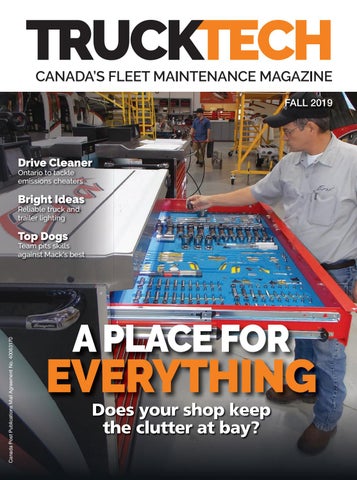
A PLACE FOR
EVERYTHING Does your shop keep the clutter at bay?
YOU NEED TRAILERS. WE GET YOU TRAILERS. Reefer trailers. Heated vans. Customized trailers. Storage trailers. Rentals. Leases.
YOU GET THE POINT. Go to trailcon.com or call 855-ROAD-RPR
is written and published for owners, managers and maintenance supervisors of those companies that operate, sell and service trucks, truck trailers, and transit buses.
FALL 2019 VOL. 4 NO. 3 Vice President, Editorial Rolf Lockwood rolf@newcom.ca • [416] 614-5825 Contributing Editors Eric Berard, Derek Clouthier, Abdul Latheef, James Menzies, John G. Smith, Managing Director Trucking and Supply Chain Group Lou Smyrlis lou@newcom.ca • [416] 510-6881 Creative Director Tim Norton tim@newcom.ca • [416] 510-5223 Production Manager Alicia Lerma alicia@newcom.ca • [416] 510-6845
TOOLS
A PLACE FOR EVERYTHING NEWCOM MEDIA INC. 5353 Dundas Street West, Suite 400 Toronto, ON M9B 6H8 416/614-2200 • 416/614-8861 [fax] CHAIRMAN AND FOUNDER Jim Glionna PRESIDENT Joe Glionna VICE PRESIDENT, PUBLISHING Melissa Summerfield CHIEF FINANCIAL OFFICER Peter Fryters DIRECTOR OF CIRCULATION Pat Glionna
Shop organization enhances productivity and safety, but don’t forget its role in recruiting and retention.
Features
Departments
Drive Cleaner Ontario to revamp emissions tests and increase focus on those who cheat
10
Bright Ideas Improve the reliability of truck and trailer lighting systems
18
TECHS TALK: Top Dogs New Brunswick team pitted their skills against Mack’s best
30
Editorial ................................................... 5 Quick Fix .............................................. 6-9 Equipment Watch ............................ 26-29 Techs Talk............................................... 30
Truck Tech is published by Newcom Media Inc. The contents of this publication may not be reproduced or transmitted in any form, either in part or full, including photocopying and recording, without the written consent of the copyright owner. Nor may any part of this publication be stored in a retrieval system of any nature without prior written consent.
27
Advertisement Bright, shiny tools and sockets are easier to keep track of than dark-colored tools that can become lost in an engine compartment.
Getting the most from a maintenance shop involves tackling weaknesses
10 trucknews.com
18
24
30 FALL 2019 TRUCKTECH 3
The gold standard in engine oil. Mobil Delvac™ diesel engine oil is technology redefined. It’s a full suite of products that help protect your engine and maximize the uptime of your fleet. Its proven protection goes beyond OEM-recommended ODI’s, making your business more efficient and your life a little easier. Discover our API CK-4 diesel engine oils at mobildelvac.ca
© 2019 ExxonMobil. All trademarks used herein are trademarks or registered trademarks of Exxon Mobil Corporation or one of its subsidiaries. Imperial Oil, licensee.
Editorial
Corrosion: OK, I’m Convinced Correspondents continue to highlight their challenges with corrosion By Rolf Lockwood
Maintenance headaches come in many colors, but as I wrote in our last issue, I was a little surprised to hear one of the country’s most experienced maintenance experts tell me that his own biggest pain in the hind quarter is corrosion. That was Jim Pinder, corporate fleet director at the Erb Group of Companies in New Hamburg, Ont., and a former Canadian Fleet Maintenance Manager of the Year. He knows his stuff. You may recall from my previous editorial that I asked him about the worst maintenance issue he faced. Corrosion, he responded, with no hesitation at all. I rather expected him to say aftertreatment systems or sensors and such because I hear about those hassles endlessly and have done for years and years. Corrosion where, I asked? “Everywhere,” he said. “Wiring, body, brakes, you name it.” We’ve had some e-mail exchanges since then, and I’ve had comments from other maintenance chiefs as well. Everyone seems to agree – corrosion is the devil. Guess I shouldn’t have been even a little surprised by Jim’s response. “Some of our biggest repair costs are related to corrosion in the wiring harnesses of our trucks, and due to the array of new safety tech spec’d on our latest equipment they are even more fragile than ever,” said one of my correspondents. Said another, “Do we suffer from corrosion? Yes, we do… We started to undercoat our trucks approximately four years ago with [product X] and two years ago we moved to [product Y] because reports suggested it was better. trucknews.com
““1616- an and nd 20-pin 20-pin cconnectors on nneectors have have ccorrosion orrrossion b build uild d iinside nside tthem hem after just a fter ju ust months ttwo wo m onths on road” o n tthe he ro oad”
“But unfortunately, we are still suffering from corrosion and it seems the product washes off even though they tell us it doesn’t. I know that the product is supposed to absorb into the metal but if that was the case, we should be corrosion-free and we are not.” He went on to say that, “…without doing intensive reports I can’t tell you our percentage of corrosion repairs, but my guess is we’d be close to Pepsi.” That was a reference to a point made in my previous editorial, namely my shock in learning that, of all work orders in PepsiCo shops, 25% are related to rust. Pinder distinguishes between corrosion and straightforward rust, saying
that “rust is a very small part of our actual corrosion issues. We still see a bit of rust-jacking on some brake shoes, streaking on paint from a bolt that has rusted, some air-fairing brackets that peel and rust, or issues in between double frames, but rust is a very small portion of the corrosion that is my biggest concern. Rust is still a slow process, though with the current de-icing materials that stick to steel it happens year-round. “The corrosion I am referring to is inside electrical harnesses where one wire in the middle of a 40-wire harness inside a loom has a porous coating, and that individual wire has turned green and the signals across it are intermittently affected or completely stopped. Or the wires inside a west-coast mirror with the turn-signal indicator incorporated rot away in 12 months. Or 16- and 20-pin connectors have corrosion build inside them after just two months on the road, causing engine codes. Or battery cables that show signs of major corrosive activity… rotting the ends completely off the cable.” In fact, he says, “Rot better explains what is happening to our equipment.” So, what can you do? Well, I can’t dive into the solutions – such as they are – with only 600 or so words to play with here, so I’m preparing a feature article on the subject. And yes, I’ll make sure that we cover the topic in next spring’s Canadian Fleet Maintenance Summit. In the meantime, once again, I’d love to have your input. Please give me your thoughts by e-mail – rolf@newcom.ca TT FALL 2019 TRUCKTECH 5
QUICK FIX
Green funding now available Natural Resources Canada is now accepting applications for funding under Phase 1 of the Green Freight Assessment Program – an initiative to help carriers identify ways to improve fuel economy and reduce greenhouse gas emissions. It provides 50% cost-shared contributions up to $10,000 to Canadian companies toward a third-party green freight assessment. Applications will be evaluated on a first-come first-serve basis, the federal agency said on its website. Submissions are due by Nov. 1.
Day&Ross breaks ground in Moncton
Linde top Canadian at CVSA championships Sgt. Benjamin Schropfer of the Nebraska State Patrol earned top honors during the recent North American Inspectors Championship [NAIC], but his Canadian peers secured top honors in several individual categories. The annual Commercial Vehicle Safety Alliance [CVSA] event gives each jurisdiction from Canada, Mexico, and the U.S. the chance to send an inspector to compete for the Jimmy K. Ammons Grand Champion Award. Brittany Linde of the British Columbia Ministry of Transportation and Infrastructure secured the Sean McAlister High Points Canada Award, as well as first place in the category devoted to hazardous materials, dangerous goods, and cargo tank/bulk packaging inspections. The latter included a focus on markings, labeling, placarding, packaging, and identification. Linde was also a member of the team with the highest combined score. Alberta Justice and Solicitor General’s Delaney Malsbury secured first place for the 37-step Level 1 inspections.
U.S. carriers dodge container tariffs The U.S. has shelved plans to apply tariffs on 53-foot domestic intermodal containers, and the American Truck6 TRUCKTECH
FALL 2019
Day & Ross recently broke ground on a new terminal to be located in Moncton, N.B. “Moncton is a critical hub for our operations. This location will play an important role in our overall growth strategy and will help strengthen our position as a leader in the transportation industry,” said CEO Bill Doherty. The facility will include an enclosed area to shield personnel from the elements during pickups. In addition to solar panels, advanced heating and cooling, and electrical upgrades to reduce diesel consumption, the office will have lots of natural light and a bright, open workspace. The terminal is expected to open in the summer of 2020. ing Associations [ATA] is clearly happy with the news. The only two manufacturers of these types of containers reside in China, meaning North American buyers would have no alternative but to absorb the higher prices. “We estimate the logistics industry would’ve paid an additional US$63 million in the first year, and nearly US$750 million more over the next decade for the equipment if these tariffs had not been rescinded,” said ATA chief economist Bob Costello.
UPS Ventures takes stake in TuSimple UPS Ventures, the venture-capital arm of United Parcel Services, has acquired a minority stake in the self-driving startup TuSimple. Together, both companies are testing self-driving tractor-trailers on a
route in Arizona to determine whether the vehicles can improve service and efficiency in the UPS network, UPS said. The work with TuSimple began with the goal of helping UPS better understand the requirements for Level 4 autonomous trucking in its network, the company said. Level 4 means the vehicle’s onboard computer is in complete control at all times, eliminating manual intervention. But current laws mean drivers would still be required in the cab to take over operations if needed. “While fully autonomous, driverless vehicles still have development and regulatory work ahead, we are excited by the advances in braking and other technologies that companies like TuSimple are mastering,” said Scott Price, chief strategy and transformation officer at UPS. trucknews.com
Daimler rolls out first eCascadias
Fuel cell research heads westward
Daimler Trucks North America [DTNA] has built its first two battery-electric eCascadias for customers in its Electric Innovation Fleet. They were built at its research and development center in Portland, Ore., and will be deployed in Southern California by Penske Truck Leasing and NFI. “This milestone in electric is important as both today and tomorrow’s technology is progressing. Our pursuit is resolute – we build for our customers,” said Roger Nielsen, president and CEO of DTNA. “Our team is incredibly proud to be leading the way for the industry, but prouder still to be working with our customers in a process of co-creation to make real electric trucks for real work in the real world.”
When fuel cells are put to the test in a pair of 140,000lb. B-trains as part of the Alberta Zero-Emissions Truck Electrification Collaboration [AZETEC] project, the motion will come through Dana’s Spicer Electrified e-Propulsion systems with TM4 SUMO HP motor-inverters. The trucks are part of a three-year, $15-million initiative sponsored by Emissions Reduction Alberta [ERA] to design and test heavy-duty, extended-range, hydrogen fuel cell electric hybrid trucks. It’s part of a $100-million investment into clean technology projects that will be put into the province’s trucking industry. “Dana is pleased to have been selected as a key partner for this enterprising hydrogen fuel project. It marks another step in the innovation continuum as the industry transitions to zero-emission transportation,” said Mark Wallace, president of Dana Commercial Vehicle Driveline Technologies. “The consortium partners share a common vision in advancing clean technologies, and we welcome the opportunity to provide Spicer electrodynamic solutions as part of these collective efforts.”
Blitz targets dangerous goods An annual inspection blitz focusing on dangerous goods expanded beyond Canada this year, as the Commercial Vehicle Safety Alliance [CVSA] extended it into the U.S. and Mexico during August’s Hazardous Material Week. Of course, the inspections are not limited to a single week. “Road inspectors check this type of transportation throughout the year,” says Marie-Josée Michaud, public relations officer for Contrôle routier Québec. Last year in Quebec alone, roadside inspectors reviewed 5,500 shipments involving dangerous goods, issuing offences for 921 of them – a violation rate of 16.7%.
Meritor completes AxleTech acquisition Meritor says it has successfully completed its acquisition of AxleTech from The Carlyle Group. The previously announced transaction enhances Meritor’s growth platform with the addition of a complementary product portfolio, the company said. The deal was worth about US $175 million. AxleTech, which generated $248 million in revenue in calendar year 2018, trucknews.com
will operate within Meritor’s aftermarket, industrial and trailer segment.
Jacobs Vehicle Systems is teaming up with Tula Technology Jacobs Vehicle Systems is teaming up with Tula Technology to further develop cylinder deactivation [CDA] technologies, which reduce engine fuel consumption and emissions. The CDA system, introduced last year, disables engine valves in selected cylinders,
Dana says its custom Spicer e-System is optimized for the Canadian market with a hauling capacity of 140,000 lb. The system’s compact design reduces weight and allows for more hydrogen fuel storage, while high-speed helical gearing provides greater overall drivetrain efficiency, Dana says. The company’s TM4 SUMO HP motor-inverter system was specifically designed for high-power applications, and for use with multi-speed gearboxes. The trucks will travel up to 700 km on return trips between terminals in Edmonton and Calgary on a single hydrogen fill. They will be operated by Trimac Transportation and Bison Transport. Ballard Power Systems will provide the fuel cell modules to power the two trucks. allowing a large engine to have the fuel economy of a smaller engine, Jacobs said. Tula is the developer of the Dynamic Skip Fire [DSF] suite of technologies, which apply advanced digital signal processing to sophisticated powertrain controls. The technology reduces fuel consumption of gasoline engines by 6-15%, according to the company. The collaboration will enable Jacobs to develop and demonstrate deactivation hardware required for diesel engines. FALL 2019 TRUCKTECH 7
QUICK FIX
Volvo, Samsung ink battery deal
Nikola secures fuel cell grant The U.S. Department of Energy has awarded Nikola Motor Co. a $1.7-million grant to advance its research into fuel cell membrane electrode assembly [MEA]. The grant is funded by the department’s Energy Efficiency and Renewable Energy Transportation Office under a recently announced program. “This award provides an opportunity for the highly talented Nikola team to leverage expertise in academia and exceptional resources within the DOE Fuel Cell Consortium for Performance and Durability to accelerate a breakthrough that will benefit the entire hydrogen and fuel cell industry and community,” said Jesse Schneider, an executive vice-president at Nikola. In this project, Nikola will bring together advanced concepts in catalysts, ionomers, proton exchange membranes and gas diffusion layers, the company said.
TOSS YOUR TORCH
> > > >
U-Bolts Brakes Exhaust Bolts Graphics
Contact us today for more information. p
www.theinductor.com 877-688-9633 8 TRUCKTECH
FALL 2019
The Volvo Group and South Korean battery maker Samsung SDI have entered into a strategic alliance to develop battery packs for electric trucks. Under the deal, Samsung SDI will provide battery cells and modules for assembly in Volvo’s manufacturing operations. The alliance will accelerate the speed of development and strengthen the long-term capabilities and assets within electromobility, Volvo said.
Alliance pushing for provincial ELDs
SAFETY CERTIFIED
Applications: > Motor Mounts > Fuel Tank Straps > Torque Nuts > Seatbelt Bolts
JW Kim, executive vice-president of strategic marketing at Samsung SDI and Andrea Fuder, chief purchasing officer at the Volvo Group, celebrate the agreement.
The Canadian Trucking Alliance [CTA] is calling on provincial transport ministers to apply a pending electronic logging device [ELD] mandate to provincially regulated carriers. As it currently stands, the ELD mandate would only apply to federally regulated carriers. “The non-compliant hours-of-service behavior shown by the carrier and driver involved in the Humboldt tragedy … is easily imitated by a minority of provincially-regulated carriers. Non-compliant behavior that leads to road safety risks knows no boundaries and certainly does not distinguish between provincially- and federally-regulated carriers when it comes to hours-ofservice regulations,” the CTA wrote in a letter sent to each provincial transport minister. “In our view, the events and timeframes in the days prior to the Humboldt collision would have been much
more transparent under an ELD regime. We must end the opportunities for this egregious and unsafe behavior regardless of whether the trucking company crosses provincial/territorial boundaries or offers services within a jurisdiction.”
Dayton Parts to open new PDC Dayton Parts has announced that it will open its third Canadian distribution center in Saint-Leonard, Que. The other centers are in Edmonton, Alta., and Mississauga, Ont. The new 50,000 square-foot facility will house the complete Dayton Parts product portfolio for greater ordering flexibility and shorter lead times, the company said. “The Saint-Leonard distribution center allows us to provide improved parts availability for our customers to speed repairs and increase vehicle productivity,” said Paul Anderson, president and CEO for Dayton Parts. trucknews.com
Alliance Truck Parts adds 11 value lines Alliance Truck Parts is expanding its network and product portfolio. The company has added more than 11 new value product lines to its portfolio. They include items ranging from diesel exhaust fluid filters to air brake compressors and slack adjusters. The company has added 13 new standalone retail stores in North America and has expanded retail areas for 22 different dealerships.
LUBRICANTS
Discover Total Heavy-Duty Rubia Optima Range
Navistar opens engineering hotline Navistar has enhanced its dealer resources by launching an engineering hotline that will give International dealers quicker access to product experts. The hotline can be reached through a simple phone call from any International dealer. Calls are immediately directed to an application engineer who listens to the dealer’s request and offers support. During a pilot phase conducted earlier this year, the hotline quickly amassed well over 100 calls from dealers, the company said. Typical phone calls ranged from general questions on severe service truck configurations to advanced, application-specific questions from customers.
Eaton extends clutch warranty Eaton is extending the manufacturer warranty periods for its aftermarket clutches. The Advantage Self-Adjust and Easy Pedal Advantage clutch standard warranties are increased to three years/unlimited miles from two years/unlimited miles. The standard warranty periods for EverTough Self-Adjust and EverTough Manual-Adjust clutches are increased to two years/ unlimited miles from one year/unlimited miles. The new warranty went into effect in the U.S. and Canada for the designated clutches purchased on or after July 1, 2019.
FGI acquires Pinwood business Winnipeg, Man.-based Fort Garry Industries [FGI] has acquired Pinwood Truck Parts, making it a wholly-owned subsidiary as of June 2. “The addition of the Pinwood stores under the FGI banner will strengthen our footprint in the Ontario market and help provide seamless product offerings and services to customers in Southwestern Ontario,” said Robyn Spitzke, president of Fort Garry Industries. Pinwood has three locations in Ontario, including Chatham, Sarnia, and Comber. Each will continue to operate under the Pinwood name until Dec. 1 and will then amalgamate under the FGI brand. TT trucknews.com
total-canada.ca
FALL 2019 TRUCKTECH 9
EMISSIONS
DRIVE
CLEANER Ontario to revamp emissions tests and increase focus on those who cheat
BY JOHN G. SMITH
P
lenty has changed since Ontario first rolled out its Drive Clean emissions tests in 1999, not the least of which is the cleaner air that passes through exhaust stacks. In the years since the program was introduced, cooled exhaust recirculation [EGR], diesel particulate filters [DPFs] and selective catalytic reduction [SCR] have become commonplace in heavy-duty vehicles. Sulfur levels in diesel fuel have dropped to 15 ppm, down from the previous 500 ppm, and drivers found themselves dispensing diesel exhaust fluid [DEF] at fuel islands as well. Measured levels of smog-producing NOx and flakes of particulate matter have plunged, and regulators are now turning their attention to greenhouse gas emissions. Each tightened limit and related technical change introduced new maintenance demands, of course. The EGR led to higher under-hood temperatures; new system sensors have been known to trigger incorrect fault codes or fail outright; diesel particulate filters need regular regens and cleanings, lest they leave trucks to limp back to the shop. This list goes on.
10 TRUCKTECH
FALL 2019
But the changes have undeniably led to cleaner air. More than 90% of heavy vehicles reportedly pass today’s emissions tests. Provincial regulators still believe there is more to do, however. While Ontario eliminated the Drive Clean program for light-duty vehicles in April 1 – following in the footsteps of B.C.’s now-defunct Air Care program – the program’s heavy-duty focus remains. Heavy trucks must pass the Ontario emissions test before renewing a registration if the vehicle is seven model years old or older. The same is true for any equipment older than the current model year if the truck changes owners. Opacity tests that measure the density of vehicle exhaust, reflecting the levels of unwanted particulate matter, are based on related model years. Most equipment that has a Model Year of 1990 or older has an opacity standard of 40%, while newer vehicles face a stricter standard of 30%. If a measured opacity reading is less than 20%, the truck can skip a year before returning for another look. But there are also plans to increase the scrutiny on those who are trying to bypass emissions-cleaning technology in the name of avoiding maintenance costs.
Updated emissions tests coming An updated version of the testing regime for heavy-duty vehicles is expected this fall, confirms Gary Wheeler, a spokesman for the Ontario Ministry of Environment, Conservation and Parks. The province has also introduced recent regulatory changes that extend the reach of emissions-related penalties to out-of-Ontario carriers. Plates will be seized no matter where an offending truck is registered. “A new, enhanced and re-designed emissions testing program will focus on improving emissions testing on heavy-duty diesel vehicles and will take further action to prevent tampering and fraud,” he said. Ontario records about 220 cases of tampering with vehicle emissions controls per year, the ministry confirms. Most of those involve inexpensive changes, such as blocker plates in the exhaust gas recirculation pipes. More sophisticated or costly tampering activities, such as reprogrammed engine electronics, tend to be linked to larger fleets that have more resources, Wheeler added. Unlike the former program for light-duty vehicles, the heavy-duty trucknews.com
EMISSIONS
Drive Clean tests don’t include conditional pass allowances. This means that any heavy-duty vehicles have to be fully repaired to get the passing grade before being registered. But some garages must be giving trucks a passing grade even if emissions equipment is modified or missing. “Part of the redesigned program will include strengthened enforcement through increased on-road inspections, which will focus on heavy-duty diesel vehicles and heavily-polluting modified vehicles to ensure that emissions control components are installed and functioning,” Wheeler said. There are plenty of truck owners cheating the systems, observes Rick DiBiase of N&R Garage in Toronto, referring to changes he has come across such as add-on units that alter the fuel settings. Those who provide such systems are also blatant about it, he adds. “Just go online and type it in.” But DiBiase is also frustrated by the way the province pulled the plug on the light-duty emissions tests. N&R Garage had participated in Drive Clean for decades, and invested about $30,000 in the equipment such as opacity meters, along with $300 in monthly maintenance fees to do the work. But with a stroke of the premier’s pen, the revenue from 50-75 tests per week evaporated. The only tests these days come in the form of a couple of heavy-duty tests per week. “We heard through the papers,” he says of the announcement. “It was a good program ... It did what it was set out to do.”
The cost of Drive Clean The Ontario Trucking Association [OTA], the industry’s largest lobby group in the province, is actively supporting the idea of on-road crackdowns, but it balks at any thought of annual Drive Clean tests for the broader industry because of the majority of trucks that pass the tests on the first try. “In remote areas of the province, the test became the classic symbol of wasteful, government red tape. Fleets routinely questioned why they should trucknews.com
lose one or two days of service productivity for a test their trucks would, statistically, nearly be guaranteed to pass,” the association said in a written submission to the Ministry of Environment, Conservation and Parks. “Such a test could take up to three hours per vehicle and – as was the case with opacity Drive Clean tests – the available infrastructure is limited to larger fleets and garages. The majority of small and medium fleets, especially those in remote communities, would be left to grapple with the heightened operational challenges and costs. “Unless there is strong empirical evidence to support the benefits for opacity testing and/or [On-Board Diagnostics] testing of all heavy trucks, OTA believes it is time to phase out the heavy-duty program for the same reasons the light-duty Drive Clean program was phased out – the overwhelming majority of vehicles pass the test. OTA believes complete OBD testing [two to three hours per truck] or opacity testing of the Ontario trucking fleet is not an effective approach to dealing with trucking industry environmental compliance.” In the meantime Lak Shoan, the association’s director – policy and in-
dustry awareness programs, says there will be plenty of work to be done before changes announced this fall take effect. “This isn’t going to happen overnight. It’s probably another year or two away before we decide on a final policy,” he says, noting how the province is assembling groups of stakeholders who will help establish a new regulatory framework. The OTA is hoping to see a program that focuses on vehicle electronics as part of an annual safety. That would help to identify cheaters by looking at factors such as the last time a regen was triggered, and recognizing key fault codes linked to the environmental system tampering. Such a test would last five to 10 minutes and require less infrastructure than full OBD tests, the association adds. It also wants the tests to look at the settings for speed limiters, which are mandated in the jurisdiction. “From the studies that have been done, speed is a significant contributor to GHG emissions,” Shoan says. “There’s always going to be a need for enforcement,” he adds. “There isn’t very much use for introducing new legislation or policy if they’re not going to be enforced on all carriers.” TT
SMOKE SOURCES High levels of exhaust smoke can be linked to a variety of factors including: • Restricted air filter • Improper injection timing • Clogged, worn or mismatched fuel injectors • Faulty or maladjusted fuel injection pump • Defective or maladjusted puff limiter • Low air box pressure • Improperly adjusted valve lash or governor
• • • • • • •
Air manifold leaks Malfunctioning turbocharger Malfunctioning after cooler Defective air fuel controller Poor fuel quality Improper driving gear Defective computer controls [sensors, wiring, etc.] • Clogged exhaust aftertreatment devices or spent catalyst
Source: British Columbia AirCare On-Road Program [ACOR] FALL 2019 TRUCKTECH 11
THE FLEET TECHNOLOGY SHOWCASE October 28-31, 2019 • Georgia World Congress Center, Atlanta, Georgia
nacvshow.com
KEEP YOUR FLEET IN
THE FAST LANE CAN’T-MISS NEW SHOW FEATURES
³ Connectivity Zone ‘Ask the Expert’ Workshops ³ 3 On-Floor Education Theaters ³ Off-Floor Conference Programs ³
REGISTER NOW with code
TTECH19
for your free expo hall pass!
Q The biggest class 4-8 vehicle manufacturers in one place Q 500+ exhibitors Q 530,000 sq. ft. of exhibitors expanded to two halls Q Enhanced educational programming
TOOLS
A PLACE FOR
EVERYTHING Shop organization enhances productivity, safety, and can even support recruiting and retention BY ERIC BERARD
Optimizing space
Bright, shiny sockets are less likely to be lost by technicians.
T
he way a truck maintenance shop is laid out and organized can make a major difference in the uptime it can help to realize, making it a vital profit center. Good organization will also benefit technicians’ safety and help attract new ones, finding comfort in a logically arranged workstation. A clean floor that’s free of obstacles is the first common denominator to a successful shop, regardless of its age or 14 TRUCKTECH
FALL 2019
size. Grease or oil deposits make surfaces dirty, but slippery as well. Hand tools, air lines or creepers lying on the shop floor are accidents waiting to happen, and they’re also counterproductive if technicians keep looking for the equipment they need. “Somewhere in the world, there’s this massive collection of 10-mm sockets,” says Jeff Lindsay, a Mac Tools distributor out of Orangeville, Ont., referring to some tools’ ability to just vanish.
As the fixed operations manager of the multi-store Kenworth Québec dealership, Sybille Lafrance says she and her team took advantage of their experience in existing locations when preparing the layout of the new facility in StAugustin-de-Desmaures that was built from scratch. Engine oil and various fluids are accessible via hose reels hanging from the ceiling. “The technician brings it down directly to the vehicle,” Lafrance says. The vertical configuration saves space and minimizes the risk of spills or tripping hazards associated with the use of funnels or jugs being carried around. National Tank Services – Trimac’s maintenance division – also uses hose reels for fluid access, says vice-president Jan Cybulskie, who oversees 44 shops throughout North America. Although, most of its sites are not brand new. “Retrofitting some of these facilities is still a little bit of a challenge,” Cybulskie says. But he and Lafrance share many organizational methods. For obvious reasons, creepers need to be stored upwards when not in use. They can be hung to the side or left leaning on the tractor or trailer being serviced, Lafrance and Cybulskie suggest. Wheel chocks can also be handy without obstructing the shop floor. Kenworth Québec had horizontal bars trucknews.com
TOOLS
Kenworth Québec’s techs work in an ergonomic, organized environment.
“Even carriers with small shops can optimize what they do with simple management methods”
similar to towel racks welded on work bench sides, where the chocks can be stored close at hand. While the vast majority of mechanics and technicians across the country use their own tools and toolboxes, some tooling – ratchet heads, drill bits, torque wrenches, weights used for precision engine re-assembly, and charging trucknews.com
system testers – is usually shared by maintenance personnel and should be stored in a dedicated room or space so it’s always easy to find. “We try, where possible, to have commonly used tools centrally located within our facility to minimize the back and forth,” Cybulskie explains. “When things are placed in a clean and visually logical manner, it’s easy for anybody to find them,” Lafrance adds, referring to methods such as color codes for tool categories.
Painted markings on the floor can be a good way to identify the place where items such as jack stands should be put back after use. Drawn outlines on perforated boards with hooks can also help identify the specific location of a given hand tool. Still, the policies to optimize shop spaces seldom restrict the shape or size of a technician’s personal toolboxes. “From an overall recruitment perspective, if we started stipulating the sizes of toolboxes in a pretty tough employment FALL 2019 TRUCKTECH 15
TOOLS
market, I think it would impact our ability to hire new employees,” adds National Tank Services’ vice president. As he visits the shops that form his customer base, Lindsay sees how attached mechanics are to their gear. “Tool storage is a funny thing. There’s
customers that will spend a lot of money on tools and then there’s some who will spend a lot of money on storage,” he says. Lindsay also recommends using colors to help keep track of tools. He gives the example of a dark-colored flashlight that can be forgotten and unnoticed in
Toolboxes can represent a technician’s career investment. the shadows of an engine compartment. A shiny green or other bright color will be more convenient, he says. Mac Tools doesn’t sell any of the “black chrome” ratchet sockets for the same reason. “Colors, shiny chrome, [they] make a big difference in technicians losing tools,” he insists.
PREMIUM BRANDS. LOCAL EXPERTS. THE RIGHT PEOPLE. THE RIGHT PARTS. THE RIGHT PLACES. There’s no beating the ease of doing business with your trusted local truck parts distributor. As part of North America’s Leading Truck Parts Network®, your local VIPAR Heavy Duty Parts Professional offers the brands you want and the expertise you need, with the strength and resources of a network of over 620 locations throughout the U.S., Canada, Mexico, and Puerto Rico.
FIND A VIPAR HEAVY DUTY PARTS AND SERVICE PROFESSIONAL AT VIPAR.COM
16 TRUCKTECH
FALL 2019
Ergonomics One trend that Lindsay has noticed is the wider use of small carts to carry around tools and parts needed for a specific job, leaving the technician’s main toolbox to serve as the main storage area. Lafrance agrees on the convenience of the multistage carts with lockable casters. The technicians she works with use them to place parts in a logical order, such as when they’re tearing down an engine. Those who take over the job will quickly understand what has been completed, and be able to roll everything into a different service bay if needed. Each of Kenworth Québec’s new service bays has also been standardized to ensure a familiar workspace for every employee. Access to electricity should also be taken into account in such spaces. Parts catalogs have been replaced by laptops at workstations, and technicians use a growing number of battery-powered handheld diagnostic tools that all need to be recharged at some point. trucknews.com
TOOLS
“It definitely had an impact on the way we designed the location and number of outlets,” Lafrance says, referring to the dealership design. While magnetized toolbox surfaces or tools could help keep those tiny screws and springs in place, there’s a downside to such a solution, Lindsay warns. A magnetized socket or wrench could cause electric interference to highly sensitive electronic components like an engine ECU because of the threat of magnetic induction, he says. If you’re testing a component, the magnetized tool could lead to an incorrect reading, whether it’s measured as voltage or milli-amps, and potentially affect the functioning of the vehicle. The same caution should be applied when using devices equipped with a positioning magnet at the back. The location of the compressor that drives air tools can also make a difference in productivity. Lafrance stresses that air lines should be of similar length so that each technician benefits from equal pressure. As compressor noise can also irritate workers, Cybulskie suggests that it can very well be installed outside the building. Swinging glass doors similar to those used in restaurants are a great way to facilitate access and exit of the shop, especially when a technician has his hands full and can’t turn a knob. “In the diesel truck industry, parts are often large and heavy,” Lafrance says, referring to the need. Meanwhile, vending machines located at strategic locations within the shop can be used to access high-volume consumables and avoid stock outages with the support of computerized inventory management. “We use them for fast-moving items such as tie-wraps or collars, things that mechanics use on a regular basis. They enter their employee code, take the quantity they need, and it’s automatically added and billed on the work order,” Lafrance says. “We can monitor usage and set thresholds in terms of how many and how often an employee can access it,” trucknews.com
Cybulskie points out, referring to the secured system. And according to Kenworth Québec’s Lafrance, shop employees should be consulted from the very beginning and on an ongoing basis when it comes to organizing their work environment.
“Everyone’s a winner when the whole team is involved in the process. People who are in the thick of it have great ideas,” she says. “Even carriers with small shops can optimize what they do with simple management methods.” TT
Digital Tire Monitoring Increasing Uptime, Decreasing g Costs Why Invest in Tire Pressure & Temperature mperature Monitoring? Improve Tire Runout Minimize irregular wear, one of the primary reasons for early tire removal. Save Fuel How much do you spend per month on fuel? What would 1% savings mean to your bottom line?
ContiConnect ® Yard Reader Digital Tire Monitoring with Web Portal
Save Labor and Tire Maintenance Costs Reduce time spent on manual tire pressure checks and repairing tire issues caused by underinflation. Reduce Roadside Breakdowns Avoid downtime, late deliveries, and cost of approximately $800 per incident. Improve Safety Help protect your drivers and other road users. Learn more about our complete line of Digital Solutions offerings at www.continental-truck.com.
GENERATION 3 CONSTRUCTION TIRES ARE NOW AVAILABLE: Conti HSC 3
Conti HAC 3 Conti HDC 3
Our Generation 3 Construction Line is engineered specifically to meet the needs of the construction environment and its tires come pre-equipped with sensors. The only cost to the fleet is to add a receiver solution, such as ContiConnect® or ContiPressureCheck®, allowing fleets to monitor their tire data and improve tire runout. Matching retread available for Conti HSC 3 and Conti HDC 3.
Lowest Overall
Driving Cost
One of the largest automotive suppliers and tire manufacturers in the world, Continental develops pioneering technologies to make fleets safer, more efficient, and more connected. With innovative tire technology and digital fleet solutions, Continental optimizes tire lifecycle management for the Lowest Overall Driving Cost.
Commercial Vehicle Tires | www.continental-truck.com
Contact Your Continental Representative Today! Need a Representative? Call 1 (800) 450-3187
FALL 2019 TRUCKTECH 17
LIGHTING
SEEING THE
LIGHT
Advances in lighting technology, and good maintenance practices, can go a long way toward eliminating lighting-related repairs BY JAMES MENZIES
L
ighting issues continue to be a significant cause of out-of-service violations for commercial drivers, despite improvements in technology and reliability. During Roadcheck in 2018, 12% of vehicles placed out-of-service were done so due to lighting issues. [Roadcheck 2019 figures have not yet been released]. This despite the fact LED [light-emitting diode] lights last much longer than incandescent bulbs and are gradually taking over the market on truck and trailers. But preventive maintenance can go a long way toward ensuring lighting issues don’t place trucks and trailers out-of-service at roadside.
Keeping lights out of harm’s way One way to ensure lights are not the culprit for an out-of-service designation at roadside is to keep them out of harm’s way in the first place. Nathan Holt, marketing manager for Ex-Guard front-end protection systems, says he’s seen headlight repairs that used to cost about $200, now costing $700$800. A front-end protection system, or moose guard, can protect the headlights and front fenders and bumper, but needs to be weighed against the cost penalty associated with the extra weight. When operating vocational trucks, there are different options for how lights are mounted to the truck. The Peterbilt Model 567, for instance, has headlights that are not contained within the fender. This makes them easier to service and replace when 18 TRUCKTECH
FALL 2019
Meredith Vincent, Ontario sales rep for Truck-Lite, shows off a new headlamp that has heating coils in the glass to melt snow and ice. damaged, but does it also make them more vulnerable to damage since they extrude from the body?
The case for LEDs LED lighting has become a no-brainer in most applications, as prices have decreased. They draw less current than incandescent bulbs and last much longer. They also provide greater visibility and in the case of headlights, a truer, whiter, brightness. “Incandescents are old technology,” says Meredith Vincent, regional sales manager, Ontario, for Truck-Lite. “That’s what fleets and owner-operators used forever, because that’s what was available. Now that the LED is readily available and more cost-effective, it’s lower maintenance and takes years of usage before you need to change anything.”
But to get the full advantages of an LED, as with any other component, it’s important to choose quality product. Brent Edmonson, a technician with Vision Truck Group, says the market is rife with poor-quality offshore LED lights. “They have vibration problems, they get full of moisture, the lenses crack and discolor,” Edmonson says of poor-quality LED lights. Even body builders will frequently install poor-quality LED lights on equipment, he notes. “You have a nearly $1-million concrete pumper that will have crappy Chinese LEDs on it,” he says. “But there are lots of good ones out there. Grote makes LEDs right here in Kitchener-Waterloo. There’s a lot of good stuff made here in North America but they insist on putting cheap crap on, and if you get a year out of it, consider yourself lucky. LEDs can be good for 10 years, or the life of trucknews.com
LIGHTING
The LED headlamps on the new Volvo VNL have a fan at the rear, that blows heat to the front of the lamp when necessary to help melt snow and ice.
the truck – but hardly anyone, it seems, buys the good ones. It’s frustrating.”
But can they handle the cold? One knock against LED lighting is that they don’t generate heat at the front of the lamp, leading to the possibility of snow and ice accumulation. It’s a debatable subject, but one that manufacturers have taken steps to address. When Volvo introduced its new VNL, it came fitted with innovative LED headlights equipped with a fan at the rear of the lamp. When ambient temperatures decline, the fan automatically turns on, pushing the heat from the rear of the lamp to the front, keeping the headlight clear of any snow and ice. Truck-Lite has since come out with a solution of its own – an LED headlight with heating elements installed right in the glass. “One thing I do hear that fleets and owner-operators don’t like [about LEDs] trucknews.com
“LEDs can be good for 10 years, or the life of the truck – but hardly anyone, it seems, buys the good ones. It’s frustrating.” – Brent Edmonson, Vision Truck Group
is, they don’t heat up from the front like incandescents do,” says Vincent. She notes the diodes in an LED get very hot, and the heat needs to be drawn away in order for the light to survive. This is done through heat sinks at the rear of the light. Rather than push the warmth to the front, like Volvo does, Truck-Lite draws the heat out the rear of the light but has heating elements within the glass to melt any snow and ice. She refers to heated LEDs as the “biggest advancement” in LED lighting at the moment. “Everybody asks for it,” she says. “Not everybody is okay with the price increase.”
For those who aren’t willing to shell out extra money for the convenience of heated lights, she says customers should simply be diligent about keeping them wiped clean. “If driving with halogen headlights, even though they do warm up in the front, it’s still not going to melt that much snow,” she reasons.
Brand new doesn’t always mean ‘good to go’ When taking delivery of new equipment, don’t always expect the lighting system to be road-ready. It’s a common mistake that can lead to downtime, FALL 2019 TRUCKTECH 19
Discover what more than 900,000 visitors did last year
We deliver
MORE BLOGS
MORE VIDEOS
MORE NEWS
truck news.com
STAY UP TO DATE ON INDUSTRY NEWS, TRENDS AND EQUIPMENT RELEASES Visit the industry's most popular website
LIGHTING even on equipment that just arrived from the factory. Vincent says lighting manufacturers do their best to educate trailer OEMs on the proper installation and preparation of lighting systems, but still recommends fleets inspect new equipment upon taking delivery. “A fleet gets a brand new trailer, and sometimes they don’t do their own PDI [post-delivery inspection],” she says. “It’s important to do that, because you can look at all the connections to make sure, yes, they have been prepared with dielectric compound. If they go in dry, it makes it that much easier for contaminants to get into the connection, even if it’s a good connection. No one wants to hear that – it’s a labor cost to do that – but if the electrical system is not working, the whole vehicle is not working.” Edmonson has had similar experiences in his own career. “I find, even when new, there’s never enough dielectric grease on any of the connections, especially the taillights,” Edmonson says. “When I buy a truck or trailer, I pop out every light, put dielectric grease on all the connections. Make sure everything is nice and sealed up.”
BRAKES
Dayco Heavy Duty. Your Global Partner from OE to the Aftermarket.
Common mistakes in the shop Since corrosion is the number one killer of lights and wiring harness connections, Vincent says it’s important to make inspecting connections and applying dielectric grease when necessary, part of the routine maintenance on a truck or trailer. Mistakes she frequently sees in the field include not using enough dielectric compound, or using an alternative product such as brake clean, which is conductive and shouldn’t be introduced to the wiring system. When a light isn’t working, she suggests troubleshooting the electrical system before assuming the light itself is to blame. “It could be plugged in incorrectly, or a connection could be loose. There are a lot of variables why [the Electrical tape should not be light isn’t working],” she exused on wires, as it can be plains. penetrated by moisture. Asked what mistakes Edmonson has seen in the shop, he rhymes off “Too much electrical tape, not enough dielectric grease, and not enough shrink tube.” It’s important to seal out moisture through proper techniques rather than slapping on electrical tape, he emphasized. “Usually, the more electrical tape you see, the worse things are going to be. There’s usually a disaster hidden underneath the tape. Tape doesn’t seal moisture out, it really just holds it in,” he says. “You want to use shrink tube. They have to be sealed, water and air tight. You have to use dielectric grease and you have to make sure the wiring is secured and isn’t going to rub and chafe on something. You also have to keep them away from the heat of the diesel particulate filter, the exhaust, all the new emissions equipment. They’re having to do a tougher job in a worse environment.” TT trucknews.com
www.DaycoAftermarket.com
FALL 2019 TRUCKTECH 21
’LL
ETS ADG G , S O GIZM VING O M U’RE R YO E H T WHE
, WE LINE M O T OT HE B OR T
ERE.
U TH
YO GET
g nnin nd ru uty a p u d leet avy- rs our f e of he filte t ep y n n e i l k a cool g to oad site tryin as a br lics and , on the u’re u h d a o a r y s o d r r e hen ® Filt el, hy on the ant w IX s n, fu ou w time. W smissio r vehicle cess. y g n hin ran suc you dow air, t last t eep ad to The ecessary udes oil, nt. K n the ro e l m om t n c s o ers.c is un ts that in our inve ur fleet ixfilt w c o y y u t d c pro keep rote will p ld — and that e i f the or in
SUSPENSION
SHOCKING COMFORT Link promises a smooth ride with smart ROI Cabmate suspension
L
ink Mfg. is promising drivers a smoother ride than ever before, launching the ROI Cabmate semi-active cab suspension that responds to everything from rough roads to harsh crosswinds. Company president Jim Huls refers to it as nothing less than a “revolution in computer-controlled suspension systems.” The heart of the ROI Cabmate is an electronic control unit [ECU] that draws data in real time from an accelerometer, which monitors cab motion, and a position sensor that tracks the cab’s position and velocity relative to the frame. The underlying algorithms are then used to adjust the suspension’s shock absorbers by filling or exhausting the air springs. The end result absorbs the road shock and vibration normally transmitted through the frame and solid cab mounts, generating a quieter and smoother ride. “It’s a chain reaction that happens 200 times per second,” says Michael Hof, vice-president of new business development. “Drivers and passengers immediately have a very soft shock when traveling on a smooth highway, and a very stiff shock when driving on uneven or off-road terrain. The system deals with unexpected encounters, like potholes, in real time.” “The shock plays a bigger role in the new system than the air spring does,” he adds. “The air spring provides the cushtrucknews.com
ion, but the shock is going to control the severe [events].” The added electronics draw less than 10 watts of power. While such electronic shocks are found in automotive applications, this will be unusual for trucking. “The semi-active damper provides access to a range of damping force at a given velocity – not one set value based on tuning,” says Bill Ott, Link’s vice-president of engineering. The traditional approach usually sees the suspensions tuned to a specific route. This may ensure the smoothest-riding twomile journey the truck can deliver, but road condition varies dramatically.
Competitive with premium seats Some truck owners opt for premium seats to smooth out a ride, and these options work by overfilling and dumping air bags, says Hof, who spent 20 years in the seating industry. But there are limits to that. “This only protects the driver and the occupant, but what about the cab?” he asks. The steering wheel, shifter and pedals continue to move around, as do any occupants on the bunk in the sleeper. Links says the ROI Cabmate Semi-Active Cab suspension will be cost-competitive with the seating, too. “They can expect to spend less for the semi-active suspension systems than
they would for two advanced seating systems,” Hof says. “We’re hoping to have this stay below [US] $2,000 to our end users.” A bolt-on retrofit version is to be available by the middle of next year, and negotiations are underway with original equipment manufacturers OEMs. Link Mfg. has already completed about two million miles of on-road tests using 20 units running with CR England, Ploger Transportation, Valley Transportation Service, and Mexican-based Transportadora Consolidada. “It’s one of the products that I think is going to have an impact on the overall efficiency of our fleet and driver quality of life,” says Joel Morrow, Ploger Transportation’s head of research and development, and senior driver. With the smoother ride, the fleet may be able to shorten truck wheelbases. And that would lead to a tighter gap between tractors and trailers to improve fuel economy. The systems could also solve issues where restarting anti-idling equipment rocks a cab and wakes drivers with a jolt of adrenaline, thinking someone has backed into the cab, he says. “You generally don’t get back to sleep after that.” “It’s maintenance-free. We don’t need to interact,” adds Captain Fausto Velazquez, president and CEO of Transportadora Consolidada, which has been responsible for 325,000 miles of test data. Link’s existing Cabmate suspensions have been on the market since 1980, and the company manufactured its two millionth unit this May. A traditional Cabmate includes the shock absorbers, air springs, height control valve, and linkage between the cab frame and chassis. Control rods maintain the stability, and the air in the spring controls the cab’s bounce. Expect more to come under the ROI brand, which refers to Road-Optimized Innovations. “It represents a product category that’s designed to enhance the performance of Link’s traditional suspensions through electronics,” Hof says. “With this new technology we think we have an even better system than what we have today … It’s pretty special.” TT FALL 2019 TRUCKTECH 23
All about maintenance management Advertisement
Organize work efficiently Getting the most from a maintenance shop involves tackling weaknesses Defining and structuring tasks is fundamental to the success of a maintenance shop. Then it’s a matter of establishing the role of the specialists and training them adequately. Their effectiveness influences the performance of the garage. Also, rethinking and updating business processes, and aiming for the best results as soon as possible -- and communicating and sharing information in real time -- is crucial at all levels. For many of those points, a Computer-Assisted Maintenance Management System (CMMS) remains an unparalleled solution.
A lean shop 1 Sort
2 Set in order
5 Sustain
5S
4 Standardize
Good planning encourages the use of intelligent inventory management. The Lean approach helps by reducing inventory, costs and losses, while ensuring the presence of the required equipment.
Empower staff
3 Shine
These changes lead to ongoing tasks at a lower cost while empowering people to achieve the desired results in a timely manner.
Support for success
Priority and schedule
Method 5S (5S methodology)
Identifying the workload encourages prioritization, task planning and a healthy organization of resources so that the right person is used for the right job, in the right place, at the right time.
A careful analysis and adaptation of the work areas on an established system such as the 5S method is vital. By re-evaluating all facets of the workspaces, each specialist has an optimized environment for his task.
A CMMS is one of the best tools to increase garage performance. Its use brings several advantages such as strict follow-up of the business process, optimized communication, and a massive reduction of the work backlog. Then the focus turns to the tasks being accomplished.
Fleet maintenance management software Work orders
Invoicing
Mechanic's mode
Warranties and claims
Inventory
Planning
Units
History
Tire management
Fuel management
datadis.com
1.800.463.4043
ENGINE OIL
SMOOTH HORIZONS Petro-Canada testing 0W20, reports smooth shift to CK-4
P
etro-Canada Lubricants is actively exploring the limits of heavy-duty engine oil, and early tests with a 0W20 prototype are just the beginning. “We’ve got these oils in real-world trucks today,” said product specialist John Pettingill, during a media briefing at the Honda Indy in Toronto. “It’s super exciting because you don’t see this … that’s passenger car language, but we’re talking heavy-duty here. “We’re asking how low can we go with viscosity, and what’s the point of going lower?” he added. It’s all about striking a balance between reducing friction in the name of fuel economy and creating a protective coating between metal surfaces. The CK-4 and FA-4 oils on the market today have High Temperature High Shear [HTHS] limits between 2.9 and 3.5 cP [centipoise] – a measure of viscosity. Petro-Canada engineers wonder where they can go from there. It’s all part of a steady downward march in terms of viscosity. Most engine manufacturers began filling their sumps with 10W30 oils rather than 15W40 formulas because of benefits such as easier cold starts and improved cooling capabilities. In general, the fluids just flow better and still protect components. “We have embraced the 30s, they’re definitely taking off,” Pettingill said.
CK-4 and FA-4 oils The trucking industry certainly seems to have embraced the latest CK-4 oil category. “It by far was the largest industry change in the last 10 years,” said Barnaby Ngai, category manager –
heavy-duty engine and driveline oils, referring to the December 2016 rollout. “Overall we feel it’s been a very successful transition in the industry in general, and specifically to us.” He says Petro-Canada Lubricants has maintained its market share despite competitors that continued to offer the previous generation of CJ-4 oil for an extended period of time, too. “CK-4 is just that much better than CJ-4 – fully back serviceable,” he said. “Why add another level of complexity?” Still, buyers have been slower to embrace the corresponding FA-4 engine oil formulas, with market shares measured in single digits despite the promised fuel economy gains. “It’s an adoption rate we’ve fully expected,” Ngai said, noting how some engine manufacturers have yet to make the transition. But field tests continue to demonstrate how well the CK-4 and FA-4 formulas work in the meantime. Petro-Canada Lubricants tests conducted in four Detroit Diesel engines operated by one fleet, for example, are showing promising results in terms of base numbers and acid numbers. And the base numbers are vital when it comes to addressing the acids that are created as fuel burns. “When the base number is just about equal to the acid number that’s generally where you’ve used up your base reserve,” Pettingill explained. Measured iron levels are also at just 60 ppm after 100,000 km of service, and that’s just over half of a condemning limit of 100 ppm. Another fleet boasting gross vehicle weights closer to 140,000 pounds is see-
ing positive results with Navistar MaxxForce engines. Drain intervals there are stretching 10,000-30,000 km beyond the points that competing products would be drained, Petro-Canada says. Bigger loads lead to bigger stresses, too. “When you have more of that combustion, you’re going to generate more acids, you’re going to be generating more wear,” Pettingill said. A Man racing truck in Europe is pushing Petro-Canada’s 20W60 oils further still. After six races, the oil stayed within grade, while iron limits were under 20 ppm. “They drive those trucks flat out,” he added. Commitments to research and development are clearly continuing in the wake of the company’s purchase by HollyFrontier more than two years ago. “They’re really putting money where it needs to be,” said global category director Asif Aleem, noting that the company invested $2 billion to acquire Petro-Canada Lubricants, Sonneborn, and Red Giant Oil. “They’ve invested heavily and they’ve invested smartly.” For now, that means a focus on the CK-4 and FA-4 categories. But even those categories will need to change in time. “They’re hoping to get, from what I understand, 10 years out of it,” Pettingill said, referring to the way evolving emission limits tend to drive the formal requests from engine manufacturers. “But it takes five years to get that going.” Oil suppliers are looking to the horizon, however. Pettingill saw the first email to reference a Proposed Category 12 oil a couple of weeks ago. It’s coming, even if a deadline has yet to be set. TT FALL 2019 TRUCKTECH 25
EQUIPMENT WATCH GEPI SǺIVW [IMKLXW MR VIEP XMQI Blue Ink Tech’s BIT Air Scale offers drivers access to axle and gross weights in real time, through a related app. Using just two wireless sensors mounted on T-fittings, the scale can install in less than 15 minutes, the company says. The sensors themselves are installed directly into the suspension’s air line without any additional wiring. Once sensors are in place, drivers weigh the truck when it’s empty and full and enter those weights into the app. The system will then read axle and gross combination weights with 99% accuracy, and even calculate the weights on steer axles.
Carriers can monitor the weight of all equipped trucks through a web portal, which combines data from other Blue Ink Tech systems to monitor weight, location, tire pressure, and available hours of service in one place.
MRGL MQTEGX [VIRGL HIPMZIVW XLI WTIIH The Ingersoll Rand 2115QXPA 3/8-inch impact wrench promises to be the fastest tool in its class. The tool is ideal for working the bolts inside vehicles, repairing side panels, and working on engines, the company says. The 2115QXPA boasts a free speed of 15,000 rpm and delivers 300 lb.-ft. of maximum reverse torque. Speeds are managed through a feathertouch trigger, while a power regulator lets technicians 26 TRUCKTECH
FALL 2019
7]HIVƶW 7]HIV,]HI ETT RS[ EZEMPEFPI MR (EREHE Ryder’s RyderGyde app, now available in Canada, offers quick access to commercial truck rentals and can even be used to schedule maintenance appointments in less than 60 seconds. Recent enhancements to the roadside vehicle repair functions include a roadside wizard, which allows drivers facing a vehicle breakdown to scan a vehicle identification number and send information about the issue and location to a maintenance dispatch center. Fleet managers can use RyderGyde to manage vehicles that need servicing and group them by importance. Vehicle odometer readings and telematics data are combined to flag vehicles that are due for maintenance, while a scheduling feature tracks upcoming preventive maintenance appointments. Ryder customers can also use the app to log their fuel receipts using image-reading technology for fuel tax reporting. Users in the U.S. can even view contracted fuel rates and those from other fueling stations. RyderGyde is available for iOS and Android devices and can be downloaded in the App Store and Google Play. adjust the torque to decrease power to minimize the chance of damaging over-tightened fasteners. Encased in a chemical-resistant composite housing, it all weighs just 2.5 lb.
&PGSE LYF GSZIVW YTHEXI [LIIP IRH ETTIEVERGI Alcoa Wheels is offering a way to upgrade the look of wheel ends on new and older trucks with a new one-piece hub cover that holds in place with “secure fit retention.” The system adds three threaded nylon nuts per cover, offering consistent contact points to secure the cover to the wheel end. Trailer lug nut towers accommodate the increased stud standout found on wide-base wheels, disc brakes, and other new truck variations, the company says. Offered for both front and rear applications, the one-piece hub cover system with secure fit retention will fit 10-hole hub-piloted wheels with a 285.75mm bolt circle [22.5- and 24.5-inch diameter].
It is also available in a matching menacing matte black to complement Alcoa Dura-Black Wheels for a complete blacked out look.
2EKRYQ YRZIMPW XYFI FYQTIV PEXGL Magnum Trailer and Equipment has unveiled an improved latch system for its tube bumpers, redefining the locking system and addressing inevitable vibrations as trucks go down the road. The redesigned locking cam is fastened in place with a retractable knob that secures the latch. When the hood needs to open, it’s just a matter of pulling out the spring-loaded knob and lifting the latch. Everything locks back into place once the latch is closed. The new system is available on all Magnum tube bumpers, and retrofit kits are also available. Magnum products are available from truck dealers throughout North America including, Mack, Volvo, International, Freightliner, Western Star, Peterbilt, and Kenworth.
XIEH](LEVKI YRMXW WYTTSVX EGGIWWSV] FEXXIVMIW Purkeys’ new SteadyCharge accessory battery charger will monitor and maintain accessory batteries that support trailer refrigeration and heating units. Inactive batteries will naturally discharge over time and can drain during seasonal periods when dependent engines are not running, the company says. The parasitic loads from built-in telematics systems can also drain starter batteries within just a few days when sitting idle. SteadyCharge will maintain the batteries for months without overcharging them, and will run whenever the tractor is connected to the trailer. No extra charging cables are required, and SteadyCharge automatically charges the system using an existing seven-way cable without interfering with other devices on the auxiliary circuit. Purkeys says it will extend the lifespan of existing batteries by up to 500%. SteadyCharge units weigh 10 lb., meet SAE J1455 testing criteria, and are IP66 rated for exterior mounting on the trailer body. Their logic controllers include a low-voltage disconnect to protect tractor batteries and can be programmed to any related setpoint. Temperature-compensated charging also optimizes charging characteristics to match the operating climate.
8VYGO 1MXI MRXIKVEXIW XIQGS [MVIPIWW XIGL Stemco’s wireless monitoring technology is now being integrated into Truck-Lite’s Road Ready telematics system through a second-generatrucknews.com
55,ƶW )IPǼIIX 4RI TEMRX W]WXIQ JSV GSQQIVGMEP ZILMGPIW PPG’s new Delfleet One paint system is designed with commercial vehicles in mind. Offerings within the lineup include undercoats, topcoats, and clear coats, producing 57% fewer VOC emissions when compared to traditional paint systems. Finishes include aluminum and pear pigments to support direct gloss, base coat, and matte colors. Each generates 1.5 lb. of VOC per U.S. gallon, while clear coats and primers reach 2 lb. or less. There are 42 toners, four binders, and four paint additives overall. The system uses the Delfleet One Tint Guide and One Color Deck, including thousands of OEM color chips. Color matching is available through PPG tools including Rapidmatch XI spectrophotometer, Touchmix XI computer, and Paintmanager XI software.
tion SmartBridge Integrator. The integration means fleets will be able to access information about Stemco’s wireless products through Road Ready’s web portal, which will now offer alerts about low tire pressure, inflation, and mileage events. The wireless products include the AirBat tire pressure monitoring system, Aeris automatic tire inflation system, and TracBat hubodometer. The Road Ready system wirelessly monitors trailers, delivering real-time alerts, notifications, and reports. The data is even available when trailers are untethered.
&PXIVREXSV HIWMKRIH JSV LIEZ] HYX] HIQERHW Military and mining vehicles are receiving some extreme support with a Leece-Nev-
ille IdlePro alternator with a 600-amp output at 6,000 rpm. The 24-volt alternators are virtually idle-free, the company adds, and it’s up to 24 lb. lighter than comparable models. Features include Prestolite Isolated Ground Technology, which reduces stray voltage and electrical noise by maintaining a closed loop of electric current. The IdlePro Extreme 600-amp alternators also run at a 78% efficiency, and in certain applications will deliver a minimum of 66% of their rated maximum output at engine idle speeds. Heavy-duty housings help to protect against vibration, while the high-performance brushless design reduces weight and size. FALL 2019 TRUCKTECH 27
You have options You receive Today’s Trucking in print (obviously). Well, we like giving you options and now you can read the Magazine wherever you want. Check it out on any device, even subscribe to receive a monthly email, letting you know that your next issue has been delivered. Canada Post can’t do that!
todaystrucking.com/magazine.cfm
EQUIPMENT WATCH 'VMHKIWXSRI 7 GSQIW [MXL QEVX;E] WXEQT Bridgestone Americas’ new R123 Ecopia tire emerges as a SmartWay-verified option for trailers, promising lower rolling resistance than the Ecopia R197. Features include what’s known as an IntelliShape sidewall, designed to reduce overall weight and minimize rolling resistance. Patented NanoPro-Tech polymers also limit energy losses and help to improve fuel economy. The tread pattern increases traction and grip on wet roads while also absorbing stress on tread edges to promote even wear, the company says. A special defense groove structure also helps to establish even pressure at the tire shoulder.
)ERE XVEMRMRK XSSPW I\TERHIH JSV IPIGXVMÇťIH ZILMGPIW
&YXS8EVT EMQW XS EPPIZMEXI HVMZIV MRNYV] Valid Manufacturing has released its AutoTarp System, revealing the new product during the Canada North Resources Expo in Prince George, B.C. With the primary goal of reducing workplace injuries sustained by drivers while tarping bulk-hauler chip trucks, the product meets Commercial Vehicle Safety and Enforcement standards by not adding height, length, or width to the trailer. AutoTarp uses a patented linkage system that is embedded within the trailer and arches 50 inches above the cap of the trailer when opening and closing. Gravity brings the swing arm down when closing on the load and can be tightened accordingly. A 3,000-lb. electric actuator powers each arm. A full, two-arm system weighs approximately 550 lb. per trailer. With button controls, drivers keep their boots on the ground during tarping, avoiding falls, stumbles, and other injuries.
For Total Lube Solutions,
*2 :,7+ 7+( )/2 √ Autogreasers for Your Mobile Equipment √ Fluid Handling Equipment for Your Garage √ Our Mobile Workshops Come to You
Dana has expanded its Driveline Forensic training series to include videos that address safety and maintenance tips for electrified vehicles. The new videos offer overviews on both electric vehicle architecture and maintenance, as well as vehicle servicing safety tips. The architecture overview includes charging instructions and a review of electric components, as well as a maintenance overview that includes pre-operation maintenance inspections, maintenance schedules, and service after impacts or water submersion. The safety tips cover caution around high voltage, personal protective equipment, primary shutdown methods, and damaged battery procedures. TT trucknews.com
.JTTJTTBVHB 1.800.668.5458 t 8JOOJQFH TBMFT!GMPDPNQPOFOUT DPN t XXX GMPDPNQPOFOUT DPN
12: ,1 :,11,3(* FALL 2019 TRUCKTECH 29
TECHS TALK
Top Dogs New Brunswick team pitted their skills against Mack’s best BY ABDUL LATHEEF
A
s a boy, Jeff Young was always curious about how things worked. He says he helped his father and grandfather, who were heavy equipment operators, fix “things in the backyard.” That backyard experience sparked his interest in trucks, and years later Young would land an apprentice’s role at Lounsbury Truck Center in Moncton, N.B., a dealer for Mack and Volvo heavy-duty vehicles. That was 20 years ago. This year, Young led a team of four to the 2019 Mack Masters Competition in Allentown, Pa., organized by the Mack Academy. The annual contest evaluates participants’ knowledge of Mack service systems and procedures and pits teams from across North and South America against each other. The other members of the Lounsbury team were Dave Boudreau, Nathan Mullin and Sheri Quinn. As captain, Young also came up with a name for the team – Top Dogs. Boudreau wasn’t initially attracted to trucks. He was interested in equipment, but after noticing that the demand for trucks is much higher, he decided to go into trucking. Like Young, Mullin too had a curious mind, and often tinkered with tools, which led him to “bigger things like trucks.” When Quinn joined Lounsbury, she knew nothing about the industry as she was more interested in economics, technology and customer relations. She eventually realized the potential, and decided to stay on for a fulfilling career that has now spanned 25 years. The Top Dogs have a combined experience of 77 years in the indus-
30 TRUCKTECH
FALL 2019
Sheri Quinn, Dave Boudreau, Nathan Mullin and team captain, Jeff Young, tested their abilities during the 2019 Mack Masters Competition in Allentown, Pa. try. While Young and Boudreau are certified Mack Masters Technicians, Mullin, the youngest member on the team, is working toward obtaining his credentials. Master technicians usually have about 10 years of experience, said Susan Cole, operations manager at Lounsbury. “It can be achieved before that by going through all the courses, but if the experience is not there, you will have the title, not the ability.” The competition began last November, with early rounds of online challenges. In all, more than 500 teams comprising some 2,000 contestants participated, with 10 teams moving on to represent their region in the finals. “There was no internal competition to select a team,” said Cole. Dozens of teams from Canada entered the contest, but the Top Dogs were the ones who made it to the final rounds. For the first time, an apprentice team, Pac Coast One, from Pacific Coast Heavy Truck Group in Vancouver, B.C., was also invited to participate. “We have been working on the competition since we got back from the Volvo Vista Tech semifinals in Sweden last year,” said Cole. She said each team member spent more than 60 hours preparing for the Mack competition. But at the end, their efforts fell short. The winner this year was Team Rise for the Anthem, from Bruckner Truck Sales in Shreveport, La.
“The competition was very hard because you never know what to study,” said Cole, adding that the contest also involved repairs the Top Dogs had never done before. “Also being on the spot with a 30-minute time limit is pretty stressful when you see the clock counting down.” But it was not all work and no play in Allentown, Young said, adding that the team had just one day of business and five days of pleasure. “The biggest takeaway for us from the competition is that we are getting rewarded for being some of the best in the world, by both Mack Trucks and our company.” He said the team has a competitive nature, which always pushes them to do better. “Two years ago, we came in third in Canada, so we knew we had a chance. Then last year with Volvo, we came in first in Canada and went to Sweden. We definitely are going to compete again.” Young believes the experience will help the group with high-pressure jobs with tight deadlines. “Because you will never get more stressful than a 30-minute timer to find out and repair a next to impossible scenario like we were doing on the competition.” The Top Dogs also enjoyed mingling with some of the other teams and sharing views on the challenges. “However, the best part was probably talking to the engineers and giving them feedback on some of the issues we see and getting a direct answer,” Young said. TT trucknews.com
Updates anytime anywhere À9 ¡Ú9 ¸Á¡SÁ e S À9/9P 9É å¹Úe 9
Taking a vehicle out of rotation to perform software and parameter updates decreases productivity. Remote Programming changes the way those updates are performed. Connect to the Volvo Uptime Center from virtually anywhere in the US and Canada and the upgrade is done while the truck is parked in as little as 20 minutes. Now you can download before sun up. Learn more at volvotrucks.ca
Uptime through Connectivity
OEM
approved
Introducing our new range of high quality heavy duty oils. Our diesel engine oils are approved by many of the leading OEMs in North America and our products are built for the Canadian environment, blended in Canada and supplied to you by the brand name you have learned to trust, Wakefield. LUBRICANTS & GREASES
Š 2019 WAKEFIELD CANADA, INC.