September 2019
YOUR GUIDE TO INSURANCE SUCCESS. SINCE 1934
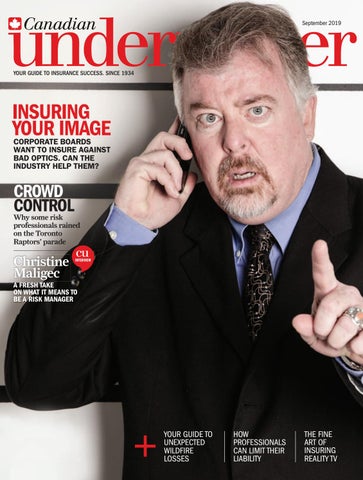
INSURING YOUR IMAGE CORPORATE BOARDS WANT TO INSURE AGAINST BAD OPTICS. CAN THE INDUSTRY HELP THEM?
CROWD CONTROL Why some risk professionals rained on the Toronto Raptors’ parade
Christine Maligec
cu
INTERVIEW
A FRESH TAKE ON WHAT IT MEANS TO BE A RISK MANAGER
+
YOUR GUIDE TO UNEXPECTED WILDFIRE LOSSES
HOW PROFESSIONALS CAN LIMIT THEIR LIABILITY
THE FINE ART OF INSURING REALITY TV
3&3 ), ) ,/-,/ 1" ǔ -" & )16 ,$"1%"/Ǿ 4" * (" 4,/)! ,# !&ƛ"/"+ " 1 3&3 Ǿ 4" -/&!" ,2/0")3"0 ,+ 1%" &+02/ + " +! /&0( * + $"*"+1 0,)21&,+0 1% 1 4" ,ƛ"/ 1, %")- ,2/ )&"+10 -/,1" 1 4% 1ȉ0 &*-,/1 +1 1, 1%"*ǽ 3&3 ȉ0 ), ) ,/-,/ 1" ǔ -" & )16 !&3&0&,+ -/,3&!"0 ,2/ /,("/0 +! ) /$" ,/-,/ 1" +! ,**"/ & ) )&"+10 4&1% &++,3 1&3" +! Ɲ"5& )" 0,)21&,+0ǽ 2/ 0-" & )&010 4,/( 1, 2+!"/01 +! +,1 '201 1%" !"1 &)"! + 12/" ,# 1%" /&0(Ǿ 21 1%" 1/2" * ("2- ,# 1%" )&"+1ȉ0 20&+"00 Ȕ &10 3 )2"0Ǿ -",-)" +! 3&0&,+ #,/ 1%" #212/"ǽ ,/(&+$ 1,$"1%"/Ǿ 4" !"0&$+ 1 &),/Ȓ* !" 0,)21&,+0 1% 1 "5 ""! "5-" 1 1&,+0 +! * (" )) 1%" !&ƛ"/"+ " Ȓ !"*,+01/ 1&+$ )&"+1Ȓ "+1"/"! --/, % 1 "3"/6 &+1"/ 1&,+ 1% 1 /"Ɲ" 10 1%" +""!0 ,# 1%" 20&+"00ǽ 2/ &+!201/6Ȓ#, 20"! "5-"/1&0"Ǿ ,* &+"! 4&1% + "*-% 0&0 ,+ ),0" /,("/ +! )&"+1 /") 1&,+0%&-0 &0 1%" /"02)1 ,# 2+&.2" 0"/3& " -/,-,0&1&,+ 4&1% -/"3"+1&,+ +! &++,3 1&,+ 1 &10 %" /1ǽ
aviva.ca/gcs
%&0 !3"/1&0"*"+1 -/,3&!"0 + ,3"/3&"4 ,# 3&3 ȉ0 ), ) ,/-,/ 1" ǔ -" & )16 ț Ȝ -/,-,0&1&,+ǽ ,/ "5 1 1"/*0Ǿ !"Ɯ+&1&,+0Ǿ )&*&1 1&,+0 +! "51"+0&,+0Ǿ -)" 0" /"#"/ 1, 1%" -,)& 6ǽ -,)& &"0 /" 2+!"/4/&11"+ 6 3&3 +02/ + " ,*- +6 ,# + ! ǽ &0( + $"*"+1 +! ) &*0 0"/3& "0 /" -/,3&!"! 6 3&3 + ! + ǽ +! +"14,/( ,# "51"/+ ) - /1+"/0ǽ
GLOBAL CORPORATE SPECIALTY
Your business may face cyber threats. It takes a partner at the forefront of the cyber curve to help you prepare, respond and recover from the attacks. AIG can help you navigate this ever-evolving, 24/7 world. A world that never sleeps.
Learn more at AIG.ca/cyberedge AIG Insurance Company of Canada is the licensed underwriter of AIG property casualty insurance products in Canada. Coverage may not be available in all provinces and territories and is subject to actual policy language. Non-insurance products and services may be provided by independent third parties. © American International Group, Inc. All rights reserved.
CONTENTS Volume 86, No. 8 | September 2019 YOUR GUIDE TO INSURANCE SUCCESS. SINCE 1934
CANADIANUNDERWRITER.CA
F EAT U R E S
26
PROTECT YOUR GOOD REPUTATION Can insurance save a company with an image problem? How to recover your losses due to unanticipated bad behavior
32
CROWD CONTROL What went wrong at the celebratory parade for Canada’s first-ever pro basketball championship team? Plenty, say risk professionals
36
KEEPING TABS ON ALCOHOL If your client is in any way involved with serving alcohol, here’s how to give your risk management strategy a sober second thought
40
WINDS OF CHANGE Companies are developing climate change plans and want advice from their risk managers. Do you know what to tell them?
Christine Maligec, President, Northern Alberta Risk & Insurance Management Society
canadianunderwriter.ca | September 2019
5
Tomorrow’s idea is today’s reality. The digital age of insurance is here. Are you ready?
At Applied, our cloud-based customer portals and mobile applications enable more brokerages to service their customers when and where they want – no matter the time of day. Let’s get there together.
appliedsystems.ca
CANADIANUNDERWRITER.CA
Twitter: @cdnunderwriter
Facebookcanadianunderwriter
36 5
32
FROM THE EDITOR
cu
9
22 Christine Maligec
The sin of not changing breached SIN numbers
PERSPECTIVES 11 Readers respond to our
INTERVIEW
Christine Maligec, president of Northern Alberta’s RIMS chapter, explains her fresh perspective on emerging risks
recent stories on slip-and-falls, broker note-taking, the hard market and more…
HANDBOOK
DECLARATIONS
Considering the impact of soot residue in the aftermath of catastrophic wildfires
13 What are friends for? Looking to get better terms in a hard market? Pick the right time to forge strong connections with your underwriters
47 When the smoke clears
13
59 Insuring reality TV
IN EVERY ISSUE
How brokers and insurers take artistic licence when insuring reality TV
15 19 21 21 49 57 61
PEER TO PEER 62 Setting boundaries Dennis Schembri tells how adjusters can keep their cool while everyone around them is losing theirs
SURVEY SAYS NEW OFFERS BIG MOVES SUMMARY BY THE NUMBERS DEAL TRACKER TRUSTED ADVISOR
51 Closing the claims spigot How insurers view various water leak detection systems in the market
17 The next domino Alberta and Newfoundland & Labrador have approved electronic pink slips for proof of auto insurance. Who’s next?
55 Professional responsibility What to keep in mind if you are a professional seeking to limit your liability through contracts
canadianunderwriter.ca | September 2019
7
Get answers Have Ha H Have ave vquestions eq questions ueessttio u ues ions nabout sa about bo b o ou uinsurance? ut t iinsurance? nssura n an ncceeA? claim? A ccl claim la aiim m?? OrO Or n Or new ew and ew an nd d emerging em meerrg gin ing risks? riisskkss?? Wherever Whe herev revveer yo re you Ha Ha Have avvve e qu q que questions uesstttiio ue ions ns a about bo bo ou utt iins u insurance? nsu ns urra an ncce e? A cl cla claim? aim m?? areare, are, ar e, you’ll you ou ll g ge get eett d di direct ire ir rect ct a access ccesss to cc o tthe hee rrig h ig ght Or new Or new ew and an nd d eme emerging emergi e me m errg er g ging iing in ng risks? rriiisssk kss?? Wherever Wherev Wh W here he revve er you yyo ou exp expe ex experts perrtts ‒ u un underwriters, nd deerw rwrriite terrss, cl cclaims la aiim mss p professiona rofe ro ofeess ssio on na allss, arre, are a are, e, you you’ll you ou’ll ’lllll get ge g et di direct dirre ect e cctt access accccce ess to es to the th th he e right rriiig ight g ght gh ht ht oror or risk risk issk consultants co on nsssul ultta ulta ul an ntts that tth ha att can ca an n help. heellp. S So, o, iff yo o, you expe e experts ex xpe pe ert rts ‒ u rt rts un underwriters nde der d erw rwrriiite ittte ers rs, ccl cla claims lla aiiim a mss p m professi rofe ro ofe fess ssiio ssi on na als ls, underwriters, professionals, nee neeed n need ed answers, an nssw weers ers rs, we we rree re rready ead ady to ady to ta ta allk. k. or risk or riissk consultants ccon co on nsul ns sul ullttta an ntts that tth ha att can ca an n help. hel hel elp p.. So, So, o, if if you you yo need ne n eed ed answers, ansswe we ers rrss, s, we’re we’’rre re we’ we rready ead ady tto o ttalk. alk. al k k.
Know KnowYou Know Y You ouCan C Can an Know K now Y You ou C Can an
axaxl.com ax a axaxl.co xa ax xl. l cco l.co om Ra Rax Ra a an nxkll.co nked nk Hm ig ghe h stt in in Customer Cust Cu stom meerr Satisfaction Sat atissfa atis fact ctio io on among am mong on ng Large Larg La rge rg ge Commercial C m Co mm mer ercciia all Insurers Ins nsur su urreerrs by by J.D. J..D D. Power, Po P owe wer, er, r, tthree hrreeee years h yeea ars rs iin n a rro ow w.. axaxl.com a ax xRanked xaxl a axl l.ed .com cdom co oHighest XL CXL XL Catlin, C tli t tl now a partt off AXA XA XL, X received XL i d the th h highest hi h t score among insurers hi i in i the tth h J.D. J D Power P 201 20 2016-2018. 0166 200188 Large L Commercial C i l Insurance I Studies St d dii off customers’ t ’ satisfaction ti f ti t with itth h their th i commercial i l ins nssurance. uranc anc a nce.. Visit Visit issitt jdpower.c jjd jdp dp d power ow ow owe werr.ccom/awa co co com om m/awa m//aw /a /awa awa a aw w wa ards r s. rd AXA,AXA, Athe XA, A,, the th AXA AXA AX and XA A and an XL logos XL XL logos logo ares trademarks are a e trademarks ar tra adem ade dem marks ma aof rks rkk AXA of of AXA ASA XA Aor SA SAits or oraff its itsiliates. aff affiliates iliates. AXA ess. A AXA XL XAisXL X a is division s a division divvisi siof onAXA of of AXA AX Group A Group Grro oup providing p providing p idin prov din products ng pr p products ro odu d du uand uc cttss and cts aservices nd servi nd sservices eervvviices ices ce through es tthr es th thro through hro h hr ro rough ufour ug g gh h ffo fou four our o business ur u bus b business ines nes ne groups: eesss g gr groups: oup oups ou o ups AXA ps: A ps AX AXA XL XA AInsurance, XLL Ins X Insurance, nsura ns ran anAXA an cee AXA ce, XL X Reinsura XL R Reins ein nsurance, ns su uran rran an ance, ce,, A AX AXA XA X XLL Art Artt & LLifestyle Liif Lif ifest eesty es tyyle ylee an nd d AXA AXA AXA AX XA XL Risk Risk skk Consulting C Co Cons ulting ulti ng g © 2019 201 0 9 AXA 01 AX A XA SA XA SA orr its aff a iiliates. l ates. liat es. In n the th he U US, S, the the A AXA XA XL XL insurance insur insura sura ancee companies ccomp com omp mpanie an ani nies are: nies ar are: e: AXA AXA A Insurance IInsu nsu nsur ns n s ra an n ncccee Company, Co Com C ompa om ompany pany pan any an any ny, Catlin Ca attlin lin in Insurance in In Ins nssu n ura rran nccee Company, C Compa ompa ompany mpa mp pa p any ny, n y, Inc., Inc ncc., ., Greenwich Greee Gr eenw een enw nwic ich cch h Insurance Insu IIns nsu n nssu sura ranc ancce Co Company, ompan mpan mpa m pa an a nyy,, IIndian nd nd ndia di dia i nH Ha Harbor rbo rbor rb bo IInsuran In Ins Insurance suran urrance ce C Compa ompa omp ompa mpany, mp nyy n XL Catlin, XL Catli attli atlin atlin, t n, n, now now wap pa par part a t off AXA AX A XA XA XL XL, XLL,, received recce rec receive re eiv iivve ve ved ed d th the the hi highest hiigh high ghe ghes gh g ghest h he t score hest hes ssco ore e among amon a mon on ng iinsurers in nssure su ure ers rss iin n th the t e JJ.D. .D Power Power owe ow o wer wer e 2016 20 2 201 2016-2018. 01 016 16-20 2018 20 201 2018. 018 01 18 1 18. 8 LLar Larg La Large arg arg rge ge C Commercial Comm Co om mme mm mer m me errrccia e ciia cial ci al IInsurance al In Ins nssu ns nsu urran ura u uran rra an ancce e St Studies Studi ttud tu udi ud u di dies es of of customers customers’ ccustom cu ustom ttom om mer ers e rrs rs’ s’ satisfaction sat sat atisfa ti tisfa iissfact isf sffact sfa acct ctio ti ttio on wit with wiith w ith th th their th heir he eir eiir commercial com comme o m merc erc rcia rci all insurance. iins in nsu n ssu urranc uranc anc nce nc nce. e.. Visit Vi Viisit it it jdpower.com/awards jd jjdp dp d power owe ow wer.com om m//awa awa wa ard rd rds ds. XL InXL XL Insurance Ins nssurance nsur anc America, Ameerica rica, Inc., Inc., XLL Specialty Sp Specialt alty ty Insurance In Ins nsuran ns ur ce ur ura ce Company Comp Com ompa p ny n and and T.H.E. T.H. H..E. Insurance H.E In nsu surance sura ncee Company. Comp mpany. an Not any. N all No all insurers in ins nsu urer erss do business bus bus usi sine nes ess in n all alllll jurisdictions jur ju urisd ur isd sdi dicctio di cti t onss nor nor or is is coverage cove co vera era rage ge a available vail vai i able ab iin na all al ll ll jjuri ju jurisdictio urr sd u sdi diicctio dic tiio on ns. s. iliates. products and through business groups: Insurance, Reinsurance, and AXA, AX AXA A XA, XA XA A, the th th he AXA XA A and a d XLL logos llogo og go g oss are are trademarks ttrrade dem emarks arrks kss of k of AXA AXA AX A SA SA or or its it i s aff affili ffili liate iates. t . AXA A AX XA XL is is a division di divviiisi ision n of of AX AXA A Group G Grro oup ou p providing pro rovidin rov idi idin iding ing p pr od odu o d duc du uccttss a nd d sservices errvi e ervi r icces rv es th es thr tthro hrrro hro h oug ugh u gh gh ffour fou fo o our ur b bu bus ussiine ines nes esss g e ess gr oups ou pss: A p AX AXA XA X A XL XL IIns nssu ura uran ur ran ra an nce, ce, A AXA XA A XLL R einssu eins uran ura rran an nce, nce, c AXA AXA XLL Art Artt & Lifestyle Lif ifestyle if esty tyylle ea nd nd AX AXA A XA XA XL XL Risk Risk sk k Consulting Cons on ulti ulting ng © 2019 20 201 0 9 AXA AXA SA AX SA or o its ts aff ts ffiliates. iliat il lia ates. s. In th tthe he US, S, the he eA AXA XA A XL XL insurance insura surranc nce c companies comp comp pan anie nie es are: are: AXA AXA A Insurance Insur nsu sur suran uran anc nce e Company, Com Co C omp om pany pan any a an nyy, Catlin n Catli Ca ttlllin tlin iin Insurance In Ins nssu urrra uran ura ancce e Company, Co om ompa mpa pa any, any nyy, y, Inc., IIn n nc., Greenwich Grre een eenw ee e en nw wich icch h Insurance In Insu nssu ns nsu urranc anc n e Company, Com C Compan mpan a y, Indian In ndi d dian Harbor di Ha H arrbor rbo bor bo b or Insurance Ins nsuran ns uran u ra ance Company, Compa ompa any, ny, ny y America, Specialty Insurance Company and T.H.E. Insurance Company. business jurisdictions nor coverage available jurisdictions. XLL IInsurance X nsur nsu ns n ssur u urance nce e Ame Am m rica a, Inc., Inc.,, X XL Sp S pec eciialty altyy Ins n uran ns ura rran nce nce ce Compa C ompa om pany nyy a n nd T .H .H.E H.E E. In nsura sur urance ura nce Com Comp mpany. any. y. No Not ot al o alll ins iinsurers nsu urer ure rer e s do do busines bus usine nes n ne esss in e na all ll jju ll jur urisd isdi is s ict sdi ctio t on tio nss n or iiss cco or vve era e rra age g a vail a lab able a b e in a all ll jju juri uriisd uri sdic dic d iction t on ns. s.
Ranked R Ra a anked nked nk nked ed Highest Hig ighe ghe h sstt in hest in Customer Cu Cu usssto stto omer om mer e Satisfaction Sa atis at tis isfa sfa fac act cttio ctio ion iio on among amon a am m mon ong Large on Larg Lar LLa arg rge Commercial Comm Co C omm mme errci cial al Insurers In nssu nsur urrrer errss by er by JJ.D. ..D D . Power Power, Po Po ow wer, we w err,, three thr hrree ee years ee ye ear ears ea arrss in in a row rrow. ro ow o w.. w
FROM THE EDITOR MANAGING DIRECTOR, INSURANCE MEDIA GROUP
Sandra Parente sandra@canadianunderwriter.ca 416-510-5114 EDITOR-IN-CHIEF
David Gambrill david@canadianunderwriter.ca (416) 510-6793 MANAGING EDITOR
Adam Malik adam@newcom.ca ASSOCIATE EDITOR
Greg Meckbach gmeckbach@canadianunderwriter.ca ONLINE EDITOR
The sin of SIN numbers
Jason Contant jcontant@canadianunderwriter.ca
The feds aren’t changing the SIN system, which will put insurers on the hook for cyber data breaches forever
ART DIRECTOR
Ellie Robinson ADVERTISING AND MARKETING CONSULTANT
Pam Chodda Young pam@newcom.ca (416) 510-5122 PRODUCTION MANAGER
Karen Samuels CIRCULATION MANAGER
Mary Garufi PRINT PRODUCTION MANAGER
Lilianna Kantor NEWCOM MEDIA INC. CHAIRMAN AND FOUNDER
Jim Glionna PRESIDENT
Joe Glionna VICE PRESIDENT, PUBLISHING
Melissa Summerfield CHIEF FINANCIAL OFFICER
Peter Fryters DIRECTOR OF CIRCULATION
Pat Glionna
MEDIA INC.
5353 Dundas Street West, Suite 400, Toronto, Ontario M9B 6H8 Tel: (416) 614-2200 Fax: (416) 614-8861 Canadian Underwriter is published twelve times yearly by NEWCOM MEDIA INC. All rights reserved. Printed in Canada. The contents of this publication may not be reproduced or transmitted in any form, either in part or in full, including photocopying and recording, without the written consent of the copyright owner. Nor may any part of this publication be stored in a retrieval system of any nature without prior written consent. © Since 1934, Canadian Underwriter has been the voice of Canada’s insurance industry - a monthly magazine providing the highest quality and most relevant news and insight to insurance professionals from all segments of Canada’s property and casualty insurance market. The magazine is delivered on a direct-request circulation basis to nearly 15,000 senior decision makers nationally, including insurance brokers, risk managers, insurance and reinsurance company personnel, claims managers and adjusters. Since its beginnings, Canadian Underwriter has been a link between all segments of the insurance industry, providing insurance professionals with award-winning coverage of industry issues, trends, news, personalities and events - written by Canada’s leading insurance journalists. Subscription Rates: 2018 Canada 1 Year $51.95 plus applicable taxes 2 Years $75.95 plus applicable taxes Single copies $10 plus applicable taxes, except $49 plus applicable taxes for July issue featuring annual Statistical Guide. Elsewhere 1 Year $71.95 Subscription Inquiries/Customer Service Mary Garufi (416) 614-5831 mary@newcom.ca GST Registration number 890939689RT0001 Second Class Mail Registration Number: 08840 Publications Mail Agreement #40063170
I
nsurers, be afraid: as long as your clients’ stolen Social Insurance Numbers are sitting on the Dark Web, your cyber exposure may as well be unlimited. Under the oversight of the federal government, SIN numbers are basically the ‘password’ to a person’s financial information. The numbers are required for obtaining child care benefits, student loans, employment insurance, pensions and death benefits. Insurance professionals, following the advice of cyber experts everywhere, constantly advise their clients to change passwords to protect their data and identities. And yet the feds want to keep a one-SIN, one-person system. Basically, they don’t want to change your clients’ passwords even after a breach. “The main reason we do not automatically issue a new social insurance number in these circumstances is simple: getting a new social insurance number will not protect individuals from fraud,” the feds told the Federal House of Commons’ standing committee on public safety and national security in July. “The former social insurance number continues to exist and is linked to the individual. If a fraudster uses someone else’s former social insurance number, and their identity is not fully verified, credit lenders may still ask the victim of fraud to pay the debts.” The feds say SIN numbers alone are “never sufficient to access a government program or benefit, or to obtain credit or services in the private sector.” But let’s face it: they are a pretty significant way for cyber criminals to get their foot in the door. That’s because other forms of ID – such as names, addresses, dates of birth, and telephone numbers – are pretty easy to obtain. When cyber thieves steal your clients’ information, it sits in a marketplace on the Dark Web for years without being used. The going rate of a SIN number on the Dark Web these days is one loonie — or $30 if it’s part of a “Fullz info” package (a bundle of information sold to fraudsters). Basically, our stolen SIN numbers are ticking time bombs, open for exploitation at any time by fraudsters. By not changing the SIN number system, the feds are basically handing cyber criminals the passwords to Canadians’ financial data. Insurers should be working with the government to change the current system, which is far too easy for cyber criminals to exploit.
Return undeliverable Canadian addresses to: Circulation Dept. Canadian Underwriter 5353 Dundas Street West, Suite 400, Toronto, Ontario M9B 6H8 Tel: (416) 614-2200 ISSN Print: 0008-525 ISSN Digital: 1923-34
david@canadianunderwriter.ca MEMBER
Twitter: @Cdnunderwriter
Facebook: canadianunderwriter
canadianunderwriter.ca | September 2019
9
:H·UH ¶EXWWHU· WRJHWKHU CAA Insurance offers unique product solutions, underwriting service and marketing campaigns that really pop. Want to spice things up more? Add a dash of CAA Member discounts. Spoiler alert: The good guys always win.
:DQW WR SDUWQHU ZLWK XV" Kathy Corbacio 289-260-5120 (Ontario) Elenor Nowosad 204-262-6003 (Manitoba) Lynne Gerhardt 902-229-3478 (Atlantic)
®CAA trademarks owned by, and use is authorized by, the Canadian Automobile Association. To qualify for the discount you must be a current CAA Member in good standing (CAA Membership dues paid in full by membership expiry date). Eligible CAA Members may qualify to receive a Member Loyalty Discount based on membership tenure and Roadside Assistance usage.
perspectives canadianunderwriter.ca l
company/canadian-underwriter l
@CdnUnderwriter l
How slip-and-fall lawsuit rules could change in Ontario July 10 The story: If Bill 118 is passed into law in Ontario, plaintiffs would have only 10 days to give defendants’ notice of slip-and-fall claims caused by snow and ice. Currently, the timeline is two years.
Judy Bell says: Get this passed! This has been a joke in the past. Lawyers have benefited the most and consumers are paying for it! We need to stop paying for people who don’t use their head. Don’t wear high heels in an ice storm and expect to get rich when you slip and fall!
Brenda Russell says: I agree with Judy. If there is true negligence, the 10-day window won’t have any effect on the claimant submitting their lawsuit.
Byron Yankou says:
canadianunderwriter
What’s at the heart of today’s hardening market cycle July 5 The story: The origin of today’s hardened market cycle is a natural evolution of a “soft market that lasted too long,” a senior risk manager told Canadian Underwriter. Jordan Switzer says: The hard market has definitely been a challenge. This is the first one I have experienced, but I feel brokers have always been selective and diligent in writing quality business and providing excellent customer service.
This bill should be passed to help curtail fraudulent slip-and-fall lawsuits. We regularly receive lawsuits just before the statute of limitations, when video footage, witnesses, and memories have disappeared.
Addison Liu says: Please pass Bill 118. Ten days to notify the occupier is not difficult. If it happens in a mall, the closest retail store can provide info about the property management or landlord. CCTV footage often gets erased every two weeks. There is a better case to preserve evidence when the occupier gets the notice in 10 days.
How diligent note-taking helped this broker defend a lawsuit July 22 The story: When a claimant sued her insurer, the case was thrown out because she had filed the lawsuit two years after the statute of limitations. The claimant said her broker had “forgotten” that she had called the brokerage within the limitations period, which the brokerage denied. The court ruled in favour of the broker, who had a history of meticulous note-taking.
Rachelle Smith says: That’s the biggest thing I’ve learned in my five years. Note as much you possibly can after a conversation with the clients! Just cover your butt.
J.Y. says: I find it interesting and commendable that the judge in particular favoured the broker because she documented “losses which were not covered” as a sign that the broker was diligent. Every broker and every carrier should. But I don’t think this is done in practice when, at first glance, coverage appears to not be triggered.
Could trial lawyers take a run at a 40-year-old cap on pain and suffering awards? July 4 The story: The Supreme Court of Canada imposed a $100,000 cap on awards for pain and suffering damages in 1978. But since then, several other measures designed to manage claims costs have been introduced, meaning the rationale for the cap may not longer be applicable, says the president of the Ontario Trial Lawyers Association.
Exposing ICBC says: Some interesting thoughts from Canadian Underwriter on what could make the caps on pain and suffering awards obsolete. What do you think, TLABC (Trial Lawyers Association of British Columbia)?
canadianunderwriter.ca | September 2019
11
WE ARE CORPORATE INSURANCE SPECIALISTS Excellence, Expertise, Experience … Every Time
theguarantee.com
We have a long history of protecting Canadians by offering solutions that respond to emerging exposures. Our committed, experienced team actively monitors new risks and trends to tailor coverage to your clients’ unique needs.
declarations HIGHLIGHTS
Broker challenges p.15 l Electronic pink slips p.17 l Big Moves p.21
BUSINESS RELATIONSHIPS
What are friends for? To survive a hard market, risk managers should be networking with underwriters. But timing is everything B Y J A S O N C O N T A N T, Online Editor
D
eveloping very strong relationships with underwriters and providing detailed information to them can help during a hardening market, risk managers say. “If you’ve never met your underwriter, don’t book a meeting with him in the hard market,” advises Stéphane Cossette, senior director of risk man-
agement with Quebecor Media Inc. in Montreal. “Some [business relationships with] underwriters are sturdier. If you were able to secure a relationship with them [before the market cycle turned], now going to the hard market will be easier. And that’s what we’re living right now.” Instead of chasing a lower rate, pick
INTACT’S NEW FRONTIER | AUGUST 7
Intact Financial Corporation expanded into the restoration services area, acquiring Vancouver-based On Side Restoration. Intact says the move will help to boost its claims expertise and supply chain network as severe weather events become more frequent.
your insurance partners wisely, Cosette advises. Receiving very competitive terms from very selective underwriters can make all the difference. “Underwriters want to tidy up the books, but honestly, at the end of the day, they want to strike that deal,” he says. “They want to renew it, so that’s where the relationship is key.”
FILE AND USE | AUGUST 2
Insurers reveal that Ontario’s new insurance regulator is considering a “file-and-use” system for private passenger auto rate changes. Specifics are not known, but generally rate filings under such a system would be “deemed approved” after a certain period of time.
canadianunderwriter.ca | September 2019
13
)LUVW *HQHUDO 3UHPLÂŞUH *ÂŤQÂŤUDOHĹ?V IRFXV LQ ZDV WR SRSXODWH QHZ RIĆ“FHV DFURVV &DQDGD WR VWUHQJWKHQ WKHLU VHUYLFH FDSDELOLWLHV DQG EUDQG The opening of PG Drain, Sewer, Excavation & PG Temporary Lodging allows us to explore opportunities in other lines of business and expand our service capabilities. “As we move forward, our vision is to strengthen our brand globally and expand across North America, South America and Europe. We are actually at the infancy stage and envision exponential growth in the next 5-10 years globally.â€? Frank Mirabelli, CEO.
ATLANTIC/MARITIMES
FG Moncton FG Northwestern New Brunswick
QUEBEC
PG Montreal East PG Drain, Sewer, Excavation PG Temporary Lodging PG Montreal Centre West PG Quebec
ONTARIO
FG Brampton/Peel FG Durham East FG Durham West FG Halton/Oakville FG Markham/Richmond Hill FG Scarborough FG Toronto Centre/Toronto-Mississauga FG Toronto West FG Vaughan FG Toronto East FG Kingston/Belleville FG Newmarket
WESTERN CANADA FG Kamloops FG Nanaimo FG Yorkton
HELP HAS ARRIVED.
FG Northwestern New Brunswick
FG Yorkton
FG Nanaimo
PG Quebec PG Montreal Centre West
FG Kamloops
PG Montreal East FG Vaughan FG Durham West FG Durham East FG Halton/Oakville FG Brampton/Peel
FG Moncton FG Kingston/Belleville FG Markham/Richmond Hill FG Newmarket FG Scarborough FG Toronto West FG Toronto East FG Toronto Centre/Toronto-Mississauga
6KRXOG \RX UHTXLUH DGGLWLRQDO LQIRUPDWLRQ SOHDVH FRQWDFW $QJHOD 9HUL (93 6WUDWHJLF 3DUWQHUVKLS DW DQJHOD YHUL#Ć“UVWJHQHUDO FD
1-877-888-9111
Ć“UVWJHQHUDO FD
DECLARATIONS If a pre-existing relationship exists, and that underwriter comes to you with terms, you know he’s got an interest in you, Cosette suggests. You know he wants to renew at a reasonable price. “I strongly believe that if you’ve been with someone for 10 years, they’ll be kind of more lenient during a hard time,” he says. “But if last year I changed underwriters for just a couple of cents, trust me, that new guy owes me nothing. Don’t go into the market and try to get every last cent out of every underwriter you meet and change relationships overnight.” How can you help an underwriter to help you in a hard market? Provide enough detailed information to enable the underwriter to write a rate that’s palatable to you, says Cossette, who began his career as an underwriter, then a broker and then a risk manager. “Underwriters want to write accounts,” he adds. “People don’t get this.” Insurers’ appetite parameters tend to tighten up dramatically in a hard market, so being able to distinguish your organization as best-in-class is extremely important, says Curtis Desiatnyk, manager of risk and insurance with Mount Royal University in Calgary. “If you’re simply filling in applications, you may not always know what information is really driving their decisions or rates,” he says. “Being able to have one-on-one conversations to make your case and answer their direct questions can make all the difference.” Cossette and Desiatynk each report seeing pressure on rates. “I don’t think an underwriter wants to double the premium,” Cossette says, noting that he has seen rate increases of between 10-15%. “What they want is a good substantial increase. But mostly they want the underwriting information that will justify their position on any given account.” HARD PREDICTION | JULY 31
Commercial clients hoping for some relief from price increases could be in for a disappointment, Albert Benmichol, CEO of Axis Capital Holdings Ltd., said during an earnings call. “We believe that [upward] pricing action will continue into 2020 and perhaps longer.”
SURVEY SAYS…
BROKERS’ BIGGEST CHALLENGES Ninety-five brokers picked their “Top 3 most important challenges” from a list of 23 major issues facing brokers today. The votes below indicate how many times the issue appeared in their Top 3 lists.
1 2 3 4 5
Retention of clients in hardening market conditions
60 Votes (63.2%) Recruiting top talent into my brokerage
36 Votes (37.9%) Improving data exchange with carriers
28 Votes (29.5%) Finding profitable business in hardening market conditions
26 Votes (27.4%) Competing for business against directs
2 1 Votes (22.1%)
Many people believe a hardening market is strictly about rates. “It’s not,” says Cossette. “It includes restricted capacity and a pressure on rates, but it’s mostly about a request for tangible information for the underwriter to assess the risk.” In a soft market, underwriters can write accounts with less information. However, if the risk manager didn’t provide enough detailed information during the soft market, and suddenly the underwriter is asking for additional information during a hard
market cycle, it can put the unprepared risk manager in a tough position. “If you did your job as a risk manager and you do have this information, there will remain some pressure on the rates, but if you have a relationship for a long time going with a serious partner, I don’t see any problem and I haven’t,” Cossette says. “I’ve seen increases, I’ve seen requests, I’ve seen people who kind of back down and say, ‘Can I reduce part of my capacity?’ but nothing so drastic that it’s going to affect my budgets.”
CAPITAL ONE BREACH | JULY 30 Credit card issuer Capital One Financial Corp. expects that a massive cyber breach affecting millions of Canadians could cost the firm more than $100 million. The company has $400 million in cyber insurance, although it is unknown if the breach is covered. canadianunderwriter.ca | September 2019
15
What’s inside a Chartered Insurance Professional designation?
PRINCIPLES DISCIPLINE ANTICIPATION Throughout the Canadian insurance industry, there are over 18,000 people who currently hold the Chartered Insurance Professional (CIP) designation. CIPs undergo rigorous training and education, operate at a highly professional level and adhere to a strict code of conduct. Get your CIP through the Insurance Institute to enhance your skills and serve your clients better today and in the future. insuranceinstitute.ca/cip
DECLARATIONS
ELECTRONIC PINK SLIPS
The next dominoes fall… Alberta and Newfoundland & Labrador join the ranks of provinces that have approved electronic proof of insurance. Who’s next? B Y J A S O N C O N T A N T, Online Editor
A
lberta and Newfoundland & Labrador have joined Nova Scotia as the only Canadian provinces allowing the use of electronic pink slips by drivers. The news from Alberta dropped right at press time. Drivers in the province are now allowed to show electronic proof of auto insurance (EPAI) to law enforcement officers. The move was announced Aug. 12 as part of the province’s “red tape reduction” initiative. In Alberta, insurance companies will be responsible for creating and providing applications for enabling digital proof of insurance and the timeline
ASTEROID INSURANCE | JULY 30 A “city-killer” asteroid missed Earth by about 70,000 km, which is closer than the moon. Had it hit, it’s likely the damage would have been covered by a standard homeowners’ policy, which covers “falling objects.”
for implementation will depend on the insurer, the government announced. Consumers will be able to continue with the original option of the traditional paper-based system if they prefer. “We are supportive of any changes that help make insurance easier and more accessible for Alberta’s 3-million drivers,” said Celyeste Power, vice president of Insurance Bureau of Canada (IBC)’s Western region. “Electronic commerce is available in most other sectors and much needed in the insurance sector. Already, many U.S. states and two other provinces allow digital proof of insurance and we
anticipate other provinces will follow.” News from Alberta followed an earlier announcement from Newfoundland and Labrador, which approved the use of EPAI in that province July 29. “Enabling the delivery of EPAI is a step towards allowing more innovation in the insurance industry and was one of the potential improvements to the automobile insurance system referenced in the Board of Commissioners of Public Utilities’ report to the provincial government in January 2019,” Superintendent of Insurance of Newfoundland and Labrador Renee Dyer wrote in a
AUTO FRAUD BUST | JULY 26
Insurance Bureau of Canada helped police identify stolen high-end vehicles that were allegedly being prepared for shipment to China and EU countries. The total value of the vehicles recovered is $2.2 million.
canadianunderwriter.ca | September 2019
17
No two risks are the same. And RSA’s risk control team is ready to get to work on all of them. With expertise in coverage for EBI, fleet, liability and property, our team collaborates with risk managers to tailor specialized programs that respond to unique exposures. At RSA, we know that every business is different—and we’re committed to preventing problems before they happen.
Proud to be your partner in insurance. Find out how we can work together at rsabroker.ca/riskcontrol
© 2019 Royal & Sun Alliance Insurance Company of Canada. All rights reserved. RSA, RSA & Design and related words and logos are trademarks and the property of RSA Insurance Group plc, licensed for use by Royal & Sun Alliance Insurance Company of Canada. RSA is a trade name of Royal & Sun Alliance Insurance Company of Canada.
DECLARATIONS bulletin announcing the move. Electronic pink slips will likely appeal to drivers who are comfortable with technology and using smartphone apps, says Kelly Hickman, president of the Insurance Brokers Association of Newfoundland and Labrador (IBAN). In fact, she adds, a common call to brokers is from clients looking for a copy of their pink card. Some brokers have already been offering access to electronic pink cards through broker management system apps or other providers. “It may be difficult getting consent from those clients after the fact,” Hickman notes. “For those brokers who have been offering access to eSlips through their online apps or other providers for a few years, it will now be necessary to obtain written consent from those clients in order for them to be able to use the EPAI.” Regulatory bulletins in Alberta and Newfoundland and Labrador include some required guidelines and principles for insurers and brokers to offer EPAI. Among them is that the insurer or broker must obtain consent from the client to offer EPAI. In addition, consumers must be aware of specific risks and limitations: • The absence of Internet services may limit the on-demand availability and accessibility of EPAI • If a client is travelling outside provinces that offer EPAI, they will be required to produce a paper-based card that “may require direct confirmation with their insurer or broker,” in the words of the Newfoundland and Labrador bulletin. • The client is responsible for any loss or damage to their phones that may occur while the devices are in the care, custody or control of a third party who has authority to request access. Nova Scotia became the first Canadian jurisdiction to approve EPAI in January 2018. ALBERTA TORNADOES | JULY 23 The province’s tornado season this year has been “active,” storm-chaser Chris Kiernan reported. Seventeen probable or confirmed tornadoes have happened so far, according to Environment and Climate Change Canada. The number far-surpasses the 30-year average of 12.
NEW OFFERS INSURTECH PLATFORM FOR AGRICULTURE Vendor: Farmers Edge Target Audience: Agricultural insurers What it Does: Creates an enhanced digital connection between insurance providers and agricultural growers
Winnipeg-based Farmers Edge has launched an insurtech platform that combines field-level data, remote sensing, artificial intelligence-driven models, and secure automation technology. For insurers, the platform offers visibility into each farm operation for better risk management and lowered administration costs through automated claim prediction, detection, estimation, adjudication and reporting. The platform uses data from FarmCommand, an all-in-one farm data management platform. It also includes the release of two new solutions, Smart Claim and Smart Reporting, to bridge the gap between field data collection and reporting.
FREE RISK MANAGEMENT SERVICES Vendor: CFC Target Audience: Technology companies What it Does: Adds a variety of free risk management services to its technology insurance policy
Specialist insurer CFC has added a range of free risk management services to its technology insurance policy to help customers prevent a claim – particularly cyber incidents – from occurring in the first place. CFC has teamed up with experts from around the globe to provide best-of-breed risk management including, among other things: • Cyber risk rating report from BitSight that allows customers to benchmark themselves against peers and competitors • CFC RepKnight breach monitoring service, which continually searches the dark web for information specific to the customer’s organization and alerts them in real-time to possible breaches of their data • Cyber incident response plan builder to help customers produce a tailored incident response plan
AUTOMATED BORDEREAU FUNCTION Vendor: Apollo Insurance Solutions Target Audience: Brokers and managing general agents What it Does: Automatically generates bordereau
Apollo’s cloud-based Exchange platform is designed to allow brokers to bind insurance products and produce bordereau reports with the click of a button. Bordereau generation has been a major friction point for brokers and MGAs across Canada. Traditionally, application data has been locked in PDF application forms. In contrast, Apollo Exchange collects, analyzes, and reports data insights. The data can be used for immediate and automated bordereau generation; it can also be used to optimize more accurate risk rating, distribution strategies and pricing. “By collecting digital application forms, we are able to route and create bordereau on any product, binding authority, or program — including those on Lineage and other upload sites,” says Apollo CEO Jeff McCann. “This function saves partners who are on the Exchange many hours of manual data entry. This is transformational, and goes directly to the bottom line.”
I, ROBOT | JULY 19
Artificial intelligence will have a big impact on adjusters, actuaries and insurance agents, but it won’t necessarily kill their jobs, predicted AI expert Eli Fathi of MindBridge Analytics Inc. But lowerskilled jobs may be in jeopardy — including employees who work in call centres. canadianunderwriter.ca | September 2019
19
DECLARATIONS BIG MOVES
SUMMARY
New Canadian chief agent for AGCS
CROSS-SELLING
Are you leaving money on the table?
Allianz Global Corporate & Specialty (AGCS) has appointed Linda Regner Dykeman as chief agent in Canada
WHO: Linda Regner Dykeman CURRENT ROLE: Chief agent in Canada for German commercial insurer Allianz Global Corporate & Specialty SE. P&C EXPERIENCE: 25 years PROFILE: Held senior roles in commercial lines for the Canadian branches of Travelers, Aviva and RSA
Linda Regner Dykeman is now chief agent in Canada for Allianz Global Corporate & Specialty, a Munich-based company with offices in Toronto, Montreal and Vancouver. She served since 2016 as head of MidCorp, the AGCS Canada division that insures small and mid-sized organizations. Dykeman succeeds Ulrich Kadow, who is now global head of marine for AGCS. Kadow had been chief agent since 2015. Dykeman’s successor as head of MidCorp had yet to be announced at press time. Before joining AGCS, Dykeman held a variety of roles at Travelers Canada, Aviva Canada, and RSA Canada. She has obtained her Chartered Insurance Professional (CIP) and Fellow Chartered Insurance Professional (FCIP) designations from The Insurance Institute of Canada. She now reports to Bill Scaldaferri, president and CEO for North America at AGCS. In Canada, AGCS writes machinery breakdown, financial lines, aviation, marine, and energy and construction, among others.
Kate Hogan is Gore Mutual’s new director of Western Canada. She will be in charge of Gore’s personal and commercial underwriting and business development teams in Western Canada. Previously, she worked for seven years at Aviva Canada.
FLOOD CZAR | JULY 19
Lorri Frederick is stepping down from her role as president of ClaimsPro, the independent adjusting unit of SCM Insurance Services. Her interim successor is Ross Betteridge, SCM’s chief operating officer.
Ontario appointed a special adviser on flooding to recommend ways for the province to help communities deal with and reduce the risk of water damage. The advisor, Doug McNeil, is a former Manitoba deputy minister. He is expected to deliver a report and recommendations in the fall.
Shelley Willick is the new CEO of Saskatchewan Mutual Insurance Company. She joined SMI in 1994 and until recently was senior vice president of operations. When she first started at SMI, she was the company’s vice president of finance and administration, a position she held for 23 years.
SIMON-KUCHER & PARTNERS Canada’s property and casualty insurance industry could potentially be leaving a lot of money on the table by not doing more cross-selling, according to a report by strategy and marketing consultants Simon-Kuchner & Partners. Simon-Kuchner surveyed 348 Canadian and U.S. policyholders in the spring of 2019. Although 93% of the participants said they would like to have a “main” insurer, only 29% of them actually had one. A participant in the study was considered to have a “main insurer” if they had more than 70% of their insurance policies with one provider. The study identified six different types of insurance that might be provided by one insurer – property, car, health, life, legal, and home insurance. Canadians in the survey who did not have a main insurer tended to have their insurance needs covered by two or three insurers (the average was 2.6). Forty per cent of participants said it would be easier to have all of their insurance policies placed with one provider. Just under 20% reported that if the service was good, they would be willing to pay a higher price to have all of their insurance policies under one roof. However, although insurers and brokers frequently contacted customers who had no main provider, only 4% of those consumers talked to their insurer or broker about insurance coverage. Most calls had to do with buying a new policy or renewing one. “Insurers frequently contact their customers, though rarely for cross-selling,” the report says. ‘Most insurers, regardless of customer tendencies, have failed to tap into customer potential [for cross-selling].” Potential solutions include a better understanding of the customer’s wants and needs, as well as making sure that processes (such as lead generation, for example) and incentives support the brokers’ and agents’ ability to cross-sell.
APARTMENT BLAZE | JULY 18 A pre-dawn fire extensively damaged a three-storey apartment building in downtown Charlottetown, displacing more than 50 people. Most of the building’s tenants, all of whom were evacuated safely, were seniors. No word yet on the cause of the fire. canadianunderwriter.ca | September 2019
21
cu
INTERVIEW
CHRISTINE MALIGEC, 2019 RIMS Canada Conference Co-Chair
RISK MANAGEMENT
ENVIRONMENTAL SCAN Christine Maligec, 2019 RIMS Canada Conference Co-Chair, talks about the shifting environment for risk managers and how they can adapt in the future. By David Gambrill, Editor-in-Chief
22
September 2019 | Canadian Underwriter
cu | What are some emerging issues you see for risk managers in the future? Aging infrastructure. It’s been added on to the World Economic Forum’s annual global risk report. It’s not a problem that’s isolated to any specific country or region. It is a global systemic problem. Infrastructure grew after the Second World War, when we put some of these systems into place, and we continued to build into the 80s and 90s and 2000s. We have pulled back on funding the maintenance of these systems, and now we are at a point when we have crumbling infrastructure underground. Our sewers and waterlines are starting to degrade. We’ve got electrical grid systems that are hanging by a thread and almost obsolete. A technology-based future requires sustaining power in a new urban environment.
cu | This ties in with a second emerging issue you have mentioned… Yes, climate change and adaptation. As we have built communities, we have taken away green space, which is Mother Nature’s flood mitigation system. The infrastructure we currently have is not able to manage those 5-year, 10-year or 20year events. We’re not prepared to deal with the aging infrastructure that we have, and the climate around us is continuing to change. We are presently experiencing two things in Alberta: fire issues in the north, and water issues. It’s either super-dry or moisture-rich in Alberta. We’re starting to have a conflict with Nature. We need to do a better job of taking care of the Nature. And most of the infrastructure that we build has to be resilient to those changes, too.
cu | How does climate change affect a risk manager? The effect depends upon the certain discipline of risk you are in. If you are an insurance risk person, and that’s specifically what you deal with, you have to be incredibly mindful of your asset inventory, your total insured value, and any exclusions you
may have on your insurance policies. If there is one of those 20- or 50- or 100-year flooding events that affect your organization’s property, you need to have the terms and conditions to be able to deal with that. From a mitigation perspective, you need to have conversations internally with stakeholders. Take an engineering group, for example. You might say to them, ‘Look, we’re not going to get $100 million in new funding, that’s not going to happen. But let’s talk about resiliency.’ There are flood mitigation systems that, for a small investment, can certainly protect high-value assets. Especially where there are things like inventory or electrical systems. We can make minor adaptations while decision-makers someplace else are trying to figure that big systemic funding problem.
cu | What skills are valuable to future risk managers when dealing with these kinds of emerging issues? One valuable skill set is problem-solving. I think the perception is that risk managers just buy insurance, but now we have to become problem-solvers. And it’s not just problem-solving for aging infrastructure and climate change adaptation. How do we help an organization meet its objectives? The objectives could be, ‘How do we integrate more options for transportation solutions? How do we increase the social well-being of communities?’ Or they could also include increased workflow integration, if you are delivering a product or service, or advancing your environmental image, if you are resource extraction agency. Helping to problem-solve is going to be one of the skillsets for a risk manager of the future.
cu | Can you elaborate on what the risk manager of the future will look like? We are risk managers, we’re not risk avoiders. Everything is changing around us. We cannot be the merchants of ‘no.’ We cannot tell our organizations that we cannot do something. We have to work with our organizations and stakeholders to help everybody find the right ‘yes.’
canadianunderwriter.ca | September 2019
23
cu
PROFILE
INTERVIEW
Our mindset should be that we are a stakeholder at the board table to help with decision-making; to help make risk-informed decisions; to help make strategic, enterprisebased decisions. And we need to be more collaborative within our organizations. Why? Everyone is a risk manager within an organization. It’s not just the risk professional. You have people in the engineering group, communications and marketing, strategic planning, governance and HR, for example. All of these people manage risk in some special way. Risk managers should be the conduit to that conversation, pulling people in. When you group all of those people together, you create a “wisdom of the crowd,” that informal Delphi group within an organization. You bloom better knowledge, better collaboration, better innovation, better decision-making within the organization that is risk-informed. You are spending less time just looking at a checklist of things, or just buying insurance, or telling people that they can’t do something. You are actually adding value to the corporation.
cu | What about risk managers in smaller organizations? Does this apply to them as well? I don’t think scale of the organization is the barrier, the barrier is the mindset. The mindset of the organization should be that it wants to evaluate itself in that type of a [collaborative] framework. It has the humility to appreciate that things aren’t perfect and appreciates the spirit of continuous improvement. For any risk manager, you need to understand what the problem is that you are trying to solve, because you could come up with some pretty brilliant solutions for a problem that doesn’t actually exist for you. Set the context. Once you establish your context, spend some time in that space. Then you can get into risk identification, risk assessment, and risk evaluation stages. After that, you can start managing the risk. That risk could be an opportunity to enter into a joint venture, create a new product, and enter into a merger or acquisition, or innovation. Value creation is where risk managers should really be spending their time.
CHRISTINE MALIGEC Title: 2019 RIMS Canada Conference Canada Co-Chair Employment: Director, Risk Management, Alberta Urban Municipalities Association Education: Stanford University, Strategic Decision and Risk Management; CRM-E, Canadian Risk ManagementEnterprise Designation from Global Risk Management Institute (GRMI) Background: Risk Officer, Alberta Blue Cross (2015-18); Conference Board of Canada, Strategic Risk Council (Volunteer, 2014-18)
cu | You have incorporated the themes of diversity and inclusion into the 2019 RIMS Canada Conference in Edmonton. Tell us how. We are really looking at this conference from a humanities perspective. We are looking at what it takes not only to be good risk managers, but what it takes to be good corporate citizens, good to each other, and even good to ourselves. We are incorporating a wellness center, we are putting in a gratitude wall, and we are trying to incorporate indigenous art and content as best we can. We are changing the conversation to think about more than just business, numbers, and insurance. There is actually a human element to what we do. Let’s bring that perspective moving forward. In our concurrent sessions, we’ve asked our presenters to not just put a deck up with a bunch of bullet points. The richness of conversation is amazing. In addition to a wonderful leadership panel, Dr. Marvin Washington from the University of Alberta will talk about the human side of change.
Personal & Commercial Lines Financing With Competitive Rates & Flexible Plans Knowledgeable Sales Team Continuing to Improve Broker Offerings for Over 40 Years Kathy Walters BDM, M Atlantic kwalters@ifs-finance.com (902) 219-2922
Ian McMahon BDM, M Ontario ian@ifs-finance.com (416) 557-9510
Get in touch to find out how IFS can help your business and experience our ‘Unmatched Customer Service’
24
September 2019 | Canadian Underwriter
Brenda Brelis BDM, M Western brenda@ifs-finance.com (877) 389-9009
www.ifs-finance.com
SEPTEMBER 22-24
MONTRÉ AL QUÉBEC SESSIONS INCLUDE: World Economic Forum - Global Risks Report Auto - Misfiring on All Cylinders Growing the Market/Growing the Pie
The NICC is Canada’s pre-eminent insurance conference attended by senior executives of insurers, brokers, reinsurers, risk managers, regulators and industry associations. Together with our senior advisory committee of industry CEOs, we are once again making the NICC a can’t-miss industry leadership event.
Encouraging Innovation: Breaking the Regulatory Logjams Global Economic Outlook
Adam Tooze
Canada at a Crossroads
NICC 2019 Keynote and Author of ‘Crashed: How a Decade of Financial Crises Changed the World’
...and new Discussion Groups!
Le Centre Sheraton Montréal, Québec
70% SOLD - REGISTER NOW:
NICCANADA.COM
COPYRIGHT MSA RESEARCH INC. 2019, ALL RIGHTS RESERVED
COVER FEATURE l REPUTATIONAL RISK
2019 RISK REPORT
Making the most of a b d r put t n Amplified by the speed and global breadth of social media, it takes seconds to shred a good corporate reputation. Corporate boards are worried. Can insurance help? By David Gambrill, Editor-in-Chief
G
one are the days when Joan Jett famously sang about not giving a damn about her bad reputation. In the era of social media, bad corporate behaviour can become common public knowledge in seconds. Companies can lose face for any number of reasons: product recalls, data breaches, large-scale oil spills, accounting improprieties, insider trading, market price manipulations, unsafe labour practices by suppliers, and sexually inappropriate behaviour. For this reason, company executives have ranked reputational risk as among the Top 10 risks that keep them awake at night. But is the damage caused by a company’s bad reputation insurable? THE FORCE OF REPUTATIONAL DAMAGE XL Foods in Canada is often cited by risk managers as an example of how a damaged reputation can ultimately wipe out a company. On Sept. 4, 2012, the Canadian Food Inspection Agency (CFIA) identified a positive E. coli O157:H7 sample in raw beef trimmings produced at an Alberta facility supplied by XL Foods Inc. Two weeks later, XL Foods found itself at the centre of Canada’s largest beef recall. About 1,800 products were ultimately removed from the Canadian and U.S. markets and 18 consumers became sick. On Sept. 20, more than two weeks after the first positive test for E. coli, XL Foods Inc. began to notify its customers
26
September 2019 | Canadian Underwriter
in Canada and the United States that it was recalling its beef trimmings. CFIA temporarily suspended the license of the XL Foods Alberta plant on Sept. 27. At the time, CFIA reported, “the company had not adequately implemented the agreed-upon corrective actions and did not present acceptable plans to address longer-term issues.” The chain of events led to a $4-million settlement of a class action lawsuit against XL Foods. Brazilian company JBS ultimately bought the Alberta operations from XL Foods in January 2013. During the crisis, XL Foods management, known to be a reticent group to begin with, remained largely silent, a fact that is not lost on Canadian risk managers. Many cite it as a textbook case of how not to manage reputational risk during a crisis. WHAT IS REPUTATIONAL RISK? If something bad happens to a company, it’s usually because the event is “in some way inconsistent with society’s expectations of the respective entities, which in turn led to undesired reputational consequences,” as a 2013 report by the Risk and Insurance Management Society (RIMS) puts it. “Such events can quickly damage financial performance, product integrity and consumer confidence, and may also trigger heightened regulatory oversight, resulting in significant loss of value or more permanent destruction.”
REPUTATIONAL DAMAGE l COVER FEATURE
canadianunderwriter.ca | September 2019
27
COVER FEATURE l REPUTATIONAL RISK Corporate boards are increasingly asking risk managers to find ways to protect their reputations. But important questions remain: What is a reputation? What is it worth? Damage to a reputation is a nebulous, intangible thing, leading to some debate among risk managers as to whether it is, strictly speaking, a risk. “There’s never a risk to your reputation,” says Christine Maligec, president of the Northern Alberta RIMS Chapter. “What happens to your reputation is an outcome. You do good things, good things happen, and people see you favourably. You do bad things, people see you unfavourably. It’s not a risk, it’s an outcome.” Tina Gardiner, RIMS Canada Council president, sees Maligec’s point. But she still believes that reputational damage qualifies as a risk. “When I look at a corporation, and I look at the things that could go wrong — or that could lead to opportunities, if viewed properly — you have to follow the basic management steps,” Gardiner says. “You have to be able to identify what those potential risks or opportunities are. You have to analyze the likelihood and severity of something going wrong, and you have to be able to assess it and prioritize…. From that perspective, it’s a risk, because you are applying risk management techniques to control the outcomes.” To underwrite a risk, you need to define it in an insurance
Damage to a reputation is a nebulous, intangible thing, leading to some debate among risk managers as to whether it is, strictly speaking, a “risk.” policy. And that’s where things get tricky. Carol Fox, vice president of strategic initiatives at RIMS, is among a group of risk managers who produced the 2013 report, Understanding Reputational Risk. She refers to the paper’s comprehensive definition of reputational risk: “Reputational risk can be defined as the uncertainty related to those internally- and externally-generated events, issues, perceptions and actions that could materially enhance or detract, either incrementally or abruptly, from the value of an organization’s assets including performance, core business practices, and management decisions within and outside of the organization.” The paper goes on to note that “reputation is generally understood as the recognized standing of a business or entity — what we actually are seen to be.” And who is doing the “seeing” (or judging) in this scenario? An organization’s reputation can shift at any time in the eyes of its public shareholders, creditors, investors, regulators, politicians, consumers, business clients, media, supply chain partners, associates, and employees. And in today’s age of social media, whatever bad behaviours may be exposed, becomes readily apparent to everyone in the world with a simple tweet. IS REPUTATIONAL RISK INSURABLE? Can something so amorphous as “public opinion” lead to a quantifiable insured loss for an organization? “When we look at insurance, we are really talking about financialization of risk,” says Gregory Eskins, who leads Canada’s FINPRO practice within Marsh. “We’re looking to quantify and price risk. That leads back to the question, ‘How does an organization view the value of its reputation?’ By extension, what inputs and variables go into making up the financial value of that reputation?” Stock price is often cited as one of those variables or inputs, as noted by Darius Delon, president of Calgary-based Risk Management 101. “Let’s say your stock is at $30,” he explains. “Something happens tomorrow, and your stock is at $20. You can argue that your reputation was harmed to the tune of $10 [per share]. If the stock rebounds, then what is the actual damage to the reputation? You could look at the revenue: did the revenue rebound as the stock market came back up? There’s a
28
September 2019 | Canadian Underwriter
REPUTATIONAL RISKK l COVER FEATURE lot of correlation there.” But the measure is limited, Delon adds. It is more appropriate for large, publicly-traded firms than those of smaller, privately-owned companies. And so how can you quantify a reputational loss? It’s still relatively early days in the effort to assign numbers to the risk for the purpose of determining an insurance payout. For Eskins, the question is: “Can we as an industry come to a meeting of the minds as to how we quantify this risk? Assuming the answer is yes, we can absolutely create a viable product, because then we can agree to a pricing framework.” Fox notes that enterprise risk managers have been doing work on this since 2013. The Reputation Institute, for example, offers an index of corporate reputations based on seven different factors: products and services, innovation, workplace, citizenship, governance, leadership, and performance. A 2014 RIMS paper, Managing Reputational Risk to Drive Strategic Performance, identifies metrics that can be used to measure the impact of each factor: • Products and services (customer satisfaction surveys, quality metrics, consumer complaints/feedback, management responses, cycle time, percent of work done by suppliers) • Innovation (analyst ratings, consumer attitude scanning, media mentions, percentage of time spent on new products and ser-
vices, number of patents, awards from professional associations) • Workplace (employee engagement surveys, compensation benchmarking, safety reports) • Citizenship (social media ratings [e.g. Yelp], corporate social responsibility ratings, community engagement surveys) • Governance (Institutional Shareholder Services Quickscore, Governance Metrics International (GMI), bond/credit ratings agencies) • Leadership (credit rating agencies, analyst reports, employee engagement surveys) • Performance (market share, margins, sales, financial results, budget performance, deviation analysis). The list of factors is not exhaustive, Fox says. “We looked at those items and we thought there is more than that. There is also the perceptions of an organization by external partners, creditors, regulators, industry and media. You can have a stellar reputation, for example, but if someone in your industry does something that gets a lot of negative press, that can affect the entire industry. It’s hard to quantify each of those dimensions and then come up with an overall score.” Organizations are beginning to put the numbers together, “but it’s baby steps,” says Fox. “I haven’t seen anybody look at this against all of these dimensions. They may just pick a few that they think are important to their organizations. At least
Partner in Your Complete Recovery • Dedicated Commercial, &RPSOH[ b/DUJH /RVV ([SHUWV • 6HDPOHVV (VFDODWLRQ DQG 6FDODELOLW\ • &RPSOHWH 1DWLRQDO &RYHUDJH • 3ULRULW\ 5HVSRQVH 3DUWQHUVKLS 3URJUDP 35(3
Visit us at firstonsite.ca or call
1.877.778.6731
Follow us: Ú&RPSDQLHV WKDW DUHQØW DEOH WR UHVXPH RSHUDWLRQVbZLWKLQ bGD\V RI D GLVDVWHUbDUHbQRW OLNHO\ WR VXUYLYH Û Õ FEMA* *U.S.-based Strategic Research Institute
canadianunderwriter.ca | September 2019
29
COVER FEATURE l REPUTATIONAL RISK it gives the organization some idea of where they are from a reputation standpoint.” TRANSFERRING THE RISK TO INSURANCE Corporations have been concerned about reputational damage for years; even so, not many insurance solutions are available on the market to cover it. “There are specialized units within insurance companies (alternative risk teams) that create parametric products,” says Eskins. “Ultimately, the client and the insurer agree to the value of the reputation (via an agreed model). You will agree to what types of events will trigger the policy. You will agree to what amount or level of financial loss would need to take place before the parametric trigger in the policy kicks in. And then, upon the conditions being met, you get to a payout of policy proceeds.” These specialized products are “generally be taken up by larger, sophisticated organizations with well-resourced enterprise risk management teams/units,” says Eskins. There isn’t a large robust standalone market for reputational risk, in part because of the issue of quantification. That said, cyber policies have evolved to the point of addressing reputational damage associated with a data breach. “From a cyber perspective, there is a reputational harm insuring agreement,
30
September 2019 | Canadian Underwriter
which is essentially a business interruption insuring agreement,” says Eskins. “This factors in the loss of business income or earnings as a result of a cyber event that causes you negative publicity, thus leading to a financial loss without a technological disruption to the business, such as a loss of revenue. This is a separate insuring agreement that is selectively being quoted on cyber policies now. Insurers are looking to charge for this, although without a meeting of the minds in advance, the utility of the coverage can rightfully be questioned.” MITIGATING REPUTATIONAL RISK Ultimately, risk managers may choose not to transfer the risk to insurance, preferring the time-honoured way of mitigating risk in-house. That comes from having well-established policies and procedures in place and making sure that employees know what to do in the event of a major blow to the company’s reputation. Cyber insurance provides an example. “I think it’s really important that when companies have a cyber breach, they have a procedure in place,” say Gardiner. “And I think it’s very important that that procedure be known within the company. I think it’s got to be practised. Companies have to do a tabletop exercise at least once a year to make sure they know who is going to do what. The insurance policy is just a safety net.”
ON THE SCENE CIP Society Fellows’ Golf Tournament June 25, 2019 Richmond Hill, Ontario The CIP Society-Greater Toronto Area (GTA), part of The Insurance Institute of Canada, invited guests to its annual Fellows’ Golf Tournament at Diamond Back Golf Club in Richmond Hill, Ont. The Diamond Back course is playable for less-skilled golfers, although seasoned players are no less challenged. The front nine is defined by hill, dale and lots of water, while the mature-looking back nine dips into valley lands carved out of thick trees. The teams enjoyed playing a scramble format.
FIND MORE PHOTOS AT
CanadianUnderwriter.ca/gallery canadianunderwriter.ca | April 2019
31
FEATURE l CROWD CONTROL L CROW D CO NT RO
When more isn’t merrier
How can a joyous occasion turn into a nightmare scenario? The perils of public parades By Adam Malik, Managing Editor
32
September 2019 | Canadian Underwriter
L l FEATURE
I
t was all fun and games at the Raptors’ victory parade until people got hurt — and worse. A planned two-and-a-half-hour parade route in June was supposed to take the Toronto Raptors, Canada’s celebrity 2019 National Basketball Association champions, to Toronto City Hall for a victory celebration. Unfortunately the plan went awry, turning into a six-hour adventure when massive crowds jammed the parade route through the downtown streets of Toronto. As the parade bogged down in a sea of people, a nightmare scenario played out: emergency calls were placed for a baby in medical distress. The baby died two days later. CROWD RISK Did overcrowding on city streets play a factor in the baby’s death? Yes, the leader of the Toronto Police Association told CBC News. Responders “were frustrated” by the crowds in their attempt to reach the child. It is estimated that more than 2 million people packed downtown Toronto to attend the celebration. A statement from the City of Toronto, Raptors owner Maple Leaf Sports and Entertainment and police said the baby was rushed to hospital within six minutes of responders arriving, contradicting reports that claimed neither medics nor police could reach the child. Could the city, police or MLSE be at risk of exposures because of the incident? Certainly, says Tyson Peel, Toronto-based national property and casualty director at Burns & Wilcox Canada. “The city could be named in a suit just due to the fact that the emergency support team wasn’t able to get to the baby quickly enough, or get that baby quickly enough to the hospital, in order to help save them at the end of the day,” Peel says. “If time was a factor and the baby needed emergency services, and it took 45 minutes when it normally takes three, there’s definitely an issue there.” The same questions could be raised regarding any other type of medical emergency that happened at the parade, says Weston Pollard, lawyer and partner at Edwards Pollard in Oakville, Ont. Pollard focuses on personal injury law and insurance defence. If someone had a heart attack or fainted
from dehydration and emergency responders couldn’t get there fast enough, there is significant exposure, Pollard says. “What if the injuries are so much more significant because [paramedics] couldn’t get in to deal with them in a routine fashion? I think then you can look to the organizers for that, because I think there should have been more personnel and there should have been better crowd control. Those two things were within the control of the city organizers. If there is a case like that, I do see some exposure.” Gary Hirst, president and CEO at CHES Special Risk in Toronto, agrees. “The largest risk is liability and responsibility,” he says. “The police are there as guardians of the public, but I don’t think they’re to be blamed at all. It’s just the overall planning of the event could manifest itself in some sort of liability claim.” The bigger the crowd, the higher the odds of something going wrong, Peel says. That makes the ability to communicate critical. During the Raptors parade, cellular service was not always available because systems were overwhelmed by the number of people downtown. Organizers of any event need to ensure there’s always a fallback communication method in case the mobile network fails, Peel says. They need to “make sure they can protect everybody and get whoever they need to their right place if there’s an emergency that happens.” Pollard and Peel believe much of the chaos at the Raptors’ parade came down to poor planning. It could be argued, for example, that: • there weren’t enough barricades along the route • not enough police were managing the crowds • no one was ensuring that the parade moved along in a timely fashion. “Have they planned for the worst?” was an important question on Peel’s mind. If there was a bomb threat and people needed to be evacuated, did the organizers know how to do so effectively? Were enough staff members available to handle such a procedure? “In an emergency situation, that’s when you’re going to have a lot more injuries,” Peel says. “In a crowd, people start to panic and you get the pressure of everyone building up trying to run away. A lot of the injuries relate canadianunderwriter.ca | September 2019
33
FEATURE l CROWD CONTROL ing in front of a business, for example, could lead to a broken window or signage. An insurance claim would follow but the insurer may then look to the city to recoup those costs if they can show overcrowding was a factor. Hirst says he didn’t see any portable toilets or shaded areas for people who were waiting for the team to arrive at Nathan Phillips Square; for him, this raises additional concerns around health and safety. At outdoor events, people may find their way into private businesses in the area looking for relief from the sun. Pollard recalls the outdoor Mass with Pope John Paul II in Toronto’s Downsview Park in 2002. He says the lack of washroom facilities at the time sent people into nearby stores; the sewage system in the area was overwhelmed when people “flushed everything,” causing backedup and burst pipes. “The city ended up
‘You know exactly what the risk is when you run beside a bus. That’s why no one runs beside a bus.’ to that sort of scenario.” A shooting at the parade reportedly led to a mad scramble a few blocks away from where players, city and team officials were giving an outdoor presentation. Whether anyone was injured in the race to flee the shooting area is unknown. Slip-and-falls are also a risk hazard at any crowd event. What if someone tripped on the sidewalk and suffered an injury during the parade? The injured party would need to show that overcrowding and a lack of control by the city was the cause. “Certainly there will be some circumstances where you could point to crowd swelling, etc.,” Pollard says. “But I think that would be on the person who was injured to prove that the crowd in that areas was so out of control, that it somehow led to them tripping over this hazard.” Overcrowding at events can also affect businesses. A parade crowd swell34
September 2019 | Canadian Underwriter
having significant exposure to repair,” Pollard says of the Pope’s outdoor Mass in 2002. Commenting more generally about commercial risks related to crowds, Pollard adds: “If there’s been damage to the business – pipes, broken windows, graffiti – I think people could look to the city and organizers ultimately for those type of things. They’ll go through their own insurance and then I bet you we see some subrogated claims against the city come in from insurers who have paid out on these claims that we can directly trace back to crowd control issues.” The Raptors parade went along Lakeshore Boulevard and University Avenue, which are wide streets that have at least six lanes of traffic and a sizeable median at different stretches. That amount of space made it possible for a large viewing audience. However, it was clear organizers underestimated how many people would show up, Peel says.
At other types of parades, like Toronto’s Santa Claus Parade – which draws more than half a million people – a safe perimeter is generally kept, says Peel. But that was not the case here. People were able to run alongside buses, creating further risk: what if someone got hit while crossing between buses? In this type of hypothetical scenario, “I think there could be multiple parties involved,” says Peel. “The bus driver would be one. The company that runs the bus is another. And the city [could be found liable] as well for the planning and not keeping people away from the streets. Each person would probably be assigned a portion of the blame if there was a suit brought against them if an accident did occur” Pollard wonders if the blame could shift elsewhere. “On the flip side, if I’m defending that, I’m going to say, ‘You know exactly what the risk is when you run beside a bus. That’s why no one runs beside a bus.’” Hirst doesn’t believe blame would fall to the injured party. “The way the law is put together here in Ontario, if you were running alongside the bus and tripped over and fell under the wheels, it doesn’t really seem to be your fault for tripping over,” he observes. “You really shouldn’t be running alongside a bus, because obviously you’re on a public road and you shouldn’t be walking along that. Common sense would suggest that it’s actually your fault.” Pollard would like to see things handled differently in the future. “Should we re-think the parade route? Why are we going down streets where we can’t corral people? Why not have it completely on [the Canadian National Exhibition] grounds, where there’s gated access and where we could control the [size] of the crowds that come in?” Pollard said. Peel feels the same. A shorter parade route would mitigate some of the risks, but barricades would play a big role in helping as well. “If they were more prepared and put up proper barriers straight through the whole parade route … at least it’s a little bit safer so that no one’s going to be hit by a bus or anything like that.”
WE ARE TRADE CREDIT INSURANCE SPECIALISTS Excellence, Expertise, Experience ‌ Every Time
theguarantee.com
Counterparty risk is a key consideration when it comes to extending credit, whether at home or abroad. Our Trade Credit products have been thoughtfully designed to mitigate the risks of non-payment and to provide specialty coverage wherever our clients are positioned in the supply chain.
FEATURE l LIQUOR LIABILITY
LIQUOR LIABILITY
Don’t be a dumb waiter If your organization is involved in any way with serving alcohol, your risk management strategy may need a sober second thought. How to be free and clear of liability By Greg Meckbach, Associate Editor
36
September 2019 | Canadian Underwriter
LIQUOR LIABILITYY l FEATURE
O
ne day at the RIMS Canada Conference, after absorbing the latest emerging threats that could knock out your business, you may enjoy a good stiff drink at the bar. But when you ask for that second beer or scotch, the server may refuse, suggesting you order water, coffee or food instead. The server does not intend to treat you like a kid. He or she is simply doing what you do every day for your employer — managing risk. “Legally speaking, establishments that serve alcohol are held to a very high standard,” says Daniel Reisler, a lawyer who has defended several lawsuits against establishments licensed to serve alcohol. This is because a customer could drink enough to get their blood alcohol level over the legal limit, get behind the wheel of a car, and cause an accident that hurts an innocent person. The victim then launches a personal injury lawsuit. Named as defendants — in addition to the at-fault motorist and vehicle owner — are the bar, nightclub or restaurant that served alcohol to that motorist. The establishment serving the booze will be found at least partly liable if a judge or jury is convinced the motorist was served to the point of intoxication. So if you’re nursing a cocktail in Edmonton while reading Canadian Underwriter between RIMS sessions, your server is mandated by Alberta law to be trained under ProServe. That program aims to teach servers about their legal liability, how to detect if a patron is intoxicated, and when to refuse service. Ontario has pretty much the same requirement, but under the different name of Smart Serve. “If you followed that to the letter, and that is pretty hard to do, you would be free and clear of liability,” Reisler says of Smart Serve. It’s hard to follow Smart Serve “to the letter” because the server is supposed to figure out whether a person entering the establishment is already intoxicated. You practically need a breathalyzer if you want to guarantee you’re not serving someone to the point of intoxication, says Reisler, owner of Reisler Law PC. “They expect you to count drinks,” Reisler says of the Smart Serve training. “They expect you to cut people off at a point in time when most people would be very upset with you.” If you get sued, the damage award can be in the millions. That’s what happened to the All Star Tap & Grill House in the Ontario Niagara region community of Pelham. In Hummel v. Jantzi, released in June, the Ontario Superior Court of Justice ruled that All Star was 20% liable for a motor vehicle accident that left Wesley Hummel with a catastrophic brain injury in 2012. The ruling on damages has not been released as of press time. It’s known that the cost of Hummel’s future care will be greater than $9 million, and his loss of future income is $1.7 million. Hummel had been drinking with five companions, including Philip Jantzi, at All Star while watching the Stanley Cup finals the night of June 6, 2012. At about 1:30 a.m., Hummel was riding in the front seat of vehicle driven by Jantzi when an accident occurred. Hummel was found 25% contributorily negligent. Jantzi pleaded
canadianunderwriter.ca | September 2019
37
FEATURE l LIQUOR LIABILITY
“It may be legal to advertise ‘happy hour’ or sell drinks at a reduced price. But the plaintiff’s counsel is still going to rake the tavern owner over the coals for promoting the sale of alcohol at the expense of the safety of their customers. That is an argument that appeals to emotion and can be successful.” guilty to operating a motor vehicle while impaired by alcohol and causing bodily harm to Hummel. Jantzi is mostly liable. While drinking at the All Star, the group of six ordered four rounds of 12 glasses of beer. Each glass had about half a bottle’s worth of beer. There was a special deal in effect, where you could order a round of 12 beers for $12. That kind of deal is “specifically discouraged” by the Smart Serve program, Justice Gerald Taylor wrote in his ruling, ending a trial that started in late 2018. The owner of the bar told the court that his bar had no procedure in place to monitor how much any one person drank when the 12 beers for $12 special was served to a group. Justice Taylor found that Jantzi drank about 20 beers and that his blood alcohol level would have been between 0.22% and 0.24% at the time he left the bar. It is a Canada-wide criminal offence to drive with a blood alcohol level of more than 0.08%. During the trial, a server agreed that it is difficult to count the number of drinks any individual patron consumes if a group orders the 12 for $12 special. So, is there a manager or assistant manager on duty – in addition to servers – when alcohol is being served? This is one question that appears on some insurers’ applications for bars and nightclubs. Underwriters also ask if: • servers are determining whether a patron will be driving after leaving the premises 38
September 2019 | Canadian Underwriter
• staff will call a taxi for patrons • there is a procedure in place for patrons who are already impaired when they arrive • a procedure is in place for patrons who become intoxicated while at the establishments. Such questions appear on an application form posted to the website of April Canada, a managing general agent. “At any given time, certain underwriters are bullish on the alcohol liability business, then they get cold feet,” Reisler says. “Then the market becomes hard, and then it gets difficult and expensive to get that coverage.” But anyone serving alcohol needs liability insurance. If a bar or lounge operator is submitting an application to online brokerage Zensurance, the prospective client is asked whether it employs bouncers – and if so, how many bouncers they have. Zensurance also asks bars and lounges applying for insurance to provide their total revenue and break it down by food, liquor, non-alcoholic beverages and “other.” It’s not just bars and restaurants that may need insurance for alcohol liability, says Tyson Peel, director of property and casualty for managing general agent Burns & Wilcox Canada. Some organizations may be putting on a special event where alcohol is being served, but the people running those events may be unaware of some of provisions in Smart Serve. So it’s a good
idea to hire wait staff who are Smart Serve-qualified and good at monitoring patrons’ alcohol consumption, says Peel. You can be held liable just because you occupy property and you know alcohol is being served in an organized way. “It’s a situation I think that is ripe for litigation,” Reisler says. In Ontario, the relaxation of liquor regulations that took effect May 6 can also affect clients’ liability risk. For example, Ontario clients are now allowed to apply for a broader range of special occasion permits. That type of permit is intended for clients whose core business is not serving alcohol, but who may wish to serve alcohol on a one-off basis – at a wedding, for example. Since May 6, Ontario has allowed what it calls “tailgate parties,” where alcohol can be served in connection with sporting events. Associating drinking with vehicles (as implied by a “tailgate party”) is not something Reisler encourages. “The plaintiffs’ bar is very aggressive about these things,” Reisler observes. “If you provide a place where people are drinking around cars, and the expectation is that, when the game’s over or when the party’s over, people are going to get in the car and drive, you are opening the door to potential liability.” Just because it’s legal does not mean it’s a good idea. For example, in May, Ontario rescinded its 35-year-old prohibition on advertising a happy hour. Now Ontario-licensed establishments are legally allowed to use the terms “happy hour” and “cheap drinks” in advertising. However, “that is actually directly contrary to what they say in Smart Serve,” Reisler says. And courts will still hold defendants to a “very high standard” if they are accused of encouraging over-consumption. “It may be legal to advertise ‘happy hour’ or sell drinks at a reduced price,” Reisler says, “but the plaintiff’s counsel is still going to rake the tavern owner over the coals for promoting the sale of alcohol at the expense of the safety of their customers. “That is an argument that appeals to emotion and can be successful.”
FEATURE l CLIMATE CHANGE PLANS
MANAGING CLIMATE RISK
Winds of change As company executives develop new climate change plans, they will turn to risk professionals for guidance. What will you tell them? By Adam Malik, Managing Editor
40
September 2019 | Canadian Underwriter
CLIMATE CHANGE PLANS l FEATURE
C
limate risk is changing the way businesses – and in turn, risk managers – plan for the future. Risks related to climate change are a relatively new factor for companies to consider, and the ripple effects of developing a proper risk management plan will be felt throughout organizations, says Maxine Nelson, U.K.-based senior vice president at the Global Association of Risk Professionals (GARP). “Rather than appearing as another risk type [alongside] the common underwriting risks, asset liability risk, or credit risk, it should be embedded in the day-to-day risk management of risk managers,” she says. Many organizations, including insurance companies, are moving to enact stronger climate change plans, although these plans are still underdeveloped, according to research from GARP. As boards develop and refine their approaches, risk managers anticipate that executives will look their way for guidance. “I always see the risk manager as the person who is pulling it all together,” says Katherine Klosowski, vice president and manager of natural hazards and structures with FM Global in Rhode Island. “They understand the risk and they can take action to reduce it. They have to do that at the facility level, to harden individual buildings against damage, as well as with executive managers to maintain business resilience across the organization.” To some extent, climate change is highlighting the changing role of risk professionals, who are assessing and responding to emerging risks in more holistic ways. As Nelson puts it: “In some ways, the climate risk function can be seen as similar to a stress-testing function, which takes input across all the different existing risk types and aggregates them to see the overall picture.” As part of this holistic approach, risk managers must increasingly
work with various external partners such as community planners, emergency planners and their insurance companies, Klosowski adds. Thus far, however, few companies actually have a team dedicated to climate-related risk, GARP’s study found. For those that do, their teams are more or less focused on environmental risk or as part of Corporate Social Responsibility (CSR) teams. It’s essential to separate the functions so that a full team is set up to watch over the climate risk file, rather than put it all on one person’s lap, Klosowski warns. “This is a really important topic,” she says. “The risk manager has many different perils to be concerned about. Each peril may have a different impact on the company and require a different mitigation plan. Simply put, one person can’t have a handle on everything, and a team approach works best.” To put it another way, consider the example of an oncoming flood. One person can’t be monitoring the flood while filling sandbags at the same time. Risk professionals will also need to assess how they manage, transfer and mitigate risk. “Transferring the risk may become more expensive,” as Klosowski observes. “Risk managers who take measures to harden their facilities against the risk of flood or hurricane damage will fare best in the insurance markets, and more importantly, in maintaining their business operations.” Many diverse climate risks exist these days, from hurricanes to wildfires. Managing all of the possible exposures is a large undertaking, not to mention understanding the various risks each facility faces from the changing climate. “It is especially important to understand the geographical risks and the aggregate impact of that risk,” Klosowski says. “Risk managers can partner with their insurance compa-
canadianunderwriter.ca | September 2019
41
FEATURE l CLIMATE CHANGE PLANS
“Contractors are often hard to come by [after a catastrophic storm] and materials can be in short supply, which leads to a facility not getting up as quickly. Ultimately, if the facility isn’t running, it is not producing goods and contributing to the bottom line.” nies to gain expertise in simple actions that can lessen the damage brought by climate risks and natural disasters.” Shifting attitudes in recent years means that the presence or absence of a climate plan is coming to be seen as a reputational risk issue. By not having one, companies risk being shunned by consumers who demand greater corporate social responsibility; and hence, the creation of CSR divisions. For companies responding to climate change risk, money is a factor. Climate change is creating financial risk, either because of the cost to repair damage after a severe storm, or because of the costs associated with environmental regulation. In addition, property and casualty insurers will argue that if we’re seeing more extreme weather events that don’t match historical weather patterns, then potentially their pricing will now be inaccurate because they’re underestimating the risk. Over the past decade, the industry has been paying more than $1 billion each year to repair catastrophic damage related to storm damage. Many insurers do not see that as being sustainable over the long term. “They might have to change their business model,” Nelson says of P&C insurers. “They may end up in a situation in which they can’t charge high enough premiums to cover certain risks. Insurers may no longer be able to just increase premiums to cover their risk. They may need to reassess their business model and if it’s still viable in a world of increased risk.” 42
September 2019 | Canadian Underwriter
For businesses, the damage caused by climate-related events is increasingly widespread, making the road to rebuilding longer and more expensive. Demand surge, for example, can increase the cost of repairs. “Contractors are often hard to come by [after a catastrophic storm] and materials can be in short supply, which leads to a facility not getting up as quickly,” Klosowski says. “Ultimately, if the facility isn’t running, it is not producing goods and contributing to the bottom line.” This leads to supply chain risk. Even if one facility is knocked out, that can create a break in the global supply chain, thanks to the way companies are interconnected. “Even if your facility is not impacted, one of your supplier’s or customer’s may be,” Klosowski says. “This can bring business to a standstill, and a loss of revenue.” The increased frequency and severity of climate-related disasters is playing a role in quickening the pace of risk mitigation efforts. Things could move even faster and get more complicated “if governments and society decide that action will be taken to prevent the temperature from increasing substantially,” Nelson says. “Then new rules might be introduced.” She advises risk managers to carefully plot out their next steps, including an assessment of how the company’s climate change plan aligns with what experts expect of the climate 20 years from now. This is not a case of using past indicators to predict future performance. “We need to understand what will happen in 20 years’ time,” Nelson says. “The costs won’t be the same in 20 years
as they were 20 years ago. Does the business strategy still fit the environment into which we are moving?” It all boils down to how a business perceives the danger, Klosowski says. “Some organizations think it’s too expensive to engineer against natural disasters; others realize it’s much more expensive not to.” Klosowski identifies three aspects to developing a proper risk plan. First, understand the possible events. “That gets down to understanding the footprint of what might be damaged,” she says. “Could there be widespread damage beyond the site? Having an understanding of the risk enables the risk manager to: 1) harden their facilities against the hazard, and then 2) craft comprehensive business continuity plans.” If there are multiple locations, risk managers will need to calculate the aggregate exposure of a single event. “For example, hurricanes like Irma, Harvey and Florence travelled through multiple states dumping tons of water that led to flooding,” Klosowski says. Finally, understand the interdependencies to help construct a risk mitigation plan. For example, are you shipping to one of your own facilities, or to a customer’s? Is your own supply chain affected by a climate-related loss? Or is it a third party’s supply chain? One impediment to coming up with a detailed climate change plan is that companies are having a hard time assessing where they stand on climate risk, according to GARP. Different companies are at different levels of maturity in the process. Since there are few benchmarks, companies may believe their plans are strong but untested. The best advice Nelson can give right now: Do something. Don’t sit around and wait until you have all the answers. Moving ahead and figuring things out as you go is better than stalling. “This is a relatively new topic for many and my advice for them would be to just start,” she says. “The questions should still be embedded in their day-today risk management processes. No one has all the answers today.”
MSA Researcher P&C and Life/Health Platforms Powered by
Our software is used by over 90% of the Canadian Insurance Industry. Our platforms are used by: • • • •
Commercial/Reinsurance Brokers All major Audit/Actuarial firms Industry Associations Regulators & Governments
• Equity Research Shops • Investment Banking Arms • Broker Associations across Canada
DON’T MISS OUT...CONTACT US TODAY! For more information or a free demo: tesfaye.fekade@msaresearch.com 416.368.0777 x. 23 www.msaresearch.com
IBAO CONVENTION OCTOBER 23–24
SHERATON CENTRE TORONTO
YOUNG BROKERS RECEIVE 20% OFF EARLY BIRD PRICING ENDS SEPTEMBER 20TH TO REGISTER VISIT IBAO.ORG/CONVENTION
BIP TALKS
ALEX & TYLER MIFFLIN CREATORS & HOSTS OF THE AWARD-WINNING TELEVISION SERIES THE WATER TER BROTHERS
KEYNOTE SPEAKER
DAVID CHILTON FORMER DRAGONS’ DEN DRAGON AND AUTHOR OF THE WEALTHY BARBER
CSR SEMINA SEMINAR
HAZMA KHAN PRODUCTIVITY & EFFICIENCY EXPERT
CEO PANEL MODERATED BY PETE TESSIER HOST & PRODUCER OF THE INSURANCE PODCAST
AWARDS OF EXCELLENCE HOSTED BY FAVOURITE COMEDIAN JAMES CUNNINGHAM WITH ENTERTAINMENT BY THE ST. ROYALS, CONVENTION’S OPENING NIGHT PARTY HONOURS THE BEST IN THE BUSINESS
Want something real? Real people. Real relationships. Real expertise. Find out more about our specialty insurance, warranty and surety solutions. Visit www.trisura.com a step above ųĜŸƚų± :ƚ±ų±ĹƋåå FĹŸƚų±ĹÏå ŅĵޱĹƼ ĜŸ ± ±Ĺ±ÚĜ±Ĺ ŅƵĹåÚ ±ĹÚ ŅŞåų±ƋåÚ {ųŅŞåųƋƼ ±ĹÚ ±Ÿƚ±ĬƋƼ ĜĹŸƚų±ĹÏå ÏŅĵޱĹƼ ŸŞåÏĜ±ĬĜDŽĜĹč ĜĹƤĹĜÏĘå ĜĹŸƚų±ĹÏå ±ĹÚ ŸƚųåƋƼ ŞųŅÚƚÏƋŸţ å ±ųå ± ŞųŅƚÚ ŸƚŞŞŅųƋåų Ņü ƋĘå FĹŸƚų±ĹÏå ųŅĩåųŸ eŸŸŅÏĜ±ƋĜŅĹ Ņü ±Ĺ±Ú±ţ
handbook HIGHLIGHTS
Water Leaks p.51 l Professional Liability p.55 l Reality TV p.59
WILDFIRE DAMAGE
After the smoke clears How wildfires create risks for businesses in surprising ways BY SAAD MERED, CEO, Chief Agent, Zur ich Canada
M
ore than three years after the wildfire in Fort McMurray, Alta., I am reminded of not only the destructive force of such natural disasters, but also their unpredictability. Wildfires can happen almost anywhere and at almost any time. They can last for weeks, or even months. They can affect property, equipment and people directly. Also, they can have an indirect impact on the labour market, transportation and infrastructure. The wildfire began southwest of Fort McMurray on May 1, 2016. It swiftly
became the most expensive disaster in Canadian history. After raging for more than three months, the wildfire spread across 1.5 million acres of land and destroyed 2,400 homes and buildings. Where there’s smoke Most of those damaged structures were private residences, but the fire also took its toll on businesses, often in surprising ways. It is no secret that wildfires pose a significant fire risk to buildings. However, many business owners had to contend
with additional risks that challenged their ability to conduct commerce. One such risk is what we’ll call “civil authority.” This is when local authorities issue evacuation orders, close roadways or turn off utilities like overhead electrical lines, which can effectively shut down a business. Such measures are critical to ensuring the safety of people in the affected areas, but they can also keep employees, customers and vendors away from businesses. Smoke and soot damage also caused unexpected losses to businesses in and
canadianunderwriter.ca | September 2019
47
Your insights
Our strengths and expertise
Top-class protection around the world
You know your business inside out. You know your markets, your customers, your competitors. Above all, you know the risks facing your business. At Swiss Re Corporate Solutions, we have the capabilities and the financial strength to meet the risk transfer needs of businesses worldwide. But that’s only half the story. Whether your risk is basic or complex, whether the solution is off-the-shelf or highly customised, we believe that there’s only one way to arrive at the right solution. And that’s to work together and combine your experience with our expertise and your strengths with our skills. Long-term relationships bring long-term benefits. We’re smarter together. corporatesolutions.swissre.com
Visit our experts at the RIMS Canada Conference, booth #601, in Edmonton. Swiss Re Corporate Solutions offers the above products through carriers that are allowed to operate in the relevant type of insurance or reinsurance in individual jurisdictions. Availability of products varies by jurisdiction. This communication is not intended as a solicitation to purchase (re)insurance. © Swiss Re 2018. All rights reserved.
HANDBOOK lated to soot and smoke, not the fire itself. One customer returned to their site after the wildfires and immediately restarted the HVAC system. This proved to be a costly mistake: the system pulled soot from the roof into the air intakes, We found that which contaminated the entire building the majority and destroyed equipment. An active wildfire season this year in of damage to building interiors Western Canada has left its mark. Nationally, more than 3,400 fires affecting nearwas related to ly 1.8 million hectares have been reported soot and smoke, this year, according to Natural Resources not the fire itself. Canada. Because wildfires can ignite suddenly and move quickly across land (up to 23 km/h), communities should prepare around Fort McMurray. In some in- now to mitigate the risks. stances, the damage occurred well after Resilience and sustainability the fires had been extinguished. In fact, when Zurich claims and risk Zurich is committed to helping its cusprofessionals visited our customers’ facili- tomers rebuild after disasters, and we ties after the fire, we found that the major- are equally focused on community resility of damage to building interiors was re- ience and sustainability. We understand
that natural hazards are not going away, so we seek to ensure communities are able to recover from them. To achieve this end, we strive to be at the leading edge of understanding risk and delivering information about emerging trends. Zurich has conducted a post-event review of the Fort McMurray wildfire and will share the findings with everyone at the RIMS Canada conference in Edmonton in the hope that together we can help create more resilient and sustainable communities. In my prior role as chief claims officer for Zurich Insurance Group, I have seen first-hand how a natural disaster can devastate a community. I firmly believe that while many hazards are natural, disasters are not. Saad Mered is the CEO and Chief Agent for Zurich Canada. Previously he served as the chief claims officer for Zurich Insurance Group.
BY THE NUMBERS
TRENDS IN TRAFFIC CASUALTIES In Saskatchewan, changes to the law five years ago appear to have changed driving behaviours. As the graph below shows, there was a huge drop in casualties and injuries after 2014. That’s when the province introduced 120 new officers to enforce traffic safety on provincial roads; harsher penalties for extreme speeders; and stronger impaired driving laws and consequences (suspensions, roadside car impoundment, and ignition interlock requirements).
Injuries and Deaths 7,235 8000
7,039
6,709
7,032
7,516
7,175 5,947
7000
5,695
5,893 4,716
6000
4,349
5000 4000 3000 2000 1000 0 2008
2009
2010
2011
2012
2013
2014
2015
2016
2017
2018
SOURCE: Saskatchewan Government Insurance (SGI)
canadianunderwriter.ca | September 2019
49
Canadian Independent Adjusters’ Association/ L’Association Canadienne des Experts Indépendants
Canadian Claims Summit
Where Claims Leaders Connect Specifically designed with
Gain insight from Industry Leaders on the Future of Claims including Industry Disruption and Innovation.
Claims Professionals in mind!
Metro T Toronto Convention C Centre T Toronto , Ontario October 10,, 2019
Full speaker line-up & registration details at
ciaa-adjusters.ca/events
HANDBOOK
WATER LEAKS
Turning off the claims spigot How insurers are using water leak detection systems to help protect consumers B Y G R A H A M J A R V I S , Freelance Business and Technology Journalist
W
ater leaks are a big reason why claims and premiums costs have been increasing in Canadian property lines. Aviva Canada reports that it typically receives 3,500 business and personal water leak claims each year; most leaks emanate from potable water systems such as kitchen sinks, toilets, water heaters, fan coil units and other systems that use water. This makes water leaks the leading cause of insurance claims in the country, says a company spokesperson. “An average water damage claim costs approximately $20,000 in both personal and commercial business lines, but we’ve seen claims in excess of $1.5 million.”
It is commonly observed in the Canadian property and casualty industry that “water has become the new fire,” meaning that the number of insurance claims due to water damage has surpassed the number of fire claims. “The country has a cold climate, and many of the water leak claims are driven through freezing pipes,” says Colin Robertson, vice president of operations and risk control at Ecclesiastical Insurance Office plc. “Ecclesiastical is a relatively small commercial niche environment, and we see water leak claims for retirement care environments through pipe-leaking and taps being left running, etc.” In contrast to Ecclesiastical U.K., the focus of the firm in Canada is on commercial insurance.
Different systems There are two types of water leak detection systems. Passive ones produce an audible alarm or use a light indicator whenever a leak is detected. They notify someone about the leak via app, email, or by sending a text message to a mobile device. Active systems detect the water leaks, alert someone, and then shut down the main water supply within seconds to prevent significant damage to property. Aviva recommends active water leak detection systems because they enable a property owner or manager to investigate the leak to prevent any flooding or serious water damage from occurring. Many water leak detection systems also
canadianunderwriter.ca | September 2019
51
Feb. 3-5
2020
Metro Toronto Convention Centre Save the Date for Canada’s Premier Catastrophe Conference! Real Disasters. Real Stories. Real Solutions. We bring together all sectors to discuss best practices and innovative solutions to mitigate catastrophic loss. Session topics include: • The War Story - the first 48 hours • Flooding • Quantifying Resilience • Earthquakes For full list, please visit our website at CONNECT.CATIQ.COM
Featuring Keynote Speaker Roy Wright, President and CEO, Insurance Institute for Business and Home Safety (IBHS)
For registration and sponsorship information, please contact Laura Twidle at laura.twidle@catiq.com
CONNECT.CATIQ.COM • #CatIQConnect Produced by MSA Research Inc.©
HANDBOOK Rebates offered Rebates are available to personal lines customers who install such systems. Aviva Canada, for example, offers an exclusive $100 mail-in rebate from Water “Even though Protec when they install a standard elecinstalling a water tronic main water shut-off system in their leak detection home. Aviva clients who install the Water system can help Protec system may also be eligible for a clients prevent premium discount; the savings would be damage and avoid determined on a case-by-case basis. claims, consumers From a commercial lines perspective, are not yet familiar Roberston says Ecclesiastical is still in with the product the early days of considering a premium discount. “We need to have a better and its benefits.” understanding of whether and how the monitor temperature, humidity and technology works, and how it provides the benefits for which you are allowing flow control. the discount.” Low uptake In Canada, Aviva offers water leak detec- Advisory status tion services to all of its current and new Aviva and Ecclesiastical don’t see water clients. The current uptake is low, involv- leak detection systems becoming mandaing fewer than 2% of the company’s poli- tory in Canada anytime soon. “I don’t see cies. “Even though installing a water leak regulators saying you’ll have to have this detection system can help clients prevent in the next three to five years,” Robertson damage and avoid claims, consumers are says. “Sprinklers are mandatory. But in not yet familiar with the product and its terms of leak monitoring and leak detection, you’d have to see more data over a benefits,” the company explains. longer period. They could become mandatory in the long term, but we need to What is the service being offered? When an Aviva client experiences a pre- get more systems out there. There is still ventable water damage claim, the com- a grey area around codes and standards.” pany connects the client with one of its preferred partners; this is done once the Preferred systems client has experienced a preventable wa- Each insurer nevertheless has its preter damage claim. The insurer’s partners ferred water leak detection partners. “We prefer active systems that include will install a water leak detection system to prevent a similar loss from occurring, automatic shut-off valves rather than a allowing any affected customers to ben- passive system that simply alerts that efit from reduced premiums after imple- there is a leak without shutting off the menting systems that can reduce water water supply,” Aviva says. Robertson feels that temperature monleak insurance claims. For example, LeakSafe, a U.K-based itoring is a plus, because it helps to estabwater leak detection solutions company, lish the ambient temperature of a buildreported that in one block of 30 luxury ing. Severe temperature drops could flats, the average annual water damage indicate that a pipe may burst, allowing insurance claim equated to £250,000 the enforcement of preventative mea(about C$409,000). “Eventually leak sures, he said. This can reduce insurance detection systems were put in place,” risk, the cost of water leak insurance says Leaksafe CEO Michael Wakley. claims and then enable insurers to offer “Nine water leaks were both detected much reduced insurance premiums. and protected, and there have been no insurance claims since then. This has Graham Jarvis’s work has appeared in The Finled to a reduction in insurance premi- tech Times, Financial Director, FinTech Futures, ums, which has paid for the cost of in- ComputerWeekly, Information Age and Digitalisastalling the systems.” tion World.
President & CEO Announcement
The Board of Directors of Saskatchewan Mutual Insurance Company (SMI) is pleased to announce the appointment of Shelley tŝůůŝĐŬ ĂƐ WƌĞƐŝĚĞŶƚ Θ K ĞīĞĐƟǀĞ :ƵůLJ ϭϱƚŚ͕ ϮϬϭϵ ƚŽ ƐƵĐĐĞĞĚ ƌĞƟƌŝŶŐ K͕ >ĂƵƌĂ Wiebe. ^ŚĞůůĞLJ ŚĂƐ ĞdžƚĞŶƐŝǀĞ ŝŶƐƵƌĂŶĐĞ ĂŶĚ ĮŶĂŶĐĞ ĞdžƉĞƌƟƐĞ ŝŶ ƚŚĞ ƉƌŽƉĞƌƚLJ ĂŶĚ ĐĂƐƵĂůƚLJ ŝŶƐƵƌĂŶĐĞ ďƵƐŝŶĞƐƐ͘ ,ŝƌĞĚ ďLJ ^D/ ŽŶ :ƵŶĞ 27th, 1994, she was promoted to VP of &ŝŶĂŶĐĞ Θ ĚŵŝŶŝƐƚƌĂƟŽŶ ŝŶ ϮϬϬϵ ĂŶĚ ƚŽ ^ĞŶŝŽƌ sW ŽĨ KƉĞƌĂƟŽŶƐ ŽǀĞƌƐĞĞŝŶŐ ƵŶĚĞƌǁƌŝƟŶŐ͕ ŵĂƌŬĞƟŶŐ͕ ĐůĂŝŵƐ ĂŶĚ ďƵƐŝŶĞƐƐ ŝŶƚĞůůŝŐĞŶĐĞ ĂĐƟǀŝƟĞƐ ŝŶ ϮϬϭϳ͘ Shelley obtained her Bachelor of Commerce ĚĞŐƌĞĞ ĨƌŽŵ ƚŚĞ hŶŝǀĞƌƐŝƚLJ ŽĨ ^ĂƐŬĂƚĐŚĞǁĂŶ in 1989, her Chartered Professional ĐĐŽƵŶƚĂŶƚ ĚĞƐŝŐŶĂƟŽŶ ; W ͕ Ϳ ŝŶ ϭϵϵϮ and in 2018 completed the Queen’s džĞĐƵƟǀĞ WƌŽŐƌĂŵ͘ &ŽůůŽǁŝŶŐ ĂŶ ĞdžƚĞŶƐŝǀĞ K ƐĞĂƌĐŚ ƉƌŽĐĞƐƐ ǁĞ ĂƌĞ ƉůĞĂƐĞĚ ƚŽ ĐŽŶŐƌĂƚƵůĂƚĞ ^ŚĞůůĞLJ ŽŶ ƚŚŝƐ ƉƌŽŵŽƟŽŶ ĂŶĚ ůŽŽŬ ĨŽƌǁĂƌĚ ƚŽ ĐŽŶƟŶƵŝŶŐ ƚŽ ǁŽƌŬ ǁŝƚŚ ŚĞƌ ƚŽ ĞŶƐƵƌĞ ^D/͛Ɛ ŽŶŐŽŝŶŐ ĂŶĚ ĨƵƚƵƌĞ ƐƵĐĐĞƐƐ͘ ^D/ ŝƐ Ă ĨĞĚĞƌĂůůLJ ƌĞŐƵůĂƚĞĚ ƉƌŽƉĞƌƚLJ ĂŶĚ ĐĂƐƵĂůƚLJ ŝŶƐƵƌĂŶĐĞ ĐŽŵƉĂŶLJ ŽƉĞƌĂƟŶŐ successfully in Alberta, Saskatchewan and DĂŶŝƚŽďĂ ǁŝƚŚ ĂŶŶƵĂů ĚŝƌĞĐƚ ǁƌŝƩĞŶ premiums of $76.6 million. As a mutual, the ŽŵƉĂŶLJ͛Ɛ WŽůŝĐLJŚŽůĚĞƌƐ ŚĂǀĞ ǀŽƟŶŐ ƌŝŐŚƚƐ and annually elect the Board of Directors ƚŚĂƚ ŽǀĞƌƐĞĞƐ ĂŶĚ ƐĞƚƐ ƐƚƌĂƚĞŐŝĐ ĚŝƌĞĐƟŽŶ ĨŽƌ ƚŚĞ ŽƌŐĂŶŝnjĂƟŽŶ͘ SMI has prospered for ŽǀĞƌ ϭϭϬ LJĞĂƌƐ͕ ƉƌŽǀŝĚŝŶŐ ƐĞĐƵƌŝƚLJ ĂŶĚ ƐĞƌǀŝĐĞ ƚŽ ŝƚƐ ŵĂŶLJ ƉŽůŝĐLJŚŽůĚĞƌƐ͘ &Žƌ ŵŽƌĞ ŝŶĨŽƌŵĂƟŽŶ ŽŶ ^D/͕ ƉůĞĂƐĞ ǀŝƐŝƚ͕ ŚƩƉ͗ͬͬǁǁǁ͘ƐĂƐŬŵƵƚƵĂů͘ĐŽŵ.
SAVE THE DATE Annual WICC Québec M\UKYHPZPUN L]LU[ [V ILULȹ[ the Canadian Cancer Society THURSDAY
OCT 2019
17
Le Windsor Hotel, Montreal Uniting the industry in the Fight for Life
TM
Pr
oud Platinum National Sponsor.
Registration and payment: wicc.ca/qc For information: Jo-Anne Polidoro 438 843-9714
TM
HANDBOOK
PROFESSIONAL LIABILITY
Contractual hurdles Professionals looking to limit their liability through contractual wording have to overcome a few obstacles first B Y S T E V E V O R B R O D T, Partner, Singleton Urquhart Reynolds Vogel LLP
M
ost professionals attempt to limit their exposure by including limitation of liability clauses in their engagement letters. Unfortunately, these clauses are not foolproof. Several issues may arise, including: • whether the letter was signed; • the scope of the limitation clause; • whether the clause was read and understood by the client; and • whether the clause is unenforceable on the basis of unconscionability or on public policy grounds. Let’s take a look at how to avoid some common pitfalls that prevent such clauses from limiting exposure as intended.
Professional liability In an ideal world, professionals could simply draft engagement letters that absolve them from all potential liability. This would be consistent with the principle that parties are free to contract as they like. However, the courts try to balance this principle against concerns that a party who agrees to perform an obligation should not be free to absolve themselves entirely from that duty. Generally speaking, the courts will be cautious about enforcing clauses that limit liability to a relatively small dollar amount. The more proportionate the liable amount is in relation to the en-
gagement, the more likely the courts will uphold the clause. Some clauses limit recovery to the amount of fees charged. In many cases (especially in construction projects), the fees charged in relation to potential damages are often high enough to satisfy the courts. The courts will also be more inclined to uphold clauses that specify the type of liability or damages sought to be excluded. Limitation clauses that cover claims in “negligence” or claims for “indirect or consequential damages,” for example, are more likely to survive than those seeking to limit liability for all “claims arising from services provided
canadianunderwriter.ca | September 2019
55
REGISTRATION
NOW OPEN
PRESENTED BY
/// SPACE IS LIMITED \\\
Ticket Prices EARLY-BIRD PRICING:
»
until Sept. 20
TOPBROKERSUMMIT.COM M
HOST A TABLE:
re E C dit
» until Sept. 20
s
$4,500 plus HST
C
$525 plus HST
NOVEMBER 25, 2019 RITZ-CARLTON HOTEL, TORONTO
SEE REGISTRATION SITE FOR DETAILS
-6/$)&0/ KEYNOTE Cyber Risks and Opportunities Paul Kovacs, Founder & Executive Director, Institute for Catastrophic Loss Reduction (ICLR)
Av TOP BROKER SUMMIT is your exciting a il a b l e opportunity to network with senior insurancee brokers and insurance company executives ass they meet to discuss and debate the industry’s hottest topics today. Emerge with fresh strategic insights that you can apply to your own business and its future success.
This presentation is sponsored by: Insurance Institute
C-SUITE SPONSORS
BREAKFAST SPONSOR
LUNCH SPONSOR
EDUCATION PARTNER
FOR SPONSORSHIP OPPORTUNITIES OR TO PURCHASE A TABLE CONTACT Sandra Parente sandra@newcom.ca | 416-510-5114
Pam Chodda Young pam@newcom.ca | 416-510-5122
HANDBOOK
“Having the other party sign a written contract containing a limitation clause is the simplest and most effective way to ensure the term forms part of the contract. ” pursuant to the agreement.” Two main hurdles present themselves in trying to rely on a limitation clause: 1) ensuring that the clause is incorporated into the contract; and 2) ensuring that the clause is enforceable. A limitation clause can be incorporated into a contract in the following ways: • by signature; • by notice; and • by previous course of dealings between the parties. Having the other party sign a written contract containing a limitation clause is the simplest and most effective way to ensure the term forms part of the contract.
Unequal bargaining power When parties do not have equal bargaining power, the court may refuse to enforce limitation clauses that were not specifically brought to the other party’s attention, even when the contract is signed. This is why rental car agencies make you initial their standard form contracts. Assuming the limitation clause forms part of the contract, it will be enforceable right? Not always. Even clearly worded limitation clauses will not be enforceable if the agreement is found to be unconscionable (unfair, unreasonable) or contrary to public policy. The requirements for setting aside a bargain on the basis of unconscionability are: • inequality in the position of the parties arising from the ignorance, need or distress of the weaker, which left them in the power of the stronger; and • proof of substantial unfairness in the bargain. Generally speaking, there has to be an abuse of the bargaining power. The test of whether a clause is objectionable on public policy grounds is not well-defined. However, conduct approaching criminality or fraud has been found to override the freedom of contract principle. As should be clear, the courts will allow parties to limit the scope and extent of their liability through limitation clauses in certain circumstances. However, the likelihood of professionals successfully limiting their exposure increases significantly when they have clearly-worded and fair engagement letters. The letters should establish the scope of services and the applicable limits of liability; they should be read and signed by the other party. Adequate coverage should be in place if a limitation clause proves to be unenforceable or, alternately, to protect against claims that survive these clauses (including defense costs). Legal advice should be sought in respect of any engagement letter on which a professional seeks to rely.
Equal bargaining power When both parties have equal bargaining power, there is less obligation to bring a limitation of liability clause in a signed contract to the attention of the other party. This is especially so if the parties have previously entered into similar contracts for similar services. The courts may enforce a limitation clause in a contract that is not signed. This can happen when parties act on the basis of their previous “course of dealings.” In such instances, the court will ask: “From the standpoint of the objective bystander, what was each party reasonably entitled to conclude about the contract terms?” Depending on the answer, the court may Steve Vorbrodt is a partner with Singleton Urqufind that conditions not actually included hart LLP practicing in the areas of professional in the contract are implied. liability, insurance defence, and construction law.
DEAL TRACKER
Latest acquisition news & activity Intact acquires insurer, MGA, restoration firm Canada’s largest property and casualty insurer, Intact Financial Corp., has agreed to buy The Guarantee Company of North America and MGA Frank Cowan Company Limited for about $1 billion from Princeton Holdings. At press time, the deal was subject to regulatory approval. Princeton will continue to own retail brokerage Cowan Insurance Group, the companies said Aug 15. The deal is intended to bolster the company’s strength in specialty lines – primarily in surety, public entities and high-net worth clients, Intact executives said in an investors’ call. On Aug. 6, Intact announced it agreed to acquire Vancouver-based On Side Restoration, which has 35 branches across Canada. With that deal, Intact said it “will gain full ownership” of On Side – which was already an Intact preferred vendor - over a two-year period. Intact did not say how much it would pay for On Side but did say the acquisition would be for a “variable purchase consideration” - based in part on future profitability.
Lussier Dale Parizeau Karma Insurance Quebec brokerage Lussier Dale Parizeau Inc. has acquired Karma Insurance, which offers an online comparison service for clients. The deal “reaffirms our commitment to innovation and investment in the development of modern digital systems,” Lussier Dale Parizeau said Aug. 5 in a release. Lussier Dale Parizeau has 26 brokerage offices - including offices in Montreal, Quebec City, Trois-Rivières, Chicoutimi and Gatineau. Karma Insurance is a life insurance brokerage.
NFP McLean Hallmark McLean Hallmark Insurance Group has been acquired by New York City-based NFP Corp. Toronto-based McLean Hallmark places insurance for trucking firms and vehicle dealerships as well as surety bonds. McLean Hallmark CEO Daryn McLean will move into the role of managing director of commercial insurance at NFP Canada. Chief operating officer John Belyea will be senior vice president of integration at NFP.
canadianunderwriter.ca | September 2019
57
Continually Updated! NATIONAL
Canadian C di Underwriter’s U d i ’ annuall Insurance I Marketer M k helps h l find fi d the h specialized i li d IInsurance Coverage C your clients li need. d M More coverage and d categories i than h any di directory off iit’s ’ ki kind. d
• Find markets for 100s of risks, from air coonditioning to zebra mussels • Fu ully searchable by product and provider • Coontinually updated by carriers, MGAs an nd wholesalers themselves • Qu uery providers directly from the site
Save time. Satisfy more customers. www.InsuranceMarketer.com YYOUR GUIDE TO
INSUR SURANCE SU SUCCESS CCESS.
201 SPECIALTY 2019 SPECIA LT MARKETS MARRKETS
August 2019
SINCE SINC CE 19 CE 1934
GUID IDE DE
CHART THE RIGHT COU RSE THE BEST T
SPECIALT TY Y INSUR URANCE ANC OPTION TIONS ONS S FOR YOUR CLIENT CLIENTS S
RESIDENT ADJJUSTE ST R
Fort McMur Murray ray Dale Vey tells adjuster how Canada nad nada’s d ’s b ggest bi big st wildfire change chan hang hanged anged d his h liife f
cu
Pete P eter err Weeig Weig eigh iightm ig ghtm httm ma an n
INTERVIEW
Prefer print? Order additional copies of the 2019 National Insurance Marketer for just $10 at: www.CanadianUnderwriter.ca/buynim
INTACT’S HEAD LINES REVEALS OF SPECIALTY HOT AND WHAT’SWHAT’S NOT
+
BOILER & MACHINERY: NO BOILER REQUIRED
HOW SOCIAL MEDIA AFFECT LIABILITY INSURANCE
THE LATEST TARGET OF (DATA)BANK ROBBERS
HANDBOOK
ENTERTAINMENT INSURANCE
Reality TV coverage A surge of reality TV shows has pushed people to their physical and psychological limits. How does insurance respond? B Y D AV I D G A M B R I L L , Editor-in-Chief
W
hen Steve Dymond appeared as a guest on Britain’s The Jeremy Kyle Show, he was certain that he would pass a polygraph test proving that he had been faithful to his fiancée. Then the show’s host, Jeremy Kyle, dropped the bomb: Dymond had failed the lie-detector test. Dymond pleaded for forgiveness from his fiancée on-air to no avail. The pair split up and Dymond was found dead four days later, an apparent suicide. The episode was never televised and the show has since been cancelled. This incident, in addition to a pair of recent suicides by contestants appearing on the reality show Love Island U.K., has sparked a parliamentary inquiry into how reality TV contestants are treated on air and after the show. Which begs the question: when reality
TV imitates life, how do brokers and carriers respond? Reality TV, in which members of the public are purportedly filmed in unscripted situations, are not a novel risk, notes Damian Schleifer, executive vice president of Front Row Insurance Brokers Inc. A brokerage with offices in Canada and the United States, Front Row specializes in placing entertainment insurance for the film, music, theatre and photography industries – including Canadian reality TV shows. “Reality television is actually quite old,” he says. “If you think of The Dating Game and Candid Camera, these were all old shows that were considered ‘reality.’ It’s certainly become a lot more popular since the 1990s, and there’s been an explosion of content.”
Today, reality TV concepts run the gamut, with shows on home renovation (Property Brothers, Holmes on Homes, Love it or List It), housemates (Big Brother), dating games (The Bachelor, The Bachelorette, Love Island), physical endurance (American Ninja Warrior), psychological and/or physical challenges (Survivor, The Amazing Race), and choosing a new wardrobe (Queer Eye). Given the diversity of shows, entertainment insurance typically features a broad range of different coverages. “It’s very entrepreneurial, and very much an artistic process,” Schleifer says of insuring TV shows. “It’s definitely a challenge for us as an industry to adapt to something new and pushing the envelope. It’s a bit of a challenge, but that’s what makes our job interesting.”
canadianunderwriter.ca | September 2019
59
86
th
HANDBOOK FOR P&C PROFESSIONALS
2019 201 19 ANNUAL
STATS GUIDE E
Packed with performance data and proprietary analysis by Canadian Underwriter. Digital Edition sponsored by DGA Careers, Canada’s only national executive search and recruitment firm focused exclusively on the insurance industry.
86
th NUAL AN
FOR BOOK HAND
ALS SSION PROFE ANCE INSUR
9 • $4
9 1 0 2 JU LY
CE ESS. SIN
20 19
63170
PM#400
1934
CE SUCC
IDE TO
YOUR GU
INSURAN
GUIDE S T A ST
nies compa an 200 more th sults of tailed re on De ati : loc e Data e and ehensiv s by lin Compr insurer s Hottest rformer Charts: s, top pe Growth y trend bers e num oks: Ke th tlo d Ou hin cial ries be Provin sto e : Th Analysis e siv Exclu
IDE:
’S INS
WHAT
NOW ONLINE
HANDBOOK
“Some reality shows have a psychological or emotional aspect to them. In those circumstances, we might even suggest looking at management liability and employment practices liability to deal with allegations of sexual harassment or wrongful termination.” Typically, TV production companies and producers will start off with a basic entertainment insurance package that generally handles exposures related to property, business interruption, and general liability. “And then from there, we really need to understand and look at the specifics of the reality show,” says Schleifer. The market has been somewhat tight lately for shows that carry a risk of physical injury. Such shows may look into things like worker’s compensation or, if worker’s compensation is not available, accident insurance. Under certain circumstances, manuscript policies — which are written to include coverage or conditions not included in a standard, one-sizefits-all policy — may be the best option. “We had one show where participants, members of the public, would team up with a family member and do extreme sporting activities,” says Schleifer. “It could be jumping out of an airplane, swimming with sharks. Each episode was something different, something unique, intended to entertain the audience and bring some element of shock factor. Understanding that is very important to us, and then tailoring coverage to match it.” Some shows include live events, which may require contingency insurance or cancellation insurance. For the home renovation shows, a producer may be looking at coverage for construction and wrap-up liability. Reputational damage insurance may be a good idea if there is a risk that a host or a contestant could damage the brand of the series, or cause a broadcaster to have to cancel a series. There is also a cyber risk for producers
if, for example, they are running contests or engaging with the fans and asking them to participate in the show. “If [contestants] are providing information about themselves — either email addresses or their identities — and if that is used by producers in any other way, that creates a bit of a cyber exposure for releasing confidential information,” says Schleifer. Some reality shows have a psychological or emotional aspect to them, he adds. “In those circumstances, we might even suggest looking at management liability and employment practices liability to deal with allegations of sexual harassment or wrongful termination if someone is dismissed.” Brokers and insurers are more likely to walk away from insuring reality TV shows that lean heavily on public humiliation or mean-spiritedness. Shows that promote inclusion and goodwill between competitors are more likely to find coverage, Schleifer says. In light of what’s happened in Britain, brokers and underwriters will definitely be asking reality TV producers what kinds of previous experience they have had working on these shows. For example, do they have employment lawyers working with them as well as entertainment lawyers? Do they use proper business practices like contracts and waivers for people? Are they offering support to the participants during the show? “We haven’t seen as many of those shows in Canada that offer an element of really vilifying people, or that humiliation aspect of it,” observes Schleifer. “We tend to be a little kinder to people and want everyone to be happy.”
TRUSTED ADVISOR
My meetings sometimes feel useless. Whether I need to meet with colleagues or clients, I often feel like I’m not getting enough out of them. What can I do? — Meeting Mediocrity
Dear Meeting Mediocrity: Meetings are an important part of any business. They get colleagues on the same page, invite collaboration and provide important (and sometimes vital) information to help to make decisions. But they can also be a waste of time. If you have too many meetings, people will wind up thinking about all the work piling up on their desk instead of focusing on the meeting. If the information is too far above — or below — your colleagues’ pay grades, they won’t be interested. Content is important, but have you considered when to hold your meetings? Timing is essential. For example, how many of your meetings are held on a Friday? It may seem like a good idea at first: people may seem happier and more relaxed with the weekend coming up. However, they’re also the least productive. A survey from staffing firm Accountemps found that just 10% of respondents felt like Friday was their most fruitful day. So how about Monday? It’s the start of the week, people are refreshed and ready to get going, right? Not so. Tuesday, in fact, topped the list of when workers feel at their best. As the week drags on, Accountemps found, employee productivity takes a dip. As for when during the day to hold meetings, mornings are the best time to have those meetings. Forty-one percent polled said that’s when they’re most productive, compared to 31% who said the afternoon. Don’t forget to keep your meeting short. Project management software company Podio says your brain can really only focus on a task for 90-120 minutes until a break is needed.
canadianunderwriter.ca | September 2019
61
peer to peer SERVICE ADVICE
SETTING BOUNDARIES It’s a busy time for adjusters. Being on the frontlines dealing with people who have suffered losses brings its own unique set of challenges. Dennis Schembri, vice president of operations in Ontario for Kernaghan Adjusters, reminds adjusters that they’re representing an industry. How they handle the client is a reflection on everyone. – As told to Adam Malik
There are times when it’s hard to balance the emotions of the client with our own. Adjusters are dealing with heavy workloads but we have to keep in mind that we’re professionals. We’re getting paid by our clients [the insurer] to act in their best interests and to administer what their clients [the consumers] are entitled to under the policy. Being an adjuster means having to be a bit of a therapist. While some clients who’ve suffered a loss quickly understand their situation and seem to be at ease with it, others feel their world is coming down around them. This is very
62
September 2019 | Canadian Underwriter
understandable in connection with large claims, when families are displaced for months while reconstruction takes place. People get emotional, use foul language, and sometimes they abuse our staff. In these cases, I calmly inform them that certain types of behaviours are unacceptable. If you set the boundaries, people tend to conform. They quickly understand that we’re here to help them. In addition to this, explaining the process is essential. Once they understand the timelines involved, it helps them to plan and cope. Consumers buy a policy and they are
entitled to a few things: 1) coverage, as set out in the terms and conditions of the policy; and 2) to be dealt with in a respectful manner and in utmost good faith. It’s about gaining trust. If you feel like slamming the door and stomping your feet, you do that after you hang up the phone with the policyholder. You have to be available for all policyholders and understand what they’re going through. As difficult as people can be at times, you have to be empathetic. Understand that this individual is, first of all, a policyholder and that you have a great responsibility to them.
It’s time to celebrate our Institute graduates Our graduates have worked hard for their designations and are deserving of our full recognition. Mark your calendars for a special occasion, supporting local graduates from coast to coast! More dates to follow.
Convocation Ceremonies at Institutes & Chapters across the country Newfoundland & Labrador
Saturday, November 9, 2019
Comfort Inn in St. John’s.
Prince Edward Island
Tuesday, November 5, 2019
Delta Prince Edward in Charlottetown.
New Brunswick
Friday, November 8, 2019
Crown Plaza Hotel in Moncton.
Nova Scotia
Wednesday, November 6, 2019
Casino Nova Scotia in Halifax.
Cambrian Shield Chapter
Tuesday, November 5, 2019
Details to be determined for Sudbury.
Ottawa Chapter
Friday, November 29, 2019
Infinity Convention Centre in Ottawa.
Southwestern Ontario Chapter
Thursday, November 14, 2019
Best Western Lamplighter Inn in London.
Manitoba
Wednesday, November 13, 2019
The Fort Garry Hotel in Winnipeg.
Saskatchewan
Thursday, November 14, 2019
)PUFM 4BTLBUDIFXBO JO Regina.
Northern Alberta
Thursday, November 21, 2019
Doubletree West Edmonton in Edmonton.
Southern Alberta
Wednesday, November 27, 2019
BMO Centre at Stampede Park in Calgary.
British Columbia
Wednesday, November 20, 2019
Pan Pacific Hotel in Vancouver.
Vancouver Island Chapter
Friday, November 22, 2019
Victoria Golf Club in Victoria.
Kelowna
Thursday, November 28, 2019
Details to be determined for Kelowna.
Ontario
www.insuranceinstitute.ca/cipsociety