October 2018
YOUR GUIDE TO INSURANCE SUCCESS. SINCE 1934
HOW TO BE A BETTER BROKER SUCCESS STRATEGIES REVEALED BY THE 2018 NATIONAL BROKER SURVEY
THE BEST ADVICE I EVER GOT Winning wisdom from insurance leaders
cu
AWARD-WINNING BROKER
INTERVIEW
Barry Lorenzetti
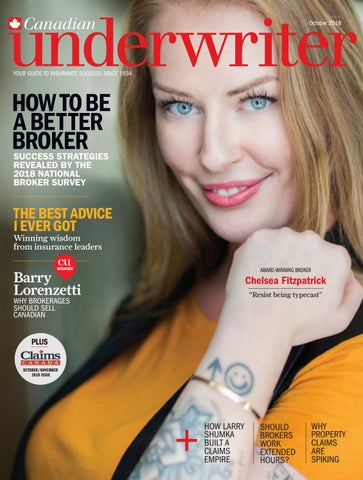
Chelsea Fitzpatrick “Resist being typecast”
WHY BROKERAGES SHOULD SELL CANADIAN
PLUS OCTOBER/NOVEMBER 2018 ISSUE
+
HOW LARRY SHUMKA BUILT A CLAIMS EMPIRE
SHOULD BROKERS WORK EXTENDED HOURS?
WHY PROPERTY CLAIMS ARE SPIKING
is something people tend to overlook. But not us. In fact, we focus on it. Because in a relationship business, like yours
ours, that simple
symbol stands for what is essential: the power of partnership. The value of the right combination. It stands for unparalleled expertise flawless service. what we bring you.
burnsandwilcox.ca
that’s
MANY thanks.
THIRTY-EIGHT THOUSAND TO BE PRECISE.
2018 IBAC Full Partners
SUPPORTER: Everest
Participants: Lloyd’s Underwriters, Pafco, Northbridge, Wawanesa
The thousands of brokers represented by the Insurance Brokers Association of Canada (IBAC) work every day to serve the best interests of millions of Canadians. Thank you to the outstanding insurance companies who partner with us to deliver security and peace of mind to so many. Proud Supporter of Brokers Displaying this Symbol
Better Coverage Less Hassle
Our new E&O coverage for contractors and professionals offers valuable protection beyond what your customers’ general liability insurance provides and covers them against lawsuits from professional errors – whether real or perceived. Speak with your Business Development Manager or Commercial Lines Underwriter today to learn more.
ClaimCare
97% CLAIMS SATISFACTION
goremutual.ca
When things go wrong, we’re here to help and will keep you and your customers informed every step of the way with our ClaimCare Tracker.
CONTENTS Volume 85, No. 9 | OCTOBER 2018
YOUR GUIDE TO INSURANCE SUCCESS. SINCE 1934
CANADIANUNDERWRITER.CA
FE AT U R E S
33
How to be a Better Broker 2018 NATIONAL BROKER SURVEY Brokers across Canada share their opinions and experiences on a wide variety of topics facing the channel and their brokerages – including thoughts on specialization, as well as best practices for identifying leads, converting prospects, sales and marketing, compensation and more!
46
THE BEST ADVICE I EVER GOT Insurance industry leaders relay the wisdom that helped them win
59
THE OPPORTUNITY IN NEW LIABILITY Why legal expense insurers are keen on Canada’s creation of new torts in privacy and harassment law
SCM co-founder Larry Shumka
canadianunderwriter.ca | October 2018
7
Twitter: canadianunderwriter
Facebook: canadianunderwriter
9
69 24 67
21
FROM THE EDITOR
HANDBOOK
75 Liability Takes the High Road
12 United brokers stand,
63 The Personal Touch
divided they fall
Who says you can’t have both the speed of automation and the advice-based advantage of a human?
Weed and booze are the same when it comes to impairment, but measuring their effects may be a different story
PERSPECTIVES 14 Our readers respond to recent stories on pink slips, A.I., telematics and more
DECLARATIONS 17 After Hours Do brokers really need to expand their availability beyond traditional office hours?
21 Property Claims Spike Two reasons why property claims are skyrocketing this year
cu
INTERVIEW
67 Working Around Workarounds An analysis of the data exchange workarounds of commercial brokerages and whether or not they work
78 HOW I DID IT
71 Poach Protection
IN EVERY ISSUE
How an all-encompassing nonsolicit contract could lead to a mass exodus at your brokerage
73 Ethics of Cost-efficiency
Why Barry Lorenzetti, president and CEO of BFL Canada, stands on guard for thee
How far are you willing to go to streamline your brokerage to save costs? Would you have a junior clerk type up certificates of insurance?
October 2018 | Canadian Underwriter
Want to sell your brokerage for the highest price? Mind the Top 3 factors for higher valuations Larry Shumka reveals a key factor in transforming his threeman adjusting outfit into Canada’s largest privately-owned claims and risk management firm
26 Selling your brokerage?
8
77 Exit Strategy
How a new gadget based on the Internet of Things has greatly simplified flood mitigation in homes and offices
69 Going with the Flow
CANADIANUNDERWRITER.CA
18 22 24 24 64 64 68
SURVEY SAYS... NEW OFFERS BIG MOVES SUMMARY BY THE NUMBERS TRUSTED ADVISOR CROWDSOURCED
We’re taking brokers and customers on a bold journey with us. Rowan Saunders, President and CEO
We’re taking bold, strategic steps across all lines of business as we respond to disruption in the industry, support our broker partners, and find unique ways to address the evolving needs of consumers. We’re excited about where this journey will take us as we move toward demutualization and beyond. By constantly staying on top of market trends and the increasingly complex needs of our business partners, Economical will be a company you can count on for another 145 years.
Get ready for the future, with us. economical.com PROPERTY | AUTO | BUSINESS
©2018 Economical Insurance. All Economical intellectual property belongs to Economical Mutual Insurance Company. All other intellectual property is the property of their respective owners.
2018 UNDERWRITERS OF THE YEAR The following individuals understand what the role of an underwriter truly is: to write great business WKDW VDWLVȴHV the clients’ needs and creates a win-win for the broker and insurer. What sets these underwriters apart from other hard working underwriters is their attitude. They commuQLFDWH LQ DQ RSHQ DQG HHFWLYH manner, and they go out of their way to explain the reasoning behind their decisions and make suggestions, if necessary, to help our member brokerages place the risk elsewhere. Their consistency and helpful nature have made them outstanding underwriters who are a pleasure to work with.
COMMERCIAL AWARD
PERSONAL AWARD
Lana Kenny Travelers Canada
Francesca Bobb Allianz
Maureen Rusnell Pembridge Insurance
Anette Bollmeier The Guarantee Company of North America
Jaime Larkman Intact Insurance
Kathryn Stimers Northbridge Insurance
Daniel Bradshaw Optimum West Insurance Company
Rose Marie Dixon Intact Insurance
James Johnson RSA Canada
Luke Pinder CNA
Jason King Aviva
James Peer Chubb
Trish Audit Gore Mutal
Sheila-Doreen Collins Intact Insurance
Darlene Hart Travelers Canada
FROM THE PUBLISHER
OUR MEMBERS
The real cover story A great business magazine should help you do your job. Welcome to Your Guide to Insurance Success
W
hatever your role in the industry, you can rightfully feel harried by the demands of an insurance career today. You're certainly dealing with more change and complexity than the people who received the debut issue of this magazine in January 1934. To name a few issues that challenge the modern insurance professional: developing an effective understanding of rapidly proliferating risks, from cybercrime to climate change; coping with new distribution models, upstart competitors and waves of consolidation; the Groundhog Day-like cycle of learning new technology that helps you do your job; wondering whether the next new technology will take your job. But, hopefully, you find that milieu more energizing than enervating. Maybe your concern isn’t with how you'll confront all of these challenges; rather, it's how you'll seize the opportunities created by this dynamic market. No matter what your perspective is, you have more to do and less time to do it than ever. So, we've rebuilt Canadian Underwriter with that pressure in mind. Undoubtedly, you’ve noticed this issue's arresting cover image, which introduces the magazine's first redesign since 2008. If you're wondering whether our cover subject, IBABC Young Broker of the Year Chelsea Fitzpatrick, represents our first step in the slavish pursuit of millennial readers at the expense of those we've served for decades, rest assured that she does not. However, the cover does mark a clear break from the CU of the past decade. More important is our new tagline, Your Guide to Insurance Success. It expresses a mandate to enrich you with practical insight that will help you cut through the clutter of our times. In other words, our priority is to improve your understanding of the issue or opportunity at hand, explain what you can do about it and, then, show you the best ways to do it — all within an engaging visual package that gives you more takeaways in less time. The new Canadian Underwriter should make it easier to achieve greater success, whether that means building your book of business, improving customer satisfaction, being a better leader or simply feeling less harried. I hope you'll think of each issue as one of the opportunities to seize in this dynamic market.
ian@canadianunderwriter.ca Twitter: canadianunderwriter
Facebook: canadianunderwriter
For more information visit canadianbrokernetwork.com or call 647 260 3798
canadianunderwriter.ca | October 2018
11
FROM THE EDITOR MANAGING DIRECTOR, INSURANCE MEDIA GROUP
Ian Portsmouth ian@canadianunderwriter.ca (416) 510-6800 EDITOR-IN-CHIEF
David Gambrill david@canadianunderwriter.ca (416) 510-6793 ASSOCIATE EDITOR
Greg Meckbach gmeckbach@canadianunderwriter.ca ONLINE EDITOR
Jason Contant jcontant@canadianunderwriter.ca
All for one and one for all
ART DIRECTORS
Catherine McKenny & Ellie Robinson DIRECTOR, BUSINESS DEVELOPMENT
Sandra Parente ACCOUNT REPRESENTATIVE
What’s more important for brokers: the broker channel, or market share?
Jonathan Hogg PRODUCTION MANAGER
Karen Samuels
A
CIRCULATION MANAGER
bout a decade ago, I had dinner with a broker who told me quite candidly that he didn’t mind if other brokerages could not keep pace with advances in technology. As far as he was concerned, if the "dinosaurs" couldn’t give customers what they wanted, they would quite likely disappear from the Canadian P&C landscape. And he was only too happy to scoop up the additional market share. That was back when brokers could afford the luxury of treating each other as competitors. At that point, about 51% of Ontario insurance consumers bought their insurance products through the independent broker channel, while 38% bought from agents or direct markets, according to 2007 statistics. Since then, directs and insurtechs have seized on new technologies to offer insurance policies and claims services to consumers at lightning speed. Not surprisingly, as seen in the results of our 2018 National Broker Survey (see Page 33), brokers now view the growth of the direct-to-consumer sales model as the Number 1 challenge facing brokers today. To thrive as a channel, brokers must work together to promote their value proposition, which is to provide choice and advice to their clients. To that end, brokers have much to learn from each other. And most certainly they aren’t shy about sharing what they know, if asked. So, we asked. More than 800 brokers across the country responded to our survey, offering many insights into how they conduct their business. What did they consider to be best practices? Which ones didn’t live up to the hype? Which tactical directions and strategies appealed to brokerage owners? Did their producers agree? The results proved to be illuminating, and we think brokers have much to learn from each other about thriving in a competitive marketplace.
Mary Garufi PRINT PRODUCTION MANAGER
Lilianna Kantor NEWCOM MEDIA INC. CHAIRMAN AND FOUNDER
Jim Glionna PRESIDENT
Joe Glionna VICE PRESIDENT, OPERATIONS
Melissa Summerfield CHIEF FINANCIAL OFFICER
Peter Fryters DIRECTOR OF CIRCULATION
Pat Glionna Canadian Underwriter is published twelve times yearly by NEWCOM MEDIA INC. All rights reserved. Printed in Canada. The contents of this publication may not be reproduced or transmitted in any form, either in part or in full, including photocopying and recording, without the written consent of the copyright owner. Nor may any part of this publication be stored in a retrieval system of any nature without prior written consent. © Since 1934, Canadian Underwriter has been the voice of Canada’s insurance industry - a monthly magazine providing the highest quality and most relevant news and insight to insurance professionals from all segments of Canada’s property and casualty insurance market. The magazine is delivered on a direct-request circulation basis to nearly 15,000 senior decision makers nationally, including insurance brokers, risk managers, insurance and reinsurance company personnel, claims managers and adjusters. Since its beginnings, Canadian Underwriter has been a link between all segments of the insurance industry, providing insurance professionals with award-winning coverage of industry issues, trends, news, personalities and events - written by Canada’s leading insurance journalists. Subscription Rates: 2018 Canada 1 Year $51.95 plus applicable taxes 2 Years $75.95 plus applicable taxes Single copies $10 plus applicable taxes, except $49 plus applicable taxes for July issue featuring annual Statistical Guide. Elsewhere 1 Year $71.95 Subscription Inquiries/Customer Service Mary Garufi (416) 614-5831 mary@newcom.ca GST Registration number 890939689RT0001 Second Class Mail Registration Number: 08840 Publications Mail Agreement #40063170 Return undeliverable Canadian addresses to: Circulation Dept. Canadian Underwriter 5353 Dundas Street West, Suite 400, Toronto, Ontario M9B 6H8 Tel: (416) 614-2200 ISSN Print: 0008-525 ISSN Digital: 1923-34
david@canadianunderwriter.ca MEMBER
Twitter: canadianunderwriter
12
October 2018 | Canadian Underwriter
Facebook: canadianunderwriter
Markel. Expect more from your insurance carrier
Commercial general liability Cyber risks insurance Directors and officers liability Environmental impairment liability Life sciences Professional liability Property and inland marine Security and protection industry Umbrella and excess liability
Helping brokers with effective insurance solutions since 1966 Calgary Montreal Toronto Vancouver www.markelinternational.ca
perspectives canadianunderwriter.ca l
company//canadian-underwriter l
Regulator reveals reasons for electronic pink slips delay August 28 The story: Police raise concerns about having to handle a motorist’s smartphone to verify insurance information, citing the potential for officers to be accused of violating motorists’privacy.
One web reader commented: “So, let me see if I understand this. We’re not implementing new policy to keep up with the modern world because a police association has some concerns about client complaints? Well, the police associations complained when we did away with front license plates, but we did away with them anyway. They also complain about the lack of an insurance database accessible to them to verify that the actual document they’re looking at is in force, and we’ve done nothing to respond to that logical request. Why aren’t all our official documents available for review electronically? Why can’t you just hand the police officer a thumb drive with all this on it? All of a sudden privacy is a concern? I don’t think so. It’s an excuse to not modernize the process!!”
The trade-off to using artificial intelligence to speed up claims
@CdnUnderwriter
Are consumers warming up to telematics?
W E B S IT E
August 28 The story: 53% of Canadians polled would use an app that tracks their driving habits if it meant having a more personalized auto insurance rating, according to a new survey commissioned by Belairdirect. The insurer offers a telematics program called Automerit, which offers insurance rates based on kilometres driven.
Kevin Chong, director of commercial lines pricing at Economical Insurance, commented: “What Intact should publish is what percentage of customers not using Automerit actually switched to it when asked to? I am sure they should have this information, and don’t expect the conversion rate to be > 50%.”
The absurd effect of commerce law on claims adjusting September 1
August 29 The story: A senior official from RSA Canada discussed Lemonade’s widely-reported use of AI to handle a claim in three seconds, saying claims leakage is a possible trade-off of using AI.
One web reader commented on empathy in claims handling: “Nothing compares with standing in front of a client, looking him in the face and saying: ‘We can make it better.’ No algorithm has the empathy needed to be a good claims adjuster. By the same token, being there in person gives you a chance to use the accumulated experience of dealing with scams. Lots of signals are non-verbal and insurers lose that chance by telephone and Lemonade adjuster.”
The story: Due in part to NAFTA, sometimes it’s easier for Canadian insurance companies to bring in adjusters from the United States than it is to move Canadian adjusters between provinces.
Marc Dubois, commercial loss claims consultant with Florida-based M.G.D. Claim Services, commented: “In the U.S., where a Texas license has reciprocity with 37 other states, movement is easier. It seems in Canada, regulators make it hard to do business.”
How smoke from B.C. wildfires affects this industry August 24 The story: Smoke from B.C. wildfires affects grapes used by winemakers.
@joannefriedman August 14 “[Ontario’s] online retail channel launching this fall will have a ‘robust verification system’ and will ensure safe home delivery for cannabis products.” What a joke!! More like @Fordnation is simply putting out a call to every hacker out there.
14
October 2018 | Canadian Underwriter
Ted Horsky commented: Finally the smoke is clearing out today! Has been a wicked August for quality of life! However, will not be cutting back on drinking Okanagan wine regardless of the “smoke”!
Using KMs.
Saving KMs.
Introducing CAA MyPace™, the first auto insurance payment program in Canada for low-mileage drivers. Designed with your clients’ individual lifestyles in mind, only CAA MyPace enables you to offer a new way to pay for and manage insurance premiums for motorists who drive less than 9,000 kilometres per year. broker.caainsurance.com
Auto Insurance is underwritten by CAA Insurance Company. Certain conditions, exclusions and underwriting eligibility rules apply. CAA MyPace™ is a trademark of CAA Insurance Company. ®CAA trademarks owned by, and use is authorized by, the Canadian Automobile Association. Available in Ontario only.
We’re coming out of our shell. At RSA, we’re ready to show you how we’ve transformed. We’ve overhauled our business to make it easier for you to grow with us, from better wordings and a more focused appetite to improved service and updated digital offerings. Talk to us to see how we’re doubling down on our shared growth.
We’re growing. How about you? Come grow with us at rsabroker.ca
© 2018 Royal & Sun Alliance Insurance Company of Canada. All rights reserved. RSA, RSA & Design, and related words and logos are trademarks and the property of RSA Insurance Group plc, licensed for use by Royal & Sun Alliance Insurance Company of Canada. RSA is a trade name of Royal & Sun Alliance Insurance Company of Canada.
declarations HIGHLIGHTS
Survey Says... p.18 l Property Claims Spike p.21 l New Offers p.22 l Big Moves p.24
BROKERS
After Hours Everyone talks about 24/7 service, but how much do you really need to expand your availability beyond traditional office hours? B Y G R E G M E C K B A C H , Associate Editor
For personal lines brokers, in an age of social media and online service, is it even relevant to talk about banker’s hours anymore? Not even bankers work “banker’s hours,” generally understood to be between the hours of 10 a.m. and 3 p.m., Mondays through Fridays. In a recent survey by J.D. Power and Associates, bank customers were asked what hours their primary bank branch keeps: 70% said their bank stays open longer than 9 to 5 on weekdays, and 75% said their primary branch is open on Saturdays. Insurance brokerages seem to be keeping pace with banks. In British Columbia, for example, brokers “have been
MARIJUANA ROADSIDE SCREENING | AUG. 28
Federal Justice Minister Jody Wilson-Raybould approved the Draeger DrugTest 5000. It’s the first saliva screening equipment to be used by police to test for THC, the main psychoactive agent in cannabis.
operating extended hours for over 10 years,” reports Mike Dakin, compliance manager for InsureBC Group (formerly known as The Intercity Group). For Dakin, it’s the new normal for brokerages to be open as late as 9:00 p.m. “Working extended hours is just a natural evolution of providing service [and] that goes beyond insurance,” Dakin tells Canadian Underwriter. “It’s just meeting the needs of busy households, in which you’ve got Mom and Dad both working full-time, and the only time they really have to do business of this nature is during off hours. So, brokers accommodate that need.” In Canadian Underwriter’s 2018 Na-
tional Broker Survey (See Page 33), 58% of 115 respondents reported that their brokerage offered “after-hours customer service.” Of the 438 brokers in the survey who said they personally offered after-hours service – meaning clients could contact them directly after normal work hours – 65% rated the practice highly for serving their clients well (e.g. on a 10-point scale, they rated the practice between 8-10). Are there any drawbacks to offering extended hours? In a blog for Bankrate, Claes Bell observes that “a substantial number of banks have held on to 9-to-5 hours at traditional branches.” There are two main
PLAYING IN THE SANDBOX | AUG. 27
Canada’s home, auto and business insurers called on regulators to establish a “regulatory sandbox” for the industry.
canadianunderwriter.ca | October 2018
17
SURVEY SAYS…
DECLARATIONS
BROKER SATISFACTION reasons for this, he says, citing Terence Roche, a partner at Cornerstone Advisors, a financial services consulting firm: • Extending bank hours is expensive. • In many cases, longer hours probably don’t generate additional transactions compared to standard hours. On the first point, in the world of insurance broking, offering after-hours service “can require more frontline staff and technology,” Joe D’Annunzio, president of Macdonald Chisholm Trask (MCT) Insurance, tells Canadian Underwriter. “There’s lots to consider before hitting the gas pedal.” MCT, which was acquired in 2014 by Intact Financial Corp.’s BrokerLink unit, has offices in Nova Scotia, New Brunswick and Newfoundland and Labrador. Physical office locations are typically open Monday through Friday from 9:00 a.m. through 5:00 p.m., but consumers can contact MCT on weekdays from 8:00 in the morning until 9:00 at night, as well as on Saturdays from 9:00 a.m. until 4:00 p.m. After hours, someone is monitoring MCT’s chat tool and social media channels. “For our brokerage, offering extended calling hours, a chat tool, and social media channels is important, because we operate across three provinces and have a large customer volume,” says D’Annunzio. There was no clear consensus among brokers about whether the number of additional transactions merited the longer hours. Discussion focused on whether it’s better to offer extended hours over the weekend, or to tack the extended hours onto the end of regular weekday hours. In Alberta, John Beal Insurance Ltd. in Calgary opens on Saturday mornings. One reason is to serve consumers who work during normal working hours and can therefore only visit the office outside of normal working hours. “It’s just a service we provide,” says Ken Nicholas, partner/principal for John Beal. “They RULING OUT DEMUTUALIZATION
|
SEPT. 4 In an interview with Canadian Underwriter, Heartland Farm Mutual Inc.’s new president and CEO, Louis Durocher, all but ruled out the demutualization option for his company.
18
October 2018 | Canadian Underwriter
On a scale of 0 to 10, how satisfied are you with your choice of profession as a broker?
55% 33% 7% 9-10
7-8
5-6
(Very Satisfied)
4% 0-4 (Not Satisfied)
*figures do not add up to 100% because of rounding
How likely are you to voluntarily leave the broker profession within the next three years for any reason?
54% 26%
0-1
2-3
(Highly Unlikely)
20% 4-5 (Highly Likely)
Source: Excerpted from the 2018 National Broker Survey
know we are open, so they come.” But there is not a huge demand for weekend service from clients at Ontario West Insurance Brokers, which has one office in London, Ont., and another in Simcoe, southwest of Hamilton. Sometimes a client buys a car on a Saturday and will contact Ontario West asking for the new car to be added to his or her auto insurance policy, reports Ontario West partner Traci Boland, who also serves as chairwoman of the Insurance Brokers Association of Ontario. “They go online and request a substitution of a new vehicle and I get that [e-mail] right away.”
On the other hand, there is often a need for someone at Ontario West to stay until 6:30 p.m. on weekdays, Boland says. “We do that by appointment for clients; as long as they let us know, someone will be here.” Offering extended hours does depend somewhat on scale. At InsureBC, many brokers work long hours and are often on the road to accommodate customers. “We have a lot of employees who are commuting two to three hours a day,” Dakin says. This can be tough on staff, especially when they have to take client calls after hours.
INSURERS’ M&A TARGETS | AUG. 29
Canadian P&C carriers are targeting other insurers and brokerages for M&A, but interest in acquiring insurtechs is rising, A.M. Best commented.
WHAT MAKES OUR
CORPORATE INSURANCE UNIQUE? OUR
SPECIALISTS KNOW... You can differentiate yourself in the market with The Guarantee.
Financial Institution Crime Commercial Crime Directors & Officers Liability (D&O) Miscellaneous Professional Liability (E&O) Office Package Fiduciary Liability Cyber Insurance We have a long history of protecting Canadians by offering solutions that respond to emerging exposures. Our committed, experienced team actively monitors new risks and trends to tailor coverage to your clients’ unique needs. Find out how we are different. theguarantee.com
Excellence, Expertise, Experience ‌ Every time
Underwriting. Optimized. CANADA’S LEADING MARKET FOR THE CANNABIS INDUSTRY We can tackle all of your clients’ coverage requirements. Contact us today!
Commercial General Liability • Umbrella & Excess Liability • Environmental Liability • Professional Liability Property & Inland Marine • Lifesciences • Marine & Logistics • +PYLJ[VYZ 6MÄ JLYZ 3PHIPSP[` Product Recall • Cyber & Intellectual Property • Security & Protection Programme • Cannabis Industry
www.suminsurance.ca
DECLARATIONS
PERSONAL PROPERTY
Through the roof Why property claims spiked by 22% this year B Y D AV I D G A M B R I L L , Editor-in-Chief
Catastrophe losses and fire – that ageold nemesis of Canadian property and casualty insurers – are among culprits cited for a recent spike in personal property claims ratios, industry commentators say. Canadian federally regulated insurers have incurred $5.5 billion in property claims up to the end of the second quarter this year (that number includes both home and commercial lines). Over the same period last year, they incurred $4.5 billion. That’s a 22% increase over last year.
WHAT QUEBEC INSURERS WANT | AUG. 244
Insurers in Quebec called for the creation and regulation of P&C group insurance, which would allow for a group of individuals to be insured under a single contract, as in a ridesharing scenario.
Overall claims ratios for Canadian P&C home insurers in personal property lines have increased from 64% last year to 71% this year. For foreign insurers writing personal property business in Canada, the increase was more dramatic – from about 49% last year to 72% this year. So, what’s going on in the personal property lines this year? “Mostly the cats,” says Joel Baker, president and CEO of MSA Research. “There were a slew of them in the first half of the year.”
Ontario alone has almost $1-billion worth of property damage thus far, based on winter and spring storms. The biggest storm was a May 4 windstorm that hit Ontario and Quebec, causing insured damage of almost $500 million. That followed just weeks after an ice storm in Ontario and Quebec that caused insurers $190 million in damage. If you tack on $200 million in insured damage from summer storms in the Prairies in July and August, and between $1025 million for flooding in New Brunswick in the spring, Canada has seen more than
LAST PROVINCE WITHOUT A CAP | SEPT. 4
Among several other recommendations for structural reform, insurers in Newfoundland and Labrador called for a $5,000 cap on minor injury awards as part of the province’s first major auto insurance review in 14 years. canadianunderwriter.ca | October 2018
21
DECLARATIONS NEW OFFERS $1.4 billion in insured damage only nine months into the year. “Commercial writers had a tough time, followed by multi-line personal lines writers,” Baker observed of the cat losses. Federally regulated insurers paid $1.8 billion in commercial property claims in 2017 Q2, and $2.4 billion during the same time this year – a 32.9% increase. But while cats were an important component of the big personal property losses we’re seeing this year, something else is going on in habitational lines, insurers are telling Canadian Underwriter. And that’s the old industry peril of fire. The CEO of one mutual insurer said the company is still seeing fire losses, which he attributed to “distracted living.” In other words, someone cooks up some food on the stove, and starts a house fire when they leave it there to go watch TV or play on their mobile devices. Glenn McGillivray, managing director of the Institute for Catastrophic Loss Reduction (ICLR), observed that even with the catastrophe losses due to flooding in New Brunswick earlier this year, that didn’t entirely explain the spike in property losses in the area. “Not enough people have overland flood cover in New Brunswick to drive those kinds of numbers,” McGillivray says. “If you look at the loss ratios by province, you may be able to match them up with a particular cat or cats. But in some cases, like New Brunswick, there appears not to be a match, so the problems lie elsewhere.” OSFI data does not break down the causes of the incurred claims in property lines. Anecdotally, McGillivray says he has heard of fire presenting a problem for underwriters this year. “Despite all the talk that structural fire losses are going down in every industrialized country in the world, we clearly still haven’t licked the fire problem,” he says. “It is still a bane to insurers.” WHAT BROKERAGES ARE WORTH | SEPT. 5
Brokers’ online books of business are going for anywhere between five to eight times revenue, Mike Berris, partner and practice group leader with Vancouver-based Smythe Advisory, commented.
22
October 2018 | Canadian Underwriter
CANNABIS INSURANCE AND RISK SERVICES VENDOR: HUB International TARGET AUDIENCE: Farmers and Agribusiness WHAT IT DOES: Covers cannabis businesses; reduces their risks and liabilities
A new product offered by HUB International Limited is designed to provide protection to medical and recreational cannabis producers, distributors and retailers, as well as specialized solutions to reduce risks in all aspects of their operations. Canada has nearly 100 cannabis producers. Twenty-six carriers are insuring the cannabis industry in one way or another. “Cannabis is a thriving business, and there is a strong appetite to debunk common misconceptions of the industry, understand the risks and obtain proper and adequate insurance coverage,” said Joshua Smart, practice leader of HUB’s agribusiness and farm specialty practice. The new coverage is available for businesses in both the U.S. and Canada. In Canada, cannabis for recreational purposes is to be legalized this month. Although marijuana is still illegal under U.S. federal law, 29 states, plus the District of Columbia, Guam and Puerto Rico, have legalized it for medicinal purposes; eight states allow it for recreational use.
COMPREHENSIVE WATER VENDOR: The Co-operators TARGET AUDIENCE: Personal Property Homeowners WHAT IT DOES: Protects homeowners from storm surges, overflowing lakes, rivers and creeks, and sewer or septic backup
Coverage for storm surge, defined as rising water levels and waves caused by storms, is now available for the first time to homeowners living in the Atlantic provinces. The coverage is included in The Co-operators Comprehensive Water package, which provides protection from storm surges, overflowing lakes, rivers and creeks, and sewer or septic backup. First released in Nova Scotia, storm surge coverage is now available for homeowners in New Brunswick, Newfoundland and Labrador, and Prince Edward Island. Another feature of the Comprehensive Water package, overland flood coverage, is now available in Saskatchewan, Northwest Territories and Yukon. The model used to predict overland flood risk incorporates data on elevation, soil, rainfall, river flow, government-controlled defences like dams and channels, and other factors that help predict areas at risk of flooding. According to a study by Partners for Action Network, 94% of Canadians living in high-risk flood zones are unaware of their risk.
ONEWORLD+ VENDOR: CNA Canada TARGET AUDIENCE: Canadian business (multiple sectors) WHAT IT DOES: A tailored suite of products offering a core foundation of coverage in multiple areas, as well as additional bespoke coverages.
CNA Canada’s packaged solution contains a tailored suite of products designed for a diverse range of Canadian businesses, including commercial, manufacturing, construction, oil and gas, healthcare, technology and office. Each product within the suite has a core foundation of coverages, with additional bespoke coverages available. Key features of Oneworld+ include first- and third-party cyber coverage, directors and officers (D&O) insurance, media management crisis costs, event cancellation and currency devaluation. In addition to providing coverage, the solution also provides services such as risk management, business continuity planning and claims handling. Oneworld+ will be available in Quebec in 2019.
AIR CANADA DATA BREACH | AUG. 29
Air Canada said 20,000 customers may have had their personal information improperly accessed due to a breach in its mobile app, prompting a lock-down on all 1.7 million accounts until consumers change their passwords.
Transform today. Thrive tomorrow. Digitally transform to take your business beyond the office – anytime, anywhere. At Applied, our innovation is transforming an industry with the end in mind – you.
appliedsystems.ca
DECLARATIONS BIG MOVES
SUMMARY
New CEO at Heartland Farm Mutual Former La Missisquoi head takes leadership role at mutual insurer formed from merger of North Waterloo Farmers Mutual and Oxford Mutual.
NEW ROLE: President, CEO, Heartland Farm Mutual Inc. P&C EXPERIENCE: 25 years MOST RECENTLY: Chief Risk Officer, Aviva Canada PROFILE: Held several roles with Economical Insurance, including vice president of the Quebec region, where he led La Missisquoi, Economical’s Quebec subsidiary.
Durocher has lost count of the number of times he has moved. Born and raised in Montreal, Durocher figures he moved 21 or 22 times over the past 25 years, while working for insurers in Toronto, Montreal, and Waterloo, Ont. He graduated from Concordia University in 1992 with a degree in actuarial mathematics and joined Allstate the following year. Durocher went on to hold senior roles with Economical and Aviva Canada, at one time leading Aviva Canada’s national commercial lines and reinsurance department. He took the helm of Waterloo-based Heartland effective July 9, 2018. Heartland was formed in 2016 as a result of the merger of North Waterloo Farmers Mutual Insurance Company and Oxford Mutual Insurance Company. Oxford Mutual was based in Thamesford, Ont., about 15 kilometres east of London International Airport. Heartland continues to maintain offices in both Waterloo and Thamesford. “We still have two offices. It’s going to stay like that.” Rissa Revin, former CFO of Temple Re, is now CEO of DAS Legal Protection Inc., a Munich Re MGA that provides legal expense insurance. Revin joined Munich Re and Temple in 2014, serving as SVP of claims, general counsel and corporate secretary for both companies. She has 27 years of experience in law, insurance and banking.
QUEBEC STORM CUTS POWER | AUG. 30
Damage caused by thunderstorms and wind gusts of up to 90 km/h caused significant damage to Quebec’s hydro distribution network, leaving as many as 175,000 without electricity.
24
October 2018 | Canadian Underwriter
Outlook for Canada’s P/C and Life Segments Remains Stable, as Economy Continues to Grow A.M. BEST COMPANY INC.
WHO: Louis Durocher
Joseph Zigrossi, former president and CEO of Global Aerospace Underwriting Managers (Canada) Limited, has joined Montreal brokerage Dulude Taylor Aviation as SVP. Zigrossi has 35 years of experience in the aviation field and graduated from the Aviation & Flight Technology Program at Seneca College.
REPORT
Robert Sparling has been appointed SVP and practice lead of materials failure for 30 Forensic Engineering, formerly known as Giffin Koerth. Sparling has more than 20 years of experience, including 12 years in aerospace and 10 years in forensic engineering. He has led more than 3,000 failure investigations.
KANETIX ACQUIRED BY TEACHERS | SEPT. 4
Insurers’ expense ratios are increasing as they bulk up on new technologies, A.M. Best Company Inc. noted in a recently-released special report on the Canadian insurance industry. “Investments in digital technology, social media presence, and mobile apps, as well as electronic and predictive modeling/underwriting, remain critical initiatives as insurers strive to grow new business,” Oldwick, N.J.-based A.M. Best said in its report, entitled Outlook for Canada’s P/C and Life Segments Remains Stable, as Economy Continues to Grow. A.M. Best released several statistics on insurers’ collective financial performance for the past five years. Among them, the expense ratio has increased over the past five years, from 31.4% in 2013 through 33.2% in 2017. “The steady increase in the expense ratio over each of the past five years reflects ongoing systems investments, as well as continuing efforts to improve underwriting and claims handling, enhance risk management efforts, and leverage data analytics in the underwriting and claims processes.” The industry-wide combined ratio remained higher than 95% from 2013 through 2017. It improved s lightly from 98.1% in 2016 to 97.1% in 2017. The improvement was partly due to the absence of a single large catastrophe in 2017, A.M. Best noted. Also, the COR in 2017 was buoyed by a significant release of loss reserves.
Ontario Teachers’ Pension Plan (OTPP) agreed to acquire Kanetix Ltd. – a marketplace providing onlinee quotes for insurance and financial products – for an undisclosed sum.
(YHU\RQH·V different. That’s why we’re serving up solutions to fit your customer. It starts with great conversation with our Brokers on products to meet the changing needs of their clients. Partnering with CAA Insurance is as satisfying and smooth as your morning coffee — all backed by one of the most trusted brands in Canada.
Want to learn more? Talk to us. Kathy Corbacio 289-260-5120 (Ontario) Elenor Nowosad 204-262-6003 (Manitoba) Lynn Gerhardt 902-229-3478 (Atlantic)
broker.caainsurance.com | Join the conversation! @CAAforbrokers ®CAA trademarks owned by, and use is authorized by, the Canadian Automobile Association. Associatio Auto Insurance is underwritten by CAA Insurance Company.
Proud to be a CAA Company
cu
INTERVIEW
BARRY F. LORENZETTI, Founder, President and CEO, BFL Canada
EXIT STRATEGY
SELL CANADIAN Thinking of selling your brokerage to a global consolidator for a ridiculously high multiple? Before you do, consider having lunch with Barry Lorenzetti, founder, president CEO of BFL Canada. Here’s his case for why a Canada-first exit strategy may be your best option for preserving your brokerage’s culture, and for retaining your young guns.
26
October 2018 | Canadian Underwriter
cu | What kind of pressure exists today for Canadian brokers to sell to global consolidators such as private equity firms, public companies or established brokerage firms? There is so much capital in our industry that, as long as interest rates remain low, multiples will stay high. [Brokerages are typically sold for a “multiple” of revenue or commissions]. A good friend of mine owns a regional brokerage and he tells me that probably at least three to four times a year, he will get M&A offer letters from private equity or global consolidators. In one case, without one single meeting, this individual received a draft letter of intent setting out the terms and conditions of an offer to buy his business based on an estimate of his firm’s revenue; that’s how impressive they are. If you are thinking solely of senior owners and the board, or perhaps you haven’t done a thorough job on succession planning, it’s easy to be lured into those large multiples. If BFL Canada was simply interested in money and looking short-term, we probably would have sold our company a few years back at a multiple that probably would have knocked your socks off. We’re coastto-coast, 12 offices, and sort of like a one-stop shop. Acquiring BFL Canada would allow a U.S. firm to come into Canada and have a national company right away. You can imagine the kind of multiples that were thrown at us.
cu | You are a big advocate for Canadian brokerages maintaining their culture throughout the M&A process. What do you mean by culture? Culture is so important to the success of an organization. We believe in culture. That’s what we want to build. We want people to feel good about working here. I think there’s a cultural difference between the U.S. and Canada. The nature of our culture is teamwork. The teamwork within BFL Canada, for example, is a tremendous asset that contributes to our culture. It underpins the trust that develops within our business
model. We have 87 shareholders; those are key principals, key partners in our organization. At the end of the day, the more these individuals work together as a team, which contributes to culture, the more their share values are enhanced. When we speak to Canadian regional brokers and brokerages, they are happy to be here. They enjoy the private concept of the firm, the entrepreneurial spirit.
cu | How does an M&A deal with a global consolidator threaten that culture? When Canadian brokerages are bought by large global consolidators, there’s a lot to be taken into consideration. What invariably happens is that expenses are reviewed, and that affects culture. How often does it happen that a U.S.-based consolidator buys a Canadian-based brokerage and, all the sudden, over the course of two or three years, the consolidator applies its corporate policy and transforms that Canadian firm with a cutback here, a cutback in expenses there? Basically, those Canadian firms become public firms, or they become part of the global mega-firm. They lose their culture. Also, when these U.S. consolidators acquire a Canadian regional or a private firm, it’s only a question of time before the Canadian broker must use the resources – the markets in London or wherever they are – that the consolidator uses. Sometimes the clients of the Canadian regional brokers have friendships and relationships with people in the Canadian operation. Well, those relationships could disappear. Also, with these high multiples, especially when brokerages are selling to insurance companies, the equity is usually consolidated in two or three senior people and that’s where it goes. It doesn’t get distributed to the young guns in the Canadian brokerage.
cu | How do these deals affect the young guns who work in the Canadian firms that are up for sale? I have met with a number of regional
We want people to feel good about working. I think that’s the whole cultural difference between the United States and Canada. We believe in culture. What is wrong with culture?
brokers and the younger members who on many occasions are not shareholders. Sometimes these young guns have a greater vision of the future of the business than the owners; they certainly have ideas on where they would like to take the company. Selling out to an insurer or private equity ends these dreams and hopes immediately.
cu | Why is that? Normally when you do a private equity deal, you’re creating to some degree a level of instability in your organization. Because private equity doesn’t stick around for that long – maybe four to six years. And the young guns in the office, and the individuals who probably don’t have the equity, they start asking themselves: ‘How long is this equity player going to be in play? What will happen when they flip us in five or six years?’ So while the multiple might look very, very good at the outset, some of the young canadianunderwriter.ca | October 2018
27
cu
INTERVIEW
talent may start to leave because of the instability, because of the lack of recruitment for five years. Let’s face it: these young guns today want to know where they need to be in two or three years, and then they start to work towards that. And they expect the resources behind them in order to get there. It’s very difficult to make a sales pitch to them if you’ve got a five-year expiry period with your private equity investment partner.
cu | How does selling to a Canadian entity improve the situation of the young guns? What’s the sales pitch there? Engagement is the key to success. It’s easier to recruit into an organization where the employees are engaged. We’ve been able to hire these individuals, recruit them, because we know our firm is independent, and that we are going to be staying independent. When I read comments from consolidators, they always say one of the biggest challenges is the engagement of their employees. They can’t hold onto them. In contrast, in our business model we facilitiate the purchase of shares to qualified employees and help them to become shareholders of the company, I think that really gives us a leg up on the global consolidators. Our business model is geared to perpetuation and employee engagement. I think we need to do a better job at communicating the benefits of this model. I think there is a tremendous opportunity for these young guns to fulfill their aspirations at a firm like ours, as opposed to working for a firm controlled by private equity. I’m just saying that our model, whether we are Canadian or not, has stood the test of time and has catapulted the level of our firm to what it is today. It has attracted top talent from public firms. We continue to recruit top professionals nationally. When it comes to acquisitions, we want to grow selectively. Many individuals in midsized Canadian firms choose to work there because it is where they feel more secure and are happy. Selling to one of the global consolidators, as opposed to another Canadian-based firm, puts 28
October 2018 | Canadian Underwriter
these young guns in a position where they never wanted to be in the first place – and we kow the end result of that. It becomes the very same concept as the firm they left to join the Candian brokerage. We want people to feel good about working. I think that’s the whole cultural difference between the United States and Canada. We believe in culture. What is wrong with culture?
cu | What promps Canadian brokerages to sell to global consolidators, despite all the factors you mention above? Look, I’m not here to tell anyone how to run his or her company. It just so happens that we are a Canadian company and after 31 years, I believe we have seen a lot of things that affect not oly BFL Canada, but also the general industry itself. Speaking personally, I am shocked and surprised by the number of deals I have seen over the past little while in which these cultural factors were perhaps not taken into consideration, or perhaps the seller was not as sophisticated. But I can’t believe that. At the end of the day, I think a lot
PROFILE
BARRY F. LORENZETTI Title: President, CEO, and Co-founder of BFL Canada Born and Raised: Montreal, Canada Education: Graduated with a Bachelor degree in Arts from McGill University in 1974 Industry Experience: First entered industry in 1970. Following his graduation, he spent time in London and New York working for a Lloyd’s insurance brokerage company. Started in 1987 as B.F. Lorenzetti and Associates. Charitable Support: Annual financial assistance to Women’s Hockey in Canada; also contributes to annual scholarships to promising Canadian amateur athletes. He serves on boards and non-profit organizations through the Lorenzetti Family Foundation.
of these deals are really done through greed. They don’t take into consideration the aspirations of the young guns, or what they are looking for down the road.
cu | What is your message to a Canadian-based brokerage that is planning to sell? How do they say no to a large multiple offered by a global consolidator? I just hope the Canadian sellers see that there is an alternative. At BFL Canada, we will pay competitive pricing up to a certain level. I would love the opportunity to have dinner or a lunch with you, the individual who wants to sell at eight times multiple. Why don’t you have a dinner or lunch with the consolidator one day, and have a lunch or dinner with me the next day? I can tell you why we offer a better deal. Why we can give you certain guarantees on your culture, on your business model, that the consolidator can’t. As I stick up for the insurance industry in Canada, I would hope that more and more Canadian firms do the same thing.
Continually Updated! NATIONAL
Insurance brokers! Find the specialized insurance coverage your clients need at InsuranceMarketer.com:Canada’s original online directory of specialty, niche and non-standard insurance products.
• Find markets for 100s of risks, from air conditioning to zebra mussels • Fully searchable by product and provider • Coontinually updated by carriers, MGAs an nd wholesalers themselves • Qu uery providers directly from the site
Save time. Satisfy more customers. www.InsuranceMarketer.com
Inside What’s new in claims management
www.claimscanada.ca August-September m 2018
The mental side of building flood resilience
Water woes
Your 46th annua l guide to PM40063170
Prefer print? Order additional copies of the 2018 National Insurance Marketer for just $10 at: www.CanadianUnderwriter.ca/buynim
Here’s the scoop: Niche coverag Discover the e is taking opportunities in today’s hottest over! where to place more than 900 lines and varieties of specialty risk
AUGUST 2018 PM#40063170
+
Detecting the industry’s frauds BY AMANDA HOLDEN ters Preparing for court: How your BY JOSEPH OPPENHEIM client sees you The next revolut ion in auto safety
BY BRUCE CARRICK
Aviva Enterprise™
Spotlight on Metal Manufacturing Ensure E nsure your your client’s clilient’ t’’ss business business -/,!2 ""0 -/,!2 "0 4&1% 0 4 4 4&1% &1% ,+Ɯ!"+ ,+Ɯ!"+ "
In today’s changing commercial landscape, Aviva recognizes that your client’s metal manufacturing business doesn’t stand still – and neither should their insurance. Aviva Enterprise™ Metal Manufacturing insurance ,ƛ"/0 201,*&7 )" -/,1" 1&,+ to meet your client’s evolving needs with all locations and operations included under one Property & Casualty policy. Aviva Business experts also provide their insights and knowledge on current trends and prevention solutions for the unique risks facing Canadian metal manufacturers. Share this industry-focused content with your clients to help them understand the exposures they face and how to protect their operations. Explore our metal manufacturing spotlight series at:
aviva.ca/MetalManufacturingSpotlight Business Insurance – Property | Casualty | Auto | Equipment Breakdown | Umbrella Aviva and the Aviva logo are trademarks used under license by the licensor. Aviva Enterprise™ is a trademark owned by Aviva Canada Inc. The Aviva Enterprise™ policy is underwritten by Aviva Insurance Company of Canada. Terms and conditions apply. For exact terms, !"Ɯ+&1&,+0Ǿ )&*&1 1&,+0 +! "51"+0&,+0Ǿ /"#"/ 1, 1%" 12 ) -,)& 6 4,/!&+$0ǽ
to come l SURVEY
2018 National Broker Survey
HOW TO BE A BETTER BROKER
n the 1994 spy movie The Specialist, two CIA explosives experts played by Sylvester Stallone and James Woods are on a mission to blow up a car transporting a South American drug dealer. But when Captain Ray Quick, played by Stallone, sees a young girl in the car, he calls to abort the mission. Colonel Ned Trent, played
I
by Woods, is having none of it, and the mission proceeds, killing the target and the young girl. Traumatized by the incident, Stallone’s character quits the CIA and starts his own business as a freelance hit man who specializes in “shaping” his explosions so that they don’t kill innocent people. Welcome to the new era of market
canadianunderwriter.ca | October 2018
33
NATIONAL BROKER SURVEY
“As the market has become more sophisticated, clients expect a broker to walk into their office with an understanding of their unique risks to be able to architect an insurance program. Specializing is the way to do that.”
segmentation. It’s a precarious world in which brokers can offer truly unique advice to their clients, cementing their value as trusted advisors. While there may not be much appetite in the insurance industry for offering E&O coverage tailored to bomb experts, our 2018 National Broker Survey shows that brokers see specialization as the way of the future. Canadian Underwriter talked to brokers about more than just specialization, of course. More than 800 brokers across the country participated in the survey, conducted in August, which asked broker owners and producers a variety of questions that covered a broad range of topics. In addition to discussing the Number 1 risk to the channel (more on this elsewhere), brokers ranked the risks facing their own individual brokerages. Our survey respondents reported that finding qualified brokers was proving to be the single greatest challenge (66%), fol34
October 2018 | Canadian Underwriter
ticated, clients expect a broker to walk into their office with an understanding of their unique risks to be able to architect an insurance program. Specializing is the way to do that.” Certainly, the market has changed over the past decade. Digital innovation and the expansion of the direct writers’ market share in Canada have contributed significantly to eroding the broker channel market share, most notably in personal lines insurance. A decade ago, about 51% of Ontario insurance consumers bought their insurance products through the independent broker channel, while 38% bought from agents or direct markets, according to a 2007 independent consumer survey commissioned by the Insurance Brokers Association of Ontario (IBAO). Nowadays, according to an estimate by broker tech service provider Applied Systems, the broker market share in personal lines is closer to the 45% range. Canadian Underwriter asked brokers to pick their strongest challenges to the channel in the future. “Growth of the direct-to-consumer sales model” ranked Number 1, selected by about 76% of the 799 people who answered the question. The other two challenges, the “misperception of the value of insurance brokers” (58%), and “insurance industry consolidation” (52%) finished a relatively distant second and third. Within the direct insurance distribution channel, direct writers typically use technology and automation to offer a single branded insurance product to consumers. U.S.-based Lemonade, for example, uses online technology to simplify insurance buying and claims payments, boasting that it can complete an online insurance purchase in 90 seconds and pay a claim in three minutes. Why specialization? Why now? “Historically, there was a hesitancy to In contrast, the independent broker stake your claim on a single area because model offers consumers a choice of prodyou never wanted to exclude yourself ucts alongside advice. How can brokers from other opportunities,” says Michael counter the threat of the directs? While the survey results definitely Loeters, past president of the Toronto Insurance Council (TIC), which promotes suggest specialization is a valued route the common interests of large commer- to take, there isn’t necessarily the same cially-focused insurance brokers with an degree of unanimity in how to define it. office in the Greater Toronto Area. “But, There are a number of ways it could be as the market has become more sophis- interpreted. lowed by the price demands of consumers (55%) and adopting new technology (53%). Overall, brokers reported being optimistic about their financial future. Some of our questions focused on the perceptions of both owners and producers about strategies for investing in the brokerage. Principals tended to emphasize the value of product and sales training, as well as customer service technology. Producers agreed with principals about the importance of product and sales training; after that, they placed more emphasis on customer-referral programs. In addition, the survey asked a series of questions related to best practices in a number of specific areas. Producers, for example, identified the following as best practices: asking existing customers for referrals, responding promptly to enquiries and educating themselves more about their clients’ particular situations. Which brings us back to specialization. In an “environmental scan” of how brokers felt about general, high-level statements related to their business (see Page 35), one statement generated the highest level of agreement (88%): “Brokers need to become more specialized to withstand changing technology and sales models.” Of those who agreed, more than half did so strongly. The level of agreement was roughly the same for personal lines brokers (89%) as it was for commercial lines brokers (between 90 and 95%, depending on the concentration of commercial business). To unpack this result further, we interviewed several brokers across the country to ask them about their emerging role as ‘The Specialists.’
NATIONAL BROKER SURVEY Defining specialization “The best way to describe specialization is to say that it creates deep-seated bench strength in a given industry,” says Tina Osen, president of Hub International Canada. “This is not just the broker handling the coverage placement, but also risk services and claims capabilities. It’s a holistic offering to the client in their given industry around any insurance-buying needs they might have.” Specialization encompasses everything from pre-loss mitigation service – identifying a specific industry’s loss exposure trends, for example, and designing special packages to mitigate those risks – to post-loss claims response. Interviews with brokers across the country suggest four main ways to specialize: • Offer specific insurance knowledge and advice to clients. • Provide unique insurance products, programs and/or services based on individual producers’ particular aptitudes and enthusiasms. • Narrow the focus of the entire brokerage to specific lines of business. • Providing service in traditional insurance lines using a unique distribution method such as purely digital platform. Still another way to specialize might be according to premium volume, observes Robyn Young, vice president of the Insurance Brokers Association of Canada (IBAC). For example, large brokerage houses may focus on the larger, complex commercial accounts, while smaller operations may be looking to target small business accounts. Rick Orr, owner and account executive at Orr Insurance & Investment, says brokers have always specialized. But today consumers may be hearing a lot more about the tailored services that brokers offer. “There have always been brokers within a brokerage with an increased knowledge in a particular market,” Orr says. “But I think brokers are now doing more to market their specialties. Some are specializing in knowledge, and others are specializing more in the marketing field than in the knowledge field.”
ISSUES & OUTLOOK
State of the Union Environmental Scan How are brokers feeling about themselves and the broker channel? We asked them to agree or disagree with these statements. agree
56%
44%
With all of the recent and anticipated changes in the insurance industry, brokers face more opportunities than threats.
72%
28%
Brokers are successfully communicating their value to consumers and businesses.
disagree
52%
48%
88%
Insurance carriers are striking a fair balance between the interests of carriers and brokers.
12%
Brokers need to become more specialized to withstand changing technology and sales models.
Direct Danger
The Problems of Principals
In your opinion, which of the following present a strong challenge (at least 8 out of 10) to the broker channel?
In your opinion, which of the following present a strong challenge (at least 8 out of 10) to the broker channel?
Share of brokers
Share of brokers
Growth of the direct-toconsumer sales model
76%
Finding qualified workers
66%
Misperception of the value of insurance brokers
58%
Price demands of customers
55%
Insurance industry consolidation
52%
Adopting new technology
53%
Legislative/regulatory uncertainty
39%
Maintaining client loyalty
48%
Demographic change
33%
Employee training and education
38%
Financial Forecast Based on what you know now, what’s your best estimate of how the financial performance of your brokerage will be next year compared to this year?
67%
29%
5%
BETTER
SAME
WORSE
canadianunderwriter.ca | October 2018
35
NATIONAL BROKER SURVEY
Brokerage owners and principals participating in our national survey identified the “price demands of customers” as the secondstrongest challenge to their business (54.7%), ranking below finding qualified workers (66%).
Specialized knowledge When brokers offer specialized advice to clients, this is often done to differentiate brokers from their competitors (for example, by giving advice, brokers provide value not offered by other brokerages, insurance companies or disruptors). But today brokers need to keep ahead of the advanced general knowledge of their consumers, who can learn a great deal by conducting a basic Google search. In essence, brokers need to justify their value as a ‘middleman’ in the insurance purchase. “Where we lend value is helping clients understand what’s important in their particular given area, and what’s critical to them,” Osen says. “Where do we see the risks in their specific industry? Where do we see the trends going? What is our experience in terms of seeing what their peers are buying, from a benchmarking perspective?” Specialized producers Relying on the unique, in-house skills and knowledge of producers is one way for brokerages to provide specialized insurance services. One broker gave Canadian Underwriter an example of a multi-lines brokerage that employed a producer who knew a thing or two about tattoo insurance. Other examples of areas of specialization include planes, boats and checking in-
surance contracts. “If you specialize in an industry, you are already walking into a meeting with information that the client may not know,” says Loeters. “Your preparation is much more focused and your time with the client is much more efficient. You need to bring value to your clients. If you meet with the executive of widget manufacturer, for example, and it takes you 20 minutes to say, ‘Let me explain a widget to you,’ that’s of no value to the client. They expect you to know that.” Specialized brokerages Of all of the specialization options, this may be the riskiest. “The danger of specializing your entire brokerage is that you have to make sure you pick a field that’s broad enough that it’s not going to be disrupted by someone else coming into that market,” says Orr. “If your single product line happens to get disrupted, that’s a challenge.” Given the hypothetical scenario of an insurance brokerage that specializes in ostrich farming, Young elaborates on the point: “There has to be a large enough volume of business to specialize,” she says. “To use your example, how many ostrich farms are there? Maybe there are only five ostrich firms in all of Montreal or in all Alberta. Maybe that’s big, but you’re probably not going to make a living on that.”
VALUE PROPOSITION
Who says you’re a trusted advisor?
97%
62%
of producers consider themselves to be trusted advisors
of producers are trusted advisors in the eyes of other advisors*
*Average producer response to the question, “What percentage of brokers are trusted advisors?” The survey defined a trusted advisor as “a broker whose customers consider him or her to be an authoritative, thoughtful and engaged consultant; someone they can count on for more than simply processing transactions or providing common information.”
36
October 2018 | Canadian Underwriter
NATIONAL BROKER SURVEY Specialized digital platform When brokers talk about “specializing” in personal lines, they often mean distributing traditional home and auto insurance products through a fully digital brokerage. But as some brokers note, this strategy is not for everyone. For one thing, home and auto lines are highly commoditized. The auto insurance product is highly regulated in Canada, leaving little room for variation in the auto products available for brokers to sell to consumers. Price therefore becomes a big factor in selling the personal lines auto product. In fact, brokerage owners and principals participating in our national survey identified the “price demands of customers” as the second-strongest challenge to their business (54.7%), ranking below finding qualified workers (66%). Adam Mitchell is president of Mitchell & Whale Insurance Brokers, an Ontario-based brokerage that taps into new technologies to promote business growth. Unlike in a traditional brokerage model, a purely digital brokerage caters to a comparatively fickle type of clientele – an online world in which consumers are shopping around for a better price. For the broker, that means a higher potential for poor client retention and unprofitable risks (leading to increased loss ratios), and higher operating costs because of the technology required to run the business. On the other hand, the potential for growth is better because younger clients are increasingly using technology to do their insurance buying. Where specialization may not work Brokerages in Canada’s smaller centres may not be ideal candidates for a specialization focus, says Shawn Fehr, president of the Insurance Brokers Association of B.C. “I don’t see it with the small mom-and-pop brokerages, they have to be generalized.” He points out that clients in smaller, rural communities tend to get their traditional home and auto insurance policies from their neighbourhood bricks-and-mortar insurance brokerages, which need the volume of these bread-and-butter lines of business to thrive, if not survive.
PRODUCER TACTICS
High Production Value From a list of sales and service tactics, we asked producers to choose the ones they deemed to be the most “highly beneficial” (a rating of 8 or more out of 10). The results bring two maxims to mind: know your client, and actions speak lounder than words. Lead generation
Share of brokers
Asking existing customers for referrals
75%
Asking other professionals for referrals (e.g. accountants, lawyers)
52%
Maintaining an active social media presence
41%
Personal advertising (i.e. not your brokerage’s general advertising)
35%
Speaking at events, offering free webinars, etc.
33%
Cold calling
21%
Converting prospects into customers
Share of brokers
Rapidly responding to enquiries
94%
Engaging in a substantive dialogue about the customer’s needs
84%
Visiting customers at their location of choice
74%
Researching your prospect before your first meeting
67%
Responding to enquiries outside of business hours
66%
Tailoring your sales approach to the customer’s age
64%
Meeting with prospects after-hours
57%
Highlighting your credentials, awards won, etc.
22%
Developing “trusted advisor” status
Share of brokers
Educating yourself more about the customer’s particular situation
82%
Proactively informing clients of relevant new products
76%
Proactively informing clients of emerging risks and exposures
74%
Developing specialty markets expertise
63%
Referring your customers to information and other resources
60%
Developing deep knowledge of a small selection of products
58%
Demonstrating expertise via social media
31%
Highlighting your credentials or obtaining new ones (e.g. CIP)
31%
Public speaking
30%
Demonstrating expertise via media outlets (e.g. writing or being quoted in an article)
29%
Self-publishing (e.g. blog, newsletter)
26%
canadianunderwriter.ca | October 2018
37
Aviva Enterprise™
Business insurance to keep your clients moving forward
In today’s changing commercial landscape, Aviva recognizes that your client’s business doesn’t stand still – and neither should their insurance. Aviva Enterprise™ &+02/ + " ,ƛ"/0 1%" Ɲ"5& &)&16 1, 201,*&7" -,)& 6 #,/ +6 20&+"00Ǿ &+ +6 0"$*"+1 +! 1 &),/ &1 1, Ɯ1 6,2/ )&"+10ȉ 0-" &Ɯ +""!0ǽ And it includes all locations and operations on one Property & Casualty policy. "0&$+"! 1, (""- ,3"/ $" 0&*-)"Ǿ "ƛ" 1&3" +! /"0-,+0&3"Ǿ 1%" -,)& 6 "3,)3"0 4&1% 1%" % +$&+$ +""!0 ,# 20&+"00Ǿ 0, 6,2/ )&"+10 + " ,+Ɯ!"+1 1%"6 have the protection they want, when they need it. Business Insurance – Property | Casualty | Auto | Equipment Breakdown | Umbrella
NATIONAL BROKER SURVEY
Brokers younger than 40 were almost twice as likely as brokers over 55 to believe that brokerages should be using digital marketing and sales tools such as Hubspot, Marketo and Pardot.
Fehr’s opinion is echoed on Canada’s other coastline, where Stephen Halsall is the president of GoToInsure in Saint John, N.B. “I can see specialization in the larger centres, but in the smaller centres, you sort of have to be a jack-of-all-trades to keep the clients happy,” Halsall says. “If you are a smaller brokerage, you need to serve a variety of client needs.” And those needs in rural areas may not be the same as client needs in urban centres, Orr points out. “Does the broker in small-town rural Ontario want to become a full digital brokerage across the province, and have their mindset around writing all their Toronto business?” he asks. “It’s a different culture. It’s not just a different culture in the digital piece, but it’s a different culture than the type of business that they have always written in the past, even just geographical. There’s a different consumer in Toronto than in rural Ontario.” There is some debate about whether Canada has a large enough marketplace for a digital brokerage, one that has a very narrow band of specialization, to succeed. Examples of niche U.S.-based digital insurance models include Slice, which insures services such as homesharing and ridesharing based on usage, and Trov, which uses mobile technology to insure specific household items. “People will look to the United States as examples of these brokers that have been able to specialize and really be narrow-focused online,” says Dario Battista, president and CEO of isure
insurance in Ontario. “That’s harder to do here in Canada simply because we don’t have the population mass to do that. And it’s so fragmented across the country that it’s difficult to get those economies of scale on something that’s too specialized. I think that’s one of the challenges when you look at specialization in the digital world.” Picking your specialization Given the caveat around geography, let’s assume most brokers agree on the need to specialize. How do they do it? “If I’m going to offer specialization, then I’m going to have to be sure of the direction I want to take,” says Brenda Rose, vice president of FCA Insurance Brokers. Or, as Mitchell colourfully puts it: “You need to be able to pick the bar fight you think you can win.” Brokers contacted for this article listed many different factors to consider. Among them: • How large is the market? How big is the business? Is the geographic footprint large enough? • How many competitors are already in that market? • What is the potential for disruption in that market? • Is there enough premium in the market to sustain the business, assuming it will be divided between competitors? • Does your brokerage have contact to that market through a producer on your team? • How deep is the bench strength on
Simple. Ȃ /$1 ѵ .+*).$1 ѵ
aviva.ca/avivaenterprise
Aviva and the Aviva logo are trademarks used under license by the licensor. Aviva Enterprise™ is a trademark owned by Aviva Canada Inc. The Aviva Enterprise™ policy is underwritten by Aviva Insurance Company of Canada. "/*0 +! ,+!&1&,+0 --)6ǽ ,/ "5 1 1"/*0Ǿ !"Ɯ+&1&,+0Ǿ )&*&1 1&,+0 +! extensions, refer to the actual policy wordings.
CANADIANUNDERWRITER.CA | October 2018
39
NATIONAL BROKER SURVEY your team to support that area of specialization? For example, will it be just the one broker undertaking all the work, or is there enough support staff who have the knowledge to back up the broker’s activities in that area? • Is it worth it to change the current business model to specialize if growth is not a key factor? (For example, a soonto-retire brokerage owner may prefer to
maintain an existing profitable business to sell for a good price, instead of risking it all to specialize.) Final note on digital specialization In our survey, brokers under 40 years old and those over 55 generally agree that investments in social media have been beneficial to their brokerage over the past two years. They differed, how-
ever, on the value of marketing automation systems. For example, brokers younger than 40 were almost twice as likely as brokers over 55 to believe that brokerages should be using digital marketing and sales tools such as Hubspot, Marketo and Pardot. Generational differences around digital marketing and sales strategies raise the age-old question of how established
PEOPLE PRACTICES
The Hired Help Broker principals rely heavily on their sales force to help the business grow. Are they finidng the right people? And are they on the same page as their producers when it comes to job satisfaction, support and resources?
Hiring’s the hard part
Rate your employer
Presently, which of the following presents a strong challenge (8-10 out of 10) to your business?
We asked producers to rate their satisfaction (out of 10) with their employers. Then we asked employers how satisfied they think their producers are.
8.2
66%
Average employers
Share of Employers
7.6
Average producers
50% 31%
36%
44%
17
%
0
%
8%
0-3
6%
4-6
7-8
9-10
Satisfaction Ranges (10 is highest)
38% Share of Employers
You get what you pay for
29% Share of Employers
Over the past 24 months, which of these practices has been highly effective (at least 8 out of 10) at improving the performance of your brokers?
Share of employers who use it
Users who say it’s “highly effective”
Performance-based compensation
77%
66%
Employee recognition programs
68%
53%
Profit-sharing plans
49%
50%
Employee share-ownership plans
35%
30%
Practice
Finding qualified workers
40
Employee training and education
Employee retention
October 2018 | Canadian Underwriter
NATIONAL BROKER SURVEY brokerages can incorporate the digital innovation and expertise of youth without breaking the traditional brickand-mortar business model of the local brokerage. What happens, for example, when a broker under 40 sees digital sales as the way to go, while the 60-yearold brokerage owner doesn’t even know what half of that stuff means? “You could teach grandma to use the iPad or you could just find a team that aligns with your values,” says Mitchell. “That’s the way it’s going: if you are successful, engaged and enthusiastic person in the insurance industry, you’re making an equal investment in the organization. You’ve got to have faith that the organization is going to turn around and find success that will match your ambi-
tions, or really you should start investing somewhere else.” Battista has lived through the experience of accommodating different attitudes towards technology when he launched his digital insurance brokerage in 2007. He acknowledges his digital brokerage initiative had its share of “doubting Thomases in the office.” But the doubts weren’t really correlated with age cohort. “When you look at change management, you have three camps, and it’s not by age,” he says. “It’s really attitude. You have one camp that’s just going to adopt it. You have one camp that is going to be cautious; they are just not sure and will give you a chance. And then you are going to have a camp that just doesn’t
want anything to do with it. “And that camp that doesn’t want anything to do with it? You have to come to terms with the reality that maybe it’s just not a good fit for them.” When it comes to transforming into a digital brokerage, Battista said effective change management really comes down to trying to “win the hearts and minds” of the employees who are unsure about the benefits of the digital model. Those who aren’t on board won’t be able to gravitate back to the traditional way of doing things, because the whole brokerage will have changed. “In my view, if you are going to be digital, you can’t effectively live in both worlds,” Battista says. “If you are going to do what we do, we changed the entire
OWNER INVESTMENTS
Where should principals invest? Listed below are several ways for broker principals to spend their money to move the business forward. Which of them works the best? And do their producers agree?
In the past 24 months, which of the following practices have been highly valuable to you or your brokerage? Share of owners
73%
70% 63% 55%
Share of producers
54%
% 61% 63
52
66%
65% 58%
%
49% 49%
39%
CRM systems
Customer service technology
Customer service training & education
Customer-referral program
Product training & education
Sales training & education
Search-engine optimization of your website
canadianunderwriter.ca | October 2018
41
NATIONAL BROKER SURVEY organization from top to bottom.” Battista says those in the older generation in his brokerage now understand how the digital tranformation has improved their interactions with clients. Clients are not directed to voicemail, for example, because voicemail is not an option – clients always talk to a broker. And so senior producers now see that they can still speak to their customers every day, even within a digital brokerage model. “I would argue we do it better today than we did when we were a traditional brokerage,” Battista says. “Our service standards are better, and our older staff who are still with us acknowledge that. They are not as stressed out, but we are providing better service than we ever have.” But don’t kid yourself: it’s not easy to turn into a digital specialist. A digital
brokerage is not just a traditional broker with advanced technology. “You can’t just put a digital facade over a traditional brokerage,” Battista says. “You have to think through that a little bit more.” Brokers interviewed for this story bucked the stereotype that older principals are always bent on rejecting the innovative ideas put forward by a generation of rebellious youth. Some brokers believe any tension between the generations over tech and sales strategy is less about innovation, and more about how to incorporate those fresh new ideas into the brokerage’s existing structure. “Talking to other brokers, I’ve heard of many situations in which a young person comes up with a great idea, but there is no follow-through on what the practical
limitations or costs would look like,” Orr observes. “I don’t see older brokers shutting it down; I think they are just trying to figure it out.” Karen Doiron, a broker in Atlantic Canada, sees an opportunity for a peaceful, multi-generational co-existence within the traditional brokerage. “I think by dividing up the roles within the brokerage, you can have someone younger in the background driving the digital part of sales and marketing,” she cites as an example. “But it’s a team effort. You don’t want the digital innovators to get bogged down, but you also don’t want the company to be put in an E&O position because of the digital world. The digital side must reflect an understanding of the technical, insurance part of the business.”
TECHNOLOGY USAGE
Tech Check Compared to their elders, younger brokers can be much more enthusiastic about the technology at their disposal. But why? Do they just “get it,” or have they gravitated towards tech tools at the expense of old-school approaches that might be equally effective?
Share of brokers, by age group, who said these tools/approaches have been highly effective (at least 8/10)
Over 55
Under 40
64% 53%
61% 55% 46%
47%
45%
23%
Social media to develop trusted advisor status
42
39%
37%
36%
23%
Customer service technology
October 2018 | Canadian Underwriter
Search engine optimization
Social media publishing (corporate)
Marketing Automation
CRM software
REGISTER TODAY!
Wednesday, November 7, 2018 T O R O N T O S H E R AT O N C E N T R E
Driving Advantage From InsurTech InsurTech is extending its reach into every corner of insurance, reducing friction costs, expanding use of internal and external data, and improving the all-important customer experience. In the face of new entrants armed with innovative approaches, insurers, brokers, risk managers, claims managers and services providers are adopting the same technologies and leveraging their industry experience to better face the competition.
Hear from leaders, new startups, early adopters. Learn about the opportunities; discover the pitfalls and lessons learned. Speakers include: Disruption In The Insurance Industry—Are We There Yet?
Customer Experience Is The Product
Where Insur + Tech Meet: The Collaboration Story of a Top 5 Insurer and a Technology Startup
Sharon Ludlow, Executive in Residence, Global Risk Institute We have all witnessed disruption in other industries. In insurance, new entrants are changing the landscape rapidly, yet there is no clear winner. How much further do we have to go, and what does the end game look like?
Jim Klotz, Vice President - Research & Consulting, Novarica How are incumbents learning, adopting, and instilling the lessons of Insurtech into their product offerings? Jim will provide insights into the impact of InsurTech on customer experience and on product development.
Philippe Lafreniere, Chief Growth Officer, Slice Peter Primdahl, Vice President - Emerging Business Models, The Co-operators We often hear about the insurtech disruption taking place in the insurance marketplace. Yet the stories behind the realities are those of collaboration—collaboration between InsurTechs and insurers. This fireside chat will explore the partnership between The Co-operators and Slice whose story examines new digital products, new ways for growth and new ways for customer interaction and satisfaction.
KEYNOTE
FOR DETAILS, AND TO REGISTER:
www.insurance-canada.ca/itto
For leading insurers, brokers, innovation hubs and start-ups alike: Explore what’s on the leading edge and what is around the corner. Thank you to our sponsors!
PRESENTED BY
Upcoming PIPEDA changes will impact businesses, brokers, and carriers Though Canada’s federal privacy law for private-sector organizations—the Personal Information Protection and Electronic Documents Act (PIPEDA)—has been in place for some time, important new changes are on the way. These additional requirements may come as news to some, but the updated rules are far from unique. In fact, PIPEDA’s evolution reflects several global changes that are already impacting the way individuals and businesses manage their personal information.
What’s changing? Some provinces have had mandatory breach notification laws in place for years. At the federal level, however, notification has been voluntary. On Nov. 1, 2018, that all changes. Organizations across the country will now be required to notify individuals affected by an exposure of their personal information. In addition, businesses will need to document their breach notification efforts and make records of their actions available to the Office of the Privacy Commissioner (OPC) upon request. If this sounds familiar, it could be because the OPC issued soft guidance several years ago on what companies should do in the event of a
breach. But until now, the law didn’t include any enforcement power. Later this year, the breach response portion of PIPEDA gets its teeth, and businesses that are out of compliance could face financial penalties and other disciplinary actions. Canada’s updates are reflective of a global trend. The United States has had state breach notification requirements for 15 years with countless recent changes and development of laws in all 50 states. The European Union’s stringent General Data Protection Regulation (GDPR) law is another notable benchmark covering all 28 EU countries. Knowing that international pressures is growing, Canada’s implementation of more comprehensive breach notification and recordkeeping requirements is a forward-looking shift that maintains parity with others at the leading edge of the privacy frontier.
Cyber offerings evolve to keep pace Now that it’s no longer optional to notify individuals affected by a privacy breach and maintain good breach response records, a company’s security posture will become a significant (and a public) matter. A breached business will need to explain what happened, why it happened and what they’re going to do about it. And they won’t
MINIMIZE | MONITOR | MANAGE
7580 N Dobson Rd, Suite 201 · Scottsdale, AZ · 85256 · Phone (480) 355 8500 · www.CYBERSCOUT.com
®
just be explaining it to their customers. Under the new law, they’ll also be providing deep insight into the event to privacy regulators. Not only does the company’s response strategy need to address and remedy any security gaps, the information they make public will also need to be skillfully managed to mitigate the risk of financial penalties, reputational damage or other negative repercussions. The market has already seen a shift in policyholders seeking higher coverage limits. As businesses consider the costs around notification, they’re wary of where additional expenses may lurk. Mailing notification letters to customers is the first step. To maintain customer loyalty, companies increasingly will offer additional support such as credit monitoring and identify theft resolution services. Beyond victim notification and assistance, this notification is going to open cyber losses up to many additional avenues, which increases the need for expanded coverage offerings. Public relations assistance, loss of income, defense and settlement, and regulatory fines and penalties are additional areas that may be triggered because of notifying the public about a privacy breach. Brokers need to assess these impacts to their customer base and lead the way in communicating this new environment to their customers.
Additional shifts in the cyber market Not only are businesses evaluating their current policies against the new PIPEDA mandate, demand for personal cyber products is also on the rise. Consumers are increasingly aware of the risks they face at all levels—their personal, health and financial data is spread
across a multitude of providers—and individuals face the same risks that businesses face when it comes to ransomware, social engineering and cyber crime, and data/network compromise. Brokers are more likely than ever to find themselves fielding questions about cyber coverage, with everyone from high earners to average families looking for help securing their data, financial assets and devices as technology continues to advance. Changes to PIPEDA will be a topic of discussion in the coming months, and brokers should be ready to expand those conversations to include personal cyber products as well.
and Nate Spurrier is a director of business development at CyberScout.
FEATURE l BEST ADVICE
Chelsea Fitzpatrick IBABC Young Broker of the Year, 2018 VP Operations and Marketing Park Insurance Vancouver
46
October 2018 | Canadian Underwriter
BEST ADVICE l FEATURE
THE BEST ADVICE I EVER GOT Sometimes, the most valuable lessons are learned the hard way. But wouldn’t you rather take the path of least resistance? We asked insurance leaders to reveal the most important wisdom they’ve received and how it led them to greater success The most transformative advice I’ve received came from Dianna Johnsen, a past president of the IBABC, at the association’s AGM in 2015. She’s a really powerful and respected woman and I could see this in the way industry colleagues interacted with her. As a younger woman, I’m striving to earn respect and to reach similar career milestones as Dianna. During a cocktail reception, I asked her to tell me more about her past and the challenges she’d overcome. That’s when she advised me to resist being typecast to a traditionally female role. Insurance is a male-dominated industry, especially at the executive level. There are many opportunities to
be involved outside of your regular job, and women will often be channeled into stereotypically gender-specific roles, such as behind-the-scenes communications and social planning. Even if you know you can execute the task, don’t. Take the challenging road and expose yourself to new experiences and people who will help to refine the skills you want to showcase. After Dianna shared her story, I did some self-reflection and realized that I was situating myself in roles that stunted my career, not nurtured it. Since then, I’ve been more strategic with my career planning – knowing where I want to go and, essentially, being more forceful.
canadianunderwriter.ca | October 2018
47
FEATURE l BEST ADVICE
Aly Kanji President & CEO InsureLine Brokers Inc. Vancouver The best advice is often the simplest advice, and in my case, it came from a mentor, Brian Wills. Brian was a VP at AXA Pacific for many years. After Brian left AXA, I worked alongside him at another company for a short stint. It was a difficult time for me because decisions were being made within the organization that I didn’t agree with, and I was often challenged with following a course of action that conflicted with my values. Brian’s advice on this was simple: “Always do the right thing.” It almost sounds inane, but we often make decisions by considering what will make the most money or cost the least or make the greatest impact. However, when you consider what would be the right thing to do, your perspective changes and the answer usually becomes obvious. The right thing might be different for everybody. It’s largely a gut thing. But that advice has helped me make some big decisions. And when the people you lead share your values, then you don’t need a lot of policies or formalized procedures for running your organization. Your team will already know what they should or shouldn’t do.
Ashley Holmes IBAO Young Broker of the Year, 2017 Operations Manager Roughley Insurance Brokers Oshawa, Ont. When I started to get into the world of management, I had a lot of great chats with my grandfather, who passed away last year. He had been a VP at Eaton’s. He gave me some advice that’s really old school, but that’s so true: Don’t be the smartest person in the room. It means to surround yourself with people more knowledgeable or experienced than you, and learn everything you can from them. But I also apply that idea in a more literal way. For instance, if I’m at an event, I’m always sure to identify the smartest person in the room on a topic I’m interested in, and then I try to get one-on-one time with them. But before I approach them, I put a lot of thought into the Top 3 things I want to learn from them. I don’t just say, “Hi, I’m Ashley,” and not have a game plan. I always have a game plan.
48
October 2018 | Canadian Underwriter
THE INSURANCE INSTITUTE OF CANADA PRESENTS
A Changing Workforce Impact of technology and demographics on the p&c insurance industry in Canada Ô The official launch of two new research reports will take place during a national webinar on Wednesday, September 19, 2018, at 1 p.m. ET.
FALL 2018 MULTICITY TOUR
JOIN US FOR PRESENTATIONS ACROSS THE COUNTRY TO LEARN MORE: Vancouver..................................................................Wednesday, October 3 Calgary .......................................................................... Thursday, October 4 Edmonton .....................................................................Tuesday, October 16 Winnipeg ................................................................Wednesday, October 17 Regina ......................................................................... Thursday, October 18 Kitchener .......................................................................Tuesday, October 30
Ottawa ....................................................................Wednesday, October 31 Montreal.................................................................. Thursday, November 15 Toronto* ....................................................................Monday, November 19 Halifax .................................................................Wednesday, November 21 Hamilton..................................................................Thursday, November 22 London ......................................................................Tuesday, November 27
*A full day seminar is being planned for Toronto Presenters: Margaret Parent Director, Professionals’ Division and Lead on the Institute’s Demographic Research
Michael Burt Executive Director, Industrial Economic Trends The Conference Board of Canada
WWW.INSURANCEINSTITUTE.CA/RESEARCH
FEATURE l BEST ADVICE
Steve Phillips Chief Operating Officer The Sovereign General Insurance Company Toronto Many people have told me to take the long-term view in management, but it never really resonated until I heard it from Warren Buffett. About 10 years ago, I attended a launch event in Toronto for one of Buffett’s subsidiaries. I had a short moment alone with him and the new president of that subsidiary. As a president myself, I was curious to know how they managed the dynamic between themselves and how they were monitoring performance. But Buffett responded as if he didn’t understand the question. He said something like, “I’ve made my decision to buy this company and I’ve picked my leader [referring to the president]. I take the long-term view.” He didn’t even address how often they meet to discuss current results, because I think to Buffett, his job was to create the environment for his president to think long-term. He’s was just going let things breathe and succeed. That was a real eye opener for me, because so often we get caught up worrying too much about short-term results. That’s difficult in our industry, because we live in a world of so much volatility and there’s so much pressure in many companies to hit short-term targets. But you can do it with good strategic planning, and lots of communication with your stakeholders.”
Jennifer Graham Past president, OIAA Senior Adjuster, PCA Adjusters Ottawa Some of the earliest advice I received in my career came when I was a desk adjuster at an independent firm in Toronto. A colleague of mine, who’d been in the industry for years, told me to shadow someone in the field whenever there’s an opportunity do so. It showed me how to be a good adjuster right from the get-go. When you’re a desk adjuster, you’re in your office most of the time and you can just sit there reading reports. Going out on a claim with another adjuster showed me that what matters isn’t just what’s written on the paper. Fifty percent of a claim is the technical meat and potatoes. But the other 50% is the interpersonal relationship with the insured. Meeting with somebody who has been in a serious car accident or whose house has burned to the ground is worth its weight in gold. You get to see the whole picture of a claim, which can have so many factors and variables that you need to learn to deal with. And the clients really appreciate that you’re there to walk them through it.
50
October 2018 | Canadian Underwriter
FEATURE l BEST ADVICE
John Sharoun Executive General Adjuster / Senior Consultant Crawford & Company (Canada) Toronto I’m lucky to have had very good leaders in my career. One of them is Ron Vance, who was a tremendous mentor for me at Allstate. His best advice was, “Never turn down an assignment.” Never turn down an opportunity to learn, regardless of whether you think the outcome will be bad. He believed you should be seen as the person will take on any task at any time, and he gave me tremendous learning opportunities. When I became CEO of Crawford (Canada), I always looked for individuals who’d never turn down an assignment. That’s one of the reasons Pat Van Bakel [current CEO of Crawford] became my successor. He was never too busy to take something on, and never too busy to learn. He always dedicated himself fully to a project, whatever its chance of success. Too many people want only the easy, high-visibility assignments or opportunities, instead of doing the dirty work, failing and saying, “We did our best, and here’s what we learned from it.”
Traci Boland Chair, IBAO Partner, Ontario West Insurance Brokers London, Ont. The best advice I’ve ever received came from my dad: “Be careful whose toes you step on today, because you might have to kiss their asses tomorrow.” He first gave it to me when I coached figure skating, which is a very political sport, and again when I started out in insurance. He knew the industry well, because he headed up Anglo Gibraltar Insurance before becoming a broker. The insurance community is so small. You’re going to deal with the same people again and again, and they might be the only ones who can help you out of a difficult situation 10 years from now. So, you always have to be cognizant of the relationships you’re building and the way you interact with people. Another really valuable piece of wisdom came from observing Bryan Yetman, Chris Floyd and Rodney Hancock [past presidents of IBAO] as leaders, especially in board meetings. They listened to all sides of an issue and made decisions based on facts. They didn’t bring their own idea and just stick to it. I’ve tried to do the same thing as president and chair of IBAO, and here in my brokerage, too. It’s healthy to listen to your staff, and it lets you make better decisions.
52
October 2018 | Canadian Underwriter
Peace of mind coverage, DAY AND NIGHT.
At A.M. Fredericks Underwriting Management Ltd., we believe that experience makes all the difference. That is why you can count on us to provide peace of mind coverage for all your clients’ needs. As one of Canada’s leading federally licensed Managing General Underwriters, our national expertise in niche and non-standard commercial liability, professional liability and property risks is second to none.
Visit us at www.amfredericks.com to learn more!
FEATURE l BEST ADVICE
Jodie Kaufman Davis Corporate Vice President, H.W. Kaufman Group Managing Director, Burns & Wilcox Canada Toronto I started my career in law, and the partner who hired me told me that today’s peers are tomorrow’s decision-makers. He really taught me about the power of building relationships from Day 1 of your legal career, but that advice has carried over to insurance. It’s a business where relationships are the cornerstone of your ability to be successful on a daily basis. I try to capitalize on the contacts I have, and I’m always looking to cultivate further relationships. When I make a business decision, I will draw on my relationships first as a resource. When I need someone with specific expertise, I will call the individual I trust in that area to do the job. Likewise, when our business partners and clients have an opportunity, we want them to come to us first. To be in that position, we have to have strong relationships, so I actively encourage my team to strengthen those ties.
Paul Vanderhooft President, IBAA Commercial Insurance Manager, Westland Insurance Group Lethbridge, Alta. I got this advice early on, when I was chasing a big account. It has framed everything I’ve done over the past 10 years. I got it from Ken Dueck, when I worked for him at Hunt Insurance [which was acquired by Westland]. “Never let the sweet aroma of a commission overpower the stench of an account.” There’s more to the profitability of a book of business than just the commission you’ll earn. It’s the idea that 20% of clients create 80% of the work. It’s still difficult not to chase some of those accounts, because it’s sometimes very difficult to discern that an account stinks until it’s too late. There are points along the road where you’ll need to have a hard conversation with a client about either what they need to do to continue working with you, or letting them move on to someone who will service them they way they want to be serviced. When you work with the clients you want to work with, it makes it easy to get out of bed every morning, come into the office and then smile at the end of the day – even when it’s been a hard one.
54
October 2018 | Canadian Underwriter
BEST ADVICE l FEATURE
APPOINTMENT
Rissa Revin, J.D
Patrick Robinson CEO, TuGo, Vancouver Someone who worked for [legendary talent manager] Bruce Allen told me the story of how this young guy named Bryan Adams had written some songs and was looking for representation, but no one would give him any time. So, Bryan sat outside of Bruce’s office for days and days to get a meeting. Every day, the staff basically told Bryan to get lost. But he kept going until, finally one day, Bruce did listen to Bryan’s songs. What impressed Bruce, I think, was Bryan’s never-give-up attitude. While “never give up” isn’t advice given to me directly, the principle holds very true. Looking at the people or entities that have really succeeded during the course of my career, without fail they’ve displayed an absolute commitment to whatever they were trying to accomplish. We’re an independent company that often competes against large institutional-type businesses and that kind of absolute commitment has come into play for us many times. As good as our competitors are, they have jobs, whereas this is our life. This is our company. We built it and we’re absolutely committed to its success. And when push comes to shove, that makes a difference.
Philipp Wassenberg, President and Chief Executive Officer of Munich Reinsurance Company of Canada and Temple Insurance Company, is pleased to announce the appointment of Rissa Revin to Chief Executive Officer of DAS Legal Protection Inc., effective September 1, 2018. Rissa joined Munich Re and Temple in 2014, and served as Senior Vice President, Claims, General Counsel and Corporate Secretary for both companies. She was also Chief Compliance Officer, and worked extensively with the companies’ Boards of Directors. Rissa has over 27 years’ experience in the legal, insurance and banking industries, and has held executive positions with a number of multinational and Canadian insurance companies with a focus on the specialty markets. Following the recent amalgamation of DAS Canada and Temple, Rissa will lead DAS Legal Protection Inc., a Managing General Agent, with responsibility for sales and distribution, marketing, underwriting, administration and claims management. She will continue to work closely with her former colleagues at Temple, as it becomes the new risk carrier for DAS business in Canada, with the continued mission to grow and lead the Canadian Legal Expense Insurance market. Rissa will succeed Barbara Haynes, who will retire from DAS Canada after serving more than eight successful years as the founding President and CEO.
YOUR ACCESS TO JUSTICE CANADIANUNDERWRITER.CA | October 2018
55
Curtain Call. Celebrating ten years of recognizing our national leaders. The CIP Society created the National Leadership Awards to celebrate excellence and to recognize individuals who demonstrate a passion for learning, dedication to the profession, personal integrity and outstanding commitment to their organizations. The Society is proud of its role as a supporter of those industry leaders who act as role models and mentors. Their positive influence energizes and inspires the people around them. They enrich their communities. And they bring great credit to our industry. We thank all the nominees, as well as those who took the time to nominate them for this prestigious national award.
To our 2018 Honourees, the CIP Society offers congratulations for earning the respect and admiration of your peers in the industry.
Kyle Case
| FCIP
Sara Runnalls
BFL CANADA Risk and Insurance Services Inc. Toronto, ON Emerging Leader
The Co-operators General Insurance Company London, ON Emerging Leader
Victoria Stanhope
| FCIP
| FCIP
Paul Féron
Stanhope Simpson Insurance Ltd.
| FCIP
ClaimsPro London, ON Established Leader
Halifax, NS Emerging Leader
Please join us to celebrate the achievements of these 2018 leaders as they are inducted into the CIP Society National Leadership Circle at appropriate local Institute Convocations.
CIP Society National Leadership Circle Established Leaders Ginny Bannerman, CIP (2013) Carla Blackmore, FCIP (2009) Ron Bouwmeister, FCIP (2010) Diane Brickner, CIP (2012) James Cameron, FCIP (2013) Glenn Gibson, CIP (2011) Andrew Janzen, FCIP (2009) Johanne Lépine, FPAA (2014) Barry F. Lorenzetti, CIP (2012)
Emerging Leaders Paul Martin, CIP (2016) Patrick McNally, FCIP (2009) Lynn Oldfield, FCIP (2014) Robert Pearson, FCIP (2016) Greg Thierman, CIP (2010) H. Ross Totten, FCIP (2009) Raymond White, FCIP (2010)
Bryan Bedford, FCIP (2015) Thomas Newby, CIP (2009) Rob Bickerton, FCIP (2010) Tammie Norn, FCIP (2013) Patrick Bouchard, PAA (2009) Adrian Osti, FCIP (2014) Simon Charbonneau, FCIP (2011) Frederik Pelaez, FCIP (2012) Andrew Clark, FCIP (2011) Phillip Robichaud, FCIP (2009) Drew Collins, CIP (2012) Kevin Sigouin, CIP (2012) Anne-Marie Deschênes, FPAA (2013) Alex Stringer, FCIP (2017) Mathieu Gagnon, FPAA (2010) Jonathan Stone, FCIP (2009) Vincent Gaudreau, FPAA (2011) Laura Van Vliet, CIP (2016) Lindsay Mackenzie, FCIP (2013) Melanie Needham, FCIP (2010)
For more information about the nomination process, to read about our CIP Society National Leadership Circle recipients, or to register to attend the awards presentation at your local Institute Convocation, please visit www.insuranceinstitute.ca/cipsociety
Legal issues
have never gone away. Cyber is hot now, but what’s next? At some point, every individual, family, or small business owner will face a legal issue that requires them to make a choice: Pursue their rights and accept the financial and emotional impact? Or walk away? With Legal Expense Insurance, your clients have access to justice, so they can exercise their rights, protect their budget, and be confident. DAS is the market leader in developing solutions for our broker and insurer partners that help their clients answer the question “what’s next?” when facing a potential legal issue.
To learn more about Legal Expense Insurance, visit www.das.ca/whatsnext.
DAS is a Managing General Agent specializing exclusively in Legal Expense Insurance. Working with brokers and corporate partners, we create access to justice solutions for Canadian individuals, families, and business owners. DAS Legal Expense Insurance policies are underwritten by Temple Insurance Company, and both companies are members of Munich Re (Group).
Contact us at whatsnext@das.ca.
YOUR ACCESS TO JUSTICE
LEGAL l FEATURE
LEGAL EXPENSE INSURANCE
New torts, new possibilities With courts expanding causes of action, brokers see a new opportunity to sell legal expense insurance. B Y D AV I D G A M B R I L L , Editor-in-Chief
No matter how often Canadians or Canadian business owners may wish to avoid lawyers, the overall likelihood of a brush with the law is increasing – creating expanded opportunities for brokers to sell legal expense insurance. “We are living through a tremendous change right now in the law,” says Rissa Revin, the newly appointed CEO of the Canadian legal expense company DAS Legal Protection Inc. (DAS). “Maybe more so than in other jurisdictions, our
Canadian courts are more responsive to the events that are impacting people. And so, when you get these new torts and liabilities, people start thinking about, ‘How am I going to protect myself against the potential for that [liability exposure]?’” In addition to a new tort for invading personal privacy, Revin notes, “#MeToo has driven changes to our law, and now we have a new tort of harassment as of 2017.” Certainly, the introduction of new le-
gal torts in Ontario has raised the attention of the insurance defence bar, which buzzed when Ontario’s Superior Court created a new free-standing tort for harassment in February 2017. In that case, Peter Merrifield of the RCMP argued that he was harassed by his superiors after he participated in a Barrie, Ont. nomination meeting for the Progressive Conservative Party in 2005. He complained that his superiors had accused him of criminal offences following canadianunderwriter.ca | October 2018
59
FEATURE l LEGAL
New courtgenerated torts speak to the way the legal system has expanded Canadians’ legal rights – and potentially their liability exposure. To protect clients, brokers can offer legal expense insurance…
60
October 2018 | Canadian Underwriter
the event and subjected him to a groundless internal investigation. He testified at court that he was harassed and bullied; his reputation was tarnished; and that he had suffered from severe emotional distress and depression as a result. The Ontario Superior Court agreed with Merrifield and created a new, free-standing tort that allows people to sue for damage inflicted by harassment. The decision opened a whole new world of potential liability, leaving insurers to figure out if and how to respond, and how to quantify the exposure. “Before, those kinds of [harassment] allegations generally found their way into human rights litigation, in front of tribunals,” Revin observes. “Now we have a new tort for that. We also have a new tort with a longer history – the tort of breach of privacy.” Five years ago, in Jones v. Tsige, the Ontario Court of Appeal recognized a right to bring a civil action for damages for the invasion of personal privacy. The court awarded $10,000 in damage to Sandra Jones, who had discovered that Winnie Tsige had surreptitiously peeked at Jones’s banking records 174 times over a period of four years. Jones and Tsige worked at the same bank; although they did not know each other, Tsige had formed a common-law relationship with Jones’s ex-husband. These new court-generated torts speak to the way the legal system has expanded Canadians’ legal rights – and potentially their liability exposure. To protect clients, brokers can offer legal expense insurance (LEI), which is making headway in the Canadian market after its introduction in 2010. LEI covers clients for costs incurred when taking or defending against certain legal actions. Lawyers see it as one important component of access to justice. In a November 2013 report, the Canadian Bar Association committed itself to “encouraging the expansion of LEI both in terms of uptake and the scope of coverage provided.” The association said it hoped that “75% of middle income Canadians” would have legal insurance by 2030. Although LEI is making gains in Canada, the target goal of 75% seems a long
way off at this point. DAS Legal Protection Inc., the country’s longstanding provider of LEI, counts 600,000 insureds among a national population of just over 35 million people. One in five of the more than 2,800 Canadians surveyed in a 2014 Ipsos Reid poll (commissioned by DAS) had accessed the legal system in the five years leading up to the study. Common causes of action included property damage issues with neighbours, for example, or litigating a tax dispute with the government. For individual Canadians, the costs of justice do not come cheap. In a poll of Canadian lawyers, Legal Line, a non-profit organization that educates the public about access to justice issues, found the average cost to bring a civil lawsuit to trial is between $10,000 and $25,000. That includes between $1,500 and $5,000 to initiate a legal action and deliver a statement of claim; $3,500 to $5,000 to complete the discovery process, and between $5,000 and $15,000 to prepare and present the case at trial. A two-day civil action could cost up to $37,000 and a seven-day civil action could run over $124,000, according to statistics published in a 2014 DAS report. Small business owners in Canada are equally exposed. Common causes of action include collecting money from customers, dealing with tax audits, and contract disputes with suppliers. A 2015 Ipsos Reid study of Canadian businesses commissioned by DAS showed that 29% of self-employed or small-medium sized business owners (with 1-99 paid employees) had a legal dispute within three years up to the time of the study. The study found that 73% of the 1,005 small and medium-sized businesses surveyed had not set aside any kind of budget for unplanned legal expenses. That would mean absorbing legal costs of up to $44,000 for a two-day civil trial or $119,000 for a seven-day trial. LEI will help clients pay for their legal costs. In Canada, LEI is a relatively new development in the insurance field. It has a longer history in Europe and can be traced back to when a French sportsman realized in 1917 that there would
LEGAL l FEATURE be legal liabilities associated with running the 1925 LeMans race – including lawsuits related to crashes and injuries. Thus, La Défense Automobile et Sportive became central to the origin of the legal protection industry. LEI first rolled out in France and Germany, moving into England in 1975 and Ireland in 1996. After establishing a presence in most of Europe, the coverage made its way to Canada, which shared similar characteristics as in European common law jurisdictions. Canada was perceived to be a good starting point in the North American marketplace, as it didn’t share the particularly litigious nature of neighbouring courts in the United States. Due to this, DAS Group, which has provided LEI for 90 years, decided to open its doors in Canada in 2010. DAS Legal Protection Inc. is part of DAS Group, which is a subsidiary of ERGO – the primary insurer of the Munich Re Group. Still, the Canadian legal system has unique features requiring brokers to take a sophisticated approach to selling LEI. “Canada has 10 provinces and three territories, with some subtle differences, and some big differences in the various legal jurisdictions,” says Alex Manning, vice president of sales and marketing of DAS Legal Protection Inc. “The Civil Code in Quebec, versus the common law in other provinces, is a prominent difference. Plus, when we write LEI business in B.C., Alberta and Saskatchewan, for example, each can be subtly different.” Although Canada tends to rank highly in surveys measuring health and education, it doesn’t rank as well when it comes to access to justice, according to the 201718 WJP Rule of Law Index. The index measures adherence to the law in 113 countries and jurisdictions worldwide, based on more than 110,000 household and 3,000 expert surveys. In this year’s survey, Canada’s justice system ranked ninth overall out of 113 countries, but it slipped to 20th in the Civil Justice category, in which its score for “access and affordability” ranked very low. This points to a need in Canada that LEI can fulfill. “An average small business with fewer than 10 employees
wouldn’t have a lawyer,” Manning says. “They wouldn’t think to have a lawyer because of the cost. Ironically, those individuals are most at risk of the issues that we insure, and they are the ones who need the advice.” Brokers looking to sell LEI should consider packages that include unlimited general legal advice over the phone with a lawyer on a broad spectrum of legal issues. In terms of policy coverage, a named perils LEI policy will likely cover off most common legal issues found in business or personal life. For business, LEI coverage is most often sought for employment issues, contract issues and debt recovery. Exclusions would typically be written for ongoing legal disputes. Manning describes the future potential of LEI in Canada as “stunning.” He notes the product is still in a relative state of infancy, and that the process of public education, with the help of brokers, will help to realize that potential. Revin predicts that over the next five years, LEI will be much further down the road of realizing the CBA’s desire to have broader access to justice for middle-income Canadians. “If we use the D&O experience, the Employment Practices Liability (EPL) experience, or even the cyber liability experience, when all of these new products started out, everyone was initially asking, ‘What do you need that for?’” Revin says. “It turns around within a five to 15 year time period.” Compare the increase in direct premiums written for the two products. Federally licensed insurers in Canada wrote about $5 million in LEI premiums in 2010; last year, they wrote about $67 million, according to figures from the Office of the Superintendent of Financial Institutions (OSFI), Canada’s solvency regulator. In contrast, the direct written premiums for cyber insurance last year were roughly $58 million. “LEI has already started to turn around at Year 5,” Revin says. “If you add another five years, you will be right in the heart of that turnaround time of getting people to understand the products and how to use them.”
… 73% of the 1,005 small and medium-sized businesses surveyed had not set aside any kind of budget for unplanned legal expenses. That would mean absorbing legal costs of up to $44,000 for a two-day civil trial or $119,000 for a seven-day trial.
canadianunderwriter.ca | October 2018
61
Pioneering together XL is now part of the AXA family. Together we’re pioneering new tools and solutions for even your most complex risks. So if you’re moving your business and the world forward, we’re the partner to help you do it. Find out more on axaxl.com AXA, the AXA and XL logos are trademarks of AXA SA or its affiliates. AXA XL is a division of AXA Group providing products and services through four business groups: AXA XL Insurance, AXA XL Reinsurance, AXA XL Art & Lifestyle and AXA XL Risk Consulting © 2018 AXA SA or its affiliates. In Canada, insurance coverages are underwritten by XL Specialty Insurance Company - Canadian Branch and AXA Insurance Company - Canadian branch. Coverages may also be underwritten by Lloyd’s Syndicate #2003. Coverages underwritten by Lloyd’s Syndicate #2003 are placed on behalf of the member of Syndicate #2003 by Catlin Canada Inc. Lloyd’s ratings are independent of Group. Not all of the insurers do business in all jurisdictions nor is coverage available in all jurisdictions.
handbook HIGHLIGHTS
Data Workarounds p.67 l Flood Mitigation p.69 l Non-solicit Contracts p.71 l Selling Your Brokerage p.77
DIGITAL SALES
The personal touch While some customers prefer the speed of buying online, others like the ‘personal touch’ of advice. Why can’t they have both?
C
B Y A N D R E W L O , former president, CEO, Kanetix Ltd.
onsumers are buying online. Technology is changing how people research and purchase their insurance in Canada. Insurance organizations have responded by creating online insurance comparison and research tools, but consumers still need to finish the transaction by phone with a broker or customer service representative. The natural next step in the insurance purchasing process is to make it a frictionless online experience that integrates the human component. What does this mean? Statistics tell us consumers research their purchases online before they buy. When purchasing products such as electronics and appliances, most consumers start their search on Amazon. When it comes to insurance, the search starts on Google. Google lists different types of insurance websites, including comparison sites, insurance brokers and direct writers. Most sites offer the ability to quote;
only one or two offer the ability to fully buy and bind a policy online. Some things must be done to pave the way for a fully seamless, end-to-end online process from quote to bind. To take advantage of this golden opportunity, service providers will have to tap into key solutions to overcome any obstacles to a consumer-centric process for buying insurance. Educating the consumer Analysts predict a huge shift in the insurance industry, and that will mean a big opportunity for companies that embrace insurance technology. A J.D. Power article earlier this year reviewed the insurance shopping experience and changing buying habits and it showed a major consumer desire to buy services online. “We’re entering an era of consumer-centric insurance that will likely be marked by a surge in new digital offerings,” said Tom Super, director of property and casualty insurance practice at J.D. Power.
Educating the consumer is the first step towards gaining the trust of the consumer and creating an end-to-end online insurance experience. J.D. Power found 45% of auto insurance shoppers use multiple channels to buy a policy. The same survey showed only 6% of prospective customers knew about insurtech companies such as Lemonade, which offers P&C insurance via a fully digital experience. As more companies go this online route, they need to let their potential customers know that insurtech is a practical choice for purchasing insurance. Consumers also need to know that digital policy issuances are secure and transactions are safe; communicating this clearly to customers through all channels is absolutely essential. Combining speed with advice An insurance broker can give valuable information to the consumer, clear up any misunderstandings about the policy
canadianunderwriter.ca | October 2018
63
HANDBOOK decision process, and provide a broader selection of custom quotes and policies. Typically, consumers can be confident when they have a broker handling their coverage: the broker knows their history, and will advocate for a client if a claim is made. This is why many people may avoid insurtech and choose more traditional means of buying insurance instead. If a good, low-friction option offered these benefits, consumers would prefer a fully digital path to purchase. How to integrate insurance providers with a digital purchase path? It is critical that advice can be provided by an insurance professional online and on-demand. Insurance is a complex product. Consumers need to be assured that
they are properly covered; humans are required to make the right judgement. Issuing digital policies using human-centred experiences It’s important to keep the insurance buying process personal, and that means offering the option of human-to-human interaction. Allowing people to connect directly with an agent or broker to help out with challenges, a feature of the Sonnet and Lemonade models, goes a long way towards converting site visitors into actual customers. Consumers will be more confident about buying a high-premium-point product when they know there’s a human behind the screen. There’s no point in having a buy-online strategy that doesn’t suit custom-
BY THE NUMBERS
AGING WORKERS
RETIRING WORKERS
17%
33%
of the industry’s IT workers will retire over the next decade
RECRUITING WORKERS
20%
of insurance IT workers are under the age of 35
SOURCE: Insurance Institute of Canada, 2018 demographics research
64
October 2018 | Canadian Underwriter
Andrew Lo, formerly the president and CEO of Kanetix Ltd., served with Kanetix for seven years. He previously served for nine years at Davis + Henderson, a financial technology provider, as managing director of corporate development and executive vice president of technology.
TRUSTED ADVISOR
Today’s Insurance IT Worker
of insurance IT workers are older than 55
ers. Companies must make sure the purchase path matches their market; creating a roadmap of the buying process is key. It helps to show gaps in the process and how you might resolve them. Guided by this knowledge, you can prep customers with everything they need to finish the purchase, by giving clear instructions. This not only makes the policy booking faster, but it creates a more positive experience for the consumer.
Our insurance office has seen a lot of new digital accounts being created. How do I know if there’s a real person linked to the new account? — Wary Underwriter
Dear Wary, First of all, you have reason to be suspicious. Machines today are creating accounts in bulk and then coming back later to use them to commit fraud. Don Duncan, security engineer at NuData Security in Vancouver, says he examined NuData’s customer base and found that 36% of new accounts were fake. It used to be more common for an insurance professional to sit down with a customer face-toface over an application form and ask all kinds of questions to establish the client’s identity. How do you establish that same familiarity with someone online? It can be done. You can tell it’s a real user based on the way they interact with you digitally. Using existing technology, you can learn how people are typing to you on their mobile devices – whether they use short or long keystrokes, for example, or whether they are using their right or left hands. Or they may prefer either a portrait or landscape orientation on their device. Such data can be collected to create a profile of the person at the other end of the device. This allows you to make an educated decision about whether the digital account belongs to a human or a machine.
Get the job. Done. TM
FOUND MY JOB AT
Cannabis: A new growth area for Commercial Insurance
R
ecreational cannabis will be legalized on October 17, 2018. As a result, the federal government is granting licenses to small, medium and large producers across Canada at a fast rate. As of late August, Health Canada had issued 115 cultivation licenses, largely due to an anticipated jump in demand from provincially-approved cannabis retail outlets as well as consumers once the recreational law is enacted.
The opportunity to penetrate the cannabis production industry is promising from a commercial property risk perspective as every part of the production process is highly regulated. There are also opportunities for other cannabis-related activities such as warehousing, logistics, retail, transportation, research laboratories, real estate facilities and construction. However, like any immature sector, this needs to be approached with caution.
The shift from medical to recreational use
What we have learned from the US market
The legalization of recreational cannabis is complicated because there are still many unknowns: from municipal-level administration and impairment detection to the response of the black market.
In Canada, the provinces will administer the distribution and sale of recreational cannabis. With 10 different jurisdictions, this will pose a challenge for the insurance market. Canadian insurers can learn from challenges the US market faced:
Currently, medical cannabis production is completely regulated. In fact, many of our broker partners already work with medical cannabis producers because it is strictly controlled. Many of these players will also be moving into recreational production. RSA is working BKNRDKX VHSG NTQ AQNJDQ O@QSMDQR SN ãMC BNLLDQBH@K OQNODQSX HMRTQance solutions for licensed cultivators and producers of cannabis and cannabis products. Although there will be regulated controls for micro cultivators and producers, they will likely not be subject to the same regulatory oversight. While this may be a developing opportunity, brokers need to be cautious of the potential risks from small producers who do not have the required knowledge or support to operate a well managed business. RSA’s approach to these risks will be considered once regulations are in place and the risk management of these types of facilities is better understood. RSA will also be taking a selective approach to retail and distribuSHNM BK@RRDR ODMCHMF SGD ãM@KHY@SHNM NE OQNUHMBH@K QDFTK@SHNMR 6GDM legalized, these classes are expected to grow and create opportunities for insurers. It will be important for us to evolve our approach as the market develops.
Canada’s public health approach Canada is taking a public health approach to the legalization of recreational cannabis to manage any potential harms. Thusly, there will be a shift in focus from criminalization to the management of public health and safety through policy interventions designed to: 1. Educate and drive awareness of health and safety risks; 2. Prevent problematic use and promote healthy choices; 3. Protect youth by restricting access and strictly controlling the cannabis supply chain; 4. Monitor use patterns and industry compliance Despite these controls, the long-term health concerns from cannabis creates a long tail liability potential. Brokers will DWODQHDMBD CHEãBTKSX ãMCHMF HMRTQ@MBD L@QJDSR VGN @QD willing to provide commercial general liability coverage.
1. Data: With the law coming into effect on October 17, there is an opportunity to gather data and inform future law enforcement about impaired driving. When cannabis was legalized in Colorado, there was no data around impaired driving or school suspensions due to cannabis, so the state had to play catch up. In Canada, we have a chance to gather data from Colorado and use it from day one. 2. Partnership with law enforcement: Law enforcement can provide the government with valuable insights into managing the regulation of cannabis. For example, the initial 99-plant growing limit in Colorado was reduced to 12 for recreational use because of information from local-level law enforcement with respect to illegal, out of State, supply issues. 3. Retail sales: As Colorado’s retail footprint for cannabis FQDV ONRS KDF@KHY@SHNM GNLD FQNVHMF QDCTBDC RHFMHãB@MSKX HM urban areas but not in rural areas because mail delivery wasn’t legalized. There will be no restrictions on mail delivery in Canada so home growing is not expected to be different between rural and urban areas.
The role brokers can play The legalization of recreational cannabis presents a growth opportunity and knowledge of the medical cannabis industry can be used to map the evolving exposures. In the coming months, RSA will work closely with our broker partners across the country to discuss pertinent and contemporary property insurance related issues affecting the industry; including the development of terms and conditions, wordings, capacity and any other new challenges which may arise. Ultimately the insurance industry needs to respond by ensuring that proper and adequate insurance coverage is provided so clients in the cannabis industry are set up for success.
About the Author Domingos Lopes brings over 25 years of experience in Risk Control/Engineering and has been AVP, Property Underwriting since 2014. Lopes graduated with a Bachelor of Applied Science from University of Waterloo and holds P.Eng., /QNEDRRHNM@K $MFHMDDQHMF "G@QSDQDC (MRTQ@MBD /QNEDRRHNM@K @MC "DQSHåDC 1HRJ ,@M@FDLDMS CDRHFM@SHNMR
HANDBOOK
COMMERCIAL POLICY DATA
Working around the workarounds How are brokers selling commercial policies in the absence of real-time commercial data exchange? A review of the good, the bad and the ugly B Y L I S A K E R R , President, Zynamic Solutions
T
here is a lot of room to improve the current process for buying commercial insurance in Canada. In a brokerage, fully half of the 24 common touchpoints involved in processing a single new commercial policy could be removed through automation, according to a white paper released in 2017 by the Toronto Insurance Council (TIC). Having worked as an insurance broker for many years, I have heard many promises about forthcoming tech solutions from carriers, broker management system (BMS) vendors and industry leaders. But to date, none have completely addressed my needs. We recently met with a smaller brokerage to discuss their current processes. We found they faced the same challenges as large brokerages: they want to grow, but they don’t want to keep investing significant amounts of dollars without seeing a significant return. Based on my meetings with various brokers over the years, here are some comments about the workaround processes I have seen
brokers use to process the purchase of a new commercial insurance policy. First, there are four basic cycles in handling a commercial insurance policy: sales/new business, renewals, changes and remarketing. I could discuss each one of these cycles in much greater depth. But for now, let’s just review the first cycle – sales and new business. Within this cycle alone, we have several stages; the process could potentially halt at each of these stages. Prospecting is the first stage of the sales and new business cycle. Good sales producers and managers should always know the answer to the question, ‘What is in my pipeline?’ A solid structure should be in place for tracking this. The good news is that most BMS solutions address this. But for the reporting to be accurate, the brokerage must be 100% committed to ensuring the data is always entered. All new prospects should be entered in the BMS and reporting is recommended. Okay, so let’s say our sales producer has a new prospect and she can’t wait to
get it on the books. She has completed the first phase by inputting a policy and an expiry date into the BMS. Now she needs to gather some information, which is Stage 2. We need to know about the premises, the client’s insurance history, and what exactly this potential client does. Absent a real-time data solution at the brokerage, there are a few workaround options. Each solution has its own pros and cons (See Figure 1 on Page 68). If the data is submitted into your BMS in a seamless fashion, you can move on to the next stage. However, in many instances, this information must be typed; this takes time and is subject to errors. Stage 3 is to get this data from your BMS to the insurance companies. You have two options here. The first is to use the carrier’s online portal. This might be good if you have a small business, there are no complications (straightforward type of business exposure) and you only want to get one or two quotes. Ideally, future tech solutions will be able to automate the process fully,
canadianunderwriter.ca | October 2018
67
HANDBOOK CROWDSOURCED so you can retrieve multiple quotes all at the same time, within minutes, without having to retype any of the information. Company portals do come with limitations. For example, they will not likely meet your needs if the commercial business you are quoting requires a more competitive rate, or if it is a larger risk. In those instances, you will have to send submissions to your companies. A couple of key considerations attach to this. First, in most instances, the submission will not be accepted if it falls outside the range of 90-120 days prior to the renewal. Second, you are operating under a tight deadline,
the questions together; that means the sales producer does not have to pester the client with multiple requests for additional information. You may even have declines; likely you will want to determine the reasons why and share this with your marketing rep. As submissions come in, there must be a method for reviewing the rates received and the policy terms so you can do a proper comparison. Stage 5 is the presentation to the prospect to win the business. A good system will offer a professional-looking document for the sales presentation.
FIGURE 1 – GATHERING INFORMATION FROM A CLIENT
THE WORKAROUNDS
Option
Pros
Cons
Paper survey forms, applications
Inexpensive
The data needs to be manually entered or typed into a database*
Easy to grab and fill out
Need to be able to quickly find the proper forms and get all the information required for a complete submission.
How to sell optional coverage
Janis Losie Director of member services and marketing, Insurance Brokers Association of Alberta Collision and comprehensive coverage are not mandatory in Alberta, but we don’t generally refer to them to as ‘optional auto,’ as in other provinces. While there are incentives to purchase the insurance for newer cars, a driver may not wish to pay for the coverage for older cars of little value. A broker might then ask: “If your car were to be written off tomorrow, do you have enough cash in the bank to go out and purchase the same car right away? If not, then you should consider purchasing collision or comprehensive.”
Handwriting might be difficult to read.
Fillable PDF form
Easy to fill out and better than handwritten
Same as above – it is not integrated with a BMS/CMS and the data can’t be searched if it is not in a database
Mobile app
Easy to collect information
It may or may not bring in enough data to receive an accurate quote There needs to be an integration with the BMS/CMS system so that the data doesn’t have to be entered twice.
so want to get this to the company as soon as possible. You need to have that email set up and ready to go for 12:01 am. The brokerage needs to have a procedure in place to make sure that this deadline is not missed, because it could result in the market being blocked. Assuming you meet the deadline, you need to follow up with a good tracking process to make sure each quote is received. This is Stage 4: carriers’ responses. You need to know to whom you sent the data, and who has responded. A good commercial system would have this stage of the process built into it. You may have some back and forth with underwriters. You need to be able to track what is being asked and get the answer to the underwriter who has asked the question. A good system will gather 68
October 2018 | Canadian Underwriter
Successfully closing the sale is Stage 6. Once the proposal and presentation has been made to the prospect, the coverage will need to be bound; the successful company will need to have any additional information they might require prior to issuance. A binder must be issued for the client and a copy provided to the insurer. Issuance is the final phase. A system must be in place to make sure the policy documents are received electronically; otherwise, some sort of accounting or invoicing will need to be done in the BMS.
Lisa Kerr has been a Canadian Accredited Insurance Broker since 1994. Before becoming president of Zynamic Solutions, she was at Nicol Insurance Inc., where she served as CFO, vice president of personal lines, and vice president of administration and finance.
Matthew Summers Personal lines account executive, Archway Insurance, Halifax Clients don’t always understand their risk, so my best practice is to discuss “what if” situations to sell optional coverages as a value. Asking the right questions to encourage your client to reveal all their concerns and exposures is key. When you know their concerns, then you won’t have to sell them on coverage – they’ve sold themselves on the value.
Myles Kuharski Branch manager, personal lines manager, Gillons Insurance Brokers Ltd., Thunder Bay, Ont. Really focus the conversation on the customer’s needs, because not every single customer will need every single benefit. It depends on what they have through their work or other health benefits they might already have. The death and funeral benefit is a great one to offer because it’s inexpensive and you can sell that one easily based on price, too. It will depend on the company and the price.
HANDBOOK
FLOOD MITIGATION
Next-generation water monitors Fancy IoT gadgets can now check the water flow in a home or business and warn of any potential flood incidents. Here’s how they can save the industry a bundle B Y G E O R G E T S I N T Z O U R A S , CEO, Co-founder, Alert Labs
I
magine you’re driving along on your daily commute. Suddenly, the engine seizes. The car grinds to a halt. Thick black smoke begins pouring out of the hood of your car as you wonder what happened. At the garage, the mechanic tells you the car gave out because the oil was low and failed to lubricate the engine. Repairs will take weeks and cost thousands. The most frustrating part is that it could’ve been avoided. If only you had some kind of sensor or light telling you there was a problem with the oil in your car. Of course, incidents such as these rarely happen nowadays. Modern-day vehicles are equipped with detection sensors that monitor a variety of internal systems and external influences, and then notify the driver with information and alerts. Which begs the question: If our cars have become so smart that they can prevent major damage, why can’t we apply the same kind of technology to our
homes — especially when it comes to water loss prevention? According to the Insurance Bureau of Canada, insurers paid out $3.2 billion to policyholders five years ago for damage caused by flooding and sewer backup. Payouts for water damage are staggering. The average cost for basement flood damage in an urban area is over $43,000, according to the Intact Centre on Climate Adaptation (ICCA). Damage losses for commercial property can be much higher, depending on the nature of the business. An undetected leak or flood can jeopardize operations for restaurants, hotels and retailers, all of which depend on generating sales by remaining open. One closure can cause clients to move to a competitor and never return. Businesses that must remain open while repairs are being done are at risk for incurring extra costs as well. Business interruption losses, consequential loss, professional fees, ordinary
payroll, off-premises power, systems hardware and software and other extensions on the policy are required by the policyholder. Extensions on a commercial policy can amount to hundreds of thousands of dollars over time. Without a strategy to prevent future water losses, businesses remain at risk of future damage. Solutions designed to prevent and minimize damage caused by leaks and floods have been available for decades. However, they typically have low adoption rates because they: • require professional installation, • don’t generate meaningful data, and • are expensive to purchase and maintain. The advent of Internet of Things (IoT) technology has changed all that. Detecting unusual water incidents and floods is now possible for the average property owner. Devices can easily be installed around a water meter like a Fitbit, tracking common metrics. In addition to benchmarking normal water usage, IoT
canadianunderwriter.ca | October 2018
69
HANDBOOK l Flood Mitigation devices can alert property, home and business owners to hidden leaks and floods. IoT devices collect information to help avoid water-related problems, but analysis of the data is required to glean genuine insights. This predictive aspect of IoT is called Analysis of Things (AoT). AoT devices can connect to the cellular network without needing access to WiFi. By including back-up battery power functionality, the device ensures the property is monitored in the event of a power outage. Insurers require water loss prevention technology to be affordable as well as being simple to install and monitor. The technology must work in a variety of extreme conditions, and it must be predictive. Incorporating smart flood and leak detection options into the core of policy offerings benefits insurers and policyholders alike. Fewer water damage claims means fewer payouts. For this reason, insurers are increasingly embracing AoT
technologies and partnering with suppliers to improve water loss prevention. Many companies offer discounts of between 5% and 10% on commercial and home insurance if policyholders install leak and flood detectors. Similar incentives offered by municipalities help make risk prevention more accessible to a wider customer base, especially those who are underserved. Smart AoT sensors for water loss prevention benefit the following groups within the P&C insurance industry: • Underwriters can use aggregate data from sensors to update industry-wide policy language. Policies will reflect a thorough understanding of the sources for water incidents, the frequency of flooding events (especially in highrisk regions), and the impact on property owners. • Risk assessors can quantify the impact of water-related damage and use this calculation to make the case for offering
cost-saving incentives to policyholders. • Claims adjusters can use the data to verify the cause and extent of water damage, helping them to assess coverage in the wording of policy contracts. • Brokers as front-line service representatives have an important role in expanding the insurer’s customer base; ensuring policyholders have appropriate policy coverage and access to water loss prevention technology is critical. In this era of AoT, preventing the Number 1 cause of insurance claims is becoming a reality with intuitively-designed AoT water flow monitoring and flood detection technology.
George Tsintzouras, the CEO and co-founder of Alert Labs, graduated from the University of Waterloo with his Bachelor of Physics and entered the field of optics. He earned his MBA degree from Wilfrid Laurier University, with a specialization in marketing strategy.
Cannabis business coverage at your fingertips!
CANNASURE
by Cansure
Service | Speed | Expertise
Commercial & Personal insurance thoughtfully underwritten
70
October 2018 | Canadian Underwriter
www.cansure.com
HANDBOOK
EMPLOYMENT CONTRACTS
Protecting against poaching A few key elements of a non-solicitation agreement can shield your brokerage against a mass exodus when an employee walks out the door B Y J A S O N C O N T A N T, Online Editor
B
eing specific is a key feature of binding non-solicitation agreements with departing brokers. A broker’s lifeblood is providing advice; to do that effectively, a broker needs to build rapport and personal relationships with clients. And so, when producers leave a brokerage, they may wish to take their clients with them. But who owns the clients? “Really, the brokerage,” says John Elwick, a partner with Alexander Holburn Beaudin + Lang LLP in Vancouver. To prevent departing employees from poaching their clients, suppliers or employees, brokerages will commonly draft non-solicitation agreements. The temptation is to cover all their bases in these agreements, but they need to be careful not to go too far. Otherwise, the agreement ends up being unenforceable in the courts. “The instinct is to go overboard and protect all your interests the best you can, but I would say with non-solicits, less is more,” says Nadia Halum, an associate
with MacLeod Law Firm in Toronto. Since courts carefully examine non-solicitation clauses, employers must strive to make sure no language restricts competition. The risk is that a court may see a non-solicitation agreement as more like a non-compete agreement, which prevents an employee from competing with their former employer. Non-compete agreements are generally more difficult to enforce than non-solicitation agreements, because they restrict a departing employee’s ability to earn a living. “Make sure you’re not throwing in some language there that might get it kicked out for being a restraint on competition,” Halum says. In the 2016 case of Donaldson Travel Inc. v. Murphy, the Ontario Superior Court of Justice deemed a non-solicitation clause to be more of a non-compete agreement. Mary Murphy left her travel agency, Donaldson Travel, to work for a competitor. Donaldson Travel claimed she solicited the agency’s clients, violating the non-solicitation clause she signed.
Murphy signed a non-solicitation clause that read: “Mary agrees that in the event of termination or resignation that she will not solicit or accept business from any corporate accounts or customers that are serviced by… Donaldson Travel, directly or indirectly.” The court deemed the clause to be unenforceable for several reasons: • There was no limit on time or geography; • The term “any corporate account” was too broad. The court found it would have been more reasonable to limit the scope of non-solicitation to only those clients with whom Murphy dealt at Donaldson Travel; • The phrase “or accept business from” goes beyond the act of solicitation and places an unreasonable restriction on Murphy’s ability to earn a living. “With language that seems to restrict competition, like ‘accepting business,’ I could see a judge saying: ‘This looks like a non-compete in disguise,’” Halum
canadianunderwriter.ca | October 2018
71
HANDBOOK l Contracts comments. “The courts are not going to amend the clause for you. They’re not going to say, ‘Well, I can tell this is what you meant, so I’m just going to strike that part that says ‘accept business’ and keep the [rest of the] clause intact.’ If one part of the clause is [unacceptable], the whole clause is out.” Courts will enforce non-solicitation agreements as long as they’re drafted properly; they have reasonable limits; and they are protecting a proprietary interest such as an employer’s client list. Here’s what to keep in mind when drafting non-solicitation clauses: the language around time, geography and scope of business must be clear, certain and brief. As for time, a non-solicitation period of one year is standard. “I personally wouldn’t recommend anything over two years,” Halum said. “I would need to get a very good explanation from the client as to why they need more than a oneyear protection.”
For geography, the clause needs to be focused on where the organization does business. ness. For example, says Elwick: “You can’t say, ‘You are restricted to doing this throughout North America or the world.’” Geography is not limited to where the employer’s office is located: it may also specify where the brokerage does business. Let’s say a broker leaves a Toronto brokerage and starts prospecting clients in neighbouring Barrie, Ont. The Toronto brokerage has no clients in Barrie. In this situation, says Halum, “if you wrote a non-solicit that says you can’t solicit any clients anywhere in Ontario, I think the court would say that’s an overreach. If you just named a region in which you had no business, or a place in which you had no interest, that would be an issue. It’s not enough to say, ‘In the hypothetical, this could hurt me.’” But the situation may be different if the Toronto office specifically sent the
Service Excellence.
Delivered One Policy at a Time™ 9 Providing insurance solutions since 197 70 9 100% independent and Canadian-own ned 9 Excellent quote turnaround times 9 Licensed across Canada (excluding Quebec) Underwriting Expertise in: • Construction • Cyber • Hospitality • Manufacturing • Professional lines (E&O, D&O) • Realty • Retail • Wholesale • Difficult-to-place business GroupOne Insurance Services 888-489-2234 • www.grouponeis.com
72
October 2018 | Canadian Underwriter
broker to solicit clients in Barrie before the broker left B the business. In that instance, says Halum, if there are potential markets in which a company is wooing customers, the brokerage will have to show their prospecting in Barrie “was in the works and the employee knew about it, because they were charged with wooing those potential customers.” Employers must be very specific about the scope of business they are restricting, as well as how the client is defined. If a company simply says, “You’re not allowed to solicit any clients,” or if it does not define a client, the courts may see that as being unfair to the employee. Halum recommends putting a time limit on the scope of business. For example, specify that departing brokers cannot solicit clients with whom they have dealt over the past six months or one year leading up to the employee’s termination.
HANDBOOK
STREAMLINED BROKERAGES
The ethics of cost-efficiency A junior staffer commits a typo while working on a certificate of insurance, leaving a client without coverage. How to do more for less responsibly B Y T H E C I P S O C I E T Y - The Insurance Institute of Canada
I
n an effort to streamline operations, a brokerage manager was striving to have tasks and responsibilities placed in the hands of staff members who could capably accomplish them at as low a cost as possible. However, occasionally the effort required to complete the task, such as typing a form, doesn’t reflect the enormous responsibility attached to carrying out the task correctly. In one particular situation, the completion of certificates of insurance was tasked to the staff’s most junior clerical member. Since it was deemed to be a task of simply transferring data from one document to another, it was felt that this did not require the involvement of a higher-salaried team member. The junior staff member keyed in the information presented to her, but unfortunately it was incorrect. Subsequently the client put in a claim; it was discovered the certificate holder did not have the coverage they thought they had. A number of ethical questions arise: is the brokerage manager potentially
putting everyone at risk by attempting to streamline the process? Is the junior staff member responsible to verify every piece of data she is requested to type? Does the client or certificate holder have responsibility to verify they are getting the coverage they requested? Does the insurance company have a part to play in ensuring accuracy?
Julie Pingree, CIP Senior Vice President, Commercial Lines, Corporate Underwriting Northbridge Financial Corporation Streamlining operations is critical to succeeding in business, but it can result in additional risk if not implemented with care. Before changing processes, it’s important to make sure you can continue to fulfill your obligations and primary business purpose once the change has been made. In any insurance brokerage, guiding the customer through the insurance process to ensure they are adequately covered is critical; it should be the ultimate test in whether eliminating or changing a
process can be successful. In this particular scenario, the objective of matching skill level required to do the work with the right level of expertise is a good goal; where things fell down is in the execution. First and foremost, it’s important to set clear parameters and guidelines for the junior person. For example, if the certificate request is the result of a new contract having been signed, or if it is written on a non-standard form, it should be referred to a more experienced person for review. Secondly, a person taking on new tasks must be properly trained. Providing some basic knowledge on coverages and policy structures will help to minimize errors in issuing certificates. Lastly, there should be an ongoing quality control process. If there isn’t adequate follow up to see that the individual has understood the training and is executing well, the customers and the brokerage are at risk. Ultimately, the brokerage is responsible for the coverage, due diligence and accuracy of the documents they are producing. By putting good processes in place, the
canadianunderwriter.ca | October 2018
73
HANDBOOK l Ethics brokerage is doing its utmost to provide quality service to customers, thereby satisfying their ethical responsibility. Having said that, even with the best processes in place, mistakes can happen and there may be legal responsibility for an error.
Maurice Audet Senior Vice President, Regional Resource Leader, Risk Research & Solutions Aon Reed Stenhouse Inc. Certificates of insurance share one thing with Rodney Dangerfield. They get no respect. Most certificates are issued to satisfy contractual requirements such as loan agreements, leases, construction contracts, and so on. And yet they invariably contain a disclaimer such as: “This certificate is for information purposes only and confers no rights on the holder.” However, major companies do rely on insurance certificates. Without them, loans are held up, contractors can be
denied access to construction sites, and landlords can deny access to the leased premise. Too often, the person assigned to issue certificates has no experience in reading a contract; this is a bad thing, since the certificate is issued to comply with a contractual requirement. Poorly drafted certificates of insurance have consequences. They cause delays, and delays cost money. Assigning the issuance of certificates to the lowest person on the corporate pecking order does not serve the broking community well. As in all other job functions, people must be trained and a more senior person should review at least a sample of certificates before they go out. Blindly issuing certificates of insurance inconveniences the client, gives insurance brokers a bit of a tarnished reputation, and increases our own E&O exposures. The disclaimer will undoubtedly protect the broker in some circumstances.
But our courts are reluctant to dismiss liability when the broker knew, or should have known, that the certificate holder would be relying on the document. The Last Word While brokerages are doing their best to streamline operations and minimize costs, a risk assessment can help owners understand what processes require the most training and oversight. When a mistake is made, the consequences for the client may result in coverage being denied, and the brokerage may face legal ramifications as a result. If the same mistake continues to be made without the brokerage taking action, the problem becomes an ethical one.
The CIP Society represents more than 17,000 graduates of the Insurance Institute of Canada’s Fellow Chartered Insurance Professional (FCIP) and Chartered Insurance Professional (CIP) Programs.
How do you nail down a judgment? An appeal takes a refined skill set. Identifying the right issues. Persuasive factums. And a team of consummate advocates devoted to knowing the law and convincing the court. In the right hands, victory is secure. Lerners Appeals Group. The end is the point.
London Peter Kryworuk, Andrew Murray, Carolyn Brandow, Yola Ventresca Toronto Earl A. Cherniak Q.C., William Pepall, Kirk Boggs, Mark Freiman, Angus McKinnon, Bryan Smith, Brian Radnoff, Cynthia Kuehl, Jason Squire, Stuart Zacharias Sign up for our Netletter at lerners.ca/appeals/netletters/
Lerners LLP | Lerners.ca
74
October 2018 | Canadian Underwriter
HANDBOOK
AUTO INSURANCE
Liability on the high road Does it matter whether a driver is stoned or drunk? Measuring cannabis impairment remains a key unknown for insurers B Y G R E G M E C K B A C H , Associate Editor
F
or auto insurance purposes, it doesn’t matter whether a driver is stoned or drunk. “Impairment is impairment,” says Mouna Hanna, an insurance defence lawyer with Dolden Wallace Folick LLP. “For the purpose of insurance coverage, they are looking at whether the driver was impaired – full stop.” But measuring impairment for marijuana is not as straightforward as measuring blood-alcohol levels. And that’s a big question mark for insurers when it becomes legal to possess marijuana for recreational use in Canada on Oct. 17. Auto coverage is “definitely the hottest” insurance issue arising from the legalization of marijuana, Hanna says. “Potential recreation users really fear the implications if they are caught driving with cannabis in their system.” Marijuana legalization has created
three new criminal offences for motorists caught with tetrahydrocannabinol (THC), the active ingredient in marijuana, in their blood. One is for having two to five nanograms of THC per ml of blood; another is for 5 ng of THC or more; and the third is when a motorist has both a blood alcohol level of .05% or more as well as more than 2.5 ng of THC per ml of blood. The three new criminal offences for driving while impaired by THC were brought in with Bill C-46, a companion bill to the Cannabis Act, both of which were passed into law this past June. THC levels affect auto insurance coverage in three potential ways: liability, accident benefits, or optional coverage to a motorist’s own vehicle, as stipulated in Section 7 of the Ontario Auto Policy. Third-party liability coverage could
be drastically reduced if drivers are at fault and stoned. In Ontario, when an at-fault driver is guilty of a criminal offense, the liability insurer may refuse to cover any amount greater than $200,000, Hanna noted. This presents a problem for the insured if they must pay any award greater than that. To put the scale of today’s awards in context, brokers and agents in Ontario recommend that drivers carry a minimum of $1 million or up to $2 million in auto liability coverage. So how does this affect an impaired driver? Consider the example of a driver who has $1 million in liability coverage and who causes an accident, resulting in a criminal conviction. An injured party sues the driver and receives a damage award of $1 million. In this scenario, the insurer might pay $200,000, leaving the
canadianunderwriter.ca | October 2018
75
HANDBOOK defendant personally liable to pay the balance of $800,000. Drivers impaired by marijuana may also see their accident benefits claims denied. A driver injured in a vehicle accident is not entitled to some accident benefits – income replacement, for example – if he or she is convicted of a criminal offence involving the operation of a vehicle. Similarly, if a driver buys optional coverage for damage to his or her own vehicle, the insurer can deny coverage for loss or damage sustained in an accident when driver is convicted of an offense under Criminal Code. This could include driving with a blood alcohol level of more than .08%, failing to provide a breath sample or one of the new THC impairment offences. As for policy exclusions related to optional loss or damage coverage, in Ontario there is no specific reference to cannabis as of now, Hanna says. That said, the
76
October 2018 | Canadian Underwriter
standard auto policy addressesses cannabis impairment in a roundabout way. Standard auto to coverage is for collision, fire, theft and other incidents causing loss of one’s own vehicle. Exclusions exist for motorists driving “under the influence of intoxicating substances,” Hanna said. “It covers any drugs, even if they are legal.” That begs the question of how to detect whether someone is driving under the influence. It is not as easy to test motorists for marijuana impairment as it is for alcohol impairment. Breathalyzers that police use for roadside testing of alcohol impairment have been around for decades. However, unlike alcohol, cannabis is fat soluble, observes Michael Milburn, a University of Massachusetts Boston psychology professor. Water soluble substances dissolve in water; excess amounts in the body are excreted through the kidneys. Fat soluble
substances, on the other hand, dissolve in fat and are stored in ffat throughout the body. In other words, THC remains in the body for longer than alcohol remains in the blood, Betty Unger, then an Alberta senator, told Parliament during debate on the marijuana legalization bill. “Heavy marijuana users have been known to give positive urine samples after 77 days of drug abstinence,” she said at the time. With alcohol, driver impairment “increases with rising alcohol concentration and declines with dropping alcohol concentration,” the U.S. National Highway Traffic Safety Administration says. By contrast, “the level of THC in the blood and the degree of impairment do not appear to be closely related,” NHTSA added. “Peak THC level can occur when low impairment is measured, and high impairment can be measured when THC level is low.”
HANDBOOK
SELLING YOUR BROKERAGE
Top 3 drivers of brokerage value Focus on these factors to sell your business for the highest price B Y M I K E B E R R I S , Partner, Smythe LLP Advisory
H
aving observed mergers and acquisitions (M&A) activity in the Canadian property and casualty (P&C) industry for the past 20 years, we believe the market will continue to be robust in the foreseeable future. There are limitations to this strength, however. This is a good time for broker owners to better understand the dynamics that drive pricing, so they can better position themselves for an eventual sale. Let’s look at how the market has evolved. Over the past 10 years, brokerage pricing multiples have increased from an approximate range of between 2.5 and 3 times gross revenues to the current market value of between 3.5 and 4 times gross revenue multiples. A seller may not care how the buyer will make a return on their investment, but most assuredly the buyer cares. For most purchasers, a 4 times revenue multiple translates into a return of less than 7%. At this pricing level, financing becomes an issue; even if capital is available, the return may not justify the risk. But for now, valuations are holding firm. When planning for an eventual exit, it is incumbent for brokers to understand what is driving value and position themselves accordingly. Many aspects result in a successful divesture, but we have identified three value drivers that can sometimes be overlooked. These include:
Book of Business As a brokerage owner, you must demonstrate the value of the book of business. This includes undertaking a deep-dive analysis of the book, highlighting its composition, the customer profile and its underwriting performance. This information can then be presented to potential purchasers who might get the greatest benefit from acquiring your brokerage.
Profitability Brokers who spend a year or two preparing for a sale tend to get the highest prices in a divestiture transaction. This includes lowering expenses, purchasing small books of business and generally improving their overall operating effectiveness.
Structured divestiture process A divestiture describes a scenario in which a portion of an organization – for example, a subsidiary, a division or a line of business – is sold to a third party. Purchasers tend not to like a structured divestiture process because it involves competing with other parties and potentially offering more money and better terms than initially desired. If handled properly, a divestiture process can ultimately result in great results for both the selling broker and the acquirer.
Mike Berris leads the advisory practice at Smythe LLP, a group that provides specialized services such as business valuations, litigation support, M&A advisory and corporate finance. He has more than 26 years of experience in chartered accounting.
canadianunderwriter.ca | October 2018
77
how I did it BUILD A GIANT
Larry Shumka co-founded and is currently executive chairman of SCM Insurance Services, Canada’s largest independent, privately-owned provider of claims and risk management services. SCM originated in Edmonton as a three-person operation named after the co-founders Shumka, Bill Craig and Rich Moore. SCM now encompasses seven subsidiary companies with more than 120 branches and 2,900 employees across the country. – As told to David Gambrill
When people ask, ‘How did you do it?’ I wish I could give you a Harvard response to that. My answer is to make more good decisions than bad ones. I’m an advocate for the governance process, so I did something in 2001 that was a little unique for a privately held company – I put an independent board in place. The purpose of that was twofold: It was to bring my young management team in front of seasoned, successful business people; through osmosis,
78
October 2018 | Canadian Underwriter
they would learn and absorb what made those board members successful. The other reason was that we were getting larger. When you make large acquisitions that use up significant capital, the risk component increases exponentially. When we put a board in place, that’s when we began maturing as a company, and we never did look back from there. I had a great, Triple-A quality board for our little Edmonton company. Our
board included the CEO of B.C. Rail, the managing partner of Ernst & Young, and the retired CEO of the Royal Bank of Canada. We had significant depth inside the board in all facets of business. When you deal with people on your board who run billion-dollar companies, when they provide advice and constructive criticism about your business, and about what is and what is not a good opportunity, that just lends itself to making better decisions.
BrovadaOne Connecting the insurance world BrovadaOne offers a comprehensive API platform for insurers and managing general agents to seamlessly communicate and exchange data with agents, brokers and consumers. It supports real-time pricing, data processing and systems integrations, providing insurers with a modern, integrated and efficient interface that improves workows and overall business performance. For more information please contact: software.solutions@willistowerswatson.com.
willistowerswatson.com/ICT