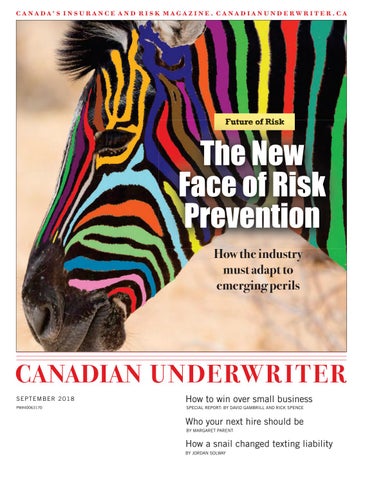
Future Fut ture of of Risk Risk
The New Face of Risk Prevention How the industry must adapt to emerging perils
S E P TE M B ER 2018
How to win over small business
PM#40063170
SPECIAL REPORT: BY DAVID GAMBRILL AND RICK SPENCE
Who your next hire should be BY MARGARET PARENT
How a snail changed texting liability BY JORDAN SOLWAY
Better Coverage Less Hassle
Our new E&O coverage for contractors and professionals offers valuable protection beyond what your customers’ general liability insurance provides and covers them against lawsuits from professional errors – whether real or perceived. Speak with your Business Development Manager or Commercial Lines Underwriter today to learn more.
ClaimCare
97% CLAIMS SATISFACTION
goremutual.ca
When things go wrong, we’re here to help and will keep you and your customers informed every step of the way with our ClaimCare Tracker.
VOL. 85, NO.8, SEPTEMBER 2018
CANADIAN UNDERWRITER
CANADA’S INSURANCE AND RISK MAGAZINE. PUBLISHED BY NEWCOM MEDIA INC.
www.canadianunderwriter.ca
COVER STORY
Evolution of the Risk Professional In the future, industry professionals will be expected to measure the worth of their advice, prioritize a blizzard of emerging business risks, and adopt new approaches to ensure they are providing indispensible service to clients. How the industry must adapt to survive.
12
BY DAVID GAMBRILL
39
45
Renting to Pot Producers
Retail Exposure
Building a Digital Strategy
If occupants of a rental property burn the place down because of their pot production, the insurance policy will be void. Will that change when pot is legalized in October?
Retailers have a treasure trove of valuable data stored on their point-of-sale devices. Here’s how your retail clients can protect their data from cybercriminals.
Do you want to introduce new technological innovation at your brokerage, but aren’t sure where to start? Here’s what your digital plan might look like.
BY BENNETT MCBRIDE
BY GREG MECKBACH
BY JENNIFER PUGSLEY
21 33 Special Report: Selling to Small Business Selling to a small business owner? Here’s a guide to the mindset of your target market; plus, learn effective ways to sell cyber to Canadian small businesses.
43
27
49
35 The New Face of Texting Liability
Limiting Liquor Liability
Commercial Data Standards Recruit for the Future
If a person texts a driver who crashes, is the texter liable? How a snail caught in a bottle of ginger beer helps to answer this question.
Liquor liability lines are tightening up, so commercial business clients who own restaurants and bars need to be well-run. Here’s what underwriters are looking for.
What needs to be done to explore the full potential of electronic data standards in commercial lines. Plus, an update on the progress of electronic proof of insurance.
Fresh industry demographic data paint a new picture of what the typical P&C professional looks like – and the paths recruiting efforts may take in the future.
BY JORDAN SOLWAY
BY JASON CONTANT
BY CATHERINE SMOLA
BY MARGARET PARENT
September 2018 Canadian Underwriter
3
VOL. 85, NO.8, SEPTEMBER 2018
Editor-in-Chief
Managing Director, Insurance Media Group
David Gambrill
ian@canadianunderwriter.ca (416) 510-6800
Associate Editor
Greg Meckbach
Director, Business Development
gmeckbach@canadianunderwriter.ca (416) 510-6796
Sandra Parente sandra@canadianunderwriter.ca (416) 510-5114
Online Editor
Jason Contant
Account Representative
jcontant@canadianunderwriter.ca (416) 510-6893
Jonathan Hogg
7
Editorial
9
Marketplace
52
Moves & Views
54
Gallery
jonathan@canadianunderwriter.ca 416-510-5122
Art Director
Production Manager
Gerald Heydens
Karen Samuels
Circulation Manager
(416) 510-5190
Mary Garufi mary@newcom.ca (416) 614-5831
Published by
NEWCOM MEDIA INC. 5353 Dundas Street West, Suite 400, Toronto, Ontario M9B 6H8 (416) 614-2200
Chairman and Founder
President
Jim Glionna
Joe Glionna
Vice President, Operations
Controller
Melissa Summerfield
Peter Fryters
Director of Circulation
Pat Glionna
Canadian Underwriter is published twelve times yearly by NEWCOM MEDIA INC. All rights reserved. Printed in Canada. The contents of this publication may not be reproduced or transmitted in any form, either in part or in full, including photocopying and recording, without the written consent of the copyright owner. Nor may any part of this publication be stored in a retrieval system of any nature without prior written consent. © Since 1934, Canadian Underwriter has been the voice of Canada’s insurance industry - a monthly magazine providing the highest quality and most relevant news and insight to insurance professionals from all segments of Canada’s property and casualty insurance market. The magazine is delivered on a direct-request circulation basis to nearly 15,000 senior decision makers nationally, including insurance brokers, risk managers, insurance and reinsurance company personnel, claims managers and adjusters. Since its beginnings, Canadian Underwriter has been a link between all segments of the insurance industry, providing insurance professionals with award-winning coverage of industry issues, trends, news, personalities and events - written by Canada’s leading insurance journalists.
Subscription Rates: 2018 Canada 1 Year $51.95 plus applicable taxes 2 Years $75.95 plus applicable taxes
Subscription Inquiries/Customer Service Mary Garufi (416) 614-5831 mary@newcom.ca
Single copies $10 plus applicable taxes, except $49 plus applicable taxes for July issue featuring annual Statistical Guide.
GST Registration number 890939689RT0001 Second Class Mail Registration Number: 08840 Publications Mail Agreement #40063170
Elsewhere 1 Year $71.95
Return undeliverable Canadian addresses to: Circulation Dept. Canadian Underwriter 5353 Dundas Street West, Suite 400, Toronto, Ontario M9B 6H8
Member
ISSN Print: 0008-525 ISSN Digital: 1923-34
4
FOCUS
Ian Portsmouth
david@canadianunderwriter.ca (416) 510-6793
Canadian Underwriter September 2018
Markel. Expect more from your insurance carrier
Commercial general liability Cyber risks insurance Directors and officers liability Environmental impairment liability Life sciences Professional liability Property and inland marine Security and protection industry Umbrella and excess liability
Helping brokers with effective insurance solutions since 1966 Calgary Montreal Toronto Vancouver www.markelinternational.ca
Transform today. Thrive tomorrow. Digitally transform to make 24/7 access to information at your customers’ fingertips a reality. At Applied, our innovation is transforming an industry with the end in mind – you.
appliedsystems.ca
EDITORIAL
Slow and Steady Loses the Race
With the exception of Nova Scotia, provincial insurance regulators have simply dropped the ball on e-slips. David Gambrill Editor-in-Chief Canadian Underwriter david@canadianunderwriter.ca
Almost a year ago, citing consumer demand and what appeared to be imminent regulatory approval of electronic pink slips (e-slips), Ontario’s broker association urged its members to find a way to deliver electronic proof of insurance to their clients. Heeding the advice, brokerages across the province worked with carriers, their own BMS vendors and the industry’s national standards body, the Centre for the Study of Insurance Operations (CSIO), to come up with an e-slips solution for consumers. Initially, the sense of urgency appeared to be well-founded. The Canadian Council of Insurance Regulators (CCIR) came out with a bulletin in February 2018 recommending that e-slips be made available in Canada. In January, Nova Scotia became the first provincial insurance regulator to allow e-slips. The CCIR bulletin encouraged all provincial insurance regulators to move forward with e-slips “if they have not done so already.” The industry seemed poised to deliver a service that consumers have demanded for some time. Since then, cricket noises. Shortly after the CCIR issued its bulletin in February, Canadian Underwriter asked Ontario’s insurance regulator for an update. FSCO confirmed it was working on the e-slips file. On the
matter of a timetable, it said: “As the regulator, it is important that FSCO balance moving quickly enough to support innovation with taking the time needed to ensure consumer interests are protected.” Fair enough. In June, we called FSCO for another update. This time, we were told “no timetable has been set” for allowing e-slips in Ontario. In public auto systems, it’s not straightforward which regulatory body has the authority to approve e-slips. In B.C., the public auto insurer has launched an entirely new auto rating model; e-slips is definitely not a priority. And so, apart from Nova Scotia’s enlightened – and lightning-fast – approach, there doesn’t appear to be much of an appetite for e-slips among any of the rest of the country’s provincial regulators. It may well be that some Canadian regulators will approve e-slips between the time I type these words and the time this issue hits the streets. More power to the regulators, if that’s the case. As of this moment, however, seven months after the CCIR’s bulletin, electronic proof of insurance is not a reality in nine out of 10 provinces. Quite frankly, that’s unacceptable. With the exception of Nova Scotia, provincial insurance regulators have simply dropped the ball on e-slips. There’s an unfair and incorrect public perception that the insurance industry is
slow to innovate. Insurance companies and brokerages have in fact been ready with e-slips solutions – their own proprietary solutions, BMS tech vendor solutions, or CSIO’s industry solution – since at least January, if not before. Insurance providers can act only as quickly as regulations allow; without regulation, they can’t act. Meanwhile, the regulators have taken so long on this file, the consumers they are supposed to be protecting have simply gone ahead and started to use e-slips on their mobile devices anyway. Word on the street is that some police officers are accepting mobile-friendly e-slips regardless of whether or not there is a regulatory regime in place. The reasons for the delay are unclear. We’re not talking rocket science here, we know this can be done quickly. When ride-sharing companies like Uber and Lyft came to Ontario, the regulator quickly approved electronic pink slips for their insured drivers in 2016. In doing so, FSCO noted the 2016 Ontario Budget called for the regulator to consider “flexible responses, including the possibility of interim regulatory approvals,” to approve ride-sharing insurance policies “as quickly as possible.” Et voila, electronic pink slips for ridesharing drivers. Perhaps it’s time for provincial politicians to give their local insurance regulators a similar nudge.
September 2018 Canadian Underwriter
7
Coming soon‌
?
On October 1, Canada’s best P&C magazine is getting even better. Discover our Relaunch issue, featuring a bold new look and context mix designed to drive the performance of insurance leaders like you.
.ca/subscribe
MARKETPLACE
WHO PAYS THE HIGHEST PREMIUMS IN CANADA? Drivers in British Columbia pay the highest auto insurance premiums in the country, followed by Ontario, according to Insurance Bureau of Canada (IBC). On the other end of the scale, Quebec paid the lowest annual premiums, at $661, followed by Prince Edward Island ($796 on average in 2017). In Quebec, the public insurance plan pays compensation for injuries arising from auto collisions, whereas private insurers cover physical damage to automobiles.
In 2017, drivers in each of the provinces listed below paid the following premiums: 1.
British Columbia
$1,680
2.
Ontario
$1,445
3.
Alberta
$1,251
4.
Newfoundland and Labrador
$1,132
5.
Manitoba
$1,080
6.
Saskatchewan
$936
7.
Nova Scotia
$842
8.
New Brunswick
$819
9.
Prince Edward Island
$796
10. Quebec
$661
COURT TOSSES ELDERLY COUPLE’S ANCIENT AUTO CLAIM Fifteen years after an auto accident, an elderly couple lost their bid to further postpone a claim against their auto insurer, following years of adjourning trial dates and failing to show up in court. “The trial judge concluded that this case had reached the point where ‘the court must say enough is enough,’” wrote the Court of Appeal for Ontario, which dismissed the couple’s action against Aviva Canada. Omelian Romanko and Neonila Romanko made a claim against Aviva after their auto accident in 2003. The case wound through the courts for several years, beset by the couple’s multiple changes of counsel and their failure to abide by court orders.
INTACT’S “SURPRISING” DISCOVERY ABOUT WINTER TIRES When Intact started giving auto insurance discounts to people with winter tires, the result was unexpected. Intact-insured drivers who reported having winter tires installed were showing worse loss ratios than those driving in the winter without winter tires, according to Jean-François Larochelle, director of Intact’s data lab. “It was kind of surprising.” Intact contacted its insured drivers and asked if they had put on their winter tires. It turned out that many insureds who said they had winter tires had not in fact installed them. “I don’t know if they lied or if they forgot to put winter tires on that winter,” Larochelle said. Generally speaking, insurers find that winter tires are safer. “Claims are reduced when people have winter tires on their cars, especially driving in climates like we have in Ontario,” says CAA Insurance president Matthew Turak. “The treads on the tires do allow you to stop sooner and prevent accidents.”
After a jury trial date was set for May 2015, the court adjourned the case at the request of the couple because of Mr. Romanko’s health concerns. A new trial date was set for Apr. 10, 2017, but the couple were not ready on that date either. When a new court date was set for April 12, the couple didn’t show up. “The trial judge appreciated that dismissing the [Romankos’] action was a drastic remedy,” the Appeal Court ruled. “She concluded that it would be manifestly unfair to [Aviva] to further adjourn the trial and that the court must control its own procedure to ensure fairness to all litigants.” September 2018 Canadian Underwriter
9
MARKETPLACE CUTTING OUT THE MIDDLEMAN – THE INSURER
Canadian insurance brokerages have already made inquiries to an Estonian-based insurance company that is using blockchain to cut out the “intermediaries” in the insurance sales process – the insurance companies. “Usually when people are speaking about intermediaries in insurance, automatically they think of brokers and agents as intermediaries,” Mart Parve, chief operating officer of Black Insurance, told Canadian Underwriter in a phone interview from Estonia. “But when giving it a little bit more thought, the insurers might be viewed as intermediaries between capital and the brokers. In this regard, we think insurers are just as much intermediaries as brokers. “Indeed, when we speak about ‘cutting out the middleman,’ the automatic assumption is that the middleman who should be cut out is the broker. But we are thinking that it’s possible to cut out the insurers from between brokers and capital. That’s the larger fundamental premise behind our business model.” Under such a blockchain model, brokers with an idea for a new insurance product would input information about the proposed product onto a blockchain platform hosted by a licensed insurer. Then an interested ‘syndicate’ of underwriters and investors (much like an MGA) would raise the necessary capital and underwrite it. The licensed insurer would simply be the conduit in this model (through the blockchain platform), and not provide any capital. 10 Canadian Underwriter September 2018
GENDER-BENDING TO GET AN INSURANCE DISCOUNT How desperate are drivers to get a discount on their auto insurance? CBC recently quoted a driver in Alberta as saying he changed his gender identity from male to female for the purpose of getting a reduced auto insurance rate. CBC, who did not name the motorist, quoted him as saying he is in reality “a man, 100 per cent,” but nonetheless changed his gender to female on both his driver’s licence and birth certificate. The driver was taking advantage of a loophole in Alberta legislation that does not require any supporting medical documentation to prove one’s gender on a driver’s license application. There is a term for this kind of tactic, industry representatives say. It’s called auto fraud. “From what this individual has said to the media, he made an intentional misrepresentation by his own admission,” the Insurance Bureau of Canada says. “Insurers have the right to cancel the policy if someone they have insured made any fraudulent claims or misrepresented themselves.”
ODDS PREDICT A MAJOR P&C MERGER IN CANADA THIS YEAR Brokers can expect to see a major carrier consolidation deal this year if the prediction of a major mergers and acquisitions (M&A) advisory firm holds true. Of the top 10 Canadian P&C insurers, “it could be expected that a few of them are looking at mergers and acquisitions intensely,” says Georges Pigeon, Montreal-based partner with KPMG’s transaction services group. “My expectation would be that some of them would contemplate an acquisition in the coming years if the right opportunity comes along.” The Canadian P&C marketplace has seen an average of one major acquisition of a carrier in each of the past 10-15 years, Pigeon says. He predicts this trend will continue, although he did not go so far as to speculate on specific carriers. In Canada, the question is “whether anyone wants to sell, and that will drive whether we see another transaction,” says Tim Prince, a Torontobased partner with KPMG Canada’s advisory service.
MARKETPLACE DON’T BELIEVE THE HYPE AROUND AUTOMATED VEHICLES Don’t hold your breath waiting for the first fully autonomous car to hit the streets anytime soon. Car manufacturers have projected for years that we will see fully automated cars on the roads by 2018. Don’t believe the hype, author Russell Brandom explains in his blog for The Verge. It may be years, if not decades, before self-driving systems are reliably able to avoid accidents, Brandom says. The million-dollar question is whether self-driving cars will run into the same “generalization” problem as chatbots. Generalization can be difficult for conventional deep learning systems. An example is when chatbots don’t give unique responses to questions. Deep learning requires massive amounts of training data to work properly,
incorporating nearly every scenario the algorithm will encounter. “For a long time, researchers thought they could improve generalization skills with the right algorithms, but recent research has shown that conventional deep learning is even worse at generalizing than we thought,” Brandom wrote.
“One study found that conventional deep learning systems have a hard time even generalizing across different frames of a video, labelling the same polar bear as a baboon, mongoose or weasel depending on minor shifts in the background.” In other words, even small changes to pictures can completely change the system’s judgement.
AMBITIOUS GROWTH PLAN FOR CANADA’S FIFTH-LARGEST BROKERAGE Navacord Inc., Canada’s fifth-largest insurance brokerage by premium volume, has entered into an agreement that will see a management-led buyout of its minority capital partner, Fairfax Financial Holdings Ltd., with the support of Madison Dearborn Partners (MDP), a leading private equity firm based in Chicago. Terms of the transaction, expected to be completed in 2018 Q3, were not disclosed. Navacord, now with 75 shareholders in the business, formed its capital partnership with Fairfax in the initial stages of its growth. Jones DesLauriers Insurance Management Inc. and Lloyd Sadd Insurance Brokers established the Canadianowned brokerage in 2014 with a startup revenue of $60 million, which has since doubled to $120 million in 2018. The plan is to double revenue again over the next five years to $250 million. Today, Navacord writes more than $700 million in premium, with 80% of its revenue coming from commercial insurance.
September 2018 Canadian Underwriter 11
COVER STORY
Future of Risk
Adapting to Survive BY DAVID GAMBRILL
Canadian companies have new expectations of their insurance professionals. Not satisfied with mere promises of insurance coverage, clients want to know the exact value of your risk and insurance programs on their bottom line. Here’s how risk professionals are adapting with new approaches to provide value to their clients. Plus, we highlight 5 new business threats your clients will face in the future.
New Expectations
A
s a forward-thinking risk professional, you have recommended that a commercial client purchase a $1-million insurance policy to cover a fleet of automated cars – an emerging risk for which there is a scarcity of loss exposure data. At a meeting to discuss your proposal, the CEO of the company asks you what precise financial impact your recommendation will have on the company’s bottom line. Would you be able to answer the question? In a world of finite budgets and an explosion of new threats to business, risk professionals are facing a new expectation to quantify the exact value of their advice. “There’s an inherent problem with our industry,” observes Steve Osselton, managing director for client advisory services at Marsh Canada Ltd. “You can have an organization that has managed risk really well, it has unearthed problems, and it has done something about it. But of course we never find out about that, do we? Because these losses never manifested.” That leaves insurance and risk professionals, be they brokers, corporate risk managers or underwriters, struggling to express the worth of their products and advice in terms that company executives readily understand – dollar values. “One of the areas I think the industry needs to improve on is the ability to demonstrate value on ROI [return on investment],” Osselton says. “If you are coming to a CFO and you are saying, ‘Look, I am concerned about risks associated with XYZ, and here are my concerns,’ you need to follow that up with, ‘And here’s the ROI for that,’ or ‘Here is the value to our organization.’”
12
Canadian Underwriter September 2018
September 2018 Canadian Underwriter 13
COVER STORY
Future of Risk Predictive analytics may is one way to do this, Osselton suggests. Other metrics are available to quantify the value of risk advice, observes Darius Delon, president at Risk Management 101 (RM101). Available data typically relate to hazard-based risk profiles, financial or operations-based profiles, or even in resource-management profiles. For example, a company may see a risk inherent in an aging demographic, and calculate the cost of training and acquisition associated with that. “There are some good metrics out there,” Delon says. Betty Clarke, manager of corporate risk and recovery at the City of St. John’s, N.F., says she will often find valuable metrics by researching what other organizations have done in comparable situations. “I can find out what their damage was to get a loss number I can use,” she says. “I can then show a loss that may result because a community didn’t do something.” It’s a valuable exercise, she adds, because the stakes for clients can be high. “We’re talking millions of dollars.” But what about reputational losses, which are inherently intangible? For example, based on the emerging risk of execu-
tive misconduct arising out of the #metoo movement, can you prove to a company’s board of directors that a D&O policy with a $1-million premium might prevent a worst-case scenario that bankrupts the $1-billion company? The trick is to quantify how much money your client or company stands to save by following your professional advice. But that means looking at historical claims patterns to attach a number to potential losses. For many emerging risks, it’s too early to tell what those patterns may be. “There continues to be an overreliance on the past to predict the future, particularly with climate change,” Osselton said, pointing to the example of Superstorm Sandy, the deadliest and most destructive storm of the 2012 Atlantic hurricane season. Sandy caused nearly US$70 billion in damage; after sweeping through New York, the storm passed through Ontario and Quebec, killing two and causing $100 million in damage. “It just hadn’t happened before,” Osselton said of the storm’s path. “The models wouldn’t have predicted that kind of storm surge in that location, except maybe one in a million years.”
New Approaches The explosion of new business risks over the past decade has caused risk professionals to change the way they do their jobs. Industry professionals are increasingly called upon to employ a multidisciplinary skill set, using techniques and skills you might expect of people characterized in the following profiles:
The News Junkie
E
ffective risk professionals are following the news constantly. They are aware of how current affairs globally might affect their clients and operations locally. Within the arena of risk management, one prime example is the rapidly emerging risk of global protectionism. Over the past year, a newly elected U.S. president has reinstated trade barriers that had gradually been removed over the past 40 years. Canadian companies don’t know what’s coming next.
14
Canadian Underwriter September 2018
“The first step is for risk managers to be thinking about taking stock of what they have, what their supply chains include, and making sure they are following what’s happening in the media,” says Dan Riordan, president of political risk at XL Catlin. “They need to be following what’s happening in terms of trade legislation or trade pacts to see if that will impact their ability to conduct their business.
UNLOCK THE FUTURE. See what tomorrow’s risk is bringing and how our CRS (Client Risk Solutions) team will get you ready during the RIMS Canada Conference. • Virtual reality demonstrations • Catastrophe modelling • New school risk engineering
• Technology helping mitigation • Big data analysis and insights • Solutions beyond insurance
Proud sponsor of RIMS Canada. Learn more at aig.ca/rimscanada AIG Insurance Company of Canada is the licensed underwriter of AIG property casualty insurance products in Canada. Coverage may not be available in all provinces and territories and is subject to actual policy language. Non-insurance products and services may be provided by independent third parties. © American International Group, Inc. All rights reserved.
COVER STORY
Future of Risk
The Avid Researcher
S
tellar research skills will differentiate exceptional insurance professionals from the rest of the pack. “Our top people do look to me for answers when they get into situations with these emerging issues,” says Clarke. “And if I don’t have an immediate answer, I will do the research. That’s one of the important things of having a risk management team. Knowing a lot of people everywhere and getting lots of information that can help you make the best appropriate decision at the time.” In some situations, quality research on one issue may end up immunizing an organization against related emerging risks. Urs Uhlmann, XL Catlin’s CEO and country manager for Canada, notes how proactive research on supply chain risk can help a company face emerging issues such as global protectionism. Brokers and risk managers have always looked for alternatives to a company’s existing supply chain, mostly driven by
the physical threat to the supply chain, Uhlmann observes. “Protectionism is just a different threat. I do believe from that perspective, it very much becomes an opportunity for a [risk professional] to create additional value for the company.”
The Discriminating Judge
O
nce emerging risks have been identified, the risk manager’s value will increasingly hinge on deciding which risks should be prioritized over the others. “Okay, I see them, now what do I do with them,” Delon says of the identified emerging risks. “How do I calculate them? How do I decide what I really should be going up against? What is the weight of one risk among all the different pillars of risk – financial, operational, hazard, reputational? What are the weights in those categories? And is there a higher weight in one category that I don’t quite realize?” Not priortizing risks properly could spell trouble. Examples abound of disasters that arose because of a failure to act on previously collected information. “The root cause of many damage losses is management failure to identify and address the basic causation,” Osselton said. “Many times, when you look back, the causation was known, it just wasn’t acted on; it [the loss] wasn’t necessarily a surprise.” He cites the example in July of a duck boat sinking in Missouri, killing 17 people. Regulatory authorities such as the U.S. Coast Guard and the National Transportation Board are investigating the sinking. A mechanical inspector appeared in the media claiming that he had warned the duck boat operator about the risk of having the exhaust come out the front of the boat (which he believed would cause the motor to stop), but the warning went unheeded.
16
Canadian Underwriter September 2018
Global solutions. Local expertise. Count on Sedgwick around the world Sedgwick is now powered by the brands you have always known, combined into one you will always depend on. We are bringing together the talent, expertise and robust capabilities of Sedgwick, Vericlaim, Cunningham Lindsey and all subsidiaries to provide technology-enabled risk, benefits and integrated business solutions around the world. At Sedgwick, caring counts.® Taking care of people and organizations – from public and private employers, to insurers and their policyholders – is at the heart of everything we do. We provide the services and expertise you are looking for, wherever you are, when you need us most. Learn more at www.sedgwick.com/global-news or visit us at the RIMS Canada Conference booth #307
COVER STORY
Future of Risk
The Savvy Politician
O
nce emerging risks are identified and prioritized, risk professionals will have to use the persuasive skills of a politician to put together a comprehensive proposal to address them. Delon provides an example from the world of risk management. “Often risk managers don’t have the direct authority [within an organization] and have to rely on indirect authority or their persuasive abilities and relationships,” Delon says. “Politics plays into this quite heavily when you are a risk manager trying to get something addressed and someone tells you it’s already been done. It’s an unpopular position to be in.” Many see an opportunity for brokers and risk managers to work with multidisciplinary teams within a business to assess how its identified risks should be handled. Delon gives the example of historical executive misconduct, which might fall under the organization’s D&O insurance.The risk touches several areas within the corporation, including HR, legal,
and insurance.Who is best suited to tackle the risk? “The evolving risk manager is judging all the different ways the organization can be hit by the emerging risk,” Delon says. “And they are the first ones to say, ‘Hey, I see something on the horizon, let’s get everyone at the table to get our house in order.’” Pamela Hans, a litigator for U.S. legal firm Anderson Kill, says insurance professionals should not back away from asking tough political questions for fear that clients will perceive them as being too proactive on low-probability risks. Her example comes from the world of counter-party insurance, in which one negotiating party agrees to rely on the insurance policy of the other party. “I don’t think parties talk about, ‘What do we do if our insurance company becomes insolvent?’” Hans says. “Trying to decide in advance who is going to bridge that gap is a question that not enough companies ask and it’s an important question, because it could be a massive amount of money.”
5 New Business Threats Facing Your Clients Cyber Security Cyber security is top of mind for Canadian risk professionals in part because of the country’s new data breach reporting requirements, which will take effect Nov. 1, 2018. In the meantime, cybercriminals are hitting the jackpot, exploiting the exposure of Canadian businesses to social engineering scams, privacy breaches and ransomware demands. A 2018 study by Scalara Security shows a Canadian company averaged a payout of $3.7 million to respond to a cyber breach in 2017.
Marijuana Legalization Canada’s new Cannabis Law is scheduled to come into force on Oct. 17, 2018. A Deloitte study last year found that 22 per cent of Canadian adults use marijuana recreationally at least some of the time. “Once it’s legalized, there’s no doubt that’s going to increase substantially,” says Clarke. “No doubt that’s going to create a lot of exposures.” Of
18
Canadian Underwriter September 2018
particular concern is the potential impact on the workplace, property managers, and property and vehicle renting agencies.
The Rise of Protectionism The future of the North American Free Trade Agreement (NAFTA), which sought to eliminate barriers to trade and investment between Canada, the United States and Mexico, is now in peril. U.S. President Donald Trump is on record as saying NAFTA has been a “the worst trade deal” in history for the United States. “If anything comes out of [this heightened political rhetoric], it would be for companies of all sizes that could be affected by this situation – particularly if they are involved in cross-border business, or trading and exporting – to take stock of what they have,” says Dan Riordan, president of political risk at XL Catlin. “If they do need to transfer risk, make sure that they are bringing that up with their broker, and that they are engaging with their underwriters to make sure they have the right coverage in place.”
Executive Misconduct One big issue for risk professionals in Canada is that several jurisdictions have removed “drop-dead deadlines” for reporting allegations of executive misconduct, says Delon. So, company executives could be hit at any time with allegations of misconduct arising from matters that may have happened 30 or 40 years ago. This will make it difficult for the risk manager to gauge the company’s true exposure.
Climate Change Climate change is not a new risk, but its increasing impact means the industry may need to take a new approach to the issue. Canadian business losses caused by natural catastrophes are becoming more frequent and severe. “We need to be aware of the long-term trickle-down effects of the disasters, because I think a lot of people just focus on the here and now,” says Clarke. “It often affects our stakeholders, and there are many threads of learning from disasters.”
Let’s face the unexpected together
By sharing the art and science of risk with our clients, we can face the unexpected together.
www.scor.com
Š Bruno Ismael Silva Alves / Shutterstock
The past 50 years have seen extensive research into the key concepts at the heart of the taking, transferring and pooling of risk. Thanks to this, we now have a better understanding of risk behaviour, risk markets and risk sharing. At SCOR, we have explored the scientific foundations of our industry to ensure that the unexpected does not faze us.
More quotes. More growth. Watch your business bloom with our new online platform to quote and bind small business. It should be easy to do business with us. That’s why we worked with brokers to build RSA Pro™, our new online platform for simple, straightforward quoting and binding. Talk to us to see how we’re taking the hassle out of quotes to help you grow.
We’re growing. How about you? Come grow with us at rsabroker.ca/rsapro
© 2018 Royal & Sun Alliance Insurance Company of Canada. All rights reserved. RSA, RSA & Design and related words and logos are trademarks and the property of RSA Insurance Group plc, licensed for use by Royal & Sun Alliance Insurance Company of Canada. RSA is a trade name of Royal & Sun Alliance Insurance Company of Canada. RSA Pro, RSA Pro & Design, and related words and logos are trademarks and are the property of Royal & Sun Alliance Insurance Company of Canada.
Special Report | Small Business | Sales
Psychology of the Small Business Owner Selling insurance to a small business? Here’s how to forge successful business relationships with these fearless entrepreneurs…
C
onsider the sheer courage of Canadian business owners. With so many commercial risks and liabilities, from property and casualty to employee fraud, credit risk, key-person vulnerabilities – and now cyber attack (see story on Page 23) – it’s a wonder anyone would want to run a business today. The right insurance can insulate business owners from chance, fraud and mishap. The trouble is, few entrepreneurs know how to buy insurance. One RBC survey
found a full 30 per cent of Canadian business owners do not understand the risks that affect their business. More importantly, few insurance brokers understand how to sell to entrepreneurs. This market gap spells trouble for underinsured businesses. But brokers who embrace the eccentricities of the SME market, which represents 98 per cent of Canadian businesses according to Industry Canada’s definition of 100 or fewer paid employees, will find it presents tremendous opportunity.
RicL Spence President CanEntrepreneur Communications
September 2018 Canadian Underwriter 21
To win the hearts of business owners, brokers have to earn their trust. Here are a few tips: Understand the lifestyle. Business owners work long hours (about 50 hours a week). Most lack formal business training, so internal processes and cash flow often take a back seat to serving customers. (Note: this may explain why they have so little patience for vendors who don’t go to the wall every day for their customers.)
Establish an honest, direct relationship. It’s lonely at the top. Business owners often feel they have no one to talk to about their problems. They can’t entrust their doubts to anyone on staff. How can you help them feel less alone?
Don’t overpromise. When an entrepreneur looks around, they see problems everywhere: managing finances, finding talent, fighting off the competition, maintaining production, motivating the sales team.When a salesperson promises to help solve their problems, it’s no wonder they laugh inside.
Be flexible and persistent. Many entrepreneurs founded their business “to be their own boss,” then found out they are now answerable to everybody with a problem.Their time is not their own, so be understanding when they miss appointments or forget to call back.
State your value early . The small-bu siness market is very cost-con sciou corporate decis s. Unlike ionbusiness owner makers, s sp own money w end their hen investing in products and services. If yo u’re not focusing o n value, you’r e wasting your time.
Know your stuff. Small businesses would be out of business if they didn’t create value for their clients, so they expect the same from you. If they ask a question you can’t answer, get back to them fast.
Once you understand this market, here’s your reward: • A clear “Yes.” When a buyer for a big organization says, “We don’t have a budget for that,” that’s usually the end of it. But business owners are the Napoleons of the office – if they want to buy something, they don’t need anyone’s permission.
• Loyalty. Entrepreneurs are looking for suppliers who are as trustworthy and professional as they are. Once they know you’re trustworthy, they’ll stick with you. They’ll share more of their problems, they’ll trust your new product recommendations, and they’ll happily refer you to their friends.
Respect the unique needs of the small business owner, and they’ll give you the highest gift they can bestow: their trust. 22
Canadian Underwriter September 2018
Special Report
Small Business | Cyber
“When I look at a commercial client that’s not carrying cyber insurance, that’s kind of like walking out of the house with no clothes on.” - Philomena Comerford, Broker
C
onsidering the potentially devastating effect of a cyber attack on a small business in Canada, it’s surprising to see a recent study showing that more than a third of Canadian firms do not report carrying cyber insurance coverage. “For me, when I look at a commercial client that’s not carrying cyber insurance, that’s kind of like walking out of the house with no clothes on or driving without auto insurance,” says insurance broker Philomena Comerford of Baird MacGregor. “You can’t not have it.” A 2018 study by Scalar Security shows smaller businesses in Canada that suffered a breach last year were down for an average of 59 cumulative hours, with an average lost revenue of about $1.1 million during that period. It costs a smaller business in Canada more than $12,000 per employee to recover from a data breach, the survey found. Scalar’s stats could be on the high side, since the survey defines a “smaller” business as between 15 and 249 full-time employees. Some of these businesses would count as medium-sized enterprises according to Industry Canada, which defines “small business” as 100 or fewer paid employees. Using Industry Canada’s definition, 98% of Canadian businesses are small. Does the nature of cyber risk change if the business is small? Miki Ho, cyber risk underwriter for Beazley Canada, notes that hackers’ strategies are changing in a way that makes small businesses more interested in buying protection for ransomware attacks. “What has caught the attention of small business is the cyber extortion element of the policy,” Ho said. “For small businesses, that’s the area of claims that we’ve really seen on the rise. For small and large businesses, hackers typically shut down the computer system and demand a certain amount of bitcoin to unlock the system.
Covering Small Business Cyber Exposure David Gambrill Editor-in-Chief
September 2018 Canadian Underwriter 23
Special Report l Small Business | Cyber “In the past, what we saw is the hackers would demand the equivalent of $100,000 to $1 million in bitcoin,” says Ho. “Now what they are doing is going for those quick wins. “So, they will look at a small business and say, ‘If they are able to pay the equivalent of $500, they are likely to pay that, and they are likely not to notify the authorities. We can probably go back after them more than one time if they are paying that.’” Small businesses generally have limited IT budgets. Depending on their size, they may not have established relationships with law firms, large technology companies, public relations firms or other organizations that can help them navigate through a cyber breach. Consequently, instead of selling the small business owner on the transfer of risk to an insurance policy, a broker may instead choose to play up the third-party services available as part of the coverage. “Small business owners are more focused on a solution to a breach than necessarily transferring the risk,” says Ho.
Through the insurer of a cyber policy, a small business owner will have immediate access to an experienced breach response team. A breach coach will be deployed, coordinating a response with lawyers, IT forensic experts and public relations representatives on the team. “They will know how to deal with the attacker on the other end of a ransomware incident and whether to pay them the bitcoin or tell them to get lost and shut them out,” says Comerford. “That is really valuable. A breach would be a terrifying experience for a small business owner who must use a computer [for work], but whose business is really something other than IT.” How to start the conversation? Small business owners don’t have a lot of time to shoot the breeze in sales meetings. To define the value of the policy early, Ho recommends that brokers open the conversation by asking clients how they would respond to a ransomware attack on their business. A small business owner may respond with skepticism. Being small, the organizations don’t have huge budgets to throw around; some small business owners may be paying for expenses out
of their own pockets. Understandably, they may look for ways to reduce their insurance budgets where they can. “A lot of brokers are afraid to have conversations that start pushing the clients’ insurance budgets higher, because they are afraid somebody else is going to come in and say, ‘Hey, I will do it for half that,’” says Comerford. But where cyber coverage is concerned, brokers should resist succumbing to the pressure of premium pricing wars, Comerford advises. She encourages brokers to treat a cyber policy discussion with a client in the same way they would an Insurance to Value (IoT) discussion. For example, a broker is obligated to make sure a homeowner’s property and contents are fully covered. If brokers are in any doubt about whether a home is insured to its proper value, they would call in an appraiser to determine the real value of a home. Similarly, if the coverage limits on a liability policy don’t seem right for the assets of the organization, a broker should recommend to a small business owner that an IT team be called in to assess the cyber risk.
3 Ways to Win Over a Small Business Owner Plamen Petkov, vice president of Ontario and business resources at the Canadian Federation of Independent Business, which represents 110,000 small businesses across Canada, provides insight to help brokers forge successful business partnerships with small business owners. DO: Establish very clearly the value you provide as a broker. “The value could be translated in different ways – it could be better rates, it could be better coverage, it could be a combination of both. It could just be easy to deal with— saving time. Business owners don’t have time to be calling insurance companies direct and being put on hold or being asked to call back or wait. So, if the broker is easily accessible, if he or she can make the process easy for the business owner, then of course they will have a preferred status.”
DO: Play up your own status as a small business owner (assuming you own a small brokerage and sell directly to clients) “Brokers are running a business, they are entrepreneurs. They have a bottom line to meet, a payroll to meet. It gives them that advantage when one business owner is approaching another business
24
Canadian Underwriter September 2018
owner. They speak the same language. That is absolutely very helpful, as opposed to you working for a big corporation trying to sell some sort of product. Brokers can relate. You can say: ‘From one business owner to another, I have a firm that I am running, these are the types of insurance products that I need to keep my business safe and successful, and that’s why I am recommending that you do the same.’ That provides that extra level of association, from one business owner talking to another.”
DON’T: Don’t try to sever an existing relationship with an insurance provider. “Unless the client is a start-up, in most cases, when the insurance broker approaches the small business owner, the owner would already have some sort of coverage. Don’t try and diminish the relationship the business owner may have established with their existing insurance company or broker. That business owner may have had that relationship for years; they may be happy with that relationship. Present yourself as a partner, even as a complementary offering to what the business already has. Instead of trying to sever that relationship so you can take over that business, in some cases, it may be more beneficial to provide additional coverage for something they don’t already have, while allowing them to maintain that existing relationship. Over time, you are competing and gradually trying to win that business.”
Partnership is crucial to success in the small business landscape mall business is big in Canada: 99.8% of all businesses have fewer than 500 employees1. They are the engine of the economy and their success is vital to Canada’s prosperity. That means Small to Medium Enterprise (SME) leaders have to be experts at multi-tasking. They wear multiple hats when it comes to running their businesses.
S
Some may not be familiar with the legal jargon they come across in a contract, while others may not know how to best prevent a fire or flood. The truth is, they don’t have to be experts in legal, marketing or risk management. That’s where external partners – especially a broker - can help.
SME brokers are thinking more and more about distribution and leveraging fewer, more significant relationships through consolidation of carriers. In our view, this is exactly the type of approach that will enable brokers to provide a superior and consistent solution for their customers. Current market dynamics are also pushing brokers to invest in their own platforms, to keep up with where insurers are headed. This includes initiatives such as application programming interface (API) development and better use of existing data for better customer relationship management.
The lawyers come from across the country, meaning that they have expert insights into specific provincial laws and regulations relevant to your business.
SME is a fast-growing sector here at RSA. Over the past year, we have rolled out several initiatives to meet brokers’ goals of growing their business, being able to offer value-added services to customers, and reducing processing time and effort by better leveraging technology in their offering to customers. Given the choice, brokers want to focus their time on growing their SME portfolio. This is one of the reasons we launched RSA Pro™, a tool developed with brokers, that allows them to quote and bind small business customers online. The tool was developed to make servicing SME clients more efficient and cost-effective. With RSA Pro™, brokers can quote and bind in three segments: Business & Professional Services, Contracting (both with revenue up to $5 million) and Retail (with revenue up to $10 million). Currently, about 2,600 brokers have access to RSA Pro™. And the feedback has been positive: the tool is simple, intuitive and only asks questions that drive value. Our Legal Assist offers SME customers access to expert legal information and practical guidance over the telephone at no extra charge to their premiums. This service allows them to tap into the vast experience and expertise of trusted, third-party lawyers in a wide range of legal issues.
Another growing threat to small businesses is the risk of a cyber attack or breach. Not only are these incidents occurring with increased regularity, the nature of cyber threats is also changing. Although the high-profile breaches impacting larger organizations are most heavily discussed in the media, small and medium-sized organizations are just as likely to be hit by a cyberattack. But as they have relatively fewer resources to protect themselves, they can be an attractive target for cyber criminals. It is estimated that approximately 60% of small to medium enterprises that have experienced a cyber attack did not have adequate cyber coverage. Knowing that a single cyber breach could cripple a SME, we have developed Cyber coverage with built-in incident management services (e.g. 24-Hour Incident Manager, IT Forensics, Public Relations and Legal). This is especially useful for a SME, as the risk management services can work hand-in-hand with the Insured’s IT department and management team to provide the quickest and most efficient resolution, thus reducing the overall impact of a potential or actual breach. As small businesses continue to dominate the Canadian industry, we as insurers are committed to continuously improving our offering to this sector. Each SME has its unique business strategy, risk factors and insurance coverage needs. Putting risk mitigation and business coverage needs in the hands of the experts lets your SME client take the time to focus on their passion: growing the business successfully.
Rosalind Staples-Simpson, VP for SME and Mid-Market, has worked with RSA for 18 years. During this time, she has held multiple, progressive leadership roles across RSA Canada’s broker business in both Commercial Insurance and Personal Insurance spanning across Underwriting and Operations, most recently driving a significant transformation agenda. Her current mandate involves the strategic ownership of RSA’s broker/customer strategy, as well as propositions for SME and Mid-Market.
1
Source: https://www.bdc.ca/en/articles-tools/business-strategy-planning/manage-business/pages/10-things-didnt-know-canadian-sme.aspx
BUILDING TOMORROW Frank Mirabelli is the President and CEO of First General Property Restoration Services. First General was established in 1980 and is one of North America’s largest restoration QHWZRUNV ZLWK RYHU RIƓFHV LQ &DQDGD DQG the United States. First General is an industry leader in technology, integrity, and customer satisfaction. Since becoming President and CEO in 2015, Mirabelli and the First General Team have employed their knowledge and experience in property restoration to develop and expand the First General network. Recently, Mirabelli shared his vision for the company moving forward and some information about himself and First General. You have an interesting background story. Can you tell us a bit about it and how you got your start in the restoration industry? I never intended to enter the property restoration industry. I was actually on track to becoming a University Professor. I completed my undergraduate degree in Accounting and then completed my MBA at Queen’s University. However, academia was not hands on enough for me. I purchased the First General Thunder Bay location and started learning the business IURP WKH JURXQG ŴRRU ,Q P\ ƓUVW \HDU RI ownership, I performed all restoration jobs, including water extraction, hauling equipment and removing smoke damage. Once I earned my stripes, I was given the opportunity to be General Manager for First General Canada and after a number of years, our family group of companies, Mirabelli Corporation, purchased the First General Brand. What’s your vision for the company moving forward? The vision for First General is to become a global brand, embracing technology along WKH ZD\ )LQGLQJ PRUH HIƓFLHQW DQG HIIHFWLYH methods to complete what we do every day LV NH\ 7KH ƓQDO LQVXUDQFH FOLHQW Ŋ WKH SURSHUW\ owner, is looking for more and better coverage DW D ORZHU SULFH Ŋ VR ZRUNLQJ ZLWK RXU LQVXUDQFH SDUWQHUV WR ƓQG ZD\V WR SURYLGH PRUH FRVW effective methods of service delivery while maintaining quality, is paramount. How do you plan to expand the brand? I believe the local business owner model, supported by the First General Corporate Team, is key to achieving successful growth. 2XU ORQJ WHUP VWUDWHJ\ LV WR LQƓOO UHPDLQLQJ markets in Canada and grow south of the ERUGHU :H DUH H[FLWHG DERXW ƓQDOL]LQJ arrangements in South America and Mexico with a strong operator in Latin America.
Growing a company often requires investment. Did you make any investments, and if so, what were they? :H UHFRJQL]HG WKDW XVLQJ D PRUH FRQVLVWHQW RSHUDWLQJ SODWIRUP ZLOO KHOS facilitate growth in Canada, the US, and South America. We invested in expanding our Corporate Team to support our growth phase, and we created the following new roles: • Vice President to manage Quebec and the Atlantic Provinces, Charles Sabourin. • Regional Manager to manage Western Canada, Kendra Kostyk. • Executive Vice President of Strategic Partnerships, Angela Veri, who works with Corporate and our Regional team to enhance and execute sales strategies and strengthen customer relations. • Vice President Operations, Randy Millar, who oversees Ontario and our quality initiatives. • Sheila Corbett, Manager of Vendor Program Resources, who is responsible for overall estimating compliance. • Large Loss Expert/Director, Lorne McIntyre, who plays an integral part in providing Corporate oversight and assistance with the expansion of our Large Loss Division across North and South America. Why did you feel these areas were important? :H IHOW WKDW WR FDSLWDOL]H RQ WKH SHUIRUPDQFH RI RXU &DQDGLDQ 1HWZRUN RI RIƓFHV )LUVW *HQHUDO KDG WR UH LQYHQW RXUVHOYHV DQG VWDQGDUGL]H RXU operations to drive growth, exceptional client experience, and higher net promoter scores. To meet our initiatives, we felt it was imperative to invest in the resources to help support the operational side of our business. +RZ GRHV &RUSRUDWH ƓW LQWR WKH )LUVW *HQHUDO 1HWZRUN RI RIƓFHV" 7KH PHQ DQG ZRPHQ LQ RXU ƓHOG RIƓFHV ZKR GHOLYHU WKH )LUVW *HQHUDO H[SHULHQFH HYHU\ GD\ SHUIRUP DQ DPD]LQJ MRE Ŋ DQG ZH DUH VR JUDWHIXO to have them as part of our family. As the insurance market evolves and technology changes, it is the responsibility of the First General Corporate 7HDP WR LQWURGXFH WKHVH FKDQJHV IRU WKH EHQHƓW RI RXU RIƓFHV 2XU UHFHQW investment in human capital is an example of our dedication to work ZLWK RXU RIƓFHV DQG DVVLVW WKHP ZLWK WUDQVLWLRQV LQWR QHZ WHFKQRORJLHV growth, and metrics. You mentioned technology. How is First General supporting and adapting to technology? We are investing heavily in technology which works off of a global platform to ensure sustainability moving forward. The increased demand for transparency, customer expectations, and the need to assist our RIƓFHV ZLWK VWUHDPOLQLQJ WKHLU SURFHVVHV JLYHV XV D SHUIHFW RSSRUWXQLW\ to onboard a new global platform-based technology. First General believes this will allow us to become a partner in our clients Ecosystem, ensuring a sustainable business model. Are there any hurdles you’ve faced in growing the company? )LQGLQJ TXDOLƓHG WDOHQW LV D VWUXJJOH 7KH HYROYLQJ LQGXVWU\ KDV LQFUHDVHG the demands on project managers, technicians and owners. Today, we need to be a jack of all trades, which takes years of training. As such, hiring people off the streets is not an option. To meet this challenge First *HQHUDO KDV LQYHVWHG KHDYLO\ LQ ƓHOG WUDLQLQJ We’ve heard that you and First General do a lot of giving back to the community. What can you tell us about that? As the company grows, it is imperative we focus on giving back to RXU FRPPXQLWLHV DQG DV VXFK HYHU\ RIƓFH UHWXUQV SURƓWV EDFN WR WKH community they work in. Corporately, we have established scholarship programs to support the next generation of business leaders. We are also working to reduce our environmental footprint and are taking steps to use more sustainable products whenever we can.
The new DUI:
The Texter’s Liability How a snail in the bottom of a ginger beer bottle created the potential to find a texter at fault for driver distraction.
T Jordan S. Solway Group General Counsel, Vice President, Claims Travelers Canada
he legal relationship between a snail in a bottle of ginger beer and a smart phone used while driving is not an obvious one, but each represents a fundamental shift in negligence law, specifically how the notion of legal responsibility can be extended. As we know, the dangers of distracted driving are real and staggering. In 2017 alone, the Ontario Provincial Police responded to 8,711 road accidents that were linked to driver inattention. Of these incidents, 83 were deaths related to distracted driving, compared to 75 deaths due to speeding, 49 due to lack of seatbelt use and 46 from alcohol. Shockingly, this was the fifth consecutive year where distracted driving in Ontario has claimed more lives than these other categories.
Many public-safety campaigns have focused on warning drivers of the dangers of texting and driving or using their smartphones in other distracting ways. These efforts have been important, but more recently questions have been raised about the responsibility of the person distracting the driver in the first place. Should the distractor of the driver also bear responsibility when an accident ensues? A recent legal precedent suggests it can, which brings us back to the snail. On May 26, 1932, the House of Lords considered a case brought by May Donoghue, who had consumed a bottle of ginger beer before discovering a dead snail had been inside. She became ill and filed a lawsuit against Stevenson, the manufacturer of the ginger beer but with whom Donoghue had no di-
September 2018 Canadian Underwriter 27
rect contract. The issue before the court raised a novel question at the time, specifically whether a manufacturer could be sued by Donoghue in the absence of an agreement between the two.1 The case introduced a critical legal concept under the law of negligence known as the “neighbour principle.” According to this principle, individuals and organizations can have an obligation to parties whom they may not even know; their duty is to avoid acts or omissions that they could reasonably foresee might injure someone so closely and directly affected by their acts or omissions – regardless of whether a contractual relationship existed between the parties. The neighbour principle became the cornerstone upon which the common law courts steadily expanded the law of
“Police across Canada say distracted driving has caused more collisions than impaired drivers.” Insurance Corporation of B.C. (ICBC), 2016
negligence to impose a duty of care in various contexts, such as a hotel operator’s duty to ensure that their drunken patrons made it home safely.2
Fast forward 80 years and the “neighbour” concept continues to be relevant in today’s hyper-connected world, specifically in the context of distracted driving based on the use of smart phones on public roads. The neighbour principle has been applied recently to show that responsibility for a distracted driving-related collision can be attributed to the person sending the text and not only the driver responding to it. How? The sender has disregarded the foreseeable risk of harm and may be liable if that driver causes an accident as a result of having been distracted.3 This was the conclusion the Superior Court of New Jersey reached in the recent case Kubert v. Best. The court held that when a person texts another person and knows – or has special reason to know –that the recipient is driving and is
Driver Distraction at a Glance
8X
continued on page 32...
27%
Xj dXep [i`m\ij Xi\ c`b\cp kf Y\ `emfcm\[ `e X ZiXj_ `] k_\p Xi\ \e$ ^X^\[ `e m`jlXc$dXel$ Xc `ek\iXZk`fej n`k_ Z\cc g_fe\j \%^%# k\ok`e^ %
of fatal crashes in B.C. were due to distraction. Insurance Corporation of B.C (ICBC), 2016
American Automobile Association, 2017
4 million
auto collisions in North America each year are in some way related to driver distraction. RCMP, 2014
28
Canadian Underwriter September 2018
increase in distracteddriving related claims in Canada from 2016 to 2018. Aviva Canada, 2018
What’s inside a Chartered Insurance Professional designation?
PRINCIPLES DISCIPLINE ANTICIPATION Throughout the Canadian insurance industry, there are over 18,000 people who have earned the Chartered Insurance Professional (CIP) designation. CIPs undergo rigorous training and education, operate at a highly professional level and adhere to a strict code of conduct. Get your CIP through the Insurance Institute to enhance your skills and serve your clients better today and in the future. insuranceinstitute.ca/cip
DAVID COLE
P C
CHANGE AGENT
D TTO
JAY ROSENTHAL
CO-FOUNDER & PRESID DENT BUSINESS OF CANNABIS
FOUNDIN NG PARTNER & CEO ABACUS DATA
STUART KNIGHT
PHILOMENA COMERFORD
ENTREPRENEUR AUTHOR, DISRUPTOR
PRESIDENT & CEO BAIR RD MACGREGOR IN NSURANCE BROKERS
BROOKE HUNTER SAMI SHAKER
PRESIDENT HUNTERS IN NTER RNATIONAL IN NSURANCE
PHYSICIS ST KODSI FORENSIC C ENGIN NEERIN NG
DARBY ALLEN JOANNA MENDONCA
BUSINESS DEV VELOPMENT MANAGER STAEBLE ER INSURANCE
FORMER FIR RE CHIEF FORT MCMURRAY
JAMES COMEDIAN CUNNINGHAM
E A RLY Y BII R D D E A D L I N E S E P T E M BE ER 21
S EC C URE E YO UR SEA AT AT I B AO.O O R G /CO N VEN N T IO ON
...continued from page 28
likely to read the text message, the person texting has a duty to users of the public roads to refrain from pressing “send.”4 The Risk for Employers The extension of the neighbour concept to distracted driving is particularly relevant to employers. In Kubert v. Best, the
court observed that an employer has a special relationship with an employee that grants them control over the employee’s conduct while driving a car as part of their work. That is why it is important for businesses to make a concerted effort to control distracted driving among its employees who may be
The risk landscape is changing fast. Are you keeping up?
BI&I gives you and your clients the leading edge with coverages and services that address today‘s emerging risks. Find out more at biico.com The Boiler Inspection and Insurance Company of Canada (BI&I)
32
Canadian Underwriter September 2018
operating a vehicle while working for the organization. Such measures may include: 1. Develop a corporate policy that prohibits the use of distracted driving activities such as texting, emailing, inputting data into navigation systems and participating in long conference calls while driving. 2. Communicate and frequently monitor the compliance of the corporate policy; also, establish specific training for those employees who use a company vehicle or are regularly on the road for their jobs. 3. Ensure that the employer’s Joint Health and Safety Committee includes distracted driving on the list of issues that it inspects and on which it reports. 4. Consider requiring employees who are regularly on the road to have an app loaded on their mobile devices that can block messages and phone calls while the vehicle is in motion. As observed by Lord MacMillan, one of the members of the House of Lords in Donoghue v. Stevenson, “the categories of negligence are never closed,” meaning that the law will continue to evolve to address a myriad of situations where the imposition of a duty of care is necessary to correct one party’s actions to avoid the potential for serious harm. The extension of the neighbour concept to impose such a duty on a person sending a text to someone who is driving and likely to read that text is an example of the imposition of a duty to avoid what has now become a serious harm, namely distracted driving. It can be expected that the neighbour concept of responsibility will continue to evolve as new technologies pose new challenges and potential dangers. 1 Donoghue v. Stevenson [1932] A.C. 562 at p. 580. 2 Jordan House Ltd. v. Menow [1974] S.C.R. 239. 3 Kubert v. Best 2013 N.J. Super. LEXIS 132; 75 A.3d. 4 Ibid at p. 16.
Home-grown rental property risk What will happen to the cannabis exclusions in policies for investment properties when marijuana is legalized in October?
I
t’s an understatement to say cannabis is a hot topic of discussion. Effective Oct. 17, 2018, Canada’s new Cannabis Act legislation will take effect, resulting in new opportunities for businesses and international ventures moving in to capitalize on the Canadian market. All businesses will be affected by the legislation in one way or another, but Bennett McBride one specific area to watch is policy covPrincipal, Zensurance Brokers Inc. erage for landlords who earn income from rental properties.
Investment Properties In Carteri v. Saskatchewan Mutual Insurance Company, the Court of Queen’s Bench for Saskatchewan found in May that an insurance company was not required to cover $175,000 of fire damage caused to a home by tenants who were attempting to produce cannabis resin. The home was one of three investment properties owned by a retired couple, who made a claim for the fire damage against their insurance policy for the rental properties. The court ruled the insurance company was not responsible for the damage. The reason? The policy included an exclusion for any damage caused by illicit activities involving the manufacturing and selling of drugs. The judge noted the exclusion was clearly stated in a box on the front page of the policy: “We do not insure: 15. Dwellings, outbuildings or personal property contained in them, used in whole or in part for the cultivation, processing, manufacture, distribution or sale of marijuana or any product derived or containing marijuana or any other substance falling under the Controlled Drugs and Substance Act Narcotic Control Regulations.”
September 2018 Canadian Underwriter 33
Having dismissed the claim against the insurer, the court allowed the landlords to proceed with a lawsuit against the tenants. One of the fundamental presumptions underlying the case is that the policy will deny coverage for illegal acts. Which begs the question: if the same case came to the court in November, when it is expected to be legal to cultivate cannabis in the home, would the outcom be the same? This case gives insurance professionals something to think about: the opportunity to share their knowledge about coverage changes will be a phenomenal wake-up call for business owners (e.g., including landlords who are renting out investment properties). The Cannabis Business The legislation will also affect businesses who are directly involved in the cannabis space, whether they are currently in-
34
Canadian Underwriter September 2018
volved or may be involved in the future. As it currently stands, cannabis for medicinal purposes (i.e., a physician prescribes a patient medical-grade cannabis for a health condition) has been accessible to patients since 2001, when the Marijuana Medical Access Regulations (MMAR) act was first introduced. Eligible patients are responsible for providing their prescription to one of Canada’s licensed distributors — they do not receive their prescriptions directly from clinics or their health practitioners. In addition, medical marijuana can only be accessed by delivery; at the moment, Canada Post is the only carrier that can distribute medical marijuana. It is illegal to purchase directly from any dispensaries or compassion clubs (which are also illegal set-ups). It remains to be seen how new entrants to the cannabis market will affect future
policy language, risk mitigation and liability coverage. Businesses involved in the cannabis space will need to reassess their possible risks given the legalization of cannabis and whether their existing coverage will suffice. There will be new expectations for liability limits for Canadian businesses based on the new legislation. All businesses playing in the cannabis space will be required to have a minimum liability insurance policy coverage of $5 million. Additionally, they will need $15 million product recall insurance coverage.
The Future of Cannabis Insurance Writing insurance with these changes will not be easy. The bottom line is that it’s going to be difficult to write insurance for cannabis, especially in the early going. Expect insurance products for cannabis to evolve in an iterative fashion.
Limiting Your Liquor Liability
Jason Contant Online Editor
L
A “well-run” restaurant or bar is key to reducing liquor liability. How risk professionals can help their clients serve responsibly.
iability related to the commercial sale of alcohol is arguably the biggest risk for businesses operating in the restaurant and bar sector. For that reason, risk managers working with these businesses will want to ensure the establishments are “well-run,” said Lorne Folick, a partner with Dolden Wallace Folick LLP. “And what I mean by that is, the insureds have policies and procedures, recognize their duty of care and have properly trained their staff around that duty of care.” Folick specializes in liquor liability and other specialty insurance defence areas. To establish whether a restaurant or bar is “well-run,” an insurance professional should work through a detailed questionnaire with a client that “mines” for information such as: • Do you have policies and procedures? • Do you have surveillance? • Do you keep incident logs? • (From an underwriting perspective): Do you have a mechanical
bull? Do you have activities on the premises that are inherently dangerous when combined with alcohol? “Smart businesses that understand their risks have all manner of protocols, preservation of evidence, incident reports and checklists in place when things happen,” Folick said. “From an underwriting standpoint, that is the sweet spot — the well-run, well-managed, well-documented liquor establishment. Underwriters look at these liquor risks and one of the big identifiers as to whether they want to write them or not is, are they well-run?” Brokers also have a role to play. The first step is to identify a client’s exposure. This is easy enough for sophisticated entities like restaurant chains, but how about a small pub at the 18th hole of a golf course that employs a staff of five? In such a case, Folick suggests asking questions like: • Are you training your staff how to properly serve alcohol? • How much are your liquor sales compared to your food sales?
September 2018 Canadian Underwriter 35
• Is the organization part of a large entity? Should the establishment be an additional named insured under the larger entity’s policy? Once a liquor risk is identified and brought to the attention of underwriters, coverage limits enter into the conversation. As Folick observes, whenever a significant motor vehicle accident happens, entities like bars can get pulled into legal cases because drivers are carrying inadequate insurance. So, injured parties involved in a crash may be looking to recover on a “joint-and-several” liability basis. Essentially, joint-and-several liability allows a plaintiff to recover damages from any defendant regardless of the defendant’s individual share of liability. Take the example of a plaintiff suing two defendants. One defendant is 90% liable, but bankrupt; the other is only 10% liable, but solvent. Under the principle of joint-and-several liability, if the defendant who is 90% liable cannot pay for any of the damages, then the defendant who is 10 per cent responsible may be required to pay 100% of the damages. “So adequate limits from a broker standpoint is absolutely critical,” Folick said. Consider another situation in which customer is “bar hopping” (e.g. drinking in several establishments before getting into a vehicle and injuring somebody). In this scenario, if the family of the victim sues each and every bar the driver attended before the accident, the cost to defend the claim may be so high that an individual bar might prefer to settle to avoid legal defence costs, observes Jay Gates, a broker specializing in the restaurant industry with U.S.based brokerage Holmes Murphy. “Even if you followed all your policies, all your procedures, and you did not overserve or you refused service…
you still have the cost of defence,” says Gates, a former risk manager for RMH Franchise Corporation, a company that owns and operates more than 100 Applebee restaurants in the U.S. “To defend that can get extremely expensive, so then you’re making a business decision like, ‘You know what? We have zero liability, we know we have zero liability, but it’s going to cost us $100,000 in legal bills to defend it. So, it makes sense to make some sort of
In a bar-hopping scenario, the cost to defend the claim may be so high that an individual bar might prefer to settle to avoid legal defence costs.
36
Canadian Underwriter September 2018
contribution to the overall settlement or to settle and get us out of it and let the responsible parties pick up the tab.” Would a liquor liability policy even cover a “bar hopping” scenario? Such a policy would be triggered in the event that a patron was overserved, or something were to happen to them as a result of consuming liquor on the insured’s premises, said Allison Sinha, a commercial property and casualty underwriter with Burns & Wilcox Canada, which provides liquor liability coverage. “Whether they have only consumed alcohol at one bar or many bars, a number of policies could be triggered as a result of an accident,” she says. Many endorsements contain certain clauses. For example, when required by law, the insured must hold a valid liquor licence; otherwise, no coverage. There
may be an exclusion for knowingly serving alcohol to a minor; or if the sale or provision of alcohol to anyone, including employees, occurs during “unauthorized hours.” Certain policies will consider bouncers to be contractors and require them to carry their own insurance. If a person doesn’t have liquor liability insurance, which is often underwritten very carefully by the specialty market at higher premiums, there aren’t many other options to transfer the risk. In that instance, “it’s all you,” says Gates. “If you’re self-insured or you have a large deductible, you’re going to manage the litigation as well as you can until you get to the carrier’s level.” Choosing the level of deductible is one way to transfer risk. For example, a smaller restaurant may have a $1-million liability policy with a $50,000 deductible, meaning that the first $50,000 will be the policyholder’s responsibility before the insurance kicks in. The size of the deductible “depends how, as a risk manager, you structure your program, and what your risk tolerance is,” Gates says. A large chain will have a different risk tolerance than a “mom-and-pop” restaurant. Outside of transferring risk to insurance policies, there are three key ways to mitigate the risk. Mandatory Smart Serve (or provincial equivalent) certifications, designated driver programs and frequent staff training on how to spot intoxication and get patrons home safely are good risk mitigation techniques, regardless of whether a patron becomes intoxicated on the premises or arrives intoxicated, Sinha noted. Gates highlights the staff training component. Everybody who serves alcohol needs to be trained on recognizing the symptoms of intoxication “so you don’t have an overservice problem and you don’t have a fake ID problem,” he says.
Using KMs.
Saving KMs.
Introducing CAA MyPace™, the first auto insurance payment program in Canada for low-mileage drivers. Designed with your clients’ individual lifestyles in mind, only CAA MyPace enables you to offer a new way to pay for and manage insurance premiums for motorists who drive less than 9,000 kilometres per year. broker.caainsurance.com
Auto Insurance is underwritten by CAA Insurance Company. Certain conditions, exclusions and underwriting eligibility rules apply. ®/™ CAA trademarks owned by, and use is authorized by, the Canadian Automobile Association. Available in Ontario only.
Retail’s Biggest Risk
Retailers are storin storing ng a treasure ttrove rove ooff fi fina financial anccial data and information - here’s ho how ow tthey hey ccan an p protect rotect themselves against cybercrimina cybercriminals. als. Greg Meckbach Associate Editor
W
ith mandatory breach notification taking effect this November, as well as six-figure lawsuits arising from hacking attacks, computer security should be top of mind for retail risk managers. Among retailers, “there is a lot of information and data being collected” from consumers, notes Rocco Galletto, leader of Deloitte’s security managed services practice in Canada. Furthermore, there is an increase in mobile apps and web applications to “make is easier” for consumers to buy products, he added. “I may log into one of those systems, I may provide my name, my address, my phone number – maybe I’m a loyalty member,” said Galletto. “Those systems are now being targeted by threat actors.”
Hackers are also targeting Canadian retailers’ payment card information. For example, Hudson’s Bay Company announced Apr. 1 that it had discovered computer malware on point-of-sale systems at some of its retail chains, including Saks Fifth Avenue. The malware was designed to collect cardholder names, payment card numbers and expiration dates. As of Nov. 1, it will be mandatory for any Canadian firm having a breach of personal information under its control to report it. If it is “reasonable in the circumstances to believe that the breach creates a real risk of significant harm to an individual,” then the organization will have to report the breach to the federal privacy commissioner and the affected individuals.
September 2018 Canadian Underwriter 39
If you make the wrong decision on whether or not to report a privacy breach, this “is going to create a regulatory snafu” and could result in a class-action lawsuit, according to Brian Rosenbaum, Aon Canada Inc.’s senior vice president and national cyber and privacy practice leader. Rosenbaum spoke about the topic in April during the International Cyber Risk Management Conference. The new regulations follow changes to the Personal Information Protection and Electronic Documents Act passed into law in 2015. Failure to report a data breach can cost a retailer $100,000 in administrative monetary penalties for every affected person it fails to notify. Even a retailer who is an innocent victim of hacking can be sued by people whose personal information got into the wrong hands. A case in point is Home Depot, whose payment card system was hacked in 2014. Home Depot settled a class-action lawsuit, agreeing to create a fund of $250,000 to compensate plaintiffs for the risk of a fraudulent charge on credit cards, the risk of identity theft and the inconvenience for checking their credit card statements. Despite the cost to the retailer, there was “no reason” to believe that Home Depot “needed or was deserving of behaviour modification,” wrote Justice Paul Perrell, the judge with the Ontario Superior Court of Justice who approved the Home Depot class-action settlement. “When you see those headlines, ‘X company lost X million credit cards,’ that’s usually because malware has been installed on those point-of-sale computers,” Nicolas Beique, founder of Calgary-based payment processing vendor Helcim Inc., told Canadian Underwriter in an interview. Beique was commenting in general and not on any particular breach. Hackers can sometimes get valid credit card numbers by hacking into retailers’ computer systems, noted Beique. Retailers “have to make sure those computers are secured, so there are no
40
Canadian Underwriter September 2018
viruses or malware, and [that the software] is kept up to date,” Beique said in an interview. “A lot of times that is not the case.” Many retailers “are running really old versions of Windows that haven’t been updated in a while, or they or don’t even have anti-virus,” Beique warned. This is the most common way that fraudsters access credit card information. The “ultimate thing” retailers can do to protect customers’ payment card information is to have end-to-end encryption, Beique said. This means the credit card number gets converted into a se-
Even if computer files are deleted, that data could still be stored and retrieved by criminals. “There are processes for safely deleting data so it cannot be recovered,” Galletto said. “For instance, you don’t just throw a hard drive in the garbage or get it recycled. You need to clear that hard drive and wipe it properly and get a certificate of destruction.” Even if you store customer information without credit card numbers, this can still be useful to a criminal. The hacker could get the customer’s name and address from one source and the date of birth from a different source.
The ultimate thing retailers can do to protect customers’ payment card information is to have end-to-end encryption. The credit card number gets converted into a secret code, so the hacker trying to read the number will only see gibberish. cret code so the hacker trying to read the number will only see gibberish. Galletto warns it is not enough to encrypt payment card data some of the time. Instead, a retailer needs to make sure the credit card is encrypted as soon as the reader reads it and stays encrypted until it gets processed by the financial institution. “The common trap is, organizations think that because they store the data in an encrypted fashion, it is safe,” Galletto said. “But the important part is actually encrypting right at the point of entry. If the data becomes visible at any point within the transaction, that’s when the threat actor can then scrape the data and build a database of credit card information.” Retailers should also have a policy stipulating that customer data is not to be retained longer than it is needed. “If you are backing up the data, how long do you actually need to hold on to that data?” said Galletto. “What is the relevance of holding on to [someone’s] credit card information for a month or two months or 12 months? Is there really a purpose behind it? Is it really required? That is a big one.”
With all of that data on one person from multiple sources, the criminal could try to apply for credit in that customer’s name. A hacker could get some of that information by correctly guessing your customer’s user name and password. To manage this risk, many companies have “multi-factor authentication,” meaning “it will not let me log into my account unless the second factor is confirmed,” Galletto explained. One method of multi-factor authentication involves a confirmation message. First, the customer logs into your website; then the customer gets a verification message asking, ‘Is this really you?’ Clicking yes will allow the customer in. However, if a criminal attempting to impersonate the customer on a different device tries to log in, the customer - and not the hacker - will receive the challenge question. Another method of multi-factor authentication is “device fingerprinting.” This is for situations when it is known the customer only logs in using an Apple iOS device. “If anything changes, I am going to ask a challenge question,” said Galletto.
Bringing Together Industry, Academia and Government to Discuss Canadian Natural and Man-Made Catastrophes
February 4-6, 2019 Metro Toronto Convention Centre
REGISTER ONLINE! catiq.com/connect SESSIONS & KEYNOTE SPEAKERS INCLUDE:
Fireside Chat Henk Ovink
• Interactive Workshop
Special Envoy for International Water Affairs of the Kingdom of the Netherlands
• Translating Climate Change and Extreme Weather into Practical Application for the Capital Markets
in conversation with Rob Wesseling, President & CEO of The Co-operators
• Lessons Learned on Hurricanes and Recent Events
The Ostrich Paradox: Why We Underprepare for Disasters Howard Kunreuther Professor, Wharton School, University of Pennsylvania
• New Technologies & Techniques • Mortgage Impairment Due to Earthquake Loss in Canada
Firestorm, How Wildfire Will Shape Our Future Ed Struzik
Join the conversation # CatIQConnect
Author and Photographer, Island Press
THE INSURANCE INSTITUTE OF CANADA PRESENTS
A Changing Workforce Impact of technology and demographics on the p&c insurance industry in Canada Ô The official launch of two new research reports will take place during a national webinar on Wednesday, September 19, 2018, at 1 p.m. ET.
FALL 2018 MULTICITY TOUR
JOIN US FOR PRESENTATIONS ACROSS THE COUNTRY TO LEARN MORE: Vancouver..................................................................Wednesday, October 3 Calgary .......................................................................... Thursday, October 4 Edmonton .....................................................................Tuesday, October 16 Winnipeg ................................................................Wednesday, October 17 Regina ......................................................................... Thursday, October 18 Kitchener .......................................................................Tuesday, October 30
Ottawa ....................................................................Wednesday, October 31 Montreal.................................................................. Thursday, November 15 Toronto* ....................................................................Monday, November 19 Halifax .................................................................Wednesday, November 21 Hamilton..................................................................Thursday, November 22 London ......................................................................Tuesday, November 27
*A full day seminar is being planned for Toronto Presenters: Margaret Parent Director, Professionals’ Division and Lead on the Institute’s Demographic Research
Michael Burt Executive Director, Industrial Economic Trends The Conference Board of Canada
WWW.INSURANCEINSTITUTE.CA/RESEARCH
Path to Commercial Data Standards
O
ne of the most exciting initiatives under way for the broker channel is implementing data standards for commercial lines. The Centre for Study of Insurance Operation’s (CSIO) data standards facilitate the exchange of data between broker management systems and carrier back-end systems. Today, the use of personal lines Electronic Data Interchange (EDI) data standards is extensive. Expediting the workflow Catherine Smola between brokers and insurance companies, the President, CEO Centre for the Study of standards result in quicker turnaround times for Insurance Operations quoting and underwriting, ultimately enabling brokers to better serve their customers. The in(CSIO) dustry is at the point where it is ready to realize those same benefits in commercial lines with CSIO’s XML standards, which are mature, robust and can support all lines of business. Recently, CSIO commissioned the Conference Board of Canada to conduct a research study to better understand the barriers for implementing commercial lines data standards. The researchers surveyed 130 brokerages and conducted several phone interviews with carrier executives and vendors. The study found that: • Due to the complexity of commercial policies, it is difficult to define what information is required to quote and write commercial risks.
Adoption of commercial line data standards will be most successful if handled in stages. • The initial cost of implementation for carriers and BMS vendors is high: broad support is needed for the industry to implement standards with confidence. Once carriers and brokers have agreed on an implementation strategy, vendors will be able to program commercial lines standards. These insights led CSIO to form a working group involving 11 carriers and broker representation through the Insurance Brokers’ Association of Canada (IBAC), with the objective of defining a minimum data set for commercial risks (i.e. the basic underwriting information requirements that do not change from policy to policy). This minimum data set will provide members with a clear, defined entry point for commercial standards, reducing the cost and risk of implementation. The same XML standards used for commercial lines also support real-time transactions that can enable brokers to quote, bind and issue policies within their BMS in a single step and significantly improve workflow for underwriters. CSIO has been involved in various industry initiatives to implement real time, such as The Guidewire Broker Connectivity Accelerator project. CSIO’s experiences with these types of industry collaborations have resulted in processes that can be applied to any system to accept and respond to standard CSIO XML messages. CSIO is developing an XML real-time blueprint, which can be
September 2018 Canadian Underwriter 43
used across the industry to ensure the streamlined and uniform implementation of real-time transactions. Work on the commercial lines data standards is among many objectives included in the CSIO’s new threeyear strategic plan for 2018-21. The organization’s expanded strategic mandate also responds to changing consumer expectations for digital service. Navigating the regulatory landscape In order to stay competitive and meet consumer expectations, brokers must be able to provide a digital experience to their customers. CSIO works with the industry to explore digital solutions that solve broker pain points and benefit all members equally, including the recent launch of My Proof of Insurance eDelivery solution. Canadians have been clear in their demand for digital proof of auto insurance: a recent Insurance Bureau of Canada (IBC) survey shows 74% of consumers want the option of
receiving their insurance documents electronically. To understand the regulatory framework that applies to digital proof of insurance, CSIO commissioned national law firm Fasken to conduct a legal review in every province. In its 2016 report, Fasken found that across Canada, statutory chan ge is not required; regulators have the authority to approve eSlips simply by issuing a bulletin. CSIO submitted this report to the Canadian Council of Insurance Regulators (CCIR), which announced in 2018 that eSlips should be made available in Canada and recommended that each province move forward with approval. Currently Nova Scotia is the only province to take this step; it has reported no concerns raised by either consumers or law enforcement. CSIO is continuing to work with industry partners to advocate for updated regulations that permit drivers to use eSlips in place of paper.
Even though regulators have been slow with approvals, brokers are already using My Proof of Insurance eDelivery to send thousands of eSlips. This widespread enthusiasm for the technology demonstrates the value that a collaborative solution brings to the broker channel. Under its new strategic plan, CSIO will continue to identify, evaluate and support similar initiatives that benefit its members going forward. Next steps The new strategic plan will roll out over a three-year period. While it will take time for our objectives to take shape, CSIO has taken the first steps to ensure that our industry is headed in the right direction. CSIO continues to build a strong, responsive and collaborative organization committed to improving the competitiveness of the broker distribution channel for the benefit of the industry.
j HELP HAS ARRIVED.
ZZZ Ć“UVWJHQHUDO FD 44
Canadian Underwriter September 2018
How to Build a Digital Strategy
D
Jennifer Pugsley Director, Client Services Goose Digital
igital technology provides brokers with ways to grow their business through targeted lead generation, sophisticated customer marketing, and personalized sales and customer service. But just implementing technology won’t deliver on this promise. It’s only through the application of a strategic plan, wrapped around the right digital technology stack, that will allow brokers to maximize their results and drive their brokerage forward into the future.
Many brokers aren’t sure why or how to include digital in their growth plan. Here are 5 of the most common questions and concerns we hear and how we respond to them. Our brokerage is still growing; we’re not sure investing in digital is that critical. Many brokers with whom we work are growing, and that’s very encouraging. But a digital strategy is not just about driving leads: it’s about transforming your business and setting you up for the future. Decreasing response time, ensuring that follow-ups happen and optimizing the operations of your sales and service teams – in addition to generating targeted leads and implementing smart customer marketing – will ensure your brokerage continues to succeed.
1
September 2018 Canadian Underwriter 45
>
>
The world around us is changing and your customers – present and future – are accustomed to choosing how, when and where they shop, bank and engage. They are demanding the same flexibility from their insurance broker. One of our brokers with a relatively quick response time recently responded to an off-hours quote request, only to find out that a policy had already been purchased through an online competitor by the next morning. Many insurance providers are well on their way with implementing digital, and brokers must do the same to stay relevant. Digital is too expensive: it’s only realistic for large brokers. Digital is an investment of time, money and resources, but so was your brick-and-mortar business. Both smaller and larger brokerages view digital as a critical investment. They have built strategic plans, so they know where they want their business to be next year; they are also incredibly excited about their future over the next five years. They are successful because they believe in the plans they have in place and are committed to making them happen. Investment concerns are real: sometimes it’s more comforting to see the construction happening in your new office or hear your sales team on the phone than to spend money on less tangible marketing automation tools, web platforms, building email strategies or driving leads through paid ads. However, digital services do create transparent measurements for measuring accountability. By implementing leadto-revenue and other key metric strategies across all channels, systems and internal departments, it becomes a lot easier to see where your investments are going and how they’re performing. This level of connected insight is virtually impossible without bestof-breed technology, but it is a critical part of the process. For digital beginners, we encourage brokers to factor in one to two years to build a foundation that will include setting realistic performance benchmarks.
2
46
Canadian Underwriter September 2018
Doesn’t digital just drive people looking for cheap leads to our website? On the contrary, when digital is implemented with a strategic approach, it can help you avoid the bargain hunters and attract high-quality leads. One of the first steps we include in a digital strategy is to help brokers build their target buyer personas. Personas are a great way to picture the types of clients you want to engage; from there, you determine where to find them, as well as how, when and what they want to buy. In a recent strategic engagement, a broker client concentrated their acquisition efforts on a few key target personas; consequently, the volume of unqualified leads dropped from more than 50 per cent to 20 per cent. This allowed the brokerage’s sales team to focus their efforts, resulting in a significantly higher conversion rate in just four months.
3
My BMS can already run support marketing campaigns No single solution today can properly manage online and offline sales, service and marketing at scale (this is a much broader topic than what we’ll cover here). Your broker management system (BMS) is critical to your technology stack, but it is just one component. BMS and customer relationship management (CRM) platforms may support a level of basic marketing, but they are best at what they do – customer/prospect relationship management, not marketing automation. We encourage brokers to choose best-of-breed, future-proof solutions that can scale with your brokerage; and remember, significant investment is required to stay in the forefront as leaders.
4
We’ve tried a bunch of things over the years and we’ve haven’t seen the return on investment. Your business is insurance. Your days are dedicated to servicing your existing customers, selling policies and managing your teams so that they can deliver on that same level of service. Implementing a digital strategy isn’t something than can be done in the 15 minutes you have available. It can’t be done by a team with little or no digital expertise, and it certainly isn’t a single tactic like a website or Google adwords campaign. Many brokers have tried various digital marketing tactics and report that their projects have failed to show much success. The reason is simple: tactics and technology do not work unless they’re supported by a solid business strategy. A strategy will determine the people you are trying to engage, align the best channels and technology to reach them, ensure your team is set up to respond and outline the key performance indicators (KPIs) to assess levels of success.
5
Conclusion Digital has become critical for brokers to compete in today’s market. Those who are successful have three key elements in place: 1. A strategy that focuses on lead generation, nurturing and customer marketing 2. A tech stack that includes best-of-breed technology 3. Clearly defined key performance indicators (KPIs) and datadriven insights, allowing them to accurately measure return on investment and optimize growth
Continually Updated! NATIONAL
Insurance brokers! Find the specialized insurance coverage your clients need at InsuranceMarketer.com:Canada’s original online directory of specialty, niche and non-standard insurance products.
• Find markets for 100s of risks, from air conditioning to zebra mussels • Fully searchable by product and provider • Continually updated by carriers, MGAs and wholesalers themselves • Query providers directly from the site
Save time. Satisfy more customers. www.InsuranceMarketer.com
Inside What’s new in claims management
www.claimscanada.ca August-September
The mental side of building flood resilience
Water woes
Specialty markets
2018
Your 46th annua l guide to
Prefer print? Order additional copies of the 2018 National Insurance Marketer for just $10 at: www.CanadianUnderwriter.ca/buynim
Here’s the scoop: Niche coverag Discover the e is taking opportunities in today’s hottest over! where to place more than 900 lines and varieties of specialty risk
AUGUST 2018 PM#40063170
+
Detecting the industry’s frauds BY AMANDA HOLDEN ters Preparing for court: How your BY JOSEPH OPPENHEIM client sees you The next revolut ion in auto safety
BY BRUCE CARRICK
PM40063170
OCTOBER 10-12
HILTON L AC-LEAMY GATINEAU, QUEBEC SESSIONS INCLUDE: The Journey • Part I: Distribution - The Times They are A'Changing - Blurred Lines • Part II: Transformation: I Robot – Personal Lines Version
The NICC is Canada’s pre-eminent insurance conference attended by senior executives of insurers, brokers, reinsurers, risk managers, regulators and industry associations. Together with our senior advisory committee of industry CEO’s, we are once again making the NICC a can’t-miss industry leadership event.
• Part III: Protection, Traditional Reins vs. Capital Markets
Alister Campbell
Fireside Chat with OSFI’s Jeremy Rudin
NICC 2018 Emcee
Global Leaders' Panel Closing the Commercial Coverage Gaps - What Are They and What Can Be Done About Them? The Merits of a (Re)Insurance Blockchain Consortium to the Canadian Market
Hilton Lac-Leamy Gatineau, Quebec
REGISTER TODAY:
NICCANADA.COM COPYRIGHT MSA RESEARCH INC. 2018, ALL RIGHTS RESERVED
7
Ways the Industry Workforce is Changing
Technology is opening up many new roles in the industry – and requires new skills for insurance professionals.
T
he Insurance Institute of Canada has been researching demographic trends within Canada’s property and casualty insurance industry for longer than a decade, and its most recent findings reflect the significant effect of technology on the industry’s recruitment and retention strategies in the future. The findings of the Institute’s 2017-18 research study Margaret Parent are being published this Director Professionals’ Division month in two reports: Demographics of the P&C Insurance Institute of Canada Insurance Industry in Canada, and a sister report, A Changing Workforce: Implications of Technological Disruption for the Insurance Industry in Canada. Together, the two reports offer a current and future perspective on the talent and technological challenges facing the industry. Seven key findings and conclusions come from the Institute’s demographic research. The first three provide insight into the demographic and technological changes that will have significant impact on the industry’s workforce. The next four key findings and conclusions provide
September 2018 Canadian Underwriter 49
insight into potential and/or necessary solutions for the industry’s workforce challenges.
1
TECHNOLOGY IS REDEFINING WORKFORCE NEEDS
Technology-driven change is increasingly influencing the labour and skills requirements of the industry’s workforce. Industry executives believe technological trends will contribute to job gains, particularly in three areas: • incorporating Big Data analytical capabilities into operations; • increasing the supply and demand for cyber insurance; and • investing in digital engagement with customers. Many organizations, particularly those identified as being technology-sensitive, are focusing on hiring technical skills such as analytics and data analysis to facilitate their transition toward datacentric approaches across all areas of work. Workplace-critical skills such as innovation, creativity and flexibility are highly-valued skills anticipated to help individuals adapt to a changing workplace.
2
COMPETITION FOR TALENT WILL INTENSIFY
The P&C industry is not unique in its need to replace retiring workers and upskill its workforce. To date, the biggest source of – and competition for – insurancespecific talent has been other insurance organizations. Research shows the current supply of workers in the industry is not enough to meet current and future demand, particularly for commercial and specialty insurance roles.
50
Canadian Underwriter September 2018
Regarding digital-specific talent, there will be a high degree of competition for both existing and emerging talent. The supply of graduates and professionals with in-demand digital skills will not meet the increasing demand from all sectors. The P&C insurance industry will need to “up its game” to be competitive against other industries when recruiting for IT, analytical and digital skills. Specifically, industry professionals anticipate competition with banking, professional services and technology companies.
3
BOOMER DEPARTURES WILL HAVE SIGNIFICANT IMPACT Boomers are all over 50 now (aged 51 to 70 in 2017). Based on a median retirement age of 60, the report projects a 27 per cent decrease in the industry’s workforce due to retirements by 2027, with the bulk (16 per cent) of exits by 2022. Approximately a third of managers and IT workers are expected to retire over the next 10 years. More than half (52 per cent) of senior managers will retire by 2027.
The influx of millennials aged 22 to 37, now the P&C insurance industry’s largest cohort (39 per cent of the workforce), has enabled the industry to manage the levels of retirements to date. However, the industry’s entryto-exit ratio has declined. For every person eligible to retire, the industry is currently recruiting only one person under 30. At a ratio of 1:1, the industry may be able to maintain its employment level but will be unable to grow.
4
FUTURE TALENT STRATEGIES NEED TO BE RETHOUGHT
Seven out of 10 industry executives anticipate an expansion in the workforce over the next five years. Recruitment and retention will be more challenging going forward due to increasing needs to: • replace retiring workers (this need will be significant); • address shorter tenures and increasing turnover; • meet increased staffing needs due to continued organic growth; and • develop and acquire new skills. These needs are arising in an environment in which obstacles and
competition to future recruitment and retention are mounting. Strategies to improve the employee value proposition will be necessary for recruitment; also, strategies to define career paths and expand development opportunities will be necessary to retain new hires.
5
LEADERSHIP AND MANAGEMENT NEED ADDRESSING Not only will the industry see significant attrition among managers due to retirements, but the industry is also expected to see a significant skills gap. Driven by technological and cultural changes, organizational and industry-wide transformation has redefined leadership. Creating and supporting a culture of adaptability requires new skills and practices from the industry’s managers and leaders. Traditionally, the industry
SURPASSING INDUSTRY STANDARDS
has promoted people into management from within, based on experience, performance or tenure. Future leaders may be identified early in their careers based on their creativity and ability to lead teams, and be given outsized responsibilities to develop their leadership skills. Future leaders may also need to be recruited from other industry sectors to bring in outside experience and knowledge.
6
DIVERSITY AND INCLUSION NEED PROMOTING
The P&C insurance industry needs to reflect the diversity of the communities it serves. Despite increasing over the past decade, the share of visible minorities in the industry remains below average for the Canadian workforce. Going forward, leaders in the industry should consider ways to expand diversity at all levels
of their organizations. Diversifying the industry’s leadership will help set the tone for an industry that is open and welcoming to all.
7
WORKPLACE CULTURE KEY TO ATTRACTING TALENT The research highlights the importance of workplace culture in the industry’s ability to attract and retain talent. It is a good-news story for the industry that employees report high satisfaction in terms of working with respected colleagues, influencing workplace decisions, receiving recognition and accessing opportunities for personal and career development. It is important for individual organizations and the industry to recognize the strengths of the country’s P&C workplace culture and to leverage these strengths when seeking to attract new talent.
30+ Years Superior Disaster Restoration Services With the strength of our team, leading technology, P]SÔ˜P]Ô˜ThT c^ cWT UdcdaT :XabcC]GXcT bda_PbbTb aTbc^aPcX^]Ô˜X]Sdbcah bcP]SPaSb U^a ^da X]bdaP]RT _Pac]Tab P]S R^\\TaRXP[ P]S aTbXST]cXP[ _a^_Tach ^f]Tab H^ [TPa] \^aT PQ^dc W^f fT RP] WT[_ aTSdRT RhR[T cX\Tb P]S T]WP]RT Rdbc^\Ta Tg_TaXT]RT 7P[[Ô˜cWTÔ˜aTbc^aPcX^]Ô˜X]Sdbcah [TPSTa :XabcC]GXcT
Visit us at firstonsite.ca or call 1.877.778.6731 Follow us:
September 2018 Canadian Underwriter 51
MOVES & VIEWS
UPCOMING EVENTS: FOR A COMPLETE LIST VISIT
www.canadianunderwriter.ca
1
Saad Mered, chief claims officer for Zurich Insurance Group, will become CEO and chief agent of Zurich Canada effective Oct. 1. Taking over for David Levinson, Mered will report to Zurich North America CEO Kathleen Savio. Levinson will be returning to the United States to explore other opportunities at Zurich. Mered joined Zurich in 2008 as CEO for Zurich Middle East. In 2010, he was appointed CEO of general insurance for the Middle East and Africa. He became chief claims officer for the Zurich Group in 2014. He started his professional career in 1994 at American International Group Inc.
2
Bermuda insurer Axis Capital Holdings Ltd. has picked Brad Randell [2a] to be its new chief agent in Canada. Randell was most recently senior vice president and professional lines unit leader for Axis. Before joining Axis in 2008, Randell held various underwriting roles at Liberty International Underwriters and at Royal Sun Alliance. The appointment is subject to regulatory review. The previous chief agent in Canada for Axis, Darin Scanzano [2b], resigned this past June to become CEO of Everest Insurance
52
Company of Canada. Axis Capital writes both reinsurance and commercial primary insurance worldwide and has a Toronto office.
3
CNA Canada has appointed Greg Metcalfe as senior vice president and chief financial officer. He was previously chief financial officer of brokerage Arthur J. Gallagher Canada. Metcalfe has more than 20 years of executive level experience in the insurance industry, including international experience from previous roles in Japan, the United Kingdom and New Zealand. In his new role with CNA Canada, Metcalfe will be responsible for leading the finance and information technology functions for the commercial insurer. Metcalfe will report to Nick Creatura, president and CEO of CNA Canada, a subsidiary of Chicago-based CNA Financial Corp.
4
Hub International Ltd. has acquired the property and casualty business of Cypher Systems Group, the Windsor, Ont.-based corporate parent of Southland Insurance Brokers Inc., SmartCoverage Insurance Services Inc. and Insurance Hunter Services Inc. Southland is a broker-
Canadian Underwriter September 2018
1
7a
2a
7b
age with offices in Windsor and the southwestern Ontario communities of Tecumseh, Leamington and Harrow. Based in Windsor, SmartCoverage offers home, auto and travel insurance. Insurance Hunter places auto, home, condo, renters and travel insurance. With the Cypher Systems deal, Hub will establish Hub Customer Central in Windsor, led by Stephen Savage, John Savage, Brian Schwab and Dave Dyer, the executive team of Cypher Systems.
brokerage DMW Insurance Ltd. Founded in 1993, DMW Insurance places home, car, life, commercial and motorcycle insurance primarily in Toronto, Etobicoke, North York, Richmond Hill and Scarborough. “We welcome DMW Insurance Ltd. founder David Waserman and his team of insurance experts to the Western family,” says Western Financial president and CEO Kenny Nicholls. Western Financial has 179 brokerage locations, most of them in Western Canada.
5
6
Western Financial Group Inc. of High River, Alta. continues to expand in Ontario, acquiring Toronto-based
Sébastien Gabez has succeeded Nick Kidd as CEO of April Canada Inc., the France-based managing general agent has an-
MOVES & VIEWS
2b
7c nounced. Gabez, 37, started his career as auditor of Ernst & Young in Lyon, France, where he worked for five years. He joined April Group in 2009 and moved to April Canada Inc.’s Montreal office in 2013 as chief financial officer. He became vice president for Quebec of April Canada in 2017.
7
Aviva Canada has added three new members to its executive team. Bryant Vernon [7a] is Aviva Canada’s new chief claims officer, Nicole Brouillard [7b] is the chief information officer and Michel Dionne [7c] is the chief risk officer. Having recently moved to Canada from the United States, Vernon has
5 claims management experience at companies such as Liberty Mutual and Solera, a Texas-based company that provides risk management and asset protection software and services to the automotive and property and casualty insurance industries. Most recently CIO at Travelers Canada, Brouillard has also held leadership roles at TD Canada Trust and Chubb. Dionne was previously actuary at Intact Financial Corporation.
8
Two farm mutuals in Ontario’s tobacco belt have agreed to merge. Norfolk Mutual Insurance Company and Wabisa Mutual Insurance Company are based in the communities of Simcoe and Jarvis respectively, about 60 kilometres southwest of Hamilton. The insurers held separate meetings this past August and agreed to amalgamate and form the Nova Mutual Insurance Company. The merger still requires regulatory approval. If approved,
Petrolia. In addition to personal and commercial insurance, the brokerage also offers special event and travel insurance. Insurance Protection Group, which places personal and commercial lines, has locations in Cobourg, Norwood and Peterborough.
Nova Mutual will become a larger regional mutual insurer with gross written premiums in excess of $21 million and a surplus of $23 million. The merger would take effect Jan. 1, 2019. Norfolk Mutual was established in 1881 as the Norfolk County Farmers Mutual Fire Insurance Company. First established in 1867, Wabisa Mutual expanded in 1970 through the amalgamation of Walpole Farmers Mutual Fire Insurance Company and Saltfleet & Binbrook Mutual Fire Insurance Company.
9
10
Intact Financial Corp.’s BrokerLink unit has acquired three new Ontario brokerages. The acquisition of Adriatic Insurance Brokers Ltd., Magermans & Raes Insurance Brokers Ltd., and Insurance Protection Group Inc. will expand Brokerlink’s offices into seven Ontario locations — Sarnia, Chatham, Petrolia, Woodbridge, Cobourg, Norwood and Peterborough. Adriatic Brokers is based in Woodbridge and places both commercial and personal lines. Magermans & Raes is a family-based business with operations in Sarnia, Chatham, and
It’s the end of an era for Kingsway Financial Services Inc., the Torontobased firm that used to own Jevco Insurance Company and York Fire & Casualty Insurance Company. Kingsway announced July 16 it has agreed to sell its non-standard auto insurers, Mendota Insurance Company and Mendakota Insurance Company, to Premier Holdings LLC. Most of Kingway’s non-standard auto premiums are from motorists in Florida, Texas and California. The sale of that business “represents the end of an era for Kingsway and its long history of owning property-casualty insurance companies in both the United States and Canada,” Kingsway CEO Larry G. Swets stated Aug. 1
September 2018 Canadian Underwriter
53
GALLERY See all photos from this event at www.canadianunderwriter.ca/gallery
Sunny skies graced the 216 competitors in the Toronto Insurance Council’s annual Golf Classic, held June 12 at the Emerald Hills Golf Club in Stouffville, Ont. This year’s event helped to mark the 100th anniversary of TIC – formerly known as the Toronto Insurance Conference – whose mandate is to advance the interests of commercial insurance brokerages. Congratulations to the winning foursome from insurance and benefits advisory firm Purves Redmond Ltd.
54
Canadian Underwriter September 2018
APPOINTMENT
GALLERY See all photos from this event at www.canadianunderwriter.ca/gallery
On June 14, customers and business partners of Thomas Gold Pettingill LLP joined the insurance law firm’s partners and associates for cocktails in celebration of its 10th anniversary. The venue: a sun-filled Henry N.R. Jackman Lounge at Toronto’s Four Seasons Centre for the Performing Arts.
Brad Randell Head of Canada Insurance and Chief Agent AXIS Insurance AXIS Insurance is pleased to announce the promotion of Brad Randell to Head of Canada Insurance and Chief Agent. Mr. Randell brings 20 years of underwriting experience to his new role managing AXIS’ insurance business in Canada, and will report directly to John Van Decker, President, North American Professional Lines, for AXIS Insurance. “Brad has built a strong reputation within the Canadian specialty insurance market and is a seasoned underwriter with deep expertise across all professional lines classes of business,” said Mr. Van Decker. “His appointment to Head of Canada Insurance reaffirms our commitment to the important Canadian specialty lines insurance market. We look forward to the progress that Brad and his team will make in continuing to grow our business in Canada.” Mr. Randell joined AXIS in 2008 and has served in several senior underwriting roles within the Company’s Canada insurance business, most recently as Senior Vice President and Professional Lines Unit Leader. Prior to joining AXIS, Mr. Randell held various underwriting roles at Liberty International Underwriters and at Royal Sun Alliance.“I’m honored to have the opportunity to lead AXIS Insurance’s Canadian branch and to serve as its Chief Agent in Canada. I look forward to working with my colleagues as we expand AXIS’ insurance business in Canada and further enhance the services that we provide to our clients and partners,” said Mr. Randell.
PHOTOS: Andrea Schnarr
Brad is based out of AXIS Insurance’s Toronto office and you can contact him at: brad. randell@axiscapital.com or at 416-361-7207.
www.axiscapital.com September 2018 Canadian Underwriter 55
GALLERY
“Go big or go home” could easily have been the tagline for the Centennial Conference & Trade Show of the Insurance Brokers Association of British Columbia (IBABC). After all, the event’s gala dinner was held on the field of Vancouver’s BC Place stadium and featured a concert by Canadian pop star Sarah McLachlan. It was all fitting for an organization that has promoted the interests of B.C. brokers for the past 100 years. Among the elements rounding out the May 30-June 1 conference were an awards luncheon, costume party, Q&A with the leaders of several major insurance carriers, and the IBABC’s annual general meeting.
56
Canadian Underwriter September 2018
GALLERY See all photos from this event at www.canadianunderwriter.ca/gallery
FNOL
AudaTarget
Damage Report Medium Heavy
YEAR: 2013 MODEL: Veloster MAKE: Hyundai VIN #:...XXXXXX
Ron’s Repairs
Otto’s Autos
Manny’s Mechs
NCR 102%
NCR 94%
NCR 115%
What if you had an intelligent system that could tell you which shops were best for WTIGMǻ G VITEMV X]TIW$ That’s exactly what AudaTarget does. Using a vast database of historical records, its algorithms accurately predict which shops ZLOO EH EHVW VXLWHG IRU WKH VSHFLȴ F conditions of the hit. Instead of EDVLQJ UHFRPPHQGDWLRQV R proximity or average repair costs, FNOL agents can make much better decisions.
Pilot studies project 3% to 5% savings on gross appraisal value. Call 1.416.498.3777 or visit audatex.ca/audatarget to learn more.
September 2018 Canadian Underwriter 57
GALLERY See all photos from this event at www.canadianunderwriter.ca/gallery
Tradeshow photos courtesy of Brian Dennehy Photography and Insurance People Media Ltd.
...continued from page 57
58
Canadian Underwriter September 2018
Your insights
Our strengths and expertise
Top-class protection around the world
You know your business inside out. You know your markets, your customers, your competitors. Above all, you know the risks facing your business. At Swiss Re Corporate Solutions, we have the capabilities and the financial strength to meet the risk transfer needs of businesses worldwide. But that’s only half the story. Whether your risk is basic or complex, whether the solution is off-the-shelf or highly customised, we believe that there’s only one way to arrive at the right solution. And that’s to work together and combine your experience with our expertise and your strengths with our skills. Long-term relationships bring long-term benefits. We’re smarter together. corporatesolutions.swissre.com
Visit our experts at the RIMS Canada Conference, booth #313, in St. John’s. Swiss Re Corporate Solutions offers the above products through carriers that are allowed to operate in the relevant type of insurance or reinsurance in individual jurisdictions. Availability of products varies by jurisdiction. This communication is not intended as a solicitation to purchase (re)insurance. © Swiss Re 2018. All rights reserved.
INTERNATIONAL ACCESS TO LEGAL EXCELLENCE AT YOUR FINGERTIPS
CANADIAN LITIGATION COUNSEL PROVIDES ACCESS TO LITIGATION AND
ADVISORY SERVICES IN THE UNITED STATES, MEXICO, THE U.K. AND EUROPE THROUGH OUR RELATIONSHIP WITH THE HARMONIE GROUP WWW.HARMONIE.ORG
MEMBER FIRMS • BENSON BUFFETT PLC • BINGHAM LAW • BROWNLEE LLP • MCCAGUE BORLACK LLP • MCDOUGALL GAULEY LLP •RITCH WILLIAMS RICHARDS • ROBINSON SHEPPARD SHAPIRO • WHITELAW TWINING LAW CORPORATION
Deborah Robinson 416-860-8392 clcrobinson@mccagueborlack.com
24/7 Emergency Response Team 1-877-247-3659 WWW.CLCNOW.COM