Canadian Mail Sales Product Agreement #40063170 Registration 10833. Return postage guaranteed. Newcom Business Media Inc., 451 Attwell Drive, Toronto, ON M9W 5C4
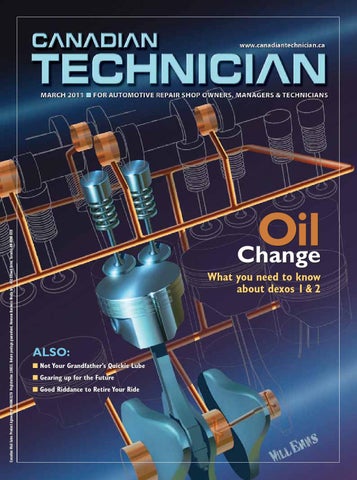
Oil Change
What you need to know about dexos 1 & 2
ALSO:
■ Not Your Grandfather’s Quickie Lube
■ Gearing up for the Future
■ Good Riddance to Retire Your Ride
WHERE CAN YOU FIND ALL THE ANSWERS TO MANAGE A JOB FROM START TO FINISH?
GRAB A VERUS.
TM
CREATED BY TECHS, FOR TECHS. Techs and shop owners from around the country helped build VERUS. In customer clinics and research groups, Snap-on got dozens of insights about most wanted designs and features. Techs told us what worked. What didn’t work. And what could work better. The result is the first handheld diagnostic tool that works the way you do — because Techs created it. VERUS is the first and only tool that gives you everything you need to manage the customer, the car, the diagnosis and repair in one rugged unit and all wirelessly from the service bay. With VERUS, you get the answers you need to fix it right the first time. Ask your Snap-on Representative to put VERUS in your hands today. Once you see— and feel—the power, you’ll know this is the only diagnostic tool you’ll ever need.
Check out the full specs and learn more right now at
www.diagnostics.snapon.com/verus ©2009 Snap-on Incorporated. All rights reserved. Snap-on is a trademark of Snap-on Incorporated. All other marks are trademarks or registered trademarks of their respective holders. Pictures are for illustration purposes only. Specification subject to change without notice. Some functions shown require an Internet connection.
contents
Canadian Technician • March 2011 • Vol. 16 No. 2
FEATURES
Not Your Grandfather’s Quickie Lube................... 18 Nurse Chevrolet Cadillac in Whitby, Ont. has opened its new EnviroLube vehicle service bay. And it’s a beauty.
Oil Change .............................................................. 22 Before you put that new GM or other 2011/2012 model year vehicle up on the hoist to perform a routine oil service, it might be prudent to make certain you have the proper warranty-approved oil on hand to refill the crankcase.
COLUMNISTS Management S.O.S. By Kelly Bennett . . . . . . . . . . . . . .16
DEPARTMENTS Editorial ......................................................................5
30 The Car Side By Rick Cogbill
Service Notes.............................................................7 Letters ........................................................................8 Out & About .............................................................10 Reader Rides...........................................................10 EyeSpy......................................................................11 From Our Forum......................................................14 Products...................................................................27 Auto Puzzle ..............................................................28
Our new international calling card. by
www.bluestreak.ca
MARCH 2011 CANADIAN TECHNICIAN
3
WHY SHOULD YOU CARRY PENNZOIL ULTRA™? FOR THE SAME REASON ROGER PENSKE PUTS IT IN HIS INDYCARS.
Learn more at Pennzoil.ca
NOTHING KEEPS YOUR ENGINE CLOSER TO FACTORY CLEAN.* Some customers wonder if oil change places have oil that’s good enough for their Current Standard** Pennzoil Ultra™ engines. You most definitely do. Tell them you have an oil that’s so good, it’s used in Team Penske’s IZOD IndyCar Series cars.† The exact same Pennzoil Ultra™ ® motor oil Roger’s team uses. Not just oil, Pennzoil. ®
*Based on Sequence VG sludge test using SAE 5W-30.**Pistons from standard V6 engine in ASTM Sequence IIIG test. †Penske IZOD IndyCar® Series cars use Pennzoil Ultra™ Euro 5W-40. Penske Racing, Inc. 2011. All trademarks used with permission of their respective owners. ©2011 SOPUS Products. All rights reserved.
PENNZOIL
®
EDITORIAL
COULD TURN YOUR CUSTOMERS INTO
Good Riddance to Retire Your Ride
WINNERS.
By David Menzies errily motoring down the highway the other day, a radio ad from some federal bureaucracy blared from my car stereo. The announcer, resembling a hyperactive parrot, repeatedly squawked, “Retire your ride! Retire your ride!” (assuming one’s ride is a 1995 vehicle or older.) Ah yes, it’s last call for the laughable Retire Your Ride program, due to expire at month’s end. Let’s all toast its demise, shall we? After all, Retire Your Ride was a flop on so many levels. For starters, how does a consumer stand to benefit if he chooses to send that ’95 Buick Century to the Great Hereafter? Well, not by much. His “reward” ranges from a $490 discount on a bicycle (a great replacement for a motorized vehicle on those 30-km wintertime commutes). Or he can choose a $450 voucher toward the purchase of an “e-bike.” He can also opt for a voucher ranging from $750 to $2,000 toward a new Chrysler, Ford, GM or Hyundai vehicle. Or he can opt for a public transit pass (oh, be still my beating heart!). If he wants cold hard cash, a whopping $300 awaits. Gee, Monty, what’s behind Door Number Two…? As I continued my trip in my 1993 Honda Prelude, I pondered: is my wellmaintained coupe only worth a measly 300 bucks? No chance. Indeed, why would anyone want to get rid of a vehicle that’s mechanically sound and can still pass its biannual emissions test? Just because a vehicle has turned Sweet 16 doesn’t mean it’s due for that big parking lot in the sky. In fact, taxpayer-funded Retire Your Ride schemes are an affront to the automotive aftermarket. Just consider the souped-up U.S. version of the Canadian program, the infamous “Cash For Clunkers” scheme that ran in 2009. Cash for Clunkers issued rebates of up
M
to US$4,500 to American consumers who traded-in old vehicles that got less than 18 mpg. Billions in new car welfare – er, “stimulus” – was paid out. What didn’t get a lot of press was how Cash for Clunkers hurt other industries. As Kathleen Schmatz, president and CEO of the Automotive Aftermarket Industry Association, noted at the time: “Doesn’t it make more sense to give a tax credit or other incentive to the majority of Americans to improve the fuel efficiency, safety and dependability of their current vehicle rather than taking their tax dollars to help a small minority of consumers and pump up new car dealer profits?” Cash for Clunkers was bad environmental policy and bad economic policy. In terms of the environment, rebuilding an existing engine is a far greener proposition than removing a vehicle from the road that hasn’t been used for its entire lifespan. The cost of manufacturing new cars far outweighs the tangible benefits of scrapping older cars – especially since numerous vehicles qualifying for money weren’t dilapidated “clunkers.” The scheme was also bad economic policy given the North American automotive aftermarket accounts for more than $50 billion annually. Eliminating vehicles in need of parts and service meant auto shops suffered. At least the Canadian government – to its credit – resisted intensive lobbying by certain vested interests to supersize the existing Retire Your Ride program. Various associations wanted Ottawa to launch a $350-million program that would mimic the U.S. scheme. The goal was to remove 100,000 so-called “clunkers” from Canadian roads. Gee, wouldn’t that be peachy news for Canadian auto repair shops? Thankfully, far from being enhanced, Retire Your Ride is itself being retired. Goodbye. And good riddance. MARCH 2011 CANADIAN TECHNICIAN
5
HELP YOUR CUSTOMERS ENTER FOR A CHANCE TO WIN A VIP TRIP TO MAY’S PREMIER RACE WEEKEND WITH PENNZOIL + PENSKE RACING. HERE’S HOW IT WORKS: Look for our “Shift to Clean” promotion activation kit in late February. Put the POP on display and with every Pennzoil oil change you sell, give out a Shift to Clean game piece. Tell customers they can also get a free entry code at Pennzoil.ca. Encourage customers to enter their game piece code online for a chance to win great prizes, including their own VIP race weekend. CONTACT YOUR PENNZOIL REPRESENTATIVE TO LEARN MORE.
KURT BUSCH
NO PURCHASE NECESSARY. Promotion starts 3/1/11 and ends 4/30/11. Must be legal resident of the 50 United States and District of Columbia or Canada 18+ years of age. Void where prohibited. Visit Pennzoil.ca for Official Rules. Penske Racing South, Inc. 2011. All trademarks used with permission of their respective owners. ©2011 SOPUS Products. All rights reserved.
Your customers trust you.
Don’t steer them wrong.
Industry experts like you know that replacing worn shocks and struts at 80,000 kilometres* not only helps improve handling characteristics, but can also help vehicles stop sooner. These facts can lead more consumers to make the right choice about ride control replacement. So when it comes to your customers, give them all the facts about the effects of worn shocks and struts. Help them understand the true role of these safety components. And then recommend only the best. Monroe.ÂŽ
monroe.com * Actual mileage and results may vary depending upon driver ability, vehicle type and the type of driving and road conditions.
Š2011 Tenneco
SERVICE NOTES
VOLUME 16
Splitting the difference
NUMBER 2
If we can separate the physical and mental parts of our job, we may have greater success finding workers in the future.
451 Attwell Drive, Toronto, Ont. M9W 5C4 EDITOR David Menzies david@canadiantechnician.ca (416) 614-5824 EDITORIAL DIRECTOR Allan Janssen ajanssen@newcom.ca (416) 614-5814 PUBLISHER Martyn Johns mjohns@newcom.ca (416) 614-5826 CIRCULATION MANAGER Lilianna Kantor lkantor@newcom.ca (416) 614-5815 DESIGN & PRODUCTION Tim Norton production@canadiantechnician.ca (416) 614-5810 DIRECTOR, QUEBEC OPERATIONS Joe Glionna PRESIDENT Jim Glionna PUBLISHED BY Newcom Business Media 451 Attwell Drive Toronto, Ont. M9W 5C4 Canadian Technician is published monthly except for January and July by Newcom Business Media, Inc., 451 Attwell Drive, Toronto, Ont. M9W 5C4. The magazine serves the Canadian automotive repair and service industry. Subscriptions are free to those who meet the criteria. For others: single copy price: $5.30; one-year subscription in Canada: $42.00 ($40.00 plus applicable taxes); one-year subscription in U.S.: US$60; one-year subscription in all other countries: US$90. Copyright 2011. All rights reserved. The contents of this publication may not be reproduced by any means, in whole or in part, without prior written consent of the publisher. The advertiser agrees to protect the publisher against legal action based upon libelous or inaccurate statements, unauthorized use of photographs, or other material in connection with advertisements placed in Canadian Technician. The publisher reserves the right to refuse any advertising which in his opinion is misleading, scatological, or in poor taste. Postmaster: Send address changes to Canadian Technician, 451 Attwell Drive, Toronto, Ont., M9W 5C4. Printed in Canada. Second class mail: Postage paid at Toronto. Canadian Publications Mail Sales Agreement #40063170. ISSN 1710-7644.
We acknowledge the financial support of the Government of Canada through the Canada Periodical Fund (CPF) for our publishing activities.
Kenneth R. Wilson Award Winner Member
Canadian Business Press
“Oil – Lifeblood of an Engine” by Will Enns Phone (250) 404-0411
By Allan Janssen
W
e’ve been in the 21st Century for more than a decade now, and it won’t be long before the newest of our young apprentices will have been born in this century. What kind of perspective will they have on the world of automotive repair in, say, the year 2020? What will their job look like? And will we still have trouble recruiting them? I think our industry may have more success on the human resources front if we start to look at electronic diagnosis and mechanic repair as two very different jobs, handled by two very different workers. Of course we’ll always need the mechanics who understand how a machine’s moving parts interact with each other. We’ll need them to get their hands dirty when the mechanical parts break. They will have to crank the bolts, and pull the filters, and replace the fluids. They’ll deal with inventories of wire sets, light bulbs, and tires.They’ll read the part numbers, order the right components, and install them according to OE specifications. As long as cars roll on wheels, the mechanical side of our job will never truly disappear. But we’ll also need the technician – the computer engineer who understands how electrons and binary codes work. It’s safe to assume the percentage of electronics in an automobile will continue to rise over the next 10 years. I’m guessing collision avoidance systems will become the norm on North American vehicles. We’ll see the development of sophisticated “auto-drive” and “auto-park” functions. And there will probably be some selfcorrecting systems which automatically adjust suspension, alignment, or braking deficiencies on the fly. At the same time, diagnostic
equipment will continue to evolve so that it can read more data, more quickly, and less intrusively. Wireless drivethrough diagnostic machines are surely on the horizon. Lab-coated techs will read scanning screens much the way security guards now read the X-ray machine at the airport. Diagnostics will not be restricted to the bay. Rather, computerized maintenance programs will run whenever the vehicle is in motion, constantly monitoring engine efficiency, and reporting glitches in real time to a preferred service provider. A few tests will confirm the problems and electronic repairs will be resolved by swapping out the infected module with a new one. Electronic repairs will be the easy part of our job, not the tough part. Much has been made about the distinction between mechanics and technicians in recent years. The line between them became blurred at the end of the 20th Century when the term ‘mechanic’ no longer encapsulated all that we did. We simply added technological skills to our job description and started calling each other ‘technicians. I think we may find that the electronic diagnosis and mechanical repair were meant to be very different jobs – handled by very different people. Both will be needed in the garage of the future. No shop will be complete without the brawny mechanic and the brainy technician working side by side. Perhaps it’s time to start streaming our training programs, and investing in separate infrastructure to develop both sides of the market. I suspect it will be a lot easier to attract mechanics when we relieve them of burden of advanced mathematics. And we’ll get eager young techs when he start treating them like computer programmers they surely will have to be. MARCH 2011 CANADIAN TECHNICIAN
7
LETTERS
SHOCK TALK
THE AUTHOR RESPONDS:
Re: Shock Absorbers article by Mohammed (Shah) Shahzad (November 2010). While I’m sure Mr. Shahzad is quite qualified, there were several factual errors in his article.These errors are not a matter of opinion (we all know techs have their opinions on how things work and why) but a matter of fact. For example: “When and Why Should Shock Absorbers Be Replaced? Reason 5: Poor Steerability – the steering wheel doesn't return to the normal position upon completing a turn.” Fact: The shock absorber has nothing to do with the steering system’s ability to return the wheel to centre after a turn.This effect is provided by an alignment angle called caster. Just like the casters on the bottom of a shopping cart, the wheel wants to travel in a straight line. There’s a little more to it than just that, but it has nothing to do with shock absorbers. Re: Sidebar story, “Six Sure Signs Of Shabby Shock Absorbers.” Sign 2: “A headlight isn’t positioned correctly, due to the car’s front end leaning down or over to one side.” Fact: Shock absorbers have NOTHING to do with a vehicle’s ride height (unless we're talking about air shocks, which we’re not). The ride height of a vehicle is affected by several factors including; tire size (aspect ratio) tire pressures, rim diameter, and of course, the springs.You could completely remove the shocks, and the vehicle would sit at the exact same level. Shocks really have one primary purpose: to keep the vehicle’s tires in contact with the road. A vehicle with shocks that are badly worn will dip excessively in corners, nosedive when braking, and tend to float or drift down the road instead of being firmly planted (points Mr. Shahzad covered in his article). In short, a shock is designed to limit or reduce a suspension’s oscillations, and in the end, keep the tire in contact with the road.
I’d like to thank Mr. Bell for his feedback and I agree techs have their opinions based on common concerns, causes and corrections. However, defective part replacements are based on many factors: age, mileage, make, model, and suspension design, (such as struts with upper mount bearings or rubber gaskets). These parts are directly affected by road shocks, so it is hard to cover every configuration of suspension parts. (I covered common causes and corrections.) In regard to Reason 5, I agree with Mr. Bell that the caster (wheel alignment) angle causes steering stability. However, the caster angle is also controlled by the struts assembly (upper mount). On most cars, shocks/struts as one unit have upper mounts supported by a roller bearing plate/mounting and some have a rubber gasket. When shocks fail, it sends a direct impact to the upper mount and causes excessive wear/bearing failure. And since the function of the upper mount is controlling steering stability/rebound actions, such binding/restriction in movements can cause poor steering stability. Re: “A headlight isn’t positioned correctly, due to the car’s front end leaning down or over to one side.” Again, Mr. Bell is right when he states: “You could completely remove the shocks, and the vehicle would sit at the exact same level.” Yes! This is fine on the shop floor only, but not under driving conditions especially on rough roads. Heavy stress, inertia, gravity and load factors can affect where the headlights aim. I have seen in old cars rusty struts with upper mounts popped out due to broken/rusty shocks mountings. That’s why at the end I suggest having strut mounts rust-proofed to avoid such problems.
Kevin Bell Professor, Motive Power Programs Conestoga College Guelph, Ont.
Mohammad (Shah) Shahzad, S.A.E., D.M.P. Manager, Customer Management Operations Brimell Toyota, Toronto
How to reach us We love to hear from our readers. Please send along your opinions to editor David Menzies at david@canadiantechnician.ca.
8
CANADIAN TECHNICIAN MARCH 2011
Now, We Do It All!
ValvolineŽ now offers a full line of Valvoline Professional Series automotive service chemicals. With Valvoline Professional Series, you get a comprehensive line of professional-grade products, services and solutions all backed by industry leading marketing programs. Valvoline Professional Series delivers maximum value to consumers and helps grow your bottom line. Š, 2010, Ashland Canada Corp.
OUT & ABOUT
Tanks for the Oil Change! Armoured gun carrier in need of an oil change is no problem for Guelph Jiffy Lube From two-seater convertibles to supersized SUVs, the folks at the Jiffy Lube in Guelph, Ont., have seen it all when it comes to vehicles rolling into the shop for an oil change. But a tank? “My career in the army ended many years ago and an acquaintance who recently retired heard I ran a Jiffy Lube shop. He contacted me about bringing his gun carrier in for a fluid change,” says Jiffy Lube manager Derek Wildfong. “He’s getting a little long in the tooth to be doing this in his backyard.” The tank was transported to the shop on the back of a trailer, whereupon the owner simply drove the vehicle into one of the shop’s bays. As you might imagine, a heavily-armoured vehicle dropping by for a lube, oil and filter service was a head-turning sight to be sure. “Seriously, I have never seen traffic come to a screeching halt in front of the shop before – this was funny,” says Wildfong. “Surprisingly, none of the rubberneckers got into a collision. A few even followed him into the shop.” Wildfong says he was concerned that his shop floor – which had recently
been refinished – might not take the weight of such a hefty vehicle. But the floor proved sturdy enough – much to the delight of the tech in the pit. As for the actual service, the oil filter change was bypassed since the tank is only driven about 50 km per year in
special events and parades. Thus, only a straight fluid change was undertaken. “The original spec was for a straight 30 weight for the engine oil,” notes Wildfong. “The owner did the research and concluded that the closest gear lube was 80w90 GL5. So that’s what we used for the differential and the manual tranny, along with 28 grease fittings, too
– I had a lot of fun with those!” Wildfong says the biggest challenge was all the bolts and plugs being in Imperial measurement. Fortunately, Wildfong has amassed a huge collection of “weird tools” to accommodate just about anything than rolls in – even military vehicles. “For a Jiffy Lube shop, we get a lot of classics, from a Model T to a Mercury M100 and even a Chrysler Imperial,” says Wildfong. “But this one certainly takes the cake. I started in this business back in the early ’70s when I was just a kid, and now I’ve seen it all.” Once the service was completed, the tank owner gave some customers a ride in the empty parking lot across the road from the Jiffy Lube and Wildfong says grown men were acting like “little kids in a candy store.” And everyone was asking the same parting question: when is the tank coming back for its next oil change service?
On the Road Again…
READER
RIDES
Vinnie Klimkosz of Vinnie’s Mr. Fixit in Guelph, Ont., sent along these shots of a recent ill-fated road trip down south. “In Alabama, we were beside a Dodge Caravan that had the interior stuffed full, a blown-out rear window and a driver’s door was barely attached to the van,” writes Vinnie. “It was also towing a trailer with several items loosely strapped down and the van sure looked dangerous, especially when we were driving right beside it and saw that the driver could barely keep it on the road.” Alas, en route back to Canada, things took a turn for the worst when Vinnie’s motorhome ended up marooned on the Ohio interstate. “We hit bad construction and sheared off all the wheel studs on the rear dual wheels on the motorhome,” notes Vinnie. “I can be seen talking with a State Trooper as we figure out how to get the 35-foot Class A motorhome and its nine passengers back home. In the end, we ended up getting a friend to rent an Econoline van to bring us back to Canada and insurance covered the US$5,500 motorhome repair bill.” And they say getting there is half the fun… You can see more Reader Rides on our website at www.canadiantechnician.ca. And if you have a photo of a hot or unusual ride, feel free to send it in. We’ll publish it up for all to enjoy! Send a pic of your ride to david@canadiantechnician.ca.
10
CANADIAN TECHNICIAN MARCH 2011
Technician sends makeshift auto shop to Africa Assembled in Canada, Auto Repair Shop in A Box now open for business in Burkina Faso. It took almost two years to compile, but Glenn Cowling’s goal of creating an “Auto Shop in a Box” has been achieved. And an African village is now all the richer for it. Colling, the owner of Eastside Auto
Colling poses with some of the aspiring technicians in Burkina Faso.
Service in Oakville, Ont., also serves as a volunteer with the Christian charity Careforce International. A few years ago, he visited Burkina Faso, West Africa to help construct a dormitory for orphaned children. “I just wanted to get take a break
EYE SPY
from auto repair for awhile and build things,” Colling says. Although Colling wanted to construct buildings rather than mend motors, he made the mistake of offering to repair an alternator for a diesel generator. After successfully fixing the generator “things came out of the woodwork that needed fixing,” he says. Indeed, Colling soon found himself repairing machines ranging from a bulldozer to a 60-year-old tractor. And fixing mechanical equipment in a remote African village was no picnic. For starters, there was a dearth of facilities in which to conduct repairs. And, as Colling notes, “When you’re in Burkina Faso, you can’t exactly run down to the local NAPA store for parts.” After his tour of duty, Colling wanted to continue making a difference for the village upon returning to Canada. And after meeting some charity workers from Colorado, Colling experienced an epiphany. The Coloradans were adapting mountain bikes that could survive the rigors of the West African terrain – the idea was to provide
Gone Fishin’ “Yes, that is a perch fillet found in a 2003 Chevy Silverado air filter housing,” writes Chad Chapman of Charlie’s Shell in Manitoulin Island, Ont. “The fish was found while performing a service. Talk about a random find – a muskrat or small animal probably thought the Chevy was a good place to store dinner.”
Have an interesting picture to share? Please send it along to EyeSpy, c/o Canadian Technician, 451 Attwell Drive, Toronto, Ont. M9W 5C4. Or email your high-resolution image to the editor: david@canadiantechnician.ca
villagers with reliable, low-cost transportation. All of which got Colling thinking: why not devise a facility that could also take care of the village’s mechanical repair needs? His solution: a 40-foot long shipping container that he purchased for $3,400. The container would not only serve as a shipping conveyance for tools and equipment, but the container itself would remain in the village where it would function as a makeshift garage. Auto Repair Shop in a Box was born. Soliciting donations from his fellow technicians (both cash and used equipment), Colling was able to outfit his Auto Repair Shop in a Box with workbenches, a welder, tools, air compressor, grinders, a tire machine and balancer, diagnostic equipment, a
Glenn Colling of Eastside Auto Service in Oakville, Ont. transformed this container into a “repair shop in a box.” He is now open for business in Burkina Faso, West Africa.
battery charger – in short, everything needed to get the job done. Colling says the makeshift auto shop is going to fulfill three key goals: It will serve as a venue to teach children valuable work skills; the garage will be used to maintain the village’s equipment; and it will provide a future means of income for the village by servicing vehicles originating from outside the village. Colling says he felt obligated to help the village succeed, noting that his original African adventure changed his outlook on materialism. “Not a week goes by when I don’t think of one of the smiling kids from the village,” he says, noting the average annual income is about $200. “They have so little and yet they’re so thankful for what they do have.” MARCH 2011 CANADIAN TECHNICIAN
11
Your #1 source for EUROPEAN vehicle products is also your best source for
ASIAN
vehicle products
OEM Products
Direct Importer
Comprehensive Inventory
50,000
30,000
20,000
products for European
products for Asian
products for Domestic
Western Canada
Eastern Canada
QuĂŠbec
(800) 644-9129 (800) 463-8749 (888) 681-9053
worldpac.ca
SUPPLIER NEWS Tenneco boosts rewards through dealer loyalty program The 2011 Expert Plus dealer loyalty program from Tenneco now features increased installer rewards and the most extensive package of shop benefits in program history. Included with every 2011 Expert Plus membership is a comprehensive pointof-sale kit featuring the first-ever Monroe Quick-Strut counter stool with backrest; a “preferred customer” coupon book with 10 valuable moneyback rebate offers on ride control and catalytic converter replacement; a tacker sign featuring the 80,000-km ride control replacement recommendation; a ride control-themed waiting room DVD; and Tenneco’s ERIS electronic catalogue CD. Members of the 2011 Expert Plus program also can earn increased rewards for participating in custom online training and a Monroe “4 More” ride control training clinic. To enroll call: 800-851-6929.
NASCAR teams embrace Fel-Pro’s HTA exhaust header gaskets Fel-Pro HTA (High Temperature Alloy) performance exhaust header gaskets from Federal-Mogul are helping Dodgeand Toyota-powered NASCAR teams eliminate the risk of gasket failure caused by extreme heating and cooling cycles. These new gaskets are now available through any Fel-Pro performance gaskets supplier. Federal-Mogul says HTA technology is ideally suited to engines that generate extremely high exhaust temperatures. As temperatures increase, conventional stamped and stainless steel parts begin to lose spring tension and strength, potentially leading to interrupted exhaust flow. Even at temperatures of up to 1,600º F, the FelPro HTA material maintains hardness, creep resistance and dynamic sealing. The Fel-Pro HTA gaskets are now available for the Toyota PH11 and Dodge R7/P5 NASCAR engines.
MARCH 2011 CANADIAN TECHNICIAN
13
FROM OUR FORUM Recent postings on www.canadiantechnician.ca/forum
Where’s the beef? A Canadian Technician Forum member asked his fellow members why pay rates for technicians never seem to keep pace with other professions. Here’s how the discussion unfolded.
OK, lets open up this taboo: why have wages in this profession not kept pace with others? I’m the besttrained, most-equipped, most-licenced, lowest-paid guy in my ’hood. And I do more than OK for this trade. One is a burner tech, one is a welder, a carpenter, and one runs a chain store. So, let’s hear from some techs. And fatchuck (lol). Posted by cooter
Are mechanics paid less than the above named trades? Not sure that’s the case in my (red) neck of the woods. The shop rates in town: Ford and GM dealer: $80/hr.; Canadian Tire: $78; me: $65 for most customers (and as low as $40 for some hardship situations). Wages in this trade in this area are pretty compatible with other shops and other trades as far as I can tell. I’m quite comfortable and the business has been very good to me. My customers are the greatest – they seldom ask for an estimate or complain about the price. Posted by fatchuck
Let’s look at the math (based on west coast rates): 1988 Door Rate: $65/hr; my wage: 47% FR/hr ($30.55/hr). 1992 Door Rate: $85/hr; my wage: 31.5% FR/hr. ($26.78/hr). From 1993-2001, I was paid hourly ($21.50 max.) In the final year when the door rate over that time went from $72/hr to $89/hr, and I was never paid more than 25% of door rate. 2010 Door Rate: $110/hr, my wage 26.4% FR/hr ($29/hr) ... in this instance, the door rate at my dealership has gone up 3 times in 4 years and yet no increase for the techs. In 9 years we have
14
CANADIAN TECHNICIAN MARCH 2011
received a total of $1/FR/hr increase. The last raise was 5 years ago. During the years of 1978-1988, I served an apprenticeship and for 8 of the 10 years managed my boss's business and did the bookwork while working the floor (never made greater than $13.50/hr while the owner purchased 2 waterfront homes) so I knew what the costs of the venture was. And during those years, no parts got marked up more than 35%.Today I see most parts marked up 100%+. So, how has the real cost of running the shop increased so much that upping the door rate results, almost always, in the tech getting no share of the pie? Posted by Swede
Well posted, Swede. But I’m looking to see what guys think about why we can't get paid like others, along with escalating vacation pay, benefits, etc. In my neck of the woods, auto techs aren't even close anymore. My lady tells me to quit my gawddamn bitching. She says that all of us have let this happen and that we should’ve joined the CAW 50 years ago. Her dad was a mechanic too, but he got out and got a union job, fed the family (not the toolbox) and took his pension. As an aside, even civilian trades here at CFB Trenton are in on the act. For instance, a motor vehicle mechanic: $24.70; carpenter: $28.75; plumber: $30.50.
beginning in 2011. Don’t forget that back in 1988 the amount of tooling, computer equipment and training was much less, and therefore a lower financial burden on a shop. So tack on at least $20 to the 2011 labour rate. Posted by bigblockbob
How did this turn into a door rate discussion? Posted by cooter
Cooter, I thought you of all people would understand the relationship between a proper door rate and wages. No tech will ever receive a proper wage without the shop charging the proper door rate. BTW, stop with the owner versus tech crap! We all have to eat. Posted by Bigblockbob
Then let me ask this, Bob. In 1988 I was earning $20/hour flat rate at that $65/door rate. If your door rate as an owner needs to be $128 in 2011 (and I’m not saying it shouldn’t be), what would be my flat rate or per hour rate at your shop? Would it also benefit from the 3% per year rule? I somehow doubt that it would be that much. The door rates keep going up and up to pay for new technology, etc., but the tech seems to be the one paying the way because he’s frozen at the same wage level year after year.
Posted by cooter
Posted by Canuck623
Simple math for you all: Labour rate in 1988: $65. Multiply that by 3% (average rate of inflation) compounded for every year. Your labour rate should be $128.28
Join the discussion! Log on to www.canadiantechnician.ca/forum and see what everyone’s talking about. If you’ve got an opinion to share, we want to hear it.
Š 2009, Ashland Canada Corp. *Source: Thomas Penway Research Poll of ASE Mechanics in the United States
www.v a lv o li n e . c o m
Only one person works on his car. And only one oil works in his engine. More ASE-certified top mechanics use Valvoline in their own cars.* <TRWP]XRb RP] dbT P]h ^X[ cWTh fP]c CWTh RW^^bT cWT ^]T fXcW P _a^eT] aT_dcPcX^] U^a `dP[Xch _a^cTRcX^] P]S P WXbc^ah ^U X]]^ePcX^] EP[e^[X]T
100 YEARS UNDER THE HOOD.
TM
MANAGEMENT S.O.S. IN THIS SERIES OF FICTIONAL LETTERS FROM A NEW SHOP OWNER TO HIS FORMER BOSS, MANAGEMENT TRAINER KELLY BENNETT DISCUSSES BASIC BUSINESS PRINCIPLES THAT APPLY TO THE AUTOMOTIVE REPAIR INDUSTRY.
Four Sure-Fire Ways to
Boost Customer Counts By Kelly Bennett
DEAR KELLY: Thanks for the great information on determining the best direction for a shop. As per your advice, I took time to think it all through. I realized that I’m quite content with the shop I have. Expansion is not in the foreseeable future. So far, 2011 has started off OK. As in, “just OK.” We’ve been tracking our key performance indicators and we’re seeing a decline in our car count. Our car count is down by 17 vehicles per month over last year. Our average invoice is holding steady at 1.7 hours per repair order. That’s a far cry from the 0.67 hours we were at five years ago. We’re holding our gross profit on parts and labour and our technicians’ efficiency is pretty consistent. I had lunch with Brian last week and he has been seeing the same trend: less new customers and a decrease in the average invoice. What have you been seeing in your management groups across the North America? -Erol
DEAR EROL: As always it’s great to hear from you. I find myself quite content in running the two shops and facilitating the management groups. Sharing what I’ve learned with other shops is also very rewarding. We had a shop owner at a meeting last week that told us he was able to start paying himself for the first time since he opened his shop almost three years ago (he had been living off income from a rental property). He’s pretty excited that he’s now able to pay himself a steady paycheque for four months now. Very rewarding, indeed! As for increasing car counts, we’ve focused on achieving this very goal in our last few meetings. Here are just a few of the ideas we came up with. If you want the complete list on the more than 60 ways to increase car counts, just email my assistant at btiexecassistant@aol.com and he’ll send along the complete list. 1. We’ve focused on attracting the employees of various business in our area. For most people, it’s easier to have their vehicle worked on at a shop closer to where they work rather than where
16
CANADIAN TECHNICIAN MARCH 2011
they live. They like to drop their vehicles off before they start work, whereupon we shuttle them to their offices and then pick them up at the end of the day. We choose four businesses per week within a 10-minute radius of our shop and target them. We call it the Pizza/Popcorn/Donut Program. We bring food to local businesses for them to place in their break rooms or lunch rooms. We include gift certificates for $25 off any service that we provide and make it clear that we provide a free shuttle service. We typically obtain two or three new customers a week from this marketing initiative.
young new drivers who really do need to learn the basics of their vehicles. We encourage them to bring their car owner’s manual and stress the benefits of preventive maintenance.
2. We now run our “Where’s the Jack?” car care clinic once a quarter. It’s really quite simple. We offer a short presentation once every three months to educate customers and their families on the basics pertaining to car maintenance. We show them how to check tire pressure, change a tire, check the oil, and so on. It works really well and attracts
arrange their transportation. Our goal is to reward that person for providing transportation for our customer – and, of course, to get the driver to become a customer of ours as well.
Larry Dickison
3. Our taxi driver certificates are working quite well. Whenever a customer arrives at our shop when dropping off a vehicle, followed by another vehicle by a friend/relative/co-worker, we give the customer a “taxi driver” certificate for $25 to give to that person. They did not ask us for a ride to work, nor did they ask for a loaner car or for us to arrange a rental car. They took upon themselves to
4. Business Networking groups have been hugely successful for several of our members. In fact, we get more new
customers from this than anything else we do. Both my advisor and I attend a BNI meeting per week. Each BNI group has only one automotive repair shop. We get an average of $6,000 in new business per month. Great return on a small financial investment a breakfast meeting each per week. These are just a few of the ways we are attracting new customers. Erol, you shouldn’t get too discouraged with your declining car count. We all encounter peaks and valleys. People move on, die, get married and go to their new spouses’ repair shop, etc. Plus when you see an increase in hours per repair order it makes sense that you will see a decline in car count. When we take better care of our customer’s vehicles on each visit, they don’t have to come in as often. In conclusion, I thought I’d give you an update on what’s happening in my world. As you know, my oldest son, Scott, has been working as an advisor is a large shop. They have 27 employees and he won the shop’s employee of the year award. And he is a super employee, no doubt about it. However, Scott recently resigned to enroll in university. He’s working on his music degree. He will be working for me on a semi-part-time basis, going on the road helping with the ever growing training and group facilitation I’m doing (he’s a natural for this kind of gig). Just shows you that the only constant in our business is change. As always, Erol, I’m only an email away. Kelly
Kelly Bennett is a certified management trainer and has been coaching automotive repair shop owners since 1990. You can reach him at kellythecoach@aol.com.
MARCH 2011 CANADIAN TECHNICIAN
17
Not Your Grandfather’s Quick Lube Nurse Chevrolet Cadillac has taken the oil change service to the next level. By David Menzies have seen the future of the oil change service. And it resides at Nurse Chevrolet Cadillac in Whitby, Ont. Last month, this General Motors dealership west of Toronto unveiled its brand new EnviroLube Systemequipped oil change facility. After observing a demonstration, the verdict is in: the benchmark for the oil change service has just been raised in terms of customer service, efficiency and value to the consumer. The oil change experience at Nurse begins when the consumer rolls up to the bay door. A porter greets the customer, takes the keys, and drives the vehicle a few metres inside the 10,000sq.-ft. hangar-like building. At this point, all of the vehicle’s mats are removed. Each mat is inserted into a
I
As the mats a the interior i
Car mats are quickly cle aned in the Rhino-Mat Wash & DryMatic.
nearby Rhino-Mat Wash & Dry-Matic machine, much the same way one would feed a sheet of paper into a fax machine. The Rhino-Mat washes and dries each mat in 30 seconds. As the mats are being scrubbed, two porters vacuum the vehicle (an industrial-strength vacuum cleaner is situated on either side of the vehicle.) Meanwhile, a barcode scanner determines the make and model of vehicle as well as how many litres of oil are required and the type of oil and filter needed. Once the dust and dirt are eradicated from the interior and the newly squeaky-clean mats are returned to their proper places, the vehicle is
moved a few metres to a Hunter 400 inspection unit. As it sits upon the Hunter platform, it’s determined if there are any suspension, brake, or wheel alignment issues. After this diagnosis, a printout is given to the customer. If a problem is found, the vehicle can be redirected to a nearby bay for any necessary repairs. After this brief checkup, it’s time for the main event: the oil change. The vehicle is moved straight ahead to the pit area, although “pit” is really a poor descriptor given that the area is so clean and well-illuminated it could pass for someone’s basement rec room. As well, the pit is long enough so that two vehicles can be serviced simultaneously.
ed, are being wash . ed um is vacu
Next stop: the vehicle is driven onto the Hunter 400 inspection unit for diagn osis.
After the oil is changed, the vehicle makes a U-turn and heads into the dealership’s car wash, exiting the building precisely where the customer dropped it off. In addition to a crankcase filled with fresh oil, the vehicle is squeaky-clean inside and out. What’s more, the entire service takes about 29 minutes, and the customer can choose to watch the “theatrics” or relax with a cappuccino within the dealership’s well-appointed and immaculately clean waiting room. The price: $49.95 for conventional oil ($89.95 for synthetic.) Dealership president Mary Nurse says the facility represents a major investment.While she declined to reveal costs, she says the goal was to improve customer service by reducing wait times for oil changes. “Nobody wants to spend two or three hours waiting for a very simple maintenance to be done on their vehicle,” she says. “We’ve now managed
e oil l of health, th ng a clean bil within the After receivi d is performe . change service ll-illuminated EnviroLube pit we n, ea cl yak ue sq
to address the time element and the value element for our customer base.” As its name implies, the EnviroLube System is an environmentally-friendly way of facilitating oil changes. The EnviroLube System consists of a fibreglass pit designed to prevent oil, grease and other contaminants from leaking into soil as they would over time in a concrete-fortified pit. As well, waste oil is automatically pumped into a remote waste tank. And grated walkways in the pit area prevent workers from standing in waste and tracking it outside. Jason Steele, VP of operations and finance for Integrated Lube Services (the distributor of EnviroLube), says another unique feature is the pit area will stay cleaner given that oil is easily removed from fibreglass whereas concrete absorbs oil, making it very difficult to clean. As well, the pit’s integrated lighting system creates a far brighter workplace for technicians. “A superior work environment results
Last step: a de luxe car wash. Now, the vehicle is good to and out with fr go, looking good inside esh oil in the cr ankcase.
in a more prideful technician,” says Steele, noting that the EnviroLube unit purchased by the dealership was $180,000. Dave Duggan, director of fixed operations at Nurse Chevrolet Cadillac, says there will definitely be a return on investment for the dealership given that oil changes are now carried out far more quickly and efficiently. In the first two weeks of operation, the dealership racked up 518 oil changes.The goal is to perform 120 oil changes daily. Bottom line: far from being a timeconsuming, teeth-grinding affair, an oil change at Nurse Chevrolet Cadillac now takes less than a half an hour to complete and features such value-added benefits as interior and exterior cleaning. It’s win-win for the dealership and the consumer. “The customer feedback we get now is that the oil change was actually fun,” notes Mary Nurse. “Customers are actually telling us they look forward to their next visit.”
FUEL MANAGEMENT
ENGINE MANAGEMENT
HEATING & COOLING
High standards.
DIESEL
Below the surface.
delphi.com/am ©2011 Delphi Automotive Systems, LLC. All rights reserved.
They may look the same, but all parts companies are not created equal. As partner to 25 of the largest vehicle manufacturers globally, Delphi understands the vehicles you service. Whether it’s a Ford, Honda or Toyota, we know each vehicle’s DNA, and apply our OE engineering and high quality standards to all our aftermarket parts. We also provide OE-based, leading diagnostic tools and advanced training to keep your customers coming back. Providing the benefit of more than 100 years of OE heritage, Delphi is the company that makes the parts cars are born with. It’s time to rethink what Delphi can deliver.
IT’S WHAT’S UNDERNEATH THAT SETS DELPHI APART Delphi Automotive // ] Fuel Management With more than 80% fuel pump coverage, Delphi fuel pumps deliver fast-pressure rise for quick engine starts and a two-strainer system for long-lasting durability; ] Heating & Cooling Delphi’s performance-driven, proven warranty experience thermal parts such as compressors, radiators, condensers and blower motors fit a wide range of import and domestic vehicles; ] Engine Management Boasting the industry’s fastest light-off time with its planar technology, Delphi delivers a full-range of emissions, ignition and sensor parts for precise engine performance, reduced potential for malfunctions all while maintaining stringent emissions regulations; ] Diesel Up to 2,000 bar capabilities and smart solenoid injector design, Delphi Diesel fuel injection systems deliver precise fuel quantities to aftermarket and commercial vehicles for optimal emissions performance; ] Training With 80 hours of training logged annually to address vehicle electronics systems, prepare to repair with Delphi’s total-coverage training and diagnostic services.
Oil Change Before you put that new GM or other 2011/2012 model year vehicle up on the hoist to perform a routine oil service, it might be prudent to make certain you have the proper warranty-approved oil on hand to refill the crankcase.
By Jeff Taylor hen was the last time you gave any serious thought to the oil that you were putting in a customer’s vehicle after you had already drained the old oil and installed a new filter? I sincerely hope your answer was: “Just before I pulled the drain plug (if it has one)” because the type of oil that is to be reinstalled to complete the service is more important now than ever before. Indeed, are you aware that most of the new vehicles (2011 onward) built by General Motors require a very specific oil specification? Most manufacturers currently specify the viscosity they want in their engines, but viscosity alone isn’t the only thing that a manufacturer is concerned about. Indeed, there are a host of other factors the engineers who designed the engine are concerned about and all those factors are taken into account when they recommend a lubricant blend. Our jobs as technicians just got a wee bit more complicated when it comes to putting the proper oil in a vehicle that will meet all the manufacturer’s specifications. Most techs are well aware of the existing VW/Audi (VW502.00 to VW 507.00) and Mercedes-Benz 229.50/229.51 oil specs. And that the factory fill on several vehicles is now 0W-20 or 5W-20. But are you aware of the new ILSAC GF-5 and
W
22
CANADIAN TECHNICIAN MARCH 2011
the introduction of dexos 1 or 2? If not, keep reading… The International Lubricants Standardization and Approval Committee (ILSAC) is a group of automotive companies that includes GM, Ford, Chrysler and the Japan Automobile Manufacturers Association. These companies sit down with the American Petroleum Institute (API) and the major suppliers of oil additives and set out the requirements of the oil that will be going into their engines. They also come up with standardized tests for oil. Up until last October, the ILSAC standard was GF-4. GF-4 was introduced in 2004, but much has changed in the subsequent seven years, and the requirements on vehicle manufacturers to provide better fuel economy and lower emissions has never been greater.The U.S. federal government has mandated 35 mpg by 2020 (corporate average fuel economy) and substantially lower emissions. And improvements in oil technology is one of many ways manufacturers are hopeful of reaching such lofty goals. While fuel economy and emissions are important, these weren’t the only areas that ILSAC wanted to improve upon by embracing the new GF-5 standard. In fact, they had a number of areas that required enhancement.
■ Emission System Integrity: Oil contains phosphorous (zinc dialkydithiophosphate, or ZDP) as an additive against wear, oxidation and corrosion. But this has to be retained in the oil to prevent poisoning of the catalytic convertor, air fuel and O2 sensors. ■ Engine Sealing Materials: Customers aren’t the only ones that don’t like oil leaks; neither do the manufacturers. And they needed an oil that would be more compatible with some of the seals and sealing materials that they’re using or going to use. They want better protection from wear and aging. As well, an engine that leaks oil isn’t very “environmental friendly.” ■ Fuel Economy: Testing has shown that 0W-20 can provide a 4% improvement in fuel economy over 15W40. In reality the OEMs are searching for an improvement of 0.5% over GF-4 oils of the same viscosity. The new GF-5 must not only deliver better miles per gallon but it has to provide the same benefits over its entire lifespan. Most of these improvements will be reached with friction modifiers that are either organic or inorganic in nature. They not only consider new oil, but oil that’s been
subjected to use as well. The test engine for GF-4 was a Ford 4.6 V8, but this has been upgraded to a GM 3.6 V6 so that newer engine technology is being used. ■ E-85 Rust Protection and Emulsion Retention: An increasing number of vehicles are now flex fuel compatible, able to run on ethanol. GF-5 oil must be able to protect against rust and corrosion that the environmentally friendly ethanol causes when it’s burned. The byproducts of E85 are water and acids that end up in the oil – and these have to be dealt with. ■ Engine Sludge Protection: The OEMs are providing longer warranties
and by doing this they’re looking for less sludge that could cause engine damage and deposits. They don’t want to see the oil pump sumps plugging up and starving the engine of lubrication. The dispersants that are used to control sludge affect fuel economy, so other additives are being used to gain improvements. ■ Keeping the Pistons Clean: The OEMs don’t want deposits on the pistons of their engines – if these deposits build up they can cause the rings to stick or drag. Rings that are sticking or failing to form a seamless
dexos1 vs. ILSAC GF-4 and GF-5
seal will lower compression. Lower compression can lead to poorer fuel economy, higher emissions and less performance. The piston’s rings are not the only area of concern – the backside of the pistons crown is also prone to deposits. If these deposits build up over time, the pistons can overheat and cause pre-ignition, resulting in lower performance (knock sensors hear what we can’t and retard the timing as needed.) All engine oil is a compromise and this area isn’t alone. The main additives that prevent piston deposits are detergents used to clean away deposits. But if you wash the engine parts too well, you remove all the friction modifiers that are preventing metal-onmetal contact. These friction modifiers are put there to improve fuel economy and engine wear, so a balancing act has to be performed. Still, improvements were made over the old GF-4 standard. ■ The Protection of the Turbocharger: The prevention of coking and oxidation of the oil in the turbocharger’s bearings after a hot shutdown is paramount. Turbocharger failure or lack of performance isn’t what the OEMs want. A current prediction has 15% to 25% of all GM, Ford and Chrysler engines being turbocharged poweplants in the near future, so this area had to be addressed. Again the compromise of detergents and dispersants that are used has to be closely scrutinized to keep things clean without removing any of the mileage and durability properties that are required of the oil (friction modifiers.) Typically, oil is a blend of products. About 10% (on average) is an additive package and 90% is base stock oil. GF-5 could be has high as 30% additive and 70% base stock. There are five base groups of base oil used today from the least refined in Group I straight weight oils, to the highest refined Group V that only contains esters and polyester compounds. As the demand for low viscosity oils increases due to fuel economy demands, the base stock that is going to be used for 0W-20 GF-5 is coming from Group III or the highlyrefined mineral oil that is then processed into synthetic oil. GF-5 is really the next step to a fully synthetic oil, but for all viscosities, that step is still a few years away. GF-5 is expected to be MARCH 2011 CANADIAN TECHNICIAN
23
the factory fill for most vehicles in 2012 – but not GM. Even though GM is part of the group that formed and operates ILSAC and created the GF-5 designation, GM wants to pursue its own direction when it comes to engine oil formulation. The General had most of the same motives that led to the formation of the GF-5 specifications, but had a couple of other ideas. GM wanted to create engine oil that could provide:
■ Oil that was equal worldwide ■ Better fuel economy ■ Better engine protection ■ Extended service life ■ Better use of GM’s Oil Life Monitor System (OLMS) GM’s engine technologies that include direct fuel injection, turbocharging, camphasing and even cylinder deactivation puts lots of stress on engine oil. For example, cam-phasing is all done with oil activation and is very sensitive to any
aeration in the oil.This aeration can affect performance or emission output of the engine if the correct oil isn’t used. All these improvements and others were taken into consideration when development of new oil is needed. The new oil that has emerged is dexos 1 for gasoline engines and dexos 2 for diesel engines. These are GM’s new world standard oils. As GM has about 20 different engines being built in facilities in 37 different countries around the world, GM wants to create an engine oil that is exactly the same everywhere. The General wanted the same quality and specifications to be met universally. So it is that dexos 1 is the factory fill for gasoline engines and recommended service replacement on all the 2011 model year vehicles while dexos 2 has been introduced in European diesels (although isn’t in North America yet.) The new dexos 1 will be available in a number of viscosities including 0W-20, 5W-20, 0W-30, and 5W-30. GM has decided to put more importance on their OLMS for service intervals. They are monitoring engine speed, temperatures, runtime and a host of other parameters in doing the OLMS calculations. The second generation of this system is looking at numerous other sensors and lengthening oil change intervals. They are doing this to maximize the oil’s useful life and prevent unnecessary oil changes. GM’s goal of extended service intervals is to lower the dependence on crude oil and reduce the waste involved in recycling oil that has little wrong with it. GM estimates that if the OLMS was followed in all their vehicles, the company could save more than 100 million gallons of oil each year. Engine designs and body styles aren’t the only things changing as fast as the weather, the simple oil that we take for granted is also evolving. Before you put that new GM or other 2011/2012 model year vehicle up on the hoist to perform a routine service, I think it would be prudent to check and see if you have the proper warranty-approved oil on hand to refill the crankcase.
Jeff Taylor is a technician at Eccles Auto Service in Dundas, Ont. 24
CANADIAN TECHNICIAN MARCH 2011
Harness the selling power of the number one oil filter brand in North America and the #1 preferred oil filter brand in the DIFM channel* with the FRAM Advantage Program. Get exclusive access to the latest technological information and training videos. Not only will your customers be better off, your business will be too. Take advantage of the FRAM Advantage. Visit FramAdvantage.com for more details. Thinking Hockey? Enter the Drive for the Cup Playoff Bracket. Participate with your friends and co-workers in one of the CHL Major Junior Hockey Playoff Series. Visit DriveForTheCup.ca to register.
*
Source: Honeywell CPG Proprietary Study by Harris Interactive, Sept. 2008 © 2011 Honeywell International Inc. Printed in Canada.
No Purchase Necessary. For details visit www.driveforthecup.ca.
Protects your engine to the MAX1 Call your local Irving distributor Parts for Trucks Atlantic Canada (800)-565-4700 www.partsfortrucks.com
Shoreline Lubes Dist. Inc. Atlantic Canada (506) 532-1493 (800) 561-5823
Atlantic Oilfield Newfoundland/Nova Scotia (709) 745-7545 (877) 745-7545 (toll free)
Fleetline Dist. Ltd. Nova Scotia (902) 245-5833 (888) 505-5833
Goldbelt Ltd. Ontario (800) 461-0246
Jack Smith Fuels Ltd. Ontario (800) 265-2120
www.irvinglubricants.com
Muskoka Ltd. Ontario (705) 789-8077
MacEwen Petroleum Inc. Eastern, Ontario (800) 267-7175
Cormack Lubricants Inc. Western Toronto (905) 304-0404 or (866) 762-5309
PRODUCT CENTRAL
Severe Duty Head Gaskets New Fel-Pro PermaTorque MLS Severe Duty head gaskets combine Federal-Mogul’s multi-layer-steel technology with additional design features that accommodate extreme head lift. The gaskets are available in two design configurations: SD4, featuring four layers of embossed fullhard stainless steel and no shim layer, resulting in additional spring action; and SD5, which comprises four embossed stainless steel layers and one shim layer, providing the same spring action and additional (up to .0052inch) thickness. Federal-Mogul sealing system engineers utilized Linear
Variable Displacement Transducers to determine the location and amount of head lift encountered in a variety of small-block Ford engines. This insight to real-world operating conditions enabled them to create a PermaTorque MLS head gasket design that exceeds the sealing requirements of supercharged and turbocharged engines. Each active layer within a PermaTorque MLS Severe Duty gasket features precisely engineered sealing beads to maintain contact pressure between the cylinder head and block. These head gaskets also feature an advanced rubber coating that accommodates a wide range of surface finishes and ensures superior reliability in all applications. www.FMe-cat.com
Mahle Clevite 2011-2012 Filter Catalogue Mahle Clevite Inc. has released its 20112012 Mahle Original Filter Catalog which, for the first time, offers a full range of light and medium duty
filtration products for all applications including European, Asian and Domestic vehicles. The 2011-2012 Filter Catalog (FI-20-11) supersedes (FI-10-08/FI-20-08). The new catalogue includes information on filter types, removal tools and applications, as well as a product prefix, (available in English, French and Spanish) as well as discontinued and superseded parts, manufacturer cross-reference tables and a number-finder. www.mahleclevite.com
New High-Performance Torch BernzOmatic, a manufacturer of handheld torches and accessories, has introduced the Quickfire high-
performance torch. Quickfire features advancements in torch technology including: a compact profile, a 30% faster soldering time, an instant on/off trigger for greater ease and efficiency and the QuickConnect canister that uses Max Power Propylene fuel, which is 20% hotter than propane fuel. www.benzomatic.com MARCH 2011 CANADIAN TECHNICIAN
27
WIN
ENTER FOR A CHANCE TO WIN A GOODYEAR PRIZE PACK. Send your solved puzzle to Canadian Technician. We’ll draw a winner on May 31, 2011. Send to 451 Attwell Drive, Toronto, Ont. M9W 5C4. Or fax to 416-614-8861
Name: Workplace: Work address: Phone:
Email:
AUTO PUZZLE MARCH 2011 1
Responsible choices & smart maintenance keep you coming back for more.
2
3
4
8
5
6
9
10
11
12
13
14
15
Snowmobile Belts The only snowmobile belt with CARBON FIBRE REINFORCEMENT for MAXIMUM PERFORMANCE and MINIMUM BELT WEAR
17
16 18
19
20
Congratulations 21
23
to Perry Vandergulik of Jem Auto Service in Coquitlam, B.C., for solving our November 2010 puzzle.
22
24
Across 1. Diminutive Mercedes-made brand 4. Crustacean once seen on Maine plates 8. Racer's entourage (3,4) 9. Audi A4 and A6 wagon variant 10. Italian track with Rivazza and Tosa corners 11. Car-stereo component 12. Bank-robbers' rides (7,4) 17. Carmaker with an Accent 19. '90s Chevy econobox 21. Roof-rack watercraft 22. UK maker of Tiger and Trident motorcycles 23. Cylinder count in some '30s Cadillacs 24. Tempestuous, early-'90s Geo model
NOVEMBER 2010 AUTO PUZZLE 1
L
E
U 9
B
O
E 11
J
Call 1-888-275-4397 www.goodyearep.com/snowmobile The GOODYEAR (and Winged Foot Design) trademark is used by Veyance Technologies, Inc. under license from The Goodyear Tire & Rubber Company. Goodyear Engineered Products are manufactured and sourced exclusively by Veyance Technologies, Inc. or its affiliates. The Gatorback trademark is licensed to Veyance Technologies, Inc. by The Goodyear Tire & Rubber Company. ©2010 Veyance Technologies, Inc. All Rights Reserved.
28
CANADIAN TECHNICIAN MARCH 2011
Down 1. Kia model, replaced by '02 Spectra 2. Chevy clone of GMC Safari 3. '05-'07 Buick minivan 4. UK-born, '08 Formula One champ (5,8) 5. With 7-Down, items gripped by calipers 6. Diminutive and defunct Chevy SUV 7. See 5-Down clue 13. ’09 Chevy SUV 14. Maker of Dodge Ram turbodiesel engine 15. Certain suspension parts, briefly 16. Home town of the Batmobile 18. "Nothing runs like a ____," ad slogan 20. '84-'94 Ford compact model
2
S
S
T R
T
B
O
R
E
T
A
8
14
P
E
C
O
N
L
E
E
L
O 21
A
23
H
F
S
18
O
R
L
R
S
U
I
T
E
I
E 15
I
19
C
D
L
S
E
7
R I
E
L
C
D E
L
S
K
E
C
D
A
R
20
U
D
E
V
E
H L
C 24
16
E R
O N
S T
U
A
I E
O
A
R 22
O
6
I
F
N M
T
T
D
Z R
E
10
E T
5
L
12
A 17
D
G O
N U M
4
R
L
O 13
3
N
U E
C
to find a distributor near you. Or, visit
NO PURCHASE NECESSARY. To enter, residents of Canada who have reached the age of majority according to the law of the province in which they reside, should complete official entry form and post it to Canadian Technician Magazine, 451 Attwell Drive, Toronto, Ont., M9W 5C4. Or fax it 416-614-8861. Canadian Technician is the Sponsor of the sweepstakes. Chances of winning depend on total number of eligible entries received. For this month’s drawing, entries must be received no later than 8:00 pm EST on May 31, 2011. One entry per person per month. Prize valued at approximately $100. Void where prohibited. Subject to full, official rules and regulations. For full, official rules and regulations visit. www.canadiantechnician.com
7
A
F
U L
L
R A
S
QUESTION OF THE MONTH What was the best training class that you ever took and what made it so special?
continued from page 30
parts for a trailer.” Herk gave me a sideways glance. “Where’s his good-lookin’ sidekick?” “Sidekick? The only person I’ve seen is Mr. Smith here.” “Hmm.Too bad. She was a sight for sore eyes.” Herk headed for the door. A few hours later the transmission was out and I was waiting for the flywheel to come back from Herkle’s. Overall things had gone smoothly, except for the discovery of a small holster tied up underneath the front seat when I went to remove the floor pan over the transmission. Hmm, so what’s that for? While we waited, I tried to make small talk without staring at the bulge under his jacket. “So…doing some camping this summer? “Nope.” “Oh.” I tried again. “So your wife is back at the trailer until you get the truck fixed?” John Smith eyed me suspiciously. “Wife? Ain’t married.” “Well, then your girlfriend must be…” He barked out a laugh. “My girlfriend is back in Vancouver. Look, let’s just fix the truck, shall we? I got places to be.” I gulped and went to phone Herkle’s. It was almost midnight when Mr. John Smith paid his debt with crisp $100 bills and drove out of my life for good. The following Wednesday I went to see Buck Pincher at his motel.“What’s the story with that guy you sent to my shop last Friday? Did he really leave a trailer here for the summer?”
Buck fished some leaves out of his pool with a longhandled net. “Yup. It’s that one up in the top right corner.” I squinted up the steep hill to his RV area. “Anyone staying in it?” “You bet,” he replied. “Her name’s Kitty – all high heels and makeup. She sure ain’t from around here.” I noticed a wire strung to the trailer from a nearby telephone pole. “Hey, she has a permanent phone line?” Buck nodded. “If I ain’t mistaken, it’s a 1-900 number.” “What! Do you mean she’s a…that Mr. Smith is a…?” I was flabbergasted. “Does your wife know about this?” “She sure does. The long-term rent’s gonna pay for our next vacation.” I stared at him. “And she’s okay with that?” Buck sighed. “Well, we got rules.” “Rules? What kind of rules?” Buck pulled up his shirt to show me a small device clipped to his belt. “I gotta wear this GPS locator every time I go outside the house. I ever turn it off, I’m dead meat.”
ADVERTISER INDEX
NOW HIRING
Bars Products – Rislone . . . . . . . . . . . . . . . . . . . . . . . . . . . . . . . .24 www.rislone.ca Blue Streak-Hygrade . . . . . . . . . . . . . . . . . . . . . . . . . . . . . . . . . . . .3 www.bluestreak.ca COASTAL Blending & Packaging . . . . . . . . . . . . . . . . . . . . . . . . .26 www.coastalbp.com Delphi Products . . . . . . . . . . . . . . . . . . . . . . . . . . . . . . . . . . . .20, 21 www.delphi.com Goodyear . . . . . . . . . . . . . . . . . . . . . . . . . . . . . . . . . . . . . . . . . . . .28 www.goodyearep.com Honeywell – Fram . . . . . . . . . . . . . . . . . . . . . . . . . . . . . . . . . . . . .25 www.fram.com National Defence . . . . . . . . . . . . . . . . . . . . . . . . . . . . . . . . . . . . . .31 www.forces.ca Pennzoil . . . . . . . . . . . . . . . . . . . . . . . . . . . . . . . . . . . . . . . . . . . . .4,5 www.pennzoil.com Redline Detection . . . . . . . . . . . . . . . . . . . . . . . . . . . . . . . . . .18, 19 www.redlinedetection.com Ross-Tech . . . . . . . . . . . . . . . . . . . . . . . . . . . . . . . . . . . . . . . . . . . .27 www.ross-tech.com Snap-On Tools of Canada . . . . . . . . . . . . . . . . . . . . . . . . . . . . . . . .2 www.snapon.com Tenneco Automotive . . . . . . . . . . . . . . . . . . . . . . . . . . . . . . . . . . . .6 www.monroe.com Total Lubricants . . . . . . . . . . . . . . . . . . . . . . . . . . . . . . . . . . . . . . .13 www.total-lubricants.ca Valvoline . . . . . . . . . . . . . . . . . . . . . . . . . . . . . . . . . . . . . . . . . . .9, 15 www.valvoline.com WorldPac . . . . . . . . . . . . . . . . . . . . . . . . . . . . . . . . . . . . . . . . .12, 32 www.worldpac.ca
Rick Cogbill is a licensed technician and former shop owner in Summerland, B.C. Special thanks to Instructor Todd Green and the Third Year Apprenticeship Class at the Southern Alberta Institute of Technology in Calgary, Alberta for this months technical mystery. To read more about Slim and the gang, order your copy of Rick’s book, , A Fine Day for a Drive at www.thecarside.com.
Shaw GMC Chevrolet Buick is Canada’s largest GM truck centre and we continue to expand.We are looking for General Automotive and Drivability Technicians to fill our busy shops. Here is what we are looking for; 1. 3rd and 4th year apprentices 2. Journeyman Technicians 3. GM experience is preferred, but we will train the right candidate. What does working for Shaw GMC Chevrolet Buick mean to you? 1. As Canada’s largest GM truck centre, we have the work and lots of it. This gives you the ability to earn a significant income. 2. Supportive, fun and an energy packed environment. 3. Specialized paid training and development to ensure your career goals are being met. 4. Extensive Health Benefit Package. 5. Longevity bonuses. 6. State of the art facility and equipment. If this is you and you want to work for an organization that has the work, commitment to your career and the fun and energy that you enjoy, then send your resume to: Paul MacGowan • (403) 287-5952 paulmacgowan@shawgmc.com
4620 Blackfoot Trail S.E. Calgary, AB, T2G 4G2 www.shawgmc.com MARCH 2011 CANADIAN TECHNICIAN
29
The Car Side By Rick Cogbill
Under The Gun A tall, dark stranger packing a heater creeps out Slim… or: Why you should never pick up the phone at 5 p.m. on a Friday preceding a long weekend… (Note from the author:This story is based on a true event.Tell us how you would handle things if a customer arrived at your shop under somewhat questionable circumstances. Please send your comments to editor David Menzies at david@canadiantechnician.ca.) I glanced up at the battered clock above the parts room door – it was almost five o’clock. “Tooner!” I hollered over the din of air guns and ball peen hammers. “Is that Dodge ready to go?” “All done!” he yelled back, slamming the hood. Two other hoods followed suit, as Basil and Beanie made a mad dash to see who could get out of their coveralls the fastest. It was the Friday before a long weekend and everybody had plans – including me. “Where you off to this weekend?” Quigley tapped his foot impatiently as he waited for our ancient dot matrix printer to pound out the final work order of the day. “My brother-in-law’s cabin,” I said. “The wife’s got…..” We froze as the telephone rang.When it’s 5 p.m. on a Friday before a long weekend and the phone rings, nobody wants to answer the call. My nervous staff poked their heads around the corner from the lunchroom. “How many rings is that now?” whispered Basil. “Twelve,” croaked Beanie, twisting his cap into a knot. “Ya ain’t gonna answer that, are ya?” Tooner raised a threatening eyebrow. I wiped the perspiration out of my eyes.“Not if I can help it.” “Good call,” said Quigley. “’Cause if it’s still ringing after all this time, then it’s gotta be…” I couldn’t stand it any longer – it’s what comes from being a shop owner. I grabbed the jangling receiver and held it to my ear. “Hello…Slim Shambles Auto Repair.” I listened for a moment. Covering the mouthpiece, I whispered, “It’s Buck Pincher.”
Quigley threw up his hands. “I knew it!” Tooner snorted. “Yep, figures.Well, I’m outta here.” By the time Buck had described his problem, my staff were as scarce as a free jacket on a tool truck. “Sure thing, Buck,” I heard myself saying. “I’ll wait till he gets here.” Ten minutes later a well-used GMC 4x4 ground its way into my shop. At first glance the body looked a little rough, but as I discovered later, appearances can be deceiving. Mechanically, the GMC was in great shape.This was a vehicle designed to run well without attracting attention. I introduced myself to the driver, a tall, thin individual hidden behind a pair of expensive sunglasses. “What seems to be the problem?” The stranger took a toothpick out of his mouth and eyed me up and down. “I burnt my clutch out trying to back my trailer into your buddy’s campground.” He removed a battered fedora from his head and ran his fingers through some well-oiled wavy black hair. “His driveway should be condemned.” He was a city boy, and he smelled like money – dirty money. I reached for a clipboard. “And your name is?” “Smith. John Smith” “Right.”This was going well. “Address?” Mr. Smith removed his shades. “Look, here’s the deal. I gotta get back to the coast ASAP. Don’t care what it costs. And if you can fix my ride tonight, I’ll toss in a bonus.” I don’t know why, but I decided to take it on. I caught Herkle’s Auto Parts before they closed for the weekend, and Herk offered to drop off the clutch pack on his way home. “Workin’ late, eh?” He set the box down on the floor, and squinted through the office door window at my customer. “Hey, I seen that guy earlier today. He bought some RV continued on page 29
30
CANADIAN TECHNICIAN MARCH 2011
“If our communications go down, lives could be at stake. My job is to inspect and maintain my team’s communications equipment. Keeping them in touch and keeping them safe.” Corporal HAEBE BAGUIDY
« Des lignes de transmission rompues, ça peut vouloir dire des vies en danger. Mon travail consiste à inspecter et à réparer le matériel de communication de mon équipe. Je fais en sorte que tous restent en contact pour que tous restent en sécurité. » Caporal HAEBE BAGUIDY