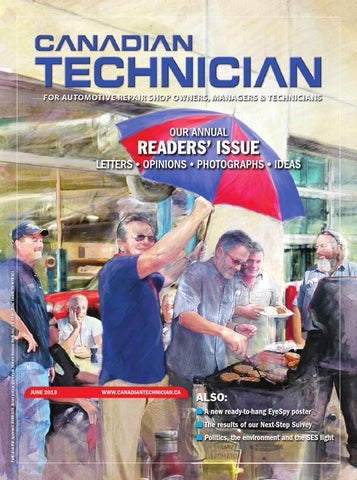
OUR ANNUAL
READERS’ ISSUE
Publication Mail Agreement #40063170. Return postage guaranteed. Newcom Business Media Inc., 451 Attwell Drive, Toronto, ON M9W 5C4
LETTERS • OPINIONS • PHOTOGRAPHS • IDEAS
JUNE 2013
WWW.CANADIANTECHNICIAN.CA
ALSO: ■ A new ready-to-hang EyeSpy poster ■ The results of our Next-Step Survey ■ Politics, the environment and the SES light
ONLY ONE BUSINESS CAN BE THE BEST.
WHY NOT OWN IT? Snap-on is a trademark of Snap-on Incorporated, Š2013 Snap-on Incorporated. All rights reserved.
LEARN MORE HERE
Snap-onÂŽ is a world leader in the design, manufacture and marketing of innovative, top-quality, value-added tools, software and services to the automotive, aviation, marine, RV, ATV, and related industries. Our unique network of more than 350 franchisees in Canada is a crucial link to our customers. As a Snap-on franchisee you'll take your well-merchandised "Mobile Store" to your customer's place of business and provide personalized service and solutions associated with the world-renowned Snap-on BRAND #USTOM BUSINESS SOFTWARE FRANCHISE kNANCING AND CUSTOMER CREDIT kNANCING IS OFFERED .O ROYALTY OR ADVERTISING FEES APPLY )F YOU ARE READY TO BE YOUR OWN BOSS AND SING FEES APPLY )F YOU ARE READY TO BE YOUR OWN BOSS AND drive your own future, contact Snap-on today.
TO LEARN MORE ABOUT SNAP-ON FRANCHISE OPPORTUNITIES GO O TO: TO:
WWW.SNAPONFRANCHISE.CA
QUEBEC/ATLANTIC CANADA: ONTARIO/WESTERN CANADA: 51 $%.)3 0%,,%4)%2 1-800-665-8665 x244 "),, 02%34/. 1-800-665-8665 x351
denis.pelletier@snapon.com
bill.preston@snapon.com
contents
Canadian Technician – June 2013 – Vol. 18 No. 5
25
FEATURES A new EyeSpy poster ........................................................16 Something to hang in your shop to let consumers know why they should leave the repairs to professionals! Next-Step Survey...............................................................19 The results are in… and they say a lot about our industry. The Clean-Air Challenge ..................................................25 What an illuminated SES light means to your customers and to our environment.
COLUMNISTS Why cheap parts just won’t cut it ....................................12 By Jay Oberoi Everyone’s an Internet expert these days .......................13 By Bob Ward The benefits of self-regulation .........................................14 By Jamie Holmes
DEPARTMENTS Service Notes ...................................................5
Becoming a Vehicle Security Professional......................15 By John Norris The Car Side......................................................................30 By Rick Cogbill
Letters...............................................................6 From Our Forum.............................................10 Ad Index..........................................................29
Our new international calling card. by
www.bluestreak.ca
JUNE 2013 CANADIAN TECHNICIAN
3
, , G G N I N I B W NG, M I O L L C P I L K D L I C U H A M , H , E G G H W N T I N I H H L D S L S R U U A O R B F , C G R R D E N L A I V L R I C , A R O G S C W S S N I E E K R L ROC P CLEA LE IN TH OD UN O . M C G R S U E T Y U T S N M L I A E F U L IN I O G HE O Y T N R O E R U D O FO T ’ Y D N E P WO BEEF U GINEER ITIONS. D N E N U , O O P Y X GC IX IN W V I R W NE TD S E H G CIT Y U NG O RIVI T D E TREM S VY HEADS LOA
IC THET N Y S OI L
EX ITION D CON
V i sit
w
om e r s .c ix f ilt
o r th
eW
r ne a ibuto r t s i IX d
re s t
you.
SERVICE NOTES
The results are in!
VOLUME 18
NUMBER 5
Now all we need is a clear interpretation of the data from our “Next-Step Survey” in order to chart a path for the future. 451 Attwell Drive, Toronto, Ont. M9W 5C4
By Allan Janssen Welcome to our fifth annual Readers’ Issue – something we’re enormously pleased to offer each summer. This year’s edition, like those of years past, is filled with photographs, letters, commentaries, and articles from readers like you. The common denominator, of course, is a wide range of opinions on the future of the automotive repair and service industry. I’ve taken some heat from time to time for allowing too much opinion in this magazine, for not softening it or filtering it. The concern is that unbridled criticism of the industry will lead young people to abandon it. But I think it’s the role of a trade magazine to reflect what readers are thinking – good or bad – so their concerns can be addressed. We face some unique challenges that will require a deft hand to solve. Most notably, it would seem, the rising cost of training a technician and equipping a shop to diagnose today’s sophisticated vehicles far outpaces the public’s willingness to pay. I think this underlies all of the other concerns we so often hear about. Our Next-Step Survey gave technicians and shop owners across the country the chance to speak out on this and other issues – from training, to business practices, to government relations. More than 200 people took part in the survey. The results are presented here, starting on pages 19, and they make for fascinating reading. Unfortunately, what you won’t find within these pages are the hundreds of comments that accompanied the survey. Not because they were so critical of the industry that I’d surely get my knuckles rapped for publishing them, but because we just couldn’t fit them all in. But we read every one, and we took copious notes. The summary
of topics they cover is here. The comments themselves are on our website at www.tinyurl.com/ct-nextstep-survey-results. There are a few things that stand out to me in these comments. For one, they point to a strong desire for a national association to represent shop owners and technicians. Yet the associations that are operating in our industry are met with some skepticism and criticism for being either too expensive or ineffective. These associations are having trouble attracting members at the same time as a number of readers said they’re unaware of any associations to join. Another paradox is the frequent calls for government action, counterbalanced by angry dismissals of intrusive government interventions. (I suppose it’s legitimate to want more of the right kind of intervention and less of the wrong kind, but defining “the right kind” is a fool’s game in an industry with so many conflicting interests.) So the results of the Next-Step Survey are hardly conclusive, begging the question, what exactly is our “next step?” For my part, I’ll be talking to association presidents, business trainers, college instructors, government bureaucrats, and industry experts to get their take on the survey results. Between them there’s got to be a few good ideas of how we can re-orient our industry. And meanwhile, I’ll be keeping my ears open for more thoughts from you. I’m hoping someone will step up to help lead this industry. The idea for the Next-Step Survey came from you guys… I’m sure the solutions are out there too. I’d like to hear what you think.You can reach me at allan@canadiantechnician.ca.
EDITOR Allan Janssen allan@newcom.ca (416) 614-5814 CONTRIBUTING EDITOR Sarah Voigt sarah@canadiantechnician.ca PUBLISHER Martyn Johns martyn@newcom.ca (416) 614-5826 CIRCULATION MANAGER Lilianna Kantor lily@newcom.ca (416) 614-5815 DESIGN & PRODUCTION Tim Norton production@canadiantechnician.ca (416) 614-5810 GENERAL MANAGER Joe Glionna PRESIDENT Jim Glionna PUBLISHED BY Newcom Business Media 451 Attwell Drive Toronto, Ont. M9W 5C4 Canadian Technician is published monthly except for January and July by Newcom Business Media, Inc., 451 Attwell Drive, Toronto, Ont. M9W 5C4. The magazine serves the Canadian automotive repair and service industry. Subscriptions are free to those who meet the criteria. For others: single copy price: $5.30; one-year subscription in Canada: $42.00 ($40.00 plus applicable taxes); one-year subscription in U.S.: US$60; one-year subscription in all other countries: US$90. Copyright 2013. All rights reserved. The contents of this publication september not be reproduced by any means, in whole or in part, without prior written consent of the publisher. The advertiser agrees to protect the publisher against legal action based upon libelous or inaccurate statements, unauthorized use of photographs, or other material in connection with advertisements placed in Canadian Technician. The publisher reserves the right to refuse any advertising which in his opinion is misleading, scatological, or in poor taste. Postmaster: Send address changes to Canadian Technician, 451 Attwell Drive, Toronto, Ont., M9W 5C4. Printed in Canada. Second class mail: Postage paid at Toronto. Canadian Publications Mail Sales Agreement #40063170. ISSN 1710-7644.
We acknowledge the financial support of the Government of Canada through the Canada Periodical Fund of the Department of Canadian Heritage.
Kenneth R. Wilson Award Winner Member
Canadian Business Press
“Lunch Break” By Wayne Moore 1-905-632-8770 JUNE 2013 CANADIAN TECHNICIAN
5
LETTERS TRADE MUST FIND A WAY TO KEEP ITS TECHS It is a sad truth that a lot of techs are leaving their jobs for better paying ones. I read your article (“The Lure of Big Money,” November 2012) and there are a lot of good points from owners, but with today’s economy and rapid technological changes, it is very hard to resist the temptation of the big pay cheque. I have to say that I’m one of those who jumped ship. When I started as a licensed red seal journeyman in 1982, my wage was $11.14 an hour. By 2006, it had increased to $23 an hour. Still not really a good wage considering all the tools I had to buy and the continuous training I had to take. I’m not sorry I left, but I do feel sorry for the small shops that are losing their techs. Hopefully the automotive industry can figure out a way to keep its most valuable workers. — Name withheld on request Elkford, B.C.
TECHS HAVE THE RIGHT TO TAKE A NEW PATH With regard to “The Lure of Big Money” (November 2012), everyone wants to hire the smarter, more ambitious techs. So when that ambition leads these techs to bigger challenges more money, or just different work, who has the right to say they can’t go? Business owners have the right to open a shop, buy a car that’s less than 20 years old and pay someone else to work on it… and so do we. Phil Hayes Member, CT Advisory Panel Rose City Ford, Tecumseh, Ont.
IT’S HARD TO SAY NO TO THE BIG MONEY “The Lure of Big Money” happened to me. I was offered $10 more per hour with a 100 percent medical package, along with tool and boot allowance. It pretty much doubled my annual income. It’s pretty hard to say no. Robert Kindred Member, CT Advisory Panel Autumn Sales Brooks, Alta.
6
CANADIAN TECHNICIAN JUNE 2013
WAGES HAVE TO REFLECT CHANGES IN THE TRADE This is a topic that hits close to home for me (“The Lure of Big Money,” November 2012). I’ve just completed my apprenticeship. I’ve invested about $25,000 in tools and training. Even after all of this, I’m still not being paid what I feel I deserve.Wages on the repair side of the industry have not kept up with the changes in the rest of the industry. Cars have become incredibly complex, and are much more difficult to work on.The cost for the tools and training has gone up. Until something changes, this is going to be an ongoing issue. Scott Matthews Member, CT Advisory Panel Canadian Tire Sechelt, B.C.
NEW COLLEGE OF TRADES IS ANOTHER INSULT RE: “Is Your Licence worth $100 a year?” November 2012 I’m the wife of an automotive technician. My husband is a brilliant, hard working, deeply ethical man. As a mechanic, he is perceived as a wizard by his white-collar friends. But to the general public he is seen as a low-life grease monkey, despite the fact that he is perpetually in school, and is highly skilled in mechanics, electronics, hydraulics, computer software, and diagnostics. If he’d been born into a different social stratum, he’d be an engineer. The recent decision by the Ontario government to set up the College of
Trades, with a new annual license fee may be the last straw in a career of insults by society and employers alike. I reviewed the College of Trades website to see exactly what we’re paying for and the remarkable thing is I didn’t see anything that benefits me or my family. We literally cannot afford this fee and I hope my husband’s fellow tradesmen stand up in protest. Patty Giovinazzo Greater Toronto Area
NEW COLLEGE IS STEP IN THE RIGHT DIRECTION Just a note to say that I think you are right (“Is Your Licence Worth $100 a year?” November 2012). The automotive repair trade does need to act. I feel the way to do this is by developing and empowering a unified association to lobby our case to those who can effect change.The Ontario College of Trades is a nice step in the right direction. Mike Weese
TOP TECH GETS TOP MARKS FROM TEACHER Congratulations to Joe Di Sabatino (“Mazda Names Top Tech in Canada,” May 2013). Not only are you a great technician, but a fine gentleman, a wonderful father, and a very ethical man of strong family moral values. You’re an example of what the trade needs today.Thank you for your diligence in the pursuit of excellence. Bill Corner Retired Automotive Teacher, Brantford Collegiate Brantford, Ont.
WE NEED TO BRING MORE TECHS INTO THE TRADE I wish them luck at the Automotive Business School (Out & About, September 2012). I don’t think that the business side of the auto industry has suffered much; it’s the actual service end that is lacking. Mechanics are hard to find, and experienced techs are about as easy to come by as winning lottery tickets. I’ve never seen a good solid plan to entice people to enter the trade. Closing high school skilled trade shops probably had something to do with it. When they started the big push for academic achievement rather than practical skill, our trade suffered. Unless we find a way to solve that problem, the outlook isn’t all that rosy. George Stringham Taber Diesel Service Taber, Alta.
FINDING HONEST WORK IS ALL IN YOUR INSPECTION
POOR-QUALITY PARTS ARE JUST NOT WORTH THE RISK Recently we had a new customer’s car in for an inspection and possible maintenance work. The front brakes looked quite good when my son-in-law Brodie inspected them on the lift. But during the road test, Brodie had to brake suddenly, and he heard a loud bang. Back at the shop, he found that the rotor had split completely around the hub, which caused the rotor face to become separated. When we got the rotor off and took a closer look, we saw that the inside was of lesser quality, causing it to fail prematurely. It was a good reminder that poor-quality parts can lead to severe injury or worse on our busy roads.We simply won’t install cheap parts. The lives of my children and grandchildren mean more to me than just a few dollars.They’re priceless! Kevin Goodkey Goodkey Service Centre Stirling, Ont.
from people who really know our industry. Something this important demands professional input, tough questions, and honest answers. Many of us started in the business without any
kind of thought about how we would get out. Dennis Roberts Owner, TransCan Service Centre Blind River, Ont.
I recently attended one of Rui Martin’s seminars in Halifax (“Inspecting Every Vehicle,” October 2012). All I can say is that if your way of looking at vehicle repair doesn’t change after listening to him, you should get out of the business.There is so much honest money rolling out the door it’s not funny! Ted Locke OK Tire Greenwood Greenwood, N.S.
STORY ON RETIRING CAME AT A GOOD TIME I enjoyed reading the article about “Planning Your Exit Strategy” (December 2012). I’m at the age when that is on my mind. Unfortunately, finding an expert that can explain the process isn’t easy. I’ve spoken to lawyers, accountants, and financial advisers. The only thing they can agree on is that planning your exit properly is of the utmost importance.Yeah, I knew that! Even trying to find a decent answer on how to go about valuing your business isn’t easy. So far, all the answers I’ve gotten have added up to the equivalent of darts and a dartboard. It would be good to hear JUNE 2013 CANADIAN TECHNICIAN
7
LETTERS
Precision Brand Precision Engineering Precision Performance
Premium Brake Rotors • Wide coverage of applications now available
ALL WE ARE SAYING IS GIVE TECHS A CHANCE Something that really grinds my gears is how technicians are dismissed as mere wrench-turners. They are not considered the thinkers in our industry. But a lot of technicians are highly educated, have analytical minds, and have a bird’s eye view of the whole operation from their spot in mechanical purgatory. Their technical understanding gives them an “X factor” that could make them truly valuable in other positions within the business. Unfortunately, however, even if they are ready and willing to step up, they are overlooked. Good technicians demonstrate hard work and discipline, and they have a lot of skills that extend beyond the repair bay. The industry should take advantage of the professionals at their disposal. Matt Armstrong Sussex Corner, N. B.
LET’S TACKLE INDUSTRY ISSUES TOGETHER Thanks for the “Next-Step Survey” (April 2013). It shows me I’m not alone in this
• Best Quality & Value • Superior Braking Power • Non-Directional Finish • No-Turning Required • Wide range of applications
®
For more information on Ceramic Plus and other ProMax products visit,.. www.autopartsdepot.ca
8
CANADIAN TECHNICIAN JUNE 2013
industry with the issues I face. I’ve been in this industry for about 39 years. I have had my own shop with up to eight technicians at a time. Here in Alberta, we fight the oil industry for technicians. We offer top wages with benefits, a positive working attitude, and a clean, safe repair centre. We have morning meetings and constant communication. We use walkie talkies to help prevent interrupted work flow. We charge $124.95 per hour, and we’re not embarrassed by that. I feel this industry needs to get the proper respect from the public.We, as service providers, need to learn to educate our customers so they have a better understanding of the technology it takes to maintain their vehicles. It helps if we all keep moving forward together. Bruce Stewart Bruce Stewart’s Auto Repair Centre Edmonton, Alta.
How to reach us What do you think? We love to hear from our readers. Please send along your opinions to editor Allan Janssen at allan@canadiantechnician.ca.
EYE SPY These brakes stop here “I see worn brakes all the time… but nothing like this!” says Ken Hau at a Midas location in Toronto. The brakes on this Volkswagen Jetta were ready for the hall of shame. The customer drove the car in (it probably should have been towed) on the suspicion that it had broken brake lines. In fact, it needed major work at all four corners.
Have an interesting picture to share? Email a high-resolution image to: allan@canadiantechnician.ca
FROM OUR FORUM
Explaining ourselves Our Forum members debate the idea of explaining to customers the various ways of charging for work… and how we stack up against other trades.
I remember reading an article about the prices we charge, compared to what other trades charge.The public doesn’t realize how many tools we have to buy, and the many hidden expenses of running a shop. I want to make a list that compares the different trades and their expenses, and put it on the wall for customers to see.
it is.When we write an invoice, there’s a “parts” section, and a “labour” section. No one questions it. They trust us; that’s why they’re here in the first place.
I have to disagree with msog. At any shop I’ve worked at, the labour rate was the same, regardless of who was working on the job. Now, some places itemize parts and labour on the invoice, and others don’t. That’s up to the individual. I’m fine with it either way. When I get an invoice for any kind of service, I just ask questions if I’m in doubt.
That might or might not be an effective project. The problem you need to overcome is the misconception that anyone can turn a “monkey wrench.” Every farmer and gear head thinks they can repair automobiles. They know they are not electricians, plumbers, or carpenters but their dads worked on their own cars, so they think they can too. They don’t value what we do because they think they can do it also.
—BRIANSOKOLOWICZ
—30222
—PFOREMAN
Our labour rate isn’t posted, and it’s rare that a customer asks what
10
CANADIAN TECHNICIAN JUNE 2013
—msog
—jpeebles
—crazyman
I wouldn’t post a list like that. A lot of your clients are from those trades or have family members that are. Do you want to devalue what they do? Honestly, I don’t think it really matters all that much. We rarely discuss our labour rate with clients anyway. We present the job in its entirety rather than divide it into ‘parts’ and ‘labour.’ Should it really matter what your rate is compared to other trades? You have your expenses to cover, and a net profit to maintain. Your rate should be reflective of that, and that alone.
effective labour rate goes up. Do you post that too? Posted labour rates are false and misleading.We charge by the procedure. That’s never misleading.
Your list is probably not a great idea. While trying to show your value, you’re devaluing other professions. A better idea would be to present a very professional image with the use of soap, paint, clean uniforms, and competent staff. If you do that, people won’t be asking why you charge what you charge. —caravanman
How accurate is a labour rate anyway? Do you charge the same labour rate if you have the apprentice doing an oil service as you do if your head diagnostician is working on a real head scratcher? I certainly hope not. And if your tech beats the suggested time for the job by 15 minutes, your
I agree with msog. A labour rate per hour is one of those throwbacks to the “good old days” that we can’t seem to cast off. It is asking for trouble because you can’t be accurate. Instead, we just give the customer an estimate based on the job... pretty simple check, I think. —caravanman
I have worked in more than one trade, but auto repair is what I like best. And it’s true about the expense and training required to be an auto tech. I think there should be a campaign to educate people about what it takes so when they walk into your shop, they will realize what’s involved. —tcauto
Join the discussion! Log on to www.canadiantechnician.ca/forum and see what everyone’s talking about. If you’ve got an opinion to share, we want to hear it.
OF THE YEAR
2013
Thank You Your nominations for the 2013 Canadian Technician of the Year are in... and our judges are now going through them. The winner will be presented with $10,000 in cash and prizes at this year’s LinderTech North training conference
Premium Sponsor
www.snapon.com
Award Sponsors
www.total-lub.ca
www.federalmogul.com
Association Sponsor
www.aiacanada.com
Register now for LinderTech 2013 to be part of the technical training event of the year, to be held October 4 - 5 in Toronto.
Friday October 4 • John Thorton Trainer (limited space - will sell out) • Special GM GDS 2 Software using MDI • Chrysler wiTech Scan Tool
Saturday October 5 • Hot topics - what you need to know to be in the know! Presented by John Thorton and trainers to be announced All that and a special Canadian Technician of the Year reception. Space is limited. Call now and reserve your spot at LinderTech North 2013. For more information or book your spot call 416-236-1763
ITS YOUR TURN
Quality parts make a quality car Customers need to know that cheap parts aren’t good and good parts aren’t cheap. By Jay Oberoi
A
customer walks into my parts store and asks for brake pad sensors for his 2009 BMW X5. While looking the parts up on my computer, I ask if he needs brake pads. He says he has them. But as I finish my work, I can’t help noticing the notes in his hand. “Front brake pads $35,” it says. I point to the paper. “Sorry, but I couldn’t avoid reading your notes,” I say. “If you’re really thinking about putting $35 brake pads on this truck, I suggest you re-think.” He’s not pleased with my remark. “All brake parts are the same,” he says dismissively. I put down my pen. “Well, there are brakes that can stop a vehicle, and there are brakes that can slow a vehicle,” I say. “And since your family travels in this vehicle, I wouldn’t install $35 brake pads.” He looks at me suspiciously. “Please understand,” I add, “I’m not suggesting you buy better brake pads from me. I just think you should buy better brake pads.” He thinks about it… and then crosses the $35 brake pads off his list and buys first-line brake pads and rotors. The point I’m trying to make is that a little education goes a long way with customers. Quality is not something they should compromise on – especially when it comes to safety-related parts. Automotive service technicians and service advisors understand this. Over the years they’ve learned that there’s a huge difference between the products 12
CANADIAN TECHNICIAN JUNE 2013
made by reputable manufacturers and those offered by no-name importers. Unfortunately, however, the average motorist doesn’t have as much experience with the various levels of quality available in auto parts. They are not exposed to the advertisements of quality manufacturers discussing the research and development that goes into top-line parts. Like my BMW customer, they think there are only two kinds of parts: expensive dealer parts and cheap aftermarket parts… and all aftermarket parts are the same. The truth, of course, is very different. Many European countries have strict regulations concerning the importation of automotive parts. Here in North America, there seems to be more regulations governing the importation of toys than automotive parts. Some truly dangerous parts can and do make
it to store shelves. And, ultimately, the decision of what part to put on a car belongs to the customer, not us. They might listen to our recommendation, or they might not. The good news is that customers want good performance out of their cars. We can explain why performance and safety will be compromised with the use of inferior parts. And they can learn. In a relatively short period of time, consumers realized that trans fats aren’t a good choice for a healthy body. Now we have to teach them that cheap parts are not good choice for a safe vehicle. Modern high-tech vehicles require high-quality parts, manufactured by reputable manufacturers. Let’s make sure they get the message. Jay Oberoi is the owner of Partsmart Auto Parts in Richmond Hill, Ont.
Internet experts How do you deal with customers who use the web to second-guess your diagnosis? By Bob Ward
H
ave you noticed a change in your customers lately? They’re being shaped by the high-tech world we live in, where a massive amount of information is readily available on the Internet. Is it hurting us? Well, it certainly brings some new challenges to our business! Last week, we had a customer whose vehicle had no rear heat. We explained our tiered diagnostic fee, and brought the car in for a Level 1 diagnostic session. The tech was on the vehicle for 40 minutes with our scan tools to confirm a defective control module. Turns out he wasn’t the only one diagnosing the problem, though. The customer himself was on the case, using our WiFi to surf the Internet for a likely fix. After my tech handed me the work order, outlining his tests and diagnosis, I talked to the customer to explain the results and present an estimate for the repair. He asked for a copy and said he was going to talk with his wife. In about five minutes, he came back to me with a fix he’d found online, as well as a breakdown of how much the repair should cost. He had it all figured out. In front of other customers, he said we should have found the problem in less than 10 minutes, and he angrily accused
me of trying to gouge him on the diagnostics and on the price of the part. After a lengthy conversation, I helped this customer realize the dangers of using the Internet to diagnose complex vehicle systems. The cause of an engine fault could be many things – some of them seemingly unrelated. Modern electronics have tied many components together so completely that the tiniest glitch at one end of the car could cause a significant malfunction at the other end. You can’t isolate the problem without doing the proper tests. Our procedures are designed to fix the problem right the first time and prevent costly comebacks. We’ll have more conversations like this with customers.We’re going to have to educate them on the merits of thorough diagnostics by well-trained technicians using expensive test equipment. But, at the same time, we have to be careful not to insult them.We can’t talk down to them. It all boils down to trust. If we gain their confidence, they won’t feel vulnerable and they won’t run to the Internet or “a mechanic friend” for a second opinion. If customers trust us, a lot of doublechecking will go away. Bob Ward is the owner of Auto Guys in St.Thomas, Ont. JUNE 2013 CANADIAN TECHNICIAN
13
ITS YOUR TURN
The benefits of self-regulation The new Ontario College of Trades isn’t a tax grab. It’s an investment in the future of our industry. By Jamie Holmes
T
here’s a pretty impressive list of professional colleges in the province of Ontario. Teachers, dentists, physicians, surgeons, pharmacists, lawyers, engineers, and many other professionals all have their own self-governing bodies that guard public safety, ensure the laws of the province are upheld, and establish consistent business practices. They demand that their members take continuing education. They intervene when there are disputes, review complaints, and deal harshly with those who practice their profession unethically or without accreditation. All of these bodies operate independently of government funding to ensure that there’s an even playing field. The best part about self-regulation is that the people overseeing the organizations are the same ones who work in the trenches on a daily basis, so they know what’s going on and what issues are most pressing. In other words, it isn’t left to a government bureaucrat who knows nothing about the industry or its needs. And now, in Ontario, the automotive repair and service industry has joined the list of professions that benefit from self-regulation. The big question for some technicians, of course, is why did there have to be an increase in fees? I understand that no one wants to see their expenses increase. However, there’s no other way to approach the formation and continued operation of such an organization. Most positions are staffed by unpaid volunteers, with a minimum 14
CANADIAN TECHNICIAN JUNE 2013
of paid staff. I look at it this way: for the past 30 years, I’ve paid $40 a year to get stickers for the two certificates I hold.That’s all I or any one of us has ever received for our money.There was no inspection, no follow-up, no other benefits. If I didn’t pay up, my certification would be revoked.That, to me, was a “tax grab.” With the creation of the Ontario College of Trades, we now have a clear voice to government, a way to ensure businesses operate within the law and those who are not certified – those who haven’t paid their dues – are not allowed to represent themselves as tradespeople. I don’t see how anyone who has served an apprenticeship, has successfully challenged the C of Q exam, and has worked within this trade can see a downside to it. Like the members of the other industry-regulating colleges, we can be considered true professionals. Our designations are conferred as proof of this. Our designation automatically gives us a level of respect within society. And with that should come the remuneration worthy of someone who is indeed a professional. If you wish to be treated as a professional, you must conduct yourself as one. The sooner we all band together and treat our trade as a profession – as opposed to merely a job – the better. The sooner we all start to weed out the unqualified, unprofessional, unethical, and undereducated who operate among us and compete against us, the better. The road ahead is going to be long.
Nothing will change overnight. Those of us that are nearing the twilight of our careers will still gain the benefits. But just think of what this will do for the younger generation of recently qualified journeymen. Think of the impact it will have on the apprentices of today.This will assist them in getting the respect and wages they deserve. Look at the positives that selfregulation brings, and realize that the increase in fees is a small amount to pay for the potential benefits. This is not a government tax grab for which you will receive nothing in return. This is an investment in the future of our industry. Jamie Holmes is vice president and owner of The Master Mechanic Inc. He holds a 310S and 310T licence.
Vehicle security data access It’s not just for specialty shops and locksmiths anymore. Here’s how repair shops can get in the game. By John Norris
R
emember when you had to send cars to the dealership because you didn’t have key codes, or there was an immobilizer reset problem, or some ignition interlock challenge, or an airbag reset headache? Remember the frustration when you couldn’t get the codes for the ECM or the body control module? Well, if you become a Vehicle Security Professional (VSP), you’ll be able to resolve those issues yourself… at your own shop. The VSP program is a data exchange designed by automakers and the independent auto repair community, in co-operation with the insurance and law enforcement communities, that gives accredited technicians access to security-sensitive information. Vehicle security systems were developed for the safety and security of consumers. Access to the most sensitive information has always been carefully controlled. Prior to the VSP program, only dealers had access to immobilizer reset capabilities. And beyond dealers, only a handful of roadside assistance companies had legitimate access to key codes. The vast majority of aftermarket service providers were unable to do work that required security-related information. They simply couldn’t get the data, or weren’t allowed to buy the special tools required. As more and more vehicle systems were protected by advanced security technology,
some aftermarket shops started looking for “work around” solutions that would give them access to vehicle security data. “Hack” equipment and illegitimate code broker services were unethical ways to beat the system. But “hacking” isn’t necessary anymore. After obtaining a VSP identification number, a technician can log on to automaker websites and access all the security-related service information they need. The program, run in association with the Canadian Automotive Service Information Standard (CASIS), was established to maintain vehicle security while closing the gap between what franchised dealers can offer to consumers, and what independent repairers can do. Through VSP, over 375,000 inquiries were made last year alone between Canada and the United States. That’s 375,000 work orders that might not have been possible prior to this information becoming available. The vast majority of all inquiries (97%) were answered within three seconds. If you’re worried that increasingly sophisticated vehicle technology is going to mean even more trips to the dealership, you may want to become a Vehicle Security Professional… and keep the cars in your own bay. John Norris is the administrator of the CASIS Vehicle Security Professional program in Canada. For more information, visit www.vehiclesecurityprofessional.ca.
An exact replacement for worn original units Functions like a spring lift and holds open trunks, hatches, hoods, windows, doors, etc.
MAX-LIFT APPLICATIONS •
Hoods
•
Trunks
•
Hatchbacks / Liftgates / Tailgates
UNIVERSAL APPLICATIONS •
Recreational Vehicles
•
Pick-Up Caps
•
Tool Boxes
•
Other Custom Applications
www.monroe.com © 2013 Tenneco
JUNE 2013 CANADIAN TECHNICIAN
15
Look at wh the road The owner of this 2007 Dodge diesel truck came into the shop with what he thought was a starter problem. When the technician opened the hood, he found out why the starter was struggling so much. The top of the battery had exploded! Submitted by Karl Jacobson, Newell Automotive, Duchess, Alta.
16
Some motoris is optional…
This car came in for an air conditioning service. But when technicians raised the car, they found out that someone had tried to plug an undercar leak using whatever materials they could find! The customer was convinced to have a proper job done. Submitted by Seid Sayed, Flame Auto Repair, Toronto, Ont.
The new owner of this 2005 Caravan was surprised to learn that the previous owner had “fixed” a suspension problem by stacking two springs, and running wires to the control arm and other points under the car to keep them from touching the tire. Submitted by Dan McEachern, OK Tire & Auto, North Battleford, Sask.
The owner of this vehicle relied on his own brake line repair – using vacuum hose and eight hose clamps – for a week before bringing it in for a proper repair. He finally sought professional help because the brakes wouldn’t work at all anymore. Submitted by Perry Carey, Perry’s Auto Shop, St. Catharines, Ont.
How about this for an elaborate do-it-yourself job? The owner of this 1996 Ford Ranger tried to fix a suspension problem all by himself. Note the duct-taped leaf spring, and the 6x6 block of wood bolted to the undercarriage. This kind of repair is an accident waiting to happen! Submitted by Rich Moore, R.T Automotive, Hepworth Ont.
CANADIAN TECHNICIAN JUNE 2013
hat shares with you
sts think safety … we don’t!
Here’s a drive shaft repair that came straight out of the Red Green playbook! The owner figured duct tape would fix a tiny corrosion problem. The vehicle also had a rack and pinion that was all chained up… with only one direction to go! Submitted by Chantel Snider, National Starter & Alternator Rebuilders, Regina, Sask.
This homemade exhaust repair on a Subaru Legacy gave the technicians who found it a good laugh. The owner of the vehicle had been frustrated by a constant rattle under the car, so he’d attempted to mollify it with some twine. Submitted by Chris Sundy, Performance Imports, Kingston, Ont.
Ever lost a tool while doing a job? The owner of this vehicle left a set of vice grips on his battery. Months later, after corrosion and chemical reactions had done their damage, he went to a shop to figure out why the car wouldn’t hold a charge! Submitted by Dominic Mollica, Midas, Newmarket, Ont.
Yes, that’s a garden hose being used as a vent tube on a 1992 Toyota Celica. The vehicle came in for a safety inspection. Needless to say, this crude fix was the first thing on the list to get repaired properly. Submitted by Ryan Robertson, Reg Nobles Automotive, Meaford, Ont.
This 1996 Grand Prix came in for brake job but when the tech tried to raise it, both radius arm mounts collapsed. They’d literally rotted off the car. The customer admitted he’d intended to drive the car until the engine gave out. Submitted by Ken Mackenzie, MacKenzie Brothers Garage, Hamilton, Ont.
© CANADIAN TECHNICIAN
Want to
REACH NEW HORIZONS? With AUTO SELECT, the sky is the limit! VISIT US AT WWW.AUTO-SELECT.COM FOR MORE INFORMATION ON HOW YOU CAN BECOME AN AUTO SELECT REPAIR CENTER, PLEASE EMAIL US AT CONTACT@AUTO-SELECT.COM
AUTO SELECT is a Uni-Select brand.
The results are in! More than 200 of you took our Next-Step Survey and what you revealed speaks volumes about the industry. It started with one person who was sick of hearing from people who were quick to complain about the industry but slow to offer any solutions. Dan Lazin, owner of Advanced Auto in Cambridge, Ont., started a thread on the Canadian Technician Forum with the less-than subtle headline of “Shut Up and Do Something.” “I’m a lifetime licensed tech and shop owner,” he wrote. “Been on and off the floor for 30 years and owned the same shop in the same location for 30 years. This is and can be a very good professional and profitable trade.” Addressing shop owners and technicians alike, he railed against negativity and pointless moaning. “Shops need to stop infighting and complaining,” he wrote. “If you want (things) to get better, shut up with the whining and do something!” The thread, which attracted comments from hundreds of people, has been viewed nearly 10,000 times. It has sparked a national conversation, and was the motivation for Canadian Technician’s online survey to take the temperature of the industry and gauge the appetite to make significant changes. More than 200 shop owners and technicians filled in the 31-question Next-Step Survey, offering their opinions on a wide array of topics. And there was a lot of consensus in the answers. Respondents were clear on their thoughts about training, business practices, our tarnished public image, and the important role that government has to play in keeping our industry healthy and our roads safe. But there was disagreement too. Most notably, respondents differed widely on whether technicians should be required to take ongoing training, and whether associations are effective. What it all means depends on your perspective. But it is undoubtedly a good snapshot of the prevailing attitudes in the repair and service industry. Take a look at the results and see if you think the Next-Step Survey makes our next step clear.
Training
STRONGLY AGREE
STRONGLY DISAGREE
AGREE
DISAGREE
1. It is difficult to find good technical training. DISAGREE AGREE 0
10
20
30
40
50
60
70
80
90
100
30
40
50
60
70
80
90
100
2. Technical training costs too much. DISAGREE AGREE 0
10
20
3. Most technical training is either too basic or too commercially biased to be of any real benefit. DISAGREE AGREE 0
10
20
30
40
50
60
70
80
90
100
4. Training that requires techs to stay late into the evening or come in on weekends is less than ideal. DISAGREE AGREE 0
10
20
30
40
50
60
70
80
90
100
5. Technicians are not interested in ongoing skills training. They prefer to learn on the job. DISAGREE AGREE 0
10
20
30
40
It is concerning that the majority of respondents agreed or strongly agreed that training is difficult to find. Predictably, agreement was strongest in smaller communities, but even in the largest Canadian cities the availability of training is perceived as a problem by some. Perhaps part of the frustration is finding training that isn’t at night and on weekend. The vast majority of respondents (69.1%) agree or strongly agree that is not the best time for training. Perhaps a follow-up question is who is willing to close the shop during the day or operate on a reduced crew in order to allow training during business hours. The clearest response, however, is for an ongoing training model that allows techs to earn meaningful certificates of achievement.
50
60
70
80
90
100
100% 90% 80% 70% 60% 50% 40% 30% 20% 10% 0% AGREE
DISAGREE
NO O OPINION
6. We need a progressive training module that allows technicians to consistently upgrade their skills and display meaningful certificates of achievement JUNE 2013 CANADIAN TECHNICIAN
19
Regulatory Environment ment should crack down on illegal operations, and there should be mandated vehicle inspections. Somewhat more divisive was the notion that technicians should be required to take ongoing training in order to maintain their licenses.
There was a lot of agreement on some of the most common complaints heard in the automotive repair and service industry. The vast majority of respondents agreed that consumers should not be allowed to buy safety parts, the govern-
7. Consumers should NOT be allowed to purchase safety parts (brake, chassis, steering, suspension). Sale should be restricted to licensed technicians only.
Among both shop owners and technicians, about 61 per cent of respondents agreed with the idea, while almost 29 disagreed. A significant percentage (10.1) offered “No opinion” on the matter.
Strongly Agree
DISAGREE AGREE 0
10
20
30
40
50
60
70
80
90
100
Agree Strongly Disagree
8. The government needs to crack down on unlicensed shops and backyarders. DISAGREE AGREE
Disagree 0
10
20
30
40
50
60
70
80
90
100
No Opinion
9. There should be provincially mandated annual inspections to get unsafe vehicles off public roads. DISAGREE AGREE 0
10
20
30
40
50
60
70
80
90
100
Business Practices STRONGLY AGREE
STRONGLY DISAGREE
AGREE
DISAGREE
11. It is a problem in our industry that many shop owners charge their customers TOO LITTLE because they don’t know how to calculate their true costs. In addition to making it difficult for them to properly maintain their customers’ vehicles, pay their techs a fair wage, or turn a reasonable profit, this makes the public suspicious of shops that charge properly. DISAGREE AGREE 0
10
20
30
40
50
60
70
80
90
100
13. It is a problem in our industry that many shops inspect vehicles only so they can sell as much service work as possible. This hurts our industry’s reputation.
10. Technicians should have to be required to take ongoing training in order to maintain their licenses.
Attitudes toward the pricing of services varies considerably in our industry. For many shop owners, business training came later in their careers – or not at all. Consequently, pricing strategies are not as uniform in our industry as it is in others. The vast majority agree that we have a tendency to charge too little, are too quick to drop prices to win a sale, and don’t inspect vehicles properly – all of this to avoid being perceived as opportunistic. The sides are more equally divided on whether over-charging is harming the image of our industry, and inspections are conducted primarily to increase revenues. In these categories, there is also the greatest percentage of respondents with no opinion on the matter or who are undecided.
DISAGREE AGREE 0
10
20
30
40
50
60
70
80
90
100 Strongly Agree
14. It is a problem in our industry that many shops don’t bother to inspect vehicles properly. This leaves a lot of necessary service work undone, ignores preventive maintenance, and harms our reputation for competence.
Agree Strongly Disagree
DISAGREE AGREE 0
10
20
30
40
50
60
70
80
90
100
15. It is a problem in our industry that many shop owners lower their prices in an effort to capture more business or undercut their competitors. This caters to penny-pinching customers, poor workmanship, and leads to a “race to the bottom” among area shops. Nobody wins. DISAGREE AGREE 0
20
10
20
30
CANADIAN TECHNICIAN JUNE 2013
40
50
60
70
80
90
100
Disagree
No Opinion
12. It is a problem in our industry that many shop owners charge customers TOO MUCH because they are trying to maximize their profits. This gives our industry a bad name and confirm consumers’ suspicions that repair shops are out to rip them off.
Image of the Industry
16. Our reputation is hindered by the fact that too many service facilities are rundown, and do not inspire confidence. DISAGREE AGREE
Perhaps the most indicting commentary on our industry is in these questions. The majority of respondents acknowledge that too many facilities are rundown, dirty, and uncomfortable for customers. Furthermore, employees do not inspire confidence by their dress or demeanour. These things, which speak to our professionalism, may well play a part in the public’s failure to grasp the complexity of our work.
0
STRONGLY DISAGREE
AGREE
DISAGREE
20
30
40
50
60
70
80
90
100
70
80
90
100
17. Too many facilities are dirty and are not comfortable to be in. DISAGREE AGREE 0
10
20
30
40
50
60
18. Too many of repair shop employees dress poorly and are often covered in grease and dirt. DISAGREE AGREE 0
STRONGLY AGREE
10
10
20
30
40
50
60
70
80
90
100
60
70
80
90
100
19. Too many shops lack basic customer service skills. DISAGREE AGREE 0
10
20
30
40
50
20. Consumers do not understand the level of skill required to fix a modern automobile. DISAGREE AGREE 0
10
20
30
40
50
60
70
80
90
100
Associations We come to overwhelming agreement on the need to work together in a number of key areas, including professional development, government lobbying, marketing, and working conditions. Yet, paradoxically, nearly half of respondents have not joined an association to address such industry needs. Some of those who gave reasons for their non-participation said they didn’t have the time, interest, or money. But nearly half (49%) said they didn’t know of any, and a further 20% said associations are ineffective. Interestingly, 22% of all respondents skipped this question entirely, indicating there might have been some confusion about how to answer.
The "NO" camp broken down:
Yes
49% I don't know of any 12% I am not interested
No
10% I don't have the time 20% Associations are ineffective
Skipped
8%
Associations charge too much
Ranking the issues Composing a laundry list of action items is difficult, given the range of challenges faced by the many differently-motivated players in our industry. It doesn’t help that some respondents had trouble recording their preferences on the survey website. But of the most frequently heard complaints, clearly the most popular was to crack down on unlicensed shops and backyarders, followed by establishing a progressive technical training program with meaningful certification, and restricting the sale of safety parts to licensed technicians only. The least popular was the idea of a union for technicians, which a majority of respon-
dents (57.1%) put last on their list of industry to-do items. The comment section that followed, however, offered a further look at other priorities. They include new training initiatives for all levels (men-
tioned by 19% of those who responded), a new emphasis on developing a strong and well-rewarded labour force (18%), creating an even playing field for all players (12%), and standardizing business practices nationally (11%).
22. As an industry, we need to focus on PROFESSIONAL DEVELOPMENT. We need to promote ongoing training (management and technical), best practices, and ethical conduct among industry players. DISAGREE AGREE 0
10
20
30
40
50
60
70
80
90
100
JUNE 2013 CANADIAN TECHNICIAN
21
Ranking the issues con’t
26. Please rank the following industry objectives from 1 to 10, with 1 being the most urgent and 10 being the least urgent.
23. As an industry, we need to focus on LOBBYING. We need an effective way to represent the interests of our industry to government.
1
0
10
20
30
40
50
60
70
80
90
100
24. As an industry, we need to focus on MARKETING. We have to educate consumers about the importance of maintaining their vehicles, about the value of specifying quality parts, and trusting the expert advice of trained and certified automotive professionals. DISAGREE AGREE
URGENCY
2
DISAGREE AGREE
3 4 5 6
0
10
20
30
40
50
60
70
80
90
100
7
25. As an industry, we need to focus on improving wages and working conditions for technicians.
8
DISAGREE AGREE
9
0
10
20
30
40
50
60
70
80
90
100 10
27. Other Issues Ethics 2% Tool Tax 2%
Training 19%
Inspections 5% Part Sales 8% Labour Issues 18% Association 10% Even Playing Field 12%
Standardized Practices 11%
Image & Respect 12%
Who responded? Almost exactly half of respondents identified themselves primarily as shop owners (though some acknowledged they are also licensed techs, some of them still working on cars). In the “Other” category were some jobbers, manufacturers, and trainers. They hailed from all parts of Canada and, while all the major urban centers were represented,
28. Job Description
1
2
3
4
25%
Shop Owner 50.3% 20%
31. Geography 15% 10% 5%
22
CANADIAN TECHNICIAN JUNE 2013
8
9 10
16-20 Years 8.4% Over 20 Years 73.3%
30%
Service Advisor 2.7% Apprentice 1.6%
7
1-5 Years 3.0% 6-10 Years 7.9% 11-15 Years 7.4%
35%
Shop Manager 12.6%
6
30. Years of Experience
there were many from smaller municipalities. Some respondents referred to their geography as a contributing factor in their difficulty in finding good hands-on technical training. It was certainly an experienced group, with the vast majority of respondents claiming more than 20 years experience in the automotive aftermarket. 29. Age
Technician 32.8%
5
1 Crack down on unlicensed shops and backyarders. (Average score: 4.17) 2 Establish progressive technical training with meaningful certification. (4.58) 3 Restrict sale of safety parts to licensed technicians only. (4.63) 4 Promote skilled trades among young people. (4.86) 5 Introduce mandatory vehicle inspections. (4.87) 6 Standardize apprenticeship program. (5.48) 7 Focus on professional development so more shops employ best practices. (5.92) 8 Focus on educating consumers about the importance of vehicle maintenance. (5.94) 9 Focus on lobbying government for regulatory changes that benefit our industry. (6.50) 10 Unionize technicians for fair wages and working conditions. (8.03)
0% 20-30
31-40
41-50
51-60
Over 60
STAY ON TRACK
Install a NAPA Belts & Hose Micro-V® Belt and DriveAlign® Tensioner together, and you’ll avoid unexpected jump off, wear and noise. Plus, our strict sizing guidelines ensure proper fit, form and function, so you can enjoy a nice long ride. We KNOW HOW to keep your drive belt system running smooth. Call your local NAPA AUTO PARTS Store today.
866-GET-NAPA / napacanada.com
2000
1965
Valvoline launches MaxLife®, the first motor oil for high mileage engines
Valvoline introduces the first & best selling racing oil of all time
1866 Dr. John Ellis invents motor oil
1939 Valvoline develops X-18, a single grade oil which could be used in place of 18 different specified automotive lubricants
1996 Valvoline launches DuraBlend™, the first synthetic blend motor oil
2012 Valvoline launches NextGen™, the first national branded recycled motor oil
Valvoline invented the engine oil category almost 150 years ago – and we haven’t stopped pushing new innovations since. NextGen™ motor oil is the latest in a long line of category-changing introductions. Made with 50% recycled oil, NextGen™ delivers 100% Valvoline engine protection. NextGen™ motor oil is great for engines and better for the environment, it exceeds industry specifications with reduced environmental impact compared to non-recycled motor oil. Naturally, NextGen™ is supported by the full force of Valvoline’s innovative marketing programs.
Welcome to the Next Generation in motor oil.
Learn more about NextGen™ at NextGenMotorOil.ca © 201Î, Ashland Inc. TM Trademark of Ashland or its subsidiaries in various countries.
THE CLEAN AIR
CHALLENGE It’s up to us to explain why an illuminated SES light is a problem – not only for our customers, but for our environment. By Jeff Taylor
W
hen it comes to emissions testing – and I mean the government mandated type – there seems to be no end of opinions. Environmentalists push for them. Consumer groups rail against them. And shop owners see them as both a civic duty and a profit centre. No one has a problem with making sure cars have built-in emissionreduction systems. That’s a no-brainer.
The trick is to get vehicle owners to care that those systems are working properly so they’re keeping pollution to a minimum. About a quarter of all airborne pollutants come from on-road vehicles. And smog continues to be a serious problem in some parts of the country – particularly where climate, topography, wind patterns, and population density combine to create favourable conditions for ground-level pollution. If you live in a valley, like I do, smog might be visible
JUNE 2013 CANADIAN TECHNICIAN
25
all year round, even in the winter. Yes, there are lots of other causes of air pollution, but with the number of on-road vehicles increasing by about 2% a year, the problem is not going to get any better. Sure, newer vehicles create fewer emissions. But emission systems are failing at a faster rate than was expected, due to a variety of reasons (high sulfur content in fuel, corrosion, and tampering to name a few). The results of mandatory emission testing in Ontario show that 9% of the vehicles that are tested using the new OBDII testing method, are not meeting the grade.The failure rate is up from the 4% failure rate seen under the previous tailpipe testing method. Even some simple math shows that this is a significant increase. And if you add more vehicles to our roads and highways, the problem only gets worse. Politics are involved in many aspects of our lives and vehicle emission testing is no exception. It’s a hot subject with voters. In B.C., the government has decided to scrap part of its AirCare program. Opponents to the program said it was not making any difference to air quality and was just a tax grab. Meanwhile, the Ontario government has taken some heat from the public about the mandatory emissions testing it instituted in 1999. Opponents say it has outlived its usefulness and is now simply a revenue generator for the government. How did we get here? The Canadian government mandates how much pollution a vehicle is
26
CANADIAN TECHNICIAN JUNE 2013
allowed to emit. Manufacturers have to prove that their vehicles comply before they can be produced, imported, or sold in this country. The government’s concern is simple: air pollution causes adverse health effects. Despite significant improvements in on-road vehicles, engine emissions are still significant producers of hydrocarbons (HC), volatile organic compounds (VOCs), nitrous oxides NOx, and carbon monoxide (CO) and other smog-forming air pollutants. For this reason, controlling air pollution continues to be both a priority and a challenge for Environment Canada. In 2004, new On-Road Vehicle and Engine Emission Regulations were introduced to Canada. This legislation, designed to align our Canadian Environment Protection Act (CEPA 1999) with the U.S. EPA, dictated that all new vehicles in Canada had to meet or exceed the Tier 2 regulations. The EPA has since announced that it is going to further tighten emission standards, starting in 2017, with a new Tier 3 level of regulation. California has always had more stringent emission controls than other states and the governments of both B.C. and Quebec have expressed their desire to follow Californian standards. The Canadian government has committed to harmonizing our regulations with those of the EPA so that, by 2017, we will have a North American Standard for vehicle emissions. This means that for the first time, manufac-
turers will be able to build and sell the same vehicles in all 50 states and Canada. Politics and legislation aside, the real issue is not how much the vehicle polluted when it was new. It’s all about what it is doing now. The numbers don’t lie. In Ontario we have a lot of vehicles being driven with the service engine soon (SES) light on – and that is showing up in the failure rate of the Drive Clean program. Remember, the SES light will only come on if the vehicle is producing 150% more emissions than it was designed to. That may not seem like much, but it adds up when you consider the number of cars we’re adding to Canadian roads every year and how much longer they’re lasting. Part of the challenge in reducing emissions is that there seems to be a huge misconception on the part of the public about what the SES light means and how serious the problem is. The average customer would never think of pouring used motor oil or gasoline into rivers and lakes. But they have no problem with letting excess emissions escape from their vehicles. You and I know that these two kinds of pollution are virtually the same thing. So why is there such a difference in thinking? Why are customers willing to ignore an SES light when the EVAP leak that triggered it could be fixed with a new fuel filler neck? The big difference of course, is that they can’t see vehicle emissions. The customer can’t see NOx coming out the tailpipe, just as they can’t see the HCs or
VOCs coming out of that EVAP system. On top of that, the vehicle seems to be operating just fine. Talk about a tough sell! Our customers are much more likely to get a fuel leak fixed quickly because they can see their money leaking out of the car and onto their driveway in the form of unburned gas. But if it’s slowly and invisibly evaporating away, they aren’t all that concerned. Now, combine the flashing SES light with a bad misfire and they might take action. But the P0420 CAT efficiency code will still be met with customer grief in most cases. Again, the difference is in perception. As repair professionals, we have to address this dangerous mindset.We need to educate our customers about the affect that an SES light can have, and why it needs to be repaired. Politics can get in the way of even the best regulations. The B.C. government ultimately bowed to voter pressure when it changed the AirCare program. It now allows 40,000 cars – about 12% of all the cars tested – to drive around with the SES light on. And because B.C. doesn’t have the same rust and corrosion issues that so much of the eastern part of the country has, its vehicles tend to last much longer. That’s a problem for them because a single 1993 model year vehicle produces as many emissions as a dozen 2004 model year vehicles. Other provinces are more sensitive to pollution concerns. On the other side of the country,
Quebec adopted California emission standards in 2010 and will likely follow the federal government in the harmonized 2017 mandate. As of last December, the provincial legislature was tabling legislation that would include mandatory emission testing on vehicles eight years and older. In Ontario, consumers can still get a waiver that allows them to drive even though their vehicles are polluting. Maybe we can convince our customers to get the work done if we explain it in terms they can understand. The repairs might be complex but at least they’ll result in better fuel economy. I know that most of us in the repair industry are very conscientious when it comes to the environment. We’re careful about how we handle refrigerants and waste oil.We dispose of them in a safe and environmentally friendly manner because we know it’s the right thing to do. Now we just have to get our customers to have the same concern about the emissions their cars are responsible for. We need to better educate our customers about why an illuminated SES light matters. Getting them to take it seriously is good for business… and good for the environment.
Jeff Taylor is lead technician at Eccles Auto Service in Dundas, Ont.
JUNE 2013 CANADIAN TECHNICIAN
27
ENGINEERED TO BE
CERAMIC BRAKE PAD.
New Wagner ThermoQuiet CeramicNXT features advanced proprietary formulations that deliver the next generation in premium ceramic brake pad technology. The core of these formulations is Dynamic Noise Absorption™ (DNA) technology that is integrated into the brake pad to target and absorb vibration at the point of contact for even quieter braking. These proprietary formulations are also engineered with thermal-sensitive properties that adapt to a wide range of temperatures encountered in every day driving conditions for superior stopping performance. This latest friction technology plus the Integrally Molded Insulator (IMI™) and patented Laser-Shaped Friction™ make Wagner ThermoQuiet CeramicNXT the ultimate ate ceramic brake pad.
DYNAMIC D YNAM YN AMIC NOISE ABSORPTION™ TECHNOLOGY formulations absorb vibration for quieter braking
www.TQBrakePads.com WAGNER, THERMOQUIET, TQ and CERAMICNXT are trademarks owned by Federal-Mogul Corporation, or one of its subsidiaries, in one or more countries. ©2013 Federal-Mogul Corporation
continued from page 30
at the end of the day. “Not so fast. Is that Saturn finished yet?” Tooner hung his head. “I kinda got sidetracked fine-tuning my invention. But I did check out the junction box right before quitting time.” “And?” He winced. “It wasn’t the problem. The car still stalls when the lights go on.” The next morning Tooner beat us all to work. When we arrived, he had meters and diagnostic tools connected to every location possible. “Watch the fuel pressure gauge,” he said, stifling a yawn. “See how it drops to zero when I turn the lights on?” We watched as the car stalled on cue. “The fuel pump’s losing power, but I don’t know why.” Basil looked thoughtful. “What happens when you step on the brake pedal?” Tooner restarted the car and applied the brakes, which caused the fuel pressure to fluctuate erratically. Tooner turned off the engine. “Got any ideas?” “No,” said Beanie. “I need coffee.” As he left, I looked over at Basil – intuition told me there was something up his diagnostic sleeve. Basil rubbed his chin. “Remember how you told us your new invention was ground-breaking? Well, I think the cosmic technician’s circle of consciousness is trying to tell you something.” Tooner groaned. “Oh great. I need answers and you go all hooey on me.” Basil smiled. “Just a hunch, but I’d check to see if the headlight and fuel pump systems are interconnected. Like your tool finder, I think the solution is ground-breaking – or rather, ground-stealing.” An hour later, Tooner came groveling into my office. “Got ’er fixed,” he muttered. “Turns out a lot of the systems use the left rear body ground in their circuit. It’s behind the left rear inside trim panel, near the lift gate.” I was intrigued. “Was the ground disconnected?” He sighed. “Nope. Rusted and corroded. The fuel pump was gettin’ its ground through the taillight bulbs. When the headlights or brake lights came on, it broke the ground circuit. That messed with the fuel pump.” It was a relief to give Paul his Saturn back, but there was still the question of Tooner’s invention. All he could think of now was how to get his idea to market. “Hey, check this out,” said Beanie at coffee break. “This new tool catalogue has some sockets that glow in the dark. This is gonna change everything!” “You gotta be kiddin’ me!” Tooner stormed off to his workbench, and moments later we winced as he took a hammer to his sockets and wrenches. It’s just a hunch, but I suspect that batteries and LEDs are no longer cutting edge. Rick Cogbill Rick Cogbill is a freelance writer and former shop owner in Summerland, B.C. You can read more Car Side adventures in his book “A Fine Day for a Drive” available at www.thecarside.com.
ADVERTISER INDEX Auto Value ..........................................9 Contact Local Representative
Bars Products – Rislone ....................13 www.rislone.ca
Blue Streak-Hygrade ...........................3 www.bluestreak.ca
Federal Mogul ..................................28 www.federalmogul.com
Imperial Oil – Mobil ..........................31 www.mobil.ca 800-567-3776 Lindertech ........................................11
NAPA...............................................23 www.napaonlinecanada.com 866-GET-NAPA
®
ProMax Auto Parts Depot ....................8 www.autopartsdepot.ca 1-866-573-9889 Snap-On Tools of Canada.....................2 www.snapon.com 1-800-734-2676 Tenneco Automotive - Monroe............15 www.monroe.com
Uni-Select.........................................18 www.uni-select.com 1-450-641-2440 Valvoline...........................................24 www.valvoline.com 1-800-TEAM-VAL Wix Filters ..........................................4 www.wixfilters.com
WorldPac......................................7, 32 www.worldpac.ca 800-463-8749 JUNE 2013 CANADIAN TECHNICIAN
29
The Car Side By Rick Cogbill
Braking new ground While Tooner illuminates his stolen tools, Basil throws light on a sticky Saturn situation. “This is gonna change everything!” Tooner was a true believer. I, on the other hand, needed convincing. I studied the object he was holding “It certainly looks interesting.What is it?” My lead technician rolled his eyes. “It’s the most important discovery since Haley invented comets.” He caressed the device lovingly. “I’m breaking new ground, Slim. Behold, the mother of all inventions!” I wasn’t so sure. “It looks like a radio controller for a toy car.What does it do?” Tooner checked to make sure no one else was listening. “It finds my tools,” he whispered. “I got some LEDs and super-glued ’em to my sockets. All I gotta do is hit the right combination of buttons, and presto! It’s Christmas in July!” He turned on the controller. “Allow me to demonstrate.” Tooner flipped levers and pushed 30
CANADIAN TECHNICIAN JUNE 2013
buttons while I watched. Suddenly his tool box came alive with dozens of glowing lights. At that same moment, Beanie yelped and banged his head on the hood of a car. “Hey, this wrench is radioactive! It’s glowing and everything!” Tooner snickered. “That’ll teach him not to borrow my tools without asking.” I shook my head. Despite my best efforts to create a professional work environment, I still end up with nonsense like this. “Okay, I get your point. Now, how are you making out with Paul’s driveability problem?” The car in question was a 1999 Saturn SW2 station wagon with a 1.9L engine. Paul’s complaint was that the car would quit every time he turned on the headlights. It also ran rough when the brakes were applied. Tooner sniffed indifferently. “I’m
workin’ on it. These vehicles are known for electrical problems.” He handed me a service bulletin he’d found online, #03-08-45-001. It described various driveability issues resulting from a loose power feed in the instrument panel junction block. “It’s easy to access, so I’ll have ’er running fine in no time.” He waved the controller under my nose again. “Now, getting back to my invention…” I ran Tooner’s idea past Basil.“Do you think he’s on to something?” Basil applied a few drops of lubricating oil to his air ratchet. “Well, losing tools is a technician’s nightmare.” He shrugged. “I’m not thrilled with Tooner’s prototype; the battery he’s got taped to each socket makes them a little bulky. But the concept is intriguing.” I caught Tooner trying to sneak out continued on page 29