Publication Mail Agreement #40063170. Return postage guaranteed. Newcom Business Media Inc., 451 Attwell Drive, Toronto, ON M9W 5C4
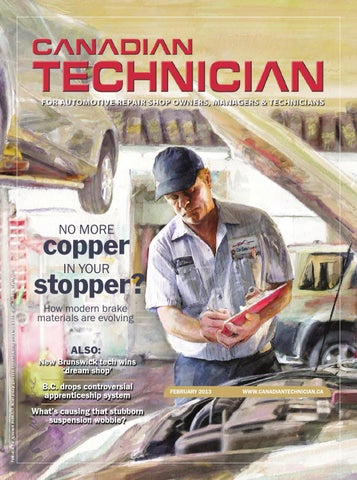
NO MORE
copper IN YOUR stopper? How modern brake materials are evolving
ALSO: New Brunswick tech wins ‘dream shop’ B.C. drops controversial apprenticeship system What’s causing that stubborn suspension wobble?
FEBRUARY 2013
WWW.CANADIANTECHNICIAN.CA
2000
1965
Valvoline launches MaxLife®, the first motor oil for high mileage engines
Valvoline introduces the first & best selling racing oil of all time
1866 Dr. John Ellis invents motor oil
1939 Valvoline develops X-18, a single grade oil which could be used in place of 18 different specified automotive lubricants
1996 Valvoline launches DuraBlend™, the first synthetic blend motor oil
2012 Valvoline launches NextGen™, the first national branded recycled motor oil
Valvoline invented the engine oil category almost 150 years ago – and we haven’t stopped pushing new innovations since. NextGen™ motor oil is the latest in a long line of category-changing introductions. Made with 50% recycled oil, NextGen™ delivers 100% Valvoline engine protection. NextGen™ motor oil is great for engines and better for the environment, it exceeds industry specifications with reduced environmental impact compared to non-recycled motor oil. Naturally, NextGen™ is supported by the full force of Valvoline’s innovative marketing programs.
Welcome to the Next Generation in motor oil.
Learn more about NextGen™ at NextGenMotorOil.ca © 201Î, Ashland Inc. TM Trademark of Ashland or its subsidiaries in various countries.
contents
Canadian Technician – February 2013 – Vol. 18 No. 1
FEATURES Breathe Easier ...............................................................18 How to talk to your customers about an often overlooked service – replacing cabin filters to ensure cleaner and healthier air in their vehicles.
11
Behind the Wobble ........................................................20 Unchecked suspension modifications on light duty trucks and SUVs can result in a scary driving condition nicknamed “The Death Wobble.” Brake friction .................................................................22 The evolution of brake pads takes an interesting turn, as some jurisdictions in North America start to crack down on the use of copper.
COLUMNISTS Management S.O.S. by Kelly Bennett ..............................14 The Car Side by Rick Cogbill ..............................................30
DEPARTMENTS Service Notes.................................................5 Letters ............................................................6
20
Out & About .................................................10 Eye Spy.........................................................12 Products.......................................................26 Ad Index .......................................................29
Our new international calling card. by
www.bluestreak.ca
FEBRUARY 2013 CANADIAN TECHNICIAN
3
Snap-o p-onn is i a trademark of Snap-on Incorporated. ŠSnap-on Incorporated 2013. All other marks are trademarks off their respective holders.
SERVICE NOTES
Celebrating excellence Once again, we’re looking for the Canadian Technician of the Year... and we’re going to need your help! By Allan Janssen e here at Canadian Technician are dedicated to promoting excellence in the automotive repair and service trade. That’s our goal. I point this out because every once in a while we take our own temperature to make sure we’re still meeting our mandate. We’re careful not to wander too far from our “core competencies” as the business consultants put it. That can happen very easily, and it can have devastating effects on a business. I remember asking my father once why he didn’t expand the menu at our family restaurant. I was a kid, and I thought the fact that 90% of the meals we sold were straight-up fish and chips demonstrated a clear lack of imagination on his part. I mean, McDonald’s was making a killing selling hamburgers. Why didn’t we give them a little competition? And, while we were at it, we could sell pizza and sandwiches too. Give people some real choice at lunchtime! My dad just smiled. “Keep it simple,” he said.The fact that we could fit everything onto a single menu board was a strength, not a weakness. Since starting this magazine in 1995, we’ve tried to keep things simple. We’ve focused on telling inspiring stories about successful repair facilities, promoting leading management practices, and advocating for ongoing training. Along the way, however, we just couldn’t help adding to our menu. In most cases, they were things that were requested of us and we just didn’t have the heart to say no. We started a website, an e-newsletter, an advisory board, a very busy online forum, and a consumer publication (Canadian Car Owner). We also published a few supplements and posters. We got involved in some industry committees, trade shows, and conferences. And we
W
started up an ambitious program called The Canadian Technician of the Year, which celebrated the best and the brightest stars in our industry. At some point, we started to wonder if we were still ‘keeping it simple.’ I’ve seen publications get too ambitious, spread themselves too thin, and ultimately weaken their brand. We didn’t want that to happen to us, and we began to draw back a bit to concentrate on the magazine. Most notably, we suspended the Canadian Technician of the Year award. I’m not embarrassed to admit that might have been a mistake. We’ve decided to resurrect the award because it is not a distraction from our core business. It is our core business. We promote excellence. What better way to do that than to celebrate the individuals who go above and beyond the call of duty to become true ambassadors for our trade? In the past, running the award introduced us to some truly amazing people. Their professionalism was clear. Their technical skills were outstanding. Their determination to keep up with technology demonstrated true leadership. And their dedication to customer service helped to enhance our industry’s reputation among consumers. There’s a lot we can learn from them. We want to find more people like that. We’re looking for the next Canadian Technician of the Year. And we’re going to need your help. Maybe they work for you. Or in the bay next to you. There’s an ad on page 16 that tells you how you can nominate them. We believe excellence is worth pursuing. And when someone attains it, it’s worth celebrating. You can reach me at allan@canadiantechnician.ca FEBRUARY 2013 CANADIAN TECHNICIAN
5
LETTERS
VOLUME 18
NUMBER 1
451 Attwell Drive, Toronto, Ont. M9W 5C4
EDITOR Allan Janssen allan@newcom.ca (416) 614-5814 PUBLISHER Martyn Johns martyn@newcom.ca (416) 614-5826 CIRCULATION MANAGER Lilianna Kantor lily@newcom.ca (416) 614-5815 DESIGN & PRODUCTION Tim Norton production@canadiantechnician.ca (416) 614-5810 GENERAL MANAGER Joe Glionna PRESIDENT Jim Glionna PUBLISHED BY Newcom Business Media 451 Attwell Drive Toronto, Ont. M9W 5C4 Canadian Technician is published monthly except for January and July by Newcom Business Media, Inc., 451 Attwell Drive, Toronto, Ont. M9W 5C4. The magazine serves the Canadian automotive repair and service industry. Subscriptions are free to those who meet the criteria. For others: single copy price: $5.30; one-year subscription in Canada: $42.00 ($40.00 plus applicable taxes); one-year subscription in U.S.: US$60; one-year subscription in all other countries: US$90. Copyright 2013. All rights reserved. The contents of this publication september not be reproduced by any means, in whole or in part, without prior written consent of the publisher. The advertiser agrees to protect the publisher against legal action based upon libelous or inaccurate statements, unauthorized use of photographs, or other material in connection with advertisements placed in Canadian Technician. The publisher reserves the right to refuse any advertising which in his opinion is misleading, scatological, or in poor taste. Postmaster: Send address changes to Canadian Technician, 451 Attwell Drive, Toronto, Ont., M9W 5C4. Printed in Canada. Second class mail: Postage paid at Toronto. Canadian Publications Mail Sales Agreement #40063170. ISSN 1710-7644.
We acknowledge the financial support of the Government of Canada through the Canada Periodical Fund (CPF) for our publishing activities.
Kenneth R. Wilson Award Winner Member
Canadian Business Press
Checklist By Wayne Moore Phone: (905) 632-8770 6
CANADIAN TECHNICIAN FEBRUARY 2013
YOUNG PEOPLE NEED BETTER INCENTIVES TO JOIN OUR TRADE After reading your article on The Lure of Big Money (November 2012), I remembered why I chose this trade back in the 1970s and it was because of the money. One of my best friends worked at a Ford dealer and sold me on flat rate. If you were willing to work hard, he said, you could make lots of money. The system worked well until 1983 when the work dried up and Ford cut flat-rate times. I’ve done well. I own my own business now. But if I were to start over again, I would choose another trade. We have little to offer young people in the aftermarket repair business. I couldn’t even talk my own son-in-law into this trade with the carrot of taking over the shop in the future. He’s making $38 an hour plus benefits as an HVAC mechanic. Until our trade can offer better incentives, we’ll just keep losing techs to better-paying alternatives. Simon Reekes Universal Auto Service Weston, Ont.
A LOT OF TECHS GET LURED AWAY BY BIGGER BUCKS I’ve found a lot of techs to be transient by nature. They’re always looking for something better. In the late 1970s, I knew a good tech who was married and well-established in our little community. He got an offer to work at a dealership in Lethbridge some 40 miles to the north for $1.10 more per hour. I tried to show him that it was far more economical to stay where he was, but he took his kids out of school, packed up his things, and headed for the better times. What can you do? George Stringham Taber Diesel Service Taber, Alta.
WORKING CONDITIONS DO NOT FAVOUR TECHNICIANS Most of the technicians I know regret their career choice. The automotive trade is so backward. The people that have the job skills make barely enough money to qualify them for the middle class. Despite the poor pay, they have to supply their own tools. And the training they need is done on their own time, without compensation. Not only is this trade hard on the wallet, it’s also hard on
the body. No wonder so many techs are constantly looking for a new path. —Name Withheld On Request
EMPLOYERS ARE A BIG PART OF THE PROBLEM If you’re a business owner and you cannot keep good employees, you need to take a long hard look in the mirror. Money is not always the problem. People are, by far, your greatest asset; treat them as such. —Name Withheld On Request
ONTARIO’S COLLEGE OF TRADES IS NOTHING BUT A RIP OFF! I just read your article in November 2012 issue about Ontario’s new College of Trades (Is Your Licence Worth $100 a year?) I had no idea about this planned rip off. Now I want to voice my outrage! I have both an auto service licence and a truck and coach ticket. So I’m going to get dinged $200 a year? Please say it isn’t so! I’ve been at this for 22 years and it makes me want to bury my tools and tell every future auto tradesperson I come in contact with to seriously rethink their career choice! Steve Powell Beaverton, Ont.
FEE HIKE MIGHT BE WORTH IT IF TRADES GOT BETTER SUPPORT I’d gladly pay $100 a year if the College of Trades would lobby the Ontario government to implement annual (or even bi-annual) safety inspections. It would definitely make that pill easier to swallow... and would get some junk off the roads as an added bonus. Since it’s very unlikely that the sale of safety related car parts will ever be regulated, maybe this will deter the illegals and backyarders in some way. Dwayne Pretty Minute Muffler Waterloo, Waterloo, Ont.
… SO, IS THIS GOOD OR BAD? As a retired automotive apprenticeship professor and a member of the program’s curriculum committee for some 20 years,
it looks like the new Ontario College of Trades is trying to reinvent the wheel with no explanation of what is truly new and beneficial to Ontario trades. Other trades have come to the conclusion that this new set-up will have a negative impact on the trades. The Motive Power Trade needs to consider this program and decide whether it is a negative or positive contribution to our industry. Norm Storms Storms Auto Service Belleville, Ont. Member, CT Advisory Panel
RE-CERTIFICATION SHOULD BE MANDATORY EVERY FIVE OR 10 YEARS A huge fee increase is the last thing this trade needs. We should try to entice more young people to take up this trade instead of giving them another reason not to! The College of Trades is just another money grab by Ontario’s Liberal government. Why not spread the new fees across every trade, rather than just across a few “compulsory trades” and make re-certification mandatory every five or 10 years, with an updated test that would force people to keep up to date? Rick VanSydenborgh Lewis Motor Sales Newmarket, Ont.
RE-CERTIFICATION? WASH YOUR MOUTH OUT WITH SOAP! Allan Janssen, wash your mouth out with soap! You have the nerve to suggest recertification? Every day on the bench is recertification! I started in this trade in 1969. I don’t need someone who probably doesn’t even work on cars anymore to recertify me! I’ve been in this trade for 43 years. I’ve gotten a lot of enjoyment and satisfaction here, so I’m not at all down on the automotive trade. But I don’t like the current trend, where the vast majority of guys really don’t get proper remuneration for their skills, and generally don’t get the respect they deserve. Randy Valnion Cambridge, Ont.
LICENSE FEES WON’T HELP A TRADE THAT IS ALREADY UNDERPAID Your article on the new Ontario College of Trades was the first I’d heard about licence fee increases. This is ridiculous! Most people would have been OK if it went from $20 to, say, $30. But from $20 to $100? What a money grab! Techs are underpaid as it is! Now they have to lay out more expenses? I wish there was a way for shop owners and techs to group together and support each other. Gord Raynsford Total Auto Service Toronto, Ont.
YOU’RE NOT ALONE IF YOU JOIN AN ASSOCIATION! There was a time when the independent repair shop considered the garage across the street his competition.There was little communication between them, certainly no cooperation, and more often than not there was a kind of quiet hostility between them. That was then. Today, you need that shop to help sustain your business.Why? Because you’re both in a dogfight with bigger, and better-financed competitors: car dealerships and government bureaucracy. Today you have to learn to work together with other independent shops, sharing information and resources. This is why I’m a firm believer in joining an association.We need to speak with a single voice. And we need good shops to be on board. If you really care about where our industry is heading, join an association. You cannot do it alone, and our voices need to be heard! Bruce Eccles Eccles Auto Service Inc. Dundas, Ont.
How to reach us We love to hear from our readers. Please send along your opinions to editor Allan Janssen at allan@canadiantechnician.ca FEBRUARY 2013 CANADIAN TECHNICIAN
7
EVERYTHING GETS OLD.
EVEN YOUR SHOCKS.
CHANGE YOUR WORN SHOCKS AT 80 000 KM.*
Worn shocks compromise the safety of your car. Keep your shocks fresh by installing the brand trusted by car manufacturers everywhere. | monroe.com *Actual mileage may vary depending upon driver ability, vehicle type and the type of driving and road conditions. Š2013 TENNECO
OUT & ABOUT
Independents win apprenticeship battle in B.C. Government acknowledges need for changes. ‘Progressive accreditation’ no longer the only option. By Allan Janssen British Columbia is backing away from its controversial “progressive accreditation” apprenticeship system for automotive service technicians. The system, which required apprentices to have a sponsor for each year of study, was heavily criticized by independent shop owners, who believed it watered down the value of industry credentials and was unfairly geared to benefit bigbox retailers and dealerships. Critics of progressive accreditation say the number of journeymen graduating as Red Seal technicians in B.C. has plummeted over the past five years. At a meeting in Prince George, B.C. in December, officials from both the Industry Trade Authority (ITA) and the Automotive Training Standards Association (ATSO) conceded the new system was not having the desired affect on apprenticeship numbers. They agreed that students should have the option to register one time for a full four-year apprenticeship, rather than have to register anew upon completion of each level. They also agreed to a number of other changes to improve apprenticeships in the province. “This is great news for the independent sector of the auto repair industry,” said Art Wilderman, executive director of the Canadian Independent Automotive Association (CIAA), which lobbied hard against progressive accreditation. “It has taken a lot of effort by independent shop owners, technicians, and college instructors who stepped up to have their voices heard. It is great to know that when we come together we can make the changes that have to be made.” He said progressive accreditation was attractive to companies that had no 10
CANADIAN TECHNICIAN FEBRUARY 2013
interest in hiring fully trained journeymen. Consequently, there were fewer and fewer apprentices completing four years of study. “Northern B.C. is likely to graduate 75 students to journeyman status this year, and there would be probably another 30 in the lower mainland, and maybe another 30 elsewhere in the province. So we’re looking at maybe 150 graduates for the year, which is a pretty sad state of affairs,” he said. “By comparison, Alberta cranks out about 450 journeymen a year, and Ontario does about 800.” He said the program has been particularly hard on northern colleges, which face a greater financial burden with fewer students. CIAA had lobbied government for years, and things finally started to turn
when Pat Bell, the Minister of Jobs and Tourism, got involved. “He knew about the situation, but I don’t think he realized the impact it was having on our industry until we brought it to his attention,” Wilderman said. “As I understand it, Mr. Bell met several times with ITA and he told them to get this fixed. Automotive was one of the target groups that were grossly underrepresented in the province, and he wanted to get those numbers up where they have to be to satisfy public demand.” While the paperwork hasn’t been finished, aftermarket representatives were happy to get the verbal commitment that things would change. Wilderman gives a lot of credit to CIAA board member and northern B.C. subcommittee chairman Tom Simpson of Benchmark Automotive in Prince George who initially sounded the alarm and “championed this campaign with patience and passion.” Bell happens to be the member of the legislative assembly who represents Prince George. “This has been a four-year run,” Simpson said. “We’re heading into election time and I think there was some strategy (at the government level) to get this resolved before the voters say who’s going to lead the province.” The demands of modern auto repair require a minimum of four years of study, he said, and there’s little sense in ‘graduating’ apprentices who have not learned critical elements that come in years three and four. “We need individuals who know the whole system. Everything is connected these days,” he said. “No one is saying you can’t have a student who goes only partway through the program and exits. What we’re trying to get away from is the apprentice having to grovel in order to get to the next level.”
Now Available!
Canadian tech wins ‘world of opportunities’ The dream of opening his own auto repair shop is a lot closer for Ryan Mullin of Quispamsis, N.B. after winning the second annual ‘Delphi Dream Shop’ promotion. The technician at Ultimate Auto in Quispamsis, N.B., (near Saint John) has won thousands of dollars worth of automotive equipment, including a lift, tire changer, compressor, air tools, AC service machine, and diagnostic scan tools. “I keep pinching myself. I can’t believe I won!” he said. “It’s opened a world of opportunities for me.” Mullin was the grand prize after signing up for Delphi’s Victory Lane promotion, aimed at building and maintaining a connection between Delphi and working technicians throughout North America. “These days, technicians buy 70 per cent of their own tools to work in a shop,” explained Malcolm Sissmore, Delphi Product & Service Solutions’s North American sales director for training, telematics and tools, as well as
David Vaughn, vice president of Eastern Automotive Warehousing, with a celebrating Ryan Mullin, winner of the Delphi Dream Garage promotion.
the company’s country director for Canada. “We wanted to help catapult a technician to the next level, and maybe help change their future that way.” He said there are now more than 14,000 technicians in the Victory Lane database. “They sign up to interact with Delphi on a number of surveys, and give us feedback on things,” he said. “We’re not just flooding them with stuff. It’s not just one-way communication. It’s interactive.” Read the full story at www.tinyurl.com/ct-dreamshop
®
Ontario tech wins award for completing 60 online courses A technician at Columbia Auto Service, in Waterloo, Ont., has been honoured by NAPA Canada for his dedication to training. Mark Robotham was singled out for being the first tech in Canada to complete 60 NAPA Excellence training courses, spanning six areas of study: brake systems, engine electrical systems, air conditioning, emissions control, chassis, and body electrical. He was presented with six plaques, and gift certificates worth $500. Pictured, from left: Jason Britton, Russ Gougeon, Mark Robotham, and Jim Voigt.
For more information on Ceramic Plus and other ProMax products visit,.. www.autopartsdepot.ca
FEBRUARY 2013 CANADIAN TECHNICIAN
11
OUT & ABOUT S H O C KS & S T R U T S
E M I S S I O N S C O N T RO L
Apprentice removes frightened snake from car In the world of automotive repair, you can never be sure what your next assignment will be. Jason Hurdle, manager of Midas Bayfield, in Barrie, Ont., learned that when a regular customer asked for help getting a pet python out of his car. “He said, ‘I have an adventure for you if you’re willing to accept it,’ says Jason. “His pet ball python got loose in the car and he was pretty sure it was under the seat.” In fact, the snake had wrapped itself around some parts under the seat and he couldn’t get it out. “One of my technicians is Indiana Jones when it comes to snakes,” says Jason (which is to say that, like the action movie hero, he’s deathly afraid of them), “but our apprentice Giancarlo Romero loves snakes. He used to have one, actually.” So while everyone else watched from the sidelines, Giancarlo removed the rear bolts on the seat, slid it forward gently, and started trying to free the snake. Once he was able to start unwrapping it,
The industry’s BEST product support program! s
Drive Consumer Traffic to Your Door with attention-catching offers and advertising
s
Get Rewarded for Sales with useful premiums and exclusive incentives
s
Reward Yourself for Online Training Take the online tests to earn valuable rewards Contact your Monroe or Walker representative for details
www.expert-plus.com © 2013 Tenneco
12
CANADIAN TECHNICIAN FEBRUARY 2013
Giancarlo Romero warms up the python he removed from a customer’s car.
it relaxed its grip on the seat. “It knew it didn’t want to be there,” says Jason. “It just didn’t know where to go. It was dormant, almost dead, but once Giancarlo was coddling it, and warming it up, it started coming back to life and moving around.” The whole process took about 20, 25-minutes. So, based on that, Jason charged the customer $40. “We’ve done other stuff for free for this customer,” Jason laughs. “You can’t do everything for free!”
EYE SPY High heat Licenced tech Ashwin Patolia of Scarborough, Ont. sent in this picture of a melted EVAP canister. The driver of the 2001 Dodge Caravan had been driving it like this for about a month, since he’d been in a small accident that damaged the left front of the car. The gas cap light was on, the check-engine light was lit, and the engine tended to vibrate after start-up, but other than that, the driver didn’t see why he should bother to have it fixed. Have an interesting picture to share? Email a high-resolution image to: allan@canadiantechnician.ca
SOLUTIONS FROM AN INDUSTRY LEADER
WALKER OFFERS A COMPLETE MUFFLER LINE-UP AS WELL AS EXPANDED WELDED ASSEMBLY COVERAGE TO HELP MEET ALL CONSUMER NEEDS, AND PROVIDE THE GREATEST CONSUMER VALUE
PREMIUM STAINLESS STEEL MUFFLERS
Walker ® Quiet-Flow ® SS Stainless steel construction resists rust-out three times longer than competitors’ premium aluminized mufflers
PREMIUM IMPORT MUFFLERS
DIRECT-FIT AND UNIVERSAL MUFFLERS
STARLA ® Import Exhaust Superior flow and OE-quality acoustics
Walker ® SoundFX ® OE-Style mufflers at a competitive price
®
I M P O R T E X H AU S T ®
MUFFLERS
MUFFLERS
Check out the complete Walker Exhaust video series on
www.walkerexhaust .com © 2013 Tenneco
E M I S S I O N S C O N T RO L
MANAGEMENT S.O.S. IN THIS SERIES OF FICTIONAL LETTERS FROM A NEW SHOP OWNER TO HIS FORMER BOSS, MANAGEMENT TRAINER KELLY BENNETT DISCUSSES BASIC BUSINESS PRINCIPLES THAT APPLY TO THE AUTOMOTIVE REPAIR INDUSTRY.
DEFENDING OUR PRICING POLICY Customers have to understand that there’s a science behind what we charge for parts – and it’s based on fairness for both sides!
DEAR KELLY: Some recent complaints from customers about what we charge for parts have led to a bit of a crisis around here. Last week a guy told us he found a cheaper price for a part we’d quoted. My service advisor was embarrassed and told him to bring the part in and we’d install it for him. This morning, a customer who’d had a part installed yesterday showed us the same part advertised in a flyer for considerably less. My guy refunded the difference, and promised a free oil change next time the customer comes in. The techs here think we should have a policy to match any advertised price that’s out there. Personally, I think we should be buying better. This issue is on the agenda for our next staff meeting. We have to come up with a solution and I wanted to get your input first. —Erol
DEAR EROL: You’re certainly not the first shop owner to face this problem. Lately I’ve also noticed an increase in the number of pricesensitive customers. I think it’s because it’s getting so easy to compare prices on the Internet. The problem is that a lot of comparisons are not fair ones at all. A lot goes into the pricing of a product, and comparing one to the other can be like comparing cherries and watermelons. Many shops in our industry have a 14
CANADIAN TECHNICIAN FEBRUARY 2013
difficult time making money selling parts, so they try to make up for it when they’re buying them. Rather than sell them for more, they try to buy them for less. But, Erol, this isn’t a ‘buying’ problem. It’s a ‘selling’ problem.We have to learn how to educate our customers on what is a fair price for the value we offer. At my shop we’ve had a few instances this month alone where customers were unhappy with our parts price. In one case, a customer called after seeing a flyer from a chain of parts and service stores advertising “Buy one strut, get one free.” The price appeared to be $139. Sounds like a pretty good price for two struts, right? I overheard my service manager talking on the phone to the customer and, to my dismay, I heard him say we couldn’t match that price so go ahead and buy them and bring them in, and we’ll install them for you. I bit my lip before talking with him. I went online and found the flyer. Sure enough, it was buy one, get one free. But below the price was an asterisk. I’ve learned what the large printed giveth, the asterisk taketh away! I called the store, but after being put through to the wrong department several times and being put on hold twice, I never did get to speak to anyone. So I called another store in the chain. They said they hadn’t received the new flyer yet so they couldn’t give me any details. The third store I called finally explained that the struts were actually $278. So when you factor in the buyone-get-one, it works out to $139 each. I also found out that the warranty on the
only premium quality parts for the continued safety and reliability of their vehicle. As professionals, we select parts that we have total confidence in, so we can stand behind. If something goes wrong, we’ll make it right. But if a customer brings in his own part, why should we be on the hook if it fails? From a customer’s perspective, it seems logical to compare prices. They’re simply trying to save money. We can all relate to that.Yet often we get frustrated when a customer questions our pricing (especially after they have agreed to it and the job is now done). I know some service managers who are downright rude when a customer asks if they can bring in their own parts. They say, “You wouldn’t take your own steak into a
actually lower than the dealer’s would have been. The point is, it’s easy to think you could have gotten a better price for a part, but there are a lot of things you have to take into account. Even something as obvious as the quality of the part in question. There are top-of-the-line parts that you know will fit, work, and last. And there are cheap knock-offs that don’t look right, don’t fit right, don’t work right, and don’t last! Are they cheaper? I have learned that, in most cases, Cheap=Expensive. If they don’t work or last, they’re a waste of money. We need to educate our customers that some parts are of such poor quality, that we refuse to install them. We install
restaurant to cook it for you, now would you?” But that doesn’t tell the whole story, and it does nothing to educate the customer. We have to explain why it is best for us to supply the part. Because we know we’re installing the best parts, we can provide the best warranty policy in the city. We set ourselves apart from our competitors by offering 24 months or 24,000 kilometers on all our work. I don’t want my shop to have “a competitive warranty” – which means it’s essentially the same as what others offer. I want to be the best. That helps people understand what they’re paying for when they buy from me. Of course to do that, I have to make sure our parts gross profit
Larry Dickison
shocks is 12 months or 12,000 km, which is a lot less than what we offer. In another case, a guy returned after picking up his car. His son had logged on to eBay and found the part he bought from us for a better price. He also said a local dealership would have charged less for the job we did. He wasn’t very happy. But when I asked a few questions, I learned that the part was in the U.S. and would take a few days to get here. The shipping was not inexpensive. And when I looked into what he was all set to buy, it turns out the part he found online wasn’t even the right one! As for the dealership price he’d been quoted, well, that was for one side – not two, like we did. And if you factor in the diagnostic time we did, our charge was
is high enough to self-insure against the occasional failure. We also explain that the warranty we provide is linked to the part we supply. We could not provide that warranty if they supplied the part. Knowing what you’re paying for is key when you’re talking about the installed price, too. Many times the customers will call a dealership or another facility that has a parts department and a service department. Getting a price from the parts department is simply a take-out price. The installed price is usually higher. They need to know that. The bottom line is that we have a reason for charging what we charge – and part of our job is to explain the fairness of our pricing to our customers. If we don’t explain it, a customer is likely to think they’re spending more and getting the same thing. Hey, I follow the same principle when I’m the customer. For example, I’m having the automatic overhead doors in my bays repaired. I’m hiring experts, because I have zero knowledge in this field. I’m not going to call a bunch of hardware stores to find the cheapest doors around and then hire the cheapest workers to install them. I’m going to let reliable professionals tell me what is best for my shop. Then I’m going to expect them to do a good job and then stand behind their work. I might pay a little more but I’ll have garage doors that work, and I’ll have some recourse if they don’t. Well, Dustin and I are heading out on a father-son trip this afternoon. I’m so excited. I’m not sure what we’re doing. When he asked me what I wanted for my birthday last week, I just told him I wanted some quality time with him. He’s got a whole day planned for us… and he’s insisting on paying for everything.This is going to be fun! As always, I am only an email away. —Kelly
Kelly Bennett is a certified management trainer and has been coaching automotive repair shop owners since 1990. You can reach him at kelly@kellythecoach.com.
FEBRUARY 2013 CANADIAN TECHNICIAN
15
OF THE YEAR
2013
10,000
$
in cash and prizes
Do you know someone who deserves special recognition? We’re looking for someone who: ■ Is an elite technician ■ Is a leader in the shop ■ Gives back to our industry
■ Is an active member of their community ■ Is helping to improve the public’s impression of technicians
We’re looking for an
AMBASSADOR FOR OUR TRADE! Nominate yourself or someone you think is the Canadian Technician of the Year. Tell us your story and make a compelling case. NOMINATION FORMS AVAILABLE ONLINE
www.canadiantechnician.com/award @cdntechnician #CTOTY
/CanadianTechnician
BREATHING LESSONS Cabin air filters are the only things between your customers and the pollutants all around and inside their vehicles. Few people knowingly ignore their home furnace filter’s replacement interval. The ones who do either don’t know about the ill-effects such inaction will have on the quality of air in their homes… or they just don’t care. The same is true for motorists who ignore the cabin filter in their vehicles. They either don’t know that they’re there… or they don’t care. Selling a service that people aren’t even aware that they need can be a tricky proposition. Although the automotive aftermarket has made a concerted effort in recent years to inform consumers that their cars are equipped with cabin air filtration systems, public education is a slow process. There’s a good chance that many of your customers wouldn’t know a cabin air filter from an engine air filter. But they should. Not only does it capture airborne contaminants like dust, soot, pollen, and other pollutants, but it also prevents leaves, dirt, bugs and other debris from entering the HVAC system and negatively impacting the operation of the heater, air conditioner, and defroster. With growing sensitivity to pollutants in our society – not to mention odours, smog, allergins, and toxins – there’s good money to be made swapping out old cabin air filters if you can bring it to people’s attention.
Appeal to your customers’ health. Recent studies have shown that these new filters can significantly reduce the amount of carbon monoxide, mold spores, and other dangerous contaminants in a vehicle. In fact, the U.S. Car Care Council says harmful contaminants can be six times more concentrated inside a car than outside. The irony is that people sometimes drive with windows closed to avoid drawing contaminants into the vehicle! Breathing in pollutants is not only unpleasant, it can be dangerous,
Know who to talk to. Cabin filtration systems may be a relatively new phenomenon on domestic vehicles, but they’re certainly not new technology. Some foreign nameplates have featured them for more than 20 years. Either way, though, the number of cars and trucks with cabin air filtration systems continues to increase. Today, well over 80 percent of all domestic and foreign vehicles sold in North America are equipped with a cabin air filter. Confirming that your customer’s car has one is a simple push of a button in today’s webconnected world.
especially for young children, senior citizens and those with asthma, allergies, respiratory problems, or weakened pulmonary systems. To further protect people, cabin filters are now available with built-in disinfectants and sanitizing chemicals that destroy microbial agents. Some filters contain an electrostatically charged material capable of trapping airborne particles like pollen, dust, soot, smog, and tobacco smoke. Many also include an activated carbon layer for filtering out noxious gases and odours. Given the amount of time people
18
CANADIAN TECHNICIAN FEBRUARY 2013
spend in their vehicles, breathing what comes through the HVAC system, they should appreciate knowing that the air in their car is as clean as it can be. Appeal to their wallets. Customers may not realize that a clean cabin air filter does more than filter the air they breathe. Dirty cabin air filters can make HVAC systems work harder to reach the desired temperature in the cabin, resulting in unnecessary wearand-tear on the HVAC system, additional work for the engine, and potentially worse fuel mileage. For that reason alone, manufacturers recommend inspecting the filter regularly and, typically, replacing it annually or every 24,000 kilometers. Use displays and point-of-sale materials. The most effective way to prove your point, when discussing cabin air filters, is to let people see a dirty one. If you’re routinely doing this service for your vehicles, it won’t take long before you come across a particularly clogged or dirty specimen that will be a real eyeopener on your front counter. A dirty filter will be discoloured (dark grey or black) with noticable dirt covering the filtration material. It sometimes looks like a dog chewed on it. Place it next to a clean one for full effect. Charge accordingly. Once you’ve got the go-ahead, replacing a cabin air filter usually takes less than five minutes.Yes, some are hidden in awkward places or can be tricky to extract, but in the vast majority of cases there is good margin to be made selling a service that is welcomed by the consumer. There are hundreds of cabin air filter part numbers, but stocking 20 to 25 of the most popular numbers in your area will ensure you’ll be able to do a quick replacement without delaying your customer.
FU E L M A N A G E ME NT
E N G INE MA N A G E ME NT
HEATIN G & COOL IN G
DIESEL
TRAIN IN G & DIAGN OSTI CS
Delphi diagnostics.
High standards.
Below the surface. They may look the same, but all diagnostics are not created equal. Today’s vehicles rely on complex electronics and the technology needed to diagnose and service them. With access to the latest OE data, training, technical support and state-of-the-art equipment, Delphi diagnostics ensure repair shops effectively diagnose and repair automotive systems. What does this mean? Reliable Delphi diagnostics you, and your customers, can trust. Providing you with the benefit of more than 100 years of OE heritage, we are the company that makes the parts cars are born with.
B
IT’ S W HAT’ S UN DERN EATH THAT SETS DEL PHI APART
D A
C
Delphi Diagnostics // A Multi-Channel Graphing View and capture up to 16 parameters at once in color; Filter function allows user to quickly find required data; B OEM Diagnostics and Flash Programming Access to latest OE data and software; Delphi scan tool has variety of parameters, tests, device controls and coverage available including step-by-step illustrated flash instructions; Quickly determine fault codes and suspect area; Link to technical data, repair history, training support or internet; Link to various parts catalogs; C Latest Interface and Connections Processor easily updated through internet downloads; Simple vehicle connection uses standard OBD II J1962 connector; No keys or adaptors required; D WiFi Capability Vehicle Communication Interface (VCI) connects to vehicle, sending data to PC wirelessly or via USB.
Find us! DelphiAutoParts
delphi.com/am
©2013 Delphi Automotive Systems, LLC. All rights reserved.
BEHIND THE
WOBBLE W W
An unusual driving condition among solid front-axle pick-up trucks isn’t a ghost in the machine. It’s more likely a case of mechanical negligence. By Octavian Lacatusu
“D
eath wobble” tales have circulated among technicians for the last 15 years. Rattled drivers talk of loss in steering, violent shaking, and a frightening inability to stop. Worse, it can happen out of the blue, Final Destination style. Scary for sure, but no deaths have been attributed to this condition. In fact, manufacturers of vehicles that are susceptible to this occurence strenuously object to the name it has gained in YouTube videos and online discussions. Nevertheless, there’s no denying that the so-called “death wobble” has affected thousands of 4x4 solid frontaxle pick-up trucks – most notably those by Chrysler and Ford. “It can get pretty ugly,” says Noel Kohen, owner of Newport Auto in Squamish, B.C. “It’s not a myth.You can really lose control of the vehicle.” He experienced the wobble firsthand back in the early 1990s, when the steering wheel of a Ford F350 he was driving started to pull violently from side-to-side – a full 180 degrees in each direction. This occurred shortly after he hit a big pothole during a drive test. “It’s way more than just a vibration. With the steering wheel going at half rotation, and the tires whipping back and forth, nobody’s strong enough to hold it still,” he said. “It was scary.” 20
CANADIAN TECHNICIAN FEBRUARY 2013
Suspension system on a Jeep Grand Cherokee – the kind of vehicle that is susceptible to a suspension wobble.
So what causes this mysterious and frightening condition? Online discussions offer mixed (and often uninformed) explanations. But one thing many experts agree on is that it stems from excessive play in the front steering components. Clarifying the exact cause can be tricky, since a wide range of parts can be involved. It’s fair to say, however, that many vehicles that turn up with the socalled “death wobble” are not wellmaintained. Or they’ve been modified to the point that they’re completely out of spec.
The severity of the wobble really varies from case to case, so diagnosing and correcting the condition can be difficult… but there are some proven methods to point you in the right direction.
1
Start with a basic suspension test
With the vehicle parked, ignition on, have one tech sit inside the cab and turn the steering wheel left to right, while another tech watches the links and rods, checking for excessive play by applying
pressure on all the linkages, particularly the track bar and steering linkage. It won’t tell you with any degree of certainty that a wobble is possible, but it can provide some insight into the status of the suspension. If something unusual is suspected, use an alignment machine to diagnose further.
2
Upgrade the steering linkages
When it comes to suspension parts on trouble-prone vehicles, the stronger the better. Kohen suggests upgrading all 1994-2001 Rams to heavy duty steering linkages because the OE system in those models may not be sufficient. Heavy duty steering linkages feature a shaft that is twice the size of light-duty linkages, and are much stronger. Steering linkage defects play a significant part in this condition. Dodge Ram 2500, 3500 and Ford F250, and 350 trucks have been suceptible to problems with their solid front-axle setups as early as 1994. Trucks equipped with lightduty steering linkages are more likely to experience this condition than those with heavy-duty linkages. “One way to deal with the issue is to change the pitman arm and the tie rod, converting it from a scissor-style steering linkage to a classic-style draglink and tie rod,” said Kohen. The poorly-engineered OE design of these scissor-style linkages doesn’t help, either, he added. “Because neither the panhard rod [also called a track bar] or drag link are moving at the same angle, the actual toe in the steering angle of the wheels will eventually change, even if you’re holding your steering wheel perfectly straight,” he said. In 2002, Chrysler reverted to the scissor-style, causing the worrisome effect to return. In 2010, however, Dodge replaced the steering linkage design again with a heavy duty one, finally solving the steering linkage issue. Dodge released the updated steering linkage package for all other pre-2010 Rams as well.
3
Check the wheels
4
Stick with the OE specs
Oversized off-road wheels are often a key issue, since they can throw off the balance at both ends of the vehicle. Uneven and imbalanced weight can stress what may already be strained or wornout components such as tie-rods, balljoints, and track bars. “The wheels may be balanced to not feel a vibration,” says Fred Mekers of True Value Automotive from Sudbury, Ont. “But if the dynamic balance is not right with a 100-lb tire rim combo, all it takes is a small bump in the road at 100 km-h to set off this wobble.”
Jeep 4x4s, such as Wrangler/TJ and Cherokee models, specifically those with lift kits and large off-road wheels, can lose their stock caster setting when lifted, creating uneven weight at both ends of the vehicle. It can takes as little as a two-inch lift kit in the front to initiate a severe vibration like the one described by some drivers. The problem with lifting a vehicle with an aftermarket kit is that it throws the OE specs completely out of whack. This is a problem. The caster must be returned to its original specs… and this may not be easy or cheap, since it will
require longer control arms, or slotting the adjustments. It is, however, crucial to avoiding serious suspension issues. Lifting the body will also put the panhard rod (or track bar) on a greater angle.You’ll need an adjustable panhard rod in order to get the axle back into the center of the truck. As always, use an alignment machine to perform a wide track adjustment, to ensure the front end is aligned with the rear. Remember, the suspension wobble can be triggered by something as seemingly insignificant as a pothole. It’s the sudden shock that that throws key components out of whack. Involuntary steering wheel motion can occur very quickly. Tell your customers that if they experience a suspension wobble, they shouldn’t panic or hit the brakes. That can cause the vehicle to veer off the road.Techs who’ve experienced this themselves have suggested to either engage the clutch and let the vehicle coast, or if it’s an automatic, shift into neutral. Despite all the hype – that just won’t seem to go away – this driving phenomenon doesn’t appear out of nowhere. It is usually the result of inappropriate modifications or prolonged neglect of the structural integrity of the vehicle’s suspension system. The best way to avoid an unpleasant suspension wobble is regular maintenance and professional advice on upgrades. FEBRUARY 2013 CANADIAN TECHNICIAN
21
No copper in your stopper
?
A look at what goes into modern braking materials… Or, more importantly, what’s coming out! By Jeff Taylor Brake jobs are one of the most frequent activities in any auto repair shop. In addition to being a primary safety system, brakes are frequently exposed to tremendous heat, so they wear faster than most parts. It makes sense that we would work on them a lot. But have you ever given any thought to what’s in pads, shoes, drums, and rotors? I mean, you’re handling them all the time. You’re exposed to the fine dust they create. Have you even considered what you’re exposed to when you work on brakes? I never did until we started hearing about the dangers of asbestos – for years an important ingredient in brake pads. I learned to be very careful with the dust and I always wore a respirator. Ultimately asbestos stopped being used in pads.We all breathed a sigh of relief. But there have been some interesting developments in the brake material formulations since then. And there are still ingredients that we have to be careful with. In fact, their impact on our health and the environment is why changes are
22
CANADIAN TECHNICIAN FEBRUARY 2013
being made in some jurisdictions. The states of California and Washington have both implemented a new law that came into effect this year. It will lead to the phasing out of copper from the brake pads and shoes sold in those areas. Yes, I said copper. I was pretty surprised to read that copper was an ingredient in the brake pads and shoes on the modern vehicles. Brake manufacturers guard the recipe for their brake pad/shoe formulation like it is the launch code of a nuclear missile. And for good reason. They have a lot invested in research, development, and product testing. There are a lot of challenges that the manufacturers have to take into consideration when they tweak the composition of the brake materials. They have to think about all kinds of things, like pad and rotor wear, brake noise, brake fade, cooling, the necessary braking force required for each application, mandated safety requirements by an assortment of governing bodies, and the environmental impact of the substances being used. And of course they’re dealing with a vast array of vehicles with varying needs in braking. A passenger car is not going to need the same kind of brakes that a pickup truck or an SUV is going to
need. The differences between a luxury car and a sports car are huge. Each vehicle needs a unique compound that works best. So you can see that it’s no easy task to perfect a line of brake components. For many years, the most common form of friction material being used was asbestos.The asbestos pad or organic pad was very widely and commonly used with the introduction of the disc brake systems of the early 1970s. Asbestos was a cheap product that had excellent heat absorption and dissipating properties. It also provided decent brake effect or ‘coefficient of friction.’ Brake manufacturers noticed, however, that the asbestos pad had some issues with short life, noise, and brake fade. But the biggest drawback was the lasting health effects that the fibers caused when brake dust was breathed into the lungs. Understandably, in most parts of the world asbestos is no longer used in the formation of brake pads and shoes. The next step in the evolution of brake material was semi-metallics.These pads were made of a combination of many different things, but the mix generally contained 30 - 65% metal and some sort of filler. The use of iron, steel, and copper took up the majority of the metal used. The composition formed a
We featured this “EyeSpy” pic on our Facebook page recently. Richard Martin of Fast Forward Auto in Neebing, Ont., offered this as Exhibit A in the argument for preventing people from purchasing and installing their own safety-related components. The owner of this 2003 Envoy (short wheel base model) came in complaining of “draggy” brakes and rotors that were turning blue. Turns out the well-meaning DIYer had installed calipers designed for a long wheel base Envoy.
very hard compound. It was robust and had exceptional heat-resistance capabilities. The semi-metallic pad was able to provide a decent coefficient of friction and worked well under high temperatures (pad temps over 200°C). Semimetallics also offer respectable wear in high-load situations, has good brake fade properties, and can be made relatively cheaply. The semi-metallic does have its drawbacks, however. It created lots of dust and noise. Consumers weren’t happy about either of these things, and manufacturers did what they could to tweak the formula or modify it to reduce these unwanted characteristics. But semi-metallic pads also tended to be really hard on rotors, didn’t wear well under low brake temps (under 100°C or the average non-aggressive city driver), and could lead to higher brake fluid temperature. The next mix in the formulation was the non-asbestos organic pad (or NAO). Sometimes these pads are referred to as ‘ceramic’ – even though they aren’t the
kind of true ceramic pad that is used on some exotic sports cars and race vehicles. This was the next step in the evolution of the modern brake pad, and it didn’t contain any ferrous metals. (The term ‘ferrous’ indicates the presence of iron. ‘Non-ferrous’ refers to metals other than iron, and alloys that don’t contain an appreciable amount of iron.) These brake pads feature a mix of organic fibers and inorganic fibers – aramid, twaron and kevlar to name just a few – in combination with other things like rubber, glass and carbon. When all these things are mixed together, they provide the lubrication, and abrasiveness necessary to make these pads perform. The NOA pad has a wide ranging coefficient of friction, and provides excellent wear properties when used in applications where temperatures stay under 200C. It also solved the issue of brake dust and wheel discolouration, because the dust is much lighter in color and was much easier on brake rotors. The NOA pad is much quieter than the semi-metallic but it has its issues as
FEBRUARY 2013 CANADIAN TECHNICIAN
23
well. The NOA pad doesn’t wear well under high load or in high-friction applications. It’s more expensive to manufacture (so they cost more to the customer). And it can lead to a customer complaint of brake squeal on the first couple of applications in the morning. Nevertheless, NOA pad compositions are heavily favoured in the North American and Japanese markets where speeds are generally lower, and noise and wear are more of a concern. The low-steel pad kind of rides the boundary between NAO and ceramics. These pads contain a certain amount of ceramic dust to replace some of the traditional NAO compounds that have been used.This formulation may or may not contain steel or other ferrous metals, but it will contain an aggressive abrasive package, and many different sulfide and carbon-based lubricants.The low-steel pad gives a good coefficient of friction, provides good pedal feel to the driver, and has good high-speed performance. The drawback is that the low-steel pad tends to experience high wear of the pads and rotors, and will create some dust issues. And because formulations that are low on iron provide much better friction at higher speed, low-steel pads tend to be favoured in Europe where high speeds, high loads, and aggressive driving is much more common. Copper had been used in brake pad formulations for a while, but the development of NOA pads and materials in the mid-1980s led to even greater usage. Copper provides the pad formulation with good wear characteristics on the pad and the rotor, limited noise, and good friction stability over a wide range of operating temperatures. The copper content of the brake material mix could range from 5 to 20%. The problem was that as the friction material wears, the dust goes into the air and eventually falls to the ground. The copper dust that
24
CANADIAN TECHNICIAN FEBRUARY 2013
made its way into waterways proved to be toxic to many aquatic species. According to brake manufacturer Federal-Mogul and a source inventory by the Brake Pad Partnership, an estimated 240,000 kg (540,000 lb.) of copper made its way into the San Francisco Bay watershed in 2003. Of that amount, 87,000 kg (36%) was copper released from brakes. Starting this year, copper is being phased out of the formulations for brake pads and shoes destined for use in the states of California and Washington. Other areas are looking at similar legislation. And since manufacturers don’t want the headache of making different formulations for different geographic regions, they may choose to make a sweeping continental change. So is copper going to go the way of asbestos? Maybe. The average brake material contains 20 to 30 different things. There’s no one direct replacement for copper. Other compounds will have to be found and tested, and many companies already have a low-copper or copper-free
product available. What we find on most vehicles that we service today are NOA pads and shoes – either in the ceramic or low-steel design. And these designs are likely going to stay here with us for a while yet, until we make the switch to full ceramic or carbon-based brakes to lower the weight to the vehicle and provide better mileage and fewer greenhouse gases. But, for now, full-blown ceramic brakes are only found on some exotic sports car, and the full carbon braking system is reserved for use in F1 race cars. The technology to make these options more commonplace on North American streets is there but the cost to manufacture is still prohibitive. Then again, so was power steering not that long ago. Look where that’s gone!
Jeff Taylor is senior technician at Eccles Auto Service in Dundas, Ont.
, , G G N I N I B W NG, M I O L L C P I L K D L I C U H A M , H , E G G H W N T I N I H H L D S L S R U U A O R B F , C G R R D E N L A I V L R I C , A R O G S C W S S N I E E K R L ROC P CLEA LE IN TH OD UN O . M C G R S U E T Y U T S N M L I A E F U L IN I O G HE O Y T N R O E R U D O FO T ’ Y D N E P WO BEEF U GINEER ITIONS. D N E N U , O O P Y X GC IX IN W V I R W NE TD S E H G CIT Y U NG O RIVI T D E TREM S VY HEADS LOA
IC THET N Y S OI L
EX ITION D CON
V i sit
w
om e r s .c ix f ilt
o r th
eW
r ne a ibuto r t s i IX d
re s t
you.
PRODUCT CENTRAL Engine parts
Automotive belts Veyance Technologies, Inc., makers of Goodyear Engineered Products, has announced the addition of 112 new part numbers to its automotive aftermarket product line.The Goodyear line of belts and hoses now covers more than 98 percent and 95 percent, respectively, of vehicles in operation. Over the past two years, the company has added more than 1,000 part numbers including molded hoses, timing belt kits, tensioners, and pulleys. tinyurl.com/ct-prod-397
26
CANADIAN TECHNICIAN FEBRUARY 2013
Mahle Clevite has introduces hundreds of new part numbers for a range of light vehicle and heavy duty applications. New part numbers are now available engine camshaft bearings, connecting rod bearings, crankshaft bearings and sets, engine pistons and pin bushings, air filters, cabin air filters, conversion gasket sets, coolant outlet gaskets and thermostat housing gaskets, cylinder head gasket sets, intake manifold gasket sets, valve cover bolt kit and gasket sets, variable timing spool valve filters, manifold gasket sets, fuel injection plenum gaskets, turbochargers, and turbocharger gaskets. tinyurl.com/ct-prod-390
Head bolts CRP Automotive has introduced the new AJUSA Cylinder Head Bolt program with OE-quality cylinder head bolts for Asian and European import vehicle applications. The bolts are packaged as sets for vehicle specific applications.They come in a shrink-wrapped cardboard box with assembly lube included.“Most modern engines use stretch or torque-to-yield bolts in their designs, and these need to be replaced whenever the cylinder head is removed,” noted Michael Palm, vice president of sales and marketing. “AJUSA offers one of the widest and deepest cylinder head bolt programs in the industry.” tinyurl.com/ct-prod-387
Loyalty program
Brake pads
Tenneco has announced a comprehensive 2013 Expert Plus dealer loyalty program, including increased consumer offers and trade rewards, new point-ofsale merchandising and a full calendar of exclusive promotions designed to drive new ride and emissions control sales. The Expert Plus program offers consumer promotions, members-only sales incentives, point-of-sale merchandising, consumer education materials, technician training rewards and many other benefits. The annual enrollment fee is $99. tinyurl.com/ct-prod-395
Wagner’s ThermoQuiet CeramicNXT brake pads are now available for several additional late-model applications, including Nissan Versa, Hyundai Accent, Hyundai Veloster, Ford Explorer, Mazda CX-5, and Toyota Yaris. Manufactured by FederalMogul, Wagner ThermoQuiet CeramicNXT brake pads feature Integrally Molded Insulators (IMI) that dissipates heat and vibration for quieter braking, and proprietary friction formulations provide exceptional stopping performance and less dust. tinyurl.com/ct-prod-385
PRODUCT CENTRAL Work gloves
Impact wrench
3M has announced the introduction of work gloves made with 3M Gripping Material that it says delivers greater productivity and performance with less effort. According to 3M, work gloves can provide up to a 270 percent improvement in friction when used as a two-part system and are ideal for techs who need a better grip especially in wet or oily conditions. Comprised of thousands of micro fingers, the 3M Gripping Material is incorporated into the work gloves to enhance traction. tinyurl.com/ct-prod-369
Mac Tools has released a new 3/4-inch drive impact wrench for the truck and heavy industrial repair markets. The impact wrench, part number AWP075, is the newest member of the growing AWP Titanium Series, engineered to pro-
Transfer case Cardone has increased its coverage with new reman transfer case motors. New part numbers include #48-116 for Hummer H3/H3T 2006-10, #48-223 for Ford Explorer Sport 2001, and #48-903 for Isuzu Axiom 2002-04. A1 Cardone Reman Transfer Case Motors feature replaced internal sensors with 100% new OE-quality sensors for superior performance and long product life. In addition, TCMs are vibration- and temperaturetested to ensure trouble-free operation throughout the coldest of winters. tinyurl.com/ct-prod-368
vide the muscle, durability and efficiency needed in hightorque applications. Mac Tools says the 8.4-pound impact wrench, offers the highest power-to-weight ratio in the marketplace thanks to its low weight and 1,560 feet per pound breakaway torque. tinyurl.com/ct-prod-337
GE Nighthawk™ Platinum headlights. Suddenly, 11 PM looks a lot like 11 AM. Help your customers put 90% more light on the road* with GE NIGHTHAWK™ Platinum headlights. Make sure your customers have every advantage. With GE NIGHTHAWK™ Platinum, your customers will get up to 90% more light on the road compared to GE’s standard halogen headlights. They’ll see more of the road, and you’ll look great, too. For more information, visit gelighting.com
Grease guns Gates Canada, distributor of Plews & Edelmann products in Canada, has announced a new line of clear tube grease guns. The UltraView clear grease guns allow the technician to see what kind of grease is being dispensed before it leaves the gun, preventing the problem of cross-contamination – the cause of 6080% of bearing failures. tinyurl.com/ct-prod-324
*GE NIGHTHAWK™ Platinum halogen lamps produce up to 90% more light in an area illuminated with more than 15,000 candelas in light intensity compared to a standard halogen headlamp bulb. Specific light levels vary by bulb type and headlamp assembly. GE NIGHTHAWK™ Platinum is a trademark of GE. © 2012 GE
FEBRUARY 2013 CANADIAN TECHNICIAN
27
PRODUCT CENTRAL Cooling system repair
Brake rotors Coolant temp sensor Delphi has released seven new Coolant Temperature Sensors to cover almost six million North American Audi,Volkswagen and Mercedes-Benz vehicles from 1985 to present. Manufactured to meet or exceed OE requirements and testing, Delphi’s one-piece design and automated production process is said to eliminate internal connectors and failure points. A rugged plastic shell and thermistor pre-mold subassembly prevent stress, ensuring accurate measurements and vibration resistance. tinyurl.com/ct-prod-383
Textar, one of the world’s leading manufacturers of OE brake pads, now offers a range of German engineered, highcarbon brake rotors for European applications. Built on nearly 100 years of experience developing OE brake pads, this new range of high-quality brake discs is manufactured to precise German specifications. Textar brake rotors are available exclusively at Worldpac. Contact (800) 644-9129 in Western Canada, (800) 463-8749 in Eastern Canada or visit www.worldpac.ca to learn more. tinyurl.com/ct-prod-376
Shop cart Snap-on has released a new Heavy Duty Shop Cart (part number KRSC246) that features the classic Snap-on design and has deeper storage space, a durable flip lid and an extra deep top compartment to safely secure more tools and equipment. It has exceptionally deep
Rislone’s new Cooling System Repair is designed to stop coolant leaks, prevent antifreeze loss, and correct associated cooling system problems. The dual-cavity bottle contains two unique formulas that combine during use. One side has a blend of carbon fiber sealer, leaksealing liquid, and stop-leak treatment to stop and prevent antifreeze loss.The other side adds system protection in the form of water pump lubricant, corrosion inhibitors, and heat transfer agents. tinyurl.com/ct-prod-398
Scan tool package Bosch has introduced the Tech 2 Pro Optima scan tool package that includes the General Motors Tech 2, CANdi module, and 32MB programming card.The Tech 2 Pro Optima package is said to provides authentic General Motors hand-held diagnostics at a competitive price. It allows technicians to diagnose and repair many General Motors vehicles manufactured from 1992 to current with the exception of those vehicles that are covered by General Motors GDS 2. tinyurl.com/ct-prod-391
New packaging Bundled software kits OTC has released new comprehensive bundled software update kits. Genisys features two kit selections with one powerful kit for the Pegisys line of professional scan tools. Genisys kit number 3421-141 provides a System 5.0 Memory card, 2012 USA Domestic / Asian and 2011 European Software. The 3421-145 software only kit is for technicians that have System 4.0 and newer tools (no new memory card required). For Pegisys, the 3825-55BDL 12-month subscription kit includes USA Domestic / Asian and European coverage. tinyurl.com/ct-prod-378 28
CANADIAN TECHNICIAN FEBRUARY 2013
storage, allowing users to store tools like long pry bars and extensions. It also features a welded cart body for lasting strength. tinyurl.com/ct-prod-372
Dayco Products has redesigned the packaging for its extensive line of automotive aftermarket products, including belts, tensioners, pulleys, timing kits and water pump kits. Features of the new packaging include a redefined, black and blue glossy appearance, upgraded print board, detailed belt rib style (depending on the part number) and in-depth routing diagrams. Dayco has also released new packaging for its Heavy Duty products, the Gold Label line. tinyurl.com/ct-prod-373
continued from page 29
those lights so long his mind had thrown a breaker.” “Don’t let him drive anything until he’s seeing straight,” I muttered to Basil. “My insurance doesn’t cover ‘working while hypnotized.’” Basil chuckled. “Automotive lighting has come a long way, Slim. Do you remember the old Ford Thunderbirds with the sequential rear signal lights?” I sure did. I’d apprenticed at a Ford dealership and had seen some of those vehicles from the late 1960s and early ’70s. “Didn’t they use a series of solenoids to turn on each light in sequence?” I asked. “Yes, the early ones did.You could get a nasty shock if things weren’t grounded properly. But today we’re using LEDs on vehicles. They have extremely low resistance to start with, so anything in the circuit that’s out of balance will cause issues.” By the end of the day, Beanie was low on bright ideas. “I’ve tried new flashers, bulbs, modules, and extra ground straps.” He looked at me pleadingly.“I gotta give it a rest or I’ll go berserk!” A good night’s sleep must have done some good, because he was back the next morning, bright-eyed and bushy-taillighted. “Look at this!” Beanie laid out some papers on the coffee table. “I put the word out on the repair forums last night, and a whole pile of good suggestions came in. I want to get started right away!” “Fine,” said Quigley. He held out a pair of designer sunglasses. “But put these on first; no one goes blind on my watch.” I read over some of the responses on Beanie’s list. “This one looks interesting; something about a resistor built right into the signal light wiring circuit.” I frowned.“But where is it located?” Beanie pointed to a partial print-out of a wiring diagram. “Left-hand radiator support,” he replied. “That’s the first thing I’m gonna check.” As it turned out, the forum tech had nailed it. The 30-watt, 6-ohm resistor was fried, and the open circuit was causing the speed flashing problems. But the solution wasn’t so easy. “You’re not going to believe this,” warned Quigley as he hung up the phone. “GM says you’ve gotta buy the entire harness in order to replace that resistor.” Fortunately for our customer, a quick trip to Herkle’s Auto Parts produced a 5-ohm ceramic ballast resistor that we could splice right into the harness in place of the original resistor. Beanie was glad to have the problem fixed, but he moaned as he put away his wire strippers. “Slim, if I see another flashing light, I’m gonna scream.” Quigley sauntered out of the front office. “Hey, Beanie,” he said. “Your girlfriend just called. There’s a Retro party tonight, complete with disco music, mirror balls, and strobe lights! She said she’d buy the tickets if you’d take her.” Beanie gasped. “What did you tell her?” Quigley grinned wickedly. “I told her it was an offer I knew you couldn’t resist.”
ADVERTISER INDEX Bars Products – Rislone ..........26 www.rislone.ca
Blue Streak-Hygrade..................3 www.bluestreak.ca
Delphi Products ......................19 www.delphi.com
GE Lighting .............................27 www.gelighting.com
Havoline .................................31 www.havoline.com
®
ProMax Auto Parts Depot ........11 www.autopartsdepot.ca 1-866-573-9889 Snap-On Tools of Canada.......4, 5 www.snapon.com 1-800-734-2676 Tenneco Automotive .............8-9, Monroe - www.monroe.com
Tenneco Automotive .........12, 13 Walker - www.walkerexhaust.com
Valvoline...................................2 www.valvoline.com 1-800-TEAM-VAL Wix Filters...............................25 www.wixfilters.com
Rick Cogbill is a freelance writer and former shop owner in Summerland, B.C.
WORLDPAC
WorldPac ................................32 www.worldpac.ca 800-463-8749 FEBRUARY 2013 CANADIAN TECHNICIAN
29
The Car Side By Rick Cogbill
The flash of no resistance When a troublesome lighting issue darkens the shop door, Beanie runs out of bright ideas. Quigley’s eyes were glued to his clipboard as he walked past the rear of the 2005 full-sized Chevy van. It was inventory time and his mind was on snow tires, not foot traffic zones in a cluttered shop. Fortunately for him, there were no sharp metal objects in his pathway. Unfortunately for Beanie, Quigley’s clipboard caught him squarely in the left ear when they collided. “Hey!” exclaimed Quigley. “Why don’t you watch where you’re standing!” But Beanie was feeling no pain. He pointed at the van. “Look,” he said dreamily. “The lights… look at all the pretty lights.” Quigley did look, and for a moment felt like he was being hypnotized. The 30
CANADIAN TECHNICIAN FEBRUARY 2013
rear signal lamps on the van were flashing rapidly, blitzing on and off like strobe lights in a disco club. He looked away quickly and shook his head to clear it. “Snap out of it, Beanie. In fact, it’s time we both took a break.” Grabbing his arm, Quig steered Beanie into the coffee room, where Basil and I were going over some scan tool data. He deposited our apprentice into a vacant chair and explained the problem. “Rapidly flashing turn signals, eh?” I rubbed my chin. “Are all the bulbs are working? You know that happens if even one bulb is out.” Beanie looked pale as he gripped his mug of hot chocolate. He nodded. “Yes, all the bulbs are fine. It’s the first thing I
checked – I think.” He sank back in his chair. “To be honest, I don’t remember.” Basil looked up from his print-outs. “Make sure they are the correct bulbs as well, Beanie. An improper bulb with the wrong resistance can cause real problems.” “Okay.” Beanie paused. “But the four-way flashers work fine. Doesn’t that mean the bulbs are good?” Basil mulled that over. “Hmmm. Well, let’s make sure you’ve got proper grounds at each light.There’s been a raft of issues lately with those rear taillight wiring harnesses.” Quigley watched Beanie stumble back to the service bays. “He was like a zombie. I guess he’d been staring at continued on page 29
PROTECT YOUR ENGINE AND YOUR POCKET ®
®
Havoline with Deposit Shield
Did you realize that one simple way to maximize your mileage is to regularly change your oil? Modern life behind the wheel is full of short trips. All that starting and stopping stresses your car’s engine, which can increase the oil viscosity and lead to excessive fuel consumption. Make the change to Chevron ®
®
Havoline with the Deposit Shield formulation. Havoline is proven to provide at least 10% better viscosity control than the highest API standard requires*. So look for the shield and protect the things you value most.
*Compared to the API standard. See our test results on Havoline.com
PROTECT WHAT MATTERS
™
Havoline.com
© 2013 Chevron Canada Limited. All rights reserved. All trademarks are the property of Chevron Intellectual Property LLC.
Chevron Products are available from the following locations: CHEVRON CANADA LTD 1500-1050 Pender St. West. Vancouver BC V6E 3T4 Tel: (604) 668-5735
LORDCO AUTO PARTS 22866 Dewdney Trunk Rd. Maple Ridge BC V2X 3K6 Tel: (604) 466-4162 Toll Free: 1 (877) 591-1581
NORTHERN METALIC SALES (GP) 9708-108 St. Grande Prairie AB T8V 4E2 Tel: (780) 539-9555
HUSKY ENERGY CORPORATION 707-8th Ave. S.W. Calgary AB T2P 1H5 Tel: (403) 298-6709
UFA 4838 Richard Rd. S.W. Suite 700 Calgary AB T3E 6L1 Tel: (403) 570-4306
CHRIS PAGE & ASSOCIATES 14435-124 Ave. Edmonton AB T5L 3B2 Tel: (780) 451-4373
RED-L DISTRIBUTORS LTD 9727-47 Ave. Edmonton AB T6E 5M7 Tel: (780) 437-2630
OAK POINT OIL DISTRIBUTORS 33-A Oakpoint Hwy. Winnipeg MB R2R 0T8 Tel: (204) 694-9100
THE UNITED SUPPLY GROUP OF COMPANIES 2031 Riverside Dr. Timmins ON P4R 0A3 Tel: (705) 360-4355
TRANSIT LUBRICANTS LTD 5 Hill St. Kitchener ON N2G 3X4 Tel: (519) 579-5330
R. P. OIL LTD 1111 Burns St. East, Unit 3 Whitby ON L1N 6A6 Tel: (905) 666-2313
CREVIER LUBRIFIANTS 2320 Métropole Longueuil QC J4G 1E6 Tel: (450) 679-8866