CT OCT 2010tn.qxp:untitled
9/27/10
10:37 AM
Page 1
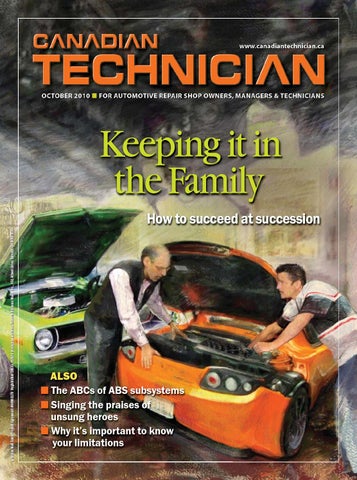
Keeping it in the Family Canadian Mail Sales Product Agreement #40063170 Registration 10833. Return postage guaranteed. Newcom Business Media Inc., 451 Attwell Drive, Toronto, ON M9W 5C4
How to succeed at succession
ALSO ■ The ABCs of ABS subsystems ■ Singing the praises of unsung heroes ■ Why it’s important to know your limitations
CT OCT 2010tn.qxp:untitled
9/27/10
10:37 AM
Page 2
IF YOU HAD SOFTWARE BUNDLE 10.4, YOU’D HAVE TIME TO READ THIS AD.
Get more answers, faster. Get Software Bundle 10.4. Talk to your Snap-on representative about a demo today and learn more at diagnostics.snapon.com
CT OCT 2010tn.qxp:untitled
9/27/10
10:37 AM
Page 3
contents
Canadian Technician • October 2010 • Vol. 15 No. 8
FEATURES
Keeping it in the Family . . . . . . . . . . . . . . 17 The failure rate is huge when a family business is passed down to the next generation. Here’s how to succeed at succession.
The ABCs of ABS subsystems . . . . . . . . . . . . . . . . . . . 23 ABS brakes have been around for decades, and much like other automotive technology, ABS continues to evolve. Here’s what you need to know.
COLUMNISTS Management S.O.S. By Kelly Bennett
14
30 The Car Side By Rick Cogbill
10 DEPARTMENTS Editorial
............................................................................................ 5
Service Notes ............................................................................... 7 Letters
............................................................................................... 9
Out & About ................................................................................ 10 Reader Rides EyeSpy
............................................................................ 10
........................................................................................... 13
Products ........................................................................................ 27 Auto Puzzle
................................................................................. 28
Our new international calling card. by
www.bluestreak.ca
OCTOBER 2010 CANADIAN TECHNICIAN
3
CT OCT 2010tn.qxp:untitled
9/27/10
10:37 AM
Page 4
Many of the world’s finest vehicles are filled with Mobil 1 right at the factory.
©2010 Exxon Mobil Corporation. Mobil, Mobil 1 and the 1 Icon are trademarks of Exxon Mobil Corporation or one of its subsidiaries. Imperial Oil licensee. NASCAR is a registered trademark of The National Association for Stock Car Auto Racing Inc.
Your vehicle may not have been filled with Mobil 1 at the factory, but it’s never too late to switch. Mobil 1 can prolong engine life and save you money in the long run.
CT OCT 2010tn.qxp:untitled
9/27/10
10:37 AM
Page 5
EDITORIAL
Singing the Praises of Unsung Heroes Don’t believe the negative hype – this industry is brimming with Good Samaritans. By David Menzies
I
was watching the Clint Eastwood flick, Gran Torino, the other day – surely one of the best movies of 2008. Even so, there’s one sequence of dialogue that just doesn’t ring true. Well, for me at least. Namely, when grizzled Korean War veteran Walt Kowalski (Eastwood) brings a neighbourhood teenager he has befriended to his local barber shop, Martin the barber starts advising the kid on how he should converse in such a manly domain. Apparently, old school barber shop etiquette decrees a guy should routinely complain about three things in life: 1. His boss; 2. His wife/girlfriend; and 3. His car. And when it comes to complaining about cars, this means going on a diatribe about getting ripped off at the local garage. Martin goes on to provide the teenager with an example rant. Says he: “[Expletive] … I just got my brakes fixed and eeehmm those S.O.B.s really nailed me, I mean they screwed me!” It’s played for laughs, of course. But how truthful is such an assessment of the automotive aftermarket? Is this really an industry populated with “S.O.B.s” who routinely “nail” and “screw” their clients? Granted the image the repair industry is saddled with isn’t superb. And of course, much like any profession, there are some rotten apples out there. But for the most part, the people toiling in the bays are honest and hardworking – not to mention extremely skilled. Now, you may think I’m merely preaching to the converted given this magazine’s readership is comprised of those who are employed in the automotive aftermarket. But I can assure you, prior to being named editor of Canadian Technician, my experience with auto shops as a consumer was overwhelmingly positive.
Indeed, in three decades of motoring, I’ve only endured a single bad encounter. Given my experiences with, say, the airline industry or the telco sector (“Your call is very important to us – so we’re putting you on hold until the Leafs win the Stanley Cup”) I’d say one lousy experience in 30 years makes for an exceptional customer service batting average. What’s more, I have this gut feeling that our industry is brimming with unsung heroes. Actually, I have proof: one of my colleagues here at Newcom Business Media, Delon Rashid, was commuting along Toronto’s Hwy. 401 during morning rush hour last month when he experienced a flat tire. Delon pulled over to the shoulder and began rummaging through his trunk for the jack and spare tire when another commuter pulled over, too. But this motorist wasn’t in need of assistance. Rather, he was there to render assistance. Wouldn’t you know it? Turns out the fellow was a technician on the way to work himself. He replaced Delon’s flat tire with such precision and speed that Delon felt as though he was observing a pit crew member at the Indianapolis 500. Indeed, so fast was the tech that Delon didn’t even get the name of this Good Samaritan or the name of his shop. Too bad – we’d like to give the gentleman some well-deserved public recognition. (If Mister X happens to be reading this editorial, the incident occurred on Monday morning, September 20 – drop me a line if you can.) Still, based on the people I’ve met to date, my instincts tell me that such random acts of kindness define this industry. This isn’t a sector rife with “S.O.B.s” who excel at “screwing” people. And wouldn’t it be nice – just once – to see such a positive scenario depicted in a major motion picture?
Introducing a New Line of Premium Engine Oils Mobil Super 1000 Engineered to exceed OEM warranty requirements.
Engineered in Canada for the latest engine technology, Mobil Super 1000 exceeds OEM (Original Equipment Manufacturer) warranty for every major gasoline car and light-duty truck manufacturer including turbo-charged engines.
Mobil Super 2000 Engineered for high mileage vehicles and longer oil drain intervals.
Engineered in Canada, Mobil Super 2000 is recommended for high mileage vehicles with over 120,000 km and provides guaranteed oil drain protection for 10,000 km or 6 months, which ever comes first.* www.MobilOil.ca
*Excludes severe service applications involving: racing and commercial use; frequent towing or hauling; extremely dusty or dirty conditions; or excessive idling. While under warranty change oil at the manufacturer’s recommendation. Mobil, Mobil Super, Mobil 1 and the Pegasus design are trademarks of Exxon Mobil Corporation or one of its subsidiaries. Imperial Oil licensee.
OCTOBER 2010 CANADIAN TECHNICIAN
5
CT OCT 2010tn.qxp:untitled
9/27/10
10:37 AM
Page 6
BEST IN CLASS
MATCO HAND TOOLS
Double Flex Ratcheting Wrenches
Torque Wrench with Angle
Pinless Universal Sockets
15" industry leader Innovative 3/8” drive eighty8 tooth ratchets
Matco Tools, America’s No. 1 Tool Franchise*, features products that are best in class; empowering you to get the job done quicker and more effectively verses other tools. Ask your Matco Tools Distributor for more information on how these products outperform the competition’s.
w w w. m a t c o t o o l s .c o m *Ranked No. 1 Tool Franchise by Entrepreneur Magazine 2010.
Top Torque II™ screwdrivers
CT OCT 2010tn.qxp:untitled
9/28/10
10:41 AM
Page 7
SERVICE NOTES
Know your limitations VOLUME 15
Better to be up-front about what you can’t do, than bumble your way through a job for which you are not equipped or trained.
NUMBER 8
451 Attwell Drive, Toronto, Ont. M9W 5C4 EDITOR David Menzies david@canadiantechnician.ca (416) 614-5824 EDITORIAL DIRECTOR Allan Janssen ajanssen@newcom.ca (416) 614-5814 PUBLISHER Martyn Johns mjohns@newcom.ca (416) 614-5826 CIRCULATION MANAGER Lilianna Kantor lkantor@newcom.ca (416) 614-5815 DESIGN & PRODUCTION Tim Norton production@canadiantechnician.ca (416) 614-5810 GROUP PUBLISHER Mark Vreugdenhil mark@canadiantechnician.ca (416) 614-5819 DIRECTOR, QUEBEC OPERATIONS Joe Glionna PRESIDENT Jim Glionna PUBLISHED BY Newcom Business Media 451 Attwell Drive Toronto, Ont. M9W 5C4 Canadian Technician is published monthly except for January and July by Newcom Business Media, Inc., 451 Attwell Drive, Toronto, Ont. M9W 5C4. The magazine serves the Canadian automotive repair and service industry. Subscriptions are free to those who meet the criteria. For others: single copy price: $5.30; one-year subscription in Canada: $42.00 ($40.00 plus applicable taxes); one-year subscription in U.S.: US$60; one-year subscription in all other countries: US$90. Copyright 2010. All rights reserved. The contents of this publication may not be reproduced by any means, in whole or in part, without prior written consent of the publisher. The advertiser agrees to protect the publisher against legal action based upon libelous or inaccurate statements, unauthorized use of photographs, or other material in connection with advertisements placed in Canadian Technician. The publisher reserves the right to refuse any advertising which in his opinion is misleading, scatological, or in poor taste. Postmaster: Send address changes to Canadian Technician, 451 Attwell Drive, Toronto, Ont., M9W 5C4. Printed in Canada. Second class mail: Postage paid at Toronto. Canadian Publications Mail Sales Agreement #40063170. ISSN 1710-7644.
We acknowledge the financial support of the Government of Canada through the Publications Assistance Program toward our mailing costs. PAP Registration No. 10833.
Kenneth R. Wilson Award Winner Member
Applied for ABC Membership
Canadian Business Press
“Keeping it in the Family” by Wayne Moore Phone (905) 632-8772 www.canadiantechnican.ca/covers
By Allan Janssen
T
he windows on Derek’s Isuzu VehiCross wouldn’t stay up.They would slip down as he drove. A problem anytime, but even more so with winter coming. So when he arranged to have a new sound system installed in the car, he went next door to a mom-and-pop collision shop to find out if they could fix the windows. “Sure,” they said. “No problem.” Those words would come back to haunt them. The problem was their techs couldn’t find the right window clips. As the VehiCross is not exactly a particularly popular model in Canada, they enlisted Derek’s help in contacting the previous owner, and the repair shop in Florida where work had previously been done on the car. When these sources proved unfruitful, they suggested buying a complete window kit for hundreds of dollars even though only the clips were broken. Derek objected. He was even prepared to have some window clips made (yes, made) at his own expense in order to get the problem sorted out, but the relationship with the shop ultimately broke down under the weight of his frustration with them. They had had his car for five weeks while Derek was out of the country on business.When he returned, it was still in pieces. So he took his VehiCross, with door panels still off, the regulators out, the windows in the backseat, no clips, and no answers. He took it to his regular technician who was up-front with him. He couldn’t do the job, he said, and he suggested Derek take it to a body shop. So Derek took it to a body shop, where
the technicians also turned down the job. They recommended he take it to a glass specialist. And that’s how Derek ended up at an Apple Auto Glass shop on Laird Avenue in Toronto. Henry, the franchisee looked at the VehiCross, rolled the broken window clips in his palm for a second, and then pulled down an old coffee can and poured the contents onto the counter. There, in a pile of window clips, were four that would work in Derek’s car. His windows were fixed four hours later. Obviously the star of this story is Henry, the man who could put his hands on the right clips at a moment’s notice. Derek asked him about that coffee can. Henry said it has come in handy on more than one occasion. Window clips tend to be hard to find and are unreasonably expensive, so whenever he gets an extra one, he keeps it. It could come in very handy… as it did for Derek. But Henry’s not the only hero. Derek’s regular technician assessed the job quickly and admitted it was out of his league. So did the guys at the second collision shop.They all said they couldn’t do the job. Derek didn’t think less of them. On the contrary, he was quite pleased they didn’t waste his time. The biggest mistake here was by the over-promising, under-delivering shop owner who so quickly took the job and then found out the hard way that it wasn’t as easy as he’d thought. There’s a very simple lesson in all of this. Know your limitations. Better to be up-front about what you can’t do, than bumble your way through a job for which you are not equipped or trained. OCTOBER 2010 CANADIAN TECHNICIAN
7
CT OCT 2010tn.qxp:untitled
9/28/10
2:45 PM
Page 8
CT OCT 2010tn.qxp:untitled
9/27/10
10:38 AM
Page 9
LETTERS
IN DEFENCE OF DRIVE CLEAN I try to follow the industry in terms of what my clients want and what consumers want. And they all are heading in the same direction – the buzzwords are reliability, efficiency, economical and environmentally-friendly. Let’s face it: a clean-running car should last longer and cost less since measured tailpipe emissions can verify that fuel is being burned properly. Yes obvious problems like a sensor or component can cause a car to run poorly, and that can be cured without a tailpipe test. But what about all the cars that run well but fail to control what is emitted? From my experience, more owners are interested in what is on the test result page, whether it passes or fails.This shows me car owners are educating themselves. Some even ask how to
CUSTOMER CLAIMS TECHNICIAN ASSAULTED HIM How’s this for a story? When I questioned a mechanic at the shop about the front end on my truck, I was physically assaulted. The details: the mechanic was grasping for anything he could find wrong on my truck. One of the problems that made it fail the inspection was “shredded metal in the wheel well.” I’ve never heard the term “shredded metal” used for a rust hole. At no point was the metal shredded nor did I run over a metal shredder to shred the inside of my wheel well. It sounds like a safety concern, but in reality, the hole is the size of a golf ball with no shredded metal around it. After searching around for a reputable mechanic I found a shop in High River, Alta. I took my truck in “as is” and had them do a safety inspection. The inspection itself took 1.5 hours (twice as long as the other shop.) The mechanic also told me that I had a caliper on my passenger side that was sticking. He took the time to bring me back and show me that one pad was wearing faster than the other. He also said that the idler arm had some play in it and recommended that I change it.
lower their results after a pass! From a business, economic, and environmental perspective, Ontario’s Drive Clean program is win-win-win. Shop owners, mechanics, governments and consumers need to realize that the program has considerable merits which outweigh the negative aspects. Keeping Drive Clean means more work for mechanics, more revenue for businesses, cleaner cars for the environment, better fuel mileage for the consumer... the list goes on. I know the Drive Clean program isn’t perfect, but I’m sure if the time is taken to explain the bigger picture we can agree that it’s a good thing and should be expanded – not abolished. Takeshi P. Takaki Takaki Automotive Corp. Ottawa
When my truck failed the inspection at the first shop, I asked to see the ball joints and tie rod ends that had failed.The mechanic pulled the truck back in the shop and after a very lame test he got frustrated because I was asking so many questions which he couldn’t sufficiently answer. He then started screaming for me to get out of the pit. Finally, he grabbed me by the shirt and threw me against a handrail. The province needs to crack down on these places and their mechanics. Safety inspections are simply cash grabs for crooked auto shops. Robert Worley Edmonton
(Editor’s Note: So, readers, what is your policy when it comes to customers in the bays?)
How to reach us We love to hear from our readers. Whether its darts or laurels, please send along your opinions to editor David Menzies at david@canadiantechnician.ca.
OCTOBER 2010 CANADIAN TECHNICIAN
9
CT OCT 2010tn.qxp:untitled
9/28/10
10:43 AM
Page 10
OUT & ABOUT SUPPLIER NEWS New National Marketing Manager for NGK
NGK Spark Plugs Canada Limited (NGK) has announced the appointment of Robert (Bob) Matthews to the position of National Marketing Manager. Matthews has been with NGK since 2004 in various senior roles. In his new role, Matthews will be responsible for directing all Canadian marketing initiatives, and for the planning and execution of these initiatives on both the national and regional levels.
Rotary reminds technicians: inspect your lifts
Rotary Lift has an important message for technicians and shop owners: remember to inspect your lifts. In fact, technicians should check their lifts every day, and the shop owner should schedule professional lift inspections annually. Regular inspections help ensure that all the lifts in the shop are operating properly. In addition to daily operator inspections, the Automotive Lift Institute recommends that all vehicle lifts
Canadians spending less on preventive maintenance Study reveals that car owners are dropping by the garage less often. J.D. Power and Associates’ 2010 Canadian Customer Commitment Index has revealed that Canadians spent $1.4 billion less this year repairing and maintaining their vehicles, down to $9.8 billion from $11.2 billion in 2009. The company analyzed responses from more than 14,500 owners in Canada whose vehicles were between three and 12 years old. Two main issues are being attributed for the drop: a decline in the average amount spent per service visit, and a decrease in the overall number of service visits, particularly for vehicles between four and seven model years old. According to the survey, on a per-visit basis, car owners spent on average $287 in 2010, compared with $352 in 2009. “Canadian vehicle owners are becoming comfortable with the notion
that they don’t need to do as much to maintain their vehicles as they once did,” notes Ryan Robinson, director of J.D. Power’s Canadian automotive practice. “There are also other factors contributing to this decline, including longer manufacturer-recommended service intervals (and) improved vehicle reliability.” Average annual spending on repairs and maintenance was highest in Ontario at $730. Quebec car owners spent the least at $499. In the Atlantic provinces, consumers spent an average of $681 per year; on the Prairies it was $665; and in British Columbia it was $589. Although revenue for shops derived from repair work has remained stable from 2009, Canadians are spending significantly less on routine maintenance in 2010.
Barney Rubble, eat your heart out! be inspected by a qualified lift inspector at least annually to ensure reliability and the continued safe operation of the lift. At a minimum, technicians should check the following daily: lift controls are working properly; all locks and restraints are working correctly; there’s no deformation or excessive wear of any lift components including posts, arms, hoses or wiring; there’s no damage or excessive wear on any of the lift contact points including adapters; there are no hydraulic leaks; and there are no cracks or loose concrete around floor anchors (if applicable.)
10
CANADIAN TECHNICIAN OCTOBER 2010
Darren Bast of Bast Radiator & Brake in Regina sent in this photo of a vehicle he spotted outside Taylor Field, home of the Saskatchewan Roughriders. “I don’t know what type of car this was made from but it sure brought back memories of a certain Yabba Dabba Doo guy I used to watch on Saturday mornings,” writes Darren. Note to Roughriders management still lamenting last year’s Grey Cup loss: even though this particular Rider Pride Mobile bears the number 13, please be advised that a CFL team is indeed comprised of 12 players.
READER
RIDES
You can see more Reader Rides on our website at www.canadiantechnician.ca. And if you have a photo of a hot or unusual ride, feel free to send it in. We’ll publish it up for all to enjoy! Send a pic of your ride to david@canadiantechnician.ca.
CT OCT 2010tn.qxp:untitled
9/27/10
10:38 AM
Page 11
Š 2009, Ashland Canada Corp. *Source: Thomas Penway Research Poll of ASE Mechanics in the United States
www.v a lv o li n e . c o m
Only one person works on his car. And only one oil works in his engine. More ASE-certified top mechanics use Valvoline in their own cars.* <TRWP]XRb RP] dbT P]h ^X[ cWTh fP]c CWTh RW^^bT cWT ^]T fXcW P _a^eT] aT_dcPcX^] U^a `dP[Xch _a^cTRcX^] P]S P WXbc^ah ^U X]]^ePcX^] EP[e^[X]T
100 YEARS UNDER THE HOOD.
TM
CT OCT 2010tn.qxp:untitled
9/27/10
10:38 AM
Page 12
CT OCT 2010tn.qxp:untitled
9/28/10
10:55 AM
Page 13
OUT & ABOUT
Oil change proves to be a real life saver Everyone in the automotive aftermarket knows that regular oil changes are crucially important when it comes to prolonging engine life. But in one particular case, a simple oil change might’ve actually saved the life of the vehicle’s owner. At the Fast Lane Quick Lube in Coeur d’Alene, Idaho recently, technician Josh Young was performing an oil change on a 2004 Mitsubishi Endeavor belonging to customer Cyndi Steele. The oil change turned out to be anything but routine when Young spotted something “suspicious” tucked underneath the vehicle. Young’s suspicions were well-founded: the mysterious foreign object was a pipe bomb. Fast Lane staff carefully rolled the Mitsubishi out of the shop and called 911. The bomb squad responded and the pipe bomb was removed and safely destroyed. Notably, as the quick lube drama was unfolding, Cyndi’s husband, Edgar Steele, was already sitting in jail waiting to be arraigned on murder-for-hire charges. He had been arrested just prior to the oil change incident, accused of hiring a man to kill his wife. Fortunately, Cyndi Steele subscribes to the merits of regular vehicle maintenance. And a good thing, too: had she put off her scheduled oil change, she might not be alive today. .
EYE CR-V (a.k.a., “Cruelly SPY Ruined Vehicle”)
“The owner of this 2005 Honda CR-V decided to flat tow it behind a motor home,” writes Steve Jeles, the service manager at Brantford Honda in Brantford, Ont. “He left the manual transmission in gear and he drove it for 30 kilometres before pulling over due to the metal going through the hood.” Have an interesting picture to share? Please send it along to EyeSpy, c/o Canadian Technician, 451 Attwell Drive, Toronto, Ont. M9W 5C4. Or email your high-resolution image to the editor: david@canadiantechnician.ca
OCTOBER 2010 CANADIAN TECHNICIAN
13
CT OCT 2010tn.qxp:untitled
9/27/10
10:38 AM
Page 14
MANAGEMENT S.O.S. IN THIS SERIES OF FICTIONAL LETTERS FROM A NEW SHOP OWNER TO HIS FORMER BOSS, MANAGEMENT TRAINER KELLY BENNETT DISCUSSES BASIC BUSINESS PRINCIPLES THAT APPLY TO THE AUTOMOTIVE REPAIR INDUSTRY.
THE BERMUDA TRIANGLE BLUES THE KEY TO RUNNING A HAPPY AND MORE PRODUCTIVE SHOP INVOLVES EMBRACING STEPS THAT REDUCE STRESS.
DEAR KELLY: Thanks for the great information re: “the two E’s” of highly effective selling. I’m sure it comes as no surprise to you that I’m much closer to the empathy side than the ego side. We had each of our staff rank ourselves on a scale of one to 10, one being to the empathy side and 10 being the ego side. My staff scored me as a “recovery two.” Why is it that whenever you solve one issue another issue almost immediately pops up? My latest dilemma is something I’m calling “service advisor meltdown.” Kim told me this week she isn’t sure how much longer she can handle her position here. She feels torn in too many directions and is trying to balance pleasing everyone. She feels there’s always someone who just isn’t happy with her and that she makes so many decisions in a given day that when she goes home she can’t bear to make another decision – it’s as if her brain is fried. I’m concerned she’s about to burn out. Any ideas? –Erol
DEAR EROL: You’re right. I’m not surprised that you rank close to the empathy side of the spectrum. I’m still working hard at getting to the middle. The balance between empathy and ego isn’t easy to achieve. Now for the serious issue regarding Kim’s ongoing frustration. I think we’ve all seen too many technicians burn out over the years – and unfortunately, we burn out many advisors as well. Sure, we’re well meaning. However, I know my lack of understanding this has wreaked havoc and has caused unnec14
CANADIAN TECHNICIAN OCTOBER 2010
essary stress for my front counter staff. Worse, my old attitude has been the root cause of a few advisors resigning since I started my business. Because of my ignorance, I underestimated many of the concerns and comments from advisors. I’ve heard them complain about doing the best they could and the customer was still wasn’t happy. They would field complaints from technicians complaining about delayed parts or wrong parts or not selling the additional work that needed to be done on vehicles and so on.
Then, of course, there’s that whole part of their job in which they need to satisfy the needs and wants of the shop owner/manager. Am I booking too many cars or not enough? Did I maintain that correct gross profit on labour and parts on each job today? Am I pre-booking customers’ appointments? Am I calling customers to confirm their appointments and following up to make sure that they’re happy with our work? Am I doing the walk around inspections and selling seasonal and comprehensive inspections? Am I ensuring I get paid for all of the diagnostics and yet ensuring there’s a no-charge item on every invoice? Am I efficient at estimating and calling customers promptly with the estimates and obtain authorization? Am I getting signatures when the car is dropped off and picked up? I used to just want to say:“Look, this is the nature of this business – just suck it up and move on or find a job you can handle.” Then one day we had a guest speaker who was an advisor at the shop of one of our members. At the start of her presentation, she pulled up a power point slide show that depicted a picture of a triangle. She talked about how the Bermuda Triangle caused issues for ships and planes years ago. As legend has it, the magnetic field in that area caused the navigation equipment to go haywire. (The advent of GPS has apparently solved that problem.) What we still have, however, is the “Automotive Bermuda Triangle.” The triangle she displayed had a line on each of the three sides and one in the middle. There are four human contacts in our shops: the customer, the service advisor, the owner/manager
CT OCT 2010tn.qxp:untitled
9/27/10
10:38 AM
Page 15
Her presentation was brilliant. We gave her a standing ovation. Then I rushed out of the room to call my advisors and apologize to them. It hit me like a ton of bricks! I had never seen what we were doing by having the focus on the advisor and how much stress we had placed on them. We made a point at our next team meetings to create an ongoing list to help reduce the service advisors’ stress and help us focus on the customer being at the centre of everything we do. So, what can we do to reduce the extra stress we place on the advisor? Consider these initiatives: 1. We went back to use the work order
happy too. She then asked us who should be in the middle of the triangle. We soon saw that it needs to be the customer. Customers are the reason why we’re gainfully employed.We all need to work, together to focus on the customers’ needs. It is their cars we’re working on. We’re ordering parts for their cars. We inspect vehicles so we can find out what their cars need so we can keep their vehicles safe and reliable. At the end of her presentation, she gave us all a copy of The Tipping Point by Malcolm Caldwell. She explained that many of our advisors were at the tipping point.
rack flow system to reduce verbal communication and the amount of times we all had to go to them and ask questions that were to have been dealt with in writing. 2. We closed the shop from noon to 1 p.m. for lunch. We realized the technicians stopped almost every day for a proper lunch break. The advisor would eat at the counter most days. Even if they were eating in the break room they were often interrupted when a customer would call or come in and want to speak to the advisor (given they had previously spoken to this person the morning.) 3. When we used to stagger lunchtimes,
Larry Dickison
and the technician. She asked us who was in the middle. It didn’t take long for all of us to realize that in most shops the man in the middle is the advisor. After all, the advisor has to facilitate the most communication with the customers; answer the calls; greet them; gather all the details; keep the customer informed; obtain up-sell authorization; call when the vehicle is done; and communicate with customers to follow-up.Whew! The advisor also has to do the bulk of the communication with the technicians – order the parts, assign the work, sell the work they find, and myriad other tasks. And the advisor has to keep owners
there was always someone gone for lunch between 11 a.m. and 2 p.m. We had issues with needing information and not being able to get answers until we had that person(s) back from lunch. Closing at lunch has allowed us to have meals together. We set up a picnic table outside and had barbeques together and we ended up talking with one and other more. Sometimes we watch an inspirational movie or we have a meeting. It has proven so successful, I wish we had made this change when we first started out. In any event, over the past few months, we’ve had many discussions about this incredibly important area of our business. We’ve asked our management group members to create lists of what they have done to solve our Bermuda Triangle Blues. Just email us at btiexecassistant@aol.com and I’ll send you the list. We’re also asking all of our members to send us lists. Please ask all of the shops you know to send us their lists as well.We will then create a master list and make sure everyone gets a copy. We are in business for ourselves, but we do not need to be in business by ourselves. We all have knowledge to share.Together we are a formidable force. Well, I now have a very important lunch appointment. Last week my son, Scott, was promoted at his job from parts to service advising. He has been advising for a few weeks now. We talk everyday and I hear loud and clear that the company he works for has him in the middle of the triangle. I feel his pain and yes, his ideas and desires are added to our list as well. I think suggestions and ideas from Kim would help, too. Thanks for the great letter, Erol. Once again, you’ve inspired me and have my wheels turning. As always, if you have any questions, I’m only an email away. Kelly Kelly Bennett is a certified management trainer and has been coaching automotive repair shop owners since 1990. You can reach him at kellythecoach@aol.com.
OCTOBER 2010 CANADIAN TECHNICIAN
15
CT OCT 2010tn.qxp:untitled
9/27/10
10:38 AM
Page 16
CT OCT 2010tn.qxp:untitled
9/28/10
10:57 AM
Page 17
The numbers are daunting when it comes to the number of family businesses that implode when being passed down from generation to generation. Here’s how to succeed at succession. By David Menzies
S
teve Booy is the “Steve” in Steve’s Automotive Ltd. But he won’t be for long. Don’t get the wrong idea. Business at Steve’s Automotive, located in Woodstock, Ont., has never been better. Steve, meanwhile, is healthy and active and just 50 years old. However, Steve Booy is looking ahead five years from now, when he plans on taking semi-retirement. Come 2015, Steve says he wants to spend more time with his wife, Sylvia, and do some travelling. By the same token, Steve doesn’t want to impede the hopes and desires of his three sons, all of whom plan on carrying on the family automotive repair business. “Basically, my sons are getting older and I don’t want to stand in their way,” he says. So it is that the entire Booy family is diligently planning for the days ahead wherein Dave, 32, Derek, 27, and Josh, 25 will be the new principals behind Steve’s Automotive, a 7,500-sq.-ft. shop with nine bays. In fact, the process of succession planning began a couple of years ago for the Booys. Far from just occasional small talk at the dinner table, their succession plan meant making use of a professional consultant as well as conducting regular formal meetings to sort out all the relevant details. A good thing, too. By paying such attention to the upcoming changing of the guard, the Booys are already way ahead of the curve when it comes to ensuring a successful transition. The sad reality is that when it comes to
Keeping it in the Family succession at family-run enterprises, too many people seemingly take the process for granted. Even sadder is the fact that family succession stories rarely end on an upbeat note. According to the Canadian Association of Family Enterprise (CAFE), a staggering 80% of family businesses fail once the second generation takes the reins. Should the business survive that transition, the failure rate attained by the third generation is a jaw-dropping 90%. The hard reality is that succession planning – or, more accurately, a lack of succession planning – often has the double-whammy effect of tearing a family apart and mortally crippling the business in the process. Indeed, as CAFE notes, many succession stories have a repetitive ring to them. Typically, the founder starts a company and weathers tough times and
The Booy family: Steve and Sylvia along with (left to right) sons Josh, Derek and Dave.
stiff competition. Thanks to his savvy business sense and a fierce will to succeed, the founder grows the start-up operation into a thriving enterprise. Eventually, old age or illness (or a combination of the two) makes the founder realize he needs to hand off the business to someone else – usually, a family member such as a son or a daughter. It is at this juncture where everything starts to unravel. Simply put, blood and money make for an extremely volatile mix and essentially one of two scenarios typically plays out: first, junior is lazy, disinterested or simply incompetent when it comes to running a business. The end result: what was once a thriving operation disintegrates – even though the successor was left with a healthy OCTOBER 2010 CANADIAN TECHNICIAN
17
CT OCT 2010tn.qxp:untitled
9/27/10
10:39 AM
Page 18
Domestic. Asian. European. OE braking technologies that speak every vehicle’s language.
Bosch QuietCast.™ Premium Disc Brake Pads. The only pads that combine more than 70 years of OE braking expertise, a laminated rubber-core shim, platform specific friction materials and Molded Shim Technology. It all adds up to shorter stopping distances with longer lasting rotors and pads. Plus, 789 part numbers means no application ever gets lost in translation. QuietCast™. From the world’s original equipment and innovation leader. Visit us at www.bosch.ca or call 1 800 618 4729. ©2009 Robert Bosch LLC. USA all rights reserved.
QuietCastBrakePadAd_B_Can_2010.indd 1
8/18/2010 8:48:28 AM
CT OCT 2010tn.qxp:untitled
010 8:48:28 AM
9/28/10
10:58 AM
company boasting a stellar reputation. Observers note that part of the problem is that it’s hard for members of a subsequent generation to have the same amount of drive and determination as the founder, partly because when someone starts a business, they’re typically confronted with myriad struggles to get to where they want to be. But when a family member simply takes over a business, it’s hard for them to have that same “eye of the tiger.” In many respects, it’s akin to a professional sports team: while it’s tough for a team to win a championship, it’s even tougher to maintain that competitive edge to stay on top year after year. The other typical succession scenario is, alas, just as dreary: the founder has more than one child, all of whom want to desperately carry on with the family firm. Just one hitch: all insist on becoming the head honcho. Egos get in the way of rational thinking and eventually the siblings are at each other’s throats. A nasty power struggle ensues and eventually, yet another once-proud family firm implodes. But the Booys insist their succession isn’t going to end in disaster. And the fact that they have undertaken a formal succession process several years before Steve plans to wind down his role in the operation backs up their bravado. That’s because a lack of succession planning often boils down to time management (or, rather, “time mismanagement”) as opposed to business owners not recognizing the importance of the issue. It’s akin to the plight of the gator wrestler – when you’re up to your ass in alligators, it’s easy to forget that the original objective was to drain the swamp. The good news is that the Booy boys are all on the same page given that there’s no rampant jockeying for position. They are all content with their future roles, and meetings have been characterized by cooperation, not polarization. Brent VanParys, a chattered accountant with VanParys, Micacchi Shippey & Warnick, has played a key role serving as a consultant to the Booy family succession process. After all, a person who is independent of the family has no preconceived impressions
Page 19
10 Steps for a Smooth Succession 1. Decide whether the business should continue to be family-owned. If the answer is yes, the founder must ensure the next generation is committed to the business and isn’t staying in it for the wrong reasons. 2. Determine whether your family can deal with the various issues and decisions which will have to be made; i.e., aging, death, inheritance and competencies of the next generation. 3. The leader must agree to manage the process and the transition of leadership to the next generation. The leader must decide on a date when he will step down. It’s also wise for the leader to progressively reduce his involvement in the business. 4. Establish a series of family meetings that all family members should participate in. Ensure that a consensus of key issues is reached – for example, who the successor will be and the timing of the transition. 5. Develop a shared strategic vision for the future of the business and the roles each family member will play. The skills and experience of each active family member must be evaluated objectively. 6. Agree on whom the successor will be and other key management positions and develop a plan to ensure they are properly trained. For example, skills for each position must be identified and potential candidates must be evaluated objectively. 7. Successors must earn the respect of family members, employees, customers and bankers. Ensure successors are introduced on a timely basis to reduce any uncertainty about the future of the business. 8. Prepare an estate plan regarding ownership of the family business and ensure it’s communicated to all family members. It’s important that the next generation understands the decisions being made (for example, why non-active family members are not owners in the family company.) As well, it’s important to ensure all family members understand the distinction between ownership with respect to their rights and obligations. 9. The leader must have outside interests. He must consider his own life plan and what his involvement will be with the business after he retires (for example, continuing to work for the company as a consultant.) 10.A contingency plan must be in place in case the leader dies or is disabled unexpectedly (or if something happens to the would-be successor.) The leader should have a “fire drill” with his family, asking them what they would do if he were to suddenly pass away.
of the next generation or their capabilities. Such an unbiased approach vastly aids the family in terms of facilitating the succession process. A facilitator will typically conduct interviews with each family member as well as key non-family employees. Often, non-working family members are also interviewed. Usually, the interviews are conducted on a one-on-one basis and are kept confidential. Step one in that process involved Steve and his sons filling out an extensive questionnaire. Later, VanParys spent the entire day with the Booy family. “He [VanParys] gave us the tools we needed to achieve succession,” says Steve. “We first met with Brent two
years ago, and he had us evaluate what our individual goals were as a family.” One of those goals was a decision to expand the family business. Thus, by year’s end, the Booys are opening a separate Car Star Express – a shop that specializes in scratch and dent repair as well as providing detailing services. The cost for such outside consulting varies. VanParys says a first-phase engagement involving a small business with about six family members runs $10,000 to $15,000. “They get very well-educated during that process in terms of what it takes to undergo a successful transition,” he says. VanParys notes some families will form family councils to help facilitate OCTOBER 2010 CANADIAN TECHNICIAN
19
CT OCT 2010tn.qxp:untitled
9/27/10
10:39 AM
Page 20
CT OCT 2010tn.qxp:untitled
9/28/10
10:58 AM
the succession process. Via the council set-up, family members will talk about such issues as philanthropy, the values of the family, and the principles of the business. Ironically, observers of succession planning say one of the biggest stumbling blocks when it comes to the succession process is family members being incapable of communicating with one and other given that succession issues can be very emotional. Put another way, the founder is often afraid of hurting people’s feelings; meanwhile, children tend not to bring up succession planning because they don’t want their parents to think they’re trying to push them out of the business.
Page 21
speak their mind. And I tell my boys they have to work as hard as they can to get the respect of my employees.” In the meantime, the future looks bright for the Booys. Steve points out that even in a turbulent economy, revenue at his shop increased by 3.5% in 2010 compared to 2009. If anything, Steve’s Automotive Ltd. is going to be in fine shape when the boys take over. For his part, VanParys says the Booys are doing all the right things when it
comes to succession. “Succession planning is not just about ownership – it’s about values and principles,” he says. “In fact, the grooming part of the process should start quite early, before the kids are out of school.” In the final analysis, it’s never too early to start takeover preparations when it comes to the family business. Put another way, succession planning is a process – not an event.
REVENUE REVENUE BUILDER R
REVE REVENUE ENUE SA AV VER SAVER
Shown: YA12NX 12,000 lbs. capacity w/optional radius gauges.
The future looks bright for the Booy family.
And as ego-bruising as it may be for some folk, sometimes the best solution when it comes to the future of the business isn’t to keep it in the family. If the parents are objective and open-minded, they might realize that none of their children are actually capable of running the business and it might indeed be best for all concerned to recruit outsiders to run the company. “We are absolutely all on the same page – we work as a team,” says Steve. “With everyone having a clear understanding of their roles, this will avoid friction or jealousy.” As well, Steve says the family continues to have structured monthly meetings; and as a form of “homework”, everyone is reading The Little Red Book of Family Businesses by David Bork. Steve describes a typical monthly meeting as being a forum in which everyone “is very open with each other… everyone is encouraged to
• • • • •
Alignments g Fluid changes Brake work Inspections You name it You
• • • • •
Straight g up-down p movement 33% faster sp eed speed worrkspace 20% more workspace 4-wheel align 71½” to 158” w/b maintennance Lower maintenance
Introducing the all-purp all-purpose ose alignment lift that doess so much more. The Y Y-Lift™ -Lift™ is an entirely new class of alignment lift. It’ rfect for It’ss so versatile it’ it’ss per perfect all kinds of jobs. And it’ perate and it’ss faster to op operate ng brand of less expensive to buy than the leadi leading alignment lift. More Workspace. Workspace. When up, it’ w open it’ss wide underneath. This Y -Space™ allows your techs Y-Space™ to move more freely bay bay-to-bay to bay. Withh quicker bay-to-bay. access to both vehicle and tools, it’ it’ss perfect for all your general repair jobs. Faster -Lift - cycle times are up u to 33% Faster.. The Y Y-Lift faster than traditional alignment lifts.. It’ It’ss not a parallelogram or a scissor lift – it hass a small footprint because it goes straight up and straight down.
Versatile. It’s It’s compatible compatiible with all vehicles – Versatile. from the the biggest biggest pick-ups pick-ups to to tthe he nnew ew m icro-cars – from micro-cars thhe newest alignment and all makes of even the diagnostic equipment. Profitabile. In In short, short, the the Y -Lift iiss aann aalignment lignment Profitabile. Y-Lift lift that does double dutyy as a general purpose lift, so you can you can make more money long with it – all day long. there’s a Rotary Lift Lifft for every job in Now there’s your shop. All backed byy legendary Rotary ervice support. Call installation, parts and se service 800-640-5438 or visit rotarylift.com/ca today today..
OCTOBER 2010 CANADIAN TECHNICIAN
21
CT OCT 2010tn.qxp:untitled
9/28/10
10:23 AM
Page 22
Like we always say,
there’s safety in numbers.
When it comes to shocks and struts, no one offers more coverage than Monroe ®. Domestic to import, car, light truck and SUV, Monroe covers most everything on the road. Our commitment to the latest ride-control technology and our limited lifetime guarantee ensures your customers drive away safer and more satisÀed. So when your customers need new shocks, recommend Monroe. After all, with coverage like ours, it’s a safe bet we’ll have what you need. monroe.com ©2010 Tenneco
CT OCT 2010tn.qxp:untitled
9/27/10
10:39 AM
Page 23
The ABCs of ABS subsystems ABS brakes have been around for decades, and much like other automotive technology, ABS continues to evolve. Here’s what you need to know. By Jeff Taylor
T
he anti-lock braking system (ABS) is certainly not a new technological feature on the modern vehicle. But when it comes to fully understanding ABS subsystems, I’m guessing we could all benefit from taking a refresher course. Anti-lock brakes have been around since 1929 when a mechanical system was developed to stop aircraft. It was later adapted to some racing car applications, although reliability and cost issues prevented ABS brakes from going into mass-production. Bosch has been working on anti-lock braking systems since the 1930s and in 1936 was granted a patent for an “Apparatus for preventing lock-braking of wheels in a motor vehicle.” With the development of computers in the early 1970s, vehicle manufacturers started to develop ABS systems for their fleets. General Motors, Chrysler, BMW, MercedesBenz and Nissan all introduced ABS systems on some of their luxury models back when Richard Nixon was president and Secretariat was the world’s fastest racehorse. These early systems were reliable and the benefits of the technology were quickly noticed. All of these systems have one thing in common: they need to know the speed the wheels are
turning so it can be determined if indeed a skid is occurring. Armed with this knowledge, the ABS module can make a decision and intervene. Where does it get this information? From the wheel speed sensors. Wheel speed sensors (WSS) have to provide accurate information to the ABS module. The most common way this is accomplished is by providing it with an AC voltage. This sine wave
signal is produced by a permanent magnet (PM) or variable reluctance (VR) sensor. These sensors are easily diagnosed – they only have two wires, but they’re not very accurate at slow speeds. This is why some scan tools will show all the wheel speeds at 3-5 mph even at a complete stop. The problem: there isn’t enough of a signal being generated at a low speed (usually below 3 mph) by a PM or VR style sensor for it to be accurate enough for the ABS system to understand as a wheel speed. As the ABS system constantly compares WSS information, it is looking for problems and checking itself for accuracy and integrity. Under certain conditions, a WSS signal may not be providing information that’s bad enough to set a code, yet it’s inaccurate enough to effect the operation of the system. This can lead to false activation and impact other systems (traction control/stability control.) Even rust under a sensor can affect the output of this type of sensor by impacting its amplitude regarding its relationship with the other sensors (particularly when coming to a stop.) Due to this lack of sensitivity, another type of sensor OCTOBER 2010 CANADIAN TECHNICIAN
23
CT OCT 2010tn.qxp:untitled
9/27/10
10:39 AM
Page 24
Protects your engine to the MAX1 Call your local Irving distributor Parts for Trucks Atlantic Canada (800)-565-4700 www.partsfortrucks.com
Shoreline Lubes Dist. Inc. Atlantic Canada (506) 532-1493 (800) 561-5823
Atlantic Oilfield Newfoundland/Nova Scotia (709) 745-7545 (877) 745-7545 (toll free)
Fleetline Dist. Ltd. Nova Scotia (902) 245-5833 (888) 505-5833
Goldbelt Ltd. Ontario (800) 461-0246
Jack Smith Fuels Ltd. Ontario (800) 265-2120
www.irvinglubricants.com
Muskoka Ltd. Ontario (705) 789-8077
MacEwen Petroleum Inc. Eastern, Ontario (800) 267-7175
Cormack Lubricants Inc. Western Toronto (905) 304-0404 or (866) 762-5309
CT OCT 2010tn.qxp:untitled
9/27/10
10:40 AM
has been developed: the active wheel speed sensor. The active wheel speed sensor (Active WSS) is not a PM or VR style sensor. Rather, it’s a Hall Effect sensor. The circuitry in the sensor is quite unique and was designed for this very purpose. The sensor uses an ASIC circuit design (ASIC is an acronym for application-specific integrated circuit.) The ASIC was developed just to be used with an ABS system. The Active WSS now incorporates “magnetoresistive” technology, and by using such technology it has the precision to see wheels speed all the way down to a complete stop (0 mph). Because the Active WSS is a type of Hall Effect sensor, it needs a trigger in the form of flux or magnetic polarity change. This trigger is provided by the incorporation of small magnets either in the wheel bearing, or more commonly, the bearings seals. There are no longer tone rings that we can see but the small magnets provide the sensor with the “on” and “off ” signal that the ABS module translates into wheel speed. As these magnets pass by the nose of the sensor, the ASIC is turned on and off and transmits a square wave signal out to the ABS module. At this point, instead of the AC voltages rising with speed, the frequency of the output changes. Active WSS sensors can have two or three wires depending on the design; the two-wire sensor uses the mounting point as the ground. The Active WSS is still sensitive to air gaps just like the old PM/VR-style sensor; however, problems with rusty or split tone rings are eliminated. The Active WSS not only uses different technology, it also requires a different diagnostic strategy. The first thing we have to be aware of at this juncture is what type of sensor are we testing? The sensor can look exactly like the VR/PM-style sensor and may only have two wires. This can complicate
Page 25
things given that the traditional Hall Effect sensor is supposed to have three wires. Some Active WSS do have three wires so that’s an obvious giveaway. But if you’re dealing with a two wire sensor and a hidden tone wheel, we need another way to tell. The easiest way is to look at scan data and it should show the sensors from a reading of 0 mph which is the whole idea behind Active WSS. But there’s another way: Active WSS requires a power source to operate so if you back probe the sensor (while it’s hooked up) it will show a voltage (5 to 12V) whereas the older VR/PM sensor would show zero voltage. We can forget about using a resistance test on an Active WSS due to the fact that it’s an integrated circuit and should have a resistance over 10k ohms (unless it is shorted out internally, although this isn’t an accurate or recommended test.) The best way to test the Active WSS is by using an oscilloscope. We have tested Hall Effect sensors before and are familiar with the square wave output they produce, and the Active WSS is no different.With the key on so the sensor is powered, the ASIC has two states: high or low (basically on or off.) When it is in the high state, the
signal will be 1.65v and 14mA. When the state changes to low, the output changes to 0.9v and 7mA. It’s this change of state that the ABS module is interrupting into a wheel speed, and it checks on this signal every 7 milliseconds to verify the sensors integrity (that translates into 143 times a second.) This signal can be tested using a DVOM, but you’ll have to turn the wheel very slowly to watch the voltage, so using a scope is your best bet. The square wave that is being produced is small (1.65v-0.9v=0.75v) but should show up sharp and clean on your scope as you spin the wheel. Remember the key has to be on; the sensor has to be plugged in and attached as the mounting is the ground on a two wire sensor. Installation of the Active WSS is very similar to the VR/PM sensor. Air gap is still important, so a clean, rust-free mounting surface is important – especially if it’s a two wire system in which the mounting bolt is now the ground. Also, now that the trigger may be in the bearing’s seal assembly, you have to be sure that you install the bearing with the correct face toward the sensor or an ABS light may ruin your road test after a wheel bearing replacement. An easy test with a paper clip or other small metallic (magnetic) object will show you which side has the embedded magnets that must be installed towards the sensor. The Active WSS started to show up on certain 1999 vehicles (Jeeps, Chryslers, and Mercedes models) and has gained popularity. Honda now uses it and GM has tried it on some models, but with the U.S. mandating vehicle stability systems on all 2012 vehicles, I’m sure that more manufacturers will adopt this technology due to its precise output. Jeff Taylor is a technician at Eccles Auto Service in Dundas, Ont. OCTOBER 2010 CANADIAN TECHNICIAN
25
CT OCT 2010tn.qxp:untitled
9/28/10
10:26 AM
Page 26
ADVERTORIAL
Brake and Exhaust Systems to Engine Management and Chassis… We’ve got them!
From
Looking for an OE type product? Beck/Arnley’s got you covered, offering high quality parts that look and perform the same as OE parts!
®
® GENUINE Foreign Nameplate Parts
Beck/Arnley features: ■ Brake Friction ■ Fuel Pumps ■ Brake Hydraulics
Original Equipment
■ Distributors ■ Chassis ■ Engine Management ■ Control Arms ■ Wire Sets ■ Filters
All your Foreign Nameplate Parts (FNP) available in
ONE location!
CT OCT 2010tn.qxp:untitled
9/28/10
10:27 AM
Page 27
PRODUCT CENTRAL Lighting control modules, oil pumps and IPR valves Why pay OE dealer prices when you can get the same quality for a lower price? On this note, Cardone has introduced a new selection of remanufactured lighting control modules, high pressure oil pumps and injection
relative diagnostic trouble codes read before and after the procedure, and reports the success of the steering system reset. The CodeLink printout can be used along with the alignment measurement printout to document service and show the customer completed work. WinAlign 11.1 also includes additional updates to improve
CodeLink’s interaction with the technician and further increase efficiency. As well, CodeLink quickly and easily resets steering angle and other related sensors to match the final alignment angles of the vehicle, as required by the OEM, to complete an alignment. www.hunter.com
pressure regulator (IPR) valves. Cardone says its components are built and tested to match OE performance and reliability. The lighting control modules over more than 1.3 million Ford Crown Victoria and Mercury Marquis cars while the oil pumps and IPR valves cover several Ford and International medium and heavy duty vehicles. www.cardone.com
Alignment software Hunter Engineering’s latest release of WinAlign software includes operational enhancements to the award-winning CodeLink steering system reset tool. WinAlign 11.1 now includes a new CodeLink printout that shows beforeand-after steering sensor values, lists any
OCTOBER 2010 CANADIAN TECHNICIAN
27
CT OCT 2010tn.qxp:untitled
9/28/10
2:53 PM
Page 28
WIN
ENTER FOR A CHANCE TO WIN A GOODYEAR PRIZE PACK.
Send your solved puzzle to Canadian Technician. We’ll draw a winner on November 15, 2010. Send to 451 Attwell Drive, Toronto, ON M9W 5C4. Or fax to 416-614-8861
Name:
Workplace: Work address: Phone:
Email:
AUTO PUZZLE OCTOBER 2010 1
2
3
4
5
8
11
12
13
14
16
23
25
15
17 20
18 21
CANADIAN TECHNICIAN OCTOBER 2010
22
Congratulations to Ann Marie Crocker of Head’s Auto Repair in Cold Lake, Alta. for solving our June, 2010 puzzle.
24
26
ACROSS 1. Tailgate a race car 4. Driving compartment in Formula One car 8. N on shift indicator 9. Surname, "Married ... with Children" Dodge driver 10. Motorcycle shipping container 11. Charlton Heston's "Ben-Hur" ride 12. With 14-Across, a British luxury car 14. See 12-Across clue 19. Tachometer's warning mark 21. Factor in new-car purchase, perhaps 23. Mazda roadster 24. Defunct Olds SUV 25. Repair a bicycle wheel 26. Shift-lever toppers DOWN 1. Given name, IndyCar racer Patrick 2. Honda-made brand 3. Six-wheel '76 Formula One car 4. '71-'05 Toyota sports coupe 5. "Hey Little ____" Rip Chords song 6. GM brand named for Indian chief 7. Maker of '78-'92 Cressida model 13. Collectors' vehicles, in other words (3,4) 15. '08 Subaru model 16. Auto-paint layer 17. '05 movie starring Beetle, "____ - Fully Loaded" 18. French track with annual 24-hour race (2,4) 20. State where Knievel jumped Snake River 22. Rent-a-car chain
28
NO PURCHASE NECESSARY. To enter, residents of Canada who have reached the age of majority according to the law of the province in which they reside, should complete official entry form and post it to Canadian Technician Magazine, 451 Attwell Drive, Toronto, ON, M9W 5C4. Or fax it 416-614-8861. Canadian Technician is the Sponsor of the sweepstakes. Chances of winning depend on total number of eligible entries received. For this month’s drawing, entries must be received no later than 8:00 pm EST on October 17, 2010. One entry per person per month. Prize valued at approximately $100. Void where prohibited. Subject to full, official rules and regulations. For full, official rules and regulations visit. www.canadiantechnician.com
7
9
10
19
6
JUNE 2010 AUTO PUZZLE 1
A
U
2
T
I 8
R
I E
G
I
R
B 10
A
O
S
P
O
M
A
O 22
R
O M
Z
P
24
A
S
S
C
L
H
C
O O
A
P
N
G
A
S
A
23
B
A E
M
I
L
O G
S
A
O
A
D
D
O
R
P
S P E
N
D
E
N E
16
D E
E
R
I Y
7
U
L 11
T
A B
R
R
A
O
D
E N
R
L
6
A
12 15
L
L
S
G
19
C
P
17
21
A
5
9
R
E
E S
Y
A
S
A
N
4
L
N 18
E
U
E
14
R O
G 13
3
20
O
U
R
E
G O
G L
T
M
A
I N
QUESTION OF THE MONTH How could your jobber serve you better?
T
CT OCT 2010tn.qxp:untitled
9/27/10
10:40 AM
Page 29
continued from page 30
prodded in nooks and crannies it didn’t know it had. But when it came time for afternoon coffee break, things were very quiet – too quiet. “Nice weather we’re having,” I ventured. Basil buried his nose in the newspaper – the one he’d already read twice. I paged through a flyer. “Hey, Big Stan is having a tool sale… his truck should be pulling in any time soon.” Tooner grunted and stirred his coffee. I picked up the coffee pot. “Seconds, anyone?” “Sure! I’ll have some!” Beanie thrust out his mug, a sure sign something was up – nobody has seconds of my coffee of their own free will. I put down the carafe. “Okay, what’s wrong?” Basil sighed and lowered the paper. “It would appear that our initial diagnosis of Principal Gumby’s Dakota was a tad off the mark.” “Meaning…?” “Meaning our tune-up didn’t fix the stalling problem,” growled Tooner. “But all the engine codes are gone,” offered Beanie. “So at least the CEL light is out.” At least the CEL light is out? I raised an eyebrow. “Oooh, is there another light?” Beanie winced. “Yeah, the ABS light is still on. It says we’ve got a bad rear diff sensor, but that shouldn’t… ” I held up my hand. “Just a minute…don’t those Dakotas use the rear differential sensor to run the speedometer?” Basil looked pained. “Yes, and before you ask – no, the speedometer was not working.” “How interesting.” I folded my arms. “This truck has a standard transmission, so when you push in the clutch at slower speeds, the computer will momentarily raise the idle to keep it from stalling. But if there’s no speedometer signal, then… ” Basil held up a hand. “We get the point, Slim.We’ve already put in a new diff sensor and that solved the stalling problem.” “Yeah,” said Beanie. “We just didn’t know how to tell you.” The real problem was how to explain this to Principal Gumby, which takes us back to the beginning of this story. I looked over the work order again as my customer droned on about the principles of problem solving. According to him, doing a bunch of work that the truck really needed was not exactly the same as doing extra credit work in high school – especially when it involved tapping into his wallet. It’s just like the old days, I thought, remembering Mr. Blightmeyer’s high performance upgrade. You try to improve things, and all you get is a failing grade. Rick Cogbill is a licensed technician and former shop owner in Summerland, B.C. The author would like to offer special thanks to Chris August and Jared Vandergugten of Harry’s Affordable Auto Repairs in Vernon, B.C. for this month’s technical mystery. To read more about Slim and the gang, check out Rick’s book A Fine Day for a Drive at www.thecarside.com.
ADVERTISER INDEX AIA Canada .............................20, 27 www.aiacanada.com 800-808-2920 Bars Products – Rislone.................13 www.rislone.ca Blue Streak-Hygrade........................3 www.bluestreak.ca Cardone Industries........................16 www.cardone.com COASTAL Blending & Packaging.....24 www.coastalbp.com 800-574-5823 Goodyear ..................................8, 28 www.goodyearep.com 888-275-4397 Honeywell – Autolite......................31 www.autolite.com Imperial Oil – Mobil .....................4, 5 www.mobil.ca 800-567-3776 Matco Tools ....................................6 www.matcotools.com 866-289-8665 NAPA ............................................12 www.napaonlinecanada.com 866-GET-NAPA Robert Bosch ................................18 www.bosch.ca 905-826-6060 Rotary Lift .....................................21 www.rotarylift.com 1-800-640-5438 Snap-On Tools of Canada .................2 www.snapon.com 1-800-734-2676 Tenneco Automotive ......................22 www.monroe.com Visit Website Uni-Select .....................................26 www.uni-select.com 1-450-641-2440 Valvoline .......................................11 www.valvoline.com 1-800-TEAM-VAL
WORLDPAC
WorldPac ......................................32 www.worldpac.ca 800-463-8749
OCTOBER 2010 CANADIAN TECHNICIAN
29
CT OCT 2010tn.qxp:untitled
9/27/10
10:40 AM
Page 30
The Car Side By Rick Cogbill
It’s The Principal… What to do when confronted by a dilapidated Dodge Dakota prone to stalling. I can still remember the last time I was in the principal’s office in high school. Mr. Blightmeyer wasn’t a happy camper (even though he probably hated camping to begin with.) “Slim Shambles!” he thundered, pounding his fist on his desk. “Whatever possessed you to tamper with the performance curve on my distributor? I’ll have you know I almost ran over Miss Purdy at the school crosswalk. I’m not used to that much power!” I sank lower in the hard-backed wooden chair. “S-sorry, Mr. Blightmeyer, but my shop teacher said you wanted a tune-up and I thought that… ” “Thought? Oh, I hardly doubt that!” He glowered at me. “The worst part is this ridiculous invoice.” He waved a crumpled sheet of paper. “Do you realize that high performance parts cost twice as much as stock ones? I’m not made of money!” I managed to escape with my diploma intact, but I learned a valuable lesson that day: when it comes to automobile maintenance, academics are some of the cheapest customers on the planet, second only to real estate agents. Today I was standing behind my service counter listening to Principal Marty Gumby lecture me on the relative merits of proper diagnostic techniques. I had just presented him with a bill and he wasn’t buying it. I shouldn’t have been surprised. “Look, Marty, you saw for yourself how worn out those old parts were.They really needed replacing!” Principal Gumby waggled a stern finger in my direction. “Tsk, tsk, Slim, worn out they may be, but they were not the real cause of my vehicular malaise. I don’t mind paying for that last item on the bill, but the rest, well…” He spread his hands out plaintively. “Really, it’s the principle of the thing.” 30
CANADIAN TECHNICIAN OCTOBER 2010
Marty’s 1999 Dodge Dakota pickup had arrived on our doorstep just yesterday, but the malaise he referred to really began five years earlier when we advised him that the tired 3.9L V6 was badly in need of a tune-up. No, he said, he was going to sell the truck, so why waste time and money on maintenance that somebody else could do. Just one hitch: he never sold the truck. Now five years later, it was stalling on low speed corners. “An’ I ain’t surprised, neither,” said Tooner, wiping his greasy hands on a rag.“I can’t believe this rattletrap runs at all.” “Oh? You mean you’ve found the problem?” “It’s obvious.” Tooner pointed to the idle speed control assembly. “There’s more carbon buildup in there than on a Jurassic dinosaur bone!” Beanie shoved a spark plug under my nose. “Talk about getting your money’s worth – these plugs have wear grooves in the porcelain!” Even Basil was arguing the case. “According to these maintenance records, Slim, Principal Gumby has done nothing but oil changes for the last 100,000 kilometres.” He adjusted his reading glasses. “And you know the cardinal rule: Always start with the basics.” It made sense. We had misfire codes on cylinders 2 and 6; the distributor cap was a maze of carbon tracking and corroded terminals. Even the ignition wires were throwing sparks everywhere. I picked up an old spark plug and studied it – the gap was large enough to drive a truck through. “Okay, let’s go to it. Marty’s not going to like it, but…” The boys attacked the little truck with noisy enthusiasm. Dirty filters flew into the garbage, fuel system cleaning machines got hooked up, and Marty’s truck got poked and
CT OCT 2010tn.qxp:untitled
9/27/10
10:40 AM
Page 31
ANY MAKE, ANY MODEL
unleash the power NO MATTER WHAT’S IN YOUR CUSTOMER’S DRIVEWAY, AUTOLITE ® SPARK PLUGS DELIVER BIG BANG FOR THE BUCK.
WE HAVE A GREAT PLUG, WE GUARANTEE IT *. WE CHALLENGE YOU TO TRY AUTOLITE ®
Try Autolite® spark plugs in any make or model, import or domestic and we guarantee that it will perform as well as any comparable plug on the market. OE quality Autolite® spark plugs create a focused ignition to provide optimum engine performance, horsepower and fuel efficiency.
Go ahead and challenge us. Unleash the power. We guarantee it*. A Car Care Product.* Void where prohibited, taxed or restricted. Valid only on qualifying purchases made from 3/1/10 to 8/31/10 by legal Canadian residents who have reached the age of majority in their province of residence. Requests must be postmarked by 10/31/10 and received by 11/10/10. Maximum refund of purchase price is $57.99CND. Sponsor: Honeywell International Inc. Subject to complete terms and conditions available at autolitechallenge.com.
www.autolite.com
CT OCT 2010tn.qxp:untitled
9/27/10
10:40 AM
Page 32
Perfectly
Adjusted for your
rts for Import and
tor of OE Pa Wholesale Distribu
inventory 100,000+ parts loc ations 80 + metro area delivery y da em Multiple sa
|
LEARN MORE AT
e catalog
g onlin Industry leadinini ng tra ss World cla ng solutions eti ark m Customer n of OE brands Best selectio
ly nth
A 46’’ LCD HDTV
Domestic Vehicles
Mo
ENTER TO WlN
Service Center
WESTERN CANADA (800) 644-9129 EASTERN CANADA (800) 463-8749 USA (800) 888-9982 ext.5470