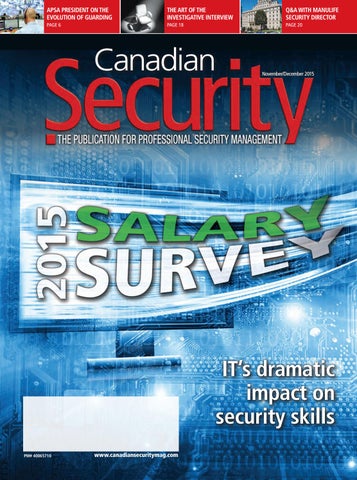
APSA president on the evolution of guarding
The art of the investigative interview
Q&A with manulife security director
Page 6
Page 18
Page 20
Canadian
November/December 2015
The publication for professional security management
IT’s dramatic impact on security skills PM# 40065710
CS NovDec 2015.indd 1
www.canadiansecuritymag.com
2015-11-20 3:16 PM
Lowering risk in a high risk worLd •
Security Guards
At Commissionaires, security is more than guarding.
•
Mobile Patrol
•
Non-core Police Services
•
Process Serving
•
Parking and Bylaw Enforcement
From risk assessment to non-core policing, Commissionaires offers a comprehensive range of security services. We are 20,000 strong with a high proportion of ex-military and RCMP in our ranks. The competition can’t match our training, discipline, sense of duty and front-line experience.
CS NovDec 2015.indd 2 Commissionaires_CS_Dec.indd 1 Ad: Security - Lowering Risk
WhEN SEcurit y iS a Priorit y ca ll c o M M i S S i o N a i r E S | 877 322 6777 commissionaires.ca/cdnsecurity
Publication: Canadian Security
2015-11-20 1:22 3:16 PM 2015-11-11
h
11 1:22 PM
CONTENTS 3
Canadian The publication for professional security management
Columns
Volume 37 Number 6
Filling the technology gap Survey respondents point to a growing need for technical skills as part of almost any physical security job description
10 risk perspective The politics of risk 12 CCTV & the law The next text
By Neil Sutton
Departments 4 editor’s notebook Creating Connections
14
6 trending 9 ASIS update Montreal Chapter winning accolades
Crucial conversation
20 Q&A Mike Allen, Director of enterprise physical security, Manulife Real Estate
A skilled interviewer can shed light on security investigations through the use of several tested techniques By Jonathan Hiltz
21 book review Under siege online 22 product focus CCTV
18 visit www.CanadianSecuritymag.com Security leaders will be dropping by our studio in 2015, so be sure to check out the video section of our website for new content.
SCORE A GOAL FOR CHILDREN IN NEED February 18,th 2016 • York University, Toronto Join other Canadian security professionals and combat child poverty in Canada and worldwide. Contact info@mission500.org today to sponsor or join.
Security Industry Hockey Classic 6689-1NB_Mission 500 Hockey Classic Ad for SP&T.indd 1 Mission500_CS_Nov.indd 1
CS NovDec 2015.indd 3
11/9/15 5:38 PM @SecurityEd • November/December 2015 2015-11-11 9:49 AM
2015-11-20 3:16 PM
Canadian
4 editor’s notebook By Neil Sutton
Creating connections Technology-based skills dominate Salary Survey results
W
hen we send notices that our annual salary survey, sponsored by Commissionaires, is once again open to respondents, I usually have a moment of hesitation. There’s a flicker of doubt on whether we will continue to get the number of responses we need to build a critical mass of results. But I’m never disappointed. The participation numbers have fluctuated over the years, but I would argue that the quality of the responses have consistently gone up. What was originally a bellwether for wages in the security industry (hence the name) is now a much more ambitious project. The basics don’t change much year to year (where are you from, what is your occupation, etc.), but it has become increasingly necessary to ask “A significant percentage questions that are more difficult to answer. One of my favourites is “Would you recommend are essentially doing security as a career to a friend?” It tends to yield the most interesting responses because in many ways different jobs.” it’s the most personal in nature. If someone were to ask me the same about my profession, I would say, “Yes.” But I could add a long list of provisos, caveats, endorsements and advice. The same is true in security, and survey takers do not disappoint. Each year, we try to add a new question. Last year, we added one on social media, which drew a moderate response but nothing I would call game-changing. This year it was a question about technical skills — specifically, “How has technology changed the way you perform your job function?” I expected to see some thought-provoking responses to that question, but I don’t think I was fully prepared for one in five to say that their jobs are “radically” different than they were five years ago. Think about that for a second. A significant percentage are essentially doing different jobs than what they were originally hired to do. I’ve heard remarks over the years that security can be slow to adapt, but I don’t think that’s true. Technology has changed drastically in recent years, so it stands to reason that security and its associated methodologies should keep pace. That same reasoning applies to us too. For example, we recently selected our “Focus On” topics for 2016. Typically, we choose vertical markets like retail or K-12 and tailor speakers and seminars to match those topic areas. We will always be mindful of the role of security in verticals but this year we decided to move a little further afield and pick two technology-based topics: Cyber security and drones. The former has been a security concern practically since the first servers went online decades ago, but the degree to which it has affected traditional physical security departments is much more recent. And if I told people in the security industry five years ago that we were hosting educational sessions on drones, I may have been met with a few blank stares. Say that today and it makes a lot more sense. I imagine if we ask the question “How has technology changed the way you perform your job function?” five years from now, it will yield responses we can barely conceive of today.
The publication for professional security management
Group Publisher Paul Grossinger pgrossinger@annexweb.com
Art Director Graham Jeffrey gjeffrey@annexweb.com
Publisher Peter Young pyoung@annexweb.com
Account Coordinator Trish Ramsay tramsay@annexweb.com
Editor Neil Sutton nsutton@annexweb.com
Director of Soul/COO Sue Fredericks
Editorial and Sales Office 222 Edward Street, Aurora, Ontario L4G 1W6 (905) 727-0077 • Fax (905) 727-0017 Web Site: www.canadiansecuritymag.com Canadian Security is the key publication for professional security management in Canada, providing balanced editorial on issues relevant to end users across all industry sectors. Editorial content may, at times, be viewed as controversial but at all times serves to inform and educate readers on topics relevant to their individual and collective growth and interests. Canadian Security is published six times per year by Annex Business Media. Publication Mail Agreement #40065710 Printed in Canada I.S.S.N. 0709-3403 Subscription Rates Canada: 1 year $40.00 + HST; U.S.A. (payable in US dollars): 1 year $60.00; International (payable in US dollars): 1 year $75.00 Circulation Tel: (416) 510-5189 Fax: (416) 510-5170 asingh@annexbizmedia.com 80 Valleybrook Drive, Toronto, ON M3B 2S9 The contents of Canadian Security are copyright by ©2015 Annex Publishing & Printing Inc. and may not be reproduced in whole or part without written consent. Annex Business Media disclaims any warranty as to the accuracy, completeness or currency of the contents of this publication and disclaims all liability in respect of the results of any action taken or not taken in reliance upon information in this publication.
Editorial Advisory Board Jason Caissie Profile Group
Tracy Ann Kosa Microsoft
Carol Osler TD Bank
Ken Close Trillium Health Partners
Bill McQuade Final Image
Theresa Rowsell Kit and Ace
Ashley Cooper Paladin Security
Clark Northcott
Tim Saunders G4S
David Hyde Hyde & Assoc.
Malcolm Smeaton Whitehorse Group
@SecurityEd November/December 2015 • www.canadiansecuritymag.com
CS NovDec 2015.indd 4
2015-11-20 3:16 PM
Advertorial
m
How can Axis open doors for you?
m
A
xis Communications is bringing new functionality to the physical access control industry with the AXIS A8004VE Network Video Door Station. It is a perfect complement to any surveillance installation and offers new possibilities to effectively control entry to any premise. The AXIS A8004-VE is an open, nonproprietary IP-based door station built for two-way communications, video identification and physical access control. Meaning, you get reliable audio and visual entry control all in one product. Since the AXIS A8004-VE is based on open IP standards and interfaces, it ensures easy installation and integration.
in mic and speaker with advanced processing for echo cancellation and noise reduction facilitating clear, legible two-way audio whether you are conversing over HTTP or via the built in SIP client. More importantly, its LED illuminated call button provides sufficient light to identify a visitor in complete darkness.
We know it’s impossible to be in two places at once –
With these advantages and our partner network, you have the possibility to integrate with a large variety of the newest technologies in the market today.
As with all Axis cameras, full support for Axis and 3rd party applications allow for a variety of analytics to be uploaded to the camera to meet even the most stringent requirements. These applications reside at the edge, so they do not require a server and you can expect lower bandwidth reductions.
With the AXIS A8004-VE Network Video Door Station, employees can to talk to visitors and allow access without having to leave their locations. Additionally, they can monitor and record what happens at any door and simplify every day operations. The audio capabilities include a built
Our aim is simple. We’re committed to helping you build a simpler, smarter physical access control system to meet your customers’ needs today and into the future.
What are you waiting for? Open the door to the future and a world of new possibilities. Visit www.axis.com/pacs to learn more.
Visit www.axis.com to learn more. @Axis_CA
CS NovDec 2015.indd 5
2015-11-20 3:16 PM
6 trending Calendar Focus On Health Care Security Dec. 9, 2015 Toronto, Ont. www.focusonseries.ca TechSec Solutions February 2-3, 2016 Delray Beach, Fla. www.techsecsolutions.com ISC West April 6-8, 2016 Las Vegas, Nev. www.iscwest.com Border Security Expo April 13-14, 2016 San Antonio, Tex. www.bordersecurityexpo.com Security and Counter Terror Expo April 19-20, 2016 London, U.K. www.counterterrorexpo.com Security Canada East April 20, 2016 Laval, Que. www.securitycanadaexpo.com Canadian Technical Security Conference April 26-28, 2016 Cornwall, Ont. www.ctsc-canada.com Security Canada Alberta May 11, 2016 Edmonton, Alta. www.securitycanadaexpo.com IAHSS Annual Conference & Exhibition May 22-25, 2016 Charlotte, NC www.iahss.org Security Canada Ottawa June 1, 2016 Ottawa, Ont. www.securitycanadaexpo.com Security Canada West June 15, 2016 Richmond, B.C. www.securitycanadaexpo.com Security Canada Atlantic September 21, 2016 Moncton, N.B. www.securitycanadaexpo.com Security Canada Central October 19–20, 2016 Toronto, Ont. www.securitycanadaexpo.com
New president for APSA
N
is also in discussions with the ministry icole Lentinello was named president regarding online guard training. of Association of Professional Security Agencies (APSA) earlier this year The guarding industry is not without and is the first woman to hold the position its challenges, but Lentinello says she has in the organization’s 25-plus year history. seen frontline roles change with the times. She previously served as vice“We’ve moved from routine president of the organization and patrols to being responsible for has been a member for more than not only surveillance but also 10 years. health and life safety programs. Lentinello’s career began 23 Security has evolved into so many years ago as a security guard different areas of responsibility,” for Intercon. She has remained she says, adding that there is now with that company ever since, more of a premium placed on admoving up the ranks and taking ministrative and computer skills. on more responsibility over time. She says her background Nicole Lentinello She’s now director of business in guarding has served her well administration at GardaWorld and will continue to inform her — which purchased Intercon in perspective at her new role at 2013 — responsible for the company’s APSA. “One of my beliefs is you do have administrative operations in Ontario. to walk in the shoes of these employees to “Based on what the concerns are, understand their challenges and concerns,” [APSA] represents the best interests of she says. “I think it’s a great opportunity to the security agencies,” she says. “[We] understand what challenges really do exist. try to move things forward or be the I think it’s definitely benefitted me to have voice in relation to issues, challenges and that knowledge.” opportunities.” One area where APSA could place Lentinello says APSA has an ongoing more emphasis is safety, she says, dialogue with the Ministry of Community “specifically for guards as well as the Safety and Correctional Services, the body companies. I think that’s another initiative that regulates the private security industry we should start focusing on. That’s in Ontario. Most recently, APSA consulted something I’m going to recommend and with the ministry in regards to the online work towards.” application process for guard licences and — Neil Sutton
Canada Post’s Rita Estwick recognized with achievement award
T
he Retail Council of Canada recently recognized Rita Estwick, Director of Security Strategy at Canada Post, as the inaugural winner of the Loss Prevention Lifetime Achievement Award. Estwick was acknowledged for her commitment to the Retail Council of Canada, along with her pioneering mentality and spirit of collaboration. “We wouldn’t be here without some of the trail blazers that have led this industry for a long time and represented us very well,” said Rui Rodrigues, National Director of Loss Prevention at Staples Canada and Chair of Retail Council of Canada’s Loss Prevention Advisory Committee. “These folks have developed benchmarks that have allowed us to grow and become better business partners. That’s what RCC’s loss prevention achievement award is really about — celebrating our leaders.” Rodrigues and Diane Brisebois, president and CEO, RCC, presented Estwick the award at the Retail Council of Canada’s Retail Loss Prevention Conference on Sept. 16. — Neil Sutton
November/December 2015 • www.canadiansecuritymag.com
Hikvision Tel: +1-8 Email: sa www.h
TurboHD CS NovDec 2015.indd 6
2015-11-20 3:16 PM
Hikvision
Hikvision Canada Inc. Tel: +1-866-200-6690 Email: sales.ca@hikvision.com www.hikvision.com
TurboHD-Ad_Campaign_FINAL.indd 4 CS NovDec 2015.indd 71 Hikvision_CS_Nov.indd
11/11/15 10:17 AM 2015-11-20 3:06 3:16 PM 2015-11-11
8 trending
Security Director of the Year 2015
Award gala
A
t the 10th Annual Security Director of the Year Gala, sponsored by Anixter Canada, friends, colleagues and supporters gathered to see Todd Milne, director of security operations, University Health Network, receive his award. Milne was chosen as this year’s recipient based on his commitment to the profession, the time and compassion he has shown in mentoring others, and his continued efforts to spearhead important and ambitious security projects at Toronto’s UHN.
Todd Milne, UHN
Paul Swan, Tri-Ed Distribution; Todd Milne, University Health Network; Peter Young, Canadian Security; Gary Mistak, Anixter Canada
Lisa Downing and Tyler Peltzer, Anixter
Joe McCann, Bulldog Fire & Security; Juan Campos, Anixter; Minaz Jivraj, Dufferin-Peel Catholic School Board
Bill McQuade, Final Image; Mike Allen, Manulife
Arshia Nair, Anixter with Scott Jupp, Stanley Security and Ontario Chapter Chair for the International Association for Healthcare Security & Safety (IAHSS)
Colleagues and supporters from UHN and IAHSS: Noreen Jivraj; Dennis Virtue; Scott Jupp; Martin Green; Todd Milne; Brine Hamilton; Laura Linger; Paul Greenwood; Ken Close
November/December 2015 • www.canadiansecuritymag.com
CS NovDec 2015.indd 8
2015-11-20 3:16 PM
By Jean-Charles Gris
asis update 9
Montreal Chapter winning accolades
W
d’Intervention de la Gendarmerie e are proud to announce that ASIS Nationale is a special operations unit Montreal is a winner of the 2015 of the French Police Forces); risk Chapter Website of the Year Award! The management for journalists award was presented on Sept. in war zones was presented 29 during ASIS International in by CBC corporate security Anaheim, Calif. Also this year, managers Benoit Suire and ASIS Montreal received the Pierre-Philippe Desmeules; 2015 Szabo Award from the and fire safety was covered by University Of Montreal School Montreal-based consultant and Of Criminology to reward expert Normand Racine. the efforts made in our Young To celebrate its 25th Professionals program. anniversary, ASIS Montreal To encourage networking Jean-Charles Gris organized a major symposium and learning by way of on terrorism that, at the time of sharing experiences, the Chapter event publication of this article, was scheduled committee is organizing four to five for Nov. 17. Among our guest speakers: conferences every year. Denis Coderre, Mayor of Montreal To date in 2015, there have been as well as representation from Radiothree: explosives, detection and Canada, the RCMP, the City of Montreal, prevention was covered by Eric Buchlin, CSIS, corporate security and a university formal GIGN team leader (Groupe
chair researcher. The year, as always, will wrap up with a networking event just prior to the holidays. ASIS Montreal is glad to be able to rely on active members to represent us on various committees, such as Graeme Lecky on the Young Professionals committee (led nationally by chapter veteran Guillaume Banville, PSP) and Amélie Bois on the Woman in Security committee. To address francophone professionals in Quebec, we also developed a partnership with Sécurité Québec, sister publication to Canadian Security magazine, contributing articles about security management. Jean-Charles Gris, M.Sc., CPP, is the chair of ASIS Montreal chapter 196.
RETAIL SECURITY SERVICES Securitas protects millions of square feet of retail space across North America and around the world. Our specially trained security guards are helpful to your staff and customers, and are vigilant in protecting your retailers from theft, loitering, and/or vandalism. We provide Retail Security Services to a wide range of retailers including: • Department Stores • Shopping Centres • Malls • Strip Malls • Retail Stores of All Sizes
1-800-268-0545
On-Site Guarding
Remote Guarding
www.securitas.ca info@securitas.ca
Mobile Guarding
CREATING ALTERNATIVES
Call now for your no obligation, free security analysis and quote. Learn about our Integrated Guarding; a unique security solution that allows you to create a customized Guarding program by combining any of our service offerings; On-Site Guarding, Remote Guarding with camera technology and analytics, and/or Mobile Guarding. Integrated Guarding Solutions can provide you with Cost Efficiencies, Flexible Service Coverage, and Service Unification. @SecurityEd • November/December 2015
Securitas_CS_Nov.indd 1
CS NovDec 2015.indd 9
2015-11-09 9:03 AM
2015-11-20 3:16 PM
10 RISK Perspective
By Tim McCreight
The politics of risk
O
The security lessons we can take away from the election process
ur recent federal election, and some The approach I’ve always taken in of the comments I heard from the these sensitive situations is to ensure an media, pundits and candidates open and transparent process is followed during the election campaign, provided to conduct the assessment. I’ve gone out of inspiration for this article. my way to engage diverse members of the We heard during the campaign promises organization, identifying key stakeholders from all parties, as well as sound bites and from different parts of the organization. speeches about the risks of voting one way or When developing the report, I ensured I the other. Candidates used provided an opportunity the election campaign to for all stakeholders to “I was reminded identify their strengths and review the methodology value propositions, while followed for the risk how important expressing their concerns assessment, the data on selecting another party, collected, and the open and factual candidate, or doctrine. draft observations and communications are.” In many ways, we as recommendations. security professionals have Updates to the risk inherently dealt with the report were documented politics of risk. As we start and published to all down the path of identifying risks objectively stakeholders, establishing a level of for our clients and employers, we have collaboration and consultation before the undoubtedly been advised that certain risk final report was created. Any presentations levels, or particular risk observations, would to senior management were first vetted with not be a “politically correct” approach to key stakeholders, to ensure the message was take. When assessing the risks of a corporate factual and objective. Remediation activities sacred cow, we may have been advised that documented in the report were provided identifying critical risks to the program, for review as well, based on a pragmatic facility or product may be a difficult position approach to resolving risks. These to defend with senior management. remediation activities had to be realistic and Early in my career, I witnessed this type of practical to be positively received by the political influence within the organizations I organization. was helping to protect. Projects or programs It may seem to be a straightforward that were considered “safe” or “above approach, but dealing with the political reproach” were assessed, and many of these aspect of any risk assessment can be fraught cornerstone or foundational parts of the with problems, issues and concerns. No two organization had significant risks. projects or assessments follow the same The task of identifying these risks, and approach, and the approach that worked reporting the results, was made more difficult for one assessment may be completely because of the political aspects of the project inappropriate for another. or program. I learned to be inclusive, collaborative, Organizations that have invested and transparent in these situations. I was significantly in a program, project, facility, reminded how important open and factual or product have a strong interest to ensure communications are between a security the capital or operating funds already spent professional, the stakeholders for the generate some type of return. A security assessment, and senior management. It’s tough professional conducting a risk assessment to argue against a point if you’ve helped on one of these foundational activities needs document it. to appreciate these concerns, while still ensuring any assessment remains objective Tim McCreight is director, enterprise information security and fact-based. at Suncor (www.suncor.com).
November/December 2015 • www.canadiansecuritymag.com
CS NovDec 2015.indd 10
2015-11-20 3:16 PM
Paladin_
As Canada’s most awarded full service security company – and recipient of 2015 Security Integrator of the Year award – we proudly combine professional, highly trained officers with state-of-the-art integrated security systems and best in class customer service. Discover the difference at paladinsecurity.com
CLIENT: CS Paladin_CS_Sept.indd NovDecJOB 2015.indd 1 NAME:11
Paladin Canadian Security Magazine
TRIM: SAFETY:
8” x 10.75” None
9/15/15 3:36 PM
Cyan
Magenta 2015-11-20 2015-09-17 3:16 9:22 PM AM
12 cctv & the law
By Elliott Goldstein
The next text
T A recent court case puts texting and data privacy to the legal test
he privacy of text messages is again The Crown appealed to the B.C. Court in the legal news. of Appeal arguing that because the drug In the British Columbia case seller had no control over the drug buyer’s of R. v. Pelucco1, a drug seller (Pelucco) cell phone, the seller had no reasonable expectation of privacy in the text messages was convicted when police, posing as a from the seller that were recorded on the potential buyer to whom the drug seller was buyer’s cell phone. The Court of Appeal communicating through text messages, met dismissed the Crown’s appeal holding that the seller and arrested him. Hours before, the trial judge’s finding that the seller had the intended buyer was arrested during a reasonable expectation of the course of the text privacy in the text message conversation and the the seller sent to the buyer police seized the buyer’s “The sender had a was well-founded. The seller’s cell phone, continued subjective expectation rights under section 8 of the the text conversation, Charter were violated and and arranged to meet that his text conversation it was open to the judge to the drug seller in a exclude the evidence under s. parking lot in Nanaimo, was private.” 24(2) thereof. where the seller was As a matter of law, one is apprehended. The police not entitled to rely on a breach found cocaine in the of another person’s Charter trunk of the seller’s rights in support of an application to exclude vehicle, obtained a search warrant, searched evidence against oneself. That is why the seller the seller’s residence and found heroin. had to argue that the police violated the seller’s At trial, the drug seller’s lawyer was able own right to be secure against unreasonable to convince the trial judge that the police search and seizure when the police read his had violated his client’s right to be secure text messages on the buyer’s cell phone. against unreasonable search and seizure The Pelucco case establishes that a when the police read the text message text message sender has a reasonable the seller sent to the prospective buyer. expectation of privacy over the contents of The judge concluded that there was no the text message once it is sent. Here, the lawful basis for the drug seller’s arrest. The sender had a subjective expectation that Honourable judge excluded the evidence his text conversation was private. But was obtained in the search of the seller’s vehicle that objectively reasonable? Yes, says the and excluded evidence obtained in the search Court, since both the seller’s and the buyer’s of the seller’s residence, finding that it could interests lay in keeping the texts private, not have been authorized without evidence there was no reason for them to believe of the text messages. that they would not succeed in doing so. Therefore, the seller’s subjective expectation of privacy was objectively reasonable. It is likely that this case may end up in the Supreme Court of Canada where that learned court will be asked to determine whether text messages attract the same high level of privacy protection as do telephone/ cell phone conversations. Elliott Goldstein, B.A., J.D., is a Thornhill, Ont.-based lawyer (elgold@rogers.com). 1. [2015] B.C.J. No. 1794 and 2015 BCCA 370 (CanLII).
November/December 2015 • www.canadiansecuritymag.com
CS NovDec 2015.indd 12
2015-11-20 3:16 PM
SkTel_Ca Sasktel_C
Yo u r D ata Safe, Secure, ManageD D ata C e n t r e S e r v i C e S Protect your data and applications in one of our Sasktel Data Centres. Whether it’s a secure environment to house your servers, or a full spectrum of management, backup, and it services, we’ll help you with your it infrastructure so you can focus on what really matters—your customers. • Colocation • Managed Hosting • New Tier III Data Centre opening 2016, in Saskatoon
sasktel.com/business
SkTel_CanSecurity_8x10.75_4c_NovDec.indd 1 Sasktel_CS_Nov.indd CS NovDec 2015.indd 113
2015-11-09 9:12 AM 2015-11-09 2015-11-20 1:11 3:16 PM PM
14 Salary survey
Technical
knowledge needed
Across the board, security professionals report that their jobs have changed and they need more technology skills than ever before
By Neil Sutton
T
here is an unmistakeable shift, at practically all levels of influence, seniority and job description in professional security, towards the need for, and use of, technical knowledge. Whether it’s a security manager who needs a working knowledge of IT security systems, a frontline guard who is required to interact with access control or visitor management software or a CSO who must make recommendations about whether the Cloud is a good for his or her organization, the world of security has changed. The results of Canadian Security’s annual Salary Survey, sponsored by Commissionaires, include examples of these and other scenarios. These changes have not taken place overnight, but they have certainly happened. The 2015 Salary Survey, conducted online in September and October, was taken by 338 people. The most common job titles of survey takers include security manager (27 per cent), security director (10 per cent) and security guard (16 per cent). Other titles include: president, senior vice-president, site supervisor, private investigator, loss prevention manager, consultant, and IT security professional. Only 14 per cent of
respondents were female (down slightly from last year’s survey at 17 per cent). More than half of respondents reported that they work in Ontario (59 per cent). British Columbia and Alberta were virtually tied for second at approximately 10 per cent. The overwhelming majority of respondents said that they work full time (93 per cent) versus part time or occasional.
Gender
Male
86% Female
14%
November/December 2015 • www.canadiansecuritymag.com
CS NovDec 2015.indd 14
2015-11-20 3:16 PM
15 Age
20-30
7%
30-40
19%
40-50
29%
50-60
31%
60-plus
13%
A new survey question for this year How long have you been with your current employer? was: How has technology changed the way you perform your job function? Almost half of respondents (46 per Less than cent) reported that a “greater number 6 months of computer skills are required.” 6-12 months Approximately one in five (18 per cent) said, “My job is radically different 1-5 years than it might have been five years ago.” About a quarter (27 per cent) said that 6-10 years skill changes include those that might affect most jobs (smartphone use, etc.). 10-15 years Less than 10 per cent said they had experienced no change. 15-20 years One respondent noted that it is no longer good enough to simply 20+ years outsource security infrastructure to an integrator or third party — it has become necessary to possess to make meaningful presentations that knowledge within whole,” he says. But, “The days of hiring to decision-makers and “to be able an organization, or at “what’s really allowed to better develop business cases and least have a reasonable me to get over that somebody off the street present those to the people with the working knowledge. hump is my increasing wallets.” Another said they knowledge in logical to be a night watchman security.” The degree to which technology require knowledge of has influenced job description or duties IT infrastructure to stay That knowledge are behind us.” varies according to position. Of the on top of regulatory helps him facilitate — John Slater, survey respondents who identified compliance issues. discussions with his Commissionaires Northern as managers, 54.5 per cent said they Others noted that own IT department, he Alberta Division they have had to hire says, as well as enabling require a “greater number of IT/ computer skills.” For respondents who security personnel with him to see the bigger said they are guards, it is only about advanced networking picture when it comes half as many (24 per cent). However, and IT skills to keep to his company’s own just as many guards as managers (about them informed. security landscape. “My knowledge of 16 per cent) reported change at the Michael Brzozowski says he has networking, encryption and how those most extreme end of the technology encountered a number of these scenarios things all intertwine with each other while working as a risk manager with has been incredibly beneficial, especially spectrum (i.e. “My job is radically different”). Symcor, a financial processing service when it comes down to implementing The influx of technology has come provider jointly held by TD Bank projects. More and more, there’s a huge with a price for some. One survey Financial Group, RBC Financial Group dependency on the IT portion for us to respondent reported that technology and BMO Financial Group. do our jobs,” he says. at work has changed “so dramatically” He credits his education and His appreciation of the growing that some older security officers have attainment of ASIS credentials like relationship between the physical and chosen to leave their jobs. For others on CPP and PSP with helping him the logical sides of the security house the front line, it has meant an expansion form the foundation of his physical has benefitted him in the pursuit of of their duties, allowing them to collect security expertise. “Those have been career goals, he says. and report data not only on locked tremendously helpful to really solidify my It has also allowed him to better knowledge of security management as a understand risk and use that knowledge doors and surveillance information, but
3.37% 6.44%
28.22% 22.7% 15.95% 8.28%
15.03%
@SecurityEd • November/December 2015
CS NovDec 2015.indd 15
2015-11-20 3:16 PM
16 Salary survey also building maintenance issues. numerous to mention. In addition to those “More and more, there’s “The bottom line is, the days of hiring already addressed, respondents noted rolesomebody off the street to be a night defining technologies like mass notification and a huge dependency on watchman, I think, are behind us,” agrees emergency management tools. Others reported John Slater, CEO of Commissionaires that their role simply didn’t exist in years the IT portion for us to Northern Alberta Division. previous and that it is predicated on the recent According to Slater, his division influence of technology. Another said that do our jobs.” ensures that all new-hires take a keeping up with technology is an imperative; — Michael Brzozowski, computer literacy test. without that knowledge, they would not be Symcor “You’ve got to be able to use able to make informed decisions about ROI. a variety of systems — everything While some roles have seen a dramatic shift, from a smartphone with a guard tour there are still some skills that are inherently management system to operating a the same as they ever were; they just adapt to log for a client to GPS tracking devices, video monitoring, the times. Soft skills — the ability to communicate effectively access control, and eventually being able to operate perhaps and create successful working relationships with people — drones,” he says. for example, are a part of the job, helping to harness all that The shift in skillsets and capabilities has resulted in accumulated knowledge and amplify its effect. change at many levels, he adds. In some cases, clients are “Gaining those business skills, those soft skills [enhances] asking for increasing levels of sophistication from their any managerial interface,” explains Brzozowski. “Now I can guarding providers. In other cases, they may not be aware of confidently say that I contribute to the strategic aspects of the tools a company like Commissionaires can bring to bear, Symcor because I’m seen as a subject matter expert — not just so it’s an opportunity to offer a value-add to a potential or on gates, doors and guards, but I can really provide some more existing client. context to the organization as whole.” Survey respondents catalogued so many different uses According to survey results, social media has had a less of technology for today’s security professional, they are too dramatic impact on the profession than technical skills. Asked,
FOCUSED. EDUCATIONAL. INTERACTIVE Where the Security Industry Talks Solutions
FOCUS ON S•E•R•I•E•S
Four targeted Focus On events in 2016 where you can learn from experts, network with colleagues and engage with vital information
Cyber Security - March Toronto
Drones - June Toronto
Government - September Ottawa
Health Care - December Toronto
For more information and sponsorship opportunities, visit www.focusonseries.ca or contact Peter Young at 905-713-4344 or pyoung@annexweb.com November/December 2015 • www.canadiansecuritymag.com
CS NovDec 2015.indd 16
2015-11-20 3:16 PM
17 What is your income?
$150K+
4.88% $100-150K
18.9%
How do you rate your current security employer as a place to work?
Less than $20K
3.35%
Needs improvement
20.14%
$20-40K
Average
18.6%
27.21% Very Good
$40-60K $80-100K
14.94%
33.22%
16.46%
Excellent
$60-80K
19.43%
22.87%
“Do you use social media for work purposes?” almost half (49.5 per cent) responded, “No, it is not part of my work routine.” That is, however, slightly less than last year, when approximately 56 per cent said no. When looking at social media platforms individually, all have grown in usage over last year. The biggest jump is LinkedIn. About a third of respondents said they use it last year, versus about 46 per cent this year. Twitter (16 per cent in 2014 and 22.65 per cent in 2015) and Facebook (20.5 per cent in 2014 and 24.75 per cent in 2015) both saw modest increases. When quizzed on their social media habits, some respondents said they use it for networking and recruiting purposes. Others said that they take a hands-off approach in any professional capacity, allowing communications or marketing departments to handle “official” Twitter or Facebook channels. Social media plays a different role for some security professionals. Monitoring social media sites and services is essentially included in their job description and is part of threat detection protocols. Whether for personal, professional or investigative purposes, the use of social media in the security community appears to be on the rise. Judging from the high participation rate and number of comments recorded, a popular question on the survey continues to be “Would you recommend security as a career to a friend?” The “Yes” responses slipped slightly, but not significantly, from last year (76.5 per cent in 2014; 74.75 per cent in 2015). In keeping with the trend towards the growing influence of technology, one respondent said, “It is a constantly growing field, especially on the technology security side.” There were concerns about low wages, particularly at entry-level positions, which continues to be a hallmark of survey responses year after year. However, there were positive comments regarding career potential in security with several respondents mentioning that there are new and different roles available in the field — particularly those with IT or technical skills. While wage potential continues to be of concern to
respondents, it is not the biggest issue. When asked, “What is the most pressing workplace issue for security?” the most common response was “Public image of security” (21 per cent). Remuneration was second, tied with “Career Opportunities (advancement)” at 14.75 per cent, closely followed by work-life balance at 14.4 per cent. Last year’s results played out differently, with remuneration edging out “Public image” as the most pressing concern.
INCREASE SITUATIONAL AWARENESS CUSTOMIZED IP INTERCOM The TKIS-2 VoIP Intercom Module adapts to any indoor or outdoor enclosure making it an ideal building communication solution for entry/exit doors and gates, emergency help points, stairwells, walkways and more. Vingtor-Stentofon offers a variety of IP audio systems and solutions to fit your large or small building security requirements.
MAKE YOUR OWN:
VoIP INTERCOM VoIP SPEAKER VoIP AMPLIFIER
CONTACT US TODAY TO LEARN MORE!
1-800-836-1730 info@vingtor-stentofon.us www.vingtor-stentofon.us
@SecurityEd • November/December 2015 Zenitel_CS_Nov.indd 1
CS NovDec 2015.indd 17
2015-11-12 9:19 AM
2015-11-20 3:16 PM
18 skills & training
Truthful matters With the right training, advanced interviewing techniques can uncover information and root out deception By Jonathan Hiltz
H
uman beings may have evolved over time but there are still a good number who will do morally questionable things if the opportunity presents itself. This is one of the reasons why techniques for interviewing and interrogating employees, potential workers and others involved with a business have developed, as well as the need for them to be incorporated into training and certification exercises. One of the most popular methods for interviewing people in this regard is the Reid Technique. Back in 1947, John E. Reid and Associates began developing interview and interrogation techniques and over the last 65-plus years, it has become a widely-used and popular approach. “In our three-day training programs we spend one day on how to assess the person’s credibility during the interview, one day on the structure of the investigative interview and then one day on the interrogation process.” says Joseph Buckley, President of John E. Reid. Buckley says the interview itself is usually focused on two types of questions, the investigative and what they call “behaviour-provoking questions.” Investigative questions are the ones we are all familiar with: the who, what, where, when and why. Behaviour-provoking questions are inquiries designed to study how a person answers and what the resulting behaviour means. “Most people who are telling the truth will answer one way, where as most people who are not telling us the truth will answer a different way,” he says. “Let’s say that somebody had stolen money from your office that four or
five people had access to. We would ask each of those subjects in their interview, ‘What do you think should happen to the person that stole the missing money?’” Buckley says most truthful people would say that they should be fired or they should pay it back. When you are then interviewing the guilty person and you ask “the punishment question” you are asking them what should happen to them. For the most part they tend to avoid the response, saying things like “I don’t know,” “it’s hard to say,” etc. He points out that it is not foolproof and you always want to be careful, but the technique has a very high degree of accuracy. Buckley says many businesses could benefit from integrating these techniques into training. “Clearly the loss prevention corporate security people should have some kind of training on
conducting those kinds of investigations and a key part of that investigation is going to be the interview of the respective parties.” Buckley says he is confident people recognize the importance of interviewing techniques and will continue to do so. “I think that the majority of employers are very sensitive to the issue and very aware of it and I think they do what they can.” He adds that if employers can’t attend these sessions, there are also books on their technique available and online training programs for people to access. The ASIS Toronto Chapter recently held a sold-out, three-day training course on the Reid Technique which was well received. Mike Soberal, who was ASIS Toronto’s chapter chair when the course was offered, says that the need for ongoing training
November/December 2015 • www.canadiansecuritymag.com
CS NovDec 2015.indd 18
2015-11-20 3:16 PM
19 and the pursuit of standards is widely recognized. “I think the general population appreciates anything that promotes better standards and education,” he says. “Most people recognize the continuous need to improve themselves through courses such as the Reid course and other ASIS courses.” The way the Reid Technique and others have been taught over the years have adapted to suit changing times. “I personally took the course almost 10 years ago,” says Soberal. “In my opinion, the fundamental basics haven’t changed but the way they teach it has evolved. It’s utilizing better use of technology, there are more examples now available of proper interview and interrogation techniques and they have adapted to the times without question.” Another well-known technique is Wicklander-Zulawski. The company’s website describes its technique as a
“non-confrontational” way to deal with complex cases including sexual harassment, discrimination, workplace violence and so on. Like Reid it also interprets physical and verbal behaviour and is encouraged for HR departments in any organization. According to David Zulawski, co-founder of Illinois-based WicklanderZulawski, their technique can be used broadly across an organization to discover the truth of a matter. “We use it from senior executives involved in large-scale frauds and embezzlements down to a cashier taking five bucks out of the register.” While loss prevention or security will benefit from such training, they also train human resources departments, auditors conducting fraud investigations, district and regional managers, etc. Wicklander-Zulawski has been in business since 1982 and both founding partners originally worked at Reid.
They created the company because they believed there was a different way of doing interrogations. Whichever technique or course is deemed right for a business, the need for teaching them to professionals whose job it may be to get to the bottom of situations is paramount. Soberal says that a challenge for ASIS is to continue spreading the word of the importance of what they do and the training they undertake to non-security personnel. Reid, as well as the Wicklander-Zulawski method, “are generally accepted to be the top level types of courses for interview and interrogation,” he says. “The great thing about both those types of interviews are that the fundamental basics are about human nature. They way we respond and react to things has been well documented over the course of time.” Jonathan Hiltz is a freelance writer based in Toronto.
@SecurityEd • November/December 2015 Gaitronics_CS_Nov.indd 1
CS NovDec 2015.indd 19
2015-11-10 11:00 AM
2015-11-20 3:16 PM
20
QA &
with Mike Allen, Director, Enterprise Physical Security, Manulife Real Estate
T
here is nothing quite like a fresh start. Mike Allen has been given that opportunity, having recently taken a top security position at Manulife’s Real Estate division — a position that didn’t exist before he accepted the role. According to Allen, the Canadian company, best known for its insurance business, is taking some significant steps to refresh its approach to security across its properties, which comprise 243 buildings worth $8 billion in Canada, and a broader portfolio of 338 properties outside of Canada, worth an additional $17.5 billion. Canadian Security recently spoke to Allen to get his take on his new role. Canadian Security: What are the key elements of your role? Mike Allen: I think a lot of businesses see the value in having a position like this — a single point of contact. The role came about not too long ago. My day-to-day duties will be to assess the current state of security from all matters
of physical security, be it our security providers, guard services, security systems, emergency response procedures within the buildings. We’re doing well everywhere but we might be doing it a little bit better and more consistently in some places. I have an advantage, working for a global company. I’m going to take the best of those [practices]. My day-today duties will be to standardize those, to say, “This is what we’ve been doing right” and make sure everyone knows about that. CS: With whom do you communicate the most? MA: I have a direct security partner in the U.S., Dean Mini, director of security for John Hancock [Manulife Real Estate operates as John Hancock in the U.S.]. I don’t think hours would go by without us talking or sharing information. I [talk to] the property managers, of course. As a major real estate organization, the property directors and regional management . . .
Manulife Financial global headquarters in Toronto.
We want to communicate on initiatives that we have on the go, projects, improvements, assessments, either regionally or per property. If there’s something like the Pan Am Games, those would be the best people for me to go to. There are other security investigation experts throughout Manulife as a whole and privacy and IT security experts. For anyone in my role in any organization, those people are critical to what you do. I don’t think anyone on the physical side can operate without speaking to them on a day-today basis. CS: How much of your role is security in the traditional sense versus business skills? MA: I would say the majority of my role now is business. The two people I’m reporting to have incredible business acumen. Throughout my career, I’ve reported to many security professionals of various security and policing backgrounds and only a handful of business people. The majority of what I do now is business related — meaning, looking at things from the perspective of, how can we do this better? How can we do this more efficiently? How can we tie in using existing resources within the organization, or provide a better service to the organization? I’m reporting to people who are seasoned professionals, which is going to be great mentoring and learning for me. CS: To what degree can you shape this role for yourself? MA: My skills, and what I’ve learned from my previous employers and my mentors — I think I can bring a lot to the organization from different perspectives. The organization has run emergency response plans, fire practices and managed security departments at the property level very well for many years before my role came along. The opportunity to bring all of those together and decide what I want to recommend to the executives — they’ve given me a lot of autonomy to demonstrate that.
November/December 2015 • www.canadiansecuritymag.com
CS NovDec 2015.indd 20
2015-11-20 3:16 PM
By Derek Knights
Book review 21
Under siege online Cyber-Physical Attacks — A Growing Invisible Threat
By George Loukas Butterworth-Heinemann ISBN: 9780128012901
I
n the Dark Ages, mankind was fearful of attacks in the physical world originating in the spirit world. As societies became more enlightened this diminished a great deal — but it’s on the rise again and with a little more grounding in reality! It’s not the spirit world but the cyber world now. And from the perspective of non-IT security professionals, this presents serious challenges. This is discussed professionally and with authority in “Cyber-Physical Attacks — A Growing Invisible Threat,” by George Loukas. Loukas lays the book out very well, particularly because it’s marketed for security people with not so much computer science experience. He opens with “Basic Concepts and Definitions of a CyberPhysical World” — A cyber-physical attack is a security breach in cyberspace that adversely affects physical space — and spends about a dozen pages setting some rules for the next seven chapters. These are important because, after this, the book becomes very detailed and certainly eye-opening. First there’s a history and context setting, then case studies that highlight his points. The rest describe the what, how, and why of cyber-based attacks on the physical world (and later some of the reverse: physical attacks on the cyber world). The case studies include incidents of compromise in SCADA (Supervisory Control and Data Acquisition), which can affect power stations to railways to waste management. One of the attacks mentioned is a case where a 14-year-old in Poland gained control over a city’s tram system causing derailments and crashes. Not all of the “attacks” discussed are intentional — faulty design and incorrect configuration are included. So, this is not only an anti-terrorism issue, but mischief and carelessness are also threats to modern systems. Chapter 3 discusses attacks on medical implants and vehicles. Many diabetics wear insulin pumps and a sensor that measures blood sugar, and secretes insulin as required. This is done wirelessly, and often with no encryption or basic data protection. Some are smartphone-controlled and anyone with passing knowledge could reconfigure a patient’s dose levels. Loukas says a high-end luxury car has computers, actuators and sensors controlled by 100 million lines of code. By comparison, an F-22 Raptor fighter has only 1.7 million and the Hadron SuperCollider has 50 million. The complexity, coupled with insufficient security, means many systems could be vulnerable to attack.
For security professionals in executive protection, vulnerabilities in health or transportation systems is a big deal. Chapter 4 discusses Industrial Control Systems, which brings SCADA back into the frame. SCADA systems and other similar controls operate nuclear reactors, so the stakes can be higher than a tram derailment (itself pretty serious). Some of these systems, in smaller, non-nuclear applications, are from commercially available software, which has that built-in vulnerability of a default password. Other chapters discuss the attack steps and protections, and the book ends with how accidents or attacks in the physical world disrupt cyber-systems. It’s science-fact almost as scary as science-fiction. Currently in its first edition, it should be required reading for every security professional. I expect its second edition will be equally valuable, considering the speed of change in this area. Derek Knights, CPP, CISSP, CFE CIPP/C, PCI, is the senior manager, strategic initiatives, global security and investigations, at the TD Bank Group (www. tdbank.com).
Lawyer,
Mediator
Author of Visual
Evidence
Elliott Goldstein, Cell: 416.315.0066
& B.A., J.D.
elgold@rogers.com
Mediation of Disputes - Commercial, Shareholder, Employment. Litigation to Collect Debts or Defend Customer Lawsuits. Alarm Installation & Monitoring Contracts, Employment Agreements. Minute Book Reviews and Updates, Incorporations. Wills, Powers of Attorney for Property and Personal Care. Video Surveillance Law Seminars, Forensic Video Analysis Law.
www.videoevidence.ca 45 Redondo Drive, Thornhill (Vaughan), ON, Canada L4J 7S7
Fax: 905.597.6226 @SecurityEd • November/December 2015
Goldstein_CS_Sept.indd 1
CS NovDec 2015.indd 21
2014-09-04 1:44 PM
2015-11-20 3:16 PM
22 product focus CCTV Dome cameras
360-degree camera
Samsung Techwin America Available in a variety of styles and configurations that offer either 1.3 MP or 2 megapixel Full HD resolution, Samsung’s WiseNet Lite cameras feature 60dB Digital Wide Dynamic Range (DWDR) and Lens Distortion Correction (LDC), which compensates for image distortion that can occur with wide angle lenses. The cameras also offer the ability to record via a built-in SD card slot or NAS direct recording capability. Automatic Remote Backup (ARB) will back up and restore video from SD memory upon video loss due to network disruption. Users can also perform backup manually as needed. WiseNet Lite bullet IR and indoor dome IR cameras are equipped with either fixed or varifocal lenses, and outdoor dome IR cameras feature a varifocal lens. www.samsung-security.com
Oncam The Evolution-12 suite of surveillance cameras leverage a 12-megapixel 4K Exmor R sensor to deliver a 9.6 MP high-resolution image, even in low-light conditions. Evolution-12 offers simultaneous multiple video streams with up to 30 fps at 2MP and up to 14 fps at other resolutions. Oncam supports both ePTZ dewarping on the camera and 3D dewarping technology on the client side, providing four independent dewarped views (Vcams) at up to 1MP each. The Evolution-12 suite of surveillance technologies feature two indoor cameras and one outdoor camera, all of which provide constant 360-degree situational awareness with no blind spots, no moving parts and silent operation. The Evolution-12 360-degree Outdoor Camera enables users to expand their surveillance network to outdoor perimeters. The Evolution-12 360-degree Indoor Concealed Camera provides discreet installation with a low profile. www.oncamgrandeye.com
Streaming encoder Christie The Christie Phoenix Quad-T is a 4K/UHD streaming encoder used with Phoenix videowall processing systems. The Phoenix Quad-T can be installed anywhere on a network to expand a Phoenix system by adding additional inputs. Featuring four HDMI connectors, each supporting 4K/UHD resolutions up to 3840 x 2160 pixels and four mini-USB ports for soft KVM control, the Phoenix Quad-T allows users to acquire high-quality, remote video and control signals over IP networks, enabling teams to work with the same data, regardless of location. www.christiedigital.com
NVR/server Milestone Systems The Milestone Husky M50 Advanced appliance is a customizable, rackmounted solution that combines industrial-grade hardware and XProtect video management software for complex, multi-site deployments. The unit supports up to 120 cameras in an all-in-one set up. An onsite configuration wizard called Husky Assistant makes it possible to simplify deployment of all-in-one and recording server configurations. The assistant can also help customers with multi-site XProtect advanced software deployments to maintain a standardized NVR/server configuration. Existing installations can be extended and new installations can be set up using the Milestone Husky M50 Advanced as a building block. It can operate as an integrated unit or as a recording server. www.milestonesys.com
ATM camera March Networks The MegaPX ATM Camera is a self-contained, covert IP camera with High Dynamic Range (HDR) image clarity. Purpose-built for installation in leading automated teller machines (ATMs), the camera captures highlydetailed video in all lighting conditions, enabling banking investigators and law enforcement to clearly identify faces and other distinguishing features. It is ONVIF Profile S compliant and can be deployed to provide the ATM video evidence many financial institutions are seeking to fill a gap in their complete banking surveillance solution. www.marchnetworks.com
Network video recorders Exacq Technologies The exacqVision Z-Series network video recorders offers performance, reliability and capacity for demanding video surveillance applications. Now these recorders are capable of storing up to 120TB of video, adding 50 per cent more maximum storage capacity. The new Z-Series IP recorders eliminate the need for purchasing multiple servers, reducing the cost of ownership. exacqVision Z-Series hybrid and IP camera NVRs record up to 128 IP cameras and 64 analogue cameras and include eight IP camera licences. www.exacq.com
Ad Index Axis Communications Commissionaires Elliot Goldstein Gai-Tronics Garrett Metal Detectors HIKVision
5 www.axis.com 2 www.commissionaires.ca 21 www.videoevidence.ca 19 www.gai-tronics.com 24 www.garrett.com 7 www.hikvision.com
Keyscan Mission 500 Paladin SaskTel Securitas Zenitel
23 www.keyscan.ca 3 www.mission500.org 11 www.paladinsecurity.com 13 www.sasktel.com/business 9 www.securitas.ca 17 www.vingtor-stentofon.us
November/December 2015 • www.canadiansecuritymag.com
CS NovDec 2015.indd 22
2015-11-20 3:16 PM
Keyscan
Keyscan access control systems network with businesses of all sizes – Get fit! Keyscan electronic access control systems fit our customers’ specific needs for security, organizational efficiency and operational convenience. Our solutions include Keyscan Aurora access control management software providing a single software solution and robust integration options for our versatile networked hardware platform.
Keyscan integrated access control solution
Keyscan_CS_Nov.indd 1 CS NovDec 2015.indd 23
Our software will drive Keyscan access control systems from one door in a single location, to thousands of doors and users in multiple locations anywhere in the world.
Kaba Access & Data Systems Americas
Regardless of the project size or scope – Keyscan fits.
http://kaba.to/GetFitCS
1.888.539.7226
2015-11-10 AM 2015-11-20 10:24 3:16 PM
Team with GARRETTÂŽ to create your SAFE ZONE Enjoy peace of mind as you enjoy your favorite sporting events. Sports fans are passionate about their teams. Garrett Metal Detectors help keep them safe so they can simply relax and enjoy their big game. Our American-made products have been an integral part of the security plan at major sports events such as the Olympic Games, the Pan American Games, FIFA World Cup venues, professional football, and even the Little League BaseballÂŽ World Series.
Garrett supports the spirit of competition.
MADE IN THE USA
CS NovDec 2015.indd 124 Garrett_CS_Jan.indd
2015-11-20 8:43 3:16 AM PM 2015-01-21