PHOTO HIGHLIGHTS FROM SECURITY CAREER EXPO
###### PAGE####### 6
Q&A WITH NEW SENIOR LEADER FOR ASIS CANADA
SHARING HOSPITAL SECURITY BEST PRACTICES
PAGE 8
PAGE 16
Canadian
March/April 2017
THE PUBLICATION FOR PROFESSIONAL SECURITY MANAGEMENT
www.canadiansecuritymag.com
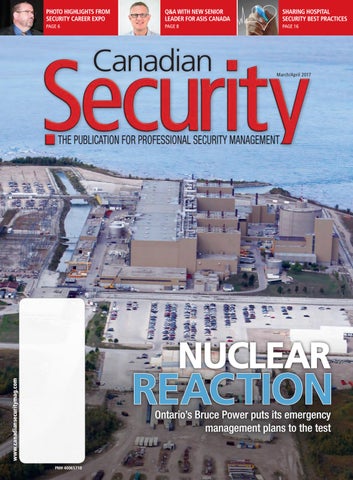
NUCLEAR
REACTION Ontario’s Bruce Power puts its emergency management plans to the test
January/February • www.canadiansecuritymag.com PM#2017 40065710
3 pm Saturday and all’s well. Let’s keep it that way.
Risk Consulting
Software & Technology
Systems Integration
Security Personnel
AMAG Technology Symmetry GUEST Security Products Magazine New Product of the Year 2016 Visitor Management
When you prepare, you prevent. Preparedness brings peace of mind. And G4S can help you stay ready, with everything from risk analysis and managed services to technology and security personnel. Because it’s good to know you’ve done everything you can to help mitigate risk. To stay prepared, please visit g4s.ca or call 888-717-4447.
culpa qui officia deserunt mollit anim id est laborum et dolor
CONTENTS 3
Canadian Volume 39 Number 2
THE PUBLICATION FOR PROFESSIONAL SECURITY MANAGEMENT
Columns
Heartbeat of security
An IAHSS mailing list comes to the rescue of numerous Ontario hospitals as a peer sharing and best practices tool
10 MUNICIPAL MATTERS The good manager 14 RISK PERSPECTIVE First things first
By Renée Francoeur
Departments 4 EDITOR’S NOTEBOOK Constant education
16
5 TRENDING 8 ASIS UPDATE Q&A with Mark Folmer
Huron Resolve
21 BOOK REVIEW Crossing the blue line
Bruce Power simulates a major crisis — then deals with it in co-operation with a multi-jurisdictional task force
22 PRODUCT FOCUS ID Management
Photo: Bruce Power
By Renée Francoeur
18 visit www.CanadianSecuritymag.com
Cover Photo Courtesy Bruce Power
Security leaders will be dropping by our studio in 2017, so be sure to check out the video section of our website for new content.
ARE YOU RECEIVING Canadian THE PUBLICATION FOR PROFESSIONAL SECURITY MANAGEMENT
e-news?
SUBSCRIBE TODAY! www.canadiansecuritymag.com @SecurityEd • March/April 2017
4 EDITOR’S NOTEBOOK By Neil Sutton
CONSTANT EDUCATION A key lesson from Security Career Expo: persistence pays off
I
’m not a huge fan of public speaking. I don’t suppose that’s much of a surprise, since few people are. It’s not easy to stand up in front of a crowd of people and speak, whether your comments are well-prepared, off the cuff, or even read from a script. But I do it and, most of the time, everything goes just fine. Sure, I’ve stumbled, sweated and occasionally rushed my way through a brief oration, but sometimes it clicks. I feel confident. I can improvise. I see people responding to what I’m saying. I provided a few brief opening remarks at our annual Security Career Expo, held earlier this March. I didn’t say much, because we had a full day of speakers and mentors ahead of us but I wanted to set the tone and get the day started on the right note. My point is, the more I do “Take on tasks something, the better I tend to get at it. Again, that’s no revelation, yet it’s something many of us can forget or that might seem neglect. Mark LaLonde, chief safety officer at Simon Fraser difficult.” University, B.C., and our keynote speaker for the day, was effusive when it came to trying new things. He urged the assembled audience to put themselves out there, make themselves known to others, take on tasks that might seem difficult, and work hard. Really hard. Get a degree if that seems like a necessary and advantageous career move. It might take two years of your life, but so what? Do it. You will thank yourself in the end. He also urged everyone to network — even if you don’t like it or if it doesn’t come naturally (or maybe especially if it doesn’t). You will hear about opportunities you may not have otherwise discovered. You will find mentors who can guide you. You will root yourself more deeply in your chosen profession. What I took away from Mark’s speech is his admonition that we should all strive for personal growth. He suggested that everyone should take at least three to four hours a week and devote that time to gaining knowledge. It doesn’t even have to be something directly related to your profession — as long as it’s contributing to your knowledge base and expanding your understanding of the world. Mark was not suggesting that downtime isn’t valuable or necessary. On the contrary, surfing YouTube is a perfectly acceptable way of letting your mind wander, but balance that with a good book that teaches you something of value. The key demographic for Security Career Expo is the 18-25 age range — those who are getting ready for their careers or are just a few years into them. But the advice dispensed by Mark, as well as our other speakers and mentors who generously donated their time, rings true for all ages. I knew we were on the right track when one of our mentors approached me after the event and told me he had probably learned as much from the students as they had learned from him.
@SecurityEd
March/April 2017 • www.canadiansecuritymag.com
Canadian THE PUBLICATION FOR PROFESSIONAL SECURITY MANAGEMENT Group Publisher Paul Grossinger pgrossinger@annexweb.com
Art Director Graham Jeffrey gjeffrey@annexweb.com
Publisher Peter Young pyoung@annexweb.com
Account Coordinator Trish Ramsay tramsay@annexweb.com
Editor Neil Sutton nsutton@annexweb.com
COO Ted Markle tmarkle@annexweb.com
Assistant Editor Renée Francoeur rfrancoeur@annexweb.com
President & CEO Mike Fredericks
National Account Manager Jennifer Dyer jdyer@annexweb.com
Editorial and Sales Office 222 Edward Street, Aurora, Ontario L4G 1W6 (905) 727-0077 • Fax (905) 727-0017 Web Site: www.canadiansecuritymag.com Canadian Security is the key publication for professional security management in Canada, providing balanced editorial on issues relevant to end users across all industry sectors. Editorial content may, at times, be viewed as controversial but at all times serves to inform and educate readers on topics relevant to their individual and collective growth and interests. Canadian Security is published six times per year by Annex Business Media. Publication Mail Agreement #40065710 Printed in Canada I.S.S.N. 0709-3403 Subscription Rates Canada: 1 Year $40.95 + HST; U.S.A. (payable in US dollars): 1 Year $70.00; International (payable in US dollars): 1 Year $80.00 Circulation Tel: (416) 510-5189 Fax: (416) 510-5170 asingh@annexbizmedia.com 80 Valleybrook Drive, Toronto, ON M3B 2S9 The contents of Canadian Security are copyright by ©2017 Annex Publishing & Printing Inc. and may not be reproduced in whole or part without written consent. Annex Business Media disclaims any warranty as to the accuracy, completeness or currency of the contents of this publication and disclaims all liability in respect of the results of any action taken or not taken in reliance upon information in this publication.
Editorial Advisory Board Jason Caissie Profile Group
Sherri Ireland Security Exclusive
Theresa Rowsell Kit and Ace
Ken Close Trillium Health Partners
Mark LaLonde Simon Fraser University
Tim Saunders G4S Canada
Ashley Cooper Paladin Security
Bill McQuade Final Image
David Hyde Hyde & Assoc.
Carol Osler TD Bank
Sean Sportun Mac’s Convenience Stores
TRENDING 5 CALENDAR April 23-25, 2017 IAHSS Annual Conference & Exhibition Vancouver, B.C. www.iahss.org April 26, 2017 Security Canada East Laval, Que. www.securitycanadaexpo.com May 2, 2017 Blue Line Expo Mississauga, Ont. www.blueline.ca May 10, 2017 Security Canada Alberta Edmonton, Alta. www.securitycanadaexpo.com May 31, 2017 Security Canada Ottawa Ottawa, Ont. www.securitycanadaexpo.com May 31-June 1, 2017 CANSEC Ottawa, Ont. www.defenceandsecurity.ca/ CANSEC June 14-15, 2017 Security Summit Canada Toronto, Ont. www.securitysummitcanada.com June 23-27, 2017 IACLEA Annual Conference & Exposition Milwaukee, Wis. www.iaclea.org September 19, 2017 Retail Council of Canada’s Loss Prevention Conference Mississauga, Ont. www.rcclpconference.ca September 25-27, 2017 (ISC)2 Security Congress Austin, Tex. congress.isc2.org September 25-28, 2017 ASIS International Seminar and Exhibits Dallas, Tex. www.asisonline.org October 4, 2017 Focus On Drones Toronto, Ont. www.focusonseries.ca
What’s old is new for Pinkerton Canada
W
The decision to open a Canadian hen Pinkerton announced it had office and reinvigorate the Pinkerton opened a brand new Canadian brand here is also a product of that company in January, it came as a surprise environment. Pinkerton is a to some. Not because it global company operating in is difficult to imagine the 60 locations around the world. company operating north of Moving into Canada again the border — but because to seemed like a natural step. many, it seems like they have The increased global focus always been here. on terrorist activities in recent The storied company was years has shifted most people’s founded in the U.S. by Allan mindsets about risk, says Pinkerton in 1850 as the Zahran. “Demand started to Pinkerton National Detective really go up in terms of ‘this is Agency. Pinkerton’s Old West Jack Zahran, Pinkerton not in someone else’s backyard, roots have since been celebrated this is in my backyard,’” he in movies as well as a TV series explains. “Canada, being a G8 nation, it which dramatized real case files. made sense to establish more of a direct “Everybody seems to know about presence.” us,” says Richard Thomas, the operations At present, Pinkerton’s Canadian manager who was recently hired to look operation is sharing office space with after Pinkerton’s new-look Canadian Securitas in its main Toronto location. The business. Thomas, who works in the plan eventually is to spread out across company’s sole (for now) Canadian office Canada, with growth planned for Quebec, in Toronto, says he has met many security Vancouver and other markets. veterans who can trace their early days in Thomas, who was previously with the business back to Pinkerton, working ASAP Secured and has also worked as a as agents for the company. loss prevention investigator for Hudson’s “In a way, we never actually left Bay Company, says the company’s main [Canada],” adds Jack Zahran, Pinkerton’s pillars are investigations, protective president, who grew up in Ontario. The services and employment screening. company went through some significant Thomas also lists a long menu of changes when it was bought in 1999 related services including intelligence by Swedish security giant Securitas. and information services, brand and Pinkerton began to focus more exclusively IP protection, crisis management and on investigations and consulting, explains emergency response. “We’re now here in Zahran, while its parent company the Canadian market to grow and expand concentrated on the guarding business. that business,” he says. About five years ago, Pinkerton began to Pinkerton can also go to market with step up its security services. “That’s where the uniformed guarding services of its we started to focus on holistic corporate parent company Securitas as well as the risk management solutions,” he says. “The recently acquired Diebold integration last five years have been kind of a rocket business which has since been rebranded ride. The way I describe it is, ‘Welcome to Securitas Electronic Security. “It allows a 165-year-old start-up.’” us to be a one-stop shop for all services In a way, that transition has been across Canada for our clients,” says a “back to our roots” strategy for the Thomas. “We can [also] engage new company, with a renewed focus on clients. Now it’s the combo: it’s the burger, “protection services, investigations…and the fries and drink.” matching the environment we’re in today, which is corporate risk management.” — Neil Sutton @SecurityEd • March/April 2017
2017
6
SECURITY CAREER EXPO
WHAT MAKES YOU MARKETABLE? D
igital skills, mentorship, lifelong learning and what makes employees marketable were some of the topics covered at this year’s Security Career Expo, held at the Universal EventSpace, Vaughan, Ont. More than 200 GTAarea security students gathered for a day of networking and knowledge sharing. Two panels showcased industry veterans, who traced their career paths, and relative newcomers, who offered advice on how to get a security career underway. Attendees were also able to network with more than a dozen industry leaders during dedicated mentoring sessions.
Keynote speaker Mark LaLonde, chief safety officer at Simon Fraser University, also offered advice about careers in public safety and security, detailing roles in the private sector. A special thank you goes to our event sponsors and industry partners: G4S Canada, Securitas, ASP, CN Tower, Commissionaires, Paladin Security, Sheridan College, Canada’s Wonderland, GardaWorld, Loss Prevention Services (LPS), Walmart Canada, Allied Universal, AFIMAC, ASAP, Queen’s College, Canadian Tactical Officers Association, Great Blue Heron Casino, ASIS Toronto Chapter, APSA, CANASA and IAHSS.
G4S Canada offered career advice to students who attended Security Career Expo 2017.
Keynote speaker Mark LaLonde, chief safety officer, Simon Fraser University, B.C., spoke about the need to stay current, informed and engaged.
Walmart Canada, one of the private sector security employers at the event, came out to support the Expo.
Mentor Brian Claman, director of national security and life safety services, GWL Realty Advisors met with groups of students to offer career advice.
Sheridan College, a key participant in Security Career Expo, shows off its colours (and t-shirts).
GardaWorld met with a number of student attendees during breaks and networking sessions.
Students from across the GTA heard from and met with a variety of speakers, mentors and exhibitors during the day.
March/April 2017 • www.canadiansecuritymag.com
Good Things Come in Threes Canadian Integrators of the Year, Paladin Security Systems (2015), Marcomm Systems Group (2013) and CONTAVA (2011) have merged together to form the largest complex, integrated systems company in Canada, Paladin Technologies. Paladin Technologies is your national choice for integrated systems solutions.
8 ASIS UPDATE
By Neil Sutton
Q&A: Mark Folmer, ASIS International Mark Folmer recently took over as Senior Regional Vice President, Group 6 (Canada), ASIS International, replacing Bill Bradshaw, who stepped down to focus on his family — although rumours of his retirement from the position may be somewhat exaggerated. Folmer says Bradshaw will still be available to help out with ASIS duties when needed. Folmer has been involved with ASIS in Canada for the better part of two decades, volunteering for both the Vancouver and Calgary chapters when he lived out west, and more recently for the Montreal chapter, as vice-chair and chair. Prior to accepting the top spot in Canada for ASIS, he was regional vice-president for region 6A, which encompasses Quebec and the Maritimes. Professionally, his security resume includes consulting firm BECQ Group, Bell Canada and most recently Tracktik, a Montreal-based Security Workforce Management software provider. He also teaches security courses at Université de Montréal. Canadian Security recently spoke to Folmer about his involvement with ASIS International and plans for its continued development in Canada. Canadian Security: What are your priorities for ASIS in Canada? Mark Folmer: I became member number 97, so it’s been a while — going on 20 years. As for the next three years, I think continued growth is going to be a big one for us. The industry is still very segmented, and it’s province by province. The more that we can bring everyone together and have some stability within ASIS and gain engagement, that will definitely help. There are some smaller chapters. I think that as that growth goes on, it will keep people moving in the same direction. Each region will have its own specific thing that they want to do — to take advantage of the national reach but with a local focus. One of our battle horses has been the French language for some of the certifications. In spite of that, I think
Mark Folmer, ASIS International
there are about 20 CPPs in the province [of Quebec] but obviously there would be a lot more if it was available in French. CS: Where is there room for improvement? MF: In terms of other goals, being a little more active communication-wise. I think even ASIS members in Canada don’t realize there’s a Region 6 leadership team (which also includes Jean-Charles Gris, Bill VanRyswyk and Darryl Polowaniuk). There’s an ASIS Canada website that was traditionally only used for Canada Night, so I think we can be a little bit more formal in how we communicate and try to impact more than just ASIS members. This is maybe a bit more of a lofty goal, and not in the short term category, but to try to be a little bit more of a voice of security in Canada — fighting that [perception] that it’s an American industry association and accepting the fact that it’s an international security association. CS: ASIS recently identified cyber as a major and growing element of physical security. How does that relate to your experience of ASIS in Canada? MF: I think that they nailed it in terms of the rise of cyber and security technology as a whole. Being with a software
March/April 2017 • www.canadiansecuritymag.com
company [Tracktik], we see that and we preach that every day. When I first started in the security industry 20 years ago, there were the security guard people and the security technology people. People weren’t even speaking about information security or cyber security. Slowly but surely, the guard people and the camera people, and so on, started coming closer and closer together and they called that convergence. That’s fully happened and they just refer to that as physical security today. And also with the change of the “traditional” security person — it used to be that you’re an ex-police officer or ex-military or ex-whatever and in your post-service career, you go and work with a security company or you start one. It still happens today, but I think there are also people who set out to go into the security side. You see that more and more with university programs. There’s no clear path to becoming a security manager. There’s not a single way to do it, which in some cases is OK, but in other cases it takes away from the industry, in terms of not being a clear way to get to the end goal. CS: What do you think ASIS’s goals should be? MF: I think more membership is going to be a by-product of leadership. If ASIS can keep going with the focus on the enterprise security management type of model, I think that they will bring together more industry associations. One of the things that we did here in Montreal for nearly every chapter event was to invite other associations and say, we’re talking about physical, but that overlaps information security. I’m hoping what I’ll bring to ASIS leadership, along with the other folks that are doing volunteer work, is “be inclusive.” I don’t claim to know the ins and outs of information security, but there’s definitely some overlaps. We’ll hopefully see that manifest itself in having industry associations working closer and closer together.
BUILT IN SECURITY Protecting Canadians and their businesses comes naturally to us. Commissionaires offers more than just security. We provide a peace of mind that is backed up by experience, innovation and dedication.
TO FIND A SERVICE THAT IS RIGHT FOR YOU, CA L L : 877 322 6777
or visit commissionaires.ca/cdnsecurity
10 MUNICIPAL MATTERS By Mel Gedruj
THE GOOD MANAGER
L Every skilled security leader requires a knowledge toolset and dose of humility
et’s continue our quest to understand What were the proposed solutions? organizational security management, Design site plans in a such a way as to set resilience and our own models for back buildings 300 feet from the edge of decision making. the sidewalk using hard landscaping as a First let’s determine the difference barrier or, later on, high precast concrete between “uncertainty” and “risk.” The walls. Once again, we witnessed reactive former involves unknowns with no “planning” at work. Instead of looking at all measurable outcomes the possibilities we focused while the latter is on what actually took unknowns with a place that threatened our “Let’s determine measurable probability. collective peace. the difference So what happens How do we go back to our judgment under to a balance between a between uncertainty uncertainty? That reasoned strategic outlook is exactly what Dan and good operational and risk.” Kahneman, the 2002 management? In Dennis Nobel Prize winner Dalton’s book, “Rethinking in Economic Sciences Corporate Security in the worked on. He wrote a best-selling work, Post 9/11 era,” published in 2003, he makes “Thinking Fast and Slow,” published in the case for corporate security managers to 2011. Appendix A was titled “Judgment operate as organizational strategic planners. Under Uncertainties, Heuristics and Biases.” He shuns what he calls the “transactional” This is really the crux of the matter we want approach, which deals with brush fires and to deal with in this column. In security, the what he coined the “panic du jour.” He predictions we make of certain likely events further clarifies good strategic planning as are based on the outcome we have mentally “doing the right things, the right way, to envisaged. achieve the desired outcome.” Let me give you practical examples. In Another way to look at strategy is to the early 1980s, Richard Marcinko, who read Richard P. Rumelt “Good Strategy, Bad instrumental in establishing the U.S. Navy Strategy” where he defines the “kernel of Seals Team 6, was in Lebanon on a security good strategy as containing three elements: mission. He carried out a risk assessment of A diagnosis, a guiding policy and finally the U.S. Navy barracks and also the leader’s a set of coherent actions to carry out the residence security situation. guiding policy.” He reported in his book “Rogue Many of us know of instances where Warrior” that he was extremely concerned planning was sacrificed to expediency and about what he uncovered for both locations once an undesirable event occurs, sudden and proved his assertions by breaching the operational steps are taken with no regards security perimeters. He acknowledged that to what we are trying to achieve. his abrasive personality did not make for Strategic planning requires collaboration good communication and his advice fell on and helps the team understand and deaf ears. appreciate what is at stake. It builds on a For those who still remember, about six rational way to develop the plan and track it months later, on Oct. 23, 1983, 241 marines, later on. Members of the planning team can 58 French peace keepers and six civilians become the promoters of the project or the lost their lives when two suicide bombers program. attacked the Beirut U.S. Navy barracks. As Again going back to Kahneman’s work, a terrible tragedy that was seared in people’s we can safely conclude that we need a minds, it highlighted truck bombings as serious dose of “humility” in our approach. the event to fear in international security We think we know more that we do. situations. But, it also applied to domestic ones, which was confirmed in the 1995 Mel Gedruj, OAA, CSPM is the president of V2PM Inc., Oklahoma City bombing. specialized in municipal security management planning.
March/April 2017 • www.canadiansecuritymag.com
Stay on top of the latest trends and security innovations. Canada’s security industry moves at an accelerated pace and Security Canada trade shows help you stay in the race. Held in six locations across Canada, Security Canada trade shows attract thousands of security professionals looking to find the best products and services the industry has to offer. Stay connected. Stay competitive. Register today for free. www.securitycanadaexpo.com
SC EAST
Laval, Quebec April 26
SC ALBERTA
Edmonton, Alberta May 10
SC OTTAWA Ottawa, Ontario May 31
SC WEST
Richmond, British Columbia June 21
SC ATLANTIC
Halifax, Nova Scotia September 13
SC CENTRAL Toronto, Ontario October 18 – 19
PRESENTED BY
JUNE 14-15, 2017 - UNIVERSAL EVENTSPACE • TORONTO
Canada’s PREMIER EVENT for the security community Who is Security Summit Canada for? • Security Management (CSOs, Directors, Managers) • Security Integrators • Security Product Manufacturers & Distributors • Alarm Companies and Dealers • Central Station Owners & Operators • Security Consultants • ANYONE WHO MAKES A LIVING IN CANADA’S SECURITY INDUSTRY
Why Should I Attend? • Learn about the latest industry trends from security experts • Network with fellow security professionals from across Canada • Discover how the financial markets view the security industry • Find out how cyber security and IoT is impacting the security of Canadians • Gain insights on how security companies are being valued • Discover the latest threats impacting Canadian businesses and consumers
GOLD SPONSOR
SILVER SPONSORS
SecuritySummitCanada.com
FEATURED SPEAKERS Keynote: John Mack Imperial Capital
Market Forecast: how the financial world views the security industry
Keynote: Veronica Kitchen University of Waterloo
Canadian Security in the Age of Donald Trump
Panelists:
Bonnie Butlin Security Partners Forum Peter Martin AFIMAC International
Canada’s Threat Landscape
Keynote: Claudiu Popa Informatica Corporation
Cybersecurity Predictions The Hits and Misses of 2017
REGISTER BY APRIL
30 AND SAVE $150
SPACE IS LIMITED
FOR SPONSORSHIP OPPORTUNITIES, PLEASE CONTACT: PETER YOUNG - Publisher T: 905-713-4344 • pyoung@annexweb.com JENNIFER DYER - National Account Manager T: 416-510-5121 • jdyer@annexweb.com
14 RISK PERSPECTIVE By Tim McCreight
FIRST THINGS FIRST
T Adopting an Enterprise Security Risk Management approach requires a strategic mindshift
he move to Enterprise Security to change, to absorb new ways of focusing Risk Management, or ESRM, is a on risks. We also need to assess what types significant journey for organizations of training will be required to implement an looking to reap the benefits of a risk-based, ESRM across the organization. business focused approach to securing assets Educating business leaders, department across the enterprise. directors, line managers and employees on ESRM requires a change in our approach, the benefits and goals of an ESRM program from “doing security” to becoming a strategic is a critical key to success. The time we partner at the executive level. This change take to inform our organization on how isn’t without effort, and we plan on developing organizations looking to and implementing ESRM, adopt ESRM philosophies as well as the critical “We need to ensure must peer inward to role they play within the our organizations are determine their readiness to program, can potentially embrace ESRM. reduce future issues and willing to focus on A recent webinar concerns. hosted by ASIS I’ve had the risks from an enterprise International and opportunity to work Resolver identified several through the design and perspective.” critical components development of an ESRM for a successful ESRM in past lives. It was an implementation. One of eye-opening experience! the often-overlooked aspects of deploying an During the development of one program, I ESRM program across an enterprise is the made the mistake of jumping immediately to readiness of the organization to embrace the recording risks without truly educating the concepts of ESRM. organization on the goals and objectives of For any type of enterprise-wide program the ESRM program. I began by setting up to be successful, organizations must be ready workshops, identifying assets, going through to change. Implementing an ESRM program risk scenarios and assigning impacts to risks is no different. We need to ensure our I identified. I spent time looking at data, organizations are willing to focus on risks assessing the likelihood of a risk becoming a from an enterprise perspective. This means reality, and preparing remediation efforts – our companies should be at a maturity level unfortunately, all in a vacuum. high enough to appreciate the benefits ESRM I learned that you can’t be successful in brings to an enterprise. developing an ESRM program if you don’t We can advocate the development spend time up front explaining the benefits and implementation of an enterprise-wide ESRM can bring to your organization. I ESRM, but if our companies are struggling also realized that adopting ESRM, while to simply identify their assets, implementing vitally important to the role of a security an ESRM program may not be beneficial at professional, may not be as important to that point in time. Nothing sets a security other business leaders. Some of the hardest professional up for failure faster than lessons I learned from my experience was misreading the ability of our companies to the value of developing a thoughtful and accept new approaches to reducing risks. I’ve comprehensive education and awareness been in this position in past lives, and it’s not program. a great place to be – trust me. Don’t let these comments from my past As security professionals, we need to be experiences dissuade you from developing an open, honest and transparent in identifying ESRM program! We need to begin the ESRM our internal processes, policies, procedures, journey in all our organizations – I just want standards, and most importantly, culture. We to ensure you’re starting in the right place. need to conduct a collaborative assessment with business leaders and their departments Tim McCreight is director, advisory services at Above to better understand our company’s ability Security (www.abovesecurity.com).
March/April 2017 • www.canadiansecuritymag.com
EXPERT ADVICE 15
EFFECTIVE BREACH DISCLOSURE David Masson is Canada country manager for Darktrace (www.darktrace.com).
T
he new amendments of the Digital Privacy Act (DPA) will require businesses to disclose cyber-attacks to the Office of the Privacy Commissioner, or face the prospect of hefty fines. Organizations need to take decisive action to secure their networks and gain full network visibility before the legislation comes into effect. Understand your network: If a breach does occur, a business should be able to
AOVS_Beauty-horizontal-ISCW17_FR.indd 2 CS_Hikvision_MarApril.indd 1
provide the relevant information to the Privacy Commissioner as quickly and as thoroughly as possible. Today’s networks include physical, virtualized, Cloud, IoT and industrial control systems and even the most seasoned security professionals find it difficult to account for every device on their network. This proliferation of inroads into the network opens up new opportunities for cyber criminals to strike — and they will take advantage of the weakest link. Advanced, self-learning technologies can gain an understanding of the entire network, leaving no device or connection behind. Gain full visibility: New forms of attack are inconspicuous, moving laterally in networks to find “the crown jewels,” before sounding off any alarms. Subtle
changes in the “normal” pattern-of-life in a network are incredibly difficult to detect and yet they are the harbingers of the most sophisticated and lethal cyber attacks. AI algorithms that mimic the human immune system can build an understanding of what is “normal” for a network and detect even the most subtle anomalies. Adopt an inside-out approach: Sophisticated cyber-attacks routinely bypass legacy security tools, and insider threats are a constant risk. The only sensible way to approach cyber security is to accept that the threat is already inside. By adopting an inside-out approach, security teams can identify and eliminate threats at their source before they can escalate into a crisis.
@SecurityEd • March/April 3/13/17 8:532017 AM 2017-03-13 3:18 PM
16 HEALTH-CARE SECURITY
HEARTBEAT OF SECURITY Ontario hospital security departments share each other’s pain and victories through a well-organized online advice pool By Renée Francoeur
H
ave a health-care security question burning a hole in your brain? If you’re working in Ontario, there’s an easy way to put out the fire. Members of the Ontario chapter of the International Association for Healthcare Security & Safety (IAHSS) can sign up to be added to an exclusive email list, administrated and monitored by Brad Stewart, the IAHSS Ontario chapter secretary and manager of security services at Grand River Hospital in Kitchener, Ont. Those on the list can email questions or concerns, reminders about events, notices of relevant deadlines and even interesting news items. Stewart then compiles an e-newsletter and sends it back out to everyone on his list. “A lot of it is on what people are doing in their hospitals and they’re often looking for advice on policies,” Stewart says. “This is a system where you don’t need to reinvent the wheel.” The week Canadian Security spoke with Stewart, he says he had just sent out a bulletin about the $1.2-million theft at Toronto Western Hospital where three suspects made off with a large quantity of colonoscopy equipment. “So in that one, it’s more or less to
get people thinking about their own facilities. I myself went and got the director of surgical services to take a look at all of our stuff and where our storage areas are.” “The intention of this networking group and the emails is to make sure we’re sharing best practices across a lot of facilities,” says Scott Jupp, IAHSS Ontario chapter chairperson. “And that when members are subject to or exposed to specific challenges within their facility or new initiatives, then they have this opportunity to reach out to their peers through the chapter to collaborate and develop best practices and have sample policies from other facilities.” The only qualification to get on this list? Be an IAHSS member. The Ontario chapter of IAHSS began to organize back in the early 2000s, according to Jupp. “It started as a group of Ontario hospitals that wanted to get together and network, collaborate,” he explains. “A lot of key players, well-know
March/April 2017 • www.canadiansecuritymag.com
names in the industry, were involved in that, such as Martin Green, Ken Close. They started the chapter and we’ve been rolling with it ever since.” Stewart started going to meetings around 2005, back when it was just known as the Health Security Network and then later the Health Security and Emergency Measures Management Network. “From my recollection of attending that, it was mostly the Toronto hospitals and they had close ties with Toronto EMS as well,” Stewart says. “I think the catalyst for the group was SARS and a lot of hospitals realized they couldn’t lock down their facilities. They had a lot of challenges back then and it was more reactive than proactive, which are issues we still deal with today... They figured they needed a governing body and so IAHSS was the way to go.” He became fully involved and engaged with IAHSS around 2012 and began sending the eBulletins shortly after.
HEALTH-CARE SECURITY 17 Dave Pym, the G4S manager of protection services with Quinte Health Care, says he has been using Stewart’s eBulletins for years, starting when he was a security co-ordinator for Kingston Hospital. “There I had a very much operational role, so I would use it to ask operational-type questions in regards to enforcement of bylaws, enforcement of provincial legislation,” Pym says. “There was this time there was a discussion about medicinal marijuana and it was posed to the IAHSS group and we had some very valuable answers out of it that were a great help.” Pym is based in Belleville, Ont. and started as a guard around 2008, joining the health-care vertical in 2010 and working his way up from there. Now, in his current role, he says he’s switched to using the mailing list for generating policy discussion and insight. “So, for example, in regards to how hospitals handle interactions with patients, restraints, lost and found, valuables and that type of thing. It’s great because you can use it [the eBulletin] for both — operational and policy-driven stuff.” Due the plethora of respondents who hit “reply all” to the emails, you can bear witness to “quite a bit of discussion happening back and forth,” according to Pym, who adds that, “when you’re asking these types of questions, you don’t just want to have one perspective; you want as many as possible so this is a great tool for that.” Similarly, these email chains open the doors for another layer of industry networking. “I’m only 28, so I’m relatively new to the industry in that regard, and just through these newsletters you start seeing names and hearing about people and you connect in that way,” he says. “When you realize certain people have expertise in specific fields, you can reach out to them directly afterwards.” The emails have no set schedule, Stewart notes, and he sometimes sends three in one day and then sees a dropoff for a few weeks. Their frequency varies and the members don’t mind.
“I’ve been in the industry for 22 While it’s still a formal enough years and it was time to give back,” he format that not just anyone can add says. “There’s no representation out this whatever they want into the emails, way [Kitchener/Waterloo] at the chapter Pym says he enjoys the relaxed level and we are trying to secure more structure, which he thinks generates a interest from the outlying areas across lot more discussion. the province.” Plus, they’re He wants the efficient, Pym says, as hospitals that aren’t you get “pretty direct “You don’t just want to involved with the access to things that have one perspective group to know they are directly applicable can really benefit to you, which is — you want to have as from the knowledge fantastic,” and you exchanged. don’t have to travel many as possible.” “We’re all sharing for physical meetings — Dave Pym, the same challenges. with these members Quinte Health Care We’re all going to do so — highly through same things beneficial for the large right now: heavy area Ontario covers. caseloads, mass amounts of people A recent lively discussion occurred coming through our doors with mental when Clint Hodges, manager of illnesses and addictions and then the protection services at Michael Garron vast amount of viruses out in the Hospital (formally Toronto East community, and you’re overloaded in General Hospital), wanted to send your emerg rooms, more incidents of out very specific questions for a violence... benchmarking report in response to “This is a fantastic venue for potential security cuts coming his way everyone to talk to each other so they — “we’re always on the defensive,” know they’re not the only ones going Stewart notes of security departments in through this.” hospitals. As for the other IAHSS chapters, “He had 15 responses and pulled they all engage and network in their together the data to do a presentation own way, Jupp notes. at his own hospital and he then shared “They have their own successes and that information with the others who their own programs they’re very proud participated,” Stewart says. of, as they should be,” Jupp says. Stewart himself used the data to “The chapters throughout Canada help his own case at Grand River continue to grow... Overall the in wanting to up-staff. “So now it’s professionalism in the industry and the actually under consideration to build need to address the shared issues Brad my budget up a little bit more — all spoke to is growing every day and these hinging on how much we receive from chapters are all rising to the challenge.” the government.” Pym also encourages all new IAHSS Stewart, who compiles everything members — especially those new to that comes to him, says he’ll continue health-care security — to give the email his email bulletins and hopes that list a try and pose a question, noting it’s once the chapter’s website (www. the “go-to spot for information” and iahssontario.ca) moves to something you are exposed to policies you’d never similar to the international website, have thought of on your own and other he’ll be able to set up a regional login fresh ideas. system where members can access “The last time I asked a question, I an archive of the emails and online got an entire policy document to help resources. me out,” says Pym. This duty is completely volunteerIt’s not everyday something like that based but Stewart doesn’t bat an eye at happens, he says — unless you’re on the extra work and one-on-one time he Stewart’s list. puts in with other members. @SecurityEd • March/April 2017
18 EMERGENCY MANAGEMENT
HURON
RESOLVE By Renée Francoeur
A
n earthquake hit Tiverton, Ont. this past October, where nuclear generator Bruce Power is located, leading to a radiological emergency. More than 500 people from across 30 municipal, provincial and federal organizations stepped up to the plate to keep the pubic safe and informed. And Bruce Power says it was a success, noting “all objectives were met.” Didn’t hear about it? Don’t worry — it was just a drill. Bruce Power, which provides about 30 per cent of Ontario’s power, is home to eight CANDU reactors and is required to conduct an emergency exercise at least once every three years, involving municipal, regional and provincial offsite authorities. The most recent of these exercises, dubbed “Huron Resolve,” involved an earthquake scenario that impacted the reactors and spanned five days this past fall. A similar drill, Huron Challenge, took place in 2012 and simulated a disaster involving a tornado. “Due to the design of our CANDU reactors, we have to really stretch what our initiating events are,” says Stephanie Murray, emergency management specialist at Bruce Power. “So, even
though [an earthquake] is highly unlikely, we still have to go through and build the scenario so we can test all aspects of our emergency response program and have that regular training to, again, make sure we are prepared in every way.” It was also a chance to challenge the teams, she says, as the standard loss-ofcoolant accident is the more traditional scenario they practise. Emergency preparedness is a strength in the nuclear industry, Murray adds, and that means exercises like Huron Resolve are taken extremely seriously. “We do these exercises, we have all of these objectives, we do the leadup and conduct the drill with all our partners and agencies, but that’s only one part of it,” she notes. “The next big part is looking at the lessons learned. Our full After Action Review captures all of that and is aimed at the continuous improvement of our collective capability to respond to an emergency.”
Plenty of players Day One of Huron Resolve saw the oncall emergency response organization activated and the emergency management centre (EMC) declared operational. As the nucleus, it provided the command and control for all site activities as well as support to the station and assumed responsibility for
March/April 2017 • www.canadiansecuritymag.com
communications, co-ordination and planning with external stakeholders, like the province. Not only were Bruce Power and numerous provincial ministries (including the Office of the Fire Marshall and Emergency Management) co-ordinating efforts, but local municipalities — such as Kincardine, Saugeen Shores, Port Elgin and County of Bruce — were also conducting their own emergency response strategies. The Canadian Red Cross set up a casualty management centre, South Bruce Grey Health Centre tested its internal emergency response plan coincidentally and St. John’s Ambulance and OPP were also involved in communications. Huron Resolve played out similar to a military exercise, when it came to scale and intensity, says Douglas Grant, senior emergency management analyst with Calian, the company that helped Bruce Power design and orchestrate Huron Resolve. “This was one of the few opportunities where all these diverse organizations get to come together and practice their skills and realize they need to co-ordinate with one another. It’s no longer sufficient to say one organization will practice in isolation,” Grant says. Huron Resolve stands apart from
Photos: Bruce Power
A multi-jurisdictional exercise tests Bruce Power’s response to a potentially calamitous event
EMERGENCY MANAGEMENT 19 previous exercises because of all the outside communication it entailed, Murray adds. “Bruce Power was dealing with their part of the scenario on site and we were dealing with the offsite consequences. There was a strong connection between the two,” says Dave Nodwell, deputy chief with Ontario’s Office of the Fire Marshal and Emergence Management. “Our main objective was to protect the public from any undesirable impacts of exposure to radiation.” Nodwell says Bruce Power provided the province, through the provincial emergency operations centre, with data related to plant conditions and radiological monitoring and “with that data we determined what protective actions would be required.” The province calls the shots when it comes to evacuations and the banning of local food and water, etc., Nodwell explains. “This was a very different exercise than Huron Challenge, where there was not a radiological release, just a hypothetical release,” he adds. “One of the recommendations that came out of Huron Challenge was that the next exercise needed to specifically focus on a nuclear release and dealing with the mechanics of that and implementing protective actions.” The exercise went “very well” and as expected, according to Nodwell, noting an evacuation order was issued for a distance of 10 kilometres out.
“This means there was a reception centre where evacuees could register and potentially be screened for radiation. KI (potassium iodide) pills were ordered in the area — though they had been pre-distributed to everyone in the primary zone anyways,” he notes. Students from Kincardine and District Secondary School, an Owen Sound police foundations course and emergency municipal employees also joined the efforts, volunteering to role-play. Side events with live play, such as people who became contaminated and a transportation emergency response incident, were incorporated to “keep people busy and create more challenges for our emergency management centre,” Murray notes. Out of these, it was the mock press conference exercise, held at Kincardine Town Hall, that impressed Grant. “Members of Bruce Power, the province and the municipality had to respond to questions from reporters who were actors but who still went indepth in their questions. They weren’t softball questions,” he assures. “It really gave the sense that if there was a major emergency, people would be upset and demanding information. It was so realistic that I think everyone involved got a lot out of it.” Through feedback afterwards, Grant says many who participated were surprised at how realistic and in-depth each event was. “This wasn’t a case of sitting down in the boardroom, listening,” he
A Bruce Power staff member goes over plans and data at the emergency management centre.
explains. “And that was refreshing to a lot of people involved.”
Security on site Security is a big element in protecting the site, Murray notes, and strategies such as the joint traffic control plan involved coordination between the security advisor at Bruce Power’s EMC and the point of contact at the provincial emergency operations centre, as well as OPP and the Ministry of Transportation. “We were actually able to have checkpoints where vehicles went through; there was live play and the centres were feeding into these checkpoints,” Murray explains. The checkpoints — many along Hwy 21 — served as a means of quasisecurity, Nodwell adds, and functioned to keep traffic flowing but also prevented vehicles from going into the zone under evacuation. Security support was also needed at the EMC when it came to access control, Murray adds. “On Day 4, because of the venting action, we activated our alternate EMC in Kincardine. One of security’s role there, in terms of support, was to help us set up that facility so there is minimal impact in response times while we’re transition there.”
Challenges It took 18 months to tie everything together, from building the plans, liaising with the province to find the right time and training stakeholders with symposiums and tabletops. “It’s definitely an investment,” Murray says. “We’ve built this investment into our operating budget moving forward.” She says they made sure to stretch the dollars to maximize the experience, such as leveraging project funding for video footage of the exercise to share with offsite stakeholders. “It’s a lot of work, but it’s worth it,” she adds. When you have such a massive scenario and so many diverse stakeholders involved, it can be difficult to make sure “everyone is pushing in same direction,” says Grant. “It can really be as simple as you give a briefing and @SecurityEd • March/April 2017
20 EMERGENCY MANAGEMENT 5 DAYS AT BRUCE POWER DAY 1
At 4:18 p.m., the on-call emergency response organization was activated and the emergency management centre (EMC) was declared operational. Emergency management response in “full swing,” local media centre activated for regular briefings. Separate transportation event related to radiological materials occurs offsite, involving deployment of transportation emergency response team. Bruce A declares state of emergency and activates emergency operation centre. Automated electronic accounting is initiated to ensure safety of station personnel. Shift manager works through “procedure matrix to determine categorization of the event.” Emergency shift assistant has 15 minutes to contact the provincial emergency operation centre and OPP. Emergency operation centre interfaces with emergency management centre to ensure they obtain required resources and support.
DAY 3
Arrival of technical support group to emergency management centre as scenario transitioned into severe accident. Bruce A shift manager decides to deploy emergency mitigating equipment. This is stored nearby offsite and provides redundancy to ensure power and additional cooling is available. Offsite survey team deployed to verify no offsite radiological release. Venting is looked at as an option on site. Province considers upgrading their response action level to partially activate offsite centre response. Ministries, Kincardine and Saugeen Shores advised to ready facilities. Crew continues to monitor throughout the evening.
DAY 4
Decision made overnight to relocate emergency management centre to its alternate location and province upgraded response level to full activation. Provincial emergency operational centre fully activated and Municipal Emergency Operations Centre in Kincardine fully staffed (MEOC) and co-ordinating local response, including working with joint traffic control centre. Reception evacuee centre is fully operating (Bruce Power staff provided monitoring and decontamination unit), receiving evacuees from primary zones. Emergency Workers Centre is operational, too. Emergency Information Centre provides media briefings.
DAY 5
EMC remains at alternate location and initiates transition from response focus to recovery focus. At 12 p.m. Huron Resolve was terminated.
Photo: Bruce Power
DAY 2
Emergency management response in “full swing” mode for Huron Resolve.
one person is out sick.” There was also some disruption as more volunteers wanted to participate but hadn’t been counted for in the planning process. “This exercise isn’t as simple as showing up and saying you’re ready to play,” Grant explains. “One of the drawbacks of these types of systems has been the amount of resources required and to make sure they’re functioning effectively,” Grant says, explaining that the huge number of people involved all need to be trained adequately, clear about their roles and responsibilities. “This is an example where Bruce Power clearly did the work and made sure the people participating in this did receive that training and development and showed there can be significant benefit if organizations are willing to put the time and energy into developing this exercise,” Murray concludes. For Nodwell, keeping up with the demands of social media proved no easy task and “staying ahead of the message” was particularly challenging. “Nothing went wrong per se, but, like anything challenges had to be watched and checked throughout the days,” Murray says. Specifically, knowing when to time the venting action was a bit tricky, due to software readings. “We’re expanding our software right now to deal with that projection code for multi-units. So it was just something that required more discussion. You see the results, you get the on the phone and work it through with provincial counterpoints.”
March/April 2017 • www.canadiansecuritymag.com
Takeaways A top lesson learned was the value in having various levels of live play, as without it, the full testing capability isn’t there, Murray says. “We’ve seen how important it is for the internal crisis management team to have the knowledge and resources to respond,” she adds. “While we have had some own involvement with this team before, this was the first time we were able to have them participate in nine briefings total during the week, which is really impressive, because we’re talking about our high-level executives.” They prioritized, actively participated and gave the EMC commander the experience of having the boss to respond to for the first time, she adds—another difference between Huron Resolve and Huron Challenge.
The Future The next full-scale exercise is slated for 2019, with two corporate exercises every year in between that, Murray says. Bruce Power goes above and beyond the licensing agreement requirements, according to Grant. “They have consistently shown they are a gold standard,” he says. “Based on the hazards, they’re willing to put the resources into making sure they’re safe and secure while other organizations are starting to realize that.” “This exercise rigorously tested our emergency preparedness... It was an opportunity to also show the rest of the site what would happen in such a scenario,” Murray says. “Overall it went exceptionally well.”
By Derek Knights
BOOK REVIEW 21
CROSSING THE BLUE LINE
The War on Cops
By Heather Mac Donald Encounter Books ISBN: 9781594038754
H
eather Mac Donald once wrote a book titled “Are Cops Racist?” Just looking at that title shows it’s an unfair question. Just about any answer can be a correct one. Her latest book is “The War On Cops — How The New Attack on Law and Order Makes Everyone Less Safe.” The title is more reasoned, but still seems to leave nuance out. Mac Donald is an established journalist with credits in print and TV, and the confidence of supporters and people at various governmental levels. But that doesn’t mean she’s always right. And from what I read in this book, I think she’s got it wrong. I found that she writes primarily (at least in this book, which is the only one of hers I’ve read) with a passion and emotion that detracts from a calm and considered examination. When I say she goes to the emotional, I’m referring to things like chapters titled, “Obama’s Ferguson Sell-out” or “The Big Lie of the AntiCop Left Turns Lethal.” These inflame rather than intrigue. It’s people raising fists above their heads and screaming in unison instead of tenting fingers in front of their faces and thinking. I found the use of adjectives troubling: Officer Darren Wilson vs “thuggish” Michael Brown. I have no opinion on whether Wilson’s shooting
of Michael Brown three years ago in Ferguson, Mo., was justified or not. I only have what I saw on TV or read in papers, which was like drinking from the proverbial firehose. But I have an opinion on how it’s presented in this book and that’s that it is manipulative and tilted. Wilson/Brown is not the only interaction discussed, but it’s typical. Black people vs. white police is a tough subject. Any discussion needs context almost like rules-of-engagement. Mac Donald says police arrest more blacks than whites because blacks commit more crimes. But statistics can lie or at least trick, so the examination can’t stop there. It’s too much to consider in a 230page book (or a 600-word review). But before I closed the book and put it aside in disappointment or dismay, I found Mac Donald devoted much of the second half to a thoughtful and balanced analysis of prison and jail systems, still considered in light of her earlier theses. So, on balance, this book is worthwhile for police and security personnel, but solely for readers capable of thinking critically enough to see through emotional rhetoric and assess
the logic for themselves. “Assessing the logic” is a required skill in our world of “fake news.” And by “fake news” I am not necessarily referring to made-up stories but to rhetoric. A police or security professional’s ability to see through this and understand truth is a new must-have. Journalists can play roles on every notch along the political continuum. Watch out for that and think for yourselves, folks. Mac Donald’s book needs people to believe there is a “war on cops” but there’s not. There are bad guys out there warring on cops, but there has been ever since policing began. This book wants people to believe no cop ever killed anyone unjustly, deliberately, but that’s not true, either. There are bad cops out there … ever since policing began. Hundreds of books might not solve this historical challenge any faster, but even a single book can delay that eventual resolution. Derek Knights, CPP, CISSP, CFE CIPP/C, PCI, is the senior manager, strategic initiatives, global security and investigations, at the TD Bank Group (www. tdbank.com). @SecurityEd • March/April 2017
22 PRODUCT FOCUS ID MANAGEMENT Access control as a service
Automated LPR
Feenics Keep by Feenics Access Control as a Service (ACaaS) Security Management System (SMS) gives users the choice of on-site servers or offsite Cloud hosting. In a hosted environment, Keep eliminates the need for servers or appliances, while providing full redundancy and disaster recovery. The platform features two-factor authentication, TLS encryption and a native User Interface (UI) that allows users to configure, manage and monitor access control/security anytime, anywhere, via an Internet connection. Keep utilizes Amazon Web Services (AWS) load balancing and horizontal scaling, making it scalable for single door to global enterprise deployments. Real-time event monitoring uses push notifications via email or SMS while integrating with leading providers of video, intrusion and wireless locks. The open RESTful API allows other applications to be integrated to Keep. www.feenics.com
Genetec The AutoVu SharpV is a new fixed ALPR (automated license plate recognition) camera with onboard processing. AutoVu SharpV is designed for fixed ALPR installations. It can be tied into citywide video surveillance systems to improve forensic investigations, reporting, monitoring, and is suited for controlling access to corporate facilities, as well as managing off-street parking facilities. Featuring a new design, the AutoVu SharpV can be mounted on walls or poles. With power and communication transferring through a Power-over-Ethernet plus (PoE+) connection, and a varifocal lens design that allows installers to easily adjust the focal distance of the camera on site for optimal image capture, the new SharpV simplifies system specification and provides flexibility during deployment. The SharpV includes various analytics such as vehicle make and direction of travel. www.genetec.com/sharpv
Mobile credential hardware ISONAS With the ISONAS Pure IP RC-04 hardware, users have the ability to use their mobile phones as their authorized and secured credential to get in and out of facilities. The new Bluetooth Low Energy feature of the hardware family (RC-04) eliminates the need for a physical card and allows a mobile device to act as an access card. Pure Mobile provides another level of security to the platform with unique session keys during transactions and non-transferrable credentials. www.isonas.com
Visitor management HID Global The EasyLobby Solo visitor management system for small- to medium-sized organizations is based on HID Global’s enterprise-class EasyLobby Secure visitor Management (SVM) solution for larger organizations. EasyLobby Solo makes it possible for organizations to transition from a multi-stage guestbook process to a digital solution managed from a single workstation. The solution provides registration and check-in, and makes it possible to quickly generate visitor reports to satisfy compliance and audit requirements. Additional EasyLobby Solo features include: a standalone solution with an embedded database; optional self-registration via tablet, featuring a simple user interface; visitor information is securely stored within the application and can be emailed to first responders. www.hidglobal.com
Contactless biometrics reader Tyco Security Products The Safran MorphoAccess SIGMA Series access control high speed biometric and card reader features the MorphoWave Tower. Using this technology, C•CURE 9000 Security and Event Management platforms are now able to deliver contactless access control. MA SIGMA Series readers feature a colour touchscreen and buzzer for advanced interactivity, and can be used with any electronic device that has Web access, including laptops, PCs, tablets and smart phones. The readers support Prox, iCLASS, MIFARE, MIFARE Plus, DESFire and NFC cards. An embedded server enables on-device enrollment, transaction log retrieval and terminal configuration, as well as user ID, BioPIN and PIN management. MorphoWave Tower readers are ideal for busy, high traffic and high security applications. www.swhouse.com
Access control tablet Princeton Identity The IOM Access Control Tablet for mainstream access control applications fuses an access control reader, biometrics, keypad, intercom, camera and other capabilities. It enables greater ease of use, security and personalization for physical and logical access control, workforce management, enterprise operations and emerging applications within the Internet of Things. Built on an Android computing platform, the IOM Access Control Tablet can provide additional functionality such as time and attendance, two-way video communications, employee alerts and scheduling. www.princetonidentity.com
AD INDEX CANASA Commissionaires G4S Garda
11 www.securitycanadaexpo.com 9 www.commissionaires.ca 2 www.g4s.ca 23 www.garda.com/healthcare
March/April 2017 • www.canadiansecuritymag.com
Hikvision 15 www.hikvision.com Paladin Security 7 www.paladinsecurity.com Salto Systems 24 www.saltosystems.com Security Summit Canada 12 www.securitysummitcanada.com
Protecting staff, patients, visitors and facilities
Specialized security services for hospitals, community healthcare facilities, medical clinics and long-term care establishments. At GardaWorld, we understand the security challenges faced by healthcare facilities: from emergency rooms to psychiatric wards, each setting abides by its own operating protocols to handle large numbers of diverse patients.
———————————————————— Contact us for more information: 1 855 GO GARDA garda.com/healthcare ————————————————————
Healthcare security programs must protect not only the clinical facilities, but staff, patients and their families as well. Prescription medecines must also be secured and medical information kept confidential. ————————————————————— ■
Security guards
■
Mobile patrols
■
Fire prevention
■
Event security
■
Security consulting
■
Investigations
■
Recruitment solutions
Incorporating SALTO’s proven reliability and stability in cloudbased access control, SALTO KS - Keys as a Service - offers a solution that every business is looking for with vastly better functionality and performance than is possible with a traditional solution. SALTO KS provides a flexible access control management system that requires no software installation or the added expense of a fully-wired electronic product. All that is needed is an online device with an Internet connection. www.saltoks.com
SALTO SYSTEMS INC. 950 Rue Valois, Suite 104 Vaudreuil-Dorion, QC, J7V 8P2 Phone: 514-616-2586 Email: info.canada@saltosystems.com www.saltosystems.com