APSA HANDS OUT GUARD AND SUPERVISOR AWARDS
CREATING SAFE EXITS FOR DISABLED EMPLOYEES
Q&A WITH SFU’S NEW CHIEF SAFETY OFFICER
PAGE 5
PAGE 18
PAGE 20
Canadian
July/August 2016
THE PUBLICATION FOR PROFESSIONAL SECURITY MANAGEMENT
www.canadiansecuritymag.com
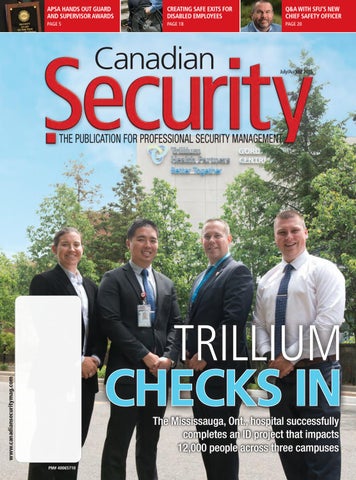
TRILLIUM CHECKS IN The Mississauga, Ont., hospital successfully completes an ID project that impacts 12,000 people across three campuses
PM# 40065710
CS July_August 2016 issue.indd 1
2016-07-20 11:27 AM
Your best response to risk •
Security Guards
At Commissionaires, security is more than guarding.
•
Mobile Patrol
•
Non-core Police Services
•
Process Serving
•
Parking and Bylaw Enforcement
From risk assessment to non-core policing, Commissionaires offers a comprehensive range of security services. We are 20,000 strong with a high proportion of ex-military and RCMP in our ranks. The competition can’t match our training, discipline, sense of duty and front-line experience.
CS_Commissionaires_JulyAug.indd CS July_August 2016 issue.indd 2 1 Ad: Security - Your Best Resp
WhEN SEcurit y iS a Priorit y ca ll c o M M i S S i o N a i r E S | 877 322 6777 commissionaires.ca/cdnsecurity
Publication: Canadian Security
2016-07-14 2016-07-20 1:40 11:27 PM AM
CONTENTS 3
Canadian THE PUBLICATION FOR PROFESSIONAL SECURITY MANAGEMENT
Columns
Volume 38 Number 4
Badges of honour
8 PARTNERS AGAINST CRIME New frontiers on cyber-crime
Post-amalgamation, Trillium Health Partners discovers a new unity through a comprehensive access control project
10 MUNICIPAL MATTERS Bridging security gaps
By Neil Sutton
12 RISK PERSPECTIVE Fighting complacency
14 Cover image: Gregory Brandsma
Departments 4 EDITOR’S NOTEBOOK Safety first
Safer exits How to create emergency management plans that offer solutions for disabled workers
5 TRENDING 11 ASIS UPDATE Canada Night comes to Florida
By Linda Johnson
20 Q&A Mark LaLonde, Simon Fraser University
18
21 BOOK REVIEW Check your privacy settings 22 PRODUCT FOCUS Locks and door hardware
Image courtesy March of Dimes
visit www.CanadianSecuritymag.com Security leaders will be dropping by our studio in 2016, so be sure to check out the video section of our website for new content.
SECURITY PAGES
Canada’s Only Security Industry Buyers Guide
Go Shopping at
SecurityPages.ca
canada’s Only Security industry Buyers guide
Security
Pages 2016
Brought to you by
Canadian The publicaTion for professional
securiTy managemenT
www.SecuritypageS .ca Security_pages 2016.indd
1 2015-11-16 10:31 AM
@SecurityEd • July/August 2016
1:40 PM
CS July_August 2016 issue.indd 3
2016-07-20 11:27 AM
Canadian
4 EDITOR’S NOTEBOOK By Neil Sutton
SAFETY FIRST
Tracking the evolution of security through job titles
W
hen I first heard that Mark LaLonde had accepted a position at Simon Fraser University in B.C., I was instantly curious. I’ve known Mark throughout other roles in his professional career, mostly on the risk and investigations side, so I wanted to learn more about his transition to higher education. What instantly struck me was his title: Chief Safety Officer. I think a title like safety officer provokes some broader questions about senior security professionals: how they view themselves, and perhaps more importantly, how their organizations, and their constituents, view them. “As security departments To the general public, the term “safety” might conjure images of orange vests, harnesses become more visible, for working at heights, traffic cones and “Slippery When Wet” signs. In many cases, we’re likely to see those are all fair depictions. But taken in the them take on more much broader context of professional security, we’re also talking about safety in all its forms: responsibility.” creating an environment where students can walk across a campus at night, where they are able to peaceably demonstrate or show their support for a cause — even accessing a campus’s network without being overly concerned about infecting their laptops with malware. In all of these cases, students need to be aware of the potential for danger and conduct themselves accordingly. Security (or safety) departments can help facilitate that understanding and provide a level reassurance. “How do we better message safety for young persons coming on to the campus?” said LaLonde during our interview (see p. 20). “For many of them, this is there first time away from home. They’re encountering a different lifestyle.” The term “risk” is going through a similar process of redefinition. Perhaps more closely associated with a roll of the dice or uncertain financial transactions, within the context of security, it has come to symbolize the opposite — taking chance, at least partially, out of the equation. If safety suggests peace of mind, then risk (or risk mitigation) connotes preparation. As security departments become more visible in the enterprise, they’re likely to take on more responsibility. And as these roles encompass more and more duties, they’re also likely to be known by different names. Ultimately, does it matter if a department refers to itself as safety, risk or security? I think that’s still quite debatable and very much depends on the situation. In some cases, all three might co-exist within the same organization and would surely experience some overlap. I don’t foresee a day when this magazine will change its name to Canadian Risk Management, but under the auspices of its original title, we’ve certainly seen some significant change to what it means to be a security professional. Using new words and creating new definitions to describe a security role is surely a reflection of how far we’ve come.
THE PUBLICATION FOR PROFESSIONAL SECURITY MANAGEMENT
Group Publisher Paul Grossinger pgrossinger@annexweb.com
Sales Manager Vince Naccarato vnaccarato@annexweb.com
Publisher Peter Young pyoung@annexweb.com
Art Director Graham Jeffrey gjeffrey@annexweb.com
Editor Neil Sutton nsutton@annexweb.com
Account Coordinator Trish Ramsay tramsay@annexweb.com
Online Editor Cindy Macdonald cmacdonald@annexweb.com
Director of Soul/COO Sue Fredericks
Editorial and Sales Office 222 Edward Street, Aurora, Ontario L4G 1W6 (905) 727-0077 • Fax (905) 727-0017 Web Site: www.canadiansecuritymag.com Canadian Security is the key publication for professional security management in Canada, providing balanced editorial on issues relevant to end users across all industry sectors. Editorial content may, at times, be viewed as controversial but at all times serves to inform and educate readers on topics relevant to their individual and collective growth and interests. Canadian Security is published six times per year by Annex Business Media. Publication Mail Agreement #40065710 Printed in Canada I.S.S.N. 0709-3403 Subscription Rates Canada: 1 Year $40.95 + HST; U.S.A. (payable in US dollars): 1 Year $70.00; International (payable in US dollars): 1 Year $80.00 Circulation Tel: (416) 510-5189 Fax: (416) 510-5170 asingh@annexbizmedia.com 80 Valleybrook Drive, Toronto, ON M3B 2S9 The contents of Canadian Security are copyright by ©2016 Annex Publishing & Printing Inc. and may not be reproduced in whole or part without written consent. Annex Business Media disclaims any warranty as to the accuracy, completeness or currency of the contents of this publication and disclaims all liability in respect of the results of any action taken or not taken in reliance upon information in this publication.
Editorial Advisory Board Jason Caissie Profile Group
Tracy Ann Kosa Microsoft
Carol Osler TD Bank
Ken Close Trillium Health Partners
Bill McQuade Final Image
Theresa Rowsell Kit and Ace
Ashley Cooper Paladin Security
Clark Northcott Hikvision
Tim Saunders G4S
David Hyde Hyde & Assoc.
Malcolm Smeaton Whitehorse Group
@SecurityEd July/August 2016 • www.canadiansecuritymag.com
CS July_August 2016 issue.indd 4
2016-07-20 11:27 AM
com
m
m
TRENDING 5 CALENDAR ASIS International Canada Night September 11, 2016 Orlando, Fla. www.asisonline.org ASIS International Seminar & Exhibits September 12-15, 2016 Orlando, Fla. www.asisonline.org Global Identity Summit September 19-22, 2016 Tampa, Fla. www.globalidentitysummit.org Retail Council of Canada’s Loss Prevention Conference September 29, 2016 International Centre, Mississauga, Ont. www.rcclpconference.ca Security Canada Atlantic September 21, 2016 Moncton, N.B. www.securitycanadaexpo.com Focus On Government Security October 6, 2016 Ottawa, Ont. www.focusonseries.ca SecTor October 17-19, 2016 Toronto, Ont. www.sector.ca Securing New Ground October 19-20, 2016 New York, N.Y. www.securingnewground.com Security Canada Central October 19–20, 2016 Toronto, Ont. www.securitycanadaexpo.com APCO Canada Conference and Tradeshow November 7-10, 2016 Banff, Alta. www.apcocanadaconference.com ISC East November 16-17, 2016 New York, N.Y. www.isceast.com Focus On Health Care Security December 7, 2016 Richmond Hill, Ont. www.focusonseries.ca
APSA acknowledges security guard and supervisor of the year was to promote his partner to corporal. The Association of Professional Security “He did a remarkable job. I can’t say Agencies (APSA) has recognized two enough about him. He’s steadfast.” frontline security professionals for McAlpine credits his training and excelling in their careers, sometimes under background for the way he handled difficult circumstances. the situation. McAlpine was formerly a The awards, Security Guard of the 911 dispatcher and also has a history of Year and Security Guard Supervisor of the military service. Year, were presented Others in his family in Toronto on June have also served 8 at a gathering in the military and attended by APSA’s policing. His brother, board of directors. a police officer, Rodney attended the award McAlpine of presentation. “I guess Commissionaires it’s instincts that Great Lakes was I picked up from the recipient of them. You stand up Security Guard of for your team mates, the Year award this Rodney McAlpine (left), Security Guard of the Year and you stand up for the year for his coolness Gord Coombes, Security Guard Supervisor of the Year little guy,” he says. under pressure and The Supervisor of the Year award presence of mind. was presented to Gord Coombes, site McAlpine was on site at the Toronto supervisor for Lambton College in Sarnia, correctional facility where he is employed Ont., and an employee of Lyndon Security when a stabbing incident occurred Services, based on Hamilton, Ont. between two men on site. McAlpine Coombes, who has worked at was the first on the scene. He was able Lambton since 2003 and has been to stabilize the situation and asked a supervisor since 2005, describes the college fellow security staff member to contact as an ideal place to work. “I would never emergency services for police and want to go anywhere else,” he says. ambulance response. Coombes says he enjoys meeting and “Once we had control of that scene, interacting with students and the day-toI had control of the building and the day rewards and challenges of looking area. My partner had called 911,” says after security on campus. McAlpine. “It seemed like an eternity, but He says he wasn’t prepared for all the it was four minutes. They came on scene, attention the award generated. “I just do they came directly to where I was and I my job to the best of my abilities. I was immediately handed over the scene.” very surprised to receive this,” he says. Police arrested the suspect without Coombes was initially told of the further incident and the victim was award while at work at the college. taken to hospital with serious multiple A roomful of 30 people were there to stab wounds. At the time of the award congratulate him, including Ernie Heines, presentation, McAlpine said that the president and general manager of Lyndon suspect was in custody at another Security. correctional facility and was still Coombes is the second recipient of the awaiting trial. APSA Supervisor of the Year award, which Following the incident, McAlpine has was introduced by APSA last year. since been promoted to chief ward officer and site supervisor. His says his first act — Neil Sutton @SecurityEd • July/August 2016
CS July_August 2016 issue.indd 5
2016-07-20 11:27 AM
PALADIN RECOGNIZES ITS EXTRAORDINARY PEOPLE LEO HUTCHINGS | Security Officer, St John’s NFLD
Extraordinary Moment
I
n January of 2016, Paladin Security Officer Leo was on his way home from a late shift driving through Butter Pot Provincial Park in Newfoundland; it was snowing and the road conditions were slushy. A fast moving car passed Leo and started to hydroplane, careened into the median, rolling at least four times and landing on it’s roof. Leo pulled over and ran toward the twisted, smoking vehicle. He began frantically heaving snow off the car, and worried about the possibility of fire. Seeing two male passengers trapped inside, Leo smashed the window while one passenger managed to haul himself out and Leo instructed him to get to his car back on the road. The second passenger had injured his leg and needed more support, Leo pulled the injured male through the window. Once the passenger was safely out of the smoking vehicle, Leo inspected the leg while the uninjured passenger called the RCMP.
Paladin Security’s commitment to the communities in which we operate is unmatched. We support our clients by integrating state-of-the-art technologies with our highly trained and passionate officers. As our company continues to grow across Canada, it is our people, like Leo who make the Paladin difference. Read More: paladinsecurity.com/extraordinary
What Leo’s Co-Workers Said “Branch Manager, Cy Thompson said, “Leo’s heroic efforts exemplifies the corporate culture we instill at Paladin. We call this the Paladin Difference and Leo is just that!” Client Service Manager Annette Osborne added, “We are very lucky to have Leo as part of our team. His personal pride in the workplace is obvious, and never taken for granted!”
The passengers were brothers and their frantic mother soon arrived to meet her sons. Leo returned to work early the next morning with a proud smile on his face. He spoke of the incident sharing modestly, “My children think I am a hero, but it’s really no big deal, it was just my instinct. As soon as I witnessed the accident, I ran to help - it didn’t sink in until the next day when I was back at work. My Paladin team is a family and they motivate me every day. Through that, I’ve learned to protect one another and provide people with support when they are in need.”
In photo (left to right): Client Service Manager Annette Osbourne, Security Officer Leo Hutchings & Branch Manager Cy Thompson.
Extraordinary People, Extraordinary Service. Since 1976. • SECURITY OFFICERS • MOBILE PATROLS & EMERGENCY RESPONSE • OPERATIONS CENTRES
CS July_August 2016 issue.indd 6 CS_Paladin_JulyAug.indd 1
• ALARM, FIRE & VIDEO MONITORING • ACCESS CONTROL SYSTEMS
• INVESTIGATIONS • SECURITY AUDITS & CONSULTATIONS • MANAGED SERVICES
• EMERGENCY MANAGEMENT & BUSINESS CONTINUITY PLANNING • CAMERAS & VIDEO MANAGEMENT SYSTEMS
2016-07-20 11:27 AM
“
Extraordinary happens everyday.
ch
s ke
all ice ave e
“Leo’s heroic efforts exemplify the corporate culture we instill at Paladin...” LEO HUTCHINGS
Security Officer, Paladin Security NFLD
EXTRAORDINARY MOMENT Rescued 2 brothers from a rollover car accident.
o
#extraordinary
S
CS July_August 2016 issue.indd 7
2016-07-20 2016-07-13 11:27 9:14 AM
8 PARTNERS AGAINST CRIME
By Kenrick Bagnall
NEW FRONTIERS ON CYBER-CRIME
B How law enforcement and the private sector can work together to make the Internet safer
ecause of the Internet, we have all and subsequently assigned to an investigator. changed the way we do business and Once that investigator determines that there law enforcement is no exception. is a cyber component to the investigation then Traditional law enforcement has always C3 is contacted and an internal “Intake” or been focused on keeping the peace and request for services is created. This Intake is enforcing the laws. This involves investigating then assigned to a C3 investigator. In 2015, criminal offences, gathering a body of C3 was involved in investigating 1,387 cases evidence and working with the Crown (Intakes) ranging from the non-criminal all Attorney’s office to put the the way up to the most best possible case before serious of offences. the courts. As law enforcement, we “By engaging law The investigation and face many challenges when prosecution of Internet enforcement early in the investigating crime. In the related offences, also real world, critical evidence known as cybercrime, is can be highly sensitive process, we can achieve of national, provincial and and volatile, requiring a great success.” municipal importance. timely response and delicate Today, many criminal handling. In the world of offences are moving cyber investigations, these online and leaving some elements become highly form of digital and or cyber related footprint magnified. If an individual or a business behind them. Even street-level crime, where becomes a victim of a cybercrime, the keys historically there may not have been a cyberare to freeze (discontinue use) the computer related component, is now becoming more systems and report the breach or data loss complex to investigate. to law enforcement as quickly as possible This is where the Toronto Police Service’s — early engagement yields the best possible Computer Cyber Crime Unit, aka C3, comes results. in. Formally established in May of 2014, We understand that there are many C3 falls under the Toronto Police Service’s factors to consider when it comes to reporting Detective Services command and is part of cybercrime, some of which may cause Intelligence Services. C3 is an investigative hesitation. For an individual, it could be pride support unit providing online investigative or scrutiny. For a corporation it could be support to all members of the Toronto Police concerns over public perception, reputation Service by using innovative technology while or even stock price and share valuation. As a being guided by Service Governance and law enforcement community we understand Federal, Provincial and Municipal Law. these things and are sensitive to them. That It is important to also note that C3 said, it is also our job to keep the peace and provides investigative assistance enforce the laws. If an act of parliament has in non-criminal matters where been breached by way of a criminal offence, there are exigent circumstances. it is our sworn duty to investigate and gather C3 has been successful in locating the best evidence with the goal of putting the vulnerable missing persons and also strongest case before the courts. persons in distress who are uttering You are our key partners in this complex credible threats of suicide. process. By engaging law enforcement early Since C3 is an internal support in the process we can achieve great success in unit, engaging its services is done prosecuting and convicting cyber criminals. when an emergency (911) or nonemergency (416-808-2222) call Kenrick Bagnall is a Detective Constable with the is placed to the Toronto Police Service and Toronto Police Service Computer Cybercrime Unit (C3) a report is taken by the responding officer @KenrickBagnall.
July/August 2016 • www.canadiansecuritymag.com
CS July_August 2016 issue.indd 8
2016-07-20 11:27 AM
CS_Ca
CANASA Presents
CANADA’S LARGEST SECURITY SHOWS
Security Canada
Security Canada
Moncton, New Brunswick September 21, 2016
Toronto, Ontario October 19 – 20, 2016
Atlantic
Central
Visit securitycanadaexpo.com and register for free. CS CS_Canasa_JulyAug.indd July_August 2016 issue.indd 1 9
2016-07-20 2016-07-0711:27 3:32AM PM
10 MUNICIPAL MATTERS By Mel Gedruj
BRIDGING SECURITY GAPS
S A thorough examination is required to determine if coverage is complete
ecurity needs cannot be derived just privacy legislation issues, there are public by going through an overview of the expectation issues. If a sign says “This site potential risks. is monitored” or contains any other text to This is a dynamic process: we examine that effect, it had better be. If an incident the details of each type of site we own and were to occur, the sign would infer that it circle back up to ascertain whether we has been captured in some way and may have a standard risk situation affecting that lead to the belief that it could be reviewed or particular type of property and activity. used as evidence. We carry out our The next layer is the individual site assessments building perimeter itself. (or site security reviews), This may include reviewing “If a sign says, ‘This which cover both physical whether the building site is monitored,’ it security and management. envelope is reinforced or We start from the outer not. When dealing with had better be.” perimeter and move existing sites, we should through each layer, stick to what we see. Our assessing them based on solutions to achieve a the “security” they provide at the present higher level of security have to gauge the time only. It is a sort of reverse engineering. cost of various options leading to an optimal We should not at this stage assume any outcome. As an example, if the building outcome but just read what is given. For perimeter would be too costly to reinforce, example, it is often the case perimeter fences then consideration should be given to the site in municipal properties are just that — perimeter and assess if a strong fence with a property delineating lines with very light controlled gate is not a better solution. gauge mesh. Compare that to fences around Other systems of interest would be jails and other high security areas and the VSS (Video Surveillance System) and DAC difference is quite clear. Here too we can (Digital Access Control) for both site and avoid personal or general opinions and rely building perimeters. Also to be reviewed are on standards. ASTM F2656-07 is a test the critical assets within a site. Although it method standard that defines the strength may not be in itself critical, it may contain of the fence based on its ability to sustain a areas deemed so. truck ramming into it. The standard covers The security management portion vehicles up to heavy duty truck. This is would look into any security monitoring, truly relevant when we deal with critical centralized or otherwise, including infrastructure such as water plants. uniformed security on site, hours of Other exterior issues to review and coverage, mobile patrol and any security assess are lighting and signage. procedures or policies. For lighting there is a security The site security review will result in guideline published by the a current SSL (site security level). Our Illuminating Engineering Society planning process would take the desired SSL of North America. It was released and compare it to the current one, giving us in 2010 and can assist us in our the gaps we need to bridge. Then remember review of illumination levels based conceptual models touched on in earlier on various locations within columns: MC (Mission Criticality) and SSA a given site. In terms of (Site Situational Awareness). They will be signage, care should be taken the tools to determine the speed of the new to assess warning signs as security countermeasures deployment. they may have been written in a manner that is loaded Mel Gedruj, OAA, CSPM is the president of V2PM Inc., with liability. Aside from specialized in municipal security management planning.
July/August 2016 • www.canadiansecuritymag.com
CS July_August 2016 issue.indd 10
2016-07-20 11:27 AM
By Bill Bradshaw
ASIS UPDATE 11
Canada Night comes to Florida
I
who has distinguished themselves f you attend the ASIS International by contributing to the growth and Annual conference, you know the professionalism of the security industry. best way to kick-off the conference is The security practitioners who initiated to attend one of the most sought-after the award looked not only at the conference events, Canada Night. contributions that individuals What began 24 years ago as made to the Canadian Security a small group gathering in a Industry and contributions to local pub, now attracts close ASIS International in Canada to 1,000 attendees each year. but also to ASIS International This not-to-be-missed, informal globally. Nominations for mixer is where fellow Canadians the award are prepared and and ASIS friends from abroad submitted from the 11 ASIS can meet, mingle and network, chapters in Canada. as well as recognize Canadian Bill Bradshaw, ASIS ASIS Canada Night is a members who contribute to Canada prelude to the ASIS International the growth and professionalism 62nd Annual Conference will be held of the security industry, through the on Sunday, September 11, 2016, at presentation of the Ron Minion Award. Lafayette’s Restaurant & Bar, Orlando, The Ron Minion – Canadian Fla. Starting at 6:00 p.m., guests can Security Industry Pioneer award is drop-in and enjoy: a complimentary presented to a security professional
buffet of American pub food; the presentation of the Ron Minion Pioneer Award; door prizes and draws; a photo kiosk, and a live band. The event is hosted by the ASIS Canada Night committee and the Group 6 (Canada) Volunteer Leadership team. With the help of Canada Night, ASIS Canada, Group 6 is able to build resources to serve the growing interests of Canadian security professionals and practitioners across Canada. This lively and not-for-profit social event is made possible solely through the generous contributions of our sponsors. For a full listing of all supporting sponsors, and event information, please visit www.asiscanada.ca. W.G. (Bill) Bradshaw, CPP, is the Senior Regional Vice President, Group 6 (Canada).
The Future of Security Services Creating Alternatives to Traditional Guarding At Securitas Canada, we are always looking for innovative ways to provide the best security solution for both your business and budget. With cutting-edge technology and real-time reporting, we enhance the effectiveness of security guards to deliver a security program that offers 24/7 coverage without on-site guard presence. Integrated Guarding combines On-site, Remote, and Mobile Guarding to create unprecedented efficiency to guard your business. Complete coverage that uses less resources – this is the future of security. Securitas Canada Call 1 (800) 268-0545 Visit www.securitas.ca
@SecurityEd • July/August 2016 CS_Securitas_JulyAug.indd 1
CS July_August 2016 issue.indd 11
2016-07-15 1:36 PM
2016-07-20 11:27 AM
12 RISK PERSPECTIVE By Tim McCreight
FIGHTING COMPLACENCY
I Young security professionals can teach us a lot about enthusiasm for the field
gave a presentation to a number of were truly engaged in conversations about graduate students at a recent conference, risk mitigation, crisis management, digital and was struck by how energetic and forensics, industrial control system security, engaging the students were. and anti-phishing technologies. It was They are just beginning their career in the refreshing to listen to these students present security and risk management field, and were their dissertations, carefully explaining the looking for opportunities to grow and expand hypothesis they were attempting to either their knowledge. They also wanted to apply credit or disprove. The conference was very what they had learned in academic in its focus, the classroom and gain real but you could sense the life experience. commitment from these “We become I wanted to tell them students in their work, and they had a clear path their plans for their own accustomed to looking ahead, and that finding careers. a fulfilling role would be We could all learn from at risk issues through a straightforward and simple. these conferences, and the particular lens.” But I knew that wasn’t true enthusiasm these young — most security and risk security professionals professionals I know have displayed during their taken a very interesting sessions. I was gently journey to become the person they are, not reminded not to take assessments for granted, knowing where their careers would eventually and to reset my “risk compass” a bit by lead them. reviewing my own perceptions of threats and If we (as a profession) want to continually risks, and how my viewpoints may have faded grow our body of knowledge, and learn over time. I felt that I had let myself down about new and exciting research from the over the past decade, relying on experience risk management field, we need to steer these and personal perspectives instead of looking recent graduates into mentorship programs at empirical evidence. It prompted me to load or work placements within the security field. up my personal iPad with some books I have This is the only way I feel we can mitigate been meaning to read, but never got around one of the most underrated risks facing us to it. These are industry journals and reference today — complacency. materials I now am taking the time to read We see it every day, in the assignments while I travel, to sharpen some of the edges we perform, the meetings we hold with and become a bit more precise in my work. our clients, and the reports we issue to our The world of risk changes so dramatically, management. We become accustomed to we need to continually review our own looking at risk issues through a particular perceptions of threats and risks, and reset our lens. We begin to see threats as personal “risk compass” frequently. Over the “more of the same,” instead of past decade, we’ve become numb to online spending personal time researching events like data breaches and the theft of how impactful a realized threat credit cards. But we need to keep learning could be. I’m not saying all security from these and other incidents to continually professionals are this way — not at focus on the threats, how they were realized, all. What I am pointing out is that and what controls we can look at in our our schedules, commitments, personal own environment to reduce our exposure to lives, and (occasionally) volunteer the threat. The adage, “It’s never too late to work takes time away from research start” truly applies to our world of risk. and review. What I felt at this recent conference Tim McCreight is director, advisory services at Above was different and inspiring. These students Security (www.abovesecurity.com).
July/August 2016 • www.canadiansecuritymag.com
AA_008 CS July_August 2016 issue.indd 12
2016-07-20 11:27 AM
CS_An
Build Electronic Access Control Solutions ASSA ABLOY and ANIXTER Provide COMPLETE Security Solutions
ENTRY CONTROL Electronic Access Control Systems, Panels, Controllers, Software
Credentials, Readers, Keypads
ACCESSORIES Switches, Brackets, Remote Switches
PATH
EXIT
Low Voltage Wire & Cable, Network Cable & Patch Cables, Wire Transfer Hinges, Door Loops
Touch Bars, Electrified Panic Devices, Request to Exit Sensors, Electrification Kits
POWER
LOCK
Plug in Transformers, Boxed & Regulated Power Suppliers, Back Up Batteries
Mag Locks, Strikes, Electrified Locks
Experience the Future of Security Distribution. Call Toll-FREE:
1-800-268-2357 www.anixter.ca
AA_008_8x10_3/7_Ad_ENG.indd 1 CS CS_Anixter_JulyAug.indd July_August 2016 issue.indd 1 13
2016-06-08 2:33 PM 2016-07-20 2016-07-12 11:27 11:21AM AM
14 HEALTH-CARE SECURITY
Better together Image: Gregory Brandsma
An access control project for Trillium Health Partners’ 12,000 staff and volunteers helps the organization achieve new levels of co-operation Ken Close, Peter Wong, Ryan LeClair and Jennifer Gilroy helped make Trillium’s ambitious re-badging process a success.
By Neil Sutton
F
ive years ago, Trillium Health Partners amalgamated three health-care sites under a single organization and subsequently adopted a new slogan: “Better Together.” Now, thanks to a comprehensive identity management and access control project, Trillium staff feel confident in saying they embody that motto. Mississauga, Ont.-based Trillium amalgamated in December 2011, following a popular trend in Canadian health-care by bringing several different sites in line with a common management, resource and organizational structure. The three hospital group includes Credit Valley Hospital, Mississauga Hospital and
the outset, informing employees of Queensway Health Centre (the latter the upcoming change, who were also two first amalgamated in 1998). asked to participate in the badge’s Providing new ID badges to design. Staff were sent a survey the organization’s 12,000 staff and through the organization’s intranet volunteers was earmarked as a project and asked to express that would be part a preference for one of the amalgamation of three different process. “Throughout “It brought security a badge templates. the years, there The response rate had been many lot tighter and closer to was huge. More discussions around than 10,000 people the ID and merging other groups.” voted for their choice it together,” says — Ken Close, Trillium and the winning Ken Close, Trillium’s Health Partners design included manager of security another hospital and parking services. credo: “Compassion, The project began Excellence and Courage.” in earnest in January and very quickly The design ultimately yielded six picked up speed. colour-coded templates: employee, Close says Trillium’s public employee for mother/baby unit, affairs team was deeply involved at
July/August 2016 • www.canadiansecuritymag.com
CS July_August 2016 issue.indd 14
2016-07-20 11:27 AM
Image: Gregory Brandsma
physician, contractor, medical student and volunteer. Next was the process of photographing 12,000 people. The security team chose the Queensway site to go first. It’s the smallest of the three hospitals and posed the fewest challenges in terms of scheduling or congestion issues. From there, the team could tweak its photo sessions for the two larger sites. About 800 staff and a few volunteers attended a photo station, which comprised of a camera, lighting and a laptop to enrol them into the new access control system. As an organization, Trillium selected a Genetec product for its access control platform (Genetec was also used as the main platform for Trillium’s camera surveillance system). The Credit Valley site was already using Genetec, but the other two hospitals were using older systems, necessitating an upgrade. As each group of employees took their pictures, Close’s team, along with the hospital’s human resources department, would keep senior leaders apprised of the progress. (As a show of support, the hospital’s CEO and chief of staff were amongst the first to be photographed.) The department created an easy-to-read bar chart graphic, indicating how many pictures had been taken and how many were left to go. For eight weeks, photos were taken. Once almost everybody was accounted for, actual badge creation was next. When that turning point was reached, “we did absolutely no photos at that time for the new ID badge,” says Close. “The reasoning behind that was to actually focus on the creation.” For a month, Trillium created badges using materials supplied by credential specialist Groove Identification. The printing was largely done on site, aided by some additional loaner printers from Groove. To keep the process moving along, badge creation didn’t stop. Trillium’s physical security coordinator Peter Wong stayed in touch with Groove’s CEO Carmen Ritter, even meeting up with him on a weekend to replenish supplies. Next came the most challenging
Image: Lauren Bauer
HEALTH-CARE SECURITY 15
Trillium staff all visited photo stations in order to capture their images for their new IDs.
stage of the process: filing followed by distribution. Some employees still had to maintain their old badges in order to access sites that were still using older access control systems, yet everyone needed to collect their new badge. The new badges are also integrated with the new parking pass system, powered by Keyscan technology. “The filing was really tricky,” says Close. “You basically had an ID badge with a piece of paper attached to it. The reason we had that piece of paper is that it was everyone’s request form and they had to sign off that they picked up their badge.” Badge pick-up was perhaps the most taxing of all, says Close. “Our first day was very challenging at the Mississauga site,” he says. “The issue was, we had so many badges and we had people coming up to the tables where they were organized and just scattered them everywhere. Eventually we got more control of it and put things in a better order. From there, we were able to move forward.” Close says badge distribution at Queensway and Credit Valley went more smoothly as a result.
Lessons learned Close characterizes the project as a re-education, not only for security but for several departments. Much of the communication about dates, times, locations, etc., could be transmitted
via email or Intranet postings, as could progress reports, but in many cases, Close and his team had to be hands-on. The hospital’s volunteers, for example, were harder to reach, since most of them were not connected to the Intranet and some were on one of the three sites infrequently. Remote, or ad hoc, camera stations had to be set up to capture images of occasional workers, including the courtesy physicians — doctors who are adjunct to the hospital, but not part of its regular staff. In some cases, special requests were made for badges to be reprinted for nicknames instead of given names (Jack instead of John, or Jackie instead of Jacqueline) and these requests were taken into consideration, especially for volunteers. “Security was very accommodating in that they did go back to some of the sites after they’d done their initial photos and caught some volunteers who may have been away on holiday,” says Deb Folkes, director of volunteer services. “It was a very well run process. We had absolutely no complaints.” Close also participated in “huddles” — regular, brief meetings with groups like physicians across Trillium to keep them in the loop as the rebadging process unfolded. “It brought security a lot tighter and closer to other groups,” says Close. “Now we have a better idea of how people are using their ID badges out there…. Even if it’s not a security-related function, they’re using something we @SecurityEd • July/August 2016
CS July_August 2016 issue.indd 15
2016-07-20 11:27 AM
Joi Or
16 HEALTH-CARE SECURITY oversee to support their operations.” The process was also an education for people like Peter Wong, physical security coordinator, who was exposed to a large variety of hospital IT systems, both security and non-security related. “We all knew the access control system had to be changed, the readers had to be swapped out and, to save time, the badges had to been created and done properly,” explains Wong. “However, to ensure the ID badges worked with the systems, we had to plan and really understand how the equipment works and swap out the card readers without affecting operations [like] the mother-baby unit, the operating room, the ER, and diagnostic imaging. One of the biggest things I got out of this project was really understanding how all of these systems work.”
Ongoing operations Close is the first to admit that managing new IDs for 12,000 people can
staff came on site or were lost due to potentially be hugely disruptive, but turnover. he was also insistent that the process “It was like juggling an extra site,” would not have a significant impact says Gilroy. on day-to-day security operations at The rebadging Trillium. He relied on process created a new his internal staff, as “We really do embody kind of unity at Trillium, well as the contracted says Close, and a certain security provider, Paladin the philosophy of one amount of pride in Security, to ensure that everyone wearing a was the case. Trillium.” common identifier. “From an — Jennifer Gilroy, “I think the best operational perspective Paladin Security part about the security — even though this program at Trillium project was quite a big Health Partners is that task — we still had our we really do embody the philosophy of direct team to manage on a daily basis,” one Trillium,” adds Gilroy. says Ryan LeClair, a dispatch supervisor It also resulted in the security at Paladin. department being more omnipresent “Ken was crystal clear that this and in some ways, better understood. project would succeed,” adds Jennifer “With this badge process, we were Gilroy, operations supervisor, Paladin. able to represent that to the rest of the Extra Paladin staff were brought in to departments. [They learned] they can manage the tougher days during the rely on security for more than they project’s rollout and security training thought,” she says. had to be kept optimal as new Paladin
annu
Inter
show
Cor
G4S’ in th expe com
Secu
G4S techn regar
WHY YOU SHOULD ATTEND: • Expert perspectives on the terror landscape in Canada • Advice on keeping privacy in focus in a Big Data world • CPTED in Government – promoting safety in public spaces
FOCUSON
Government Register online at focusonseries.ca Brought to you by
October 6, 2016 The Westin Ottawa Ottawa, Ont.
July/August 2016 • www.canadiansecuritymag.com
Securi
CS July_August 2016 issue.indd 16
2016-07-20 11:27 AM
CS_G4S
Join us at ASIS Canada Night! Sunday September 11th in Orlando. G4S Canada is a Gold Sponsor at this year’s ASIS Canada Night. ASIS Canada Night is an annual societal event hosted by Canadian security professionals that is open to all ASIS Canada and International ASIS members attending the annual ASIS International security conference & trade show. Come meet, mingle and celebrate Canadian member contributions to the security industry!
Corporate Risk Services
Secure Integration
AMAG Technology
Security Personnel
Corporate Risk Services
AMAG Technology
G4S’s team of security consultants is unparalleled in the industry and consists of recognized experts with functional expertise across multiple competencies.
AMAG Technology, a G4S company, manufactures and deploys the Symmetry™product line, one of the leading global brands of access control and video management in the world.
Secure Integration
Security Personnel
G4S envisions, designs, builds and maintains security technology systems to meet all our clients’ needs, regardless of size, complexity or location.
G4S provides specialized security personnel, management and software to accelerate safety and security programs to new levels of performance.
Find us at booth #3151 at ASIS Orlando from September 12th-15th!
1-888-717-4447 solutions@ca.g4s.com www.g4s.ca Securing Your World
CS July_August 2016 issue.indd 17 CS_G4S_JulyAug.indd 1
2016-07-20 2016-07-13 11:27 10:44 AM AM
18 EMERGENCY MANAGEMENT
Another
wayout Image courtesy March of Dimes
By having specific emergency plans for disabled workers, an organization can help to ensure all workers come through an emergency situation safely. The first step to inclusive disability planning is to identify employees whose disability might put them at greater risk during an emergency, according to guidelines issued by uring any emergency or disaster, people with Ontario’s Ministry for Community and Social Services. The disabilities are particularly vulnerable to harm. next step is to devise a plan outlining the procedures and any The hearing or visually impaired employee may equipment needed, such as an evacuation remain unaware of warning chair, to be used during the evacuation. The signals. Without access to the employees should receive all the training and elevator, the worker who uses a wheelchair “Emergency information they need to execute the plan. loses the ability to evacuate promptly. management is no During this process, the guidelines note, These workers have in the past often it’s important to protect employees’ privacy. been overlooked in emergency planning. But longer one-size-fits-all. Generally, only the employer, employee and today, more organizations are realizing the assisting employee should be aware of a importance of addressing the special needs Different communities, person’s individualized emergency response of disabled employees in their preparedness information. Protecting the worker’s programs. different people, need confidentiality is particularly important “Emergency management is no longer a different response, when a person has a mental disability. one-size-fits-all. Different communities, The areas of disability planning different people, need a different response, communication and that most need to be addressed are communication and tools,” says Amanda communication and access, says Andria Barros, emergency planner with the Alberta tools.” Spindel, president and CEO of the March of Emergency Management Agency (AEMA), — Amanda Barros, Alberta Dimes in Toronto. who teaches a course on including persons Emergency Management Agency The response plan must be communicated with disabilities in emergency plans. to the employees in ways they comprehend, Barros says the course, which is designed she says. Thus, for a visually impaired person, for municipal staff, directors of emergency emergency supplies and warning signs social services and fire chiefs, is focused on could be provided in Braille or, for information distributed raising awareness. electronically, in enlarged text. For hearing impaired employees, “The estimate is 15 per cent of Albertans have some kind visual aids could be used to ensure they know the fire alarm has of additional need that would affect their ability to evacuate gone off and to indicate the evacuation route. and respond to a disaster or emergency. Our course is focused The plan should be devised in consultation with the on getting people to start the conversation,” she says.
By Linda Johnson
D
July/August 2016 • www.canadiansecuritymag.com
CS July_August 2016 issue.indd 18
2016-07-20 11:27 AM
Image courtesy March of Dimes
EMERGENCY MANAGEMENT 19 employee, she adds, to ensure it meets their needs. “You need to talk to the person up front: ‘If there’s an emergency, we go on the intercom. We call out. Does that work for you?’” she says, adding you should also determine if there is anything the person needs to take with them. “The person may have medication to take or battery charger for their wheelchair.” Moreover, Spindel says, the organization must be able to carry out the plan, which means all egress routes need to be accessible. On the ground floor, for example, exit doors should lead to ramps. If a ramp cannot be added to an exit, that door should be excluded from emergency plans. Employees who work on upper floors and use heavy electric wheelchairs usually rely on elevators to get to the ground floor. However, elevators often stop working in an emergency. Choosing the best plan for employees who can’t use the stairs during an evacuation should be based on planning, testing and discussion, says Denise MacDonald-Billard, director of income assistance at Nova Scotia’s Department of Community Services in Halifax. One option is for the disabled person to stay put while a non-disabled person meets first responders, gives them the location of the person needing assistance and allows them to move the person out. Alternatively, you could plan for trained personnel to carry the person down stairs.
OH&S committees should test the emergency plan through practice drills several times a year, and in co-operation with emergency response teams, such as the fire department, MacDonald-Billard says. “You would make sure, the minute they’re on the scene, they’re aware of where in the building there are people who might require additional supports,” she says. Barros agrees, saying practising the plan provides important lessons. During the 2013 Calgary floods, for example, some group homes discovered a problem with their evacuation plan. “They found they could not assist their residents to evacuate in wheelchairs while also managing a flashlight. So they threw out all their flashlights and got headlamps,” she says. “It’s about practising and figuring out what works and what doesn’t.” While conducting research for a thesis in 2011, Barros found disability emergency planning was not a well considered or studied area. Today, she says, the situation is changing. “Disability emergency planning is coming more to the forefront — especially among people in Alberta, after the 2013 floods,” she says. “So, at the very least, the conversations are starting.” Linda Johnson is a freelance writer based in Toronto.
CANADA NIGHT 2016
@SecurityEd • July/August 2016 CS_ASIS_JulyAug.indd 1
CS July_August 2016 issue.indd 19
2016-07-07 3:22 PM
2016-07-20 11:27 AM
20
QA &
with Mark LaLonde, Chief Safety Officer, Simon Fraser University
F
ollowing a long and successful stint in risk and investigations (and before that, policing) Mark LaLonde recently took over as Burnaby, B.C.-based Simon Fraser University’s chief safety officer. He is already looking at the benefits of implementing process improvement tools like Six Sigma and ISO standards, and is definitely bringing his riskbased background to campus security. Canadian Security spoke to LaLonde mere weeks into the new position about risk, campus safety and building relationships with staff and students. Canadian Security: What is the portfolio you’re now looking after? Mark LaLonde: The portfolio is massive. I have four business units reporting to me: campus security; emergency planning and business continuity; occupational health, safety and hygiene (which is incredibly complex, given all the research labs we have on site); and the risk and insurance portfolio. So within all of that I’m responsible for enterprise risk management across the entire university. CS: What goals have you identified for yourself? ML: One of my priorities is to focus on
the creation of a campus-wide culture of safety and security. I’m concerned about what don’t we know around concerns of students, faculty and staff. How do we get a handle on that and how do we help them alleviate those concerns or address those concerns? We’re a service division, so the goal is to address safety and security in support of the university’s mission, which is learning, teaching and research. So, how do we facilitate that but at the same time, not get in the way? A great example is, SFU is known worldwide for a number of things, including sciences. We have some incredibly complex research labs that have safety issues and compliance issues. So, how do we work with them to ensure compliance and ensure a safe learning and research facility, but not get in the way of their core mission? CS: Coming from a corporate risk background, how much of that can you apply directly to what you’re doing now? ML: All of it. I’m extremely fortunate in that I’ve worked with a number of universities as a consultant, but I’m also adjunct faculty at two universities. Coming from the private sector, consulting with a number of different
Simon Fraser University’s Burnaby, B.C. campus. SFU has two other locations in Vancouver and Surrey.
entities, I’ve got a broad perspective on risk issues and risk systems that are totally applicable here. I’ve seen the good, the bad and the ugly elsewhere and there’s lots of lessons to pull from that. CS: Are people taking a more risk-based approach to security in post-secondary institutions? ML: It’s moving to that. It’s fascinating looking at how different institutions address the concept of security. We’ve deliberately branded our division as safety and risk services. One of my goals is to better instil that mindset across our group about risk and risk management. It’s not about locking or unlocking doors or responding to a theft complaint, it’s a shift towards identifying, well in advance, what the touch points are, how we enhance safety and security, and better manage risk. CS: Your title, “chief safety officer” isn’t typical of senior security positions. ML: It is unique. Some universities refer to it as the chief risk officer. I’ve thought about that and what it implies. Some people see that as managing risk of finance or insurance. What we’re promoting here is that broader safety culture. Safety first, as a subset of risk. CS: What is your relationship with the student body? How can you help foster that relationship? ML: Well, as a matter of fact, one of my first acts here was to start to reach out to the different student groups across campus to introduce myself, talk more about what my role is and hear what their issues are. For example, I’m meeting with the First Nations student society today. Early next week, I’m meeting with the Out on Campus group, as well as the larger Simon Fraser student union. I’m really, really focused on having strong relationships across the university. Ultimately, the goal is: people feel safe and comfortable so that they’re happy to come here and study.
July/August 2016 • www.canadiansecuritymag.com
CS July_August 2016 issue.indd 20
2016-07-20 11:27 AM
By Derek Knights
BOOK REVIEW 21
CHECK YOUR PRIVACY SETTINGS Your Right to Privacy: Minimize Your Digital Footprint By Jim Bronskill and David McKie Self-Counsel Press ISBN 978-1-77040-263-8
J
im Bronskill and David McKie are both Canadian journalists in the Ottawa area: Bronskill with the Ottawa bureau of The Canadian Press and McKie with the CBC News parliamentary bureau. Both have experience with data-related stories and issues, in particular those relating to information security and privacy. The two had previously teamed up to write a book called “Your Right to Know — How to Use the Law to Get Government Secrets.” This new collaboration is about what they call “the flip side of the right to information” — privacy — and it might be the handiest book to pick up this year, for both professional and personal use. Ann Cavoukian, former Ontario Information and Privacy Commissioner, says in the foreword: “[it] makes a valuable contribution to simplifying the complex online ecosystem into manageable chunks...” and she describes it as “a practical user guide...an encyclopedia of knowledge of privacy...” Cavoukian is a credible expert on privacy and her opinion carries weight, but her use of the term “encyclopedia” might as well be hyperbole: the book is barely 120 pages of a little more than a dozen sections and chapters. Chapter 1 starts in 1086 with the “Domesday Book”—an assessment in England by William the Conqueror to determine who owned what items of value for taxation purposes (but possibly a method of identifying wealthy future dissenters). In a few paragraphs we’re ahead over nine centuries, past 1984 and right into modern privacy legislation and Edward Snowden. Chapter 2 (Privacy at Home) seems more mundane but it’s not when you consider the impact of telemarketers, smart meters, home computers, Wi-Fi, direct mail, electoral list, etc. Chapters 3–9 deal with employees; the online world; issues while traveling across borders; pictures and video in public places; government and other spying; and so on. The way each of these chapters is constructed is what I found unique and intriguing. The authors don’t spend a lot of time discussing and philosophizing about privacy, they’re explaining what you can do to protect your own privacy. More precisely, they’re listing various government and private links you can use to lower your profile. Hardly a page goes by without a link to a relevant news article as example or explanation, or for instructions or tactics to protect your privacy and information, such as “Checking In:
Your Privacy Rights at Airports and Border Crossings” from the Federal Privacy Commissioner. This book is contemporary — e.g., it has the Apple/FBI battle for encryption keys to the San Bernardino shooters’ iPhones in it — but soon all that will be out-of-date (or the links will). The authors recognized this and added a note at the outset to that point exactly. Bronskill and McKie and SelfCounsel Press produced a timely, easy-to-read-and-use book that every security professional (PhySec or InfoSec) should have. And it’s priced right, too. As you decide if you need this book, I’ll leave you with an apt Bruce Schneier quote the authors used: “I used to say that Google knows more about what I’m thinking of than my wife does. But that doesn’t go far enough. Google knows more about what I’m thinking of than I do, because Google remembers all of it perfectly and forever.” Derek Knights, CPP, CISSP, CFE CIPP/C, PCI, is the senior manager, strategic initiatives, global security and investigations, at the TD Bank Group (www. tdbank.com).
Lawyer,
Mediator
Author of Visual
Evidence
Elliott Goldstein, Cell: 416.315.0066
& B.A., J.D.
elgold@rogers.com
Mediation of Disputes - Commercial, Shareholder, Employment. Litigation to Collect Debts or Defend Customer Lawsuits. Alarm Installation & Monitoring Contracts, Employment Agreements. Minute Book Reviews and Updates, Incorporations. Wills, Powers of Attorney for Property and Personal Care. Video Surveillance Law Seminars, Forensic Video Analysis Law.
www.videoevidence.ca 45 Redondo Drive, Thornhill (Vaughan), ON, Canada L4J 7S7
Fax: 905.597.6226 @SecurityEd • July/August 2016
Goldstein_CS_Sept.indd 1
CS July_August 2016 issue.indd 21
2014-09-04 1:44 PM
2016-07-20 11:27 AM
22 PRODUCT FOCUS LOCKS AND DOOR HARDWARE Small electric strike
Hands-free switches
Alarm Controls The AES-300 electric strike has a small body design which eliminates the need to cut out the dustbox, saving time and eliminating a majority of potential mistakes during installation. Its small size means it fits neatly into any size cutout, making it suitable for retrofit in medium duty applications. Each AES300 strike includes the strike body and multiple faceplates to work with cylindrical locksets with ½” throw. The AES-300 is a Grade 2 electric strike with a static strength of 1,000 lbs, dynamic strength of 50 ft-lbs. and completed factory testing to 500,000 cycles. The patented design features keeper shims for up to 1/4” horizontal adjustability and it installs in metal or wood frames. www.alarmcontrols.com
Camden Door Controls The SureWave CM-330 Series of active infrared, hands-free switches are wireless ready. CM-330: Wireless, battery-powered; CM-331: Line-powered, with one relay and optional wireless; CM-332: Line-powered, with two relays and optional wireless; and, CM333:Battery-powered, with one relay and optional wireless. The CM-331, 332 and 333 models can function as area detectors with an operating range of up to six feet. The CM-332 model offers two relays, with three selectable sensor operating modes and four relay operating modes, including door sequencing. The CM-333 model offers battery power with a wired relay, which enables the switch to be instantly used in place of any non-powered door control pushbutton or push plate. www.camdencontrols.com
Bluetooth key
Keyway-less deadbolt
ABLOY The Bluetooth key for Abloy Protec2 CLIQ is operated by an app that can be downloaded to any Android or Apple phone. The key tasks and access rights for the Bluetooth key can be updated by pairing the key to the app on a user’s phone. The key is also compatible with existing CLIQ systems and includes larger memory for audit trails, as well as sports an enhanced battery life. In addition to the Bluetooth key for Abloy Protec2 CLIQ, the Bluetooth Online Key will be activated when used in a CLIQ cylinder for instant access approval and audit trails, which will provide similar features to a traditional card access system. www.abloy.ca
Kwikset This touchscreen deadbolt is keyway-less, removing the threat of lock-picking and lock bumping. In the unlikely event the four AA batteries run out of power, backup power can be supplied via a 9V battery. The keyway-less touchscreen will be launching with the new Z-Wave 500 Series chip which comes with a number of enhancements including increased wireless range and robust wireless encryption. The unit features a responsive, capacitive touchscreen for keyless entry. The screen senses contact quickly for fast code entry, and will auto-detect a correct code and quickly unlock. www.kwikset.com
Access control lock Corbin Russwin The SE LP10 Integrated Wiegand Access Control Lock, combines ASSA ABLOY’s Integrated Wiegand technology with multiCLASS SE smart card technology from HID Global. The SE LP10 is an Integrated Wiegand lock that incorporates all standard access control components including the card reader, door position switch and request-to-exit monitoring sensors into a single device. The SE LP10’s reader uses intelligent power management to reduce reader power consumption by up to 75 per cent and the mortise locks feature ASSA ABLOY’s EcoFlex technology, which reduces energy consumption by up to 96 per cent as certified by GreenCircle. The mortise locks are field-configurable to fail-safe or fail-secure. www.corbinrusswin.com
MRI locks Olympus Lock This MRI line of cabinet door and drawer locks is designed for use in Magnetic Resonance Imaging (MRI) areas. The new MRI locks are available on N Series (100M and 200M) and R Series (500M and 600M) keyways. Features include all non-magnetic materials, components, and copper plated non-magnetic keys. These locks include the same rekeyability as the company’s standard cabinet locks. The MRI locks are stocked in US26D satin chrome finish and can be ordered with stock keyed alike numbers, keyed different or custom keyed to the user’s specifications. Optional key-retaining and door long-bolt features are also available. www.olympus-lock.com
AD INDEX Anixter 13 www.anixter.com ASIS Canada Night 19 www.asiscanada.ca CANASA 9 www.securitycanadaexpo.com Commissionaires 2 www.commissionaires.ca Elliot Goldstein 21 www.videoevidence.ca Focus On 16 www.focusonseries.ca
G4S HID Paladin Salto Systems Securitas
17 www.g4s.ca 23 www.hidglobal.com 6, 7 www.paladinsecurity.com 24 www.saltosystems.com 11 www.securitas.ca
July/August 2016 • www.canadiansecuritymag.com
hid-ysc CS July_August 2016 issue.indd 22
2016-07-20 11:27 AM
CS_HID
SIMPLIFIED. TRUSTED. CONNECTED. Through our comprehensive portfolio of interconnected solutions, HID Global is changing the way people interact with the world around them. By combining innovation and convenience across platforms and devices, we are able to seamlessly secure your home life and work life like never before. Security is now free to be mobile so that you can live beyond limits. You’ll call it the mobilization of security. We call it, “your security connected.” YOUR SECURITY. CONNECTED
|
Visit us at hidglobal.com
© 2016 HID Global Corporation/ASSA ABLOY AB. All rights reserved. HID, HID Global, the HID Blue Brick logo, and the Chain Design are trademarks or registered trademarks of HID Global or its licensor(s)/supplier(s) in the US and other countries and may not be used without permission.
hid-ysc-mobility-ad-en-8x10.75.indd 1 CS CS_HID_JulyAug.indd July_August 2016 issue.indd 1 23
7/14/16 11:13 AM 2016-07-20 2016-07-1411:27 1:30AM PM
THE KEYLESS SOLUTION TO MECHANICAL KEY CONTROL Innovative technology in wire-free access control for virtually any type of door.
BATTERY OPERATED ELECTRONIC WIRE-FREE LOCKS
FLEXIBLE AND EASY TO ADAPT TO VIRTUALLY ANY TYPE OF DOORS JustIN MOBILE APP BY SALTO
Innovation keeps you one jump ahead ELECTRONIC LOCKS
AUTOMATIC DOORS
ELECTRONIC CYLINDERS
GATES
PANIC DEVICES
SALTO Systems Inc. 950 rue Valois, suite 104 Vaudreuil-Dorion, QC, Canada, J7V 8P2 Tel. 514.616.2586 Info.canada@saltosystems.com
CS_Salto_JulyAug.indd 1 CS July_August 2016 issue.indd 24
2016-04-29 11:27 1:33 PM 2016-07-20 AM