rethinking the approach to retail crime
keeping a lid on your cloud-based data
toronto’s profile group turns 25
Page 8
Page 12
Page 18
Canadian
July/August 2015
The publication for professional security management
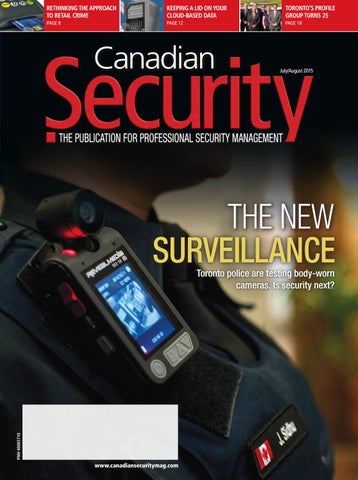
The new surveillance
PM# 40065710
Toronto police are testing body-worn cameras. Is security next?
www.canadiansecuritymag.com
CS July aug 2015.indd 1
2015-07-23 1:56 PM
we stop what can happen •
Security Guards
At Commissionaires, security is more than guarding.
•
Mobile Patrol
•
Non-core Police Services
•
Process Serving
•
Parking and Bylaw Enforcement
From risk assessment to non-core policing, Commissionaires offers a comprehensive range of security services. We are 20,000 strong with a high proportion of ex-military and RCMP in our ranks. The competition can’t match our training, discipline, sense of duty and front-line experience.
Commissionaires_CS_Aug.indd CS July aug 2015.indd 2 Ad: Security - We Stop1
WhEN SEcurit y iS a Priorit y ca ll c o M M i S S i o N a i r E S | 877 322 6777 commissionaires.ca/cdnsecurity
Publication: Canadian Security
2015-07-17 2015-07-2312:32 1:56PM PM
CONTENTS 3
Canadian The publication for professional security management
Columns
Volume 37 Number 4
A new way to view Security companies are watching closely as police departments try out body-worn cameras. Could it work for them too?
8 focus on retail Calling retail crime fighters 10 risk perspective It’s all about collaboration
By Linda Johnson
11 CCTV & the law Do you recognize this person?
14
12 safe data Keep a lid on your data
Departments
Generations at Profile
4 editor’s notebook Camera obscura
The Toronto investigations firm turns 25 and remarks on new ventures and how the security business has changed (and stayed the same) over the years.
6 trending 9 ASIS update Ottawa on the move
By Neil Sutton
17 Q&A Dell CSO John McClurg
18
21 Book review Learning from crisis 22 product focus Fire & Life Safety
Cover photo courtesy Toronto police service Photo (Left) Courtesy G4S
visit www.CanadianSecuritymag.com Security leaders will be dropping by our studio in 2015, so be sure to check out the video section of our website for new content.
Security Pages
canada’s Only Secu rity
Security industry Buyers Guid e
Pages 2015
Go Shopping at SecurityPages.ca Brought to you by
www.securitypages.ca
www.securitypa Security_pages 2015.indd
ges.ca
1
2014-09-24 2:36 PM
@SecurityEd • July/August 2015
12:32 PM
CS July aug 2015.indd 3
2015-07-23 1:56 PM
Canadian
4 editor’s notebook By Neil Sutton
Camera obscura Body-worn devices raise questions, but their adoption is inevitable
W
riter and director Alex Garland has been quoted as saying his film “Ex Machina” is set “10 minutes from now.” The film is an exploration of the almost limitless potential of artificial intelligence (AI) and the dark side that may come with it — the fact that it’s set in a future so close at hand is a poignant reminder of how quickly our society is changing. “Ten minutes from now” is how I feel about most new technology. We are heartbeats away from potentially disruptive devices and I think body-worn cameras are a case in point. In truth, we could have featured a story about this a year ago — possibly earlier. But I think now is the time. There are concrete examples of this working in the field and strategies around their best use are starting to “We are heartbeats coalesce. away from potentially Granted, most of these are with police departments. I am aware of several tests in Canada, disruptive devices.” including Toronto police (as highlighted in our cover story), as well as police in Calgary and Montreal. There are dozens of other police examples across the U.S. and in Europe, some dating back as far as 10 years. But what does this mean for the security industry? The police examples are engaging and are being watched with great interest, but the cost structure, oversight issues, training and licensing, not to mention privacy and legal obligations, are quite different for private security. I would encourage you to read our cover story, since I believe it engages all the angles effectively, particularly for those who work with or employ frontline security professionals. I would also say a careful consideration of how body-worn cameras might impact your organization is warranted now, whether you plan to deploy them or not. As with most disruptive technologies, it’s not a matter of “if” but “when” you encounter them on a professional level, whether it’s in your organization, your customers’ or your partners’. The interesting flip side to body-worn camera technology is that most people have it already. While not expressly designed to be surveillance or recording devices, smart phones offer that capacity and have been used as such for years. As security trainer Mike Burgess, president of M.D. Burgess and Associates, once said at a Canadian Security Focus On event, “Don’t be a YouTube star.” By that he meant, private security should always conduct themselves in a professional manner, since a person willing to record an altercation with a member of the public and subsequently post it online (and completely out of context) may only be steps away. These are issues that both police and private security have had to deal with and I believe the hope is that body-worn cameras will, in a sense, level that playing field, providing a potentially more accurate record of events. For some, body-worn devices may be 10 minutes away, for others, 10 years. But now is the time to think about how they will affect our industry.
The publication for professional security management
Group Publisher Paul Grossinger pgrossinger@annexweb.com
Account Coordinator Trish Ramsay tramsay@annexweb.com
Publisher Peter Young pyoung@annexweb.com
Circulation Nicole Cuerrier ncuerrier@annexweb.com
Editor Neil Sutton nsutton@annexweb.com
Director of Soul/COO Sue Fredericks
Art Director Graham Jeffrey gjeffrey@annexweb.com
Editorial and Sales Office 222 Edward Street, Aurora, Ontario L4G 1W6 (905) 727-0077 • Fax (905) 727-0017 Web Site: www.canadiansecuritymag.com Canadian Security is the key publication for professional security management in Canada, providing balanced editorial on issues relevant to end users across all industry sectors. Editorial content may, at times, be viewed as controversial but at all times serves to inform and educate readers on topics relevant to their individual and collective growth and interests. Canadian Security is published six times per year by Annex Publishing & Printing Inc. Subscriber Services: Nicole Cuerrier ncuerrier@annexweb.com P.O. Box 530, Simcoe ON N3Y 4N5 Tel: 866-790-6070 ext (201) Fax: 877-624-1940 I.S.S.N. 0709-3403 Printed in Canada Canada Post: Customer #6597297, Agreement #40065710. RETURN UNDELIVERABLE CANADIAN ADDRESS TO CIRCULATION DEPARTMENT P.O. Box 530, Simcoe ON N3Y 4N5 Subscription Rates: Canada: 1 year $40.00 + HST; U.S.A. (payable in US dollars): 1 year $60.00; International (payable in US dollars): 1 year $75.00 The contents of Canadian Security are copyright by ©2015 Annex Publishing & Printing Inc. and may not be reproduced in whole or part without written consent. Annex Publishing & Printing Inc. disclaims any warranty as to the accuracy, completeness or currency of the contents of this publication and disclaims all liability in respect of the results of any action taken or not taken in reliance upon information in this publication.
Editorial Advisory Board Jason Caissie Profile Group
Tracy Ann Kosa Microsoft
Carol Osler TD Bank
Ken Close Trillium Health Partners
Bill McQuade Final Image
Theresa Rowsell Kit and Ace
Ashley Cooper Paladin Security
Clark Northcott Pelco by Schneider Electric
Tim Saunders G4S
David Hyde Hyde & Assoc.
Malcolm Smeaton Whitehorse Group
@SecurityEd July/August 2015 • www.canadiansecuritymag.com
CS July aug 2015.indd 4
2015-07-23 1:57 PM
G4S_C
Integrated Security Solutions
m
m
Proud Sponsors of Canada Night!
See our latest services at the ASIS 61st Annual Seminar in Anaheim, CA at Booth #1839 1-888-717-4447 • solutions@ca.g4s.com • www.g4s.ca
CS G4S_CS_July.indd July aug 2015.indd1 5
2015-07-23 2015-07-10 1:57 10:58 PM AM
6 trending Calendar Cyber Security for ICS Canada September 9, 2015 Calgary, Alta. www.cybersecurityics.com Security Canada Atlantic September 15, 2015 Halifax, N.S. www.securitycanadaexpo.com Retail Council of Canada Loss Prevention Conference 2015 September 16, 2015 Toronto,Ont. www.retailcouncil.org Focus On Hospitality Security September 24, 2015 Richmond Hill, Ont. www.focusonseries.ca ASIS International Seminar & Exhibits September 28 – October 1, 2015 Anaheim, Calif. www.asisonline.org Next Generation Security leader & The Great Conversation October 12-13, 2015 Chantilly, Va. www.the-sage-group.com/ the-great-conversation/home Intl. CPTED Assoc. Conference October 19-20, 2015 Calgary, Alta. www.cpted.net National Policing Cybercrime Summit October 19-20, 2015 Toronto, Ont. www.cata.ca Security Canada Central October 21-22, 2015 Toronto, Ont. www.securitycanadaexpo.com Securing New Ground October 28-29, 2015 New York, N.Y. www.securingnewground.com ISC East November 18-19, 2015 New York, N.Y. www.isceast.com Focus On Health Care Security December 9, 2015 Richmond Hill, Ont. www.focusonseries.ca
G4S expands presence in B.C.
G
immediate plans to expand that footprint, 4S Canada says is making additional “as we increase our market share, one investments in British Columbia, could reasonably expect there would be a starting with a new general manager for need to increase our real estate,” he says. the Pacific region. Owen Court has been hired for that The guarding market is B.C. has role, and has been tasked with increasing expanded dramatically in the last 10 years, G4S’s market presence out with the number of registered West. G4S is Court’s first foray guards more than doubling. into the private sector, having “We think there’s huge market held various senior level share still available,” says Katie positions in the public sector McLeod, G4S Canada’s national for more than 20 years. Court director of communications. began his career in the B.C. “There is definitely some Corrections branch, before competition in B.C., but there’s a moving on to the RCMP, then lot of green field as well... That’s the B.C. Coroner’s Service. why it’s worth our investment Owen Court, G4S Canada More recently, he helped to and that’s why the company is develop and implement the taking B.C. so seriously.” Independent Investigations Office of B.C. McLeod adds that G4S is also looking — an agency that investigates incidents to capitalize on its systems integration involving B.C.-based police officers. business in B.C., committing more “The core of the business is about resources to its technology practice. The relationships and relationships are the company also owns AMAG Technology, a same whether you’re in the public sector manufacturer of access control and video or the private sector,” says Court. “Really, solutions. Torrance, Calif.-based AMAG from a public or private sector point of added new positions in Canada earlier this view, the dynamic is the same. It’s about year with the appointment of Derek Beier providing good leadership and putting the as regional sales manager in Ottawa, and right people in the right places.” more recently, Bill Daniel, who holds a His first task at G4S will be to add similar position for Western Canada. “We staff to the organization in B.C., filling will partner with [AMAG],” says McLeod. several senior positions across the “We’re looking at this as a full product and province. G4S currently operates a small service complement in the province.” office in Vancouver. While there are no — Neil Sutton
CATA to host cybercrime summit
T
he Canadian Advanced Technology Alliance (CATA) is hosting its first ever cybercrime summit this fall — an issue that has come to the forefront for the organization. CATA hosted a cybersecurity event last year, and it became apparent that there should be a subsequent event that targeted crime. “One of the things we heard cybersecurity summit … was that there was not enough collaboration between private [and] public, and even private-private. There really needs to be more of a concentrated effort to have more of these recognized partners working together,” says Kevin Wennekes, CATA’s chief business officer. CATA has developed an agenda through collaboration with the Canadian Association of Chiefs of Police that is specifically tailored to those issues. The event will be held Oct. 19-20 in Toronto and will feature speakers from police services across Canada addressing current and emerging criminal threats such as cyberterrorism and darknets. — Neil Sutton
July/August 2015 • www.canadiansecuritymag.com
hid-you CS July aug 2015.indd 6
2015-07-23 1:57 PM
HID_CS
SWIPE TAP TWIST POINT TOUCH OR PUSH WITH CONFIDENCE. Technology is evolving and words like “interoperability” are taking on entirely new meaning. HID Global is leading the industry by developing the world’s broadest portfolio of truly scalable, fully interoperable secure identity solutions. We are connecting people to places with physical, mobile and virtual access solutions like never before—and we’re doing it with the most advanced layers of security anywhere on the planet. You’ll call it seamless end-to-end solutions. We call it, “your security connected.” YOUR SECURITY. CONNECTED
hid-your-sec-cnnctd-ad-en-can-sec.indd 1 CS HID_CS_Aug.indd July aug 2015.indd1 7
|
Visit us at hidglobal.com
7/17/15 11:00 AM 2015-07-23 2015-07-17 1:57 12:36PM PM
8 focus on retail By Matt Robertson
calling retail crime fighters
O
There are steps retailers can take to put a serious dent in criminal practices
rganized Retail Crime (ORC) costs Canadian retailers approximately $5 billion per year. Why is retail such a growing target though? Simply put: It is easy to get away with it. Retail is the path of least resistance. Criminals see retail crime as a low risk, high profit crime. The merchandise is easily obtained through theft or fraud, and typically has a high resell value. One of the major causes for the increase over the last several years has been the shift in the type of ORC activity occurring. Retailers are now seeing return fraud and credit card fraud as the highest trend as opposed to traditional theft or “grab and runs” of merchandise. It is far easier to fly under the radar when you are committing return or credit fraud than traditional theft and therefore it appeals to the criminals. With the growing evolution of online sales platforms such as Kijiji and Craigslist, criminals can now easily sell stolen goods online for nearly 100 per cent of their retail value. In circumstances where criminals are committing return fraud, they can potentially obtain up to 100 per cent of the value back on a gift card or in some circumstances cash. What can retailers do then to effectively combat this? Make your organization known as a company that fights back. Stop it at the point of sale. By educating your front line team members on fraud, proper credit acceptance procedures and other tips for identifying fraud, it can stop a significant amount of these fraudulent transactions before they are even processed. Data analytics has become a buzz word recently. It is being used quite heavily in the sales side of the retail business, but has rarely become a topic of discussion when speaking about ORC activity. One of the things working in our favour is that most fraud occurrences follow patterns. The criminals are either always using the same credit card, returning the same type of goods,
or some are even using the same name and information for every return. With this in mind, if you can tie in your recognizable fraud patterns into a data analytics program, you can start to identify ORC much quicker and with greater success. Information sharing has also become a necessity when catching ORC offenders. Most ORC groups are not only preying on one specific retailer, but several. Chances are the same retailers competing for your sales may be the same retailers with whom you are collaborating in catching your ORC suspects. Information sharing platforms for Law Enforcement such as TAPPS in Toronto or Retail COP in Calgary are immensely effective for allowing retailers and law enforcement to collectively ID suspects and determine ongoing trends and ORC activity. Internal policies need to be regularly reviewed and updated to reflect growing trends in fraud. For example, some retailers still allow returns without any form of receipt or identification. This is opening up the door for fraudulent activity. You need to ensure you are mitigating the risk wherever possible, and policies surrounding such things as returns without receipts may be a great place to start. Physical security strategies are also a must. Criminals can be deterred quite easily if something does not go as planned for them. For example, with cases of return fraud, using Spider Wraps or Ink Tags on highly targeted items can deter the majority of thieves. When dealing with credit card fraud cases, simply asking for identification can cause the criminals to just walk away (sometimes leaving the fraudulent card behind). We need to ensure that retailers continue to work together to identify strategies and solutions to better combat Organized Retail Crime. We need to be as proactive as we are reactive and make our organizations known as ones who will not stand for ORC activity and who will fight back! Matt Robertson is manager, corporate inventory & investigations for Sears Canada (www.sears.ca). He spoke about organized retail crime at Canadian Security’s Focus On Retail Security in June.
July/August 2015 • www.canadiansecuritymag.com
CS July aug 2015.indd 8
2015-07-23 1:57 PM
asis update 9
Ottawa on the move
T
on professional networking, extremist he security community in Canada’s recruiting and a 911 Emergency National Capital Region often Response Centre tour. There operates behind the scenes, was also a special “live” but one security organization demonstration in co-operation is doing something different, with the justice program at Cite according to its growing de Collegial on the topic, “Dogs membership. with Jobs.” ASIS Ottawa Chapter #140 The Chapter has a number has seen an 11 per cent increase of events scheduled for the fall in new members this year. To including its second “Certificants continue to grow our young Susan Munn Dinner,” and planning for professional base, the Ottawa the Chapter’s Annual Gala and Chapter is planning to relaunch Annual General Meeting is underway the student scholarship program in the with an announcement expected soon. fall of 2015. Past gala guest speakers have included This year’s Chapter Education Gen. Romeo Dallaire, Roger Lucy, Order Program has included some unique of Canada’s honouree for his role in the sessions such as a members’ only briefing real life “Argo” Affair (Iran Crisis of from the RCMP’s Canadian Police 1979) and Jody Mitic, retired Canadian Bomb Data Centre, and open sessions
soldier, and veterans advocate. The recent past has not been without tragic and poignant moments. Last October’s death of Cpl. Nathan Cirillo at the National War Memorial and attack on Parliament Hill is still present in security professionals’ thoughts and is changing the security landscape in Ottawa. More recently, there was June’s unexpected death of Chapter stalwart, Dr. Wayne Boone, CD, PhD, CPP in a motorcycle – vehicle accident. He was a past president of the Ottawa Chapter, avid supporter and staunch advocate of security education and professionalism. Susan Munn is the vice-chair of ASIS Chapter 140, vice-chair of the Physical Security Council and Asst. RVP, Women in Security, Group 6 Canada.
REMOTE GUARDING THROUGH ADVANCED TECHNOLOGY Advances in technology have resulted in: • Expanded Security Capabilities • Reduced Cost of Technology • Increased Guard Effectiveness Working out of our 24/7 state of the art, Canadian Security Operations Centre, our Remote Guarding Specialists can provide: • Full Video Tour of a Facility • Security Announcements • Alarm Response • Employee Escort • Exit/Entry Management – Doors/Vehicle Gates • Patrol Tours • Perimeter Protection • Fire & Intrusion Alarm Monitoring • Vagrant/Loitering Checks • Mobile Response or Emergency Services Dispatch
1-800-268-0545
On-Site Guarding
Remote Guarding
www.securitas.ca info@securitas.ca
Mobile Guarding
CREATING ALTERNATIVES
Call to learn about our Integrated Guarding; a unique security solution that allows you to create a customized Guarding program by combining any of our service offerings; On-Site Guarding, Remote Guarding with camera technology and analytics, and/or Mobile Guarding. Integrated Guarding Solutions can provide you with Cost Efficiencies and Flexible Security Coverage, all from one security provider. @SecurityEd • July/August 2015
Securitas_CS_July.indd 1
CS July aug 2015.indd 9
2015-07-08 2:41 PM
2015-07-23 1:57 PM
10 RISK Perspective By Tim McCreight
It’s all about collaboration
O Consider your end users and support teams when creating a risk strategy
ver the past decade, I’ve watched the environment I wanted this application organizations attempt to address to reside in was fraught with additional risks in a siloed approach. vulnerabilities that could directly impact the Risk assessments were conducted against application, and cause it to either fail, or be critical assets, remediation activities were open to attack from an adversary. I missed documented, and progress in reducing my chance to be collaborative in the risk the risks were dutifully reported to senior assessment process. It was a pretty tough management. The issue lesson, but I’ve been able to wasn’t the risk program, use it as a learning moment but the involvement of for every team since. “I was able to figure only a single unit, the I’ve made a point security department, in the now of ensuring business out where I went risk management process. teams, operation support wrong and adjust my What many of these groups, legal counsel, pioneering organizations human resources, supply approach.” realized was that chain and even executive identifying and managing leaders are involved in the risks across an enterprise risk assessment process. can enhance the efficiency One approach I’ve taken of an organization. The issue I had back in the years since that fiasco has been to then, and can still see in many companies, sit with a business team and ask them was restricting who is engaged in the risk questions about the project they want to management program. start. I ask them about business drivers, and One of the great lessons I had to learn how their proposed project will support the the hard way focused on maintaining a strategic objectives of the organization. I very narrow approach to risk assessments. I look for executive sponsorship and financial remember being very confident in my ability commitment for a project. If there isn’t to conduct a risk assessment. I had done my support or funding, are we really dealing homework — I reviewed a new application with a project, or a dream? that was being considered, I researched the The teams that will support the project typical vulnerabilities I could expect to see (whether it’s a new CCTV installation, or a once the application was installed, and I had new website) are key to assessing risks facing even started working on remediation steps the project. These teams have knowledge I could put into place once the application that, if tapped into early in a risk assessment, was in production. What I didn’t do was can ensure that any solution selected will talk to the business units that were going to not only work in the environment, but also use the new application, or the operational have the right support to ensure any ongoing team that would be responsible for operational issues can be managed, and keeping the application up and any residual risks lowered over time as the running after it was installed. project matures. If I had thought of engaging Lessons like the one I went through were the business users, I would hard to accept. It took a while for the sting have learned that all those of a failed project to lessen, but I was able wonderful security controls I to figure out where I went wrong and adjust had envisioned could be easily my approach. Collaborating with partners circumvented by a business user who across the enterprise is the only way to didn’t follow the path I had assumed realistically manage risk. they would to access the application. Had I spent any time with the operations Tim McCreight is director, enerprise information security team, I would have learned from them that at Suncor (www.suncor.com).
July/August 2015 • www.canadiansecuritymag.com
CS July aug 2015.indd 10
2015-07-23 1:57 PM
By Elliott Goldstein
cctv & the law 11
Do you recognize this person?
I
When the accused’s appearance changes before a trial, the big picture may be in question
t is not unusual for the appearance of limited question of whether A’s appearance an accused to change between time of at the time of the shooting fit within the offence and time of trial. general descriptions provided by witnesses.” So how does the prosecution prove that The Supreme Court dismissed the the person who was seen at the crime scene argument that the photographs were (or seen committing a crime) is “one-andprejudicial, as follows: “Regarding the-same person” as the accused in court? the potential prejudicial effect of the The answer is found in photographs, there are the recent Supreme Court particular dangers involved of Canada decision in R. in showing eyewitnesses “How does the v. Araya1. a single photograph to determine if the individual In Araya, a shooting prosecution prove the shown is the individual took place in a Toronto park in 2008 during a person who was seen at they saw, because the witness’s memory may robbery. The victim was the crime scene is the be tainted by exposure shot and killed while to that photograph. chasing after the robbers same as the accused?” However, this concern who were fleeing the is not relevant where it scene. Eyewitnesses is the jury who has been described the robbers exposed to the photograph as “young, black, thin, of a single person and asked to consider and clean-shaven” and the shooter as being whether the person shown falls within a between 5’4” and 5’8”. The accused, who general description. The jury has no pre was 6’1” at the time, was NOT identified existing memory of the person’s appearance as being among the robbers. The accused to corrupt, nor is the concern about the approached a teacher at his school and over persuasiveness of tainted witness “confessed” to being present at the shooting testimony relevant in this context …. [t] but not having fired the gun. here is no reason to disturb the trial judge’s As the accused’s appearance had changed finding that the risk associated with the between the time of the shooting and his photographs could be appropriately trial, the Crown asked the trial judge to mitigated by a limiting instruction, and thus admit two photographs taken of the accused that the probative value of the photographs five days after the shooting. Photographs outweighed their prejudicial effect.” admitted; accused convicted. The Court of Identity is always an issue of fact, not Appeal for Ontario reversed the trial judge law, so the trier of fact (i.e., the jury or the and ordered a new trial. The Supreme Court judge, if sitting alone) must decide whether of Canada allowed the appeal, restored the person identified by eyewitnesses the conviction and stated “[T]here is no or shown in the video or photograph reason to disturb the trial judge’s finding (committing a crime) is “one-and-thethat the photographs were admissible. same person” as the accused in court. Whether Araya could have been among the The Supreme Court has now approved a assailants was a critical issue in this case, procedure to permit a jury to identify the because he denied being in the park accused where his or her appearance has the night of the shooting,” despite his changed between the time of offence and the alleged “confession” to his teacher. time of trial. The Supreme Court continues: “Moreover, Araya did not concede that his appearance fit the general Elliott Goldstein, B.A., J.D., is a Thornhill, Ont.-based eyewitness descriptions. Accordingly, lawyer (elgold@rogers.com). the photographs were relevant to the 1. 2015 SCC 11 (date 2015 03 13). @SecurityEd • July/August 2015
CS July aug 2015.indd 11
2015-07-23 1:57 PM
12 SAFE DATA
By Cory Freed
Keep a lid on your data
A Understanding ISO/IEC 27018: a new international standard regarding Cloud privacy
s more businesses contemplate a control over their data. move to the Cloud, there is increased 3. Transparency: Customers must be informed scrutiny on how Cloud service about where their data resides and how providers (CSPs) secure the valuable data it is handled. CSPs must also identify any entrusted to them by their customers. subcontractors that will be hired to handle For most enterprises, their most data on their behalf and provide notice when important asset is the data they create and new subcontractors are added. accumulate while running 4. Accountability: A breach their business. This data of information security can be extremely sensitive must trigger a review by the “For most enterprises, and can include personal CSP to determine if there their most important identifiable information, was any loss, disclosure or health information and, in alteration of their customers’ asset is the data they the case of many security personally identifiable solutions, critical video create and accumulate.” information. surveillance data. 5. Communication: In the As a result, it should event of a breach, the CSP come as no surprise that should notify its customers the most common concern businesses have and keep records about the incident and the when considering a move to the Cloud is how response to it. This is very important as it to maintain control of their data. allows customers to react appropriately and A new international standard — the first satisfy any notification obligations. regarding Cloud privacy — addresses some of 6. Independent and yearly audit: In order these concerns. to be compliant with ISO/IEC 27018, a Last year, ISO/IEC 27018 was published CSP must undergo rigorous third-party which provides specific standards for CSPs audits. A successful third-party audit of a concerning the protection of their customers’ CSP’s compliance documents the service’s personally identifiable information stored conformance with the standard, and can then in their Cloud. CSPs adopting ISO/IEC be relied upon by the customer to support 27018 must operate under the following six their own regulatory obligations. principles when handling customer data. Compliance with ISO/IEC 27018 1. Consent: Customer data may not be used is particularly significant to Canadian enterprises because it reinforces — and for advertising and marketing purposes unless in some cases goes farther — than the expressly consented to by the customer. Furthermore, a CSP cannot make the requirements under Canadian privacy laws. Furthermore, by requiring the CSP to undergo use of the Cloud service conditional an annual independent audit, customers will on the customer granting that consent. have the further assurance that the CSP is This gives customers of Cloud solutions complying with these standards. the power to prevent the CSP from using its data for its own commercial There are many CSPs in the marketplace today. Not all of them offer their customers purposes. an internationally recognized level of 2. Control: Customers have explicit protection. When considering a move to the control over how their personal data Cloud, be sure to look for ISO/IEC 27018 is used and must implement a policy to compliance to ensure your most valuable data allow for the return, transfer, and/or is protected in accordance with the highest secure disposal of personal data within a international standards. reasonable period of time. This ensures that customers can avoid lock-in and can switch CSPs whenever Cory Freed is senior corporate counsel with Microsoft they wish — leaving the customer in full Canada (www.microsoft.ca).
C
M
Y
CM
MY
CY
CMY
K
July/August 2015 • www.canadiansecuritymag.com
CS July aug 2015.indd 12
2015-07-23 1:57 PM
Canasa
CANASA Presents
2015
Mark your calendars
Security Canada Atlantic
C
M
Holiday Inn Harbourview Halifax, Nova Scotia September 15, 2015
Y
CM
MY
CY
CMY
K
Security Canada Central Toronto Congress Centre Toronto, Ontario October 21 - 22, 2015
Visit
www.securitycanadaexpo.com CS Canasa_CS_July.indd July aug 2015.indd 13 1
2015-07-23 2015-07-02 1:57 10:11 PM AM
14 TECHNOLOGY & POLICY
Cameras on the
frontline
Early evidence suggests there may be significant benefits to wearable cameras for security professionals, but do they outweigh the costs, data management issues and potential legal entanglements? By Linda Johnson But we have to consider everything, including cost,” he says. The estimated cost for storage alone to deploy cameras across the service, he adds, could be as high as $30 million. The cameras are activated by officers, and they decide when to start recording, he says. However, police policy requires them to activate the camera for “any investigative purpose.” This covers situations ranging from stopping a person to ask for personal information to a homicide investigation. Officers must inform those being recorded that they are being filmed as soon as “reasonably possible.” Officers can stop recording, he says, as soon as they judge the recording is no longer serving any of the project’s
purposes (e.g., transparency). Officers upload video via hardwire to a central server at the station, Barsky says. Recordings are kept in their original state on the server and tracked: all attempts to access the video, including unsuccessful attempts, are recorded through the backend metadata. Audit trails are run regularly Recording officers have no ability to edit or delete any part of a video, he says. “Security at the backend is paramount for the Toronto police. If we were to have one breach into our system, every asset we ever collected would be no good for court. We could never articulate the purity of that asset in its original form.” There’s a lot of interest in body-worn
photo courtesy Toronto police service
W
hile body-worn cameras are being used today by thousands of police and military agencies, the security industry has shown greater trepidation. Some companies are testing them whereas others are using them in limited applications, but the pros and cons of equipping private guards with cameras are proving difficult to assess. Currently, the Toronto Police Service is conducting its own testing. They recently launched a year-long pilot project to determine whether they should adopt the cameras. While guarding companies will await the verdict with interest, many of them will certainly continue to have reservations about the new technology. The Toronto police project involves almost 100 officers, who began wearing the cameras in May, says Inspector Michael Barsky of the Toronto Police Service. During the project, which costs $500,000, two cameras are being tested: one by Panasonic, the other by Reveal Media. Barsky says Toronto police hope the devices will bring numerous benefits: more accurate records of transactions with civilians; greater transparency; reduction of false allegations; better oversight in cases of truthful allegations; better evidence for use in court and increased public trust in officers. “If the technology achieves all those things, then this pilot will be a success.
Toronto Police Service officers are in the year-long process of testing body-worn cameras.
July/August 2015 • www.canadiansecuritymag.com
CS July aug 2015.indd 14
2015-07-23 1:57 PM
photo courtesy Toronto police service
TECHNOLOGY & POLICY 15 cameras among security companies, says Robert Hastings, senior consultant, professional services at Toronto-based G4S Canada. “Many private security firms are in a hold-and-wait situation, trying to see how police projects roll out first,” he says. “They see police projects as a kind of litmus test for their own possible future adoption.” While, he says, wearable cameras can be expected to produce the same benefits for security as for the police, there remain many complicating issues. One is cost. In addition to cameras, a company has to pay for docking stations and servers. There are also operating costs, and the cost of developing and enforcing procedures. “Will the market, already very competitive and cost-sensitive, bear the cost of rolling out these programs? How well can we pitch that to clients?” While G4S is not using cameras in Canada, it deploys them in other locations. In the United Kingdom, they are used in prisons, for event management and for certain clients, including job centres. Don MacAlister, chief operating officer at Vancouver-based Paladin Security, says he is seeing a move towards cameras in security. One Toronto client is already using body cameras on security officers, and a client in Alberta is considering using them. “I’m sure there are folks all across the country who are starting to look at this as a potential tool for security officers, just as in policing,” he says. But like Hastings, MacAlister believes the cameras raise difficult questions, including the subjective capacity to turn them on and off; access and storage and, most critically, protection of information. Paladin does a lot of work in health care, and patient confidentiality is vital. In medical facilities, recorded images become part of a patient’s record of their care, and hospitals must be careful to meet legal requirements around protection of privacy and release of information.
stages, they expect it to start ramping up “I think there’s a place increasingly significantly in the near future. for the use of cameras. But you need to The cameras offer several benefits have strong controls in place.” for security guards, he says, primarily Glenn Thomson, vice-president, in providing an objective record of an Central and Atlantic Regions at event. Montreal-based GardaWorld, says he “The purpose of a body-worn believes cameras have a huge number camera is to provide unbiased video of benefits for security companies. evidence of any interaction, and this In addition to providing clarity to can be a tremendous benefit for security potentially confrontational and guards whose job it is to be vigilant confusing situations, the devices will and document incidents. Security build trust with customers. “A number guards are often the first on the scene of reports show that when people of a situation, so announce they’re using any evidence-quality body-worn cameras, video they can capture it’s a deterrent or de“Many private security would be valuable,” escalation point. We firms are in a hold-andhe says. “Body-worn like that concept as cameras can also well,” he says. wait situation, trying to be used in training One of the and performance great benefits of the see how police projects improvement, which cameras, Thomson is a benefit for any says, is they provide roll out first.” professional.” a more complete — Robert Hastings, G4S Canada Generally, use of record of an event, the cameras by law as opposed to those enforcement will taken on cell phones, have benefits, including increased police and thus may provide vital context for a accountability and better evidence of guard’s actions. police-civilian interaction, says David “We see it as a great balancer. A T.S. Fraser, a privacy lawyer with third-party person may not hear exactly McInnes Cooper in Halifax. what’s going on or may start recording However, he adds, the devices raise part way through an incident. So they important issues, mainly regarding how don’t get a clear picture of what’s going the information will be managed after on,” he says. it’s collected; for example, how accessGardaWorld is doing live field testing to-information requests will be handled. of the cameras, but is a long way from “Assuming that a video image of rolling them out, Thomson says. The me is a record related to me, access-tocompany is following police projects in information laws will say I have a right Canada and Europe to see how they go. of access to that. How do they manage “Right now, everything we’re doing that?” he says. is just in a pilot program. But once we If people have access to recordings come up with a policy and procedure, they appear in, the privacy interests of we’ll determine where exactly it fits in to third parties must also be addressed, the mix,” he says. Fraser says. And removing other people’s From a vendor’s perspective, security personal information becomes more companies are — like law enforcement difficult when a person is part of a agencies — a natural market for crowd. “What happens, for example, body-worn cameras, says John Cusick, if there’s an altercation outside a bar, product manager at Newark, N.J.-based four officers are present, and all have Panasonic System Communications cameras on? How do you manage it if Company of North America in an email the media ask to see the footage from interview. While adoption of the cameras those cameras?” in the security industry is still in its early @SecurityEd • July/August 2015
CS July aug 2015.indd 15
2015-07-23 1:57 PM
16 TECHNOLOGY & POLICY Like security companies, the police Moreover, he asks, could recorded may see in the cameras a way to information be used for employee counter the trend of posting incidents relations, for discipline or training? online. Historically, “It’s not really a Schneider says, police matter of, Are cameras controlled crime good or bad? It’s a “Reports show that scene information: whole lot of detail that when people announce they cordoned off the needs to be worked out scene, conducted their in order to implement they’re using body-worn investigation and fed them properly.” information to the Christopher cameras, it’s a deterrent media. Schneider, associate “Now, the crime professor at Wilfrid or de-escalation point.” story unfolds on Laurier University in We like that concept.” YouTube, and police Waterloo, Ont., says it’s and news media too early to judge how — Glenn Thomson, GardaWorld respond to that,” beneficial wearable he says. By putting cameras will be, in part cameras on officers, because police have they create “official” recordings, which in the past been reluctant to make video have more authority in court than other recordings widely available. “We’re not “unofficial” recordings. sure yet to what extent the [devices] will Technology has outpaced the law, improve transparency,” he says.
Schneider says, and the issues raised by the cameras will have to be settled through the courts. The final report on the Toronto police pilot project is due at the end of June 2016, Barsky says. It will then go to the Police Services Board, who will determine whether to introduce the cameras. Most people today, he says, especially young people, are used to being recorded in public places. In their dealings with police, they will know they’re being recorded and won’t be bothered by it. “Now, the recording picks up audio, picks up your conversation. And that’s where people have some sensitivity,” he says. “But this too will pass. The camera won’t mean anything to people a year from now. They’ll just know, that’s the nature of society today.” Linda Johnson is a freelance writer based in Toronto.
16 September New Location! The International Centre Mississauga
REGISTER TODAY - RCCLPCONFERENCE.CA Learn about the latest trends, insights and case studies, including: Organized crime Information and cyber security
Online fraud and identity theft
Preventing workplace violence
Payment and security fraud
Emergency response planning Produced by Presented by
#RCCLP15
July/August 2015 • www.canadiansecuritymag.com RCC_CS_Aug.indd 1
CS July aug 2015.indd 16
2015-07-20 2:07 PM
2015-07-23 1:57 PM
17
QA
close association, you gain renewed respect and appreciation. The cyber side would say, “I’m glad you like your with John McClurg, job; I wouldn’t want to do the physical Chief Security Officer, Dell side.’ And the physical side would say, ‘I’m glad you like your job . . .” There are certain challenges and aspects that maybe attract certain personalities. The physical world perhaps engage more directly with human beings, businessmen: we don’t give them and ohn McClurg doesn’t have an easy in an investigation or an interview. assessment and say, “Well, you’ve got job, but he appears to enjoy it Maybe the cyber guys who are dealing problems. We wish you luck on that.” immensely. with ones and zeros a little more You stick with them until you actually He is Dell’s chief security officer, often... although there’s aspects of the close it. responsible for the organization’s psychological, the Another area that internal security services, both physical human side entering stood out is in the and cyber. Prior to that, he held senior into that [too]. I’ve area of investigations. security roles at Honeywell and Lucent “We’re still pushing the been pushing my You have physical and has also worked with both the FBI cyber guys to get investigators and CIA. envelope in terms of Reid training (the investigating McClurg was in Toronto recently what we’re discovering. Reid interviewing fraud and internal and spoke with Canadian Security technique). You take investigations. They about the intersection between We’re only limited by a cyber guy and say, get to a certain physical and cyber security and what point where they professionals on both sides of the fence our imagination and our “You appreciate that the physical guys say, “We can’t take can learn from each other. have been getting this investigation innovative prowess.” Reid training all any further until Canadian Security: Dell is known as an IT these years. You we get this person’s company but still has physical assets to need to have that laptop imaged and protect. What does that mean for you? as well because some of the variables analyzed.” I said, “Time out.” The basic John McClurg: The cyber world does and the expertise that you develop in journeyman skills of a physical world what they call risk assessments. The that training, you can use. You’ve got investigator in the 21st century have to physical world does risk assessments. to interpret and anticipate what your include at least those cyberskills that So what we’ve classically done in most adversary is thinking.” would enable them to do a basic image corporations is, go and knock on the and some of those preliminary analysis door and say, “Hey, we’re hear to help. CS: What is the role of metrics in today’s of searching that hard drive. Otherwise We’ll disrupt your business for a week security organization? they get bottlenecked waiting to get to and we’ll do a physical assessment. JM: I’ve seen a significant shift in the IT guys who have time to do the Then you go away and you give them the industry towards the retention, forensics for them. your report. Two weeks later, a knock formulation and development of classic You start to see these comes on the door and it’s the cyber metrics. Businesses have had metrics interdependencies because of the guys, and they say, “We’re hear to help.” for years to reflect the health and support structures. It’s a work in They disrupt the business for another viability of where they’re going and progress. We’re still pushing the week and they give you a separate IT what they’re achieving. I think we’re envelope in terms of what we’re risk assessment that never calls out going to see more and more classic discovering. We’re only limited by the inter-dependencies between those security organizations adopting on a our imagination and our innovative two worlds. One of the first things you regular basis metrics that reflect to the prowess. do [as CSO] is you bring those risk CEO: Here’s the health and viability assessment processes together. So you of our current status, cyber and CS: What are the two sides, physical and knock one time on the door and say physical in terms of how we sit. We’re logical, learning from each other? that you’re here to do a risk assessment no longer the guns, gates, guards of JM: The growing appreciation and — full spectrum physical and logical yesterday, we’re now business assurance awareness of the interdependencies. — you present them those exposures, and business assurance needs to be Quite often, before you merge both call out where those inter-dependencies described and conveyed in terms that sides, each side has underestimated the might be, and actually work with them resonate with business people. complexities of the other. Just by that to create a plan to bring closure. We’re
&
J
@SecurityEd • July/August 2015
CS July aug 2015.indd 17
2015-07-23 1:57 PM
18 COMPANY PROFILE
on the case
A group of security professionals led by a father and son team, Toronto-based Profile Group has expanded its business to multiple disciplines over its 25-year history
Profile Group staff (from left): Jim Bradley, Daly Luk, James Skinner, Tanya Vesters, Dan Ulrich, John Caissie, Paul Parent, Markus Hebblethwaite, Stefanie Quackenbush, Jason Caissie, Trevor Smith, Chimene Woktcheu, Ervin Balanowski, Sharon McVeigh
By Neil Sutton
T
o get a sense of how the security business has changed in the last 25 years, you might want to ask the owner of the Profile Group. The Toronto-based company was started a quarter century ago by John Caissie, initially as an investigations firm, but has expanded over the years to cover several of the major cornerstones of the security industry, including screening and integration services. More precisely, it started when it was untied from its moorings at Paragon Security, a Toronto-area guarding company. Caissie left that business in the late 1980s and as part of his deal upon departure, he acquired the Profile name and business, which was a small investigations arm of Paragon. Profile “was very small at that time, but I just saw the potential in it,” says Caissie, who adds that the parting with Paragon was on good terms and that the two, now separate organizations,
would work together occasionally through a process of referrals. With Profile now an independent entity, Caissie changed the name to Profile Investigation Inc., and began to pursue clients. Almost immediately, a large contract emerged from a labour dispute, which helped to get the fledgling business off the ground. Caissie hired an investigations manager within the first three months of operation and set to growing the business with a handful of part-time investigators. Striking out on his own wasn’t an easy decision, he says. “It was tough. [I had a] young family, a house, a mortgage.” But the labour climate in the late 1980s and early 1990s was good for business. “It was bustling, is the only way to put it,” says Caissie. “We did a lot of workers’ comp cases.” Generally, a lot of workers’ compensation cases are derived from unionized environments, adds Caissie’s son Jason, who has worked at the business on and off since his teen years and is currently its vice-president of operations. In situations
July/August 2015 • www.canadiansecuritymag.com
CS July aug 2015.indd 18
2015-07-23 1:57 PM
COMPANY PROFILE 19 The systems business, known officially as Profile Security where an employer suspects that worker’s compensation Integrated Services, evolved from the investigations business, may be unjustified, they may hire a company like Profile to much the same as the screening division that preceded it. investigate the claim. “They’re doing something while they’re “The systems business really grew out of doing covert on leave that they shouldn’t be,” says Jason. “They’re working camera installations. We had customers requesting covert elsewhere, they’re driving a cab, they’re roofing their house camera installations as part of an investigation,” explains Jason. — they’re doing those things that they say they can’t do, “It was usually a corporate entity doing a hence they can’t work. Companies hire us to theft investigation or a workplace conduct investigate those claims.” investigation. That grew from there into: In that sense, the business has changed “The competition is ‘Well can you install regular cameras? Can very little in 25 years. The work still entails you install card access? Can you install surveillance — sitting in parked cars, what you make of it. intrusion alarms?’” gathering evidence, compiling reports. What You’ve got to pick Jason stayed at Profile for another five has changed are the tools, says Dan Ulrich, years before opting to work outside the vice-president, business development, for and choose what company — something his father had longProfile. encouraged him to do in order to gain some Ulrich, a former New Jersey police officer, you go after.” wider industry experience. In 2007, he joined moved to Canada in the late 1990s, started — Jason Caissie, Profile Group the Royal Bank of Canada (RBC) as physical working for Profile in 1999 and has been security advisor, protection services. there ever since. “Definitely, the technology “You get a limited perspective on things, has changed, but it’s the same process in how growing up and working in a family business,” he says, “so to we set up. What we do out in the field is really unchanged.” go to work for a different group of people — especially in a big When Ulrich started with Profile, the company would send organization like a bank — is an amazing experience.” clients evidence on VHS cassettes and “all our files went out of He credits Ric Handren, who was then director of the office with sleeves of stills — 35 mm pictures that we had protection services at RBC and now works as vice-president of to get developed.” Today, of course, almost everything is digital, corporate security at CIBC, with mentoring him and helping with video and image files transported on CD or a USB device him gain a broader perspective on security. — although some clients still prefer paper and to have their Jason is also heavily involved in the Toronto chapter of information faxed rather than emailed, largely for legal reasons. ASIS International and has occupied several positions on Investigating insurance cases became the bread of butter its executive board over the years, largely as the result of of the company, says John Caissie, growing to a point were it encouragement of Pat Bishop. Bishop, Profile’s general manager reached 200 or more files a month. “It just evolved,” he says. for 10 years, was ASIS Toronto’s chapter chair twice in the early “Every time we expanded, we seemed to move offices. We got 90s and held several board positions for ASIS International. more people.” ASIS membership is common across Profile and is The company also developed a screening division, “something we’re all pretty active in. We’re pretty proud of performing background checks — an opportunity that it,” says Jason. Ulrich was the first in the company to obtain grew from the investigations side as clients inquired about his CPP designation in 2000. Jim Bradley, Profile’s manager of additional security-based services. Currently known as Profile investigations for the past eight years, currently sits on the ASIS Screening Services, it took off sharply after 9/11 as the security International profession certification board. environment changed drastically and employers were conducting more due diligence in their hiring practices, says Ulrich.
Caissie & Son Jason Caissie graduated from the University of Western Ontario in 2002 with a history degree. He had initially enrolled in university for microbiology but quickly tired of it. “Sitting in biology labs wasn’t my thing,” he says. “I just wanted to get out of school and start working.” Once Jason left school, he immediately started full time at Profile — 2002 was coincidentally the year that Profile began a major expansion and incorporated a security systems division that it had started four years earlier. “It was the systems business that really gave me my start,” he says, adding that he started taking manufacturer training courses to learn the different systems.
John and Jason Caissie look over some files with investigations administrator Stefanie Quackenbush @SecurityEd • July/August 2015
CS July aug 2015.indd 19
2015-07-23 1:57 PM
20 COMPANY PROFILE Years of service Long-serving employees is hallmark for Profile, says John Caissie. “A lot of people have been with us since almost when the company was born. That’s proven to be our success . . . the longevity of these people. We must be doing something right to hang on to them.” The company currently has 30 full time employees and another 60 part time (a mixture of investigators, consultants and service technicians). It is, by all accounts, outgrowing its current office space — an unassuming business park in Etobicoke in the West end of Toronto. Jason acknowledges that the company is currently on the hunt for new space to accommodate its expansion. The investigations, installations and screening businesses are all now well established. “It’s like we’ve got all these bubbles around us, with all these companies running out of one office, basically,” says Sharon McVeigh, manager of finance and HR, who been with Profile for 23 years, and, according to Jason, is “the glue” that holds the business together. So what’s next for Profile, other than more office space? “It’s where Jason’s going to take it,” says John, nodding towards his son.
But Jason doesn’t anticipate he’ll be taking over any time soon. “I always joke that I’ll retire before he does,” he says. The principals of the company feel it’s on a solid foundation, having now spread out across three businesses, all of which generate business for each other through client referrals. And, one of them can help see the others through, should any aspect of the business slow down for a period. The company is good size, says Jason: big enough to handle large contracts (the company can manage national accounts through a network of trusted subcontractors) and small enough “that we’re not a target for somebody to acquire or somebody to compete with,” he says. While security can be a competitive business, especially on the systems side, “there’s a lot of business to be had out there. . . . There’s not a lot [of business] we’ll turn away from. I don’t see that competition out there because the competition is what you make of it. You’ve got to pick and choose what you go after.” The company could do better at marketing its services, admits Jason, but its otherwise in a good place. Word-of-mouth has served it quite well so far and some clients prefer the feel of a family-run business. “We’re a good alternative sometimes,” he says. “They want that personal touch.”
YOU’RE INVITED!
Sunday, September 27, 2015 Café Tu Tu Tango The Outlets at Orange 20 City Boulevard West, Orange, CA Sunday, September 27, 2015 7:00 p.m. Welcome All ASIS Members 7:30 p.m. Awards & Acknowledgements 7:30 Complimentary 9:00 p.m. Appetizer Buffet 1:00 a.m. Party Wrap-up Cash Bar
Diamond Sponsor
Platinum Sponsors
Media Sponsors
ASIS Canada Night Information & Sponsorship Inquiries - Visit www.asiscanada.ca July/August 2015 • www.canadiansecuritymag.com Asis_CS_July.indd 1
CS July aug 2015.indd 20
2015-07-02 10:44 AM
2015-07-23 1:57 PM
By Derek Knights
Book review 21
learning from crisis Transnational Security By Marie-Helen Maras CRC Press ISBN 9781466594449
O
n the back cover of Marie-Helen Maras’ book, “Transnational Security,” it says “[a] comprehensive text…on transnational security (global security, human security…). It can also be used for crisis management and disaster preparedness.” As the saying goes, “Truer words were never spoken.” Dr. Maras is a professor at John Jay College of Criminal Justice, and was a U.S. Navy Law Enforcement Specialist and Command Investigator. She has degrees from a number of universities and she’s written other books and articles. She’s a credible source and this is a credible book. At first I thought it might have been about conventional security from an international perspective. It’s not — it’s way above that. Dr. Maras speaks authoritatively about security issues such as terrorism, infectious diseases, natural disasters and organized crime. She does this in 13 well-written, understandable (if a bit complex) chapters and writes in a pragmatic style not prone to the hyperbole or over-the-top rhetoric that often afflicts such books. Where most security professionals will find helpful information is in the chapters on organized crime, cybersecurity, natural disasters (“A Forgotten Security Risk”) and humanmade disasters. In particular, those of us with business continuity responsibilities should read these chapters. The chapters on disasters are particularly interesting. Dr. Maras points out that in the event of natural disasters such as earthquakes or hurricanes about all authorities can do is mitigate the impact. We certainly can’t prevent them. The same isn’t true of human-made disasters. We do have some capacity to prevent them, but do we have the drive, the encouragement, or the resources? All of us have seen challenges in this and some of us actually remember Three-Mile Island, Chernobyl, Love Canal and Bhopal. There is considerable discussion on a more contemporary incident: Fukushima — a combination of a natural and human-made disaster. Her last chapters are on subjects quite close to home: natural resources/food and water security and energy. Food and water are, according the UN and other agencies, “fundamental human rights.” This is from the over-arching perspective. But what about on a more basic level: what happens in places where water and food are scarce? Dr. Maras points out four
drivers of water scarcity: population growth; commercial, industrial and agricultural uses; deterioration of existing water through contamination and pollution; and climate change/ variability. Is it foreseeable that wars will be fought over water, or communities will steal food and water from each other? Canada has lots of fresh water; so did California. The final chapter, “The Future of Transnational Security,” touches on several threats, including poverty and inequality and their roles in national destabilization as well as day-today crime. The book cites steps the World Bank took to successfully reduce poverty levels in Nepal — now challenged again as the result of natural disaster. Cybercrimes, disasters, organized crimes—this book has it all. Does it directly address the security issues we all face daily? Not really. But it does discuss security as a higher concept, which we need to know and understand. Derek Knights, CPP, CISSP, CFE CIPP/C, PCI, is the senior manager, strategic initiatives, global security and investigations, at the TD Bank Group (www. tdbank.com).
Lawyer,
Mediator
Author of Visual
Evidence
Elliott Goldstein, Cell: 416.315.0066
& B.A., J.D.
elgold@rogers.com
Mediation of Disputes - Commercial, Shareholder, Employment. Litigation to Collect Debts or Defend Customer Lawsuits. Alarm Installation & Monitoring Contracts, Employment Agreements. Minute Book Reviews and Updates, Incorporations. Wills, Powers of Attorney for Property and Personal Care. Video Surveillance Law Seminars, Forensic Video Analysis Law.
www.videoevidence.ca 45 Redondo Drive, Thornhill (Vaughan), ON, Canada L4J 7S7
Fax: 905.597.6226 @SecurityEd • July/August 2015
Goldstein_CS_Sept.indd 1
CS July aug 2015.indd 21
2014-09-04 1:44 PM
2015-07-23 1:57 PM
22 product focus FIRE & LIFE SAFETY Pull-station system
Lone worker transmitter
BluePoint Alert Solutions BluePoint Medical is a pull-station system designed to directly alert medical response teams when people are requiring emergency medical attention. The system works similar to the BluePoint integrated safety system that speeds response times of law enforcement/first responders and notifies building occupants when life-threatening incidents occur. Similar to a standard “fire alarm,” occupants can activate a BluePoint pull station and instantly notify first responders and building occupants of an emergency situation. BluePoint uses a 900 MHz wireless network that is dedicated to response alerts and is independent of other building systems. The wireless system covers an entire building or campus, plus any surrounding areas (parking lots, fields, garages, etc.). www.bluepointalert.com
Elpas The Lone Worker Emergency Call Transmitter ensures that people who may be subject to attack or injury while on the job can send alerts about their situation so that responders can be dispatched to the exact location of the evolving security incident. Using Elpas’ Real-Time Location System (RTLS) technology, the unit transmits real-time location data that identifies the name and location of the worker in need. The transmitter is equipped with two emergency call buttons for manual, wireless duress alerting. It includes an onboard tilt switch and a pull cord for automatic alarm sending if a lone worker is knocked down, or even becomes unconscious, or if the unit is taken from the victim by force. www.elpas.com
Security control panels Bosch Security Systems This security control panel family for large commercial applications includes the B9512G and B8512G. Approved for combination burglar and fire alarm applications and featuring integrated access control, the panels offer security with a single system to learn, install, and maintain. These new control panels meet the requirements of a range of applications including office buildings, retail stores, banks, schools, government facilities, and more. The B9512G supports up to 2,000 users, 599 points and 32 areas, 32 doors, and 16 IP cameras. us.boschsecurity.com
Protect notification appliances STI The UL/cUL Listed Horn/Strobe/Speaker Damage Stoppers are specifically designed to protect System Sensor SpectrAlert Advanced series of horn/ strobe/speaker notification appliances. Constructed of 9-gauge steel wire coated with corrosion resistant red or white polyester and are available in flush or surface mount. Guards are recommended for areas where abuse is severe or it is imperative horn/strobe/ speakers continue to operate. Installation is accomplished with the screws and anchors provided. A variety of wire guards are available for smoke detectors, emergency lights, speaker/ strobes, clocks, etc. www.sti-usa.com
Aspirating smoke detectors Xtralis The VESDA-E VEA series of aspirating smoke detectors combine early warning smoke detection with pinpoint addressability and a variety of annunciation options. They use patented air sampling points and multichannel micro-bore air-sampling with enhanced or standard alarm sensitivity setting for the sampling points. As a multi-channel addressable system, the VEA detector is able to divide a protected space into sampling locations, enabling the localization of a fire for faster incident response. The detectors are suitable for protection of areas where pinpoint location of fire events is essential, such as offices, hospitals, schools, prisons, multi-story dwellings, cabinets in data centres and warehouse racks. www.xtralis.com
Fire and suppression solution Mircom The FX-3500 Series includes intelligent fire alarm control units, which support Advanced Protocol (AP) as well as Classic Loop Interface Protocol (CLIP) devices. The FX-3500 control units are UL 864 Rev 9 and ULC S527-2011 listed for fire control and releasing service. The FX-3500 Series is suggested for both new and retrofit special-hazard, critical- infrastructure suppression, and special agent applications. The units are fully expandable, provide up to three addressable Signal Line Circuits (SLCs) and connect up to 954 addressable devices or points. tion of conventional systems to newer technology platforms. www.mircom.com
Ad Index Anixter ASIS Canada Night CANASA Commissionaires Elliot Goldstein
23 www.anixter.ca 20 www.asiscanada.ca 13 www.securitycanadaexpo.com 2 www.commissionaires.ca 17 www.videoevidence.ca
G4S Garrett Metal Detectors HID RCC Securitas
5 www.g4s.ca 32 www.garrett.com 7 www.hidglobal.com 16 www.rccipconference.ca 9 www.securitas.ca
July/August 2015 • www.canadiansecuritymag.com
CS July aug 2015.indd 22
2015-07-23 1:57 PM
Anixter_C
Products. Technology. Services. Delivered Globally.
Come out and see how Anixter and our network of industry-leading manufacturer partners can help you meet the needs of your most challenging infrastructure and physical security projects. The Anixter Showcase will also provide you with the opportunity to network with these manufacturers to discuss the latest in technology and solutions. Who Should Attend: • CSOs • CFOs • CIOs • Engineering managers • Electrical contractors and engineers • EPCs • Industrial automation managers • IT managers • Systems integrators • Engineers
• • • • • • • • • •
Attendees of the 2015 Canada Showcase will be entered into a draw to win a GoPro®
Networking managers Contractors Data communications managers Purchasers Project managers CLECs Telecom managers Security integrators OEM specialists Facility managers
1.877.ANIXTER | anixter.ca 15E4345 © 2015 Anixter Inc. • 07/15
Anixter_CS_Aug.indd CS July aug 2015.indd 123
About Anixter: anixter.com/aboutus Legal Statement: anixter.com/legalstatement
2015-07-20 2015-07-23 2:13 1:57 PM PM
Team with GARRETTÂŽ to create your SAFE ZONE Enjoy peace of mind as you enjoy your favorite sporting events. Sports fans are passionate about their teams. Garrett Metal Detectors help keep them safe so they can simply relax and enjoy their big game. Our American-made products have been an integral part of the security plan at major sports events such as the Olympic Games, the Pan American Games, FIFA World Cup venues, professional football, and even the Little League BaseballÂŽ World Series.
Garrett supports the spirit of competition.
MADE IN THE USA
Garrett_CS_Jan.indd CS July aug 2015.indd 1 24
2015-01-21 2015-07-23 8:43 1:57AM PM