SEPTEMBER 2018
PUBLISHED SINCE 1898 | WRITTEN EN FOR BUYERS SO OF F TRANSPORTATION SERVICES
RETAIL LOGISTICS Frozen food fix
PROJECT CARGO The road to Muskrat Falls
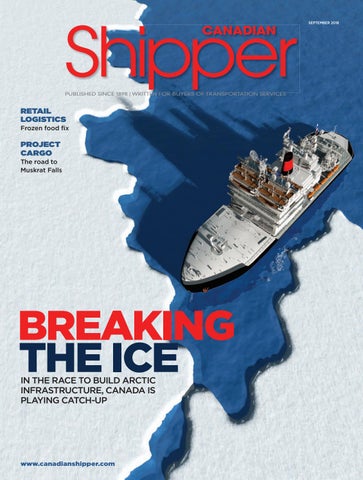
BREAKING THE ICE IN THE RACE TO BUILD ARCTIC INFRASTRUCTURE, CANADA IS PLAYING CATCH-UP
www.canadianshipper.com
WE MAKE DELIVERING CARGO A WORK OF ART Museums and galleries trust Air Canada Cargo to transport priceless artifacts and pieces from their collections around the globe. AC Secure is designed for the safe and secure transport of valuable cargo. From Egyptian artifacts to modern art, we are proud to be trusted to transport the world’s cultural heritage. aircanadacargo.com
CONTENTS
SEPTEMBER 2018
DEPARTMENTS
8
5 | Editor’s Foreword Arctic intentions
COVER STORY
6 | In the news
BREAKING THE ICE
Seaway cargo generates $60 billion worth of economic activity; Air Canada Cargo receives live animal certification
IN THE RACE TO BUILD ARCTIC INFRASTRUCTURE, CANADA IS PLAYING CATCH-UP
41 | Inside the Numbers Inside Canada's private fleets
43 | Coaching Corner What happened to equal pay?
46 | The Bigger Picture Politics is costing shippers
Photo: iStock
31 Experts agree more needs to be done before it can be said Canada has entered a ‘Golden Age’ of shipping in the Arctic.
FEATURES
INTERNATIONAL TRADE | 16 Opening Asia’s markets with new Trans-pacific trade deal
PROJECT CARGO
RETAIL LOGISTICS | 21
The road to Muskrat Falls
OCEAN FREIGHT | 24
34
Frozen food maker revamps Canadian logistics
Carriers look past industry consolidation gains
EVENT LOGISTICS | 34 Behind the scenes of Formula 1 racing www.canadianshipper.com September 2018 3
Jacek Misiak Truck Driver 8 years, VersaCold
VersaCold is a food-first company. With over 70 years of supply chain experience, we’re a diverse team dedicated to ensuring the safety, quality and freshness of the food families eat—every step of the chain.
versacold.com
EDITOR'S FOREWORD John Tenpenny September 2018 Volume 121 Issue No. 5
EDITOR John Tenpenny (416) 510-6880 john@newcom.ca MANAGING DIRECTOR, TRUCKING AND SUPPLY CHAIN GROUP Lou Smyrlis lou@newcom.ca
Arctic intentions
ART DIRECTOR Ellie Robinson CONTRIBUTORS Carolina M. Billings, Tawna Brown, Mark Cardwell, Ken Mark, Carroll McCormick, Ian Putzger, Laurie Turnbull
PRODUCTION MANAGER Kimberly Collins (416) 510-6779 kim@newcom.ca DIRECTOR, BUSINESS DEVELOPMENT Delon Rashid (416) 459-0063 delon@newcom.ca REGIONAL ACCOUNT MANAGER Anthony Buttino (416) 458-0103 anthonyb@newcom.ca WESTERN EDITOR Derek Clouthier (403) 969-1506 derek@newcom.ca CIRCULATION MANAGER Mary Garufi (416) 614-5831 mary@newcom.ca PRESIDENT Joe Glionna CHAIRMAN & FOUNDER Jim Glionna HEAD OFFICE: 5353 Dundas Street West, Suite 400, Toronto, ON M9B 6H9 Canadian Shipper is written for Canadian transportation and logistics professionals who manage product flow from manufacturer to point-of-sale. Editorial is focused on reporting, analysis and interpretation of Canadian logistics trends and issues. It is published by NEWCOM MEDIA INC.
SUBSCRIPTIONS: Contact us at: mary@newcom.ca Tel: (416) 614-5831 Fax: (416) 614-8861 Website: canadianshipper.com (click on subscription button)
SUBSCRIPTION RATES: Canada: $65.95 + applicable taxes, per year; $107.95 + applicable taxes, for two years. U.S.A.: US$107.95 per year. All other foreign: US$107.95 per year. Single copies $8 except for the annual Logistics Buyers’ Guide (Aug) $60.95 + applicable taxes, (not including HST) plus $2.00 for postage. USA: US$68..95, Foreign: US$68.95 ISSN 2292-2490 (print), ISSN 2292-2504 (Digital), (Canadian Shipper.) Indexed by Canadian Business Periodicals Index. Printed in Canada. All rights reserved. The contents of this publication may not be reproduced either in part or in full without the consent of the copyright owner.
C
hina has an Arctic policy? Yes, it does. And that shouldn’t come as a surprise considering the vast wealth of untapped resources lying under the ice near the top of the world. In 2013, China was granted observer status—with the support of Iceland—at the Arctic Council, whose core members are Canada, Denmark, Finland, Sweden, Norway, Russia, the United States and Iceland. Iceland also granted the state-owned China National Offshore Oil Company permission to explore in Iceland’s waters and is co-operating on an observatory to study the magnetic phenomena known as the Northern Lights. China also operates a research station in Norway. According to Beijing, China won’t interfere in the interests of nations in the region. A top Chinese diplomat made that statement earlier this year in an attempt to allay concerns about his country’s increasingly prominent activities in the Arctic, such as sending the icebreaker Xuelong (Snow Dragon) on an 85-day ‘scientific’ quest across the Arctic Ocean in 2017. At the same news conference, the country released the government’s first comprehensive report on its Arctic policy. “Regarding the role China will play in the Arctic affairs, I want to emphasize two points. One is that we will not interfere; second is that we will not to be absent,” said the official. “Not being an Arctic country, China will not interfere in the affairs that are exclusive to the Arctic countries and inside the Arctic region.” The document is notable, in part, for what it leaves out. In particular, economic investment and military presence. The route to China via the Northwest Passage is some 40 per cent shorter than the traditional Panama Canal route, and as a result reduces greenhouse gas emissions by more than 1,300 tonnes per trip. In 2014, Fednav’s MV Nunavik sailed from Deception Bay en route to China via Canada’s Northwest Passage, with a full cargo of nickel concentrate. The Nunavik was one of the first commercial vessels to transit the Northwest Passage completely, and the first to do so unescorted with an Arctic cargo. As Canada looks to increase transportation infrastructure in the Arctic region (“Breaking the Ice” page 8) we should be mindful of China and other nations who may want to claim waters we believe are “internal” for their own use. An open dialogue is important, and our first question should always be, “What to you intend to do?” CS
POSTMASTER: Please forward forms 29B and 67B to: 5353 Dundas Street West, Suite 400, Toronto, ON M9B 6H9 Second Class Mail Registration Number 0721.
PUBLICATIONS MAIL AGREEMENT 40063170
John Tenpenny, Editor john@newcom.ca
© id-work/iStock
www.canadianshipper.com September 2018 5
IN THE NEWS
Seaway cargo generates $60B worth of economic activity: study Great Lakes-St. Lawrence shipping adds 180,000 jobs, $26B to Canadian economy Cargo shipments to ports on the Great Lakes-St. Lawrence River waterway generate $60 billion worth of economic activity and 328,500 jobs in Canada and the U.S., according to a new study. That breaks down to 181,000 jobs and $26 billion in economic activity in Ontario and Quebec. The Economic Impacts of Maritime Shipping in the Great Lakes-St. Lawrence Region reveals the economic benefits of the shipping activity along the entire binational Great Lakes-St. Lawrence River waterway—the longest deep draft inland navigation system in the world. In 2017, more than 230 million metric tons of raw materials and finished goods were transported by ships to and from ports via the waterway, which includes the Great Lakes, the St. Lawrence Seaway and the lower St. Lawrence river. This international and domestic cargo was worth over $100 billion. Key findings of the study include: • Great Lakes-St. Lawrence River shipping supports 181,000 direct, indirect and induced jobs and $26 billion in economic activity in Canada. More than 60 per cent of those jobs and impacts are in Quebec, with the balance in Ontario. • Marine-related industries and employees contribute significantly to the health, education and general prosperity of Canadian society through their $5.7 billion contribution to federal and provincial/ local taxes. • The top five cargoes transported on the bi-national system by volume are iron ore ( for steel production), petroleum products ( for fuel, home heating and business uses) stone/aggregates ( for construction), coal ( for steel production and more limited power generation) and grain ( for domestic food production and world export). • Containers shipped to Quebec ports accounted for 60 per cent of the total value of all cargo transported on the bi-national waterway. 13.8 million metric tons of containers were valued at over $60 billion. “This study demonstrates the value of investing in port and lock infrastructure,” said Bruce Burrows, president of the Cham6 September 2018 www.canadianshipper.com
The Welland Canal is just one section of the Great Lakes-St. Lawrence River waterway—the world’s longest deep draft inland navigation system.
“The 2017 shipping season saw significant cargo increases fueled by global economic recovery and new business wins. We have great potential to build on this momentum to deliver further economic growth for Canada.” Bruce Burrows, president of the Chamber of Marine Commerce
ber of Marine Commerce. “The 2017 shipping season saw significant cargo increases fueled by global economic recovery and new business wins. We have great potential to build on this momentum to deliver further economic growth for Canada.” According to Sean Donnelly, president and CEO of ArcelorMittal Dofasco, the Great Lakes-St. Lawrence shipping corridor is critical to the steel producer. “More than 185 ships deliver 5.2 million metric tons of iron ore and coal to our Hamilton docks every year. It provides a direct, costeffective and sustainable way to transport these huge volumes of raw materials. Our success is dependent on the success of our supply chain, including the St. Lawrence Seaway and the ship operators that move our material.”
Redpath Sugar’s iconic silos on Toronto’s waterfront were constructed in 1959 to coincide with the opening of the St. Lawrence Seaway to service the Ontario food and beverage processing sector, a sector which currently generates $41 billion in revenue, exports $7.6 billion in product and provides over 130,00 direct jobs, according to Phil Guglielmi, Redpath’s general manager. “[Redpath] will continue to be dependent on the St. Lawrence Seaway to provide a safe, environmentally efficient and economical mode of transport for raw sugar from as far away as Central America and Brazil. Each vessel of 20,000 metric tons of raw sugar represents 500 to 600 truckloads travelling over 500 kilometers of strained highways and congested downtown Toronto streets.” CS Photo: Chamber of Marine Commerce
IN THE NEWS
Air Canada Cargo receives IATA certification for transport of live animals Air Canada Cargo received the first Center of Excellence for Independent Validators for live animals logistics (CEIV Live Animals) certification by IATA after successfully completing the pilot program launched in March. According to Tim Strauss, vice president, Cargo, the certification reinforces that Air Canada Cargo is operating to the highest standards in the transport of live animals, be it exotic species or household pets. “Air Canada Cargo is a trusted carrier for thousands of animal shippers worldwide and has always complied with the IATA Live Animal Regulations. We expertly handle complex shipments, from rescued dogs, livestock, endangered animals travelling between zoos for conversation efforts and of course family pets. “We are honoured to have been selected to participate in the CEIV Live Certification pilot and are proud of the team at Air Canada Cargo for achieving the industry’s first ever certification, which reinforces our position as an industry leader.” “I want to congratulate Air Canada for their great leadership in achieving the first CEIV Live Animals certification in the world,” stated Nick Careen, IATA’s senior vice president, Airport, Passenger, Cargo and Security. “Proper handling and transporting of live animals is a very im-
“Proper handling and transporting of live animals is a very important aspect of the cargo supply chain, with many unique complexities.” Tim Strauss, Air Canada Cargo
portant aspect of the cargo supply chain, with many unique complexities. Global standards and expertise are key to the safe and humane transportation by air of this precious cargo.” The International Air Transport Association (IATA) launched the new standardized global certification program to improve the safety and welfare of animals travelling by air earlier this year. Air Canada Cargo and London Heathrow Animal Reception Center (HARC) were chosen to undergo a pilot for the program. Over several weeks in May and June, as part of a thorough audit, IATA’s specialists reviewed Air Canada Cargo’s policies and procedures for transporting live ani-
These alpacas travelled from a farm near Brome, Quebec to Frankfurt, Germany, though to their final destination was a farm in Norway.
mals. All aspects of animal handling were included in the review, from booking to acceptance, customer service, training, physical handling, transport to and from the ramp and conditions in our Montreal facility, and consideration for animal safety and well-being. Compliance with Canadian Border Services Agency (CBSA) was fully reviewed as was compliance with protocols like the Convention on International Trade in Endangered Species of Wild Fauna and Flora (CITES), whose aim is to deter illegal wildlife trade. CS
%*3&$5 8&&,-: *.1035 &91035 $0/40-*%"5*0/4 4*/("103& )0/( ,0/( #64"/ */%*" 4)"/()"* 4)&/;)&/
Photo: Air Canada Cargo
www.canadianshipper.com September 2018 7
INFRASTRUCTURE
ARCTIC SHIPPING WARS Canada is racing to catch up when it comes to enhancing northern transportation infrastructure BY MARK CARDWELL
W
hatever the reasons for global warming, the reality is that the mountains of ice and snow that once made travel into and across Northern Canada the stuff of lore are fast receding. But does the advent of ice-free waterways and a few new transportation infrastructure projects in the region mean Canada is on the cusp of a golden age of shipping into and around the Great White North? Not unless and until there is a sea change in Canadian attitudes and investments toward the North, say experts in the field, including top executives with two Canadian shipping companies that predominate the movement of people and goods in the region. “Shipping has always been a fundamental feature and a major challenge of Canada’s North,” says Michael Byers, a political scientist at the University of British Columbia and Canada research chair in global politics and international law. “But I think our de8 September 2018 www.canadianshipper.com
First Air’s fleet provides passenger and cargo service between 31 northern communities.
velopment of transportation there is extremely slow.” According to Byers, whose work focuses on Arctic sovereignty, climate change and Canadian foreign and defence policy, Ottawa has long paid lip service to the need to enhance northern transportation infrastructures and create marine corridors that are competitive, safe and environmentally and socially sustainable. But he says decades of inaction have left Canada unprepared and unable to regulate and/or support the domestic and international maritime traffic that is rising as quickly as sea ice is vanishing from the waterways that link the Atlantic and Pacific Oceans through Canada’s Arctic, particularly the Northwest Passage. “The Canadian Arctic is a big and dangerous place,” says Byers. “You need search and rescue capabilities, aids in navigation, ports of distress—you name it. But Canada has almost none of that.” One example of the federal government’s failure to act, is the promise it made in 2007 to build a naval refueling station for the
Photo: First Air
INFRASTRUCTURE
Arctic. “That’s still the plan,” says Byers, “But there’s been no action.” He also noted that Canada has only one ship—the ice breaker Louis St. Laurent, which turns 50 in 2019 and is now used as an Arctic research vessel—capable of getting into our northern-most territorial waters. Though he applauded the start of work in July on a new deepsea port and small-craft harbour in Iqaluit—an $85-million, Inuitbuilt facility that is expected to open in November of 2019 and provide 24-hour access for sealift carriers and facilitate delivery of cargo and fuel to Nunavut’s capital—Byers lamented the closure since 2015 of the port in Churchill, Manitoba. It is Canada’s only Arctic deep-sea port with land connections southward. Talks aimed at finding local buyers for the port and flood-damaged railroad, which was closed last year by American owner OmniTRAX, were held onboard a Canada Coast Guard vessel in the port of Churchill on July 3. By August however no agreement had been reached. Byers says the only operating facility right now in the Canadian Arctic is the deep-sea wharf built by and for Baffinland Iron Mines in 2015 at Eclipse Sound near the Mary River iron-ore mine on Baffin Island in Nunavut. “We need to get Churchill reopened,” says Byers. “It should be a national priority.” Breaking the ice The lack of infrastructure in Canada’s North, he adds, has put a damper on the hopes and enthusiasm of sea-trading nations and businesses for a viable commercial route between Asia and Europe that is nearly half as long as transiting the Panama Canal. In early 2018, for example, China’s ministry of transport published an operating manual for the Canadian Arctic that calls the route “the world’s most efficient and fast passage” between eastern and western markets. However, unlike Russian’s Northeast Passage, a route lined by major ports with two million people and enough modern icebreakers (more than 50, the world’s largest such fleet) to help ships move an estimated five million containers a year, Chinese officials say the dearth of everything from ports and hydrology data to telecommunications and search-and-rescue capabilities in Canada’s sparsely-populated Arctic region mean “commercial operations (there) will have to wait a long time.” Tom Peterson agrees. A former ship captain cum vice president and the No. 3 executive at Montreal-based Fednav, the world’s largest Arctic shipping company, he says Canada should discourage commercial traffic through the Arctic for the foreseeable future. “It’s not true that sailing is getting easier in the north,” says Peterson, who oversees Fednav’s fleet of three identical Polar Class-4 icebreakers that serve as support vessels for world-class nickel, lead and zinc mines in Canada’s North, including Voisey’s Bay and Deception Bay. “I think trips through the passage should be restricted. It’s too risky for spills and possible problems that require assistance and cost Canada plenty.” According to Peterson, operating in the Arctic is a dangerous business at the best of times.
Fednav ships make some 100 trips per season between the Arctic, Europe and Eastern Canada.
“There is a lot of risk and reward in the equation,” he says. “You need a lot of experience and infrastructure to do what we do, which is relatively high risk.” Privately-owned Fednav, which will celebrate its 75th anniversary in 2019, has been involved in every major shipping project in Canada’s Arctic for the past 65 years, from the building of the first Distant Early Warning (DEW) Line facilities on Hershel Island to community and mine supply and resupply. Fednav ships make some 100 trips per season between the Arctic, Europe and eastern Canada, notably Quebec City, carrying a combined tonnage of six million tons of minerals, supplies and fuel—seven million litres worth. “That is a significant amount of material and it has increased steadily over the years,” says Peterson. “It’s still a niche business for us but it’s an important one because it’s not market sensitive and contracts are stable.” Though the infrastructure Fednav uses in the Arctic (mostly docks and loading equipment) are built, owned and maintained by the blue-chip miners the company works for, Peterson says its ships are designed and built specifically for the rugged conditions of the dedicated routes they run. “These are 30,000-ton ships worth $80 million to $90 million apiece, four times the cost of a bulk carrier,” says Peterson. “We carry high-value cargo that can be worth $15,000 a ton. That’s the same value as a super tanker of oil.” Unlike ships that use the Panama Canal, Peterson says there’s no smooth sailing or predictability when sailing through Canada’s Arctic waters. “Ship owners are in the business of making money,” he says. “Speed and distance equals time and the sailing through the (Northwest Passage) forces slowdowns and challenges.” Depending on location and time of year, Peterson says ships plying northern Canada waters run a gauntlet of ever-changing dangers that range from fog and icebergs to car-sized growlers and house-size bergy bits that can breech a ship’s hull. “The molecular structure of thousands-years-old ice is stroncontinued
Photo: Fednav
www.canadianshipper.com September 2018 9
INFRASTRUCTURE
continued from p. 9
ger than steel—it’s more like titanium,” says Peterson. Ships that make it to the Beaufort Sea confront another menace in the form of pingo fields, which are mounds of earth-covered ice that push up from the ocean floor like underwater mountains. “They are charted but you need to go slow,” says Peterson, who gives an annual lecture on sovereignty and the Northwest Passage to post-graduate students at the University of California, Berkeley. Asian-bound ships, he adds, must also contend with powerful winds and monstrous waves in the Bering Sea and around the Aleutian Islands. “By the time you get to China your ship and crew are used,” says Peterson, who oversaw the 2014 trip of Fednav’s ice-strengthened ore carrier Nunavik, which made the first unsupported trip through the Northwest Passage from Deception Bay in northern Quebec to northeastern China. “Taking a cargo from Montreal to China via the Northwest Passage is not likely.” Not cleared for takeoff Obstacles of a different kind face the most popular and yearround option for the transportation of people, food and consumer goods to and from northern Canada—air travel.
“Our operating costs are substantial and the climate is tough on planes and schedules,” says Brock Friesen, president and CEO of First Air. Wholly owned by the 9,000 Inuit of northern Quebec through the Makivik Corporation, a non-profit group created in 1975 to invest proceeds from the James Bay and Northern Quebec Agreement, First Air is by far the largest airline serving Canada’s Arctic. The airline’s fleet of 19 aircraft—including 13 ATR freighter aircraft (six for passengers, seven for carrying approximately 4,500 kilograms of cargo) and four jets—provide scheduled service between 31 northern communities plus Ottawa, Montreal, Winnipeg and Edmonton.
Follow us on 10 September 2018 www.canadianshipper.com
INFRASTRUCTURE
Completed in 2017, at a cost of $300 million, the Iqaluit Airport’s new terminal is eight times the size of the original.
Only Yellowknife, Iqaluit and Ranken Inlet have proper paved runways in the northern communities the airline services. The rest are small, Indigenous-run village airports with gravel runways that are frozen—and as hard as concrete—for several months each year. According to Friesen, those small airstrips are mostly devoid of basic navigation systems, especially for approaches, like runway lights and navigation aids. “These are all soft investments that need to be done but don’t get done,” he says. “But the big issue we face right now are crew and duty time regulations, which are designed for big carriers on global routes.
“To apply those norms in the North we have to hire 13 per cent more pilots. But there is a pilot shortage so it’s not easy to do.” Friesen lauded a new federal infrastructure investment to the Cold War-era facility his company uses at the airport in Iqaluit. Announced in May, the $35-million project involves the building of an expanded cargo warehouse operated by First Air that will increase the capacity to store climate-controlled dry goods and refrigerated products—to reduce food waste due to weather delays—by 75 per cent. Last year, a new terminal at Iqaluit Airport— eight times the size of the original— was completed. “Our government is investing in Canada’s economy by making improvements to our trade and transportation corridors,” federal Transport Minister Marc Garneau said in a press release announcing the project. The funds came from Canada’s $2 billion National Trade Corridors Fund, which is part of the federal government’s $180-billion Investing in Canada Plan, a long-term strategy for addressing infrastructure needs. In addition to the Iqaluit cargo warehouse, the government announced funds to replace outdated and undersized airport terminal buildings in the five communities of Kugluktuk, Naujaat, Kimmirut, Whale Cove and Chesterfield Inlet. continued
Photo: Government of Nunavut
www.canadianshipper.com September 2018 11
INFRASTRUCTURE
continued from p. 11
The recently opened Inuvik–Tuktoyaktuk Highway is the first all-weather road to Canada’s Arctic coast.
“Transportation and distribution of goods are a vital part of our local, regional and national economies and this announcement makes our transportation system stronger by addressing urgent capacity constraints at First Air operations and at five airports in Nunavut and fosters long-term prosperity for our community,” stated Yvonne Jones, parliamentary secretary to the Minister of Crown-Indigenous Relations and Northern Affairs. The North, however, is mentioned only nine times in the strategy’s master document, entitled “Transportation 2030: A Strategic Plan for the Future of Transportation in Canada.” Similarly, the North is not one of the three strategic regions or corridors identified in Canada’s transportation and logistics system. According to Friesen, the Iqaluit investment is needed because nearly all of the food sold on Baffin Island is flown in through its capital city’s airport. “Our building there was hopelessly overworked and out of date,” he says. “Redoing the building enables us to redesign cargo flow through. That means better times and storage.” Not just another road Another recent transportation investment in Northern Canada that is earning rave reviews from backers and users is the new Inuvik-Tuktoyaktuk Highway. Opened in May and thought to be the most expensive unpaved road ever built in Canada, the 137-kilometre, $300-million road re12 September 2018 www.canadianshipper.com
places the world-famous ice road on the Mackenzie River that linked the two Northwest Territory towns during the winter months. It is also expected to replace the barges that bring fuel and other supplies downriver from Hay River to Tuktoyaktuk, a hamlet on a peninsula that juts out into the Arctic Ocean. “The road is working really well,” says Tuktoyaktuk mayor Merven Gruben, who is also vice-president of E. Gruben’s Transport Ltd., a family-owned firm that was involved in building the road. “The price of food and gas have gone down here considerably already. And people are happy they can now get down south in any weather.” Gruben downplays concerns that the highway’s $2.2 million per kilometer price tag and expected $1.5 million in annual maintenance costs—three times the annual cost to build the ice road— are too high. “It’s hard to rely on the ice road or barging bulk fuel and gas and it’s cheaper than flying,” he says. “It’s an investment in our future, which is looking much brighter thanks to this road. In my books, the [Canadian] Arctic is the place to be.” CS
Mark Cardwell is an independent journalist and writer based in Quebec City. He is a correspondent for publications in various fields, including transportation, business, agriculture, medicine and law.
Photo by Tawna Brown
Nothing says Professional Logistics Expert like CCLP. CITT is proud to SUHVHQW WKH &,77 &HUWL¿HG /RJLVWLFV 3URIHVVLRQDOV ZKR HDUQHG WKHLU CCLP designation EHWZHHQ -XQH -XQH &RQJUDWXODWLRQV WR WKH PRUH WKDQ GHGLFDWHG VXSSO\ FKDLQ ORJLVWLFV SURIHVVLRQDOV ZKR QRZ MRLQ WKH UDQNV RI WKH LQGXVWU\¶V HOLWH
Ericka Affonso Cruz, CCLP Toronto, ON
Mohammad Ahsan, CCLP Mississauga, ON
Rami Alsaidi, CCLP North York, ON
Deepika Bilkhu, CCLP Burnaby, BC
Megan Bradley, CCLP Cambridge, ON
Michael Butler, CCLP North York, ON
Charles Daharry, CCLP Milton, ON
Rajat Dalal, CCLP Scarborough, ON
Horacio De Leon, CCLP Woodbridge, ON
Carmen Apolaya Calderon, CCLP Mississauga, ON
Maude Arcand, CCLP Montreal, QC
Glenn Bedard, CCLP Brampton, ON
Debasish Chakraborty, CCLP Etobicoke, ON
Mariami Chubinidze, CCLP Kleinburg, ON
Troy Churchill, CCLP Guelph, ON
Sushrut Desai, CCLP St. Albert, ON
Justyna Dzioch, CCLP Edmonton, AB
Loudette Dela Riarte, CCLP Toronto, ON
Donnelly Fleming, CCLP Woodbridge, ON
Carrie Flood, CCLP Belleville, ON
Karen Flores Juarez, CCLP Toronto, ON
Kelsey Fulton, CCLP Ottawa, ON
Pragati Grewal, CCLP Calgary, AB
Darren Gumbs, CCLP Toronto, ON
Justice Gyan, CCLP Mississauga, ON
Andrew Hicks, CCLP Rycroft, AB
Mohammad Huq, CCLP North York, ON
Candice Kim, CCLP Cambridge, ON
Jennifer Kit Vorng Lim, CCLP Elmira, ON
Douglas Linton, CCLP Brampton, ON
Paul Liton, CCLP St. Laurent, QC
Lingling Liu, CCLP Mississauga, ON
Scott Luxton, CCLP Calgary, AB
Shannon Lynch, CCLP Toronto, ON
Jane Ayn Lyndon, CCLP Woodbridge, ON
Bobbi MacDougall, CCLP Port Hawkesbury, NS
Kristen Malcolm, CCLP Etobicoke, ON
Jay Michno, CCLP Winnipeg, MB
Marin Miu, CCLP Laval, QC
Giorgi Mkheidze, CCLP Kleinburg, ON
Nurzhan Moldakhmetov, CCLP Toronto, ON
Natalia Nakasato, CCLP Scarborough, ON
Ferlyn Noronha, CCLP Dubai, UAE
Simon Odongoro, CCLP Calgary, AB
Daniel Oluwasesan, CCLP Winnipeg, MB
William Pavlick, CCLP Winnipeg, MB
Franklin Pena Ibarra, CCLP Scarborough, ON
Aileen Platon, CCLP Winnipeg, MB
Jefferson Quach, CCLP Winnipeg, MB
Jennifer Rempel, CCLP Saint Laurent, QC
Simon Roy, CCLP Drummondville, QC
Alicia Samano Arriaga, CCLP Scarborough, ON
Jonas Schneider, CCLP Waterloo, ON
Stephan Sommer, CCLP Mississauga, ON
Robert Sutton, CCLP Alix, AB
Ismael Tan, CCLP Toronto, ON
Nora Tsui, CCLP Markham, ON
John Wiles, CCLP Mississauga, ON
Kejia Zeng, CCLP Markham, ON
Yan Sun, CCLP Markham, ON
Adriano Viterbo, CCLP Mississauga, ON
Shalaine Waudby, CCLP Brampton, ON
6HH WKH 7KH /LVW RI all &XUUHQW &&/3V SOXV H[SORUH LQGLYLGXDO &&/3 SURÀOHV DW
ZZZ FLWW FD WDOHQWSRRO
Photos of these 2018 &,77 &HUWLÀHG /RJLVWLFV 3URIHVVLRQDOV were not available: Rajesh Batra, CCLP, Hamilton, ON Jeff Biggar, CCLP, Mississauga, ON Jennifer Casey, CCLP, Saint John, NB Jordan Dalzell, CCLP, Brampton, ON Sanjib Debnath, CCLP, Brampton, ON Ruslan Drygant, CCLP, Oakville, ON Oscar Garro, CCLP, Phoenix, AZ Alexei Gekkelman, CCLP, Kelowna, BC Janaya Hansen, CCLP, Borden, ON Kirk Huff, CCLP, Winnipeg, MB Syed Saad Hussain, CCLP, Brampton, ON Radovan Ilievski, CCLP, Toronto, ON Ankit Joshi, CCLP, Vancouver, BC Jagpinder Juneja, CCLP, Brampton, ON Chris Keough, CCLP, Calgary, AB Marc Klein, CCLP, Burnaby, BC William Knowles, CCLP, Signey, BC Amber Leavitt, CCLP, Blacks Harbour, NB Ching-Fang Lee, CCLP, Delta, BC Jason Lyons, CCLP, Etobicoke, ON Brett MacDonald, CCLP, Calgary, AB Dwayne MacEachern, CCLP, Port Hawkesbury, NS Stephanie Matthews, CCLP, Burlington, ON Paul Musgrave, CCLP, Dieppe, NB Kyle Ng, CCLP, Richmond, BC
Paul Ody, CCLP, Burlington, ON Prachi Patel, CCLP, Burlington, ON Dinesh Ramchandani, CCLP, Mississauga, ON Randy Richmond, CCLP, Toronto, ON Eusebio Rodrigues, CCLP, Mississauga, ON Sharon Rose, CCLP, Burlington, ON Derrick Sones, CCLP, Calgary, AB Fernando Sternberg, CCLP, Winnipeg, MB Jill Stevens, CCLP, Winnipeg, MB Nicoleta Tampu, CCLP, Oakville, ON Tiffany Tanguay, CCLP, Mississauga, ON Brandon Toothill, CCLP, Langley, BC Ralph Turner, CCLP, Brampton, ON Theresa Urbanczyk, CCLP, Edmonton, AB Wilson Villanueva, CCLP, Toronto, ON
7R VHH WKH /LVW RI all &&/3V SOXV LQGLYLGXDO &&/3 SURÀOHV YLVLW ZZZ FLWW FD WDOHQWSRRO )RU PRUH LQIRUPDWLRQ DERXW VXSSO\ FKDLQ ORJLVWLFV FRXUVHV DQG SURIHVVLRQDO FHUWLÀFDWLRQ IURP &,77 YLVLW ZZZ FLWW FD
What’s the PRVW UHZDUGLQJ career decision you’ll ever make?
Your best choice for complete career-long OHDUQLQJ FHUWLÀ FDWLRQ in supply chain logistics
Earning the CCLP® designation is easily the single best thing you can do to boost your career prospects. It can set you up for better SD\ PRUH DGYDQFHPHQW RSSRUWXQLWLHV DQG D UDQJH RI PDQDJHPHQW SDWKZD\V DQG RSWLRQV DFURVV WKH VHFWRU 3OXV \RX¶OO GHYHORS DQG GHPRQVWUDWH FURVV IXQFWLRQDO FDSDELOLWLHV WKDW FDQ GHOLYHU better business results—DQG PRUH SHUVRQDO MRE SURWHFWLRQ Depending on your background, your &&/3 designation might be within closer reach than you think. Call or click WR ¿ QG RXW LI \RX TXDOLI\ IRU DGYDQFHG VWDQGLQJ
ZZZ FLWW FD FFOS • ®CCLP & &,77 &HUWLÀ HG /RJLVWLFV 3URIHVVLRQDO LV D UHJLVWHUHG WUDGHPDUN RII &,77
INTERNATIONAL TRADE
A Trade Deal by Any Other Name The newly signed CPTPP agreement will give shippers better access to Asia’s booming markets BY KEN MARK
D
espite President Trump’s tariff tug-of-war against Chinese imports which could lead to an all-out trade war, many global traders now realize that other Asian markets are no longer dozing tigers. China, Japan, South Korea and Singapore are already first-tier economies. But others may soon join the club. China ‘s supreme leader, Xi Jinping’s has confirmed that his ultimate goal is to ensure his country becomes the world’s largest economy by 2050. That locomotive will pull along many neighbouring economies into the 21st century. As well, The World Bank predicts that by 2030 India could become the world’s third largest economy. In fact, its annual GDP growth rate may soon exceed eight per cent, surpassing China’s current figures. In India in particular, a rising middle class—one that recently saw the country open its first IKEA store—will make it all happen. Currently it numbers about 50 million people or five per cent of 16 September 2018 www.canadianshipper.com
India’s population. By 2030 it will top 475 million, adding more people than China to the global middle class. By then, others predict that two-thirds of the world’s middle class will be living in Asia. As more consumers have more money, they start buying more imported products while local producers will require more foreign parts and components for higher priced products for domestic and export sales. Ignoring President Trump’s tirades against global trade, Canada and many other countries are busy negotiating and signing free trade agreements. After ratifying the Comprehensive Economic & Trade Agreement (CETA) treaty with the 28-member European Union (EU), Canada has recently signed the Comprehensive and Progressive Agreement for Trans-Pacific Partnership (CPTPP). Other signatories include Australia, Brunei, Chile, Japan, Malaysia, Mexico, New Zealand, Peru, Singapore and Vietnam These eleven countries represent 13.4 per cent of global GDP.
Photo: ©michal812/iStock
INTERNATIONAL TRADE
The CPTPP is the world’s largest free trade agreement, after the North American Free Trade Agreement (NAFTA) between Canada, the U.S. and Mexico. Its membership also differs from CETA, as the EU is a customs union. Several members of the Association of South-East Asian Nations (ASEAN) including Thailand, the Philippines, Myanmar, Cambodia and Laos have expressed interest in joining the CPTPP. It is an updated version of the earlier Trans-Pacific Partnership (TPP) agreement which was signed but never ratified. CPTPP signatories will start enjoying its benefits six months after ratifying the agreement. So far, two countries—Japan and Mexico had done so. As with the earlier TPP, both China and the U.S. are not involved. Since Japanese prime minister Shinzo Abe, was the prime mover behind the new agreement, proposed changes to the auto parts section that Canadian producers sought were ignored. Under CPTPP Japanese car makers will enjoy future advantages from using lower-cost South-east Asian auto parts and components in their vehicles. Where’s the beef? In contrast, Canadian food and agricultural exporters will celebrate CPTPP’s ratification. That’s because Japan currently imposes a 38 per cent duty on imported beef products such as muscle cuts. Under CPTPP, it will drop to nine per cent over the next 15 years making Canadian products more competitive. Says Chris White, Ottawa-based president of the Canadian Meat Council: “Canada needs to be among the first six to ratify to ensure we enjoy the full advantages of the treaty. Otherwise, our competitors will.” At the same time, China has developed a huge appetite for Canadian meat exports. According to the Canadian Meat Council, in 2016 red meat exports to China surged to $835 million, more than double the amount in 2010. As the current U.S.-China trade impasse drags on, some suggest it may offer a chance for Canadian exporters, who do not face such embargoes that American firms do, to slip in and sell more products to China. However, White warns that such moves may backfire. “We are better served by not trying for short-term advantages because once the problems are solved, that will come back to bite us,” he says. CPTPP also opens the door to future products as well. It includes the most advanced and detailed intellectual property (IP) standards of any existing trade agreement. They will protect companies operating abroad from having their innovations stolen. That’s important since exports are increasingly digital systems and high-tech tools not simply mechanical products. Still, trans-Pacific trade relies on existing logistics infrastructure and technology, both of which are adapting quickly to handle current and future complexities and growth. In Maersk’s recent Canada Trade Report, Jack Mahoney, president of Maersk Line Canada wrote: “For a country that makes trade one of their top priorities and believes that commerce brings prosperity and growth, CPTPP represents an opportunity to help boost exports after a moderately better performance in 2017. CPTPP will also further increase Canada’s activeness as a gateway for trade to North America.”
THE ART OF THE (ASIAN) DEAL Jeff Leung, a principal with the JET Design Group in Toronto is part of the team that has successfully cracked the Asian architecture and design marketplace. He offers some of his insights. “A good place to start is finding local people ‘in the know’ who can introduce you to potential clients who are really interested in what you have to offer—avoid tire kickers. Take the time to identify the key decision makers and build a true relationship with them. “Starting almost 10 years ago to raise our Asian profile our firm took the risk of participating in international competitions for Asian projects. The first was for a project in the southern Taiwanese port of Gaoxiong. We came fifth out of 95 participants. Later, we were again in the top five for project in Shenzhen China. “As our credibility grew, architectural and other design firms in Asia and Europe started talking to us. Finally, in 2013 we won the competition which attracted more than 100 entrants to design the M+ Pavilion in Hong Kong’s West Kowloon Cultural District. It was completed in 2017. “More recently, we completed a theatre project in a Beijing suburb after winning the commission over a much more experienced Hong Kong designer. The client was impressed by our portfolio. Good design is really is good business. “Our success in Asia also was made easier with the support of the Canadian Consulate General in Hong Kong and other government agencies like Export Ontario. They helped to organize and covered a portion of the cost of trade shows, which helps us to showcase our work to prospective clients.”
continued www.canadianshipper.com September 2018 17
INTERNATIONAL TRADE
continued from p. 17
Photo: HZMB Authority
Above: The Hong Kong-Zhuhai-Macao Bridge project includes a 29.6-km bridge, a 6.7-km tunnel and two artificial islands for the tunnel landings. Left: Foreign firms can ship goods to customers in China through Free Trade Zones (FTZ) facilities, such as those operated by Montreal’s OEC Group.
Photo: OEC Group
A key factor in Maersk’s trans-Pacific optimism is the role of the port of Prince Rupert in its operations. Thanks to its location, the port is 58 hours closer to Asia than any other North American gateway—which for ships traversing the route can mean roughly one additional round-trip voyage a year. Goods offloaded at Prince Rupert can then be trans-shipped to Canadian and U.S. destinations using a Canadian National Railway’s 20,000-mile network, which connects the Pacific Coast, the Atlantic and the Gulf of Mexico. According to Brian Friesen, director, trade development and communications with the Prince Rupert Port Authority, the primary destinations for bulk cargo such as grain, coal and wood pellets include China, Japan, South Korea as well as other markets in Southeast Asia, destinations offered by DP World’s Fairview Container Terminal with its four weekly services to Asia. “In 2017, DP World completed a major expansion of the Fairview Terminal, adding a second berth, 6,000 feet of additional ondock rail and three new large dock gantry cranes to handle the largest container vessels in the world. Our natural 17-metre deep harbor and berth depth in excess of 17 metres enables us to accommodate newer vessels that are getting larger and larger.”
In the zone However, the growing number of Chinese free trade zones (FTZs) may offer Canadian and other exporters other options for serving the needs of their Chinese and Asian customers. “Foreign firms can ship goods to customers in China or other parts of Asia faster, cheaper and more securely from our Chinese FTZ facilities than from their home countries,” says Marc Bibeau, president and CEO of Montreal-based OEC Group. An experienced “China hand,” having first visited the country in 1984, Bibeau has watched China pass through various boom, bust and echo cycles over the years. He believes that the current boom will end, but no one is sure when. OEC has established a major presence in several of China’s Free Trade Zones such as Shanghai and others, especially in the larger business centres on the coast of Eastern China. Bibeau believes that FTZs are crucial to ensuring that foreign firms’ supply chains operate smoothly and efficiently, as well as make sure that foreign products stored in its Chinese FTZ facilities reach Chinese and other Asian customers safely and on time. According to Bibeau, the key for unlocking the advantages of the continued www.canadianshipper.com September 2018 19
INTERNATIONAL TRADE
continued from p. 19
FTZ system was spending the necessary time and effort to understand Chinese business practices, relevant government policies and regulations while establishing close relationships with customs and other government officials as well as partnering with local transportation and
logistics firms. (See sidebar on page 17) In addition, Canadian exporters and supply chain specialists should also remember Hong Kong’s unique China trade role. Later this year, several infrastructure mega-projects are due to open including the much anticipated 29.6-kilometre
“Foreign firms can ship goods to customers in China or other parts of Asia faster, cheaper and more securely from our Chinese FTZ facilities than from their home countries”
PROUD RECIPIENT OF THE
NISSAN LOGISTICS
AWARD
2 0 1 7 B R A N D P O W E R AWA R D | 2 0 1 8 M O B I L I T Y AWA R D
Serving your LTL, Truckload & Dedicated requirements to/from Canada, AL, GA, TN and KY for more than 20 years.
Marc Bibeau, president and CEO of Montreal-based OEC Group Hong Kong–Zhuhai–Macao Bridge (HZMB) and tunnel system. It will reduce the overland travelling distance from Hong Kong to the other cities from 160 to 30 kms while shortening transit times three hours to approximately 30 minutes. The highway terminates at Hong Kong Airport which in 2017 was the world’s busiest air cargo facility handling more than five million tonnes of freight. The bridge-tunnel-roadway link will become the transportation backbone for China’s “Greater Bay Area” plan to link Hong Kong to Guangzhou, Shenzhen and eight other Guangdong Province cities. China has a four-year plan to turn the corridor into a Silicon Valley-like financial and innovation powerhouse. Attendees of the upcoming Asian Logistics and Maritime Conference organized by The Hong Kong Trade Development Council (HKTDC) in November will learn how these and other related infrastructural projects will retool the region to become the south-eastern terminus for China’s expansive Belt and Road Initiative (BRI). This world-changing US$1 trillion infrastructure project involving more than 70 countries is China’s master plan to become the world’s largest economy by 2050. It likely is too massive for even President Trump to derail. CS Ken Mark is a veteran technology expert, who has covered supply chain management since it was called distribution and has documented its legitimization as a critical business function. He holds an MBA from York University.
20 September 2018 www.canadianshipper.com
RETAIL LOGISTICS
FROZEN FOOD FIX Optimizing its transportation network helped a frozen foods producer ensure a merger went smoothly for its retail customers BY IAN PUTZGER
A
takeover in the frozen foods business gave Transplace Canada a logistics puzzle to chew on. The Dallas-based provider of transportation management services and logistics technology was called in to revamp the Canadian logistics of an overseas producer of frozen food in the wake of its takeover of a North American competitor. The marriage not only doubled the client’s volume in North America, it also added considerable complexity to their North American footprint. This called for a new logistics strategy that would enhance visibility and allow for network optimization to leverage the increased volume and enlarged footprint.
There were several clear objectives that the company was pursuing—notably cost reduction, a more consolidated transportation strategy, a better streamlined shipping schedule and perhaps also a faster turn of inventory, recalls the executive director, supply chain. Beyond this, he was looking for an integrated solution, which would eliminate the need to talk to various parties while engendering a closer engagement with the logistics partner. “We had a very transactional relationship with all our providers. We had separate agreements with warehouses and transportation companies,” he says about the previous set-up. For Transplace the challenge was to configure a network to accommodate the
changes in the client’s sourcing, with minimum impact on service and cost. “We needed to ensure that lead times would be upheld, if not improved,” says Brian Ware, managing director, Transplace. Together the pair mapped out the client’s business to work out a baseline for the amalgamated operation. At the time of the acquisition the company was producing most of its frozen products for the Canadian market in eastern Canada, supplemented with imports from overseas. The takeover added production facilities in eastern Canada and in the U.S. Logistics in Canada prior to this centered around warehouses in eastern and western Canada. continued
©StockImages_AT/iStock
www.canadianshipper.com September 2018 21
RETAIL LOGISTICS
continued from p. 21
A radical change of the warehousing strategy became the cornerstone of the revamp. The warehouse in the west was dropped, while the prime warehouse in the east, which is located not far from the main Canadian production facility, was converted into a merging centre where shipments from various origin points are consolidated to serve customers in Ontario and in the west. Product from overseas, the U.S. and Canada converges at the centre. Merging inventory Ware stresses that the shift to a merging centre marks a fundamental change from inventory at rest to inventory in motion. “It’s not a storage facility but a proper merging facility,” he says. This means that product is held for shorter periods of time on a smaller footprint. Typically it should not stay in the building for more than seven days. Previously the client kept inventory stock on hand for 20-25 days. Instead of feeding and maintaining the former warehouse in the west Transplace now builds up full truckloads at the merging centre, co-mingling the shipments with traffic from other customers when possible. This has brought a sharp reduction in the use of LTL for the client. The trucks heading west make multiple stops on their journey to drop off consignments at a number of points in the west. “This eliminated the need to replenish our warehouse in the west, which was expensive. Plus, we saved a lot of LTL costs,” says the manufacturer’s executive director, supply chain. “They schedule multiple stops to different customers en route, co-mingling our product with other customers.” While the western warehouse has disappeared altogether, inventory levels at the merging centre are down, thanks to the relatively short distance to the production plant, he adds. In order to make the new model serving the west work it was necessary to modify the ordering process, designating certain days when customers can place their orders. “Historically our order and shipping schedule was very open, very fluid. It made sense to go to a structured schedule—without extending the lead times. They are the same,” says the supply chain director of the manufacturer. The implementation of an ordering and shipping schedule has brought an el-
©Nirad/iStock
Ware stresses that the shift to a merging centre marks a fundamental change from inventory at rest to inventory in motion. “It's not a storage facility, but a proper merging facility.” This means that product is held for shorter periods of time on a smaller footprint. ement of consistency to the process, and it has resulted in reduced lead times, according to Transplace. “Customers know if they order on a specific day, they get their order on a specific day,” remarks Ware. Thanks to systems integration, Transplace has early visibility of orders in the pipeline. “The minute an order is generated in their system we have visibility,” he says. For the manufacturer this consistency has also been beneficial. The objective of the revamp was to become as efficient as possible—not only in terms of transportation but also with regard to dealing with customer orders and administration, says the supply chain director. On the transportation side the new strategy has brought tangible benefits. The consolidation of freight and the reduced inventory level has produced cost savings north of seven per cent. The revamp optimized the network and brought consistency to the shipping operations. Moreover, the manufacturer has established a partnership with the logistics provider, unlike the previous engage-
ments with other logistics firms. Their collaboration has brought about a level of integration and visibility that should set the stage for further gains. According to the client, Transplace’s role “continues to grow as we move forward and explore additional opportunities to drive further operational efficiency and improve financial performance”. For his part, Ware says that the collaboration with this client has set the bar for engagements with other customers. “Our work on this has become a best practice in our organization.” CS
Ian Putzger is an award-winning journalist with more than 20 years experience covering transportation and logistics issues. He is a former writer and editor with the Hong Kongbased Asian Sources Media Group, and Airtrade, a British magazine covering the global air cargo industry.
www.canadianshipper.com September 2018 23
OCEAN FREIGHT
BIGGER, BETTER,
STRONGER? Carriers are beginning to look past the gains of industry consolidation as they confront calls for better service from shippers BY JOHN TENPENNY
T
he past few years have seen a wave of consolidation amongst container shippers, reducing their number, while at the same time ocean cargo carriers operating in multiple trade lanes has also dropped. Yet the container industry remains only marginally competitive. Shippers, meanwhile, are demanding better service. There are signs that the ocean carrier industry is moving towards a recovery from overcapacity and low freight rates. In the first half of 2018, the Prince Rupert Fairview Container Terminal has seen container volumes surge by 19 per cent from the same period last year, more than any other major gateway for Asian trade in the U.S., Canada or Mexico. The Port of Vancouver also reported that container volumes (measured in 20-foot equiva24 September 2018 www.canadianshipper.com
lents or TEUs) increased by five per cent compared to mid-year 2017 to a record 1.64 million TEUs as a result of the growing demand for Canadian resources and products, and the increasing Canadian demand for consumer and manufacturing goods from Asia. With the good comes some bad, according to Maersk Line Canada president Jack Mahoney. “What we in Canada share with the global challenge is the escalating costs, particularly as it relates to fuel,” he says. “The rate improvements or the recovery of those fuel cost increases has not been satisfactory. That’s applying a substantial pressure on Maersk Line and I doubt we are unique in that. It’s a negative aspect of ocean freight in Canada.” On the other hand, there is a positive
story adds Mahoney. “In that the market growth we see so far this year is consistent with what we see in the market and that is that the market growth is positively developing—close to six per cent yearto-date—versus last year, and last year was a positive market.” Continued container volume growth is envisioned by Hapag-Lloyd Canada’s managing director Wolfgang Schoch as well. Cost increases from a variety of sources means freight rates will continue to remain under pressure, “even in cases where third-party vendor costs are charged by a carrier as a pass-through to a customer, resulting in disputes. “[We] continue to explore operating synergies and efficiencies wherever possible, while negotiating with vendors and offering alternative options to customers
“‘Peak container’ isn’t on the horizon,” a McKinsey & Co. report declared recently, saying container traffic was likely to grow as long as the global economy keeps growing. “Indeed, the flexibility of the container trade makes it resilient: one product may go out of fashion but another will come along to fill the box.”
In the first half of 2018, the Prince Rupert Fairview Container Terminal has seen container volumes surge by 19 per cent from the same period last year, more than any other major gateway for Asian trade in the U.S., Canada or Mexico Photo: Maersk
in an effort to minimize the impact of such increases. The consequence of not recovering such costs will eventually have an impact on customers, as carriers rationalize and limit services offered as we have already started seeing in certain trades with fewer options now available. Nonetheless, freight rates must increase for carriers to remain viable, while focusing efforts on improved service in a somewhat strained environment.” The proof is in the pudding A recent report from consultancy AlixPartners, “2018 Global Container Shipping Outlook,” suggests that if the industry addresses the dual challenges of rising costs and oversupply—mostly driven by fleet expansion—there may be some rate restoration this year.
OCEAN FREIGHT
Maersk’s remote container management (RCM) system not only monitor’s a reefer’s location, but also how well the refrigerated unit is maintaining the shipper’s settings for temperature and atmosphere control. Graphic: Maersk
According to the report, shippers may soon see impacts resulting from the industry’s reconfiguration into two tiers: the five large global players and about two dozen much smaller players, many of which compete either as specialists or exclusively in niche markets. “As controlling power within the industry stabilizes,” the report states, “it becomes more important than ever for carriers to step up their efforts to improve their performance, discipline their investments, and sharpen their strategies for succeeding through scale or specialization.” The report also notes that it’s vitally important for carriers to curb their “voracious appetite” for new vessels and increase scrappage to reduce the current margin-crushing balance of supply and demand. However, fleet capacity is once again on the rise. Estimates of growth in fleet capacity in 2018 range anywhere from four per cent to more than five per cent, compared with 3.3 per cent in 2017. For Pyers Tucker, senior director of corporate development at Hapag-Lloyd, it all boils down to quality of service. “The irony is that we’re in a service industry, but for the last 10 years—service, quality service—has been neglected. Carriers have not put much effort into it and the reason is that the only game in town was to increase scale as fast as possible. We believe that has now run its course,” he told Canadian Shipper from his office in Hamburg, Germany. “We believe the container shipping industry is coming to an inflection point. In
the past it was only about getting as big as you can as fast as you can, but in the future, we think it’s going to be increasingly about delivering on quality.” “That’s our fundamental belief and it’s why we undertook a massive market research study.” What became clear from the results of that study, says Tucker, is that the single biggest thing customers want is on-time delivery. “They’re really fed up with the on-going inability of carriers to provide a sufficiently reliable service to enable their supply chains to work effectively.” For Tucker and Hapag-Lloyd, it’s all about what they call “provable quality.” One of the issues over the past ten years, he says, has been that carriers have been effectively selling a “best-efforts” promise and then failing to deliver. “They were mainly marketing exercises. What they’re missing is the actual operational execution in the background and therefore struggled to be able to deliver against their promises,” says Tucker. “When you look at it from a customer’s perspective, it’s extraordinary how few of the things that really matter to customers carriers can even measure.” Therefore, the approach Hapag-Lloyd is taking is seeking to identify the promises that really matter to customers, being able to measure them internally so that they can manage their achievement and show customers how they performed and the evidence of how they performed. “Our goal is to have a standard of performance and we will set up our operations and our systems and our managecontinued www.canadianshipper.com September 2018 25
CONNECT WITH EDMONTON CARGO
EDMONTON INTERNATIONAL AIRPORT CARGO Use our expanding network to ship anything, anywhere in the world • Full service capabilities including perishables, cold storage and heavy lift • Worldwide air cargo service with non-stop freighter routes and connections • Â&#x;NON STOPÂ&#x;PASSENGERÂ&#x;ÛIGHTSÂ&#x;WITHÂ&#x;CARGOÂ&#x;CAPACITYÂ&#x; • Road connections within 24 hours to and from anywhere in Western Canada
&ORÂ&#x;MOREÂ&#x;INFORMATIONÂ&#x;VISITÂ&#x;ÛYEIA COM cargo
MEMBERS OF:
OCEAN FREIGHT
continued from p.25
At Hapag-Lloyd, efforts to digitize the process for customers led them to being the first of the major container lines to launch an online rate quotation tool—Quick Quotes. Photo: Hapag-Lloyd
ment structure and our reporting to manage by those KPIs and to execute against those KPIs rather than it being quality as promised by a salesperson, that is then not lived up to,” explains Tucker. “We believe that doing this and really executing on this is what is going to help us win commercially.” According to Hapag-Lloyd’s market research there is an appetite for quality and that appetite differs from customer to customer. It is all about value creation for customers, says Tucker. “There’s a small segment of shippers where reliable supply chains really create value for them and that’s particularly manufacturing, retail and high-value goods. For them, having a reliable supply chain where they can reduce their buffer stocks because they know shipments will come in on time and they can reduce their inventory carrying and distribution costs, that really creates value for them. “There is a second, larger group of shippers for whom price matters, but so does quality, providing that the price is similar and that there is proven quality, not promised quality. “Then you have the largest group, which are the shippers only focused on cost. Reliability doesn’t really create value for them. “They are not our target. We will, of course, continue to serve them, but won’t focus heavily on them. We do however suspect that once this type of customer starts seeing the evidence of additional value that we can create for them by in-
creasing reliability, that some of them may switch carriers.” Simply better Quality of service has to be executed— by people—and that’s what can set apart one carrier from another, says Jimmy Deliveliotis, vice president – branch services for MSC (Canada). “All the carriers offer similar transit times and vessel sizes, but we believe it’s the people that make the difference. “The feedback we’ve been getting from shippers is that they continue to work with MSC mainly because of our employees and because we’ve been able to build personal relationships with those same customers. We’re also fortunate to have such a dedicated and passionate team who are dedicated to customer service.” Those relationships in Canada are built in-person, says Deliveliotis. “Since 2017 we’ve decentralized our operations in Canada, establishing a full branch model across the country, with branches in Vancouver, Toronto and Montreal. They handle all the day-to-day interactions with customers, including documentation, bookings, vessels, import releases, et cetera. “We believe having staff in our customers’ backyard is very valuable in helping us manage their expectations and that is what builds long-lasting relationships.” Simplicity is another way to improve customer service, says Mahoney. “What we’re trying to do is make sure
that we do our part to make it simpler for Canadian importers and exporters to conduct their business through a host of initiatives. But also, that we make it easier for Canadian importers and exporters to connect with their market.” On the simplification side, Maersk Line Canada is seeing an uptick in the use of their website, “which is the standard way we take bookings and issue invoices and using that allows us to have and also share with the client great visibility on how quickly, how timely, how accurately we’re doing things like bookings and invoicing,” says Mahoney. “Of course [ from customers] there is an expectation and a demand for transparency and our website helps with that, being available 24/7, having improved functionality and being the main method that customers can get something quickly, timely, accurately and at their convenience without needing to deal with courier fees or counter services.” As far as connections, Mahoney points to Maersk’s network on both coasts and the recent addition of a new service between the east coast of Canada and the Mediterranean. “It was seeing these positive developments in north Europe in the months after CETA that helped,” he says. “We did see a want and a need in the market for an alternative to what existed.” The free trade agreement with the European Union not only helped north Europe, but it helped Mediterranean volume as well. And as Mahoney points out, with continued www.canadianshipper.com September 2018 27
OCEAN FREIGHT
continued from p.27
Levelling the playing field In anticipation of the new surge in ocean carrier consolidation, a new partnership was recently forged between two prominent global supply chain consultancies and launched this past spring. Chainalytics and Drewry Supply Chain Advisors have partnered to create the Ocean Buying Group, an ocean freight procurement platform that will enable medium and small-scale importers and exporters to collaboratively achieve “big shipper” rates and terms direct with ocean carriers and benefit from shared intelligence for better commercial decisions. “By combining propositions we’re able to offer a unique service delivering much needed improved ocean carrier contractual terms with full transparency, cost stability and predictability, market intelligence and technologydriven category management to a segment of the market that often suffers pricing volatility and opaque service levels,” Philip Damas, head of Drewry’s logistics practice, remarks. “We designed the Ocean Buying Group to provide companies often outsized by competitors the opportunity to gain ‘big’ shipper value relative to the size of its organization and quantity of shipments, and our partnership with Drewry further enhances our clients’ capabilities to competitively acquire ocean freight services,” explains John Westwood, senior manager, Chainalytics Transportation Practice “This is an exciting initiative, not only for both our organizations but also for Beneficial Cargo Owners (BCOs)”, adds Arjun Batra, group managing director at Drewry. “Between our two companies lies a vast knowledge bank of market insight and intellectual knowhow which can be exploited to the full. Through the launch of the Ocean Buying Group we look forward to delivering something compelling to those that value our independence and impartiality.”
28 September 2018 www.canadianshipper.com
Since 2017 MSC has decentralized its operations in Canada, establishing a full branch model across the country, with branches in Vancouver, Toronto and Montreal.
Maersk’s terminal network, the new service opens more destinations for shippers. “We’re able to take Montreal and Halifax cargo to our own facilities in the Mediterranean and from there connect to Africa, the Middle East, India and Pakistan and even as far as Asia.” With trade policies and tariffs seemingly shifting with the prevailing winds, carriers like MSC need to keep a close eye on where their customers may be heading. “We’ve definitely seen a lot more cargo coming in from the EU since CETA was enacted and we’re getting a lot more requests on the export side about shipping to those markets,” says Deliveliotis. “What we’re seeing is shippers are now forced to look at other markets to sell their goods in and are swayed from their traditional trading markets, and what we’ve done is made sure that if customers come in and ask about a new market they want to penetrate that our staff put them in contact with our offices overseas. “Some are weary of trading to the same traditional trading partner and are using our network to make it easier to move goods efficiently and effectively to those new markets they’ve discovered.” Digital age Given the complexity of today’s global ocean cargo networks, a new era of digitized transparency cannot come too soon, suggests a new report by Boston Consulting Group (BCG). The report, ti-
Photo: MSC
tled “Digital Imperative in Container Shipping,” notes that digital technology is transforming and disrupting the container shipping industry. “A few leading container carriers have started to capture significant improvements in costs and revenues. Other carriers still have an opportunity to leap to the forefront of digital adoption, but they must embark on the transformation immediately,” states the report. “Carriers must also defend their direct customer relationships against threats from traditional logistics players and new entrants that are adopting digital to provide seamless end-to-end services.” To that end, Maersk Lines’ parent A.P. Moller-Maersk took steps to help overhaul global trade by unveiling a joint venture with IBM to create an industry-wide, paperless platform using blockchain technology. That venture—TradeLens— recently announced that 94 organizations are actively involved or have agreed to participate on the platform built on open standards. “Technologies like blockchain will help address one of the downsides in ocean shipping, the fact that we have a lot of archaic, paper-based handoff interactions,” says Mahoney. “Blockchain isn’t intended only as a Maersk offering, but as something the industry can adopt. The whole shipping ecosystem should be able to benefit from it.” But even before blockchain, Maersk was offering technologies like remote container management (RCM), which,
OCEAN FREIGHT
says Mahoney, “enable both sides to avoid and reduce the quantity of waste that can be involved in shipping, waste in the form of redundancy and waste in the form of extra paperwork and handoffs.” Described as “relatively simple,” RCM involves a GPS, a modem and a SIM card on all 270,000 of Maersk’s reefer containers, enabling readings to be continuously collected and stored. That information then reaches customers and global support teams via satellite transmitters on 400 of the company’s ships. Interest in the technology has exceeded expectations, says Mahoney, interest he attributes to customer demand for transparency. MSC also employs ocean container tracking technology, in the form of Traxens, which Deliveliotis says gives customers unprecedented visibility of cargo from door-to-door. The system uses a sensor-laden hardware, including GPS, that can monitor a container’s position, temperature, humidity, carbon dioxide level, vibration activity, unauthorized door openings, and customs status. In addition, it can also communicate readings in real time to a data hub using mobile transmission technology. The Traxens system can also remotely adjust the temperature in refrigerated containers. “We’re always looking at what new technologies are out there, exploring and experimenting, and we continue to digitize all aspects of our business to make sure it’s easier for our customers to deal with MSC, whether it’s blockchain or any other technology,” adds Deliveliotis. At Hapag-Lloyd, efforts to digitize the process for customers led the company to being the first of the major container lines to launch an online rate quotation tool—Quick Quotes. After, what Schoch describes as a successful implementation period, the program became available to all customers in August. To get a shipment quotation, customers log in via Hapag-Lloyd’s website, select start and end points of the shipment, and nominate commodity and container types. Customers will, “within seconds” says Hapag-Lloyd, receive a binding quotation, allowing them to immediately
make a booking. Customer feedback thus far has been extremely positive, according to Schoch, who is quick to add that while digitalization of the industry is front and centre, with more products being offered at a
Canadian Intermodal LTL Canadian Road LTL !8',3<9-2+ { -9;8-#<ধ32 Cross Border LTL Service
faster pace, carriers need to remember nothing can replace customer service when it comes to the unique requirements and issues faced by shippers. “Digitalization with a human touch is key to our success.” CS
Coast to Coast Coverage Container Transport/Drayage '&-$!;'& '8=-$' ø'8-2+ Transload Service Centres
I N T E G R AT E D LO G I S T I C S
Ontario/Quebec Service Cross Border Truckload Dry Vans and Reefers Dedicated Service Schedules
Added Capacity and Coverage Canadian LTL & Truckload Cross Border LTL & Truckload Specialized & Intermodal
Let Fastfrate Group help you stay competitive in today’s market.
www.canadianshipper.com September 2018 29
th ANNIVERSARY
SURFACE TRANSPORTATION SUMMIT
Drive Results for Your Business OCTOBER 10, 2018 International Centre 6900 Airport Road, Mississauga, ON
GET Expert insights on the state of the industry and future trends Actionable strategies to increase efficiencies and productivity Networking with supply chain leaders Inspired with enlightening keynote speakers
Economic outlook | Freight transportation technologies | Shipper - Carrier roundtable | Last mile delivery | ELD mandate | Managing budgets | Small Carrier strategies | Freight brokerage & management | And more‌ Association Partners
Produced by
MEDIA INC.
www.surfacetransportationsummit.com
Media Sponsors
PROJECT CARGO
POWER MOVES Shipping huge components to the Muskrat Falls hydro project in Labrador was no walk in the park BY CARROLL MCCORMICK
V
ast quantities of materials and equipment have been supplied to Muskrat Falls, Labrador and associated downstream facilities for a hydroelectric megaproject, for which construction began in 2012. One complex set of moves involved 20 rotors, stators and transformers, the lightest of them mashing the scales at 175 tonnes. Over a roughly six-month period spanning 2016 and 2017, heavy-lift ships from General Electric plants in England and Brazil delivered 14 transformers, weighing between 175 and 200 tonnes apiece, to Bay Bulls, a 30-minute drive south of St. John’s. Barges also arrived with three 205-tonne stators and three 225-tonne rotors manufactured by General Electric in Sorel-Tracy and Trois-Rivieres, Quebec. Bay Bulls is a central repository for the Lower Churchill Project, which includes the 824-megawatt Muskrat Falls installa-
tion—a dam and overland and subsea transmission lines stretching from Labrador to Nova Scotia. The Lower Churchill Project is being developed by Nalcor Energy, a provincial Crown corporation under the Government of Newfoundland and Labrador Hydro, created in 2007 to manage the province’s energy resources. In the early months of 2017 Transport Bellemare International moved the stators and rotors, and Mammoet seven of the transformers, 37 kilometres from Bay Bulls to Soldiers Pond, where direct current electricity from Muskrat Falls will be converted to alternating current. Mckeil Marine used its barge Dowden Spirit to move the seven remaining transformers 474 nautical miles up the coast to Cartwright, Labrador. From there Mammoet handled the 400-kilometre overland journey to the Muskrat Falls hydroelectric dam construction site.
Mckeil Marine’s barge Dowden Spirit moved seven transformers for the Muskrat Falls hydroelectric project 474 nautical miles up the coast of Labrador.
Shouldering the weight Specialized equipment and exquisite planning are required for such unusual overland moves. Mammoet project manager Carter El-Fityani ticks off some of the advanced planning his team did: “Evaluation of the road itself, culverts, bridges and structure analyses for crossing with a heavy load, evaluation of hills, to ensure enough tractive effort can be applied, evaluation of corners, to ensure the 24-metre hydraulic trailer, along with prime movers [tractors] could navigate the turns.” Kevin Kwateng, heavy haul operations manager with Transport Bellemare International, discusses some of the pre-trip continued
Photo: Mammoet
www.canadianshipper.com September 2018 31
PROJECT CARGO
continued from p.31
The 400-kilometre trip from Cartwright to Muskrat Falls took two days, travelling with two transformers at a time.
planning for their loads, which stood 25 feet high. “Before we started the project, 65 poles were replaced and wires were raised for height clearance.” And moving the loads at night was a double-edged sword. “It is more difficult to move at night, because we have utility crews moving lines in the pitch black with no street lights. Traffic-wise, there are a lot fewer cars and pedestrians moving around at night. It is so much of a hassle during the day,” Kwateng says. Bellemare brought its equipment in from Sainte-Catherine’s, Quebec, hitching a ride on the barge that moved the stators and rotors. It included a 90-foot long, madein-Germany Goldhofer hydraulic platform trailer with 16 axles, weighing about 60 tonnes. Bellemare used a 60-foot Goldhofer to move pieces off the barge that came up from Quebec. The hydraulics on these specialized trailers power two feet of up and down axle travel. They not only allowed the trailers to duck under the loads and rise up to shoulder the weight. The highly responsive hydraulics also kept trailers level even as waves rocked the barge moored alongside the wharf, and smoothed and leveled the ride as the rigs negotiated the uneven road to Soldiers Pond at a stately 20 km/h. Western Star tractors with dual drive axles and 600-Hp engines pulled the trail32 September 2018 www.canadianshipper.com
ers. (It took three tractors pulling and two more pushing to get each load up the hill out of Bay Bulls.) Travel rules included stopping if winds blew stronger than 40 km/h, or if gusts exceeded 60 km/h. And for some of the moves, which were done in February, significant snow accumulation, rain, or temperatures below seven degree Celsius, also meant no travelling. A contractor salted down the road to Soldiers Pond to re-melt any daytime runoff that froze at night. Moving the remaining seven transformers to Cartwright took about 60 hours for each of the two voyages. While the Dowden Spirit was mobilised from Sydney, Mammoet brought in its equipment from Guelph and Edmonton, and moved it to Cartwright on the barge. Just loading the barge in Bay Bulls was a very complex, week-long procedure that included setting ballast pumps, loading one transformer per day, always on a rising tide, and securing everything to the deck. “The loading procedure, aka the roll-on, is a very calculated maneuver with a lot of engineering behind it,” explains El-Fityani. “Essentially, we have only two windows of opportunity per day to roll on. One of those being during the night, and it is generally much higher risk to roll on overnight, so we don’t do that.”
During the overland journey, it took tractors, to pull the 200-plus tonne loads up hills.
It took another six days to offload the first barge in Cartwright, after which it returned to Bay Bulls to fetch the remaining three transformers. Meanwhile Mammoet prepared for the last leg of the journey to Muskrat Falls. “[We]t required two days to set out the appropriate equipment, and secure the area for safe operations,” says El-Fityani. “Additionally, we [had] to configure the transport equipment and go through the necessary safety checks to ensure that our equipment was operating as expected.”
Photos: Mammoet
PROJECT CARGO
Fail to plan, plan to fail But even before that, Mammoet and others had done extensive work to prepare the route for the convoys, according to El-Fityani. “A number of overhead wires had to be addressed. The road was, for the most part suitable, however road plating was strategically placed in certain locations, civil work was required at one intersection to widen the corner, allowing the lengthy transport to make the turn. A specialized detection service was brought in to locate an old underground fuel line. We had to address this crossing, in order to alleviate concerns from the locals that the high axle loads and overall gross vehicle weight would not damage the fuel line.” And then there were the bridges the massive loads, which grossed out at 312 tonnes per vehicle, would cross. “Every bridge along the route from Cartwright to Muskrat Falls had to be extensively analyzed by a third party to ensure that the structures could support the transport loads,” says El-Fityani. The Paradise River and Kenamu River bridges required special attention, he adds. The Kenamu River bridge, at a span of 81 metres, was analyzed years ago and structurally upgraded to support the load. The Paradise River bridge, also an 81-metre span, required special conditions to be met, including disconnecting the second prime mover, driving down the centre of the bridge with no other traffic on the structure. For one culvert, which could not have supported the passing loads, Mammoet laid down 15.2-metre ramps weighing more than eight tonnes each, so the rigs could safely cross over it. Eventually everything was ready, and Mammoet set out for what would be a two-day journey, driving at speeds ranging from a crawl to a breezy 20 km/h. ElFityani recalls the set-up: “We travelled with two transformers at a time. Pilot vehicles, authorities, utility support, and escort vehicles, and traffic management personnel were all part of the convoy, in addition to the transformer load. The transformer, on a 16-axle hydraulic trailer, with two prime movers to provide the grunt is a 51-metre vehicle. We had two of those per convoy. With all the additional vehicles, all leaving sufficient space for safe navigation does add up
to a very lengthy convoy.” Finally, with the deliveries successfully completed, the Dowden Spirit headed back to Sydney, Nova Scotia, while Mammoet and Bellemare demobilized their equipment in preparation for the next big job. CS
Carroll McCormick is an award-winning writer who has been covering transportation industry issues and technologies for more than a decade. He is based in Quebec.
www.canadianshipper.com September 2018 33
EVENT LOGISTICS MANAGEMENT
FORMULA for SUCCESS DHL has become an expert in handling time-critical, international motorsports logistics, moving F1’s freight by land, air and sea BY JOHN TENPENNY
T
he man charged with ensuring 10 Formula 1 teams—and all their equipment—arrive in time to compete in 21 races over five continents compares the task to playing Tetris, the addictive puzzle video game from the 1980s. The game was about creating order out of chaos. “Everything has to be in the right place at the right time or it simply doesn’t work,” says Paul Fowler, vice president Motorsport and managing director, UK DHL Global Forwarding, on the phone from London. The company has been active in Formula 1 logistics for more than 35 years and has been the Official Logistics Partner since 2004. Described as the “race before the race,” the logistical effort it takes to transport up to 2,000 tonnes of freight from one racing venue to another safely and on time leaves little room for error. “It is like playing Tetris at the highest level, only quicker,” says Fowler. “The only difference is we don’t get to do Game Over, because that’s not an option. 34 September 2018 www.canadianshipper.com
“There is literally no room for any failure at all.” During an eight-month schedule (April to November), beginning in Australia and ending in Abu Dhabi, Fowler and his team sometimes have less than 48 hours after the race to dismantle the irreplaceable equipment at the race venue, transport it to the next venue and reassemble it there. There is a timeframe of just two days for the transportation of the valuable and sensitive cargo, including the teams’ racing cars, tires, fuel and spare parts, but also transmission technology, hospitality and marketing equipment. “For the tight schedule to work, everything has to be planned well in advance to the minute,” says Fowler. At European races, DHL operates up to 25 trucks to transport around 1,000 tonnes of freight from one racing venue to another safely and on time. For fly-away races outside Europe the amount of freight handled by DHL increases to about 2,000 tonnes (or 240 elephants), corresponding to the load capacity of six Boeing 747 aircraft
EVENT LOGISTICS MANAGEMENT
Top: Each Formula 1 team carts around 10,000 kilograms of electronics, while each race venue requires 150,000 kilograms of broadcast media equipment and 30 freight containers of hospitality equipment. Above: At each of the circuit’s 21 races, DHL handles 40 to 50 tonnes of freight per team, which includes fuel and tires.
and 40 sea freight containers. During the course of the 2017 season, those airplanes travelled a combined distance of 131,995 kms. Each team requires 2,000 litres of motor fuel, 140 litres of engine oil, 40 litres of oil and 90 litres of engine coolants—for each race. On average, there is 40 to 50 tonnes of freight per team, including 10,000 kilograms of electronics. In addition, 150,000 kilograms of broadcast media equipment and 30 freight containers of hospitality equipment is moved between each venue. The Grand Prix du Canada, held on the Circuit Gilles Villeneuve on Montreal’s Ile Notre-Dame in June, holds unique challenges and not just because it follows the race in Monaco. “It’s on an island, so we have to deal with bridges, roadwork and traffic,” says Fowler. “For timing, we like to operate at night or out of peak periods, but sometimes flights are delayed and that can put us into a traffic situation.” They fly into Mirabel International Airport, which Fowler says
is great for capacity, but it’s further away from the race track which can lead to traffic issues when you have a convoy of 40-50 trucks. “Because the Montreal race is not a 365-day circuit, and so semi-permanent, we have to also consider the local infrastructure going in first—grandstands, etc.—then our sea freight arrives around this time,” explains Fowler. “At the same time, we are talking to the organizers to see when we can get access to the track without causing any bottleneck to operations. “Next into the track is the team and TV infrastructure, like the garages for the teams, which have to be completed nine days before the race when the air freight arrives from Europe and plugs in to this pre-installed equipment. Revisiting tracks helps us because we know what to expect.” While this is all happening, the race is going on in Monte Carlo. As soon as the checkered flag is waved, the DHL team springs into action. “All the equipment is broken down and the technical equipcontinued
Photos: DHL Global Forwarding
www.canadianshipper.com September 2018 35
The supply chain never sleeps. And neither do we. At Transplace, we are relentless in executing our customers’ transportation and supply chain needs to achieve profitable and predictable results. Continuous improvement and innovation is core to our culture, and we aren’t satisfied until you are. Learn more about our North American logistics and technology solutions at Transplace.com. 1.866.413.9266 | info@transplace.com
J=KL =9KQ& O= OGF L&
Radar
nttss ent pmen hiip Sh
EVENT LOGISTICS MANAGEMENT
continued from p. 35
For races outside Europe, DHL ships up to 2,000 tonnes of freight on six Boeing 747 aircraft.
ment is sent back to the factories for a full rebuild, before being broken down again and put in what we call a fly-away kit—basically a travelling garage—and we collect them for shipment to Canada, where they are set up over the next three days in preparation for the teams’ arrival on the Monday before the race.” The race happens on Saturday and Sunday and while you might think that means the DHL teams gets a break, you’d be wrong. “I want to say we get a chance to catch our breath, but there is still a lot of last-minute equipment that can arrive as late as Saturday,” says Fowler. He says the logistics requirements are getting harder and harder as the windows are getting smaller because racing fans want to see more races and the only way to do that is to expand the season and that means more back-to-back races. Or back-to-back-to-back, as happened this season after the Montreal race. For the first time in the history of the series, there was a triple-header on the race calendar, i.e. three races on three consecutive weekends in three different countries: France, Austria and Great Britain. And Fowler doesn’t list that as the most difficult challenge he’s
faced during his 33 years being involved in Formula 1. “Two years ago, Baku [Azerbaijan] was a new event and was a back-to-back with Montreal [June 12 and 19], which was probably, with the time difference, the hardest the gig we’ve ever had to do. It was a seven-and-a-half-hour flight with the time zones working against us and a brand new event where the host country that was not really prepared for what was about to arrive—but they did exceptionally well under the circumstances.” During his time with Formula 1, Fowler has seen a lot of change, both on and off the track. “From a logistics point of view, it’s grown unrecognizably,” he says. “The season has expanded from when I started in this industry from four long haul international and 16 European races to 12 international and seven European races, so the dynamic for us as a forwarder has changed a lot. With more emphasis on the international events its longer periods away, and the team discussions are always about keeping all of the systems mobile, but safe.” With an increase in the size has come a commensurate amount of pressure to win. Their motto is: “Fail to prepare, prepare to fail.” continued
www.canadianshipper.com September 2018 37
th ANNIVERSARY
SURFACE TRANSPORTATION SUMMIT
Drive Results for Your Business OCTOBER 10, 2018 International Centre 6900 Airport Road, Mississauga, ON
GET Expert insights on the state of the industry and future trends Actionable strategies to increase efficiencies and productivity Networking with supply chain leaders Inspired with enlightening keynote speakers
Economic outlook | Freight transportation technologies | Shipper - Carrier roundtable | Last mile delivery | ELD mandate | Managing budgets | Small Carrier strategies | Freight brokerage & management | And more‌
Association Partners
Produced by
Media Sponsors
www.surfacetransportationsummit.com
EVENT LOGISTICS MANAGEMENT continued from p. 37
“Teams haul around a lot more equipment than they used to because they don’t want to fail and that demands more people and more equipment. It’s the drive for success and success sells,” says Fowler. “We have to have a 24/7 operation and follow everything through to the finest of details because you can’t be the weak link in their chain.” For Fowler, the biggest reason for DHL’s success in Formula 1 is people. He oversees a team of 57 full-time employees for the planning and logistics of F1, divided between Italy, Germany and the United Kingdom. “For us, we’re blessed with DHL’s global resources so we’re able to get local knowledge and support where required.” The logistics people at DHL have to know the individual peculiarities of each country inside out and ensure that all regulations are adhered to scrupulously. One mistake and the equipment may be held up for days or even weeks. That means good advanced planning. The DHL experts therefore draw up a long list of transport and customs rules before the start of every season. For example, no timber may be imported into Australia, China or Malaysia. Not a single wheel could turn in Formula 1 without logistics. No cars, engines or fuel would ever reach the race venues around the world. The drivers would not even have a driving suit in which to tear around the circuit—assuming they got to the race track first. CS
EXPAND DHL FEATURE π TO THIS 1/2 PAGE SHIPPING SUPPLY SPECIALISTS
OUR BOXES MEASURE UP OVER 1,550 BOX SIZES ALWAYS IN STOCK
ORDER BY 6 PM FOR SAME DAY SHIPPING
COMPLETE CATALOG
1-800-295-5510 uline.ca
www.canadianshipper.com September 2018 39
Whether it’s across town or halfway around the world, with every shipment and every project, our customers place their trust in our hands. My hands. Because at some point, every piece of business I touch becomes a personal responsibility. It’s up to me to keep costs down, performance on schedule, and quality at a premium. Someone’s business is riding on it. And I won’t let them down. I am
pilotdelivers.com / 1-800-HI-PILOT
INSIDE THE NUMBERS WITH LOU SMYRLIS, MCILT
QUIET GIANT
Fleet activities
Inside Canada’s private fleets The private fleet – despite claims to the oppo-
Long Haul (+600 km from terminal)
17%
Regional (-600 km from terminal)
36%
Urban/Local
13%
Construction
11%
Forestry
2%
Other
21%
site – is alive and well in Canada, having weathered the Great Recession and the economic upsurge. However, Canada’s private fleets are much different than their for-hire counterparts. They are much more focused on the regional
Planning to purchase Class 8 trucks this year
and local hauls than long hauls. Half of private
Yes
carriers have 25 or fewer vehicles in their fleet. They are also more dependent on medium duty
67%
33%
of respondents
No
vehicles than their for-hire counterparts.
Trade-in cycle for heavy duty vehicles
Percentage of fleet looking to replace
2-3 years More than 30% of fleet 4-5 years
4%
10 years or more
30% of fleet
0% of fleet
9% 6%
17%
20% of fleet
53%
33% of respondents
13% 23% 6-7 years
38%
4%
10% of fleet
8-9 years
Size of medium duty fleet 0 vehicles
Size of heavy duty fleet 8%
0 vehicles
4%
1-4 vehicles
36%
1-4 vehicles
12%
5-9 vehicles
10%
5-9 vehicles
17%
10-24 vehicles
24%
10-24 vehicles
17%
25-99 vehicles
14%
25-99 vehicles
25%
100-499 vehicles
4%
100-499 vehicles
19%
500 or more vehicles
4%
500 or more vehicles
6%
www.canadianshipper.com September 2018 41
29TH INTERNATIONAL AIR CARGO FORUM & EXHIBITION 2018 TORONTO METRO CONVENTION CENTER
OCTOBER 16th–18th
THE WORLD’S PREMIER AIR CARGO INDUSTRY EVENT
TIACA brings the world of air cargo to YOU with one goal in mind – to grow YOUR business ®
• •
BOOK YOUR STAND! 5% off Exhibit Booking Valid until March 31, 2018 www.aircargoforum.org
•
• •
Meet and create new business with over 3,000 industry decision makers/attendees From the ground to the sky... Network with every segment of logistics Take part and learn from dynamic, industry-leading panels and interactive workshops that will ensure your business is performing at its best Pre-schedule your business meetings and fill up your agenda weeks ahead of the event with CargoLinX! Stand out amongst the crowd with your own ‘fully furnished’ exhibit booth. Early Bird special is still available for a limited time.
IN PARTNERSHIP WITH: For further information, call +1 786 265 7011 or contact: Kenneth Gibson: kgibson@tiaca.org or Warren Jones: wjones@tiaca.org
COACHING CORNER
What happened to equal pay? Q: Our company has recently merged with another company and as a result you have people earning more than others, especially men. Plus, their employment agreements had different work conditions and special arrangements such as flexible hours. How do we even begin to address this? What happened to equal pay?
ability, workplace culture and the economy as a whole,” PwC noted in a study last year. It estimated that Canada would likely see $105-billion in GDP growth if it closed the wage gap and boosted female work-force participation. When companies merge there are several strategies that are often used to mitigate pay disparity:
The difference between equal pay for equal work and equal pay for work of equal value may seem like the same thing, but are in fact often confused. During the merger of two companies, the strategy to ensure such gaps are mitigated occurs during the planning stages and on-boarding process. It is not uncommon that companies have a completely different way to value positions and/or have different payroll/salary criteria based on company size or profitability. Equal pay compares the pay of incumbents in the same or very similar jobs. Pay equity compares the value and pay of different jobs within an organization in completely different roles or departments. For example, an accounting role and shipping/receiving one. This is the biggest area where pay based on gender gap occurs as some jobs/roles are often gender dominated. Recent annual data from Statistics Canada show that, in yearly earnings, women working full time in Canada still earned 74.2 cents for every dollar that fulltime male workers made. Another measure that controls for the fact that men typically work more hours than women— the hourly wage rate—shows women earned 87.9 cents on the dollar as of 2017. These numbers show that the pay gap exists in every province and in every major occupational group, though there are variations. The gap in annual earnings between men and women has barely budged over the past two decades, even as education levels among women have surpassed those of men. Across Canada, gender parity at all levels in the workplace “improves profit-
• All positions are treated as “new” as a result of the merge. This means all
A:
©iStock
employees have to re-apply to their jobs as a new position under the new criteria sometimes this means different work conditions and/or pay. • Red Circling means that when employees from company A are earning more than those from company B during the merger for similar positions, the new company can “Red Circle” or freeze that employee’s salary until the other employees catch up. This means it acceptable for two people to do the same work with different pay. The company must notify in writing the terms of the “Red Circle” for the employee receiving it. • Changing working conditions. The amount of notice required is the same as what would be required in the event of a dismissal without cause. Unless the existing contract says otherwise, it will be “reasonable notice.” In other words, it can be months or even years. Where several employees are involved, the most prudent course of action is to determine which employee is entitled to the greatest period of notice, and then provide that amount of notice to all affected employees. Exceptions to pay equity Even if a man and a woman are doing substantially the same work, they can be paid different rates of pay if the difference is due to: • A seniority system. An employee with greater seniority than another employee of the opposite sex may be paid more than the other employee even though both are doing substantially the same
By Carolina Billings, CPCC, CHRL, MA-IS
work if the difference in pay rates is based on a seniority system. • A merit system. An employee may be paid more than another employee of the opposite sex even though both are doing substantially the same work if the difference in pay rates is based on a system that objectively measures merit. • A system that measures earnings by quantity or quality of production.
An employee may be paid more than another employee of the opposite sex even though both are doing substantially the same work if the difference in pay rates is based on a system that measures how much employees produce or the quality of what they produce. • Any difference that is not based on the sex of the employee. For exam-
ple, an employee may be paid more than an employee of the opposite sex even though both are doing substantially the same work if the difference in pay rates is based on a factor other than sex. The truth is that aside from the designated Privacy Officers within a company who have access to the exact pay structure within an organization it is often left to innuendo or assumptions as to what other employee’s compensation plan is actually comprised of. In the simplest terms, equity means fairness, which is not necessarily the same thing as equality. It’s not about everybody getting the same thing, it’s about everybody getting what they need in order to improve the quality of their situation. CS Carolina M. Billings is Partner & CEO of a business consulting group and has 15+ years of experience in the fields of Business Development & Branding, Human Resources and Finance. She champions leadership initiatives as well as empowering and coaching/mentoring others to lead. For more information please visit www.thewellnessgroup.ca or email Carolina@thewellnessgroup.ca
www.canadianshipper.com September 2018 43
REPRESENTING CANADIAN SHIPPERS FOR 100 YEARS What do you know about? • The new Electronic Logging Device regulations for trucks? • The container decontamination requirements? • Improvements to the rail shipper protection laws? FMA members are kept informed on changes to current laws and regulations that will impact their operations. Government relations and information dissemination is an essential part of FMA’s mandate to promote a cost-effective, safe and efficient transportation system.
GOVERNMENT HAS A BIG IMPACT ON FREIGHT TRANSPORTATION you can help shape the future of the freight transportation industry. FOR MORE INFORMATION CONTACT FMA: (613) 599-3283 | kelsey@fma-agf.ca | www.fma-agf.ca
ADVERTISER'S INDEX
Air Canada www.aircanadacargo.com
2
Hercules www.herculesfreight.com
22
Air Cargo Forum www.aircargoforum.org
42
MSC www.msc.com
18
CITT www.citt.ca
13
Oceanex www.oceanex.com
11
CN www.cn.ca
back cover
Penske www.penske
47 40
Edmonton International Airport www.flyeia.com/cargo
26
Pilot Freight Services www.pilotdelivers.com
Fastfrate www.fastfrate.com
29
Surface Transportation Summit www.surfacetransportationsummit.com
Freight Management Association of Canada www.fma-agf.ca
44
Transplace www.transplace.com
36
U-LINE www.uline.ca
39
Gillship Navigation www.gillship.ca
7
GX Transport www.gxts.com
20
Highway H2O www.HWYH2O.com
33
30 & 38
Versacold www.versacold.com
4
GET THE INSIDE STORY! We’re renovating to serve you better! MM&D – CANADA’S SUPPLY CHAIN MAGAZINE – WILL HAVE A FRESH NEW TITLE AND A BOLD NEW LOOK THIS SUMMER. WE’RE EXCITED TO INTRODUCE TO YOU:
JUNE 2018
C A N A DA’ S S U P P LY C H A I N M AG A Z I N E
FORMERLY
MATERIALS MANAGEMENT & DISTRIBUTION
After 63 years in continuous publication, a lot has changed in the media world. New platforms, and new ways of consuming content demand a fresh approach. So we’re giving MM&D a new look worthy of the 21st century media landscape, and doubling down on our commitment to giving you the inside stories behind some of Canada’s most innovative supply chains. Exploring real world applications of the latest technologies and best practices, Inside Logistics will be your source for practical hands-on experience you can use and apply to your own operations.
The digital future
Modex shows the way
C A N A DA’ S S U P P LY C H A I N M AG A Z I N E
For editorial inquiries: EMILY@NEWCOM.CA For advertising inquiries: DELON@NEWCOM.CA
I N S I D E LOG I STI C S .C A
i Blockchain in the warehouse i Combilift at 20 i Airbus’s supersized supply chain
INSIDELOGISTICS.CA
www.canadianshipper.com September 2018 45
THE BIGGER PICTURE
The politics of risk management One of the unfortunate side effects of the current trade dispute between Canada and the U.S. is the realization that, despite Canada’s status as a founding member of the World Trade Organization (WTO) since 1995, Canadian businesses will be forced to deal with wasteful practices in their supply chain operations. When Taiichi Ohno developed his famous list of seven “wastes” while working at Toyota more than 50 years ago, the emphasis was on identifying elements of the production process that could be eliminated if they did not add value for the customer. For example, unnecessary transportation, over-processing and holding inventory. Companies now recognize the benefits of eliminating these elements in their pursuit of lean business practices to reduce costs, improve quality and increase competitive advantage. Whether calculated on an “ad valorem” basis (as a percentage of the product’s value), or as a “specific tariff ” (calculated on the quantity of goods being imported), tariffs serve to increase costs for political reasons. They do not add quantity, or quality, to the product being purchased; they simply increase the cost, rather than value, to the consumer and increasing costs unnecessarily can have a dampening effect on trade. In contrast, consider the impact on trade when tariffs are not applied. In April, the WTO reported that global trade in 2017 was the highest it had been since 2011. Given that tariffs in the current environ-
ment appear to be issued for no other reason than political expediency, they should be seen for what they are, nothing more than a form of taxation, or what Taiichi Ohno would consider “wasteful.” Cost increases like these in the supply chain are noticed quickly since they can have a negative impact on sales and company market share. But the current state of political tension between Canada and the U.S. also poses many less-visible risks for supply chain managers. Some of these are regulatory, which have an indirect impact on the supply chain. For example, in 2011 President Obama and Prime Minister Harper launched the Canada-United States Regulatory Cooperation Council (RCC), intended to promote regulatory cooperation between the two countries in a wide range of areas. The RCC initiative is a prime example of good governance, resulting in more efficient transborder operations for buyers and sellers and reducing costs for consumers. The current dialogue around tariffs however may counteract RCC benefits by adding more complexity in the supply chain when it comes to transborder transportation and customs formalities. Similar uncertainty surrounds the future of the AsiaPacific Gateway and Corridor Initiative (APGCI), an international trade initiative launched by the Canadian government in 2006 to speed the transportation of exports from Asia to consumers in Canada and the U.S. Among
46 September 2018 www.canadianshipper.com
By Laurie Turnbulll
other benefits, the APGCI has generated improvement of west coast port facilities in Vancouver and Prince Rupert, expansion of railway capacity from British Columbia to central Canada and development of CentrePort Canada, a world class transportation hub situated on 20,000 acres in Winnipeg. CentrePort’s strategic importance to North American trade is identified in its promotional literature, which promotes its location “onehour north of the United States and a consumer population of 100-million people
ism (C-TPAT) in the U.S. in 2001, Canada developed the Partners in Protection (PIP) program. Similar security programs have been developed by other countries that export to the U.S. and much effort has been spent over the past 15 years trying to harmonize these programs with C-TPAT. Despite the importance of supply chain security, these efforts are easily neutralized when negotiators lose sight of the bigger picture during trade disputes. This was the case recently when U.S. trade representative Robert Lighthizer reportedly labeled Can-
“Despite the importance of supply chain security, these efforts are easily neutralized when negotiators lose sight of the bigger picture during trade disputes.” within a 24-hour drive.” Unfortunately, the rapidly growing number of tariffs applied by the U.S. on Canadian and Chinese products may turn the APGCI into the fastest supply chain corridor to nowhere. Another consideration for Canadian importers and exporters is the potential impact worsening political relations with the U.S. may have on the future of supply chain security programs. Following development of the Customs-Trade Partnership Against Terror-
ada a national security threat. This type of negotiating immaturity demonstrates the importance of maintaining a reasoned approach to trade negotiations that have a direct impact on supply chain operations. The role of politics in this environment should be to facilitate international trade between buyers and sellers, not act as an impediment. Unfortunately politics is now associated with other risk management elements for Canadian businesses. CS
Laurie Turnbull, CCLP, MSc is a Professor, Supply Chain Management-Global, at Conestoga College Institute of Technology and Advanced Learning. He can be contacted at lturnbull@conestogac.on.ca.
©zygotehasnobrain/iStock
© 2018 Penske. All Rights Reserved.
REACH FARTHER.
3 coasts, 15 ocean terminals, 23 inland terminals and growing.
At CN we’re investing in all aspects of our business - from infrastructure to innovation - to give you the supply chain advantage you need to stay competitive in the global marketplace. Reach out to us and reach farther than you thought possible.
cn.ca