MAY 2018
PUBLISHED SINCE 1898 | WRITT WRITTEN TEN FOR BUYERS S OF OF TRANSPORTATION SERVICES
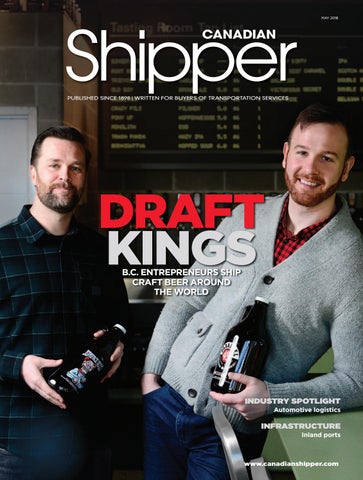
DRAFT KINGS B.C. ENTREPRENEURS SHIP CRAFT BEER AROUND THE WORLD
INDUSTRY SPOTLIGHT Automotive logistics
INFRASTRUCTURE Inland ports
www.canadianshipper.com
250 FLIGHTS, 24 HOURS. Your customers choose air freight when speed matters most — for transporting seafood, produce, pharmaceuticals, engine parts or anything urgent. Air Canada has more than 250 direct, widebody flights that can transport freight across Canada, the US, Mexico, South America, Europe, Australia, Asia, India and the Middle East, in 24 hours or less, airport to airport. Contact your Air Canada Cargo representative to find out how to leverage our network. aircanadacargo.com
CONTENTS
MAY 2018
DEPARTMENTS 5 | Editor’s Foreword The "other" trade deals
6 | In the news Strong growth predicted for NA container trade; UPS invests in Montreal hub
35 | Inside the Numbers Transportation buying habits
37 | Coaching Corner
8
Cannabis in the workplace
38 | The Bigger Picture NAFTA soul-searching
COVER STORY
25
B.C. entrepreneurs ship craft beer around the world
AWARD WINNING SUPPLIERS Profiles of some of Canada’s Best Managed Companies in the transportation and logistics industries
Dan Wainwright (left) and Garett Senez of Pacific Rim Distributors have created a unique business in helping craft brewers in the Pacific Northwest find and ship their beer to overseas markets.
FEATURES ROUTE PLANNING | 12 A look behind the scenes of oversize load transport
37
AUTOMOTIVE LOGISTICS | 16 The digitalization of the automotive supply chain
TRADE | 19 Concerns over Brexit are overshadowing CETA gains
INLAND PORTS | 22 The rise of Regina’s Global Transportation Hub
PEST CONTROL | 33 Keeping pests out of your supply chain www.canadianshipper.com May 2018 3
Photo: Ryan McLeod
DRAFT KINGS
EDITOR'S FOREWORD John Tenpenny May 2018 Volume 121 Issue No. 3
EDITOR John Tenpenny (416) 510-6880 john@newcom.ca MANAGING DIRECTOR, TRUCKING AND SUPPLY CHAIN GROUP Lou Smyrlis lou@newcom.ca ART DIRECTOR Ellie Robinson ellie@newcom.ca CONTRIBUTORS Eric Berard, Carolina M. Billings, Ken Mark, Carroll McCormick, Ryan McLeod, Alice Sinia, Laurie Turnbull PRODUCTION MANAGER Kimberly Collins (416) 510-6779 kim@newcom.ca VIDEO PRODUCTION MANAGER Brad Ling CIRCULATION MANAGER Mary Garufi (416) 614-5831 mary@newcom.ca DIRECTOR, BUSINESS DEVELOPMENT Delon Rashid (416) 459-0063 delon@newcom.ca PRESIDENT Joe Glionna CHAIRMAN & FOUNDER Jim Glionna VICE-PRESIDENT, OPERATIONS Melissa Summerfield
HEAD OFFICE: 5353 Dundas Street West, Suite 400, Toronto, ON M9B 6H9 Canadian Shipper is written for Canadian transportation and logistics professionals who manage product flow from manufacturer to point-of-sale. Editorial is focused on reporting, analysis and interpretation of Canadian logistics trends and issues. It is published by NEWCOM MEDIA INC.
SUBSCRIPTIONS: Contact us at: mary@newcom.ca Tel: (416) 614-5831 Fax: (416) 614-8861 Website: canadianshipper.com (click on subscription button)
SUBSCRIPTION RATES: Canada: $65.95 + applicable taxes, per year; $107.95 + applicable taxes, for two years. U.S.A.: US$107.95 per year. All other foreign: US$107.95 per year. Single copies $8 except for the annual Logistics Buyers’ Guide (Aug) $60.95 + applicable taxes, (not including HST) plus $2.00 for postage. USA: US$68..95, Foreign: US$68.95 ISSN 2292-2490 (print), ISSN 2292-2504 (Digital), (Canadian Shipper.) Indexed by Canadian Business Periodicals Index. Printed in Canada. All rights reserved. The contents of this publication may not be reproduced either in part or in full without the consent of the copyright owner.
No NAFTA, no problem
W
ith so much consternation surrounding ongoing NAFTA negotiations and amid refrains of “will they or won’t they,” some good news is being drowned out: Canada has other trade deals that are benefiting our economy. Both the recently launched Comprehensive Economic and Trade Agreement (CETA) with the European Union, and the recently signed Comprehensive and Progressive Agreement for Trans-Pacific Partnership (CPTPP) are helping to increase Canada’s imports and exports. According to marine shipper Maersk Line, Canada’s growth in imports and exports by container are surging past those of the U.S., in part due to trade deals signed with other countries. “Overall, we see Canada’s trade prospects very favourably compared to not just North America but globally,” says Jack Mahoney, president of Maersk Line Canada, in its North America Trade Report. (In the News, page 6.) “We think it all comes from this atmosphere where trade is seen as good for the country.” NAFTA will always be the most important trade deal for the participating nations, but both CETA and CPTPP are increasingly showing up on the radar of businesses. A recent study from HSBC found 43 and 39 per cent of Canadian firms saw growth opportunity from CETA and CPTPP respectively, compared to 52 per cent from NAFTA. As well, all three countries remain upbeat about doing more business abroad, with Mexico leading the way with 87 per cent of firms surveyed expecting increased trade volume over the next 12 months, compared to 77 per cent of U.S. firms and 70 per cent of Canadian firms. With CETA ratification now complete, access to the EU’s 512 million consumers has been granted to Canadian companies looking for new or expanded markets. One industry already seeing benefits is Canadian seafood. According to the Lobster Council of Canada, sales are up to certain European countries, now that the eight per cent duty has been dropped (“Anarchy in the U.K.” page 19). Even that quintessentially Canadian product—beer—is benefiting from our increased trade partnerships around the globe. In conversation with Dan Wainwright and Garett Senez, founders of PACRIM Distributors, for our cover story (“Draft Kings” page 8), the CPTPP was specifically mentioned as a boon for their business in markets as diverse as Mexico and Vietnam. Due in no small part to the arrival of these trade deals, PACRIM expects to be in as many as 25 markets in Asia and Europe by the end of next year. While there are those that question the timing of the CPTTP—namely the Canadian auto industry—there is no doubting that opening trade corridors with nations other than the United States will only strengthen our economy. You only have to look at the about-face President Trump has done on his country’s interest in joining the Trans-Pacific agreement. CS
POSTMASTER: Please forward forms 29B and 67B to: 5353 Dundas Street West, Suite 400, Toronto, ON M9B 6H9 Second Class Mail Registration Number 0721.
PUBLICATIONS MAIL AGREEMENT 40063170
John Tenpenny, Editor john@newcom.ca
iStock
www.canadianshipper.com May 2018 5
IN THE NEWS
Canada’s container trade growth to outpace U.S.: Maersk North America set to deliver strong growth in 2018 after healthy 2017 The signing of two major trade deals with global trading partners will help send Canada’s growth in imports and exports by container surging past that of the United States, according to marine shipper Maersk Line. “Overall, we see Canada’s trade prospects very favourably compared to not just North America but globally,” said Jack Mahoney, president of Maersk Line Canada, which calls on container terminals at most North American ports, including Vancouver, Prince Rupert, Montreal and Halifax. “We think it all comes from this atmosphere where trade is seen as good for the country.” Containerized imports and exports rose by seven per cent in 2017, and are positioned to rise again in 2018 with the launch of CETA (the Comprehensive Economic and Trade Agreement) with Europe, according to Maersk Line’s annual North America Trade Report. Canada will also gain from a boost in trade in the wake of the recent signing of the CPTPP (Comprehensive and Progressive Agreement for Trans-Pacific Partnership) free trade area accord with 11 nations across the Pacific. “For a country that makes trade one of their top priorities and believes that commerce brings prosperity and growth, CPTPP represents an opportunity to help boost exports after a moderately better performance in 2017. CPTPP will also further increase Canada’s attractiveness as a gateway for trade to North America,” says Mahoney. In terms of volumes, Canada’s biggest imports and exports market is Asia, representing 69 per cent of all trade with Northern Europe at 15 per cent, the Mediterranean eight per cent and the Middle East, India and Pakistan at five per cent. “We believe the arrival of CPTPP will provide a boost to Canadian trade, but the effect will be gradual as we are seeing with CETA. It takes effort to find new markets and win new customers; however, it provides Canada the opportunity to strengthen its trade across the Pacific.” he adds. In 2017, Canadian imports increased 13 per cent and exports 6 May 2018 www.canadianshipper.com
gained two per cent. This comes as Canada is expected to take more business away from the U.S. West Coast in 2018, according to the report. Prince Rupert benefits from a geographical advantage of being closer to Asia as well as providing more competitive and efficient services than its neighbors further south. “Prince Rupert is a competitive gateway to the U.S., a real alternative to its competitors further south. We can see how the Canadian city’s main purpose is geared toward boosting trade backed by a close collaboration between Maersk Line, DP World, the Port Authority of Prince Rupert, and CN,” says Mahoney. According to the Association of American Railroads, U.S. railways grew 3.7 per cent in the first 40 weeks of 2017 versus Canadian railways growth of 11 per cent.
“We believe the arrival of CPTPP will provide a boost to Canadian trade, but the effect will be gradual as we are seeing with CETA.” Jack Mahoney, president, Maersk Line Canada
“Long Beach / Los Angeles remains the top container port in the region but congestion related to rail, trucking and other variables are impeding it from competing as effectively as it could be,” says Mahoney. “This is important because shipping lines need to be focused on efficiency for their clients and make it easier for them to do business in Canada and abroad by stripping out the complexity of what can be a cumbersome container booking process if handled poorly. “Through digital tools, clients can make a container booking online in a
Jack Mahoney, president of Maersk Line Canada.
few minutes today instead of taking hours in 2014,” he adds. “The U.S. and Canada are growing and yet they are in two very distinct moments,” says Omar Shamsie, president for Maersk Line North America. “The U.S. is in digital disruption and transformation, putting pressure on the way the nation trades, so much so that the endgoal must change so that booking a container and moving it across continents becomes as easy as posting a parcel, helping U.S. business flourish locally and globally. “It sounds far-fetched when you consider how the industry does business now, but the future of the whole supply chain needs to be discussed at the highest levels, U.S. competitiveness needs to come under a magnifying glass so the whole industry and authorities can address new ways of narrowing the everincreasing gap with imports and update itself in the face of digital disruption and increasing competition from Asia, Latin America and Europe,” he adds. CS Photo: Maersk
IN THE NEWS
UPS set to invest $500 million to expand Canadian operations Integrator building automated sortation hub in Montreal, adding 1,000 new jobs
Prime Minister Justin Trudeau was on hand alongside UPS chairman and CEO David Abney, to announce construction of a $125 million expansion to company’s Montreal hub.
With unprecedented volume fueled by the rise of e-commerce and the growth of Canadian businesses, UPS plans to invest more than $500 million towards facility expansions and technological enhancements in Canada, adding more than 1,000 new jobs. The investment in Canada is included in the company’s previously stated capital expenditures for 2018. Prime Minister Justin Trudeau joined UPS Chairman and chief executive officer, David Abney in Toronto to formally an-
nounce UPS’s major investment in Canada at the company’s global management conference, held at the Fairmont Royal York. Construction of a $125-million, 180,000-square foot expansion to the company’s Montreal hub, which will be UPS’s first automated sorting facility in Canada, has already begun. Additional facility-based projects include expansions in the Greater Toronto Area and other parts of Ontario as well as Quebec, British Columbia, Alberta and Manitoba.
“UPS is the kind of company we want in Canada, one that invests in its people and creates better opportunities for hard working folks to get ahead. I am thrilled they will expand their Canadian operations, invest in our economy, and create so many good, well-paying middle class jobs for Canadians,” said Prime Minister Justin Trudeau. As the first market in the company’s international expansion in 1975, UPS’s Canadian operations have grown to include more than 12,000 employees, 1,100 UPS access point locations and 63 facilities covering more than 2.3 million square feet. “UPS Canada is capitalizing on customer growth and solid operating leverage,” stated Abney. “Strong returns coupled with continued customer demand create an optimal time for this investment that we expect to even further contribute to Canada’s vibrant economy.” In addition to optimizing the UPS Canada network through facility expansions and improvements, UPS will maintain its focus on meeting environmental sustainability goals through the use of alternative fuels and technology designed to reduce distance and fuel consumption. UPS Canada has set a goal to have 50 per cent of its fleet running on alternative fuels by the end of 2018. The company has also launched a fleet of compressed natural gas delivery vehicles in British Columbia, a first for UPS in Canada. “UPS is committed to investing in the infrastructure, workforce and technology that will help Canadian businesses grow and enable Canadian consumers to acquire their goods efficiently and sustainably,” said Christoph Atz, president, UPS Canada. CS
Ê Õĝå «®èĝ ´Ç¼ÊÕČ çǼÊÕĝ ¼µÎ¼® uÕ ¼µÎĝÎ Êä µ ĝÕ ĝ^6Āĝ>¼ÊÕ ĝ ÙÊ¼Ç ĀĝU uµ µuä uĀĝ u®Õ Āĝ µÕÊu®ĝ ÙÊ¼Ç Āĝ)Õu®èĀĝUÇu µĝuµ ĝ è¼µ ą
Photo: UPS
www.canadianshipper.com May 2018 7
FOOD & BEVERAGE
DRAFT KINGS B.C. entrepreneurs Dan Wainwright and Garett Senez turned their love of craft beer into a thriving business that ships the nectar of the gods around the globe BY JOHN TENPENNY
It
all started with some very expensive beer. Three years ago, while visiting friends in Manilla, Philippines, Garett Senez was gob smacked to see American craft beer selling for upwards of US$50 a bottle. While he wasn’t thrilled to pay so much for a pint, the timing of his discovery couldn’t have been better. Just before his jaunt across the Pacific, Senez and Dan Wainwright, a friend and co-worker at beer conglomerate SAB Miller Canada in Vancouver, had been musing about their futures after the announcement that their employer was merging with the world’s largest brewer, AB InBev. “Looking a year out, we knew we were probably going to be out of job, so we put our heads together and we both knew we wanted to go the entrepreneurial route,” recalls Wainwright. The pair looked at the craft beer space in British Columbia and asked themselves, “How can we add value?” “Neither one of us wanted to go the route of a brewery,” says Wainwright. “It’s a saturated market and besides, we couldn’t brew as well as a lot of the guys already out there.” 8 May 2018 www.canadianshipper.com
Fresh off his trip, Senez remembers the moment when Pacific Rim (PACRIM) Distributors was born. “I came back, walked into Dan’s office and said, ‘I know what we’re going to do.’” What they did is create a company to bring the beers of the Pacific Northwest region (Oregon and Washington states and B.C.) to a broader global beer community, something they felt local brewers weren’t able to do. As popular as craft beer is locally, the B.C. market is both limited and saturated, says Wainwright. Brewers are focused on what they do best—brewing great beer—which leaves international markets rife with opportunity. That is where PACRIM comes in. They help local brewers find foreign markets for their product. “We handle essential aspects of the export process, as well as identifying and securing the right partnerships with national and regional distributors in Asia,” says Wainwright. “We then work closely with local breweries to ensure we launch the right strategy and support local-market activities.” “We have a differentiator in the quality of our beer as well as
Photo: Ryan McLeod
FOOD & BEVERAGE
possible for anyone to start brewery from scratch. “Craft beer in Thailand is rebellious,” he continues. “If you’re young and successful it is very cool to be seen drinking craft beer. The government, in trying to hinder the market, has in fact made it a wonderful market for craft beer. “So it made complete sense to start there because it’s predominantly an import market.” Finding the right distribution partner was essential, says Wainwright. “We started by looking at craft beers that were doing well and were being handled and represented the way that craft beer should. We noticed a Japanese beer that was being represented well, through social media and consumer education, so we tracked down the distributor and were able to strike a deal where they were able to take on all of our brands.”
Dan Wainwright (left) and Garett Senez founded PACRIM Distributors in 2016 with the goal of helping local craft brewers find foreign markets for their product.
advantages versus the U.S. dollar in terms of Canadian exchange rates and there is a lot of support our brewers are looking to give because there is not a lot of capacity in the Vancouver beer market,” says Senez, who is PACRIM’s VP marketing. “So exporting makes complete sense for them, they’re making them heavily invested in our business model.” Crafting rebellion Wainwright, who is president, looks after logistics and brewery operations, while Senez, who also worked for L’Oreal Canada in marketing, hunts for new craft beer hotspots. “We don’t operate in North America,” he says. “We took a look at the U.S. market, but it’s extremely complicated; going into five different states is like going into five different countries. “Our model is based on going into markets where the saturation of craft beer is very low.” This is what made Thailand an attractive option for their first foray. “Craft beer is basically illegal in Thailand,” says Wainwright, adding that lobbying from larger brewers has made it nearly im-
First come, first serve The beer comes first. According to Wainwright and Senez, when it comes to choosing a brewery to work with, there are two things required: great beer and the ability to fill orders. “For three of our brewers—Phillips, Central City and Parallel 49—inventory is not an issue,” says Wainwright. “They’re among the largest craft brewers in western Canada. Our other three brewers [Off The Rail, Coal Harbour and Postmark] are boutique artesian breweries.” While PACRIM is still looking for new markets, it’s not looking to take on any new brewers right now. “We want to make sure that we fulfill the volumes that our current partners want to achieve overseas, then we can take on new breweries,” says Wainwright. After establishing a presence Thailand, the duo quickly expanded in the Asian market to Hong Kong, Singapore, Taiwan and more recently China. “Once we proved our model in Asia, the brewers said, ‘Let’s go global,’” says Senez. “It kind of took off from there.” Now the company ships beer to Spain, France, Portugal, Germany, as well as Australia. Philippines and Malaysia are moving forward soon, and negotiations are underway with a distributor that could see them enter the Mexican market later this year. Senez expects PACRIM to be in as many as 25 markets across the globe by the end of 2019. “We’re scaling up as quickly as we can.” They’re always on the lookout for the next great craft beer outpost, even when they’re on vacation or in Senez’s case, his honeymoon. “I went to Peru and Columbia for my honeymoon and the craft beer scene there is booming. South America is a market no one is talking about.” Other markets in Asia may also be opened up when the recently signed Comprehensive and Progressive Agreement for TransPacific Partnership (CPTPP) comes into effect. Vietnam, for example, currently has a 120 per cent duty on alcohol. No reefer, big problem With the brewers taking care of producing some of the world’s best beers, it’s left to Wainwright and Senez to ensure the orders and the beer keep flowing. continued www.canadianshipper.com May 2018 9
FOOD & BEVERAGE
continued from p. 9
On any given day PACRIM has approximately 100 different beers in its portfolio, which they consolidate with the help of Direct Tap, a B.C.-based delivery and logistics company, which handles distribution for much of the craft beer and wine industry in the province, including all six of the breweries that PACRIM work with. “Direct Tap are great partners for us, all of our product is consolidated and cold warehoused and ready to go,” says Wainwright. It isn’t until PACRIM’s overseas distributors place an order that the process is put into motion. That’s to ensure the beer is as fresh as possible, says Wainwright. “We have a deal with our breweries—they don’t brew it until we order it. “This is where it can get tricky because craft beer is unpasteurized. All of the beer that we ship overseas in containers is anywhere from two days to two weeks freshly brewed.” Wainwright says PACRIM uses only reefer containers, and on the other end, “we only work with distributors that do A to Z cold chain logistics—from delivery to warehousing and in between.” While some might worry that a perishable such as beer won’t be handled properly at its final destination, Wainwright points out the opposite is true because of the nature of craft beer in Asia. “It’s so expensive for the distributor and the consumer, we find with the right partners it is well taken care of at the other end.” Senez hits the nail on the head: “Craft beer needs to be treated properly, and our partners understand this. You need to manage
10 May 2018 www.canadianshipper.com
your investment. It’s like buying a Ferrari and filling it up with regular gasoline, it doesn’t make sense.” From Direct Tap’s warehouse, the beer is shipped to PACRIM’s distributors by Cargo Dynamics, a Richmond, B.C. third party logistics company. “There are occasions where [distributors] want to use their own shipper, which is fine, but we will not put it in a container that is not a reefer,” asserts Wainwright. Depending on the amount, 20 or 40-foot refrigerated containers or reefers are used, although sometimes they can be hard to find, according to Senez. “There is no LCL reefer container service out of Vancouver, so it’s cheaper to buy a 20-foot reefer container and fill it with six pallets instead of 10 because it’s cheaper than air-freighting it.” He says their break-even between buying a 20-foot reefer container and shipping it by air is four pallets. If their distributor orders more than three pallets a 20-foot reefer is booked. “Finding a 20-foot reefer container in Vancouver is like finding a unicorn,” says Wainwright. Air freight is used occasionally to ship to China and Europe. “Our issue with air freight is that you have to amortize the cost by bottle, so it increases the cost,” says Senez. “We usually use air freight to ship samples.” For example, says Wainwright, a customer in China who owns a chain of restaurants wanted samples—about 15 different
FOOD & BEVERAGE
brands—so because it was only three pallets, “he air-shipped them at $1,500 per pallet because there’s no middleman.” Kegger’s better To get product to European destinations, PACRIM ships the beer by rail to Montreal where it is consolidated by their distributor partner JF Hillebrand. Currently, the ocean containers head for Spain, but Senez says Hillebrand is working on secondary warehousing space in the Netherlands. Inside the reefer containers are a mixture of kegs and packaged beer (cans or bottles). According to Wainwright, about 30 per cent of the beer destined for Asia is in kegs, while to Europe it is about a 50-50 split. “I like sending kegs,” he says. “The KeyKeg one-way system we work with is very good for the beer. It has a bladder system inside so air and light never touch the beer.” Beer is sent to Asia in 20-litre kegs because space is at a premium, with many of the places selling the beer being very small. “Our distributor in Thailand owns a chain of places that are all under 20 seats per establishment with six taps—and that’s it.” The partners see a bright future for the company with many more markets to conquer, despite the fact that currently they ship a relatively low volume. “2018 will be a good year, 2019 will be a great year,” says Senez, pointing to the fact that PACRIM has signed forward contracts,
including one in China for 25 containers a year for six different beer brands. “Our big bet is China,” he continues. “We are doing three trade shows there this year alone. We partner with the Canadian government’s agriculture marketing program [Agri-Food] and bring the brewers with us to help build the brand.” He likens it to planting seeds. “Our value-add to breweries is that our vision is not one year, but rather a five-year vision. You have to invest heavily in the brands to gain traction. “We’re helping them to build Canadian beer from nothing.” To that end, Senez and Wainwright are also behind a second company—Canadian Craft Beer Collective (www.canadiancraftbeercollective.com), a B2C (business-to-consumer) business, that complements PACRIM, which is business-to-business (B2B). “All of our marketing efforts are done through that, where we market all the things that make Canadian craft beer so great, points of differentiation that are meaningful to a consumer versus a distributor,” says Senez. “In China one of our biggest selling points is the fact that we’re using Canadian water.” Thanks to a great product and strong export capacity B.C. craft beer can now be enjoyed from a Granville Island patio to a beach in Thailand. Although, it might cost you a bit more on the beach. CS
What’s the most rewarding career decision you’ll ever make?
Your best choice for complete career-long OHDUQLQJ FHUWLÀFDWLRQ in supply chain logistics
Earning the CCLP® designation is easily the single best thing you can do to boost your career prospects. It can set you up for better pay, more advancement opportunities, and a range of management pathways and options across the sector. Plus, you’ll develop and demonstrate cross-functional capabilities that can deliver better business results—and more personal job protection. Depending on your background, your CCLP designation might be within closer reach than you think. Call or click WR ¿QG RXW LI \RX TXDOLI\ IRU DGYDQFHG VWDQGLQJ
www.citt.ca/cclp • 416.363.5696 &,77 &HUWLÀHG /RJLVWLFV 3URIHVVLRQDO LV D UHJLVWHUHG WUDGHPDUN RII &,77 &
www.canadianshipper.com May 2018 11
ROUTE PLANNING
Threading the Needle Route planning for oversize loads can be an exercise in frustration, but not for those who specialize in such moves BY CARROLL MCCORMICK
H
ighways are not designed with the trouble-free passage of oversize loads in mind. Goldilocks might say, “This load is too high, too wide, too long, and/or too heavy.” The planning required to deal with physical restrictions, and permitting issues, can begin long before a move, and may continue right up to the moment of delivery. An early exercise for a route planner is obtaining weight and dimensional information on the load to be moved—obligatory for getting permits from departments of transportation (DOTs) and critical for plotting how to avoid too-low overpasses, wobbly bridges, and negotiate tight turns. This should merely require a quick call to the owner, right? “You would think so, but a lot of times—I notice more and more as the years go by—it’s more like pulling teeth to get information,” says Kelly Ficociello, manager of Kelowna, B.C.-based MAK Transportation Services. One reason: “[Shippers are saying] ‘It’s your job. You do it.’ A lot of it is repetitive, so we know dimensions, but people tend to supersize the machine and not tell me. An extra 12 May 2018 www.canadianshipper.com
thousand pounds can make my life very difficult. You have to scale everything, and a lot of places are not able to take us on the scale, because we are too big,” she says. “Sometimes they will ask you to quote on such and such, with dimensions, but when the piece arrives, it has grown. If it is a very long piece of equipment you are going to move, we want drawings on the dimensions, and the weight,” adds Peter Ross, a Nova Scotiabased customer concierge who does a variety of tasks, such as permitting, project supervision and pricing, with Acheson, Albertabased T-Lane Nation. Correct weights and dimensions are critical, as shipping costs, trailer type, where and when the load can travel, and legal issues, all flow from them. Ficociello paints a little scene: “As soon as a driver notices a load is already bigger, he calls me. An extra inch may mean we have to pull over at dark. When there is a discrepancy, if the customer won’t pay, I tell my driver to unload it. ‘Sorry, it’s not my job to pay you to haul your freight.’” Once the planner has nailed down a load’s the weight and di-
Photo: Transport Bellemare International
ROUTE PLANNING
During the transportation of oversize loads, power lines may need to be lowered or lifted.
Wind turbine components present special challenges for shippers, especially blades, which can top 60 metres.
mensions, it is time to apply, or appeal, depending on one’s perspective, to one or many authorities for permits. Without them, oversize, overweight loads cannot legally move. Long and winding road Take, for example, wind turbine blade shipments from TroisRivières Quebec, to Kentland, Indiana. “We’re going to need oversize/overweight permits from Quebec, Ontario, Michigan, and Indiana. Sometimes we may also have to request permits from counties, cities, and police,” says David Trodechaud, wind planner with Trois-Rivières-based Transport Bellemare International. Depending on the province and country, the permitting process can range from dead simple to nightmarish, according to some carriers. “In Nova Scotia you can order your oversize permit 24/7 online. It is quite simple. It can take me 10 minutes to get a permit in my hands. But not for superloads [extra heavy, extra long],” says Ross. Other provinces have less stellar reputations. While no Department of Transportation (DOT) would ever admit to being disagreeable, stories abound of long waits for permits, permitting departments that reputedly reject loads just to demonstrate that they can, or Departments of Transportation that lack streamlined
permitting processes. “Get with the times,” accuses one carrier. Permits are inextricably linked with the route a load can take, as permitting department engineers chew on things like the load limits of bridges, overpass clearances for proposed routes and active highway construction projects. It is the job of the carrier trip planners to work out routes that can accommodate loads of X, Y and Z dimensions and weights. Other flies that can land in the ointment include power lines that need to be lifted or laid down, sharp curves and steep hills. Utility companies, police, escorts, and extra heavy equipment may need to be mobilized. Occasionally, a surveyor will have to drive and survey, kilometreby-kilometre, a route from origin to destination. “The surveyor will take pictures and measurement: curves, roads, corners, overpasses, bridges, et cetera. Once back at the office the routes are confirmed with operations. Then we apply for permits. It looks easy, but believe me it takes a lot of preparation and planning,” says Trodechaud. Take blade overhang, he says. “Wind turbine blade loads can reach 60 metres, and soon will be even longer. They swing way out there when a rig corners. “When you turn, you need to calculate the turning radius and the overhang.” Wind turbines components present special challenges, as they are often sited at the top of steep hills at the end of slipperywhen-wet roads hacked out of the woods. Some components are so heavy that rigs cannot climb the hills without powerful help. Take the wind turbine nacelle, for example, that cabin-like structure perched atop a tower It weighs 180,000 to 190,000 lbs. “We need to pay attention not only to the traditional obstacles, but also the grade of the elevation. Imagine hauling 180,000 pounds up a muddy, 12-degree route. We’re going to need help to pull and push, with bulldozers, graders, and 6 x 6 all-wheel drive mining trucks. [If there are] any doubts, the team will stop everything,” explains Trodechaud. Survey says Patrick Stewart is the owner of, in Brandon, Manitoba-based Open Road Pilot Car. His work includes doing route surveys, which route planners sometimes request. “We see whether bridges have restrictions. In our neck of the woods, that can be because of spring floods or winter thaws. In some provinces, permit offices have all clearances. Other provinces may be limited to what they can provide. “I start at the starting point, set my odometer, list any issues, what the issue is and at what point; for example, overhead power line. I make a complete list for the whole route. The driver and dispatcher will have this list. I sometimes supply pictures.” One of Stewart’s clients, who delivers jet engines to Winnipeg for testing, needs to know where the potholes and any other road continued
Photo: Groupe Robert
www.canadianshipper.com May 2018 13
ROUTE PLANNING
continued from p. 13
“One wind farm we did in 2015, we had to change the route from Matan to Saguenay three times. The [road construction] contractor didn’t talk to MTQ, so the [road] work did not appear on 511. You always need to verify everything.” David Trodechaud, wind planner, Trois-Rivières-based Transport Bellemare International
hazards are. “They put shock sensors on the trucks. They can’t take more than a certain amount of shock. We run two pilots with them to scout for hazards,” says Stewart. It does not take much to render a route survey useless. “We have a customer who wanted to build a wind farm with two-megawatt towers, with 42-metre long blades. He changed his mind and now wants three-megawatt towers. These come with a 62-metre blade. That changes everything. We now need to do a new survey and order new permits,” says Trodechaud. Route planners must also consider where these big loads can stop overnight—not just anywhere, that’s for sure—where they can fuel up, special speed limits, and when the load is allowed to move.
Construction zones pose additional challenges. While DOTs should be aware of them, some pop up like mushrooms, sending route planners scurrying. “You might think that everything is great on Interstate 81 in Pennsylvania, but then they take you off at an exit and down a side road because of construction,” says Ross. Adds Trodechaud: “One wind farm we did in 2015, we had to change the route from Matan to Saguenay three times. The [road construction] contractor didn’t talk to MTQ, so the [road] work did not appear on 511. You always need to verify everything.” Road construction can be one the hardest things to deal with, agrees Ficociello. “You put in your route plan and they reject it. We’ve had loads in Ontario where we’ve had to lift the loads over guard rails because the lanes around the construction sites were too narrow.” Route planning also includes calculating travel times and the sequence in which loads arrive, say, at a construction site, says Peters, where one crane could consist of up to 25 loads. “As they take the crane apart, and how they want you to haul it, it has to be delivered in a certain order, otherwise it will screw up how they reassemble it.” So the next time you see an oversize load on the move, remember, says Stewart: “A big move can take years of planning.” CS
Carroll McCormick is an award-winning writer who has been covering transportation industry issues and technologies for more than a decade. He is based in Quebec.
GET THE INSIDE STORY! We’re renovating to serve you better! MM&D – CANADA’S SUPPLY CHAIN MAGAZINE – WILL HAVE A FRESH NEW TITLE AND A BOLD NEW LOOK THIS SUMMER.
JUNE/JULY 2018
C A N A DA’ S S U P P LY C H A I N M AG A Z I N E
WE’RE EXCITED TO INTRODUCE TO YOU:
After 63 years in continuous publication, a lot has changed in the media world. New platforms, and new ways of consuming content demand a fresh approach. So we’re giving MM&D a new look worthy of the 21st century media landscape, and doubling down on our commitment to giving you the inside stories behind some of Canada’s most innovative supply chains. Exploring real world applications of the latest technologies and best practices, Inside Logistics will be your source for practical hands-on experience you can use and apply to your own operations.
For editorial inquiries: EMILY@NEWCOM.CA For advertising inquiries: DELON@NEWCOM.CA
How the outdoor retailer is managing growth
i Hydrogen in the DC i Executive profile i Intralogistics primer Publication mail agreement #40063170
C A N A DA’ S S U P P LY C H A I N M AG A Z I N E
Inside
MEC’s Surrey DC
FOR EDITORIAL INQUIRIES: EMILY@NEWCOM.CA FOR ADVERTISING INQUIRIES: DELON@NEWCOM.CA
I N S I D E LOG I STIC S .C A
INSIDELOGISTICS.CA
www.canadianshipper.com May 2018 15
AUTOMOTIVE LOGISTICS
Blockchain is just one of many technologies being employed to digitize the automotive supply chain BY JOHN TENPENNY
B
lockchain is not the first digital technology that comes to mind when thinking about the automotive supply chain. It is usually associated with cryptocurrencies like Bitcoin and has only recently started to infiltrate the world of logistics, mostly in ocean container shipping. However, blockchain is one of a number of technologies that the industry is turning to in order to streamline and gain transparency to the supply chain and manage rising costs and transportation capacity. According to Manav Gupta, distinguished engineer, cloud native competency leader with IBM Canada, there are a wide range of use cases within the automotive supply chain that can benefit from blockchain, including logistics, supply chain finance and parts. “From helping shippers make strategic decisions about cargo loads, to recording IOT data onto a smart contract and sharing it with other parties within the supply chain, blockchain is enabling entire networks to gain better visibility into a shipment’s status,” explains Gupta. “Shippers can proactively and strategically plan for next steps—such as warehouse and un16 May 2018 www.canadianshipper.com
loading capacity and inventory planning.” When it comes to logistics, Gupta says blockchain allows for greater transparency of accurate information between different parties to improve logistics and decrease order errors in the manufacturing environment, “where the timely delivery of parts and inventory must work effectively and efficiently with multiple parties, from suppliers to transportation companies.” Blockchain-based systems can also provide greater transparency of accurate information between the different parties involved in supply chain finance, says Gupta. “Due to many parties controlling different steps in the supply chain, a car manufacturer typically waits several weeks or even months before receiving payment for a shipment of vehicles. Blockchain can help avoid the large flow of paperwork involved in this process by providing faster payment processing and banking documentation to help minimize the settlement period before the manufacturer receives payment.” The customer is always right Collaboration was the idea behind Kuehne + Nagel’s new comprehensive supply
chain management platform, which allows customers will be able to connect, collaborate and manage their physical and digital supply chains from sourcing to delivery on a global level. KN ESP (enterprise solutions platform), offers a modular architecture to connect international supply chain customers with their vendors, their buyers and sellers, Kuehne + Nagel’s physical assets and experts, and their cargo flows. Improvements in supplier reliability and product availability will be enabled through control of the full product life cycle, from sourcing, quality control, purchase order negotiation and management, to commercial invoice release, buyer’s consolidation, transportation and delivery. With predictive analytics and artificial intelligence, KN ESP optimizes orders and prioritizes transportation decisions based on a set of customer’s defined business rules, cost and service options. The platform is designed for mediumto large-sized companies, such as automotive OEMs, who have complex supply chain and want to manage their supply chain in a digitalized platform, says Deming Wu, director, customer solutions with
AUTOMOTIVE LOGISTICS
“Companies must incorporate a host of different technologies, processes and methodologies, such as the deployment of sensor, RFID technology and smart devices in order to increase supply chain visibility.” Tony Reggio, GM, North American surface transportation, C.H. Robinson
Kuehne + Nagel. “KN ESP is built with modules to manage things like vendors, transportation, purchasing, payments and documentation. “For automotive customers, for example, they can utilize the platform to manage the entire order cycle.” According to Jan Dreyer, vice president, sales and marketing for Kuehne + Nagel, ESP was a customer-driven solution. “Our customers are expecting us to collaborate with more than one party involved in the supply chain. With KN ESP we are able to manage information flows with numerous partners in a more collaborative environment than before. “KN ESP is a step forward towards more customer satisfaction.” Additive supply chain There are also non-traditional supply chain services being offered, such 3D printing to manufacture replacement parts for automotive customers. DB Schenker is one such company, developing the technological requirements of “additive production.” The major benefit for customers, according to Rodrigo
Simoes, head of automotive, Americas, is reduced warehousing costs, as spare parts are manufactured only when they are required. Faster production helps reduce delivery times as well. “At the end of 2015, the first printed part from a 3D printer for Deutsche Bahn (DB) was a coat hook. Since then, DB has printed 1,800 spare parts. By the end of 2017, 2,000 spare parts are to be produced, and by the end of 2018, 15,000 will be produced.” While digitization and automatization are significantly driving the automotive logistics business, for both production and aftermarket logistics, Simoes says supporting these solutions is important. “DB Schenker links warehouse services with transportation services, with full visibility of the supply chain offered by track and trace systems, connecting customer, vendor and transportation at a country or global level.” Maximum benefits The consensus is that there is no silver bullet to managing an efficient automotive supply chain. “Companies must incorporate a host
of different technologies, processes and methodologies, such as the deployment of sensor, RFID technology and smart devices in order to increase supply chain visibility,” says Tony Reggio, general manager, North American surface transportation at 3PL C.H. Robinson. “Predictive tools will provide greater insight into potential external disruptors and allow for pro-active or preemptive emergency planning to mitigate risk and impact quality and production,” he continues. “With a continued emphasis on global collaboration and real-time connectivity, companies can ensure the highest level of uniformity is obtained, resulting in a greater ability to manage and measure processes, quality, and on-time delivery of parts.” For Mark Edds, managing director of supply chain solutions for Ryder Canada, it boils down to investment costs over return on investment for technology. “In our experience, a scalable solution in technology investment is required to determine the maximum benefit. We have technology to improve route design and execution and we are using a number of different technologies to pull analytics from the truck, trailer, and driver to help manage the activity better. The recent introduction of Electronic Logging Devices (ELDs) to the industry is another example of automating manual processes for greater efficiency and safety.” Scanning freight at a vendor pickup has been around for a number of years and can be made easier with an app and a smart phone, says Edds. “No large investment costs on the front end, no complicated interfaces needed, and a quick and easy deployable solution that is simple to adopt from the driver’s perspective. We are using this at a number of locations in Canada, across a number of industries, including automotive.” Ryder recently opened a new Logistics Operating Centre in London, Ontario, featuring a cross-dock, which services large automotive manufacturers in Canada and the U.S. A number of new technologies have been deployed at this site, according to Edds, including a Yard Management System (YMS). continued www.canadianshipper.com May 2018 17
AUTOMOTIVE LOGISTICS
continued from p. 17
“The next generation of this technology will entail the deployment of RFID tags to the trailers that will be automatically scanned as a shunt truck passes the front of the parked trailer,” explains Edds. “This, in turn, will automatically update the YMS. We are looking at deploying this
ALABAMA
TENNESSEE D A I L Y
OHIO
D I R E C T
technology at one of our automotive customers’ sites that manages over 1,500 trailers on a daily basis.” Streamlining visibility Supply chain visibility is the No. 1 concern in the automotive industry due to
KENTUCKY
INDIANA
S E R V I C E
YOUR CROSS-BORDER SPECIALIST
1 . 87 7.74 0 . 3 9 4 0
GXTS.COM
LTL | DEDICATED | TL | DIRECT | EXPEDITED | DRY VAN | CONSOLIDATIONS
18 May 2018 www.canadianshipper.com
the cost of production downtime and high quality standards, says Reggio. “Through the use and integration of smart devices, sensors, RFID tags, and predictive tools and technology, companies are greatly increasing their supply chain visibility. The challenge is not so much access to new and existing technological tool kits, but the awareness, acknowledgment, understanding and commitment to re-engineering the appropriate organizational structures and disciplines required to use them effectively. We see time and time again companies that struggle to break down internal culture constructs that create obstacles to the effective use of technology.” For Ryder, which counts automotive manufacturers along with Tier 1 and Tier 2 suppliers as customers, having visibility at a time when capacity issues are heightened due to driver shortage and ELD legislation is all the more helpful. “If a problem is identified on a dock in Texas, Ohio, or Michigan, for example, having hours’ notice in advance of a delivery at an Ontario plant is invaluable,” says Edds. “The industry has seen incredible shortages in trucks available to loads like never before. Expedites or freight recovery have become more expensive and difficult to source, causing disruption in the supply chain. The ability to know you have a problem at point of pick up allows us and our customers to make better decisions days before the part is needed to go on a car or truck.” According to Edds, manufacturers and suppliers who order the parts are streamlining their processes. They want the parts hours before they need them— not days; so the reaction time to a problem has been all but eliminated. “We have to push the availability of information further up the supply chain, and the use of scanning tools allows us to have this information at our first point of contact at the point of pick-up.” Vendors for some of Ryder’s automotive customers are as far away as Florida, Texas, British Columbia and Mexico, and with lead times for these customers of 16 hours of freight on-hand, any issues put extreme stress on their supply chains. “Our ability to support our customers’ ever-changing world with the use of technology and give them as much visibility to their supply chain as possible will be a differentiator in the industry,” says Edds. CS
INTERNATIONAL TRADE
ANARCHY IN THE U.K. The pall being cast by Brexit is putting CETA on the backburner for many Canadian shippers BY KEN MARK
C
anada’s triumphant ratification of the Comprehensive Economic and Trade Agreement (CETA) with the European Union has been pushed aside by trade spats with the United States over NAFTA, as well as by their escalating trade war with China. Instead of pursuing new opportunities to trade goods and service with the EU’s 512 million consumers, many Canadian executives are re-examining existing deals with our largest trading partner. Joy Nott, president of the Canadian Association of Importers and Exporters (I.E. Canada) sums up the shift by stating: “To deal with uncertainties over the future shape of NAFTA, Canadian importers and exporters now realize that for now, exploring for new CETA partners and deals has become job No. 2. “After President Trump first announced and later cancelled imposing tariffs on steel and aluminum imports from Canada, many executives are waiting for the next shoe to drop. They are holding pens in their hands over contracts sitting on their desks but not signing them. “There is uncertainty in both directions—potential tariffs on exports to the U.S. as well as retaliatory tariffs on imported raw materials and components. As a result, Canadian manufacturers are
unsure how much to charge customers for products they will ship.” As well, she believes that U.S. tax reform will affect production and trade decisions made here since many large Canadian corporations are in fact subsidiaries of U.S. conglomerates. Since Canada and the U.S. are neighbours and each other’s best customers, developing potential EU deals and partners across the Atlantic Ocean may have to wait. Seafood bounty But it is not all bad news. CETA has started opening doors wider for various Canadian products such as fresh Atlantic lobster. “We have not seen any changes in the numbers [of live lobsters] sold, so it may still a bit too early to tell,” says Geoff Irvine, Halifax-based executive director of the Lobster Council of Canada. “But, anecdotally, we have heard that our fresh products are selling better in Southern Europe— Portugal, Spain and Italy—after the EU dropped the existing eight per cent duty. That makes Canadian lobsters more competitively priced. Also, our lobsters have a higher meat yield by weight than those from other countries. We already enjoy strong market sales in Northern Europe.” Other lobster product sales will continue to grow. Irvine points out that CETA con-
tains a duty-reduction schedule that will eliminate duties ranging from six per cent to 20 per cent on other items such as frozen whole and lobster parts as well processed items over the next three to five years. A recent New York Times story confirms that trend when it reported that Nova Scotia has emerged as a fierce competitor to the state of Maine in exporting lobsters, particularly to Europe. Last year, American lobster exporters sold slightly more to Europe than their Canadian counterparts. But Nova Scotia will likely soon pass Maine’s numbers as a result of President Trump’s increasing aversion to trade deals which he believes harms American producers and workers. However, other food sectors are progressing more slowly. CETA simply removes tariffs on various imported agricultural and food products. But lower prices alone will not necessarily change longstanding consumer eating and purchasing habits. In addition, each of the 28 EU members has its own set of labelling, content, health, environmental and other regulations. And yet, today’s consumers everywhere are looking for new and more exciting products to buy when they go grocery shopping. Winning an international competition can help boost product reccontinued
Photo: iStock
www.canadianshipper.com May 2018 19
INTERNATIONAL TRADE
continued from p. 19
ognition and sales. For example, Christian Sivière, president of Montreal-based freight forwarding consultancy Solimpex points out that Saint-Hubert, Quebecbased Agropur’s Camembert l’Extra, recently won first prize, besting 17 other products, at the World Championship Cheese Contest, held in Madison Wisconsin. But, he adds, they will still face stiff competition from existing EU cheese producers on their home turf. Some Canadian critics complain that cheese production in various EU markets is often supported by government subsidies which enable producers to purchase raw milk at less than market prices. In the other direction, CETA’s introduction of geographical indicator (GI) labelling, such as Champagne, for sparkling wine produced in that region of France may create problems for Canadian exporters. Some Canadian firms have received domestic copyright protection for product names, which may cause confusion with traditional EU products that are protected by the new EU GI rules. For example, Maple Leaf Foods received a registered copyright for the name Parma Ham in 1971. The EU has provided GI protection for a similar product Prosciutto di Parma, produced in that region of Italy. So far, it is still not clear how under Canadian intellectual property law a trademark can be repealed. If that happens, it may lead to legal action, not to mention confusion in Canadian and EU consumers’ minds. Invariably, domestic laws and international agreements contain new and sometimes confusing sections. Under CETA, it’s the introduction of the socalled REX (Registered Exporter system) number. It requires EU exporters to register for and include it on recently introduced origin declaration enabling government inspectors to clear products for shipment. Says Nott: “It only applies to European exporters. Although it is easy to apply for, it has led to confusion among EU-based firms which have never had to deal with it before.” For Canadian exporters, if a European importer requests similar proof, Canadian shippers can simply include their CRA business number in their origin declarations. Brexit confusion However, the darkest cloud hanging over 20 May 2018 www.canadianshipper.com
Sales of live lobsters to EU countries such as Portugal, Spain and Italy have increased since the eight per cent duty was dropped.
CETA is Brexit—the United Kingdom’s decision to leave the EU. It poses very serious challenges to the basic concepts on which the 28-member European Union is based. Whether or not Brexit actually happens remains unclear. But the clock has already started ticking. The U.K. is scheduled to leave the EU in March 2019. But there may be a one-year grace period after that. But that date is not carved in stone, since it can be extended. As well, it may take a few years to implement the terms of the new agreement. Adding to the confusion is the possibility—albeit remote—of a second referendum. A recent poll, conducted for the pro-remain groupBest for Britain, revealed that a majority of Britons support the idea of a second referendum on any final Brexit deal secured by Prime Minister Theresa May. With her calendar already full of Brexit-related negotiations, it is unlikely May will give into demands for another vote. Meanwhile, on the ground in the U.K., the country’s exit from the European Union has been supplanted as the biggest risk facing companies by potentially weaker growth in the economy, according to a survey of chief financial officers conducted by Deloitte. At stake for Canada is not simply trade with the United Kingdom itself but also the U.K.’s role as a duty-free, convenient passthrough transshipment point for goods to and from the other 27 EU members. “The United Kingdom remains the ‘crown jewel’ of our international trade,” says Nott. “After all, we have been doing
business with them for more than 500 years. We enjoy a special relationship with it sharing the same language, culture legal system and business practices.” But until the issue has been settled diplomatically or otherwise, Canadian executives need to develop plans and strategies to deal with uncertainties. Many of them will involve GRC, or governance, regulation and compliance—what used to be called red tape. Bob Sacco, GTA trade and customs practice leader with KPMG LLP, expects that Canadian trade with an independent U.K. even without tariffs and duties will still encounter other bureaucratic barriers such as reviews of data and standards in sectors such as pharmaceuticals. “Meeting such requirements could incur seven-figure expenses. Governments require data to ensure product quality, consumer safety and related issues. Currently the process relies on EU-established standards and rules. But if the U.K. leaves the EU, it will have to re-establish its own standards as well as rebuild and reorganize the supporting bureaucracy.” These concerns are unrelated to customs or tariffs, but involve reassuring the public that imported products meet U.K. public safety and other standards. For other sectors it may involve protecting British producers from competing imports. Setting up its own regulatory bureaucracy may result in new fees and even delays as the U.K. government incur added costs as they set up or expand their inspection and regulatory practices. This Photo: iStock
INTERNATIONAL TRADE
will replace the vast existing EU inspection and regulatory bureaucracy in Brussels. As well, since freshly minted U.K. officials may take more time to inspect incoming products to ensure exporters meet the new standards, such processes will likely add time and cost which will reduce the overall efficiency of shipping products to U.K. buyers. Sacco also mentions that commonwealth countries such as Canada and Australia formerly enjoyed a preferential tariff for goods entering Britain. Such privileged access ended in 1973 when the U.K. joined the European Common Market. To regain that advantage, the current 53 British Commonwealth members may need to negotiate a new treaty to re-establish preferential trade with the U.K.’s 66 million consumers. Negotiating such a complex agreement may take time. After all, CETA took eight years of detailed discussions. With Brexit hanging over their heads, U.K. companies themselves also are find-
ing it harder to keep contracts or win new businesses in the EU. A recent Chartered Institute of Procurement & Supply (CIPS) survey found that close to 10 per cent have lost contracts or had them cancelled. Another 25 per cent say they have difficulty securing contracts extending beyond March 2019. Domestic U.K. firms are also busy making Brexit-related adjustments such as downsizing. According to the CIPS survey, 23 per cent of U.K. companies intend to cut staff during the lead up to Brexit. Any reduction in fast, smooth and low-cost links to the EU worries the British automotive industry. It lives or dies by ‘just-in-time’ and ‘just-in-sequence’ deliveries. But when Brexit takes place, it will likely lead to disruptions by breaking that chain. The Brussels-based European Automobile Manufacturers Association (ACEA) contends that additional postBrexit customs checks will add costs, cause delays and hamper productivity. Such disruptions could also lead to as-
OVER 2,500 TAPE PRODUCTS IN STOCK
sembly line stoppages. Finally, depending on whether Brexit actually happens what the actual terms of the final agreement look like, Canadian executives may need to consider reconfiguring their supply and delivery chains with CETA trading partners. Their greatest fear is that a hard Brexit will eliminate the U.K. as a convenient transshipment point for the EU market or at least increasing the hassles of doing so. Most mornings these days, when business decision makers wake up they are not eager to find out what happened in the world overnight. CS Ken Mark is a veteran technology expert, who has covered supply chain management since it was called distribution and has documented its legitimization as a critical business function. He holds an MBA from York University.
π SHIPPING SUPPLY SPECIALISTS
ORDER BY 6 PM FOR SAME DAY SHIPPING
BIG DADDY BIG MAMA INDUSTRIAL
COMPLETE CATALOG
1-800-295-5510 www.canadianshipper.com May 2018 21
INLAND PORTS
Regina’s Global Transportation Hub is a model of inland port business strategy BY ERIC BERARD
T
here are elements that, once put together, become something greater than the sum of their parts. That’s seems to be the case in Regina, Sask., where a series of local initiatives led to the creation of the Global Transportation Hub (GTH), which has aspirations of becoming one of Canada’s premier inland ports. The incident that jump-started the process was the relocation of the CP Rail’s Regina facility. “There is no change in efficiency without an infrastructure change,” says GTH’s president and CEO Bryan Richards. “Moving the rail facility out of the totally congested landlocked downtown location was step one.” The CP facility became fully opera22 May 2018 www.canadianshipper.com
tional in its new location in January of 2013 and the 84-acre GTH was legally created only months later, in August. Canadian food retail giant Loblaw was the first major business partner to identify the value and potential of the soon to be GTH location when it decided to establish a distribution centre in Regina in 2012 to service 250 stores from Vancouver to Thunder Bay. According to Darcy Scott, general manager of the facility until September of 2016, who now manages Loblaw’s Vancouver distribution centre, up to 15,000 unique SKUs fill half of the warehouse’s one million square feet, while the other half of the building—outfitted with 40 foot ceilings— is reserved for perishable items destined for Saskatchewan and parts of Manitoba.
Loblaw’s decision helped get the ball rolling, says Richards. “The opportunity arose, primarily driven by Loblaw’s decision to purchase land right next to where the intermodal facility was going to be and we thought: Who else would benefit from being co-located right next to the rail?” The other building block of infrastructure to boost GTH’s growth as inland port is the Regina Bypass, a new highway system that will allow trucks to bypass the city’s congestion, which is crucial for time-sensitive logistics and distribution operations. While parts of the new highway are now in service, the official opening is scheduled for October of 2019. The project will see 60 kilometres of four-lane highway and 55 kilometres of new service
Photos: Global Transportation Hub
INLAND PORTS
roads built, as well as 12 new overpasses. According to Richards, the new road link will provide direct access to not only the Trans-Canada Highway, but also Highway 11 North to Saskatoon and Edmonton and ease the congestion on the east side of Regina by offering more direct access to the Trans-Canada from Winnipeg. “This project is a game changer, no question,” he says. “It has been anticipated to support this inland port. That access to the national highway network was critical. It has been planned from the inception of this particular facility.” And that’s far from being over, according to him: “We’re also considering a bulk access rail, transload capabilities and other service components that the transpor-
tation shipper would use on an effective basis, so it’s very much a work in progress.” Growth, synergies and workforce And that progress is tangible with more than a third (669) of the available 1,871 acres of land at the GTH still up for grabs. “We currently have about 860 people working there every day and we firmly believe that’s probably going to expand to 3,000 people by the time we’re built out,” Richards says, comparing the site to a small community. For example, 3,000 out of Regina’s census metropolitan area (CMA) population of 241,000 is the equivalent of 80,000 people working within the same shared zone in the Greater Toronto Area, which has a population of 6.4 million.
The good news, says Richards, is that all these people interact on a daily basis and that creates business partnerships that speeds up the flow of goods in the GTH. “If I only have to go across the street with my truck to do the pick-up and deliver it to the rail, there’s some real efficiency benefits,” says Richards. “You’re starting to see what I call vertical integration of services, side by side.” The challenge was to find workforce for all this economic activity in a region where natural resources—not only oil, potash, too—attract a lot of people. Loblaw had to deal with this worker shortage almost from day one, says Scott, but managed to convince enough people from Canada and abroad to join its ranks. “Staffing is always a continued www.canadianshipper.com May 2018 23
INLAND PORTS
continued from p. 23
The relocation of Canadian Pacific Railway's Regina yard to the Global Transportation Hub (above) helped jump-start the process, according GTH's president and CEO Bryan Richards (left).
challenge in warehousing. The resource sector pays very well but it is cyclical. Our appeal has always been that we’re consistent. No matter what, people have to eat so we can provide that permanent long term employment. We created a culture that’s very appealing to our people but the province was also very helpful in getting us to connect with communities.” Scott points to the crucial role played by the GTH, the Chamber of Commerce and local First Nations in the success of the recruitment effort. In fact, there are now 40-plus different flags representing countries from around the world that fly in the warehouse at Loblaw and living in Regina, says John Hopkins, CEO of the Regina District Chamber of Commerce. The Chamber took similar action for other companies settling in Regina, says Hopkins. “We had companies, whether 24 May 2018 www.canadianshipper.com
they were small or large businesses, like Loblaw, literally screaming for people.” Lowering total landed cost Hopkins says he can feel a real “buzz” surrounding the Regina area. “We’ve seen some positive growth and growth creates other opportunities,” he says, adding that he can’t wait for the new Bypass project to be completed. “That was really needed, particularly to ensure that logistical timelines were met, particularly for companies where every minute in a lot of cases does certainly matter in terms of how you manage the business.” At Loblaw, Scott expects that the Bypass will save “30 to 45 minutes for all of our loads that are either going North towards Saskatoon or East towards Winnipeg.” The GTH also has other selling points. For starters, it has a legal status that’s
similar to a municipality’s, which makes it kind of a city within the city. According to Richards, the major advantage of that status is the simplicity and efficiency it affords decision makers. “We’re capable of being a single point of contact and work for the client,” he says. Scott agrees: “What it really translates to is less bureaucracy. You can pick up the phone and you can talk to them directly and they are the decision-makers in terms of regulations and bylaws related to the site. If there are issues, you can get them resolved quickly.” The GTH is also Saskatchewan’s only designated Foreign Trade Zone (FTZ), which makes it eligible for tariff and tax exemptions with respect to the purchase or importation of raw materials, components or finished goods. Such materials and goods can generally be stored, processed or assembled in the FTZ for re-export (in which case taxes and duties generally would not apply) or for entry into the domestic market (in which case taxes and duties would be deferred until the time of entry), according to Canada’s Department of Finance. For the GTH, easy access to rail and road transportation, being located in the heart of western Canada, the foreign trade zone designation, all contribute to a lower total landed cost for shippers, which is one of the main advantages of the inland port business model. The coming together of all of these factors in Regina can only be beneficial to Saskatchewan as a whole, Richards says, underlining how much the local business community contributes to the provincial GDP. “We’re Canada’s most trade-reliant province. Seventy-five per cent of what we grow or pull out of the ground here needs to go for export and we’re a thousand miles away from Taiwan.” That’s how a sequence of local actions can open the door to global ambitions. CS
Eric Berard is a veteran Montreal-based journalist and translator, with 30 years of experience, specializing in transportation and logistics.
AWARD WINNING SUPPLIERS ARMOUR TRANSPORTATION SYSTEMS CONESTOGA COLD STORAGE DAY & ROSS DEDICATED LOGISTICS
AWARD WINNING SUPPLIERS
New service offerings drive growth Wesley Armour, President & CEO of Armour Transportation Systems CANADIAN SHIPPER: HOW HAS E-COMMERCE CHANGED THE INDUSTRY AND HOW IS ARMOUR TAKING ADVANTAGE OF THIS OPPORTUNITY? WESLEY ARMOUR: With the tremendous growth of e-commerce in Canada, we are really seeing our traditional business changing. The way consumers and businesses are buying and selling products and services has rapidly changed over the past ten years and will continue to evolve. Amazon has really changed the landscape and now consumers expect fast shipping and visibility about when they will receive their purchases, regardless of the particular industry or product in question. As a result of this new growth opportunity, in the summer of 2017, we launched our Home Delivery & White Glove Services, our company’s latest division. Providing the best possible customer experience, this division specializes in multi-person delivery solutions to both residential and businesses throughout Atlantic Canada. From delivery to inspection, we setup and install appliances, furniture and other consumer goods. Our industry leading technology provides customers with real-time data and our dedicated customer service team will turn a stressful shipment into a smooth and efficient process. As the exclusive carrier for all Home Depot appliance deliveries throughout Atlantic Canada, we deliver new appliances on behalf of Home Depot direct to the customer’s residence, uncrate, install and then remove debris and old appliances at the customer’s request. In addition, we oversee many administrative functions for Home Depot, including managing appliance returns and replacements and acting as their local customer service agent. This is really providing that final mile delivery service to our customers. CANADIAN SHIPPER: HOME DELIVERY OF FOOD IS ANOTHER AREA OF GROWTH. DOES ARMOUR OFFER ITS CUSTOMERS SERVICE IN THIS NICHE? WESLEY ARMOUR: Yes, over the past year through our Armour Courier Services division, we have been the carrier of choice for the home food delivery service provider, HelloFresh. Through this partnership, we deliver HelloFresh’s weekly food boxes straight to their customer’s doorstep, so they can cook delicious, quick and healthy meals at home. Capitalizing on our extensive terminal network throughout the maritime provinces, we provide convenient delivery schedules and fast local distribution to meet our customer’s needs and in turn, meet the needs of their customer’s. With our Courier and Home Delivery & White Glove divisions, we are positioned and experienced with this specialized type of transportation service.
26 May 2018 www.canadianshipper.com
While home delivery of groceries direct from grocery chains is not currently available in Atlantic Canada, we will be ready and well positioned for it when it does arrive.
“As home deliveries, e-commerce and direct to customer orders become more common in the transportation industry, we plan to continue to change with the times and further expand our service offerings.” CANADIAN SHIPPER: LOOKING FORWARD, WHAT TRENDS DO YOU SEE AFFECTING THE TRANSPORTATION AND LOGISTICS INDUSTRIES?
E-commerce is also evolving the role and responsibility of the professional delivery driver. The driver is now more public-facing than ever before. In our case with both our Courier and Home Delivery & White Glove divisions, our drivers are now dealing directly with the end-customer in private residential settings. They are face-to-face with the customer and are not only the delivery driver, but also the front-line customer service person. Further extending the saying, “if you bought it, a truck brought it,” we deliver anything from small packages to king size beds. From deliveries to single-family residences to brand new apartment complexes and condos, we deliver on whatever our customer needs. For example, we recently delivered and installed five-piece appliance packages to each unit in a 10-unit apartment building in St. John’s, NL. No delivery is too large or small for us to handle. Expanding into new types of business and creating new service offerings is nothing new to Armour Transportation Systems, as we pride ourselves in being a one-stop transportation and logistics provider. As home deliveries, e-commerce and direct to customer orders become more common in the transportation industry, we plan to continue to change with the times and further expand our service offerings. We are extremely pleased with everything our Courier and Home Delivery & White Glove divisions have achieved over the past year and look forward to future business growth ahead. CS
WESLEY ARMOUR:
We are very proud to be recognized as one of Canada’s
Best Managed Companies
for the 15th consecutive year As of one Canada’s leading transportation & logistics specialists, Armour Transportation Systems provides its customers with: A truckload division servicing all of North America Strategic alliances with less-than-truckload partners across Canada, the United States and Mexico !8',3<9-2+ !2& &-9;8-#<ধ32 9'8=-$'9 -2 !£-(!?T Moncton and St. John’s 32;!-2'8 9'8=-$'9 =-! ;,' 38;9 3( !£-(!?T 32;8'!£T Saint John & St. John’s $3<8-'8 &-=-9-32 9'8=-$-2+ !££ 3( ;£!2ধ$ !2!&!
AWARD WINNING SUPPLIERS
Investing in facility efficiencies the path to growth Greg Laurin, President, Conestoga Cold Storage CANADIAN SHIPPER: HOW IS CONESTOGA POSITIONING ITSELF FOR FUTURE GROWTH?
Conestoga Cold Storage has continued to expand to service our customers across Canada. In August of 2017 we completed a 10,000-pallet fully automated facility in Mississauga and have broken ground on another automated expansion at our Kitchener facility. This 10,000 pallet addition will be one of the tallest cold storage facilities in North America at 42 metres (140 feet) and designed to handle over 100 full pallet transactions per hour. Conestoga Cold Storage has built over 100,000 pallet positions of automated cold storage space since our first automated retrieval storage building began receiving produce in the early ’80s.
GREG LAURIN:
CANADIAN SHIPPER: HAVE YOU HAD AN OPPORTUNITY TO LEARN ABOUT THE COLD CHAIN INDUSTRY OUTSIDE OF NORTH AMERICA ?
ing difficulties finding people willing to work in the manufacturing sector or even willing to work evening or night shifts. Rising minimum wages in several jurisdictions is also putting pressure on manufacturers to invest in automation. Historically low interest rates and access to cheap capital for the past several decades has also made major investments in automated equipment easy to justify.
“It is a safe bet that companies that have modernized and invested in the most efficient facilities and procedures will be in much better shape than those who are relying on older, less efficient operations.”
GREG LAURIN: Yes. I recently made trips to Nigeria and Belgium on
behalf of the Global Cold Chain Alliance (GCCA), which highlighted the different challenges facing business and the dramatically different solutions that entrepreneurs around the world are implementing to thrive and succeed. In August of 2018 I travelled to Owerri, Nigeria to work with an interesting start-up company, Cold Hubs, founded by CEO Nnaemeka Ikegwuonu, with the objective to create and improve the cold chain in Nigeria through the use of walk in size refrigerated coolers powered by solar panels. The refrigerated boxes, or “hubs” are located in markets without access to reliable power. The units are refrigerated by energy efficient refrigeration systems powered by batteries recharged by solar panels. By extending the cold chain, ColdHubs is helping to reduce the almost 45 per cent of food of that goes to waste due to temperature abuse in most developing markets. After only five months, they were over 75 per cent full and have since reached capacity and have opened four additional coolers in the region. The challenges facing developing economies are daunting. Poor infrastructure, unreliable power, and devalued currencies make purchasing and importing technology and equipment prohibitively expensive. The lack of access to capital, a minimum wage of only US$40/month and an unemployment rate of 18 per cent significantly reduces the advantages of automation in Nigeria.
During my visit to Belgium, I toured a Lantmannen Unibake bakery operation that recently won a 2018 ‘factory of the future’ award. The bakery is a cooperative owned by 25,000 Swedish farmers, and they have invested more than 100 million Euros in this facility to purchase the newest technology from around the world. Every effort has been made to maximize quality control and minimize labour costs. The facility is able to churn out thousands of quality baguettes an hour with just a few supervisors monitoring the mixing, baking, freezing, packaging and warehousing process. Manufacturing facilities that used to employ hundreds of workers per shift are largely being replaced by automated machines that handle the mundane, repetitive tasks that used to define the manufacturing process. Future jobs in this market will be far fewer and require a much higher level of education. Programmers, technicians and maintenance experts with experience in automation and design will be in high demand in order to keep these operations functioning efficiently. CANADIAN SHIPPER: ARE THERE ANY LESSONS TO BE LEARNED?
It remains to be seen how long the economies of Europe and North America can continue to operate at almost full capacity but clear signs of inflation are starting to show up in economic reports. It is a safe bet that companies that have modernized and invested in the most efficient facilities and procedures will be in much better shape than those who are relying on older, less efficient operations. CS
GREG LAURIN: CANADIAN SHIPPER: IS THE SITUATION DIFFERENT IN EUROPE? GREG LAURIN: Absolutely. The situation could not be more different for manufacturers in Europe and to a lesser degree, North America. As opposed to the situation in Nigeria, Europe and North America face increas-
28 May 2018 www.canadianshipper.com
AWARD WINNING SUPPLIERS
Diversification and technology chart the way forward Shawn McMahon, President, Day & Ross Dedicated Logistics, a division of The Day & Ross Transportation Group
CANADIAN SHIPPER: WHAT DO YOU SEEL AS THE TOP TRENDS FOR DAY & ROSS DEDICATED LOGISTICS IN 2018?
CANADIAN SHIPPER: CAN YOU DISCUSS ANY NEW SERVICES/ LAUNCHES YOU ARE ROLLING OUT IN 2018?
SHAWN MCMAHON: I am very excited about 2018 and beyond. We have been experiencing excellent growth in a variety of different verticals in Dedicated and I expect that trend to continue. As capacity in the market continues to shrink due to high demand, we are seeing that our customers want to ensure their capacity and guarantee that their products continue to flow through their supply chain in a timely manner. Our solutions are tailored to the customer’s specific needs and requirements, while maintaining the most cost effective network solution. We provide them with the peace of mind that their product will be delivered on schedule, and that they will have the necessary equipment and drivers to ensure there are no disruptions of their freight flows.
SHAWN MCMAHON: We have many new launches, either recently
CANADIAN SHIPPER: WHAT ARE SOME OF THE KEY INITIATIVES FOR DAY & ROSS DEDICATED IN 2018? SHAWN MCMAHON: We have numerous initiatives and goals set for 2018. One that we are very excited about is the expansion of our dedicated services into the United States. In November 2017, we purchased a Michigan-based carrier that provides dedicated solutions, and this acquisition was successfully transitioned into Day & Ross USA Inc. This has provided us the ability to expand our services to our North American customer base as well as attract new customers. In 2018, we will continue to grow our U.S. footprint, both organically, as well as through further acquisitions. Also moving forward we will continue to expand our dedicated services in temperature controlled freight and retail. Originally, Day & Ross Dedicated Logistics was known for its services in the aftermarket automotive sector. As the automotive vertical remains a very important and strategic market for us, a lot of effort was put forth to diversify our portfolio and I’m excited to say that in the past couple of years the team has been very successful in launching many new solutions for a variety of customers. The success of these new launches has been the key to our diversification and we expect this to continue throughout 2018. We are also heavily investing in technology as our customers are increasingly looking for us to be on the leading edge of freight visibility, equipment utilization and key performance indicators. We will continue our investments in TMS systems, incab technology solutions, trailer tracking, temperature tracking, and real time updates throughout our entire network.
30 May 2018 www.canadianshipper.com
rolled out or being launched in the near future. The launch team has been very busy, and I am proud to say that every one of these launches either has been successfully completed or is on track to go live on time, as planned. We have a highly trained group of launch members within the organization and they have always delivered on schedule. These launches have increased our network with the addition of over 300 drivers, 220 power units, and 475 additional trailers.
“The North American dedicated market is rapidly growing given that shippers are shifting their transportation spend towards dedicated contract services in order to ensure capacity, and service levels while mitigating disruptions in their supply chain.”
CANADIAN SHIPPER: ARE THERE ANY OTHER MILESTONE ACHIEVEMENTS WITHIN THE COMPANY THAT YOU WOULD LIKE TO HIGHLIGHT? SHAWN MCMAHON: Day & Ross continues to grow our Women’s Diversity Council. The Council is a forum to discuss diversity issues, share ideas and information with respect to diversity, collaborate and implement diversity initiatives. The goal is to drive results through diversity and inclusion, foster a collaborative workplace and continue to build a high-performing organization. As well, Day & Ross Dedicated Logistics will be recognized for the second year in a row, with the General Motors Global Supplier of the Year award. This is a significant achievement for the company as this award takes into account all suppliers of General Motors globally. In 2017 there were 132 suppliers recognized out of over 20,000 global suppliers. CS
PEST CONTROL
WHAT’S THE
NEXT STEP IN YOUR LOGISTICS CAREER?
PEST CONTROL
Keep Out! The vulnerability of the transportation leg of the supply chain to pests can have serious consequences for shippers BY ALICE SINIA, PH.D.
W
hen delivering goods from point A to point B, the shipping industry faces unique challenges—especially when it comes to pests. Because large inventories are often stored together and may come from multiple warehouses or distribution centres, pest pressure runs high in this link of the supply chain. If products are infested or cross-contaminated during transportation, they cannot be sold and the blame could fall on the shipper. If this is the case, shipping companies can suffer significant financial loss and a lasting blow to their reputation. The transportation leg of the supply chain is often overlooked when it comes to pest management. Nevertheless, it is the most vulnerable to pest activity. Whether traveling by land, sea or rail, the way a product gets from one place to another will impact the pests that threaten it. The more time products spend en route, the longer they are exposed to environmental elements that make them vulnerable to pest attacks. In these conditions, pests reproduce at exponential rates because of the abundant food and protected shelter. The pests attacking products can vary based on the products’ country of origin. Products originating overseas, for example, may harbour unique pests that are unfamiliar to Canadian distributors and importers. Because products from different sources can end up in the same shipment, it’s easy for cross-infestations to occur or for a small infestation to spread to multiple packages. Similarly, the type of good— whether it is a raw material or finished product—can affect which pests settle in. Photo: iStock
To prevent a pest infestation from taking root on a fleet, it is important for shippers to first understand which pests are threats. Stored product pests are one of the most common offenders and will feed on everything from food products to clothing. They include weevils, flour beetles, grain beetles and Indian meal moths. Opportunistic pests like pscoids, plaster beetles, fungal beetles and mold mites can infest cargos with high relative humidity as they feed on the mold that grows in these conditions. In addition to these pests, cockroaches and rodents—particularly mice—are a constant threat. Cockroaches can be difficult to spot because they hide in dark places, like boxes and wooden pallets. Because cockroaches are nocturnal pests, seeing one during the day can be a sign of a widespread infestation. Agile climbers, swimmers and burrowers, rodents are able to run across wires or squeeze into tight spaces to gain access to food sources. Most products are vulnerable to rodent infestations, as rats and mice can gnaw through cardboard boxes, wooden pallets, storage containers and even concrete walls. Other vertebrate pests such as raccoons, birds and small mammals are often a problem on land cargo transportation. Once trapped inside the transportation vehicle, these pests contaminate products with their droppings, body fluids and hair. Once transportation begins, pest vulnerability increases because products are kept in a confined area that creates a suitable microhabitat for pests to reproduce and complete their lifecycle. If left unaddressed, these residual pest populations will continue to contaminate or infest
new products brought onboard. Consequentially, the mode of transportation— not the goods—becomes the source of pest infestations. Therefore, it’s important to create an Integrated Pest Management (IPM) strategy that helps keep pests at bay during all stages of shipping and transportation. IPM is a business-savvy and environmentally-responsible approach to pest management that emphasizes non-chemical techniques in addition to chemical treatments. With an IPM program in place, shippers can take a proactive step toward reducing pest threats and ensuring pests don’t come onboard in the first place. To help reduce pest pressure, shippers should create a system for monitoring outgoing products before they are shipped. Routine inspections of incoming and outgoing products will help identify pest problems early, preventing contaminated products from infesting other goods. When infested products are identified, there should be a protocol in place to stop shipment immediately, investigate the infestation and take action to prevent pests from spreading. Within the transportation vessel— whether it’s a truck, ship, train or airplane—shippers also should establish a routine for thorough sanitation and maintenance. By working with a pest management professional, shippers can identify hot spots and dead spaces where moisture, debris and spills may build up. These areas should be cleaned regularly and between shipments to prevent residual infestations. Gaps, cracks and voids where pests can hide or gain access to the shipped goods should be sealed. Any leaks should be repaired immediately and the correct temperature and relative humidity should be maintained in the vehicle to prevent moisture build up. In highrisk situations and in the case of chronic pest infestations, residual treatments can be incorporated as part of these sanitation and maintenance procedures. CS
Alice Sinia, Ph.D. is Quality Assurance Manager— Regulatory/Lab Services for Orkin Canada focusing on government regulations pertaining to the pest control industry. www.canadianshipper.com May 2018 33
th ANNIVERSARY
SURFACE TRANSPORTATION SUMMIT
Drive Results for Your Business OCTOBER 10, 2018 International Centre 6900 Airport Road, Mississauga, ON
GET Expert insights on the state of the industry and future trends Actionable strategies to increase efficiencies and productivity Networking with supply chain leaders Inspired with enlightening keynote speakers
Economic outlook | Freight transportation technologies | Shipper - Carrier roundtable | Last mile delivery | ELD mandate | Managing budgets | Small Carrier strategies | Freight brokerage & management | And more‌
Association Partners
Produced by
Media Sponsors
www.surfacetransportationsummit.com
INSIDE THE NUMBERS WITH LOU SMYRLIS, MCILT
GETTING TO KNOW YOU
Annual logistics budget $1M - $5M
$500,000 - $1M
Inside the buying habits of Canadian shippers The Canadian market is dominated by small and medium sized companies. Almost half of the respondents to our latest Transportation Buying Trends Survey are from companies with less than $100M in annual sales. Yet the vast geographic breadth of the Canadian marketplace combined with the need to export to the U.S. and beyond means that Canadian companies must spend a great deal on transportation. Our research shows almost 80% of shippers are spending over $1M annually on transportation.
$100,000 $500,000
8%
14%
$5M - $10M
10%
Under $100,000
17%
4%
of respondents
$20M or more
16%
31%
$10M - $20M
Sector
Annual transportation spend
Freight forwarder
Under $100,000
Third-party logistics
$1M - $5M
Retail Wholesale
4% 7%
9%
$100,000 $500,000
19%
6%
22% of respondents
of respondents
9%
Resources $500,000 $1M
3%
$5M - $10M
6%
Distribution
17% 21%
37%
30%
10%
Manufacturing $20M or more
$10M - $20M
Size of company by estimated annual sales
Spending over $1M annually by mode
NA Over $2B
6% 6%
$500M-$2B
Air cargo
Intermodal
Less than $5M
Rail
9%
17% of respondents
22%
9%
Marine
15% 10%
$5M-15M
23% of respondents
$15M-$30M
11%
$100M-$500M
24%
18%
Truckload
42%
6% 11%
Courier
$30M-$60M
25% Less-thantruckload
$60M-$100M www.canadianshipper.com May 2018 35
REPRESENTING CANADIAN SHIPPERS FOR 100 YEARS What do you know about? • The new Electronic Logging Device regulations for trucks? • The container decontamination requirements? • Improvements to the rail shipper protection laws? FMA members are kept informed on changes to current laws and regulations that will impact their operations. Government relations and information dissemination is an essential part of FMA’s mandate to promote a cost-effective, safe and efficient transportation system.
GOVERNMENT HAS A BIG IMPACT ON FREIGHT TRANSPORTATION you can help shape the future of the freight transportation industry. FOR MORE INFORMATION CONTACT FMA: (613) 599-3283 | kelsey@fma-agf.ca | www.fma-agf.ca
COACHING CORNER
Cannabis@work: What to do if someone is high at work On the eve of Bill C-45 coming into force and legalizing the possession of non-medical marijuana employers are raising concerns about employees being high at work. Bill-C45, the proposed Cannabis Act, is currently before the senate for review. The Senate has committed that it will hold a third reading vote no later than June 7, 2018. What exactly does that mean and what are the rights of employees at work? Q: When cannabis becomes legal how is an employer supposed to prevent workers from being high at work? Can they be fired? What if they inform you that they’re using medicinal marijuana?
By Carolina Billings, CPCC, CHRL, MA-IS
ployer to absorb the cost and infrastructure changes in order to accommodate the employee. So the fear to disclose is real and understandable. This is where having a clear policy regarding the use of narcotics for medical purposes is so important. If an employee chooses not to disclose the use of any prescribed drug that affects their ability to perform their job in a safe and proper manner it may result in termination. This should be a very important clause in employment contracts especially when cognitive function is required.
purposes to adult consumers remains prohibited until the proposed Cannabis Act is brought into force. At that time, adults would be able to legally possess, grow and purchase limited amounts of cannabis. This would mean that possession of small amounts of cannabis would no longer be a criminal offence and would prevent profits from going into the pockets of criminal organizations and street gangs. As it relates to the workplace, the Bill establishes new legal duties for workplace health and safety and imposes serious penalties for violations that result in inju-
A: First I would like to say that having em-
How can you tell if someone is using medicinal marijuana? The reality is, that you are not likely to be able to tell.
ployees show up at work under the influence of alcohol or drugs is not new. Alcoholism—for the purposes of employment accommodations—is classified as a disease and employees are protected from termination as a result, even if they show up drunk for work. So, let’s break down the question into the three parts. If an employee has been given a legitimate prescription for the medicinal use of marijuana, they may chose not to disclose it to the employer for fear of termination or judgement. This becomes a very dangerous situation as it limit’s the employer’s ability to make proper accommodations. This brings us to the second question about the employee’s rights. Employees are entitled to accommodations to their work duties as a result of medical limitations barring undue hardship to the employer, which the employer must prove. Side effects of using medicinal marijuana or any prescription drugs that may alter someone’s ability to function may endanger not only the specific employee but those around them. It is very important to know that “undue hardship” varies from case to case depending on the size and financial/organizational capacity of the em-
Medicinal Marijuana is quite different from recreational cannabis. It may be consumed through skin patches, oils, tablets, vapors, etc. Employees should present a letter from their prescribing physician as to limitations or recommended accommodations required. How can you tell if someone is using medicinal marijuana? The reality is, that you are not likely to be able to tell. Medical marijuana has a higher Cannabidiol or CBD content, which does not produce any psychoactive effects, so when someone is taking it, they don’t feel the euphoria that is associated with its recreational counterpart. According to a Government of Canada website, Bill C-45 is an amendment to the Canadian Criminal Code regarding possession of Recreational Marijuana. For example, cannabis products will need to be packaged and labelled in a way that is compliant with the Act and regulations, and be shipped to distributors and retail stores. (Much like cigarettes.) Retail stores also need to be ready to open, which assumes that products have been received and that staff have been trained. The sale of cannabis for non-medical
©iStock
ries or death. However, it is no different— from a lifestyle perspective—for an employee to be legally able to purchase alcohol. They are however, expected not to consume intoxicants on the job or work under the influence of such. If you suspect someone is working under the influence of cannabis—recreational or medical—your human resources representative, health and safety committee or business owners are your best guides. It is imperative that compassion, confidentiality and due process take place to protect dignity and psychological safety in the workplace. CS Carolina M. Billings is Partner & CEO of a business consulting group and has 15+ years of experience in the fields of Business Development & Branding, Human Resources and Finance. She champions leadership initiatives as well as empowering and coaching/mentoring others to lead. For more information please visit www.thewellnessgroup.ca or email Carolina@thewellnessgroup.ca www.canadianshipper.com May 2018 37
THE THEBIGGER BIGGERPICTURE PICTURE
NAFTA partnership has lost its soul The spirit of the North American Free Trade Agreement (NAFTA) may survive this year, but not its soul. NAFTA was implemented with equal measures of skepticism and optimism, a true test of the integration of corporate objectives and government policy. At least that’s how governments sold it at the time. Yes, there were rumours that NAFTA was more about benefits for a small group of industries like automotive and electronics, at least at the beginning. But for businesses large and small, including those in all modes of transportation, 1994 was a year many welcomed with excitement, and some with trepidation. Despite its bumpy start, something unique happened as NAFTA evolved. It held the promise of something more than just a trade agreement, it represented a vision of mutual goals, shared objectives, and economies of scale for organizations resulting in economic growth, new job opportunities and reduced prices for consumers. It illustrated the opportunity for three separate nations to participate in one of the largest free trade zones in the world. When NAFTA was first contemplated, office conversations centered around the risks associated with committing to such a close relationship with a much larger trading partner. Could we do it? Should we do it? Canada and the U.S. already had so much in common that many
debated the pros and cons of adopting the U.S. currency, or openly speculated on the possibility of one North American state, a form of governing not too dissimilar from that envisioned by proponents of the European Union as it evolved from a common market towards single-market status. For the first 20 years it looked as though NAFTA might succeed to the benefit of all parties. According to the Federal government, NAFTA was responsible for improving the standard of living for consumers in all three member states, generating a threefold increase in trilateral merchandise trade by 2016 and reinforcing the credibility of globalists who favoured the analogy that “a rising tide lifts all boats.” Increasing trilateral trade had a cumulative effect for many industries, particularly transportation, where surface modes (trucking, rail and pipelines) handle more than 80 per cent of NAFTA freight movements. A collapse of NAFTA would be troublesome for all, especially trucking which handles approximately 65 per cent on average (by value) of these shipments for each country. NAFTA isn’t perfect of course, and the fact that North American buyers gradually turned from Mexico toward Asia for consumer goods was counterproductive. It signalled confusion over the total landed-cost tradeoffs regard-
38 May 2018 www.canadianshipper.com
By Laurie Turnbull
ing transportation, currency exchange, labour costs related to comparative advantage, longer lead times and lengthier shipment transit times. It also raised concerns around the issue of fair pricing—the idea that companies had been keeping a larger share of the savings flowing from outsourcing to Mexico than were being passed along to their customers. In recent years, the escalating selection of Asian suppliers over those in Mexico also pointed to the hypocrisy of many North American buyers who feigned commitment to sustainability principles while overlooking increased greenhouse emissions resulting from extended supply chains. Despite these challenges however, NAFTA has survived. But no longer. This year NAFTA will become little more than a soulless paper transaction, not for cost-related reasons, but for political expediency. In 1994 Canada and the U.S. both heralded NAFTA as a partnership. We’ve since learned that the word “partner” does not necessarily mean the same thing on both sides of the border. I stopped using that word 10
years ago when I discovered that customers looking for a “partner” were really looking for a supplier who would do everything they wanted at the price they wanted to pay, which was usually nothing. The current renegotiations on NAFTA are not so much “renegotiations” as an exercise by the Americans in economic hostage-taking. The tone and tenor of the current round of discussions have dispelled the myth that Canada and the U.S. are trade partners in the true sense of the word. The United States’ attitude and public insults towards the other NAFTA countries demonstrate that its goal is to maximize returns in the short term, not build enduring trade relationships for the long term. Canada and Mexico would welcome a real trade partner, one who values reliability over uncertainty, a partner who sees the light at the end of the tunnel (not one that shoots it out), a partner who sets policy based on principle rather than posturing, on fact not fiction, and most importantly, one committed to building and maintaining strong, enduring relationships. CS
Laurie Turnbull, CCLP, hMSc is a Professor, Supply Chain Management-Global, at Conestoga College Institute of Technology and Advanced Learning. He can be contacted at lturnbull@conestogac.on.ca..
©zygotehasnobrain/iStock
CONNECT WITH EDMONTON CARGO
EDMONTON INTERNATIONAL AIRPORT CARGO Use our expanding network to ship anything, anywhere in the world • Full service capabilities including perishables, cold storage and heavy lift • Worldwide air cargo service with non-stop freighter routes and connections • Â&#x;NON STOPÂ&#x;PASSENGERÂ&#x;ÛIGHTSÂ&#x;WITHÂ&#x;CARGOÂ&#x;CAPACITYÂ&#x; • Road connections within 24 hours to and from anywhere in Western Canada
&ORÂ&#x;MOREÂ&#x;INFORMATIONÂ&#x;VISITÂ&#x;ÛYEIA COM cargo
MEMBERS OF:
REACH FARTHER.
3 coasts, 15 ocean terminals, 23 inland terminals and growing.
At CN we’re investing in all aspects of our business - from infrastructure to innovation - to give you the supply chain advantage you need to stay competitive in the global marketplace. Reach out to us and reach farther than you thought possible.
cn.ca