MAY/JUNE 2017
PUBLISHED SINCE 1898 | WRITT WRITTEN TEN FOR BUYERS S OF TRANSPORTATION SERVICES
AIR CARGO State of play
E-COMMERCE Changing the logistics landscape
BOTTLED WATER From the ground to your lips
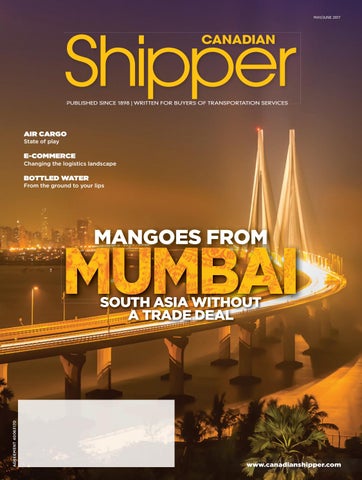
MANGOES FROM
AGREEMENT 40063170
SOUTH ASIA WITHOUT A TRADE DEAL
p01-02 Shipper MayJune 2017.indd 1
www.canadianshipper.com
2017-04-26 9:57 AM
When it comes to air freight, a global network helps you grow. As your business grows, so does your need to access new markets around the world. Air Canada Cargo continues to add cities to its global network in 2017, launching direct service to key cities like Taipei and Mumbai, starting this spring. With 80 years of expertise, we proudly make the success of businesses like yours our mission.
aircanadacargo.com
p01-02 Shipper MayJune 2017.indd 2
2017-04-26 9:57 AM
CONTENTS
MAY/JUNE 2017
DEPARTMENTS
16
5 | Publisher’s message Changing of the guard
COVER STORY 6 | In the news
SOUTH ASIA IN FOCUS
Driver safety; Great Lakes strategy; NAFTA; Electric vans
31 | Inside the Numbers
An update on trade with India, Pakistan and Bangladesh
Salaries are on a downward spiral
33 | Retrospective The qualities of a logistics manager
35 | Coaching Corner How to choose a coach
37 | The Bigger Picture The real cost of protectionism
10 A panel discussion on trends, pain points and solutions
©narayankumar/iStock
AIR CARGO The Bandra-Worli Sea Link bridge in Mumbai, India connecting the suburb of Bandra with South Mumbai.
FEATURES
E-COMMERCE | 19 How online retailing is changing the logistics landscape
22
BOTTLED WATER | 22 Tracing the supply chain from the well to your mouth
SEAFOOD UPDATE | 25 An update on the latest trends affecting seafood logistics
REEFER CONTAINERS | 28 A cool history of chilled transport
www.canadianshipper.com May/June 2017 3
p03-05 CdnShipper MayJune2017_ContentsEditorial.indd 3
2017-04-26 9:59 AM
Jaime Lobo Director, Panama Operation Center MOL (Panama) Inc.
VESSEL ON-TIME PERFORMANCE ASIA - U.S. WEST COAST • OCT - DEC 2016 TARGET: 100%
What’s behind a number? People. People like Jaime Lobo. Professionals committed to the highest level of service. Whether it’s vessel planning, operations, stowage or ensuring vessels remain on schedule, a top-notch team is in place to deliver what you need when you need it. Review all of our fresh KPI results at CountOnMOL.com.
p03-05 CdnShipper MayJune2017_ContentsEditorial.indd 4
2017-04-26 9:59 AM
FROM THE PUBLISHER Nick Krukowski May/June 2017 Volume 120 Issue No.3
EDITOR John Tenpenny (416) 510-6880 John@newcom.ca RESEARCH DIRECTOR Lou Smyrlis lou@newcom.ca ART DIRECTOR Ellie Robinson ellie@newcom.ca CONTRIBUTORS Carolina M. Billings, Ken Mark, Carroll McCormick, Ian Putzger, Christian Siviere, Laurie Turnbull MARKET PRODUCTION MANAGER Kimberly Collins (416) 510-6779 kim@newcom.ca VIDEO PRODUCTION MANAGER Brad Ling CIRCULATION MANAGER Mary Garufi (416) 614-5831 mary@newcom.ca PUBLISHER Nick Krukowski (416) 510-5108 nick@newcom.ca PRESIDENT Joe Glionna CHAIRMAN & FOUNDER Jim Glionna VICE-PRESIDENT, OPERATIONS Melissa Summerfield HEAD OFFICE: 80 Valleybrook Drive, Toronto, ON M3B 2S9 Canadian Shipper is written for Canadian transportation and logistics professionals who manage product flow from manufacturer to point-of-sale. Editorial is focused on reporting, analysis and interpretation of Canadian logistics trends and issues. It is published by NEWCOM BUSINESS MEDIA INC.
SUBSCRIPTIONS: Contact us at: mary@newcom.ca Tel: (416) 614-5831 Fax: (416) 614-8861 Website: canadianshipper.com (click on subscription button)
SUBSCRIPTION RATES: Canada: $65.95 + applicable taxes, per year; $107.95 + applicable taxes, for two years. U.S.A.: US$107.95 per year. All other foreign: US$107.95 per year. Single copies $8 except for the annual Logistics Buyers’ Guide (Aug) $60.95 + applicable taxes, (not including HST) plus $2.00 for postage. USA: US$68..95, Foreign: US$68.95 ISSN 2292-2490 (print), ISSN 2292-2504 (Digital), (Canadian Shipper.) Indexed by Canadian Business Periodicals Index. Printed in Canada. All rights reserved. The contents of this publication may not be reproduced either in part or in full without the consent of the copyright owner.
POSTMASTER: Please forward forms 29B and 67B to:
A changing of the guard
G
eorge Orwell once said that journalism is printing what someone else does not want printed; everything else is public relations. That perspective has perhaps never been truer than in today’s fragmented media landscape, where readers have more choice than ever before in where they get their news and information. An editor ultimately answers to you, our reader. Viewing information with a discriminating eye, deciding which stories are worth the telling and which are not, is surely an editor’s greatest responsibility. With this issue of Canadian Shipper, I would like to thank one editor, and welcome another. Julia Kuzeljevich and I both joined Canadian Transportation & Logistics within weeks of each other, back at the turn of the last century. Over the years, Julia has been a vibrant voice for this publication, and was instrumental in our successfully rebranding to Canadian Shipper. Many of you have had the pleasure of meeting Julia in person at one of the multitude of industry events she covered, or will have seen her moderating any one of a number of panels over the years. As a former colleague and current friend, I would like to thank Julia for her years of service, and wish her every success in her new role with CIFFA. It gives me great pleasure to introduce to you John Tenpenny, the new editor of Canadian Shipper. John brings with him many years of experience in business journalism, including editing an advanced manufacturing title which should furnish him with an engaging and refreshing perspective on the supply chain. He is an award-winning writer, and has about him an easy style that I believe readers in our industry will respond well to. Please join me in welcoming John to Canadian Shipper, and be sure to introduce yourself when you next see him. At its best, a publication is a two-way channel of communication, so don’t be shy in reaching out! Finally, I would like to say a word of thanks to Emily Atkins, editor of our sister publication, MM&D. Emily stepped up to handle the editorial responsibilities for Canadian Shipper as we conducted our search for Julia’s successor, ensuring a seamless transition. The issue you hold in your hands is largely the result of Emily's efforts, and I am extremely grateful for her assistance. While the cast may have changed, our mandate at Canadian Shipper has not: To educate and inform; to challenge and question; to inspire and entertain — these will continue to be the bedrocks of our media content, and the basis of our relationship with you, our reader. CS
80 Valleybrook Drive, Toronto, Ontario, M3B 2S9 Second Class Mail Registration Number 0721.
PUBLICATIONS MAIL AGREEMENT 40063170 We acknowledge the financial support of the Government of Canada through the Canada Periodical Fund of the Department of Canadian Heritage MEMBER CANADIAN BUSINESS PRESS
Nick Krukowski, Publisher
©iStock
p03-05 CdnShipper MayJune2017_ContentsEditorial.indd 5
www.canadianshipper.com May/June 2017 5
2017-04-26 9:59 AM
IN THE NEWS
Trucking Alliance promotes injury prevention Campaign designed to improve driver safety at shipping facilities The Canadian Trucking Alliance has produced a multimedia toolkit to assist industry, governments as well as injury prevention stakeholders in promoting truck driver safety at workplaces and shipping facilities. Videos and infographics in English and French provide facility operators helpful tips on improving safety and reducing injury risk to flatbed truck drivers in particular. Last year, CTA took notice of a Hazard Alert issued by the Occupational Health and Safety (OHS) Directorate at Employment and Social Development Canada (ESDC) meant to provide employees and employers with information on how to prevent unsafe practices when loading
and unloading flatbed vehicles. The alert noted that several truck drivers have been fatally or seriously injured when they’ve been struck by unstable freight falling from a flatbed trailer. These accidents occurred during operations at sites not under the control of the driver’s employer. ESDC’s actions were a good start, but in a follow-up national survey conducted by CTA, member companies operating flat-
beds expressed concerns that go beyond the issues ESDC identified. For example, inadequate lighting, improper maintenance of grounds, and the fact many sites require drivers to tarp their loads off-site — sometimes in traffic on the side public roads — are common occurrences that put many truck drivers at risk. CTA’s toolkit illustrates ‘best’ and ‘poor’ practices at workplaces facilities and re-
Promises We make a bigknow deal no borders over the tiniest items.
Your business doesn’t stop at the border. Neither does Old Dominion. Our focus on premium service means every shipment arrives on time and worry free, backed by an on-time record and claims ratio that rank among the best in the industry. When shipping to or from the U.S., choose Old Dominion.
Old Dominion Freight Line, the Old Dominion logo, OD Household Services and Helping The World Keep Promises are service marks or registered service marks of Old Dominion Freight Line, Inc. All other trademarks and service marks identified herein are the intellectual property of their respective owners. © 2017 Old Dominion Freight Line, Inc., Thomasville, N.C. All rights reserved.
p06-09 CdnShipper MayJune2017_News1.indd 6
2017-04-26 10:01 AM
IN THE NEWS
minds site operators of their responsibilities to ensure safety on their premises. While the media material focuses mostly on flatbed drivers, many of these types of issues are relevant in other sectors. For example, grain haulers are often forced to clean residual grain from their vehicles in unsafe environments as well. “CTA encourages carriers to share this information with their customers to promote best practices when loading and unloading flatbed trucks,” said Stephen Laskowski, CTA president. “For our part, the Alliance requests ESDC works with CTA to encourage shippers and receivers to create safer workplaces and to work with provincial authorities to enforce the law against those who create dangerous conditions for drivers of flatbed trucks as well as other configurations requiring drivers to work in situations covered by fall protection regulations.” The video can be found here: http://tinyurl.com/CTAcampaign CS
Auto sector needs NAFTA: report Economic resilience threatened by lack of planning Global car sales accelerated sharply in February, in line with global growth, with volumes jumping 6.9 per cent above a year earlier and well above the four per cent year-over-year gain during the previous two months. This solid performance leaves global volumes on track to climb to record highs for the eighth consecutive year. However, the Trump Administration’s push to renegotiate NAFTA has created significant uncertainty for the industry in North America, says a recently published auto sector report by Scotiabank Global Economics. The auto sector has the most
highly integrated supply chain of all manufacturing industries under NAFTA. “The integration of the North American auto market has enabled the sector to outperform on a global stage,” said Carlos Gomes, Senior Economist and Auto Industry Specialist, Scotiabank. “Any new continued
For transborder shipments, OD offers:
• A single point of contact with a local OD shipping expert • In-house customs clearance and brokerage services available 24/7 • 100% visibility with door-to-door track and trace • Complete coverage of the U.S. with direct loading to major markets • PARS and PAPS pre-clearance that reduces paperwork issues and delays at the border
For more information, visit odfl.ca or call 1-800-432-6335.
p06-09 CdnShipper MayJune2017_News1.indd 7
2017-04-26 12:10 PM
IN THE NEWS
continued from p.7
restriction to the free flow of vehicles and parts among the three countries would have a negative impact on economic activity in Canada, Mexico and the Unites States including potential job losses.” More than 92 per cent of all auto industry shipments from the U.S. are now destined to the three NAFTA countries. This integration has boosted productivity and enhanced the industry’s global competitiveness, enabling it to increase its share of global exports. The U.S. is the major supplier of auto parts to its NAFTA partners and has been a major beneficiary of the rapid expansion of assembly plants in Mexico. In particular, Mexico is now the destination for one third of auto parts exported from the United States, up from less than five per cent prior to NAFTA’s inception. The highly integrated North American auto supply chain has enabled U.S. auto industry employment to increase by more
positions at plants in the United States, Canada and Mexico. Other highlights: More recent sales data for March confirm continued record volumes in both Canada and Mexico, but show some disappointment in U.S. results. • Sales in Canada jumped seven per cent above a year earlier last month, with volumes buoyed by double-digit gains in both light trucks and luxury models. • Volumes in Mexico jumped 17 per cent above a year ago in March, even as interest rates moved higher and economic activity slowed. • Asia led the broad-based acceleration of global car sales with a 16 per cent year-over-year surge as sales in China returned to double-digit yearover-year growth. • Sales in South America have been stronger than expected, advancing above a year earlier in February for the fourth consecutive month. CS
•
than five times the growth in overall manufacturing jobs. The supply chain under NAFTA has closely tied the three economies and any interference could challenge the outperformance of the North American auto industry including potential job losses for some of the nearly two million
Mercedes-Benz and courier pilot electric delivery vans 1,500 vans to be trialed in Stuttgart and Hamburg European courier and third-party logistics provider Hermes and Mercedes-Benz Vans have agreed on a wide-ranging strategic partnership to electrify the courier service’s vehicle fleet. The companies will start a pilot project using battery-electric vehicles in Hermes’s normal operations in Stuttgart and Hamburg in early 2018. The focus will be on the economy, sustainability and
practicality of emission-free vans when used for last-mile delivery. By the end of 2020, Hermes Germany intends to deploy 1,500 Mercedes-Benz Vito and Sprinter electric vans in urban areas across the country. For Hermes, the new vans form part of its parent company’s plan to reduce CO2 emissions by at least half by 2020. “Electric mobility plays a key role as
part of our long-term strategy for climate and environmental protection. With this in mind, we are continuing along the path of sustainably renewing our fleet of vehicles. The strategic partnership with Mercedes-Benz is another milestone in this process,” said Frank Rausch, CEO of Hermes Germany GmbH. The partners have set themselves the goal of improving efficiency, productivity
— FOR SALE —
Freight Forwarder/Customs Broker in business for 40 years. • Based in Montreal • Exceptional customer base • Very profitable
Interested buyers, please contact: Mark Borkowski, Mercantile Mergers & Acquisitions Corp. (416) 368-8466 ext, 232 or mark@mercantilema.com 8 May/June 2017 www.canadianshipper.com
p06-09 CdnShipper MayJune2017_News1.indd 8
2017-04-26 10:01 AM
IN THE NEWS
and sustainability in parcel deliveries. This has been partially triggered by the rapid growth in online retailing and the resulting challenges for courier-expressparcel (CEP) companies. With the help of quiet, locally emission-free vehicles, Mercedes-Benz Vans and Hermes Germany hope to make a lasting contribution to optimizing urban delivery transport. By the year 2025, Hermes plans to carry out deliveries in the inner-city areas of all major German cities completely free of emissions. Only electricity from 100 percent regenerative energy sources will be used to charge the electric vehicles’ batteries. Mercedes-Benz Vans’ fully electric study Vision Van which was presented to the public at the Commercial Vehicles IAA 2016.
Hermes and Daimler have been partnering on alternative fuel systems since the 1990s. In 2001, Hermes tested a Mercedes-Benz Sprinter with fuel-cell technology in normal operating conditions. In 2011, the Hamburg-based logistics provider deployed the first series-produced electric vehicle from Mercedes-Benz Vans, the Vito E-CELL. The two companies also cooperate on vehicles over 3.5 tonnes. Together with Hermes and the city of Stuttgart, Daimler is currently performing a fleet test with five battery-powered Fuso Canter E-CELL vehicles in urban distribution transport. CS
Great Lakes-St. Lawrence region needs transportation strategy Economic resilience threatened by lack of planning Future economic prosperity in the Great Lakes–St. Lawrence Region will require bi-national integration of freight and passenger transportation systems in the face of unknown impacts from climate change, technology, and trade patterns, says a new report released by the Council of the Great Lakes Region (CGLR). The report, prepared in partnership with CPCS Transcom, is part of a project that aims to develop the region’s first-ever multimodal transportation strategy. “Most Great Lakes states and provinces, as well as the U.S. and Canadian federal governments, have developed long-range transportation plans and modal plans to support their growth and key cross-border trade corridors,” says Mark Fisher, CGLR’s President and CEO. “What’s lacking is meaningful integration of these systems across the region, including passenger and freight transportation priorities.” The study seeks to address a critical policy gap that impacts the region’s bi-national economy — an economy that spans eight Great Lakes states and two Canadian provinces, includes 105 million people, and generates roughly US$5.8 trillion in economic activity each year. The region’s multimodal transportation system is an extensive network of highways, regional and urban roads, railroads and rail terminals, airports, marine ports and inland waterways, pipelines, and transit infrastructure. “The efficient movement of people and goods facilitates tourism and trade, and is
vital to the economic growth of our Great Lakes region,” said Howard Eng, President and CEO of the Greater Toronto Airports Authority. “For its part, Toronto Pearson has proposed a Regional Transit Centre that will connect our region to the world through improved transit and reduced traffic on the roads. This report is a clear indication that industry is well aligned in its vision of ensuring increased connectivity and economic competitiveness for the regions it serves.” To date, regional transportation strategies and plans have largely been based on linear trends and projections. Growing pressure on transportation systems from capacity constraints, aging or inadequate infrastructure, outdated regulations, climate change, institutional and regulatory fragmentation, technology, changing trade patterns, mean a different approach is required to improve system performance and make it more resilient and adaptable. “To meet tomorrow’s challenge of moving goods and people in an increasingly congested region, we need to do things differently than we do today,” said Ian Hamilton, President and CEO of the Hamilton Port Authority. “There is an extraordinary opportunity to make better use of the marine mode to increase transportation efficiency in the Great Lakes region; governments and industries need the will to make it happen, and a strategy that shows the way forward.” This study was made possible with the financial support of CN, the Hamilton Port Authority, and the Greater Toronto Airports Authority. CS
%*3&$5 8&&,-: *.1035 &91035 $0/40-*%"5*0/4 4*/("103& )0/( ,0/( #64"/ */%*" 4)"/()"* 4)&/;)&/
www.canadianshipper.com May/June 2017 9
p06-09 CdnShipper MayJune2017_News1.indd 9
2017-04-26 12:10 PM
AIR CARGO
AIR CARGO’S KEY CHALLENGES IN 2017 By Julia Kuzeljevich
10 May/June 2017 www.canadianshipper.com
p10-30 CdnShipper MayJune2017_Air_SouthAsia_E-commerce_Water_Fish_Containers.indd 10
©Frank Peters/iStock
2017-04-26 10:33 AM
AIR CARGO
BACKGROUNDER: B BA AC CKGROUNDER: KGROUNDER:
The Cargo Logistics Canada Conference, held in Vancouver this February, saw a panel of carriers, airports, associations and forwarders highlight their concerns over air cargo trends. The panel, moderated by Julia Kuzeljevich of Canadian Shipper magazine, featured William McKinnon, General Manager, Western Region for DB Schenker Canada; Ronald Schaefer, the Project Lead for the Center of Excellence in Pharmaceutical Logistics at the International Air Transport Association (IATA); Mark Sutch, General Manager, Cargo Sales & Marketing, Cathay Pacific Airways; and, Ray Segat, Director, Cargo and Business Development, Vancouver Airport Authority.
EXPANDING GLOBALLY REQUIRES NIMBLE SUPPLY CHAIN McKinnon, who presented a forwarder’s perspective on air cargo, brought continued
www.canadianshipper.com www.canadianshipper.com May/June May/June 2017 2017 11
p10-30 CdnShipper MayJune2017_Air_SouthAsia_E-commerce_Water_Fish_Containers.indd 11
2017-04-26 10:33 AM
THE ONLY THING FASTER THAN OUR TRANSIT TIMES IS OUR COMMUNICATION WITH YOU. Our P&D drivers transmit live shipment status updates including who signed for the shipment.
1.800.822.4512 Canada 1.800.621.8723 USA herculesfreight.com
p10-30 CdnShipper MayJune2017_Air_SouthAsia_E-commerce_Water_Fish_Containers.indd 12
2017-04-26 10:33 AM
continued from page 11
up the topic of triangle trade, a multilateral system of trading in which a country pays for its imports from one country with its exports to another. A more modern definition of triangle trade today, he said, focuses around coordinating—from a third country—the movement of goods between countries. “Often this movement can be called cross-trade as well. This is becoming more prevalent as we move forward in a variety of situations,” McKinnon said. “As forwarders, we are seeing that our customers today are reaching out on a very global basis to move forward. This global reach is really about businesses evolving because in the Canadian economy's growth in GDP is lagging.” Small to mid-size businesses are moving out of their traditional markets of comfort. As well, they are searching for new markets and profits. “When I talk about small to mid-size business what I’m looking at is typically the movement of goods on a triangle basis. This movement has been dominated by large organizations but this model is changing rapidly. Smaller players want access to cost-effective options for getting goods to market across all modes, immediately,” he said. Single-source knowledge in their base country becomes of paramount importance. “There is the expectation that the single source knowledge will have a clear understanding of all pertinent rules and regulations as the organization expands internationally, and peace of mind that a seamless supply chain solution is in place,” McKinnon said. It’s about adjusting to a world where smaller companies "are going to demand more expertise of us" so they can build their businesses on a global basis, he added. PHARMACEUTICALS: EXCURSIONS STILL A MAJOR ISSUE The total market in cold chain for pharmaceuticals is at $360 billion dollars a year and is expected to grow six to eight per cent annually between now and 2020. Developing markets are growing very fast and governments are increasing their healthcare spending, noted IATA’s Ronald Schaefer. “Even in developed countries we still see a lot of growth and the result is that logistics spending has increased a lot, and in air cargo we have had our share (of this growth) as well. Another disturbing trend is that air cargo has also lost some of its share to other modes of transportation. There is lots of discussion and analysis going on but I can tell you that the majority of the temperature excursions that take place happen when the pharmaceutical products are in an airline/air cargo environment,” Schaefer said. Some 25 per cent of vaccines reach their destination degraded because of incorrect shipping, and 30 per cent of scrapped pharmaceuticals can be attributed to logistics issues alone, he added. “If we have a cold chain excursion and the product is rendered worthless, it’s going to cost a lot of money to replace it; 22 million people a year don’t receive their vaccinations on time because of this. It’s very clear that we need to take a look at the points where these temperature excursions take place,” he said. “While the high-risk points are airlines and cargo handlers, regulatory authorities can have an influence as well. In countries such as Saudi Arabia or Brazil, for example, they keep the mer-
AIR CARGO
“It’s about adjusting to a world where smaller businesses are going to demand more expertise of us so they can build their businesses on a global basis.” William McKinnon, General Manager, Western Region for DB Schenker Canada
chandise on the tarmac for hours and the merchandise becomes useless. Every country has its own regulations; we are faced with the big challenge that there is no harmonized and no standardized procedure for handling pharmaceuticals. “So at IATA what we did was we talked to the shippers because we wanted to see what we could improve. And they were adamant as well. They said there is no standardization, there is no harmonization; everybody does their own little thing,” said Schaefer. “In addition to that, what the pharma shippers told us is that they really see a lack of training among the people who handle the pharmaceuticals. For them, carrying a pharmaceutical is just like carrying another box from the tarmac to the plane. Properly trained stakeholders are another issue that we are facing, and not just on this side of the world but on other sides of the world as well.” In many cases shippers say they have seen investment in better cold chain infrastructure, but this is inconsistent at every station around the world. Pharmaceutical shippers are seeking some kind of global harmonization and global standard, as well as some kind of common audit format because they are faced with auditing according to different kinds of standards all over the world. IATA was asked by the industry to develop a new standard, to do something about it. “We have a pharmaceuticals task force that has been very active over the last eight to nine years. But, because of the previously mentioned factors, this was not enough. So CEIV Pharma came into play: a much more robust program which focuses on preventing sanitary issues when we handle pharmaceuticals and when we have temperature excursions, and training the staff of the companies handling pharmaceuticals so they know what to do. We hope to ensure product integrity with all this,” Schaefer said. “We did develop a new standard where we took the different regulations that are out there, and we created a huge checklist of 380 items to cover to make sure that all the different needs are aligned. What we try to make sure of is that all the Good Distribution Practice standards are covered because that’s what the pharma shippers are looking for, but also that the standard is tailored to our industry. Unfortunately many times in our industry we are too late in developing standards and when it comes to the point that other companies then impose them on us, they are not really made for our industry. So that’s what the CEIV pharma program addresses. We have about 68 companies that have been certified officially and we are currently working with about 100 different entities worldwide to implement that standard and I’m talking to another 150 who are thinking of implementing it. We’ve seen that we’ve hit the right spot here because there is a need for this standard,” he concluded. continued
©iStock
p10-30 CdnShipper MayJune2017_Air_SouthAsia_E-commerce_Water_Fish_Containers.indd 13
www.canadianshipper.com May/June 2017 13
2017-04-26 12:11 PM
p10-30 CdnShipper MayJune2017_Air_SouthAsia_E-commerce_Water_Fish_Containers.indd 14
2017-04-26 10:33 AM
AIR CARGO
continued from page 13
CARRIERS AND CAPACITY “There are a number of challenges in airfreight and I think Cathay is at the forefront of that.” said Mark Sutch, General Manager, Cargo Sales & Marketing, Cathay Pacific Airways. “Cathay Pacific Airways is the second biggest cargo carrier in the world in terms of flown tonne kilometres, if you exclude the DHLs and the integrators. In 2016 we carried 1.9 million tonnes of cargo.” The airline is based in Hong Kong, which is by far the biggest air cargo hub in the world. Cargo represents about 25 per cent of the company’s revenues. “Everything cargo at Cathay is very important to the strategy of the business, right down to the kind of aircraft we operate. From 2010 when cargo had a record year, the last five years have been a challenge. 2016 was an illustration of that when we started the year very, very weak and then finished very strong, which hopefully gives us a good momentum.” The real challenge from a carrier perspective is obviously competition, and it’s not only competition from new airlines, it’s really to do with the balance of belly cargo and main deck cargo, Sutch stressed. “As an operator of 20 freighters we’re very asset heavy and we’re hugely invested in our freighter capability. But at the same time we, like many others, are taking on 777s and A350s which are hugely competent aircraft in terms of carrying cargo. We’ve just had the A350-900 in our fleet and we’ve already seen a payload coming from London to Hong Kong of 22.5 tonnes, which is an incredible amount. Competition and the amount of capacity in the market have really put a lot of pressure on yields. The other thing is volume stability and this is certainly something we worry about. Fuel prices are a huge issue for us. It’s anywhere from 30 to 40 per cent of our operating costs. There is also the whole macroeconomic situation as well. Finally, 25 per cent of our cargo is special cargo, like pharma, and we try to get a particular yield from it and charge more for handling it, but actually delivering on that product is a huge challenge,” Sutch said. CONNECTING AIRPORTS AND CLIENTS SEAMLESSLY Vancouver International Airport’s (YVR) overall strategy is to connect British Columbia to the rest of the world, and to continue to develop the airport as a world-class, sustainable gateway. 2016 was a record year for the airport: 11 new destinations and two new carriers were added, as well as a host of new services, noted Ray Segat, Director, Cargo and Business Development, Vancouver Airport Authority. “In 2014 we set up a new subsidiary company to mimic what we’ve done with the terminal operations and get closer to our tenant base. We are closer to what their needs are and we can develop facilities and meet those needs. We’ve also reached out to other airports and gateways in the world to create connections and synergies: with Shanghai airport in China, for example,” Segat said. “When it comes to total tonnage, when we look at what is actually processed at the airport it’s more like 1.7 million tonnes of cargo. And that’s made up of 900,000 roughly in truck-to-truck activity. The integrators are driving a lot of this, using Vancouver as a port of entry and then trucking it across the border.” Cargo employment has grown at the airport and it’s fairly resilient, he noted. According to Segat, “YVR’s role is to facilitate. We have to make our product efficient, effective and attractive to the industry to use it. And so we work on facilitating what the tenants of Cargo Village ©iStock
p10-30 CdnShipper MayJune2017_Air_SouthAsia_E-commerce_Water_Fish_Containers.indd 15
“The real challenge from a carrier perspective is obviously competition, and it’s not only competition from new airlines, it’s really to do with the balance of belly cargo and main deck cargo” Mark Sutch, General Manager, Cargo Sales & Marketing, Cathay Pacific Airways
need, as well as CBSA (Canada Border Services Agency); we work on route development and marketing. Our Cargo Village is unique and we want to work on that. We look at where we can add value down the road where it makes sense. The future focus is to protect access to Sea Island—Vancouver is a unique city—there is not a lot of ability to put more roads or bridges in and our function as part of the Asia Pacific Gateway is important.” THE FUTURE OF AIRFREIGHT? Airfreight’s loss of market share to other modes is something the air cargo supply chain does consider, but airfreight continues to have a strong advantage for particular kinds of cargo. “We think about this a lot at Cathay,” Sutch said. “Seafreight has obviously got a cost advantage but in reality they are very separate products and we believe airfreight has a very strong future. Nevertheless we see some mini-shifts from time to time, but for us, aside from that modal shift to seafreight, one thing we’re concerned about is a shift to rail freight, with trains that can go throughout the year from China to Europe. But I still think that there are distinct differences between the products so long as we continue to get a handle on our prices.” With a rise in interest rates, he added, there may be a shift back to airfreight as people decide not to hold inventories. According to Schaefer, airfreight is the first choice for shipping premium product. “The types of commodities shipped (live, pharma) are very time-sensitive, measured in hours or days. We have seen a shift on certain trade lanes. Freight forwarders we’ve interviewed see a little bit more shift in electronics for example. As long as we do the job right, and the pricing right, in the airline industry (air cargo will survive),” he said. “Certainly, perishability is a major factor but what hasn’t occurred is a shift away from cargoes that are high value. There is a major bias from clients who move these to move them in a clear, concise manner around the world and that hasn’t changed,” McKinnon said. “Air cargo represents 0.5 per cent of the volume of the goods that move around the world but 35 per cent in terms of value. There’s a lot of value that goes by air. The airport needs to operate by having infrastructure that enables multimodal moves, and making sure Customs authorities can accept the product no matter what mode it comes by,” Segat said. CS
Julia Kuzeljevich has been writing about transportation issues for 15 years. Her articles have garnered several transportation and Canadian Business Press writing awards. www.canadianshipper.com May/June 2017 15
2017-04-26 10:33 AM
REGIONAL FOCUS
LACK OF A TRADE AGREEMENT IS NOT IMPEDING GROWTH BY IAN PUTZGER
ir Canada (AC) has set course for Mumbai. In July the airline will start service between Toronto and India’s commercial centre, operating three days a week. Vito Cerone, director of marketing and sales, Americas of AC Cargo, is looking forward to the new venture. “Mumbai is one of the fastest growing markets right now,” he says, adding that demand appears to be exceeding capacity. The Mumbai service boosts AC’s footprint in India, which currently consists of daily flights between Toronto and Delhi (launched last year) and three weekly services from Vancouver to the Indian capital. “Delhi has been performing well. If we had more flights, we could take more cargo,” Cerone says. Joe Lawrence, president of airline sales agency Airline Services International, reports good business in the Indian market, which two of his clients serve. “For us, India is doing well. It is a huge export market, but not necessarily at yields we could write home about. But it has the quantity, so you can make money on volume,” he says. No sign of a trade breakthrough Hopes that trade might enjoy a quantum leap through a trade liberalization agreement between Ottawa and Delhi remain frustrated. After a trade
16 May/June 2017 www.canadianshipper.com
p10-30 CdnShipper MayJune2017_Air_SouthAsia_E-commerce_Water_Fish_Containers.indd 16
promotion trip to India in January, federal infrastructure minister Amarjeet Sohi reaffirmed that a free trade deal is “a high priority for our government”, but negotiations have moved at snail’s pace and have offered no cause for optimism that a breakthrough may be on the cards before long. Toronto-based Global Supply Chain Logistics has moved a broad array of goods in from India — from granite to staples, lentils and beans, reports CEO Ashok Thomas. Agricultural exports have been strong out of India, but other commodities have shown dynamic growth, notes Gary Vince, head of air freight, DHL Global Forwarding, Canada, pointing to products like garments, aircraft parts, automobile products and parts. “With the recent ‘Make in India’ campaign and increase in foreign direct investment, we have seen a huge transformation of product profile, which is noticeable in the changing export basket from India. Auto giants Hyundai and Suzuki have made Chennai their manufacturing hub and volumes speak for themselves,” he remarked. Cerone is expecting to see pharmaceuticals make up a prominent part of AC’s loads out of Mumbai, plus textiles and garments, precious stones and jewellery. The airline is fielding a Boeing 787 Dreamliner on the route, which allows
©oytun karadayi/iStock
2017-04-26 10:33 AM
REGIONAL FOCUS
nonstop service — unlike early forays by AC that were as routed over Europe, which was o and d a tough sell both in the cargo di the passenger business. The direct routing allows AC to go after higher yielding traffic from customers who are prepared to pay a premium over indirect service going via a transit point either in Europe or in the Middle East. The airline continues to funnel traffic between India and Canada over Europe through interline agreements with other carriers that connect with AC for the transatlantic portion of the route. This is one day slower than the direct service. “Interline gives us a second leg to stand on. From Delhi we’ve been doing a lot of that. It gives us more feed and we can offer different solutions to our customers,” says Cerone. Airline Services International relies on interline flows as well, but the weak transatlantic yields make India-Canada trade less appealing for its airline clients than some other trade lanes. “It is not a good return for the airlines. Unless it is highly time-sensitive or highyield cargo, it is not worth the effort. Even if you feed into London or Amsterdam for interline, you can’t justify it. Other destinations work better,” says Lawrence. Liking the lift Forwarders are happy with the air cargo capacity that has come into the market in recent years, led by the rapid expansion of Middle Eastern airlines, which all feed their longhaul networks with traffic from the Indian Subcontinent. “In the old days there was a lot of spoilage because of lack of lift. The Gulf carriers have made a tremendous difference,” comments Thomas. “In the past it was customary for us to bite our fingernails down to the bone during mango season.” While the arrival of a new generation of longhaul aircraft has allowed direct flights with some (albeit limited) cargo capacity, leading to a choice for shippers
“In the old days there was a lot of spoilage because of lack of lift. The Gulf carriers have made a tremendous difference. In the past it was customary for us to bite our fingernails down to the bone during mango season.” Ashok Thomas, CEO, Global Supply Chain Logistics
to go for premium nonstop or deferred air cargo service, those who move their goods by ocean carrier also have two speed options, notes Vince. “Ocean freight routing for exports from India has also experienced a transformation, from traditional routes of hub and spoke with multiple transhipments, to now a direct and faster service. Interestingly, in addition to traditional service with extended transit time, which caters to the low value market segment, carriers now have deployed faster and direct service which caters to higher-end ‘high value cargo’ which caters to fast moving goods, such as the auto sector,” he observes. Some shippers have been burned by one routing option, reports Thomas. A number of shipping lines tranship cargo through the United States. If U.S. Customs decides to inspect one of these containers, the result is delays and demurrage charges. For this reason, some of his clients ask that their traffic is not transhipped through the U.S., he says. “Transit time through the U.S. is better. If there is no inspection, then it’s perfect,” he adds. As in other sectors, shipping lanes to India have seen some capacity issues in the wake of the downsizing and consolidation of consortium services, but observers expect this to be temporary. Capacity at India’s ocean gateways has not been an issue, smaller hiccups notwithstanding. “When you book 20, 30 containers in one lot, sometimes you have space constraints,” remarks Thomas. Vince points to enhancements at mainline ports like Mundra Chennai and Kolkata and also
at Pipavav, India’s first port in the private sector, that have made life easier. “However, there is still room for improvement and reduction of dwell time at ports and rail connectivity. Road access to ports still experiences bottlenecks, and this impacts the smooth connectivity and onward journey for last mile delivery,” he notes. Inland container terminals One drive that has alleviated capacity bottlenecks at ports has been the development of inland container deports and container freight stations with rail connection by the Container Corporation of India, which has also helped to improve transit times, Vince says. India’s major airports have also made headway improving their cargo infrastructure. “Airport ground handling has seen great developments and infrastructure investment. Turnaround time for freighter and combi operations has improved a lot to meet international standards. However, ancillary support services need to be improved which will help improve overall transit time and customer experience,” commented Vince. At Kempegowda International Airport in Bengaluru, ground handling company Air India SATS (a joint venture of the national carrier with Singapore-based handler SATS) opened the country’s first integrated on-airport perishable handling centre in February, an 11,000 sqm facility with 17 dedicated cold rooms to cater to the rapidly growing traffic in pharmaceuticals, fruits and vegetables, flowers, meat and seafood. The US$7.2 million centre, which can continued
©glowonconcept/iStock
p10-30 CdnShipper MayJune2017_Air_SouthAsia_E-commerce_Water_Fish_Containers.indd 17
www.canadianshipper.com May/June 2017 17
2017-04-26 10:33 AM
REGIONAL FOCUS
continued from page 17
process 40,000 tonnes per year, houses Customs, a state-of-the-art drug controller lab and a plant quarantine inspection and certification office. Cutting through red tape The improvements in the infrastructure have been matched by plainer sailing through the bureaucracy. “Clearance of goods going into India has been fairly streamlined. It is not the nightmare that it used to be,” remarks Thomas. Overall red tape has been trimmed, although more than enough still remains. Thomas cites taxes and charges levied on goods moving across state borders, which have been cut down but not eliminated altogether. There is hope, though, that this will disappear after the introduction of a General Sales Tax which is due to be implemented this summer. Besides simplifying the tax regime, this should put an end to the paperwork associated with moving goods
across state borders. There have also been predictions that the new tax regime will make it easier to establish 3PL companies, leading to growth in India’s logistics provider base. Overshadowed by India’s momentum, its neighbours are facing significant challenges but they are showing some improvement. Pakistan has been stabilizing, which is reflected by the influx of multinationals, notes Thomas. Despite some financial support from China, which is looking to the country as another gateway for its exports, the country’s warehousing and distribution infrastructure is not adequate, he adds. He also sees a need for more infrastructure investment in Bangladesh. During peak times Dhaka’s Shah Jalal International Airport, the chief gateway for air cargo, struggles to cope with the rise in traffic. Arguably the problems could be worse were it not for security problems which have prompted some airlines, such as Luf-
18 May/June 2017 www.canadianshipper.com
p10-30 CdnShipper MayJune2017_Air_SouthAsia_E-commerce_Water_Fish_Containers.indd 18
thansa, to suspend flights to the capital of Bangladesh. A spokesman for Lufthansa Cargo expressed hope that the German carrier will resume flying there before long. As it is, the issues around security have prompted firms looking to shift garment production to countries in the region with lower labour costs than China to turn to the likes of Vietnam and Cambodia rather than Bangladesh. Otherwise, the surges in export volume would be an even bigger challenge for Dhaka to cope with. CS
Ian Putzger is an award-winning journalist with more than 20 years experience covering transportation and logistics issues. He is a former writer and editor with the Hong Kong-based Asian Sources Media Group, and Airtrade, a British magazine covering the global air cargo industry.
©proksima/iStock
2017-04-26 10:33 AM
LOGISTICS
THE NEW
LOGISTICS How the demands of e-commerce are changing supply chains BY KEN MARK
T
he days of rigid logistics, focused solely on moving goods may be coming to an end. More and more, logistics is expanding to include other aspects of the entire supply chain. As a result, shippers and their carriers are starting to work more closely with their customers to discover new, top- and bottom-line opportunities That’s because service providers are facing increasing pressure to reduce costs and delivery time while improving customer service and satisfaction. Leading the charge are those serving the e-commerce and retail sectors. For example, in February of this year, cereal maker Kellogg Co. announced major changes to its long-standing delivery practices. Gone are the days of distributing its U.S. snack products directly to stores. Instead, it will now switch all deliveries to retailers’ warehouses. The company is trying to reduce costs to address the rise in online, not-in-store grocery shopping. Says Kellogg president and CEO John Bryant, “We believe our decision will help us grow the business in the long term, taking resources tied up in distribution
and putting them back into the brands themselves.” Such comments echo the goals of UPS’s 2015 United Problem Solvers strategy that outlined its plans to expand its business offerings to include creating greater overall value for customers. That announcement indicated its services may no longer begin and end at customers’ loading and shipping docks. Its new extended mandate may require UPS and others to look more closely at the emerging business process called intralogistics. Jay Moris, founder and executive vice-president of Canton, Conecticutbased Invata Intralogistics Inc. defines the term as “the art of optimizing, automating, integrating, and managing the logistical flow of material goods with the flow of information pertaining to those goods within the walls of a fulfillment centre, distribution centre, or warehouse. It can also encompass the logistical flow of materials within an entire supply chain.” In other words, the “Chinese wall” between distribution and logistics is starting to crumble.
Although the term intralogistics may be new, the concept is not. Its roots go back to the so-called “Toyota system”. The Japanese automaker began scheduling deliveries of parts and sub-assemblies from suppliers located nearby to meet their actual shop-floor production needs. The goal was to link the flow of parts deliveries to match each day’s production line needs more closely. This replaced the stop-and-go approach of storing deliveries in adjacent warehouses and moving parts over as they were needed. That was the standard approach of the U.S. Big Three automakers. That system, which relied on truckload deliveries, often from distant suppliers, kept shipping costs low thanks to the vast, interstate highway system, volume product discounts and lower truck-load freight rates. But since Japan is a tiny country where real estate is very expensive and has fewer major highways, it made economic sense to cluster parts suppliers and auto assemblers closer together. At the same time, U.S. automakers paid less attention to inventory carrying costs where one firm, General Motors, dominated the home market and price continued
©tmcnem.iStock
p10-30 CdnShipper MayJune2017_Air_SouthAsia_E-commerce_Water_Fish_Containers.indd 19
www.canadianshipper.com May/June 2017 19
2017-04-26 10:33 AM
LOGISTICS
continued from page 19
“As mass customization and omni-channel order fulfillment become the predominant model for our consumer economy, the focus will shift from automating siloed tasks to a full spectrum of coordinated automation.” Daniel Theobald, Greenbelt, MD-based Vecna Technologies, Inc Co-founder and Chief Innovation Officer
competition was not keen. In contrast, Japanese firms were very cost-conscious to make their vehicles affordable to domestic buyers. Low sticker prices also helped attract significant consumer interest when their vehicles later arrived in North American showrooms. To make the system as seamless as possible, Toyota and its suppliers had to sit down and work out the details of how the parts were to be delivered. Besides scheduling, there were other details about packaging and flowing the parts quickly and easily onto the shop floor to
keep production lines humming. Today, various intralogistics technology and services providers are surfacing to help manufacturers simplify the handling of goods before they are loaded onto trucks and after they arrive on receiving docks. Some of the new players combine the latest robotics technology with information management systems that can collect, share, and analyze the petabytes of data that will yield operational insights to satisfy the higher demands today’s supply chain participants. “As mass customization and omni-
channel order fulfillment become the predominant model for our consumer economy, the focus will shift from automating siloed tasks to a full spectrum of coordinated automation,” says Daniel Theobald, Greenbelt, Maryland-based Vecna Technologies, Inc’s cofounder and Chief Innovation Officer. “Our path-management system solutions have a foundation in these market dynamics enabling our customers to turn logistics into a major competitive advantage.” Theobald foresees a shift in manufacturing in which producers will create custom-made products, using mass production techniques, and sell tham at affordable prices. They key to this production of the future will involve bringing together robotics and automation. For example, Vecna continues to develop robots that can provide “virtual” infrastructure to serve as mobile conveyors to move incoming parts from receiving
π QUALITY STRETCH • Over 32,500 Products IN STOCK • Order by 6 PM for SAME DAY SHIPPING
ORDER BY 6 PM FOR SAME DAY SHIPPING
• 11 North American Locations Mean Savings and Fast Delivery • Pricing in CANADIAN DOLLARS • FRENCH WEBSITE – fr.uline.ca
CALL FOR COMPLETE CATALOG
20 May/June 2017 www.canadianshipper.com
p10-30 CdnShipper MayJune2017_Air_SouthAsia_E-commerce_Water_Fish_Containers.indd 20
1-800-295-5510 uline.ca ©Lightcome/iStock
2017-04-26 10:33 AM
LOGISTICS
docks to the shop floor or finished goods from store rooms to loading docks. Being dynamic, not fixed, the multi-purpose robots can be re-programmed for other duties and moved quickly to other parts of the plant. They also have navigational intelligence to adapt to changing shop floor patterns or routes rather than simply following standard routes or patterns. Such flexibility and mobility provides on-demand services, eliminating the need for expensive, single-purpose fixed infrastructure such as conventional conveyor belts. As well, the robots can also capture record-keeping data related to the products as they pass through various shopfloor operations. Such a virtual trip ticket is crucial in the food, pharmaceutical and other sectors in cases of later product recalls or warranty concerns. Although it is still early days in the blockchain revolution, many practitioners now recognize its potential to turn today’s supply chain management and logistics practices upside down. Currently, IBM is collaborating with Maersk, operators of the world’s largest cargo fleet, to use blockchain technology to digitize, manage, share, store and track cargo transaction-related data. In its research, Maersk found that a simple East Africa–Europe shipment of refrigerated goods involved nearly 30 people and organizations and at least 200 different communications. As part of a universally connected digital super ledger, blockchain will offer a secure, transparent and accurate medium to enable supply chain partners—shippers, freight forwarders, ocean carriers, ports and customs officials—to share data across a network of individual computers in real time. The new system will help reduce or eliminate fraud and errors and minimize the time products spend in transit. IBM and Maersk expect to offer an ocean shipping-industry solution by year’s end. CS Ken Mark is a veteran technology expert, who has covered supply chain management since it was called distribution and has documented its legitimization as a critical business function. He holds an MBA from York University.
Adam Robinson, Marketing Manager of Eagan MN-based Cerasis Inc, has fleshed out some of the highlights from his firm’s 2017 Logistics Trends Impacting Shippers: Product Life Cycles Will Grow Shorter and More Complex Today, more companies are looking for real-time data-driven decision-making opportunities through the Internet of Things (IoT). To handle such increased demand, more manufacturing and logistics partners are looking for ways to shorten product lifecycles through improving inventory management systems, changing shipping strategies and altering the fundamental ways products move from point A to point B.
Autonomous Trucks Will Drive Logistics Forward Since they do not require drivers, carriers will no longer have to worry about drowsy driving or meeting electronic logging mandates, etc. Says Robinson, “the greatest barriers here are not in the technology but government red tape and other things such as insurance. Also, new technology will provide greater visibility into each delivery, which will enable planners to analyze the trip data to introduce more efficient routing and scheduling patterns.” True driverless vehicles are likely to be several years away. But software firm Peloton Technology based in Mountain View, California, plans to offer a “yellow jersey” solution deploying two trucks traveling front-to-back with a driver in the front vehicle in control. Trailing the lead vehicle by as little as 30 feet, the second truck which also has a driver, uses about 10% less fuel because it is drafting off the lead truck. Peloton plans a 2018 product launch.
Consumer Demand Will Shape Logistics Services in 2017 Consumer power has always been true in retail, but it is expanding further in the digital age. They now demand the newest products today, not tomorrow. Consequently, service providers must adopt predictive analytics to get ahead of tomorrow’s needs by adjusting operations to reflect today’s immediate demand. As well, Big Data will empower new fleet, freight optimization and consolidation measures.
Logistics Providers Will Push the Boundaries of Digitization Management teams must now have access to immediate freight and shipping rates and information, allowing better consolidation and optimization of incoming and outgoing shipments. Says Robinson, “Logistics service suppliers are facing a lack of relevant IT specialists with supply chain savvy to analyze the data. Such firms need to become true supply chain technology integrators to match what the data tells them with the proper hardware and tools to meet customer needs.”
Companies Will Evaluate Logistics For Efficiency and Value Since overhead costs in logistics services suppliers translate immediately into higher freight shipping rates, such firms are automating as many processes as possible, including billing, auditing and freight pricing and ultimately introducing driverless trucks. Says Robinson, “Many fast moving e–commerce sellers need automated invoicematching tools ensure collect all the customer money coming in and paying out only the actual charges owed to service providers. “We call this ‘catching pennies that fly out the door’. But these are internal savings that go straight to the bottom line.” Many 3P warehouse executives cite implementing autonomous robots as their top priority between now and 2020. Consequently, more shippers are working closely with carriers and other logistics service providers to negotiate better deals. Overhead evaluations will redefine 3PL contract negotiations and service-level bids among third-party logistics and in-house providers. www.canadianshipper.com May/June 2017 21
p10-30 CdnShipper MayJune2017_Air_SouthAsia_E-commerce_Water_Fish_Containers.indd 21
2017-04-26 10:33 AM
WATER LOGISTICS
WATER, EVERYWHERE Nestlé Waters Canada’s bottled water reaches most corners of Canada
F
rom Vancouver Island to Newfoundland, and north into the Territories, Nestlé Waters Canada, founded in 1970, runs a scheduled supply chain operation that directly, or via customers’ own delivery trucks, puts bottled water in thousands of stores owned by its 145 retailer clients. As well, it also taps some of its 50-plus for-hire carriers to deliver some of the over one million bottles of water it donates every year. Counting both domestic and imported brands, Nestlé Waters Canada represents 33 per cent of Canada’s entire bottled water market. Almost half of all domestic spring water products sold in Canada are produced by the company. The company bottles three brands: Pure Life, Nestlé Pure Life Splash, and Montclair. The water comes from three springs: Erin and Aberfoyle in Ontario, and Hope, British Columbia. While the Hope and Aberfoyle plants are co-located with their springs, the water pumped in Erin is trucked about 32 kilometres to Aberfoyle, in south-central Ontario. To move water from Erin to the Aberfoyle plant, Nestlé Waters Canada uses five tanker trailers, which it owns, each with a 10,600-gallon capacity. “We use a dedicated third-party carrier to haul the water. They make between five and seven tanker trips a day,” says John Innes, Director of Logistics, Nestlé Waters Canada. The Aberfoyle and Hope plants make and fill only single-serving bottles; they do not bottle in the bigger jugs used in home and office water coolers. The two plants
serve what are essentially two separate geographical markets: Aberfoyle supplies bottled water to customers in Ontario and east to the Atlantic Provinces. Hope supplies customers from BC to Manitoba. The company has four distribution centres: one with eight dock doors in Hope, and one with 14 dock doors in Chilliwack, roughly 85 kilometres from Vancouver, another with 37 dock doors in Laval, Quebec, and its largest, with 55 dock doors, in Guelph, Ontario. It also uses a third-party warehouse in Vancouver and, occasionally, one in Calgary. The company's for-hire carriers haul three-axle trailers, to maximize the weight that can be shipped on each. “The vast majority of shipments to our own distribution centres and to customers’ distribution centres and direct-to-store promotions, are full-load,” Innes says. “Although we don’t ship to the Territories, our water gets there through the customer distribution channel,” Innes adds. The company imports some of its other bottled water brands, such as Perrier, from Europe: They are shipped in containers to Vancouver and Montreal, where they are unstuffed, added to customers’ custom orders and sent on their way by truck. Nestlé Waters Canada pre-approves its for-hire carriers. “We go through a vetting process and make sure our carriers meet our requirements for service and quality,” Innes says. The company wants for-hire carriers that understand food and bever-
22 May/June 2017 www.canadianshipper.com
p10-30 CdnShipper MayJune2017_Air_SouthAsia_E-commerce_Water_Fish_Containers.indd 22
BY CARROLL MCCORMICK
age logistics, and since players are likely to be around for the long term, they need to be able to handle the shipping volume, current and future, that it may ask of them. “Before we agree to face-toface meetings, we will start by asking a series of questions on their capabilities; for example, how many tridem trailers they operate,” Innes says. “We ask questions to carriers about what their business segment representation is. We tend to look for carriers more involved in food and beverage. We ask them who their largest customers are and ask what percentage of their revenues their largest customer is. Too many eggs in one basket could be a vulnerability. We ask what their fleet size is, what their growth plans are, and what their regional strengths are. We also want to know what their ontime delivery performance is, and most importantly, what their safety record is. “If we feel they can meet our requirements, we will then ask for rate quotes. Assuming the rates are competitive (and sustainable for the carrier), we can choose to award them some business.” As part of its ongoing quality control of carriers, Nestlé inspects their trailers every time they back up to dock doors. “For the most part we are not concerned with what carriers do with their backhauls. [But] we do have a dedicated trailer inspection process we follow before we load one of their trailers. It is pretty thorough: cleanliness, appearance, check to make sure there are ©RoseNoom/iStock
2017-04-26 12:11 PM
WATER LOGISTICS
Fighting Climate Change no odours, floor inspected to make sure it will take the weight of the forklifts. The safety of our staff is paramount,” Innes explains. For en-route security, Innes adds, “We have a very stringent trailer seal process to make sure the trailers haven’t been tampered with.” As for the risk of cargo theft, Innes comments, “We haven’t had a stolen trailer in the past six years. In general, water is fairly inexpensive, heavy and bulky. We ship direct to customers, direct from A to B. The trailers rarely stay in yards overnight.” Top carriers are recognized for outstanding service with three different awards that Nestlé Waters Canada hands out. “We give a Carrier of the Year Award, Best New Carrier Award, and a Customer Service Excellence Award. In my mind the awards are for best practices and a great way to reward our top-performing carriers,” Innes says. “For each of these awards our Regional Transportation Manager asks for nominations. We take the top six nominations and we ask the departments (load centre, customer support, accounts payable, and warehousing) to rank the carriers.” Last year, Nestlé Waters Canada gave Brampton, Ontario’s Interstate Freight Systems Inc. the Carrier of the Year Award; Mississauga, Ontario-based Pride Group Logistics Ltd. the Best New Carrier Award; and Richmond, British Columbia-based Stryder Motorfreight Ltd. the Customer Service Excellence Award. Stryder recently picked up a significant amount of work, thanks to Nestlé Waters Canada streamlining the shuttle and shunting services for its Hope plant. “This happened only a few months ago. The Hope manufacturing site has very little warehousing, because of the geographical layout. In the past, if a carrier arrived late, we might have had to shut down the plant,” Innes says. But by turning over both the shuttle service between Hope and Chilliwack, and yard shunting duties to just one carrier—Stryder—Nestlé Waters Canada wins in two ways. First, Innes says, “before, we had a large carrier pool. If one of these was late, we didn’t have a large contingency buffer. Stryder has enough trailer capacity to ensure that we always have enough trailers to fill. They are getting a fair amount of transfer volume through
Nestlé has a corporate commitment to reduce its greenhouse gas (GHG) emissions. One component of this commitment is to reduce GHGs in its supply chain. “We have a corporate initiative and a long-term plan to increase our percentage of alternate modes of transportation,” says John Innes, Director of Logistics, Nestlé Waters Canada. To that end, Nestlé Waters Canada ships by rail about half of its bottled water from Aberfoyle, and some from Montreal, to destinations in New Brunswck and Nova Scotia. Why? “Typically, rail is cheaper. It is also better for the environment. Net, net, it is just the right thing to do, when we can make it work. We are trying to increase our rail percentage, while still managing the required flexibility and lead times to meet customer needs,” Innes explains.
OUR PROMISES GET DELIVERED Terminal Locations | Mississauga, ON Winnipeg, MB Saskatoon, SK Calgary, AB Edmonton, AB Vancouver, BC Fargo, ND
Regina, SK
"Continuing to Deliver Promises between USA and Canada”
Over 350 Power Units Fully EDI capable Up to date Technology Single point of contact 93 years of experience Cross border TL carrier
Operating from seven terminals in Canada and the USA, we offer swift and reliable truckload service to most of North America. That, combined with our no nonsense commitment to customer service has helped Penner become the transportation provider of choice for customers who need to keep their promises, wherever they need to ship in North America.
www.Penner.ca
Toll Free 866.729.7134
and 800 Trailers
continued ©iStock
p10-30 CdnShipper MayJune2017_Air_SouthAsia_E-commerce_Water_Fish_Containers.indd 23
www.canadianshipper.com May/June 2017 23
2017-04-26 10:33 AM
WATER LOGISTICS
continued from page 23
the Hope and Chilliwack warehouses. They’ve become more involved in our operations. There is one point of communication now. The benefit for us is that we have a reliable flow of trailers that keep the Hope plant running.” Second, “we had our own personnel staffing the yard trucks. Stryder [now] provides a dedicated yard service moving empty trailers in and out of our docks. We don’t have to do that now,” Innes adds. Looking at the larger supply chain picture, Nestlé Waters Canada evaluates its network every year or two to find better solutions to balancing costs and customer requirements. “One example is to work with our customers on advance shipping of promotional volume. As promotional activity drives large volume spikes, we try to spread it out leading up to the events,” Innes says. This improves customer service, and the customers’ ability to handle the inbound shipments. In addition to the scheduled runs that
“As promotional activity drives large volume spikes, we try to spread it out leading up to the events. This improves customer service, and the customers’ ability to handle the inbound shipments.” John Innes, Director of Logistics, Nestlé Waters Canada
carriers make, Nestlé Waters Canada counts on them to do one-off shipments. They include delivering donations to special events, such as those held by Kids Help Phone, a national crisis centre line for kids. “They have events in the summer each year across the country and we provide water for them,” says Jennifer Kerr, Director, Corporate Affairs and Nestlé Waters Canada.
“We work with our carriers to get the water out to the events all over the country.” Other examples, among many, are donations to First Nations schools that have no potable water, and providing support to firefighting crews and affected communities, such as Fort McMurray in 2016 when a wildfire burned more than 1.5 million acres and thousands of homes. “Some of our carrier partners have been supportive and helpful in carrying donated loads. With the fires in Alberta, it is urgent to get water there. It is not normally easy. Our carriers have been fantastic in reallocating their services,” Innes says. CS Carroll McCormick is an award-winning writer who has been covering transportation industry issues and technologies for more than a decade. He is based in Quebec.
24 May/June 2017 www.canadianshipper.com
p10-30 CdnShipper MayJune2017_Air_SouthAsia_E-commerce_Water_Fish_Containers.indd 24
2017-04-26 10:33 AM
FOOD LOGISTICS
NOTHING FISHY HERE The logistics of moving seafood
A
s consumer demand for seafood sourced from fertile fishing grounds like Newfoundland and Labrador, Nova Scotia, British Columbia, and Alaska continues to rise, so does the need for enhanced logistics and speed to market of these commodities from the sea. At Cargo Logistics Canada this February in Vancouver, a group comprising seafood companies, buyers, and multimodal service providers shared their experiences and outlooks for these unique supply chains. The panel was moderated by Rob McInnes, Manager, Business Development, Port of Halifax. Here’s what the panellists had to say:
Jan Koslosky, VP Supply Chain Management, Ocean Beauty Seafoods Koslosky has a team responsible for logistics support at the company’s six Alaska shore-based facilities, at its two value-added facilities in Washington state, and at its seven fresh seafood distribution centres. Ocean Beauty started in 1910 as a storefront seafood business and has expanded over the years. Five of its shore-based facilities are seasonal, focused on salmon production. “We touch all modes of transportation to support all of this activity,” Koslosky said. “We have a network of offshore co-packers that help us get product through distribution. We are the number one wild smoked salmon producer domestically, and the number one canned producer. Pink salmon represents 60 to 65 per cent of the total of wild fish caught in Alaska. “What happens with pink salmon winds up affecting us either positively or negatively. There are tremendous issues in terms of being able to scale up to provide the necessary support for our Alaska facilities, in particular. The issues lie around building a logistics pipeline that can address seasonal volume swings, export domestic container positions, airlift capacity, the loss of domestic widebody lift, port efficiency, ocean carrier alliances, and trucking capacity.” Darcy McKay, International Transportation Manager, High Liner Foods “High Liner Foods employs almost 1,500 people, importing into North America from well over 25 countries, and selling into the
BY JULIA KUZELJEVICH
North American market: Canada, U.S. and Mexico. Sales over the last couple of years have hit over $1 billion dollars and increases have come through acquisition and organic growth over this time period. “We procure over 250 million pounds of seafood every year, including 30 different species from 20 different countries. Some of the logistical challenges have come from integration issues around the acquisitions, the differentiation between wild and aquacultured products, and seasonality. Consolidation in the ocean freight industry is also a factor.” Dirk Peters, General Sales Manager, Import Export Sales, CMA CGM “The third largest container carrier in the world, CMA CGM has 536 vessels calling at 420 ports. Seafood is part of our reefer business, which we manage as a separate product with specialist experts in 85 ports. The main challenge in the reefer business is to develop solutions for the different products that are carried. For us, seafood is the third-largest commodity after fresh fruit and meat. As the industry evolves, historically speaking, the more advanced, sophisticated carriers are coming up with new equipment to match these commodities. “It’s more challenging because you’re creating imbalances with the wide variety of reefers in use in the market. For example, lamb coming from New Zealand arrives in 20-foot reefers, but no one in Canada wants 20-foot reefers; everyone wants 40-foot reefers. You’re moving empty reefers out of Canada,” he continued. “The latest development is a project called Aquaviva—a solution to transport live lobsters. It looks like a 20-foot reefer container. It has two chambers and it basically simulates the natural habitat of the lobsters. It’s complicated technology that took four years to develop. We’ve done test runs on the transatlantic service. Inside you have a water filtration system, there’s an oxygen system, UV lamps, cooling system, pumping system. In a nutshell the idea is not to beat airfreight at their game, the idea is to create a new market. It’s a bit more expensive but the success has been high. There’s less stress for the lobsters, which arrive basically in the same shape, 10 to12 days later, as they were in when they left.” continued
©iStock
p10-30 CdnShipper MayJune2017_Air_SouthAsia_E-commerce_Water_Fish_Containers.indd 25
www.canadianshipper.com May/June 2017 25
2017-04-26 10:33 AM
Print is Not Dead... In Fact
BORN: Germany, 1439 DIED: Circa 2000 ... or Did It?
It’s Growing
Consider The Following... • 2015 reversed a decade of decline, with a projected 0.2% YOY growth. (FIPP Trends Report)
‘‘
Print is not hanging on by its fingernails, IT’S GROWING. FIPP World Magazine Trends 2014-2015 Report
• Printed UK magazine advertising delivered the highest ROI of all media channels, 11% higher than TV and 22% higher than online. (PPA Magonomics)
• In the US alone, 234 new titles made their debut, up 21% from 2013. (Guide to New Magazines, USA) • FOLIO Magazine’s annual survey of US city and regional magazines said 2015 featured more new launches than any year since 2009.
Publications Serving Niche Markets (like B2B) Provide Unique Content Readers Cannot Get Anywhere Else.* * Skip Zimbalist, chairman and CEO of Active Interest Media (AIM), which publishes titles like Backpacker, Black Belt, Arts & Crafts Homes, Better Nutrition, Ski Magazine, Vegetarian Times, Power & Motor Yacht, and Yoga Journal, told FOLIO’s recent Growth Summit that AIM is investing in circulation marketing including direct mail. “We have not found declining yields in mail over the last 10-15 years,” he said.
In Case You Weren’t Convinced Before, You Can Confidently Say:
is Far From Dead. It’s Alive!
p10-30 CdnShipper MayJune2017_Air_SouthAsia_E-commerce_Water_Fish_Containers.indd 26
2017-04-26 10:33 AM
FOOD LOGISTICS
continued from page 25
Ravelle Snyder, Cargo Sales Manager, Alaska Airlines “The airline services over 118 destinations, moving up over 85 years from serving small villages in Alaska. We do 170 million pounds of cargo a year and 21 million of that is fresh seafood coming out of the state of Alaska. “Basically we’re committed to cargo and the logistics of cargo. When you become a cargo manager for seafood and logistics you find out that you have to become a jack-of-all-trades very quickly. Every different kind of seafood, every different fish has logistical challenges and for air cargo it really is about fresh seafood moving fast and not breaking that cold chain while it’s moving. What we do in air cargo especially is somebody’s livelihood; people’s lives depend on it. Some of the challenges we have are around capacity: the airline industry in the last couple of years has learned that big aircraft that take lots of fuel don’t make lots of money. So the capacity has really dwindled especially in North America. We’ve
gone to 737s that are very fuel-efficient, but that reduces the capacity for our air cargo to move in the belly of those planes. We do currently have one freighter aircraft and we do fly combination aircraft (737-400s) with unit load devices in the front and passengers in the back. “We’ve decided to move into an all-freighter fleet of 737-700 freighters so that’s how we will start moving more cargo. We’re lucky we have the freighters because most airlines have gone away from freighter aircraft. “The other piece is getting that capacity where it needs to be when it needs to be there and fish is a huge challenge. Sometimes the forecasting is not right and it could be in either direction. The other challenges are dealing with port authorities and screening. Fish companies gradually became certified to screen their own cargo, which has helped. As airports are growing they want to use all available space and they don’t always understand the logistics of getting those trucks in and out.” CS
McInnes asked the panel, “How do you address seasonality?” KOSLOSKY | “Collaboration is essential to the seafood pipeline. It’s about sitting with each of our key vendors because we really do have a partnership. When we develop our production plan I sit with our carriers and explain our strategy for the year: what markets we need to service, predicting and matching aircraft capacity to demand. Capacity in the right place at the right time is extremely important to us, whether it’s air, ocean, domestic or export.” MCKAY | “With High Liner, it’s more ocean freight, less on air. In ocean transportation there is the issue of peak seasons, and schedule changes where sailings are omitted due to Chinese New Year. Making sure we have the capacity and allocation to put our products on the water during those times when there is peak season, and only so many container spots, we have to make sure we have good partnerships with all the carriers we are using so we can move product when we need to.” “From a market standpoint there is a seasonality component to the sale of seafood into North America as well. Every species has different seasonality—it’s trying to manage all of that and trying to make sure we have all those products available.” PETERS | “For us, the first way to deal with it is being close to the customer—getting forecasts, past performance statistics—although history is not always a good guide year-to-year, depending on the fishing seasons and weather. Our job is to make sure we have the right equipment at the right time so product can be loaded as it is booked. We try to balance import and export loads. Canadian regional markets have their own challenges and different imbalances. “If there is not enough reefer cargo available then the other option the carriers use is the non-operating reefers. The third solution is to position empty containers, from U.S. west coast or from overseas.”
©Mike_Kiev/iStock
p10-30 CdnShipper MayJune2017_Air_SouthAsia_E-commerce_Water_Fish_Containers.indd 27
www.canadianshipper.com May/June 2017 27
2017-04-26 10:33 AM
HISTORY LESSON Frederick Jones of Thermo King developed the first portable refrigeration units for troops stationed overseas in World War II.
The rise of temperature-controlled containers
A
t the beginning of containerization some 60 years ago, the carrier Ideal X departed from the port of Newark, New Jersey on April 26th, 1956, carrying 58 containers bound for Houston, Texas. That was the birth of containerized shipping. A kind of specialized ocean container called a ‘reefer’—the common abbreviation for refrigerated container—set sail a few years later. These containers are also called, perhaps more appropriately, temperaturecontrolled containers. The latter term describes them better, since the temperature range of today’s reefers generally covers from +30 Celsius to –30 Celsius—we can heat the cargo, keep it cool or keep it deep frozen. In short, they permit the safe and efficient worldwide transportation of a wide variety of products ranging from meat, seafood, fruits, vegetables and dairy products to pharmaceuticals and chemicals. History When and how did it start? This began thanks to the work of Frederick McKinley Jones, an engineer born in Cincinnati, Ohio in 1893, who invented the first portable aircooling unit in 1935. He went on to form the U.S. Thermo Controls Company. Originally trained as a mechanic, Jones was awarded 61 patents in refrigeration equipment as well as in a variety of other fields, like X-ray machines, sound equipment and gasoline engines. These refrigeration units were placed on the outside of trucks that carried perishable foods and this innovation greatly improved their long-haul overland transportation.
They were used by the U.S. Army in World War II and variations of the Thermo-King units, as they were called, were used in Europe, Africa and the South Pacific, cooling everything from drinking water to blood plasma. Military personnel in field hospitals, repair shops and transport trucks were made more comfortable and plane cockpits were also cooled by Thermo’s control systems. In 1955, the Thermo Controls Company was renamed Thermo King (the name of its leading product). The ability to keep food fresh or frozen during transport helped the growth of the frozen food and supermarket industries in the early 50s. Bought by Westinghouse in 1960, Thermo King changed hands again and became part of Ingersoll Rand in 1997. Today, the company is still one of the market leaders for transport refrigeration equipment, together with Carrier Transicold, a United Technologies company. Cooling at sea On the ocean, in the early 1960s, shipping lines developed insulated containers commonly known as ‘porthole containers’. They were connected to the ship’s cooling plant and had two holes at the top and bottom of one of the ends, though which cool air was pumped in the bottom of the unit and warm air extracted from the top. These looked like portholes, hence the name. The first refrigerated marine containers were developed in the late ‘60s, based on converted truck units, thanks to Fred Jones’s invention. The first reefers with integrated cooling units came to life in the early '70s. How different are these reefers from
28 May/June 2017 www.canadianshipper.com
p10-30 CdnShipper MayJune2017_Air_SouthAsia_E-commerce_Water_Fish_Containers.indd 28
By Christian Sivière
standard containers? Reefer containers come in 20-foot and 40-foot lengths, with the outside dimensions identical to standard containers of the same size. However, they are slightly smaller inside due to the necessary insulation material sandwiched between the exterior and interior finishing of the walls, ceiling, floor and doors. As well, there is the space taken by the refrigeration unit and ventilation equipment at the front (about two feet deep). The floor of reefer containers is ducted with Tshaped aluminium extrusions to allow for air to circulate at the bottom. In addition to the container itself being slightly smaller inside, cargo must be loaded in such a way as to allow air circulation between the rows of packages, at the door and at the top, hence there is some loss of usable space. Before reefer containers are dispatched to shippers for loading, they are inspected and pre-cooled or pre-tripped (short for “preparation for the trip”) to the desired temperature at the terminal, by the carrier or its representative. When at the terminal and on board ships, they are plugged into the ship and/or shore electrical power, whereas when moving over the road or by rail, external diesel generators are required in order to power the refrigeration machinery and maintain the temperature. These can be integral parts of the truck’s chassis but the more commonly used ones are the clip-on type mounted on the container itself for the journey over the road and removed when the reefer comes back to the terminal or the port. When reefer containers move by rail, the railways can use the individual clip-ons or powerful diesel generators mounted on a railcar that have up to 16 plugs to which Photos ©Thermo King
2017-04-26 10:33 AM
HISTORY LESSON
refrigerated containers are connected for the intermodal move. In this context, should the machinery malfunction and cause the goods to lose their quality or spoil altogether, it is essential for the cargo owner to be able to demonstrate what happened and where. Reefer containers generally have temperature recorders that generate a chart for each voyage but these are not always reliable and since they are within the control of the carrier, they are not always freely accessible. A prudent shipper will therefore purchase a temperature recorder and place it inside the container, at the door, after loading and it will monitor the temperature throughout the entire voyage. These temperature recorders are widely accepted in the industry in support of a claim and recognized by the courts. Atmospheric control Besides maintaining the required temperature, a new variety of reefers was developed in the '90s to control the atmosphere inside the container, so as to slow down the ripening process of fresh fruits and vegetables. These are called ‘Controlled-Atmosphere’ or CA containers. They are equipped with oxygen and carbon dioxide sensors, pumps to extract the carbon dioxide produced by the cargo, and ventilation to let in fresh air when the oxygen level drops below a certain level and that can inject nitrogen or carbon dioxide during the transport. Different features are used depending on the cargo, to control the ripening process and to make it possible for our grocery stores to stock all sorts of fresh produce and fruits year-round. Reefer containers are used to transport both chilled and frozen cargo. They can be used seasonally as well to protect cargo from freezing, for example wines and spirits shipped in winter, or to protect some products from excessive heat, like chocolates or candies shipped in summer. They are also used to protect sensitive products and equipment that can be affected by wide differences in temperature, for example when we ship goods from Canada to Asia via the Panama Canal, where the tropical temperatures experienced year-round can affect some types of cargo. Reefer madness What are the main challenges for carriers? Aside from the high up-front purchase cost and the subsequent operation and
MODEL C
maintenance costs, one of the biggest challenges is equipment imbalance and matching imports and exports. This is increased by the seasonal nature of some of the commodities carried. For example, New Brunswick ships frozen French fries yearround but the export seasons of Nova Scotian crab or Lac-St-Jean wild blueberries tend to be short. In order to alleviate this, many ocean carriers bring in non-operating reefers (NORs), using them as dry boxes to carry non-refrigerated cargo. This enables the carriers to earn dry cargo rates from those imported reefers rather than just shipping them empty in order to meet the export needs. Temp-control trends Current and future developments include a general tendency towards using more 40-foot reefers and fewer 20-foot units. This is due to the limited space available in 20-foot reefers compared to 40s, while the building and maintenance costs are almost equivalent. Addressing the ever-increasing traceability and safety requirements, particularly for perishable foodstuffs, carriers are developing monitoring systems to allow real-time tracking of the position and temperature of reefer containers around the globe. Another interesting innovation was just launched by CMA CGM: the Aquaviva, a new generation of containers that allows the safe carriage of live lobsters in their original water, in conditions maintaining their natural habitat. Currently, lobsters are shipped either frozen in ocean containers or live and packed in ice by airfreight. With this new container, live lobsters can travel by sea in optimal conditions, with the water temperature and oxygen level
MODEL A (1939)
maintained during the voyage. The initial market for this will be North America to Europe, as the short transit times of seven to 10 days from Halifax to North Europe ports help to make this method feasible. As more and more commodities are carried by ocean freight in reefer containers, including very expensive pharmaceuticals that may previously have been shipped by air, this puts pressure on ports, terminals and inland carriers to maintain the infrastructure necessary to accommodate these movements efficiently. In some regions, this includes cold storage facilities for trans-loading. Going bananas What better example of the popularity of reefer containers than the banana trade from Colombia to North America. This trade used to be handled almost exclusively breakbulk in specialized reefer ships transporting several thousand tonnes at a time by the now defunct Flota Mercantile Grancolombiana. They were offloaded from the vessel by crane one pallet at a time and transferred to dock-side warehouses for eventual distribution, a risky process potentially leading to spoilage. Today, all the Colombian bananas we consume arrive in reefer containers, several hundreds per vessel, and move direct from port to distribution centre or store, providing a more reliable product to the final consumer. CS www.canadianshipper.com May/June 2017 29
p10-30 CdnShipper MayJune2017_Air_SouthAsia_E-commerce_Water_Fish_Containers.indd 29
2017-04-26 10:33 AM
Service to your destination is nothing without service to you.
For all the hundreds of vessels and dozens of global shipping routes, for all the specialized transportation services including container, RoRo, DST, heavy lift, LNG, and bulk, for all the state-of-the-art technologies, what makes “K” Line your best choice is service. You get the highest level service because we have the highest level service people. They’re specially trained and dedicated to the notion that, as much capability as we have to offer, customer service is everything. ®
A L L - A R O U N D
C A P A B I L I T I E S ,
A L L
A R O U N D
T H E
W O R L D
“K” Line America, Inc. • Customer Service (800) 609-3221 • www.kline.com
p10-30 CdnShipper MayJune2017_Air_SouthAsia_E-commerce_Water_Fish_Containers.indd 30
2017-04-26 10:33 AM
INSIDE THE NUMBERS WITH LOU SMYRLIS, MCILT
Rating of salaries past five years Exceptional Fair/poor
67% Supply chain professional salaries are in a worrisome downward spiral, our recent annual Survey of the Logistics Professional indicates. Not only is the number of supply chain professionals receiving a base pay increase down the last four years since 2012 but the amount of the increase is shrinking. In 2016 for the first time in our survey the largest percentage—45%—received a 2% base pay hike or less. Fewer than a third of supply chain professionals now rate their salaries over the past five years as good or excellent while more than half don’t believe their salary is keeping up with their responsibilities.
Good
5% 27%
Exceptional/ Good
Fair
39% 32% 1% 27% NS/REF
Poor
Salary has kept pace with responsibilities last five years Base Salary Increased
74% 75% 74
Yes
7 1% 71 65% 65
62% 60% 62 60
60% 60 60 60%
No
47%
57% 46% 46
52%
39% 39 1% NA
2006
2007
2008
2009
2010
2011
2012
2013
2014
2015
2016
Job satisfaction Base Salary Increased 2% or less
Mean
45% 45
Somewhat satisfied
3.5%
42% 31% 31 31 31% 3 30 0% 26% 26 26 26% 26 26 % 2 8 %
Extremely satisfied
14% Somewhat dissatisfied
Extremely dissatisfied
19% 17 19 19% 17% 19
11% 4%
2% 27% NA
2006
2007
2008
2009
2010
2011
2012
2013
2014
2015
2016
©Ryzhi/iStock
p31-40 CdnShipper MayJune2017 Retro_CoachingCorner_InsideNumbers_BigPic_2.indd 31
Neutral www.canadianshipper.com May/June 2017 31
2017-04-26 12:03 PM
SURFACE TRANSPORTATION SUMMIT
OCTOBER 11, 2017 INTERNATIONAL CENTRE 6900 Airport Road, Mississauga, ON
PLEASE PLAN ON JOINING CANADA’S TOP TRANSPORTATION EXECUTIVES FOR A DAY OF EDUCATION & NETWORKING. We have created an agenda that truly addresses the many challenges facing both Shipper and Carrier executives.
2017 Summit Agenda Brought to you by:
The Donald Trump Effect and The Economy in 2018: What trends will impact your business? Fast Forward – an inside look at the Future of Transportation Shipper-Carrier Roundtable Effective Strategies to Improve the Profitability of your Trucking Business Bridging the Generational Gap Table Topics:
Association Partners:
Our Sponsors: GOLD
Bridging the Gap between Shipper Expectations and Carrier Profitability Best Practices in Cross-Border Freight Transportation Best Practices in Recruiting, Developing and Training Top Talent for your Business Preparing for Changes to NAFTA and Border Policies How to successfully Navigate a Rail Claim with the Canadian Transportation Agency
Best Practices in Developing a Driver Recruitment and Retention Strategy Major Issues in Transportation Across Canada Motivational Speaker - How to Build a Successful Business and Brand
SILVER SPONSORS
• REGISTRATION: 7:30 am • PRESENTATIONS: 8:20 am sharp
REGISTER NOW AT
www.surfacetransportationsummit.com AND QUALIFY FOR THE EARLY BIRD RATE
p31-40 CdnShipper MayJune2017 Retro_CoachingCorner_InsideNumbers_BigPic_2.indd 32
#sts17
2017-04-26 10:42 AM
RETROSPECTIVE
Leadership qualities Canadian Transportation & Distribution Management’s November 1986 issue looked at the qualities that make a logistics manager tick. Interestingly enough soft skills ranked near the top of the list: “excellent interpersonal skills and innate ability to maintain high visibility.” Seeing the “big picture”, conceptualizing, innovating, all make up part of the composite senior logistics executive profile. Of course, leadership qualities are relevant everywhere, in all aspects of business, but what makes logistics particularly unique? Today, they must be cognizant of the need to drive down costs but also to ensure top performance. They must inspire the achievement of goals. Logistics transcends multiple environments, and a good logistics leader understands the boundaries, but also how to translate the needs of each area across that permeable membrane. Ask a 100 people and you’ll get 100 different answers about what constitutes leadership. But there are some ideas that most can agree upon: Having a clear goal: the goal is well understood, well communicated, and not pie in the sky. It’s ambitious but not unachievable. Embracing change: Change is frightening for most people but under good leadership change is something
to embrace rather than to fear or shirk. Enablers: Leaders let people exercise their own powers of judgement, allowing them to develop according to their true potential. They don’t see others’ potential or talents as threats to their own. Walking the Walk: Leaders are respected for the example they set, by acting with integrity even when no one is looking. People can tell when things aren’t genuine, when people are acting the part.
Ability to make decisions and hold people accountable: It goes without saying that this is key. Saying one thing, doing another, or sitting too long on the fence doesn’t inspire confidence. Born this way? Leadership is something that emerges from experience, from a long road of trial and error. Skills and talents can be honed. Passion is something that has to be there, in some shape or form, in order to move things forward. CS
www.canadianshipper.com May/June 2017 33
p31-40 CdnShipper MayJune2017 Retro_CoachingCorner_InsideNumbers_BigPic_2.indd 33
2017-04-26 10:42 AM
p31-40 CdnShipper MayJune2017 Retro_CoachingCorner_InsideNumbers_BigPic_2.indd 34
2017-04-26 10:42 AM
COACHING CORNER
What makes a good professional coach? It seems being a coach and getting a coach are the latest trends in career development. But not all coaches are created equal. Not only do they have different professional backgrounds and qualifications, they each also have specific niche of mastery that can prove to be the true competitive advantage when investing in one. Q: I really want get to the next level in my career. My boss and other people I know use executive or sales coaches to advance their careers it seems to work for some, yet for others just seem to be wasting their money, in my opinion. How can you tell the difference? I want to reach my sales targets and grow my book of business. How do I find a coach for that?
A: Thank you for your question. Having a coach can be a powerful resource to get you closer to achieving your goals. For that to happen you must take into consideration a number of factors, including: a) What is the experience and qualification of the coach? b) Are you able to get references from other clients? c) Are you clear on what you want to achieve? d) How would you know you have succeeded? To increase a book of business or to reach a specific goal I would think a performance or accountability coach may be a good place to start.
By Carolina Billings, CPCC, CHRL, MA-IS
are at and is not afraid to push you to reach the goals you set. They have to be strong—after all they are helping you get the goals that you asked for. This is a very important point. When hiring a coach, it is important that you are the one setting the agenda. That is why it is very important that you know exactly what you want and to be able to identify what success would look like.
regulated profession, there are a number of accrediting bodies that provide professional standards and ethics guidelines for practitioners. One of them is the International Coaching Federation also known as ICF. All professional accredited coaches who have attended a minimum requirement of training and on-going professional development are registered there. So are all the accrediting schools
“Coaching only works if you do. Having a coach check-in every session to make sure you’ve done your part is likely to kick you into action more than if you work with an accountability partner or have no accountability at all.”
What are the pros and cons of having someone to be accountable to on a consistent basis?
recognized as an accrediting facility. In my opinion, the best professional coaches are the ones that bring to you a wealth of professional experience in your particular field and that have received proper training as a coach. To coach is not the same as to mentor or advise. Someone who has themself invested in making sure they have the skills needed to call themselves a coach is a good sign, as is a coach who has a coach. In fact, to be a certified coach you must be in a coaching relationship yourself so as to truly understand the coach-client relationship and benefits. CS
Accountability coaching for success in a sales role is about helping clients keep revenue-generating tasks at the top of their to-do list. Basically, you hold yourself accountable to this person each week for getting things done, meeting your deadlines and achieving the goals you set yourself. It is a little more structured than that, but that is the general principle.
Coaching only works if you do. Having a coach check-in every session to make sure you’ve done your part is likely to kick you into action more than if you work with an accountability partner or have no accountability at all. That is the great part about having a coach. It brings about consistent action on your part, getting you closer to your goals. If you don’t do your work, you may feel you’re wasting your money and it may put stress on your coaching relationship. Coaching relationships create an inherent momentum and energy so that you naturally feel inclined to do what your coach assigns, otherwise what you may gain out of the relationship is insight into why you are not doing what it takes to succeed. Either way you will be ahead of where you are without this insight.
What makes a good accountability coach?
Why look for a Certified Coach:
please visit www.thehiveconsulting.ca or
Someone who understands where you
Although professional coaching is not a
email Carolina@thevillagehive.ca
What exactly is an accountability coach?
Carolina M. Billings is Partner & CEO of a business consulting group and has 15+ years' experience in the fields of Business Development, Human Resources and Finance. She champions leadership initiatives as well as empowering and coaching/ mentoring others to lead. For more information
©id-work/iStock
p31-40 CdnShipper MayJune2017 Retro_CoachingCorner_InsideNumbers_BigPic_2.indd 35
www.canadianshipper.com May/June 2017 35
2017-04-26 10:42 AM
2017 SCMA NATIONAL CONFERENCE
#SCMA17
Canada’s largest and premier conference for professionals in supply chain management
JUNE 14-16 | WINNIPEG, MB SCMA.COM/NATIONALCONFERENCE
REGISTER NOW!
CONNECT WITH INSPIRING KEYNOTE SPEAKERS MICHELLE CEDERBERG, WORK LIFE ENERGY EXPERT
PAUL NEDEAU, HOSTAGE AND CRISIS NEGOTIATOR Learn from a hostage negotiator, international peace keeper, and professional interrogator how closing a sale is not an art — it’s a science.
Identify and integrate proven energy habits embraced by high-performers from every profession and walk-of-life.
SPARK YOUR IMAGINATION WITH THOUGHT-PROVOKING EDUCATION SESSIONS
JUDY THOMPSON & GALE HALLGREN, NETWORKING EXPERTS Leverage the power of positive networking to leap forward in work and life.
Link the nation with hundreds of Canada's top supply chain professionals!
Build enhan and ce profes your sio netwo nal rk!
TOPICS INCLUDE: Category management Leveraging vendor relationships Measuring performance beyond saving Finance and procurement: Bridging the divide between finance and procurement
HIT THE GROUND RUNNING WITH A PRE-CONFERENCE SEMINAR
Best practices in responsible and sustainable supply chains Supply chain workplace safety Navigating your way through a diverse workplace Supply management of blood and plasma resources in Canada
Learn strategies for successful binding and non-binding RFP processes. Become a better leader by learning strategies from a leading executive coach.
THANK YOU TO OUR SPONSORS FOR THEIR GENEROUS SUPPORT! SILVER
BRONZE
LEAD MEDIA PARTNER
APP SPONSOR
MEDIA PARTNERS
SCMA.COM/NATIONALCONFERENCE | EVENTS@SCMA.COM | 1-877-799-0877
p31-40 CdnShipper MayJune2017 Retro_CoachingCorner_InsideNumbers_BigPic_2.indd 36
2017-04-26 10:42 AM
THE BIGGER PICTURE
The real cost of protectionism Many trading partners of the United States are holding their breath as the new American administration continues its protectionist rhetoric. Canada, along with Mexico, figures prominently in this group as we await U.S. demands regarding “tweaks” to NAFTA. One thing is for sure, American expectations for a “tweaked” NAFTA probably won’t include improving the trade positions of its NAFTA partners. For Canada, NAFTA has certainly had a positive impact, with two-way merchandise trade between Canada and the U.S. increasing by 120% between 1994 and 2010 (Source: US Embassy, “Did You Know? Why Canada is Important to the United States”). At the same time, however, the dollar value of that relationship had been steadily declining on a year-over-year basis. Canadian exports to the U.S. declined from 87% of total exports in 2002 to 74% in 2011. Similarly, Canadian imports from the U.S. declined from 63% in 2002, to under 50% in 2011 (Source: Statistics Canada: “Reliance on U.S. as trading partner continues decline”). An interesting perspective on a trading world without NAFTA in its present form involves looking at worldwide trade following decades of globalization. There is a tendency to think that any changes in U.S. trade policy will come at the expense of other nations. A return to protectionist trade policies will un-
By Laurie Turnbull
“If consumers adopt the view that protectionism is not so much a trade policy as it is a metaphor for “not sharing” for example, the potential backlash may extend beyond products “made in USA”, to American brands produced in other nations for local consumption.”
doubtedly be felt by some nations in the short term, if for no other reason than the loss of production related to consumption in the country with the world's largest GDP (Source: International Monetary Fund World Economic Outlook – October 2016). But the rest of the world hasn’t been idle in terms of trade. Efficiencies in transportation and technology, along with increased geopolitical acceptance of the benefits of free(er) trade policies, have generated increases of approximately 7% annually in world merchandise and commercial services trade over the past 30 years (Source: World Trade Organization (WTO) Trade Report 2013:
Trends in international trade). In 2015 for example, despite the trade stimulus provided by NAFTA, China became America's largest trading partner. The face of global trade is indeed changing. The U.S. may have built the highway to global trade, but as it heads for the sidelines in terms of globalization, that highway will increasingly be paved by other nations, driven not by a desire to emulate America, but to surpass it. According to the WTO, between 1980 and 2011 developing economies raised their share of world exports from 34% to 47%, and of global imports from 29% to 42%. To underscore this point, except for the reces-
sion of 2008-2009, the world economy has grown for 54 out of the past 55 years, with Asia dramatically outperforming every other continent in percent share of world real GDP (Source: World Economics - Global Growth Tracker). Many recent initiatives illustrate the growing appetite for increased world trade. On February 22nd, the WTO’s Trade Facilitation Agreement came into force, simplifying clearance and movement of international shipments; China has been investing heavily in the “Silk Road” project to connect Asia with Europe, sending the first train load of consumer goods to London, England from Eastern China earlier this year; Malaysia has announced a multi-billion dollar investment for port development at Pulau Carey, strategically located on the Straits of Malacca, one of the world’s busiest marine trade routes; and, Canada and the European Union have announced their intention to enter into a free trade agreement—CETA (the Canada Comprehensive Economic and Trade Agreement). Clearly, the current U.S. administration is not looking at the bigger picture when it comes to trade. However, there are many risks associated with the U.S. adopting a protectionist stance that impacts foreign industries whose growth relied on decades of American support for globalization. If consumers adopt continued
©iStock
p31-40 CdnShipper MayJune2017 Retro_CoachingCorner_InsideNumbers_BigPic_2.indd 37
www.canadianshipper.com May/June 2017 37
2017-04-26 10:42 AM
THE BIGGER PICTURE
the view that protectionism is not so much a trade policy as it is a metaphor for “not sharing”, the potential backlash may extend beyond products “made in USA”, to American brands produced in other nations for local consumption. A significant reduction in U.S. imports will also have an impact on the marine transportation industry. While it will undoubtedly adapt through consolidation and vessel-sharing agreements, such a policy shift couldn’t have come at a worse time for an industry already struggling with over-capacity issues. And these same challenges may soon face Canadian transborder trucking carriers. Despite provisions in NAFTA designed to allow
Mexican trucking companies the ability to o obtain U.S. op-erating licenses, President Bill Clinton signed a moratorium in 1995 denying Mexican carriers access to the U.S. on the basis of safety and security concerns. With the exception of a pilot program authorized by President George W. Bush allowing 100 Mexican trucking companies to haul goods into the U.S., this moratorium has generally governed the cross-border trucking relationship between the U.S. and Mexico to this day. Many people are saying the real reason behind the American moratorium on cross-border trucking with
Mexico is not so much safety, as a successful lobbying effort by the U.S. trucking industry to prevent the loss of high-paying jobs. As well, sentiment is that the U.S. trucking industry has always felt threatened by the cross-border provisions of NAFTA, surrounded by Mexican carriers to the south and 'Mexican carriers with
sweaters' to the north. One can only wonder if this may become the prevailing view, as a group of U.S. House Democrats has reportedly voiced support recently for a “tweaked” NAFTA that would remove the cross-border trucking provisions entirely (Source: FleetOwner, Feb. 17, 2017). The real question is, unlikely as it may seem, will this approach result in a moratorium on cross-border trucking for Canadian carriers? CS
Laurie Turnbull, CCLP, P.MM is a supply chain consultant with Cole International, a Canadian logistics company providing Customs brokerage, warehousing and worldwide transportation services. He can be contacted at laurie.turnbull@coleintl.com
38 May/June 2017 www.canadianshipper.com
p31-40 CdnShipper MayJune2017 Retro_CoachingCorner_InsideNumbers_BigPic_2.indd 38
2017-04-26 12:04 PM
p31-40 CdnShipper MayJune2017 Retro_CoachingCorner_InsideNumbers_BigPic_2.indd 39
2017-04-26 10:42 AM
WHEN EVERY DEGREE COUNTS Count on CN as your true partner in the food value chain Ship your temperature-sensitive cargo by CN Rail and enjoy year-round capacity, predictable pricing and great service with an extensive reach into the North American market.
remote control setpoint temperature
robust monitoring capabilities
food grade assets ensuring food security
real-time fuel consumption reports GPS tracking
CN IntelliGEN™ gensets powering overseas containers
24/7 customer service “following the box” on our network
www.cncargocool.com
p31-40 CdnShipper MayJune2017 Retro_CoachingCorner_InsideNumbers_BigPic_2.indd 40
2017-04-26 10:42 AM