AUGUST 2021
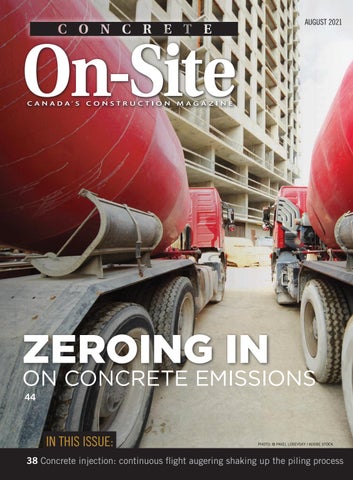
ZEROING IN
ON CONCRETE EMISSIONS 44
IN THIS ISSUE:
PHOTO: © PAVEL LOSEVSKY / ADOBE STOCK
www.on-sitemag.com 38 Concrete injection: continuous flight augering shaking up the piling process
PILING
Concrete injection Piling crews in Kelowna, B.C. drill to new depths for pair of downtown towers BY DAVID KENNEDY
I
PHOTO: SB CANADA
n downtown Kelowna, a few blocks Okanagan Lake, construction crews are drilling deep beneath surface, building piles for a pair of new towers set to start rising shortly in one of Canada’s fastest-growing cities. Employing a crane-mounted lead system, with a hollow stem auger capable of drilling and injecting concrete to depths of 52 metres (170 feet), this is not your typical drill rig. Custom parts were built and shipped both from across Canada and the U.K., making the complex piece of machinery the first of its kind in the Okanagan. The rig and the process it uses, known as continuous flight augering (CFA), reflects both the valley’s rapid urbanization and the focus the project’s builder is placing on minimizing noise and vibration in a busy part of Kelowna. Compared to the more traditional driven steel piling method, the CFA process is far easier on the community, said Luke Turri, executive vice-president of Mission Group. “Urban infill in Kelowna is, I would say, relatively new and so when you’re dealing with these tighter sites with existing buildings surrounding them, anything that we can do as a local builder to try and minimize the disturbances to surrounding businesses and homeowners is great,” he said.
Using a crane-mounted lead system, the hollow stem auger can drill and inject concrete to depths of 52 metres, or roughly 170 feet.
38 / AUGUST 2021
Based in Kelowna and founded 2004, Mission Group is a vertically integrated development firm that leads construction on own its projects, including the three-tower Bernard Block development. Work is already nearing completion on the first stage of the mixeduse project, with a residential condo tower known as Brooklyn scheduled to be finished by the end of this year. Work on the two other buildings is currently getting underway. For the Block, a 16-storey office building, and Bertam, a 34-storey residential tower, Mission Group has enlisted geotechnical specialist Soletanche Bachy Canada (SB Canada) to head the novel piling effort. “Typically, you’re restricted to depths in the region of 25 to 35 metres with traditional equipment,” said Barry Evans, vice-president of Project Delivery, West, for SB Canada, adding that piecing together a system that would drill to 52 metres took some ingenuity. Specially-made parts from Bachy Soletanche in the U.K. and its sister company Berminghammer were also needed. The depth the piling system can reach and its use of a crane as opposed to a conventional drill rig, is a first in Canada for the CFA application. The process itself is not new, however. Like many other construction techniques, the CFA method – also known as auger cast – is a European import, where it’s been in use for decades. “We progress that auger by turning it into the ground to a proscribed design depth,” Evans said. “Once we reach that design depth, we lift the auger slightly and the discharge valves open on the bottom of the auger and then we start to pump the concrete in through the hollow stem of the auger. So, we actually build the pile from its toe upward under a head of pressure.” “The auger holds spoil and then the head of concrete pushes up past the tip of the auger, so we always have positive pressure so that the pile wall is supported,” he adds. Crews slowly withdraw the auger while pumping concrete, eventually leaving just a fluid column of concrete in the ground. “Once the auger is fully retrieved and out of the hole, we move the machine onto the next pile position, we clean the top of the pile and we plunge the reinforcement into that fresh column of concrete,” Evans said, noting the company typically uses CFA-specific concrete with a slump north of 250 and a four-hour set delay
New
www.gomaco.com ❘ info@gomaco.com GOMACO offers the full range of concrete slipform pavers, curb and gutter machines, placer/spreaders, texture/cure machines and bridge/canal finishing equipment. GOMACO equipment features our exclusive and proprietary G+® control system, created in-house by our software engineers from the wants and needs of contractors paving in the field. We’ll show you the new Navigator controller with a 10-inch touchscreen that allows ground personnel to simply control and view all attachments from one location. We are also introducing our new high-production system for the C-450 cylinder finisher for bridge decks and flat slabs. At the heart of GOMACO equipment is our passion for concrete and our commitment to our customers. We look forward to visiting with you about your upcoming paving projects and your concrete paving equipment needs. CONCRETE STREETS AND HIGHWAYS ❘ AIRPORT RUNWAYS ❘ CURB AND GUTTER ❘ SIDEWALKS RECREATIONAL TRAILS ❘ SAFETY BARRIER ❘ BRIDGE PARAPET ❘ BRIDGE DECKS ❘ IRRIGATION CANALS GOMACO CORPORATION IN IDA GROVE, IOWA, USA ❘ 712-364-3347
PILING
in case there’s a mixer delayed on the road or any For its part, Mission Group sees the new issue with equipment that would delay getting type of piling as a great solution to the chalthe rebar cage into the concrete. lenges it faces putting up larger and larger Soil conditions and the goal of limiting buildings in the Okanagan. noise in downtown are a couple of the key “It’s the type of system that as we’re aspects of the Bernard Block project that turned moving ourselves into doing more concrete the team onto CFA, Turri said. high-rise construction, they’re putting a lot “The water table in Kelowna, particularly in more load on what are not great soils for the areas closer to the lake like the downtown, construction of towers in the market that we require a fair amount of soil enhancement, work in,” Turri said. The continuous flight auger process is soil preparation, whether that be piling or Still, while CFA works well for Kelowna, it’s being used for two new towers that are other methods to support some of these taller not for all locales, Evans noted. Regions where part of the Bernard Block development towers that are now become commonplace in crews may encounter boulders or hard formain downtown Kelowna. Kelowna,” he said. tions, for instance, are often not viable, and While driven steel piles are often quite loud, requiring vibratory compact job sites can lead to challenges. hammers to drive pile to depth, CFA limits the noise. “If you’re on a tighter site, it can get very congested very “Whenever a pile driving rig shows up there are complaints, quick because you need a concrete pump, excavator, there’s a “Evans said, “and wherever you can drive a pile, you can do a CFA hole bunch of other moving parts. The reinforcement is delivered pile. The soil conditions are very, very similar.” With owners focus- to site and you have to store that somewhere,” he said. sing more on community and environmental impact, Evans said Having wrapped up the roughly eight-week piling process he is seeing growing momentum for the CFA process throughout June 6, Mission Group has begun moving into construction of the Western Canada, particularly in the Prairies, and now into B.C. parkade podium at the Block. To get to this point, Turri credits The eventful year in the commodity market also has owners the geotechnical and structural teams for the long hours spent looking to CFA for greater cost certainty. working on design and eventually, overseeing execution. “We’re not at risk of a 16-week lead time,” Evans said. “We’re Evans, likewise, said the collaborative mindset Mission Group not at risk of steel prices increasing every day. We have plenty and the engineering team working on the project brought to the of ready-mix concrete suppliers here in B.C. and reinforcement table made the novel approach possible. for the steel cages seems to be readily available, so people are Construction on the pair of new towers is scheduled to run starting to see the benefits.” through 2024.
40 / AUGUST 2021
PHOTO: MISSION GROUP
PHOTO: SB CANADA
A rendering of the three-tower Bernard Block development.
You know what you need in a truck. We’ll help you build it. Build yours at MackTrucks.com/BuildGranite
With Mack® Truck Builder, you can customize your Mack Granite® to be the exact truck you need for your operation. Because when you’re building a business, you need a truck that can do the same. Scan with your smartphone to access
SPONSORED CONTENT
CONCRETE’S FUTURE, PART 1 With Re-Con Zero™ Evo, concrete becomes reusable and sustainable by Giorgio Ferrari and Amilcare Collina of Mapei S.p.A.’s Research & Development division
Thirteen billion cubic meters of concrete are produced every year around the globe, the equivalent of around thirty billion tons or almost four tons per year for each inhabitant of the planet. This material owes its enormous success to its excellent characteristics and properties: Cost-effectiveness, the wide availability of raw materials, excellent mechanical properties and durability. Each and every day, in every corner of the planet, hundreds of thousands of trucks transport fresh concrete from mixing plants to building sites to be used in the construction of every possible type of building and infrastructure. Not all the concrete that is produced, however, is actually used on site. A certain amount, from just a few hundred liters to several cubic meters, is returned to the mixing plant in its original state as what is known as “leftover” or returned concrete. For various reasons, the production of returned concrete is unavoidable and, as such, has to be considered as an integral part of the production process. According to estimates, returned concrete accounts for around 3% of the total amount produced, or around 900 million tons per year at a global level.
Only a fraction of all returned concrete may be reused as is in concrete works, while for the most part, due to the lack of a viable possibility of using it again and transforming it, it has to be disposed of. For this reason, returned concrete is by far the most abundant waste product at the concrete batching plants. Disposing of returned concrete in landfill sites has a heavy impact on the environment, which may be expressed in terms of “equivalent” CO2, the gas responsible for global warming. In numerical terms, one cubic meter of returned concrete sent for landfill is the equivalent of 267 kg of CO2, which, if multiplied by the amount of returned concrete produced annually in the world, amounts to almost 105 million tons of CO2, the same amount produced in one year by around 47 million medium-sized cars, more than the cars currently in use in Germany.
From waste to resource Today, with Re-Con Zero Evo, MAPEI’s product for more sustainable concrete, it is possible to recover and transform returned concrete, thereby going from a “linear” economic model, based on the production of waste, to a more “circular” economic
2
42 / AUGUST 2021
model in which waste no longer exists but rather becomes a resource. A circular economy is a regenerative type of industrial system. It replaces the “end of life” concept with a concept of “restoration,” prevents the depletion and decline of natural resources, encourages the use of renewable energy, eliminates the use of toxic chemical substances that impede its reuse/return to the biosphere and aims at eliminating waste by improving the design of materials, products, systems and business models. But how is it possible to transform concrete from waste material into a resource with Re-Con Zero Evo? When Re-Con Zero Evo is added to returned concrete in a mixer truck, or in any other suitable mixing system, in the space of just a few minutes the special additives contained in the product absorb any free water that is present, thereby “drying” the concrete. This transforms it into aggregates with a grain size distribution and mechanical characteristics that are perfectly suitable to be reused to make new concrete without generating any new waste – liquid or solid. The advantages of this innovative product are clear: The production of aggregates
3
SUSTAINABLE RECOVERY OF RETURNED CONCRETE
1ST STEP Component B 1.5 kg/m3 Mix for 3 minutes
1
from returned concrete enables the acquisition of natural aggregates to be reduced by a corresponding amount, which in turn limits the depletion of raw materials. The process also completely eliminates the use of landfill sites, which in turn further reduces the impact on the environment. With Re-Con Zero Evo, one cubic meter of returned concrete produces only 6.75 kg of CO2, almost 40 times less than when compared with disposing of it as landfill. Apart from these environmental benefits, there are also corresponding advantages associated with its use for the entire industrial system: A significant reduction in costs for production, the acquisition of raw materials and the disposal of waste.
2ND STEP Component A 0.5 kg/m3
1: Approximately 400 million m3 of returned concrete requires treatment every year. 2 and 3: After being mixed for a few minutes with Re-Con Zero Evo, concrete is transformed into granular material that, once cured, may be used as aggregate in concrete. 4 and 5: After the material is discharged, the mixing drum is left clean. The cleaning water for the mixer drum may be completely recycled and used again for mixing.
Today, thanks to Re-Con Zero Evo, there is now the certainty that all returned concrete can be recovered and reused, by means of a process of industrial transformation based on the principles of a circular economy, to produce aggregates with all the technical and environmental requirements for its correct use in the production of concrete and in other civil engineering works.
Mix for 4 minutes
concrete
3RD STEP DISCHARGE
Complete kit to treat 1 cubic meter of returned concrete: RE-CON ZERØ EVO Comp. B:1x1.5 kg water-soluble bags RE-CON ZERØ EVO Comp. A:1x0.5 kg water-soluble bags
4
5
on-sitemag.com / 43
Zeroing in on concrete emissions
Industry innovators are working to lower or eliminate concrete’s carbon footprint while maintaining its workability.
New technologies making headway, but carbon neutral a tall order BY DAVID KENNEDY
C
rews pouring the concrete footings, columns and slabs at the end of the intricate cement and concrete supply chain will never know the difference. The new mixes will maintain the same workability, the same degree of early strength, the same level of air entrainment and the same feel as traditional concrete mixes, all while bringing the carbon dioxide emissions produced throughout the process to zero. At least that’s the intention.
44 / AUGUST 2021
Last fall, the Global Cement and Concrete Association (GCCA) – made up of several dozen of the world’s largest cement firms – set 2050 as the target for delivering zero carbon concrete. Many multinational members, such as Cemex, HeidelbergCement and LafargeHolcim have also set 2030 targets as stepping stones on the way to carbon neutrality. Hitting the intermediary targets and the “ambitious” mid-century goal is achievable, Apoorv Sinha, the CEO of
Carbon Upcycling Technologies says, but will require a confluence of factors. “If you’re trying to make the World Series or the finals at the World Cup, a lot of different things have to fall in place,” he says. “Even if you prep exactly right and your strategy’s been great, and your coach is great, there are a lot of things outside your control that still need to happen.” The situation is much the same for the cement and concrete industry’s CO2 goals, he says, adding that the onus is on
PHOTO: © 1JAIMAGES / ADOBE STOCK
EMISSIONS
MAKE YOUR CONCRETE
WORK FOR YOU
®
SMART CONCRETE®
Help your clients maximize the sustainability of their structure without sacrificing your budget or your schedule. Take advantage of Kryton’s award-winning admixtures to permanently waterproof your concrete and dramatically increase wear resistance to help builders meet the needs of today and tomorrow. Eliminate the time and cost of surface-applied products Overcome scheduling challenges Save skilled labor for other critical tasks Improve on-site safety by reducing toxic silica dust Double the wear life of your concrete Reduce your structure’s lifetime carbon footprint www.kryton.com
start-ups working on commercializing or scaling up new technologies to ensure the industry’s slower-moving players have the tools to reach their net-zero targets. With plenty of “runway” left before 2050, Andrew Fahim, senior manager of Research and Development at Giatec Scientific Inc. sees the goal as achievable as well, but only if new tools are implemented throughout the industry’s supply chain. “It will come down to a lot of disruptive technology,” he says. “If we’re doing what we’re doing today, I don’t think we’ll get there.” Rob Niven, the CEO and founder of CarbonCure, says he is seeing momentum pick up for clean technology across the cement and concrete industry, with pressure being heaped on by government regulations, media, and investors focussed on environmental, social and corporate governance (ESG), among other players. “It’s coming from all sides and it’s just getting bigger and bigger and bigger every month,” he says. In respect to the 2050 goal, however, he says he would have liked to have seen a more detailed roadmap for achieving
46 / AUGUST 2021
carbon neutrality. Niven says there’s visibility into how the industry could cut emissions by about half, but less clarity on the second 50 per cent. “It tends to fall into this category of carbon capture, utilization and storage (CCUS),” he says. “Those technologies fortunately do exist today, but creating the right business models and economics I think will be a challenge.” All parties acknowledge making cement and concrete carbon neutral will be a tall order, but with industry CO2 emissions accounting for seven or eight per cent of global emissions, depending on the study, the wider impact is also considerable. Technologies from all three Canadian firms look likely to play a role in the shift.
GETTING TO ZERO Fresh off a grand prize win in the NRG COSIA Carbon XPRIZE competition, and firmly established at roughly 400 plants on four continents, CarbonCure is working toward the lofty goal of cutting 500 megatonnes of CO2 from the concrete industry by 2030. The Dartmouth, N.S.-based cleantech
firm is best known for its mixer technology, which injects captured CO2 into concrete at ready-mix facilities, both strengthening the mix and locking in CO2 from waste streams. But it’s picking up the pace on innovation in a number of other areas as well, Niven says. For instance, it shared first place in the $20 million XPRIZE competition this April not for its original injection technology, but for a new process it has developed for reclaimed water at concrete plants. Designed to work with concrete producers’ existing water reclaimers, the technology uses slurry or wash water from mixer trucks and injects CO2 to produce a “nano-scale suspended solid” that can then be integrated into fresh concrete. The process cuts back on both the amount of cement and the amount of water required for the fresh concrete. To hit its 500 MT target, Niven says the company’s focus is on deploying its existing technology and on delivering new, interconnected innovations that will work in tandem with its current tools. “I do expect that we’ll be a full-suite solution on the CO2 supply side, on the
PHOTO: © KASIPAT / ADOBE STOCK
EMISSIONS
Though vital to construction, the cement and concrete industry are major contributors to global carbon emissions.
utilization side, but also all of the digital tools that allow for these technologies to be connected with the marketplace and create other efficiencies in the concrete plants,” Niven says. CarbonCure has begun helping customers take part in the carbon credit market, which lets concrete producers earn offsets – and additional revenue – for using its technology. With a growing in-house software team and access to cuttingedge computing capabilities through its second-largest investor, Amazon.com Inc., Niven says the company is also advancing its digital offering. “Now, where our mind is turning is how can we help concrete producers adopt artificial intelligence with the large sets of data that are involved in their business to help them reduce cost and sell more.” In that arena, CarbonCure is likely to have plenty of competition. Giatec, which is based in Ottawa and makes concrete sensors that contractors have put to work on thousands of projects
in at least 85 countries, has been expanding its software offering as well. This June, it launched SmartMix, a web-based tool that helps contractors and concrete producers fine-tune their mixes to meet project specifics. It uses artificial intelligence to sift through 20 years of historical data and millions of data points to generate mix designs that meet project and environmental specifications. “Cement contributes eight per cent to global greenhouse gas emissions, but it’s also the most expensive component of concrete mixtures, so [by] reducing cement content, we’re able to give them a better bottom line as well as a significantly lower carbon footprint,” Fahim says. With a huge range of mitigating factors involved, designing concrete mixes has typically been a time-consuming process that relies on lab testing numerous options with different make-ups of cement and supplementary cementitious materials. SmartMix, meanwhile, can quickly run the numbers. “It’s able to virtually run millions of
Request A FREE Jobsite Demo
MAX developed the World’s First battery powered rebar tying tool in 1993. Since then, MAX rebar tying tools have revolutionized rebar tying work on a variety of jobsites all around the world. The safety equipped TWINTIER® system is the fastest solution on the market for tying rebar. TWINTIER® technology allows up to tie 4,000 ties per charge, while delivering just the right amount of wire for greater productivity and cost savings. Compared to hand tying, this tool can reduce the risk of musculoskeletal injuries. MAX is committed to manufacturing reliable tools that have been designed to deliver enhanced performance while making sure that users can carry out safe operations. The MAX PPE Shield means that you can trust that our tools are engineered with your health and safety in mind. MAX rebar tying tools are designed to alleviate the pain of manually tying rebar and reduce the risk of developing musculoskeletal diseases. Work safe with MAX tools. Prioritizing using proper equipment keeps you safe and healthy on the job site. MAX USA Corp. • 205 Express St. Plainview, NY 11803 • U.S.A. - Phone: (800) 223-4293 • FAX: (516) 741-3272 •
MAX USA CORP.COM on-sitemag.com / 47
OnSite_MaxUSA_June21.indd 1
2021-06-03 2:33 PM
Software assistance will help push certain aspects of the construction process out of the lab.
If the concrete industry and the construction materials industry in the U.S. is shifting very quickly to buy clean, we have to make sure as a Canadian industry that we’re harmonized.” –Rob Niven, CarbonCure
PHOTO: © PINGPAO / ADOBE STOCK
EMISSIONS
significantly higher performing than many conventional SCMs, which in their original form can reduce concrete strength. With Carbon Upcycling’s enhanced SCM, producers can cut the cement content in their concrete, saving on both emissions and cost. To date, the company has been putting its 20-tonne-per-day reactor to work with ready-mix producer Burnco, integrating SCM in some 3,000 truckloads of concrete. It has shown it can reduce cement content in any mix by at least 10 per cent, and in some mix designs by up to 25 per cent. While the company’s process also has applications in industries such as plastics, its main focus has shifted to construction materials as the industry looks for ways to decarbonize. With the promising results, it’s working toward building a 200-tonne, commercial scale version of its reactor to continue its scale-up. If all goes according to plan, the company could build hundreds of its reactors at ready-mix facilities around the world, and even higher capacity versions at cement plants.
GETTING GOVERNMENTS ON BOARD different candidate mixtures or mixtures that would meet the designer’s criteria in terms of performance and the owner’s criteria in terms of carbon footprint,” Fahim says, noting teams can then take their custom-designed favourite to the lab for confirmation. The company’s sensors, which use the maturity method to determine concrete strength, also come into play, displaying any mix adjustments that may be needed in real-time. Giatec anticipates SmartMix could reduce CO2 emissions in the industry by 400 megatonnes by helping contractors hit the same performance targets while eliminating as much cement from their mixes as possible. Giatec is aiming to hit that figure, which Fahim says would mean capturing about 30 per cent of the global market, by 2030. Carbon Upcycling remains in the relatively early stages of its development, having made the shift out of the lab in the past year. Still, its promising technology has attracted
48 / AUGUST 2021
numerous high-profile partners, including Cemex and Lafarge. It has developed a low-energy process to mineralize carbon emissions into solid materials. Employing feedstocks heavy on alkali earth metal oxides, such as calcium oxide or magnesium oxide, it uses a single-unit catalytic reactor to force the powders to take on CO2. “We’re creating these optimal conditions where that reactor component can very quickly absorb CO2 to become calcium carbonate,” Sinha says. For feedstocks, the company is turning to materials like fly ash, fuel slag, crushed glass, or even natural minerals with high enough levels of the two key oxides. “The CO2 that we feed into our reactor gets absorbed into these SCMs, or supplementary cementitious materials, and create a direct sink for CO2,” Sinha says. The reactor also changes the reactivity of the fly ash, crushed glass or other material in concrete, increasing its cementitious properties. Material that has been run through the Calgary-based firm’s process is
To complement the technical side of getting to zero, regulators will also need to force the issue, Niven says. Proposed regulations in U.S. states such as New York and California will do just that by introducing procurement incentives and rewarding companies leading the way on cleaner concrete. Others in the U.S. and Canada are expected to follow suit. “If the concrete industry and the construction materials industry in the U.S. is shifting very quickly to buy clean, we have to make sure as a Canadian industry that we’re harmonized,” Niven says. In Ottawa, the federal government is making some early headway. This spring, the National Research Council (NRC), the Standards Council of Canada (SCC) and the Cement Association of Canada (CAC) formed a working group designed to chart Canada’s course to a 15 MT reduction in CO2 emissions by 2030 and net-zero concrete by 2050. The group is expected to have a roadmap in place to achieve both goals by this December.