www.claimscanada.ca
April/May 2016
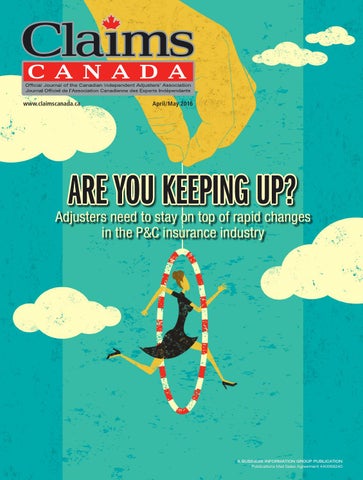
Adjusters need to stay on top of rapid changes in the P&C insurance industry
Official Journal of the Canadian Indeépendent Adjusters’ Association
A BUSINESS INFORMATION GROUP PUBLICATION Publications Mail Sales Agreement #40069240
p1 CLAIMS COVER FINAL.indd 1
16-04-28 10:10 AM
GK_Ad_ClaimsCanada.pdf
1
11-11-03
2:51 PM
Exceptional expertise
• Forensic Engineering • Loss Mitigation / Remediation • Engineering Risk Management
416.368.1700 giffinkoerth.com
ad right size.indd 1
15-06-24 3:57 PM
Contents A P R I L / M AY 2 0 1 6 • V O L U M E 1 0 • N U M B E R
2
12
Cover Feature 12 Are you keeping up? The pace of change facing the independent adjuster, along with the entire P&C insurance industry, is blistering. And the risks of not keeping abreast of new developments are high, for small and large firms alike. So where’s an adjuster to turn for advice and education in the brave new world? Turns out there are options; you just have to find the time. BY Emily Atkins
20
Spotlight 18 Loss in Translation Making the complex clear brings satisfaction to Andy Williams and the team at AMG Claims Inc. By Emily Atkins
News Features 20 Challenges in Fire Damage Assessment and Remediation: Forensic Engineering Perspectives
22
Lack of guidelines makes it a tricky science. BY Kirsten Hoedlmoser, B.A.Sc., P.Eng.
22 Dash Cam Evidence Onboard cameras can minimize fraud, encourage early settlements and save insurance companies costs. By John Seyler & Mike Furyk
24 What is an Executive General Adjuster? By Brent E Hackett, FCIP, CIOP, EGA
26 The Continuing Evolution of Canadian Law and Privacy: The Impact of Social Media Posts A Review of Ontario Superior Court Decision, Jane Doe 464533 v. ND By Laura Emmett and Natalie Carrothers
24
p3 contents.indd 1
Departments 4 First Notice 28 On The Scene
Columns 10 President’s Message
16-04-26 3:21 PM
• first notice FN Low oil price linked to large losses Energy firms are facing challenges, including falling revenues, but are encouraged to maintain their investment in risk management to reduce the potential for future major incidents and insurance claims, suggests a new research report from global insurance broker and risk advisor Marsh. Over the past 20 months, oil prices have fallen by about 70 per cent, notes Can Energy Firms Break the Historical Nexus Between Oil Price Falls and Large Losses? released at the firm’s bi-annual National Oil Companies conference in Dubai. In the upstream market, the report notes that periods of significant price reductions historically have been met by the following: • new projects being shelved or cancelled; • increase in layoffs and hiring freezes; • cuts in infrastructure and maintenance spending; and, • less investment in health and safety measures and employee training. “Already, companies have been cancelling projects and making staffing reductions,” states the report, which analyzes the historical sequential correlation between oil price reductions, which led to energy firms cutting costs, including safety training and education, which, in turn, led to an occurrence of significantly larger insured losses in the following period. “While project cancellations and redundancies are easy to quantify due to publicly available information, cuts in mainte-
Response. Results. Specialty Adjusting, Redefined.
BRAMPTON
|
KITCHENER
PETERBOROUGH
|
|
HAMILTON
BELLEVILLE
|
dsbclaims.com
Claims Canada
DSB QtrPg Ad 09_18.indd 1
p4,6,8 FIRST NOTICE.indd 4
OSHAWA
MUSKOKA
1-866-856-6335
4
|
nance, health and safety measures, and employee training are far more difficult to assess. With a prolonged period of low oil prices expected, however, the question now is when oil and gas companies begin spending less on maintenance and health and safety,” the reports notes. “Analysis of past cycles indicates that cost-cutting decisions were followed by an increased frequency of major incidents or large losses,” Andrew George, chairman of Marsh’s Global Energy Practice, says in a statement from Marsh, a wholly owned subsidiary of Marsh & McLennan Companies, Inc. Marsh points out that insured losses in the global upstream energy sector reached a peak in the 1980s, shortly after the price of Brent crude oil fell from US$35 to US$15 per barrel. This cycle also occurred in the late 1990s, when the price fell below US$10 per barrel, and in the years following the 2008 slump, when the price fell from more than US$100 to US$32 per barrel. ●
Analysis of climate change impact on catastrophes now possible It is now possible to estimate the influence of climate change on some types of extreme events, such as heat waves, drought and heavy precipitation, says a new report from the Washington, DC-based National Academies of Sciences, Engineering, and Medicine. The relatively new science of extreme event attribution has advanced rapidly in the past decade, owing to improvements in the understanding of climate and weather mechanisms and the analytical methods used to study specific events. But more research is required to increase its reliability, ensure that results are presented clearly and better understand smaller scale and shorter duration weather extremes, such as hurricanes and thunderstorms, said the committee that conducted the study. Scientists cautioned in the past that individual weather events couldn’t be attributed to climate change, notes the report, Attribution of Extreme Weather Events in the Context of Climate Change. “The relatively young science of extreme event attribution seeks to tease out the influence of human-cause climate change from other factors, such as natural sources of variability like El Niño, as contributors to individual extreme events.” Extreme event attribution explores the influence of humancaused climate change on individual or classes of extreme events compared with other factors, such as natural sources of climate and weather variability. The science typically estimates how the intensity or frequency of an event has been altered by climate change and provides information that can be used to assess and manage risk, guide climate adaptation strategies and determine greenhouse gas emissions targets. Event attribution is retrospective, but the report calls for the development of predictive weather-to-climate forecasts of future extreme events that account for natural variability and human influences. ●
April/May 2016
www.claimscanada.ca 9/18/15 1:30 PM
16-04-26 3:24 PM
SPECS.CA
Canada’s leading provider of pre- and post-loss appraisal and consultation services. SPECS provides the insurance industry with expert, impartial, and comprehensive structural consultation. Our customers benefit from: precise valuation of damages, accurate reserves, a reduction in claim cycle times and enhanced claimant satisfaction. Trust SPECS to assist with any residential, commercial, industrial or CAT claim.
SERVICES PROPERTY LOSS SCOPE AND ESTIMATING BID ANALYSIS AND MANAGEMENT
DIVISIONS TECHNICAL SERVICES CONTENTS APPRAISAL STORM AND CATASTROPHE
PROJECT MANAGEMENT AND CONSULTING
Ethics - Excellence - Value - Teamwork
2016 © All rights reserved. Specialized Property Evaluation Control Services Limited
ad right size.indd 1
BENEFITS REDUCED CLAIM AND PROJECT TIMELINES EFFECTIVE EXPENSE AND COST CONTROL PRECISE VALUATION OF DAMAGES
888-73-SPECS
(77327)
16-04-25 3:46 PM
• first notice FN Supreme Court won’t hear auto claimant’s appeal after two-year limit The Supreme Court of Canada will not hear an appeal from an Ontario auto claimant who unsuccessfully sought a nonearner benefit more than three years after her income replacement benefits were terminated. In a ruling released July 13, 2015, the Court of Appeal for Ontario upheld a lower court ruling against Angela Bustamante, who was involved in a vehicle accident on June 3, 2004. She applied for accident benefits with The Guarantee Company of North America. Court records indicate that in August 2004 Bustamante had elected income replacement benefits as opposed to non-earner benefits. At the time she was employed as a hairdresser. The Guarantee stopped paying IRB July 26, 2006 because a post-104 week disability assessment found that the claimant “no longer met the disability test for entitlement.” In September 2009 Bustamante’s lawyer advised The Guarantee that Bustamante “intended to pursue a claim for non-earner benefits.” The Guarantee told her the following January she was not entitled to non-earner benefits. When efforts at mediation with the Financial Services Commission of Ontario were unsuccessful Bustamante initiated a lawsuit against The Guarantee in 2012. In 2014, the Ontario Superior Court of Justice granted The Guarantee’s request for summary judgment to dismiss Bustamante’s lawsuit. That ruling was upheld in 2015 on appeal. In September 2015, Bustamante applied for leave to appeal to the Supreme Court of Canada, which announced March 17, 2016 that her application was denied.
Section 51 (1) of Ontario Regulation 403/96—the province’s Statutory Accident Benefits Schedule—stipulates that any mediation, evaluation, court proceeding or arbitration over a disputed SABS claim “shall be commenced within two years after the insurer’s refusal to pay the amount claimed.” Bustamante “did not re-assert a claim for non-earner benefits until June 17, 2011 when she sought mediation, a time well in excess of two years following the termination of benefits,” the Court of Appeal for Ontario wrote in its decision released July 17, 2015. “Even her letter dated September 25, 2009, in which she informed [The Guarantee] that she wished to pursue non-earner benefits, was delivered two years after the respondent terminated her benefits.” The Court of Appeal for Ontario cited a 2014 ruling by the same court in Sietzema v. Economical Mutual Insurance Company. Tanya Sietzema was involved in a vehicle accident in 2005. She was employed at the time and a form signed by a physician indicated she “did not meet the ‘disability test’ for Non-Earner Benefits,” the Court of Appeal for Ontario wrote in 2014 in its ruling against Sietzema. “The facts in Sietzema are on all fours with those in this case,” wrote the Justices in their ruling against Bustamante. “There, the claimant applied for and received income replacement benefits. She was denied her claim for non-earner benefits. The claimant received her income replacement benefits and then more than two years after they were denied, she sued her insurer for non-earner benefits.” ●
Anchor losses underline need for crew awareness A new investigation suggests many anchor losses are avoidable and shed light on a potentially bigger issue: the need for crews to be aware of the environmental loads for which equipment is designed. A rising number of anchor losses prompted an investigation. The investigation was carried out by DNV GL, which provides classification and technical assurance, and software and independent expert advisory services to the maritime, oil and gas and energy industries; Gard, a shipowner-controlled provider of protection and indemnity, marine and energy insurance products; and The Swedish Club, a mutual insurance company owned and controlled by its members. “The root cause of many groundings and collisions, lost anchors are among the top five reasons for claims costs,” notes a joint statement. “Anchor and chain loss can often lead to collisions and grounding, which can result in additional damage to a vessel. Adding to the costs of anchor loss is the increasingly common requirement from port authorities that lost anchors are recovered,” the statement adds. “One of the key takeaways of our investigation is the importance of the officers and crew being aware of the environ6
Claims Canada
p4,6,8 FIRST NOTICE.indd 6
April/May 2016
mental loads their equipment is designed for,” says Håkon Skaret, senior principal engineer at DNV GL. “If these limits are not taken account of in shipboard anchoring procedures, there can be significant damage to the vessel—even beyond the loss of anchor and chain. Many anchor losses are avoidable, if the proper maintenance and handling procedures are adhered to,” Skaret contends. The project partners identified the most frequent technical and operational causes, as well as some steps crews and operators can take to address them. Their observations include the following: The D-shackle is the technical component with the highest loss-causing failure rate, indicating it should be inspected whenever possible, with special attention paid to the taper pin. The windlass brake is essential to control the pay-out of the chain, and many anchor losses are reported as a result of loss of brake power and uncontrolled release of the chain. Corrosion of the drum and wear of the brake band lining reduces brake capacity and proper maintenance is essential. ● www.claimscanada.ca
16-04-26 3:25 PM
WHEN THE UNEXPECTED HAPPENS,
WE’RE WE’RE READY
WHEN THE UNEXPECTED HAPPENS,
READY
WE ARE EQUIPPED TO RESPOND TO YOUR NEEDS 24/7.
We are the single-source solution with the expertise and resources to mitigate damages and minimize losses with superior results. You can depend on us to handle every aspect of the property repair efficiently, effectively and with care. Call the brand you can trust to deliver all your We are the single-source solution with the expertise and resources to mitigate damages needs. andrestoration minimize losses with superior results. You can depend on us to handle every aspect
WE ARE EQUIPPED TO RESPOND TO YOUR NEEDS 24/7.
We are the single-source solution with the expertise and resources to
of the property repair efficiently, effectively and with care. Call the brand you can trust to mitigate damages andneeds. minimize losses with superior results. You can deliver all your restoration
depend on us to handle every aspect of the property repair efficiently, effectively and with care. Call the brand you can trust to deliver all your restoration needs.
1-800-RESPOND servicemasterrestore.ca
ad right size copy.indd 1 ad right size.indd 1
15-01-19 9:21 AM 15-06-24 4:03 PM
• first notice FN BC pouring money into Richmond flood prevention British Columbia is making $16.6 million available to fund a flood mitigation project in Richmond. Announced as part of public safety funding in the 2016 provincial budget, the $24.95-million project also includes $8.3 million from the City of Richmond, the provincial Ministry of Transportation and Infrastructure said in a press release. The combined funding will help Richmond rebuild four pump stations that have reached the end of their functional lifespan and enhance 1,750 metres of the north dike to accommodate rising sea levels induced by climate change. In Richmond, storm water is pumped off the island by 39 drainage pump stations, notes background information from the ministry. “It is imperative that the City of Richmond continuously upgrades infrastructure to meet the effects of climate change including rising sea level, increased intensity of storms and risk of flooding,” the information said. Climate change scientists estimate that sea level will rise about one metre over the next 100 years, the release said, requiring Richmond to raise dikes by 1.2 metres to accommodate these changes. In response to the elevated flood threat, the City of Richmond has developed a comprehensive disaster mitigation plan that includes upgrades to existing infrastructure and new mitigation structures. Richmond is the highest-risk area in B.C. for coastal and freshet flooding. The investment will protect “important provincial and national infrastructure assets, including the Vancouver International Airport and SkyTrain.”
The provincial investment is part of over $49 million being provided to flood mitigation projects in communities across B.C. In the 2016 budget, the government announced $65 million to help keep communities safe, including $16 million in public safety preparedness initiatives and $49 million in community hazard mitigation initiatives, such as upgrades to dikes and flood protection. Malcolm Brodie, Mayor of Richmond, noted in the release that the city is an island community, surrounded by water. “Richmond’s 49 kilometres of dike and the supporting drainage system is a critical part of our civic infrastructure, protecting us from the threat of flooding,” Brodie said. “We must continually strive to improve this network to address both current threats and emerging risks from climate change. This new funding will help Richmond address this important need for our community.” Since 2008, the province has committed $174 million with the federal government to pay for 168 flood mitigation projects in 65 communities throughout British Columbia. ●
Paul Aquino Publisher (416) 510-6788 paul@canadianunderwriter.ca
Steve Wilson Senior Publisher (416) 510-6800 steve@canadianunderwriter.ca
Christine Giovis Account Manager (416) 510-5114 christine@canadianunderwriter.ca
Emily Atkins Editor (416) 510-5130 emily@claimscanada.ca
Karen Samuels Production Manager • (416) 510-5190 karens@newcom.ca
Mike Wells Account Manager • (416) 510-5122 mike@canadianunderwriter.ca
Michael Chimienti Art Director mike@newcom.ca
Subscription inquiries (416) 614-5831 Official Journal of the Canadian Indeépendent Adjusters’ Association
www.claimscanada.ca
Produced by the publishers of Canadian Underwriter magazine
A bi-monthly magazine (6x per year), Claims Canada is published by NEWCOM Business Media Inc. is located at: 80 Valleybrook Drive, Toronto, ON, M3B 2S9. Claims Canada magazine is the Official Publication of the Canadian Independent Adjusters’ Association [CIAA] and through its editorial content and circulation brings together the ‘entire property & casualty insurance claims market nationally’ with information and insight into the profession, business and people of insurance claims and loss adjusting. All key claims process stakeholders are reached as part of our readership community – including: both CIAA member and non-member independent claims adjusting firms; insurance and reinsurance company executive, claims management
8
Claims Canada
p4,6,8 FIRST NOTICE.indd 8
April/May 2016
and claims adjusting personnel; corporate risk managers and loss control professionals; insurance brokers; insurance law firms; forensic engineers and accountants; appraisal, restoration, rehabilitation and collision repair professionals; Insurance Institute chapters; insurance associations, regulators and related claims market recipients. The contents of this publication may not be reproduced or transmitted in any form, either in part or in full, without the written consent of the copyright owner. Nor may any part of this publication be stored in a retrieval system of any nature without prior written consent.
www.claimscanada.ca
16-04-26 3:25 PM
CIAA REGIONAL PRESIDENTS 2015 – 2016 Newfoundland & Labrador TBA
Nova Scotia Michael Connolly, BA, CFEI, CIP ClaimsPro 30 Damascus Rd., Suite 220 Halifax, NS B4A 0C1 Phone: (902) 835-5065 Fax: (902) 835-0848 E-mail: michael.connolly@scm.ca
New Brunswick & Prince Edward Island Greg Potten, BPE, CIP, CFEI AMG Claims Inc. 212 Queen Street, Unit 308 Fredericton, NB E3B 1A8 Phone: (506) 458-9000 Fax: (506) 458-9595 E-mail: greg.potten@amgclaims.ca
Quebec/AESIQ Denis Duchesne Cunningham Lindsey Canada Claims Services Ltd. 1250 rue Guy, bureau 1000 Montreal, QC H3H 2T4 Phone: (514) 938-5400 Fax: (514) 938-5445 E-mail: dduchesne@cl-na.com
Ontario Maria Joshua, FCIP Sedgwick CMS Canada Inc. 21 Four Seasons Place, Suite 100 Toronto, ON M9B 6J8 Phone: (416) 695-5100 Fax: (416) 695-5120 E-mail: maria.joshua@sedgwickcms.ca
Manitoba Craig Shanks, BA, CIP Network Adjusters Ltd. 64 Regent Cres. Brandon, MB R7B 2W9 Phone: (204) 725-7436 Fax: (204) 725-7437 E-mail: craig.shanks@mymts.net
Saskatchewan Justin Braaten, FCIP, CRM, XAT Capital Claims Adjusters Limited 3500 – 13th Avenue Regina, SK S4T 1P9 Phone: 1 866 550-0516 Fax: 1 866 725-4794 E-mail: justin@capitalclaims.ca
Western M. Doreen Lennon, CIP T&L Adjusters Ltd. #309, 5227 55 Avenue NW, T6B 3V1 Edmonton, AB T6B 3V1 Phone: (780) 463-7776 Fax: (780) 462-1280 E-mail: dlennon@tladjusters.com
PACIFIC TBA
www.claimscanada.ca
p9 CIAA NSC.indd 9
National Standing Committees 2015-2016 ADVISORY Heather Matthews, CIP, CRM Crawford & Company (Canada) Inc. 539 Riverbend Dr. Kitchener, ON N2K 3S3 Phone: (519) 578-5540 Fax: (519) 578-2868 E-mail: Heather.Matthews@crawco.ca Gary Ellis, BBA, FCIP, RF, FCLA, FCIAA, FIFAA AMG Claims Inc. P.O. Box 20102 Sherwood Charlottetown, PE C1A 9E3 Phone: (902) 628-9091 Fax: (902) 628-9093 E-mail: gary.ellis@amgclaims.ca Albert Poon, CIP Cunningham Lindsey Canada Claims Services Ltd. 1102 – 50 Burnhamthorpe Rd. W. Mississauga, ON L5B 3C2 Phone: (905) 896-8181 Fax: (905) 896-3485 E-mail: apoon@cl-na.com Paul Féron, FCIP, CRM ClaimsPro 210 – 746 Baseline Rd. East London, ON N6C 5Z2 Phone: (519) 645-6500 Fax: (519) 645-2250 E-mail: paul.feron@scm.ca Lorri Frederick ClaimsPro 120 Adelaide St. W., Suite 2401 Toronto, ON M5H 1T1 Phone: (905) 308-6292 Fax: (416) 360-7335 E-mail: lorri.frederick@scm.ca James B. Eso, CIP, CIOP Crawford & Company (Canada) Inc. 539 Riverbend Drive Kitchener, ON N2K 3S3 Phone: (519) 578-5540 Fax: (519) 578-2868 E-mail: Jim.Eso@crawco.ca E. Grant King, BA, B.Ed., CIP Crawford & Company (Canada) Inc. 120 – 237 Brownlow Avenue Dartmouth, NS B3B 2C7 Phone: (902) 468-7787 Fax: (902) 468-5822 E-mail: Grant.King@crawco.ca John Jones, BA Cunningham Lindsey Canada Claims Services Ltd. 1102 – 50 Burnhamthorpe Rd. W. Mississauga, ON L5B 3C2 Phone: (905) 896-8181 Fax: (905) 896-3485 E-mail: jjones@cl-na.com Albert Poon, CIP Cunningham Lindsey Canada Claims Services Ltd. 1102 – 50 Burnhamthorpe Rd. W. Mississauga, ON L5B 3C2 Phone: (905) 896-8181 Fax: (905) 896-3485 E-mail: apoon@cl-na.com Marie C. Gallagher, FCIP, CRM Kernaghan Adjusters Limited 602 – 1 St. Paul Street St. Catharines, ON L2R 7L3 Phone: (289) 786-1074 Fax: (289) 723-1979 E-mail: mgallagher@kernaghan.com Craig J. Walker, CIP, FCIAA, FIFAA Maltman Group International 3550 Victoria Park Ave., Suite 301 Toronto, ON M2H 2N5 Phone: (416) 492-4411 Fax: (416) 492-5657 E-mail: cwalker@maltmans.com CIAA NATIONAL INSURANCE INDUSTRY ADVISORY BOARD Patti M. Kernaghan, FCIP, CRM Kernaghan Adjusters Limited 300 - 1445 West Georgia Street Vancouver, BC V6G 2T3 Phone: 1-800-387-5677 Fax: 1-800-387-5644 E-mail: pkernaghan@kernaghan.com Fred R. Plant, AIIC ClaimsPro 85 Englehart Street Dieppe, NB E1A 8K2 Phone: (506) 853-8507 Fax: (506) 853-8501 E-mail: fred.plant@scm.ca Heather Matthews, CIP, CRM Crawford & Company (Canada) Inc. 539 Riverbend Dr. Kitchener, ON N2K 3S3 Phone: (519) 578-5540 Fax: (519) 578-2868 E-mail: Heather.Matthews@crawco.ca
Monica Kuzyk, FCIP, CRM Curo Claims Services 125 Northfield Dr. W., P.O. Box 218 Waterloo, ON N2J 3Z9 Phone: (866) 952-2876 Fax: (519) 888-9704 E-mail: mkuzyk@curocanada.com Albert Poon, CIP Cunningham Lindsey Canada Claims Services Ltd. 1102 – 50 Burnhamthorpe Rd. W. Mississauga, ON L5B 3C2 Phone: (905) 896-8181 Fax: (905) 896-3485 E-mail: apoon@cl-na.com Patricia M. Battle Canadian Independent Adjusters’ Association/L’Association Canadienne des Experts Indépendants Centennial Centre, 5401 Eglinton Ave. West, Suite 100 Etobicoke, ON M9C 5K6 Phone: (416) 621-6222 Toll Free: 1-877-255-5589 Fax: (416) 621-7776 E-mail: pbattle@ciaa-adjusters.ca Marie C. Gallagher, FCIP, CRM Kernaghan Adjusters Limited 602 – 1 St. Paul Street St. Catharines, ON L2R 7L3 Phone: (289) 786-1074 Fax: (289) 723-1979 E-mail: mgallagher@kernaghan.com Craig J. Walker, CIP, FCIAA, FIFAA Maltman Group International 3550 Victoria Park Ave., Suite 301 Toronto, ON M2H 2N5 Phone: (416) 492-4411 Fax: (416) 492-5657 E-mail: cwalker@maltmans.com Sasha Alexander University of Guelph Alexander Hall 50 Stone Road East Guelph, ON N1G 2W2 Phone: (519) 824-4120 Fax: (519) 824-0364 E-mail: sasha@uoguelph.ca Ian Frost, FCIP Wawanesa Mutual Insurance Company 191 Broadway Winnipeg, MB R3C 3P1 Phone: (204) 985-3886 Fax: (204) 942-7724 E-mail: ifrost@wawanesa.com Tim Guernsey RSA Canada 18 York Street, Suite 800 Toronto, ON M5J 2T8 Phone: (416) 366-7511 Fax: (416) 367-9869 E-mail: tim.guernsey@rsagroup.ca Peter Hohman Insurance Institute of Canada 18 King Street East, 6th Floor Toronto, ON M5C 1C4 Phone: (416) 362-8586 Fax: (416) 362-1126 E-mail: phohman@insuranceinstitute.ca Glen Hopkinson XL Insurance Company SE 100 Yonge Street, Suite 1200 Toronto, ON M5C 2W1 Phone: (647) 277-8650 E-mail: glen.hopkinson@xlcatlin.com Dan Langer CICMA Ontario Chapter President c/o CIAA 5401 Eglinton Ave. W., Suite 100 Etobicoke, ON M9C 5K6 Phone : (416) 621-6222 Fax : (416) 621-7776 E-mail: danlanger@sympatico.ca Justin MacGregor Highgate Insurance Brokers Inc. 151 Rose Glen Rd. Port Hope, ON L1A 3V6 Phone: (905) 885-1551 E-mail: justinmacgregor@ highgateinsurance.com Alex Walker, CIP Aviva Canada 2206 Eglinton Ave. E. Toronto, ON M1L 4S8 Phone: (866) 692-8482 E-mail: alex_walker@avivacanada.com Mark Weir CIAA NIIAB c/o CIAA 5401 Eglinton Ave. W., Suite 100 Etobicoke, ON M9C 5K6 Phone: (416) 621-6222 Fax: (416) 621-7776 E-mail: 4markweir@gmail.com
CAREER RECRUITMENT PLANNING Richard Swierczynski, BA, CIP AZ Claims Services Inc. 1500 Upper Middle Rd., Unit #3, P.O. Box 76041 Oakville, ON L6M 3G3 Phone: (905) 825-0027 Fax: (905) 825-5543 E-mail: richard@azclaims.ca COMMUNICATIONS Richard Swierczynski, BA, CIP AZ Claims Services Inc. 1500 Upper Middle Rd., Unit #3, P.O. Box 76041 Oakville, ON L6M 3G3 Phone: (905) 825-0027 Fax: (905) 825-5543 E-mail: richard@azclaims.ca John D. Seyler, CIP Integrated Insurance Resources 5080 Timberlea Blvd., Suite 214 Mississauga, ON L4W 4M2 Phone: (905) 238-4985 Fax: (905) 238-2735 E-mail: jseyler@integrated-ins.ca Fred R. Plant, AIIC ClaimsPro 85 Englehart Street Dieppe, NB E1A 8K2 Phone: (506) 853-8507 Fax: (506) 853-8501 E-mail: fred.plant@scm.ca CONSTITUTION & RULES Paul Féron, FCIP, CRM ClaimsPro 210 – 746 Baseline Rd. East London, ON N6C 5Z2 Phone: (519) 645-6500 Fax: (519) 645-2250 E-mail: paul.feron@scm.ca CONVENTION TBA DESIGNATION Paul W. Greening, CLA, FCIAA Greening Aviation Claims Inc. 26C Palliser Park, Box 190 Riverhurst, SK S0H 3P0 Phone: (306) 353-2000 Fax: (306) 353-2200 E-mail: pgreening@sasktel.net Robert V. Pearson, CLA, FCIAA CIAA Honorary Life Member c/o CIAA National Office 5401 Eglinton Ave. W., Suite 100 Etobicoke, ON M9C 5K6 Phone: (416) 621-6222 Fax: (416) 621-7776 E-mail: info@ciaa-adjusters.ca EDITORIAL Mary Charman, CIP Crawford & Company (Canada) Inc. 1 – 120 Mulock Dr. Newmarket, ON L3Y 7C5 Phone: (905) 898-0008 Fax: (905) 898-1705 E-mail: Mary.Charman@crawco.ca John M. Sharoun, FCIP, FCIAA, CRM Crawford & Company (Canada) Inc. 300 – 123 Front Street West Toronto, ON M5J 2M2 Phone: (416) 867-1188 Fax: (416) 867-1925 E-mail: John.Sharoun@crawco.ca EDUCATION Gary Ellis, BBA, FCIP, RF, FCLA, FCIAA, FIFAA AMG Claims Inc. P.O. Box 20102 Sherwood Charlottetown, PE C1A 9E3 Phone: (902) 628-9091 Fax: (902) 628-9093 E-mail: gary.ellis@amgclaims.ca EMERGENCY MEASURES Richard Van Horne Action Investigations Inc. 2 Catelina Court Dartmouth, NS B2X 3G9 Phone: (902) 462-1222 Fax: (902) 462-3688 E-mail: richardvanhorne@actioninvestigations.ca FINANCE John D. Seyler, CIP Integrated Insurance Resources 5080 Timberlea Blvd., Suite 214 Mississauga, ON L4W 4M2 Phone: (905) 238-4985 Fax: (905) 238-2735 E-mail: jseyler@integrated-ins.ca
April/May 2016
Fred R. Plant, AIIC ClaimsPro 85 Englehart Street Dieppe, NB E1A 8K2 Phone: (506) 853-8507 Fax: (506) 853-8501 E-mail: fred.plant@scm.ca Albert Poon, CIP Cunningham Lindsey Canada Claims Services Ltd. 1102 – 50 Burnhamthorpe Rd. W. Mississauga, ON L5B 3C2 Phone: (905) 896-8181 Fax: (905) 896-3485 E-mail: apoon@cl-na.com IBC: LIAISON, LEGISLATIVE & FORMS Paul Hancock, B.Sc., CIP Crawford & Company (Canada) Inc. 300 – 123 Front Street West Toronto, ON M5J 2M2 Phone: (416) 867-1188 Fax: (416) 867-1925 E-mail: Paul.Hancock@crawco.ca LICENSING J. Miles O. Barber, B.Comm. (Hons.), FCIP, CRM Network Adjusters Ltd. 67 Folkestone Blvd. Winnipeg, MB R3P 0B4 Phone: (204) 897-5793 Fax: (204) 897-5797 E-mail: mbarber@mts.net MEMBERSHIP & QUALIFICATIONS Marie C. Gallagher, FCIP, CRM Kernaghan Adjusters Limited 602 – 1 St. Paul Street St. Catharines, ON L2R 7L3 Phone: (289) 786-1074 Fax: (289) 723-1979 E-mail: mgallagher@kernaghan.com NOMINATING Albert Poon, CIP Cunningham Lindsey Canada Claims Services Ltd. 1102 – 50 Burnhamthorpe Rd. W. Mississauga, ON L5B 3C2 Phone: (905) 896-8181 Fax: (905) 896-3485 E-mail: apoon@cl-na.com Fred R. Plant, AIIC ClaimsPro 85 Englehart Street Dieppe, NB E1A 8K2 Phone: (506) 853-8507 Fax: (506) 853-8501 E-mail: fred.plant@scm.ca Lorri Frederick ClaimsPro 120 Adelaide St. W., Suite 2401 Toronto, ON M5H 1T1 Phone: (905) 308-6292 Fax: (416) 360-7335 E-mail: lorri.frederick@scm.ca James B. Eso, CIP, CIOP Crawford & Company (Canada) Inc. 539 Riverbend Drive Kitchener, ON N2K 3S3 Phone: (519) 578-5540 Fax: (519) 578-2868 E-mail: Jim.Eso@crawco.ca Craig J. Walker, CIP, FCIAA, FIFAA Maltman Group International 3550 Victoria Park Ave., Suite 301 Toronto, ON M2H 2N5 Phone: (416) 492-4411 Fax: (416) 492-5657 E-mail: cwalker@maltmans.com PRIVACY James B. Eso, CIP, CIOP Crawford & Company (Canada) Inc. 539 Riverbend Drive Kitchener, ON N2K 3S3 Phone: (519) 578-5540 Fax: (519) 578-2868 E-mail: Jim.Eso@crawco.ca Keith P. Edwards, FCILA, CLA, FUEDI-ELAE ClaimsPro 120 Adelaide St. W., Suite 2401 Toronto, ON M5H 1T1 Phone: (416) 777-4479 Fax: (416) 360-7335 E-mail: keith.edwards@scm.ca PROFESSIONAL PRACTICES Albert Poon, CIP Cunningham Lindsey Canada Claims Services Ltd. 1102 – 50 Burnhamthorpe Rd. W. Mississauga, ON L5B 3C2 Phone: (905) 896-8181 Fax: (905) 896-3485 E-mail: apoon@cl-na.com
Claims Canada
9
16-04-26 3:30 PM
Message from the President La Plume du Président FRED PLANT
Ours is a venerable profession and you should be proud of the important work you do, every day, delivering the product of the Property & Casualty Insurance Industry in Canada. As a profession we have a responsibility to determine and address the needs of our customers so we can develop the skills necessary to meet those needs. We’ve done that in the past; however the game has now changed. The most significant aspect of that change has been the closing of the training room which was the regular supply of full-handle field assignments for independent adjusters. We were a part of the overall claims headline strategy for Insurers who saw the big picture. Now, however, the focus seems to have narrowed considerably. I have had a number of conversations with independent adjusters and insurer claims representatives in Canada, the United States and England over the last six months regarding the future of independent loss adjusting service in those jurisdictions and, generally, worldwide. On this subject I recently, quite inadvertently, put a Canadian claims manager on the spot. That was not my intent, as I was only continuing to explore the issue and gain as many perspectives as possible in order to formulate a plan for the direction we must take in Canada to preserve and focus our efforts as an Association. My inquiry was genuine, but I came to realize the answer was not one that could come from him alone. It is not just one insurer taking this in a certain direction; rather all Insurers have a hand in where this is going. So, with apologies to him, I am putting the issue out here with the hope it will garner some responses from insurers. We live in a vast and diverse country. Many insurers write business in multiple jurisdictions. Every insurer in Canada engages the services of independent adjusters to some extent. Some quite a bit, though not as much as before; others not so much. However they all call on independent adjusters at some point, with more calls coming after-hours than ever before, followed by another call next business day to take the file back inside. With the current trend of insurer consolidation and internalizing claims handling and siloing claim-handling elements (a statement here, an inquiry there, then close your file), how will the supply of independent field adjusters be maintained so there is no point in time when an Insurer needs the service of an independent adjuster only to find there are none available? That may sound dramatic, but in a 10 Claims Canada
p10,11 presidents message.indd 10
April/May 2016
Notre profession est respectée; vous devriez être fiers du travail important que vous accomplissez chaque jour, c’est-à-dire d’offrir le produit du secteur de l’assurance de dommages au Canada. À titre de profession, nous avons la responsabilité de définir et de répondre aux besoins de nos clients afin que nous puissions développer les compétences nécessaires pour les aider. Nous l’avons fait auparavant, mais le jeu a changé. L’aspect le plus important de ce changement a été la fermeture de la salle de formation qui était une source régulière de missions complètes sur le terrain pour les experts en sinistres indépendants. Nous faisons partie de la stratégie globale des sinistres pour les assureurs qui ont une vue d’ensemble de la situation. Cependant, l’accent semble avoir été considérablement réduit. J’ai eu plusieurs conversations avec des experts en sinistres indépendants et des représentants chargés du règlement des sinistres des assureurs au Canada, aux États-Unis et en Angleterre au cours du dernier semestre en ce qui concerne l’avenir du secteur du règlement des sinistres indépendant dans ces pays et, généralement, dans le monde entier. À ce sujet, j’ai récemment, tout à fait par inadvertance, mis sur la sellette un gestionnaire de règlement des sinistres au Canada. Ce n’était pas mon intention, puisque je ne faisais que continuer à étudier la question et à obtenir autant de perspectives que possible, afin de formuler un plan pour la direction que nous devons prendre au Canada pour préserver et concentrer les efforts de notre association. Mon interrogation était authentique, mais j’en suis venu à réaliser que la réponse ne pouvait pas venir seulement de lui. Il ne s’agit pas seulement d’un assureur qui décide d’adopter une certaine orientation; tous les assureurs participent à l’évolution du secteur. Donc, en lui offrant toutes mes excuses, je pose la question ici dans l’espoir de recevoir des réponses des assureurs. Nous vivons dans un pays vaste et diversifié. De nombreux assureurs souscrivent des affaires dans plusieurs régions. Chaque assureur au Canada retient les services d’experts en sinistres indépendants, dans une certaine mesure. Certains le font souvent, mais pas autant qu’auparavant; d’autres, pas vraiment. Cependant, ils ont tous besoin d’experts en sinistres indépendants à un moment donné, étant donné que plus d’appels sont reçus après les heures normales d’ouverture et qu’ils sont suivis par un autre appel le jour ouvrable suivant pour reprendre le dossier en interne. Étant donné la tendance actuelle de regroupement des assureurs et d’intériorisation du processus et d’isolation des éléments du règlement des sinistres (une déclaration ici, une enquête là, puis la fermeture du dossier), comment l’approvisionnement d’experts en sinistres indépendants sur le terrain sera-t-il maintenu pour éviter qu’un assureur ayant besoin du service d’un expert en sinistres découvre qu’il n’y a aucun expert de disponible? Cela peut sembler dramatique, mais dans un pays www.claimscanada.ca
16-04-26 3:37 PM
country like Canada where insurance is sold all over, so too will claims service—delivered in good faith—be necessary all over. When an adjuster handles a file from start to finish, that adjuster learns along the way. However, when the assignment is just to take a statement and then have nothing more to do with the file, how is the adjuster to know of the pitfalls that may lie on the road to settlement of that claim, pitfalls that may well have been addressed in that statement had he or she been aware of the potential? There is no place to go and get schooled in this sort of thing other than in the field. No matter how many manuals you want to write, experience is the best teacher. So to bring it together, what are Canada’s property and casualty insurers doing today to secure the necessary supply of experienced and available independent loss adjusting services tomorrow? Or is meeting the cost-cutting demands of today the only focus, with someone else left to deal with the consequences down the road? I am hopeful some insurers will provide their comments on this subject. It is a condition that affects us all and hopefully one to which we will all contribute to find the best outcome for our industry. Members of CIAA from across Canada will be meeting at the CIAA National Convention to be held in beautiful Saint Andrews, New Brunswick September 22-25, 2016. I encourage you to attend and participate in shaping of the future of your profession. ■
comme le Canada où l’assurance est vendue partout, le service de règlement des sinistres, offert de bonne foi, est nécessaire partout. Quand un expert en sinistre traite un dossier du début à la fin, il apprend tout au long du chemin. Toutefois, lorsque la mission consiste seulement à prendre une déclaration et à ne plus rien faire avec le dossier, comment l’expert en sinistres peut-il connaître les pièges qui peuvent se trouver sur la voie du règlement de ce sinistre? Ces pièges auraient pu être abordés au moment de cette déclaration, s’il avait été mis au courant de cette possibilité? Il est impossible d’apprendre de ce genre de chose ailleurs que sur le terrain. Peu importe le nombre de manuels que vous voulez écrire, l’expérience est le meilleur enseignant. Donc, pour conclure, que font les assureurs de dommages du Canada aujourd’hui pour faire en sorte que l’approvisionnement nécessaire en services d’experts en sinistres indépendants expérimentés soit disponible demain? En outre, le seul objectif aujourd’hui est-il de répondre exclusivement aux exigences en matière de réduction de coûts en laissant la tâche d’assumer les conséquences à quelqu’un d’autre? J’ai bon espoir que certains assureurs nous donneront des commentaires à ce sujet. Il s’agit d’une situation qui nous touche tous et à laquelle nous devons tous contribuer pour trouver la meilleure solution pour notre industrie. Les membres de l’ACEI provenant de l’ensemble du Canada se rencontreront à l’occasion du congrès national de l’ACEI qui aura lieu dans la magnifique ville de Saint Andrews, au Nouveau-Brunswick, du 22 au 25 septembre 2016. Je vous encourage à assister et à participer à l’élaboration de l’avenir de votre profession. ■
NATIONAL EXECUTIVE 2015 2014 - 2016 2015 President Fred R. Plant, AIIC ClaimsPro 85 Englehart Street Dieppe, NB E1A 8K2 Phone: (506) 853-8507 Fax: (506) 853-8501 E-mail: fred.plant@scm.ca 1st Vice-President Heather Matthews, CIP, CRM Crawford & Company (Canada) Inc. 539 Riverbend Dr. Kitchener, ON N2K 3S3 Phone: (519) 578-5540 Fax: (519) 578-2868 E-mail: Heather.Matthews@crawco.ca 2nd Vice-President Gary Ellis, BBA, FCIP, RF, FCLA, FCIAA, FIFAA AMG Claims Inc. P.O. Box 20102 Sherwood Charlottetown, PE C1A 9E3 Phone: (902) 628-9091 Fax: (902) 628-9093 E-mail: gary.ellis@amgclaims.ca Secretary Monica Kuzyk, FCIP, CRM Curo Claims Services 125 Northfield Dr. W., P.O. Box 218 Waterloo, ON N2J 3Z9 Phone: (866) 952-2876 Fax: (519) 888-9704 E-mail: mkuzyk@curocanada.com
www.claimscanada.ca
p10,11 presidents message.indd 11
Treasurer John D. Seyler, CIP Integrated Insurance Resources 5080 Timberlea Blvd., Suite 214 Mississauga, ON L4W 4M2 Phone: (905) 238-4985 Fax: (905) 238-2735 E-mail: jseyler@integrated-ins.ca Past-President Albert Poon, CIP Cunningham Lindsey Canada Claims Services Ltd. 1102 – 50 Burnhamthorpe Rd. W. Mississauga, ON L5B 3C2 Phone: (905) 896-8181 Fax: (905) 896-3485 E-mail: apoon@cl-na.com Executive Director Patricia M. Battle Canadian Independent Adjusters’ Association/ L’Association Canadienne des Experts Indépendants Centennial Centre, 5401 Eglinton Avenue West, Suite 100 Etobicoke, ON M9C 5K6 Phone: (416) 621-6222 Toll Free: 1-877-255-5589 Fax: (416) 621-7776 E-mail: pbattle@ciaa-adjusters.ca
Director Paul Féron, FCIP, CRM ClaimsPro 210 – 746 Baseline Rd. East London, ON N6C 5Z2 Phone: (519) 645-6500 Fax: (519) 645-2250 E-mail: paul.feron@scm.ca Director Lorri Frederick ClaimsPro 120 Adelaide St. W., Suite 2401 Toronto, ON M5H 1T1 Phone: (905) 308-6292 Fax: (416) 360-7335 E-mail: lorri.frederick@scm.ca Director James B. Eso, CIP, CIOP Crawford & Company (Canada) Inc. 539 Riverbend Drive Kitchener, ON N2K 3S3 Phone: (519) 578-5540 Fax: (519) 578-2868 E-mail: Jim.Eso@crawco.ca Director E. Grant King, BA, B.Ed., CIP Crawford & Company (Canada) Inc. 120 – 237 Brownlow Avenue Dartmouth, NS B3B 2C7 Phone: (902) 468-7787 Fax: (902) 468-5822 E-mail: Grant.King@crawco.ca
Director John Jones, BA Cunningham Lindsey Canada Claims Services Ltd. 1102 – 50 Burnhamthorpe Rd. W. Mississauga, ON L5B 3C2 Phone: (905) 896-8181 Fax: (905) 896-3485 E-mail: jjones@cl-na.com Director Albert Poon, CIP Cunningham Lindsey Canada Claims Services Ltd. 1102 – 50 Burnhamthorpe Rd. W. Mississauga, ON L5B 3C2 Phone: (905) 896-8181 Fax: (905) 896-3485 E-mail: apoon@cl-na.com Director Marie C. Gallagher, FCIP, CRM Kernaghan Adjusters Limited 602 – 1 St. Paul Street St. Catharines, ON L2R 7L3 Ph: (289) 786-1074 Fax: (289) 723-1979 E-mail: mgallagher@kernaghan.com Director Craig J. Walker, CIP, FCIAA, FIFAA Maltman Group International 3550 Victoria Park Ave., Suite 301 Toronto, ON M2H 2N5 Ph: (416) 492-4411 Fax: (416) 492-5657 E-mail: cwalker@maltmans.com
April/May 2016
Claims Canada 11
16-04-26 3:37 PM
CS
• cover story
The pace of change facing the independent adjuster, along with the entire P&C insurance industry, is blistering. And the risks of not keeping abreast of new developments are high, for small and large firms alike. So where’s an adjuster to turn for advice and education in the brave new world? Turns out there are options; you just have to find the time.
By Emily Atkins
p12-17 COVER STORY.indd 12
16-04-26 3:45 PM
re you keeping up? Or is keeping up keeping you up at night? Chatter in the industry—at conferences, industry gatherings and, no doubt, around the water cooler—frequently turns to the rapid and occasionally bewildering pace of change for the P&C insurance business these days. And the challenge of keeping up with that pace is one that concerns many independent adjusters. It’s not just about ensuring that legislative changes are managed, nor following the latest developments, or having the right systems in place. While these are important it’s also a matter of making sure you are positioned with the skills and abilities you need—and your company needs—to adjust claims in new areas and in new environments.
www.claimscanada.ca
p12-17 COVER STORY.indd 13
Luckily, there are numerous avenues you can pursue to improve your chances in the jungle. From formal designation programs to continuing education, mentoring and simple networking, there are plenty of ways to learn and adapt to become better at your job, and even take a leadership role in helping the industry move forward.
The new environment A quick look back over the past few months highlights some of the areas where changes are creating vacuums of knowledge. For example, at the annual joint conference of the Canadian Insurance Claims Managers Association/Canadian Independent Adjusters’ Association Ontario Chapter in February, Paul Hancock, national director of global technical ser-
vices at Crawford & Company told attendees there is a “growing need for more and different complex loss adjusters. The future of adjusting will be engineering, IT professionals, data analysts, lawyers, accountants, quantification experts doing their thing, for the most part, 24/7, 365, remotely and virtually.” There are several areas “where the risk and expertise required is new,” he said. Driverless cars, drones, the Internet of Things—all these will pose new challenges and illustrate the need for a new kind of adjuster equipped with a different skill set. Add to this the continuing evolution of regulations, claims management systems and the increasing emphasis on customer service in the era of instant communications and social media feedback, and adjusting firms and individual
April/May 2016
Claims Canada 13
16-04-26 3:46 PM
It’s just imperative that professionals in this field are continuing their education and are current.
adjusters alike face a potentially bewildering array of challenges.
Risks Since risk management is the industry’s bread and butter, it should be evident that failure to maintain pace with change could produce catastrophic results. For Lisa Boniface, vice president of programs at the Insurance Institute of Canada (IIC)—the industry’s own notfor-profit education provider—this is motherhood: “It’s been a stable field of work for many, many years,” she says. “But in recent years there have been very significant changes that have resulted in new products that were never even thought of before, and there are new things impacting both claims and insurance. When there’s that kind of change going on, it’s just imperative that professionals in this field are continuing their education and are current.” The risks apply just as much to the adjusting firms, both large and small. “If we’re not current with technology, legislation, current adjusting expectations then the risk is that we won’t be a provider to the industry,” says Albert Poon, CEO, Canada with Cunningham Lindsey Canada Claims Services Ltd. 14 Claims Canada
p12-17 COVER STORY.indd 14
April/May 2016
With insurers no longer paying the independent adjusting firms to train staff, “how do we remain relevant in the business if we’re not able to offer them something they can’t do themselves?” he asks.
Identifying the gaps Acknowledging that you must stay current in order to survive is the first step. Figuring out which changes require adaptation versus what can be ignored takes more analysis. This places a lot of pressure on the IIC to provide the educational programming that helps the individual adjuster learn the necessary skills. Legislative and regulatory changes require predictable updates to curriculum. But it’s the non-mandated evolution of educational needs that keeps the Institute on its toes. Boniface notes that professional development programs and seminars often need be developed on the fly to respond to changes in the industry and get them to the market. “We’re so embedded in the industry that we’re able to be in touch with the needs before developing something new,” Boniface says. When they do decide to build new curricula “it’s because we’ve heard over and
over again that something is needed, whether it’s a broad need across the professions in the country or whether it’s something specific.” Cyber security and insurance is one topic the Institute has chosen to focus on, commissioning a comprehensive research paper that was published last year, delivering webinars and developing new course material. The next big topic under development is driverless cars. A second research paper is being written to guide the industry on the issues around this quickly emerging technology. The Institute relies on its curriculum advisory committees and other volunteers for input into the learning it delivers, which includes the Chartered Insurance Professional (CIP) and Fellow (FCIP) programs, and continuing education. The FCIP, in fact, has a focus on emerging issues, with a complete course on the latest topics, and how to identify them (for details on the latest issues identified for the course, see Sidebar: New topics in P&C insurance, on page 17). At Crawford & Company, where manager of professional development Catherine McKinnon and two trainers are responsible for ensuring the organization’s approxiwww.claimscanada.
16-04-26 3:46 PM
mately 1,000 staff are kept up to date on the latest industry developments and skills, identifying training needs is a multifaceted process. It’s often as simple as gaps being identified by managers when doing performance reviews, McKinnon says. Other gaps are identified by an audit committee or senior managers who see a need either in day-to-day operations, or as a result of new developments across the industry. At Curo Claims Services committing to change and staying relevant to the profession is part of the DNA, according to Monica Kuryk, the company’s VP claims. “The information is always coming in,” she says. “The ability to disseminate what’s critically important this week, or this month, and making it relevant to staff is a requirement of management.”
Formal education
country. A suite of technical courses—the Understanding Series—aimed at the claims adjuster, covers topics such as case law and serious injuries. It also offers frequent webinars and seminars on emerging topics. Recent and upcoming subjects include the solar industry, new case law, and forensic engineering. Academic institutions across the country offer insurance education that often dovetails with the designation sys-
tem. Conestoga College in Ontario is one example that delivers the two-year “Insurance - Property and Casualty” program. The program includes studies of all areas of property and casualty coverage considering agency claims, underwriting, marketing, and management. Students in the program can earn nine of the ten credits required for the CIP designation. Supporting the academic institutions through volunteering is another important part of the development work done by Curo’s senior staff, says Kuryk.
If you’re in Manitoba, this is considered an automobile. Surprised? ARC isn’t.
Your customer has a list of the vehicles that are covered by your fleet policy. You have a list of the vehicles that are covered by ARC Group Canada is a national that policy. network of independent law firms, And your lists aren’t theintimately same. each connected to their local market. When the one vehicle that is involved in Insurance risk appear management an accident is the one thatand doesn’t on experts. Regionalnext? strength. both lists, do you know what happens National scope. ARC does. That is the ARC Group.
If yo Manitoba, consider autom
Surprise
ARC Group Canada is network of independent each intimately con their loc
As noted above, there are many ways a claims professional can keep up to Insurance and risk ma experts. Regional date. The P&C industry has numerous Natio designations and certification programs. Some are required for licensing under That is the AR different provincial regimes, while othGo to AskA ers are options that can provide a leg up on career development. Go to AskARC.com The CIAA provides the Fellow Chartered Loss Adjuster (FCLA), and Chartered Loss Adjuster (CLA) programs along with the Fellow of the Canadian Independent Adjusters’ Association (FCIAA). According to CIAA executive director, Pat Battle, “the designations reflect competency, knowledge, skills and experience in the very complex and technical field of loss adjusting, distinct from the already demanding requirements mandatory in attaining a full inARC Group Canada is a national network of independent law firms, dependent adjuster’s license.” each intimately connected to their local market. These are the only designations that Insurance and risk management experts. Regional strength. National scope. Go to AskARC.com exclusively distinguish independent loss adjusters in Canada. The CIAA’s online education program is designed to meet continuing education requirements for provincial licensThe ARC Legal Reporter ing and professional development needs. Winter Issue – Article #1 A National Network of Independent Law Firms The curriculum includes technical property courses, adjusters’ skills and knowlWhen is a medical examination considered a second examination edge courses as well as basic courses in under Rule 36 of the New Brunswick Rules of Court? legal concepts for contract and tort law. In addition to the CIP and FCIP desThe ARC Legal Reporter v. Crowther and Kelly Case: ignations, and core courses for adjuster Winter IssueReported – Article #1 Blyth 2009 NBCA 80 Citation: When both the plaintiff’s physical and mental condition are in issue in an action, and At Issue: licensing, the IIC offers a raft of conA National Network of Independent Law Firms the plaintiff undergoes a physical examination, will a subsequent application for a tinuing education programs through its psychiatric examination be considered an application for a second medical examination? central office and chapters across the When is a medical examination considered a second examination Should medical examinations that are ordered as part of the discovery process be characterized as ‘independent’ medical examinations? under Rule 36 of the New Brunswick Rules of The Court? Court of Appeal of New Brunswick Court: www.claimscanada.ca Reported Case: Citation: At Issue: p12-17 COVER STORY.indd 15
ARC_Fleet ad_1/2 page.indd 1
Judgment Rendered: Factual Summary:
April/May 2016
Claims Canada 15
October 13, 2009 (Reasons delivered November 2015-02-14 26, 2009) 1:05 PM The plaintiff suffered injuries in a motor vehicle accident and commenced an action seeking damages. Both the plaintiff’s physical state and mental state were in issue in the action. The plaintiff submitted to a physical examination by the defendant’s expert, but subsequently refused to submit to a psychiatric examination.
Blyth v. Crowther and Kelly 2009 NBCA 80 When both the plaintiff’s physical and mental condition are in issue in an action, and The adefendant made a motion requesting an order that the plaintiff submit to the the plaintiff undergoes a physical examination, will a subsequent application for PM appealed, psychiatric examination. The motions judge granted the16-04-26 order. The3:46 plaintiff psychiatric examination be considered an application for a second medical
“Insurance is a fundamental component of the economy, and we have to continually look for new talent and develop that talent,” she notes. Reaching out to the universities and colleges is key to helping develop a strong pool of potential new hires.
In-house training When new issues arise there is going to be opportunity, and how a company reacts can make all the difference if you are looking for advancement or new challenges. When it comes to brand new
competency within our organization,” says Kuryk about Curo’s approach. “It’s one we leverage consistently with our staff, whether it’s through one-on-one meetings, team meetings, or whether it’s about identifying job-shadowing opportunities, project work, or committee work; we are continually developing staff to achieve their full potential.” Operating in an environment in which insurers are developing policies where the nature of the loss is not even known makes it a challenge to train adjusters, says Denis Houle, executive gen-
Insurance is a fundamental component of the economy, and we have to continually look for new talent and develop that talent. technical subjects, getting the knowledge can be a challenge. “We respond to areas of improvement or knowledge gaps by developing online courses, delivering webinars or holding formal in-class sessions,” McKinnon says of Crawford’s approach. The company is committed to developing at least 15 hours of new continuing education curriculum each year. That’s partly designed to meet the continuing education requirements for licensing in Alberta, which is the province with the greatest continuing-education requirements, but it also serves all staff who want to further develop their skills. “We strongly support developing self and developing others as a fundamental 16 Claims Canada
p12-17 COVER STORY.indd 16
April/May 2016
eral adjuster – SRD (Special Risk Division) at ClaimsPro. “At the end of the road, these are going to be very complex claims,” he says, specifically noting the rise of cyber. As an employer, “you have to hire somebody who has some form of IT knowledge, then train them to be an adjuster. When I started, you started from scratch; it didn’t matter what your field of expertise was, you were just learning to be an adjuster. “
Mentoring When you don’t have access to formalized training options in your workplace, it can be up to you to find the help you need in a more casual way. Selecting
a mentor can be a very successful means to advance your career. Although mentoring may not be formal, it’s long been an important part of the education process. Mentors are typically senior members of their profession who have a lot of experience and want to share it. These wise practitioners can play a role in guiding people at any stage in their career. Houle has 33 years experience mentoring others in the business. He started when he was just three years into his adjusting career, underlining a point he makes about the process: It’s very giveand-take. The mentor and mentee both give—and gain—in the process. “I wish I could tell you that mentoring in 2016 is strictly benevolent…if you’re dealing with guys that are in the prime of their career they will not have time to drop everything and help you. So you find a way that it’s give and take.” He emphasizes that compatibility between the partners is very important: “It is a transmission of knowledge, and the fit is the conductor. If the fit isn’t excellent then I think both might be wasting their time.” Mentoring has changed over the years, Houle says, largely thanks to technology and the ready availability of information. The junior adjuster can conduct background research on his or her own, while feedback from the mentor is instant, via email or even web-based apps. He also advocates developing multiple mentor relationships; for example, with one who is a coverage “bookworm”, and with another who has strong people skills who you would shadow in the field. At the moment, Crawford & Company uses informal matching to help new adjusters and those who seek to move into new areas of practice. The company’s Global Technical Services (GTS) division houses expert adjusters in specialties like marine, business interruption and transportation. “If someone had the desire to progress into GTS we’d set them up with a mentor in GTS, or have them job shadow, or maybe have them do a bit of different claims or more complex claims as they go along. So it’s a build up; it’s time and it’s exposure to the different areas that going to get them into GTS,” McKinnon says. And because the company is large and has so many areas of specialty, “it’s www.claimscanada.ca
16-04-26 3:46 PM
difficult to have a very detailed mentoring program for every single role that could be conceived of,” she adds. “It will be a very overarching approach.” Cunningham Lindsey, on the other hand, has formalized the mentoring process. It runs a two- to three-year program, focusing on specialized areas like cyber or large commercial exposures. Mentors and mentees go through a formal evaluation process before being accepted, and must commit to the program, says Poon. The company’s service line leaders are key in identifying unique opportunities where there is enough business to support training the mentee. It’s working well, he says. Progress is evaluated by both parties and also measured against corporate objectives—financial and from a development standpoint—to make sure the company is getting what it needs out of the process. At the moment there are about six mentor pairs, and the 500-employee company is continuing to look for opportunities to expand the roster. “Ideally, if we could get 10 a year, we’d be highly successful,” Poon says. He recognizes that Cunningham Lindsey won’t keep all of the people it trains this way, but “as they grow into a role we’re hoping that we will develop a larger and stronger corps of senior loss adjusters.” At Conestoga College the insurance program advisory committee is exploring a mentoring type of program in which students will be able to access subject matter experts via an online forum, such as a LinkedIn group. Part of the impetus for establishing this program is the recognition that academic learning often needs a grounding in reality to make it really sink in. “We recognize the importance of providing a mentorship program while they are going through the program… and through their learning curve. The significance of providing subject-matter experience while they are learning is sometimes more important than simply learning the textbook material,” says McKinnon, who sits on the committee.
Networking The P&C insurance industry is a very face-to-face business, and it’s easy to meet others in the field. Numerous industry events across the country prowww.claimscanada.ca
p12-17 COVER STORY.indd 17
vide opportunities to make and develop contacts. At Curo Claims Services, Kuzyk says that face-to-face meetings continue to be a useful tool for both the company and potential job seekers. “We participate in job fairs and information nights where the students can come and sit with you and learn more about what you do. They’re connecting with us and asking questions about the roles we have and the future of insurance, which I think is really important as we go forward.” However, networking through social media outlets such as LinkedIn is still in its infancy in the claims business. This is an area that requires initiative. Creating a LinkedIn profile is the key first step, then work on developing a network of others in the business. You can establish topic groups on LinkedIn that often develop into vibrant sources of advice, information and contacts.
You have to know how to choose who can help, but you also have to know when to come to your own conclusions, he says. “At times there aren’t procedures or protocols in place to deal with new situations, and they need to be identified.” The knowledge and perspective he gained definitely helped him get promoted from adjuster to claims manager, he adds. As Lisa Boniface at the IIC says: “It is just not an option not to be continuing your education on a regular basis whether it is formal or informal.” That means continuing education, networking and mentoring should be high on your list of career priorities. So if concerns about staying current are keeping you up at night, don’t waste the time counting sheep—spend it studying! •
Rewards Keeping up with industry changes by educating yourself—no matter how you choose to do it—offers huge rewards. You can learn new skills, gain promotions and round out your knowledge of the world. “The actual FCIP program is a ton of work,” says Greg Crawford, a recent FCIP graduate and unit manager, casualty, at Intact Insurance in the Halifax area. “But I recognized it as a stepping stone to further my knowledge and career. I didn’t come out of university thinking I was going to be an insurance adjuster. I fell into it.” Crawford points out that his lack of business experience—coming from a Kinesiology background—made the analytical and strategic parts of the FCIP program all the more pertinent. He adds that the emerging issues course was really good at underlining that “change is the new norm. The industry is ever-changing and stability is long gone. An organization that is not changing won’t last. They can’t just stay stagnant for too long without making changes to processes and protocols. “ The key take-away for Crawford is the ability to identify coming shifts and to assess whether there are the resources to deal with it in the company you work for.
New topics in P&C insurance Subjects from the FCIP Emerging Issues course (Fall 2015 and Winter 2016 terms) • Implications of the rise of the Sharing Economy (Uber, etc.) for property and casualty insurers • Potential impact of the Internet of Things on the traditional operating model of property and casualty insurers • Potential positive and negative consequences for the insurance industry of the use of drones • How insurers should prepare for regulatory and legal changes when autonomous cars are introduced in Canada • How to improve an insurance company’s risk management framework to deal with cyber risk/ data breach/reputational risks of social media • Assessing the readiness of the insurance industry for the impacts of mobile technology
April/May 2016
Claims Canada 17
16-04-26 3:47 PM
• spotlight S Loss in Translation
Making the complex clear brings satisfaction to Andy Williams and the team at AMG Claims Inc. By EMILY ATKINS
18 Claims Canada
p18-19 SPOTLIGHT.indd 18
April/May 2016
er firms when they decided it was time to try running their own shop. Potten was in Fredericton, which allowed the team to start out with two offices—one in Fredericton and the other in Halifax. “It meant we could say we were in Nova Scotia and New Brunswick right off the bat,” Williams says. Now the company has an office in Charlottetown, PEI as well, and has expanded to six adjusters.
One of our “ approaches is to work together as teams, especially if we have a large or complex loss that needs more than one set of eyes
“
C
uriousity is essential for good claims adjusting, says Andy Williams, one of the senior adjusters and a partner in AMG Claims Inc, based at the company’s main office in Halifax, Nova Scotia. Williams strongly believes that inquisitiveness is key to gaining satisfaction in claims adjusting. “The fun part of the job is going out and doing the adjusting,” he says. “You have to be naturally inquisitive, you have to want to understand what happened.” Williams believes that’s what separates a really good adjuster from someone who is going through the motions, just doing the job. It’s this abiding sense of curiosity that underpins all the work done by his firm. And once you understand the claim, Williams says, the satisfaction comes from communicating your findings successfully to the client. “The hardest part is communicating the investigation—putting together all you’ve learned, what your gut feeling is, and what your recommendations are,” he says. And it’s rewarding when the report goes through and the feedback from the examiner is they enjoyed reading it—it answered the questions they had.” Williams and partners Mike Sieber and Greg Potten founded AMG Claims five years ago. It now operates throughout the Maritimes, with licenses for Nova Scotia, New Brunswick, PEI and Newfoundland and Labrador. The three had worked together in the past, and were all working for larg-
Nick MacDonald joined the team in Halifax within the past three years as a senior loss adjuster. Having him aboard means a lot to Williams, as MacDonald was his first mentor in the adjusting business. Gary Ellis, executive general adjuster, joined four years ago, opening the Charlottetown branch. “Both Gary and Nick bring a lot of experience. They’ve both been in the industry for a number of years so it’s really nice to have their knowledge to go to and depend on,” Williams says. Rounding out the team is Kelly Muise who joined as a loss adjuster in
Fredericton in April 2015. She had previously worked with Potten and came to AMG from an insurer. Despite being spread out across three provinces, the team comes together frequently with weekly or monthly meetings to keep up to date with the work they are all doing. “We draw on each other’s resources as we need them to make sure we get claims done,” Williams said. For example, during the bad winter of 2015 there were multiple property claims stemming from snow load and ice dams. Ellis came to Halifax from Charlottetown to help with that work, Williams explained. “One of our approaches is to work together as teams, especially if we have a large or complex loss that needs more than one set of eyes,” he adds. “We try to focus on complex losses,” Williams says. “We’re not set up to handle large volumes of claims. The lower claim count allows us to spend more time on each one.” Each of the three principals has his own area of expertise. The overall focus is commercial, with the occasional personal loss, but these are claims Williams says they don’t seek out. For Sieber the focus is on property, while Potten spends his time on construction and property claims. Williams specializes in aquaculture and aviation, and the former makes him almost unique in Canada. “It’s a specialized field,” he explains. “There’s not an abundance of claims, so it doesn’t lend itself to lots of people getting involved.” www.claimscanada.ca
16-04-26 3:54 PM
L-R: Mike Sieber, Greg Potten, Andy Williams.
The aquaculture work always involves loss of fish stock, whether from storms, disease or predation by other animals. While it’s very similar to other livestock adjusting, the physical nature of the work can be demanding, involving travel by boat to offshore fish farms. “I jump right in,” he jokes, adding in all seriousness that he really does wear a lifejacket, and now that he’s been adjusting these claims since 2000, he’s much better prepared for the inclement weather and cold, wet conditions that are frequently part of the job. Beyond the challenges of his own specialty, Williams sees a serious bump in the road ahead for the claims industry. One of biggest hurdles is getting people involved to have enough adjusters to do the work in coming years. The challenge is having enough young people join the business, he says. Certainly in Atlantic Canada, Williams sees that a lot of adjusters are senior people who are getting close to www.claimscanada.ca
p18-19 SPOTLIGHT.indd 19
the end of their careers, rather than starting off, and this is going to cause a skills shortage. “It’s going to take some commitment from firms like ours to train people. It will take time, resources and money to invest into people, and that’s for the insurers as well,” Williams asserts. “They’re in the same boat as the independents — they’re actively trying to source people, that takes time and money.” Part of it is that not everybody’s cut out to be a loss adjuster. Williams points out that it’s not always easy to tell someone that there’s no coverage for their loss. “And if there is coverage, you have to deal with the circumstances—it could be a tragedy—it’s people’s lives and livelihood.” In any industry there’s a learning curve. It takes time to develop proper skills in dealing with the public and to learn the industry. People in insurance but not in claims don’t understand how involved it gets, Williams says. “You could be
doing a service station one day, and construction of a brand new building the next; you have to know a little bit about everything.” That need to learn underpins the value of CIAA membership for Williams. The primary benefit he sees is the information the association disseminates to members about changes to policies and laws. He also feels the association’s events and conferences offer a great opportunity for marketing as well as meeting clients, and talking to peers to stay current with industry trends. The rest of the firm is clearly in agreement about the CIAA’s value; Potten is president of the New Brunswick and PEI region, while Ellis is second vice-president on the current national executive. It all comes back to the natural curiosity that drives a good adjuster. It’s why AMG Claims prefers the complex claims that need them to dig deep to translate the facts of each loss into comprehensive information for their clients. • April/May 2016
Claims Canada 19
16-04-26 3:54 PM
Challenges in Fire Damage Assessment and Remediation: Forensic Engineering Perspectives Lack of guidelines makes it a tricky science By Kirsten Hoedlmoser, B.A.Sc., P.Eng.
Fires are one of the most common causes of property damage. Even with modern advances in fire detection and protection, fires remain commonplace and can cause hundreds of thousands of dollars of damage. Within Ontario in 2013 alone, over 7,000 fires involving structures occurred, with the estimated losses totalling over $570 million. The impacts of fires extend beyond building damage; modern remediation professionals increasingly recognize the assessment challenges and hazards posed to both occupants and contents exposed to fire and smoke contaminants. From the perspective of an Environmental Engineer, the first step in remediating fire damage involves assessing and delineating the extent of the loss-related damage—but what do we do when the impacts are not always visible to the naked eye or when the impacts overlap with background levels? One might think that, much like asbestos, accepted guidelines or regulations would be in place to help navigate the assessment and remediation process. Unfortunately, this is not the case for potentially hazardous fire residues. While high-level guidelines exist for fire restoration, these guidelines are generally geared towards managing expectations during the process and providing basic cleaning guidance to contractors. How, then, can the environmental aspects of a fire claim be best managed in the absence of universally accepted best practices? Depending on the source, extent of combustion, and the nature of the materials impacted by a fire, myriad different chemical contaminants and residues can be released throughout a building or absorbed into porous contents. Contaminant residues can include soot, char, ash, and polycyclic aromatic hydrocarbons (PAHs). Soot, char, and ash are common combustion by-product residues that can be detected via microscopy on wipe samples collected from impacted surfaces. Soot consists of carbon-based and inorganic solids in conjunction with organic tars and resins, less than one micron in size. Char is particulate produced via incomplete combustion and is larger than one micron. Char can contain some of the original material’s structure, minerals, etc. Ash, in contrast to char, is the residue remaining after complete carbonization of the material. Ash does not maintain its original form. 20 Claims Canada
p20-21 FIRE.indd 20
April/May 2016
Combustion by-products commonly contain carcinogens, including those present in PAHs, a group of chemicals generated or released during combustion. PAHs condense onto building surfaces after a fire, just as water vapour condenses onto a cold windowpane. Because motor vehicle emissions, cooking activities, and indoor heating sources can also produce PAHs, background concentrations can reasonably be expected to be present within indoor spaces. Proper determination of background levels is important. As detailed above, fire events can release or produce several hazardous contaminant substances that adversely impact indoor environments, adding to the challenge of returning a fire-impacted building to a state where it can be re-occupied. Assessing the presence and extent of residual contaminants (whether airborne, adhered to building finishes, or absorbed into contents) and interpreting site assessment data to guide remediation is a complex task. First, there is a lack of guidelines and regulations specific to fire and smoke contaminant residues. In Ontario, certain PAH species have airborne exposure limits set by Ontario Regulation 833 (O.Reg. 833), “Control of Exposure to Biological or Chemical Agents”. These airborne regulatory limits, however, do not speak to the concentrations of soot, ash, and/or char that are acceptable on interior building surfaces. Using only PAH analysis to assess fire residues can be costly and sometimes misleading due to the presence of background concentration levels. Other fire remediation and restoration guidelines provide only a general overview of the fire damage remediation and restoration process, without providing guidelines and recommendations regarding appropriate sampling and analytical methods, or acceptable residual fire contaminant concentrations. The determination of safe levels of fire residue concentrations, particularly physical deposits like soot and char, often remain open to interpretation regarding the ‘acceptable background levels’ versus the levels that pose issues from an occupant health and safety perspective. A qualified environmental professional should be relied upon for interpretation of such fire residue concentration data, with the end objective of returning the building to its pre-loss conwww.claimscanada.ca
16-04-26 4:00 PM
dition. This logical approach ensures that insurance claims do not include background concentration levels in the restoration scope, and prevents attempting to clean industrial manufacturing buildings where smoke may be continuously generated through hot processes on assembly lines or other procedures. Commonly used ‘presence/absence’ types of assessment methods—such as chemically-treated sponges wiped on walls to visually confirm the presence of smoke impacts— do not effectively identify trace level smoke contaminants such as char or soot. As well, these methods are easily confounded by high background dust and dirt levels on surfaces. While these visual field tools are helpful for the initial delineation of gross soot and char residues during the emergency phase, these assessment methods should not take the place of more accurate data collection and third-party analytical methods (i.e., surface swab sampling for soot, char, and ash residues and/or PAH concentrations). Third-party laboratory results provide the proper basis for further forensic expert review and can act as evidence in disputes and litigation that may arise. An appropriately-accredited laboratory should be used for the analysis of surface wipe sampling, whether for soot, char and/or ash, PAHs, or other residues of concern. The laboratory should use an analytical method directly applicable to fire contaminants (e.g., ASTM D6602-13). Unfortunately, Canada has a shortage of laboratories that can properly perform this analysis. In our view, it is not appropriate for laboratories to attempt such specialized microscopy simply because they do other types of environmental analytics. The possibility of fire residues being present within building cavities (i.e., not only on visible finishes) should also be appropriately investigated, as pressurization of smoke and gases within a building can force fire contaminants into voids. Frequently, only visible surfaces and finishes are cleaned, while hidden areas are not appropriately assessed or remediated. These concealed contaminants generally later manifest in the form of smoke odours that reappear post-restoration as the residual contaminants volatilize and subsequently enter the airspace of the building. The presence of hazardous materials, such as asbestos and lead, should also be assessed before disturbance of fire debris and demolition of fire-impacted finishes. In developing the appropriate remedial scope of work, environmental professionals must identify the applicable regulatory requirements by provincial jurisdiction. While many provinces have rigorous asbestos testing and abatement requirements, lead is less clearly regulated as it relates to restoration activities, and remediation is often mismanaged by restoration professionals. Both the Ontario Ministry of Labour (MOL) and the Environmental Abatement Council of Ontario (EACO) have developed lead abatement guidelines in which various classes of operations and engineering controls are detailed for projects involving lead-containing substances. When combined, the nature of fire contaminants, the absence of a clear and consistent set of guidelines or formal regulatory framework, and the scarcity of proper www.claimscanada.ca
p20-21 FIRE.indd 21
analytical resources pose a significant challenge to professionals assessing the environmental impacts of fires. These challenges, when not appropriately managed, can result in assessment and remediation delays, inadequate remediation efforts, and exposure of building occupants and restoration personnel to hazardous materials and carcinogenic fire residues. The increased awareness among members of the public regarding environmental and chemical exposure and resultant health effects may also serve to increase the frequency of claim and legal disputes arising from fire losses. Consideration of the above will help to ensure that fire damage assessments and remediation projects run smoothly, with reduced health and safety risks for all individuals involved. It is our view that the relevant methodologies, analytical methods, clearance standards, and remedial practices require refinement in order to provide a consistent, safe approach to the restoration of fire losses. We anticipate that residual fire contaminants will become a more prevalent concern in the coming years, and we look forward to contributing to the growing body of knowledge. • Kirsten Hoedlmoser, P.Eng., is a Chemical and Environmental Engineer and Intermediate Associate with Giffin Koerth Forensic Engineering and Science. She has provided consulting engineering support to the assessment and remediation of numerous fire losses.
GOT A RESTORATION QUESTION? NOT A CLIENT - NO PROBLEM! EMAIL US - NO COST! QUESTIONS@FIRSTGENERAL.COM
FIRST GENERAL THERE WHEN YOU NEED US MOST
April/May 2016
Claims Canada 21
16-04-26 4:00 PM
Dash Cam
Evidence Onboard cameras can minimize fraud, encourage early settlements and save insurance companies costs By John Seyler & Mike Furyk
If a picture is worth a thousand words, I guess a minute of dash cam video in your favour may be worth a lot more. While we are subjected to more and more passive surveillance in our community, one evolution has turned out to be a great investigative and defence tool for the insurance industry and law enforcement. My clients often refer to the dash cam as a “cash cam” for the money the investment saves them. For those unfamiliar, a dash cam is a camera system that typically is mounted on the dash of a vehicle, and possibly in the rear, for front and rear view. The camera records while the vehicle is in motion and can also be used when parked. The technology has flourished in the commercial transportation sector, although is not completely embraced by commercial drivers. The implementation of cameras in the vehicles of the drivers is a record of behaviour and is seen by many operators as 22 Claims Canada
p22-23 DASH CAM final.indd 22
April/May 2016
a corporate intrusion into their personal workspace. Imagine if your company installed a camera at your desk that would keep a record of your every coming and going. Just as the public have become accustomed to cameras on the street, in your taxi, and at an ATM, drivers will eventually adjust and accept the surveillance. The ongoing record of a trip in a truck provides a myriad of information both visual and audio. The camera will record activity including the lane position of the subject vehicle as well as those around them. The optical capabilities of the camera work both day and night. Some of the cameras function in a manner similar to a GPS where speed and location is also recorded. Many of the cameras record the ongoing audio inside the subject vehicle, which can lead to a country music soundtrack or colourful commentary peppered with expletives. Despite these drawbacks, the audio record can provide a valuable perspective to the investigator of the operator’s state of mind. The first step to using dash cam evidence in an investigation is determining if it exists. I had the recent experience of being at the scene of a fatal accident where the police investigator failed to even rec-
ognize or identify the camera on the dash of our insured’s vehicle. In fact, the camera recorded several hours of the comings and goings of emergency and police personnel from its stationary position, despite the scene being closed. The securement of the video evidence should be preserved by the camera owner or engineering expert and disseminated exclusively by legal counsel to others to ensure privilege is maintained. In less serious accidents, determining liability can be quick and easy. As an adjuster, knowing the truth enables me to make an instant decision to accept liability and expedite a settlement, or prepare for a fight. Prior to the inception of the technology, adjusters relied on the physical evidence and statements of their drivers to reconcile their liability. This could end in a negotiated settlement, or worse, the eventual revelation that our information provided by the insured was inaccurate or simply false. Dash cam videos have been utilized successfully in traffic cases in various countries around the world, including Canada. In actions involving conflicting testimonies and evidence, a video recording can be a significant factor in the determination of liability, damages www.claimscanada.ca
16-04-26 4:05 PM
and in some cases, fraud. Police vehicles are commonly equipped with dashboard cameras, which may be utilized as evidence in court to obtain convictions. Vehicles today are also being equipped with a “black box”, which tracks key driving parameters that can be transferred to insurance companies and may be used as evidence in an action for damages. Dash cams are a logical extension that complements the black box; together they provide advanced data and insight into a motor vehicle accident. Dash cams can drastically minimize fraudulent accidents, encourage early settlements and save insurance companies costs relating to litigation and investigation. Generally, if parties to an action have not disclosed the existence of a dash cam recording, this evidence may ultimately be revealed at examinations for discovery. The existence of dash cam evidence warrants a party’s undertaking to produce the video recording based on relevancy with respect to damages and liability. The video should be reviewed and analyzed by all parties involved to determine the degree of liability, if any, of your insured. If the action proceeds to trial or arbitration, this evidence may be used to sway a jury, judge or arbitrator in favour of your insured. Dash cam evidence in conjunction with an explanation and/or testimony, may bolster the video data creating a very compelling argument at trial or arbitration. The admissibility of such evidence is based on relevance to a material fact of a case governed by case law and statutes such as the Rules of Civil Procedure, the Dispute Resolution Practice Code and the Evidence Act. Material fact is a fact that is necessary to a determination of the matter, and without which a proper determination cannot be made. In the civil context, what is material is often determined by the pleading of an action as the pleadings set out what is being disputed. Dash cam evidence is relevant if it makes the existence or non-existence of any fact that is material to the determination of a material fact or issue more probable or less probable than it would be without the evidence. To decide whether the dash cam evidence is relevant, ask yourself whether the evidence helps you prove or disprove the facts involved in your claim. In the transportation industry one of the most common accident types is the improper lane change. Truck drivers in big rigs have to manoeuvre slow, large vehicles with blind spots in front and to www.claimscanada.ca
p22-23 DASH CAM final.indd 23
the right. Police and opposing drivers often blame truck drivers based on past prejudice. Truck drivers have to overcome the motoring public’s misconception that they are careless. The cost of dash cameras and the quality of the video has made this technology viable for fleet vehicles as well as personal automobiles The current costs range from $100 to $500 depending on features and quality of recording. The devices can be hard-wired or use an existing power source such as a 12-volt outlet or USB port.
How courts and law enforcement will use this remains to be further determined. With certainty, however, video evidence from dash cameras will become more prevalent in the future and the claims industry has to prepare for the acquisition, storage and sharing of the evidence. • John Seyler is President of Integrated Insurance Resources Inc., a niche market specialty independent adjuster and TPA. Mike Furyk is a student-at-law with Blouin Dunn LLP.
BDO HELPS WHEN DISASTER STRIKES To business owners who have tirelessly committed themselves, disaster is the loss of their dreams and livelihood. To insurance professionals, it’s the challenge to fairly and accurately quantify what their loss is worth. When disaster strikes, trust the firm that provides expert, objective opinions and quality resources. • • •
Business interruptions Personal injury claims Inventory losses
• • •
Income replacement benefit calculations Forensic investigations Fidelity and surety bonds
Vancouver | Calgary | Edmonton | Winnipeg | Toronto | Montreal | Halifax People who know, know BDO.SM Assurance | Accounting | Tax | Advisory Greg Hocking 416 775 7800 ghocking@bdo.ca
Andrew Bourne 416 775 7802 abourne@bdo.ca
www.bdo.ca/advisory
April/May 2016
Claims Canada 23
16-04-26 4:05 PM
What is an Executive General Adjuster By Brent E Hackett, FCIP, CIOP, EGA
Should the claims industry consider better self-governance in respect to designations by establishing credible criteria to ensure there continues to be value and industry recognition for the titles used by adjusters? Not all firms publicize their internal criteria and requirements for specific titles. Many industry designations are readily recognizable, CIP, FCIP, CLA, CRM, CFEI etc. The insurance industry understands what it takes to achieve these designations. There are also numerous titles used to describe claim positions in the insurance industry. Some of the most common are
p24-25 EXECUTIVE ADJUSTER.indd 24
?
junior adjuster, telephone adjuster, senior adjuster, field representative, claims investigator, property adjuster, claims consultant, and so on. The lengthy list of titles used by the property and casualty claims industry represents the very diverse nature of the claims business. Professional titles and certifications should signify or represent the professional’s role. Have we asked ourselves: What does it take to become an Executive Adjuster? What are the prerequisites? Who decides who meets the criteria? The title Executive Adjuster is a common term used across the professional loss adjuster industry. The loss adjusting profession has no formal validation, standard practice, or criteria around the use of Executive Adjuster. The designation
is used freely in the industry, and with it comes a set of expectations on the part of the customer. Are those expectations truly satisfied in all cases? In the absence of a formal validation process, the ultimate end user—the policy holder—may, in fact, be dealing with someone not fully capable of handling that particular loss, even though the adjuster’s title suggests otherwise. Crawford and Company has clear guidelines on what is necessary to become an Executive General Adjuster in order to ascertain whether or not the adjuster is worthy of the title. Adjusters at Crawford & Company submit a qualification questionnaire. This “application” covers the adjuster’s complete background including:
16-04-26 4:07 PM
• years of claims experience, (15 year requirement); • educational background; • continuing education; • complex loss handling experience with file particulars to support experience in coverage analysis; • quantification; • reserving; • dispute resolution; • catastrophe work; • selection and direction of experts; • salvage; • subrogation; • several additional elements. The adjuster’s application is scored by two senior staff. The scoring grid measures over 30 items and the candidate must score 90 percent or higher. Crawford’s adjusters can be categorized as General Adjuster, Senior General Adjuster, Executive General Adjuster, or International Executive Adjuster. Each title is representative of defined experience levels. The insurance industry includes adjusters at insurers, consulting, TPA, and
p24-25 EXECUTIVE ADJUSTER.indd 25
independent adjusting firms with significant experience in complex losses. These loss professionals are clearly legitimate experts in their fields and they are assigned losses based on their track record.
There is also the wider group of insurance professionals outside the claims departments who might also place a greater emphasis based on titles versus the track records, which are better known by the front line claims professionals. The industry continues to evolve and age. Newcomers and less tenured staff do not have long-term relationships and general experience with industry talent. This group might rely more on titles and designations to help them assign losses. There is also the wider group of insurance pro-
fessionals outside the claims departments who might also place a greater emphasis based on titles versus the track records, which are better known by the front line claims professionals. Most of our industry designations and titles are easy to recognize and understand. The Executive Adjuster title is one that might have a bit of mystique to it. Industry professionals should quickly be able to articulate what makes them who they are representing to be. At some organizations this should be pretty simple, but not so for those without a formal validation or designation process. Also missing are the defining criteria, which will vary across our organizations and associations. Perhaps the Canadian Claims Manager and Canadian Independent Adjusters’ Associations could tackle writing the basic criteria that define an Executive Adjuster—and other titles. These criteria could be used to help organizations toward self-governance of industry-accepted and recognized titles. • Brent E Hackett, FCIP, CIOP, EGA is VP Operations, Ontario Region, Crawford & Company Canada Inc.
16-04-26 4:07 PM
The Continuing Evolution of Canadian Law and Privacy: The Impact of Social Media Posts A Review of Ontario Superior Court Decision, Jane Doe 464533 v. ND By Laura Emmett and Natalie Carrothers
As cyber technology continues to evolve, so too do the parameters of privacy law in Canada. A recent decision of the Ontario Superior Court of Justice illustrates how far the Courts will go in holding a person liable for breach of privacy. In the landmark decision of Jane Doe 464533 v ND, the Court expanded the common law’s protection of privacy rights by recognizing the new tort of public disclosure of private facts. While it remains to be seen what the long-term impact of this decision will be, the case has broad application, as the use of social media continues to grow. For the time being, victims have the opportunity to seek civil redress where they have suffered harm as a result of online misconduct, such as the use of social media to share personal and private information.
Facts In Jane Doe, the parties were involved in a romantic relationship. Although they broke up, they continued to communicate regularly. The Defendant asked the Plaintiff to send a sexually explicit video of herself. Although she initially refused, after several months of requests (and with the assurance that the Defendant would not show the video to anyone else), the Plaintiff relented. Immediately upon receipt of the video the Defendant posted it online and shared it with his friends. Once the Plaintiff was made aware of the Defendant’s actions, she became mentally distraught and ultimately checked into a crisis intervention centre. Although there was no resulting physical harm, Jus26 Claims Canada
p26-27 SOCIAL MEDIA 2.indd 26
April/May 2016
tice Stinson determined the Plaintiff had suffered significant psychological harm. The Court found the Plaintiff’s injuries included depression, insomnia, humiliation and a damaged reputation. Overall, the Court recognized the Plaintiff’s dignity and personal autonomy had been severely compromised by the Defendant’s conduct.
Criminal vs. Civil Redress The Plaintiff commenced a claim against the Defendant, who did not respond and was noted in default. The Plaintiff brought a motion for default judgment, which was heard by Justice Stinson. In determining the issue, the Court noted that technology had a substantial impact on privacy rights. With the increased reach of the Internet, there was a significant effect of posting intimate photographs or videos of a person without their consent. It was available for millions of people to see. The Court recognized the seemingly large disparity between criminal and civil courts regarding their ability to provide recourse for breaches of privacy. The Criminal Code of Canada was amended in 2014 to include the new offence of publication of an intimate image without consent. Under this provision, anyone who publishes an intimate image of a person without that person’s consent is guilty of an offence and can be sentenced to up to five years in prison. Nevertheless, there was no specific tort to provide civil redress for victims of cyber sexual harassment. Further, there was no legal basis upon which these types of claims could be founded other than the tort of intrusion upon seclusion. The tort of intrusion upon seclusion was established by the Court of Appeal in Jones v. Tsige, where an employee of a financial
institution accessed an account without consent. The employee had formed a common-law relationship with the Plaintiff’s ex-husband. The employee used her work computer to access the Plaintiff’s personal financial information at least 174 times. When the Plaintiff discovered what had happened, she brought an action for damages for invasion of privacy. The Court of Appeal determined there was a breach of privacy and outlined three factors required to establish intrusion upon seclusion: (1) it was intentional; (2) it was an invasion of private affairs without lawful jurisdiction; and (3) a reasonable person would regard the conduct as highly offensive, causing distress, humiliation or anguish.
Recognition of a New Tort: Public Disclosure of Private Facts Although the circumstances in Jane Doe would clearly satisfy the three-part test for intrusion upon seclusion, Justice Stinson determined that the actions of the Defendant went far beyond just an invasion of personal privacy, because the video was posted in a public forum. Since the Defendant’s actions had a far greater impact on the Plaintiff as a result, the Court determined that the most appropriate tort was the public disclosure of private facts. The Court recognized that this tort had three components, which must be satisfied: 1. The Defendant gave publicity to a matter concerning the private life of the Plaintiff; 2. The matter publicized, or the action of publication itself, would be highly offensive to a reasonable person; and, 3. The matter publicized, or the act of publication, is not of legitimate concern to the public. www.claimscanada.ca
16-04-26 4:13 PM
Framework for Damages The Court found the Plaintiff had established all three elements of the test and was entitled to damages. The Court determined it was inappropriate to assess damages under the same framework of nominal damages for humiliation and distress as was done in Jones. Instead, the Court relied upon the reasoning in sexual battery cases. In doing so, the Court applied the longstanding framework used to assess damages for psychological harm arising from sexual battery. Although there was no actual battery in Jane Doe, there were injuries which were strikingly similar to those of a sexual assault, and for which the Courts have awarded compensation in the past. Justice Stinson’s decision to apply the sexual battery framework provided for a larger award of damages than would have been available under the tort of intrusion upon seclusion. The Plaintiff brought her claim for damages under the Simplified Procedure, which capped damages at $100,000. The Court ordered that the Plaintiff was entitled to the highest damages available. Accordingly, in future cases, the Court may be prepared to order damages in excess of this amount. Not only was the Plaintiff awarded general damages, she was also awarded aggravated and punitive damages. The www.claimscanada.ca
p26-27 SOCIAL MEDIA 2.indd 27
aggravated damages were warranted because of the manner in which the Defendant’s actions were committed. The Defendant had reassured the Plaintiff continuously that the video would be seen only by him. The immediate disclosure of the video online demonstrated a sig-
Despite the welcomed expansion of privacy litigation with the introduction of the new tort of public disclosure of private facts, because the Defendant did not file a defence and no contrary position was advanced, we can expect clarification and refinement of this new tort in future decisions. nificant breach of trust. Punitive damages were reasonable because the Plaintiff’s vulnerability was significant, the blameworthiness of the Defendant’s conduct was high, and the harm directed specifically to the Plaintiff was substantial. The decision to award damages under the same framework as sexual assault cas-
es demonstrates the Court’s view on the severity of breaching privacy by posting intimate images/videos on the Internet. The Court likening the Defendant’s conduct to a sexual assault, suggests a willingness to broaden the scope of sexual assault to include conduct often referred to as cyber sexual harassment. By awarding aggravated and punitive damages, the Court has made it clear this conduct will not be tolerated.
What’s to Come As with Jones, the Court’s decision in Jane Doe will likely have significant implications on our understanding of privacy law in Canada. Despite the welcomed expansion of privacy litigation with the introduction of the new tort of public disclosure of private facts, because the Defendant did not file a defence and no contrary position was advanced, we can expect clarification and refinement of this new tort in future decisions. For now, the decision has provided significant support for victims seeking civil redress against cyber bullying and cyber sexual assault. Furthermore, the acceptance and establishment of a new tort demonstrates a willingness by the Court to extend the reach of tort law to provide for an increased protection of privacy rights. Although Jane Doe is the first decision of its kind, it certainly will not be the last, as the Courts will have to continue to balance privacy rights and the ever-growing use of social media. • Laura Emmett, Lawyer and Natalie Carrothers, Student-At-Law, Lerners LLP April/May 2016
Claims Canada 27
16-04-26 4:14 PM
• on the scene OTS The CICMA/CIAA annual education conference was held on April 13, 2016 at the Chateau Louis in Edmonton, Alberta. It was organized by CIAA Western Canada/ Northern Alberta Chapter and CICMA Northern Alberta Chapter. Topics covered included injury claims, legislation compliance, fire claims, and condo law. ● Pat O’Hara & Fred Plant Jim Picken has accepted the role of branch manager for STRONE in Ottawa. Picken brings solid restoration experience and a strong work ethic to the job and will play a key role in taking the Ottawa branch to new levels of service, revenue, and profitability. Since joining the STRONE Ottawa team as a project manager a few months ago, he has provided outstanding customer service and leadership on a daily basis within the branch. Picken credits fellow Ottawa staff with recent success and reason for confidence in the future. “There is an incredibly knowledgeable team to lead here in Ottawa and together we can make lasting relationships with the people that we serve every day,” Picken said. Kabir Shaal, VP operations, said: “Jim and his team will play a significant role in our plans for Eastern Ontario as we continue to develop STRONE’s business proposition. Ottawa is a key regional location for us and we have strong ties to the area that go back a long time”. ● AssessMed a Canada-wide independent medical evaluation provider, is moving its Vancouver-based operations from the current office space in South Granville to a newly renovated office in the heart of the downtown core. Centrally situated on the corner of Hornby and Robson, the new office represents a major upgrade in space and location, and demonstrates AssessMed’s long-term commitment to the BC market. In a building with on-site medical services, cafés, and restaurants, the newly renovated office has abundant parking available in an attached parkade. The building is wheelchair accessible and has a washroom specifically designed for disabled patrons. ● Origin and Cause, Canada’s largest forensic engineering and fire investigation firm, is launching its Forensic Litigation Services to assist clients as expert witnesses in litigation proceedings, and provide technical opinions for insurance claims investigations. The team is made up of some of the most experienced and sought after forensic experts in Canada. They have been involved in more than 1,500 legal cases, and have testified as expert witnesses in over 170 litigation proceedings in Canada, the United States and internationally. Origin and Cause is a full service forensic engineering and litigation services provider with more than 30,000 cases completed. ● 28 Claims Canada
p28-29 OTS.indd 28
April/May 2016
Robert Eyford
Peace Hills Group
Barry Penner, QC brings his legal skills and considerable experience with the Government of British Columbia—including as the province’ longest-serving environment minister— to his new duties as chair of the Insurance Corporation of B.C.’s (ICBC) Board of Directors. Penner’s appointment— which runs for three years to the end of March 2019—was announced by B.C. transportation and infrastructure minister Todd Stone. “Mr. Penner’s deep commitment to public and community service led him to accept the government’s request that he take on this challenging position. His extensive experience with government and the private sector will make him an excellent fit for this important role,” Stone said. Penner replaces Ronald Olynyk, who served as interim chair since December 31, 2015. “I’m honoured to have been asked to take on this challenging and important role,” Penner said in a statement. Currently senior counsel and strategic advisor for Penner Pacific Advisory Services, Penner has served as B.C.’s environment minister, attorney general, minister of aboriginal relations and reconciliation and deputy house leader. ● Trillium Mutual Insurance Company has partnered with The Boiler Inspection and Insurance Company of Canada (HSB BI&I) to launch two new products designed specifically for small to medium sized commercial and agricultural operations. Data Compromise Coverage helps businesses notify and assist affected individuals following a breach of personally identifying information. This coverage provides indemnity for first party expenses as well as third party costs of defence, settlement and judgment. CyberOne Coverage protects businesses against damage to electronic data and computer systems from a computer attack such as viruses, hacking or denial of service. Coverage responds to events that damage or degrade data and systems. It also pays for defence and liability costs for an insured’s security system failure, including breach of third party business information. “All businesses today collect and store increasing amounts of confidential information and rely heavily on computer systems which are vulnerable to attack,” said Mike Virley, vice-president of member services at Trillium Mutual Insurance. “These coverages are available with scalable limits at a modest price point specifically designed for small to medium sized operations and allow us to continue to provide a complete insurance solution for our business and agricultural clients.” ● www.claimscanada.ca
16-04-27 9:43 AM
CEP has a new corporate image, including a revitalized logo and the launch of a redesigned website. “The new visual identity also references each of our offices, reflecting CEP’s wish to provide services nationwide, while maintain a local presence in each region” stated Jean-François Joubert, P. Eng., president and CEO at CEP. “We are committed to developing new services and utilizing the most advanced technology to ensure that we provide the highest quality professional services. Through this change we are following our values and pursuing our vision to become the Canadian reference for Forensic Engineering and Sciences.” The website has been simplified to allow for quick and efficient searches and is now compatible with all mobile devices. ● FirstOnSite Restoration launched a new branch in Ottawa, Ontario to provide restoration, remediation and reconstruction services in the National Capital Region. This new branch follows closely on the heels of FirstOnSite’s addition of a new branch in Victoria, B.C., further expanding the company’s scope of operations. The Ottawa outfit will be led by branch manager Dennis Van Luit. Van Luit is a seven-year FirstOnSite veteran, and currently also manages the Brockville branch. He will be responsible for ensuring consistently high standards of customer service across both branches. Senior project manager Stephane Fournier will work directly out of the Ottawa branch and play a central role in serving customers in the Eastern Ontario area. He has more than 22 years’ experience in the restoration industry, has handled both residential and commercial losses, and is IICRC certified in WRT, FSRT and AMRT. ●
Kim Roudebush has joined the North American management team of The CRU Group (CRU Adjusters, AIA, Maltman’s Group International). Roudebush has extensive experience in the US P&C insurance business and for the last 10 years has managed recruitment, dispatch, and marketed new business for the NCA Group and AAN Adjusters. In addition to her expertise in marketing, she is ranked as one of the best Adjuster Development Leads in the industry. With CRU, she will continue to expand its roster with specialty adjusters and oversee the ongoing training, qualification, and compliance needed to match assets to each carrier’s unique needs. Roudebush will be based in the Indianapolis office and will market the company’s expanding services throughout the United States and Canada reporting to Kyle Winston, CRU president. ● The BrovadaOne division of Willis Towers Watson has appointed Michelle Poirier as head of sales, Canada. With more than 17 years of industry experience, Poirier is committed to improving service delivery for her clients, and to continue strengthening the Willis Towers Watson brand within the industry. She brings significant experience within the insurer, broker and vendor space and will leverage her extensive background in business development and customer success management. Poirier began her career in underwriting and broker management and subsequently held senior roles with key solution providers within the industry. “Michelle is an accomplished sales leader and I am excited to add her skills and diverse experience to the team,” stated Charlie Samolczyk, global head of sales at Willis Towers Watson for BrovadaOne. ●
LBC Meaden Moore International held its annual fall cocktail reception at the CN Tower’s Horizon Café in downtown Toronto October 8, 2015. Guests enjoyed a chance to connect over a casual cocktail while enjoying scenic views of Toronto and Lake Ontario from the top of the famous tower. ●
www.claimscanada.ca
p28-29 OTS.indd 29
April/May 2016
Claims Canada 29
16-04-27 9:43 AM
• on the scene OTS WINMAR Toronto/Brampton, Burlington/ Hamilton, Durham, Guelph/Orangeville, Markham, Newmarket, Oakville/Mississauga – hosted ‘The Better Late Than Never Christmas Party’ in support of Wounded Warriors at The Real Sports Bar in Toronto February 18, 2016 where $3,000 was raised. Guests enjoyed great food and drinks, prize giveaways and watched the Leafs take on the New York Rangers. ●
30 Claims Canada
p30 OTS.indd 30
April/May 2016
www.claimscanada.ca
16-04-26 4:17 PM
Canadian Independent Adjusters’ Association
32nd Annual General Meeting and Conference September 22 – 25, 2016 The Algonquin Resort, located in New Brunswick’s charming town of St. Andrews by-the-Sea, is one of Canada’s most luxurious and legendary resorts. Known for its majestic presence, maritime hospitality, and invigorating seaside allure this destination truly offers the best of the past with contemporary amenities.
SAVE THE DATE CIAA New Brunswick ad.indd 1
15-12-14 4:34 PM
ExpEriEncE. intEgrity. rEsults. www.blouindunn.com twitter.com/@blouindunn
info@blouindunn.com
199 Bay Street, Suite 4805, toronto, ontario M5L 1e8 t 416-365-7888 | F 416-365-7988
Jan 2016 ad pms312.indd 1
16-01-04 3:54 PM