www.claimscanada.ca
April/May 2015
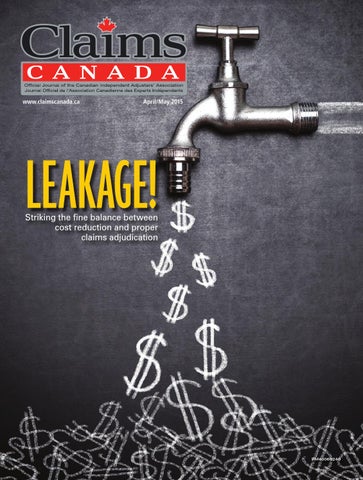
LEAKAGE!
Striking balance between Official Journalthe of thefine Canadian Indeépendent Adjusters’ Association cost reduction and proper claims adjudication
PM40069240
p1 CLAIMS COVER FINAL.indd 1
15-04-21 10:18 AM
GK_Ad_ClaimsCanada.pdf
1
11-11-03
2:51 PM
Exceptional expertise
• Forensic Engineering • Loss Mitigation / Remediation • Engineering Risk Management
416.368.1700 giffinkoerth.com
ad right size.indd 1
13-10-16 2:58 PM
Contents A P R I L / M AY 2 0 1 5 • V O L U M E 9 • N U M B E R
12
2
Cover Feature 12 LEAKAGE! The notion that insurers can better control their indemnity spend through streamlining, cost cutting and efficiency initiatives has gained momentum in Canada in recent years. Many insurance companies are finding ways to plug financial “leakage” in claims handling – a term not always popular with claims managers. Independent adjusters understand the reasons behind this focus on costs, but caution that a proper approach to claims adjudication should prevail. BY CRAIG HARRIS
26
Spotlight 20 “We Like the North” Marlene Lefebvre of Laurin Adjusters, which serves Alberta’s Peace Region, says her firm embraces the challenge of handling claims in a remote area. BY CRAIG HARRIS
Education Forum 32 Artful Adjusting What are the unique features of fine art coverage?
News Features 22 Fire, Pollution and Exclusion
28 No Contract Is An Island
Pollution resulting from fire is not necessarily subject to insurance exclusion, according to B.C. Court.
How the Supreme Court of Canada “Sattva” decision may affect policy interpretation.
BY JONATHAN HODES
30 Understand the Tension
26 Location, Location New technologies, such as location-based intelligence, are helping insurers mitigate catastrophe risk. BY MICHAEL O’NEILL and MARY ALLEN
30
BY MICHAEL S. TEITELBAUM
Adjusters can help with disaster assessment of post-tensioned reinforced concrete structures. BY DEREK GIBSON and PHILIP SARVINIS
Departments 4 First Notice 34 On The Scene
Columns 10 President’s Message
22 p3 contents.indd 1
32 Education Forum
15-04-20 9:45 AM
• first notice FN IBC gives thumbs up to B.C. earthquake report The Insurance Bureau of Canada (IBC) is applauding the government of British Columbia’s earthquake preparedness report, which recommends that the provincial and federal governments engage with the insurance industry and other key stakeholders to develop a strategy on disaster resilience and increase public awareness on the need to prepare. The B.C. government released the Earthquake Preparedness Consultation Report March 26. “It’s clear, both from consultation chair Henry Renteria’s report and from previous reports on the subject, that more must be done at the individual level, and at all levels of government if B.C. is going to be adequately prepared for a major earthquake or other catastrophic disaster,” said a joint statement from the provincial Ministry of Environment and Ministry of Government Operations. The statement said that the “province has begun or will begin shortly taking many important steps to prepare British Columbia in the event of ‘the Big One.’”
Among the steps: • An upgrade to the provincial emergency notification system (PENS), which provides new efficiencies to get tsunami notifications more quickly into the hands of emergency managers in B.C.’s coastal communities and media, so that they may alert citizens faster; • Undertaking an analysis of the future of the 9-1-1 call answer service throughout B.C.; • Increased capacity to support future provincial-level catastrophic event training and exercises; • Provision of $50,000 to Ocean Networks Canada to support research for tsunami inundation maps, to assist long-term planning in vulnerable coastal communities in British Columbia; and • Updates to the Earthquake and Tsunami Smart Manual, which includes important information for British Columbians to help get themselves prepared for a major earthquake or tsunami. l
Alberta rules on distracted driving supported by industry The Insurance Bureau of Canada (IBC) is applauding proposed requirements in Alberta – which received the green light in the provincial legislative assembly – that seek to curb distracted driving by beefing up fines and penalties for texting while behind the wheel. Bill 204, the Traffic Safety (Distracted Driving Demerit) Amendment Act, 2014, was tabled last December by MLA Moe Amery and received unanimous support during third reading March 24. The bill amends Alberta’s Traffic Safety Act by adding that a person who is guilty of an offence under subsections 115.1, 115.2, 115.3 or 115.4 is liable to a fine of $250 (up from $172) and shall be assessed three demerit points in accordance with the regulations. The aforementioned subsections under the Prohibited Operation of Vehicles section of the act are as follows: cellphones, electronic devices, etc.; display screen visible to driver prohibited; global positioning system; and prohibited activities. Bill Adams, IBC’s vice president, Western & Pacific, calls the proposed requirements a step in the right direction to curb distracted driving. “Distracted driving puts the safety of everyone on the road in jeopardy. We hope that this bill and continued efforts to raise awareness will help bring an end to distracted driving,” Adams said. l
4
Claims Canada
p4,6,8 FIRST NOTICE final copy.indd 4
April/May 2015
www.claimscanada.ca
15-04-20 9:48 AM
A New View
WALLS: EagleView® wall measurement reports utilize the same patented technology that drives EagleView’s proven roof reports. Experience the quality and accuracy needed to close exterior claims faster and more efficiently than ever before. To learn how to add walls to your EagleView Reports call 866.447.3741 or vist www.eagleview.com/insurance © 2015 EagleView Technologies, Inc.
ad right size.indd 1
15-04-10 3:38 PM
• first notice FN Consumer protection measures for Ontario auto go live
BILL
Sections of an Ontario law aimed at reducing auto insurance claims costs, which give inspectors power to enter premises without a search warrant and remove records for review, took effect April 1. Bill 15, the Fighting Fraud and Reducing Automobile Insurance Rates Act, is an omnibus bill that was passed into law Nov. 20. Not all provisions have taken effect, but a section of Bill 15 - which changes the Consumer Protection Act to provide for the appointment of inspectors and inspection powers – is now in effect. Bill 15 will “provide new enforcement tools, such as allowing inspectors to issue orders where violations are found,” said Laura Albanese, parliamentary assistant to Ontario Finance Minister Charles Sousa, when Bill 15 was tabled for second reading last October. She was commenting on the parts of the legislation that impose additional requirements on towing and storage providers. Bill 15 will change the Consumer Protection Act to require tow and storage providers to publish their rates, accept credit card payments and provide itemized invoices before receiving payment. It “would require tow and storage providers to get authorization from the consumer, or someone acting on behalf of the consumer, before charging for towing and storage services,” Albanese said. l
15
Water damage claims increasing: Aviva Canada With the late winter thaw happening around the country, Aviva Canada Inc. noted recently that the frequency and severity of water damage claims is on the rise. “2013 was our worst year for water damage in part due to flooding in Alberta and Toronto,” said Sharon Ludlow, president of Aviva Insurance Company of Canada, in a March 20 press release. “But it is important to note that water damage is steadily increasing in terms of the number and cost of claims, and that homeowners and tenants can take steps to protect themselves from loss.” In 2014, water damage claims accounted for 44% of dollars paid out on all Aviva Canada property damage claims, compared with 39% in 2004. The average cost per residential water damage claim has increased significantly – going from $11,709 in 2004 to $16,070 in 2014, a 37% increase. Aviva Canada paid out $180 million in water damage claims in 2014, a 189% increase versus 2004 and a 57% increase versus 2012, the press release noted. “The reasons for the upward trend are rather simple,” Ludlow said. “The increasing investment Canadians are putting into their basements, combined with more frequent severe weather events and an aging sewer system that is unable to deal with large amounts of water within a short time period, results in a lot of homes experiencing damage.” l
6
Claims Canada
p4,6,8 FIRST NOTICE final copy.indd 6
April/May 2015
Federal government wants more insurance for railways A bill proposing to mandate specific levels of insurance for Canadian railway operators – of $1 billion in some cases – was tabled March 30 in Ottawa for second reading in the House of Commons. MPs debated Bill C-52, the Safe and Accountable Railway Act, introduced by Conservative Transport Minister Lisa Raitt. Currently, Canada’s Railway Third Party Liability Insurance Coverage Regulations stipulate that railway operators must be covered for third-party liability, third-party bodily injury or death. However those regulations do not mandate a specific coverage limit. The Canadian Transportation Agency - which has the authority to issue and suspend certificates of fitness currently reviews each railway’s insurance coverage on a caseby-case basis. Montreal Maine and Atlantic Railway - whose crude oil train derailed July 6, 2013 in Lac-Mégantic, Quebec, killing 63 filed for protection in 2013 under the Companies Creditors Arrangement Act. “Under the Canada Transportation Act, federally regulated railways must carry insurance, but the Lac-Mégantic tragedy has proven that the measures now in place are simply not sufficient,” Raitt said in the House of Commons. After the Lac-Mégantic derailment, “we realized that MMA had $25 million in liability insurance,” said Hoang Mai, NDP MP for the Montreal area riding of Brossard-La Prairie, Quebec. “That amount does not even begin to cover the $400 million that has been spent to date on cleaning up and rebuilding, and that cost may still go up.” Bill C-52 “identifies specific levels of insurance that must be carried, depending upon the type and volume of dangerous goods that the railway transports,” Raitt said. l
FSCO issues warning on ride-share programs Ontario’s financial regulator has released an infographic to its website warning about the insurance risks related to ridesharing programs. Ride-sharing services use an online app to connect passengers with drivers using their personal vehicles. The infographic, released in late March by the Financial Services Commission of Ontario (FSCO), noted that “the services may significantly impact your insurance coverage.” The infographic noted that standard auto insurance policy excludes coverage when the vehicle is used to carry paying passengers or used as a taxi. “You may not be protected against certain damages, losses and liabilities,” the infographic warns. “Know if you’re covered – ask your driver.” l
www.claimscanada.ca
15-04-20 9:49 AM
When critically injured people need help‌ who provides support? Let’s recognize the best. The choice is yours.
The Ontario Brain Injury Association is pleased to announce that the annual Awards of Excellence in Brain Injury Rehabilitation will now include an Award of Excellence for the Insurance Company of the Year. This award is meant to recognize the insurance company that consistently acts responsibly and compassionately in assisting brain injury claimants. The recipient will be a company that continues to provide support to the brain injury community and is dedicated to raising public awareness of brain injury. Online nominations for the Awards of Excellence will take place from June 1st to July 17th, 2015 Online voting for the selected nominees will take place from August 4th to August 28th, 2015 The Awards of Excellence will be presented by the Ontario Brain Injury Association at the Back to School Conference on September 10th, 2015 at the Four Seasons Hotel in Toronto.
Please encourage voting. To vote or for more information, visit OBIA.ca
ad right size.indd 1
15-04-10 3:50 PM
• first notice FN Insurers move into drone space State Farm Mutual Automobile Insurance Company announced in mid-March that it is the first insurer in the United States to receive permission from the Federal Aviation Administration (FAA) to test unmanned aircraft systems (UAS) for commercial use. The decision provides the insurer the opportunity to research this new technology and potentially deploy it in ways that could benefit customers, the insurer said in a press release. Bloomington, Illinois-based State Farm plans to explore the use of unmanned aircraft to assess potential roof damage during the claims process and respond to natural disasters. “The potential use of UAS provides us one more innovative tool to help State Farm customers recover from the unexpected as quickly and efficiently as possible,” said Wensley Herbert, operations vice president . The company plans to move forward with test and development flights at private
Paul Aquino Publisher (416) 510-6788 paul@canadianunderwriter.ca
Steve Wilson Senior Publisher (416) 510-6800 steve@canadianunderwriter.ca
Elliot Ford Account Manager eford@canadianunderwriter.ca (416) 510-5117
Craig Harris Editor (905) 873-7691 craig@editinsight.com
Gary White Production Manager • (416) 510-6760
Christine Giovis Account Manager (416) 510-5114 christine@canadianunderwriter.ca
Michael Chimienti Art Director mchimienti@annexnewcom.ca
Subscription inquiries (416) 442-5600 • 1-800-668-2374 Fax: (416)Indeépendent 442-2191 Official Journal of the Canadian Adjusters’ Association
www.claimscanada.ca Produced by the publishers of Canadian Underwriter magazine
A bi-monthly magazine (6x per year), Claims Canada is published by NEWCOM Business Media Inc. is located at: 80 Valleybrook Drive, Toronto, ON, M3B 2S9. Claims Canada magazine is the Official Publication of the Canadian Independent Adjusters’ Association [CIAA] and through its editorial content and circulation brings together the ‘entire property & casualty insurance claims market nationally’ with information and insight into the profession, business and people of insurance claims and loss adjusting. All key claims process stakeholders are reached as part of our readership community – including: both CIAA member and non-member independent claims adjusting firms; insurance and reinsurance company executive, claims management
8
test sites in the Bloomington area, while strictly adhering to parameters set forth by the FAA, State Farm noted in the release. Meanwhile, Zurich Canada recently introduced an insurance product targeted to risk mitigation and cost saving opportunities available through the use of drones. The new drone insurance package, developed in partnership with UK-headquartered Global Aerospace Underwriting Managers Limited, a leading provider of aerospace insurance, also closes a coverage gap for companies already making use of drones in their operations, according to Zurich. “Zurich’s customers in Canada will be the first ones around the world to have access to this unique insurance solution, thanks to the sophisticated regulatory environment governing the use of drones in Canada,” said Urs Uhlmann, CEO of Zurich Global Corporate Canada. l
Claims Canada
p4,6,8 FIRST NOTICE final copy.indd 8
April/May 2015
Mike Wells Account Manager • (416) 510-5122 mike@canadianunderwriter.ca
and claims adjusting personnel; corporate risk managers and loss control professionals; insurance brokers; insurance law firms; forensic engineers and accountants; appraisal, restoration, rehabilitation and collision repair professionals; Insurance Institute chapters; insurance associations, regulators and related claims market recipients. The contents of this publication may not be reproduced or transmitted in any form, either in part or in full, without the written consent of the copyright owner. Nor may any part of this publication be stored in a retrieval system of any nature without prior written consent.
www.claimscanada.ca
15-04-20 9:49 AM
CIAA REGIONAL PRESIDENTS 2014 – 2015 NEWFOUNDLAND & LABRADOR TBA
NOVA SCOTIA E. Grant King, BA, B.Ed., CIP Crawford & Company (Canada) Inc. 120 – 237 Brownlow Avenue Dartmouth, NS B3B 2C7 Phone: (902) 468-7787 Fax: (902) 468-5822 E-mail: Grant.King@crawco.ca
NEW BRUNSWICK & PRINCE EDWARD ISLAND Luc Aucoin, BBA, FCIP Plant Hope Adjusters Ltd. 85 Englehart Street Dieppe, NB E1A 8K2 Phone: (506) 853-8500 Fax: (506) 853-8501 E-mail: laucoin@planthope.com
QUEBEC/AESIQ Denis Duchesne Cunningham Lindsey Canada Claims Services Ltd. 1250 rue Guy, bureau 1000 Montreal, QC H3H 2T4 Phone: (514) 938-5400 Fax: (514) 938-5445 E-mail: dduchesne@cl-na.com
ONTARIO Dorothy Lowry, FCIP Crawford & Company (Canada) Inc. 11 - 431 Bayview Drive Barrie, ON L4N 8Y2 Phone: (705) 728-5597 Fax: (705) 728-2167 E-mail: Dorothy.Lowry@crawco.ca
MANITOBA Craig Shanks, BA, CIP Network Adjusters Ltd. 64 Regent Cres. Brandon, MB R7B 2W9 Phone: (204) 725-7436 Fax: (204) 725-7437 E-mail: craig.shanks@mymts.net
SASKATCHEWAN Cheryl Hanson Crawford & Company (Canada) Inc. 210 – 227 Primrose Drive Saskatoon, SK S7K 5E4 Phone: (306) 931-1999 Fax: (306) 931-2212 E-mail: Cheryl.Hanson@crawco.ca
WESTERN M. Doreen Lennon, CIP Townsend & Leedham Adjusters Ltd. 200, 4245 - 97 Street Edmonton, AB T6E 5Y7 Phone: (780) 463-7776 Fax: (780) 462-1280 E-mail: dlennon@tladjusters.com
PACIFIC TBA
www.claimscanada.ca
p9 CIAA NSC.indd 9
National Standing Committees 2014-2015 ADVISORY Gary Ellis, BBA, FCIP, RF, FCLA, FCIAA, FIFAA AMG Claims Inc. 535 North River Road, Unit 3 Charlottetown, PE C1E 1J6 Phone: (902) 628-9091 Fax: (902) 628-9093 E-mail: gary.ellis@amgclaims.ca Marie C. Gallagher, FCIP, CRM Kernaghan Adjusters Limited 602 – 1 St. Paul Street St. Catharines, ON L2R 7L3 Phone: (905) 499-0018 Fax: (905) 538-7981 E-mail: mgallagher@kernaghan.com
John Jones, BA Cunningham Lindsey Canada Claims Services Ltd. 1102 – 50 Burnhamthorpe Rd. W. Mississauga, ON L5B 3C2 Phone: (905) 896-8181 Fax: (905) 896-3485 E-mail: jjones@cl-na.com Craig J. Walker, CIP, FCIAA, FIFAA Maltman Group International 3550 Victoria Park Ave., Suite 301 Toronto, ON M2H 2N5 Phone: (416) 492-4411 Fax: (416) 492-5657 E-mail: cwalker@maltmans.com
COMMUNICATIONS Richard Swierczynski, BA, CIP AZ Claims Services Inc. 1500 Upper Middle Rd., Unit #3, P.O. Box 76041 Oakville, ON L6M 3G3 Phone: (905) 825-0027 Fax: (905) 825-5543 E-mail: richard@azclaims.ca John D. Seyler, CIP Integrated Insurance Resources 5080 Timberlea Blvd., Suite 214 Mississauga, ON L4W 4M2 Phone: (905) 238-4985 Fax: (905) 238-2735 E-mail: jseyler@integrated-ins.ca
FINANCE John D. Seyler, CIP Integrated Insurance Resources 5080 Timberlea Blvd., Suite 214 Mississauga, ON L4W 4M2 Phone: (905) 238-4985 Fax: (905) 238-2735 E-mail: jseyler@integrated-ins.ca Albert Poon, CIP Cunningham Lindsey Canada Claims Services Ltd. 1102 – 50 Burnhamthorpe Rd. W. Mississauga, ON L5B 3C2 Phone: (905) 896-8181 Fax: (905) 896-3485 E-mail: apoon@cl-na.com
Fred R. Plant, AIIC Plant Hope Adjusters Ltd. 85 Englehart Street Dieppe, NB E1A 8K2 Phone: (506) 853-8500 Fax: (506) 853-8501 E-mail: fplant@planthope.com
IBC: LIAISON, LEGISLATIVE & FORMS Paul Hancock, B.Sc., CIP Crawford & Company (Canada) Inc. 300 – 123 Front Street West Toronto, ON M5J 2M2 Phone: (416) 867-1188 Fax: (416) 867-1925 E-mail: Paul.Hancock@crawco.ca
CONSTITUTION & RULES John Jones, BA Cunningham Lindsey Canada Claims Services Ltd. 1102 – 50 Burnhamthorpe Rd. W. Mississauga, ON L5B 3C2 Phone: (905) 896-8181 Fax: (905) 896-3485 E-mail: jjones@cl-na.com
LICENSING J. Miles O. Barber, B.Comm. (Hons.), FCIP, CRM Network Adjusters Ltd. 67 Folkestone Blvd. Winnipeg, MB R3P 0B4 Phone: (204) 897-5793 Fax: (204) 897-5797 E-mail: mbarber@mts.net
Bob Grouchy, BA, FCIP, CRM Allianz Global 1600 – 130 Adelaide Street West Toronto, ON M5H 3P5 Phone: (416) 915-4247 Fax: (416) 849-4555 E-mail: bob.grouchy@agr.allianz.ca
CONVENTION Krystine Wolochatiuk Cunningham Lindsey Canada Claims Services Ltd. 74 Cedar Pointe Drive, Suite 1001 Barrie, ON L4N 5R7 Phone: (705) 728-8398 Fax: (705) 734-0559 E-mail: kwolochatiuk@cl-na.com
MEMBERSHIP & QUALIFICATIONS Georgiana Chen, CIP ProFormance Group Insurance Solutions Inc. 1101 Kingston Rd., Suite 280 Pickering, ON L1V 1B5 Phone: (877) 539-3111 Fax: (905) 554-3776 E-mail: gchen@proadjusting.ca
Tim Guernsey RSA Canada 18 York Street, Suite 800 Toronto, ON M5J 2T8 Phone: (416) 366-7511 Fax: (416) 367-9869 E-mail: tim.guernsey@rsagroup.ca
DESIGNATION Paul W. Greening, CLA, FCIAA Greening Aviation Claims Inc. 26C Palliser Park, Box 190 Riverhurst, SK S0H 3P0 Phone: (306) 353-2000 Fax: (306) 353-2200 E-mail: pgreening@sasktel.net
NOMINATING Marie C. Gallagher, FCIP, CRM Kernaghan Adjusters Limited 602 – 1 St. Paul Street St. Catharines, ON L2R 7L3 Phone: (905) 499-0018 Fax: (905) 538-7981 E-mail: mgallagher@kernaghan.com
Albert Poon, CIP Cunningham Lindsey Canada Claims Services Ltd. 1102 – 50 Burnhamthorpe Rd. W. Mississauga, ON L5B 3C2 Phone: (905) 896-8181 Fax: (905) 896-3485 E-mail: apoon@cl-na.com
Paul Hicks, FCIP, CRM TD Insurance 2161 Yonge Street, 4th Floor Toronto, ON M4S 3A6 Phone: (416) 486-2507 Fax: (416) 545-6022 E-mail: Paul.Hicks@tdinsurance.com
E. Brian Gough, FCIP, CLA, FCIAA Marsh Adjustment Limited 1550 Bedford Highway, Suite 711 Bedford, NS B4A 1E6 Phone: (902) 469-3537 Fax: (902) 469-2396 E-mail: ebgough@marshadj.com
Albert Poon, CIP Cunningham Lindsey Canada Claims Services Ltd. 1102 – 50 Burnhamthorpe Rd. W. Mississauga, ON L5B 3C2 Phone: (905) 896-8181 Fax: (905) 896-3485 E-mail: apoon@cl-na.com
Gary Ellis, BBA, FCIP, RF, FCLA, FCIAA, FIFAA AMG Claims Inc. 535 North River Road, Unit 3 Charlottetown, PE C1E 1J6 Phone: (902) 628-9091 Fax: (902) 628-9093 E-mail: gary.ellis@amgclaims.ca
Peter Hohman Insurance Institute of Canada 18 King Street East, 6th Floor Toronto, ON M5C 1C4 Phone: 416-362-8586 Fax: 416-362-1126 E-mail: phohman@insuranceinstitute.ca
Monica Kuzyk, FCIP, CRM Curo Claims Services 125 Northfield Dr. W., P.O. Box 218 Waterloo, ON N2J 3Z9 Phone: (866) 952-2876 Fax: (519) 888-9704 E-mail: mkuzyk@curocanada.com
Justin MacGregor Highgate Insurance Brokers Inc. 151 Rose Glen Rd. Port Hope, ON L1A 3V6 Phone: (905) 885-1551 E-mail: justinmacgregor@highgateinsurance.com
EDITORIAL Mary Charman, CIP Crawford & Company (Canada) Inc. 1 – 120 Mulock Dr. Newmarket, ON L3Y 7C5 Phone: (905) 898-0008 Fax: (905) 898-1705 E-mail: Mary.Charman@crawco.ca
Marie C. Gallagher, FCIP, CRM Kernaghan Adjusters Limited 602 – 1 St. Paul Street St. Catharines, ON L2R 7L3 Phone: (905) 499-0018 Fax: (905) 538-7981 E-mail: mgallagher@kernaghan.com
Mark Weir Intact Financial Corporation 700 University Avenue, 13th Floor Toronto, ON M5G 0A1 Phone: (416) 341-1464 Fax: (416) 217-0562 E-mail: mark.weir@intact.net
John M. Sharoun, FCIP, FCIAA, CRM Crawford & Company (Canada) Inc. 300 – 123 Front Street West Toronto, ON M5J 2M2 Phone: (416) 867-1188 Fax: (416) 867-1925 E-mail: John.Sharoun@crawco.ca
PRIVACY James B. Eso, CIP, CIOP Crawford & Company (Canada) Inc. 539 Riverbend Drive Kitchener, ON N2K 3S3 Phone: (519) 578-5540 Fax: (519) 578-2868 E-mail: Jim.Eso@crawco.ca
Patricia M. Battle Canadian Independent Adjusters’ Association/L’Association Canadienne des Experts Indépendants Centennial Centre, 5401 Eglinton Ave. West, Suite 100 Etobicoke, ON M9C 5K6 Phone: (416) 621-6222 Toll Free: 1-877-255-5589 Fax: (416) 621-7776 E-mail: pbattle@ciaa-adjusters.ca
Alex Walker, CIP Royal & Sun Alliance 2225 Erin Mills Parkway, Suite 1000 Mississauga, ON L5K 2S9 Phone: (905) 412-1397 Fax: (905) 403-2328 E-mail: Alex.Walker@rsagroup.ca
EDUCATION Gary Ellis, BBA, FCIP, RF, FCLA, FCIAA, FIFAA AMG Claims Inc. 535 North River Road, Unit 3 Charlottetown, PE C1E 1J6 Phone: (902) 628-9091 Fax: (902) 628-9093 E-mail: gary.ellis@amgclaims.ca
Keith P. Edwards, FCILA, CLA, FUEDI-ELAE CIAA Honorary Life Member c/o CIAA National Office 5401 Eglinton Ave. W., Suite 100 Etobicoke, ON M9C 5K6 Phone: (416) 621-6222 Fax: (416) 621-7776 E-mail: info@ciaa-adjusters.ca
EMERGENCY MEASURES Richard Van Horne Action Investigations Inc. 2 Catelina Court Dartmouth, NS B2X 3G9 Phone: (902) 462-1222 Fax: (902) 462-3688 E-mail: richardvanhorne@actioninvestigations.ca
PROFESSIONAL PRACTICES Marie C. Gallagher, FCIP, CRM Kernaghan Adjusters Limited 602 – 1 St. Paul Street St. Catharines, ON L2R 7L3 Phone: (905) 499-0018 Fax: (905) 538-7981 E-mail: mgallagher@kernaghan.com
James B. Eso, CIP, CIOP Crawford & Company (Canada) Inc. 539 Riverbend Drive Kitchener, ON N2K 3S3 Phone: (519) 578-5540 Fax: (519) 578-2868 E-mail: Jim.Eso@crawco.ca John Jones, BA Cunningham Lindsey Canada Claims Services Ltd. 1102 – 50 Burnhamthorpe Rd. W. Mississauga, ON L5B 3C2 Phone: (905) 896-8181 Fax: (905) 896-3485 E-mail: jjones@cl-na.com Craig J. Walker, CIP, FCIAA, FIFAA Maltman Group International 3550 Victoria Park Ave., Suite 301 Toronto, ON M2H 2N5 Phone: (416) 492-4411 Fax: (416) 492-5657 E-mail: cwalker@maltmans.com CIAA NATIONAL INSURANCE INDUSTRY ADVISORY BOARD Patti M. Kernaghan, FCIP, CRM Kernaghan Adjusters Limited 300 - 1575 West Georgia Street Vancouver, BC V6G 2V3 Phone: 1-800-387-5677 Fax: 1-800-387-5644 E-mail: pkernaghan@kernaghan.com
James B. Eso, CIP, CIOP Crawford & Company (Canada) Inc. 539 Riverbend Drive Kitchener, ON N2K 3S3 Phone: (519) 578-5540 Fax: (519) 578-2868 E-mail: Jim.Eso@crawco.ca
Sasha Alexander University of Guelph Alexander Hall 50 Stone Road East Guelph, ON N1G 2W2 Phone: (519) 824-4120 Fax: (519) 824-0364 E-mail: sasha@uoguelph.ca Jo-Ann Eccleston, CIP Aviva Canada Inc. 2206 Eglinton Ave. East Toronto, ON M1L 4S8 Phone: (416) 689-3328 Fax: 1-866-805-8585 E-mail: jo-ann_eccleston@avivacanada.com
CAREER RECRUITMENT PLANNING Richard Swierczynski, BA, CIP AZ Claims Services Inc. 1500 Upper Middle Rd., Unit #3, P.O. Box 76041 Oakville, ON L6M 3G3 Phone: (905) 825-0027 Fax: (905) 825-5543 E-mail: richard@azclaims.ca
Robert V. Pearson, CLA, FCIAA CIAA Honorary Life Member c/o CIAA National Office 5401 Eglinton Ave. W., Suite 100 Etobicoke, ON M9C 5K6 Phone: (416) 621-6222 Fax: (416) 621-7776 E-mail: info@ciaa-adjusters.ca
April/May 2015
James B. Eso, CIP, CIOP Crawford & Company (Canada) Inc. 539 Riverbend Drive Kitchener, ON N2K 3S3 Phone: (519) 578-5540 Fax: (519) 578-2868 E-mail: Jim.Eso@crawco.ca Craig J. Walker, CIP, FCIAA, FIFAA Maltman Group International 3550 Victoria Park Ave., Suite 301 Toronto, ON M2H 2N5 Phone: (416) 492-4411 Fax: (416) 492-5657 E-mail: cwalker@maltmans.com
Claims Canada
9
15-04-20 10:03 AM
Message from the President La Plume du Président ALBERT POON
What does it mean to be a “professional?” It’s certainly a term thrown around a lot these days, but what does it really entail? There are many ways the word is used – paid versus non-paid (i.e. professional vs. amateur athlete), showing great skill (i.e. a professional repair job) or engaging in a certain activity as a career or livelihood (i.e. a professional auditor). For me, being a professional obviously means being part of a well-defined craft, trade or profession, such as independent adjusting. The term also describes the standards of education, training and licensing that prepare members of the profession with the knowledge and skills necessary to perform that role. This also applies to minimum standards for continuing education. In addition, most professionals are subject to strict codes of conduct enshrining rigorous ethical obligations. Professional standards of practice and ethics for a particular field are typically agreed upon and maintained through widely recognized professional associations. If you use these parameters as a benchmark or rough guideline, it’s easy to see the commitment to professionalism CIAA members have through their choice to belong to their professional association. How, specifically, does CIAA promote professionalism throughout the independent adjuster community? First on the list is education and professional designations. Recently, the association announced the addition of a third credentialing program, affording each member further opportunity to raise their professional status. The FCLA, CLA and FCIAA designations reflect outstanding ability and qualifications in the field of loss adjusting. Through a comprehensive marketing strategy, the FCLA, CLA and FCIAA designations will differentiate CIAA members as the elite group of adjusters in the country. Our alignment with other industry educational bodies is a key sign that we are committed to the latest in leadingedge learning materials and course work for adjusters. We are pleased to have Peter Hohman, President and Chief Executive Officer of the Insurance Institute of Canada, on CIAA’s National Insurance Industry Advisory Board ensuring this continuity in education. 10 Claims Canada
p10,11 presidents message.indd 10
April/May 2015
Que signifie le fait d’être un « professionnel »? Il s’agit certainement d’un terme employé à tort et à travers ces jours-ci, mais que signifie-t-il vraiment? Ce terme est utilisé de plusieurs façons : le fait d’être rémunéré par opposition au fait de ne pas être rémunéré (par exemple, athlète professionnel par opposition à athlète amateur), le fait d’afficher d’excellentes compétences (par exemple, des travaux de réparation professionnels) ou le fait d’exercer une certaine activité comme carrière ou moyen de subsistance (par exemple, un vérificateur professionnel). Pour moi, être un professionnel signifie évidemment exercer un métier ou une profession qui sont bien définis, tels que la profession d’expert en sinistres indépendant. Le terme fait également référence aux normes en matière de scolarité, de formation et d’autorisation visant l’acquisition de connaissances et de compétences dont les membres de la profession ont besoin pour se préparer à exécuter leurs fonctions. Il en va de même pour les normes minimales visant la formation continue. En outre, la plupart des professionnels sont assujettis à des codes de déontologie stricts qui intègrent des obligations éthiques rigoureuses. Les normes de pratique et d’éthique professionnelle pour un secteur particulier sont habituellement convenues et maintenues par des associations professionnelles largement reconnues. Si vous utilisez ces paramètres à titre de référence ou de lignes directrices générales, il est facile de constater l’engagement des membres de l’ACEI envers le professionnalisme, étant donné leur choix de faire partie de leur association professionnelle. Comment l’ACEI favorise-t-elle précisément le professionnalisme dans l’ensemble de la communauté des experts en sinistres indépendants? Tout d’abord, grâce à la formation et aux titres professionnels. L’association a récemment annoncé l’ajout d’un troisième programme d’accréditation, ce qui donne l’occasion à chaque membre d’améliorer davantage son statut professionnel. Les titres de FCLA, d’ESA et de FCIAA reflètent des compétences et une qualification exceptionnelles dans le secteur du règlement des sinistres. Grâce à une stratégie de marketing complète, les titres de FCLA, d’ESA et de FCIAA permettront aux membres de l’ACEI de se distinguer en tant que membres d’un groupe d’élite parmi les experts en sinistres au pays. Notre conformité avec les autres organismes de formation du secteur témoigne réellement de notre engagement à soutenir les dernières avancées en matière de matériel et de cours d’apprentissage pour les experts en sinistres. Nous avons le plaisir d’avoir Peter Hohman, président et chef de la direction de l’Institut d’assurance du Canada, qui siège au Conseil consultatif national de l’industrie de l’assurance de l’ACEI pour assurer cette continuité en matière de formation. www.claimscanada.ca
15-04-20 10:10 AM
A condition of provincial licensing for independent adjusters (in most provinces) is the requirement for minimum hours of continuing education. CIAA actively promotes high and rigid adjusting standards both in continuing education and experience. We are an active organizer and supporter of professional development in the form of seminars, conferences, on-line training opportunities and continuous learning events and initiatives. Your national association also has a published Code of Ethics that applies to policyholders and claims, as well as insurers and self-insurers. Membership in CIAA means that all members abide by the standards set out in the Code. Adherence to education and conduct/ethical standards is the point of entry for recognized professional status. This is the minimum benchmark that groups like CIAA and its provincial chapters can define and promote for independent adjusters. However, I think true professionalism goes even beyond these standards. There are further, less tangible traits that embody the true professional – including expertise, honesty, commitment, transparency, respect and empathy. Once the standards, licensing and code of ethics requirements are met, the sign of a real professional is that you know one immediately when you deal with one. These are just some of the characteristics that I see everyday in my workings with CIAA and our member firms. n
L’une des conditions visant l’obtention d’autorisations provinciales pour les experts en sinistres indépendants (dans la plupart des provinces) est un minimum d’heures de formation continue. L’ACEI favorise activement des normes élevées et strictes en matière de règlement de sinistres, à la fois pour la formation continue et l’expérience. Nous organisons et soutenons activement le perfectionnement professionnel sous la forme de séminaires, de conférences, d’occasions de formation en ligne et d’événements et d’initiatives d’apprentissage continu. Votre organisation nationale a également publié un code d’éthique qui s’applique aux titulaires de police et aux demandes de règlement, de même qu’aux assureurs et aux auto-assureurs. Le fait d’être membre de l’ACEI signifie, pour tous les membres, le respect des normes établies dans le code. Le respect des normes de déontologie et d’éthique est la porte d’entrée vers un statut professionnel reconnu. Il s’agit du minimum prescrit que les groupes tels que l’ACEI et ses sections provinciales peuvent définir et promouvoir pour les experts en sinistres indépendants. Toutefois, je pense que le véritable professionnalisme va même audelà de ces normes. Il existe d’autres caractéristiques moins tangibles qui représentent le véritable professionnalisme, y compris l’expertise, l’honnêteté, l’engagement, la transparence, le respect et l’empathie. Une fois que les exigences en matière de normes, d’autorisations et de code d’éthique sont respectées, ce qui fait un vrai professionnel, c’est le fait de reconnaître immédiatement qu’il en est un lorsque vous traitez avec lui. Il s’agit seulement de certaines des caractéristiques que je remarque tous les jours en travaillant avec l’ACEI et nos cabinets membres. n
NATIONAL EXECUTIVE 2014 - 2015 PRESIDENT Albert Poon, CIP Cunningham Lindsey Canada Claims Services Ltd. 1102 – 50 Burnhamthorpe Rd. W. Mississauga, ON L5B 3C2 Phone: (905) 896-8181 Fax: (905) 896-3485 E-mail: apoon@cl-na.com 1ST VICE-PRESIDENT Gary Ellis, BBA, FCIP, RF, FCLA, FCIAA, FIFAA AMG Claims Inc. 535 North River Road, Unit 3 Charlottetown, PE C1E 1J6 Phone: (902) 628-9091 Fax: (902) 628-9093 E-mail: gary.ellis@amgclaims.ca SECRETARY Monica Kuzyk, FCIP, CRM Curo Claims Services 125 Northfield Dr. W., P.O. Box 218 Waterloo, ON N2J 3Z9 Phone: (866) 952-2876 Fax: (519) 888-9704 E-mail: mkuzyk@curocanada.com
www.claimscanada.ca
p10,11 presidents message.indd 11
TREASURER John D. Seyler, CIP Integrated Insurance Resources 5080 Timberlea Blvd., Suite 214 Mississauga, ON L4W 4M2 Phone: (905) 238-4985 Fax: (905) 238-2735 E-mail: jseyler@integrated-ins.ca PAST-PRESIDENT Marie C. Gallagher, FCIP, CRM Kernaghan Adjusters Limited 602 – 1 St. Paul Street St. Catharines, ON L2R 7L3 Phone: (905) 499-0018 Fax: (905) 538-7981 E-mail: mgallagher@kernaghan.com EXECUTIVE DIRECTOR Patricia M. Battle Canadian Independent Adjusters’ Association/ L’Association Canadienne des Experts Indépendants Centennial Centre, 5401 Eglinton Avenue West, Suite 100 Etobicoke, ON M9C 5K6 Phone: (416) 621-6222 Toll Free: 1-877-255-5589 Fax: (416) 621-7776 E-mail: pbattle@ciaa-adjusters.ca
DIRECTOR James B. Eso, CIP, CIOP Crawford & Company (Canada) Inc. 539 Riverbend Drive Kitchener, ON N2K 3S3 Phone: (519) 578-5540 Fax: (519) 578-2868 E-mail: Jim.Eso@crawco.ca DIRECTOR John Jones, BA Cunningham Lindsey Canada Claims Services Ltd. 1102 – 50 Burnhamthorpe Rd. W. Mississauga, ON L5B 3C2 Phone: (905) 896-8181 Fax: (905) 896-3485 E-mail: jjones@cl-na.com DIRECTOR Craig J. Walker, CIP, FCIAA, FIFAA Maltman Group International 3550 Victoria Park Ave., Suite 301 Toronto, ON M2H 2N5 Phone: (416) 492-4411 Fax: (416) 492-5657 E-mail: cwalker@maltmans.com
April/May 2015
Claims Canada 11
15-04-20 10:10 AM
CS
• cover story
LEAKAGE! The notion that insurers can better control their claims/indemnity spend through streamlining, cost cutting and efficiency initiatives has gained momentum in Canada in recent years. Many insurance companies are finding ways to plug financial “leakage” in claims handling – a term not always popular with claims managers. Independent adjusters understand the reasons behind this focus on costs, but caution that a proper approach to claims adjudication should prevail. BY CRAIG HARRIS
12 Claims Canada
p12-19 COVER STORY.indd 12
April/May 2015
www.claimscanada.ca
15-04-20 10:13 AM
“If you wish to converse with me,” the French philosopher Voltaire once said, “define your terms.” The need for a clear definition of terms seems also to apply to the concept of claims leakage – a word that is both used often in the industry and open to interpretation. So how is “leakage” defined?
T
he simple description of leakage is that it’s the difference between what an insurer should pay in claims under the contractual policy and what it actually ends up paying. This sounds straightforward; however, the reality of lost dollars due to claims process issues can be remarkably complex. For example, the International Risk Management Institute (IRMI) characterizes claims leakage as “dollars lost through claims management inefficiencies that
www.claimscanada.ca
p12-19 COVER STORY.indd 13
ultimately result from failures in existing processes (manual and automated)… The cause can be procedural, such as from inefficient claim processing or improper/ errant payment, or from human error, such as poor decision-making, customer service, or even fraud.” A recent study by PwC, called “Stopping the Leaks,” also identified failure to detect fraudulent or over-inflated claims, errors in payments made to claimants and missed opportunities as
the main culprits behind claims leakage. The consulting firm noted that people, process and technology glitches are the key drivers behind higher than necessary claims payouts.
More Than Just Fraud “Leakage is more than just fraud,” the PwC study stated. “It refers to any instance where the insurer paid more than was appropriate or necessary under the terms of a policy.”
April/May 2015
Claims Canada 13
15-04-20 10:13 AM
Many studies on insurance operations argue that there is plenty of room for improvement in claims handling efficiency. “Over 15 years of research, compiled across more than 70,000 claims reviews, 4,500 interviews with claims professionals, and across companies operating in more than 14 countries, has confirmed that there is significant room for insurers to deliver improved outcomes across loss cost management and expense efficiency,” Accenture noted in a report entitled “Claims at a Crossroads.” Just how much leakage actually exists is a question open to debate. Several figures and percentages have been bandied around. “Many are surprised about both the extent of claims leakage and the improvements possible,” according to PwC. “The industry benchmark for leakage is about 3 per cent, but in our experience most insurers have levels well beyond that. At some insurers… we have identified leakage of up to 25 per cent.” Inpoint, a subsidiary of multinational insurance brokerage Aon, specializes in helping insurance companies reduce leakage through adherence to best practices in claims handling. According to Inpoint’s web site: “The claims leakage of an average insurer is typically 8-12 per cent of claims cost, depending on the line of business, and many insurers have limited strategies or knowledge on how to reduce leakage to best-in-class (typically 2-3 per cent) leaving a significant opportunity untapped.” Inpoint is working with three of the top five Canadian insurers on ways to improve claims performance, notes a source with the company.
Emerging on the Radar Screen “We have been working in Canada since 2008 and have seen claims leakage really emerge on the radar screen for insurance companies,” says Mitesh Suchak, a partner with Inpoint in Canada. “It was a newer topic at that time, but it is more mature today. It has become more important for Canadian companies in measuring this leakage, and it really goes hand in hand with measuring the quality of claims handling.” Other sources have also seen a distinct move towards plugging holes in claims leakage. “It is a significant focus for many of our clients,” comments Jim Eso, senior vice president, property and casualty at Crawford & Company (Canada) Inc. “At 14 Claims Canada
p12-19 COVER STORY.indd 14
April/May 2015
“It has become more important for Canadian companies in measuring this leakage, and it really goes hand in hand with measuring the quality of claims handling.” a time where claims departments and insurers in general are facing the pressure of rate competition and less than ideal investment returns, along with things like mandatory premium reduction in the auto market, identifying claims leakage and taking steps to control those costs makes a lot of sense.” Patti Kernagahan, president of Kernaghan Adjusters Ltd., says the insurance industry has mirrored other parts of the economy in its focus on cost control. “Every business makes choices around the resources it will use to solve an issue,” Kernaghan notes. “The insurance industry is no different. The question of cost management versus the knowledgeable expertise and time it takes to properly adjudicate a claim is a struggle the industry faces on an ongoing basis.” “We see regular changes and process implementation by insurers designed to improve performance on many levels
and some of those are certainly aimed at catching some of the ‘leakage’ that does occur,” notes Fred Plant, president of Plant Hope Adjusters Ltd. “However, the jury is still out on how effective many of those strategies are.”
Claims Transformation Strategies Others see the move towards containing leakage as part and parcel of broader claims transformation strategies. “Most insurance companies have expended a lot of energy and resources on initiatives to improve their claims operations as a whole,” says Pierre Lepage, a partner in the P&C actuarial practice for KPMG in Canada. “We have seen this in three ways in recent years – better claims systems, or getting better information to people handling the claims, improving the internal claims processes, or getting the right file to the right person, and better supply chain management.” www.claimscanada.ca
15-04-20 10:13 AM
Crawford ad right size.indd 1
15-04-20 9:28 AM
“It really is about ensuring that the contractual promise an insurance company makes to customers is fulfilled completely and satisfactorily, but as efficiently and cost effectively as possible,” says Scott Shapiro, managing director, actuarial and insurance practice in KPMG’s U.S. operation. “These are not conflicting goals. There are always opportunities through data, information and training to be as efficient as you can be – those companies that focus on that will get a competitive advantage.” Most agree that the primary source of leakage is property claims, particularly large events that feature a sharp spike in loss frequency. For example, the massive flooding that hit southern Alberta in the summer of 2013 saw interpretations and reconsiderations of policy language that, in some cases, extended coverage to situations that would otherwise not be indemnified. In other cases, the sheer volume of property rebuilding and a shortage of qualified contractors led to cost overruns. Speaking generally, Suchak notes that leakage can play a factor in all business lines – auto (AB/BI and PD), property (personal and commercial), casualty and business interruption. “Where insurers find leakage certainly varies from company to company and from line of business,” Suchak says. “There are some insurers in the high teens in certain areas, and others much lower. The spectrum is pretty wide based on the capabilities of each organization.” The upside of controlling claims leakage for insurers is obvious – reduced costs. “The good news is that while claims leakage is a complex issue, the process to improve it is relatively straightforward,” states the PwC study. “And in most cases can lead to savings of between 5 and 10 per cent. For an insurer spending $500 million in claims, that translates to a bottom line improvement of $25 to $50 million.”
Best Practices in Claims Handling Those numbers certainly sound good, but Suchak says there are several processes that have to take place before leakage issues are fully addressed. For his firm, the first step is measuring the leakage through a proprietary, webbased platform called ClaimsMonitor. Then, insurers can compare industry best practices to their own claims han16 Claims Canada
p12-19 COVER STORY.indd 16
April/May 2015
“The good news is that while claims leakage is a complex issue, the process to improve it is relatively straightforward,” states the PwC study. dling procedures – and see where the gaps are. “The next step is usually around measuring the quality of claims handling, sampling X number of files per adjuster per month,” says Suchak. “And then it is having the appropriate improvement planning to go after the issues identified in the audit or review process.” “Some of those are strategic issues that companies will have to address at an overall level,” he adds. “For example, there may not be an effective plan for subrogation recovery. Other issues are more individual and may involve coaching issues on training and handling claims.” For insurers, the need to juggle service, costs and satisfaction is a delicate balancing act. “All of the costs need to be managed correctly,” Lepage says. “If you look at internal processes, it has been proven that the faster you can get the file to the
right person, the faster you take care of the claim, the better the service to the client and of course the greater benefit of reduced costs. For the insurers I talk to, these are the ultimate objectives they need to balance.”
Taking Unnecessary Costs Out “Taking unnecessary costs out of the claims – both from an indemnity and expense perspective – should be a win/win for the insurer and the insured if it is focused on removing inefficiencies from the process that lead to lower costs and potentially quicker claims resolution,” Eso says. “Completing vehicle repairs more quickly for example by streamlining the estimate process means the insured gets their car back sooner, the insurer saves on rental car expense and the body can repair more vehicles and obtain their payment sooner,” he adds. However, not all sources concur with the “win-win scenario” of insurer apwww.claimscanada.ca
15-04-20 11:33 AM
Knowledgeable Knowledgeable Fast & Effective Fast & Effective
Complex Complex & & Large Large Loss Loss Complex & Large Loss Consulting Services Consulting Services Consulting Services Appraisal Appraisal Services Services Appraisal Services Multi Multi Claim Claim Losses Losses Multi Claim Losses & Catastrophic & Catastrophic Events Events & Catastrophic Events High High Performance Performance Standards Standards High Performance Standards National National Coverage Coverage National Coverage
Ethics Ethics Ethics
ad right size.indd 1
Excellence Excellence Excellence WWW.SPECS.CA WWW.SPECS.CA WWW.SPECS.CA
Innovative Innovative Solutions Solutions || |
Value Teamwork Value Value Teamwork Teamwork 1-877-907-7327 1-877-907-7327 1-877-907-7327 15-04-10 3:28 PM
proaches to controlling claims leakage. For some, the focus is too much on internal company processes, benchmarks and metrics, which can be misleading to the bigger picture of claim indemnification – and client satisfaction. “The measure of success on a claim is the compliance with process rather than determination of what should be paid on a claim,” Plant notes. “It appears insurers would rather save expense dollars and sacrifice indemnity dollars as there is no effective way to ever compare what should have been paid to what was paid. However, comparing this year’s or this quarter’s expenses to the same period last year can be done and management is judged on that.” “Insurers should be pricing their product based, in part, on what the real costs of claims are rather than collecting too little in premium and trying to squeeze shareholder return from those dollars at the sacrifice of diligent claims service and proper adjudication,” Plant adds. For Kernaghan, the prime issue is that not all claims leakage strategies are created equal. In some cases, such as telephone adjusting for routine auto claims, she agrees that cost efficiencies can be realized. In other areas, such as the use of unlicensed contractors for property loss adjudication, the results may be disastrous and lead to conflict of interest.
Many Leakage Strategies Don’t Perform Well “We are generally closing our eyes to the obvious – many leakage reduction strategies don’t perform well,” Kernaghan comments. “Financial leakage is not a surprise; the industry is willing to live with a certain level. Independent adjusting fees are perceived as expenses even though they help control the cost associated with increased indemnity figures. Financial leakage is created when we don’t pay attention to the business we’re in – selling claims service. Who is watching and measuring the cost of indemnity?” This latter question is particularly relevant given the tendency of some insurers to directly outsource property insurance claims for rebuilding and reconstruction to contractors. While it’s difficult to measure the extent of this practice, Kernaghan says it is a mistake that will create far more problems than solutions. 18 Claims Canada
p12-19 COVER STORY.indd 18
April/May 2015
“Unlicensed people in the field can’t see and don’t know what to look for in terms of the contract of insurance,” notes Kernaghan before rattling off several questions. “Does the unlicensed activity have a self-interest in the outcome of the work necessary to conclude the claim? The basement is full of water but is it over land flooding or sewer back up? Will the unlicensed vendor create an estoppel and the insurer have no choice because the action taken was within the vendor’s authority to proceed with emergency repairs? Are we adjusting claims or writing cheques without proper adjudication and oversight?”
Inpoint’s Suchak says some of the initial attempts at claims leakage control may have focused more on the “head count” issue, but he argues that insurers have broadened their approach in recent years. Eso observes that a short-term focus on cost cutting or simply removing layers from the claims process can come back to bite insurers if they lose sight of the goal of claimant satisfaction. “The savings from not paying for a staff or independent adjuster can quickly be lost if indemnity control is not carefully managed or if coverage interpretations are not done accurately,” Eso says. “The savings can also be lost if there is perceived lack of customer service or perceived inadequacy in the settlement
amount, leading to lower customer satisfaction.” Inpoint’s Suchak says some of the initial attempts at claims leakage control may have focused more on the “head count” issue, but he argues that insurers have broadened their approach in recent years.
Driving Quality, Efficiency and Service “We have seen companies pursue cost cutting by, say, reducing head count, but that can reduce the quality of claims handling and result in higher leakage,” Suchak observes. “Now, we are seeing that it is more about driving quality, efficiency, improved service levels and best practices in claims handling.” Others hold that insurers can still keep their eye on the indemnity ball while pursuing greater efficiency – it’s not a zero sum game. “It may look to some like just cutting corners, but there are ways to improve service and reduce costs,“ Lepage says. “For example, claims service in the past was often seen as going through a series of filters before payment. But it is much more effective to view it as a triage system. Who does the claims need to go to in order to provide the best, most efficient service?” “The most cost efficient thing you can do is to fulfill the promise of the contract completely,” says Shapiro. “You can be very penny wise and pound foolish here, but that is not the motivation I see when insurer clients ask us how to become more efficient or to lower costs. It is never in my experience anything to do with less customer satisfaction or not fulfilling the contract.” Given the recent activity around claims leakage, one point that adjusters and other sources make is the need for a more productive dialogue amongst business partners, including insurers, independents and all players in the claims value chain. “We believe that an ongoing dialogue with the claims adjusting firm is the best way for the insurer to achieve the best outcome in managing claims costs,” Eso notes. “Adjusters often see inefficiencies in claims processes, but may not always feel empowered to change the processes or may not have a forum with the insurer to make recommendations to change the process.” www.claimscanada.ca
15-04-20 10:14 AM
“We do not see it as a point of friction but rather a sign of a strong partnership when an insurer asks us to help them with cost controls, even if some of the outcome will be reduced claims fees,” Eso explains. “In the past, leakage control might have meant things like controlling fraudulent claims or negotiating lower settlements with insureds. However, today’s consumers require a more sophisticated, holistic approach that makes the claims process easier by removing unnecessary inefficient processes, while keeping customer service and retention top of mind.”
long as the process is followed, the claim resolution is deemed a ‘success’. Actually, had a well trained intelligent person been in control of what was paid to whom and when, the claim payment would have been less.” In fact, Kernaghan argues that the pendulum of traditional cost reduction practices may be swinging in favour of more nuanced approaches that take into account all aspects of adjudication and claims performance.
“The trend for applying leakage reduction strategies that don’t perform well may be heading in the other direction with a market correction toward proper adjudication, communication and training,” Kernaghan concludes. “When companies provide trust and put authority into hands of the adjuster, with clear lines of communication regarding their service requirements, everyone wins.”
If you’re in Manitoba, this is considered an automobile. Surprised? ARC isn’t.
Dialogue and Partnership
If you Manitoba, t considere automo
Surprised Suchak notes that at least part of that Your customer has a list of the vehicles that dialogue is beginning to take place as are covered by your fleet policy. You have insurers take the “quality journey” toa list of the vehicles that are covered by wards best practices in claims handling. ARC Group Canada is a n ARC Group Canada is a national that policy. network of independent law “Insurance companies are startnetwork of independent law firms, each intimately conne ing to put in place the metrics around And your lists aren’t theintimately same. each connected to their local measuring quality down to the adjuster their local market. Insurance and risk mana When the one vehicle that is involved in level,” he says. “This is not just about experts. Regional st Insurance risk appear management an accident is the one thatand doesn’t on traditional audits, but moving into National experts. Regionalnext? strength. both lists, do you know what happens self-review of performance, wherein an That is the ARC National scope. adjuster reviews his or her own perforARC does. mance.” Go to AskAR That is the ARC Group. “We are seeing companies track and measure the level of agreement between Go to AskARC.com adjusters and supervisors and home office on quality of claims handling,” Suchak adds. “You can have one claim and have multiple people review and compare how aligned they are in terms of quality.” For Kernaghan, the insurer discussion about quality, costs and best pratices in claims handling should involve a direct dialogue with those knowledgeable in the field – adjusters. “Independent adjusters are an extenARC Group Canada is a national network of independent law firms, sion of an insurers’ claims department,” each intimately connected to their local market. Kernaghan says. “We are trained to conInsurance and risk management experts. Regional strength. trol expenses and watch for unnecessary National scope. Go to AskARC.com deviations from the actual contract. We are the gatekeepers for insurers’ expenses. Our expertise and presence controls costs. The level of indemnity paid is The ARC Legal Reporter lower when knowledgeable adjusters are Winter Issue – Article #1 used.” A National Network of Independent Law Firms Plant contends that terms such as processes, benchmarks and metrics When is a medical examination considered a second examination do not paint the full picture of proper under Rule 36 of the New Brunswick Rules of Court? claims adjudication. The ARC Legal Reporter “As long as the concept of indemnifiv. Crowther and Kelly Case: cation is still part of the P&C Insurance Winter IssueReported – Article #1 Blyth 2009 NBCA 80 Citation: When both the plaintiff’s physical and mental condition are in issue in an action, and At Issue: process, claims can be whittled down A National Network of not Independent Law Firms the plaintiff undergoes a physical examination, will a subsequent application for a psychiatric examination be considered an application for a second medical to algorithms and robots,” Plant says. examination? “We are seeing more and more ‘processWhen is a medical examination considered a second examination Should medical examinations that are ordered as part of the discovery process be es’ employed to move claim along and, so characterized as ‘independent’ medical examinations?
under Rule 36 of the New Brunswick Rules of The Court? Court:
www.claimscanada.ca
Reported Case: Citation: At Issue:
p12-19 COVER STORY.indd 19
ARC_Fleet ad_1/2 page.indd 1
Judgment Rendered: Factual Summary:
Court of Appeal of New Brunswick October 13, 2009 (Reasons delivered November 2015-02-14 26, 2009) 1:05 PM The plaintiff suffered2015 injuries a motor vehicle accident April/May in Claims Canada 19and commenced an action seeking damages. Both the plaintiff’s physical state and mental state were in issue in the action. The plaintiff submitted to a physical examination by the defendant’s expert, but subsequently refused to submit to a psychiatric examination.
Blyth v. Crowther and Kelly 2009 NBCA 80 When both the plaintiff’s physical and mental condition are in issue in an action, and The adefendant made a motion requesting an order that the plaintiff submit to the the plaintiff undergoes a physical examination, will a subsequent application for psychiatric examination. The motions judge granted the order. The plaintiff appealed, psychiatric examination be considered an application for a second medical arguing that because the examination was a second medical examination, the motions examination? judge was required to apply a higher standard than on an application for a first examination.
Should medical examinations that are ordered as part of the discovery process be
15-04-20 10:14 AM
• spotlight S
“We like the North”
Marlene Lefebvre of Laurin Adjusters, which serves Alberta’s Peace Region, says her firm embraces the challenge of handling claims in a remote area. BY CRAIG HARRIS
W
hile the Toronto Raptors basketball team has adopted the unofficial slogan “We the North,” it’s highly unlikely that any of the players (or perhaps even fans) have been to the far north regions of the country. Like, say, Fort Vermilion, Alberta (58.3°N latitude; average winter temperature -15° C). Or perhaps the hamlet of La Crete, Alberta, which requires crossing an ice bridge to access it in winter. The vast expanse of northern Alberta known as the Peace Region is, however, home to Laurin Adjusters Ltd. and its resolute team of professional loss adjusters. The company has two offices – in Grand Prairie, Alta and Peace River, Alta. It serves a daunting and vast stretch of northern Alberta and British Columbia, with the firm licensed to provide adjusting services in both provinces. “What a lot of people don’t understand is we have to jump in our vehicles and drive for six or seven hours before we even get to the job,” says Marlene Lefebvre, the owner and senior adjuster of Laurin Adjusters. “The maps don’t show the kinds of interesting and sometimes dangerous roads we travel on, including rough terrain, wildlife and winter conditions.” Lefebvre adds that other issues often present themselves in different local markets, including availability of contractors, supply of parts/material and occasionally spotty Internet connectivity. But she says her team, which includes five adjusters and three support staff, wouldn’t have it any other way. ”It is a very interesting and challenging envi20 Claims Canada
p20-21 SPOTLIGHT final.indd 20
April/May 2015
ronment to work in,” Lefebvre observes. “We like the north.” An industry veteran who first started with a major insurance company in 1985, Lefebvre has a unique perspective on the property and casualty insurance industry. She worked on the company claims side for ten years, before a brief stint at a brokerage. Then she moved to the independent adjusting arena, working for two large national companies until in 2013 she bought Laurin Adjusters Ltd. – a firm that has been in business since 1972.
“
We can ensure that our adjusters work out of the closest office to the client, whether that be Grand Prairie or Peace River.
”
“I have experience on both sides of the fence, “ she says. “I have been in the policy/ underwriting and claims aspect of the company side, so I can appreciate that. It has really helped me in the business approach of being an independent adjuster. I can understand what is going on at the company level when it comes to adjusting claims and policy interpretation; that can also help me with clients.” This perspective is reflected in a strong affinity pursuit for Lefebvre – the significance of training and education.
“I absolutely love training younger adjusters, particularly when they are really excited about the business,” she says. “I find it fulfilling and I am passionate about it. I think everyone in this industry can agree there is quite a gap between older, veteran adjusters and the new ones coming in. We have to take into consideration what is going to happen down the road – a lot of people will be retiring and taking that expertise with them. Who will take responsibility for the newer adjusters?” Certainly, the national association of independent adjusters, the CIAA, and provincial chapters can take leadership positions in recruitment, training and professional designation standards, according to Lefebvre. “I think we can look to our associations for resources, standards and the ability to network and work together,” she says. “This is an important part of membership in a professional association.” Lefebvre brings that passion about training to Laurin Adjusters, which offers a unique blend of adjuster backgrounds and credentials. “We are an all-lines adjusting firm with a wealth of adjuster experience,” she notes. “We have adjusters who have been in the business for 20-30 years; we also have some younger blood. I think it is our expertise that really stands out.” In addition to Lefebvre, veteran adjuster Jim Devito and Dave Vangroningnen work out of Grand Prairie, while Dan Millar heads up the Peace River office. Newer adjuster Tina Vangroningen is learning the ropes in Grand Prairie. Three support staff takes care of the adwww.claimscanada.ca
15-04-20 11:36 AM
Laurin Adjusters’ team in Grand Prairie (from left): Tracy Devito, Kim Leonard, Tina Vangroningen, Marlene Lefebvre, Dave Vangroningen and Jim Devito. Missing from photo are Dan Millar (Peace River), Brenda Schell (Peace River).
ministrative side of things for the small but nimble adjusting firm. “A lot of companies are cookie cutter,” Lefebvre explains. “But we are more of a unique mom and pop shop; we do things differently. I have worked as a Branch Manager for a national adjusting firm for more than eight years and I think there are pros and cons. But one thing that definitely happens with larger companies is more staff turnover. When the focus is on volume, I also think that the younger adjusters don’t get the same level of training that once existed in this industry.” A key aspect of that training is, or should be, exposure to multiple types of claims, according to Lefebvre. This multi-faceted approach to claims handling is part of the core philosophy of Laurin Adjusters. Whether the loss at hand is property (including large commercial and residential), bodily injury, www.claimscanada.ca
p20-21 SPOTLIGHT final.indd 21
liability, oilfield, heavy equipment, forestry/logging, errors & omissions, employee dishonesty, agriculture or marine, the firm has the capacity to handle virtually any type of claim. “We offer that flexibility when needed. We may have an adjuster working on a property claim up in High Level, which is over a four-hour drive from Grand Prairie. But let’s say there’s a liability claim in the same area – we can offer that same service and experience,” she says. That agile approach comes in particularly handy when the region of service is vast and potentially cumbersome. “We go wherever our clients want us, but we are primarily a northern adjuster,” says Lefebvre. “We adjust claims as economically as possible for the client. We can ensure that our adjusters work out of the closest office to the client,
whether that be Grand Prairie or Peace River. The bottom line is that we want to offer experience and high-quality service at a fair price.” For Lefebvre, that philosophy has kept a smaller firm like Laurin Adjusters in business for more than 40 years (Binns & Associates, which Laurin Adjusters recently purchased, has been serving clients since 1976). This level of commitment also holds promise for the future. “I hope that insurance companies are aware of the value of these kinds of services offered by local adjusters,” Lefebvre concludes. “Let’s face it: you have access to a well-rounded team of adjusters who can handle all lines of claims in a remote geographic area, whether that is property, auto or liability. I think there will continue to be strong place for quality adjusting firms with a distinct focus on local communities.” April/May 2015
Claims Canada 21
15-04-20 11:37 AM
Fire, Pollution and Exclusion
Pollution resulting from fire is not necessarily subject to insurance exclusion, says B.C. Court. BY JONATHAN HODES
Virtually every modern CGL policy contains some variation of the “absolute pollution exclusion,” which eliminates or severely restricts coverage for environmental damages. In recent years, the courts in British Columbia and elsewhere have consistently upheld such exclusions in relation to chemical spills, leaks from underground storage tanks, and other losses involving environmental remediation. In 2014, however, the BC Supreme Court departed from this trend, in a decision that could have an impact on any fire loss claim involving environmental damage. In Precision Plating Ltd. v. Axa Pacific Insurance Company (2014 BCSC 602), the insured business owners purchased a CGL policy from the defendant insurer, with the expectation that it would cover losses caused by fire. In April 2011, a fire occurred at the insureds’ unit in a commercial building, triggering the building’s sprinkler system and causing chemical vats on site to overflow. Four actions were commenced by neighbouring unit owners for fire damage, including environmental damage caused by chemicals and fumes emanating from the insureds’ premises.
The original policy form contained a pollution exclusion that was subject to an exception for damage caused by “heat, smoke, or fumes” from an uncontrollable fire. However, by way of endorsement, the insurer had deleted the exception and inserted a new exclusion that purported to apply, without exception, to damages “caused by, contributed to by or arising out of” the escape of “Pollutants”, including thermal irritants or contaminants, smoke and fumes. The insurer denied coverage on the basis of the endorsement, and the insureds sued, alleging that the insurer had a duty to defend. The insureds argued that the exclusion should be interpreted narrowly to apply to traditional environmental risks, such as leakage from oil tanks, and not to spills caused by fire or other fortuitous circumstances. They also relied on statutory provisions allowing a court to refuse to enforce an unjust or unreasonable provision, on the basis that the pollution exclusion was so broad as to negate coverage for nearly all the damages usually caused by fire. The insurer took the position that the true nature of the claim was for remediation of contamination caused by the escape of chemicals, and that there was no ambiguity that
The insureds argued that the exclusion should be interpreted narrowly to apply to traditional environmental risks, such as leakage from oil tanks, and not to spills caused by fire or other fortuitous circumstances.
22 Claims Canada
p22,24 CDL.indd 22
April/May 2015
www.claimscanada.ca
15-04-20 10:27 AM
Any spill, anywhere, anytime! • 24 / 7 – 365 days a year response. • Excavating services, haulage, disposal, demolition, restoration and clean up.
Spill Response
• Above and below ground fuel tank removal. • Licensed by the MOE and TSSA. Toll Free: 855-378-3015 Fax: 888.245.5220 Email: info@kgservices.ca
Site Remediation
General Contracting ad right size.indd 1
14-08-15 4:43 PM
would justify the application of the “reasonable expecta- c. the Insured was not an “active industrial polluter of the tions” doctrine. Further, they argued that the clause was natural environment”, and to apply the exclusion would not unfair, as it did not deprive the insured of substantial produce an unfair and unintended result in the context other forms of coverage. of a CGL policy. The court reviewed the general principles of policy In the result, the court ordered the insurer to defend the interpretation, and relied heavily on the leading On- claims. tario decision of Zurich Insurance This case appears to represent a Co. v. 686234 Ontario Limited, in departure from recent decisions in which the Ontario court of Appeal which pollution exclusion clauses had held that a pollution exclusion have been upheld. However, the key to did not apply to damages caused the court’s reasoning appears to lie in by the escape of carbon monoxide the insurer’s inconsistent application fumes from a faulty furnace. The of the exclusion to fire losses dependcourt’s rationale was that the excluing on the existence of “traditional” sion was intended to apply to active environmental contamination, rather industrial polluters, and to hold that than in the words of the exclusion itthe fumes from the furnace constiself. tuted pollution would fail “the comHad the insurer not deleted the exmon sense test for determining what ception to the exclusion for heat and is ‘pollution.’” smoke caused by fire, the insurer’s The insured in Precision Plating arduty to defend the claim would have gued that, as in the Zurich case, a litbeen beyond dispute. However, in that eral interpretation of the pollution excircumstance, the insurer might have clusion would result in damage from been in a position to reserve rights smoke, heat or contaminated water beand later deny coverage for clearly ing excluded, even though such damexcluded environmental damages, in ages form part of all fire claims and are accordance with other recent cases uptypically covered by CGL policies. In holding the absolute nature of modern response, the insurer stated that if the pollution exclusions. claim had been for fire damage alone, Unfortunately for the insurer, the it would not have raised the pollution Unfortunately for the finding of ambiguity in respect of fire exclusion, and that the real issue was claims and the court’s pronouncement insurer, the finding of environmental damage. This suggesconcerning the “common sense” defiambiguity in respect of tion turned out to be fatal to the innition of “pollution” make it likely that surer’s position, prompting the court fire claims and the court’s after these claims run their course, the to comment that: pronouncement concerning insurer will be forced to indemnify the “The defence and indemnity of an insured not only for the traditional the “common sense” insured in a case involving a fire may heads of damage in the fire claims, but depend on the Insurer relenting from the definition of “pollution” for the environmental contamination application of the literal meaning of the as well. make it likely that after pollution exclusion. This raises an amAs a result, this case has significant these claims run their biguity in coverage.” implications for insurers involved in, As a result, the court applied the course, the insurer will for example, warehouse fire claims well-known principles requiring the involving the rupture of chemical be forced to indemnify ambiguity to be resolved in favour of containers. It also underscores the the insured not only for the insured, in a way that meets the importance of considering how the parties’ reasonable expectations, and the traditional heads of interpretation of policy wordings may is not inconsistent with the main purbe impacted by claims handling polidamage in the fire claims, pose of the policy. The court concludcies. but for the environmental ed that: contamination as well. a. pollution caused by fire fails the Jonathan Hodes is a partner with common sense notion of “polluMiller Thomson in Vancouver and a tion” in its ordinary sense; past president of Canadian Defence b. to apply a pollution exclusion to the escape of substances Lawyers (CDL). CDL is the only national organization repcaused by a fire would deny the history of the exclusion, resenting the interests of civil defence lawyers. It offers broad the purpose of CGL insurance, and the reasonable ex- opportunities to unite the defence bar over common issues, as well as providing accredited continuing legal education. pectations of policyholders; and 24 Claims Canada
p22,24 CDL.indd 24
April/May 2015
www.claimscanada.ca
15-04-20 10:27 AM
24 HOUR EMERGENCY RESPONSE
PROUDLY SERVING SOUTHERN ONTARIO
ON SITE WITHIN 1 HOUR • • • • • • • •
Water Damage Sewer Back-Up Fire Damage Wind & Storm Damage Environmental Damage Marijuana Grow-Ops & Meth Labs Structural Drying Pack-Out Services
• Asbestos • Mould • Trauma Scenes, Biohazard & Blood Borne Pathogens • In-House Cleaning & Disinfecting (E coli) • Odor Control & Abatement • Vandalism • Esporta/Fireline Content Cleaning
LONG TERM WARRANTY & ZERO COMPLAINT POLICY CALL US TO RESTORE YOUR INSURED’S HOME BACK TO HEALTH!
mail@tristardr.ca | Fax: 289-389-8901 Toronto 416-619-0847 | Mississauga 905-267-1018 | Oakville 905-901-3049 | Burlington 905-592-1436 | Hamilton 289-389-8899 | Kitchener/Waterloo 519-489-4634| Guelph 519-341-5120 | Milton 905-908-2128 | St. Catharines/Niagara Falls 905-228-0333
www.tristardisasterrecovery.com
ad right size copy.indd 1
15-03-31 9:38 AM
Location, Location New technologies, such as location-based intelligence, are helping insurers mitigate catastrophe risk. BY MICHAEL O’NEIL AND MARY ALLEN
A review of recent weather history paints a picture that is painfully familiar to insurers. According to Glenn McGillivray, managing director for the Institute for Catastrophic Loss Reduction (ICLR), the incidence of catastrophic events has nearly quadrupled over the past five decades, with meteorological and hydrological events increasing from fewer than 50 in the 1960s to more than 160 in the most recent decade. The cost of catastrophic events to Canadian insurers topped $1 billion each year from 2009-2013, and is expected to be well over $900 million when all 2014 calculations are completed. During the period from 2009 to 2014, the Canadian insurance industry paid out more than $8.52 billion in severe weather-related claims arising from events with total claims value of more than $25 million. This accelerating exposure to catastrophe risk isn’t causing insurers to exit the market, but it is prompting changes in how they conduct business, according to McGillivray. “We’re seeing changes in product – for example, we’re seeing some companies take a look at things like sewer back up coverage… we’re seeing increases in deductibles and premiums, of course… and some companies may be looking at where they choose to write business,” he notes. To support this business transformation, many insurance providers are looking to invest in technologies that can help improve financial performance through better management of risks, such as flooding. 26 Claims Canada
p26-27 DMTI.indd 26
April/May 2015
One way to connect information technology (IT) to the catastrophe management needs of the insurance industry is through location-based intelligence. These are systems that Steve Sigal, vice president of product management for DMTI Spatial, defines as “business intelligence plus geography.” In the case of insurance, information generated by this technology enables insurers to make real-time business decisions based on “the location of the property in context of all of the things around that property,” Sigal notes. This could affect decisions on whether a specific application should be approved, including proximity to flood zones, earthquake zones, underground perils or other important contextual factors. Location-based intelligence systems can support better decision processes within an insurance firm in a number of ways, while accelerating and enhancing both communications with clients and information exchanges involving insurers, third-party adjusters and reinsurers. The first entails making a complete set of important data available to insurers, and presenting it in a way that enhances decision and communications processes. To deliver comprehensive information, location-based systems are built through the layering of hundreds of different data sets. This data provides intelligence that is critical to insurers: it provides accurate mapping of policyholder or policy applicants’ real estate, identifying issues that may affect risk assessment associated with a property. For example, is it within a 1/20, 1/100, 1/200 or 1/1500 flood zone? What is the property’s elevation relative to potential flooding in the area? Is it high enough to escape the water in the event of a flood?
How close is it to potential problem sources, ranging from those that are easily seen in an aerial view (such as railroad tracks) to those that require a deeper understanding of the landscape, such as the locations of buried fuel tanks? The data is delivered to insurers through a visual interface that plots each important item on a map display, enabling system users to quickly grasp the relationship between a particular property and critical location factors. This combination of very rich data and intuitive presentation supports multiple levels of analysis, and can be used across an insurer’s business and throughout the customer relationship. When an application is received, the data can be used for scoring. Applications requiring review can be assessed on screen with a multilayered understanding of all relevant risk factors. Insurers can also obtain aggregate insights from the data to inform underwriting. This same information can be used to help manage claims. As McGillivray explains, these kinds of systems “could be very helpful in managing the claim process,” especially when insurers are responding to large scale events. As an example, he described the Calgary flood of 2013, when firms had to respond to large numbers of claims. “Location-based data would help [insurers] come up with a plan and work through the logistics of dealing with large numbers of people in short amounts of time,” he says.. Location-based intelligence systems offer other logistics benefits, too. In addition to highlighting high-priority accounts and claims, location-based intelligence systems can help insurers understand the effect of a catastrophic event on staff, business branches and other rewww.claimscanada.ca
15-04-20 10:31 AM
sources. It can tell a manager which employees will be able to come to work and which branches can be opened, while helping the company direct remediation resources to the areas of greatest need. Location-based understanding can also help support business-to-business communications within the insurance industry supply chain, providing all parties with the detailed information they need to make rapid, accurate decisions on claims. Using location intelligence capabilities, an insurer can understand which claims its own adjusters can handle, and which they should assign to the third party adjusters. At the same time, the system contains information that can be helpful to reinsurers, who are (according to McGillivray) increasingly likely to demand detailed data from primary insurers. A ‘single version of the truth’ that is accurate and rooted in the relevant geographic data helps to improve response times and reduce costs throughout the system. If location-based intelligence provides answers to so many insurance questions, why aren’t location-based intelligence so-
lutions deployed by all insurers? McGillivray remarks that there are always “leaders, followers and those somewhere in between” in every industry – insurance is no different. Large companies have substantial budgets for technology, as well as in-house weather, earthquake and GIS
In the end, this technology may be the key factor that drives adoption of location-based intelligence within a broad swath of the Canadian insurance industry.
experts who can deliver some of the insights available via location-based intelligence solutions. Smaller firms likely lack these specialized staff, and have a greater need for third-party services.
From this perspective, McGillivray believes that cloud-based solutions, which offer access to a wide range of resources and have low up-front investment requirements, may help to facilitate adoption. Cloud-based systems can be accessed in the field, providing real time, mobile intelligence to adjusters who may be coping with the effects of catastrophic events. In the end, this technology may be the key factor that drives adoption of location-based intelligence within a broad swath of the Canadian insurance industry. By connecting deep information with rapid and ubiquitous communications, these systems enable all parts of the insurance ecosystem to reduce costs, respond faster and provide better customer service whether an event affects a home, a neighbourhood or an entire region. Mary Allen and Michael O’Neil are principals in InsightaaS, a Toronto-based consulting firm that analyzes trends in technology and the benefits of IT-based business strategies.
Forensic Engineering Consultants Read Jones Christoffersen (RJC) Ltd. has been involved in the evaluation and restoration of building structures and enclosures for over 35 years. Our expertise has expanded to include Forensic Engineering: > Property Damage Assessment and Loss Remediation > Structural Collapse > Failed Building Component Issues > Building Code Compliance Issues > Construction Claim Disputes Analysis > Litigation Technical Support
rjc.ca
416.977.5335 613.767.6936 519.954.6392
Vancouver Victoria Nanaimo Calgary Edmonton Lethbridge Kitchener Toronto Kingston
www.claimscanada.ca
p26-27 DMTI.indd 27
Toronto Kingston Kitchener
April/May 2015
Claims Canada 27
15-04-20 10:31 AM
No Contract is an Island
How the Supreme Court of Canada “Sattva” decision may affect insurance policy interpretation. BY MICHAEL S. TEITELBAUM
In August 2014, the Supreme Court of Canada released Sattva Capital Corp. v. Creston Moly Corp. (2014 SCC 53) – a decision hailed as a “blockbuster” addition to its canon of contract interpretation jurisprudence. Sattva is important for three reasons. It definitively establishes that contract interpretation is a matter of mixed fact and law rather than law alone. It also clarifies that context, otherwise known as the “factual matrix,” is to play a central role in contract interpretation. Lastly, the case is also the source for the Court’s most recent guidance on the principles to apply when interpreting a contract. While Sattva does not specifically address insurance, the history of interaction between commercial contract and policy interpretation suggest that the Court’s findings will apply to insurance as well.
Background In Sattva, a contract dispute arose as to the proper date upon which to value outstanding common shares of the defendant, who was obligated to transfer $1.5 million worth of shares as a finder’s fee to the plaintiff. The difference in value between the proposed dates was approximately $9 million. Initially, the dispute went to arbitration. The arbitrator sided with the plaintiff and awarded shares based on the lower valuation. The defendant appealed, stating that the arbitrator failed to address a key provision of the project. The B.C. Supreme Court denied leave to appeal on a jurisdictional basis. The Court of Appeal overturned this ruling on jurisdiction, stating that a potential failure to properly interpret an 28 Claims Canada
p28-29 ARC.indd 28
April/May 2015
agreement is a question of law. Now finding itself with the jurisdiction to hear the appeal, the B.C. Supreme Court ultimately sided with the arbitrator. The appeal made its way to the Supreme Court, which had to determine the essence of contract interpretation – is it a matter of law, or a matter of mixed fact and law? And if the interpretation is reviewable, how exactly is proper interpretation to be performed?
A Matter of Mixed Fact and Law The foremost issue resolved in Sattva is the classification of contract interpretation. The Supreme Court states, unequivocally, that contract interpretation is a matter of mixed fact and law. Therefore, it is subject to a spectrum of judicial review with “correctness” at one end and “palpable and overriding error” at the other. The Court began its analysis with an overview of prior decisions demonstrating the “historical approach” to contract interpretation. Under this approach, interpretation was viewed as a matter of law that would be reviewable on a standard of “correctness.” The Court proceeds to declare that this approach “should be abandoned” and recognizes that contract interpretation is more properly understood as a question of mixed fact and law: The Court states that the modern approach to contract interpretation is “practical [and] common-sense” focussed and “not dominated by technical rules of construction.” The overriding concern is to determine the intent of the parties and the scope of their understanding.
Guidance on Contract Interpretation The Court proceeds to elaborate on the approach to take in contract interpreta-
tion, and summarizes the principles as follows: “[A] decision-maker must read the contract as a whole, giving the words used their ordinary and grammatical meaning, consistent with the surrounding circumstances known to the parties at the time of formation of the contract.” This quotation suggests that one should not parse a sentence using the dictionarydefinition of words if this would undermine the intention that can be gleaned from the contract’s surrounding circumstances – alternatively known as the “factual matrix.” Put another way, contract wording is not to be interpreted in splendid isolation as if the reader is on a deserted island.
Surrounding Circumstances Although words should be viewed in their context, they cannot be ignored entirely. The Supreme Court says the fundamental purpose of considering surrounding circumstances is to understand the mutual and objective intentions of the parties as expressed in the words of the contract. Therefore, while surrounding circumstances can be considered when interpreting a contract, they must not overwhelm the words of that agreement. Interpretation must be grounded in the text and read in light of the entire contract. A court must not deviate from the text such that it has effectively created a new agreement. The Court says that what constitutes evidence of surrounding circumstances will “necessarily vary from case to case.” These guidelines were explained as thus: “[Surrounding circumstances] should consist only of objective evidence of the background facts at the time of the execution of the contract . . . that is, knowledge that was or reasonably ought to have been within the knowledge of both parties at or before the date of contracting.” www.claimscanada.ca
15-04-20 10:32 AM
Parol Evidence The parol evidence rule prevents a party to a written contract from presenting extrinsic evidence that discloses an ambiguity and clarifies it or adds to the written terms of the contract that appears to be whole. The Supreme Court clarified the relationship between parol evidence and surrounding circumstances in Sattva: “The parol evidence rule does not apply to preclude evidence of the surrounding circumstances. The surrounding circumstances are facts known or facts that reasonably ought to have been known to both parties at or before the date of contracting; therefore, the concern of unreliability does not arise.” With this statement, the Court appears to be distancing itself from the parol evidence rule with a view to ensuring the factual matrix cannot be considered extrinsic evidence. While the court notes that the rule might be an “anachronism,” it declines to do away with it completely. This has some significance to policy interpretation.
of more than one meaning.” At that juncture, the courts will receive such evidence.
Conclusion It remains to be seen whether Sattva will have any significant impact on insurance policy interpretation. The case has already been applied or referenced in at least 35 decisions, but only one involving insurance policy interpretation. Ultimately, whether Sattva serves as a sword or shield will be left to coun-
sel. But it now appears clear that the “correct” interpretation result will belong to those who are best able to marshal the “surrounding circumstances” in their favour. Michael S. Teitelbaum is a partner with Hughes Amys LLP. Hughes Amys is a member firm of The Arc Group of Canada, a network of independent law firms across Canada.
Applying Sattva to Insurance Sattva might initially appear to be more recognition of the status quo as it applies to contract interpretation rather than any groundbreaking new statement of the law. Courts in Ontario have a history of interpreting policy language to determine the parties’ reasonable expectations and achieve a commercially sensible result. For example, this is done even where the language is clear and unambiguous. This may occur where an exclusion clause is contrary to the “reasonable expectations” of an insured when they entered into the contract – an approach found in 2002’s Zurich Insurance Co. v. 686234 Ontario Ltd. (62 OR (3d) 447). And, very recently, the Ontario Court of Appeal in two decisions, Dunn v. Chubb Insurance Co. of Canada (2009 ONCA 538,) and Coventree Inc. v. Lloyds Syndicate 1221 (2012 ONCA 341), formulated an approach to policy interpretation that, in our view, foreshadowed Sattva. It held that the factual matrix of the parties’ dealings must be considered when interpreting a policy, while also maintaining the rule that extrinsic or parol evidence cannot be considered in that same endeavour. The Court of Appeal indicated that the latter can only be considered if the policy language is ambiguous, defined in Dunn v. Chubb as meaning “reasonably susceptible www.claimscanada.ca
p28-29 ARC.indd 29
BDO HELPS WHEN DISASTER STRIKES To business owners who have tirelessly committed themselves, disaster is the loss of their dreams and livelihood. To insurance professionals, it’s the challenge to fairly and accurately quantify what their loss is worth. When disaster strikes, trust the firm that provides expert, objective opinions and quality resources. • • •
Business interruptions Personal injury claims Inventory losses
• • •
Income replacement benefit calculations Forensic investigations Fidelity and surety bonds
Vancouver | Calgary | Edmonton | Winnipeg | Toronto | Montreal | Halifax People who know, know BDO.SM Assurance | Accounting | Tax | Advisory Greg Hocking 416 775 7800 ghocking@bdo.ca
Andrew Bourne 416 775 7802 abourne@bdo.ca
www.bdo.ca/advisory
April/May 2015
Claims Canada 29
15-04-20 10:32 AM
Understand The Tension Adjusters can help with disaster assessment of post-tensioned reinforced concrete structures. BY DEREK GIBSON AND PHILIP SARVINIS
Post-tensioned reinforced concrete – Yup, that’s a mouthful. Most insurance professionals are familiar with conventional reinforced concrete (rebar) used to construct slabs, walls, columns and piers. But how does concrete reinforced with posttensioning steel differ from the conventional system? And what are the unique post-disaster considerations for this type of construction? Post-tensioned concrete was first developed in the late 1950s in Europe. Over the years, it has been used in parking garages, bridges, storage facilities, stadium/grandstands, offices and apartment buildings to create structures using less concrete and with fewer cracks. Post-tensioned concrete is generally more versatile than conventional reinforced concrete, but it has benefits and disadvantages. For example, it requires fewer support beams and columns, thus offering greater design flexibility. It also uses thinner slabs (less concrete) with overall lower building weight. However, post-tensioned reinforced concrete is a more complex structural system that is susceptible to deterioration from moisture. It is also vulnerable to tendon breakage and sudden ruptures, which necessitates more frequent inspections. There are two basic types of post-tensioning systems – unbonded and bonded. Unbonded post-tensioned systems typically comprise a series of high strength steel strands formed by 7 braided wires packed in the grease-filled plas30 Claims Canada
p30-31 READ JONES.indd 30
April/May 2015
tic sheathing, which forms a tendon. Bonded post-tensioned systems are composed of steel strands that become encased in the poured concrete (no sheathing or grease) and are typically stressed before the concrete is placed. In North America, unbonded systems are more commonly used in building structures; as such, this article focuses on this method. Unbonded post-tensioned concrete is an “active” technique of reinforcing concrete whereas conventional steel reinforcement (rebars) is considered a “passive” method. The post-tensioning tendon with the plastic sheathing is placed into the formwork and then the concrete is poured around it. After the concrete has sufficiently cured/hardened, the steel tendons are drawn tight (stressed) by a hydraulic jack placed at one or both ends of the tendon. Then, the steel tendons are secured by steel-casted anchoring systems at each end and grouted. The tendon ends when locked/secured engage the concrete by a steel cast anchoring system and transfers the tensile force in the tendon into a compressive force in the concrete. This intentionally compresses the concrete structural member (i.e. slab, beam). Because of this “active” reinforcement method, it is inherently more dangerous in a post-accident or post-disaster situation should the structure become damaged. The tendons could de-stress and shoot out of the end of the slab or out of the surface or underside of the slab, which would not only affect the structures integrity but also cause potential injuries or fatalities. An insurer’s concern should start with proper knowledge if a structure is post-tensioned and then the proper assessment and remediation of damage post-tensioned tendons www.claimscanada.ca
15-04-20 10:35 AM
should a catastrophic event occur or in case of accidental slab. As such, it is crucial for fire-fighting departments to overloading. However, during renovation work, a contrac- be aware if a building structure is post-tensioned due to the tor may inadvertently drill through a concrete slab cutting inherent risks with these systems. through a stressed steel tendon, potentially causing injury as Accidental overloading could involve a loaded concrete well as creating a structural deficiency (see image below). truck or large garbage truck accessing a suspended parking The biggest concern with post-tensioning, aside from garage slab or podium deck surrounding a building with no physical damage, is exposure to moisture. If moisture gains vehicle height barrier or signage. Overloading could also ocaccess into the sheathing, the protective grease will break cur from building debris collapsing onto or piling up on the down and the high strength steel strands could suffer stress post tensioned slab such as during a fire. cracking. In older post-tensioned structures, if water gains It is important for insurance adjusters to know whether access into the system through leaking walls, roofing systems, their insured’s building/structure has post-tensioned conbalcony slabs or failed garage membranes, the strands will crete for risk management. In a catastrophic event (fire, experience corrosion (which may or may not be excluded flood, vehicle impact into a structure) adjusters are the repfrom an insurance claim). resentatives of their insured client and In a flood, assessment and remeoften the first to speak with emergency diation efforts on a post-tensioned personnel. Merely mentioning that the structure should go beyond the visible structure is post-tensioned could be surface elements of the structure. The seen as vital risk management step to tendon sheathings could become conprevent a property loss from turning taminated and lead to tendon corrosion into a much greater disaster. or allow contaminants into the tendon In post-fire forensic investigations, sheathings. Cleaning up and drying the a forensic structural engineer experiexterior of the concrete structure is not enced with post-tensioned concrete enough to remediate the flood damage would provide invaluable assistance to in post-tensioned structures. a fire investigator. Working in conjuncAfter fire exposure, the steel tention, they may even complement each dons could be heat damaged and, as other efforts to achieve their own objecAn insurer’s concern such, no longer capable of carrying the tives. should start with proper required tensile force. Assessment of Forensic investigation of damaged fire damaged post-tensioned concrete post tensioned structures requires speknowledge if a structure structures will involve observing many cial techniques and expertise. Repair/ is post-tensioned and of the tell-tale signs indicating conrehabilitation also poses challenges then the proper crete damage from fire or heat to that unique to the construction industry of conventional reinforced concrete. that requires a level of flexibility, creativassessment and These include pink/red discoloration ity and ingenuity beyond normal design remediation of (determined to be from iron content and construction. Canada Mortgage damage post-tensioned in aggregate oxidizing in documented and Housing Corporation (CMHC) studies) of the concrete if it was excommissioned a report entitled Investitendons should a posed to a fire above 300deg. C, surface gation Protocol for Evaluation of Postcatastrophic event occur crumbling and layer separation called Tensioned Buildings, which provides a or in case of accidental spalling and delamination. basis for forensic investigation of damSigns of fire damage unique to postaged post tensioned concrete structures. overloading. tensioned concrete structures would Since the early 1980s, Read Jones be tendons undergoing relaxation and Christoffersen Ltd. (RJC) has developed a loss of strength, melted plastic sheathings on tendons or assessment and rehabilitation techniques for post tensioned contaminated water containing chemicals from fire sup- concrete structures at risk. Through assessment and monipression activities becoming trapped inside the tendons. toring of several hundred structures across North America, This could affect the condition of the tendons. Under nor- RJC has gained unique insights in predicting the performal circumstances, cutting a hole in a post-tensioned con- mance of these types of structures and responding with recrete slab has to be done with great care and usually with pair and protection programs. the aid of non-destructive techniques, such as x-raying or Derek Gibson, B.Eng, P.Eng., is a Project Engineer with Read Ferroscanning. During fire suppression activities, fire fighters, unaware Jones Christoffersen Ltd. (RJC) specializing in forensic engithat a roof slab or apartment building is post-tensioned, may neering. Philip Sarvinis, B.A.Sc., P.Eng., is the Managing Princut holes through roof decks for venting. A tendon under cipal of the Building Science and Restoration practice areas in high tensile force could be severed causing injury to those RJC’s Toronto office and President of the Building and Concrete nearby or compromising the structural integrity of the roof Restoration Association of Ontario. www.claimscanada.ca
p30-31 READ JONES.indd 31
April/May 2015
Claims Canada 31
15-04-20 10:35 AM
EF
• education forum
A SERIES OF ARTICLES PROVIDED BY THE INSURANCE INSTITUTE OF CANADA
Artful
Adjusting Features of Fine Art Coverage
M
ore and more people are buying art for pleasure and for investment purposes, and many end up with quite a lot of artwork before they realize just how large their collection is. Some may not fully appreciate how large their exposure is if they face a loss. In this article, we look at insurance issues related to art owned by individuals. The definition of “art” in this context is broad: it includes paintings, drawings, photographs, sculptures – but also jewellery, china, ceramics, rare stamps, coins, books and manuscripts, sports memorabilia, antiques – basically anything that can be bought or sold at auction. Art can be insured under a homeowner’s policy or under a separate specialty policy.
Homeowner’s insurance Under a homeowner’s policy, art may be covered generally as contents, or individual items can be listed in a separate rider to the policy. Adjusters who find themselves dealing with art claims under a homeowner’s policy may discover that the art collection is underinsured under standard homeowner limits and coverage. For example: Policy limits: Some insureds assume that as long as they insure their contents under their homeowners policy to a high amount, their art is sufficiently covered. However, insureds may underestimate the total value of their contents, and the contents policy limit may not provide sufficient coverage. Per-item limits: In addition, there is often a per-item limit for valuables included in contents in a homeowner’s policy. These limits can be quite low (for example, $2,000), potentially leaving some items in an art collection underinsured. 32 Claims Canada
p32-33 EDUCATION FORUM.indd 32
April/May 2015
Excluded perils: The perils covered under a typical homeowner’s policy do not cover all the risks related to artwork. Coverage for perils such as fire and theft is provided, but breakage of fragile items, for example, may be excluded.
Specialty insurance Where the insured has a separate specialty insurance policy, this can provide coverage that is more tailored to the protection of art and the activities of art collectors. Features of a specialty policy may include the following: Broad form coverage: Wording that will cover various forms of accidental damage, such as “all risks of physical loss or damage” (subject to limited exclusions). Coverage for different types of objects: Wording that will cover more than one type of art or collectable, such as “objects of art of every nature and description.” Worldwide, wall-to-wall coverage: Collectors often move pieces of art between multiple homes, or to and from off-site storage, or to museums, galleries or auction houses. Specialty policies can cover art from the moment it is taken off the hook on one wall to the moment it is affixed to a nail or hook on another wall, including while in transit. Immediate coverage for new items: Many art owners buy and sell quite regularly, and these activities can take place online at all hours. Some policies will extend coverage for scheduled items to automatically cover new acquisitions (up to a value limit) for a few weeks or months, giving the insured some time to assemble documentation and report the acquisition to the insurer. Cataloguing and reference: It’s important for collectors to keep detailed
inventory records, including information that can help substantiate the provenance and value of items in a collection. Many collectors maintain an art reference library as well, to inform their collecting and cataloguing activities. Some policies offer additional coverage for losses related to the reference library or for the costs of preparing inventories. Some insurers may also offer optional coverages for things such as work in progress or for loss resulting from restoration work.
Blanket, scheduled, or combination coverage Coverage under a separate art or valuable collection policy can be written three ways: • All items can be separately itemized or scheduled, listing the value of each item.
Appraising the appraisal A valid appraisal report should be signed by the appraiser and should contain the following elements: • a statement that the appraisal is for insurance purposes • a sworn statement of the appraiser’s objectivity • a full description and identification of each item covered by the appraisal • a firm statement of value • the condition and providence of each item • an indication of how the appraiser arrived at the value, with supporting documentation.
www.claimscanada.ca
15-04-20 10:38 AM
• The policy can provide blanket coverage for the collection. This option is often used when there are many pieces whose individual values are relatively small but whose combined value is substantial. Regardless of the total amount of the blanket coverage, there is usually a per-item maximum that the policy will pay.
• Condition of the item
• Photos of the work from various angles
• Any distinguishing features, markings or inscriptions
Regardless of the type of policy under which the art or collectibles are covered, these cataloguing details – together with the appraisal reports – are invaluable documentation at the claims stage.
• There may be a combination of scheduling and blanket coverage, providing complete coverage for pieces that are listed separately and blanket coverage for the rest (subject to the per-item limit).
• Whether the work has been exhibited, referred to in any catalogues or news stories, etc.
• Receipt and date of purchase • Certificate of authenticity • Provenance and any paperwork provided by the seller
• Description of where the work is physically located
This article is based on excerpts from ADVANTAGE Monthly, a series of topical papers on emerging trends and issues provided to members of the Chartered Insurance Professionals’ (CIP) Society. The CIP Society is the professional organization representing more than 15,000 graduates of the Insurance Institute’s Fellow Chartered Insurance Professional (FCIP) and Chartered Insurance Professional (CIP) programs.
Loss settlement options Various loss settlement options are available under art insurance policies. For example: • Agreed value (insuring for a specified amount) • Current market value with a percentage cap, with no requirement that the object be replaced • Current market value with no percentage cap. One concern with agreed value is that it does not automatically take into account changes in the market. In spite of this, the agreed-value option is quite popular because it provides certainty: the insured knows exactly how much the item is insured for.
Catalogues and appraisal reports No matter which type of policy provides coverage, the insured should maintain detailed documentation on their collection, including appraisals of value. Appraisals should be completed by qualified appraisers and should be updated periodically – in general, every three to five years. If the art is insured under a specialty policy, the insurer may require updated appraisals at specific intervals or for certain objects. In addition to keeping appraisal reports, art owners may also be advised or required to maintain additional information for each piece in their collection: • Details of the artist or maker (name, date of birth/death) • Title of the work and description of the subject matter • Dimensions and materials • Description of how the work is displayed (framing/mounting materials and suppliers, etc.) www.claimscanada.ca
p32-33 EDUCATION FORUM.indd 33
April/May 2015
Claims Canada 33
15-04-20 10:38 AM
• on the scene OTS The Canadian Independent Adjusters’ Association has added a 3rd credentialing program, affording each member further opportunity to raise their professional status through the only designations exclusively distinguishing independent loss adjusters. Professional designations are one of the most important services an Association can provide its members. CIAA’s certification program evolved from a vision by the association’s leadership in establishing nationally recognized benchmarks defining competency, knowledge, skills and experience distinct from the already demanding requirements mandatory in attaining a full independent adjusters’ license. The FCLA, CLA and FCIAA designations are the only credentials reflecting outstanding ability and qualifications in the very complex and technical field of loss adjusting. l
Pat Van Bakel, president and chief executive officer, Crawford & Company (Canada) Inc., is pleased to announce the addition of Dan Ogale to the position of client service manager in the Human Risk division. Reporting to Noel Dunne, assistant vice president inside claims, National Claims Management Centre, Ogale will be responDan Ogale sible for maintaining existing business relationships and expanding the business portfolio of Crawford’s Canadian operations, in the areas of workers compensation case management, short-term and longterm disability, and health and safety. l
David Bonnar
David Bonnar has been named Canadian National Sales and Operations Director at CRDN, the Certified Restoration Drycleaning Network. Prior to joining CRDN, Bonnar spent six years as a business development executive for two national restoration organizations, after nearly a decade in the insurance industry. In his new role, Dave is responsible for working with Canadian insurance carriers and restoration contractors. l On Side Restoration recently promoted Amber Walker to the Branch Manager position in Red Deer, Alberta. l
Amber Walker AssessMed recently announced it has achieved full accreditation from CARF (Commission on Accreditation of Rehabilitation Facilities). In other company news, Tia Levan was promoted to National Vice President of Operations and Media Relations.. AssessMed has also moved its head office to a larger location in Mississauga, Ont. – at 5945 Airport Road, Suite 335. l 34 Claims Canada
p34-36 OTS.indd 34
April/May 2015
David Riddell, president of Canadian Claims Services, announces an expansion into the Central Alberta Region with a new office in Red Deer Alberta. “We continue to add new service areas in Western Canada” says Mr. Riddell. “Organic growth to service our clients’ needs continues to be our frontline mandate.” l For the third year in a row, STRONE has been named one of Canada’s Best Managed Companies. A winner of Canada’s Best Managed Companies program in 2012, STRONE requalified in 2013 and now 2014 to maintain its status as a Best Managed company. l SPECS Limited announced in February that it is celebrating its 20th anniversary. It also opened a new office in Regina, Sask and will be soon launching an office in Quebec City, Que. In other company news, Mark Canthal has joined SPECS as an Appraiser in the company’s Langley, British Columbia office. Frank Galati has been promoted to Branch Manager of the SPECS Vaughan Ontario location. Melissa Marshall has been promoted to the position of Brand Manager with SPECS. l
CIAA New Members — April 2015 INDIVIDUAL MEMBERSHIP Crawford & Company (Canada) Inc. Patricia Nadine Furnell Vancouver, BC Stella Tran Calgary, AB Kristen Moskal Winnipeg, MB Elena Carobelli Hamilton, ON Stan Beland Dartmouth, NS Kernaghan Adjusters Limited Debra Halstead, CIP Courtenay, BC Bradford Murray Courtenay, BC Lynne Kunz, CIP Salmon Arm, BC Mobin Minto Vancouver, BC Colleen Stevens, CIP Victoria, BC Elizabeth Cumming Calgary, AB David Keddy Halifax, NS Midwest Claims Services Colin Warnecke, CIP Regina, SK PCA Adjusters Limited Ben Baldwin, CIP Belleville, ON Duncan Southall Kingston, ON
Level 3 Level 1 Level 3 Level 1 Level 1 Level 3 Level 2 Level 3 Level 1 Level 3 Level 1 Level 2 Level 3 Level 2 Level 1
www.claimscanada.ca
15-04-20 10:40 AM
APPOINTMENT
SIAdvisers, a national claims services provider, announced in late March that it has acquired SubroGateway Inc., a Toronto based Claims, Recovery and Subrogation firm. l Intact Financial Corporation (IFC) announced in late March that it has launched Intact Lab – its centre for digital excellence. The Intact Lab will be based in Montreal at the company’s 2020 Robert-Bourassa office and is scheduled to open in May, IFC said in a press release. l Aviva Canada announced in March that is has become the first insurance company to join as a national corporate partner of the Canadian Red Cross’ Ready When the Time Comes program, committing over $500,000 to the partnership over the next three years. Ready When the Time Comes recruits and trains corporate employees as disaster volunteers to provide assistance following natural disasters, including floods, house fires and forest fires, tornadoes, and extreme weather conditions. l The Toronto-based Institute for Catastrophic Loss Reduction (ICLR) announced in March that it will immediately form a new worldwide alliance with an international group of disaster research institutes. The proposal builds on initiatives presented at the Sendai Framework for Disaster Risk Reduction 20152030. The 3rd U.N. World Conference on Disaster Risk Reduction was held in Sendai, Japan from March 14 to 18. Glenn McGillivray, managing director of the ICLR, said that the Global Alliance of Disaster Research Institutes (GADRI) will serve as a forum for sharing knowledge and promoting collaboration on topics related to disaster risk reduction and resilience to disasters. l A York Regional Police (YRP) officer has pleaded guilty to a charge of “knowingly making a false or misleading statement or representation to an insurer” under the Insurance Act, the police force revealed March 26. Const. Stuart Coleman entered his plea under section 447 1(a) of the act in the Ontario Court of Justice in the Town of Bradford, the YRP said. He was ordered to pay a $3,000 fine and $21,547.71 restitution to the Regional Municipality of York as the insurance benefit provider. Const. Coleman and two co-accused were charged criminally in July 2014, following alleged misuse of company insurance benefits, the press release noted. Criminal charges laid by the YRP Professional Standards Bureau were dismissed, as were all charges against the two co-accused, Ruth Coleman and Michael McCleary. l An auto insurance group in Quebec unveiled a new online tool in March that explains to drivers who’ve had an accident or had their car stolen, or suffered any other loss, what they need to know step by step. The Groupement des assureurs automobiles (GAA) announced the auto claims settlement tool, a web resource that helps drivers through the claims settlement process, suggests several possible scenarios, and answers many of their questions. l Desjardins General Insurance Group Inc. of Levis, Quebec introduced a mobile app for its Ajusto usage-based auto insurance, under which DGIG offers discounts based on driving behaviour. With the Ajusto app - for devices running Apple Inc. iOS and Google Inc.’s Android operating systems - DGIG is offering “a 100% mobile insurance program that doesn’t require the installation of a device in the vehicle,” DGIG said in a March 27 release. l ACE announced in mid-March the launch of a management liability coverage option for private companies in Canada. The new offering includes the option to add the same broad privacy and network liability coverage that ACE offers on a standalone basis. l www.claimscanada.ca
p34-36 OTS.indd 35
Zofia Vorontsova Claude Blouin and Jamie Dunn, Partners at Blouin, Dunn LLP, are extremely pleased to announce that Zofia Vorontsova has joined the firm as an associate. Zofia received her Bachelor of Arts (Honours) degree in Psychology from the University of Saskatchewan in 2006. She went on to study behavioural and cognitive neuroscience at the University of Waterloo, after which she obtained dual law degrees from the University of Ottawa in both common and civil law in 2012. She was called to the Bar in 2013. Zofia is trilingual in French, English, and Russian and prior to joining Blouin Dunn, she articled and practiced with two Toronto insurance defence boutiques. Zofia practices solely in the areas of insurance defence litigation and has advised major insurers on all aspects of insurance claims, including Occupiers’ Liability, motor vehicle tort and Accident Benefit claims, and insurance coverage. Zofia appears regularly at the Ontario Superior Court of Justice on contested motions and represents insurers at the Financial Services Commission of Ontario. A confident advocate and strong writer, Zofia also has jury trial experience. In October of 2014, following a 12 day trial with her cocounsel, Zofia achieved a zero liability verdict for her client in a complex motor vehicle case. Zofia is a member in good standing with the Law Society of Upper Canada and is a member of the Canadian Defence Lawyers, Toronto Lawyers Association, The Advocates’ Society and Young Women in Law. zvorontsova@blouindunn.com (416) 365-7888 ext. 124 Blouin Dunn is one of Ontario’s leading insurance defence firms whose members have been providing quality legal support to the insurance community for over 30 years. We offer services in Ontario to property and casualty insurers throughout North America, at all levels of experience, at appropriate and competitive rates.
www.blouindunn.com April/May 2015
Claims Canada 35
15-04-20 10:40 AM
• on the scene OTS The cold and snowy winter of 2014/2015 in the United States caused preliminary direct economic losses of US$3.2 billion and industry-wide insured losses of US$2.3 billion, compared with US$4.4 billion direct economic losses and US$2.5 billion insured losses for the 2013/2014 winter season, Munich Re said in a statement issued in early April. The 2014/2015 aggregated winter storm loss data is based on preliminary information from the Munich Re NatCatSERVICE and Property Claim Services (PCS), reflecting the 11 major winter storms identified by PCS. l
Seven catastrophe bonds covering US$1.5 billion in property risk were issued in the first three months of 2015, and two of those provide coverage in Canada, Verisk Analytics Inc.’s Property Claims Services (PCS) unit said in a report released April 8. “Six of the seven catastrophe bonds completed this year had exposure to North America,” PCS stated in Heavy and Lite: PCS First-Quarter 2015 Catastrophe Bond Report. l
Claims Canada Magazine is the only national claims publication COVERING the Canadian market
Global insured losses from natural catastrophes and man-made disasters were $US35 billion in 2014, down from $US44 billion in 2013 and well below the $US64 billion-average of the previous 10 years, according to a Swiss Re sigma study released on March 25. There were 189 natural catastrophe events in 2014, the highest ever on sigma records, causing global economic losses of $US110 billion. Approximately 12,700 people lost their lives in all disaster events, down from as many as 27,000 in 2013, making it one of the lowest numbers ever recorded in a single year, Swiss Re said in a press release. l The Co-operators Group Limited announced April 10 that it acquired the Premier group of companies, a managing underwriting agency. Premier’s management team, including CEO Troy Moreira, will remain in place and the company will operate as an independent entity as part of The Co-operators group of companies, the company said in a statement. l
Reaching Over 8,500 Insurance Claims Professionals from Coast-to-Coast!
For advertising space information, please contact Paul Aquino, Publisher: paul@canadianunderwriter.ca
Claims Canada Wants You! Claims Canada magazine wants you to send us your company news, appointments and event photos for possible inclusion within our ‘On the Scene’ department. Please help us share your items with the claims industry across the country. For more information, please email: craig@editinsight.com
www.claimscanada.ca 36 Claims Canada
April/May 2015
www.claimscanada.ca
Official Journal of the Canadian Indeépendent Adjusters’ Association
p34-36 OTS.indd 36
15-04-20 10:40 AM
“With over 1000 Independent Adjusters committed to professionalism in 300 offices throughout Canada… CIAA Members are dedicated to fair practice and integrity on all claims-related services” For a complete listing of all CIAA Professional Members – www.ciaa-adjusters.ca/find.asp BRITISH COLUMBIA Allmark Claims Service Kelowna Canadian Claims Services Inc. Kelowna Vancouver Coast Claims Service Ltd. Campbell River Courtenay Duncan Nanaimo Port Alberni Powell River Vancouver Victoria Cornerstone Adjusters Inc. Abbotsford Vancouver West Vancouver Crawford & Company (Canada) Inc. Campbell River Cranbrook Kamloops Kelowna Nanaimo Surrey Vancouver Victoria Cunningham Lindsey Canada Claim Services Ltd. Cranbrook Fraser Valley Kelowna Nanaimo Penticton Port Moody Vancouver Victoria Discovery Claims Services Ltd. Surrey Horizon Claims Terrace Kernaghan Adjusters Limited Courtenay/Comox Cranbrook Duncan Golden Kelowna Mackenzie
Nanaimo Osoyoos Revelstoke Salmon Arm Vancouver Victoria Whistler
Capital Claims Adjusters Limited Regina Saskatoon
MAGC Insurance Adjusters Burnaby McAuley Claims Services Ltd. Vancouver R.F. Moore Claims Service Ltd. Aldergrove Peninsula Adjusters (2007) Ltd. Halfmoon Bay
Cunningham Lindsey Canada Claims Services Ltd. Lloydminster Saskatoon
ALBERTA Canadian Claims Services Inc. Calgary Canmore Edmonton Crawford & Company (Canada) Inc. Calgary Edmonton Grande Prairie Lethbridge Medicine Hat Red Deer Cunningham Lindsey Canada Claims Services Ltd. Calgary Edmonton Lethbridge St. Paul Kernaghan Adjusters Limited Calgary Edmonton Fort McMurray Laurin Adjusters Ltd. Grande Prairie Peace River Townsend & Leedham Adjusters Ltd. Edmonton
Kernaghan Adjusters Limited Saskatoon
NORTHWEST TERRITORIES Arctic West Adjusters Ltd. Yellowknife SASKATCHEWAN Absolute Claims Adjusters Moose Jaw
Crawford & Company (Canada) Inc. Regina Saskatoon
District Insurance Adjusters Regina Greening Aviation Claims Inc. Riverhurst
Midwest Claims Services Regina Saskatoon Swift Current Nor-Sask Adjusting Services Ltd. Prince Albert MANITOBA Canadian Claim Services Inc. Winnipeg Capital Claims Adjusters Limited Brandon Compass Insurance Adjusters Winnipeg Crawford & Company (Canada) Inc. Winnipeg Cunningham Lindsey Canada Claims Services Ltd. Winnipeg Kernaghan Adjusters Limited Flin Flon Thompson Winnipeg
Network Adjusters Ltd. Brandon Winnipeg
QA Adjusting Company Winnipeg
For more information about membership in CIAA, our professional standards, goals and objectives, Canadian Independent Adjusters’ Association 5401 Eglinton Avenue West, Suite 100, Etobicoke, ON M9C 5K6 Phone: (416) 621-6222 Fax: (416) 621-7776 E-mail: info@ciaa-adjusters.ca Website: www.ciaa-adjusters.ca
WESTERN - CIAA.indd 1
15-04-20 11:43 AM
• on the scene OTS The CICMA/CIAA Ontario Chapter’s 48th Annual Joint Conference was held February 3, at the Metro Toronto Convention Centre. The theme of the conference was “Catastrophe’s – It’s not just about the weather”. Guest speakers were master of ceremonies Brian Maltman, executive director of General Insurance OmbudService; Alex Walker, president of the Ontario CICMA Chapter; Dorothy Lowry, president of the Ontario CIAA Chapter; Glenn Gibson, president & COO, Hamilton Tiger-Cats Football Club; Carol Kreiling, vice president at Swiss Re; Mark Prefontaine, Assistant Deputy Minster, Financial Sector Regulation & Policy, Government of Alberta; and the keynote speaker, Carl Van – Insurance Training Professional, president & CEO, +International Insurance Institute. l
38 Claims Canada
p38-39 OTS.indd 38
April/May 2015
www.claimscanada.ca
15-04-20 10:44 AM
www.claimscanada.ca
p38-39 OTS.indd 39
April/May 2015
Claims Canada 39
15-04-20 10:44 AM
• on the scene OTS Hundreds of insurance claims industry guests attended the 9th Annual Post CICMA/CIAA Joint Conference Cocktail on February 3. Entitled The Big Mingle, Giffin Koerth and Blouin Dunn LLP hosted the event, held at The Fifth Social Club in Toronto. l
40 Claims Canada
p40,42 OTS.indd 40
April/May 2015
www.claimscanada.ca
15-04-20 10:46 AM
WHEN THE UNEXPECTED HAPPENS,
WE’RE WE’RE READY
WHEN THE UNEXPECTED HAPPENS,
READY
WE ARE EQUIPPED TO RESPOND TO YOUR NEEDS 24/7.
We are the single-source solution with the expertise and resources to mitigate damages and minimize losses with superior results. You can depend on us to handle every aspect of the property repair efficiently, effectively and with care. Call the brand you can trust to deliver all your We are the single-source solution with the expertise and resources to mitigate damages needs. andrestoration minimize losses with superior results. You can depend on us to handle every aspect
WE ARE EQUIPPED TO RESPOND TO YOUR NEEDS 24/7.
We are the single-source solution with the expertise and resources to
of the property repair efficiently, effectively and with care. Call the brand you can trust to mitigate damages andneeds. minimize losses with superior results. You can deliver all your restoration
depend on us to handle every aspect of the property repair efficiently, effectively and with care. Call the brand you can trust to deliver all your restoration needs.
1-800-RESPOND servicemasterrestore.ca
1-800-RESPOND
ad right size copy.indd 1
15-01-19 9:21 AM
ad right size.indd 1
15-02-25 3:13 PM
• on the scene OTS
42 Claims Canada
p40,42 OTS.indd 42
April/May 2015
Big Mingle photos continued l
www.claimscanada.ca
15-04-20 10:46 AM
FOR
THANK YOU TO OUR CANADIAN NETWORK MEETING OUR 2014 KPI OBJECTIVES. Michael, Lou, Frank & Randy The Executive Team
With over 80 offices across North America We’re here to help www.fgsna.ca | 1-877-888-9111
FIRST GENERAL right size.indd 1
15-02-26 1:43 PM
• on the scene OTS More than 150 exhibitors from across Canada showcased their works at the Ontario Insurance Adjusters’ Association’s (OIAA) Professional Development and Claims Conference in Toronto on February 4. The event featured a trade show and seminars covering a wide variety of timely claims topics. l
44 Claims Canada
p44-45 OTS.indd 44
April/May 2015
www.claimscanada.ca
15-04-20 10:52 AM
www.claimscanada.ca
p44-45 OTS.indd 45
April/May 2015
Claims Canada 45
15-04-20 10:52 AM
• on the scene OTS The Toronto Insurance Women’s Association (TIWA) Wine and Cheese Reception was held at The Hyatt Regency in Toronto on February 19. More than 900 guests attended the association’s annual signature event. This year’s Wine and Cheese event was a chance for all to celebrate TIWA’s 55th Anniversary in 2015. l
46 Claims Canada
p46 OTS.indd 46
April/May 2015
www.claimscanada.ca
15-04-20 10:54 AM
v4Quarter Century AD March 2014
2/25/14
4:12 PM
Page 4
Announcing the Announcing the
QUARTER CLUB QUARTER CENTURY CENTURY CLUB 56th Annual 56th AnnualReception Reception
Wednesday, May 13th, 2015 th The Albany Club May WEDnesday, May 20 20th 2015 th,, 2015 WEDnesday, WEDnesday, May 20 , 2015 91 King Street East Toronto, ON,Club M5C 1G3 The Albany Albany Club The The Albany Club
91 King King Street Street East East 91
91 King Street East p.m. Reception – 12:00 Toronto, ON, M5C Toronto, ON, M5C 1G3 1G3 Cost - $75.00 Reception – 12:00 p.m.
th Reception – 12:00 p.m. 56 Annual Cost $75.00 Cost Reception Committee: Cost -- $75.00 $75.00 John Cherrie - 416-737-7525 56th Annual 56th Annual John Sharoun - 416-957-5001 56th Annual Reception Committee: Ford Blow - 416-457-7072 Reception Committee: John Cherrie - 416-737-7525
John John Cherrie Cherrie -- 416-737-7525 416-737-7525 Stewart Ponton Ponton -- 905-740-1100 905-740-1100 Stewart Stewart Ponton - 905-740-1100 Send Contact Info and Cheque Ford Blow Blow - 416-457-7072 416-457-7072 Ford Ford Blow - 416-457-7072
Payable to (or VISA, provide exp. date):
Featuring… Featuring… Featuring… ‘The Roasting “The Roasting of of ‘The Roasting of Paul Handcock Hancock” Paul Paul Handcock
Send Contact Info and and Cheque Send Contact John Sharoun Send Contact Info Info and Cheque Cheque Payable to (or (orClub VISA, provide provide exp. exp. date): Payable to VISA, Quarter Century Payable to (or VISA, provide exp. date): date): Stewart Ponton Ponton Stewart c/o Crawford & Company (Canada) Ltd. Stewart Ponton Quarter Century Club Quarter Century Club300 123 Front St, Suite Granite Claims Solutions Granite Claims Solutions Toronto M5JRoad, 2M2Suite 200 5915 Airport 200 5915 5915 Airport Airport Road, Road, Suite Suite 200 Mississauga, ON, L4V 1T1 Email: John.Sharoun@crawco.ca Mississauga, Mississauga, ON, ON, L4V L4V 1T1 1T1 Phone: 905-740-1100 905-740-1100 Phone: Phone: 416-957-5001 Phone: 905-740-1100 Fax: 905-671-2088 Fax: Fax: 905-671-2088 905-671-2088 Email: stewart.ponton@graniteclaims.com stewart.ponton@graniteclaims.com Email: Email: stewart.ponton@graniteclaims.com
Thank you for the support of these generous event sponsors: Thank you for for the support support of these these generous event event sponsors: Thank Thank you you for the the support of of these generous generous event sponsors: sponsors:
Once again this this year, the the Quarter Century Century Club plans plans to continue continue to make make a donation to to the Once Once again again this year, year, the Quarter Quarter Century Club Club plans to to continue to to make aa donation donation to the the Insurance Institute Scholarship Scholarship Fund, in in memory of of our claims claims colleagues Insurance Insurance Institute Institute Scholarship Fund, Fund, in memory memory of our our claims colleagues colleagues Design and Space Compliments of: Design and and Space Space Compliments Compliments of: of: Design Design and Space Compliments of:
ad right size.indd 1
15-04-17 3:59 PM
When some things can’t Wait ...
We’re All
The power of an international Network. The personalized attention of a local Partner. When disaster hits home and families are displaced, basic needs become a priority. That’s why we have developed the CRDN Immediate Needs Service. CRDN provides up to two weeks of clothing and other textiles families need to go to work, to school and continue their lives as normally as possible. We also securely store these and other textiles until the family can have them delivered. • Two weeks worth of clothing and comfort items are restored and returned within 24 hours • Secure, insured and climate controlled storage • Local storage provides convenient homeowner access to their belongings
One call brings immediate response. 866-897-CRDN (2736) 24-Hour Claim Assignment Line or visit crdn.ca Find out how CRDN’s new mobile app 2.0 can make your job easier. Download it now
ad right size.indd 1
15-04-10 3:16 PM