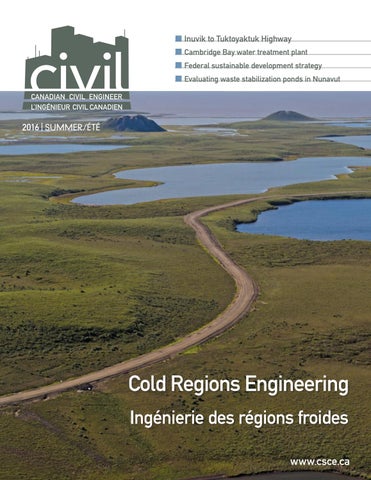
Inuvik to Tuktoyaktuk Highway Cambridge Bay water treatment plant Federal sustainable development strategy Evaluating waste stabilization ponds in Nunavut
2016 | S UMMER/ÉTÉ
Cold Regions Engineering Ingénierie des régions froides www.csce.ca CIVIL_Summer_2016_laz.indd 1
16-08-08 1:55 PM
Civil_MarchSpring_SFrame.indd CIVIL_Summer_2016_laz.indd 1 2
2016-02-11 16-07-29 11:34 12:41 AM PM
contents SUMMER 2016/ÉTÉ 2016 | VOLUME 33.3
IN VIEW: PROJECTS 8 C ambridge Bay Water Treatment Plant 10 I nuvik to Tuktoyaktuk Highway FORUM ON SUSTAINABLE INFRASTRUCTURE/ FORUM SUR LES INFRASTRUCTURES DURABLES 13 CSCE comments on the proposed 2016-2019 federal sustainable
development strategy
TECHNICAL: COLD REGIONS ENGINEERING/ TECHNIQUE: INGÉNIERIE DES RÉGIONS FROIDES
16 Introduction: The challenges of cold regions, by Rui F. de Carvalho,
M.Eng., P.Eng., BCEE 17 Providing basic municipal services to Qikiqtarjuaq, Nunavut 20 Evaluating the performance of municipal waste stabilization ponds in Nunavut 23 The Yukon ditch – moving big water after the rush
NEWS, VIEWS & DEPARTMENTS NOUVELLES, POINTS DE VUE ET RUBRIQUES 4 President’s perspective/
Perspective présidentielle 6 From the regions: Prairies/ De nos régions, Région des Prairies 7 Young professionals corner/Le coin des jeunes professionnels 25 Lifelong learning/ Formation continue 26 CSCE partners and sponsors/Partenaires et commanditaires SCGC
13
8
20
On the cover: Inuvik to Tuktoyaktuk Highway. Photo by Tawna Brown Photography.
Canadian Civil Engineer | Summer 2016
11:34 AM
CIVIL_Summer_2016_laz.indd 3
3
16-07-29 12:41 PM
PRESIDENT’S PERSPECTIVE | PERSPECTIVE PRÉSIDENTIELLE
Jim Gilliland, Ph.D., P.Eng., LEED AP PRESIDENT, CSCE/PRÉSIDENT SCGC PRESIDENT@CSCE.CA
CSCE/SCGC 521-300, rue St-Sacrement Montreal, Québec H2Y 1X4 Tel.: 514-933-2634, Fax: 514-933-3504 E-mail: mahmoud.lardjane@csce.ca www.csce.ca
Guiding the conversation about sustainable infrastructure
PRESIDENT/PRÉSIDENT Jim Gilliland, Ph.D., P.Eng., LEED® AP
I
CANADIAN CIVIL ENGINEER/L’INGÉNIEUR CIVIL CANADIEN EDITOR/RÉDACTEUR Doug Salloum, CSCE Executive Director 514-933-2634 ext. 1, doug.salloum@csce.ca MANAGING EDITOR/ DIRECTEUR DE LA RÉDACTION Cindy Macdonald Tel.: 416-510-6755 cmacdonald@annexnewcom.ca
ASSOCIATE EDITOR/ RÉDACTEUR EN CHEF ADJOINT Bronwen Parsons Tel.: 416-510-5119 bparsons@ccemag.com
ADVERTISING SALES/ PUBLICITÉ Maureen Levy Tel: 416-510-5111 mlevy@ccemag.com
ART DIRECTOR/ COMPOSITION ARTISTIQUE Lisa Zambri Tel: 416-510-5600 x3595
Annual Subscription Rates/Abonnement annuel Canada & U.S./E.U. $35.00, Other countries/Autres pays $45.00; Single copy/Un numéro $7.50; Agency discount/Rabais au distributeurs 10% PUBLICATION ISSN 9825-7515 RETURN ADDRESS/ADRESSE DE RETOUR : The Canadian Society for Civil Engineering La Société Canadienne de Génie Civil 521-300, rue St-Sacrement Montreal, Québec H2Y 1X4 Canadian Civil Engineer (CCE) is published five times per year by the Canadian Society for Civil Engineering (CSCE). L’ingénieur Civil Canadien (ICC) est publié cinq fois par année par la Société Canadienne de Génie Civil (SCGC). The opinions expressed in the papers are solely those of the authors and the Canadian Society for Civil Engineering is not responsible for the statements made in this publication. Les opinions exprimées dans les articles sont la seule responsabilité de leurs auteurs et la Société canadienne de génie civil n’engage pas sa responsabilité dans les propos exprimés. CIVIL Magazine is produced by the publishers of Canadian Consulting Engineer Magazine, published by Annex Publishing & Printing Inc. Le magazine Civil est produit par l’editeur de la publication Canadian Consulting Engineer qui est publie par Annex Publishing & Printing Inc. Annex Publishing & Printing Inc., 80 Valleybrook Drive, Toronto, Ontario M3B 2S9 Tel.: 416-442-5600; Fax: 416-510-5140 PUBLICATIONS MAIL AGREEMENT/POSTES CANADA ENREGISTREMENT #40065710
4
CIVIL_Summer_2016_laz.indd 4
am honoured and excited to write my first president’s message for CIVIL magazine. I hope to serve the Canadian Society for Civil Engineering as well as those who came before me, and leave the society in a strong position for those who follow. I am grateful to serve with a very engaged executive and board as well as countless volunteers from across the country. Of course, the continuity of the CSCE organization continues to be well served by the staff at the CSCE national office, led by Doug Salloum. This edition of CIVIL is focused on engineering in cold regions. Canada and CSCE are well positioned, literally and figuratively, to develop unique and innovative solutions to northern sustainable infrastructure issues that can be applied around the world. As Canadians, we sometimes feel that we can derive greater benefits by joining other societies and associations based in other parts of the world. While we can learn a great deal from other countries, it is important to remember that CSCE is recognized as a leader in sustainable infrastructure. We should be proud of what we have built as a country, and the network of civil engineering excellence across the country that the CSCE has helped establish. Given what the CSCE and its members have accomplished, it seems obvious that the organization should be celebrated and supported. In return, CSCE can support its members and provide leadership on the national and international stage. However, as we all know, maintaining and growing a Canadian network of civil engineering excellence requires at least three ingredients: dedication, hard work and money. The dedication and accomplishments of civil engineering professionals in Canada have never been in question. It would be unfortunate if opportunities to maintain our leadership in sustainable infrastructure could not be realized due to a lack of financial resources. Organizations like CSCE are all struggling with the same problem. It is no longer sufficient for an organization to do good things. It is also important to explain to stakeholders what good things are being done and why these things are relevant to them. With this connection, financial support can be realized. This is the situation that CSCE finds itself in today. Fortunately, CSCE is built on a strong foundation with a strong vision for the future. The five strategic advocacy positions promoted by the CSCE are an excellent platform from which to promote sustainable infrastructure in Canada. The focus of my year as president of CSCE will be to strengthen the connection with our members and other stakeholders by engaging them in conversations about sustainable infrastructure. I believe this speaks directly to the critical issue of our relevance and the role CSCE can play in the community and economy of Canada. These conversations have already started. The national office is building a communications strategy to network with CSCE members and partners, and the technical divisions are preparing new methods of communicating to highlight the infrastructure challenges they are tack-
Été 2016 | L’Ingénieur civil canadien
16-07-29 12:41 PM
PRESIDENT’S PERSPECTIVE | PERSPECTIVE PRÉSIDENTIELLE ling. An important new initiative to engage current and prospective corporate partners has also been recently launched. These corporate relationships offer significant opportunities to add value to CSCE and companies with specific interests in the infrastructure sector, as well as to grow membership in the society. Jim Gilliland is regional director, Southern Alberta, for Williams Engineering Canada.
Orienter la conversation sur les infrastructures durables
J
e suis honoré et excité à l’idée de rédiger mon premier message du président pour la revue CIVIL. J’espère servir la Société aussi bien que ceux qui m’ont précédé et laisser la Société dans une position forte à ceux et celles qui me suivront. Je suis reconnaissant de pouvoir compter sur l’aide d’un conseil d’administration et d’un exécutif très engagés, ainsi que sur de nombreux bénévoles de partout au pays, que j’ai appris à connaître au cours de la dernière année. Bien entendu, la continuité de la SCGC est toujours assurée par le personnel du bureau national, mené par Doug Salloum. Cette édition de la revue CIVIL met l’accent sur l’ingénierie dans les régions froides. Le Canada et la SCGC sont bien positionnés, au sens littéral et figuré, afin de développer des solutions uniques et novatrices aux problèmes d’infrastructures durables dans le nord, solutions pouvant être appliquées partout dans le monde. En tant que Canadiens, nous avons parfois l’impression que nous pouvons obtenir de plus nombreux avantages en se joignant à d’autres sociétés et associations basées dans d’autres parties du globe. Bien que nous puissions apprendre de nombreuses choses d’autres pays, il est important de se rappeler que la SCGC est reconnue comme un chef de file en matière d’infrastructures durables. Nous devrions être fiers de ce que nous avons construit en tant que pays, et du réseau d’excellence en génie civil à travers le Canada que la SCGC a contribué à mettre sur pied. Au vu de ce que la SCGC et ses membres ont accompli, il semble hors de tout doute que notre organisation devrait être célébrée et soutenue. En retour, la SCGC peut soutenir ses membres et fournir un leadership sur les plans national et international. Cependant, comme nous le savons tous, maintenir et faire croître un réseau canadien d’excellence en génie civil nécessite au minimum trois ingrédients : dévouement, travail acharné et argent. Le dévouement et les accomplissements des professionnels en génie civil au Canada n’ont jamais été remis en question. Ce serait malheureux si des occasions de maintenir notre leadership en infrastructures durables ne pouvaient être réalisées en raison d’un manque de ressources financières. Les organisations telles que la SCGC sont toutes aux prises avec le même problème : il ne suffit plus pour une organisation de
Canadian Civil Engineer | Summer 2016
CIVIL_Summer_2016_laz.indd 5
CSCE LEADERSHIP IN SUSTAINABLE INFRASTRUCTURE: FIVE ADVOCACY POSITIONS • Innovative Procurement Practices • Long-Term Investment Planning • Measure Sustainable Performance • Leverage Asset Management Processes • Sustainability Education
LE LEADERSHIP DE LA SCGC EN MATIÈRE D’INFRASTRUCTURES DURABLES : CINQ PLAIDOYERS STRATÉGIQUES • Pratiques d’approvisionnement novatrices • Planification à long terme des investissements • Mesurer le rendement durable • Profiter des processus de gestion des actifs • Éducation durable
faire de bonnes réalisations. Il est également important d’expliquer aux parties prenantes les réalisations qui sont accomplies et pourquoi elles leur sont pertinentes. Le soutien financier ne peut être obtenu que de cette façon. C’est dans cette situation que se trouve la SCGC aujourd’hui. Fort heureusement, la SCGC repose sur une fondation solide et peut profiter d’une vision claire de l’avenir. Les cinq plaidoyers stratégiques que la SCGC met de l’avant constituent une excellente plateforme pour faire la promotion des infrastructures durables au Canada. L’objectif principal de mon mandat de président de la SCGC sera de renforcer les liens avec nos membres et les autres parties prenantes en les engageant dans des discussions sur les infrastructures durables. Je crois que cela concerne directement la question essentielle de notre pertinence et du rôle que peut jouer la SCGC dans la communauté et dans l’économie canadienne. Ces discussions sont déjà entamées. Le bureau national élabore une stratégie de communication permettant de réseauter avec les membres et les partenaires de la SCGC, et les divisions techniques préparent de nouvelles méthodes de communication avec les membres et les autres parties prenantes concernées afin de mettre en lumière les défis auxquels elles doivent face en matière d’infrastructures. Une nouvelle et importante initiative visant à impliquer les membres d’entreprise actuels et futurs a également été récemment lancée. Ces liens avec les entreprises et les institutions offrent d’importantes opportunités d’ajouter de la valeur à la SCGC et aux organisations ayant des intérêts particuliers dans le secteur des infrastructures. Ces liens permettent également d’accroître le nombre des adhésions à la Société. Jim Gilliland est directeur régional, Sud de l’Alberta chez Williams Engineering Canada.
5
16-07-29 12:41 PM
FROM THE REGIONS: SECTION NEWS | DE NOS RÉGIONS : NOUVELLES DES SECTIONS
Starting a tradition: Saskatoon Fellows Dinner By Mike Hnatiuk, P.Eng. MCSCE VICE-PRESIDENT, PRAIRIE REGION, CSCE
T
his past fall, the Saskatoon Section of the CSCE developed a new event called the Fellows Dinner, which they hope will evolve into a new tradition. Invitations were sent to all Fellows in the Saskatoon area, with a large percentage of the invited responding positively. The dinner was well timed, as two new Fellows were added to the ranks during the 2015 Annual Conference which was held in Regina. The two new Fellows celebrated that night were Lisa Feldman, P. Eng., from the
Le début d’une tradition : le souper des membres Fellows de Saskatoon par Mike Hnatiuk, P.Eng. MCSCE VICE-PRÉSIDENT, RÉGION DES PRAIRIES, SCGC
L
’automne dernier, la section de la SCGC de Saskatoon a organisé un tout nouvel événement intitulé Fellows Dinner (le souper des membres Fellows), qu’elle voir pour devenir une nouvelle tradition. Des invitations ont été envoyées à tous les membres Fellows de la région de Saskatoon, dont plusieurs ont répondu positivement. Le
University of Saskatchewan, and Phil Bruch, P. Eng., from Golder Associates. These two members have been very involved in the Society over the years, so it was very fitting that the first edition of this dinner was able to recognize them at a local event. While one of the main strategic directions of the Society is to “Grow with youth,” the local section also feels it is important to celebrate members who have been longstanding contributors to the Society. With this in mind, the section launched the Fellows Dinner. The dinner was held without a formal program to allow conversations to flow naturally between the attendees. The feedback gathered supported the decision to run the evening this way. Overall, the evening was a success, with our long-term members receiving well-deserved recognition of their contributions over the years. As this is a new event, the format for subsequent years is still evolving, but the feedback and attendance this year is promising for the success of this event in the future.
souper tombait bien, alors que deux nouveaux membres Fellows ont reçu ce titre au cours du congrès annuel 2015, lequel se tenait à Regina. Les deux nouveaux fellows célébrés ce soir-là étaient Lisa Feldman, P. Eng, de l’Université de Saskatchewan, et Phil Bruch, P. Eng, de Golder Associates. Ces deux membres ayant été très impliqués au sein de la Société au cours des années, il était approprié que la première édition du souper des membres Fellows reconnaisse leurs accomplissements. Bien que l’une des orientations stratégiques principales de la Société soit de « Croître avec les jeunes », la section pense qu’il est également important de célébrer les membres qui sont des contributeurs de longue date de la Société. C’est en ayant ceci à l’esprit que la section a lancé le souper pour les membres Fellows. Le souper s’est déroulé sans programme officiel afin de permettre des conversations informelles entre les participants. Selon les commentaires recueillis, les participants ont approuvé la manière dont la soirée fut organisée. De manière générale, la soirée a été un succès alors que nos membres de longue date ont reçu une reconnaissance bien méritée de leurs contributions au cours de toutes ces années. Comme il s’agit d’un nouvel événement, le format pour les prochaines années sera sujet à changement, mais la rétroaction et la participation à l’événement de cette année sont des indices prometteurs du succès de cet événement dans le futur.
Participants at the Saskatoon Fellows Dinner./ Participants au souper des membres Fellows de Saskatoon.
6
CIVIL_Summer_2016_laz.indd 6
Été 2016 | L’Ingénieur civil canadien
16-07-29 12:42 PM
YOUNG PROFESSIONALS’ CORNER | LE COIN DES JEUNES PROFESSIONNELS
Young Professionals drawn to Infrastructure Report Card session By Laird Ferguson and Michael Benson
O
n April 20, the West New Brunswick CSCE Section hosted its first young professionals networking event. The event took place at a local pub following the presentation of Canada’s Infrastructure Report Card (CIRC) at the University of New Brunswick (UNB). The CIRC presentation was an excellent opportunity to host a young professionals (YP) event, as local professionals from across the section were in attendance. Pairing technical sessions and National Lecture Tour presentations with additional networking opportunities for youth can strengthen the relationships among YP members, and it can provide incentives to attend the technical sessions, interact with knowledgeable practitioners,
and get involved with the local CSCE section. In addition to YP members being in attendance, a partnership was made between the CSCE section, the undergraduate student chapter, and the graduate student society at UNB to engage a larger audience. The UNB student chapters are actively involved in coordinating local technical and social events; therefore as the West NB section continues to evolve, developing these relationships with other youth organizations will be critical to its growth. The event was a great success, with more than 45 attendees stopping in to share their thoughts on the report card and to network. The West NB section will be actively engaging our YP members for future technical sessions, as it serves as an excellent opportunity for them to grow their personal network and learn more about the profession as a whole.
Les jeunes professionnels au cœur de la session du Bulletin de rendement sur les infrastructures par Laird Ferguson et Michael Benson
L
e 20 avril dernier, la section SCGC de l’ouest du Nouveau-Brunswick a organisé son premier événement de réseautage des jeunes professionnels. L’événement s’est tenu dans un pub local après la présentation du bulletin de rendement des infrastructures canadiennes (BRIC) à l’Université du Nouveau-Brunswick (UNB). La présentation du BRIC a constitué une excellente opportunité de tenir un événement des Jeunes professionnels (JP), alors que des professionnels locaux représentant plusieurs domaines de la section étaient présents. Associer des sessions techniques et des présentations de la tournée
nationale de conférences à des occasions supplémentaires de réseautage pour les jeunes peut renforcer les liens entre les membres JP, et fournir un incitatif à assister aux sessions techniques, interagir avec des professionnels chevronnés et s’impliquer auprès de la section locale de la SCGC. En plus des membres JP présents à cet événement, un partenariat a été établi entre la section de la SCGC, le chapitre étudiant du premier cycle et la société étudiante des étudiants diplômés de l’UNB afin d’impliquer une audience plus large. Les chapitres étudiants de l’UNB sont activement impliqués dans la coordination des événements techniques et soSuite à la page 25
Denso Products - Unmatched Quality and Performance
If it doesn’t say
on the outside, then its not
Denso North America Inc. • www.densona.com
Canadian Civil Engineer | Summer 2016
CIVIL_Summer_2016_laz.indd 7
on the inside.
7
16-07-29 12:42 PM
IN VIEW: PROJECTS | PROJETS EN VEDETTE
Cambridge Bay Water Treatment Plant
specialized requirements for operations and maintenance.
An aging and undersized system with assorted upgrades
A new water treatment system being built at a remote hamlet 700 kilometres north of Yellowknife will provide a community that currently relies on water trucks with a reliable system. By Arlen Foster, P.Eng. and Matthew Follett, M.A.Sc., P.Eng., STANTEC
8
CIVIL_Summer_2016_laz.indd 8
W
ater and wastewater infrastructure is at the core of a community’s survival and continues to be highlighted by environmental and regulatory bodies for improvement so that negative impacts to surrounding environments are minimized. As well, in the Arctic regions of Canada the supply, treatment and distribution of clean, safe drinking water is a major problem and expense to municipalities, hamlets, and the federal government. Drinking water treatment systems that exist often have been plagued with struggles ranging from improper installations to
The hamlet of Cambridge Bay, Nunavut, is located approximately 700 kilometres northeast of Yellowknife, Northwest Territories, and was experiencing problems with its drinking water treatment system. The hamlet’s aged and undersized potable water infrastructure was causing significant issues in shortages and reliability concerns. The system had been upgraded several times since the construction of its first intake pump house in 1970. In 1980 a new insulated water line, central distribution pump house, water storage tanks, and upgrades to the existing intake pump house were completed. In 2002, further significant upgrades and modifications were completed consisting of a new insulated water line, access vaults, and refurbished boiler stations. Since then various replacements and maintenance items had been completed at the facility. The community’s potable water system at this point consisted of assorted “upgrades,” resulting in a much needed complete overhaul. From a potable water demand perspective and according to Community Government Services representatives, it was estimated that the community’s population was projected to
Été 2016 | L’Ingénieur civil canadien
16-07-29 12:42 PM
IN VIEW: PROJECTS | PROJETS EN VEDETTE
Far left: part of the packaged water treatment system being lifted onto piles. Left: backwash
Stantec
tank (yellow), water treatment plant, and potable water storage tank (not yet insulated).
grow from 1,613 in 2010 to approximately 3,788 by 2045. With the addition of a future Canada High Arctic Research Station (CHARS), the project population may be at high as 4,013 by 2045. The current water delivery system consists of a combination of underground distribution lines and trucked services. There are three 12,500-L water trucks, with a fourth truck for emergency use. The trucks typically operate on a seven-day delivery schedule with an eighthour delivery day. The government owns and operates the drinking water treatment system in collaboration with the community. Stantec Consulting’s local office in Yellowknife was first requested by the Government of Nunavut and the hamlet to investigate and problem-solve the issues. The newly designed system would include a new intake structure, pump house, and treatment facility. The replacement and addition of underground distribution lines was also a component.
New intake, pump house, water treatment plant and distribution lines In 2011 Stantec stepped up to the challenge and was contracted to design upgrades to the system. The upgrades have been developed in two phases. In phase I, a new lake intake and pump house was installed. In phase II, the 1.7-km supply lines from the new intake to the new water treatment plant are being
Canadian Civil Engineer | Summer 2016
CIVIL_Summer_2016_laz.indd 9
replaced, with construction expected to be completed in the fall of 2016. Water Lake is distanced from both the community and human activity, making it relatively free from potential anthropogenic contamination at present. The water is of good quality for potable use, being slightly hard, well buffered, slightly alkaline, and slightly under-saturated with respect to calcium carbonate. Previous microbiological analyses of treated water showed that the addition of chlorine successfully eliminates most of the organisms tested. A comparison of the chemical analysis of the community’s raw supply water to the CCME Guidelines for Canadian Drinking Water Quality showed tested parameters as below the recommended maximum limits, qualifying the existing water source as suitable for the new design. The central feature of the improved water supply system is a water treatment plant using a zeolite-based filtration system, combined with chlorination and UV treatment. The system chosen can handle a design flow of 1,200 L/min and generates half the backwash wastewater compared to alternate systems that were considered — an important feature as the backwash must be collected in a 60-m3 insulated steel tank stored on site and hauled away by trucks. A 570-m3 tank will store the treated water, which will be pumped through the underground infrastructure as well as distributed by trucks to homes. The project will also modify and improve the existing supply mains in the community. A new 2,000-m long water main will create a complete circulation loop that will help reduce the operation and maintenance costs
of the existing main. The new loop will also service the future Canadian High Arctic Research Station currently in construction. With the provision of a high-pressure water service throughout the community, significant cost savings are starting to be realized on several levels: from insurance cost savings realized thanks to a great increase in firefighting measures, to capital cost savings for building developments due to the removal of the need for individual storage tanks. Also, the community will be able to continue to expand the water distribution network over time, reducing the reliance on expensive water truck deliveries.
The challenges Some of the challenges Stantec and the design team overcame were: maintaining high efficiency and maintaining a continual supply of potable water during the entire phased project. The project required a high level of professional services across a broad range of disciplines, with people experienced in Arctic design and construction. The design constraints include: • harsh Arctic climate; • permafrost-rich soils; • cold water (temperatures ranging from 0°C to 10°C); • short construction season; • remote location; • treatment process waste disposal; • limited piped services; • limited availability of local tradesmen; • limited material and equipment availability; • high construction and service costs; and • high electrical and diesel fuel costs.
OWNER: Government of Nunavut CLIENT & CONTRACTOR: NDL Construction PRIME CONSULTANT: Stantec Consulting OTHER KEY PLAYERS: BI Pure Water (construction of packaged water treatment plant)
9
16-07-29 12:42 PM
IN VIEW: PROJECTS | PROJETS EN VEDETTE
Inuvik to T
Highway approaching Tuktoyaktuk. The road is an embankment 1.5 m high.
A new all-weather highway is being built from Inuvik to the Arctic Circle that will fulfill Canada’s national dream of having land transportation connections between three coasts. By Warren McLeod, P.Eng., STANTEC
10
CIVIL_Summer_2016_laz.indd 10
Tawna Brown Photography
C
anada is enormous, and its northern reaches are among the least hospitable climates on the planet. Basic survival is exponentially more difficult. This makes connecting the region’s major settlements as difficult as it is important. The Inuvik to Tuktoyaktuk Highway is the newest link between communities in Northern Canada. The 140-kilometre, two-lane gravel highway will provide an all-weather connection north between the Town of Inuvik to the Hamlet of Tuktoyaktuk, on the shore of the Beaufort Sea in Canada’s Arctic Circle. Currently under construction, with projected completion in 2017, the highway will fulfill the national dream of having land transport connections from coast to coast to coast. The project was first discussed in the 1960s, with some preliminary design work completed in the 1970s. The project laid dormant for nearly four decades before being brought back to life. The Government of the Northwest Territories’ Department of Transportation worked with EGT Northwind to advance the $300-million construction project. The design was completed as a joint effort between Kavik-Stantec and Kiggiak-EBA Con-
Été 2016 | L’Ingénieur civil canadien
16-07-29 12:42 PM
IN VIEW: PROJECTS | PROJETS EN VEDETTE
to Tuktoyaktuk Highway sulting. The highway will have eight bridges and 19 bridge-size culverts. It will provide a year-round connection to Tuktoyaktuk, which is currently accessible only by ice road in the winter, and in the summer by boat or plane.
Shaping the sideslopes.
Stantec
Permafrost challenges The biggest challenges for this project were those that impede construction all over the north: the remote location and the extreme weather. Permafrost challenges are exclusive to a northern climate. Sitting one and a half metres below the surface, the permafrost makes excavating more than two metres during con-
THE PIPE THAT FITS IN SO MANY WAYS.
struction a challenge. Further, if it is exposed to warm air, permafrost will degrade, which compromises the structural stability of the terrain permanently. The team had two solutions: the first was to build in the winter, and the second was to build up rather than down. The design did not have any excavation sections at all; the team designed an embankment 1.5 metres high that is intended to not disturb the permafrost, allowing for both a structurally sound road and a relatively undisturbed ecosystem. To limit damage to the permafrost, all embankment construction was planned to take place during the winter. Construction equip-
NovaForm PVC Liner TM
The sewer & culvert rehabilitation solution in the sizes you need.
• • • •
A Size for Every Job Durability of PVC Consistent Production Peace of Mind
To learn more, call us toll free at 1-866-473-9462 or visit www.ipexinc.com NovaFormTM is manufactured by IPEX Inc. NovaFormTM is a trademark of IPEX Branding Inc.
CivilEngineering_Spring_IPEX.indd 1
Canadian Civil Engineer | Summer 2016
CIVIL_Summer_2016_laz.indd 11
2016-01-28 8:57 AM
11
16-07-29 12:42 PM
IN VIEW: PROJECTS | PROJETS EN VEDETTE ment severely damages the sensitive tundra in the summer. Also, the embankment core is designed to remain frozen to protect the underlying permafrost; to do this the material must be frozen when placed. Finally, the available material to construct the embankment is easier to source and handle when frozen. For the bridge foundations the team selected adfreeze piles. These served a dual purpose: to support the structure and take advantage of the permafrost’s physical properties. In addition, this type of foundation is best suited for installation in the winter, which helped the builder to coordinate the construction of the bridge with the construction of the embankment.
Technical approach As mentioned above, adfreeze piles were used in the frozen ground as they are designed to form a strong bond with the permafrost around the piles and not transfer heat into the ground and melt it, which would compromise the structural integrity of the bridge. The team also elected for larger-than-usual culverts to accommodate fish passage needs, ice buildup, and permafrost restrictions. Out of the 60 culverts, 19 of them are bridge-size culverts (SPCSP) and 41 are large-diameter culverts. The culvert design called for a seal at the end to avoid loss of engineering fill through erosion, keeping the culvert as stable as possible. Clay is traditionally used for this purpose, but clay is not available in the north, and even if it were available it cannot be placed in sub-zero temperatures. After researching the available choices, the team selected rubber membranes to give the culvert linings durability and resilience. Culverts need to be placed in ground that is 95 per cent compacted to prevent damage from ground settlement post construction. Achieving this degree of density is challenging in frigid northern winters. To mitigate the risk of under-compaction, the team used thicker-gauge steel for the culverts and carefully combed the culvert beds to remove oversized, frozen particles of granular material.
12
CIVIL_Summer_2016_laz.indd 12
While building portions of the highway over the winter gives the team certain advantages, it still presents difficulties for assembling many components. For this reason, the team’s design emphasized components that could be fabricated off-site to the greatest extent possible and then shipped to the North. For example, pre-cast concrete modular bridge girders built in Alberta and British Columbia are used on all the bridges. Measures to address climate change were employed in the design. Simple approaches were taken to mitigate the effects of global warming, such as a deeper permafrost active layer and increased precipitation. These approaches were: • longer adfreeze piles; • thicker roadway embankment; and • larger diameter culverts.
Minimizing disruption to the environment The highway runs over both Arctic tundra and boreal forest — some of the most rugged terrain in Canada, and also some of the most sensitive. From the start, the team worked closely with both the territorial and federal governments to ensure regulatory compliance and minimal disruption to the environment. The culvert designers ensured the speed of the water through the culverts is consistent with that of nearby streams, taking a lighter toll on local piscine populations as a result. The larger size culverts also mitigate the pervasive icing problems to allow for flow even when the culvert is iced up in the spring. As mentioned above, construction in winter helped to minimize the disturbance of the tundra and underlying permafrost. The choice to make the road gravel also mitigated the project’s environmental footprint. With more flexibility than pavement, gravel will endure the freeze-thaw climate cycle much better than a blacktop road. It also attracts
much less heat, cutting down on the thermodynamic pollution of the highway.
Advantages for the North Canada’s north has always captivated our mind. We’re a northern nation, and some part of our collective imagination will always linger over the farthest reaches of our borders. In recent years, the north has also emerged as one of the global resource hotspots of tomorrow, rich in hydrocarbon resources. And, of course, the north is home to more than hydrocarbons and dreams. People live here — people who need to get around for work and pleasure, who need to buy groceries and birthday presents, and who need timely access to hospitals, government offices, and so on. For all these reasons the new highway makes a significant contribution to Canadian society. The road makes economic opportunities easier to grasp for residents and industry. It strengthens the bonds of community between Tuktoyaktuk and Inuvik. It makes tourism easier, reinforcing the connection between the north and the rest of Canada. It will cheapen the cost of importing food, which is to say the cost of almost all food, in a region where access to good nutrition is often compromised.
Lessons learned • Winter embankment construction works. • Granular borrow source development through drill/blast is efficient. • Fill-only design is necessary to minimize disturbance to sensitive terrain. • Overbuild is necessary to allow for seasonal settlement. • Ensure adequate time for review by owners and regulators is included in the design schedule. • Maintain constant communication with regulatory agencies throughout the project to build trust.
OWNER: Government of the Northwest Territories CLIENT (CONTRACTOR): EGT Northwind PRIME CONSULTANT/DESIGN: Kiggiak EBA (Graham Wilkins, P. Eng.) and KAVIK-STANTEC (Warren McLeod, P. Eng., Walter Orr, P. Eng., Ren Cheng, P. Eng.)
Été 2016 | L’Ingénieur civil canadien
16-07-29 12:42 PM
SUSTAINABLE INFRASTRUCTURE | LES INFRASTRUCTURES DURABLES
CSCE comments on the proposed 2016-2019 Federal Sustainable Development Strategy By: Guy Félio, PhD, P.Eng., FCSCE, IRP (Climate) CHAIR, INFRASTRUCTURE RENEWAL COMMITTEE, CSCE
T
he Government of Canada, through Environment Canada, is in the process of reviewing and updating its Sustainable Development Strategy (FSDS) for 2016-2019 and asked Canadians for input and comments on the FSDS before June 24, 2016. The draft 2016–2019 FSDS outlines federal government action to create a sustainable economy, protect the environment and enhance Canadians’ well-being for the next three years. It is available at http://fsds-sfdd. ca/index.html#/en. CSCE, through its Infrastructure Renewal Committee and in collaboration with its Sustainable Development Committee, provided comments on several targets. The context of CSCE’s response to the invitation by the federal government to comment is aligned with the society’s own strategic direction: Leadership in SustainHarnessing wind energy in St-Ulric, Quebec. able Infrastructure. Members will recall that in May 2015, CSCE’s Board adopted CSCE Policy Statement #2015-01: Development of Sustainable Infrastructure. Thus, maintaining basic living conditions for humanity. CSCE recommends that the federal government include strong incenfollowing general comments about the proposed strategy, the focus of CSCE’s comments on the draft FSDS was on the five major goals of the tives (similar to those relating to asset management in the renewed gas tax agreements) to its infrastructure programs to include vulnerability FSDS, namely: assessments, risk management and resiliency measures in all the projects Goal 1: Taking action on climate change; to which it contributes funding. Goal 2: Clean technology, jobs, and innovation CSCE recommends that the federal government resume its leadership Goal 3: National parks, protected areas and ecosystems role in collecting, analyzing and sharing climate data with public and Goal 4: Freshwater and oceans; and private agencies. This should include, but is not limited to, a significant Goal 5: Human health, well-being and quality of life. CSCE provided the following general comments and recommenda- expansion of the network of stations across the country. CSCE recommends that the federal government include the assesstions about the FSDS: CSCE recognizes that climate change represents a global crisis that ment of climate change impacts and the provision of adaptation and/ must be addressed not only by infrastructure resilience and adaptation. or elimination options in its procurement procedures for tangible capital Civil infrastructure must now be planned and implemented not only assets (infrastructure, buildings and facilities) that are projected to expeto maintain economic growth and current lifestyles based upon exces- rience changes in climate during their service lives. Following are the specific goal/target recommendations made in the sive energy consumption; it must be directed to eliminating and avoiding GHG emissions, forestalling a global environmental collapse while draft 2016-2019 FSDS:
Canadian Civil Engineer | Summer 2016
CIVIL_Summer_2016_laz.indd 13
13
16-08-02 3:22 PM
SUSTAINABLE INFRASTRUCTURE | LES INFRASTRUCTURES DURABLES
the watershed level and incorporated in the environmental assessment process for projects receiving federal government funding.
GOAL 5 – Human Health, Well Being And Quality Of Life
Enbridge’s Sarnia Solar site in southwestern Ontario.
GOAL 1 – Taking Action On Climate Change TARGET 1.2: RESILIENCE TO CLIMATE CHANGE Innovation and demonstration: CSCE encourages the federal government to support pilot projects and demonstrations of technologies and processes to improve the resilience of infrastructure to climate change impacts. Resiliency indicators: CSCE encourages the federal government to develop and adopt SMART indicators of infrastructure resilience for its funding programs.
Infrastructure, facilities and buildings exist to provide a service: roads, bridges and other transportation infrastructure provide mobility; water and wastewater were first introduced in Canada to protect the health or urban populations from water-borne deceases; stormwater management systems are constructed to prevent flooding. Infrastructure risks due to climate change are therefore risks to the health, well-being, quality of life of Canadians and the economy of the country. TARGET 5.3: ON-RESERVE FIRST NATIONS DRINKING WATER AND WASTEWATER SYSTEMS CSCE recommends that the federal government work with First Nations communities and the technical professions to assess how best to provide potable water and sanitation services on-reserve that are resilient and sustainable.
GOAL 4 – Freshwater And Oceans
The CSCE has a crucial role to play in assisting the federal government to facilitate change, drive innovation and creativity, and break down the silo mentality driven by growth and lifestyle considerations that has prevailed in the provision of public infrastructure. Since 1994, CSCE has alerted civil engineers and Canadians to this developing crisis by means of CSCE policies, major conferences and professional papers – all highlighting that society has been accelerating in the wrong direction on a non-sustainable course, and concluding that if the majority of the earth’s population begins to consume at the rate of the world’s affluent urban-industrial nations, the global environment will be significantly degraded. We are indeed at a tipping point, and the planning and implementation of public infrastructure must reflect the rapid deterioration of the global environment: water, land, and air. This means envisioning bold new directions for society and infrastructure. As the learned society representing civil engineering practitioners, academics and students, CSCE will continue to work with and support the federal government’s initiatives to build, operate and maintain infrastructure, buildings and facilities that provide safe and affordable services for Canadians while at the same time eliminating and avoiding the alarming deterioration of the global atmosphere. CSCE has a long history of working with federal departments, in particular Infrastructure Canada, and we look forward to continuing this relationship.
TARGETS 4.1 TO 4.6: SURFACE WATER SOURCES FOR POTABLE CONSUMPTION CSCE recommends that impacts of climate changes be evaluated at
Guy Félio is infrastructure management specialist with R.V. Anderson Associates. He can be reached at GFelio@RVAnderson.com
TARGET 1.5: REAL PROPERTY ENVIRONMENTAL PERFORMANCE CSCE encourages the federal government to lead by example in the application of vulnerability assessments and resiliency planning for its infrastructure, buildings and facilities.
GOAL 2 – Clean Technologies, Jobs And Innovation TARGET 2.1: CLEAN TECHNOLOGIES AND GREEN INFRASTRUCTURE CSCE recommends that all federal agencies focus on developing and/or using clean technology and green infrastructure that is carbon-neutral or carbon-free.
GOAL 3 – National Parks, Protected Areas And Ecosystems TARGETS 3.3 AND 3.7: ECOSYSTEMS AND CONNECTING WITH NATURE CSCE recommends that efforts to preserve and protect national parks and ecosystems, and connecting with the public, incorporate the growing concerns regarding deterioration of the global atmosphere as a vital component of climate change.
14
CIVIL_Summer_2016_laz.indd 14
Été 2016 | L’Ingénieur civil canadien
16-07-29 12:42 PM
C
I AM CIVIL ENGINEERING CATHY LYNN BORBELY Director, Planning and Policy Division, Ministry of Highways and Infrastructure, Province of Saskatchewan
What my job is: I lead the strategic planning process for the Saskatchewan Ministry of Highways and Infrastructure. My expertise is in project management and results based strategic orientation that includes all levels of the organization influencing our future transportation network. The planning process is rooted around citizens’ needs and delivering programs that meet the demands of an export trade economy and growing population.
Why I became a civil engineer: My father says he saw the potential for me having a career in engineering from watching me build cities in my sandbox. As the daughter of a local politician, my mother broke barriers and encouraged me to choose a path that would make me happy and contribute to improving the lives of people. Engineering seemed like a natural fit and a way to use both logic and creativity to solve complex problems. I was fortunate to have role models like my parents and friends who supported my choice of civil engineering at a time when few women were in civil engineering practice.
The project I worked on that I think best represents sustainable infrastructure: Sustainability encompasses economic, social and environmental considerations. My organization’s long term planning horizon uses
“Engaging participants at planning workshops”
these pillars and demand based, outward focused, forward looking principles to set a framework for planning the future transportation network for the province. Although it is not a physical structure, it lays the foundation for sound decision making while taking into account fiscal realities. It builds on knowing where we came from, understanding the current situation and creating the best future for the next generation. www.csce.ca
Canadian Civil Engineer | Summer 2016
CIVILCathyLynnBorbely.indd 3 CIVIL_Summer_2016_laz.indd 15
15
16-07-28 1:32 PM 16-07-29 12:42 PM
FROM THE TECHNICAL EDITOR | MOT DU RÉDACTEUR TECHNIQUE
The Challenges of Cold Regions By Rui F. De Carvalho, M. Eng., P. Eng., BCEE
I
t is well documented that modern and efficient infrastructure is a key factor for economic development and performance. The planning, design, construction and financing of infrastructure services present great challenges, and these are all greatly amplified in the northern regions of Canada. Small and sparse population centres, lack of permanent road access, and environmentally sensitive terrain are all factors. Not the least of these is the harsh environment that results from the extreme cold climate over a significant part of the year. Water, soils and other materials undergo dramatic changes in behaviour at extreme low temperatures; temperatures not considered the norm by most engineers. The engineering of vital infrastructure services – water supply, wastewater management and transportation – under these conditions presents unique challenges that require the application of not only well-founded science, but also ingenuity, practicality and experience. Canadian engineers are up to these challenges, as we can observe from
Les défis des régions froides par Rui F. De Carvalho, M. Eng., P. Eng., BCEE
U
ne infrastructure moderne et efficace est un facteur clé du rendement et du développement économique. Cela a été documenté et prouvé. La planification, la conception, la construction et le financement des infrastructures présentent des défis de taille, et ces défis sont grandement amplifiés dans les régions du Nord du Canada. De petits centres épars de population, le peu de routes d’accès, un terrain sensible sur le point environnemental sont tous des facteurs déterminants. Une autre raison, et non la moindre, est l’environnement rigoureux qui résulte du froid extrême sévissant une bonne partie de l’année. L’eau, les sols et d’autres matériaux subissent des modifications importantes de leur comportement à des températures extrêmement basses que la plupart des ingénieurs ne considèrent pas comme étant la norme. L’ingénierie des infrastructures vitales - approvisionnement en eau, gestion des eaux usées et transport - sous ces conditions présente des défis uniques nécessitant un recours à une science bien établie mais aussi à l’ingéniosité, à la pratique et à l’expérience. Les ingénieurs canadiens relèvent bien ces défis, comme en témoignent les articles présentés dans cette édition de CIVIL. La Société canadienne de génie
16
CIVIL_Summer_2016_laz.indd 16
the articles that are presented in this issue of CIVIL. The Canadian Society for Civil Engineers (CSCE) brings under its umbrella practising engineers in consulting, government and academia. Within this impressive group of professionals resides a unique and relatively small number of engineers who understand the north and the exciting challenges and opportunities that it provides. They understand that water supply quite often makes its way to the user by a delivery truck and that the sewage will also be picked up in a similar manner; by a different truck of course! Conventional engineering just doesn’t do in the north, and as the demand for infrastructure increases there will be more numerous and greater challenges that will need to be addressed. Climate change is real and we are already observing these impacts on the seasonally shortened window for the transportation of basic commodities to some communities. The continued expansion and sharing of our knowledge base and experiences will be an important factor in advancing the field of cold regions engineering and thereby continuing to provide a vital contribution to the economic development of this extremely significant region of Canada. Rui De Carvalho is senior vice-president at R. J. Burnside & Associates Ltd. in Orangeville, Ont.
civil (SCGC) réunit sous son enseigne des ingénieurs professionnels travaillant au sein de firmes de consultants, du gouvernement et des universités. Au sein de ce groupe impressionnant de professionnels se trouve un nombre relativement restreint et unique d’ingénieurs qui comprennent la vie dans le nord ainsi que les défis stimulants et les opportunités qui leur sont offerts. Ils comprennent que l’approvisionnement en eau se fait assez souvent par un camion de livraison et que les eaux usées seront également ramassées de la même manière (par un camion différent évidemment !). L’ingénierie conventionnelle ne convient tout simplement pas à la vie dans le nord. Alors que la demande d’infrastructures va s’accroître, des défis encore plus importants et plus nombreux se présenteront et qui devront être relevés. Les changements climatiques sont réels et nous observons déjà leurs impacts sur la fenêtre saisonnière toujours plus restreinte du transport des produits de base vers certaines communautés. L’expansion continue et le partage de nos connaissances et de nos expériences seront un facteur important pour l’avancement de l’ingénierie dans les régions froides, permettant ainsi le maintien d’une contribution vitale au développement économique de cette région extrêmement importante du Canada. Rui De Carvalho est vice-président senior chez R. J. Burnside & Associates Ltd., à Orangeville (ON).
Été 2016 | L’Ingénieur civil canadien
16-07-29 12:42 PM
TECHNICAL: COLD REGIONS ENGINEERING | TECHNIQUE: INGÉNIERIE DES RÉGIONS FROIDES
Providing basic municipal services to Qikiqtarjuaq, Nunavut Michael K. O’Hara, P.Eng. Matthew J. Paznar, P.Eng., EP R.J. BURNSIDE AND ASSOCIATES LTD.
Q
ikiqtarjuaq is a remote community of approximately 600 people located in Nunavut on a 16-km by 12-km island known as Broughton Island. The island is located just off the east coast of Central Baffin Island some 96 km north of the Arctic Circle. This thriving community is accessible all year by plane and during the summer by ship or barge. July mean temperatures range from 1°C to 7°C, while in January mean temperatures range from -21°C to -28°C. Typically, July and August are the only two months with mean temperatures above freezing. Providing basic infrastructure services including water, wastewater and solid waste disposal is a major challenge.
Existing conditions
Qikiqtarjuaq is located about 96 km north of the Arctic Circle, off the coast of
The hamlet provides trucked water and sewage services, central Baffin Island. along with regular solid waste collection for the residents, businesses and institutions. Fresh water is drawn from the Tulugak Associates was retained to evaluate the existing systems and determine River during the summer to fill a lined earthen reservoir with a truck- the most cost effective solution to expand the infrastructure so as to fill combination treatment station to provide potable water to the meet the needs of a future design population of 940 people. community throughout the year. Individual holding tanks are provided at each building for Infrastructure design and construction both potable water storage and for the collecThe objective was to evaluate alternative treattion of sewage. Sewage treatment is provided by ment systems that would be designed to: a facultative lagoon. Effluent from the lagoon is • meet the 20-year needs; discharged overland through a natural wetland • operate in and withstand extreme cold; area. Solid waste is disposed of at a facility lo• be cost effective both in capital and operacated adjacent to the sewage lagoon. This solid tional and maintenance costs; waste disposal facility includes areas for bulky • be simple yet effective to operate; and metals, derelict vehicles, barrels, metal dump • have minimal impact on the natural environborrow, secondary metal, and residential solid ment. waste. Other infrastructure and facilities located Water supply within the hamlet include: Concerns with the existing reservoir and truck• diesel electrical power generators; fill station included: • barge landing area; and • the gravity supply line from the river to the • gravel airstrip. reservoir freezing; The existing infrastructure was approaching • insufficient capacity (18,000 m3 ) in the water the end of its useful life and R.J. Burnside and reservoir to meet current and future demands;
One recommendation was to replace the
insulated pump intake
lines by installing them in the reservoir berms to prevent damage
from ice movement.
Canadian Civil Engineer | Summer 2016
CIVIL_Summer_2016_laz.indd 17
17
16-07-29 12:42 PM
TECHNICAL: COLD REGIONS ENGINEERING | TECHNIQUE: INGÉNIERIE DES RÉGIONS FROIDES
Qikiqtarjuaq water supply facility.
Qikiqtarjuaq wastewater and solid waste facilities.
18
CIVIL_Summer_2016_laz.indd 18
• the concrete anchors on the intake pipe were exposed and had been damaged by ice; • as the water level dropped in the reservoir, the intake pipe which was frozen into the ice, pulled away from the truck-fill station; • the truck-fill station relied on the continuous operation of the diesel generators for electricity for the pumps, lights and heating (building and heat trace), resulting in high operation and maintenance (O&M) costs; • both generator units failed and the entire facility froze solid leaving the community without a potable water supply; • the reservoir liner was damaged due to ice movement within the reservoir; and • the existing treatment system needed to be upgraded to meet the new regulations. The recommended solution was to: • install a new gravity supply line with headworks and valves to ensure that the line could be drained after filling the reservoir to prevent freezing; • expand the reservoir to provide a useable capacity of 31,500 m3 ; • replace the insulated pump intake lines by installing them in the reservoir berms to prevent damage from ice movement; • install submersible pumps in the pump intake lines; • install the pump intake lines so that they were open inside the truck-fill station to allow warm air into the pipes to help prevent freezing; • extend a power line from the community to the truck-fill station and convert one of the existing generators to an emergency standby unit; • modify the liner system with a heavier gauge material to prevent against ice damage and with a material that is also resistant to ultraviolet (UV) degradation. The liner was also required to ensure that the integrity of the berms was maintained; and • install micro filters (selected on the basis of excellent raw water quality) and chlorination to meet the new potable drinking water regulations.
Été 2016 | L’Ingénieur civil canadien
16-07-29 12:42 PM
TECHNICAL: COLD REGIONS ENGINEERING | TECHNIQUE: INGÉNIERIE DES RÉGIONS FROIDES
Wastewater disposal Concerns with the wastewater system were: • the existing lagoon does not provide sufficient retention capacity for the projected 20year needs; • the existing gravity outlet freezes, requiring the operator to manually pump the effluent from the lagoon, resulting in erosion downstream of the lagoon; and • the effluent from the existing lagoon did not meet the effluent quality guidelines for discharge. The recommended solution was to: • construct a second cell to provide the required capacity; • install a heat traced discharge line for the lagoon; • install thermistors in the berms to monitor permafrost to confirm the reformation of permafrost following construction, as modelling indicated that a liner would not be required; and • construct a 130-m discharge berm along the base of the lagoon which would ensure that the effluent is distributed evenly across the width of the wetland so as to provide for a polishing area of approximately 22 ha; required to meet the effluent quality guidelines.
Solid waste disposal Although the community was satisfied with the current process of waste streaming and disposal, the following concerns regarding the solid waste system were identified: • the need for a long-term, effective plan to provide environmental safeguards; • the site is difficult to access; and • appropriate areas for the handling and temporary storage of hazardous materials were not provided. The recommended solution was to: • design a solid waste landfill facility that would provide areas for hazardous waste storage, recyclables storage, bulky metals storage and household waste that would be burned and buried; • include a surface water retention area within
the facility to prevent landfill leachate from leaving the site; and • install a fence around the site to prevent wind-blown garbage.
Construction of the upgrades Upon completion of the detailed design, the upgrades were tendered for construction. There were numerous logistical requirements to complete this project including: • completing shop drawing reviews over the winter so as to allow for the purchase and delivery of construction materials to the barge for transportation to the site; • transporting equipment, materials and fuel by barge to the site for the construction season; • employing seasonal construction workers who would work seven days a week due to the short working season (three months); • utilizing the continuous daylight during the summer construction season to the project’s advantage by operating two 12-hour work shifts and thereby effectively working 24 hours a day; • using local granular materials for the con-
Using Innovative Technologies for Transmission Main Inspections
The inspection of the 50-year-old, 1200 mm diameter, 5.4 km long Burlington Street transmission main was completed using two Pure Technologies inspection tools. The PipeDiver® and SmartBall® inspection platforms were best suited for the large-diameter concrete pressure pipe since it could not be taken out of service due to operational constraints. These tools allowed the City of Hamilton to make better decisions about of their aging infrastructure.
toronto niagara ottawa sudbury london moncton fredericton st. john’s mumbai www.rvanderson.com
Civil_RVAnderson_Summer.indd 1
Canadian Civil Engineer | Summer 2016
CIVIL_Summer_2016_laz.indd 19
struction of the berms, which required the contractor to rip through the frozen ground and create stockpiles to allow the material to thaw and drain prior to use; • ensuring that the existing water reservoir could be decommissioned and the new reservoir could be both completed and filled within one construction season; • installing a temporary pump in the river to fill the water trucks to provide water to the community during the construction; and • completing the construction of the entire reservoir and all associated works prior to the end of the summer so that water from the river (which only runs for four months) could be used to refill the reservoir to ensure that a potable water supply would be available over the next 10 months. Northern contractors are a special breed and are very organized to enable the completion of a significant amount of work in a very short construction season. This project was successfully completed over two construction seasons, providing the members of the hamlet with municipal infrastructure that would meet regulations and provide additional capacity to allow the community to grow.
Canadian Civil Engineer 2016-07-12 10:32 AM 4.875” x 3.625” 19 July 2016
16-07-29 12:42 PM
TECHNICAL: COLD REGIONS ENGINEERING | TECHNIQUE: INGÉNIERIE DES RÉGIONS FROIDES
Evaluating the performance of municipal waste stabilization ponds in Nunavut Jordan J. Schmidt, Ph.D. candidate Rob C. Jamieson, Ph.D., P.Eng., Canada Research Chair in Cold Regions Ecological Engineering and Associate Professor DEPARTMENT OF CIVIL AND RESOURCE ENGINEERING, DALHOUSIE UNIVERSITY
T
he wastewater systems effluent regulations (WSER) which have been implemented for the southern regions of Canada include national performance standards (NPS) of 25 mg/L five day carbonaceous biochemical oxygen demand (CBOD5), 25 mg/L total suspended solids (TSS), and 1.25 mg/L unionized ammonia (NH3-N). They apply to all municipal wastewater systems collecting, on average, greater than 100 m3/d. During the development of the WSER it was recognized that the northern regions of Canada are faced with unique challenges with respect to wastewater treatment. As such, Nunavut and other Far North jurisdictions have been temporarily exempted from the WSER, as they try to better understand how current systems are performing, and what risk they pose to environmental and human health. Passive treatment technologies, such as waste stabilization ponds (WSPs), or wetlands, are widely used in the Far North. The effluent quality criteria currently applied to northern wastewater systems are generally much less stringent than the WSER, and upgrading systems to meet the WSER would require a shift to the use of mechanical treatment plants, with associated increases in operation and maintenance requirements. In 2010, the Government of Nunavut initiated a research project in conjunction with the Centre for Water Resources Studies at Dalhou-
Figure 1: Map of the study sites.
sie University. A major component of the research program focused on evaluating the treatment performance of WSPs in Nunavut. WSPs are the most common form of wastewater treatment in Nunavut. However there are significant gaps in our knowledge of the treatment performance of these systems. This research program addressed these knowledge gaps in order to inform the development of appropriate regulations for Nunavut.
Study sites Comprehensive studies were conducted on WSPs in the hamlet communities of Pond Inlet, Clyde River, Kugaaruk, and Grise Fiord, Nunavut from 2011 to 2014 (Fig. 1). Pond Inlet (Fig. 2), Kugaaruk and Grise Fiord have single-cell WSPs, while Clyde River has a two-cell WSP. A summary of the systems is shown in Table 1. The Clyde River WSP is operated in semi-parallel,
TABLE 1: SUMMARY OF THE STUDY SITE SYSTEMS Community
Population
Surface Area (ha)
Depth (m)
Organic Loading Rate (kg BOD/ha/d)
Pond Inlet
1612
4
1.9
15
Kugaaruk
878
1
5.4
28
Grise Fiord
157
0.4
1.5
25
Clyde River
1004
Cell 1: 0.6
Cell 1: 1.1
Cell 1: 57
Cell 2: 1.5
Cell 2: 2.3
20
CIVIL_Summer_2016_laz.indd 20
Été 2016 | L’Ingénieur civil canadien
16-07-29 12:42 PM
TECHNICAL: COLD REGIONS ENGINEERING | TECHNIQUE: INGÉNIERIE DES RÉGIONS FROIDES
Figure 2: WSP in Pond Inlet, Nunavut
with both cells receiving raw wastewater. Periodically, wastewater is transferred from the smaller cell 1 to the larger cell 2. All of the WSPs are operated as intermittent discharge WSPs, with a controlled decant generally occurring at the end of the ice-free summer treatment season. Due to continuous permafrost all of the communities utilize vacuum truck sewage collection. Northern communities operating on trucked sewage collection systems generally have water consumption rates that are much lower than piped systems, which results in a high-strength raw wastewater.
Biogeochemistry Dissolved oxygen (DO) and pH were measured continuously throughout the ice free treatment season in Pond Inlet, Kugaaruk and Clyde River. In Grise Fiord spot samples were taken as multiple site visits were not possible. In general, the Pond Inlet, Kugaaruk and Clyde River WSPs operated anoxically with DO concentrations less than 0.5 mg/L and near-neutral pH. Little microalgae growth
was observed in the systems. In contrast, the Grise Fiord WSP had significant microalgae growth (Figure 3). During a July 2011 site visit, dissolve oxygen concentrations exceeded saturation and pH was 10.8. Depth, organic loading rate and climate were all likely factors resulting in low dissolved oxygen. Literature suggests maximum depths and organic loading rates of 2 m and 22 kg BOD/ha/d, respectively, to promote aerobic conditions in facultative WSPs. Therefore, the Kugaaruk WSP was likely too deep (5.4 m) and had too high of a loading rate (26 kg BOD/ha/d) to allow for aerobic conditions. The Pond Inlet WSP was within the recommended limits; however climate may have hindered biological productivity. Due to the semi-parallel operation of the Clyde River WSP it is unclear what caused the anoxic conditions. It may be due to a combination of climate and a high organic loading rate.
Treatment performance Treatment performance was assessed by sampling each WSP throughout the ice-free treatment season. Sampling was done from an inflatable boat (Figure 4) or by using a telescopic sampling pole. Each sample was analyzed for a full suite of chemical and biological parameters including CBOD5, TSS, total ammonia nitrogen (TAN), NH3-N, and total phosphorus (TP). From these results, an understanding of expected effluent quality generated by WSP systems operating in Nunavut was developed (Table 2).
Figure 3: Microalgae growth in the Grise Fiord WSP.
Figure 4: Sampling from an inflatable boat in Clyde River, Nunavut
TABLE 2. EXPECTED EFFLUENT QUALITY FROM WSP SYSTEMS OPERATING IN NUNAVUT Parameter
Shallow (< 2.5 m)
Deep (> 2.5 m)
CBOD5 (mg/L)
80-120
120-160
TSS (mg/L)
50-100
25-50
TAN (% Removal)
10-25
0
NH3-N (mg/L)
< 1.25
< 1.25
Canadian Civil Engineer | Summer 2016
CIVIL_Summer_2016_laz.indd 21
21
16-07-29 12:42 PM
TECHNICAL: COLD REGIONS ENGINEERING | TECHNIQUE: INGÉNIERIE DES RÉGIONS FROIDES
The Kugaaruk WSP (deep, ~5.4 m) generated effluent with low levels of TSS (<30 mg/L), but CBOD5 concentrations were higher, as compared to effluent produced by the shallower systems in Pond Inlet, Grise Fiord, and Clyde River. Concentrations of CBOD5 in the Kugaaruk WSP did not change during the summer treatment season, indicating minimal biological treatment was occurring. In contrast, CBOD5 decreased in the Pond Inlet WSP and the cell 2 of the Clyde River system, providing evidence of biological treatment during the ice-free season in shallower systems. However, CBOD5 levels in the shallow systems were still well above the WSER NPS. TSS levels were also generally higher in the shallower WSPs due to the algae growth. During the microalgae bloom in the Grise Fiord WSP, TSS concentrations exceeded 400 mg/L. The Pond Inlet, Kugaaruk and Clyde River WSPs had minimal nitrogen removal. However, due to a neutral pH, unionized ammonia concentrations remained below the WSER NPS (1.25 mg N/L). In contrast, the Grise Fiord WSP had a much higher pH (10.8) due to
Waste stabilization
pond design criteria currently applied in the North may need to be refined.
carbon dioxide utilization by microalgae. This caused significant nitrogen removal due to ammonia volatilization. However, due to the high pH, most of the remaining nitrogen was present as unionized ammonia and concentrations greatly exceeded the WSER NPS. TP concentrations were generally quite high. The exception is Grise Fiord where concentrations were 3.5 mg/L. It was estimated that most of the TP in Grise Fiord was present as microalgae particulate and that soluble concentrations were consistent with secondary treatment. No effluent standards are explicitly stipulated by the NWB or WSER.
Key findings In response to the WSER, the first comprehensive study of WSP treatment performance in Nunavut was conducted. The study evaluated treatment performance in four systems from 2011 to 2014. Some key observations included: 1. WSPs are not consistently designed in terms of depth and loading rates. This may be attributed to local site constraints. However this variability makes it challenging to compare system performance across different regions of the territory. 2. The deeper WSP in Kugaaruk provided consistent primary treatment, with effective solids removal, but very little biological treatment occurs during the ice-free season due to the depth and elevated organic loading rates. 3. Shallow WSP systems (<2.5 m) were able to provide some level of biological treatment during the ice free season, removing up to 80% of CBOD5. However, concentrations of CBOD5 were still generally greater than 100 mg/L at the end of the treatment system. These systems generally had very low concentrations of dissolved oxygen, which limited their treatment potential. This indicates that facultative WSP design criteria currently applied in the North may need to be refined (i.e. WSP depths and organic loading rates may need to be decreased). A more comprehensive description of the research program can be found in Ragush et al. (2015) and Schmidt et al. (2016).
References
CALL FOR CASE STUDIES - 2016-17 The editors of CIVIL magazine invite CSCE members to submit case studies for possible publication in future issues. Bronwen Parsons, Associate Editor, CIVIL. e-mail bparsons@ccemag.com, Tel. 416-510-5119.
22
CIVIL_Summer_2016_laz.indd 22
Ragush, C.M., Schmidt, J.J., Krkosek, W.H., Gagnon, G.A., Truelstrup-Hansen, L., Jamieson, R.C. 2015. “Performance of municipal waste stabilization ponds in the Canadian Arctic.” Ecological Engineering, 83, 413-421. DOI: 10.1016/j.ecoleng.2015.07.008. Schmidt, J.J., Ragush, C.M., Krkosek, W.H., Gagnon, G.A., Jamieson, R.C. 2016. “Characterizing phosphorus removal in passive Arctic waste stabilization ponds.” Arctic Science, 2(1), 1-14. DOI: 10.1139/as-2015-0002.
Été 2016 | L’Ingénieur civil canadien
16-07-29 12:42 PM
TECHNICAL: COLD REGIONS ENGINEERING | TECHNIQUE: INGÉNIERIE DES RÉGIONS FROIDES
The Yukon Ditch - moving big water after the rush Ken Johnson, Stantec
T
he “so-called” Klondike gold rush was short lived, and as much as it left a cultural legacy for the Yukon, it had limited influence on the long-term gold mining of the territory. The mining technology during the gold rush was crude, and only effective at capturing the richest deposits of placer gold. More efficient technologies were needed to capture the low-grade deposits. However, a limiting factor was the availability of water, which was essential for the washing separation of the heavy gold from the gravel and sand. After the rush ended, enterprising individuals began the process of removing the limitations to large-scale, efficient placer gold mining. Monster machines, called gold dredges, were brought in to undertake the large scale mining in the region around Dawson City. Dredges were large floating barges that dug up the gold-bearing gravels, and separated the gold from the gravel by washing it through a large rotating screen, ultimately capturing the gravel in a series of riffles and mats.
The final missing piece to successful application of this technology was the water needed to wash the gold, to “hydraulic mine” from the higher elevations in the valleys, and to generate electricity to power the dredges.
Bringing water to the gold fields The Chandindu River (12 Mile River) watershed from the Tombstone Mountains, north of Dawson City, had sufficient grade and flow for the hydraulic mining in the gold fields. It was estimated that a water conduit to the mines near Dawson, with a capacity of 3500 litres per second under a head varying from 260 to 105 metres, would be 110 kilometres long and would cost $3 million ( in 1906 dollars). An integral part of this plan was also a hydro-electric development to provide electricity to run the dredges on the Bonanza Creek claims. Ditch construction started in 1906 with an initial priority of constructing the water supply for the hydro-electric power plant at the confluence of the Little 12 Mile and Chandindu Rivers. A steam-oper-
Figure 1: Profile of the Yukon Ditch alignment from Tombstone River to Grand Forks.
Canadian Civil Engineer | Summer 2016
CIVIL_Summer_2016_laz.indd 23
23
16-07-29 12:42 PM
TECHNICAL: COLD REGIONS ENGINEERING | TECHNIQUE: INGÉNIERIE DES RÉGIONS FROIDES ated sawmill was built, and local spruce was equilibrium. The upper and lower embankmilled for the construction of the flume to ments usually collapsed into the excavation, feed the power plant. and the next season the ditch was re-excaEasy access to the outside world from the vated into thawed ground. The material excavated in the second season was used to construction zone was limited to the wincreate the lower embankment of the ditch. ter months because the permafrost ground Moss was then used to insulate the upper became a spongy mass in the summer, not bank and minimize further thawing. capable of supporting any sort of traffic. All Flumes and pipelines were used extensively the materials and supplies needed for conon the Yukon Ditch where earth excavations struction had to arrive by sternwheeler from were impossible because of steep terrain. The Whitehorse before the shipping season on flume was built from local spruce and was the Yukon River closed. The freight was 1.8 metres wide, 1.2 metres deep and had an unloaded and stockpiled at the Chandindu average slope of 0.27 percent (fourteen feet River landing 35 kilometres north of Dawper mile). The flume was generally placed on son City. With the onset of cold weather, timber and log trestles to provide a stable base freighting roads were built by clearing the structure. land, removing the snow and building up The northern section of the ditch was prean ice driving surface for the heavy sleds dominantly constructed using flumes and used to haul the equipment pipelines. Pipelines were also used to cross As soon as the surveying was complete on Figure 2: Hydraulic mining in California applying valleys, and the pipelines were either wood the ditch alignment, a 20-metre right-of- high-pressure and high-flow water. stave pipe or iron pipe. Wood stave pipe was way was cleared. Thick brush, deep moss, Figure 3: Construction of wood (California Redpreferred because it was about one-third of and tangled spruce trees had to then be wood) stave pipe section of the Yukon Ditch. the cost of iron pipe, and this included the removed, and swamp and permafrost inshipping of pipe, which could be collapsed creased the difficulty of this initial clearing. Six steam shovels (literally powered by steam) were purchased and into the individual 50-mm by 300-mm (two-inch by six-inch) wood mobilized from the United States to dig the ditch. The steam shovels staves. However, the wood stave pipe was generally limited to pressures were mounted on standard railway tracks that were moved manually of less than 61 metres of head (200 feet or 85 psi). The wood stave pipe was constructed on site from individual 50-mm as the shovel advanced. Over the course of a 24-hour day, the shovels could advance 90 metres of ditch (2.7 metres wide at the base), exca- by 300-mm tongue and groove pieces that were planed before shipvating 34 cubic metres on average. The shovel crew consisted of the ment. There were thirty staves to the perimeter of the 1200-mm (48fireman, the craneman, the engineer, and a “roustabout” who hauled inch) pipe, which was encircled with half-inch iron bands. The largest single undertaking in the construction of the Yukon Ditch wood and water for the shovel. In places that were too narrow for the steam shovels to work, horse was the Klondike River pipeline. This was an iron pipe that crossed the drawn slipscrapers were used. Ditching had been commonly used to Klondike Valley at Bear Creek with an inlet elevation of 700 metres move water in regions of North America, but ditch construction in dropping to the valley bottom at 350 metres. The construction of the permafrost had never before been attempted. A ditch was the cheapest Klondike River pipeline employed over 300 men for two summer seaand most durable way to transport the water, but was dependent on the sons. The pipeline itself was five kilometres long and consisted of lap topography. The standard ditch was 2.7 metres wide at the base and 1 welded iron pipe, which had to withstand 350 metres of head (1150 metre deep. The average slope of the ditch was 0.11 per cent (six feet feet or 500 psi). A four-span iron bridge carried the pipeline across the per mile) with a range of 0.08 per cent (four feet per mile) to 0.13 per Klondike River. cent (seven feet per mile). The Yukon Ditch was completed and water was delivered to the area around Grand Forks on June 4, 1909. The conduit consisted of 62 km Adapting to northern conditions of ditch, 31 km of flume and 20 km of pipe. The ditch operated until The ditch construction required innovations for construction in the 1933, when the aging system became too expensive to maintain, and thaw-sensitive permafrost soils (ground temperature close to zero) was delivering only one-fifth of its original capacity. prevalent around Dawson City. Excavation required two construcFor more information on the Yukon Ditch, gold dredges, and Yukon tion seasons to achieve a stable cross-section. The ditch was initially sternwheelers see the technical papers at the website issuu/cryofront excavated during the first summer, and then left to establish a thaw (search online for “issuu cryofront Yukon ditch”).
24
CIVIL_Summer_2016_laz.indd 24
Été 2016 | L’Ingénieur civil canadien
16-07-29 12:42 PM
LIFELONG LEARNING | FORMATION CONTINUE
CSCE Canadian Infrastructure Report Card National Tour Mahmoud Lardjane, PROGRAMS MANAGER, CSCE
Facts about our municipal infrastructure and ideas to make it sustainable LONDON, REGINA - SEPTEMBER 2016
C
anada’s latest Infrastructure Report Card (CIRC), which was released in January 2016, identifies one-third of Canada’s municipal infrastructure as being in fair, poor or very poor condition. Guy Félio, Ph.D., P.Eng., (R. V. Anderson Associates Limited) and Nick Larson, MEPP, P.Eng. (GM BluePlan Engineering) present a
detailed overview of the CIRC process and results, and provide some ideas for how we can engineer our infrastructure to make sure it can be sustained over the long term. Please visit www.csce.ca for details.
Tournée nationale SCGC – Bulletin de rendement des infrastructures canadiennes Des faits sur nos infrastructures municipales et des idées pour les rendre durables MONTRÉAL, SHERBROOKE, QUÉBEC - SEPTEMBRE 2016
L
e dernier Bulletin de rendement des infrastructures canadiennes (BRIC) fut publié en janvier 2016. Il identifie un tiers des infrastructures municipales du Canada comme étant dans un état passable, mauvais ou très mauvais. Ces résultats lancent un appel à l’action et les gouvernements à tous les paliers semblent prêts à y répondre avec d’importants investissements dans divers systèmes d’infrastructures à travers le Canada.
Guy Félio, Ph.D., P.Eng., (R. V. Anderson Associates Limited) présente un aperçu détaillé du processus et des résultats du BRIC et fournissent des idées sur la façon dont les intervenants du milieu peuvent concevoir ces infrastructures pour assurer leur durabilité à long terme. Veuillez visiter www.csce.ca pour les détails.
YOUNG PROFESSIONALS’ CORNER | LE COIN DES JEUNES PROFESSIONNELS Suite de la page 7 ciaux locaux. Le développement de ces liens avec les autres organisations de jeunesse sera essentiel à la croissance de la section de l’ouest du N.-B. L’événement fut un véritable succès, avec plus de 45 personnes présentes qui sont venues réseauter et partager leurs opinions sur le bulletin de rendement. La section de l’ouest du N.-B. veillera à impliquer
Canadian Civil Engineer | Summer 2016
CIVIL_Summer_2016_laz.indd 25
activement nos membres JP dans les futures sessions techniques, car elles constituent une excellente opportunité pour ces membres d’élargir leur réseau personnel et d’apprendre davantage sur leur profession.
25
16-07-29 12:42 PM
CSCE PARTNERS & SPONSORS | ASSOCIÉS ET COMMANDITAIRES DE LA SCGC MAJOR PARTNERS / ASSOCIÉS PRINCIPAUX
PARTNERS / ASSOCIÉS
AFFILIATES / AFFILIÉS
CSCE SECTIONS SCGC Newfoundland
Québec
London & District
Contact: Kim Lajoie T. 418-650-7193 Courriel: scgc-sectionquebec@outlook.com
Contact: Patricia Wilbur T. 226-268-7778 E-mail: trisha.wilbur@csce-cgs-london.org
Nova Scotia
Capital Section (Ottawa-Gatineau)
Manitoba
East New Brunswick and P.E.I. (Moncton)
Contact: Kevin Alemany T. 613-724-4091 E-mail: kevin.alemany@stantec.com
Contact: Vaibhav Banthia T. 204-226-4875/204-988-0546 E-mail: vaibhav.banthia@tetratech.com
Toronto
South Saskatchewan
Contact: Nigel Parker, AMCSCE T. 647-463-5002 E-mail: nparker@rjc.ca
Contact: Harold Retzlaff, MCSCE T. 306-787-4758 E-mail: harold.retzlaff@gov.sk.ca
West New Brunswick
Hamilton/Niagara
Saskatoon
Contact: Ben Hunter, MCSCE T. 905-335-2353 x 269 E-mail: ben.hunter@amec.com
Contact: Ehren Gadzella T. 306-343-7280 E-mail: e.gadzella@cwce.ca
Montréal
Northwestern Ontario
Calgary
Contact: Gerry Buckrell, MCSCE T. 807-625-8705/807-623-3449 E-mail: gerald.buckrell@hatchmott.com
Contact: Kris Karvinen T. 403-716-1489 E-mail: cscecalgarychapter@gmail.com
Sherbrooke
Durham/Northumberland
Edmonton
Contact: Bing Chen, MCSCE T. 709-864-8958, E-mail: bchen@mun.ca Contact: Haibo Niu E-mail: haibo.niu@dal.ca
Contact: Samuel Richard T. 506-857-3164 E-mail: samuel.richard@canamgroupinc.com Contact: Brandon Searle T. 506-260-3947 E-mail: Brandon.searle@opusinternational.ca Contact: Jean-Luc Martel, MCSCE T. 514-918-3249 E-mail: president@scgcmontreal.com Contact: Jean-Gabriel Lebel T. 514-502-7368, Courriel: jg.lebel@usherbrooke.ca
26
CIVIL_Summer_2016_laz.indd 26
Contact: Robbie Larocque T. 905-576-8500 E-mail: robbie.larocque@dgbiddle.com
Vancouver
Contact: Stanley Chan, AMCSCE E-mail: csce.vancouver@gmail.com
Vancouver Island
Contact: Jonathan Reiter T. 250-590-4133 E-mail: jreiter@seng.ca
CSCE Hong Kong Branch
Contact: Kelvin Cheung, MCSCE T. 011-852-9225-0304 E-mail: kelvin_cheung@wanchung.com
Contact: Mark A. Scanlon, MCSCE T. 780-801-6115 E-mail: mark.scanlon@arrowonline.ca
Été 2016 | L’Ingénieur civil canadien
16-07-29 12:42 PM
CIVIL_Summer_2016_laz.indd 27
16-07-29 12:42 PM
CIVIL_Summer_2016_laz.indd 28
16-07-29 12:42 PM