Grand Bend’s Award-winning WWTF B ridges to Prosperity: Panama & Nicaragua Creep Resistance of Metallized Bolted Connections Cross-frame Layout in Skew Bridges
2015 | S UMMER/ÉTÉ
Plus: Building Bridges to Connect Communities
Engineering Mechanics and Materials Méchanique appliquée et génie des matériaux www.csce.ca 01 CIVIL Summer 2015 .indd 1
15-07-28 9:34 AM
02-05 Conts-PresMess.indd 2
15-07-23 3:23 PM
contents SUMMER 2015/ÉTÉ 2015 | VOLUME 32.3
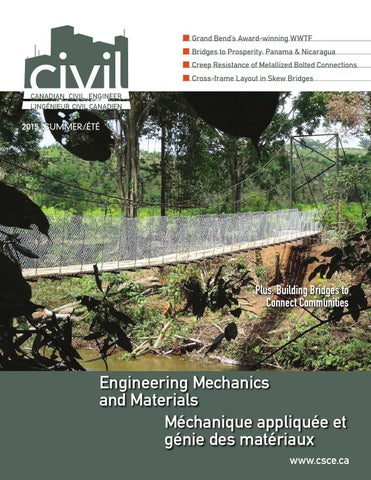
IN VIEW: PROJECTS 12 R io Abajo Footbridge in Nicaragua 14 La Conga Bridge in Panama Cover: Footbridge at La Conga, Panama. Photo by CH2M.
TECHNICAL: ENGINEERING MECHANICS AND MATERIALS TECHNIQUE: MÉCANIQUE APPLIQUÉE ET GÉNIE DES MATÉRIAUX
18 Introduction by Dan Palermo, Ph.D., P.Eng. 19 Long-term creep resistance of slip-critical bolted connections with
metallized faying surface 22 Effectiveness of cross-frame layout in skew composite concrete deck-over steel I-girder bridges 27 Expansion of concrete containing recycled concrete aggregate suffering different levels of alkali-silica reaction
FORUM ON SUSTAINABILE INFRASTRUCTURE/ FORUM SUR L’INFRASTRUCTURE DURABLE
NEWS, VIEWS & DEPARTMENTS
NOUVELLES,
POINTS DE VUE ET
DÉPARTEMENTS 4 President’s perspective/
Perspective presidentielle 6 From the regions: Saskatchewan/De nos regions, Saskatchewan 8 Student voice/La voix des étudiants 10 Young professionals corner/Le coin des jeunes professionels 11 Memoriam 30 CSCE partners and sponsors/ Associés et sponsors SCGC
16 From shared vision to certification: Grand Bend’s journey towards sustainability
16
27
12 Canadian Civil Engineer | Summer 2015
02-05 Conts-PresMess.indd 3
3
15-07-27 12:11 PM
PRESIDENT’S PERSPECTIVE | PERSPECTIVE PRÉSIDENTIELLE
Tony Bégin, P.Eng., CDP, M.A.Sc., MCSCE PRESIDENT, CSCE/PRÉSIDENT SCGC PRESIDENT@CSCE.CA
CSCE/SCGC
521-300, rue St-Sacrement Montreal, Québec H2Y 1X4 Tel.: 514-933-2634, Fax: 514-933-3504 E-mail: info@csce.ca www.csce.ca
PRESIDENT/PRÉSIDENT Tony Bégin, P.Eng., CDP, M.A.Sc., MCSCE
CANADIAN CIVIL ENGINEER/L’INGÉNIEUR CIVIL CANADIEN EDITOR/RÉDACTEUR Doug Salloum, CSCE Executive Director 514-933-2634 ext. 1, doug.salloum@csce.ca MANAGING EDITOR/ DIRECTEUR DE LA RÉDACTION Cindy Macdonald Tel.: 416-510-6755 cmacdonald@annexnewcom.ca
ASSOCIATE EDITOR/ RÉDACTEUR EN CHEF ADJOINT Bronwen Parsons Tel.: 416-510-5119 bparsons@ccemag.com
ADVERTISING SALES/ PUBLICITÉ Maureen Levy Tel: 416-510-5111 mlevy@ccemag.com
ART DIRECTOR/ COMPOSITION ARTISTIQUE Lisa Zambri Tel: 416-510-5600 x3595 lzambri@annexnewcom.ca
Annual Subscription Rates/Abonnement annuel Canada & U.S./E.U. $35.00, Other countries/Autres pays $45.00; Single copy/Un numéro $7.50; Agency discount/Rabais au distributeurs 10% PUBLICATION ISSN 9825-7515 RETURN ADDRESS/ADRESSE DE RETOUR : The Canadian Society for Civil Engineering La Société Canadienne de Génie Civil 521-300, rue St-Sacrement Montreal, Québec H2Y 1X4 Canadian Civil Engineer (CCE) is published five times per year by the Canadian Society for Civil Engineering (CSCE). L’ingénieur Civil Canadien (ICC) est publié cinq fois par année par la Société Canadienne de Génie Civil (SCGC). The opinions expressed in the papers are solely those of the authors and the Canadian Society for Civil Engineering is not responsible for the statements made in this publication. Les opinions exprimées dans les articles sont la seule responsabilité de leurs auteurs et la Société canadienne de génie civil n’engage pas sa responsabilité dans les propos exprimés. CIVIL Magazine is produced by the publishers of Canadian Consulting Engineer Magazine, published by Annex Publishing & Printing Inc. Le magazine Civil est produit par l’editeur de la publication Canadian Consulting Engineer qui est publie par Annex Publishing & Printing Inc. Annex Publishing & Printing Inc., 80 Valleybrook Drive, Toronto, Ontario M3B 2S9 Tel.: 416-442-5600; Fax: 416-510-5140 PUBLICATIONS MAIL AGREEMENT/POSTES CANADA ENREGISTREMENT #40069240
4
02-05 Conts-PresMess.indd 4
First Words
I
am truly honored and feel very privileged to represent our Society during this coming year. Thank you to my predecessors who have paved the way to facilitate the pursuit of a clear vision with strategic directions and a well-defined action plan. On behalf of the recently appointed board of directors, thanks to all of you, the members, for your trust. We, as a team, will advance the growth objectives of our organization and we will work to meet your expectations. Firstly, by making you proud, as we will continue to be seen, to be heard We dared and to be relevant. to learn, Secondly, by making a difference. Who can make this difference? It is us, it is you, it is everyone involved in this organization as a volunteer. It is all we will now about people who are only asking to be inspired, to be respected and to be learn to dare. recognized. Thirdly, by making things happen as we move from the learning phase to the action phase. We dared to learn, we will now learn to dare. To find out more about the status of our on-going initiatives, I invite you to read the strategic initiatives mid-year report card on our website: https://csce.ca/strategic-directions/ I have listed below some of the accomplishments related to our guiding principles.
Making you proud • CSCE succeeded in adding a practical case study track to the technical program of the annual conference in Regina. This new value-added practitioner-oriented content will officially remain part of the conference program in the future. • We recorded the highest participation by young professional members at our annual conference in Regina. Young professionals accounted for more than 50% of all attendees. Our investment in initiatives for the young professionals over the last few years is starting to pay off.
Making a difference • Student Chapters now have a practitioner advisor from the relevant CSCE Section who will provide support and guidance to the Student Chapter executives in managing their chapter and developing and implementing their projects. Close to 75 per cent of all Student Chapters across Canada have access to a practitioner advisor, and the volunteer student members really appreciate this link with a professional member. • A letter of commendation will be sent to the supervisors of all active volunteer members of CSCE to thank their employees for the time they dedicate to support the Society and to recognize their valuable contribution to the management of CSCE and the development and implementa-
Été 2015 | L’Ingénieur civil canadien
15-07-23 3:23 PM
PRESIDENT’S PERSPECTIVE | PERSPECTIVE PRÉSIDENTIELLE tion of our initiatives and projects. The letter will serve as a referral for the members’ involvement in external work and for their future performance evaluations.
Making things happen • The launch of a mentor and protégé program is under way. A call for mentors was published in mid-June. • CSCE student membership for all civil engineering students will be facilitated and extended for the duration of their undergraduate studies.
This initiative will be validated in the coming weeks in order to be effective at the start of the next academic year. • An associate member recruitment campaign is being prepared to reach out to all new civil engineering graduates. I welcome all new members to the Society. I hope you will find it beneficial to you and that you take advantage of all CSCE has to offer. Tony Bégin is senior director of integrated project delivery at Canam-Buildings, a division of Canam Group.
Premier message
J
e veux dire à tous les membres de la Société canadienne de génie civil combien je suis honoré et privilégié de représenter notre Société au cours de la prochaine année. Je remercie mes prédécesseurs qui ont facilité la poursuite de notre destinée avec une vision claire, des directions stratégiques ainsi qu’un plan Nous avons d’actions bien défini. Au nom de tous les membres du conseil d’adminosé savoir, istration qui ont ré élus récemment, merci à vous, le temps est les membres, pour votre confiance. Nous allons, en équipe, faire avancer les objectifs de croissance de novenu de tre organisation et nous serons à la hauteur de vos savoir oser. attentes. Premièrement, nous voulons vous représenter dignement en continuant d’être vus, d’être entendus et d’être pertinents afin que vous soyez fiers d’être membre de notre Société. Deuxièmement, nous voulons faire une différence. Qui peut faire cette différence ? C’est nous, c’est vous et tous ceux qui s’impliquent à titre de bénévoles au sein de notre organisation. Derrière toute réalisation se trouvent des personnes engagées qui ne demandent qu’à être inspirées, respectées et reconnues. Troisièmement, nous allons faire avancer les choses. Nous voulons passer de l’apprentissage à l’action. Nous avons osé savoir, le temps est venu de savoir oser. Pour connaître les détails de nos initiatives programmées à court terme, je vous invite à prendre connaissance du rapport sur notre site web https://csce.ca/fr/strategic-directions/ d’avancement de nos initiatives stratégiques en cette période de mi-année. Voici des exemples de réalisations en cours liées à nos principes directeurs.
Affirmer notre fierté • Insertion d’études de cas pratiques dans le programme des présentations techniques du congrès annuel de Régina. Ce nouveau contenu destiné aux praticiens fera officiellement partie du programme des futurs congrès.
Canadian Civil Engineer | Summer 2015
02-05 Conts-PresMess.indd 5
• Participation la plus importante des membres jeunes professionnels qui représentent plus de 50% des délégués du congrès annuel de Régina. L’investissement dans nos initiatives destinées aux jeunes professionnels commence à porter fruit.
Faire la différence • Les chapitres étudiants de la SCGC ont maintenant à leur disposition un conseiller praticien de la section de la SCGC qui apporte aux dirigeants du chapitre étudiant son support et ses orientations dans la gestion de leur chapitre et la conduite de leurs affaires. Ce sont 75% des chapitres étudiants qui en sont pourvus. Les membres étudiants apprécient grandement ce lien avec un membre professionnel que nous avons mis en place. • Des lettres de félicitations seront transmises aux superviseurs de tous les membres bénévoles actifs de la SCGC afin de les remercier pour le temps que leurs employés consacrent à la Société et de reconnaître leur contribution à la gestion de la SCGC et à l’élaboration et la mise en œuvre de nos initiatives. Ces lettres serviront de référence pour leur implication dans des travaux externes et pour l’évaluation de leur performance.
Faire avancer les choses • Un programme de mentors et protégés sera lancé prochainement. Un appel aux mentors fut publié à la mi-juin. • L’adhésion à la SCGC des membres étudiants sera facilitée et couvrira la durée de leurs études du premier cycle. Cette initiative sera validée dans les semaines à venir afin qu’elle prenne effet à la prochaine rentrée universitaire. • Une campagne de recrutement de membres associés est en préparation afin de tendre la main à tous les nouveaux diplômés. Je souhaite la bienvenue à la Société aux nouveaux membres. J’espère que votre adhésion vous sera bénéfique et que vous tirerez profit de tout ce que la SCGC a à vous offrir! Tony Bégin est directeur senior, réalisation de projets intégrés pour Canam-bâtiments, une division de Groupe Canam.
5
15-07-23 3:23 PM
FROM THE REGIONS: SECTION NEWS | DE NOS RÉGIONS : NOUVELLES DES SECTIONS
Another Successful Student and Young Professionals Program
Un autre succès pour le programme des jeunes professionnels et des affaires étudiantes Katelyn Frecon,
Katelyn Frecon,
COORDONNATRICE DU PROGRAMME DE CONFÉRENCE DES JEUNES PROFESSIONNELS
YOUNG PROFESSIONALS CONFERENCE PROGRAM COORDINATOR
Amie Therrien, COORDONNATRICE DES AFFAIRES ÉTUDIANTES ET DES JEUNES PROFESSIONNELS DE LA SCGC
C
ette année en fut une des plus excitantes pour le programme des Jeunes professionnels et des Affaires étudiantes lors du congrès Amie Therrien, annuel de la SCGC. Il y a plus d’étudiants et de jeunes professionSTUDENT AND YOUNG PROFESSIONALS nels au congrès que de membres titulaires! Le programme destiné aux PROGRAM COORDINATOR, CSCE étudiants et aux jeunes professionnels comprenait un certain nombre d’évènements de réseautage et de nature technique, lesquels comhis year was an exciting year for the student and young profes- plétaient bien les activités régulières du congrès. sionals program at the CSCE annual conference. There were Lors de la soirée de mercredi, nous avons assisté à la réception du more students and young professionals at the conference than regu- Président pour les étudiants et les jeunes professionnels. Le président lar members! The program for students and young professionals was sortant Reg Andres, ainsi que le nouveau président Tony Begin, se comprised of a number of technical and networking events which sont tous deux adressés aux invités. Nous avons ensuite été rejoints complement the regular conference proceedings. par le reste des participants pour assister à la réception de bienvenue. Suivant la réception de bienvenue, il y a eu la Soirée Pub, au Fat BadContinued on top of page 7 ger, un établissement de la région. Jeudi soir, comme alternative à Sustainability workshop. / Atelier sur la durabilité. l’activité sociale, nous avons mangé au Crave Kitchen and Wine Bar avant d’aller traîner au centreville de Regina pour assister à un excitant jeu de course du genre « Amazing Race ». Le jeu s’est terminé à la Victoria’s Tavern. La journée de vendredi fut très occupée. En matinée eut lieu le concours Capstone destiné aux étudiants de premier cycle. Le concours fut suivi par le dîner de remise des prix, au cours duquel des étudiants se voient reconnaître pour leur dur labeur autant durant l’année scolaire qui vient de s’écouler que durant la tenue du
Photo: Katelyn Frecon
T
6
06-11 News.indd 6
Été 2015 | L’Ingénieur civil canadien
15-07-23 3:24 PM
On Wednesday night, we attended the president’s reception for students and young professionals. Both outgoing president Reg Andres and incoming president Tony Begin addressed the attendees. We were then joined by the rest of the conference for the welcome reception. Following the welcome reception, there was a pub night at the Fat Badger, a local establishment. On Thursday night as an alternative to the social night, we ate at Crave Kitchen and Wine Bar before scavenging downtown Regina for an exciting “Amazing Race” game. The game wrapped up at Victoria’s Tavern. Friday was a busy day. In the morning, there was the Capstone Competition for the undergraduate students. This was followed by the student awards luncheon, where students were acknowledged for their hard work both throughout the previous school year and during the conference. Following the student awards luncheon was the student leaders workshop. Meanwhile, there was an interactive sustainability workshop led by Reg Andres. Participants looked at the challenges and barriers that must be addressed in order to implement a sustainability rating system for infrastructure in Canada. Friday night included supper and a brewery tour at Bushwakker Brew Pub, followed by a second brewery tour at Rebellion Brewing, both local businesses. On Saturday morning, the young professionals held their committee meeting, which was open to all YPs attending the conference. We discussed regional and national challenges encountered by the Young Professionals Committee, and reviewed how they might be overcome. That night, we enjoyed supper at the Rooftop Bar and Grill followed by SaskRoots Night at the Exchange.
congrès. Le dîner fut suivi par l’atelier des leaders étudiants. Pendant ce temps se déroulait un atelier interactif sur la durabilité animé par Reg Andres. Les participants ont discuté des défis et des obstacles qui doivent être affrontés afin de mettre en œuvre un système de notation de la durabilité pour les infrastructures canadiennes. Vendredi soir fut le théâtre d’un souper et d’une dégustation de bières se déroulant au Bushwakker Brew Pub, suivi d’une seconde dégustation de bières au Rebellion Brewing, deux brasseries locales. Samedi matin, les jeunes professionnels ont tenu la réunion de leur comité, laquelle était ouverte à tous les JP assistant au congrès. Nous avons discuté des défis régionaux et nationaux rencontrés par le comité des jeunes professionnels et avons analysé comment nous pouvons les relever. Ce soir là, nous avons profité d’un excellent souper au Rooftop Bar and Grill, suivi de la soirée SaskRoots à la discothèque The Exchange.
Canadian Civil Engineer | Summer 2015
06-11 News.indd 7
THE PIPE THAT FITS IN SO MANY WAYS.
NovaForm PVC Liner TM
The sewer & culvert rehabilitation solution in the sizes you need.
Aging sewer and water infrastructure has led to ever increasing maintenance costs for municipalities. The engineers at IPEX recognized this development and responded with NovaForm PVC Liner, a product that brings the benefits of factory-made PVC pipe to the North American trenchless pipe rehabilitation industry.
A Size for Every Job Available in the sizes you need: 6” to 30” and industrystandard dimension ratios DR 35 and DR 41.
Durability of PVC Useful life of 100 years, plus excellent chemical resistance properties.
Consistent Production Factory-made, quality-controlled and tested to stringent ASTM standards.
Peace of Mind IPEX has been a leading manufacturer of PVC piping systems for more than 50 years and developing trenchless PVC solutions for the past 20 years. Plus, we back everything we sell with in-field technical support throughout North America.
To learn more, call us toll free at 1-866-473-9462 or visit www.ipexinc.com NovaFormTM is manufactured by IPEX Inc.
7
15-07-23 3:24 PM
THE STUDENT VOICE | LA VOIX DES ÉTUDIANTS
Students Achieve Success and Progress at All Levels By Charles-Darwin Annan, Ph.D, P.Eng. CHAIR, CSCE STUDENT AFFAIRS COMMITTEE
W
ell, they say there is strength in partnership. Once again, with the collaboration of our Student Chapters, faculty and practitioner advisors, as well as the local CSCE Sections, the Student Affairs Committee recorded another hugely successful school year in 2014/2015. I would like to congratulate everyone who was involved, one way or another, in writing this success story. Remarkable progress was made building on the high level of interaction that we started in the previous year. We made significant progress in our online student membership registration, and we provided more support, encouragement and resources to help individual Student Chapters remain dynamic and maintain a sense of purpose. Collectively, we increased support for student participation in the National Capstone Competition and the national student leaders workshop held during the annual conference in Regina. Congratulations to UBC Vancouver for winning the President’s Award for Outstanding Student Chapter. Western and BCIT scooped second and third places, respectively. Dalhousie and UBC Okanagan were judged as the most improved Chapters and the honourable mention went to Lakehead. Congratulations also go to the winners of CSCE’s various competitions. Polytechnique Montreal won the National Capstone Design Competition, with UBC Okanagan and Western taking second and third places, respectively. The University of Calgary took first place in the Concrete Toboggan Race; Cégep de Chicoutimi had the best structure in the Troitsky Bridge Building Competition; and Universi-
té Laval won the National Concrete Canoe Competition. There are individual students of note as well. Congratulations to: James Bomhof from University of Ottawa for winning the CSCE Hydrotechnical Engineering Award; Nathan Bruce from University of Regina for winning the Student Paper Competition; and Maxime Ampleman from Laval University for winning the Best Overall Student Paper Award in Engineering Mechanics and Materials. Now, with a new school year comes a new opportunity to build on our previous success and explore new and exciting opportunities. Our programs will continue to address key aspects of students’ personal and professional development, such as self-reliance, leadership, decision-making, ethical behaviour, communication and teamwork, to complement their academic development. We will continue to offer exciting and stimulating programs to provide excellent networking opportunities for students, both regionally and nationally. We will engage the local CSCE Sections to participate in and provide support to Student Chapter activities. We will make student membership benefits more tangible and relevant. This is the time to get involved. This is the time to make your student membership count and be part of a rewarding experience. Get involved with your CSCE Student Chapter today and begin those lifelong and valuable professional contacts. Dr. Charles-Darwin Annan is an associate professor of civil engineering at Université Laval and can be reached at Charles-darwin.annan@gci. ulaval.ca
Les étudiants ont du succès à tous les niveaux Par Charles-Darwin Annan, Ph.D, P.Eng. PRÉSIDENT, COMITÉ DES AFFAIRES ÉTUDIANTES DE LA SCGC Students leaders from the UBC Vancouver Student Chapter receiving the President’s Award from CSCE past-president Reg Andres./Leaders étudiants du chapitre étudiant de UBC Vancouver recevant le prix du Président de la part de Reg Andres, président sortant de la SCGC.
8
06-11 News.indd 8
N
e dit-on pas qu’un bon partenariat renforce toujours les partenaires impliqués ? Une fois encore, grâce à la collaboration de nos chapitres étudiants, des facultés et des conseillers professionnels, ainsi que des sections locales de la SCGS, le comité des Affaires
Été 2015 | L’Ingénieur civil canadien
15-07-23 3:24 PM
THE STUDENT VOICE | LA VOIX DES ÉTUDIANTS étudiantes a enregistré une autre année scolaire phénoménale remplie de succès en 2014-2015. J’aimerais féliciter toutes les personnes concernées, qui ont contribué d’une façon ou d’une autre à ce succès grandiose. Parmi les progrès remarquables, on compte le développement d’un niveau élevé d’interaction, développement qui fut débuté l’année précédente. Nous avons fait d’importants progrès au niveau de l’inscription en ligne des membres étudiants et nous avons fourni davantage de soutien, d’encouragement et de ressources afin d’aider les différents chapitres étudiants à demeurer dynamiques et à maintenir l’accent sur un objectif commun. Collectivement, nous avons augmenté le soutien destiné à la participation étudiante au sein du concours national Capstone et de l’atelier des leaders étudiants tenu au cours du congrès annuel de Regina. Félicitations à UBC Vancouver pour avoir remporté le prix du Président remis à un chapitre étudiant exceptionnel; l’Université Western et la BCIT ont terminé respectivement en deuxième et troisième places. L’Université Dalhousie et UBC Okanagan ont été nommés les chapitres s’étant le plus améliorés et une mention honorable a été accordée à Lakehead. Sincères félicitations également aux gagnants des divers concours de la SCGC. L’École Polytechnique de Montréal a remporté le concours national de conception Capstone, alors que les deuxième et troisième places sont allées à UBC Okanagan et à l’Université Western. L’Université de Calgary a pris la première place de la course de toboggan en béton; le Cégep de Chicoutimi a démontré la meilleure structure lors du concours de construction de pont Troitsky; et l’Université Laval a remporté le concours national de canoë de béton.
Certains étudiants sont également à l’honneur. Félicitations à : James Bomhof de l’Université d’Ottawa pour avoir remporté le Prix d’excellence en génie hydrotechnique de la SCGC; Nathan Bruce de l’Université de Regina, grand gagnant du concours de la communication étudiante; et Maxime Ampleman de l’Université Laval pour avoir remporté le Prix de la meilleure communication étudiante en mécanique appliquée et génie des matériaux. Avec la nouvelle année scolaire vient une nouvelle occasion de perpétuer nos succès précédents et d’explorer de nouvelles opportunités excitantes. Nos programmes continueront à traiter des aspects clés du développement personnel et du perfectionnement professionnel des étudiants, tels que l’autonomie, le leadership, les prises de décision, le comportement éthique, la communication et le travail d’équipe, afin de bien compléter leur formation universitaire. Nous continuerons à offrir des programmes excitants et stimulants visant à fournir d’excellentes occasions de réseautage pour nos étudiants, aussi bien au niveau régional que national. Nous demanderons aux sections locales de la SCGC de participer à ce réseautage et de fournir un soutien lors des activités des chapitres étudiants. Nous rendrons plus tangibles et pertinents les avantages d’être membre étudiant. Voici le moment de s’impliquer. Il est temps pour vos membres étudiants de faire une différence et de faire partie d’une expérience enrichissante. Impliquez-vous auprès de votre chapitre étudiant de la SCGC dès aujourd’hui et commencez à établir des contacts professionnels significatifs et durables. Le Dr. Charles-Darwin Annan est professeur adjoint en génie civil à l’Université Laval et on peut le joindre au Charles-darwin.annan@gci. ulaval.ca
WE DO IT ALL
CORROSION PROTECTION & SEALING SYSTEMS YOU CAN DEPEND ON
Extend Structure Life, Reduce Maintenance & Repair Costs • for industrial steelwork, pipework & road surfaces • above & below ground pipe, valves, fittings & steel • offshore marine piling protection • road, bridge, airport & asphalt applications A member of Winn & Coales International.
Canadian Civil Engineer | Summer 2015
06-11 News.indd 9
www.densona.com Toronto • Edmonton Denso North America Inc. 90 Ironside Cres. Unit 12 Toronto, ON M1X 1M3 Tel: 416.291.3435 Fax: 416.291.0898
9
15-07-23 3:24 PM
R.V. Anderson Associates Limited appoints new President and Vice President
YOUNG PROFESSIONALS’ CORNER | LE COIN DES JEUNES PROFESSIONELS
Greetings from the New CSCE YP Chair
Shawn N. Scott, P.Eng. President & CEO Shawn Scott, P.Eng. was appointed as the President & CEO of R.V. Anderson Associates Limited by the firm’s Board of Directors in April 2015. Through the past 24 years of service, Shawn has developed a proven record of operational leadership, strategy development, customer service, team building, financial management, and relationship management. As Vice President of Regional Operations for the past six years, Shawn provided corporate oversight and leadership for RVA’s eight Canadian branch offices. Through this role, he has been involved in many of the firm’s marquee projects. RVA’s culture of ownership and service excellence will continue under his direction.
Vincent L. Nazareth, P.Eng. Vice President Vincent Nazareth P.Eng. was appointed as a Vice President of R.V. Anderson Associates Limited by the firm’s Board of Directors in April 2015. Over the past 28 years with RVA, Vincent has developed an extensive wastewater portfolio, with special expertise in biosolids. He became the firm’s Manager of Municipal Wastewater in 2002 and a Principal of firm in 2006. His experience includes many of the firm’s key wastewater projects, both in Canada and overseas. In his new role, he will be focussing on international ventures, as well as expanding our domestic wastewater capabilities. Internally, he will also provide corporate leadership for critical areas related to human resources and information technology.
toronto niagara ottawa sudbury london moncton fredericton st. john’s mumbai www.rvanderson.com
10
06-11 News.indd 10
Canadian Civil Engineer 2.375” x 10” July 2015
Bernard Moulins CHAIR, YOUNG PROFESSIONALS COMMITTEE, CSCE
The position of chair for the CSCE Young Professionals Committee is an exciting opportunity, presenting unique insight into the professional lives of young civil engineers across Canada. Nigel Parker, my predecessor, leaves behind an ever growing team of YP representatives throughout the country. Under Nigel’s tutelage, CSCE has come to occupy an ever more important role in the professional lives of the next generation of civil engineers. CSCE has helped provide guidance, build networks, provide training and education, as well as offer a social setting to meet friendly peers. My involvement in CSCE stems back to McGill University in 2010, but my work as vicechair of this committee since 2013 has been especially enriching. Nigel and his team of representatives have laid a strong foundation for the YP group. I am confident that over the upcoming years we will succeed in building a larger following among young civil engineers, allowing us to offer ever greater support and advantages to our members. Entering this new position, I look forward to future growth and challenges, but must first thank Nigel for his past efforts and successes.
Salutations de la part du nouveau président des JP de la SCGC Bernard Moulins PRÉSIDENT, COMITÉ DES JEUNES PROFESSIONNELS, SCGC
Le poste de président du comité des jeunes professionnels de la SCGC s’avère une occasion excitante de profiter d’une perspective unique au cœur de la vie professionnelle des jeunes ingénieurs civils à travers le Canada. Nigel Parker, mon prédécesseur, m’a légué une équipe en pleine croissance constituée de représentants des JP provenant de partout au pays. Sous la tutelle de Nigel, la SCGC en est venue à remplir un rôle toujours plus important dans les vies professionnelles de la prochaine génération d’ingénieurs civils. La SCGC a contribué à tracer les orientations, à développer des réseaux, à fournir une formation et un enseignement, ainsi qu’à offrir un cadre social permettant de rencontrer les pairs. Mon implication avec la SCGC remonte à 2010, lorsqu’étais à l’Université McGill, mais mon travail comme vice-président de ce comité depuis 2013 a été tout particulièrement enrichissant. Nigel et son équipe de représentants ont jeté des assises solides pour le groupe des JP. Je suis sûr qu’au cours des années à venir, nous réussirons à susciter davantage d’intérêts de la part des jeunes ingénieurs civils, nous permettant ainsi d’offrir encore plus de soutien et d’avantages destinés à nos membres. Au moment où je prends les commandes de ce poste, j’entrevois une croissance et des défis à venir, mais je dois avant tout remercier Nigel pour les efforts déployés et les succès qu’il a obtenus.
Été 2015 | L’Ingénieur civil canadien
15-07-23 3:24 PM
ELS
MEMORIAM |
Martin Cunnick Jones (1934-2015)
tation Canada Ltd., where he progressed to vice-president. In 1986, Jones opened his own firm, Groundation Engineering Contractors, and worked across Canada, from SCE National Office regrets to inform Yellowknife to James Bay, Ungava Bay and members that Martin Jones, P.Eng, many other remote areas of northern OntarFCSCE, O.N., past-president of the Society, io. As well, he contributed his expertise to passed away on April 6, 2015, in Oakville, many jobs in the Toronto and Ottawa areas, such as the Hockey Hall of Fame, the CN Ontario. Jones is pre-deceased by his wife Jennifer. Tower, the Parliament Building tunnels, and He is survived by his four children and their bridges. From 1991-92, Jones was president of the families, Russell (Dolores), Clare (Grant), Neil (Tanya) and Andrew (Filiz), and nine Canadian Society for Civil Engineering. Following his retirement, Jones dedicated grandchildren, all of whom he loved dearly. Born August 5, 1934, in Peterborough, En- much of his time to his church, St. Hilda’s, gland and raised in Essex, Jones became a top in Oakville. He enjoyed helping individuals athlete in 400-m running competitions. He in need by delivering food supplies to the less graduated from Chigwell School and then fortunate, and volunteered his time to meet the University of London (Queen Mary Col- with troubled youth. He was the recipient of lege) as a civil engineer. He and his family the Order of Niagara, granted by the Anglican Diocese of Niagara. emigrated to Canada in 1969. Jones struggled with Alzheimer’s for the Jones worked for Wimpey Canada upon AlumaBridge Half Pg Ad_CM.pdf 1 7/10/15 3:20 PM years. his arrival. In 1971, he moved to Cemen- past five
C
CALL FOR CASE STUDIES - 2015 The editors of CIVIL magazine invite CSCE-CSGC members to submit case studies for possible publication in future issues. Projects submitted should should demonstrate technical innovation in structural/civil engineering, project management or other engineering expertise. Submit a brief summary of 700 words (in English or French), plus two or three images, to: Bronwen Parsons, Associate Editor, CIVIL. e-mail bparsons@ccemag.com, Tel. 416-510-5119.
AlumaBridge Advantages: • Corrosion resistance • Weight neutral to steel open grid decks • Skid-resistant wearing surface • Prefabricated panels for quick installation • Environmentally friendly
DEMONSTRATION PROJECTS INVITED Deck installed in 30 minutes
Generation II AlumaBridge decking is now available. Time-proven technology delivers substantial savings in time and money.
For more information and must-see video go to www.alumabridge.com Includes wearing surface
TOLL-FREE: 855.373.7500
® North American Distributor
Canadian Civil Engineer | Summer 2015
06-11 News.indd 11
11
15-07-23 3:24 PM
Buckland & Taylor
IN VEW: PROJECTS | PROJETS EN VEDETTE
Rio Abajo Footbridge
A team of Canadian engineers was part of a Bridges to Prosperity project that helped a community in Nicaragua by replacing a bridge destroyed by Hurricane Mitch.
By Hendrik Westerink, EIT BUCKLAND & TAYLOR
T
he 3,000 residents of Rio Abajo in Nicaragua are celebrating a safe and reliable way to cross the Rio (River) Pueblo Nuevo for the first time in more than 16 years, thanks to the completion of a new suspension pedestrian bridge. Hurricane Mitch destroyed an existing bridge in 1998, severely limiting the community’s access to secondary schools, hospitals and government services in the nearby town of Pueblo Nuevo during the rainy season. The new footbridge restores year-round access across the river, and was built as a collaboration between the local government, non-profit organization Bridges to Prosperity, Canadian bridge engineering firm Buckland & Taylor, and contractor Kiewit Bridge & Marine.
Design and construction The new footbridge, based on Bridges to Prosperity’s standard suspension bridge design, spans 81 metres over the Rio Pueblo Nuevo. Its 9-metre tall steel pipe towers are founded on reinforced concrete
12
12-13 Case StudyRio.indd 12
and masonry abutments. The main suspension cables, each containing three sheathed post-tensioning strands, anchor into an at-grade reinforced concrete transition segment that transfers the cable loads to a buried anchor block. Steel bar hangers, which were bent on-site to defined lengths to control the bridge geometry, attach to double angle steel floor beams to carry permanent, pedestrian, and wind loads from the deck to the main cables. The 1-metre wide walking surface comprises planks cut from tempisque — a local Nicaraguan hardwood tree. Cast-in-place concrete ramps provide pedestrians with access to the bridge. The build team used a scaffolding tower at each abutment to erect and temporarily support the steel towers until the suspension cables were set and anchored. Hanger rod assemblies were installed using pull cables that run along the main suspension cables and ensure the hanger rods are spaced correctly. The bridge was completed by installing deck planks and fencing to provide a safe crossing.
Été 2015 | L’Ingénieur civil canadien
15-07-23 3:25 PM
IN VEW: PROJECTS | PROJETS EN VEDETTE The entire superstructure was successfully constructed without any cranes or mechanical work platforms in just eight construction days, using only light power tools. Working alongside the Buckland & Taylor and Kiewit staff, volunteers from the community played an important role in the timely completion of the bridge.
Partnering for success Bridges to Prosperity (B2P), the coordinator of the project, was founded in 2001 to address the global need for safe and reliable footbridge access across otherwise-impassable rivers. Over the past 14 years, B2P has partnered with local communities and teams of student and corporate volunteers to build more than 160 bridges in 18 countries. The organization trains local masons, construction managers and engineers as part of their program to maximize the long-term sustainability of the bridges they build. Buckland & Taylor, a COWI North America company headquartered in North Vancouver, is no stranger to challenging cable-supported bridge projects. The company’s list of notable projects includes the suspended structure replacement of the Lions’ Gate Bridge in Vancouver, the design of North America’s first extradosed bridge, the North Arm Bridge in Vancouver, and most recently the main span design of the New NY (Tappan Zee) Bridge in the U.S. Buckland & Taylor’s involvement with the Rio Abajo project began in 2014 when a group of junior engineers approached company management with a proposal to join the Bridges to Prosperity corporate
partnership program. The proposal was accepted, and Buckland & Taylor became a partner in the Rio Abajo project by sponsoring a portion of the construction materials and conducting a design review of the structure. Once the bridge foundations and anchors had been constructed by Rio Abajo residents and B2P staff, the Buckland & Taylor team of Hendrik Westerink, Terrence Davies, Kali Dickerson and vice-president of major projects and senior project director Don Bergman travelled to Nicaragua for two weeks in March 2015 with Kiewit Bridge & Marine employees to construct the bridge superstructure. Each team member was profoundly and positively impacted by their experience in Rio Abajo. Bergman, speaking at the bridge inauguration ceremony, remarked: “I’ve worked on many larger bridges around the world, but none have provided the sense of joy and satisfaction that the Rio Abajo bridge has.” Hendrik Westerink, EIT, is a junior bridge designer at Buckland & Taylor in North Vancouver. For more information on the project visit www.COWI-NA.com and www.BridgesToProsperity.org. OWNER: Community of Rio Abajo and Municipality of Pueblo Nuevo PROJECT COORDINATOR: Bridges to Prosperity PROJECT PARTNERS: Buckland & Taylor (Don Bergman, P.Eng., Hendrik Westerink, E.I.T., Terrence Davies, P.Eng., Kali Dickerson, E.I.T.) and Kiewit Bridge & Marine OTHER KEY PLAYERS: Indenicsa (steel fabricator)
Opposite: Children from the community venture across. Below: Footbridge under construction. The completed bridge spans 81 metres from
Buckland & Taylor
9-metre tall steel pipe towers. The walking surface consists of planks of a local hardwood tree.
Canadian Civil Engineer | Summer 2015
12-13 Case StudyRio.indd 13
13
15-07-23 3:25 PM
IN VEW: PROJECTS | PROJETS EN VEDETTE
LA CONGA BRIDGE IN P By CH2M Foundation
Volunteers from CH2M helped to build a suspension bridge over a treacherous river, giving an isolated community safe passage to schools and medical services.
F
elicita’s 50-year-old son drowned while attempting to cross the Trinidad River in Panama. During the rainy season, the river floods for days, making it impossible for residents of La Conga and La Florida to cross. In the summer of 2014, 11 CH2M employees helped to build a 45-metre long suspension bridge that connected these communities to the nearby municipal town of Capira, west of Panama City. The bridge created safe passage for 200 people to access schools, medical clinics, commercial markets and farmland in 15 minutes instead of a four-hour round trip. According to the World Bank, more than 900 million people lack year-round, reliable road access, and 300 million lack access to the rest of their country. Basic services are often located far from where people live, and river crossings can become perilous or even life threatening during rainy seasons, requiring travelers to find another route. Since travel by foot is most common, it may take hours to reach necessary services. The CH2M Foundation’s collaboration with the nonprofit Bridges to Prosperity is helping isolated rural communities to build footbridges over impassable rivers, improving community access to services, markets and jobs.
It takes a village to build a bridge together The collaboration began before the volunteers arrived in Panama. Many community members donated time and materials and completed the side tower foundation pours beforehand. CH2M didn’t just send money and walk away, though. In addition to financial support from the CH2M Foundation, employee volunteers from across the globe shared their technical expertise on the ground with the local people and Bridges to Prosperity employees and volunteers — to build the bridge together. “In my entire life, I have never been a part of a team as amazing as the Bridges to Prosperity-La Conga team,” says project manager Reece Bishop, a CH2M engineer from Calgary. “We had people from the U.S., Canada, England, Australia, UAE, Panama, and Nicaragua with different skills and languages — kind, fun, passionate and won-
14
14-15 CasestudyLaConga.indd 14
derful people who understood the impact we were making on the lives of those in La Conga. This made my role as project manager as easy as possible. No matter how mundane the task, everyone got to work and did whatever was needed to ensure we left the people of La Conga with a safe path to a more prosperous future.” The team built a suspension bridge from approximately 115 wooden boards, 45 crossbeams, 90 rebar suspenders, and 800 metres of steel cable — in just eight days — under continuously changing conditions. Beyond technical challenges, bringing together worldwide team members to a Central American country involved sharing different cultures and backgrounds. Team members speak of the humbling experience of working with the local communities and the pleasure of giving back. They faced day-to-day challenges, such as plentiful bugs, roosters crowing at 3:15 a.m., high humidity and rain downpours, and uncooperative trees.
A life changing experience Beyond the rewarding aspects of providing safe access for the villagers in this life-changing experience, the volunteers built their leadership, teamwork, project management, design, and construction skills. They also improved their communication, networking, and Spanish proficiencies. (As this article goes to press, another CH2M-Bridges to Prosperity team is helping another community, building a 60-metre-long suspension bridge in Gasabo-Gasura, Rwanda.) On July 5, 2014, 90-year-old Felicita, honorary grandmother of La Conga, had the honour of cutting the ribbon, marking the bridge’s official opening. After hearing her stories and learning how her son died trying to cross the river, the bridge-building team felt deeply honoured to play a role in giving her the early birthday gift of knowing that her children, grandchildren, and community will not be in danger again crossing the Trinidad River. Her two daughters-inlaw took Felicita’s arms and led her across the bridge that she never thought she would see in her lifetime. The 45-metre-long La Conga suspension bridge will never grace the history books, but it is critical to the 200 community members who now have a safe, efficient way to reach school, health clinics,
Été 2015 | L’Ingénieur civil canadien
15-07-23 3:25 PM
and markets. Every volunteer who played a small role in building the bridge has been touched deeply by this experience. Not only did it stretch them outside their comfort zones and bridge new relationships, but it will also be one of the most meaningful projects in their careers. For more information, visit http://bridgestoprosperity. org/wherewework/central-america/panama/la-conga 
CH2M
N PANAMA
IN VEW: PROJECTS | PROJETS EN VEDETTE
OWNERS: Communities of La Conga and La Florida, Panama PROJECT COORDINATOR: Bridges to Prosperity PROJECT MANAGEMENT: CH2M Foundation Canadian participants: Reece Bishop, EIT (project CH2M
manager), Kimberly Weston-Martin (safety)
Top: The finished bridge across the Trinidad River, which floods during the rainy season and was impassable. Middle: 90-year-old Felicita, had the honour of cutting the ribbon, marking the bridge’s official opening. She told of how her son had died trying to cross the
Bottom: Members of the community and the CH2M and Bridges to Prosperity team.
Canadian Civil Engineer | Summer 2015
14-15 CasestudyLaConga.indd 15
CH2M
treacherous river.
15
15-07-23 3:25 PM
SUSTAINABLE INFRASTRUCTURE | LES INFRASTRUCTURES DURABLES
From Shared Vision to Certification: GRAND BEND’S JOURNEY TOWARDS SUSTAINABILITY A number of key decisions were influenced by the project team’s use of the Envision sustainability rating system. By Melissa Peneycad, MES, ENV SP; Gary Deonarine, P.Eng., PMP, ENV SP; Elvio Zaghi, MBA, P.Eng. STANTEC CONSULTING
wastewater treatment facility will flow into a constructed wetland, providing a new micro-ecosystem.
T
he community of Grand Bend in the southwestern part of Ontario – a popular tourist destination due to its long expanses of pristine beaches and its small-town charm – had a problem: malfunctioning septic systems and discharges from the area’s sewage treatment lagoons were adversely affecting surface and groundwater quality, and recreational beach water quality. This was considered a significant risk not only to residents, but also to local businesses, the tourism industry, and Lake Huron – the area’s most important natural and recreational asset. The community’s member municipalities, Lambton Shores, South Huron, and Bluewater, undertook a sewage servicing master plan, the results of which indicated that the existing sewage lagoons needed expansion and upgrades. Then, the municipalities commenced a Municipal Class Environmental Assessment (a requirement in the province) to investigate how best to replace the existing lagoons. Ultimately, nearly
16
16-17 SustainableInf.indd 16
Photo: Stantec
Treated effluent from the Grand Bend Area
$16 million in grant funding was secured to construct a new wastewater treatment facility. In 2008, the municipalities commissioned the design of a new treatment plant to replace the aging facility in order to meet the community’s current wastewater servicing needs, and to meet projected wastewater treatment demands. Excessive budget overruns ultimately forced the municipalities to halt the project and look for new ideas to reduce the project’s construction cost of $23.2 million – an amount that far exceeded the municipal budgets combined with grant funding received. Five years later, after the original design concept had been abandoned, Stantec Consulting was commissioned by the municipalities to pursue a new design for the facility. From the outset, the design team saw value in pursuing the facility redesign using the Envision sustainable infrastructure framework and rating system to meet the shared vision for a more
Été 2015 | L’Ingénieur civil canadien
15-07-23 3:26 PM
Photo: Stantec
SUSTAINABLE INFRASTRUCTURE | LES INFRASTRUCTURES DURABLES affordable, flexible, and resilient design, one that would enhance quality threatened native bird, turtle, fish, and plant species; walking trails of life and the area’s ecological assets. To effectively use the Envision accessible to the public; and educational materials and programs desystem, a sustainability sub-group was formed. This group was com- livered to school groups through conservation organizations and local prised of the project manager; discipline leads from all major disciplines school boards. To encourage visits by the public and school groups, including civil, mechanical, structural, and electrical; and an “Envision a parking lot and informational signage was incorporated into the facilitator,” a sustainability specialist with the Envision Sustainability design. This one decision – what to do with the excavated pits – ultiProfessional (ENV SP) designation who has intimate knowledge of the mately led to the enhancement of public space; ongoing stakeholder system and how best to use it to inform design choices. This multi-dis- involvement; the diversion of waste from landfills; the reduction of ciplinary team used Envision to challenge assumptions and the status excavated materials taken off-site; the restoration of aquatic wetlands; quo, and to look at the design process through a new lens, an approach and the preservation of species biodiversity. All of these are key asthat ultimately led to a cost-effective and sustainable solution for the pects included within the Envision framework. Preserving prime farmland and greenfields was community. another key decision spawned by the use of the The Envision system is a collaboration beEnvision framework. While the original design tween the Institute for Sustainable InfrastrucFrom the outset, the design for the facility required the acquisition of new ture and the Zofnass Program for Sustainable land, the re-design focused on containing deInfrastructure at the Harvard University Graduteam saw value in pursuing the velopment within the boundaries of the existing ate School of Design. It establishes a framework facility redesign using the sewage treatment lagoon property. for planning, designing, evaluating, and rating Also, the use of Envision helped the project civil infrastructure projects of all types and sizes Envision sustainable team to identify ways to reduce construction and against the needs and values of the community. operations and maintenance costs throughout The system evaluates the economic, social, and infrastructure framework and the project’s life-cycle by focusing on efficiency: environmental costs and benefits of infrastrucrating system to meet the shared reducing energy consumption, reducing potable ture projects across five key categories: quality water consumption in process applications, reof life, leadership, resource allocation, natural vision for a more affordable, ducing materials costs by identifying and pursuworld, and climate and risk. Envision provides ing opportunities to use unwanted by-products infrastructure owners, designers, and policy flexible, and resilient design, from nearby operations, and choosing a pre-enmakers with a consistent, objective, and holistic gineered building for the facility’s main structure. infrastructure planning and design framework one that would enhance The design team also focused on improving that not only recognizes and rewards significant quality of life and the area’s the flexibility and resiliency of the re-design. The innovation and improvements to the sustainable new design is, for example, highly responsive to performance of infrastructure projects, but also ecological assets. changes in inflow from summer peaks caused by makes restoration an explicit goal. Applying Enan influx of tourists and cottagers in comparison vision to the planning and design process aided to winter low flow conditions. And, from a resilthe project’s design team to not only identify the best solution to meet the present and future needs of the community, iency perspective, the wastewater treatment facility is designed to withbut also how best to design the chosen solution for the Grand Bend Area stand short-term hazards and contains sufficient adaptive capabilities to Wastewater Treatment Facility in terms of its technical performance and maintain proper function in an altered future state brought on by, for economic, social, and environmental attributes. example, climate change that can lead to changes in temperature, precipitation levels, and extreme weather events such as flooding. The re-design, and the sustainability aspects included within it, were On-site excavation spawned the idea for wetlands A number of key decisions were influenced by the team’s use of En- very well received by the client as the central tenets of the shared vision vision. For example, the project team recognized that retrofitting the were effectively captured: affordability, flexibility, resiliency, sustainabiliexisting sewage lagoons to suit the re-designed facility required a con- ty. In early 2015, the Grand Bend Area Wastewater Treatment Facility siderable volume of fill. Excavation of two large pits to be used as earned the Envision Platinum award from the Institute for Sustainable on-site fill spawned the idea for a wetland. Treated effluent from the Infrastructure in Washington, DC. This is the highest honour bestowed wastewater treatment facility would flow into this constructed wet- by the organization. The project is the first in Canada to become Enviland, providing a new micro-ecosystem. An array of educational and sion-verified, and is also the first wastewater facility in North America to environmental special interest groups were consulted by the project earn an Envision award. Construction of the facility has commenced, team and the idea for this wetland grew to include a nature reserve for and the facility is expected to be operational in early 2016.
Canadian Civil Engineer | Summer 2015
16-17 SustainableInf.indd 17
17
15-07-23 3:26 PM
FROM THE TECHNICAL EDITOR | MOT DU RÈDACTEUR TECHNIQUE
Outstanding student papers on engineering mechanics and materials By Dan Palermo, Ph.D., P.Eng. CHAIR, ENGINEERING MECHANICS/MATERIALS DIVISION, CSCE
T
he 4th International Engineering Mechanics and Materials Specialty Conference was held in Regina, as part of the 2015 CSCE Annual Conference. This specialty conference was organized by the Engineering Mechanics and Materials (EMM) Division of CSCE. This year, the inaugural student paper awards competition for the engineering mechanics and materials specialty conference was held. Three awards were granted, namely: Best Overall Student Paper Award, Best Student Paper in Engineering Materials, and Best Student Paper in Mechanics. This edition of CIVIL focuses on the award-winning student papers from this event. The Best Overall Student Paper was awarded to Maxime Ampleman, a master’s student in the Department of Civil and Water Engineering at Université Laval. Maxime was the lead author of the paper, “Long-term Creep Resistance of Slip-critical Bolt-
ed Connections with Metallized Faying Surface.” The winner of The Best Student Paper Award in Engineering Materials was Matthew Piersanti, a master’s student in the Department of Civil Engineering at Ryerson University. Matthew co-authored the paper, “Expansion of Concrete Containing Recycled Concrete Aggregate Suffering Different Levels of Alkali-Silica Reaction.” The award for Best Student Paper in Engineering Mechanics was given to Muhammad Kashif Razzaq for the paper, “Effectiveness of Cross-Frame Layout in Skew Composite Concrete Deck-Over Steel I-Girder Bridges.” Muhammad is a Ph.D. student in the Department of Civil and Environmental Engineering at the University of Windsor. Dan Palermo is an Associate Professor with the Department of Civil Engineering, Lassonde School of Engineering, York University.
Des communications étudiantes exceptionnelles sur la mécanique appliquée et le génie des matériaux Par Dan Palermo, Ph.D., P.Eng. PRÉSIDENT, DIVISION DE LA MÉCANIQUE APPLIQUÉE ET GÉNIE DES MATÉRIAUX DE LA SCGC
L
a 4e Conférence internationale spécialisée sur la mécanique appliquée et le génie des matériaux s’est tenue à Régina (Saskatchewan) en marge du Congrès annuel de la SCGC 2015. Cette conférence spécialisée a été organisée par la division de la mécanique appliquée et génie des matériaux de la SCGC. Cette année, le premier concours de communication étudiante de la conférence spécialisée sur la mécanique appliquée et génie des matériaux a eu lieu. Trois prix ont été remis : le prix de la meilleure communication étudiante, le prix de la meilleure communication étudiante en génie des matériaux et le prix de la meilleure communication étudiante en mécanique appliquée. Cette édition de la revue CIVIL met l’accent sur les gagnants de ces différents prix lors de la conférence spécialisée. Le prix de la meilleure communication étudiante fut remis à Maxime Ampleman, un étudiant à la maîtrise au département de génie civil et de génie des eaux de l’Université Laval. Maxime est l’auteur principal de l’article
18
18-21 TechAmpleman.indd 18
« Long-term Creep Resistance of Slip-critical Bolted Connections with Metallized Faying Surface ». Le prix de la meilleure communication étudiante en génie des matériaux a été remporté par Matthew Piersanti, un étudiant à la maîtrise du département de génie civil de l’Université Ryerson. Matthew a coécrit l’article « Expansion of Concrete Containing Recycled Concrete Aggregate Suffering Different Levels of Alkali-Silica Reaction ». Le gagnant de la meilleure communication étudiante en mécanique appliquée fut Muhammad Kashif Razzaq pour son article « Effectiveness of Cross-Frame Layout in Skew Composite Concrete Deck-Over Steel I-Girder Bridges ». Muhammad est étudiant au doctorat au département de génie civil et de génie de l’environnement de l’Université de Windsor. Dan Palermo est professeur adjoint au département de génie civil de la Lassonde School of Engineering de l’Université York.
Été 2015 | L’Ingénieur civil canadien
15-07-23 3:27 PM
TECHNICAL: ENGINEERING MECHANICS AND MATERIALS | TECHNIQUE: MÉCANIQUE APPLIQUÉE ET GÉNIE DES MATÉRIAUX
Long-term Creep Resistance of Slip-critical Bolted Connections with Metallized Faying Surface M. Ampleman, C-D. Annan, M. Fafard
Figure 1. Tension creep test bed.
UNIVERSITÉ LAVAL, QUÉ.
É. Lévesque CANAM-BRIDGES, QUÉ.
S
teel bridge elements are exposed to harsh conditions from the ambient environment and human activities such as the spread of salt on roadways. The durability of these steel elements is significantly improved by applying a surface coating that provides protection against wear and corrosion. Metallization, a term commonly used to describe thermal spray metal coatings of zinc and/or aluminum alloys, of steel bridge members has become a practical solution in protecting the structural integrity of these members, while reducing the number of maintenance cycles. Bolted connections must be designed as slip-critical if the joint would be subjected to load reversal or fatigue as in bridges. In this type of connection, the load is transmitted by friction in the connection area, commonly referred to as faying surfaces, and slip in the connection is prohibited at the serviceability limit state. The preparation/condition of these faying surfaces is a critical parameter in calculating the slip resistance (Vs ) of the joint, given by: n b [1] Vs = ks x m x Fbi i =1
∑
Where ks is the slip coefficient of the faying surfaces, m is the number of slip planes, nb is the numCanadian Civil Engineer | Summer 2015
18-21 TechAmpleman.indd 19
19
15-07-23 3:27 PM
TECHNICAL: ENGINEERING MECHANICS AND MATERIALS | TECHNIQUE: MÉCANIQUE APPLIQUÉE ET GÉNIE DES MATÉRIAUX ber of bolts and Fbi is the bolt preload in bolt i. The Specification on Structural Joints using High-Strength Bolts, published by the Research Council on Structural Connection (RCSC, 2014), hereafter named RCSC bolt specification, specifies that the minimum bolt preload must be equal to 70% of the tensile strength of the bolt. According to Equation 1, bridge designers need to know the slip coefficient to obtain the slip resistance of the connection. Canadian standard CAN/CSA-S6-14 (CSA, 2014) specifies slip coefficient for two faying surface conditions, namely clean mill scale, blast-cleaned with Class A coatings or hot-dip galvanized coating with wire-brushed surfaces, and blast-cleaned or blast-cleaned with Class B coatings. The corresponding slip coefficients are given as 0.30 and 0.52, respectively. Design standards do not specify slip coefficient for metallized faying surfaces. Bridge fabricators are thus compelled to mask off all connection faying surfaces before metallizing. This process is time-consuming, labor intensive and costly. Moreover, touch-ups of exposed areas are often required after assembling. The work associated with masking can be eliminated if metallized coated faying surfaces are appropriately characterized in light of the prevailing design standard for slip-critical joints. Appendix A of the RCSC bolt specification (RCSC, 2014) provides a methodology used to determine the slip resistance of a coated faying surface. This method consists of two parts: the first is a short-duration static test to determine the mean slip coefficient. If the mean slip coefficient is found to be satisfactory, a long-term sustained tension creep test is carried out to ensure that the coating will not undergo excessive creep. This article presents results of both short- and long-term tests performed at Laval University in collaboration with Canam-Bridges in Québec City.
Short-term slip tests Annan and Chiza (2013) conducted a large number of short duration slip tests to evaluate the mean slip coefficient for zinc-based metallized faying surfaces. A number of important parameters were investigated, including coating thickness (6 and 12 mils), bolt preload (70% and 90% of tension capacity of the bolt), test regime (compression and tension), plate sizes (1/2 and 5/8 inch) and substrate preparation (with burrs left in place and with burrs removed). For each set of parameters, the mean slip coefficient was obtained for five replicates. Results showed significant slip coefficients that were greater than the specified value for Class B (ks = 0.52) faying surfaces by the Canadian standard. The minimum mean slip coefficient was obtained as 0.77 for tests in compression with 5/8 inch thick plate, 6 mils thick metallized coating, bolt preloaded to 90% of its tension capacity and with burrs removed; while the maximum mean slip coefficient was obtained as 0.98, representing a 12 mils thick coating on a half-inch plate with 70% bolt preload in a tension test. But essentially, for the same set of parameters, it was revealed that an increase in coating thickness from 6 mils to 12 mils resulted in an increase in
20
18-21 TechAmpleman.indd 20
slip resistance, while the bolt preload, plate thickness, burrs and test regime had no significant effect. Additional information about these tests and results can be found elsewhere (Annan and Chiza, 2013).
Long-term creep tests Long-term creep tests have also been conducted to ensure that the coating will not undergo significant creep under the service load associated to the slip coefficient tested. To do so, three assemblies connected in series were loaded in tension at the service load level for 1000 hours (Figure 1). For each assembly, the relative displacement between the middle plate and the two lap plates was measured using two extensometers, one on each side of the assembly. The displacement recorded is the average of the two measurements. Creep deformation is defined by the displacement recorded between 30 minutes and 1000 hours of loading. The acceptable creep deformation is less or equal to 0.127 mm (0.005 inch) per the RCSC (2014). If the creep deformation was found to be satisfactory, the assembly was subsequently loaded in tension up to a load that is equal to the average clamping load times the design slip coefficient times the number of slip planes (= 2). If the average slip deformation that occurs at this load level is less than 0.381 mm (0.015 inch) for each of the three specimens, the assembly with metallized faying surfaces tested is considered to meet the requirements for the slip coefficient tested (Yura and Frank, 1985). An assembly consists of three identical 5/8-inch thick steel plates (a middle plate and two lap plates) clamped together using a 7/8-inch diameter A490 high-strength bolt. The test plates were fabricated and zinc-metallized (99.9% pure) in the shop under usual controlled environmental conditions. Thermal spray coating was applied on both sides of each plate from a zinc wire through an electric arc in accordance with SSPC-CS 23.00/AWS C2.23M/NACE No. 12 (SSPC/ AWS/NACE, 2003). The applied clamping force was continuously monitored from the time of assembly through to the end of testing by using a washer-type load cell installed in series with the clamped test plate assembly. Table 1. Important Parameters # Parameters Variables 1 Thickness of coating 6m - 6 mils 12m - 12 mils 2 Clamping force
70 - 70% of bolt capacity 90 - 90% of bolt capacity
3 Presence of burrs
s – Burrs cleaned a – Burrs left in place
4 Slip coefficient targeted 0.50 – ks = 0.50 0.55 – ks = 0.55
Été 2015 | L’Ingénieur civil canadien
15-07-23 3:27 PM
TECHNICAL: ENGINEERING MECHANICS AND MATERIALS | TECHNIQUE: MÉCANIQUE APPLIQUÉE ET GÉNIE DES MATÉRIAUX
Figure 2. Relaxation of clamping force vs. time.
Figure 3. Creep deformation vs. time.
Table 1 contains the parameters of the specimens tested. Each specimen has been identified following the variables used in Table 1. For example, specimen 6m-70-s-0.50 refers to a faying surface with 6 mils thick zinc-metallized coating, with a preload equal to 70% of the tension capacity of the bolt, with burrs removed and under a design slip coefficient of 0.50. Figure 2 shows the average relaxation which occurred during the creep test for each set of parameters studied. It is evident that there is an increased relaxation with increasing thickness of coating. In fact, specimens with 12 mils thick metallized coating underwent nearly twice as much as specimens with 6 mils thick metallized coating under the same bolt preload. Figure 3 shows the average connection slip between 30 minutes and 1000 hours of testing, also referred to as creep deformation. Also shown on this figure is the creep deformation limit specified by the RCSC bolt specification (RCSC, 2014). For each combination of parameters and for each single assembly tested, the metallized coating yielded an acceptable creep performance, well below the limit of 0.127 mm (0.005 inch) prescribed by the RCSC bolt specification (RCSC, 2014). The largest creep deformation obtained was 0.0991 mm, which occurred in the 12 mils thick metallized coating and a bolt preload equal to 70% of the bolt tension capacity with burrs removed and under a slip coefficient of 0.50. It is observed that the test conducted for specimens 12m-90-s-0.50 was accidentally terminated at 665 hours of testing. However, based on the results of the other tests which were completed, the creep deformation observed for this test is nearly conclusive (see Figure 2). Comparing the creep deformation of the 12 mils thick metallized coatings with clamping force of 70% and 90% of bolt tension capacity under a slip coefficient of 0.50, it does appear that a higher level of bolt preload leads to lesser creep deformation. When loaded to the design slip load at the end of the creep test, all the test assemblies increased only slightly in deformation. The maximum average final deformation was obtained as 0.1013 mm representing the
12 mils thick metallized coating and 70% bolt preload under a slip coefficient of 0.55 with small burrs left in place. This was within the limit of 0.381 mm (0.015 inch) specified by the RCSC (2014).
Canadian Civil Engineer | Summer 2015
18-21 TechAmpleman.indd 21
Conclusions Overall, test results showed a good slip and creep performance of metallized faying surfaces used with slip-critical connections, and, according to these tests, this coated surface could be classified as Class B. The tension creep tests are still ongoing at Laval University. If the trend continues, it is expected that recommendations will be made for the classification of metallized coated surfaces in both the Canadian and American Bridge Design Codes.
References Annan, C. D., and Chiza, A. (2013). “Characterization of Slip Resistance of High Strength Bolted Connections with Zinc-Based Metallized Faying Surfaces,” Elsevier, Engineering Structures 56. CAN/CSA S6-14. (2014). Canadian Highway Bridge Design Code, Canadian Standards Association, Mississauga, Ont. Kulak, G. L., Fisher, J. W. and Struik, J. H. A. (2001). Guide to Design Criteria for Bolted and Riveted Joints, 2nd Edition, Research Council on Structural Connections. Research Council on Structural Connections. (2014). Specification for Structural Joints Using High-Strength Bolts, American Institute of Steel Construction, Chicago, Illinois. SSPC/AWS/NACE. (2003). Specification for the Application of Thermal Spray Coatings (Metallizing) of Aluminum, Zinc, and Their Alloys and Composites for the Corrosion Protection of Steel, Joint International Standard SSPC-CS 23.00/AWS C.2.23M/NACE No.12. Yura, J. A. and Frank, K. H. (1985). “Testing Method to Determine the Slip Coefficient for Coatings Used in Bolted Joints,” Engineering Journal, American Institute of Steel Construction, Third Quarter, Pg. 151-155.
21
15-07-23 3:27 PM
TECHNICAL: ENGINEERING MECHANICS AND MATERIALS | TECHNIQUE: MÉCANIQUE APPLIQUÉE ET GÉNIE DES MATÉRIAUX
Effectiveness of Cross-Frame Layout in Skew Composite Concrete Deck-Over Steel I-Girder Bridges Muhammad Kashif Razzaq DEPARTMENT OF CIVIL AND ENVIRONMENTAL ENGINEERING, UNIVERSITY OF WINDSOR
Khaled Sennah, Ph.D., P.Eng. CIVIL ENGINEERING DEPARTMENT, RYERSON UNIVERSITY
Faouzi Ghrib, Ph.D., P.Eng. DEPARTMENT OF CIVIL AND ENVIRONMENTAL ENGINEERING, UNIVERSITY OF WINDSOR
S
kewed bridges exhibit much more complicated behavior than straight-aligned bridges with normal supports due to the complex interaction between the steel girders and the cross-frames. This interaction generates large forces in the cross-frames under truck loads, thereby augmenting fatigue cracks commonly found around locations of cross-frames during routine maintenance inspections (Helwig and Wang 2003). The severity of the fatigue-associated problems is dependent on the layouts of the cross-framing. In practice, three cross-frame layouts are commonly used in skewed bridges as shown in Figure 1; they are (i) parallel layout, (ii) perpendicular-continuous layout and (iii) perpendicular-discontinuous layout. If the skew angle is less than 20°, AASHTO-LRFD Specifications (2012) and CHBDC (2006) allow the cross-frame to be parallel to the skew angle. For skew angles greater than 20°, both design specifications require the cross-frames to be perpendicular to the longitudinal axis of the girder. Previous research dealing with cross-frame layout perpendicular to the girder line (continuous and discontinuous) is not conclusive as to which layout performs better with respect to effective load sharing among girders and curbing differential vertical displacement at the two ends of the cross-frame. In order to address this issue, the current study aims at investigating the effectiveness of cross-frame layout in skew composite concrete deck-over steel I-girder bridges under dead loading by conducting three-dimensional (3D) finite-element modeling. Results showed that the limiting value of skew angle specified in the bridge design specifications (AASHTO-LRFD 2012; CHBDC 2006) to employ parallel cross-frame layout is over conservative and it can be relaxed for skew angle up to 30°. Also,
22
22-26 TechRazz.indd 22
Figure 1
Figure 1. Cross-frame layouts for bridges with skewed supports for (a) parallel configuration; (b) perpendicular continuous configuration; and (c) perpendicular-discontinuouos configuration.
Été 2015 | L’Ingénieur civil canadien
15-07-23 3:28 PM
TECHNICAL: ENGINEERING MECHANICS AND MATERIALS | TECHNIQUE: MÉCANIQUE APPLIQUÉE ET GÉNIE DES MATÉRIAUX the adequacy of the perpendicular-discontinuous cross-frame layout for skewed bridges is verified as it exhibits better structural performance than the perpendicular-continuous cross-frame layout.
Bridge prototype
Figure 2 shows typical details of a 20-m single span, composite concrete deck-over-steel I-girder bridge considered in this study. The bridge cross-section has either one design lane with total bridge width of 6 m or four design lanes with total bridge width of 18 m. The bridge structure was idealized considering the following assumptions: (i) all materials were elastic and homogeneous; (ii) the effects of curbs and barrier walls were ignored; and (iii) the concrete deck slab and the supporting steel I-girders were in full composite action; and (iv) the composite I-girders were simply supported at the abutments. The concrete deck slab thickness was 225 mm. The steel web thickness was 20 mm, whereas the top and bottom flange width and thickness were 400 and 20 mm, respectively. The over-hanged slab length was considered equal to half the girder spacing. The modulus of elasticity of the concrete material was 25 GPa with Poisson’s ratio of 0.20, whereas these design values for the steel material were 200 GPa and 0.30, respectively. The X-type cross-frames at the support and between
the supporting lines were provided in accordance with the specification stipulated in the Manual of Standard Short-Span Steel Bridges (Theodor and Al-Bazi 1997). Cross-frame members were spaced at equal intervals between the support lines and were made of L102x102x11 steel angles. For comparison purposes, three types of cross-frame layouts were considered in this study, namely: parallel layout, perpendicular-continuous layout and perpendicular-discontinuous layout, as depicted in Figure 1. The effects of cross-frame layouts on girder longitudinal bending moment, vertical support reactions, cross-frame forces at bridge supports and differential vertical displacement of cross-frames at obtuse corners were studied by varying the skew angle between 0° and 60° by increments of 10°. Straight bridges with zero skew angles served as a reference for comparison with skewed bridges. In total, 38 bridge cases were analyzed and assessed using finite-element analyses (FEA).
Finite element modeling and studied parameters The general FEA program CSiBridge (CSI 2013) was used to generate the 3D finite-element models. The concrete slab and web of steel girders were modeled using four-node shell elements with six degrees of freedom at each node. The top and bottom flanges of the longitudinal steel girders were modeled using two-node beam elements with six degrees
Figure 2
Figure 2. Cross-section diagram of a concrete slab over steel l-girder bridge for (a) one-lane; (b) four-lane. Figure 3
Figure 3. Details of the finite-element modeling of (a) concrete slab over steel l-girder bridge; (b) composite girder with cross-frames.
Canadian Civil Engineer | Summer 2015
22-26 TechRazz.indd 23
23
15-07-23 3:28 PM
TECHNICAL: ENGINEERING MECHANICS AND MATERIALS | TECHNIQUE: MÉCANIQUE APPLIQUÉE ET GÉNIE DES MATÉRIAUX Figure 4
of freedom at each node. The transverse cross-frames were simplified and modeled using the same beam elements. Rigid-link elements were used to model the composite action between the deck and the girders by connecting the nodes of the deck elements over the steel girders with the corresponding nodes of the top steel flanges. Details of the finite-element modeling of composite girders and the cross-frame are shown in Figure 3. Simple supports at the ends of bridges were modeled using boundary constraints in which the lower nodes of the girder web ends were restrained against translation in such a way to simulate temperature-free bridge superstructure. To validate the developed finite-element modeling, available physical load test data from field testing of the Missouri Bridge A6101 performed in August 2002 (Wu 2003) were compared. The comparison shown in Figure 4 indicates that this finite-element modeling is quite accurate in predicting bridge system behavior and girder response within 5% difference.
FEA results The FEA results for the one-lane and four-lane bridges considered in terms of the cross-frame forces at bridge supports, differential vertical displacement of cross-frame at obtuse corners, and magnification factors for girder longitudinal bending moment and vertical support reactions are reported subsequently. FEA results demonstrated that cross-frame diagonal members exhibited compressive force while tensile force was generated in the bottom chord members. Figure 5(a) shows that both bridge configurations showed a decreasing trend of tensile forces with an increase of skew angle from 0° to 60°. However, Figure 5(b) illustrates a maximum of 20% decrease and 59% increase in compressive force for one-lane and four-lane bridge systems respectively with the variation of skew angle from 0° to 60°. The results from 3D FEAs revealed that the differential vertical displacement at the obtuse corners of the intermediate cross-frame members increased significantly in the case of perpendicular-continuous cross-frame layout in comparison with parallel and perpendicular-discontinuous layouts for multi-lane bridges, as shown in Figure 6. Moreover, the result showed that at high skew angle, perpendicular-discontinuous layout performed well in significantly reducing the differential vertical displacement at the cross-frame ends.
24
22-26 TechRazz.indd 24
Figure 5
Figure 4. Validation of live load field testing with finite-element modeling results. Figure 5. Cross-frame forces at obtuse corner of multi-lane bridge: (a) tensile force; (b) composite force.
The longitudinal bending moments for the interior and exterior girder of multi-lane bridges were evaluated and the corresponding magnification factors (M /M ) are presented in Figures 7 and 8 respectively. The FEA a o results of an interior girder of multi-lane bridges exhibited that for the one-lane bridge, all cross-frame layouts resulted in about 12% decrease in longitudinal internal girder moment with the variation of skew angle from 0° to 60°. Whereas, for the four-lane bridge, all cross-frame layouts experienced a similar trend of 2% decrease of internal girder moment up to 30° skew angle. Subsequently, this reduction in the internal girder moment increased significantly and experienced a decrease of 23%, 29% and 25% in the case of parallel, perpendicular-continuous and perpendicular-discontinuous cross-frame layouts respectively. However, for exterior girder moment, the FEA results showed an insignificant effect of different cross-frame layouts with the variation of skew angle (0° to 60°). In skewed bridges the behaviour of the structure near the bearings, particularly at the obtuse corner, requires special consideration. Figure 9 shows the support reaction at obtuse corners for one-lane and fourlane bridge systems in term of magnification factor (R /R ). The results a o showed that for a one-lane bridge system, all cross-frame layouts resulted in a 6% increase in exterior girder support reaction at the obtuse corner
Été 2015 | L’Ingénieur civil canadien
15-07-23 3:28 PM
TECHNICAL: ENGINEERING MECHANICS AND MATERIALS | TECHNIQUE: MÉCANIQUE APPLIQUÉE ET GÉNIE DES MATÉRIAUX Figure 6
Figure 7
Figure 8 Figure 6. Differential displacement of cross-frame end members for: (a) one-lane; and (b) four-lane bridge. Figure 7. Moment magnification factor for interior girders of bridge system for: (a) one-lane; (b) four-lane. Figure 8. Moment magnification factor for exterior girders of bridge system for: (a) one-lane; (b) four-lane.
for skew angle up to 30°. However, an increase of 22% is experienced beyond 30° up to 60° skew angle. Whereas, for the four-lane bridge system, a maximum of 7% increase in support reaction was observed at 30° skew angle for perpendicular-continuous cross-frame layout. However from 30° to 60° skew angle, the cross-frame layouts having parallel, perpendicular-continuous and perpendicular-discontinuous arrangements exhibited 21%, 26% and 23% increase in support reactions respectively. Figure 10 reveals that cross-frame layouts have insignificant effect on
Canadian Civil Engineer | Summer 2015
22-26 TechRazz.indd 25
acute corner support reaction with the variation of skew angle for both bridge configurations.
Conclusions This study investigated the effectiveness of cross-frame layout in skew composite concrete deck-over steel I-girder bridges under dead loading by conducting 3D finite-element modeling. The findings of this study can be summarized as follows:
25
15-07-23 3:28 PM
TECHNICAL: ENGINEERING MECHANICS AND MATERIALS | TECHNIQUE: MÉCANIQUE APPLIQUÉE ET GÉNIE DES MATÉRIAUX Figure 9
Figure 10
Figure 9. Reaction magnification factor at obtuse corners of bridge
Figure 10. Reaction magnification factor at acute corners of bridge
system for: (a) one-lane; (b) four-lane.
system for: (a) one-lane; (b) four-lane.
Higher compressive forces in the cross-bracing members arranged at the support lines were experienced in the four-lane bridge system, particularly at high skew angles. An increase of 59% was observed with the variation of skew angle from 0° to 60°; however an increase of about 9% took place when the skew angle was less than 30°. Regardless of the number of lanes, number of girders and girder spacing, the FEA results indicated a decreasing pattern of the longitudinal interior girder moment for different cross-frame layouts with an increase in the skew angle when compared to a non-skewed bridge. This decrease was small for a skew angle less than 30°, and tends to be more significant when the skew angle exceeded 30°. However, the cross-frame layout has insignificant effect on exterior girders. As skew angle increased, more reaction was transferred towards obtuse angled corners and less on the acute angled corner. The increase was small for skew angle less than 30°, and tended to be significant when the skew angle exceeded 30°. The FEA result showed that the computed responses have insignificant effect with the change of skew angle below 30°. Therefore, parallel crossframe layout can be employed for skew angles up to 30°.
For high skew angles (30° to 60°), perpendicular-discontinuous crossframe layout provides better load distribution among girders by significantly reducing girder displacement.
26
22-26 TechRazz.indd 26
References AASHTO-LRFD (2012). American Association of State Highway and Transportation Officials,Third Edition, Washington, D.C. CAN/CSA-S6-06 (2006). Canadian Highway Bridge Design Code. Mississauga, Ontario. Computers and Structures, Inc. (2013). CSiBridge user’s manual, CSI, Berkeley, CA. Helwig, T. and Wang, L. (2003). Cross-Frame and Diaphragm Behavior for Steel Bridges with Skewed Supports, Report 1772-1, The University of Houston, 231 p. Theodor, N. and Al-Bazi, G. (1997). Manual of Standard Short-Span Steel Bridges. Ministry of Transportation of Ontario, Ontario. Wu, H. (2003). Influence of Live-Load Deflections on Superstructure Performance of Slab on Steel Stringer Bridges. Morgantown, WV: West Virginia University.
Été 2015 | L’Ingénieur civil canadien
15-07-27 10:54 AM
TECHNICAL: ENGINEERING MECHANICS AND MATERIALS | TECHNIQUE: MÉCANIQUE APPLIQUÉE ET GÉNIE DES MATÉRIAUX
Expansion of Concrete Containing Recycled Concrete Aggregate Suffering Different Levels of Alkali-Silica Reaction Figure 1
Matthew Piersanti M.SC. CANDIDATE, DEPARTMENT OF CIVIL ENGINEERING, RYERSON UNIVERSITY
Medhat Shehata, PhD., P.Eng, PROFESSOR, DEPARTMENT OF CIVIL ENGINEERING, RYERSON UNIVERSITY
Stephen Senior, M.Sc., P.Eng, Carole Anne MacDonald, M.Sc. MINISTRY OF TRANSPORTATION, ONTARIO
I
n Canada, the environmental conditions aid in the deterioration of concrete structures. When concrete continues to deteriorate and reaches the end of its service life, it is demolished and placed in landfills. In an effort to reduce the amount of waste produced by deteriorated concrete structures, the structures are being crushed into recycled concrete aggregate (RCA). This recycled aggregate is tested to determine its usability as an aggregate in new structures. The original aggregate used in the structure has a major impact on its usability as different precautions may need to be taken depending on its quality and condition. For instance, a structure containing aggregate that has suffered alkali-silica reaction (ASR) may continue to expand due to ASR in its new structure. Because of this, it is important to understand whether or not the level of deterioration will have an effect on the level of damage to the new structure, and what precautions need to be taken in order to mitigate the damages in the new structure. Alkali-silica reaction is a deterioration mechanism that causes expansion and cracking in concrete with the presence of the following three elements – alkalis, reactive siliceous aggregate, and water. The reaction occurs with the presence of sodium (Na+) and potassium
Figure 2
Figure 3
Figure 1. Cracking due to ASR in panel from Sudbury bridge. Figure 2. High-deterioration road barrier. Figure 3. Low-deterioration road barrier.
Canadian Civil Engineer | Summer 2015
27-29 TechPierSanti.indd 27
27
15-07-23 3:29 PM
TECHNICAL: ENGINEERING MECHANICS AND MATERIALS | TECHNIQUE: MÉCANIQUE APPLIQUÉE ET GÉNIE DES MATÉRIAUX
Figure 4
Figure 4. Cross-section of bridge barrier suffering from ASR and freezethaw deterioration.
(K+) ions and their accompanying hydroxyl ions (OH-) in the pore solution of concrete (Federal Highway Administration 2012). The high pH level allows the hydroxyl ions to intrude on the reactive silica (SiO2), causing it to disintegrate (Federal Highway Administration, 2012). Water is absorbed from nearby cement paste by the alkali-silica gel, which causes swelling and expands around or within the aggregate. This expansion causes an increase in pressure, which inevitably causes the concrete to crack (Federal Highway Administration, 2012). Figure 1 shows cracking in a concrete panel due to ASR. In an earlier study by Shehata et al. (2010), RCA produced from demolished concrete that contained highly alkali-silica reactive aggregate was found to produce higher expansion than that produced by the reactive virgin aggregate used originally in the demolished concrete. In this study, RCA produced from demolished concrete containing moderately reactive aggregate was investigated. The RCA was obtained from road barriers of a bridge in Sudbury, Ont. The road barriers are over 20 years old and cast with gravel coarse aggregate from Sudbury containing argillite, greywacke, and quartz-wacke. These road barriers suffered varying degrees of deterioration due to ASR and freezing and thawing and were separated into two groups, classified as high-deterioration and low-deterioration barriers as shown in Figures 2 and 3. Figure 4 shows a cross-section of a highly-deteriorated bridge barrier. Expansion testing was completed on both high- and low-deterioration road barriers. In addition, concrete samples were cast with virgin Sudbury aggregate, RCA obtained from high-deterioration barriers (RCA-H), and RCA obtained from low-deterioration barriers (RCA-L). Each expansion test was completed on a set of samples (3 samples) of the same mix to allow a comparison between
28
27-29 TechPierSanti.indd 28
the three aggregates. Each set of samples has a comparative set undergoing the same testing that was sealed with a silane-based sealer. The silane-based sealer is a clear liquid coating that can be applied to concrete in an effort to repel water penetration and was used as a mitigation technique for ASR. When comparing the results of concrete prisms containing virgin Sudbury aggregate, RCA-H, and RCA-L obtained after 26 weeks, it was found that the samples containing RCA-H and RCA-L expanded at a similar rate and significantly more than the virgin aggregate, as shown in Figure 5. The difference between the expansions of the concrete with the two types of RCA is so minimal that it can be considered negligible. This suggests that when using RCA, the level of deterioration that has already occurred does not affect the expansion results. The reasons for this could be that when crushing, new faces of the aggregate are being exposed that have not yet reacted, thus causing expansion. The amount of expansion that would be caused from the faces that were already exposed and suffered from ASR would be far less than that of the new exposed faces, thus causing a similarity in the expansion between high- and low-deteriorated RCA. The reason for the increased expansion in concrete with RCA in comparison to concrete with virgin Sudbury aggregate is likely due to the increase in alkalis in concrete with RCA and/or swelling of existing gel upon exposure to moisture. The increase in alkalis arises from alkalis released from the residual mortar in the RCA. All samples have already exceeded the acceptable limit of 0.04% well before the oneyear mark for the concrete prism test (CPT) as per the Canadian Standards Association (CSA). The higher expansion of concrete with RCA was found earlier for RCA produced from concrete containing
Été 2015 | L’Ingénieur civil canadien
15-07-23 3:29 PM
TECHNICAL: ENGINEERING MECHANICS AND MATERIALS | TECHNIQUE: MÉCANIQUE APPLIQUÉE ET GÉNIE DES MATÉRIAUX highly reactive aggregate (Shehata et al., 2010). The moderately reactive aggregate investigated here was found to have the same trend. The effectiveness of a silane-based sealer as a way to reduce the rate of ASR was investigated. After 26 weeks, the silane proved to reduce the expansion of low deteriorated prisms by 0.020 percent points and the high deteriorated prisms by 0.010 percent points over 26 weeks. The reason for the difference in expansion reduction is under investigation. However, the silane-based sealer caused a very similar reduction in expansion when high-deteriorated and low-deteriorated RCA was tested in cylindrical samples rather than prisms. Perhaps achieving a uniform coating on cylindrical samples was easier or more achievable compared to coating prism samples due to edges and corners of the latter. In other words, there is a possibility that the applicator could not achieve the same level of coating uniformity for prisms with RCA-L and prisms with RCA-H. In any case, it is clear from the graph in Figure 6 that the coating reduced the expansion but did not mitigate it. So, for new concrete with reactive RCA, an adequate level and type of supplementary cementing material (SCM) is essential to mitigate the expansion. This has been found earlier (Shehata et al, 2010); preliminary results in the current study suggest the same. The efficient use of silane-based sealer would be to reduce the rate of expansion in existing structures affected by ASR to extend their service life. Field expansion tests were also monitored on the road barriers for a year using the Whittemore Strain Gage. The results indicate that, after one year, there is no difference in expansion between the highand low-deteriorated barriers as the expansion for both sets of barriers is roughly 0.013%. The measurements taken as the zero reading and week 52 were taken at the same temperature (1°C), thus thermal expansion can be considered negligible. As expected, the expansion measured on the barriers is very minimal compared to the lab samples, even though the field specimens have been monitored for twice as long, because they are not exposed to conditions that accelerate ASR, namely, high temperature and humidity. The expansion of the barriers will continue to be monitored and will be compared to expansion of extracted cores from the same barriers under lab conditions in an attempt to draw a correlation between lab and field data for structures affected by ASR. This will help better predict expansion under field conditions based on lab results.
Conclusions Through the completion of this research, there were three main conclusions to be made: • Concrete containing alkali-reactive RCA produces higher expansion than concrete containing the original moderately reactive virgin gravel aggregate. Through an earlier study, this was also found to be true for old concrete containing moderately reactive aggregate or high reactive aggregate.
Canadian Civil Engineer | Summer 2015
27-29 TechPierSanti.indd 29
Figure 5. Expansion of prisms containing virgin Sudbury aggregate and Sudbury RCA.
Figure 6. Effects of silane-based sealer on cylinders containing Sudbury RCA.
• The level of deterioration that has previously affected the structure containing gravel reactive aggregate does not have a significant effect on its reactivity as an RCA. This suggests that the reaction occurs at the newly crushed faces of the aggregate. • Silane-based sealers were found effective in reducing expansion in existing concrete suffering ASR.
References CSA A23.2-14A (2014). Potential Expansitivity of Aggregates (Potential for Length Change due to Alkali–Aggregate Reaction in Concrete Prisms), Canadian Standards Association, Toronto, ON, Canada. Federal Highway Administration (2012). Alkali-Aggregate Reactivity (AAR) Workshops for Engineers and Practitioners Reference Manual, <http://www.fhwa.dot.gov/pavement/concrete/asr/pubs/reference. pdf> [Last accessed: June 11, 2015] Shehata, M.H., Christidis, C., Mikhaiel, W., Rogers, C. and Lachemi, M. (2010). “Reactivity of reclaimed concrete aggregate produced from concrete affected by alkali–silica reaction,” Cement & Concrete Research, 40(4):575-582.
29
15-07-23 3:29 PM
CSCE PARTNERS & SPONSORS | ASSOCIÉS ET SPONSORS SCGE MAJOR PARTNERS / ASSOCIÉS PRINCIPAUX
PARTNERS / ASSOCIÉS
AFFILIATES / AFFILIÉS
CSCE SECTIONS SCGC Newfoundland
Québec
Durham/Northumberland
Calgary
Contact: Bing Chen, MCSCE T. 709-864-8958, E-mail: bchen@mun.ca
Contact: Kim Lajoie T. 418-650-7193 Courriel: klajoie@cecobois.com
Contact: Robbie Larocque T. 905-576-8500 E-mail: robbie.larocque@dgbiddle.com
Contact: Kris Karvinen T. 403-716-1489 E-mail: cscecalgarychapter@gmail.com
Contact: to be determined
Capital Section (Ottawa-Gatineau)
London & District
Edmonton
East New Brunswick and P.E.I. (Moncton)
Contact: Kevin Alemany T. 613-724-4091 E-mail: kevin.alemany@stantec.com
Contact: Patricia Wilbur T. 226-268-7778 E-mail: trisha.wilbur@csce-cgs-london.org
Contact: Mark A. Scanlon, AMCSCE T. 780-451-7666 x3448 E-mail: scanlonm@ae.ca
Toronto
Manitoba
Vancouver
Contact: Nigel Parker, AMCSCE T. 647-463-5002 E-mail: nparker@rjc.ca
Contact: Vaibhav Banthia T. 204-226-4875/204-988-0546 E-mail: vaibhav.banthia@tetratech.com
Contact: Stanley Chan, AMCSCE E-mail: csce.vancouver@gmail.com
Hamilton/Niagara
South Saskatchewan
Contact: Ben Hunter, MCSCE T. 905-335-2353 x 269 E-mail: ben.hunter@amec.com
Contact: Harold Retzlaff, MCSCE T. 306-787-4758 E-mail: harold.retzlaff@gov.sk.ca
Contact: Kevin Baskin, FCSCE T. 250-387-7737 E-mail: kevin.baskin@gov.bc.ca
Northwestern Ontario
Saskatoon
Contact: Gerry Buckrell, MCSCE T. 807-625-8705/807-623-3449 E-mail: gerald.buckrell@hatchmott.com
Contact: Karleigh Pihowich T. 306-203-6463 E-mail: karleighp@graham.ca
Nova Scotia
Contact: Gerard J. Poitras T. 506-858-4759 E-mail: gerard.poitras@umoncton.ca
West New Brunswick Contact: to be determined
Montréal Contact: Jean-Luc Martel, AMCSCE T. 514-918-3249 E-mail: president@scgcmontreal.com
Sherbrooke Contact: Michael Jean, AM1CSCE T. 819-565-3385, Courriel: michael.jean@cima.ca
30
30-32 Sponsor.indd 30
Vancouver Island
CSCE Hong Kong Branch Contact: Kelvin Cheung, MCSCE T. 011-852-9225-0304 E-mail: kelvin_cheung@wanchung.com
Été 2015 | L’Ingénieur civil canadien
15-07-23 3:30 PM
September 18, 2015 is
STEELDAY
www.SteelDay.ca
WE’RE OPENING OUR DOORS FOR YOU.
LEARN HOW THE STEEL INDUSTRY CAN HELP YOU: Reduce your risks • Manage your costs Accelerate your project • Maximize your revenue Increase efficiency • Build sustainably
Register to attend a free event at
SteelDay.ca 30-32 Sponsor.indd 31
15-07-23 3:30 PM
30-32 Sponsor.indd 32
15-07-23 3:30 PM