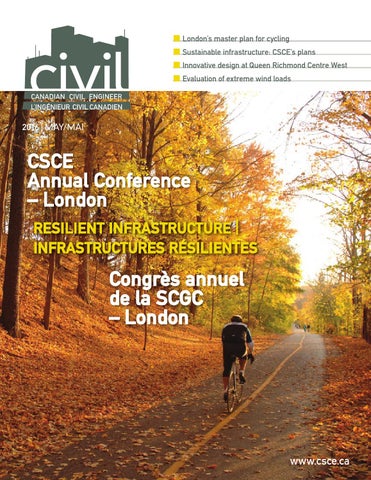
London’s master plan for cycling Sustainable infrastructure: CSCE’s plans Innovative design at Queen Richmond Centre West Evaluation of extreme wind loads
2016 | M AY/MAI
CSCE Annual Conference – London RESILIENT INFRASTRUCTURE | INFRASTRUCTURES RÉSILIENTES
Congrès annuel de la SCGC – London
www.csce.ca CIVIL_May16_LAZ.indd 1
16-04-25 1:23 PM
STEEL VS. CONCRETE: Which is the better, greener and more cost efficient choice for commercial building construction? Review the results of an independently conducted research study that outlines the impacts on design, construction costs, project schedules, and sustainability of steel vs. concrete framing alternatives. Download the case study flyer today at
cisc-icca.ca
Civil_CISC_May.indd 1 CIVIL_May16_LAZ.indd 2
2016-04-19 16-04-25 2:58 1:18PM PM
9 2:58 PM
contents MAY 2016/MAI 2016 | VOLUME 33.2
HISTORIC CIVIL ENGINEERING SITES 12 E gerton Street Double Sewer 16 L ondon’s Blackfriars Bridge FORUM ON SUSTAINABLE INFRASTRUCTURE/ FORUM SUR LES INFRASTRUCTURES DURABLES 10 CSCE advocating for the development of sustainable infrastructure systems
CSCE CONFERENCE/CONGRÈS SCGC – LONDON 2016 18 Conference preview
TECHNICAL: 2016 ANNUAL CONFERENCE PREVIEW/PAGES TECHNIQUES: CONGRÈS ANNUEL 2016 - UN APERCU
22 Introduction to the specialty conferences 24 Using laser induced fluorescence (LIF) to establish monitoring well
NEWS, VIEWS & DEPARTMENTS NOUVELLES, POINTS DE VUE ETRUBRIQUES 4 President’s perspective/
Perspective présidentielle 6 From the regions: Atlantic/ Région de l’Atlantique 8 Student voice/La voix des étudiants 9 Young professionals corner/Le coin des jeunes professionnels 34 CSCE partners and sponsors/ Associés et commanditaires SCGC
network of migrating LNAPL plume in the vicinity of surface water 25 Queen Richmond Centre West – Innovation in practice 26 Towards a robust wind tunnel-based evaluation of extreme wind loads 28 London on bikes – London’s cycling master plan
12
25
6 On the cover: Trail riding courtesy of City of London
Canadian Civil Engineer | May 2016
CIVIL_May16_LAZ.indd 3
3
16-04-25 1:18 PM
PRESIDENT’S PERSPECTIVE | PERSPECTIVE PRÉSIDENTIELLE
Tony Bégin, P.Eng., CDP, M.A.Sc., MCSCE PRESIDENT, CSCE/PRÉSIDENT SCGC PRESIDENT@CSCE.CA
CSCE/SCGC 521-300, rue St-Sacrement Montreal, Québec H2Y 1X4 Tel.: 514-933-2634, Fax: 514-933-3504 E-mail: mahmoud.lardjane@csce.ca www.csce.ca
PRESIDENT/PRÉSIDENT Tony Bégin, P.Eng., CDP, M.A.Sc., MCSCE
CANADIAN CIVIL ENGINEER/L’INGÉNIEUR CIVIL CANADIEN EDITOR/RÉDACTEUR Doug Salloum, CSCE Executive Director 514-933-2634 ext. 1, doug.salloum@csce.ca MANAGING EDITOR/ DIRECTEUR DE LA RÉDACTION Cindy Macdonald Tel.: 416-510-6755 cmacdonald@annexnewcom.ca
ASSOCIATE EDITOR/ RÉDACTEUR EN CHEF ADJOINT Bronwen Parsons Tel.: 416-510-5119 bparsons@ccemag.com
ADVERTISING SALES/ PUBLICITÉ Maureen Levy Tel: 416-510-5111 mlevy@ccemag.com
ART DIRECTOR/ COMPOSITION ARTISTIQUE Lisa Zambri Tel: 416-510-5600 x3595
Annual Subscription Rates/Abonnement annuel Canada & U.S./E.U. $35.00, Other countries/Autres pays $45.00; Single copy/Un numéro $7.50; Agency discount/Rabais au distributeurs 10% PUBLICATION ISSN 9825-7515 RETURN ADDRESS/ADRESSE DE RETOUR : The Canadian Society for Civil Engineering La Société Canadienne de Génie Civil 521-300, rue St-Sacrement Montreal, Québec H2Y 1X4 Canadian Civil Engineer (CCE) is published five times per year by the Canadian Society for Civil Engineering (CSCE). L’ingénieur Civil Canadien (ICC) est publié cinq fois par année par la Société Canadienne de Génie Civil (SCGC). The opinions expressed in the papers are solely those of the authors and the Canadian Society for Civil Engineering is not responsible for the statements made in this publication. Les opinions exprimées dans les articles sont la seule responsabilité de leurs auteurs et la Société canadienne de génie civil n’engage pas sa responsabilité dans les propos exprimés. CIVIL Magazine is produced by the publishers of Canadian Consulting Engineer Magazine, published by Annex Publishing & Printing Inc. Le magazine Civil est produit par l’editeur de la publication Canadian Consulting Engineer qui est publie par Annex Publishing & Printing Inc. Annex Publishing & Printing Inc., 80 Valleybrook Drive, Toronto, Ontario M3B 2S9 Tel.: 416-442-5600; Fax: 416-510-5140 PUBLICATIONS MAIL AGREEMENT/POSTES CANADA ENREGISTREMENT #40065710
Keep on growing
D
uring the course of last year, we have worked as a team under my presidency to carry out many projects in line with our growth strategy. We can be proud of what we have accomplished and it is just the beginning of our journey to make CSCE stronger. The individual membership increased from 3,463 to 5,174 total members in the course of 2015. This represents a growth rate of close to 50 per cent, the highest increase of the last few years. This momentum has to be kept at a minimum annual increase of 25 per cent in coming years in order to reach our goal of 10,000 members by the year 2020. The corporate membership went from 26 to 32 business partners in one year, which represents a growth of more than 20 per cent. We acknowledge all the firms that support us and associate their name with CSCE. More results are expected in the recruitment of new corporate members. We have hired a new staff member to achieve this objective, Latifa El Ayachi, as marketing director (latifa.elayachi@csce.ca). We are working on a new set of benefits for the corporate members. This initiative will help us increase our financial strength in order to provide our technical divisions, programs and committees the resources required to enhance the CSCE learning experience for all members.
CSCE gaining recognition The reputation of CSCE has been taken to a new level over the last few months. The publication of the second edition of the Canadian Infrastructure Report Card (www.canadainfrastructure.ca) in January, an article on CSCE published in the Canadian Business Journal (www.cbj.ca) in February, an invitation to speak at the 98th annual conference of the Canadian Construction Association (www.cca-acc.com) in March, the National Tour on the Infrastructure Report Card in April and May, and a keynote address I will deliver at the Canadian Network of Asset Managers (www.cnam.ca) in Halifax in May, have all been great opportunities to affirm CSCE’s leadership in building sustainable infrastructure. Your new president, Jim Gilliland, and new president-elect, Susan L. Tighe, are ready to pursue our growth. In collaboration with the national office staff, they will guide us towards more success. Your valuable input and feedback as a CSCE member is more than welcome at any time. As the best way to interact is in person, we invite you to come meet with us in London, Ont., from June 1 to 4. Au revoir to all of you my friends and CSCE family members. It has been an honour to serve you and I thank you very much for your trust. Tony Bégin is senior director of integrated project delivery at Canam Group Inc.
4
CIVIL_May16_LAZ.indd 4
Mai 2016 | L’Ingénieur civil canadien
16-04-25 1:18 PM
PRESIDENT’S PERSPECTIVE | PERSPECTIVE PRÉSIDENTIELLE
Continuons notre croissance
A
u cours de l’année dernière, nous avons travaillé en équipe et, sous ma présidence, nous avons entrepris des actions en lien avec notre stratégie de croissance. Nous pouvons être fiers de ce que nous avons accompli et ce n’est que le début de notre expédition pour renforcer la SCGC. Le nombre d’adhésions individuelles est passé de 3 463 à 5 174 au cours de l’année 2015. Ceci représente une augmentation de près de 50%, la plus importante des dernières années. Cet élan de croissance doit être maintenu à un taux minimum annuel de 25% au cours des prochaines années afin d’atteindre et même dépasser notre objectif de 10 000 membres en 2020. Le nombre de membres d’entreprise est passé de 26 à 32 partenaires en un an, soit plus de 20% d’augmentation. Nous remercions toutes les firmes qui nous apportent leur appui et associent leur nom à la SCGC. Plus de résultats sont en perspective avec le recrutement de nouveaux membres d’entreprise. Nous avons engagé une nouvelle personne dédiée à l’atteinte de cet objectif, madame Latifa El Ayachi, Directrice Marketing SCGC (latifa.elayachi@csce.ca). Nous travaillons sur une nouvelle série de privilèges pour nos membres d’entreprise. Cette initiative nous aidera à atteindre la santé financière qui nous permettra de fournir les ressources requises aux divisions techniques, programmes et comités pour améliorer l’expérience d’apprentissage de la SCGC de tous les membres. La réputation de la SCGC se consolide de plus en plus et a atteint un niveau de reconnaissance significatif au cours des derniers mois. La publication de la 2e édition du Bulletin de rendement des infrastructures canadiennes (www.canadainfrastructure.ca) en janvier dernier, l’article sur la SCGC paru dans le “Canadian Business Journal” (www.cbj.ca) en février, l’invitation qui m’a été faite d’être conférencier à la 98e Conférence annuelle de l’Association canadienne de la construction (www.cca-acc.com) en mars, la tournée de présentations sur le bulletin de rendement des infrastructures en avril et mai et le discours d’ouverture à la conférence du Canadian Network of Asset Managers (www.cnam.ca) à Halifax le 10 mai sont des événe-
Canadian Civil Engineer | May 2016
CIVIL_May16_LAZ.indd 5
CSCE individual members/nombre d’adhésions individuelles, SCGC
2014
3,463
2015
5,174
CSCE corporate members/nombre de membres d’entreprise, SCGC
2014
26
2015
32
ments qui le démontrent. Ils ont tous été d’excellentes opportunités d’affirmer le leadership de la SCGC pour la construction d’infrastructures durables. Votre prochain président, Jim Gilliland et la nouvelle présidente-désignée, Susan L. Tighe, sont prêts à poursuivre notre croissance. En collaboration avec l’équipe du Bureau national, ils sauront nous guider sur le chemin de la réussite. Vos précieux commentaires et réactions sont les bienvenus en tout temps. Et la meilleure façon de les présenter étant de le faire en personne, nous vous invitons à venir nous rencontrer à London, ON du 1er au 4 juin. Au revoir à tous mes amis et membres de la famille de la SCGC. Ce fût un honneur de vous servir et je vous remercie pour votre confiance. Tony Bégin est directeur principal, réalisation de projets intégrés chez Groupe Canam Inc.
5
16-04-25 1:18 PM
FROM THE REGIONS: SECTION NEWS | DE NOS RÉGIONS : NOUVELLES DES SECTIONS
Atlantic Region: Busy season coming up Jeff H. Rankin, PhD, P.Eng, FCSCE VICE-PRESIDENT, ATLANTIC REGION, CSCE
A
ll Sections of the Atlantic Region have been quite active this year in providing programming to support their local members and reaching out to the broader civil engineering community. The last few months were particularly busy as the Atlantic Region Sections played host to four stops of the National Lecture Tour (NLT) on the National Infrastructure Report Card and three workshops on the new edition of the Canadian Highway Bridge Design Code. The NLT in particular is providing an excellent opportunity to partner with local municipalities and industry associations on the topic of sustainable infrastructure. Some additional highlights of this current year include an emphasis on growing through youth by fostering the strong relationships that each Section has with the Student Chapters at Memorial University, Dalhousie University, Université du Moncton and University of New Brunswick. Joint events between the Sections and Chapters include organizing job shadowing opportunities and local project site tours (Eastern NB and PEI), as well as industry-student dinner meetings with keynote addresses and networking opportunities (Western NB). Of particular note is the re-emergence of the Nova Scotia Section
under the leadership of Haibo Niu (Dalhousie University) and the strong growth of the UNB Student Chapter. Members of the New Brunswick East and Prince Edward Island Section were invited to the Faculty of Engineering at the Université de Moncton last fall for a presentation that was part of an engineering course. Angèle Spencer, P.Eng., project engineer with the City of Dieppe, gave a presentation on the Acadie Avenue/Amirault Street refurbishing project. This event proved to be very popular in our region with participation exceeding 45 people. This section also created an on-site kiosk to commemorate the historic Aboiteaux infrastructures located in Aulac, N.B. Two bronze plaques were fabricated and installed at the on-site kiosk as well as at the Faculty of Engineering (Université de Moncton). This project was planned, organized and completed with the help and the collaboration of the Department of Agriculture, Aquaculture and Fisheries. The CSCE section provided funding for the plaque at the kiosk. Special thanks goes to Gilles Hebert, P.Eng. and Claude Robichaud, P.Eng. who coordinated the project. An official opening is planned for the fall of 2016.
The CSCE Section supported the development of a plaque commemorating the Aboiteaux (dyke) structures at Fort Beauséjour National Historic Site. La section de la SCGC a apporté son appui à l’installation d’une plaque commémorant les structures Aboiteaux (digue) sur le site historique national de Fort Beauséjour.
6
CIVIL_May16_LAZ.indd 6
Mai 2016 | L’Ingénieur civil canadien
16-04-25 1:18 PM
FROM THE REGIONS: SECTION NEWS | DE NOS RÉGIONS : NOUVELLES DES SECTIONS
Région de l’Atlantique : une saison très occupée en vue Jeff H. Rankin, PhD, P.Eng, FCSCE VICE-PRÉSIDENT, RÉGION DE L’ATLANTIQUE, SCGC
T
outes les sections de la région atlantique ont été passablement occupées cette année à offrir différentes activités visant à soutenir les membres au niveau local et à rejoindre la communauté plus large des ingénieurs civils. Les prochains mois seront particulièrement occupés car les sections de la région atlantique accueilleront quatre sessions de la Tournée nationale de conférences (TNC) portant sur le Bulletin de rendement des infrastructures canadiennes et trois formations sur la nouvelle édition du Code canadien sur le calcul des ponts routiers. Les TNC, en particulier, procurent une excellente opportunité de créer des partenariats avec les municipalités locales et les associations de l’industrie sur le sujet des infrastructures durables. Certains autres faits marquants de cette année incluent l’accent mis sur une croissance avec les jeunes en encourageant les relations solides que chaque section entretient avec les chapitres étudiants de l’Université Memorial, l’Université Dalhousie, l’Université de Moncton et l’Université du Nouveau-Brunswick. Les événements organisés conjointement par les sections et les chapitres incluent l’organisation d’opportunités de jumelage et des visites de sites de projets locaux (est du N.-B. et I.-P.-E), ainsi que des soupers-rencontres entre l’industrie et les étudiants impliquant des conférenciers et des opportunités de réseautage (ouest du N.-B.). Un fait particulier à noter est la réémer-
gence de la section de la Nouvelle-Écosse sous le leadership de Haibo Niu (Université Dalhousie) et la forte croissance du chapitre étudiant de l’UNB. Les membres des sections de la région Nouveau-Brunswick-Est et de l’Île-du-Prince-Édouard ont été invités à la faculté de génie de l’Université de Moncton l’automne dernier pour assister à une présentation dans le cadre d’un cours d’ingénierie. Angèle Spencer, P.Eng., ingénieure de projet pour la ville de Dieppe, a fait une présentation portant sur le projet de réhabilitation de l’intersection de l’avenue Acadie et de la rue Amirault. Cet événement s’est avéré très populaire dans notre région avec la participation de plus de 45 personnes. Cette section a également monté un kiosque sur place afin de commémorer les infrastructures historiques Aboiteaux au site historique national de Fort Beauséjour à Aulac (N.-B.). Deux plaques de bronze ont été fabriquées et installées au kiosque du site, ainsi qu’à la faculté d’ingénierie de l’Université de Moncton. Ce projet a été planifié et organisé avec l’aide et la collaboration du ministère de l’Agriculture, de l’Aquaculture et des Pêches. La section de la SCGC a fourni les fonds pour la plaque et le kiosque. Des remerciements particuliers sont adressés à Gilles Hébert, P.Eng. et Claude Robichaud, P.Eng., qui ont coordonné le projet. Une ouverture officielle est prévue pour l’automne 2016.
Denso Products - Unmatched Quality and Performance
If it doesn’t say
on the outside, then its not
Denso North America Inc. • www.densona.com
Canadian Civil Engineer | May 2016
CIVIL_May16_LAZ.indd 7
on the inside.
7
16-04-25 1:18 PM
THE STUDENT VOICE | LA VOIX DES ÉTUDIANTS
Showcasing Student Talent through Competitions Charles-Darwin Annan, Ph.D., P.Eng. CHAIR, STUDENT AFFAIRS COMMITTEE, CSCE
S
tudent competitions are a fantastic way for students to challenge themselves and apply their knowledge to projects outside the classroom. The CSCE Student Affairs Committee is proud to support different student competitions across the country that provide opportunities which suit different interests and ambitions. In late January, the University of Ottawa hosted more than 500 engineering students for the 2016 Great Northern Concrete Toboggan Race (GNCTR). After months of hard work, 21 competing teams and 3 alumni teams tasked with designing, building and racing a toboggan gathered in Ottawa to compete. Congratulations to the team from Western University in London, Ont., who were crowned overall champions for presenting a superior mix of ingenuity and technical competence. The 2017 GNCTR takes place in
Winnipeg, Man. (http://gnctr2017.com). For the 31st time, the Troitsky Bridge Building competition was held at Concordia University, Montreal, in March. Overall, there were 38 bridge entries subjected to the crushing ceremony, and the Tronald Dumps Bridge from McMaster University came out tops. Watch for some epic upcoming student competitions and events. This year, CSCE, in partnership with the Canadian Institute of Steel Construction (CISC), will hold the first Canadian National Steel Bridge Competition (http://steelbridge.csce.ca/home/) on May 13-15, 2016. McGill University is proud to host this competition, which will run simultaneously with the 22nd Canadian National Concrete Canoe Competition (http://concretecanoe.csce.ca). I also invite you to come and participate in the many stimulating student events at the CSCE Annual Conference in London, Ont., on June 1-4, 2016. Notably, the 4th Annual CSCE National Student Capstone Design competition will be held on June 3, 2016. The Annual Student Chapter Leaders Workshop will also be held during the conference. Winners of all the competitions will be invited to receive their awards during the student luncheon at the conference. Don’t hesitate to contact me for information on how to participate in these competitions and events. Prof. Annan can be reached at Charles-darwin.annan@gci.ulaval.ca
Mettre en évidence le talent des étudiants grâce aux concours Par Charles-Darwin Annan, Ph.D., P.Eng PRÉSIDENT, COMITÉ DES AFFAIRES ÉTUDIANTES DE LA SCGC
L
es concours étudiants constituent une magnifique occasion pour les étudiants et étudiantes de relever des défis et de mettre en pratique leurs connaissances à des projets à l’extérieur de la salle de classe. Le comité des affaires étudiantes de la SCGC est fier d’apporter son appui aux différents concours étudiants à travers le pays qui procurent des opportunités permettant de rejoindre divers intérêts et ambitions. À la fin de janvier 2016, l’Université d’Ottawa a accueilli plus de 500 étudiants et étudiantes en génie de partout au Canada venus assister à la Grande course nordique de toboggan de béton (GNCTR). Après des mois de dur labeur, 21 équipes en compétition et 3 équipes d›anciens qui avaient la tâche de concevoir, construire et mettre en course un toboggan se sont réunies à Ottawa pour concourir. Félicitations à l’équipe de l’Université Western, de London, en Ontario, qui a été couronnée championne toute catégorie pour avoir présenté un mélange inégalé d’ingéniosité et de compétence technique. Le GNCTR 2017 se tiendra à Winnipeg (Manitoba). (http://gnctr2017.com/). La 31e édition du concours de construction de ponts Troitsky s’est déroulée à l’Université Concordia (Montréal) en mars 2016. En tout, 38 ponts ont été inscrits au test du compresseur « The Crusher ». Le
8
CIVIL_May16_LAZ.indd 8
pont Tronald Dumps, de l’Université McMaster en est sorti gagnant. D’autres concours et événements étudiants mémorables sont encore à venir. Cette année, la SCGC, en collaboration avec l’Institut canadien de la construction en acier (ICCA), organisera du 13 au 15 mai 2016 le premier concours national canadien de pont d’acier (http://steelbridge. csce.ca/home/). L’Université McGill est fière d’accueillir ce concours, qui se tiendra en même temps que le 22e concours national canadien de canoë de béton (http://concretecanoe.csce.ca). Je vous invite également à venir assister et à participer aux diverses activités étudiantes passionnantes qui se dérouleront lors du congrès annuel de la SCGC, à London (Ontario) du 1er au 4 juin 2016. En particulier, le 4e concours national de conception Capstone qui se tiendra le 3 juin 2016. L’atelier annuel destiné aux dirigeants des chapitres étudiants se déroulera également au cours du congrès. Les lauréats de tous les concours seront invités à recevoir leurs prix au cours du dîner étudiant du congrès. N’hésitez pas à communiquer avec moi pour plus d’informations sur la manière de participer à ces concours et événements. Le professeur Annan peut être joint à Charles-darwin.annan@gci.ulaval.ca.
Mai 2016 | L’Ingénieur civil canadien
16-04-25 1:18 PM
YOUNG PROFESSIONALS’ CORNER | LE COIN DES JEUNES PROFESSIONNELS
Spring at the YP Committee Bernard Moulins CHAIR, YOUNG PROFESSIONALS COMMITTEE, CSCE
W
ith the arrival of spring, fresh ideas and endeavours abound, especially at the CSCE YP Committee. During the first quarter of 2016 each region contributed feedback, recommendations, and thoughts in order to establish national goals for the rest of the year. The committee set a CSCE YP 2016 direction, which is in line with the CSCE 2020 Vision: growing with youth, and enhancing member services. Evidently, both these elements were important to the CSCE YP Committee, as it wanted to offer better services to YP members and attract more members across the country. In order to fulfil this direction, the committee selected tangible
goals for 2016. Each region was invited to focus on three event types during the year: mentorship events, YP networking events and student outreach events. Financial resources were also at each region’s disposal to help accomplish these goals, which were born from the individual round-table discussions with the representatives of each region. Mentorship, network and student-YP events were repeatedly pinpointed as the three most attended, thought-provoking and fun. Therefore, setting all three as the 2016 goals seemed like an easy way to add value for existing CSCE members, while attracting new ones. Obviously, there are numerous advantages to this common direction, which has been framed by these three tangible, short-term goals. First, regions can share event ideas and provide feedback on the different formats. Second, regions can create synergies by also sharing resources and contacts. Finally, the most successful nation-wide events can be brought to the attention of different CSCE committees and replicated. The CSCE YP Committee is excited about this clear direction and the 2016 goals. In our next article, we hope to discuss the most recent YP events across the nation. If you’d like to join the CSCE YP Committee, please contact me at bernard.moulins@enercon.de
Ce printemps, au sein du Comité des jeunes professionnels Bernard Moulins PRÉSIDENT, COMITÉ DES JEUNES PROFESSIONNELS, SCGC
A
vec l’arrivée du printemps, des idées fraîches et des initiatives nouvelles foisonnent, spécialement au sein du comité JP de la SCGC. Au cours du premier trimestre 2016, chaque région a apporté sa contribution par de la rétroaction, des recommandations et des idées afin d’établir des objectifs nationaux pour le reste de l’année. Le comité a établi l’orientation 2016 des jeunes professionnels de la SCGC, laquelle rejoint la Vision 2020 de la SCGC : croître avec les jeunes, et la bonification des services aux membres. De manière évidente, ces deux éléments étaient importants pour le comité JP, étant donné que ce dernier souhaitait offrir de meilleurs services aux membres JP et attirer plus de membres à travers le pays. Afin de respecter cette orientation, le comité a sélectionné des objectifs tangibles pour 2016. Chaque région a été invitée à se concentrer sur trois types d’activités au cours de l’année : le mentorat, le réseautage JP et des activités destinées aux étudiants. Des ressources financières furent également mises à la disposition de chaque région afin de contribuer à la réalisation de ces objectifs émanant des diverses tables rondes impliquant les représentants de chacune des régions. Les activités JP de mentorat, de réseautage et celles destinées aux étudiants furent identifiées, et ce de manière répétée, comme étant
Canadian Civil Engineer | May 2016
CIVIL_May16_LAZ.indd 9
les trois activités attirant la plus grande participation, stimulant le plus les échanges et la réflexion, et surtout comme étant les plus amusantes. Par conséquent, insérer ces trois activités parmi les objectifs 2016 semblait une façon aisée et naturelle d’offrir plus d’avantages aux membres existants de la SCGC, tout en attirant de nouveaux membres. Il est clair qu’il y a de nombreux avantages à cette orientation commune qui a été élaborée en grande partie sur la base de ces trois objectifs tangibles à court terme. Premièrement, les régions peuvent partager des idées d’activités et de la rétroaction sur les différents formats. Deuxièmement, les régions peuvent créer des synergies en partageant également leurs ressources et leurs contacts. Finalement, les activités d’envergure nationale ayant le plus de succès peuvent être portées à l’attention des différents comités de la SCGC et être reproduites. Le comité JP de la SCGC est stimulé par cette orientation claire et les objectifs 2016. Dans notre prochain article, nous discuterons des événements JP les plus récents qui se sont déroulés partout au Canada. Si vous souhaitez vous joindre au comité JP de la SCGC, veuillez me contacter à bernard.moulins@enercon.de
9
16-04-25 1:18 PM
SUSTAINABLE INFRASTRUCTURE | LES INFRASTRUCTURES DURABLES
CSCE Advocating to Encourage the Development of Sustainable Infrastructure Systems Nick Larson, MEPP, P.Eng. CHAIR, INFRASTRUCTURE RENEWAL COMMITTEE, CSCE
O
ver the past few years CSCE has been slowly finding its voice for the 21st century. It started with a basic concept – that as stewards of our infrastructure systems we have an important role to play to address the infrastructure challenges of our society. And with the adoption of our strategic direction of “Leadership in Sustainable Infrastructure,” our sights were collectively focused on helping our world solve one of the largest problems of our time: how to transition to a sustainable future. We have some of the greatest infrastructure minds across Canada among our ranks and thought it was about time that we help our society solve a piece of this large problem: how to engineer our infrastructure systems to be more sustainable. What you will hear from the CSCE over the coming years is a continued crescendo of ideas, opinions and solutions to make our infrastructure systems more sustainable. Below you will find a few ideas from the CSCE’s Infrastructure Renewal Committee about what we feel needs to be done to, first, address our infrastructure challenges that are outlined in the 2015 Canadian Infrastructure Report Card, and second, to prepare for the opportunity that is on our doorstep as governments at all levels begin to make large-scale investments to renew our infrastructure systems. We will be advocating for these ideas in a multitude of venues across Canada. Over time, each of these broad ideas will become more granular and detailed as we collectively work together to achieve our common goal
10
CIVIL_May16_LAZ.indd 10
of a sustainable future supported by sustainable infrastructure systems.
Canadian Infrastructure Report Card The second iteration of the Canadian Infrastructure Report Card (CIRC) was released in early 2016. This edition has been expanded to include bridges, municipal buildings and transit, in addition to the original asset groups of roads, water, wastewater and stormwater systems. The CSCE sits on the project steering committee and has been a proud partner of the initiative since the original planning for the first CIRC began back in 2010. The CIRC is firmly positioned as a fact-based document that presents information that was collected directly from municipalities on the state of their infrastructure systems and the state of their asset management practices. The CIRC does not include any advocacy positions about what should be done to address the survey results.
What the CIRC tells us about our infrastructure systems The CIRC tells us that a large proportion of our infrastructure systems will need to be renewed over the short to medium term in order to prevent a decline in the quality of life that is supported by the systems. Some $388 billion worth of infrastructure is in fair condition or worse, equating to approximately $28,000 per Canadian household. Governments at all levels in Canada recognize this problem and are tak-
ing steps to increase their financial investment in our infrastructure. But, equally as important as financial concerns, the CIRC tells us that there is a widespread lack of maturity in infrastructure asset management-related processes that support informed decision-making related to how our infrastructure systems are renewed. Infrastructure asset management processes provide the tools that will ensure our communities develop sustainable infrastructure systems.
Sustainable infrastructure systems will be the foundation In 2015, the CSCE Board approved Policy Statement 2015-01: Development of Sustainable Infrastructure. This policy statement was based on the recognition that the civil engineering profession is the steward of Canada’s core infrastructure systems. The availability, condition and functionality of public infrastructure systems are widely acknowledged as having a direct impact on the quality of life for all Canadians. The quality of life issues encompass the triple bottom line definition of sustainability, namely the economic, environmental and social values for current and future needs of society. We will not have a sustainable future without sustainable infrastructure systems.
What should be done? What does CSCE feel should be done to address the infrastructure challenges that are identified in the 2015 CIRC? In short, our
Printemps Mai 2016 | L’Ingénieur civil canadien
16-04-25 1:18 PM
SUSTAINABLE INFRASTRUCTURE | LES INFRASTRUCTURES DURABLES infrastructure systems are not sustainable because we have not engineered them to be sustainable. We have engineered them with other purposes in mind, such as to be cheaper or faster to construct. Civil engineers have the ability to turn our infrastructure challenges into an opportunity – to bring innovation into the next generation of infrastructure systems that will support our future society. And CSCE is well positioned to provide leadership in the collection of different areas that will need to work together to build the next generation of infrastructure systems: academia, government and the private sector in the disciplines of engineering, public policy and finance. Here are some areas where the CSCE, and our members, will be working together to make our infrastructure systems more sustainable: • We will make sure that innovative ideas and techniques around the planning, design, construction, financing and management of infrastructure are encouraged. At the same time, we will work with our partners to redesign how our infrastructure systems are procured by their owners to remove the barriers to innovation that currently exist within our municipal/provincial/federal bureaucracies. • We will work with other infrastructure stakeholders to develop a long-term investment strategy to ensure that the financial needs of our infrastructure systems do not continue to be passed along to future generations. • We will provide leadership to implement a Canadian Sustainable Infrastructure Rating System that supports the ability to quantify the sustainable performance of infrastructure projects. This will enable all infrastructure stakeholders to make better informed decisions to ensure that we are first building the right project, and then building the project right. • We will advance the skills, knowledge and information necessary to achieve our vision for sustainable infrastructure through research, education and technological innovation. This will include working with post-secondary institutions to bring the con-
In short, our infrastructure systems are not sustainable because we have not engineered them to be sustainable.
All members have a role to play cepts of sustainable infrastructure into our classrooms at an early stage. This will also include working with research groups in our university network to increase the ability to bring new products or construction techniques to our infrastructure systems. • We will encourage municipalities to further advance their internal infrastructure asset management processes and demonstrate how these processes will be fundamental to quantifying the sustainable performance of their own infrastructure systems. The CSCE believes that infrastructure asset management processes should have the ability to quantify greenhouse gas emissions of an infrastructure
CIVIL_May16_LAZ.indd 11
CSCE is looking inward toward our members to help in our advocacy efforts. Members from across the organization are in the process of developing white papers to inform the preparation of additional policy statements for board approval. Once a policy statement is approved by the board, then it becomes a formal advocacy position for CSCE. If you have an idea for how you can help, please contact Nick Larson or Doug Salloum to share your thoughts. Nick Larson, MEPP, P.Eng., works in infrastructure planning and asset management with GM BluePlan Engineering Ltd.
Corporate Announcement Reg Andres, P.Eng., FCSCE Reg Andres, P.Eng., FCSCE has been inducted a Fellow of the Engineering Institute of Canada. Reg is an Infrastructure Management Specialist overseeing civil and municipal engineering business. With over 40 years of experience as a municipal and consulting engineer, he specializes in asset management for municipal infrastructure systems planning, development and implementation of sustainability and life cycle assessment projects and programs. Since 1963, the Council of the EIC has elected engineers to the grade of fellow in recognition of their excellence in engineering and for service to the profession and society.
toronto niagara ottawa sudbury london moncton fredericton st. john’s mumbai www.rvanderson.com
Civil_RVAnderson_May.indd 1
Canadian Civil Fall Engineer Engineer||Spring May 2016 2016
system, be able to justify the adoption of a new product/construction technique that would result in lower GHG emissions, and be used to understand the resiliency of an infrastructure system to climate change. • Finally, we will partner with national organizations and government agencies to bring the American Society for Civil Engineering 2018 International Conference for Sustainable Infrastructure to Canada.
Canadian Civil Engineer 2016-03-24 9:23 AM 4.875” x 3.625” 11 April 2016
16-04-25 1:18 PM
2016 HISTORIC CIVIL ENGINEERING SITE | LIEUX HISTORIQUE DE GÉNIE CIVIL 2016
National Historic Civil Engineering Sites E
ach year at the CSCE annual confer-
neers themselves more aware of the rich
have been designated.
ence, the society’s National History
history and heritage of Civil Engineering
In 2016 two sites are being designated
Committee selects a site or project from
in Canada. A commemoration ceremony
as National Historic Civil Engineering Sites,
the region in which the conference is being
is held during the CSCE conference, and
both in London, Ontario. One is the Egerton
held as a National Historic Civil Engineering
a plaque is placed on the chosen site, in a
Street Double Sewer (see article this page).
Site.
place where it is readily visible to the public.
The other is Blackfriars Bridge (see article
Through this program the committee
Since the program began in 1983, 66
aims to make the general public and engi-
national, international and regional sites
page 16).
EGERTON STREET DOUBLE SEWER
A century ago, concern about public health in London, Ontario caused Willis A. Chipman to champion the construction of a sewer system. This year the sewer is designated as one of two 2016 CSCE National Historic Civil Engineering Sites. By John V. Lucas, P. Eng., MCSCE CSCE/SCGE CONFERENCE HISTORIC SITE CHAIR
12
CIVIL_May16_LAZ.indd 12
London Engineering Department
C
ivil engineers continue to serve the public health of Canadians. In London, Ontario, this understated role will be celebrated by designating the 100-year-old Egerton Double Sewer as a Canadian Society for Civil Engineering National Historic Civil Engineering Site at the 2016 CSCE Annual Conference. The historic site designation also commemorates the role of Willis Chipman, C.E., a national figure in Canadian civil engineering who rose to meet a public health challenge by promoting and helping to design the sewer. In the mid-19th century, London was a frontier oil town, with its water supply coming from private wells. Poor sanitation caused many cases of typhoid in settlers. The Thames River was the city’s unofficial sewer. Open drains, human waste deposits in the river, and the milking of cows on public sidewalks created concern about public health. In 1877, the city built a drinking water system, but its combined sewers were in extremely poor condition, leading Willis Chipman, in his 1892 report to condemn and warn the city council that “your sewers
Above: View inside the sewer, with storm flow on the right and sanitary flow under cover on the left .Built during WWI, the sewer was constructed at the rate of up to 25 feet per day.
Mai 2016 | L’Ingénieur civil canadien
16-04-25 1:18 PM
Civil_Ce
CONCRETE: INNOVATIVE SOLUTIONS FOR CLIMATE READY COMMUNITIES Resilient, durable, energy efďŹ cient, versatile and cost-effective, concrete plays an essential role in building safe, smart, low carbon communities. Learn more at rediscoverconcrete.ca
Civil_Cement_May.indd CIVIL_May16_LAZ.indd 113
2016-04-25 AM 16-04-25 10:54 1:18 PM
2016 HISTORIC CIVIL ENGINEERING SITE | LIEUX HISTORIQUE DE GÉNIE CIVIL 2016 Left: The City of London maintains the original single roll linen design drawing of the 7,400-ft. long sewer. The smaller
London Engineering Department
photos show details.
in the present condition are a menace to the health of your city.” He also noted the haphazard way they had been built without an overall plan in mind. He proposed that interceptor sewers be built to direct sewage to a new filter farm. In 1896, the London Board of Health noted a death rate of 12.3 per 1,000, including: 65 cases of typhoid with 12 deaths; 141 cases of diphtheria with 12 deaths; 6 deaths from cholera; nine deaths from dysentery; and nine deaths from diarrhea; all within a population of 36,200. Concern about public health impacts was summed up in this way: “Typhoid fever is one of the diseases for which defective sewerage is blamed. Now, the death rate from typhoid in London is about three times higher than it is in the crowded cities of the continent of Europe.... Twenty-five years ago when these cities had no sewerage, their death rate from this disease was two or three times greater than ours is now; today with improved systems of sewerage, their death rate is only one third of ours.” Notwithstanding the obvious waterborne disease public health problem, it is interesting to note that the city fathers of the day promoted the sewer work (and the expenditures) on the basis of economic pros-
14
CIVIL_May16_LAZ.indd 14
perity — car shops were coming! The mayor also wanted to resolve a number of Supreme Court nuisance verdicts about depositing sewage in the river. On this, a lawyer quipped at a public meeting: “The natural place for the sewage of any city is a river, God Almighty gave us rivers to drain the country.” Fortunately, this position was not held by the public and politicians. Approvals and funding soon flowed and construction commenced. Some of the pipes installed in 1896-7 as part of the interceptor system remain in service today. The filter farm is the site of London’s Greenway Pollution Control Centre, which now services 60% of London’s 381,000 people.
Two separated systems within one structure Another recommendation by Chipman was that all new sewers were to be built as separated systems because “it is important that the volume of sewage be a minimum and that it be a constant quality” for sewage treatment. Also, separated systems would be “much better from a sanitary standpoint.” He was brought in to design the “East End” system, the backbone being the Egerton Street Double Sewer. This rare format of two separated sewers within one structure has been reported in only a few other instances across Canada. The City of London maintains the original single roll linen design drawing of this 7,400-ft. long sewer, including hand notations and on-site design details by the site engineers. Also on record are the East End Sewerage System as-built drawings on original linen, and copies of Chipman’s reports.
Mai 2016 | L’Ingénieur civil canadien
16-04-25 1:18 PM
2016 HISTORIC CIVIL ENGINEERING SITE | LIEUX HISTORIQUE DE GÉNIE CIVIL 2016 It took two years to build the sewer (1914-16) during WWI, often advancing at a rate of 25 feet per day and using construction methods never used in London before. Since the sewer is 25 feet below grade, the contractor used new mechanized equipment: buckets of excavated soil attached to a cable operated by a windlass were drawn backwards to fill in sections already completed, or they were emptied into wagons. The concrete structure was built in five separate pours, most in an open cut trench, some by tunnel.
Chipman was also instrumental in the creation of the Association of Professional Engineers of Ontario, and was its second president. He shared his technical knowledge through publications on his designs, including “London Sewerage System” (Civil Engineer), and “The Separated System of Sewerage and Storm Water Drainage” (Proceedings - Canadian Society of Civil Engineers).
Commemorative Plaque
Willis Chipman, C.E. (1855 – 1929)
To mark the designation as a National Historic Civil Engineering Site, a plaque will be installed near the sewer alignment, as follows:
Willis Chipman was born in Elgin, Ontario. After graduating from McGill University in 1876 with first rank honors in civil and mechanical engineering, he worked on the construction of the Toronto waterworks. During the 1880s he was engaged in both engineering and land surveying throughout Canada. He founded the Association of Provincial Land Surveyors and served as president. In engineering, he acquired a successful reputation in waterworks and sewerage systems in 41 Canadian cities from Halifax to Victoria. Concerned with public health, Chipman served as president of the Association of Health Officers of Ontario in 1893. He frequently traveled to the U.S. and England to study sewerage innovations in order to design the most advanced solutions possible.
EGERTON STREET DOUBLE SEWER A tribute to the civil engineers, contractors and workers who designed, built and operated this separated sewer system, achieving a major advancement in the cause of public health. Its workmanship and methods of construction have met the test of time, having served Londoners for 100 years. The double sewer configuration designed by Willis Chipman, C.E., is rare and efficient. It combined a separate sanitary sewer within a larger storm sewer. There is no doubt that this sewer system and those built in the same era across Canada have saved countless lives from waterborne diseases. Owner and Operator: City of London. Engineering Firm: Chipman and Power.
THE CLEAR CHOICE Fibreglass storage tanks are the clear choice for storing water and wastewater in many different applications. With a wide range of tank models and sizes, ZCL offers competitively priced storage tank options for projects with underground or aboveground water storage requirements.
Why Choose Fibreglass... • • • • •
Corrosion Resistance Design Flexibility Watertight Design H-20 Load Rated Easy to Install
WATER/ WASTEWATER TANKS
UNDERGROUND STORAGE TANKS
ABOVEGROUND STORAGE TANKS
1.800.661.8265 | zcl.com Civil_Xerxes_May.indd 1
Canadian Civil Engineer | May 2016
CIVIL_May16_LAZ.indd 15
2016-03-30 10:40 AM
15
16-04-25 1:18 PM
2016 HISTORIC CIVIL ENGINEERING SITE | LIEUX HISTORIQUE DE GÉNIE CIVIL 2016
LONDON’S BLACKFRIARS BRIDGE
United States Patent Office
By F. Michael Bartlett, F.CSCE
T
he present Blackfriars Bridge constructed in 1875 is the third structure erected to link the City of London to what was then known as the Village of Petersville. The previous two bridges were of wood construction, whereas the present bridge is a wrought iron bowstring through arch-truss with a 68.4-m span. It Job Abbott. was designed and built by the Wrought Iron Bridge Company (WIBC) of Canton, Ohio. The photograph below left must have been taken soon after the new bridge was erected, as the pier foundation for the previous structure is still visible in the middle of the Thames River. Blackfriars Bridge is indicative of an era in Ontario when wood bridges were replaced by metal bridges. Cuming (1983) reports that “towns such as Brantford, Peterborough, London and Paris all had wrought iron bridges constructed in the seventies.... Wrought iron bridges proliferated in the United States and in some cases appear to have made significant inroads into southwestern Ontario towns. London for instance had seven iron bridges.” Dominion Bridge Company Ltd. Library (Archives Canada)
The second structure in London, Ontario to be designated by CSCE in 2016 as a National Historic Civil Engineering Site dates from an era when wood bridges were frequently replaced by wrought iron structures.
1870s-era structural innovations
Stanford University Libraries, Department of Special Collections
Blackfriars Bridge is a product of an era of intense competition amongst wrought-iron bridge fabricators and represents the zenith of wrought-iron bowstring arch-truss technology. This is reflected in the Wrought Iron Bridge Company 1874 book of designs (WIBC 1874), which contains technically credible information that is consistent with modern bridge design standards. For example, it recognizes that pedestrians are the governing live load, and, based on credible literature reviews, specifies pedestrian loadings that are consistent with those in modern codes. It also contains other information that clearly Above left: Double-panel diagonal arrangement from Abbott’s 1876 patent (Abbott 1876). Left: Photograph of 1875 Blackfriars Bridge taken shortly after it was erected, with piers of the previous bridge still visible in the Thames River.
16
CIVIL_May16_LAZ.indd 16
Mai 2016 | L’Ingénieur civil canadien
16-04-25 1:18 PM
2016 HISTORIC CIVIL ENGINEERING SITE | LIEUX HISTORIQUE DE GÉNIE CIVIL 2016
wikipedia.org, 2015.
distorts engineering science, perhaps to ensure the economy of WIBC products in a very competitive market. Blackfriars contains, or contained before renovations in 1950, eight features of 20 included in WIBC’s most significant U.S. patent, dated 11 February, 1873. Above: Three of a series of stained glass images of the bridge created by local artist Ted Goodden. Blackfriars Bridge also features a double-panel web diagonal arrangement that was patented in America (see drawing) by den that are exhibited in Centennial Hall in London. Three of the imJob Abbott (Abbott, 1876). The web diagonals at midspan each cross ages are shown above (wikipedia.org, 2015). two panels at an angle of approximately 45 degrees to the horizontal, making the diagonal structurally more efficient and so reducing Commemorative Plaque its volume by 20%. The patent was filed 10 months after Blackfri- To mark the designation by CSCE as a National Historic Civil Enars opened to traffic, perhaps because the state of structural analysis gineering Site, a plaque will be installed at the bridge site, as follows: in the 1870s was insufficient to determine the web member forces accurately. Each bowstring arch-truss is statically indeterminate to BLACKFRIARS BRIDGE the 13th degree, requiring the original structural analysts to make A tribute to the civil engineers, contractors, and workers who designed, simplifying assumptions because the solution of statically indetermi- fabricated and erected this bridge to maintain an important social, ponate structures was not understood in the 1870s. Procedures can be litical, and economic link between London and Petersville. The bridge is envisaged to identify essential load paths and so demonstrate that the a rare survivor of the through arch-truss form fabricated by the Wrought double-diagonal system is safe, even though such procedures would Iron Bridge Company of Canton, Ohio. The original pedestrian design not be sufficient to quantify precisely the loads in the web members loadings are consistent with those specified in modern codes. The centre (Bartlett et al, 2009). four truss panels feature a double-panel diagonal configuration that was patented in America one year after the bridge opened on 27 September, Job Abbott and Dominion Bridge 1875. Blackfriars Bridge has also been woven into the cultural fabric Sir John A. Macdonald’s National Policy created tariffs that prevented of London. WIBC from selling bridges in Canada. With a new Canadian railway to the Pacific Ocean proposed, Job Abbott created a branch plant of References the firm in Toronto named the Toronto Bridge Company in 1878. Abbott, J., 1876. Improvement in metallic arch-bridges. United States “This company was a small concern and only fairly successful, since Patent 184490, November. its very first contract, a 180-foot span of 42 tons, for London, On- Bartlett, F. M., Graham, J. M., and Camiletti, J., 2009. “1870s Innovatario, (at the price of $4,000) was dropped into the river during erection in London Canada’s Blackfriars Bridge.” Proc. ICE – Eng. History tion, and the company was held liable for its repair and replacement” & Heritage, 162 (2): 111-117. (Shearwood, n.d.). In 1882, Abbott, as president, secured funding Cuming, D.J., 1983. Discovering Heritage Bridges on Ontario’s Roads. from three Scottish investors for a new venture titled the “Dominion Boston Mills Press, Erin Ont., 96 pp. Bridge Company” to be sited in the vicinity of Montreal, which sub- Wikipedia 2015. Blackfriars Street Bridge. <https://en.wikipedia.org/ sequently became the most significant Canadian steel bridge compawiki/Blackfriars_Street_Bridge> [Last accessed 31 Jan 2016] ny in the 20th century. Shearwood, M.H., n.d. (mid 1930s?). Whence Came this Dominion Bridge that Spans the Dominion of Canada. Publisher and place of Contribution to London’s cultural fabric publication unknown. 57 pp. Blackfriars Bridge is a key piece of the cultural fabric of London. It has Wrought Iron Bridge Company, 1874. Designs of Wrought Iron Bridges been widely photographed, drawn, and painted, and in the early 1980s Built by the Wrought Iron Bridge Company of Canton Ohio. Hartzell & a series of stained glass images were created by London artist Ted GoodSaxton Printers, Canton, Ohio.
Canadian Civil Engineer | May 2016
CIVIL_May16_LAZ.indd 17
17
16-04-25 1:18 PM
Resilient Infrastructure
June 1-4, 2016 | Le 1-4 juin 2016 | London, Ont.
Welcome to CSCE 2016 London!
W
e are delighted to invite you to register for the CSCE 2016 Annual Conference with the theme Resilient Infrastructure. Additional specialty conferences on environmental, materials, structural and transportation engineering, as well as natural disaster mitigation, will create the perfect forum for interaction between industry professionals, academics and government delegates. The presentations of peer-reviewed papers and innovative case studies will inform practising Canadian civil engineers of new developments in infrastructure resilience. We are delighted by the response to date: more than 640 abstracts have been received including 120 for project-profile presentations. We are very excited about the internationally-known speakers who will be making keynote presentations at the conference. We will be supplementing
the technical sessions with an informal off-site event, where old friendships can be renewed and new ones germinated, and optional trips to tour Western University’s unique wind engineering laboratory and to celebrate two new National Historic Civil Engineering Sites. London is proud to host the conference at the London Convention Centre with accommodation available at the nearby Delta Armouries Hotel. Early June is a lovely season to explore our beautiful and diverse city and the surrounding communities. The London 2016 Conference Organizing Committee looks forward to hosting you in London from June 1 to 4. Mike Bartlett, Chair
TOP PARTNERS
18
CIVIL_May16_LAZ.indd 18
Mai 2016 | L’Ingénieur civil canadien
16-04-25 1:18 PM
CSCE ANNUAL CONFERENCE | CONGRÉS ANNUEL DE LA SCGC
Technical Tours Wind Engineering, Energy and Environment Dome (WindEEE)
London Wastewater Facility
Tour Date: Thursday, June 2, afternoon (2 hours) The London Wastewater Facility (LWF) is a dedicated technology demonstration facility enabling the Tour Date: Thursday, June 2, morning (2 hours) development and testing of treatment technologies WindEEE is the world’s first hexagonal wind tunnel. It genand systems from pilot scale up to full municipal erates realistic tornadoes and other three-dimensional wind scale. The City of London provided half of funding phenomena. Building upon Western University’s strong legfor the $8-million facility that is located within the acy of wind research infrastructure, this unique structure has The London Wastewater Greenway Wastewater Treatment Centre. an inner diameter of 25 meters with 106 fans unevenly dis- Facility allows testing LWF has local and regional partners in Western tributed, to allow wind simulations over extended areas and and demonstration with University and the Southern Ontario Water Conflows up to 4500 m3/day. complex terrain. sortium and is a hub that is linked to other univerThis tour will give the dynamics of real wind environsity researchers and platforms in water research. The ment and conditions. The main topics of research at WindEEE re- LWF offers unprecedented capacity for testing and demonstration of late to: impact of non-synoptic wind systems (such as tornadoes and technologies, enabling access to full scale municipal flows up to 4500 downbursts) on buildings and structures, optimization of wind farms m3/day, drawing effluent from all stages of the sewage treatment proand wind turbines, and physical modelling of flow over rough surfac- cess, including sludge. es, urban canopies, and complex topography. This tour will show the inside of the new facility and include disThere are limited spots available so register early, at the conference cussions with one of its clients. There are limited seats available, so info desk. Transportation is provided. Cost included with conference register early at the conference info desk. Transportation is provided. registration. Cost is included with your registration.
Social Evening at Palasad Thursday, June 2 After a couple days of catching up on the latest papers and technologies, we hope you’ll join us for some fun down time to connect with your Canadian and international colleagues. This year’s social night is ramping up the fun with an evening at London’s premier entertainment hot spot, Palasad. There’s something for everyone – bowling, billiards, ping pong, arcade games. Palasad’s comfortable retro-fusion lounge offers plenty of space to kick back and relax with friends, old and new. The entertainment attractions will be available all evening to enjoy casually or to engage your competitive spirit through the organized games and challenges scheduled throughout the night. The cuisine at Palasad will not disappoint. The evening’s menu will offer their famous slow roasted prime rib buffet featuring locally sourced Ontario beef. Palasad also carries a wide selection of domestic and craft beers on tap as well as international and Ontario wines. Just read the reviews to know you are in for a good time… “so much fun”, “fabulous”, “great food” (Tripadvisor, 2015). Check out our video featuring Palasad at www.csce2016.ca. Shuttle service will be provided so your only worry should be warming up your throwing arm. The CSCE London 2016 organizing committee and our sponsor for the evening, Canam Group, look forward to seeing you for a great night out.
Canadian Civil Engineer | May 2016
CIVIL_May16_LAZ.indd 19
There’s something for everyone at Palasad: bowling, billiards, beer and a roast beef buffet.
19
16-04-25 1:18 PM
CSCE ANNUAL CONFERENCE | CONGRÉS ANNUEL DE LA SCGC
Conference Schedule Overview Wednesday, June 1 • Registration opens • CSCE committee meetings • Trade show set-up and opening • Conference technical sessions begin • Companion luncheon • Young professionals reception • President’s welcome reception Thursday, June 2 • Opening ceremony breakfast and keynote • Conference technical sessions continue • Technical tours • Companion event • Luncheon keynote • Social night and dinner Friday, June 3 • Breakfast and keynote • Conference technical sessions continue • Luncheon keynote and student awards • Historic site dedication • Trade show closing • Annual awards banquet • Young professionals outing Saturday, June 4 • Breakfast and keynote • Conference technical sessions conclude • Luncheon keynote and closing ceremony • CSCE annual general meeting • Fellows dinner and young professionals event
20
CIVIL_May16_LAZ.indd 20
Young Professionals Program Resilient Infrastructure Workshop, Technical Sessions, Tours and an Escape Room on the Agenda The annual conference is fast approaching, and with it, another exciting young professionals program. Although this program is targeted at young professionals and students, it is open to all conference attendees. There are lots of exciting things on the program. One highlight is the Resilient Infrastructure workshop, where industry professionals will be hosting a panel to discuss what young professionals and students need to keep in mind about resilient infrastructure in industry practice. On top of that, there will also be our annual Student Leaders Workshop for the members of student chapters across Canada to get together and talk about important issues. In addition to the technical sessions, there will be several networking and social events including the president’s reception, a tour of the Labatt brewery, an escape room, and visits to some downtown establishments. I encourage you to check out www.csce2016.ca to see all of the seminars, social events, and networking opportunities that are being held specifically for the YP program. Remember that some of these events require pre-registration and additional fees.
Keynote Denis Millette: Lac-Mégantic Emergency Remediation Dr. Denis Millette, ing., P.Eng., Agr., Ph.D., is the principal and senior hydrogeologist at Golder Associates in Montreal, where he leads various contaminated site management projects, as well as hydrogeology and hydrology studies at national and international levels. His field of expertise includes contaminated site management, contaminant hydrogeology, emergency response, hydrogeology, soil salinity, soil and water conservation engineering, international consulting and training. Dr. Denis Millette Dr. Millette was the project director in charge of a team of Golder specialists involved in the clean-up of the Lac-Mégantic train derailment that occurred on July 6, 2013. The derailment resulted in a spill of approximately 6 million litres of light crude oil, destroyed the downtown area of the city, contaminated the Chaudière River over some 120 km and killed 47 residents. Golder Associates acted as the environmental consultant to support the emergency operations in Lac-Mégantic and to assist with clean-up operations on the Chaudière River and Lake Mégantic. Dr. Millette spent almost five months in the field and was actively involved in planning all aspects of the emergency operations. He interacted with authorities and the various contractors involved in the clean-up. Dr. Millette’s keynote address will focus on the emergency remediation work that Golder conducted at Lac-Mégantic in response to the train derailment.
Mai 2016 | L’Ingénieur civil canadien
16-04-25 1:18 PM
CSCE ANNUAL CONFERENCE | CONGRÉS ANNUEL DE LA SCGC
Keynote Ian Burgess: Connection Behaviour and the Robustness of Steel-framed Structures in Fire
Keynote Therese McAllister: Tools and Guidance for Resilient Infrastructure
Ian Burgess, B.A., PhD, CEng, MIStrucE, studied as an undergraduate at the University of Cambridge and gained his doctorate at University College London, carried out in the structural stability research group led by Professor Henry Chilver. Dr. Burgess also completed a two-year NRC fellowship at McMaster University working in the general Ian Burgess, B.A., theory of flutter in aeroelastic systems. Ian is Ph.D., CEng, MIStrucE currently a professor of structural engineering at the University of Sheffield. In the mid-1980s, Dr. Burgess began a fruitful and enduring collaboration with Roger Plank (now retired as head of architecture at Sheffield) developing numerical techniques for modeling the behaviour of steel and composite elements in fire. After much development, the Vulcan software which emerged from this collaboration is now capable of non-linear modelling of three-dimensional composite buildings as temperature distributions develop through the cross-sections of both beam-columns and slabs. The full-scale fire tests on the multi-storey building at Cardington were a vital ingredient in the development of the software, and in understanding the complex structural interactions which take place in fire. Vulcan was the winner of two British Computer Society national awards in 2005. The main thrust of Dr. Burgess’ research remains in numerical modeling, but some very successful experimental work has been done at Sheffield in developing a component approach to connection modeling for fire conditions. Dr. Burgess’ keynote address will focus on the most important current theme – after the tragic events of September 11, 2001 – concerning the robustness of connections in fire and the avoidance of a consequent progressive collapse of buildings.
Terri McAllister, PhD, P.E., FASCE, leads the community resilience group at the National Institute of Standards and Technology (NIST) in Gaithersburg, MD, and is the federal program officer for the Center for Risk-Based Community Resilience Planning, a NIST-sponsored Center of Excellence. She leads research on resilience at the community Terri McAllister, scale, focusing on the performance of physiPh.D, P.E., FASCE cal infrastructure systems and how they support social and economic systems. Her expertise in structural reliability, risk assessment and failure analysis has been informed by disaster and failure studies, including the World Trade Center disaster, Hurricane Katrina flooding in New Orleans, and Hurricane Sandy flood effects on infrastructure systems. Dr. McAllister is also active in code and standard development, including the ASCE 7 Standard on minimum loads and the IBC 2016 Structural Code Committee. Communities face an abundance of natural, technological and human-caused hazards which sometimes become disasters. The consequences and costs of recovering from disasters can be effectively reduced through improving the resilience of infrastructure systems. NIST is conducting research to advance infrastructure and community resilience in collaboration with a NIST-sponsored Center of Excellence. Major objectives include the development of community-level performance goals, quantitative science-based resilience assessment tools based on modern principles of reliability and risk analysis, meaningful measures of resilience, and documents that can guide communities and support rational public policies for mitigating risk to communities. Methods to assess the performance of the built environment, and its impact on social and economic systems, are being developed, including performance goals, loss and recovery of community functions, and economic impacts. To better inform the research, NIST is also engaging with communities to better define resilience needs. An update on current progress and challenges will be presented, as well as the contributions that engineers can make to help communities become more resilient.
Canadian Civil Engineer | May 2016
CIVIL_May16_LAZ.indd 21
21
16-04-25 1:18 PM
FROM THE TECHNICAL EDITOR | MOT DU RÉDACTEUR TECHNIQUE
Resilient Infrastructure in Canada’s Severe and Diverse Environments O
n behalf of the technical program committee, we invite you to attend the CSCE Annual Conference in London, taking place from June 1-4. Our theme of “Resilient Infrastructure” is to recognize Canada’s leadership in the design of infrastructure within one of the world’s most severe and diverse environments. We accepted more than 650 abstracts for paper submissions in various disciplines of civil engineering, including 118 project profiles presentations. We have five specialty conferences presenting state-of-the-art innovations and case studies presenting real life engineering projects. • CSCE 2016 Annual General Conference Antony Fediw, co-chair Aaron Rozentals, co-chair Scott Mathers, co-chair Trevor Scott, technical secretary • The 11th International Transportation Specialty Conference has invited more than 60 authors to submit papers, covering many innovations in design and construction of highways, rapid transit and active transportation facilities. Highlighted papers this year include the City of London’s Cycling Master Plan and construction of the Region of Waterloo’s rapid transit system. Jeff Matthews, co-chair Ryan Vanderputten, co-chair • The 5th International Structural Specialty Conference has invited 180 authors to submit papers which cover both industry project cases and novel research studies. Highlighted topics are: bridge design, construction, rehabilitation and management, composite behaviour between construction materials including FRP, structural behaviour under blast loads, structural fire engineering, and innovative and accelerated construction techniques. Maged Youssef, co-chair Brad Schmidt, co-chair
22
CIVIL_May16_LAZ.indd 22
•The 5th International Materials Specialty Conference has invited more than 50 authors to submit papers. In chorus with the main conference theme, resilience, a substantial number of the papers deal with the sustainability and durability of civil infrastructure materials, emerging composites and ultra-high performance materials, along with innovative fields such as nano materials, self-healing materials and various topics that bridge materials applications and various branches of civil engineering. Moncef Nehdi, chair • The 5th International Natural Disaster Mitigation Specialty Conference has invited more than 60 authors to submit papers which cover recent research and technological advances concerning the assessment of extreme wind effects on buildings, bridges and other civil infrastructure. The topics present new developments on wind, load evaluation, physical testing and computational methods, and wind- and earthquake-induced building motion mitigation through novel damping technology. Girma Bitsuamlak, chair • The 14th Environmental Specialty Conference has invited 50 authors to submit papers covering recent research and technological advances concerning the assessment and sustainable management/remediation of environmental impacts to soil, air and water. Interesting topics include emerging contaminants in the environment, including pharmaceuticals, and risk-based performance of storm water drainage networks under climate change. Sandra Carrelas, chair The following articles, in the form of extended abstracts (beginning on page 24), are selected from papers that are to be presented at the CSCE 2016 Annual Conference. For more information, go to: http://www. csce2016.ca/technical-program/
Mai 2016 | L’Ingénieur civil canadien
16-04-25 1:18 PM
CIVILG
I AM CIVIL ENGINEERING GLEN CARLIN CEO, The Jacques Cartier and Champlain Bridges Inc.
What is my job? As Chief Executive Officer of The Jacques Cartier and Champlain Bridges Incorporated (JCCBI), my role is to ensure that the major infrastructure managed by the Corporation, which is crucial to public transportation and the Canadian economy, remains safe, fully functional and aesthetically pleasing, today and in the future. I lead a big team of engineering, planning, construction and structural maintenance professionals who oversee the regular inspections of our infrastructure and the planning and execution of cutting-edge engineering work. I use my technical expertise, structural knowledge, and all of my in-the-field experience to guide our teams through these large-scale projects.
Why I am a civil engineer? As a civil engineer, I get to actively participate in building and repairing major and crucial infrastructure that helps people get where they need to go. This work is incredibly stimulating! When you have the opportunity to get involved in projects with very complex technical challenges that required innovative solutions, you have to seize it without hesitating. It’s important for engineers to find the best possible solutions to our challenges—and then dare to implement them.
The project I worked on that I think best represents sustainable infrastructure? In 2016, we are finishing the redecking of the Honoré Mercier Bridge, which is a large-scale project with multiple challenges. Through the replacement of the original reinforced concrete deck, from 1959, with
one made from high-performance precast concrete with galvanized reinforcement, this 8-year project will extend the bridge’s service life by 75 years. This project, which is in collaboration with the Mohawk community of Kahnawake, is a great example of technical success, collaboration and sustainable development.
www.csce.ca
CIVIL_May16_LAZ.indd CIVILGlenCarlin.indd 3 23
16-04-25 16-04-21 1:18 9:20 PM AM
TECHNICAL: 2016 ANNUAL CONFERENCE PREVIEW | PAGES TECHNIQUE: CONGRÈS ANNUEL 2016 - UN APERCU
Using Laser Induced Fluorescence (LIF) to Establish Monitoring Well Network of Migrating LNAPL Plume in the Vicinity of Surface Water By Laura Jones, Golder Associates Ltd.
T
he former Michigan Avenue Landfill (now Canatara Park) was used by the City of Sarnia for disposal of municipal waste between approximately 1930 and 1967. Between approximately 1930 and 1944, oily waste was reportedly disposed of at the site from one of the local refineries. This waste material was reportedly a by-product of a process that used clay to remove colour impurities during the production of automobile lubricating oil. In 1997, light non-aqueous phase liquid (LNAPL) was discovered at the southwest shore of Lake Chipican, north of the former landfill. In response, temporary measures were taken by the city to contain and collect the oil film at the lake. In 2000, remedial measures were developed to mitigate the discharges from former Michigan Avenue Landfill including installation of a 70-metre-long sheet-pile barrier wall along the south shore of Lake Chipican and installation of two oil recovery wells south of the barrier wall.
Monitoring program An annual monitoring program commenced in 2000 to detect LNAPL at monitoring locations prior to potential migration to Lake Chipican. During routine monitoring in October 2011, LNAPL was detected in a sentry well located near the west end of the barrier wall which prompted additional remedial measures. Since LNAPL was discovered in a sentry well, a subsurface investigation was undertaken to determine the current extent of LNAPL in the vicinity of Lake Chipican. The subsurface investigation used Laser Induced Fluorescence (LIF) to delineate the extent of the LNAPL plume and to determine locations for additional monitoring wells to provide advance warning of plume migration prior to encountering sensitive receptors. LIF uses a built-in laser to emit short pulses of light of a certain wavelength range. Polycyclic aromatic hydrocarbons (PAHs), present in the automobile lubricating oil, fluoresce when excited by light of a known wavelength and emit light of a specific wavelength range. LIF
24
CIVIL_May16_LAZ.indd 24
An LIF investigation was completed at 49 locations and monitoring wells were installed at nine locations near Lake Chipican.
provides rapid semi-quantitative results in the field to allow for quick decision-making regarding the progress of the investigation. In April 2012 and April 2013, an LIF investigation was completed at 49 locations and monitoring wells were installed at nine locations near Lake Chipican and associated surface water bodies to provide advanced warning of LNAPL plume migration. The LIF program was able to identify a narrow band of migrating LNAPL. Monitoring wells were installed in locations beyond the migrating LNAPL plume to provide advance warning of further migration of LNAPL towards surface water bodies. The LIF program was able to achieve high resolution data in the field which allowed the investigation to proceed in a systematic way and allow for cost effective delineation of the LNAPL in one mobilization using a finer spacing between locations than would be used using monitoring wells. The additional wells were incorporated into the annual groundwater monitoring program and have been included as trigger wells in the “trigger and contingency plan” for the former landfill. Since the start of the LIF investigation program, additional LNAPL migration has been discovered based on the network of monitoring wells installed and results of the LIF investigations.
Mai 2016 | L’Ingénieur civil canadien
16-04-25 1:18 PM
TECHNICAL: 2016 ANNUAL CONFERENCE PREVIEW | PAGES TECHNIQUE: CONGRÈS ANNUEL 2016 - UN APERCU
Queen Richmond Centre West – Innovation in Practice I
n 2015, Queen Richmond Centre West (QRCW) opened its doors to the first wave of eager tenants. By that time Toronto as a whole had fallen in love with QRCW and its innovative revitalization of two existing heritage buildings. The history of QRCW begins in 1910 when Weston Bakery originally constructed the Peter Street location to serve as a biscuit factory. By the 1970s the factory was transformed into an office and fashion showroom. In 1998 Allied Properties REIT (the owner) acquired the property; tenants at the time were nightclubs such as Distrikt and the Light Lounge. In 2010, the owner commissioned Sweeny &Co Architects (the architect) to design a landmark mixed-use development in Toronto’s entertainment district. Given the positioning of the two existing heritage structures on the site, the architect engaged Stephenson Engineering (the engineer) and presented the structural engineering firm with the challenge of suspending an office building above the two existing structures. This configuration would form a large L-shaped, glass-enclosed atrium with direct access from streets to the east and south of the complex and to a mid-block public lane to the north. The architect’s desire to offer office space with clean, unobstructed ceilings drove their selection of an exposed reinforced concrete structural system for the 11-storey tower.
Tabletop platform is the solution The engineer developed a solution which called for the creation of a “tabletop” platform seven stories in the air, from which the office building could be constructed. The tabletop’s sup-
Canadian Civil Engineer | May 2016
CIVIL_May16_LAZ.indd 25
porting structure was a significant challenge considering the enormous loads involved; the need for lateral stiffness given the eccentric location of the elevator core; the unbraced height from the top of the foundation level to the underside of the tabletop (more than 75 feet); and the architectural desire to support the building above with a structure that wouldn’t clutter the atrium. The engineer and architect were part of a design charrette, which resulted in the design of the Mega Delta-Frame system that was ultimately employed in the design and construction of the building. Each of the three frames is an hourglass space frame configuration formed from two stacked rectangular-based space frame pyramids – the top pyramid being inverted such that the apexes of both pyramids meet at one central node 40 feet in the air. The Mega Delta-Frames also form a major part of the lateral system – the only other effectual lateral support through the atrium space is provided by reinforced concrete stairs and an elevator core. Each Mega Delta-Frame is capable of supporting forces of 80,000 kN, which is approximately equivalent to the weight of 400 transport trucks. Each frame is comprised of 39-inch diameter steel legs with a steel thickness of two inches, pressure-filled concrete and a 17-ton cast steel node engineered by Cast Connex. The result is a soaring open air atrium that sets the development apart from any other. Sustainable features of the building include a cistern for collection and re-use of rainwater; daylight harvesting with solar shading and light shelves; exterior shading for reduced solar
Photo by Enscape TM
Zoran Tanasijevic, P.Eng. Sobhy Masoud, PhD, P.Eng. Stephenson Engineering Ltd.
BIM rendering showcasing the innovative tabletop design.
heat gain; advanced coated glazing for optimized light penetration; operable windows and individually controlled ventilation; raised flooring with pressurized underfloor air distribution; and water-efficient plumbing fixtures.
Award-winning design The development as a whole accommodates urban intensification, which is an important aspect of sustainable development given its impact on a wide range of important environmental issues, including travel behaviour and transport provision, resource efficiency, social equity, accessibility and economic viability. For its structural design the engineer has received numerous awards including: the 2015 Canadian Consulting Engineering Schreyer Award, the 2013 Innovation Award from the Toronto Construction Association, and the 2015 Award of Excellence in Engineering from the CISC Ontario Steel Design Awards. QRCW emerges as a great example of multiple teams working together to come up with a desired outcome. The team used design workshops to explore and develop an incredible building design while maintaining a collaborative, mutually beneficial approach.
25
16-04-25 1:18 PM
TECHNICAL: 2016 ANNUAL CONFERENCE PREVIEW | PAGES TECHNIQUE: CONGRÈS ANNUEL 2016 - UN APERCU CU
Towards a Robust Wind Tunnel-based Evaluation of Extreme Wind Loads Haitham Aboshosha, PhD, P.Eng., M.CSCE, M.ASCE BOUNDARY LAYER WIND TUNNEL LABORATORY (BLWTL), WESTERN UNIVERSITY, LONDON, ONTARIO
P
roper modeling of the boundary layer flow is essential for wind load evaluation under extreme events such as hurricanes. This layer is formed due to the interaction of wind with natural or manmade obstacles over the surface of the earth. Such interactions generate drag forces proportional to the roughness of the ground which shape the characteristics of the boundary layer, including mean velocity and turbulence intensity profiles, as well as the spectral contents and correlations. In the current study, a robust technique for evaluating extreme wind loads using wind tunnels is proposed and validated. The technique is based on automatic identification of effective ground roughness at a site of interest using aerial Google images and reproduction through automated roughness blocks mounted on the wind tunnel floor, a dynamic turntable to recreate the wind direction effects, and high-resolution pressure and load measurements. In addition to enhancing efficiency, these automations limit the subjectivity
CALL FOR CASE STUDIES - 2016-17 The editors of CIVIL magazine invite CSCE members to submit case studies for possible publication in future issues. Bronwen Parsons, Associate Editor, CIVIL. e-mail bparsons@ccemag.com, Tel. 416-510-5119.
26
CIVIL_May16_LAZ.indd 26
involved in this type of study. The main steps are summarized as follows (also shown in the accompanying flowchart, p. 27). 1. Site location is identified using longitude and latitude. Then, Google images at the site location are downloaded and combined to form two maps: a large scale map covering distances ± 10 km (to characterize close details to the site) and a small scale map covering distances of ±100 km (to characterize far details from the site). Information such as angle of the illumination and time of image capture are also considered. 2. The two maps are segmented into zones based on the gradient of the grey-scale image. Then each zone is classified into a water, vegetation, building or non-building zone and roughness of each zone is estimated. 3. Each map is divided into roughness sectors, to represent various wind directions approaching the site, and each sector is divided into roughness patches. Effective roughness within each patch is estimated based on the roughness of all subzones identified in Step 2. 4. Applying the Engineering Standard Data Unit (ESDU) methodology (based on the Harris-Deaves atmospheric boundary layer model), the target boundary layer characteristics at the site are identified for wind approaching from each direction. An automatic selection routine is developed and used to find the best match between the expected full-scale and simulated boundary layer profiles. This technique reduces the subjectivity involved with characterizing ground roughness. Consideration of the quality and completeness of the location-specific satellite imagery remains an important component of this process. Also, detailed models of surrounding buildings are included to simulate the local effects due to adjacent structures. 5. Wind load is measured either using aerodynamic (e.g. pressure taps, force balance) or aero-elastic models for wind approaching from a full range of directions. 6. The measured loads are combined with the local climate data to evaluate the predicted load or response corresponding to the nominal return period of the extreme event.
Mai 2016 | L’Ingénieur civil canadien
16-04-25 1:18 PM
TECHNICAL: 2016 ANNUAL CONFERENCE PREVIEW | PAGES TECHNIQUE: CONGRÈS ANNUEL 2016 - UN APERCU Figure 1. Proposed technique for evaluating extreme wind loads using wind tunnels
Canadian Civil Engineer | May 2016
CIVIL_May16_LAZ.indd 27
27
16-04-25 1:18 PM
TECHNICAL: 2016 ANNUAL CONFERENCE PREVIEW | PAGES TECHNIQUE: CONGRÈS ANNUEL 2016 - UN APERCU
London On Bikes – London’s Cycling Master Plan Claire Basinski, B. ES, MCIP, RPP MMM | WSP
Doug MacRae, P.Eng. CITY OF LONDON
T
he City of London has been implementing cycling infrastructure since the 1980s. The city’s formal planning efforts to improve the cycling culture within the city were successfully “launched” in 2005 with the development and adoption of the city’s first cycling master plan. The first master plan was followed by a strategic implementation plan which was completed in 2007 and used to guide planning, design and engineering efforts by city staff. The completion and adoption of both of these plans has led to the development of a comprehensive off-road network of cycling facilities along the city’s Thames River Valley. Though the city has experienced substantial success in the areas of cycling planning, design and engineering, in recent years there has been increasing support by local residents, stakeholders and staff for a system of cycling facilities that: connects all of the major destinations, communities and neighbourhoods; provides cyclists with a continuous system of on- and off-road facilities; allows for cyclists to feel comfortable when cycling in all areas throughout the city; and provides cyclists with facilities that are considered the most appropriate and safe for the condition in which they are implemented. Since the development of the original planning, design and implementation master plans, design guidelines, standards and best practices related to the design of cycling facilities have emerged over the past five to 10 years, e.g. Ontario Traffic Manual (OTM) Book 18: Cycling Facilities, Ministry of Transportation Ontario (MTO) Bikeways Design Guidelines, National Association of City Transportation Officials (NACTO) Urban Bikeway Design Guidelines and American Association of State Highway and Transportation Officials (AASHTO) Bike Guide, among others. In order to create a city-wide net-
28
CIVIL_May16_LAZ.indd 28
work of modern cycling facilities that reflect sound engineering and planning judgment, an updated approach to cycling master planning was needed.
An updated plan In 2015, city staff em- Top, London has a mix of on- and off-road barked on a project to bicycle routes. Above, Gibbons Park update the cycling master Bridge. plan with the help of the consulting team at MMM Group. The master plan was developed as a collaborative effort between the consultant team, staff from various city departments, stakeholders, members of the public and politicians. The policies, strategies and recommendations contained within the master plan were developed with the goal of achieving five key objectives: 1. Identify a network of new routes, enhancements to existing routes and transitions between on- and off-road routes. 2. Provide facilities that are considered connected, comfortable and
Mai 2016 | L’Ingénieur civil canadien
16-04-25 1:18 PM
CIVILT
JE SUIS LE GÉNIE CIVIL TONY BÉGIN, ING., CDP, M.SC.A., MSCGC Président 2015-2016, Société canadienne de génie civil (SCGC) Directeur sénior, Réalisation intégrée de projets, Groupe Canam Inc. St-Georges de Beauce, QC
En quoi consiste mon travail : Chez Groupe Canam Inc., mon rôle est de promouvoir l’expertise en ingénierie du service de pré-construction de l’entreprise auprès des propriétaires et des développeurs de nouveaux projets de bâtiment. Je travaille en collaboration avec les bureaux d’ingénieurs conseils et d’architectes responsables de la conception. Je participe à l’élaboration des plans et devis avec l’expérience de Groupe Canam en matière de fabrication et de montage de composantes structurales et de l’enveloppe de bâtiment en interaction avec l’architecture et la mécanique du bâtiment. Cette méthode de conception assistée est reconnue dans l’industrie de la construction sous l’appellation de la réalisation intégrée de projets.
Pourquoi j’ai choisi le génie civil: Quand j’étais enfant, mon père exerçait le métier d’opérateur de machineries lourdes sur plusieurs chantiers de construction à travers la province du Québec. Il m’emmenait souvent visiter ces réalisations et m’expliquait les travaux qu’il avait eu à exécuter. Ses récits, avec des exemples concrets que je pouvais bien visualiser et comprendre, m’ont inspiré à choisir la profession d’ingénieur civil.
Projet sur lequel j’ai travaillé en lien avec la construction d’infrastructures durables: La réhabilitation et le redéveloppement du complexe commercial du “Lansdowne Park”
à Ottawa, ON a été un projet marquant en matière de développement durable auquel j’ai participé. Le client, Trinity Development, a choisi de travailler directement avec Groupe Canam selon une approche innovatrice et collaborative pour la fourniture et l’installation de la charpente d’acier de tous les bâtiments commerciaux sur le site dans le but d’obtenir une certification LEED de niveau Argent. La performance de montage de la charpente des bâtiments fût 20% à 25% plus rapide que la méthode d’installation traditionnelle. La réduction des manipulations au chantier
et des pertes de temps avec l’application de principes “LEAN CONSTRUCTION”, connu sous la marque de commerce BuildMasterTM chez Groupe Canam, est à l’origine de cette réussite. La réduction du temps de travail des équipements à moteur a automatiquement réduit l’émission de gaz à effet de serre durant la période de construction pour le bien-être de l’écosystème. C’est un projet auquel je suis très fier d’avoir été associé.
www.csce.ca
CIVIL_May16_LAZ.indd CIVILTonyBegin.indd 329
16-04-25 16-04-21 1:18 9:50PM AM
TECHNICAL: 2016 ANNUAL CONFERENCE PREVIEW | PAGES TECHNIQUE: CONGRÈS ANNUEL 2016 - UN APERCU safe for all types of cyclists. 3. Identify route and facility maintenance practices. 4. Identify priorities for implementation to improve connectivity and the overall sustainability of city infrastructure and monies. 5. Build upon programs and initiatives to increase awareness and interest. The master plan was completed using a four-phase process which was completed during 2015 and early 2016. One of the key components of the master plan is the comprehensive cycling network made up of on- and off-road facilities linking all corners of the city. The network was developed using an eight-stage network development process which is founded on the steps and principles outlined in Ontario Traffic Manual Book 18. The result of the master planning and network development process is a comprehensive, tool-based master plan that is intended to guide decision-making across various city departments over the next 20plus years. Included in the master plan are the innovative strategies and recommendations including: • A phased (short-, medium- and long-term) approach to implementing the cycling network, coordinated with other infrastructure/ construction (e.g. EAs, scheduled capital projects, future rapid transit connections, etc.). Implementation is further guided by strategic
costing and funding assumptions based on available budgets and economies of scale. • A strategy for maintaining cycling infrastructure year-round. The strategy takes into consideration the different types of maintenance that are required for various types of cycling infrastructure and includes a proposed approach for maintaining cycling infrastructure during winter months based on available budgets and public expectations. • An approach to signing the cycling network including both regulatory signage as well as promotional wayfinding to help improve both commuter and recreational cycling and cycle tourism, and to create a clearer and more comfortable transition between on- and off-road facilities. • Promotion and education initiatives based on past successes and best practices to help promote and encourage local residents to cycle for various trip types and purposes. The master plan is not just an update but a revised vision for cycling that is reflective of the cultural change that is so desired by staff, Council, stakeholders and the public. The content has been developed to address the unique conditions found throughout the city while also considering the need for greater environmental, cultural and social change.
LIFELONG LEARNING | FORMATION CONTINUE
Using BIM to standardize information flow in design and construction Mahmoud Lardjane, PROGRAMS MANAGER, CSCE
June 1, London, Ont.
T
raditional ways of delivering projects are being replaced with evolving collaborative processes for design, construction and operations. Digital information helps designers, engineers, contractors, owners and operators to reduce risk on civil projects, increase productivity and realize better quality results. The presentation is aimed at helping professionals understand and adopt standard approaches for managing model deliverables, communicating model reliability, and planning BIM practices to put them in an advantageous position. The course is presented by John Dickinson, Ph.D., P.Eng., and
30
CIVIL_May16_LAZ.indd 30
Paul Woodard, Ph.D., respectively president and vice-president of Advanced BIM Solutions. Both have extensive experience in BIM planning and standards, and have played a leading role in the development and promotion of BIM in Canada. This course is offered in conjunction with CSCE’s Annual Conference. Formation offerte en anglais au Congrès annuel de la SCGC.
Mai 2016 | L’Ingénieur civil canadien
16-04-25 1:18 PM
FROM THE NATIONAL OFFICE | COMMUNICATIONS DU BUREAU NATIONAL
REPORT OF THE NOMINATING COMMITTEE (2016-2017) The Nominating Committee of the Board of Directors of the Canadian Society for Civil Engineering hereby provides for approval by the members the following nominations to the Board of Directors, as follows:
Position
Incumbent
Proposed
Term
President
Tony Bégin, finishing term
Jim Gilliland
1 yr
President-Elect
Jim Gilliland, finishing term
Susan Tighe
1 yr
Senior Vice-President and Chair, Regional Coordinating Committee
Susan Tighe, finishing term
Darrel Danyluk
1 yr
Past President
Reg Andres, finishing term
Tony Bégin
1 yr
Honorary Treasurer
Glen Hewus, finishing 2nd yr
Glenn Hewus
2 yrs
Vice-President, Administration Coordinating Committee
Wade Zwicker, finishing 1st yr
Wade Zwicker
1 yr
Vice-President, Technical Divisions and Committees
Gopal Achari, finishing 1st yr
Gopal Achari
1 yr
Vice-President Technical Programs
Todd Chan, finishing 2nd yr
John Newhook
2 yrs
Vice-President, Atlantic Region
Jeff Rankin, finishing 1st yr
Jeff Rankin
1 yr
Vice-President, Quebec Region
Jean-Luc Martel, finishing 1st yr
Jean-Luc Martel
1 yr
Vice-President, Ontario Region
Adrian Munteanu, finishing 2nd yr
Adrian Munteanu
2 yrs
Vice-President, Prairie Region
Mike Hnatiuk, finishing 1st yr
Mike Hnatiuk
1 yr
Vice-President, Western Region
Philip Alex, finishing 3rd yr
Philip Alex
1 yr
Vice-President, International Region
Brian Burrell, finishing 2nd yr
Brian Burrell
2 yrs
Member at Large representing Corporate Members
Jean-Pierre Pilon, finishing 2nd yr
Peter Langan
2 yrs
Member at Large representing Heads and Chairs
Ashraf El Damatty, finishing 2nd yr
TBD
In addition to the above elected Director positions, which are voting positions on the Board, there are two non-voting positions on the Board appointed by others:
Position
Incumbent
Proposed
Term
Representative – Canadian Geotechnical Society (non-voting)
Catharine Mulligan, finishing 1st yr
Catharine Mulligan
1 yr
Representative – Hong Kong Branch (non-voting)
Kelvin Cheung, finishing 1st yr
Kelvin Cheung
1 yr
The Chairs of the Divisions, Committees and Programs of CSCE are also elected or re-elected by the members of the Divisions, Committees and Programs, as follows:
Position
Incumbent
Proposed
Term
ADMINISTRATION COORDINATING COMMITTEE Chair, Communications Committee
Seibert, finishing 1st yr
Peter Seibert
1 yr
Chair, History Committee
Sexsmith, finishing 5th yr
TBD
2 yrs
Chair, Business Development Committee
Ghoneim, finishing 2nd yr
TBD
2 yrs
Chair, Membership Services Committee
Calcetas , finishing 4th yr
Peter Calcetas
1 yr
Chair, Honours and Awards Committee
Pickle, finishing 3rd yr
Randy Pickle
1 yr
Chair, Student Affairs Committee
Annan, finishing 3rd yr
Charles–Darwin Annan
1 yr
Chair, Life Members Committee
Wright, finishing 2nd yr
TBD
2 yrs
Chair, Young Professionals Group
Moulins, finishing 1st yr
Bernard Moulins
1 yr
Chair, Conference Committee
Sterparn, finishing 1st yr
Graham Sterparn
1 yr
Canadian Civil Engineer | May 2016
CIVIL_May16_LAZ.indd 31
31
16-04-25 1:18 PM
FROM THE NATIONAL OFFICE | COMMUNICATIONS DU BUREAU NATIONAL
Position
Incubent
Proposed
Term
PROGRAMS COORDINATING COMMITTEE — Technical Divisions & Committees Chair, Cold Regions Division
Burrell, interim
Mathew Follett
2 yrs
Chair, Construction Division
Sadeghpour, finishing 3rd yr
Farnaz Sadeghpour
1 yr
Chair, Engineering Mechanics/Materials Division
Palermo, finishing 3rd yr
Dan Palermo
1 yr
Chair, Hydrotechnical Division
Bender, finishing 4th yr
Kerry Mazurek
2 yrs
Chair, Environmental Division
Mulligan, finishing 1st yr
Catherine Mulligan
1 yr
Chair, Structures Division
Zaki, finishing 2nd yr
TBD
2 yrs
Chair, Transportation Division
Qiu, finishing 2nd yr
Tony Qiu
2 yrs
Chair, Sustainable Development Committee
Tam, finishing 3rd yr
Gordon Lovegrove
2 yrs
Chair, Innovation and IT Committee
Akhras, finishing 1st yr
George Akhras
1 yr
Chair, Engineering Management Committee
Katsanis, finishing 2nd t yr
TBD
2 yrs
Chair, Infrastructure Renewal Committee
Larson, finishing 4th yr
Guy Felio
2 yrs
Chair, Engineering Practice Committee
Devkota, finishing 5th yr
Mark Scanlon
2 yrs
Chair, International Affairs Committee
Gupta, finishing 1st yr
Rishi Gupta
1 yr
Chair, Education and Research Committee
Dragomirescu, finishing 2nd
Elena Dragomirescu
2 yrs
Chair, Technical Publications Committee
Newton, finishing 2nd yr
Linda Newton
2 yrs
NLT Coordinator
Garland, finishing 2nd yr
James Garland
2 yrs
Editor, CJCE
Biswas, finishing 1st yr
Nihar Biswas
4 yr
PROGRAMS COORDINATING COMMITTEE —Technical Programs
Bartlett, finishing 6th
RAPPORT DU COMITÉ DES CANDIDATURES (2016-2017) Le Comité des candidatures du conseil d’administration de la Société canadienne de génie civil a soumis les candidatures suivantes au conseil d’administration, pour approbation par ses membres.
Poste
Titulaire
Candidat
Durée
Président
Bégin, fin de mandat
Jim Gilliland
1 an
Président désigné
Gilliland, fin de manat
Susan Tighe
1 an
Premier vice-président et Président, Comité des régions
Tighe, find de mandat
Darrel Danyluk
1 an
Ancien président
Andres, fin de mandat
Tony Bégin
1 an
Trésorier honoraire
Hewus, fin de la 2 e année
Glenn Hewus
2 ans
Vice-président, Comité de coordination de l’administration
Zwicker, fin de la 1 ère année
Wade Zwicker
1 an
Vice-président, Divisions techniques et comités
Achari, fin de la 1 ère année
Gopal Achari
1 an
Vice-président, Programmes techniques
Chan, fin de la 2 e année
John Newhook
2 ans
Vice-président, Atlantique
Rankin, fin de la 1 ère année
Jeff Rankin
1 an
Vice-président, Québec
Martel, fin de la 1 ère année
Jean-Luc Martel
1 an
Vice-président, Ontario
Munteanu, fin de la 2 e année
Adrian Munteanu
2 ans
Vice-président, Prairies
Hnatiuk, fin de la 1 ère année
Mike Hnatiuk
1 an
Vice-président, Ouest
Philip Alex, fin de la 3e année
Philip Alex
1 an
Vice-président, International
Burrell, fin de la 2 e année
Brian Burrell
2 ans
Représentant les entreprises membres
Pilon, fin de mandat
Peter Langan
2 ans
Représentant le Conseil des chefs de départements de génie civil canadiens
El Damatty, fin de mandat
TBD
32
CIVIL_May16_LAZ.indd 32
Mai 2016 | L’Ingénieur civil canadien
16-04-25 1:18 PM
FROM THE NATIONAL OFFICE | COMMUNICATIONS DU BUREAU NATIONAL
En plus des administrateurs élus ci-dessus, des candidats sont nommés par d’autres organismes pour les deux postes suivants (sans droit de vote):
Poste
Titulaire
Candidat
Durée
Représentant la Société canadienne de géotechnique (sans vote)
Mulligan, fin de la 1 ère année
Catherine Mulligan
1 an
Représentant la succursale de Hong Kong (sans vote)
Kelvin Cheung, fin de la 1ère année
Kelvin Cheung
1 an
Les présidents des divers divisions, comités et programmes de la SCGC sont également élus ou réélus par les membres des divisions, comités et programmes :
Poste
Titulaire
Candidat
Durée
COMITÉ DE COORDINATION DE L’ADMINISTRATION Président, Comité des communications
Peter Seibert, fin de la 1ère année
Peter Seibert
1 an
Président, Comité histoire
Sexsmith, fin de la 5e année
TBD
2 ans
Président, Comité de développement des affaires
Ghoneim, fin de la 2e année
TBD
2 ans
Président, Comité des services aux membres
Calcetas , fin de la 4e année
Peter Calcetas
1 an
Président, Comité des distinctions honorifiques et fellows
Pickle, fin de la 3e année
Randy Pickle
1 ans
Président, Comité des ffaires étudiantes
Annan, fin de la 3e année
Charles–Darwin Annan
1 an
Président, Comité des membres à vie
Wright, fin de la 2e année
TBD
2 ans
Président, Groupe des jeunes professionnels
Moulins, fin de la 1ère année
Bernard Moulins
1 an
Président, Comité des congrès
Sterparn, fin de la 1ère année
Graham Sterparn
1 an
Président, Division des régions froides
Burrell, interim
Mathew Follett
2 ans
Président, Division de la construction
Sadeghpour, fin de la 3e année
Farnaz Sadeghpour
1 an
Président, Division de la mécanique appliquée et génie des matériaux
Palermo, fin de la 3e année
Dan Palermo
1 an
Président, Division hydrotechnique
Bender, fin de la 4e année
Kerry Mazurek
2 ans
Président, Division de l’environnement
Mulligan, fin de la 1ère année
Catherine Mulligan
1 an
Président, Division des structures
Zaki, fin de la 2e année
TBD
2 ans
Président, Division des transports
Qiu, fin de la 2e année
Tony Qiu
2 ans
Président, Comité du développement durable
Tam, fin de la 3e année
Gordon Lovegrove
2 ans
Président, Comité de l’innovation et des TI
Akhras, fin de la 1ère année
George Akhras
1 an
Président, Comité de la gestion de l’ingénierie
Katsanis, fin de la 2e année
TBD
2 ans
Président, Comité du renouvellement des infrastructures
Larson, fin de la 4e année
Guy Felio
2 ans
Président, Comité du développement professionnel
Devkota, fin de la 5e année
Mark Scanlon
2 ans
Président, Comité des affaires internationales
Rishi Gupta, fin de la 1ère année
Rishi Gupta
1 an
Président, Comité de l’éducation et de la recherche
Dragomirescu, fin de la 2e année
Elena Dragomirescu
2 ans
Président, Comité des publications techniques
Newton, fin de la 2e année
Linda Newton
2 ans
Coordonnateur, Tournée nationale de conférences
Garland, fin de la 2e année
James Garland
2 ans
Rédacteur, RCGC
Biswas, fin de la 1ère année
Nihar Biswas
4 ans
COMITÉ DE COORDINATION DES PROGRAMMES —Divisions et comités techniques
COMITÉ DE COORDINATION DES PROGRAMMES —Programmes techniques
Bartlett, fin de la 6e année
Canadian Civil Engineer | May 2016
CIVIL_May16_LAZ.indd 33
33
16-04-25 1:18 PM
CSCE PARTNERS & SPONSORS | ASSOCIÉS ET COMMANDITAIRES DE LA SCGC MAJOR PARTNERS / ASSOCIÉS PRINCIPAUX
PARTNERS / ASSOCIÉS
AFFILIATES / AFFILIÉS
CSCE SECTIONS SCGC Newfoundland
Québec
London & District
Contact: Kim Lajoie T. 418-650-7193 Courriel: klajoie@cecobois.com
Contact: Patricia Wilbur T. 226-268-7778 E-mail: trisha.wilbur@csce-cgs-london.org
Nova Scotia
Capital Section (Ottawa-Gatineau)
Manitoba
East New Brunswick and P.E.I. (Moncton)
Contact: Kevin Alemany T. 613-724-4091 E-mail: kevin.alemany@stantec.com
Contact: Vaibhav Banthia T. 204-226-4875/204-988-0546 E-mail: vaibhav.banthia@tetratech.com
Toronto
South Saskatchewan
Contact: Nigel Parker, AMCSCE T. 647-463-5002 E-mail: nparker@rjc.ca
Contact: Harold Retzlaff, MCSCE T. 306-787-4758 E-mail: harold.retzlaff@gov.sk.ca
West New Brunswick
Hamilton/Niagara
Saskatoon
Contact: Ben Hunter, MCSCE T. 905-335-2353 x 269 E-mail: ben.hunter@amec.com
Contact: Karleigh Pihowich T. 306-203-6463 E-mail: karleighp@graham.ca
Montréal
Northwestern Ontario
Calgary
Contact: Gerry Buckrell, MCSCE T. 807-625-8705/807-623-3449 E-mail: gerald.buckrell@hatchmott.com
Contact: Kris Karvinen T. 403-716-1489 E-mail: cscecalgarychapter@gmail.com
Sherbrooke
Durham/Northumberland
Edmonton
Contact: Bing Chen, MCSCE T. 709-864-8958, E-mail: bchen@mun.ca Contact: Haibo Niu E-mail: haibo.niu@dal.ca
Contact: Samuel Richard T. 506-857-3164 E-mail: samuel.richard@canamgroupinc.com Contact: Brandon Searle T. 506-260-3947 E-mail: Brandon.searle@opusinternational.ca Contact: Jean-Luc Martel, AMCSCE T. 514-918-3249 E-mail: president@scgcmontreal.com Contact: Jean-Gabriel Lebel T. 514-502-7368, Courriel: jg.lebel@usherbrooke.ca
34
CIVIL_May16_LAZ.indd 34
Contact: Robbie Larocque T. 905-576-8500 E-mail: robbie.larocque@dgbiddle.com
Vancouver
Contact: Stanley Chan, AMCSCE E-mail: csce.vancouver@gmail.com
Vancouver Island
Contact: Jonathan Reiter T. 250-590-4133 E-mail: jreiter@seng.ca
CSCE Hong Kong Branch
Contact: Kelvin Cheung, MCSCE T. 011-852-9225-0304 E-mail: kelvin_cheung@wanchung.com
Contact: Mark A. Scanlon, MCSCE T. 780-451-7666 x3448 E-mail: scanlonm@ae.ca
Mai 2016 | L’Ingénieur civil canadien
16-04-25 1:18 PM
CIVIL_Ipe
THE PIPE THAT FITS IN SO MANY WAYS.
NovaForm PVC Liner TM
The sewer & culvert rehabilitation solution in the sizes you need. Aging sewer and water infrastructure has led to ever increasing maintenance costs for municipalities. The engineers at IPEX recognized this development and responded with NovaForm PVC Liner, a product that brings the benefits of factory-made PVC pipe to the North American trenchless pipe rehabilitation industry. A Size for Every Job Available in the sizes you need: 6� to 30� and industry-standard dimension ratios DR 35 and DR 41.
Durability of PVC Useful life of 100 years, plus excellent chemical resistance properties. Consistent Production Factory-made, quality-controlled and tested to stringent ASTM standards. Peace of Mind IPEX has been a leading manufacturer of PVC piping systems for more than 50 years and developing trenchless PVC solutions for the past 20 years. Plus, we back everything we sell with in-field technical support throughout North America.
To learn more, call us toll free at 1-866-473-9462 or visit www.ipexna.com Product is manufactured by IPEX Inc. NovaFormTM is a trademark of IPEX Branding Inc.
CIVIL_May16_LAZ.indd CIVIL_Ipex_May.indd 1 35
16-04-25 10:04 1:18 PM 2016-04-01 AM
CIVIL_May16_LAZ.indd 36
16-04-25 1:18 PM