Engineering Management History of Regina’s Powerhouse Sustainable Infrastructure: Saskatchewan CSA-S6 Bridge Design Code Updates
2015 | m ay/mai
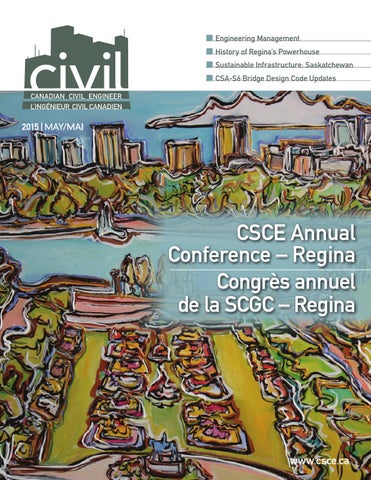
CSCE Annual Conference – Regina Congrès annuel de la SCGC – Regina
www.csce.ca CIVIL May 2015 B .indd 1
15-04-27 11:54 AM
Go Trenchless with PVC TM
Installed in over 125 projects in Canada, will you be the next?
»
Available in CIOD & IPS sizes 4" to 36"
IPEX has introduced Fusible BruteTM and Fusible SeriesTM PVC pipe for
» »
Achieves higher flow rates
HDD and other trenchless applications to the Canadian market. While other thermoplastic materials have been fused routinely, our patented fusion process incorporates a proprietary PVC formulation providing the only available method of installing a continuous, monolithic, fully restrained
»
Connects directly to existing PVC systems for material consistency Use standard CIOD or IPS fittings
PVC pipe system.
Products manufactured by IPEX Inc. IPEX FusibleTM, Fusible BruteTM, Fusible SeriesTM and Go Trenchless with PVCTM are trademarks of IPEX Branding Inc.
Tough Products for Tough Environments
®
C anada Tol l Fr ee: 1 - 8 6 6 - 4 7 3 - 9 4 6 2 | w w w . i p e x i n c . c o m
02-05 CONT-PRES.indd 2
15-04-23 11:21 AM
contents may 2015/Mai 2015 | Volume 32.2
HISTORIC CIVIL ENGINEERING SITE 10 Saskatchewan Science Centre (Powerhouse) CSCE Conference/Congrès SCGC – Regina 2015
13 Conference preview On the cover: Painting of Regina by Jason Robins
news, views & departments
nouvelles,
points de vue et
départements 4 President’s perspective/
Standards/Les Normes
19 The 2014 edition of the Canadian Highway Bridge Design Code Forum on Sustainabile infrastructure/ Forum sur l’infrastructure durable
22 Sasketchewan: Still an untapped opportunity Technical: Engineering Management Technique : La gestion de l’ingénierie
25 Introduction by Constantine J. Katsanis, Ph.D., P.Eng 27 The influence of leadership on organization character:
A synthesis of 20 years of study 29 Reflection on engineering education – A success story of the integration of engineering management topics in construction engineering
19
Perspective presidentielle 6 From the regions: Atlantic/ De nos regions, Atlantique 6 Student voice/La voix des étudiants 8 Young professionals corner/Le coin des jeunes professionels 12 Lifelong learning/ Formation continue 30 From the CSCE National Office/Communications du bureau national de la SCGC 34 CSCE partners and sponsors/ Associés et sponsors SCGC
22
13 Canadian Civil Engineer | May 2015
02-05 CONT-PRES.indd 3
3
15-04-23 11:21 AM
President’S Perspective | Perspective Présidentielle
Reg Andres, P.Eng. FCSCE President, CSCE/Président SCGC president@csce.ca
CSCE/SCGC
4877 Sherbrooke St. W., Westmount, Québec H3Z 1G9 Tel.: 514-933-2634, Fax: 514-933-3504 E-mail: info@csce.ca www.csce.ca
President/Président Reg Andres, P. Eng., FCSCE (Toronto, ON)
Canadian Civil Engineer/L’Ingénieur civil canadien Editor/Rédacteur Doug Salloum, CSCE Executive Director 514-933-2634 ext. 1, doug.salloum@csce.ca Managing Editor/ Directeur de la rédaction Cindy Macdonald Tel.: 416-510-6755 cmacdonald@annexnewcom.ca
Associate Editor/ Rédacteur en chef adjoint Bronwen Parsons Tel.: 416-510-5119 bparsons@ccemag.com
Advertising Sales/ Publicité Maureen Levy Tel: 416-510-5111 mlevy@ccemag.com
Art Director/ Composition artistique Lisa Zambri Tel: 416-510-5600 x3595 lzambri@annexnewcom.ca
Annual Subscription Rates/Abonnement annuel Canada & U.S./E.U. $35.00, Other countries/Autres pays $45.00; Single copy/Un numéro $7.50; Agency discount/Rabais au distributeurs 10% PUBLICATION ISSN 9825-7515 Return Address/Adresse de retour : The Canadian Society for Civil Engineering La Société Canadienne de Génie Civil 4877 Sherbrooke St. W., Westmount, Quebec H3Z 1G9 Canadian Civil Engineer (CCE) is published five times per year by the Canadian Society for Civil Engineering (CSCE). L’ingénieur Civil Canadien (ICC) est publié cinq fois par année par la Société Canadienne de Génie Civil (SCGC). The opinions expressed in the papers are solely those of the authors and the Canadian Society for Civil Engineering is not responsible for the statements made in this publication. Les opinions exprimées dans les articles sont la seule responsabilité de leurs auteurs et la Société canadienne de génie civil n’engage pas sa responsabilité dans les propos exprimés. CIVIL Magazine is produced by the publishers of Canadian Consulting Engineer Magazine, published by Annex Publishing & Printing Inc. Le magazine Civil est produit par l’editeur de la publication Canadian Consulting Engineer qui est publie par Annex Publishing & Printing Inc. Annex Publishing & Printing Inc., 80 Valleybrook Drive, Toronto, Ontario M3B 2S9 Tel.: 416-442-5600; Fax: 416-510-5140 PUBLICATIONS MAIL AGREEMENT/Postes Canada enregistrement #40069240
4
02-05 CONT-PRES.indd 4
State of the Nation at CSCE
C
SCE’s annual conference in Regina is near and my term as president will be completed. I recall my feelings one year ago of a lack of accomplishment for CSCE. I am checking my current feelings as I write this message. The work of the Society is actively focused on our strategic directions. We are making progress and with that a feeling of accomplishment is settling in. That does not mean we have arrived. More work is needed but with the current direction CSCE will be making the kind of difference that it was once only a dream to achieve. The strength of CSCE is in its diversity and ability to respond to the varied interests of civil engineers across Canada. Regardless of age, geographic location, technical education/ training or career choices, CSCE has much to offer all civil engineers. Two streams of activities have been on-going over the past year. One stream is serving to strengthen the internal workings of the Society. The second stream relates to the strengthening of our external visibility, influence and recognition as a learned society using sustainable infrastructure as a foundation. Some of the internal “organizational strengthening” activities in the past year included the adoption of a planning framework designed to focus the individual planning activities of the various groups of the Society on CSCE’s strategic vision. The Board adopted December 30 as a new fiscal year end. This went hand-in-hand with an update of the by-laws to meet current not-for-profit legislation requirements. Additional changes to the by-laws are underway to address a number of housekeeping issues such as deleting references to organizations or committees that no longer exist. Finally, we are preparing for a review of a number of broader operational issues. Several new committees have been established to address some operational needs and to provide more relevancy and connection to civil engineers. All the while our traditional activities, including specialty conferences, life-long learning courses and journal publications, continue to support CSCE’s profile and reputation as a learned society. Some of the external strengthening activities included on-going involvement with other national organizations in programs like the Canadian Infrastructure Report Card and initiation programs like the Sustainability Rating System for Infrastructure. Our partnerships with other groups, such as CPWA, FCM, CCA, CNAM and ACEC, broadened CSCE’s national visibility. We have been working on a number of new policy statements as a foundation for future exposure through advocacy. CSCE has been represented at national and international forums including the first International Sustainable Infrastructure Conference in Long Beach, California, Ontario Premier Kathleen Wynne’s Infrastructure Summit in Toronto and media events like the infrastructure webinar hosted by Science Media Canada, a group serving journalists with information on scientific and engineering issues. I was asked by Infrastructure
Mai 2015 | L’Ingénieur civil canadien
15-04-23 11:21 AM
President’S Perspective | Perspective Présidentielle Canada to facilitate a national discussion group on asset management in Ottawa this spring and we just received a request from the Minister of Infrastructure’s office to address CSCE’s annual conference. All of this affirms that CSCE is making progress. Can you imagine what we might achieve in the next few years? We need more involve-
ment and more members to achieve greatness. I offer this as a challenge for all civil engineers in Canada. We will make a difference and you can be part of this exciting journey. Reg Andres is vice-president of R.V. Anderson Associates Limited in Toronto.
L’État de la Nation de la SCGC
L
e congrès annuel de la SCGC qui se déroulera à Régina est de plus en plus proche et mon mandat de président se terminera par la même occasion. Il y a un an, je me souviens parfaitement d’avoir eu le sentiment d’un manque d’accomplissements de la part de la SCGC. Je m’interroge sur les sentiments actuels au moment où j’écris ces lignes. Le travail de la Société met l’accent sur nos orientations stratégiques. Nous faisons des progrès et cela s’accompagne d’un sentiment d’accomplissement qui prend forme. Mais cela ne signifie pas que nous sommes arrivés à destination. Davantage de travail est nécessaire, mais avec la direction actuelle, la SCGC pourra faire le type de différence qui n’était autrefois qu’un rêve à atteindre! La force de la SCGC réside dans sa diversité et son habileté à satisfaire les intérêts variés des ingénieurs civils partout au Canada. Peu importe l’âge, la région, l’éducation ou la formation technique, ou encore les choix de carrière, la SCGC a beaucoup à offrir à tous les ingénieurs civils. Deux volets d’activités ont été particulièrement actifs au cours de la dernière année. L’un des volets concerne l’amélioration du fonctionnement interne de la Société. Le second volet a trait à l’accroissement de notre visibilité, de notre influence et de notre reconnaissance à l’externe en tant que société savante utilisant les infrastructures durables comme fondation. Certaines des activités de « renforcement organisationnel » à l’interne des 12 derniers mois incluaient l’adoption d’un cadre de planification conçu pour que les activités individuelles de planification des divers groupes de la Société mettent l’accent sur la vision stratégique de la SCGC. Le conseil d’administration a adopté le 30 décembre comme la nouvelle date de fin d’année fiscale. Cette adoption fut jumelée à une mise à jour des statuts afin de satisfaire aux exigences actuelles en matière de loi sur les organismes à but non lucratif. Des modifications additionnelles aux statuts sont en cours afin de traiter d’un certain nombre de questions administratives comme celle d’éliminer des références à des organisations ou des comités qui n’existent plus. Finalement, nous nous préparons à une révision de certaines questions opérationnelles de nature plus large. Plusieurs nouveaux comités ont été créés afin de discuter de certains
Canadian Civil Engineer | May 2015
02-05 CONT-PRES.indd 5
besoins fonctionnels et pour susciter davantage de pertinence et de lien auprès des ingénieurs civils. Conjointement, nos activités traditionnelles incluant les conférences spécialisées, les cours de formation continue et la publication de nos revues, continuent de renforcer le profil et la réputation de la SCGC en tant que « société savante ». Certaines des activités de « renforcement » externe incluaient une implication continue avec d’autres organisations nationales au sein de programmes tels le Bulletin de rendement des infrastructures canadiennes ainsi que des programmes d’initiation comme le Système de notation de la durabilité pour les infrastructures. Nos partenariats avec d’autres groupes tels la CPWA, la FCM, le CCA, le CNAM et l’AFIC, ont permis d’élargir la visibilité de la SCGC sur le plan national. Nous continuons de travailler à un certain nombre de nouveaux énoncés de politique pouvant servir à accroitre notre visibilité par le biais de la promotion de notre cause. La SCGC a été présente lors de forums nationaux et internationaux incluant le Premier congrès international sur les infrastructures durables qui s’est tenu à Long Beach, en Californie, le Sommet de Toronto de la première ministre de l’Ontario, Kathleen Wynne, portant sur les infrastructures et des événements médiatiques comme le webinaire sur les infrastructures organisé par le Centre canadien science et médias, un groupe informant les journalistes sur des questions et des enjeux scientifiques et en ingénierie. Infrastructure Canada m’a demandé d’organiser un groupe national de discussion sur la gestion des actifs à Ottawa ce printemps, et nous venons tout juste de recevoir une requête du bureau du ministre des Infrastructures pour présenter cette initiative lors du congrès annuel de la SCGC. Tout ceci nous confirme que la SCGC a fait d’énormes progrès. Pouvez-vous vous imaginer tout ce que nous pourrions accomplir au cours des prochaines années ? Nous avons besoin de plus d’implication et d’encore plus de membres pour atteindre l’excellence. Je vois cet objectif comme un défi pour tous les ingénieurs civils du Canada. Nous ferons la différence et vous pouvez faire partie de cette extraordinaire aventure. Reg Andres est le vice-président de R.V. Anderson Associates Limited à Toronto.
5
15-04-23 11:21 AM
From the regionS: SECTION NEWS | De nos Régions : Nouvelles Des Sections
Atlantic Region: Recruitment Focus
Région de l’Atlantique : l’accent sur le recrutement
Catherine LeBlanc
Catherine LeBlanc
Member of the executive committee,
Membre du comité exécutif, section Nouveau-Bruns-
Eastern New Brunswick and
wick-Est et Île-du-Prince-Édouard, SCGC
Prince Edward Island Section, CSCE
F
or the Eastern New Brunswick and Prince Edward Island section, several activities over the past year focused on student recruitment and their retention once they are part of the workforce. Each year, the local section organizes a job shadowing activity involving civil engineering students and CSCE members. After starting the event with a lunch, the students are invited to the workplace of their partner engineer, paired according to the student’s particular field of interest. This job shadowing activity allows for discovery of the practical aspects of the profession while offering networking opportunities. As in previous years, the most recent job shadowing activity was a success. Contributing to this success was the addition, for the first time, of a wine and cheese event a few weeks after the job shadowing activity. At this event, everyone had an occasion to share and discuss their experience with other CSCE members. At the end of the academic year, Jérémie Aubé, local representative of the CSCE Young Professionals committee, presented the advantages of CSCE membership to the student members during a lunch-and-learn activity. This initiative had the objective of ensuring a fluid transition from student member to associate member upon graduation. As these activities demonstrate, the recruitment of CSCE members does not require a significant budget. The resources for recruitment can be an innovative team and the essential involvement of the CSCE members in activities such as job shadowing.
P
our la section de l’est du Nouveau-Brunswick et de l’Île-du-PrinceÉdouard, certaines activités de cette dernière année visaient le recrutement d’étudiants et leur rétention une fois sur le marché du travail. Chaque année, la section locale organise une journée de jumelage entre les étudiants en génie civil et les membres de la SCGC. L’événement débute par un dîner, puis les étudiants sont invités au milieu de travail de leur ingénieur partenaire auquel ils sont jumelés selon le domaine d’intérêt particulier de l’étudiant. Ce jumelage permet de découvrir les aspects pratiques de la profession tout en offrant des occasions de réseautage. Comme les années précédentes, la journée jumelage a été un succès. Contribuant au succès de l’évènement cette année a été l’ajout, pour la première fois, d’une soirée vins et fromages quelques semaines suivant la journée jumelage. Au cours de cet évènement, tous les participants ont eu l’occasion de discuter et partager leurs expériences avec d’autres membres de la SCGC. À la fin de l’année universitaire, Jérémie Aubé, représentant local des jeunes professionnels de la SCGC, a présenté les avantages de l’adhésion à la SCGC aux membres étudiants dans le cadre d’un dîner-apprentissage. Cette initiative avait l’objectif d’assurer une transition fluide, après l’obtention du diplôme, entre le statut de membre étudiant et celui de membre associé. Comme ces activités le démontrent, le recrutement des membres de la SCGC ne requiert pas un grand budget, mais trouve toutefois sa source dans une équipe innovatrice et l’implication indispensable des membres de la SCGC dans des activités comme la journée jumelage.
The Student Voice | La Voix Des étudiants
Stimulating Early Professional Consciousness – What Every Student Should Know Charles-Darwin Annan, Ph.D., P.Eng. Chair of Student Affairs, CSCE
S
tudents move through difficult transitions as they progress through life’s challenges. For example, they will have to meet certain admission requirements to be accepted into a civil engineering
6
06-09 NEWS A.indd 6
program. Once in the program, they are required to master principles and techniques of engineering and to maintain good grades to earn their degrees or diplomas. When they work hard, they are able to
Mai 2015 | L’Ingénieur civil canadien
15-04-23 11:22 AM
The Student Voice | La Voix Des étudiants
Stimuler sa conscience professionnelle - Ce que chaque étudiant devrait savoir
achieve sound academic development. But the real concerns begin when they face another important transition between their undergraduate or graduate studies and the real world. Often, whether they have the right set of skills for the challenges they face is not in question. Nonetheless, many new graduates are unsure about what that “right” set of skills is and what their potential employers look for in new graduates. They begin to question Charles-Darwin Annan, Ph.D., P.Eng. themselves, and question whether they are prepared for entry into the Président, Affaires étudiantes de la SCGC civil engineering profession and society. es étudiants doivent passer par des transitions difficiles alors qu’ils Academic development is important and the classroom experience progressent à travers les différents défis de la vie. Par exemple, ils is often satisfactory. But equally important, and not typically covered in class work, is personal development (e.g. commitment, self-reli- devront satisfaire certaines exigences d’admission pour être acceptés dans ance, goal setting and decisionmaking, leadership, can-do attitude, un programme de génie civil. Une fois acceptés dans le programme, ils etc.) and professional development (e.g. client relationship, ethical doivent maîtriser les principes et les techniques de l’ingénierie et obtenir behaviour, interpersonal communication, teamwork, etc.). The ques- constamment de bonnes notes pour recevoir leurs diplômes. Lorsqu’ils tion is: if students do not get this education from the classroom, travaillent fort, ils sont en mesure d’atteindre un bon développement where are these skills learned and practised? Many aspects of these scolaire. Mais les véritables préoccupations commencent lorsqu’ils ont à faire professional matters lend themselves to CSCE Student Chapter activities. CSCE student chapter members hold leadership positions, face à une autre importante transition lors du passage de leurs études they visit engineering works, they invite and host guest speakers, they universitaires (baccalauréat ou études supérieures) vers le monde réel. La conduct chapter activities and prepare annual reports, they partici- plupart du temps, la véritable question n’est pas de savoir s’ils possèdent pate in regional and local CSCE section meetings and activities, and le bon ensemble de compétences pour affronter les défis auxquels ils font maintenant face. Néanmoins, plusieurs nouveaux diplômés ne sont they participate in the national CSCE conferences. This year, at the CSCE annual conference in Regina (May 27-30), pas certains de ce qui constitue un « bon » ensemble de compétences, the CSCE Student Affairs committee will offer a variety of exciting ni de ce que recherchent les employeurs éventuels chez les nouveaux and stimulating programs to provide networking opportunities for diplômés. Ils commencent à se remettre en doute et à se questionner students. The Student Chapter Leaders Workshop will bring togeth- pour savoir s’ils sont réellement préparés à faire leur entrée dans la proer student chapter executives from around the country to engage fession d’ingénieur civil et au sein de la société. Le développement scolaire est important et l’expérience acquise en in stimulating interaction, share experiences and learn from each other. Each Student Chapter will benefit from a $200 travel subsidy. Student chapNadine Crescent Pump Station Upgrades ters are encouraged to consult the student affairs website (http://csce.ca/committees/ student-affairs/) for more information. Student Affairs will also hold the National Civil Engineering Capstone Design Competition which brings together top end-of-program Capstone design teams from civil engineering programs across Canada. Essentially, this unique competition is not about troReusing existing infrastructure saved money and reduced environmental impacts during the phies: it is about participation and learning Nadine Crescent Pump Station Upgrades in the City of St. Catharines. The concrete pumping chamber, inverted siphon, sanitary overflow and electrical/control cabinet were and making good engineers. The Chair of repurposed, resulting in minimal demolition and less construction waste. This project has Student Affairs (charles-darwin.annan@gci. reduced operational and maintenance costs for the City, while providing a reliable and robust wastewater collection system for the local area residents. ulaval.ca) would be happy to hear from organizations who would like to be partners for this competition. Get involved in your CSCE Student Chapter today and begin those lifelong and valutoronto niagara ottawa sudbury london moncton fredericton st. john’s mumbai www.rvanderson.com able professional contacts and associations.
L
Canadian Civil Engineer | May 2015
06-09 NEWS A.indd 7
Canadian Civil Engineer 4.875” x 3.625” 7 April 2015
15-04-23 11:22 AM
The Student Voice | La Voix Des étudiants classe est souvent satisfaisante. Mais tout aussi important, et habituellement non abordé dans une salle de classe, est le développement personnel (ex. : l’engagement, l’autonomie, l’établissement d’objectifs et les prises de décision, le leadership, la détermination, etc.) et le perfectionnement professionnel (ex. : les relations avec le client, le comportement éthique, les communications interpersonnelles, le travail d’équipe, etc.). La question est : si les étudiants ne reçoivent pas cet enseignement dans leur salle de classe, où ces compétences peuvent-elles être apprises et pratiquées ? Plusieurs aspects de ces questions professionnelles s’inscrivent d’emblée dans les activités des chapitres étudiants de la SCGC. Les membres des chapitres étudiants de la SCGC détiennent des postes de leader, ils visitent des chantiers d’ingénierie, ils invitent et accueillent des conférenciers, ils dirigent des activités du chapitre et préparent les rapports annuels, ils participent à des activités et des rencontres des sections régionales et locales de la SCGC et ils participent aux congrès nationaux de la SCGC. Cette année, lors du congrès annuel de la SCGC à Régina (27 au 30 mai), le comité des affaires étudiantes de la SCGC offrira une panoplie de programmes stimulants et excitants destinés à procurer des occasions
de réseautage aux étudiants. L’atelier des leaders des chapitres étudiants rassemblera des dirigeants des chapitres étudiants de partout au pays afin de participer à une interaction stimulante, de partager diverses expériences et d’apprendre les uns des autres. Chaque chapitre étudiant bénéficiera d’une allocation de déplacement de 200 $. Les chapitres étudiants sont encouragés à consulter le site Web des affaires étudiantes (http://csce.ca/fr/committees/student-affairs/#home) pour plus d’informations. Le comité des affaires étudiantes organisera également le concours national Capstone en génie civil qui mettra en compétition les meilleures équipes d’étudiants de dernière année en conception de type Capstone de partout au Canada. Essentiellement, ce concours unique ne se veut pas une course aux trophées. Il sert plutôt à mettre de l’avant la participation, l’apprentissage et la fierté de former de bons ingénieurs. Le président du comité des affaires étudiantes (charles-darwin.annan@ gci.ulaval.ca) se fera un plaisir de discuter avec des organisations qui souhaiteraient s’impliquer comme partenaire de ce concours. Impliquez-vous dès aujourd’hui auprès de votre chapitre étudiant de la SCGC et commencez à vous constituer un réseau de contacts professionnels inestimable et qui vous sera utile toute votre vie.
young professionals’ corner | le coin des jeunes professionels
Young Professionals Across Canada: Prairie Region South Saskatchewan Section The South Saskatchewan Section held a career panel this fall at the University of Regina. Three young professionals from our section gave an overview of their career paths to date. The presenters discussed current projects and position roles, shared their experiences and gave advice to the many students who attended. We hosted our annual popsicle stick bridge competition in January. Thirteen teams participated with their truss bridges constructed of a maximum of 100 whole popsicle sticks. The winning bridge, by Software Master Race, carried a maximum load of 513 N! We are now busy preparing for the upcoming CSCE Annual Conference in Regina. We hope to see you there! —Katelyn Frecon, EIT, AMCSCE
bers, and the Nooners are held on the University of Saskatchewan to help promote student attendance. Our first mixer of the year was a bowling event, where our attendance was primarily YPs and we had good turnout from our student chapter. Our other main event of the year so far has been our annual popsicle stick bridge competition, which had great participation from our professional members and students alike. We are looking forward to having the national CSCE conference in our home province, and can’t wait to see you there! —Ehren Gadzella, EIT, AMCSCE
Saskatoon Section This year the Saskatoon Section has seen a lot of support from our young professionals. We have added 2 YPs to our executive and have been working to expand our events to support the needs of all our members. Our main goals for this year are to retain our student members as associate members when they graduate, and to bring our long term members into contact with our new members. Our strongest events continue to be our “Nooners,” which are short presentations over the lunch hour with a delicious lunch included. This is a great opportunity for YPs to meet our long-standing mem-
8
06-09 NEWS A.indd 8
Participants in the South Saskatchewan bridge competition. Courtesy of The Leader-Post./ Participants lors du concours de construction de ponts de la section de Saskatchewan Sud. Gracieuseté de The Leader-Post.
Mai 2015 | L’Ingénieur civil canadien
15-04-23 11:22 AM
young professionals’ corner | le coin des jeunes professionels
Les jeunes professionnels au Canada : région des Prairies Section de Saskatchewan Sud La section de Saskatchewan Sud a organisé cet automne un panel sur les carrières à l’Université de Régina. À ce jour, trois jeunes professionnels de notre section ont donné un aperçu de leur cheminement de carrière respectif. Les intervenants ont discuté de projets actuels et de responsabilités des postes, ont partagé leurs expériences et ont prodigué des conseils aux nombreux étudiants présents. En janvier, nous avons accueilli notre concours de construction de ponts en bâtonnets de glace (popsicles). Treize équipes ont participé en présentant leurs ponts en treillis construits à partir d’un maximum de 100 bâtonnets de glace complets. Le pont vainqueur fut celui de Software Master Race, qui a supporté une charge maximale de 513 N ! Nous sommes présentement en pleins préparatifs du congrès annuel de la SCGC qui se tiendra à Régina du 27 au 30 mai prochains. Nous espérons vous y voir en grand nombre ! —Katelyn Frecon, EIT, AMCSCE
cellente occasion pour les JP de rencontrer nos membres de longue date. De plus, les exposés-midi se tiennent à l’Université de Saskatchewan afin d’encourager la présence étudiante. Notre première rencontre fut une journée de quilles, où les participants furent surtout des JP. Notre chapitre étudiant y était également très bien représenté. L’autre grand évènement de l’année à ce jour, fut notre concours annuel de construction de ponts en bâtonnets de glace (popsicles), auquel plusieurs de nos membres professionnels et étudiants ont participé. Nous sommes bien heureux que le prochain congrès national de la SCGC se tienne dans notre province et avons bien hâte de vous voir lors de l’évènement ! —Ehren Gadzella, EIT, AMCSCE
Section de Saskatoon Cette année, la section de Saskatoon a été témoin d’un soutien constant de la part de nos jeunes professionnels. Nous avons ajouté 2 JP à notre équipe de direction et avons travaillé à élargir nos évènements afin de satisfaire aux besoins de tous nos membres. Nos objectifs principaux pour cette année sont de retenir nos membres étudiants en tant que membres associés lorsqu’ils obtiendront leur diplôme, et de mettre en contact nos plus anciens membres avec les nouveaux membres. Nos évènements les plus populaires sont toujours les exposés-midi, ou « Nooners », qui consistent en de mini-présentations sur l’heure du dîner, accompagnées d’un délicieux repas. Ils constituent une ex-
Participants in the Saskatoon Section’s bridge building competition./ Des participants lors du concours de construction de ponts de la section de Saskatoon.
WE DO IT ALL
CORROSION PROTECTION & SEALING SYSTEMS YOU CAN DEPEND ON
Extend Structure Life, Reduce Maintenance & Repair Costs • for industrial steelwork, pipework & road surfaces • above & below ground pipe, valves, fittings & steel • offshore marine piling protection • road, bridge, airport & asphalt applications A member of Winn & Coales International.
Canadian Civil Engineer | May 2015
06-09 NEWS A.indd 9
www.densona.com Toronto • Edmonton Denso North America Inc. 90 Ironside Cres. Unit 12 Toronto, ON M1X 1M3 Tel: 416.291.3435 Fax: 416.291.0898
9
15-04-23 11:22 AM
2015 HISTORIC CIVIL ENGINEERING SITE | LIEUX HISTORIQUE DE GéNIE CIVIL 2015
Saskatchewan Science Centre (Powerhouse) The Powerhouse, a former coal-fired electrical generating station in Regina, has been expanded and adapted over the years to serve as a research facility and science centre. By Cathy Lynn Borbely, P.Eng., FCSCE, FEIC CSCE/SCGC Conference Co-Chair
T
he history of electrical power generation in Saskatchewan began around the turn of the 20th century. At that time electricity was made available primarily in larger centres such as Regina, and most electrical utilities were owned by municipalities. The first electricity supply for Regina was provided by the Regina Light and Power Company and became operational on November 15, 1890. The company became a publicly owned utility in 1904 and was located on the corner of Smith Street and Dewdney Avenue. A year later, a new plant was built on the corner of Dewdney Avenue and Broad Street. These early facilities were “stand alone” facilities and were not connected to each other. They were fueled by residual fuel oil (RFO), by the Navy specification, Bunker C. This type of oil is characterized as a heavy RFO with a high viscosity, requiring heating by a recirculating low pressure steam system. Regina had been incorporated as a city in 1903 with a population of 2,249, but by 1911 it had grown to 30,213. To meet a growing need for electrical power in the burgeoning centre, the city decided to build a coal-fired generation plant. Two men who were largely instrumental in bringing the new plant to the city were Edmund Bull, who had worked at the old power house, and Louis A. Thornton, city commissioner at the time and former city engineer. The architecturally pleasing massive red brick structure was completed in 1914 on the shores of Wascana Left: David Furlong, General Manager of the Saskatchewan Power Corporation, accepting the keys to the power plant from Mayor Henry Baker on May 1, 1965.
10
10-12 SASKSCIENCE.indd 10
Mai 2015 | L’Ingénieur civil canadien
15-04-23 11:22 AM
2015 HISTORIC CIVIL ENGINEERING SITE | LIEUX HISTORIQUE DE GéNIE CIVIL 2015 Lake. Known as the Powerhouse, it was the main electrical power supply for the City of Regina and the first coal-fired plant in the area. The plant first housed two 1500kW generators. The units were all driven by coal-fired steam boilers. It is one of the oldest original buildings representing the adoption of coal-fired electrical power generation in Canada. But today, as the Saskatchewan Science Centre, it generates a new kind of power: the power of imagination.
An ornament on Wascana Lake The building’s lakeside location was chosen because of the abundant supply of water needed to cool the boilers and to produce steam to drive the turbines. Interestingly, this incidentally encouraged the Canada Geese colony on Wascana Lake to remain over winter. But the site was selected for symbolic reasons as well. The city administration wanted a building which “should be an ornament to the shores of Wascana Lake, which will one day be the beauty spot of the city.” They achieved the goal and 100 years later, the original structure is prominent on the shores of the lake. The Regina architectural firm of Storey and Van Egmond had begun planning in 1913 and the construction firm of Smith Brothers & Wilson Ltd. received a contract for $90,800 to complete the work. The project ended up $25,000 over budget.
The building consisted of a basic rectangular structure housing the boilers and turbines, and four functional additions, one on each face, housing a coal-handling facility, switching facilities, workshops and stores, and duty-staff quarters. The exterior was trimmed with decorative white limestone and featured large steelsashed Romanesque windows — unusual features for such a utilitarian building. Planning for the new plant building began in the spring of 1913 and construction was completed in 1914. Over the years, additions to the building came and went. They included four large smoke stacks, and a new addition that was built in 1954 and enlarged in 1960. The addition was metal sided because the city could not match the original brick.
10-12 SASKSCIENCE.indd 11
Each year at the CSCE annual conference, the society’s National History Committee selects a site or project from the region in which the conference is being held as a Historic Civil Engineering Site. Through this program the committee aims to make the general public and engineers themselves more aware of the rich history and heritage of Civil Engineering in Canada. A commemoration ceremony is held during the CSCE conference, and a plaque is placed on the chosen site, in a place
Transformation to a research and science centre
where it is readily visible to the public.
On May 1, 1965, the city sold the Powerhouse to the Saskatchewan Power Corporation (now SaskPower), which gradually phased the plant out of operation and shut it down completely in October 1978. However, SaskPower built a new research and development facility adjoining the building and added a glass “greenhouse” over the front entrance. The Technical Services and Research division of SaskPower still uses the northern half of the renovated annex and about half of the old Powerhouse for its high voltage research facility.
tional, international and regional sites have
Early view of the building, which was constructed in 1914.
Canadian Civil Engineer | May 2015
National Historic Civil Engineering Sites
Since the program began in 1983, 65 na-
been designated. In 2015 the site being designated as a Historic Civil Engineering Site is the Saskatchewan Science Centre, originally opened in 1914 as the Powerhouse for the City of Regina. The building was adapted and transformed into the science and research centre in 1989 and is now owned by SaskPower.
Powerhouse building in Regina as it looks today.
11
15-04-23 11:22 AM
2015 HISTORIC CIVIL ENGINEERING SITE | LIEUX HISTORIQUE DE GéNIE CIVIL 2015 SaskPower sought to find an additional use for the old Powerhouse structure and found one in May 1978, when the Junior Service League of Regina proposed what became the Saskatchewan Science Centre. Headstart Corporation cleared the allocated space within the building for the centre in 1982. Arnott MacPhail Associates was selected as architect in early 1987 and structural engineering services were provided by Huntley O’Connor, P.Eng. Two years later the Saskatchewan Science Centre was officially opened to the public in July 1989 by Their Royal Highnesses The Duke and Duchess of York. Under its current use, the Powerhouse exhibit floors feature hands-on science exhibits and live stage shows and demonstrations for
the public. In April of 1991 the Saskatchewan Science Centre opened its second attraction, the Kramer IMAX Theatre, built partially on the frame of the 1954 annex. The Powerhouse also promotes careers as technologists, engineers, scientists — even an astronaut. Encouraging the imagination has the ability to transform children into individuals who can change the future of the province, the nation, and maybe even the world. To mark the building’s designation as a Historic Civil Engineering Site, a plaque will be installed: REGINA POWER GENERATION STATION In recognition of civil engineers and those who
helped design, build, maintain and renew the Powerhouse to its current role as a research facility and discovery place for engineering and science. The plant which opened on March 14, 1914, is one of the oldest original buildings representing the adoption of coal fired electrical power generation in Canada. Architectural Firm: Storey and Van Egmond Construction Firm: Smith Brothers & Wilson Ltd. Original Owner: City of Regina Owner (2015): SaskPower Current Use: Saskatchewan Science Centre and the SaskPower High Voltage Research Facility.
LIFELONG LEARNING | FORMATION CONTINUE
CSA-S-06 Canadian Highway Bridge Design Code: New Edition Vancouver, Edmonton, Calgary, Saskatoon: May 12-15, 2015 Quebec / Maritimes: Fall 2015 CSCE will be offering a one-day course on the new edition of the Canadian Highway Bridge Design Code. Authors of the code will present and explain the major changes made to four main sections of the code: Section 4: Seismic Design, Section 5: Methods of Analysis, Section 6: Foundations and Geotechnical Systems and Section 12: Barriers and Highway Accessory. The 11th edition of CSA S6 Code applies to the design, evaluation and structural rehabilitation design of fixed and movable highway bridges. This event is sponsored by Acrow Bridge and Canam-ponts.
CSA-S-06 Code canadien sur le calcul des ponts routiers: Nouvelle édition Vancouver, Edmonton, Calgary, Saskatoon: 12-15 mai 2015 Québec/Maritimes : automne 2015 La SCGC présentera une formation d’une journée sur la nouvelle édition du Code canadien sur le calcul des ponts routiers. Les auteurs du code présenteront les modifications importantes apportées à quatre principaux chapitres du code : Chapitre 4 : Conception parasismique; Chapitre 5 : Méthodes d’analyse; Chapitre 6 : Fondations et systèmes géotechniques et Chapitre 12 : Dispositifs de retenue et supports d’équipements routiers.
12
10-12 SASKSCIENCE.indd 12
La 11e édition du CSA S6 couvre la conception, l’évaluation et la conception de réhabilitation de la structure des ponts routiers fixes et mobiles. Cette formation est commanditée par Acrow Bridge et Canam-ponts.
CSA-S850 Design and Assessment of Buildings Subjected to Blast Loads Regina (CSCE Annual Conference): May 27, 2015 This course presents the first Canadian standard for the design and assessment of buildings subjected to blast loads. It is the most comprehensive of its kind in the world. The course is presented by Dr. Ghani Razaqpur, Chair of the Technical Committee for the CSA-S850 and Dr. Murat Saatcioglu, Chair of the Sub-Committee on Design.
CSA-S850 Conception et évaluation des bâtiments soumis à des charges de souffle Regina (Congrès annuel de la SCGC) : 27 mai 2015 Cette formation présente la première norme canadienne sur la conception et l’évaluation des bâtiments soumis à des charges de souffle. Il s’agit de la norme la plus complète au monde. Les formateurs sont les professeurs Ghani Razaqpur, président du Comité technique de la norme CSA-S850 et Murat Saatcioglu, président du Sous-comité Conception de la norme.
Mai 2015 | L’Ingénieur civil canadien
15-04-23 11:22 AM
CSCE Annual Conference | Congrès annuel de la SCGC
Building on Our Growth Opportunities Miser sur nos opportunités de croissance May 27 to 30, 2015 | 27 au 30 mai 2015 | Regina Welcome The time is quickly approaching and we invite you to join us in Regina, Saskatchewan for the 2015 CSCE Annual Conference from May 27 to 30, 2015. Register today and secure your place at the best civil engineering conference of the year! We have an exciting program with both technical and social events to inspire you professionally and provide a dynamic atmosphere to renew old acquaintances and establish new connections. This is an opportunity to share the accomplishments we are making as civil engineers in our communities. The conference theme for 2015 is “Building on Our Growth Opportunities.” Saskatchewan is home to more than 1.1 million people and is among Canada’s leaders in population growth. We are a thriving province. Export trade is our backbone and we have the natural resources the world wants. We are excited to have you visit our city and let you in on the secret. Regina is no longer the place to be from. It is the place to be. From arts and culture to recreation and sports, we welcome you.
Gold
Bronze
Other sponsors
Exhibitors
Cathy Lynn Borbely, co-chair Harold Retzlaff, co-chair
Canadian Civil Engineer | May 2015
13-18 CONFERENCE.indd 13
13
15-04-23 11:23 AM
CSCE Annual Conference | Congrès annuel de la SCGC
Technical Program
Young Professionals Program
On behalf of the Technical Program Committee, we invite you to attend the CSCE Annual Conference in Regina. “Building on Our Growth Opportunities” is the theme of the 2015 event. We have more than 200 papers in various disciplines of civil engineering. Topics in our General Conference range from structural and construction engineering to sustainable development and infrastructure management. In addition, we have specialty conferences to showcase the engineering challenges and recent advances in the following specific areas of our profession: engineering materials and mechanics, disaster prevention and mitigation, and new this year, innovation in engineering practice. The 4th International Engineering Mechanics and Materials Specialty Conference provides a forum for academics, researchers and practitioners from various fields of engineering mechanics and materials to present and discuss recent advancements and innovative solutions. More than 40 papers have been submitted by distinguished researchers and practitioners. A snapshot of topics to be presented at the conference includes: high performance and high strength materials, emerging materials and specialized metals, fibre-reinforced concrete, dynamics of structures and concrete durability. We have about 20 papers submitted to the 4th International Disaster Prevention and Mitigation Specialty Conference. The presentations will highlight the engineering advancements on post-disaster management, flood control, seismic resistant design and blast loadings. For the first time at an annual conference, CSCE is providing a venue for civil engineering practitioners to present case studies, project implementation summaries and technology summaries. More than 40 abstracts have been submitted to our 1st Innovation in Engineering Practice Conference. Some of the topics include: state-of-the-art and emerging technologies, design and construction case studies, advanced decision tools, and project management in the Prairie provinces. For more information, go to: www.csce2015.ca/techprogram.php
The annual conference is fast approaching, and as part of it, another exciting young professionals’ program. The purpose of the young professionals’ program is to build on CSCE’s strategic direction, “Growing with Youth,” by providing services that target the specific career development needs of students and young professionals. Although this program is targeted at young professional and student members, it is open to all conference attendees. This year’s program will include a technical workshop titled: “Developing a Policy for a Sustainable Rating System for Infrastructure.” The interactive workshop will be facilitated by Reg Andres, president of CSCE. In addition to the technical session, there will be several networking and social events including the President’s Reception, a tour of some local microbreweries, and visits to several downtown establishments. Some events require pre-registration and additional fees. For more information, go to: www.csce2015.ca/students.php
Volunteers Wanted Become a volunteer and be a part of all the excitement of the 2015 CSCE conference! Help us show the rest of Canada and the world the hospitality that South Saskatchewan has to offer, while also contributing to your professional development. Your volunteer duties will be coordinated to ensure that you have time to attend presentations and to network. Meeting with new people and staying in touch with the engineering field are the major benefits of being a volunteer. There are many other benefits that you will be able to take advantage of during your free time should you choose to volunteer at this conference. Volunteer placements are limited – sign up now, don’t miss this opportunity.
14
13-18 CONFERENCE.indd 14
The Saskatchewan Legislature Building is located in Wascana Park. A tour of the Legislature will be part of the companions’ program of the CSCE Annual Conference.
To register as a volunteer, visit goo.gl/ZMT5M8 and submit the available registration form. Please also visit our website at www.csce2015.ca/volunteer.php for further details.
Mai 2015 | L’Ingénieur civil canadien
15-04-23 11:23 AM
STEEL VS. CONCRETE: Which is the better, greener and more cost efficient choice for commercial building construction? Review the results of an independently conducted research study that outlines the impacts on design, construction costs, project schedules, and sustainability of steel vs. concrete framing alternatives. Download the case study flyer today at
cisc-icca.ca
13-18 CONFERENCE.indd 15
15-04-23 11:23 AM
CSCE Annual Conference | Congrès annuel de la SCGC
Keynote Lamb: Canadian Light Source’s Contribution to Science Robert Lamb was educated at Melbourne and Cambridge universities, and subsequently held academic appointments in England, Germany, the United States, Hong Kong and Australia. Lamb also held academic and government positions in senior administration. One of his major interests is how public and private sectors form relationships to translate science into technology. Along the way, Lamb has also been involved in the creation of four companies, the most recent in Hong Kong, China. A synchrotron produces the world’s brightest and most perfect source of light. This light is used to probe and manipulate matter down to the atomic level. The technology has become a critical part of the tool box of analytical instrumentation available to scientists and engineers. Saskatchewan’s synchrotron, the Canadian Light Source (CLS), of which Robert is currently CEO, is located in Saskatoon. It plays an integral role in aerospace, pharmaceuticals, automotive, medical and materials science developments. This year will mark the 10th anniversary of the CLS’ first user and this talk will showcase some of the most brilliant science that has come out of Canada’s synchrotron in its first 10 years of discovery.
Robert Lamb,
Canadian Light Source
Keynote Collins: Building Information Modelling of Rail Terminus Ronan Collins is currently the BIM project director with InteliBuild. He is an experienced building information modelling (BIM) project manager and specializes in the production of detailed and accurate BIM models for the purpose of virtual design and construction co-ordination. Collins leads a team of experienced construction professionals and 3D-modelling and virtual construction specialists that has collaborated with numerous clients from the Middle East to Southeast Asia. Intelibuild has worked with clients on such projects as the Marina Star Residential Tower in Dubai, the Qatar Education City Convention Centre, the Disney Park in Hong Kong and the Mass Transit Railway (MTR) West Kowloon High Speed Rail Terminus. Collins’ presentation is on how the MTR Corporation in Hong Kong adapted the use of BIM processes to review design and construction drawings for the West Kowloon High Speed Rail Terminus. More than 15,500 engineering drawings were assessed and modelled from eight different civil works contracts. The MTR BIM process identified and resolved more than 10,000 problems across all disciplines and used a webbased RFI procedure for raising, responding and tracking the queries. The BIM process also used 4D techniques for planning the work and reviewing the contract interfaces.
Workshop: Implementing a Sustainability Rating System CSCE is creating a policy for a sustainability rating system for infrastructure, and we want you to help us realize this goal. At the 2015 CSCE Annual Conference, join us for a workshop on Friday, May 29, to discuss: • How you see sustainability being implemented in society; • The challenges and barriers that sustainability faces, and practical solutions; • The purpose or role of a sustainability rating system; • The components of a sustainability rating system; and • How such a rating system may be implemented. This interactive workshop will integrate education, collaboration in break-out groups, sharing of ideas and solutions, and discussion as a large group. The results of the workshop will be documented and made available to its participants. CSCE president Reg Andres will facilitate the discussion that has been organized as part of the young professionals program at the conference. We highly encourage participation of all of our members. If you are unable to attend the conference and would like to contribute your thoughts and ideas, please contact Katelyn Frecon at kfrecon@walkerprojects.com.
Ronan Collins,
Reg Andres,
InteliBuild
president, CSCE
16
13-18 CONFERENCE.indd 16
Mai 2015 | L’Ingénieur civil canadien
15-04-23 11:23 AM
CSCE Annual Conference | Congrès annuel de la SCGC
Social Evening: The RCMP Heritage Centre May 28th, 2015
SaskPower’s Boundary Dam integrated carbon capture and storage facility.
Keynote Monea: SaskPower Carbon Capture Initiative Michael J. Monea joined SaskPower in 2008 as vice-president, carbon capture and storage initiatives and in September 2011 was appointed president of the division. Prior to his role with SaskPower, Monea was a senior vice-president with Canada Capital Energy Corporation. He served as executive director of the Petroleum Technology Research Centre at the University of Regina and later was appointed chairman of the board. In 2008, he was appointed to the Society of Petroleum Engineers Distinguished Lecture program as an expert in enhanced oil recovery. In 1982, early on in his professional career, he created his own consulting oil company, Nautilus Exploration and Associates Ltd., which is still an active Canadian oil and gas company. Monea holds professional engineer and geoscientist designations and is a member of the Canadian Institute of Corporate Directors. Monea’s presentation is on the Boundary Dam Integrated Carbon Capture and Storage (CCS) Project, SaskPower’s flagship CCS initiative. Through the development of the world’s first and largest commercial-scale CCS project of its kind, SaskPower is making a viable technical, environmental and economic case for the continued use of coal. The captured CO2 is transported by pipeline to nearby oilfields in southern Saskatchewan where it is used for enhanced oil recovery. CO2 not used for enhanced oil recovery is stored in the Aquistore injection well at SaskPower’s Carbon Storage and Research Centre. Aquistore is the Petroleum Technology Research Center’s second world-class project, following the International Energy Agency’s Greenhouse Gas Weyburn-Midale CO2 monitoring and storage project.
Experience the history of the Royal Canadian Mounted Police during the CSCE conference’s social evening event on May 28. See where the brave RCMP Cadets are trained and where the story begins. Designed by world-renowned Canadian architect Arthur Erickson, the striking 70,000-square-foot RCMP Heritage Centre opened in May 2007. The Heritage Centre documents and shares the RCMP’s past and present with the world. Permanent and temporary displays describe the critical role the force has played in the development of western Canada, and the role it continues to play in addressing contemporary crime issues. A unique mix of educational institution, museum and tourist attraction, the RCMP Heritage Centre engages visitors in this fascinating Canadian story. At the Heritage Centre guests have the opportunity to visit “Depot” Division, the RCMP Academy, which is the only training academy for the Mounties in all of Canada. Your evening will include the telling of the story of the RCMP through interactive exhibits, audio/visual tours, and programming, as well as trolley tours and live events. This one-of-a-kind evening will also include cocktails, appetizers, a seated buffet dinner and dessert. Free bus transportation will be provided to and from the Delta hotel.
Experience the story of the RCMP while Michael Monea,
enjoying cocktails and a buffet dinner during
SaskPower
the CSCE Annual Conference social evening.
Canadian Civil Engineer | May 2015
13-18 CONFERENCE.indd 17
17
15-04-23 11:23 AM
CSCE Annual Conference | Congrès annuel de la SCGC
Technical Tours
Companions Tour
SaskPower Carbon Capture and Storage Facility at Boundary Dam
We invite the companions of conference delegates to join us in exploring Regina and surrounding communities through historical tours, dining experiences, art galleries and shopping. One of the highlights this year is a historical tour of the Saskatchewan Legislature Building, known as the marble place, located in Wascana Park, one of the North America’s largest and most scenic urban parks. We will spend the rest of the afternoon at Henry’s art gallery, boutique and café. You are in for a treat if you decide to join us on a short trip to Moose Jaw, a popular tourist destination known for its fascinating attractions, vibrant downtown and rich history. Visit one of Moose Jaw’s famous underground tunnels where you will learn about the early history of Chinese immigrants to Canada. After the tour, you will have lunch in the elegant setting of the newly restored Grant Hall Hotel. After lunch you will visit the Yvette Moore Gallery, home of the exclusive art collection of renowned Canadian artist Yvette Moore. For more information, go to: www.csce2015.ca/companion.php
Tour Date: Wednesday, May 27, 2015 (9 hours, 45 minutes)
The facility is the world’s first and largest commercial-scale carbon capture and storage project of its kind. The Boundary Dam Project near Estevan, Sask., will be a long-term producer of 110 megawatts of base-load electricity and reduce greenhouse gas emissions by one million tonnes of carbon dioxide (CO2) each year. The captured CO2 is transported by pipeline to nearby oil fields in southern Saskatchewan or is stored in an injection well. There are limited spaces for this tour so register early. Cost: $70 plus tax (includes transportation, tour, lunch and the use of personal protection equipment)
Global Transportation Hub - CP Rail
Tour Date: Thursday, May 28, 2015 morning (2 hours) It is the largest project of its kind undertaken in the history of the province and is quickly gaining notoriety as Canada’s premier inland port. Comprising 1,700 acres, the Global Transportation Hub (GTH) helps local, national and international companies connect to global markets through an efficient rail and road infrastructure. There are limited spaces for this tour so register early. Transportation is provided. Cost: included with conference registration.
Mosaic Stadium at Taylor Field
Tour Date: Thursday, May 28, 2015 afternoon (2 hours) The 33,000-seat open-air facility will be a comfortable home for the Saskatchewan Roughriders and local sports teams, along with their fans. The stadium will feature expandable seating and the option to add a roof at a later date. With enviable amenities and state-of-the-art features, this new stadium will attract world-class sports, concerts and events. There are limited spaces for this tour so register early. Transportation is provided. Cost: included with your conference registration.
Conference Program at a Glance
Sponsorship Opportunities
Wednesday, May 27 Technical tour – Carbon Capture Facility Professional development session CSCE Operations workshop Opening reception
Friday, May 29 Capstone student competition Technical papers Trade show Honours & Awards Gala evening
Thursday, May 28 Technical papers Technical tours Trade show Social evening
Saturday, May 30 Technical papers AGM luncheon CSCE committee meetings
18
13-18 CONFERENCE.indd 18
Showcase your business at the Canadian Society for Civil Engineering 2015 Annual Conference. More than 500 delegates from 15 countries will gather in Regina to share their knowledge and expertise. This is a unique opportunity to network with experts from Canada and around the world. For more information, please visit www.csce2015.ca/sponsorship.php and review the Sponsorship and Trade Show Exhibition Programs brochure.
Mai 2015 | L’Ingénieur civil canadien
15-04-23 11:23 AM
Standards | les normes
The 2014 Edition of the Canadian Highway Bridge Design Code Mark Braiter Senior Project Manager, CSA Group
C
SA S6-14, Canadian Highway Bridge Design Code (Code), was recently published by CSA Group (CSA) in February 2015. As in previous editions, the primary concern in the development, interpretation and application of this Code is the safety of the public, including that of construction and maintenance workers. This Code uses the limit states design approach and reflects current research activity and design conditions across Canada. Several design aspects are Image courtesy of Saskatchewan Highways and Infrastructure. addressed for the first time in this edition and a more detailed treatment of many others is provided. This latest edition of CSA S6 is expected to be adopted by jurisdictions els for highway bridges that are consistent across Seismic Design: across Canada. all Canadian jurisdictions. Adoption of a single code makes it easier for designers and consultants The approach for to respond to calls for proposals and eliminates Historical background the need for familiarity with the details of several The publication of the first edition of the Ontario determining seismic codes. The adoption of a single code also supBridge Design Code (OHBDC) in 1979 marked the beginning of modern bridge design codes in North hazard has been updated ports the implementation of a national highway transportation system with agreed minimum America. The OHBDC, developed by the Ontario standards and loadings for bridges on interproMinistry of Transportation, used for the first time the and is based on the vincial highways, thereby encouraging consisprinciple of limit states design, and included several tency of vehicle weights across jurisdictions and new and daring design provisions based on research approach taken in supporting the objective of more cost-effective findings of the time. transportation of goods. The CSA standard for the design of highway bridgdeveloping the 2015 es, CSA S6, was initiated in 1922. It was modeled after the AASHTO Specifications for Highway BridgThe development process National Building Code es. The 1988 edition of CSA S6, however, used the This Code was developed taking into account the OHBDC as its model. different regulatory structures and standards of of Canada Canada’s provinces and territories. Overall priApplicability orities and objectives were established by CSA’s In Canada, the legal mandate for establishing design and construc- Canadian Highway Bridge Design Code Regulatory Authority Comtion requirements for highways, including highway bridges, lies with mittee (RAC), which also monitored the progress of the Code’s dethe provincial and territorial governments. This Code applies to the velopment. In accordance with CSA procedural requirements, howdesign, evaluation, and structural rehabilitation design of fixed and ever, responsibility for the technical content of this Code lies with the movable highway bridges in Canada. This Code also covers the de- Technical Committee (TC). Because of the breadth and complexity sign of pedestrian bridges, retaining walls, barriers, and highway ac- of the Code, subcommittees (required to operate and report on a cessory supports of a structural nature, e.g., lighting poles and sign consensus basis) were established to oversee each of the Code’s sevensupport structures. teen sections. The use of subcommittees permitted the recruitment of Among the benefits associated with undertaking the development subject matter experts needed to address the sometimes highly speof this Code is the opportunity to establish safety and reliability lev- cialized topics covered by the Code. In all, a team of more than 175
Canadian Civil Engineer | May 2015
19-21 BRIDGEDES.indd 19
19
15-04-23 11:24 AM
Standards | les normes
CSA members have been working over the past five years developing this latest edition of the Code.
Code Sections There are 17 sections of the Code. The changes and updates to some of the sections are outlined below. Section 1 (General) specifies general requirements for applying the Code and includes definitions and a reference publications clause. It also specifies geometric requirements, based in part on the Transportation Association of Canada’s Geometric Design Guide for Canadian Roads (1999), and hydraulic design requirements, based in part on the Transportation Association of Canada’s Guide to Bridge Hydraulics, 2nd ed. (2004). There are also general provisions covering durability, economics, environmental considerations, aesthetics, safety, maintenance, and maintenance inspection access. Section 2 (Durability) specifies durability requirements to be considered during the design process and aspects of materials used in the construction of highway bridges, culverts, and other structures located in transportation corridors.
CALL FOR CASE STUDIES - 2015 The editors of CIVIL magazine invite CSCE-CSGC members to submit case studies for possible publication in future issues. Projects submitted should should demonstrate technical innovation in structural/civil engineering, project management or other engineering expertise. Submit a brief summary of 700 words (in English or French), plus two or three images, to: Bronwen Parsons, Associate Editor, CIVIL. e-mail bparsons@ccemag.com, Tel. 416-510-5119.
20
19-21 BRIDGEDES.indd 20
Section 3 (Loads) specifies loading requirements for the design of new bridges, including requirements for permanent loads, live loads, and special loads (but excluding seismic loads). The 625 kN truck load model and corresponding lane load model are specified as the minima for interprovincial transportation and are based on current Canadian legal loads. This Section covers long-span live loading and addresses wind tunnel testing for aerodynamic effects. Section 4 (Seismic Design) has been extensively rewritten. This section specifies seismic design requirements for new bridges and evaluation and rehabilitation requirements for existing bridges. The definitions for important categories have been revised. The approach for determining seismic hazard has been updated and is based on the approach taken in developing the 2015 National Building Code of Canada. Seismic effects from earthquakes having three different return periods are considered. Performance-based design has been introduced with force-based design permitted for special cases. New provisions for damping, effective moment of inertia, hold-down-devices and shear keys have been added. Modifications have been made to some of the response modification factors, and requirements for foundations have been added. Expected material properties for concrete, reinforcing bars and structural steel have been introduced for design. Changes have been made to provisions for the shear design of ductile concrete columns as well as for braces and connections of ductile concentrically braced frames. Design provisions for ductile diaphragms have been added as energy dissipating systems for slab-on-girder bridges in the transverse directions. Performance-based design provisions for seismic isolation have been added, as well as test requirements for these types of bearings. Requirements for the design and testing of shock transmission units are included. Performance-based design has been added for the evaluation and rehabilitation of existing bridges. Section 5 (Methods of Analysis) has also been extensively rewritten. This section specifies requirements for analyzing the basic superstructure of a bridge. In its methods for simplified analysis of bridge superstructures, the beam analogy method approach is used and presented in a more concise manner. Distribution factors are expressed according to S/D approach common to the Codes prior to the 2000 edition. Based on research conducted during the past five years to validate and supplement work done in the 1990s, some equations have been modified. The new simplified method includes skewed bridges. Simplified elastic methods are included for the analysis of transverse effects. Refined methods of analysis for short, medium, and longspan bridges are also addressed.
Mai 2015 | L’Ingénieur civil canadien
15-04-23 11:24 AM
Standards | les normes
Section 6 (Foundations and Geotechnical Systems) has adopted a reliability-based approach to the design of foundations and geotechnical systems. It includes a risk and consequence based framework to determine the design factors. New to this section is a consequence factor which adjusts target reliabilities depending on failure consequences, combined with a resistance factor whose value slides, and depending on the degree of site and model understanding and the specific limit state being designed. The two factors are applied to the characteristic geotechnical resistance at both ultimate and serviceability limit states to achieve consistent system reliability levels while simultaneously improving economies. The scope is limited to the static loading condition (seismic loading conditions will be included in the next edition). Other changes include an additional section for foundation design aspects of integral and semi-integral abutments, enhancements to sections on geotechnical investigations to include requirements for seismic design, and revisions to the deep foundations section to improve foundation design aspects and added provisions for lateral resistance of piles. Section 7 (Buried Structures) deals with soil-metal structures with shallow corrugated plates in which thrust is the dominant force in the metal plates, soil-metal structures with deep corrugated plates, and metal box structures in which flexural effects are considered in the design of the metal plates. New provisions are provided for the use of plates with deeper corrugations and conditions stipulated for situations when rigorous methods of analysis should be used in lieu of the simplified equations for determining load effects. This section also provides provisions for reinforced concrete precast and cast-inplace structures, including pipes, box sections, and segmental structures, and specifies requirements for determining the properties and dimensions of the engineered soil and non-soil components. Section 8 (Concrete Structures) covers reinforced and partially and fully prestressed concrete components (including deck slabs) made of normal-density, semi-low-density, and high-density concrete of a strength varying from 30 to 80 MPa. Compression field theory is used for proportioning for shear and for torsion combined with flexure. The strut-and-tie approach is used for proportioning regions where the plane sections assumption is not applicable. Section 9 (Wood Structures) specifies properties for materials and fastenings and includes data for sawn lumber, glued-laminated timber and structural composite lumber. For this edition of the Code, the size effect factor for flexural resistance of glued-laminated timber and the specified negative bending moment strength for two grades of glued-laminated timber have been updated in accordance with CSA O86-14 Engineering Design in Wood. In addition, compression at an angle to grain formula has been revised. AWPA Standards are referenced for pressure preservative treatment of laminated veneer lumber. Section 10 (Steel Structures) specifies the requirements for the de-
Canadian Civil Engineer | May 2015
19-21 BRIDGEDES.indd 21
sign of structural steel bridges, including requirements for structural steel components, and their connections. Requirements for fracture control are outlined in Clause 10.23. Construction requirements are specified in Clause A10. Section 11 (“Joints and Bearingsâ€?) specifies the minimum requirements for the design of deck joints and bearings. Section 12 (Barriers and Highway Accessory Supports) specifies the requirements for the design of permanent bridge barriers and highway accessory supports. Performance level requirements from previous editions have been replaced with Test Level requirements. Crash test requirements for barriers and highway accessory supports have been updated. Additional geometric requirements have been added for side mounted pedestrian and bicycle barriers. Section 13 (Movable Bridges) specifies requirements for the design, construction and operation of conventional movable bridges, i.e. bascule, swing and vertical lift. Although the structural design aspects are based on the limit states design approach, the mechanical systems design procedures follow the working stress principle used throughout North American. This section includes special load combinations and load factors that are specific to movable bridges. Section 14 (Evaluation) includes provisions concerning the three-level evaluation system, evaluation of deck slabs, and detailed evaluation from bridge testing. A probability-based mean load method that uses site-specific load and resistance information for more accurate evaluation is also provided. Section 15 (Rehabilitation and Repair) specifies minimum design requirements for the rehabilitation of bridges. This Section provides guidance on the selection of loads and load factors based on the intended use of the bridge following rehabilitation. Section 16 (Fibre-reinforced Structures) specifies design requirements for a structural components containing either high- or low-modulus fibres, and concrete beams and slabs, concrete deck slabs, and stressed wood decks using FRP. This section also includes design provisions for glass-fibre-reinforced polymers to be used as primary reinforcement and as tendons in concrete. Section 17 (Aluminum Structures) specifies the requirements for the design, fabrication and erection of aluminum highway bridges and pedestrian bridges. This Code is complemented by CSA S6.1-06, Commentary on CAN/CSA-S6-06, Canadian Highway Bridge Design Code, which provides rationale statements and explanatory material for many of the Code clauses.  CSCE is offering a nationwide course on the 2014 edition of the CSA S6 code. Please go to the CSCE website to view the brochure and to register.
21
15-04-23 11:24 AM
Sustainable Infrastructure | les infrastructures durables
Saskatchewan: Still an Untapped Opportunity By Katelyn Frecon, B.Sc., EIT Young Professionals Representative, South Saskatchewan Section, CSCE
S
askatchewan is not often mentioned in discussions of sustainable infrastructure. We are known for our potholes, our mining, and our never-ending fields. It is true; we face some very real challenges when it comes to sustainable infrastructure. These challenges affect all three pillars of sustainability: social, environmental and economic. However, it would be naive to claim that Saskatchewan’s infrastructure as a whole lacks sustainability. Having lived in Saskatchewan my entire life, I know that we are working to overcome the challenges at hand, and while we may still have a ways to go, we’re on the right track.
Promising foundations For more than 10,000 years, people of the region of Saskatchewan have lived off of the land. The indigenous people canvassed the land as hunter gatherers. The fur traders introduced a universal means of organic currency. The pioneers settled the land and created the timeless prairie backdrop of grain elevators standing tall in pools of wheat. Today, agriculture is one of our largest economic sectors; it accounts for one third of the province’s total exports. Saskatchewan is responsible for more than 30% of the world’s exports in flaxseed, durum, peas, and lentils.1 We are the world leader in potash and uranium exports. We are making a name for ourselves in oil and natural gas. As a province, we are known for our strength, our perseverance and our core “small town” values. We have a modest upbringing and a strong sense of community. When you look at our fields, our mines, Douglas Park Elementary School, LEED Gold Certified, Regina, SK. Courtesy of Number TEN Architectural Group
and our rigs, it’s obvious that we really do still live off the land. Through our often frugal spending and our traditionalist attitude, the economic and social pillars of sustainability are always at the forefront of infrastructure design. But when it comes to the environmental pillar – the single most important component of our economy and our roots – have we forgotten to consider it?
The dark years Saskatchewan has a history of being a have-not province. We spent decades literally weathering the storm. For the 70 years preceding 2006, our province hovered at a population in the mid-900,000s. In the 1980s a great deal of our infrastructure required renewal. However, the funding wasn’t there. Sustainability in its three-pillar form wasn’t even brought to the table, as nearly impossible upfront costs spoke loudest. Some of these architectural scars still exist and remind us of a time when we lacked choice.
Unimagined growth Since 2006, Saskatchewan has seen impressive and diversified growth on all fronts. In fact, amidst current economic conditions, it is predicted that Saskatchewan will not only avoid a recession in 2015, but we will see growth2. Through this growth, Saskatchewan has transitioned from a havenot province to a “have” province. However, many of our humble residents have trouble believing that our hard work has finally paid off. The people of this province have difficulty considering long-term investments in sustainable infrastructure because we lack the confidence to believe that our success may be permanent. We become fixated on the short-term gains from savings in capital expenditures. It might be said that we have more confidence investing in the prosperity of the province’s football team than in its own people.
Conservative development standards In many parts of the province, engineers and planners are harnessed by out-of-date bylaws. Municipal engineers on many city projects see bloated construction costs based on outdated development standards. Many consultants are hungry to implement new technologies. Time and time again, the question is asked, “Is everyone else doing it?” Residents of Saskatchewan lack an appetite for risk, and therefore
22
22-24 INFRASTRUCTURE.indd 22
Mai 2015 | L’Ingénieur civil canadien
15-04-23 11:24 AM
THE PIPE THAT FITS IN SO MANY WAYS.
NovaForm PVC Liner TM
The sewer & culvert rehabilitation solution in the sizes you need. Aging sewer and water infrastructure has led to ever increasing maintenance costs for municipalities. The engineers at IPEX recognized this development and responded with NovaForm PVC Liner, a product that brings the benefits of factory-made PVC pipe to the North American trenchless pipe rehabilitation industry.
A Size for Every Job Available in the sizes you need: 6� to 30� and industry-standard dimension ratios DR 35 and DR 41.
Durability of PVC Excellent chemical and abrasion resistant properties. Consistent Production Factory-made, quality-controlled and tested to stringent ASTM standards. Peace of Mind IPEX has been a leading manufacturer of PVC piping systems for more than 50 years and developing trenchless PVC solutions for the past 20 years. Plus, we back everything we sell with in-field technical support throughout North America.
To learn more, call us toll free at 1-866-473-9462 or visit www.ipexinc.com Products manufactured by IPEX Inc. NovaFormTM is a trademark of IPEX Branding Inc.
22-24 INFRASTRUCTURE.indd 23
15-04-23 11:24 AM
Sustainable Infrastructure | les infrastructures durables are slow to adapt technologies which have been developed elsewhere. Our harsh climate has historically made new technologies risky and prone to failure. It will be the responsibility of civil engineers to provide guidance and support to regulatory agencies to help improve opportunities for sustainable technical creativity while providing a framework for controlling quality and mitigating risk.
Urban sprawl, rural dispersion Saskatchewan, like much of the Prairies, houses a culture of people who started with nothing. The pioneers worked hard for every acre they bought, sowed, harvested. Today we still place a huge sense of value, respect, and priority on gaining land and possessions such as vehicles. This has led to urban sprawl, which further complicates government’s ability to fund infrastructure. Public transportation is a tough sell when the neighbourhoods aren’t developed for it, the travel time is inconvenient, and the cost savings are marginal. Additionally, it is difficult to create a thriving city centre when housing is less expensive and provides more space in the suburbs – which are still only a short drive to downtown. One of Saskatchewan’s greatest challenges is servicing its people. Saskatchewan has the highest amount of road surface of any province – and a modest population on which to spread the cost of upkeep. For years, the Ministry of Highways and Infrastructure (MHI ) has been forced into the position of being unable to afford to upkeep its highways, bridges, or culverts until failure. Again, we are aware that it’s not the most logical or economical solution – but it’s the only solution that fits in the short-term budget. In light of the challenge at hand, MHI does an impressive job of asset management. Given an impossible budget and an unforgiving freezethaw cycle, MHI still finds ways to maintain our current infrastructure at a functional level while upgrading our system where growth demands. In addition, highway maintenance directly and indirectly employs thousands of residents. Further, we have identified that cheaper, flexible asphalt used across most of the province actually performs better in our conditions than more expensive, rigid asphalt or concrete mixtures.
Disaster mitigation Saskatchewan is prone to extremes: winter temperatures dipping below -50°C, arid 40°C summers causing fires, storm events reaching one-inone-thousand-year flows, plow winds demolishing infrastructure. Our people can attest that we truly are the “Land of the Living Skies.” As a province, we have begun to take these risks seriously: we simply don’t have the resources to start over. Disaster mitigation has been integrated into transportation design, community design, flood control structures, and vital infrastructure standards. We have identified and accepted that extreme weather patterns are changing and that our previous standards are no longer acceptable.
24
22-24 INFRASTRUCTURE.indd 24
Construction The construction sector has seen ample improvement in sustainable practice. Local companies are taking on LEED-designated projects. Recycling on site has become not only a viable option, but in many cases the most economical option. Only five years ago, items such as drywall could be recycled, but they had to be shipped out of province. Recycling bins were an expense with very restricted use. Today, recycling bins have become an affordable option with a practical application. In addition, many of the materials brought onto a site are recycled materials.
The energy debate Saskatchewan is looking to change the world’s perspective on coal with the first ever commercial-scale carbon capture and storage operation. The CO2 emissions captured are equivalent to removing 2.6 million cars from the road.3 We also have major investments in hydroelectric infrastructure, and lesser investments in wind, waste heat, and landfill gas that should not be overlooked. Housing the largest uranium mine in the world, Saskatchewan has yet to make use of this contentious resource as anything more than an export. However, we are likely to continue to feel pressure to increase our use of renewable resources.
Call to action Saskatchewan certainly isn’t anywhere near its potential when it comes to sustainable infrastructure. However, residents and administrators have started down the right path. Saskatchewan has seen unprecedented growth over the last decade. If we can be leaders in the country for exports, growth, and employment rates, why can’t we be leaders in the country for sustainability? All of the morals comprising sustainability were centre stage during our rural upbringings. My challenge to Saskatchewan is to bring environmental sustainability back to the table for infrastructure planning. Katelyn Frecon works at Walker Projects Inc., Regina, SK
References 1. “Who Knew – Agriculture in Saskatchewan,” Government of Saskatchewan. <http://www.agriculture.gov.sk.ca/Default.aspx?DN=7b598e42-c53c-485d-b0dd-e15a36e2785b> 2. Southwest Booster. (2015). “A decade of growth will help Saskatchewan’s economy weather the storm.” <http://www.swbooster.com/ News/Regional/2015-03-05/article-4066668/A-decade-of-growthwill-help-Saskatchewans-economy-weather-the-storm/> 3. SaskPower. “Capturing Carbon and the World’s Attention.” <http:// www.saskpower.com/our-power-future/innovating-today-to-power-tomorrow/capturing-carbon-and-the-worlds-attention/>
Mai 2015 | L’Ingénieur civil canadien
15-04-23 11:24 AM
From the Technical Editor | Mot du rèdacteur technique
Beyond Traditional Practice: Engineering Management Constantine J. Katsanis, Ph.D., P.Eng. MCSCE Inaugural Chair of the CSCE Engineering Management Committee
T
raditional curricula prepare engineering graduates to deal with problems which are both well defined and for which there are design manuals, codes and formulas. In the real world of engineering practice, engineers need to perform proficiently in domains that require the integration of the multiple facets that exist outside what the traditional undergraduate curriculum provides. In today’s work environment, a great proportion of civil engineers assume management functions by the time they reach mid-career. The CSCE established the Engineering Management Committee (EMC) in order to support and promote the evolving career paths and role of the civil engineer — not only for engineers already in management positions, but to provide engineers with the ability to develop and optimize the appropriate solutions. The EMC is a technical committee that resides under the portfolio of the vice-president of technical divisions
and committees. Its genesis was the result of discussions I had with Dr. Peter Wright during the Annual Conference in Montreal in 2012, and subsequent discussions and actions by Dr. Brenda McCabe and the Programs Coordinating Committee. Why engineering management? Not only have our world and projects become more complex, but also our general knowledge base has expanded thus enabling us to identify and deal with more complex situations. Engineering management aims to provide the platform for dealing with this ever-increasing complexity in real-world systems. Effective engineering solutions require systems thinking and an awareness of the dynamic nature of systems. This systems approach demonstrates the interaction of variables that form in domains outside the realm of engineering. Figure 1 (on page 26)shows the diverse variables that com-
prise a system in the domain of construction projects. The engineer must be cognizant of the influences that bear on systems beyond those exerted by the technical variables. This will allow the engineer to optimize the system as a whole rather than simply the individual components that may yield a suboptimal performance. With this holistic view of engineering practice, the EMC aims to: Engage civil engineers who have migrated into management roles; Provide opportunities for the membership to share management experiences, best practices, and current research; and Introduce activities that create awareness and promote engineering management within the Society. The articles that accompany this issue provide a perspective of the evolution of the engineers’ outlook towards the importance of management and a view of the complexity intrinsic in projects. Continued on page 26
Au-delà de la pratique traditionnelle : la gestion de l’ingénierie Constantine J. Katsanis, Ph.D., P.Eng. MCSCE Premier président du Comité sur la gestion de l’ingénierie de la SCGC
L
es programmes traditionnels préparent les diplômés en génie à traiter des problèmes qui sont bien définis et pour lesquels il existe des manuels, des codes et des formules de conception. Mais dans la réalité de la pratique de l’ingénierie, les ingénieurs doivent démontrer des compétences dans des domaines nécessitant l’intégration de multiples
Canadian Civil Engineer | May 2015
25-30 TECHNICAL.indd 25
facettes qu’ils doivent acquérir à l’extérieur de ce qui est fourni par les programmes d’études traditionnels de premier cycle. De nos jours, la plupart des ingénieurs civils ont à assumer des fonctions de gestion avant même d’arriver à mi-chemin de leur carrière. EN 2014, la SCGC a mis sur pied le Comité sur la gestion de l’ingénierie afin
de soutenir et promouvoir les cheminements de carrière en constante évolution pour ses nombreux membres occupant déjà des postes de gestion, et pour ceux qui aspirent à occuper ces postes. Le Comité sur la gestion de l’ingénierie est un comité technique faisant partie du Comité de coordination des programmes. Son origine fut le résultat de
25
15-04-23 11:25 AM
From the Technical Editor | Mot du rèdacteur technique
A model of a complex dynamic bldg. related education & basic research
system can reveal the influences of various components. A metaphorical interpretation of the dynamic relations depicted in Figure 1 can be
LEGEND: b
• education requirements • training requirements • funding
a
provided by considering the various
Procurement, the matching function
lators or ‘valves’ The ‘valves’ enable
3
the various input factors to be mixed demand for space
(i.e., weighted), and generate a ‘pressure’ that raises or reduces the dicated by the following oval boxes). For example, consider the variable
n
"regulators" delays
the building industry
listed factors as inputs to the regu-
value held by the next variable (in-
• requirements for personnel • demand for innovations
• socio-economic factors • techno-cultural factors • fiscal, monetary and employment policies
• organization • technology • materials • manpower • gov't policies
new building available space
2
recycled building
• socio-economic factors • techno-cultural factors • fiscal, monetary and employment policies
4
occupied space
‘New Building.’ The amount of new need for space
building produced is determined by
5
the capacity of industry – under the
• technology • wear and tear • economics • culture • aesthetics
obsolete space
pressure generated by ‘Demand for Space’ – and a mixture of influences on that pressure, such as organizational efficiency, technology, policies on interest rates, etc.
START HERE
1
• demographic change • economic change • technological change • social change
Figure 1. System dynamics model of the construction cycle and regulating influences. The diagram inregulating Figure 1 isinfluences./Modèle consistent with thede conventions for dynamic systems Figure 1. System dynamics model of the construction cycle and la dynamique des systèmes surmodeling les cycles de (Roberts, 1978b). Consequently, a metaphorical interpretation of the dynamic relations deconstruction et les diverses influences les régissant. From/Extrait de: Katsanis, C.J. and C.H. Davidson (1995). “Horizon 2020: How Will North picted in Figure 1 can be provided by considering the various listed factors as inputs to the America Build?” International Journal of Architectural Management Practice & Research, No. 9, pp. 146-162. regulators or ‘valves’ (represented by numbered circles). The ‘valves’ enable the various input factors to be mixed (i.e. weighted), and generate a ‘pressure’ that raises or reduces the value held by the next variable (indicated by the following oval boxes). For example, discussions que j’avais eues avec le Dr Pe- consider Des solutions d’ingénierie efficaces né- sous-optimal. à cette conception the variable ‘New Building’. The amount of new buildingsGrâce produced is determined by the capacity of industry under the pressure generated by ‘Demand for Space’ and a ter Wright au cours du congrès annuel de cessitent une pensée systémique et une re- holistique de la pratique de l’ingénierie, le mixture of influences on that pressure, such as organizational efficiency, technology, policies Montréal en 2012, ainsi que de discussions on connaissance de la nature dynamique des Comité sur la gestion de l’ingénierie vise à : interest rates etc.
subséquentes et de mesures prises par la Dr Brenda McCabe et le Comité de coordination des programmes. Pourquoi la gestion de l’ingénierie ? Notre monde et les projets entrepris deviennent de plus en plus complexes. Cependant, notre base de connaissance générale s’est élargie, nous permettant d’identifier et de faire face à ces situations plus complexes. La gestion de l’ingénierie vise à procurer la plateforme permettant de faire face à cette complexité constamment en augmentation au sein du monde « réel ».
systèmes. Cette approche systémique fait la
engager des ingénieurs civils qui sont re-
qui se forment dans des domaines externes à l’univers de l’ingénierie. La figure 1 démontre les diverses variables qui composent un système dans le secteur des projets de construction. L’ingénieur doit être conscient des influences qui soutiennent les systèmes audelà de celles exercées par les variables techniques. Cela permettra à l’ingénieur d’optimiser le système dans son entier plutôt que de simplement améliorer les composants individuels risquant de mener à un rendement
fournir des occasions aux membres de partager leurs expériences de gestion, leurs meilleures pratiques et leurs recherches actuelles; 149 et introduire des activités qui créent une conscientisation et font la promotion de la gestion de l’ingénierie au sein de la Société. Les articles accompagnant cet enjeu présentent un point de vue de l’évolution du regard des ingénieurs envers l’importance de la gestion et un portrait de la complexité intrinsèque des projets.
To complete our de conceptualization of variables the dynamics of the building industryde seen as subdémonstration l’interaction de sponsables de fonctions gestion; system of the larger socio-techno-economic system, it is important to look in some detail into
26 Mai 2015 | L’Ingénieur civil canadien
25-30 TECHNICAL.indd 26
15-04-23 11:25 AM
Technical: Engineering Management | Technique: La gestion de l’ingÊnierie
The Influence of Leadership on Organization Character: A Synthesis of 20 Years of Study Paul S. Chinowsky Mortenson Professor of Sustainable Development, University of Colorado, Boulder, CO
T
he study of leadership has been a foundational element in organization studies, engineering management, and general business for decades. The continued interest in leadership can be attributed to the understanding that organization success is inextricably linked to the people who not only set strategy, but who also serve as the focal points for inspiring organizations to achieve short-term and long-term goals. The study of leadership has subsequently launched specialty fields including, among others, emotional intelligence, succession planning, knowledge management, leadership training and social networks. The division of leadership studies into a number of sub-disciplines is a positive step in that it brings the often conceptual topic of leadership into tangible actions for organizations to follow. However, this specialization can overlook the direct influence that leadership has on organization success. The manner in which this influence occurs varies according to the individual organization and the types of individuals in an organization. Similarly, the actions taken by the individuals in the organization influence leadership decisions in a feedback loop that can reinforce or balance current strategies. This symbiotic relationship between leaders and individuals within the organization creates the opportunity to either move an organization toward longterm success, or mire it in long-term status-quo or decline.
Leadership Influence model To illustrate the relationship between leadership and organization character, a Leadership Influence (LI) model is presented that spotlights the influences between the actions taken by leaders and the character that the organization assumes as a reflection of its leaders (Figure 1). The model is a reflection of 20 years of studying organizations, as well as a synthesis of personal work in the sub-disciplines of strategic management, knowledge management, network analysis, and innovation. As illustrated in Figure 1, the LI model is reduced to two principal dimensions that reflect the influence of leadership actions on the organization, strategy development and network density. The former of these elements, strategy development, is the degree to which the organization develops strategy that addresses long-term competitiveness. Specifically, the extent to which the strategy addresses long-term positioning, including potential competitors, financial
Canadian Civil Engineer | May 2015
25-30 TECHNICAL.indd 27
risks, employee development and overall vision, will influence the manner in which the organization undertakes projects, as well as the overall integration of the organization. The second dimension of measurement is the network density in the organization. This measurement from Social Network Analysis reflects the number of connections that exist between individuals in the organization (Chinowsky and Taylor 2012). In this model, the connections represent the individuals who exchange knowledge to assist in developing new client solutions. This network influences the effectiveness of the knowledge management processes within the individual organization. Specifically, the greater the number of individuals that share connections, the greater the likelihood that the organization can achieve knowledge diffusion. The common element in these two dimensions is their dependence on organization leadership. The leaders of the organization are the individuals who have the responsibility to set the strategic vision and direction for the organization. No other individuals have the authority to put in place and execute a strategic plan. Similarly, the leaders of the organization have the responsibility to set the model under which the organization is going to operate on a daily basis in terms of collaboration and knowledge sharing. Mid-level managers have the opportunity to influence individual groups, but it takes senior leadership to set the manner in which the organization will operate. From this perspective, the two dimensions in the model are dependent on, and representative of, the leadership model that an organization puts in place. The effect of these two elements is to divide the organization character into four quadrants that illustrate the potential effects of strategy development and network density. The lower half of the diagram represents organizations with minimal implementation of a strategic plan or one that is in early development. The lower left quadrant represents an organization with low network density. This is an Individualistic organization that is often characterized by disengagement or non-cohesive behavior. The individuals in this organization are focused on immediate tasks and focus strongly on personal rather than organization goals. The lower right quadrant represents an organization with minimal strategic direction, but has units with strong employee networks. This is a Sub-Optimized organization that is focused on individual unit success. The units have engaged employees
27
15-04-23 11:25 AM
Established Development
Organization Strategy
Technical: Engineering Management | Technique: La gestion de l’ingénierie
Aspirational
Generative
Individualistic
Sub-Optimal
Low
High Network Density
Figure 1. The Leadership Influence (LI) model connects leadership with the organization individuals to characterize the organization attributes.
and have developed unit-based goals, but the units have a neutral or negative relationship with other units as they lack a common vision. The upper two quadrants in the diagram represent organizations that have established strategic plans that place a greater emphasis on long-term objectives. The upper left quadrant represents an organization with an established strategic plan, but low network density. These organizations are Aspirational in that they have defined where they want to be, but have yet to put into place a structure to achieve the goals. These organizations spend a considerable effort describing what they want to achieve, but focus on immediate tasks through individualistic behavior. Finally, the upper right quadrant represents organizations that are Generative. These organizations have a vision, but more importantly are focused on collaboratively working towards making opportunities through strong employee networks. The generation of innovative solutions that will lead to organization success becomes a greater priority than the optimization of existing processes to improve individual unit results.
Goals Overall, the goal for an organization is to move toward Generative behavior. However, this is much easier to identify than to implement. In terms of focusing on long-term goals, a recent study found that only 65 engineering organizations were able to continuously remain on the Engineering News Record list of Top 500 engineering organizations for the last 25 years (Chinowsky and Hoffman 2014). However, in follow-up interviews with the organizations meeting this criteria, a common theme among the executives was a focus on
long-term vision and collaborative work environments. Similarly, in studies focused on successful knowledge sharing environments, a common theme in these organizations was the benefit to the overall organization and the promotion of individual contributions (Wanberg et al 2014). The challenge for engineering organizations is that a move toward a Generative organization runs counter to many of the project management techniques employed by engineering managers. Specifically, the necessary focus of project management is on the tasks required to complete a project. Understanding dependencies, resource requirements, and responsibility matrices are a few of the necessary techniques employed by project managers. Unfortunately, these techniques do not encourage the development of long-term strategies, collaborative behaviors, or identification beyond a specialty unit. The identity of individuals is intentionally placed on the project over the organization to build a sense of common focus around the completion of the project. Breaking the pattern of individualism, project-emphasis, and sub-optimization requires an increased awareness of the role that senior leaders play in developing vision and recognizing the importance of shared identity. The Generative organization takes pride in the success of the overall organization, and the individuals within the organization identify with the overall organization first and their individual units second. Achieving this level of collaborative behavior begins with the leaders setting the vision for the organization. The question that leaders must ask themselves is whether or not this is the focus they are providing for their organizations. As found in previous work, less than half of engineering organizations have successful longterm knowledge management or learning programs in place (Chinowsky and Carrillo 2007). If long-term success is the goal of the engineering organization, then a return to basic leadership principles of promoting collaboration, identity, and long-term success must be an immediate priority.
References Chinowsky, Paul S. and Carrillo, Patricia (2007). “The Knowledge Management to Learning Organization Connection,” Journal of Management in Engineering, ASCE, 23(3). 122-130. Chinowsky, Paul S. and Hoffman, Rod (2014). “Long-Term Viability of Mid-Size Engineering Firms,” ASCE Journal of Management in Engineering, 10.1061/(ASCE)ME.1943-5479.0000328. Chinowsky, Paul S. and Taylor, John E. (2012). “Networks In Engineering: An Emerging Approach to Project Organization Studies,” Engineering Project Organization Journal 2(1):15-26. Wanberg, John, Javernick-Will, Amy, Chinowsky, Paul and Taylor, John (2014). “Knowledge Pipelines: Structural effects and relational preference in multinational communities of practice,” ASCE Journal of Construction Engineering and Management, 10.1061/(ASCE) CO.1943-7862.0000955.
28 Mai 2015 | L’Ingénieur civil canadien
25-30 TECHNICAL.indd 28
15-04-23 11:25 AM
Technical: Engineering Management | Technique: La gestion de l’ingénierie
Reflection on Engineering Education — A Success Story of the Integration of Engineering Management Topics in Construction Engineering Edmond Miresco, P. Eng., Ph.D. Professor, department of construction engineering, École de technologie supérieure
I
obtained a bachelor in engineering in Montreal 45 years ago and immediately found a job in a major cables plant. I remember how terrifying those moments were when I first became acquainted with actual manufacturing production and operations – me, who knew all the engineering formulas by heart, but had never seen or touched a real machine. That became clear when I had to interact with the operators, who used common tools and trademark names that I had never heard about. I was often put in situations where I wasn’t able to respond intelligently, or knowledgeably. For someone like me, who believed that I mastered the engineering field, it was a shock that I still remember today. I was marked by this experience and I hoped that in the future, there would be a better way for a new graduate who is about to start this new profession. Now, after a career of almost 40 years as a professor of engineering, I have the satisfaction of knowing that, at least in part, the engineers graduating from our university encounter this uncomfortable situation less and less. However, I am convinced that a lot of graduates in engineering still received a heavy theoretical background and very little practical experience. Recently, the Canadian Engineering Accreditation Board rightfully imposed an important accreditation condition: every engineering course involving design or conception must be taught by a professional engineer who is licensed by his or her provincial engineering corporation. These provincial corporations, most of the time, require at least two years of practical experience before they grant the professional license to a graduate with a bachelor’s in engineering. However, if the graduate has a master’s in engineering, only one year of experience is required and no practical experience is required for a Ph.D. graduate in engineering. Now, in order to be appointed in a full academic position at any faculty of engineering, the Ph.D. diploma is required. Therefore, most of the engineering professors have an excellent academic background, but they have almost no practical or industrial experience. That is the case for most of the engineering faculties. Some engineering faculties in Canada offer students a co-op program, with up to one year of industrial exposure, but relatively few faculties required a minimum of five years of industrial experience for the new appointed professors. This situation is not new; it dates back for many years.
Canadian Civil Engineer | May 2015
25-30 TECHNICAL.indd 29
New curriculum addresses lack of practical skills In 1972 in Montreal, a group of engineering professors and industrials leaders created a small think tank commission called Opération Sciences Appliquées (OSA) that would eventually advise the government, mainly on the deficiency of practical skills of the new graduate engineers. The main concern at that time was that the academic curriculum of engineering programs had a concentrated theoretical component and lacked essential practical skills required by the industries’ jobs. The situation for civil engineering programs was particularly obvious: the new graduate in civil engineering had a solid background in design, but lacked the practical abilities required for a job on a construction site. Since at least 80% or more of the jobs offered for civil engineers were (and still are) on construction sites, the shortage of practical civil engineers was severe. The industry had to account for a period of at least one to two years of acquired experience before a new engineer should became fully productive. The similar situation was also found for electrical and mechanical new graduate engineers. The main recommendation of OSA was the creation of a new technical profession, at the same academic level as the graduate engineers (bachelor level), that would have a strong practical background in most common engineering domains (civil, electrical and mechanical), and with at least one year of practical internship acquired directly in a real industrial job. That led to the establishment in Montreal of the École de technologie supérieure – ÉTS, in 1974, where two new technological programs in electrical and mechanical were founded, and later in 1976, a new technological program in construction was also created. The curriculum of the new construction engineering program included compulsory courses on engineering management, such as: planning and control of construction projects, project estimation, management of construction contracts, project profitability analysis, realization of construction projects, control and performance of construction projects and quality in construction. Also compulsory were three industrial internships (called stages in Quebec) in construction engineering, for a duration of a minimum one year. Each of the above topics became a distinctive course, and they are still taught today in
29
15-04-23 11:25 AM
Technical: Engineering Management | Technique: La gestion de l’ingénierie the current program of construction engineering. The engineering research and other academic duties, whereas a practitioner has to management topics cover at least 20% of the entire engineering cur- deal with the nitty-gritty of the everyday problems of a construction site. This is a well-known paradigm: new Ph.D. graduates in civil riculum in construction engineering. Another important novelty in engineering education initiated by engineering will hardly be hired for a construction site job, mainly ETS was the requirement of a professional technical degree for the because their academic skills are not practical enough, and in most all applicants. In other words, in order to be accepted at ETS, one cases they lack on-site experience. Unfortunately, if one really needs must be a graduate technician – that ensured that any new student to work in a construction site, most of the time, it helps to omit the had a good dosage of practical knowledge and a predilection for ap- higher education lines from your CV. So where are these practitioner academics, the ones with advanced plied engineering. This prerequisite is standard practice in many ingraduate studies and a vast practical experience on the field? The dustrial countries, like Japan, Korea, Germany and others. In 1989, all the ETS programs were accredited by the Canadian answer is simple: they are extremely rare. In the early days of ETS, Engineering Accreditation Board, with most of the practical courses when the academic bodies were composed mainly of leaders of the and the full co-op year of industrial internship, as an integral part industry, the emphasis was put on the practical experience of the of the curriculum of these engineering programs. Since then, ETS professors, so the Ph.D. degree was not a compulsory condition for made history, becoming the largest engineering school in Quebec appointment. Most of the professors who were appointed for their experience in the field of project management and the third largest in Canada, with more than completed their Ph.D. while already employed 8,000 students, of which 2,000 are in graduate The curriculum of the new by ETS. At least five years of practical experistudies. The construction engineering program is construction engineering ence were required for each professor. The new the largest civil engineering program in Canada, professors, whom by now also all hold Ph.D. with more than 700 new students applying every program included degrees with little practical experience when year, representing more than one third of all the compulsory courses on they join ETS, are sent for at least one year or new graduate civil engineering students in Quemore at the faculty’s expense to an industrial bec. Every year, more than 1,000 industrial stagengineering management, environment to acquire on-site experience, if es in construction are created. Since the creation such as: planning and necessary. However, all the courses in engiof the construction engineering program, there neering management are taught by professors have been more than 2,500 graduates from this control of construction with extensive industrial experience, or by program alone. projects … lecturers who work full-time in industry and The success of ETS programs, in particular the have outstanding practical experience and are construction engineering program, resides clearly licensed engineers. in the integration of practical engineering skills The implementation of engineering management topics also had in the curriculum through a substantial concentration of notions of engineering management, as well as offering a graduated engi- a major effect on the graduate-level programs. ETS offers two disneer with a full year of practical experience, not counting his or her tinctive paths for a master’s degree: the research profile, a program of previous technical background. The strong assets of a graduate en- 45 credits among which there are 30 credits for research which leads gineer are the design, planning and control of construction projects to a Master in Applied Sciences, and the professional profile, which operations, directing the site works, designing solutions and related also has 45 credits, but mostly applied courses, leading to a Master in technical processes for the implementation of construction projects, Engineering. The professional profile has a common and compulsory and their management. These skills are just marginally seen today in core of 5 courses (15 credits) for all the specialties, all in engineerother programs of civil engineering but they in fact represent most ing management: applied project management, feasibility analysis, multiple projects management, management of human resources and of the requirements of the jobs offered in the domain. advanced engineering management. In addition, depending on the type of the master’s program, there are at least 40 more engineering Practicing engineers needed to teach These practical courses had to be taught by practitioner engineers. management courses, all designed to serve the needs of the industry. Certainly, the major elements of the ETS success story are the They are the only ones who have enough practical experience and have lived through the many cases and situations that are important integration of engineering management topics in our engineering in consolidating the theoretical approach. However, without trying programs, coupled with a professorial core that had a solid base of to stereotype, there is a clear and fundamental difference in approach practical experience in their respective field of specialty. I am sure and personality between a full-time professor of engineering and a that a new graduate in engineering from ETS does not face the same ful-time practitioner engineer. A full-time professor is involved in embarrassing situation that I did, when he or she starts a new job.
30 Mai 2015 | L’Ingénieur civil canadien
25-30 TECHNICAL.indd 30
15-04-23 11:25 AM
From the National Office | communications du bureau national
REPORT OF THE NOMINATING COMMITTEE (2015-2016) The Nominating Committee of the Board of Directors of the Canadian Society for Civil Engineering hereby provides for approval by the members the following nominations to the Board of Directors, as follows:
Position
Incumbent
Proposed
Term
President
Andres, finishing term
Tony Bégin
1 yr
President-Elect
Bégin, finishing term
Jim Gilliland
1 yr
Brown, finishing term
Susan Tighe
1 yr
Past-President
Kells, finishing term
Reg Andres
1 yr
Honorary Treasurer
Hewus, finishing 1st yr
Glenn Hewus
1 yr
Vice-President, Administration Coordinating Committee
Mainali, finishing 4th yr
Wade Zwicker
2 yrs
McCabe, finishing 2nd yr
Gopal Achari
2 yrs
Senior Vice-President Chair, Regional Coordinating Committee
Vice President, Technical Divisions and Committees Vice President, Technical Programs
Chan, finishing 1st yr
Todd Chan
1 yr
Vice-President, Atlantic Region
Hickey, 4th yr
Jeff Rankin
2 yrs
Vice-President, Quebec Region
Labrecque, finishing 2nd yr
Jean-Luc Martel
2 yrs
Vice-President, Ontario Region
Munteanu, finishing 1st yr
Adrian Munteanu
1 yr
Vice-President, Prairie Region
Retzlaff, finishing 4th yr
Mike Hnatiuk
2 yrs
Vice-President, Western Region
Philip Alex, finishing 2nd yr
Philip Alex
2 yrs
Vice-President, International Region
Burrell, finishing 1st yr
Brian Burrell
1 yr
Member at Large representing Corporate members
Pilon, finishing 1st yr
Jean-Pierre Pilon
1 yr
Member at Large representing Council of Heads and Chairs of Canadian Civil Engineering Departments
El Damatty, finishing 1st yr
Ashraf El Damatty
1 yr
In addition to the above elected Director positions, which are voting positions on the Board, there are two non-voting positions on the Board appointed by others:
Position
Incumbent
Proposed
Term
Representative - Canadian Geotechnical Society (non-voting)
Mulligan, finishing term
Catherine Mulligan
1 yr
Representative - Hong Kong Branch (non-voting)
Pang, finishing 1st year
Kelvin Cheung
1 yr
The Chairs of the Divisions, Committees and Programs of CSCE are also elected or re-elected by the members of the Divisions, Committees and Programs, as follows:
Position
Incumbent
Proposed
Term
ADMINISTRATION COORDINATING COMMITTEE Chair, Communications Committee
Hnatiuk, finishing 2ndt yr
TBD
2 yrs
Chair, History Committee
Sexsmith, finishing 4th yr
Hazel Battad
2 yrs
Chair, Business Development Committee
Ghoneim, finishing 1st yr
Gamal Ghoneim
1 yr
Chair, Membership Services Committee
Calcetas , finishing 3rd yr
Peter Calcetas
1 yr
Chair, Honours and Awards Committee
Pickle, finishing 2n yr
Randy Pickle
2 yrs
Chair, Student Affairs Committee
Annan, finishing 2nd yr
Charles–Darwin Annan
2 yrs
Chair, Life Members Committee
Wright, finishing 1st yr
Peter Wright
1 yr
Chair, Young Professionals Group
Parker, finishing 2nd yr
Bernard Moulins
2 yrs
Chair, Conference Committee
Zwicker, finishing 1st yr
Graham Sterparn
2 yrs
Canadian Civil Engineer | May 2015
31-33 NOMINATING.indd 31
31
15-04-23 1:06 PM
From the National Office | communications du bureau national Position
Incubent
Proposed
Term
PROGRAMS COORDINATING COMMITTEE — Technical Divisions & Committees Chair, Cold Regions Division
Smith, finishing 4th yr
TBD
2 yrs
Chair, Construction Division
Sadeghpour, finishing 2nd yr
Farnaz Sadeghpour
2 yrs
Chair, Engineering Mechanics/Materials Division
Palermo, finishing 2nd yr
Dan Palermo
2 yrs
Chair, Hydrotechnical Division
Bender, finishing 3rd yr
TBD
2 yrs
Chair, Environmental Division
Achari, finishing 4th
Catherine Mulligan
2 yrs
Chair, Structures Division
Zaki, finishing 1st yr
Adel Zaki
1 yr
Chair, Transportation Division
Qiu, finishing 1st yr
Tony Qiu
1 yr
Chair, Sustainable Development Committee
Tam, finishing 2nd yr
Edwin Tam
2 yrs
Chair, Innovation and IT Committee
Foo, finishing 4th yr
George Akhras
2 yrs
Chair, Engineering Management Committee
Katsanis, finishing 1st yr
Constantine Katsanis
1 yr
PROGRAMS COORDINATING COMMITTEE —Technical Programs Chair, Infrastructure Renewal Committee
Larson, finishing 3rd yr
Nick Larson
1 yr
Chair, Engineering Practice Committee
Devkota, finishing 4th yr
Bhuwan Devkota
1 yr
Chair, International Affairs Committee
Droste, finishing 4th yr
Rishi Gupta
2 yrs
Chair, Education and Research Committee
Dragomirescu, finishing 1st yr
Elena Dragomirescu
1 yr
Chair, Technical Publications Committee
Newton, finishing 1st yr
Linda Newton
1 yr
NLT Coordinator
Garland, finishing 1st yr
James Garland
1 yr
Editor, CJCE
Sayed, finishing 9th yr
Nihar Biswas
2 yrs
Bartlett, finishing 5th yr
Mike Bartlett
1 yr
RAPPORT DU COMITÉ DES CANDIDATURES (2015-2016) Le Comité des candidatures du conseil d’administration de la Société canadienne de génie civil a soumis les candidatures suivantes au conseil d’administration, pour approbation par ses membres.
Poste
Titulaire
Candidat
Durée
Président
Andres, fin de mandat
Tony Bégin
1 an
Président désigné
Bégin, fin de manat
Jim Gilliland
1 an
Premier vice-président et Président, Comité des régions
Brown, find de mandat
Susan Tighe
1 an
Ancien président
Kells, fin de mandat
Reg Andres
1 an
Trésorier honoraire
Hewus, fin de la 1ère année
Glenn Hewus
1 ans
Vice-président, Comité de coordination de l’administration
Mainali, fin de la 4e année
Wade Zwicker
2 ans
Vice-président, Divisions techniques et comités
McCabe, fin de la 2e année
Gopal Achari
2 ans
Vice-président, Programmes techniques
Chan, fin de la 1ère année
Todd Chan
1 an
Vice-président, Atlantique
Hickey, fin de la 4e année
Jeff Rankin
2 ans
Vice-président, Québec
Labrecque, fin de la 2e année
Jean-Luc Martel
2 ans
Vice-président, Ontario
Munteanu, fin de la1ère année
Adrian Munteanu
1 an
Vice-président, Prairies
Retzlaff, fin de la 4e année
Mike Hnatiuk
2 ans
Vice-président, Ouest
Philip Alex, fin de la 2e année
Philip Alex
2 ans
Vice-président, International
Burrell, fin de la 1ère année
Brian Burrell
1 an
Représentant les entreprises membres
Pilon, fin de la 1ère année
Jean-Pierre Pilon
1 an
Représentant le Conseil des chefs de départements de génie civil canadiens
El Damatty, fin de la 1ère année
Ashraf El-Damatty
1 an
32
31-33 NOMINATING.indd 32
Mai 2015 | L’Ingénieur civil canadien
15-04-23 1:06 PM
From the National Office | communications du bureau national
En plus des administrateurs élus ci-dessus, des candidats sont nommés par d’autres organismes pour les deux postes suivants (sans droit de vote):
Poste
Titulaire
Candidat
Durée
Représentant la Société canadienne de géotechnique (sans vote)
Mulligan, fin de mandat
Catherine Mulligan
1 an
Représentant la succursale de Hong Kong (sans vote)
Pang, fin de la 1ère année
Kelvin Cheung
1 an
En plus des administrateurs élus ci-dessus, des candidats sont nommés par d’autres organismes pour les deux postes suivants (sans droit de vote):
Poste
Titulaire
Candidat
Durée
COMITÉ DE COORDINATION DE L’ADMINISTRATION Président, Comité des communications
Hnatiuk, fin de la 2e année
TBD
2 ans
Président, Comité histoire
Sexsmith, fin de la 4e année
Hazel Battad
2 ans
Président, Comité de développement des affaires
Ghoneim, fin de la 1ère année
Gamal Ghoneim
1 an
Président, Comité des services aux membres
Calcetas , fin de la 3e année
Peter Calcetas
1 an
Président, Comité des distinctions honorifiques et fellows
Pickle, fin de la 2e année
Randy Pickle
2 ans
Président, Comité des ffaires étudiantes
Annan, fin de la 2e année
Charles–Darwin Annan
2 ans
Président, Comité des membres à vie
Wright, fin de la 1ère année
Peter Wright
1 an
Président, Groupe des jeunes professionnels
Parker, fin de la 2e année
Bernard Moulins
2 ans
Président, Comité des congrès
Zwicker, fin de la 1ère année
Graham Sterparn
2 ans
Divisions et comités techniques
Divisions et comités techniques
TBD
2 ans
Président, Division des régions froides
Smith, fin de la 4e année
Farnaz Sadeghpour
2 ans
Président, Division de la construction
Sadeghpour, fin de la 2e année
Dan Palermo
2 ans
Président, Division de la mécanique appliquée et génie des matériaux
Palermo, fin de la 2e année
TBD
2 ans
Président, Division hydrotechnique
Bender, fin de la 3e année
Catherine Mulligan
2 ans
Président, Division de l’environnement
Achari, fin de la 4e année
Adel Zaki
1 an
Président, Division des structures
Zaki, fin de la 1ère année
Tony Qiu
1 an
Président, Division des transports
Qiu, fin de la 1ère année
Edwin Tam
2 ans
Président, Comité du développement durable
Tam, fin de la 2e année
George Akhras
2 ans
Président, Comité de l’innovation et des TI
Foo, fin de la 4e année
Constantine Katsanis
1 an
Président, Comité de la gestion de l’ingénierie
Katsanis, fin de la 1ère année
COMITÉ DE COORDINATION DES PROGRAMMES —Divisions et comités techniques
COMITÉ DE COORDINATION DES PROGRAMMES —Programmes techniques Président, Comité du renouvellement des infrastructures
Larson, fin de la 3e année
Nick Larson
1 an
Président, Comité du développement professionnel
Devkota, fin de la 4e année
Bhuwan Devkota
1 an
Président, Comité des affaires internationales
Droste, fin de la 4e année
Rishi Gupta
2 ans
Président, Comité de l’éducation et de la recherche
Dragomirsscu, fin de la 1ère année
Elena Dragomirescu
1 an
Président, Comité des publications techniques
Newton, fin de la 1ère année
Linda Newton
1 an
Coordonnateur, Tournée nationale de conférences
Garland, fin de la 1ère année
James Garland
1 an
Rédacteur, RCGC
Sayed, fin de la 9e année
Nihar Biswas
2 ans
Bartlett, fin de la 5e année
Mike Bartlett
1 an
Canadian Civil Engineer | May 2015
31-33 NOMINATING.indd 33
33
15-04-23 1:06 PM
CSCE partners & sponsors | Associés Et sponsors SCGE MAJOR PARTNERS / ASSOCIÉS PRINCIPAUX
PARTNERS / ASSOCIÉS
AFFILIATES / AFFILIÉS
CSCE SECTIONS SCGC Newfoundland
Québec
Durham/Northumberland
Calgary
Contact: Bing Chen, MCSCE T. 709-864-8958, E-mail: bchen@mun.ca
Contact: Kim Lajoie T. 418-650-7193 Courriel: klajoie@cecobois.com
Contact: Robbie Larocque T. 905-576-8500 E-mail: robbie.larocque@dgbiddle.com
Contact: Kristoffer Karvinen T. 403-716-1489 E-mail: kris.karvinen@stantec.com
Contact: to be determined
Capital Section (Ottawa-Gatineau)
London & District
Edmonton
East New Brunswick and P.E.I. (Moncton)
Contact: Kevin Alemany T. 613-724-4091 E-mail: kevin.alemany@stantec.com
Contact: Patricia Wilbur T. 226-268-7778 E-mail: trisha.wilbur@csce-cgs-london.org
Contact: Mark A. Scanlon, AMCSCE T. 780-451-7666 x3448 E-mail: scanlonm@ae.ca
Toronto
Manitoba
Vancouver
Contact: Nigel Parker, AMCSCE T. 647-463-5002 E-mail: nparker@rjc.ca
Contact: Vaibhav Banthia T. 204-226-4875/204-988-0546 E-mail: vaibhav.banthia@tetratech.com
Contact: Stanley Chan, AMCSCE E-mail: csce.vancouver@gmail.com
Hamilton/Niagara
South Saskatchewan
Contact: Ben Hunter, MCSCE T. 905-335-2353 x 269 E-mail: ben.hunter@amec.com
Contact: Harold Retzlaff, MCSCE T. 306-787-4758 E-mail: harold.retzlaff@gov.sk.ca
Contact: Kevin Baskin, FCSCE T. 250-387-7737 E-mail: kevin.baskin@gov.bc.ca
Northwestern Ontario
Saskatoon
Contact: Gerry Buckrell, MCSCE T. 807-625-8705/807-623-3449 E-mail: gerald.buckrell@hatchmott.com
Contact: Karleigh Pihowich T. 306-203-6463 E-mail: karleighp@graham.ca
Nova Scotia
Contact: Gerard J. Poitras T. 506-858-4759 E-mail: gerard.poitras@umoncton.ca
West New Brunswick Contact: to be determined
Montréal Contact: Jean-Luc Martel, AMCSCE T. 514-918-3249 E-mail: president@scgcmontreal.com
Sherbrooke Contact: Michael Jean, AM1CSCE T. 819-565-3385, Courriel: michael.jean@cima.ca
34
34-36 SPONSORS.indd 34
Vancouver Island
CSCE Hong Kong Branch Contact: Kelvin Cheung, MCSCE T. 011-852-9225-0304 E-mail: kelvin_cheung@wanchung.com
Mai 2015 | L’Ingénieur civil canadien
15-04-23 11:26 AM
Smart. Choice.
For 38 years, Nilex’s engineered, technically advanced geosynthetic materials have provided customers with smart choices and alternatives to conventional construction methods for less money. Smart, environmentally conscious solutions used in road building, Mechanically Stabilized Earth walls for grade changes, erosion and sediment control, water management and containment. Nilex. Smart. Choice.
nilex.com
34-36 SPONSORS.indd 35
15-04-23 11:26 AM
34-36 SPONSORS.indd 36
15-04-23 11:26 AM