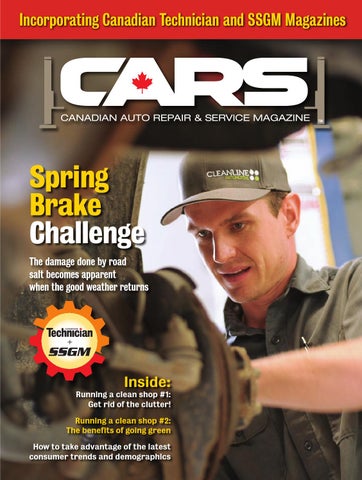
Incorporating Canadian Technician and SSGM Magazines
CANADIAN AUTO REPAIR & SERVICE MAGAZINE
Spring Brake Challenge The damage done by road salt becomes apparent when the good weather returns
+
Inside: Running a clean shop #1: Get rid of the clutter! Running a clean shop #2: The benefits of going green How to take advantage of the latest consumer trends and demographics
CARS_March2015.indd 1
3/13/15 10:18 AM
Snap-on is a trademark of Snap-on Incorporated. Snap-on Incorporated 2015.
HAVE MERCY. We’ve unleashed the biggest, baddest line of cordless power tools to ever terrorize a rusted bolt. Fueled by our beastly 4.0 amp MonsterLithium battery, they boast gobs more torque and a 33% longer runtime than ever before. For a hands-on look at the 1/2" or 3/8" Impact Wrench, Flat Angle Grinder, Hammer Drill or Recip Saw, holler at your Snap-on ® Representative. Or burn rubber to snapon.com/MonsterLithium
CARS_March2015.indd 2
Snap-on • 18V Monster Lithium Family Ad: CARS• Trim_8.125” x 10.75” • March 17, 2015 1:58 PM
3/17/15 2:20 PM
MARCH 2015 | VOL. 1 NO. 2
COLUMNS
17
5
Service Notes Editor Allan Janssen on a breakthrough statistic: labor sales outpaced parts sales at Canadian repair shops in 2013.
14 What I’ve Learned: It’s Easy Being Green A B.C. shop’s strategy to minimize its impact on the environment makes business sense as well as ecological sense.
Collective Wisdom Management consultant Alan Beech offers advice on how to get back to basics, and learn to love your business again.
30
The Car Side Our resident humorist, Rick Cogbill, describes the latest shenanigans at Slim Shamble’s Auto Repair Shop in Slumblerland, B.C.
19
Departments
22
Industry Trends: The Moving Target
Talking Tech: Spring Brake Work
New cars, old cars, boomers, millennials… Andrew Brooks reports on some demographic trends that will have a significant impact on the aftermarket.
Undercar corrosion often gets its start during a rough Canadian winter, but it reveals itself in the spring. Tech writer Jeff Taylor wants to know if you’re ready.
Industry News ......................... 7 Eye Spy .................................... 7 News Briefs ............................ 11 By the Numbers .................... 12 Baywatch ............................... 25 AutoPuzzle ............................ 28 Advertiser Index ................... 29 Cover photo by Stephanie Van de Kemp
Our new international calling card. by
www.bluestreak.ca
March 2015
3
Canadian Technician_BS Intermotor Contents Page material CARS_March2015.indd 3
3/13/15 12:23 PM
r - you urch h c r r filte you mes ing a beco creat e s age r g p a a e gar 70 ye book h e r t c e , a v s ine nt o ur F es. isit o ir eng e spe d the why we’v gel. V ip of engin n n a a r s r u h a ’s o s t c y r a r h fo wo cts en!” T their ssion prote bout ue pa® e say,”Am ger and a r t s a ie n r have % lo IX , w ll sto n you hip. At W irt, last 30 omers te t Whe s d s r u o e r c mo of w our place tures 45% to watch p e a d c co that e QR an th or sc
WE E LOV ! INES ENG
wixfilters.com wixfilters.com
CARS_March2015.indd 4
3/13/15 10:10 AM
m
SERVICE NOTES
The trend is your friend Analyzing statistics can give you an advantage in the marketplace if you know how to apply them. By Allan Janssen People who like numbers tend to like them a lot. They’ll study graphs and charts for hours, looking for hidden meanings. I’ve never been particularly good at math, but I understand that kind of obsession. Like a lot of journalists, I even have some training at reading statistics. In the never-ending quest for news, such things as budgets, forecasts, and reports are a treasure trove of information. Recently, I found an exciting statistic in the Outlook Study produced by the Automotive Industries Association of Canada (AIA). There were no remarks about this particular statistic. No fanfare. But I found it to be quite telling, nonetheless. In 2013, for the first time, labor sales outpaced parts sales at Canadian repair shops. It’s a statistical intersection that many people have anticipated for quite a while. Not that long ago, it was commonplace for parts to generate significantly more revenue than labor. Then things started changing. The significant lead of part sales started to diminish. And in the past decade or so, the two major components of automotive repair bills approached parity. In 2013, labor became the dominant component (though just by a hair). And if predictions hold, it will continue to grow larger compared to the parts component. Why is this? Well, it makes a lot of sense when you think about it. n Cars are better made than they used to be, with components that last significantly longer. n There’s a lot of pressure on parts margins, which keeps their prices fairly flat. n Labor, on the other hand, is an increasingly valuable commodity,
with older technicians retiring and young people not exactly flocking to the skilled trades. n And the complexity of modern engines calls for increased reliance on diagnostic troubleshooting and electronic reflashing – neither of which involves part sales. In this new paradigm, the shops that will thrive are the ones that invest in high-tech equipment and the most up-to-date training. Anticipating the crossing of the parts and labor lines, some shops even established a separate diagnostic rate, elevated from the normal door rate because diagnostics requires the best technicians with the most training, and does not entail a lot of parts sales. The shops that looked at the numbers, interpreted them correctly, and acted on them are in a better position, obviously, than those who ignored them. Quite frankly, this is the rationale for our monthly “By the Numbers” page. We get a lot of those numbers from conferences and seminars that highlight aftermarket trends. We believe that if shops act on trendlines, they could gain an advantage in the marketplace. The rise of light trucks and SUVs over passenger cars? Some shops saw that coming and responded accordingly. The rise of import nameplates at the expense of domestics? Some people saw that trend forming and positioned their shop to handle the influx. There’s an old saying: “The trend is your friend.” It has guided investors for decades. It could guide your shop too.
PUBLISHER | Marc Gadbois (416) 510-6776 marc@carsmagazine.ca EDITOR | Allan Janssen (416) 614-5814 allan@carsmagazine.ca CONTRIBUTING WRITER | Andrew Brooks ART DIRECTOR | Tim Norton (416) 614-5810 tim@newcom.ca CIRCULATION MANAGER | Selina Rahaman (416) 442-5600 ext. 3528 srahaman@bizinfogroup.ca SUBSCRIPTION ENQUIRIES | Roshni Thava (416) 442-5600 ext. 3555 PRODUCTION MANAGERS | Steve Hofmann (416) 510-6757 • PRINT: Phyllis Wright
CARS magazine is published monthly except for January and July by Newcom Business Media Inc., 80 Valleybrook Drive, Toronto, ON M3B 2S9. The magazine serves the Canadian automotive repair and service industry. Subscriptions are free to those who meet the criteria. For others: single copy price: $7.00 plus tax; one-year subscription in Canada: $53.95 plus applicable tax; 2-year subscription in Canada: $84.95 plus applicable tax; one-year subscription in U.S: US$95.95; single copy price: US$10.00; one-year subscription in all other countries: US$97.95. Copyright 2015. All rights reserved. The contents of this publication may not be reproduced by any means, in whole or in part, without prior written consent of the publisher. The advertiser agrees to protect the publisher against legal action based upon libelous or inaccurate statements, unauthorized use of photographs, or other material in connection with advertisements placed in CARS. The publisher reserves the right to refuse any advertising which in his opinion is misleading, scatological, or in poor taste. Postmaster: send address changes and undeliverable Canadian addresses to Circulation Dept., CARS, 80 Valleybrook Drive, Toronto, ON M3B 2S9.
VP, EDITORIAL | Rolf Lockwood GENERAL MANAGER | Joe Glionna PRESIDENT | Jim Glionna CORPORATE OFFICES HEAD OFFICE 451 Attwell Dr., Toronto ON M9W 5C4 Telephone: 416-614-2200 Facsimile: 416-614-8861 REGIONAL OFFICE 80 Valleybrook Drive, Toronto, ON M3B 2S9 Telephone: 416-442-5600
Facsimile: 416-510-5169
Member of the Audit Bureau of Circulations Publications Mail Agreement #40069240 Print edition ISSN 2368-9129 On-line edition ISSN 2368-9137 We acknowledge the financial support of the Government of Canada through the Canada Periodical Fund of the Department of Canadian Heritage.
Allan Janssen is the editor of CARS magazine. You can reach him at 416-614-5814 or allan@carsmagazine.ca
March 2015
CARS_March2015.indd 5
5
3/13/15 10:10 AM
Tested To The Extreme.
We put 100 years of under-the-hood experience into every fuel delivery part we make. It’s no wonder we back them with a lifetime warranty. We test them to be durable up to 240,000 kilometers and in more than 20% ethanol—so they deliver 100% satisfaction for you and your customers. delphiautoparts.com ©2015 Delphi Automotive PLC. All rights reserved.
CARS_March2015.indd 6
3/13/15 10:10 AM
NEWS
B.C. to re-examine apprenticeship system Planned new advisory group may put an end to ‘progressive credentialing.’ By Allan Janssen It looks like British Columbia’s apprenticeship system will get a complete make-over this spring. The program came under provincial scrutiny last year after a number of players in the automotive repair and service industry cried foul over a controversial “progressive credentialing” education system for apprentices. Now the Automotive Training Standards Organization (ATSO), which championed the system, is gone and a new ‘industry sector advisory group’ is about to be put in place to advise the province’s Industry Training Authority (ITA) on future initiatives for the trade. “Progressive credentialing is still in place but that it is likely to be changed,” says Rene Young, executive vice president of the National Automotive Trades Association of Canada (NATA), as well as an industry development coordinator for the Automotive Retailers Association of British
Columbia (ARA). “This is something that will probably be among the first things that the new sector advisory group will discuss.” The system allowed students to ‘graduate’ every year of study with a certificate. Some industry insiders argued that this took away some incentive to complete all four years of study to become fully licensed technicians. Indeed, enrollments in the province’s apprenticeship program dropped off significantly in the second, third, and fourth years. “Very few independent shops have benefited from that process,” says Ronald Tremblay, owner of The Garage in Vancouver. “We all seem to be dissatisfied with it. It has led to lower enrolment numbers and far fewer completions.” He was part of a committee that recommended about 18 names to ITA to make up the new automotive advisory group. The names represent a wide variety of interests in the automotive repair and service sector, he said. “It’s a really healthy mix of people from both the interior of the province and the lower mainland,” he says. “It
includes glass installation, power sports, collision, dealerships, independents, big companies and small companies.” The new group, if it is approved by ITA, will likely meet in April to begin the task of rebuilding an apprenticeship program that will attract more people and graduate more technicians. Young believes the drop off in students over the course of four years may not
‘We all have to band together and fight for our trade again. And this is the time to do it.’ only be due to progressive credentialing, and the industry needs to remove all the barriers to completion. For Tremblay, the new advisory group gives the industry a chance to rebuild the apprenticeship program and create a stronger future for everyone. “We need to come together, first and foremost,” he said. “That’s one of our most glaring issues. We all have to band together and fight for our trade again. And this is the time to do it.”
EYESPY
Got a light?
Tom Hines of Fountain Tire Marine Drive in Vancouver thought we’d get a kick out of this photo, sent to him by a friend in California who was working on a PT Cruiser Turbo. The vehicle owner had attempted his own repair of a blown head gasket. He actually got the engine running for a few seconds before all hell broke loose and he had to have it towed to a garage. “When my friend pulled the head, he found the remains of a cigarette light inside!” Tom writes. Have an interesting picture to share? Email a high-resolution image to allan@carsmagazine.ca
March 2015
CARS_March2015.indd 7
7
3/13/15 2:34 PM
Choose the right oil filter.
It’s not just another oil change, it’s a FRAM ® oil change. FRAM® Extra Guard® Engineered for conventional oil
FRAM® Tough Guard® Engineered for premium conventional oil
FRAM® Ultra SyntheticTM Engineered for synthetic motor oil
©2014 FRAM Group (Canada) Inc. Fram.com
CARS_March2015.indd 8
3/13/15 10:10 AM
NEWS
Get ready for telematics, warns outgoing AIA chief Marc Brazeau believes new technology is a big challenge – and a big opportunity – for the repair and service industry. The outgoing president of AIA says the aftermarket must be careful not to get outmaneuvered by carmakers when it comes to telematics. Marc Brazeau, who is stepping down from the Automotive Industries Association of Canada at the end of April, says details about the “gamechanging” vehicle technology are still evolving but much rides on unfettered access to vehicle data. “Telematics and how it will drive customer behavior is a big challenge and a big opportunity for the aftermarket,” he said. “When the technology is ready, we need to be ready. We need to be there with the right tools and the right programs.” Vehicle manufacturers have been aggressive in building telematics models that will tie customers to their service facilities. Brazeau believes the technology will move shops from their current preventive maintenance business model into a new era of predictive maintenance.
“When the technology is ready, we need to be ready. We need to be there with the right tools and the right programs.” “Instead of waiting for the vehicle to break down, or for the owner to bring it in, I think the future is in being able to predict upcoming maintenance through constant monitoring,” he said. The big challenge, of course, will be ensuring that the car owner has the ability to determine who should receive
the data their vehicles produce. “At the end of the day, consumers own their vehicles. They should have
Marc Brazeau joined the Automotive Industries Association of Canada in 1995 and has served as president for the past eight years.
full ownership over how the data is used. They should have choices as to how it is shared,” he said. “That, to me, is a basic consumer right that AIA and the industry will need to continue to push for.” Brazeau is leaving the association to become vice president of sales and marketing for Uni-Select. He said the future is bright for the aftermarket. “There are more and more vehicles on the road. There are more older vehicles on the road. Vehicles are lasting longer. There are more kilometers being driven. All of those key indicators are pointing to a period of tremendous growth and opportunity for the aftermarket,” he said. “And all of those new vehicles sold in the past few years – record sales – are going to end up in the aftermarket in our service bays in the very near future.” You can read our full interview with Brazeau at www.carsmagazine.ca
www.redi-sensor.com
TPMS service with VDO REDI-Sensor™ was always a snap. Now it’s also available with a rubber snap-in valve stem! The VDO REDI-Sensor multiapplication TPMS sensor has already made TPMS service faster and easier by eliminating the need for programming and cloning. Now, for service techs looking for the option, we’re also offering REDI-Sensor with a familiar rubber snap-in valve stem. And just like the original REDI-Sensor, our new rubber valve stem version is ready right out of the box! • Pre-programmed and designed to follow OE vehicle relearn procedures • Works with all major TPMS scan tools • Reduces inventory and eliminates service delays • OE designed and validated For more information, visit: www.redi-sensor.com
VDO and REDI-Sensor – Trademarks of the Continental Corporation
March 2015
CARS_March2015.indd 9
9
3/13/15 10:10 AM
Who Makes Installation Practically Turn Key?
DENSO Mass Air Flow and Oxygen Sensors, Spark Plugs, Coil on Plug and Ignition Wire Products: Accept No Substitutes. DENSO continues to make critical replacement parts for most applications. First Time Fit® ensures that the job will be done correctly the first time. Built for reliability and performance, DENSO standards live up to the highest expectations. Get DENSO and relax. We’ve got you covered.
Check out our full line of First Time Fit® replacement parts
1-888-96-DENSO
densoautoparts.com/ssgm
a/c compressors & components • cabin air filters • air filters • fuel pumps • oil filters • ignition wire sets • oxygen sensors • spark plugs • starters • alternators • wiper blades
©2015 DENSO. First Time Fit is a registered trademark of DENSO Products and Services Americas, Inc.
CARS_March2015.indd 10
Scan with your smartphone to learn more
2015-03-14 10:12 AM
NEWSBRIEFS
Canadians on shortlist for prize
Fifteen grassroots racers, including a team of two Canadians, are among the finalists in Federal-Mogul’s annual ‘Search for a Champion’ competition. World jet boat racers Barry Fenton and Dennis Bell of Grovedale, Alta., have already won $5,000. They stand to win the grand prize – a sponsorship package worth $50,000 – when online voting is completed at the end of this month.
Emissions training
Tenneco will host Walker Emission Control Diagnostic Workshop training on April 16, at Rosa’s Place in Woodbridge, Ont. The high-level training will be led by Kris Lewis of Automotive Training Group. Call Mark Potts at (416) 346-7892 for details.
AC training
Robinair and the Mobile Air Conditioning Society (MACS) are working together to provide a free Section 609 test prep webinar on May 6. Up to 100 technicians will receive the training and certification in the 90-minute webinar. Go to www.tinyurl.com/609training for details.
Hybrid training
Automotive Career Development Center (ACDC) is holding a three-day Train-the-Trainer Hybrid and EV event April 27-29 in Flint, Mich. The class, led by Craig Van Batenburg, will focus on advanced skills in the hybrid segment. To enroll, call Deb at (800) 939-7909.
ToolTech 2015
The Equipment and Tool Institute’s annual ToolTech conference will focus on “The Connected Vehicle: Opportunities and Challenges.” The event, to be held April 13-16 in Austin, Tex., will feature a wide range of speakers, panel discussions, group interaction, and networking opportunities.
NACE / CARS 2015
The International Autobody Congress and Exposition (NACE) and the Congress of Automotive Repair and Service (CARS) will be held in Detroit July 21-25. Now in its 33rd year, NACE / CARS 2015 will feature numerous opportunities for technical training, business education, demonstrations, networking, and technology showcases.
LIQUI MOLY offers manufacturer approved motor oils for every car. Since 1957, demanding car owners in Germany have used and trusted LIQUI MOLY. Our company offers the highest quality motor oils and additives for gasoline and diesel engines.
Isn‘t it time YOU discover LIQUI MOLY?
Available at:
LinderTech Conference The Annual LinderTech Automotive Technical Training Conference will be held in Toronto, May 1-2. The conference, features well-known trainers John Thornton and Peter Rudluff. Call (866) 970-7720 for details.
www.liqui-moly.us
March 2015
CARS_March2015.indd 11
11
2015-03-14 10:12 AM
By the NUMBERS Stats that put the Canadian automotive aftermarket into perspective. Despite the expected growth of mobility-as-a-service (MaaS), the vast majority of automotive executives around the globe (almost 80%) believe that, for the foreseeable future, those aged 25-50 will continue to own a car as their main form of transport.
Negative equity in vehicles is a growing concern in Canada. In 2009, 16.6% of all trade-in vehicles were “under water.” Today, that figure has swelled to 29.4%. Nearly a third of all vehicle owners could be making payments on cars they no longer own.
Now that recovery is largely complete, the Great Recession of 2008-2009 can be put into some historical perspective. Canada showed greater growth from 2005 to 2013, moving its GDP from $1.164 trillion to $1.826 trillion, an increase of 56.9%. Comparatively, the U.S. saw an increase of 28.1%, moving its GDP from $13.093 trillion in 2005 to $16.768 trillion in 2013. (All figures in current US$).
GDP Increase as a Percentage of 2005 Canada
New-car dealerships were the most popular choice for vehicle service in Canada in 2012. They captured 36.6% market share. Independent repair outlets achieved a 32.2% share of the “do-it-for-me” market in 2012.
US
60%
50%
40%
The core of the Canadian automotive aftermarket industry employed approximately 216,900 people in 2013. The core aftermarket includes parts wholesalers (24,900 workers), parts retailers (46,900), and automotive repair and maintenance shops (145,100).
20%
10%
Top 10
0%
Passenger Cars in Canada 2013
2005 2006 2007 2008
2009 2010 2011 2012 2013
UNITS SOLD Honda Civic
64,063
Hyundai Elantra
54,760
Toyota Corolla
44,449
Mazda3
40,466
Chevrolet Cruze
33,184
VW Jetta
30,413
Ford Focus
25,781
Ford Fusion
20,145
Hyundai Accent
18,884
Toyota Camry
18,245
By 2020, the 10 major carmakers plan to reduce the number of vehicle platforms they use by about a third. GM alone plans to halve its vehicle platforms from 30 in 2010 to 14 in 2018.
Source: KPMG International’s Global Automotive Executive Survey; J.D. Power & Associates; AIA 2014 Outlook Study; World Bank Group; DesRosiers Automotive Consultants Inc.
The 1.74 million light vehicle sales recorded in 2013 was an all-time sales record for Canada… but 2014 was even better, with 1.849 million vehicles sold. In the United States, car companies had their best year since 2006, with sales hitting 16.5 million vehicles.
30%
12 CARS
CARS_March2015.indd 12
3/13/15 10:10 AM
CARS_March2015.indd 13
3/13/15 10:10 AM
Source: KPMG International’s Global Automotive Executive Survey; J.D. Power & Associates; AIA 2014 Outlook Study; World Bank Group; DesRosiers Automotive Consultants Inc.
COLLECTIVE WISDOM
Hitting the
reset button
Things not going well at the shop? Get back to the basics and maybe you’ll start to love your business again. By Alan Beech
Hi Alan I really need your help. I’m just not enjoying my business anymore. We’re busy… but even this seems to be a problem. We have more customers than we can handle and this has led to impatience on the part of my staff, and complaints from customers. Despite all the work, my accountant just told me that I didn’t turn a profit last year. We’re constantly busy and I failed to make money? How can this be! Should I just shut down my business as a lost cause? — Samuel
Hi Samuel
I understand how you might worry that your business is not worth saving. But rather than shutting it down, I’d encourage you to hit the reset button. Get back to the basics and maybe you can get to a place where you love your business again. There’s no mystery to what makes a great shop. You start with a clean and comfortable facility, where a warm and friendly staff can deliver great value to your customers. We tend to over-complicate things, but that’s it in a nutshell. Slow down, do things right… and have fun again. So where do you start? I know it may seem like a daunting task, especially since you’ve been in business for more than 20 years and your frustration has been building for the last five years or so. Let’s start with your facility. It’s time to get rid of the clutter. Throw away all the posters and notices that litter your showroom. I know it’s tempting to let people know all about the spark plug, suspension and filter choices you’re making… but there’s only one brand
you need to promote: your own. When it comes to décor, simplicity is the best advice. Once you’ve gotten rid of all the clutter, apply a fresh coat of paint. Maybe choose one wall to put your logo on. Remember, cleanliness is the key feature of this ‘renovation,’ so don’t forget to have a spotless washroom. Keeping the shop clean is not rocket science, but it will require your constant attention. Take pride in your facility and your customers will appreciate it as well. You’ll be surprised about how your attitude will change in a clean operation. Perhaps the bigger problem is going to be cleaning up your staff ’s attitude – especially if they’ve been stressed by an unrelenting pace for a prolonged time. Sometimes a culture of entitlement sets in that can be very difficult to change. Your employees may have started seeing customers as an annoyance rather than the foundation of the business. This is obviously a very serious problem, and I don’t know if there’s any magic bullet to solve it, other than to
open the lines of communication. Your employees need to understand how important it is to have loyal customers who are true “fans” of the business. Start with regular staff meetings. You will quickly see which employees are ready to help you push the reset button, and which ones are holding you back. They all need to understand how a bad customer experience can go viral on the Internet and what that can mean to a shop. I suggest you put a reward system in place that recognizes employees who give great customer service. This will be difficult if you have too many people coming to the door. That’s right. I said too many. When you’re running around too fast doing tire repairs and “wait oil changes” where the customer is in the showroom waiting for their car, you’re going to make mistakes. Worse, you’re not going to get the chance to properly inspect the vehicle and find the work that is really
14 CARS
CARS_March2015.indd 14
3/13/15 12:29 PM
necessary to maintain your customer’s investment. You’re doing the superficial work, not the meat-and-potatoes work. Shops like this have a challenge to be profitable, and often have high customer complaints.
When you’re running around too fast doing tire repairs and “wait-around” oil changes, you’re going to make mistakes. Slow the process down. Control your “wait” appointments and implement a courtesy inspection program. These strategies go hand-in-hand. When the customers are in the waiting area, you’re always in “hurry-up” mode, and you’re not doing the customers any favors. The key to profitability is selling
your technician’s available hours and when you slow down you’re able to do this more effectively. When you control the wait appointments, your shop will transition into a “leave-it-for-the-day shop.” How do you achieve this transition? Start by letting the customer know, when they’re booking an appointment, that you’d prefer to have their vehicle for the whole day. An incentive like detailing works well to convince them to do this. Tell them you can give their car a proper cleaning at no extra charge, but you need some extra time in order to make this happen because you’ve only got one detailer. Offer a shuttle ride home or to the office and tell them you can pick them up when their car is ready. Your customers will love the detailing so much they’ll be happy to leave their vehicle. Now that you have the car for a longer period, you can offer a complimentary courtesy inspection on every
visit. You’ll be amazed at how much more successful you’ll be at selling the found work when you call a customer at home or at the office, as opposed to talking to them in your waiting area. When the customer is nice and relaxed and is not dependent on their vehicle, their reaction is usually, “Well, since it’s there, let’s go ahead and get the work done.” If they’re in the waiting area, they’re expecting to get back on the road in 15 minutes. They weren’t planning on staying longer, and they don’t want to have to come back. Implementing the courtesy inspection program it not always easy. Often the biggest challenge comes from your staff. They’ll say they don’t have time to conduct inspections or they’ll have issues around selling extra services. This is where your regular staff meetings come into play. Use them to train your staff on the value of the inspection program. You’re not relying on strong-arm tactics to sell vehicle work. You’re just giving your customer valuable information about the state of their vehicle so it’s reliable and lasts longer. That’s what most motorists truly want. Their vehicle represents a sizable investment for them. Protecting it saves them money in the long run. Remember, Rome wasn’t built in a day. Inspection programs may take months to properly implement. Hitting the reset button gives you the chance to offer your customers a better service experience. It will be a game changer for your entire business. But it will require you to be the captain of the ship. You need to offer your staff the support and direction they need. Be steady and consistent in your vision and you’ll be amazed at the results.
Alan Beech is a management consultant and the owner of Beech Motorworks in Hamilton, Ont. You can reach Alan at alan@beechconsulting.ca
March 2015
CARS_March2015.indd 15
15
3/13/15 12:29 PM
WHAT I’VE LEARNED
Aaron with his daughter, Eden, in front of Cleanline Automotive in Invermere, B.C.
The owner of Cleanline Automotive in Invermere, B.C. says reducing impact on the environment is all about choices. By Allan Janssen
It’s EASY being GREEN A
aron Van de Kemp runs an “earthfriendly” auto repair shop in Invermere, B.C. But his environmental approach is much more than just a marketing hook for his business. It’s part of who he is. He and his wife Stephanie lead active lives of hiking and biking in the beautiful Rocky Mountain town west of Calgary. It’s fair to say that being green comes naturally to them. “It just carried over from our personal lives. I wouldn’t say we’re hippies, but I guess we’re along that line,” he says with a laugh. The 32-year-old owner of Cleanline Automotive is a gifted technician with
an easy-going demeanour, a head for business, and a flair for explaining automotive concepts to consumers. He’s also a community-minded shop owner with a personal mission to change the impression people have of the repair and service world. He believes a big part of the shop’s success is its clear mandate to minimize its impact on the environment. “The customers really respond to it,” he says. “A lot of people will comment on our stance and say they appreciate that we’re putting our best foot forward.” Stephanie agrees about the impact the green philosophy has had. “It has been cool to watch Aaron
Andrew Patterson, also known as “the Car Whisperer” at work.
apply his values to the business,” she says. “He started his own business because he wanted to promote certain values. One of those is caring about the environment. Another is caring about people, and taking the time to educate them and empower them when it comes to their vehicles. He’s really pushing the boundaries of what the industry can be.” Aaron insists it is easy to be earthfriendly, even in the automotive world. He doesn’t use solvent-based brake cleaners or degreasers. Instead, he opts for more natural products that do the same job in a clean and non-carcinogenic way.
16 CARS
CARS_March2015.indd 16
3/13/15 12:20 PM
Photos by Stephanie Van de Kemp
Service advisor Michelle Rievaj, a licensed heavy-duty mechanic herself, goes over the details with a client.
He also buys as little bottled fluid as possible. “You have to have some, of course, but we buy most of our oil, antifreeze, and window washer in bulk to minimize packaging and waste.” The wheel weights he uses are not the traditional lead variety.
business called Green Garage in Colorado, and he expects this kind of earth-friendly approach to become more standard within the automotive aftermarket because it does so much to improve the industry’s image in an increasingly environmentally sensitive culture. To put his money where his mouth is, he donates $1 from every oil change to the Nature Conservancy of Canada, an organization that purchases sensitive natural areas and makes them available for non-motorized recreation such as biking and hiking. It’s not their only charity contribu-
‘He started his own business because he wanted to promote certain values. One of those is caring about the environment. Another is caring about people… He’s really pushing the boundaries of what the industry can be.’ “Wheel weights fly off all the time and end up in ditches to start impacting run-off water, streams, and the water table,” he explains. “So we’ll choose zinc or stainless steel weights, which have less impact on the environment. They cost marginally more, but it doesn’t affect the bottom line at all. You hardly notice it.” He’s found inspiration in a similar
tion. They also set aside a certain amount of money each year to donate to local causes and community projects that they believe in. The staff is fully behind Aaron and his eco-friendly outlook. Journeyman Andrew Patterson helps in the bays, while service advisor Michelle Rievaj runs the front-end. Stephanie works from home, taking care of a lot of the
paperwork and handling the marketing efforts – in particular the photography on the company’s well-designed and extremely inviting website. On the site, Aaron is referred to as “the big wheel” while Stephanie is jokingly referred to as “the spare tire.” “Things are going really well,” he says. “Our services are in high demand. In fact, we were considering doing more advertising, but we’re growing enough just by word of mouth!” Things are going so well, in fact, that Stephanie predicts that the next hurdle is going to be finding more space. “With every change we make, it just feels like we’re keeping up again,” she says. “That’s a good problem to have, but it also means constantly thinking a year or two ahead.” For Aaron, the success comes by being true to his values, and putting people first. “You have to treat the people, not the cars,” he says. “That means addressing their concerns, teaching them about their vehicles, and then letting them make the decisions that are right for them.” It is why he puts so much effort into educating his customers. “The more you know about something, the more comfortable you are with it,” he says. “We want people to be comfortable buying service for their cars. And we want them to feel comfortable working with us.” March 2015
CARS_March2015.indd 17
17
3/13/15 12:22 PM
CARS_March2015.indd 18
3/13/15 10:10 AM
INDUSTRY TRENDS
decidedly inner-city demographic. They prefer to live close to where their work and social lives take place, preferably within walking distance or easily accessible by public transit. Also, they’re just not as into vehicle ownership as the car-crazy boomers were. The romanticism and aestheticism seems lost on them, and they tend to consider vehicles merely a form of conveyance. When public transit won’t work, they show a marked preference for car-sharing. What’s more, millennials simply aren’t as well-off as their predecessors. “They’re more economically challenged than any other age cohort,” says David Portalatin, executive director of industry analysis, automotive aftermarket, for the NPD Group. He says they’re driving less and buying cheaper vehicles. But, Portalatin adds, their vehicles are older and much more in need of service. It’s one of the most significant trends in the As the profile of the average car-owner changes, the aftermarket automotive business… must learn how to deliver premium service in a way that the customer and it’s gathering is convinced they’re getting good value. strength. According to AIA By Andrew Brooks Canada figures for 2013, The exit of the baby boom generation seeks out new blood to replace retiring the average age of a light vehicle in from the workforce is having a massive employees. But demographic shifts are Canada is now 9.3 years. And that age impact throughout the economy. also hitting the aftermarket on the is increasing. (South of the border it’s Faced by a cresting wave of retirecustomer side. Because while the well over 11 years.) ments, employers across the economic millennials may be coming ‘on-stream’ Older cars need more service, spectrum are scrambling to find new in big numbers, their financial profile whether or not their owners actually recruits and trying to figure out how and driving behaviours are markedly get the work done. AIA Canada to appeal to the millennials – the generdifferent from those of the generations estimates that the value of unrealized ation born between 1980 and 2000, who they’re replacing. maintenance in Canada totals about are embarking on their careers just as It isn’t a simple one-to-one switch, $14 billion. The question for the afterthe baby boomers bow out. and the aftermarket needs to pay close market is how to get more of those The aftermarket faces the same chalattention. well-used cars into the bays. lenges as many other industries as it For one thing, the millennials are a It starts with customer education,
THE
MOVING TARGET
March 2015
CARS_March2015.indd 19
19
3/13/15 10:10 AM
says Mark Seng, global aftermarket practice leader with IHS Automotive. “Up to half of aftermarket sales opportunities come from routine maintenance,” Seng says. “Service operations need to be aware of this. They need to talk to customers differently in their marketing campaigns. Build your messaging around routine maintenance; offer promotions and discounts to get people in; then add on once they’re in the bay.” A revenue boost could even be as simple as one of the details shops can overlook so easily: a taillight that needs replacing, or a new set of wipers. The good shops are already good at finding work that needs to be done. But this needs to become regular practice for the aftermarket as a whole, because in spite of the increased average age of vehicles, the frequency of service visits is actually on the decline. A 2009 study by J.D. Power and Associates showed
that owners of cars aged 4-12 years came in for service three times a year on average. By 2014 that was down to 2.6 visits a year. That obviously translates to a decrease in opportunities to sell necessary service work. But here’s where it gets interesting.
their service spending the way they do other household expenditures,” says J.D. Ney, manager of automotive research and consulting at J.D. Power’s Canadian office. It seems customers would rather avoid a single large bill, even if two or
Good-bye baby boomers… hello millennials? It isn’t a simple one-to-one switch, and the aftermarket needs to pay close attention to the difference between the generations. The more frequently drivers come in for service, the less they spend on each visit, as you might expect. But while someone who comes in three or four times a year may spend less each time, their annual spend on repair and maintenance is still higher than it is for the one-time caller. “People apparently don’t analyze
three smaller ones still cost more overall. A smaller invoice is just easier to deal with, it seems. Customers actually report higher satisfaction levels when they pay two to three lower bills a year than those who make that big one-time payment. So should the aftermarket encourage more frequent visits, thereby increasing
20 CARS
CARS_March2015.indd 20
3/13/15 10:10 AM
the number of opportunities to interact with customers? The problem is that if the frequent visitors are motivated by the lower invoice they get for each visit, they’ll probably fight recommended service work that much harder. Should shops then accept the trend and focus on the less-frequent visitor? After all, since these customers seem to have decided that it’s better to get everything done at one time regardless (more or less) of price, they’re already reconciled to paying a heftier bill. Enter the value proposition, which applies to both customer profiles. It’s a fact that automotive customers these days, whatever their financial condition, are willing to pay a little more up-front if they believe they’re getting quality repair or maintenance. That’s not what you might think in a supposedly post-recession environment, and especially considering that the millennials are so financially tight.
ReadyMount
®
Strut Assemblies
Precision Engineered
But today’s automotive service buyers aren’t as driven by bottom-line price as they used to be. “They’re willing to define value in more ways than just getting rockbottom price,” Portalatin says. “They’ll opt for high-mileage or fully synthetic oil, even if it costs a bit more up-front, if they’re convinced the car needs it and they’ll save over the long term.” The value-driven customer requires a smarter approach. Portalatin says the aftermarket must learn how to deliver premium service at a value price point, but in a way that the customer is convinced they’re getting good value. This may apply just as much to the more price-conscious frequent customers; they’ll probably just need a bit more persuading. Consider the experience of shops that offer free tire storage for drivers who opt for premium snow tires and a synthetic cold-weather oil when they
come in for their fall tune-up. With the right marketing, these shops keep their bays significantly busier during the pre-winter season. The free storage ensures that even new customers are already “locked in” to a repeat appearance in the spring. It might not work out exactly the same for everybody. But at a time when cars are getting older and the fastest growing demographic of new drivers are financially pressed, coming up with new, creative ways to get the customer’s attention and deliver genuine value makes more sense than ever.
Andrew Brooks is a freelance journalist, covering the automotive industry in Canada. He can be reached at ahbrooks@rogers.com
WE’VE EXPANDED OUR LINE
BY MORE THAN 25%
We rival the competition for coverage, but they can’t match us for quality. We’re adding over 40 new, first-to-market designs to our rapidly expanding premium ReadyMount ® line, which means the first name in ride control should always be your first choice for pre-assembled
Fit-Tested
struts. Just like every new shock and strut we make, every new ReadyMount pre-assembled strut design is Precision-engineered to the OE design, Component- and Unit-tested, and Fit- and Ride-tested to ensure unbeatable quality. Plus, each new strut design has been validated to 1,000,000 cycles and features our advanced G-Force™ Technology. So, check out Gabriel.com today, explore our
Ride-Tested
expanded line of nearly 200 ReadyMount strut designs and learn why they’re the perfect fi t for you and your customers.
Learn more!
Scan to see how you get more with Gabriel ReadyMount!
March 2015
CARS_March2015.indd 21
21
3/13/15 10:10 AM
TALKING TECH
Spring
BRAKE work Corrosion is part of the Canadian winter experience. Thankfully, there are some new alloys designed to limit the damage. By Jeff Taylor The work order said the brake light was illuminated, and the brake pedal was low. First thoughts on the issue? Probably a burst brake line, right? That’s what I was thinking when I pulled the car into my bay and popped open the hood. And when I checked the brake fluid level, sure enough, one side of the master was almost empty. I put it up on the hoist and there it was: a corroded and leaking brake line, about halfway down the left hand side of the unibody. This is not a particularly uncommon experience in many parts of Canada. Our winter experience can get pretty rough… and that means that the roads need to be treated with some form of de-icing agent. Salt – or sodium chloride – is the usual solution. It’s readily available, cheap, and it works well. There are other alternatives such as calcium chloride, sodium chloride mixed with magnesium chloride, sugar beet by-products mixed with salt, and exotic combinations such as refined corn mixed with magnesium chloride and water. For
the purpose of this article, I’m going to call all these products “salt” to simplify things. NASTY The issue with salt is that it is nasty – not just on the environment, but on the cars we drive. As we splash through road slush, it covers the underside of our vehicles and causes corrosion of exposed metal. If you’re out west, where the temperature is too cold for anti-icing product to work and where road salt is not as readily available, you likely won’t experience corroded brake and fuel lines (unless, of course, the vehicle started out in Eastern Canada!). As soon as the salt or other road product gets on the exposed metal, corrosion starts. If the product were just salt, an under-vehicle wash would likely neutralize it or wash most of it away. But the other products that are being used are not as easily removed. And what remains is not easily neutralized. The corrosion doesn’t progress very far when
22 CARS
CARS_March2015.indd 22
3/13/15 10:11 AM
Coated brake line on an ABS module.
the temperature is low. But when warmer weather arrives, the corrosion kicks into high gear. No wonder spring and summer are the prime months for leaks and ruptures due to corrosion. PREVENTING CORROSION Vehicle manufacturers are more than aware that their vehicles are exposed to harsh road chemicals that induce corrosion. Some carmakers have taken steps to prevent or slow the corrosion of brake lines by various methods. They’re not always particularly successful. GM has had issues with brake line corrosion on certain model trucks (1999 to 2003) that seemed to have a higher than normal
failure rate. The issue is being investigated as part of NHTSA Action Number EA11001. And it’s not just GM. Subaru also has had corrosion concerns. In the past few years, it has issued a couple of recalls, involving about 666,000 vehicles. They had to repair brake lines that could leak over time. To stop corrosion, the steel brake line is usually chromium treated and plated with zinc. The amount of zinc and the type of chromating process determines the amount of corrosion protection the line will have. The coating method is very popular and really works well but it has a weakness. Anywhere that the brake
Dual coated line with heavy deposits on a bracket and the flex hose attachment.
line is attached to the vehicle and is susceptible to vibration, the coating can be removed. This is one of the main reasons that lines will look great right up until that support bracket and that’s where the leak is. Yes, the bracket tends to trap the corrosive material, but that’s not what leads to the corrosion. The real problem is the removal of the coating. This speeds up the damage. Some vehicle brake lines may have a tight coating of either plastic or nylon or epoxy on top of the zinc coating, and this gives good protection. But if the coating gets pitted or perforated by road debris like gravel, the corrosion process will set in.
Examples of brake line: steel, cupro-nickel, and polyvinyl coated.
March 2015
CARS_March2015.indd 23
23
3/13/15 10:11 AM
These coated lines will look great right up to the fitting at the flex hose and that’s where they tend to corrode. Polyvinyl fluoride (PVF) is another covering that can be applied over the zinc-coated steel line. This combina-
until a couple of years ago, when they started making their debut as an aftermarket replacement option. Yes, the copper-nickel brake line costs more than the regular steel brake line, but it has a major advantage: It
Heavily corroded steel brake and fuel lines.
tion dramatically increases corrosion resistance. PVF coated lines are popular on most vehicles now. It has a greenish color to it. Corrosion rarely happens on the wide-open runs, but near the brackets where vibration can slowly remove the coating, we start to see the results of the exposure to the corrosive elements. PVF lines have become popular now with many manufacturers. And, with vehicle warranties going as long as 10 years now, the trend has been for better materials –particularly when safety is involved. NEW ALLOYS Other manufacturers have come up with different alloys that are more resistant to corrosion. Mixing copper and nickel into the base metal, for example, is expensive but considerably more corrosion resistant. And because the actual brake line is made entirely of the alloy, it isn’t susceptible to wearing off due to vibration near a bracket or a support. These brake lines have been exclusive to the higher-end European vehicles
bends and flares very easily. This is a major improvement over the older steel line that was next to impossible to shape without kinking. Anyone that has replaced the brake
As we splash through winter slush, road salt covers the underside of our vehicles and causes corrosion of exposed metal. The results will be seen in spring when warm weather returns. line to the ABS unit on a GM pickup will truly appreciate the new alloy. The time savings alone will usually cover the extra cost of the 5/16 line. Creating a proper flare is pretty basic stuff, and most of us don’t need a refresher on that. But there are a couple of areas that seem to get overlooked when using the new copper nickel line. Because this line is softer than the old
steel that we’re familiar with, it is very easy to overflare when creating a traditional double flare. The proper flare is imperative. The seal that the flare creates is a metal-on-metal seal. There should be no need to tighten the line past about 11 ft/lb. Now, that’s not very tight at all, but most of the connections that we use are brass and that brass connector (or flex hose connection) is usually softer than the brake line that we’re attaching. You can actually crush the double flare too far down when you use the cone in the final stage of the double-flare procedure. This makes the connection very difficult to seal because the material that should be seating against the connector is too far away to create a tight and leak proof seal. Remember, the proper torque isn’t the amount needed to stop the leak. If you have overflared the connection, a stripped fitting can easily be the result. Some trial and error will show you when to stop creating the flare by hand and if you’re using a hydraulic flaring tool, this is usually when you start to feel stiff pressure but before the actual mechanical stop. Brake line failures are part of our business. And with many of our customers keeping their vehicles longer, it’s almost inevitable that we’ll eventually have to face a brake line repair. Manufacturers have made great improvements in materials and manufacturing processes, but corrosion or mechanical damage will still likely occur. There are things we can do to prevent the corrosion. Washing off or neutralizing the corrosive material works, as do anti-rust compounds, sprays and rust inhibitors. But if the rust or corrosion has started, a repair will be in the future. Once the rust starts, it can’t easily be stopped. It can really only be slowed down.
Jeff Taylor is senior tech at Eccles Auto Service in Dundas, Ont. You can reach him at jeff@ecclesautoservice.ca
24 CARS
CARS_March2015.indd 24
3/13/15 10:11 AM
BAYWATCH BA Heavy duty belt kit Gates says its new FleetRunner Micro-V enhancement kit offers a cost-effective answer to early alternator and AC tensioner failure on select Mack and Volvo engines. The company says the new kit addresses problematic accessory belt drives with a re-engineered tensioner and a more robust belt that increases performance and durability. www.gates.com
Light-duty jack stands
Aftermarket products Cardone has released a line of accelerator pedal sensors for Ford, GM, and Nissan. The company is planning an aggressive SKU expansion throughout 2015. Stand-alone sensors are available where possible to maximize inventory space and minimizing cost. Installation hardware is included. Also available: air suspension springs and struts (pictured) covering the most failure prone applications. www.cardone.com
Rotary Lift has introduced a lightweight jack stand designed to stabilize vehicles on two-post surface and inground lifts, when you’re removing heavy components. The new RS4 supplementary tripod jack stand features 4,000 lbs. of capacity and can be raised to a maximum height of seven feet to reach nearly any raised vehicle. A screw-up adapter at the top of the column provides a fine-adjustment range of 5.5 inches. The adapter is fitted with a rubber contact pad to ensure a secure connection with the vehicle. www.rotarylift.com
Ride control catalog Ten n e c o ha s released a new Monroe Ride Control Master Cat alog (No. M-1114), featuring more than 330 additional parts offering combined coverage of millions of late-model domestic and foreign nameplate vehicles. Among the new parts are 93 additional Monroe OESpectrum shocks and struts and 21 additional Monroe Quick-Strut assemblies. The catalog also includes Tenneco’s expanded offering of Rancho shock absorbers for p er formance and of f-road applications. www.monroe.com
Ford Mustang driveshaft Dana has introduced a Spicer one-piece aluminum driveshaft for the Ford Mustang. According to Dana, the new Spicer driveshaft weighs 19 lbs. less than the OEM shaft, enabling quicker acceleration and improved driving performance. The Spicer one-piece design also eliminates the need for a center support bearing. It bolts directly to the original-equipment Mustang flange without any need for adapters. www.dana.com/aftermarket
All-Season tire BFGoodrich Tires says it is bringing raceproven technology to everyday use with the launch of the new g-Force COMP-2 A/S tire. According to BFGoodrich, the new g-Force COMP-2 A/S tire will give drivers the ability to accelerate faster, brake shorter and maintain control in all seasons. The g-Force COMP-2 A/S will be released to consumers on April 1, initially in 33 sizes with a total of 59 sizes released by the end of the first quarter of 2016. www.bfgoodrichtires.ca
Engine air filters
Shop software
Robert Bosch has added engine air filters to its Workshop Filters portfolio. Bosch says the new Workshop Engine Air Filters are 98 percent efficient and their exclusive filtration media prevents contaminants from entering the engine. Bosch offers 231 engine air filter SKUs that cover a total of 219 million vehicles representing 90 percent of Domestic, Asian and European vehicles in operation in the United States and Canada. www.boschautoparts.com/filters
Mitchell 1 says it has enhanced the ‘Quick Links’ and printing functions in the latest release of its ProDemand repair, diagnostic, and maintenance information program. The Quick Links menu contains links to the most commonly looked up information in the product. With the latest release, users now have special print options for wiring diagrams, linedrawn diagrams, and maintenance check lists. www.mitchell1.com March 2015
CARS_March2015.indd 25
25
3/13/15 10:11 AM
BAYWATCH BA ‘Pro Series’ filters Fram is rolling out the Fram Pro Series oil, air, and cabin air filters, designed specifically for use by professional technicians. The oil filters are designed to pair to a specific oil offering. The Fram Pro Air Filters and Fram Pro Cabin Air Filters help prevent dirt and dust from entering the engine
or the vehicle’s ventilation system. The rollout of Fram Pro Series includes oil, air and cabin air filter part numbers most frequently used by professional installers. More than 90 oil filter, 170 air filter, and 70 cabin air filter part numbers are available. www.framproseries.com
Your guide to Europe
Finish cleaner Snap-on has introduced a new Matte and Flat Finish Cleaner to keep its tool storage units looking like new. According to Snap-on, brake cleaners and wax will take the matte finish right off the cabinet, while glass cleaner will not do the job. Snap-on Matte and Flat Finish Cleaner safely removes grease, dirt, oil, fingerprints and more from the tool box without adding a shine to the flat, matte surface. www.snapon.com/toolstorage
Steering and suspension parts The Moog Steering and Suspension brand has added 835 new par t numbers – including nearly 600 additional control arms and assemblies – representing in excess of 470 million potential parts replacement opportunities. In addition to 597 new control arm and assembly part numbers, the brand introduced 49 additional tie rods, 42 bushings/ kits, 47 wheel hub assemblies, 22 stabilizer link kits, 17 complete strut assemblies, and dozens of other parts for popular late-model applications. www.moogproblemsolver.com
Brake calipers
MANN-FILTER, a leading brand for European applications, offers high quality filtration products for the automotive aftermarket. All oil /air/fuel/ and cabin air filters are designed to ensure maximized engine performance, reduce fuel consumption, and optimize quality of the interior air.
MANN-FILTER - Perfect parts. Perfect service. www.mann-filter.com
Cardone Industries has introduced Cardone Ultra Premium Calipers, the company’s new brand of premium remanufactured calipers that features an exclusive, silver coating to protect against rust and corrosion. Cardone Ultra Premium Calipers come equipped with all the necessary installation hardware, including a new banjo bolt and mounting bracket on all applicable applications. Over 500 part numbers covering the most in-demand applications are available. www.cardoneultra.com
26 CARS MF-AA-AD-0033-0115_SSGM.indd 1 CARS_March2015.indd 26
1/26/2015 9:49:43 AM 3/13/15 10:11 AM
LockLight Rotary Lift has introduced LockLight, a patent-pending lift accessory that shows technicians and shop managers at a glance if a vehicle lift is resting on its locks. It is approximately four inches square with a large light in the center. Mounted to the lift or the control console, it connects to the lift’s hydraulic system. When LockLight detects that the lift’s hydraulic pressure
has been relieved, the light in the center turns green. www.rotarylift.com
Injector tester
Mitchell 1 says it has updated its ProDemand repair, diagnostic and maintenance information program with ProView, a new troubleshooting tool to help service professionals relate diagnostic trouble codes and symptoms to components. It features a radial graph that shows the relationship of the code to possible at-fault components, a bar chart that lists the most commonly replaced components for that code, and a graph that shows the mileage at which the most common component is replaced. www.mitchell1.com
Rad-Cap remover Removing the radiator coolant reservoir cap on a BMW vehicle can be a challenge because the cap is fastened tightly and is difficult to remove by hand. The new Snap-on Radiator Coolant Reservoir Cap Removal Tool (RCR1) is specifically designed to remove the cap without damaging it. The RCR1 tool fits directly over the cap and has a 3/8” drive allowing a ratchet to be attached. www.snapon.com/handtools
MADE I
N
Troubleshooting tool
Delphi Product & Service Solutions, in partnership with Hartridge Ltd., have developed an all-makes common rail injector test solution specifically designed for garages and general diesel workshops. The YDT-35 provides technicians with the ability to check basic functionality of common rail injectors and quickly determine which need to go to the repair network for service. It combines an electrical injector test with visual spray pattern checks to quickly identify failed individual injectors in the garage. www.delphiautoparts.com
SYNTRON ® 100% Fully Synthetic
Veedol.
Made Here. For You.
Vintage engine components The Sealed Power Engine Parts brand has introduced an extensive line of vintage replacement engine components covering millions of classic American passenger vehicles manufactured between 1928 and 1980. The new Sealed Power Vintage product line includes original equipment-design pistons, piston rings, gaskets, engine bearings and valvetrain components updated and enhanced to today’s quality standards. www.SealedPowerVintage.com
Veedol Syntron is a fully synthetic oil that offers the highest level of engine cleanliness, reduced wear and fuel efficiency, making it an obvious choice for Canadian automotive professionals. And with over a hundred years of experience, Veedol has stood the test of time. THE PROFESSIONAL’S CHOICE
For more information contact:
INNOVATION • TECHNOLOGY • PERFORMANCE
Automobile Solutions Americas Inc. 800-975-2935 info@asaveedol.com www.asaveedol.com
March 2015
CARS_March2015.indd 27
27
3/13/15 12:25 PM
AutoPuzzle
#80
• Hardware Included
Positive Mold Ceramic Disc Brake Pads
ACROSS Positive Mold Metallic Brake Pads
1 5 9 10 11 12 15 16 19 21 24 25 26 27
Drum Brake Shoes
Shock ______________. Acronym for electronic brake part. Increasingly popular material for use in car parts. What you own. What you charge. Subaru mid-size crossover, sold since 2005. Where you do most of your work. Probably the coldest U.S. state to be an automotive technician in. The most. Rip. Car name used by both Smart and Renault. Twisting force measured in foot-pounds. Front part of the frame supporting the rear of the hood, the windshield, dashboard, pedals and instrument panel. The excess movement of the steering wheel that causes “looseness” in the steering.
DOWN 1 2 3 4 6 7 8 13 14 17 18 20 22 23
A measurement of electric current. Modern device that took the place of a hand crank in getting engines going. The Beatle’s lovely meter maid. Ford vehicle sold in North America between 1981 and 2002. Fundamental or simplest level. The science of numbers. Transfers torque from the crankshaft to the shaft of the cooling fan. What a spark plug does to fuel inside the cylinder. Promise of quality. Blue light _________. Design feature that allows water to stream along the edges of the roof to the back of the car. Give permission. Acronym for group of countries that provide oil to the world. No charge.
Answer our Question of the Month and you could win a pizza lunch for your shop When you’ve finished the crossword, send it, along with your answer to our Question of the Month, to CARS Magazine, 451 Attwell Drive, Toronto, ON M9W 5C4. Or you can put it in an email, along with a picture of the completed puzzle, to allan@newcom.ca. We’ll select the best answer to our Question of the Month, and send off $50 toward a pizza lunch for your whole crew.
Question of the Month: What was the best advice you ever received about the trade or the business, and who was it from?
Precision Brand Precision Engineering Precision Performance Name: Shop Name: ®
www.autopartsdepot.ca
Shop Address: City:
Prov:
Phone:
Email:
28 CARS
CARS_March2015.indd 28
3/13/15 10:11 AM
ADVERTISER INDEX
THE
Automobile Solutions Americas Inc...........27
...continued from page 30 “Makes sense,” said Beanie. “With today’s tech-driven vehicles, we can spend more time diagnosing than making the actual repair.” “Drives me nuts,” complained Tooner. “In the old days, if somethin’ weren’t running right, we’d check for fuel, spark, compression, and timing. Now ya gotta take into account faulty sensors and actuators, bad solder joints in circuit boards, and software updates from manufacturers who didn’t get it right the first time.” “And that’s my point,” said Basil. “It might seem strange to our customers that our labor numbers on an invoice are passing the parts and supplies numbers, but it’s like every other industry around us – knowledge is becoming more important than actual bits and pieces.” A lot of the discussion was going over my head, but one thing I did know; Tooner’s mug was leaking all over the magazines on our coffee table. The good thing was there was a way to fix it, and change was part of the solution. Tooner’s birthday was coming up, so I rummaged through the parts room that afternoon for ideas. What I came up with involved a little welding and fabrication, but once I had it finished and rechromed, it looked pretty good. “Happy birthday, Tooner,” I said a week later, setting my gift on the coffee room table. “I hope you enjoy it for many years to come.” Tooner stared at the object. “Enjoy it? What the heck is it?” He picked up my present and studied it. “It looks like a baby moon hubcap with a handle on the side.” “Yeah, isn’t it great? I made it myself!” I puffed up my chest. “It’s your new coffee mug.” Tooner gaped at me. “What! Ya expect me to drink outta that?” “What’s wrong with it?” I protested. “It’s exactly what you asked for.” His eyes narrowed. “I did?” “Yeah. You said you needed something that would fit your mouth!” Everything went quiet in the lunchroom. Finally Basil cleared his throat. “Well, you could look at it as an illustration of our discussion last week.” Tooner glared at him. “And how would that be?” “It’s obvious.” Basil waved a hand at the new mug. “The parts were scrap, but Slim spent an awful lot of time putting it together. It proves that in our industry, the parts to labor ration has really changed!” “Yep.” Tooner scowled. “An’ it proves somethin’ else too – I still hate change!”
www.asaveedol.com Blue Streak-Hygrade....................................3 www.bluestreak.ca BMW Group Canada...................................31 www.4ir.ca CRC Canada................................................13 www.crc-canada.ca Delphi Product & Service Solutions.............6 www.delphiautoparts.com DENSO Products & Services America........10 www.densoautoparts.com/ssgm Gabriel Ride Control...................................21 www.Gabriel.com Liqui Moly USA Inc......................................11 www.liqui-moly.us Mann + Hummel Automotive......................26 www.mann-filter.com Promax Auto Parts Depot Ltd....................28 ®
www.autopartsdepot.ca Snap on Tools of Canada..............................2 www.snapon.com UCI-Fram Group............................................8 www.framgrp.com VDO REDI-Sensor..........................................9 www.redi-sensor.com
VL.COM
VL Com .......................................................18 www.vlcom.com WIX Filtration Corporation LLC....................4 www.wixfilters.com WORLDPAC.................................................20 www.worldpac.com/textar100
Rick Cogbill is a freelance writer and a former shop owner in Summerland, B.C. You can read more of Slim Shambles’ misadventures in Rick’s book, “A Fine Day For a Drive,” available at www.thecarside.com
WORLDPAC.................................................32 www.worldpac.ca
March 2015
CARS_March2015.indd 29
29
3/16/15 11:21 AM
THE
Change is the new normal The boys at Slim’s ponder the meaning of a new parts-to-labor ratio… and how it could affect their day-to-day work. By Rick Cogbill I caught Tooner with the tube of Crazy Glue again. “Are you still fixing that stupid mug again? That’s the third time this year. Why don’t you just get a new one?” Tooner shushed me a glare. “Quiet – you’re breaking my concentration.” With great care he put the bits of pottery back into place using a pair of needle-nosed pliers and a seal pick. Satisfied with his work, he straightened up and massaged his sore back. “I ain’t throwin’ this out; I’ll never find another one like it.” The squat, ugly coffee mug looked like an upside down mushroom. It had come from a neighborhood craft sale years earlier. “Yeah, it’s one of a kind,” I agreed. “What’s so special about it?” Tooner shrugged. “It fits my mouth.” Basil ambled over to the coffee maker and poured himself a cup. “I can appreciate your concerns, Tooner. Change without reason can unsettle the heart.” He reached into the donut box and pulled out the gooiest specimen he could find. “Take this, for instance. The quality of a donut was once rated by its layers of sugar.” He sighed. “Now they brag about the fruit and fiber content.” He took a bite, squirting Boston Crème filling everywhere. He wiped the icing sugar from his goatee. “Now that, my friends, is a donut!” I waved off their complaints. “I think we need to appreciate change. Some changes are for the better.” “Name one,” grumbled Tooner, pouring some coffee into his mug. A slow drip developed at the site of last month’s repair. “Hey, I know,” said Beanie. “It’s good to change your
coveralls regularly – that way we don’t leave grease marks on the upholstery.” “That’s the spirit!” I said. “And what about when our repair data went digital? It’s a relief not to have shelves full of out-ofdate manuals collecting dust.” “Maybe for you,” Tooner sniffed. “I kind of miss looking through the old books.” Quigley tapped the side of his iPad. “The changes in technology mean I don’t have to stay tied to the front counter. No matter where I am in the shop, I can check up on parts delivery, and customer appointments. Most importantly, I can track how much time you guys are wasting on a job.” Tooner scowled. “Yeah, I’ve been meaning to bring that up at the next shop meeting. Somebody around here needs to change their britches – ’cause they’re getting too big for ’em!” Basil smiled. “Seriously, gentlemen, there have been some interesting changes in our own industry. In fact, there’s a new statistic that just came out.” He pointed at a recent study by the Automotive Industries Association of Canada. “According to the bean counters, repair shops like ours are seeing a change on how they bill out parts and labor.” “How so?” asked Quigley with interest. He considered it a major part of his job to help customers understand the difficulty and cost of modern vehicle diagnostics. “On average, we used to charge out more parts than labor time on a job,” explained Basil. “Now the ratio between parts and labor has flipped the other way.” ...continued on page 29
30 CARS
CARS_March2015.indd 30
3/13/15 10:11 AM
MAKING THE RIGHT CHOICES REQUIRES THE RIGHT INFORMATION. FIND THE RIGHT INFORMATION ON BMW4IR.CA. Introducing bmw4ir.ca – BMW Group Canada’s portal for independent repair facilities performing quality repairs on BMWs and MINIs. Service your customer’s vehicle with confidence by having all the information you need – right at your fingertips, 24 hours a day, 7 days a week. By signing up for bmw4ir.ca today, you will immediately benefit from: • • • • •
Exclusive special offers/promotions. Quick access to valuable and detailed parts information. Access to catalogues to help increase your sales. Technical information to help answer customer questions accurately. Informative videos to help you increase workshop productivity.
Visit bmw4ir.ca today to setup your account. To learn more, contact your BMW or MINI Retailer.
BMW GROUP ©2015 BMW Canada Inc. “BMW”, the BMW logo, BMW model designations and all other BMW related marks, images and symbols are the exclusive property and/or trademarks of BMW AG, used under licence.
CARS_March2015.indd 31
3/13/15 10:11 AM
CARS_March2015.indd 32
3/13/15 10:11 AM