October 2017 Vol. 19, No. 2
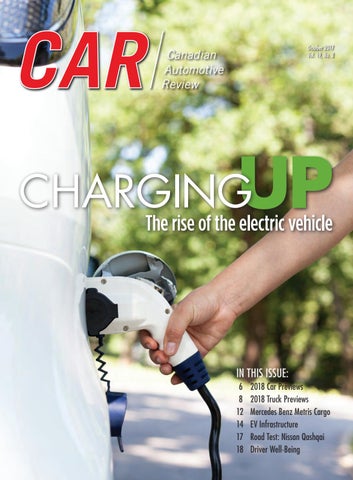
CHARGINGUP The rise of the electric vehicle
IN THIS ISSUE: 6 2018 Car Previews 8 2018 Truck Previews 12 Mercedes Benz Metris Cargo 14 EV Infrastructure 17 Road Test: Nissan Qashqai 18 Driver Well-Being
ADD A FEW HARD WORKERS TO YOUR CREW. The 2017 Nissan Titan XD with Cummins® Turbo Diesel Engine* offers superior capability and performance. With over 12,000 lbs of towing capacity** and 555 lb.-ft. of torque, you can trust that a fleet of Titans can handle anything your workers throw at it. Or in it.
*Available feature. **When equipped properly. The Nissan names, logos, product names, feature names, and slogans are trademarks owned by or licensed to Nissan Motor Co. Ltd. and/or its North American subsidiaries. Always wear your seat belt, and please don’t drink and drive. ©2017 Nissan Canada Inc. All rights reserved.
Fuel Saving Tips Cost-effective driving habits can make a difference to the bottom line. Picking up a few driving habits will reduce fuel consumption and save money. ACDelco offers the following fuel-saving tips:
80 VALLEYBROOK DR, TORONTO, ONTARIO M3B 2S9 PHONE: 416-442-5600 FAX: 416-510-5140
www.PurchasingB2B.ca
Vol. 19, No. 02
October 2017
EDITOR: Michael Power (416) 442-5600, ext. 3259, mpower@purchasingb2b.ca ART DIRECTOR: Mark Ryan PUBLISHER/ADVERTISING SALES: Dorothy Jakovina (416) 510-6899, djakovina@purchasingb2b.ca ACCOUNT COORDINATOR: Tracey Hanson (416) 510-6762, thanson@annexbizmedia.com CIRCULATION MANAGER: Barbara Adelt (416) 442-5600 x 3546, badelt@annexbizmedia.com
ANNEX PUBLISHING & PRINTING INC. GROUP PUBLISHER: Martin McAnulty, mmcanulty@annexweb.com COO: Ted Markle, tmarkle@annexweb.com PRESIDENT & CEO: Mike Fredericks CAR, established 1991, is published twice annually (April and October), by Annex Publishing & Printing Inc. © Contents of this publication are protected and may not be reproduced, in whole or in part, without the written consent of the publisher or editor. From time to time we make our subscription list available to select companies and organizations whose product or service may interest you. If you do not wish your contact information to be made available, please contact us via one of the following methods. Phone: 1-800-668-2374, Fax: 416-442-2200, Mail: Privacy Officer, 80 Valleybrook Drive, Toronto, ON M3B 2S9. NOTICE: CAR accepts no responsibility or liability for claims made for any product or service reported or advertised in this issue. CAR receives unsolicited materials including letters to the editor, press releases, promotional items and images from time to time. CAR, its affiliates and assignees may use, reproduce, publish, re-publish, distribute, store and archive such unsolicited submissions in whole or in part in any form or medium whatsoever, without compensation of any sort. Printed in Canada Publications Mail Agreement No. 40065710
•L ose the rooftop carrier: these can increase wind resistance and lower fuel economy. Increase aerodynamics and boost fuel economy by storing a rooftop carrier. If possible, store the load inside the vehicle rather than using a roof rack. • I nflate tires properly: Underinflated tires can lower gas mileage. If you don’t know what your tire pressure should be, try checking your driver’s side doorjamb sticker. •C orrect oil: Using the manufacturer’s recommended grade of oil can improve your gas mileage from one to two percent. •R emove extra weight: Carrying an extra 100lbs in your vehicle can reduce your kilometre-per-litre by about one percent. • Keep engine tuned: Dealing with maintenance problems like a faulty oxygen sensor can improve fuel efficiency by up to 40 percent. •A void aggressive driving: Rapid acceleration uses gas. Anticipate traffic to brake and accelerate steadily. •C ombine car trips: Combine errands into one trip while the engine is warm.
Goodyear announces 2017 Highway Hero A truck driver who stopped a dump truck and saved the incapacitated driver’s life with CPR is the 34th Goodyear Highway Hero. Chosen from three finalists, David Webb of Billings, Montana, accepted the award during the Mid-America Trucking Show, in Louisville, Kentucky. Webb and his wife were driving through Washington State last June when they saw a dump truck in the next lane swerve. Webb noticed the driver slumped over the wheel. As the dump truck slowed, Webb parked his own truck and ran after the still-moving vehicle. He jumped onto the truck’s running board, opened the door, reached inside and applied the brakes. Webb, working with a bystander, pulled the driver out of the truck and was CHARGING The rise of the electric vehicle performing CPR on him when help arrived. The driver was hospitalized and survived. Webb receives a Highway Hero ring, a $5,000 prize and other items.
October 2017 Vol. 19, No. 2
UP
IN THIS ISSUE: 6 8 12 14 17 18
2018 Car Previews 2018 Truck Previews Mercedes Benz Metris Cargo EV Infrastructure Road Test: Nissan Qashqai Driver Well-Being
Cover: iStock
Purchasingb2b.ca | OCTOBER 2017 CANADIAN AUTOMOTIVE REVIEW | 3
Toyota and Transition Énergétique Québec to study province’s hydrogen infrastructure market
Ontario plans to crack down on careless and distracted driving with new rules and penalties designed to improve road safety. The province says it will introduce new legislation this fall that, if passed, will help protect pedestrians and cyclists and reduce the fatalities and injuries by impaired, distracted and dangerous drivers. The proposed measures include: •A new offence for careless driving causing death or bodily harm with penalties like fines, license suspension and imprisonment; •T ougher penalties for distracted driving, such as using a cellphone while operating a vehicle; • I ncreased penalties for drivers who don’t yield for pedestrians and escalating fines for drivers convicted of multiple pedestrian-related offences within a five-year window; and •E xpanding the use of rear flashing blue lights for enforcement and emergency vehicles. The province is consulting on the use of cameras on school buses that capture the offence of illegally passing a school bus, so evidence can be admitted into court without a witness.
Magna unveils autonomous driving platform Magna has unveiled the MAX4, an integrated, customizable and scalable autonomous driving sensing and compute platform that can enable up to Level 4 autonomous driving capabilities in urban settings and on the highway. MAX4 combines cameras, RADAR, LiDAR and ultrasonic sensors with a compute platform designed for integration with any automakers’ platforms—including hybrid and electric vehicles. Integration of MAX4 retains an automaker’s existing design and styling for their vehicle, the company said. Magna also said it wanted to simplify how drivers engage with autonomous driving systems, including the option of an intuitive and familiar cruise-control-like user interface. A lighted display indicates the vehicle is in autonomous mode, and drivers can disengage that mode by braking or an emergency button. 4 | CANADIAN AUTOMOTIVE REVIEW OCTOBER 2017 | Purchasingb2b.ca
National Drive Electric Week
The seventhannual National Drive Electric Week took place September 9 to 17, with countries across the globe taking part in the event. Canada, Drive Electric Week for the Waterloo Region. the US, the UK, India, Australia and New Zealand were among the countries involved. In Canada, 23 municipalities saw electric vehicles hit the road to participate. The event is a celebration to heighten awareness of the availability of plug-in vehicles and highlight the benefits of all-electric and plug-in hybrid-electric cars, trucks and motorcycles. Started in 2011 as National Plug In Day with the idea to hold events simultaneously, the event has expanded to a week and changed the name. Each event is led by local plug-in drivers and advocates and includes a combination of EV parades, ride-and-drives, electric tailgate parties, press conferences, award ceremonies, informational booths and so on. Event participants ask and answer questions, connect with other EV owners and hear from event sponsors—ranging from auto manufacturers to environmental organizations. The next National Drive Electric Week takes place September 8-16, 2018.
Image: Larry Trakalo
Ontario plans distracted driving laws
Toyota is investing in a pilot network of multi-fuel service stations that include hydrogen fuel and collaboration with groups like Transition Énergétique Québec (TEQ), the new public body that the Ministry of Energy has established to support energy transition, innovation and efficiency. Toyota Canada and TEQ announced a memorandum of understanding to study market requirements for hydrogen infrastructure needed to introduce fuel cell vehicles. Toyota and the Québec Government said they share a common goal and are looking to reduce the carbon emissions of vehicles. Toyota’s chairman, Takeshi Uchiyamada, announced that Toyota Canada’s first hydrogen fueling and service facility will be built at its Québec zone office as a first step in the development of hydrogen fueling infrastructure.
Best Retained Value canadianblackbook.com
2017
2017
IMPREZA, LEGACY & OUTBACK
2017
FORESTER & CROSSTREK (WITH OPTIONAL EYESIGHT & HID HEADLIGHTS)
(WITH OPTIONAL EYESIGHT & HID HEADLIGHTS)
®
®
2017 Best Retained Value Award for Overall Brand Car __________________
CANADIAN UTILITY VEHICLE OF THE YEAR
CANADIAN UTILITY VEHICLE OF THE YEAR
VÉHICULE UTILITAIRE CANADIEN DE L’ANNÉE
VÉHICULE UTILITAIRE CANADIEN DE L’ANNÉE
SUBARU CROSSTREK CANADIAN BLACK BOOK BEST RETAINED VALUE AWARD Compact Car
2017 FORESTER
2017 Best Overall Mainstream Brand
Canadian Utility Vehicle of the Year
Subaru holds its value better than all other mainstream brands in Canada. 3 Consecutive Wins
2017 CROSSTREK
2017 IMPREZA
2017 WRX
2017 LEGACY
2017 WRX STI
2017 OUTBACK
2017 BRZ
2017 FORESTER
SUBARU’S AWARD WINNING LINE UP With a great model lineup to suit your business needs, it simply makes sense to add the safety, value and reliability of Subaru symmetrical full-time All-Wheel Drive vehicles to your fleet. Thanks to the Subaru symmetrical full-time All-Wheel Drive system, all Subaru vehicles are uniquely equipped to offer unsurpassed control and safety in all types of weather conditions and on all types of road surfaces. Affordable acquisition costs, high residual value and volume fleet incentives make Subaru vehicles an excellent value and a smart investment.
Designed around everything you love doing. fleet.subaru.ca or call 1-877-293-7272
By Lesley Wimbush
A
s fall erupts in its glorious annual display of colour, it signifies the year is winding down. But automakers are gearing up after a flurry of new car debuts, with many of their 2018 models either in dealerships now, or soon to be on their way. There’s plenty on offer, with significant refreshes to important mainstream vehicles, and some brand-new nameplates we haven’t seen before. Here’s a sampling of what’s new for 2018.
Honda Accord Honda For 19 years and running, Honda’s compact Civic has been Canada’s best-selling car. But the number of mid-size Accords moved has steadily fallen since 2004 thanks to the growing popularity of crossovers. The all-new Accord debuting this fall is still a big deal for Honda, given its status as the top US selling car. It loses the coupe, but returns with better handling and new power trains; axing the V6 in favour of a pair of turbo-charged four-cylinders and 10-speed transmission. A hybrid model should soon follow.
Hyundai Elantra GT
Ford Eco Sport
6 | CANADIAN AUTOMOTIVE REVIEW OCTOBER 2017 | Purchasingb2b.ca
Image: Ford
Image: Hyundai
Hyundai Canadians like their Elantras—so much that they’ve bought more than 500,000 of them. And now there’s the 2018 Elantra GT, a hatchback version with sportier styling, European tuning, and a more premium interior. Lower trims come with a 162hp 2.0L four-cylinder, but upper Sport models get a turbocharged 1.6L with a 201hp output. All but the Sport Ultimate can be had with a six-speed manual—it comes with a seven-speed dual clutch automatic. Hyundai’s “green” car, the 2018 Ioniq, is available as a hybrid, plug-in hybrid or all-electric. All models offer plenty of safety and connectivity tech, and the Ioniq EV boasts a 177km range and a fuel consumption rating of 1.89L/100 km.
Image: Toyota
Toyota’s new design language injects a little pizzazz into what had become rather a bland lineup, with some rather divisive new front-end treatments. Their “Safety Sense” suite of driver assist technology is now standard on most vehicles, including the brand new C-HR crossover and even the new base model Corolla. One of Canada’s perennial top 10, the Camry, now in its 8th generation, returns with somewhat polarizing styling, a more luxuriously executed interior and significantly improved driving dynamics. Available with 2.5 litre 4-cylinder, 3.5 litre V6 or a 2.5 litre Hybrid Synergy power train and optional premium sound and infotainment technology.
Image: Honda
A PREVIEW OF THE NEW CARS AVAILABLE FOR THE NEW YEAR
Toyota Camry
Toyota
Ford While Ford won’t be reintroducing the mid-size Ranger pickup nor legendary Bronco until 2019 and 2020 respectively, the F-Series trucks receive a mild facelift and new diesel option. The full-size Expedition SUV is the latest to get an aluminum body, a new 10-speed auto transmission, and slightly more power from its 3.5L turbo V6. Joining the crossover lineup is Ford’s new entry into the explosive sub-compact segment, the Eco Sport. Powered by a 123hp 1.0L Ecoboost four cylinder (FWD) or a 2.0L (AWD) mated to a six-speed automatic transmission, the Eco Sport comes standard with Apple CarPlay and Android Auto.
Kia Niro
Subaru Impreza
Subaru’s all new Impreza is their second vehicle built on the new Global Platform—the architecture that will eventually underpin all of their cars by 2025. Outward changes are slight, but the cabin quality takes a leap forward with stitched leather, and better finishing throughout. All come with a new 2.0L four-cylinder boxer engine producing 152hp. “Eyesight” safety package is optional, and includes adaptive cruise control, lane-keep assist, lane-departure, pre-collision braking, high beam assist and new “reverse automatic braking,” which senses obstacles when reversing and apply the brakes.
Kia The first of Kia’s “EcoDynamics” green initiative sub-brand, the brand-new 2018 Niro compact crossover is available exclusively as a hybrid. Together, its 1.6L four-cylinder and electric motor mounted on the six-speed dual clutch transmission produce 146hp and consumption as low as 4.7L/100km. Available tech includes adaptive cruise control, lane change assist, Apple CarPlay and Android Auto. The Korean company is taking on the Germans with their new performance sedan. Launched at the infamous Nürburgring circuit, the Stinger’s available as either RWD with limited slip differential, or AWD with torque vectoring. Canadians will get two engine choices: a 251hp 2.0L turbo-charged four, or a 365hp 3.3L turbo six, channelled through an eight-speed automatic, the single transmission choice.
Dodge Challenger Demon
Nissan The Leaf returns with substantial changes in styling and a bump in both range and power. The more conventionally attractive Leaf now boasts a maximum 241km on a full charge, and puts out 147hp. A bigger battery is in development, which will see the range increase to compete with the Chevrolet Bolt’s 380kms. Nissan’s crossover lineup grows to include the subcompact Quashqai, which will compete with the Honda HR-V, Chevy Trax and Buick Encore. Front wheel drive models get either six-speed manual or continuously variable transmission, while AWD is CVT only. All models are powered by a 140hp 2.0L four-cylinder engine, and all get heated front seats, back-up camera, and Siri eyes-free.
Image: FCA
Image: Nissan
Nissan Leaf
Image: Lesley Wimbush
Subaru
Image: Kia
Image: Mercedes Benz
Mercedes Benz E-400 Mercedes Benz Previously available only with a four-cylinder, the E-Class sedan follows coupe, wagon and convertible variants as the recipient of a new V6. Since AWD is standard on all models, the E400’s 3.0L engine puts out 329hp through a nine-speed automatic transmission to all four wheels. The same nine-speed transmission finds its way into the C-Class sedan and coupe, replacing the previous seven-speed. Backup cameras are now standard across Mercedes-Benz’s passenger car and crossover lineup.
FCA Although the venerable Dodge Caravan was due to be axed this year, its popularity has earned it a reprieve. All models from the base to the sporty Grand Caravan GT are powered by the same 283hp 3.6L V6. Another outrageous muscle car joins the Dodge lineup with the Challenger Demon. With 840hp and 770lbs-ft of torque, it’s the fastest, most powerful production car that ever hit the drag strip. As well, count Alfa among the historic marques from whom you’d never expect to see a crossover. But that’s where the profits come from to keep building beautiful sports cars. The new Stelvio boasts voluptuous Italian styling, a class-leading 280hp from a 2.0L turbo-charged four, and a host of available luxury features. Purchasingb2b.ca | OCTOBER 2017 CANADIAN AUTOMOTIVE REVIEW | 7
By Howard J. Elmer
S
peciality pickups are big business, and this will certainly continue into next year. All manufacturers now offer these unique trim and colour packages. Chevy alone has been pushing five this year—more if you count the HDspecific ones. Even Nissan is offering dealer-available equipment that will “personalize” your new Titan. Toyota is also doing it, in addition to pushing its TRD Pro models. Ram is on board, spring boarding off the Rebel and regular Ram with multiple grille treatments, hood designs, wheel treatments and wild colours. Ford already offers the most multi-level trim packages; yet for 2018 they are pushing four new special editions. From a marketing viewpoint it makes sense. Trucks just can’t be new every year—but special editions can; and they have proven to sell well.
Image: Ford
A roundup of the coming model year for trucks
2018 Ford F150 Yes, the 2018 F-150 will offer an all-new 3L Power Stroke V6 turbo diesel. However, word now is that it won’t arrive till late next year—no explanation for the delay. Changes to the sheet metal are minor; in fact what you do see is a blending of look of the F-150 and that of the Super Duty. The big changes are to the powertrains. The standard engine for 2018 will be 3.3L V6 EcoBoost (282hp and 253lbs-ft of torque). The current 2.7L EcoBoost is being updated to offer direct injection technology and improved durability. The 5L V8 will also be improved and also matched (for the first time) to the 10-speed automatic transmission. Past this all engine offerings will now include a standard Auto Stop/Start feature. Safety and electronic upgrades will include Pre-Collision Assist and Pedestrian Detection as well as 4G LTE modem and a Wifi hot spot that will handle up to 10 mobile devices at one time. The F150 will also be offered in the Limited trim next year.
Image: Howard J. Elmer
HAULING IN THE 2018s
2018 Ford Super Duty F250 to F450 The Super Duty lineup was all-new in 2017 so this year is a carryover. However this second generation of the Super Duty was packed with enough new technology that it will carry forward easily. What is new for 2018 is another top trim level recently shown at the State Fair of Texas. The “Limited” adds even more content to these heavy haulers. Limited will add Camelback two-tone leather seats, a leatherwrapped steering wheel, leather-upholstered dash and armrests, a micro-suede headliner, ash-wood trim, a specially designed grille, satin-finish tailgate trim, special badges and a unique serial number. This edition may well push the price of a Super Duty past $100,000 in Canada for the first time. Past this, the F450 retains the top max tow weight of 32,500lbs with a payload of 7,630lbs. The 6.7L Power Stroke diesel is now rated at 440hp and 925lbs-ft of torque.
Chevy’s 100th anniversary will no doubt add special appearance packages to GM’s HD trucks this year as well. These will build on upgrades like Digital Steering Assist, an available Gooseneck/5th Wheel Trailering Prep Package and spray-in bedliner. Last year the second generation Duramax was released (445hp and 910lbs-ft) It’s redesigned for better oil and coolant flow capacity and now has an electronically controlled turbocharging system. As part of this update the HD air intake was redesigned. An integrated hood scoop now traps snow, sleet, and rain, allowing cool dry air to get to the engine. 8 | CANADIAN AUTOMOTIVE REVIEW OCTOBER 2017 | Purchasingb2b.ca
Image: Chevrolet
2018 Chevrolet Silverado HD 2500 & 3500
Image: Howard J. Elmer Image: Howard J. Elmer
Image:GMC
2018 GM Canyon and Colorado The GM midsize twins continue to carry several unique features forward into 2018, including the only small diesel currently available in this segment. Past this the Colorado ZR2—an off-road version of its small truck—new in 2017 is still the big news. It’s the real deal with front and rear electronic locking differentials. An available gas or diesel engine and Multimatic’s Dynamic Suspensions Spool Valve (DSSVTM) damper shock technology.
2018 Toyota Tundra and Tacoma Tacoma was all-new for 2016 including its powertrain. For 2018, little changes—except for the continued push of the TRD Pro versions, of not only the Tacoma but now also the Tundra, being offered to off-road enthusiasts. TRD Pro’s feature Multi-Terrain Select 4WD, Crawl Control, beefed up front and rear suspension and Bilstein shocks and unique decals and colour schemes.
Image: Howard J. Elmer
2018 Nissan Titan Released last year to compete in the straight half-ton market, this one-trick pony won’t change in 2018. This pickup offers just one powertrain (5.6L V8), tows 9,390lbs and has just one bed length at 6.5 ft. A V6 was announced, but the company has since gone quiet on that addition. Nissan made a splash with its all-new Titan XD in 2016. Since then it has added a 5.6L gas engine to the featured Cummins 5L V8 Turbo Diesel that is rated to tow 12,000lbs. There are no expected changes to the 2018 model except perhaps some paint choices.
2018 Ram Truck HD 2500 and 3500 Ram Heavy Duty retains its best-in-class towing rating of 31,210lbs for 2018, only because they claim it for the 3500-series truck. Like the other builders, what they lack in new technology they cover up with more options, trim and colours.
Image: Howard J. Elmer
2018 Honda Ridgeline The year 2018 will see no changes to the Ridgeline— and being that it took Honda 10 years to get to this second-generation upgrade, I expect it to remain the same for a while yet. It features a 3.5L V6, an auto all-wheel drive system and an automatic six-speed transmission along with some unique features like its fold-down tailgate that also opens sideways and a large, lockable trunk under the cargo bed.
Image: Howard J. Elmer
Image: Chevrolet
2018 Chevrolet Silverado 1500 August 2017 was the 100th anniversary of the birth of Chevrolet trucks and in honour of that milestone Chevy has unveiled a special centenary bowtie emblem that will grace several special editions in the 2018 model year. The most sought after may be the Silverado Centennial Edition that will come in a one-off Centennial blue. So, while these models will have unique trim packages—everything else remains the same in 2018. Currently they offer an eight-speed automatic transmission on both the 6.2L and the 5.3L V8. The current max trailering is 12,000lbs.
2018 Ram 1500 The 2018 is still carrying over—though rumour has it that the 2018 Detroit Auto Show will introduce the next generation of the Ram in January. In the meantime, Ram is churning out special editions at a furious rate. The newest, shown at the State Fair of Texas, is the Tungsten Edition. It will also be offered on HD models.
Purchasingb2b.ca | OCTOBER 2017 CANADIAN AUTOMOTIVE REVIEW | 9
A friendly tip, don’t be Bill. See vehicle order status, with integrated up-fitting and accurate in-market dates in real-time, so you can avoid the guesswork.
SeenItComing.ca
WELL-PRICED
sophisticate The 2017 Mercedes-Benz Metris Cargo
D
aimler introduced North America to the concept of the premium Euro commercial van about 15 years ago with the Freightliner Sprinter—which became the Dodge Sprinter and now the Mercedes-Benz Sprinter. Within the past few years, the overseas commercial van has made big inroads, with dedicated workhorses from Nissan, Ram (Fiat) and Ford offering contractors and fleet buyers vans that shame the old traditional North American fare with higher plateaus of utility, durability, drivability and economy. Yes, and pricing. Compact versions of the big boys (Ram Promaster City, Nissan NV200, Ford Transit Connect) are catching on too, offering tidy functionality and frugality to the inner-city crowd. Introduced in 2016, the Mercedes-Benz Metris finds the
The Metris is available in two configurations: a cargo panel van at $33,900 and a seven-passenger van starting at $37,900.
middle ground between big and small. It offers about 50-percent more payload and cargo capacity than the other small vans, yet delivers nimble urban moves. The Spanish-built Metris is available in two configurations—a cargo panel van at $33,900 and a seven-passenger van that starts at $37,900. Here, we’re putting the basic cargo van to work, hauling some furniture, building supplies and taking a load of scrap metal to the recyclers. Ordering a 2017 Metris Cargo is a fairly low-stress affair. There is only one box height, one drivetrain and one length, although for 2018 a box that’s nine inches longer is on offer. The longitudinally mounted gasoline 2.0L turbo four (208hp, 258lbs-ft) sends power to the rear wheels through a sevenspeed 7G-Tronic transmission with paddle shifters. It offers
The Metris’s steering is quick, alert and body motions are well controlled.
12 | CANADIAN AUTOMOTIVE REVIEW OCTOBER 2017 | Purchasingb2b.ca
Images: Peter Bleakney
By Peter Bleakney
three programs—ECO, Comfort and Manual, for those times when you’re feeling racy on the job. This is a perky little hauler, with a smooth, eager drivetrain that is impressively devoid of turbo lag. The steering is quick, alert and body motions are well controlled. In short, the Metris feels every bit the Mercedes-Benz from behind the wheel. The cabin might be plain, but it is well built and ergonomically sound. The dashtop has three depressions for clipboards, etc. North American Metris’ get two Big Gulp-size cupholders in the lower dash where the Euro stick shift would live. With its big windshield and low cut doors, forward visibility is stellar, although I would ask for bigger rearview mirrors. The right side mirror gets a convex lens for 2017, which helps.
Fun to drive Dare I say it, I actually enjoyed driving this cubist workhorse, especially on an extended highway jaunt where superbly comfortable seats, ample passing power and straight-line stability helped shrink the miles. The ride is commendably refined for a utility vehicle, and it has a half-decent stereo too. Premium fuel is recommended, although wisely Mercedes says the Metris will run on regular, with a slight loss in performance and efficiency. Having spent most of my test week away from the inner city grind (and with relatively light loads) it turned in a heart-warming 9.2L/100km. Payload capacity is 113kg (2502lbs) and tow rating is 2250kg (4960lbs). Cargo bed length is 111.5 inches, and with 50 inches between the wheel wells, Metris will accommodate 4x8 sheets of building materials. Interior height is 53.8 inches and cargo volume maxes out at 186 cubic feet. Numerous utilitarian options are available, including a bulkhead behind the passenger compartment, box lining with a system of anchor points and extra lighting. Beware: the sliding door can hit the barn-style rear door when it is fully opened and hugging the side of the van. There is a sticker on the door jam warning of this peril. Metris comes standard with fabric seats, AM/FM, Bluetooth, air conditioning, USB, auto headlights and a couple of safety systems—Attention Assist which monitors your driving style and alerts if you’re losing focus, and Crosswind Assist that uses targeted braking to keep the rig on the straight and narrow. New for 2017 is optional blindspot assist. This tester was equipped for real hauling duties with its $330 full partition, and you’ll definitely want the $760 backup camera (now standard on 2018 models) along with the heated and
The Metris is able to accommodate 4x8 sheets of building materials.
power adjustable side mirrors ($280). The $810 Convenience Package added multi-function steering wheel, cruise control, trip computer, centre console with storage compartment, two additional master keys and pixel-matrix display instrument cluster. Absent here, but certainly worthy of consideration, is the $730 Cold Weather Package (heated front seats and auxiliary electrical heating). Other available options include auto start/ stop ($290), navigation ($670), reverse warning system ($120), roof rails ($460), hi-performance air conditioning ($1200), anti-theft alarm ($380). Indeed, the Metris seems infinitely customizable, in a strictly utilitarian way. With an 11.8-metre turning circle, the Metris is pretty easy to wheel around in tight quarters, and with an overall height of 6’3 inches, it will fit into most parking garages. The Mercedes-Benz Metris was named Vincentric’s Lowest Fleet Cost To Own in the category of mid-size commercial van. This is based on cost, fuel economy and residual value, and is certainly helped along by the Metris’ 25,000km service intervals. There’s no question this well-priced little sophisticate from Benz delivers on the marque’s promise of fine dynamics and clever engineering. The fact that it parks itself between the small and large commercial vans makes it a unique proposition. C.A.R.
AS TESTED: Price as tested: $36,080 Engine: 2.0-litre turbocharged four-cylinder Power: 208 hp 258 lb.-ft. of torque Transmission: seven-speed 7G-Tronic transmission Drivetrain rear-wheel-drive Rated Fuel Economy Auto (L/100 km): not available for commercial vehicles Observed Combined Fuel Economy (L/100 km): 9.2
Purchasingb2b.ca | OCTOBER 2017 CANADIAN AUTOMOTIVE REVIEW | 13
Charged Up
Range anxiety and charging station availability among considerations for those considering electric vehicles By Kara Kuryllowicz
14 | CANADIAN AUTOMOTIVE REVIEW OCTOBER 2017 | Purchasingb2b.ca
E
Photo credit: Image: iStock
All
lectric vehicles continue to attract attention as air quality and extreme weather—both in Canada and globally—put the focus on emissions and climate change. Yet as much as they appeal to anyone that cares about the planet, the reality is that so far, EVs remain suitable only in certain circumstances due to their capital cost, driving range, limited model range, charge time, access to charging stations and value at resale. “Consumers are open to them and they truly believe they are coming but people are not dumb—they need them to make sense in their daily lives and right now, that’s the case for very few people,” says Ian Jack, managing director, communications and government relations, Canadian Automobile Association in Ottawa, which has over six million members and 100-plus offices nationwide. “Right now, EVs are more about signaling that you are doing the right thing.” In Canada in 2016, there were 22.4 million passenger vehicles on the road of which just 28,000 were EVs. A fully electric vehicle is powered exclusively by electricity, charged by plugging into the grid, has a range of about 200 to 400km and no tailpipe emissions. Alternatively, plug-in hybrid electric vehicles have small battery packs for driving 20 to 80km before the gasoline engine or generator kicks in. The cost of an EV is about $35,000, according to Plug ‘N Drive, a non-profit organization that’s committed to accelerating the adoption of EVs to maximize their environmental and economic benefits. To date, only Ontario, Quebec and BC offer funding to help ease the sticker shock. Ontario provides up to $14,000 off the purchase of an electric car and up to $1,000 off the purchase and installation of a home charging station. In Ontario, EV owners also get a green license plate that allows drivers to use high-occupancy/toll lanes when driving solo. In Quebec, there is a rebate of up to $8,000 off the purchase
“This technology is still being adopted almost exclusively by organizations with very specific mandates around the environment and the use of electricity, for example, government and utilities.”—Peter Nogalo, ARI of an electric car and 50 percent off the cost for buying and installing a charging station up to a maximum of $600. British Columbia offers a rebate of up to $5,000 on a fully electric car and up to $2,500 off a plug-in hybrid electric car. “This technology is still being adopted almost exclusively by organizations with very specific mandates around the environment and the use of electricity, for example, government and utilities, because the ROI and the range simply aren’t there yet,” says Peter Nogalo, marketing manager, ARI, Mississauga, Ontario, which manages 180,000
MITBRD17106-Q3-1-2PG-CndAutoReview-E 2 OL.indd 1 CARSupp_Mitsubishi_Oct.indd 1
vehicles Canada-wide. The CAA’s Jack, ARI’s Nogalo and Plug ‘N Drive all point out that in most cases, range anxiety is unfounded since most drivers regularly drive only shorter distances, but acknowledge that most vehicles that are used for work do require more range than EVs can deliver. Plug ‘N Drive, which notes most Canadians drive 60km or less daily, suggests setting one’s trip calculator to zero before starting the daily commute to track the actual distance travelled. “The increased popularity of car- and ride-sharing services indicates Canadi-
ans’ attitudes toward their vehicles are evolving,” says Jack. “For example, you could use your EV day to day, then rent a hybrid or gasoline-powered vehicle to visit a distant client, drive to the cottage or take a two-week road trip.” EVs’ upfront cost and range tend to limit their appeal, but consumers also want more choice than the approximately 10 fully electric cars currently available in Canada. Both Jack and Nogalo point out that the lack of fully electric SUVs and pick-ups leads buyers back to either a hybrid or traditional gasoline engine. Of the 1.95 million new passenger vehicles
2017-10-05 4:03 PM
Purchasingb2b.ca | OCTOBER 2017 CANADIAN AUTOMOTIVE REVIEW 15 2017-10-06 12:19| PM
Photo credit: gettyimages
sold in 2016, pickups, SUVs and vans dominated the top rankings. The Ford F-Series and Ram Pickup respectively ranked #1 and #2 in 2016 and 2015 followed by the Honda Civic in third, then the Dodge Grand Caravan, GMC Sierra and Toyota RAV4 in 4th, 5th and 6th place. “If you need the EV as a work tool or really want an SUV or pick-up, an EV isn’t currently an option,” says Nogalo. “As much as you want to do the right thing, whether you’re an entrepreneur, a small- to medium-sized enterprise or part of a multinational, you have to be practical.” Range and charging are less of a concern as the range increases and the charging options continue to expand, but they’re still an issue for many buyers. In Canada, there are now more than 4,500 public charging stations, of which 150 are Level 3 fast chargers that fully charge an EV in 30 minutes or less. As well, businesses and workplaces are installing charging stations for employees and customers. For example, about 300km of north of Toronto on Georgian Bay in Pointe au Baril, Ontario, Desmasdons Boatworks’ general manager Matt French, a car and boat fanatic, learned that several customers had Teslas and EVs as second vehicles. When customers at the 200-plus slip marina said they’d drive their EVs to the cottage if Desmasdons
had charging stations, French approached Tesla which supplied and installed two Tesla chargers and one generic unit at no charge. “The chargers show we’re forwardthinking, confirm our commitment to protecting the environment and are tangible proof we pay attention to what really matters to our customers,” says French. “There is usually at least one vehicle being charged and with interest expected to increase, Tesla will soon install a fourth unit at Desmasdons.” CAA’s Jack also notes that although vehicles represent one of consumers’ most significant life investments, many focus more on the vehicle’s appearance and the monthly payment than operating costs. That’s one reason CAA offers an Electric Vehicle Cost Calculator. “Most people aren’t particularly rational about vehicle prices, but if they were, they would realize that EVs can offer good value,” says Jack. “Consumers will have to look beyond the monthly payments to lifecycle costs if EVs are to be adopted by the masses.” Fortunately, certain governments are taking a different approach as nations consider the environmental and human impact of the 1.2 billion vehicles on the road with two billion expected by 2035, as reported by automotive trade journal Ward’s Auto. There are plans to end the production and sale of gasoline and diesel vehicles, which would boost EV
16 | CANADIAN AUTOMOTIVE REVIEW OCTOBER 2017 | Purchasingb2b.ca
production and sales, while positively affecting cost and acceptance. Yet it’s also recognized that government plans and promises can be rescinded and that to date, not one nation has detailed exactly how their gasoline and diesel bans will be achieved. Globally, right now, Bloomberg New Energy Finance (BNEF) notes 95 percent of electric cars are sold in only 10 countries: China, the US, Japan, Canada, Norway, UK, France, Germany, Netherlands and Sweden. China, which accounts for about 30 percent of global passenger vehicle sales, will implement its policy “in the near future.” Dutch parliament voted to end all gas and diesel car sales by 2025 (yet to go through the Dutch senate); India said sales of gas and diesel cars will stop by 2030 and Norway will follow suit by 2025. France and Britain will end sales of gas and diesel vehicles by 2040 and Germany is considering action. BNEF expects within eight to 10 years, electric vehicles will be cost competitive with conventional vehicles. That’s just one of many reasons it forecasts 54 percent of new car sales will be EVs and a third of the global light-duty fleet will be electric by 2040. In short, change will continue to come and while BNEF states, “We can now envision a future dominated by electric vehicles.” C.A.R. The Canadian Automobile Association (CAA) provides several online tools for those either considering the purchase of an electric vehicle or those who already own one. For example, CAA’s website offers a handy charging station location tool: http://bit.ly/2xWlW7p As well, the site provides an online cost calculator for electric vehicles: http://bit.ly/2g6V4rV For additional information about EVs, including the types of vehicles sold in Canada, government incentives available and so on, visit the CAA’s website at www.caa.ca.
Funky Name, Great Value The 2017 Nissan Qashqai By David Miller
Images: David Miller
T
he all-new Nissan Qashqai went on sale in June 2017, and within three months it has already topped the Canadian subcompact crossover charts for the month of August. For a new nameplate that’s not an easy accomplishment, as it looks to battle with an all-refreshed Subaru Crosstrek for the remainder of the year. The Qashqai name itself has raised a few eyebrows (it’s called the Rogue Sport in the US), but from a sales standpoint it’s clear that it hasn’t become a deterrent. A lot of that has to do with its impressive combination of price, comfort, design and versatility. We can talk about many features of a brand-new vehicle, but what typically attracts consumer attention starts and ends with price. Nissan’s marketing team has managed to set the cost of the Qashqai just under the $20,000 threshold, at $19,998. Great value is offered at that price, but unless you want the manual transmission, one would have to move up to at least $21,998 for its automatic continuously variable transmission (CVT). The Qashqai may be new to Canada, but it’s been a success story since its 2007 arrival, quickly becoming one of Europe’s best-selling SUV/crossover vehicles with over 2.5-million sold. For years, the Qashqai was felt to be too similar in size to the Rogue, but with a growing appetite for utility vehicles and success overseas, it was the right time to come to the North American market. The smaller crossover slots in between the Rogue and the Juke with hopes of filling that market void, plugged in most recent years by new entries in the Honda HR-V, Mazda CX-3 and Jeep Renegade. The Qashqai is built off of the same platform of the Rogue and takes on similar styling, which isn’t a bad thing. It just comes in a smaller form with reductions in length (250mm), height (98mm) and wheelbase (60mm). Many of the Rogue’s signature touches are featured on the Qashqai including its V-Motion grille, swept-back headlights and boomerang-shaped taillights. Outside of its size, discernible differences are found in its sleeker grille and circular fog lights. Along the body, sporty creases and a curvaceous hatchback rear provide character that complements its compact frame. Inside, the Qashqai offers up a healthy dose of headroom
and legroom in both rows for four adults. Its sloping roofline may appear to cut off headroom in the rear, but surprisingly my six-foot frame fit comfortably with room to spare. Versatility and cargo space can be question marks in the compact crossover segment, but Nissan turns those into positives with a 60/40 rear seat split, an available Divide-N-Hide cargo system in the trunk, and second row cargo volume at 1,730L (1,982L in the Rogue). However, when the second row is folded upward, cargo space shrinks to 643L, a drastic decline compared to 1,113 found in the Rogue, but not so much with actual competitors in the segment. Moving up trims, consumers will be treated to a heated leather-wrapped flat-bottom steering wheel, power moon roof, an around-view monitor, and a plethora of safety technology, but it should be noted that all trims have standard heated front seats and a rearview camera. Like most compact crossovers, the Qashqai’s appeal isn’t its performance. There’s nothing wrong with its 2.0L, four-cylinder engine that cranks out 141hp and 147lbs-ft of torque; there’s just nothing exciting about it. It gets the job done seamlessly, working through its CVT in a calm and quiet manner. As aforementioned, a six-speed manual is offered up only in the base trim, but unless you’re in a money pinch or simply need to have a manual, the automatic version is the smoother option with better fuel efficiency, rated at 8.8L/100km in the city and 7.3L/100km on the highway in all-wheel drive (9.1 city and 7.5 highway in all-wheel-drive). The Qashqai can be a perfect errand runner. It gets up to speed at a decent pace, while soaking up divots in the road while cruising. It’s ideal in an urban setting where it can weave its way through traffic, perform three-point turns with ease and, perhaps most important, fit its frame into small parallel parking spots. The only drawback can be felt in its steering. There were a few occasions on sweeping turns where steering correction needed to be employed. Other than that, the Qashqai performed admirably, and for a price starting at under $20,000, it’s hard to go wrong with this new crossover entry and its funky name. C.A.R. Purchasingb2b.ca | OCTOBER 2017 CANADIAN AUTOMOTIVE REVIEW | 17
DRIVER WELFARE Are you doing enough to care for your drivers’ health and wellbeing? By Martin Duval We’re moving into the cooler months of the year, which means the cold and flu season and winter driving season is fast approaching. Unfortunately, for drivers who are on the go, this means being at risk for catching a bug while also having to navigate the nasty winter roads in Canada. While keeping costs down, managing fuel spend and driver controls remain the top priorities for many fleet managers, there are additional factors that managers should consider when it comes to driver care.
Steps to wellbeing Communicating and caring for your drivers is the first step to helping build a highly competitive fleet operation. While there are a number of factors that managers should consider regarding driver wellbeing, the top four are: • Quality rest: Although it seems obvious, the importance of quality rest should be communicated to drivers on a regular basis. Driver fatigue remains a major contributor to road accidents, so it’s imperative that drivers are educated
Driver wellbeing includes the factors that keep drivers safe, happy and engaged with the job that they do. Driver wellbeing includes the factors that keep drivers safe, happy and engaged with the job that they do. This could mean offering new driver training programs or something as simple as providing tips on making healthy food choices while on the road. Research shows that companies that take an interest and create an environment where employees feel their wellbeing is a priority are better at keeping staff, something that continues to be a challenge for the fleet industry that is currently suffering from a shortfall in terms of qualified drivers.
and aware of the dangers. Managers can also provide support by putting company policies in place such as a fatigue risk management system or a stop-work policy to ensure drivers make rest a priority. • A safe environment: Education is a fundamental part of safety and drivers can never know too much about keeping themselves and others on the road out of harm’s way. Managers should ensure their drivers have completed a drivertraining course and have ongoing training refreshers. At Shell, we use a journey management plan that involves outlining
18 | CANADIAN AUTOMOTIVE REVIEW OCTOBER 2017 | Purchasingb2b.ca
a process that drivers follow when getting on the road. We also share this with customers who are interested in implementing one of their own. In addition to training, drivers should have a safety kit in their vehicle that contains items such as booster cables, an ice scraper, multi-tool, flashlight, blanket, snacks, reflective triangles and first aid supplies. • Keeping in touch: While managers can put many preventive measures and policies in place to help ensure the safety of their drivers, it’s important that drivers have access to a mobile device while on the road. This will allow drivers to locate the nearest service station or call for roadside assistance, if required. However, it is equally important that the proper technology be in place so that the phone isn’t being used while driving. • Access to healthy food and amenities: For many drivers, the service station is the only stopping point between the depot and their destination. When they are spending many hours on the road, finding a place to rest, stretch their legs or grab a healthy snack is vital. Shell Commercial Fleet customers have access to one of the largest station networks in the country with fresh food and coffee options at their fingertips, allowing them to enjoy the journey ahead. While some driver wellbeing suggestions may require time, planning and investment, the process of improving driver welfare is important and makes important business sense. However, there are some initial first steps that can be taken right away, including putting the topic of health and safety on the agenda of every team meeting, creating a health and safety challenge and sharing some of the driver success stories to motivate others. Both your drivers and fleet business will benefit in the long run. C.A.R. Martin Duval is a Shell commercial fleet account manager.
AMRY C 8 1 0 2 W E N ALL OBJECTIVE ansform To beautifully tr
perience.
your driving ex
HONOURS
st Black Book Be 1 2017 Canadian e ). th ry of r go te ne ca in W • e Car Award (Mid-siz Retained Value SKILLS
wer stance, t grille, wide, lo on fr ve si es gr • Ag terior. and premium in Hybrid models. linder, V6 and cy 4in e bl la ai Av • and more apps affic, Weather Tr , lp Ye ss ce Ac • 2 using Entune. ging. less phone charTM 3 including • Available wire P ta Safety Sense • Standard Toyo ruise Control. rC Dynamic Rada REFERENCES eet.toyota.ca • Available at fl
Transform your fleet lineup with the all-new 2018 Toyota Camry. 1 Based
on value retained from original MSRP for 2013 model year vehicles as published by CBB, as of January 1, 2017. See CandianBlackBook.com for complete details.2Data charges may apply. 3TSSTM - P is standard on all Camry models. Drivers should always be responsible for their own safe driving. Please always pay attention to your surroundings and drive safely. Depending on the conditions of roads, vehicles, weather, etc., the TSSTM systems may not work as intended. Please see toyota.ca, your local Toyota Dealer or Owner’s Manual for details.
EXPERTISE. EXPERIENCE. EASE. THAT’S FORD FLEET. When it comes to building the fleet that your success rides on, trust yours to Ford Fleet. Our experts will be by your side before, during and after sale, offering vehicle advice, customized financing and maintenance solutions, and a nationwide network of Ford-approved up-fitters and modifiers. Our mission is more than just vehicles. We’re driven to make supporting your fleet easier. FLEET.FORD.CA
2017 F-150
2017 FOCUS ELECTRIC
Vehicles may be shown with optional features. ©2017 Ford Motor Company of Canada Limited. All rights reserved.
2017 ESCAPE
2017 TRANSIT