OCTOBER/NOVEMBER 2018 | WWW.PLANT.CA
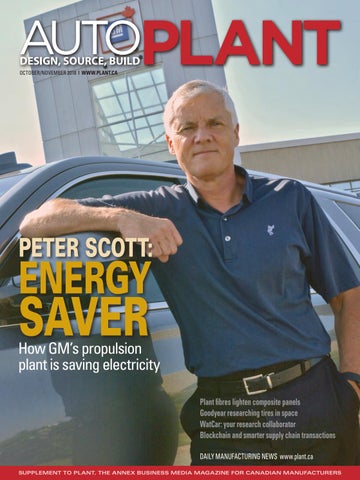
PETER SCOTT:
ENERGY
SAVER
How GM’s propulsion plant is saving electricity Plant fibres lighten composite panels Goodyear researching tires in space WatCar: your research collaborator Blockchain and smarter supply chain transactions DAILY MANUFACTURING NEWS www.plant.ca SUPPLEMENT TO PLANT, THE ANNEX BUSINESS MEDIA MAGAZINE FOR CANADIAN MANUFACTURERS
AutoPLT_OctNov_2018_AMS.indd 1
2018-10-22 1:00 PM
SPECIAL
LIMITED TIME
OFFER
WHAT DO YOU NEED TO MEASURE? FLIR delivers world-class thermal cameras and test & measurement tools with the accuracy, reliability, and versatility you need to tackle your most challenging jobs.
BONUS BUYS
Visit flir.ca/promos
AutoPLT_Fall_Flir.indd 1 AutoPLT_OctNov_2018_AMS.indd 2 Annex Print 9(W) x 12(H) (Bleed .25 W&H).indd 1
2018-10-12 2018-10-22 11:27 1:00 PM AM 7/24/2018 1:47:05 PM
2 11:27 AM 1:47:05 PM
CONTENTS
October/November 2018 Supplement
FEATURES 18 CCOHS SAFETY TIPS Recognize and prevent repetitive strain injuries.
WEED Legalized pot is heightening the focus on impairment in the workplace.
20 LIGHTWEIGHTING A new binder technology is strengthening natural-fibre composites.
8 ENERGY
A lighting project has significantly cut the amount of electricity General Motors uses to make its propulsion products in St. Catharines, Ont.
DEPARTMENTS 4 Editorial 5 News Events 12 RESEARCH Goodyear is testing tire materials in space.
13 SUPPLY CHAIN How blockchain will secure the supply chain.
7 Economy PLANT Pulse
11 Rearview 22 Backseat Driver
15 COLLABORATION WatCar is helping automotive companies solve their biggest challenges.
17 ASSEMBY Ford’s new exoskeletal tool will assist workers at its Oakville plant with repetitive overhead tasks. Cover: Stephen Urhaney
PLANT—established 1941, is published 8 times per year by Annex Business Media. Publications Mail Agreement #40065710. Circulation email: blao@annexbusinessmedia.com Tel: 416442-5600, ext 3552 Fax: 416-510-6875 or 416-442-2191 Mail: 111 Gordon Baker Road, Suite 400, Toronto, ON M2H 3R1. Occasionally, PLANT will mail information on behalf of industry-related groups whose products and services we believe may be of interest to you. If you prefer not to receive this information, please contact our circulation department in any of the four ways listed above. Annex Privacy Officer: privacy@annexbusinessmedia.com Tel: 800-668-2374. No part of the editorial content of this publication may be reprinted without the publisher’s written permission. ©2018 Annex Publishing & Printing Inc. All rights reserved. Performance claims for products listed in this issue are made by contributing manufacturers and agencies. PLANT receives unsolicited materials including letters to the editor, press releases, promotional items and images from time to time. PLANT, its affiliates and assignees may use, reproduce, publish, re-publish, distribute, store and archive such unsolicited submissions in whole or in part in any form or medium whatsoever, without compensation of any sort. This statement does not apply to materials/pitches submitted by freelance writers, photographers or illustrators in accordance with known industry practices. Printed in Canada. ISSN: 1929-6606 (Print), 1929-6614 (Online).
www.plant.ca
AutoPLT_OctNov_2018_AMS.indd 3
AutoPLANT 3
2018-10-22 1:00 PM
EDITORIAL
USMCA: It’s a deal, but not among amigos
P
layers in the automotive sector may feel relieved that Canada, Mexico and the US have agreed to terms on a revised North American trade deal, and that some business certainty has been achieved. Don’t get too comfortable. The NAFTA renegotiation was actually a US attack on its continental allies. So much for the Three Amigos. There are some comforting aspects to the United States-Mexico-Canada Agreement (USMCA), but a protectionist administration in the White House means there will likely be more disruption and trouble to come. Despite President Donald Trump’s bellowing about NAFTA being the worst trade deal ever made, the USMCA isn’t so different from the 24-year agreement in structure, preserving the main features of freer trade, plus more local content. North American content is 75% for vehicles, 40% from plant’s where the hourly wage is $16 per hour, and 60% to 75% for parts, all with four-year phase-ins. Yet the contentious tariffs on steel and aluminum, levied by executive order because of a “trumped up” national security issue (via Section 232), were still in place as of Oct. 1. They’ll be dealt with on a separate track and there’s no timeline. There is some protection in a side letter to the new deal, noting the national security ploy won’t be applied against imports of vehicles and parts from Canada and Mexico based on production up to 2.6 million units, even if the US decides to deploy a 232 against other countries. Yes, Canada can hover safely under this ceiling. All the same, we should not underestimate Trump’s potential for creative application of the security play elsewhere. Car companies will see some costs rise because of higher wages in Mexico and fewer lower-priced parts and components from Asia. Regulatory compliance costs will also be higher. And businesses lose the Chapter 11 dispute mechanism that allowed them to sue Canadian and Mexican governments over trade beefs. But Chapter 19 and 20 remain in place, a win for Canada. The agreement, which goes into effect Jan. 1, 2020, will be up for review every six years. If it passes the first review, USMCA will be renewed for 16 years, but with another review in six years. If there are complaints, yearly reviews go into effect until the issues are settled, or the partners decide to craft a new deal. This is a compromise from a five-year sunset clause, something the Trudeau government resisted because of the uncertainty that would result and have a direct impact on investment in Canada. Nonetheless, uncertainty lingers. It could conceivably impact the shorter-term plans of Canadian companies and those who would otherwise consider Canada as a place to locate manufacturing operations. Trump will be gone or on the way out when the first review comes up. Except the next administration may be protectionist and inclined to bullying. Who knows? And that is surely the point. Canada has taken the trade relationship with the US for granted. Thank you, Mr. Trump, for the wake-up call. He has demonstrated how fast a friend and ally can become an adversary. We will not soon forget his threat of a 25% auto tariff and a promise of ruination falling upon the Canadian economy for failing to arrive at a deal by his arbitrary deadlines. Post agreement announcement, he blew it off as a negotiating tactic. That’s some tactic, and an interesting way to treat a friend and ally. Canada can no longer rely so exclusively on our neighbours to the south for economic prosperity. We’re amigos no more.
Publisher Jeff Brownlee 416-277-8428 jbrownlee@annexbusinessmedia.com Editor Joe Terrett 416-442-5600 ext. 3219 jterrett@plant.ca Art Director Andrea M. Smith National Account Manager Ilana Fawcett 416-510-5202 ifawcett@plant.ca Account Coordinator Debbie Smith 416-442-5600 ext 3221 dsmith@annexbusinessmedia.com Annex Business Media Vice President/Executive Publisher Tim Dimopoulos (416) 510-5100 tdimopoulos@annexbusinessmedia.com President & CEO Mike Fredericks Circulation Manager Beata Olechnowicz 416-442-5600 ext. 3543 bolechnowicz@annexbusinessmedia.com Subscription Price Canada $74.50 per year, US $151.50 (US) per year, Foregin $171.00 (US) per year. Single Copy Canada $12.00. Add applicable taxes to all rates. Combined, expanded or premium issues, which count as two subscription issues. Mailing Address Annex Business Media 111 Gordon Baker Road, Suite 400 Toronto, ON M2H 3R1 Circulation Bona Lao 416-442-5600 ext. 3552 blao@annexbusinessmedia.com Fax: 416-510-6875 or 416-442-2191
Joe Terrett, Editor Comments? E-mail jterrett@plant.ca.
4 AutoPLANT
AutoPLT_OctNov_2018_AMS.indd 4
October/November 2018
2018-10-22 1:00 PM
NEWS EVENTS A3 Business Forum A3 Jan. 14-16, 2019, Orlando An annual networking event presented by the Association for Advancing Automation for robotics, vision and imaging, motion control, and motor professionals. More than 650 global automation leaders attended in 2018. Visit www.a3automate.org. CanWEA Operations and Maintenance Summit 2018 CanWEA Jan. 30-31, Mississauga, Ont. Canadian Wind Energy Association’s (CanWEA) annual summit. Network with wind farm operators, turbine manufacturers and service providers. The event covers the latest in technical innovations, operational strategies and turbine technologies. Visit canwea.ca. Hannover Messe Deutsche Messe AG April 1-5, 2019, Hannover An international trade fair focusing on industrial technology from R&D, industrial automation, IT, industrial supply, production technologies and services to energy and mobility. Visit www.hannovermesse.de. Metalworking Manufacturing & Production Expo FMA Inc. April 3, 2019, Winnipeg Automation equipment, industrial, meteorology equipment, machine tools and services. Visit www.mmpshow.com. Automate 2019 A3 April 8-11, 2019, Chicago Automate, presented by the Association for Advancing Automation, showcases the full spectrum of automation technologies and solutions from traditional industrial applications to cutting edge. Held every two years. Visit www.automateshow.com. Plast-Ex UBM June 4-6, 2019, Toronto For Canada’s plastics processing marketplace. Showcases products and innovative business solutions covering marketing, packaging services, material handling and logistics. Visit http://admtoronto.com/ plastex.
www.plant.ca
AutoPLT_OctNov_2018_AMS.indd 5
KUKA, Humber partner Collaborating on robotics to advance Industry 4.0
KUKA Robots in action.
PHOTO: KUKA
TORONTO — Humber College and KUKA Canada Inc. are partnering to bring the latest robotics technology to the Toronto college and they’re working together on robotics systems integration applications. The five-year agreement will see robotics manufacturer KUKA provide financial contributions each year, advanced software and two state-of-the-art, Industry 4.0-ready collaborative robots. The college will also have access to the company’s virtual reality and simulation technology that will assist small- and medium-sized enterprises develop applications requiring vision or conveyor tracking. Over five years, KUKA will participate in applied research projects as well as provide awards and scholarships. The company will also help develop recruitment opportunities for students and graduates, and it will join Humber’s Industry 4.0 consortia.
$50,000 award for mobility research VANCOUVER — Vancouver’s Human in Motion Robotic Inc. is one of 10 recipients from around the world to receive an award to continue research into human movement and mobility as part of Mobility Unlimited Challenge. Launched by the Toyota Mobility Foundation, the Mobility Unlimited Challenge is a US$4 million global competition to expand mobility for people with lower-limb paralysis. The Discovery Awards, in partnership with Nesta’s Challenge Prize Centre, provide seed funding of US$50,000 for 10 groups with promising concepts, while supporting their submissions to the main global challenge. Teams from 25 countries applied for the grants. More than 10% of the applications came from Canada. Human in Motion’s project is its Exomotion apparatus, a full mobility, wearable robotic exoskeleton. It completely or partially supports a person’s weight and controls the guidance of leg movements, allowing standing and walking.
CIPEC energy winner
chilled water are used to cool air as well as equipment, during different processes. The FCA Windsor plant projects saving 30% paint shop’s chiller system maintains a set temperature and humidity level at all times for WINDSOR, Ont. — A plant initiative that consistent paint application, while sustaining resulted in a 30% energy saving has earned FCA’s a cool temperature for the equipment. Windsor Assembly Plant a Canadian Industry The study recommended a multi-faceted chillPartnership for Energy Conservation (CIPEC) er initiative that included Leadership Award. resetting the supply temperThe auto assembler was ature set point, retrofitting recognized for process and additional pumps with technology improvements variable frequency drives, involving the chilled water removing mechanical flow system and a reduction of controls and adding PLC greenhouse gas emissions logic control to operate the equivalent to the annual system. The project was energy use of 21 homes. executed over a two-week The plant builds Chrysperiod last summer. ler Pacifica, Chrysler An employee at the Windsor Assembly plant builds “In the first quarter alone, Pacifica Hybrid and Dodge a super module for the Chrysler Pacifica Hybrid. we’ve achieved 113% of the Grand Caravan minivans. PHOTO: FCA anticipated savings, which A new vehicle rolls off the is an incredible success,” said plant manager line every 48 seconds and it takes approximateMichael Brieda. ly 27 hours to complete one, with eight to 10 of CIPEC is a partnership between private those hours spent in the paint shop. industry and the federal government that That’s where a recent onsite study conducted promotes and improves Canada’s industrial by the plant’s energy management team identienergy efficiency while reducing greenhouse fied opportunities to reduce energy consumption. gas emissions. Throughout the plant large compressors of
AutoPLANT 5
2018-10-23 7:54 AM
NEWS
Martinrea recognized for excellence …and it has opened a state-of-the-art US technical centre
(L-R): Joe Hinrichs, executive vice-president and president, global operations, Ford; Dominic Piantedosi, Martinrea’s vice-president of sales; and Hau Thai-Tang, executive vice-president, product PHOTO: FORD development and purchasing, Ford.
TORONTO — Ford Motor Co. has awarded Canadian parts supplier Martinrea International Inc. with a Silver World Excellence Award at its 20th annual event in June. The Dearborn, Mich. automaker honours companies that achieve the
6 AutoPLANT AutoPLT_Fall18_RacerInternational.indd
AutoPLT_OctNov_2018_AMS.indd 6
1
highest levels of excellence in quality, delivery, value and innovation. Martinrea, based in Vaughan, Ont., was recognized as a top-performing global supplier out of 88 companies selected from thousands of candidates as finalists. Excellence categories include: primary brand pillars – quality, green, safe and smart; aligned business framework principles focused on quality, delivery, value and innovation; Lincoln luxury; and supplier diversity development. Martinrea recently opened a stateof-the-art technical centre in Auburn Hills, Mich. The new energy-efficient facility combines research and development, engineering and testing capabilities. The company employs approximately 15,000 people in 44 operating divisions in Canada, the US, Mexico, Brazil, Germany, Slovakia, Spain and China.
CAMI hosts the community Open house shows Equinox start to finish INGERSOLL, Ont. — CAMI Assembly and Unifor Local 88 welcomed the local community to tour its plant in August. Visitors got to see the Chevrolet Equinox come to life – from the roll of steel in the stamping shop to finished vehicles rolling off the line in general assembly. The wholly owned General Motors operation produced its five millionth vehicle in May. The plant, which has 1,700,000 square-feet of floor space, has something else to celebrate: 30 years of production as of next year.
Aerial view of the CAMI plant in Ingersoll, Ont.
PHOTO: CAMI
October/November 2018 2018-10-15 12:02 PM
2018-10-22 1:00 PM
ECONOMY
Uncertainty impacts growth
ECONOMIC TRENDS IN THE AUTOMOTIVE SECTOR
OECD revises global outlook
AUTOMOTIVE DRIVES TRADE SURPLUS
P
www.plant.ca
AutoPLT_OctNov_2018_AMS.indd 7
Canada’s merchandise trade balance achieved a surplus of $526 million in August for the first time since December 2016. Imports fell 2.5%, mainly due to non-US countries, while exports were down 1.1%, mostly because of an 8.9% decline in passenger cars and light trucks. Vehicles and parts fell 6.2% to $7.4 billion following a 7.9% increase from May to July. Year over year, exports of passenger cars and light trucks were down 5.7%. The decrease coincided with more temporary shutdowns during the month than was usual over the summer.
billions of current $ 54
Exports
Imports
52 50 48 46 44 42 40 38 Aug. 2013
2014
2016
2015
2017
Aug. 2018
Source: Statistics Canada
90%
1.6 The drop in light vehicle sales in September from August, marking seven months of declines, reports DesRosiers Automotive Consultants. Sales are down 7.4% year-over-year.
Vehicles manufactured in Canada that are exported. Nearly 60% of automotive parts made here are also exported, according to the Government of Canada.
7,477 The number of battery and plug-in vehicles sold last year in Canada, up 126% from 2016, according to FleetCarma. At the end of the year, EVs accounted for 1.4% of all vehicle sales.
67%
Percentage of vehicles produced in Canada that are light trucks or SUVs, as of 2016. That compares to 58% in 2012, according to a 2017 APRC report.
1.97M IMAGES: FOTOLIA
rospects for global economic growth have weakened since a May outlook report, according to an update by the Organisation for Economic Co-operation and Development (OECD). The Paris-based international policy organization says escalating trade tensions, tightening financial conditions in emerging markets and political risks could further undermine strong, sustainable medium-term growth in G20 economies. The OECD projects 3.7% growth in 2018 and 2019, up from 3.6% last year, but not the broad-based expansion seen in the latter part of 2017 and earlier this year. The May forecast was 3.8% this year, 3.9% next year. Canada’s growth was also revised downward since May’s forecast of 2.1% this year and 2.2% in 2019. Now GDP is projected to be 2% next year. The OECD says strong US demand continues to support exports, but higher borrowing costs have begun to check household spending growth and the housing market, while rising trade uncertainty could “temper” business investment. “Trade tensions are starting to bite, and are already having adverse effects on confidence and investment plans,” said OECD chief economist Laurence Boone. “Trade growth has stalled, restrictions are having marked sectoral effects and the level of uncertainty on trade stances remains high.” She stressed the urgency for ending the slide towards further protectionism, reinforcing the global rules‑based international trade system and boosting international dialogue. The US is to blame for the trade friction, yet its growth remains unchanged at 2.9%. But it will decline to 2.7% in 2019 as US import tariffs kick in. Overall prices will rise by 0.3% to 0.4%. Some prices, such as washing machines, have jumped by as much as 20%. Additional tariffs on Chinese imports, autos and auto parts could raise overall prices to a little more than 1%.
The annualized pace of car and light truck sales during each month of Q3. This represents the first time since Q4-2016 quarterly sales have averaged fewer than 2 million units on a seasonally-adjusted, annualized basis, says Scotiabank in a global economics report. It attributes the drop to a decline in business and consumer confidence between August and September. But the report says it’s too early to tell what caused Canadians to slow vehicle purchases. If October’s numbers are up, September was just a transitory blip.
AutoPLANT 7
2018-10-22 1:00 PM
ENERGY
GM CANADA
LIGHTS UP …WHILE REDUCING EMISSIONS AND COSTS
St. Catharines propulsion plant lighting project is cutting electricity use. BY KIM LAUDRUM
L
Peter Scott, manufacturing engineering manager at GM’s St. Catharines propulsion plant.
8 AutoPLANT
AutoPLT_OctNov_2018_AMS.indd 8
PHOTO: STEPHEN URHANEY
ooking to reduce energy costs? Take note of General Motors of Canada’s efforts at its St. Catharines, Ont. propulsion plant. Spurred by an ambitious corporate objective to reduce energy, carbon, water and waste intensity by 20% as of 2020, plant engineers sought advice from GM’s electricity supplier, Alectra Utilities Corp. Through Alectra’s Independent Electricity System Operator’s (IESO) Save on Energy conservation program, GM has saved over the past six years 30.7 million kilowatt hours (kWh) of energy annually and reduced carbon emissions by 1,535 tonnes. That’s enough electricity to power 3,600 homes each year. “GM has been working with Alectra for more than eight years, and together we’ve successfully implemented many exciting energy and greenhouse gas-reduction projects,” says Peter Scott, manufacturing engineering manager at the St. Catharines plant. “These projects not only support our energy conservation efforts, but also help us mitigate high electricity costs and improve our competitiveness.” Alectra’s lighting project lead Wayne Allen describes the collaboration as “evolving.” In 2012, GM started working with Alectra’s Save On Energy program, which offers incentives for businesses and homeowners to help reduce energy consumption. Allen, a certified electrical engineering technologist working for the industrial automotive, machinery and parts branch of Alectra, collaborated with the GM team to identify, implement and validate ways they could retrofit lighting to meet the 20% reduction goal by 2020. Together they identified project costs and Allen helped GM with the program application process. GM received incentive funding through the
October/November 2018
2018-10-22 1:00 PM
Engine advances into a station for installation of a front PHOTOS: GM cover.
Retrofit Program and Process and Systems Upgrade Program (PSUP) for many projects to date, Scott says. This includes the first GM Canada renewable micro-hydro project where gravity-fed canal water from the St. Lawrence Seaway is used to cool process equipment. “The Save On Energy program incents electrical energy savings in any form,” Allen says. “We incent the retrofit program at $0.05 per kWh or $400 per kW for lighting; and $0.10 kWh or $800 kW for non-lighting, whichever is the highest number. These are capped at 50% of project costs, on the lighting and the non-lighting. So if the energy savings were so great but the costs of the equipment were not, you only get half of the project costs.”
Team member puts pinions into a carrier (part of the assembly that allows the transmission to change gears).
GF6 transmission cases for the Chevrolet Equinox ready to load into the main assembly line.
Big projects There’s also the bigger and more complex Process and Systems Upgrade Program for larger projects like GM’s. “We incent them at $0.20 per kWh, 70% of project costs or one-year payback, whichever is the lowest. Overall energy use at a propulsion plant is quite high,” Allen says. GM builds V6 and V8 engines, and GF6 transmissions at the 2-million-square-foot site. The engines end up in vehicles such as Sierra, Silverado, Yukon, Tahoe, Escalade, Camaro, Corvette, Impala, Colorado, Traverse, Enclave, XTS, Equinox and Malibu. The automaker has invested more than $1.85 billion over the past 15 years at the facility that employs 1,389 people. “Many cross-functional team members from both companies were involved in this process,” Scott says. These members included representatives from the St. Catharines plant team, corporate team, approval agencies, subject matter expert consultants and contractors. “All members were responsible for ensuring the successful implementation of the projects.”
www.plant.ca
AutoPLT_OctNov_2018_AMS.indd 9
Just leaving Loop 1 in Gen V Assembly and heading to a station where the fuel system is checked for leaks.
prove air and light quality, while extending equipment life. But more importantly, both of these projects will result in an energy reduction of 6.2 million kWh, Allen says. That’s enough to reduce carbon emissions by 310 tonnes. Scott says there were many challenges to overcome during implementation. “These included working safely in and around our production processes during operating hours, working with state-of-the-art smart energy-reduction technologies early in their deployment, and the hardware cost was very high in the initial stages of the project, which challenged the business case.” What was the biggest surprise for GM? Scott says before VFDs were installed, the plant would shut off a number of air makeup units to reduce energy use during peak demand periods. Although this was an acceptable practice, it reduced air movement in different areas of the facility. With VFDs, instead of shutting off the air make-up unit, the speed of the air make-up unit motor is reduced to achieve the required energy savings while maintaining indoor air movement and quality within the plant.
A temperature controlled clean room environment in the GF6 area.
Surprising savings
These projects were assigned to the GM project manager who was required to work with all key stakeholders to implement them safely, on time and within budget. It’s the lighting phase of GM’s energy-reduction initiatives, described by Allen as the low-hanging fruit, that is relevant to operators of plants of any size in Canada. Under one of the seven phases of the lighting retrofit, GM replaced 854 interior bay metal halides with 700 energy-efficient, smart technology LED lighting fixtures. They also upgraded 17 air make-up units with high-efficiency motors and VFD speed controls. These changes are intended to im-
“The biggest surprise for us was that by reducing the motor speeds the benefit yielded more favourable savings than expected. For example, by reducing the speed by 5%, we would reduce the power demand by more than 14%; and by reducing the speed by 10%, we would reduce the power demand by approximately 27% respectively,” Scott says. “This was a great lesson learned by our team.” GM measured the electrical energy consumed and peak electricity demand in the plant. “Over the years we’ve seen our performance reduced significantly,” Scott says. “These projects have combined to reduce our energy consumption by more than 30 million kWh and have helped to reduce our
AutoPLANT 9
2018-10-22 1:00 PM
greenhouse gas emissions by more than 1,500 tonnes annually. This represents an ongoing substantial savings for our plant.” Scott says GM realized the benefits of these projects immediately upon implementation with the unique set of factors for each project yielding a different payback in each case. “The energy incentives are helpful and often essential in developing viable business cases,” he says. GM reduced its lighting kWh by more than two-thirds, Allen says. He doesn’t want to say what that would translate into dollars, but suggests it depends on what GM pays as a Class A client of an energy utility. The automaker will pay less per kWh than most customers. If GM reduces consumption during peak periods, it will save even more. The going rate per kWh, depending on time of day and peak use, could be between $0.14 kWh and $0.16 kWh. GM would pay less. “Lighting is the low hanging fruit, especially if you have metal halide lighting in your plant. LED is really the only way to go right now. The energy saving is huge. It drops by approximately one third of what you had
10 AutoPLT_Fall18_SamuelSon.indd AutoPLANT
AutoPLT_OctNov_2018_AMS.indd 10
1
Energy savers (L-R): Hugo Vargas, Wayne Allen and Raegan Bond from Alectra; and Peter Scott, Gary Athoe, Duc PHOTO: GM Hoang and Mike Ford from GM.
before,” Allen says. “For a big company like GM, if there isn’t a two-year payback they won’t do it. Without the incentives, some of these projects would not have met their rate of return.” Once the payback has been achieved, the savings continue. “We’re in a 3% world. The payback is continual. After the payback, the rest is just gravy,” Allen says. In addition to lighting there are also potentially deeper savings with pumps and fans. A bonus of the GM retrofit is an improvement in safety. “The plant lighting retrofits contribute positively to creating engaging
workspaces, better area lighting and work environments, better occupancy sensor and controls, and useful life of the fixtures. Plus, reducing our electrical energy demand from the grid indirectly helps to reduce greenhouse gas emissions from the electricity generation plant,” Scott says. Metal halides quickly lose their lumens over time while LEDs have a life span of 10 to 20 years. Alectra and GM have a lot more on the go at the St. Catharines plant. In addition to the lighting retrofit, Alectra has helped GM establish the micro-hydro initiative. These projects have already saved GM much and pushed it closer to a 20% energy reduction by 2020. Were there any lessons learned at GM that could be shared with other plant managers across Canada? Scott doesn’t hesitate. “Just do it!” Kim Laudrum is a Toronto-based business writer and regular contributor to PLANT. E-mail klaudrum@rogers.com. Comments? E-mail jterrett@plant.ca.
October/November 2018 2018-10-15 1:52 PM
2018-10-22 1:00 PM
REAR-VIEW
RIP Sergio Marchionne Assembling vans in Scarborough
The Golden Mile in Scarborough, Ont.
PHOTO: SIMONP
General Motors Canada used to have a plant in Scarborough, Ont., which opened in 1952. Located in Toronto’s Golden Mile retail district (between Victoria Park Ave. and Warden Ave.), the plant employed 2,800 workers before closing in 1993. It’s two-shift, five-day work schedule produced about 90,000 vans annually. Models produced between 1970 and 1993 included the Chevrolet Van, Chevrolet Beauville, Chevrolet Sportvan, GMC Rally Wagon, GMC Vandura and the GMC Vandura HD (from 1985). GM announced the plant’s closing in 1989, moving production from Scarborough and Lordstown, Ohio to Flint, Mich. Most of the Scarborough employees ended up at the truck or car plants in Oshawa, Ont. Production at the combined operation in Flint was projected to be 170,000 units a year.
Stronach a hall of famer The founder of the global automotive supplier Magna International was inducted into the Automotive Hall of Fame in July. “…If you’re at the right place at the right time and have the right inFrank Stronach, founder of Magna International. gredients, a lot things can PHOTO: MAVILA2 happen,” Frank Stronach, 86, said at the gala. And some luck, he added. It doesn’t hurt to be sharp, either. Stronach came to Canada from Austria in 1956 a penniless 21 year-old, opening a one-man tooling shop in Toronto. His first customer was General Motors. What began as Multimac has grown over the years into a US$39 billion empire – the world’s third largest auto parts giant. Magna has approximately 173,000 employees in 339 manufacturing operations and 89 product development, engineering and sales centres in 28 countries. Stronach’s estimated net worth is around $3.12 billion (2013). His interests encompass politics, in Canada as a federal Liberal candidate, and in Austria, were he established a new political party; and thoroughbred racing through the Stronach Group. Not bad for a broke Austrian immigrant.
www.plant.ca
AutoPLT_OctNov_2018_AMS.indd 11
A few words about Sergio Marchionne, chief of FCA, who died July 25 at 66 from complications following shoulder surgery. If not for him, the automotive world might be down two iconic car makers. Born in Italy, he immigrated to Toronto with his family at 14. After high school, he earned several degrees, including bachelor’s degree in philosophy (1978) from the University of Toronto, a bachelor’s degree in commerce (1979) and a master’s degree in business (1985) from the University of Windsor, and a law degree (1983) from Osgoode Hall Law School in Toronto. During his career, he climbed the executive ranks of several corporate entities, which eventually brought him to the board of Fiat SpA. One degree he lacked was engineering, but that didn’t stop him from taking on the CEO role and turning around the ailing Fiat Group Automobiles SpA. He did it by downsizing and restructuring management, while speeding up the introduction of new models, such as the retro Fiat 500 minicar. He took over the top job at Chrysler in 2009 after Fiat gained control of the company following its emergence from Chapter 11 bankruptcy. Two years later Chrysler reported its first profit in five years. FCA US chairman and CEO Sergio Marchionne and Now FCA is the world’s seventh largest automak- Unifor president Jerry Dias at the launch of the allPHOTO: FCA new 2017 Chrysler Pacifica. er. He was a titan.
Impact of the Windsor Ford strike in 1945 Look back to the 99-day strike at the Windsor Ford plant in 1945 as the catalyst for strengthening unions and changing the union-management dynamic. The Ford plant unionized in 1941-42 and achieved employment gains when workers were scarce and the automaker had to ensure production was uninterrupted. But by war’s end with the imminent influx of veterans, Ford was looking to return to prewar conditions. The union was campaigning for layoff and vacation pay, improved medical benefits and pay for working on Sundays and holidays. After 18-months of negotiation between Ford, the union and an Ontario government conciliator, the UAW called a strike. It began Sept. 12, 1945 and ended Dec. 19, when the two sides agreed to return to their corners and await arbitration by Superior Court Justice Ivan Rand. This led to the Rand Formula, which established that union dues are deducted from any employees covered by a collective agreement. This principle was eventually extended Ford’s Windsor assembly plant in 1956. PHOTO: FORD across Canada.
AutoPLANT 11
2018-10-22 1:00 PM
RESEARCH Tire maker is harnessing microgravity conditions on the International Space Station.
Testing for unique forms of silica. PHOTO: GOODYEAR
BY PLANT STAFF
S
pace is about to be the new frontier for tire research and development. The Goodyear Tire & Rubber Co. plans to test tire materials as part of a project to be conducted on the International Space Station (ISS) US National Laboratory. The tire maker, with Earth headquarters in Akron, Ohio, expects the experiment to launch later this year. The plan is to study the formation of silica particles in the space station’s microgravity environment. From there, Goodyear’s engineers and scientists hope to determine if unique forms of silica should be pursued for use in tires running on terra firma. Success in space could lead to improvements in fuel efficiency and other tire performance factors. The silica project is being conducted through an agreement with the Center for the Advancement of Science in Space (CASIS), which is tasked by NASA to manage the laboratory. “Goodyear has been a pioneer in tire innovations related to space, with the first and only tires on the moon, numerous projects with NASA and now this,” says Eric Mizner, Goodyear’s director of global materials science.
Testing at the Mcity Test Facility.
12 AutoPLANT
AutoPLT_OctNov_2018_AMS.indd 12
Tires in
SPACE
GOODYEAR TO CONDUCT SILICA TESTING IN ORBIT By the way, if your company would like to make use of the orbiting facilities, the International Space Station is game. “The ISS National Lab can provide companies and researchers opportunities to evaluate materials within their product line and in ways not previously possible,” says Cynthia Bouthot, CASIS director of commercial innovation. Other clients include Procter & Gamble and Merck & Co. Delta Faucet announced in July it would use the space lab to study the formation of water droplets, flow and pressure in the microgravity environment. (To learn more about the on-orbit capa-
PHOTO: GOODYEAR
bilities including past research initiatives and available facilities, visit www.spacestationresearch.com).
Tires for EVs The space station, orbiting Earth for 18 years, may need to drum up a lot more business. The Trump administration would like to stop funding its annual $3 billion operating cost and turn over responsibility to the private sector. Current partners include the US, Canada, Europe, Russia and Japan. Meanwhile, back on Earth, Goodyear has developed a prototype tire for the growing electric vehicle market that will be on the road in Europe by 2019. Testing reveals regular EV tires wear out up to 30% faster due to the powerful, instant torque from electric motors and additional weight from heavy battery packs. Automakers are also looking for enhanced rolling resistance. Greater range is a high priority for consumers with the underdeveloped electric recharging infrastructure in most countries. Quiet and comfort from tires is another consideration. At low speeds, electric vehicles gener-
ate as little as half the amount of noise as traditional vehicles. To increase mileage, Goodyear’s EfficientGrip Performance prototype with Electric Drive Technology has thinner channels for greater rubber contact on the road surface than radial grooves. More rubber on the road improves handling at high levels of torque while maintaining high performance in wet conditions. The tread design also prevents sound waves from entering its grooves, reducing interior and exterior tire noise. The tire’s optimized cavity shape supports the added weight from batteries. Material properties of the tread compound are tuned for ultra-low rolling resistance to extend the vehicle range while coping with the torque. And the sidewall reduces aerodynamic drag while the profile yields less rotating mass, resulting in reduced consumption of energy. Goodyear’s drive to innovate includes extending its network to add Mcity, the University of Michigan-led public-private partnership in Ann Arbor, to advance connected and automated vehicles and technologies. It’s testing with electric and autonomous vehicles at the Mcity Test Facility to further develop its intelligent tires and the application of sensors. Mcity is a proving ground for testing connected and autonomous vehicles and technologies in simulated urban and suburban driving environments. Goodyear joins nearly 60 other companies working with the facility. They include automotive manufacturers and suppliers, chip and hardware makers, insurance providers, and companies engaged in advanced modelling, big data acquisition and intelligent transportation technologies. Comments? E-mail jterrett@plant.ca.
October/November 2018
2018-10-22 1:00 PM
SUPPLY CHAIN Smart contracts streamline and secure the supply chain, but there are challenges. BY IMRAN AHMAD, KATHERINE BARBACKI AND OLEG STRATIEV
B
lockchain has become a hot topic. Widely known as Bitcoin’s underlying technology, it has the potential to transform how modern economies deal with maintaining and updating records, but many people are confused by the concept and its actual applications. So what is blockchain and how does it work? It’s a ledger database maintained by a vast distributed network of computers, each permanently recording the history of all the transactions taking place on the network in blocks. The ledger is distributed in the sense that all the network members (nodes) store an up-todate copy of the ledger, ensure its accuracy and continuously validate transactions, which are then added to a new block. Upon completion, the block is time-stamped and subsequently linked to the previous block through a hashing function – similar to a digital signature – and a chain of blocks is formed. Blockchain is generally viewed as reliable and secure, provides a clear audit trail and simplifies complex processes by essentially removing the middle person. Several major automobile manufacturers are exploring how to integrate blockchain technology with their operations. According to market
Automotive manufacturers are exploring how to leverage blockchain technology.
Joining the
BLOCKCHAIN WHAT IT MEANS TO THE SUPPLIERS AND THE AUTOMOTIVE INDUSTRY
research agency Frost & Sullivan, by 2025, they’ll spend approximately US$169 billion on implementing new technologies, of which 0.6% (more than $1 billion) will be allocated specifically to blockchain technology. Here are a few examples of how blockchain technology can impact the automotive industry, including some of the legal issues: Supply chain management. Today, every actor in the supply chain has its own record-keep-
Blockchain and the law
V
ermont and Arizona have recently enacted a law rendering blockchain contracts enforceable. Moreover, the US federal Electronic Signatures in Global and National Commerce Act, as well as the Uniform Electronic Transaction Act, provide sufficient legal foundation for blockchain-based smart contracts to be enforced under current US law. In Australia, the Electronic Transactions Act 1999 offers sufficient flexibility to analyse the validity of blockchain-based contracts. The French contract law reform of 2016 included provisions enabling parties to contract via distributed ledgers.
www.plant.ca
AutoPLT_OctNov_2018_AMS.indd 13
PHOTO: FOTOLIA
ing database. At every layer of the supply chain (order-processing, shipping, billing and payment), assets and information are transferred from one organization’s database to another, resulting in an incredibly complex, costly and often inefficient supply chain system.
Order, track, pay Blockchain enables manufacturers to simultaneously order, track and pay for goods with computer code-written (smart) contracts that verify and execute the terms of a given contract automatically as different steps are completed. Such a contract could automatically be triggered when a manufacturer places an order from a supplier. The software immediately creates a purchase offer and an invoice is generated, then time-stamped. Documents are matched with the bill of lading. Time-stamping creates a unique identifier on the blockchain, mak-
ing it impossible for the supplier to sell the invoice again. This has already been put into practise by a London-based startup that developed software to allow companies to reconcile invoices by automatically tokenizing each one into a blockchain network. As a result, investors can be certain the invoices were not previously sold or faked. Blockchain also helps manufacturers ensure ethical sourcing of materials, especially relevant as electric vehicles become more popular among socially minded consumers. Batteries are dependent on nickel and cobalt, which comes with a significant environmental and social cost. Currently, tracing these minerals back to their places of origin is extremely complicated since suppliers are three or four layers removed from the manufacturers. Blockchain would make it easier to trace materials all the way back
AutoPLANT 13
2018-10-22 1:00 PM
to the mine. Avoiding materials originating from questionable locations could positively impact a manufacturer’s brand and allow consumers to make more informed decisions. Warranty issues. Recently, a European start-up created an application aimed at solving a general lack of transparency related to an automobile’s history and how this affects the vehicle’s warranty. The application enables every piece of information regarding an automobile to be saved by the owner in a streamlined, tamper-proof and secure digital car maintenance passport, rendering any potential product recall issues much easier to manage.
US$4 million) last year. Apart from the financial consequences of counterfeiting, lives are at stake, especially when it comes to brakes and airbag safety. But accounting for counterfeit parts is a time-consuming and arduous task because of the volume of paperwork involved, plus information concerning each part is stored across multiple databases. Blockchain offers an efficient solution by registering each part as a unique entity within the blockchain as soon as it’s produced. The ease and speed at which any given part could be traced back to its origin would in turn make the sale of counterfeit parts much more difficult.
Blockchain is a highly promising technology, but it’s not yet mature.
Vehicle information is currently spread across many actors such as insurers, repair shops and governmental agencies. Using blockchain, the manufacturer matches a defective part to the specific vehicle, making recalls more targeted and less costly. Counterfeit parts. This is a major global problem. Abu Dhabi officials confiscated more than 500,000 of them from a store (approximate value
14 AutoPLANT
AutoPLT_OctNov_2018_AMS.indd 14
Legal pitfalls. Implementation of blockchain technology will almost certainly present legal issues. For example, the use of smart contracts is one area that could prove difficult to regulate. For a contract to be valid between parties, various legal notions must be satisfied. It’s unclear how the more subjective legal concepts such as reasonableness, implied duty of good faith and the intention to be
bound could be successfully integrated into a code-written contract. If a code error prevents correct execution of a smart contract, parties could be left without a clear solution. Even more dangerous is the automatic nature of the smart contract, making it challenging – if not impossible – to prevent an illegal contract from executing if the parties did not incorporate specific mechanisms beforehand.
Settling disputes Jurisdictional issues are another legal concern. A blockchain transaction is fundamentally decentralized and distributed, being performed and recorded
PHOTO: FOTOLIA
simultaneously on nodes in numerous locations. In the event of an erroneous transaction, how would it be determined which laws apply and which courts have jurisdiction? At the moment, only a few regulatory bodies have provided some guidance on whether blockchain technology can truly create valid contracts between parties (see Blockchain and the law). Barring any tailor-made legislation, the courts will most likely try to
solve any blockchain-related dispute by using existing principles and laws. From a warranty and product liability standpoint, blockchain-based technologies would need to meet regulatory requirements and withstand scrutiny from the relevant enforcement agencies. That could be a challenge given the technology is not yet fully understood. Since many product recalls result in class-action litigation, manufacturers will need to test their blockchain solutions to ensure reliability of the technology can be successfully demonstrated in court. What does the future hold? Blockchain has much to offer the automotive industry, such as reducing inefficiencies in the supply chain, enhancing the user experience and preventing fraudulent manipulation of a car’s history. However, adoption presents significant challenges. Most people are not fully aware of potential legal pitfalls; the technology is in its infancy, and numerous technical flaws still exist; and integration raises questions regarding liability for technical errors. The decentralized nature of the network also makes it difficult, if not impossible, to identify the responsible party for glitches, errors or data breaches. These and other issues such as lack of expertise and handson training in the area must be addressed before the technology is widely implemented. Imran Ahmad is a partner in the Toronto office of the law firm Miller Thomson LLP who specializes in technology, privacy and cybersecurity law. E-mail iahmad@millerthomson.com. Call (416) 597-6031. Katherine Barbacki is an associate and Oleg Stratiev an articling student, both at the law firm’s Montreal office. Comments? E-mail jterrett@plant.ca.
October/November 2018
2018-10-22 1:00 PM
COLLABORATION U of W is working on the auto industry’s innovation challenges. BY WILL MAZGAY
A
uto manufacturers are continuously looking to improve their products, systems and processes. Vehicles and parts need to be lighter, stronger, easier and cheaper to make. They must also be more fuel efficient, environmentally friendly and increasingly – as autonomous technology takes over – more intelligent. But innovation is expensive and labour-intensive, so where do companies turn when they need to enhance a product or solve a pressing problem when they don’t have the resources in-house? The University of Waterloo’s Centre for Automotive Research (or WatCar) draws on the expertise of more than 125 university faculty across its sciences and engineering departments to help companies in the automotive space nail down their next big idea. WatCar helps with projects involving lightweighting, autonomous driving, connectivity and next-generation powertrains in a number of ways, depending on the scope of the challenge and how much time the company has to solve it. Collaborative research tackles the big picture. A project involves a professor and members of a research team, typically running between 18 to 36 months, though in some cases it can stretch over five years. “You can have a multi-phase collaborative research project in three phases over five years and you don’t even really know what phase three is going to entail,” says Ross McKenzie, WatCar’s managing director. These types of projects are open-ended in nature, and usually address game changing technologies that revamp entire product offerings for companies. Costs are shared between the
www.plant.ca
AutoPLT_OctNov_2018_AMS.indd 15
A Lincoln MZK Hybrid called the Autonomoose, with nine cameras, radar, sonar and lidar sensors.
Need R&D
HELP? TAKE YOUR AUTOMOTIVE PROJECT TO WATCAR firm and participating governments (federal and/or provincial).
Limited partnerships For those looking to address smaller issues and don’t have 18-plus months to spare, WatCar offers more limited partnerships through contract research. A professor and a team will apply a narrower focus, or if a project is relatively simple and doesn’t require the expertise of a professor, WatCar would pull a graduate student off a research team to intern with the company. Companies pay 100% of the cost, but get a targeted solution to an urgent problem. Another option is leveraging undergraduate co-op placements by breaking a project into four-month work modules and
hiring one or two students to work on it full-time. These students are paid salaries for their services, but McKenzie asserts it’s worth it: co-op engineering students must complete a work term every other semester, so it takes five years to get a four-year degree. That makes
PHOTO: WATCAR
a fourth-year undergrad from Waterloo the equivalent of a first-year post-graduate student somewhere else. The centre looks at the potential project, breaks it down and finds the most effective solution given the firm’s technological needs, budget and time constraints. If the project doesn’t result in anything feasible, there’s still value derived from the effort. The company avoids wasting money in development. WatCar’s advantage is the breadth of research projects and testing labs housed on campus. “The project that gets the most attention is our autonomous vehicle research,” McKenzie says. The university has modified a Lincoln MZK Hybrid with autonomous driving features, called “Autonomoose.” The vehicle is
Protecting IP
R
egardless of the scope a project, one of the biggest sticking points that companies have to navigate when working with a university is the protection of their intellectual property, and how to assess ownership of IP derived from the collaboration. “We have a very unique intellectual property policy at the University of Waterloo. It’s unique in North America if not the world,” says Ross McKenzie, WatCar’s managing director. Any IP that results from a project is negotiated between the lead professor and the firm. The university administration is not involved. McKenzie contends that this makes non-disclosure agreements far less onerous at Waterloo than at other institutions.
AutoPLANT 15
2018-10-22 1:00 PM
equipped with nine cameras, radar, sonar and lidar sensors. Researchers just completed a two-year project with automotive microprocessor manufacturer Renesas Electronics Corp. to create a software stack to improve object perception and detection. The campus also has an anechoic chamber. This echofree, sound absorbing room used for antenna and radio system
research holds up to a 2.5-tonne pick-up truck. Another laboratory uses a treadmill and miniature vehicles that test semi-autonomous driving functions such as adaptive cruise control, lane keeping assistance, lane departure warning and forward collision detection. WatCar even dabbles in autonomous robotics through RoboHub, a Waterloo facility where
ground, aerial, humanoid and magnetically levitated robots are built, tested and researched – a program that has applications for auto manufacturing. This network of accrued knowledge doesn’t just help WatCar fulfill its mandate of helping to solve the auto industry’s most pressing challenges, it allows the centre to play a role in the future of Canada’s advanced economy.
Data Collector
Ultrasound and Vibration
sdtultrasound.com/sdt340 16 AutoPLT_Fall18_SDT.indd AutoPLANT
AutoPLT_OctNov_2018_AMS.indd 16
1
W
atCar projects receive contributions from the Natural Sciences & Engineering Research Council (NSERC) – the federal government’s primary source of funding for science and engineering projects – along with the Social Sciences and Humanities Research Council (SSHRC), Canada Research Chairs (CRC) and other federal organizations. Provincial assistance comes from the Ontario Research Fund and Ontario Centres of Excellence.
“Schools are in the business of training the next generation of skilled employees,” McKenzie says. “We need to do more than just provide workers for the production line. We’ve got to provide people who can modify the production line, and people to contribute the next generation of products.” Waterloo’s students and research capabilities were a draw for General Motors when it opened a software engineering centre in Markham, Ont. in January. Uzma Mustafa, General Motors Canada spokesperson, says the automaker chose Markham because of the community’s proximity to the Toronto-Waterloo tech corridor, and because “we have access to world-renowned universities, along with first-class research institutions, academic experts, which Waterloo of course has, and the next generation of innovators.” The automotive industry is undergoing a transformation as it adapts to advanced technology and climate concerns. WatCar is helping manufacturers pave the way to a greener, higher tech future.
Detect, Measure, Analyze
hůƚƌĂƐŽƵŶĚ ^ŽůƵƟŽŶƐ
Funding
Scalable Multi-technology Multi-platform
UAS4.0
Analysis Software
2018-10-16 10:54 AM
Will Mazgay is the associate editor of Canadianmanufacturing.com. E-mail wmazgay@ canadianmanufacturing.com. Comments? E-mail jterrett@plant.ca.
October/November 2018
2018-10-22 1:00 PM
ASSEMBLY Exoskeletal tool assists with repetitive overhead tasks in auto assembly. BY PLANT STAFF
M
anufacturers whose workers perform a lot of overhead tasks will be interested in a contraption developed by the Ford Motor Co. and Ekso Bionics, a manufacturer of exoskeleton devices. Ford assembly line workers lift their arms during overhead tasks as many as 4,600 times per day or one million times a year. To relieve the fatigue and prevent injury, Ford and Ekso, based in Richmond, Calif., have come up with a new upper body exoskeletal tool. Employees in 15 plants and seven countries, including Ford’s plant in Oakville, Ont., will use the EksoVest following successful trials in two US plants. The vest elevates and supports a worker’s arms during overhead tasks, such as reaching up with a power tool to screw bolts that secure the car’s brace. It fits workers ranging from 1.5 metres (five feet) to almost two metres (six feet, four inches), and provides adjustable lift assistance of 2.3 to 6.8 kilograms per arm. It’s lightweight, not bulky, and workers move their arms freely to perform tasks requiring tools that weigh up to 3.6 kilograms. “My job entails working over my head, so when I get home my back, neck and shoulders usually hurt,” says Paul Collins, an assembly line worker at Ford’s
Closer look at the shoulder apparatus.
www.plant.ca
AutoPLT_OctNov_2018_AMS.indd 17
Relief for overhead
The EksoVest in action at a Ford assembly PHOTOS: FORD plant.
TASKS FORD EKSOVEST PREVENTS UPPER BODY INJURY
Michigan Assembly Plant. “Since I started using the vest, I’m not as sore, and I have more energy to play with my grandsons.”
EksoVest pilot The device is suitable for environments other than factories, such as construction sites and distribution centres where there’s a need to reduce strain on a worker’s body. “I don’t want the EksoVest to ever leave,” says Nick Gotts, an original EksoVest operator at
Front view of the vest.
the Flat Rock plant. “Any job that’s overhead, I wouldn’t work without it.” Ford piloted the EksoVest during the past year at the Michigan Assembly Plant in Wayne, and Flat Rock plant, both in Michigan. The feedback from plant operators helped refine the technology before the company rolled it out globally. Investing in the latest ergonomics research, assembly improvements and lift-assist technologies is paying off. Since
2005, the Dearborn, Mich.-based automaker has recorded an 83% decrease in the number of incidents, resulting in days away, work restrictions or job transfers – to an all-time low of 1.55 incidents per 100 full-time North American employees. There’s also a 90% decrease in ergonomic issues such as overextended movements, difficult hand clearance and tasks involving hard-to-install parts. Ekso Bionics has another connection with Ford. Its headquarters in Richmond was a Ford factory. Opened in 1931, it was the largest auto assembly plant on the West Coast. The plant manufactured Model As before it was retooled during WWII to make tanks and jeeps. Comments? E-mail jterrett@plant.ca.
Full body view of the EksoVest.
AutoPLANT 17
2018-10-22 1:00 PM
CCOHS SAFETY TIPS
Strain leads to
PAIN
HOW TO RECOGNIZE AND PREVENT RSI ISSUES It’s best to address the source of repetitive strain injuries.
W
hether your team members work at a computer, at a machine or on an assembly line, the job likely involves performing the same task or movement repeatedly. That can lead to repetitive strain injury (RSI). RSI is a general term used to describe a variety of painful injuries that affect tendons, tendon sheaths, muscles, nerves, joints and other soft tissues. They cause persistent or recurring pain mostly in the neck, shoulders, forearms, hands, wrists, elbows and lower limbs. Symptoms vary but include joint stiffness, muscle tightness, redness and swelling of the affected area. Some workers may also experience sensations of “pins and needles,” numbness, skin colour changes and decreased sweating of the hands. Symptoms usually develop gradually with the injury progressing in stages ranging from mild to severe, eventually causing longer periods of pain. Eventually, without treatment, the symptoms can become constant and impede job performance or even light duties. At this stage the condition may be irreversible. Not everyone goes through these stages in the same way, however the first indication of pain is a signal that muscles and tendons should rest and recover. Gripping, holding, bending, twisting, clenching and reaching
18 AutoPLANT
AutoPLT_OctNov_2018_AMS.indd 18
Workers should respond to symptoms as soon as they appear.
are not particularly harmful during regular daily activities. What makes them hazardous is the continuous repetition. Other work factors also contribute to injuries, such as awkward postures and fixed body positions, excessive force concentrated on small parts of the body such as the hand or wrist, and a fast pace of work with insufficient breaks or recovery time. RSI’s are best eliminated at the source. Focus on eliminating repetitive work through job design, which may involve mechanizing certain tasks. In addition, jobs should be structured so workers rotate between various tasks where they do something completely different, using different muscles groups. If it’s not practical to eliminate the repetitive aspect of a job, a well-designed workstation adjusted to fit the worker’s body size and shape will help. Work-
stations should be fully adjustable and allow standing, sitting, or sitting-standing positions. Appropriate, carefully maintained tools and equipment reduce the force needed to complete tasks and prevent muscle strain. Providing equipment to help with tasks that require holding elements (vices and clamps for machining) saves a great deal of muscular effort in awkward positions.
Prevent strain Because RSIs develop slowly, workers should be trained to understand what causes these injuries, how best to prevent them, and how to recognize early signs and symptoms. Workers need to know how to adjust workstations to fit their tasks and individual needs. Employers should also encourage workers to take short, frequent rest breaks and to consciously control muscle tension
PHOTO: FOTOLIA
throughout the shift. Many RSI cases resolve themselves once the source of the problem is eliminated. If nothing is done to address the injury or remove its cause, the damage could become permanent. Prevention and control measures are more likely to be effective if they have been established with the participation of both employers and employees.
C
M
Y
The Canadian Centre for Occupational Health and Safety (CCOHS) in Hamilton contributed this article. CCOHS provides information, training, education, management systems and solutions that support health and safety programs and the prevention of injury and illness in the workplace. Visit www.ccohs.ca.
CM
MY
CY
CMY
K
Comments? E-mail jterrett@plant.ca.
WEED
Legalized pot A management tool for the workplace
Strategies: Risk ecreational use of cannabis will be legal as of Oct. of Impairment 17, which is heightening the focus on impairment in from Cannabis) the workplace. that downThe Canadian Centre for Occupational Health and loads from Safety (CCOHS) has produced a helpful infographic www.ccohs. (www.ccohs.ca/products/posters/impairment/) for ca/products/ Address impairment from medical and recredistribution via social networks or e-mail that can also publications/ PHOTO: FOTOLIA ational cannabis use. be printed as an 11- x 17-in. handout, or you can downcannabis/. load a poster (www.ccohs.ca/products/posters/). It discusses The infographic covers causes and the impact of the implications associated with the use of cannabis for impairment in the workplace, tips for employers, workers’ both therapeutic and recreational purposes, and includes responsibilities and legal considerations. information and guidance for employers, workers and CCOHS has also produced a white paper (Workplace others interested in workplace health and safety.
R
October/November 2018
2018-10-22 1:00 PM
AutoPLT
AutoPlantAGVADWITHTIRESoct2018-9x12.pdf 1 16/10/2018 3:42:29 PM
C
M
Y
CM
MY
CY
CMY
K
AutoPLT_Fall18_SEWEurodrive.indd191 AutoPLT_OctNov_2018_AMS.indd
2018-10-17 1:00 2018-10-22 2:21 PM PM
LIGHTWEIGHTING A new binder technology addresses the challenges.
I
t doesn’t matter to the engineers who designed your car whether you drive a crumb-coated minivan, an urbane compact, a cottage-bound crossover or a supercharged sports car. In all likelihood, the number-one design challenge was how to create the best, but lightest version of the vehicle. Competition is fierce and the consequences loom for automakers that fail to meet government-mandated CO2 emissions standards in North America and Europe. No single part in a vehicle is too insignificant to optimize for weight. That’s because every pound shed counts toward one kilometre per litre, and a better fuel economy rating, which most consumers continue to prioritize even when oil prices are low. There are a lot of ways to lightweight a vehicle, and automakers are using a combination of all of them. It’s not enough just to downsize the powertrain or consolidate parts with injection-moulded thermoplastics. Manufacturers and their OEMs must also scrutinize every metal, plastic, glass and composite material used in the vehicle, as they look for opportunities to swap them out for something lighter. But in addition to being lighter, the new material has to be just as strong and as easy to process. Material selection is where
Losing
The 2017 Mercedes-Benz E-Class uses Acrodur resin in its sunroof frame. PHOTOS: BASF
PLANT-BASED FIBRES LIGHTEN COMPOSITE PANELS
It makes sense. Natural fibres are lightweight, renewable, relatively cheap, recyclable, and they don’t off-gas. Their acoustic and thermal insulation properties are also noteworthy, outperforming glass fibre. Where natural fibres lack in strength, durability and fire resistance, the resin binder – typically polypropylene (PP) or ABS (acrylonitrile butadiene styrene) – picks up the slack. The binder is where chemistry plays a crucial role. Not only does the polymer have to
WEIGHT innovation gets serious, because it’s downright molecular. All fibres are up for consideration. Even plants. Natural fibres such as flax, jute, and hemp have become
Natural fibres are used in door panels, trunk liners and back panels.
20 AutoPLANT
AutoPLT_OctNov_2018_AMS.indd 20
increasingly popular for non-structural composite panels – think door panels, trunk liners, back panels – replacing even conventional glass and carbon fibres.
Composite car door.
October/November 2018
2018-10-22 1:00 PM
It hasn’t taken long for the auto industry to find new opportunities for savings. The 2017 Mercedes-Benz E-Class is already using Acrodur in its first non-woven natural fibre sunroof frame, which is reported to provide up to 50% weight savings compared to conventional metal-reinforced sunroof frames. Acrodur technology certainly won’t be the end of lightweighting innovation for non-structur-
Bamboo: Fibre to watch
A
utomotive panel manufacturers are constantly looking for fibres that will work well in composite panels. Bamboo has caught their attention. Bamboo fibre is strong like wood, but it’s technically a grass, so it grows fast and tall, and it can be harvested twice a year. There are a lot of bamboo families, it grows in different climate zones around the world and it’s readily available. But it’s not competing with any food value chains, so it’s sustainably harvested. BASF sees bamboo as an ideal material to be cut into shorter fibres and made into a non-woven fibre mat.
retain the desirable properties of natural fibres, it also has to add the properties the fibres don’t have. Suffice it to say chemists have been able to check most of these boxes. Auto manufacturers already have a couple years of experience with the benefits of natural fibre composites, and they have started to shift processing technologies to get even more savings. Just by making the change from injection moulding of composite panels to compression moulding, automakers have further reduced the weight of each part by 20%.
Aim higher Lightweighting by 20% is excellent by any standards. But Henning Karbstein, manager of new business development and idea management at chemical company BASF in Charlotte, NC, says the industry can do better. This is where we return to the binder chemistry. “Traditional resins have been very effective, but they aren’t without challenges,” Karbstein says. “The problem with polypropylene and ABS is they release formaldehyde and asphenol in the processing stage. These volatile organic compounds aren’t safe for autoworkers, consumers or the atmosphere. They also tarnish the sustainability of the natural fibres.” Another issue with PP and ABS is composite parts only use up 50% natural fibre, he adds. “This isn’t a huge problem, per se, but when the goal is lightweighting, we want to use more natural fibres to yield better results.”
A new binder technology from BASF addresses these challenges. In the process, manufacturers have been helped to achieve more in both weight savings and in overall sustainability. Acrodur Power 2750 X is a water-based acrylic resin system that’s formaldehyde-free and has only one component. Like other polymers, there are different grades available to offer flexibility in processing (even thermoplastic), and to provide specific properties in the final composite part. Also notable, Acrodur allows up to 75% natural fibre content in the composite for additional weight savings. That makes the piece 40% lighter than conventional plastic components, without compromising on strength. One of its major differences from PP or ABS binders comes down to process. Let’s start by looking at the traditional impregnation method, which adds PP or ABS to the fibre granulates in a solid form. Here, the materials are heated up, the resin melts, and then it adheres to the surrounding fibres before solidifying in a cold mould. In essence, PP and ABS fill the gaps between the fibres. Acrodur is a wet binder added to the fibres as a liquid. While the fibres soak, every surface gets coated in the adhesive, entangling the fibres and bond. With wet impregnation – whether liquid is added to a pre-produced mat or to the loose fibres before forming the mat – the resin acts more efficiently. Manufacturers end up using less of the resin to get a stronger bond.
This article was contributed by BASF Canada Inc., based in Mississauga, Ont. It’s a subsidiary of BASF SE, the German chemical company. Visit www. basf.com. Comments? E-mail jterrett@plant.ca.
Superior Suction, Safety & Solutions. Guaranteed. VAC-U-MAX compressed-air powered industrial vacuum cleaners are engineered for 100% more suction power for even the finest powders & combustible dusts now ATEX Approved & Certified - the first line offering for Class I & Class II hazardous area locations. Since 1954 VAC-U-MAX has provided “Intrinsically Safe” Industrial Hygiene Solutions for Flammable Liquids - FL SeriesTM, Combustible Dusts - CD SeriesTM and the SR SeriesTM for Reactive Powders. Reactive Powders MDL55SR
Flammable Liquids MDL55 23954
Combustible Dusts MDL30 40008SS (Food/Pharma)
Combustible Dusts MDL15
Combustible Dusts MDL55 40012/3 (General Purpose)
Let us solve your industrial vacuum cleaning challenges. Visit vac-u-max.com/vacuum or call 800-VAC-U-MAX.
WET/DRY • AIRWET/DRY OPERATED AND ELECTRIC DRUM-TOP • CONTINUOUS DUTY • COMBUSTIBLE DUST • AIR OPERATED & ELECTRIC DRUM-TOP • CONTINUOUS DUTY COMBUSTIBLE DUST • CENTRAL SYSTEMS • CONTINUOUS-BAGGING • LIQUID & SLUDGE CENTRAL SYSTEMS • CONTINUOUS-BAGGING • LIQUID & SLUDGE • FLAMMABLE LIQUIDS FLAMMABLE LIQUIDS • SUBMERGED RECOVERY •• PHARMACEUTICAL METALWORKING • PHARMACEUTICAL SUBMERGED RECOVERY • METALWORKING • STEEL SHOT STEEL & SHOT • INTERCEPT HOPPERS PRE-SEPARATORS INTERCEPT HOPPERS PRE-SEPARATORS • HSE / & INDUSTRIAL HYGIENE SOLUTIONS HSE / INDUSTRIAL HYGIENE SOLUTIONS • METAL CHIP COLLECTION & CLEANING
AutoPLANT 21
www.plant.ca PLANT_Combustible_Dust_Vacs-ATEX_3.875x7.875.indd PLT_Sept_VacUMax.indd 1 1
AutoPLT_OctNov_2018_AMS.indd 21
al panels, or even natural fibre composites, but it sets a new standard for improvement.
9/6/2018 2018-09-06 9:30:39 10:15 AMAM
2018-10-22 1:00 PM
A way to avoid road congestion
The Electra Meccanica crew with the first SOLO.
PHOTO: ELECTRA
Driving SOLO Electra Meccanica Vehicles’ first single-passenger, all electric SOLO has rolled off the assembly line in Vancouver. The designer and manufacturer of electric vehicles, which sources parts and components from India and China, is aiming to produce 5,000 of the commuter vehicles by September 2019. The EV designed for lone North American drivers (priced at US$15,500)features many of the comforts found in a regular sedan such as air conditioning, heated seats, backup camera and Bluetooth radio. The automaker also builds the Tofino, a two-seater electric roadster.
As foretold by the Jetsons, a Hanna-Barbera cartoon popular in the 1960s, the flying conveyance (defined as a vertical takeoff/landing electric or hybrid electric with driverless capabilities) is in development. Prototype of the Terrafugia Transition. PHOTO: MARKWARREN A variety of players, such as Google, drone company Ehang and automaker Geely in China, Volkswagen, and Toyota (with its investment in Japan’s Cartivator), are working on the concept, according to the Associated Press. But there are also plenty of independent projects in the works, such as the Transition and a flying car called the TF-X from Terrafugia, a Chinese-owned corporation based in Woburn, Mass. Maximum road speed is about 110 km/hour with a flying range just short of 800 kilometres. The plan is to have a Transition ready to soar by next year.
Bye-bye Beetle Looks like that’s it for the VW Beetle, again. The German automaker has decided the latest iteration of the iconic rear-engine, air-cooled “Bug” has run out of gas. Production at its plant in Puebla, Mexico ends in July 2019. The love affair with the oddly shaped German car introduced in Here’s the 2018 Beetle, end the end 1938 has run hot and cold since it PHOTO: VW of line. came to the US in 1949. Canada saw its first shipment of 12 Bugs in 1952, according to GoldKey Auto Group. Hottest sales growth in North America was between 1960 and 1965. VW tallied US sales rising to 46,000 vehicles in 2013 following a revamp to a less bulbous look, but they’ve trailed off to just over 15,000 last year, according to Autodata Corp. Canadian sales as of August were down 34% to almost 1,600 units. So count the Beetle as another casualty of the consumer preference for SUVs. Perhaps VW will consider a Bug version of a crossover.
Some EV Clarity Looking for some hands-on experience with an electric vehicle? Honda Canada has provided two 2018 Honda Clarity Plug-in Hybrids to the Electric Vehicle Discovery Centre in Toronto (North York). The centre, in partnership with the Ontario government (pre Rob Ford), was created to share the benefits of driving EVs with the public. Post-Ford, drivers will have to do without the Wynne government’s rebate program that provided up to $14,000 in EV incentives. The Honda Claritys ready for test drives. PCs cancelled it as a PHOTO: HONDA cost-cutting measure.
22 AutoPLANT
AutoPLT_OctNov_2018_AMS.indd 22
I’m not using tariffs. I used tariffs to get the deal, because if they weren’t willing to make a deal, as an example, Mexico or Canada, then I would have used tariffs… US President Donald Trump, interview on Tennessee television station WJHL
2019 Mustang Bullitt, celebrating the 50th anniversary of the iconic movie starring Steve McQueen. PHOTO: FORD
Muscle car sales are getting flabby The future is looking less certain for the iconic muscle cars still made by the Detroit 3. Sales of Ford’s Mustang, GM’s Camaro and Corvette, and FCA’s Dodge Challenger and Charger declined 13% in 2016, 11% last year and they’re down almost 10% in the first half of this year, reports the Associated Press (based on Kelly Blue Book numbers). Baby boomers (born 1946 to 1964) are retiring and less likely to spend $30,000 to $60,000-plus to cruise in high performance splendour, so that leaves millennials (22 to 37), who have so far displayed an antipathy to car ownership. Ditto the upcoming Gen Zers. SUVs are the vehicles of choice these days, but they’re not much fun to drive. Automakers just have to figure out how to make the vroom-vroom more appealing to younger drivers.
October/November 2018
2018-10-22 1:00 PM
Plant_Sep AutoPlt_F
· · · · ·
Plant_Sep_Ad_fullpage_outline.indd 1 AutoPlt_Fall2018_Wainbee.indd 1 23 AutoPLT_OctNov_2018_AMS.indd
21/08/2018 8:46:06 AM 2018-10-10 1:00 2018-10-22 9:29 PM AM
Expertise you can count no matter what path your business takes
WELLS FARGO EQUIPMENT FINANCE STRUCTURED LOANS CAPITAL AND OPERATING LEASES FAIR MARKET VALUE LEASES PREAPPROVED CREDIT LINES FOR CAPITAL EXPENDITURE TRANSACTIONS FUNDED IN US OR CAD CROSS-BORDER EQUIPMENT FINANCING LEASE SYNDICATION/SECURITIZATION OF ASSETS
Balancing capital expenditure and the costs of doing business can be challenging for many auto parts manufacturing companies. At Wells Fargo Equipment Finance, we understand these challenges. By getting to know you and your business, our experienced specialists can help you find the solutions that best meet your needs — now and in the future. To learn more, contact Abid Kabani or visit wellsfargo.ca/equipmentloans. Abid Kabani Territory Manager 905-283-4484 abid.kabani@wellsfargo.com © 8 Wells Fargo Bank, N.A. All rights reserved. All transactions are subject to credit approval. Some restrictions may apply. Wells Fargo Equipment Finance is the trade name for certain equipment leasing and finance businesses of Wells Fargo & Company and its subsidiaries. Equipment financing transactions are provided in Canada by Wells Fargo Equipment Finance Company. IHA-
AutoPLT_Fall18_WellsFargo.indd 124 AutoPLT_OctNov_2018_AMS.indd
2018-10-22 2018-10-22 11:53 1:00 PM AM