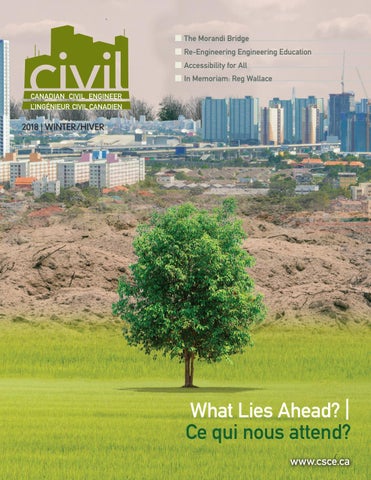
The Morandi Bridge Re-Engineering Engineering Education A ccessibility for All In Memoriam: Reg Wallace
2018 | WINTER/HIVER
What Lies Ahead? | Ce qui nous attend? www.csce.ca
EXCLUSIVE FINANCIAL SECURITY PROGRAM
for engineers, geoscientists, students and their families
RRSP, non-registered savings plan, TFSA, RRIF, LIF or annuities Sponsored by Engineers Canada
Lower fees
Get group pricing
How much more?
$35,526
More future savings and more income in retirement
more*
with an Engineers Canada-sponsored RRSP
Program participants get free investment guidance Start today – contact Angela Harvey at 1-866-788-1293 ext. 5786 or angela.harvey@gwl.ca, or visit www.infosite.grs.grsaccess.com/engineers-canada Sponsored by:
*Assumes no further contributions for ease of calculation, interest on the initial $25,000 investment compounded annually. Based on a 25-year investment at a group plan rate of return (which includes fees) of eight per cent and a bank rate of return (which includes fees) of seven per cent. / Great-West Life and key design are trademarks of The Great-West Life Assurance Company (Great-West Life), used under licence by its subsidiaries, London Life Insurance Company (London Life) and The Canada Life Assurance Company (Canada Life). As described in this advertisement, group retirement, savings and income products are issued by London Life and payout annuity products are issued by Canada Life.
contents WINTER 2018/HIVER 2018 | VOLUME 35.5
IN VIEW: PROJECT/PROJET VEDETTE 14 The Morandi Bridge SMSB CONFERENCE REVIEW 13
10th International Conference on Short and Medium Span Bridges
4 President’s Perspective/
TECHNICAL: WHAT LIES AHEAD? TECHNIQUE: CE QUI NOUS ATTEND? 16 20 21 22 24
NEWS, VIEWS & DEPARTMENTS NOUVELLES, POINTS DE VUE ET RUBRIQUES
From the Technical Editor Engineering education that puts equity and social justice at the core A shift from designing for people to designing with people Sustainability, Resilience & Avoidance Accessibility for All
6
Perspective présidentielle 6 From the Regions: Montreal Section/De nos régions: section de Montréal 8 Young Professionals’ Corner/Le coin des jeunes professionnels 10 Student Voice/La voix des étudiants 12 Lifelong Learning/Formation continue 28 In Memoriam: Reg Wallace 30 CSCE Partners and Sponsors/ Associés et commanditaires SCGC
24
14 On the cover: (source: Adobe Stock)
Canadian Civil Engineer | Winter 2018
3
PRESIDENT’S PERSPECTIVE | PERSPECTIVE DU PRÉSIDENT
CSCE/SCGC 521-300, rue St-Sacrement Montreal, Québec H2Y 1X4 Tel.: 514-933-2634, Fax: 514-933-3504 E-mail: mahmoud.lardjane@csce.ca www.csce.ca PRESIDENT/PRÉSIDENTE Glenn Hewus, P.Eng., FCSCE
MANAGING EDITOR/ DIRECTEUR DE LA RÉDACTION Doug Picklyk Tel.: 416-510-5119 dpicklyk@ccemag.com ADVERTISING SALES/ PUBLICITÉ Maureen Levy Tel: 416-510-5111 mlevy@ccemag.com ART DIRECTOR/ COMPOSITION ARTISTIQUE Mark Ryan Tel: 416-442-5600 x3541 Annual Subscription Rates/Abonnement annuel Canada & U.S./E.U. $35.00, Other countries/Autres pays $45.00; Single copy/Un numéro $7.50; Agency discount/Rabais au distributeurs 10% PUBLICATION ISSN 9825-7515 RETURN ADDRESS/ADRESSE DE RETOUR : The Canadian Society for Civil Engineering La Société Canadienne de Génie Civil 521-300, rue St-Sacrement Montreal, Québec H2Y 1X4 Canadian Civil Engineer (CCE) is published five times per year by the Canadian Society for Civil Engineering (CSCE). L’ingénieur Civil Canadien (ICC) est publié cinq fois par année par la Société Canadienne de Génie Civil (SCGC). The opinions expressed in the papers are solely those of the authors and the Canadian Society for Civil Engineering is not responsible for the statements made in this publication. Les opinions exprimées dans les articles sont la seule responsabilité de leurs auteurs et la Société canadienne de génie civil n’engage pas sa responsabilité dans les propos exprimés. CIVIL Magazine is produced by the publishers of Canadian Consulting Engineer Magazine, published by Annex Publishing & Printing Inc. Le magazine Civil est produit par l’editeur de la publication Canadian Consulting Engineer qui est publie par Annex Publishing & Printing Inc.
Annex Publishing & Printing Inc., 111 Gordon Baker Road, Suite 400 Toronto, Ontario M2H 3R1 Tel.: 416-510-5111; Fax: 416-510-5140 PUBLICATIONS MAIL AGREEMENT/POSTES CANADA ENREGISTREMENT #40065710
4
Glenn W. Hewus P.Eng., MBA, FCSCE, CGC President, CSCE/Président de la SCGC President@csce.ca
Practising what we preach A
growing need that we are faced with in infrastructure design is allowing it to be dynamic enough to incorporate ever changing needs of accessibility. Accessibility was never just a nice-to-have; it’s a necessity – one that’s growing in complexity. As you will read in this issue, my fellow members and I agree on some vital changes that need to happen around this matter. We, as an industry, have to push forward the notion that accessibility needs to be prioritized both in the study of Civil Engineering, as well as in our practise. We also have to be more open to appreciating the challenges of people who are living with limitations in smaller, more rural areas, often overshadowed by larger city or national issues. At this mid-point in my term, I want to share other recent accomplishments and areas that I will shift my focus towards in the new year. I am eager to report that we completed the soft-launch of our HUB tool in early November, a tool for our members, but also a move towards sustainable business practises for CSCE. This tool will allow us to replace many of our current paper-based activities with more sustainable digital alternatives. While we are committed to supporting sustainable practises in our industry, we realize that we need to make more conscious decisions around how we run our society, and to share these best practises publicly. In late October I had the honour of speaking about CSCE’s views and approach on sustainable development at the Global Engineering Congress in London. The presentation was very well received and conversations were
later had around how collaborations around sustainable efforts could help improve focus on this global mission. Later, together with ASCE, I had the privilege of co-presenting ICE with a plaque to recognize them as an International Historical Civil Engineering Landmark (photo above). We also held a very productive board meeting on November 4th in Ontario with many outcomes that we look forward to sharing with our members. With some recent changes to the structure of the National Office, board members are feeling confident that CSCE is more determined than ever to be truly engaged with members and to find new ways to show them that they are the voice of CSCE. Together we will deliver on our strategic directions and find ways to improve communications around everything we do. We are excited to reveal a revamp to our brand, to work with our regions and sections to unite our voice and make it clear that CSCE’s strength comes from the contribution of all of our members. We are aiming to clarify for all of our members, both individual and at the corporate level, the mutual benefit of
Hiver 2018 | L’Ingénieur civil canadien
PRESIDENT’S PERSPECTIVE | PERSPECTIVE DU PRÉSIDENT their membership. We appreciate their contribution, and will make it more clear what benefits and opportunities we can provide in return. While individuals pursue this vocation to help others, at CSCE we know that together we can do more. Lastly, anytime we see actions that support our Vision 2020 we want to share them – and with that, I was thrilled to see that Concordia University renamed its school of engineering after Gina Cody - a definite first for women in Canada. Cody was quoted as saying she’d like the name change to ‘help break barriers for women in engineer-
ing’ and, of course, at CSCE we are proud to support this initiative. I want to take this opportunity to wish you and yours a safe and healthy holiday season. I look forward to keeping the momentum going in the new year and keeping you abreast of our initiatives, member news and as planning progresses around our Annual Conference coming in June 2019. As always, “be seen, be heard, be relevant and be proud” of our society. Best regards.
Pratiquons ce que nous prêchons U
n besoin croissant auquel nous sommes confrontés dans la conception des infrastructures est de faire en sorte qu’elle soit suffisamment dynamique pour intégrer les besoins d’accessibilité en constante évolution. L’accessibilité n’a jamais été juste quelque chose d’agréable à avoir. C’est une nécessité qui devient de plus en plus complexe. Comme vous le verrez plus loin, mes collègues et moi sommes d’accord sur certains changements essentiels qui doivent être apportés dans ce domaine. En tant qu’industrie, nous devons mettre de l’avant la notion selon laquelle l’accessibilité doit être priorisée à la fois dans l’étude du génie civil et dans notre pratique. Nous devons également être plus ouverts pour comprendre les défis auxquels font face les personnes vivant avec des limitations dans des zones plus petites et plus rurales. Leurs préoccupations sont souvent éclipsées par les problèmes des grandes villes ou par des questions d’ordre national. À mi-parcours de mon mandat, je souhaite vous faire part d’autres réalisations récentes et des domaines sur lesquels je me concentrerai davantage au cours de la nouvelle année. Je suis ravi de vous informer que nous avons achevé le pré-lancement de notre HUB au début de novembre. Le HUB est un outil destiné à nos membres et marque une évolution vers des pratiques commerciales durables pour la SCGC. Il nous permettra de supprimer bon nombre de nos supports papier et de passer à des solutions de rechange numériques plus durables. Bien que nous soyons résolus à soutenir les pratiques durables de notre industrie, nous sommes conscients que nous devons procéder à des changements à l’interne afin de prendre des décisions plus éclairées quant à la façon dont nous gérons notre Société et de partager publiquement ces meilleures pratiques. J’ai eu l’honneur de prendre la parole au Congrès mondial de l’ingénierie à Londres à la fin du mois d’octobre, sur le point de vue et l’approche de la SCGC en matière de développement durable. La présentation a été très bien accueillie et des discussions ont ensuite eu lieu sur la manière dont des collaborations autour d’efforts durables pourraient aider à mieux mettre l’accent sur cette mission mondiale. Plus tard, j’ai également eu le privilège de présenter avec l’ASCE une plaque à l’ICE la reconnaissant comme un Emblème international de génie civil.
Canadian Civil Engineer | Winter 2018
Nous avons également tenu une réunion très productive de notre conseil d’administration le 4 novembre en Ontario. Nous avons hâte de partager avec nos membres les nombreux résultats de la réunion. À la suite des récents changements apportés à la structure du bureau national, les membres du conseil d’administration sont convaincus que la SCGC est déterminée plus que jamais à s’engager réellement avec ses membres et à trouver de nouveaux moyens de leur montrer qu’ils sont la voix de la SCGC. Ensemble, nous allons mettre en œuvre nos orientations stratégiques et trouver des moyens d’améliorer les communications autour de toutes nos réalisations. Nous sommes ravis d’annoncer une refonte de notre image de marque, de travailler avec nos régions et nos sections pour unir notre voix et faire comprendre que la force de la SCGC vient de la contribution de tous nos membres. Nous visons à clarifier à l’ensemble de nos membres, tant les individus que les entreprises, les avantages mutuels de leur adhésion. Nous apprécions leur contribution et nous indiquerons plus clairement quels avantages et opportunités nous pouvons leur offrir en retour. Alors que les individus poursuivent cette vocation pour aider les autres, à la SCGC, nous savons qu’ensemble, nous pouvons en faire plus. Enfin, chaque fois que nous voyons des actions qui soutiennent notre vision 2020, nous souhaitons les partager. Ainsi, j’étais ravi d’apprendre que l’Université Concordia a renommé son école de génie au nom de Gina Cody, une première pour les femmes au Canada. Mme Cody a déclaré qu’elle espère que le changement du nom «aidera à lever les barrières pour les femmes en ingénierie». À la SCGC, nous sommes fiers d’appuyer cette initiative. Je tiens à profiter de cette occasion pour vous souhaiter, ainsi qu’aux vôtres, une saison des fêtes toute en sécurité et en santé. Je suis impatient de poursuivre sur notre lancée au cours de la nouvelle année et de vous tenir informés de nos initiatives, des nouvelles de nos membres et de la planification de notre congrès annuel qui se tiendra en juin 2019. Comme toujours, «soyez vus, soyez entendus, soyez pertinents et fiers» de notre société. Sincères salutations.
5
FROM THE REGIONS: SECTION NEWS | DE NOS RÉGIONS: NOUVELLES DES SECTIONS
Montreal Section: Exciting Collaborations Jennifer Tran, Jr. Eng. President – Montreal Section
T
his year, the Montreal section is placing an emphasis on collaboration among several entities to better serve our members. One such effort is to connect with all the academic and professional societies in Montreal. For this purpose, the CSCE Montreal Section recently participated in a meeting to discuss collaboration with many groups such as the ISM, AFG, and Young CPA. As a result, there is a new shared calendar which will help avoid date conflicts and aid in coordination among all parties. Furthermore, we are leaning into the CSCE’s strategy of Growing with Youth by having a representative from the Young Professionals Committee. Having a voice on the Montreal Section’s committee, Mr. Mansour helps us join efforts with the YPC to further encourage relationship building and to develop our young members’ careers. Our first event this year was a conference by CSCE Past President, Dr. Susan Tighe. Her presentation on Leadership in Engineering was followed by a cocktail reception sponsored by the Young Professionals to support networking among those starting their careers and those with much more experience. The feedback was overwhelmingly positive, and we will be sure to continue this event format in the future. We still have five conferences remaining this year and are working to provide the most interesting presentations to shed light on the many different facets of civil engineering. The topics of our six yearly conferences vary between case studies, soft and technical skills, as well as technological advances. Our speakers are among the top of their respective fields, and we aim to leave our participants inspired and informed. For example, the largest project in North America, the New Champlain Bridge in our
6
The first event of the new season was a presentation on Leadership in Engineering by CSCE Past President, Dr. Susan Tighe. / La première activité de la nouvelle saison fut une présentation sur le leadership en ingénierie par la Dre Susan Tighe, présidente sortante de la SCGC. (photo: Jennifer Tran)
very own city, is a hot topic among junior and senior members. We’ll make certain to take advantage of this by inviting professionals from this project to present different aspects from the construction planning side to the structural design. In addition to the conferences, our largest yearly event is the Career Forum. This is a soirée that showcases a few exemplary professionals who will share their career stories with the hundreds of student and professional attendees. The presenters’ stories and the advice shared during the networking cocktail will serve as valuable insights to guide our audience towards their career goals. Last year, our honoured guests were: • Prof. Adel Francis, Professor at École de technologie supérieure and Fellow of CSCE • Ms. Isabelle Jodoin, Senior Vice Presi-
dent - Quebec at Stantec and President of AFG • Mr. Franz Knoll, Vice-President NCK inc. • Prof. Van Nguyen, Professor at McGill University and Fellow of CSCE • Ms. Sandra Sultana, Director at the MTQ Thanks to the Regional Section, we have a page on the new website that centralizes the information on all the sections within Quebec. This is another collaboration to add value for our members. Please stay updated on all of our events, conferences and more on the Montreal Section’s page at www.scgcquebec.ca. Finally, should you have suggestions or interest in knowing more about our activities and events, please contact me personally at: president@scgcmontreal.ca
Hiver 2018 | L’Ingénieur civil canadien
FROM THE REGIONS: SECTION NEWS | DE NOS RÉGIONS: NOUVELLES DES SECTIONS
Section de Montréal: des collaborations passionnantes Jennifer Tran, ing. jr. Présidente, Section de Montréal
C
ette année, la section de Montréal de la SCGC met l’accent sur la collaboration entre plusieurs entités afin de mieux servir nos membres. L’un de ces efforts consiste à établir des liens avec toutes les sociétés universitaires et professionnelles de Montréal. À cette fin, la section a récemment participé à une réunion portant sur la collaboration avec de nombreux groupes tels que l’ISM, l’AFG et le Young CPA. Ainsi il a été établi un nouveau calendrier commun qui permettra d’éviter des conflits de dates et facilitera la coordination entre toutes les parties. De plus, nous nous appuyons sur la stratégie Croître avec les jeunes de la SCGC en ayant un représentant du Comité des jeunes professionnels sur le comité de la section. M. Mansour nous aide à joindre nos efforts à ceux du CJP afin d’encourager l’établissement de relations et d’aider au développement de la carrière de nos jeunes membres. Notre première activité cette année était une conférence de la présidente sortante de la SCGC, la Dre Susan Tighe. Sa présentation sur le leadership en ingénierie a été suivie d’un cocktail organisé par les jeunes professionnels afin de faciliter le réseautage entre ceux qui débutent leur carrière et ceux qui ont acquis une certaine expérience. Les réactions furent extrêmement positives et nous continuerons d’organiser ce type d’activité. Cinq autres conférences sont programmées cette année et nous nous efforçons d’offrir des présentations des plus intéressantes qui permettront d’expliquer les nombreuses facettes du génie civil. Les sujets de nos six conférences annuelles varient selon les études de cas, les compétences techniques et non techniques, ainsi que les avancées technologiques. Nos conférenciers sont parmi les meilleurs de leurs domaines
Canadian Civil Engineer | Winter 2018
respectifs et nous visons à informer et inspirer nos participants. Par exemple, le plus grand projet en Amérique du Nord, le nouveau pont Champlain situé dans notre propre ville, est un sujet brûlant parmi les membres juniors et seniors. Nous veillerons à en tirer parti en invitant les professionnels de ce projet à en présenter différents aspects, de la planification de la construction à la conception de la structure. Outre les conférences, notre plus grand événement annuel est le Forum sur les carrières. Cette activité présente quelques professionnels exemplaires qui présenteront leur carrière aux centaines d’étudiants et de professionnels participants. Les récits des présentateurs et les conseils formulés lors du cocktail de réseautage seront des informations précieuses pour guider le public vers ses objectifs de carrière. L’année dernière, nos invités d’honneur étaient: • Le Dr. Adel Francis, professeur à l’École
de technologie supérieure et membre de la SCGC • Mme Isabelle Jodoin, vice-présidente principale – Québec, Stantec et présidente de l’AFG • M. Franz Knoll, vice-président, NCK inc. • Le Dr. Van Nguyen, professeur à l’Université McGill et membre de la SCGC • Mme Sandra Sultana, directrice, MTQ Le nouveau site Web de la Région du Québec comprend une page qui centralise les informations de toutes les sections du Québec. Il s’agit d’une autre collaboration visant à améliorer nos services aux membres. Je vous invite à vous tenir informés de tous nos événements, conférences et plus encore en consultant la page Web de la Section de Montréal à www.scgcquebec.ca. Enfin, si vous avez des suggestions ou si vous souhaitez recevoir plus d’informations sur nos activités et nos événements, veuillez me contacter à president@scgcmontreal.ca.
Murray P. Amirault, P.Eng. We are pleased to announce that Murray Amirault has joined RVA to the position of Regional Branch Manager of our Moncton, New Brunswick office. Murray has over 30 years of extensive cross-disciplinary senior management work experience in civil construction, municipal consulting engineering and project management.
Arthur Austin, P.Eng. We are pleased to announce that Arthur has joined RVA to the position of Project Manager. Arthur is based out of RVA’s Moncton office and has over 21 years of engineering and project leadership experience. His capabilities include project and team management with respect to urban development, transportation, sewers and watermains, water and wastewater treatment facilities, and industrial projects.
New to the RVA Moncton Office CIV_WInter18_RVanderson.indd 1
rvanderson.com 2018-11-09 8:56 AM
7
YOUNG PROFESSIONALS’ CORNER | LE COIN DES JEUNES PROFESSIONNELS
Truth and Reconciliation: The Young Civil Engineer’s Role Nicholas C. Kaminski, P. Eng., PMP, MCSCE CSCE Young Professionals Committee Chair
I
magine one day you woke up and were unable to drink, wash vegetables or brush your teeth with your tap water. How would your life be affected? This situation is the reality for thousands of Indigenous people in isolated communities throughout Canada. As of October 1, 2018 there were 69 long-term drinking water advisories on public systems on reserve1. It is inconceivable that in Canada, today, there are residents of this country who still do not possess the basic fundamental right to fresh, clean and dependable drinking water2. Over three years ago, the Truth and Reconciliation Commission of Canada released 94 calls to action to address the human rights crisis that our Indigenous peoples are facing. Call to action No. 19 states that the gap between Aboriginal and non-Aboriginal health outcomes and availability of appropriate health services needs to be bridged. Addressing the water crisis that Indigenous communities are undergoing could help address part of this call to action. As young civil engineers, we need to be at the forefront of developing new and more cost effective solutions to provide safe drinking water for these remote communities. It is our moral and ethical duty to use our problem solving abilities to protect human life and that’s exactly what we’re doing by helping those affected by this on-going water crisis. I had the opportunity to speak with Tim Vogel, M.Sc. candidate, at the University of Saskatchewan’s College of Engineering, whose thesis is titled “Assessing Design and Funding Methods of Water Infrastructure for Saskatchewan First Nations”. Tim’s work highlights what young civil engineers can do to help alleviate this crisis. His work was awarded the best student paper at this year’s annual CSCE conference. Below are highlights from an interview with Mr.Vogel about his work.
Please provide a summary of your thesis. My thesis: “Assessing Design and Funding Methods of Water Infrastructure for Saskatchewan First Nations” looks at the way water infrastructure projects are completed on First Nations. With trends towards community driven design and multi-disciplinary project teams, my thesis looks at what methods are being used on projects and makes recommendations how to facilitate this trend and inform industry how to approach it. I also take a look at how these projects are funded, which is often the greatest barrier. Many communities prefer piped water distribution over cisterns and trucked water delivery because there is less opportunity for contamination and therefore illness. However, piped distribution requires a larger capital invest-
8
ment. My thesis considered the cost to human health associated with cisterns and hauling water compared to a piped system. Improving health and quality of life is justification for greater investment on its own, but this research found it is also economically justified in the long-term.
What role do you think civil engineers have in solving the water crisis on First Nations in Canada? Engineers have a large role to play by providing technical services and solutions, but also by informing regulation and policy changes. These issues are not entirely technical, and engineering services could go beyond by addressing social and political factors that influence technical issues. We are seeing examples of well-engineered infrastructure failing in these communities because they did not address social and cultural priorities.
Why is this important to you? It’s easy to take water resources for granted when you have never had to worry about having consistent access to safe drinking water. Growing up in Saskatchewan and never having to worry about my drinking water, it doesn’t sit right with me that just a few 100 kilometers away there are communities that struggle. Saskatchewan is a small province and you want to be able to give back to the community that has raised and invested in you.
What do you think young professional engineers can do to help address this situation? I think it is important for young engineers to be open-minded and embrace working in multi-disciplinary project teams. Infrastructure will be successful long-term if the communities believe in the process, which means greater consultation, collaboration, and combination of worldviews. As part of the Young Professionals Committee mandate, we seek to provide funding and support to local sections that are planning and hosting networking, mentoring and professional development events for our members. kaminski.nick@icloud.com 1
https://www.canada.ca/en/indigenous-services-canada.html https://www.ecojustice.ca/drinking-water-crisis-first-nations-communities-vio-
2
lates-human-rights/
Hiver 2018 | L’Ingénieur civil canadien
YOUNG PROFESSIONALS’ CORNER | LE COIN DES JEUNES PROFESSIONNELS
Vérité et réconcilication: le rôle du jeune ingénieur civil Nicholas C. Kaminski, P.Eng., PMP, MSCGC Président, Comité des jeunes professionnels de la SCGC
I
maginez qu’un jour vous vous réveillez sans pouvoir boire, laver vos légumes ou vous brosser les dents avec l’eau du robinet. Comment votre vie serait-elle affectée? Cette situation est la réalité de milliers d’Autochtones vivant dans des communautés isolées du Canada. Au 1er octobre 2018, il y avait 69 avis d’eau potable à long terme sur les réseaux publics situés dans les réserves1. Il est inconcevable qu’il y ait encore au Canada des résidents qui ne possèdent toujours pas le droit fondamental d’avoir de l’eau potable fraîche, propre et saine2. Il y a plus de trois ans, la Commission vérité et réconciliation du Canada a publié 94 appels à l’action pour faire face à la crise des droits de la personne à laquelle font face nos peuples autochtones. L’appel à l’action 19 indique qu’il faut combler l’écart entre les résultats dans le domaine de la santé des Autochtones et des non-Autochtones et dans la disponibilité des services de santé appropriés. S’attaquer à la crise de l’eau que vivent les communautés autochtones pourrait aider à répondre en partie à cet appel à l’action. En tant que jeunes ingénieurs civils, nous devons être à l’avant-garde du développement de solutions nouvelles et plus rentables pour fournir de l’eau potable salubre à ces communautés isolées. C’est notre devoir moral et éthique d’utiliser nos capacités de résolution de problèmes pour protéger la vie humaine et c’est exactement ce que nous faisons en aidant les personnes touchées par cette crise de l’eau qui perdure. J’ai eu l’occasion d’en discuter avec Tim Vogel, candidat en maîtrise au Collège d’ingénierie de l’Université de Saskatchewan. Le sujet de sa thèse s’intitule «Évaluation des méthodes de conception et de financement des infrastructures en eau pour les Premières Nations de la Saskatchewan». Le travail de Tim met en lumière ce que les jeunes ingénieurs civils peuvent faire pour atténuer cette crise. Son travail a reçu le prix de la meilleure communication étudiante au congrès annuel de la SCGC de cette année. Vous trouverez ci-dessous les points saillants d’une entrevue avec M. Vogel à propos de son travail.
Pouvez-vous nous résumer votre thèse? Ma thèse: «Évaluation des méthodes de conception et de financement des infrastructures d’approvisionnement en eau pour les Premières Nations de la Saskatchewan» porte sur la manière dont ces projets d’infrastructures d’approvisionnement en eau sont réalisés. La tendance étant à la conception axée sur la communauté et à des équipes de projet multidisciplinaires, ma thèse examine les méthodes utilisées dans les projets et formule des recommandations sur la manière de faciliter cette tendance et d’informer l’industrie de la façon de l’aborder. J’examine également le mode de financement de ces projets, qui constitue souvent le principal obstacle. De nombreuses communautés préfèrent la distribution d’eau courante à la distribution par citernes et par camion, car les risques de
Canadian Civil Engineer | Winter 2018
contamination et donc de maladie sont moindres. Cependant, la distribution par canalisation nécessite un investissement en capital plus important. Ma thèse portait sur le coût pour la santé humaine associé à la distribution par citernes et au transport de l’eau par rapport à un système de canalisation. L’amélioration de la santé et de la qualité de la vie justifie à elle seule un investissement plus important, mais cette recherche a montré qu’il était aussi économiquement justifié à long terme.
Quel rôle pensez-vous que les ingénieurs civils jouent dans la résolution de la crise de l’eau chez les Premières Nations du Canada? Les ingénieurs ont un rôle important à jouer en fournissant des services et des solutions techniques, mais également en informant sur les modifications apportées à la réglementation et aux politiques. Ces problèmes ne sont pas entièrement techniques et les services d’ingénierie pourraient aller au-delà en s’attaquant aux facteurs sociaux et politiques qui influent sur les problèmes techniques. Nous voyons des exemples d’infrastructures bien conçues mais qui sont défaillantes dans ces communautés car elles ne répondaient pas aux priorités sociales et culturelles.
Pourquoi est-ce important pour vous? Il est facile de prendre pour acquis les ressources en eau quand on n’a jamais eu à s’inquiéter d’avoir un accès constant à de l’eau potable. Ayant grandi au Saskatchewan et n’ayant jamais à me soucier de mon eau potable, il n’est pas évident qu’à quelques centaines de kilomètres de là, des communautés rencontrent des difficultés. La Saskatchewan est une petite province et vous voulez être en mesure de redonner à la communauté qui vous élevé et qui a investi en vous.
Que pensez-vous que les jeunes ingénieurs peuvent faire pour remédier à cette situation? Je pense qu’il est important que les jeunes ingénieurs soient ouverts d’esprit et acceptent de travailler dans des équipes de projet multidisciplinaires. Les infrastructures auront du succès à long terme si les communautés croient au processus, ce qui signifie davantage de consultation, de collaboration et une combinaison de visions du monde. Dans le cadre du mandat du Comité des jeunes professionnels, nous cherchons à fournir du financement et un soutien aux sections locales qui planifient et organisent des activités de réseautage, de mentorat et de développement professionnel pour nos membres. kaminski.nick@icloud.com 1
https://www.canada.ca/fr/indigenous-services-canada.html https://www.ecojustice.ca/drinking-water-crisis-first-nations-communities-vi-
2
olates-human-rights/
9
THE STUDENT VOICE | LA VOIX DES ÉTUDIANTS
The Retention of Women in Engineering Bronwyn Chorlton, graduate student, York University Natalie Mazur, research assistant, York University Bronwyn Chorlton
Natalie Mazur
10
Percentage
W
hat factors are causing women to discontinue their pursuit of engineering more than men? The answer to this question has been the motivation behind our survey of undergraduate students, industry and academia. The goal of our work is to develop a comprehensive timeline of women’s careers in engineering, drawing attention to times where more support may be needed. Statistics from Engineers Canada show that the percentage of licensed female engineers continues to be significantly lower than the percentage of female engineering graduates. Many studies have focused on the importance of recruiting women into STEM (Science, Technology, Engineering, and Mathematics) fields, though a significant number of women who do choose to enter engineering eventually decide to leave the profession. Our pursuit of the topic of retention has been inspired by our own personal experiences; Natalie first learned of the importance of this topic through her own studies in Cognitive Science, and Bronwyn became interested in this research as an engineering student herself. Dr. John Gales, our research supervisor, understands the importance of this study as he has noticed throughout his career that men and women may not be having the same experience. We have developed a program meant to address this topic, based out of York University. The University has been extremely encouraging of this endeavor, as they also have their own initiatives such as trying to reach a 50:50 gender balance within the school of engineering. Marisa Sterling, York’s Assistant Dean of Inclusivity & Diversity, has also been very supportive of our project. Our survey, meant to identify factors that may be impacting female undergraduate engineering students more than male students, was piloted in 2017 (Mazur, Chorlton, & Gales, 2018) with one institution (see Figure 1). We found that female students were much more likely to report feeling intimidated or discouraged than male students, in all years of their program. This year, the survey is set to be distributed to at least five accredited universities. An additional survey has been distributed to industry and academia, to understand what factors are impacting women in those settings. From our work so far, it is clear that there are issues in retention, beginning at the very start of women’s careers in undergraduate studies. Women continue to be underrepresented as they move into more senior positions, and this necessitates investigation
Year of Study
Figure 1: Percentage of undergraduate students, years 1 through 4, that felt intimidated or discouraged by those in their program.
into the workforce. Canadian engineers remain an understudied population with their own unique needs. The importance of collaborating with more Canadian institutions, practitioners, academics, and companies to understand Canadian engineers and to work together to build a more inclusive field cannot be understated. The campaign for gender equity must be a national one. We encourage any institutions who are interested in getting involved with our work to reach out to our team (Natalie Mazur at mazur. talie@gmail.com or our supervisor John Gales at jgales@yorku.ca).
References Engineers Canada, 2016 Engineering Enrolment and Degrees Awarded Report. 2017, 84 pp. Available from https://engineerscanada. ca/reports/enrolment-and-degrees-awarded-report. Engineers Canada, Percentages of newly licensed engineers who are women [Graph], 2017. Available from https://engineerscanada.ca/diversity/women-in-engineering/30-by-30. Mazur, N., Chorlton, B., & Gales, J. (2018). The experiences of women in undergraduate engineering. Proceedings from the 2018 Canadian Engineering Education Association (CEEA-ACEG18) Conference. Available from https://yorkufire.com/2018/05/22/the-experiences-of-women-in-undergraduate-engineering/
Hiver 2018 | L’Ingénieur civil canadien
THE STUDENT VOICE | LA VOIX DES ÉTUDIANTS
La rétention des femmes en ingénierie Bronwyn Chorlton, étudiante diplômée, Université York Natalie Mazur, assistante de recherche, Université York
Q
pourcentage
uels sont les facteurs qui poussent les femmes à interrompre leur activité d’ingénieure plus que les hommes? La réponse à cette question nous a motivées pour réaliser notre enquête auprès des étudiants de premier cycle et auprès de l’industrie et du monde universitaire. L’objectif de notre travail est d’établir une chronologie détaillée de la carrière des femmes dans le secteur de l’ingénierie, en attirant l’attention sur les moments où un soutien supplémentaire peut être nécessaire. Notre étude de la rétention a été inspirée par nos expériences personnelles. Natalie a d’abord réalisé l’importance de ce sujet en poursuivant ses études en sciences cognitives et Bronwyn s’est intéressée à cette re année d’étude cherche alors qu’elle étudiait l’ingénierie. Nous avons développé un programme destiné à traiter ce sujet à Pourcentage des étudiants de la 1ère à la 4è année de premier cycle l’Université York sous la supervision du Dr John Gales. L’Université a s’étant senti intimidés ou découragés par leurs collègues. également ses propres initiatives, telle que la réalisation d’un équilibre de 50-50 entre hommes et femmes au sein de son école d’ingénierie. Marisa Sterling, vice-doyenne à l’inclusion et à la diversité de NEW Corporate Member of CSCE York, a également apporté son soutien à notre projet. Notre enquête, qui visait à identifier les facteurs susceptibles d’avoir un impact plus important sur les étudiantes en premier cycle en génie que sur les étudiants, a été mise à l’essai en 2017 dans un établissement (voir la figure 1). Nous avons constaté que les étudiantes étaient beaucoup plus susceptibles de se sentir intimidées ou découragées que les étidiants, tout au long de leur programme. Cette année, l’enquête devrait être distribuée à au moins cinq universités accréditées. Une enquête supplémentaire a été remise à l’inWe are thrilled to announce that RJC Engineers dustrie et au monde universitaire afin de comprendre les facwill be joining CSCE as a new Affiliate Corporate teurs qui affectent les femmes dans ces environnements. Member. With over seven decades in the industry Les ingénieurs canadiens demeurent une population peu and a strong commitment to sustainability, there is étudiée. L’importance de collaborer avec davantage d’instino doubt this new partnership is a perfect fit and tutions, de praticiens, d’universitaires et d’entreprises pour will provide mutual opportunities to support key comprendre les ingénieurs canadiens et travailler ensemble à issues in our industry. la création d’un domaine plus inclusif ne saurait être sous-estimée. La campagne en faveur de l’équité entre les sexes doit être nationale. Nous encourageons tous les étudiants et les institutions souhaitant participer à nos travaux à nous contacter (Natalie Mazur à mazur.talie@gmail.com ou notre superviseur John Gales à jgales@yorku.ca).
Creative Thinking Practical Results
CIV_Winter18_NewCorporateSpon.indd 1
Canadian Civil Engineer | Winter 2018
2018-11-20 3:58 PM
11
LIFELONG LEARNING | FORMATION CONTINUE
Performance-based Seismic Design of Tall Reinforced Concrete Buildings Mahmoud Lardjane, Programs Director
Vancouver, Calgary, Edmonton – January 22, 24, 25, 2019 Toronto, Ottawa – February 14, 15, 2019 Montreal, Quebec – February 18, 19, 2019 This course covers detailed information from the conception to the final design of a Reinforced Concrete Shear Wall building using a performance-based seismic design (PBSD) approach. It includes handson experience in the application of PBSD on several building projects on the West Coast of the U.S. It will go over the concept of PBSD, its development and key aspects of the approach. It also presents an overview of PBSD guidelines currently used and a review of current code requirements and how they differ from the PBSD approach. The presenter is Freddy Pina, Ph.D., P.Eng, President of PBRV Consulting Ltd. PBRV offers professional services to structural engineering firms. Its main focus is in the seismic design of tall buildings using a performance-based design approach and the assessment of the potential risk of failure or damage of existing buildings in BC. Freddy is also an Adjunct Professor at the University of British Columbia teaching courses related to the structural design of steel buildings and dynamic analysis of structures. Please visit www.csce.ca for full details and registration information.
Conception sismique de grands bâtiments en béton armé basée sur la performance Cette formation présente des informations détaillées allant de l’avant-projet à la conception finale de bâtiments en murs de cisaillement en béton armé utilisant une approche de conception parasismique basée sur la performance. Elle inclut une expérience pratique de l’application de la PBSD à plusieurs projets de construction. Elle est présentée en anglais. Veuillez visiter www.csce.ca pour tous les details et pour vous inscrire.
Denso Products - Unmatched Quality and Performance
If it doesn’t say
on the outside, then its not
Denso North America Inc. • www.densona.com
12
on the inside.
Hiver 2018 | L’Ingénieur civil canadien
CONFERENCE REVIEW | REVUE DE CONFÉRENCE
10th International Conference on Short and Medium Span Bridges Prof. Adel R. Zaki, P.E. V.P./Chief Engineer – SNC-Lavalin Dr. Josée Bastien, Department Head of Civil Engineering, Laval University
T
he 10th edition of the International Small and Medium Span Bridge (SMSB) Conference, held in Quebec City from July 31 to August 3, was marked by an unprecedented degree of participation with more than 500 delegates attending from 33 countries. The SMSB Conference addresses bridge engineering and construction and is dedicated to gathering and disseminating information and exchanging experiences and practices among all parties in the field of bridge design, construction and management systems. The main objective of this year’s conference was to provide a forum for practitioners and developers from around the world to discuss examples of current and future practice and research, and also to exchange ideas on future solutions. The event is organized under the auspices of the Canadian Society for Civil Engineering (CSCE) and has been held every four years since 1978 in a different Canadian city. Our platinum partner this year was SNC-Lavalin, and the conference co-sponsors included Université Laval, International Association for Bridge and Structural Engineering (IABSE), International Federation for Structural Concrete (FIB), Transportation Association of Canada (TAC) and the American Society of Civil Engineers (ASCE). This year, the conference focused on the theme “Build Bridges… Not Walls”. No matter how technical a bridge can be or how much expertise is required to make one, bridges are also social. They unite people and places. They connect people not just through their technical aspects, but also through their character. Bridges can be emblematic; they can change the landscape of a city or countryside. A local example in Montreal is the New Champlain Bridge Corridor Project that is in its final construction phase and due to open in Spring 2019. The technical presentations at the conference covered various topics, including: • Large Projects and Innovative Design • Structural Analysis and Dynamic of Bridges • Composite and Hybrid Materials • Design for Durability and New Materials • Innovative Rehabilitation Techniques and Maintenance Strategy • Sustainability Considerations for Bridges Construction • Light Rail Transit – Emergence of a Bridge performance • Bridge Management System and Service Life Implementation • Effect of Climate change in bridge reliability • Modern Applications for ABC techniques • Aesthetics and Historical Bridges • Research and Development As the conference co-chairs, we attempted to engage university
Canadian Civil Engineer | Winter 2018
SMSB Conference co-chair Adel Zaki (right) presents thank you gift to keynote speaker M. Ahmad Al Hassan, Managing Director of the Public Authority for Road and Land Transport (PART), Kuwait.
students from across the country in the hope that this new generation will bring forward fresh perspectives and innovative bridge engineering knowhow. As a prelude to the SMSB Conference, CSCE with the contribution of Dr. Khaled Sennah, conference Technical Chair and Professor of Civil Engineering at Ryerson University, offered short course workshops. Since many factors now affect the design and construction of bridges, the workshops focused on environmental sensitivity, innovation in material and construction techniques, and advances in bridge design methods. The short course covered the following subjects: • Application of Fiber Reinforced Polymer (FRP) Technology in Bridges • Seismic Design of Bridges • Recent Advances in Accelerated Bridge Construction A recent statistic from the World Economic Forum, as reported by Patrick Aubin, Conference Honorary Chair and Vice President of SNC-Lavalin, mentions that the world demand for infrastructure is such that we need to build as much infrastructure in the next 40 years as has been built in the last 400 years. The challenges of meeting this global demand and embracing technology are intrinsically linked if engineers are to become more efficient in the design, build, operation and maintenance of Infrastructure going forward. To date, the industry has been relatively slow in the adoption of new technologies that lead to greater efficiency, so events such as the SMSB Conference will continue to enhance the opportunity for the industry at large to share innovations and promote the results that can be achieved through the ingenuity of our profession. Adel R. Zaki, SNC-Lavalin Inc., Adel.Zaki@snclavalin.com Josee Bastien, Université Laval, Josee.Bastien@gci.ulaval.ca
13
IN VIEW:PROJECT | PROJET EN VEDETTE
THE MORANDI VIADUCT Eugenio G. Ceroni, FCSCE, FIABSE, ASCE Life Member
T
he Morandi Bridge, part of the Polcevera viaduct, is a motorway bridge straddling the Polcevera river in the city of Genoa, Italy. Designed by engineer Riccardo Morandi, it was built between 1963 and 1967. The viaduct is part of the motorway A10 and is a strategic infrastructure link between northern Italy and southern France. The viaduct is also the main road axis connecting the centre of Genoa and Liguria with the container port of Voltri, the Cristoforo Colombo airport and the industrial and commercial activities of the area. It has been closed since August 14th, 2018, due to the partial collapse of the bridge, which resulted in 43 deaths, injuries to 15 and the displacement of 600 people.
Construction and characteristics For the construction of the viaduct over the Polcevera, Morandi chose a mixed structure of reinforced concrete and prestressed reinforced concrete, with balanced trestles, similar to those used for the Morandi-designed General Rafael Urdaneta Bridge crossing Lake Maracaibo in western Venezuela. This construction solution garnered great fame to the designer for the originality of the structures. The Polcevera viaduct works were completed on July 31, 1967, and the inauguration was celebrated on September 4 with Italian President Giuseppe Saragat. The result was a work of 11 spans with a road surface 18 meters wide, at a height of 45 meters with three 90-metre-high piers supporting the stays. With long spans, the Polcevera crossed over railway lines, industrial buildings and condominiums. The most characteristic portion of the structure was made up of three balanced concrete stands that held four stays, each stay clad in prestressed concrete to protect them
14
TECHNICAL DATA TYPE: cable-stay bridge; concrete Gerber beams MATERIAL: reinforced concrete and prestressed concrete LENGTH 1,182 meters MAX SPAN: 208 meters height maximum 90 meters and 45 meters the road floor CARRIAGEWAYS: 2 LANES: 4
from the atmosphere. Each stand consisted of an H-shaped support structure which had the task of widening the central area where the box girder of the road deck rested and a second A-shaped pier structure, 90 meters high and completely disconnected from the previous, with the task of supporting the stays that held the ends of the balanced stand. Each stay consisted of 352 high-strength steel strands with a diameter of 1/2 inch, as well as an additional 113 for prestressing the protective sheath in concrete. This structural configuration made it possi-
[FIG. 1] Chart of subdivision of the bridge spans with relative length.
ble to cover a length of more than 200 metres with each span. The remaining part of the viaduct, which extended west beyond the Polcevera bed, used six V-shaped ordinary reinforced concrete stands and a vertical stack at the west end. Morandi’s objective, by adopting these solutions, was to reduce the load on the supports on the ground, since, already in the 1960s, the area was heavily built up. Each support pile therefore supported its own balanced and monolithic portion of the road deck, and at the two ends provided support for two further portions of the deck, each consisting of six prefabricated connecting beams, 36 meters long, in prestressed concrete, simply resting on the adjacent cantilevers. It is clear that this autonomous configuration prevented the collapse of the stack from dragging the other sections of the bridge with it, which remained standing and were able to evacuate safely. It is also clear that the 8 and 10 piles were relieved of some of the loads transmitted by
Hiver 2018 | L’Ingénieur civil canadien
IN VIEW:PROJECT | PROJET EN VEDETTE [FIG. 2] Some photos of the collapse
the adjacent decks after the collapse and were therefore no longer balanced as planned by the project.
Issues Within a few years after its completion the bridge began to show structural problems. Morandi himself pointed out how the corrosive acid fumes of the Cornigliano steelworks, brought by the sea breeze, had caused a serious deterioration of the exposed metal elements and the concrete (also used to protect the stays and considered necessary by Morandi precisely to avoid even faster corrosion of the same). He therefore believed that, within a few years, it would be necessary to carry out maintenance aimed at resolving these degradations. As far as the static aspects are concerned, also because of the lack of in-depth knowledge of the effects of the viscosity of concrete over time, behaviour took place that differed from that expected in the structures of the deck: the road surface of the bridge soon ended up with a wavy conformation, which in the 1980s was partially remedied with repeated levelling corrections. The steel stays covered with protective sheaths of pre-stressed reinforced concrete over time proved not to be adequately protected from the phenomena of degradation. In addition, the presence of concrete prevented a more immediate visual check of the condition of the steel strands and made it impractical to replace them. In 1992, the eastern pylon of the bridge was reinforced with new external steel suspension cables, which were added to the original stays. And then, over the years the bridge was loaded with significantly more traffic than planned.
Canadian Civil Engineer | Winter 2018
In 2009, according to a study by the SocietĂ Autostrade, the bridge supported 25.5 million transits per year, with traffic four times higher than in the previous 30 years and with a further growth of 30% expected in the next 30 years. The study pointed out that the volume of traffic, which causes daily queues at peak times, increased the stress on the structure and accelerated its deterioration. Maintenance activities of the structure had become practically daily, with a consequent increase in operating costs. In addition, the bridge was also burdened with the weight of New Jersey road safety barriers, with the consequent increase in weight on the structure.
The collapse At 11:36 a.m., on August 14, 2018, the section of the bridge above the river and industrial area, about 250 meters long, suddenly collapsed, along with one of the high pillars, pylon 9.
Cause of the collapse It seems that one or two stays of stack 9, stripped from fatigue and wear in addition to the reduction of the effect of prestressing, were broken so that the deck, without support fell down 45 meters onto the Polcevera river, the railway and industrial and residential area below. At the same time, the inverted V stand, remaining unbalanced and under the pull of the other two stays on the opposite side, suffered a violent and lightning-fast stress due to rotation and twisting, shattering, dragging the other V-cell to ruin. The dimensions and mass of the foundation of the stack formed an integral whole with the ground and was not damaged, while the stresses described above crushed the upper load-bearing structures. That is my summary opinion, pending the results of the court reports. 
[FIG. 3] Guidance scheme of collapse mechanics
15
FROM THE TECHNICAL EDITOR | MOT DU RÉDACTEUR TECHNIQUE
What Lies Ahead?
Alan Perks, P. Eng., M.Eng., FCSCE, FEIC
W
hat lies ahead can sometimes be seen through the lens of those brief moments of awareness triggered by unexpected events and accumulated experience. Several such moments completely changed my outlook on what lies ahead for civil engineering and human society. In the mid 1980’s more frequent references to greenhouse gas emissions affecting temperature and climate appeared in internal scientific notes, memos and papers that crossed my desk. At the time, I recall thinking this to be not an immediate issue, likely a millennium issue. A few years later, in 1994 in Beijing, I heard CSCE President, Claude Johnson, issue stark alarming warnings about global resource depletion and climate change leading quite rapidly to a collapse of the global environment. I was surprised and conflicted by the urgency and apparent extremity of the views he expressed. As a young mid-career engineer completely embedded in design standards, codes of practice, and proven approaches to infrastructure planning and design, I believed civil engineering as it was being practiced was the answer to emerging environmental problems. Then came a flood, the first of those brief moments of awareness. Asked by the CSCE to review the 2005 ASCE report on Hurricane Katrina and the New Orleans Flood, I was completely astounded by what I read, and what it reflected of the engineering profession. The flood walls did not overtop—they were undermined and collapsed. The flooding was exacerbated by gaps in incomplete levees, rusted-out rail crossing gates left open, different datum used for dyke design over the decades, and back-syphoning of dozens of large pumping stations that were abandoned.
I remember being shocked at what I had read about the complete failure of civil engineering, from planning, to design, construction and operations; placing 1 million citizens at the risk of floodwaters rising 1 foot every 10 minutes. It made me wonder, how vulnerable is all infrastructure? The second awareness grew out of my first trip to Mumbai (formerly called Bombay), India. Arriving at the airport at 3 am, after a flight from Germany, we headed downtown in a bajaj on a four-lane roadway. And there, people slept on the thin concrete median divider strip all along the roadway, with cars and trucks speeding by their heads at 100 km/hr, a few centimetres away. Now one can walk past the homeless sleeping on quiet sidewalks in Toronto, Ottawa, Montreal and Vancouver, so how is it that society can devote billions to high profile infrastructure projects and not provide basic accommodations for its disadvantaged members. The third moment was in 2015 when I was invited to deliver a keynote address at the 3rd Civil Engineering Triennial Summit by the ICE, CSCE and ASCE in London, UK. The theme was indeed changing climate and its global impacts—a call to action. My background was hydrology and municipal infrastructure, not climate science. But after reading current IPCC reports and cross-referencing a number of research agency websites from a basic hydrological “mass balance” perspective, I began to appreciate three facts I had never taken the time to consider over the years. 1. Since pre-industrial times, the concentration of carbon dioxide in the atmosphere has increased by 45%, and the global ocean acidity has increased by 25%. Human health will soon be affected just by breathing the air outside. 2. The global population is now projected to reach 11 billion persons,
The engaging ‘What Lies Ahead?’ panel discussion at the 2018 Annual National Conference held in Fredericton led to this article and the contributions on the following pages. Panelists (l-r): Alan Perks (moderator); Dr. Janice Gillis; Dr. Anna Robak; Dr. Katy Haralampides; and Marty Janowitz. / Table ronde <<Ce qui nous attend?>>, Congrès annuel 20018 de Fredericton: Alan Perks (Modérateur), la Dre Janice Gillis, la Dre Anna Robak, la Dre Katy Haralampides, Marty Janowitz.
16
Hiver 2018 | L’Ingénieur civil canadien
FROM THE TECHNICAL EDITOR | MOT DU RÉDACTEUR TECHNIQUE a far cry from the approximately 2 billion persons (of 6 billion currently living) now enjoying a high-energy consumption lifestyle and economy. 3. Each and every year, human activity emits a volume of GHG equivalent to 1%-2% of the entire global atmosphere. From these three basic and easily substantiated facts, the current trajectory is clearly unsustainable, and can only get much worse under any scenario of adaptation and mitigation; elimination and avoidance may be the only way forward. Claude Johnson was right to raise the alarm in 1994. Civil engineering, despite its glorious past, has accelerated human society and the global environment to a point of crisis that may indeed be beyond the “tipping point”. Yet another moment of awareness was still to come. After retirement, I spent more time with persons with physical disabilities as they experience their day-to-day (and hour-by-hour) frustrations, and I better appreciated how civil infrastructure affects homeless and disabled persons. The condition of civil and municipal infrastructure often results in uncomfortable, disrespectful, unaccessible and often dangerous infrastructure for persons with disabilities going about daily life. It now is very clear that every dollar, rupee or Euro spent needlessly on overly complex and costly civil infrastructure is money that becomes unavailable to meet the more pressing needs of society that lie ahead: climate change, social justice, and universal accessibility. These shocking realizations led me, and others in our profession, to consider ‘What lies ahead?’ as the subject of a vigorous and engaging panel discussion I had the honour to moderate, at our 2018 Annual Conference in Fredericton.
Listening to our colleagues provide their own perspective on these issues was enlightening, encouraging and stimulated energetic and fulsome audience participation. Within the theme of the conference, Building Tomorrow’s Society, the panelists discussed the following serious, urgent and growing issues for the profession, and for society: • Sustainability and Climate Change • Inclusivity and Social Justice; and • Universal Design of the Built Environment. The invited panelists, in my opinion, successfully built awareness and motivation among the attendees to participate and consider these issues. The panelists were provocative, questioning, and pointed out where the profession may be “missing the boat” on key issues, and what may lie ahead if not addressed. This issue of CIVIL magazine is devoted to that panel discussion. I thank all those colleagues for submitting their discussions for publication, which the reader can appreciate on the following pages. There are many views on “What lies ahead?” for our profession and for society. But it is unlikely to be met with a business as usual approach to engineering, infrastructure, and energy utilization. A very serious situation is what lies ahead, and President Claude Johnson was perceptive in 1994 in emphasizing that not only must civil engineering change its approach, a complete shift in society and its use of energy must come about, or the global environment will indeed simply collapse. It’s time to take a serious look at what role CSCE and the civil engineering professional can play in addressing the necessary changes needed for societies of tomorrow.
Ce qui nous attend?
Alan Perks, P.Eng., M.Eng., FSCGC, FEIC
C
e qui nous attend peut parfois être vu à travers le prisme de ces brefs moments de prise de conscience. Déclenchés par des événements inattendus et des expériences accumulées, plusieurs de ces moments ont complètement changé ma vision de l’avenir du génie civil et de la société humaine. Au milieu des années 1980, des références plus fréquentes aux émissions de gaz à effet de serre ayant une incidence sur la température et le climat sont apparues dans des notes scientifiques internes, des mémos et des articles qui se trouvaient sur mon bureau. À l’époque, je me souviens d’avoir pensé que ce n’était pas un problème immédiat, probablement un problème du millénaire. Quelques années plus tard, en 1994, à Beijing, en Chine, j’ai entendu le président de la SCGC, Claude Johnson, lancer des avertissements frappants et alarmants sur l’épuisement des ressources mondiales et le changement climatique entraînant assez rapidement un effondrement
Canadian Civil Engineer | Winter 2018
de l’environnement mondial. L’urgence et l’apparente sévérité des opinions qu’il a exprimées m’ont étonné et perturbé. En tant que jeune ingénieur en milieu de carrière, totalement intégré dans les normes de conception, les codes de pratique et les approches éprouvées en matière de planification et de conception des infrastructures, je pensais que le génie civil, tel qu’il était pratiqué, était la solution aux problèmes environnementaux émergents. Puis vint une inondation, le premier de ces brefs moments de prise de conscience. La SCGC m’a demandé d’examiner le rapport de l’ASCE de 2005 sur l’ouragan Katrina et le déluge de la Nouvelle-Orléans. J’étais complètement ébahi par ce que j’avais lu et par ce qu’il pensait du métier d’ingénieur. Les murs d’endiguement n’ont pas été débordés, ils se sont effondrés. L’inondation a été exacerbée par des lacunes dans les digues incomplètes, des portes de passage à niveau rouillées laissées ouvertes, des données dif-
17
FROM THE TECHNICAL EDITOR | MOT DU RÉDACTEUR TECHNIQUE férentes utilisées pour la conception des digues durant des décennies et par le siphonage en retour de douzaines de grandes stations de pompage abandonnées. Je me souviens avoir été choqué par ce que j’avais lu sur l’échec complet du génie civil - de la planification à la conception en passant par la construction et l’exploitation - exposant 1 million de citoyens au risque d’une crue des eaux d’un pied toutes les 10 minutes. Je me demandais à quel point toutes les infrastructures sont vulnérables. Ma deuxième prise de conscience est née de mon premier voyage à Bombay, en Inde. Arrivés à l’aéroport à 3 heures du matin en provenance d’Allemagne, nous nous sommes dirigés vers le centre-ville en bajaj sur une route à quatre voies. Et là, les gens dormaient sur la bande étroite de séparation en béton tout au long de la route, les voitures et les camions roulant à 100 km/h, à quelques centimètres de leur tête. Aujourd’hui, on peut passer devant les sans-abri qui dorment sur des trottoirs calmes à Toronto, Ottawa, Montréal et Vancouver. Comment se fait-il que la société puisse consacrer des milliards de dollars à des projets d’infrastructures de grande envergure et ne pas fournir d’hébergement de base à ses membres défavorisés. La troisième occasion a eu lieu en 2015, lorsque l’ICE, la SCGC et l’ASCE m’ont invité à prononcer un discours liminaire au Troisième sommet triennal du génie civil, à Londres, au Royaume-Uni. Le thème était en effet le changement du climat et ses impacts globaux, un appel à l’action. Mon expérience était dans l’hydrologie et les infrastructures municipales et non la climatologie. Mais après avoir lu les rapports actuels du GIEC et avoir consulté plusieurs sites Web d’agences de recherche dans une perspective basique de «bilan de masse» hydrologique, j’ai commencé à comprendre trois faits que je n’avais jamais pris le temps d’examiner au fil des ans. 1. Depuis la période préindustrielle, la concentration de dioxyde de carbone dans l’atmosphère a augmenté de 45% et l’acidité globale des océans a augmenté de 25%. La santé humaine sera bientôt affectée simplement en respirant l’air extérieur. 2. La population mondiale devrait atteindre 11 milliards de personnes, loin des quelque 2 milliards de personnes (sur 6 milliards actuellement en vie) bénéficiant désormais d’un mode de vie et d’une économie à forte consommation d’énergie. 3. Chaque année, l’activité humaine émet un volume de GES équivalent à 1% - 2% de l’atmosphère globale. À partir de ces trois faits de base faciles à justifier, la trajectoire actuelle est clairement intenable et ne peut que s’aggraver encore plus, quel que soit le scénario d’adaptation et d’atténuation; l’élimination et l’évitement peuvent être le seul moyen d’avancer. Claude Johnson avait raison de tirer la sonnette d’alarme en 1992. Malgré son passé glorieux, le génie civil a mené la société humaine et l’environnement mondial à une situation de crise qui a peut-être atteint le «point de non-retour».
18
Un autre moment de prise de conscience était encore à venir. Après ma retraite, j’ai passé plus de temps avec des personnes ayant une déficience physique, car elles ressentaient leurs frustrations quotidiennes (et heure par heure), et je comprenais mieux comment l’infrastructure civile affecte les personnes sans abri et handicapées. L’état des infrastructures civiles et municipales se traduit souvent par des infrastructures inconfortables, inadéquates, inaccessibles et souvent dangereuses pour les personnes handicapées qui se déplacent au quotidien. Il est maintenant très clair que chaque dollar, roupie ou euro dépensé inutilement dans des infrastructures civiles trop complexes et coûteuses est de l’argent qui devient indisponible pour répondre aux besoins les plus pressants de la société: le changement climatique, la justice sociale et l’accessibilité universelle. Ces réalisations choquantes m’ont amené, ainsi que d’autres membres de notre profession, à considérer «Ce qui nous attend» comme l’objet d’un débat animé et engageant que j’ai eu l’honneur de modérer lors de notre congrès annuel 2018 à Fredericton. Écouter nos collègues donner leur propre point de vue sur ces questions a été éclairant, encourageant et a stimulé une participation énergique et complète du public. Dans le cadre du thème du congrès, Construire la société de demain, les intervenants ont abordé les problèmes graves, urgents et croissants suivants auxquels font face la profession et la société: • La durabilité et le changement climatique, • L’inclusion et la justice sociale et • La conception universelle de l’environnement bâti. À mon avis, les panélistes invités ont réussi à sensibiliser et à motiver les participants pour qu’ils prennent part à la discussion et qu’ils examinent ces questions. Les panélistes étaient provocateurs, posaient des questions et ont indiqué où la profession risquait de «rater le coche» sur des questions clés, et ce qui pourrait nous attendre si elles n’étaient pas abordées. Ce numéro de la revue CIVIL est consacré à cette table ronde. Je remercie tous ces collègues d’avoir soumis leurs discussions pour publication, ce que le lecteur pourra apprécier dans les pages suivantes. Il existe de nombreux points de vue sur «Ce qui nous attend» dans notre profession et dans la société. Toutefois, il est peu probable que l’on adopte une approche classique en matière d’ingénierie, d’infrastructures et d’utilisation de l’énergie. Ce qui nous attend, c’est une situation très grave. En 1994, le président Claude Johnson a fait preuve de perspicacité en soulignant que non seulement le génie civil devait changer son approche, mais que l’attitude de la société, ainsi que son utilisation de l’énergie doivent aussi changer sinon l’environnement mondial va tout simplement s’effondrer. Il est temps de se pencher sérieusement sur le rôle que la SCGC et les professionnels du génie civil peuvent jouer face aux changements nécessaires pour les sociétés de demain.
Hiver 2018 | L’Ingénieur civil canadien
REGISTRATION OPENING SOON! As always, this event provides the opportunity for young professionals, esteem professors and veterans of the industry to have a meeting of the minds. The theme this year is Growing with Youth. The specialty conferences within the CSCE 2019 Annual Conference will be: - CSCE General Conference - 7th International Construction Specialty Conference jointly with the Construction - Research Congress - 17th International Environmental Specialty Conference - 24th Canadian Hydrotechnical Conference - 7th International Engineering Mechanics and Materials Specialty Conference
CSCE ANNUAL CONFERENCE SHERATON LAVAL AND CONVENTION CENTRE JUNE 12-15, 2019
CONGRÈS ANNUEL DE LA SCGC SHERATON LAVAL ET CENTRE DES CONGRÈS DU 12 AU 15 JUIN 2019
CSCE2019.CA
LES INSCRIPTIONS OUVRENT BIENTÔT! Comme toujours, cet événement offre l'occasion aux jeunes professionnels, aux professeurs et aux vétérans de l'industrie de se rencontrer et d’échanger. Le thème de cette année est Croître avec les jeunes. Les conferences spécialisées du Congrès annuel 2019 de la SCGC seront : - Conférence générale de la SCGC - 7e Conférence internationale spécialisée sur la construction conjointement avec le - Congrès de la recherche en construction (CRC 2019) - 17e Conférence internationale spécialisée sur l’environnement - 24e Conférence hydrotechnique canadienne - 7e Conférence internationale spécialisée sur la mécanique technique et les matériaux
graphic: Craig Froehle
WHAT LIES AHEAD? | CE QUI NOUS ATTEND?
EQUALITY
EQUITY
Engineering education that puts equity and social justice at the core
Dr Katy Hralampides, Ph.D., P.Eng., University of New Brunswick
W
hen I ask my students “What do engineers do?” their answer is “Engineers solve problems.” My observations tell me that a more accurate answer is actually “Engineers blindly solve problems,” and that engineering solutions often lack critical insight and analysis. This is not necessarily the fault of my students; in my opinion, it is the fault of our profession and our pedagogical approach to teaching engineering. Sociologists highlight the importance of taking a step back and assessing a problem in context of the influence of the wider society in which we live, recognizing that our personal experience is shaped by historical context and structure, with intentional or unintentional benefiters and losers. With this lens, I would argue that we have created an exclusive engineering profession that is akin to a fraternity that has historically prioritized so-called ‘efficiency’ for industry at the expense of silenced voices in our society and the environment. In order to move forward as a profession that works positively and meaningfully, we need to increase our ability to understand and prioritize the needs of society, mov-
20
ing away from our historically blind problem-solving habits. This is a very long process. It starts with changing the reputation of engineering away from being purely a technical service provider, to one that has huge potential to make a real difference. Maybe, just maybe, if word gets out that civil engineers lead change through an understanding of society’s needs and challenges, this will attract an increased diversity of students and eventual practitioners and public expectations. The process also requires an overhaul, not just a tweak, of engineering curriculum and instruction to incorporate principles of equity and social justice throughout the core. Having end-users central to, and present in, our civil engineering teaching curricula will help bring reality to the classroom. The concept of the triple bottom line, in which environmental, social, and economic impacts are all emphasized for a project was mentioned several times during the ‘What Lies Ahead’ panel discussion at the 2018 CSCE Annual Conference. If we are to foster a profession that goes beyond the minimum codes and promotes development
and designs that support fair and sustainable treatment of the people and natural environments affected by them, then a significant paradigm shift is necessary. We need to teach our students to embed concepts of equity in their engineering practice, which involves admitting that: a) we don’t know everything; b) a responsible and ethical solution that addresses a diversity of needs requires a diversity of voices; c) often the simplest solution is more appropriate and far-reaching than a high-tech one; and d) the historical and structural context of our own personal experiences influences our solutions. I often use Jurassic Park as an example to illustrate the concept of should we versus can we in the classroom. I also bring in my background in water resources from New Orleans to make the same point, though we have many examples in our own communities. As Canadian engineers, we wear our Iron Rings and consider ourselves extremely ethical, but often in our arrogance and ignorance we condone injustice in our engineering practice by not seeking out voices and collaborators who could increase our ability to develop ethical solutions for our society.
Hiver 2018 | L’Ingénieur civil canadien
WHAT LIES AHEAD? | CE QUI NOUS ATTEND?
A shift from designing for people to designing with people Anna Robak, P.Eng., Ph.D., Research Manager, Innovation and Future Ready, WSP
M
y vision as a civil engineer is for a built environment that inspires and supports each and every person to contribute fully to their community, and live a full and meaningful life. To this end, I propose four major changes to the way we practice Civil Engineering: 1. Look to the future. Investigate future trends in technology, society, climate and resources, so we can plan and design resilience into our built environment. 2. Identify connectedness. Learn to see connectedness and manage complexity so that there are fewer ‘unanticipated consequences’. 3. Be human-centric. Involve users and embed behavioural sciences so we see solutions that have higher social, and lower environmental, impact. 4. Raise our risk tolerance. Test and experiment with solutions in the real world. We now have so many problems that if we aim to find a perfect solution to each, most will remain unsolved. A higher risk tolerance now means a higher likelihood of finding solutions that work. In the Civil Engineering community, we’ve solved many of society’s big problems and cracked much of the larger issues. Now it’s time to shift our focus to the little, tricky problems – the elements that connect people to the big built environment components. If we don’t shift our focus to the connective tissue between people and their built environment, we’ll just be adding bones to a skeleton. Through history, civil engineers have designed and built roads and bridges that connect communities and markets and significantly improve livelihoods; wastewater pipe networks to divert our wastes from our living spaces and keep our groundwater clean; water pipe networks that allow us to live further from freshwater resources, preventing overly concentrated populations and excess localized resource consumption; and buildings that protect us from the elements. These problems we solved were common to almost everyone. Now, when we step back to look at the world, we see that not everyone’s problems have been completely solved. Although the bridge connects people and markets, not everyone can get to the bridge. Some people can’t get out of their homes. Some can’t get out of their beds. So now our solutions must focus on connecting people to what they need, whether it’s by finding other ways of getting them to the bridge, or finding ways of giving them access to whatever’s on the other side of the bridge, or finding ways of giving them what they need without the need for anyone to travel at all. If the nature of our problems has shifted, then perhaps it’s time to investigate the nature of our problems both now, and into the future,
Canadian Civil Engineer | Winter 2018
and shift our solutions to suit. The image below proposes bases for distinctions between the “old” and “new” problem paradigms, and for the nature of appropriate solutions. The image indicates that our problems used to be large, long-lasting, common to the majority, and clear. Now that we’ve solved the big problems, the over-riding problem has shifted towards more equitable access to resources and amenities – now and in the future. There are so many ways in which societal and geographical segments are hindered from accessing services that the problem has become very complex. The appropriate response to big, common problems was technical. But now, with such a range of problems, and the potential for behavioural change (e.g., helping your neighbours, managing demand) to provide similar or better outcomes, we need a far better understanding of human behaviour. We need to bring behavioural science into the core of what we do. Our problems and our context are also changing quickly, which is why we need get better at predicting our future world – or at least elements of it – so we can design solutions that will either take us further into the future – or that have pivot points designed in to them. The appropriate response is to ensure that we pool our resources and skills to produce low-risk solutions. Now our problems are so many that we don’t have the resources to perfect them all. We need to change our risk appetite, test and experiment more in the real world, and monitor and evaluate our results – and then share them widely. Finally, the appropriate response was straight-forward, but now that we’re facing more complex problems, we need a mindset that embraces and can manage complexity, and work with a variety of stakeholders to make sense of it all. It’s time to shift the way we solve problems to reflect the changing nature of our problems. We will need to be more daring, holistic, collaborative and humanistic. We need to look at what’s coming and prepare our designs for the future. We will need to shift from solving problems for people to solving problems with people.
21
WHAT LIES AHEAD? | CE QUI NOUS ATTEND?
Sustainability, Resilience & Avoidance Marty Janowitz, VP Sustainable Development, Stantec
T
here are many provocative and pertinent questions around current challenges facing engineers and planners working in the urban environment. This is certainly true with respect to infrastructure renewal. We can imagine the nature and extent of these challenges if we picture an image of a complex ‘medieval’ city balanced precariously on aging pipes that are too few and fragile to support what is above. Or perhaps consider the well-known image of the Leaning Tower of Pisa. I suggest a medieval city to imply that many modern cities are not really modern or progressive with regard to what is in place, needed, or possible. This powerful image is relevant today, when in both the developed and developing world, we are largely reliant on aging or even failing infrastructure. Our infrastructure, so critical as the substructure of healthy communities, were typically built component by component on a lowest front-end cost basis and in the absence of integrated systemic plans.
22
This is still largely the case, even as technology along with smart and holistic system design capabilities have leapt forward. Just as these components are at this critical phase, we are amidst an era characterized by intensified resource and carbon constraints, increasing threats of catastrophic events, and a growing array of environmental, social, economic, demographic and population pressures. Even as we face these pressures, the prevailing urban planning and engineering perspective has not much changed and is still generally focused on replacement or short-term resilience. I therefore propose that our infrastructure needs to be designed and integrated in even more efficient, adaptive, and responsive ways and that the urban maze of intertwined and interdependent risks warrants a dramatic shift to cohesive, systems-based approaches. I believe that it is imperative to take a fresh look and consider alternative paradigms about what and how we renew our infrastructure, despite constraints, indeed because of constraints.
Hiver 2018 | L’Ingénieur civil canadien
WHAT LIES AHEAD? | CE QUI NOUS ATTEND? This sentiment is captured by the 20th century social thinker, Eric Hoffer: “In a world of change, the learners shall inherit the earth, while the learned shall find themselves perfectly suited for a world that no longer exists.” His statement highlights the assessment that long held, conventional approaches to urban design and engineering are neither sufficient nor appropriate at this time of severe change and challenge. The proposition is offered that long established linear (box and line) engineering approaches have actually been one of the significant contributors to the current dilemma. At the same time, this is not to ‘blame’ conventional engineering but to recognize that these approaches did not arise or persist in a professional vacuum. A range of social, policy, political, financial and business drivers have also encouraged narrow thinking. Policy and planning criteria have confirmed these expectations—limited solutions, service objectives and project boundaries, proscribed performance parameters and a bias against lifecycle analysis or valuation. As a result, infrastructure development has been framed most typically as a series of separate and specific service delivery projects: waste treatment or containment, roads or rail, water, stormwater or wastewater etc. Contextualizing these initiatives against broader community quality of life or sustainability values has not been the priority nor the practice. Indeed, such overarching, integrative, systemic consideration has been avoided as impractical and overly complex. The example of the human body can be considered as an analog, illuminating the proposition that communities are best regarded as if they were living organisms whose health and vitality are dependent on integrated relationships between all communal parts and sub-systems. In this frame, urban infrastructure can be conceived as the skeletal, digestive and circulatory systems of society. It would be insane to design a foot without considering its relationship to the heart or circulatory system, yet our infrastructure components are most similar to a series of independent feet and hands separating people and communities from each other. As an example, I cite the childhood experience of living on one side of the Long Island Expressway in New York City, separated from any access or knowledge of communities on the other side of the road or from the nearby ocean. Fragmented and isolated mini-communities within bigger urban environments are the outcome. Therefore, it is imperative that we rethink our underlying approach to urban design and renewal so that we achieve more holistic and enriching outcomes. In the case of infrastructure and dependent systems we will live with the consequences of our actions or inaction for a long time. The final point I raise is based on an appreciation of the work of the mid-20th century economist Joseph Schumpeter who is credited with originating, or at least popularizing, the ‘principle of creative destruction’. This principle proposes that moments of significant change and transition are often simultaneously periods of both destruction and
Canadian Civil Engineer | Winter 2018
opportunity. Schumpeter argued that at these times there is often a dynamic shift through which something new brings about the demise of whatever existed before it. At the same time, it is possible that the pre-existing circumstance could creatively evolve to embody new paradigms, techniques or tools responding to new needs and constraints. Oft cited examples of this process include the shift from horses to cars (the need for faster and more effective transport at a time of accelerated industrial, community and technological advancement; the shift from film to digital photography (what happened to Polaroid); from calculators to mainframes to microchips; and in the case before us—from cities built in accord with the linear industrial age model to…who knows what? This is a time of enormous need and challenge: climate change, environmental, social, political and population pressures all amidst rapidly deteriorating infrastructure capital and increasingly constrained resources of all kinds. So, will we, a community of active and impactful professionals, who could have disproportionate impact on directions and models in the realm of infrastructure, rise to the occasion in new ways and new collaborations? In short, will we shape the future or will we be shaped by it?
23
WHAT LIES AHEAD? | CE QUI NOUS ATTEND?
Accessibility for All Dr. Janice Gillis
T
he general public, including many engineering professionals, are living under the fallacy that accessibility in the new built environment is a “fait accompli”. There is an erroneous sentiment that this has been legislated and addressed, yet both are simply not true. Regulations, if in existence, are not universally applied nor are current codes remotely sufficient. The latter is not because civil engineers can’t—the way surely exists—it’s the will that is lacking. One does not find the will which leads to the way without information. In surveying recent graduates and students who have continued on to masters’ level from various maritime universities, 100% reported receiving zero instruction on accessibility or Universal Design (UD) in their programs or even having it offered in the form of optional lectures.
24
New civil engineering graduates, unless personally associated with a wheelchair user, are leaving completely ignorant to the basic requirements of this segment of the population. Another falsehood is that the number of mobility impaired individuals are few. France’s National Institute of Statistics and Economic Studies reported as early as 2002 that over 1/4 of the population (26.4%) state they have at least one incapacity or limitation on their activity. More recently, a 2010 joint publication of the Rick Hansen Institute and Urban Futures - Strategic Research to Manage Change states that both the incidence and prevalence of spinal cord injury in Canada is increasing from both traumatic and non-traumatic causes. “This pattern is largely the result of the ageing of the Canadian population over the coming two decades...” Indeed, North
American numbers continue to climb from obesity and diabetes complications alone. Make no mistake, it’s not just the ‘boomers’, we are all becoming disabled whether it be from reduced mobility, vision, hearing, cognitive skills, ect. So, why not prepare? Even those with temporary injuries (an athlete on crutches) or no injury (a parent pushing a stroller) benefit as well. We all benefit from structures and designs which facilitate movement in an ergonomic fashion. There is NO time to waste as we are already far behind in terms of what is actually required. Improved codes and legislation will not come fast enough, if at all; therefore, your insight and innovation must prevail. Designs sell themselves once the tangible merits are evident. Every single one of us will profit from UD—this is no exageration. We must look to more progressive countries
Hiver 2018 | L’Ingénieur civil canadien
WHAT LIES AHEAD? | CE QUI NOUS ATTEND?
Bathroom (Fig. 1) left, depicts accessible toilet, sink and an excellent emergency call system; however, the tiny, light, free-standing, unstable seat would not permit anyone in a wheelchair to be able to shower. Moreover, the shower wand is well out of reach from a seated position. In contrast, Fig. 2 (below) demonstrates a functional design. Note: there is an additional arm bar in the elevated position to the right of the seat that will also drop down.
which mandate an accessible bathroom and bedroom on the main floor, even in residential construction. Imagine the pressure this alleviates on nursing homes and hospitals by keeping seniors or others with accessibility requirements in their homes longer. It represents immense cost savings, not to mention an enhanced quality of life. Architecture has retreated from its former interest in society and serving a diversity of users to largely focusing on aesthetics and technology. Our environments should be EN-abling not DIS-abling for the variety of real world people attempting to utilize them (eg: different ages, languages, cultures, genders, etc.) with or without physical or cognitive impairments. The scope is vast, yet so many fail to see the full range of individuals positively affected by addressing accessibility and inclusion. Engineers, urban planners and architects must educate themselves to have meaningful future collaboration; this requires consulting the end-user. Only then will form and function flow to create the intimacy and experiences desired in the modern built environment. It is well within our capacity to produce sustainable infrastructure that is user-friend-
Canadian Civil Engineer | Winter 2018
25
WHAT LIES AHEAD? | CE QUI NOUS ATTEND? ly and enjoyable for all. We are basically still at ground zero when most public washrooms built to code are inaccessible. You, as shapers of our future cities/towns, need to find out why and rectify it. Truly, there is nowhere to go but up. The old adage, “If you’re going to build it, build it right the first time,” is more and more imperative, because you would be naïve to think that one day it won’t be yourself, or your
family member, or your friend in need, and every single day you are lucky enough that it isn’t your significant other, mother, brother or, worst of all, child…it’s someone else’s.
http://www.rickhanseninstitute.org/resource/ publications-media/select-papers-and-reports #publications-and-reports
References: INSEE (France): Institut National de la Statistique et des Etudes Economiques enquete HID (Handicaps-incapacites-dependence) Article in 05.10.2002 edition of LE MONDE
Accessibility based on codes such as depicted here (right) are completely inadequate. Typically, there is insufficient space allotted to close the stall door when a wheelchair is positioned where it needs to be for using the toilet. Even opening the outer washroom door may be impossible without pushbuttons. Additionally, toilets must be wall-mounted and NOT automatic flush to allow use by all. Moreover, dim and/or poorly situated lighting often prevents using facilities and no designing to permit placement of medical supplies results in items meant to be kept as sterile as possible having to be placed on a dirty bathroom floor to be within reach. Incredibly, the majority of the time, mirrors are installed at heights above which a seated person can see. Problems such as these, and many more, are not exceptions - they are the rule.
A reference for barrier-free access in PEI: “A design guide for building requirements to accommodate physically and visually challenged persons” printed by Community and Cultural Affairs 2004.
e're bringing people together to celebrate the season
ous rassemblons les gens pour célébrer la saison
Together we can do more. At CSCE we recognize that every member brings a new vision to Civil Engineering, extends the reach of our voice where it needs to be heard and brings attention to relevant matters. Each of you has pursued Civil Engineering to help others. Let's work together. Renew your membership today.
Ensemble nous pouvons faire plus. À la SCGC nous reconnaissons que chaque membre apporte une nouvelle vision au Génie civil, étend la portée de notre voix là où elle doit être entendue et attire l’attention sur des questions pertinentes. Chacun d’entre vous poursuit le Génie civil pour aider les autres. Travaillons ensemble. Renouvelez votre adhésion aujourd’hui.
Be seen. Be heard. Be relevant. / Soyez vus. Soyez entendus. Soyez pertinents. CSCE.CA
IN MEMORIAM
Reginald R. Wallace, FCSCE W
ith sadness we report that our friend, Reg Wallace, passed away in Toronto on September 27, 2018. Reg had a wide ranging career as a civil engineer and more generally was a good citizen of the world. Reg, who was born in Montreal in 1933, was raised in Cardinal, Ontario, where his father was the Chief Engineer for the Canada Starch Company. It may explain Reg’s ongoing interest in the history of civil engineering as he was very aware that Walter Shanly, one of the founders of the Canada Starch Company, had contributed so much to the founding in 1887 of the Canadian Society of Civil Engineers. Reg attended Ridley College before enrolling in 1951 in the Royal Military College in Kingston, Ontario, graduating in 1955. As required at the time, to be registered as a professional engineer, he had to undertake one more year of studies which he did at the University of Toronto, graduating with Honours. Reg was then awarded an Athlone Fellowship which enabled him to study concrete technology at Imperial College in London, England. From 1958 to 1969 Reg worked as a civil engineer with several firms in the United Kingdom and in Canada. He particularly recalled his contributions to the completion of the Royal Festival Hall in London, his three years with Robert Halsall and Associates, Toronto, and his four years with Laurence Casaly and Associates, Toronto, where, among other projects, he worked on the Canadian Prestressed Concrete Handbook. These positions prepared Reg for his career as a professor at what is now Ryerson University, where he taught from 1969 to 1998 in both the Civil Engineering and the Architectural Science
Departments. While at Ryerson University he was also committed to its Faculty Association acting, for several years, as chair of the Services Committee. Reg was named a Fellow of the Society in 2001. One measure of Reg’s wide-ranging interests is the fact that in 1976 he went to Oxford University where he participated in research into scaffolding and falsework. In addition, in 1986 he returned to Imperial College where he studied the history of technology and received his second Diploma of Imperial College. For many years he was an engaged member of the Arts and Letters Club, Toronto, and a faithful member of Grace Church on-the-Hill. On October 5 there was a well-attended Service of Thanksgiving for his life. Reg is survived by his wife, Ann, and their three sons and their families. Reg was an active member of the National History Committee of the Society, and in 2004 he became its chair serving as such for five years. At the Annual Conference in 2005 he chaired one of the rare joint meetings of the History Committees of CSCE, ASCE and ICE. His interest in and commitment to the history of Civil Engineering internationally was further demonstrated by his participation in the Isambard Kingdom Brunel Bicentenary Celebrations in Bristol, England, and the John A. Roebling Bicentennial Symposium in Brooklyn, both in 2006, and in the Conference of the Royal Society of Edinburgh in 2007 celebrating the 250th Anniversary of the birth of Thomas Telford. We remember Reginald Wallace fondly and very much appreciate his service to the Society and to society in general. Peter Wright and Alistair MacKenzie
Reginald R. Wallace, FSCGC C 28
’est avec tristesse que nous apprenons que notre ami, Reg Wallace, est décédé à Toronto le 27 septembre 2018. Reg a eu une
carrière diversifiée en tant qu’ingénieur civil et était un bon citoyen du monde.
Hiver 2018 | L’Ingénieur civil canadien
IN MEMORIAM Né à Montréal en 1933, Reg a été élevé à Cardinal, en Ontario, où son père était l’ingénieur en chef de la Canada Starch Company. Cela explique peut-être l’intérêt soutenu de Reg pour l’histoire du génie civil sachant que Walter Shanly, l’un des fondateurs de la Canada Starch Company, avait beaucoup contribué à la fondation de la Société canadienne du génie civil en 1887. Reg fréquenta le Ridley College avant de s’inscrire en 1951 au Collège militaire royal de Kingston, en Ontario, où il obtint son diplôme en 1955. Comme requis à l’époque, pour être enregistré comme ingénieur, il dut entreprendre une autre année d’études à l’Université de Toronto et y obtint son diplôme avec distinction. Reg a ensuite reçu une bourse Athlone pour étudier la technologie du béton à Imperial College de Londres, en Angleterre. De 1958 à 1969, Reg a occupé des emplois comme ingénieur civil dans plusieurs entreprises au Royaume-Uni et au Canada. Il a en particulier contribué à l’achèvement du Royal Festival Hall à Londres, passé trois années chez Robert Halsall and Associates et quatre années chez Laurence Casaly and Associates, à Toronto, où il a notamment collaboré à la rédaction du Manuel canadien du béton précontraint. Ces postes l’ont préparé à sa carrière de professeur à l’actuelle Université Ryerson où il a enseigné de 1969 à 1998 dans les départements de génie civil et des sciences de l’architecture. À l’Université Ryerson, il était également engagé auprès de l’association des professeurs et y a présidé le Comité des services durant plusieurs années. Reg a été nommé Fellow de la Société en 2001.
Marque de ses intérêts variés, Reg s’est rendu en 1976 à l’Université d’Oxford où il a participé à des recherches sur les échafaudages et les faux-travaux. De plus, en 1986, il retourne à l’Imperial College où il étudie l’histoire de la technologie et obtient son deuxième diplôme de l’Imperial College. Pendant de nombreuses années, il a été un membre engagé du Arts and Letters Club de Toronto et un membre fidèle de l’église Grace Church on-the-Hill. Le 5 octobre, un service de Thanksgiving très fréquenté fut organisé à sa mémoire. Reg laisse dans le deuil son épouse Ann et leurs trois fils et leurs familles. Reg était un membre actif du Comité d’histoire nationale de la Société. En 2004, il en est devenu le président et a tenu ce rôle durant cinq années. Lors du congrès annuel de 2005, il a présidé l’une des rares réunions conjointes des comités d’histoire de la SCGC, de l’ASCE et de la ICE. Sa participation aux célébrations du Bicentenaire Isambard Kingdom Brunel à Bristol, en Angleterre, au Symposium bicentenaire John A. Roebling à Brooklyn en 2006, ainsi qu’à la Conférence de la Société royale d’Edimbourg de 2007 qui célébrait le 250e anniversaire de la naissance de Thomas Telford illustrent son intérêt et son engagement pour l’histoire du génie civil à l’échelle internationale. Nous nous souvenons de Reginald Wallace avec affection et nous apprécions grandement les services qu’il a rendus à la SCGC et à la société en général. Peter Wright et Alistair MacKenzie
CSCE SECTIONS SCGC Newfoundland
Sherbrooke
Durham/Northumberland
Calgary
Contact: Jean-Gabriel Lebel, MESCGC T. 514-502-7368 Courriel: jg.lebel@usherbrooke.ca
Contact: Robbie Larocque T. 905-576-8500 Email: robbie.larocque@dgbiddle.com
Contact: Hadi Aghahassani, MCSCE T. 587-475-4872 Email: cscecalgarychapter@gmail.com
Nova Scotia
Québec
London & District
Edmonton
East New Brunswick and P.E.I. (Moncton)
Contact: Kim Lajoie, MSCGC T. 418-650-7193 Courriel: scgc-sectionquebec@outlook.com
Contact: Julian N. Novick, MCSCE T. 519-850-0020 x104 Email: julian@wastell.ca
Contact: Courtney Beamish, MCSCE T. 780-264-1832 Email: chair@csceedmonton.ca
Capital Section (Ottawa-Gatineau)
Manitoba
Vancouver
Contact: Nima Aghniaey, MCSCE T. 613-580-2424 x17691 Email: nima.aghniaey@ottawa.ca
Contact: Tricia Stadnyk, MCSCE T. 204-474-8704 Email: tricia.stadnyk@umanitoba.ca
Contact: Stephanie Dalo, MCSCE T. 604-444-6430 Email: stephanie.dalo@aecom.com
West New Brunswick
Toronto
South Saskatchewan
Vancouver Island
Contact: Alexander Andrenkov, MCSCE T. 905-320-8912 Email: TorontoCSCE@gmail.com
Contact: Harold Retzlaff, MCSCE T. 306-787-4758 Email: harold.retzlaff@gov.sk.ca
Contact: Jonathan Reiter, MCSCE T. 250-590-4133 Email: jreiter@seng.ca
Montréal
Hamilton/Niagara
Saskatoon
CSCE Hong Kong Branch
Contact: Bing Chen, MCSCE T. 709-864-8958 Email: bchen@mun.ca Contact: Haibo Niu, MCSCE Email: haibo.niu@dal.ca
Contact: Jérémie Aubé, MCSCE T. 506-777-0619 Email: jeremie.aube@wsp.com Contact: Brandon Searle, SMCSCE T. 506-260-3947 Email: Brandon.searle@opusinternational.ca Contact: Jennifer C. Tran, MCSCE T. 514-878-3021 Email: jennifer.tran.chau@gmail.com
Contact: Ben Hunter, MCSCE T. 905-335-2353 x 269 Email: ben.hunter@amec.com
Contact: Roanne Kelln, AMCSCE T. 306-665-0252 Email: rkelln@bbk-eng.ca
Contact: Kelvin Cheung, MCSCE T. 011-852-9225-0304 Email: kelvin_cheung@wanchung.com
Northwestern Ontario
Contact: Gerry Buckrell, MCSCE T. 807-625-8705/807-623-3449 Email: gerald.buckrell@hatchmott.com
Canadian Civil Engineer | Winter 2018
29
CSCE PARTNERS & SPONSORS | ASSOCIÉS ET COMMANDITAIRES DE LA SCGC We invite you to consult our web page (https://csce.ca/members/corporate-membership) to discover all the benefits associated with our Corporate Member Package. Veuillez consulter la liste complète des privilèges de membre d’entreprise à la page https://csce.ca/members/corporate-membership. MAJOR PARTNERS | PRINCIPAUX PARTENAIRES
PARTNERS | PARTENAIRES
AFFILIATES | AFFILIÉS
30
Hiver 2018 | L’Ingénieur civil canadien
An exciting benefit for you as a member of the Canadian Society for Civil Engineering. Get preferred rates and coverage that fits your needs.
You save with preferred insurance rates.
Take advantage of your member benefits. You have access to the TD Insurance Meloche Monnex program. This means you can get preferred insurance rates on a wide range of home, condo, renter’s and car coverage that can be customized for your needs. For over 65 years, TD Insurance has been helping Canadians find quality insurance solutions. Feel confident your coverage fits your needs. Get a quote now.
Endorsed by
HOME | CONDO | CAR | TRAVEL
Get a quote and see how much you could save ! Call 1-866-269-1371 or go to tdinsurance.com/csce The TD Insurance Meloche Monnex program is underwritten by SECURITY NATIONAL INSURANCE COMPANY. It is distributed by Meloche Monnex Insurance and Financial Services, Inc. in Québec, by Meloche Monnex Financial Services Inc. in Ontario, and by TD Insurance Direct Agency Inc. in the rest of Canada. Our address: 50 Place Crémazie, 12th Floor, Montréal, Québec H2P 1B6. Due to provincial legislation, our car and recreational insurance program is not offered in British Columbia, Manitoba or Saskatchewan. Wide Horizons Solution® travel insurance is administered by RSA Travel Insurance inc.. and is underwritten by Royal & Sun Alliance Insurance Company of Canada. Medical and claims assistance, claims payment and administrative services are provided by the administrator described in the insurance policies. All trade-marks are the property of their respective owners. ® The TD logo and other TD trade-marks are the property of The Toronto-Dominion Bank.