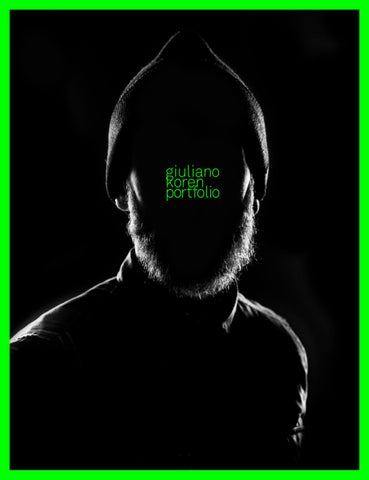
Bi ography
I am a freelance photographer based in Trieste, Italy. I studied Graphic Design and Visual Communication at ISIA (Institute of Artistic Industries) in Urbino, Italy, between 1996 and 2000. Through the Erasmus programme, I also attended the photography course at the University of Plymouth in the UK. There, I had the opportunity to further develop my knowledge of documentary photography, as well as colour and black-and-white printing techniques. Over the years, I have attended workshops led by internationally renowned photographers such as Antonin Kratochvil, Christopher Morris and Yuri Kozyrev. These encounters further strengthened my interest in portrait photography, both in its practice and conceptual approach. It subsequently became an integral and fundamental part of my work and photographic vision. Since 2008, I have been working in photojournalism, portraiture, editorial, automotive, advertising and commercial photography. My work has been published in magazines and publications including D - La Repubblica delle Donne, D Casa, DAMN, L’Espresso, Focus, Internazionale, Panorama, Runner’s World, Stern, Vanity Fair, Sportweek, TIME, TOFM (The Original Ferrari Magazine), Undici and Wired. My clients include : Acerbis, AW Lab, Carrera/Ducati, Cisalfa, Costa Crociere, Errea, Ferrari, Fincantieri, Foscarini, Generali, Genertel, illy, Ingo Maurer, ITS (international talent support), Marina Rinaldi, Nike, Scarpa, Zonin. I have received several national and international awards and recognitions, including distinctions at the PX3 - Prix de la Photographie Paris, the International Photography Awards, FIIPA, the Tau Visual Professional Photographers Association Photography Award, the International Color Awards and the Orvieto Fotografia Professional Photography Award. I exhibited as part of the group exhibition organised by the Worldwide Photography Gala Awards at the Círculo de Bellas Artes in Madrid. Three photographs from a reportage I produced in Afghanistan were selected for the Warzone exhibition at the Noorderlicht International Photography Festival in Leeuwarden, the Netherlands. I exhibited at Espace Dupon in Paris and at the 14th International Photographic Art Exhibition in Lishui, China.
FOB TODD
Bala Morghab, Afghanistan. Italy’s military presence in Afghanistan began in 2002, as part of the International Security Assistance Force (ISAF) mission. By 2008, the mission had been underway for six years, with approximately 3,000 Italian troops deployed in the country, most of them stationed in the Herat region. Working alongside and in coordination with the Afghan security forces, Italian troops were tasked with helping to maintain security across the country, while also supporting reconstruction efforts. At the time, Afghanistan represented one of Italy’s most significant and sensitive military commitments. Rising tensions and increasing security threats had reignited debate over the need to revise the rules of engagement to address the changing situation on the ground. In the village of Bala Morghab, in north-western Afghanistan, soldiers from the 8th Alpini Regiment, part of the Julia Alpine Brigade, were stationed at Forward Operating Base Todd, alongside US troops and units of the Afghan National Army (ANA). The village had long been a strategic hub for the trafficking of weapons and drugs from neighbouring Turkmenistan. These illicit networks helped sustain and support the numerous Taliban groups operating in the surrounding area. The situation in Bala Morghab remained extremely tense. In the weeks leading up to the reportage, several firefights had directly involved Italian troops. The balance of power between the opposing sides was fragile, and the distinction between peace and war was increasingly blurred. There was little indication that the situation would improve in the near future. https://koren.photoshelter.com/portfolio/C0000lCYAJr0m0sU/G0000Jk_I_AFI7bQ
SREBRENICA MASS BURIAL
Potočari Cemetery, Srebrenica, Bosnia and Herzegovina. The fifteenth anniversary of the Srebrenica genocide. Hundreds of families gather at the Potočari Memorial Cemetery to lay their loved ones to rest in a collective burial ceremony. During the Bosnian War (1992–1995), Srebrenica became a refuge for thousands of Bosnian Muslims fleeing the violence and ethnic cleansing taking place across eastern Bosnia. In April 1993, the United Nations declared the enclave a “safe area”, placing it under international protection. However, on 11 July 1995, Bosnian Serb forces led by General Ratko Mladič captured the town, overrunning the UN-protected zone and the Dutch peacekeeping battalion stationed there. In the days that followed, more than 8,000 Bosnian Muslim men and boys were systematically separated from women, children and the elderly, captured and executed. Their bodies were buried in mass graves, many of which were later disturbed and relocated in an attempt to conceal the evidence of the killings. The events were subsequently recognised as genocide by international courts. Fifteen years later, the search for the missing was still ongoing. The remains of thousands of victims had been recovered from mass graves and identified through DNA analysis, allowing families to finally give their relatives a proper burial. On 11 July 2010, 775 newly identified victims were laid to rest at the Potočari Memorial Cemetery, bringing the total number of victims buried there to 4,524. The cemetery stands as a place of remembrance and mourning, but also as a reminder of one of the darkest chapters in recent European history. https://koren.photoshelter.com/portfolio/C0000lCYAJr0m0sU/G0000W327qjjXU0Y
WAITING 4 DARKO
Northern Mitrovica, Kosovo. Mitrovica is a city of two parallel worlds, divided by a conflict whose wounds have yet to heal. This series of portraits explores both the differences and the shared experiences of people living on either side of the divide. The stories range from an outspoken young Albanian woman reflecting on women’s status and the importance placed on virginity among her peers, to a Serbian student speaking about the ongoing violence against the Serb community. Other portraits reveal the precarious conditions of families living in occupied buildings, the daily survival strategies of an Albanian Muslim with fundamentalist beliefs, and the hopes of a young Serbian student who sees university education as a path towards a better future. Through these individual stories, the reportage offers an insight into a city still haunted by its past, where the prospect of future ethnic integration remains uncertain. Yet, despite the divisions and unresolved tensions, people continue to find ways to adapt, rebuild their lives and struggle for a different future. https://koren.photoshelter.com/portfolio/C0000lCYAJr0m0sU/G0000d9DjJbELgpU
LA OROYA
Department of Junín, Peru. In 2008, the city of La Oroya, located in the department of Junín, Peru, approximately 180 kilometres from Lima, was facing a severe environmental and public health crisis. Situated between the Amazonian jungle and the central Peruvian coast, the city had a population of around 35,000, most of whom lived in the immediate vicinity of a large metallurgical complex. The smelting and refining complex had operated in the area for more than 85 years. Since 1997, it had been owned by Doe Run Peru, a subsidiary of the American company Doe Run Company. The facility processed 22 different metals, including gold, silver, copper, lead, tellurium, cadmium and iodine, and also produced sulphuric acid and arsenic. Its annual turnover exceeded 600 million US dollars. The economic benefits of this industrial activity, however, came at an enormous environmental and human cost. At the time, the chimneys of the multimetal smelting and refining complex released hundreds of tonnes of sulphur dioxide into the atmosphere every day, along with hazardous particulate matter containing various heavy metals. In 2006, the Blacksmith Institute, a New York-based environmental organisation, included La Oroya among the world’s ten most polluted places, alongside heavily contaminated industrial sites such as Norilsk and Chernobyl. The consequences for public health were particularly severe among children. Studies conducted during this period found that children under the age of seven had blood lead levels approximately three times higher than internationally accepted reference thresholds. Among children under five, 44% were reported to suffer from developmental or motor impairments, while nearly 10% of children under seven had blood lead concentrations high enough to require medical treatment. https://koren.photoshelter.com/portfolio/C0000lCYAJr0m0sU/G000026Lt2Z6RBtY
MARCO CAVALLO A JOURNEY FOR FREEDOM Across Italy.
Marco Cavallo is a large blue horse made of wood and papiermâché, created in 1973 inside the San Giovanni psychiatric hospital in Trieste, during the reform movement led by psychiatrist Franco Basaglia. Conceived as a collective project involving patients, artists and hospital staff, the horse became a symbol of the struggle against psychiatric institutions and the fight for the dignity and freedom of people with mental health conditions. In 1973, it famously led hundreds of people out of the hospital gates. Forty years later, in November 2013, Marco Cavallo embarked on a new journey across Italy, visiting the country’s six Judicial Psychiatric Hospitals (OPG) to denounce the conditions of confinement and call for their closure. I documented this journey alongside Peppe Dell’Acqua, psychiatrist and one of Basaglia’s close collaborators, following the blue horse through the different institutions. Through this reportage, I sought to capture the encounters with inmates, staff and places of confinement, telling a story about freedom, human dignity and the rights of people living on the margins of society.
ARAB SPRING ELECTIONS
Tunisia – The First Democratic Elections. On October 23, 2011, Tunisia held its first free elections following the popular uprising that brought an end to the 23-year rule of President Zine el-Abidine Ben Ali, who fled the country on January 14, 2011. The elections marked a historic turning point for the country and for the wider Arab world. Millions of Tunisians went to the polls to elect the 217 members of the National Constituent Assembly, tasked with drafting a new constitution and laying the foundations for a democratic political system. After weeks of protests driven by widespread unemployment, corruption, social inequality and the demand for political freedom, the election represented the first major step in Tunisia’s transition towards democracy. I travelled to Tunisia to document this pivotal moment, witnessing a country experiencing profound political and social change. Through photographs, I sought to capture the atmosphere of expectation, participation and uncertainty surrounding an historic vote, as people took part in shaping their country’s future. https://koren.photoshelter.com/portfolio/C0000lCYAJr0m0sU/G00004py686J3VXc
BOSNIAKS Sandžak, Serbia.
In south-western Serbia, near the border with Kosovo, lives a large Bosniak community, predominantly Muslim, which has long been regarded with suspicion by Belgrade. The Sandžak region has historically been a sensitive political and ethnic issue for the Serbian government, which has viewed its demands for greater autonomy with concern, fearing the emergence of new separatist tensions. An ancient crossroads along the trade routes connecting the West with the Middle East, Novi Pazar is the region’s main city, with a population of around 100,000. According to demographic statistics, it is one of the youngest cities in the Balkans. Its inhabitants live between unemployment and hope, modernity and tradition. Young people dressed in contemporary European fashion mingle in the streets with women wearing the traditional Islamic veil, reflecting the different cultural influences that shape everyday life. The Sandžak region is geographically divided between Serbia and Montenegro. Beyond the political and ethnic tensions between Serbs and Bosniaks, the region is also marked by rivalries and divisions within the local Muslim community, reflecting different religious orientations and competing visions of its future. https://koren.photoshelter.com/portfolio/C0000lCYAJr0m0sU/G0000OsfVKzPXnm8