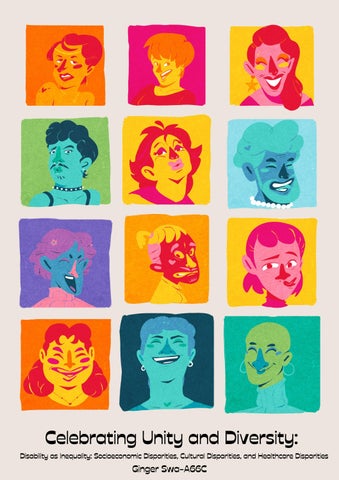
Celebrating Unity and Diversity: Disability as Inequality: Socioeconomic Disparities, Cultural Disparities, and Healthcare Disparities
Ginger Swa-A66C
FA I T H E N GA GE ME N T PA PE R B Y GI N GE R S W A
Disability as Inequality: Socioeconomic Disparities, Cultural Disparities, and Healthcare Disparities
We have all seen humanity's horrors and have watched the world grow toward greater inclusion and acceptance of all people; nonetheless, one minority group of humans continues to bear the brunt of humanity's atrocities and injustices in the form of inequality and discrimination despite the progress made in culture, legislation, and, environment. The identified minority is known to the community of people with disabilities (PWDs). People with disabilities (PWDs), according to the department of health, are those who have longterm physical, mental, intellectual, or sensory impairments that, when combined with other factors, may prevent them from fully and equally participating in society (Department of Health, 2013). I can assert that it is a universal truth that everyone, regardless of ethnicity, nationality, or disability, is entitled to a chance at opportunities and complete life, despite the fact that abuse and prejudice in today's society deny them this opportunity and From a cultural perspective, the community of people with disabilities has different experiences and lives that most of us do not understand and there is an existing tendency amongst people who are not educated enough to place them outside of the known cultural previous norm; thus, emphasizing the unfortunate process of passing on outdated negative connotations, which also deepens and exacerbates socioeconomic, cultural, and healthcare disparities.
FA I T H E N GA GE ME N T PA PE R B Y GI N GE R S W A
Disability as Inequality: Socioeconomic Disparities, Cultural Disparities, and Healthcare Disparities Inequities in health care are a common occurrence and cause of concern for people with disabilities, as it is clearly not accessible, functional, or affordable. This situation has gotten worse as the Corona Virus pandemic has entered, making overall health care for people with disabilities much more expensive and inaccessible. According to the world health organization (WHO), There are continuing barriers that these groups of people continue to face, one of which is Attitudinal barriers which entail that there can be occurences of prejudice and discrimination by health service providers at health facilities. Furthermore, in the context of the Philippines, there is an evident scarcity of health care facilities and rehabilitation centers, such as for services such as disability treatment and therapy, which prevents patients from receiving the additional assistance that they need. As a result, the community has expressed that there is inequity in the health care system because they do not have the ability to obtain proper treatment, which can lead to lower self-esteem and worsening their conditions, leading to internal illnesses or their own death, which I consider to be inhumane because they are deserving of accessible health care facilities and proper compassion in receiving their needed treatment. Thus, knowing that there are existing barriers and that this is a continuous problem for this group urges us to take action against the adversity, injustice, and, inequality that they suffer and face on a daily basis. Moving forward, I believe that we can be part of the solution by utilizing the See-Judge-Act methodology; The utilization of this model will begin with the first step of looking towards what is actually happening followed, by judging and acting upon the issue. In this case, there is a concrete observation of inequality, and to act upon it, I believe that as a society, we must call upon our policymakers to improve the current Magna Carta for disabled persons and its implementation. The Implementation necessitates policies that ensure accessible and disability-friendly facilities and organizations that can assist, and in the "act" portion of the methodology, we can be part of the solution by becoming the voice of the voiceless in ways such as volunteering and emphasizing policies that allocate more resources to the community of people with disabilities. I am aware that this process of concrete resolution may take time, but if we collectively as a society and a generation magnify the voices that needed to be heard, it will result in a greater wave of voices and translate to dedicated and sustained community actions.
FA I T H E N GA GE ME N T PA PE R B Y GI N GE R S W A
Disability as Inequality: Socioeconomic Disparities, Cultural Disparities, and Healthcare Disparities There is a cultural imbalance in the degrees of inequities encountered by people with disabilities (PWD), since there is a long history of stigmatization of disability in the Philippines which creates barriers and exclusivity rather than creating bridges and acceptance with the diversity and uniqueness that individuals with disabilities bring. To further affirm that there is a cultural imbalance and inequity amongst people with disabilities, there are defamatory words like "baliw yan (they're crazy)" and negative connotations defining people with disabilities as "dangerous" or "unhealthy," which I disagree with since they are false and do not represent the behaviors of people with disabilities and the authentic reflection of what they are living with. These cultural inequalities are just unjust and remnants of a bygone period, and in the Philippines, there are some organizations that work to promote acceptance, such as the "Christian Foundation for Persons with Disabilities – CFPDInc”. The CFPDinc is a faithbased organization that aims to reimagine and destigmatize the culture of encountering people with disabilities in the Philippines through performative and collective actions such as hosting online webinars with esteemed attorneys and professionals who help advocate for better policies. The organization also performs media coverage promoting the specific advocacy of inclusion. They also pay visits to those with impairments and invite them to prayer and guidance sessions. I am inspired by the consistent actions that the "Christian Foundation for Persons with Disabilities – CFPDInc” is doing; Subsequently, those acts of kindness are something I wish to replicate in the near future. I believe that the workshops hosted by the organization are sufficient in a sense of creating and promoting inclusion but I also believe that we can do is eradicating these cultural microaggressions that were ingrained in us by society and further, create empathy towards these individuals. Furthermore, I feel it is critical that we include honoring unity in diversity; celebrating our differences is one method to remind uninformed or ignorant people that individuals with disabilities have a place in this society and these individuals deserve the same rights and protections as we all do.
FA I T H E N GA GE ME N T PA PE R B Y GI N GE R S W A
Disability as Inequality: Socioeconomic Disparities, Cultural Disparities, and Healthcare Disparities
There is a scarcity of special education, special education professionals, and infrastructure in the Philippines. As a result of the paucity of educational resources, persons with disabilities are excluded from having the chance to develop skills and possibilities for a job. As a result, there is a likelihood that people with disabilities will rapidly decline in terms of their condition, as well as their socioeconomic situation, as their opportunities will be limited due to a lack of education and facilities, which is an evident act of exclusion, and we are called to be instruments of accessibility and information in order to be a part of the solution. In order to become instruments of systemic change, I believe we must use our resources, whether they be knowledge, wealth, or relationships, to provide and increase access to educational materials and opportunities for persons with disabilities. A similar collaborative endeavor might result in long-term accessibility for all persons, which would aid in the settlement of the entire problem of cultural challenges, health care concerns, and socioeconomic difficulties for people with disabilities since education is the key to overcoming adversity.
FA I T H E N GA GE ME N T PA PE R B Y GI N GE R S W A
Disability as Inequality: Socioeconomic Disparities, Cultural Disparities, and Healthcare Disparities
Overall, I would reiterate that all individuals are worthy of equal opportunity and equality. Acts such as the see-judge-act technique would be beneficial in reducing and eradicating the known systemic disparities in health care, culture, and the socioeconomic context for the disability population. Empowering the community of people with disabilities is a step forward toward growth in society. Thus, our overarching objective of unity and variety is accomplished as well. We are invited to accomplish acts of faith, desire for service, and communion in mission in order to realize this greater goal of unity and diversity and become stewards of inclusion.
Celebrating Unity and Diversity: Disability as Inequality: Socioeconomic Disparities, Cultural Disparities, and Healthcare Disparities
Celebrating DID YOU KNOW? Unity and In the Philippines, the 2016 National Disability Prevalence Survey (NDPS) revealed that Diversity: 12% of Filipinos 15 and Disability as Inequality: Socioeconomic Disparities, Cultural Disparities, and Healthcare Disparities
Sufficient Health care & Accessible Facilities
older suffer disabilities.
from
Filipinos with disabilities face discrimination. Their economic, social, and political rights aren't recognized, and they have limited access to government services.
severe
Equal Opportunities
What can we do? Advocate for more
See - Judge- Act
Disability friendly laws
Educate one's self about the barriers Join Non Profit organizations that Support People with disabilities
Call for proper Accessibility
Urge the Government to create more educational facilities for people with disabilities
Ginger Swa-A66C
Our Future is Accessible, Sustainable, and, Inclusive
Ginger Swa-A66C
Celebrating Unity and Diversity: Disability as Inequality: Socioeconomic Disparities, Cultural Disparities, and Healthcare Disparities
Ginger Swa-A66C
References: Carrie L Shandra, Disability as Inequality: Social Disparities, Health Disparities, and Participation in Daily Activities, Social Forces, Volume 97, Issue 1, September 2018, Pages 157– 192, https://doi.org/10.1093/sf/soy031 5 Global Issues to Watch in 2020. (2020). 5 Global Issues to Watch in 2020 | Joint SDG Fund. https://jointsdgfund.org/article/5-global-issues-watch2020 Christian foundation for persons with disabilities CFPDInc. (2022). Facebook. https://www.facebook.com/cfpdinc/ De La Salle University Manila. (2019, November 20). Our Core Values and Principles. De La Salle University. https://www.dlsu.edu.ph/about-dlsu/ourcorevalues/ Persons with disabilities | department of health website. (2013). Department of Health. Retrieved June 30, 2022, from https://doh.gov.ph/persons-with disabilities#:%7E:text=Persons%20with%20disabilities%20(PWDs )%2C,on%20an%20equal%20basis%20with
How the future of work might look like for PWDs. (2018). Cnn. https://www.cnnphilippines.com/life/culture/2018/2/19/PWDsvirtualahan-work.html