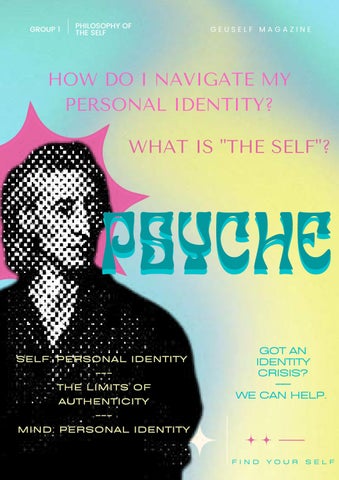
GROUP 1
PHILOSOPHY OF THE SELF
GEUSELF MAGAZINE
HOW DO I NAVIGATE MY PERSONAL IDENTITY? WHAT IS "THE SELF"?
PSYCHE SELF: PERSONAL IDENTITY --THE LIMITS OF AUTHENTICITY --MIND: PERSONAL IDENTITY
GOT AN IDENTITY CRISIS? --WE CAN HELP.
FIND YOUR SELF
by Wireless Philosophy
y
m i n d : perso n al identit A common question that most if not everyone asks is this: Who am I? The discovery of your personal identity is a journey that most people embark on as a part of basic human nature. What must be considered is that there isn’t one definitive answer to that question, and there also isn’t one defining perspective. The answer to the question of “Who am I?” varies between people, and even varies in interpretation. How would you choose to interpret it, and what do you think answers that question? Let's consider the different views of the question.ent.
A common question that most if not everyone asks is this: Who am I? The discovery of your personal identity is a journey that most people embark on as a part of basic human nature. What must be considered is that there isn’t one definitive answer to that question, and there also isn’t one defining perspective. The answer to the question of “Who am I?” varies between people, and even varies in interpretation. How would you choose to interpret it, and what do you think answers that question? Let's consider the different views of the question. There are 3 commonly considered perspectives of personal identity: The Philosophers Perspective, The Narrative Perspective, and The Character Perspective. First, let's talk about the philosopher's perspective. This perspective considers personal identity as the conditions that decide the “Preservation” and “Annihilation” of an “Entity”. This perspective is therefore concerned with the dimensions of an entity that are needed for it to be preserved, such as the entity’s relative position or appearance. This perspective does NOT consider what makes us human, and as such may not be the best way to decide personal identity. What are we if not human?
by Wireless Philosophy
y
m i n d : perso n al identit
This presents us with the second perspective or the Narrative Perspective. This perspective instead takes into account a person's journey or story. This perspective is called the narrative perspective because it considers Personal Identity as the sum of multiple personal details, experiences, and beliefs. This means that inherently the Narrative Perspective is more humanistic; it considers the importance of personal experience and also states that Identity can only be decided by oneself. This view is not without faults, however. The fact that the Perspective considers finding one’s Self Identity as a story means that Self Identity can only be fully realized at the end of the story, and as such the importance of character, or “Selves”, is not fully stressed. This leads us to the third and final perspective to be discussed, Which is the Character Perspective. This perspective is similar to the narrative view, in which it is up to us to construct our own selves. Personal Identity in this perspective is also the sum of our personal details, experiences, and beliefs. Just like in the narrative view, this is also an ongoing journey that people face, and there are stories involved. However, the stories make up a part of our self-identity, and should not be considered as our identity as a WHOLE. This distinction separates the Character Perspective from the Narrative Perspective, as the end of the story doesn’t mean the end of your personal journey.
The perspectives, despite their different names and ideas, also have similarities. Both the Narrative Perspective and the Character Perspective present Personal Identity as an ongoing journey that everyone must embark on. They also place importance on the experiences or stories that people have throughout their life. They all also take into account personal details, although the Philosophers Perspective does so to a limited extent.
APRIL
ISSUE 2022
PHILOSOPHY
ASK PSYCHE! Q
Hola, Psyche magazine! My name is Bernard Mark and I have been a basketball player and am currently injured for the foreseeable future. I have based a lot of my identity on being a soccer player, and now that I can’t practice it I feel lost. How do I find myself again ?
AN ADVICE PIECE BY UNNA, GINGER, & LEXI Hi Bernard! We’re very sorry to hear about your injury but we’re glad that you reached out. It’s completely understandable that a piece of your identity may feel fractured. But don’t fear! Although you can’t play soccer anymore, you inherited a wealth of character-building memories from your past self that is still with you (for more, see: Olson, 2009 [p. 14] There must have been principles and disciplines you loved that you may still continue. You are more than your sport. One’s identity is not tied down to their likes but rather the qualities and traits they obtain along the way! (Wireless Philosophy, 2016) Furthermore, Scottish philosopher David Hume suggests that your identity is made up of memories, dreams, and events of your life. As long as you treasure the memories and experiences you had playing soccer in the past, you will easily find the identity which you feel you’ve lost. Another perspective that may help you process your injury is the beginning and end of life perspective. This perspective tells us that if we continue to dwell without moving forward or passing it on. Our psychological state may cease to exist in terms of continuity and in this situation, it may not be productive towards your progress towards finding yourself again. #realitycheck !! The beginning and end of life perspective helps us understand that you cannot inherit your current psychological state if there is nothing to pass it on to. So at this point, you should allow yourself to discover new things that you can do despite your injury that you’ll love and can pass your enthusiasm to! What you’re currently going through is not easy, but hopefully, this advice may help you. We are hoping for a speedy recovery, both physically and psychologically.
YOU ARE MORE THAN YOUR PASSIONS
THIS MONTH
ISSUE 22
Q “Hello, Psyche! My name is Jojo, and
I am a freshman at De La Salle University in Manila. I've been enjoying the college social scene, but my friends and family believe I've been behaving differently around these friend groups. HELP! What should I do?”
PHILOSOPHY
ASK PSYCHE!
AN ADVICE PIECE BY YAEL, AYA, & JUSTINIA Hi Jojo! I don’t think there is an issue with socializing a lot. It’s just called being a social butterfly. A normal path for any college student. This helps find them new friends and discover who they are as a person. Especially in your adolescent years, this is a very crucial moment for you. At the same time, it’s normal for anyone to have different sets of friends due to having different interests. Just because you are in one group doesn’t mean that you have to only stay there. The point of college is to explore, and having new friend groups due to various interests isn’t something that is inherently wrong. However, do keep in mind that there are times that you would need to draw a line because it may go against your beliefs and standings. This can probably be why your parents and friends are concerned about you behaving very differently around various people due to them not seeing you as authentic anymore. In other words, be true to yourself. It’s personally fine if you want to try new things, but if you feel like you are being peer pressured just to fit in, maybe you should reflect again on the purpose of why you are changing yourself. That is why authenticity may be hard to achieve due to it entailing on person to have self-control and wisdom over decisions. To summarize, the fact that your close friends and family indicated this issue to you may be something you should look into. Reflect on your plans and intentions, and see if it’s making you a better person. If this exploration is making you grow, by all means, do so. However, when your morals start to be shaky, maybe rethink if this is really you.
THIS MONTH
PHILOSOPHY
ISSUE 20
ASK PSYCHE! Q
Bonjour, Psyche! My name is Sandy and I’m currently in middle school and am trying to fit in. I’m trying a lot of new things and having new experiences. My family says that I am becoming a different person, and honestly, I agree with them. How do I explain to them that I want to grow?
AN ADVICE PIECE BY MATT & ANFERNEE Bonjour, Sandy! Thank you for reaching out and trusting us with your situation. First off, let me start by saying that it is normal to want to explore new things and have new experiences in middle school. Trust me, we felt the same way! There are actually theories, such as Erik Erikson’s psychosocial stages of development, that say the adolescent years are the time to develop your identity. (For more, read Erikson 1968 [p.128]) That only goes to show that developing a sense of identity should not be something to be ashamed of. But you don’t have to know everything right now! Take your time to find yourself, maybe through your hobbies or the things you like. Now, for your question on how to explain to them that you want to grow, here’s my master plan. The first step is to ask them about what they liked when they were younger. It could be anything, a hobby they had, a movie they watched, a book they read, or even their favorite toy. Find out what they really liked when they were still little kids. The second step is to ask them what they liked when they were a bit older, maybe around your age. Next, ask them about their high school years and then finally ask them what they like now. They would probably answer differently each time, right? Well, tell them you feel the same way. The things that you liked to do, or your interests when you were younger are different now, and as you get older they will be different all the same. We hope that we helped you remember there is nothing wrong with being different as long as you are comfortable with the changes, and we wish you the best of luck!
DON'T BE ASHAMED OF YOUR GROWTH!
The most central and important questions about personal identity are the questions of persistence and of population. The persistence question is the identity of time. This query arises from the idea that the soul is immortal. The population question asks about the number of people existing within a time frame. There are two answers to this: 1) physical human organisms or 2) psychological unity or disunity. This concept becomes an issue when a single human organism has more than one stream of consciousness or when a human organism has no consciousness. If the number of people is determined by the psychological unity there will be two or more people; if it is determined by biological unity, there will be one person. The question of personal-ontology is concerned with our basic metaphysical nature; what we are made of and if we are independent beings. There are 5 main answers to this question. 1) we are biological organisms (animalism) 2) we are immaterial substances (souls) 3) we are material but not organisms (we are temporal parts) 4) we are bundles of mental states 5) we don’t really exist at all. “When I wonder what I am, what is it that wonders?” The author posits that people care about their own survival first and that their concern for others stems from whether or not they are connected to the individual. The persistence question asks what validates that one’s present self is “numerically identical” with themself in the past or future (a singular person). The author concluded that it is impossible for one to change numerically but can qualitatively (physically and personally). The three main answers to the aforementioned “persistence question” comprise: 1.) the psychological continuity view which says that memories, experiences, etc. should be inherited from a past self to a future self, 2.) the brute-physical view ties the self to the body one inhabits, 3.) the simple view which posits that “mental and physical continuity is evidence for our persistence” but do not ensure it. I concur with the psychological-continuity view. People are made up of experiences and change qualitatively throughout a period of time. The remembrance of those experiences is what connects the present me to the past and future me One of the subjects explored by the author in relation to psychological continuity was fission, which is a topic that happens naturally in nature (amoebas, starfishes, and so on) and is defined as when one organism divides into two or more. Human fission, on the other hand, is a contentious process. The Fission issue is concerned with the major obstacle to psychological continuity that occurs when two future persons meet at the same time.
by ET Olson
" When I wonder what I am, what is it that wonders? " Though the problem of fission was encountered when neuroscientists delved deeper into breaking the cerebral hemispheres; it would result in PSYCHOLOGICALLY CONTINUOUS with you; however, in the situation where one destroys + transplants the hemisphere = the transplanted hemisphere still psychologically remains continuous. The following solutions have been proposed: (1) the multiple-occupancy perspective, which relies on the assumption that persons and other persistent entities are made up of temporal components (however, it is a disputed metaphysical question). Second, the second is the NON-BRANCHING VIE, which rejects the intuitive premise that psychological continuity alone is sufficient for one to endure. Furthermore, the author starts to elaborate on the notion of the origin and end of existence. Although the beginning assumes that every one of us was an embryo and later a fetus, the psych continuity believes that none of us was an EMBRYO because an embryo is assumed to have no psyche,When a person's life comes to an end, the psychological continuity perspective indicates that WE COME TO AN END. For example, if we enter a vegetative condition, we become utterly mentally disconnected. We cease to exist. Finally, the author claims that psychological-continuity theory says that humans' persistence over time is not true. Hence, people are ruled out as ORGANISMS. Psychological-continuity theorists must reject the idea that we are creatures and provide another explanation for who we are, which is why some people believe that humans are temporal components of organisms. The highlighted issue focuses on two conscious beings in close proximity to a person who shares all of the same beliefs and experiences. Despite the fact that our animal bodies share our brains, are physically similar to us, and display all of the exterior features of awareness and intelligence, they do not think or are conscious -> we are immaterial.
HOW DO I NAVIGATE MY PERSONAL IDENTITY
UNNA SAN DIEGO Knowledge of self can be an elusive thing because it requires one to momentarily step out of themself and examine who they are in and out of the presence of others. Additionally, in extreme situations when one societal mold is held as a standard, it can be hard to visualize an alternative life path that can accommodate one's identity. Within society, one CAN have multiple identities depending on circumstance. The first step to navigating personal identity is to ask if you are being truthful to yourself. Do you actually like what you are doing, or are you just performing? Second, once you’ve figured that out, keep reinforcing it! Self-progress is a long-term thing. Accumulate experiences that reinforce who you are and add to the qualities that make you, you!
GAYE JUSTINIA R. DELOS SANTOS At a certain stage in someone’s life, a question of who am i, what I will be comes to them. As an individual still in the midst of defining herself, I personally navigate my identity through exploration and reflection. I navigate through exploring my likes and dislikes–which changes frequently, another way is through constant reflection of who I was, who I am and who I hope to be. Furthermore, I personally believe that the process of forming one’s true identity is a long term quest of rooting one’s self out with open-mindedness and without any bias.
HOW DO I NAVIGATE MY PERSONAL IDENTITY
YAEL INVENTOR We first have to recognize that the ‘you’ is ever changing. It is not and will never be one thing alone. We then have to realize that identities are complex and they are composed of multiple pieces that we often oversimplify. Knowing this, we have to allow ourselves to be adventurous in finding what we identify as. Identity is a lifelong journey, it is not just for teens or early adults and it is unfair that we frame it that way. It is vital that we allow ourself to try different labels and experiences to be able to self-actualize and live a holistic life. Navigating your personal identity is something only you can do because you are the only person who can validate how important those experiences are to you. And once you realize the vitality of it, only you get to sort how it fits into the puzzle we call ourselves.
LEXINE ESPIRITU Personally, I navigate my identity by reflecting on my past self made up of memories, dreams, events, and overall character-building moments in my life. Through the treasuring of my past self this way, it becomes clearer to me on who I am and what I want to become. I also navigate my identity through the relationships that I build with the people around me, whether that be friends, family, acquaintances, and even strangers I bump into. In recognizing that we have a past, present, and future self, the consistent evolution throughout our lifetime may help us obtain an authentic identity.
HOW DO I NAVIGATE MY PERSONAL IDENTITY
MATT GIBBS The path to Personal Identity is one that every person will tread. But in my opinion, this path isn’t definite; It isn’t a paved path that leads to a destination. Rather, the path to personal identity is similar to the concept of a desire path; it is formed from a person's choices, and not based on the designs of others. As such, my motto is this: The path you take is the path you make, formed through the experiences and events you encounter. Not all events need to inform your path, instead your path will be formed by the events you choose. Don’t feel pressured on the journey, there isn’t an itinerary to follow. Take your time, savor your experiences, and learn. This is how I navigate my Personal Identity.
ANFERNEE ESTACIO Every individual has experienced of questioning his/her own existence. In life, you will encounter different people and different environments that has the possibility of having different identity of you. To navigate your personal identity, you have to know your own purpose. Knowing what makes you happy and finding who are your inspiration in life will lead you to finding “the self”. Reflecting in your past experiences in life will add to your own personal knowledge, being genuine to your own feelings will lead you to knowing your true self.
HOW DO I NAVIGATE MY PERSONAL IDENTITY
GINGER ERIN SWA Humans, particularly philosophers, have pondered the quandary and voiced great skepticism over the broad theories and conceptions of Personal Identity. The notion of identity is often examined and disputed and We often question whether we have the same consciousness from birth to death, and questions extend to questioning if the labels we are given or the boxes we complete constitute our identity. The pursuit to navigate personal identity is frequently perilous, but it is one of the pleasures of our autonomy as humans, and philosophers/experts have aided us in exploring perspectives in traversing our personal identities. When I was able to ponder on my own terms, I was able to come to my own conclusions After reading Dr. Ben G. Yacobi's Limit to authenticity, I came to the conclusion that my own personal viewpoint navigation is a continuous process of persistent introspection, social interaction, and willingness to listen to feedback from others. Humans like us may discover and navigate our most real and true personal identity through the constant and ever-changing navigation process, which lets us experience errors, external influences, and other elements that I find personally true in my experiences (Rousseau,). When it comes to self-navigation, I find that Rousseau's philosophy is most pertinent because of the emphasis on external factors which has allowed me to cultivate qualities such as responsibility, empathy, and selfanalysis, all of which I believe are essential for personal identity flourishing and something you hopefully can replicate in your own quest to your true personal identity.
AYAHNNA DAYU One thing about personal identity is that it can actually change. There is no one personality for a person’s whole entire lifetime, but actually multiple ones due to various experiences. So with this in mind, how do I navigate my personal identity. For me, it starts with building my core values and principles first. This is because, no matter what I’ll be like, as long as this is forever ingrained in my heart, I wouldn’t lose myself. Then once I feel like my principles are concrete enough, that’s when I’ll start doing what I’m passionate about or what generally makes me happy. Some activities can either be cooking, gaming, sports, and many more! I personally discovered who I truly was from the activities I would normally do. I noticed I was more of a sporty person rather than a bookworm. And from those tiny discoveries of my interests, that was when I started to mingle with people that had similar interests to me or people who I just vibed with. From there, I noticed that the people who I surrounded myself with, really helped better my personality as well.
WHAT IS THE SELF TO YOU?
UNNA SAN DIEGO While some philosophical perspectives may tie this to the physical body one inhabits, or the “mind self” that processes reality and dictates action, I believe the self encompasses both mind and body (after all, muscle memory is to the body as memories are to the mind). It is the “core” of any individual. It is the truest most “authentic” part of an individual which is the basis for their personal identity. It comprises traits and characteristics which result from life experiences. Although the “self” has qualities that are consistent, it continually evolves over time.
GAYE JUSTINIA R. DELOS SANTOS Personally, the self is what makes an individual different from the others–it is an individuals core identity. With various definitions and interpretation of the self, I believe that the self is constantly progressing and changing as the individual discover new knowledge and experience new things, for example, discovering their likes and dislikes, pet peeves and more. I believe that my current definition and outlook of my self will be vastly different in the future. I hope that through the things I am currently experiencing and going through whether positive or negative will be a signifier I will use to continuously better and improve myself as I progress in my life.
WHAT IS THE SELF TO YOU?
YAEL INVENTOR Firstly, I think the most you part of you is probably your traits and personality. Even if you lose all your memories, that does not mean you are no longer you. That may mean that there are parts of you deemed missing but the way you react to something before you lose your memory and after may still be the same. Which means, you are still inherently yourself. Secondly, I believe that you are whatever you want to be. To fully self-actualize means accessing parts of your subconscious, which is proven to be impossible at the moment. Hence, with the consciousness we have now, I think that people can find different things they connect with and identify as that. Identity is not stagnant and it is ever changing, and so it important to find yourself in things you are drawn to then figure out how it fits in your life.
LEXINE ESPIRITU I believe that I can define my “self” in the stories that I tell of my life. Stories of my adventures and relationships, the rising and the falling, the good, bad and ugly. The ability to recount the life you have lived so far is what makes the self. As I see it, f I somehow get into a terrible accident that will cause me to lose all the integral memories of my life, I believe that my “self” will cease to exist. From that point, there will be a new “self” living in my human organism of a body; one that does not know of the trials and victories of the past “self”.
WHAT IS THE SELF TO YOU?
GINGER ERIN P. SWA Philosophers and humans have created a multitude of definitions and forms of the self. With the offered numerous understandings of the self, we as a society have progressed farther because we recognize these multiple abstract definitions of the self" and it has certainly, philosophers like René Descartes shape my own view of the "self". In my viewpoint, the "self" is an unified entity comprising my morality, awareness, experiences, and potential as a human; nevertheless, I find my definition of self to branch out further in a biological approach, as reinforced by Olson's "personal identity" article. I broadened my concept of the self to include the presence of a soul and the traits that go with it, and they all work together to bring one's self into reality. Subsequently, Learning the multiple definitions of self is significant as I've found that developing a personal definition of self that resonates with your convictions is an important step in progressing as a person.
AYAHNNA DAHYU Though we are a technically merge of two people, it doesn’t mean that we aren’t our own people that may have different perceptions and beliefs. For me, the self is how you view yourself. It can range from, am I an athletic person or a studious person to am I inherently a good person or a bad person. The self is consist of values, beliefs, experiences, and abilities that shapes us into who we brand ourselves to be. The great thing about the self is that it will often change as we grow. Which really puts no limit on how one may better themselves.
WHAT IS THE SELF TO YOU?
MATTHEW GIBBS The self to me is the amalgamation of all of my life events, decisions, beliefs, learnings and stories. What I consider as my “self” can only be determined by the events that have taken place in my life, and I think that the same will be true even when I am old. My current “self” isn’t a constant; I am a different person than I was a year ago, and that is normal. I think that the “self” is a changing thing, and it should be. Character development shouldn’t be exclusive to movies or books, but really it should be a universal goal. Personally, I aim to develop a better “self” everyday. I try to be better than I was yesterday. But that’s just for me; that is my “self”, because the nature of the “self” is personal.
ANFERNEE ESTACIO “The self” is a simple word yet most of us humans are left with many questions. The branch of philosophy gave us different perspectives and explanations. In my own definition, “the self” is comprised of my own morals, personal experience, passion and subconscious. Our mind is very complex, “the self” of each individual has its own subconscious mind and muscle memory that shows its truest self. Even if the possibility of transferring my mind to another body, “the self” mind has its own characteristics and natural habits that makes one unique. I believe the combination of the mind, body and personal experience is what makes “the self”.
limits of authenticity
by Ben G. Yacobi
Authenticity is a continuous process that judges a person based on who they become, which not only involves one’s awareness of themself but also their awareness of others and their mutual influences. Ben G. Yacobi portrays the beauty of authenticity by highlighting how it can bring harmony to people’s inner and outer lives. When one is playing by their own rules, they ignore external pressures from society since it doesn’t represent their values. Hence, it is only achieved through one’s eagerness and passion that authenticity can be achieved, not through others. As Yacobi says, authenticity is an individual mission, which can differ from person to person. Since each individual has a different way of living—with different cultures, religions, and political beliefs —there are no clear criteria to help distinguish what is or is not authentic. With how complex authenticity actually is, many great philosophers have taken interest in explaining authenticity. Jean-Jacques Rousseau argued that achieving authenticity is prevented by one’s need for the esteem of others, meaning that inauthenticity is produced by external influences. Martin Heidegger said that authenticity is tied to one’s awareness of the nature of their identity and existence, and mortality. He argued that realizing one’s identity within a world with many potential influences suggests a complex relationship between authenticity and inauthenticity and that the two are not mutually exclusive. Jean-Paul Sartre argued that everyone has a free will that enables them to define themselves and determine their lives through choices. Thus, authenticity requires individuals to take full responsibility for their choices and actions, but one’s freedom is limited by society and by their own limitations or “facticity”. Albert Camus believes that one’s awareness of living in a universe that does not care about us is what pushes them to realize only through authentic self-realization can they obtain freedom. Personal authenticity is achieved by disregarding external consolation, otherwise, one would be alienated from their own life, society, and the universe. The conceptualization of the formation of the authentic self comes from a “human construct”. What this entails is that the practice of attaining and discovering the authentic self is crucial however the quest to be authentic which is absolute can be in vain.
limits of authenticity
limits of authenticity A glaring issue for self-authenticity is that it can only be found in places of uncertainty and questioning, very rarely are we able to find the answer if we are content with what is given to us. We cannot fully know what our authentic self is, especially since an answer means having access to our subconscious. Certain thoughts, feelings, or reactions are stored and there are only a few ways we can access that part of our brain. But even if we do, we would still be unable to create a fully accurate depiction of ourselves because our brain can only interpret so much information because our brain tries to fill in the gaps. These gaps lead to inaccurate conclusions that don’t consider numerous factors.
by Ben G. Yacobi
Another oversight that we often don’t recognize is that identity is dynamic. The way we identify ourselves is often oversimplified and interconnected with other reasons. It is dynamic because there are a lot of different factors that play into our lives and how we grow from them Additionally, even if we were able to fully grasp our dynamic identities, human judgment is based on interpretations of truths and not the reality of said truths. Even if, in the absolute best case, we are able to grasp our true and honest identities, the hurdle of language and being able to accurately describe ourselves still stops us. Language, today, will never be able to fully encompass the thoughts and feelings of a human being. Sentences and words are ambiguous and may have more than one meaning depending on who the person is, and what they are talking about. There are several factors that can hinder the advancement of progress when vying to establish their individual identity and be their authentic self. This includes the lack of introspection, human perception, and external social pressure to conform. Additionally, due to pressure and expectations, some individuals might feel the need to act and change their attitudes to appease others. Also, another limitation on authenticity is the advancement of technology including televisions and virtual reality as these both can impact an individual’s perception of what is real and fantasy allowing for self-delusion and deception to develop.
A range of individuals claims that accomplishing authenticity as an “ongoing state of being” is not feasible due to the real authentic self-being being transitory and not permanent. Additionally, authenticity cannot be fully defined or quantified since many aspects of a person are always changing as humans constantly adapt–an individual’s identity is complex. For some individuals, trying to find their authentic selves is a life-long process that they may never truly accomplish. The true question an individual must ask themselves is how will they be able to identify the difference between genuine authenticity and an ideal, untrue version of themselves they want to show others? Ben G. Yacobi answers this question by emphasizing that authenticity must be subtle and unobtrusive. He also states that some individuals feel the need to control the expression of their authentic selves to The author then ends by explaining that when in the quest not bother others with their problems–feel to find one’s personal, authentic self some individuals do the need to hide their honest emotions and not try to discover it live their lives without truly ever thoughts which is why it is crucial to knowing their real authentic selves and some come upon it carefully discern/differentiate between by chance whilst some do try and eventually discovers it internal and external authenticity. but many will never truly find it.
limits of authenticity
WHICH VIEW FITS YOU MORE? Are you a fan of the television program Community? Find out whether your life philosophy is similar to that of your favorite community characters, Annie or Troy!
NARRATIVE VIEW You believe that to achieve total personhood in life, there are a set events and circumstances that must be achieved (ex. vibrant social circle, fulfilling job, etc). The narrative view focuses on the meaning that these events bring to the individual. These events typically follow a beginning, middle, and end order. The main goal of those under narrative view is selfactualization.
CHARACTER VIEW You believe that selfhood is NOT dependent on life events. The character view focuses on the qualities and characteristics that a person accumulates throughout their life with the goal of becoming a wellrounded person.
R
S
E N R C E E F E
Erikson, E.H. (1968). Identity: Youth and Crisis. NewYork: Norton. pp. 128 Olson, E.T. (2009). Self: Personal Identity. In W. Banks (ed.), Encyclopedia of Consciousness. Elsevier. pp. 301312. Yacobi, B. G. (2012). The limits of authenticity | issue 92. Philosophy Now. https://philosophynow.org/issues/92/The_Limits_of_Au thenticity Wireless Philosophy. (2016, February 5). Philosophy Mind: Personal Identity (The narrative self). [Video]. Youtube. https://www.youtube.com/watch? v=lcIqoN9oRgo&t=23s
GEUSELF - A66C - GROUP 1
THANK YOU R
N I X E L E E A L Y GINGE I T N S IA U J ENNY P A N N U
MM
AYA
T T A