RONALD PHILLIPS
GREAT ENGLISH FURNITURE
RONALDPHILLIPS
GREAT ENGLISH FURNITURE
Tel: + 44 (0)20 7493 2341 www.ronaldphillipsantiques.co.uk advice@ronaldphillips.co.uk
FOREWORD
I sat down to write this foreword on the day that the founder of this firm (my father Ronald) passed away at the age of 97.
There would have been no antique business in our name had it not been for him. I am incredibly lucky that he established a wonderful showroom in Mayfair after first opening in South Kensington in 1952. I joined my father in the business in July 1979, but I had always known from about the age of ten that I wanted to be an antique dealer too. From then on my father kept saying, since I knew what I wanted to do, why didn’t I leave school early? I was also constantly reminded of the stock we could have purchased instead of paying exorbitant school fees.
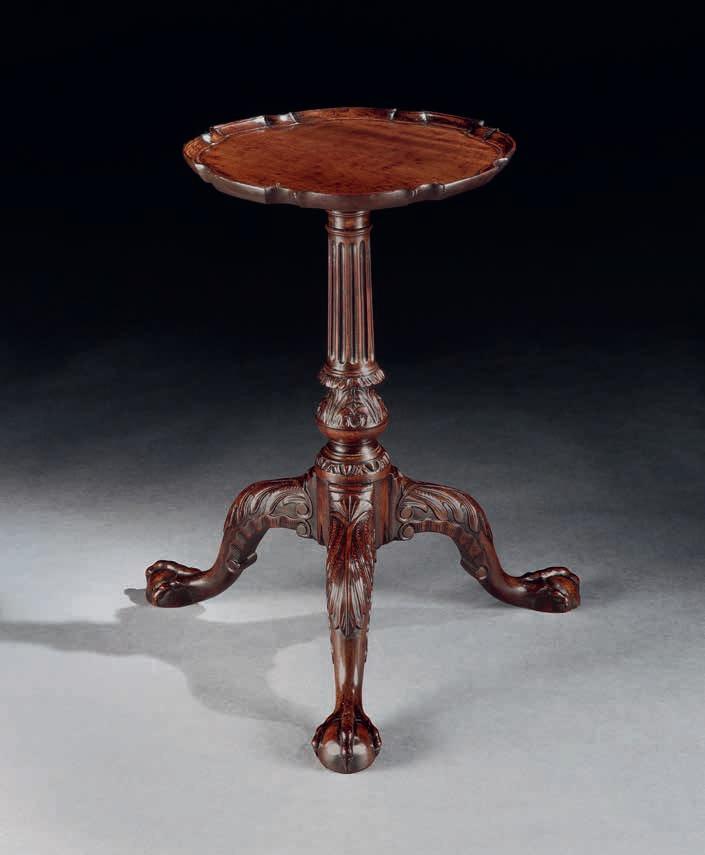
I thank him for making all of this possible. He never lost his enthusiasm or interest in the business, and he would invariably ask how the catalogues and fairs were progressing. He so looked forward to seeing the latest catalogue, and he would have been happy to see the kettle stand on page 96 which he sold in 1956. He will be missed by us all.
Many wonderful pieces adorn the following pages. A large number have been purchased privately and have not been on the market for many years. It is not possible to mention all the great pieces of furniture that are included, but I will draw attention to a few of my favourites.
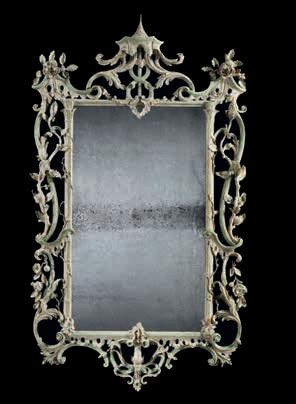
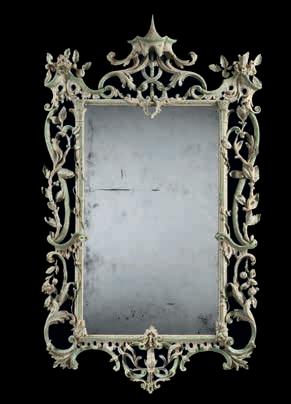
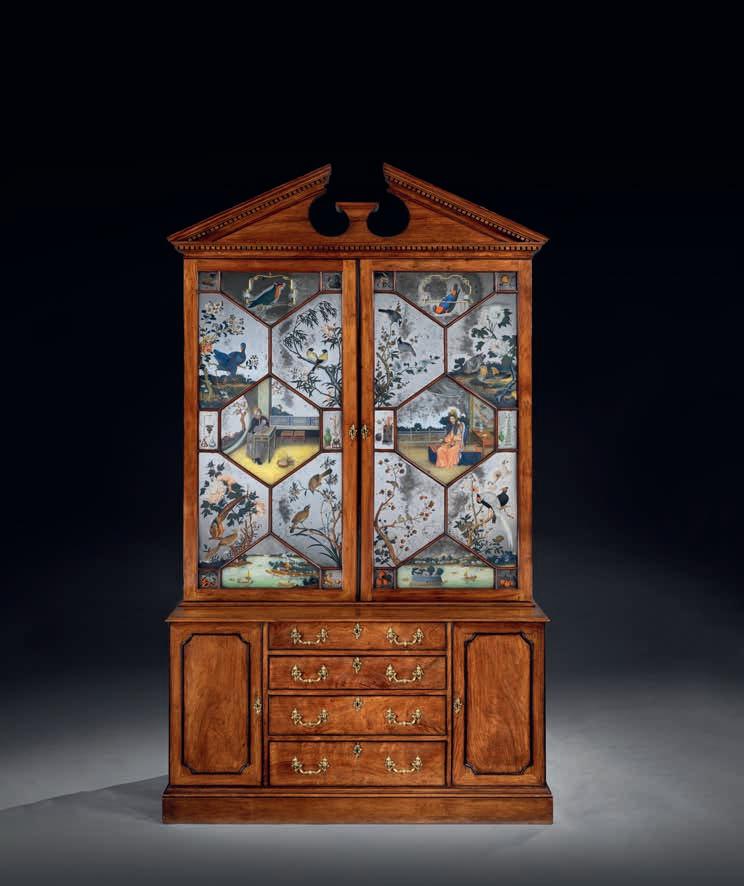
The pair of Adam torchères on page 7 are amazing and should really be in a museum. The large silver table on page 15, which came from the Channel Islands and was at the Grosvenor House Fair in 1951, is simply the best. The pair of painted mirrors on page 26, sold by Moss Harris in 1947, are quite incredible, of wonderful quality and with the most beautiful original decoration. Particularly noteworthy too are the truly exceptional pair of demi-lune tables probably by Thomas Chippendale on page 30. Finally, the Chinese cabinet with mirror paintings on page 260 is not only unique but also an astonishing masterpiece in every respect.
As always, I thank my loyal staff for all their help compiling this catalogue.
I look forward to seeing you at the Treasure House fair from 24 to 30 June and (a new venture for us) the LAPADA fair in Berkeley Square in late October.
Please feel free to email me at simon@ronaldphillips.co.uk or call me on +44 20 7493 2341. It would always be a pleasure to show you around the showrooms or try to locate specific items.
Best wishes,
2026
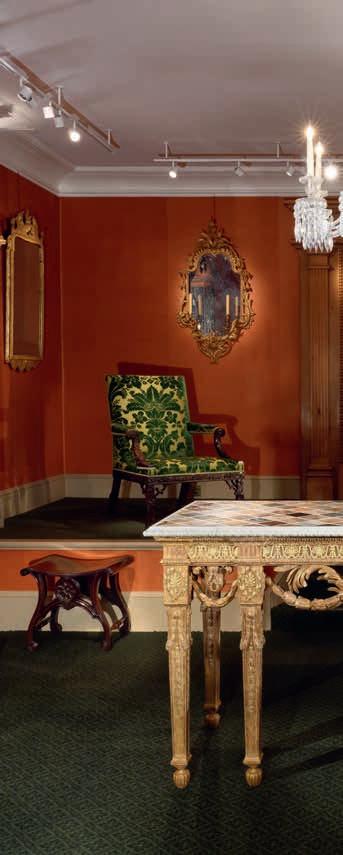
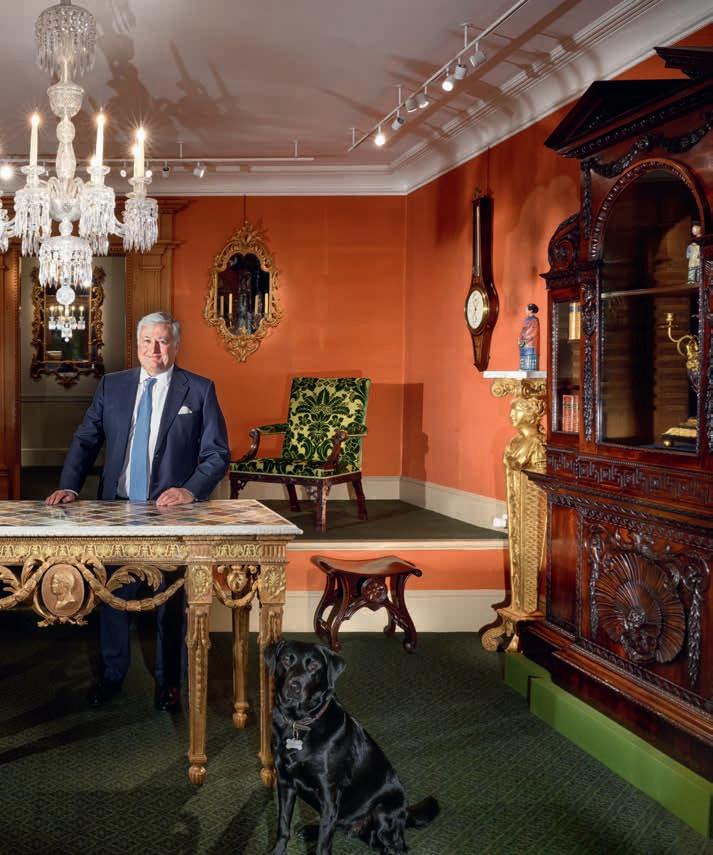
Simon Phillips London,
Right: Simon Phillips with Truffle
RONALDPHILLIPS
GREAT ENGLISH FURNITURE
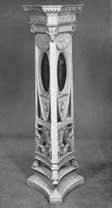
One of the torchères illustrated in Adam and Hepplewhite Furniture by Clifford Musgrave, 1966
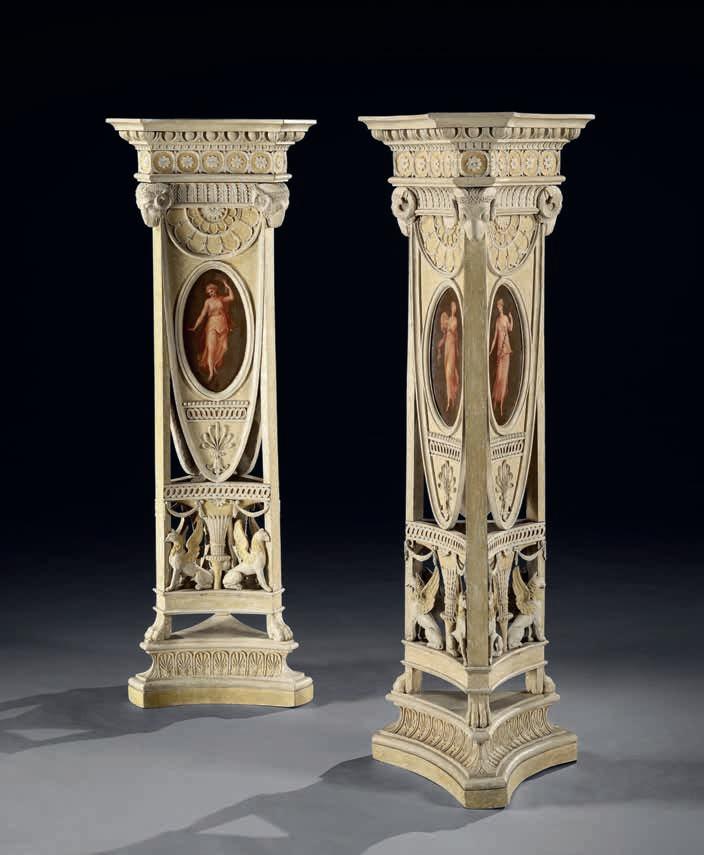
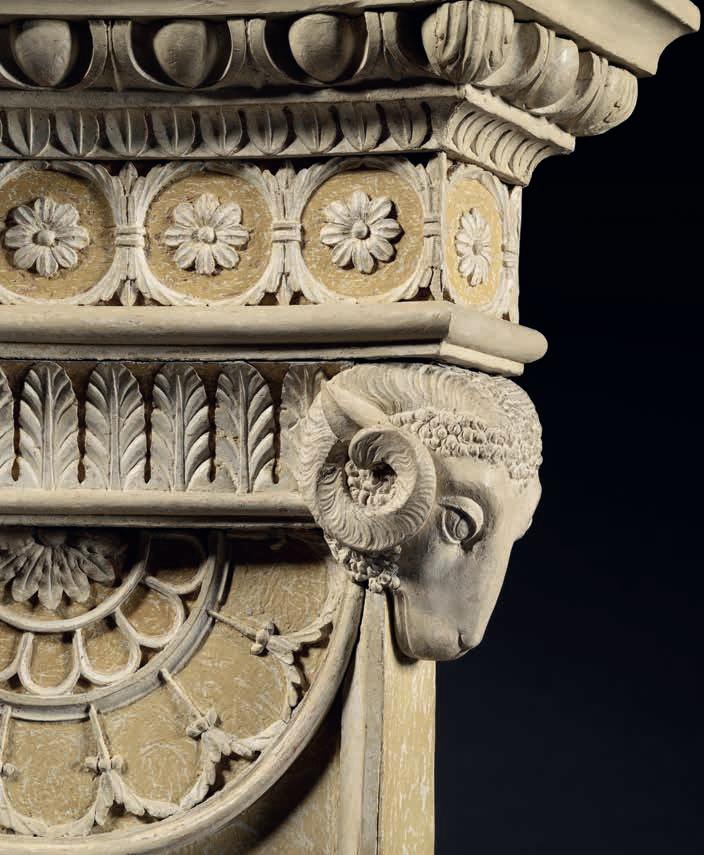
A PAIR OF GEORGE III GREY PAINTED ETRUSCAN TORCHERES DESIGNED BY ROBERT ADAM WITH PANELS BY ANTONIO ZUCCHI AND CARVED BY SEFFERIN ALKEN
Note: Some of the decoration is original. The painted ovals are virtually untouched.
English, circa 1775
Height: 48¼ ins; 123 cm
Width: 16½ in; 42 cm
Depth: 16½ ins; 42 cm
Provenance:
Frank Partridge & Sons Ltd., London, England; a set of four, thereafter separated;
Ronald Phillips Ltd., London, England; Private collection, USA.
Illustrated:
Clifford Musgrave, Adam and Hepplewhite and Other Neo-Classical Furniture, 1966, pl. 148.
Literature:
Margaret Whinney, Home House: No. 20 Portman Square, 1969, pl. 50; the design for the torchères at Home House.
Maurice Tomlin, Catalogue of Adam Period Furniture, 1972, pp. 84 & 85; the torchères at Osterley.
Eileen Harris, The Furniture of Robert Adam, 1973, pl. 137; the torchères at Alnwick Castle.
Four variants of this model are known; three as realised objects, and the fourth as a design drawing.
A virtually identical pair of pedestals, differing only in the composition of design motif and in being gilded, are in the Tapestry Room at Osterley Park, Middlesex, and are recorded there in the 1782 inventory following Robert Child’s death. The finished design drawing dated 1776 for this pair is preserved in the collection of Sir John Soane’s Museum in London.
A further drawing for a pedestal for Home House in Portman Square, London, is also preserved in the Soane Museum collection. This drawing, however, is marked ‘preliminary’, suggesting that the actual realisation of the pedestals might have been different. A finished design drawing is not recorded.
A related pair of pedestals similar to the Home House design are in the Duke of Northumberland’s collection at Alnwick Castle, Northumberland. No design drawing for the Alnwick pedestals has survived.
Clifford Musgrave illustrates one of the present pedestals in his Adam and Hepplewhite and Other Neo-Classical Furniture, where he also mentions a bill from Antonio Zucchi to Sir Watkin Williams-Wynn dated 26 September 1774 for ‘Drawings for 2 figures in wood for Trypods £3’ and suggests this as a possible provenance. The reference to ‘2 figures’ presents a problem, however. At the time when Musgrave was writing, there were four pedestals in the set, and each pedestal had three ovals for paintings, making twelve ovals in total. Unless another bill can be found from Zucchi to Sir Watkin for a further ten ‘figures in wood’ at a different time, that provenance should be ruled out.
Without further information it is impossible to ascertain the original provenance of these pedestals. We can however confidently say that they were designed by Robert Adam and carved by Sefferin Alken, with paintings almost certainly by Antonio Zucchi.
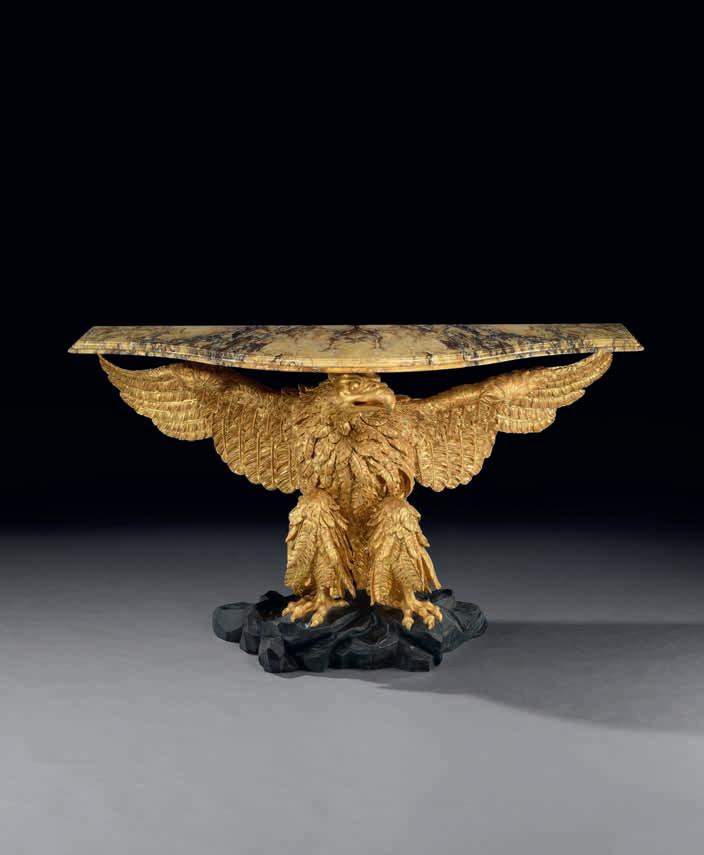
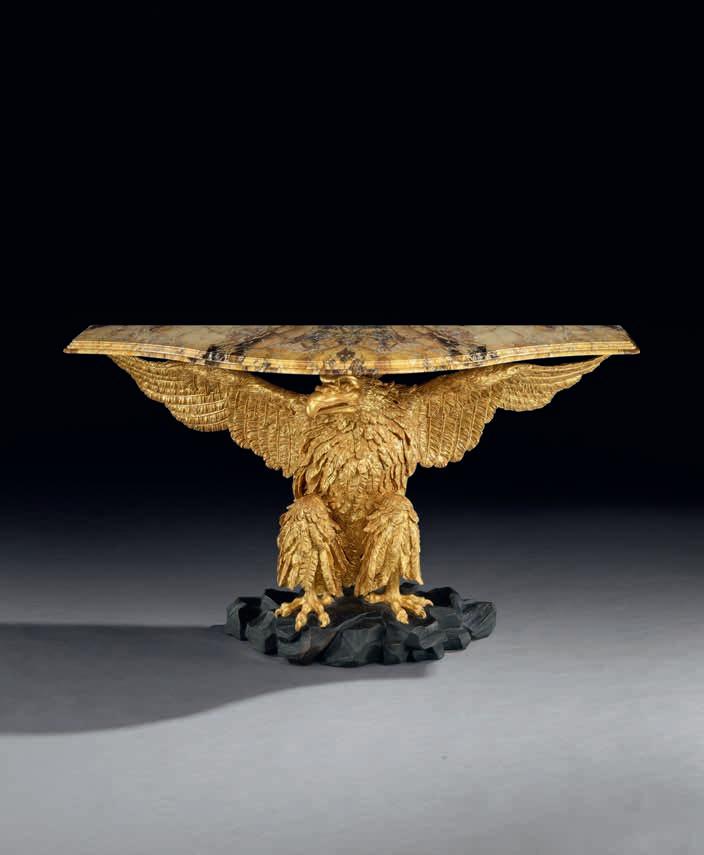
THE LAIRD OF DUCHRAY CONSOLE TABLES
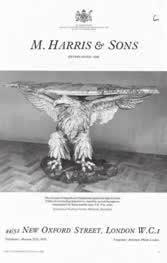
The tables with M. Harris & Sons, Connoisseur, February 1960
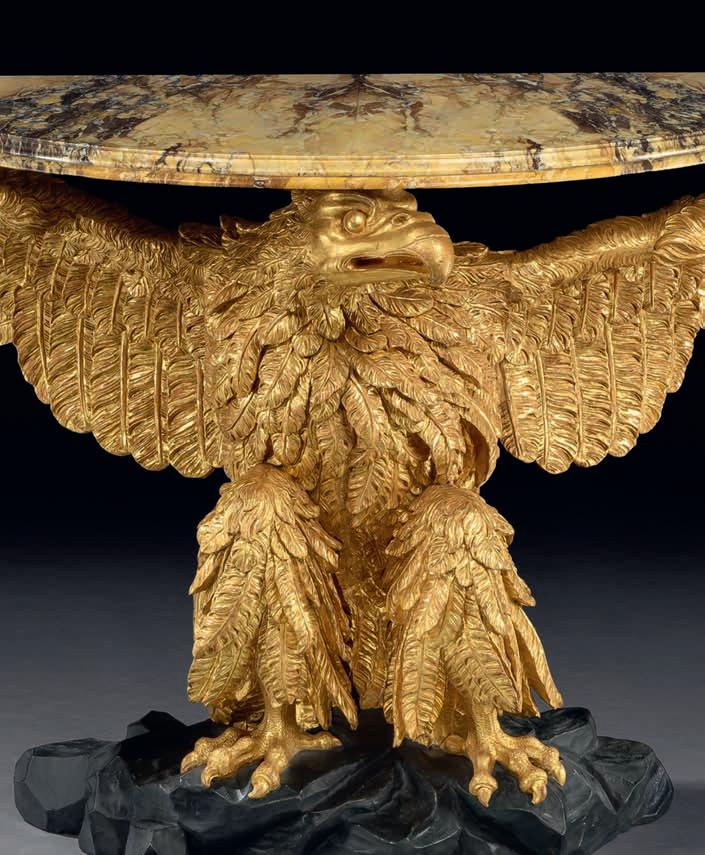
A PAIR OF GEORGE II GILTWOOD CONSOLE TABLES
Note: The tables retain their original Sienna marble tops. The bases have been re-gilded at some stage in the 20th century.
Scottish, circa 1755
Height: 3 ft 2 in; 97 cm
Width: 5 ft 8 in; 173 cm
Depth: 2 ft 1¼ in; 64 cm
Provenance:
The Lairds of Duchray, Duchray Castle, Scotland; M. Harris & Sons, London, England; Partridge Fine Arts Ltd., London, England; Private collection, USA.
Illustrated: Connoisseur, February 1960, no page reference; advertisement with M. Harris & Sons. Partridge Fine Arts Ltd., ‘Summer Exhibition’, catalogue, 1983, pp. 34–5.
These impressive tables are supported by exceptionally well carved birds with their wings spread. The birds could be mistaken for eagles, but their striking pose, as if they were about to take flight, is highly unusual if not unique when compared with other eagle tables, which in general belong to either the Palladian or the Regency period. The serpentine fronts of these tables, however, suggest they were made in around 1755 during the rococo period, when serpentine fronts were popular.
A further clue is the crest of the Graham clan, which contains a falcon. The Lairds of Duchray are a side branch of the Graham clan, sharing the same crest. Since falcons have, apart from their size, quite similar features to eagles, it is plausible that the table supports in fact depict falcons.
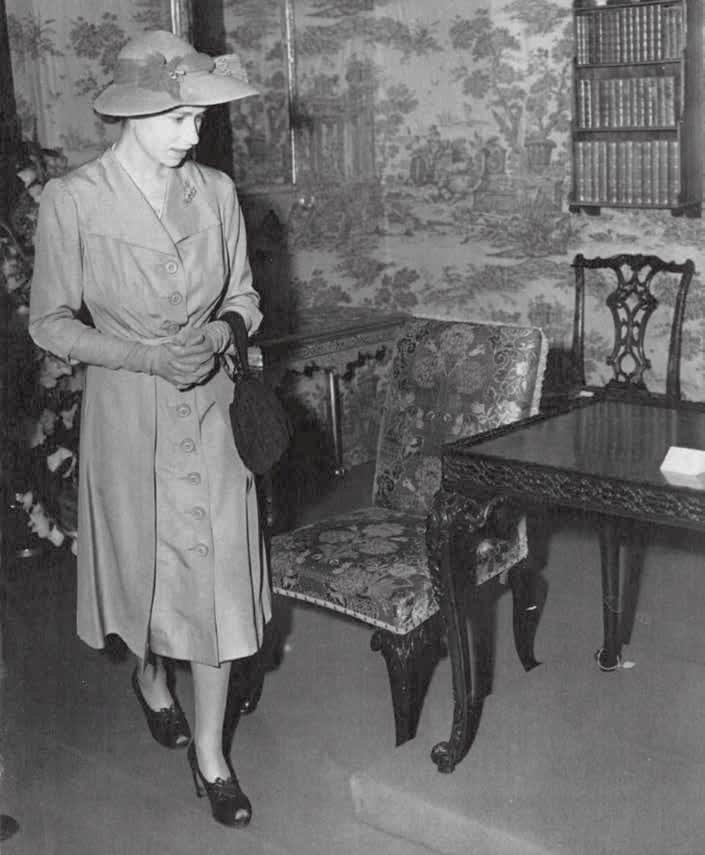
HRH Princess Elizabeth, later Queen Elizabeth II, with the table at the Grosvenor House Art and Antique Dealers Fair, 1951
3
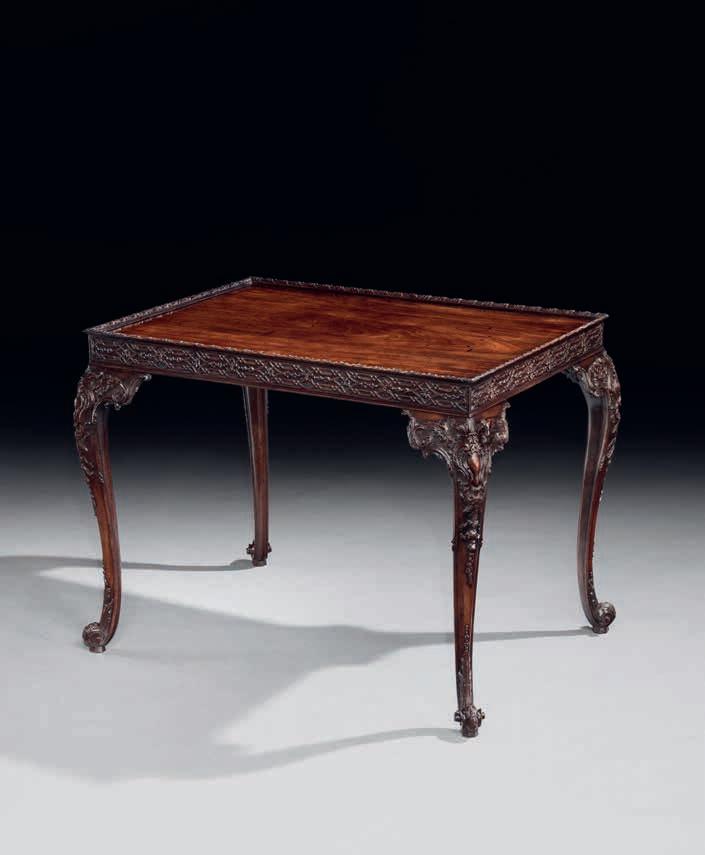
A GEORGE II MAHOGANY SILVER TABLE
Note: A typed paper label reading ‘Phillips of Hitchin’ is pasted to the underside of the tabletop.
English, circa 1755
Height: 28 in; 71 cm
Width: 37½ in; 95.5 cm
Depth: 27¾ in; 70.5 cm
Provenance: Phillips of Hitchin, Hertfordshire, England; Private collection, Channel Islands.
Exhibited: Art and Antique Dealers Fair, 1951, Grosvenor House, London; with Phillips of Hitchin.
Photographed: Phillips of Hitchin archive: 8-12699, RP 01204, glass plate negative.
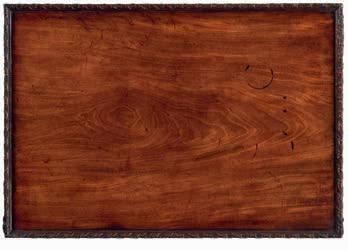
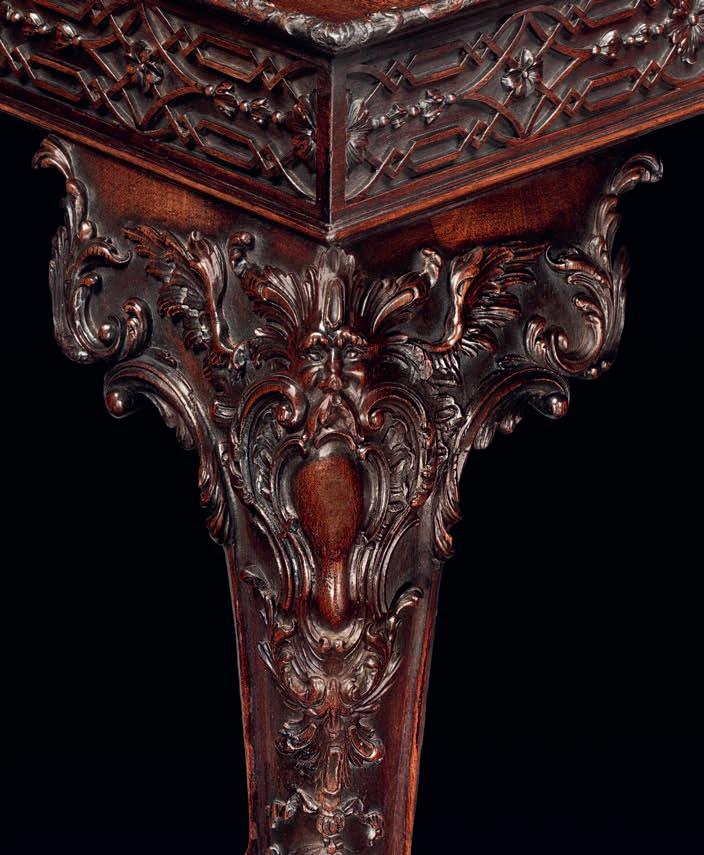
The table has acquired an outstanding colour and has survived in virtually untouched condition. The execution of the applied blind fret to the frieze and the carved details on the mouldings and legs are second to none.
A photograph from the Phillips of Hitchin archive shows HRH Princess Elizabeth, later Queen Elizabeth II, with the table displayed in the centre of their stand at Grosvenor House in 1951.
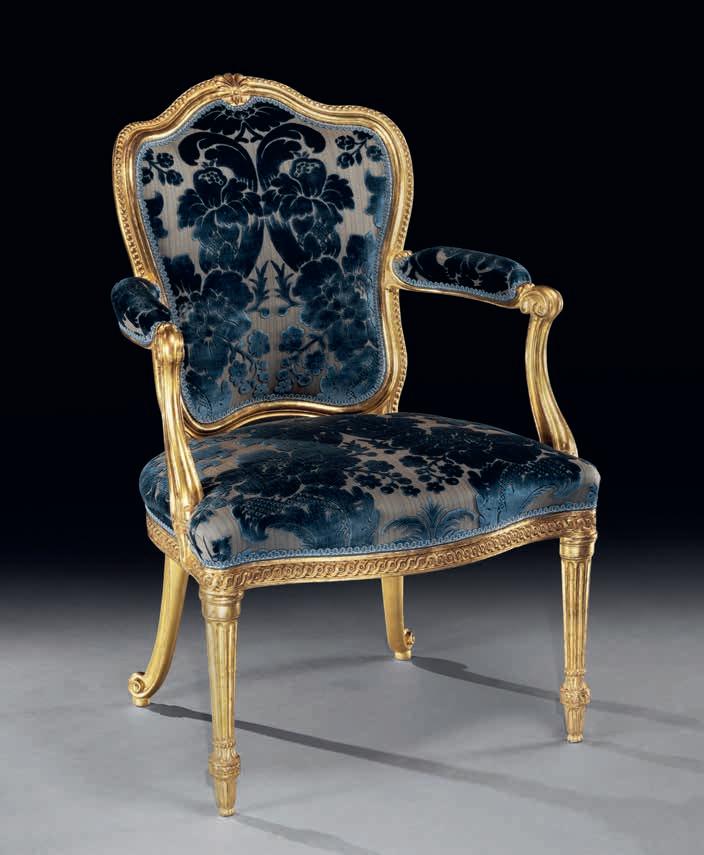
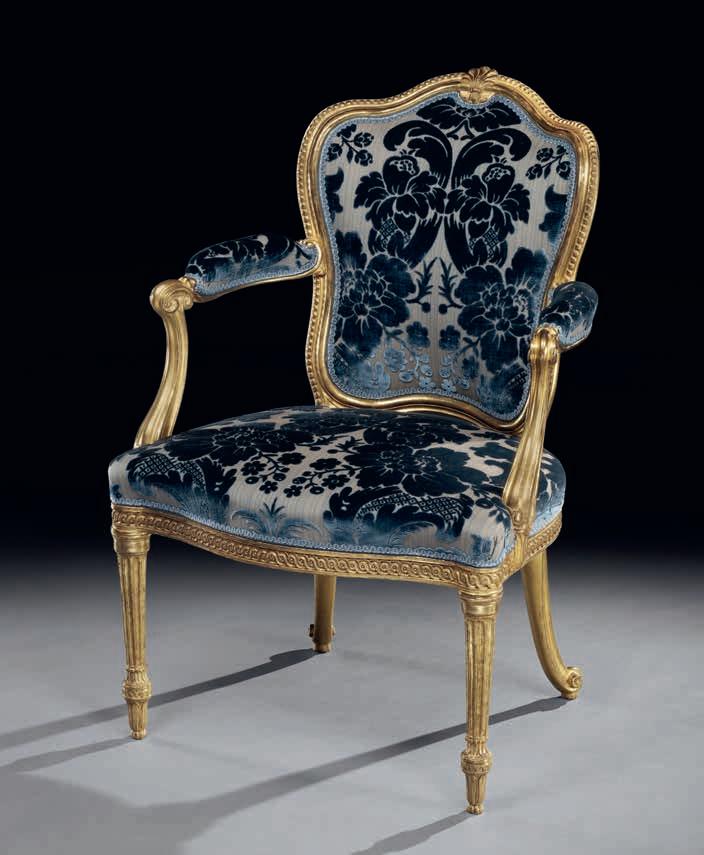
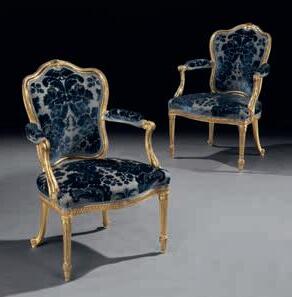
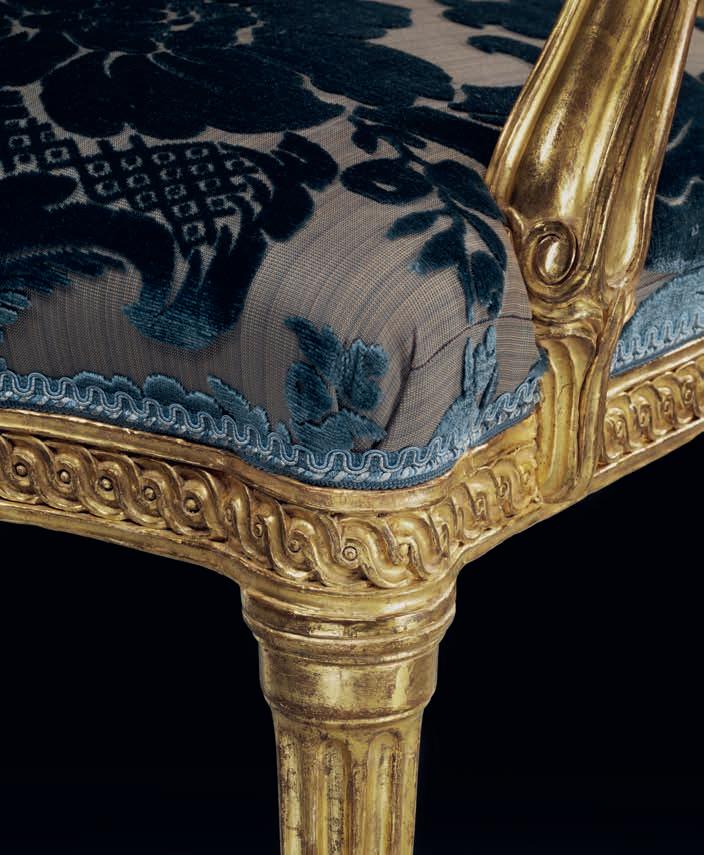
A PAIR OF GEORGE III GILTWOOD OPEN ARMCHAIRS ALMOST CERTAINLY BY THOMAS CHIPPENDALE
Note: The chairs have been re-gilded.
English, circa 1775
Height: 36 in; 91 cm
Height of seat: 17 in; 43 cm
Width: 25½ in; 64.5 cm
Depth: 25½ in; 64.5 cm
Without further information, the original commission for these chairs remains unknown, but the chairs feature many Chippendale characteristics. They are constructed of lime wood, Chippendale’s preferred material for chairs of this type. Mahogany corner blocks are inserted into the back frame, joining the upright stiles with the horizontal crest rail and lower back support. The chairs also feature clamp cuts to the underside of the frame; this practice was not exclusive to Chippendale, but few other workshops of the time applied it. Furthermore, the arms are set back from the front where they join the side rails, and lastly, they feature typical Chippendale C-scrolls at the knuckle of the arm just before the padding.
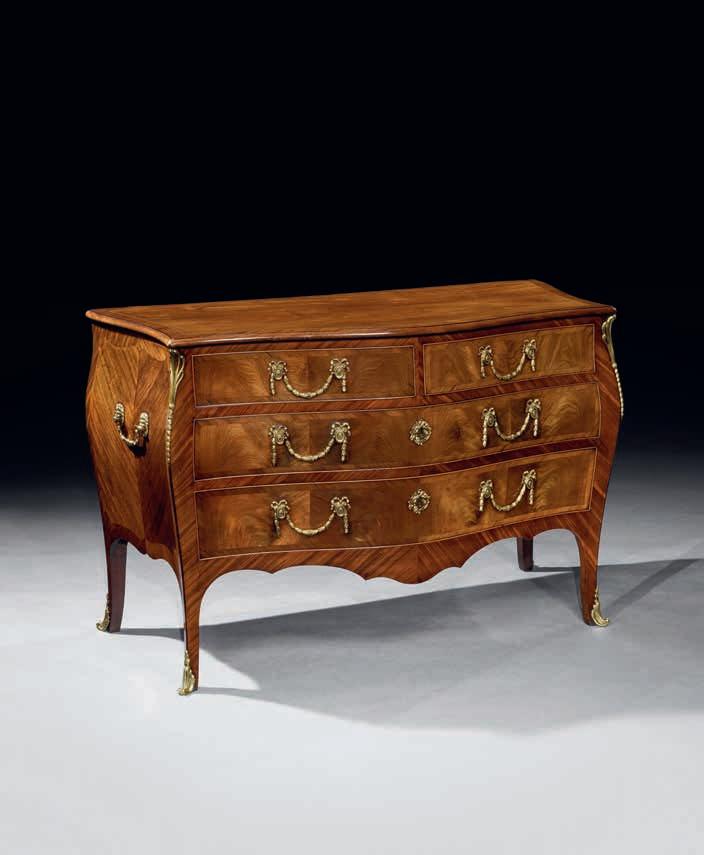
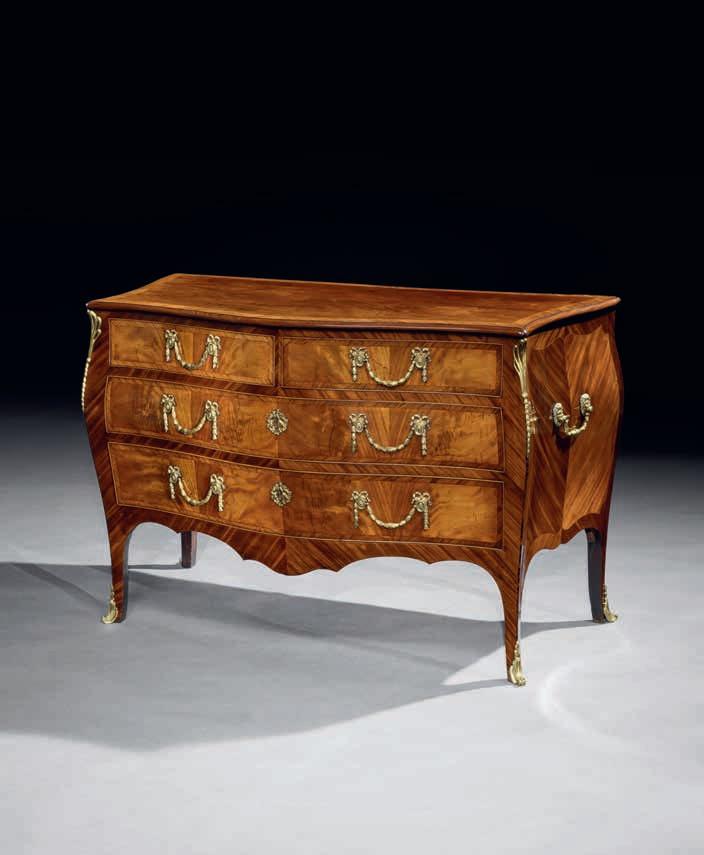
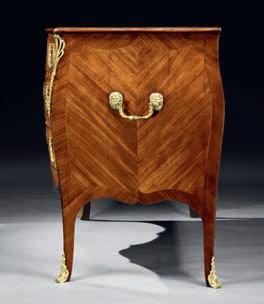
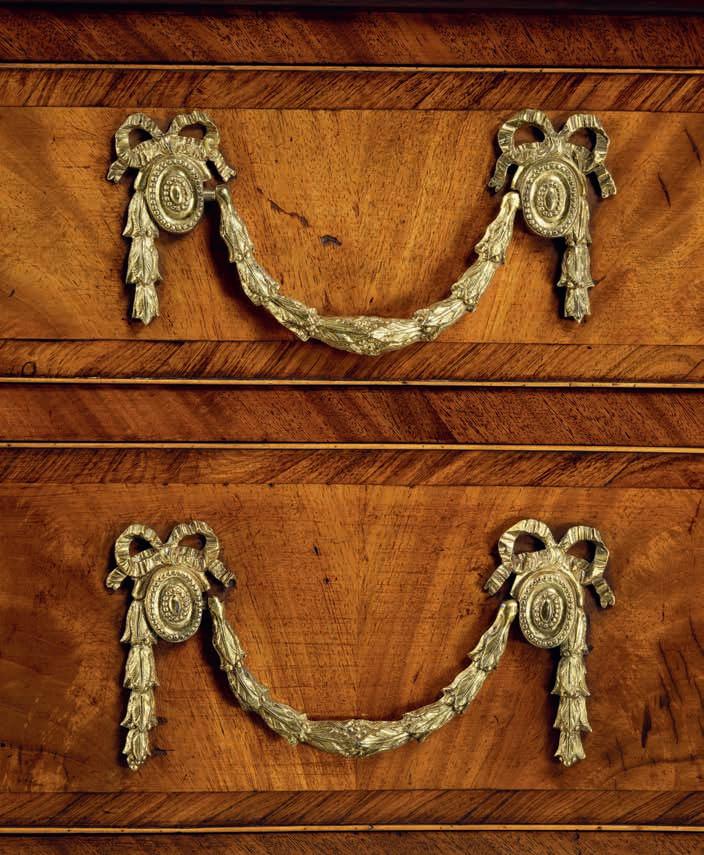
A PAIR OF GEORGE III BRASS MOUNTED MAHOGANY SERPENTINE COMMODES ATTRIBUTED TO THOMAS CHIPPENDALE
Note: The commodes retain the original handles and mounts. With minor differences between the two in the crossbanding of the tops.
English, circa 1770
Height: 35 in; 89 cm
Width: 54 in; 137.5 cm
Depth: 25½ in; 65 cm
A similar single commode is in the collection at Nostell Priory in Yorkshire. The construction is of particular interest: unlike related shaped commodes by John Cobb, in which the shaped apron to the front of the commode forms part of the bottom drawer, in commodes from the Chippendale workshop the shaped apron is part of the main carcase, as in the Nostell Priory example. Other shaped commodes, such as the pair of firmly documented commodes from St. Giles’s House in Dorset, feature the apron as part of the drawer front.
Another deciding factor is the choice of handles. Cobb appears to have routinely used baroque handles with laurel-leaf wreath backplates. Chippendale, on the other hand, kept pace with the latest fashions, and used neoclassically influenced castings for some of his handles, as in the present example.
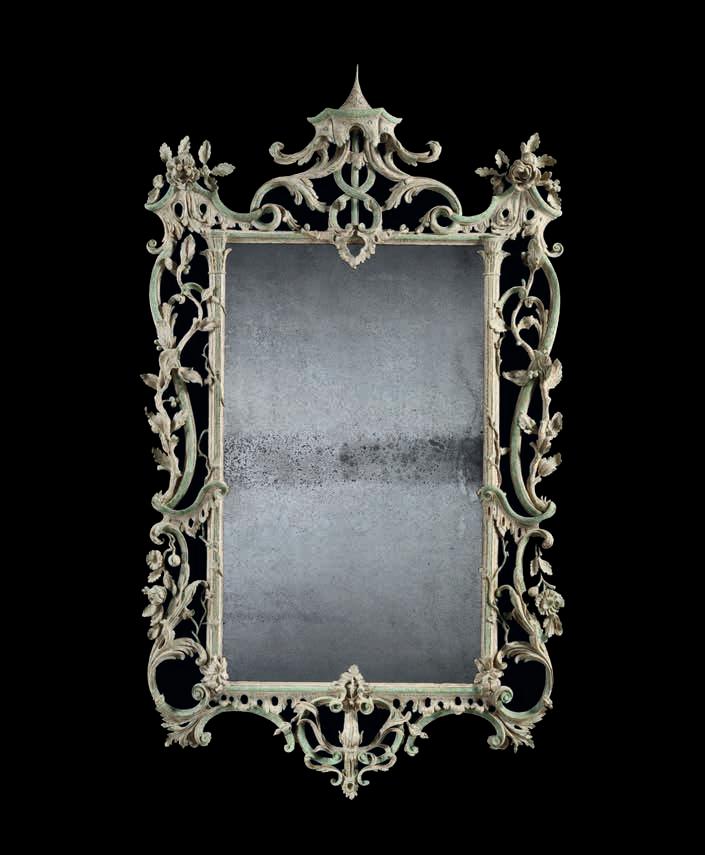
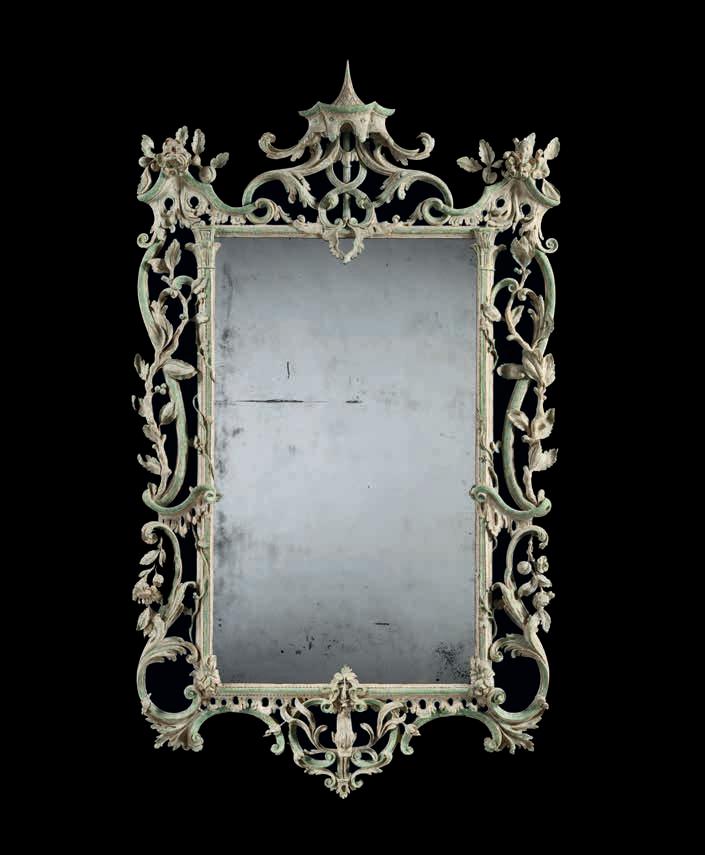
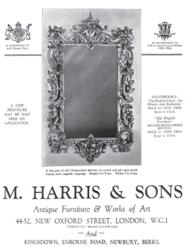
The mirrors with M. Harris & Sons in 1946
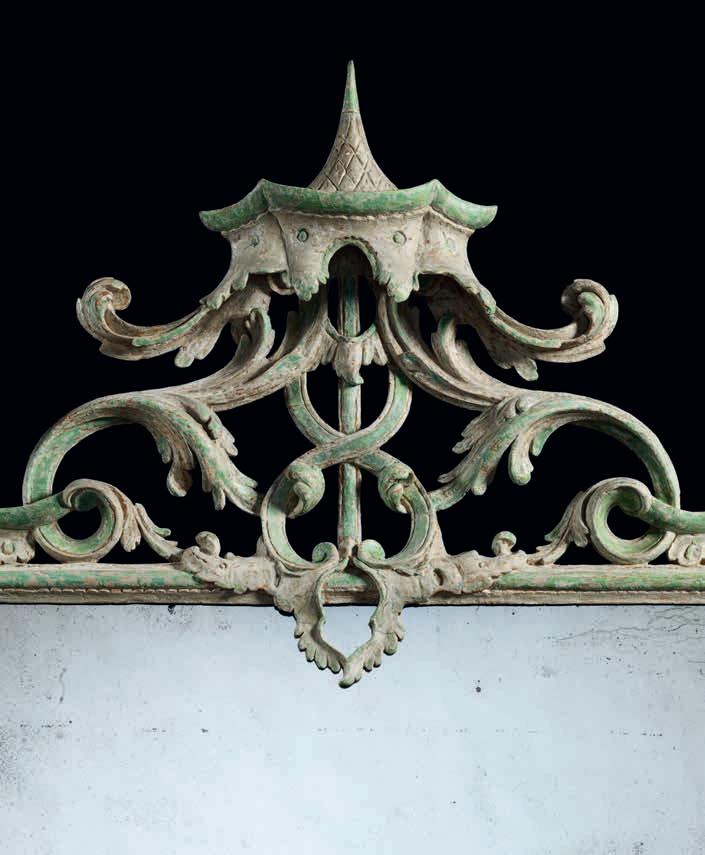
A PAIR OF GEORGE III GREEN AND OFF-WHITE PAINTED MIRRORS
Note: The frames retain most of their original paint surface, with some restorations. The mirror plates are mercury silvered period replacements.
English, circa 1770
Height: 56¼ in; 143 cm
Width: 32½ in; 82 cm
Depth: 2½ in; 6.5 cm
Provenance:
M. Harris & Sons, London, England; Private collection, USA.
Illustrated:
M. Harris & Sons, advertisement, 1946.
White paint is only occasionally discovered under later gilding on mirror frames of the 18th century, and green paint is hardly ever found. Its beauty and exceptional rarity are owing to the preservation of the green pigments which, had they been exposed over the centuries, would have faded to blue. Green is created by combining yellow and blue pigments, and the yellow fades in sunlight at a much faster rate than the blue. When the green paint has been protected from sunlight, however, as on this example, we have a rare opportunity to experience the green on the mirror frame as it was originally intended.


7
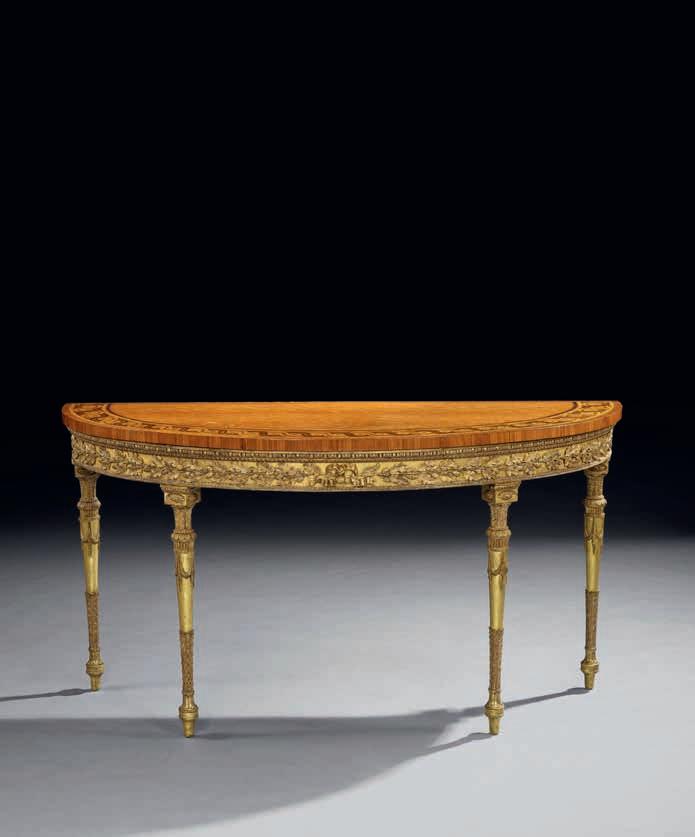
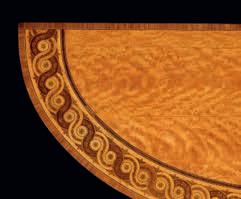
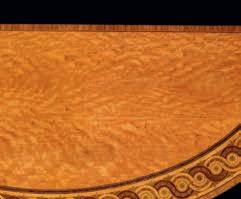
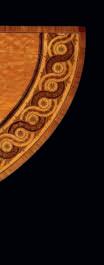
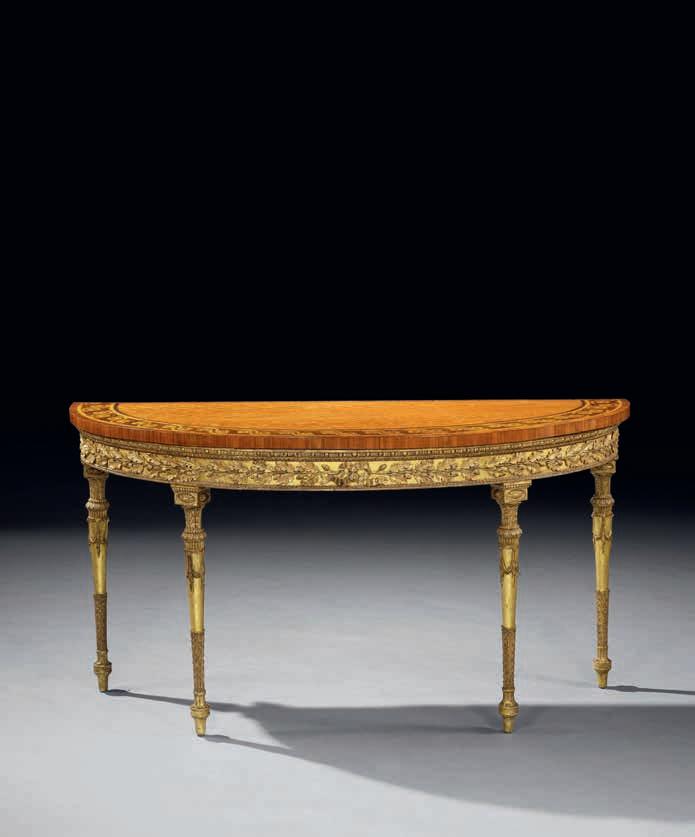
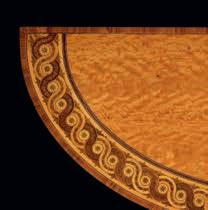
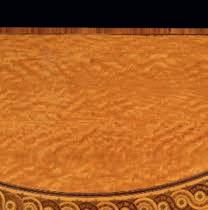
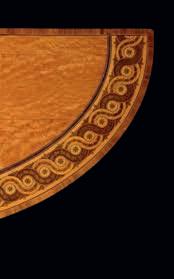
A PAIR OF GEORGE III SEMI-ELLIPTIC SATINWOOD MARQUETRY AND GILTWOOD SIDE TABLES ATTRIBUTED TO THOMAS CHIPPENDALE THE YOUNGER
Note: The tables retain most of their original gilding.
English, circa 1785
Height: 2 ft 9½ in; 85 cm
Width: 5 ft 3½ in; 161 cm
Depth: 2 ft ½ in; 62 cm
Provenance: Private collection, USA; Kentshire Galleries, New York, USA; Mallett & Son, London, England; Private collection, USA.
Illustrated: Lanto Synge, Mallett Millennium, 1999, p. 159, fig. 194.
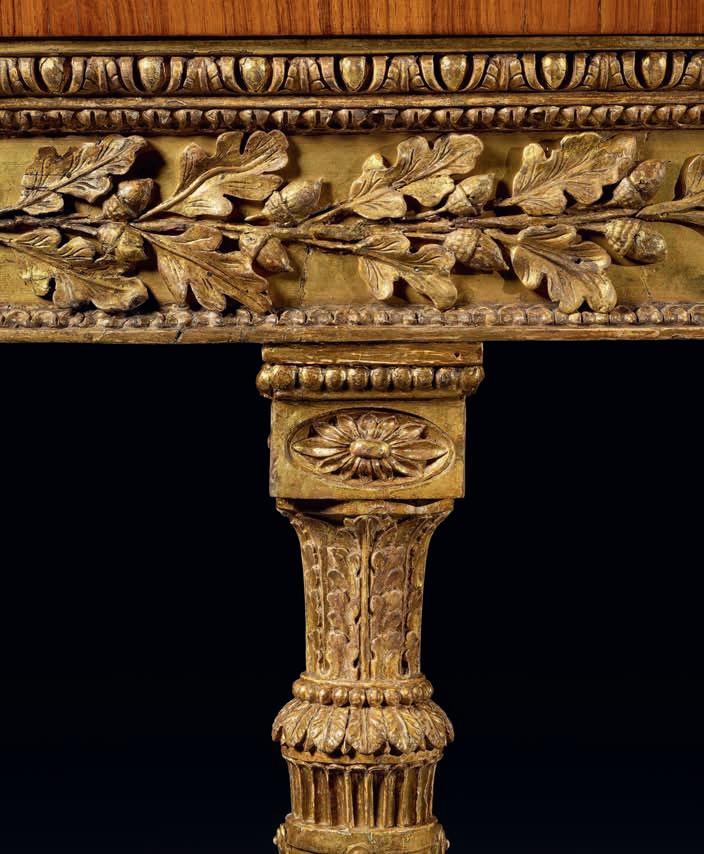
The tables are typical of the output of Thomas Chippendale the younger towards the end of the 18th century. The garland of leaves, in this case oak leaves with acorns, can be found on several of Chippendale’s commissions, including those for Temple Newsam in Yorkshire, Stourhead in Wiltshire (on side tables with laurel leaves) and Newby Hall in Yorkshire, the last featuring a marquetry frieze of inlaid vine leaves on two sideboard tables.
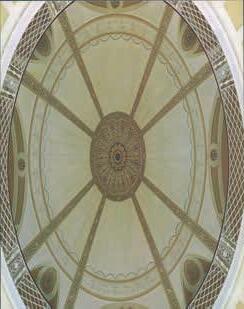
All four pairs, including ours, are influenced by designs associated with James Wyatt. Interestingly, every design motif in the compactly structured frame and leg design of the tables is also used in the interior of the dome of Wyatt’s Radcliffe Observatory in Oxford, finished in 1794. The correspondence is so close that the tables would harmonise perfectly with the design of the Radcliffe Observatory dome.
The dome of the Radcliffe Observatory in Oxford, illustrated in James Wyatt: Architect to George III by John Martin Robinson, 2012
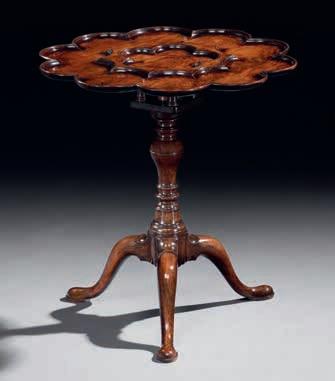
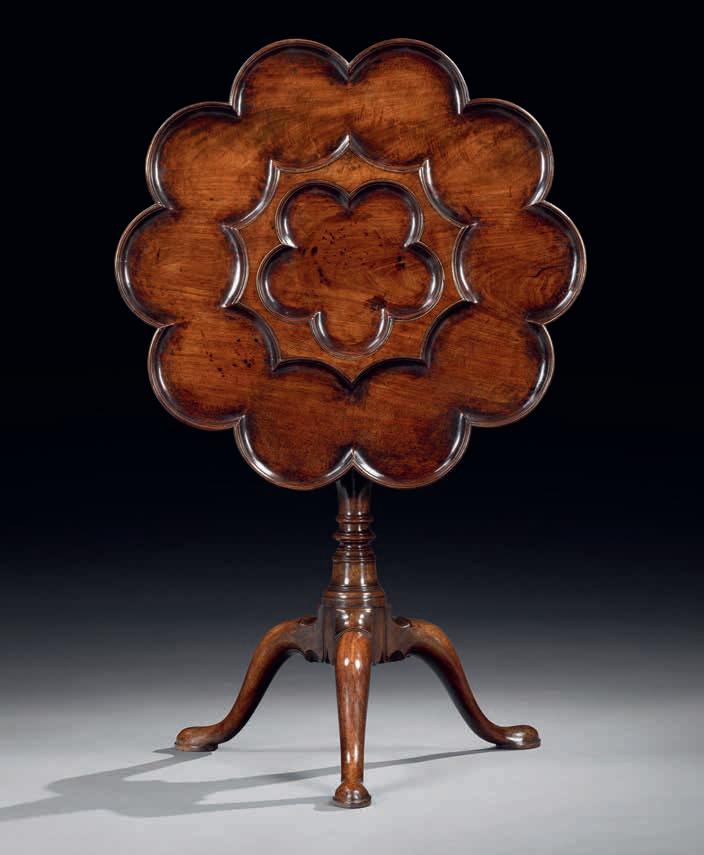
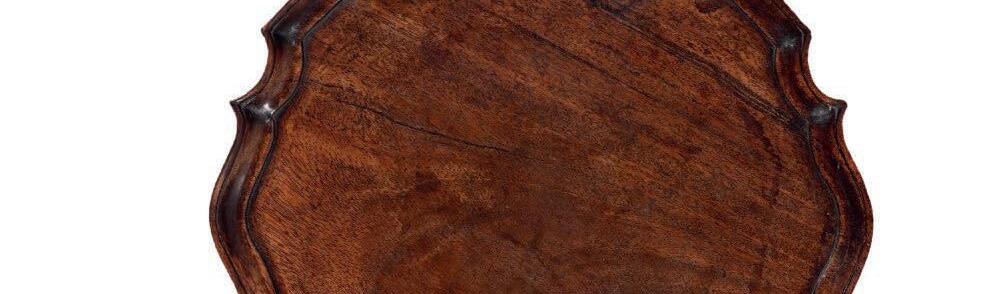
A GEORGE II LOBED BRASS INLAID MAHOGANY TIP-UP
TRIPOD TABLE ATTRIBUTED TO FREDERICK HINTZ
Note: The mahogany has acquired a beautiful patination over the centuries of wax polishing. One pad foot has been restored.
English, circa 1745
Height: 27¼ in; 69 cm
Diameter: 25¾ in; 65.5 cm
Provenance: Private collection, Ireland.
Literature: Christopher Gilbert and Tessa Murdoch, John Channon and Brass-Inlaid Furniture 1730–1760, 1993, pp. 38–40 & 115–20.
Tripod tables with brass-inlaid scalloped tops are rare. They are generally ascribed to a small group of three makers who produced similar tables of this kind over a period of some twenty years from about 1745 up to 1760. John Channon specialised in high quality mahogany, often inlaid with brass, while his brother Otho supplied the carved elements. Abraham Roentgen, originally from Neuwied in Germany, spent some time amongst the Moravian community in England and is thought to have worked with John Channon during his stay. The third maker in the group was Frederick Hintz.
This table’s supporting column, made in the Hintz workshop, does not follow the traditional composition. The bulbous centre has a slightly naive quality and is perhaps less refined than the spiral twist knops on other tables. Arguably, however, this simpler shape complements and enhances the ornate top, which was intended to be the dominant feature.
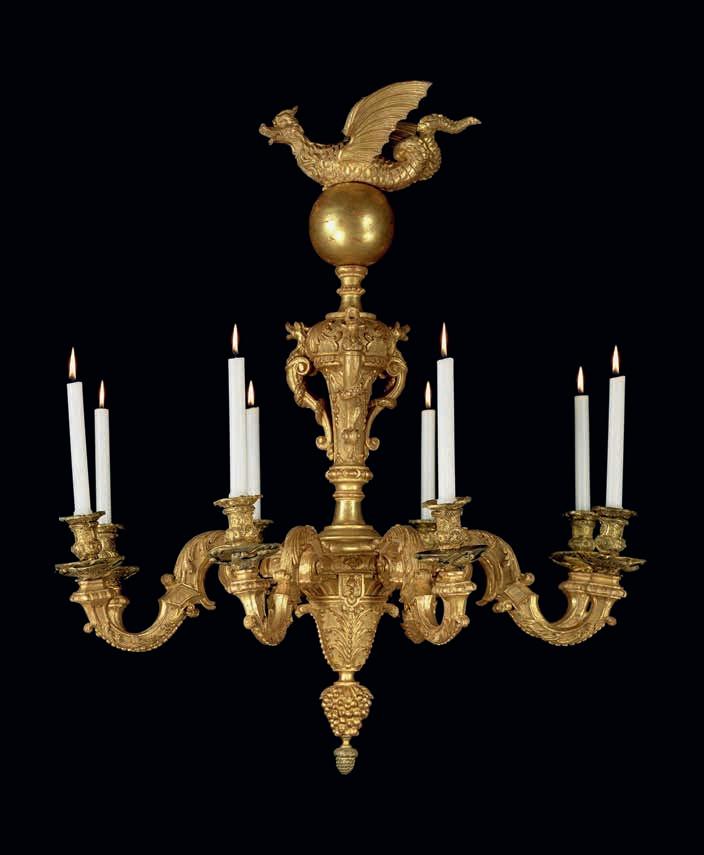
A QUEEN ANNE GILTWOOD AND GILT-METAL CHANDELIER ATTRIBUTED TO THE PELLETIER WORKSHOP
Note: The chandelier was re-gilded around sixty years ago. Some of the arms have been repaired, and two brass nozzles have been replaced.
English, circa 1705
Height: 41 in; 104 cm
Diameter: 36 in; 91.5 cm
Provenance:
Redburn Antiques Ltd. (inv. no. 27A), London, England, until 1 April 1971; ‘The Collection of Doris Duke’, Christie’s, New York, USA, 15 April 2005, lot 145; Ronald Phillips Ltd., London, England; Private collection, London, England; Private collection, USA; Rolleston Ltd., London, England.
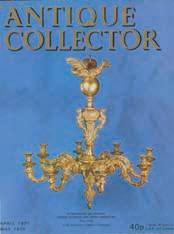
Illustrated: Antique Collector, April/May 1971, cover illustration; advertisement with Redburn Antiques Ltd. Ronald Phillips Ltd., ‘Antique English Furniture’, catalogue, 2006, p. 220.
In the early 1700s, Huguenot craftsmen like the Pelletier family had only recently brought the manufacture of gesso furniture to England. Jean Pelletier had arrived in 1681, followed by his sons Thomas and René the year after. The Pelletiers’ first known commissions were for Ralph Montagu, the Francophile courtier who as Lord Chamberlain was responsible for introducing their work to the court of William III and Mary II, as a result of which they went on to furnish the newly acquired Kensington Palace and an entire new wing at Hampton Court.
Early gesso furnishings and fittings such as this, conceived in the latest fashion and copying the court of Louis XIV and his newly built palace at Versailles, were reserved for the very highest levels of the court and the aristocracy, and above all for the monarch. It was not until other workshops adopted the new carved and gilded gesso technique that gesso furniture became more widely available.
The great delicacy of these expensive and luxurious items, meaning they could be spoiled for ever though careless use, has served only to enhance their appeal and exclusivity over the centuries and up to the present day.
The cover of Antique Collector, April/May 1971
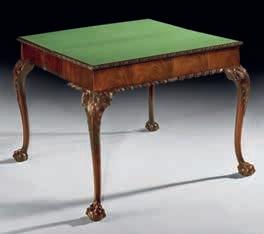
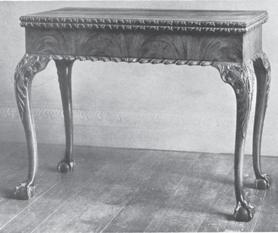
A GEORGE II MAHOGANY CONCERTINA ACTION CARD TABLE
Note: The playing surface is lined with green baize of later date.
English, circa 1755
Height: 28¾ in; 73 cm
Width: 38½ in; 97.5 cm
Depth (open): 38 in; 96.5 cm
Depth (closed): 19 in; 48.5 cm
Provenance:
M. Harris and Sons, London, England; Percival D. Griffiths Collection, Sandridgebury, Kent, England; Hotspur Ltd., London, England; Ronald Phillips Ltd., London, England; Private collection, London, England.
Illustrated:
M. Harris & Sons, ‘A Catalogue and Index of Old Furniture and Works of Decorative Art’, Part II 1730–1780, 1929, p. 278.
R. W. Symonds, English Furniture from Charles II to George II, 1929, p. 196, fig. 157.
Christian Jussel and William DeGregorio, English Furniture, 1680–1760: The Percival D. Griffiths Collection, 2023, vol. I, p. 167, illus. F171.
The table illustrated in English Furniture from Charles II to George II by R. W. Symonds, 1929
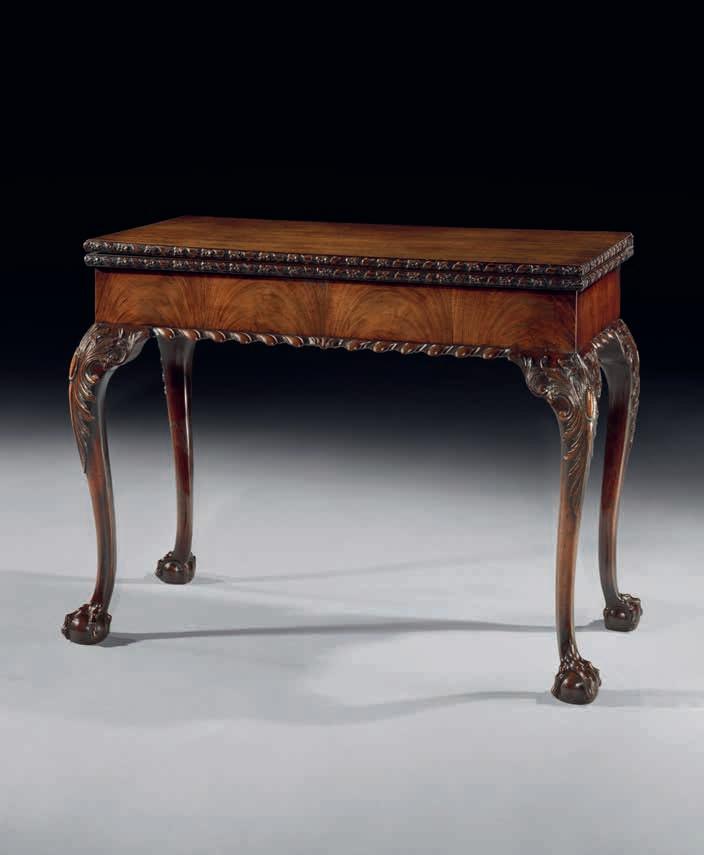
A
MAHOGANY CARD TABLE FROM THE PERCIVAL D. GRIFFITHS COLLECTION
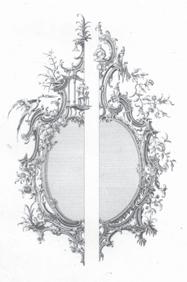
Plate CXLVII of the first edition of Thomas Chippendale’s The Gentleman and Cabinet-maker’s Director, 1754
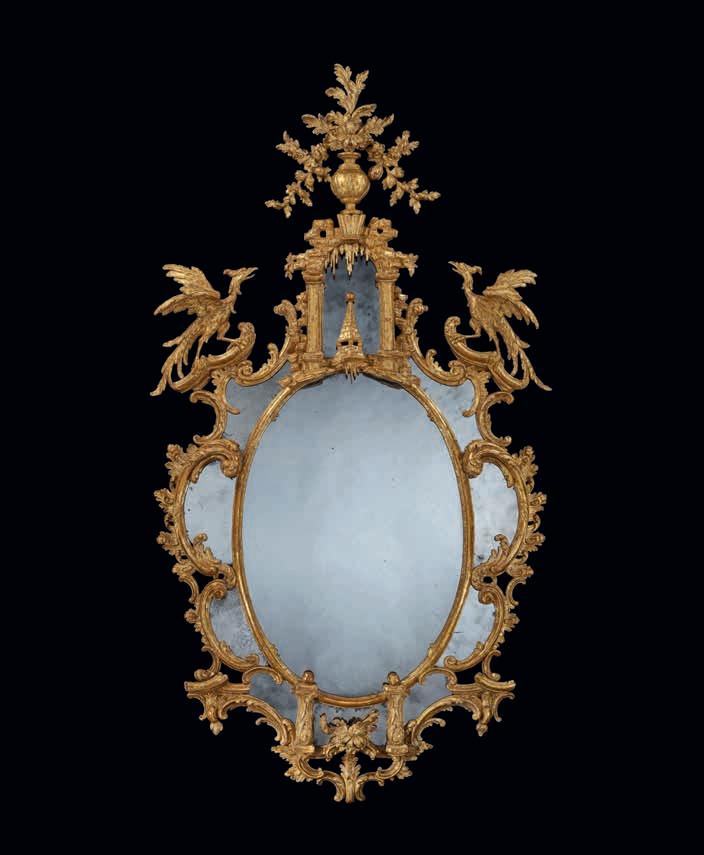
A GEORGE III GILTWOOD OVAL PIER MIRROR IN THE MANNER OF THOMAS CHIPPENDALE
Note: The frame has been re-gilded. The mirror plates are mostly original.
English, circa 1775
Height: 6 ft 11 in; 180.5 cm
Width: 3 ft 2½ in; 98 cm
Depth: 6 in; 15 cm
Provenance: Private collection, England.
Literature: Thomas Chippendale, The Gentleman and Cabinet-maker’s Director, 1754, pl. CXLVII.
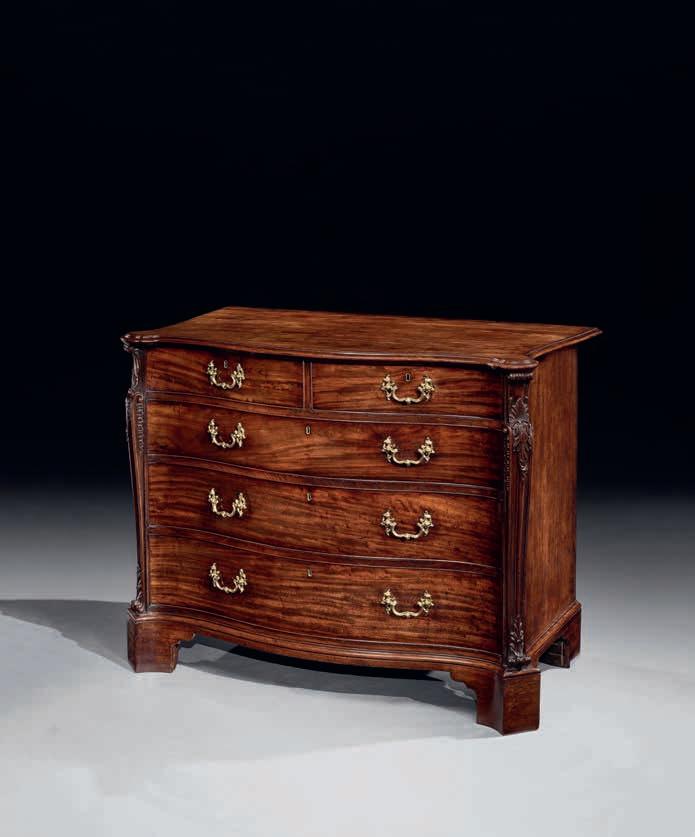
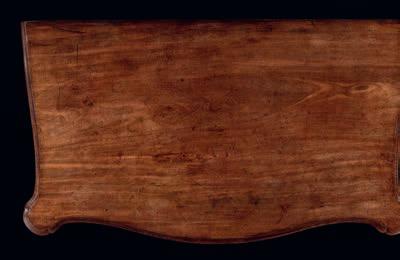
A GEORGE III MAHOGANY SERPENTINE CHEST OF DRAWERS ATTRIBUTED TO WILLIAM VILE
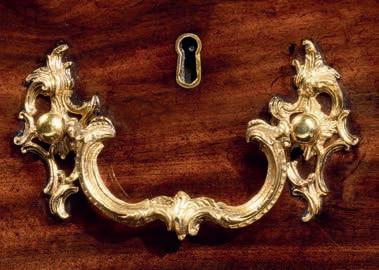
Note: The chest of drawers retains the original rococo handles, and features exceptionally fine and elegant corner trusses typical of the work of the master. The original wax finish has acquired a beautiful patination.
English, circa 1760
Height: 37½ in; 95.5 cm
Width: 47½ in; 120.5 cm
Depth: 26¾ in; 68 cm
Provenance: Private collection, London, England; Private collection, Australia.

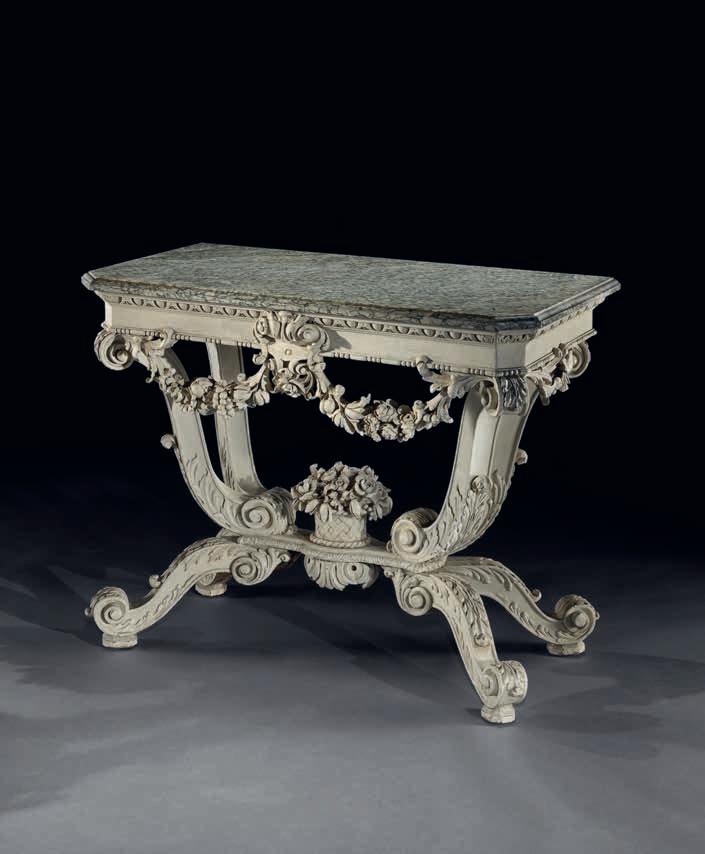
A GEORGE II OFF-WHITE PAINTED SIDE TABLE ATTRIBUTED TO HENRY FLITCROFT
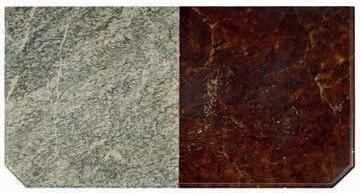
Note: Traces of the original paint were discovered during surface analysis. This decorative scheme has been reinstated. The Campan Antico marble top is original.
English, circa 1740
Height: 34¼ in; 87 cm
Width: 43 in; 109 cm
Depth: 22 in; 56 cm
Provenance: Private collection, USA.
Literature: Christie’s, Review of the Season, 1989, p. 231.
The marble top is a rare and fortunate survivor. The original marble tops of many other tables were replaced when the type of marble or its colour no longer suited a new decorative scheme. Unusually, in this case the original marble was retained and was simply painted over in a darker colour and then marbled.
A related pair of tables, similarly constructed and featuring swags of floral garlands above a basket of fruit and cone finials, were part of the original furnishings of Wentworth Woodhouse, Yorkshire, for the 2nd Marquess of Rockingham. These tables were also painted off-white.
The underlying original marble top (left) during restoration, and the later painted surface (right)
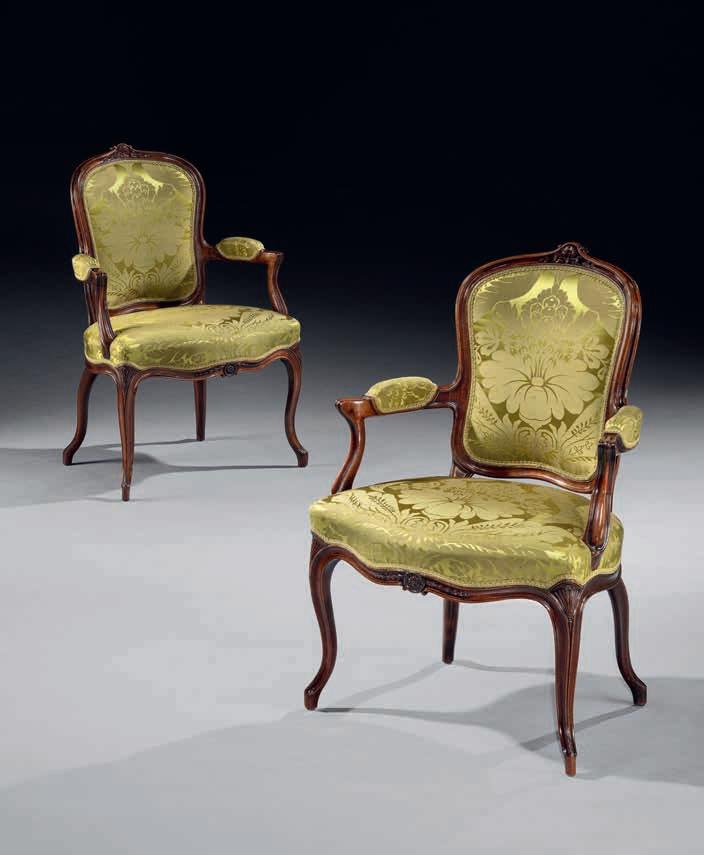
A PAIR OF GEORGE III MAHOGANY ARMCHAIRS ATTRIBUTED TO INCE & MAYHEW
English, circa 1770
Height: 38½ in; 97.5 cm
Height of seat: 17½ in; 44.5 cm
Width: 26¾ in; 68 cm
Depth: 23¾ in; 60.5 cm
Provenance: Ronald Phillips Ltd., London, England; Private collection, London, England.
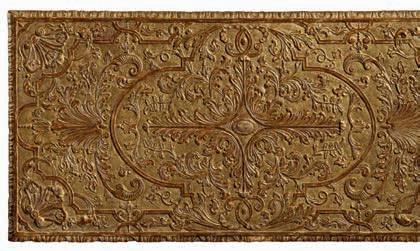
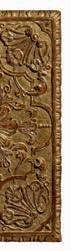
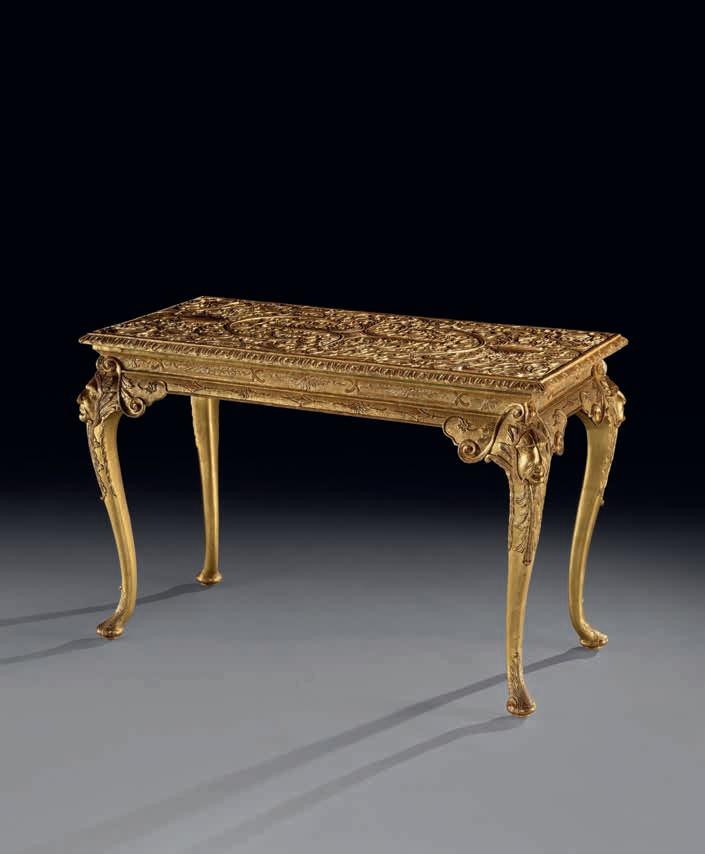
A QUEEN ANNE GILT GESSO CENTRE TABLE
Note: With restorations to the gesso on the top. The table has been re-gilded.
English, circa 1710
Height: 28¾ in; 73 cm
Width: 43 in; 109 cm
Depth: 21 in; 53.5 cm
Provenance: Private collection, USA.
Virtually all tables made in the 18th century were designed as side tables. Centre tables are exceptionally rare. In general, all tables and all the other furniture in rooms were placed against the walls. The centre of the room was usually left vacant.
This table marks a pivotal moment in Queen Anne’s reign. In April 1710 a delegation of four Native American chiefs arrived in London for a seven week official visit and were received by the queen. The entire visit was carefully planned and meticulously orchestrated by the inner circle of the Whig government both to strengthen Britain’s alliance with the Native American tribes and to win public support at home for Queen Anne’s war in North America as part of the War of the Spanish Succession.
The visitors were treated as dignitaries and were driven around London in royal carriages to visit landmarks such as Greenwich Hospital, the
A ‘HEADS OF AMERICA’
TABLE
Tower of London and Woolwich Arsenal, where they were given cannon salutes. They attracted enormous public attention, and a performance of Macbeth at the Theatre Royal at which the four chiefs were guests of honour had to be halted because the audience became so rowdy. It resumed only after the chiefs had left their box to sit on the stage in full public view for the remainder of the play.
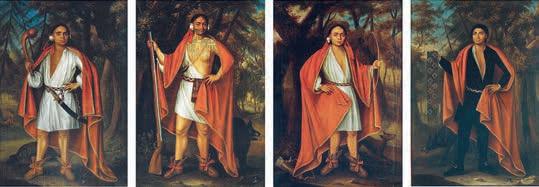
Also known as the ‘four Mohawk kings’, the chiefs’ names were Sa Ga Yeath Qua Pieth Tow (Peter Brant), Ho Nee Yeath Taw No Row (John of Canajoharie), Etow Oh Koam (Nicholas), and Tee Yee Ho Ga Row (Hendrick Tejonihokarawa).
The queen commissioned official portraits of the four visitors, poems were written about them and for a short time furniture was adorned with ‘the Heads of America’. The distinctly different faces on each corner of this table are modelled after the portraits of the four chiefs.
It is unlikely that many such pieces were made, and of those very few have survived. Examples like this table are therefore extremely rare. Of those, two can be traced back to their original owners, both members of the inner circle of the Whig government, known as the Junto: William Cavendish, 3rd Duke of Devonshire, who was Lieutenant General for Ireland, and James Brydges, 1st Duke of Chandos, Paymaster General during Queen Anne’s reign. A gesso table with four Indian mask knees is today in the collection of the Dukes of Devonshire, and a suite of seat furniture now at Houghton Hall, Norfolk, was originally commissioned for James Brydges for Canons, Middlesex. By the summer of 1710, however, the Queen had tired of the Whigs’ policies. She gradually replaced them with Tories who pushed for the end of the war, culminating in the Treaty of Utrecht in 1713.
Portraits of (left to right) Etow Oh Koam, Sa Ga Yeath Qua Pieth Tow, Ho Nee Yeath Taw No Row and Tee Yee Ho Ga Row by John Verelst (circa 1675–1734), oil on canvas, 1710. National Archives of Canada
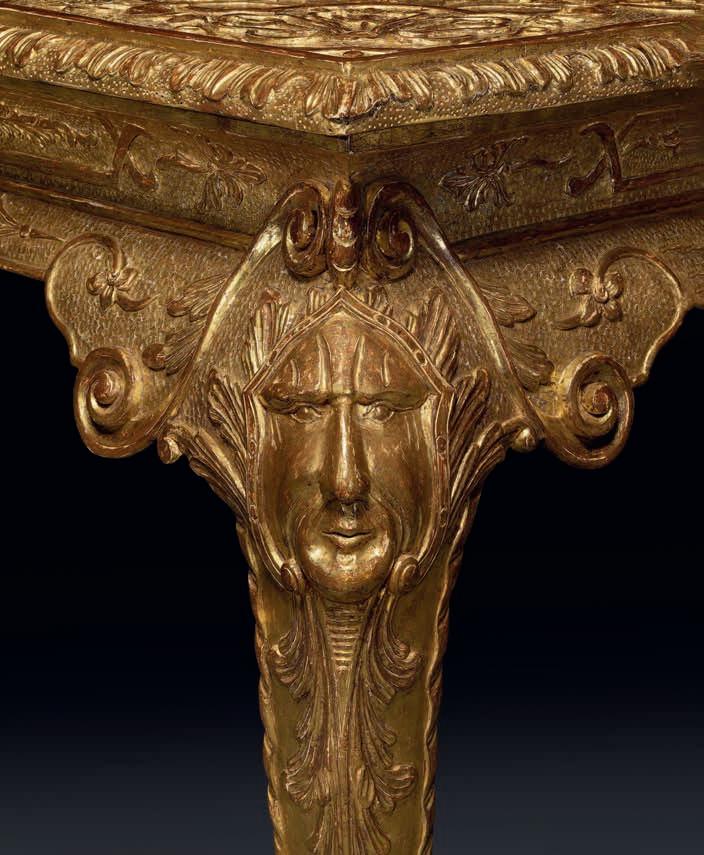
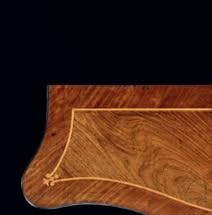
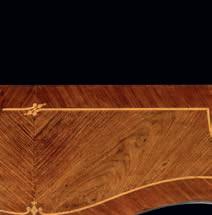

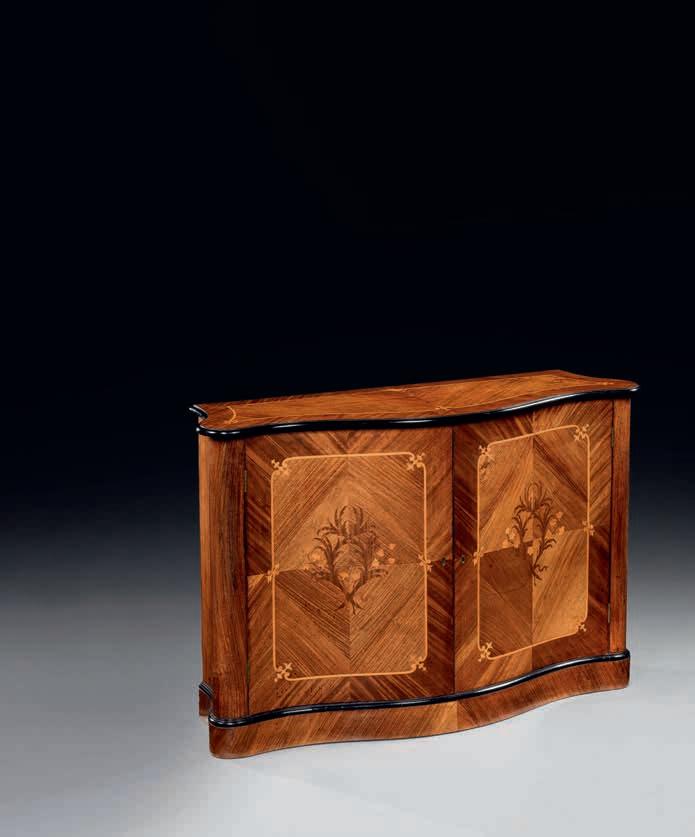
A PAIR OF GEORGE III ROSEWOOD AND PADOUK SIDE CABINETS ATTRIBUTED TO INCE & MAYHEW
Note: Printed and pasted paper labels by ‘Jolly & Son Ltd.’ and inscribed ‘Salmond No. 236’ can be found on the back of both cabinets.
The cabinets have survived in excellent condition, and the timbers have acquired a wonderful mellow colour.
English, circa 1780
Height: 32¼ in; 82 cm
Width: 48 in; 122 cm
Depth: 16½ in; 42 cm
Provenance: Private collection, England.
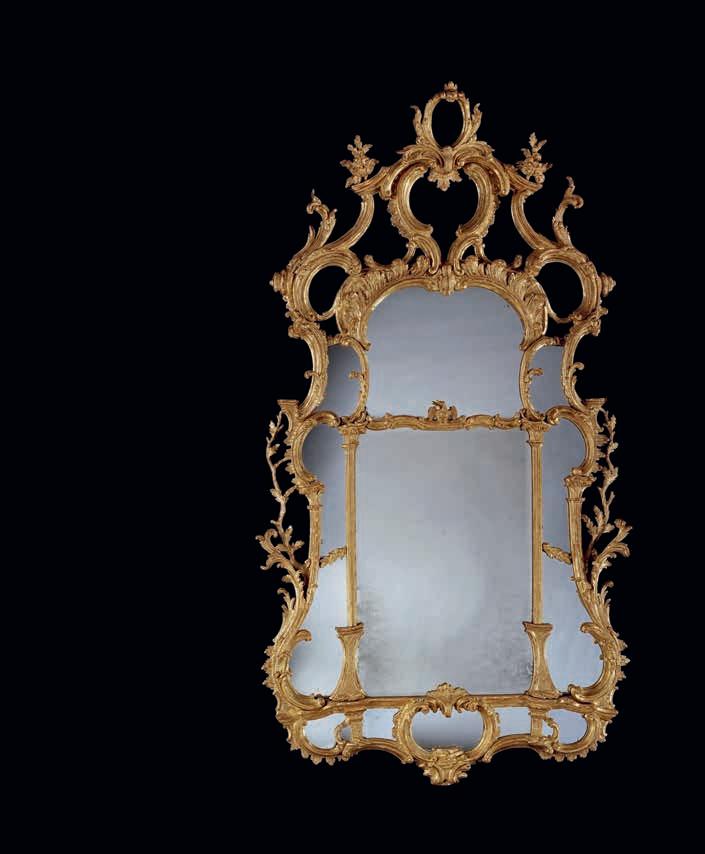
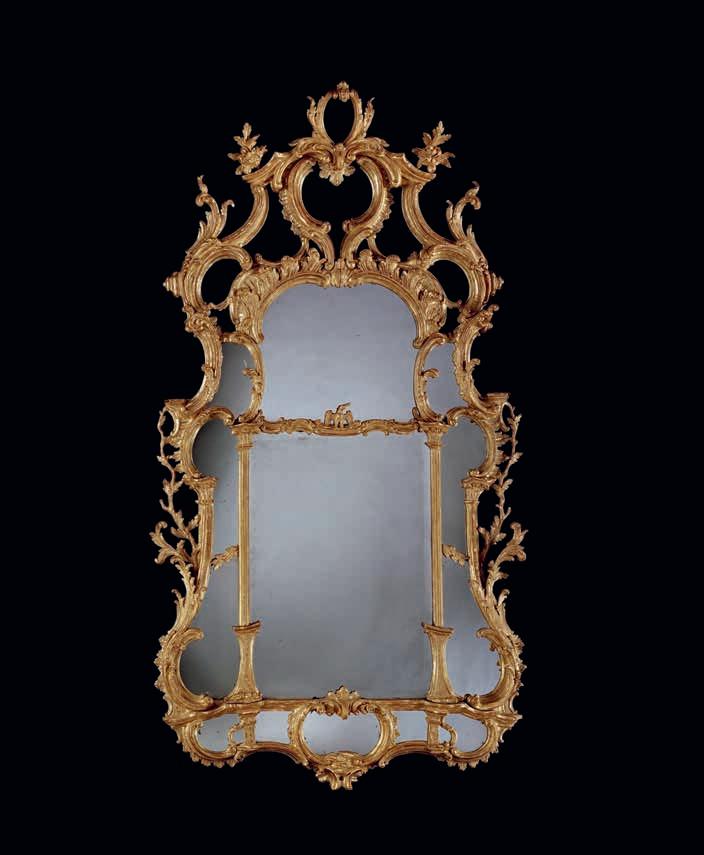
A PAIR OF GEORGE III GILTWOOD MIRRORS ATTRIBUTED TO JOHN LINNELL
Note: The frames have been re-gilded. The frames retain virtually all their original mirror plates. Only a few border glasses are 18th century mercury silvered glass replacements. English, circa 1765
Height: 6 ft 10½ in; 209.5 cm
Width: 3 ft 8½ in; 113 cm
Provenance: Private collection, New Orleans, USA.
Illustrated: Ronald Phillips Ltd., ‘Mirrors’, catalogue, 2010, pp. 156–9.
Literature:
R. A. Woods, English Furniture in the Bank of England, 1972, illus. 62. Helena Hayward and Pat Kirkham, William and John Linnell, Eighteenth Century London Furniture Makers, 1980, vol. II, p. 98, pl. 187. D. Coombs, ‘Queen Elizabeth’s Collection’, Antique Collector, August 1990, p. 34.
The mirrors have the charming and unusual feature of a carved bird in the centre of the dividing fillet of the glass plates. Similar mirrors, probably from the same workshop, were formerly in the collection of the late Queen Elizabeth, The Queen Mother. A single mirror in the collection of the Bank of England features a virtually identical bird on the dividing fillet, and this mirror is also attributable to the Linnell workshop.
A closely related drawing by John Linnell for our mirror is in the collection of the Victoria and Albert Museum in London.
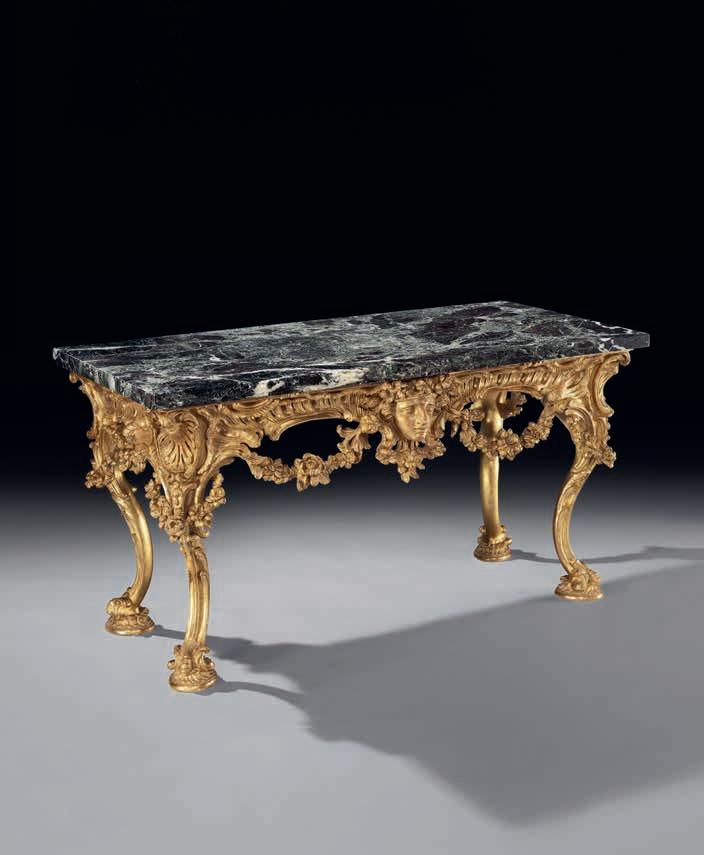
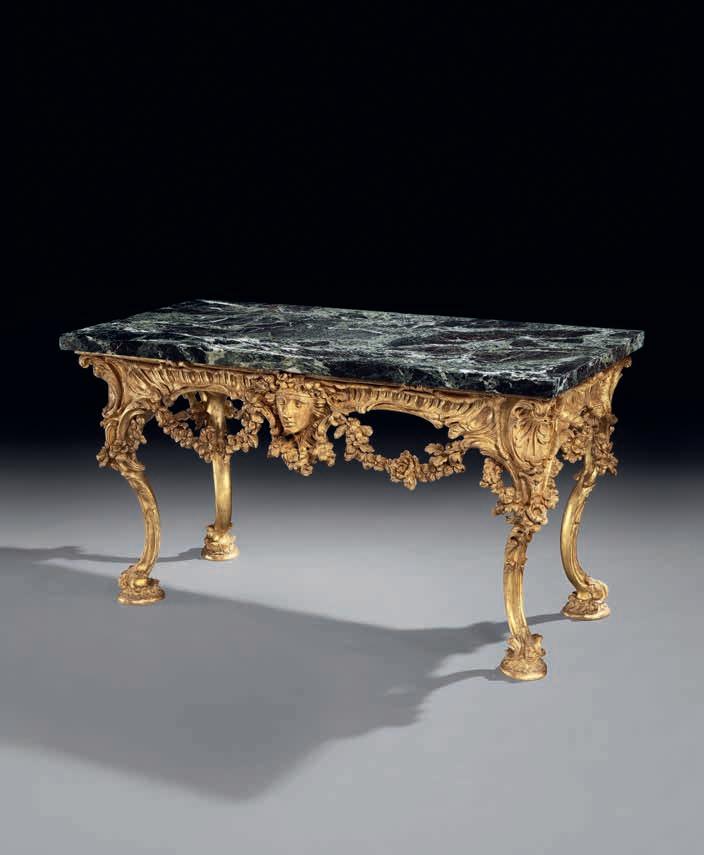
THE WARDOUR CASTLE TABLES
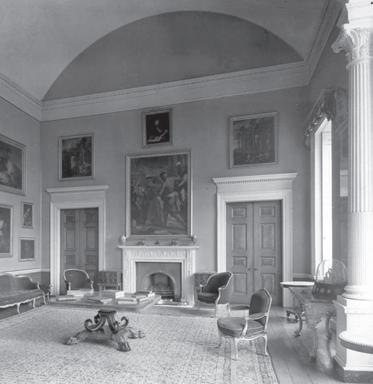
One of the pair in situ at Wardour Castle, Wiltshire, in an early photograph taken by Country Life
A PAIR OF GEORGE III GILTWOOD SIDE TABLES
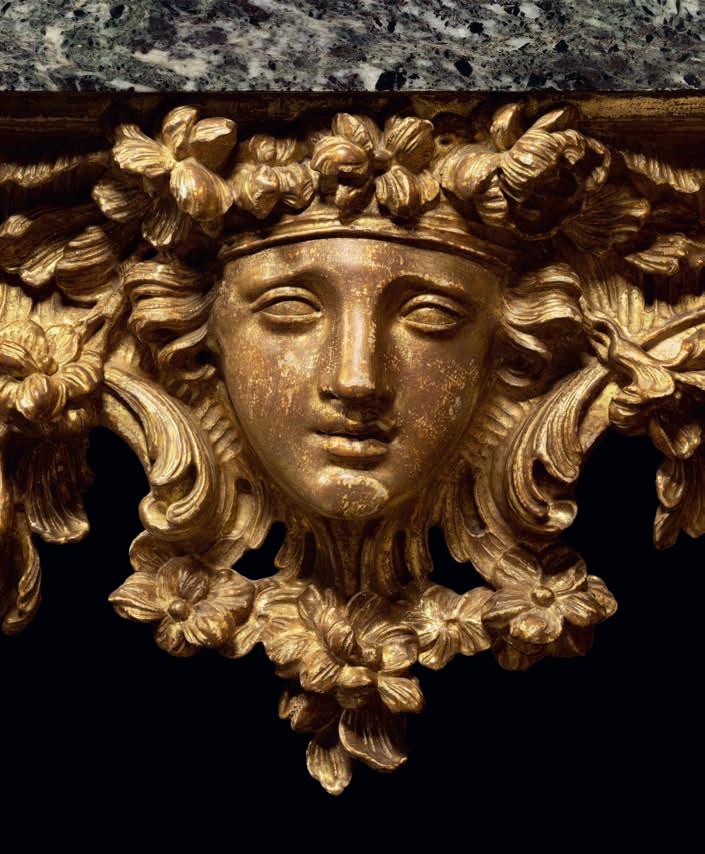
Note: The Rosso Levanto marble tops are possibly original. The tables were re-gilded about ten years ago, and the pendent floral swags include some restorations.
English, circa 1765
Height: 2 ft 8 in; 81.5 cm
Width: 5 ft 1 in; 155 cm
Depth: 2 ft 4½ in; 72.5 cm
Provenance: Henry Arundel, 8th Lord Arundel of Wardour Castle, Wiltshire, England; by descent until September 1952; J. M. Botibol Ltd., London, England; Mrs. Brimsley-Plunket, Luttrellstown Castle, Dublin, Ireland; by descent until September 1983; Private collection, California, USA, until October 2013; Private collection, USA.
Photographed:
Country Life, prior to 1952; one of the pair in situ at Wardour Castle, located in the saloon.
Literature:
Inventory of the Wardour Heirlooms, 1907, The Saloon: ‘Pair 63 inch Green marble top Tables on carved frames and supports painted white’ (Wiltshire & Swindon Archives, ms. 2667/8/8).
‘Priced List of Heirlooms at Wardour Castle Wiltshire the Property of the Trustees of the Wardour Estate’, Rawlence & Squarey, Salisbury, 30 September 1908, p. 8, The Saloon: ‘Pair 63 inch Green marble top Tables on carved frames and supports painted white’ (Wiltshire & Swindon Archives, ms. 2667/22/2/10).
‘Wardour Castle Inventory & Effects contained in Wing let to Mr. Turck’, Rawlence & Squarey, Salisbury, 19 July 1936, p. 25, The Saloon: ‘The pair of carved white wood side tables, female mask centres and floral wreathed cabriole supports Marble tops, 5’ 4’’ long. Carvings chipped’, (Wiltshire & Swindon Archives, ms. 2667/22/2/10).
19
A PAIR OF GEORGE II GILTWOOD TERMS DESIGNED BY WILLIAM KENT AND ATTRIBUTED TO BENJAMIN GOODISON
English, circa 1730
Height: 59¾ in; 152 cm
Width: 14¾ in; 37.5 cm
Depth: 14¾ in; 37.5 cm
20
THE HAREWOOD HOUSE LACQUER CABINET
A GEORGE III CHINESE BLACK LACQUER AND JAPANNED SIDE CABINET BY THOMAS CHIPPENDALE
English, circa 1770
Height: 37½ in; 95 cm
Width: 46 in; 117 cm
Depth: 20 in; 51 cm
21
A GEORGE II GILTWOOD OVAL MIRROR ATTRIBUTED TO JOHN LINNELL
English, circa 1760
Height: 44 in; 112 cm
Width: 28 in; 71 cm
Depth: 7½ in; 19 cm
22
A PAIR OF QUEEN ANNE VERRE EGLOMISE WALL LIGHTS ATTRIBUTED TO PHILIP ARBUTHNOT
Note: One cresting and one apron glass cracked. Candle arms of later date.
English, circa 1705
Height: 30¾ in; 78.5 cm
Width: 9½ in; 24.5 cm
Depth: 9 in; 23 cm
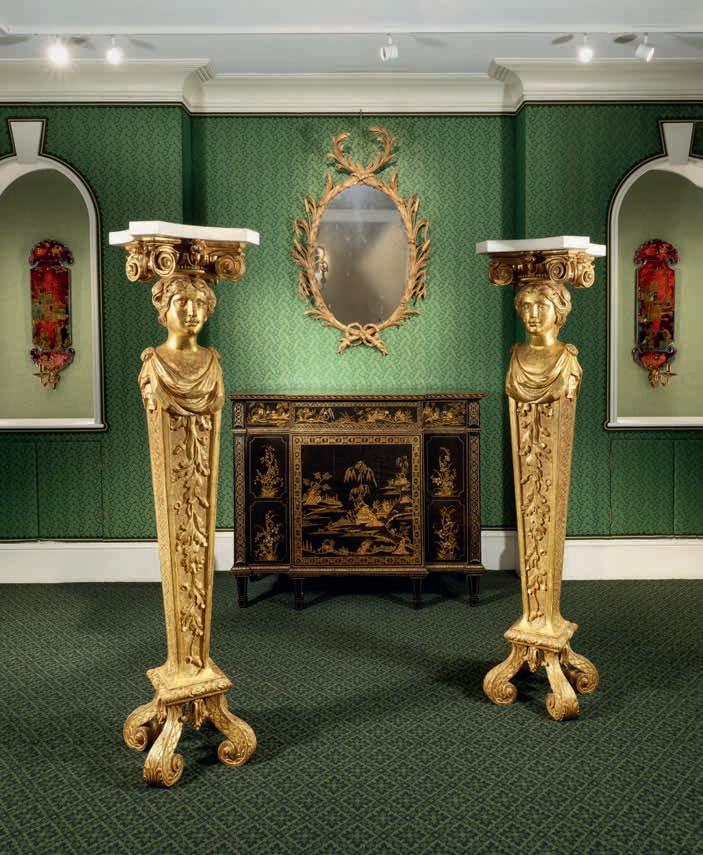
Assembly drawing of a Parker & Perry chandelier. © Victoria and Albert Museum, London
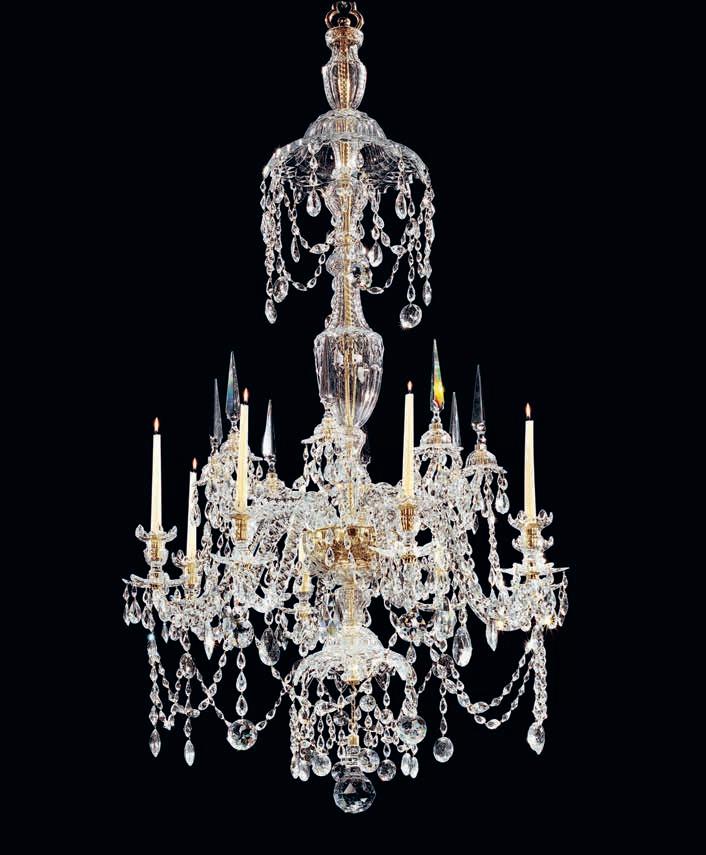
A GEORGE III EIGHT LIGHT CUT GLASS CHANDELIER ATTRIBUTED TO PARKER & PERRY
English, circa 1780
Height: 5 ft 2 in; 157.5 cm
Diameter: 2 ft 10 in; 86.5 cm
Provenance: Ronald Phillips Ltd., London, England; Private collection, London, England.
Illustrated: Ronald Phillips Ltd., ‘Antique English Furniture’, catalogue, 2010, pp. 20–21.
Literature: Martin Mortimer, The English Glass Chandelier, 2000, p. 17; a chandelier of very similar design: p. 151, pl. 90; a drawing for a Parker chandelier.
An assembly drawing from Parker & Perry for this chandelier model is preserved in the Victoria and Albert Museum, London.
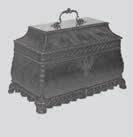
The tea caddy with H. J. Joel, Christie’s, 15 May 1978
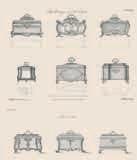
Plate CLIX of the third edition of Thomas Chippendale’s The Gentleman and Cabinet-Maker’s Director, 1762
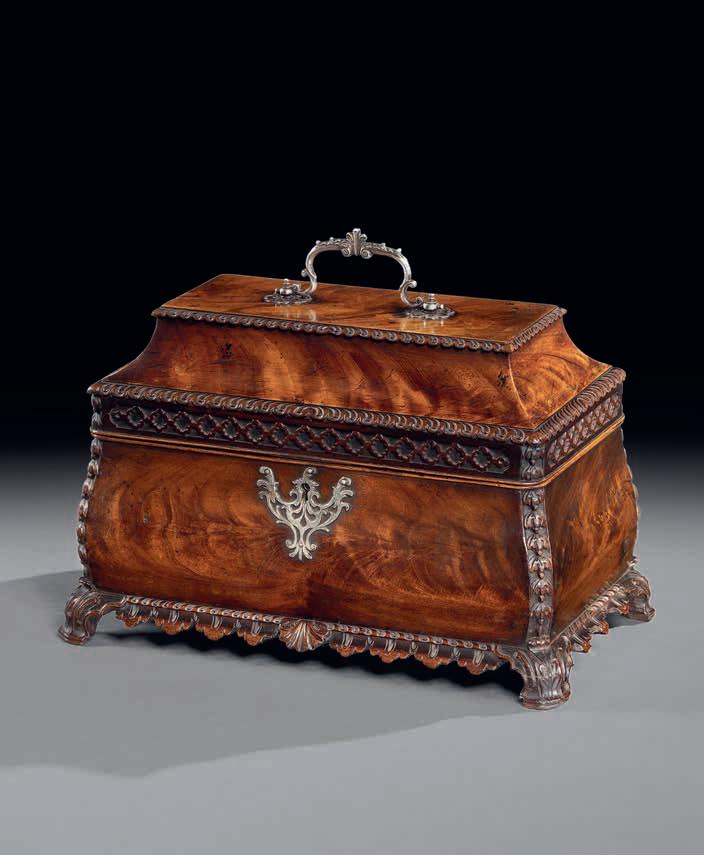
A GEORGE II SILVER MOUNTED MAHOGANY TEA CADDY
Note: The caddy retains the original silver mounts and the original velvet lined lid interior finished with fine silver braid. It would originally have contained tea canisters made of either wood or silver; the interior is now fitted with a removable cedarwood tray of later date.
English, circa 1755
Height (handle up): 9½ in; 24 cm
Width: 12¼ in; 31 cm
Depth: 7 in; 18 cm
Provenance:
H. J. Joel, Childwick Bury, St. Albans, Hertfordshire, England; Private collection, Channel Islands.
Illustrated:
Christie’s, ‘Childwick Bury, St. Albans, Hertfordshire’, sale catalogue, Part 1, 15 May 1978, p. 50, lot 60.
Christie’s, Review of the Season, 1978, p. 274.
Literature:
Thomas Chippendale, The Gentleman and Cabinet-maker’s Director, 1754, pl. CXXIX. Thomas Chippendale, The Gentleman and Cabinet-maker’s Director, 3rd edn, 1762, pl. CLIX. Gillian Walkling, Tea Caddies, An Illustrated History, 1985, figs 34–5.
The design of this tea caddy derives from plate CXXIX of Chippendale’s first edition of The Gentleman and Cabinet-Maker’s Director and plate CLIX of the third edition.
A very similar tea caddy, most probably by the same hand, is in the collection of the Victoria and Albert Museum in London.
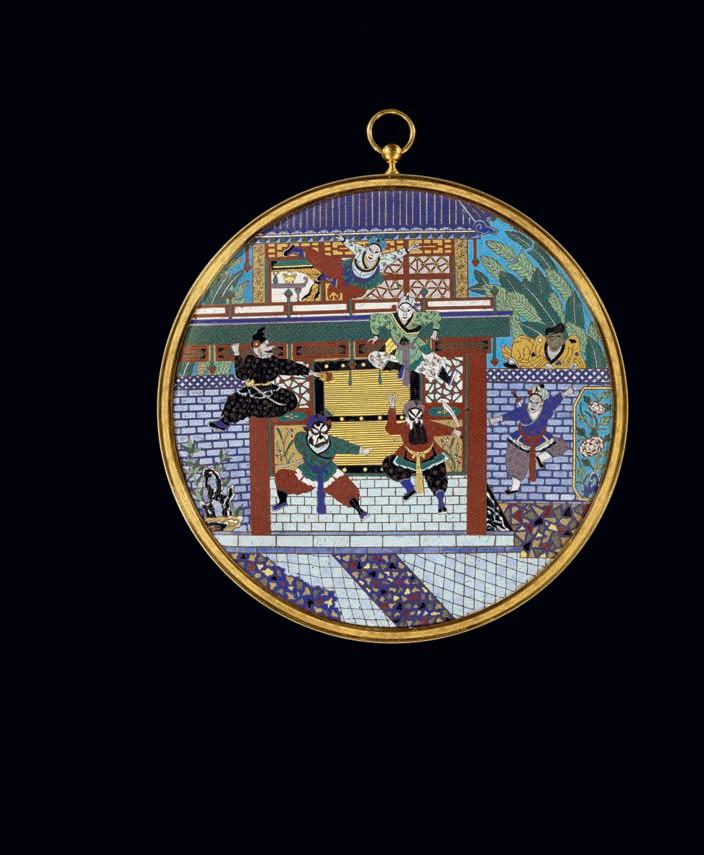
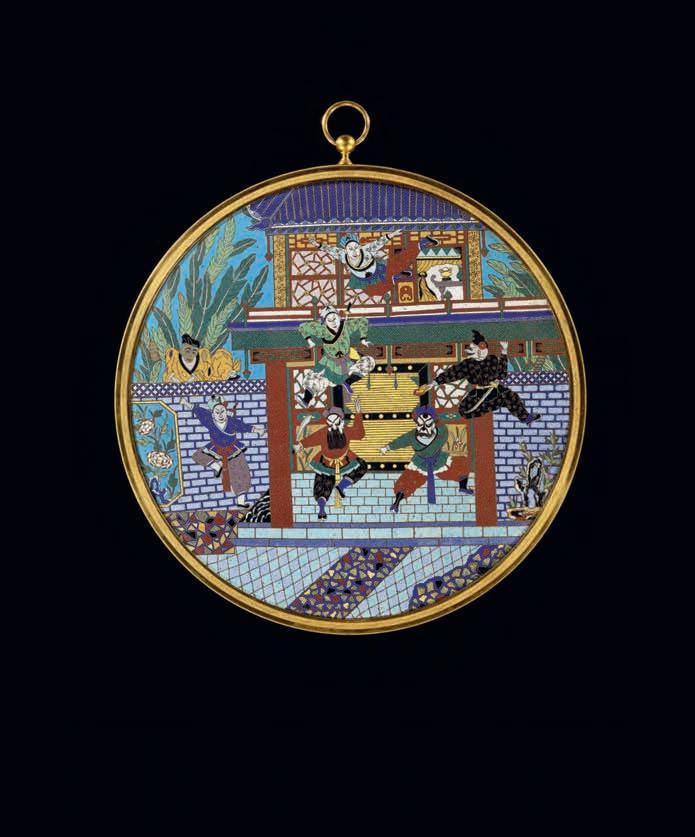
A PAIR OF QING DYNASTY CIRCULAR CLOISONNE ENAMEL PANELS DEPICTING A DRAMATIC SCENE OF MARTIAL CONFLICT
The panels: Chinese, Qianlong period, 1736–1795
The ormolu frames: French, circa 1800
Height: 29 in; 73.5 cm
Diameter: 25½ in; 65 cm
The design is probably inspired by a Peking Opera performance based on the Ming dynasty novel The Three Heroes and Five Gallants, particularly the celebrated episode of the ‘Five Rats Causing Havoc in Kaifeng’. The Peking Opera was started and became very popular during the Qianlong period.
The impressive size of these panels makes them rare articles.
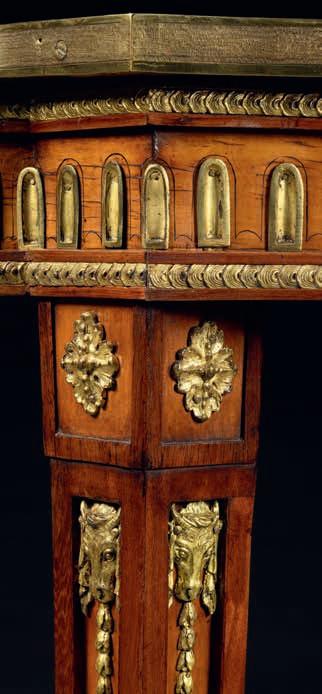
A CATHERINE THE GREAT ORMOLU MOUNTED ROSEWOOD MARQUETRY
SERPENTINE SIDE TABLE
ATTRIBUTED TO CHRISTIAN MEYER
Note: Small losses of ormolu section have been replaced by later castings. A printed linen label is pasted to the reverse of the table: ‘CAPT MICHAIL/W ART ELL OR. MRS 225/APL 5 1922’.
Russian, circa 1795
Height: 34 in; 86.5 cm
Width: 59¼ in; 150.5 cm
Depth: 20 in; 50.5 cm
Provenance: Perhaps Mikhailovsky Palace, St. Petersburg, Russia;
Private collection, England.
This unusual side table fits in with the oeuvre of Christian Meyer of St. Petersburg. Following the influence of David Roentgen in Russia under the Empress Catherine the Great, Meyer became the main supplier of furnishings to the imperial court.
Meyer is recognised for the exceptional quality of his ormolu mounts, and the distinctive castings on this table can be found on other pieces ascribed to his workshop.
The choice of plain yet sophisticated exotic veneers is also typical of his work.
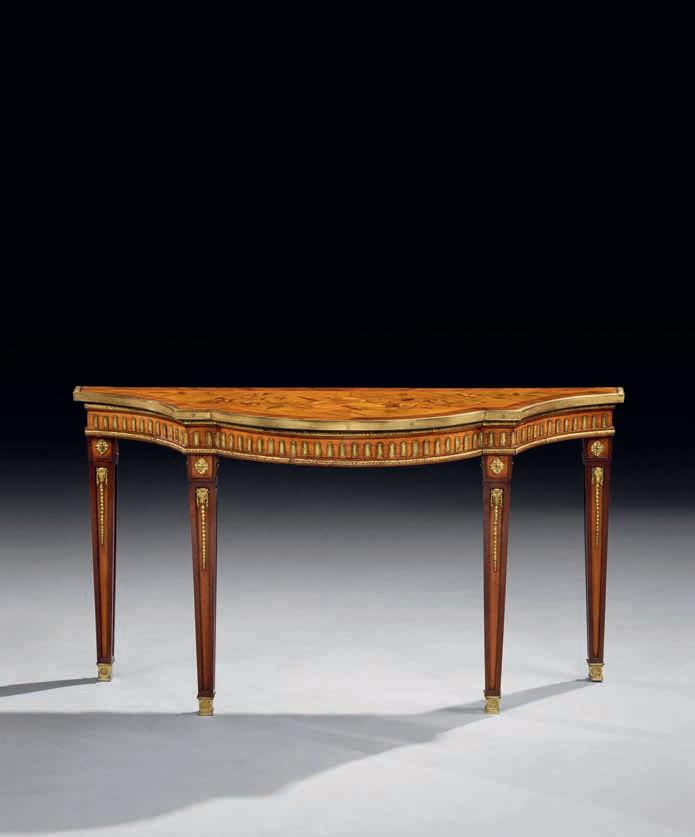
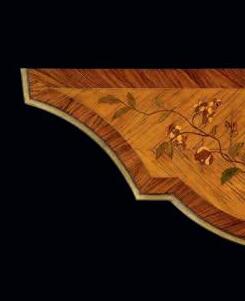
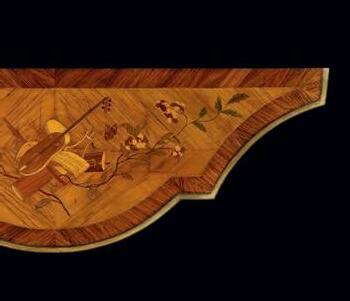
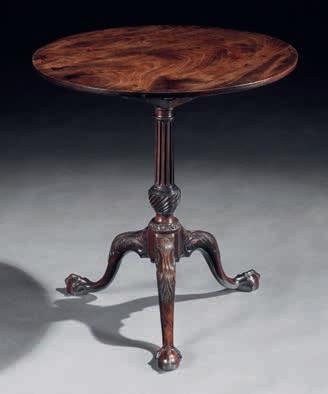
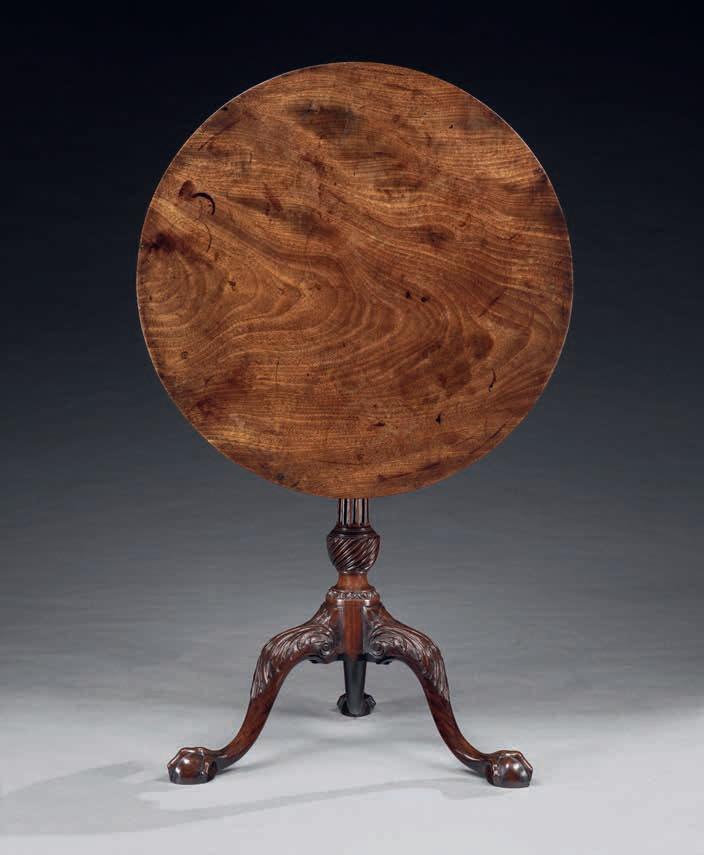
A GEORGE II MAHOGANY TRIPOD TABLE WITH BIRDCAGE ACTION
Note: This table has survived in the most remarkable untouched condition. There are no breaks and no repairs, and the birdcage action retains its original wedge.
English, circa 1755
Height: 27½ in; 70 cm
Diameter: 25½ in; 64.5 cm
Provenance: Ronald Phillips Ltd., London, England; Private collection, New York, USA.
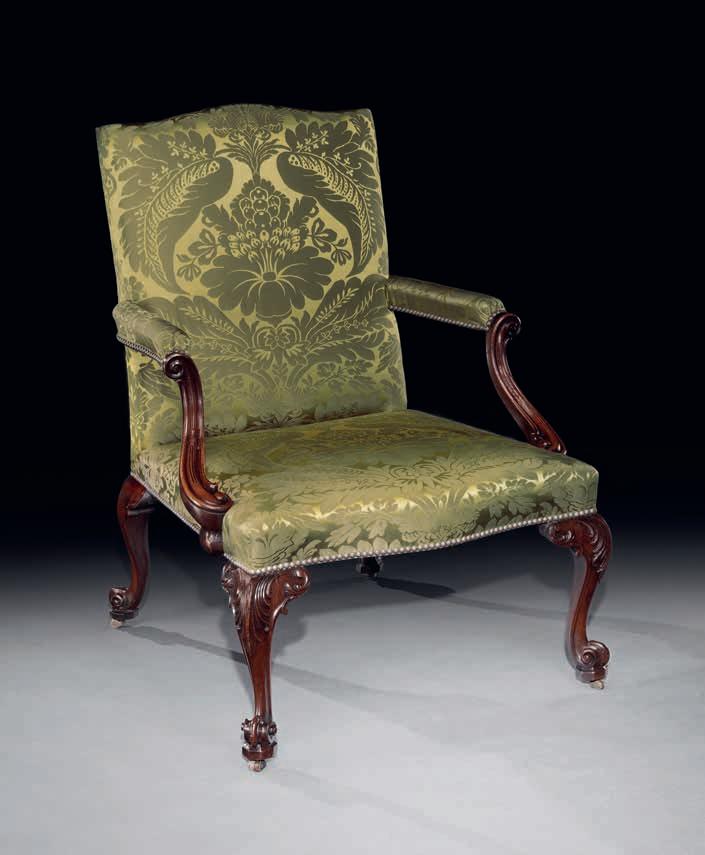
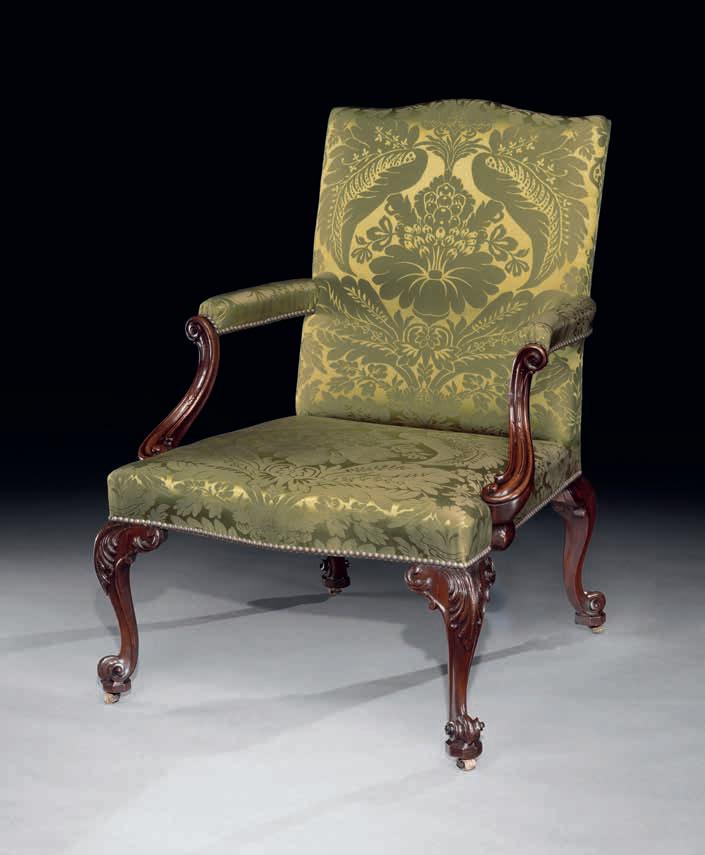
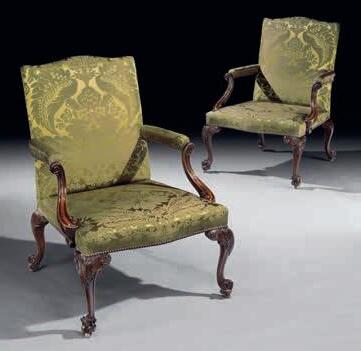
A PAIR OF GEORGE III MAHOGANY LIBRARY ARMCHAIRS IN THE MANNER OF THOMAS CHIPPENDALE AND ATTRIBUTED TO WRIGHT & ELWICK
English, circa 1760
Height: 41¾ in; 106 cm
Height of seat: 17½ in; 44.5 cm
Width: 31¼ in; 79 cm
Depth: 34 in; 86.5 cm
Provenance: Private collection, England.
The design of these chairs derives from plate XIX of Chippendale’s third edition of The Gentleman and Cabinet-maker’s Director, published in 1762. The strong outswept arms suggest the firm of Wright & Elwick as the maker. Wright & Elwick supplied a similar suite of chairs to the Earl of Swinton for Swinton House in Yorkshire and the Duke of Rockingham for Wentworth Woodhouse, also in Yorkshire.
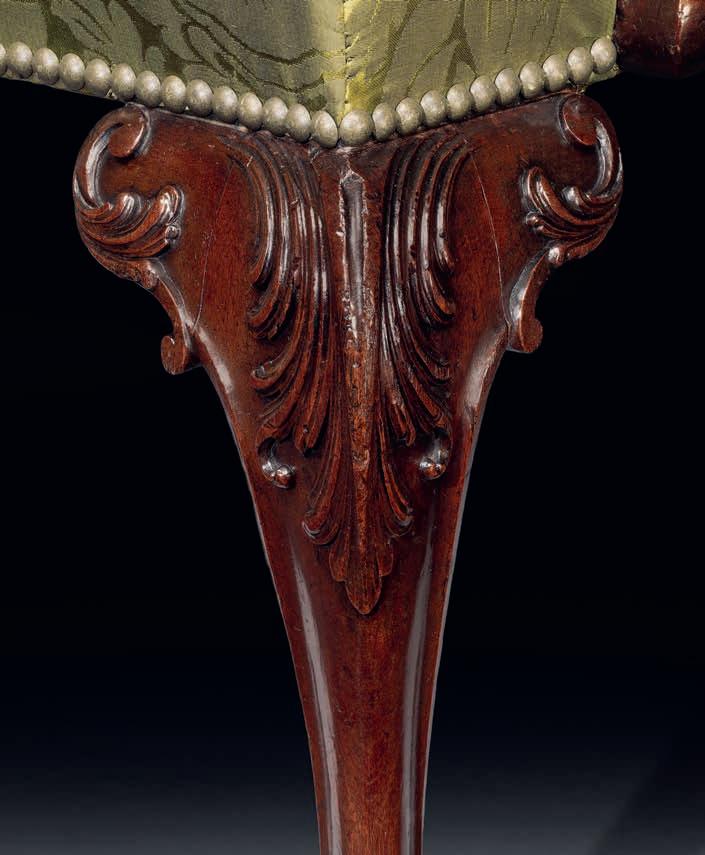
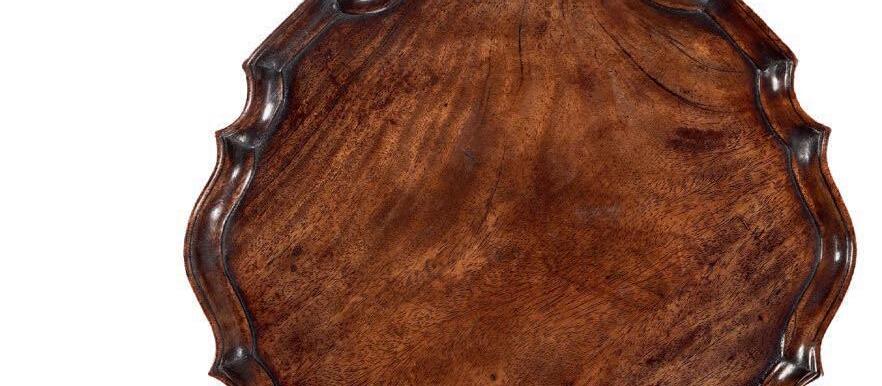



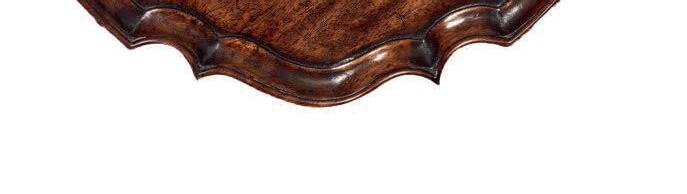





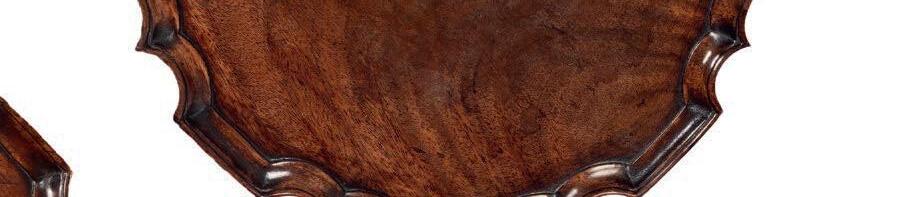
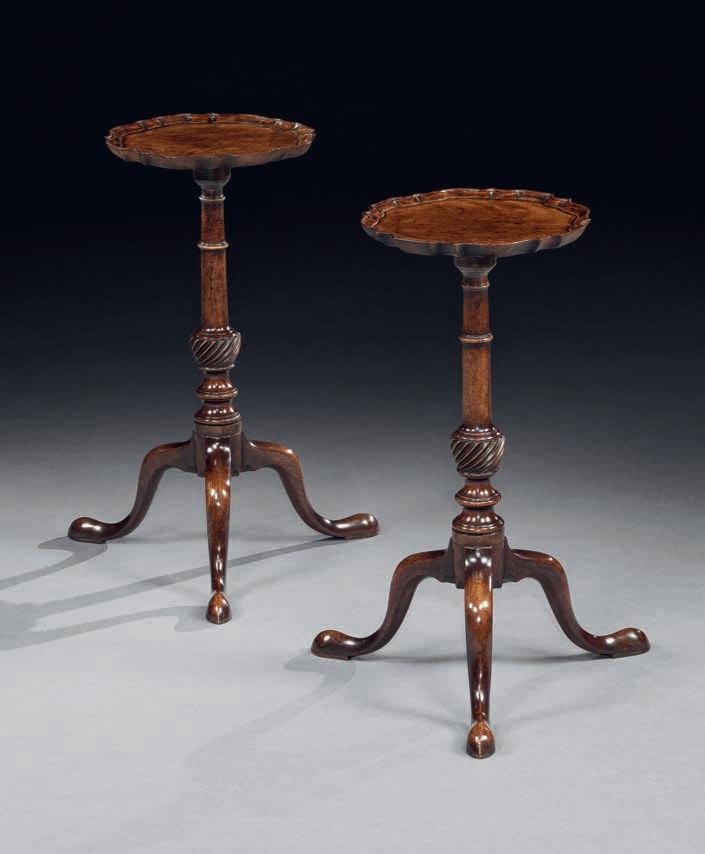
A PAIR OF GEORGE III MAHOGANY KETTLE STANDS
English, circa 1770
Height: 24¼ in; 61.5 cm
Diameter of tops: 11½ in; 29 cm
Provenance: Private collection, England.
Surviving pairs of kettle stands are exceptionally rare, with fewer than a handful known to exist.



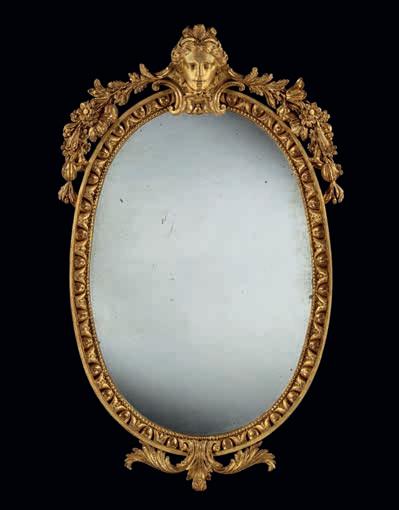
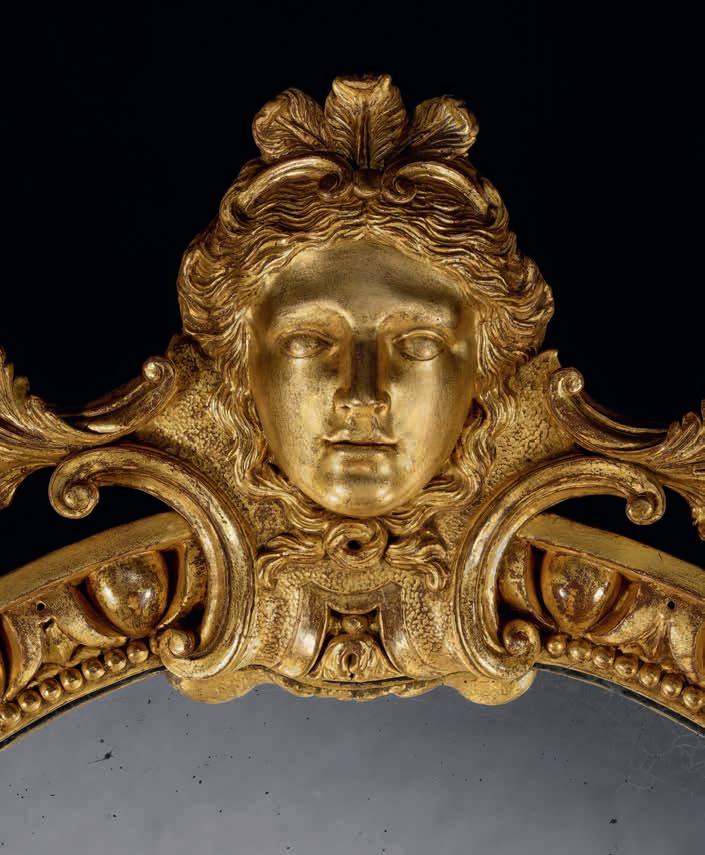
Note: The mirror has been re-gilded, and the mirror plate is a 19th century replacement.
English, circa 1730
Height: 52½ in; 133.5 cm
Width: 32½ in; 82.5 cm
Depth: 7 in; 17.5 cm
A GEORGE II GILTWOOD OVAL MIRROR IN THE MANNER OF WILLIAM KENT
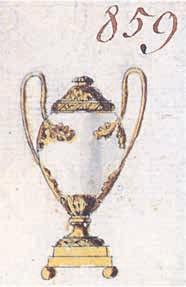
Design drawing by Matthew Boulton, Pattern Books I and II, n.d.
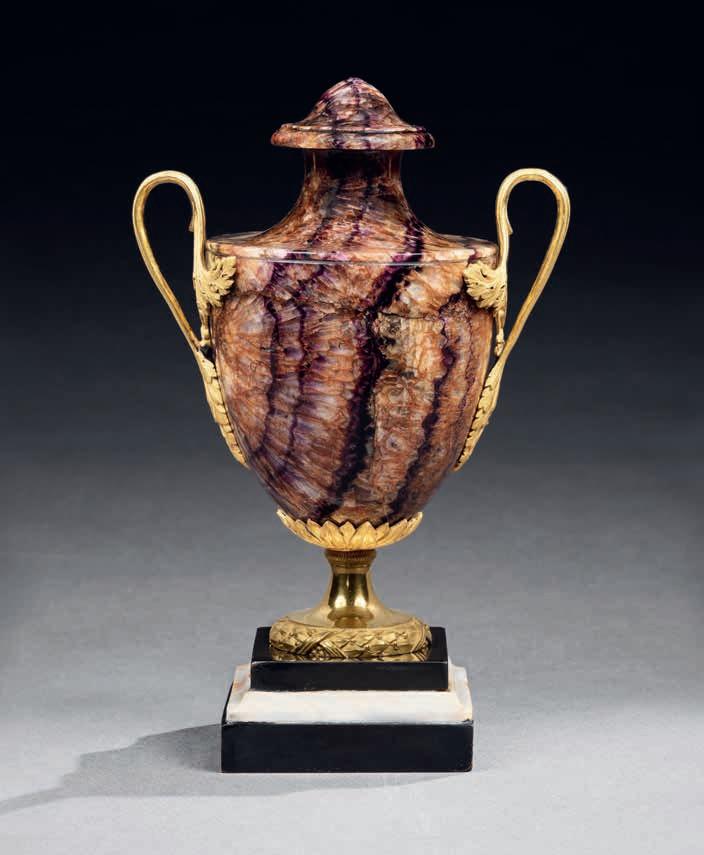
A GEORGE III ORMOLU MOUNTED BLUE JOHN VASE BY MATTHEW BOULTON
Note: The vase retains all the original mounts. The ball finial to the lid is missing.
English, circa 1775
Height: 7¾ in; 20 cm
Width (across the handles): 5 in; 13 cm
Diameter of blue john: 3¼ in; 8.5 cm
Provenance: Benjamin F. Edwards III, St. Louis, Missouri, USA; Private collection, USA.
Literature: Matthew Boulton, Matthew BoultonPattern Books I and II, n.d., p. 170, no. 859.
Nicholas Goodison, Matthew Boulton:Ormolu, 2002, p. 304, fig. 275; design drawing.
The firm attribution to Matthew Boulton is based on the mounts, which are identical to a design by the company for a candle vase. In this instance the candle part and the ormolu stepped base have not been used. The solid blue john body has no other function and is purely decorative. The quality of the mounts, however, leaves no doubt about their maker, and the solid body makes this a very rare piece by Boulton & Fothergill’s Soho factory in Birmingham.
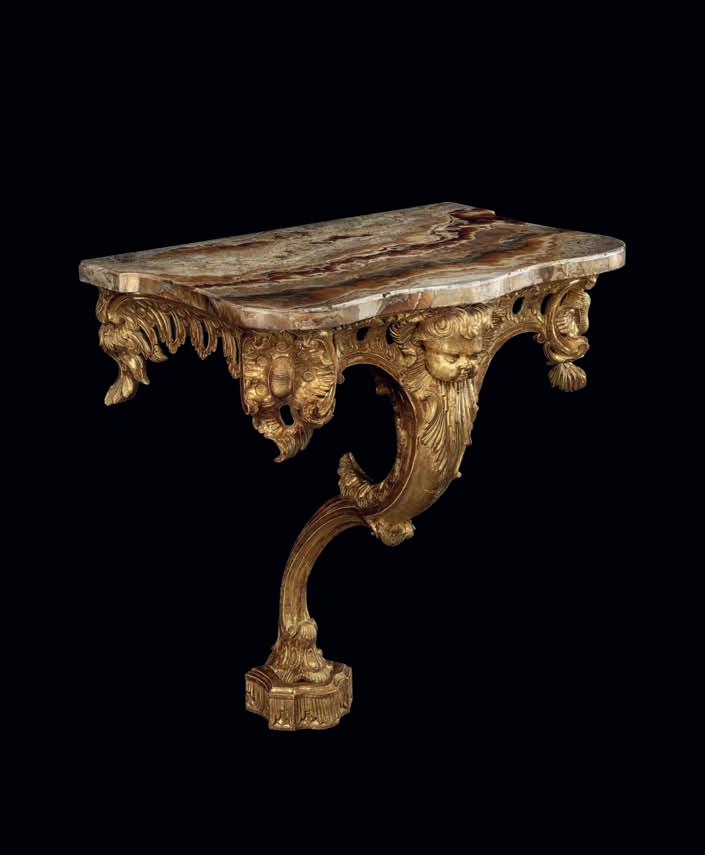
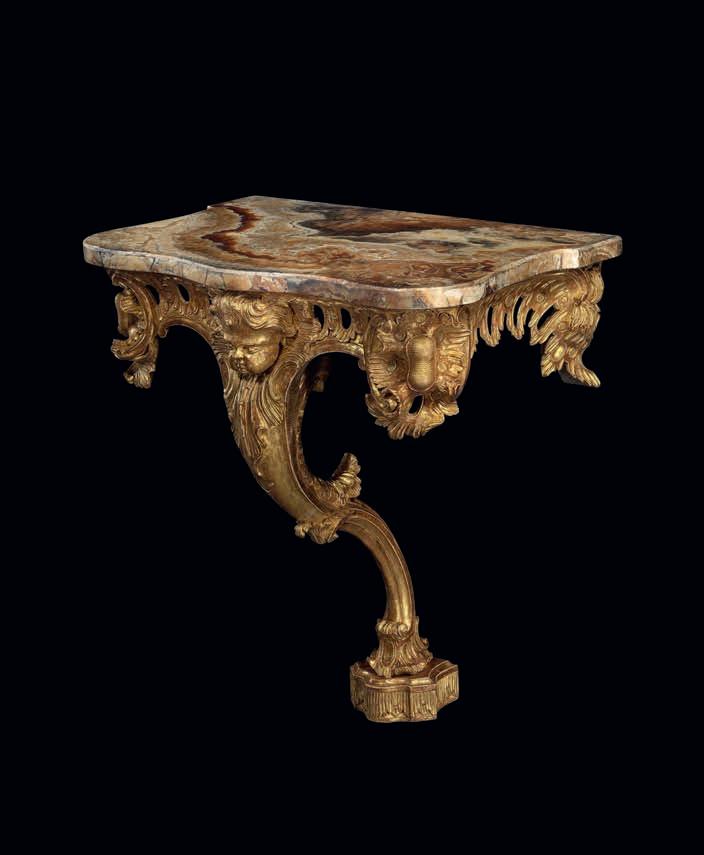
A PAIR OF
Note: The tables have been re-gilded and the shaped jasper tops are of later date.
English, circa 1745
Height: 30¾ in; 78 cm
Width: 26½ in; 67.5 cm
Depth: 20¼ in; 51.5 cm
Provenance: Private collection, USA.
GEORGE II GILTWOOD CONSOLE TABLES
THE MOLLER
PIER GLASSES
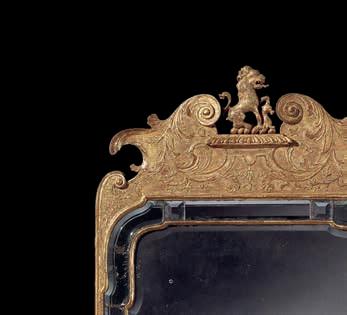
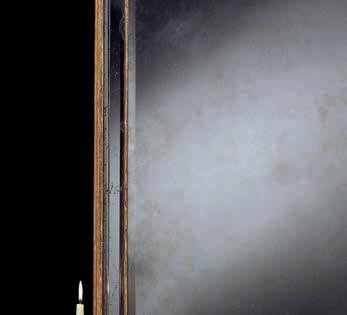
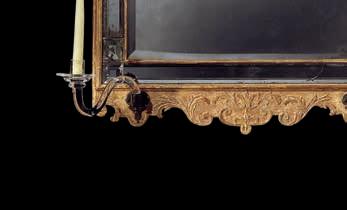
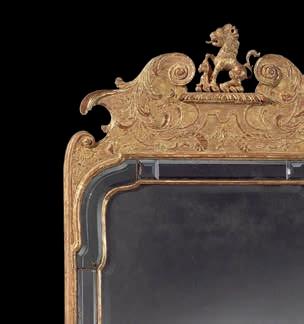
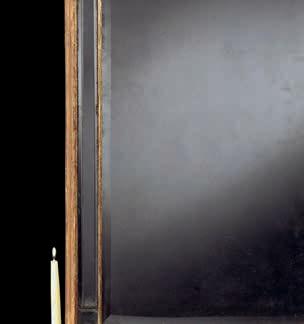
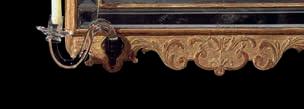

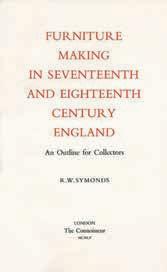
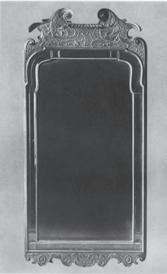
One of the pair illustrated in Furniture Making in Seventeenth and Eighteenth Century England by R. W. Symonds, 1955
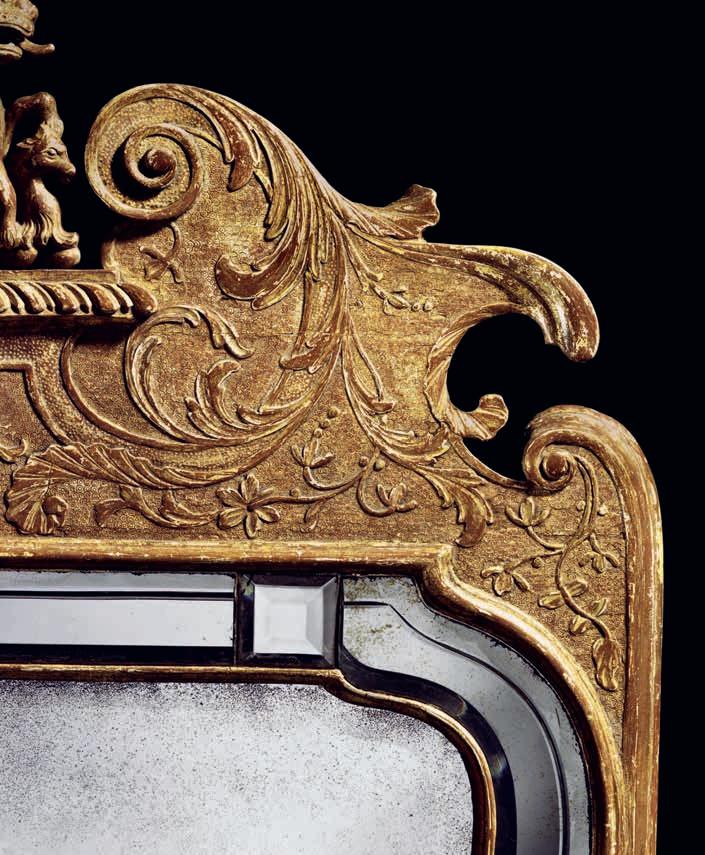
A PAIR OF GEORGE I CARVED GILTWOOD AND GESSO MIRRORS
Note: The mirrors retain the original bevelled mirror plates and border glasses and virtually all the original gilding. The lion crestings and scrolled glass candle arms are of later date.
English, circa 1720
Height: 57 in; 145 cm
Width: 25¾ in; 65.5 cm
Depth: 9 in; 23 cm
Provenance: The Moller Collection (formed under the guidance of R. W. Symonds), Thorncombe Park, Surrey, England; Private collection, New York, USA.
Illustrated: R. W. Symonds, Furniture Making in Seventeenth and Eighteenth Century England, 1955, p. 152, fig. 207; one of the pair. Graham Child, World Mirrors 1650–1900, 1990, p. 74, pl. 44.
34
A GEORGE III BRASS MOUNTED MAHOGANY SIDE TABLE ATTRIBUTED TO JOHN COBB
Note: The table retains the original brass mounts and has acquired an outstanding colour and patination.
English, circa 1770
Height: 34 in; 86.5 cm
Width: 49½ in; 126 cm
Depth: 25 in; 63.5 cm
Provenance: Trevor Antiques Ltd., London, England; Norman Adams Ltd., London, England; Private collection, England.
Exhibited:
The Antique Dealers’ Fair and Exhibition, Grosvenor House, London, 1968; with Trevor Antiques Ltd.
Illustrated:
The Antique Dealers’ Fair and Exhibition handbook, London, 1968, p. 90; with Trevor Antiques Ltd.
The table belongs to a small group of related tables all sharing a similar outline, high quality brass mounts and marquetry of exceptional quality. John Cobb was William Vile’s younger partner, and together they held the Royal Warrant from 1751 until 1764.
After Vile’s death, Cobb’s furniture shows a transition in style towards the rococo, with an emphasis on veneered surfaces, often with finely engraved marquetry and luxurious brass mounts, in contrast to Vile’s fine carvings.
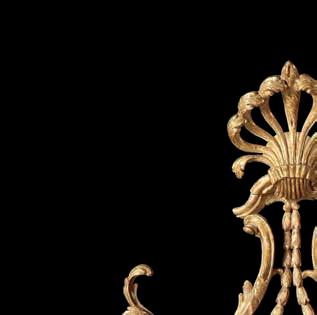
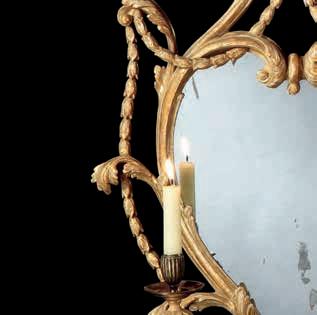
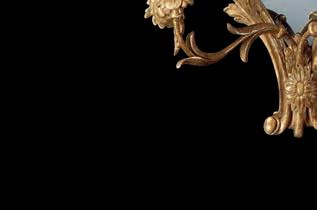
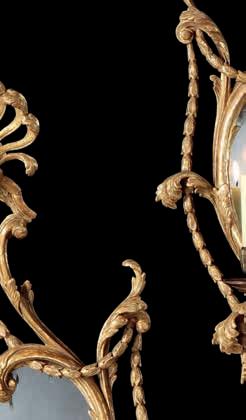
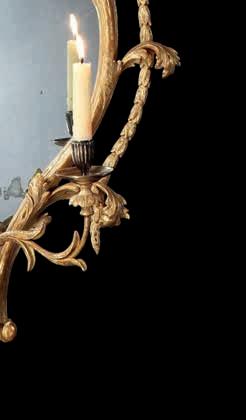
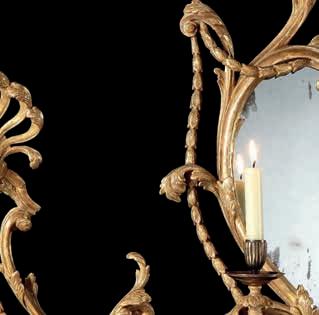
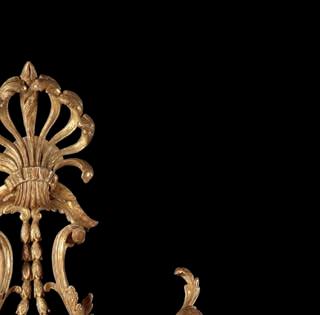
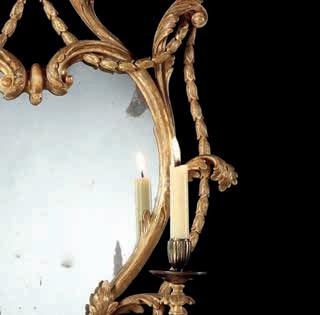
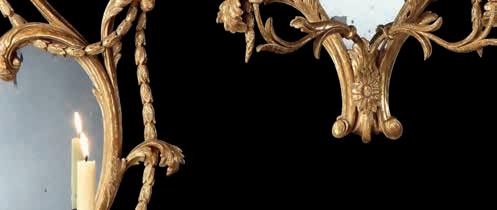
A PAIR OF GEORGE III GILTWOOD GIRANDOLES ATTRIBUTED TO WILLIAM FRANCE
Note: The girandoles have been re-gilded and the mirror plates are period mercury silvered replacements.
English, circa 1770
Height: 32¼ in; 82 cm
Width: 18¾ in; 47.5 cm
Depth: 8 in; 20.5 cm
Provenance: Private collection, Texas, USA.
Illustrated: Graham Child, World Mirrors 1650–1900, 1990, p. 138, illus. 218.
The design of this pair compares to girandoles supplied by William France to Sir Lawrence Dundas, now at Aske Hall in Yorkshire.

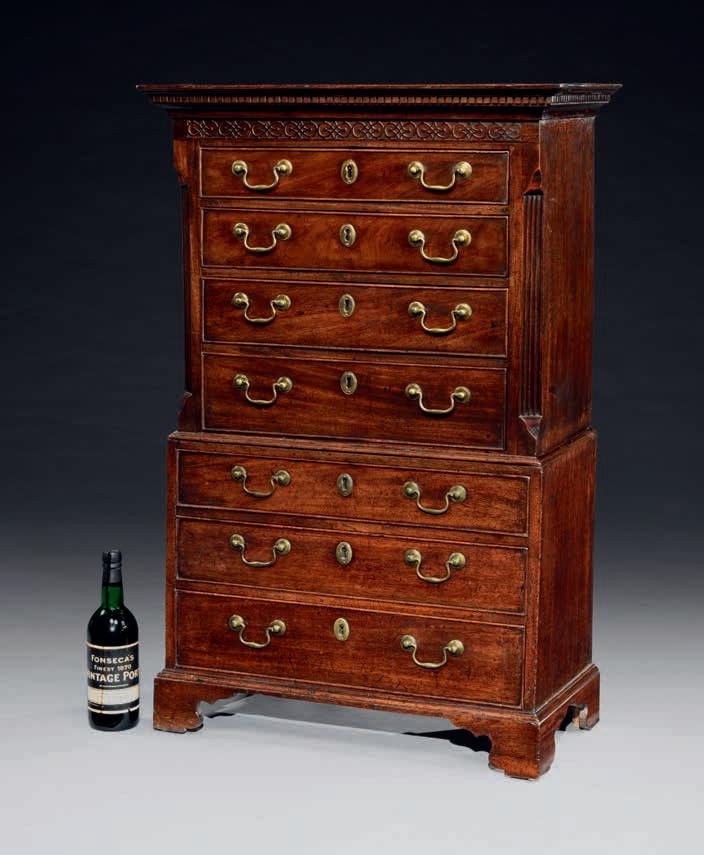
A GEORGE III DIMINUTIVE MAHOGANY CHEST-ON-CHEST
Note: The chest retains the original swanneck brass handles and escutcheons. English, circa 1770
Height: 39¼ in; 99.5 cm
Width: 26 in; 66 cm
Depth: 13 in; 33 cm
At one third of the size of a standard cheston-chest, the scale of this example is highly unusual.
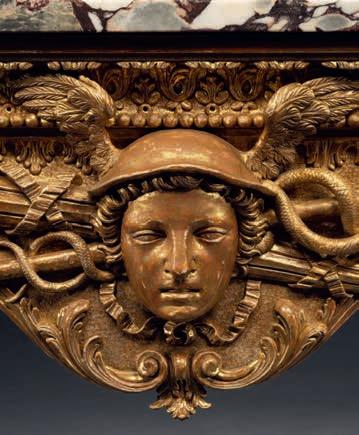
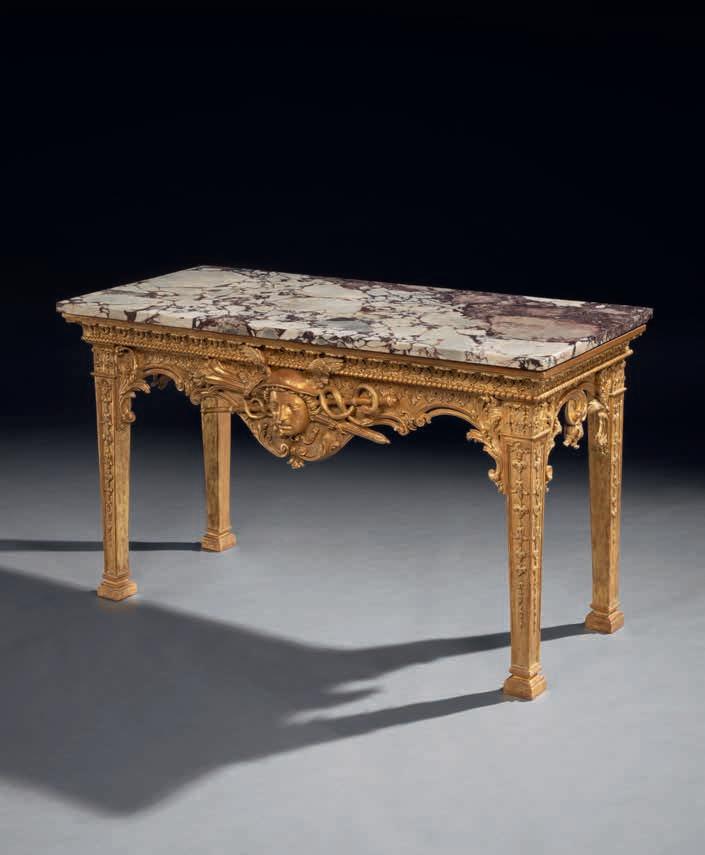
Note: The table has been re-gilded and the toes have been tipped. The brèche violette marble top is probably of later date.
English, circa 1770
Height: 34¾ in; 88.5 cm
Width: 59½ in; 151 cm
Depth: 27 in; 69 cm
Provenance: Ronald Phillips Ltd., London, England; Private collection, Canada.
Illustrated: Ronald Phillips Ltd., ‘Antique English Furniture’, catalogue, 1997, p. 1.
A GEORGE III GILTWOOD SIDE TABLE
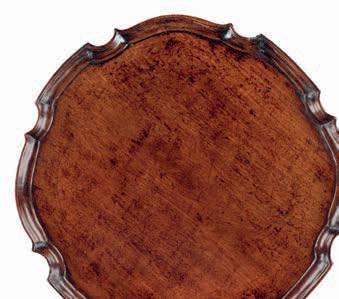

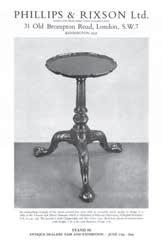
A GEORGE II MAHOGANY KETTLE STAND
English, circa 1750
Height: 20½ in; 52 cm
Diameter of top: 12¼ in; 31 cm
Provenance: Phillips & Rixson Ltd., London, England; Private collection, England.
Exhibited: The Antique Dealers’ Fair and Exhibition, Grosvenor House, London, 1956; with Phillips & Rixson Ltd.
Illustrated: Connoisseur, June 1956, p. xxxix; advertisement with Phillips & Rixson Ltd.
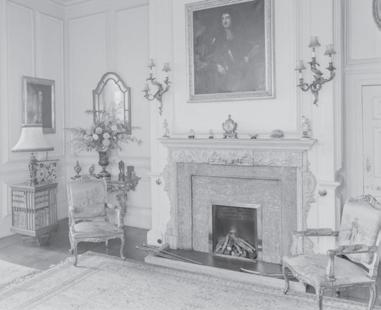
The kettle stand with Phillips & Rixson Ltd. in 1956
39
A GEORGE III PARCEL GILT CONSOLE TABLE ATTRIBUTED TO MATTHIAS LOCK
Note: The table has been re-gilded and repainted. The shaped Sienna marble top is original.
English, circa 1760
Height: 33 in; 84 cm
Width: 44 in; 112 cm
Depth: 22 in; 56 cm
Provenance: Possibly commissioned by James Unwin (1717–1774) for Wootton Lodge, Staffordshire, England; Brigadier General Sir Hill Child, Wootton Lodge, Staffordshire, England, until sold from the house in the late 1950s or early 1960s; Private collection, England; Ronald Phillips Ltd., London, England; Private collection, England.
Illustrated: ‘Wootton Lodge II’, Country Life, 1959, vol. CXXV, p. 522, showing the table in the drawing room.
Literature: Matthias Lock, Six Tables, 1746, pl. 3; pier table. Elizabeth White, Pictorial Dictionary of British 18th Century Furniture Designs: The Printed Sources, 1990, p. 265, pl. 3; pier table.
The console table in situ at Wootton Lodge, Staffordshire, in 1959
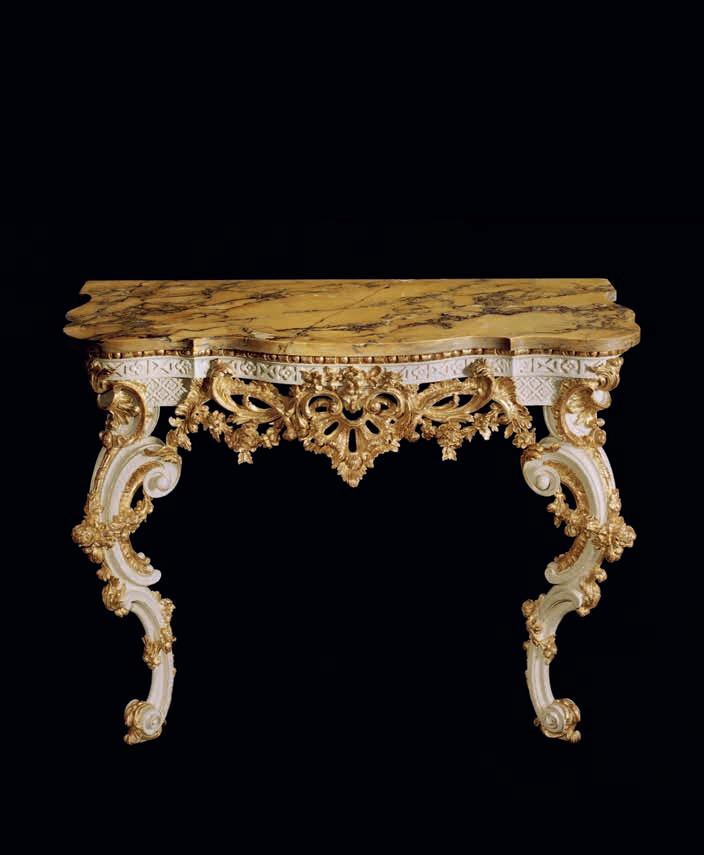
THE WOOTTON LODGE TABLE
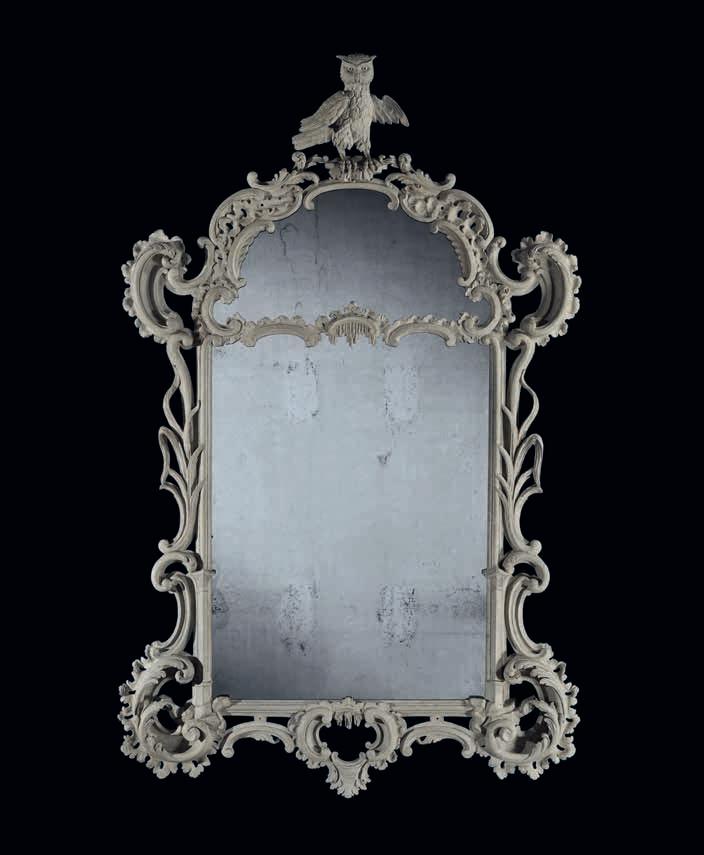
A GEORGE II PAINTED MIRROR ATTRIBUTED TO JOHN VARDY
Note: The mercury silvered mirror plates are period replacements. The front of the owl cresting is a restoration, but the backing is original. The mirror has been partially repainted.
English, circa 1755
Height: 5 ft ½ in; 153.5 cm
Width: 3 ft 1¾ in; 95.5 cm
Provenance:
Chiswick or Burlington House, London, England; Chatsworth House, Derbyshire, England; Private collection, London, England.
Paint analysis carried out on this mirror has revealed that it was originally painted, with four later decorative finishes over the centuries, three of which were also paint.
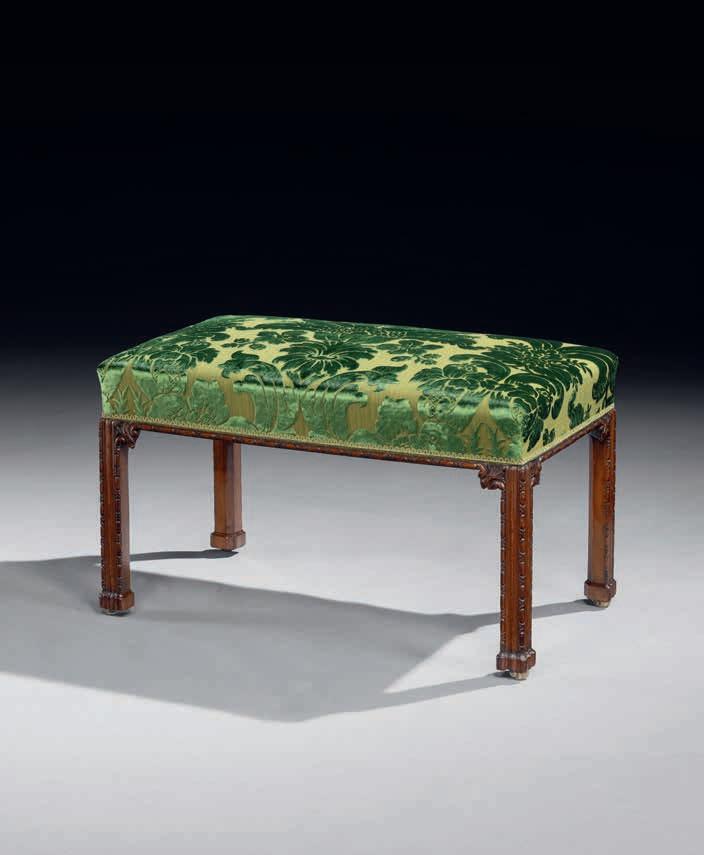
A GEORGE III MAHOGANY STOOL ATTRIBUTED TO WRIGHT & ELWICK
English, circa 1765
Height: 18 in; 46 cm
Width: 31 in; 79 cm
Depth: 18 in; 46 cm
Provenance:
Mallett & Son, London, England; Private collection, USA.
A suite of seat furniture with identical leg and corner brace carving was formerly at Brynkinalt Hall in Wales. This suite, now dispersed, consisted of side chairs, armchairs, stools and window seats, and this stool may originally have been part of the same suite.
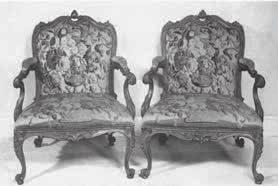
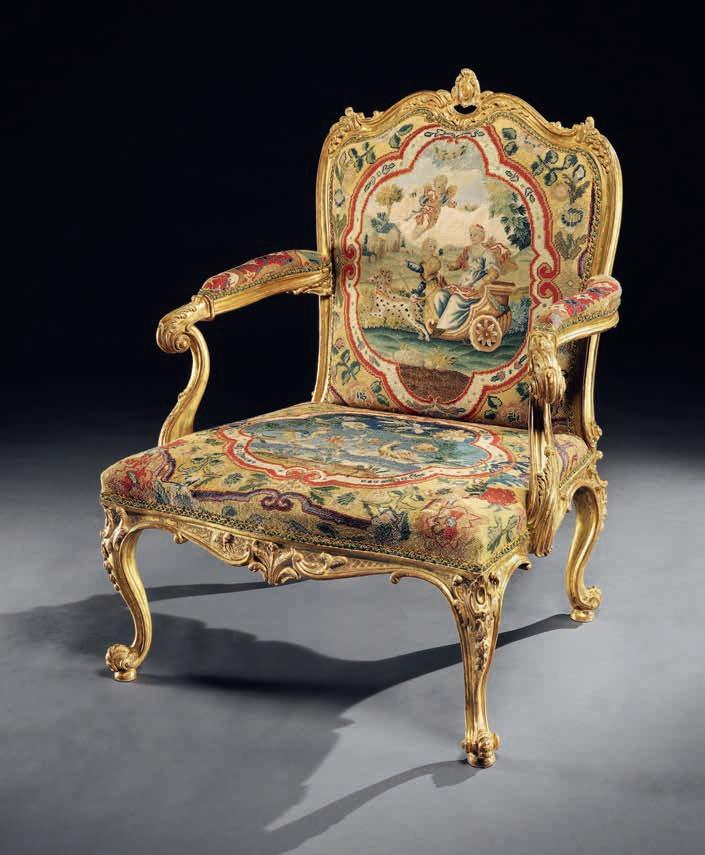
The chair with another from the set in their original needlework covers, photographed in 1960, in Anthony Coleridge’s Chippendale Furniture, 1968
A GEORGE II GILTWOOD OPEN ARMCHAIR ATTRIBUTED TO THOMAS CHIPPENDALE
Note: The chair has been re-gilded.
The chair: English, circa 1755
The needlework: French, circa 1750
Height: 41¼ in; 105 cm
Height of seat: 16½ in; 42 cm
Width: 32½ in; 83 cm
Depth: 30¼ in; 77 cm
Provenance:
Belvedere House, County Westmeath, Ireland; Symonds Incorporated, New York, USA; Robert J. Dunham, New York, USA, until 1947; Frank Partridge Inc., New York, USA; Walter P. Chrysler, New York, USA, until 1960; J. J. Wolff, New York, USA; Mrs. Reuben Trane, USA, until 1964; The Art Institute of Chicago, USA.
Illustrated:
Parke-Bernet Galleries Inc., ‘Masterpieces of Georgian Furniture and Chinese Porcelain, Property of Robert J. Dunham, New York, USA’, sale catalogue, New York, 9 & 10 May 1947, pp. 140–41, lot 370.
Parke-Bernet Galleries Inc., ‘The Walter P. Chrysler Collection of English Furniture’, sale catalogue, New York, 6 & 7 May 1960, vol. 2, pp. 48–9, lot 372.
Anthony Coleridge, Chippendale Furniture: The Work of Thomas Chippendale and His Contemporaries in the Rococo Style, 1968, pl. 185. Desmond Guinness and William Ryan, Irish Houses and Castles, 1971, p. 294.
Literature: Christie’s, ‘Old English Furniture – Fine Chinese Porcelain and Objects of Art, The Property of Henry Hirsch Esq.’, sale catalogue, 10 June 1931, pp. 24–5, lot 55.
Antique Collector, April 1957, title page; a chair with G. Jetley. Christie’s, ‘Fine English Furniture’, sale catalogue, 13 February 1975, lot 37, pl. 3.
Connoisseur, June 1976, p. 64; advertisement with Glaisher & Nash. Partridge Fine Arts Ltd., ‘Summer Exhibition 1989’, catalogue, pp. 38–9.
This chair was originally part of a larger set, four of which were photographed by Alex Starkey for Country Life magazine at Charleville Castle in Ireland in 1962. The house was empty at the time and Starkey furnished two rooms specially for the photoshoot, using furniture borrowed from nearby Belvedere House, County Westmeath, where two chairs had been previously photographed by Country Life in 1961. Four chairs from the set at Belvedere were sold at auction in 1967.
The same Country Life photograph taken in situ at Belvedere House in 1961 was reproduced in Irish Houses and Castles, published in 1971.
Another chair from the set is in the collection of the Art Institute of Chicago, USA. A pair of chairs from the set were sold by Frank Partridge Ltd. to Irene Roosevelt Aitken.
A suite of seat furniture of very similar form was formerly at No. 45 Berkeley Square, the London residence of Robert Clive, also known as Clive of India. This suite was moved to Powis Castle in Wales when the London house was sold by the descendants of Sir Robert. Part of the suite is still at Powis today.
English, circa 1755
Height: 22 in; 56 cm
Width of top: 17 in; 43 cm
Depth of top: 14½ in; 37 cm
Provenance: Hotspur Ltd., London, England; Private collection, New York, USA; Tom Devenish, New York, USA; Private collection, New York, USA.
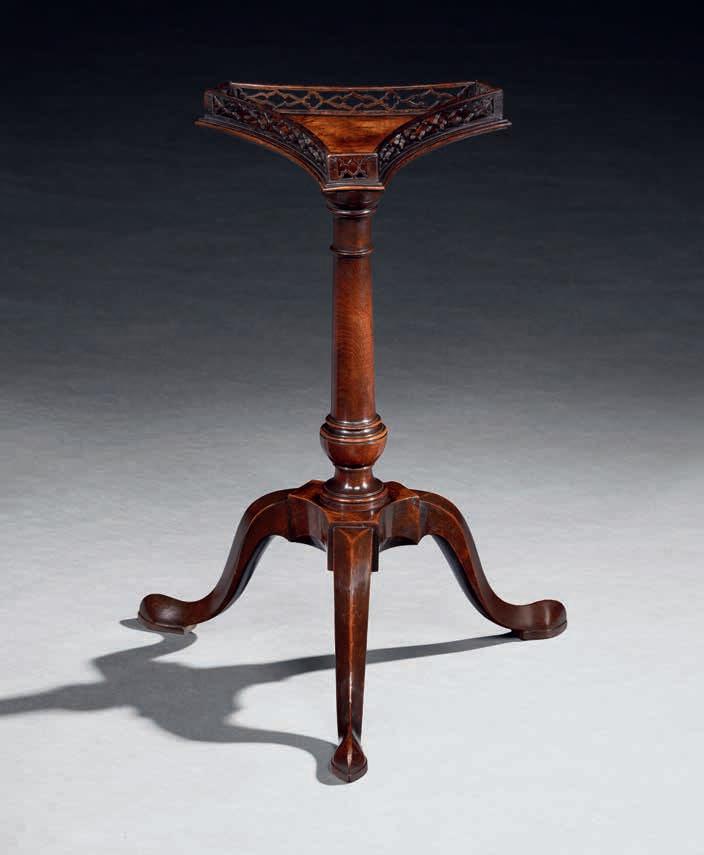
Triangular kettle stands are exceptionally rare. The furniture enthusiast and celebrated collector Samuel Messer must have developed a liking for such rare pieces, since the sale of his collection at Christie’s on 5 December 1991 featured no fewer than four examples, the largest group of triangular kettle stands assembled to date.
A GEORGE II MAHOGANY KETTLE STAND WITH TRIFORM TOP
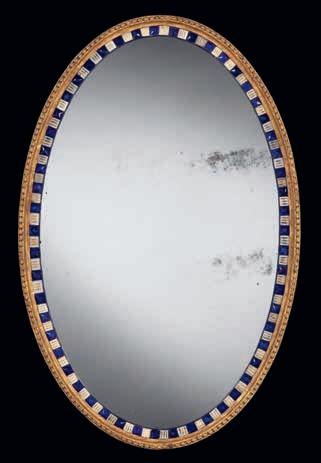
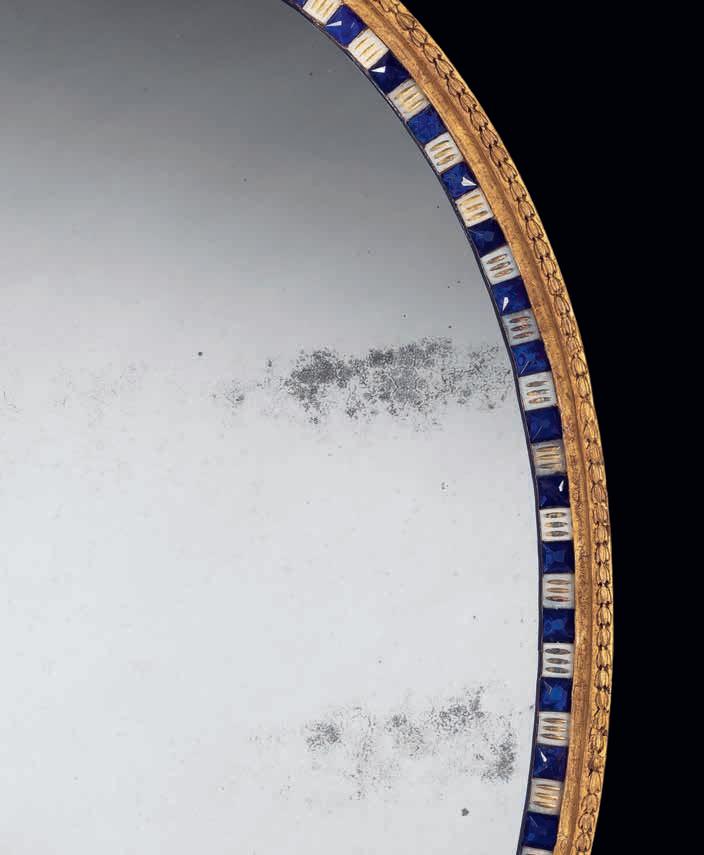
AN IRISH GEORGE III OVAL GILTWOOD AND BLUE AND OPAQUE WHITE GLASS STUDDED MIRROR
Note: The mirror plate is a 19th century replacement. The giltwood outer frame is a rare feature on mirrors of this type.
Irish, circa 1790
Height: 28¼ in; 71.5 cm
Width: 18½ in; 47 cm
Provenance:
J. M. Botibol Ltd., London, until 1953; Private collection, London, England.
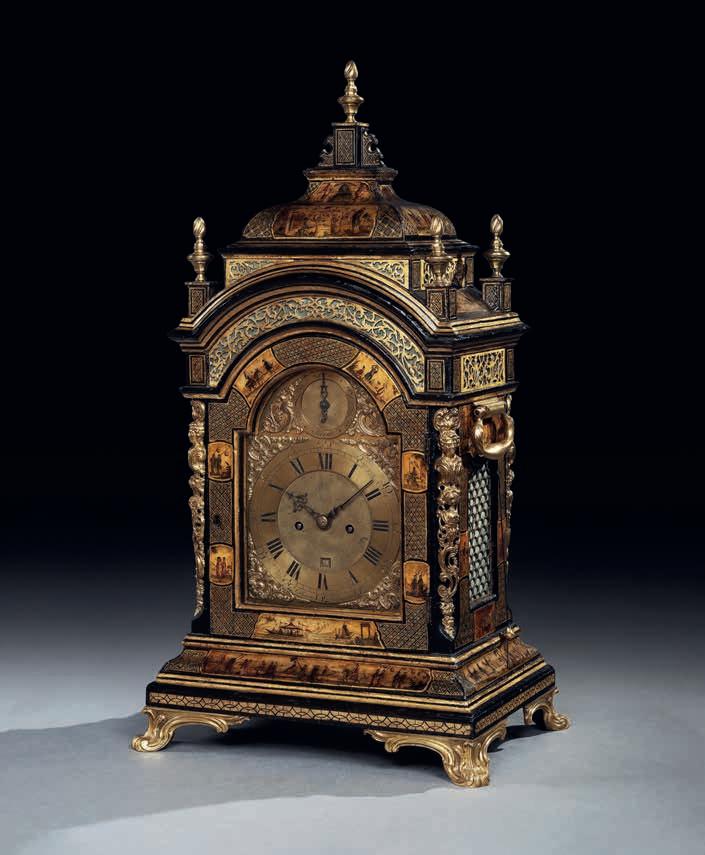
A GEORGE III DOUBLE FUSEE BRACKET CLOCK BY JOHN ELLICOTT IN A BLACK AND GOLD JAPANNED CASE
Note: With repairs to the platform below the top finial. The clock retains the original brass mounts typical of Ellicott timepieces made towards the end of his career, in particular the unusual rococo bracket feet and the rococo spandrels.
English, circa 1765
Height: 20 in; 51 cm
Width: 15½ in; 39 cm
Depth: 11 in; 28 cm
Provenance: Private collection, Florida, USA.
John Ellicott was a highly esteemed clockmaker who was elected a Fellow of the Royal Society in 1738 for his scientific achievements in improving clock accuracy. He went on to be appointed Clockmaker to the King in 1762. Ellicott was an early supporter of Thomas Coram’s Foundling Hospital in London, where the clock that he donated still remains.
A GEORGE III MAHOGANY HALL CHAIR ATTRIBUTED TO GEORGE MARSHALL
English, circa 1770
Height: 37 in; 94 cm
Height of seat: 17 in; 43 cm
Width: 26½ in; 67 cm
Depth: 23 in; 58 cm
Provenance: Ronald Phillips Ltd., London, England; Private collection, USA.
Illustrated:
Ronald Phillips Ltd., ‘Antique English Furniture’, catalogue, 2001, pp. 45–6.
Literature:
Antique Collector, May 1949, no page no.; trade advertisement with Ayer & Co.
Christie’s, ‘Fine English Furniture’, sale catalogue, London, 10 October 1968, p. 9, lot 25.
Geoffrey Beard and Christopher Gilbert, TheDictionary of English Furniture Makers 1660–1840, 1986, p. 577.
Hall chairs were usually supplied in sets. A pair of armchairs very probably from the same set were sold by Christie’s in 1968. Another set of six armchairs of virtually identical design were retailed by Ayer & Co. in 1949. One chair in this set was signed and dated ‘George Marshall, 7 April 1772’.
Given the similarity between our chair and the set of six, it is very likely that they came from the same workshop and were made at around the same time.
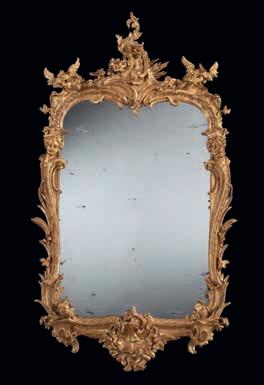
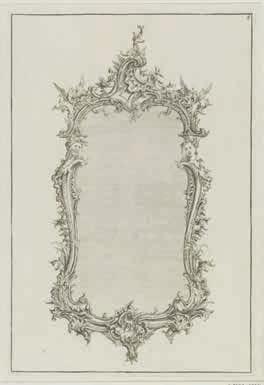
The design for the mirror, published by Matthias Lock in 1744. © Victoria and Albert Museum, London
A GEORGE II GILTWOOD MIRROR ATTRIBUTED TO MATTHIAS LOCK
Note: The frame retains most of the original gilding. The mirror plate is original.
English, circa 1745
Height: 54 in; 137 cm
Width: 31½ in; 80 cm
Provenance: Ronald Phillips Ltd., London, England; Private collection, London, England.
Illustrated: Ronald Phillips Ltd., ‘Antique English Furniture’, catalogue, 2000, p. 95. Ronald Phillips Ltd., ‘Mirrors 1660–1820’, catalogue, 2010, p. 254.
Literature: Matthias Lock, Six Sconces, 1744, pl. 4.
Elizabeth White, Pictorial Dictionary of British 18th Century Furniture Design: The Printed Sources, 1990, p. 236.
This early rococo mirror belongs to a small group of mirrors relating to a design published by Matthias Lock as plate 4 in Six Sconces in 1744. Most have slight variations from the published design, but the current example follows the drawing in detail apart from being mirrored.
The carving is of exceptionally high quality and the best example within this small group. It would not be a surprise if this mirror was carved by the master himself. In 1769, four years after Lock’s death, the publisher Robert Sayer described him as ‘the famous Mr. Matt. Lock recently deceased who was reputed the best Draftsman in that way that had ever been in England’.
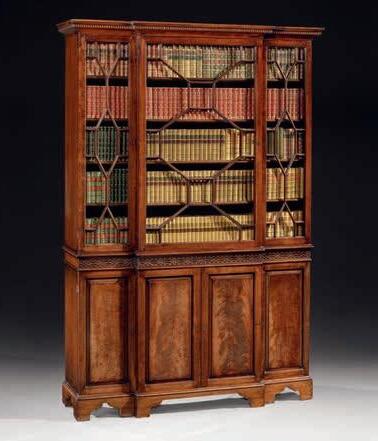
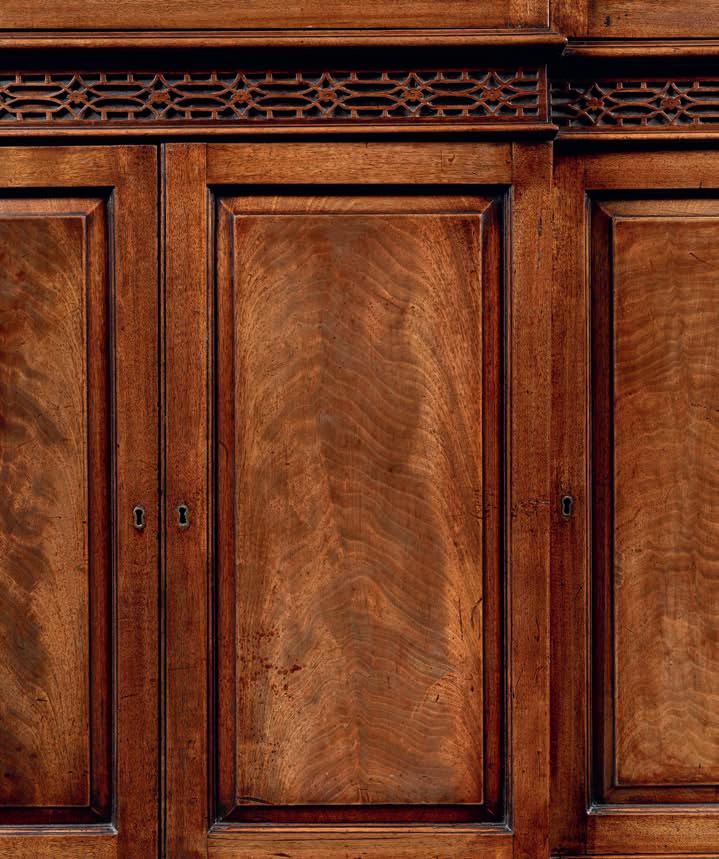
A GEORGE II MAHOGANY BREAKFRONT BOOKCASE ATTRIBUTED TO GILLOWS
Note: The bookcase has acquired a beautiful mellow colour and patination. The bracket feet are unusual and give an appearance of lightness to the piece. At just over four and a half feet in width, the bookcase is smaller than usual.
The top section has fixed shelves. Behind the doors in the lower section are four graduated drawers in the centre and four at each side.
English, circa 1750
Height: 6 ft 10¾ in; 210 cm
Width: 4 ft 7½ in; 140.5 cm
Depth: 1 ft 4¾ in; 42.5 cm
Provenance:
M. Harris & Sons Ltd., London, England, until 1933; Private collection, London, England.
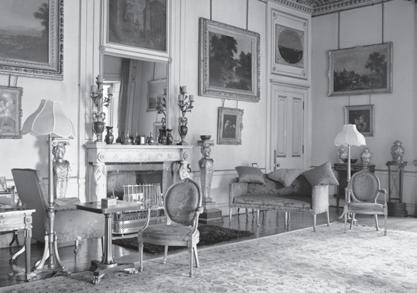
49
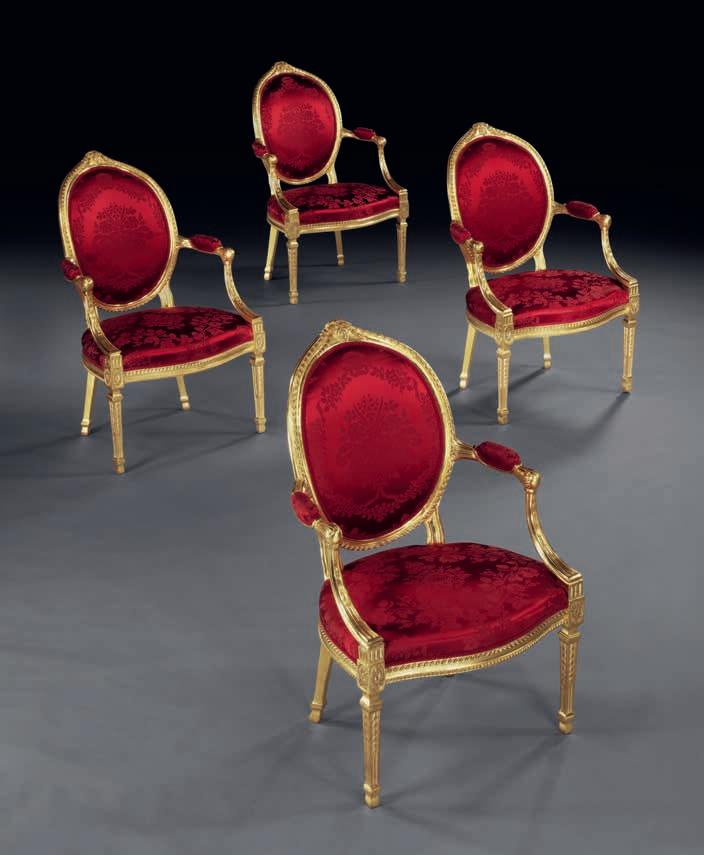
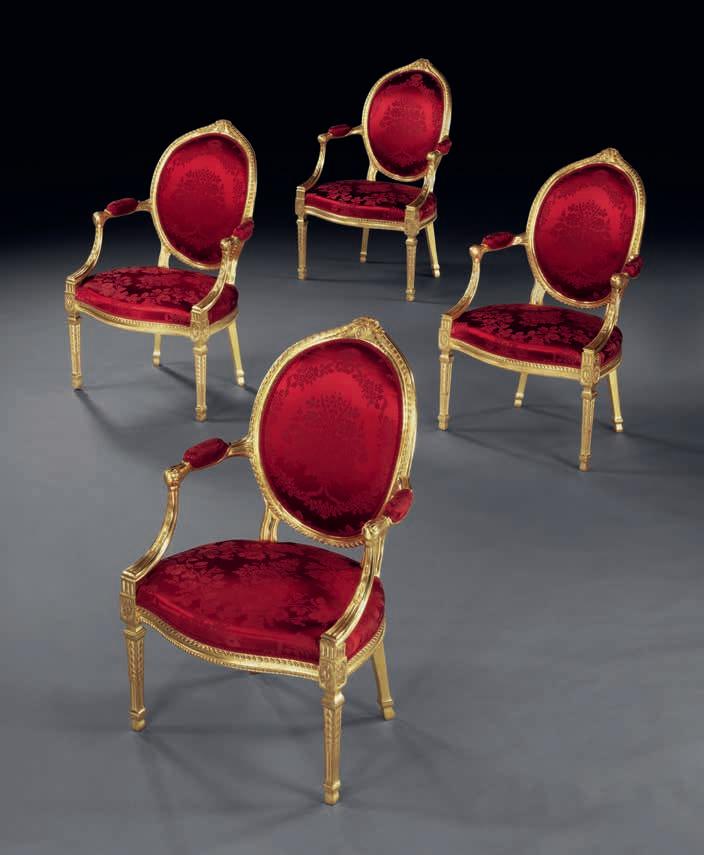
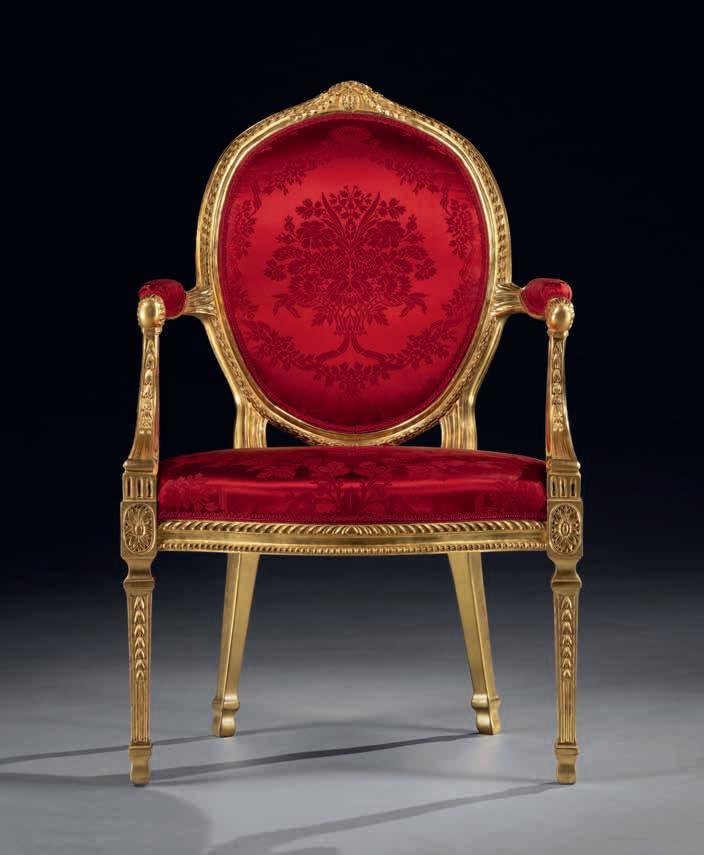
A SET OF EIGHT GEORGE III GILTWOOD OPEN ARMCHAIRS ATTRIBUTED TO JOHN LINNELL
Note: The frames have been re-gilded.
English, circa 1780
Height: 39 in; 99 cm
Height of seat: 17 in; 43 cm
Width: 25 in; 63.5 cm
Depth: 27 in; 68.5 cm
Provenance: 1st Viscount Dungannon, Brynkinalt, Wales; Ronald Phillips Ltd., London, England; Private collection, London, England.
The chairs were once part of an extensive set of at least twenty, of which only these eight remained with the family at Brynkinalt. Twelve chairs were acquired by Edward McGuire to furnish Newtown Park House, Dublin, Ireland, bought by him in 1946. Newtown Park House was a mere shell at the time, and McGuire furnished it over the following decades.
The Newtown Park chairs feature in a photograph of the dining room taken in 1947, in the Irish Architectural Archive, Dublin.
The set of eight feature in the West Drawing Room in photographs taken at Brynkinalt in the 1980s, together with a number of other pieces of furniture supplied by the Linnell workshop, suggesting a substantial commission for the firm at the time.
Two of the chairs in situ at Brynkinalt, photographed in the 1980s
50
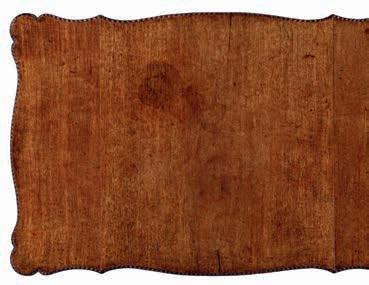
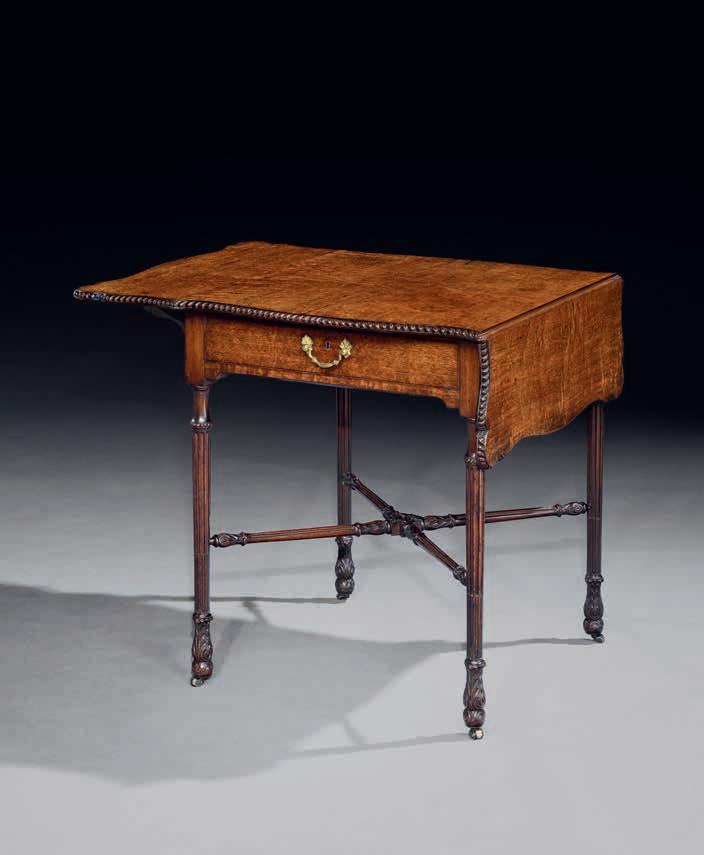
A GEORGE II MAHOGANY PEMBROKE TABLE ATTRIBUTED TO THE ST. MARTIN’S LANE SYNDICATE
Note: The table retains the original handle, and has survived in untouched condition and acquired a beautiful bronze-like patina.
English, circa 1755
Height: 28½ in; 72.5 cm
Width (open): 41 in; 104 cm
Width (closed): 24¼ in; 61.5 cm
Depth: 26 in; 66 cm
Provenance: Private collection, England.
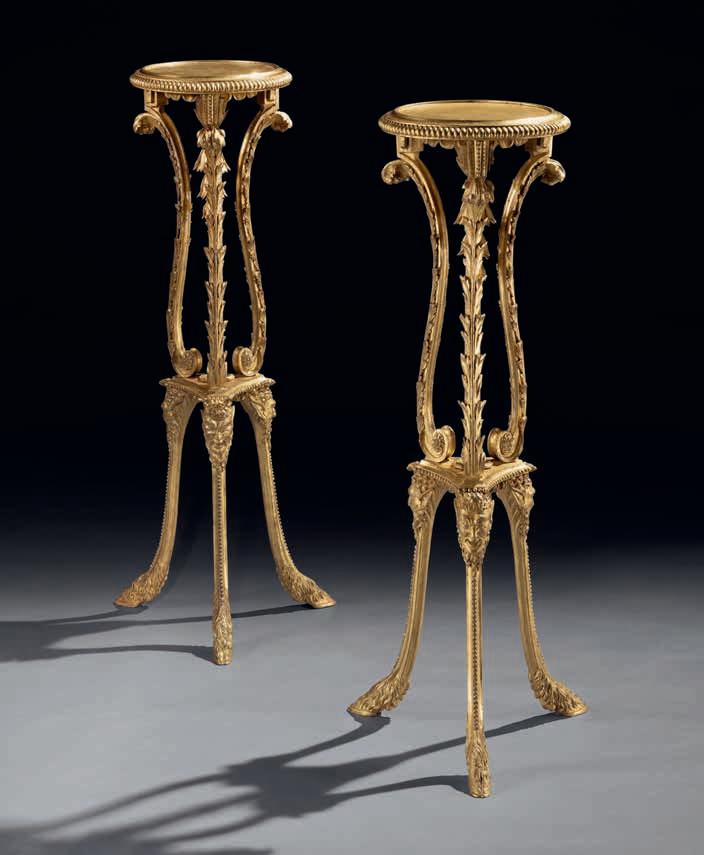
A PAIR OF GEORGE III GILTWOOD TORCHERES
Note: The torchères retain much of the original gilding. English, circa 1770
Height: 44 in; 112 cm
Diameter of tops: 12¾ in; 32.5 cm
Span of legs: 18 in; 46 cm
Provenance: The Hon. Mrs. Audrey Pleydell-Bouverie, Julians, Hertfordshire, England.
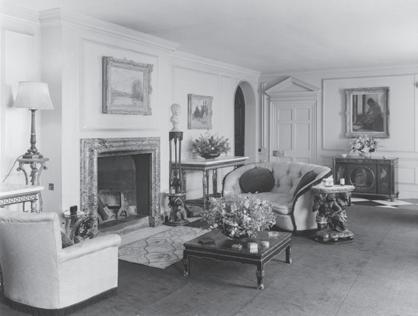
Illustrated: Christopher Hussey, ‘Julians, Hertfordshire – I’, Country Life, 27 June 1947, p. 1210, fig. 2, and p. 1213, fig. 10; one illustrated in the Entrance Hall and one in a bedroom.
One of the torchères in situ at Julians, Hertfordshire, in 1947
THE DEAN OF ST. PAUL’S CATHEDRAL CABINET
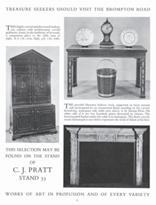
The cabinet with C. J. Pratt Ltd., 1951
52
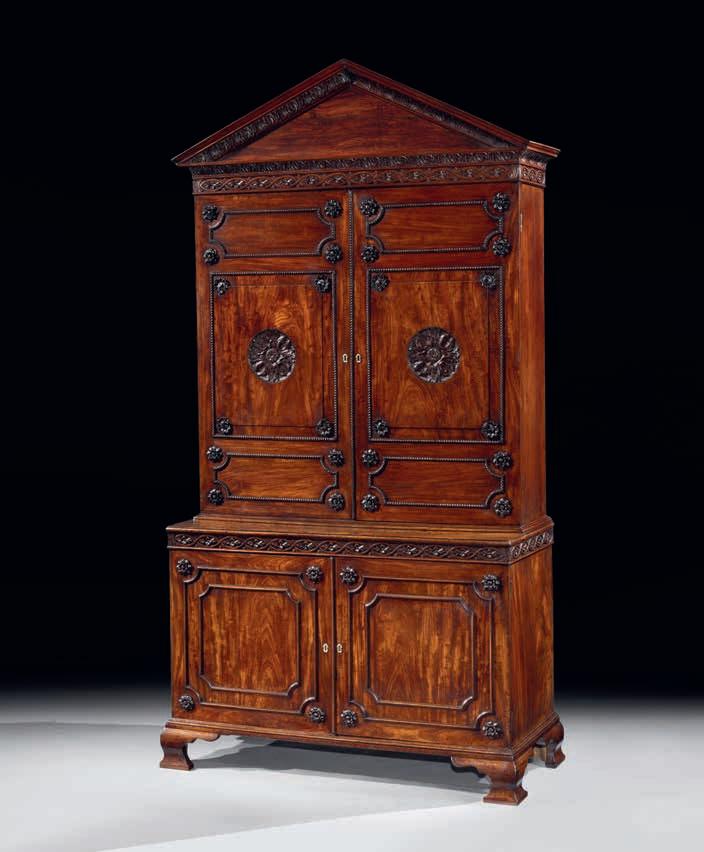
A GEORGE II MAHOGANY CABINET IN THE MANNER OF WILLIAM HALLETT
Note: The cabinet had at one stage upright divisions, perhaps forming large pigeon-holes to serve as a filing cabinet. It is now fitted with three adjustable shelves, the lower part with two original trays, with space for a third. The ogee bracket feet have been tipped to their original height.
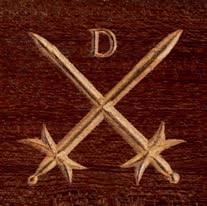
The inside of both top doors is incised with crossed swords, the arms of the See of London, centred by the letter D, for Dean of the Chapter.
English, circa 1755
Height: 7 ft 10½ in; 240 cm
Width: 4 ft 2½ in; 128.5 cm
Depth: 1 ft 10½ in; 57 cm
Provenance: The Deans of St. Paul’s Cathedral, London, England; C. J. Pratt Ltd., London, England.
Illustrated: Connoisseur, June 1951, p. 7; advertisement with C. J. Pratt Ltd.
Literature: Ralph Edwards and Margaret Jourdain, Georgian Cabinet Makers, 3rd revised edn., 1955, p. 151, fig. 61.
Anthony Coleridge, ‘A reappraisal of William Hallett’, Furniture History, 1965, pl. 1; a cabinet inscribed in pencil ‘William Hallett/1763 Long Acre’, formerly at Halswell Park, Somerset.
The fine carvings on the cabinet relate to similar carvings ascribed to the workshop of William Vile, in particular a small side cabinet at Longford Castle, Wiltshire. The unusual triangular pediment reflects the shape of the portico of the west entrance of the old St. Paul’s Cathedral.
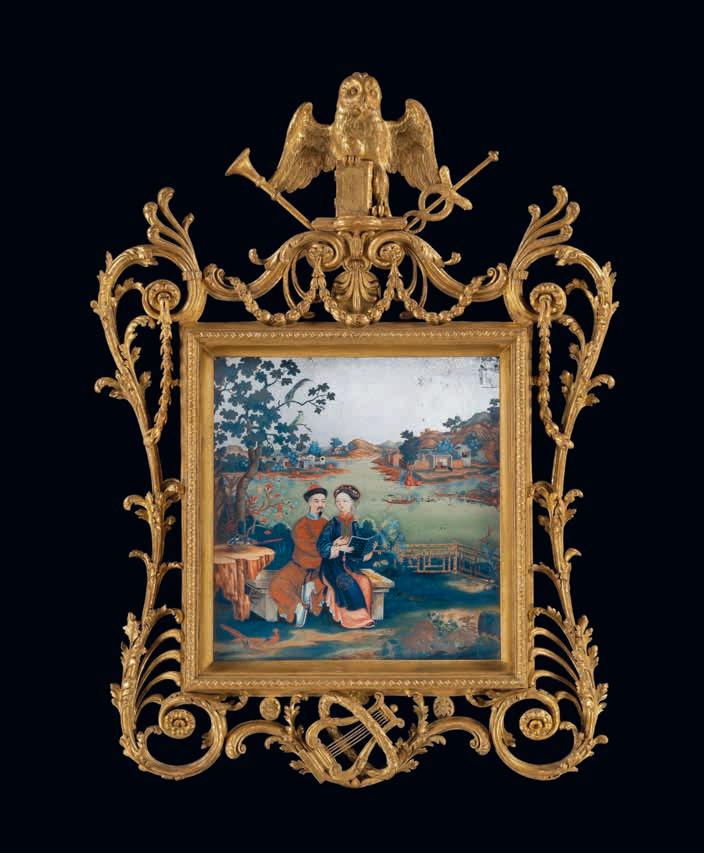
THE DITCHLEY PARK MIRROR PAINTING
A QING DYNASTY MIRROR PAINTING IN A GILTWOOD FRAME ATTRIBUTED TO LINNELL
Note: The frame was originally fitted with a painted canvas.
The mirror painting: Chinese, Qianlong period, circa 1760
The frame: English, circa 1770
Height: 37½ in; 95 cm
Width: 28 in; 71 cm
Provenance:
Henry Dillon, 11th Viscount Dillon, Ditchley Park, Oxfordshire, England; by descent to Arthur, 18th Viscount Dillon (1876–1934), Ditchley Park, Oxfordshire, England, and purchased with the property in 1933; Ronald and Nancy Tree, Ditchley Park, Oxfordshire, England; Private collection, England.
Literature:
Christie’s, ‘Fine English Furniture’, sale catalogue, 28 June 1979, p. 7, lot 15, pl. 6.
Christie’s, ‘Highly Important English Furniture’, sale catalogue, 28 June 1984, p. 15, lot 9.
The giltwood frame belongs to a small group of frames of varying sizes from Ditchley Park, all sharing the same distinctive owl and caduceus cresting. The light yet strong design is typical of the output of the Linnell workshop, with characteristically superior carving to the details.
Related designs can be found among the Linnell drawings preserved at the Victoria and Albert Museum in London.
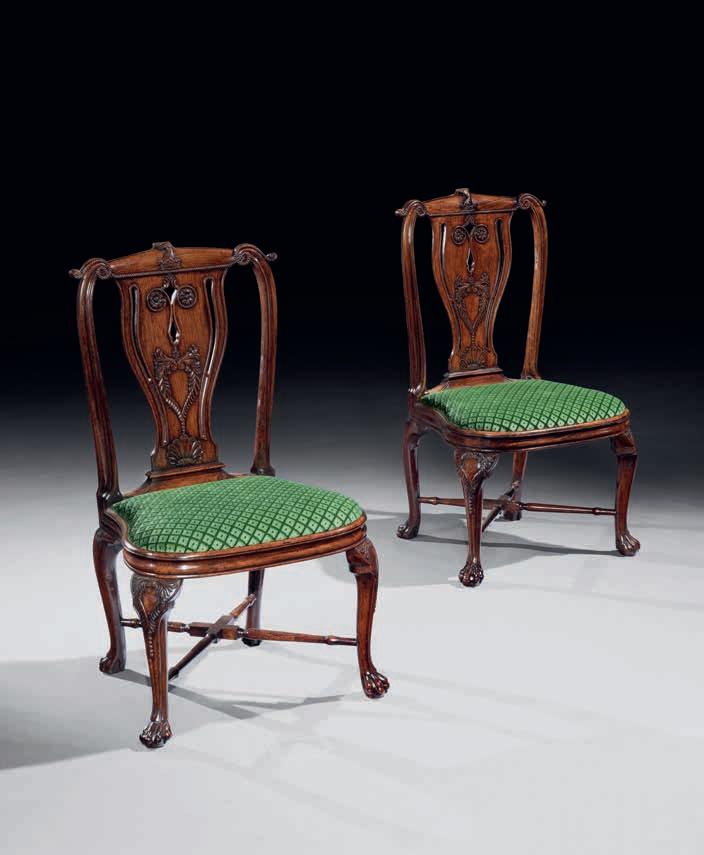
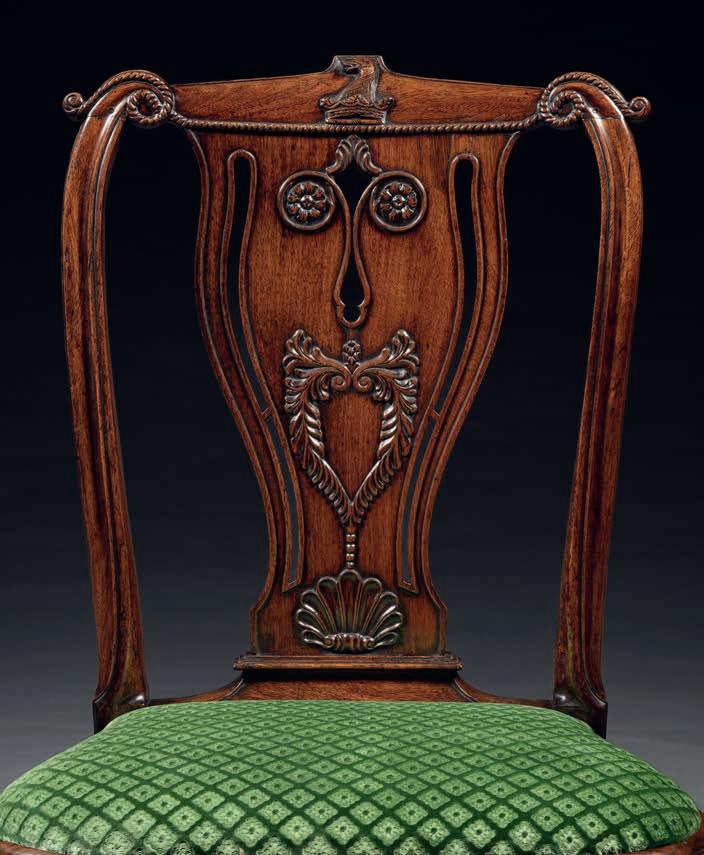
THE ALSCOT PARK CHAIRS
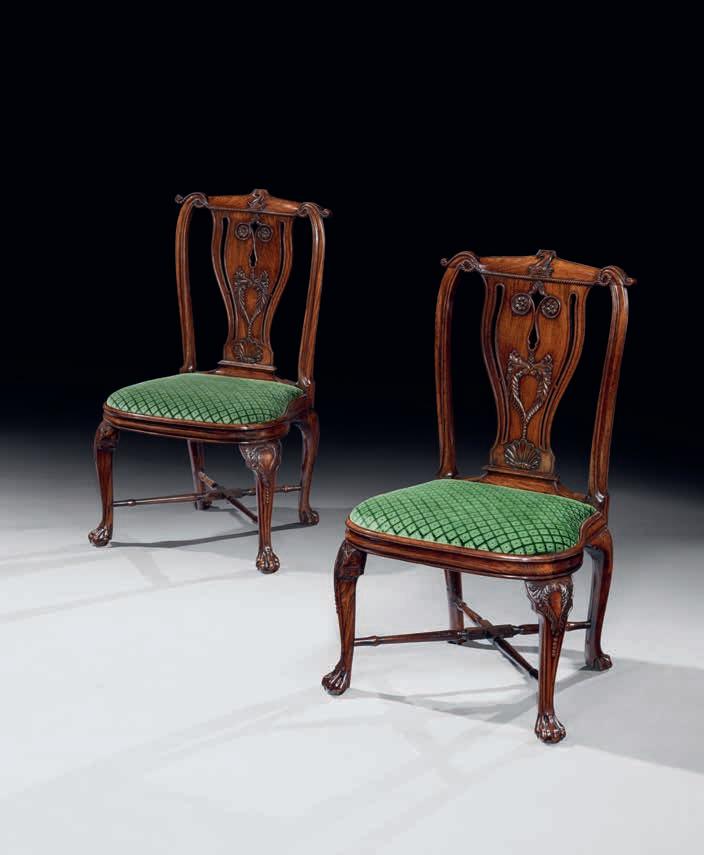
A SET OF FOUR GEORGE III PERIOD ANGLO-INDIAN ROSEWOOD SIDE CHAIRS
Note: Each chair is numbered on the inside of the front rail with incised Roman-style numerals: I, II, IIII and VIII respectively. Two of the chairs retain their original drop-in seats, and two have 19th century replacements.
Anglo-Indian, circa 1770
Height: 39½ in; 100 cm
Height of seat: 17½ in; 44.5 cm
Width: 24 in; 61 cm
Depth: 21 in; 53 cm
Provenance:
Commissioned by James West (1703–1772), at Alscot Park, Warwickshire, England, until 1773; Esmond Bradley Martin, Knole, Long Island, USA, for two of the four; Private collection, USA, for the remaining two; Reunited by the last owner, private collection, New York, USA, and London, England.
The numbering on the front rails of the chairs shows that there were at least eight chairs within the set. The settee from the set was sold in the London trade some twenty years ago.
The ducal coronet crest, with dexter facing (facing left as seen by the viewer) spotted griffin without wings, was granted to James West of Alscot Park in 1768.
James West’s position in government as Secretary of the Treasury came with huge political influence and subsequent financial rewards from the East India Company, the government’s single most important trade partner at the time. West purchased Alscot Park in 1747 and immediately set about transforming the house into a gothic villa.
James West died in 1772, just two years after Alscot Park was completed. Confounding Horace Walpole’s belief that ‘he was so rich that I take for granted nothing will be sold’, West’s prodigious antiquarian collections were auctioned off, along with the house contents, curiosities and even livestock, over a series of sales, the longest lasting around fifty days in early 1773. A Caxton first edition of Chaucer’s TheCanterbury Tales was bought by King George III and is today among the treasures of the British Library in London.
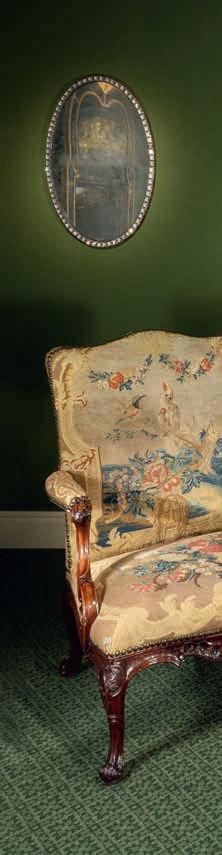
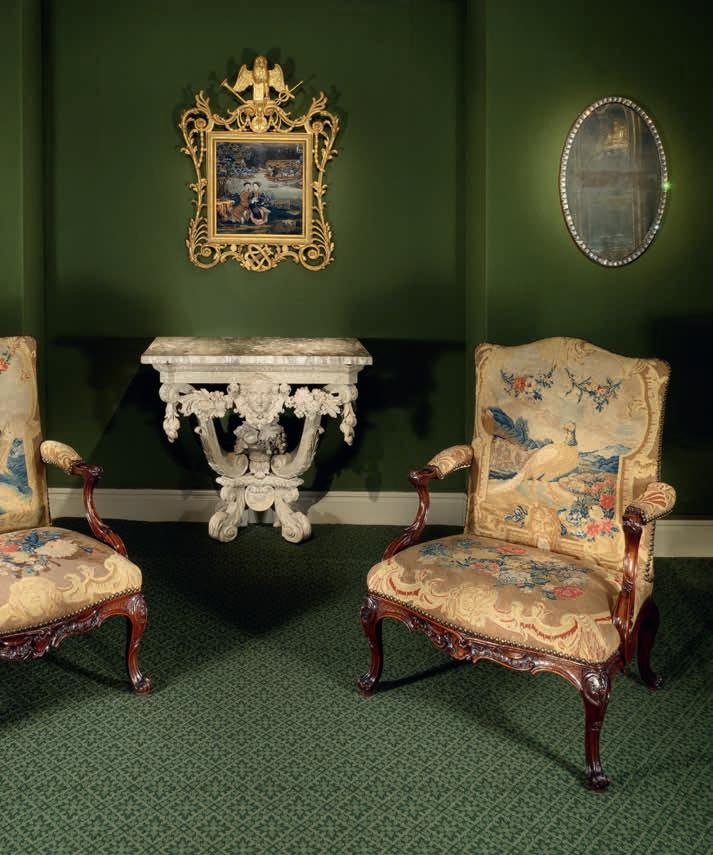
55 THE GLEMHAM HALL GAINSBOROUGH ARMCHAIRS
A PAIR OF GEORGE II MAHOGANY LIBRARY ARMCHAIRS WITH ORIGINAL NEEDLEWORK MADE BY LADY BARBARA OF GLEMHAM HALL
English, circa 1755
Height: 40½ in; 103 cm
Height of seat: 16 in; 40.5 cm
Width: 28½ in; 72.5 cm
Depth: 27¾ in; 70.5 cm
56
A PAIR OF IRISH GEORGE III CUT GLASS OVAL MIRRORS
Irish, circa 1780
Height: 27½ in; 70 cm
Width: 17½ in; 44.5 cm
57
THE JOHN PAUL GETTY CONSOLE TABLE
A GEORGE II GREY PAINTED CONSOLE TABLE
Note: The pendent swag carvings to the front corners are restorations. The table retains the original marble top.
English, circa 1735
Height: 33½ in; 85 cm
Width: 36 in; 91.5 cm
Depth: 22 in; 56 cm
A QING DYNASTY MIRROR PAINTING IN A GILTWOOD FRAME ATTRIBUTED TO LINNELL
Item 53: see page 128
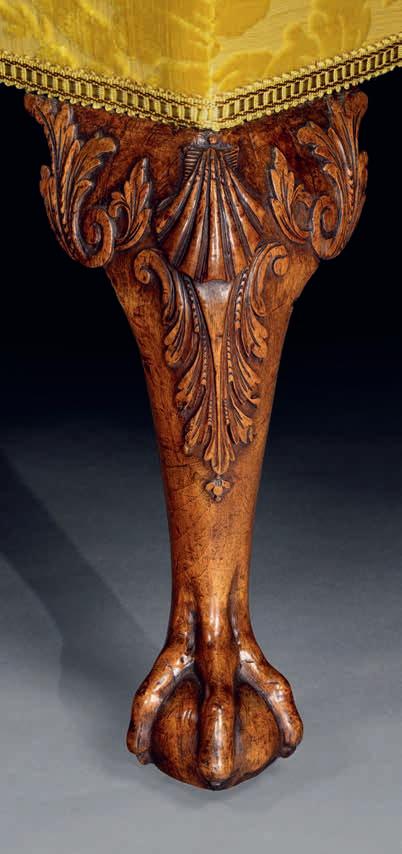
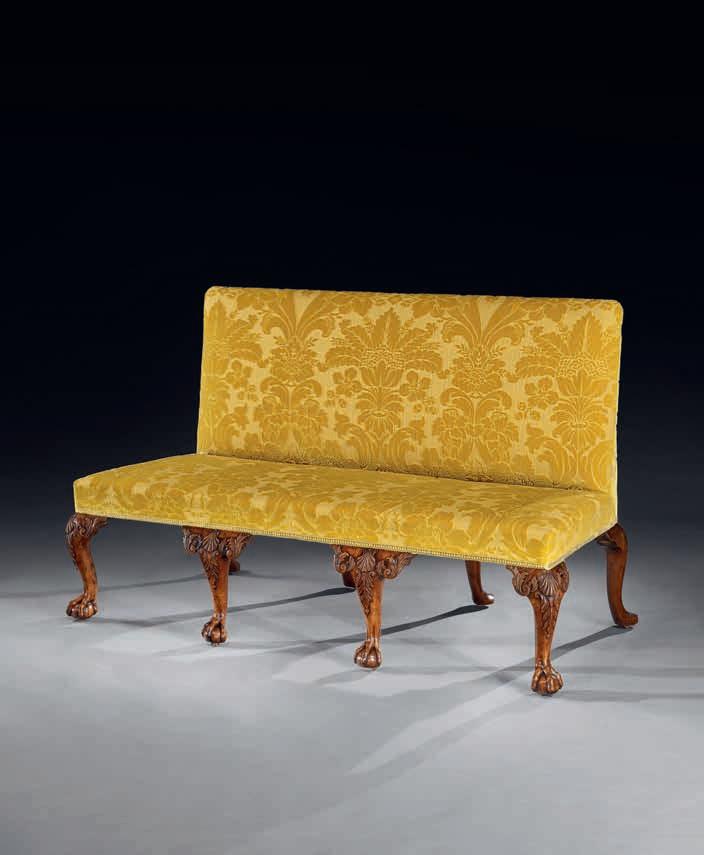
A GEORGE II WALNUT SETTEE
English, circa 1735
Height: 3 ft 3 in; 99 cm
Height of seat: 1 ft 6½ in; 47 cm
Width: 5 ft 4½ in; 164 cm
Depth: 2 ft 8½ in; 82.5 cm
Provenance: Private collection, Texas, USA.
This settee never had arms fitted, making it both exceptionally rare and also extremely practical for furniture arrangements where arms would get in the way.
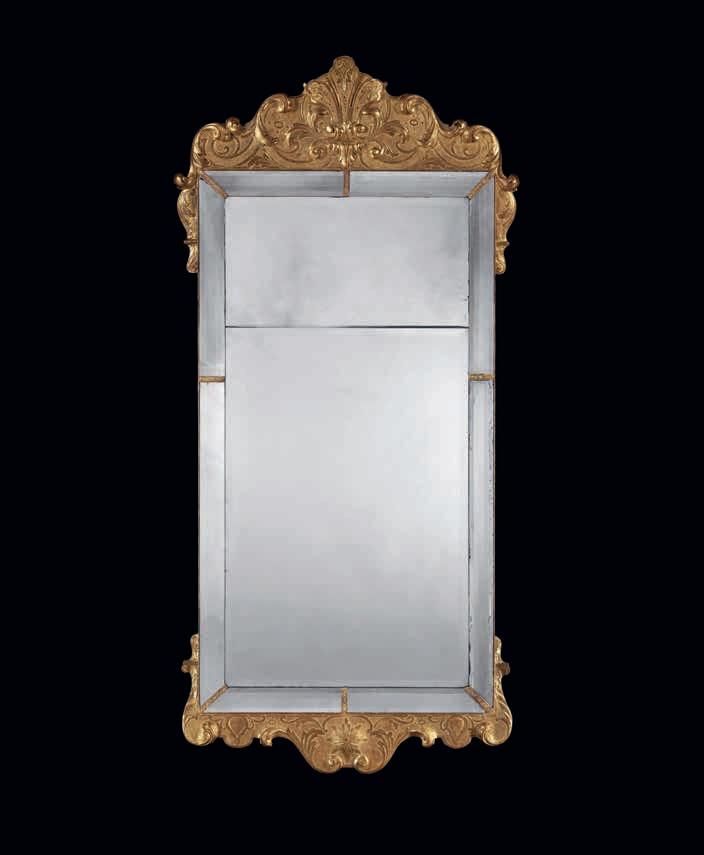
A QUEEN ANNE BORDER GLASS GESSO MIRROR
Note: The mirror retains much of the original gilding and most of the original glasses. The large bevelled mirror plate has been resilvered and the smaller plate above is a later replacement. Two of the border glasses are period replacements.
English, circa 1710
Height: 5 ft 10½ in; 179 cm
Width: 2 ft 10 in; 86 cm
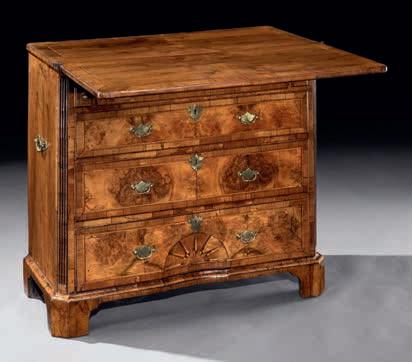
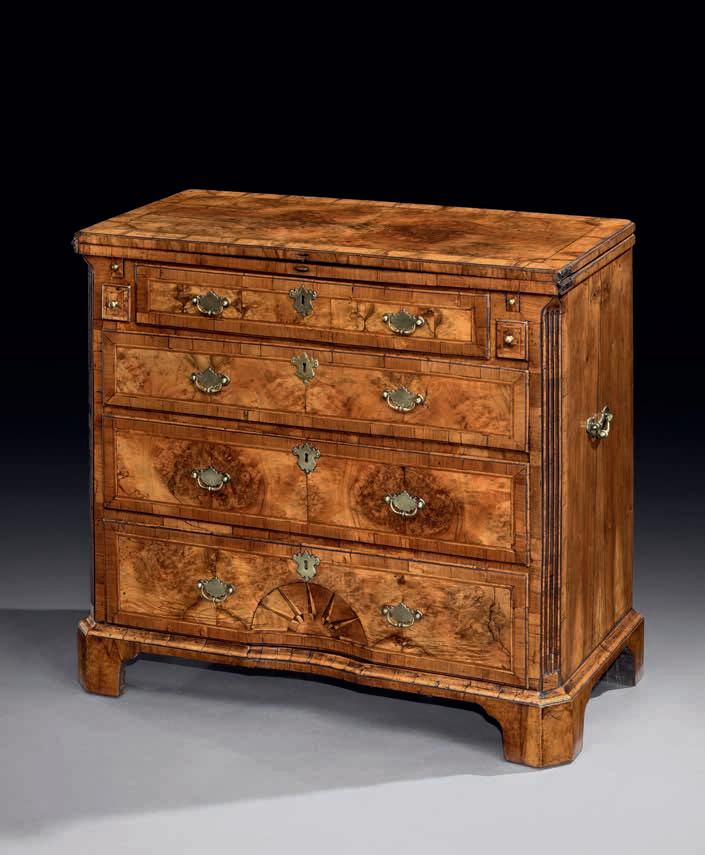
Note: The chest of drawers retains the original brass handles. English, circa 1725
Height (closed): 35 in; 89 cm
Height (open): 34¼ in; 87 cm
Width: 37½ in; 95.5 cm
Depth (closed): 18 in; 46 cm
Depth (open): 35½ in; 90 cm
Provenance: Private collection, Europe.
This bachelor’s chest has the unusual feature of two very small drawers fitted beneath the lopers of the fold-over top, as well as a secret drawer. The canted fluted angles and finely veneered concave sunburst of the largest drawer are exceptionally rare decorative elements.
A GEORGE I FIGURED WALNUT BACHELOR’S CHEST
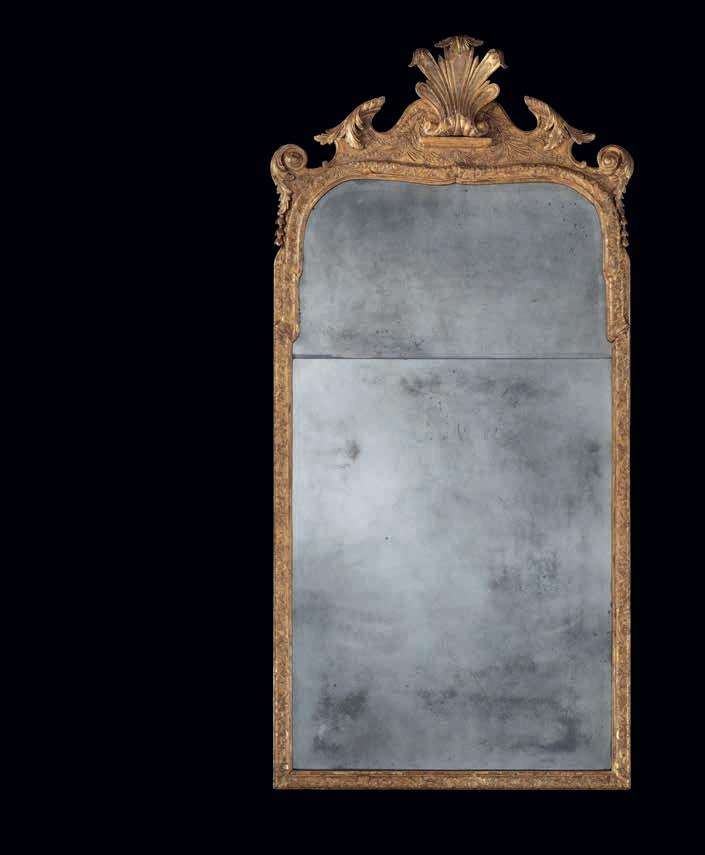
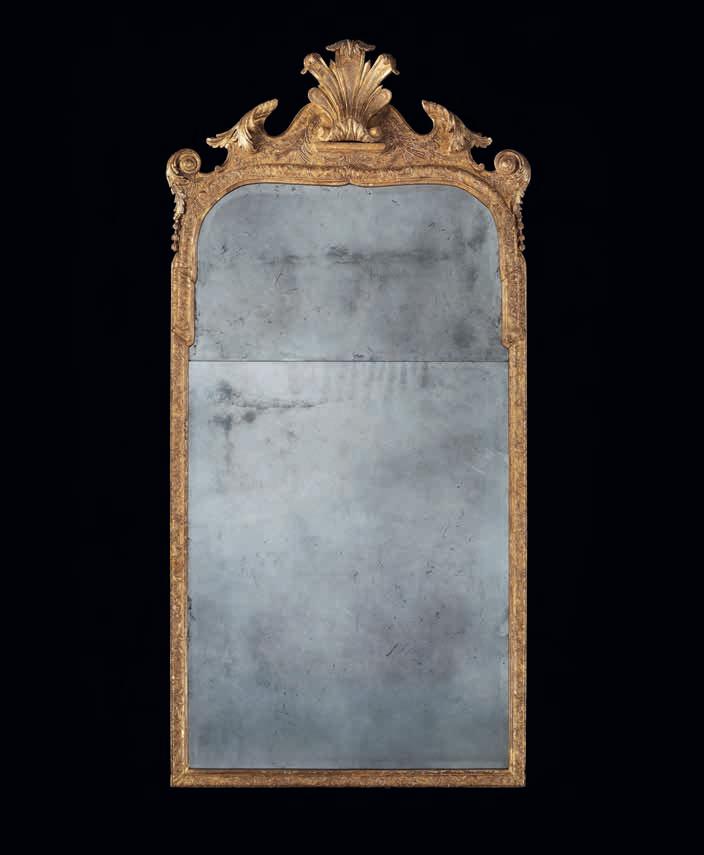
A PAIR OF
GILT GESSO PIER MIRRORS ATTRIBUTED TO ROBERT DERIGNEE
Note: Both mirrors retain much of the original gilding. The mirror plates are later replacements.
English, circa 1705
Height: 5 ft 6 in; 167.5 cm
Width: 2 ft 9¾ in; 86 cm
Provenance: Private collection, England.
QUEEN ANNE
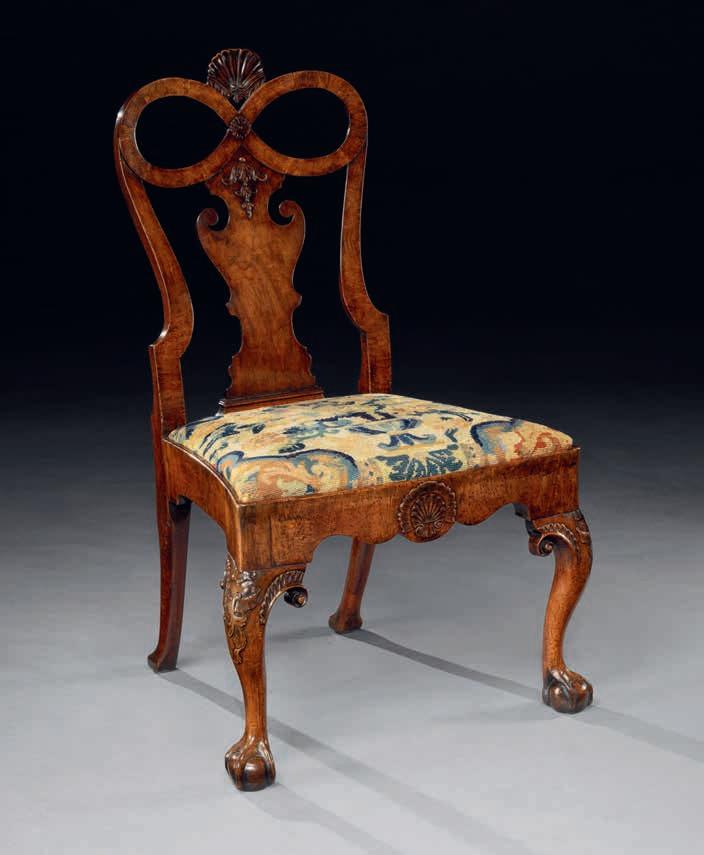
A PAIR OF GEORGE II WALNUT SIDE CHAIRS
Note: The chairs are incised with Roman-style numerals, IIII and XIIII respectively.
The chairs: English, circa 1735
The needlework: French, circa 1720
Height: 41 in; 104 cm
Height of seat: 19 in; 48 cm
Width: 25¼ in; 64 cm
Depth: 23 in; 58.5 cm
Provenance: Private collection, England.
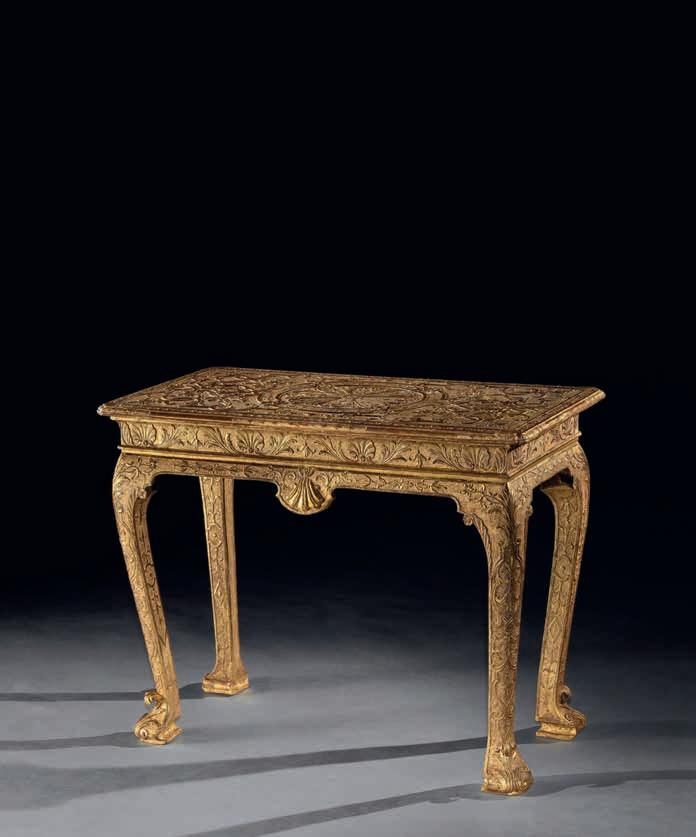
THE ADLINGTON HALL GESSO TABLE
A GEORGE I GESSO TABLE
Note: The table retains most of the original gilding.
English, circa 1720
Height: 30½ in; 77.5 cm
Width: 38½ in; 97.5 cm
Depth: 20½ in; 52 cm
Provenance: Probably commissioned by John Legh for Adlington Hall, Cheshire, England; by descent to Baroness Patricia Rawlings, Adlington Hall, Cheshire, England.
Illustrated: ‘Adlington Hall’, Country Life, 12 December 1952, p. 1961.
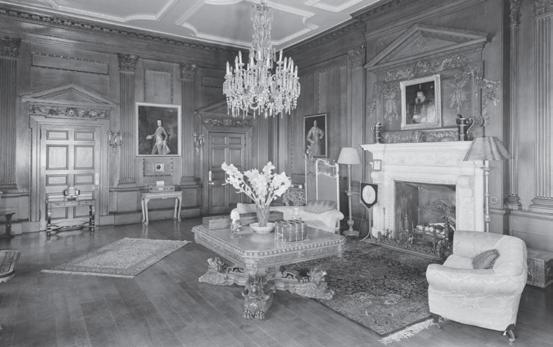
The table in situ at Adlington Hall, Cheshire, in 1952
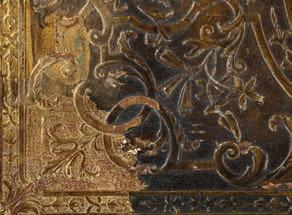
One corner of the tabletop with original gilding revealed during restoration

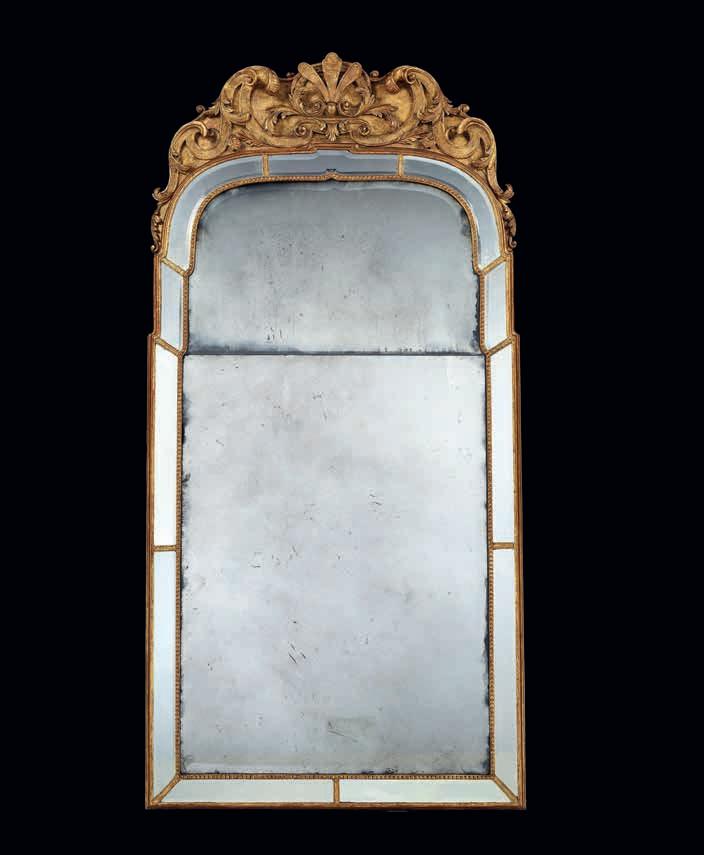
THE GODMERSHAM PARK MIRROR
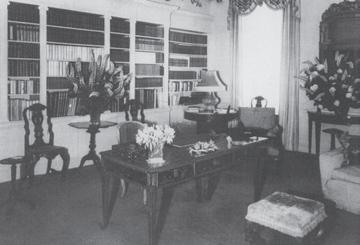
A QUEEN ANNE GILT GESSO MIRROR ATTRIBUTED TO THOMAS AND RENE PELLETIER
Note: The frame retains some of the original gilding. Some of the marginal glasses are 18th century replacements and the original centre plates have been re-silvered.
English, circa 1705
Height: 6 ft 1¾ in; 187.5 cm
Width: 3 ft ¾ in; 93.5 cm
Provenance: Mrs. Robert Tritton, Godmersham Park, Canterbury, Kent, England.
Illustrated: Christie’s, ‘The late Mrs. Robert Tritton, Godmersham Park’, sale catalogue, 3–9 June 1983, lot 197.
The mirror in situ in the library at Godmersham Park, Kent, in 1983
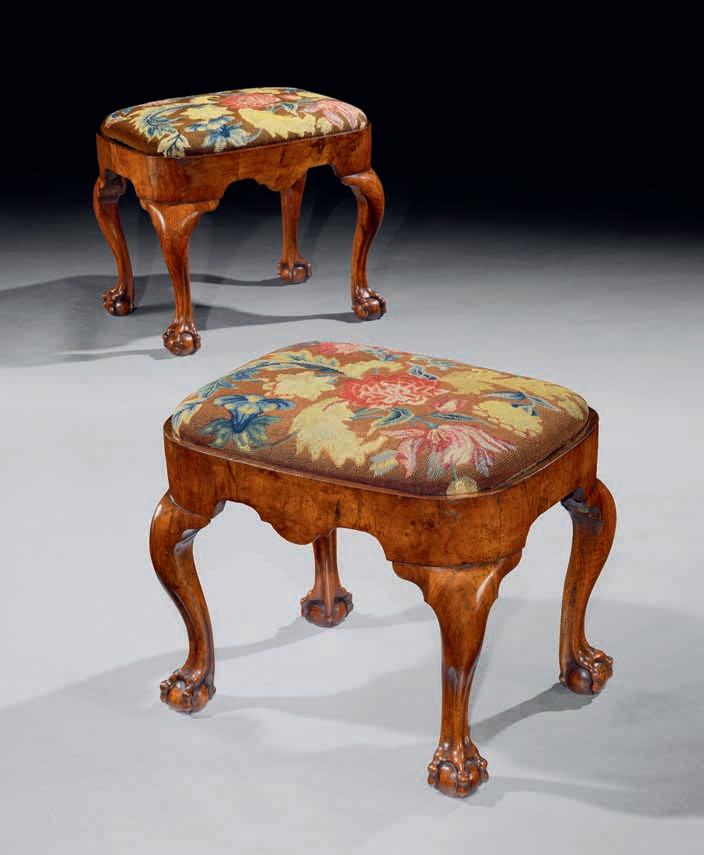
THE JUDGE UNTERMYER STOOLS
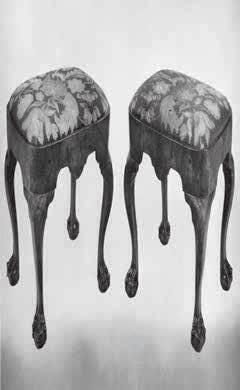
A PAIR OF GEORGE II WALNUT STOOLS
Note: The floral pattern of the needlework is carefully placed so that each element is fully visible without being masked by the frame of the stool. It is therefore possible that the needlework is original to the piece.
The stools: English, circa 1730
The needlework covers: English, circa 1730, and possibly original
Height: 17½ in; 44.5 cm
Width: 18¾ in; 47.5 cm
Depth: 15¼ in; 38.5 cm
Provenance: Judge Irwin Untermyer, New York, USA; Metropolitan Museum of Art, New York, USA, as part of the Untermyer bequest; Private collection, USA.
Illustrated: Yvonne Hackenbroch, English Furniture with Some Furniture of Other Countries in the Irwin Untermyer Collection, 1958, pl. 61.
The stools illustrated in Yvonne Hackenbroch’s catalogue of the Untermyer Collection, 1958
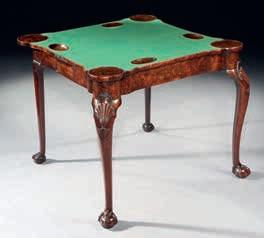
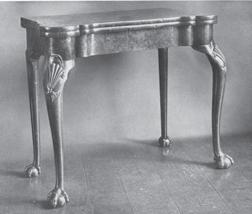
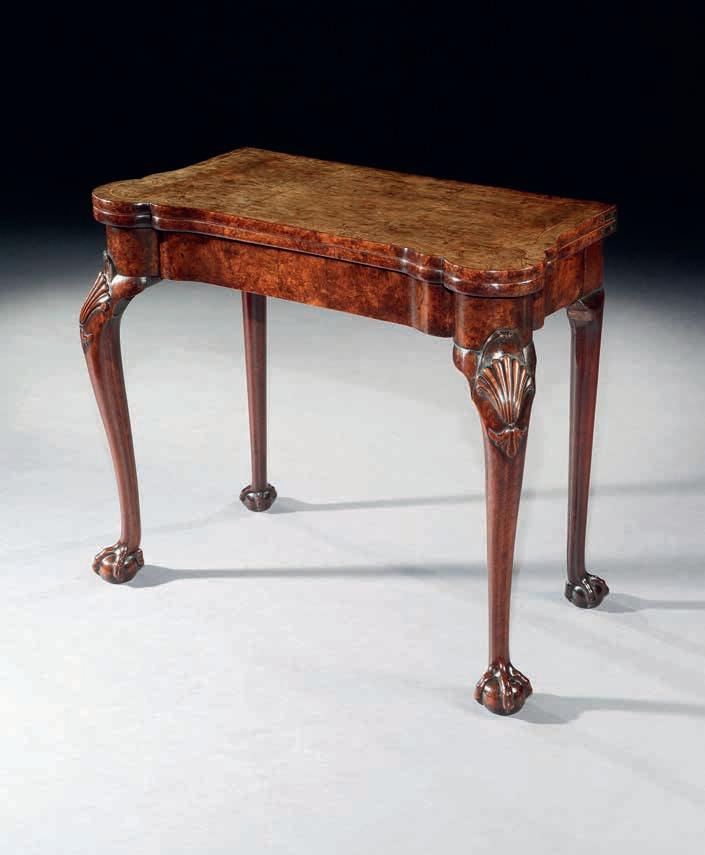
A GEORGE II WALNUT CONCERTINA ACTION CARD TABLE
BY BENJAMIN CROOK
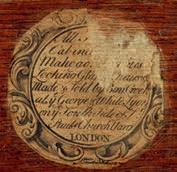
Note: The card table retains a paper trade label of Benjamin Crook pasted to the inside of the frieze drawer. The green baize lining is of later date.
English, circa 1735
Height: 28½ in; 72.5 cm
Width: 35¼ in; 89.5 cm
Depth: 17 in; 43 cm
Provenance:
Percival D. Griffiths, Sandridgebury, Kent, England, until 1939; Purchased by a Mr. Blake for £168; Private collection, England.
Illustrated:
R. W. Symonds, English Furniture from Charles II to George II, 1929, p. 47, fig. 24; p. 182, fig. 139; p. 264, fig. 217.
Christie’s, ‘The Important Collection of Chinese Porcelain and Objects of Art – Stuart Relics and Needlework Fine English Furniture and Eastern Rugs and Textiles formed by the late Percival D. Griffiths, Esq.’, sale catalogue, 10 May 1939, pp. 52–3, lot 202.
Geoffrey Wills, English Furniture 1550–1760, 1971, p. 208.
Christopher Gilbert, A Pictorial Dictionary of Marked London Furniture 1700–1840, 1996, p. 169, illus. 265.
Christian Jussel and William DeGregorio, English Furniture 1680–1760: The Percival D. Griffiths Collection, 2023, vol. I, p. 163, illus. F166.
Literature:
Geoffrey Beard and Christopher Gilbert, The Dictionary of English Furniture Makers 1660–1840, 1986, pp. 211–12.
Benjamin Crook’s only recorded commission for a set of chairs is for the Duke of Montrose in 1733, despite Crook not being a freeman at the time. In the following year he was elected a Freeman of the Joiners Company, which allowed him to trade legally under his own name.
Although Crook labelled his furniture, as did other contemporary cabinet-makers located around the St. Paul’s Churchyard area in London, including Giles Grendey and John Belchier, only a handful of items with his label have come to light so far.
Crook retired in 1748. His stock was put up for sale, and his son, also called Benjamin, took over the business at the same premises.
The card table is typical for the period with its elegant cabriole legs with carved knees. The herringbone inlay in the top is very fine. More unusual is the drawer in the frieze, which is original and retains the trade label.
R. W. Symonds rated the table highly for its elegant design, its genuine patination and the label, featuring it three times in his seminal work, English Furniture from Charles II to George II
The card table in the Griffiths collection, illustrated in English Furniture from Charles II to George II by R. W. Symonds, 1929
A WALNUT CARD TABLE
FROM THE PERCIVAL D. GRIFFITHS COLLECTION
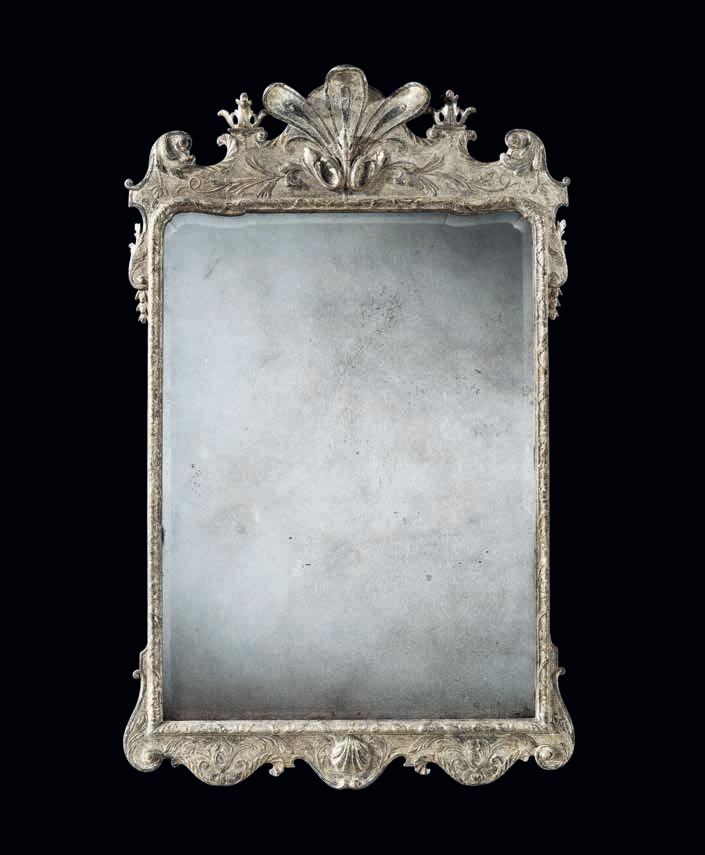
A GEORGE I SILVERED GESSO MIRROR
Note: The mirror retains much of the original silvering. The original bevelled and shaped mirror plate has been re-silvered.
English, circa 1720
Height: 50½ in; 128.5 cm
Width: 31½ in; 80 cm
This mirror with its original silvered finish is a rare survivor. Although similar to painted mirrors, only a small number of silvered mirrors were produced in England during the 18th century. Most of those that have survived have at some stage lost their silvered gesso and then been gilded.
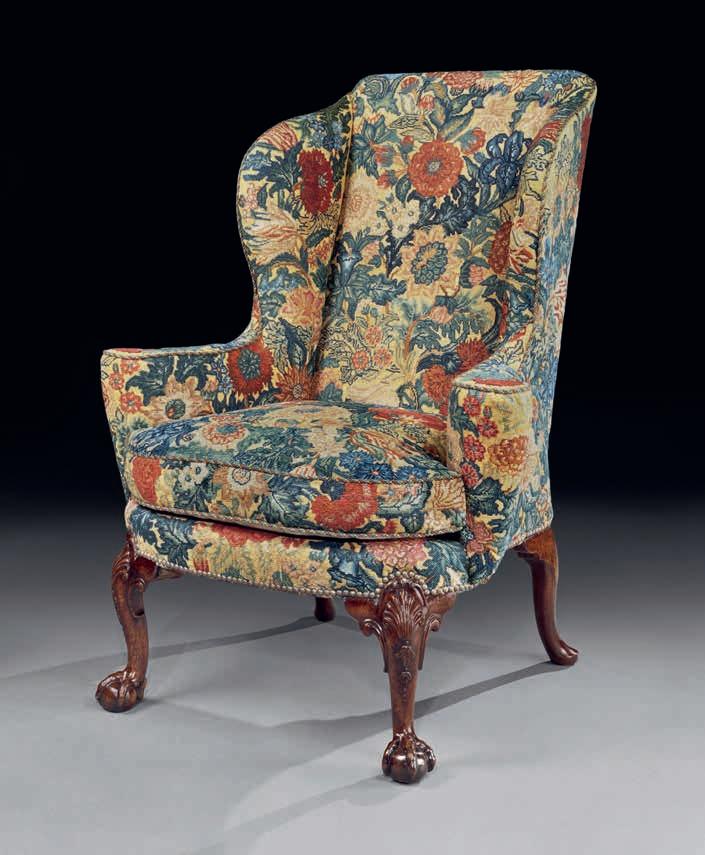
A GEORGE II WALNUT WING CHAIR
Note: Much of the unfaded original brightness of the wool fabric has been retained. With minor restorations to the needlework.
The chair and the needlework: English, circa 1740
Height: 45½ in; 115.5 cm
Height of seat: 18½ in; 47 cm
Width: 34¼ in; 87 cm
Depth: 28½ in; 72.5 cm
Provenance: Ronald Phillips Ltd., London, England; Private collection, London, England.
Literature:
R. W. Symonds, English Furniture from Charles II to George II, 1929, frontispiece.
Yvonne Hackenbroch, English and Other Needlework Tapestries and Textiles in the Irwin Untermyer Collection, 1960, pl. 109.
It is rare to find wing chairs upholstered in needlework both inside and out, especially when its condition is as well preserved as on this example. Very similar needlework can be found on a wing chair formerly in the celebrated Percival Griffiths Collection and now in the Metropolitan Museum of Art in New York as part of the Untermyer bequest.
RONALD PHILLIPS
69
THE DAISY FELLOWES SPECIMEN MARBLE TABLE
A GEORGE III GILTWOOD SIDE TABLE BY JOHN LINNELL WITH A ROMAN SPECIMEN MARBLE TOP
The specimen marble top: Italian, circa 1750
The giltwood base: English, circa 1765
Height: 3 ft 2 in; 96.5 cm
Width: 5 ft 6¾ in; 169.5 cm
Depth: 2 ft 3¾ in; 70.5 cm
70
A GEORGE II MAHOGANY BREAKFRONT CABINET ATTRIBUTED TO WILLIAM HALLETT, THE DESIGN TO WILLIAM KENT
English, circa 1740
Height: 8 ft 2 in; 249 cm
Width: 5 ft 7 in; 170.5 cm
Depth: 1 ft 10 in; 56 cm
71
A PAIR OF GEORGE III MAHOGANY STOOLS ATTRIBUTED TO THOMAS CHIPPENDALE
English, circa 1765
Height: 18¼ in; 46.5 cm
Width: 20 in; 51 cm
Depth: 13 in; 33 cm
72
A PAIR OF GEORGE III MAHOGANY LIBRARY ARMCHAIRS ATTRIBUTED TO WILLIAM VILE FROM THE ST. GILES’S HOUSE SUITE
English, circa 1765
Height: 39¾ in; 101 cm
Height of seat: 17½ in; 44.5 cm
Width: 28¾ in; 73 cm
Depth: 31½ in; 80 cm
73
A GEORGE IV EIGHT LIGHT CUT GLASS CHANDELIER ATTRIBUTED TO F. & C. OSLER
English, circa 1820
Height: 48 in; 122 cm
Diameter: 29 in; 74 cm
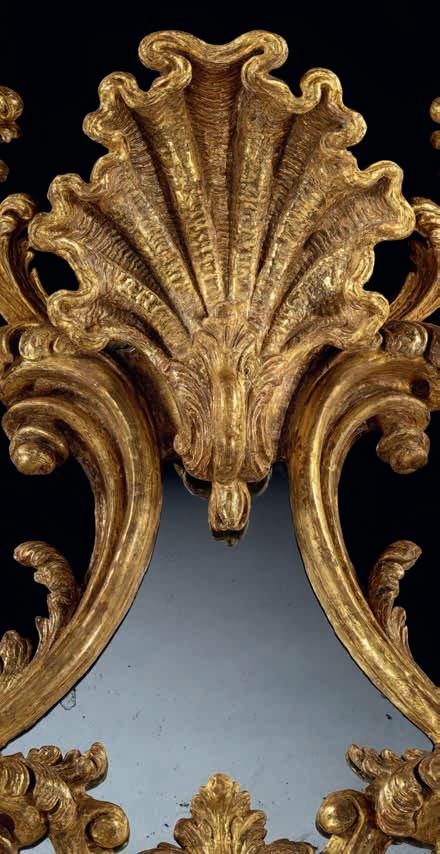
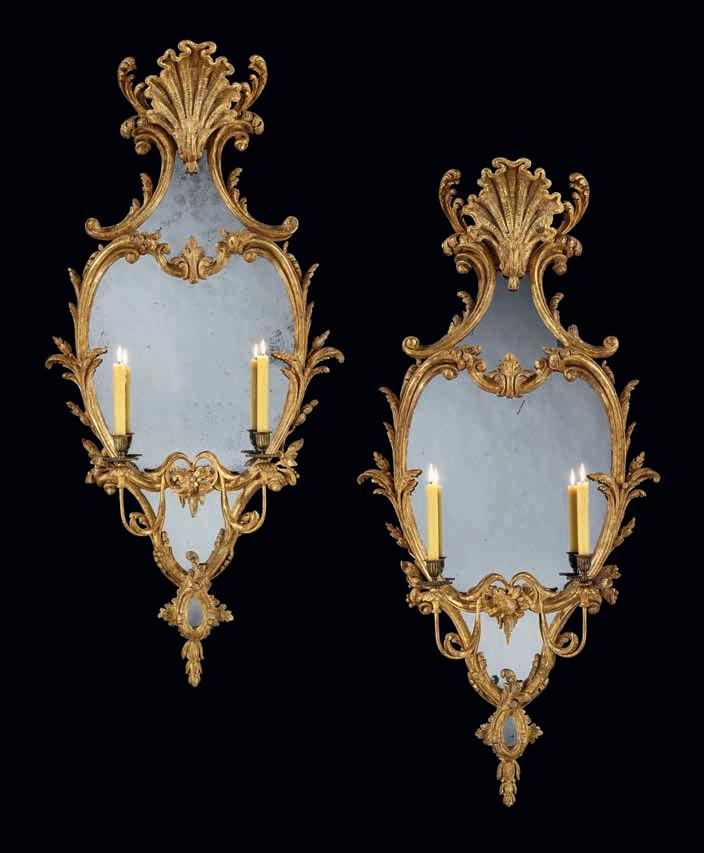
A PAIR OF GEORGE III GILTWOOD TWIN LIGHT GIRANDOLES ATTRIBUTED TO JOHN LINNELL
Note: The girandoles retain their original mirror plates and most of the original gilding. The twin candle arms have been replaced.
English, circa 1765
Height: 35 in; 89 cm
Width: 19 in; 48 cm
Depth: 11¾ in; 30 cm
Provenance:
Private collection, England.
The prolific furniture business of father and son William and John Linnell was based in Berkeley Square, London. They were ranked among the finest cabinet-makers of their time.
John Linnell was William Linnell’s eldest son. He trained as a designer at the prestigious St. Martin’s Lane Academy, founded by William Hogarth in 1735. He joined the business in 1749 and took it over after his father’s death in 1763.
75
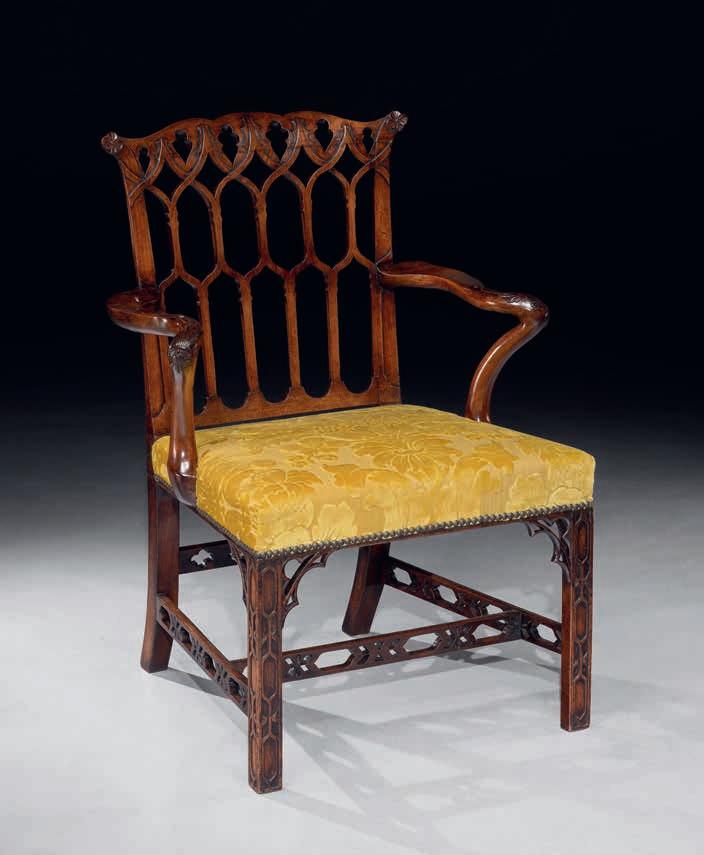
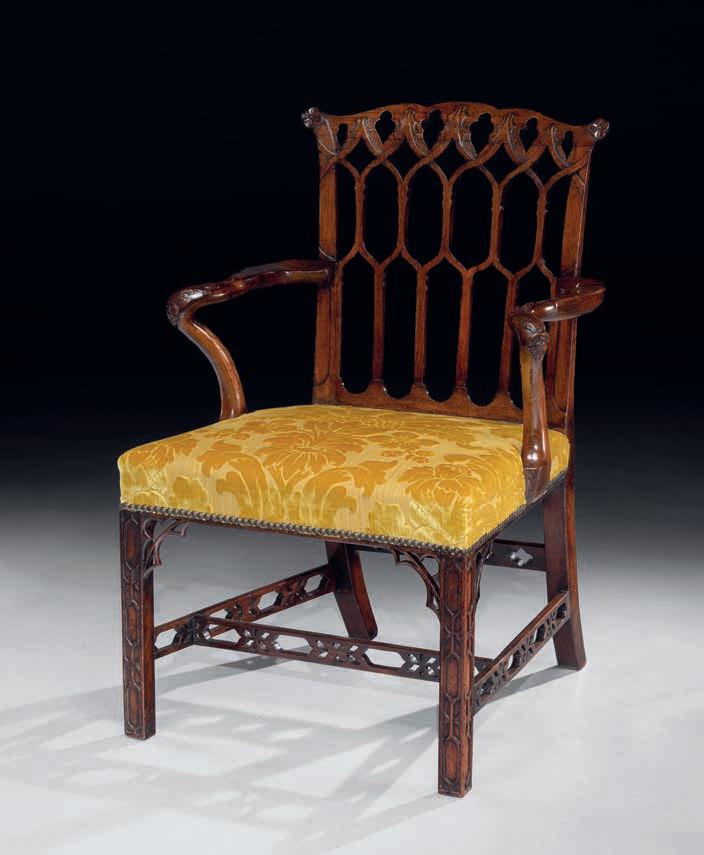
A PAIR OF GEORGE II MAHOGANY ARMCHAIRS
Note: With restorations to the needlework covers.
English, circa 1755
Height: 37¾ in; 96 cm
Height of seat: 18¾ in; 47.5 cm
Width: 27½ in; 70 cm
Depth: 25 in; 63.5 cm
Provenance:
Mallett & Son, London, England; Private collection, London, England.
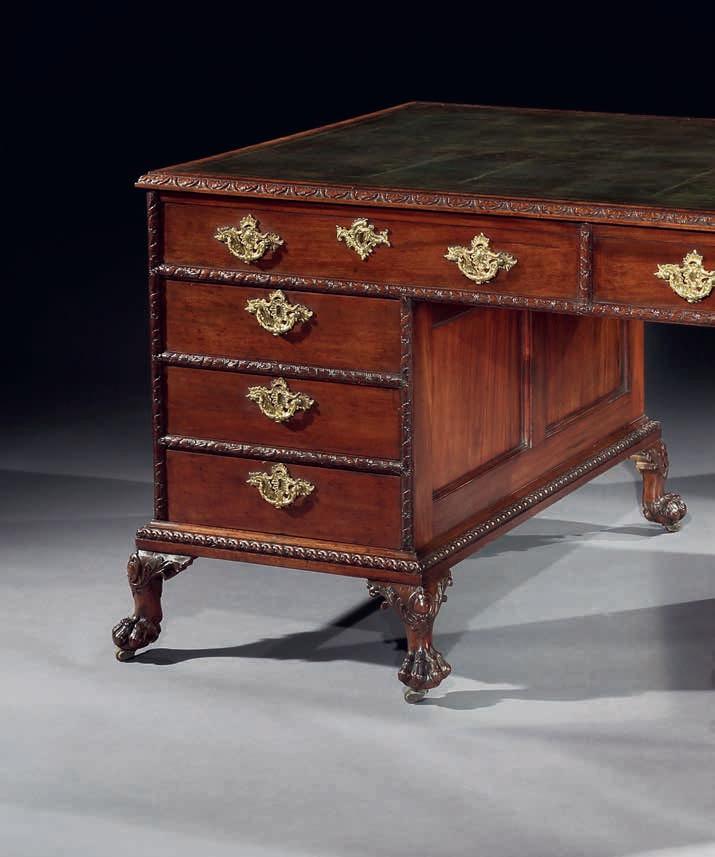
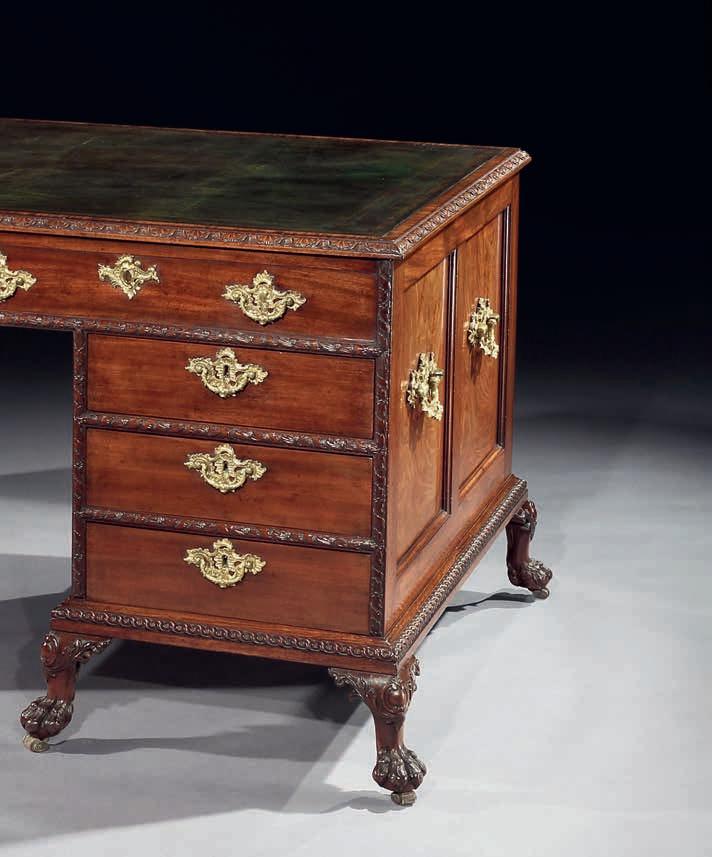
THE DINGLEY HALL LIBRARY TABLE
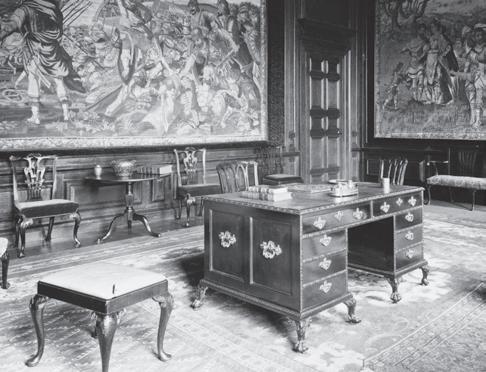
The pedestal desk in situ at Dingley Hall, Northamptonshire, in 1921
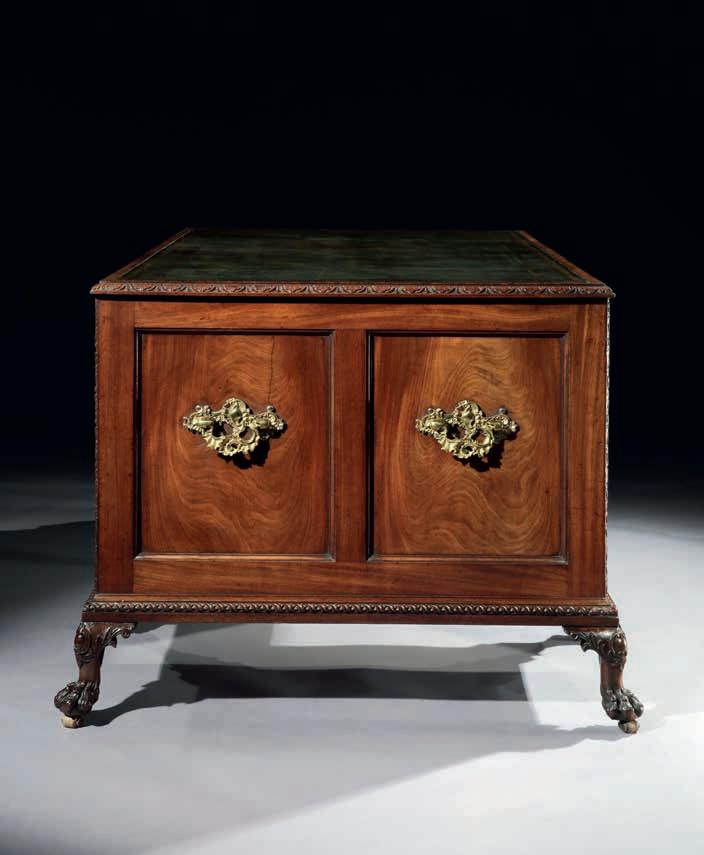
A GEORGE II MAHOGANY PEDESTAL WRITING DESK ATTRIBUTED TO WILLIAM HALLETT
Note: The front of one pedestal was at some stage converted to a filing drawer but has now been reinstated as drawers, retaining the original drawer fronts. The desk retains all the original brass locks, ornate brass handles and concealed castors. The gold tooled leather insert is of later date.
English, circa 1740
Height: 2 ft 7 in; 79 cm
Width: 5 ft 3¼ in; 160.5 cm
Height of kneehole: 2 ft ½ in; 62.5 cm
Width of kneehole: 1 ft 10¼ in; 56.5 cm
Depth: 3 ft 3½ in; 100.5 cm
Provenance:
Dingley Hall, Northamptonshire, England; Private collection, England.
Illustrated: ‘Dingley Hall II, Northamptonshire, The Seat of Viscount Downe’, Country Life, 23 April 1921, p. 497; in situ in the Tapestry Room.
Literature: Christie’s, ‘The Important Collection of French and English Furniture and Meissen Porcelain, formed by the late S. B. Joel’, sale catalogue, 29 May 1935, pp. 34–5, lot 133.
Percy Macquoid and Ralph Edwards, The Dictionary of English Furniture, revised edition, 1954, vol. III, p. 246, fig. 15.
A virtually identical pedestal desk also attributable to the Hallett workshop was formerly in the collection of S. B. Joel, formed under the guidance of R. W. Symonds. The Joel desk is illustrated in TheDictionary of English Furniture. Further smaller examples with arched kneeholes are known, including one formerly with Partridge Fine Arts, now in a private collection in New York.
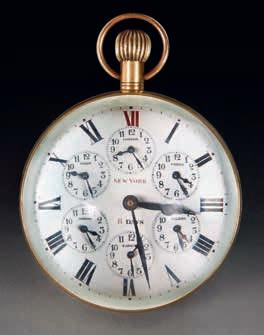
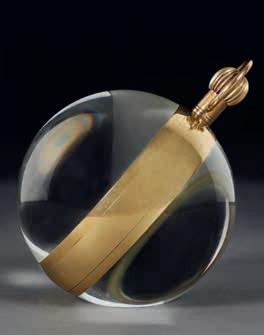
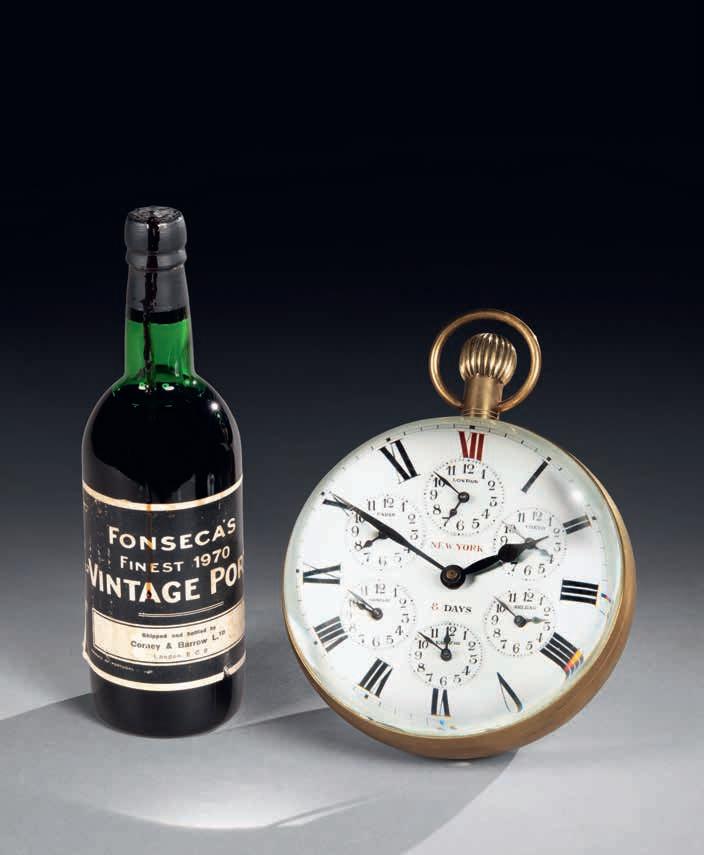
AN EDWARDIAN PERIOD GIANT BRASS MOUNTED GLASS WORLD TIME BALL DESK CLOCK BY ELGIN NATIONAL WATCH COMPANY
Note: The dial has six subsidiary dials, for London, Paris, Tokyo, Moscow, Karachi and Beijing, with an eight-day movement.
Signed: ‘Elgin National Watch Company, Illinois, USA’.
American, circa 1905
Height: 8 in; 20.5 cm
Diameter: 7¼ in; 18.5 cm
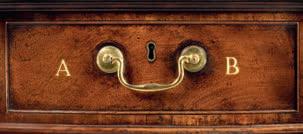
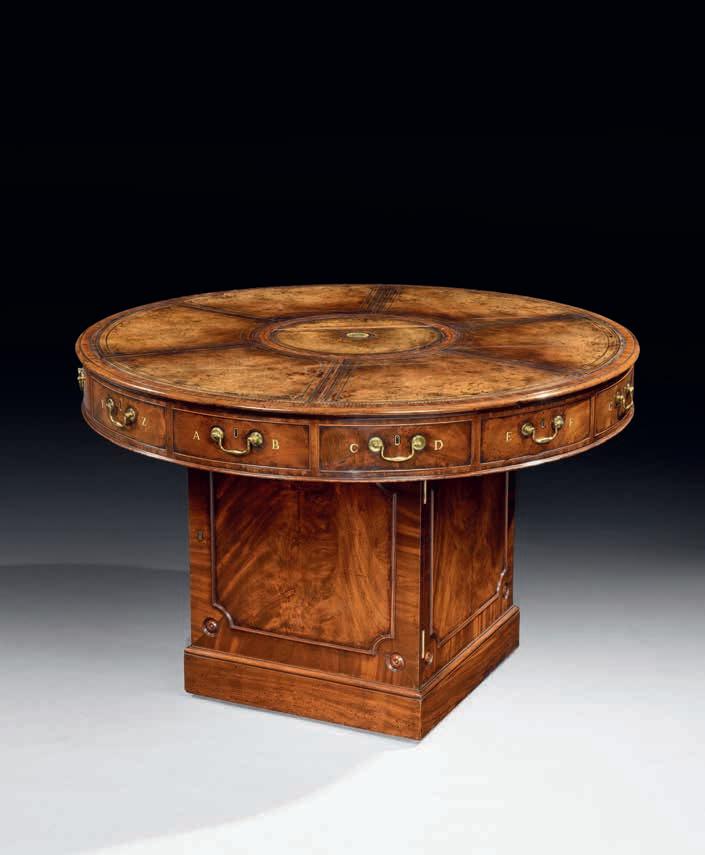
A GEORGE II MAHOGANY RENT TABLE ATTRIBUTED TO GILLOWS
Note: The revolving top is fitted with a money well retaining the original engraved brass sprung lock and the original brass handles to the drawers. The leather insert is of later date.
English, circa 1755
Height: 32½ in; 82.5 cm
Diameter: 49½ in; 126 cm
Provenance: Le Brun Antiques, London, England; Private collection, London, England.
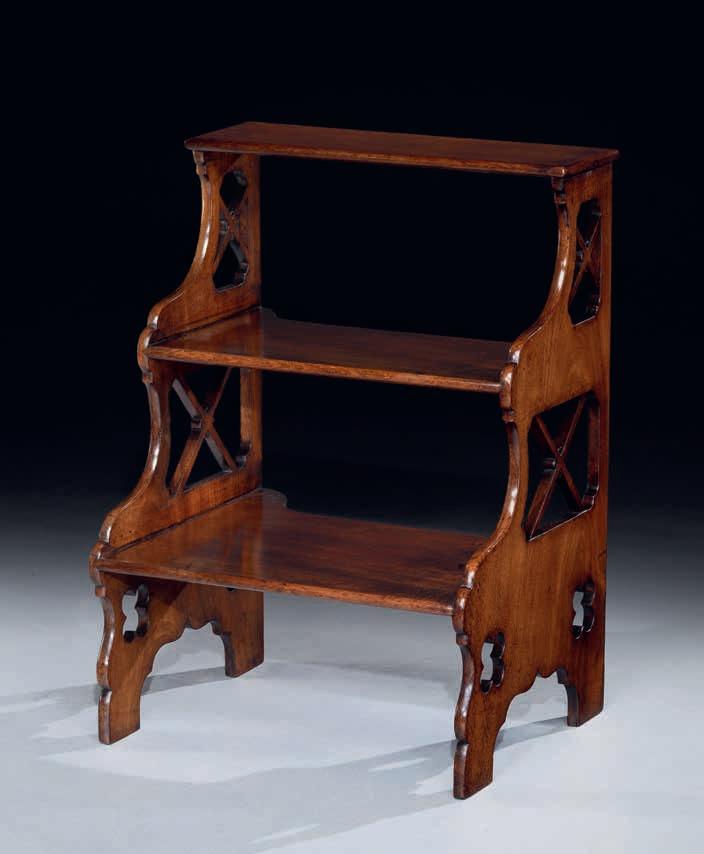
THE HORACE CLAUDE BAXTER LIBRARY STEPS
A SET OF GEORGE II MAHOGANY LIBRARY STEPS
English, circa 1755
Height: 25½ in; 65 cm
Width: 18¼ in; 46.5 cm
Depth: 15 in; 38 cm
Provenance:
Horace Claude Baxter, London, England; Terence Baxter, London, England; Gary Baxter, Sussex, England.
This set of library steps has been passed down through three generations of the Baxter family. It originally belonged to Horace Claude Baxter, co-founder with his sister Maude of the company H. C. Baxter & Sons in 1927. Maude later established her own jewellery business in Knightsbridge, London.
80
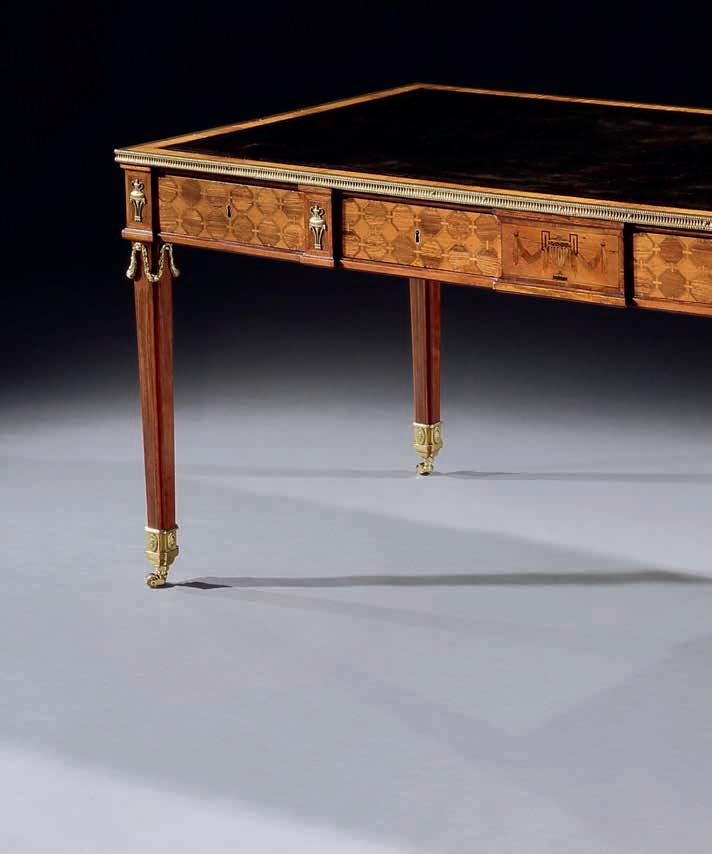
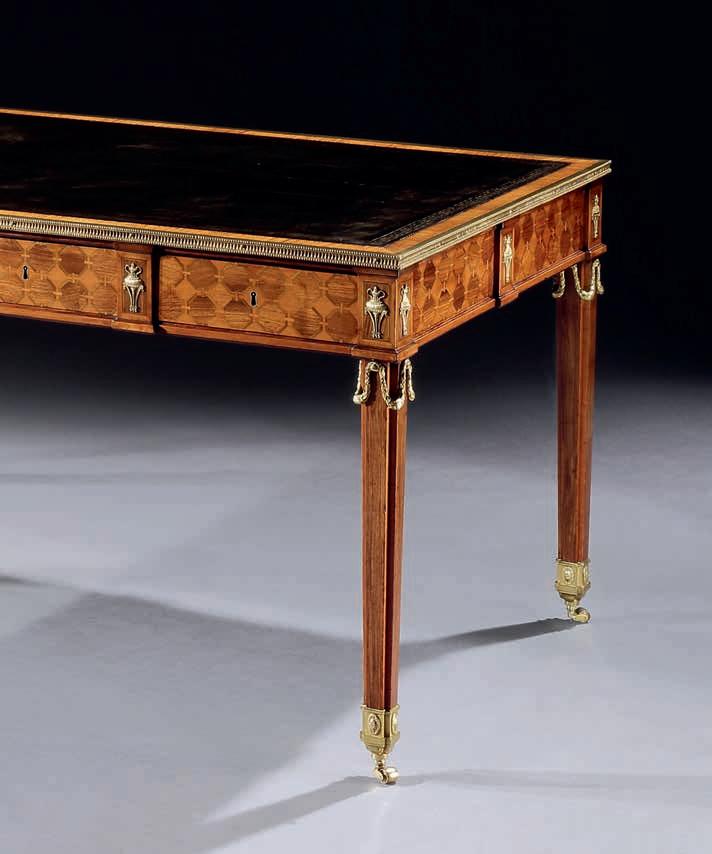
A GEORGE III ORMOLU MOUNTED SATINWOOD, TULIPWOOD AND COCOBOLO WRITING TABLE ATTRIBUTED TO CHRISTOPHER FUHRLOHG
Note: The table retains all the original ormolu mounts and probably the original gold tooled black leather writing surface. The castor wheels and forks are of later date. The parquetry veneered frieze houses four drawers to one side and dummy drawers to the reverse side.
One drawer has a faux ivory label reading ‘Frank Partridge/Works of Art/26 King Street St. James’s/ and/New York’.
English, circa 1785
Height: 2 ft 6¼ in; 77 cm
Knee height: 2 ft; 61 cm
Width: 5 ft 7¾ in; 172 cm
Depth: 2 ft 8 in; 81 cm
Provenance: Frank Partridge Ltd., London, England, and New York, USA; The Hon. Mrs. Audrey Pleydell-Bouverie, Julians, Hertfordshire, England; Partridge Fine Arts Ltd., London, England; Private collection, Switzerland.
Illustrated: Country Life, 27 June 1947, p. 1213; the desk in situ in Mrs. Pleydell-Bouverie’s bedroom at Julians, Hertfordshire.
Partridge Fine Arts Ltd., ‘Recent Acquisitions 1996’, catalogue, pp. 58–9.
Christopher Fuhrlohg was born in 1737 into a Swiss family that had emigrated to Sweden. He came to London via Amsterdam and Paris (where he had worked for Simon Oeben in 1767) and initially worked for Linnell. The influence of the latest French fashion on his work can be found in the collection of Linnell drawings at the Victoria and Albert Museum, London, where a design for a commode is signed with his name. Strong neoclassical lines and skilful parquetry veneering are characteristic of Fuhrlohg’s work.
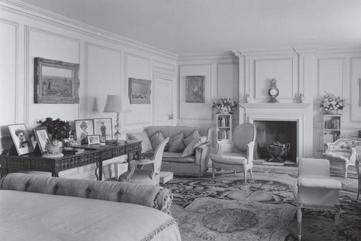
The writing table in situ at Julians, Hertfordshire, in 1947
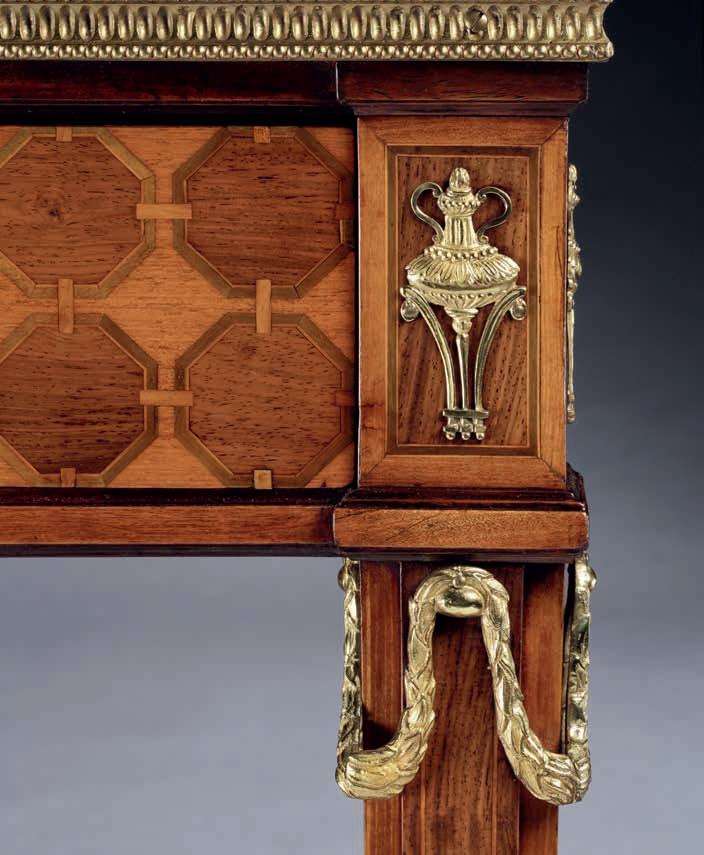
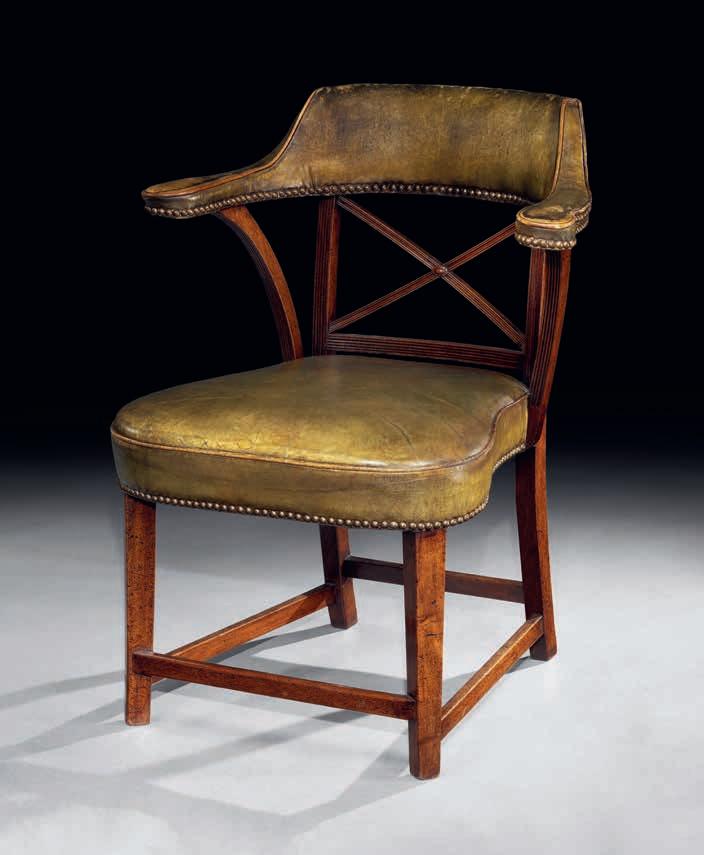
Note: The leather upholstery has faded beautifully, acquiring a pleasing colour.
English, circa 1770
Height: 34 in; 86.5 cm
Height of seat: 19 in; 48 cm
Width: 27 in; 68.5 cm
Depth: 28¾ in; 73 cm
This type of desk chair is today often referred to as a ‘Bank of England’ chair. Although there is no evidence that such chairs were designed specifically for the Bank of England, similar versions may well have been used by clerks there.
The back support forms a cross. This unusual feature, perhaps indicating a Scottish influence, is a pleasing contrast to the standard vase-shaped back splat.
A GEORGE III MAHOGANY ‘BANK OF ENGLAND’ CHAIR
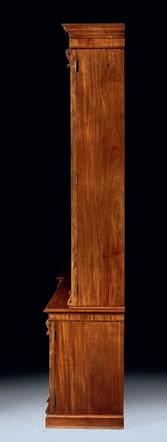
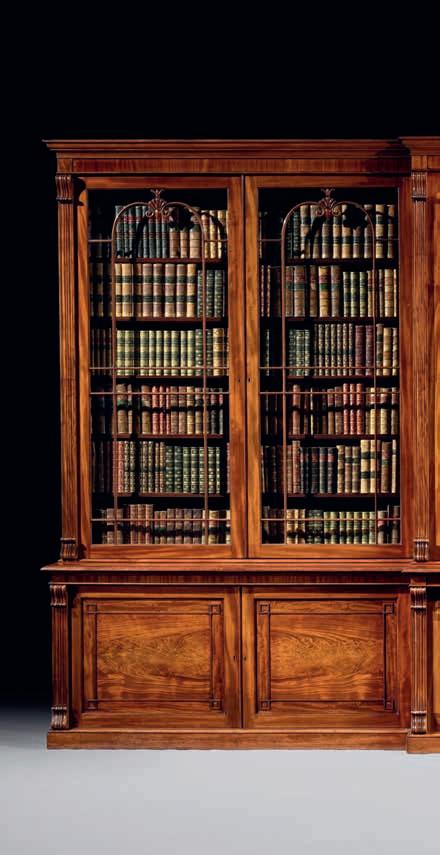
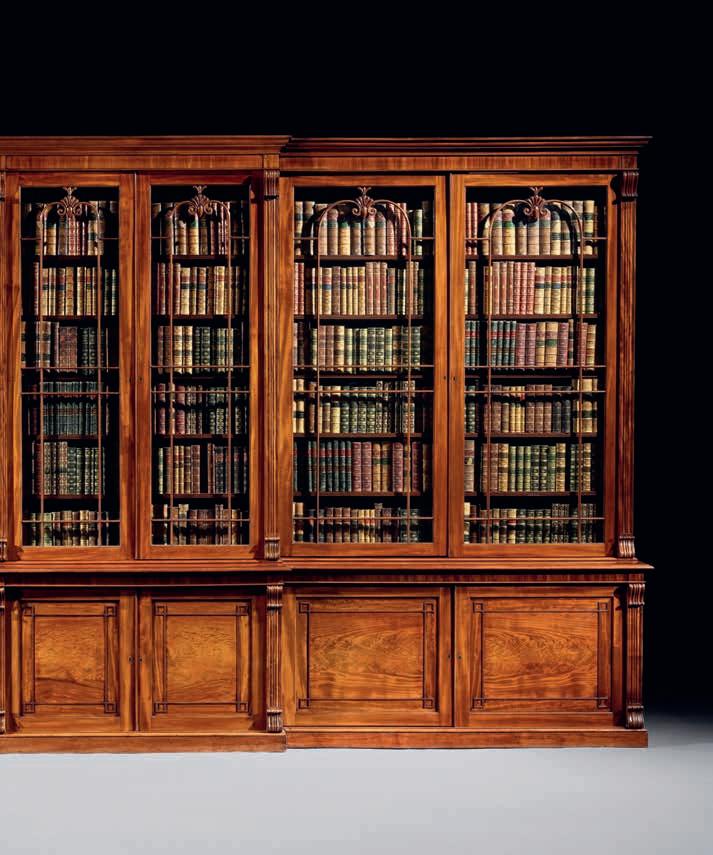
A REGENCY MAHOGANY BREAKFRONT BOOKCASE ATTRIBUTED TO GILLOWS
Note: The shelf between the upper and lower sections of the bookcase is a replacement using period mahogany.
English, circa 1815
Height: 9 ft 3½ ins; 283 cm
Width: 15 ft 9¼ in; 481 cm
Depth: 2 ft 1½ in; 65 cm
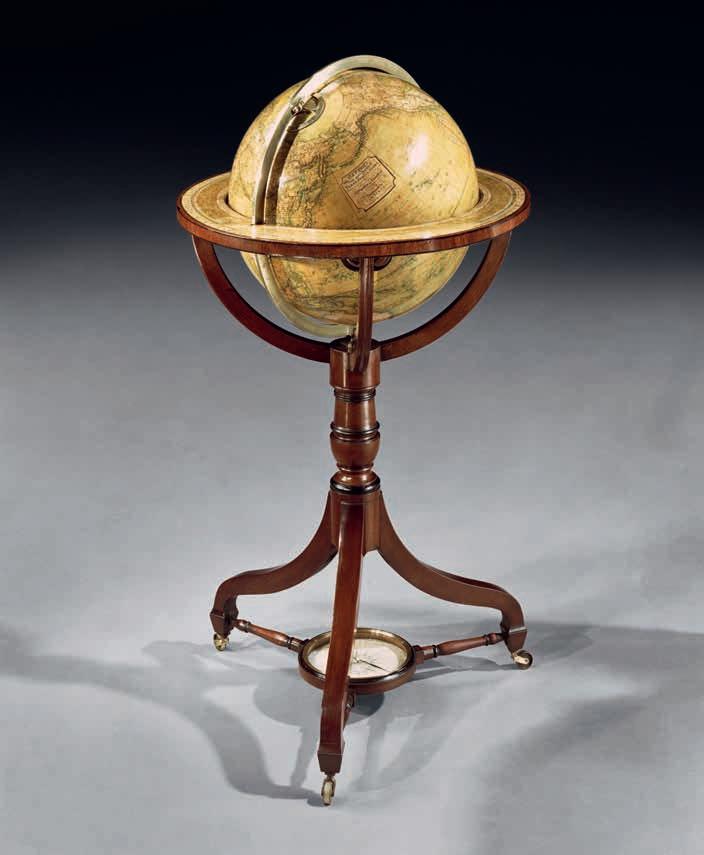
A REGENCY FIFTEEN INCH TERRESTRIAL GLOBE BY J. & W. NEWTON
English, dated 1818
Height: 39½ in; 100.5 cm
Diameter: 21¼ in; 54 cm
A printed label on the globe is inscribed ‘Newton’s/New and Improved/Terrestrial Globe/Accurately delineated from the observations of the most esteemed Navigators and Travellers/To the present time/ Published 1 July 1818/Manufactured by J&W Newton/No. 66, Chancery Lane, London’.
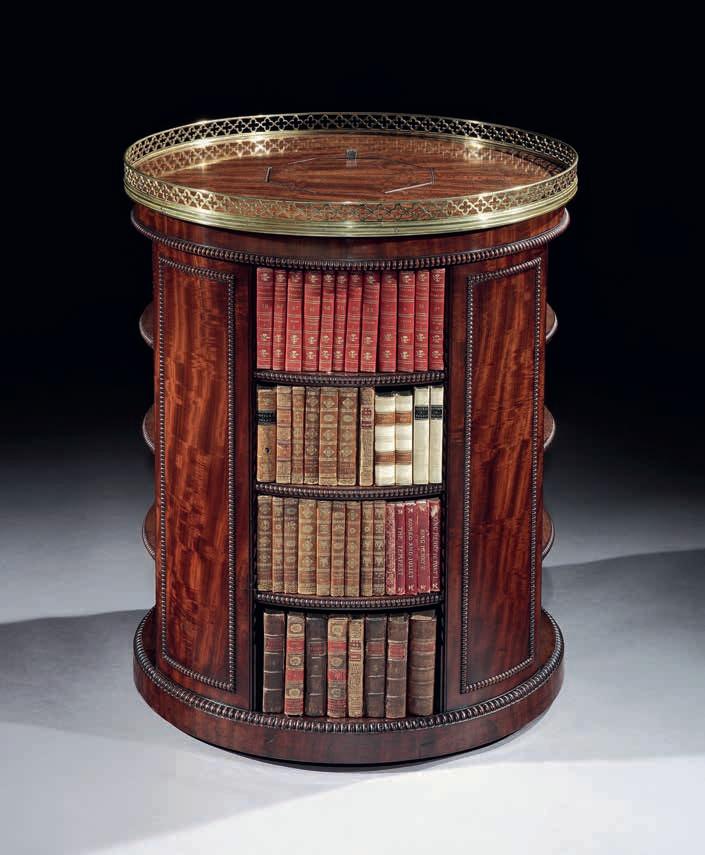
A REGENCY BRASS MOUNTED MAHOGANY CIRCULAR BOOKCASE BY GILLOWS
Note: The original pierced brass gallery is typical of Gillows. Each compartment is fitted with three adjustable shelves. Two shelves are stamped ‘Gillows’ on the reverse edge. On concealed castors.
English, circa 1815
Height: 32 in; 81 cm
Diameter: 24¾ in; 63 cm
Provenance: Ronald Phillips Ltd., London, England; Private collection, New York, USA.
Illustrated: Ronald Phillips Ltd, ‘English Antique Furniture’, catalogue, 2018, pp. 128–9.
Literature: Susan E. Stuart, Gillows of Lancaster and London, 1730–1840, 2008, vol. I, p. 383, pl. 458.
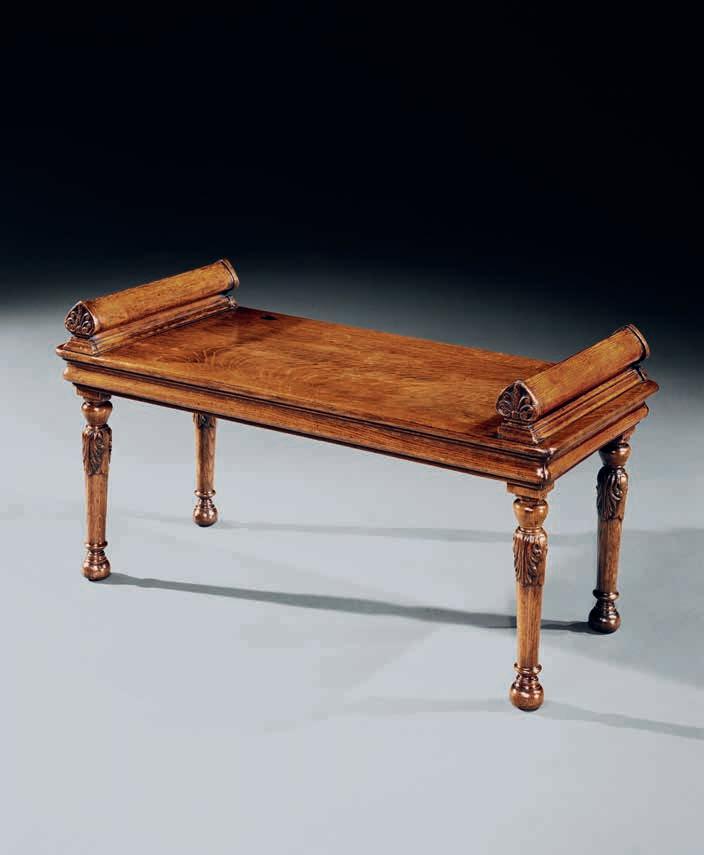
A VICTORIAN OAK BENCH
Note: This bench has acquired a beautiful golden colour. It is unusually deep and could be used as a coffee table.
English, circa 1880
Height: 22 in; 56 cm
Width: 42¼ in; 107 cm
Depth: 18¾ in; 47.5 cm
Provenance: Ronald Phillips Ltd., London, England; Private collection, London, England.
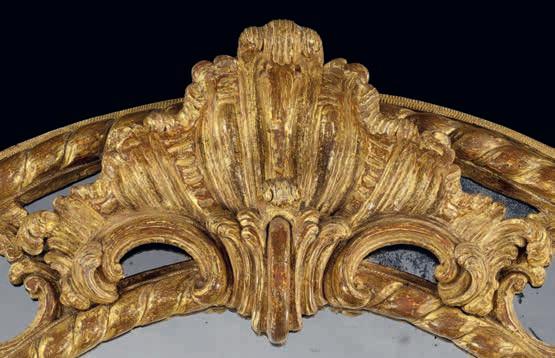
Note: The frame has been re-gilded. The mirror plates are original.
English, circa 1805
Height: 55½ in; 141 cm
Width: 41¼ in; 105 cm
Provenance: Private collection, England.
A GEORGE III GILTWOOD OVAL BORDER GLASS MIRROR
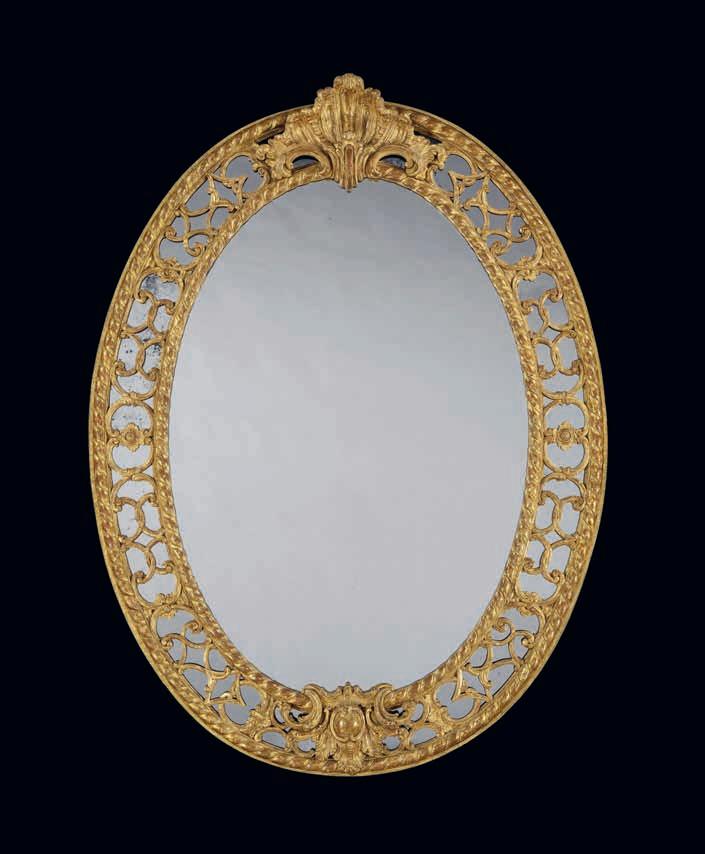
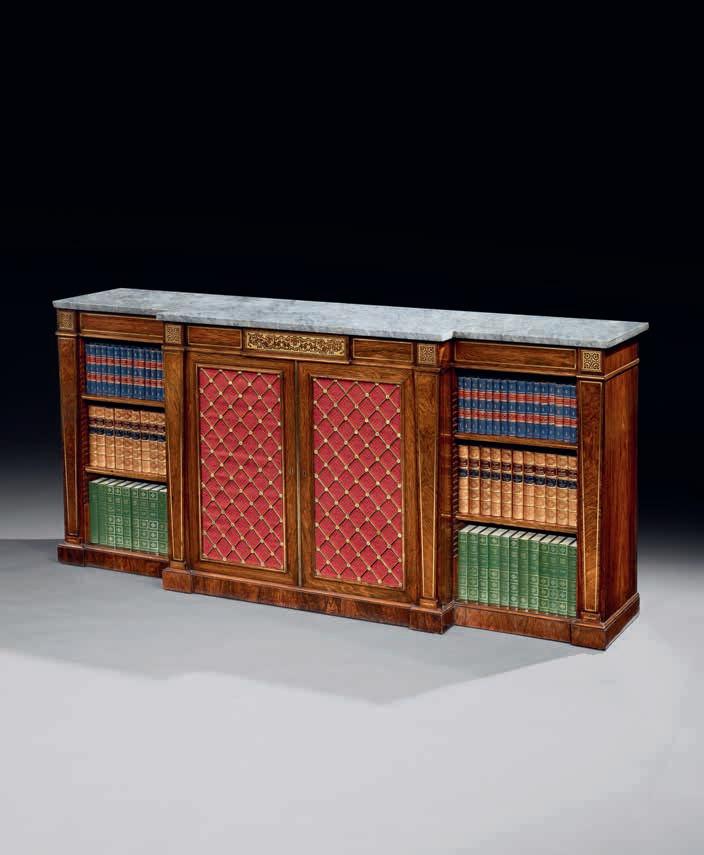
A REGENCY BRASS MOUNTED ROSEWOOD SIDE CABINET ATTRIBUTED TO GILLOWS
Note: The cabinet retains the original dove grey marble top.
English, circa 1815
Height: 2 ft 10½ in; 88 cm
Width: 6 ft 2 in; 188 cm
Depth: 1 ft 5 in; 43.5 cm
The brass inlay to the front of the cabinet relates to similar inlay on the documented library furniture supplied to the Duke of Bolton for Hackwood Park, Hampshire.
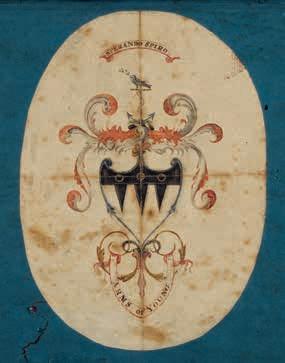
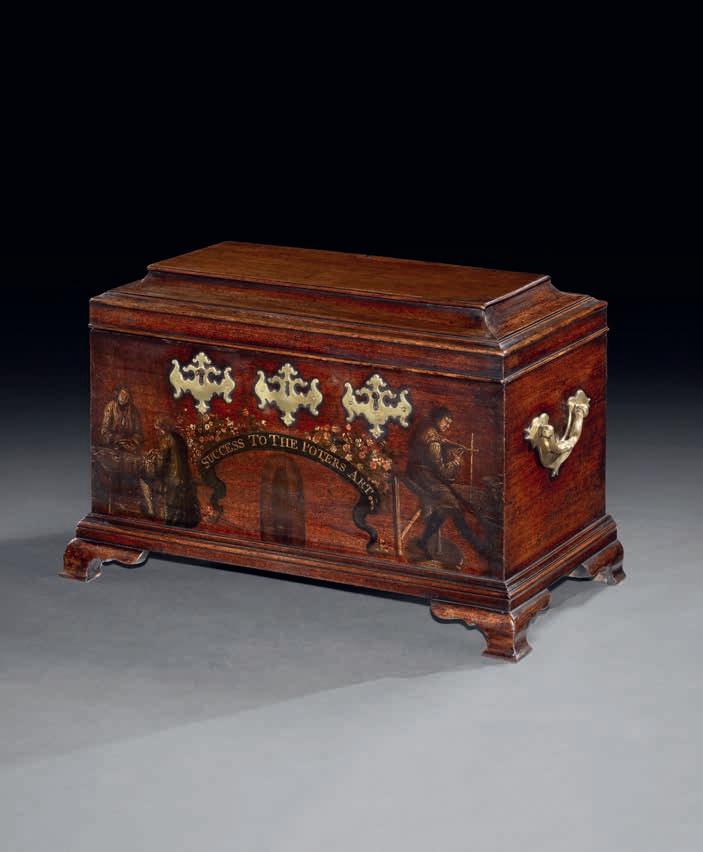
A GEORGE II POLYCHROME DECORATED MAHOGANY DEED BOX
Note: The box retains the original two locks to the front and the original brass lifting handles and escutcheons. The interior retains the original blue lining paper to the inside base. The inside of the lid is painted with the Young family crest and motto. The decoration on the front depicting potters at work is original.
Scottish, circa 1750
Height: 17½ in; 44.5 cm
Width: 29 in; 73.5 cm
Depth: 15 in; 38 cm
Provenance: The Young family, Rosebank, South Lanarkshire, Scotland; Private collection, London, England.
The family crest and motto inside the lid
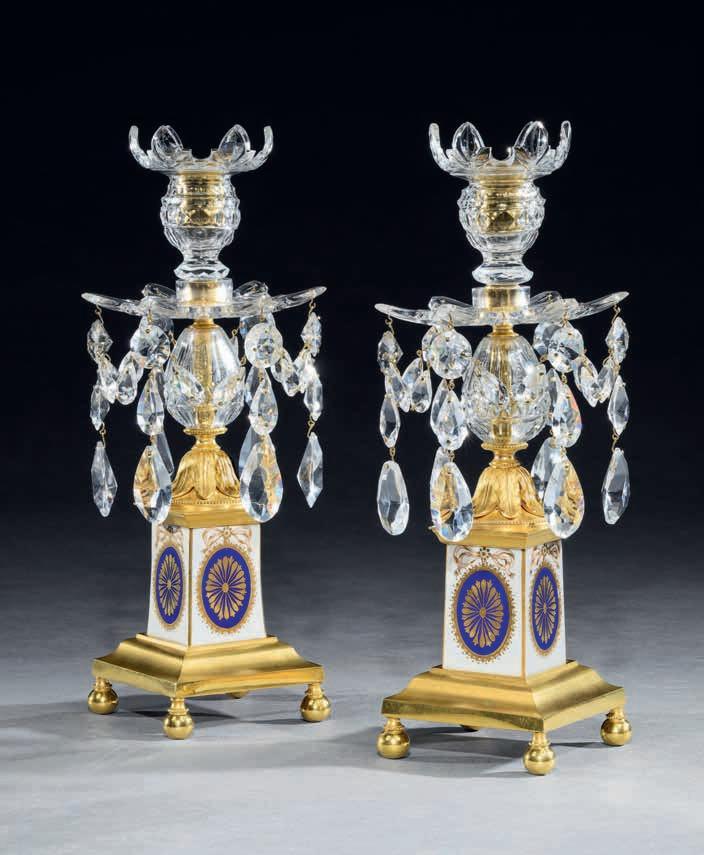
A
PAIR OF GEORGE III ORMOLU MOUNTED CUT GLASS, COBALT AND WHITE OPAQUE GLASS CANDLESTICKS ATTRIBUTED TO WILLIAM PARKER
Note: The candlesticks have survived in outstanding condition with only minor chips to some of the cut glass pendants.
English, circa 1780
Height: 12½ in; 32 cm
Diameter: 5 in; 12.5 cm
90
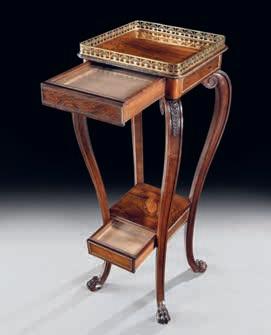
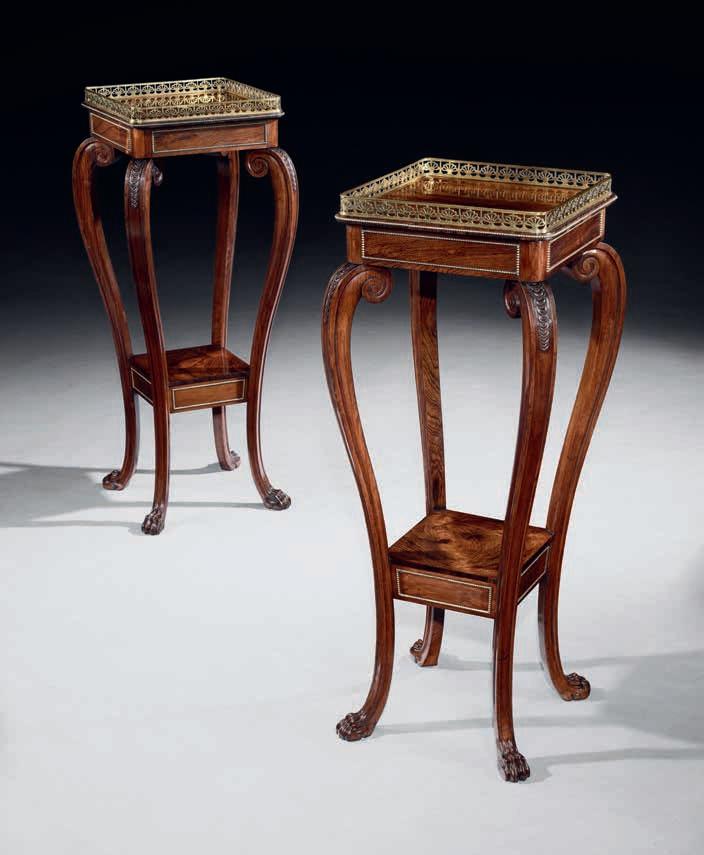
A PAIR OF REGENCY BRASS MOUNTED ROSEWOOD ETAGERE PEDESTALS IN THE MANNER OF GEORGE OAKLEY, FOLLOWING A WILLIAM CHAMBERS DESIGN
Note: The pedestals retain the original brass galleries. The drawers of each pedestal retain the original fitted glazed frame covers concealed within them.
English, circa 1815
Height: 45¼ in; 115 cm
Width: 19 in; 48 cm
Depth: 19 in; 48 cm
Literature: William Chambers, Designs of Chinese Buildings, Furniture, Dresses, Machines and Utensils, 1757, pl. XIV.
The quality of craftsmanship on these pedestals is outstanding. Two hidden drawers on each pedestal are cleverly concealed in the frieze and the lower shelf. The drawers are locked by a brass stay identical to locking stays used on cabinet doors of the period and accessed from the underside of each drawer front. Each drawer is precisely fitted and functions as a display case. The drawers are lined with cork and paper on the bottom and are closed at the top with a glazed frame cover. To ensure that each drawer is returned to the correct housing, the undersides of the drawer fronts are incised with the Roman-style numerals ‘I’ to ‘IIII’.
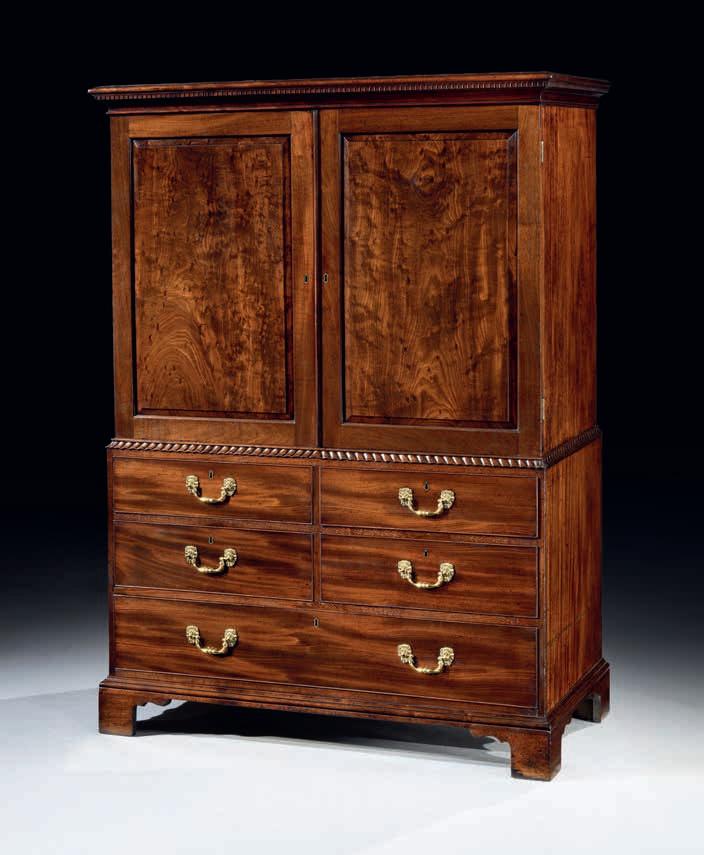
A GEORGE II MAHOGANY LINEN PRESS ATTRIBUTED TO WILLIAM HALLETT
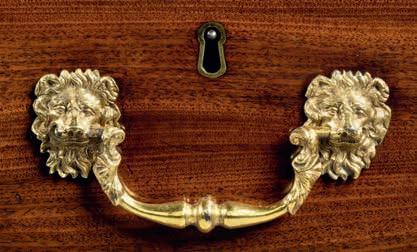
Note: The press is fitted with four sliding trays. The lion mask swan-neck handles, typical of Hallett, are original.
English, circa 1750
Height: 5 ft 7¼ in; 170.5 cm
Width: 4 ft 2 in; 127 cm
Depth: 2 ft 1 in; 63.5 cm
Provenance: Private collection, England.
The mahogany has acquired a beautiful mellow patina. The superior quality of the wood is also reflected in the craftsmanship. William Hallett was one of the finest cabinet-makers of his time. His success allowed him to purchase Canons in Middlesex from the estate of the Duke of Chandos in 1747 and retire early to pursue the life of a squire.
The scallop carved edge moulding is often associated with the work of William Vile, who was apprenticed to Hallett and who may well have been involved in the making of this linen press. After Hallett retired he became a silent partner first to William Vile and later, to a lesser extent, to Vile & Cobb.
92
A GEORGE II MAHOGANY LIBRARY TABLE ATTRIBUTED TO WILLIAM HALLETT
English, circa 1740
Height: 2 ft 7 in; 78.5 cm
Height of kneehole: 2 ft ½ in; 62.5 cm
Width of kneehole: 1 ft 7¾ in; 50 cm
Width: 5 ft ¾ in; 154.5 cm
Depth: 2 ft 11¾ in; 91 cm
93
A GEORGE I SCARLET JAPANNED LONGCASE CLOCK ATTRIBUTED TO GILES GRENDEY, THE MOVEMENT BY DAVID LESTOURGEON
English, circa 1725
Height: 9 ft 4 in; 285 cm
Width: 1 ft 11 in; 58.5 cm
Depth: 11¼ in; 28.5 cm
94
A PAIR OF GEORGE III EIGHT LIGHT ORMOLU MOUNTED CUT GLASS CHANDELIERS BY MOSES LAFOUNT
English, circa 1800
Height: 48 in; 122 cm
Diameter: 34 in; 86.5 cm
95
A PAIR OF GEORGE III GILTWOOD AND COMPOSITION MIRRORS
English, circa 1780
Height: 5 ft 7 in; 170.5 cm
Width: 3 ft 4¾ in; 103 cm
Depth: 6 in; 15 cm
96
A PAIR OF GEORGE III SEMI-ELLIPTIC SATINWOOD AND PURPLEHEART MARQUETRY SIDE TABLES ATTRIBUTED TO INCE & MAYHEW
English, circa 1780
Height: 34 in; 86.5 cm
Width: 58 in; 147.5 cm
Depth: 20¾ in; 53 cm
A REGENCY MAHOGANY DRINKS TABLE
Note: The table retains the original Portor marble top with ormolu band and the original Sheffield plate wine coolers, as well as the original castors. The brass knob handle has been replaced.
English, circa 1815
Height: 30½ in; 77.5 cm
Width: 20¼ in; 51.5 cm
Depth: 18½ in; 47 cm
Provenance: Ronald Phillips Ltd., London, England; Private collection, London, England.
Illustrated: Ronald Phillips Ltd., ‘Antique English Furniture’, catalogue, 2016, pp. 132–3.
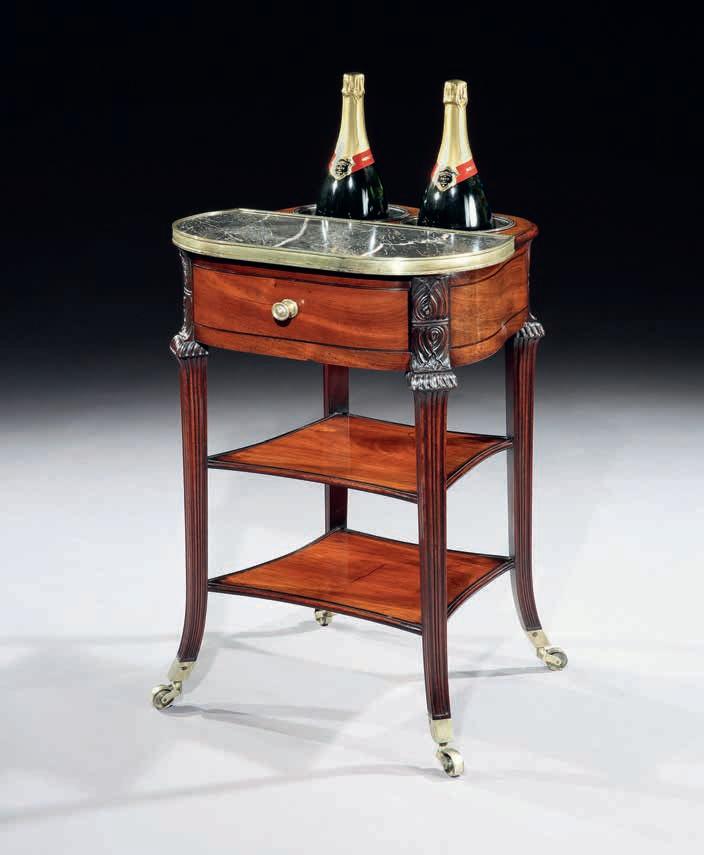
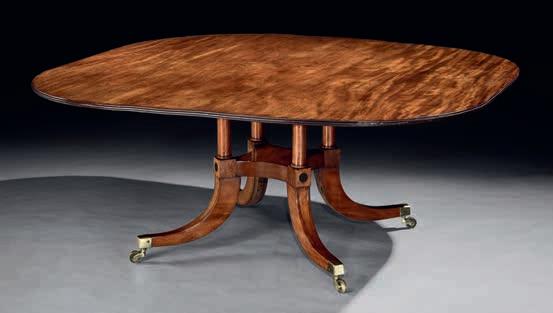
A GEORGE III MAHOGANY BREAKFAST TABLE OF LARGE SIZE
English, circa 1800
Height: 2 ft 3½ in; 70 cm
Width: 5 ft 8 in; 173 cm
Depth: 5 ft 4 in; 162.5 cm
Provenance: Ronald Phillips Ltd., London, England; Private collection, Switzerland.
Remarkably, the tabletop is made from a single board. The tree from which it came must therefore have measured more than seven feet across.
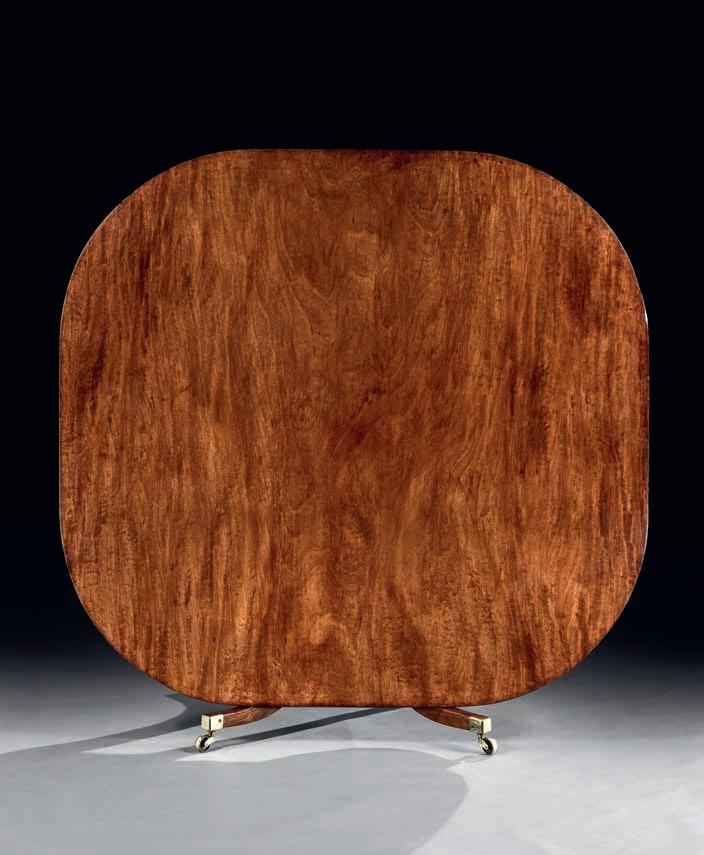
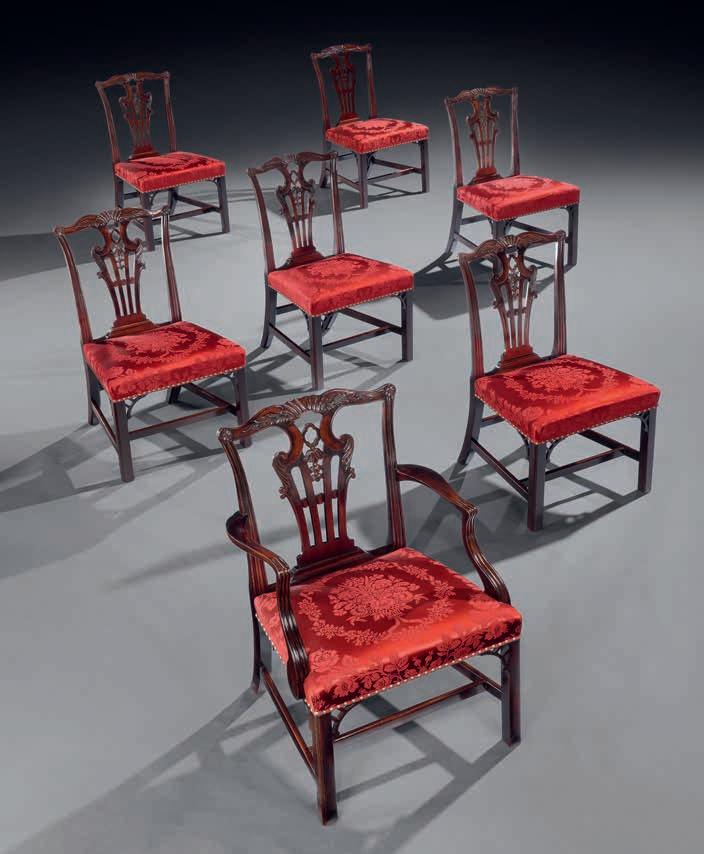
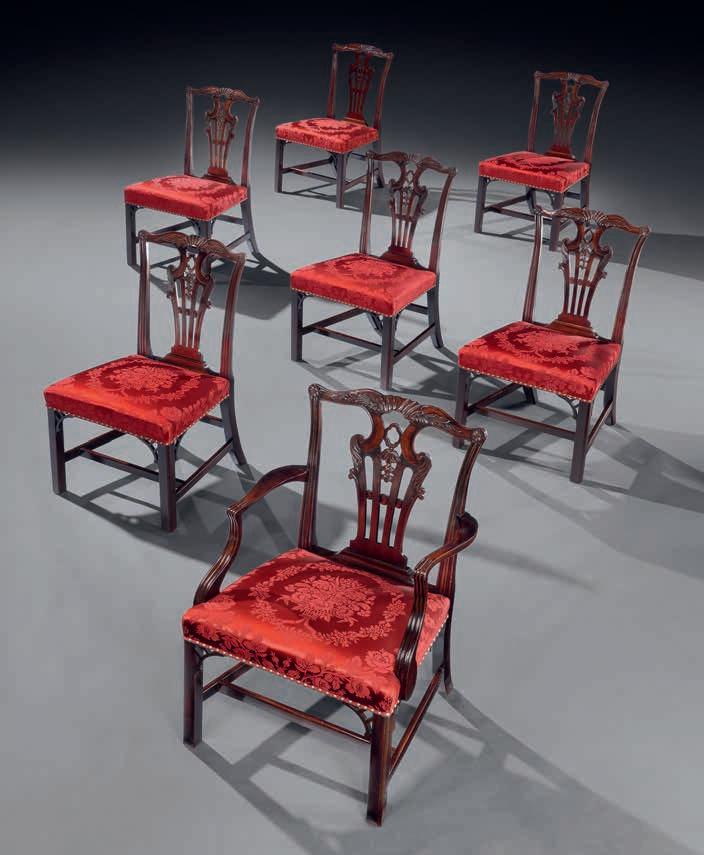
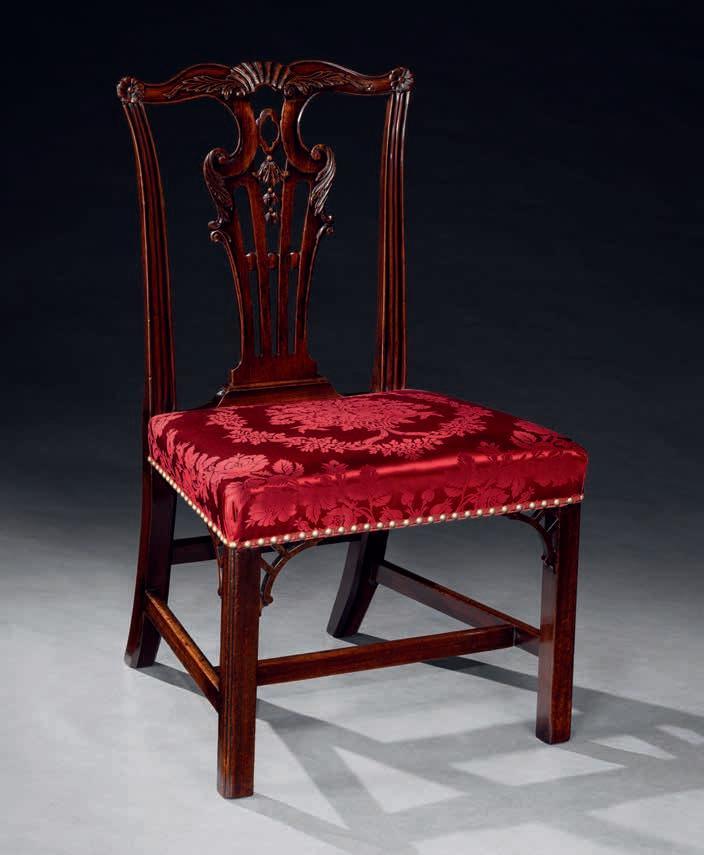
99
A SET OF FOURTEEN GEORGE III MAHOGANY DINING CHAIRS INCORPORATING TWELVE SIDE CHAIRS AND TWO ARMCHAIRS
Note: The two armchairs are of later date. English, circa 1765
The dining chairs:
Height: 37½ in; 95.5 cm
Height of seat: 18¾ in; 47.5 cm
Width: 22½ in; 57 cm
Depth: 22½ in; 57 cm
The armchairs:
Height: 37½ in; 95.5 cm
Height of seat: 18¾ in; 47.5 cm
Width: 25½ in; 65 cm
Depth: 22½ in; 57 cm
Provenance: Private collection, England.
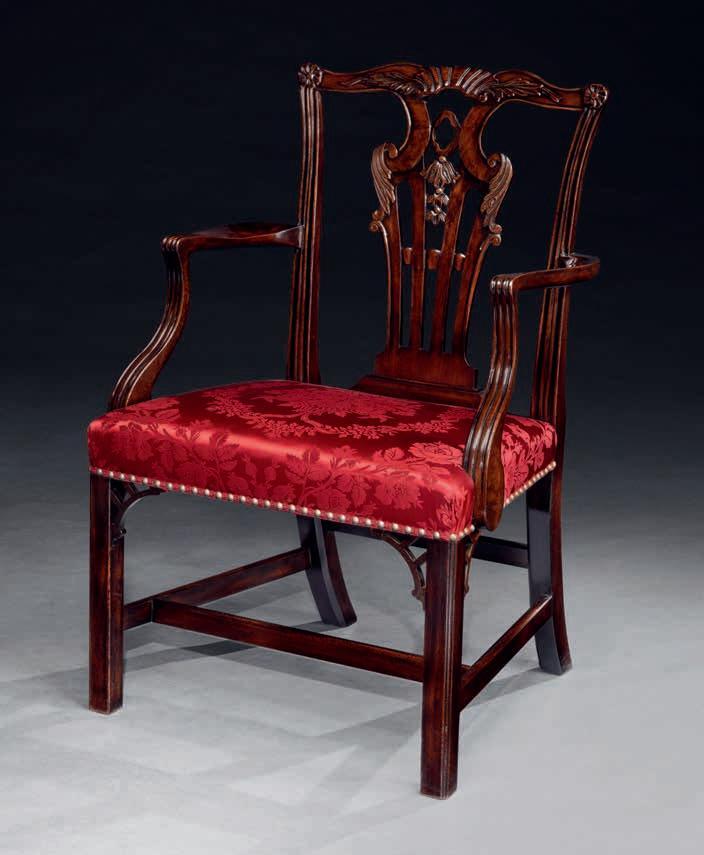
100
A PAIR OF REGENCY TRIPLE-ARM GILTWOOD AND EBONISED EAGLE WALL LIGHTS
Note: The wall lights retain most of their original gilding and much of the ebonising. The drip pans and nozzles are period replacements.
English, circa 1815
Height: 34½ in; 87.5 cm
Width: 18½ in; 47 cm
Depth: 11¾ in; 30 cm
Provenance: Private collection, Italy.
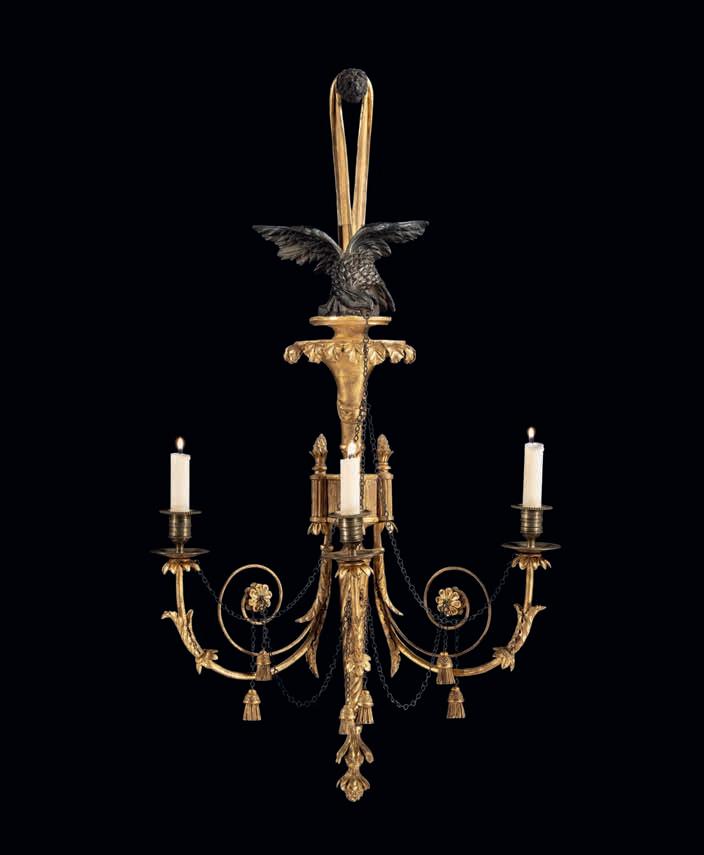
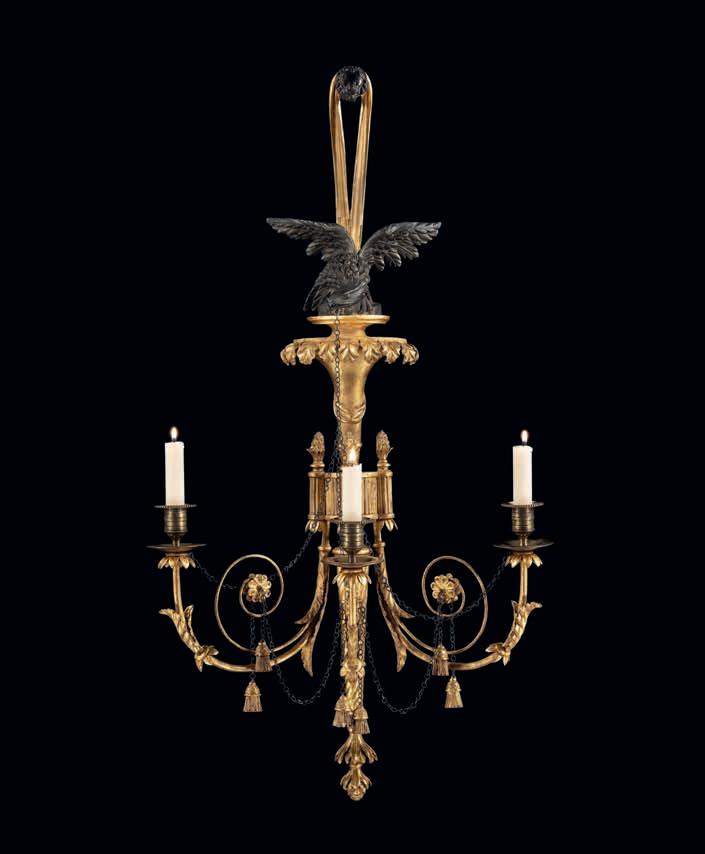
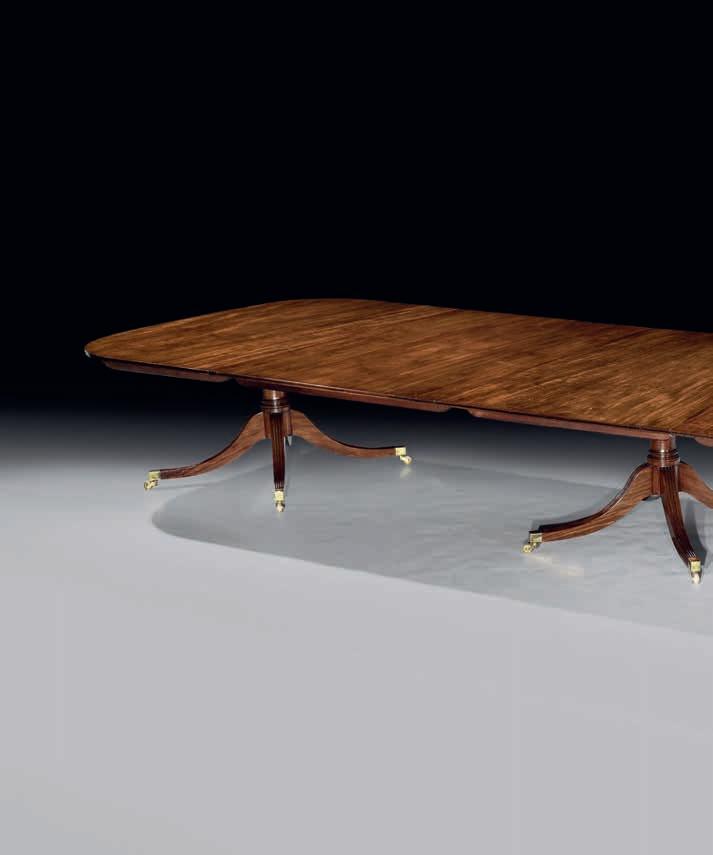
A GEORGE III MAHOGANY THREE PEDESTAL DINING TABLE
Note: The table retains its original brass box castors and has not been reduced in width. The extension leaves are 18th century replacements.
English, circa 1790
Height: 2 ft 4¼ in; 72 cm
Width (with leaves): 16 ft 10½ in; 514.5 cm
Width (without leaves): 9 ft 6¼ in; 290 cm
Depth: 5 ft 3 in; 160 cm
Provenance: Ronald Phillips Ltd., London, England; Private collection, USA.
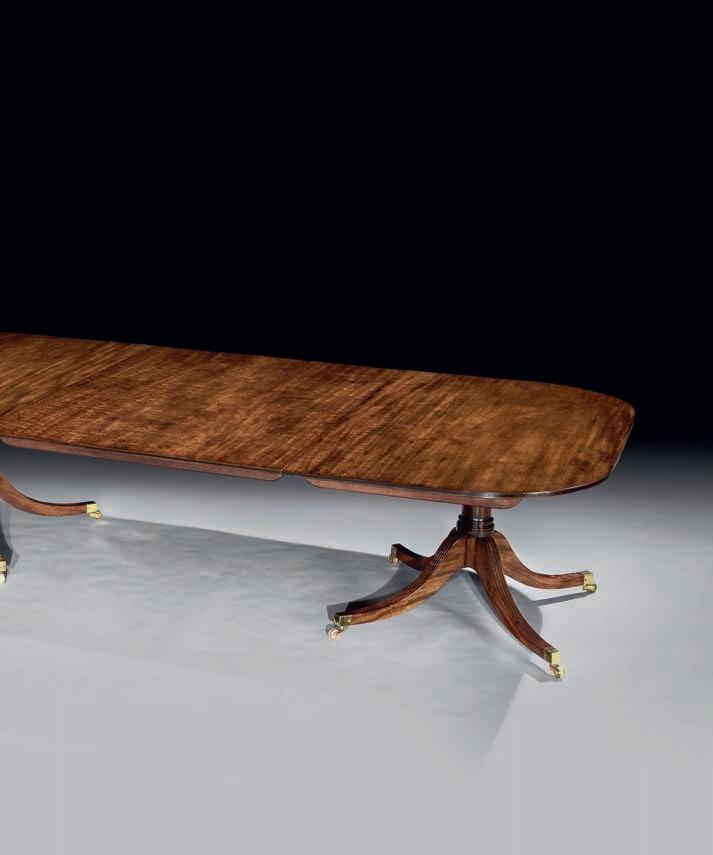
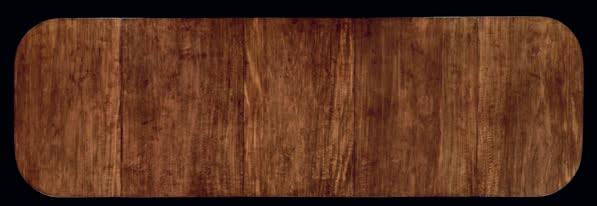
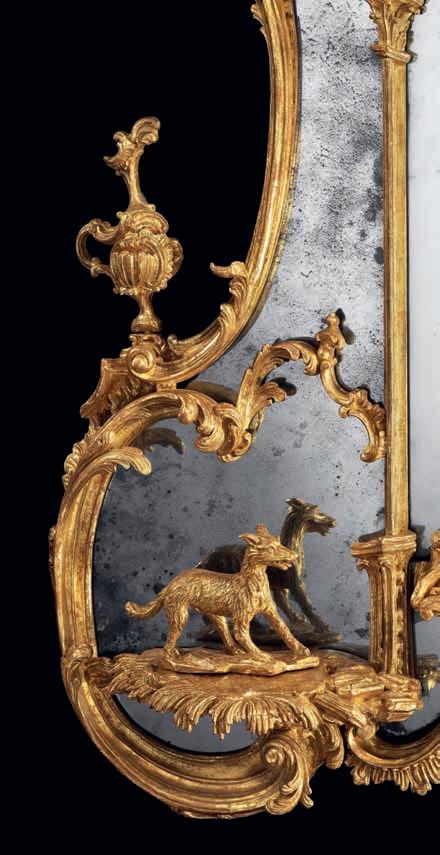
A GEORGE III GILTWOOD OVERMANTEL ATTRIBUTED TO THOMAS JOHNSON
Note: The mirror retains virtually all of the original mirror plates. The frame has been re-gilded and the carved figure on the top is of later date.
English, circa 1765
Height: 5 ft 6½ in; 169 cm
Width: 5 ft 1 in; 155 cm
Depth: 7 in; 18 cm
Provenance:
John Tempest (1710–1776) for Wynyard Park, County Durham, England; by descent to Frances Anne Vane-Tempest, later Marchioness of Londonderry (1800–1865); by descent with the Marquesses of Londonderry at Wynyard Park, County Durham, England.
An inventory taken in 1949 at Wynyard Park lists the overmantel in the Drawing Room: ‘An ornamental mirror in giltwood frame finely carved with rococo scrollwork and floral motifs and with figures of animals on small brackets. Width 5ft 4 in.’
Although no specific drawing for this exceptionally finely carved mirror is known, the overall style of the carving and virtuosity of design suggest that Thomas Johnson was the designer and possibly also the carver.
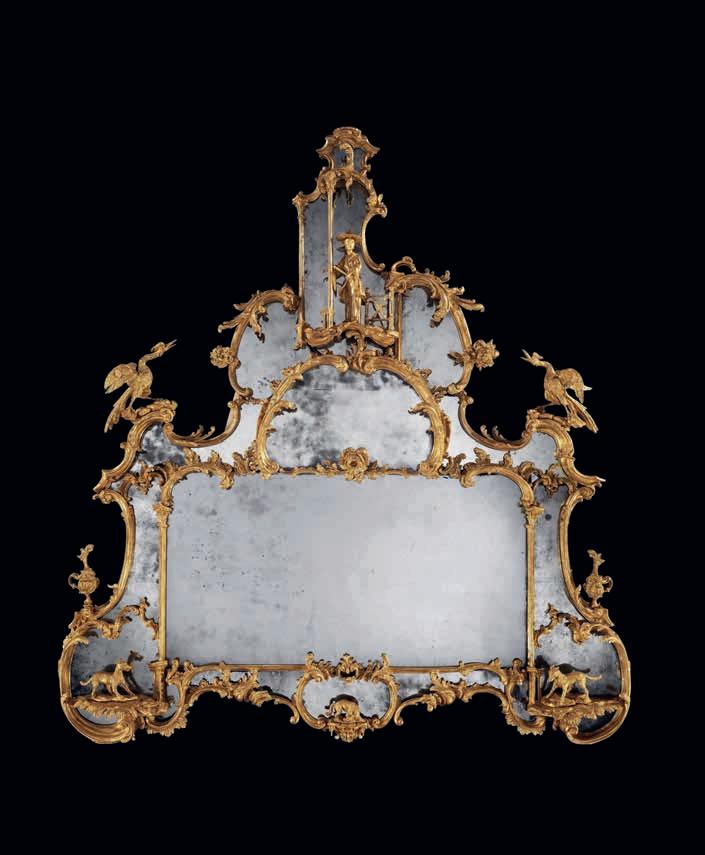
THE LONDONDERRY OVERMANTEL
Thomas Sheraton’s design for the sideboard, 1793
A GEORGE III MAHOGANY SIDEBOARD TO A DESIGN BY THOMAS SHERATON
Note: The brass plate handles are of later date. The right end of the sideboard is fitted with a cupboard.
English, circa 1795
Height: 3 ft ¾ in; 93 cm
Width: 6 ft 3¾ in; 192.5 cm
Depth: 1 ft 11¾ in; 60.5 cm
Provenance: Private collection, Lancashire, England; Private collection, England.
Literature:
Thomas Sheraton, The Cabinet Maker and Upholsterer’s Drawing Book, 2nd edn, 1794, pl. 31.
Thomas Sheraton published the design for this sideboard as plate 31 in the second edition of The Cabinet Maker and Upholsterer’s Drawing Book in 1794. The plate itself, however, is dated 1793.
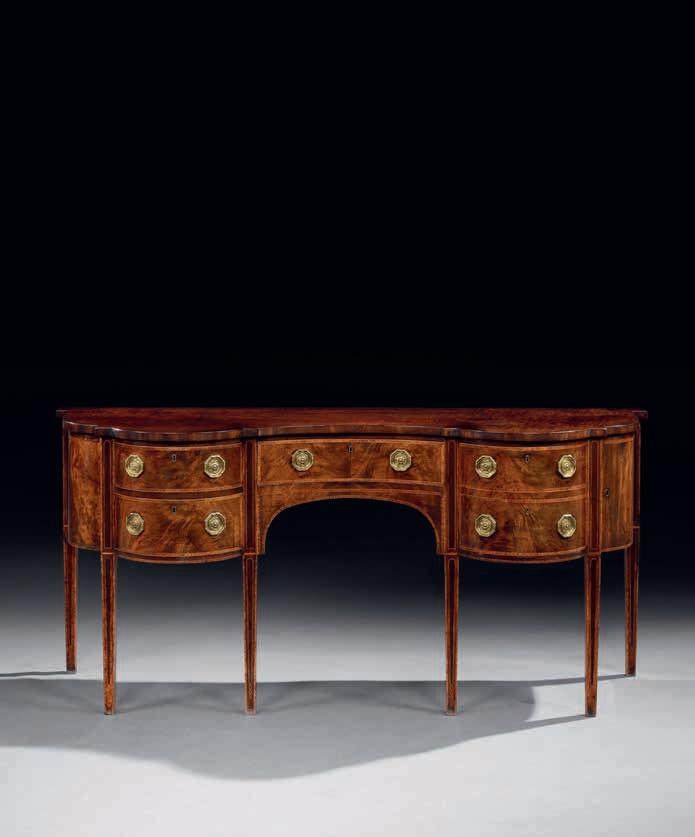
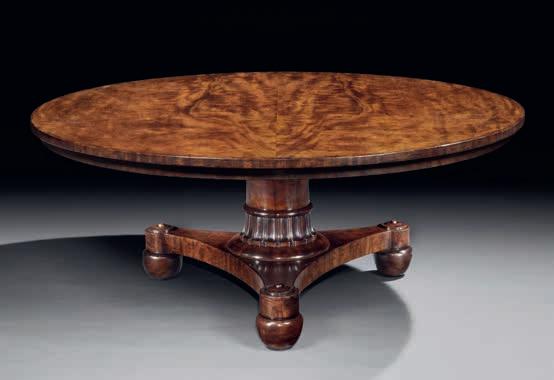
A WILLIAM IV MAHOGANY EXTENDING DINING TABLE
Note: The extending leaves are of later date. English, circa 1835
Height: 2 ft 5¼ in; 74.5 cm
Diameter (with leaves): 8 ft; 243.5 cm
Diameter (without leaves): 6 ft; 183 cm
Provenance: Private collection, England.
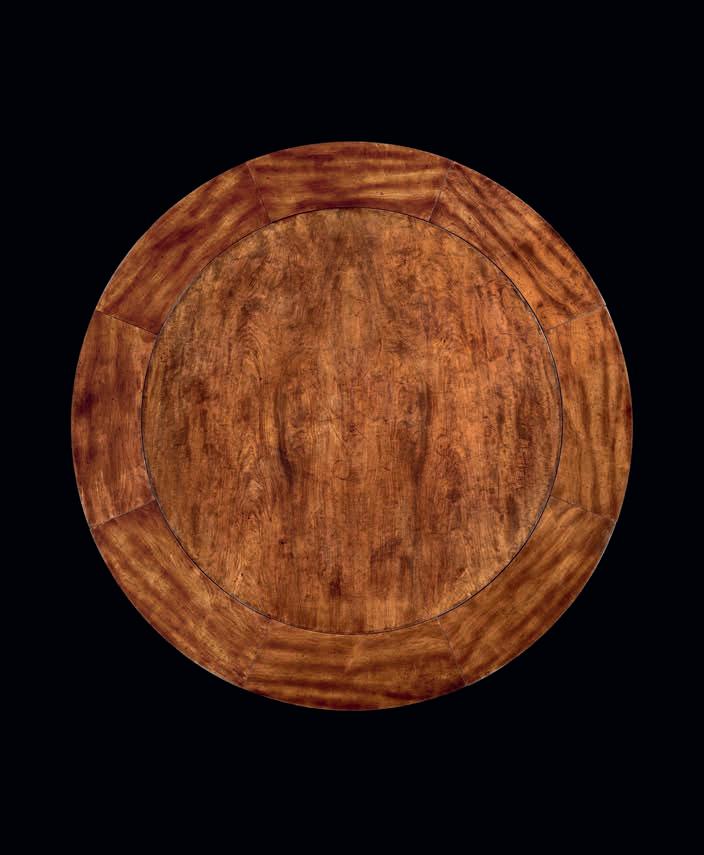
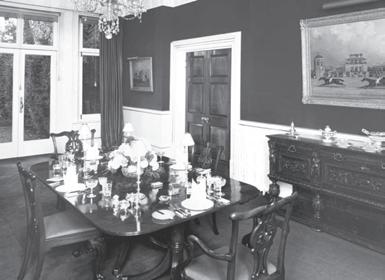
A SET OF TEN GEORGE II MAHOGANY DINING CHAIRS INCORPORATING EIGHT SIDE CHAIRS AND TWO ARMCHAIRS
Note: Two side chairs from the set are of later date. English, circa 1750
The armchairs:
Height: 38 in; 96.5 cm
Height of seat: 19¼ in; 49 cm
Width: 26½ in; 67.5 cm
Depth: 24 in; 61 cm
The side chairs:
Height: 37¾ in; 96 cm
Height of seat: 19¼ in; 49 cm
Width: 23½ in; 59.5 cm
Depth: 22 in; 56 cm
Provenance:
S. B. Joel, Sefton Lodge, Newmarket, England; Ronald Lee Ltd., London, England; Private collection, Australia.
Photographed: In situ at S. B. Joel’s residence, Sefton Lodge, Newmarket, England.
Four of the chairs in situ in the dining room at Sefton Lodge, Newmarket. Courtesy of The Childwick Trust
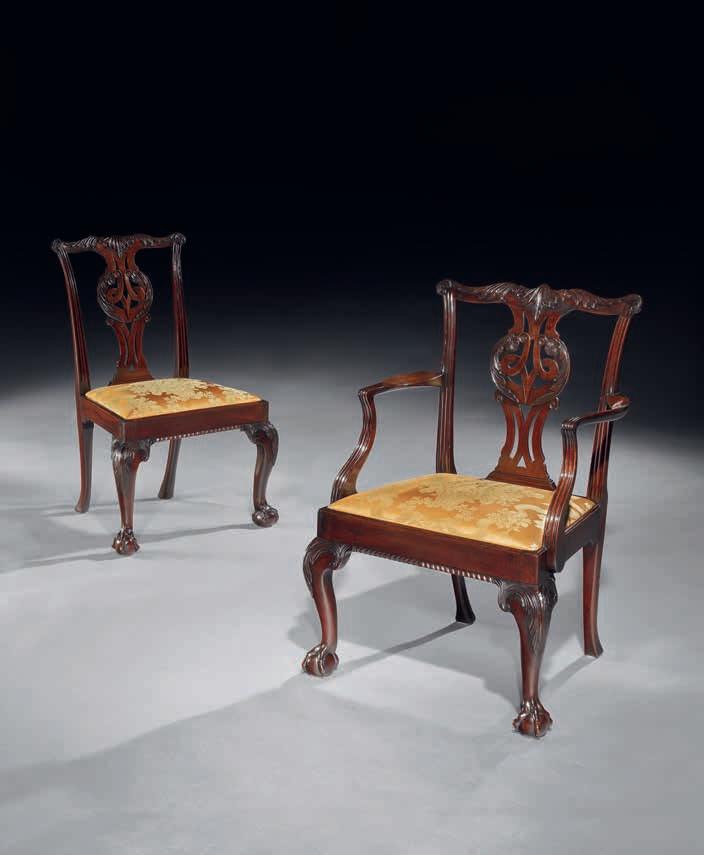
THE S. B. JOEL DINING CHAIRS
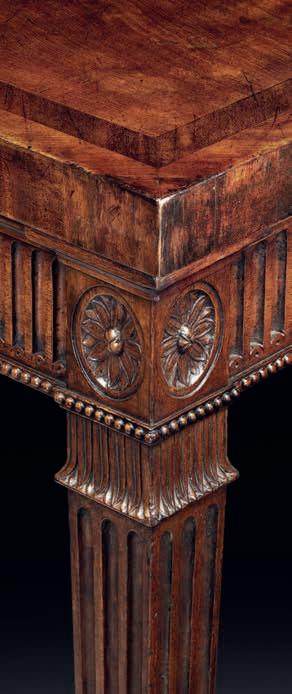
A GEORGE III MAHOGANY SERVING TABLE ATTRIBUTED TO INCE & MAYHEW
Note: The table has acquired an outstanding colour and patination.
English, circa 1780
Height: 2 ft 11¼ in; 89.5 cm
Width: 5 ft 3 in; 160 cm
Depth: 2 ft 7¾ in; 80.5 cm
Provenance: Private collection, England.
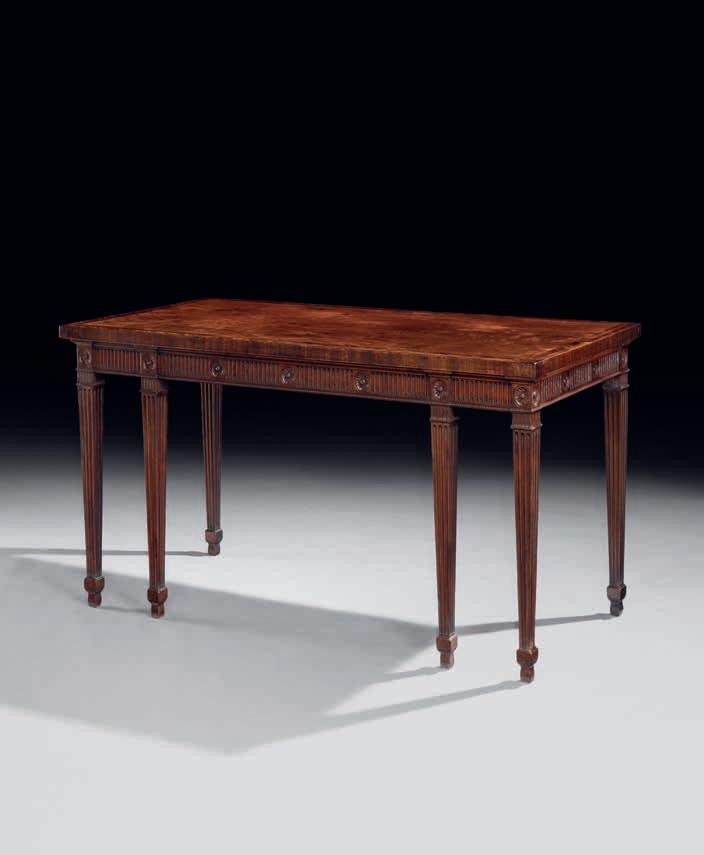
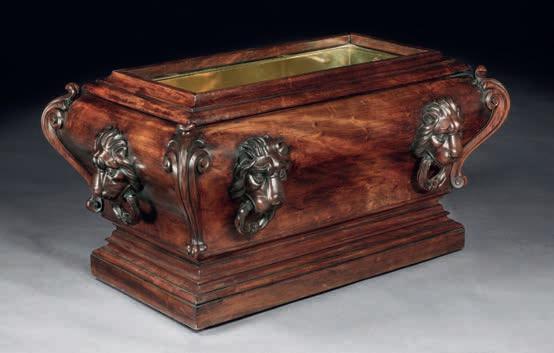
AN IRISH VICTORIAN MAHOGANY WINE CELLARET
BY WILLIAMS OF DUBLIN
Note: The brass liner is of later date. Irish, circa 1845
Height: 21½ in; 54.5 cm
Width: 44 in; 112 cm
Depth: 27½ in; 70 cm
Provenance: Partridge Fine Arts Plc, London, England; Private collection, California, USA; Ronald Phillips Ltd., London, England; Private collection, London, England.
Illustrated: Ronald Phillips Ltd., ‘Great English Furniture’, catalogue, 2021, pp. 134–5.
The inside of the cellaret is stamped ‘Williams 49766’.
A virtually identical wine cellaret, of the same size and differing only in some carved detail, but otherwise essentially of the same design, was formerly in the collection of the Dukes of Hamilton at Hamilton Palace in Lanarkshire, Scotland. The sale of the contents of Hamilton Palace in 1882 took some thirty days and is notable as one of the great estate sales of the 19th century.
The Dublin cabinet-making firm of Williams was founded in the 18th century. In partnership with John Mack and William Gibton it traded under the name Mack, Williams & Gibton. Following the death of Mack in 1829, the company traded as Williams & Gibton until Gibton’s death in 1842, when the name changed again to Williams & Son. The business ceased trading in 1852.
Furniture produced by Williams & Gibton and by Williams & Son is often stamped with the company name and a five digit serial number. The cellaret is stamped ‘Williams 49766’, placing it in the third and final stage of the company’s history.
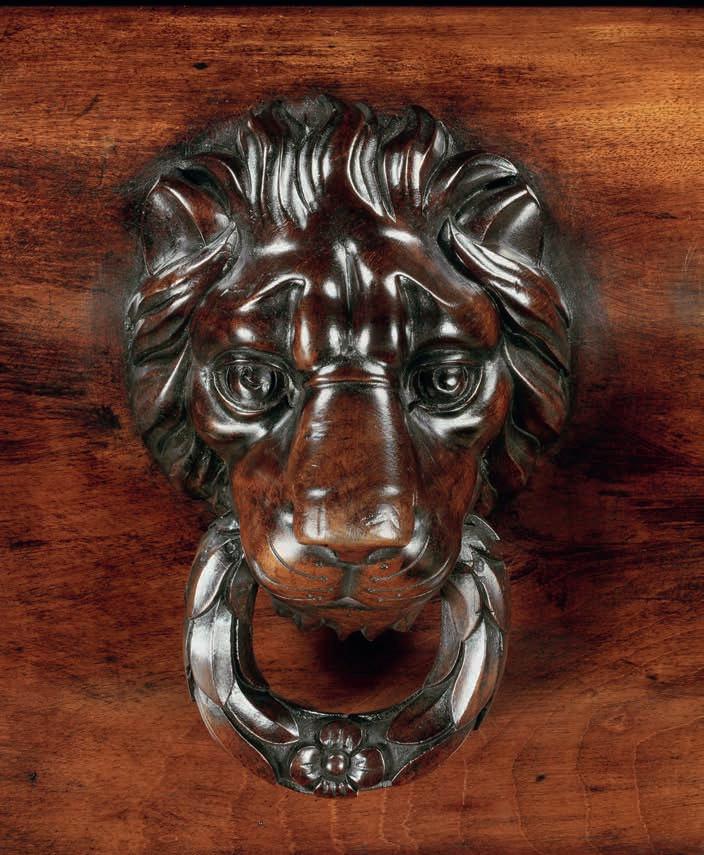
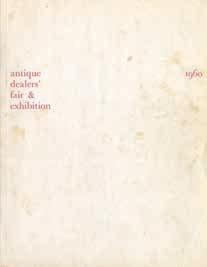
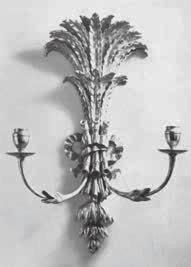
Note: The wall lights retain much of the original gilding.
English, circa 1790
Height: 19 in; 48 cm
Width: 13½ in; 34 cm
Depth: 7 in; 18 cm
Provenance:
Norman Adams Ltd., London, England; Clifford Wright Antiques Ltd., London, England; Ronald Phillips Ltd., London, England; Private collection, London, England.
Exhibited:
The Antique Dealers’ Fair and Exhibition, Grosvenor House, London, 1960; with Norman Adams Ltd.
Illustrated: Antique Dealers’ Fair and Exhibition handbook, London, 1960, p. 13.
A PAIR OF GEORGE III GILTWOOD TWIN-ARM WALL LIGHTS
The wall lights with Norman Adams Ltd. in 1960
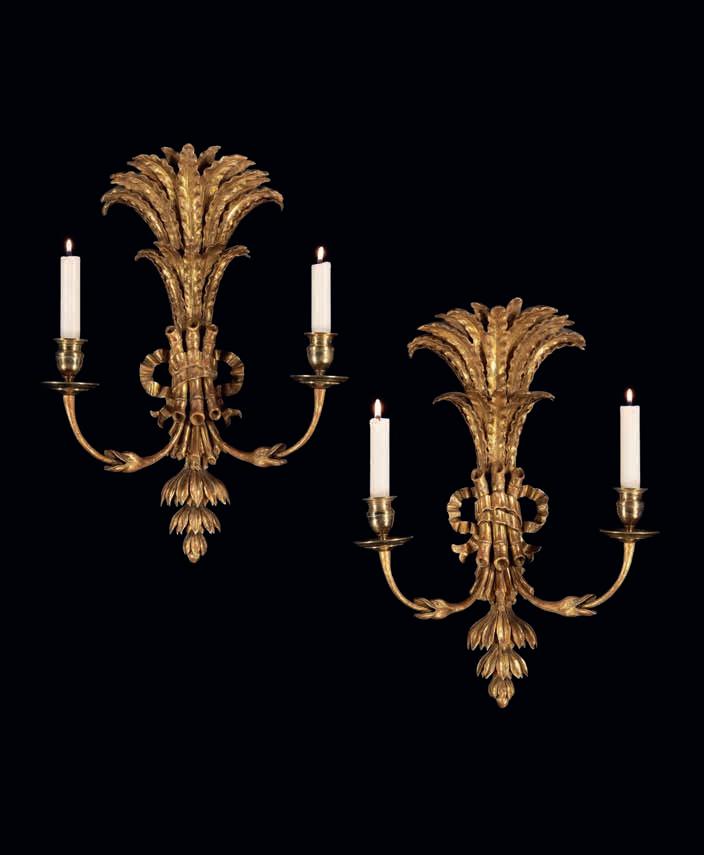
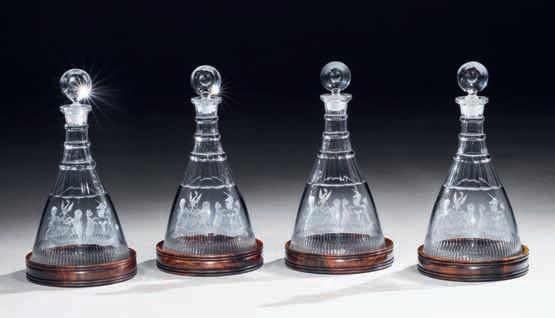
A SET OF FOUR GEORGE III CUT GLASS MAGNUM SHIP’S DECANTERS
Note: The decanters retain two original target stoppers and two repaired stoppers. The four cocobolo coasters are of later date.
English, circa 1795
Height: 14 in; 35.5 cm
Diameter: 7 in; 18 cm
Provenance: Private collection, USA.
Each decanter is engraved with the family crests of the Graham and Cunningham families, probably to celebrate a wedding between them. Their capacity is actually three standard size bottles, considerably larger than a standard magnum’s capacity of two bottles.
Sets of four decanters of this size are extremely rare.
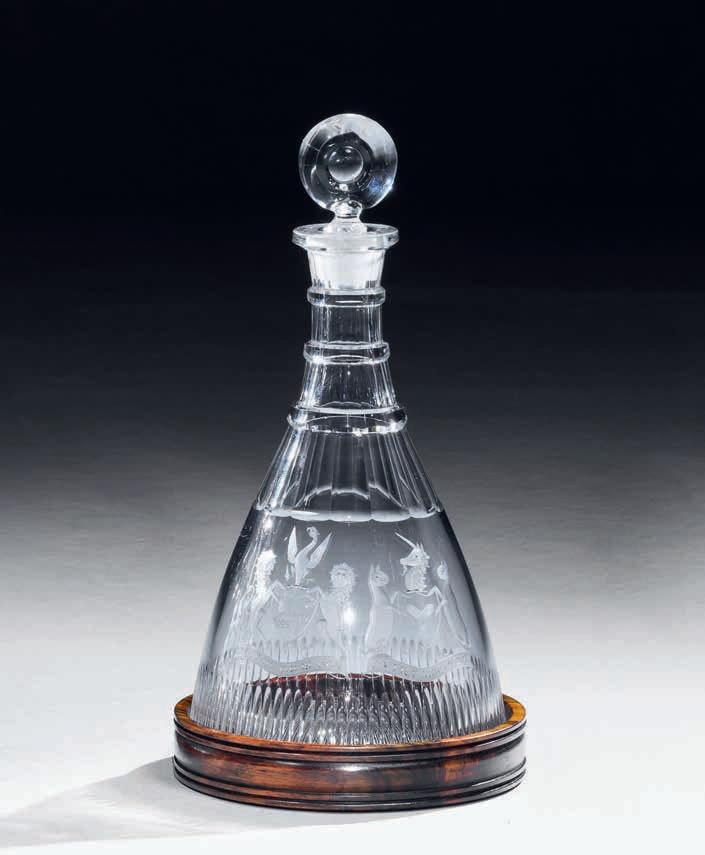
AN EARLY 19TH CENTURY BRASS MOUNTED MAHOGANY SIDE TABLE
Note: The sprung drawer mechanism is original. When closed, it is released by pushing a flush fitted button to the underside of the front frieze of the table.
Continental or Russian, circa 1815
Height: 35 in; 89 cm
Width: 39 in; 99 cm
Depth: 17¾ in; 45 cm
Provenance: Private collection, USA.
The attractive design of the legs of this table together with the profuse use of brass inlay and the unusual sprung drawer mechanism make English manufacture possible but unlikely. Related designs can however be found in Russian and northern German furniture of the period, and the sprung drawer is consistent with Continental manufacture.
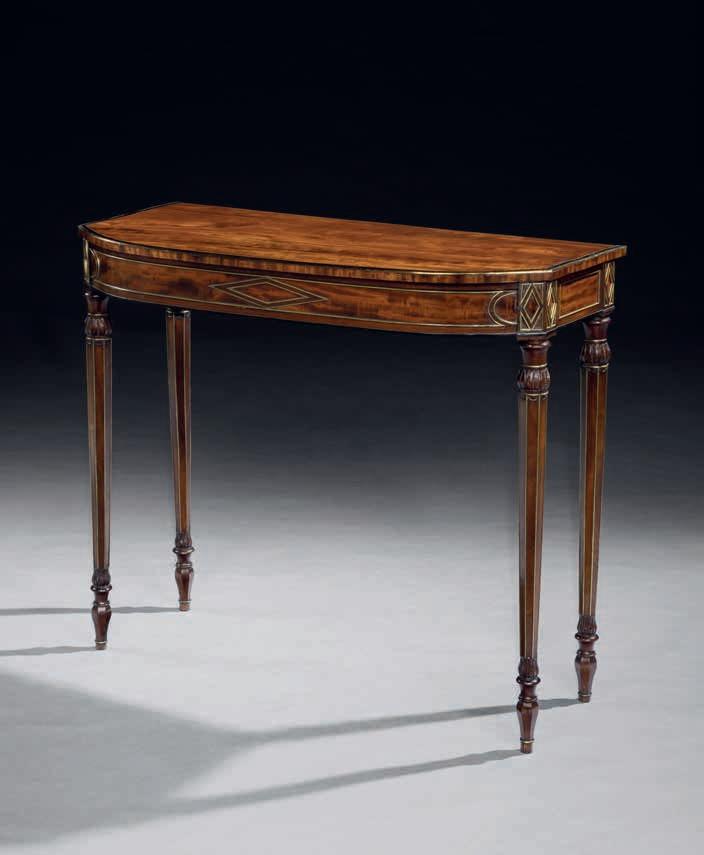
A PAIR OF GEORGE III GILTWOOD STOOLS ATTRIBUTED TO THOMAS CHIPPENDALE
Note: The frames have been re-gilded. Each stool bears an inscription in ink reading ‘8652 Chesterfield’ to the inside of one of the rails.
English, circa 1775
Height: 19 in; 48 cm
Width: 22½ in; 57 cm
Depth: 18 in; 45.5 cm
Provenance: Devenish & Co., New York, USA; Private collection, London, England.
Another stool and seven side chairs from the same suite, also featuring the ink inscription to the inside of the rails, were sold by Phillips on 20 April 1999.
The undersides of the chairs feature not only Chippendale’s typical clamping notches but also baton holes to the underside of the rails. These baton holes indicate that the suite was made not for a London home but for a more distant destination, and it therefore required securing with batons for transport.
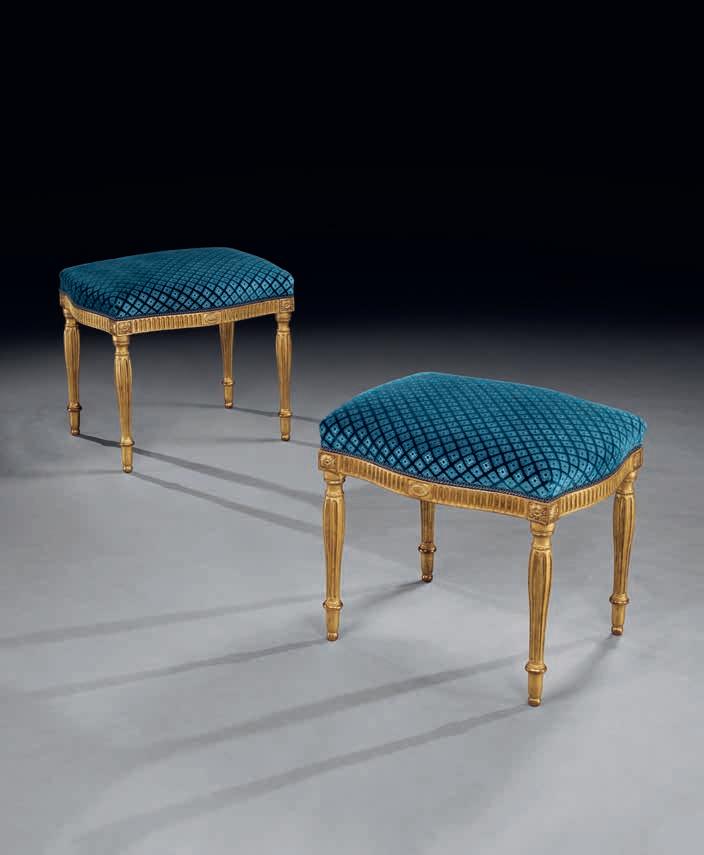
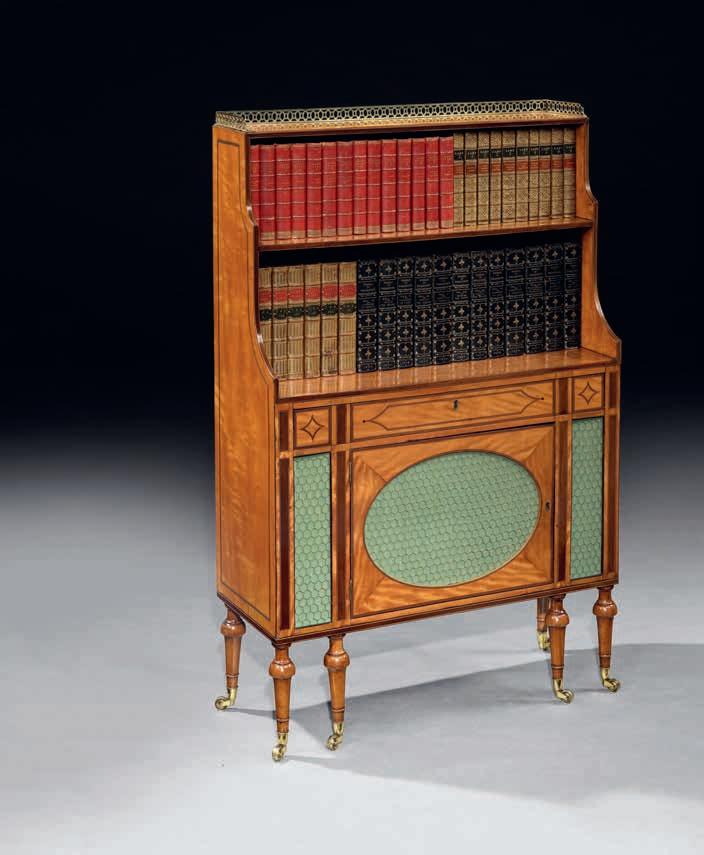
A PAIR OF GEORGE III SATINWOOD AND AMARANTH SIDE CABINETS IN THE MANNER OF
Note: The cabinets retain their original brass mounts. The wire grilles are of later date. English, circa 1785
Height: 48 in; 122 cm
Width: 30½ in; 78 cm
Depth: 11¾ in; 30 cm
Provenance: H. C. Baxter & Sons, London, England; Private collection, London, England.
GEORGE SIMSON
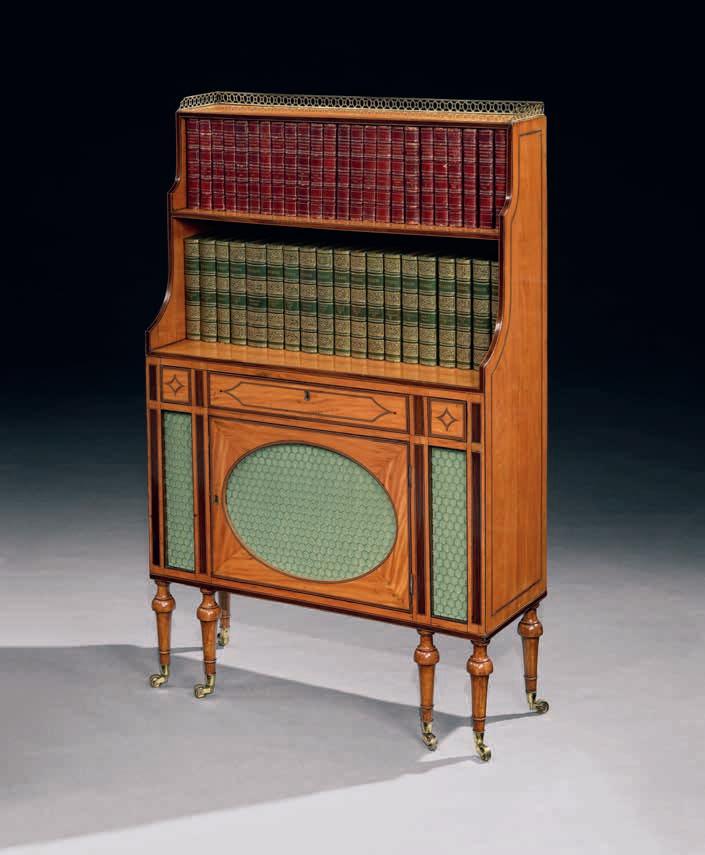
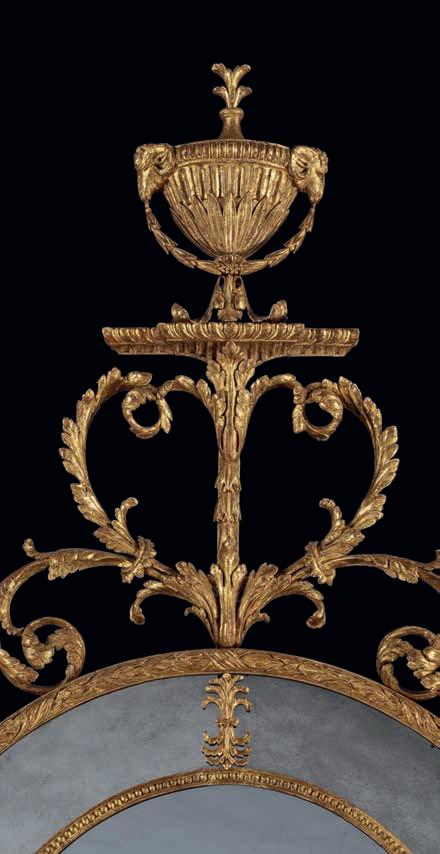
A GEORGE III GILTWOOD OVAL PIER MIRROR ATTRIBUTED TO JOHN LINNELL
Note: The mirror retains most of the original gilding. Some of the mirror plates are mercury silvered replacements.
English, circa 1785
Height: 6 ft 11½ in; 212 cm
Width: 3 ft 9¼ in; 115 cm
Provenance: Ronald Phillips Ltd., London, England; Private collection, London, England.
Illustrated: Ronald Phillips Ltd., ‘Antique English Furniture’, catalogue, 2005, pp. 162–3.
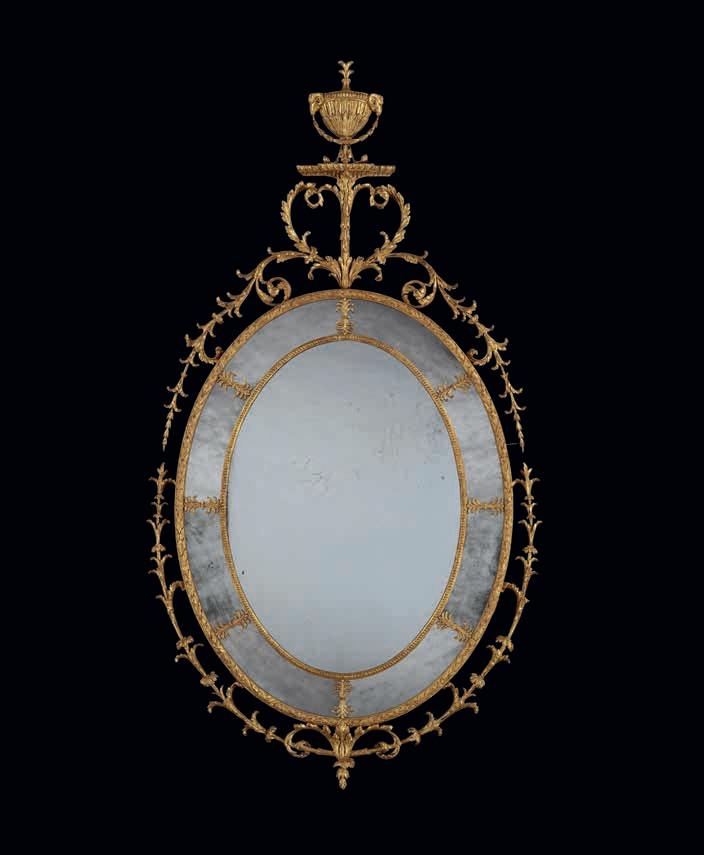
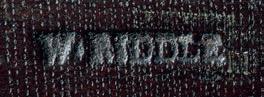
The stamp to the underside of the platform
A GEORGE IV BRASS MOUNTED AMBOYNA AND GILTWOOD CENTRE TABLE BY WILLIAM RIDDLE
Note: The table retains virtually all of its original finish, including the gilding applied to limewood, the preferred timber for fine carving, and the finely cast brass moulding to the top.
The platform is stamped ‘W. Riddle’ to the underside. English, circa 1830
Height: 2 ft 4½ in; 72.5 cm
Diameter: 5 ft; 152.5 cm
Provenance:
Thomas Coulborn & Sons Ltd., London, England; Private collection, England; Ronald Phillips Ltd., London, England; Private collection, England.
Illustrated: Ronald Phillips Ltd., ‘Antique English Furniture’, catalogue, 2015, pp. 156–7.
Literature:
Christopher Gilbert, APictorial Dictionary of Marked London Furniture 1700–1840, 1996, p. 390, fig. 767.
Ronald Phillips Ltd., ‘Antique English Furniture’, catalogue, 2013, pp. 132–3.
This table belongs to a small group of virtually identical tables in various sizes, all sharing the same finely carved gilded details as well as the use of wonderfully mellow amboyna veneers.
The table is very similar to one formerly in the John Bedford Collection and illustrated in Christopher Gilbert’s book on labelled London furniture.
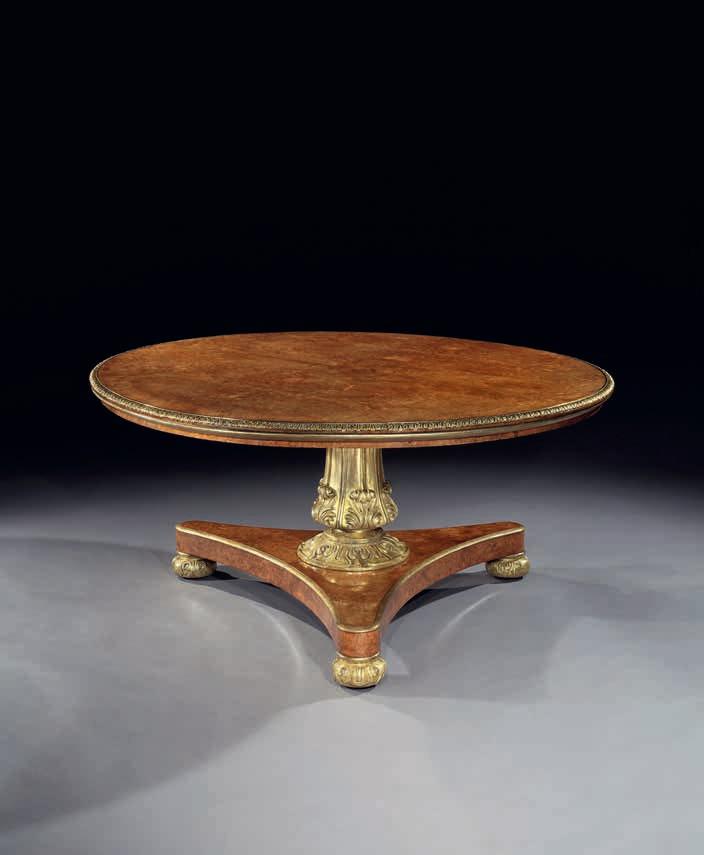
A PAIR OF REGENCY BLUE JOHN INLAID WHITE MARBLE URNS
English, circa 1815
Height: 13¼ in; 33.5 cm
Diameter: 5 in; 13 cm
Provenance: The Earls Cowper, Panshanger House, Hertfordshire; England; Ethel Anne Priscilla Grenfell (néeFane), Baroness Desborough, Panshanger House, Hertfordshire, England.
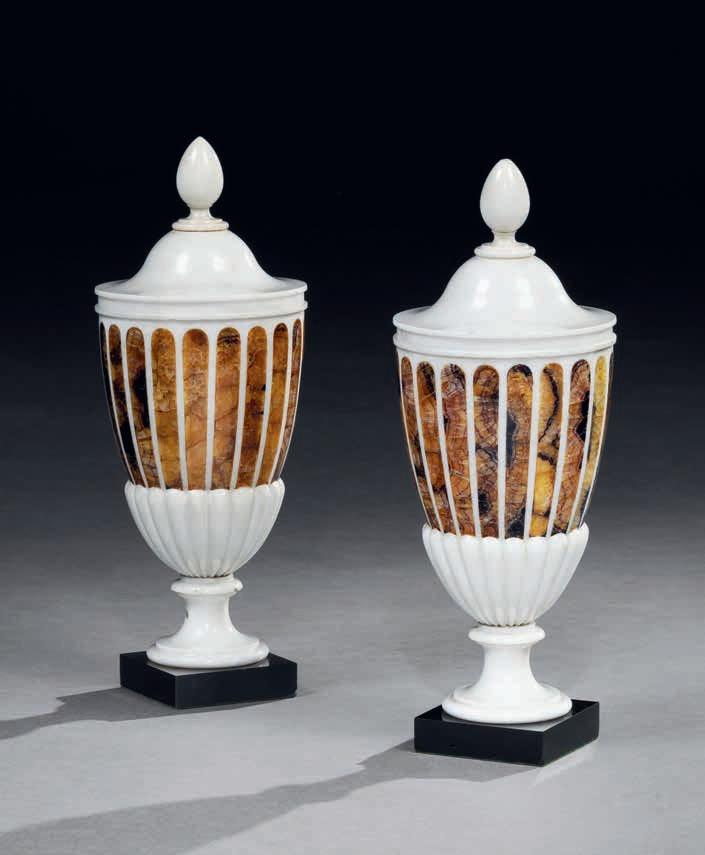
A GEORGE III BRASS MOUNTED MAHOGANY WINE COOLER ATTRIBUTED TO INCE & MAYHEW
English, circa 1770
Height: 25¾ in; 65.5 cm
Width: 29 in; 74 cm
Depth: 22¼ in; 56.5 cm
Provenance: Philip Colleck Ltd., New York, USA; Private collection, USA.
Illustrated: Ronald Phillips Ltd., ‘Antique English Furniture’, catalogue, 2007, pp. 44–5.
The wine cooler belongs to a small group of similar coolers, all sharing the same bold design. Some are of solid fine mahogany and others are veneered or painted.
One pair, formerly with Ronald Phillips Ltd., is veneered in yew wood and applied with ormolu mounts. A further single cooler, also formerly with Ronald Phillips Ltd., is entirely painted in off-white and similarly mounted with ormolu.
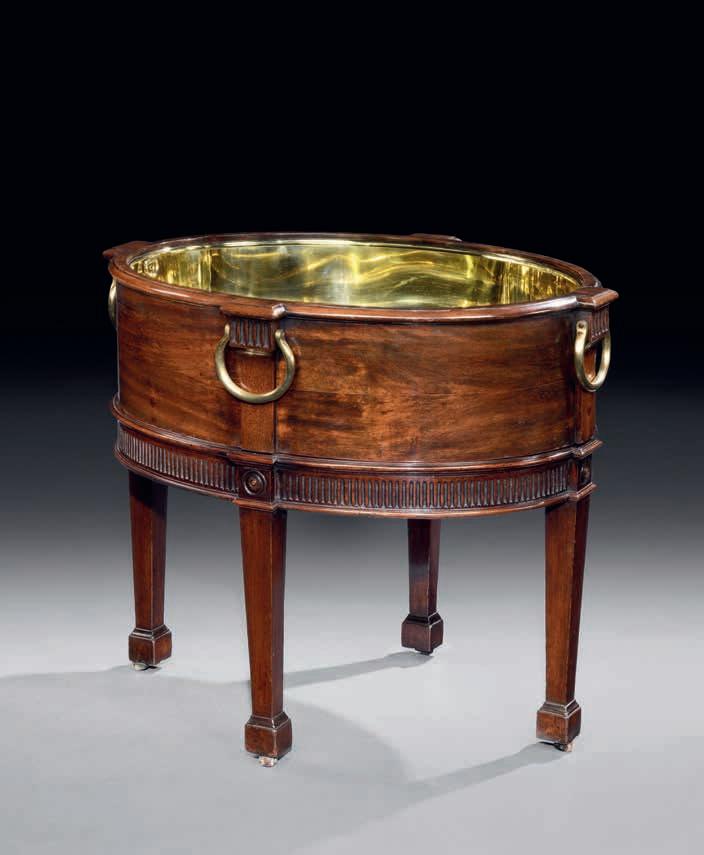
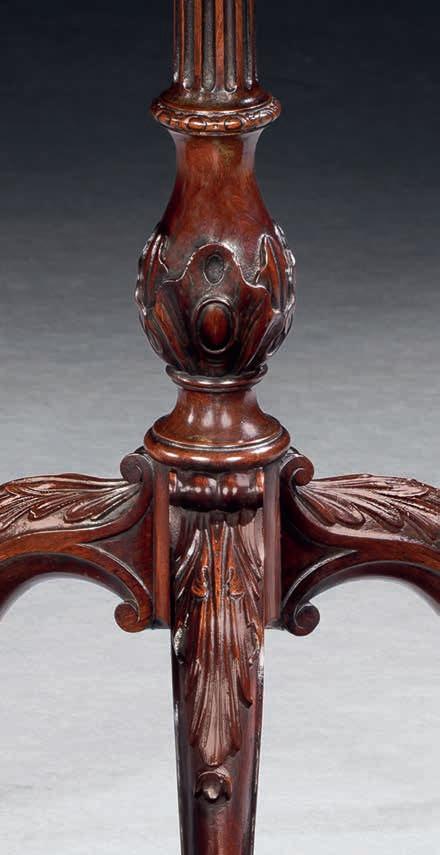
Note: The table has survived in remarkable original condition, retaining the original lock to the tip-up top as well as the original leather castors.
English, circa 1770
Height: 27½ in; 70 cm
Diameter: 22 in; 56 cm
Provenance: Private collection, England.
A GEORGE III MAHOGANY TRIPOD TABLE
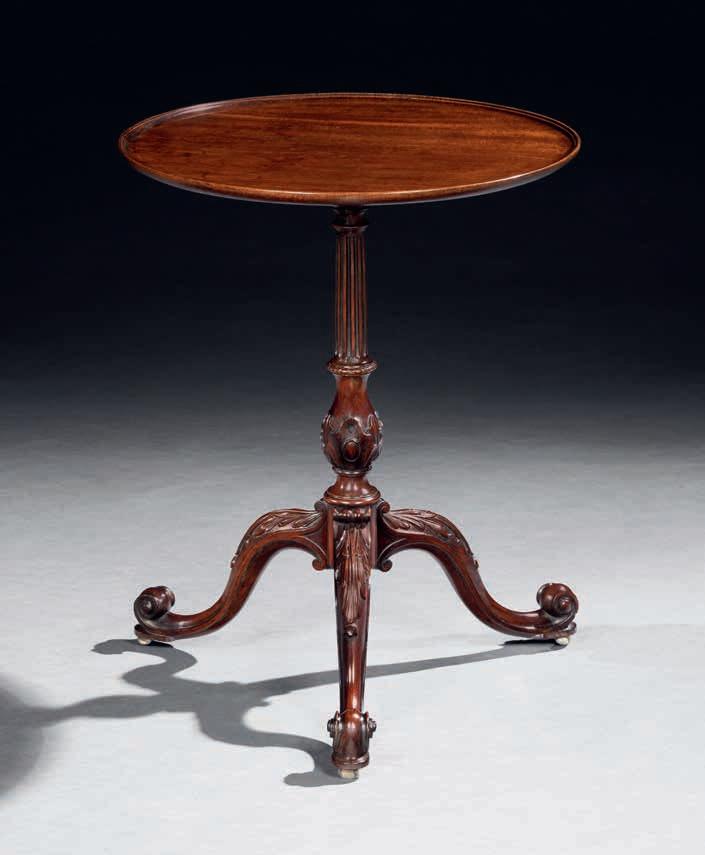
The mirror chandelier illustrated in Goodison and Kern’s Hotspur: Eighty Years of Antiques Dealing
118
A HUGE IRISH GEORGE III GILTWOOD AND CUT GLASS MIRROR CHANDELIER
Note: The chandelier retains all the cut glass cobalt and opaque studs and much of the original gilding. Some of the cut glass pendants have been replaced with period pieces. The brass candle nozzles inserted in the glass nozzles to protect the original glass are of later date.
Irish, circa 1785
Height: 44 in; 112 cm
Width: 33 in; 84 cm
Depth: 11¼ in; 28.5 cm
Provenance: Hotspur Ltd., London, England; Private collection, USA.
Exhibited:
The Grosvenor House Antiques Fair, London, 1982; with Hotspur Ltd.
Illustrated:
The Grosvenor House Antiques Fair handbook, 1982, no page no.; advertisement with Hotspur Ltd.
Nicholas Goodison and Robin Kern, Hotspur: Eighty Years of Antiques Dealing, 2004, pp. 168–9.
This mirror chandelier is particularly notable for its large scale and for being unusually decorated with giltwood slips in addition to the standard facet-cut glass pieces bordering the frame. The mirror is backed with a timber framed construction, suggesting earlier manufacture than for mirrors with laminated wood or metal frames. The components of the chandelier part on this mirror were carefully cut in half, a skilled and difficult process. In later versions this difficulty was avoided by suspending a full stem from a hook at the top of the mirror plate.
Mirror chandeliers are generally scarce, but this example is exceptionally rare: it is the only one known so far of this early type and size.
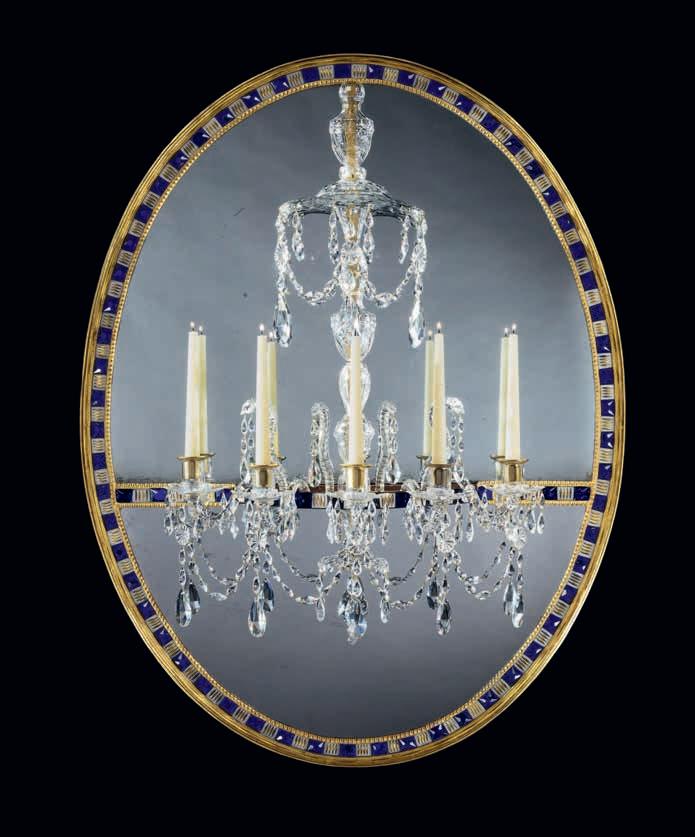
A GEORGE III MAHOGANY HALL BENCH
Note: The bench retains the original polychrome painted family crest of the Mann family of Linton Park.
English, circa 1795
Height: 3 ft 1½ in; 95 cm
Height of seat: 1 ft 6½ in; 47 cm
Width: 5 ft 1 in; 155 cm
Depth: 2 ft ½ in; 62 cm
Provenance: Sir Horatio Mann, 2nd Baronet, Linton Park, Kent, England; by descent to James Cornwallis, 4th Earl Cornwallis, Linton Park, Kent, England.
Literature: Charles Cator and Hugh Roberts, Industry and Ingenuity: The Partnership of William Ince and John Mayhew, 2022, p. 379, figs. 371 & 372.
The hall bench has several distinct features which are repeated on other commissions by Ince & Mayhew. The overall shape of the seat conforms to a bench made for Southill Park, Bedfordshire, around 1770; most strikingly, both benches have deeper than standard seats. The turned legs on both commissions are virtually identical, but the panelled back and solid volute arms on the present bench differ from the Southill model.
Another bench by Ince & Mayhew, however, supplied by them to the 14th Earl of Shrewsbury around 1780, and now in the National Trust Collection at Kenwood House, London, features both the panelled back with oval crest inserts and very noticeably the solid volute arms. The latter feature can perhaps be seen as a distinctive indicator of the workshop of origin.
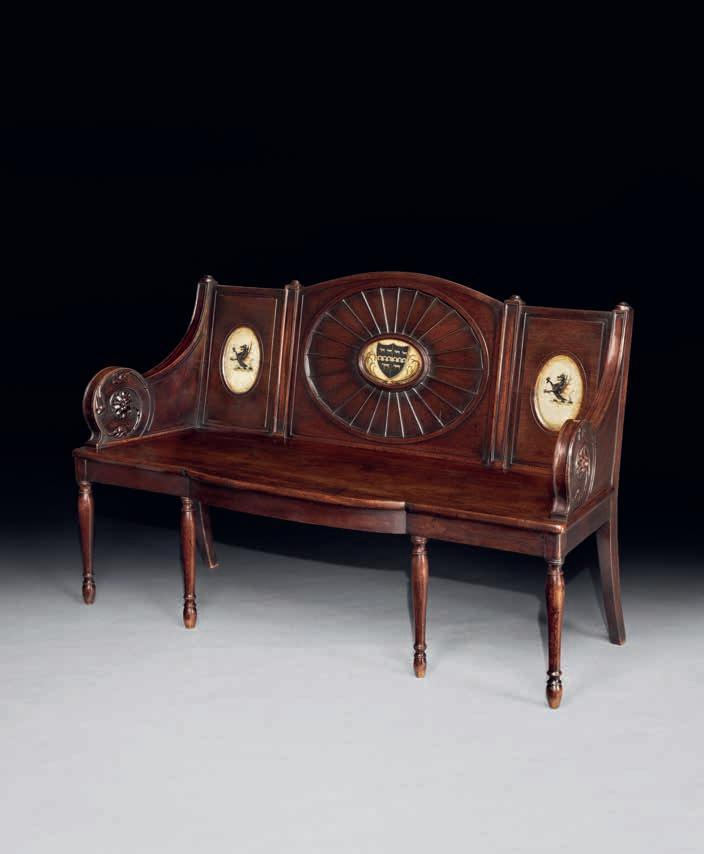
THE LINTON PARK HALL BENCH
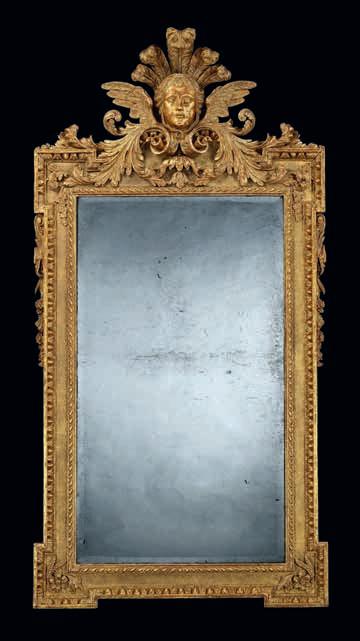
Note: The frame has been re-gilded. The bevelled mirror plate is original.
English, circa 1735
Height: 5 ft 5¾ in; 167 cm
Width: 2 ft 10¾ in; 88 cm
Depth: 8 in; 20 cm
Producing mirror plates of this size was a major achievement. Unlike modern sheet glass production, in which molten glass is cast flat and then rolled out between metal rollers, in the 18th century the size of the plate was determined by the makers’ lung capacity. Large glass bubbles were blown, shaped into cylinders and then split or sliced open in order to flatten the glass into sheets. The sheets were then ground smooth and silvered.
A GEORGE II GILTWOOD PIER MIRROR IN THE MANNER OF JOHN VARDY
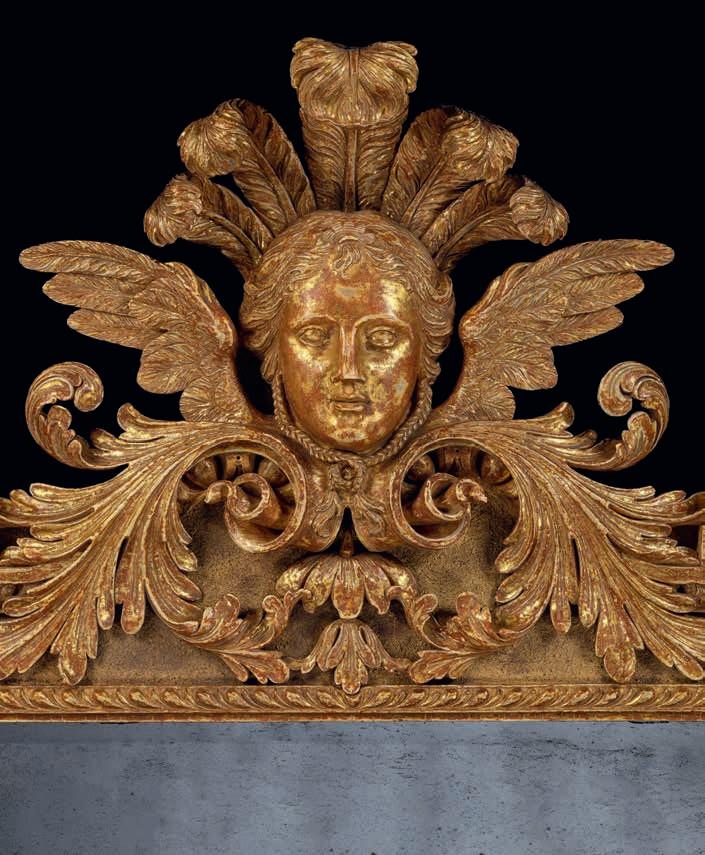
A GEORGE III CARVED BONE NAPOLEONIC PRISONER-OF-WAR SHIP MODEL OF HMS MARS
English, circa 1805
Height: 28½ in; 72.5 cm
Width: 32½ in; 82.5 cm
Depth: 14 in; 35.5 cm
This ship is a fine example of the extremely intricate and wellproportioned model ships generally made by French sailors captured by the British during the Napoleonic Wars between 1803 and 1815.
The French prisoners of war were kept either in prisons on land or on board ships (‘prison hulks’) moored along the coast. The prisoners were mostly officers and were periodically allowed short visits ashore on parole. They sold their ship models, made from beef or mutton bones and rigged with their own hair, to earn money and buy supplies to supplement their prison diet.
The ships were accurately modelled, from memory and experience, on specific vessels, usually warships but sometimes merchantmen. This example is of HMS Mars, a 74-gun third rate warship originally launched on the river Thames at Deptford, London, in 1794.
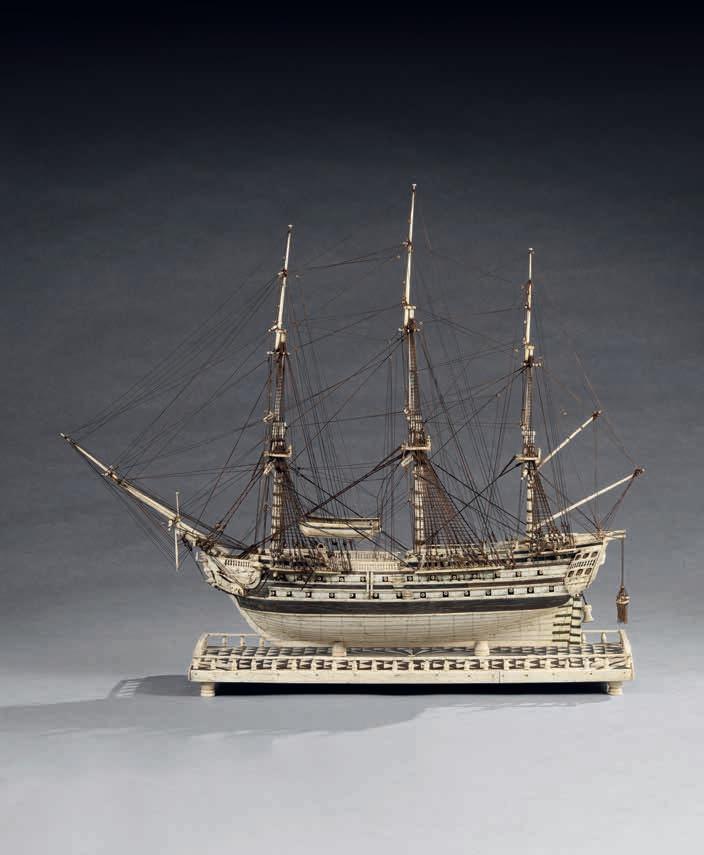
The Mars class (consisting only of the Mars herself and her sister vessel, HMS Centaur, launched a few years later) set a new standard in naval design, being slightly longer and narrower than previous ships of their kind. A key innovation was the number of cannons on the quarterdeck: warships of this size traditionally carried four guns on each side, but the Mars class used their extra length to carry five.
At the battle of Trafalgar in 1805, the Mars was second in line behind HMS Victory, the flagship of Admiral Lord Nelson. During the battle the Mars was severely damaged after coming under fire from five enemy vessels, and her commander, Captain James Duff, was decapitated by a cannon ball. Before the battle, Duff had sent his thirteen-year-old son Norwich below decks, probably saving his life. Mars ’s losses that day were among the highest in the British fleet, with 69 wounded and 29 killed. Among the dead was one of the captain’s nephews, Alexander Duff, aged twenty. Another nephew, Thomas Duff, aged eighteen, was also aboard but survived.
HMS Mars continued in active service until 1813, when she became a training vessel. She was eventually broken up in 1823.
A smaller scale model of the Mars is in the collection of the Greenwich Maritime Museum, London.
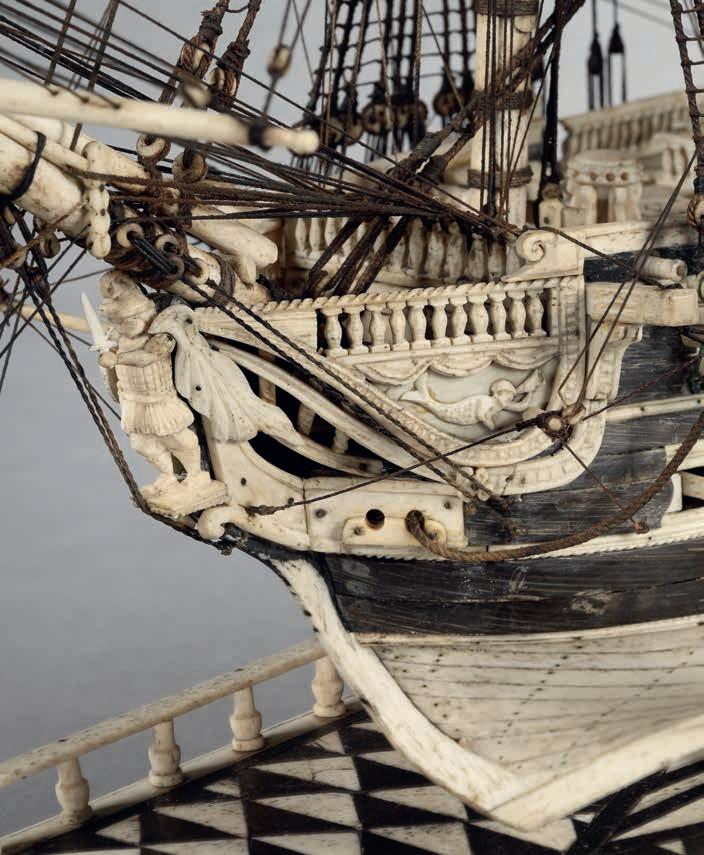
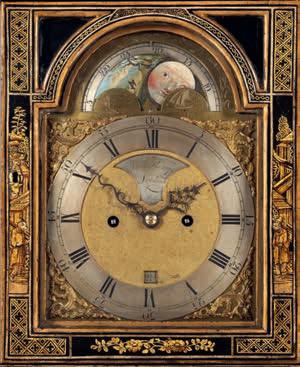
A GEORGE III BLACK AND GOLD JAPANNED TABLE CLOCK BY HENRY KEMP ON ORIGINAL WALL BRACKET
Note: The japanning has survived in virtually untouched condition. English, circa 1775
Overall height: 36 in; 91.5 cm
Height of clock: 20 in; 51 cm
Height of bracket: 16 in; 41 cm
Width: 15 in; 38 cm
Depth: 8 in; 20.5 cm
Provenance: Private collection, Europe.
The clock is fitted with an eight-day time and strike fusee movement with original verge escapement, and a rare original Dutch striking mechanism sounding the succeeding hour on a smaller bell. The break arch dial has a silvered strike/silence subsidiary, and a Roman numeral engraved chapter ring with a recessed maker’s boss engraved ‘Henry Kemp, London’.
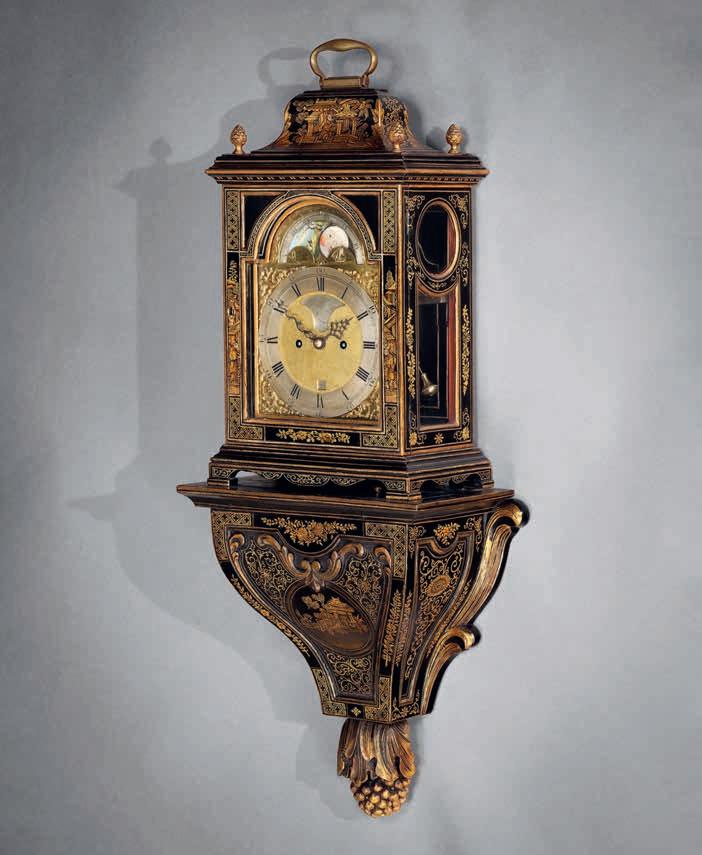
THE EDWARD JAMES OF WEST DEAN ATLAS MIRROR
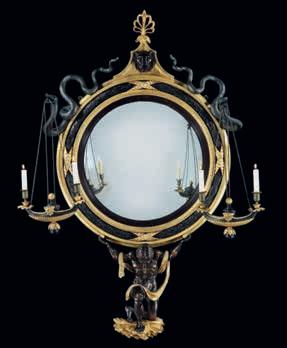
A REGENCY BRONZE PAINTED AND PARCEL GILT CONVEX MIRROR
Note: The mirror retains the original plate, most of the original gilding and most of the original bronze painted surface.
English, circa 1815
Height: 55½ in; 141 cm
Width: 35 in; 89 cm
Depth: 12 in; 30.5 cm
Provenance: Dolly Mann Ltd., Arlington Street, London, England; Edward James, Monkton House, West Dean Park Estate, West Sussex, England; Hotspur Ltd., London, England; Private collection, England.
Illustrated: Norris Wakefield, ‘A memoir of Edward James and the creation of Monkton’, Christie’s, Review of the Season, 1986, pp. 206–12.
Literature: George Smith, A Collection of Designs for Household Furniture and Interior Decoration, 1808, pl. 135.
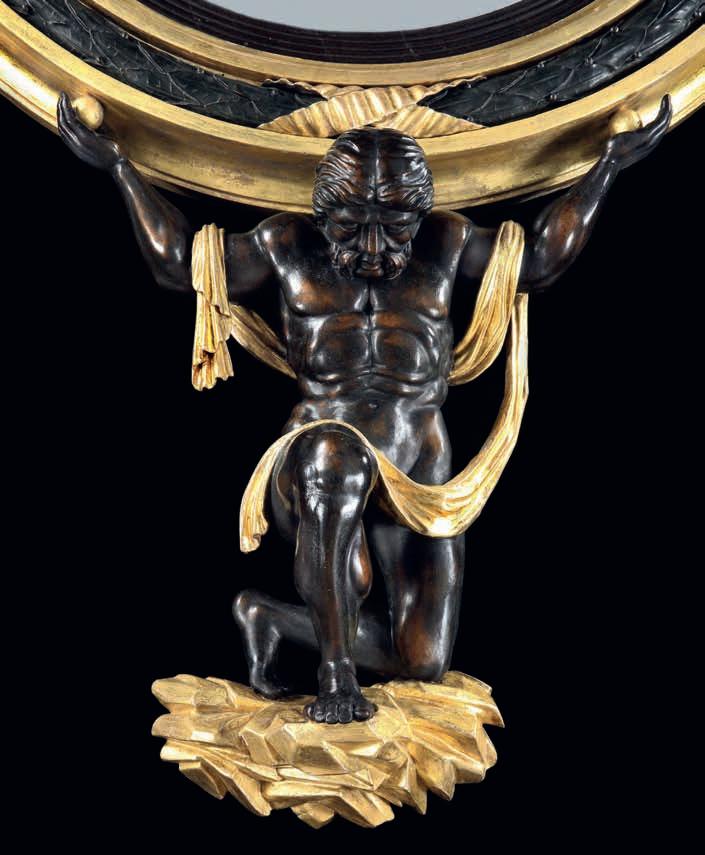
A HIGHLY IMPORTANT MASTERPIECE
A GEORGE III PERIOD CHINESE EXPORT HUANG HUALI AND EBONY CABINET
Note: The cabinet retains its twenty-six original reverse painted mirror plates and ornate brass handles and escutcheons. The top section is fitted with three adjustable shelves. The cupboards in the base are each fitted with a single shelf. The plinth base is a restoration. Two of the small mirror plates each have a minor crack.
Chinese export, circa 1760
Height: 8 ft 4½ in; 255 cm
Width: 4 ft 9 in; 145 cm
Depth: 1 ft 8 in; 51 cm
Provenance: Private collection, London, England; Ronald Phillips Ltd., London, England; Private collection, New York, USA.
Illustrated: ‘Around Grosvenor House’, Country Life, 7 June 2001, p. 170. Ronald Phillips Ltd., ‘Antique English Furniture’, catalogue, 2001, pp. 1–2.
Literature:
William Chambers, Designs of Chinese Buildings, Furniture, Dresses, Machines and Utensils, 1757, fig. 1, pl. xv.
Thierry Audric, Chinese Reverse Glass Painting 1720–1820: An Artistic Meeting Between China and the West, 2020, pp. 120–25.
One might be excused for thinking at first glance that this bookcase is English, but on closer inspection it soon becomes clear that it was made in China. The timber is the rare and highly regarded huang huali, a hardwood not used in England in the 18th century, and prized in China for its mellow golden colour, its fine grain and its aromatic scent. This timber has been used for the entire construction, with lesser parts of the tree such as the sap wood used for non-structural parts like drawer sides and back boards. The joinery of the piece is also very characteristically Chinese, with through tenons with pegs being used for the door frames, and dovetails in the drawers that are not in the English style.
The hardware – handles, hinges, escutcheons and locks – was all imported from England, probably prior to work starting on making the bookcase. The twenty-six mirror plates would also have originated in England. Packed in straw in wooden crates, and travelling for months on rough seas, it is remarkable that these fragile pieces of delicately thin glass, the most striking part of this exceptional cabinet, survived the
outward voyage. The use of reverse painted mirror panels in a bookcase is extremely rare. Only one other example is known, a larger bookcase made of solid ebony and formerly in the collection of Ann and Gordon Getty.
The striking similarity of design and composition of the painted glass panels in both bookcases is extraordinary and leaves no doubt that both pieces originate from the same source.
The panels for this bookcase, just like those for the ebony example, were specially commissioned and designed for their specific location within the doors, very probably at a premium cost. This bespoke production contrasts with most other mirror paintings, which were copied over and over again at speed to meet high demand.
From planning through to the finished item, this bookcase would have taken several years to produce before being, if destined for Europe, handed over to the supercargo, the person in charge of a ship’s cargo, whose duties included buying and selling of stock on behalf of the cargo’s owner.
During the 18th century, trade restrictions imposed by China allowed very limited access to a select few countries, with Canton the only port open to Europeans and subsequently also Americans. This highly lucrative trade with China was organised for Britain by the East India Company.
Sir William Chambers (1722–1796), perhaps best known as architectural adviser to King George III, was born in Gothenberg, Sweden, to Scottish parents. He was educated in England before starting a mercantile career and joining the Swedish East India Company. He made three separate voyages to Asia between 1740 and 1749. The first (1740–1742) was to Bengal, India, and the second (departing 1743) and third (1748–1749) were both to China. On the voyages to China, Chambers acted as an assistant supercargo and was responsible for managing and selling the cargo on arrival, as well as buying and receiving goods for the return voyage. As the assistant supercargo he was familiar with the Siou-Sin Saang workshop.
It is plausible to speculate that Chambers may have been involved with the design and the making of both the bookcase and the mirror panels. Not only was he in a position to manage the designs for the bookcase, with its unusual lozenge glazing bars, but also he is known to have met the Chinese artist Siou-Sin Saang and employed him to draw images of Chinese costume on glass panels. These images later formed the basis of Chambers’s 1757 publication on Chinese design, and some of them are repeated on the glass panels of the bookcase.
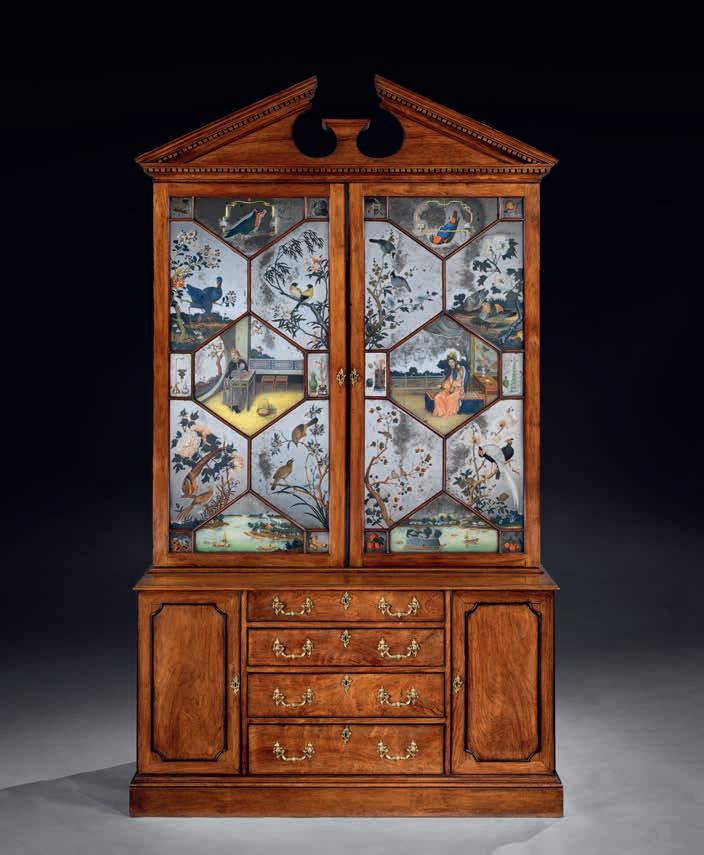
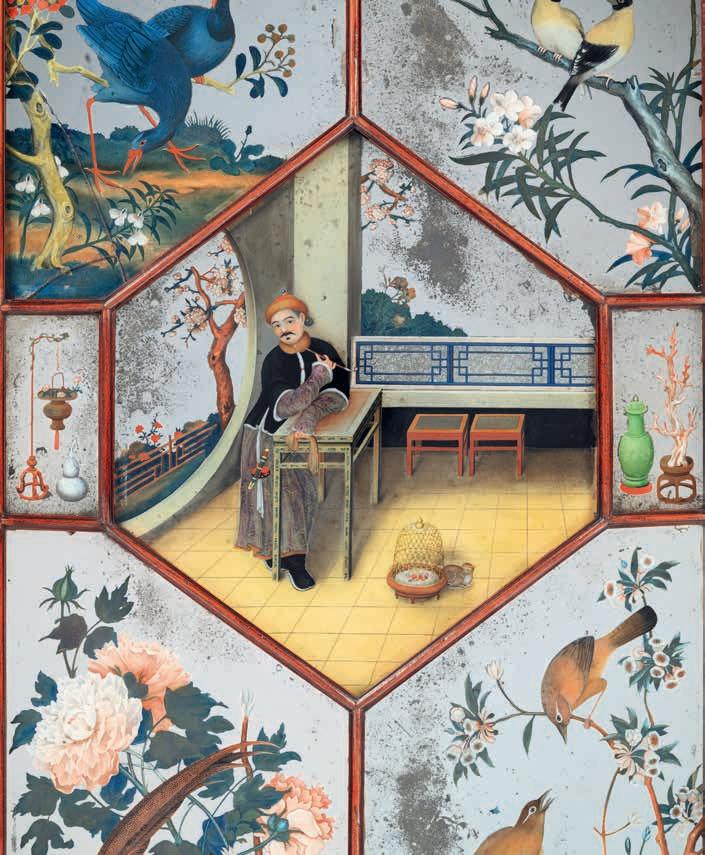
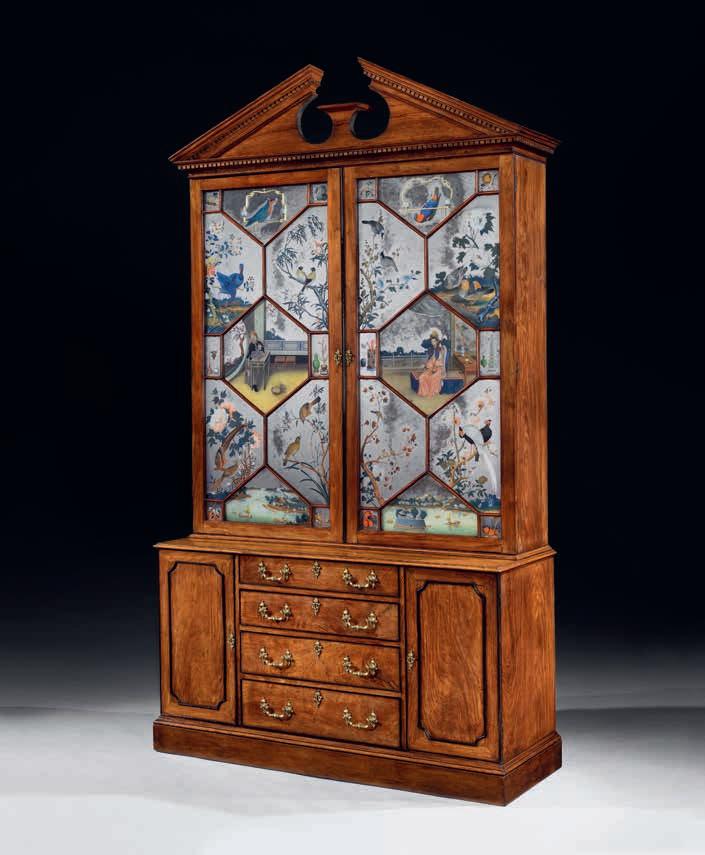
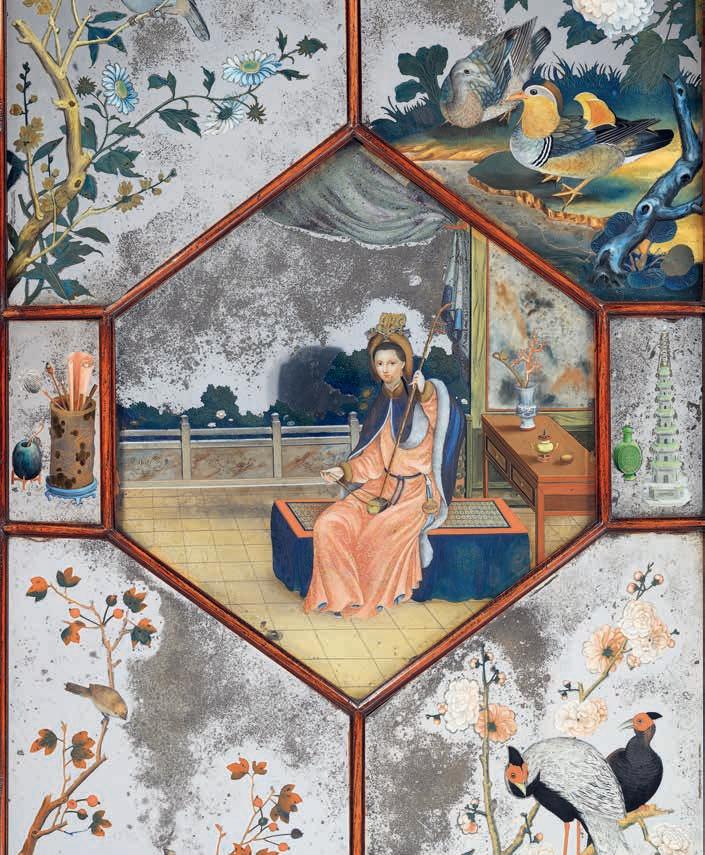
Detail of item 124, a George III period Chinese export huang huali and ebony cabinet: see page 260
BIBLIOGRAPHY
Audric, Thierry, Chinese Reverse Glass Painting 1720–1820: An Artistic Meeting Between China and the West, 2020.
Beard, Geoffrey, and Christopher Gilbert, The Dictionary of English Furniture Makers 1660–1840, Leeds, 1986.
Boulton, Matthew, Matthew Boulton Pattern Books I and II,n.d.
Cator, Charles, and Hugh Roberts, Industry and Ingenuity: The Partnership of William Ince and John Mayhew, London, 2022.
Chambers, William, Designs of Chinese Buildings, Furniture, Dresses, Machines and Utensils, 1757.
Child, Graham, World Mirrors 1650–1900, London, 1990.
Chippendale, Thomas, The Gentleman and Cabinet-maker’s Director, London, 1754.
Chippendale, Thomas, The Gentleman and Cabinet-maker’s Director, 3rd edition, London, 1762.
Coleridge, Anthony, Chippendale Furniture: The Work of Thomas Chippendale and His Contemporaries in the Rococo Style, London, 1968.
Edwards, Ralph, and Margaret Jourdain, Georgian Cabinet Makers, 3rd revised edition, London, 1955.
Gilbert, Christopher, A Pictorial Dictionary ofMarked London Furniture 1700–1840, Leeds, 1996.
Gilbert, Christopher, and Tessa Murdoch, John Channon and Brass-Inlaid Furniture 1730–1760, New Haven, 1993.
Goodison, Nicholas, Matthew Boulton: Ormolu, London, 2002.
Goodison, Nicholas, and Robin Kern, Hotspur: Eighty Years of Antiques Dealing, London, 2004.
Guinness, Desmond, and William Ryan, Irish Houses and Castles, London, 1971.
Hackenbroch, Yvonne, English Furniture with Some Furniture of Other Countries in the Irwin Untermyer Collection, London, 1958.
Hackenbroch, Yvonne, English and Other Needlework Tapestries and Textiles in the Irwin Untermyer Collection, London, 1960.
M. Harris & Sons, ‘A Catalogue and Index of Old Furniture and Works of Decorative Art’, Part I 1560–1740, Part II 1730–1780, Part III 1770–1840, London, 1929.
Harris, Eileen, The Furniture of Robert Adam, London, 1973.
Hayward, Helena, and Pat Kirkham, William and John Linnell, Eighteenth Century London Furniture Makers, 2 vols, London, 1980.
Jussel, Christian, and William DeGregorio, English Furniture, 1680–1760: The Percival D. Griffiths Collection, 2 vols, New Haven, 2023.
Lock, Matthias, Six Sconces, 1744.
Lock, Matthias, Six Tables, 1746.
Macquoid, Percy, and Ralph Edwards, The Dictionary of English Furniture, 3 vols, new edition revised by Ralph Edwards, London, 1954.
Mortimer, Martin, The English Glass Chandelier, London, 2000.
Musgrave, Clifford, Adam and Hepplewhite and Other Neo-Classical Furniture, London, 1966.
Robinson, John Martin, James Wyatt: Architect to George III, London and New Haven, 2012.
Sheraton, Thomas, The Cabinet Maker and Upholsterer’s Drawing Book, revised 2nd edition, London, 1794.
Smith, George, A Collection of Designs for Household Furniture and Interior Decoration, London, 1808.
Stuart, Susan E., Gillows of Lancaster and London, 1730–1840, Woodbridge, 2008.
Symonds, R. W., English Furniture from Charles II to George II, London, 1929.
Symonds, R. W., Furniture Making in Seventeenth and Eighteenth Century England, London, 1955.
Synge, Lanto, Mallett Millennium, London, 1999.
Tomlin, Maurice, Catalogue of Adam Period Furniture, London, 1972.
Walkling, Gillian, Tea Caddies: An Illustrated History, London, 1985.
Whinney, Margaret, Home House: No. 20 Portman Square, London, 1969.
White, Elizabeth, Pictorial Dictionary of British 18th Century Furniture Design: The Printed Sources, London, 1990.
Wills, Geoffrey, English Furniture 1550–1760, London, 1971.
Woods, R. A., English Furniture in the Bank of England, London, 1972.
Detail of item 52, a George II mahogany cabinet in the manner of William Hallett: see page 126
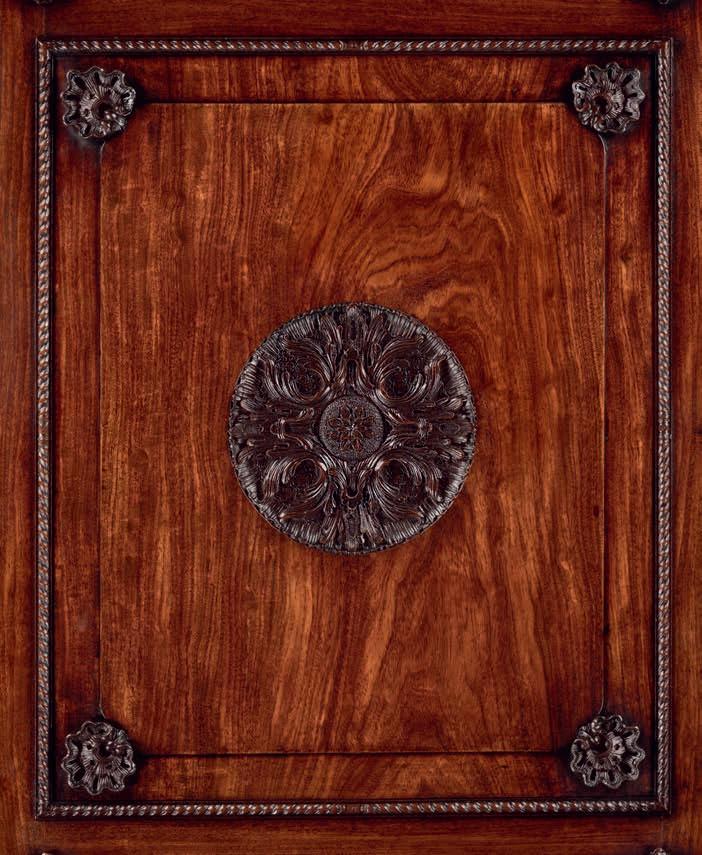
INDEX
BOOKCASES / CABINETS / BUREAUX
THE DEAN OF ST. PAUL’S CATHEDRAL CABINET
A George II mahogany cabinet in the manner of William Hallett 126, 267
A George II cabinet attributed to William Hallett, the design to William Kent 158
A George II mahogany breakfront bookcase attributed to Gillows 116
A George II mahogany linen press attributed to William Hallett 198
THE HAREWOOD HOUSE LACQUER CABINET
A George III Chinese black lacquer and japanned side cabinet by Thomas Chippendale 60
A George III period Chinese export huang huali and ebony cabinet 260
A pair of George III rosewood and padouk side cabinets attributed to Ince & Mayhew 52
A pair of George III satinwood side cabinets in the manner of George Simson 234
A Regency brass mounted mahogany circular bookcase by Gillows 184
A Regency brass mounted rosewood side cabinet attributed to Gillows 190
A Regency mahogany breakfront bookcase attributed to Gillows 180
CHESTS / COMMODES
A George I figured walnut bachelor’s chest 140
A George III diminutive mahogany chest-on-chest 92
A George III mahogany serpentine chest of drawers attributed to William Vile 42
A pair of George III serpentine commodes attributed to Thomas Chippendale 22
CLOCKS
A George I scarlet japanned longcase clock attributed to Giles Grendey 200
A George III black and gold japanned table clock on original wall bracket 256
A George III double fusee bracket clock by John Ellicott in black and gold japanned case110
An Edwardian period giant glass world time ball clock by Elgin National Watch Co.168
GLOBES
A Regency fifteen inch terrestrial globe by J. & W. Newton
LIGHTING
A Queen Anne giltwood and gilt-metal chandelier attributed to the Pelletier workshop 36
A pair of Queen Anne verre églomisé wall lights attributed to Philip Arbuthnot 60
A George III eight light cut glass chandelier attributed to Parker & Perry 62
A pair of George III eight light ormolu mounted cut glass chandeliers by Moses Lafount200
A pair of George III giltwood twin-arm wall lights
A George IV eight light cut glass chandelier attributed to F. & C. Osler
MIRRORS / GIRANDOLES Single
THE GODMERSHAM PARK MIRROR
A Queen Anne gilt gesso mirror attributed to Thomas and René Pelletier
A Queen Anne border glass gesso mirror
A George I silvered gesso mirror
A George II giltwood mirror attributed to Matthias Lock
A George II giltwood oval mirror attributed to John Linnell
A George II giltwood oval mirror in the manner of William Kent
A George II giltwood pier mirror in the manner of John Vardy 250
A George II painted mirror attributed to John Vardy 100 THE LONDONDERRY OVERMANTEL
A George III giltwood overmantel attributed to Thomas Johnson 214
A George III giltwood oval border glass mirror 188
A George III giltwood oval pier mirror attributed to John Linnell 236
A George III giltwood oval pier mirror in the manner of Thomas Chippendale 40
A huge Irish George III giltwood and cut glass mirror chandelier 246
An Irish George III oval giltwood and blue and opaque white glass studded mirror108 THE EDWARD JAMES OF WEST DEAN ATLAS MIRROR
A Regency bronze painted and parcel gilt convex mirror 258
Pairs
A pair of Queen Anne gilt gesso pier mirrors attributed to Robert Derignée 142 THE MOLLER PIER GLASSES
A pair of George I carved giltwood and gesso mirrors 84
A pair of George III giltwood and composition mirrors 200
A pair of George III giltwood girandoles attributed to William France 90
A pair of George III giltwood mirrors attributed to John Linnell 54
A pair of George III giltwood twin light girandoles attributed to John Linnell 160
A pair of George III green and off-white painted mirrors 26
A pair of Irish George III cut glass oval mirrors 134
Mirror paintings
THE DITCHLEY PARK MIRROR PAINTING
A Qing dynasty mirror painting in a giltwood frame attributed to Linnell128, 134
OBJECTS
THE HORACE CLAUDE BAXTER LIBRARY STEPS
A set of George II mahogany library steps 172
A George II polychrome decorated mahogany deed box 192
A George II silver mounted mahogany tea caddy 64
A George III brass mounted mahogany wine cooler attributed to Ince & Mayhew242
A George III carved bone Napoleonic prisoner-of-war ship model of HMS Mars 252
A George III ormolu mounted blue john vase by Matthew Boulton 80
A pair of George III cut glass candlesticks attributed to William Parker 194
A set of four George III cut glass magnum ship’s decanters 228
A pair of Regency blue john inlaid white marble urns 240
An Irish Victorian mahogany wine cellaret by Williams of Dublin 224
A pair of Qing dynasty circular cloisonné enamel panels 66
SEATING
Benches / stools / window seats
THE JUDGE UNTERMYER STOOLS
A pair of George II walnut stools 150
THE LINTON PARK HALL BENCH
A George III mahogany hall bench 248
A George III mahogany stool attributed to Wright & Elwick 102
A pair of George III giltwood stools attributed to Thomas Chippendale 232
A pair of George III mahogany stools attributed to Thomas Chippendale 102
A Victorian oak bench 186
Chairs (single)
A George II giltwood open armchair attributed to Thomas Chippendale 104
A George II walnut wing chair 156
A George III mahogany ‘Bank of England’ chair 178
A George III mahogany hall chair attributed to George Marshall 112
Chairs (pairs)
THE GLEMHAM HALL GAINSBOROUGH ARMCHAIRS
A pair of George II mahogany library armchairs with original needlework 134
A pair of George II mahogany armchairs 162
A pair of George II walnut side chairs 144
A pair of George III giltwood open armchairs almost certainly by Thomas Chippendale 18
A pair of George III mahogany armchairs attributed to Ince & Mayhew 46
A pair of George III mahogany library armchairs from the St. Giles’s House suite158
A pair of George III mahogany library armchairs in the manner of Thomas Chippendale 72
A pair of Regency triple-arm giltwood and ebonised wall lights 210
Chairs (sets)
THE S. B. JOEL DINING CHAIRS
A set of ten George II mahogany dining chairs 220
THE ALSCOT PARK CHAIRS
A set of four George III period Anglo-Indian rosewood side chairs 130
THE BRYNKINALT SALON CHAIRS
A set of eight George III giltwood open armchairs attributed to John Linnell 118
A set of fourteen George III mahogany dining chairs 206
Settees
A George II walnut settee 136
TABLES
Card / games
THE PERCIVAL D. GRIFFITHS CARD TABLES
A George II mahogany concertina action card table 38
A George II walnut concertina action card table by Benjamin Crook 152
Centre
A ‘HEADS OF AMERICA’ TABLE
A Queen Anne gilt gesso centre table 48
A George II mahogany rent table attributed to Gillows 170
A George IV brass mounted amboyna and giltwood centre table by William Riddle238
Desks / reading / writing
THE DINGLEY HALL LIBRARY TABLE
A George II mahogany pedestal writing desk attributed to William Hallett 164
A George II mahogany library table attributed to William Hallett 200
A George III ormolu mounted writing table attributed to Christopher Fuhrlohg 174
Dining / breakfast
A George III mahogany breakfast table of large siz 204
A George III mahogany three pedestal dining table
A William IV mahogany extending dining table
Occasional tables / stands
A George II lobed brass inlaid mahogany tip-up tripod table attributed to Frederick Hintz 34
A George II mahogany kettle stand 96
A George II mahogany kettle stand with triform top 106
A George II mahogany tripod table with birdcage action 70
A pair of George II giltwood terms designed by William Kent 60
A George III mahogany tripod table 244
A pair of George III Etruscan torchères designed by Robert Adam with panels by Zucchi7
A pair of George III giltwood torchères 124
A pair of George III mahogany kettle stands 76
A Regency mahogany drinks table 202
A pair of Regency rosewood étagère pedestals in the manner of George Oakley196
Pembroke / sofa
A George II mahogany Pembroke table attributed to the St. Martin’s Lane syndicate122
Side (single)
THE ADLINGTON HALL GESSO TABLE
A George I gesso table 146
THE JOHN PAUL GETTY CONSOLE TABLE
A George II grey painted console table 134
A George II off-white painted side table attributed to Henry Flitcroft 44
A George II mahogany silver table 15
THE DAISY FELLOWES SPECIMEN MARBLE TABLE
A George III giltwood side table by John Linnell with Roman specimen marble top158
THE WOOTTON LODGE TABLE
A George III parcel gilt console table attributed to Matthias Lock 98
A George III brass mounted mahogany side table attributed to John Cobb 88
A George III giltwood side table 94
A George III mahogany serving table attributed to Ince & Mayhew 222
A George III mahogany sideboard to a design by Thomas Sheraton 216
A Catherine the Great ormolu mounted serpentine side table attributed to Christian Meyer 68
An early 19th century Continental or Russian brass mounted mahogany side table230
Side (pairs)
THE DUCHRAY CONSOLE TABLES
A pair of George II giltwood console tables 10
A pair of George II giltwood console tables 82
THE WARDOUR CASTLE TABLES
A pair of George III giltwood side tables 56
A pair of George III satinwood side tables attributed to Ince & Mayhew 200
A pair of George III side tables attributed to Thomas Chippendale the younger 30
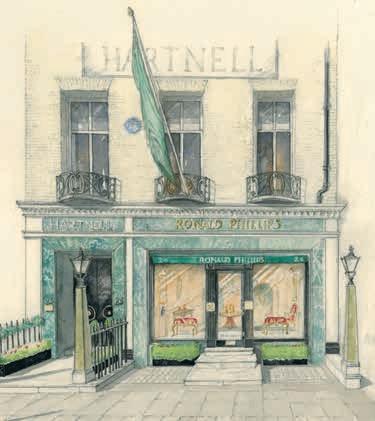
Tel: + 44 (0)20 7493 2341
www.ronaldphillipsantiques.co.uk advice@ronaldphillips.co.uk