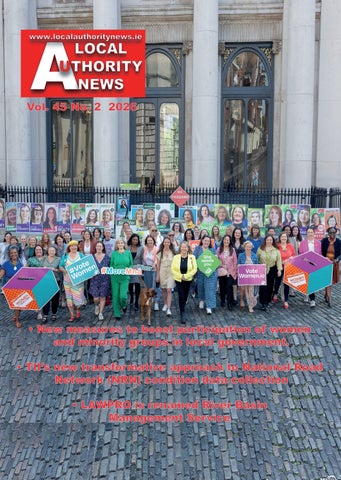
LAN 45 No.2 Cover .qxp_Layout 1 26/08/2026 13:48 Page 1
Vol. 45 No. 2 2026
• New measures to boost participation of women and minority groups in local government. • TII’s new transformative approach to National Road Network (NRN) condition data collection • LAWPRO is renamed River Basin Management Service
LAN 45 No.2 Cover .qxp_Layout 1 26/08/2026 13:48 Page 2
.
LAN 45 No. 2.qxp_Layout 1 26/08/2026 13:47 Page 1
CONTENTS 45 No. 2
Vol. 45 No. 2 2026
FEATURES NEW MEASURES TO BOOST PARTICIPATION OF WOMEN AND MINORITY GROUPS IN LOCAL GOVERNMENT. • New measures to boost participation of women and minority groups in local government. • TII’s new transformative approach to National Road Network (NRN) condition data collection • LAWPRO is renamed River Basin Management Service
3
TII’S NEW TRANSFORMATIVE APPROACH TO NATIONAL ROAD NETWORK (NRN) CONDITION DATA COLLECTION
4
LAWPRO IS RENAMED RIVER BASIN MANAGEMENT SERVICE
8
Published by: ACCESSING LOCAL DATA ACROSS DUBLIN CITY JUST GOT EASIER!
10
HOW BETTER DOMESTIC HOT-WATER SPECIFICATION CAN HELP REDUCE AVOIDABLE MAINTENANCE CALLOUTS
GILTRON LTD RIVERVIEW LODGE, DUBLIN ROAD, NAVAN, CO. MEATH. Tel: 00353 46 9072841 Email: info@localauthoritynews.ie Website: www.localauthoritynews.ie
ISSN NO. 1393-0394 LOCAL AUTHORITY NEWS is available FREE OF CHARGE and ON LINE to all Local and Central Government Bodies throughout Ireland. Published bi-monthly it is disseminated Local Authority CE's, Directors of Finance, Administration Officers, I.T. Professionals, County Director of Services, Senior Architects, Chief Quantity Surveyors, Webmasters, Principal Officers, All Department Heads, Senior Engineers, Water / Wastewater Plant Superintendents, Senior Parks Superintendents, Environmental Officers in all City and County Councils, Office of Public Works, District Councils, Road Design Offices, Libraries, Regional Authorities, Regional Waste Authorities, Transport Infrastructure Ireland, National Transport Authority, Uisce Eireann, EPA, RSA, SEAI, RBMS, Government Departments, National Parks & Wildlife Service, State-Sponsored and Development Bodies, Energy Agencies, Approved Housing Bodies, Local Authority Contractors receive the online version free.
14
LOCAL GOVERNMENT REFORMS TO STRENGTHEN LOCAL DEMOCRACY AND EMPOWER COMMUNITIES
16
FRS CO-OP: SPECIALIST CONTRACT SERVICES AND TRAINING FOR LOCAL AUTHORITIES
18
GALWAY CITY COUNCIL IN EPA TOP THREE LOCAL AUTHORITIES NATIONWIDE FOR ENVIRONMENTAL ENFORCEMENT
19
IRELAND’S GREENHOUSE GAS EMISSIONS DECREASE BY 2.2% IN 2025
20
INOVA: A HEAT PUMP DESIGNED FOR THE WAY IRISH APARTMENTS ARE BUILT
23
UNDERGROUND CHAMBERS WITHOUT THE INSTALLATION BURDEN (EJ)
24
KILDARE COUNTY COUNCIL SIGNS CONTRACTS FOR LANDMARK NEWBRIDGE LIBRARY, COUNTY ARCHIVES AND CULTURAL CENTRE PROJECT
25
ALL-IRELAND POLLINATOR PLAN 2026-2030
28
CROSS-BORDER BEE KIND INITIATIVE CHAMPIONS BIODIVERSITY AND INCLUSION
30
DRINKING WATER IS SAFE, BUT LONG-TERM RESILIENCE MUST IMPROVE TO PROTECT PUBLIC HEALTH, SAYS EPA.
31
COUNCIL MAKES STRIDES IN €187 MILLION ANTI-DERELICTION EFFORT
32
€23 MILLION UPGRADE OF BALLYMAHON WASTEWATER TREATMENT PLANT TO SUPPORT FUTURE GROWTH AND HELP SAFEGUARD WATER QUALITY IN THE RIVER INNY
34
COMMUNITY SPIRIT IN ACTION IN BRAY CO.WICKLOW
36
1
LAN 45 No. 2.qxp_Layout 1 26/08/2026 13:47 Page 2
2
LAN 45 No. 2.qxp_Layout 1 26/08/2026 13:47 Page 3
New measures to boost participation of women and minority groups in local government.
The Local Democracy Taskforce has published recommendations to strengthen local democracy, bring decision-making closer to communities, and better support Councillors. A key element of the recommendations is to increase the participation of women, people with disabilities and people from minority backgrounds. “Local Government is stronger, fairer and more trusted when it fully reflects the communities it serves. The Taskforce report contains a range of welcome proposals to increase the participation of women and people from minority backgrounds, which is essential to sustaining our democracy”, said Brian Sheehan, CEO of Women for Election. Ireland currently ranks 22nd out of the EU27 in the number of women in local government. Women hold just 261 council seats (27%), with only three local authorities having more than 40% women after the last election. Just 12 women from migrant backgrounds were elected. “There are well-recognised barriers to participation of women and people from diverse backgrounds. Incumbency is a major challenge, with 84% of Councillors seeking re-election and 86% of those returned in 2024, leaving limited opportunities for women or people from Traveller or minority backgrounds. It is disappointing that the Taskforce did not recommend candidate gender quotas, similar to those in place in Dáil elections, or diversity or nested quotas, or consider term limits to address this barrier.” “However, the recommendation that the Electoral Commission examine the long-term framework for determining Councillor numbers offers an opportunity to consider candidate quotas, nested quotas or other temporary or special measures to ensure Councils better reflect the communities they serve.” Women for Election also welcomed the recommendation to examine an election access fund for disabled candidates, one of the organisation's key submissions to the Taskforce. Similar schemes in other countries have helped level the playing field by covering disability-related election costs Recent Women for Election research highlighted the widespread abuse and harassment experienced by women in politics. "We also welcome the report's emphasis on implementing the recommendations of the Task Force on Safe Participation in Political Life, including online safety training for candidates and elected representatives, training that Women for Election offers to women candidates and those elected.” "While it is a lost opportunity that the Taskforce did not recommend directly elected Municipal Councils, which could have provided an important first step into politics for women, people from minority backgrounds or other underrepresented groups, the report contains many positive measures that will strengthen local democracy and enhance Councillors' ability to serve their communities," concluded Sheehan.
3
LAN 45 No. 2.qxp_Layout 1 26/08/2026 13:47 Page 4
TII’s new transformative approach to National Road Network (NRN) condition data collection
Colleagues in Network Management have implemented a data-driven, AI-enabled asset intelligence approach that transforms how road pavement infrastructure condition is collected, analysed, and managed across both the national road and active travel networks. It has been a game changer for TII asset managers, engineers, and decision-makers responsible for maintaining national roads and active travel infrastructure, as well as the travelling public — including motorists, cyclists, and pedestrians — who rely on safe, high-quality infrastructure.
What problem did they solve? TII manages a €31 billion national road network (5,300+ km) and a rapidly expanding active travel network (greenways and cycleways). Before this project, the asset condition was primarily assessed through periodic machine surveys (e.g. RSP, LCMS, SCRIM) and manual inspections. These inspections that were typically undertaken on multi-year cycles, resulting in delayed identification of defects and limited ability to monitor deterioration between survey.
The solution combines five key elements: 1. Scalable, Low-Cost Data Collection They introduced the use of smartphone and camera-based data collection (e.g. GoPro, mobile apps) alongside traditional surveys to capture georeferenced video and imagery across the network at scale. This approach significantly increases coverage while reducing reliance on expensive specialist survey vehicles. 2. AI and Computer Vision Analytics Using AI-powered platforms, captured data is processed automatically to: ▪ Detect defects (e.g. cracking, potholes, surface deterioration) ▪ Classify asset condition ▪ Generate standardised condition scores (0–100 index) This replaces manual interpretation with consistent, objective, and repeatable outputs. 3. Integration of Multiple Data Sources The solution integrates: ▪ AI video analytics ▪ Traditional machine survey data ▪ LiDAR surveys (e.g. Xenobike for active travel assets) This creates a single, unified dataset across all asset types, improving comparability and decision-making.
4
LAN 45 No. 2.qxp_Layout 1 26/08/2026 13:47 Page 5
4. Cloud-Based Platforms and Decision Tools All data is processed and visualised through: ▪ GIS-based platforms (e.g. ArcGIS) ▪ Web-based dashboards and reporting tools 5. Connected Vehicle Data Road Roughness Data (IRI) from NIRA Dynamics Volkswagen Database provides near real-time condition monitoring of Road Roughness Data. 3. Integration of Multiple Data Sources The solution integrates: ▪ AI video analytics ▪ Traditional machine survey data ▪ LiDAR surveys (e.g. Xenobike for active travel assets) This creates a single, unified dataset across all asset types, improving comparability and decision-making. 4. Cloud-Based Platforms and Decision Tools All data is processed and visualised through: ▪ GIS-based platforms (e.g. ArcGIS) ▪ Web-based dashboards and reporting tools 5. Connected Vehicle Data Road Roughness Data (IRI) from NIRA Dynamics Volkswagen Database provides near real-time condition monitoring of Road Roughness Data. What are the benefits? ▪ Near real-time access to asset condition data ▪ Easy visualisation of defects and trends ▪ Exportable data for lifecycle planning and investment decisions
Resulting Transformation Together, these elements shift TII from periodic, inspection-led asset management to continuous, data-driven and AI-enabled asset intelligence. This provides network-wide visibility, improves efficiency, and supports proactive and predictive maintenance strategies. This project has been shortlisted as a finalist under the category of Infrastructure, Assets & Built Environment Digitisation in the Ireland eGovernment Awards. Gerard O'Dea and Stephen Smyth presented this project AI‑Driven Asset Intelligence: Transforming Ireland's Transport Networks for a Resilient Future at the Institute of Asset Management – Annual Conference 2026 in June 2026.
5
LAN 45 No. 2.qxp_Layout 1 26/08/2026 13:47 Page 6
6
LAN 45 No. 2.qxp_Layout 1 26/08/2026 13:47 Page 7
7
LAN 45 No. 2.qxp_Layout 1 26/08/2026 13:58 Page 8
LAWPRO is renamed River Basin Management Service The Local Authority Waters Programme (LAWPRO) has been renamed the River Basin Management Service with the tagline ‘A Local Authority Shared Service, funded by the Department of Housing, Local Government and Heritage’. The new name reflects the evolution of the shared service over the past decade and its expanding role in supporting all 31 local authorities to protect and improve water quality across Ireland.
Photograph of Lough Altan, Co. Donegal submitted by Kathleen Gallagher as part of the River Basin Management Service’s ‘My Favourite Waterbody’ national photo competition..
Christopher O'Sullivan, Minister of State for Nature, Heritage and Biodiversity at the Department of Housing, Local Government and Heritage, announced the new name at the national EPA Water Conference on 17th June. The River Basin Management Service will continue to operate as a local authority shared service, funded by the Department of Housing, Local Government and Heritage and led by Tipperary and Kilkenny County Councils. There is no change to its staffing, governance arrangements or core responsibilities.
Supporting local authorities to deliver water quality objectives The new name better represents the organisation’s role in coordinating and supporting efforts to achieve good or high water quality in our rivers, lakes, transitional and coastal waters, and groundwater, as required by the European Union Water Framework Directive (WFD) which is currently implemented through the River Basin Management Plan for Ireland. The name reflects both the evolution of the shared service over the last ten years and its transition towards becoming a permanent, long-term service.
8
LAN 45 No. 2.qxp_Layout 1 26/08/2026 13:58 Page 9
For local authorities, the River Basin Management Service provides: • Catchment science and evidence to help identify the pressures affecting individual water bodies and inform targeted action. • Technical expertise, resources and guidance to support local authorities in improving water quality. • Coordination across organisations and stakeholders, helping to align activity and support implementation of the River Basin Management Plan. • Community and stakeholder engagement, supporting local communities and other groups to understand, engage with and take action to protect their local water environment. • Support for programmes and funding opportunities that enable practical measures to address water quality pressures.
A shared service with an expanding role Director of Services Anthony Coleman said the new name better reflects the breadth of the service's work. “Since its formation in 2016 the organisation has grown significantly. From initially focusing on coordinating the implementation of the River Basin Management Plan and community engagement, the River Basin Management Service now provides critical catchment science assessments that inform targeted actions to address water quality pressures and delivers innovative programmes including Farming for Water, Nature-based Solutions and the Blue Dot Catchments Programme. The previous name, LAWPRO, no longer reflected the full breadth of the work.” As part of the National Strategy on Nature Based Management of Urban Rainwater and Urban Surface Water Discharges, the River Basin Management Service will also administer the associated Local Authority Fund, with €4.5 million allocated in 2026 to address urban runoff pressures. Mr Coleman added: “The updated logo reflects Local Government Ireland branding guidelines and aligns the River Basin Management Service with other local authority shared services, reinforcing its key supporting role within the local authority sector.”
River Basin Management Service Director, Anthony Coleman.
A long-term role in protecting Ireland's water environment Ireland continues to face significant challenges in protecting and improving water quality. Nutrient pollution, particularly from nitrogen and phosphorus, remains a key pressure, alongside other pressures arising from human activities such as farming, wastewater discharges and runoff from land. Significant work is already underway nationwide to address these pressures. Actions under the River Basin Management Plan, or Water Action Plan 2024, are being implemented and tracked in a coordinated way. However, further targeted action, tailored to the specific pressures affecting individual water bodies, will be essential to improve water quality, particularly with the additional pressure of climate change. The River Basin Management Service will continue to support local authorities and national stakeholders in this work through catchment science, coordination, community engagement and the delivery of practical, innovative programmes. The new name reflects this broader and increasingly strategic role, as the shared service moves towards becoming a permanent, long-term service supporting local government in the protection and restoration of Ireland's rivers, lakes, transitional and coastal waters, and groundwater. Further information about the service can be found at riverbasin.ie
9
LAN 45 No. 2.qxp_Layout 1 26/08/2026 13:47 Page 10
Accessing local data across Dublin City just got easier!
Lord Mayor of Dublin Daryl Barron; Eileen Quinlivan, Assistant Chief Executive, Culture, Leisure, Community & Area Services, Dublin City Council; Justin Gleeson, Director of the All-Island Research Observatory (AIRO) at Maynooth University
Dublin City Council, in collaboration with the All-Island Research Observatory (AIRO) at Maynooth University, is pleased to announce the launch of the Dublin City Knowledge Hub. In a first for local authorities, the Hub is an innovative new online platform providing access to a wide range of local data on the demographic, social, economic, housing and environmental characteristics of Dublin City. The Dublin City Knowledge Hub represents the first stage in a new initiative to make authoritative public data more accessible to policymakers, elected members, community organisations, researchers and the public. Bringing together over 20 interactive dashboards and mapping applications in a single location, the Hub enables users to explore and better understand local conditions across Dublin City. The platform provides information at Local Electoral Area (LEA), Dublin City Committee Area and Small Area level (local areas with approximately 75 households), allowing users to examine local patterns across the city. The Hub includes detailed information on: • Population and demographic profiles, including age structure and population change; • Citizenship, ethnicity and other social characteristics; • Health and wellbeing indicators; • Income and deprivation measures; • Housing activity, including planning permissions, commencements and completions; • Residential property prices for both new and second-hand homes based on the Property Price Register; • Environmental indicators covering a range of themes across Dublin City and the wider region.
10
LAN 45 No. 2.qxp_Layout 1 26/08/2026 13:47 Page 11
The Dublin City Knowledge Hub has been designed as a practical evidence base to support informed decisionmaking across a wide range of sectors. All data published through the Hub is drawn from authoritative public sources, including the Central Statistics Office, the Department of Housing, Local Government and Heritage, Pobal, the Environmental Protection Agency, the Sustainable Energy Authority of Ireland and Geological Survey Ireland. By bringing these datasets together in a single, easy-to-use platform, the project demonstrates the value of the reuse of publicly funded data and supports the objectives of Ireland's National Open Data Strategy.
Supporting Evidence-Based Planning The Dublin City Knowledge Hub is the first initiative of its kind developed by a local authority in Ireland, providing an integrated collection of interactive local-level dashboards and mapping applications covering such a broad range of topics. It establishes an important foundation for evidence-based planning, service delivery and policy development across the city. The platform has also been designed with future development in mind. As new datasets become available, including results from Census 2027, the Knowledge Hub will continue to expand, providing an evolving evidence base to support decisionmaking over the coming years.
Nronanskane The Dublin City Knowledge Hub has been developed through a long-standing collaboration between Dublin City Council and the All-Island Research Observatory (AIRO) at Maynooth University. The initiative reflects a shared commitment to improving access to public data and supporting better-informed decisions through innovative digital tools. The Lord Mayor of Dublin Daryl Barron said: "The Dublin City Knowledge Hub provides an important new resource for understanding the changing social, economic, housing and environmental characteristics of Dublin City. By making high-quality local data more accessible, the platform will support better planning, more informed decision-making and greater public understanding of the city and its communities. This is great new tool that will support both DCC in our work but also provides a useful resource for many of our stakeholders that operate in all areas across the city." Justin Gleeson, Director of the All-Island Research Observatory (AIRO) at Maynooth University, added: "The Knowledge Hub demonstrates what can be achieved through collaboration between local government and the research sector. By bringing together authoritative public datasets in an accessible and interactive format, the platform makes local evidence available to a much wider audience and provides a strong foundation for future planning, research and community engagement. It’s brilliant to see Dublin City Council taking the lead on this new initiative – the combination of solid data and excellent visualisation tools make this a great resource."
The Dublin City Knowledge Hub can be accessed at www.dublincityknowledgehub.ie
11
LAN 45 No. 2.qxp_Layout 1 26/08/2026 13:47 Page 12
12
LAN 45 No. 2.qxp_Layout 1 26/08/2026 13:47 Page 13
LAN 45 No. 2.qxp_Layout 1 26/08/2026 13:47 Page 14
How Better Domestic Hot-Water Specification Can Help Reduce Avoidable Maintenance Callouts For local authorities installing Grant Aerona R290 air source heat pumps across new-build and retrofit housing, specifying the right hot-water cylinder is an important part of ensuring the complete system performs as intended. Grant’s Quick Recovery (QR) Hot Water Cylinders are designed to work with Grant Aerona R290 heat pumps and, through Grant’s free Heating Design & Specification Service, can be correctly sized and specified to meet the hot-water requirements of each property.
Grant Aerona R290 air source heat pump & QR Cylinder Range
This gives local authorities reassurance that the heat pump and cylinder have been designed and specified to work together as part of one integrated heating system – helping to support reliable hot-water performance for residents and reduce the potential for avoidable maintenance callouts further down the line.
When specification becomes a maintenance issue Hot-water performance issues are not always the result of a mechanical fault. A cylinder that is too small may run out of usable hot water at peak times, while a cylinder that is not appropriately matched to a heat pump may not deliver the required recovery performance. In some cases, these issues may be reported as maintenance problems even though individual components are operating correctly. For local authorities managing multiple properties, getting the cylinder specification right from the outset can therefore help prevent avoidable performance issues being built into a project. Through its free Heating Design & Specification Service, Grant considers the heating and hot-water requirements of the individual property and specifies the appropriate Grant QR cylinder alongside the Grant heat pump and other system technologies.
14
LAN 45 No. 2.qxp_Layout 1 26/08/2026 13:47 Page 15
Grant’s in-house team uses planning drawings and project information to determine the requirements of each property, giving local authorities, consultants and contractors confidence that the technologies have been appropriately sized and matched before installation begins.
Capacity is only part of the calculation Although storage capacity is important, Grant advises that specifying a cylinder based on litres alone does not provide the full picture. Property type, household size, occupancy, anticipated demand and recovery performance should all be considered. A larger cylinder is not automatically better. Oversizing can increase costs, occupy valuable space and contribute to unnecessary standing heat loss. Undersizing may leave residents without sufficient hot water and create a recurring service issue. Grant’s Heating Design & Specification Service considers the individual heating and hot water requirements of each property. Its in-house team uses planning drawings and project information to design an integrated heating system and identify appropriately matched components. For local authorities managing varied housing stock, this can support a consistent approach across wider programmes while ensuring technologies are appropriately sized for individual properties.
Designed for heat-pump performance Grant’s QR Hot Water Cylinder range has been designed and manufactured in Ireland for use with modern lowtemperature heating systems, including the Grant Aerona R290 air source heat pump. The cylinders feature a high surface area heat-exchange coil designed to optimise heat transfer and support rapid recovery at the lower system temperatures associated with heat pumps. Advanced insulation also helps minimise standing heat loss, while the cylinder construction has been engineered for durability. Available in capacities from 150 to 300 litres, the QR range includes standard, slimline, Smart pre-plumbed and Smart integrated configurations, allowing the appropriate cylinder to be specified for different property and hot-water requirements.
Think complete system Grant advocates a complete-system approach in which the heat pump, QR cylinder, heat emitters and controls are designed and specified to work together rather than individual technologies being selected in isolation. For local authorities, this approach provides greater reassurance at the specification stage. By pairing a Grant Aerona R290 heat pump with a correctly sized Grant QR cylinder, supported by Grant’s Heating Design & Specification Service, they can be confident that the key technologies have been selected to work together and meet the requirements of the property. Getting this right before installation can help support reliable heating and hot water performance for residents, while reducing the potential for specification related issues to result in unnecessary maintenance visits over the lifetime of the system.
Visit grant.ie for more information on Grant’s range of innovative heating solutions and Heating Design & Specification Service. Follow Grant on Facebook at @GrantIRL, Instagram at @grant_irl, LinkedIn at @GrantEngineeringULC and YouTube at @GrantengineeringIE.
15
LAN 45 No. 2.qxp_Layout 1 26/08/2026 13:47 Page 16
Local Government reforms to strengthen local democracy and empower communities Government publishes Local Democracy Taskforce Report and launches ambitious implementation plan Major programme of reform will enhance the role of councillors, strengthen local decision-making and deepen engagement between communities and local government The Minister for Housing, Local Government and Heritage, James Browne TD, and the Minister of State with responsibility for Local Government and Planning, John Cummins TD, have published the Local Democracy Taskforce Report and launched the Local Democracy Taskforce Government Implementation Plan 2026–2029, setting out a comprehensive programme of reforms designed to strengthen local democracy, empower communities and enhance the role of elected Councillors across Ireland. The Implementation Plan translates the recommendations of the Local Democracy Taskforce into a clear programme of action, comprising 79 measures to be delivered over the period 2026–2029. The reforms will support a more responsive, democratic, accountable and empowered system of local government. The Plan is structured around eight key objectives: • Strengthening community engagement and local decision-making; • Enhancing the democratic role of Councillors; • Improving engagement between central and local government; • Supporting greater devolution of functions; • Increasing transparency and public understanding; • Strengthening financial autonomy and sustainability; • Enhancing governance and accountability; and • Promoting greater representation and inclusivity in local government. Among the most significant reforms are the establishment of Municipal Councils in every local authority, the creation of new Council Oversight and Governance Committees, stronger mechanisms for Councillors to influence local policy priorities and funding decisions, and the establishment of a formal National and Local Government Forum to strengthen cooperation between central and local government. Launching the Plan, Minister James Browne said: “Local government is the level of government closest to our communities. This Implementation Plan marks a significant milestone in our commitment to strengthening local democracy and ensuring that local government has the authority, capacity and support needed to deliver for people. “The reforms set out in this Plan will empower Councillors, enhance accountability, improve community engagement and strengthen the relationship between national and local government. Most importantly, they will ensure that local voices play a greater role in shaping decisions that affect people's everyday lives. “We want to see a local government sector that is empowered to respond effectively to the needs of local communities, deliver national priorities, and remain accountable - both to the people it serves and for the outcomes it is entrusted to achieve.”
16
LAN 45 No. 2.qxp_Layout 1 26/08/2026 13:47 Page 17
Minister Browne added: “I want to sincerely thank the Chair of the Local Democracy Taskforce, Jim Breslin, and the members for their dedication and hard work. Their report represents one of the most significant examinations of local democracy undertaken in recent years. The recommendations reflect a strong consensus across the sector on the need to strengthen local government and enhance the role of Councillors. This Implementation Plan demonstrates the Government's commitment to turning those recommendations into meaningful action.” Minister of State with responsibility for Local Government and Planning John Cummins TD said: “This report marks a significant step towards rebalancing the relationship between elected members and the executive. While local authority executives perform a critical role in delivering services and implementing policy, over time there has been a shift in where decision-making power lies. These recommendations are about restoring the correct balance; strengthening democratic oversight and ensuring councillors have the tools, information and authority they need to represent the people who elected them. “Having served as a councillor for eleven years before entering national politics I know first-hand that strong local government depends on strong partnerships. Delivering for communities requires elected members, executive teams and central government working together with mutual respect and a shared commitment to better outcomes. These reforms are designed to strengthen those relationships while ensuring local government is more accountable, more responsive and better equipped to meet the needs of the communities it serves. “I am committed to working with colleagues across Government, local authorities and the wider local government sector to progress these recommendations. Together, they have the potential to mark a genuine step change in how local government operates, empowering councillors while enabling councils to deliver even more effectively for the people they serve.” Minister of State with responsibility for the Office of Public Works, Kevin “Boxer” Moran, said: “These reforms mark a significant step forward in strengthening local democracy and empowering communities. The Plan will strengthen decision-making at local level, improve transparency and ensure that local voices have a greater role in a system that delivers for people where it matters most.” Key actions in the Plan include: • Establishing Municipal Councils across all local authority areas with enhanced budgetary and decision-making powers; • Introducing formal structures to strengthen Councillor oversight of local authority performance and governance; • Expanding training, research and policy supports for Councillors; • Creating strengthened arrangements for engagement between local government, Government Departments and State agencies; • Developing a framework to support the devolution of additional functions to local government; • Increasing transparency through publication of performance information, service delivery data and governance reports; • Exploring new sources of local government revenue and greater financial flexibility; • Strengthening the role and capacity of oversight bodies; and • Advancing measures to improve diversity and representation in local government. An Implementation Steering Group, chaired by the Department of Housing, Local Government and Heritage, will oversee and coordinate delivery of the programme across Government, local authorities and sectoral stakeholders, and will report directly to both Ministers. The Government Implementation Plan will be delivered through a combination of legislative changes, administrative reforms and sustained collaboration between all partners in the local government sector. Government will continue to explore other mechanisms for reforming local government during this implementation phase.
17
LAN 45 No. 2.qxp_Layout 1 26/08/2026 13:47 Page 18
FRS Co-Op: Specialist Contract Services and Training for Local Authorities FRS Co-Op supports Local Authorities, government agencies and public sector organisations across Ireland through a combination of specialist contract services and industry-leading training solutions. With extensive experience delivering projects in land-based, environmental and infrastructure settings, our teams provide the expertise, resources and practical support needed to deliver essential programmes safely and efficiently. Through FRS Contract Services, we work with government agencies and public bodies to deliver and support important national and regional initiatives. Our experience includes a deer management programme and a large-scale soil sampling project, providing skilled personnel and practical expertise to help organisations deliver complex projects on the ground. Our wider contract capabilities also include specialist fencing through FRS Fencing, one of Ireland’s leading fencing contractors. We deliver high-quality fencing solutions for motorways, railway lines, housing developments, parks, public amenities and commercial infrastructure. With over 40 years’ experience and a network of 15 fencing branches nationwide, we provide Local Authorities and public sector organisations with reliable, durable solutions that help create safe, secure and well-managed public environments. Complementing the FRS services, FRS Training is one of Ireland’s leading providers of professional development and safety training for land-based, environmental and infrastructure sectors. We work closely with Local Authorities, contractors and public sector teams to deliver accredited training that supports compliance, enhances safety and develops workforce capability. Our programmes equip participants with the technical knowledge, certifications and practical skills required to work safely and legally in high-risk environments such as roadside maintenance, forestry operations, parks management, biodiversity projects and land stewardship activities. Our accredited training portfolio includes City & Guilds, Lantra and QQI-certified programmes covering chainsaw maintenance and cross-cutting, felling of small trees up to 380mm, pole saw and woodchipper operation, emergency windblow, knapsack and boom sprayer operation, as well as specialist machinery training including quad bikes (ATVs), tractor driving and telescopic handlers. We also deliver essential health and safety programmes including PHECC First Aid Response, AED and Cardiac First Responder, Manual Handling, Fire Safety, Working at Heights, Lantra Emergency First Aid + Forestry and Safe Pass training, helping organisations maintain compliance while ensuring staff remain safe, competent and site ready. To discuss how FRS Contract Services can support your organisation or upcoming project, visit frscoop.ie. To discuss a training requirement or arrange a course for your team, visit frstraining.ie/contact or contact Marcella Ryan on 086 837 9979 or mryan@frstraining.com. To request a fencing quotation or discuss an infrastructure project, visit frsfencing.ie/contact-us.
18
LAN 45 No. 2.qxp_Layout 1 26/08/2026 13:47 Page 19
Galway City Council in EPA Top Three Local Authorities Nationwide for Environmental Enforcement Galway City Council has been named by the Environmental Protection Agency (EPA) as one of three top performing local authorities for environmental enforcement in the Local Authority Environmental Enforcement Performance Report 2025. The annual report by the Environmental Protection Agency examines how local authorities are addressing ‘National Enforcement Priorities’ (NEPs) to improve environmental compliance and achieve positive outcomes for waste, water, air and noise. Only three local authorities – Galway City Council, Dún Laoghaire-Rathdown and South Dublin County Council – achieved the required standard across all relevant NEPs. Actions in Galway City Council include increased rate of inspections, risk-based inspections targeting high risk establishments and extensive follow up with enforcement actions whenever a noncompliance was detected. Mayor of the City of Galway, Cllr Helen Ogbu said, “Galway City Council plays a vital role in protecting our environment in Galway City – from providing amenity sites, bulky goods collections and Christmas tree recycling, for example, to enforcement of environmental licencing, daily street cleaning, and supporting community initiatives such as clean ups, repair workshops and schools’ programmes. Galway City Council Staff, working in partnership with other agencies and community groups, are at the heart of this positive result, and I congratulate all those involved in this achievement.” Leonard Cleary, Chief Executive, Galway City Council said, “This EPA report demonstrates the importance and effectiveness of enforcement in tackling environmental performance. Galway City Council has prioritised resourcing in this area over the past number of years, with the appointment of Waste Enforcement Officer and Environmental Scientist, working in conjunction with our Community Wardens, Environmental Awareness Officer, Litter Management Unit, and the team in Environment. The work of the team has transformed Galway City Council’s performance in 2024, when seven of 19 NEPs were reaching the required standard, to now being one of the top three in the country, with all 13 NEPs achieving the required standard. The 2025 report found that Galway City was one of only three local authorities meeting the required standard, and the only local authority outside Dublin to achieve this result. Galway City Council will continue to build on this positive result, with recent initiatives including installation of CCTV to prevent illegal dumping; a community-led antilitter project in Ballybane including a rap video created with students from a local primary school; working groups with community leaders; and environmental awareness events.” The 2025 Local Authority Environmental Enforcement Performance Report is available on the EPA website, see https://www.epa.ie/publications/compliance--enforcement/public-authorities/LocalAuthority-Environmental-Enforcement-Performance-Report-2025.pdf
19
LAN 45 No. 2.qxp_Layout 1 26/08/2026 13:47 Page 20
Ireland’s greenhouse gas emissions decrease by 2.2% in 2025
• Ireland’s greenhouse gas emissions decreased by 2.2% (-1.2 Mt CO2eq) in 2025. • All main sectors saw reductions in 2025, with the largest reductions observed in the Energy industries (down 7.1% or 0.51 Mt CO2eq), Buildings (down 4.7% or 0.32 Mt CO2eq), Industry (down 3.3% or 0.20 Mt CO2eq) and Transport (down 1.5% or 0.17 Mt CO2eq). • Provisionally, Ireland is under its first Carbon Budget by 1.1 Mt CO2eq. Energy Industries and Buildings sectors are meeting their sectoral ceilings. Two sectors, Transport and Industry, exceeded their ceilings by 8.1% and 9.1% respectively. • While greenhouse gases are declining overall, compliance with national and EU climate targets remains extremely challenging. • The national gap: Ireland’s national target is to reduce greenhouse gas emissions by 51% in 2030 (compared to 2018). As of 2025, emissions have fallen by 14.5%. • The EU gap: under EU legislation, Ireland must reduce greenhouse gas emissions in key sectors, such as Agriculture, Transport and Buildings, by 42% in 2030 (compared to 2005). As of 2025, a reduction of 12% has been achieved. The Environmental Protection Agency (EPA) has published its provisional greenhouse gas emissions for Ireland for 2025. The figures show a reduction of 2.2% or 1.2 Mt CO2eq compared to 2024, with emission reductions across all the main sectors. However, greenhouse gas emissions now need to decrease by over 10% each year to 2030 for Ireland to meet our national climate target of a 51% reduction on 2018 levels. Commenting on the report Dr Eimear Cotter, EPA Director General, said: “This is the fourth year in a row that Ireland’s greenhouse gas emissions have reduced which is welcome in the context of a growing economy and population. However, with just four years to 2030, Ireland needs to accelerate delivery and achieve much deeper annual reductions to meet our climate targets.”
20
LAN 45 No. 2.qxp_Layout 1 26/08/2026 13:47 Page 21
She added, “The evidence shows that clear prioritisation and sustained investment can deliver emissions reductions. Since 2005, emissions covered by the Emissions Trading System, including large point sources such as power generation, have fallen by over 52%. By contrast, greenhouse gas emissions from Agriculture, Transport and Buildings have collectively fallen by only 12%. This highlights the key challenge for Ireland to reduce emissions from dispersed emission sources. The priority now is to accelerate delivery in these sectors by removing barriers and making low-carbon choices practical, affordable and attractive.” In terms of EU targets, the assessment shows that Ireland has not met its EU Effort Sharing Regulation (ESR) commitments in 2025, even with the use of flexibilities. 2025 greenhouse gas emissions were 12% below 2005 levels, well short of Ireland’s EU Effort Sharing reduction commitment of 42% by 2030. Regarding compliance with national climate commitments, the assessment shows that greenhouse gas emissions (including LULUCF) are 14.5% lower than in 2018, well off track for the national climate ambition of a 51% reduction by 2030.
A summary of the trends from key sectors: Energy Industries: Emissions from energy industries decreased for the fourth consecutive year by 7.1% in 2025, to an all-time low of 6.6 Mt CO2eq. This was due to the large share of energy generation coming from renewables (40.6%) in combination with an increase in the share of imported electricity (16.4% of electricity supply in 2025 compared to 14.1% in 2024). Transport: Emissions from transport decreased for the second year in a row by 1.5% or 0.17 Mt CO2eq following a 1.2% decrease in 2024. A 14.9% increase in the use of biofuels along with a 35.4% increase in electricity consumption for road transport contributed to reduced emissions in 2025. Agriculture: Agriculture emissions decreased slightly by 0.2% or 0.04 Mt CO2eq in 2025. This was primarily due to a 3.3% reduction in cattle numbers offset by a 12.7% increase in nitrogen fertiliser use and a 4.8% increase in milk production. Buildings (Residential, Commercial and Public): Emissions from buildings decreased by 4.7% due to a warmer winter and decreased use of fossil fuels. Emissions within the Residential sector have fallen to their lowest level in over three decades. Currently standing at 2.7 t CO2eq per household, this figure represents a substantial decline from the 1990 baseline of 7.5 t CO2eq. Industry: Manufacturing combustion and industrial processes emissions decreased by 3.3% to 6.0 Mt CO2eq in 2025 due to marked reductions in coal (down 25.5%), oil (down 6.2%) and gas (down 2.7%) usage. Total emissions from the cement sector decreased by 3.6% or 0.1 Mt CO2eq in line with a reduction in clinker production. Provisionally, Ireland is under its first Carbon Budget by 1.1 Mt CO2eq. The assessment also reports on Sectoral Ceiling performance for 2021-2025, with several sectors such as Energy Industries and Buildings meeting or coming within their ceiling. Two sectors, Transport and Industry, exceeded their ceilings by 8.1% and 9.1% respectively. A direct comparison of the Agriculture sector against its absolute Sectoral Emission Ceiling is no longer possible given recent scientific updates to baseline historical agriculture emissions. Dr Conor Quinlan, EPA Programme Manager, commented: “Sectoral ceilings are intended to make climate progress measurable and accountable. The fact that some sectors, such as Energy Industries and Buildings, are provisionally on track is encouraging, but the overshoots in Transport and Industry show that the overall carbon budget remains at risk unless delivery strengthens across all sectors.”
The Greenhouse Gas Emission Inventory 1990 to 2025 is available on the EPA website and the EPA Greenhouse Gas web resource is also available online.
21
LAN 45 No. 2.qxp_Layout 1 26/08/2026 13:47 Page 22
LAN 45 No. 2.qxp_Layout 1 26/08/2026 13:47 Page 23
Inova: a heat pump designed for the way Irish apartments are built www.pipelife.ie For anyone installing heating in apartments, next year brings a real change to plan around. Under the EU F-Gas Regulation (EU) 2024/573, no new heat pump unit of 12kW or under can be placed on the market after 31 December 2026 if it uses R32. In practice that rules R32 out of most residential installations from 2027 onwards. The prevalent replacement is R290. It is a high-performance refrigerant with high efficiencies, but it brings its own constraints. 290 heat pumps have traditionally been placed outdoors, often on balconies. For safety reasons, that is not an option in most apartment settings. So, installers have been left with a gap, the refrigerant the regulations point towards, and nowhere obvious to put the unit. This is the gap Pipelife set out to close with Inova Indoor Heat Pump. Inova is a fully indoor R290 heat pump, developed to Pipelife's own specification with the Irish apartment market in mind. The whole unit sits inside the apartment. There is nothing on the balcony and nothing on an external wall. The in-built safety features are designed around indoor installation from the start, rather than adapted for it. The unit fits within an 800 by 800mm footprint and can be positioned up to 10m from an external wall, connected by 150mm or 220 by 90mm ducting, with no reduction in performance. That 10m figure matters more than it first looks. It gives the apartment designer real freedom on where the unit goes, rather than tying the layout to the position of an outside wall. Inova has a capacity of 3.2kW and can deliver water temperatures up to 75 degrees Celsius, covering both space heating and domestic hot water. The 3.2kW figure was specified to suit the heating and hot water needs of most new-build Irish apartments. Heat losses vary from building to building and apartment to apartment, depending on structure, insulation and air tightness, so sizing always comes back to the individual scheme, but the unit has been designed to satisfy the heating requirements of the majority of Irish apartments. There is also a ventilation advantages worth pointing out some alternative systems, such as exhaust air heat pumps, can lead to over-ventilation and the over-consumption of energy that comes with it if outdoor and indoor air are not mixed correctly. Inova uses only outdoor air, which removes that risk. It also means the unit does not need to be integrated with the ventilation system to work efficiently. The installer keeps flexibility on the ventilation specified, whether MEV or MVHR, and the heat pump runs independently of it. One unit per apartment, decentralised, doing its own job.
23
LAN 45 No. 2.qxp_Layout 1 26/08/2026 13:47 Page 24
Underground Chambers without the Installation Burden Reducing Road Opening, Installation Risk and Concrete use in Municipal Chamber Construction • Faster installation • Lightweight modular sections • High strength performance • Long-term structural reliability in trafficked areas
The COMMAX™ - a high strength, structural composite chamber designed to reduce site work and whole life costs for municipal infrastructure projects.
The Challenge Facing Municipal Infrastructure Projects Traditional chamber construction methods can introduce unnecessary complexity on site. Heavy precast concrete structures often require lifting equipment, extensive labour resources and longer installation programmes. These requirements can add cost, increase traffic disruption and create additional health and safety considerations during construction. The COMMAX™ offers a different approach to underground chamber construction. Manufactured from advanced glass fibre reinforced composite material, COMMAX™ combines exceptional structural strength with a lightweight, modular design. Unlike traditional chamber systems, it achieves the required structural performance without the need for concrete backfill, reducing material use, labour requirements and installation time.
Why Specify the COMMAX™ • Reduced Site Risk • Faster Project Delivery • Long-Term Structural Performance • Greater Sustainability • Integrated System - Cover & Frame
Building Smarter Infrastructure from the Surface Down Developed by the engineering expertise behind globally recognised access cover solutions provider - EJ, COMMAX™ represents a new generation of structural chamber technology, helping local authorities, utilities and consulting engineers deliver safer, faster and more sustainable infrastructure projects. Contact the Business Development team at EJ on 057 91 23100 for further information.
24
LAN 45 No. 2.qxp_Layout 1 26/08/2026 13:47 Page 25
Kildare County Council Signs Contracts for Landmark Newbridge Library, County Archives and Cultural Centre Project
Kildare County Council has signed a contract with Townlink Construction Ltd for the delivery of the new Newbridge Library, County Archives and Cultural Centre. The €18.18 million project, located on the Athgarvan Road, Newbridge, is being part-funded by the Department of Rural and Community Development and the Gaeltacht. The development will see the refurbishment and regeneration of the historic library building, originally constructed in 1936, with a substantial new extension which will replace the existing branch library building, constructed in the 1970s. The design was developed by Metropolitan Workshop Architecture and Urbanism, supported by the consultant team including JCA Architects, AECOM, and BB7. The project is being managed by the Special Projects Team in Kildare County Council. Welcoming the contract signing, the Cathaoirleach of the County of Kildare, Cllr. Tim Durkan said: "This project represents a major investment in the future of Newbridge and County Kildare. The new Newbridge Library, County Archives and Cultural Centre will provide a vibrant community hub where people of all ages can learn, create, connect and engage with their local heritage. I am delighted to see this important project reach construction stage." Sonya Kavanagh, Chief Executive, Kildare County Council, said: "The signing of this contract marks the culmination of years of planning and collaboration between Kildare County Council, the Department of Rural and Community Development and the Gaeltacht and the Design Team. This development will transform library and cultural services in Newbridge while preserving an important historic building at the heart of the town. Together with the Riverbank Arts Centre, it will help create a new cultural campus, support the wider regeneration of Newbridge and provide infrastructure that meets the needs of a growing community” Gillian Allen, County Librarian, said: "Kildare Library Service is hugely excited to see this important project move forward. This new Newbridge Library, County Archives and Cultural Centre represents a major investment in the future of Newbridge, providing modern, flexible and welcoming spaces that will support learning, creativity, culture, innovation and community life for generations to come. It will restore a key heritage building while delivering enhanced library services, My Open Library access, a Maker Space, study, County Archives and Local Studies facilities, and new public realm. Most importantly, it will ensure that our library service continues to grow with the community and remains responsive to the needs of Newbridge into the future." David Caulfield, Managing Director, Townlink Construction Ltd added: "We are thrilled to be selected as main contractor to construct the new Library for Newbridge, Kildare and Kildare County Council. We look forward to working with on the project with Kildare County Council and the Design team to bring this vision to reality." Construction of the development is expected to commence in August 2026, with completion anticipated in early 2028. 25
LAN 45 No. 2.qxp_Layout 1 26/08/2026 13:47 Page 26
LAN 45 No. 2.qxp_Layout 1 26/08/2026 13:47 Page 27
27
LAN 45 No. 2.qxp_Layout 1 26/08/2026 13:47 Page 28
All-Ireland Pollinator Plan 2026-2030 Ambitious new Pollinator Plan aims to create ‘pockets for nature every 200 metres’ across the island of Ireland A new five-year plan brings together communities, farmers, businesses, and public bodies to create a more biodiversity-rich landscape. The new All-Ireland Pollinator Plan 20262030 was launched at the National Botanic Gardens, Dublin, by Ireland’s Minister for Nature, Heritage and Biodiversity, Christopher O’Sullivan TD, and Andrew Muir, Minister of Agriculture, Environment and Rural Affairs, Northern Ireland. The AllIreland Pollinator Plan is a voluntary framework coordinated by the National Biodiversity Data Centre and supported by a wide network of partner organisations across both jurisdictions.
July 9th, the new All-Ireland Pollinator Plan 2026-2030 was launched at the National Botanic Gardens, Dublin, by Andrew Muir, Minister of Agriculture, Environment and Rural Affairs, Northern Ireland, and Ireland’s Minister for Nature, Heritage and Biodiversity, Christopher O’Sullivan TD. Pictured with Dr Una FitzPatrick, Co-founder of the All-Ireland Pollinator Plan and Chief Scientific Officer, National Biodiversity Data Centre. Photo Dermot Byrne
Pollinators are essential to both healthy ecosystems and human health. They enable plant reproduction, support biodiversity, and underpin agricultural productivity and food security. However, our 100 species of wild bees are in decline, with one-third at risk of extinction. Actions not only help pollinators but also benefit our wider biodiversity, which benefits human health and wellbeing. Therefore, addressing pollinator decline is both an ecological necessity and a societal priority. Welcoming the launch, Taoiseach Micheál Martin said: “I warmly welcome the launch of the third phase of the All-Ireland Pollinator Plan out to 2030, supported through the Government’s Shared Island Fund, National Parks and Wildlife Service and Department of Agriculture, Food and the Marine and by the Northern Ireland Executive. The All-Ireland Pollinator Plan has proved an enormous success over the last decade in bringing together farmers, local communities, public bodies and businesses to help conserve and create a landscape where pollinators can survive and thrive. I look forward to seeing the All-Ireland Pollinator Plan expand and continue this crucial work in protecting sustainable agriculture, food security, and benefitting the island’s unique and precious biodiversity.” Speaking at the launch, Minister O’Sullivan, said: “Bees, hoverflies and other pollinating insects play a vital role in our food systems and in the health of the wider natural environment. That’s why the All-Ireland Pollinator Plan is such an important initiative, because it makes it easy for everyone to get involved and take action to reverse their decline – no matter where they live, how young or old they are, or how much they know about pollinators. Through outreach, education and partnerships, the AIPP team have developed a network of allies across the island to help these amazing insects, including all 42 councils, over 120 organisations and more than 400 businesses. I’m proud that the funding from the Government of Ireland’s Shared Island initiative will support them to continue this work and to scale it up even further to help us deliver on the ambitious targets for pollinators in the EU Nature Restoration Regulation.” The vision of the All-Ireland Pollinator Plan 2026–2030 is simple but ambitious: to create a landscape that provides food and shelter every 200 metres. This mission reflects the fact that our important solitary bees can only travel these short distances from their nest sites to find food. Achieving this vision will require coordinated action across all land types, supported by strong partnerships and public engagement.
28
LAN 45 No. 2.qxp_Layout 1 26/08/2026 13:47 Page 29
In his launch address, Minister for Agriculture, Environment and Rural Affairs, Northern Ireland, Andrew Muir said: “Bees, butterflies and our other pollinators are the unsung heroes of our environment, playing a fundamental role across our ecosystems. The All-Ireland Pollinator Plan provides a clear, practical framework to support these busy bugs in enabling nature recovery. By working together, across all landscapes, it is possible to restore pollinator populations and create an island that is richer in biodiversity, more resilient to climate change, and better for people and nature alike. Adopting a more ambitious All-Ireland Pollinator Plan for 2026-2030 will help us play our part in meeting international biodiversity targets, and is key to the success of our Environmental Improvement Plan and forthcoming Nature Recovery Strategy. I am grateful to the Irish government and particularly the Department of the Taoiseach, for their partnership and cooperation in developing and supporting it through Shared Island funding.” The 2026-2030 phase of the Pollinator Plan is supported through funding from the Government of Ireland’s Shared Island Fund, the National Parks and Wildlife Service, the Department of Agriculture, Food and the Marine, and the Northern Ireland Environment Agency (NIEA). Dr Sara McGuckin, Head of Natural Science, NIEA said: “Halting and reversing pollinator species decline is essential to securing healthy, resilient ecosystems and sustainable food systems. The Northern Ireland Environment Agency is delighted to continue our strong partnership through the All-Ireland Pollinator Plan to 2030. By strengthening our monitoring of pollinators, we can develop a better understanding of what our rare and threatened species need, and track recovery of pollinator populations across Ireland.” According to Minister for Agriculture, Martin Heydon: “The Department of Agriculture, Food and the Marine is delighted to fund two Farmland Pollinator Officers under the new Plan from 2026 to 2030, to further support farmers in taking action for pollinators. Agriculture and farmers are key in this wide-scale societal effort to reverse the decline of these important insects. We look forward to supporting the next ambitious phase of the All-Ireland Pollinator Plan.” The All-Ireland Pollinator Plan has become internationally renowned as best practice, and as successful model that has been copied by other European States in developing their own action plans to reverse pollinator declines. The Plan is built on robust scientific research, and all recommended actions are evidence-based. “Since 2015, implementation of the All-Ireland Pollinator Plan has been coordinated by the National Biodiversity Data Centre. Thanks to action across all sectors during the first ten years of the Plan, pollinators are now in a much better position, but they still face major challenges. The 2026-2030 phase will be supported by a dedicated team of eight staff within the National Biodiversity Data Centre. Our monitoring schemes and expertise help to provide the scientific basis for evidence-based action and to identify where action will have the greatest impact for our threatened pollinators.” – Liam Lysaght, CEO, National Biodiversity Data Centre The All-Ireland Pollinator Plan 2026-2030 includes 50 strategic aims and 75 success metrics, which will be reported annually to ensure accountability and transparency. Its 10 work packages cover key sectors such a Farmland, Public Land, Transport Networks, Communities, and Businesses. Together, these work packages aim to drive landscape-scale change, connecting individual actions into a coherent ecological shift towards an island where pollinators can survive and thrive. In a time of climate and biodiversity anxiety, the Pollinator Plan empowers people to create positive change for our future, and provides all the knowledge and tools to allow anyone to take action for biodiversity. Its ethos is simple: ‘small actions, taken together, can create real change – helping to restore pollinators in order to build a healthier, more resilient environment for everyone.’
Find out more about the All-Ireland Pollinator Plan team at pollinators.ie
29
LAN 45 No. 2.qxp_Layout 1 26/08/2026 13:47 Page 30
Cross-Border Bee Kind Initiative Champions Biodiversity and Inclusion The success of the Bee Kind Project is continuing to bear fruit across Counties Louth and Down, with communities on both sides of the border benefiting from an initiative that combined biodiversity action, community inclusion and cross-border collaboration. Delivered by Variety – the Children's Charity of Ireland - in partnership with Louth County Council and Newry, Mourne and Down District Council, the project brought together schools, community groups, disability organisations and volunteers in April to create a lasting environmental legacy Built around four key principles - Bee kind to yourself, Bee kind to others, Bee kind to your community, and Bee kind to nature - the project promotes biodiversity, inclusion, wellbeing and community participation. A central aim is to raise awareness of the important role that heritage fruit trees, local seed varieties and pollinators play in supporting healthy ecosystems and biodiversity. As part of the project, heritage fruit trees were planted and beehives established to encourage pollinator activity and environmental education. The cross-border initiative brought together participants from communities in both counties. Community groups from Newry travelled to Omeath to plant 30 heritage fruit trees, while groups from Omeath later travelled to Newry to participate in a corresponding planting event. In advance of the planting events, Men's Shed groups in Omeath and Newry prepared handcrafted benches, which were exchanged between the two communities as a symbol of cooperation and friendship. The project brought together schools, disability organisations, sports clubs, community groups and local residents, highlighting the value of collaboration and shared responsibility in creating more sustainable and inclusive communities. It also provided an opportunity for participants to learn about biodiversity, pollinator conservation and the importance of preserving heritage fruit varieties for future generations. Among those taking part were pupils from Scoil Naomh Lorcáin, Omeath, alongside representatives from Omeath Tidy Towns and a wide range of community organisations from both sides of the border. Cllr Fiona MhicConchoille, one of the organisers of the initiative, said: "I was absolutely delighted to be involved in the Bee Kind Project and to see months of planning come to life in such a positive and meaningful way. “Working alongside Kevin O'Brien from Variety Ireland and Laura Savage from Newry, Mourne and Down District Council, we spent several months developing this initiative to ensure it would deliver lasting benefits to communities on both sides of the border. “This project was about bringing people together, strengthening community connections, promoting inclusion and fostering a shared commitment to protecting our environment. Seeing schools, disability organisations, sports clubs, Men's Sheds, community groups and residents working side by side was a wonderful reflection of what can be achieved through collaboration. “The cross-border nature of the project was particularly important, demonstrating the value of partnership, friendship and shared purpose between neighbouring communities. The trees planted will provide a lasting legacy for future generations while supporting biodiversity and creating greener, healthier spaces for everyone to enjoy. “I would like to sincerely thank the Men's Sheds for the beautiful benches they created; Simon from the Irish Seed Savers Association for his invaluable advice, and all the volunteers and participants who contributed to the success of the project. “The Bee Kind message — be kind to yourself, be kind to others, be kind to your community, and be kind to nature — was reflected throughout the initiative, and I look forward to seeing its positive impact continue in the years ahead." A promotional video showcasing the initiative, Bee Kind Project Connecting Co Down and Co Louth Communities, is available to view at the top of the page and on Variety Ireland's YouTube channel.
30
LAN 45 No. 2.qxp_Layout 1 26/08/2026 13:47 Page 31
Drinking water is safe, but long-term resilience must improve to protect public health, says EPA. • The quality of drinking water from public supplies continues to be high, with 99.8% of samples compliant with standards. • The EPA’s list of ‘at-risk’ supplies has decreased from 45 supplies in 2024 to 35 supplies in 2025, serving 467,000 people. • The number of boil water notices and water restriction notices both increased during 2025, impacting almost 200,000 people. The Environmental Protection Agency (EPA) has published its Drinking Water Quality in Public Supplies 2025 report, which shows that Ireland’s drinking water continues to meet high standards for over four million people. Compliance with microbiological limits reached 99.8%, while chemical standards were met in 99.7% of samples analysed, which means our public water is safe to drink. Despite this good level of compliance, the EPA has identified a list of ‘at-risk’ supplies - the Remedial Action List (RAL) - where improvements are required to ensure a safe and secure drinking water supply for consumers. Ten ‘at-risk’ supplies were resolved during 2025, reflecting sustained progress by Uisce Éireann in upgrading their drinking water treatment infrastructure. However, 35 public water supplies still remain on the RAL at the end of 2025 and must be addressed as soon as possible. Launching the report, Patrick Byrne, EPA Director of the Office of Radiation Protection and Environmental Monitoring, said: “Public drinking water quality remains high, so people can be confident that the water supplied to their homes is safe to drink. While the EPA welcomes the reduction in the number of ‘at-risk’ supplies, EPA audits and enforcement continue to identify supplies which cannot guarantee safe and secure drinking water. Uisce Éireann must allocate necessary resources to complete the required upgrades at ‘at-risk’ supplies to ensure drinking water remains safe and public health is protected into the future.” Water restrictions must be imposed by Uisce Eireann to protect human health when they cannot provide safe drinking water due to contamination or inadequate treatment. In 2025, 100 supplies affecting almost 200,000 consumers were impacted by boil water notices or water restriction notices, an increase from 84 supplies in 2024. Uisce Éireann must improve treatment plant resilience to respond to changing weather conditions, raw water quality or malfunctions in the treatment process so that water restrictions are not needed in the first place. Regarding water restrictions on drinking water supplies, Noel Byrne, EPA Programme Manager, said: “It is worrying that almost 200,000 people were affected by water restrictions in 2025. While necessary to protect public health, they are a considerable inconvenience for consumers and point to a lack of resilience in water treatment. Uisce Éireann must make water treatment plants more robust, so they can withstand treatment challenges and continue to provide a safe water supply for consumers. Where restrictions are necessary, Uisce Éireann must respond quickly so that a compliant water supply is restored as soon as possible.” The EPA’s report also highlights wider challenges across the supply network, including the level of leakage and the replacement of lead pipe work. Thirty six percent of treated water is lost daily through leakage, and people continue to be at risk from exposure to lead in drinking water due to lead in water pipes. More action is needed by Uisce Éireann and other stakeholders to address these issues in the supply network. The EPA Drinking Water Quality in Public Supplies 2025 Report and the complete list of public water supplies currently ‘at risk’ (Remedial Action List) - including details of the remedial measures and associated timeframes - are available on the EPA website.
31
LAN 45 No. 2.qxp_Layout 1 26/08/2026 13:47 Page 32
Council makes strides in €187 million anti-dereliction effort
Cavan County Council has made significant progress in combatting dereliction across the county, with over 187 million currently being invested in the transformation of vacant or derelict properties into social housing and community facilities. Cavan County Council is committed to increasing the supply of housing by all available means, and tackling dereliction is a key strand of this multi-faceted approach, and a core pillar of the Government’s ‘Delivering Homes, Building Communities 2025-2030’ housing action plan. Several recent housing developments have seen vacant or derelict properties demolished or renovated to make way for new, high-quality, energy-efficient social homes, including St Brigid’s Place Cavan phase 1, the former Duckin’ Stool pub in Belturbet, Briody’s Hardware Kilnaleck and more. Elsewhere, vacant and or derelict properties such as Lios na Rí in Cootehill, and Derrylurgan Ballyjamesduff, The Erne Palais Belturbet, Widow’s Row, Belturbet, and St Brigid’s Place Cavan phase 3 are in the process of being redeveloped into modern, high-quality social homes. In total, 113 homes have been delivered across the county by Cavan County Council in the past 18 months, while a further 137 are under construction, and an additional 220 units are at various stages of planning and design. Approved housing bodies will deliver another 98 homes across Cavan in the next two years. The local authority has also refurbished and returned 31 units in its own housing stock to use this year to date. In addition, Cavan County Council has allocated over 10 million under the Croí Cónaithe Vacant Property Refurbishment Grant, with 175 applications paid out – allowing homeowners to restore and occupy previously vacant and derelict homes. A further 314 properties have been approved in principle, with refurbishment work on the majority of these expected to be completed within the next 12 months.
32
LAN 45 No. 2.qxp_Layout 1 26/08/2026 13:47 Page 33
This significant progress in housing is being delivered in tandem with the range of major capital community projects underway across the county. Hugely transformative and impactful projects such as the Market House redevelopment in Ballyconnell, Bailieborough Bridewell & Courthouse, the Community Hub at the Former Percy French Hotel in Ballyjamesduff, Saint Michael’s Hall Cootehill, Kingscourt Town Regeneration projects, Belturbet Community & Enterprise Hub at the former Dinkin’s Bakery, and the major Abbeylands Regeneration Project in Cavan Town, are being delivered by Cavan County Council in a 62 million investment through the Urban Regeneration Development Fund (URDF), the Rural Regeneration Development Fund (RRDF) and SEUPB’s PEACEPLUS programme supplemented by up to 12 million in Cavan County Council’s own funds. Cavan County Council, with its project partners, is also transforming a vacant town-centre site into a worldclass community leisure asset through the development of the Cavan Regional Sports Campus. With an investment of over 35 million, the project represents one of the most significant developments in Cavan Town in recent years and is expected to commence on site before the end of the year. The campus is being delivered with support from the Large-Scale Sport Infrastructure Fund and the SEUPB PEACEPLUS Programme match funded by Cavan County Council. Cathaoirleach of Cavan County Council, Councillor Carmel Brady recently took the opportunity to visit some of the sites being transformed from dereliction to thriving community housing, and hailed the progress being made by the local authority. “It is really heartening to look at some of these old, dilapidated, empty buildings knowing that they will soon be family homes, providing shelter, heat, and security to those who need it, and creating memories for generations to come,” said Cllr Brady. Cavan County Council is working hard on a variety of fronts to combat dereliction in our towns and villages, and I applaud management and staff for their efforts in getting to grips with the scourge of dereliction. There is much work still to be done, but we are very much on the right track,” she added. Chief Executive of Cavan County Council, Eoin Doyle said no stone was being left unturned as the local authority revitalises our towns and villages. “Cavan County Council developed a series of Town and Village Revitalisation Plans a number of years ago, with a view to re-energizing the urban landscape of the county, and this strategic foundation has seen us make great progress in achieving those goals. In transforming derelict and vacant properties into not only social housing, but also critical community infrastructure, we are re-energizing town cores across the county, providing a much-needed boost to local economies, and helping boost social and community cohesion, all the while creating jobs through engaging local contractors,” said Mr Doyle. “This progress would not be possible without the support of local communities, without the efforts of our committed staff and of course the various funding agencies such as the Department of Housing, Local Government and Heritage, and the Department of Rural and Community Development and the Gaeltacht. I’d also like to particularly highlight the role of our elected members who have seen the bigger picture in committing significant match funding to allow us to pursue this ambitious programme of works,” he added.
33
LAN 45 No. 2.qxp_Layout 1 26/08/2026 13:47 Page 34
€23 million upgrade of Ballymahon Wastewater Treatment Plant to support future growth and help safeguard water quality in the River Inny
• €23 million upgrade of Ballymahon Wastewater Treatment Plant to support… Uisce Éireann has commenced construction on a 23 million upgrade of Ballymahon Wastewater Treatment Plant. The major investment will provide additional wastewater treatment capacity, paving the way for future growth and investment in Ballymahon while helping to safeguard water quality in the River Inny. To mark the start of construction, the project team was joined in Ballymahon by Minister of State Robert Troy T.D., Deputy Chief Executive of Longford County Council John Brannigan, local councillors, Oireachtas members and representatives from the Inny Kayaking Club. The upgrade will modernise Ballymahon Wastewater Treatment Plant through the delivery of new infrastructure and advanced treatment technology. It will strengthen the resilience of local wastewater services, support compliance with Irish and EU environmental standards and incorporate sustainable features, including a solar array to support more energy-efficient operations. The project will almost double the capacity of the existing treatment plant, increasing it from a population equivalent (PE) of 2,125 to 4,150. This additional capacity will help ensure wastewater infrastructure can support future growth and development in Ballymahon for decades to come while helping to safeguard water quality in the River Inny.
34
LAN 45 No. 2.qxp_Layout 1 26/08/2026 13:47 Page 35
Speaking about the project, Minister for Housing, Local Government and Heritage, James Browne T.D., said: "Investment in water and wastewater infrastructure is fundamental to supporting sustainable growth and thriving communities. This significant upgrade in Ballymahon will provide the capacity needed to support future development and economic growth while protecting the local environment. It is an important investment in the future of the town, ensuring the infrastructure is in place to meet the housing needs of the community for years to come." Cllr Gerry Hagan, Cathaoirleach of Longford County Council, said: "I am delighted to see the commencement of works on the new Ballymahon Wastewater Treatment Plant, a vital investment in the future of the town. This long-awaited project will protect our natural environment, support sustainable growth and enhance resilience for generations to come. It represents an important step forward for Ballymahon, ensuring the town can continue to develop while safeguarding the natural resources that are so important to the community."
Esther White, Programme Manager with Uisce Éireann, said: "This project represents a powerful investment in Ballymahon's future. As the town continues to grow, it is essential that wastewater infrastructure keeps pace with that growth. This upgrade will almost double the capacity of the existing treatment plant, providing the infrastructure needed to support future development while helping to safeguard water quality in the River Inny. It will also deliver long-term environmental benefits, strengthen the resilience of local wastewater services and incorporate sustainable features, including a solar array to support more energy-efficient operations." Uisce Éireann will continue to engage with local stakeholders and keep the community informed as the project progresses towards construction completion.
Construction is underway and expected to be completed end of 2029.
35
LAN 45 No. 2.qxp_Layout 1 26/08/2026 13:47 Page 36
Community Spirit in Action in Bray Co.Wicklow
Pictured are: (L-R) Paul Farreller , Farrellers Plumbing Bray, Baz Ashmawy, Tomasz Lawniczak, lead plumber and Paul Morris
The team at Wavin was so privileged to have been able to get involved, in a small way, with a very special DIY SOS: The Big Build Ireland project in Bray, Co. Wicklow recently. Watching a community come together to support a family who has gone through the unimaginable was something very special. Wavin was delighted be able to donate product to the project and sends warm congratulations to everyone in involved in creating something really special for an incredibly brave family, in just nine days.
Keep an eye out for the episode on RTE One this autumn.
36
LAN 45 No.2 Cover .qxp_Layout 1 26/08/2026 13:48 Page 3
LAN 45 No.2 Cover .qxp_Layout 1 26/08/2026 13:48 Page 4