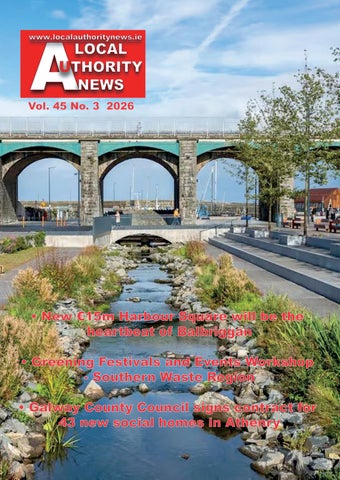
LAN 45 No.3 Cover .qxp_Layout 1 22/10/2026 09:46 Page 1
Vol. 45 No. 3 2026
• New €15m Harbour Square will be the heartbeat of Balbriggan • Greening Festivals and Events Workshop - Southern Waste Region • Galway County Council signs contract for 43 new social homes in Athenry
LAN 45 No.3 Cover .qxp_Layout 1 22/10/2026 09:46 Page 2
.
LAN 45 No. 3.qxp_Layout 1 22/10/2026 10:05 Page 1
CONTENTS 45 No. 3
FEATURES INOVA: A HEAT PUMP DESIGNED FOR THE WAY IRISH APARTMENTS ARE BUILT (PIPELIFE)
3
NEW €15M HARBOUR SQUARE WILL BE THE HEARTBEAT OF BALBRIGGAN
4
WORK BEGINS ON NEW ALL-WEATHER SPORTING FACILITIES AT RATHMORE PARK SPORTS RECREATIONAL HUB, LUSK
7
GREENING FESTIVALS AND EVENTS WORKSHOP – SOUTHERN WASTE REGION
8
GALWAY COUNTY COUNCIL SIGNS CONTRACT FOR 43 NEW SOCIAL HOMES IN ATHENRY
10
WHY A WATERLESS TRAP MAKES SENSE FOR MVHR CONDENSATE DRAINAGE (WAVIN)
12
MINISTER DILLON LAUNCHES €1.5 MILLION CIRCULAR ECONOMY INNOVATION GRANT SCHEME
14
NEW ATHENRY RING ROAD SECTION OFFICIALLY OPENS
18
SMART TECHNOLOGY TO SHAPE THE FUTURE OF TREE MANAGEMENT IN DÚN LAOGHAIRERATHDOWN (DLR)
21
LOUTH COUNTY COUNCIL ACHIEVES ISO 45001 OCCUPATIONAL HEALTH AND SAFETY CERTIFICATION
24
GALWAY CITY SEEKS OVERHAUL OF LOCAL AUTHORITY FUNDING MODEL
26
€33 MILLION BROADBAND INVESTMENT TRANSFORMS CONNECTIVITY ACROSS LOUTH AS NBI COMPLETES MAIN NETWORK BUILD
30
NEW REPORT SHOWS PROGRESS IN LOCAL CLIMATE ACTION
32
Published by:
GILTRON LTD RIVERVIEW LODGE, DUBLIN ROAD, NAVAN, CO. MEATH. Tel: 00353 46 9072841 Email: info@localauthoritynews.ie Website: www.localauthoritynews.ie
ISSN NO. 1393-0394 LOCAL AUTHORITY NEWS is available FREE OF CHARGE and ON LINE to all Local and Central Government Bodies throughout Ireland. Published bi-monthly it is disseminated Local Authority CE's, Directors of Finance, Administration Officers, I.T. Professionals, County Director of Services, Senior Architects, Chief Quantity Surveyors, Webmasters, Principal Officers, All Department Heads, Senior Engineers, Water / Wastewater Plant Superintendents, Senior Parks Superintendents, Environmental Officers in all City and County Councils, Office of Public Works, District Councils, Road Design Offices, Libraries, Regional Authorities, Regional Waste Authorities, Transport Infrastructure Ireland, National Transport Authority, Uisce Eireann, EPA, RSA, SEAI, RBMS, Government Departments, National Parks & Wildlife Service, State-Sponsored and Development Bodies, Energy Agencies, Approved Housing Bodies, Local Authority Contractors receive the online version free.
1
LAN 45 No. 3.qxp_Layout 1 21/10/2026 16:17 Page 2
LAN 45 No. 3.qxp_Layout 1 21/10/2026 16:17 Page 3
Inova: a heat pump designed for the way Irish apartments are built www.pipelife.ie For anyone installing heating in apartments, next year brings a real change to plan around. Under the EU F-Gas Regulation (EU) 2024/573, no new heat pump unit of 12kW or under can be placed on the market after 31 December 2026 if it uses R32. In practice that rules R32 out of most residential installations from 2027 onwards. The prevalent replacement is R290. It is a high-performance refrigerant with high efficiencies, but it brings its own constraints. 290 heat pumps have traditionally been placed outdoors, often on balconies. For safety reasons, that is not an option in most apartment settings. So, installers have been left with a gap, the refrigerant the regulations point towards, and nowhere obvious to put the unit. This is the gap Pipelife set out to close with Inova Indoor Heat Pump. Inova is a fully indoor R290 heat pump, developed to Pipelife's own specification with the Irish apartment market in mind. The whole unit sits inside the apartment. There is nothing on the balcony and nothing on an external wall. The in-built safety features are designed around indoor installation from the start, rather than adapted for it. The unit fits within an 800 by 800mm footprint and can be positioned up to 10m from an external wall, connected by 150mm or 220 by 90mm ducting, with no reduction in performance. That 10m figure matters more than it first looks. It gives the apartment designer real freedom on where the unit goes, rather than tying the layout to the position of an outside wall. Inova has a capacity of 3.2kW and can deliver water temperatures up to 75 degrees Celsius, covering both space heating and domestic hot water. The 3.2kW figure was specified to suit the heating and hot water needs of most new-build Irish apartments. Heat losses vary from building to building and apartment to apartment, depending on structure, insulation and air tightness, so sizing always comes back to the individual scheme, but the unit has been designed to satisfy the heating requirements of the majority of Irish apartments. There is also a ventilation advantages worth pointing out some alternative systems, such as exhaust air heat pumps, can lead to over-ventilation and the over-consumption of energy that comes with it if outdoor and indoor air are not mixed correctly. Inova uses only outdoor air, which removes that risk. It also means the unit does not need to be integrated with the ventilation system to work efficiently. The installer keeps flexibility on the ventilation specified, whether MEV or MVHR, and the heat pump runs independently of it. One unit per apartment, decentralised, doing its own job.
3
LAN 45 No. 3.qxp_Layout 1 21/10/2026 16:17 Page 4
New €15m Harbour Square will be the heartbeat of Balbriggan
The official opening of Harbour Square marks a major milestone in Balbriggan's regeneration, with the €15 million project transforming the harbour area into a vibrant public, community and commercial destination that will support economic growth, tourism and quality of life for years to come. The Mayor of Fingal, Cllr Tony Murphy, and the Minister for Housing, Local Government and Heritage, James Browne, today officially opened Harbour Square, the landmark €15 million redevelopment of Balbriggan's historic Quay Street and Harbour area. Harbour Square is the flagship project and largest capital investment within the €50-€55 million Our Balbriggan Rejuvenation Programme 2019-2030, one of the most ambitious urban regeneration initiatives currently underway in Ireland. Extending across 19,300 square metres, Harbour Square is a unique and sustainable waterfront destination featuring a multi-purpose civic plaza, a linear park, enhanced public realm and vibrant community spaces designed to host markets, festivals, cultural events and year-round activity. Funding for Harbour Square came from the Government’s Towns and Cities Regeneration Investment Fund (formerly Urban Regeneration Development Fund) and from Fingal County Council. The rejuvenation of Ireland’s youngest - and one of its most culturally diverse large towns - is led by Fingal County Council’s Economic, Community and Cultural Development Department. Our Balbriggan’s aim is to create a more attractive, connected place where people want to live, work, visit and do business, and to use public funds to leverage private investment for the good of the coastal community.
4
LAN 45 No. 3.qxp_Layout 1 21/10/2026 16:17 Page 5
The Opening of Balbriggan Harbour Square Harbour Square in Balbriggan has been opened by Mayor of Fingal, Minister James Browne and other local representatives. Opening Harbour Square, Mayor of Fingal, Cllr Tony Murphy, highlighted Harbour Square’s importance not only to the local economy, but also to community life: "This is a momentous occasion for Balbriggan. Harbour Square represents one of the most significant public investments ever made in the town and creates a vibrant new destination at the heart of our waterfront. It will bring people together, support local enterprise and showcase the very best of Balbriggan. Harbour Square will become the heartbeat of our town."
The restoration and change of use of the former RNLI Boathouse and the development of new commercial buildings at Harbour Square are aimed at generating increased business and social activity throughout the town. New public amenities include toilets and changing places. The redevelopment includes significant enhancement works to the River Bracken, extensive landscaping, new paving and surfacing, increased seating, improved accessibility and expanded green spaces. Quay Street, Mill Street and Harbour Road have been reimagined as a cohesive and connected public realm that seamlessly links the town centre with the harbour and coastline. Minister for Housing, Local Government and Heritage, James Browne TD, said: "I am delighted to officially open the Harbour Square redevelopment project, which represents a significant investment in the future of Balbriggan and its waterfront through the Towns and Cities Regeneration Investment Fund. The Harbour Square redevelopment is a flagship example of urban regeneration in action. This transformative project has revitalised a key part of the town centre, creating attractive public spaces, enhancing accessibility for pedestrians and cyclists, improving environmental resilience along the River Bracken, and celebrating Balbriggan's rich maritime heritage. “I am pleased that Government funding has helped unlock this opportunity and I look forward to seeing the positive impact this development will have on Balbriggan's continued growth and success." The ambitious vision contained in the Our Balbriggan Rejuvenation Plan was the result of an historic community engagement in 2019 which saw more than 25% of residents outline their preferences for the future of the town. There was strong support for reimagining the Harbour and Quay Street area in the plan.
5
LAN 45 No. 3.qxp_Layout 1 21/10/2026 16:17 Page 6
The Our Balbriggan Rejuvenation Programme has been tasked with and is making huge progress on key infrastructure and social projects. Under the plan, Fingal County Council has made a number of strategic property acquisitions, as well as driving several social projects. Work is progressing on developments at Bridge Street and Dublin Street, and also at the Bathhouse and Boathouse at the Martello Tower.
Dr David Begg, chair of the Our Balbriggan Leadership Group, said Harbour Square would prove to be a community facility which would prompt investment by attracting visitors, businesses and jobs. “We are seeing improved infrastructure, new businesses opening, and a stronger sense of identity. Renewed confidence has encouraged investors, because they can see a long term vision aligning.” As part of the project, new harbour-side retail units, including kiosk-style premises, have been incorporated as part of the redevelopment, helping to animate the waterfront, support local enterprise and provide additional services for residents, harbour users and visitors. AnnMarie Farrelly, Chief Executive of Fingal County Council, said: "Harbour Square is a landmark investment by Fingal County Council, Government and the people of Balbriggan. It will transform the waterfront, attract new opportunities, boost tourism and help shape a strong future for the town.” The Harbour Square works were delivered by John Craddock Ltd, a contractor with more than 20 years of experience in delivering high-quality, award-winning public realm projects across Ireland. Construction commenced in May 2024. New children's play facilities will also be delivered in the coming months, further strengthening Harbour Square's role as a vibrant, family-friendly destination and enhancing the area's appeal for residents and visitors alike.
6
LAN 45 No. 3.qxp_Layout 1 21/10/2026 16:17 Page 7
Work begins on new all-weather sporting facilities at Rathmore Park Sports Recreational Hub, Lusk
Fingal County Council has commenced works on the much anticipated Rathmore Park Sports Recreational Hub in Lusk. When completed, the new hub will provide state of the art sports and recreational facilities and excellent opportunities for increased engagement with local sports clubs and community development in line with the council's Development Plan. The beginning of works was marked with a sod turning ceremony attended by the Mayor of Fingal, Cllr. Tony Murphy, Chief Executive of Fingal County Council, AnnMarie Farrelly, alongside Oireachtas members and local community groups. The new Rathmore Park Sports Recreational hub will contain an all-weather synthetic soccer & GAA pitch along with an eight-lane floodlit athletics track to World Athletics specification. Mayor of Fingal Cllr. Tony Murphy said: "In a young, dynamic and growing community, sport plays a vital role in promoting inclusion, wellbeing and connection. High quality facilities such as this are essential in encouraging healthier and more active lifestyles for people of all ages. The development of this significant new recreational hub represents a major investment in the local community. It will provide greater opportunities for people to participate in sport and physical activity, helping to increase participation, strengthen community connections and support the continued growth and development of sport in Lusk and the wider area." Chief Executive of Fingal County Council, AnnMarie Farrelly commented: "The development of the Lusk Recreational Hub forms part of our ongoing commitment to providing high-quality facilities for the local community. This modern sports and recreation facility has been designed to accommodate a wide range of sporting activities and will offer valuable opportunities for clubs, schools and community groups to participate, train and grow." Other works to complement the facility includes covered cycle parking, EV charging provisions, car park extension and associated landscaping works. The project which is being led by the Council’s Parks & Green Infrastructure Division will become a valuable sporting amenity for the people of Lusk and the wider area.
7
LAN 45 No. 3.qxp_Layout 1 21/10/2026 16:17 Page 8
Greening Festivals and Events Workshop – Southern Waste Region
More than 100 colleagues and contributors from across the Southern Waste Region gathered in Cashel for a practical actions workshop focused on improving the delivery of greener festivals and events. From policy to practice On Thursday September 24, the Environmental Awareness Officers of the Southern Waste Region, together with the Regional Waste Management Planning Office – Southern, hosted a practical actions workshop aimed at improving the delivery of greener festivals and events. The Southern Waste Region covers 10 local authorities, Carlow County Council, Clare County Council, Cork City Council, Cork County Council, Kerry County Council, Kilkenny County Council, Limerick City and County Council, Tipperary County Council, Waterford City and County Council and Wexford County Council. Held at Brú Ború Heritage Centre in Cashel, Co Tipperary, the event was attended by more than 100 colleagues and contributors from across the region. Participants were first brought up to date with the national policy that supports this work. Philippa King, the Waste Plan Co-ordinator for the region, addressed the workshop and set the scene for the day, covering the National Waste Management Plan for a Circular Economy and its ambition of 0% waste growth over the lifetime of the plan.
Sharing experience and practical action There were two panels on the day, expertly hosted by Pauline McDonogh, Circular Economy Co-ordinator in the Southern Region. In the first panel, green and circular actions at festivals and events during 2026 were explored, with a lively discussion involving Bree Allen of the Ballymaloe Food Festival, and Cliona Connolly, Environmental Awareness Officer in Wexford representing Relay for Life. The recent greening of the Irish Open at Doonbeg was also described in detail by Karen Foley, Environmental Awareness Officer with Clare County Council.
8
LAN 45 No. 3.qxp_Layout 1 21/10/2026 16:17 Page 9
Circular solutions for festivals and events The workshop’s second panel covered a wealth of information on the circular solutions that are available to arts & festivals officers, economic development teams, and municipal district staff to deliver more circular festivals and events. This panel had contributors from suppliers of reusable cup solutions such as Circular Cups for Community Events powered by IRD Duhallow, Refill which supplies hydration stations to outdoor events, and Clean Cup Co., which is a new company based in Northern Ireland offering end-to-end solutions for outdoor events and arenas. Native Events, a consultancy and advocate for greener festivals, also addressed the audience about their work. Participants were also informed about the Regional Waste Management Planning Offices Guide to Plastic Free Festival and Events and Signage for Waste Segregation, both of which are available to download on www.mywaste.ie The audience heard from Ryan’s Cleaners, based in Tipperary but operating nationwide, providing event and concert cleaning services, with useful insights into designing more effective waste management at high-volume events.
Managing food waste Separating food waste at outdoor events and festivals can be challenging. And the audience welcomed insights from Dr Stephen Nolan, Technical Advisor to Bia Energy, on how food waste and compostable packaging can be collected and anaerobically treated to produce green energy. This was followed by a contribution from the Waste Enforcement Regional Local Authority (WERLA) who outlined the obligations for festivals and events regarding the Food Waste Regulations.
Learning from Bloom The second panel wrapped up with a contribution from Bord Bia, which has hosted Bloom in the Park for the last 20 years and has considerably improved sustainability at the festival through a concentrated programme of activities since 2023. With over 100,000 visitors annually, it’s a significant achievement. Bloom in the Park has achieved and retained ISO 20121 – an international standard for sustainable event management and it is the first festival in Ireland to achieve this.
Changing behaviour, moving forward In the afternoon, Maria Lee, behavioural scientist with the ESRI, addressed the workshop, helping participants to understand nudging techniques that can encourage more sustainable behaviour and support the move towards circular festivals and events. The Regional Waste Planning Office – Southern will continue to help the local authorities to improve understanding and deliver greener festivals and events in support of the actions of the National Waste Management Plan for a Circular Economy.
9
LAN 45 No. 3.qxp_Layout 1 21/10/2026 16:18 Page 10
Galway County Council signs contract for 43 new social homes in Athenry - Construction to begin in coming weeks with completion due in early 2028 Galway County Council has signed the construction contract for a new development of 43 social homes at Gort Mhaoilir in Athenry. Construction is due to begin in the coming weeks, with the development expected to be completed in early 2028.
The 1.8-hectare site is located approximately 1km from Athenry town centre. The scheme will provide 43 housing units, including universally designed units. The Galway County Council development will also include new roads and footpaths, car and cycle parking, landscaping, public lighting, signage and associated infrastructure. Cathaoirleach of Galway County Council, Cllr Andrew Reddington, said the project would make an important contribution to housing provision in Athenry. “The signing of this contract marks an important step towards the delivery of new homes for people in the town and winder hinterland. The Council has a responsibility to provide high-quality housing in communities where there is a clear need, and this development will make a significant contribution to that work.” Chief Executive of Galway County Council Liam Conneally said the project was part of the Council’s continuing programme of housing delivery across the county. “This is a significant housing project for Athenry and the signing of the contract allows us to move into the construction phase. “Galway County Council has a strong pipeline of housing projects at various stages of delivery. Working with our delivery partners, we are committed to increasing the pace of housing delivery and bringing more homes on stream across the county.
10
LAN 45 No. 3.qxp_Layout 1 21/10/2026 16:18 Page 11
“We will continue to progress projects that respond to local demand and provide homes that will serve communities for many years to come.” The new development follows the commencement of construction on a separate €4.7 million Galway County Council project at Cullairbaun in Athenry. That project will provide 12 social homes and a purpose-built community care home. Damien Mitchell, Director of Services for Housing with Galway County Council, said the Council was pleased to see another major housing project progressing in the town. “The signing of the contract brings this project to an important stage, and we look forward to seeing construction get underway. The development will provide a range of good quality, energy efficient homes to meet different household needs and it is in a well-connected location close to the town centre.” “We look forward to working alongside C&N Higgins and the wider design team as construction gets underway.” C&N Higgins Construction has been appointed as contractor for the development. The architectural team is Studio PKA & Van Dijk Architects, with SDS Consulting Engineers and MFA Consulting Engineers providing civil and structural engineering services. CBS Consulting and EDC Progressive Engineering are the mechanical and electrical engineers, while Mulcahy McDonagh and Partners are the quantity surveyors.
Positive Coverage Positive Achievements Tel: 00353 46 9072841 Email: info@localauthoritynews.ie Website: www.localauthoritynews.ie
11
LAN 45 No. 3.qxp_Layout 1 21/10/2026 16:18 Page 12
Why a waterless trap makes sense for MVHR condensate drainage With more MVHR units being installed in attic spaces, Wavin explains why a waterless valve like HepᵥO offers a practical advantage over conventional traps when managing condensate drainage. Why does MVHR condensate drainage need particular consideration? MVHR systems generate condensate when warm, moistureladen extract air is cooled as it passes through the heat exchanger, and that condensate needs to be safely drained away. Technical Guidance Document F – Ventilation (TGD F), which provides guidance on complying with Part F of the Irish Building Regulations, states that installed heat-recovery units should have condensate drains fitted and the pipe iinsulated where passing through unheated spaces. The particular challenge with MVHR is that condensate production is not constant. During warmer summer periods, when internal and external air temperatures are closer, significantly less condensate may be generated. At the same time, attic temperatures can rise considerably, increasing the risk of the water held in a conventional trap evaporating. Why can a traditional U or P trap be a weak point? Traditional traps depend on standing water to maintain the seal between the foul drainage system and the MVHR unit. Many MVHR units are located in attic spaces, which can become particularly warm during summer. A combination of higher attic temperatures and periods of low condensate flow can mean that the water held within a conventional trap gradually evaporates. Once that water seal is lost, foul or contaminated air can travel back through the condensate connection towards the MVHR unit and into the living space. There is also a practical maintenance issue. An MVHR unit located out of sight in an attic can easily be forgotten, so a traditional trap that requires checking and refilling may not receive regular attention.
12
LAN 45 No. 3.qxp_Layout 1 21/10/2026 16:18 Page 13
What makes HepᵥO such a strong solution? Wavin HepᵥO removes the reliance on standing water. Its self-sealing elastomeric membrane opens to allow condensate to discharge and then closes to create an airtight seal. There is therefore no water seal to evaporate and no requirement to keep a conventional trap topped up simply to maintain that barrier. For an MVHR unit installed out of sight in an attic, that removes a potential maintenance issue that might otherwise be easily overlooked. HepᵥO has also been performance tested under negative-pressure conditions and demonstrated suitability as an air lock for heat-recovery condensate drainage at negative pressures up to -4 kPa.
Ducting in the ceiling void
Valve in ceiling
Side view of unit mounted in a cupboard fixed to a stud partition with the 25mm MDF fixed behind the plasterboard MVHR-DRAIN Condensate drain, uninsulated drain pipe with min 5˚ fall running to SVP
What should installers consider? Attic installations bring winter considerations too. Any condensate pipe passing through an unheated void or area that could fall below 4°C should be insulated to prevent freezing. Wavin angled adaptors feature a 2.5° angle to help maintain the required fall. Wavin HepᵥO can also be installed horizontally or vertically. Where space is restricted, horizontal installation provides a compact option and is usually preferred for maximum space saving. Wavin also recommend flushing the valve through before installation. The valve requires a minimum of 50100mm head of water to open the valve on its first flush, after this first flush, only 15mm of water is required to open the valve, in standard operating conditions.
Can HepᵥO be used in other condensate applications? Yes. Applications include HVAC, air-conditioning, mechanical ventilation, heat-recovery systems, dehumidifiers and condensate drainage from boilers.
For more, see Wavin.ie or scan the QR code
13
LAN 45 No. 3.qxp_Layout 1 21/10/2026 16:18 Page 14
Minister Dillon launches €1.5 million Circular Economy Innovation Grant Scheme Funding more than doubles from €650,000 to €1.5 million to support businesses and organisations to turn circular ideas into practical solutions
Minister of State at the Department of Climate, Energy and the Environment with special responsibility for the Circular Economy Alan Dillon has announced the launch of the 2026 Circular Economy Innovation Grant Scheme (CEIGS), with total funding increasing from €650,000 to €1.5 million. The 2026 funding round opens today (14 September), with individual grants expected to range from €50,000 to €150,000. The increased investment represents a significant expansion of Government support for circular economy innovation. It will help businesses and social enterprises to develop and implement practical solutions that reduce waste, extend the life of products and materials, and make better use of resources. Launching the 2026 scheme, Minister Dillon said: “Ireland’s transition to a circular economy presents a major opportunity to reduce waste and emissions, conserve valuable resources and build a more sustainable and resilient economy. That is why I am delighted to increase funding for the Circular Economy Innovation Grant Scheme – from €650,000 to €1.5 million in 2026. “This is real investment in circular innovation. It will help organisations move beyond ideas and develop practical solutions that can be tested, implemented and scaled. Whether it is redesigning products, increasing reuse and repair, reducing food waste, finding new uses for materials or developing innovative circular business models, this funding will help turn innovation into action. “The Circular Economy Strategy 2026–2028 sets out an ambitious programme of action across Government and across key sectors of our economy. The Circular Economy Innovation Grant Scheme is an important part of delivering that ambition. By investing directly in innovators, businesses and communities, we are helping to build the solutions, business models and technologies that will make circularity a reality across Ireland.”
Circular Economy Innovation Grant Scheme The Circular Economy Innovation Grant Scheme is a Government initiative that is designed to support innovative projects that advance the circular economy in Ireland. Since its launch in 2021, the scheme has awarded over €2.4 million to 50 projects, supporting innovation across areas including food waste, plastics, single-use plastics, packaging, construction, textiles and general waste.
14
LAN 45 No. 3.qxp_Layout 1 21/10/2026 16:18 Page 15
The 2026 scheme will place a strong emphasis on projects that can demonstrate practical implementation and measurable circular economy impacts, including approaches that keep products, components and materials in use for longer and at their highest possible value. The increased funding is aligned with the implementation of Ireland’s Circular Economy Strategy 2026–2028. The strategy places a stronger emphasis on moving from policy development to practical delivery. It identifies innovation as an important enabler of Ireland’s circular transition.
CIRCULÉIRE and Irish Manufacturing Research (IMR) For 2026, the scheme will be administered in partnership with CIRCULÉIRE and its secretariat Irish Manufacturing Research (IMR). CIRCULÉIRE is Ireland’s Circular Innovation Network, an industry‑led, crosssectoral, public‑private platform supporting Irish businesses to capture circular advantage since 2020. CIRCULÉIRE will manage the application, evaluation, administrative processes for the Circular Economy Innovation Grant Scheme. It will steward successful awardees, as they deliver on their projects. Dr Geraldine Brennan, IMR’s Director of Circular Economy Innovation, said: “CIRCULÉIRE has evolved the fund to make it more accessible and focused on impact-oriented implementation. Through broadened eligibility criteria, we are opening the door to more ambitious projects, particularly those advancing higher-value circular economy ‘R’ strategies including ‘as-is reuse’, repair, remanufacturing, circular design and industrial symbiosis. “The increased funding available in 2026 provides an important opportunity for organisations to move from promising ideas to practical demonstration and implementation, generating evidence and learning that can support wider adoption of circular solutions across Ireland.” The 2026 Circular Economy Innovation Grant Scheme will support projects focused on priority areas for Ireland’s circular economy, including: • • • •
Plastics: Redesigning products or packaging to reduce reliance on virgin or non-recyclable plastics and increase the use of recyclable alternatives. Construction and demolition: Developing reusable construction products and approaches that enable greater reuse and material recovery through selective demolition. Food waste: Implementing technical or behavioural interventions to prevent and reduce food waste in production and commercial settings. Resources and raw materials: Improving the recovery and reuse of critical raw materials and reducing the use of hazardous substances in products.
The scheme is intended to support projects that can demonstrate tangible environmental, economic and social benefits and contribute to the wider development of a more circular Irish economy. Minister Dillon added: “The Circular Economy Strategy 2026–2028 provides the framework for accelerating Ireland’s transition to a more circular economy. But strategies only deliver when they are translated into action. This €1.5 million investment will help do exactly that – backing organisations with the ambition and ideas to change how we design, make, use, reuse and recover products and materials. “I encourage businesses, social enterprises and community and voluntary organisations with innovative circular economy projects to take advantage of this opportunity and bring forward proposals that can make a real difference.”
Full details on the application process for the Circular Economy Innovation Grant Scheme are available through CIRCULÉIRE.
15
LAN 45 No. 3.qxp_Layout 1 21/10/2026 16:18 Page 16
LAN 45 No. 3.qxp_Layout 1 21/10/2026 16:18 Page 17
LAN 45 No. 3.qxp_Layout 1 21/10/2026 16:18 Page 18
New Athenry Ring Road Section Officially Opens
Pictured at the official opening of the Western Section of the Athenry Northern Ring Road in County Galway were Liam Hanrahan, Galway County Council, Liam Conneally, Chief Executive, Galway County Council, Cathaoirleach of County Galway, Cllr. Andrew Reddington, Michael Garry, Minister of State for International and Road Transport, Logistics, Rail and Ports, Sean Canney TD, Donal Garry and Declan Carey, Tower Civil Engineering. Photo: Murtography.
A new section of the Athenry Northern Ring Road has opened, with work on the next phase of the longawaited relief road expected to begin next year. Minister of State for International and Road Transport, Logistics, Rail and Ports, Sean Canney TD officially opened the Western Section of the Galway County Council scheme todayThe section of road connects the previous sections delivered by Galway County Council and IDA Ireland, providing a continuous route between the Tuam Road and the M6 motorway junction. Construction of this latest section began in June 2025 and was carried out by Tower Plant and Civil Engineering on behalf of Galway County Council. Minister Canney said the Government was pleased to support the project. “Improving connectivity while alleviating congestion in our urban centres is key to creating sustainable, safe, thriving and healthy communities. “The Government is delighted to support the delivery of this important phase of the Athenry Northern Ring Road and to have also secured funding for an element of the next section under the Housing Infrastructure Investment Fund (HIIF). I look forward to seeing work get under way on that phase. “I want to acknowledge the commitment of Galway County Council staff and elected members who have worked to bring this project forward. Investment in infrastructure such as this is essential to supporting communities and unlocking the potential for future housing and economic development.”
18
LAN 45 No. 3.qxp_Layout 1 21/10/2026 16:18 Page 19
Cathaoirleach of the County of Galway, Cllr Andrew Reddington, said the road would help reduce traffic in the historic town centre. “This project will help divert through traffic away from Athenry's historic town centre, reducing congestion and improving the environment and safety for pedestrians and cyclists. “Importantly, it will support the sustainable growth of Athenry in line with Galway County Council's long-term vision for the town.” Galway County Council Chief Executive, Liam Conneally, said the project was identified as key infrastructure for the future development of Athenry.
Pictured at the official opening of the Western Section of the Athenry Northern Ring Road in County Galway were Louis O'Hara, TD, Liam Conneally, Chief Executive, Galway County Council, Cathaoirleach of County Galway, Cllr. Andrew Reddington, Minister of State for International and Road Transport, Logistics, Rail and Ports, Sean Canney TD, Albert Dolan, TD and Uinsinn Finn, Director of Services, Galway County Council. Photo: Murtography.
“The Athenry Northern Ring Road is identified in the Athenry Local Area Plan 2024-2030, adopted by the Elected Members, as a key infrastructure project to support the economic development of the town and housing growth. “It will improve access to lands zoned for residential, industrial, business and technology development. “I wish to thank the Department of Transport for its support and acknowledge the Council's Transport Department for its work in designing the scheme in-house.” Uinsinn Finn, Director of Services for Physical Infrastructure, Fire and Emergency Services and Climate Change, said the project would improve connectivity while supporting active travel. “Through the in-house expertise and dedication of our engineering staff, and with the support of our elected members and the Department, Galway County Council is committed to delivering high-quality infrastructure that meets the needs of our communities.
Pictured at the official opening of the Western Section of the Athenry Northern Ring Road in County Galway were Cathaoirleach of County Galway, Cllr. Andrew Reddington, Geraldine Canney, Minister of State for International and Road Transport, Logistics, Rail and Ports, Sean Canney TD, and Liam Conneally, Chief Executive, Galway County Council. Photo: Murtography.
“The new road will take unnecessary traffic out of Athenry’s historic town centre, making it safer and more pleasant for residents, businesses and visitors. It will also improve access around Athenry and support future housing and economic development. “ “Most importantly, I acknowledge the landowners whose lands were required for the scheme. I recognise the impact on their holdings and families and thank them for their cooperation.”
When fully completed, the Athenry Northern Ring Road is expected to carry around 2,000 vehicles a day, taking through traffic away from the town centre.
19
LAN 45 No. 3.qxp_Layout 1 21/10/2026 16:18 Page 20
20
LAN 45 No. 3.qxp_Layout 1 21/10/2026 16:18 Page 21
Smart Technology to Shape the Future of Tree Management in Dún Laoghaire-Rathdown
Dún Laoghaire-Rathdown County Council (dlr) has become the first local authority in Ireland to use artificial intelligence (AI) and LiDAR technology to create a detailed digital twin of its street tree network. As part of a pilot project taking place this September, approximately 20,000 street trees will be surveyed across the county, with around 10,000 trees assessed on each side of the county. Using advanced AI and LiDAR technology, the project will generate valuable data to support smarter urban forest management, strengthen climate resilience and help safeguard one of dlr's most important natural assets for future generations. Using advanced AI and LiDAR technology, the surveys can collect and analyse information about individual trees more efficiently than traditional methods. The technology creates a digital twin of each tree, capturing more than 70 data points on its condition, structure and surrounding environment. This data will support smart urban forest management, providing valuable insights to guide future tree planting, maintenance and climate resilience programmes. The initiative forms part of dlr's ongoing commitment to protecting and enhancing the county's green infrastructure and biodiversity. Trees play a vital role in improving air quality, storing carbon, reducing urban heat, supporting wildlife and creating attractive places for people to live, work and visit. The survey findings will help identify trends, monitor tree health and resilience, and inform future investment in tree planting and maintenance. The data will also support the Council's efforts to increase canopy cover and ensure the long-term sustainability of the county's urban forest. Cathaoirleach of Dún Laoghaire-Rathdown County Council, Cllr Barry Saul,said: "Our trees bring countless benefits to communities across the county, from improving air quality and enhancing biodiversity to making our neighbourhoods more attractive places to live. The information gathered through this survey will help us care for these important assets and ensure they continue to thrive into the future." Chief Executive of Dún Laoghaire-Rathdown County Council, Frank Curran, said: "Being the first local authority in Ireland to use AI technology for tree surveys demonstrates dlr's commitment to innovation and sustainability. The information gathered will help us make informed decisions about our trees, strengthen biodiversity and support climate action objectives across the county." The AI surveys are expected to provide detailed insights into the county's tree population, helping to ensure that dlr's trees continue to thrive and support local biodiversity for years to come. ” 21
LAN 45 No. 3.qxp_Layout 1 21/10/2026 16:18 Page 22
The Future of De-centralised Ventilation.
Without Filters. Without Compromise. Introducing the S&P Filterless Infinity Fan The next generation of low-energy, low-maintenance ventilation for social housing.
Designed for Public Sector Performance The S&P Filterless Infinity Fan is purpose-built to meet the real-world demands of local authority projects. By removing traditional filters from the system design, ongoing maintenance requirements are drastically reduced, delivering consistent ventilation performance across the full building lifecycle. Its intelligent airflow management ensures optimum indoor air quality, improves occupant comfort, and maximizes operational, efficiency—without the maintenance burden associated with traditional filter-based units.
Built -In Smart Data Logging Enables the collection of data such as the total running time at both speeds, the time in which the fan has spent in periods of increased humidity and the energy that had been used. Key Features & Benefits
Removable impeller. No Filter Exchangeable cartridge system Variable speed control Pullcord boost as standard 8 year Warranty Patented cyclone separation technology
22
LAN 45 No. 3.qxp_Layout 1 21/10/2026 16:18 Page 23
23
LAN 45 No. 3.qxp_Layout 1 21/10/2026 16:18 Page 24
Louth County Council Achieves ISO 45001 Occupational Health and Safety Certification
Eugene Birch, Litter Warden; Jerome Lambe, Head of Safety; Finbar Gethins, Senior Executive Officer; Richard Sullivan, Craft Foreman; and Pat Casey, Foreman, pictured with Louth County Council's I.S. ISO 45001:2018 certification.
Louth County Council has achieved certification to I.S. ISO 45001:2018, the internationally recognised standard for Occupational Health and Safety Management Systems, following a successful assessment by the National Standards Authority of Ireland (NSAI). ISO 45001:2018 provides organisations with a framework to create safer workplaces by identifying and managing risks, preventing work-related injuries and ill health, and supporting continual improvement. The certification, awarded by NSAI in June, provides Louth County Council with independent verification that its health and safety management practices meet international best-practice standards and that robust systems are in place to protect employees and support safe service delivery across a diverse range of operational and administrative functions. As part of the certification process, Louth County Council underwent a comprehensive assessment of its Occupational Health and Safety Management System by the NSAI. Maintaining certification requires ongoing external audits and regular reviews to ensure compliance with the requirements of the standard and to demonstrate continual improvement in health and safety performance. The accreditation covers a broad range of Council services, including Roads, Housing, Libraries, Facilities Management, Environment, Planning and Regeneration, Corporate/HR, Community and Enterprise, IT and Finance. It builds upon Louth County Council's existing ISO 45001 certification for Fire Service operations and demonstrates a strong organisational commitment to employee wellbeing, risk management, and continuous improvement.
24
LAN 45 No. 3.qxp_Layout 1 21/10/2026 16:18 Page 25
Jim Campbell, Executive Health & Safety Officer; Jerome Lambe, Head of Safety; Cllr Dolores Minogue, Cathaoirleach of Louth County Council; David Conway, Chief Executive of Louth County Council; Debbie McAreavey, Facilities & Safety Section; and Finbar Gethins, Senior Executive Officer, pictured with Louth County Council's I.S. ISO 45001:2018 certification.
Welcoming the announcement, Cllr Dolores Minogue, Cathaoirleach of Louth County Council, said: "A safe and healthy workplace is fundamental to the delivery of effective public services, and this certification recognises the strong culture of safety that has been developed across Louth County Council." Jerome Lambe, Head of Safety, Louth County Council, said: "Achieving ISO 45001 certification is a significant accomplishment for the organisation and reflects the ongoing commitment to improving our Safety Management System. "It is the culmination of a considerable body of work across the Council and demonstrates the commitment of staff at all levels to embedding health and safety into our day-to-day operations and service delivery.” David Conway, Chief Executive of Louth County Council, described the award as a major organisational achievement, saying: "Achieving certification to ISO 45001 is a significant milestone for the organisation and a strong reflection of the sustained commitment to maintaining and improving our Safety Management System. “This accreditation is an incredibly positive development and provides clear assurance of the high standards being applied across the organisation. It demonstrates our commitment to good governance, continuous improvement, and to developing and valuing our staff, all of which are key priorities in Louth County Council's Corporate Plan 2024-2029. By supporting a safe and healthy working environment, we are also strengthening our capacity to deliver high-quality public services to the people of County Louth. “I would like to thank Jerome Lambe, Head of Safety, his Safety Team members Jim Campbell and Debbie McAreavey, Finbar Gethins, Senior Executive Officer, Human Resources, and Joanna Kelly, Acting Director of Services, HR, Corporate and Community Delivery, for their work in reaching this important milestone." The certification builds on Louth County Council's broader commitment to excellence, accountability, and continuous improvement in service delivery. The Council also holds ISO 50001 certification for energy management, reflecting its commitment to best practice across a range of organisational functions. As a result of the certification, Louth County Council is now listed on the NSAI Certified Company Search and is entitled to use the NSAI ISO 45001 Certification Mark and the IQNET Certified Management System mark, providing further recognition of its commitment to workplace health and safety. The achievement aligns closely with the ambitions set out in Louth County Council's Corporate Plan 20242029 and reflects the Council's commitment to good governance, staff wellbeing, and the delivery of highquality public services for the people of County Louth.
25
LAN 45 No. 3.qxp_Layout 1 21/10/2026 16:18 Page 26
Galway City Seeks Overhaul of Local Authority Funding Model Galway City Council is calling on national Government to reexamine the outdated funding model for local authorities, to reduce significant gaps in service delivery and public infrastructure across the Galway Metropolitan Area.
The current funding model positions Galway City below every other local authority, urban and rural, in Ireland - despite the city being the largest urban centre in the Northern and Western region, a key driver of economic growth both regionally and nationally. How are Local Authorities Funded? Local Authorities have two types of expenditure: • ‘Capital’ or spending on infrastructure such as astro pitches, cycle routes, or community buildings for example, and • ‘Services’ – local authorities deliver over 1,000 services from street cleaning, recycling centres, severe weather response, libraries, removal of abandoned vehicles, homeless supports, business grants and training, environmental monitoring and licencing, to burial ground maintenance. You can see the full list of services at https://Services.LocalGov.ie Infrastructure or ‘Capital expenditure’ is mainly supported by national government funding, and ‘match funding’ from the local authority, financed by development levies, borrowings, property/land sales or other internal resources. Infrastructure projects may also be eligible for European funding. Services are financed through a number of different sources including: • charges for goods and services; • state funding and programmes; • commercial rates; and • the Local Government Fund (LGF). The Local Government Fund (LGF) is a central government fund that partially funds the work of local authorities. This fund comes from three primary sources: • Local property tax revenues • Motor tax revenues (does not apply to Galway City Council) • Payments from the Exchequer (the Government’s central fund) (does not apply to Galway City Council)
26
LAN 45 No. 3.qxp_Layout 1 21/10/2026 16:18 Page 27
Every year, the Department of Housing, Local Government and Heritage assesses how the Local Government Fund (LGF) is distributed to local authorities around the country. Motor tax and Payments from the Exchequer do not apply to Galway City Council – making LPT the primary source of funding from the Local Government Fund for the city. LPT is collected nationally by Revenue, and distributed back to local authorities based on ‘weightings’ including: • Population - 10% • Area - 35% • Deprivation levels - 20% • Local Authority locally raised income - 27.5% • Achievement of National Policy Priorities - 7.5% These simplistic weightings treat Galway as a relatively small geographically area, with a population of 84,000 people. They do not recognise a student population of over 30,000 and visitor numbers of over 2.4million people annually, which put pressure on public infrastructure and services that support both residents and visitors. For example, The Town Hall Theatre, Leisureland, community centres and pitches are all heavily subsidised by income raised locally. Where Area is used as a metric – Galway’s relatively compact size doesn’t reflect the volumes of traffic on urban roads in the city, for those travelling into Galway as a major regional economic, education and employment hub – or passing through the city into the region. Using these weightings, every local authority is entitled to receive a minimum amount of funding under the LPT allocation process, known as the ‘Baseline’. Galway City will generate €10,339,596 in LPT locally in 2026. However, Galway City Council’s baseline was set for 2026 at €5,099,723 – the lowest of all 31 local authorities in the country. Galway City retains €8,304,998 of the €10m, meaning 20% of Local Property Tax paid by residents in the city is effectively being invested in other local authorities nationwide, to Galway City’s detriment. Elected Members and Management of Galway City Council are calling on national government to address this imbalance, to avoid impacts on services and infrastructure delivery in areas including housing, street cleaning, parks, playgrounds, transport, arts and culture. The Council is seeking a ‘baseline’ funding figure that reflects the city’s resident and student population, and also the number of people who travel into Galway each day for employment, education, healthcare, retail, tourism and public services. Mayor of the City of Galway, Cllr Helen Ogbu said, “Galway City is operating on a financial platform behind every local authority in the country, including rural counties of Longford, Roscommon and Leitrim. It is extremely challenging for public representatives and staff of Galway City Council to deliver the level of services required by a thriving, growing, regional city, when national funding, and funding raised locally through Local Property Tax, is not allocated in a way that reflects Galway’s status or service requirements. We are asking national Government to recognise Galway City’s contribution to the region, and the country, and to provide a fairer, more sustainable funding basis for essential local services and capital projects”. Leonard Cleary, Chief Executive, Galway City Council, said, “Galway City is a key growth centre, supporting national and regional development policy. However, simplistic weightings in the national funding models do not reflect this, resulting in a significant under weighting relative to other neighbouring local authorities, including Clare and Limerick. Galway is geographically compact, but it operates as a much larger urban and regional centre for employment, transport, education, homeless services, housing, arts and culture, healthcare and tourism. Working with the Elected Members, we will continue to raise this issue with national government. An equitable funding model is essential for both service delivery, capital investment and for the Council’s ability to co-finance development required to deliver obligations set out at national level.”
27
LAN 45 No. 3.qxp_Layout 1 21/10/2026 16:18 Page 28
LAN 45 No. 3.qxp_Layout 1 21/10/2026 16:18 Page 29
LAN 45 No. 3.qxp_Layout 1 21/10/2026 16:18 Page 30
€33 Million Broadband Investment Transforms Connectivity Across Louth as NBI Completes Main Network Build Latest county milestone achieved as national infrastructure deployment nearing completion National Broadband Ireland (NBI), the Department of Culture, Communications and Sport, and Louth County Council have today announced the completion of the National Broadband Plan (NBP)’s main infrastructure build works in Co. Louth. The milestone marks a major step forward for communities across the county, with high-speed fibre broadband now available to homes, farms, businesses and schools in areas that previously had no access to reliable, highspeed connectivity. With the completion of the main NBI infrastructure rollout, Louth becomes the latest county to reach this milestone as the nationwide infrastructure deployment moves into its final phase ahead of completion later this year. Speaking recently, Minister for Culture, Communications and Sport, Patrick O’Donovan, TD said: “The completion of the National Broadband Plan build in County Louth is a significant milestone in delivering on our commitment to connect every community to the opportunities of the digital economy. “This €33 million Government investment is giving homes, businesses and communities across Louth the connectivity they need to work, grow, and compete. That matters particularly in a county with such a proud industrial heritage and such a strong entrepreneurial spirit. "The National Broadband Plan is transforming rural Ireland. In Louth, we are seeing that transformation become a reality, creating the digital foundations for the next generation of enterprise, innovation, and opportunity. "This is about more than broadband. It is about giving people the tools to build their future in the communities they call home.” To mark this milestone, Louth County Council hosted a reception at the Oriel Centre, Dundalk, featuring addresses from Cllr Dolores Minogue, Cathaoirleach, Louth County Council; Feargal Ó Coigligh, Secretary General, Department of Communications; Mairead Meyer, Chief Operations Officer, National Broadband Ireland; and David Conway, Chief Executive, Louth County Council. There are approximately 9,000 premises in County Louth that are included in the State’s Intervention Area, where NBI is delivering minimum speeds of 500 megabits per second. The rollout represents 33 million of Government investment in the county, with over 3,500 premises already connected to the network. Cllr Dolores Minogue, Cathaoirleach of Louth County Council, said: "The completion of the main National Broadband Plan rollout is a significant milestone for County Louth and a major achievement for the people, businesses and communities that have waited many years for access to reliable, high-speed broadband. “With the network build now complete, every community within the National Broadband Plan intervention area in Louth can access the NBI fibre network, ensuring that location is no longer a barrier to opportunity. “From the Cooley Peninsula to Mid-Louth and Drogheda, rural families, farmers, businesses, schools and community organisations can now benefit from the same world-class digital connectivity available in our larger towns and urban centres.
30
LAN 45 No. 3.qxp_Layout 1 21/10/2026 16:18 Page 31
“This investment strengthens the foundations of our communities, supports education, enterprise and local development, and ensures that people across County Louth can enjoy the same connectivity opportunities as anywhere else in Ireland." David Conway, Chief Executive of Louth County Council, said: “The completion of the main National Broadband Plan rollout marks the culmination of a transformational infrastructure project for County Louth and reflects many years of collaboration between Government, National Broadband Ireland, telecommunications providers and local stakeholders. "I would also like to acknowledge the dedicated work of Wayne Macken, Broadband Officer with Louth County Council, whose ongoing engagement with communities, providers and national agencies has helped maximise the benefits of broadband investment across the county. "The impact of this investment is already evident, with recent ComReg figures showing County Louth performing above the national average for both fibre broadband availability and take-up. That demonstrates not only the success of the rollout itself, but the willingness of residents and businesses to embrace the opportunities that enhanced connectivity brings." Mairead Meyer, Chief Operations Officer, National Broadband Ireland commented: “As a county strategically positioned on the Dublin-Belfast corridor, connectivity has always played an important role in Louth's success. Today's milestone ensures that communities beyond the urban centres can also benefit from the opportunities that high-speed broadband brings. “Through strong collaboration with Government, Louth County Council and our delivery partners, 9,000 homes, farms, businesses and schools across the county can now access the NBI fibre network. “While the network build is complete, the next step belongs to the people of Louth. Over 3,500 premises are already connected, and we are seeing strong demand from homes, farms and businesses who recognise the value of reliable, high-speed fibre broadband. If your home or business is now ready for connection, I would encourage you to contact your chosen broadband provider and place your order today.” With construction now at an advanced stage nationwide, NBI has confirmed that the main build of the fibre network remains on track for completion by the end of this year. The network will enable high-speed broadband access for 566,000 homes, farms and businesses across rural Ireland, an increase of 29,000 premises from the original 537,000 identified at the time of contract signing. Across the country, almost 532,000 premises can now connect and order broadband on the NBI network, with over 193,000 connections to date. In many areas where the network has been live for longer, take-up already surpasses 60%, reflecting strong national appetite for world-class fibre connectivity. Communities across Ireland are now able to access fibre broadband capable of supporting remote work, online learning, digital health services, agri-tech, tourism and local enterprise. NBI is a wholesale network operator, meaning homes and businesses order services through broadband providers rather than directly from NBI. Residents and businesses in NBI’s rollout area can check their Eircode on the NBI website to confirm availability and view the list of broadband providers offering services over the network and place an order directly with their preferred provider.
Positive Coverage Positive Achievements Tel: 00353 46 9072841 Email: info@localauthoritynews.ie Website: www.localauthoritynews.ie
31
LAN 45 No. 3.qxp_Layout 1 21/10/2026 16:18 Page 32
New report shows progress in local climate action Across Ireland, local authorities are taking practical climate action that affects homes, businesses and communities every day. That action can be seen in warmer social homes, businesses finding ways to reduce energy use, and local authorities supporting communities to turn climate ideas into practical projects. Tracking the impact of this work, the 2025 Local Government Climate Action KPI Report has just been released. It shows where local climate action is making a visible difference and helps build a clear picture of how it is being delivered. The report looks at ten key performance indicators, or KPIs. These are measures that track activity in important areas of local government climate action, including energy efficiency, support for businesses, staff training, and preparations for severe weather. The LGMA Research team has been publishing climate action KPIs annually since 2022, showing where progress is being made and where systems or approaches can be further strengthened. One of the strongest results in 2025 was the continued investment in social housing retrofits. Local authorities made effective use of available funding and retrofitted 2,671 social homes in 2025, the highest number to date. Almost all of these homes, 99%, achieved a BER B2 rating or higher. A B2-rated home is significantly more energy efficient than a poorly rated home. For tenants, the impact is immediate: more comfortable, energy-efficient homes that cost less to heat and power. Another strong result in 2025 was the high number of small businesses that took part in the Green for Business Initiative, delivered by Local Enterprise Offices. This free programme connects businesses with specialist Green Consultants, who work with them to identify practical ways to become more sustainable, reduce utility costs and lower their carbon footprint. The number of small businesses taking part in 2025 was almost 1,100, showing growing interest in practical supports that can help businesses operate more efficiently and reduce their environmental impact. Another area where the impact of local climate action can be seen directly is through the Community Climate Action Programme. The programme supports community groups to develop practical local projects in areas such as energy, transport, food, waste and environmental action. By the end of 2025, 706 projects had been funded across Ireland. The figures also show that many of these projects are now moving from planning into delivery. In 2024, 12% of funded projects were recorded as completed. By the end of 2025, that had risen to 54%. This means that an increasing number of community-led climate projects are now taking shape on the ground, helping local groups turn ideas into practical action. Taken together, the findings show how local climate action can translate into practical outcomes: homes that use less energy, businesses receiving support to operate more efficiently, and communities turning climate ideas into practical local projects. Annual tracking also provides a consistent way to see how that work develops over time. Climate action will ultimately be experienced locally — in homes, businesses and communities. By measuring what is being delivered and how approaches are developing, the Local Government Climate Action KPI Report helps make that progress more visible and provides evidence to support continued improvement as Ireland adapts to a changing climate.
32
LAN 45 No.3 Cover .qxp_Layout 1 22/10/2026 09:46 Page 3
LAN 45 No.3 Cover .qxp_Layout 1 22/10/2026 09:46 Page 4