Jeanne Green Director of Advancement Communications and Outreach
Contributors
Heather Harlan Warnack
Assistant Head of School for Advancement
Nathaniel Badder ’94 Director of Advancement Operations
Andrew Robinson Director of Alumni Relations
Photo Contributors
Bodin Farace
Digital Content Manager
Steve Ruark ’96 Ruark Photography
Printing Mt. Royal Printing
Find Gilman on social media at linktr.ee/gilmanschool
The Gilman Bulletin is published by Gilman School, Baltimore, Maryland 21210. Gilman School welcomes students of any race, color, religion, sexual orientation, and national or ethnic origin.
Power of the Pack: The Pursuit of Athletic Excellence
Victor
Brandon
Alumni
Rock
Jr. ’
John F. “Jack” Bartkowski, Kenneth A. Bourne, Jr. ’60, Susan E. “Sue” Dickey, Douglas Munder “Doug” Godine ’53, Mark R. Fetting ’72, J. William Middendorf II ’43, William M. “Bill” Passano, Jr. ’48
Gilman School is a diverse community dedicated to educating boys in mind, body, and spirit through particular emphasis upon academic excellence, athletic participation, and aesthetic appreciation. Gilman seeks to produce men of character and integrity who have the skills and ability necessary to make a positive contribution to the communities in which they live and work.
Dear Gilman Family,
As I have remarked before, in reading the first sentence of Gilman’s mission statement (above), it is easy to treat each component of our full selves — mind, body, and spirit — as separate parts. It is also easy simply to equate the mind with “academic excellence,” the body with “athletic participation,” and the spirit with “aesthetic appreciation.” Either is an over-simplified reading of our mission. We know that our fullest selves — the “whole boy,” in Gilman’s vernacular — develop through the integration of and dynamic interplay between the mind, body, and spirit. These three components do not just develop separately and then get glued together to make a whole person!
Perhaps nothing captures that integration and interplay more than athletics. Through our required athletics program, which takes different forms in each division, Gilman boys are enhancing their physical development, for sure. But their minds and spirits are fully engaged, too. At Gilman, we believe in the age-old adage, “sound body, sound mind,” understanding that our minds are sharper when we exercise regularly. What’s more, physical challenges demand mental strength and spiritual groundedness. Whether one is willing a team to victory or reaching seemingly unattainable heights, great athletic and physical achievements do not happen on braun alone.
Beyond one’s personal development, and also in keeping with our mission, athletics at Gilman help us to build communities. Collective struggles and triumphs through team workouts, practices, defeats, and victories reinforce the fact that we are part of something larger than ourselves. Teamwork helps us to develop the character and skills needed to make positive contributions to our communities well beyond the field or gym. Furthermore, athletics help cultivate school spirit, which is maybe the broadest manifestation of being part of something larger than ourselves. I tell the boys often that we are at our best when we are celebrating each other, and games, meets, and matches give us great reasons to do just that. These contests surround us with community. Whether we are in the game, on the sidelines, or in the stands, we are all pulling for our classmates, and we are all pulling for Gilman.
In short, these life lessons make athletics central to Gilman’s mission. They play a critical and integral role in shaping the whole boy in mind, body, and spirit and helping us to see beyond ourselves. The pages that follow highlight ways in which sports continue to shape Gilman boys’ and men’s lives. The dynamic interplay between mind, body, and spirit is very much alive, and there is no question that athletics have helped them become their fullest selves. I hope you enjoy reading their stories, as well as learning about campus life and catching up on classmates.
Wishing everyone sound bodies, minds, and spirits,
Henry P. A. Smyth PP, P’26 Head of School
Power of the Pack: THE PURSUIT OF ATHLETIC EXCELLENCE
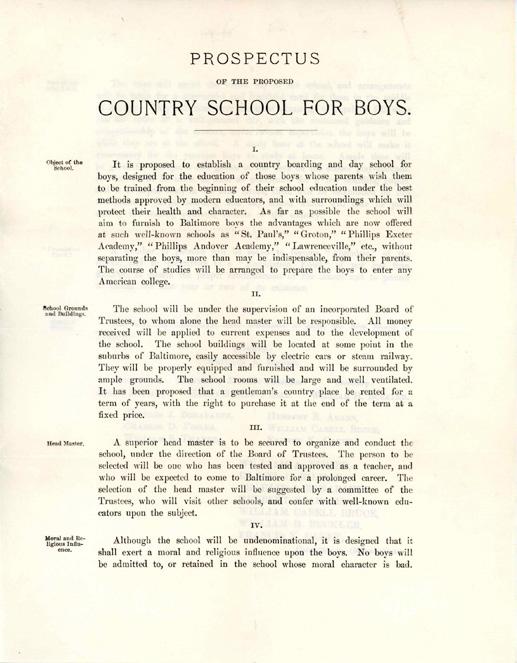
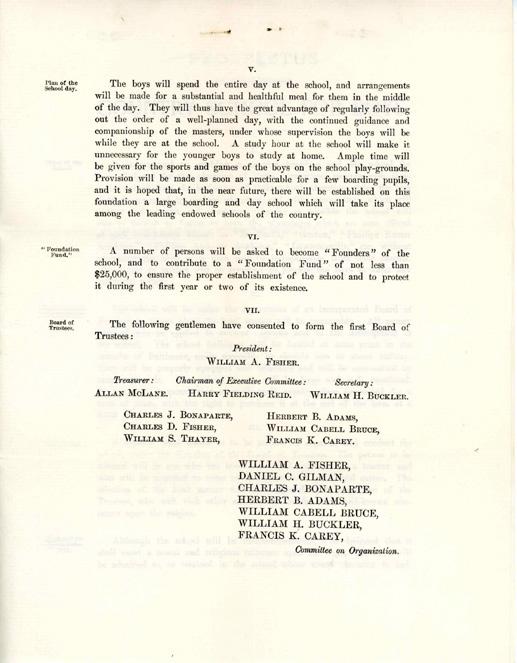
Gilman’s emphasis on athletics — and on a balance of mind, body, and spirit — has been woven into the fabric of Gilman from the very beginning when, in 1897, Anne Galbraith Carey’s vision to educate boys led to the opening of the Country School for Boys.
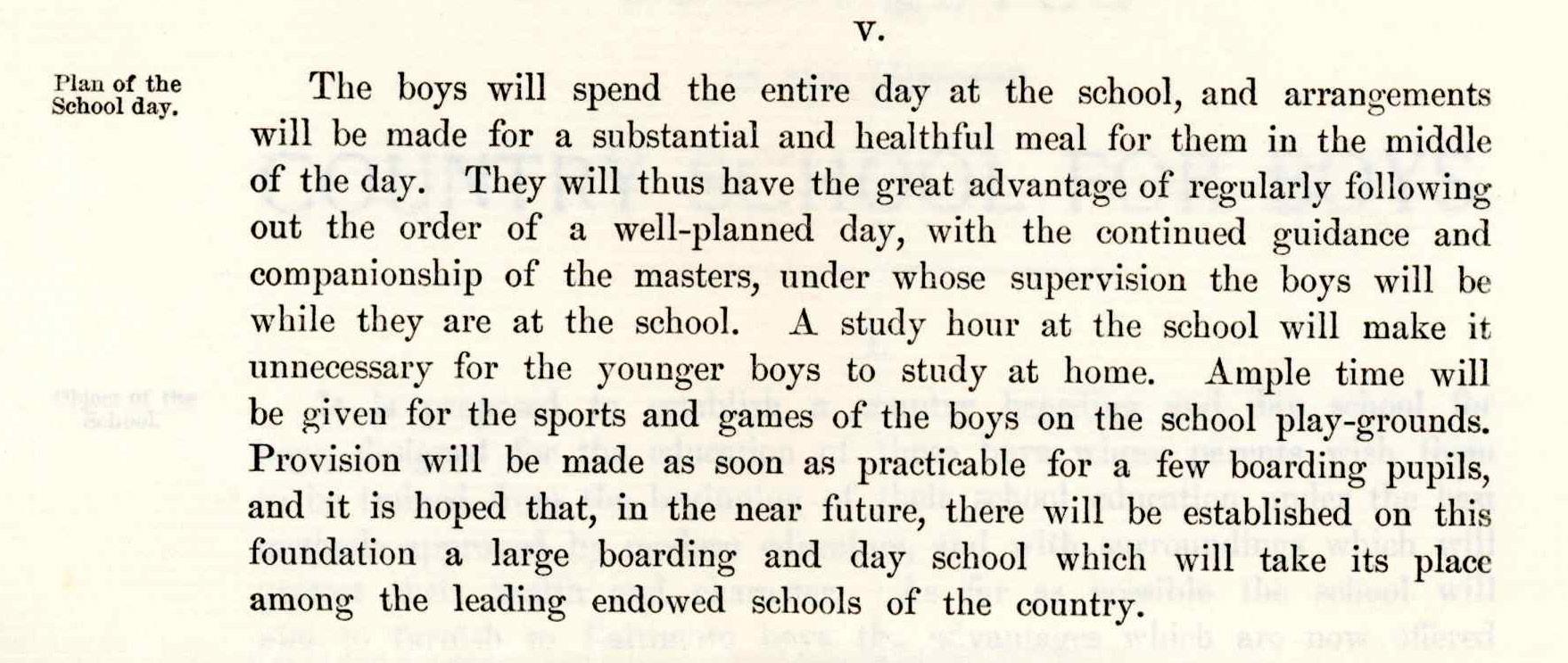
The Prospectus of the Proposed Country School for Boys written some months earlier said, in a section called Plan of the School day, “It is proposed to establish a country boarding and day school for boys, designed for the education of those boys whose parents wish them to be trained from the beginning of their school education under the best methods approved by modern educators, and with surroundings which will protect their health and character. … The boys will spend the entire day at the school, and arrangements will be made for a substantial and healthful meal for them in the middle of the day. … A study hour at the school will make it unnecessary for the younger boys to study at home. Ample time will be given for the sports and games of the boys on the school playgrounds.”
In 129 years, much has changed, and much has stayed the same. Gilman no longer offers boarding for students but still provides a healthy lunch (at no extra cost to families!). Even young Gilman students are expected to spend some amount of time doing homework after school but Lower School boys are still given “ample time” on the playground during two recesses each day (and they will enjoy a new playscape and swing set area this fall!). Middle School students also enjoy a recess period in the morning, as well as an athletics block in the afternoon.
So, what does Gilman’s commitment to an education centered on mind, body, and spirit mean today? In 2026, rigorous academics are integrated with a well-rounded athletics program and character curriculum, a combination of values that are deeply ingrained in Greyhound culture. From an early age, boys are encouraged to move their bodies, challenge themselves physically, and compete with integrity. Beginning in prep-one or first grade and throughout their time in Lower School, boys participate in instruction in the pool as part of the physical education curriculum, so that every Greyhound becomes a confident swimmer. In fifth and sixth grades, boys are exposed to a wide range of activities through physical education and skill development; during the second half of Middle School, they have the opportunity to compete on intramural or interscholastic teams each season. Upper School students stay active throughout the school year, engaging in interscholastic sports or intramural activities of their choosing — a signature requirement of the curriculum.
Of course, no part of this structure happens in isolation; a dedicated team of coaches, teachers, counselors, athletic trainers, and others support each student on his journey. On the following pages, read reflections from four men who are currently or have been active in Gilman athletics: two alumni and two Gilman coaches, one of whom is Gilman’s Director of Athletics and also an alum.
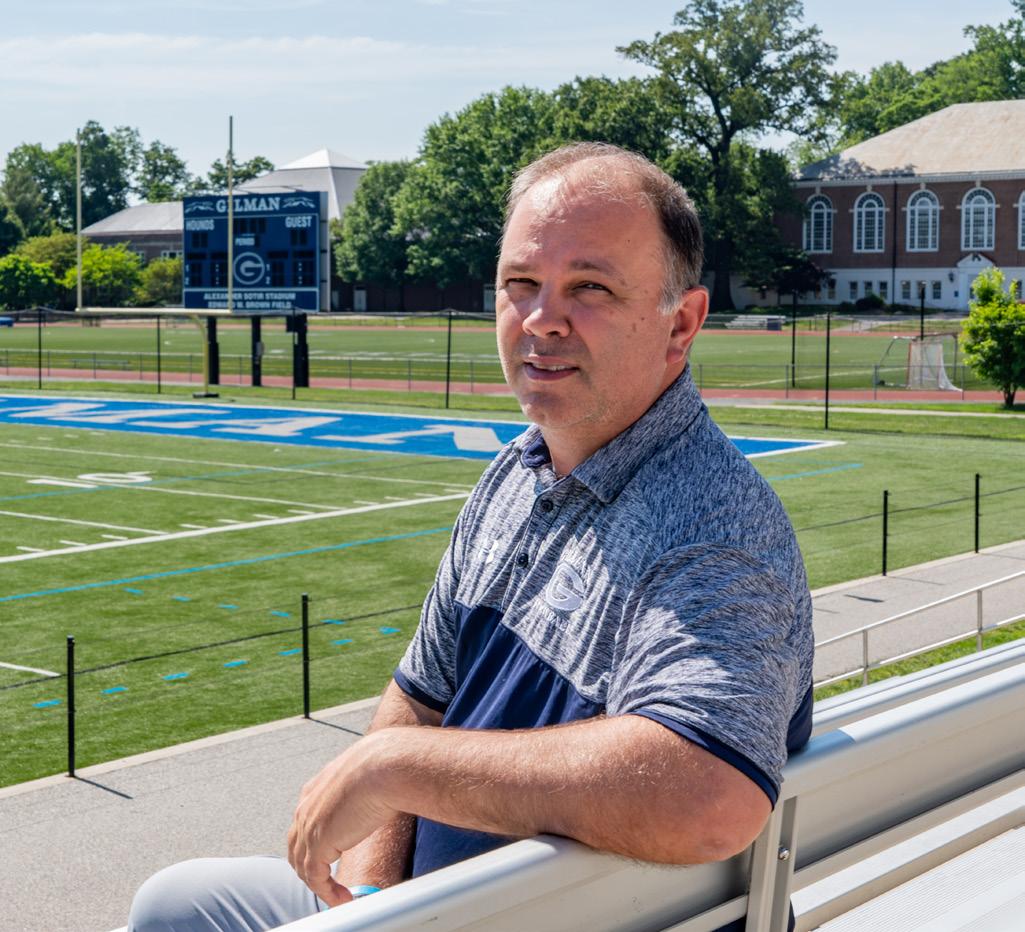
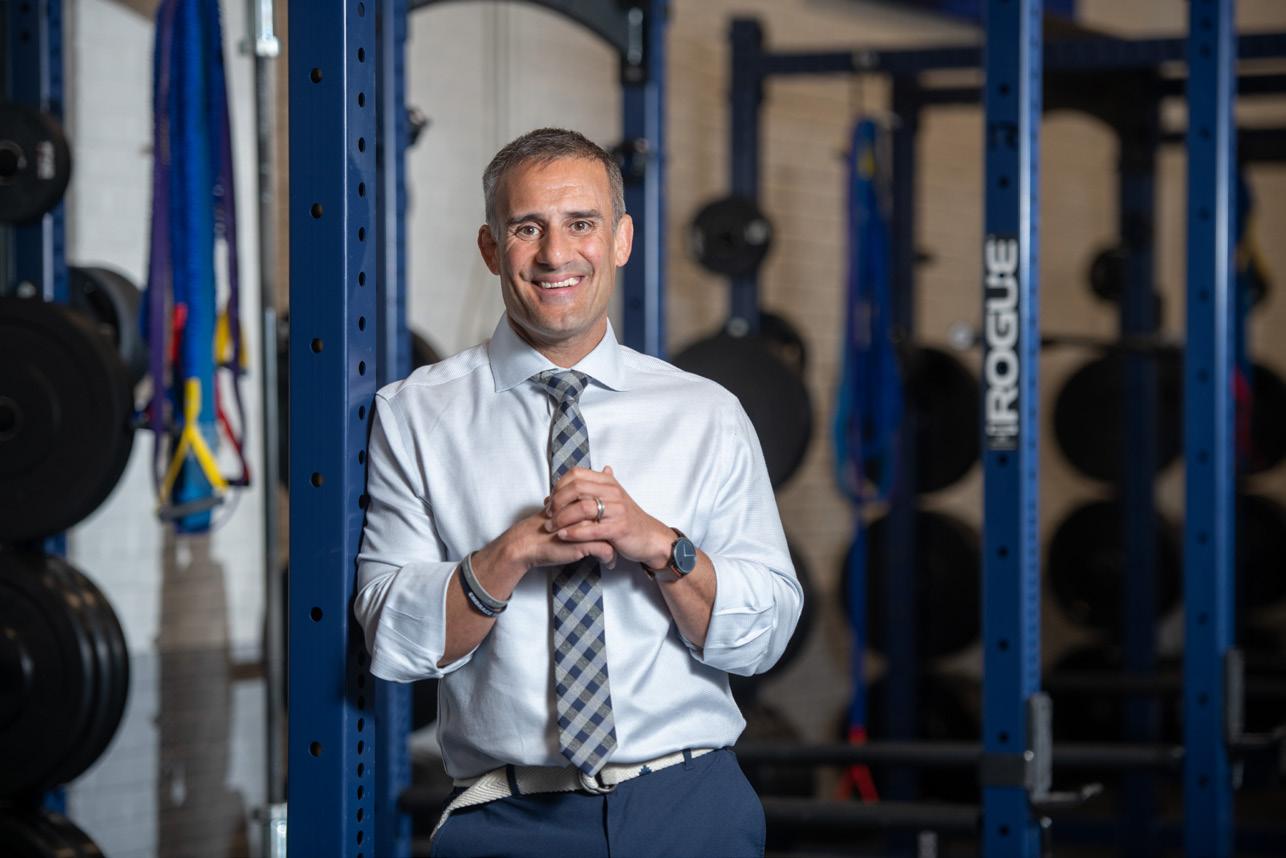
RUSSELL WRENN ’96 DIRECTOR OF ATHLETICS AT GILMAN,
ASSISTANT FOOTBALL
AND BASEBALL COACH
“Every interscholastic athlete in the Upper School participates in the Character Development program with Coach Jeff Gouline ’00 once a week during his season. These sessions both teach lessons about character, teamwork, commitment, and brotherhood and also allow the boys time to reflect, journal, and discuss with each other. It is a unique program and serves as an adhesive around our athletic program — every boy, regardless of sport, has some shared experience coming through our various teams, while still having individual and group experiences unique to their own team. At Gilman, we believe that the crucible of competition reveals character, strengthens bonds among teammates, and provides real-world opportunities to learn from failures and celebrate success. The competition begets personal development.”
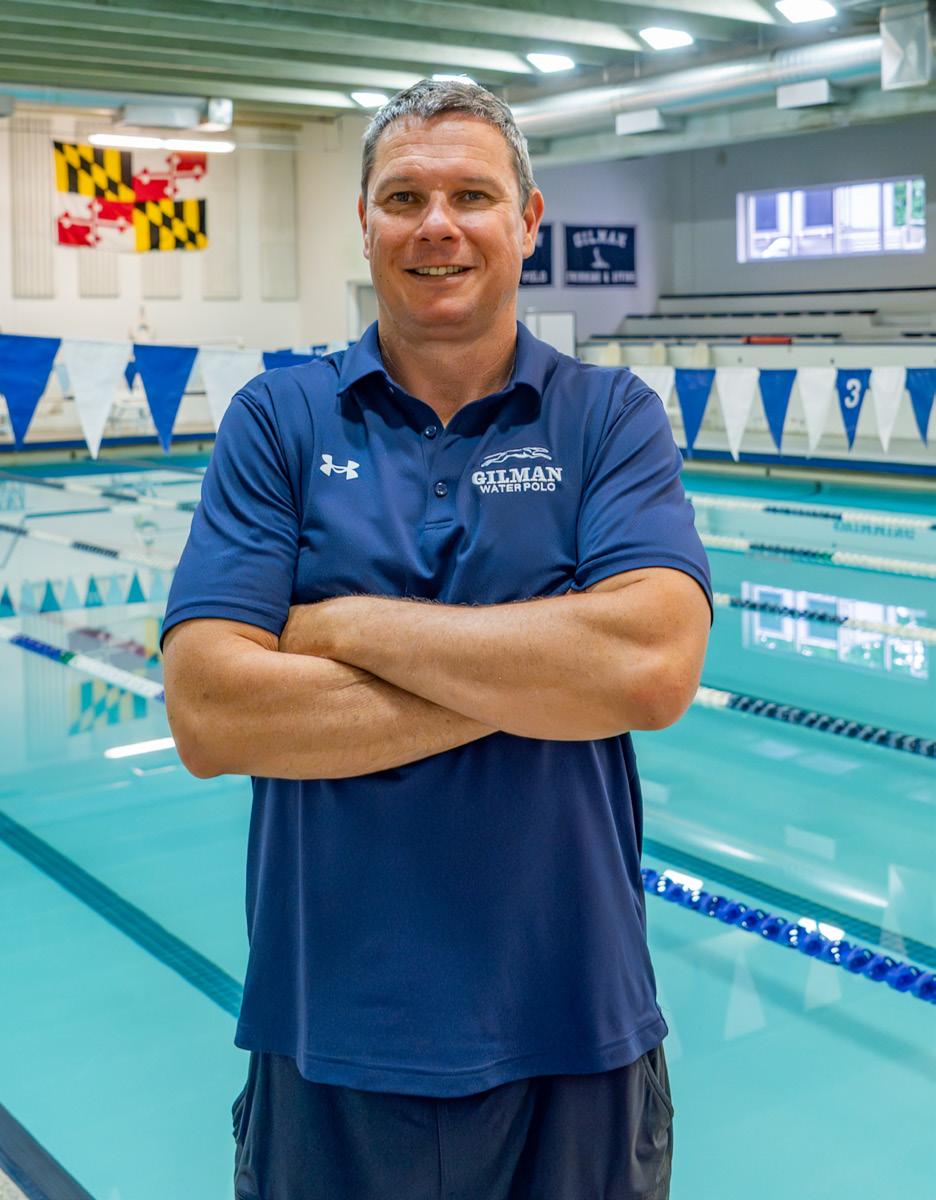
VAUGHAN SMITH
HEAD VARSITY WATER POLO COACH AT GILMAN
“I think for most student-athletes, sports give them a reprieve from the rigors of academia and give them an outlet and challenge different to that found in a classroom. Initially there is the physical challenge of any given sport, but at some point there is the mental aspect of it too, and that is generally where the growth can be found. To some degree, athletics refreshes the mind, and sometimes, without even realizing it, you can mentally overcome what were previously obstacles.
In my formative years with water polo, student-athletes came to try the sport because they couldn’t make another team or to fulfill their athletic obligation. I can safely say that for the majority of them, they found a home. It has now snowballed and put water polo on the map at Gilman. I have witnessed so many young men whose self-esteem was barely there work hard, flourish, gain confidence, and become leaders in and out of the pool. To me, that is what success looks like.”
DR. ARMAN TAGHIZADEH ’95 (AKA DR. T.)
FOUNDER OF MINDSET TRAINING INSTITUTE® AND DOUBLE
BOARD-CERTIFIED PSYCHIATRIST (CHILD, ADOLESCENT, AND ADULT; SPORTS AND PERFORMANCE)
“Through wrestling, I developed my sense of self, grew confidence, met lifelong friends, and found an identity that I could be proud of and others would respect. Being new to Gilman in sixth grade, it was initially hard to truly know where I would fit in, but the sport of wrestling allowed me to find that place.
Through my collegiate career as an NCAA D1 athlete, my experiences as a medical student and resident, and my career as a child, adolescent, adult, and sports performance psychiatrist, the concepts of hard work, discipline, confidence, humility, gratitude, accountability to oneself and others, and grit have always been the foundations for my success. It was through athletics where these values were initially taught and tested and through my life where they are consistently applied.
Coming back to campus reminds me where I came from, allows me to reflect and appreciate my experiences and the people who chose to believe in me, and fuels my passion and purpose to help others achieve and even exceed expectations. It helps me become a better doctor and advocate for young people.”
DR. CHARLES EDWARDS ’88
DIRECTOR, THE MARYLAND SPINE CENTER AT MERCY
“On the eighth grade soccer team, I always finished the warm-up jog around campus before everybody else but was rarely put into games. Eventually it occurred to me that perhaps I was more designed to be a runner than a soccer player. That early disappointment gave me the nudge to try a different sport, one at which I excelled. From that early experience, I learned that disappointment can be a gift if it prompts me to pivot towards a better opportunity.
As a 90-pound freshman, I would have felt unnoticed and unimportant were it not for Coach Jerry Thornberry’s very loud shouts of encouragement from across the track or the scenic during practice and races. While my twig legs were tempted to give up, his booming voice never let up. Though not pleasant in the moment, I always appreciated that he knew me and cared enough to push me hard. He was the same in U.S. History class — high expectations and a personalized push.
I love coming out to Gilman athletic contests to cheer on the boys. They are spirited, practiced, well coached, and they really give it their all. The thrill of victory for many is an unforgettable joy, and a sad loss is an invaluable learning opportunity. From my sons’ Gilman athletic participation over the past 10 years, I can attest that a quest for excellence is standard, team bonds are strong, and coach mentoring is impactful. Since the 1980s, new sports have been added, and there are growing challenges due to sports specialization and competition with other extracurriculars. Fortunately, Gilman’s commitment to the boys receiving the benefits of a premier athletic program remains strong.”
From the Mat to the Mic
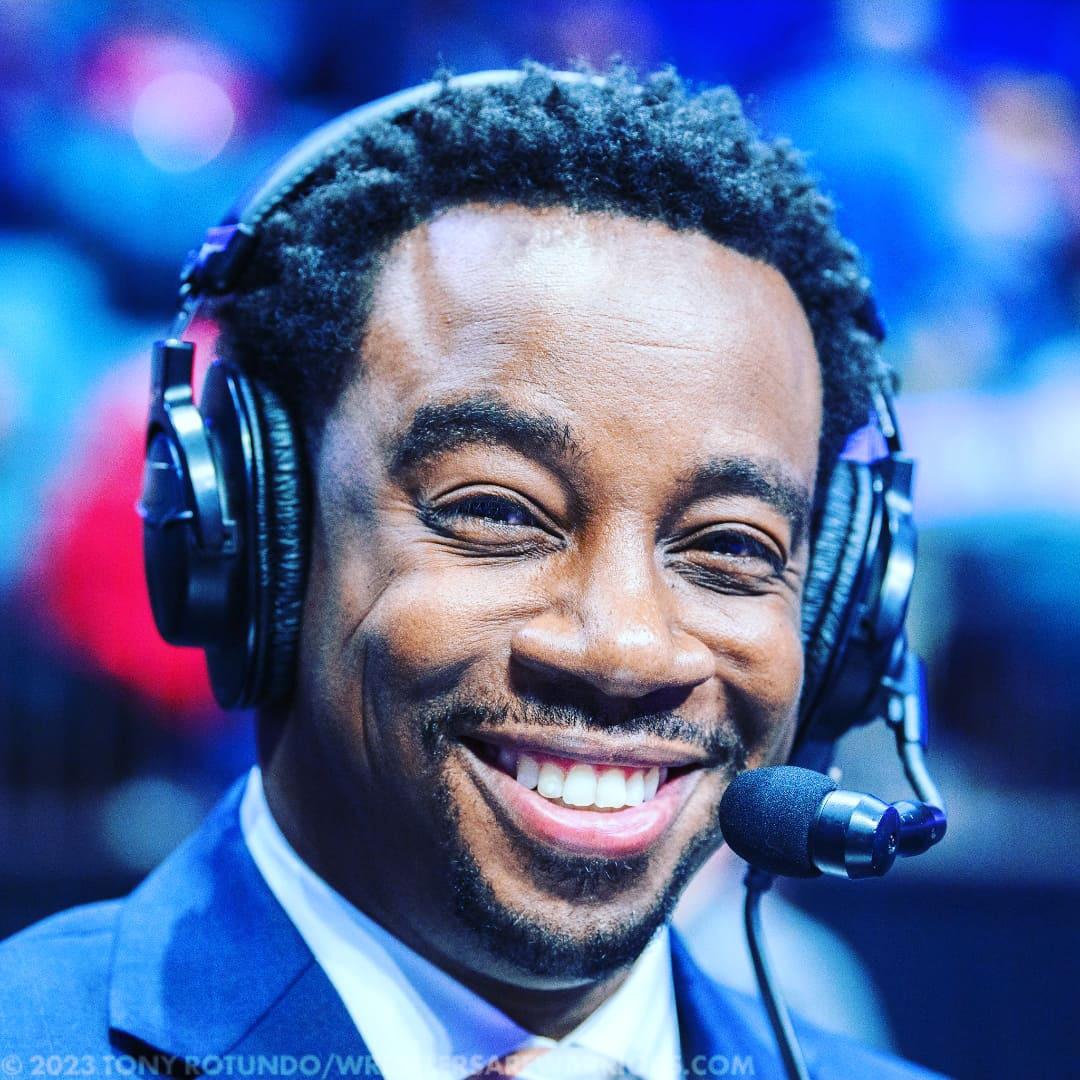
Rock Harrison ’93 was introduced to what would become his passion when he won the fourth grade wrestling tournament at Gilman.
He would go on to wrestle in Middle and Upper School, and later at the University of Virginia. His Gilman wrestling coach and history teacher, David Chae, “taught me what I knew about wrestling and taught me the hard lessons of life.” He also names his football coach, Tim Holley, Jr. ’77, as an impactful mentor.
For 24 years, Harrison has made a career in asset and risk management. Currently he works — with several other Gilman alumni — as a Vice President at HUB Retirement and Private Wealth in the company’s Hunt Valley, Maryland, office, a role that allows him flexibility to also pursue endeavors related to his passion. During the winter season, Harrison keeps a very busy schedule — as an assistant wrestling coach at Gilman in the evenings and as a commentator for the ACC (Atlantic Coast Conference) and ESPN on the weekends. To explain the latter, Harrison says there are two people behind the mic: One is a play-byplay announcer who “lays it out” and the other — his position — is an analyst who “breaks it down.” He landed the gig after working as a college wrestling referee when the officials coordinator encouraged him to apply for the job.
increasing the visibility of wrestling on the network. Each time he has been able to articulate why his proposals made sense, backing up his arguments with clear reasoning; each time, they said yes.
Just like when he was a student at Gilman, Harrison does his homework, constantly challenging himself to get better. He actively seeks out trusted colleagues for critical feedback and strives to deliver content that makes an everyday TV watcher flipping through channels stop when they reach a match where he is announcing. He aims to strike a balance between honoring the technical aspects of the sport while also bringing accessibility to more casual wrestling fans.
“The more you prepare, the less likely you’ll be caught off guard. I don’t think you can overprepare.”
–ROCK HARRISON ’93
As a student on Roland Avenue, Harrison learned to place a high value on hard work and preparation, which has served him well. “The more you prepare, the less likely you’ll be caught off guard,” he says, adding, “I don’t think you can overprepare.” During his time as an announcer, Harrison has applied that approach when pitching ideas to ESPN focused on
Over the dozen or so years Harrison has been commentating, one highlight came about seven years ago when ESPN asked him to move from what’s called digital — streaming coverage — to linear — live TV broadcasts on cable. “I had no [TV] experience,” he recalls, “but I believed I could get it done.” That conviction took root in his formative years. “Gilman instilled a lot of confidence in me.” Now Harrison is at the top of his industry, as a nationally prominent analyst for conference championships, nationals, and the NCAA finals.
And yet, he still wants to make a bigger impact. “I do my part to elevate the sport,” Harrison says, noting that he continues to push for additional matches to appear on ESPN’s flagship network. He observes that while baseball and football are super popular among the public but with many complex rules for fans to remember, “Wrestling is two people, one referee, and a circle.” His job is to help people understand the sport and want to engage with it.
Rock Harrison ’93 PHOTO BY TONY ROTUNDO
“I Get to Call Baseball for a Living”
BRETT HOLLANDER ’03 LIVES OUT HIS DREAM
Brett Hollander ’03 and his friends tirelessly talked about local sports on the playground and in their free time when they were growing up at Gilman in the 1990s.
It was part of the “daily culture” among his social group. Now, as lead play-by-play announcer for the Orioles Radio Network, Hollander still has boundless joy for the pursuit. “I get to call baseball for a living,” he says with the same earnest smile of the former 7-year-old with a childhood dream.
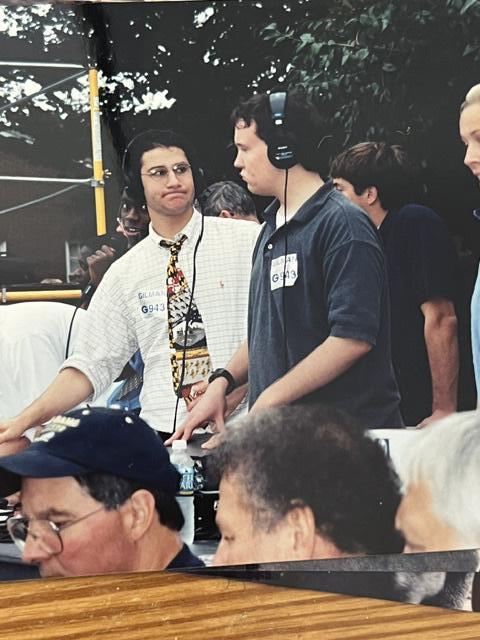
During his junior year at Gilman, in December 2001, Hollander (along with classmate Jason Gant ’02) announced a Gilman basketball game that aired on G943 Radio, which broadcast to the School’s dining hall. This experience sparked the idea to expand springtime lacrosse game coverage to a broader audience on a new platform: the internet.
Of course, this lofty endeavor, developed by Hollander, Gant, Scott Kidder ’03, and a few others, would require planning, funding, and a blessing from Headmaster John E. Schmick ’67. Looking back, Hollander can think of a million things that could have gone wrong with letting a couple of 17-year-olds represent the School in the unfamiliar territory of the world wide web. “Allowing me to do it when the easy answer would have been ‘no,’” he says, was “the most impactful thing” that set Hollander up for his future in sports media. “They believed in me, and they believed in my passion.”
It’s a good thing they did. Gilman Sports Radio, now called Greyhound TV or simply GTV, immediately gained momentum, and so did Hollander. From there, he went on to Dickinson College, where he continued to call games. His early career included local radio jobs, covering sports and traffic. He worked at WBAL Radio in the 2010s, where he would eventually host his own sports talk show and become the well-known voice of Baltimore sports he remains today.
Hollander came by his success through a little luck and a lot of hard work. He recommends the same for anyone trying to break into the field: “Turn down the TV and see if you can call a game. Record yourself and see what it sounds like.” He notes that college is a great place to “get reps,” pointing out that a larger school may lead to a network of connections where a smaller school may provide more opportunities to announce for a variety of sports.
“I believe in handshakes and looking people in the eye,” says Hollander, crediting Gilman for instilling in him a sense of civility that continues to guide him. “I still fall back on a lot of those values. I believe in honor and integrity.” He also strives for excellence — another Gilman Five value — with the quality of the work he produces. Covering the week of Super Bowl XLVII (where the Ravens defeated the 49ers 34-31) for Ravens Radio Network and WBAL is one special stretch of time that stands out for him. Another unforgettable moment came just a few weeks earlier when he followed Ray Lewis around the field for his final victory lap at M&T Bank Stadium. Hollander hopes to take the time one day to fully document a career filled with meeting interesting people and making special memories such as these. “It’s kind of amazing.”
What’s next for a guy who has already fulfilled his lifelong ambition? He hopes for more of the same. “It’s my hometown team. I have no desire to do this anywhere else,” he says. In a hyper-competitive industry where many people are vying for bigger markets, Hollander is content right where he is. “This is the only place I’ve ever wanted to be.”
Brett Hollander ’03 calls a game with Scott Kidder ’02 in the early days of Gilman Sports Radio.
Brett Hollander ’03 PHOTO BY GARY LANDSMAN
Calling the Plays
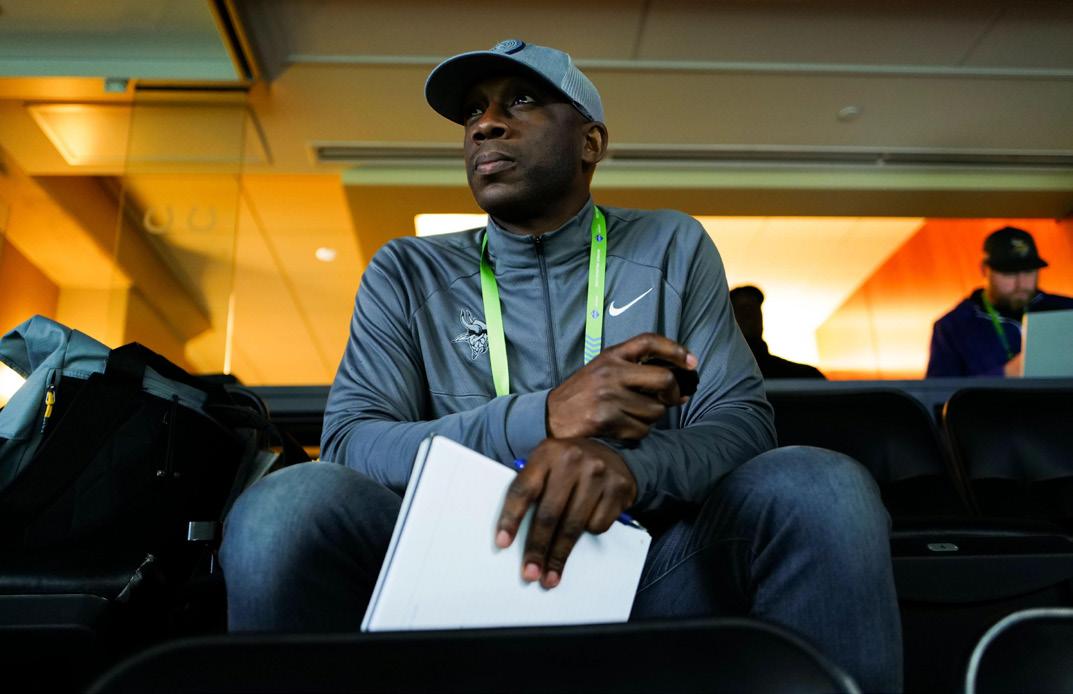
CHISOM OPARA ’99, ASSISTANT DIRECTOR OF PLAYER PERSONNEL, MINNESOTA VIKINGS
“Gilman did well to emphasize the potential importance of sports in augmenting the experiences and lessons necessary to prepare you for the real world. Gilman opened my eyes to the beauty of competition … the beauty of the process, of winning and of losing. The 1999 MIAA Football Championship is the best team I’ve ever been on and really drove home the power of the concept of team. I really believe that it’s one of the experiences that lit this obsession with team building. It made me realize how rewarding and how powerful it can be when it all comes together for the ultimate goal.
Gilman instilled a curiosity in learning and an expectation for achievement. Being at a school like Gilman there is an unspoken standard that has been the tailwind of most of my career. Being around talented teachers/coaches who pour into your development and surrounded by smart, high-achieving students — I feel like it’s hard not to inherit some of that same standard for yourself.
Signing Darius Jennings ’11 in Cleveland was one highlight in my career. Darius is a guy who I’ve known since he first got to Gilman. I tracked his career and would check in on him during my scouting trips to the University of Virginia (UVA). I knew what he was about as a player and as a person. Being able to sign him after the draft and watching him work his way from a rookie camp tryout, to making the 53-man roster, to a seven-year career has been one of the most rewarding experiences for me. In a lot of ways, it felt like he took the baton from me and ran with it. It was awesome to watch it happen, and I’m very thankful that I was able to play my part. A real fullcircle moment. (Read more from Jennings on page 10.)
Being at a school like Gilman can help bring out a better if not the best version of yourself. There’s a certain unspoken expectation or standard that comes with walking those hallways. In school and in sports you felt that standard. That unspoken standard is a big part of my foundation.”
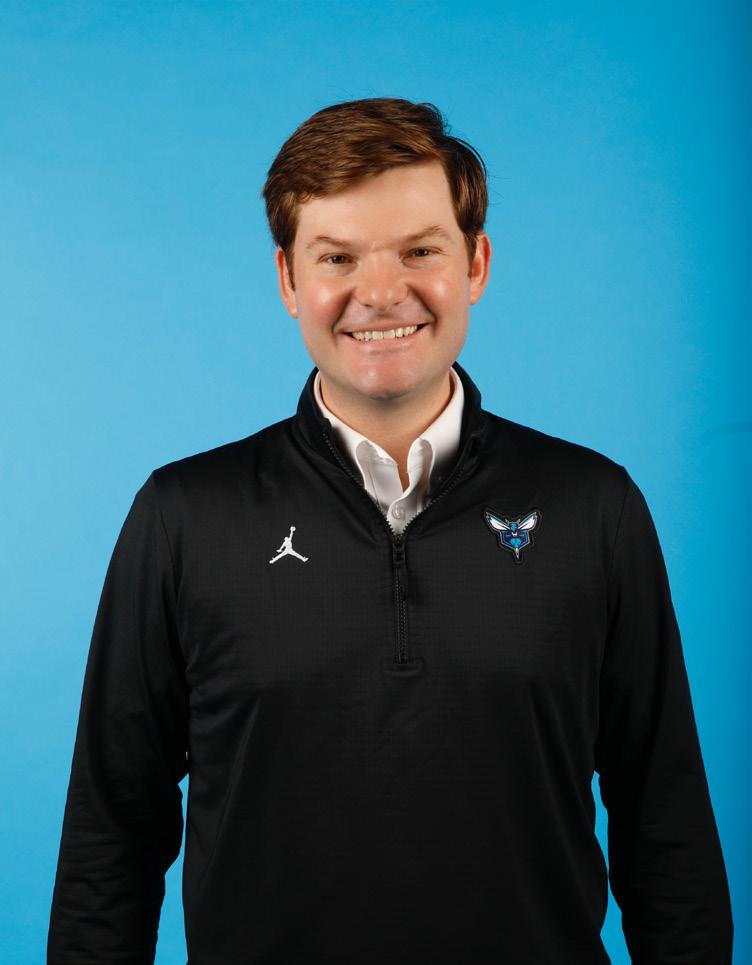
RYAN GISRIEL ’09
, VICE PRESIDENT, BASKETBALL OPERATIONS & STRATEGY, CHARLOTTE HORNETS
“My career in sports would not have happened without the Senior Encounter program. Like many 18-year-olds, I was interested in sports but didn’t yet have a clear path, so I sent cold emails to the Ravens, Orioles, and Ron Shapiro. I was fortunate that Ron not only responded, but he offered me
the opportunity to shadow him during the two-week program. That experience led to a summer internship and eventually to a mentorship that has continued to this day. Looking back, that initial outreach, along with someone’s willingness to invest in me, completely changed the trajectory of my career.
Gilman instills a commitment to serving others, and the School’s mission of developing men of character who contribute to their communities has always resonated with me. It instilled a mindset of serving something bigger than yourself, which has shaped how I approach my career. I view my role as a service-oriented position, where my responsibility is to support players, coaches, staff, and ownership in any way I can. I believe strong leaders prioritize helping others succeed. That mindset, reinforced during my time at Gilman, has been foundational to how I approach leadership and teamwork.
The industry has become extremely competitive, and it is increasingly difficult to break in without offering a clear value proposition. For current students interested in sports careers, know that self-awareness is critical. Understanding your strengths, and developing them to a level where they provide a tangible advantage to an organization, is key. The more you can differentiate yourself and clearly demonstrate how you can help a team succeed, the better positioned you will be.”
Chisom Opara ’99 PHOTO COURTESY OF MINNESOTA VIKINGS
Ryan Gisriel ’09
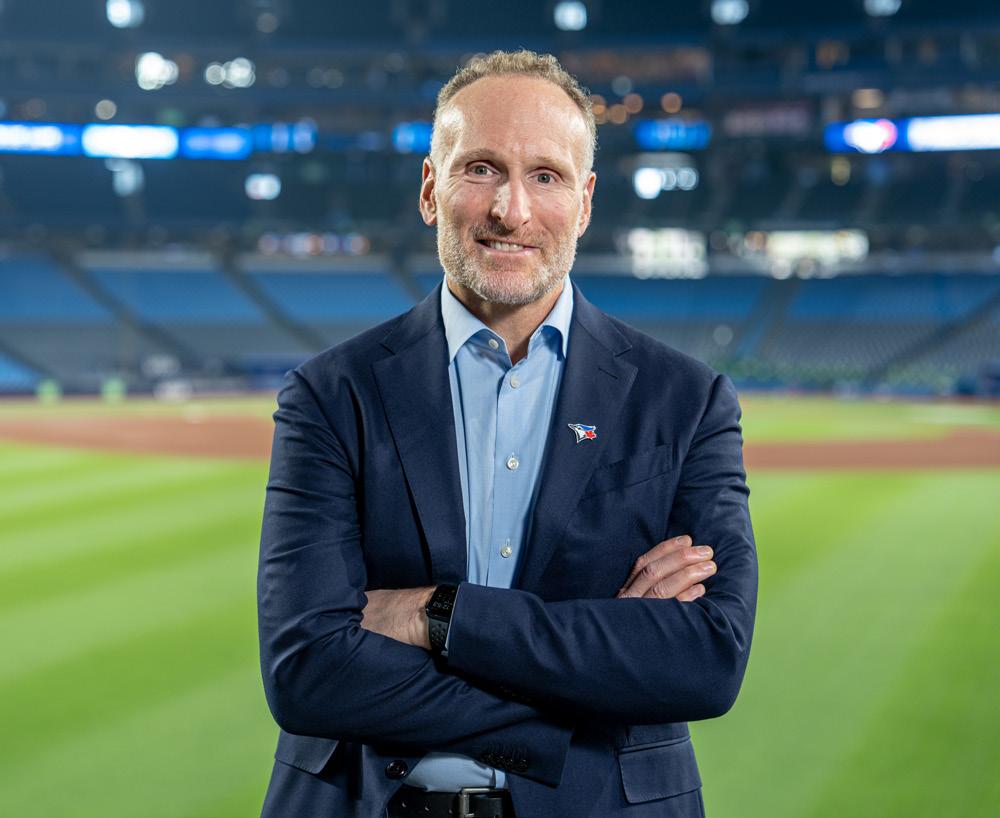
MARK SHAPIRO ’85, PRESIDENT, TORONTO BLUE JAYS
“My time at Gilman is the genesis to my interest in sports: the philosophy of a healthy body and healthy mind, the remarkable coaches who played an integral role in shaping both my character and my love for competing, and the opportunity to play throughout my 11 years at a variety of levels shaped the man I am.
My Gilman experience was synonymous with Mr. Reddy Finney and Mr. Sherm Bristow and what they stood for: demonstrating character in your daily life and aligning your actions with a strong set of values, treating people fairly and with compassion, and being extremely competitive. All of those things I carry with me and originated from my time at Gilman.
I always think back to the first time in Cleveland that we knocked the Yankees out of the playoffs in 2007. [Shapiro worked for more than two decades in the front office of the Cleveland Indians, now the Guardians.] It was the first time I’d heard silence in Yankee Stadium. It was an incredible feeling to have done that as a smallmarket team. That team in 2007 in Cleveland and in Toronto in 2025 were very similar in that they both had high-character players who represented authentic and genuine role models for kids and were incredible ambassadors of the game. They played with passion, they were tough and resilient, and they demonstrated so many attributes that exceptional teams demonstrate. In those two teams you could see the values that organizations strive to have in players in the way that they play the game.
Both Gilman and Princeton prepared me to face a work environment that is competitive, demanding, and requires critical reasoning. There’s no question I got the ability to express myself clearly and thoughtfully at Gilman. That foundation was built at Gilman and furthered at Princeton. The confidence to rise up to a competitive situation was seeded at Gilman and advanced at Princeton. The combination of the two schools was formative to me in building a competitive nature and a confidence that I could handle myself in elite, highly competitive environments.
The most challenging aspect of this job comes from the intense level of public scrutiny and criticism that you face on a yearly basis regardless of how much success you have. You get a lot of ‘free
advice.’ Transitioning to Toronto was extremely hostile because of circumstances outside of my control. It was a great reminder to focus on the things in my influence and continue to attack the challenges in front of me and be the leader I need to be. And believing that, over time, doing that will quiet the critics.”
ANDREW B. COHEN ’90, VICE CHAIRMAN, DIRECTOR, AND MINORITY OWNER, NEW YORK METS; MEMBER OF THE BOARD OF DIRECTORS AND INVESTOR, PGA TOUR ENTERPRISES; CO-FOUNDER
AND CHIEF INVESTMENT OFFICER, COHEN PRIVATE VENTURES
“My work ethic, integrity, and other values Gilman developed in me over my 12 years there all contribute to the executive and leader I am today. I’m competitive now, and I was competitive at Gilman. My time playing tennis, serving on the debate team, and participating in other activities honed that competitive edge. Working in sports brings a certain dynamic — people who are naturally competitive thrive on that kind of feedback.
Being involved in sports also has a significant public-facing component. A lot of people love golf, and a lot of people love baseball. Many feel deeply invested in the sports they care about — whether they played as kids, competed in college, still play recreationally, or simply enjoy being fans. They take their teams seriously, and I keep that in mind when making decisions that affect the organization, players, fans, and sponsors.
I never really planned to work in sports; it developed organically rather than by design. It’s a dynamic and competitive field, and much of it is out of your control. You have to learn to operate within that reality, and it’s hard not to take things personally. It’s difficult to watch a team lose, and it’s an incredible feeling when they win. In that way, it’s similar to working in a hedge fund — stocks move up or down every day. When they rise, it feels great; when they fall, it feels terrible, and I’m not in control of the market. Even though investing in public markets prepared me for my roles in sports, I still can’t fully separate my emotions from a team’s performance. My role with the PGA TOUR is different because our investment is in the league as a whole, so I’m rooting for all the players. Still, you can’t detach yourself from results — in sports or in any career. In this case, once the game is over, it’s over. You move forward.”
Mark Shapiro ’85 PHOTO COURTESY OF TORONTO BLUE JAYS
Andrew B. Cohen ’90
Career, Character, and Connection
DARIUS JENNINGS ’11 ON BUILDING A LIFE BEYOND FOOTBALL
How did you figure out what your next career would be after football?
Gilman connections. I ran into Mr. [Patrick] Hastings (former Gilman teacher) in the gym while I was working out as a free agent. He had admired how I carried myself as a student, followed my career path in college and the NFL, and was intrigued enough by our conversation in the gym that he mentioned my name to his wife — who just so happened to be in the process of hiring someone. I spoke to Mr. Hastings in March of 2022 and was hired by CBRE in September. Decisions I made when I was 15 years old paved the way for my current career in commercial real estate exactly 15 years later.
How did Gilman prepare you for working in such competitive fields?
Gilman is a place where the standard is the standard. When the expectation is excellence and that every student goes to college, you rise to the occasion. And even still, during my first day as a second
Lasting Lessons
grader, my mother made sure I knew that amongst all the chaos, “Gilman will be a better place because you are here.” Words I live by 26 years later.
What’s next for you?
The only goal I have in life is to try and leave an impact (whether big or small) in any room I step into or person I encounter. Everything else will fall into place how it’s supposed to.
VICTOR ABIAMIRI ’03 ON ATHLETICS, HIS GILMAN EDUCATION, AND LIFE AFTER THE NFL
“Sports were always important to me growing up, but what drew me to Gilman wasn't just athletics. It was the combination of academic excellence, competitive athletics, and the sense of community that existed throughout the School. Coming to Gilman was a bit of a culture shock. I came from a different background than many of my classmates, and there were times when I felt out of place. What helped bridge that gap was football. On the field, none of those differences mattered. We were all working toward the same goal, and the friendships and brotherhood that developed through sports became a big part of my Gilman experience.
Gilman helped me see that athletics could be a vehicle for opportunity, growth, and personal development. I wanted to be known for more
than athletics, and Gilman gave me opportunities to pursue excellence in multiple areas. That mindset has stayed with me throughout my life.
Athletic careers are often shorter than people realize. The habits you build, the relationships you develop, and the education you receive will stay with you much longer than any game or season. Like most athletes, I had a vision for how my career would unfold. Unfortunately, reality had different plans. I experienced multiple injuries throughout my NFL career, and eventually an Achilles injury ended my time in the league.
At the time, it was incredibly difficult. Football had been such a large part of my life for so many years. But I was fortunate to have great mentors, a supportive family, and an educational foundation that reminded me football was something I did, not who I was. I decided to pursue an MBA at Drexel University, which gave me an opportunity to think carefully about the next chapter of my life. Looking back, that period of uncertainty ended up being one of the most important growth experiences I’ve ever had.
One thing football taught me is that success is rarely about one individual. Great teams are built on trust, accountability, and people doing their jobs consistently. That’s true in sports, and it’s equally true in business.”
Darius Jennings ’11
Victor Abiamiri ’03
From Brown Field to Broad Impact
BRANDON COPELAND ’09 CONTINUES TO COMPETE WITH THE BEST VERSION OF HIMSELF
Brandon Copeland ’09 is no stranger to reaching high standards. When he enrolled at Gilman in ninth grade, he saw his peer group striving to live up to the same high expectations set by their teachers.
“Gilman is a strong academic school,” says the former NFL player, who ended his football career on the Baltimore Ravens in 2022 and officially retired from the sport in 2023. And not being able to slack in either arena — academic or athletics — during his high school years was critical for him. “Gilman created a structure where I had to show up.”
And show up, he did. His teachers and coaches believed in him and pushed him to reach his full potential. He says coaches Tim Holley, Jr. ’77 and Tony Jordan “saw more in me than I saw in myself.” Coach Johnnie Foreman encouraged him to run track in the spring season. Though he was reluctant to run even a warm-up mile, Copeland says his NFL career “was predicated on being a big guy who was faster than almost everybody on the field,” a skill he attributes to the three-miles-three-days-a-week running schedule Foreman expected of the team. (Copeland fully admits he hasn’t kept up that routine since leaving Gilman.)
Copeland’s English teacher and basketball coach, Dan Christian, reminded Copeland to set a high bar no matter what team they faced on the court; a sentiment he continues to lean on. “Compete with
the best version of me. Coach Christian taught me that,” he says, and he relays this message to the children he works with through Beyond the Basics, an organization he founded in 2018 that addresses challenges faced by underserved communities.
Copeland also names his football coaches from Brown Field — Biff Poggi ’79, Joe Ehrmann, and Stan White — as well as countless others at Gilman as individuals who made a tremendous impact on him. On the football team, “we had a policy where if one of your teammates was eating lunch alone, you would invite them to your table,” Copeland remembers. That policy was “one of the most powerful experiences at an impressionable time in my life,” he says. It became a guiding principle for how he operates.
How exactly does Copeland operate? With integrity, humility, empathy, resilience, and hard work — values that were embedded in his Gilman education. He had two season-ending injuries during his NFL career; the first, in 2017, happened during the preseason opener. That long break from the game gave him the chance to ask himself, “What would my life be like without football?” It was the first time since the fourth grade that the sport did not play a huge part in his daily experience. Without games, practices, and strenuous training, Copeland spent time finding and embracing “the beauty, the silver lining” as he recovered from his torn pectoral muscle. That year, he started a real estate investment firm with his wife, Taylor.
Perhaps Copeland always knew something in that realm would be part of his journey. In his Upper School days on Roland Avenue, he began to learn “how the financial world worked,” which he says got him thinking of football “as a means to an end: Get to the NFL, get startup capital, create some stuff.” And so, after he enjoyed a decadelong career in the pros, he got busy creating.
Today, Copeland continues to grow the real estate portfolio he and Taylor have been developing since 2017. He also teaches a popular seminar at his alma mater, the University of Pennsylvania, called Life 101, which focuses on personal finance skills and socio-economic mobility. Through his company Copeland Media, he furthers his mission to make financial literacy more accessible. When he trains and mentors kids at Beyond the Basics football camps, he sees the coaching vocation through a new lens. “I have an appreciation for all that our Gilman coaches poured into us. It’s not an easy job,” he says.
For all the roles he has held on the field and beyond, the most rewarding part has been the chance to have a meaningful impact on others. “There are few things you can do where you can actually look at somebody and see that you changed their life for the better. It’s an incredible feeling.”
Copeland wasn’t the only Gilman guy to bleed blue and gray AND purple. These Greyhounds work for the Baltimore Ravens. Houegnon “Q”
Brandon Copeland ’09 PHOTO BY DANNY MCDONNELL, MACMEDIA PRODUCTIONS
From Blue & Gray to the Big Leagues
The road to professional sports demands talent, perseverance, and an unwavering work ethic. These Gilman alumni have embraced that challenge, building on the skills and values they developed as students.
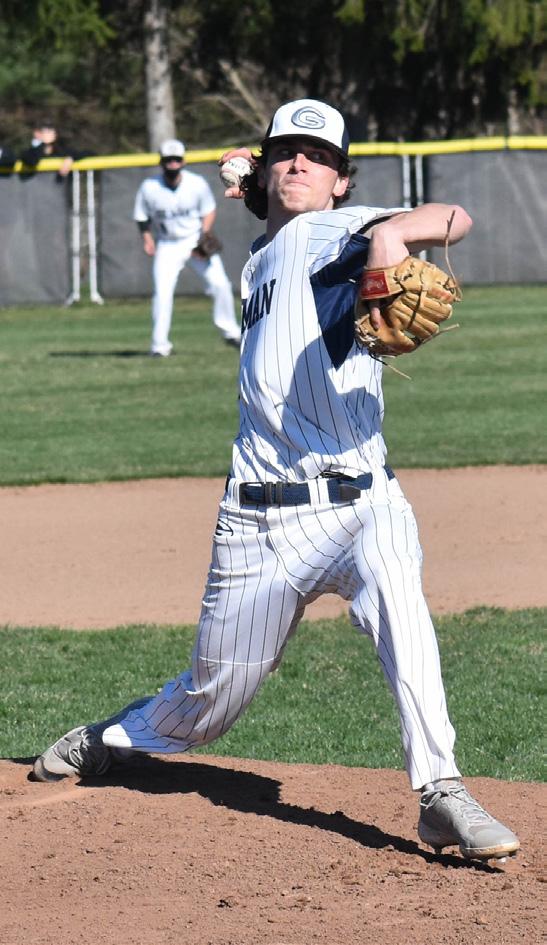
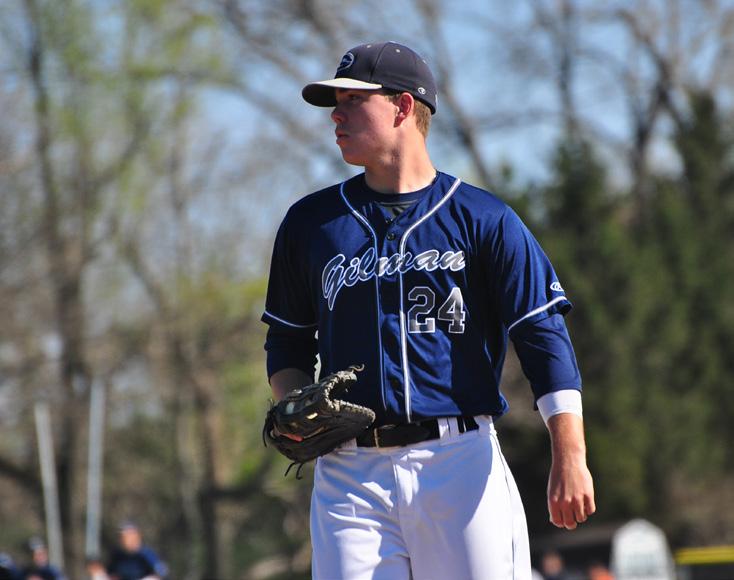
Peter Heubeck ’21 has long been a source of pride for the Gilman community. In the summer of 2021, that pride reached new heights when he was selected by the Los Angeles Dodgers in the third round of the Major League Baseball (MLB) Draft with the 101st overall pick. Chosen directly out of Gilman, Heubeck joined the professional ranks as one of the nation’s top high school pitching prospects. His move to the MiLB over Wake Forest University highlighted his standing as the first Maryland pitcher selected in the first three rounds of the MLB Draft in more than a decade.
Since signing with the Dodgers, Heubeck has continued his development in one of baseball’s most respected farm systems, representing Gilman with the same determination and humility that defined his years on Roland Avenue. We recently caught up with Heubeck, who is now pitching for the Tulsa Drillers, the Dodgers’ Double-A affiliate.
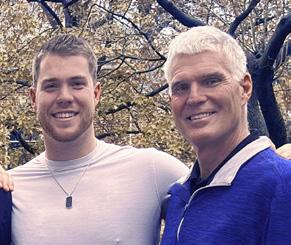
This elite athlete credited his teachers, particularly Will Bartz ’99, Aaron Goldman, Jeff Gouline ’00, and Andre Jones, with providing life lessons that he leans on today. They helped him to develop his authentic self, forge his own path, and advocate with abandon, all while maintaining a strong work ethic. “When I think of a Gilman student, I think of a confident guy,” he says. “It takes a while to get there.” In the pros, it is important to have a sense of “delusional confidence,” he explained. “If you are not believing in yourself, other people aren’t going to believe in you.”
Fun Fact: Peter Heubeck is the son of Rob Heubeck, former Head of Gilman’s Upper School. They are pictured together at left, at Founders Day in 2021
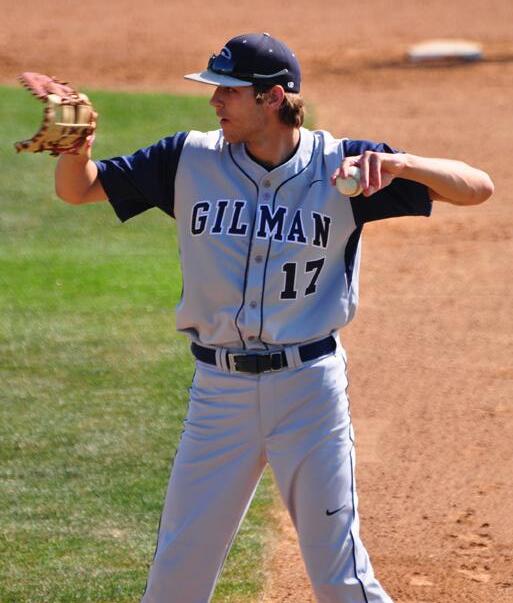
For Ryan Ripken ’12, hanging up the cleats was just the beginning of a brilliant new chapter in sports. After a standout prep career as an Under Armour High School All-American at Gilman, Ryan forged his own path through professional baseball, playing 428 games over seven seasons and rising through the minor leagues to reach the Triple-A level with his hometown Baltimore Orioles. Upon retiring from the diamond in 2022, he seamlessly transitioned from the field to the microphone, establishing himself as one of the most insightful and authentic voices in sports media. Rather than relying on standard “hot takes,” Ripken leverages his firsthand experience to give fans a genuine look behind the lens of athlete life, anchoring The Ryan Ripken Show — which broadcasts live several times a week on YouTube, X, and Facebook — while also serving as a prominent analyst for 105.7 The Fan, FOX 45, and various regional broadcasts. By stepping out from the immense shadow of his legendary baseball family to carve out a distinct media career, Ripken continues to make the Greyhound community proud as a trusted commentator and community leader.
From dominating the diamond at Gilman to launching home runs off of major-league pitchers, Gavin Sheets ’14 has carved out an explosive path to the top of professional baseball. After an All-American collegiate career at Wake Forest University, Sheets was selected in the second round of the 2017 MLB Draft by the Chicago White Sox, where he made a splash in his 2021 rookie year by belting a monster postseason home run. After four seasons in Chicago, the powerful lefthanded slugger took his bats and gloves to the West Coast, signing with the San Diego Padres and turning his first season with the club into a career year. During that breakout campaign, Sheets set personal bests across the board with 124 hits, 19 home runs, and 71 RBIs, while securing his place in Padres lore by hitting a historic pinch-hit home run in his very first at-bat with the team on Opening Day 2025. Now anchoring a potent San Diego lineup as a top-tier utility threat, Sheets continues to make his alma mater proud with every towering drive. He returned to his hometown in June, and posted a gaudy stat line against the Orioles, including an RBI double and a solo home run.
Fun Fact: Gavin Sheets is the son of former Baltimore Oriole and current Gilman Head Baseball Coach Larry Sheets. At right, they are pictured together when Gavin visited Roland Avenue in 2022
Fun Fact: Sheets partnered with North Park Beer Company to launch his own beer, a triple dryhopped hazy IPA called “Holy Sheets!”
Gavin Sheets ’14 at a Gilman baseball game in 2014
Peter Heubeck ’21 at a Gilman baseball game in 2021
Ryan Ripken ’12 at a Gilman baseball game in 2012
From his days anchoring the defense on Brown Field at Sotir Stadium to hoisting the Lombardi Trophy on football’s brightest stage, Thomas Booker IV ’18 has personified excellence at every level of his football journey.
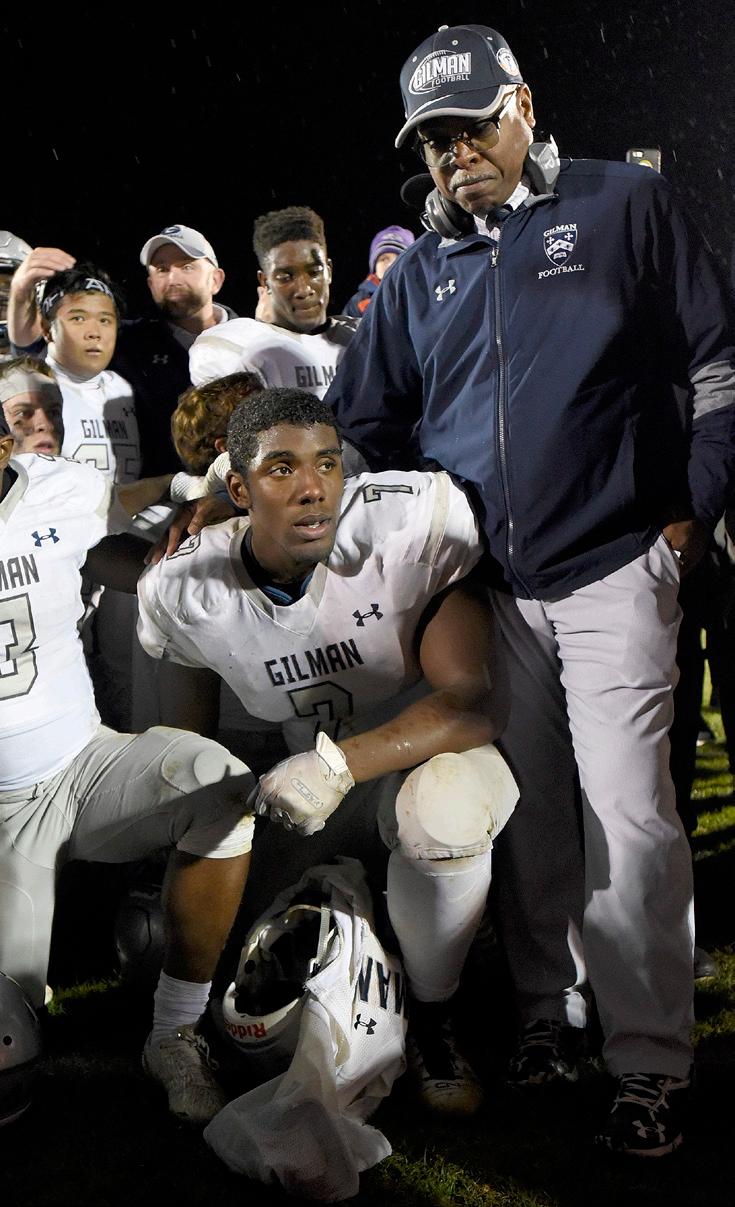
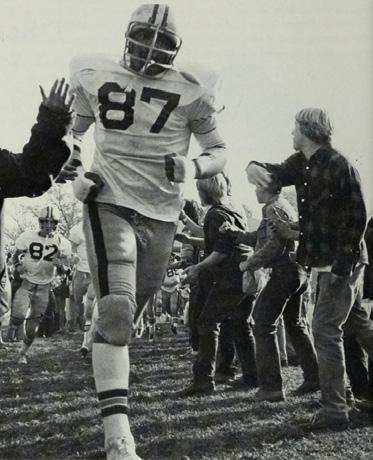
After helping lead Gilman to two MIAA A Conference Championships during his days in the blue and gray, Booker headed west to Stanford University, where he became a dominant two-time All-Pac-12 defensive lineman, two-time Academic All-American, and a finalist for the prestigious William V. Campbell Trophy. Drafted by the Houston Texans in the fifth round of the 2022 NFL Draft, the elite scholar-athlete quickly proved his mettle at the professional level, playing a key role for the Philadelphia Eagles during their thrilling Super Bowl LIX championship run. After a trade to the Las Vegas Raiders, the massive 6'3, 301-pound Booker had a breakout campaign, earning 13 starts and recording a career-high 44 tackles, five passes defensed, and a forced fumble. Praised for his physicality and strength, Booker was recently rewarded with a lucrative contract extension to anchor the Raiders’ defensive line, where he continues to demonstrate the very best of Greyhound pride with his tireless work ethic and eagerness to improve.
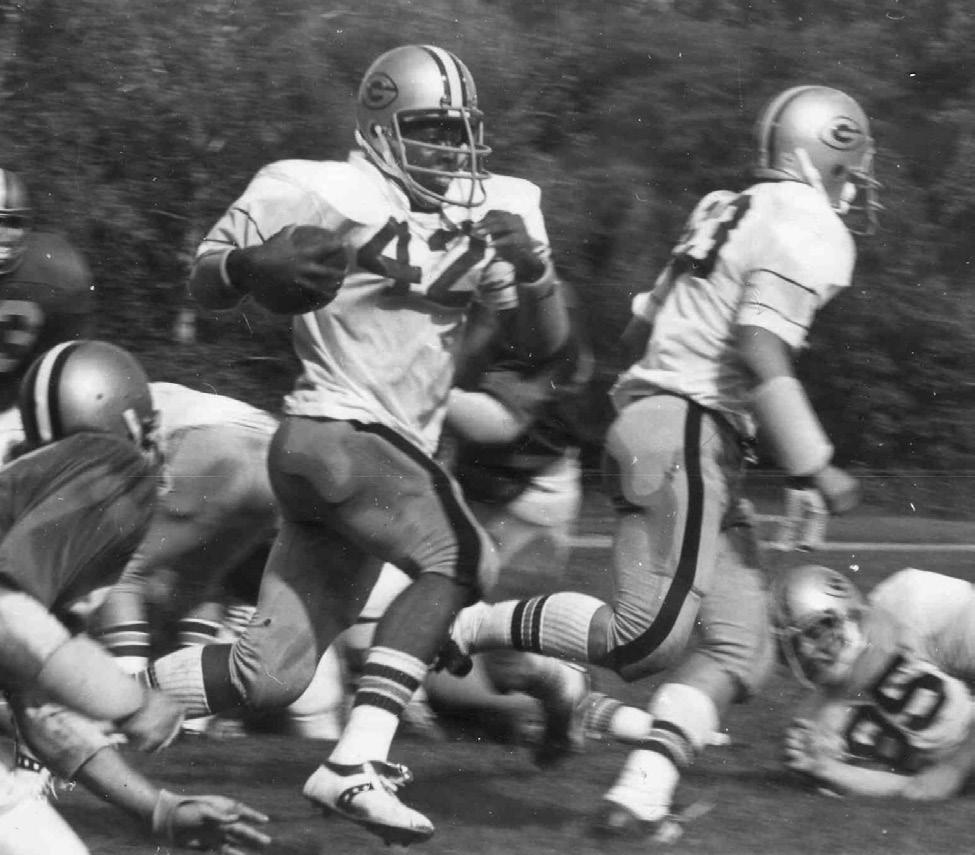
Fun fact: Thomas Booker’s father, Tom Booker III ’ 79, also starred on the gridiron for the Greyhounds before playing four seasons on the offensive line at the University of Wisconsin. At left, he is pictured at a 1978 Gilman game.
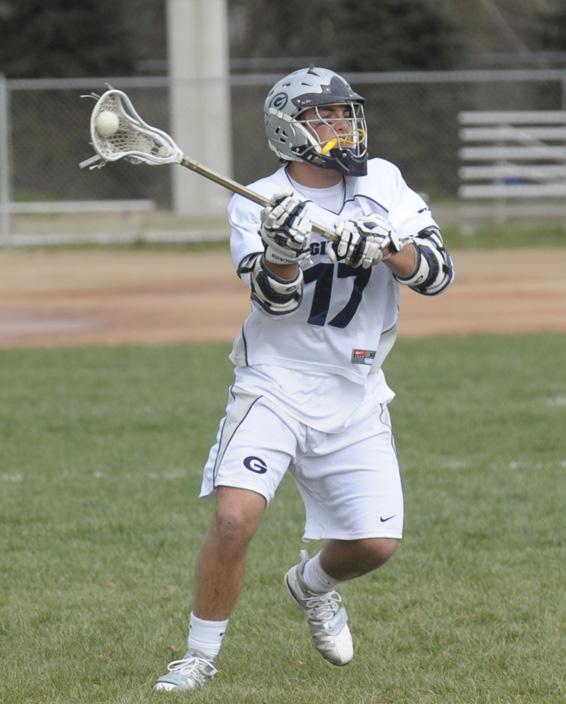
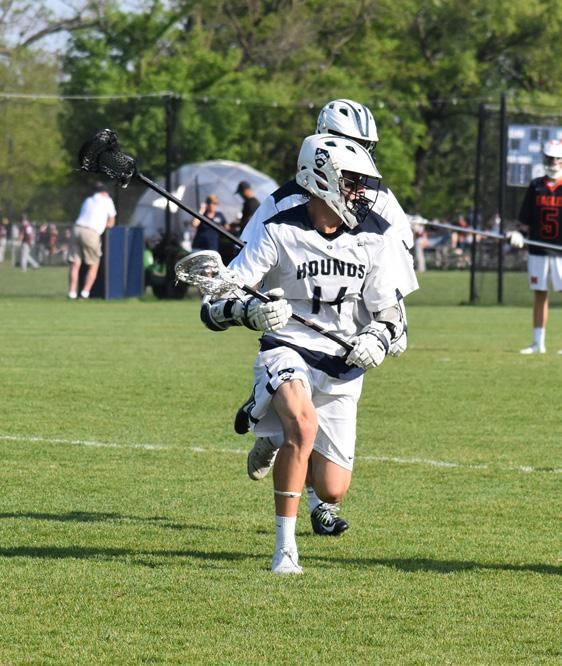
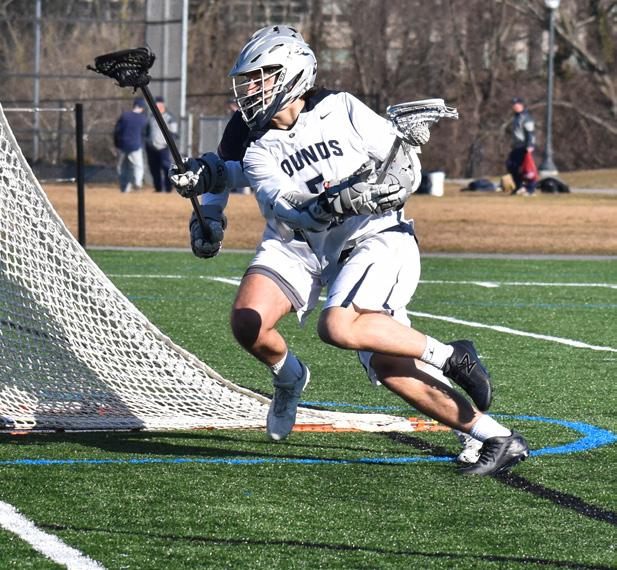
The legacy of Gilman lacrosse goes well beyond the fabled clear (see page 14) and continues to burn brightly at the professional level, where Marcus Holman ’09, Piper Bond ’18, and Sam King ’19 all star in the Premier Lacrosse League (PLL). Following a standout career at the University of North Carolina, Holman has established himself as an icon in the professional ranks. In his 14year career (and counting!) with three teams, he has amassed 12 All-Star selections, two first-team All-Pro honors, and cemented himself as the second all-time leading goal scorer in professional outdoor lacrosse history. Holman also represented his country as a member of the gold medal-winning 2014 and 2018 U.S. Men’s National Lacrosse Teams. At the other end of the field, Bond has established himself as an elite short-stick defensive midfielder in the pros, translating a highly decorated collegiate career at the University of Pennsylvania — where he earned All-American honors and the university’s prestigious Class of 1915 Award — into back-to-back PLL Championships (2023, 2024) and two All-Star selections with the Utah Archers. Joining Bond in the Archers midfield rotation, King was a third-round draft pick in 2025 following a spectacular career at Harvard University, where he became a Tewaaraton Award finalist and the first player in Crimson history to record 100 goals, 100 assists, and 100 ground balls.
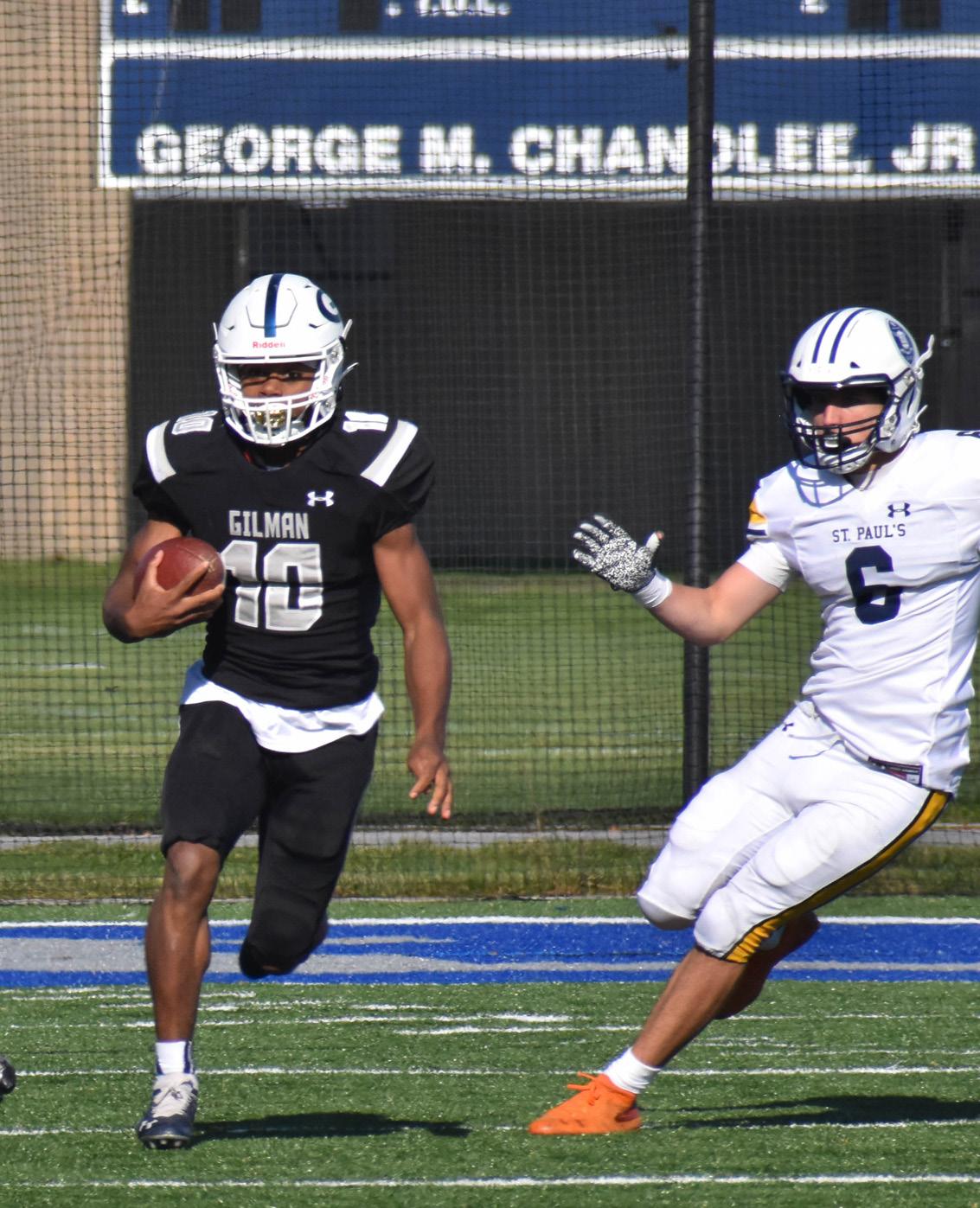
From patrolling the secondary for Gilman to embodying the ultimate standard of leadership as both an NFL player and a United States Marine Corps officer, Rayuan Lane III ’21 has chartered one of the most inspiring journeys in modern sports history. After a standout prep career as a versatile defender for the Greyhounds, Lane enrolled at the U.S. Naval Academy, where he became a legendary anchor of the Midshipmen defense, starting 43 consecutive games — the longest streak in the nation by an Football Subdivision (FBS) safety. His spectacular 2024 senior campaign cemented his legacy, as he served as a team captain, earned First-Team All-AAC honors, and was named the FBS Special Teams Player of the Year after leading Navy to a historic 10–3 season and a Commander-in-Chief’s Trophy victory. Making history in 2025, Lane became the first defensive back from the Naval Academy ever selected in the NFL draft, when he was picked in the sixth round by the Jacksonville Jaguars. Commissioned as a Second Lieutenant in the Marine Corps Reserve, Lane spent his rookie season showcasing his elite football IQ and signature special teams grit by appearing in all 17 games for the Jaguars, reminding the entire Gilman community that loyalty and perseverance do pay off in the end.
Thomas Booker IV ’18 kneels next to Coach Tim Holley ’77 at a Gilman football game in 2017.
Marcus Holman ’09 (top left), Sam King ’19 (right), and Piper Bond ’18 (bottom) at Gilman lacrosse games during their time as student-athletes.
Rayuan Lane III ’21 runs the ball at a Gilman football game in 2020.
FROM THE ARCHIVES:
Origin of Lacrosse’s “Gilman Clear”
by Johanna Schein, Director of Archives and Special Collections, with contributions from Sam Merrick, Jr. ’87
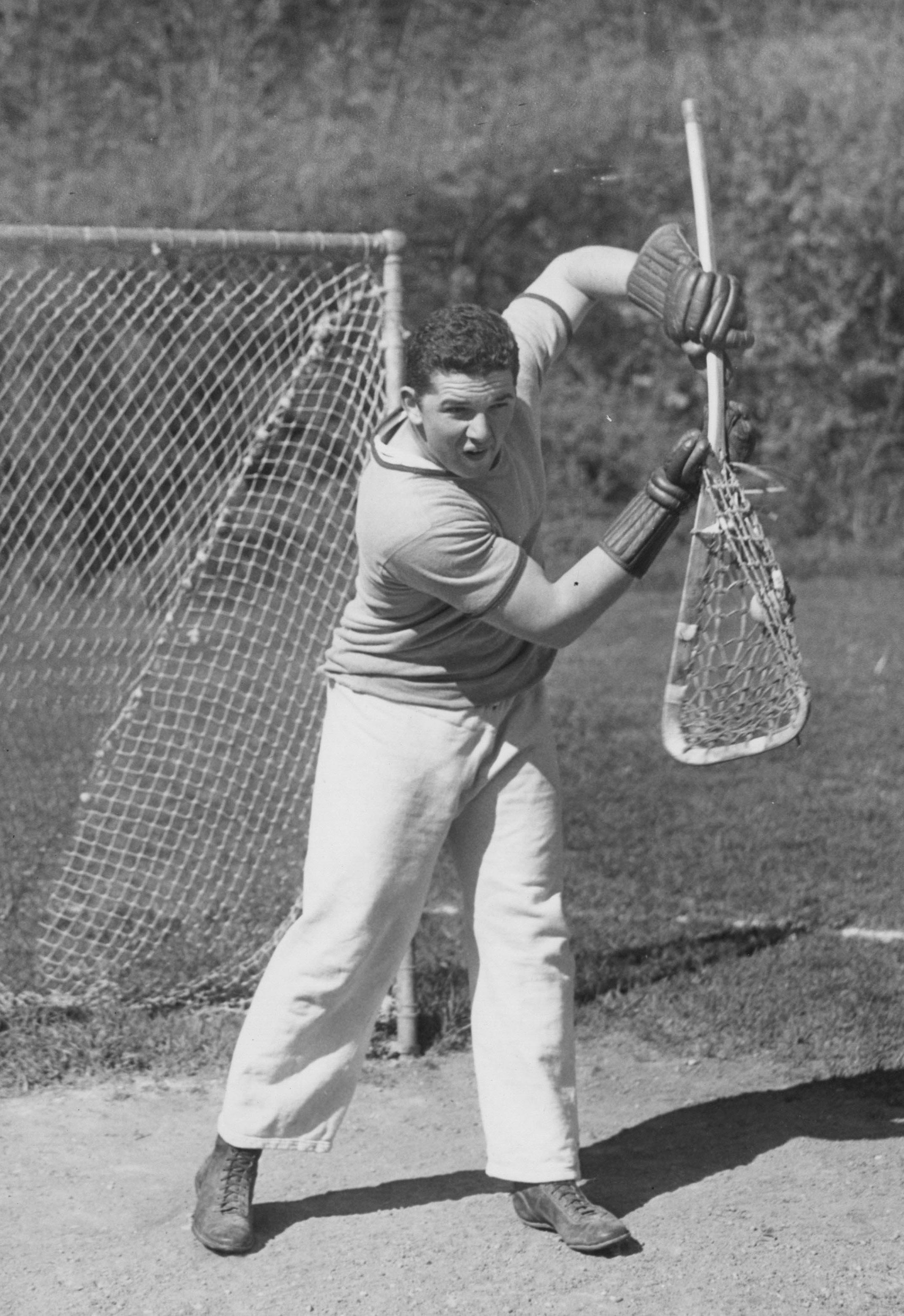
“GILMAN IT!” the crowd is heard yelling at the goalie, as the riding attackmen apply heavy pressure to the clearing team. For those unfamiliar with lacrosse terminology, the “Gilman Clear” is a long-distance throw by a defensive player from one end of the field to the other. Commonly viewed as lacrosse’s version of football’s Hail Mary, the play is recognized globally, but its origin remains an open question. How did the “Gilman” play begin? Has it always been a desperate pass, or was it once a more strategic, deliberate play?
Given Gilman School’s storied lacrosse tradition, popular lore has long connected the play to the School. Lacrosse at Gilman dates back to 1929, when it began as an undersquad team. Coached by Edward W. Brown, Gilman fielded its first interscholastic varsity lacrosse team in 1932. Under Coach Ferris Thomsen, who led the program from 1935 to 1946, the sport flourished, producing future Lacrosse All-Americans and Hall of Famers, including George M. Chandlee, Jr. ’32, Philip W. “Pete” Swindell ’33, C. Markland Kelly, Jr. ’36, M. Tyler Campbell ’39, and Frederick A. Allner, Jr. ’42 Chandlee later returned to coach Gilman lacrosse from 1947 to 1970, leading Gilman to six Maryland Scholastic Association (MSA) Championships. The team has won a total of 16 MSA and MIAA Championships.
So how did a school known for disciplined, innovative lacrosse become associated with what many now view as a desperation play? A search through the Gilman Archives provides one clue: In a 1957 Gilman Bulletin article, Chandlee traces the “Gilman Clear” to the 1930s. After describing the 1937 and 1938 lacrosse teams, Chandlee writes, “A few years earlier probably also saw the first use of the ‘Gilman Clear’ dependent at that time on [goalie] Harry Nance’s [Class of 1938] ability to whistle and so signal the use of a planned and practised [sic] play.” That brief passage is revealing. Rather than describing a random heave downfield, Chandlee portrays the Gilman Clear as a coordinated set play in which the goalie signaled teammates to expect a long pass.
Cyrus F. Horine, Jr. ’49 during his senior year as goalie.
Another reference appears in the 1981 Gilman Bulletin, when the Class of 1949 refers to goalie Cyrus F. Horine, Jr. ’49 as “Mr. ‘Gilman Clear’ himself.” Horine earned All-Maryland honors three times and was known for his powerful passes and for deploying the Gilman Clear with some frequency rather than carrying the ball out of the crease. Horine’s son, John Horine, recalls his father did not just hurl the ball up the field to get rid of it, but instead had the tall attackman Ralph N. “Bo” Willis ’49 at the other end of the field to receive an accurate pass.
Alumni recollections provide additional insights into how the play may have worked. Samuel S. Merrick ’55 remembers the Gilman Clear in the 1950s as a coordinated fast-break maneuver. Before enrolling at
Gilman, Merrick remembers watching a Gilman goalie make a save and fire a fast, low pass toward an attackman stationed slightly off-center near midfield. Instead of scooping the ball, the attackman lifted his defender’s stick, allowing the ball to skip past him. Anticipating that move, a second attackman raced from near the restraining line to the ball, hoping to scoop it up cleanly in stride. On the opposite side of the field, the third Gilman attackman broke toward the goal. With the defense caught off guard and out of position, the second attackman delivered a quick feed to the cutter, creating a one-on-one with the goalie.
When Merrick transferred to Gilman, he remembers that the team regularly practiced the play. He recalls it being used strategically, particularly in man-down
A1
situations. When executed correctly, the play produced open shots and goals.
How the term spread across the lacrosse world is still a mystery. Over time, the phrase appears to have drifted from its original meaning. Merrick believes that the term has since been “misapplied,” likely by opponents who observed the clear but failed to grasp its design. As the term circulated through the lacrosse world, perhaps its meaning gradually simplified into a synonym for a desperate clear. However, if the original “Gilman Clear” was indeed a deliberate, orchestrated tactic rather than a lastsecond hurl, then the term deserves to be understood in its proper historical context. Clarifying its origin is one way to honor the innovation of the Gilman lacrosse program.
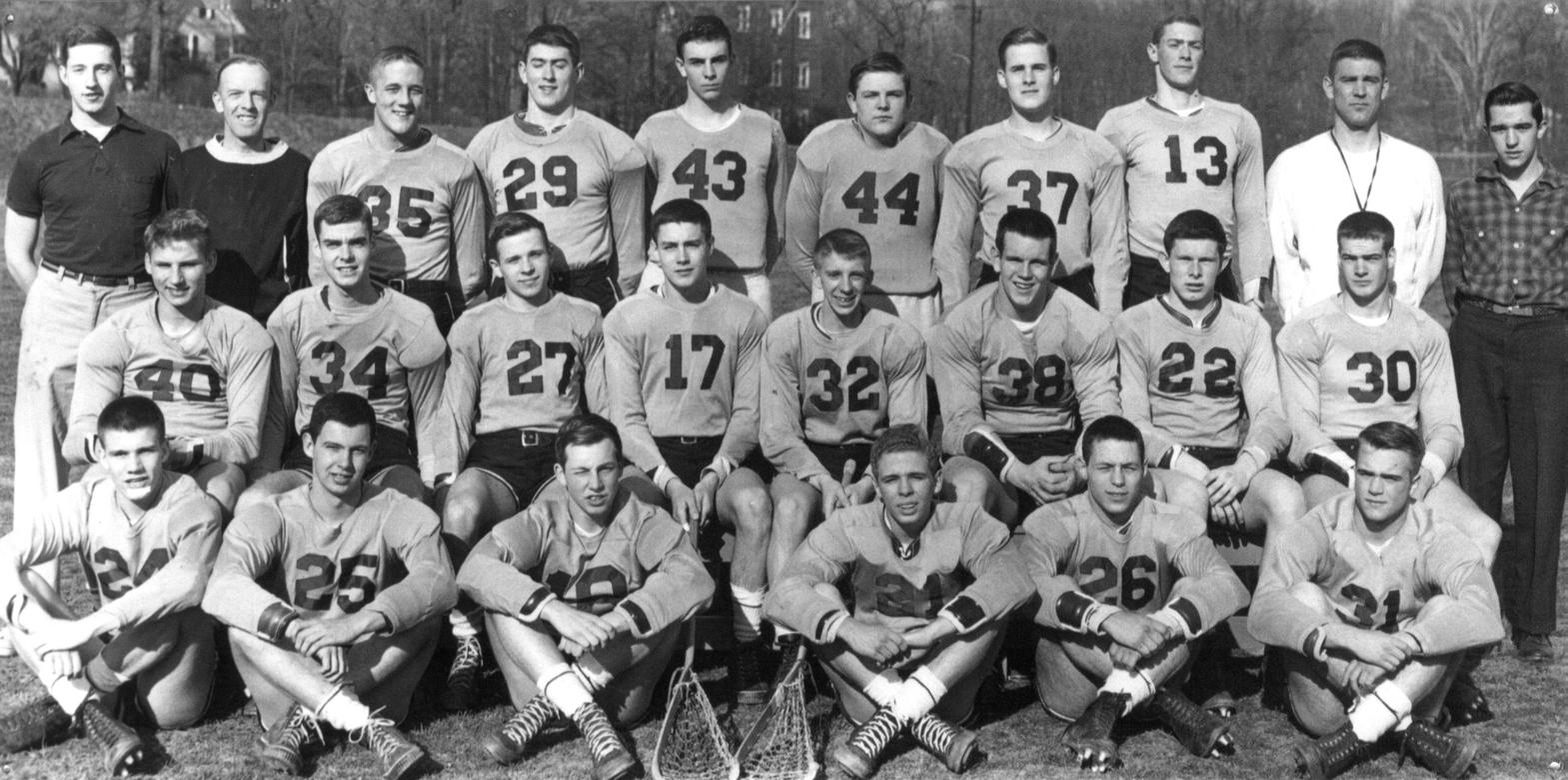
1955 Varsity Lacrosse Team
Diagram of “Gilman Clear” play as remembered by Sam Merrick ’55 by his son, Sam Merrick, Jr. ’87
Alumni Weekend
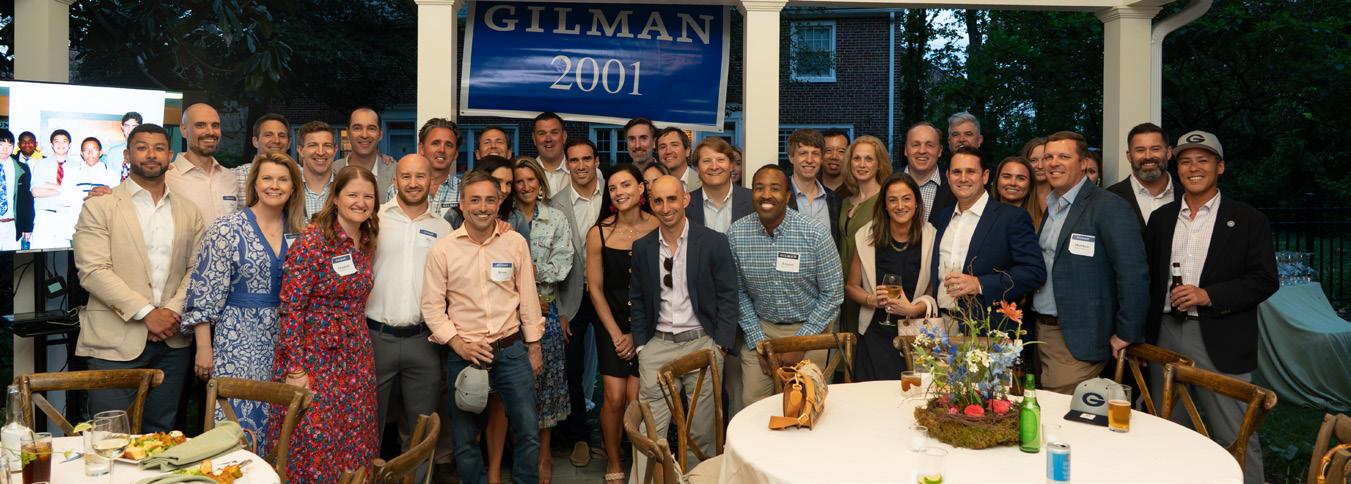
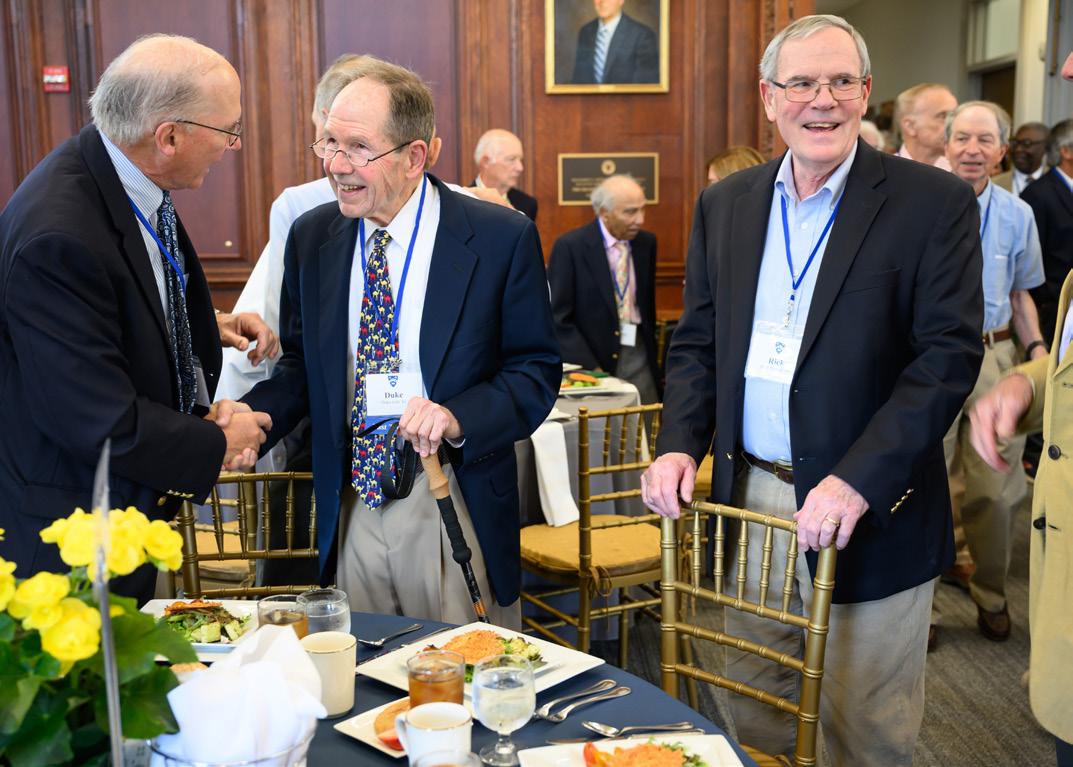
More than 600 alumni and guests returned to campus in late April for Alumni Weekend, bringing Roland Avenue to life with Greyhound spirit, camaraderie, and pride. Blessed with beautiful spring weather, the weekend offered countless opportunities for alumni across generations to reconnect and celebrate their shared Gilman experience.
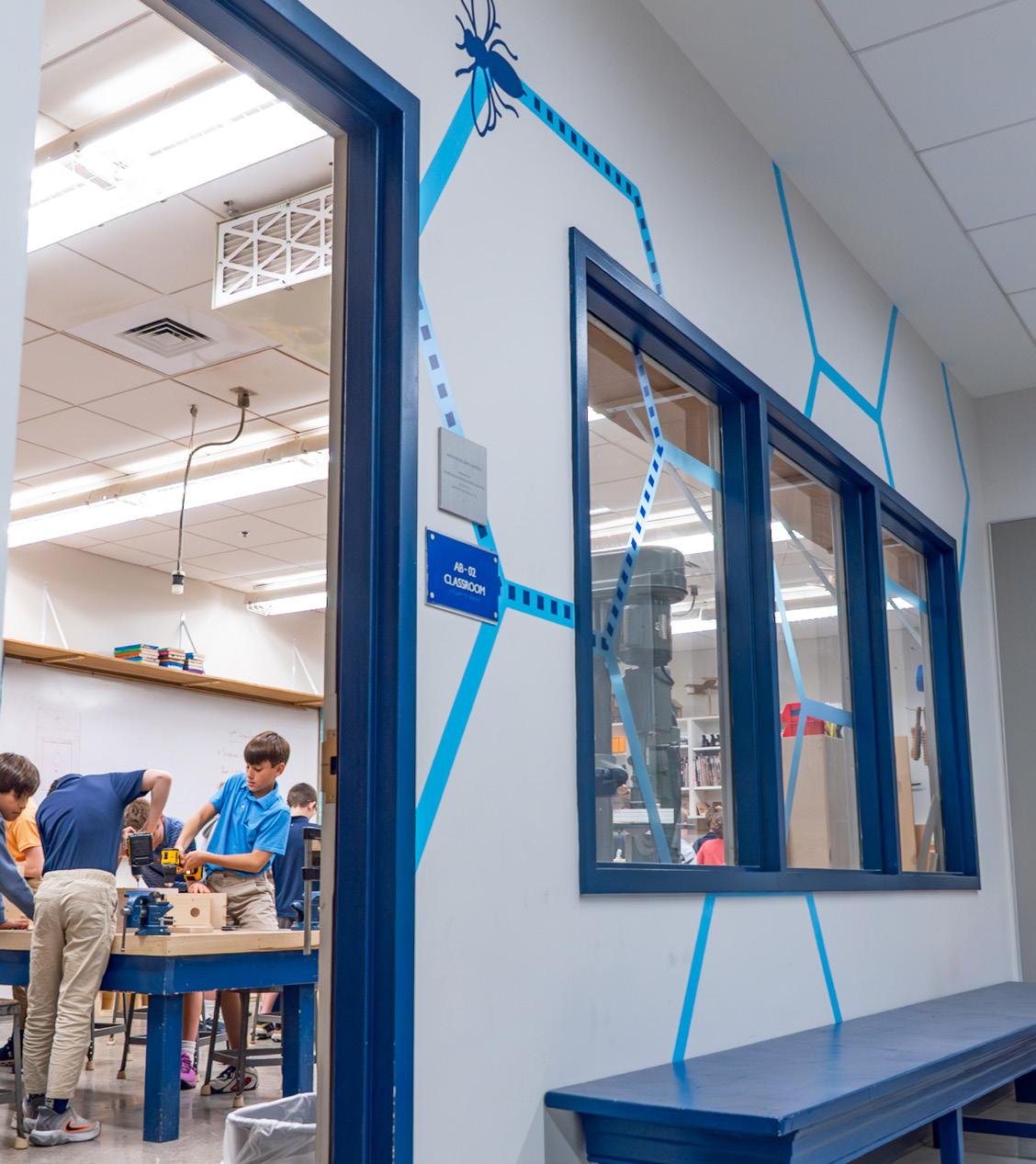
Friday began with a campus tour led by Donell Thompson ’91, highlighting both familiar landmarks and newer spaces, including the HIVE. (Read more about the HIVE on page 58.) Later that morning, more than 90 alumni from the Classes of 1952–1975 gathered for the Ninth Annual Gilman Forever Luncheon. The program featured remarks from Board President Andy Brooks ’74, PP, and Head of School Henry Smyth PP, P’26, as well as the presentation of the Richard E. Evans ’60 Memorial Alumni Spirit Award to Stuart “Stu” Simms ’68. Members of the Class of 1976 also met their third grade pen pals in person after months of letter writing.
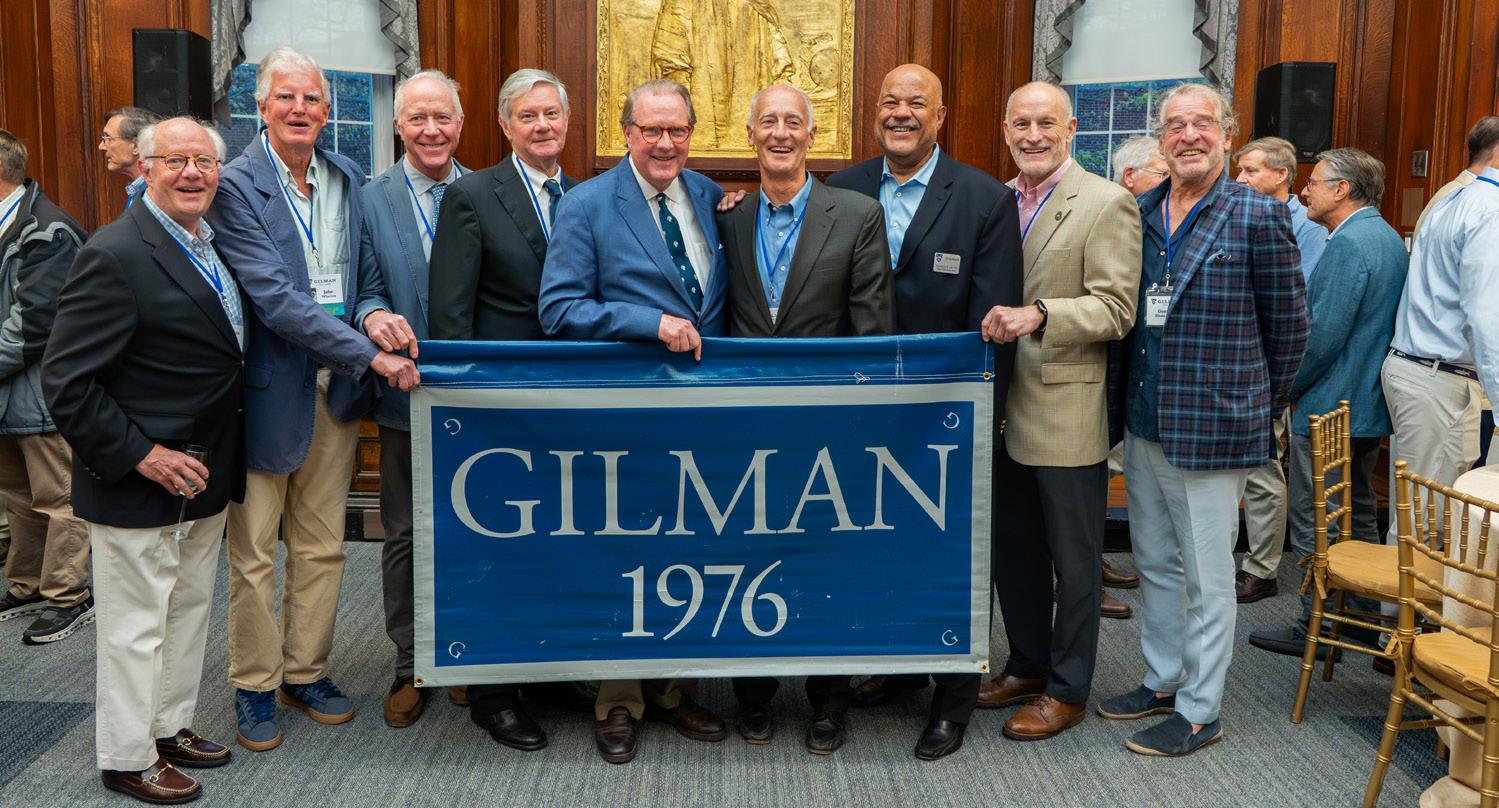
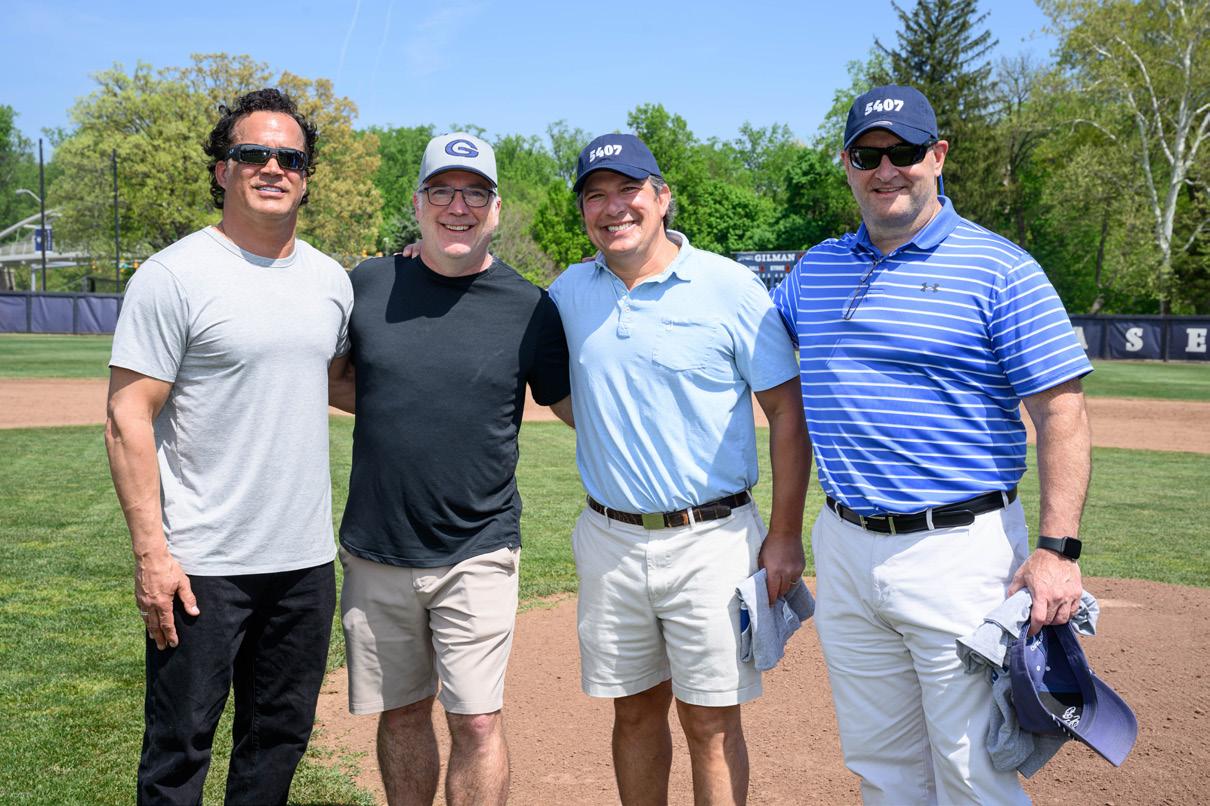
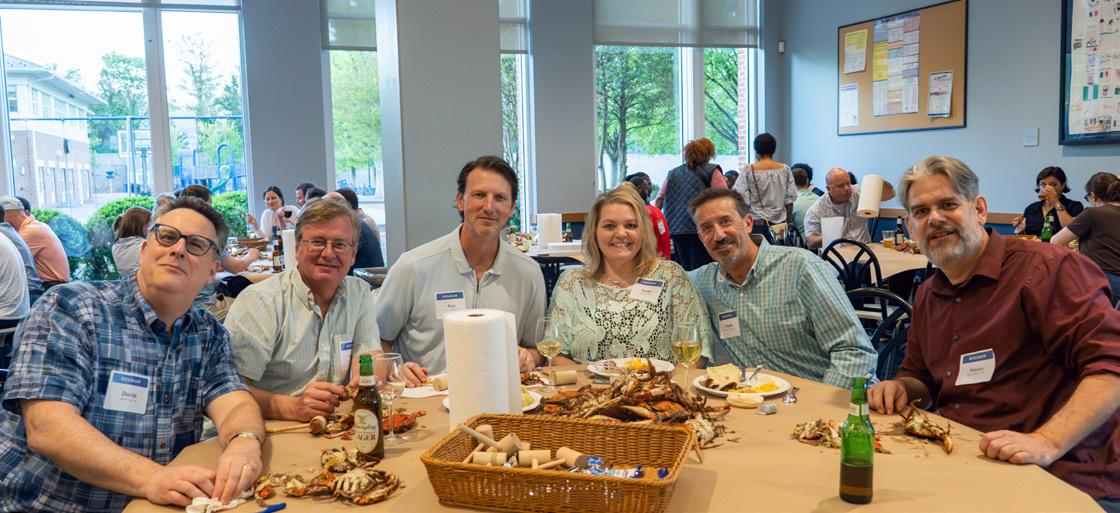
That afternoon, alumni gathered at Chandlee Field for the varsity lacrosse game against Loyola Blakefield and a halftime recognition of Gilman championship teams from 1956, 1976, 1981, and 2011 The evening included receptions for the Gilman Black Alumni Society, the Class of 1976, and championship lacrosse alumni before culminating in a record-setting Alumni Crab Feast filled with laughter, storytelling, and tradition.
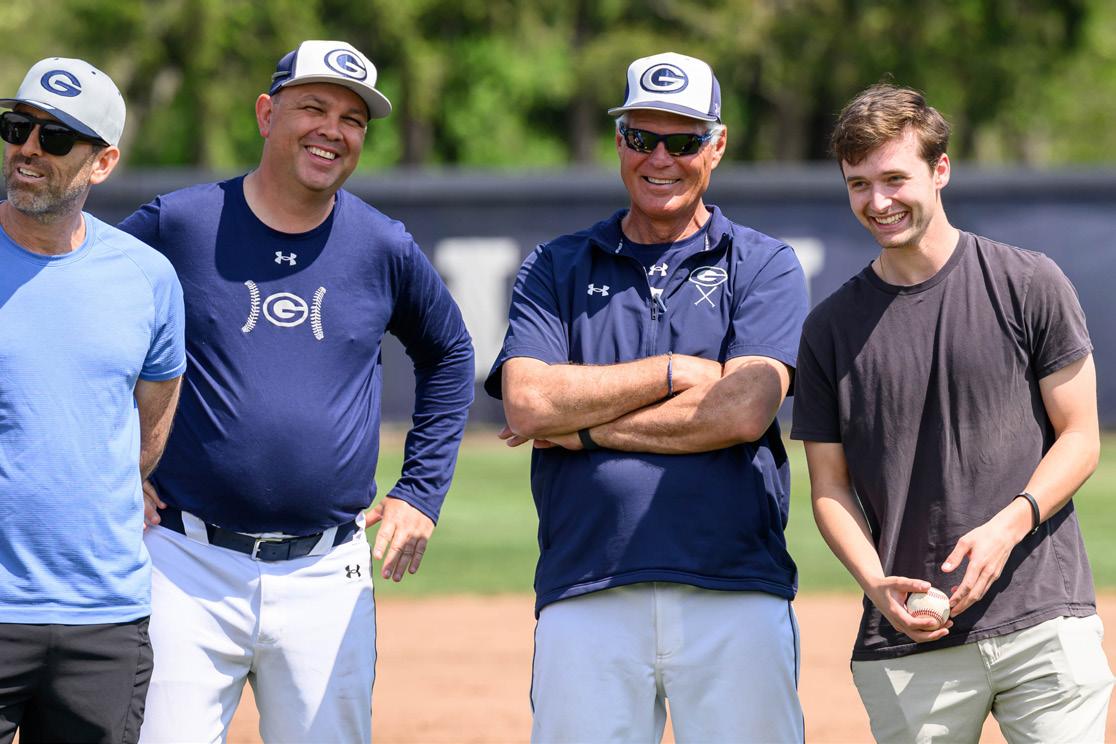
Saturday featured a memorial service and brunch for the Class of 1976, along with baseball festivities honoring championship teams from 1976, 1991, 1996, and 2021. Alumni Authors David Norton ’86 and Chaz Howard ’96 shared reflections on their work, while Smyth’s State of the School address highlighted Gilman’s continued strength and included the presentation of the Young Alumnus Award to Darius Jennings ’11. (Be sure to check out his feature on page 10.)
The weekend concluded with the All-Reunion Cocktail Reception and class dinners held across campus and beyond. A special Cluster Reunion at the Elkridge Club brought together nearly 100 alumni from the Classes of 1956, 1961, 1966, and 1971 for an evening of fellowship and shared memories.
As the final guests departed, one thing remained clear: The strength of the Gilman community endures across generations. Thank you to all who returned and helped make Alumni Weekend 2026 another memorable celebration of connection, tradition, and lifelong Greyhound pride.
Alumni Mentoring
Winter Startup Experience Judges and Mentors
Demo Day was held January 16, 2026.
JUDGES:
Cheo Hurley ’92, PP, P’30
President and CEO at THG Companies
Kelvin Liu P’27
Chief Product Officer at Infinity Bio, Inc.
Christopher Sachse P’34
Chief Executive Officer at Network Coverage
MENTORS:
Ryan Kamauff ’03 Cloud Architect at VMware
Zach Landers-Portnoy ’06
Chief Revenue Officer at Tricerat
Robb Lawrence P’28, ’33 Entrepreneur in Residence at University of Maryland, Baltimore
Kevin Robbins ’94
General Partner at Blue Delta Capital Partners
Jason Pappas ’86 Founder & Managing Partner at Antson Advisors
BUSINESS
“Starting a business takes guts. Don’t be afraid. Keep doing it.”
–CHEO HURLEY ’92, PP, P’30, PRESIDENT AND CEO, THG COMPANIES
Spring Entrepreneurship Class Mentors
Demo Day was held May 15, 2026.
Jason Griswold ’93 CEO/Co-Founder at REIN
Andrea Shelby PP Co-Founder of the Timbre Wellness Collective
Alex Puthumana ’14 VP, Strategic Finance & Corporate Development at Machine Specialties, Inc.
Jon Laws ’02
Head of Global Consumer Insights at EA SPORTS
Byron Hoffberg ’01 Partner at Nash Performance Marketing
Josh Levinson ’89, PP Founder & CEO at Charm City Run
Duncan Booth Chief Financial Officer at Gilman School
Saul Waller ’01
Managing Director at Columbia Partners Private Capital
Will Zerhouni ’94, PP, P’29
Managing Director/Partner at TRGP
Investment Partners, LP
Beau Smith ’99, P’32
Senior Risk Manager at Maryland State Retirement and Pension System
George Stewart ’07
Marketing Specialist at Brown Advisory
Zachary Landers-Portnoy ’06
Chief Revenue Officer at Tricerat
Alex Josowitz ’01
Principal, Noma Growth Partners & Founder and Principal at Switz Venture Group
Graham Savage ’98, Managing Director of Investment Sales at Cushman Wakefield, spoke about his career in commercial real estate.
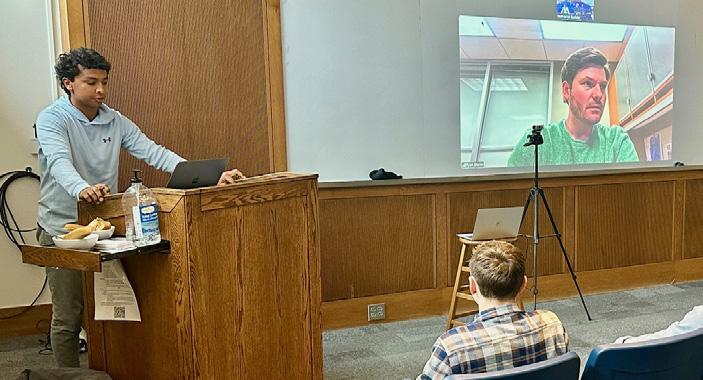
Ryan Gisriel ’09 joined via Zoom and shared the ins and outs of his role as the Vice President of Basketball and Strategy Operations for the NBA’s Charlotte Hornets. Check out the feature about Gisriel on page 8.
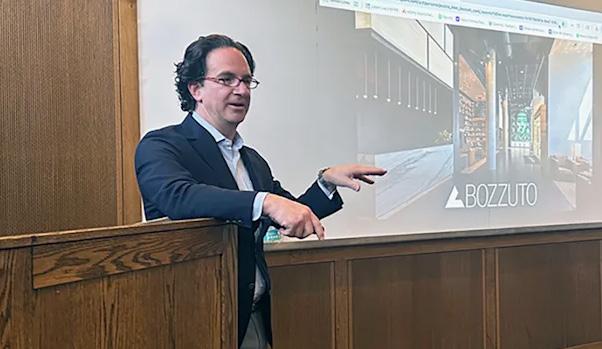
Toby Bozzuto, Jr. ’92, President and CEO of The Bozzuto Group, spoke about his career journey and how he stepped into the leadership of the family-owned real estate company.
SENIOR ENCOUNTER
as seniors prepare to head to college, the capstone experience — Senior Encounter — aims to provide them with a broader perspective on a career field of interest while connecting with a mentor in that field.
ATHLETICS-RELATED ENCOUNTERS
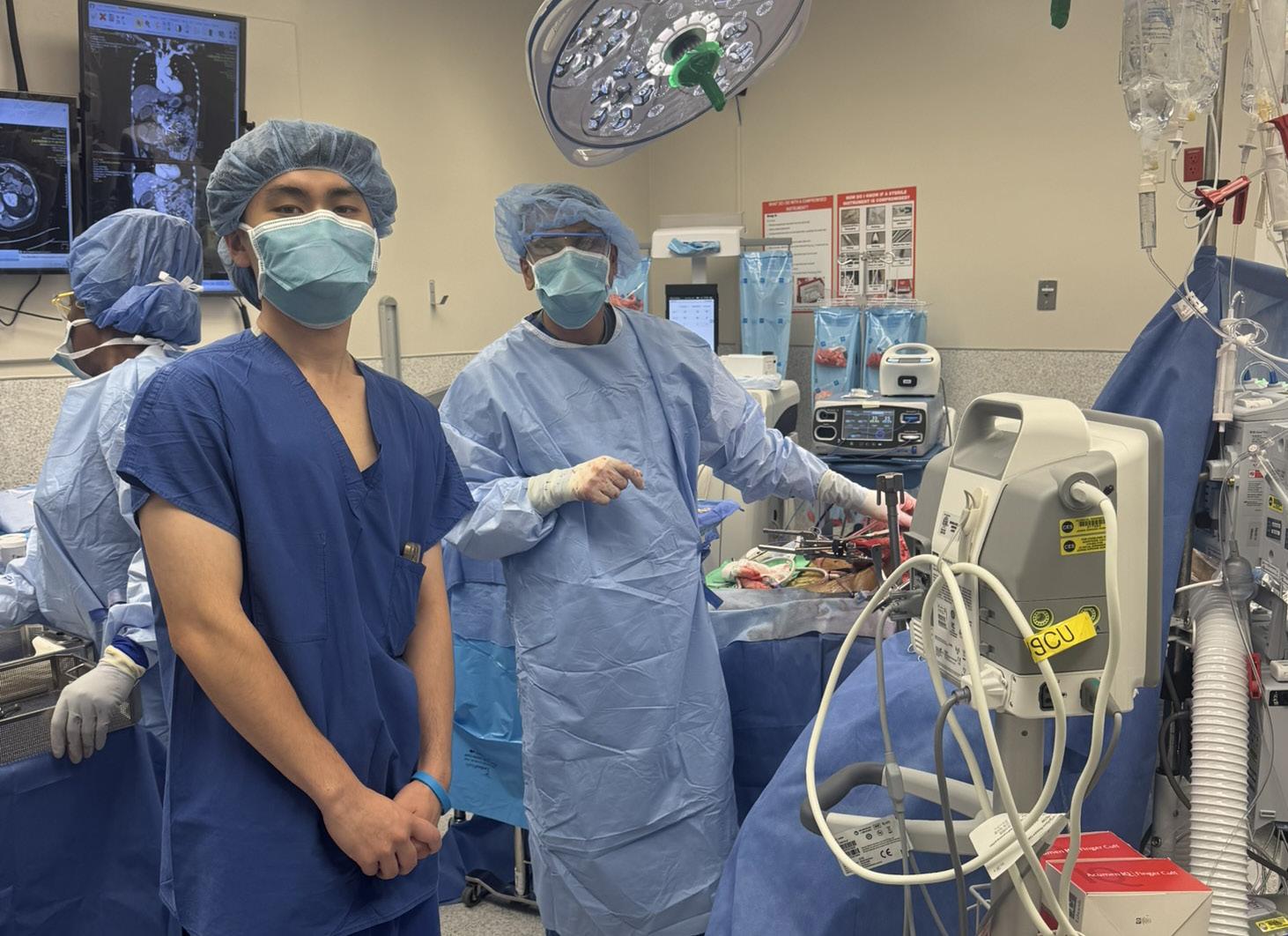
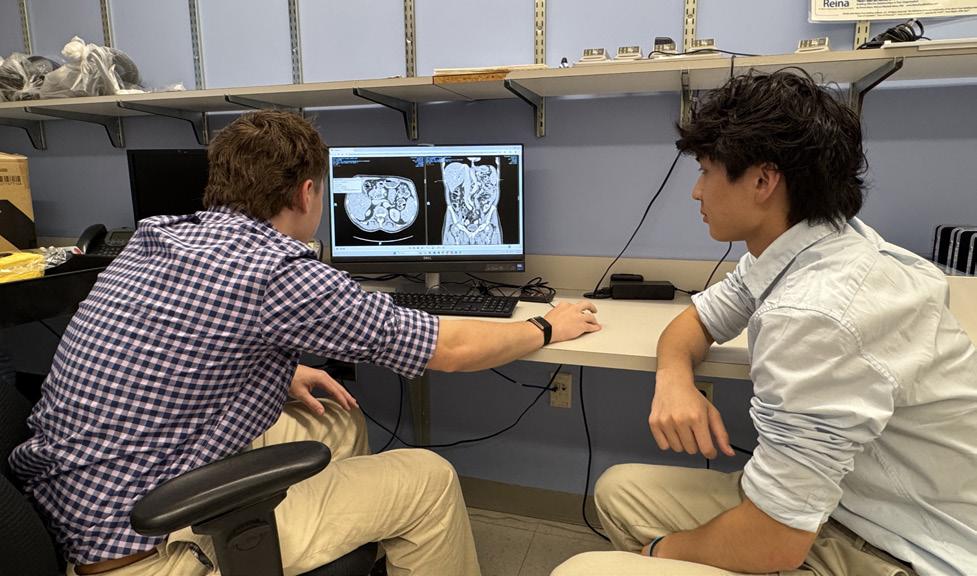
“In short, it was absolutely fantastic having Tony and Michael rotate through our department. Both of them seamlessly integrated into and garnered the respect of our entire team through their professionalism, intelligence, intellectual curiosity, and collegial demeanor.
The first photo [left, top] is Michael participating in a case in which we delivered intraoperative radiation to the ‘Baltimore Triangle’ for a patient with pancreatic cancer undergoing a total pancreatectomy, a treatment approach that can only happen at Hopkins. The second [left, bottom] is Tony independently interpreting the CT imaging for a patient with pancreatic cancer, which is some of the most complex imaging out there.
My Gilman roots have always given me tremendous pride, and having the opportunity to see such impressive graduates has only deepened that pride. They are absolutely ready to take the next step, and I am 100% confident that they will represent Gilman extremely well in all of their future endeavors.”
–Dr. Amol Narang ’03 (parent of rising kindergartner), Department of Radiation Oncology at Johns Hopkins
“I knew that I wanted to do my Encounter in the athletics field. I enjoyed gaining a new perspective on how much goes into athletics programs whether in high school, college, or professionally. Many people only see what happens during the games and don’t see how a team stretches well beyond just the players. I was surprised to learn that many schools look to each other for ideas on how to improve their own school. A lot of my work during Encounter included looking at other schools to see in what ways they were aligned and where areas for improvement existed.”
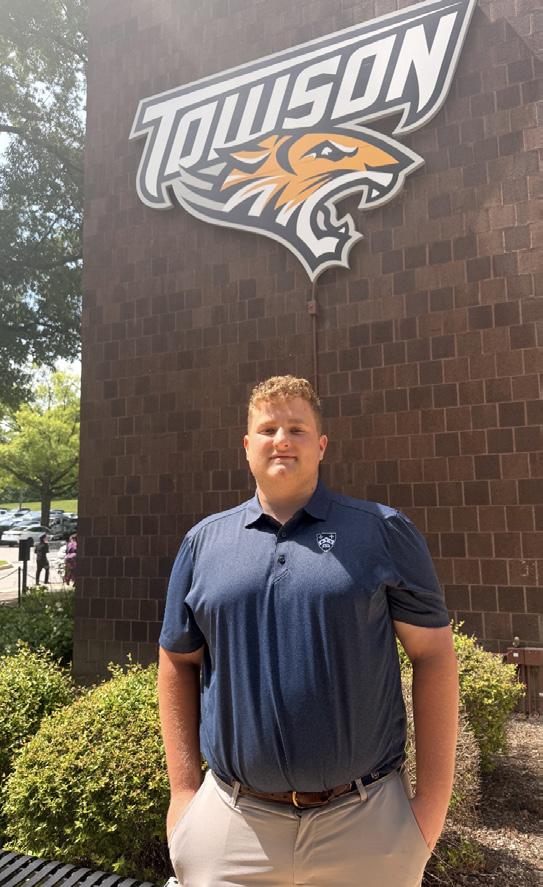
–Drew Corbin ’26 / Mentor: Chris Smith, General Manager, Towson University Athletic Sponsorships
“The most memorable moment of my Encounter was traveling with the kickers and punters so they could experience the kicking and the wind at M&T Bank Stadium. I will take away a lot from this experience, and I really hope that eventually I can use the skills I have learned here to continue working in the scouting business later in my life.”
–Spencer Oddo ’26 / Mentor: Eric DeCosta P’26, ’30, General Manager, Baltimore Ravens
“The thing that surprised me the most about this experience was how much relationships matter as a Head Golf Professional. Part of Mr. Franz’s job is to keep the members happy, and to do that, he needs to know about them and check in on them. To be in this role, you need to be someone who is approachable and kind. A skill I used a lot in my Encounter is active listening and talking. Gilman taught me how to be an engaging communicator and how to make people feel welcome and appreciated.”
–James Hobelmann ’26 / Mentor: Joe Franz, Head Golf Professional, Elkridge Club
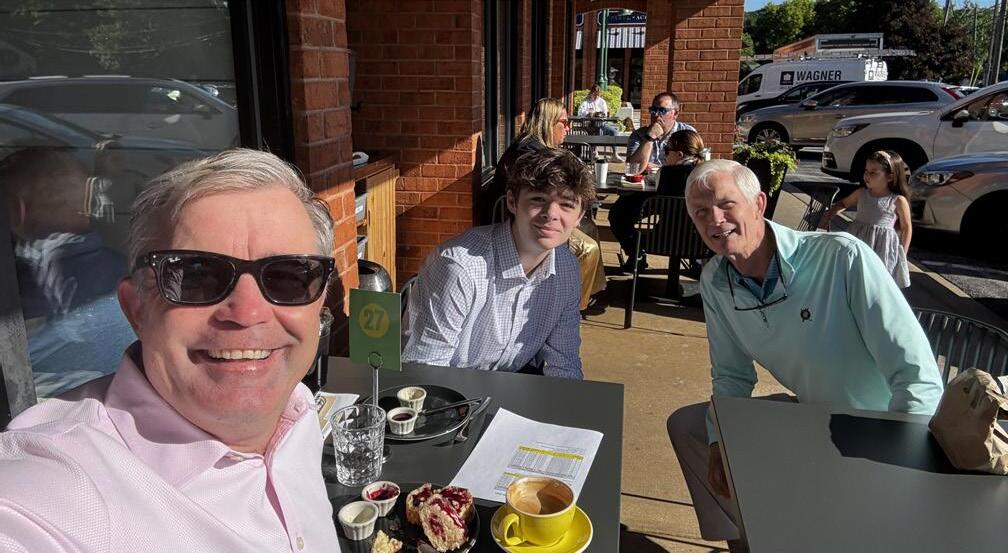
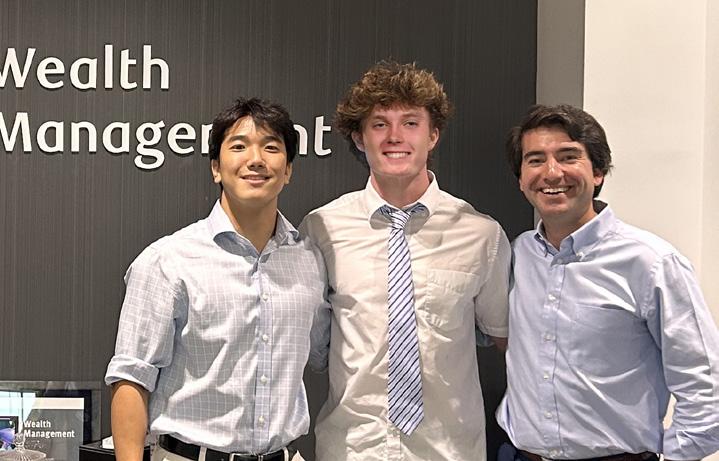
Brandon Yoon ’26 and Lucas Kelley ’26 with mentor Yale Hoffberg ’11, Vice President, Financial Advisor at RBC Wealth Management.
Chase Carpenter ’26 with mentor Charlie Fenwick ’93, Managing Director at Cushman & Wakefield, and Benson Legg ’66, former U.S. District Judge.
ABOVE Michael Jiang ’26 (left) with mentor Dr. Amol Narang ’03, Department of Radiation Oncology at Johns Hopkins. BELOW Tony Romano ’26 (left) and Michael Jiang ’26.
Drew Corbin ’26 / Mentor: Chris Smith, General Manager, Towson University Athletic Sponsorships
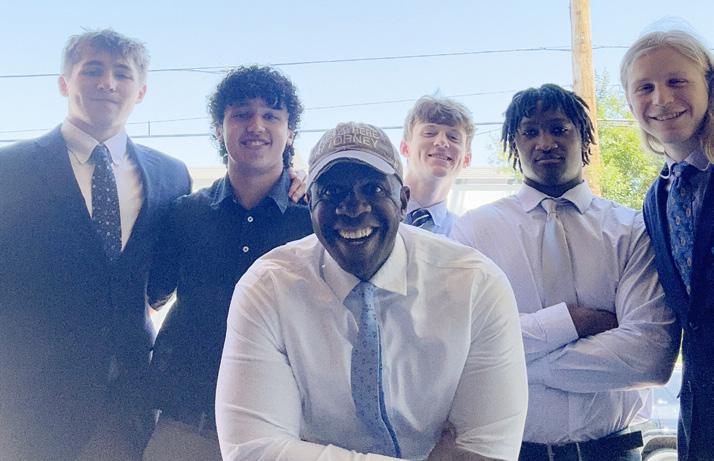
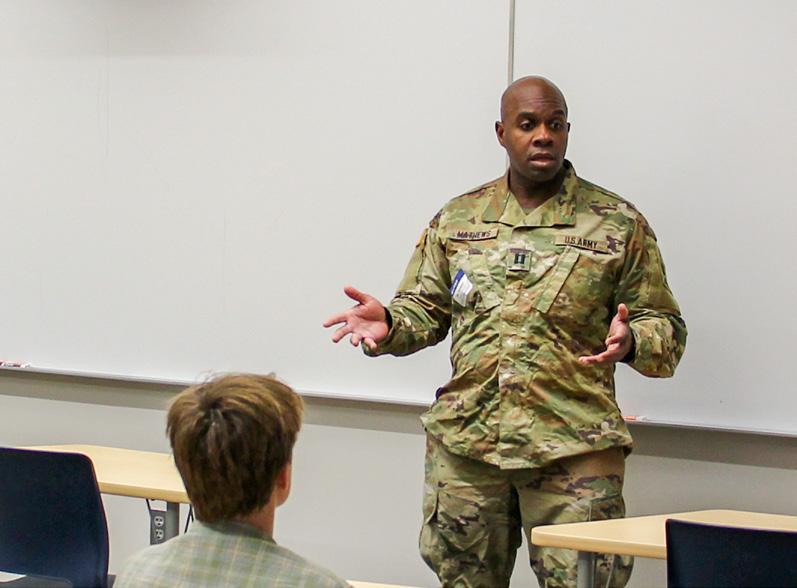
Jacob Rody ’26, Arjun Ramachandran ’26, Joe Wise ’26, Noah Lawrence ’26, and Micah Loveland ’26 with mentor Singleton Mathews ’03, Attorney.
RECENT ALUMNI RETURN
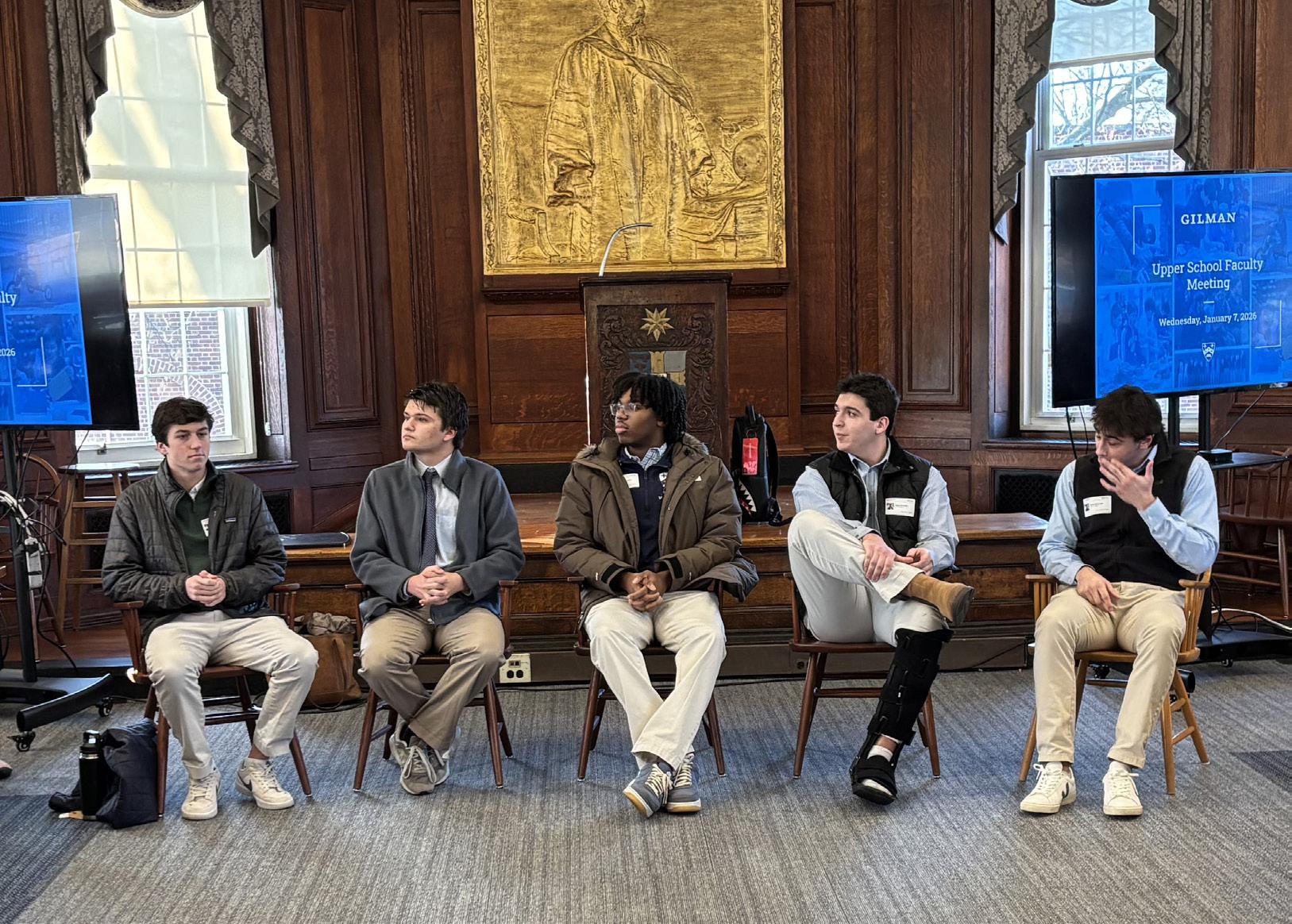
Several college-aged alumni returned to campus during winter break to share advice with Upper School students. During a senior form meeting panel moderated by Associate Director of College Counseling Anna Follensbee, Jackson Brooks ’25 (University of Richmond), Sawyer Enright ’25 (University of Maryland), Wesley Krieger ’24 (Wake Forest University), Nicky Lawson ’25 (Cornell University), Dev Saluja ’24 (Tulane University), and Frank Siciliano ’25 (University of Virginia) discussed the transition to college, emphasizing time management, personal accountability, and balancing academics with campus life.
INVESTING IN THE FUTURE: SENIORS EXPLORE CAREERS ON WALL STREET
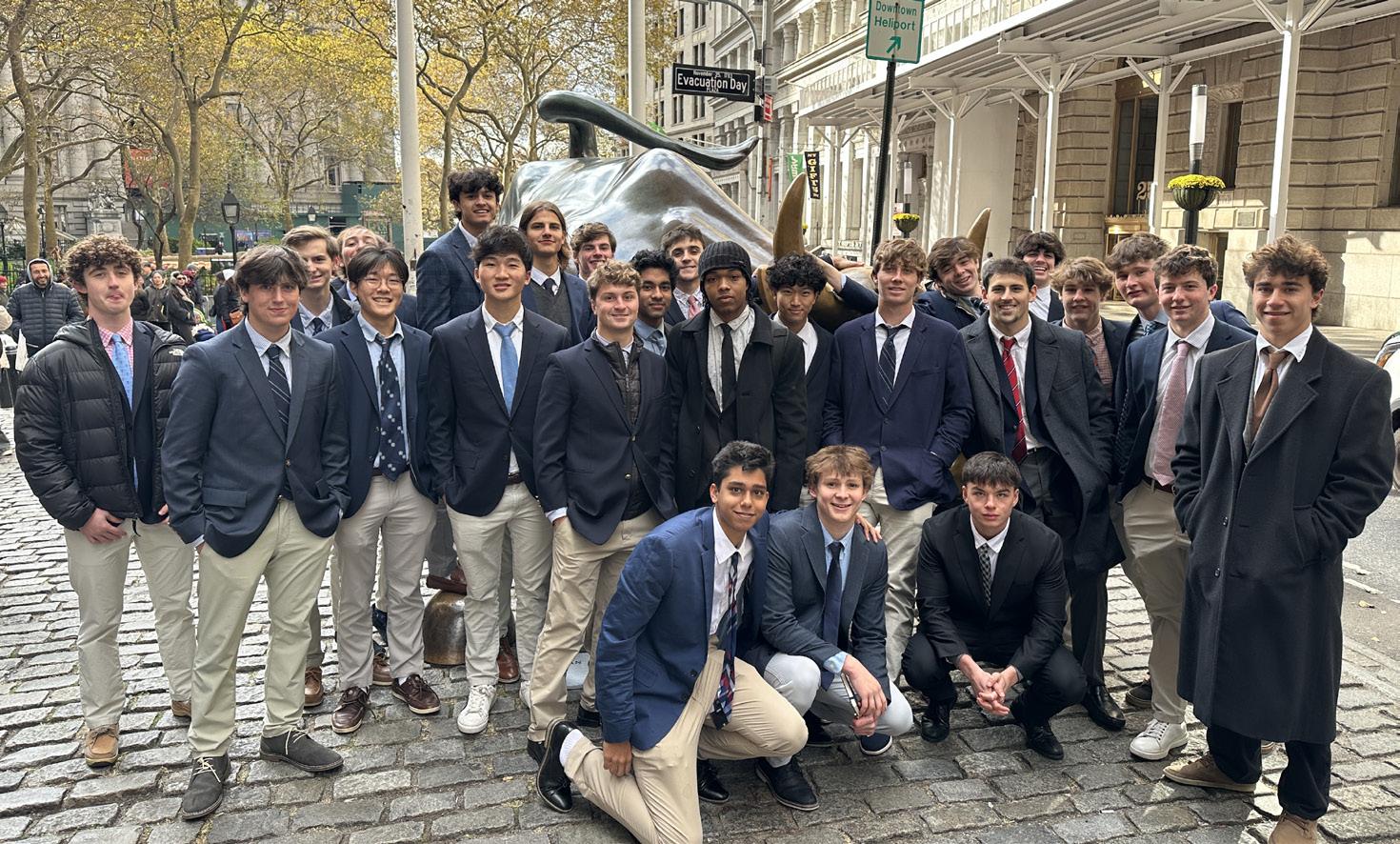
Wall Street 101 gave 25 seniors an immersive look at careers in finance through conversations with Gilman alumni working in the industry on November 13, 2025. During a panel moderated by Bruce Cameron ’74, four alumni — Michael Faridi ’02 of Morgan Stanley, John Clarke ’83 of DLA Piper, Vijay Prabhakar ’94 of Two Sigma Investments, and Joseph Melancon ’18 of Northampton Capital Partners — emphasized the importance of integrity, communication skills, intellectual humility, and career exploration.
Later that day, the Gilman Investment Society (GIS) welcomed back Juno Yoon ’23 (University of Michigan) and Saraj Dhillon ’23 (Carnegie Mellon University). Reflecting on how GIS prepared them for college clubs, internships, and networking, both alumni encouraged students to pursue their interests, make the most of Gilman’s opportunities, and tap into the strength of the alumni network.
Earlier in the day, students met with Matt Berger ’10 of the Wolfson Group, who led an investment exercise and shared advice on excellence, adaptability, and the enduring value of human relationships. The group also toured Lower Manhattan landmarks connected to the history of American finance.
FROM MEDICINE TO MEDIA
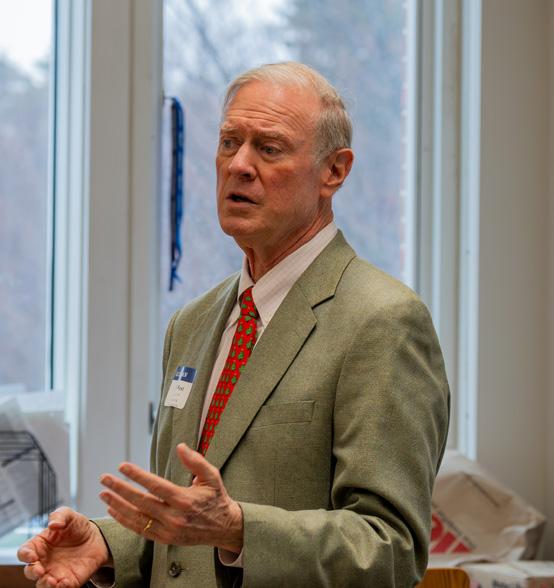
We are grateful to the alumni and parents who shared their insights with Upper School students.
Greg Bader ’93, Executive Vice President and General Manager at MASN
GILMAN’S FIRST CAREER CORNER BROADENS STUDENTS’ HORIZONS
“Aim as high as you possibly can — you will never know your potential until you try it.” Those were just a few words of advice dispensed on December 5, 2025, at Gilman’s first Career Corner, held during Upper School community time. Malcolm Ruff ’02, P’33, who encouraged students with the above statement, is a member of the Maryland State House of Delegates and an attorney at Murphy, Falcon & Murphy. He never imagined the twists and turns his career would take or that he’d be representing clients in complex cases with such high stakes.
Ruff was just one of a few dozen alumni and parents to visit Roland Avenue to share insights about their professional journeys in fields such as healthcare, finance, architecture, politics, and entertainment. Dr. Harsh Trivedi P’28, ’30 is president and CEO of Sheppard Pratt, the largest nonprofit provider of mental healthcare in the country, located in Towson. Among other topics, he spoke to students about his congressional fellowship in 2004, where he drafted federal legislation that was passed to develop suicide prevention programs and expand mental health services on college campuses. Regarding the practice of medicine, he said, “It’s all about connecting with people.”
“It’s all about connecting with people.”
–DR. HARSH TRIVEDI P’28, ’30, PRESIDENT AND CEO OF SHEPPARD PRATT
The goal of the event was two-fold: to broaden students’ ideas about and understanding of the career paths that may be accessible to them and also to provide alumni and parents a great opportunity to connect with the School and interact with its students in a meaningful way.
Upper School Math Department Chair Jeff Gouline ’00 made sure that each student was able to attend a relevant talk related to an industry he wanted to learn about or may wish to pursue in the future. “I think the traditional career day presentations many schools provide only reach the small number of students interested in that specific field,” he said. “This event allowed our students to learn about an area of interest.”
Upper School Art Department Chair Karl Connolly, who sat in on the commercial real estate session, called the event “tremendous” and said, “Listening to the banter in the art room afterwards, I can confirm that many of the boys felt it was a pretty excellent use of their time.”
Dr. Amol Narang ’03 spoke with students about his patient care and research into radiation and oncology at Johns Hopkins Hospital. “At this point in my life and career, events like these are really one of the most meaningful things I get to do. To be able to give back to the Gilman community that helped me so much and hopefully inspire the next generation, I can’t think of many things more valuable than that.” Narang also hosted two students for Senior Encounter (see page 19). After the first impactful rendition of Career Corner, plans are already in the works to make it an annual event.
Phil Beatson ’00, Senior Vice President, Strategy and Operations at Mercy Health Services
Brad Boutilier ’95, Principal at TAI Engineering
Kathy Broadbent PP, P’27, Realtor at Compass Group
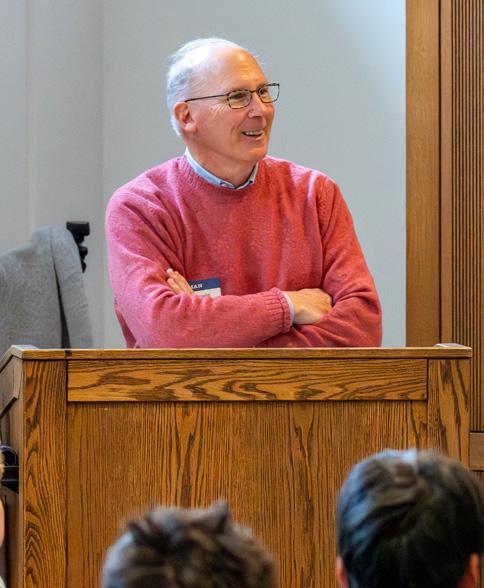
Andy Brooks ’74, PP, Retired Vice President and Head of U.S. Equity Trading at T. Rowe Price
Ted Brown ’84, CEO at Biohabitats
Hunter Dase ’17, Assistant Superintendent at Southway Builders
Austin Dase ’11, Lead Software Engineer at Fundrise
Garrett Dvorkin ’14, Finance and Sports Business Reporter at Baltimore Business Journal
Sandra Gallegher-Mohler PP, Performance Coach at Athlete Optimization
Anthony Gill P’27, Principal at Marshall Craft Associates
James Guyton ’92, Managing Director, Life Sciences at Alvarez & Marsal
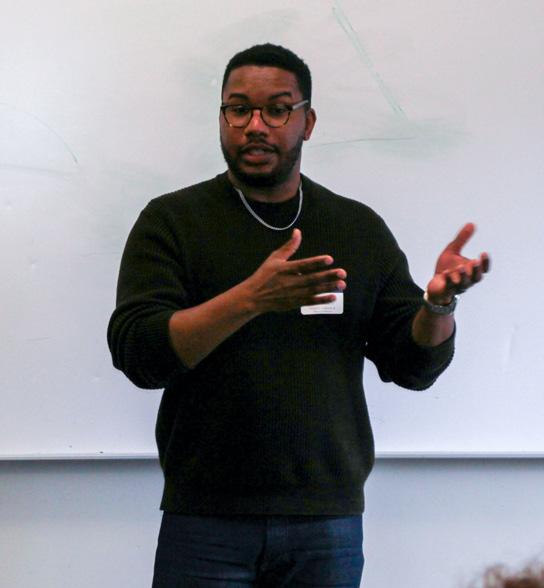
Jeremy Hairston ’14, Guitarist, Composer, and Musical Director
Charlie Halpert ’17, Associate at StepStone Group
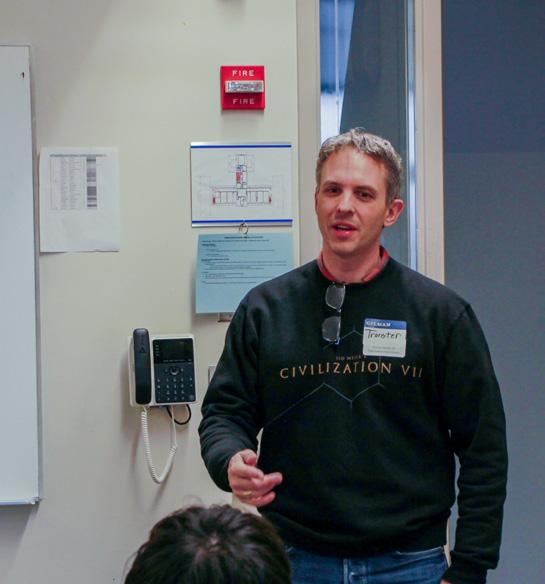
Tronster Hartley ’94, Team Lead at Firaxis Games
Brett Hollander ’03, Broadcaster at Baltimore Orioles
Will Keigler ’06, Managing Director at Flexis Capital
Rob Law ’01, Partner at Shot Tower Capital
Dr. Kelvin Liu P’27, Founder at Circulomics
Jon Manekin ’98, Founder at Falls Road
Mushroom Company
Amy Markwort P’31, Manager, National Teams Development Program at USA Lacrosse
Singleton Mathews ’02, Member of the U.S. National Guard
Peter McGill ’93, PP, Managing Director at Cushman & Wakefield
Dr. Hugh Mighty PP, P’34, Principal Investigator, Centers of Excellence (OBGYN) at Howard University
Dr. Amol Narang ’03, Vice Chair, Department of Radiation & Oncology at Johns Hopkins University
JD Nelson ’01, Managing Director at Oppenheimer & Co. Inc.
Josh Schapiro P’36, ’38, ’40, Anne Arundel County Firefighter
Andrew Schwartz P’32, Cinematographer
Dr. Harsh Trivedi P’28, ’30, President and CEO at Sheppard Pratt
Chris West ’68, Maryland State Senator & Attorney
Andy Brooks ’74
Singleton Mathews ’02
Chris West ’68
Jeremy Hairston ’14
Tronster Hartley ’94
ERAS OF GILMAN
In the prelude to Alumni Weekend, Gilman hosted an Upper School assembly featuring Michael Weinfeld ’91, Khalil Uqdah ’06, Darius Jennings ’11, and LJ Shapiro ’16, who reflected on their experiences and the enduring qualities of the School.
Weinfeld noted changes in technology and facilities while emphasizing that Gilman’s people remain its defining strength. Uqdah shared favorite traditions and the full-circle moment of returning for a community iftar dinner after helping found the Muslim Student Association. Jennings reflected on school spirit, multi-sport participation, and academic habits that carried into his NFL career. Shapiro discussed the teacher-coach model and mentors who inspired his return to Gilman as an educator, including colleagues Nick Schloeder ’85 and Jeff Gouline ’00
MLK CONVOCATION HIGHLIGHTS LEADERSHIP, BROTHERHOOD, AND CHANGE
At the Dr. Martin Luther King, Jr. Convocation on January 14, students were asked to reflect on how they can create change at Gilman and beyond. A panel featured Dr. Joe ValentineWhite ’07, BSU Vice President Marcus Turpin ’27, Upper School English Teacher Tim Holley, Jr. ’77, and recent graduate Marcus Walker ’23, now at Morgan State University, who discussed Dr. King’s legacy and the role of Gilman in shaping their perspectives on justice and equality.
Walker spoke about the sense of brotherhood he found at Gilman. Holley reflected on witnessing Dr. King’s legacy evolve over time and later founding the African American Literature elective in 1987. Turpin added a student voice to the conversation, connecting current experiences to the panel’s broader themes.
ALUMNI SHARE PERSPECTIVES ON AI IN THE WORKPLACE
Timur Guler ’14, Machine Learning Engineer at Spotify, and Luis Queral ’09, Lead Product Designer at The New York Times, returned to campus for an Upper School assembly on “AI in the Workplace,” moderated by Nathaniel Badder ’94. They shared how they use AI in their professional roles, with Guler offering foundational definitions and emphasizing critical evaluation of information, a skill he traced back to his Gilman education. Queral discussed AI’s growing role in design and media, including video generation and software development, while urging students to remain discerning about low-quality online content and emerging “AI slop.” The session concluded with student questions on ethics, creativity, and AI’s future impact.
LIVING WITH PURPOSE, AND OTHER LESSONS FROM VETERANS DAY SPEAKER ANDREW KATZ '13
Former U.S. Army Captain Andrew Katz ’13 spoke at Gilman’s Veterans Day assembly on November 11, 2025, urging students to embrace service in everyday life. He encouraged students to live with purpose, put others first, and recognize that “just showing up” can be a meaningful act of service.
Katz highlighted servant leadership he experienced at Gilman, including Ned Emala ’13, JD Kameen ’10, and Jeff Gouline ’00, each of whom shaped his understanding of character, mentorship, and support for others. He also reflected on his 2025 summit of Mount Everest, sharing a story of mutual sacrifice with his climbing partner, which reinforced his belief that service is reciprocal. Katz concluded with a Q&A with students on leadership, service, and his post-Gilman journey.
LEFT TO RIGHT Michael Weinfeld ’91, Khalil Uqdah ’06, LJ Shapiro ’16, and Darius Jennings ’11
Luis Queral ’09 and Timur Guler ’14
Marcus Walker ’23
Tim Holley, Jr. ’77 and Marcus Turpin ’27
Andrew Katz ’13
NESBITT ’74 SHARES HOLIDAY STORY AND SCHOOL MEMORIES
Bill Nesbitt ’74, a member of Gilman’s Alumni Association Board of Governors, visited the William Passano Library for the Lower School’s Holiday Reader program, which brings guest readers into pre-k through fourth grade classrooms each December. He read “Santa Bruce” by Ryan T. Higgins to section 2B, taught by fellow alum LJ Shapiro ’16, bringing the story to life for students.
During a Q&A, Nesbitt shared memories of his own Gilman experience, including learning music from Helen Stevens and Bill Merrick ’51 and participating in weekly chorus. He also reflected on changes to the School over time and his involvement with the Traveling Men, sparking an impromptu performance of “The Gilman Five” with the students.
CONNECTING GENERATIONS:
ALUMNI READ TO LOWER SCHOOL BOYS TO KICK OFF READ-A-THON
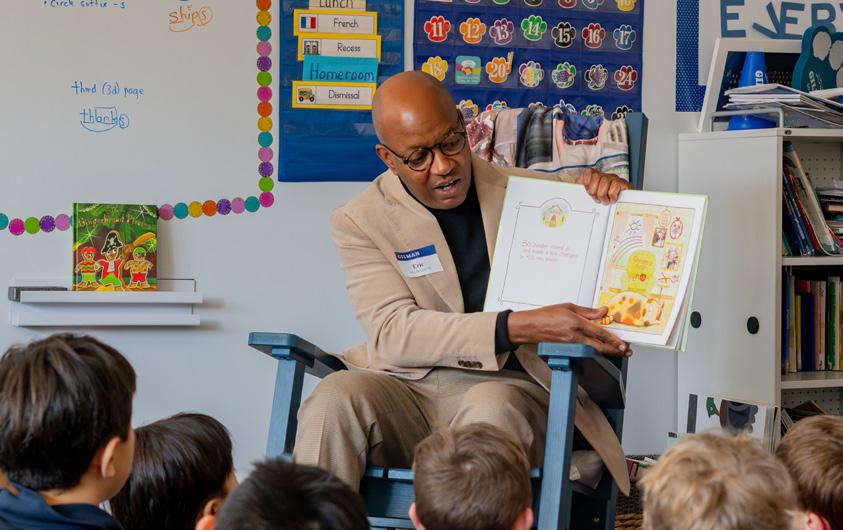
To kick off the annual read-a-thon in the Lower School, several alumni — Matt Baum ’93, Eric Bryant ’88 (pictured left), Stephen Demos ’09, Alex DeWeese ’11, John Schmick ’97, Johnny Shapiro ’17, and Will Zerhouni ’94 — read books to boys in their classrooms on January 20, 2026
WEEK OF DIALOGUE: HONORING STORIES AND BUILDING UNDERSTANDING
Now nearly a decade strong, Gilman’s Upper School Week of Dialogue continues to center the experiences of LGBTQ individuals in our community. The week of April 6, 2026, began with classroom reflections on LGBTQ history and contributions and included a featured speaker, student-led seminars, and a celebratory LGBBQ. This year’s speaker, Scott McCaughey ’94 — the first openly gay student at Gilman — shared his story with honesty and perspective, reflecting on both the challenges he faced and the support he received. His return underscored the progress the School has made and the importance of continued conversation, driven by student leadership and supported by faculty partnership.
BECOMING HUMAN: ALUMNI REFLECT ON PURPOSE, LEGACY, AND LIFE
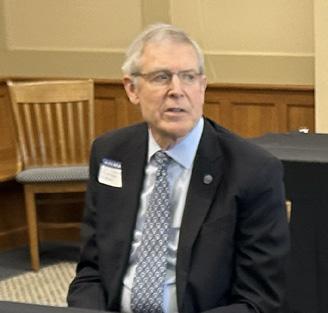
Mike Hilliard ’71, Jim Garrett ’61, and Tom Waxter ’52 visited campus as guest speakers in the 10th grade elective Becoming Human, which explores purpose across the life cycle through conversations with people at different stages of life.
Students asked the alumni about meaning, responsibility, and how they spend their time. Hilliard, reflecting on his work with the Baltimore City Police Department and later civic and church service, emphasized purpose in retirement. Garrett discussed lessons from his Gilman education and his work with Outward Bound, as well
ARTFUL ADVICE
as his role in creating the Middle School’s Talk program. Waxter, a retired judge, shared reflections on his legal career, family influences, and the evolving nature of purpose over a lifetime. “His emphasis on the importance of professional and familial relationships was heartening,” said the course’s teacher, Director of Health Education Bessie Oster. “The boys were especially struck by his perspective that one’s purpose changes over the course of the life cycle.”
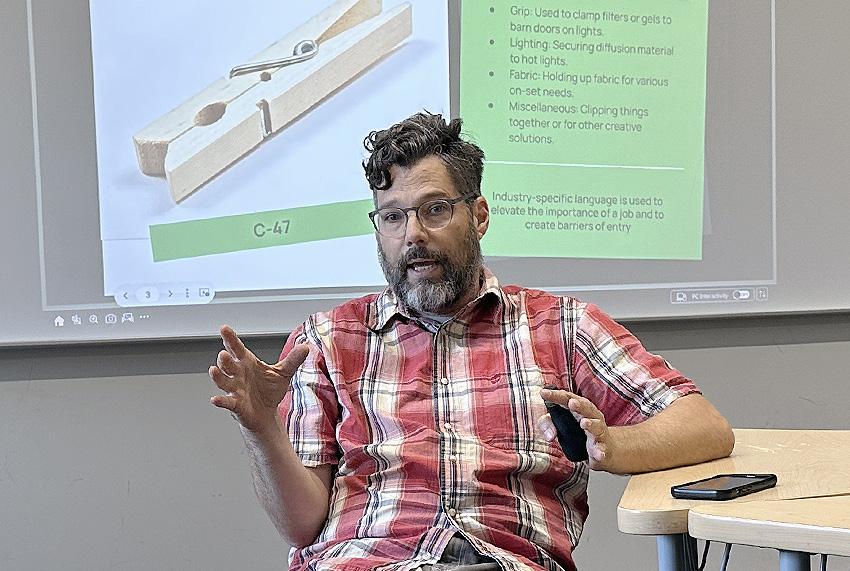
Steve Ruark ’96
Robert Marbury ’89
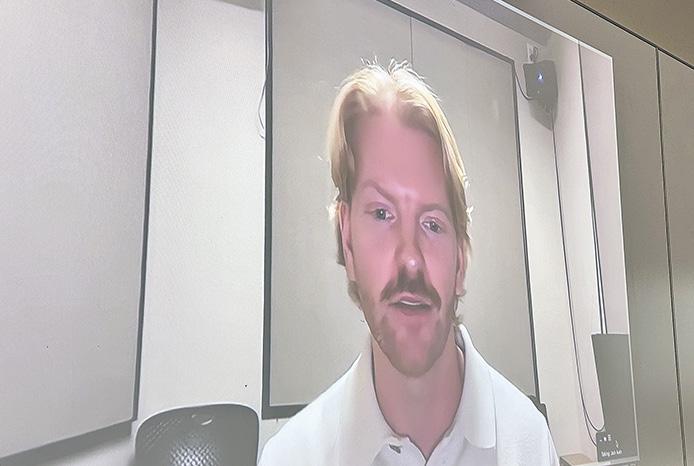
Jack Auen ’15 (via Zoom)
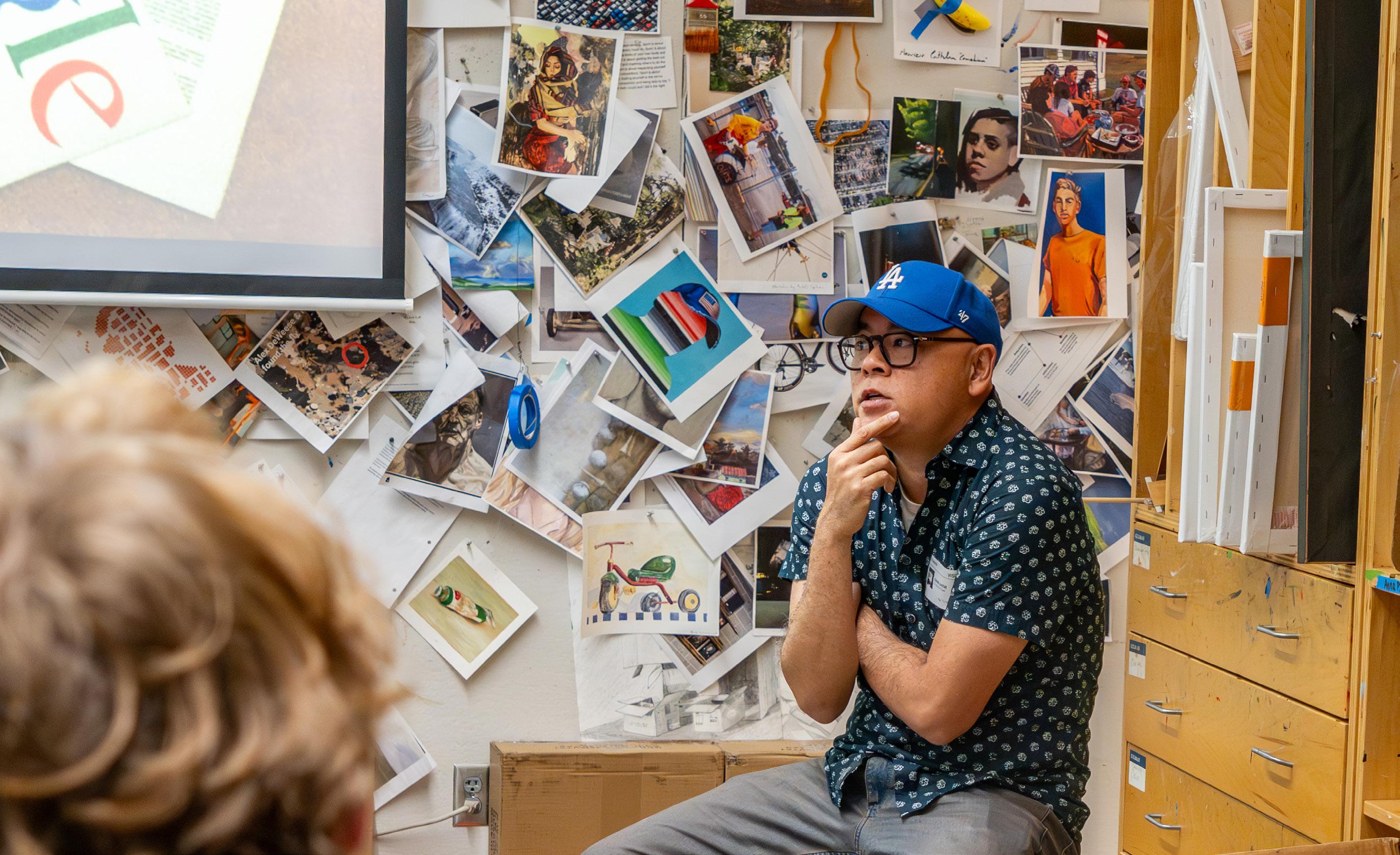
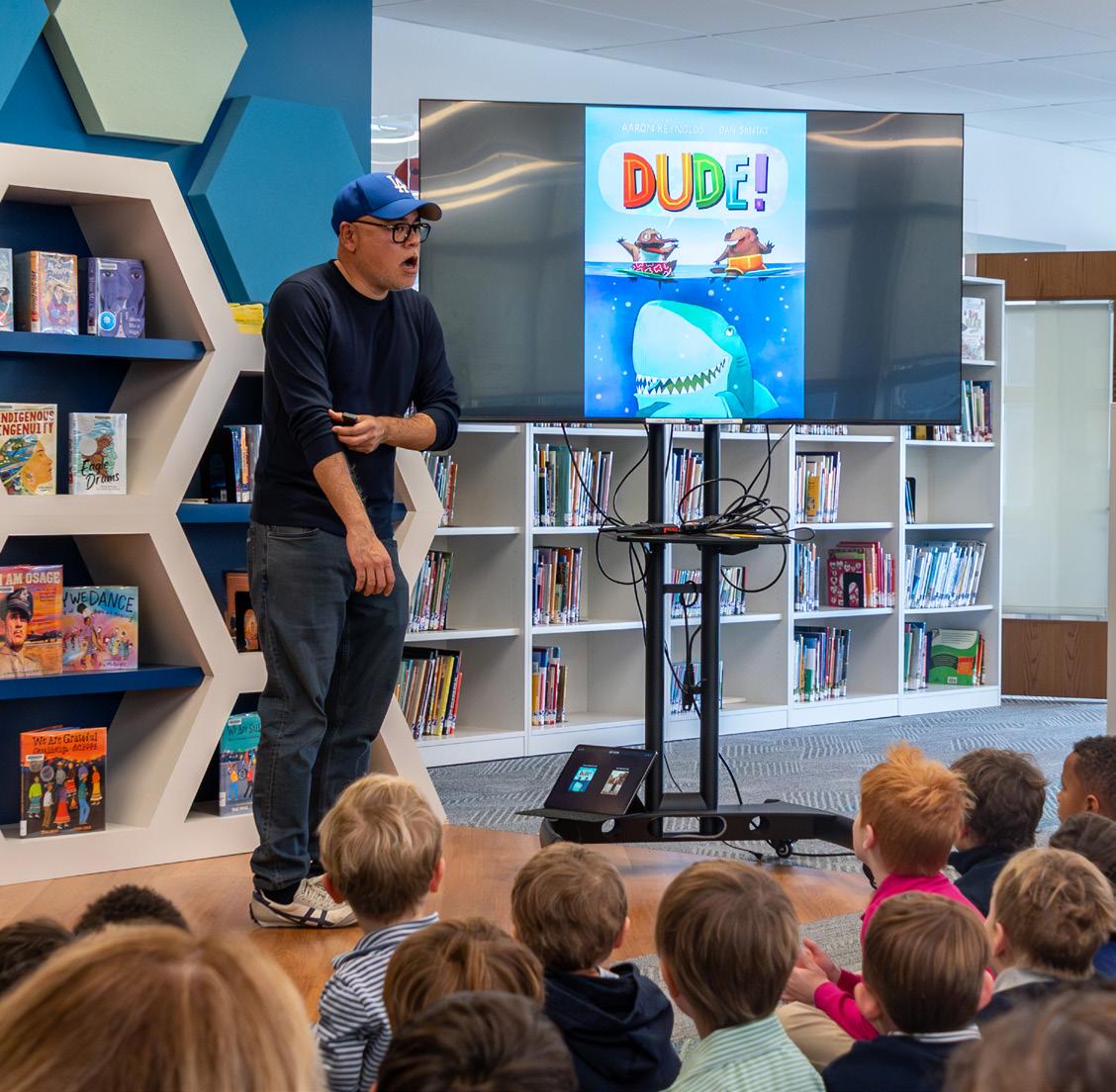
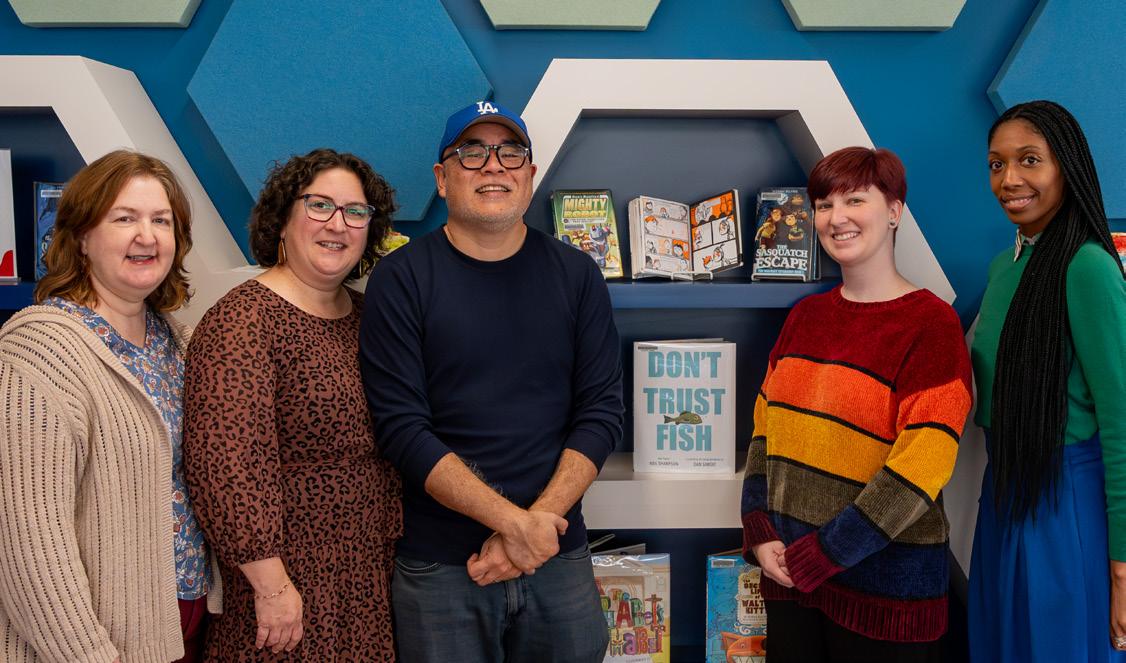
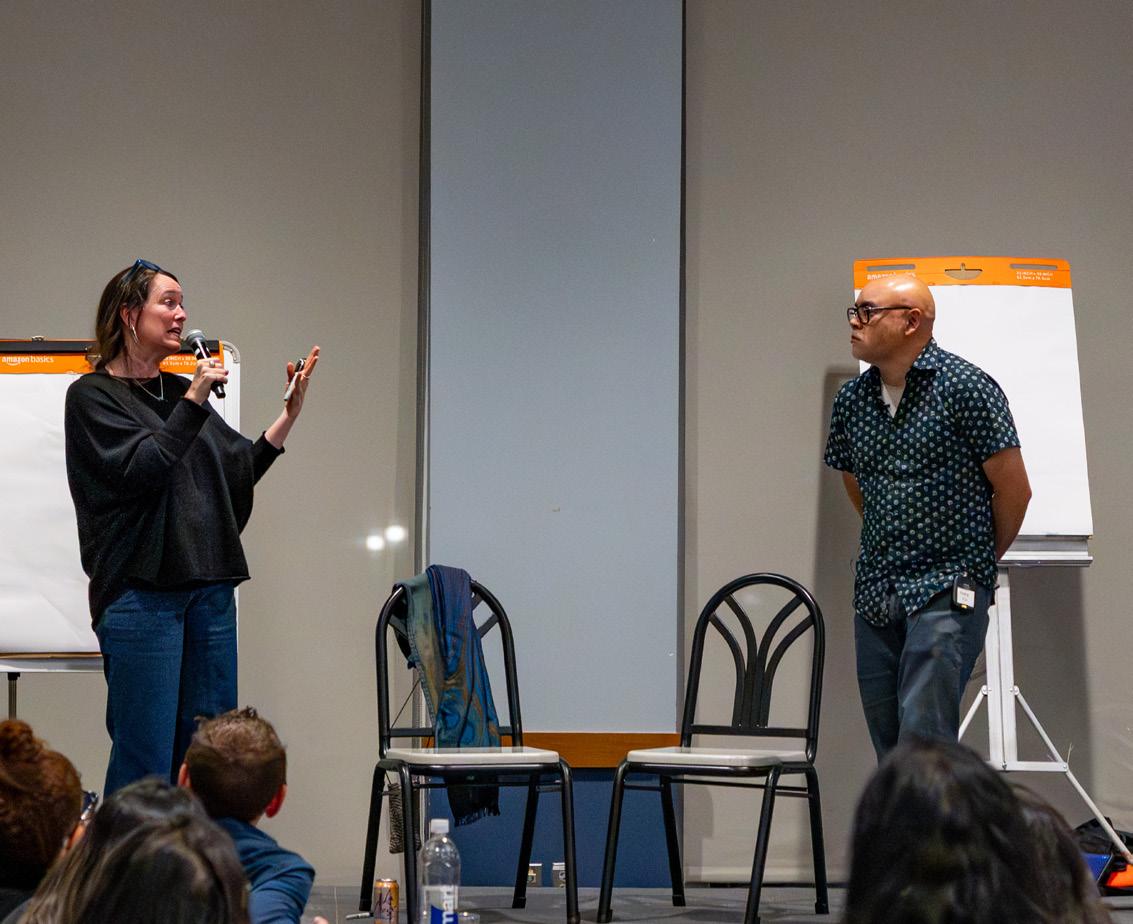
The alumni shown here visited Gilman for the Art as a Business immersive in the Upper School, led by Nathaniel Badder ’94, in early winter. Read more about the immersives initiative on page 34.
Alumni On Campus
FOOTBALL ALUMNI BBQ
Twenty alumni joined the varsity football team for the annual Football Alumni BBQ, an evening of fellowship before the Hounds’ victory over St. Mary’s. Alumni watched practice, shared memories, and heard remarks from Head Coach Scott Van Zile.
Guest speakers David Emala ’74 and his son, Ned Emala ’13, reflected on Gilman football’s enduring traditions and family legacy. Among the alumni in attendance were legendary Coach Alex Sotir, Michael Sotir ’78, Al Burk, Jr. ’68, Michael Austin ’76, and Tom Booker III ’79, who shared stories and advice with current players. The evening highlighted the strong bonds connecting generations of Greyhound football, a tradition now carried forward by coaches Ned Emala ’13, Kevonte Beard ’18, George Hopkins ’88, Nick Schloeder ’85, and Robbie Wright ’06.
ADAM JANET WRESTLING TOURNAMENT
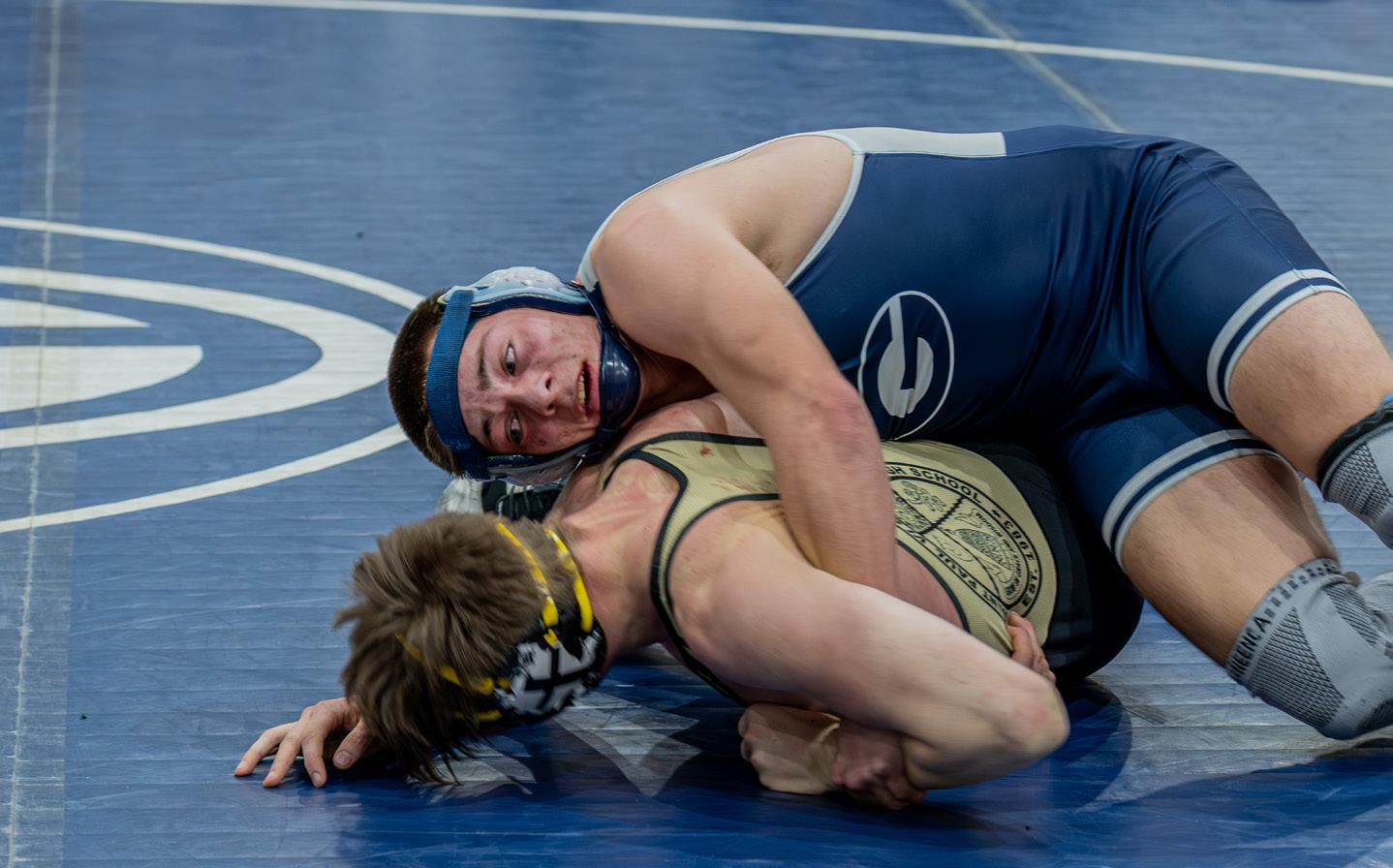
The Greyhounds finished second out of 14 teams at the Adam Janet Wrestling Tournament on December 29, 2025, in a competitive Maryland and D.C. field. Four individual champions led the way: Miles Molina ’27 (113 lbs), Christian Wirts ’28 (126 lbs), Sawyer Peck ’27 (165 lbs), and Arthur Konschak ’27 (175 lbs), all of whom are set to return next season.
ALUMNI LACROSSE GAME
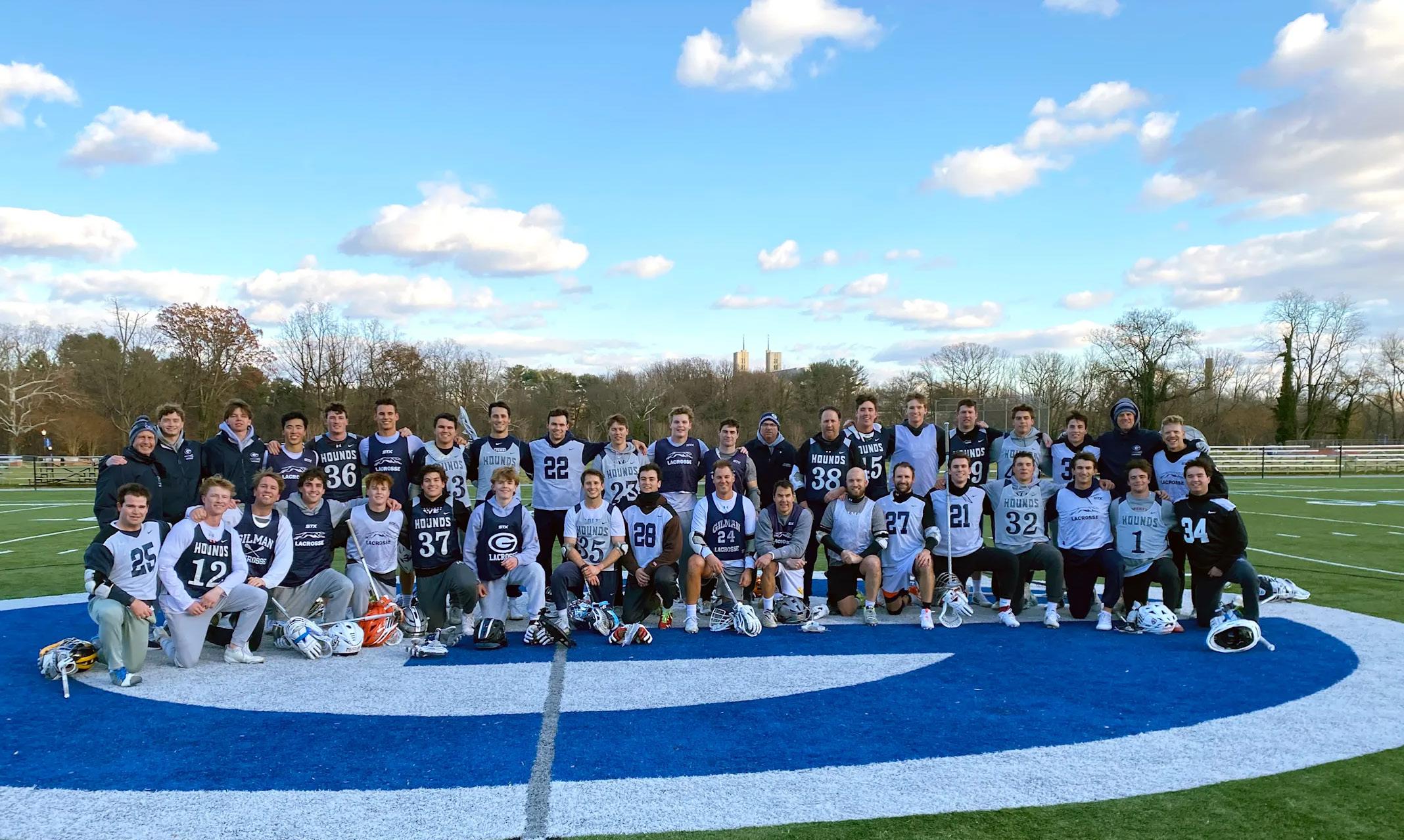
Brown Field hosted another competitive alumni game, with Gray defeating Blue 10–7 in cold, windy conditions. The matchup featured balanced scoring from both sides and strong midfield play for Gray and attack-heavy production for Blue.
Gray scorers included Piper Bond ’18, Logan Paff ’19, Pierce Washburn ’20, Johnny Shapiro ’17, and Matt Feola ’25, with
Held over winter break, the packed gym created a strong atmosphere for high-level wrestling. Head Varsity Wrestling Coach Bryn Holmes praised both the team’s performance and the program’s community effort in hosting the event, noting the culture built by wrestlers, families, and supporters. The Greyhounds’ efforts across the lineup secured an impressive runner-up finish.
assists from Jack Tortolani ’20, Chris Walsch ’13, Austin Hudson ’17, and Feola. Blue was anchored by Jay Wilkerson ’24, Michael Maloney ’24, Clayton Baddley ’24, and James Meyer ’24, representing the 2024 MIAA A-Conference semifinal squad.
Goalkeepers Zach Parks ’25 and Logan Gordon ’28 helped anchor the contest. Thanks go to Ned Emala ’13 for field setup and Dan Muhly PP for officiating.
Live from Roland Avenue
Live from Roland Avenue, a webinar series new in the 2025–2026 school year, featured dynamic discussions on the topics shaping our world. The series showcases the expertise of Gilman alumni and shares it with the broader Greyhound community. Thank you to our inaugural participants!
MAKING THE MOST OF AI
AI experts Jeff Seibert ’ 04, CEO at Digits, Timur Guler ’ 14, Machine Learning Engineer at Spotify, and Aaron Gokaslan ’ 14, Computer Science Ph.D. Candidate at Cornell University and former AI Resident at Facebook, explored the history and future of artificial intelligence, as well as the technology’s impact on education, career paths, and moral and ethical standards.
CAPTURING AN AUDIENCE IN AN INCREASINGLY COMPETITIVE WORLD
Mike Eisenstein ‘06, Director of Olympic Production, Programming & Sales Integration at NBC Sports, Jon Laws ’ 02, Head of Global Consumer Insights at EA Sports, and Evan Redwood ‘08 Business Development, Media & Entertainment Content Partnerships at
Google, spoke about strategies for engaging audiences in today’s rapidly evolving competitive environment.
CAREERS OF THE 21ST CENTURY
Collin Wallace ’02, Partner at Lobby Capital, Scott Kidder ’ 03, CFO for The Onion, and Ben Weinfeld ’23, Founder of Propagentic, examined the shifting landscape of careers in the 21st century, the jobs that will be most impacted, and the skills that will be most prized.
BREAKTHROUGHS IN HEALTHCARE
Philip Beatson ’00, Senior Vice President, Strategy and Operations at Mercy Health Services, Dr. Amol Narang ’ 03, Director of the Johns Hopkins Pancreatic Cancer Multidisciplinary Clinic, and
Ethan Weiss ’87, Chief Scientific Officer and Co-founder at Marea Therapeutics, discussed the breakthroughs in science, patient care, and hospital administration that will undoubtedly impact us all.
FROM PREPS TO THE PROS
Chisom Opara ’99, Assistant Director of Player Personnel for the Minnesota Vikings, Andrew Stanley ’91, Director of Athletics at Collegiate School (Va.), and Jack Tortolani ’ 20, Assistant Men’s Lacrosse Coach at St. Joseph’s University, considered the evolving environment of high school, college, and professional sports.
42ND ANNUAL GILMAN DUALS AND WRESTLING ALUMNI RECEPTION
Twenty-five wrestling alumni gathered during the annual Haswell M. Franklin, Sr. ’50 Gilman Duals, which featured eight schools from five states. Attendees represented eight decades of Gilman wrestling history, including Tom Waxter ’52, who attended for the fourth consecutive year, and Andy Weinstein ’20, who reconnected with fellow alumni, including his uncle, Rich Weinstein ’87. Weinstein also caught up with Bill Gamper ’71, who continues to volunteer as an assistant coach and reflected on the coincidence of both winning MIAA titles on the same February date 50 years apart. Head Coach Bryn Holmes stopped by to provide program updates before alumni returned to the mats to watch the Greyhounds capture the Duals championship.
What’s the Buzz?
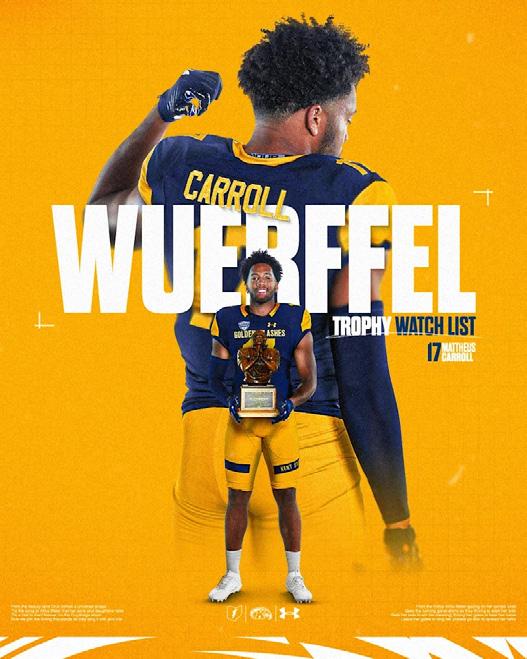
CARROLL ’21 NOMINATED FOR TWO PRESTIGIOUS COLLEGE FOOTBALL AWARDS
Mattheus “Stretch” Carroll ’21, a defensive lineman at Kent State University, was named to the watch list for the Jason Witten Collegiate Man of the Year Award. The nomination follows Carroll’s nomination in August 2025 to the watch list for the Allstate Wuerffel Trophy. The Witten Award is presented annually to the Football Bowl Subdivision college football player who has demonstrated a record of leadership by exhibiting exceptional courage, integrity, and sportsmanship both on and off the field. The Allstate Wuerffel Trophy is college football’s premier award for community service.
WEST ’68 RETIRES FROM MARYLAND STATE SENATE
WYPR, Maryland’s NPR affiliate, profiled Sen. Chris West ’68 upon his retirement from the Maryland State Senate. West, a self-described moderate Republican who represents portions of Baltimore and Carroll Counties, retired after 12 years of
service in the Maryland General Assembly. He told WYPR that he oversaw the passage of more than 100 bills during his distinguished tenure.
BOZZUTO ’92 LEADS CREATION OF $330M REAL ESTATE INVESTMENT FUND
The Baltimore Business Journal wrote a feature article on the Bozzuto Group’s partnership with Invesco Real Estate in a new $330 million real estate investment fund. Toby Bozzuto ’92, the company’s President and CEO, was central in securing the deal. According to the article, the fund targets multi-family developments along the East Coast. Bozzuto Group and Invesco are focusing on multi-family developments in mid-sized cities like Fort Lauderdale and Tampa, and larger markets like Boston and Miami.
VAN BERGEN ‘93 LEADS NEW PRIVATE-PUBLIC PARTNERSHIP AT WASHINGTON UNIVERSITY
Washington University in St. Louis (WashU) announced the creation of a college-community partnership initiative,
led by inaugural Executive Director Chris Van Bergen ’93. The program, called the Public Exchange, will harness WashU’s intellectual capital to help solve community problems with a simple formula: Connect university researchers with external organizations to accelerate problem-solving and turn research into actionable solutions. Van Bergen brings pertinent experience as CFO and COO of Nest, a nonprofit focused on the global artisan economy. He has also taught on social impact and sustainability at NYU’s Stern School of Business, where he earned his Executive MBA in Global Business, Strategy, and Leadership.
RAHMAN ’06 GUIDES NEW PREMIER JUMPING LEAGUE AS GENERAL COUNSEL
Zahir Rahman ’06 is a member of the executive team leading the launch of the Premier Jumping League, or PJL. He will serve as General Counsel for the global showjumping league. Backed by longtime professional sports leader and investor Frank McCourt and his company, McCourt Global, the PJL, a groundbreaking, highstakes, elite equestrian competition, will provide a global competition platform with 16 teams and a $300 million guaranteed prize pot. The inaugural season will run from March to October 2027 across 14 international venues, spanning Europe, North America, and the Middle East. The PJL will partner with Emmy award-winning production company Box to Box Films and will be supported by a free-to-view broadcasting model.
BRYANT ’88 APPOINTED TO MARYLAND STATE BOARD OF ELECTIONS
Governor Wes Moore announced in January 2026 the appointment of Eric Bryant ’88 to the Maryland State Board of Elections. Bryant most recently served as chief of staff to Congressman Kweisi Mfume (D-MD), following 17 years — three as senior associate and 14 as partner — with the Maryland-based law firm Rifkin Weiner Livingston LLC (RWL). Before joining RWL, Bryant served as Assistant Director of National Field Operations for the NAACP, working on various civil rights issues, including largescale, non-partisan voter registration drives and voter re-enfranchisement efforts.
ATKINS ’80 NAMED D.C. BAR’S LAWYER OF THE YEAR
William Atkins ’80, a longtime intellectual property partner at Pillsbury Winthrop Shaw Pittman LLP, was named the 2025 Lawyer of the Year by the Bar Association of the District of Columbia (BADC). The BADC, founded at the historic National Hotel in 1871, is the first bar association in the District of Columbia and one of the four oldest bar associations in the United States. This award is the highest honor bestowed by the BADC. It recognizes Atkins’s exceptional legal skill and deep commitment to the bar. Over the course of more than three decades, he has led hundreds of complex IP litigations in courts, before the U.S. Patent Office, and at the International Trade Commission.
RANDALL ’23 HELPS U.S. ARMY VETERAN CHRONICLE VIETNAM EXPERIENCES
Cole Randall ’23, a mechanical engineering and political science doublemajor at Union College, partnered with David Matloff — a U.S. Army MASH surgeon who served in Vietnam — to help him write his memoir, “Reflections from Vietnam / David B. Matloff Collection,” which was accepted by the Library of Congress. Randall worked on the memoir for months with Dr. Matloff, who spent 30 years as a general surgeon at Geneva (New York) General Hospital after his service. Randall views the library’s acceptance as a meaningful accomplishment. In an interview with Union, he called it “an important step to preserve a critical part of history.”
MCELROY ’10 AND TWO CROW COLLECTIVE PROFILED BY PBS
Arts Plus, a local public television program produced by PBS affiliate WEDU in Florida, profiled Jame McElroy ’10 and Two Crow Collective, his small-batch clothing company that merges punk culture with storytelling. He discovered screen-printing in his college years. A longtime musician, he later started a side venture, promoting bands with apparel he printed after coming home from his 9-to-5 job. During COVID, he pivoted from printing clients’ designs to producing his own art and clothing lines. Today, his clothing company focuses on raising awareness for chronic illness, mental health challenges, and disabilities.
LANE ’21 INVITED FOR VIP TOUR OF PENTAGON
Marine Corps 2nd Lt. Rayuan Lane III ’ 21, a 2025 graduate of the Naval Academy and rookie defensive back for the Jacksonville Jaguars, was invited by Defense Secretary Pete Hegseth in 2025 for a special visit to the Pentagon. Lane’s visit included a tour of the Pentagon with a robust history lesson on the Defense Department and introductions to some of its current leaders. For his part, Hegseth praised Lane for the example he sets for service and excellence: “Think about all the kids that can look and say, not only can I serve my country, but I can excel at the highest of levels and make it to the NFL,” he told Lane, as quoted in an article shared by the Department of Defense. Lane had a busy 2025: In early March, he participated in the NFL Scouting Combine, an invite-only, weeklong skills showcase for the top NFL draft-eligible players in college football. In April, he was selected by the Jaguars in the sixth round of the NFL draft. Lane graduated from the Naval Academy in May and was commissioned as a second lieutenant in the Marine Corps. In August, he earned a spot on the Jaguars’ opening 53-man roster after an impressive preseason. He played in all 17 regular-season games for the Jags, registering 13 total tackles and helping the team finish 13-4 and at the top of the AFC South Division standings.
Alumni Out and About
WASHINGTON, D.C.
Thirty alumni gathered at the University Club of Washington, D.C. for an evening of conversation and reconnection. Head of School Henry Smyth shared a school update and fielded questions on topics ranging from campus improvements and artificial intelligence to demographic shifts affecting independent schools, with Trustee Duane Holloway ’90 adding board-level perspective. Pope Barrow ’61 praised Smyth’s leadership, while Ananth Josyula ’20 joined after recently returning from work abroad. Reunion volunteers Darius Jennings ’11 and Hudson Waters ’15 attended alongside Alumni Association Board of Governors leaders Alex Puthumana ’14 and Brandon Croxton ’96, P’32 Daniel Jang ’99 and Adam Gray ’16 expressed interest in becoming more involved, and many alumni lingered well past the scheduled end of the evening.
NEW YORK CITY
Seventy alumni gathered at the Union Club in Manhattan for Gilman’s annual New York reception. Special guests included Board of Trustees President Andy Brooks ’74, PP and faculty members Brian Ledyard, Tony Incontrera, and Dia Matthews. Earlier, Gilman’s Traveling Men enjoyed a behind-the-scenes Broadway experience hosted by Brig Berney ’78 before performing at the event. Co-hosts Paul McBride ’06 and Alex Puthumana ’14 welcomed attendees, while Brooks shared a campus update and Ledyard reflected on enduring aspects of the Upper School experience. Throughout the evening, alumni reconnected with classmates and faculty, reminiscing long after the program concluded.
CALIFORNIA
More than 60 alumni attended Gilman’s annual California regional events in Los Angeles, Palo Alto, and San Francisco. In Los Angeles, former Gilman parent Janet Marie Smith hosted a behind-the-scenes tour of Dodger Stadium for 30 alumni. In Palo Alto, Erwin Hosono ’78 and his wife, Beth Axelrod, welcomed attendees to their historic home, where Hosono reflected on the impact of his Gilman experience and Head of School Henry Smyth shared campus updates. In San Francisco, alumni gathered in the Financial District, including Noah Klein ’19, Abraham Karikkineth ’24, and Rohan Sinha ’23 Across all three events, Greyhounds reconnected, shared memories, and celebrated their enduring ties to Gilman.
DUNCAN
BOOTH
IS THE NEW CHIEF FINANCIAL OFFICER
Duncan Booth began his role as the Chief Financial Officer at Gilman in 2026, having most recently held the title of Chief Operating Officer at The St. Paul’s Schools for five years. Before that, Booth enjoyed a 17-year run across the bridge at Roland Park Country School, where he served as Assistant Head of School for Finance and Operations.
In addition to holding these positions, Booth has been very engaged with the world of independent school finance and operations. He is past chair of the Board of Directors of the National Business Officers Association (NBOA) and has been on that board since 2017. Closer to home, Booth served as the treasurer for AIMS from 2013–2019, and he was on the board of Education Benefits Services (EBS) for 11 years. Additionally, he has been involved in coaching lacrosse at all levels from rec to club and high school.
TERRANCE SCOTT IS THE NEW HEAD TENNIS COACH
Terrance Scott joined the Gilman team as Head Varsity Tennis Coach in 2026. Scott is a registered USTA and PTA Tennis professional with more than 30 years of coaching experience and expertise. A former standout player at the University of Maryland - Eastern Shore, Scott comes to Roland Avenue after six years as the owner and director of the All Courts Tennis Academy in Baltimore. Prior to UMD, he spent five years as the Tennis Director at Aspen Hill Club in Silver Spring. His other coaching stops include a seven-year stint with the Arthur Ashe Youth Tennis and Education Program in Philadelphia.
Scott’s coaching philosophy revolves around building men of character. “There are a lot of life skills that can be learned while playing tennis, and I plan on incorporating all of them in our way of training and competing. Hard work, discipline, intensity, and striving for excellence are my core values.”
MICKEY WATSON IS THE NEW DIRECTOR OF THE FINNEY-GREENE PROGRAM
Mickey Watson was named Director of the Finney-Greene Program, following the departure of Dr. Joe Valentine-White ’07 in the summer of 2026. The Finney-Greene Program extends Gilman’s nearly 70-year legacy of making the School accessible to talented boys of all backgrounds. Founded in 2017 by Head of School Henry Smyth and generous alumni, the Finney-Greene Program honors two people who contributed greatly to Gilman’s modern constitution: Mr. Redmond C. S. Finney ’47 and Mr. Bill Greene. The program offers academic, non-tuition financial, personal, and social support to nearly 50 promising students in Middle and Upper School.
Watson’s experience as Gilman’s Head Varsity Soccer Coach and an Upper School Student Support Team member, as well as his passionate advocacy, tireless work ethic, and successful culture-building efforts illustrate how well-prepared he is for the role.
ANNA FOLLENSBEE IS THE NEW DIRECTOR OF COLLEGE COUNSELING
Anna Follensbee, a member of Gilman’s College Counseling Office since 2013, became Director of College Counseling in the summer of 2026. Prior to Gilman, she spent nine years as a college admissions counselor at Eckerd College, Providence College, and Loyola University Maryland. In addition to college counseling, Follensbee is an advisor and intramural coach and has taught English and led the Senior Encounter program.
Follensbee describes her approach to college counseling as “holistic,” saying, “We work closely with each student to understand his distinctive strengths, accomplishments, and goals as we help them build a college list and put forth compelling applications. It’s so rewarding to help students engage in a self-reflective process where they consider what is important to them in their next community. That often includes reflecting on what has been meaningful to them about their years at Gilman.”
ADVANCEMENT OFFICE UPDATES
Riley Campbell ’09 has been named Gilman’s new Director of Alumni Relations. No stranger to the Advancement Department, Campbell has served as the Associate Director of Annual Giving for the past two years. In this role, he has helped elevate The Gilman Fund efforts while focusing on annual mailings, donor acknowledgments, and reunion giving. Known for his careful planning, systematic approach, and attention to detail, Campbell — who admittedly “loves the chaos of Alumni Weekend”— began his new role in July 2026
Campbell’s promotion created a new opening on the Advancement team. Haswell “Mac” Franklin ’14 has been named Gilman’s new Associate Director of Annual Giving. Franklin returns to Roland Avenue from Washington College, where he has spent the last three years as an Athletics Gift Officer. In this role, he generated revenue by executing a comprehensive alumni engagement strategy across athletic programs and expanding donor participation.
After 25 total years of dedicated service, Dr. Peter O. Kwiterovich III ’87 left Gilman at the end of the 2024–2025 school year (too late for inclusion in the last Bulletin) to pursue other opportunities. Kwiterovich’s impact has been lasting, and we are grateful for the time, talent, and care he brought to his work over the years — first as a teacher, coach, and Upper School Dean of Students; later, as Head of Middle School; and finally, as Assistant Head of School. We extend our sincere thanks to Kwiterovich for his dedicated service to Gilman, and we wish him all the best in his future endeavors.
Painting aLegacy A
SENIOR’S ARTWORK CELEBRATES THE JOY OF READING
“We thought it would be nice to capture Gilman kids doing one of the things they love to do, which is reading,” says Lower School Librarian Melissa Da. For the last couple of years, she had been keeping an eye out for student artwork to hang in the recently renovated space — but had not been successful in finding the right piece. Then she had the idea to commission one instead.
The seniors graduating this year were Da’s first students at Gilman when they were in fifth grade in the Lower School. Joshua Turner ’26, who enrolled as a fifth grader, was new to the community at the same time as his librarian in 2018, and Da has had the pleasure of watching him grow as an artist over the years. Now, he’ll be “leaving a legacy in the library,” she says.
Turner has always been interested in art but became more serious during his junior year AP Drawing/ Painting class when he put in many hours in the studio. He and Da worked together to select photos — of Gilman boys doing what they do in the library — that he would paint. It was important to Da that the “spirit of working together” be depicted; Turner wanted to be sure he could “convey the real wonder and emotional depth in their facial expressions.” They landed on two
THE MAKING OF A MASTERPIECE
photos: one of two boys reading together at the Lower School Book Swap and one of two boys working to solve a mystery at a third grade book club session. Da views the whole process — of bringing an aesthetic discipline into the library, recognizing a student’s talent and supporting his passion, and collaborating on this project with Turner — as a perfect representation of “what we value at this school.”
Turner is headed to Columbia University in the fall where he’ll study financial economics and art. Though his days on Roland Avenue are over, he hopes “that my pieces not only make boys in the library excited to read but also inspire them to pursue the arts, knowing a Gilman student painted those images.”
ABOVE AND BELOW Finished pieces
ABOVE AND BELOW Original photos and in-progress works
LEFT Joshua Turner ’26 stands with his mother, Michelle Turner (who teaches fourth grade in the Lower School), and Lower School Librarian Melissa Da stands with Art Department Chair Karl Connolly at a small ceremony on June 1, 2026, where the paintings are revealed. These pieces are currently the only works of art by an Upper School student on display in the Lower School.
ONE LOVE CLUB BREAKS THE SILENCE ON TEEN DATING VIOLENCE AT SILENT NIGHT BASKETBALL GAME
At the home varsity basketball game on January 23, 2026, a costumed student body remained silent in the bleachers until the Greyhounds scored six points. The Silent Night tradition, which dates back to the early 2010s, returned this year with a new twist, as Gilman’s One Love Club spread awareness and provided resources about teen dating violence in the lobby before the big game.
Club leaders Sam Nuermberger ’26, Drew Klein ’27, and Asher Mathai ’26 decided the club should make an appearance at several athletic events this school year to promote the important message of the One Love Foundation to Greyhound fans. Director of Wellness and Support Jean Perez and Director of Health Education Bessie Oster, who are advisors for the club, helped the boys develop the concept of breaking the silence of teen dating violence to coincide with the basketball game’s theme.
Relationship abuse among teens and in high school relationships can be physical, verbal, or emotional, the club leaders explained. “It is important for high school students and their families to learn about the different types of dating violence and to create strategies to prevent them for themselves and for others,” said Nuermberger “We hope this event will teach people about the importance of recognizing both unhealthy — and also healthy — relationships,” added Mathai. In addition to wristbands, the group handed out “conversation starters” to support parents in engaging their teens in critical conversations about relationships.
The club’s founding advisor, Assistant Head of Upper School Beth Knapp, was instrumental in bringing the club to Gilman back in 2015. She had a personal connection to the family of Yeardley Love, the Baltimore native for whom the foundation was named. Tragically, Love, who played lacrosse at Notre Dame Prep during high school and then at the University of Virginia, was killed by an ex-boyfriend shortly before her college graduation in 2010. “When I came to Gilman, I realized that One Love Foundation’s goals of fostering healthy relationships complimented the Gilman mission of producing men of character who make a positive impact on the communities in which we live and work,” said Knapp. “We’re all in
Upper School Counselor Nazeé Wright, Director of Wellness and Support
Jean Perez, and Director of Health Education Bessie Oster stand behind the One Love table at Silent Night.
“We’re all in all kinds of relationships, and making those relationships healthier can lead to a ripple of positive impacts.”
–BETH
KNAPP, ASSISTANT HEAD OF UPPER SCHOOL AND FOUNDING CLUB
ADVISOR
all kinds of relationships, and making those relationships healthier can lead to a ripple of positive impacts.”
Oster and Perez had been looking to expand upon the wellness festival held at Gilman in recent years into more consistent programming throughout the year. “Healthy relationships are important for all ages, and we thought the message would resonate well through athletics, particularly given the history of the One Love organization,” said Perez.
Throughout the school year, the One Love club meets regularly and holds discussions following a One Love Foundation-provided lesson or video presented by the club leaders. Students who want to get involved should attend a meeting, where conversations about relationships are encouraged. Klein noted that previous club leaders and upperclassmen “always created a welcoming and open environment” and “gave me a time and place to look forward to being open.” He hopes that during his leadership, he can “continue to grow this club and make an impact.”
WELLNESS + READING = BINGO!
After growing the Book Bites program (featured in the 2025 Bulletin on page 36) from an early childhood read-aloud into a healthy food tasting and eventually a full Lower School assembly, Gilman’s wellness team partnered with the Lower School librarians to expand the initiative once again. Wellness Self-Care Book Bingo launched in late winter, offering students the chance to earn House points and other prizes. The game encouraged boys to explore books across eight wellness categories — mindfulness, fruits and vegetables, friendship, hygiene, growth mindset, exercise, emotional expression, and sleep.
SNOW GLOBES FOR GOOD
“This Is Who We Are”
The 2025–2026 school year was Early Childhood Art Teacher Amy Digges’ first at Gilman but not her first participating in “The Village of Cross Keys Gifting Back to Baltimore” holiday tradition to celebrate creativity, community, and compassion. In its inaugural holiday season in 2024, Digges was teaching art at Boys’ Latin, so this competition — which involves a creative venture whose winner garners support for a chosen charity — was perfectly suited to her.
Cross Keys identified the theme for 2025 as Snow Globes for Good. Each of the 14 local participating schools created a snow globe to reflect the uniqueness of their school’s spirit while honoring the mission of their nonprofit partner. “Together, they capture the true heart of giving back,” according to the website. Digges appreciated this theme because of the exciting sculptural component the snow globe aspect brings.
With the Donald Bentley Food Pantry, an organization near and dear to the hearts of so many in the community, selected as Gilman’s nonprofit partner, Digges wanted “as many hands to make their mark” as possible. She came up with the initial idea — to make the base of the snow globe look like a food pantry — while brainstorming at home with her husband, Kip, who teaches Middle School Spanish at Gilman. A few fourth graders wrote about the community effort and the Donald Bentley Food Pantry; one read aloud at the event at Cross Keys on November 19, 2025, where all 14 globes were revealed and voting began (see bottom photo).
carrying a lit-up sack filled with canned goods, seemingly on its way to the pantry at the base.
Because the masterpiece was shaped by so many, the final product truly reflects the diversity of the Gilman community.
Students of all ages were involved in the creation of the globe: Boys in grades 2–12 worked on individual canned goods that were glued on the base, while those in pre-k through first grade fingerprinted “berries” on the painted wreaths featured on one side. A few faculty members got in on the fun as well, decorating canned goods and coordinating student collaboration. Lower School Science Teacher Becca Stolzenbach helped students in House Council and in the Mentoring Program make their artistic contributions; Middle School Art Teachers Dave Anderson and Julia Kidd dedicated class time to the project; and Upper School Librarian Sherry Schmidt hosted interested students with Digges in the library during an afternoon block. Design & Woodworking Teacher Mike Chamberlain showed Digges how to use power tools in the woodshop so she could build the red sled that sits inside the dome, ready to glide down a hill
Because the masterpiece was shaped by so many, the final product truly reflects the diversity of the Gilman community. In addition to traditional food pantry staples like green beans and carrots, participants made it a point to also incorporate cans to represent the different families and cultures at the School. “Not everybody eats turkey and mashed potatoes,” Digges said. The decoupaged cans include anchovies, kimchi, spicy garlic sauce, and other delicacies. Another one of Digges’ goals was to have a wide range of skills depicted. “Every kid is so unique,” she said. “It didn’t need to be perfect; it just needed to be representative of the whole school. This is who we are.”
Amy Digges helps a student put his fingerprint on the project.
Learning Comes to Life IN GILMAN’S IMMERSIVE PROGRAM
A new initiative at Gilman — created to give choice in community time programming and to provide a space for faculty to share their passions — offers Upper School students nearly 40 non-traditional offerings for academic extension, alternative enrichment, or casual recreation. The immersive program’s topics range from life skills like DIY Home Repair to hobbies like Juggling; from futurefocused subjects like Careers in Sports to friendly competitions like Cornhole.
Math Teacher Donell Thompson, Jr. ’91, who moonlights as a mixmaster, put a new spin on school in the Learning to DJ immersive. “At Gilman, we actively engage in our roles as teachers, coaches, and mentors for our students,” he said. “I see it as a way of building relationships with them.”
Caleb Park ’29, who participated in Thompson’s immersive throughout the fall, looked forward to this time each week. “This class helped me appreciate how much skill and time go into making music flow naturally,” he said. “I think the program is a fun way to learn unique skills and engage in different interests.” Another student in the group had already been DJing for a couple of years, which presented an opportunity for him to help guide the learning. “His input was invaluable, and he taught me a few things,” Thompson said, noting an additional lesson students came away with — that they have agency in their own learning process.
Pat Franz, Executive Assistant to the Head of School, expertly plays the Celtic harp, among other instruments, and led the Traditional Music Sessions immersive. “I felt confident that the students interested in exploring traditional music would find a different way to express themselves musically, building on their foundational knowledge and expanding their understanding,” she said. “They enjoyed it more than I had anticipated.”
Director of Advancement Programs & Operations
Nathaniel Badder ’94, before returning to Gilman as an employee, ran a photo art business, an enterprise that was inspired by a photography class he took at Gilman. He wanted to teach the Art as a Business immersive to reach students “who have creative passions of their own and are curious about how they might make viable careers out of these talents.” In addition to his own expertise, Badder brought in alumni and parents to share their stories and approaches. (See a few on page 23.) Tyler Linkinhoker ’28, who took Badder’s immersive in the fall, said, “It was great to hear from people in the industry to see how they were able to pursue their passions and make a living while doing it.”
In addition to bringing specialized topics to supplement the established curriculum, immersives present opportunities for friendships to develop and grow. Classics Teacher Harriet Livesay, who offered the Board Games immersive, said, “Where I see the lasting impact is in the relationships, as groups often form with students who might never have a chance to do something together.”
History Teacher/JV Basketball Coach Matt Baum ’93 ran the 3-on-3 Basketball immersive. He noted that while the skill levels vary widely, the program builds camaraderie. “The students genuinely look forward to the immersive experience, which is rewarding to see.”
Finding Their Voice INSIDE HONORS PAPER IN ENGLISH
Writing a 15- to 20-page, college-level, critical essay — on top of an already rigorous academic schedule that includes an English class — isn’t for everyone. But for a handful of Gilman students each year beginning in 2019 when Honors Paper in English became an Upper School elective, it proves to be a worthwhile endeavor.
The course description emphasizes effective research practices and writing skills “to sustain an original and sophisticated argument.” In the fall semester of 2025, three students enrolled in the independent study under the guidance of Upper School English Chair Justin Baker, who met with them monthly to serve as a research mentor and writing consultant.
Donovan Herb ’26 wrote about the presence of pessimist theory in Cormac McCarthy’s “The Passenger” and the first season of the HBO series “True Detective,” which he thinks portrays the “world-weary, morally corrupt protector archetype better than any literature or media I’ve seen.” Though Herb doesn’t consider himself a pessimist,
he says he was drawn to the theory, which he describes as “a worldview that holds that consciousness leads to suffering because it allows humans to comprehend the terrifying mysteries of the universe.” Before this course, he had never delved deeply into questions about the meaning of life in an academic sense. “The chance to explore my personal opinions on different existentialist questions was very exciting,” he says, noting that this soul-searching journey led him to have a stronger personal philosophy.
Jay Salovaara ’26 signed up for the course to push himself as a writer. He used classic and contemporary theories on comedy to interpret Joseph Heller’s “Catch 22” and Douglas Adams’s “The Hitchhiker’s Guide to the Galaxy.” As a Managing Print Editor in charge of the satirical Gilman Snooze section for The News, the School’s student newspaper, comedy and comedic writing is a big part of Salovaara’s life, so choosing a topic in this direction made perfect sense.
Math Teacher Donell Thompson, Jr. ’91 works with a student in the Learning to DJ immersive.
Jay Salovaara ’26 and Zavier Quick ’27
Cultivating Curiosity AND BALANCING RIGOR WITH WELLNESS
“There is some kind of magic in the water here,” says Sarah Ross, Director of College Counseling at Gilman. She is referring to the success of the School’s students in the National Merit® Scholarship Program (NMSP), an academic competition that recognizes high scores on the PSAT exam. Approximately 16,000 Semifinalists are awarded annually across the country of 1.3 million high school students who enter, “representing less than 1% of the nation’s high school graduating seniors,” according to NMSP. Gilman’s Class of 2026 lauds eight seniors who were awarded the Semifinalist distinction.
This class isn’t unusual at Gilman; in each of many recent years, five to eight students have been given this honor. So, to what can be attributed for their achievement? To start, “Our students are incredibly aspirational and deeply curious,” Ross says. “They are excited about learning.”
and he points to science teacher Frank Fitzgibbon for guiding him to “follow the ideas that make me curious.” Garza says that the vast number of courses available at Gilman has allowed him to study subjects of particular interest to him, which, “paired with amazing teachers who care about what they teach, has helped me succeed.”
The Gilman curriculum doesn’t directly prepare students for PSAT material, and Randy Liu ’26, a Semifinalist, thinks that’s a good thing: “Engaging discussions in English classes develop our analytical ability,” a skill that is relevant for the exam. “Outside studying was certainly helpful, but Gilman classes provided the base of knowledge that I then refined.”
Other Semifinalists agree. “Gilman does a good job of introducing concept-based questions that delve into why ideas work,” says Nikhil Gupta ’26. He specifically names math teacher Jeff Gouline ’00, who “has a simple way of breaking down answers until I understand the problem.”
Teo Garza ’26 credits Gilman’s intense reading and writing program in helping him understand word problems that appear on the exam,
Finding Their Voice continued from previous page
Zavier Quick ’27 applied Frantz Fanon’s philosophy on racial identity as outlined in “Black Skins, White Masks” to Ralph Ellison’s existential epic “Invisible Man.” Though Quick enjoyed some of the books assigned in his previous English classes, he wanted to choose which literature to analyze, which is what attracted him to Honors Paper in English. Quick selected these particular pieces, both coincidentally written in 1952, because of the philosophical lens through which they explore systemic racism. “Finding connections between the two works has been enriching not only as a student but also as a Black person living in America.”
Baker says he helps students along the way by guiding them towards resources and reviewing early drafts of their essays. He thinks he is most helpful during the writing process by offering organizational models and encouraging them to take argumentative and stylistic risks. Salovaara agrees, characterizing his teacher as “very dedicated to developing my voice as a writer.” Reflecting on shorter types of
While some parts of their education — like class discussions or tests — more easily connect to the skills important for the PSAT, other aspects of the Gilman experience are at play as well — namely an emphasis on supporting students in mind, body, and spirit, in addition to academic excellence. The School offers “a robust array of PK–12 wellness programs designed to foster belonging and to build skills related to self-care, decision-making, and social awareness,” says Director of Health Education Bessie Oster, noting an intentional balance of rigor with wellness.
The research bears this out. Recently published studies in The Review of Educational Research found that “students in grades 1–12 who participated in universal school-based SEL [social-emotional learning] programs demonstrated better academic achievement.”
Oster thinks the sense of community at Gilman doesn’t hurt either. “It’s so encompassing and reliable that it lifts our boys to achieve astounding measures of excellence — academically, athletically, and artistically,” she says. Ross has observed, over her nine years at the school, that boys show enthusiasm for their peers equally for all kinds of successes, whether it’s a sports team celebrating a winning season at an assembly, a student impressively performing a traditional Irish dance in front of the student body, or the debate team returning from a tournament victorious. “The beauty of this place is that it’s cool to be smart.”
assignments he has completed for English classes in Upper School, the senior says an abbreviated length can make it difficult to develop a unique style. “Mr. Baker stressed the importance of using unique syntax and rhetorical devices to bring my voice to the paper.”
Herb recognizes the value of the freedom he was afforded in the course to choose his own topics and set the pace of his work.
Salovaara believes the self-directed framework allowed the quality of his writing to improve and ultimately prepare him for college. “It gave me confidence in my ability to write meaningfully,” he says. Quick also appreciated the independence, noting, “It gave me an unprecedented sense of agency in my education.”
All three students recommend the independent study to others who are passionate about literature and skilled in time management. Baker seconds that: “The students who do well are enthusiastic readers, independently motivated, well-organized, and gifted writers.”
Director of Health Education Bessie Oster teaches Freshman Seminar.
Science Teacher Frank Fitzgibbon with Teo Garza ’26.
FRANCIS J. CAREY, JR. LECTURE: Logan Powell
Head of School Henry Smyth and Director of College Counseling Sarah Ross welcomed Logan Powell, Associate Provost for Enrollment & Dean of Undergraduate Admission at Brown University, as the sixth annual Francis J. Carey, Jr. Lecture speaker on September 19, 2025.
Powell spoke from the stage in the packed Alumni Auditorium to an audience of Upper School students and faculty. He shared about his experience going to an all-boys high school (“I hated it … until I loved it”) and about the circumstances that led to him learning to read in prison (his father was incarcerated when Powell was a small child; he learned to read while visiting him).
Though Powell majored in biology at Bowdoin University, he has spent his entire career in admissions, illustrating a point he made during the Q&A that followed his talk about how one’s field of study
WATCH THE LECTURE AT GILMAN.EDU/CAREYLECTURE
The Carey Lecture series, which brings to Gilman experts in college admissions, is made possible by the generosity of the W.P. Carey Foundation. We thank the Foundation and the Carey family for their continued support.
and where one ends up working isn’t necessarily linked. “The best thing you can do is have a range of experiences in college,” he said.
His talk focused on three areas of a college application: the academic portfolio, extracurriculars, and character. He emphasized that grades and course rigor are important though being at the top of the class is not essential for admission. Regarding outside involvement, Powell stressed that admissions offices are looking for students who have made an impact in their communities who will likely be engaged at the college or university as well. Finally, and Powell said, “most importantly,” they look for signs of character, or “the roommate test” — i.e. would this student make a good roommate?
Powell also spoke about the range of students who are accepted to Brown: Some are well-rounded, while others are what he referred to “well-lopsided,” meaning that they are involved in a smaller number of activities but that they are deeply engrossed in them.
One point that he came back to multiple times was that of authenticity; he encouraged students to do what they truly enjoy and to share that joy when building narratives for their college applications.
Director of College Counseling Sarah Ross
Chairman & President of the W. P. Carey Foundation and Gilman Trustee William P. Carey II
PICTURED LEFT TO RIGHT:
Executive Director of the W. P. Carey Foundation Juliana K. Harris
Board of Trustees President Andrew M. Brooks ʼ74, PP
Head of School Henry Smyth PP, P’26
Brown University Associate Provost for Enrollment & Dean of Undergraduate Admission Logan Powell
Logan Powell
H. K. DOUGLAS COTTON MEMORIAL LECTURE:
Gaurab Bansal ’96
Gaurab Bansal ’96 acknowledged that he didn’t know what he wanted to be when he grew up. As the accomplished Gilman alumnus delivered the 44th Cotton Lecture to Upper School students, faculty, and staff on February 24, 2026, he described his non-traditional career path — underscoring the importance of reinvention and healthy risk-taking.
Bansal captivated the audience with his six career pivots, outlining lessons learned from each chapter.
• He started out as a public school teacher in Houston.
• Next, Bansal went to law school and worked as an attorney for a Seattle law firm where he focused on emerging companies and venture capital.
• Then, he worked as corporate counsel on Barack Obama’s presidential campaign.
• That experience led him to serve President Obama’s administration at the White House as Deputy Assistant.
• Later, he worked with a private family, helping to guide their philanthropy efforts. This included an opportunity to help a major league baseball team remake its leadership team.
• Today, he works with startup founders and investors, building artificial intelligence, trying to make sure emerging technologies “serve all of us, not just the few of us.”
“The reality is that I didn’t plan any of these things,” Bansal said. He never imagined “how much the world would reinvent itself over the years and without warning” or the paths he would take over the course of his career. He reflected on his time working in the White House, a place where “certainty is the currency.” But, he advised, “You can’t have all the answers and you shouldn’t pretend that you do.”
Another lesson came when he worked to develop new front-office leadership for the Seattle Mariners. He learned that to rebuild trust with the community, they first needed to listen.
He shared that in his current role, he works with young startup founders who are building emerging technology where business, technology, human impact, policy, and geopolitics all collide. He went on to explain how building AI means transforming how people live and work, how they get healthcare, how they fight wars. “Our job every day is to work with founders on what those consequences will be and how to mitigate them.”
He concluded with the following: “Your job is not to ace any tests. You have to figure out which problems you are here to solve, why you should be the one to solve them, and how you’re going to do it differently in a way that advances all of us.”
A more intimate gathering with interested students followed in the Gilman Room, where Bansal continued the conversation and answered questions about artificial intelligence, careers in entrepreneurship, learning by doing, following your passion, overcoming “imposter syndrome,” and more.
Gaurab Bansal ’96
The annual H. K. Douglas Cotton Memorial Lecture was established by Baltimore businessman Henry Kyd Douglas Cotton to create a stimulating program to acquaint Gilman students with the various careers that are available to them.
GEORGE E. P. MOUNTCASTLE MEMORIAL LECTURE:
Garth Greenwell
Garth
Award-winning author Garth Greenwell was the guest speaker at the annual Mountcastle Lecture on January 28, 2026, which was part of the Writers at Work series. After reading off a list of his numerous accomplishments, like being a Distinguished Writer in Residence at New York University, Tickner Writing Fellow Johannes Lichtman summarized, “He’s kind of a big deal.”
The annual George E. P. Mountcastle Memorial Lecture, established and endowed at Gilman School as a memorial to George E. P. Mountcastle ’68 by his family and friends, brings a distinguished writer to Gilman each year to give a formal address and spend a day in informal conversations with students and faculty.
although he had a supportive home at his mother’s, all his books and notes were at his dad’s. Doing poorly in English meant he needed extra credit, which led him to audition for the school choir The choir teacher saw potential in him and offered him free voice lessons after school. “I wouldn’t understand how generous that was for decades,” reflected Greenwell, “not until I started teaching high school myself and realized how exhausting a day of teaching was.” He went on: “It was the first time an adult had treated me as though my life might have value.” The teacher not only spent time working on Greenwell’s voice but also ingrained in him a love for classical music. “What I heard in that music, what I still hear in it, was the possibility of a different world.”
“My hope for you is that you will discover what you love and that you will be courageous enough to live your lives in its light.”
–GARTH GREENWELL
Greenwell announced to the audience of Upper School students and faculty that he would speak on the “relationship between art and life, what it means to dedicate your life to art, and the relationship between art and failure.” He shared that the reason he became a writer stems back to the ninth grade when he failed English class.
The story began in Louisville, Kentucky, where Greenwell grew up, and took twists and turns along the way. Greenwell had been kicked out of his father’s house after learning Greenwell was gay, and
At around the same time, Greenwell came across a book called “Giovanni’s Room” by James Baldwin, which explores themes of love, sexuality, identity, and shame. Despite the story ending in — spoiler alert — death and devastation for most of the characters, Greenwell said this book “saved his life.” It provided him with possibilities for a life that he had not yet considered. It “reoriented” his dignity. He read from the novel and then from his own essay about Baldwin’s work.
He concluded the lecture circling back to his message about art and failure: “Being a writer means failing every day … Striving each day to fail slightly less fills my life up with value,” he said. “I feel grateful every day that as a young person … I fell in love with art. … My hope for you is that you will discover what you love and that you will be courageous enough to live your lives in its light.”
Greenwell
WRITERS AT WORK
Gilman’s new writer-in-residence Johannes Lichtman stood at the podium in the Alumni Auditorium for the first time on September 25, 2025 Lichtman shared about the first time he stood up and read in front of a room full of mostly young people, which was when he was in college, reading a piece he had published in the school’s literary magazine. Though the presentation didn’t go quite as planned, he remembers the event fondly because “it was the first time I got to read words that matter to me to people I had never met. And some of them listened, and some of them paid attention, and some of them even related to it in some way … and what a feeling that is. I’ve been hooked on it ever since.”
The A. J. Downs Writers at Work series brings professional writers to Gilman for a day to read from their work in an Upper School assembly, to visit and work with classes, and to meet with faculty.
you can actually understand and ideally connect with,” he said. The job of the journalist is to decipher “What’s really happening here? … Who’s telling the truth?” The speaker also emphasized the importance of listening to diverse voices and how journalism is a form of civic work.
His final point engaged the audience directly: “Journalism needs you. … It needs readers, subscribers, and practitioners.” Is Stanley-Becker concerned that AI might come for his job? Not really. “AI can never replace what good journalists do. AI can’t discover anything new, it can’t figure out or reveal information that people want to keep hidden. And that’s what the best journalism does.”
His advice to students: “Pay attention to as much as you can. Memorable writing tends to be built on specific details rather than the unveiling of big ideas.” And also: “When you publish something, you stop getting to say what it means; the reader gets to decide what it means.”
Pulitzer Prize-winning journalist Dr. Isaac Stanley-Becker spoke at the next A. J. Downs Writers at Work lecture on November 7, 2025. He talked about how consumers of news can easily feel overwhelmed by the “noise” of so much information. “What journalism does, when it’s done right, is a way of turning that noise into something that
GILMAN REMAINS IN #1 SPOT FOR ALL-BOYS HIGH SCHOOLS IN MARYLAND FOR 2026
Gilman was recognized — for the second year in a row — all-boys high school in Maryland by Niche, the country's leading college and school search platform. Gilman received top rankings by Niche in the following categories for 2026:
• #1 for the Best All-Boys High Schools in Maryland
• #1 for the Best All-Boys High Schools in the Baltimore Area
• #2 for the Best Private K-12 Schools in Maryland
• #2 for the Best Private K-12 Schools in the Baltimore Area
• #2 for the Best High Schools for STEM in Maryland
• #3 for the Best Private High Schools in Maryland
• #5 for the Best All-Boys High Schools in America
At the final assembly of the school year for the Writers at Work series on April 21, 2026, Tickner Writing Fellow Johannes Lichtman introduced the guest speaker: poet and writer Chet’la Sebree.
Sebree’s presentation emphasized the timing of her many projects; for example, she had the idea for her first book, “Mistress,” in 2011 but didn’t have it published until 2019. While waiting for publication, she began working on her next book. “I wasn’t ever just working on one thing,” she said. “I was always thinking through many different ideas.”
She underscored the importance of receiving feedback and critique, and then read from her lyric essay called “American Passports.” Sebree talked about her writing process, which includes taking copious notes, going through many drafts, and uncovering new ideas along the way. “It’s far more exciting to write about what you discover than to write about what you think you already know.”
NICK PITRUZZELLA INDUCTED INTO ATHLETIC TRAINER HALL OF FAME IN MARYLAND
Congratulations to Gilman’s Director of Sports Medicine Nick Pitruzzella, who was inducted into the Maryland Athletic Trainers’ Association (MATA) Athletic Trainer Hall of Fame in June 2026. This prestigious honor recognizes qualified MATA members for their exceptional and unique contributions to the athletic training profession. It reflects a lifetime of dedication to the Association and the field of athletic training on the state level. Pitruzzella calls the award “an amazing honor” adding that he is “truly humbled.” What keeps Pitruzzella passionate on the job? “I love working with the students most of all. They bring a different aspect to our lives every day. I love the opportunity to care for the boys at Gilman.”
Isaac Stanley-Becker
Johannes Lichtman
FRANCIS “BOO” SMITH ’70 MEMORIAL LECTURE FOR THE ARTS: David Hess ’82
“Being creative is what makes us human. The greatest gift you can give someone else is the act of creativity,” said noted sculptor David Hess ’82, who returned to campus on January 7, 2026, to present the second annual Francis “Boo” Smith ’70 Memorial Lecture for the Arts in a conversation with Gilman Art Department Chair Karl Connolly.
Growing up, art was all around him but never forced upon him. When a football injury in ninth grade freed up some afternoon time, Hess found his way to the art room where he logged countless hours with longtime art teacher Harvey Peterson and soon realized a new home. On matriculating to Dartmouth College, however, he still planned to study medicine. After a few semesters and meaningful interactions with famed wood sculptor Fumio Yoshimura, it became clear that he needed to redirect his focus to visual studies.
The Francis “Boo” Smith ‘70 Memorial Lecture for the Arts is an annual series established to honor the legacy of Gilman alumnus and beloved educator Boo Smith. Designed for Upper School students, alumni, faculty, and guests, the series celebrates creativity, explores artistic perspectives, fosters dialogue around the visual and performing arts, and encourages students to pursue careers or lifelong engagement in the arts.
After Dartmouth, Hess wanted to go on to graduate school to study sculpture in earnest. Yoshimura disagreed. “You need to learn how to survive [as an artist],” the professor counseled his pupil. Hess has been a practicing artist ever since his graduation from Dartmouth in 1986
Hess works mostly with found materials, which he refers to as “rescued objects” that are loaded with history and cultural narrative. His interests in science, engineering, and narrative filmmaking also inform his sculpture. Frequently, he explores a precarious balance of elements poised on the verge of movement but ultimately frozen in time. Much of his work inspires interactivity, whether that involves picking up a gun made of guitar pieces, sitting on a bench made of farm equipment, or climbing inside an enormous homophone.
His work ranges from smaller furniture pieces like coffee tables and bar stools to massive public installations like the beloved bird’s nest that serves as a second-floor balcony at the American Visionary Arts Museum (AVAM). It was actually at the installation of a stairway at AVAM years earlier, as the museum was opening, that Hess realized his career was on the right path.
Following his talk, excited students and faculty members joined Hess in the Gilman Room for cookies and more conversation. Questions centered around finding inspiration for public art installations, working in unfamiliar mediums, developing an emotional component in a work, 3D printing models, AI and art, the impact of his Gilman background on his career as an artist, and, of course, where he finds all of his rescued objects.
For more on Hess’s work, visit hess.industries
ENIGMA, GILMAN’S STEM-FOCUSED ONLINE MAGAZINE
ENIGMA was founded in 2024 by a group of passionate Gilman students. Wanting to spread their love for science to their community, they launched ENIGMA, Gilman's student-run online STEM magazine. Through detailed research and engaging stories, they hope to explore and critically question the world while making science accessible to all. As of March 2026, the site had a readership of approximately 1,000.
What inspired you to start an online STEM magazine?
Matthew Chi ’26: We originally felt as though there was an abundance of humanitiesoriented clubs in the Gilman community: Model UN, News, Paragon, Debate, Cynosure, Mock Trial, the list goes on. But when it came to STEM, the only major club was Robotics. We wanted our club to leverage the existing resources Gilman offers to clubs, while also creating a uniquely STEM-oriented space. That came in the form of a publication. ENIGMA gives students a space to explore their distinct interests in STEM, and then share it with the community around them.
What steps did you take to make it happen?
Vivek Raghavan ’26: When we first started working on ENIGMA, we underestimated how difficult it would be to create a new publication. After all, Gilman’s existing publications have been around
for years, with recognizable brands and a lasting legacy. If we wanted to create a new publication, we had to rival that to a certain extent. We worked on branding, built our website, created project management systems, recruited members, and set clear editorial and writing guidelines to make it easy to write. We constantly chatted about the magazine throughout junior year, and in that way, we generated tons of ideas. For example, I remember Matthew talking to me about Penrose diagrams on the walk to a class at Bryn Mawr, which inspired us to create our current logo.
Where did the name ENIGMA come from?
Jeffrey Hu ’26: In the early stages of the club, we conducted a survey in which club members could vote for the name they liked best. We really wanted this to be a collaborative and engaging club where everyone could express their ideas freely. I remember the naming process was quite contentious
at the beginning, but ENIGMA prevailed.
Vivek Raghavan ’26: One of the reasons we liked ‘ENIGMA’ as a name was because one, it sounds cool, and two, it pays homage to the German code broken by the legendary code-breaker and mathematician Alan Turing and his collaborators at Bletchley Park during World War II. I think that symbolizes what we wanted ENIGMA to be — something that demystifies complex things.
How do team members collaborate with each other?
Rik Chaudhuri ’26: We have a team of leaders and editors dedicated to helping with the article-creation process. Articles are written monthly/quarterly, and articles can be written about any STEM-related topic. Inspiration often comes from classes such as biology and chemistry, and writers often try to explore a topic they have been introduced to in class.
challenges have you faced?
Jeffrey Hu ’26: The club is very interdisciplinary, so we’ve developed a wide range of skills. The biggest was learning the process of gathering scientific information and presenting it in an easy-to-understand, engaging way. Getting people excited about science and innovation through writing can be very hard, and we’ve been refining our ability to convey that information through writing.
What are your plans for the future?
Kevin Zheng ’26: I want to bridge my interest in STEM culture — pursued through my work on ENIGMA — with my other career interests, including consulting, entrepreneurship, and private equity. Particularly, ENIGMA has pushed me to discover the space for innovation in biomedical engineering through scientific research opportunities and independent learning. Whether serving as a consultant in the biomedical industry or as an investor in an industry-related startup, I’ve learned that there are many career paths that combine the topics we cover in ENIGMA with other fields that students may find fascinating.
Read more from this Q&A at gilman.edu/experience/clubs/enigma
LEFT TO RIGHT Kevin Zheng ’26, Rio Chaudhuri ’26, Matthew Chi ’26, Jeffrey Hu ’26, Vivek Raghavan ’26
What’s the Buzz?
CHI ’26 PRESENTS AT THE AMERICAN SOCIETY FOR GRAVITATIONAL AND SPACE RESEARCH
Matthew Chi ’26 was named as first author on a poster presentation at the American Society for Gravitational and Space Research in Phoenix, Arizona, in December 2025. His presentation, “Exploring the Effects of Oxidative Stress on Sulfur Compound Metabolism and Biosynthesis in the Liver” discussed liver datasets OSD-245 and OSD-686 and analyzed their transcriptomes from NASA’s Open Science Data Repository. Chi participated in the NASA GeneLab for High Schools (GL4HS) program over the summer of 2025 and was selected to do research on the rodent liver dataset OSD-245. Following the summer program, he conducted further analysis on OSD-686 and submitted his findings to the conference independently.
Chi’s research focus has included computational biology and pure astrophysics, and he also has a solid interest in ophthalmology, having attended a conference on that topic previously. But the experience in Phoenix cemented his fascination for the exploration of the universe: “It made me certain I want to continue space research, especially as it’s one of the rapidly developing fields.”
Read a Q&A with Chi and the other founders of Gilman’s first STEM-focused student magazine on page 41
CYBERHOUNDS TAKE FIRST PLACE IN ROBOTICS COMPETITION
Gilman’s Middle School First Lego League teams competed at the Battle by the Bay FLL Qualifier Challenge held at Anne Arundel Community College in December 2025. The seventh grade team — the CyberHounds — took home the firstplace Core Values award with a score that qualified for the state tournament. The team worked with Mike Taylor, an outreach scientist at NASA Goddard, on their project. They received praise from a judge who said that their presentation and innovative project were one of the best he had seen.
MIDDLE SCHOOL STUDENTS WIN 10 AWARDS AT MODEL UN CONFERENCE
Middle School students from the Model UN Club took home 10 awards from the Maryland International School’s Model UN Conference in December 2025, where they engaged in lively debates, round-robin discussions, and caucuses and contributed to drafting whole-committee resolutions.
“These students worked extremely hard to prepare for this conference,” said Dr. Eileen Kim, who is the Model UN Club faculty sponsor. “The energy, creativity, and engagement that they brought was fantastic, and I couldn’t be prouder of their achievements.”
GILMAN INVESTMENT SOCIETY TAKES FIRST IN DISTRICT AND STATE ECONOMICS CHALLENGE
In April 2026, the Gilman Investment Society — Christian Flaherty Zimmerman ’ 27, Gabriel Romero ’27, Brandon Wu ’27, and Caleb Park ’29 — competed in the National Economics Challenge for High School Students hosted by the Council for Economic Education. The team came in first place in both the district round and at the state level before competing for a spot in the national semifinals.
Nikhil Gupta ’26, with several shows under his belt at Gilman and Bryn Mawr,
GUPTA ‘26 STARS IN MUSICAL AT EDINBURGH FRINGE
was called on by the latter’s former music teacher, Todd Twining, to star in “An Idiot’s Guide to Breaking Your Own Heart,” which showcased at The Edinburgh Festival Fringe in Scotland in August 2025.
CELEBRATING MATH EXCELLENCE: THREE STUDENTS RECOGNIZED IN STATE COMPETITION
Victor Shi ’29, Peter Yang ’26, and Roger Huang ’29 achieved Honorable Mention in the University of Maryland High School Math Competition. Additionally, Shi was the highest scorer among all Baltimore City competitors. Gilman’s Math Club, led by faculty advisor Will Marbury ’ 93, meets once a week, where they dive into math problems together with a shared goal of improving in the subject. In the fall of 2025, 14 Gilman boys entered Part 1 of the University of Maryland High School Math Competition, open to any high school student in the state and District of Columbia, consisting of 25 multiplechoice questions. Six of the 14 Gilman students qualified to continue to Part 2, which involved answering five essay/ proof questions. Not only did Shi earn the highest combined score of all Baltimore City students but also among the six ninth graders throughout Maryland who qualified to take Part 2 of the test. This may be the first time a Gilman student has earned Honorable Mention in this competition. (Past results are listed since 1998 though the competition has been held since 1979 And although Gilman students were the top scorers in Baltimore City from 2015–2019 and in 2022 and 2023, they did not achieve Honorable Mention status.) Marbury noted that these students find “camaraderie and collaboration doing what most people say is painful and scary,” and that it brings a smile to his face. He went on: “When you learn something, it lights up the same part of your brain that is activated when you fall in love. Seeing these guys fall in love with math is really cool.”
SIXTH GRADER SCORES IN TOP 5% IN INTERNATIONAL MATH COMPETITION
Swarneel M. ’32 scored in the top 5% of the American Math Competition 8. Founded in 1950, the AMC is the preeminent math competition for students K-12. The AMC 8 is a 25-question, 40-minute competition designed for students in grade 8 and below. The competition focuses on middle school mathematics topics, including counting and probability, estimation, proportional reasoning, elementary geometry (including the Pythagorean Theorem), spatial visualization, and interpreting graphs and tables. Some of the later questions may touch on beginning algebra topics, such as linear or quadratic functions and coordinate geometry.
BESS ’29 WINS STEM/BUSINESS COMPETITION
Grayson Bess ’29 and his team came in first place at the STEM CEO Challenge through Morgan State University Earl Graves School of Business and Management in November 2025. The competition allows students to step into the role of CEO of a major tech company and learn foundational principles of commercial real estate. His team, which included two other high school students with whom he was matched, participated in several workshops to learn about financial and strategic considerations when considering a company acquisition. The simulation portion of the day involved conducting research and presenting their findings to a panel of judges. Bess’s team
was placed in the role of Microsoft CEO; the group was given three AI companies to evaluate for possible acquisition. Bess said he enjoyed learning about the companies and “found it challenging to develop the EBITDA number for each,” he said. He went on to explain that he had learned that EBITDA — or Earnings Before Interest, Taxes, Depreciation, and Amortization — refers to how much money a company makes from its core business before paying loans, taxes, and equipment costs. The winning team took home a $500 prize as well as new knowledge and improved presentation skills. Bess found the whole experience “interesting and exciting.”
GILMAN STUDENTS ADVANCE TO HOSA INTERNATIONAL COMPETITION
Seven Gilman students competed in the Future Health Professionals (HOSA) state championship online competition in March. Three students — Mustafa Mastoor ’27, Kieran Thomaskutty ’27, and Ibrahim Padder ’27 — qualified for the International Leadership Conference and Competition in Indianapolis held in June. Thank you to club advisors Lynn Nichols and Sherry Schmidt as well as Ellie Loane and Rya Inman, who helped coordinate testing.
Congratulations to the following finalists on outstanding performances!
Caldecott Award-winning, New York Times best-selling author and illustrator Dan Santat visited with a variety of groups from the Gilman community over a few days in mid-November 2025. From a lunch-and-learn and assembly in Middle School to multiple Lower School gatherings (some of which included girls from RPCS and Bryn Mawr); from an Upper School art class discussion to an evening that brought parents and families together to speak the universal language of art, there wasn’t a single participant who wasn’t wowed by Santat. “I love telling stories more than I love drawing,” he said, “so I use drawing as a means to tell stories.”
His unexpected story of becoming an author and illustrator after getting a degree in microbiology and being accepted into dental school left audiences inspired and encouraged to stay true to themselves and follow their passions. When Santat was in third grade, his parents wouldn’t enroll him in art classes but his school librarian pointed him towards a book called “How to Draw Comics the Marvel Way.” He borrowed it from the library week after week for three years, at which point the librarian let him keep it. Santat
still has the well-loved copy on his book shelf, a testament to how educators make a real difference in the lives of their students
At the Middle School assembly on Friday, November 14, Santat shared his middle grades graphic memoir, “A First Time for Everything,” which won the National Book Award. The comingof-age story goes through Santat’s awkward years of feeling invisible, culminating in a class trip to Europe where a series of first experiences turns things around for the young teen.
In the Lower School Stevens Room with first and second grade Gilman boys on Monday morning, November 17, Santat read aloud a story that he illustrated (“Don’t Trust Fish” authored by Neil Sharpson) with such gusto, he may have convinced the room full of students that fish living in the depths of the sea are plotting the doom of humanity. “Don’t trust fish!” they all shouted in unison throughout the silly story. Later that afternoon, a similar assembly was held for third and fourth graders. “He has an amazing ability to fit his presentation to his audience, and it was fun to see him relate
to Middle Schoolers one day and pre-k the next,” said Senior Library Assistant Alice Garten.
Santat shared with audiences about his interests (baking bread, roasting coffee beans, running), how he gets ideas (listening to conversations, reading books, experiences in life), and his illustration process (it includes Photoshop, a Wacom tablet, and his imagination, while wearing Lululemon pants). He also told many laughable anecdotes like how his favorite award was not the Caldecott but one he received from a Trader Joe’s coloring contest meant for children. “There was nothing in the rules that said a 40-year-old awardwinning illustrator can’t enter,” he said, pleased to win the prize of free groceries.
At the session that same day for pre-kindergarten through prep-one held in the Lower School Library, Santat showed boys how to draw faces with a variety of emotions using only letters of the alphabet. He also read a colorful book he illustrated about surfers — a platypus and a bear — who come across a shark in the water. The only word in the whole story is also the title of the piece — “Dude” — cleverly
written by Aaron Reynolds (sometimes with spelling variations like “Duuuude” or with punctuation like “Dude?” and “Dude!” to convey despair, confusion, or excitement). Santat explained how the pictures he drew provided foreshadowing for the reader.
Santat’s visit in the Lumen Center on Monday evening, in partnership with the CIE Office, included a hands-on drawing activity and exploration of how art can bring people together and help create common ground. Fellow author Laurel Snyder (who visited Gilman in 2024) made a special appearance to assist.
Finally, on Tuesday morning, November 18, students in Karl Connolly’s and Rya Inman’s Upper School art classes heard details about the ups and downs of Santat’s career working in a creative field and the importance of following a path that brings one joy. He also signed complimentary copies of “First Time for Everything” for each student. “He served as a nice example for our students,” said Connolly, “as some of them consider continuing with their arts interests after Gilman.”
The events were coordinated by Lower School Librarian Melissa Da, with much support from her team (Lower School Assistant Librarian Blair Exter, Senior Library Assistant Alice Garten, and Lower School Library Assistant Chanali Sweeper), as well as Middle School Librarian Mark Welch, Upper School Librarian Sherry Schmidt, Assistant Head of School for Community, Inclusion, and Equity Mike Molina, and CIE Program and Engagement Coordinator Aliya Reveley.
Da says it’s always been her dream to bring Santat to Gilman. In her remarks on Monday evening, she shared an exchange with Molina. “Recently, Mike and I reflected on a poem written by Polish Jewish doctor and author Janusz Korczak.” Korczak first gained fame in the early 1900s writing storybooks for children and advocating for their human rights. She went on to say, “At Gilman, we advocate for boys, we help them reach their full potential, and we nurture their mind, body, and spirit. As educators and mentors, we stress the boys’ commonalities and celebrate their differences. And, most importantly, we listen. We listen because we understand, just like Korczak, that what children and teenagers say matters, and we value their perspective.”
A JOURNEY AROUND THE WORLD, RIGHT ON ROLAND AVENUE AT
CULTURAL ARTS FESTIVAL
Cultural Happenings on Campus
LEFT TO RIGHT: Lunar New Year Puppet Show in the Lower School, Sugar Skull Workshop for Day of the Dead, Jewish Student Union celebrates Sukkot with boys from Lower School, Middle School salsa dancing lesson, Diwali Presentation at Upper School Assembly, Donuts for Eid, Holi celebration, Easter dinner with FOCUS and the Christian Affinity Group, Irish Music and Culture Assembly, Shabbat Dinner hosted by the Gilman Jewish Affinity Group, Iftar Dinner hosted by the Muslim Families Affinity Group and Muslim Student Association, Indian Music Workshop
FOOTBALL
4-6
The football program continued to build on the foundation established by recent teams. This hard work and dedication culminated in the Greyhounds earning a postseason playoff spot. This was the first conference playoff berth by a Gilman football team in eight years. The season began with the Greyhounds splitting two outof-conference games prior to entering MIAA competition.
The Hounds battled each week in a league that boasted tremendous parity. The highlight of the regular season was a 13-7 victory over Calvert Hall. This was the first time in eight years that the Greyhounds had bested the Cardinals. In the semifinals of the playoffs, Gilman was eliminated by Archbishop Spalding, a team that has won the conference championship the last four years and has only lost one conference game during that period.
The gridiron crew was led by four senior captains, all of whom received All-Conference acknowledgment; linebackers Messiah Jews ’26 and Isaiah Trusty ’26 were named to the All-Conference team with linemen Noah Lawrence ’26 and Patrick Morrow ’26 receiving Honorable Mention recognition. Junior lineman Jacob Webster ’ 27 was also selected to the All-MIAA team. Underclassmen receiving MIAA Honorable Mention honors were Anton Manning ’29, Aiden Johnson ’28, and Marcus Turpin ’27.
With a strong and deep returning roster, the Blue and Gray will look to continue to build on the momentum achieved by this year’s team. Next year’s objective for Gilman football will be to return to the conference playoffs.
SOCCER 8-8-4
When new-to-Gilman Coach Mickey Watson arrived on Roland Avenue, his objective was to establish a new program culture. This goal was established through a host of strategies including a “Welcome to Varsity” dinner, where varsity players were presented with a special tie to wear on game days. The team also made community involvement a priority through various service initiatives.
The team struggled early on to find their identity but gathered momentum as the year progressed. At the conclusion of the regular season, the Greyhounds secured a playoff seed — the second playoff berth for a Gilman soccer team in nine years.
In the first round of the playoffs, the Hounds defeated Calvert Hall on penalty kicks after a double-overtime tie. This was the first playoff win for a Gilman soccer team in more than 15 years. In the semifinals, the Greyhounds faced crosstown rival McDonogh. At the end of two overtimes, the score was tied forcing a sudden death penalty-kick period. The Hounds pulled up short in the penalty-kick period and were eliminated from the postseason tournament.
The Blue and Gray were led by a strong senior class that included Frankie Alonso ’26, Lucas Kelley ’26, Jadon Chaney ’26, and team captains John Cameron ’26, Greyson Greenlee ’26 (Honorable Mention All-Conference), and Bashir Abou ’26 (All-MIAA). Goalkeeper Noah Sinada ’27 also provided solid minutes in the net and earned All-Conference honors.
Looking ahead to next year, the soccer program will look to build on the culture that was established this season. The objective will be to build a clear and consistent identity and return to the MIAA playoffs. Read more about one of Coach Watson’s program initiatives on page 64.
photo by Cameron Donohue ’27
photo by Cameron Donohue ’27
CROSS COUNTRY
6-1 IN LEAGUE / SECOND PLACE IN CONFERENCE
The running Hounds began the cross country season in August with a young and inexperienced squad. The team participated in several invitational meets with the goal of maturing and developing prior to league competition.
The Greyhounds participated in three invitational events, which validated the youth and inexperience of the roster. At the first, Gilman finished toward the bottom but continued to grow and mature. At the Greenspring Valley Invitational, the team emerged victorious and were laser-focused on MIAA competition.
As the season progressed, the young team came together under the leadership shown by captain Jack Mashaw ’26. The Greyhounds carried their momentum into the MIAA and finished with a 6-1 record in conference competition. This strong showing was followed by a second-place finish at the MIAA Conference Championship meet. At the conclusion of the regular season, the team participated in the Maryland Private School Championship and captured a third-place finish with Coach Joe Duncan named MIAA Coach of the Year.
The cross country program is very excited and optimistic about the future. The squad will return the majority of the roster for next year’s campaign that will be led by Michael Johnston ’27 and All-Conference selection Leo Bowen ’29.
WATER POLO
24-3 / MIAA CHAMPIONS
Water polo had a successful season in the pool, going undefeated in the MIAA, which culminated in a 17-9 victory over Calvert Hall in the MIAA Championship game. It was a season of grit and determination by the whole team, starting with captains Sam Nuermberger ’26, Hayden Dodge ’26, and Treve Darby ’27, who steered the team with their dedicated leadership, and goalies Baxter Bertozzi ’26 and Nikhil Krishna ’27, who split time throughout the season.
Every person on the roster contributed offensively, led by Darby, who ended the season with 110 goals, and followed by Jonathan Bradlee ’27 with 80 goals. Defensively, the polo Hounds’ stalwart team defense was a force in every game, with two-meter defender Grant Wright ’27 leading the charge. With excellence in both sides of the game, they ran away with the championship game in the second half, capping the epic season off with a trophy. Moreover, Darby earned the championship game’s MVP trophy and was voted Player of the Year in the MIAA. Additionally, Bertozzi received All-MIAA honors, and Wright, Bradlee, Dodge, and Krishna all received All-MIAA Honorable Mention. Coach Vaughan Smith was named MIAA Coach of the Year, his third since the awards inception four years ago. Read Smith’s reflections on the program on page 4
This is water polo’s fifth trophy in six years, and the program looks to continue its legacy of success and work toward a seventh MIAA championship title next year!
photo by Cameron Donohue ’27
photo by Mike Spotte P’26, ’28
WINTER
SQUASH
8-3
VOLLEYBALL
10-5 / SECOND PLACE IN CONFERENCE
The volleyball team put together an outstanding season, finishing with a 10–5 overall record and securing second place in the conference. The team continued its upward trajectory throughout the fall, ultimately earning a spot in the MIAA Championship match. Reaching the final was a testament to the group’s collective commitment, daily improvement, and the competitive standard they set for themselves from the first day of preseason through the final serve of the year.
A defining highlight of the season was the team’s remarkable growth. What began as a talented but developing group quickly transformed into a disciplined unit capable of competing with the top programs in the conference. Captains Coco Bose ’26 and Jay Salovaara ’26 played a critical role in establishing that culture, providing steady leadership on and off the court. The team also benefited from major contributions from Michael Jiang ’26, Billy Smyth ’26, Suli Leheny ’26, Kambi Ebo ’26, and Nikko Eggers ’26, whose presence and voice helped guide the group through challenging moments.
Every player on the roster showed meaningful growth throughout the season, reflecting the team’s commitment to steady improvement. Rohan Vesely ’26 made especially impressive progress, entering the year with the least volleyball experience and emerged as one of the team’s most reliable contributors. In conference recognition, Alex Triplett ’26 and Evan Choi ’26 earned All-MIAA honors, while Hugh Ward ’26 received Honorable Mention.
Next year’s team will be anchored by returning contributors Josh Kim ’27, Liam Digges ’27, Zack Zooker ’28, Lucas Wang ’27, Joe Hutzler ’27, and Jonah Thompson ’27. These returning varsity players coupled with a talented group of underclassmen emerging from the JV program, creates a bright future for Gilman volleyball. The Hounds should be poised to make another playoff run next fall.
The squash team finished the year with eight wins and three losses. The Hounds advanced to the Conference Championship round but pulled up short against an undefeated St. Paul’s squad. As conference play concluded, the team traveled to Philadelphia for the U.S. High School National Squash Tournament. Entering the event, Gilman was ranked 11th in Division II but finished the weekend with a strong sixth-place finish.
All members of the team contributed and improved throughout the year. Matthew Chi ’26 and Jack Paternotte ’27 repeated as AllConference performers. Also, emerging as a force for the Greyhounds was Daniel Sun ’29, who achieved All-Conference recognition for his efforts. Next year, Chi will continue his squash career as a member of Stanford University’s squash club.
With only Chi graduating and eight members of the varsity squad returning, the squash team has high expectations for next year. The goal will be to recapture the MIAA Conference title that the Greyhounds have held for five of the last six years.
photo by Cameron Donohue ’27
WRESTLING 8-5
Gilman’s wrestling team posted eight wins against five losses with a fifth-place finish in both the MIAA Conference and the Maryland Independent State Tournament. The Greyhounds had seven wrestlers place at the state tournament with five athletes ending the year with a top 15 or better ranking for the state of Maryland.
Captains for the wrestling squad this year were seniors Noah Lawrence ’26, Michael DeCosta ’26, and Anders Martin ’26 as well as junior Arthur Konschak ’27. Standouts from the junior class included Sawyer Peck ’27, Miles Molina ’27, and J.D. Vassar ’27. The sophomore class also supplied points on the mat with major contributions from Noa Restencourt ’28 and Christian Wirts ’28 Receiving All-Conference recognition for outstanding performance were Konschak, ranked third in the state, and Lawrence, ranked 11th in the state. A memorable night of the season took place against rival McDonogh during Spotlight Night. With only a spotlight illuminating the mat, a packed gym and an electric atmosphere, Gilman battled the whole way. In a very close match, the Greyhounds were eventually bested by McDonogh, whose team went on to win the league title.
The Gilman grapplers graduate six very capable seniors but will reload with a talented group of juniors and sophomores. The expectation is to have a strong and balanced squad that will climb in the conference rankings and compete for a league title.
INDOOR TRACK
FIRST PLACE REGULAR SEASON / THIRD PLACE CHAMPIONSHIP MEET
The indoor track team finished the year as the regular-season Conference Champion and secured a third-place finish at the MIAA Championship meet. The team was led by the strong group of senior captains, John Cameron ’26, Andrew Goodale ’26, Connor Ward ’26, and Kendall Lunn ’26
The scoring for the track team was evenly distributed, which was evident during the Conference Championship. The Hounds recorded a third-place finish or better in nine events at the Conference finals. The team had three individual athletes and one relay team qualify for the Nike Indoor Track Nationals. Gilman also qualified three athletes in the Freshman Division for the Nike Nationals to be held in New York City. Derrick Alexander ’27 received All-Conference accolades for his jumping ability, (long jump, high jump, and triple jump), with Coach Matt Tully named Coach of the Year for the MIAA Conference.
The preponderance of the indoor track scoring originated with the underclassmen. With a season of experience and maturity these underclassmen will continue to grow and develop. The combination of youth and development produces a very bright outlook for the Gilman track program. The indoor track team carried their momentum into the spring/outdoor season with the objective of duplicating the success realized during the indoor/winter campaign.
photo by Mike Spotte P’26, ’28
photo by Mike Spotte P’26, ’28
ICE HOCKEY 6-5
The ice hockey team finished the year with a winning record despite injuries, weather cancellations, and a grueling year-end schedule of makeup games. The Hounds were able to overcome these obstacles and skated their way into the semifinals of the Conference playoffs. Unfortunately, the Blue and Gray was upended by the #2 seeded team and eliminated from championship contention. The inspirational leader of the team, both on and off the ice, was captain Walton Staley ’26. Brady Walter ’26 set the tone on both sides of the rink as the team’s best defender and the leading scorer. The most impactful player was Andy Krasulski ’26, who manned the cage as the goalie. The three aforementioned seniors all received AllConference recognition along with junior Sam Brody ’ 27. The highlight of the season was a 6-1 victory over the eventual Conference Champion St. Paul’s School for Boys. This loss to the Greyhounds was the only blemish on the Conference Champions record.
Gilman returns a strong senior class and a promising group of underclassmen to the frozen pond next year. The skating Greyhounds will look to build on this year’s success and advance to the championship round.
BASKETBALL 3-19
The basketball team exemplified the School’s doctrine of the Gilman Five (honor, integrity, respect, humility, and excellence). Continually facing opponents with greater depth and size, the Greyhounds never backed away from a challenge. Regardless of the circumstances or the score, the team battled until the final buzzer. These three-sport athletes showed resolve and grit during each and every contest. While the team did not achieve a winning record or a playoff berth, they were dominant in the areas of character and valor.
The Hounds were led by Jute Taylor ’26 (Towson University baseball commit), who was the heart of the team. Matthew Gordon ’26 and Bashir Abou ’26 also assumed leadership roles to help establish an unwavering team culture. Chad DeVeaux ’27 stepped up as the year progressed to become the leading scorer for the squad. The team’s focus and determination culminated in front of a full gym on Senior Night, where the Greyhounds triumphed by a score of 75-67 over rival Loyola Blakefield. Next year the Gilman hoopsters will return six varsity members along with a talented group of JV players. More importantly, the program will inherit the culture, tenacity, and conviction achieved by this year’s team.
photo by Leo Romano ’28
photo by Steve Ruark ’96
SWIMMING 5-0 / SECOND PLACE AT MIAA CHAMPIONSHIP
The swim team achieved another outstanding year during the 2025–2026 campaign. Led by captains Oscar Spotte ’26 and Cooper Walters ’26, the Greyhounds went undefeated during the regular season and secured a second-place finish at the MIAA Championship meet.
The team boasted several major contributors or ‘point-getters’ in the pool including Charlie Dieveney ’28, Kyan Siri ’28, and Bryce Heo ’29. Joining Siri and Heo on the All-Conference squad were Myles Koff ’26, Bogdan Mytsak ’26, and Walters. Perhaps the greatest testimony to the year was the fact that every swimmer achieved personal best times in one or more events.
The season had several highlights but two stood out the most: The first was beating rival McDonogh by four points in a dual meet. The second was a record-setting effort in the 4x100 relay. The team of Mytsak, Koff, Siri, and Heo shaved three seconds off the previous record and earned All-American status.
Gilman sends four swimmers to the collegiate level next year (Koff to Brown University, Walters to Bates College, Mytsak to Cornell University, and Barret Emerson ’26 to Hamilton College) and returns a strong nucleus including two All-Conference performers. The Hounds are excited about the future of the swimming program and are eager to return to the water.
LACROSSE 8-9
The lacrosse team finished the year with a record of eight wins and nine losses. Of the eight wins, by far the most gratifying was the victory over Boys’ Latin. This was the first time in a decade the Hounds had bested their neighbors to the north. An overtime loss to McDonogh along with two conference losses in the closing moments of the game prevented the Greyhounds from advancing to the playoff rounds.
Captain and All-Conference selection Joseph Kim ’26 led the way at the dot winning over 70% of his face offs. Captain Cabot White ’26, captain Tommy Malfa ’27, and Rohan Vesely ’26 excelled on both sides of the field as midfielders, playing lockdown defense and adding fire power on offense. Captain Chase Carpenter ’26 led the attack with captain Austin Athanas ’26 battling through injuries to anchor the defense. Logan Gordon ’28 manned the cage and emerged as one of the most effective goalies in the conference.
Gilman will send a number of athletes to play college lacrosse next year: Joseph Kim (University of North Carolina), Connor Ward (United States Air Force Academy), Cabot White (Bucknell University), Chase Carpenter (College of Holy Cross), Jadon Chaney (St. John Fisher University), Leo Eiswert (Swarthmore College), John Maloney (Babson College), Sam Nuermberger (Williams College), and Chase Harrington (Randolph-Macon College).
The lacrosse program will graduate 23 seniors who made major contributions on and off the field. The Greyhounds return five starters next year and welcome a very talented group of underclassmen. The team is excited to progress and develop in the off season and compete in the very competitive MIAA conference next spring.
SPRING
by coaches and Athletics Administrative Assistant Joe Lizana.
photo by Mike Spotte P’26, ’28
photo by Ryan Sweeney ’27
TENNIS 2-4
The Gilman tennis team got off to a slow start but rallied as the season progressed. The Hounds remained in playoff contention until the final week, missing the conference tournament by a single match. The perseverance and character shown by the team was in large part due to the leadership of team captains Richard Nesti ’26 and Kiran Milak ’28. Milak was selected as an AllConference player.
One of the most rewarding aspects of the season was the development and growth of the underclassmen. Nathaniel Gong ’28 showed tremendous improvement throughout the year and was a force down the stretch. Austin Gupta ’29 settled into his role as a singles player and became a consistent contributor. Daniel Shou ’27 had an outstanding year and will assume a substantial leadership role next spring. The tennis team’s resolve culminated during the last match of the year: The Greyhounds won a dramatic comefrom-behind victory over Loyola to close out the year and establish program momentum.
The Gilman tennis squad will return nine players next spring with only one senior graduating. This group has outstanding chemistry and camaraderie and is very excited about the direction of the program. Couple these factors with a JV team that advanced to the conference finals, and the Greyhounds should be a significant factor on the courts in the immediate and extended future.
GOLF 7-11-1
Early on in the campaign, the golf team experienced some very competitive matches but struggled to secure the win(s). The squad faced this adversity with determination and focus, which produced growth and resolve. Their resilience led to a late-season surge with the Hounds winning three of their four final matches, earning a conference playoff berth. The late-season rally ended in the quarterfinals for the Blue and Gray but created excitement and energy for the golf program. At the conclusion of the playoffs, Gilman competed in the MIAA individual tournament with Barret Emerson ’26 and Will Ketterer ’27 achieving top-10 finishes.
Leading the Greyhounds this year was team captain and “A” conference all-league selection Drew Klein ’27. Coming off a tremendous junior outing, Klein is currently ranked 11th in school history for birdies and will eclipse that mark next spring. Other major contributors on and off the links were Emerson, Dylan Sopher ’26, and team captain James Hobelmann ’26. The Greyhounds return the bulk of their roster, which includes a strong group of underclassmen. Jackson Clapp ’28 and Max Baum ’28, who had a prolific year, will join forces with Andrew Herman ’29 to add strength at the tee box. The Gilman golf program looks to build off the momentum and leadership established during the 2026 season.
photo by Ryan Sweeney ’27
photo by Ryan Sweeney ’27
SPRING
BASEBALL
13-19
A young and scrappy baseball team took the field for the Blue and Gray in 2026 (only four seniors on the roster). Gilman’s baseball team finished the year with a record of 13 wins against 19 losses while qualifying for a playoff berth in the conference tournament. Unfortunately, the Hounds were eliminated in the first round of the MIAA playoffs. The season highlight was a 4-0 win over Dulaney High School during Alumni Weekend. In front of a large crowd of past and current students, Zane Krikstan ’27 threw a complete game while only allowing two hits.
Seniors and two-year captains Jute Taylor ’26 and Toby Rosenband ’26 provided tremendous leadership to the young squad. Both of these players will continue their baseball careers on the collegiate level; Rosenband will play for Union College in New York while Taylor will stay local and take the field for the Towson University Tigers. Taylor also received All-Conference honors and led the team in hitting with a whopping .368 batting average. A promising group of underclassmen also made substantial contributions throughout the year. Outfielder Jack O’Sullivan ’28 stole 30 bases, hit for a .345 average, and was selected to the All-MIAA conference team. Pitcher Krikstan recorded 55 strikeouts in 42 innings on the mound. Ronan Wrenn ’28 led the team in RBIs with 20 runs batted in and achieved a .333 average from the plate.
With 16 returning varsity players (80% of the roster) the Greyhounds are excited about the future. Expectations are for continued development with the objective of a deep playoff run next spring.
TRACK AND FIELD
FIRST
PLACE
REGULAR SEASON / SECOND PLACE CONFERENCE MEET
Gilman’s track and field team experienced another stellar year. The Greyhounds won the regular-season championship and the MIAA conference relays. In the conference championship meet, Gilman secured a second-place finish, a mere 3.5 points behind the first-place finisher. The Blue and Gray also placed four athletes on the All-Conference squad: Messiah Jews ’26 (shot put), Kendall Lunn ’26 (at large), Andrew Fribush ’27 (discus), and Derrick Alexander ’ 27 (at large).
The track squad was led by a strong group of senior captains: Lunn, Jack Mashaw ’26, Alex Zhao ’26, Mikey Savage ’26, and Jews. As the season progressed, the running Hounds experienced success as a team with the season highlight being a victory over McDonogh to capture the regular-season championship.
During the campaign, many athletes realized individual achievements and accomplishments. Three top-three school performances were consummated during the season: Lunn ran the second-fastest time in School history in the 110-meter hurdles, Alexander captured the second-best high jump ever at Gilman, and Leo Bowen ’29 recorded the third-fastest 3200 meters in program history. Alexander and Bowen both qualified for the New Balance Outdoor Nationals in Philadelphia. Alexander also recorded the state’s second-best triple jump with teammate Marcus Turpin ’ 27 recording the 10th-best triple jump in the state of Maryland.
With a strong core of returners and a JV track team that finished second in the conference, along with establishing three new freshman records, the track and field future looks very promising on Roland Avenue. The team looks toward continued growth and being a perennial contender for the conference crown.
photo by Mike Spotte P’26, ’28
photo by Steve Ruark ’96
COMMITTED TO COMPETE
GILMAN GRADS TAKING THEIR GAME TO COLLEGE
Gilman families and coaches are proud of our seniors who are committed to college athletics for fall 2026
What got them here?
“Truly enjoying the sport and putting in your best efforts whenever and however you can”
–BAXTER BERTOZZI (WATER POLO) CONNECTICUT COLLEGE
“Unwavering support of my friends, family, and coaches”
–CHASE CARPENTER (LACROSSE) COLLEGE OF HOLY CROSS
“Staying determined even in the hardest moments”
–JADON CHANEY (LACROSSE) ST. JOHN FISHER UNIVERSITY
“Support from my family and hard work”
–LEONARD EISWERT (LACROSSE)
SWARTHMORE COLLEGE
BARRET EMERSON (SWIMMING) HAMILTON COLLEGE
“Hard work, persistence, and trusting the recruitment process”
–CHASE HARRINGTON (LACROSSE) RANDOLPH-MACON COLLEGE
“Relentless motor and a pursuit to perfect my weaknesses”
–JOSEPH KIM (LACROSSE) UNIVERSITY OF NORTH CAROLINA
MYLES KOFF (SWIMMING) BROWN UNIVERSITY
“Gaining the ability to play with confidence by working and building myself”
–NOAH LAWRENCE (FOOTBALL) FRANKLIN AND MARSHALL COLLEGE
“Realizing one thing I could do better after every game and practicing it as much as possible”
–JOHN MALONEY (LACROSSE) BABSON COLLEGE
BOGDAN MYTSAK (SWIMMING) CORNELL UNIVERSITY
“Keeping my options open but also knowing what I wanted for myself led me down the path that landed me at my dream school playing lacrosse.”
–SAM NUERMBERGER (LACROSSE) WILLIAMS COLLEGE
“The sacrifices of time and money from my parents were key factors in getting the opportunity to play collegiate sports.”
–TOBY ROSENBAND (BASEBALL) UNION COLLEGE
“Hard work, dedication, and support from the Gilman coaches”
–CONNOR SOURYAL (FOOTBALL)
GETTYSBURG COLLEGE
“My parents and coaches and all their sacrifices”
–JUTE TAYLOR (BASEBALL) TOWSON UNIVERSITY
“Overcoming nerves and noise that slowed me down. Staying focused and relaxed in the toughest conditions let me become my best self and put on my best performances.”
–COOPER WALTERS (SWIMMING) BATES COLLEGE
“My work ethic and passion for the game”
–CONNOR WARD (LACROSSE) UNITED STATES AIR FORCE ACADEMY
CABOT WHITE (LACROSSE) BUCKNELL UNIVERSITY
*Due to an injury, Trusty later changed his college plans.
LEFT TO RIGHT John Maloney, Chase Harrington, Leo Eiswert, Jadon Chaney, Cooper Walters, Baxter Bertozzi, Myles Koff, Joseph Kim, Connor Souryal, Noah Lawrence, Isaiah Trusty,* Jute Taylor, Connor Ward, Toby Rosenband, Chase Carpenter, Cabot White. PHOTO BY STEVE RUARK ’96. NOT PICTURED Barret Emerson, Bogdan Mytsak, Sam Nuermberger.
Athletic Buzz
GILMAN FOOTBALL RETURNS TO PLAYOFFS
The Greyhounds were able to secure a berth in the MIAA playoffs for the first time in several years. Their run included a string of dramatic victories against Concordia, St. Mary’s, and Calvert Hall, anchored by a strong defense led by All-MIAA linebackers Messiah Jews ’26 and Isaiah Trusty ’26
WATSON’S FIRST SEASON AT GILMAN A SUCCESS
In Head Soccer Coach Mickey Watson’ first season at the helm, the Hounds made a dramatic run to the MIAA semifinals with a penalty kick win over Calvert Hall in the quarterfinals. Captain Bashir Abou ’26 led the way with five game-winning or game-tying goals.
WATER POLO BACK ON TOP
Varsity water polo completed an undefeated season against MIAA competition, winning the league championship in dominant fashion over Calvert Hall. Treve Darby ’27 was Player of the Year in the league and MVP of the championship match.
WALTER ’26 HITS CAREER MILESTONE AS VARSITY HOCKEY BOUNCES BACK
The varsity hockey team returned to the MIAA playoffs after a two-year absence. Brady Walter ’26 led the league in scoring and reached 100 points for his career in the process.
KONSCHAK ’27 AND LAWRENCE ’26 WIN MIAA TITLES
Noah Lawrence ’26 (285 lbs) and Arthur Konschak ’27 (175 lbs) won their respective brackets at the MIAA Championship Tournament. Additionally, Konschak finished second at the MIS Championship and was named All-Metro.
VARSITY TRACK RAISES THE BAR
Gilman’s track teams won both the indoor and outdoor regular-season titles. In the outdoor season, the team came within three-and-a-half points of winning the championship meet. Additionally, Coach Matt Tully was named Coach of the Year for both indoor track and track and field.
photo by Mike Spotte P’26, ’28
photo by Casey Boin
CROSS-POLLINATING CREATIVITY:
The HIVE Is Buzzing at Gilman
In such a digital-heavy world, how do we maintain a focus on teaching boys to work with their hands and explore their surroundings through a three-dimensional sense? This was one guiding principle that led to the renovation of the space that is now called the Hub for Innovation, Visual Arts, and Engineering or, more simply, the HIVE.
The HIVE, whose name is a nod to the bees that represent industry in the Gilman shield, was unveiled at the start of the 2025–2026 school year. It is located on the lower level of the Lumen Center. Alumni from the 2010s era would remember visiting the School Store in this area while younger alumni may have stopped by for academic support in the AcLab for a few years prior to the renovation of the Upper School library.
Intentionally designed to encourage collaboration, “The space is built to have clearly defined and dedicated areas for each subject but is also very open and visually accessible to anyone who comes down,” says Rya Inman, who taught Sculpture classes in the HIVE. The addition of large interior windows in each classroom opens up sight lines in the foyer at the bottom of the stairwell. “This gives our Lower School students more opportunities to observe Middle and Upper School students,” Lower School Design & Woodworking (D&W) Teacher Mitch Cyman points out. “This is a unique part of the School where students from all three divisions create and learn each day.”
instruction. Lynn Nichols, Director of Education Technology, hosts Upper School students in the HIVE to create stained glass art using the WAZER waterjet cutter following a geometry lesson. The Robotics teams use the HIVE as a home base, and other student organizations, including the Student AI Steering Committee, the CAD (Computer-Aided Design) Club, and the HOSA (future health professionals) club, meet there as well, with many students making use of the 3D printer and modular soldering stations.
Connolly has plans to send his visual artists to the HIVE to build frames for their own work. Opportunities abound for HIVE applications and projects! In the senior Entrepreneurship elective, which has boys building businesses from the ground up after learning about product development, market research, and other business fundamentals, participants could work in the HIVE to build a real prototype, which may go a long way in their Shark Tankstyle sales pitch to potential alumni judge investors (see more on page 18). Taking it a step further, a budding innovator might use the tools in the HIVE one day to create Gilman merchandise that could be sold in the School Store (now located on the terrace level of Carey Hall).
“This is a unique part of the School where students from all three divisions create and learn each day.”
–LOWER SCHOOL DESIGN & WOODWORKING TEACHER MITCH CYMAN
Inman highlights how the HIVE serves the many strengths of Gilman’s students, who are not only skilled in traditional academics but also in spatial reasoning and design. “The HIVE provides them with a well-equipped, advanced-level space in which these talents can shine.” She notes the rarity it is for boys to enter the world
Not only does the HIVE bring together students from all divisions but it also integrates students interested in different subjects. “Things are now set up such that the likelihood of cross pollination between our creative people — digital and analog creators, tech and robotics folks — is greater in that space,” says Karl Connolly, Upper School Art Department Chair. “Students with different skill sets may end up hanging out and coming up with creative ways to work together.”
Teachers are free to reserve time in the HIVE with their classes to introduce a more constructive, hands-on element to their
“already knowing how to operate a planer, jointer, band saw, and table saw to construct furniture, guitars, sculpture, and more — or how to digitally design, program, and build a robot” and how these experiences “set them apart as they leave Gilman for their next stages in life.”
Connolly recognizes that school is a place where students get to find themselves. “In the same way as our kids clearly possess a rich array of personalities and creative instincts, we’ve now provided a space that offers a multitude of creative outlets and natural overlaps,” he says. “We’ve laid the groundwork for creativity without mandating what that creativity should look like.”
The Upper School robotics space has been expanded to include a larger classroom, an area for various robotics arenas, and a separate clean fabrication space for a Fusion Pro Laser cutter, Wazer, soldering equipment, and other tools for digital fabrication, robotics, and STEM.
The Middle and Upper School workspace has been updated to include two dedicated classrooms — a clean fabrication area for sewing and the Glowforge, as well as a streamlined D&W space equipped with tools and machinery to support efficient, creative work.
Lower School classes enjoy a dedicated D&W room tailored to introduce our youngest boys to tools, materials, and creative building. (See photos below.)
39 Steps
“What fun it has been to tackle this fun and challenging play with 10 incredibly game and talented student actors (and a host of equally game and talented behind-the-scenes collaborators). In the coldest month of the year, we have spent our time laughing, inventing, and investing in ways to bring this show to life on the Gilman stage.”
–Upper School Theater Director John Rowell
The Winter Reading Series was born out of the pandemic as a way to stage a play that limited the usual close proximity of actors and their interactions onstage in performance. It has since evolved into a fully designed and costumed presentation that now honors and revels in the time-honored tradition of staged readings, which give young performers a chance to fully explore a great play in a shorter, more concentrated rehearsal period.
“The most impactful part of bringing this musical to life was seeing all my talented friends go out onstage and share their talents with the audience. Seeing them transform into a different person was the most rewarding experience I have ever had, especially since this was my first musical.”
–Grant Wright ’27 (Minstrel)
“What I found most rewarding about ‘Mattress’ was watching high schoolers with vastly different backgrounds and music tastes unite onstage to sing and act out a fairy tale. It was a lot of fun, collectively transplanting our lives into the 15th century.”
–Dylan Moyar ’26 (Sir Harry)
“As an upperclassmen, seeing the underclassmen find themselves on the stage is what makes this show different than any other. Additionally, when getting the role of the Jester, I initially thought that it would be ‘cringe’; however, I realized that we tend to amplify thoughts in our heads to fit the narrative we tell ourselves. So instead of focusing on the thoughts that discourage us, we should focus on the ones that build us up.”
–Xiani Monroe ’27 (Jester)
“The most rewarding part was having an audience and seeing people laugh at all the jokes that the actors had carefully curated over the time of rehearsals. I love hearing and waiting for laughs because it validates the work and effort that we have put into the show.”
–Carlos Baleeiro ’27 (Prince Dauntless)
Once Upon A Mattress
Music in Motion
by Lower School Music Teachers Nick Corasaniti and Amy Cyman
Movement is an essential part of a Lower School music classroom because it helps students experience musical concepts in a concrete, embodied way. When children move, they aren’t simply “burning energy” — they are physically feeling rhythm, form, tempo, and expression. A steady beat becomes something they can clap, step, skip, or sway to, turning abstract ideas into lived experiences.
Using movement in music instruction also builds on what children naturally do well. As a principle of pedagogy, it is important to begin with familiar skills and use them as a bridge to new learning. Young children are instinctive movers, and engaging those highly developed physical skills allows them to access musical concepts more confidently and joyfully. By involving the whole body in the learning process, we fully engage students and make new ideas more meaningful and memorable.
Structured movement experiences, such as folk dances like the Virginia reel, deepen students’ understanding of musical phrasing, pattern, and form. As students learn sequences and respond to musical cues, they practice listening carefully, remembering patterns, and working together as an ensemble. Group dances and parachute games encourage cooperation and shared timing, helping students experience music as something collaborative and communal.
Ultimately, movement allows students to experience music as something active and alive rather than distant or abstract.
Playful activities are equally powerful teaching tools. Chasing games like “Mouse, Mousie” combine joy and spontaneity with important musical skills such as timing, anticipation, and quick response. Because students are fully engaged in the game, they absorb these concepts naturally while also experiencing the delight and freedom that music can bring.
Movement activities also support important developmental growth. Keeping a steady beat with the body strengthens rhythmic accuracy while reinforcing coordination and brain development, especially through activities that involve crossing the midline. These motions strengthen communication between the two hemispheres of the brain and help develop focus, balance, and spatial awareness.
Ultimately, movement allows students to experience music as something active and alive rather than distant or abstract. At the same time, it nurtures physical coordination, social connection, creativity, and cognitive growth. By connecting music to movement, students build a strong foundation not only for musical understanding but also for confidence, expression, and lifelong enjoyment of the arts.
The disciplines of athletics and music may seem worlds apart, but both demand dedication, focus, creativity, and countless hours of practice. Some Gilman students find that the skills they develop in one arena strengthen their performance in the other, whether it’s learning rhythm and timing, performing under pressure, working as part of a team or ensemble, or striving for continual improvement. In the following Q&A, three students reflect on how they balance their passions for sports and music and the ways each pursuit shapes who they are.
WHAT SKILLS FROM ATHLETICS CARRY OVER INTO YOUR MUSIC (OR VICE VERSA)?
Hugh Ward ’26: Teamwork, communication, and dedication carry over the most. Both sports and music require a huge time commitment, and neither is something you do alone. On the volleyball court or during a performance, being able to work with others and communicate effectively is really important.
Mark Zagranichny ’28: Repetition makes improvement. I play tennis, and there is no way to improve in tennis if you do not put the time into it. The same goes for music; you will never improve without putting in the hours and repetition.
Mikey Savage ’26: Athletics has taught me immense discipline in showing up when I don’t want to, while music has taught me to focus and make the most of each practice or rehearsal.
WHAT DOES IT MEAN
TO REPRESENT BOTH ATHLETIC AND MUSIC COMMUNITIES AT YOUR SCHOOL?
Hugh Ward ’26: It makes me feel accomplished and like I’m taking full advantage of the opportunities at Gilman. Very few schools allow students to be this involved in different extracurriculars, so it means a lot to me.
Mark Zagranichny ’28: It’s a cool feeling to go from band to tennis. I am a well-rounded, wellversed student who is part of both communities. It is challenging because on some nights I go to bed late because I didn’t have that hour and a half to do my homework or study, but during concerts or big matches, it’s usually worth it.
Mikey Savage ’26: I think it means to show excellence in both by simply showing up and trying my best each time I am representing the School.
WHAT WOULD YOU SAY TO STUDENTS WHO FEEL LIKE THEY HAVE TO CHOOSE JUST ONE PATH?
Hugh Ward ’26: The biggest concern for most people is the time commitment, but it’s usually more manageable than you think. Gilman is built for this kind of exploration, so students shouldn’t limit themselves to just one activity. A lot of people here are involved in many different things, and that balance is what I think makes the School special.
Mark Zagranichny ’28: It is very possible to take both paths. Just because your passion for one outweighs your passion for another does not mean you shouldn’t pursue what you enjoy less. I recommend at least trying to do both.
Mikey Savage ’26: They don’t have to choose one or the other as the teachers and coaches at Gilman are very flexible when it comes to making sure you have time for all of your commitments and making the most of opportunities at School.
Hugh Ward ’26 VOLLEYBALL AND DRUMS
Mikey Savage ’26 TRACK AND BELLS
Mark Zagranichny ’28 TENNIS AND OBOE
Little Helpers, Big Goals
LOWER SCHOOLERS JOIN VARSITY SOCCER AS BALL BOYS
ON THE SIDELINES
THIRD AND FOURTH GRADE BOYS SHARE ABOUT THEIR EXPERIENCES
“I liked feeling like I was contributing to part of the game. It was cool to see how fast and tough the varsity boys are, and it makes me want to work harder as a soccer player so I can make varsity when I am in high school. An exciting moment for me was being included in the team huddle. It made me feel like I was part of the team.” –Jack C.
“My favorite part of being a ball boy was going into the dugout with the team. I saw the coach talk to the team and show them what to do better.” –Travis B.
“A standout moment of the game was when they scored a goal to tie the game in the last 15 seconds.” –Luca D.
“My favorite part of being a ball boy at the soccer game was meeting the players and helping them out with the game. My other favorite part was having fun with the other ball boys: We played soccer with each other and then with Coach Mickey before the game started.” –Cameron C.
“My favorite part about being a ball boy for Gilman’s varsity soccer game was getting the ball and giving the ball back to the players. An exciting moment for me was when Gilman scored its fifth goal of the game.” –Noah R.
In his first season as Head Varsity Soccer Coach, Mickey Watson had a memorable conversation with Middle School Soccer Coach Rich Shock. His colleague gave him some advice while pointing to Callard Hall (Lower School building): “ You need to figure out how to get those boys to fall in love with soccer.” As Watson thought about how to do just that, an idea came to him: Invite Lower School students to serve as ball boys at home games. “How exciting and memorable would it be for them to walk out with the referees on game day?” he said.
With help from a couple members of the Parents Association, there was no shortage of willing participants. “Having the boys at our games has been an incredible experience,” Watson said. “I’m typically tense before games,” he continued. “However, I’ve found that interacting with them — playing Rondos or World Cup — has helped me relax. More importantly, I’ve heard a few of them say, ‘I can’t wait until I’m playing on varsity like the big boys.’ That was my ultimate goal with all of this.”
GREYHOUNDS TURN A DAY OFF SCHOOL INTO ONE OF
Purpose and Impact
On Dr. Martin Luther King, Jr. Day, January 19, 2026, students, families, faculty, and staff used the holiday to gather for a Day of Service Through Learning. The morning began with a keynote from Director of Health Education Bessie Oster who, as a student at a local independent school, helped found the Donald Bentley Food Pantry. Leaders of Upper School servicebased clubs focused on disability access (Polar Bear Plunge/Special Olympics), disaster relief (UNICEF and Red Cross), environmental sustainability (GreenHounds), hunger (Lunches for the Homeless), and immigrant rights (Immigrant and Refugee Initiative for Student Empowerment) worked with students in grades 4–8 through informational and interactive workshops. Oster and the service club leaders helped to inspire younger students to care about the world around them and to commit to serving the greater good while offering a glimpse into opportunities they can join in the years ahead.
Tim Holley, Jr. ’77
UPPER SCHOOL HISTORY TEACHER, FORMER DIRECTOR OF ATHLETICS
(1985–1994; 1997–2026) 38 YEARS AT GILMAN
By Sherm Bristow, Retired Director of Athletics
As Nick Schloeder, our mentor, coach, and colleague, was known to say, “I have many stories; this one may actually have some truth to it.”
Many know Timmy the English teacher, advisor, coach, Athletic Director, and great ambassador for Gilman. I remember his student days as well.
It all began 50+ years ago when Timothy J. Holley, Jr. appeared in my ninth grade English class. Gregarious, loquacious, garrulous (all “Word Wealth” words that he may or may not remember), he was filled with confidence and energy. Always willing to share in the discussion, all his teachers knew the class would be lively and engaged.
Later in the day, he arrived at JV football practice. A bit on the bulky side at this point in his athletic career, my crack staff and I immediately determined his future was at nose guard. It was this strategic career-launching determination that culminated in AllMetro recognition as a running back in his senior year. To this day, he holds that incredibly insightful positioning decision against me; to this day I tell him he needed to toughen up!
Timmy’s greatest athletic love was baseball. A flame-throwing pitcher and #3 hitter, he was a feared opponent for many reasons. He could hit! But he could also throw heat. His “occasional” bouts with wildness
made opposing hitters completely uncomfortable in the batter’s box. (Catcher, classmate, and good friend Paul Englert ’77 was a 220-pound tight DND on the football team in the fall; by May, after a season of chasing wild pitches to the backstop, he weighed 190!)
And of course, Timmy played basketball, where he and co-captain/ classmate Mason Lord, Jr. ’77, stopped me after class one day and begged me NOT to start them any longer. They felt they were not worthy. I explained that their leadership, exemplary attitude, and hustle affected their teammates in ways they didn’t understand.
Early in his student days, Timmy had all the characteristics that so clearly define him now as a Gilman man. All the wonderful traits we saw in him as a youngster were foundational to his success as an adult. And for me, personally, it is with great love and pride that I see what Timmy has done for so many Gilman boys and families. From those early student days (ninth grade English and football to senior athletic stardom), to his post-college ascent through Gilman’s ranks (from English teacher/coach to senior administrator), he and I have shared a strong and lasting friendship.
As colleagues we played many Gilman poker games together; we started the Yom Kippur and Good Friday Opens; and through the years, we had many road trips playing courses at first light or into the darkness. I cherish those memories today.
There are a handful of people in my opinion who are exemplars of all that Gilman stands for and for which every alumnus should be proud. Timmy Holley is in that special group.
By Johnnie Foreman, Retired Director of Community, Inclusion, and Equity
I met Timmy Holley on a rainy day after a football game at Curley High School in the fall of 1984. He was dressed in his “Navy White Uniform,” walking down the long steps to the field at Curley. In August of 1985, we were both football coaches for summer football camp. For a few years of football, we coached together, and our relationship developed into a friendship. It seemed to be destined by a power higher than understanding. Timmy and I worked to lay the foundation that was in place before our time in the Athletic Department. His leadership style and admiration of Gilman and its philosophy were contagious. His love for the institution exemplified what a “true Gilman man” was about. That admiration and attitude made everyone around him respect what was before us. This wasn’t just on campus; it was how he carried himself 24/7/365. Its existence
probably began with his dad’s upbringing. He admired and respected him to the utmost.
Timmy is the example of what is great about the institution we all call Gilman — an example that each young student should exemplify. This is the standard we should uphold and repeat through the halls today. I personally witnessed and tried to emulate, as I was placed in his sphere. Timmy Holley is Gilman through and through. It is an honor to set down on paper the gratitude I owe him. Timmy, enjoy the time that God has afforded you. As Judge Marty Welsh said to me, “Retirement is as if every day is a Friday!”
A third Holley tribute is on the next page.
Holley and team celebrate after a football win against McDonogh in November 2017.
PHOTO BY STEVE RUARK ’96
By Russell Wrenn ’96, Director of Athletics
I first met Coach Holley during the winter of my sixth grade year, my first at Gilman, in November or December of 1989. As the varsity basketball team waited to take the court in the Old Gym after Middle School athletics ended, I vividly remember the butterflies of that day, wondering what it would be like to wear that practice uniform and play for Coach Holley’s team. Just a few short years later, I didn’t have to wonder; Coach Holley was my advisor, English teacher, and basketball coach, serving as an omnipresent mentor, fully embodying the teacher-coach-advisor relationship that is still the key ingredient to the secret sauce Gilman offers boys. Now, more than a few short years later … I am grateful for the opportunity to share a few words here in honor of my coach, teacher, mentor, and now longtime friend, and feel awed by the responsibility as well, given Timmy’s rightful place in the pantheon of great men who have carried Gilman forward through the years while diligently and proudly guarding the legacy of the boys and School — ensuring that young graduates understand what it is to “Be Gilman” as they leave these halls and head into a bigger world.
The pride Timmy has about our boys (and the men and women who work here, as we are all his students these days, too) is what I will most reflect upon as I think of the 10 years I have had the good fortune to work alongside Timmy. The trophy presentation on the football field at McDonogh in November of 2017, captured forever in a photograph that lives in our new fitness center (see photo on previous page), illustrates this pride as Coach Holley hugs the trophy after a tough-fought victory, and the boys’ uncontained glee is both for the win in the game, the playoff bid secured, and for their interim head coach, giving all he had for the School and the for boys on the team.
While Coach Holley has, at some point during his decades of service, been the interim head coach of everything, I would be remiss if I didn’t also point to the classroom as a place where his legacy will live on. Whether diagramming Huck and Jim’s adventures along the river on the blackboard, passionately examining Atticus Finch’s lessons on empathy, or, in more recent years, connecting new generations of students with Celeste Ng’s generational family drama in “Everything I Never Told You,” Timmy remains in his element in front of students with a well-loved paperback in hand.
For many adults (not just me), the start of next year will be immensely strange. While Gilman is fortunate to have a formal archivist, for the first time, I won’t be able to just pop into the office of the unofficial archivist, the living Gilman historian, with whatever random Gilman athletics question has confounded me that day. For 10 years, I’ve been able to get not only the answer to my question but also the history of the foundation of the question itself, plus two or three entertaining anecdotes, complete with scores, names of alums featured in the games in question, the names and background of the coaches of the opposing teams, what all of the aforementioned people are up to now and what their children are doing, and I could go on. No one ever has a quick conversation with Timmy in his office, but no one ever leaves without learning something and being thoroughly entertained. Whatever collegial is supposed to mean, Timmy far exceeds the hopes and dreams of that word. Fortunately, though Timmy won’t be in his office, behind the scorer’s table, or on a sideline, whistle at the ready, next year, he will remain only a phone call away. And while I am happy for Coach Holley to spend more time with his family, his daughters, and his grandchildren, some time on the golf course (I won’t say “more time” here as I don’t know whether more time golfing than what he already spends golfing would be healthy), I also know that he will always make time for those of us who follow him here on Roland Avenue. Once a teacher, always a teacher. Congratulations, Timmy!
Holley tributes continued from previous page
Sarah Ross
DIRECTOR OF COLLEGE COUNSELING 9 YEARS AT GILMAN
By Anna Follensbee, Associate Director of College Counseling
Sarah Ross’s career has spanned decades of counseling, advising, and teaching, and we are so fortunate that she chose to spend the last nine years of it at Gilman. Throughout her time in the Gilman College Counseling Office, Sarah has counseled hundreds of students and their families on every aspect of the college search and application process from building a college list to writing and revising essays to applying for financial aid and scholarships. Sarah has always valued a student-centered approach where she encourages boys to engage in a process of deep reflection as they find their “best-fit” college. Everyone who has worked with Sarah — from students and parents to teachers and admission and counseling colleagues outside of Gilman — know her to be empathetic, kind, dedicated, patient, friendly, and warmhearted.
Henry Smyth often references “showing up and showing love,” and Sarah embodies this mantra as a steadfast supporter of the arts, CIE events, and athletic contests, allowing her to see the boys shine in multiple lights. To best capture Sarah’s immense and lasting impact on the Gilman community, I wanted to share reflections from those who have worked directly with her at Gilman and beyond:
“As one of Gilman’s greatest patrons of the arts, you have helped me understand the power of art, the power I have in being part of it, and the power in trusting my voice. I still remember the email you sent after my freshman-year performance in ‘Into the Woods.’ You were one of the first people, outside my family, to truly engage me in my craft. Our conversations — about the despair in ‘Merrily We Roll Along’ or the satire in ‘The Importance of Being Earnest’ or just the joy of the theater medium — have shown me how powerfully art can communicate what words alone often cannot. … Your office has been a home over these past four years: a place to share the highest notes of good news and a place to find steady ground after the bad … Your love will continue to live on in all the places you touched at Gilman.”
–Nikhil Gupta ’26
“I endearingly call Ms. Ross my mother, because she was, and still is, my American mom. Coming to the U.S. alone at age 14, there was nothing more reassuring than being welcomed by Ms. Ross as soon as I arrived at Kent. I was so lucky to be in Ms. Ross’s advisory throughout high school, where she made formal dinners fun and filled each advisory period with kindness and care. Despite not living on campus, she never missed a single concert of mine, and always made me feel seen and heard. I became a college counselor because
of Ms. Ross. She has changed my life forever, and for the better, and I can only hope to live up to a fraction of who she is. Thank you, Ms. Ross, for being the light of my life.”
–Angela Wang, Kent School ’15, Associate Director of College Counseling at Princeton Day School
“Ms. Ross was an invaluable source of guidance, wisdom, and reassurance as we navigated the college process with all three of our boys … it was her expertise and calming presence that made a complex journey far less overwhelming and even gave the boys a certain confidence to achieve the ambitious goal. What stood out most was her ability to balance professionalism with genuine care for our boys as students and as people. In everything, she was always generous and patient. We got to see that her dedication to students and families was far beyond college counseling, so we are sure she has positively shaped the journeys of so many boys at Gilman.”
–Dr. Markos Yibas and Mrs. Amy Alemayehu PP, P’26
“In one word, our hearts are filled with GRATITUDE for the guidance Ms. Ross provided to two of our boys and our family … What stood out to us was her forthrightness. She demystified the college admission process for us and was straightforward in her communication. We were thrilled at our first meeting about how much she knew not only about our son but also about our family … It was obvious that she took the time to learn about Nedum and reassured him throughout the process with such clarity that no matter what, he was going to be okay. Our second son, Kambi’s, journey through the college admission process was different but again Ms. Ross’s approach was consistent, learning about Kambi. Her steady presence made the difference. Our one regret we have is that Ms. Ross will miss out on an Ebo trifecta! We will have to find another Ms. Ross for our third son, Neme. We wish her all the best. A healthy, peaceful, and fulfilling retirement. We love you and will miss your guidance.”
–Mrs. ChiChi and Dr. Chuks Ebo PP, P’26, ’30
Founders Day 2026
On a beautiful, sunny Saturday morning in June, in front of proud families and teachers, the Class of 2026 processed onto the stage in front of the Old Gym for their formal goodbye to Gilman.
In his remarks, Head of School Henry Smyth read passages from a cookbook written by the graduating seniors when they were in first grade. He’d been holding on to his copy of the red, spiral-bound “Recipes from Gilman’s First Grade Top Chefs” since his own soon-to-be graduate contributed to it in the 2014–2015 school year. After everyone had a good laugh — “Bake one slice of bread on medium temperature” and “put 11 sprinkles on it” were two steps in a particular cupcake recipe — Smyth connected the nostalgic school project to the occasion of the day.
“What is in a successful recipe?” he asked. “You have to have the right ingredients, you have to have the right mix, the right steps.” He emphasized that “in an effective blend, no one ingredient overpowers the others … finding balance results in a better overall product.” He went on to talk about the Gilman experience and the blend of academics, athletics, arts, and brotherhood that filled the students’ time on Roland Avenue. And then, “As magic as these days have been, bigger and grander things are ahead.”
Smyth read from a New York Times article by one of his favorite journalists, David Brooks. “Life is a series of daring explorations from a secure base.” He encouraged the young men seated behind him to “go explore daringly, knowing you are doing so from a secure home base. … knowing that a recipe for a good life requires the right ingredients, the right mix, and the right steps. Be multidimensional and balanced. … Find the right blend of ingredients that make you your best, fullest self.”
Valedictorian Kevin Zheng ’26 echoed Smyth’s sentiments about the importance of balance.
Zheng called out many of his classmates by name, listing their many talents and school involvements. He told a story about a piece of Spanish literature where the characters clash with one another, face adversity, and yet never come into conflict. “Each character undergoes a radical transformation throughout the novel, in particular, adopting the qualities of the other; their world views begin to intertwine. … In doing so, they become more fruitful in their pursuits.”
Zheng said he sees similarities in the time he and his peers have spent together at Gilman as they have learned from one another and developed themselves. “Remember the community that nurtured the man you were yesterday, constructed the man you are today, and overjoys at the man you will become tomorrow.” Zheng ended his speech with the following directive: “Be multi-talented. Be curious. Be open. Be yourself. And, perhaps most importantly, be Gilman.”
Smyth presented faculty and student awards, followed by a Traveling Men performance of “The Parting Song,” featuring three seniors. Diplomas were presented by Smyth as well as Head of Upper School Brian Ledyard and Board of Trustees President Andrew M. Brooks ’74, PP. Assistant Head of School for Community, Inclusion, and Equity Mike Molina P’27 offered a meaningful benediction.
And then, 117 students who make up the Class of 2026 exited Founders Day in pairs with creative celebratory gestures, including hugs, bows, complicated handshakes, an attempted shoulder ride, chest bumps (with impressive air!), selfies, a rendition of the lift from “Dirty Dancing,” a super-quick arm wrestling match, and, for the last pair, in a cloud of chalk dust!
Congratulations to the Class of 2026!
Tied to Tradition
On a pleasant, crystal clear Wednesday morning in early June, nearly 60 alumni volunteers embarked on the pre-graduation ritual of Senior Tie Delivery Day. Drivers traversed five Maryland counties, reaching points as distant as Clarksville and Woodbine to the southwest, and Forest Hill and Bel Air to the northeast. In between, countless smiles, high-fives, and warm embraces materialized across Greyhound territory in this beloved graduation-week tradition carried out for the Class of 2026
It was an early morning for several volunteers. Three alumni relatives of a current senior (two brothers and a father) pulled up to campus before 7 a.m. to collect ties: Riley Walters ’23, Andy Cameron ’87, and Jack Nuermberger ’22 Hayden Carpenter ’23 followed soon after; he snapped a photo with his sleepy brother, Chase ’26, and sent it to Gilman by 8 a.m.!
Family group presentations were in order this year. Jack was joined by his older brother, Charlie Nuermberger ’21, who had given him his tie back in 2022 Drew White ’89 roped in elder son Jack ’21 (adorned in his Gilman tie) for the handoff to younger son Cabot ’26 Debu Bose ’88 conducted a similar ceremony with Xandy ’24 and Coco ’26. A special multi-generation family celebration came together in the form of Rip Zink ’65, son Matt ’92, and grandson James ’26 Kaydin Lunn ’23 enjoyed the unique privilege of presenting ties to brother Kendall ’26 and cousin Mikey Savage ’26
Alumni relatives were the largest driver contingent, but alumni faculty and staff also showed up in force. Sixteen school employees took a break from the school day to put the pedal to the metal, surprising 60 seniors with their neckties. Jeff Gouline ’00, meanwhile, put one foot in front of the other, walking a four-house circuit across Charles Village. Several teachers pulled in an alumnus familiar to a recipient for a delivery: Will Marbury ’93 with brother
Rob ’89; John Schmick ’97 with friend Jim Garrett ’61; and Donell Thompson ’91 with classmate Tim Scott ’91
Teachers routinely request the heaviest delivery load since they know the seniors best! Special thanks to Matt Baum ’93, Joe Valentine-White ’07, Will Marbury ’93, and Will Bartz ’99 for each making five presentations.
The most well-represented class among the delivery men? That would be the 2024 graduates; seven of their ranks participated. Likely given the proliferation of older siblings, the 2020s were the largest decade represented. But don’t overlook the ’90s! A hearty crew of 13 donned their well-worn neckwear and presented fresh apparel to their youngest alumni brethren!
Devoted delivery drivers reflected warmly upon the experience.
“As always, a great experience for me, but also for the young men about to become Gilman alumni,” noted Jamey Hebb ’82, a veteran volunteer. Edward Brown ’14, like Hebb, a member of the Alumni Association Board of Governors, but a first-time deliveryman, relished the “cool volunteer opportunity,” highlighting how much fun he had “chatting with the seniors and hearing about their interests and college plans.”
The tradition is a happy one for the parents who witness it, too. One shared this heartfelt reflection with her son’s delivery driver:
“We loved having you … Your words were so inspiring and encouraging that I probably needed to hear [them] more than he [did]! Thanks so much for telling him about the real stuff that matters.
[I’m] thankful to Gilman alumni that they started this tradition, and hopefully these kids will turn out to be as empathetic and impactful. Meeting you makes me feel [my son] can get there too.”
Congratulations! 2026
JOHN F. “JACK” BARTKOWSKI UNKNOWN–2025
Longtime former faculty member Mr. John F. “Jack” Bartkowski passed away on January 18, 2025
Bartkowski was a fixture in the Upper School Science Department for 29 years, from the fall of 1963 through his retirement at the end of the 1991–1992 school year. Chemistry was his specialty; he taught several levels, including Advanced Placement. When Bill Porter retired in 1980, Bartkowski succeeded him as department chair and served in that capacity until his own retirement.
Beyond the classroom, Bartkowski took great pride in his lengthy run as faculty co-chair of the Gilman Circus, a post he shared with his friend and colleague Porter. He relished the joy and goodwill the Circus generated. In his early Gilman years, he was also an assistant soccer coach.
Bartkowski enjoyed a sabbatical for the 1973–1974 school year, during which he completely rewrote the science curriculum, first
through 12th grade, while also taking advanced coursework at Johns Hopkins.
Bartkowski earned his undergraduate degree from Sewanee: The University of the South and his master’s degree from Syracuse University. Before Gilman, he taught at St. John’s School, an independent, co-educational, K–12 day school in Houston, Texas.
After retirement, he traveled with his wife, Ruth. Due to back troubles, he then refocused his time and energy on developing new hobbies at home, including woodcarving. Bartkowski was a skilled duck decoy carver who won several prizes and accolades at expos and competitions. He also made bedroom furniture for his grandchildren, as well as beautiful home and kitchen items. Very late in life, Bartkowski transitioned to stained glass and designed numerous pieces, including lampshades and window hangings.
Students cherished his impact dearly and showed appreciation in correspondence well after graduation and deep into their careers. Bartkowski received letters from students until his final days, thanking him for instilling a strong foundation and springboard into life after Gilman.
Bartkowski is survived by his wife, Ruth, three children, and five grandchildren.
KENNETH A. BOURNE, JR. ’60 1942–2025
Kenneth A. “Ken” Bourne, Jr. ’60, father of Edward B. “Ned” Bourne ’93, passed away on September 24, 2025
In addition to his son, Ned, he is survived by his wife of more than five decades, Deborah; his two other children, Alison La Fiura and Courtney Fox; his grandchildren Emily Bourne, Whitney Bourne, Olivia La Fiura, Sam La Fiura, Nolan Fox, and Brady Fox; and his sister, Caroline Davies. He was predeceased by his parents and his sister, Virginia Nickerson.
Bourne earned a Bachelor of Arts from Princeton University. He began a long and distinguished career in banking at Mercantile Bankshares in 1970. (Mercantile was acquired by PNC Financial Services Group in 2007.) He held numerous leadership roles over the years, including senior credit officer, chief financial officer, and
executive vice president, during which time he oversaw the lead bank’s commercial and retail banking divisions. At the time of his retirement in 2009, Bourne was president of PNC’s Metropolitan Baltimore City division, a position he held until his retirement. He was known for his integrity and commitment to excellence throughout his career.
Deeply committed to serving the Baltimore community, Bourne served as director of Tissue Banks International, the Midtown Development Corporation, and Charlestown Retirement Community. He also contributed his time and insight by serving on the Gilman Board of Trustees, as well as on the boards of other local institutions. He also chaired Jubilee Baltimore Inc., an organization dedicated to revitalizing neighborhoods and improving lives.
Known for his selfless nature and humble demeanor, Bourne brought warmth and humor wherever he went. He enjoyed golf and fishing. In recent years, he and Deborah split their time between Baltimore and Harbour Ridge in Florida, where he enjoyed entertaining family when they came to visit. He was a longtime member of The Maryland Club and The Elkridge Club.
SUSAN E. “SUE” DICKEY 1942–2026
Susan E. “Sue” Dickey, longtime Gilman faculty member and former Head of the Lower School Music Department, passed away on January 23, 2026
Dickey graduated from the College of St. Catherine in St. Paul, Minnesota, before earning her Master of Music degree from Northwestern University. She taught at the University of Maryland, College Park, and the Peabody Institute of the Johns Hopkins University before arriving at Gilman in 1978 to teach part-time in the Lower School.
After traveling to Hungary, Dickey revamped the traditional Lower School choral program by introducing the Kodály Concept to Gilman. Through instrumental training, vocal skill development, and interactive games, students learned the delight of expressing themselves musically. She also encouraged Lower School teachers with musical ability to become mentors and role models for the boys. When interviewed by Gilman students before her retirement, Dickey reflected on her 33 years of teaching at Gilman. She shared
that her favorite part of teaching was seeing the happy faces of her students as they sang or played games in music class.
Former Head of Lower School Leith Herrmann ’64 wrote in a 2011 Bulletin article that Dickey was “a role model extraordinaire for kids and teachers alike — the embodiment of the Gilman Five.” Dickey was named the Edward K. Dunn Faculty Fellow in 1986, traveled to Japan as a Fulbright Memorial Fund Teacher in 1997, and was granted the Edward C. Russell Chair in 1999. She retired in 2011
Dickey was an active volunteer at her parish — initially Cathedral of Mary Our Queen and subsequently Saints Philip and James — and served on the Board of the Mother Seton House in Baltimore. After years of prison ministry and service to the poor and sick, she became a Dame of the Sovereign Military Hospitaller Order of St. John of Jerusalem, of Rhodes, and of Malta in 2017
She enjoyed entertaining, gardening, and traveling with her husband and family. She spent many summers in North Dakota and later acquired a second home in Dickinson to be near the family ranch in Killdeer.
Dickey is survived by her husband, G. Edward Dickey; her sister, Kathleen Oleson; her brothers, Alan J. Veigel and Jeffery K. Veigel; her son, Paul E. Dickey ’85; and her granddaughter, Katherine Emma. She was predeceased by her son, George Louis Dickey, in 1998
DOUGLAS MUNDER “DOUG” GODINE ’53 1934–2025
Douglas M. “Doug”
Godine ’ 53, Sr., father of Douglas M. Godine, Jr. ’87 and grandfather of Douglas M. Godine III ’18 and William H. Godine ’19, passed away on December 24, 2025
In addition to his son and grandsons, he is survived by his wife of 65 years, Ellen Hurst Godine; his sister, Linda Long; his daughter, Kathy Godine Phillips; and his other grandchildren, Katherine Phillips, Walker Phillips, and Caroline Godine. He is predeceased by his brother, Richard L. “Chip” Godine, Jr. ’73, and his daughter, Mary Brooke Godine.
Godine received his Bachelor of Arts in 1957 from the University of Virginia (UVA), where he served as president of Delta Kappa Epsilon and vice president of the Student Council. He was also named an All-American lacrosse player in 1955.
Following graduation, he served in the U.S. Army as a first lieutenant before beginning his real estate career at The Rouse Company, where he became a senior vice president and helped oversee the initial planning of Columbia, Maryland.
Godine later formed Godine & Stunda, whose projects included Station Square in Pittsburgh and the Loews hotel in Annapolis. He also held leadership roles with Prime Retail and General Growth Partners.
After his daughter, Brooke, received a dyslexia diagnosis, the couple worked with other families and specialists to create a school for students with dyslexia. Together, they opened The Jemicy School in 1974, now recognized as one of the nation’s first day schools for students with dyslexia.
Godine loved golf and was a founding member of the Niblick Golfing Society, whose members traveled extensively to play renowned courses.
He enjoyed watching the Baltimore Orioles, Baltimore Ravens, and UVA sports and especially loved cheering for his grandchildren on the sports fields. In retirement, he cultivated an extensive vegetable and cutting garden and enjoyed traveling with friends and family.
A Lasting Legacy
MARK R. FETTING ’72 1954–2025
A year after Mark R. Fetting ’ 72, PP, unexpectedly passed away, he is remembered by so many in our community for his allegiance to Gilman, Greater Baltimore, and his wonderful family.
Fetting attended Gilman for four years, what some venerable alumni describe as third form through sixth form. His dedication to the School, however, deepened after his 1972 graduation. He became an active volunteer who was first elected to the Board of Trustees in 1997. After serving two consecutive terms through the early 2000s, he was named Board President-Elect in 2017 and assumed the presidency in 2018
Extraordinary challenge and transformative progress defined his tenure as Board President when Fetting partnered closely with Head of School Henry Smyth PP, P’26 to guide Gilman through the pandemic and a national reckoning on race and equity. He helped firmly establish Community, Inclusion, and Equity as a Board-level priority, oversaw the launch of the School’s strategic and campus master plans, and celebrated the enrollment of Gilman’s first prekindergarten class.
In all-school addresses and notes to the Gilman community, he urged everyone to live by the Gilman Five — honor, integrity, respect, humility, and excellence. Fetting was also fond of encouraging leaders to make the hard but right decisions. “Be brave!” he often wrote before signing his name.
Current Board President Andrew M. Brooks ’74, PP, and several past Board presidents recently reflected on Fetting’s lasting legacy at Gilman — rooted in bold leadership and enduring support. Read their messages below.
CURRENT
BOARD PRESIDENT ANDREW M. BROOKS ’74, PP
“When Mark arrived at Gilman, he came with more enthusiasm than anyone I had ever seen. He was outgoing, engaging, and spoke to everyone. He felt honored and privileged to be at the School, and that made those around him feel that way, too.
He was very competitive and committed to doing whatever he could to help Gilman and his beloved Baltimore community. His board leadership was defined by passion and purpose. I have missed his perspective and wise counsel.”
PAST BOARD PRESIDENT GEORGE B. HESS, JR. ’55, PP
“It was very sad for me to learn that a lifelong friend passed away so unexpectedly, and at such a young age. When Mark got involved
in something, he gave it his all: intellect, lots of time and energy, leadership if needed, and wonderful judgment. Gilman was the beneficiary of all these traits during his involvement with the School. The world would be better if there were more people like Mark Fetting. I think of him frequently and miss him.”
PAST BOARD PRESIDENT PAUL F. MCBRIDE PP
“Mark Fetting was inclusive of others and displayed this trait often and naturally. I remember joining the Board and, soon after, the Human Resource Committee, chaired by Mark. He uniquely added faculty members to the committee, and also annually joined the Head of School in a presentation to the entire faculty and staff focused on compensation and benefits. Mark was very involved. He was always keen to help others and never shied from being involved with challenges that impacted the School.”
PAST BOARD PRESIDENT JAMES S. RIEPE PP
“I first met Mark in 1982 when I joined T. Rowe Price (TRP). His enthusiasm for just about everything (as we all know) was quickly evident.
Shortly after my arrival, Mark took it upon himself to give me a proper introduction to Baltimore, so off we went to dinner at a wonderful old East Baltimore crab house. He ordered for us, and then a waitress spread brown wrapping paper over the table, along with beers, which Mark had also ordered. I sensed this was about to be a new experience. Shortly, someone approached with a big tray and dumped a pile of smelly, steamed crabs on the table. What followed was my first lesson in picking hard crabs — and an introduction to a colleague and friend whose love of everything Baltimore never wavered.
Mark led the firm’s marketing efforts, and his first major assignment was to help us select a logo and tagline for TRP’s communications and advertising. Mark organized a process to pick an ad agency to partner with us. He was instrumental in our final selection of a Big Horned Sheep for the logo and ‘Invest with Confidence’ as our tagline. Mark and I talked shortly before his tragic passing about the pleasure we took seeing the firm still using those two identifications more than 40 years later.
Gilman was a consistent presence for Mark, even when he was not living in Baltimore. Others and I often answered his questions about how the School was doing. Thus, it was a great moment for the School when he returned to Baltimore and could get reinvolved, ultimately serving as Board President. Gilman, and all of the other organizations in Baltimore that Mark impacted, are better for his participation … and, like the rest of us, will miss him greatly.”
J. WILLIAM MIDDENDORF II ’43 1924–2025
J. William Middendorf II ’ 43, a statesman, composer, and former U.S. Secretary of the Navy, passed away on October 24, 2025. He was 101 and the oldest Gilman alumnus at the time of his death.
He is survived by his children, Frances Middendorf, Dr. Amy Givler, and Ralph Middendorf; a daughterin-law, Jeni Middendorf; seven grandchildren; and four greatgrandchildren. He was predeceased by his wife of 63 years, Isabelle Jackson Paine Middendorf, his daughter, Martha, and his son, John.
Ambassador Middendorf attended Gilman in eighth and ninth grades before graduating from Middlesex School in Massachusetts. He studied at Harvard College but left to serve as a naval officer in World War II, later earning his degree and an MBA from New
York University. He built a successful career on Wall Street before entering public service.
A trusted statesman and diplomat, Ambassador Middendorf served five U.S. presidents — Eisenhower, Nixon, Ford, Carter, and Reagan — during a career spanning four decades. As Secretary of the Navy, he championed key defense programs, including the Trident missile, Ohio-class submarine, AEGIS system, F/A-18 fighter, and CH-53E helicopter. He later served as U.S. Ambassador to the Organization of American States, where he helped develop the Caribbean Basin Initiative.
A dedicated advocate for democracy, he co-founded the International Republican Institute and held leadership roles with the Heritage Foundation and the International Democratic Union.
Ambassador Middendorf was also an accomplished composer and artist. He wrote eight symphonies and more than 80 marches for U.S. Navy ships and was a benefactor of the Metropolitan Museum of Art, the Baltimore Museum of Art, and the Corcoran Gallery. His musical works and artwork reflected a lifetime devoted to service, creativity, family, and country.
WILLIAM M. “BILL” PASSANO, JR. ’48 1929–2026
Former Trustee and devoted Gilman benefactor William M. “Bill” Passano, Jr. ’48 passed away peacefully on May 6, 2026.
An 11-year Gilman man whose connection to 5407 Roland Avenue began in 1937, Passano was devoted to the School for nearly nine decades — as a student and later as a volunteer, Trustee, mentor, and philanthropist whose generosity shaped generations of Greyhounds.
As a student, Passano was deeply involved in campus life. He served as chairman of both the fifth and sixth form dance committees, wrote for The Gilman News, competed in varsity football, wrestling, and tennis, and participated in the Areopagus Debating Club. These experiences established a lifelong dedication to Gilman and its mission.
After graduating from Gilman, Passano attended Hampden-Sydney College, where he met his future wife of 65 years, Helen Virginia “Honey” Addington. Following service as a First Lieutenant in the United States Marine Corps, the couple returned to Baltimore,
where he joined the family printing and publishing business, Waverly Press/Williams & Wilkins.
Over the course of a distinguished career in medical and scientific publishing, Passano rose to become president of both organizations in 1972 and later chairman of the Board of Directors following the companies’ first public stock offering. He retired in 1998 after the sale of the publishing assets to Wolters Kluwer.
Passano’s leadership at Gilman was equally enduring. He served two terms as a Trustee from 2004–2012 and was active on the Human Resources Committee from 2011–2024. He also returned to campus as the 1992 H. K. Douglas Cotton Memorial Lecture speaker and volunteered as a caller for The Gilman Fund
A lifelong sailor and passionate yachtsman, Passano served as president and commodore of the Gibson Island Yacht Squadron and was an active member of the Gibson Island community.
He is survived by his children, Leslie Passano, William M. “Will” Passano III, and Kemp Passano Hill; 10 grandchildren, including Nicholas H. Bartlett ’12; and 11 great-grandchildren. He is also survived by Gilman family members E. Magruder “Mac” Passano, Jr. ’61 and Graham A. Long ’08. He was predeceased by his wife, Honey, in 2018, and by his daughter, Joanne Passano Bartlett, in 2025
In Memoriam
We remember those who have died recently. May they rest in peace.
1943
The Hon. J. William Middendorf, II
1946
Mr. Lawrason R. Sayre
1948
Mr. I. Manning Parsons, III
Mr. William M. Passano, Jr.
1949
Mr. Charles C. Humpstone
1950
Mr. Benjamin L. Bird, Jr.
Mr. John W. Boynton, Jr.
Mr. Bartow Van Ness III
1953
Mr. Benjamin L. Bird, Jr.
Mr. Douglas M. Godine
Dr. Talbott W. Huey
1954
Mr. Lawrence K. Wagner
1955
Mr. Armand F. Girard
Mr. Samuel S. Merrick
Mr. Peter C. Muncie
1956
Mr. Louis M. Fisher, Jr.
Dr. Duncan Yaggy
1957
Mr. John H. Lewin, Jr.
Mr. Nelson T. Offutt, Jr.
1958
Mr. Robert W. Wagner
1959
Mr. Charles Markell III 1960
Mr. Kenneth A. Bourne, Jr.
1961
Dr. Richard W. Little
Mr. Corbin Marr
Mr. R. Bruce McKibben
1962
Mr. Lyle P. Schill, Jr. 1964
Dr. Mitchell G. Owens
Mr. Frederic Miller Reese, Jr.
Mr. Albert Gallatin Warfield III
1965
Mr. Dawson L. Farber III
Mr. John S. Helfrich
Mr. Howard A. Kelly IV
1967
Mr. William R. Beehler 1968
Mr. John T. Ingalls 1970
Mr. Michael A. Bowe
1972
Mr. Mark R. Fetting
1982
Mr. Andrew L. Mittelman
1984
Dr. Thomas C. Jett
1988
Mr. Andrew C. Fenselau
Mr. Stephen J. Ramos
1993
Mr. Eric C. Hrabowski
1997
Mr. Walker P. Vreeland
2007
Mr. Matthew C. McCarus
2013
Mr. Ryan T. Burden
Deaths reported to Gilman between June 1, 2025, and June 30, 2026
Are you harnessing the power of your Gilman network? Just as important as the lessons you learned while at Gilman are the people you met along the way! Tap into professional connections you may not even realize you have with the Gilman Network Groups on LinkedIn.
GET STARTED AT GILMAN.EDU/NETWORKING
Have you moved or changed your email recently? Be sure we have your up-to-date information so you never miss a reunion, alumni event, networking opportunity, or chance to get involved at Gilman.
EMAIL ALUMNI@GILMAN.EDU
Have you kept in touch with your classmates? Submit your class note online, and keep up with the latest in (practically) real time! Online notes are searchable, so you can find your class year, a specific name, or even a particular interest. Submitting your news and photos is easy. GIVE IT A TRY AT GILMAN.EDU/CLASSNOTES