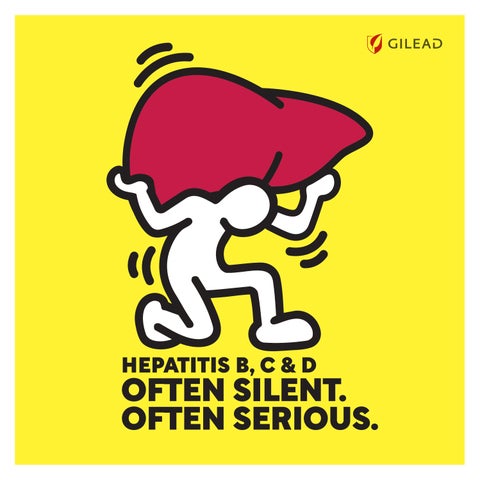
HEPATITIS B, C & D
OFTEN SILENT. OFTEN SERIOUS.
WHAT IS THE LIVER? The liver is a large and vital organ located in the upper right part of the abdomen, just below the diaphragm and behind the ribs. With a weight of approximately 1.5 kilograms, it is, after the skin, the largest organ in the body. The liver plays a central role in almost everything that happens in the body and performs hundreds of essential tasks necessary to stay healthy.
WHAT DOES THE LIVER DO? The liver is essential for:
1.
metabolism (processing food and energy).
2.
detoxification (processing and breakdown of substances such as alcohol and medicines).
3.
storage of nutrients such as vitamins and sugars
The liver works day and night, without a break, to keep your body in balance. A properly functioning liver is therefore crucial for your overall health.
WHAT CAN YOU DO TO KEEP YOUR LIVER HEALTHY? 1.
USE MEDICINES AS PRESCRIBED. If in doubt, consult your doctor or pharmacist. Some dietary supplements and herbal products may put a strain on the liver.
2.
AVOID ALCOHOL Alcohol use can seriously damage the liver. In addition, the combination of alcohol and medication can lead to serious liver damage.
4.
EXERCISE REGULARLY Exercise can reduce the fat content in your liver, even if you do not lose weight. Whether you walk, cycle, swim, dance or do weight exercises: every form of movement counts.
3.
EAT A BALANCED DIET You can make your liver healthier by eating fiber-rich foods, such as fruit, vegetables and grains. Make it a habit to eat fresh food and to keep your weight under control.
WHAT IS HEPATITIS?
Hepatitis is an inflammation of the liver. This inflammation can have different causes, such as viruses, certain chemical substances, certain medicines or excessive alcohol use. When liver inflammation is caused by a virus, we speak of viral hepatitis. Viral hepatitis is contagious and often remains unnoticed for a long time. Worldwide, viral hepatitis is one of the most common liver diseases. Infection occurs when viruses enter liver cells and multiply there. Because this process takes place within living cells, damage can gradually build up without clear symptoms.
Viruses, unlike bacteria, are not sensitive to antibiotics. Therefore, viral infections cannot be treated with antibiotics. In some cases, treatment with specific medicines is possible. There are five main types of viral hepatitis, indicated by the letters A, B, C, D and E. These viruses cause inflammation of the liver, but differ in mode of transmission and severity. Hepatitis A and E are usually transmitted via contaminated food or water, while hepatitis B, C and D are mainly spread through blood and other body fluids. In this brochure, we focus only on hepatitis B, C and D.
WHY IS AN INFECTION WITH HEPATITIS B, C AND D DANGEROUS? Chronic hepatitis B, C and D are sometimes referred to as ‘silent diseases’. You may not feel ill for a long time, although damage is developing in your liver. EARLY DETECTION AND FOLLOW-UP ARE THEREFORE ESSENTIAL, EVEN IF YOU HAVE NO SYMPTOMS.
This damage can develop step by step:
Inflammation of the liver
Fibrosis: scar formation in the liver
Cirrhosis: advanced scarring in which liver function may be impaired
Liver cancer: chronic hepatitis B, C and D are an important cause of liver cancer
TOPIC
HEPATITIS B
General
Many people do not know they are infected. May cause liver cancer.
Can it become a chronic disease?
Yes, in 5–10% of people. In case of infection around birth, up to 90%.
Is there a vaccine?
Yes
What is the cause?
Hepatitis B virus (HBV).
Where is the virus found?
In blood, semen and vaginal fluids.
How is it transmitted?
Contact with infected blood, semen or vaginal fluids. Unsafe sex. From mother to child at birth.
What are the short-term symptoms?
Flu-like symptoms, sometimes jaundice.
What are the long-term symptoms?
Liver inflammation, liver cirrhosis and/or liver cancer.
Is there a treatment?
Yes, these treatments suppress the virus and do not cure the disease.
Prevention
Vaccination against hepatitis B. If not vaccinated: avoid contact with infected blood and body fluids.
HEPATITIS C
HEPATITIS D
Many people do not know they are infected. May cause liver cancer.
Occurs only in people with hepatitis B*. May be more severe than hepatitis B alone.
Yes, in 70–80% of people.
Yes, very often. The course of chronic hepatitis D progresses faster.
No
No*
Hepatitis C virus (HCV).
Hepatitis D virus (HDV)*.
In blood.
In blood.
Blood-to-blood contact, for example via non-sterile needles, tattoos or piercings.
In the same way as hepatitis B*.
Usually there are no symptoms.
Often few symptoms, sometimes more severe than hepatitis B.
Liver inflammation, liver cirrhosis and liver cancer.
Faster development of liver cirrhosis and higher risk of liver failure and liver cancer.
Yes, in >95% there is cure thanks to medicines. Reinfection is possible.
Yes, there are limited and specialized treatment options.**
Avoid contact with infected blood. Do not share needles or sharp objects. Only sterile materials for tattoos and piercings.
Vaccination against hepatitis B*. Avoid contact with infected blood and body fluids.
* Hepatitis D can only occur in people who also have hepatitis B. Protection is possible through vaccination against hepatitis B. ** These treatments suppress the virus, but there is no cure.
RISK ASSESSMENT FOR HEPATITIS B, C AND D
If you complete the checklist on the next page, you can gain more insight into a possible (unintentional) exposure to hepatitis B, C or D. If in doubt, it is better to be cautious and tick the box. This checklist is not exhaustive, does not replace a blood test with a doctor and is not intended to make a diagnosis yourself. Always discuss your answers with your doctor.
Tick all that apply to you: I received a blood transfusion and/or blood products before 1992. I have received an organ transplant or have donated blood, tissue or organs. I use or have used intravenous or intranasal drugs. I have had a tattoo or piercing done in potentially non-sterile conditions. I have received medical or dental treatment in countries where hygiene standards are not always guaranteed. I have had direct contact with another person’s blood. I share or have shared sharp objects such as razors, nail clippers or toothbrushes. My current or former partner has (or has had) hepatitis B, C or D. I live or have lived with someone who has (or has had) hepatitis B, C or D.
My mother has hepatitis B or had it during pregnancy or childbirth. I am not vaccinated against hepatitis B or I am not sure if I am. I have experienced unexplained fatigue, nausea, loss of appetite or abdominal pain. I have experienced jaundice (yellowing of the skin or eyes). Blood tests have previously shown abnormal liver values without a clear cause.
IF YOU HAVE TICKED ONE OR MORE BOXES, PLEASE CONSULT YOUR DOCTOR. Early detection is important: hepatitis B and D can be managed, and hepatitis C is curable in many cases. Open communication with your doctor is essential for maintaining your health.
*Hepatitis D only occurs in people who also have hepatitis B. Vaccination against hepatitis B also protects against hepatitis D.
REFERENCES
American Association for the Study of Liver Diseases, & Infectious Diseases Society of America. (2023).Hepatitis C guidance. https://www.aasld.org/practice-guidelines/hepatitis-c Centers for Disease Control and Prevention. (2025).Hepatitis C prevention and control.https://www.cdc.gov/hepatitis-c/ prevention/index.html European Association for the Study of the Liver. (2025).EASL Clinical Practice Guidelines on the management of hepatitis B virus infection. Journal of Hepatology, 83(2), 502–583.https://www. journal-of-hepatology.eu/article/S0168-8278(25)00174-6/fulltext Kenhub. (2023).Liver anatomy: Location, lobes and function.
https://www.kenhub.com/en/library/anatomy/liver World Health Organization. (2025).Hepatitis B – Fact sheet. https://www.who.int/news-room/fact-sheets/detail/hepatitis-b World Health Organization. (2025).Hepatitis C – Fact sheet. https://www.who.int/news-room/fact-sheets/detail/hepatitis-c World Health Organization. (2025).Hepatitis D – Fact sheet. https://www.who.int/news-room/fact-sheets/detail/hepatitis-d Gilead Sciences Belgium BV, Park Lane, Culliganlaan 2D, 1831 Diegem I BE-UNB-1938 May 2026 @ 2026 Gilead Sciences, Inc. All rights reserved.