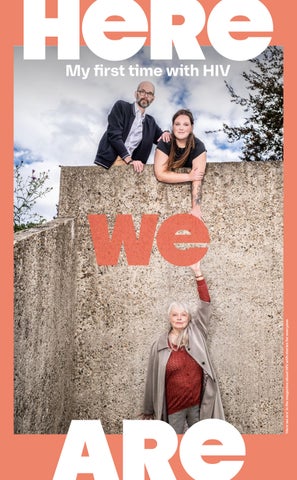
‘Here we are’ is the magazine about HIV with stories for everyone.
HERE My first time with HIV
WE
“Falling in love was easy, being intimate was not.” Truus
The first time...
but after a proper conversation, he was able to quickly put it in perspective. He was confident that I was honest about the impact of HIV and I was confident that he would treat this
…I fell in love after my diagnosis, was like a dream. It was nerve-racking to tell him that I had HIV, but he reacted very well. My confession did not change our vibe, and I felt safe. However, being intimate for the first time was less straightforward.
vulnerable part of me with care. Falling in love with my boyfriend therefore felt very safe.
Getting intimate with instructions It feels like I’ve had two first times in terms of intimacy. In the beginning of our relationship I was not yet undetectable. Even though we did everything by the book, I was scared: What if I give my brand new love
From the moment I started dating, it was clear that I
HIV? He supported me and helped me take that step.
had worked hard to accept my diagnosis, so I wouldn’t
The spontaneity may have been slightly lost, but we
waste my time with someone who couldn’t deal with it.
made up for it with romance.
Although that determination did not always outweigh my nervousness. Every time I was going to tell someone, I practised for hours in front of the mirror. I had to be able to explain as much as possible before the word ‘HIV’ came up. As once people hear that word, they stop listening.
For years, I thought that no one would ever want to have unprotected sex with me, so the first time we had sex without a condom was an emotional roller-coaster. I was overwhelmed by pent-up grief and sadness. But there was also something more important: I could hardly believe that this was really happening. I’m so
When my current partner and I were still dating, I told
grateful that I can share this with someone who loves me
him about my status in a message. That way, I could
unconditionally. To him, I'm just Truus, not Truus with HIV.
also send him a link with all the necessary information, which was convenient! He was slightly shocked at first,
Read Truus's story on p.8
Did you know that ... ... HIV stands for human
... You can protect yourself against
undergo treatment and is therefore not
immunodeficiency virus?
HIV in various ways? In addition
undetectable? 3
to condoms there are other ... HIV is the virus that affects the
efficient methods such as PrEP
Do you have HIV and
immune system? If HIV remains
(Pre-Exposure Profylaxis) and PEP
would you like further
untreated for a long period of time, the
(Post-Exposure Profylaxis).
information, support or contact with other people
immune system can be so weakened that AIDS (acquired immune
... HIV CANNOT be transmitted by
deficiency syndrome) can develop.¹
cuddling, kissing, shaking hands or drinking from the same glass?
living with HIV? Contact the specialized community organisations.
1
... U = U stands for Undetectable is Untransmittable? Someone who is
... HIV CAN be transmitted
undergoing treatment and has an
by having unprotected sex,
undetectable viral load cannot
by blood and from mother to
transmit the virus by sex.
child, if the person does not
2
2
Here We Are
www.allesoverseks.be/wat-is-hiv Rodger AJ, et al., Lancet 2019; 393: 2428-38 3 www.sensoa.be/actueel/stijgende-hiv-cijfers- bevestigen-de-complexiteit-van-de-hivproblematiek 1
2
Who Truus
How long have you had HIV? I was diagnosed at the end of 2021, but I probably had if for longer. At that time I was already in the AIDS stage.
How were you diagnosed? I was very sick and after a year of tests there still was no answer. Until a doctor decided to test for HIV… Then the diagnosis followed soon after.
Why are you sharing your story? I hope people will recognize themselves in the various stories. And that the takeaway from my story for other women with HIV is that it is okay to want children.
Didier
we
How long have you had HIV?
One year. The doctor first thought I had cancer because my health was so bad, but at the end of 2024 it turned out to be HIV.
How were you diagnosed?
It came up by chance during other tests. It wasn't even an infectious
disease specialist who told me: my cardiologist saw it when she opened my file.
Why are you sharing your story?
It’s important for people to know what it's really like to live with HIV. I’m convinced that it's possible through open and honest testimonials.
Dominique How long have you had HIV? I was diagnosed in 1985, so 40 years ago. I was one of the first Belgians with HIV.
How were you diagnosed? A doctor rang my doorbell to tell me I needed to get tested. I was on a list of people who had potentially been exposed to someone who had since been quarantined.
Why are you sharing your story? Many people are ill-informed and don’t know what it means to have HIV. It’s a chronic illness like any other. We can live with it, but we cannot be cured, and that is important to remember.
My first time
3
HIV: then and now Dominique is 75 and has been living with HIV since 1985. Didier is 58 and received that same news in 2024. They meet for a double interview. One glance and a warm handshake are enough: even before the recording equipment starts rolling, they become engrossed in a candid conversation. The key question: what was it like for you to acquire HIV at that time? Whether it was 40 years ago or one year ago, the diagnosis creates a bond. Photography © Debby Termonia
4
Here We Are
Dominique, you were one of the first to be
Dominique: “Receiving
a tough diagnosis is
diagnosed with HIV in Belgium. Why did you get
traumatic, Didier. It often brings things to the
tested?
surface that we’ve suppressed for a long time, which
Dominique: “I had heard about HIV and AIDS in
can be very difficult, but it’s also an opportunity to
the media, but it was like something that was far
work on yourself. It takes guts to dare to be yourself.
removed from my daily life. Until on 14 July 1985 a
Keep believing in yourself.”
doctor suddenly appeared on my doorstep. He told me that I was on a list of people who potentially had
How did your partner deal with the news,
HIV and to get tested asap. The test wasn't even
Dominique?
fully developed yet, that's how new the disease was
Dominique: “My fiancé took me in his arms and said,
here. But the verdict was clear: I had HIV.”
‘From now on, I’m your husband, your family and your psychologist.’ I'm grateful that he never made an issue of my diagnosis. He came from Senegal,
It was 1985, and HIV felt far removed from my own life.”
where HIV had been around for quite some time, so it was nothing new to him. That perspective has really helped me.” Did you have other people living with HIV you could talk to? Didier: “After coming out, I moved in with my eldest
son in Brussels. I wanted to meet people I could talk to about HIV and my sexuality. That's how I ended up at an organisation for gay men, which put me in touch with two people of whom Rafael, who
Didier: “I didn't even know I was being tested for HIV.
contributes to Here We Are, was one. They made
My health had been going downhill fast for a year.
me feel that I wasn't alone and encouraged me to
Fainting, severe weight loss, respiratory problems,
share my story.”
loss of taste and appetite, etc. The doctors initially thought it was cancer, but even after a week in
Dominique: “I knew the person who gave me HIV
hospital, they couldn't find anything. Until a few
and I wanted no more contact with him. He died
days later I met with the cardiologist who saw
one year after I was diagnosed, so I will never
what was going on in my file. I was surprised and
know whether he was aware of his status. But that
my wife immediately asked questions about how
trauma stays with me. My mother, fiancé and best
I could have acquired HIV. That's when I realised
friends did accept and support me immediately.
that my life would be forever changed.”
Even though they urged me not to talk openly about my diagnosis, for fear of negative reactions
Your diagnosis did indeed coincide with a
and discrimination. I was raised in a family where
personal turning point in your life.
lying was frowned upon, so I really had to learn
Didier: “I had kept my feelings for men hidden for
this.”
years. After the diagnosis, my wife suspected that I had cheated on her, but she had no idea that it
When was the first time you met someone who
was with a man. I wasn't ready to come out yet:
also had HIV?
for months, I had been in full denial, which was
Dominique: “From when I was diagnosed until 1995
a lonely and difficult time. For me, because I was
I only allowed myself to be treated with alternative
fighting the disease alone and didn't know how to
medicine. The first HIV medication was already
be myself, and for her, because she was left in the
on the market, but I refused to take it because I
dark and saw me struggling. When I finally told her
had been told it was too toxic. When triple therapy
the truth, she broke down. Shortly after I came out,
emerged in 1995 and I showed the first signs of AIDS,
I left home and since then I’ve had no contact with
I decided to give it a try. However, the side effects
my two youngest children. I understand that it’s
were so severe that I turned back to alternative
difficult for them to accept this major change, but
medicine. Three years later, I was getting sicker and
it causes me great pain.”
sicker, and my viral load kept rising. At that point,
My first time
5
a friend introduced me to Jean-Marc, the first man in
I've practised sports for a long time and have good
Belgium to go public about his status in the media.
control over my body. But don't let that discourage
He encouraged me to give HIV treatment, which
you, Didier. Someone who's been treated properly
had evolved significantly in just a few years, another
from the outset is unlikely to have this much
try. I’m still grateful to him for that. Since then, I’ve
trouble in their old age.”
been able to do the same for many other people.” Didier: “I hope so! Although my body feels different
How did you experience the search for the
now than it did years ago. I can no longer walk or run
appropriate treatment?
fast. So I'm going to try to do some gentler sports
Dominique: “In the beginning doctors didn't even
like yoga, because now I'm out of breath at the
know that HIV could affect women. After ten years
slightest effort. And you should know that my new
without treatment and then a few interrupted
apartment is on the third floor... without a elevator!”
treatments, the virus had mutated several times, making me resistant. Doctors called me a Chinese
Dominique: “That should keep you in shape!”
puzzle. Eventually, they found something that worked and I became undetectable fairly quickly.
Something unfortunately a lot of people living
Although 30 years ago, I had to take 25 pills a day
with HIV have to deal with is stigma. How do you
for it.”
experience this? Dominique: “I was turned down once when I
looked for a new dentist. He didn’t want to treat
“If you have HIV people often still look at you with disapproval.”
me and said that, regardless, my appointment would always be the last of the day, in case they got a hygiene inspection. I was shocked. In addition, many care workers ask, sometimes without any specific reason, about my sexuality or drug use. I personally don’t mind, but it shows how persistent the prejudices are. As if the fact that you're HIV positive, implies that you lead a certain lifestyle.” Didier: “So far everyone's reacted with under
standing. But I was only diagnosed a year ago. I’m honest and immediately tell everyone for whom Didier: “It’s terrible to realize that you’ve lived
it's relevant. Like when I wanted to have my first
without treatment for so long and experienced so
tattoo: it was no problem for the tattoo artist.
many side effects. Especially because it contrasts
Everything was very hygienic and pleasant.”
so starkly with my situation. I was willing to try
6
anything, as long as we could find something that
Dominique: “Fortunately, imagine if in the middle
worked. But I got lucky the first time! Within two
of your tattoo he said: ‘Ah no, I quit.’ Then you'd
months, I was undetectable and the only side effect
be left standing there with half a drawing on your
was mild insomnia.”
arm! (smiles)”
Dominique, you are 75 and have been living with
What do you think is needed to break down that
HIV for 40 years. What is it like to get older with
taboo?
the virus?
Dominique: “People should be better educated about
Dominique: “My immunologist puts it like this:
what HIV actually is and how it is transmitted.
‘You are 75, feel like 65, but your body is 85.’ Not
It’s particularly important that more be discussed
so nice to say something like that to a woman.
about this in schools, so that young people take
(smiles) My body’s damaged and I’m constantly
precautions. Treatment may enable you to live with
dizzy. The only reason you don’t notice is because
HIV, but there’s still no cure.”
Here We Are
The first time… Dominique: “Even before I knew whether my test was positive, the doctor told me that HIV was fatal. I would get AIDS and eventually die. When that fateful phone call finally came confirming Didier: “Prevention and awareness are really
my status, I felt like the earth was sinking
important, even in the LGBTQIA+ community.
beneath my feet. I was engaged, had a son
Even there, people often look at you funny if you
who was barely six years old and desperately
have HIV, because they just don't know that it can be safe with the right treatment. I’m so open about it because I hope that my story will make a difference in this.” Dominique: “Exactly. it’s not because some people
discriminate against you that they all do. By keeping it a secret you close yourself to negative, but also to positive reactions. I’m happy that I
wanted to live. But according to my doctor I had ten years left, with some luck at least. That is now 40 years ago.” Didier: “I can't even imagine how difficult it would have been to be diagnosed in the early years. It obviously came as a shock when I heard last year that I had HIV, but I wasn’t afraid. I was aware of the disease and knew that with the proper treatment you can live a full and beautiful
removed my mask because since I speak openly
life these days. I was more worried about the
about my diagnosis, it has only enhanced my life.”
impact of my diagnosis on my family life.”
My first time
7
© Debby Termonia
My desire to have children when HIVpositive White picket fence, children. It seems like a logical next step, but not everyone who wants to have children finds it easy to get there. Truus and her boyfriend are at the beginning of their fertility journey. An important detail: Truus has HIV.
In 2021 Truus got very ill. Her health went downhill fast and doctors did not know what was wrong. A year later, the answer came: HIV. “The first thing my mum said to me was: you’ll never be able to have children! She was really shocked, but she also took care of me straight away.” Did you want to have children back then? “Not as badly as now, but to some degree yes. I had been in a relationship for five years and a child just seemed like the next step. After the diagnosis I forgot about having children and also as a single person I stuck with it. The fear of transmitting HIV was huge. I couldn’t imagine at the time that my desire to have children would be strong enough to overcome this.” When did it change? “I have HIV and my current partner cannot conceive a child naturally. It wasn't necessary for us... until out of
8
Here We Are
“I'm not giving birth to a child with HIV; I have HIV and am giving birth to a healthy child.”
the blue my period was a month and a half late. We were so disappointed when it suddenly started anyway! Since then, my ‘biological clock’ has been running overtime. (smiles)” How was your first experience with the fertility clinic? “Like a slap in the face. The doctor literally said: ‘We don't help people with HIV, no one in Belgium does.’ My boyfriend was livid and I burst into tears. She even asked how I acquired HIV. Would she have helped me if I hadn’t contracted it through sex? That conversation lasting a few minutes brought back years of doubts and pain.” After this bad experience, did you find someone who was willing to help you? “I’m lucky enough to be well surrounded. By my partner, friends and family, and by the care workers in the reference centre who treat me for HIV. I immediately called with all my questions and they helped us to book an appointment with another fertility clinic. It's a longer drive, but it's worth it.” Is a fertility journey different for you than for someone without HIV? “It’s very important that I stick to my treatment. Especially because I'm undetectable but not actually below the Belgian viral load threshold. I also have to take a much higher dose of folic acid than other women. But apart from those things, I don't experience any difference. I feel like a normal
If one day your child has questions about HIV,
patient here.”
how do you want to tackle that? “I speak very openly about my status and will
Is there anything about pregnancy that worries
continue to do so, to break the stigma and help
you?
prevent HIV. I aim to do the same with my future
“I’m confident that my pregnancy will proceed
child. Sexual health is very important and I want
normally, but I'm apprehensive about the delivery.
my child to know that no question is taboo to me.”
Regardless of how often my doctor assures me that it's completely safe, I don’t wish to give birth via the
Are there any misconceptions about being
vaginal route. With a caesarean section, it’s easier
pregnant with HIV that you would like to dispel?
to avoid blood contact with your baby, and that’s
“I'm not giving birth to a child with HIV; I have HIV
what I need to feel reassured.”
and am giving birth to a healthy child. Full stop. People with HIV are monitored closely and are
What do you think the maternity period will be
very careful. The idea that getting pregnant would
like?
be irresponsible has long been outdated. And don't
“I’m not allowed to breastfeed. The doctors were
forget: no matter how you contracted the virus,
always clear about that, as the risk is too great and
you have the right to a full life and to have a child if
the medication makes my milk taste bad. The baby
you want one.”
will also need to be treated preventively during the first few weeks. My mother's heart will bleed a little, but apart from that, that period will be fairly normal.4 Just like other brand new parents my boyfriend and I will come home and for a second
The approach to pregnancy and breastfeeding in women with HIV is highly individualised. Decisions are made on the basis of an individual discussion and joint decision-making between the patient and healthcare provider. Consult your healthcare provider if you have any questions.
4
not know what to do with that baby. (smiles)”
My first time
9
HIV & stigma: 3 levels Preconceived notions, discrimination and ignorance are the building blocks of stigmatisation. But what influence do they have? Fleur Baert, clinical psychologist and researcher at Ghent University, explains how stigma not only exists in our society, but also affects people from within and even reaches their loved ones.
“Stigma is persistent and spreads easily.”
1 2 3 Structural and social stigma
Internalized stigma
Associative stigma
“Stigma involves certain features of
“It’s difficult to accept a chronic
“The preconceived notions targeted
people that are associated with neg-
illness and reconcile it with
at one person are all too quickly
ative stereotypes,” explains Fleur.
who you are as a person. When
transferred to the people around
“In many cases, these stem from old
stigmatization also gives rise to
them,” says Fleur. “Their partner,
beliefs or misconceptions that are
misconceptions and prejudices
family, friends or caregivers may also
not or insufficiently corrected, partly
surrounding your diagnosis, this can
experience stigma by association.
due to how the media portrays cer-
cause feelings of doubt, shame or
Again, this isn’t the responsibility
tain groups and the way our world is
guilt. That internalized stigma has a
of the affected individual, but it can
organised.”
major impact on mental well-being.”
feel that way when your loved one is confronted with it. The result?
“The World Health Organisation
How do we make a difference?
Feelings of guilt, powerlessness
identifies stigma as one of the main
“Proper personal guidance is
and concern mean that people still
barriers to healthcare, resulting in
important, because internalized
prefer to keep their status secret.”
fear or delay in consulting healthcare
stigma has a major impact on
providers. It also leads to social isola-
mental health and on the course
How do we make a difference?
tion and fear of being oneself, which
and effectiveness of treatment.
“The best thing you can do is keep
in turn harms mental health.”
However, we should not put the
talking to each other. Tell your loved
responsibility for ‘dealing with it’
ones that there is a chance this
How do we make a difference?
solely on them. Health stigma is not
could happen and discuss how you
“There are many good initiatives, but
their problem, it is our problem as a
would handle it. You could also seek
we can only make a lasting differ-
society, something for which we are
support together, as this can be
ence if we tackle this complex prob-
all responsible.”
beneficial for loved ones as well.”
lem on multiple fronts. For example,
“Sometimes you may feel the need
by providing people with the right in-
to correct others, but know that it's
formation and putting them in touch
also okay to leave things as they are.
with the stigmatised group. This is
You know how things work and you
not easy, so start with yourself.”
take care of each other, and that’s what matters most.”
10
Here We Are
About Here We Are Here we are, at the end of the second edition of Here We Are. The magazine about HIV that reaches beyond the clichés.
The idea was born two years ago. During an editorial board organised by Gilead Sciences, the HIV community and healthcare professionals made a powerful proposal: let's create a lifestyle magazine about people living with HIV. Gilead gathered an editorial board to create a light-hearted and accessible magazine that also addresses difficult topics. And this is now the second edition! As creators of this magazine, we would like to thank Dominique, Didier and Truus for their kindness, openness and courage. Share Here We Are with a loved one, a colleague or anyone else who wants to know more about HIV, and spread their story. Because if one message should be clear, it is this: anything is possible with HIV.
‘HERE WE ARE’ EDITORIAL BOARD: Rafael, Hany and Laurence (empowered people living with HIV), Charlotte (psychologist and sexologist, UZ Ghent), Yama (volunteer nurse, Aide Info Sida vzw), Frédérique (in charge of relationships with the HIV community and the development of this project with Gilead Sciences), Astrid and Arthur (communication specialists, Growth inc.), Annelies and Bert (Bold & Pepper, responsible for concept, editing and design of this magazine).
‘If you create a magazine that breaks taboos, you have to do the same yourself.’ Rafael, member of Here We Are editorial board
The first time… …that I told someone about my diagnosis, left its mark. More than ten years ago, I confided in a friend who was HIV positive himself. Without my permission, he shared that sensitive detail of my life with others. Since then, I have kept my status secret. Until last year, when the first edition of Here We Are was published. Because suddenly there it was, in writing: ‘Rafael lives with HIV.’ Those few words marked the first time I openly disclosed my HIV status. And in a magazine, no less! It took some getting used to, but I'm glad I did it. Actually, I signed up to take part out of curiosity. The fact that I have HIV myself was a ‘side issue’: I mainly wanted to see up close how such a
CHOOSE YOU
magazine was produced. At the time, I didn’t know that I would not only
This publication is part of the Choose YOU campaign with which Gilead aims to improve the knowledge of HIV. Choose Life, choose Protection, choose Well-being.
learn about design and colour schemes, but also about my own relationship with HIV. Even twelve years after my diagnosis, my status still felt like a taboo. I always informed my sexual partners and discussed it with my husband, but that was the extent of it. By contributing to this magazine about HIV, a new world opened up for me. During the brainstorming sessions, I was confronted with the part of my life that I had ignored as much as possible until then. My fellow patients, care providers and other editorial staff helped me get over that threshold.
READ THE FIRST EDITION Everyone is unique. Curious about other stories from people living with HIV? Scan the QR code and read the testimonials by Laurence, Hany, and Helen from the first edition of Here We Are.
Breaking taboos, building trust These conversations not only set the tone for the magazine, but also taught me a lot about myself: who am I? How do I deal with my HIV? If you create a magazine that breaks taboos, you have to do the same yourself. Now I dare to trust people who feel ‘safe’ again. Here We Are therefore helped me to grow, and I hope that it has the same effect for readers. That the stories in the magazine promote (self) reflection and self-discovery, and that talking about HIV truly makes a difference.
Gilead Sciences Belgium BV/SRL Culliganlaan 2D, 1831 Diegem BE-UNB-1834 - February 2026. ©2026 Gilead Sciences, Inc. All rights reserved. GILEAD and the GILEAD Logo are trademarks of G ilead Sciences, Inc.
My first time
11
HERE “The idea that getting pregnant with HIV is irresponsible has long been outdated. Regardless of how you contracted the virus, you are entitled to a full life and to have a child if you want one.” Truus, p.8
WE
“If you have HIV, people often look at you with disapproval. Many don’t know that everything can be safe thanks to the proper treatment. I want to make a difference with my story.” Didier, p. 4
“Receiving a tough diagnosis is traumatic. It often brings things to the surface that we have suppressed for a long time, which can be very difficult, but it’s also an opportunity to work on yourself. It takes guts to dare to be yourself.” Dominique, p.4
12