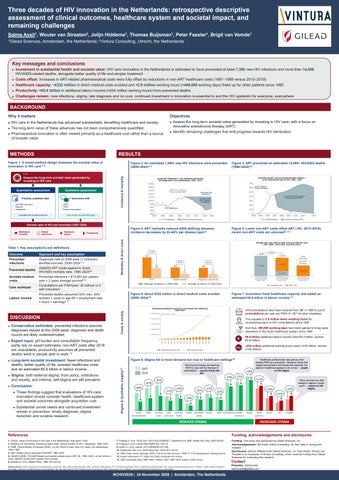
Three decades of HIV innovation in the Netherlands: retrospective descriptive assessment of clinical outcomes, healthcare system and societal impact, and remaining challenges Salma Assil1, Wouter van Straaten2, Jolijn Hiddema1, Thomas Buijsman1, Peter Fassler1, Brigit van Vemde1 1Gilead Sciences, Amsterdam, the Netherlands; 2Vintura Consulting, Utrecht, the Netherlands
Key messages and conclusions ● Investment in substantial health and societal value: HIV care innovation in the Netherlands is estimated to have prevented at least 7,300 new HIV infections and more than 14,000
HIV/AIDS-related deaths, alongside better quality of life and simpler treatment ● Costs offset: Increases in ART-related pharmaceutical costs were fully offset by reductions in non-ART healthcare costs (1987–1989 versus 2013–2018) ● Healthcare capacity: ~€232 million in direct medical costs avoided and ≈3.9 million working hours (≈496,000 working days) freed up for other patients since 1990 ● Productivity: ≈€6.8 billion in additional labour income (≈254 million working hours) from prevented deaths ● Challenges remain: new infections, stigma, late diagnosis and no cure; continued investment in innovation is essential to end the HIV epidemic for everyone, everywhere
BACKGROUND Why it matters
Objectives
● HIV care in the Netherlands has advanced substantially, benefiting healthcare and society.
● Assess the long-term societal value generated by investing in HIV care, with a focus on
● The long-term value of these advances has not been comprehensively quantified. ● Pharmaceutical innovation is often viewed primarily as a healthcare cost rather than a source
innovative antiretroviral therapy (ART) ● Identify remaining challenges that limit progress towards HIV elimination
of broader value.
METHODS
RESULTS
Figure 1. A mixed-method design assesses the societal value of innovation in HIV care1–12
Figure 2. An estimated 7,300+ new HIV infections were prevented (2009–2024)1–3
Figure 3. ART prevented an estimated 14,000+ HIV/AIDS deaths (1996–2023)4,5
Figure 4. ART markedly reduced AIDS-defining diseases: incidence decreases by 53–62% per disease type2,9
Figure 5. Lower non-ART costs offset ART (-9%, 2013–2018); recent non-ART costs are unknown6,7,13
Figure 6. About €232 million in direct medical costs avoided (2009–2024)2,6
Figure 7. Innovation freed healthcare capacity and added an estimated €6.8 billion in labour income1,11
Assess the long-term societal value generated by investing in HIV care Quantitative assessment Publicly available data • Scientific literature • Reports • Databases
Qualitative assessment 7 interviews with • HCPs • PWH • Patient association
Quantifies the societal outcomes
Incidence & mortality
AIM
Adds context and identifies gaps
Societal value of HIV care innovation (1987–2024) Healthcare system
Productivity
Table 1. Key assumptions and definitions Outcome
Approach and key assumption
Prevented infections
Diagnoses held at 2008 peak (1,233/year); shortfall summed, 2009–20241–3
Prevented deaths
UNAIDS ART model applied to Dutch HIV/AIDS mortality data, 1996–20234,5
Avoided medical costs
Prevented infections × €15,897 per patientyear × 2 years average survival6,12
Care workload
Consultations per PWH/year: 36 without vs 2 with innovation1
Labour income
Prevented deaths (assumed 50% men, 50% women) × years to age 65 × employment rate × hours × earnings1,11
DISCUSSION ● Conservative estimates: prevented infections assume
diagnoses stayed at the 2008 peak; diagnosis and death counts are likely underestimated.
Morbidity & direct costs
Patient experience
HIV-consultations have been reduced from 361 in 1990 to just 2 consultations per year per PWH of ~202 minutes nowadays
Costs & society
Morbidity & mortality
This equates to 3.9 million fewer working hours for nurses/physicians on HIV consultations since 1990 And thus, 496,000 working days have been gained to bring value elsewhere in the Dutch healthcare system since 1990
● Expert input: pill burden and consultation frequency
partly rely on expert estimates; non-ART costs after 2018 are unavailable; productivity assumes all prevented deaths were in people able to work.12
and society, and internal, self-stigma are still prevalent. ● Conclusion: ● These findings suggest that evaluations of HIV-care
innovation should consider health, healthcare-system and societal outcomes alongside acquisition cost. ● Substantial unmet needs and continued investment
remain in prevention, timely diagnosis, stigma reduction and curative research.
Stigma & Qualitative insights12
● Stigma: both external stigma, from policy, institutions
hrs
≈254 million additional working hours (men ≈105 million, women ≈149 million)
‘’We must put energy into teaching PWH to cope with the feelings of (self-)stigma.“ – person living with HIV
References 1. Vintura. Value of innovation in HIV care in the Netherlands: final report. 2026. 2. Stichting HIV Monitoring. Monitoring report 2025; annual number of HIV-1 diagnoses, 1996–2024. 3. IHME, Global Burden of Disease (2025), via Our World in Data. New HIV cases, the Netherlands, 1990–1995. 4. CBS. Deaths due to advanced HIV/AIDS, 1980–2023. 5. UNAIDS (2026). HIV/AIDS deaths and deaths averted due to ART, NL, 1990–2023, via Our World in Data; UNAIDS Global AIDS Update 2023 (model). 6. Borleffs JC, et al. Health Policy. 1990;16(1):43-54.
€6.8 billion additional labour income (men €3.0 billion, women €3.8 billion)
Figure 8. Stigma fell in most domains but rose in healthcare settings10
● Long-term societal investment: fewer infections and
deaths, better quality of life, avoided healthcare costs and an estimated €6.8 billion in labour income.
€
“Healthcare professionals wear gloves when treating PWH as a precaution. Research shows that stigma among family and friends has improved, but stigma in healthcare appears to be worse.” – expert on HIV stigma
‘’There has been too little change in stigma in recent years.“ – expert on HIV stigma
Funding, acknowledgements and disclosures 7. Popping S, et al. PLoS One. 2023;18(2):e0280877; Oosterhof et al. BMC Health Serv Res. 2025;25:643. 8. Popping S, et al. Lancet Reg Health Eur. 2021;8. 9. Smith CJ, et al. Lancet. 2014;384(9939):241-248. 10. Stutterheim SE, et al. AIDS Educ Prev. 2022;34(1):33-52. 11. CBS (mean hourly earnings, 2023); Tuiu et al. Nat Commun. 2026;17:1110 (employment, working hours). 12. Expert interviews (n=7; Sept–Oct 2023) conducted by Vintura. 13. CBS. Exchange rates 1980–2003; inflation rates 1990–2023 (costs in 2022 euros).
Abbreviations: AIDS, acquired immunodeficiency syndrome; ART, antiretroviral therapy; CBS, Statistics Netherlands; FTE, full-time equivalent; HCPs, healthcare professionals; HIV, human immunodeficiency virus; HRQoL, health-related quality of life; IHME, Institute for Health Metrics and Evaluation; NL, the Netherlands; PCP, Pneumocystis pneumonia; PWH, people with HIV; UNAIDS, Joint United Nations Programme on HIV/AIDS
NCHIV2026 | 24 November 2026 | Amsterdam, The Netherlands
Funding: This study was sponsored by Gilead Sciences, Inc. Acknowledgements: We thank Vintura Consulting for their help in running the analysis. Disclosures: Authors affiliated with Gilead Sciences, Inc. hold stocks. Wouter van Straaten is an employee of Vintura Consulting, which received funding from Gilead Sciences for conducting this research
Contact Presenter: Salma Assil salma.assil@gilead.com