


Revised 2024
Staying organized is often one of the biggest challenges in a busy home school home, and it’s even more important than we sometimes realize. According to the Home Education Regulation, under Evaluation of student progress: “4 (1) A parent providing a home education program to a student (a) must conduct an evaluation of the progress of the student at regular intervals and maintain a record of the methods and dates of those evaluations, (b) must maintain dated samples of student work and a general record of the student’s activities.
This booklet gives you practical tips for effective record keeping, written by home schooling parents who have faced these challenges.
Unless otherwise credited, images are courtesy of WISDOM's Noster, Burgess, Tinant and Doyle families.




By Miriam Snyder
As a busy home school mom leading my kids through 4 different grades, I have looked for ways to help them take more initiative and be more independent. Charlotte Mason said, “self-education is the only possible education; the rest is mere veneer laid on the surface of a child’s nature.” She didn’t mean this in the sense of a child-led education, she meant that as long as you remain the teacher, trying to dictate all the facts and bits they will internalize, it will never be an education. They must be an active participant. I don’t want to get too sidetracked on educational philosophy, though I highly recommend Charlotte Mason’s writings. What I do want to do is share some tools that I have found very useful in the practical working out of our daily life. For giving direction toward meeting our educational goals while still giving my kids opportunity for initiative (by not being totally tied to me to give direction every moment of the day) I use these four main tools:
1. Chore Assignments. Once a year, at the beginning of our summer break, we do a chore switch up. (This timing helps us learn chores and make modifications if something doesn’t work out before we are also trying to get back into the school habit.) I got a list from the internet somewhere but then added to it and modified it. It breaks down every job I could think of that needs doing to keep our house clean and running (ie, clean bathroom sink and counter, dust the
living room fan…). Then I further broke these jobs into categories of daily, weekly or twice a week, and monthly chores. Then I assigned each job a point value (I ripped this part off of Brandy Vencel at Afterthoughtsblog.net) that reflects the difficulty and/or time it will take. For example, scrubbing the tub is a 3 point job whereas cleaning the toilet is only a 2 point job. Next, I decide how many points each child can be responsible for that year. Everyone gets some work. 2 year olds sort cutlery from the dishwasher or dump little garbages into bigger garbage while older kids can clean toilets or wash laundry. At this point, I call the kids to the table and they can have a say in which chores they will have for the year. We divide up monthly chores, weekly and then daily, trying to keep the point distribution fair and jobs appropriate for ability while still giving the kids some choice. This goes a long way to help attitudes.
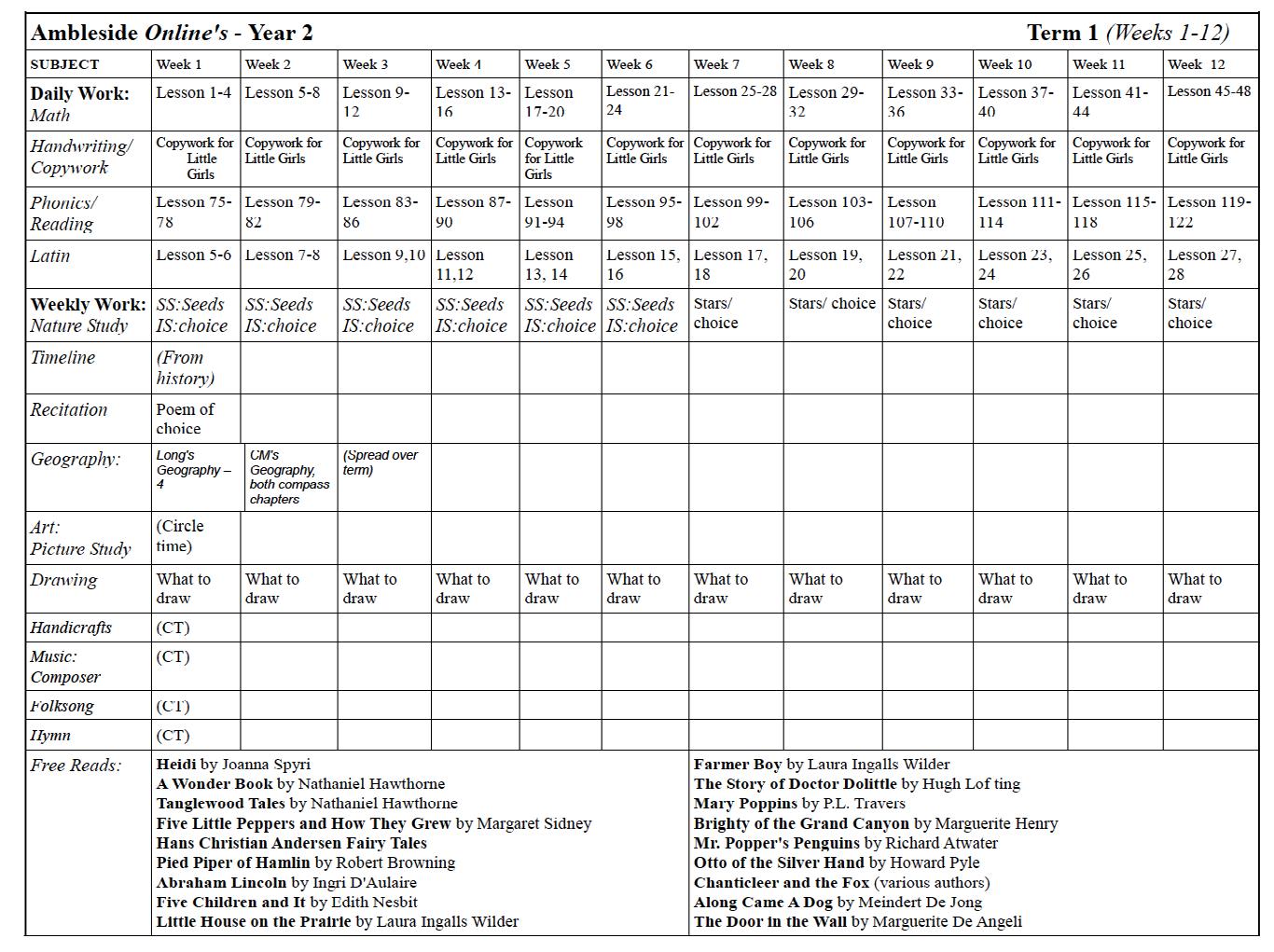
2. School Plan: The second thing to do is plan my school year. I use amblesideonline.org with some modifications. They have conveniently provided Excel spreadsheets that I download and modify/fill in as needed. I break my year into three terms as they do, each with 12 weeks. The spreadsheets have subjects listed down the left and weeks across the top. Once I


have all of the kids’ work on their spreadsheets (this is labor intensive but pays off big during the year) I print these and put them in a binder along with any other info I need to reference for their work. Each child has their own divided section. Now
at a glance, I know what everyone should be doing on a given week. I should note that I don’t attach dates, just week numbers so I can stay flexible. If we get the stomach flu and don’t touch school work one week, we don’t give that week a number but


pick up when we can and I don’t feel like we are “behind”.
3. Schedule: Next, I make a weekly schedule. I never used to do this step. With one or two kids doing school I could fly by the seat of my pants.
But, as my family has grown, and the number of scholars has increased, I have had to acquire more discipline and structure myself for the sake of the smooth functioning of our home. While it was a bit stressful for me in the beginning, it has paid off by
reducing stress in the long run. I say this to encourage those who are of a similar personality type to me!
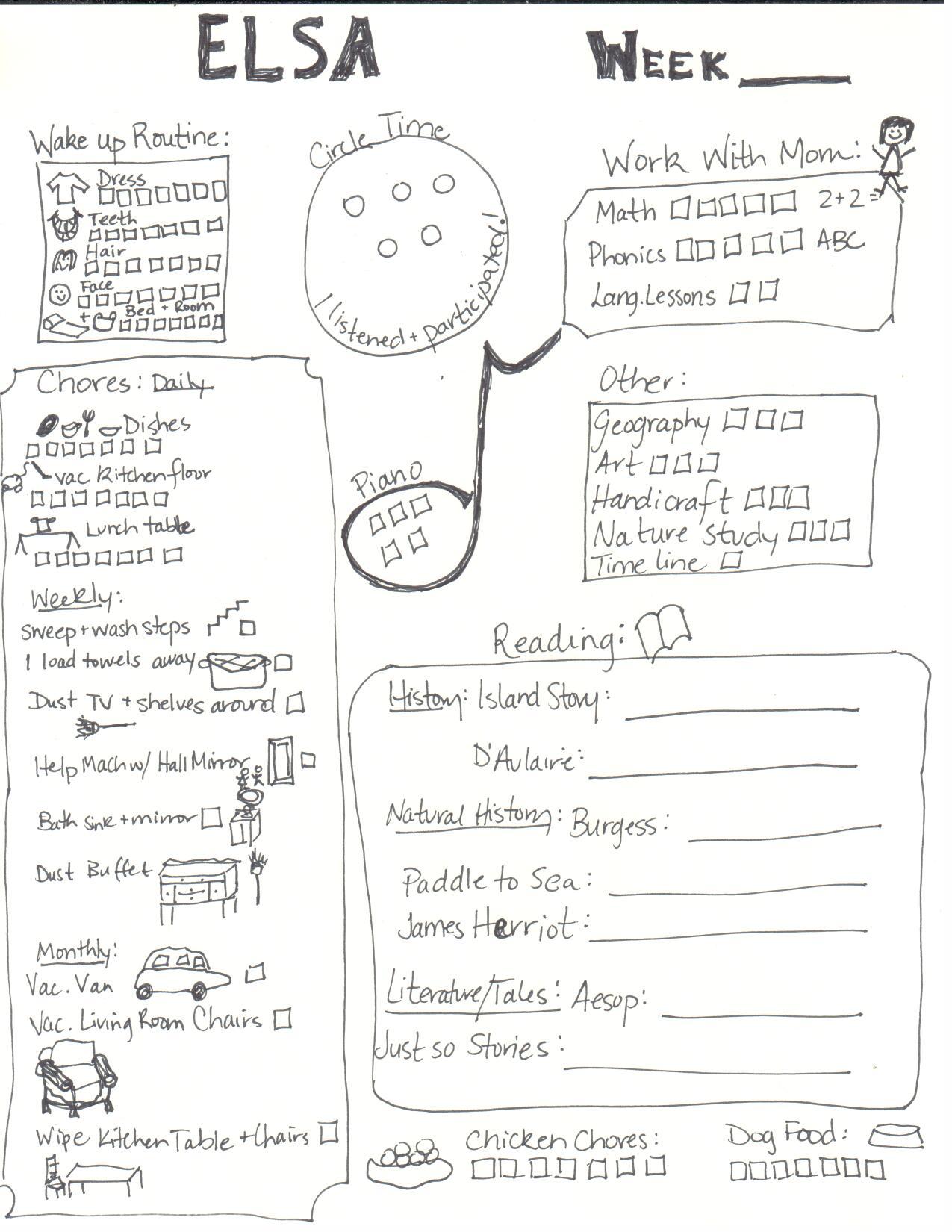
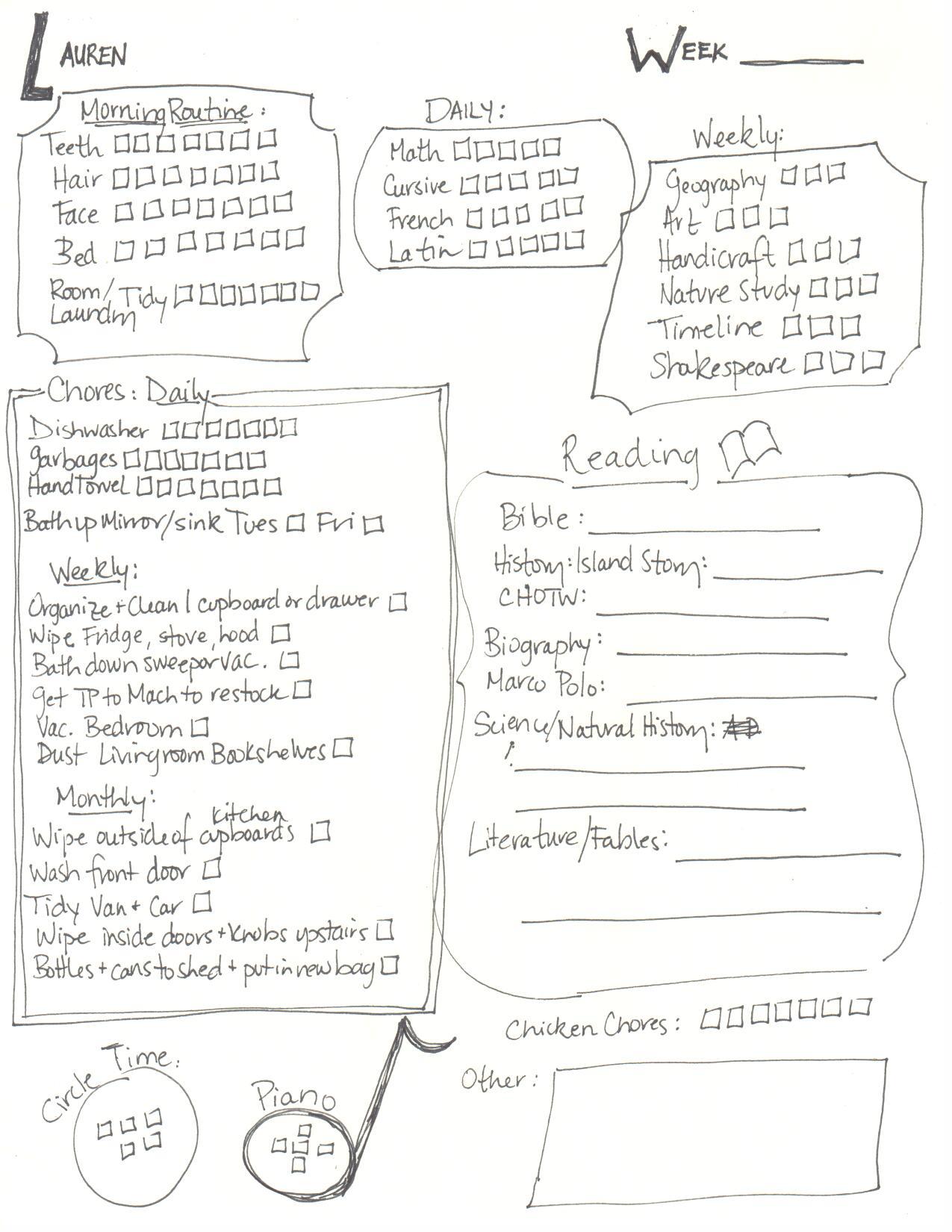
4. Daily Charts: Last is the step that brings it all together and allows for the initiative! I make charts for each of the kids that I will use all year long to communicate their chore information and school work. I use this to train morning routines (teeth, hair, dress, bed, floor tidy) in the littles and to remind about
afterschool farm chores (separate from in-house cleaning chores) for all. Additionally, the chart includes a space for the child to list things they want to do with their free time as a motivator/reminder so when they are in the middle of school work and are longing to build a fort or sew a new doll outfit, they can write it down to remind themselves later. I use those cheap brown clipboards from the dollar store and have them hanging in a row down the wall from oldest
Monday
6:00-7:00 Mom up read/pray
7:00 Kids up/morning routine 7:30 Chores
8:00 Breakfast 8:30 Clean up/ start school
9:00-10:00 Circle Time
10:00-10:30 Math 30 min, Elsa 20
10:30-11:00 Read 30 min from list
11:00-11:15 Narrate oral or written
11:15-11:30 copywork
11:30-12:00 A/L Latin (E-15min/lunch table)
12:00-12:45 Lunch and break 12:45-1:00 Map Quiz
1:00-1:30 Plutarch
1:30-2:00 L-30 min read/narrate
A-60 min Read/narrate
Outside sport (badminton, ball hockey) Piano, handicraft, sewing, reading, chores, etc.
3:30 Tea Time!
to youngest descending. I hand draw one copy at the beginning of the year and photocopy a handful at a time to replenish as we go. This simply reflects my skills. If I could do it on the computer, I might, but I also like the hand-drawn touch. If one of my kids can’t read, I draw them simple pictures…a toothbrush, a hair brush, a bed (to make), a shirt (get dressed), a garbage can (empty garbages)…you get the idea.
At the beginning of the week, or on a Saturday, I sit down with the clipboard list (we call them Dailies for some reason…) and my planning binder. Child by child, subject by subject, I check off the school work that was completed for the past week. (This also gives me a record of what we actually did all year.) Then I get a new sheet, label the week we are on and write in the work for the coming week (this takes a half hour tops). There are empty
check boxes correlating to the number of times the thing gets done. If it’s a monthly chore, there is one box. If it’s daily, there are seven. Then at the beginning of each day or the night before the work is required, I highlight the check boxes of the items I want them to do (this takes 5 minutes tops). I use a different color of highlighter each day as in, “Today is blue!” And they know they are looking for the blue boxes. I have a few school sections on the page. One is for things done daily such as math. Another is for things done weekly. Yet another is for all their reading, where I list the books by subject on the original that I copy and then I just have to fill in the page numbers each week. As they complete items, they “X” the box. When they are done and want free time, they bring me the clip board to check over. (Inspect what you expect!)
And that’s it. Day in and day out. The kids rise and consult the clipboard rather than Ambleside Online's - Year 2, Detailed
2:15-3:24, The Fall 4; 5:21-26, Cain and Abel 6:9-22; 7, The Flood 8; 9:1-20 After Flood 11:1-10, 2632, 12, Acts 7:1-6, Call of Abraham 13; 14:1-13, Lot's choice 14:13; 15 Abram
NT: Matthew 1:18-2:23 3:1-4:12
History and Tales:
CHOW/ CHOW: Ch 47 (45) 2 Empires Ch 48 (46) Getting a Start
Ch 49 (47) The End of World D’Aulaire Leif the Lucky
CHOW: Ch 50 (48) Real Castles
Ch 51 (49) Knights / Chivalry
Ch 52 (50) Pirate's Grandson
Ch 53 (51) Great Adventure
An Island Story 22, Harold 23, Stamford Bridge 24, Battle of Hastings 25, William Conqueror, Hereward 26, William Conqueror, Death 27, William the Red 28, Henry I “White Ship” 29, King Stephen 30, Henry Plantagenet, Gilbert and Rohesia 31, Henry Plantagenet, Thomas a Becket 32, Henry Plantagenet, Conquest of Ireland
Canada/Pioneer Pg6-13
Little Duke ½ ch
Natural History: Burgess Animal Jenny Wren and Peter Peter and Jumper Longlegged Cousins Chatterer and Happy Jack Tree Squirrels, Striped Chipmunk Johnny Chuck, Whistler, YapYap
the
Literature: (Circle time) Poetry Riley Riley Riley Riley Riley Riley
Book House:
and Engineer Worker and Robber Trader and Handsome Fellow
me for: “What’s next?” As they mature, I’ve seen my eldest take the initiative to set her alarm, rise early and tackle the day’s tasks so that she is independent and a master of her time; not tied to me to tell her what and when (well at least not directly). Certain things are fixed in the schedule, such as our morning Circle Time together for singing, memory work etc. Readings such as history, biography, literature and even science are scheduled as reading time but flexible as to which goes first. My eldest daughter has become responsible to be sure they all get done within the week (she is going into grade 7). If she wants to do them earlier in the day than planned, in free moments or in the evening, because she finds them enjoyable or wants to free up daytime for other things, I am flexible. The goal is to get it done and learn something. Learning to manage time is an important skill I’d like my kids to know before they leave
home. That will only happen if I model it and gradually let them practice and take responsibility for it.
I hope this might give you a new tool to make your home run smoother. I know it is very specific but it has taken me some time (8 years or so!) to really find a system that works. I know it won’t fit every home or homeschool, but maybe it will spark an idea of what would work for you.
Miriam Snyder lives on a small ranch near St. Lina, AB and homeschools her 4 children. She enjoys painting, reading and starting more projects than she can finish. She would rather spend money on books than most other things save good coffee beans and quality stationery supplies.
Notes:
By TobyLauren Burgess

Let me start at the very beginning (a very good place to start). When I was 8 years old, my aunt gave me a journal for Christmas. I was instantly, feverishly committed. I wrote in great detail about my Christmas. I wrote about our pets, about my siblings. About my parents, and how I was in trouble ‘for no reason at all’ after neglecting to complete something that was asked of me. I wrote about getting ready for family functions, and how “right now we are late”. (I wonder why. Could it have been because I was holed up in a corner, writing in a journal?)
I wrote diligently, every single day. For about 8 days.
Six months later, the journal entries pop up again, for a little while longer this time. Then there’s another lag… followed by another burst of writing. After a couple of years, I started writing regularly, if not daily, and continued right up through marriage and motherhood. I’ve slowed down in recent years, but still find journaling to be a valuable tool.
I was always fascinated with history, legacy,

and learning who I was in relation to those around me or those who had gone before me. Especially when I was young, I made the effort to write in way more detail than situations warranted, going so far as to draw maps and legends to correspond to the things I wrote. I imagined that some future day, some age hence, someone would find my journal and read it and learn all about the times gone by. Just like in a book I’d read, or probably quite a few books. They’d learn about an ancestor that they hadn’t known in real life. They would learn a little about who they were.
Despite my flair for the dramatic in some of my earlier work (oh, and my later work, too, like when I was ranting about ‘growing up without my own permission’ or bemoaning the journey ahead before I would be a ‘famous something-or-other’), I have genuinely appreciated journaling. When I was a teenager, living through what I thought then were pretty tough days (and so they were, because my feelings were very real to me, if not objective), my mother showed me her journal from around the same age of her life. I was

stunned. She seemed so like me in ways that my juvenile brain couldn’t reconcile with the patent ‘mother’ that I lived with. I learned something about myself by reading her experiences, and I learned that there was a real person, rather like me, inside of the authority figure that I called Mama. Several years later, I looked back at some of my journals again. While I cringed to read some things, my heart opened with compassion for the girl I had been, who didn’t-know-then-what-I-knew-now. I learned something about myself even then.
Fast forward a decade or so. Now I had a son who had been given his first journal. He wrote diligently for three days, and then forgot about it. I dug up my very first, teddy-bear-covered journal and handed it to him. He was about the same age, after all. His eyes widened as he found a sudden connection with this ‘mother’ entity beside him. And for me, reading it again in new light, I read in my former self some of the echoes of my own son. I reminded myself what he did not yet know, and of the very real feelings that his nine-year-old self was really feeling. It helped to make me a better parent in the moment, and in the years after that as my reflection came back to rest on this moment in time.
Skip ahead a few more years, when I decided that journaling would be a valuable tool to add to my home schooling routine. Not so much making space for the kids to journal – we did that already – but to use journal entries as an assessment tool. I’d seen this on forms and heard of it being done for years in other homes, but thought maybe it could bear some fruit for my family. And I was right.
When we look at the Alberta Home Education Regulation, we are reminded that parents are responsible for keeping dated samples of students’ work. Most of us call that a portfolio. Some of us call it a filing cabinet. Some have a shed out back with every piece of paper their child has ever touched.
It’s good to look back at those portfolios from time to time, giving us a tangible idea of what has been accomplished in a particular time frame. Why add journaling to that?
I thought about the broadening effect that reading my old journals had on my own perspective, and about how much more I remember when I write things down. I thought about the details that can’t be kept simply by dating a colouring page. The ‘aha’ moments that might otherwise be smushed into some vague middle of some random year, evidenced only by the apparent improvements in those dated samples. What about that lightbulb moment where your son looks at you in wonder, and says, “Now I understand.” Maybe, years down the road, you’ll want to remember how you got to that point of success so you can try it again with a younger sibling.
We keep one, combined home school journal, rather than one per child. Why? Because if I had four I am pretty sure I would lose one, and it would probably be one of the middle children. (Life just happens that way.) If we had four, I might wear out before I wrote in all four and one or two of the kids would have way more stuff written about their day. And of course, so much of their learning happens together that it really makes sense to journal it together. In my perfect world I would
colour-code it by using different pens for each child’s entry (because I love pens). But as this is a shared journal between my husband and me, one that we both write in, I’m just thankful that we’re doing it, and letting go of the colour-coding… for now. (Ooo! Maybe highlighters after the fact…?)
Here are some of the concrete reasons we keep a home school journal:
1. It develops and supports our home school vision.
Begin your journal with your vision for your home school, and then make notes that support your home school philosophy. Developing a love of learning is high on our priority list, so we jot down instances when a child especially enjoys something they’re learning about. When they’re struggling with some particular character issues, we make a point of writing something down when they show growth in a certain area.
Anecdotal records are simply ‘notes taken on something that happens’. When used in a classroom setting, they are meant to be completely objective, with no opinions or subjective language allowed. Here’s one I could have written this week: William and Helen decided to learn about the bug we found in the garden. Helen looked in Bugs of Alberta, William searched online. They presented their findings at lunch.
For my home schooling journal I can be a bit more opinionated in my wording, maybe adding, it was really great seeing them work together after the week we’ve had. I appreciated that they enthusiastically researched something together without prompting OR fighting.
When a hard day comes, and you find yourself doubting that you’re succeeding at this homeschooling thing, you can pull out your notebook and be encouraged. When you’re feeling frustrated with a child’s behaviour or lack of progress, it can really help to be reminded of little victories.
Referring back to your mission often will keep your educational philosophy and mission statement fresh in mind.
2. Not relying solely on my memory is always a good thing.
My mind is a sieve. It’s good to have specific instances of growth or even struggle that are noted for future reference.
I’m very fortunate to have my husband sharing the day-to-day home schooling with me, but as we’re not both there at the same time, it’s hugely beneficial to just see what the other parent covered with the kids in a day. In most homeschooling homes, mama does the homeschooling of the children while daddy goes to work. A journal would still work better than my memory for showing him ‘what we learned this week’.
What to write? You can write down the pages they did in math, noting any ‘aha’ moments. You can write down the progress they made on an assignment, the books they read, the conversation you had that was of particular value. If one of your goals for the year is to develop independent thinking, for example, then record decisions they made on their own, or instances when they figured something out without help.
3. Journaling becomes a quantitative tool for assessment.
Before our facilitator visit, we read through the home school journal. When our facilitator conducts his portfolio review, we are able to include additional notes that point very clearly to the learning that has taken place. In an eclectic home with multiple learning and teaching styles, journaling is the best way to record the ‘unschooling’ learning that has no other tangible evidence of taking place.
4. Journaling can help us to form a future plan of action.
When Jim and I are preparing for the new school year or revising our existing plan, our journal becomes an excellent planning tool. We can review areas we were particularly successful, and see areas of consistent struggle for each child. Our new plan is informed by the real learning pace and progress of each unique child,
giving us a good idea of reasonable goals that we should strive for next.
My journaling days will never be over, because I still love the thought that someone will come upon these books, many years from now, and learn from them. And now I think maybe they’ll learn about more than just an artistic and dramatic farm girl with big dreams of being a famous somethingor-other. Maybe they’ll learn about home schooling, and how it can be done well. Maybe they’ll learn about the love and effort that these parents put into nurturing their unique children. And maybe, if it’s one of my children reading, they’ll learn a little bit more about who they are, and how far they’ve come.
TobyLauren resists the urge to demand colour-coded home school journaling (Jim likely appreciates this, as he does most of the journaling) while still colour-coding her notebook in the WISDOM office, where she is the COO.


Growth - what a lovely word. It brings to mind gardens and summer days, yardsticks or growth sticks measuring babies, children and teens. As a home educating mother, I was very interested in the growth of our children.
Ken Noster shared a tip years ago that got my attention. It was a simple idea – just to get a notebook and make notes regularly on the growth of our children. I used it while home schooling our children, but with the current popularity of daytimers and bullet journals, it would be easier than ever to use it now.
I would recommend checking out the small, slim travel journals at Michaels and buying one for each child. I’ve seen similar ones at Dollar Stores, too. Slip them into your daytimer or home school logbook. Take some time every few months to reflect on the points below and answer them for each child.
I used one bigger notebook and designated a section for each child I was home schooling. I simply put their name at the top of each section and tried to update it regularly. I managed to do this for a few years. I wish I had been able to do it more often and for more years, but I think of how easy it would be to use your daytimer as a reminder to do it regularly now.
Make a little reminder chart to follow as you are journaling for each child - even just a quick scribble is better than nothing.
By Terry Yaceyko
A quote I heard once is that the lightest scribble is better than the best memory - and isn’t that true of busy home school moms? We have so much going on and are always planning for the future and working hard to get education done in our home.
On my reminder chart, I would put:
What can my child accomplish physically now? Where are they at with swimming, running, lifting weights?
What character trait or development are they exhibiting in their lives today? Where are they at spiritually? Are they reading their Bible (or other spiritual books)? When answering this, I would add in a quick written prayer or verse for each child.
Academic
I may write on each element of our program plan, or this could be just be the top three subjects. I might even simply write about math or language arts... Sometimes I might write a lot. Other times, just a little bit.
Social
Are they struggling with finding a friend? Am I giving them enough social opportunities for growth or happiness? What family activities have we done together since the last time I journaled about them?
How is my child doing in a specific area that we have been working on? Has there been an improvement?
This is so motivating to think about. Please remember that it doesn’t have to be pretty or a novel for each child. This is simply a quick record of where your child is at this point in time. It could be point form or quick paragraphs - that will depend on the amount of time you have to do this AND the number of children you have. My goal was two or three paragraphs for each child.
Doing this exercise just one time will be an accomplishment. If you are able to do it another one, two, or three times each year, it will be so effective in helping you see your child improving in certain areas, OR to help you see what areas you need to focus on. Actually, the above activity might be great for home school moms and dads to answer for themselves...
It is very important to write something positive down, just as it is important to have our children always stop at a point of success when learning something or trying something. I know I was very focussed
through the years and could be very tough on our children - always expecting more than they were doing. Your children are probably doing very well in some areas and could do better in an area or two, just like we could ourselves. So are you. Whether you’re journaling for your children or for yourself, please include positives that will remind you of all you have accomplished.
So now you’re journaling regularly about your children. USE these notes. Peruse them before meeting with your facilitator or before planning your next year of home schooling. It is also a GREAT tool to use when we are discouraged and think no one is ‘growing’ or improving in our family or home school. It is so easy to focus on where they are now and not where they have come from. I know that reviewing my own notes was so encouraging for me, to see how the girls were growing.
Here is another idea to measure growth.
Home School Pictures
We had a lot of fun doing this through the years. We had a few tears, too, to be honest. It isn’t easy pulling all the kids together and getting pictures. It takes


deliberate planning and effort to make it happen.
One of my sisters-in-law told me years ago that she took fall pictures of her kids. Another friend takes her children to Walmart to get their pictures done individually once a year. I decided that summer pictures would work better for us. It doesn’t matter when you do them, but just get them done regularly if this is important to you.
I liked the idea of taking pictures together as siblings and individually, as well. We went to our local College Gardens and would spend almost an hour taking pictures. My tip is - the more pictures you take, the more likely you get some great pictures of each child. Many years we had a theme. Other years, they chose what they wanted to wear.
I found the younger our children were, and the more of them there were, the harder it was to get everyone smiling at the same time, BUT we worked hard at that, too. Great memories. Going to the same place year after year has wonderful
memories, too. The girls had their favorite trees to peek out from and the flowers were always beautiful. Another fun family memory was taking a goofy picture, too, now and then. Often it was of all our children together. They still do that today.
Why take the time and effort? Well, we love our families and our children. These help us to remember our favorite home school and family memories. Time marches on so quickly. Both of these activities help us to take a ‘snapshot in time’ and enjoy our children as they are. How lovely it is to look back over the years and see the growth of each child.
Terry Yaceyko is a graduated WISDOM mama of 4 girls. She now loves finding creative ways to connect with her grandchildren and homeschoolers around Alberta.


While giving 4 year old Clayton a bath, who hates having his hair washed, I tried to distract him by asking him questions about fish. He loves to fish and answered all my questions. By then I was done washing his hair and told him he was squeaky clean. He then asked me why fish are so slippery. So I reversed the question to see what he would say. His answer was...”Because they need soap!”
-Helen P
One Monday we couldn't find my 6 year old's math workbook. I asked my husband to look while I worked that evening. Tuesday morning I checked with my son if the book had been found. He emphatically said, "Mom, I KNOW where the book is. It's in OUTER SPACE, having more adventures than I have!" ...we found it on Wednesday, back from its adventures.
- Cailey M
“Mom, the tooth fairy came tonight and gave me one duck, two boats and three deers!” -Ulanda Dargis
Iwas planning on leaving my oldest son, Andrew, in charge of his 3 younger siblings while I ran out on a quick errand. After reading the riot act to them all, I was stopped on my way out the door by my 8 year old daughter, who queried seriously, "Will Andrew's authority over us be an absolute monarchy or a constitutional democracy?"
-Andrea V
We were at A&W, which is a rare treat for my family. However, on this occasion, my 3 year old was incensed that I would order her a Baby Burger. "I'm not a baby!" she protested, loudly, shaking her head. "I'm.... a man!"
-Anonymous
Iwas on my way out the door with two of our daughters. I went to grab a sweater from the bedroom and on my way back, I overheard this conversation. One girl complained to the other, "I don't want to wait for Mom!" "Well," the other replied, "She waited 9 months for you!"
-Anonymous

By Terry Yaceyko

I have always tried to be organized - made lists in my mind and on paper, but never really felt like I was really good at it.
Through the years, I have researched different techniques that have worked with varying success. A few years ago, I heard about Bullet Journaling. Now, if you google “Bullet Journaling”, the first site that comes up is bulletjournal.com and is described as: “…a customizable and forgiving organization system. It can be your to-do list, sketchbook, notebook, and diary, but most likely, it will be all of the above. It will teach you to do more with less.”
It doesn’t cost a lot and can be totally set up as you wish. It also will work for our children. It is a great tool for the Home School Mom! It can be a simple Dollar Store notebook or can be a more expensive notebook bought at paper supply stores or online. (I never knew there were so many fancy notebooks and pens to drool over....)
Rapid Logging - get those tasks written down using: topics, page numbers, short sentences, and bullets. Once you get the above down pat, then you start adding in tasks. Tasks are actionable items and what Home School Mom doesn’t have a LOT of actionable items?
The next thing you add into your Bullet Journal are events. These are simply added into your monthly and weekly calendar – a great idea is to make a page for each event you host and keep every little item listed. This was personally
life-changing for me as I planned family birthdays one by one. Yes, I always got everything done - sometimes the day of - but now, I sat down and thought about the meal, decorations, gift, etc... and had a written plan.
There are *Signifiers* that are simply symbols that you use in your planner. They give significance to your events and tasks. You can use a dot, an arrow, an open triangle or square, or other shapes. My favorite is the open square. After a task or event is done, I simply fill it in as a record of what I did.
What makes a Bullet Journal different from a Daytimer? It is all the extra items that make the Bullet Journal a great way to plan ahead. The Index, Future Log, Monthly Log and Daily Log are some of the most valuable items.
The Index is the first page in your Bullet Journal - it lists all the page titles and page numbers in your Bullet Journal. SO handy when you include lists of what you want to do, buy, go do and more.
The Future Log is a valuable tool, too.
As a busy home school mom (or dad), you might want to include a page for each child’s birthday as I mentioned above. Do some quick planning and write down what you want to do, invite or buy and by what date. I only had 4 children, but my life was very busy and sometimes what I wanted to do was overrun by the urgent, and I missed an opportunity to bless someone.
You can also include Holidays. Have a page for each one and again write down


who needs to be invited, what needs to be done, made or bought. It really is lovely to have a list written out and organized instead of writing items on a piece of paper and putting it on the fridge.
You could also include pages for Field Trips, Youth Gatherings, Family Nights or Vacation Plans. All of these are so wonderful to plan ahead and do. Planning makes them easier to accomplish, and is a lovely record of what you did manage to get done.
The Monthly Log is simply a calendar and an overview of your month. When I use this diligently, it is much easier to avoid the BUSY week or weekend where ‘somehow’ most of the activities for the month end up. That happened to me more than once before I started being intentional about planning. I must admit, the older I get the less willing I am to have busy weekends or days. I want to spread activities out and to enjoy life more.
Sticker packs - wait for a sale!

Why not add in Paying Bills and Balancing Your Checkbook / Checking your Bank Account, too? I try to check our account twice a week and have scheduled days for paying bills. It has made such a difference in our lives. I love knowing exactly how much we have at any one time. I also love saving money for a holiday or big item. These are other pages or charts you could create - Spending or Saving Trackers and Bill Trackers. I LOVE these.
I love the Daily Log. At the beginning of the week, or at the end of the previous week, you simply look over your monthly calendar and write down your plans for each day of the week. You can do your menu planning at the same time. Make sure to highlight your home school extras or the big plans and activities that you want to do with your children, such as playing a game, doing a craft, baking a recipe, reading aloud. I found what I planned was what I got done. I still was productive without using this approach, but I was MORE productive by 30-40% by making a plan.
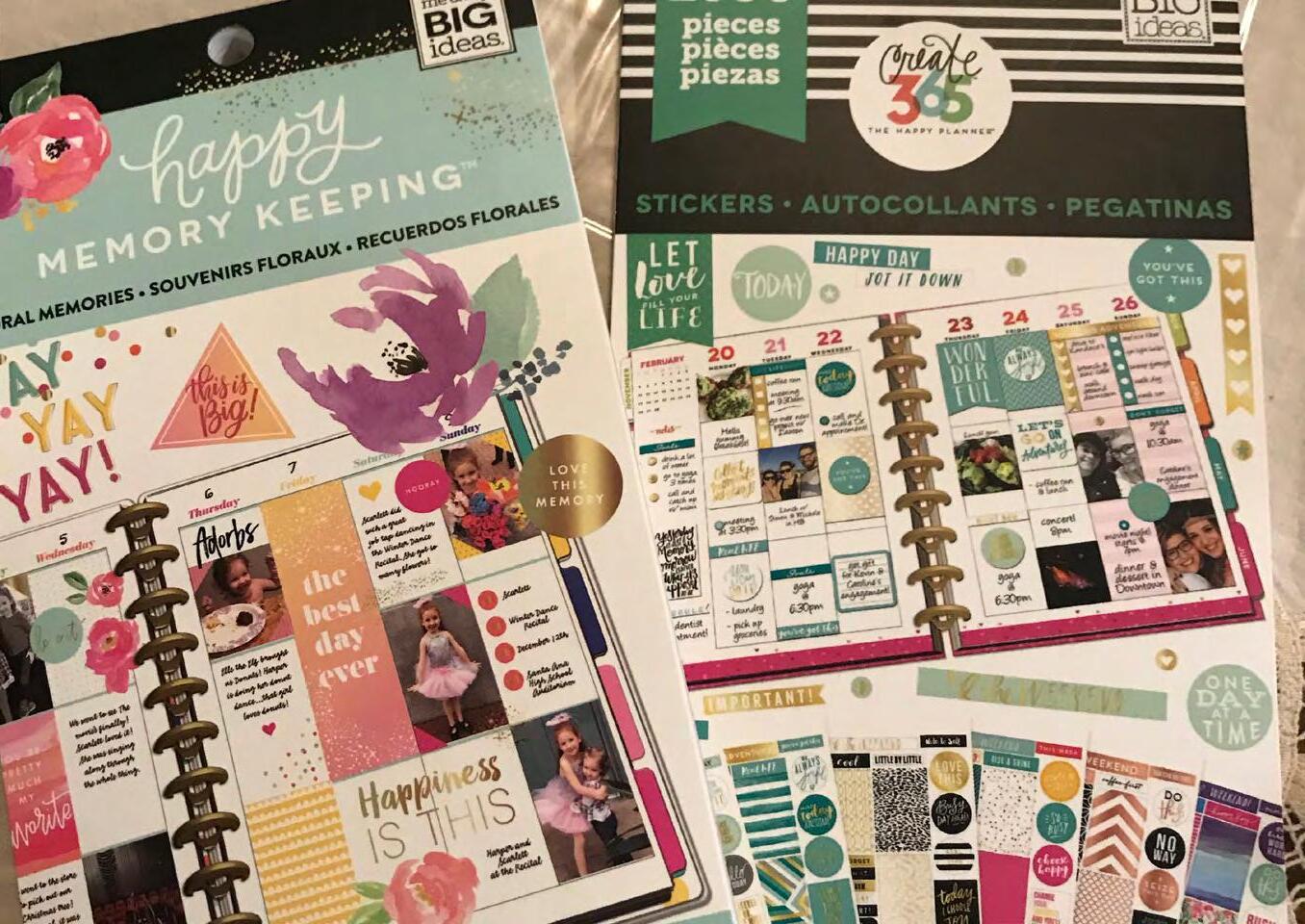

By the way, you can also have pages for Presents to Buy (or ideas of what to buy), Presents Bought (and where they are hid), Clothes to Buy for each child, Gifts / Crafts to Make, People to Write or Call, Movies to Watch.... The list is really endless and totally adaptable to your family and what you want to do.
Home School Mom, why not add in pages for Curriculum to Buy (or Sell), a page for links or names of Blogs that Inspire You, Books to Read (or read-alouds that have been read), Field Trips, Quick and Easy Recipes or Date Nights? All of these would be handy to have written down and saved.
This really is just the tip of the iceberg for Bullet Journaling, but it might be enough to get you interested. Check out the link I shared above or check out Bullet Journal Home Schoolers and Parents on Facebook. There also is a very active Facebook Page for Bullet Journal Junkies for more information.
Many parents are teaching their children to use a Bullet Journal, too. I think the best thing to do would be to start early with that. Make it part of your home school week. Early on Monday, sit down together and make a plan for the week. It is a wonderful skill for anyone to have. Plans can be very elaborate and beautiful (with stickers and sketching) or just a notebook of lists.
Sometimes some of us might worry each child is getting enough attention or time. Make a plan and put it on the calendar. Other times, we might need to schedule chores or make sure everyone is doing their fair share to keep the house running. What about listing who makes the meal and who cleans up each day? Make a schedule for that.
I will say that getting into Bullet Journals is a whole new world. Find washi tape, sharpies, special pens, planner pages, stickers and notebooks to buy. It is
fun to buy some of the new items, but it really can be a frugal thing to do when you download templates from the internet or create your own. You don’t have to spend a lot of money on this.
By the way, all of the Bullet Journal pages I mentioned above can be added easily into a planner you already own, using regular or pretty washi tape. It might not be as customized as a Bullet Journal, but it is quick, easy AND done. That is what is important. Make your planner work for you. Don’t stress about making it perfect. Just get it done. It is a tool that can help you relax more and get a bit more done.
I actually found that writing things down really made me relax - I often would have a plan of three things to do or buy in my mind, and it really wore on me at times. I found that the lightest scribble of a note is better than the best memory. Happy Home Schooling AND Happy Planning!
Terry Yaceyko is a “graduated” home school mom who still lives and breathes home schooling! She loves helping to lighten the load on other home school moms.

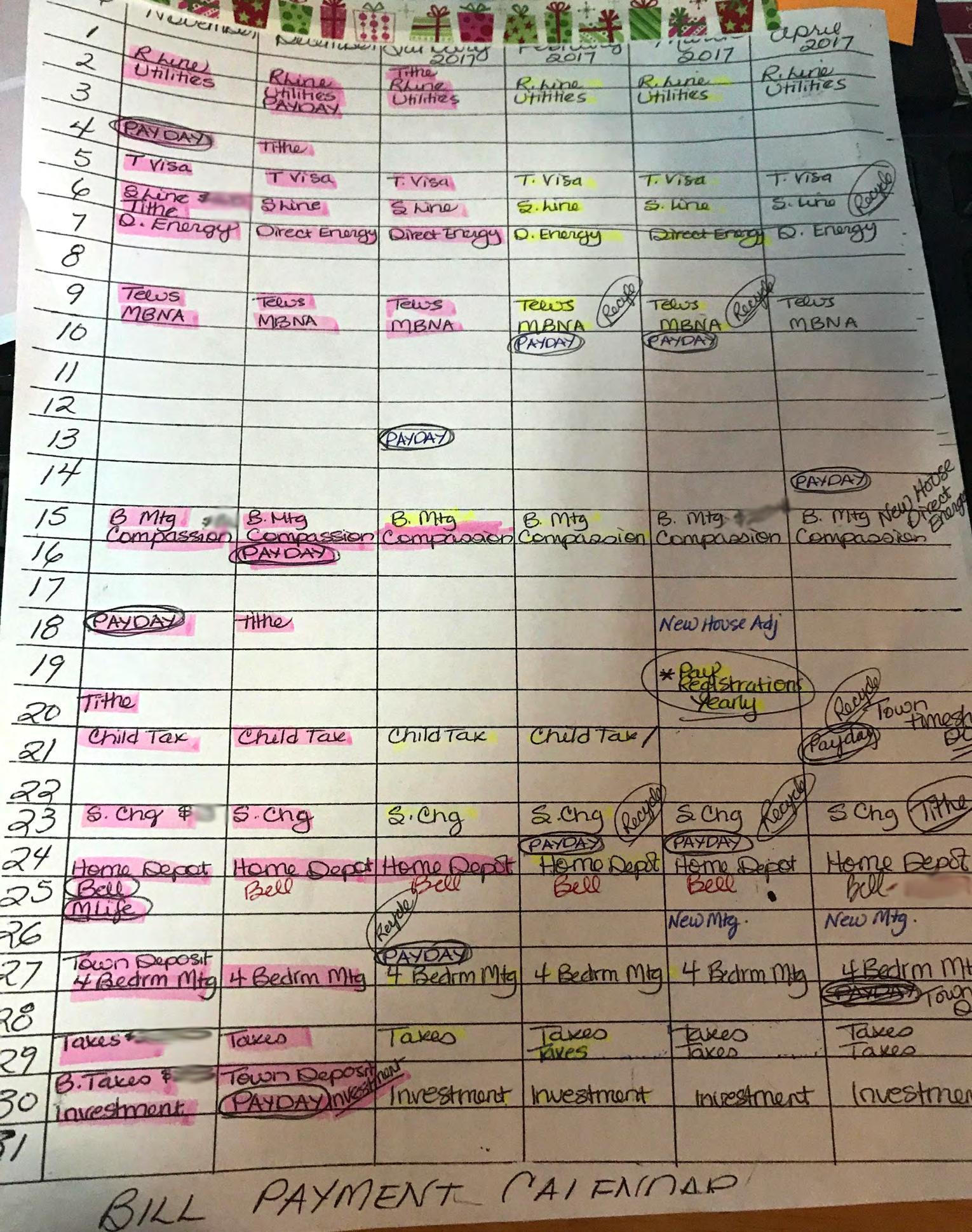
This is our simple bill calendar. I make it up for 6 months at a time. (I went through our banking and noted for 6 months what day of the month different bills were paid on). Whenever a bill is paid, it gets highlighted. I’ve also added in paydays, tithing Sundays and irregular payments, like insurance and registration. This makes it really easy to see what needs to be paid when. It is a very simple tool, but is invaluable to us. Great to include in a planner. (If you are having trouble paying bills on time, try scheduling 2 "bill paying days" each month, and pay early to avoid late fees.)



By Dwija Borobia
Ifeel like a bit of a poser (poseur?) saying this, but here goes: this is the last week of school for our school year! But... really? Can it be? I just don’t feel like it was hard enough. Usually by the end of the year I’m a dragging mess of exhaustion, just begging for freedom from the early mornings and the homework marathons. And this year, when I expected to feel more exhausted and more of a mess, I feel strangely at peace.
Oh my gosh. That means we didn’t do enough! We haven’t done enough. Clearly. I should start panicking. I should make them do summer school. I should get out some flash cards or something, right?!?!?!?!
But then I had an idea. We’ll find all the things they’ve written or drawn or created and put it together in one folder, including poems, stories, plays & field


ceramics projects and posters and put them in a digital file labeled with the school year. We’ll make reading logs so
we’ve got going on here, I can take out the folder or open the file. I can marvel that they’ve done so much in seemingly such a short amount of time. And I can say, “Hey, maybe it’s okay for a mom, every once in a while, to not feel like she was just trampled upon by a thousand angry bulls.”

Dwija and her husband home school their 7 children in southwest Michigan. She blogs their adventures on House Unseen {Life Unscripted} at www. houseunseen.com.
Editor’s Note: The Home Education Regulation requires that we keep dated samples of our children’s work here in Alberta. But rather than a box of samples, why not try Dwija’s suggestion for something that will also serve to encourage us?


By Danielle Shaber
So you’ve been hearing a lot about this Bullet Journal thing and read a bit about the benefits of using one with your students in your homeschool.
But… how?
I have been using Bullet Journals with my 3 students (5, 7, and 9) for about 6 months now and have 10 tips on how to make the transition as smooth as possible. As smooth as a nice chocolate malt icecream shake. Mmmm. That’s smooth. (I started a Whole30 and I miss dairy…a lot.)
Whatever your reason for using a student Bullet Journal, have it in mind before you start actually using one, or purchasing one. Seriously, write it down. It will help later when you feel overwhelmed. There are a lot of choices on how to Bullet Journal and what can go into it.
Keeping your ‘why’ in mind will help make sure that your Bullet Journal is helpful for you and leads you towards your goals instead of being a timesucking distraction.
For me, I started a bullet journal for each of my 3 school-aged children to reduce power struggles and record the spontaneous schooling they were doing. If you were to flip through their most recent pages, you wouldn’t find certain elements that are common to Bullet Journal/planners, like a monthly calendar. A monthly calendar does not work towards my two goals of reducing power struggles or record keeping.
Your students will be learning a new way to write things down and complete tasks. For some students this will be an easy transition. For others, not so much. To make the transition easier, start with just a few items that can each be completed in

20 minutes or less, fewer if you know your student will struggle with the change.
I come back to this rule any time things get overwhelming.
My 3 most important tasks currently are: morning time, zone clean up, and their focus subject for the year. At the beginning of the school year it was: morning time, chore, and oneon-one time with mommy. As the school year progressed, one-on-one time with Mommy got easier to do and didn’t need to be scheduled.
As homeschoolers, we build these beautiful systems. And what happens the first day of summer break? We throw them all out the window! I would encourage you not to throw your student Bullet Journal out the window when you’re not doing school. Surely there are still things that need to get done or goals to accomplish. Let your Bullet Journal change with your family and the seasons you are in and you may find your college graduate thanking you for developing the habit for them.
Searching “Bullet Journal Layouts” on Pinterest would be enough to send any sane mom running as far away as possible. I’m not sane.
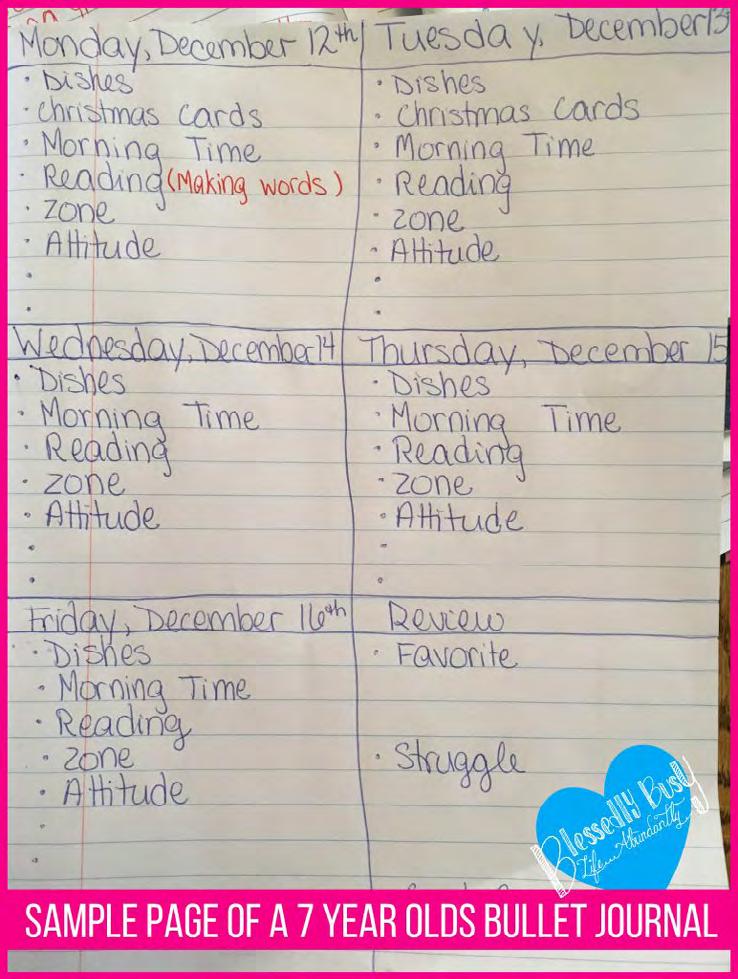
While I do scour the internet for ways to make my Bullet Journal a bit dressier, my student journals are very simple. After all, I have to make 3 of them. Someday I may have to make 5! I want the process to be as easy as I can make it. Here is our current layout.
It’s no fun being told how to spend all of your time. You will get more buy-in if you give your students some choice in their day.
You may have noticed in the last picture that there are some bullets with nothing written next to

them. Those are left blank for the child to decide what goes in them. Sometimes they fill them in as a task to be completed that day or sometimes after having done a task, they record it.
I have two “when-then”s on my student Bullet Journal:
• When you have finished your ‘must do’ tasks, then you may work on your ‘want to do’ tasks.
• When you have finished all of the tasks (and it’s 5:00), then you may have media time.
I can’t tell you how many power struggles this has ended before they really began.
When you first start, you will want to impress upon students that diligence is rewarded. To do that, plan something in the evening for the first week or two. Students who get their list done by a certain time (like dinner) can participate in evening time. Students who do not, have the consequence of working on their tasks during the evening event.
The evening activity doesn’t have to be super special or involve spending money. It just needs to be something
students would rather do than their tasks. During the fall, we went to the Rec Center (we already had passes). I should say: Hubby and qualifying children went to the Rec Center. I stayed home with task-completers.
Now, it’s really cold outside. So cold we don’t even want to walk to the van. So, our evening activity has been watching documentaries with the older ones while the younger ones play.
You don’t have to be creative to have this work. Even just scheduling free play time will reward diligent workers.
Yes, you are the one who writes the task list. Technically, you are the boss. But, if you let the Bullet Journal be the boss, you can be a sympathetic adviser. Instead of falling into the nagging trap and feeling horrible about your homeschool and maybe your child, trust that the Bullet Journal and your consequences will (over time) steer your child toward independent diligence.
When I first introduced the Bullet Journal to my 3 children, it was magical. They were so productive and cooperative. Sadly, the magic quickly evaporated. Well, more like exploded! All of my students have limit pushed the new system but one child in particular really pushed it!

She’s what you might call ‘spirited’.
She went several days a week for weeks missing out on the evening activity. Every day (it seemed), the day would end and there would be something on her list that she had refused to do earlier. Normally just saying, “let’s check everyone’s journal” would result in tears and tantrums. She knew.
It was very challenging, but slowly I became good at letting the journal and consequences tell her what she needed to do. When she failed, in my sweetest voice I would say, “it’s okay, we’ll try again tomorrow”. And we did. And the next day. And the next. Until one day she decided she cared.
All of my children push the limits of the system every once in a while. As long as I stay firm, it doesn’t last long and there are no power struggles!
Once a week (typically Monday) I ask each of my students (5, 7, and 9) what goal they would like to have for the week. If they seem really stuck, I might offer some suggestions based on what I’ve seen them working on (finish a Minecraft town) or struggling with (play 15 minutes with sibling).
My spirited child once made a goal of getting her tasks completed by 4:00. I was really surprised that she made this goal since she was struggling to finish her tasks by 5:00. Several days
into it, she was discouraged. She was failing at her goal. I was able to talk to her about her failure and brainstorm ways to improve. If I had given her that goal, there’s no way she would have come to me for help. I would have been viewed as “the mean mommy who makes me do things I don’t want to do”. But since it was her goal, I was viewed as an ally. When she did finally make her goal, her triumph meant so much more to her than it would have if I had been the one to give her the goal.
If you do not schedule planning time, it will never get done!
You need to schedule:
o time to add assignments/tasks to their Bullet Journal (I do once a week about 10 min/student)
o time to check in on their progress (I check progress daily around dinner time)
o time to have students set a goal for the week and break down what needs to be done in order to accomplish it (I do weekly)
Ready to Try?
Try it out and tell me it isn’t the best chocolate malt ice-cream shake you’ve ever tried.
Before living a life of adventure as a homeschooling mama to 5, Danielle was a math teacher in a local middle school. She now works part time as a homeschool coach, helping others find their dream homeschool. Contact daniellehomeschoolcoach@gmail.com for more information.