



WISDOM Home Schooling offers to parents an effective method of interaction that can help all learners, regardless of learning or behaviour difficulties, age, or background.
The parent is the best person to help a child make progress in their learning. Using a specific method and set of strategies, the parent can help their child think effectively and work to a place of success when faced with problem solving. WISDOM teaches a system that concentrates on three things: process, meaning, and change. Our parent training program focusses on how to learn more than what to learn. Parents learn how to stimulate brain change in the learner, overcome weak areas, and use a child’s strengths. In a series of effective learning events offered in various Alberta locations, parents are presented tools and strategies to strengthen any learner’s ability to think.
The mediational method develops optimism in the child, opens up a greater desire to learn, and stimulates enthusiasm to work to a place of success. Improved parenting and teaching skills use a gentle approach by asking questions that exercise reflective thinking in the child. The more the brain is intentionally exercised (especially where there is a weakness), the greater the resulting brain change. No child is stuck in their behaviour, emotion, or learning challenges.
Mediated Learning usually involves:
• Asking questions rather than providing answers to a learner. The mediator encourages "thinking".
• Encouraging children to think about the meaning of a lesson or activity. “Why? and How?”
• Taking advantage of teachable moments, when a child’s questions or body language show they are curious.
• Asking children to explain something in their own words; offering or asking for an analogy.
• Posing process questions that guide children to think logically.
• Helping children form and use strategies to work past barriers.
• Helping children to organize, make deductions, and think through their decisions.
• Helping children who are distracted, having difficulty remembering, are oppositional, or have lost the love of learning.
• Helping children who are gifted in one or more areas of endeavour, but also struggle in other areas of learning or behaviour.
• Helping children in specific

weak capacities such as in
• Helping children who have challenges with planning, goal setting, and staying to task.
• Helping those that experience anxiety, depression, or anger.
• Helping with attachment issues, or difficulty with relationships.
This program can help any individual. Nobody is trapped by challenges. Parents are the key to making meaningful and positive changes in their children. Mediated Learning is a means of positive, permanent change.
For more information, please check out the Resources section of our website.
Yvonne Harink
By Lorrie Rempel

My journey with Mediated Learning (ML) began about 8 or 9 years ago. Our first two sons learned to read around the age of six without much trouble, but our third son . . . well, that was a different story. I started attending the ML workshops in the early days of them being offered by WISDOM. I came away from some of these first workshops, knowing that there were answers for our troubles, and I was encouraged. About the only practical thing I came away with however, was “keep on asking questions” rather than giving the children answers, in order to help them learn to think.
I continued to search for answers in many different ways. I spent hours researching and changing our eating habits. It made a huge difference in our lives in many areas, but for one son, reading (or maybe I should say all schoolwork) was not one of them.

About then, Thérèse McDonald came in as a ML instructor. Under her management, the reworking of the WISDOM ML program brought in practical hands on application of the concepts that were being taught in the workshops. One day she talked about the importance of learning balance, so that the different halves of the brain learn to work together. This is an essential before learning to read. It struck a chord with me – our young son had a terribly hard time learning to ride a bicycle. But seeing that it was the middle of the winter at the time, we sent him out to the wood shop with his Grandpa, to build a balance board for himself. We also purchased a mini- trampoline and a balance ball for him to use. These all became stepping stones in his learning to read, but the light bulb moment came when we realized one day, that he had no reason in his mind of why he should learn to read. ML talks a lot about the

need to bridge concepts to meaning. He needed to have a reason why he should read! Suddenly he took off trying hard to read. . . for a little while. About six weeks later, we were at a standstill again. He had forgotten the reasons. Once they were firmly established, he took off with his reading. It felt like we laid aside the three letter word “BOB” books and suddenly picked up Piet Prins “Scout” series chapter books. We almost wondered why we had children’s picture books in our home library, as he never read them.
In those days, one of the workshops was “The Gifted Learner.” I remember thinking that this one wouldn’t apply to our house, but it was one of the series, so I would attend anyways. What a surprise! I came home so encouraged and blessed that day! The gifted learner and the challenged learner are often “two sides of the same coin,” so to speak. I was especially encouraged in the “nonschooling” form of education that we had chosen for our children. I was motivated to continue tailoring their learning to their unique needs and personalities.
I continued to take every opportunity I could to listen to Thérèse. She should have been thinking, “Lorrie, why are you
here? You’ve heard this all before.” But I needed to hear it again. The content was familiar, so now I was comprehending more of what was being said, but my perspective was also changing. One session, Thérèse was making comparisons and encouraging the changing of negative statements into positive ones, when she said “It’s not that your child is sensitive, rather, they can experience thought as reality.” I don’t know what else was said for awhile. I began to take a turn in ML. It was no longer about my children. It was now about me, and learning to understand myself, and how I was thinking, as I so clearly saw myself in a new light in this statement.
This began a time in my life of reading some of the books that WISDOM had available at the workshops. Times of thinking, reading, and reflecting. Times of recognizing myself, learning about who I was, and slowly understanding why I did or thought about things the way I did, as well as examining some of the presuppositions that I had, and how they affected me.
As the workshops were changing and becoming even more practical, there were times when there were brief activities to


help you put yourself in the place of the student, followed by discussions of how we had responded to the instructors’ requests, comments, or intentional pressure points. I had to struggle for a long time to get control of my emotions after a couple sessions that day. I never was able to share, but it was a powerful learning experience as I gained a lot of insight into thinking - especially my own thinking - that day.
All of a sudden, several Scriptures started to take on more depth of meaning. “For the mind set on the flesh is death, but the mind set on the Spirit is life and peace” Rom. 8:6, “For as he thinketh in his heart, so is he” Prov. 23:7, “Do not conform to the pattern of this world, but be transformed by the renewing of your mind.” Rom. 12:2, “Understanding is a fountain of life to one who has it.” Prov. 16:22.
God wants us to take every thought we have, and examine it in light of His Word. In order to do that we must first have learned to think about what we are thinking about! This brings me back to some of my original responses to the ML teaching: this material is fabulous, because it is relevant to everybody. We all need it.

A statement that Thérèse made one day that stayed with me was, “Truth always reinforces truth.” I continue to see this so often. I just finished reading John Taylor Gatto’s “Weapons of Mass Instruction”. He talks about the school system teaching us fear: fear of man, fear of failure, fear of authority . . . hmmm . . . I was a great student and a quick learner in that system; it’s no wonder that I now battle fear issues. If you are attacked with fears about your ability as a home school parent, read this book and be encouraged. You are doing what is best for your children!
Every stage in life is different. I continue to learn things about myself, while also trying to study and understand my children: seeking ways to help them along in our journey of life. We were recently reminded again of the power of games for learning. I realized that an older child was having trouble reading because they still had a couple gaps in their knowledge of the sound alphabet, and they were struggling with alphabetical order. Now what? The little children’s worksheets would be insulting. Games seemed to be our answer, but what games? We put our brains together and soon had created 2 new games of Dutch Blitz and Racko with an alphabet twist. Along with another simple free game we found on the
internet, the necessary skills were quickly mastered. The “Do It Yourself Journals” we found at DyslexiaGames.com have also helped us pass another milestone as some of the children have begun to take ownership for their own learning. As we pray and work together to learn and help each other, I am so thankful to see our home slowly becoming more peaceful and joyful. God is so good, and I have been so blessed to watch Him take a simple action of attending a ML workshop to
try to help a struggling son, and He has taken it and turned it into something so much bigger and larger, as He transforms our family and our thinking! I marvel as I look back and see His vision and plan for us!
I want to say a very special thanks to Thérèse for her years with WISDOM`s ML program, and the part that she has played in being a vessel that God has used to help us in this journey. I’ve greatly appreciated Thérèse, and wish her God’s richest blessings wherever He leads her in the years ahead.
Lorrie is the wife of Vern Rempel, and together they have been home educating their 8 children for many years. Lorrie loves learning, researching, and God’s Word, and has often said that they could continue to home educate even if all they had was their $10 library card.
By Thérèse McDonald

Tip #1
Sleep and Nutrition – Sleep-loss equals mind-loss. Sleep loss creates a distracted, unfocused brain. Be sure that a child gets sufficient sleep. Stay clear of screen time and devices before bedtime as the brain interprets the bright screen as daylight. Wind your child’s world down using quiet activity such as reading, low level music, or a soothing audio book.
Avoid preservatives and dyes in food. Research confirms that cognitive functions are affected by nutrition, especially in the child struggling with focus challenges. Allergies also contribute to distracted thinking.
Movement - The distracted child needs at least twice as much body movement in a day. Allow for many body breaks. Look at YouTube for many Brain Gym exercises that promote better focus and healthy chemical brain balance. Some examples are:
• Jumping Jacks
• Hugging oneself and twisting at the waist
• Touching the opposite foot to the hand behind the back - alternating
• Doing crab walks
• Hopping on one foot and then the other

• Looking left, looking right
• Squeezing fists tight and then releasing
• Lying on your back, lifting legs into the air
Tip #3
Vision and Hearing Tested - Distraction can come from impaired vision or hearing. Have your child tested.
Tip #4
Reduce Stress - The distracted child becomes even more distracted when the environment or relationships are stressful. Keep voices calm and reassuring. Mediate difficulties with gentleness and care. Remove pressure consistent with time-
limits, testing, and grade content most of the time. Create boundaries and rules that protect the child from being yelled at or belittled.
Tip #5
Limit Media Distractions - TV, Internet, Gaming, and other forms of screen time. The distracted child’s brain becomes even more distracted with too much screen time. Half an hour a day for those children over the age of 6 years is sufficient, with one hour for those over the age of twelve. Stick to your rules. Distracted children have trouble filtering out noise. Do not allow at TV or computer in the child’s bedroom. See our website for recommendations on screentime.
Tip #6
Give Undivided Attention to Your Child for a Portion of the Day- Intentionally plan to give focused attention to each child each day for a concentrated 20 minutes. Your attention will help wire your child’s brain to stay focused. Play a short board game, read aloud and discuss, or do a drawing together. Come up with a planned activity ahead of time and make time for it.
Tip #7
Play games that require attention and practice the brain with activities that strengthen focus. I Spy, Guess Who, Clue, Art Appreciation, etc. Request the Brain Game booklet from WISDOM Home Schooling.
Tip #8
Work in small chunks, breaking exercises down into more manageable bites.
Thérèse McDonald is the former manager of WISDOM’s Mediated Learning Program, which has helped hundreds of families to learn better, together. She and her husband Glen home educated their four children through high school. Thérèse is mother to two daughters and two sons and has found Mediated Learning to be of great benefit to her home schooling.
WISDOM Mediated Learning Program
By Thérèse McDonald

WhatPerfectionism Looks Like in Children and Teens:
• When making mistakes, there is a tendency to become angry, upset or very anxious.
• A pattern of procrastination develops with tasks often going uncompleted.
• A strong fear of embarrassment or humiliation is present. Fear of failure is chronic.
• There is an over-cautious approach to activities and tasks - this leads to taking way too much time to complete things.
• The child tries to improve things by rewriting and rewriting.
• Meltdowns are frequent when things don’t go perfectly or as wanted.
• The child is reluctant or refuses to try new endeavours because they don’t want to risk making a mistake.
Help your child to understand perfectionism
• Have a discussion about perfectionism. Share with your child that perfectionism is a kind of lie - it makes us overly critical about ourselves or of others. We hear inner messages that aren’t realistic. These can make us afraid, angry, unhappy, or anxious about trying new things. It makes it difficult for us to make decisions, or finish what we start. This is frustrating for the child and the family.
• The feelings of needing to be perfect have us thinking things that aren’t good for us. The lies we hear might be like these: “You have failed if you don’t get it perfect.” “If you disappoint someone or don’t please them, you are a terrible person.” If we listen to these kinds of messages, it can make us afraid or sad.
• If we believe messages about perfectionism, it makes it very hard to learn new things. It takes lots of time and effort to perform to a level that is acceptable to a perfectionist.
• Perfectionism makes it so that we have trouble really enjoying our activities and achievements.
• God desires that we enjoy all the moments and steps in life, mistakes and all. He takes care of us and the details of life – Trust in Him.
Change negative statements to positives.
• Perfectionist children often have very literal, black-and-white thinking. Things are either right or wrong, perfect or a failure, good or bad. Help your child see that things aren’t always this way. Sometimes imperfect things can be beautiful. Getting 8 answers right out of 10 is still a great achievement, especially when you tried your best.
• Help your child to replace critical thoughts with more positive and helpful statements. The child may not believe them right away but with enough repetition, good thoughts will replace perfectionistic thoughts in a more habitual way. Move the negative thoughts aside by replacing them with optimistic and positive talk.
Some examples of positive statements:
“Nobody’s perfect.”
“My best is good enough.”
“Making mistakes is normal. I learn way more when I fail.”
“Everyone makes mistakes.”
“I’m not going to worry because I’ve done my best for ___(God, for others, for myself).”
Have your child say these statements to herself whenever she starts to be self-
critical or upset about not doing something perfectly. Suggest writing these statements down, keeping them handy to look at.
Helpful Hint: Parents, model saying these statements aloud when making mistakes yourselves.
• The perfectionist tends to see things more seriously than they are. They can see a catastrophe, when in reality the situation is much more manageable than they think. They can focus on the perceived negatives, and anticipate consequences and failure that are disproportionate to the truth.
• Help your child to see that a mistake does not equal failure. Messing up does not mean they are useless or worthless.
• Talk about people that your child admires who made mistakes but still bounced back. Share from your own experiences, characters in books or public life, inventors, sports stars, etc.
• Helpful Hint: Have your child come up with their own positive quote and make a “failure” bookmark.
• Share other quotes or scripture phrases. Put them up on the fridge or bathroom mirror.
“Failures are finger posts on the road to achievement.” C.S. Lewis
“Take a chance and you may lose. Take not a chance and you have lost already.” Soren Kierkegaard
“Failure is the opportunity to begin again more intelligently.” Benjamin Disraeli
• Praise effort regardless of whether or not your child was successful. Stress that there is success in giving good effort and doing one’s best.
• Instead of praising the achievement, give specific praise that gives focus to the action. “Wow you showed real confidence.” “I love seeing how hard you worked. That is what counts.” “Good for you for getting started right away!” “You were very brave to give that a try.”
• As a way of coping with their fear of mistakes, perfectionists procrastinate. Help your child overcome this with the following strategies:
• Make Realistic Schedules. Help your child break down big tasks into little tasks (chunking). This can be achieved with a list, chart, calendar or journal. Write down the goal and then work backwards by creating mini-goals along the way.
• Help the child to decide how much time each task should take. Encourage your child to focus on achieving the goal and not necessarily making their results perfect.
The perfectionist often has difficulties deciding on what is most important and where to devote their energies. Helping your child set priorities is important. They may need help determining which activities need the most energy and attention. Help them to see where 100% is needed and where it is not.
The perfectionist child tends to lead lives that are limited. As it is difficult to be very good at a lot of things, they avoid leading full lives. Teach them how to do a “good” job, and not to over-sweat in trying to do the “perfect” job. Show them how this frees up time to enjoy other activities and hobbies, which are also important. We strive for a balanced life, and God wants that too.
• Be a model to your child by candidly saying, “I don’t know,” when you don’t. Help them become comfortable with ambiguity and vagueness - the grey areas.
• Share your own mistakes and talk about what you have learned. Let your child hear you say, “I made a mistake - oops!” Try to laugh at your mistakes in front of your child.
• Set reasonable standards for your child. Maybe step away from too many academic pursuits for a season as they gain greater appreciation for other kinds of activities or lessons that don’t place as much emphasis on grades or right and wrong answers. Give more breathing room to your educational goals for the perfectionist child.
• Encourage your child to think of ways to serve and build others up. When being a contributor, they may see many valuable ways of growing character and being a helper that place less focus on perfection. They will feel good about themselves as they think more of others, while thinking less about how they are personally ‘failing’.
• Pray for your child, asking the Lord to heal anxiety, worry and anger. Ask that the child see himself as God sees him.
Book Resources:
Nobody’s Perfect: A Story For Children About Perfectionism - Sep 2 2008 by Ellen Flanagan Burns
What to Do When Good Enough Isn’t Good Enough: The Real Deal on Perfectionism: A Guide for Kids - Apr 15 2007 by Thomas Greenspoon
By Christie Lietz
Thefirst day back at “school” last fall, I proudly pulled out all the curriculum we’d begged, borrowed and bought for this school year. I was already feeling a bit “behind” as we’d used the perfect fall weather in September for a glorious camping trip into the Rockies, making applesauce, and trips to Fort Edmonton and the Ukrainian village before they closed for the winter. We’d also hunted down skates, skis, sleds and winter wardrobes for our family of nine, and celebrated four birthdays the first 10 days of October! Now, we were finally ready to get down to business!
I sat our eleven-year-old son down with his math book and asked him to figure out where he’d left off in May. And all of a sudden I saw him exhibiting behaviours I hadn’t seen since May as well! We persevered for a few more days, but it was becoming abundantly clear that he had developed a real mental and emotional block towards this subject.
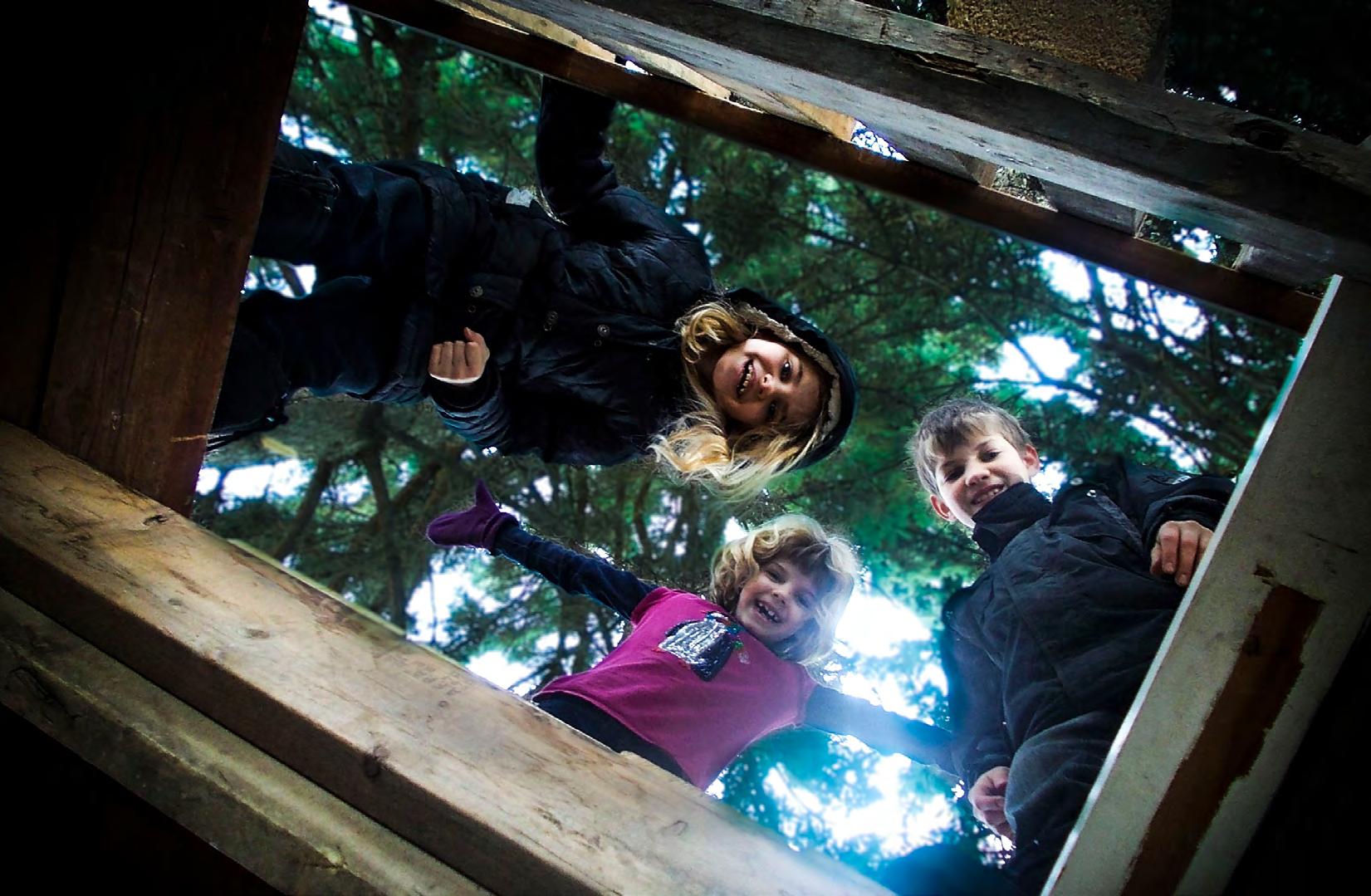
We remembered all the articles we’d read in the magazine about Mediated Learning, and how important it was for subject matter for boys in particular to be relevant, hands-on and productive. We decided to try a different tactic. We have two huge spruce trees growing in our back yard. They are about 8 feet apart, and we noticed that all the lower interior branches were dead. If we cleared those out, there would be a concealed, sheltered, cathedral shaped space...
“Nathan - do you want to build a tree fort?”
He did.
And he has!
Our “I can’t!”, happy-go-lucky, neverfinish-things boy has produced a masterpiece! And he didn’t lose even one tool - at least not permanently. This project has done wonders for him. The first step was to go to the library and get on the internet, look at tree house plans and decide what he wanted to create. Then
he had to draw his own “blueprint” and calculate how many of each kind of board he would need. I remember one day his dad was inside the bathroom, and Nathan, too eager to wait for him to come out, was simultaneously questioning him and somersaulting up and down the hall, trying to wrestle the calculations out of his head! It worked, too.
Once they’d researched the price of new lumber, he and his dad spent a bunch of time checking out Kijiji and other sources for lumber and hardware within his budget and geographical area. We even prayed about it, and he actually got it all for free! This all took some time, and it was helpful to remind ourselves, “This IS his math (physics, economics and carpentry) for this fall!” so we could feel okay with that!
As you know, winter came early this year, so our “fall” project had to become an “every mild winter day” project. Were there days our dear son whined and would rather have stayed inside? Yes. Were there days he would have cheerfully left us with a pile of boards to dispose of some day and thrown the whole project to the wind? Of course.
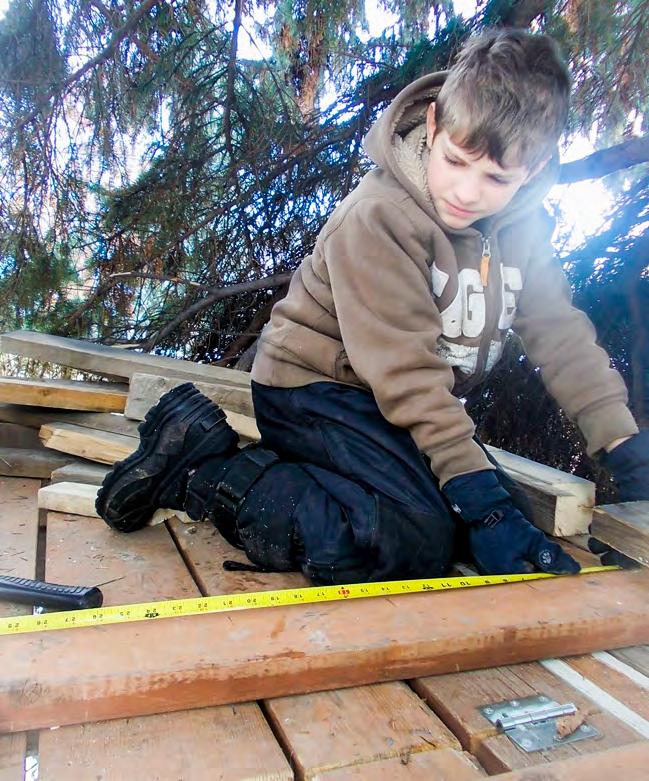
But we did not let him, and as we projected how great this was going to be, and pointed out what he’d already accomplished towards it, he believed us enough to keep at it. Now, he did not do this on his own. There were also days my dear husband would perhaps have rather been getting other things done, too, but he is a great dad, knows what he’s doing with tools, and could see the great potential benefits to our son accomplishing this. He taught Nathan how to plan, persevere, figure things out, do the math, saw and hammer, put his tools away and work cheerfully. I’m so proud of them both!
Our back yard has become a place our son’s cousins and friends beg their parents to let them come play in! And that suits Nathan just fine, because if there’s a subject he gets an A+ in, it’s making friends.
Christie Lietz is a homeschooling mom whose family is back in Alberta for a while from their family missionary work in China. They didn’t bring much back to Canada, so got creative last year with educational supplies. And thanks to the generosity of other WISDOM parents, most of their curriculum needs were met.
Photos courtesy of the Lietz Family
By Thérèse McDonald

Mom: Write two pages on anything you want.
Suzy: Um, I don’t know where to start.
Ithink all of us recognize something wrong with the above scenario. Where is Mom going with this, and where is Suzy’s focus? We see that Mom wants to see some kind of writing happen but the elements required to make this a purposeful and meaningful learning experience are lacking.
Intentionality and reciprocity (I’ll get to the reciprocity part later) are key to and an essential first part of the Mediated Learning experience. Mediation is a very intentional act where the parentmediator deliberately guides the child in a particular and chosen direction where the child is influenced to focus attention on ideas or material.
To learn and retain anything long-term, we need to pin-point the purpose and significance in what we do. We are looking to frame, select, and interpret whatever it is we are exploring so that it yields some kind of meaningful response from the child.
In other words, if we don’t have a specific direction in our teaching, we can expect a limited amount back from the child. Reciprocity occurs when the learner actively demonstrates cooperation and becomes engaged in their learning.
Just intending to intervene with my child’s learning, doesn’t guarantee that attention from the child will occur. If I write a story, I’m not assured anyone will read it, but if I actively and purposefully mediate my story to an audience, I can draw them to want to read my story, become involved in it, and remember it.
Freedom in a rich learning environment leads to wonderful learning in a child. Intentionality of mediation does not mean we do the learning for our children. It is about creating high interest in a subject or experience and enhancing the learning by sharing enough with the student so that they are motivated to learn. We create the proper conditions to encourage in the child a desire to learn. Sometimes we can get in the way when we intervene too much. Conversely, if we aren’t involved enough, the child loses the benefit of our experience and enthusiasm.
If I put on a piece of classical music and say nothing, we all enjoy it at a certain level; it is all pleasant enough. You do get something out of it. However, what if I tell you that this piece of music is meant to convey a time in history where two sides are at war? The kettle drums represent the heartbeats of the soldiers as they stand at the bottom of a hill, gazing up at the enemy. The beat gets more rapid, the cymbals clash as the two armies meet, and at the end of it all we hear the sweet violins representing the angels carrying the souls of the dead to
heaven. I’ve changed how you engage with this piece of music. I’ve enhanced learning for you. I’ve given more purpose and meaning to the piece, and I’ve evoked an active response from you. You’ll never forget this piece because my intentionality gave birth to reciprocity in you.
What can the parent- mediator do to influence successful intentionality and reciprocity?
• Change pitch, gestures, language, pace and vary learning experiences.
• The parent takes into consideration how the child learns best –movement, auditory, the written word, or visual.
• The mediator takes into consideration the maturity of the child, attention span, interest level, environment and availability.
• As we teach we need to consider the need for repetition, how much to teach and for how long of a stretch.
• Has the child got good access to water, proper nutrition and enough sleep (how about the parent?)
How does the parent foster the mediation of intentionality and reciprocity?
• Put some zing into your teaching. You are trying to arouse interest in the subject matter. You are looking for feedback from the child that shows they are actively learning. Are they listening with interest? Are they responding in an enthusiastic way? If they aren’t, is there something you need to change in your approach? Too many workbooks as opposed to the child “experiencing” an activity? Do you discuss what you read, encouraging the child to express ideas and thoughts?
• Create an atmosphere that is conducive to learning. Are you communicating your intentionality?
“Let’s all gather around this picture. I wonder how a hot air balloon works?” The mediator “asks” and tries not to “tell”.
• Are you modeling curiosity and guiding your child to explore the things they are curious about? “I wonder what kind of bug that is? How can we find out?”
• Are you ready to re-frame something that is not understood? Do you have other ways to get concepts across (different modalities)? Sing it, dance it, write it, read it, draw it, tell about it…
• We need to make learning opportunities relevant to our children. How does this connect with real life? How does it affect me beyond right now?
• Instead of “Get out your books and start working”, we are looking for the “why” behind the lesson. We are focussed on the process in our learning, not just the outcome.
As mediators it is important that we don’t over-kill, but rather choose carefully those areas that need particular focus and change. Let me share an example.
A couple of years back one of my children lacked confidence in math and I could see that they were beginning to block and resist doing math. I gave great thought and prayer to the situation and decided I needed to take my child back to the last place of success and build from there. I thought about the last time math was a joy, and pin-pointed the time when the child began to lose desire in the subject. We returned to that place and when we went over the math, the child was at ease revisiting it, and did the problems without any trouble. This gave us the opportunity to begin again, leaving off from a place of success.
I asked gentle questions of my child that gave greater clarity as to what they
were thinking and feeling. I discovered that the child felt overwhelmed when I originally presented the new material, but had not shared that they weren’t “getting it” because they felt incompetent. I presented too much in the lesson at once and the child felt “stupid” for not understanding. I realized that I had not originally looked for reciprocity in the child, making sure that I had given meaning and purpose to the lesson, and that the child was engaged and interested. I motored on without realizing there were gaps for the child and that over time things only got worse.
With intentionality I looked at ways that better fit this child’s learning style and went online and found a resource that broke algebra into smaller steps and used more of a story-telling approach to explaining algebraic concepts.
I began by mediating the lack of confidence and helped the child to realize that they were not stuck where they were, that they were capable of getting past this barrier, and that we were going to make a fresh start, using a new resource. I also talked about how failure is just another step toward success. I shared my own responsibility for the situation and my lack of mediation. I mediated hope and optimism in trying again.
We talked about the benefits of learning algebra, looking carefully at the purpose behind our upcoming lessons. I bridged to other times of challenge and what comes of persevering through difficult times. I bridged to the future and how getting past this learning barrier was going to help in the long run.
I asked for a good attitude from the child, and a willingness to put a good effort in as we started over in this part of our mathematical journey.
I kept the first lesson short and I purposefully ended at a good place where the student felt successful and open to more math. The next day I could see this
child ready and willing to do more. We were in a much better place. I solicited feedback and it was very positive. I worked alongside my child, giving the message that this was something we were tackling together and that they were not alone. We took things at a relaxed pace, I was careful to be cheerful in my teaching, and we covered the concepts in small chunks. I looked for practical applications to the math we learned, so that the lesson was infused with meaning and relevancy.
The good news is that this child was renewed and changed by the experience. The child’s thinking was modified, as was their belief in what they could do. We went forward successfully from there and things were so much better.
Learning is a natural process. How can it be enhanced? What can you do when you want to zero in on a particular need and find solutions?
I stated at the beginning “Mediation is a very intentional act where the parentmediator deliberately guides the child in a particular and chosen direction where the child is influenced to focus attention on ideas or material.” Are you looking for a method that will work at getting past learning and behaviour challenges? Mediated Learning works for the whole family. Are you looking to make actual changes at the cognitive level? Do you want to learn more about being more intentional in your teaching? Do you want greater engagement and enthusiasm from your child? Maybe it is time to consider training as a mediator in your home.

By Thérèse McDonald


It can be worrying when a child struggles to read, especially when their peers are reading with ease. Outside pressure from well-meaning family or friends can really damage the beginner reader.
Mediated Learning Parent Training Reading & Math Workshop has a focus on reading challenges. I’ve met with several parents who have late readers, usually boys between the ages of nine and twelve years old. Here is the story of one such boy.
Peter* always looked forward to local library visits for Moms’ and Tots’ Reading Hour. He would plunk himself in the front row so he could get a good look at the featured picture book. He loved hearing a story read aloud. More of a joy was bedtime when Mommy would read a story, and then Daddy would read another.
When Peter turned six his mother, Sharon*, started a phonics program with him. Things didn’t click well, and he would get very frustrated while trying to sound out the letters. After talking to her facilitator,
Sharon decided to back off for a bit and give Peter more time. She continued to read to the family and Peter continued to be engaged.
The new school year began and Peter was about to turn seven. On a visit to Grandma’s house Grandma asked Peter how his reading was going. Sharon jumped in saying things were coming along. Grandma said that she would like to hear Peter read. Peter said he didn’t know how. Grandma’s expression was that of shock and in front of Peter she began to talk to her daughter about how far behind Peter was compared to his cousin, he just wasn’t learning enough. It was proposed that it might be better if they put Peter in school before he fell even further behind. Sharon went home, discouraged.
A week later, Peter was at the soccer field meeting his new team for practice. As the group was divided into groups, each child had to reach into a sack and pull out a little card that designated what group they were
in. Peter pulled out a card upon which was written BROWN. He stared at it and then just waited. Sharon was about to help him when another boy told Peter he should get in his group. When he said he didn’t know where to go, the boy told him to read his card. Peter shared that he didn’t know how to read. The boy told Peter that he must still be a baby and told him his group colour. Peter pushed the boy over and Peter was scolded by the coach. Sharon and Peter talked about the situation, encouraging him about his reading, and deciding that it was time to try phonics again. Peter told her he hated reading.
Peter was still not ready and encountered failure. Sharon tried different approaches and began to dread their “sessions”. She pushed him along, but with little success. He seemed to remember what they had studied one day, and not the next. Daddy began to worry and began to push too. Peter announced that he hated books and didn’t ever want to read. Reading was “stupid”. Sharon’s facilitator encouraged patience and shared the title Better Late Than Early by the Moores. A veteran home schooler encouraged Sharon to “relax” and to continue reading aloud together. But other voices told Sharon in so many ways that Peter needed serious intervention and that she was a failure home schooling mom.
Another year went by and another. Peter was nine. He told his little sister, a good reader, that she was way smarter and that he was probably going to never have a real job. Sharon asked him about this and he told her that his cousin told him he would probably never get a very good job because he didn’t know how to read. Again Sharon compassionately spoke encouragement but deep down felt immense discouragement. She pushed harder.
Sharon and her husband noticed how difficult Peter’s behaviour was getting. He began to act out and had to be disciplined for disrespect or rudeness toward others. He became very non-cooperative. Sharon was determined Peter would read by yearend. She got out a stack of Dr. Seuss and
had Peter “read” them with her over and over, she made phonics cards and hung them about the family room and then she tried BOB books, hoping the simple format would work for Peter. Peter dug in and wouldn’t even try. He was heading for ten years old. Sharon began to withdraw privileges from Peter unless he would work at his reading. Peter kept trying… superficially.
Sharon signed up for Mediated Learning’s foundational workshop. She cried and shared openly that she was sure she had set her son up for repeated failure and that a happy boy had turned into a fighting and angry person. She was given a message of hope, a new focus on solutions and the tools to do it.
First up, Sharon decided to mediate some of the criteria she had learned in the first workshop. She began by talking to her husband and sharing Mediated Learning (ML) concepts. He was open and willing to help. She decided to begin with using Process Questions to talk with her son about what he was feeling, what he found hard, and other matters of the heart. She watched as the defenses went down, and tears flowed. They talked about failure. Sharon mediated a hopeful approach to failures, creating a fresh confidence in Peter. They spoke of an accurate understanding of intelligence and Peter’s gifts. Over an eight-week period, Sharon and Peter worked on a new plan to move toward a place of success.
They worked on many of the nine criteria covered in the workshop, namely Competence, Challenge, Self-Change, Optimism and Self-Regulation. Sharon set reading aside while she worked on the core of ML. She became more intentional about sticking with her plan, looking to see that Peter was truly engaged. She tried to bring greater meaning to their time together, and she and Peter bridged their activities to other experiences, which reinforced all that they were learning together. Most of all, she focused on just being close with Peter and capturing some of the joy they had lost.
One discovery when talking with Peter was his embarrassment at reading “baby books”. When family and friends asked what he was reading he felt angry and mortified to say he was reading Hop On Pop. He told his mom he wanted to read Redwall books like his cousin, or Lord of the Rings like his sister. Peter also shared how hurt he had been over and over because of his inability to read. Sharon helped him to see how he was blocking because of the unpleasant experiences. Did he think he felt ready to give reading a gentle try? He actually thought he could now learn to read, but he wanted to be “private” about it.
Sharon shared some thoughts with me at break time.
• She had never looked for readiness to read in her son. She assumed he should read at six.
• Peter did not have the same maturity at six as did other children that age. He needed more time.
• She had been peer pressured into pushing Peter and much of it was to save face herself.
• Very aware that Peter learned best visually, she never considered using a different modality to help him learn. She stuck with the printed word only.
• She failed to connect his behavior issues with failure to read.
• She had not asked him the kind of questions that would reveal his heart and mind.
You would think that Sharon would be sunk with discouragement, but because of the nature of the workshops, she was hopeful, even excited about making changes. Equipped with ML techniques and tools she headed forward optimistically.
Here are a few things that they found successful:
• She helped Peter form picture bubbles in his head connected to sounds. “Sss” was a snake, “Mmm” came out of a cow’s mouth etc.
• Peter put these mental images to paper, creating humourous art cartoons, which the family loved.
• Peter and Sharon found phonemes (smallest sounds) in the Redwall books and worked from them instead of “baby books”. When someone asked about reading, Peter would proudly report he was reading Redwall.
• Sharon had her children draw human figures, mediating one-to-one an emphasis on perceiving detail and being precise and accurate. Within two weeks Sharon noticed Peter picking up on greater detail and correcting himself when he misread a sound.
• She bridged these exercises to life and told stories of perseverance and meeting challenges.
• She “caught” Peter being good, encouraging him in the small success along the way, giving him more time to think before answering, and helping him to self-regulate when he felt frustration coming on.
A while ago, Sharon and Peter did one of the placement tests found in their workshop resources. They were both so pleased at such progress in a short time. Sharon describes one Saturday afternoon when some kind of breakthrough occurred. Peter was looking at a TinTin comic book and he suddenly announced that he wasn’t sounding things out, and he wasn’t doing picture bubbles in his head. “I’m just reading!
According to research, Peter will not be behind his peers in the long run. Most reading delays are temporary, with the playing field leveling out by the age of sixteen. If you have a delayed reader: Breathe.
*names have been changed

By Thérèse McDonald
Molly (name changed), was described by her mother Anne, as impulsive and haphazard in her approach to most tasks. Molly was an interrupter, rushed into and through her school work, missed important information and therefore produced many errors. Anne described most days as trial and error, with Molly lacking any kind of order or organization, and doing most things by the seat of her pants. Molly was just as frustrated as everyone in the family and saw herself as constantly “messing up”. At the ripe old age of nine years old, she declared, “I make so many mistakes; I’ll probably get fired from High School.” Although this got a good chuckle, Anne fretted that the home school environment wasn’t the best for Molly. Maybe the school across the street could do better for Molly? Maybe Anne was responsible for Molly’s struggles? Before succumbing to such a course of action and self-criticism, Anne decided to give Mediated Learning a try.
At one of WISDOM’s Mediated Learning workshops Anne zeroed in on one of the cognitive functions being featured: Exploration of a Learning Situation. When presented with what this function looks like when it is weak, Anne recognized immediately that her Molly needed help strengthening this part of her thinking. She listened carefully to the information, taking notes, and studying her resource binder over the next few days. She discussed her daughter’s challenges with me, and with her husband’s help set out a structured plan to help Molly.
Anne learned that systematic exploration of a learning situation refers to the ability to:
• Approach a task in a goal oriented way
• Take time to gather and assess all the information to define a problem
• Think through a task in an ordered and systematic way
• Control speed and precision when solving a problem
A child who experiences difficulties with this cognitive function could manifest impulsivity in one of three ways. They will:
• Rush into tasks too quickly in a disorganized way, without appropriate attention to what is required, or without adopting a methodical approach
• Have poor investigational strategies, and will not see the need to gather and integrate all the information necessary to think through a problem
• Lack self-control and have difficulty adjusting the speed, accuracy, and precision needed for a particular task
Anne and her husband laid out the following strategy based on their WISDOM ML workshop parent training:
• Anne set a slower pace for Molly, ensuring proper attention. “Molly,
let’s go slower and think about one thing at a time.”
• Molly was encouraged to regulate her impulsivity with reminders. “Wait a minute; let’s take time to think!”
• Anne structured Molly’s day into smaller ‘chunks,’ giving her less to deal with at a time, helping Molly to minimize shifting between one task and another.
• Molly was given more time to do things and at a slower speed. Anne set a timer asking Molly to work on matching completion with the allotted time, rather than beating the clock.
• Anne was careful to repeat instructions more than once, asking Molly to wait through the entire set of directions, and then repeat them back to Anne.
• Anne helped Molly to create daily

lists as a structured way to approach tasks. As Molly completed tasks she would write “for Jesus” after the item on the list. This worked very well.
• Molly’s mom modeled talking through solutions to problems aloud. Hearing Anne and her husband think out loud, Molly was given concrete ways problems are solved.
• Molly and Anne worked on puzzles together as this proved a great way to use a systematic approach while having fun. They took time to consider colour, shape, and size.
• The family began having twiceweekly board games as the skills needed to play were the very things Molly needed to strengthen exploring learning situations. Checkers proved a favourite, as did the game “Clue.”
• Molly was encouraged to “take turns” with her siblings, with Anne giving specific praise when Molly did well with this.
• Molly was asked to explain tasks in her own words. This allowed Anne to see how well Molly was taking in information, and it helped Molly think carefully about the organization of her tasks.
• Anne prompted Molly to consider her choices with key phrases. “Let’s look at a better way to solve this problem.”
• Anne gave examples (bridging) that showed the importance of gathering as much information as possible before deciding upon the best alternative. This turned into a game where Anne would purposefully leave key information out to illustrate what happens when we drop important cues.
• Anne gave Molly thinking time to ponder course of action before acting. They also added daily quiet
time.
• Anne promoted a positive attitude before taking on challenging tasks. “Take your time, think things through, create your strategy, and make your list. I’m confident you can do this, Molly!”
• As Molly showed improvement, Anne was very specific in her praise. “I loved how you slowed down and gave such careful consideration to this math exercise.”
I touched base with Anne a couple of days ago, discussing this magazine article with her. She said that some days they seemed to take a step back, but they were mostly going forward. This was going to take some time, but already she could see the improvement in Molly. Anne said the greatest challenge was to keep their structured plan, but for the most part they were staying the course and being consistent.
I asked Anne if she could tell me what had improved. As she began to list several areas of growth, she realized quickly that there had been more progress than she realized. Molly was interrupting far less, to the point where it rarely happened. Errors had diminished greatly. Molly was taking more time to do tasks and as a result was more organized in her approach. She was getting a lot done, as evidenced by her daily list completion, and she was able to problem solve much more efficiently. As a summary, Anne she told me that the frustration level in the house was at a minimum, and Molly seemed ever so much happier with herself.
Anne was looking to improve Molly’s weakness in falling to ‘trial and error’ responses. Getting Molly to stop and think before proceeding was still an area that needed help. This said, her follow up to this comment was one of optimism and hope. “We’ll get there. We’ll stick to the plan and get there.”
Photos coutesy of the Yaceyko Family

By Thérèse McDonald
Ireceived an email this week from Peggy* in which she shared how they had fun as a family last week looking at each member’s learning style. After attending a foundational workshop in Mediated Learning, she had pored over the resource binder notes given to her and found material highlighting the eight different types of intelligence human beings possess.
Not only was the family eager to survey their strengths, but they were also interested in exploring learning areas that they hadn’t considered in their day to day activities. Peggy said that her eyes were opened to the fact that she persisted in instructing two of her boys the way she learned best, much to their frustration. Her verbal/linguistic bias was being challenged by their visual/ spatial learning strengths. A little intimidated by change at first, she later
found it wasn’t so difficult. The boys still needed to learn using language, but she began to add visual dimensions to their learning.
One simple example Peggy shared involved memorizing a poem; as the boys worked on recalling the words, she had them draw cartoons for each stanza. They loved it, and found remembering that much easier!
We aren’t limited to a couple of learning styles. We typically use all eight, but some more than others. Mediated Learning encourages using strengths to build up weak or fragile intelligences.
• I enjoy telling stories and jokes.
• I have a good memory for trivia.
• I enjoy word games.


• I read books for fun.
• I like doing library research and written projects.
• I am usually a good speller.
• I like talking and writing about my ideas.
• I read instruction books to assemble something new.
• If I have to memorize something, I create a rhyme or saying to help me remember.
Logical/Mathematical Intelligence
• I really enjoy math work.
• I find solving math problems fun.
• If I have to memorize something I tend to place events in a logical order.
• I like to find out how things work.
• I love playing chess, checkers or Monopoly.
• In an argument, I try to find a fair and logical solution.
• I enjoy computer games.
• I like logical math puzzles and brain teasers.
Bodily/Kinesthetic Intelligence
• I like sports.
• I enjoy activities like woodworking, sewing, and building models.
• When looking at things, I like to touch them.
• I have trouble sitting still for any length of time.
• I use a lot of body movements when talking.
• I tend to fidget.
• I like to present information in the form of a model or using props.
Visual/Spatial Intelligence
• I prefer a map to written directions.
• I daydream a lot.
• I enjoy hobbies like photography.
• I like to draw and create.
• If I have to memorize something, I draw a diagram to help me remember.
• I like to doodle on paper whenever I can.
• In a magazine, I prefer looking at the pictures rather than reading the text.
• I visualize solutions rather than talk about them.
• I like to present information in the form of pictures.
Naturalist Intelligence
• I am keenly aware of my surroundings and of what goes on around me.
• I love to go walking in the woods and looking at nature.
• I enjoy gardening.
• I like to collect things.
• I like to get away from populated areas and enjoy nature.
• If I memorize something, I organize my thoughts into categories.
• I enjoy learning the names of living things.
• In an argument, I compare my


opponent to someone or something I have read about and react accordingly.
• I like to present information in classified and organized categories.
Intrapersonal Intelligence
• I like to work alone without anyone bothering me.
• I like to keep a diary.
• I like myself (most of the time).
• I don’t like crowds.
• I know what I am good at and what I am weak in.
• I find that I am strong-willed, independent, and don’t follow the crowd.
• If I have to memorize something, I tend to close my eyes and “feel out” the situation.
• In an argument, I will usually walk away until I calm down.
• When presenting information, I like to contribute something that is uniquely mine, often based on how I feel.
Interpersonal Intelligence
• I get along well with others.
• I like to belong to clubs and organizations.
• I have several close friends.
• I like teaching others.
• I like working in groups.
• Friends ask me for advice because they see me as a leader.
• If I have to memorize something, I ask someone to quiz me.
• In an argument, I tend to ask a friend or some person in authority for help.
• If something is broken or won’t work, I find someone to help me.
• I like to organize people.
Musical/Rhythmic Intelligence
• I enjoy listening to CDs and the radio.
• I tend to hum to myself when working.
• I like to sing.
• I play a musical instrument quite well.
• I like to have music playing while I learn or study.
• I can remember the melodies of many songs.
• If I have to memorize something, I’ll create a rhyme about the event.
• I prefer to put new words to a popular tune, or use music in presenting information.
• I hear music in everything.
Humans are a combination of these intelligences, but most often we shine in a few areas and struggle in others. As home educators we can mediate weak areas, and celebrate strengths in ourselves and in our children. God hard-wires us with particular gifts, but also allows our very changeable brain to adapt to experiences and activities, stretching us to grow in learning styles that do not come with ease.


By Thérèse McDonald
Someof us are naturally askers and some of us are tellers. Over the years, I’ve had both askers and tellers teach me. The ones who presented information to me lecture style were often interesting at the time, but unfortunately much of what they told me has been dropped from my brain. I get a kick out of the quote by Dorothy Sarnoff, “Make sure you have finished speaking before your audience has finished listening.” Although humorous, there is truth to this statement.
The learner can easily tune out and quickly dump incoming information. The brain thrives on variety and stimulation. We are created to be curious and thinking. When we learn passively, we are limited in our ability to pay attention and to remember. The brain looks for that which is meaningful. Our memory functions in such a way that we select to hold information either temporarily (working memory), short term or long term, based on how important, relevant, and necessary the information is to us.
Asking process-type questions keeps us interested, appeals to our curiosity, and fires the brain up. When posed a question, we can’t help but start thinking and searching for answers. Mediated Learning emphasizes making meaningful connections for the learner and stresses the importance of questions that cause the learner to think critically.
When we are given information in a non-questioning format, our brain activity remains fairly static. Research has shown that we typically retain 10% of what we read and 20% of what we are told via lecture. When we read and discuss something, we can retain 70% in our long term memory. If what we discuss is presented through meaningful questioning, we retain up to 80%!
In my life, askers have made me work for my answers (sometimes to my dismay), and I have definitely retained much more from those experiences. When a question is asked, the brain is kicked into action and responds with a flurry of activity. As we search for answers, a myriad of processes begin working, starting with focus and moving through comparing & analyzing, seeking clarification, and finding explanations. We draw greater meaning through this process and therefore store it to our memory long term.
The Critical Thinking Community, an organization that promotes Socratic Dialogue, states, “the key to powerful thinking is powerful questioning. When we ask the right questions, we succeed as a thinker, for questions are the force that powers our thinking. Thinking, at any point in time, can go off in thousands of different directions, some of which, by the way, are dead-ends. Questions define the agenda of our thinking. They determine

what information we seek. They lead us in one direction rather than another. They are, therefore, a crucial part of our thinking.”
If I want my children to be thinkers and problem solvers, and if I want them to retain most of what they learn, much of my home schooling ought to be a combination of reading and the kind of discussion stimulated by questions.
Mediated Learning has taught me that the type of question matters. Children are natural problem solvers. They prefer questions that are divergent and open ended rather than comprehension questions and those that have a single right answer. When they know there is only one answer they are left with little room for creative thinking, a variety of ideas, or differences of opinion. Of course concrete and factual questions have a single answer (2+2 = 4) and are essential to the learner, but we want to move beyond “What shape is this?”, “What is the boy’s name in the story?”, and “What is today’s date?” Questions like, “I wonder why …?” and “What do you think of….?, are the kinds of questions that fire and wire the brain.
Tips to consider when asking questions:
• Pose the question to yourself first. Does your question require a single answer or will it open a world to many possible answers?
• Use questions throughout the day in natural situations. Get your children to creatively problem solve. “What can we use all this bubble wrap for?”
“I found this puzzle piece on the floor. How can we find where it belongs?”
• Answer questions with questions. When your child asks, “Why do birds have different songs?” Or “Where does the sun go at night?” ask them what they think. They may reply with an “I don’t know”, but if you show your own wonder, you help the child to experiment with their ideas
and thoughts. Sincerely listen to what they think could be an answer. Encourage creative thinking first and then help the child to read, research, and discuss answers later.
• Ask questions that help the child to elaborate. You can mediate children to keep open ended discussions going. If they give you a short, limited answer, try asking a divergent question based on their first answer. “Can you tell me more about…?” or “What might be the thing that happens next?” or “What did you mean by….?” Help them to ask their own questions as well. “What would be a good question to ask yourself to help you find out more about your topic?”
• Celebrate your children’s ideas and responses. Display their work and ask them more questions that can help them build upon their initial work. Record their responses, their own questions, post them up, and have more discussions over time, showing them how they are elaborating upon their thinking.
• When reading a book together, pause to voice aloud your own curiosity. “I wonder if Joe is doing this because he is courageous or simply too proud to be defeated?” Let them voice the questions that come out of reading aloud. Move beyond comprehension questions.
• Prepare yourself ahead if you find asking questions a challenge. Before reading a chapter together, take some time to pre-read and jot some openended questions down. You’ll get better and better at thinking of good questions with more practice.
Let’s keep our children engaged and responsive. Limit the telling and invest a bit of time to ask questions, it will pay off... with interest.
By Michelle McLay
Conflict arises when two or more people have an incompatible or contrasting view or position on something. It’s unfortunate that we see growing and unresolved conflict nearly everywhere today, but it does not have to be part of your home or your home learning time. Our home education should be an extension of our vision for our family. It’s part of the “package”, the lifestyle that we have (hopefully) chosen.
So, what happens if unwanted and unhealthy conflict creeps in? First, it’s very important to have our own self-control in place, and an optimistic attitude toward working through and resolving conflict. In order to do this, we need to believe that positive change is possible, and our most important step is to discover the root of the problem; what is causing the conflict? Without an understanding of where the conflict stems from, we have a tendency to put temporary solutions in place. Much like a Band-Aid over an untreated wound, “infection” develops and further problems arise, or at the very least any required healing does not occur.
Conflict can become pervasive and infect the entire home, and if relationship is affected (and it usually is), learning can not and will not happen. As parents that mediate learning, we have a valuable opportunity while home educating to teach our children key skills for managing and resolving conflict. Mediated Learning is a tool both for resolving conflict and for teaching our children useful skills in resolution of conflict. Mediation enhances communication and understanding. Using the core tools ensures that specific issues, which may be driving behaviour behind the conflict, are addressed in a peaceful and self-controlled manner, rather than jumping from one “problem” to the next. Mediating through conflict requires a planned approach, having determined in advance your specific intentions as well as the purpose and outcome of the mediation. Consistency helps to develop self-control in our children, and the family will resolve conflict efficiently. It is imperative to bring
personal meaning to the conversation; bridging to past, present and future situations, and to self, family and the greater community. This offers the child the opportunity to make connections, and brings lasting understanding and resolution to conflict. Mediating conflict preserves relationship by allowing us to come shoulder to shoulder with each other and confront the issue together, rather than allowing the problem to remain between us.
Above all, we must remain sure in our belief that change is possible, and transmit this belief to our children by focussing on even seemingly small successes. These are the achievements that we bridge to, to bring hope and an optimistic outlook to our children’s perception of themselves.
WISDOM provides parent training workshops in Mediated Learning. We begin with a Foundations Workshop which offers an Introduction to Mediated Learning. After that, parents can follow up with attendance at further workshops that focus on particular areas of need and attention. Follow the website for updated workshops and contact the Mediated Learning Team for additional guidance.
“Let no unwholesome word proceed from your mouth, but only such a word as is good for edification according to the need of the moment, so that it will give grace to those who hear.” -Ephesians 4:29
Michelle McLay is a graduated home schooling mother to two grown sons.

By Yvonne Harink

Iwouldlike to take a few moments to encourage WISDOM to keep offering Mediated Learning workshops. I thought of doing this for several reasons: first of all to encourage WISDOM to keep on going, secondly to encourage parents to take the wonderful opportunity of participating in these workshops, and lastly for a selfish reason: to help me internalize what I actually learned, and to make it my own, so it will become part of the way I teach and relate to other people in general.
The ML workshop helped us to think deeply about education and about teaching. We often get caught up in the system of preparing for examinations, in regurgitating information and in lower level thinking skills. The workshop showed us that education involves the forming of a whole person, and that so much more is at stake than learning basic
skills and regurgitating information for a test. Teaching is actually all about helping a child learn to teach himself.
Mediated Learning is a method, a teaching philosophy, developed by an Israeli Professor, Reuven Feuerstein. He worked with post-war, traumatized children, who had “shut down” mentally, and could not learn. Feuerstein was determined to find a way to “unlock” their state of mind, and draw them out, or help them heal. In the process he developed a system of thought, and proved that the idea of children having a set IQ was not true, nor was it helpful. He experimented and showed that human beings have brains that are amazing and that have infinite possibilities to develop in new ways. People rarely use more than ten percent of their brain power, and if properly stimulated, brains will continue to develop indefinitely, for

life-long learning.
The aim of Mediated Learning is to show teachers and parents that true education is about helping a child educate himself. The teacher is a mediator in this process. This means he is an instrument in stretching, bridging, and helping a child respond to new learning situations for the rest of his life. The teacher’s job is about showing a child how to learn, rather than what to learn. In order to do this, a teacher has to learn to ask rather then tell.
This is the central idea that I gained from the workshops, and to me it is tremendously helpful. Instead of worrying that my children are covering all the subjects adequately, I can watch them as they are busy in their various activities, and think: what kinds of thinking processes are they engaged in? What is going on in their
brains? As they are working or playing I can see they are engaged in higher order thinking skills such as planning, organizing, comparing, contrasting, problem solving, and analyzing.
Instead of putting all my energy into book learning, and regurgitating information, I can see the value in planning, planting and tending a garden, organizing the garage, cleaning up a bedroom, planning a camping trip, getting involved in hospitality… the list can go on.
As we learn to declutter and to organize our household stuff, we are really building intelligence and higher order thinking skills which will in turn also help us in writing essays and in engaging in coherent discussions.
We discussed a concept called bridging. I take that to mean that a teacher’s job is to help show how any experience, object or concept relates to other things. Because we are older and wiser, we see many connections that a child does not. It is mainly through our discussions that we will bridge. We might think that this will just happen naturally and randomly, but it is wise to be intentional in our talks, and try to relate as much as possible to our own experiences, as well as to God’s promises, to his commands and his wisdom.
This is just a very short summary of a few key concepts that I learned from the Mediated Learning workshop. There is so much more to learn, and I would encourage parents to take at least one or two of these workshops if you have the opportunity. It will help you become a more confident parent/teacher, and a more effective spouse or friend. It will make you amazed at the potential of a human being, and of the amazing way in which God made us.
Yvonne Harink is a long-time WISDOM homeschooling mother of many, who has truly appreciated being able to utilize mediational techniques in her home.
Photo Courtesy of Arlene Letkeman