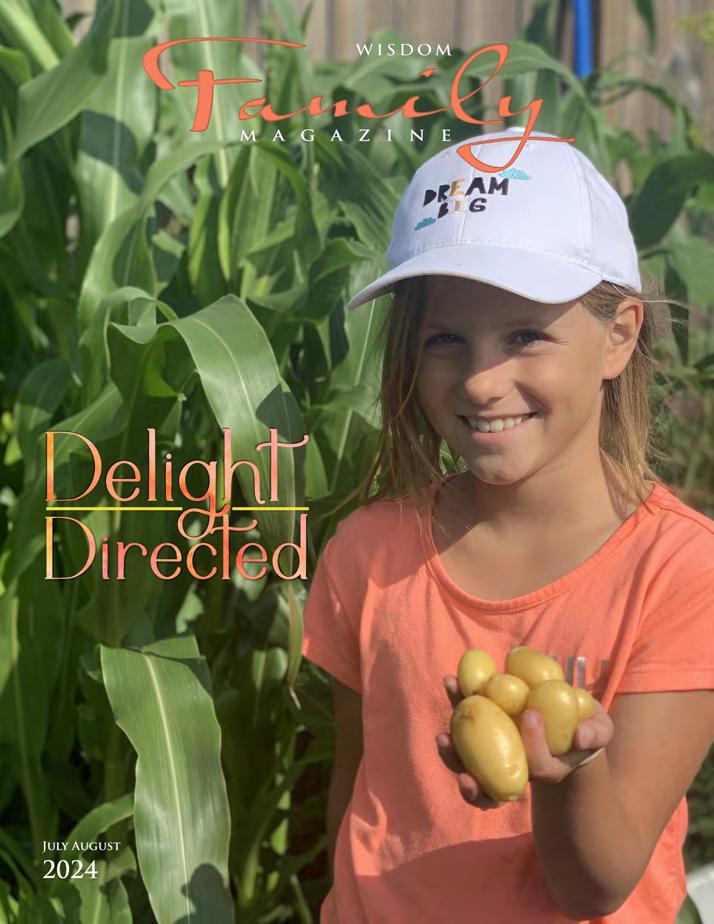
Mediated Learning Program Manager Dynamic Assessment
John Hoekstra
Mediated Learning Advisor & Educational Therapist
Lora Cardinal
High School Subject Specialists
Pierre-Andre Beaudoin (Chemistry)
Rhonda Caluttung (English & Social Studies)
Lydie Delli Santi (French, Spanish)
James Rauch (Latin)
Peter Weidman (Math, Sciences)
For contact information, see wisdomhomeschooling.com > About > The Team
WISDOM Home Schooling is a registered trade name of The Gilbertine Institute. The Gilbertine Academy, Calgary, is an independent school operated by The Gilbertine Institute.
Phone: (780) 741-2113
Toll Free: (877) 425-8546
with questions: office@wisdomhomeschooling.com with contributions to the WISDOM Magazine: magazine@wisdomhomeschooling.com
Publisher: WISDOM Home Schooling
Content/Editor /Desktop:
TobyLauren Burgess & Amy Burkey
Desktop / Design:
Naomi Doyle
wisdomhomeschooling.com
Facilitators:
Tiffany Arnold (403) 866-7822
Michele Barter (780) 363-3740
Pierre-Andre Beaudoin (780) 239-0381
Joan Bishop (780) 878-5380
Rhonda Caluttung (403) 846-0404
Lydie Delli Santi (403) 392-9209
Carrie Friesen (780) 217-4006
Simon Friesen (587) 222-1790
Rachelle Godin (780) 349-1827
Liz Gurnett (780) 349-1577
Nola Hutchinson (780) 781-2527
Anella Jantz (587) 297-1992
Desmond Kilgannon (780) 225-6688
Randy Kopp (780) 723-5382
Gordon Loewen (587) 298-7565
Taylore Maschmeyer (780) 270-0460
Mark Meakes (780) 231-6594
Kyla Mould (306) 716-6328
Simon Noster (780) 581-8885
Sue Peachment (403) 994-1963
Joy Ronald (780) 278-5557
Kim Schultz (780) 623-2886
Glenn Spiess (639) 894-0470
Brian Taje (780) 312-4525
Paul van den Bosch (403) 358-4497
Catherine van Kampen (403) 845-2923
Peter Weidman (780) 223-2414
North
Georg & Gayle Beinert
Rene & Karen Godin
Menno & Margaret Knelsen
Central
Darrel & Kristine Buchholtz
Sheldon & Sharon Kok
Don & Bo Reid
Cory & Sierra Rotchford
South
Joe & Diane Pollock
Content:
WISDOM publishes articles by many Individual authors. The opinions of the writers are not necessarily those of WISDOM. We reserve the right to decline any submission, and to edit those submissions we accept for accuracy, clarity & length.
Fairview
Fort McMurray La Crête
Sherwood Park St. Albert St. Albert Edmonton Calgary area
Unless otherwise credited, photography is courtesy of the Noster, Burgess, Tinant, and Doyle families. The people appearing in photos throughout this publication do not endorse any specific product, service, cause, association or endeavour. Images and photos are for illustrative purposes only.
First Things
November/December 2024
Greetings:
I have heard from families that opportunities have been abundant this fall and that the biggest challenge has been deciding which activities to pursue and which good things need to wait for another season. I hope that you are finding balance in your home education.
This year, the WISDOM community is celebrating 30 years of serving home education families! To recognize this momentous occasion, we are hosting a family camp on June 19-22, 2025, at the Alberta 4-H Centre at Battle Lake, north of Red Deer. Come celebrate with us! More information to come.
The WISDOM Social Network List is a means by which WISDOM families can connect with each other. If you opted to be a part of the Social Network List when notifying, you will receive a copy of the list soon. If you opted out of joining the list at the time of notification, you may contact the WISDOM office to join it at any time.
You can find WISDOM family gatherings all over Alberta, not only this fall but throughout the year. These are events hosted or organized by WISDOM families to promote community and to encourage specific pursuits such as sports and field trips. Check the Events section of our website for more information. You may be contacted by members of the WISDOM Parent Advisory Council to inform you about events in your area.
Registration for the WISDOM Socratic Dialogue Online Program’s Spring Term opened on October 16th and will close on January 9th. If your desired course is “full”, please do join the waiting list; where there is sufficient interest we strive to open new sections whenever possible. Check our website to review course options and descriptions. You can also find a list of online workshops offered over the next few months.
The WISDOM High School and Beyond Conference will be on April 4-5, 2025, in Spruce Grove. The theme is “Chart Your Course”, and we are very excited about our speakers. Stay tuned for more information! The conference will include representatives from post-secondary institutions who are eager to recruit our graduates. Visit them in our full exhibit hall alongside booths featuring potential employers and more.
WISDOM has an Alumni Association! If you know any WISDOM Alumni, please encourage them to join our mailing list on our website wisdomhomeschooling.com/about/alumni in order to learn about upcoming events and opportunities. Goals of the Alumni Association include networking and peer support, as well as providing examples of home education success to those within and without our home education community.
The Alberta Home Education Association posts homeschooling support, information and political updates on their website, aheaonline.com. They have scheduled their next home school convention for May 29-31, 2025. Consider supporting their good work by becoming a regular donor. Another organization to check out is the Alberta Homeschooling Association, which advocates for homeschoolers and provides helpful information at albertahomeschooling.ca.
The Western Canadian Catholic Home School Conference, Edmonton, provides an opportunity for parents to refresh spiritually while planning the future of their home schooling journey. The theme of the March 6-8, 2025, conference is Confidence. More information can be found on their website, wcchsc.net.
The Home School Legal Defense Association is a wonderful resource for their members; they work to advance and safeguard home education across Canada and beyond. Check out their website hslda.ca to learn about targeted legal protection and other benefits, including insurance coverage for certain home school activities. A related organization, the Canadian Centre for Home Education (cche.ca), aims to help home schooling families thrive through research and support. Visit homeschool.today for great information and free resources.
The Gideons are faithful in their desire to send New Testaments to home schooled students, and we will be mailing Bibles to Grade 5 students in the new year. If you prefer that your child not receive a Gideon Bible, please let us know by January 10th. Email office@wisdomhomeschooling.com
Our office stops daily to pray for you. Let us know your specific requests, and please pray for us too.
Blessings on your home,
Simon Noster, Associate Principal of Home Education simon@wisdomhomeschooling.com
WISDOM
for reprint permission.
On Building Noah's Ark
Adapt
By Kenneth Noster
It’s funny how difficult it can be for us to adapt; we are such creatures of habit that even small deviations from our norm seem like impositions. It seems this is not a problem of ability but really one of attitude, for if we work at molding ourselves into people capable of adapting, it should make us very capable of joyfully facing a great variety of challenges. Seem impossible? Well, actually we are continually already adapting physically at the very least. Your body is doing it, plants and animals are doing it, apart from the human will, pretty much everything on earth is continually adapting.
Yes, the human body is constantly adapting. We spend most of our time in an environment that is cooler than our body temperature, so our body adapts by warming itself. On occasion we find ourselves surrounded by air (and sunlight) significantly warmer than our body temperature so, again, our body adapts. This time it covers itself with salt water, relying on the fact that evaporating has a cooling effect. Without even thinking about it, we adapt. Our body also adapts to what we eat or drink. It uses different processes to digest vegetables than it does for meat, but it adapts so seamlessly that
we likely don’t even know it’s happening. These are just the tip of the iceberg; our body is continually adapting, so why can’t our head?
Well, actually, our head can. Our brain is the most incredible adaptive thing on earth. It is continually categorizing incoming information and storing it appropriately. It also adapts to our moment-to-moment needs by accessing short term memory, long term memory, comparison of new knowledge to stored knowledge, and judging the entire range of need between measured thought to
total instinct. Okay, our head is capable of adapting, so what isn’t? Ahh, our attitude.
What is wrong with our attitude? It remains stuck while every other aspect of our being continually adapts. All else about the human body gives the impression we were created to adapt, to be open and resilient with change, to always be comfortable in our skin, no matter what surprises might come along. What went wrong?
The fall went wrong. Our first parents lost a lot by turning their backs and exercising their prideful independence, but not the least of what they lost was the natural ease with which they could adapt. When they chose not to adapt their will and actions to the will of God, they began in their hearts an attitude of rigidity. Whereas the body continued its capacity to keep adapting, the will of mankind was wounded by a disordered will to control. The man wanted to control the woman, the woman wanted to control the man, and both wanted to control their environment, experiences, everything really. Meanwhile, each of us continues to bear the age-old resistance to adapting, so what should we do about it? What can we do?
For a start, it would be beneficial to see resistance to adapting as a disorder. If we identify it as unnatural, alien to ourselves, it may become more appealing to change it. As with all disorders, an effective way to commence change is by small ways. Consider some of the daily, ordinary ways we are called to adapt. These are probably the best ones to work on first.
An example might be the person who irritates you. Maybe it is a small thing, maybe big, but it gets under your skin. What an opportunity you have to consciously choose to adapt yourself rather than expecting the other person to change. Tell yourself (and someone else if it is helpful) that you will adapt your attitude, so that the annoying action will no longer belong to your list of annoyances but will grow (perhaps slowly) into opportunities for you to express and feel gratitude for the very existence of the person and the many opportunities that person provides for you to adapt.
Another example might be the weather. Why would a person complain about the weather? Is it not, deep down, a refusal to adapt to God’s will? Even though we know we can’t change the weather, we hurl our dissatisfaction at it and, by
extension, at God. This is something we can change, and we will know we truly are adapting when the weather turns contrary to our desire and our joy isn’t lost; in fact we thank God for the day, just as it is.
If a person keeps alert, you will notice many situations in each day when you are inclined not to adapt; many things you can’t control yet refuse to joyfully accept. Don’t tackle them all at once, but it is good to notice how very many there are. Once these towers start to fall, you will be surprised how quickly others will follow suit, and adapting can gradually become a way of life.
One might think adapting means you become a pushover; not at all. Adapting to things we cannot change does not imply we stop trying to change what we are able to, even trying to change the things that seem impossible. Strive we must, continuing to employ all our skills and creativity to solve problems and change the seemingly immovable obstacles before us, but there are two ways in which we can face those obstacles. We can be frustrated, angry, resentful, or we can adapt our response to accept that the task may not be within our power to change, all the while continuing to try. This “adaptive” approach brings with it a certain peace that may in fact help our clarity of mind and better serve our success. Once we are capable of joyfully accepting challenges the whole time we are striving to change them, we change from negative to positive people, and our life becomes much more enjoyable to live. Whether we are striving for success or accepting failure, we can do it with equal joy, because we are no longer slaves to our dogged resistance to adapt.
Kenneth Noster and his wife Marlane live near Derwent, Alberta on their certified organic farm. In addition to his role as Head of School, Ken also contributes to his faith community as a deacon. Ken and Marlane home educated their 6 children through high school. Those of their eighteen grandchildren who are school-aged are also home schooled.
Adapt
Adapt is an idea that is not new to any parent. There are so many moments in which we must, should or could adapt, especially when we are homeschooling and spending significantly more time together than most families. We adapt in moments of emergency, trial, choices we’ve made that don’t fit our family or one child, and even when we come upon lovely surprises.
Generally, one keeps a schedule that works for the family and we try to be consistent in our schedule in order to foster a healthy way of life, but even the best schedule must adapt. An example that comes to mind is when there was a call on Ken and me to look after the emergency needs of our neighbour. We needed to immediately
By Marlane Noster
modify our schedule and expectations, to find someone who could come in and be with our children, and to adapt the schedule for chores and some bookwork and piano practice. I must say that I was very impressed with our children for the manner in which they dealt with our hurried exit and their own efforts on behalf of the neighbour. When we were gathered again as a family, we ended up having such a good discussion about the event and new lessons were learned. We had to focus on doing a bit of catch up with regular school work over the next few days, but we wouldn’t have wished it to be any other way.
During the day, due to the general knowledge that I was usually at home, it was quite common for people to just drop in for a visit. This was my trial, as hospitality is the rule in this farming community (and homeschooling was not at all the rule). I would often find myself removing my children to a different room and giving them direction as to their activities while I would go and host a visit. Eventually the visitors realized that I was needed since there were so many interruptions and questions for me during our coffees. I must say some were verifiable questions and others were just plain curiosity on the part of my children. In the end, I had to adjust and put the needs of the children before the guests and begin the process of withdrawing from being the nice person. Instead of pretending that visits at any time are just fine, I had to express the importance of our school schedule and suggest other times to gather for social time. I had been adapting our home school when I should have been adapting my personal compulsion to be hospitable.
Other trials that call us to adapt are those moments of discord between children, and I know how ineffective it is to just yell for order. This is an opportunity for some effective teaching, but a person must take the time to understand the discord and to gently (as possible) ask questions in order to bring acts, and mental states, back into harmony. Adapt, yes, because we are no longer on schedule. Why would the schedule matter more than the hearts of children?
And then there is the issue of adapting our curriculum. I know I often purchased more curriculum than I could possibly finish. I also chose material that turned out not to suit our family’s learning style (or my teaching style). After some serious struggles, and not to give up too easily, we tried to use ill-fitting resources for the remainder of the year, especially in the core subjects, but there were some choices that we simply had to admit were a mistake and adapt with a different choice of resource.
Now about one of those lovely surprises…
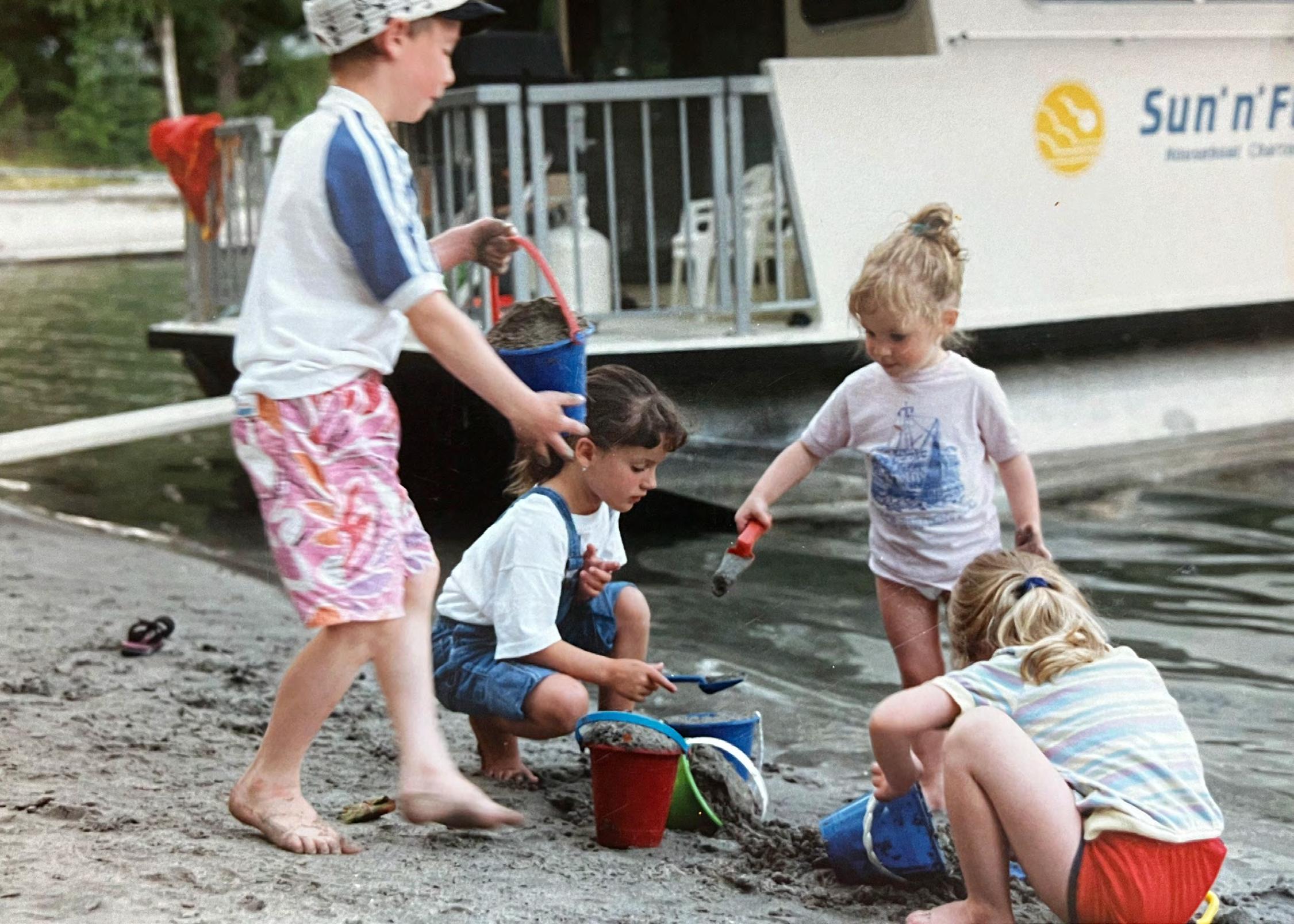
We had an opportunity to go on a houseboat in ‘low season’ and that meant we would not be able to complete all our academic work. Should we? Could we? What kind of modifications did we need to make in order for
this holiday to take place? We worked hard at Math and Science before we left and then took reading material along for the trip there and on the houseboat. Lots of reading happened on the drive and then, sorry, there was just fun learning left for the houseboat. Great adaptation, really.
Adapt: to modify or change, to conform, to accommodate, to reconcile one thing with another, to adjust, to bring back into harmony. These are all reasonable choices in order to advance in family life and learning.
Marlane Noster is WISDOM's co-founder and Events Director. When she's not in the office, she dedicates time to her church, community and her family, including her six children and eighteen grandchildren.
Mediated Learning
Adapting Through Mediated Learning: Strengthening Bonds in Home Schooling
By Lora Cardinal
The Power of Emotional Connection
As home schooling gains momentum, parents are increasingly seeking effective strategies to enhance their children’s educational experiences. This article emphasizes the importance of emotional connections in learning, supported by research illustrating the profound relationship between emotions, cognition, and educational outcomes. One particularly impactful approach is Mediated Learning, which focuses on the essential interactions between learners and mediators—typically parents, teachers, or caregivers. By fostering positive reciprocal relationships, Mediated Learning can transform education into a dynamic and engaging process.
In a successful learning environment, every student must feel a sense of belonging and be valued and understood. This emotional security is critical for effective learning, particularly in a home schooling context. Dr. Eric Jensen, in his work Teaching with the Brain in Mind, underscores that emotions are not merely a modern concern but a fundamental aspect of learning. Advances in affective
and cognitive neuroscience have revealed that emotions, thoughts, and learning are interconnected (Jensen, 1998). By prioritizing emotional connections, parents can create an environment where curiosity and enthusiasm thrive.
Mediated Learning enhances these connections by equipping children with the tools to process their experiences through guidance and support. As mediators, parents help their children make sense of new information, fostering critical thinking and problem-solving skills. This supportive environment allows learners to form meaningful connections between their emotions and education, ultimately enriching their academic journey.
Building a Trusting Relationship
A strong, trusting relationship between parent and child is essential for effective learning. When children experience emotional security, they become more receptive to new information and creative thinking. Engaging a child’s emotions is vital for cognitive development. Research indicates that a trusted caregiver can significantly reduce a child’s stress
response, facilitating better learning outcomes. A study by neuroscientists Nim Tottenham and Laurel J. GabardDurnam highlights how trust affects brain function, revealing that a child’s stress response systems can be effectively regulated by the presence of a trusted caregiver, especially a parent (Tottenham and Gabard-Durnam, 2017).
When children feel they can rely on their parents and that their efforts are genuinely appreciated, they are more likely to engage deeply in their studies. To build this trust, consider implementing the following strategies:
1. Celebrate Successes: Acknowledge even the smallest victories. Celebrating milestones boosts confidence and motivation.
2. Use Specific Praise: Offer detailed feedback on achievements. For example, instead of a generic “Good job,” say, “You did an excellent job solving that challenging math problem independently.” Specific feedback clarifies strengths and encourages continued effort.
Photo Courtesy of Carol Provins
3. Create a Supportive Learning Environment: Start and end learning sessions positively. Initiate with an engaging activity and conclude with a review of accomplishments. This practice fosters a positive association with learning.
4. Build Rapport: Demonstrate genuine interest in your child’s learning journey. Engage in discussions about their interests and involve them in planning activities. This involvement helps children feel secure and valued.
Being Your Child’s Champion
Rita Pierson, a notable educator, stated, “Every child needs a champion, an adult who will never give up on them, who understands the power of connection and insists that they become the best that they can possibly be” (Pierson, TED, 2013). Parents are uniquely positioned to fulfill this role, which extends beyond academic support to encompass overall development. Here are ways parents can embody this champion role:
1. Advocate for Them: Support your child in overcoming challenges. Encourage resilience by framing obstacles as growth opportunities rather than failures.
2. Show Genuine Enthusiasm: Express excitement about your child’s interests and achievements. Your enthusiasm reinforces their motivation.
3. Encourage Autonomy: Allow your child to take ownership of certain aspects of their learning. Providing choices fosters independence and helps develop critical thinking skills.
4. Maintain Open Communication: Regularly check in about your child’s learning experiences. Your support and understanding will help them feel heard and valued.
Conclusion
Adapting to the home schooling experience requires more than organizing lesson plans; it necessitates a dedicated focus on nurturing emotional connections and supporting each child’s growth. By embracing the principles of Mediated Learning, parents can create an enriching environment that fosters both academic success and personal development. Refining strategies to build trust, celebrate achievements, and cultivate a positive learning atmosphere lays a strong foundation for meaningful educational experiences. As parents commit to strengthening these essential relationships, they ensure that their children not only achieve their academic goals but also thrive emotionally and socially. Ultimately, integrating Mediated Learning into home schooling empowers children to flourish on their unique learning paths, paving the way for lifelong learning and personal growth.
For further insights, consider viewing Rita Pierson’s TED Talk on the power of relationships in education: Rita Pierson TED Talk (www.youtube.com/ watch?v=SFnMTHhKdkw).
References
• Jensen, E. (1998). Teaching with the Brain in Mind. Alexandria, VA: Association for Supervision and Curriculum Development.
• Pierson, R. (2013). Every Kid Needs a Champion, TED.
• Tottenham, N., & Gabard-Durnam, L.J. (2017). ‘The developing amygdala: a student of the world and a teacher of the cortex,’ Current Opinion in Psychology, 17, 55–60.
Lora Cardinal feels blessed to be able to apply her skills and education in the WISDOM Mediated Learning program. Home school parents already have intrinsic teaching and mediational skills. Providing families with tools to enhance, develop, and vitalize these skills is rewarding. Witnessing the drive, determination, and love home school parents and their children have is inspiring. Lora belongs to the ‘Alumni’ of WISDOM home school mums, and her three grown sons are now embarking on the next phases of this wide world of opportunity. Lora’s interests are ever-expanding, and her love of reading has overflowed the space in her bookshelves.
Foundations
7:00pm
Thursdays, Nov. 7 - Nov. 21
Mondays, Nov. 25 - Dec. 9
High School
7:00pm
Tuesdays, Nov. 12 - Nov. 26
Speech & Language Development
7:00pm
Wednesday, Nov. 13
Wednesday, Feb. 5
Reading & Math
7:00pm
Thursdays, Dec. 5 - Dec. 12
Parent Talk
The start of a new homeschool year brings a wave of excitement and possibility. For us homeschool families, it’s a time to set intentions, reflect on educational goals, and celebrate the unique journey of learning at home. This freedom is both a privilege and a responsibility—a chance to design a homeschool culture that not only fosters learning, but also strengthens family bonds.
As a former school teacher, I knew I wanted to bring the same excitement and anticipation of a “back-to-school buzz” into our homeschool environment. The joy of learning, coupled with the memories we create around it, is the heartbeat of our home education experience. Homeschooling offers something extraordinary: the ability to design an education tailored to our children’s unique needs, while also nurturing their character, hearts, and minds. We strive to create an environment where our children feel safe, loved, and supported—a place where they can explore their passions, ask big questions, and develop a love for learning that will last a lifetime.
Celebrating New Beginnings & Vision Casting
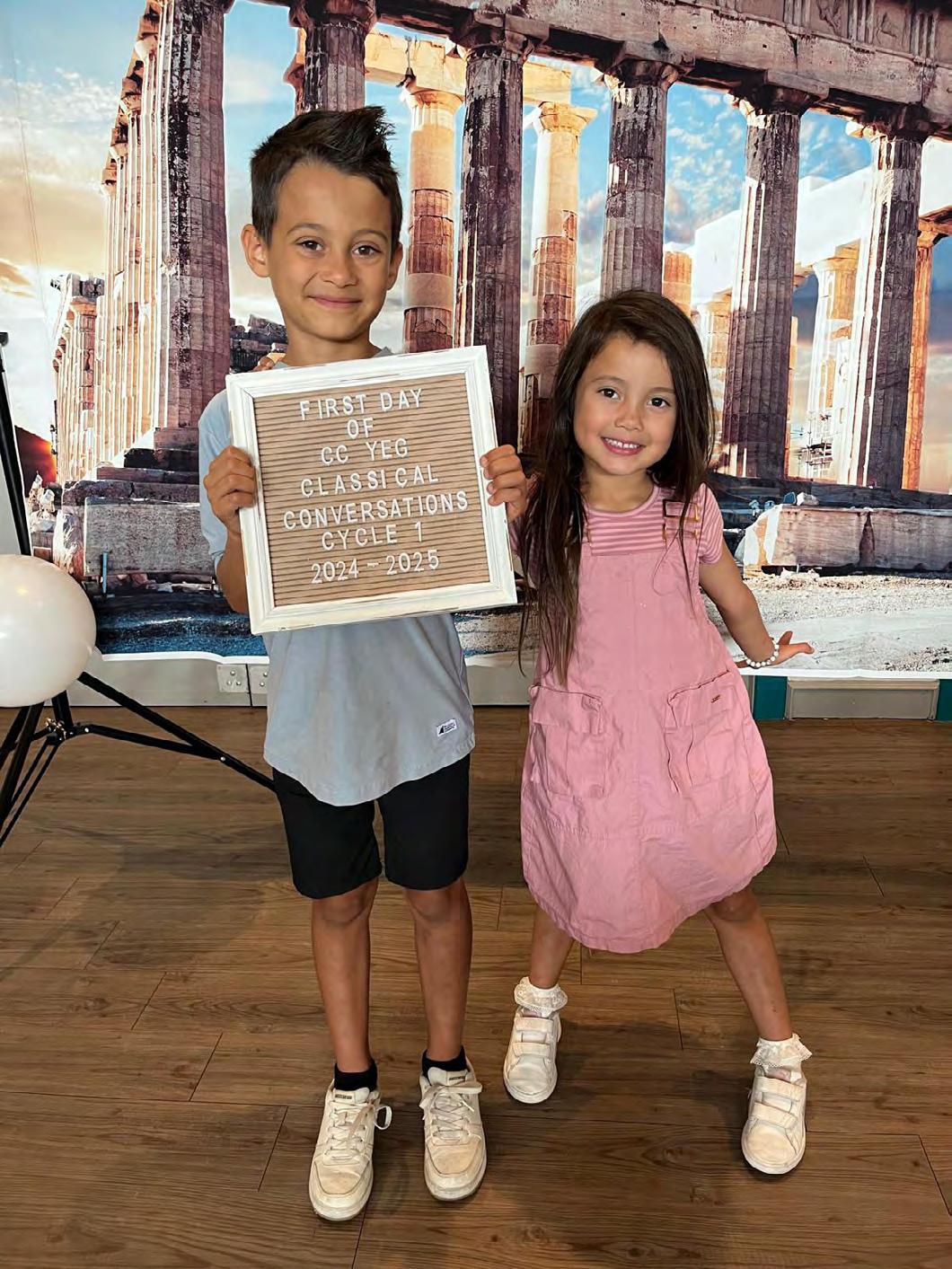
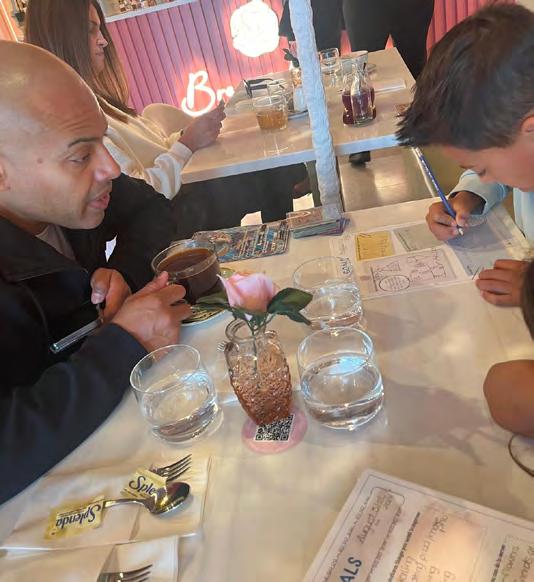
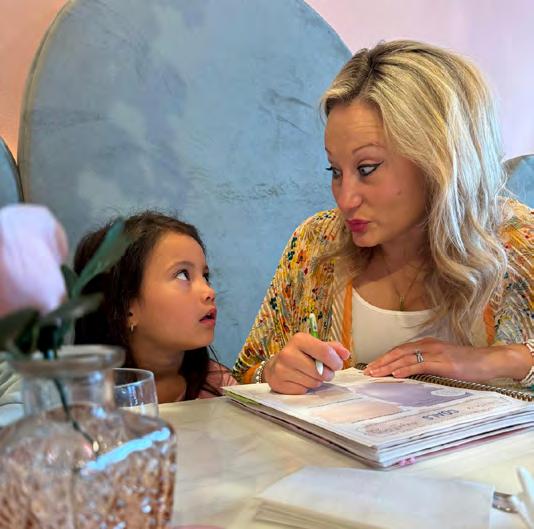
Since we started our homeschooling journey 4 years ago, we’ve begun our homeschool year with a few memorable traditions. We’ve typically selected a restaurant or an outdoor site to go to for our annual homeschool vision casting meeting. During this meeting, we sit down as a family to discuss the year ahead, setting goals and areas to focus on and casting a vision for what we want the upcoming year to look like. We are a multi-lingual family and
Celebrating the Beginning of a New Homeschool Year
By Tamara Alvarado
still find that we are navigating the waters when it comes to doing our best with language education when a lot of our learning and read alouds are in English!
My husband and I also talk about our children’s strengths, interests, and areas for growth. We brainstorm ways to create an enriching learning environment that will nurture both their minds and their hearts. This process not only helps us set academic goals, but also spiritual and emotional ones. What kind of people do we want our children to grow into? How can we create a space where they can flourish intellectually, but also grow in kindness, generosity, and gratitude?
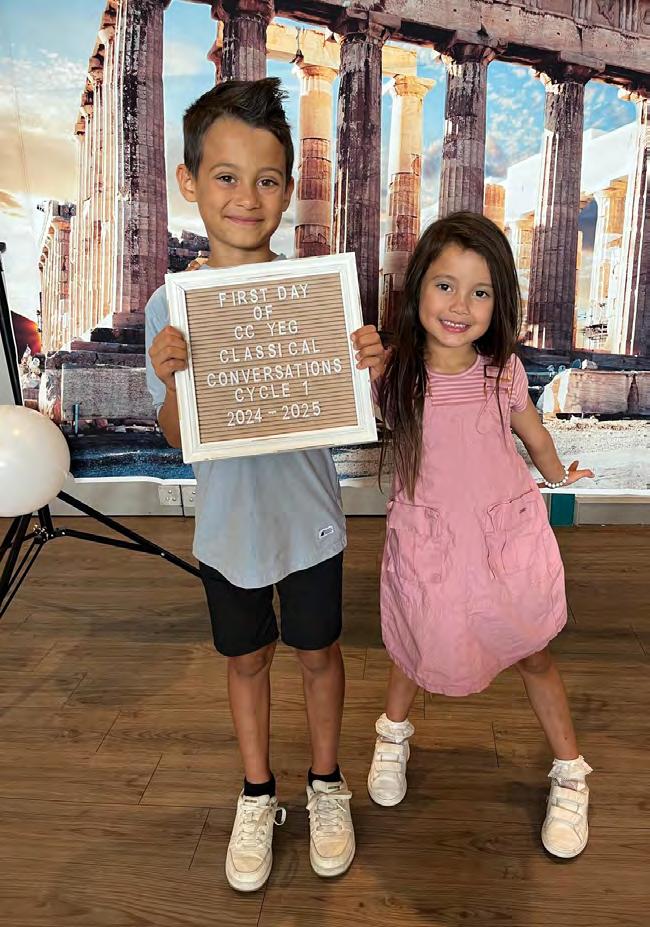
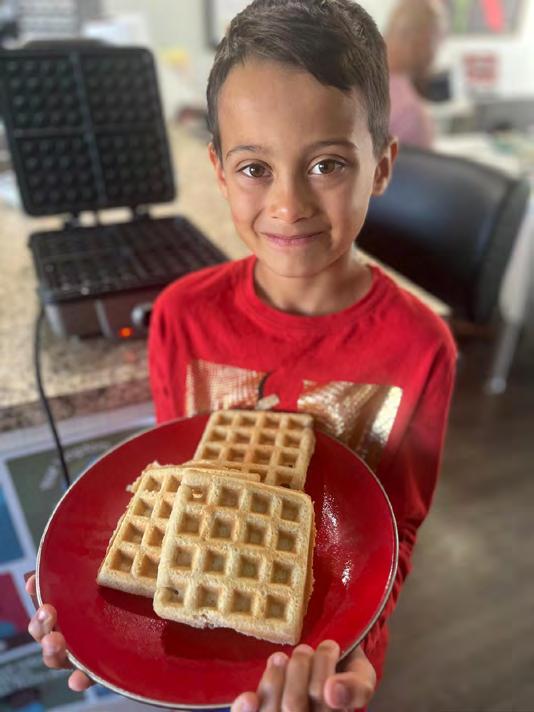
As part of this tradition, we also choose a “Word of the Year” to guide our homeschool focus. This year, the word we’ve chosen is “Hope.” This word speaks to our desire to not only create academic success but to shape a homeschool environment that fosters joy and peace, while nurturing relationships, and celebrating life’s beautiful moments. The week we officially begin our homeschool rhythms, we have a family brunch, signaling the transition into a new chapter of learning. This year, my son, Marciano, was in charge of following a recipe and making waffles for us. My daughter, Tianna, helped set the table. The smell of freshly made waffles wafting through the house and our yummy brunch creates a feeling of warmth and excitement. It’s a time to pause, connect as a family, and remind our children that education is a journey we walk together, hand in
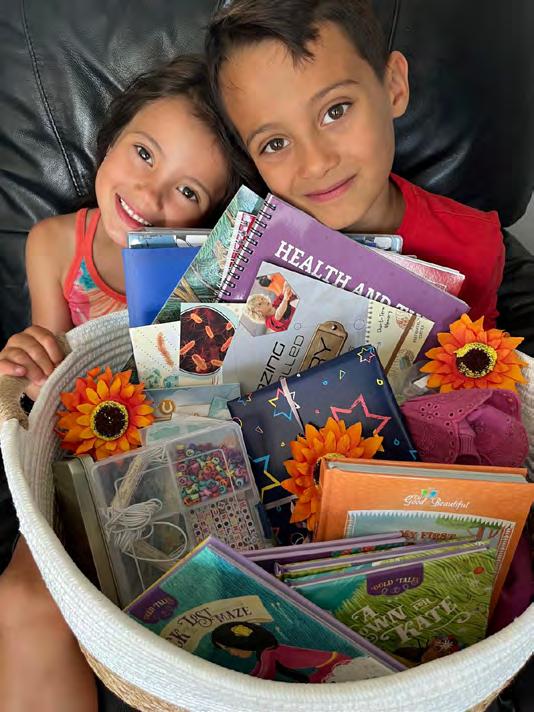
hand. After our brunch, we share a basket of goodies with them –this has been an assortment of things from new read aloud books, math manipulatives, art supplies, pajamas, etc. They love receiving their learning basket! Some years, we’ve selected a mentor text as a family read aloud that has a special message or connects to our theme of the year.
Incorporating a celebration into the first week of homeschooling helps set a positive tone for the year. Celebration ideas could be as simple as a family swim day, a picnic in the park, or a day trip to a favorite spot. Whatever the tradition, the goal is to create memories that highlight the joy of learning and the importance of togetherness.
These moments of celebration are also a reminder of the flexibility and freedom that come with homeschooling. We have the ability to stop and celebrate learning whenever we want—whether it’s mastering a new math concept, finishing a great book, or completing a challenging project. By making room for celebration, we teach our children that learning is not just about the pursuit of knowledge, but about appreciating the journey and the growth that comes with it.
Creating a Homeschool Kick-Off Tradition with other HomeSchool Families
Another event that we organize with our homeschool family friends is a Homeschool Kick-Off! We’ve met at different parks in the city, setting up various stations for the kids to set goals, listen to read-alouds, play games, participate in LEGO competitions, learn fun dances and even take photos at a photo booth. I’ve heard multiple times from parents how memorable this event has been and their kids look forward to it every single year!
Cultivating Hearts, Not Just Minds
I love the quote by Jeannie Fulbright: “Homeschooling is not about what you are teaching, but what you are building in your children’s hearts.” When we celebrate the start of a homeschool year, we are acknowledging more than just academic achievements. We are celebrating the privilege of being able to spend time with our children, to walk alongside them as they grow, and to be present
for the small but significant moments of their lives. We are celebrating the opportunity to nurture not just their intellect, but their character and spirit.
These ordinary moments, when cherished and appreciated, become the foundation of our children’s childhood memories. Sally Clarkson, a beloved voice in the homeschooling community, often speaks about the importance of “memory-making.” I have embraced being a “memory-making mom!” It can be as simple as setting the table for tea and baking some muffins to enjoy while sipping on tea using my Baba’s china and enjoying a read aloud at the table. She has inspired me to turn everyday life into opportunities for creating lasting memories. Homeschooling is the perfect platform for this. It allows us to craft not just educational experiences, but rich life experiences that our children will carry with them long after they’ve moved on from homeschool.
Looking Ahead with Joy and Anticipation
The beginning of a homeschool year is not just about opening new books or starting new lessons. It’s about vision, intention, and heart. It’s about creating a space where our children can grow intellectually and emotionally, where learning is celebrated, and where family bonds are strengthened. It’s a time to celebrate the incredible journey we are on as homeschoolers and to embrace the unique opportunities we have to shape our children’s education and their lives.
So, here’s to a new homeschool year—one filled with joy, hope, learning, growth, and endless possibilities. May we cherish the ordinary moments, create beautiful memories, and celebrate the gift of homeschooling with full hearts.
Tamara Alvarado, based in Edmonton, is a former elementary school teacher, dancer and athlete with a deep passion for community building and service. As an entrepreneur and homeschooling mother to her two children, she also leads as Director of a Classical Conversations community in Edmonton. Tamara is the creator of "Money & Marriage," a workshop designed for marriage preparation, where she and her husband share practical insights through their partnership with a marriage ministry. Tamara lives a gluten free lifestyle and can be often found in the kitchen making new recipes. Dedicated to fitness, healthy living, and personal growth, she aspires to write some children’s books alongside her children in the future and travel as a family to explore new places together.
Photos Courtesy of Tamara Alvarado
Penpal Club
Simeon B, 9
I have two brothers and six sisters. I live on a farm. I like playing LEGO. I also like sports, especially baseball and soccer. I play piano. I am excited to hear from you!
Brooklynn S, 10
Hi, my name is Brooklynn S. I just turned 10 years old. I love animals. I have a Ragdoll cat named Oliver. I like to sing, dance, do art, and play outside. I have two older brothers who have now moved out on their own, so I am basically an only child now. I would love for anyone, boys or girls, to be my pen pal.
Gunnr U, 12
I live in Alberta with two older brothers, one older sister and one younger sister. My hobbies are ants and bugs. I love to go outside and look at bugs. When I go outside I like to bounce on the trampoline and use a magnifying glass to burn stuff. I like to play with LEGO. I keep pet ants. It is my favorite hobby. I would love to have a pen pal that loves bugs as much as me.
Eda B, 10
I live on a farm, and I like playing with kittens. I enjoy doing crafts and creative activities. I have a lot of fun playing with my brothers and sisters. I like piano, dancing, and sports! Hope to hear from you soon!
Rigo N, 13
Hello! My name is Rigoberto, or Rigo for short. I'm 13 years old and enjoy designing pictures and such, LEGO, playing games with my friends, writing stories, and swimming. I live in Okotoks Alberta. I would love to talk to other teens my age. I hope to hear from somebody soon!
Maxwell G, 8
I like Lego, Pokemon, dinosaurs, biking and being creative. I have a one year old brother and a cat. I would love a pen pal.
Amelie M, 12
I have 2 sisters, 1 brother, and 2 dogs. Horses are my favourite animals. I enjoy reading, swimming, and knitting. I do not like video games.
Luke P, 7
I like playing Hot Wheels with my friends. I love God. We have chickens, one is named Chubby Chicks and I like catching and petting her.
Aspen M, 8
I live on a farm. I like to colour and do cart wheels. I love all colours. My favourite animal is a rabbit. I like strawberry ice cream. I also like to ride my bike. I hope to hear from you soon!
Ily E, 7
I live in Sherwood Park. My birthday is October 15. I have twin baby brothers and they are a year old. I love cats, dogs, LEGO, art, and taking care of my baby brothers. I also like horseback riding and swimming. I live in an apartment and my favourite food is pizza. I hope you will be my pen pal.
Dionte P, 10
I like to hunt. I love LEGOs. I have one older brother and two younger brothers! I love to cook and bake. I love to do airsoft and do tricks on a trampoline. I like to experiment with bugs. I hope to get a good pen pal friend.
Olivia H, 11
I am almost 12! My hobbies are drawing, hip hop, playing piano, and sewing. I really like puppies, poutine, shopping and 711. I have 2 other siblings and I am the middle child.
Antwon P, 12
I have 3 younger brothers and I love airsoft, dirt biking, skidooing, hunting, paintball, building, and I'm learning how to blacksmith. I love being outside and would like to talk to other teens who enjoy the outdoors as much as I do.
Chorus M, 13
My favourite colours are blue and green. I live on a farm and we have lots of animals. I have many hobbies, a few are knitting, reading, baking, LEGO, and collecting coins, stickers, and pens. I also enjoy helping on our farm. I have 2 sisters and 1 brother. I am the oldest. I hope to hear from you soon!
Laura D, 14
I'm 14 turning 15 in December. I have 1 brother and 3 sisters. I live in Northern Alberta. I love animals. I like to play with our dog and cats and study about horses. I love being outdoors, bouncing on the trampoline, reading books, and baking. I like to play games, go camping, fishing, and spending time with my family.
Myelle H, 14
I am 14 years old and the oldest of 3 siblings. My hobbies are dancing, (ballet, hip-hop, contemporary) and singing. I really love make-up, skin care, shopping, reading, music, and spending time with friends. I hope to hear from someone soon!
To join
You are invited to write to any Pen Pal Club member listed here!
To join the Club, please send a short letter of introduction (like those posted here) to the WISDOM office, along with a note giving parental permission.
You may also ask your parent to email office@wisdomhomeschooling.com.
If you'd like to be a pen-pal of someone listed here, please send your first letter to:
[Penpal name]
c/o WISDOM Pen Pal Club Box 78
Derwent, AB T0B 1C0
November/December Birthdays
Nov 4, 2010 — Agnes H
Likes reading, gaming, music, doing laundry, and cats
Nov 8, 2014 — AnnaMaria H
Likes reading, art, piano, and animals (especially dogs!)
Nov 9, 2011 — Antwon P
Loves hunting, playing piano, and enjoys making knives
Nov 18, 2006 — Teresa N
Likes books, baking, and Disney princesses
Nov 23, 2010 — Annaclare N
Likes books, animals, mermaids, and fairies
Nov 27, 2014 — Eva K
Likes horses, crafting and hiking
Nov 28, 2018 — Cecilia M
Favourite colour is pink, loves riding her bike, favourite book is "Peter and Jane", and her favourite party foods are pizza and cupcakes
Dec 29, 2006 — Alicia A
Loves music, reading, mathematics, science, and baking. Plays violin and piano and is fascinated with Japanese as a result of her interest in anime.
Dec 12, 2016 — Zelie H
Likes dogs, playing outside, LEGO, and reading.
Send a Birthday Card!
Send a birthday card to any of the children below to: [Child's name]
c/o WISDOM Birthday Club Box 78
Derwent, AB T0B 1C0
Join Our Birthday Club!
Write to us with your child's name, age, 2-3 things they're interested in, and their birthdate. We will print them just like we do in the Pen Pal Club, but instead of an ongoing pen pal commitment, this gives other kids a chance to send yours a birthday card!
(Please send this to us at least 3 months before your child's birthday, so we can get them printed in time.)
Home School Experiences
WhenEmpowering Kids Through Educational Choices:
my boys hit the middle school years, our family made a huge change to our homeschool. I called it our Grand Experiment because I felt it was either a genius idea or it would lead to our downfall.
After reading about tweens and teens and how their sleep cycles change during this phase of life, I decided we needed to do something different around here. I realized that when I woke my boys up before they’re ready to wake up they were surly.
They both complained that they didn’t sleep well, and it took a long time for them to function properly.
So, that year, I tried something radically different!
Step One of Empowering Kids Through Educational Choices
First, I stopped waking them up in the morning.
Yes, you heard me right. I let my boys wake up on their own and start their schoolwork whenever they were ready.
This was a challenge for me because I’m the type of person who would rather get up at a decent hour and dive right into our day. I’d much rather get the vast majority of our work done in the morning so that we can be free to do whatever we’d like to do with our afternoons.
When my boys were younger, this system worked well for us. But once they were 12 1/2 and almost 14, they tended to stumble through their mornings blearyeyed and afternoons became a better time for them to do their schoolwork.
Step Two of Empowering Kids Through Educational Choices
Next, I gave them a list of schoolwork for the week and let them manage their own time.
This was also a hard one for me. I was used to giving them a list of things I want them to do each day. But then, I found myself having to push them from one activity to the next because it felt like they were dawdling and wasting all of our time.
I asked both of my sons if they’d like me to give them a list of everything they need
3 Simple Ways to Unlock Their Potential Through
3 Simple Ways to Unlock Their Potential
By Michelle Caskey
to get done for the week and allow them to do as much or as little as they’d like to do each day. They both eagerly agreed that they’d like to make that change.
I was excited and told them that if they worked really hard the first few days of each week, then they could have a day or two to focus on whatever they wanted to learn about. They’d have lots of time to explore whatever their hearts desired.
My boys responded to me with, “If we get all of our work done early can we have lots of time to do NOTHING!?!” I thought about it for a minute and then I told them that if “doing nothing” is what motivated them to get their work done, then I guess that would be fine.
The Rules
There were some rules they needed to follow.
I told my boys that they must have all of their schoolwork done before Dad got home from work on Friday or I would jump back in and help them manage their time more wisely.
Also, if that happened, we expected them
to finish whatever they didn’t complete during the week on Saturday. And that was something they definitely wanted to avoid.
Did it Work?
In the first weeks of our Grand Experiment, things went very well. One of my boys woke up at 8am on Monday and started immediately working his way through the list.
The first thing he did was to spend two hours doing Phys Ed. Seriously. Then, he did some science and some reading.
My other son slept in until around 10:30. He didn’t get very much done on his first day, which was worrisome to me.
After that, however, he kicked things into gear and started working hard to be sure he’d get all of his stuff done before the end of the day on Friday.
At the end of the first week, one of my sons had completed everything by 11am on Friday and the other one had to scramble to get everything done later into Friday afternoon. But overall, it was a great success.
I had to talk with one son about how he hadn’t used his time very well at the beginning of the week and he agreed and talked to me about how he would do things differently the next week.
I must admit that in the years since we first started conducting this experiment, there were periods when my boys could handle a weekly checklist and other periods when they did much better with a daily checklist. Your results may vary depending on the age and maturity of your own child.
What have I learned so far about empowering my sons?
• My boys’ favorite subject for several years was Phys Ed!
• My boys would rather focus on one subject for a longer period of time
than to spend short bits of time each day on different subjects. For example, my sons sat down and read 10 chapters of the book they were reading for literature in one sitting versus reading 2 chapters a day like I would normally assign. Or they’d do all of their math lessons for the week in one sitting rather than doing one lesson each day.
• My boys may dawdle, but they get their work done. And they speed up dramatically as their deadline approaches!
• If I trust them and let them move forward at their own pace, it is much more relaxing for them AND for me.
This new way of doing things was a radical change for me. It was counterintuitive for sure! But it was definitely a positive change for our homeschool.
My boys learned to manage their own time. They got their work done. They also got plenty of sleep and everyone was in a better mood. I learned to take advantage of my alone time in the mornings rather than in the afternoons.
And I learned to back off while they picked up more and more responsibility for their own learning. Making this
change had a few hitches along the way, but it honestly had an amazingly positive impact overall.
If you’ve always homeschooled a certain way, try talking to your kids to see if they have any suggestions which might make things go more smoothly. Because our kids aren’t always wired the same way that we are, you might be surprised at some of the changes you could make that will revolutionize their homeschool experience for the better – for you and for your kids.
For links and more info, read the original article here: homeschool-your-boys.com/grand-experiment
Michelle Caskey - I’m here because I want to encourage and inspire you as you both parent and/or homeschool your boys. Being a mom to boys can be hard! Homeschooling boys can be even harder. As a mom of two teenage boys who I’ve been homeschooling since the beginning, I’m here to tell you that having sons is a blessing. And it is possible to connect with them and to enjoy spending your days with them. My desire is that Homeschool Your Boys will be a place where parents are inspired to teach their sons in a way which will most engage their minds and their hearts. Find out more at Homeschool Your Boys! homeschool-your-boys.com
Photos courtesy of Michelle Caskey
HaveBy Nicki Truesdell
in the 1800s and today, learning about life on horseback, historic cattle brands and ranches, rodeos, chuckwagons, maps of cattle drives, following directions by the stars, cooking food over a campfire, buying and selling cattle for a profit, and so much more. As you can see from this list, many subject areas are included, like history, geography, reading, astronomy, cooking, business math, and a whole list of hands-on activities!
How about a unit study on cats? This could include a stack of books from the library, God’s creation of animals on the 6th day, animal kinds and species, cat breeds, the care and keeping of pet cats, wild cats around the world, drawing lessons with cats, and of course — cat videos on the internet! There’s a lot of science, literature, art, and hands-on fun to be had.
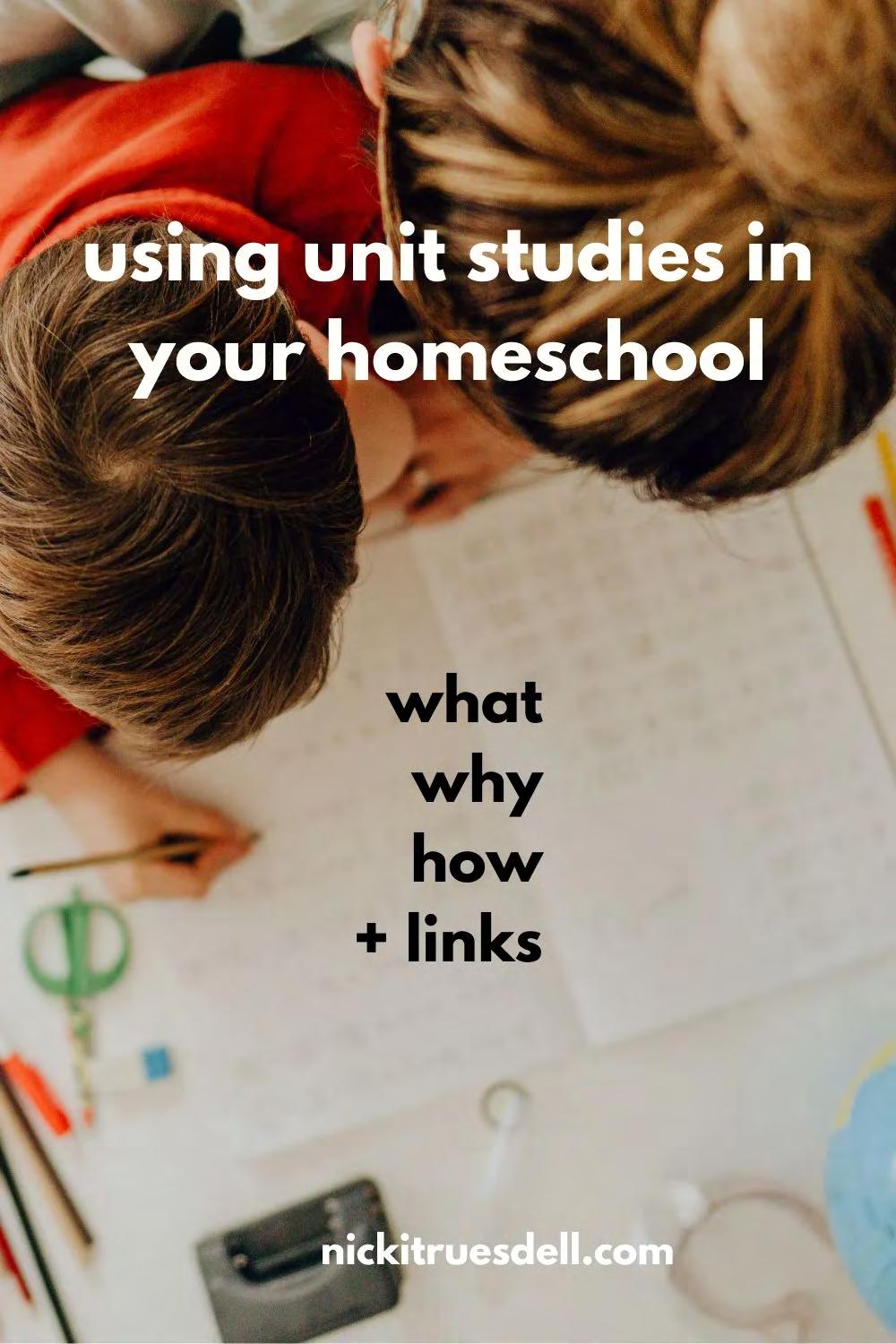
you ever used a unit study? If not, let me introduce you to one of the most flexible, inexpensive, and creative ideas for a homeschool mom. The unit study approach is a fun way to study a variety of subjects and appeal to all ages.
In a nutshell, a homeschool unit study is centered on one topic and explores that topic with all the senses and subjects! It allows you to really dive into a particular subject matter with your children,
learning as much as they can about that topic with a blend of reading, writing, math, science, geography, discussion, hands-on arts or craft activities, field trips, and more!
Let’s take cowboys, for example. Unit study resources would include a great story about fictional cowboys or a true story of a historic cattle drive (Up the Western Trail by Andy Adams), a visit to a museum that features exhibits of cowboy life, learning about the cattle industry
Road trips and vacations are a great reason to do a unit study! Wherever you’re going, make it educational before or after your trip. Maps, historic markers, museums, food, landmarks, fun attractions. . . all of these are ready-made resources for your study. Collect travel brochures, postcards, and books from your travels. Just a few of our vacations and historic sites that made great studystarters: Pikes Peak, the Alamo, Laura Ingalls Wilder’s home, and the Nao Santa Maria.
Do you see the possibilities? You can create homeschool lesson plans from almost any topic that suits your children’s interests or your lesson planning. And unit studies are applicable to all ages (and even combined age groups).
One thing to remember when considering unit studies is that this is so.not.public. school. You might be tempted to want to “make this count,” and that’s hard to do using the public school scope and sequence. You will be tackling history and science and art and math without a table of contents or a grade-level checklist. But please hear me when I say that it’s okay Take a deep breath and watch the love of learning grow in your home.
Unit Studies to Purchase
If you’re brand new to unit studies, a ready-made plan is a great way to get started. All you need to do is pay and download, gather your supplies, and get started! Here are a couple of my favorite unit study programs to purchase:
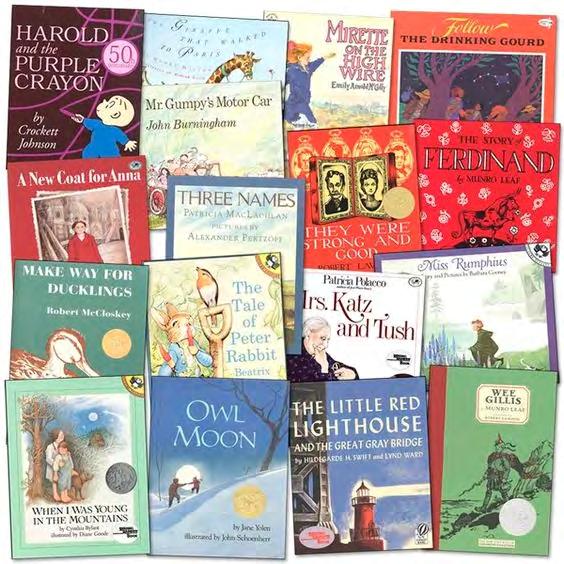
Five in a Row is one of my favorites, and it’s the only preschool curriculum I recommend. The fun thing is, it’s not just for preschoolers; there are many levels of Five in a Row. This curriculum focuses each unit on a different children’s story book each week and includes different topics to explore. You read a book every day for a week (five days in a row) and notice something different in the story each day. You might explore patterns in the language or the illustrations, learn the story’s geography, talk about a
Resources, Reviews & The Rest
character quality, review shapes, colors, or numbers, and perhaps do a craft or play a game.
The books in Five in a Row lessons are all high-quality children’s books, usually found at your local library. Five in a Row studies begin at the preschool level and go to about age 12. And if you want to really expand the hands-on fun, check out the free lapbook printables on Homeschool Share. There are several that go with Five in a Row lessons!
Unitstudy.com by Amanda Bennett is a great place to start. There are two different types of studies on Unitstudy. com: short term and long term. Short term studies are for one week, and the long term studies can last up to six weeks. Topics available include seasons, holidays, history, hobbies, and more. Everything you need is listed in the downloadable PDF from the website, complete with daily lesson plans, a book list, website links, supplies, and field trip ideas.
I usually recommend a fun unit study or two from Unitstudy.com for families who are transitioning from public school
to homeschool. It’s a fun bridge to a new kind of education, and easy for any parent to jump right in!
Beautiful Feet Books offers some indepth history units, which are wonderful, but you might also be interested in their History of the Horse pack or California History. We have enjoyed the Holling Geography Unit, too.
Earthly Wellness offers a unique set of unit studies on homesteading and natural health. Check out Introduction to Herbalism, Wild Berries, Learn to Homestead, and Herb Gardening!
Free unit studies
• One of my favorite sites for free unit studies is Tina’s Dynamic Homeschool Plus. I have utilized her awesome resources many times!
• Freedom Homeschooling has a great list of seasonal unit studies, plus an entire site of free homeschool curriculum.
• The Crafty Classroom has a nice list of studies, including pumpkins,
Resources, Reviews & The Rest
hummingbirds, mushrooms, and much more.
And a Google search for a specific “free unit study” will give you lots more results.
Create Your Own Unit Study
Once you’ve done a unit study or two, you will probably be inspired to create your own! As you can see, they can be focused on a certain time period, a place, a historical event, historical figures, an art, a hobby, an animal, or just about anything worth studying. Start with a theme, and brainstorm from there. You might discover more possibilities than you have time for!
Once you have your theme, write down everything that can be explored: stories to read, movies to watch, YouTube video demonstrations, history, geography, music, math, science, crafts, food, field trips, art, discussion questions, and additional research. Here are just a few ideas in each category:
Field trips: museums, ocean, river, mountains, train ride, sporting event, bakery, lessons
Art: museum, lessons, composers, famous artists, styles
Discussion Questions: debate, apologetics, conversation, interviews, public speaking
Additional research: using the library, using the internet, creating a book report, writing a research paper, giving a speech, telling a story
When you begin to see how to incorporate a wide variety of experiences into a particular topic, you create a love of learning. Children learn that the world is their classroom, and that classroom is huge!
Resources, Reviews & The Rest
Year Round Homeschooler has a great post on creating your own unit study + a free planner. Tina’s Dynamic Homeschool Plus has a really nice download for an affordable price.
Unit Studies as a Homeschool Method
While some families do occasional unit studies throughout the year based on a holiday or a season, or to break up the monotony of the school year, others use this as their primary homeschool method. If you have a solid math curriculum and teach your children to read, you can accomplish almost everything else with unit studies as your homeschool curriculum.
Unit studies as a homeschooling style truly allows you to have a delightdirected learning environment. This is especially useful if you’ve recently taken your child from an unpleasant public school experience, as it gives them the chance to slow down, and see that learning is truly fun.
If you find yourself jumping all over the place with your child’s interests, consider building a portfolio of things learned, or creating a history timeline to add your studies to. For instance, put ww2 and ancient Egypt studies on a timeline along with your child’s birthday, Columbus’ first voyage, the birth of Jesus, etc. This helps your child to see the big picture while still following their passions.
Unit Studies for Homeschool Co-ops
If you want to teach a class for your homeschool co-op, look no further than a prepared unit study! So many of them
are easily adapted to various age groups and timeframes. Our local co-op is once a week for ten weeks. So if I needed ten lessons, I’d choose the ones that fit best with my class goal, class time limit, cost, and age level.
Five in a Row (mentioned above) is perfect for preschool and elementary coop classes. Beautiful Feet studies are great for middle school students and high school students. And of course, creating your own with the methods I outlined will give you the ability to create endless co-op classes for your group!
Ideas
So, your wheels are hopefully spinning by now, but I want to just give you a taste of what’s possible. Take some of these ideas or use them as a springboard for further brainstorming!
• Ancient Egypt unit study
• a Human Anatomy unit
• Harry Potter
• Civil War
• Little House on the Prairie
• Noah’s Ark
• Water
• Jane Austen
• Sports Cars
• Lego
• Pumpkins
• Christmas Around the World
• Medieval Weapons
• Historic Clothing
• Sailboats
• Dinosaurs
• Dogs
• Shakespeare
• Horses
• Planets
• Guitar
• Different Countries
• World Geography with Food
Unit studies can be lots of fun, and there is really no time limit or age limit! So, take a break from your regular school schedule, explore a season or a specific interest, and let your kids loose to enjoy learning!
For links and more info, read the original article here:
Nicki Truesdell - Christian. Wife. Mother of two sons and three daughters. Author, blogger, speaker, and book lover. Second-generation homeschooler. This blog has been my space to share all things Christian parenting, homeschooling, and conservative issues since 2009. I believe in bold truth-telling, biblical womanhood, and discipleship parenting. Find out more at Nicki Truesdell nickitruesdell.com
Photos courtesy of Nicki Truesdell
Resilience :
By Kari Patterson
Formany families in my area, the first day of school included evacuating their homes.
Due to COVID-19, schools in our area are online for the time being, so just as families were preparing for the steep learning-curve of an entirely new system of education, a severe windstorm and wildfires swept through rural areas, burning more than five million acres along the West Coast.
I was full of fresh enthusiasm that morning, having just made new lesson plans and explained to the kids the schedule for the day, when my phone began buzzing with news of the fires. Soon all our nearby friends had evacuated, and my parents had evacuated to our home.
My mom had just been released from the hospital two hours before, and was completely immobile, so we set to work preparing spaces and making the necessary preparations to care for her.
Our beautiful blue sky slowly began to disappear…
The nine days that followed brought many twists and turns (and a lot of elevated cortisol).
2020 strikes again!
While this was an unusual event, disasters in general aren’t. If there’s one thing we can count on during our homeschool days, it’s unexpected interruptions
From slight inconveniences to truly catastrophic emergencies, the more resilience we can develop in our homeschool, the better we’ll fare overall.
Here are a few ways to help make your homeschool disaster-proof:
Avoid over-relying on the internet.
I LOVE the resources and educational possibilities that exist because of the internet! However, for those whose entire educational day revolves around a decent Wifi connection, it’s just too easy
to be entirely derailed by a technical malfunction.
We didn’t have internet for our first full week of school, but I was so grateful that the bulk of all our studies could still be completed. This isn’t to say that distance or online learning isn’t a great option, but it’s worth recognizing that an overreliance on Wifi can make us sitting ducks for frustration and an easily-derailed day.
Consider keeping a few non-screen options for various subjects, or at least a big stack of actual books on hand.
Develop routines that are soothing, not stressful.
I remember hearing a grown-man reminisce about his homeschool experience growing up. Every morning after breakfast, his mother would pull out their current read-aloud and all five of them would curl up with quilts by the wood-stove and begin their day with a story.
From September 2020
Yes, please! Who wouldn’t want to start their day that way?
Of course this will look different for each family, but especially consider your morning routine, the way your school day begins The blessing of homeschooling is that you don’t have to rush kids out the door, so consider crafting some starting point that each child enjoys.
It doesn’t have to be extravagant or indulgent, but when times are stressful, the hope is that our homeschool routines will actually soothe anxious hearts, rather than heap more stress upon them.
Use structure to provide stability.
Of course everyone’s different, but my experience has been that I can actually maintain some homeschool structure through much more than I used to think.
I used to be derailed by just about any distraction or interruption, thinking it would be too hard to homeschool through (fill in the blank with whatever disruption it happens to be this week).
Now, I find that that structure provides us exactly the stability we need.
On our hardest day last week, the sky was red, the house was dark, power was out, fires were getting worse, and I had no idea what was going to happen in the next 24 hours.
Everything felt chaotic, but you know what? The best thing we did was sit down and do our normal day. It made everyone feel a little less anxious.
Always, always, always have a great book you’re reading together.
As we sat there in dark and smoke, I was so grateful that our current languagearts study happened to be Corrie Ten Boom’s The Hiding Place, sharing her experience hiding Jews and surviving the Nazi concentration camps during WWII. Talk about perspective!
Sure, there’s a place for sentencediagramming and grammar worksheets,
but there’s nothing like an inspiring story to comfort, inspire, and cultivate hope. Cait Curley recently shared a great article on the importance of reading aloud, along with tips on practical implementation.
All summer I had been debating whether to have each kid do their own independent language-study (reading to themselves) or whether to combine them, read aloud, and do language-arts together.
I knew it would take much more investment and time on my end to do it together, but last week I was so grateful we chose that route! While I’m all for independence, reading aloud together allows you to draw common courage from a shared story.
Take full advantage of unusual opportunities for learning and growth.
Let’s continue to cultivate the perspective that interruptions don’t have to be obstacles to education, interruptions are opportunities, and not just the traditional, academic kind.
Taking meals to displaced families, gathering emergency supplies, learning about weather systems, not to mention pitching in practically to help the household function during difficulties–all of these provide a rich, robust educational experience that help develop mature,
capable, empathetic, creative, wise, skilled human beings.
These experiences prepare them for far more than filling in bubbles on their next state test; these experiences prepare them for life.
As I type these words Jeff has taken Heidi with him to build a HEPA air-filter for an elderly neighbor. Before that we were delivering meals as families came home from evacuations.
I firmly believe that none of those hours were wasted.
I certainly hope that 2020 has finally finished dolling out disasters, but just in case it hasn’t, let’s do all we can to prepare our hearts and homeschool routines to be as resilient as possible.
For links and more info, read the original article here: simplehomeschool.net/disaster
Kari Patterson and her family are unschooling, church-planting, smoothie-drinking, frugalliving weirdos from Oregon. As a 2nd generation homeschooler, Kari enthusiastically espouses the same delight-directed method her mother did in the 80s. She celebrates life’s messy glory over at Sacred Mundane. karipatterson.com AND find out more at the Simple Homeschool simplehomeschool.net, too.
Image courtesy of Kari Patterson
Flexibility... with a backbone
By Paul van den Bosch
There are many wonderful benefits and advantages with home schooling - I’m sure you have your own list - and one terrific long-term advantage is the ability of home schooled students to continue to learn and grow and adapt as the student grows into adulthood.
But although home schooling trains students to be flexible and adaptable, I think home schooling also sets a limit for how far that adaptability can and should go.
First, here is the definition of “adapt” as found in the Cambridge dictionary: to change your ideas or behaviour to make them suitable for a new situation. The example used by Cambridge is this: adapt to - The good thing about children is that they adapt very easily to new environments.
Now I don’t want to argue with the Cambridge dictionary, but I’d like to modify the definition and that example to include
what I know is true in home schooling families: To be openminded to changing your ideas or behaviour within moral limits to make them suitable for a new situation. The modified example then would be: adapt to - The good thing about children is that they adapt very easily to new environments but can remain grounded in their moral upbringing.
The difference between those two definitions (and those two examples) is that I think we can, and should, set a limit for our children as to how adaptable and flexible they can be.
Our children, as they continue to grow through the teenage years and into adulthood, will meet some terrific pressures: peer pressure, work group pressure, financial pressures, and more. There will be times where people will encourage our grown children to change. As I noted at the beginning, that can be a very good thing. Home schooled children have a terrific advantage in that, when they meet a new situation in work or in life, they are readily able to say: “I can do this! I can learn this! I can master this situation!” To have the ability to learn in new situations is part of being adaptable.
But sometimes those outside pressures can feel very uncomfortable. When we, as adults, think back on similar situations of our teenage years and young adulthood, I’m sure we can all think of times when we were encouraged to change in a way that we really didn’t want to. There may have been times when we were tempted to cut corners or to make moral allowances for ourselves or others in social situations or work situations. That is where the ability to adapt should have limitations. If we are so adaptable and so flexible that we become completely malleable to anyone and everyone who asks something of us, we completely lose ourselves. There is nothing at our core, no anchor and no backbone. We can, if putting adaptability first as a character trait, become doormats without any moral compass at all.
“You would be miserable if you had to go through life with a human doormat with ‘Welcome’ written on him.
You want some one made of sterner stuff.” - P. G. Wodehouse, Piccadilly Jim, 1917
The ability to adapt is something we all need.
When life presents a new situation, one we haven’t encountered before, we lean on our prior learning to determine what we should do next. If that new situation repeats itself, we can adjust our perspective so that we can “expect the unexpected” like a baseball hitter adjusts to different speeds and spins of a baseball. If we can’t hit the curveball, we likely won’t have a long
career in the major leagues. The ballplayers that continue and persist do so by consulting someone who is a trusted advisor and then, while sticking with their practiced routine, add a small adjustment, a tweak, an adaptation. The core of their approach, though, remains the same.
That is the same thing with home schooling families as they teach their children. We give our children a strong moral compass and raise them to have solid character traits. When some flexibility is required because a new situation has arrived, we, as parents, don’t need to completely change our moral approach or throw out our character traits when we know our morals and strong character traits work. We can continue our routine and be true to our core selves and our core beliefs, but tweak our approach (as the baseball hitter does) so that we can hit that curveball consistently for a home run.
“For change is not progress unless the core remains unchanged.
A small oak grows into a big oak: if it became a beech tree, that would not be growth, but mere change…
In other words, wherever there is real progress in knowledge, there is some knowledge that is not superseded.
Indeed, the very possibility of progress demands that there should be an unchanging element.” - C. S. Lewis, God in the Dock, 1971
In this section from God in the Dock, Lewis notes examples of how we can use what we already know to succeed in new situations. An example is that when we write (and this includes when our children write stories or essays) we don’t have to invent new letters in order to express ourselves. The 26 letters in the English alphabet were used by Mark Twain to write Huckleberry Finn, by Charles Dickens to write A Tale of Two Cities, by Ernest Hemingway to write The Old Man and the Sea, and by William Shakespeare to write King Lear. These authors simply took the tools that they already knew how to use - 26 letters - and created wonderful works of literature.
We can do the same and so can our children.
I’ve seen home schooled children take rough pieces of lumber and make a magnificent house for bats.
I’ve eaten crepes made by one home school grad who had to “make do” when she discovered she was missing a key ingredient (and still produced a delicious dish).
I’ve seen a group of home schoolers invent their own game when somebody forgot the ball for home school baseball.
I’ve seen one grad do all of the maintenance and add several
modifications to his motorbike, although very little of mechanics was taught to him in his family’s home school.
I’ve seen many home schooled students modify their ideas as they learned and grew through the Socratic method of WISDOM online classes.
I’ve seen many home school grads adapt their behaviour to a new level of maturity as they grew into adulthood.
“When I was a child, I talked like a child, I thought like a child, I reasoned like a child.
When I became a man, I put the ways of childhood behind me.”Paul’s First Letter to the Corinthians, 13:11
The ability of home schoolers to grow and adapt is well documented. Because students grew in an environment where the family fostered and treasured learning, the children learned to love learning too, and that lifelong love continues. The solid moral foundation that home schooling families give to their kids is also well documented. The point here is to help our children grow in both of these desirable character traits: the ability to grow and flourish in the unknown future while remaining firm and constant in the moral teaching they were raised with. That is how to be flexible, how to adapt, but still keep your backbone. And the best moral foundation can perhaps be found simply by looking at that word “adapt”.
Let me write it this way:
adapt
The word ends with a solid upright backbone, the moral backbone that is the cross of Christ.
Paul van den Bosch is a WISDOM Facilitator who is flexible in many ways but is not very good at doing the limbo.
When You Encourage Your Child, Focus on Character not Achievements not
By Belinda Letchford
Whenwe encourage our children, we need to praise the character choice, not the achievement, otherwise we slip into false praise and praising behaviour, not the heart.
My parents tell this story of being at a 21st birthday party and the parents listing all the things their daughter had done – her achievements thus far. Their hearts sank, because they knew this girl as a girl of strong faith and character and those things weren’t mentioned in her parent’s praise. This gave me a strong desire that when it came time to celebrate my children moving into adulthood, I wanted to be able to stand up and commend them for their character – the values and beliefs that I could see in their life. I didn’t want to go through a list of achievements – what would really make me proud was to see that they were people of character.
With that in mind, I started to work towards that when they were young. I knew that I needed to recognise their character choices, instead of their achievements from then on – it was something that had to change in how we parented. Our society is driven by achievements. God’s kingdom is driven by character. It is hard to make the switch over in our thinking but so worth it. When we praise by drawing attention to
the character choices, we are building their hearts, not just recognising their actions.
I define character as the quality of our responses to people or situations, based on our values. So as our children respond to life more and more in ways consistent with the values we are teaching them, they will become people of character. This is what character education at home, or in our family, is all about.
4 Tips for You to Encourage Your Child
1-Set your Children up for Success
For our children to make character-based choices they need to know the right way to respond in a given situation. We need to teach our children the moral values behind the actions we want of them. For example – we want them to not lie, so we teach them about telling the truth. We want them to be a good friend, so we teach them to be kind. We want them to be diligent, orderly, punctual, compassionate, flexible etc.…so we need to teach them these things.
We can teach our kids these values proactively, before they
are needed, but we can also teach on the spot. One way I do this is when I give an instruction, I give the reason why this is important, I remind them of the value that motivates us to do this action. For example, I could say – “It’s chore time – we need to keep our home orderly so we can enjoy being here together.” Or “Please carry that carefully with two hands.” Woven in with my instructions is a reminder of the values we have as a family.
2-Notice What Your Child Does
I have found this to be one of the biggest keys in parenting –we need to be constantly watching our children – even when we are out and about. This isn’t to “catch them” doing bad but rather to guide them and direct them into what is good. When you see them heading the wrong way you can encourage them to choose a better way. When you see them doing the right thing you can praise them for their choice.
We need to have a heart that expects the best of our kids. Not always watching them to pounce on them for doing the wrong thing – we need to have more grace than that. But when we choose awareness and availability as the character traits that define our parenting – we can teach, guide and praise them as they grow in character.
3-Verbalise Praise
Often taking the time to stop and say something to my children gets caught up in the busyness of getting through my day. Yet the reality is it doesn’t take very long to say something like – “I noticed how you did your chores this morning – you seemed very determined to complete them on time. You did a good job. I certainly appreciate having the kitchen ready for me to cook dinner. Thank you.”
That sounds very verbose, and it might sound awkward to start with – but keep practicing it. Practice noticing, and commenting (that is, giving praise) for the things your kids do.
If you have no idea how to do this, here is a little formula:
• Say what you saw them do (I saw you do your chores).
• Connect this to the choice they made (You made a choice to get it done on time).
• Affirm their choice (Well done! Good job! Excellent work etc.…).
• Acknowledge how their choice and actions benefit them, you, or the family.
4-Be Intentional
In the busyness of daily family life, if I don’t plan to think about these things – they just don’t happen. I often use my afternoon cuppa as a little review of our day. As I reflect over our day, I not only bring to mind situations that require praise but possibly recognise that a child hasn’t done so well today so I still have a couple of hours to get along side of them and encourage them in some way – hopefully leading to a situation where I can praise them before the end of the day.
We’ve all heard of the string wrapped around the finger trick – do something to remind yourself to take notice of your children’s choices. You might have a time of day, or a poster on the fridge, a Post-it on your mirror, beads around your wrist. Do something to remind yourself to encourage your child as they make good choices and establish good character in their lives.
A Caution to How you Praise your Child
We can so easily get caught up in the concept of praising our kids and making them feel good, that we don’t stop to think of the repercussions of our words, and we give praise indiscriminately. What are the consequences of ill-timed praise? I believe it lowers our children’s standards – the standard that they hold in their own heart.
Let’s look at it. When a child is given a task – be it an academic task or a moral task, in the end, they know in their hearts to what standard they have been successful. They know the attitude of their heart, they know if they did well, or if they did the barest necessity. Then the parent comes along and says, “Good job!” This confirms that the standard that they performed to is a standard good enough for mum and dad – or another adult.
The praise (though intended for good) actually confirms a lower standard than is excellent, a lower standard than what was their best.
A lot of past parenting styles would be labelled, these days, as authoritative or legalistic. This style of parenting would have said very little when the child did succeed and said very much when the parent was disappointed. I wonder if getting caught up in ill-timed praise has come as a reaction, trying to find a balance to a more relational style parenting.
I believe the pendulum has swung too far.
The balance is in seeing what praise can do for a child. Praise confirms the standard, confirms the moral rightness of an action rather than just making a child feel good about himself.
The idea of making a child feel good about himself is slightly out of whack too – what really makes a child feel good about himself? I believe it is when they know they are doing right – morally right. Our praise, when it is aimed at anything less than the standard the children are aiming for, only sends mixed messages. We need to parent with character, which means we need to be sincere, honest, and brave when it comes to the words that we speak.
Praise their Choices, Strengthen their Heart
Praise is usually expressed in words – words that express acknowledgement, approval, appreciation, admiration. (I didn’t mean to come up with 4 ‘a’ words – but there you go!)
We live in a society that values making people feel good about themselves. So, praise may well be something you are familiar with. But do you praise in a way that builds up, strengthens,
encourages the heart?
We can praise the actions of our children – or we can go to a heart level and praise the belief or value that motivated their action.
When we praise the action – we are parenting behavior.
When we praise the belief or value behind the action – we are parenting the heart.
This is not easy. The more kids you have running around – the harder this gets. Who has time to reflect on what motivated their child to do whatever they did. It gets tricky!
The key I found was to see the choice the child made – and praise that (if it was a wise choice). When we start praising based on choices, we are parenting the heart. Our children make choices based on what they believe in that moment. They may believe that they are the boss – and therefore they can and do take what they want. Or they may believe that the other person is special, that they love the other person, that God wants them to be kind to the other person – so they share what they have or find a solution to sharing.
In this situation – we can say, “Well done for playing happily!” Or we can see and praise (give acknowledgement, approval, appreciation, and admiration) for the choice of being kind. Playing happily was the outcome of them making a choice based on a value they have in their heart.
When we start to see the choices our children make, we will be able to parent the heart.
When we praise the heart – the choices – we consolidate that value behind that choice, as a good thing to keep in their heart. The next time they are in a situation where they have to make a choice, their heart and their ability to make a wise choice is that much stronger, because you encouraged them and praised them for their character choice last time.
For links and more info, read the original article here: belindaletchford.com/2015/09/encourage-your-childcharacter/
Belinda Letchford - The heart is the place where we process and hold our beliefs, values and knowledge – which in turn affect our choices, our actions, attitude and will. The Bible says – out of the heart flows all of life. What a privilege to teach, encourage, and train our children’s hearts. That being said – our influence will come as we live true to our own convictions and passions. My desire for you is that you build relationships with your kids, teach and train the heart, and use the whole of life to teach faith, character and life skills to your kids. I help parents raise their children to have faith, character and lifeskills so that they can live a full and purposeful life. Find out more at the Heart Focused Blog belindaletchford. com/blog
If Charlotte Mason Were Your Life Coach
By Sonya Shafer
If Charlotte were your life coach, what would she model for you and inspire you to do? Here are ten ideas.
Wouldn’t it be nice to have someone who acts as your coach throughout life? Someone who counsels you, shows you the best way, and encourages you in your personal growth. Someone whose heart it is to help you improve in your relationships, and your work, and your daily life.
A life coach. That’s what we want.
I think we have one in Charlotte Mason. One girl who came to Charlotte’s teacher training course in the Lake District of England summed it up beautifully. Years later she recalled, “On my arrival at Ambleside I was interviewed by Miss Mason who asked me for what purpose I had come. I replied: ‘I have come to learn to teach.’ Then Miss Mason said: ‘My dear, you have come here to learn to live.’ I have never forgotten those precious words which have helped me with my children.”
You see, having a life coach is not a selfish thing to do. What we’re really desiring is to become the best version of ourselves so that we can continue to improve how we serve our families, our communities, our countries, and the world.
So, if Charlotte were our life coach, what would she model for us and inspire us to keep growing in the art of living?
I’ve been thinking about that question lately, and I want to share with you ten ideas—both encouraging and challenging— that stood out to me as I reviewed her life. When you put them all together, they give us a glimpse of the atmosphere that surrounded Charlotte, the ideas that ruled her life and that she encouraged others to grow in as well.
Some of them she outright stated in her writings, others were related by those who knew her personally and spent time with her, and some are pulled from her daily life and example.
If Charlotte Mason were your life coach, I think these are ten ideas that she would encourage you to focus on.
Home School Tips
Life CoaChing idea #1: honor eaCh person.
We all know how strongly Charlotte advocated that the child is a person, but that respect wasn’t only for children. Charlotte believed and lived out the idea that each of us is a whole person who deserves to be honored as such. Here is some insight into how she lived out that idea, and how we can live it out too. These descriptions are from people who knew her personally:
“A child is a ‘person,’ an individual having a separate entity, not merely one of a crowd; and everybody was a person, requiring separate understanding and inviting individual treatment. ‘Big or little,’ she seemed to say, ‘you and I are each one. Let us treat each other as such.’”
-In Memoriam, p. 81
“She could not be anything but generous, and the ways of her mind were wide. So she did not make you feel small and foolish. You did not bite your lip or flush with vexation. She lifted and inspired. She did not drive: she led, and you went with her by happy choice.”
-In Memoriam, p. 43
I think Charlotte would coach us to honor each person we know and each person we meet.
Life CoaChing idea #2: Think for yourseLf.
Charlotte placed great importance on thinking for yourself, not depending on others to do your thinking for you. She believed that:
“‘Liberty is the most sacred and inalienable right’ of a child; that ‘public opinion is an insufferable bondage, depriving a person of his individual right to think for himself’; that ‘a mind that does not think and think its own thoughts, is as a paralysed arm or a blind eye.’”
-In Memoriam, p. 143
And her teachers in training recalled:
“We were to allow freedom to the ‘person,’ room for him to think his own thoughts.”
-In Memoriam, p. 145
“She always tried to get our thoughts and views on subjects before she gave us her own. If our views did not quite coincide with hers, she simply gently told us what she thought about it and left us to think it over.”
-In Memoriam, p. 92
“She laid down principles and waited for others to think along
her lines of thought and find the right solution. She would not deliver those she loved from the growing pains of thinking for themselves . . . She thought and acted and she wished others to think too.”
-The Story of Charlotte Mason, p. 65
So, if Charlotte were your life coach, she would encourage you to think for yourself, and that ties in to the next idea . . .
Life CoaChing idea #3: form opinions CarefuLLy.
It’s easy to be swayed by others’ opinions. But when we pick up opinions based on popularity or convenience, we are not honoring each person. We owe it to our fellow humans to form opinions carefully and not make assumptions.
Charlotte wrote:
“Every person has many opinions, either his own, honestly thought out, or picked up from his pet newspaper, or from his favourite companion. The person who thinks out his opinions modestly and carefully is doing his duty as truly as if he helped to save a life. There is no more or less about duty; and it is a great part of our work in life to do our duty in our thoughts and form just opinions.”
-Ourselves, Book 1, pp. 180, 181
Today we might modernize her first statement to “Every person has many opinions, either her own, honestly thought out, or picked up from social media or her favorite podcaster.” The point is, Charlotte would encourage us to read, learn, listen, and consider—to gather the facts. Look for fallacies. Seek to understand all sides of the issue at hand. Then each person should form her own opinion conscientiously and carefully, being careful not to be swayed by emotions.
At Simply Charlotte Mason, we have a blog series on forming just opinions that further explores Charlotte’s coaching on this important aspect of life. You can take a look if you’re interested in learning more.
Life CoaChing idea #4: don’T depend Too heaviLy on your reason.
If Charlotte were your life coach, I think she would caution you not to make logic and reason the pinnacle of your education. Charlotte knew that reason was fickle. We can talk ourselves into or out of anything if we want it badly enough. She wouldn’t coach us to throw out reason altogether, but she would encourage us to keep an eye on it, know its tendencies and limitations, and make sure we are also instructing our consciences with solid principles in the art of living. Without
the tempering that an instructed conscience can bring, reason can lead us in the wrong direction.
Charlotte put it this way:
“Without knowledge Reason carries a man into the wilderness and Rebellion joins company.”
-In Memoriam, p. 25
It’s important to be able to spot fallacies in an argument and recognize when we’re being swayed by emotions and desires. I recently talked about the place of reason in a Charlotte Mason education at Simply Charlotte Mason.
We need to understand how reason works as we seek to form our opinions carefully, and as we seek to make good decisions. That brings us to the next coaching idea . . .
Life CoaChing idea #5: sTrengThen your wiLL.
If Charlotte were your life coach, I think she would spend a lot of time encouraging you to strengthen your will so that you would have the willpower to make wise choices that will benefit you and those around you. We all face choices every day that can either help us or hinder us, and those choices affect our families.
They are watching to see what kind of choices we make. Charlotte observed that our model in this area of life has a strong influence on our children. She noticed that the will of the child is “weaker in the children of the weak, stronger in the children of the strong” (Home Education, p. 103).
She wrote a lot about how the will works and gave lots of practical coaching on how to strengthen it and what to do when it feels weak.
Life CoaChing idea #6: CuLTivaTe good habiTs.
You knew that one was coming, didn’t you? Good habits make wonderful servants. They can serve us well and reduce our mental stress. Yes, Charlotte encouraged us to cultivate good habits in our children, but she also said, “It is pleasant to know that, even in mature life, it is possible by a little persistent effort to acquire a desirable habit” (Home Education, p. 135).
We live our daily lives mostly out of habit anyway. “We are all mere creatures of habit,” Charlotte recognized that fact in Home Education, page 110. So why not make our daily habits serve us well?
Let me share a couple of habits that Charlotte Mason put into place in her own life. I think she would coach us to build these
same habits into our own daily rhythms.
Life CoaChing idea #7: spend Time in naTure every day.
Charlotte made it a priority to set aside her work and take a walk in nature every day. Some of you might not realize that, when she got older, she was almost an invalid, but she still spent time in nature. Her friends described it for us:
“The walks which had played so important a part in the active years of Miss Mason’s life had given place to drives. She went in a pony-cart along the little roads of the district . . . But showery weather is unpleasant in an open pony-cart and it was replaced by a victoria . . .”
-The Story of Charlotte Mason, p. 66
A victoria is a type of covered horse-drawn carriage, and Charlotte’s was a gift from a friend. So even with her declining health and chronic pain,
“At two-fifteen whatever the weather (unless it was raining heavily or there was a high wind) Miss Mason drove out in her little victoria till four. Her life was a constant evidence of the joy of ‘the science of relations,’ her relations with earth, with man, with bird, with beast and flower, and with God. She never came back without some ‘find,’ some fresh flower out, some new sound she had heard, some new aspect of the beauty in the sky or on the fell. And she was ready with expectancy to hear of what others had to tell.”
-The Story of Charlotte Mason, p. 63
Why was time in nature so important? I think there is a revealing comment in Ourselves, Book 2. Charlotte wrote that nature helps us “get life into focus” and helps us “learn to distinguish between small matters and great, to see that we ourselves are not of very great importance, that the world is wide, that things are sweet, that people are sweet, too; that, indeed, we are compassed about by an atmosphere of sweetness, airs of heaven coming from our God.” (Ourselves, Book 2, p. 98)
That’s why she spent time in nature every day, and that’s why she would coach us to develop that habit too.
Life CoaChing idea #8: read daiLy.
Besides her morning and evening Bible reading each day, she scheduled 10 minutes of a classic author before lunch, one hour to read some old favorite novel before supper, and she always ended her day with a novel by Sir Walter Scott. She would just continually cycle through his books over the years. All of this reading was in addition to the books she read for school work. These were books for her personal enjoyment and growth.
Home School Tips
Now, I realize that Charlotte was not dealing with preschoolers and the interruptions that young children can bring. But Charlotte had other interruptions and responsibilities surrounding her. So don’t get hung up on the number of minutes she was able to devote to reading, just focus on the main habit: read daily.
If Charlotte Mason were your life coach, she would tell you:
“Never be without a really good book on hand. If you find yourself sinking to a dull commonplace level, with nothing particular to say, the reason is probably that you are not reading, and, therefore, not thinking . . . I know that all good teachers have some study each day in preparing for the next day’s work, but besides this study two or three subjects, definitely on your own account. Do not think this is a selfish thing to do, because the advantage does not end with yourself.”
-The Story of Charlotte Mason, p. 162
Life CoaChing idea #9: baLanCe work and resT.
Even with all of her responsibilities, Charlotte intentionally scheduled times for leisure and rest. One friend recalled that:
“Miss Mason considered leisure to be as important as work, for it is during leisure that ideas are sifted and grow; moreover ‘leisure out of doors, with all the wild things of Nature, is soothing and restful to the tired mind; it gives a time when ideas can grow.’”
-In Memoriam, p. 203
I wrote a blog post that details what Charlotte’s personal daily schedule looked like and how she purposefully had set times for work and set times for rest and leisure. The post is called “What I Learned from Charlotte’s Schedule.”
Life CoaChing idea #10: Love god.
Charlotte loved God deeply, and that love shines through in her writings and in her personal life. She believed that “the knowledge of God is the principal knowledge” (Ourselves, Book 1, preface) and reminded us that, “as the friend listens to the voice, pores over the written word of his friend, so the lover of God searches the Bible for the fuller knowledge he craves” (Ourselves, Book 2, p. 184).
She encouraged us to turn our thoughts toward God a hundred times a day in prayer, offering thanksgiving, praise, and repentance, and aligning our hearts to His. But she also counseled us to set aside specific seasons, places, and purposes for prayer. In her words, “We must give ourselves time to pray and times of prayer” (Ourselves, Book 2, p. 189).
Everything Charlotte did flowed out of her deep faith in and love for God. I’m sure she would want the same for us.
So, do you want to know how to improve your relationships, your work, and your daily life? If Charlotte were your life coach, I think these are the places where she would encourage you to focus your attention and give your best effort:
1. Honor each person.
2. Think for yourself.
3. Form opinions carefully.
4. Don’t depend too heavily on your reason.
5. Strengthen your will.
6. Cultivate good habits.
7. Spend time in nature every day.
8. Read daily.
9. Balance work and rest.
10. Love God.
These are ten ideas that ruled Charlotte’s life. They are lifegiving principles that permeated the atmosphere around her. And they are how we can continue to grow in the art of living. Which one are you going to start with?
For links and more info, read the original article here: simplycharlottemason.com/blog/if-charlotte-mason-were-your-lifecoach
Sonya Shafer is a popular homeschool speaker and writer, specializing in the Charlotte Mason Method. She has been on an adventure for more than 20 years studying, researching, practicing, and teaching Charlotte’s gentle and effective methods of education. Her passion for homeschooling her own four daughters grew into helping others and then into Simply Charlotte Mason, which publishes her many books and provides a place of practical encouragement to homeschoolers. The above article was originally published at simplycharlottemason.com and was reprinted with permission.
“Interior with Woman Reading” By Carl Vilhem HolsØe
Anne with an “E ” Student Feature
Maliya Millar Faces of History
March 18th, 2024
hen Lucy Maud Montgomery stumbled across the quote that she had clipped from a newspaper years before; “Elderly couple applies to orphanage for a boy, but a girl is sent instead”, she had no idea to what magnitude that snippet would re-invent her life. Living in Prince Edward Island, Montgomery was an unheralded writer up until her book, Anne of Green Gables was published. The book about a red-haired orphan girl called Anne spelled with an “E” catapulted her forward as a best-selling Canadian author. Life before fame, the success of the book, and the legacy of Anne, summarizes the chronicle of Lucy Maud Montgomery.
Lucy Maud Montgomery was born on November 30th 1874, in Clifton, now New London, Prince Edward Island, and she lived a very ordinary life. Montgomery’s mother died when she was but a mere infant, which forced her to live with her grandparents in Cavendish, PEI, where she channeled her unhappiness with her life’s circumstances into writings and journals. Leafing through a newspaper on November 26th 1890, Montgomery was exceptionally thrilled. She was only 16, and for the first time one of her poems had been published! Later, Montgomery attended Prince of Wales College, and received a license to teach school. By 1905 though, she had quit all her jobs, and was focusing entirely on writing. Disappointingly, her life was as typical as could be.
Success was on her doorstep. As she carried out her mundane chores, such as hanging laundry or washing dishes, Montgomery plotted dialogue for a manuscript. Inspired by her childhood diary entries, she wrote “Anne of Green Gables” which became her first published book. When she finished the manuscript in October 1905, she sent it to a publisher, who immediately rejected it. After five rejections, Montgomery stashed the book away. She was compelled to give the manuscript one more chance when she stumbled upon it two years later, and a Boston company accepted it in 1908, and the book Anne of Green Gables, was an overnight success. Instantaneously, it sold
out printings, although to Montgomery and the publisher’s bafflement, the book lured more adult book-lovers than children. The instant popularity of Anne of Green Gables led to Montgomery eventually creating a series with seven sequels. Royalties deservingly earned from her book made Montgomery a woman of independent means, which was an uncommon occurrence in Canada in the early 1900s. Finally, her seeds of success had blossomed.
Montgomery’s claim to fame was truly Anne of Green Gables. The novel was translated into many languages, and became famous on stage, screen, and television. Montgomery’s other writings, including short stories, diaries, and letters were also published after she tragically passed away in 1942. Since the 1920s and to date, millions flocked to PEI to see the charmingly portrayed Green Gables, which the non-existent kindred spirit still seems to haunt. Green Gables is still the largest tourist attraction in Canada, making Prince Edward Island a proud cornerstone of tourism in the Maritimes. Even though Anne of Green Gables is well over a century old, the book is still a bestseller, a colorful Canadian classic, and it captivates bookworms from around the world. Montgomery was named a Fellow of the Royal Society of Arts in 1923, and an Officer of the British Empire in 1935. Her legacy lives on through the fictional character that she created.
Even though Montgomery published numerous other publications, the success and legacy of Anne of Green Gables was quintessentially her road to fame. “The dearest and most lovable child in fiction since the immortal Alice”, as Mark Twain deemed the red-headed kindred spirit, who was brought to life from a newspaper clipping, by the now famous Lucy Maud Montgomery. Shockingly, Montgomery confessed late in her life that she had developed an aversion to Anne-with-an-E, the character through whom she had replicated so much of her childhood history.
H Graham Rawlinson, and Jack Lawrence Granatstein. The Canadian 100 : The 100 Most Influential Canadians of the Twentieth Century. Toronto, Mcarthur & Company, 1998.
Macleod, Elizabeth, and John Mantha. The Kids Book of Great Canadian Women. Toronto, Kids Can Press, 2006.
Artwork credit of Maliya Millar
By Jamie Erickson
After using our Task Cards for only a few months, it became glaringly obvious that our little Sweetie Pea needed something extra to fill her day. She, as a first-born and as the only sister (mother hen) to a tribe of boys, has always been quite self-motivated and hard working. The Task Cards gave her the organizational tools to get all her school work done in a timely fashion, leaving most of the day for reading...and reading...and well, READING!
And while reading for pleasure is never a bad thing, reading for both pleasure and information is even better! Remember, the goal of learning to read is reading to learn. Enter our independent project-based learning assignments...
In an effort to cultivate an independent love for learning within my reader, I have begun giving month-long projectbased learning assignments. Unlike most of her regular school work, these are self-directed projects that are completely child-led.
Here’s how it works.
At the beginning of the month, Sweetie Pea has to pick a topic that she would like to explore. The choice is completely up to her...within reason. Depending upon her topic, she can use a wide variety of resources in her research...library books, YouTube videos, real-life mentors who are knowledgeable on the subject, the internet, etc.
She can take notes in a small notebook as well as keep track of how many days she has left to complete her independent study. At the end of the month, or allotted time frame, she has to present her findings to the family in some way...a speech, a demonstration, a display...the choice is up to her. She has to be prepared to answer any questions that her audience might have after her presentation.
She recently presented her very first independent study.
She chose to study the life of Betsy Ross, famed American flag seamstress. After learning about her two years ago in American history, she was still very curious about the “rest of the story.”
And how did it go?
She absolutely loved working on her project each day. And why not? It was something she was naturally interested in and had the natural motivation to learn more. As this was her first independent project, I encouraged her to answer the questions WHO, WHAT, WHERE, WHEN, WHY, and HOW as she researched. This gave her a basic outline to follow and helped direct and organize her research.
When it came time to present her findings, she decided to fill a basket with items that represented portions of Betsy Ross’ life. She passed the basket around the room and invited everyone to claim one item from the basket. She referred to each one of these trinkets during a short discussion of Betsy Ross.
What are the benefits?
The most obvious benefit to this type of learning is that, as statistics have shown, self-initiated learning is engaging and effective because it is relevant. Students learn best when the material has value to them. Since she was able to choose the topic, Sweetie Pea naturally chose something of value to her and learned a great deal.
In addition, an independent project with a pre-determined time frame helps to develop much-needed scheduling skills. I did not nag her to keep on schedule. I only gave her a due date and allowed her to determine how many days she would spend researching and how many days she would spend preparing to present her materials. A simple “days until my project” countdown helped to give her a tangible sense of time. (I chose a month because I wanted to give her enough time to fully explore the topic, but not too much time that she would get bored or grow empathetic.) Strengths can be nurtured and weaknesses can be mentored. While it was obvious to the entire audience that Sweetie Pea had learned quite a bit about the life and times of Betsy Ross, it was difficult to understand the information through her nervous jitters. After the presentation, I was able to take her aside and give a private critique of her presentation skills. We brainstormed some ideas about how to present her ideas clearly and creatively next time. As in all things, she will get better with practice. Project-based learning encourages community. Knowledge gained from worksheets or textbooks cannot be easily shared with others. Projects,
on the other hand, can be extended to family and friends. On the night of the scheduled presentation, we welcomed extended family for dinner and a “show”. She was able to exhibit her information to more than just mom and dad and, in the process, cultivate her relationships with others. Researching one topic often leads to another topic worth exploring. During her month-long study, my daughter came upon several more topics that she became anxious to explore. I encouraged her to keep a running list of these ideas in her project journal. Later, when she had to choose a topic for her next month-long study, she had several great suggestions already waiting. And what did she choose for project #2?...Origami! She’s got quite a collection of paper pets already and she’s only on day 3.
For links and more info, read the original article here: theunlikelyhomeschool.com/2013/05/an-introduction-toindependent-project.html
Jamie Erickson - Jamie left her big city life to follow love all the way to a reallife Mayberry. After earning her Bachelor's degree in elementary education, working for the nation's leading homeschooling curriculum company, and teaching in a traditional classroom, she had babies...lots of them...and decided to point her gaze towards home. When she's not curating memories, hoarding vintage books, or playing ringmaster to her own live-in circus of seven, she can be found writing, speaking, and trying to stay warm in the upper midwest. Be sure to check out Jamie's latest book, Homeschool Bravely: How to Squash Doubt, Trust God, and Teach Your Child With Confidence. Find out more at The Unlikely Homeschool theunlikelyhomeschool.com
Photos courtesy of Jamie Erickson
We kicked off a new home school year with a big 'Not-Backto-School Giveaway' with prizes donated by WISDOM and by a number of generous vendors! We would like to thank them for their support of the WISDOM community, and encourage you to check them out for your future needs.
We had 54 individual prizes this year, including 5 WISDOM Swag prizes, with 2686 individual entries from our families.
Congratulations to our winners!
Day 1: Heather P, Elizabeth T, Melanie R, and Farrell C
Day 2: Stephanie B, Ali T, Yvonne S, Monica B, and Carolyn H
Day 3: Christina B, Sarah D, Joe W, and Kelly K
Day 4: Owethu D, Tegan S, Diane T, Jennifer S, and Jane S
Day 5: Shaylene R, Nathan R, Sheri P, and Melissa E
Day 6: Melanie B, and TBA
Day 7: Diane T, Becky S, Fatima R
Day 8: Angela L, Alyssa T, Rosanne F, Neena A
Day 9: Cassandra M, Mariya B, Chantel J, Miranda S, and Nikki J
To find out how to use a purchase order for home school resources, see our website under Funding.
This Year's 19 vendors
• Active Animals the Game - Beantown Publishing & Entertainment Industries Ltd. (game + shipping)
• Alberta Computers (20 $50 gift certificates)
CHER ($50 gift certificate)
• Christian Book & Record ($100 gift certificate)
Christian Light (Math for Grade 1 - $117 value)
• Classical Education Books (5 $50 gift certificates)
• DBCS Computer (2 $50 gift certificates AND a chromebook / cable / mouse / laptop sleeve)
• History Plus (1 membership)
• Homeschool Print and Prep ($100 gift certificate)
• HSLDA (Home Education Planning for Purpose Bundle)
• Math Canada ($50 gift certificate)
Northwoods Press (Guide to Government Bundle - $75 value)
• Owl's Nest Books ($100 gift certificate AND 10 free Hopscotch Kits to the first 10 PO's)
• Shepherd's Fold ($50 gift certificate)
Sunrise Marian (4 $50 gift certificates)
• The Great Canadian Adventure ($50 gift certificate)
• The Learning House (3 $50 gift certificates)
• Tree of Life ($25 discount on online order)
• Michetti Information Solutions, Inc. (Amazon Fire Tablet + shipping)
Adapting for the Colours of My Palette
By Nicole Noster
Asa homeschooling parent… I mean, as a parent… I mean, as a person, my experience is that adaptation is a state of being. Like a linking verb, it just always “is” what I am doing. I am a multi-tasker (show me a mom who isn’t!), and this means being an adapter. No situation in my experience takes place in a controlled setting, so the need to adapt is essential. For example, I’m currently writing this article, sitting by my eighth grader working through “comma rule #5”, waiting for the chicken to finish so that I can make stew, knowing that I need to make sure I leave time to go dig some potatoes, carrots, and onions for said stew in order to get supper finished at the magical moment that everyone needs it (while also having finished work and school). The only way all of those things happen is by adapting to the needs of the moment and constantly reorganizing the elements to respond to the ever-shifting priorities placed in front of me. Whew. No wonder I’m tired all of the time. (That’s actually most likely because I’m adapting to the ever-later bedtime of my children, which results in later evenings in order to actually spend some time with my husband, which then means that I most certainly do not get to bed when I should… Does anyone else experience their life as a run-on sentence in addition to existing as a linking verb? Fellow grammar nerds, are you out there?)
Chesterton makes a discerning reflection in “The Eternal Revolution” in Orthodoxy: “The only intelligible sense that progress or advance can have among men, is that we have a definite vision, and that we wish to make the whole world like that vision. If you like to put it so, the essence of the doctrine is that what we have around us is mere method and preparation for something that we have to create. This is not a world, but rather the material for a world. God has given us not so much the colours of a picture, but the colours of a palette. But he has also given us a subject, a model, a fixed vision. We must be clear about what we want to paint…We have said we must be fond of this world, even in order to change it. We now add that we must be fond of another world (real or imaginary) in order to have something to change it to.” This section hits me in my part of this world. What or who are my “colours”, my “definite vision”? What is “the picture” I am painting? Although I am fond of the world around me, what are the things I aspire to that create the need to change or adapt to “another World”?
In my vocation, my world is my family: God, husband, kids, etc. I have lots of little ‘g’ and big “G” goals and hopes for my family, and I believe I have a vision that clarifies the path to head toward those targets. Practically, part of that vision is the content I choose for their education, and more particularly, much of it is classical. The context of classical education in my home is found in what books my children read and in intentional discussion about the ideas these books present. I want them to be exposed to excellent literature that has been read for centuries and still presents a pertinence to their lives. Mortimer Adler, a 20th century philosopher, educator, and author, talked about the importance of inviting students to participate in “the great conversation”. This is the ongoing practice of thinkers and writers engaging each other, often centuries apart, learning from each other, and then building upon what has come before. Adler says: “What binds the authors together in an intellectual community is the great conversation in which they are engaged. In the works that come later in the sequence of years, we find authors listening to what their predecessors have had to say about this idea or that, this topic or that. They not only harken to the thought of their predecessors, they also respond to it by commenting on it in a variety of ways.”
My vision is to invite my children to that conversation, first by reading Little House on the Prairie, Chronicles of Narnia, and Black Beauty, then heading into Lord of the Rings, Sir Gawain and the Green Knight, and Pride and Prejudice, then The Iliad, The Republic, Utopia, and Hamlet, to name but a small few. How important is our heritage, both personal and
historic? I want them to see where they have come from, not only by knowing their family stories, but also by experiencing what has shaped the culture we participate in and have a responsibility to build.
I planned to implement these ideas and educational choices when I started a family, but I was given an even greater opportunity to do just that with the WISDOM Socratic Dialogue Online Program. An interesting turn of events also led to me managing this program just at the time when my children were old enough to join it. (I still have to convince them that one had nothing to do with the other!) So you could call me biased (my kids do), but I cannot say enough about the positive opportunities this program has given our family. The one thing these books need in addition to themselves is someone with whom to talk about them. The Online Program gives my kids a chance to sit with their peers, under the guidance of a tutor, to hash out ideas. It has taught them honestly, humility, vulnerability, and appreciation, and has given them wonder, excitement, satisfaction, confidence, and lots more questions.
So, back to adapt. Perhaps this program has something to offer your child; perhaps it is presenting you a chance to adapt in response to a need or desire. Just as one wants to recommend a good book to someone else, I wanted to share this program with you (or I guess, I’m recommending LOTS of good books!). The WISDOM Online Program has many options for classes in literature, history, philosophy, politics, writing, and the arts. Even for the reticent reader, there is usually something that piques their interest.
This C.S. Lewis quote comes to my mind frequently: “In reading great literature I become a thousand men and yet remain myself…Here, as in worship, in love, in moral action, and in knowing, I transcend myself; and am never more myself than when I do.” The ideas and inspiration I receive from reading excellent books are often the colours of my palette, shaping my vision of how to adapt to a more eternal World. I know how limited I am, so I need these examples that transcend chicken stew and grade 8 grammar to remind myself and my children of the part we can play in the great conversation. It’s relieving to know that I am not alone.
Nicole Noster is a homeschooling mama of 4 who enjoys making an academic life on the farm happen with her husband, Simon. She keeps her mind alive and well in the daily zoo through reading and discussing good books. Some recent favourites include Brideshead Revisited and True Grit.
CheCk iT ouT: A Program Adaptation Option for High Schoolers
Augustana Campus, University of Alberta, is a partner with WISDOM Home Schooling, The Gilbertine Academy.
WISDOM students have the option of meeting Augustana admissions requirements by completing 3 courses:
1. Math 30-1 or 30-2 (through WISDOM Course Challenge or by writing the Math diploma exam as a Mature Student)
2. WISDOM’s Mastering the Essay Course
3. The Extra Evaluation version of one of the following WISDOM Courses: Canadian Government, Continued Great Books, C.S. Lewis, History of Western Culture, Introduction to Political Philosophy, or Shakespeare.
This partnership signals an encouraging trend in university recruitment of home educated students. Ideally, it will strengthen the traditional Home Education programs of high school students completing secondary education and moving into post-secondary studies.
Although the Extra Evaluation Online Course option was created to fulfill requirements for this new partnership, it is not exclusive to Augustana bound students. Any WISDOM student who would benefit from more opportunities to demonstrate knowledge and understanding may now access Extra Evaluation.
More information can be found here: wisdomhomeschooling.com/courses/about-online-courses/ university-partnerships
Biology Laboratory
2024-2025 · Derwent
Students in the Biology Laboratory 2024-2025 seminar will gain experience in using the scientific method, laboratory skills, and lab write ups.
In Biology 30, students will: study the neurological system (cow or sheep brain and eye dissection); the endocrine system (case studies); the reproductive system (bovine organ dissection); molecular genetics (strawberry DNA extraction); and carry out meaningful exercises that will assist them in their diploma examination.
In Biology 30, students will be expected to do a small online pre-lab assessment to ensure adequate preparation. The dates for both the online component and the lab are below.
Sessions run from 4:30-6:30pm.
Chemistry Laboratory 2024-2025 · Calgary
Students in the Chemistry Laboratory 2024-2025 seminar will gain experience in using the scientific method, laboratory skills, and lab write ups pertaining to Chemistry.
In Chemistry 30, students will study and conduct experiments regarding: Thermochemical Changes (Calorimetry, how many calories are in a macadamia nut); Electrochemical Changes (Making a Battery); Acid/Base Chemical Reactions (Titrations); and Chemical Equilibrium on Acid-Base Systems (Titrations extended).
In Chemistry 30, students will be coached and mentored in measurement, graphing, and algebraic reasoning but it is expected that they will already have adequate skills in naming and deriving chemical formulas for Ionic and Molecular Compounds and acids, balancing chemical equations, given two reactants, graphing and algebraic reasoning skills to manipulate basic algebraic equations. Also, students will do an online pre-lab assessment to ensure adequate preparation before every lab.
The dates for both the online component and the lab are below. Classes run from 12-2pm.
Physics
Laboratory
2024-2025 · Edmonton
Students in the Physics Laboratory 2024-2025 seminar will gain experience in using the scientific method, laboratory skills, and lab write ups pertaining to Physics.
In Physics 30, students will study and conduct experiments regarding: Momentum and Impulse (Conservation of Momentum in two dimensions); Forces and Fields (drawing Electric Force fields using equipotential lines); Optics (using an optical bench to study the properties of light); Atomic Physics (creating and analyzing models to understand the nature of an atom).
In Physics 30, students will be coached and mentored in measurement, graphing, and algebraic reasoning but it is expected that they will already have adequate graphing and algebraic reasoning skills to manipulate basic algebraic equations. Also, students will do an online pre-lab assessment to ensure adequate preparation.
The dates for both the online component and the lab are below.
WISDOM Calgary & Area Cross Country Club starts its 2nd Season!
It’s time to dust off the ski gear and come to enjoy the wonders of winter in the beautiful foothills of the Alberta Rockies. Winter landscapes are among the most beautiful scenes, and there is no better way to take them in than by cross country skiing.
Cross country skiing is something the whole family can enjoy together and is a wonderful opportunity for children and families to make and nurture great friendships. Last season, we had an amazing bunch of families join us on Mondays throughout the winter. There were moms and dads with babies, elementary aged, teenaged and college aged kids, and even some grandparents visiting from India who joined us. There is always a fire going with lots of good conversation, and snacks to share. The kids were always the first to scout out the best hills! Hearing the laughter of the children coming from the hills and meadows is truly heartwarming.
Cross country skiing is good for your body and soul!! It is known as the best cardiovascular exercise, and it involves just about every muscle in your body!
For more benefits of cross country skiing, check out this link: uwhealth.org/news/ top-10-reasons-crosscountry-skiing-isgood-for-you
We are inviting you to join the WISDOM Calgary and Area Cross Country Ski Club. For the second season, Joe and Diane Pollock, former facilitators and current Parent Advisory Council members for WISDOM, are making their private ski trails near
Millarville available to WISDOM families and friends. Their variety of trails in open meadows, gently rolling hills and aspen woods have something for skiers of all abilities. No experience is necessary, and lessons are available.
You can join the WISDOM Calgary and Area Cross Country Ski Club through the WISDOM website.
wisdomhomeschooling.com/xcski
April 4-5, 2025
Spruce Grove
Join us for an inspiring conference designed to empower parents and students as you navigate homeschooling through high school and beyond! Discover potential routes to your adult life, backed by compelling data that supports your choice to home school through high school.
We’ll share strategies for achieving excellence in your homeschooling journey. Hear from experts, educators, and successful homeschool graduates. Visit our exhibit hall and engage with post-secondary institutions, career representatives and learn about essential life skills. Connect with fellow homeschoolers, meet the WISDOM team, and get answers to your questions!
Stay tuned for more details at wisdomhomeschooling.com/conference.
Parents and students, age 12+
When:
June 19: Early Arrival
June 20: Full Day of Activities
June 21: Full Day of Activities, including Dance Instruction, Catered Dinner, and a Formal Dance
June 22: Clean Up and Depart
Where:
Battle Lake 4H Centre (Dorms, Trailers, and Tents available – Limited Capacity)
grande prairie (Evergreen Ridge Recreation Area) 1-3pm Winter First Aid
11onLine
Fundamentals of Chess Ages 6-10 (November 11-December 16)
12
grande prairie (Evergreen Ridge Recreation Area)
10-12pm Long Term Shelter Building 1-3pm Bushcraft: Wooden Mallets
12 onLine
Fundamentals of Chess All Ages (November 12-December 17)
Chess: Intermediate Continuation Class All Ages (November 12-December 17)
13 onLine
Chess: Intermediate Continuation Class All Ages (November 13-December 18)
14
14
drayTon vaLLey (Blue Rapids PRA) 1-3pm Long Term Shelter Building
edmonTon 10-12pm Indoor Rock Wall Climbing
Welcome
Tiffany arnold, faciliTaTor
Tiffany grew up in small town Alberta. As an adult, she started travelling as soon as possible which led her to becoming an au pair in France. This experience taught her a lot about children, language, culture, perspective, and so many other life lessons. Upon returning home to Alberta, she continued to pursue her Bachelor of Education degree. She married the love of her life, and they started a family. Tiffany worked in the public school system for 15 years. Along the way she saw her son (and many others) struggling to learn in this type of environment, and the time came for the Arnolds to begin their homeschool journey. Homeschooling is now a passion for Tiffany, and she cannot imagine her life any other way. She strongly believes in meeting kids where they are at and encouraging them to learn in a way that is meaningful for them. Tiffany is excited to work alongside families that have chosen to educate their children. We welcome Tiffany to the team!
Farewell
hAnnAh hoekstrA
Hannah worked part-time for WISDOM for many years, most recently as part of our Data team. A joyful presence around the office with a true servant's heart, Hannah will be greatly missed. We wish her all the best in her future endeavours, notably her own entrepreneurial sewing business, Swell Stitches!
henriettA neilson
Henrietta has been an important part of the WISDOM office team since 1999. After stepping away from full time work, Henrietta stayed connected with the office by working casual hours for the Finance department, helping wherever needed. We will miss you, Henrietta, but wish you well in your retirement and new adventures!
Thank You!
AbigAil lAurence & Anthony lAszlo
Abigail has been an integral part of the WISDOM Data team these past several years. As she begins her maternity leave, she passes on the role of Data Assistant to Anthony Laszlo. Anthony joined the Data team this spring and we appreciate his willingness to step into the role of full-time Data Assistant!
I was just pondering my kids’ journey through school this morning.
I thought I'd share this one.
This is my 17yo son. He HATED reading for years and years. Like, it was honestly akin to torture if I made him read. (At least in his mind. Haha)
I was really struggling because both of his older brothers were avid and voracious readers, but this son was not.
But then I remembered.
Even though his older brothers were younger when they discovered their love of reading, they each had a book or series that “hooked” them. (My oldest was Geronimo Stilton, my second was Septimus Heap)
This son just hadn't found “his” book/series/genre. Until last year.
Yes. He was 16 before he FINALLY found his love of reading. (It was the Nicholas Flammel series incidentally)
So. If you are feeling like you maybe are not doing as good as you should be with your children's so called milestones or homeschool achievements, remember my son. They all do things at their own rate and schedule. And what is one child's timeline, might not be the next child's timeline. Even in your same family. Don't give up hope. Just change your approach. Offer new things/experiences/books, and some day, it's going to work. Or they will find that passion deep inside.
It's the beauty of why we do what we do. Every single child can find that love of learning that is personal and lasting.
It's a beautiful thing, I think.
From Jaime Roberts
Steven Bloom is an incredible chess instructor! He's patient and so knowledgeable. His classes are so fun and engaging.
His passion for chess truly shows in his teachings.
My daughter Sophia has been taking chess classes with Steven for a few years now. Her rating has improved so much. She's gained so much knowledge about chess tactics, concepts and strategies. She defeats dad and big brother every single time. Her confidence has grown immensely! While planning our homeschool year Sophia put chess classes with Steven at the top of her list! She really looks forward to her weekly chess classes with Steven.
Stephanie M.
We have been loving ‘travelling’ around the world with our Gather Round Homeschool Unit Studies. This year we are focusing on getting to know our world a little better, so with the Gather Round continent units, paired with the History Plus continent units this year; we are becoming quite the world travellers, even trying new recipes! ��
Refer-A-Friend: For a limited time, for each brand new HSLDA membership that lists WISDOM's group as the referrer, the WISDOM group will receive $25 rebate off our annual fee, and the new member will also receive a $25 rebate! All they need is our HSLDA group name (WISDOM) and number (5003454). For more information about terms and conditions, hslda.ca/terms-conditions
Find The Pencil & The Globe
Find the symbol above hidden somewhere in the magazine and email us to tell us what page number it is on - we will enter you in a draw for a fun prize.
The draw will be held on January 8. magazine@wisdomhomeschooling.com
Home ScHool
A ssistA nce F und
Donate to the Family Assistance Fund to assist WISDOM families in crisis with shortterm support, so that they can maintain their freedom to home educate.
Credit Card Donations (Monthly or One-Time):
Either scan the QR Code or simply visit wisdomhomeschooling.com/ donate.
Make sure to select Family Assistance when filling out the form.
Cheque Donations: Make your cheque payable to WISDOM Home Schooling.
Family Assistance Box 78 Derwent, AB T0B 1C0
Charitable receipts will be issued for any 2024 donations.
November
December
January
February
Finding Help
· Call us at 780-741-2113 or 1-877-425-8546 · · Email us at office@wisdomhomeschooling.com ·
Funding
The funding year is open! Submit claims digitally or by postal mail and be reimbursed the following month. You may access purchase orders for direct billing at select vendors. Go to wisdomhomeschooling.com/funding or read the funding handbook for more information.
Would you like an updated paper copy of the funding handbook?
We would be happy to send you one.
Questions? Email finance@wisdomhomeschooling.com
A note on emails
We always respond to emails. If you do not receive a reply from us within two weeks, we did not receive it. Please send it to us again.
When you Call Us
Call us at 780-741-2113 or toll free at 1-877-425-8546
We take calls between 9 and 4, Monday through Friday, with an hour off at noon.
If you reach our voicemail, you may enter the extension of anyone in the office at any time during the greeting. To speak to a home school consultant, dial 1. To speak to a member of the funding team, dial 2. To leave a general message, stay on the line or dial 3.
We endeavour to return calls as quickly as possible. If you do not hear back from us within two business days, it may be because the message didn't come through clearly, so please call again.
Connect with WISDOM families
We offer many ways to connect with the larger WISDOM community, from events and workshops, to our Social Networking phone and email list, to Facebook Groups just for WISDOM parents. This year, we are working to add local WISDOM communities around Alberta! For more information on events, email events@wisdomhomeschooling.com. For local community connection, email terry@wisdomhomeschooling.com.
Subscribe to The WISDOM Family Magazine
(The Magazine is free to WISDOM families.)
□ Option A - paper subscription ($30 in Canada, $44 in USA)
□ Option B - digital subscription, delivered to your email inbox ($18)
Where should we send it?
Name:
Address:
Phone Number:
Email:
Method of Payment:
□ Cheque payable to WISDOM Home Schooling
□ E-transfer to billing@wisdomhomeschooling.com
□ VISA/MasterCard Number
Expiry
Name on Card
□ This is a gift subscription
Detach form and send with payment to WISDOM Home Schooling, Box 78, Derwent, AB T0B 1C0. You may also request subscriptions by emailing magazine@wisdomhomeschooling.com