WISDOM publishes articles by many Individual authors. The opinions of the writers are not necessarily those of WISDOM. We reserve the right to decline any submission, and to edit those submissions we accept for accuracy, clarity & length.
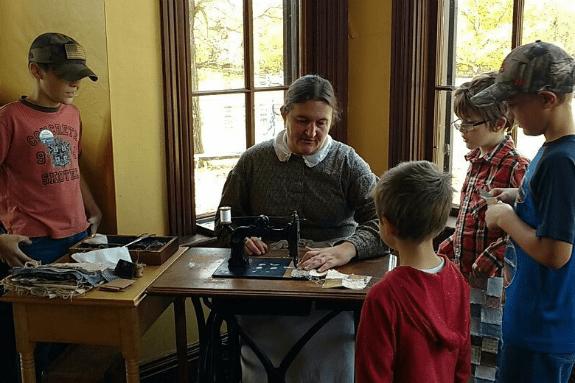
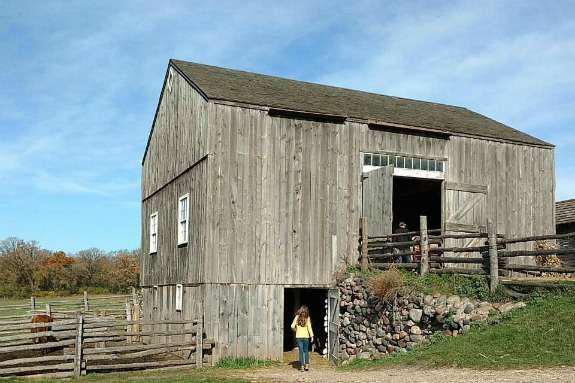
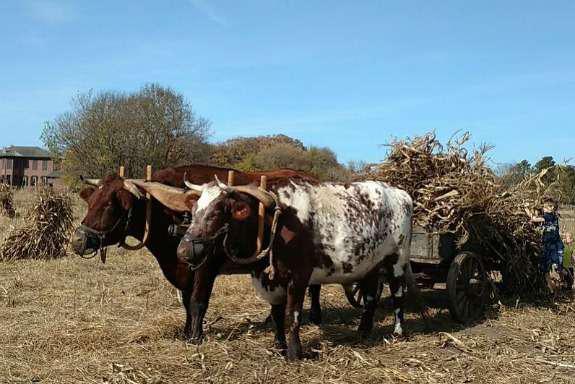
The people appearing in photos throughout this publication do not endorse any specific product, service, cause, association or endeavour. Images and photos are for illustrative purposes only.
WISDOM Home Schooling is a registered trade name of The Gilbertine Institute. The Gilbertine Academy, Calgary, is an independent school operated by The Gilbertine Institute.
First Things
May/June 2026
Greetings to your family:
The winter weather has held on so long in our part of the world that it almost seems Narnian. Aslan must be on the move, because relief is on the horizon with rising temperatures in the forecast; I hope that your family is graced with the hope and optimism that this season can bring.
We are hosting Spring Socials and Information Sessions throughout the province. I hope that you attend one, connect with old friends, and perhaps make new ones. Look through the pages of this magazine, talk to your facilitator, or check our website in order to find one near you.
We have many other events planned for the spring. Consider signing up for a Foraging walk or a Ballroom Dance Workshop, and keep an eye on the Events page of our website for updates.
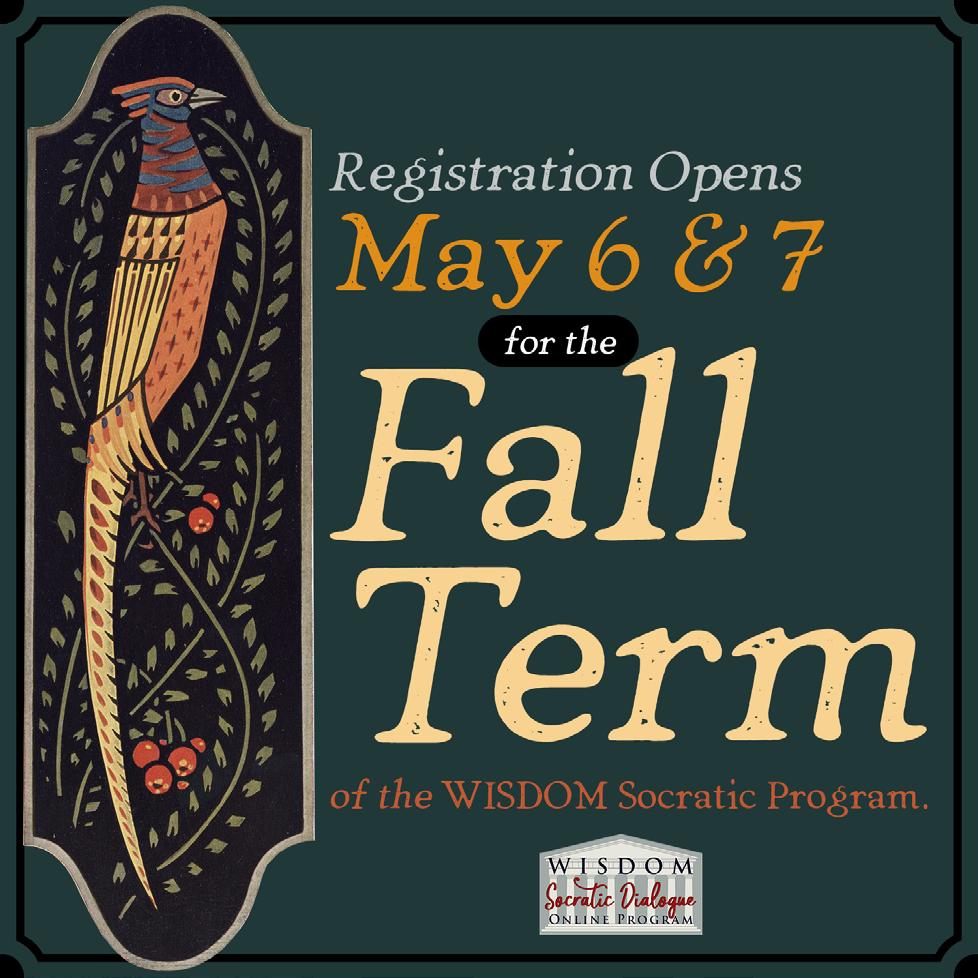
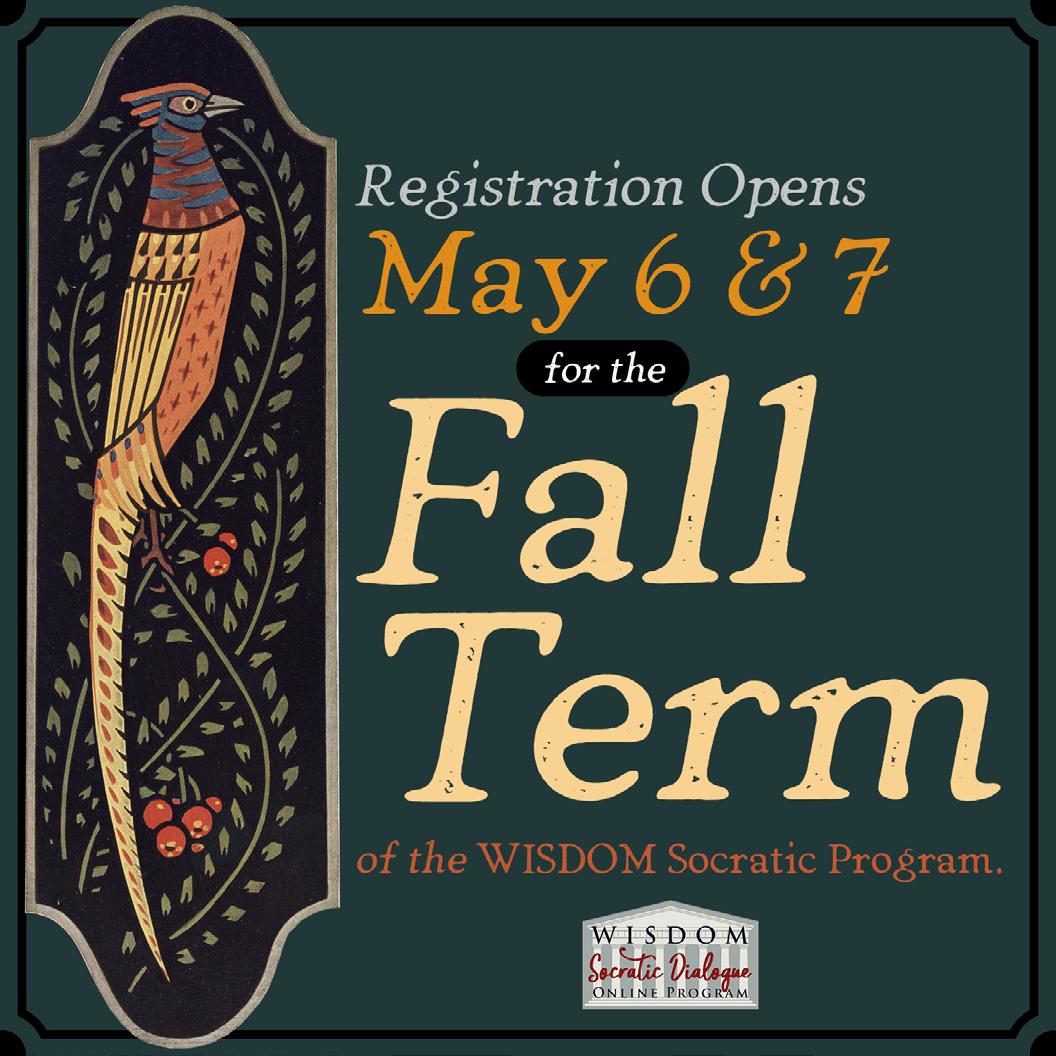
Registration for the Fall Term of Socratic Dialogue Online Program opens on May 6th. Popular courses fill quickly, so secure your child’s spot in a course by signing up early. You can peruse the course offerings on our website under “Courses”.
The following are some important Family Funding Deadlines: Purchase Orders close on May 29th at 4:00 pm, except for ahea vendors/attendees (see below). The receipt submission deadline for July refund is May 31st.
The Alberta Home Education Association (ahea) convention will be held in Red Deer from May 28-30. Visit aheaonline. com to learn more or to register. We are pleased to extend our Purchase Order deadline to accommodate those wishing to purchase resources at the ahea convention vendor hall: Purchase Orders close at the end of convention on May 30th for ahea vendors/attendees.
WISDOM will be in attendance at ahea; please stop by our booth to say hello to our team!
Please re-notify us of your intent to home educate with WISDOM in the 2026-2027 year by visiting schoolcloud. ca/login. Please do not delay, but re-notify today! It only takes a few clicks.
Everyone likes prizes, and so all families who re-notify by May 31st will be entered into a draw at the beginning of June! To be entered in a bonus draw, send your education program plan(s) to your facilitator before May 31st to be entered into a second draw.
WISDOM will be hosting an Honorary Graduation Dance on May 30th in Spruce Grove for WISDOM’s 2026 Graduates. Graduating students, their families and friends are invited to join us for this event. Learn more, and register on the WISDOM website under In-Person Events.
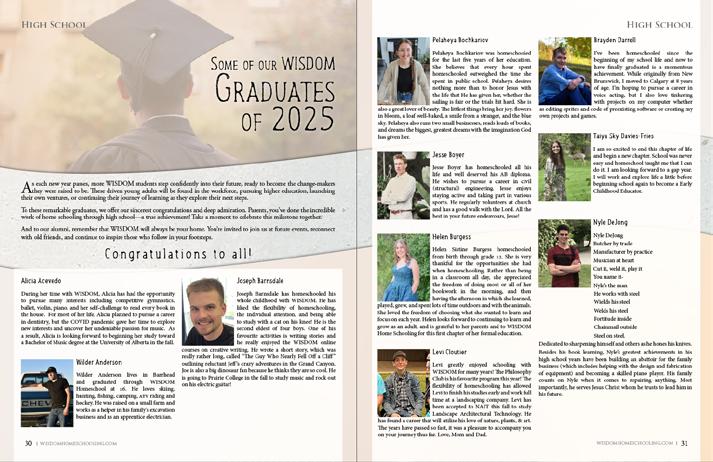
Graduation merchandise is once again available for Graduates of 2026; Please order hoodies and tassels by May 15th. The July magazine will once again feature WISDOM Graduates; please send a brief biography and photo by May 20th to magazine@wisdomhomeschooling.com in order to be included.
Graduates and parents, please join our WISDOM Alumni Association in order to stay in touch with us and other WISDOM Alumni. Visit About > Alumni on the WISDOM website for more information and to sign up.
Our office stops to pray for you every day at 3:00 pm. We welcome your prayer requests; please call or email the office with your specific intentions.
Simon Noster, Principal, Home Education simon@wisdomhomeschooling.com
Write for The WISDOM Family: Do you have something to share? We welcome you to submit articles for many of our columns, to be considered for publishing. Also, if you come across an excellent article or blog, please share it with us. We will contact authors for reprint permission.
WISDOM
for
and upcoming themes and deadlines. Send submissions to magazine@wisdomhomeschooling.com.
On Building Noah's Ark
Theyear was 2006, the history had been grim, and suddenly the word, “plan” became a ray of hope for home schoolers. In fact, it became pure gold and would set the standard for freedom to home school in Alberta.
Well, not all of the history had been grim. In the late 1980’s home schooling pioneers like Ray and Lois Strom effectively convinced Alberta Education that home schoolers shouldn’t be tied to their resident school boards, that were
often adversarial, but should be able to seek out a school authority that would support them. In 1989, the first Home Education Regulation clearly legalized home schooling in Alberta and enshrined the option to notify anywhere you chose. This regulation was in effect for 5 years and provided significant freedom to home schooling parents and their children, but change was brewing.
In 1994, the regulation was replaced by a restrictive Home Education Regulation. Among the requirements
was the writing of Alberta’s Provincial Achievement Tests in grade 3, 6, and 9. In order to excel at these tests, home schoolers would have to study Alberta Programs of Study. Bureaucrats expected home schoolers to be evaluated according to provincial curriculum and provincial standards, but most families persisted in choosing their own curriculum and avoiding the provincial tests.
In 1999, the regulation was revised again, allowing parents to opt out of the Provincial Achievement Tests
Plan
By Kenneth Noster
only if their school authority applied an alternate test. Government remained of the mind that the provincial curriculum was the standard by which home schoolers should be evaluated. This form of the regulation would endure for 7 years, but there was a glimmer of hope in the next round of negotiations. For the first time, rather than bureaucrats being tasked with the entirety of regulation review, the Minister of Education, Lyle Oberg, came to the table. He was determined to draft a regulation that would be fair to
home schoolers while upholding the province’s responsibilities. Who would have thought that grade 3 Mathematics would tip the table?
Core in the debate was the province’s insistence on testing home schoolers according to provincial curriculum standards. On that great day, the Minister confidently shared with the meeting that all students in grade 3, for example, should be proficient at the Math functions taught in Alberta schools. He then received a response that made him pause.
It went something like this: the Alberta curriculum teaches students basic mathematical computation by grade 3, preparing them to use these skills in the Provincial Achievement Test. Home schoolers who choose Math-U-See, would do poorly when writing the grade 3 Provincial Achievement Test in Math, because they don’t learn computation until later in their program. Instead, Math-U-See provides a solid base in mathematical concepts prior to teaching computation. As a result, although Math-USee home schoolers would fail the Provincial Achievement Test, they would understand mathematical concepts better than the majority of Alberta adults. Some brief examples rounded out the argument, and the Minister drew a deep breath: “Okay, it isn’t reasonable to expect home schoolers to conform with the provincial curriculum; they need to be evaluated by a different standard.” He was aware of provincial standards, supported by
the curriculum the province created, delivered, and evaluated, but what would each home schooler’s standard be?
The answer became clear that day: the standard by which a home schooler’s curriculum would be created, delivered, and evaluated would be the parent’s annual plan. Suddenly, the plan became gold to the home schooler. The 2006 Home Education Regulation declared that the parents, through their annual Education Program Plan, would have legal authority over what was taught, when it was taught, and how it was evaluated. A well designed plan became the parents’ source of confidence to forge on with what they perceived to be best for each child, and it helped them make the most of each home schooling year. And the regulation endured.
The Home Education Regulation of today contains only minor adjustments to that monumental 2006 regulation, and the power of the parent’s plan remains enshrined and supported. Parents of today enjoy a great freedom to be authors of their plan and, meanwhile, they are stewards of a great responsibility to plan well.
Kenneth Noster and his wife Marlane live near Derwent, Alberta on their certified organic farm. In addition to his role as Head of School, Ken also contributes to his faith community as a deacon. Ken and Marlane home educated their 6 children through high school. Those of their twentyone grandchildren who are school-aged are also home schooled.
Plan
By Marlane Noster
Ilook at the word plan in three ways. The first is to not waste a day, a year, a lifetime by not having a plan. (Well, two plans, really: one that is general and one that is specific.) The second is to plan for things that don’t go according to plan - a Backup plan. The third is to actually plan for spontaneity.
I like to look ahead at my year and see what sense of direction is being suggested by our situation, by the things happening around us, and by our personal priorities, and then I put
some general plans in place. For example: what events will I be hosting? When should I plan my garden? When can I fit butchering chickens in my calendar, so that I can plan when I should start feeding day old chicks?
In the past, the process of home schooling my children was quite similar. What would be the school year’s general time frame? Would it be better to teach our children their formal academics from October to May so as to make better use of harvest and seeding time on the farm?
Once the general time frame was determined, then I could begin to drill down into the details. I had monthly plans and weekly plans and daily home schooling plans. I could see my month at a glance, spelled out in general terms, and see what each week was going to be like. Then I could look at my daily calendar for the details, adding and subtracting as seemed appropriate. Often, I would find myself so very busy that I would arbitrarily call a halt. Some people would call it a snow day, but I didn’t wait for the weather to decide a break or simple change in direction was needed. Even now, I have my calendar ever before me with plans for the day and for the week, with meeting dates, birthdays and specific outings securely illustrated. It keeps me functioning with purpose, but I don’t hesitate to call a time out.
Apart from “snow days” for the sake of sanity, what about the times when plans just don’t go as intended? In the midst of home schooling, it might be an emergency outside of our control, usually coming from outside our family. Sometimes it was an issue of one of my children’s behaviour that needed to be dealt with, what then? After the first few times when I found myself trying to handle too many things at once, I began to fashion for myself a set of contingency plans. Then, when a situation outside of my control demanded my full attention, I had a backup plan. It may have been an activities sheet with projects, extra reading, and even household chores, but it was a plan, and usually nobody except me realized it was actually “plan B.”
If the distraction was a simple behaviour issue that could be quickly addressed, the other children had to carry on to the best of their ability while I dealt with the behaviour issue in the moment, not leaving it off. Especially if dealing with the behaviour issue had taken more time than expected, catchup work could be needed in order to get us back on track, sort of setting the day to rights, but it all seemed to work out in the end. I guess I just planned to pick up where we left off and keep moving forward, even though sometimes my weekly plan needed to be adjusted.
Even now, when I have made plans, I like to have a second person lined up to take my place and assist in a timely fashion. For example, I agreed to help someone with a project, and suddenly my work dictated a different use of my time. The backup person became essential, and it worked out well for everyone. This past Fall and Winter, the weather played havoc with some of my plans, and contingency plans needed to be relied upon. I was grateful to have developed the habit of planning for surprises.
How about the plan for spontaneity? In my world there needs to be a certain amount of openness for anything to happen. For example, an open Saturday might be the stimulus for me to say: “Let’s go for a drive, doesn’t a picnic sound good?”; “Let’s see if these friends are open for a visit, here, there or in between?”; “How about we tackle that ‘job’ that has been waiting for an open day?”; “Let’s surprise the grandchildren with ice cream.” I might have to say I enjoy the spontaneous plans the most, but I rely upon the more measured plans to get me through the challenging days and the ordinary days for all the rest of the time. I guess you could call them bread and butter plans.
So, my simple advice is this: Make a plan, yes, a very good plan. Make backup plans, follow your plans, and yet, don’t be a slave to them. Be sure to plan spontaneously and then get back to the day-to-day plans later. Above all, enjoy a life that is profitable and meaningful through plans that assure we do not waste a day, a year, or a lifetime.
Marlane Noster is WISDOM's co-founder and Events Director. When she's not in the office, she dedicates time to her church, community and her family, including her six children and twenty-one grandchildren.
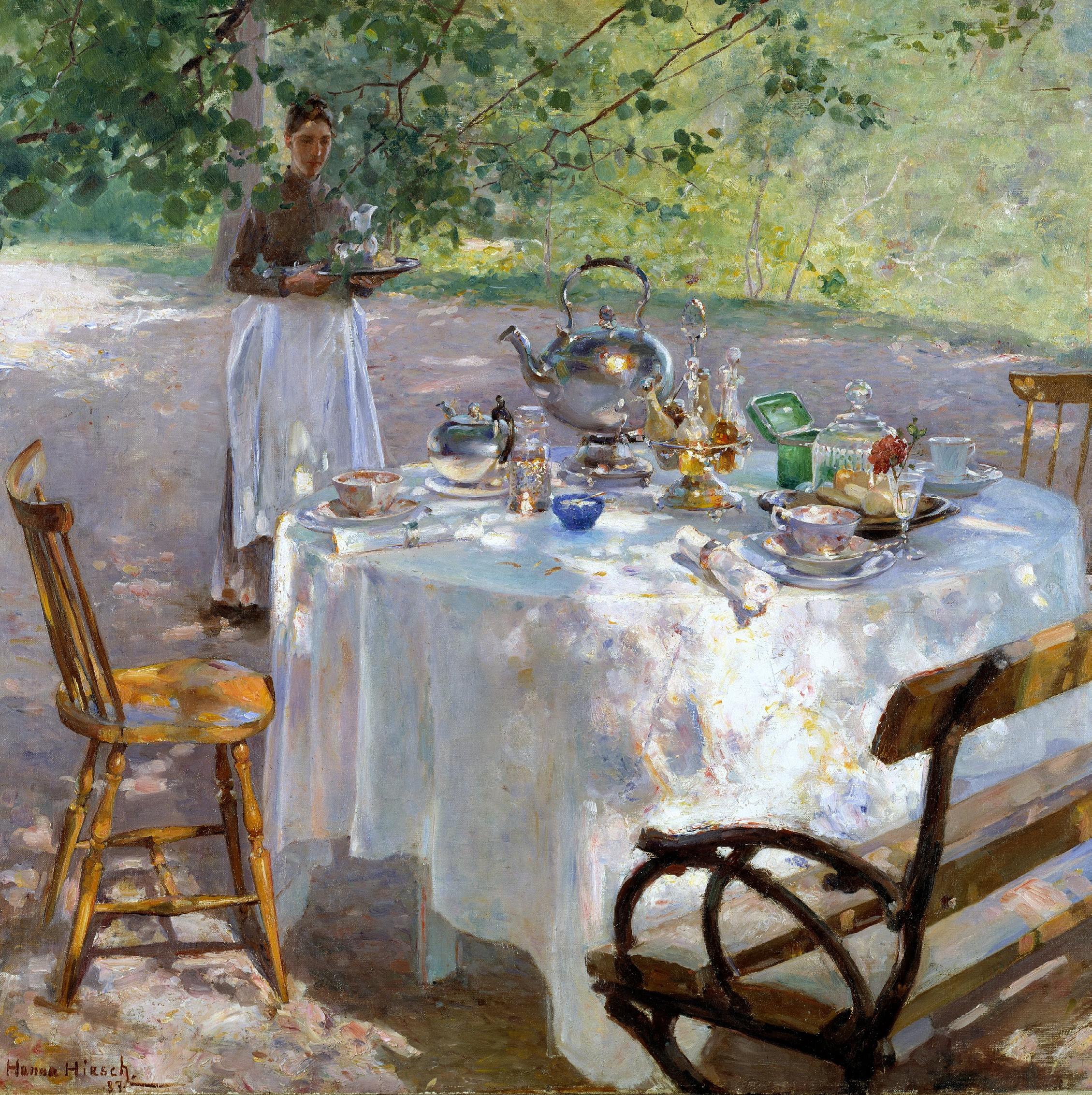
Image: Breakfast Time by Hanna Pauli
Same Page, Same Message: What is our Parenting Plan?
By Thérèse McDonald
It takes work to parent and plan for unity. Without consistency in the rules, the messaging, and the discipline, there will be conflict—conflict in the marriage, and conflict with the children. If we consider the qualities that are needed for children to thrive in the home, we know that alignment between parents is crucial. Children need:
• Predictability
• Rules of conduct
• Consistency
• Safety and Security
• Assurances
• A set of values and moral practices
• A cooperative home
• Calm and Peace
• Unitive messaging from Mom and Dad
When mother and father are at odds, mixed messaging emerges and confusion ensues in children. They lose the anchor of
knowing what is expected of them. This internal chaos created within the child looks like this:
• Frustration and anger
• Manipulation
• Acting out and non-cooperation
• Broken trust
• Resentment
• Anxiety
• Conflict with siblings
When parents have a unified plan and are aligned in their decisions and practices, children tend to:
• Have better self-control and regulation
• Be better balanced emotionally
• Have solid bonds of trust with Mom and Dad
• Understand rules and boundaries
• Respect parents and their guidelines
• Take on more responsibility for their actions
Parents have different roles and different styles. They can have different approaches, but they must come to a place of consistent collaboration. A template of dos and don’ts are needed for “how we roll” in our parenting. When parents sit down to create a template, communicate from a standpoint of achieving parenting goals and peace in the home through consistency and predictability, children will share the vision after a very short time. Change can be dramatic within thirty days. When both parents incorporate culture, faith, values, and histories into their parenting style, it can be a very rich experience for the whole family. Try having a conversation where the positives are celebrated and the negatives left behind. Areas to explore between husband and wife:
• What did I like in my own childhood? What didn’t I like?
• What kind of structure worked well?
• What kind of modelling did I like? What did I not like?
• What is the best from both our pasts and what do we want to keep out of our home?
If a couple looks at differences in their quest to come into parenting unity, they need to come to final decisions about what the future will look like. On some issues, some solid rules are needed. The idea is to cut back on reactive parenting. Here are things to determine:
• What is our position on screen usage?
• What are the ways we will discipline after a breach of rules?
• What works best for each individual child based on their temperament?
• What form does problem-solving take?
• What are our core values? What are our clear and consistent rules?
• What absolutes will we teach?
• What is allowed under our roof and what is not allowed?
• How do we reconcile after conflict?
• What behaviours are unacceptable?
• What do our consequences look like?
• How will we build solid attachment—the love bond?
Having a mission statement for parenting can be useful:
• Who are we as a family?
• What do we want our children to remember about our home life and family when they are adults?
• What will we base our values upon? What is our foundation and source of parenting choices?
• What kind of people do we hope to raise?
Parents should keep parenting disagreements private and work things out in quiet and at a distance from children. How you work things out together matters. Avoid the following:
• Arguing in front of the children
• Undermining each other in front of the children
• Allowing the children to come between you or taking sides.
Parents will do well if they have regular meetings about parenting and discuss the following:
• What is working well?
• What needs adjusting?
• When did I let you and our unity in parenting down?
• How will we fix our mistakes?
• When did I feel supported?
• Does anything need updating or changing?
• How can we be solution focused?
Thérèse McDonald is having heaps of fun serving WISDOM families again. She is ready and rolling with the Mediated Learning program and encourages you to come out for a workshop or two. If you are in the middle of any type of home schooling challenge, she wants you to know there are solutions at hand. This month, Thérèse finds herself focused on "optimistic alternatives through adversity". She would love to share hopeful and practical choices with you.
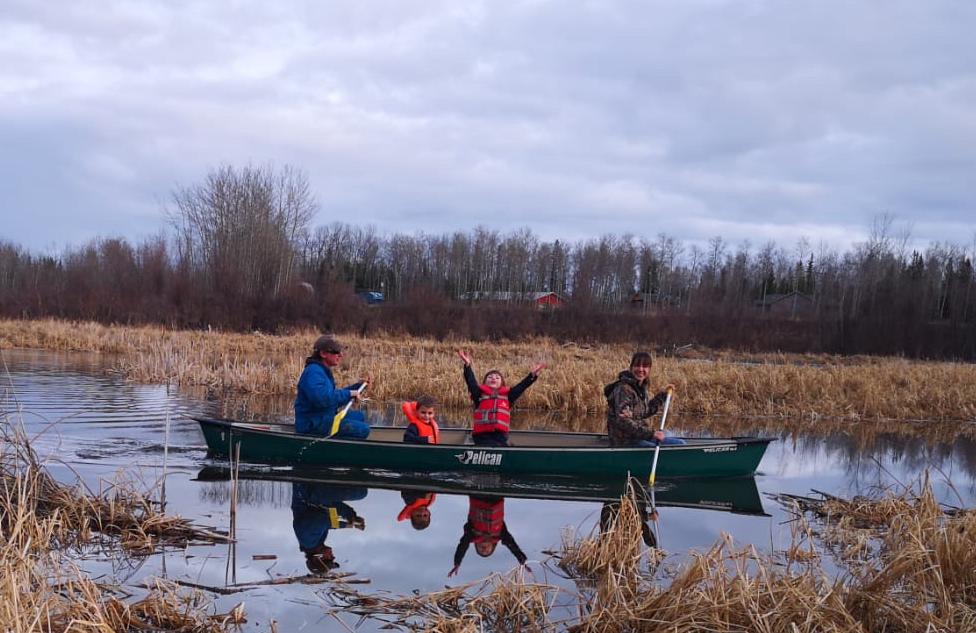
Photo courtesy of the Krahn Family
Mediated Learning Workshops Dates
& Information
• Workshops are designed for attendance by either couples or individual parents/ guardians.
• The High School Workshop, Executive Function Workshop for High Schoolers, and Executive Function Workshop for Kids require parental supervision during these sessions.
• Participants have the option to utilize available funding for these workshops.
• Note: Although this program is faith-based, it is accessible and useful to everyone.
If you need further information, feel free to ask! therese@wisdomhomeschooling.com
high School WorkShop $60.00 (Ages 14 and up)
This workshop is specifically designed for high school students. Participants will receive a valuable booklet that will empower them to take charge of their own learning, prepare for exams, redefine failure, and cope with challenges. They will also learn how to develop a growth mindset, build resilience, and become competent self-learners. Additionally, students will gain the courage to ask for help when needed and will learn to appreciate their parents, their siblings, themselves, and their personal growth and development. The workshop consists of two sessions, each lasting 2 hours.
Dates Offered
TWo evening may SeSSionS (7 – 9 pm):
• Tuesday, May 19
• Tuesday, May 26
TWo afTernoon may SeSSionS (1 – 3 pm):
• Thursday, May 21
• Thursday, May 28
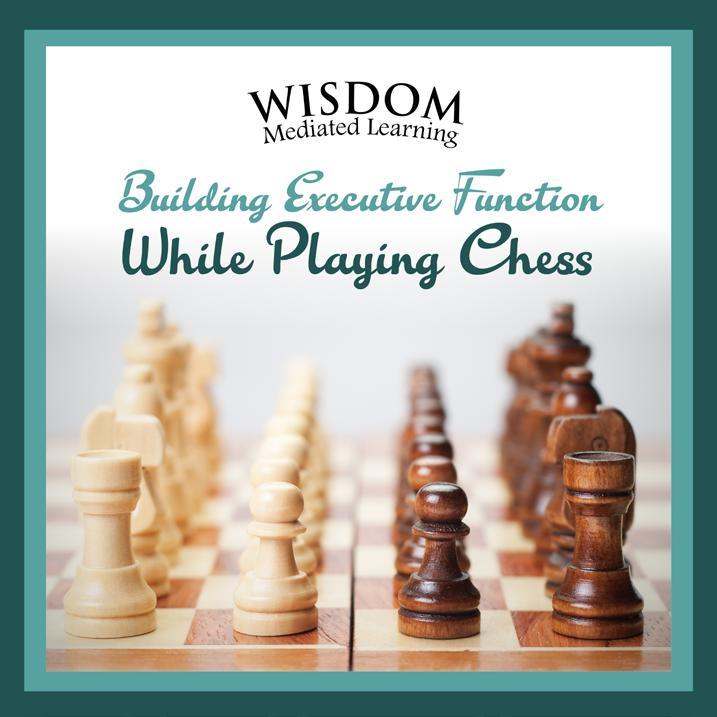
Building execuTive funcTion While Playing Chess for Teens WorkShop
$60.00 (Ages 14 and up)
In this workshop, teens will learn how chess can enhance their planning, strategic thinking, and resilience. Co-hosted by chess expert Marty Barter. One Two-hour workshop.
Dates Offered
• (TBD) Friday, May 8: 1 – 3 pm
• (TBD) Monday, June 8: 7 – 9 pm Register for both the High- school workshop and the Executive Function workshop and save 10%!
Building execuTive funcTion While Playing Chess for Teens WorkShop
$45.00 (Ages 9 and up)
• (TBD) Friday, June 5: 10 am – 12 pm
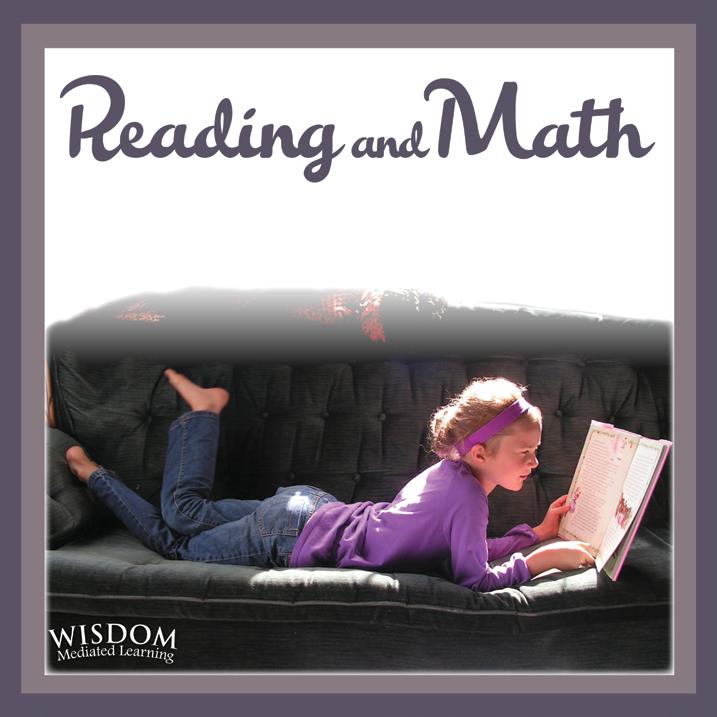
maTh & reading ToolS WorkShop
$60.00
Discover why reading requires more cognitive processes than spoken language and how difficulties in reading can affect math and problem-solving skills. Learn tools to help your child overcome these challenges. One two-hour workshop
• Tuesday, May 12: 7 - 9 pm
Know How to Help your CHild Grow witH an intentional plan
By Belinda Letchford
Howdo we keep perspective when all we can see are all the issues that need to be addressed with our children? How do we know which issue to take on, and which issue to leave for another day? What happens when we multiply that by all the kids in the house? I have a strategy to share with you.
Many years ago, listening to Carla Links’ Mom’s Notes, I heard her tell of a card system. I took it on board, and over the years I have tweaked it to make it my own. It helped me keep perspective in the middle of each of my four kids needing help with their growth and development. I call it my Intentional Parenting Plan.
The thing that is often overlooked when we talk about training our children is that we assume it is caught up with correction and discipline. We think that we train after our kids have done something wrong. We think it is a part of gentle parenting—we won’t get angry or give inappropriate
consequences but we’ll train. After all doesn’t discipline actually mean to train? Well yes, it does, and yes, when our child does do the wrong thing we do need a training mindset, but a key part of intentional, relational, and heartfocused parenting is to train–to teach–before they do the wrong thing, or at least before the wrong habits get entrenched in their hearts. It is a very proactive thing.
Being a proactive parent means we see a need and we address it, or we know a developmental stage is coming, so we prepare for it. Being proactive doesn’t mean we will never be taken by surprise, but it does mean we set to and do something about it. And this is where today’s strategy comes in.
I recommend that you have monthly reviews—just you, God, and a notebook. At this review, you need to consider your child’s overall behaviour and plan on what you are going to focus on in the teaching and
training of your child. Sit down with a notebook or with our Parenting Plan worksheet and answer a few questions. Make the answers brief, and if you don’t know, pause, pray and come back to it. Remember this whole process is prep for your parenting—your child never has to see it! Probably best they don’t see it, to be honest!
1. Their Love Language
Do you know how your child feels the most loved? And how well do you think you’ve been speaking love to them (in ways they feel it)? What can you do to change this?
2. Their Relationship with God
We cannot make a child respond to God, though we can encourage and support them as they get to know Him. At this review time, consider how your child is going in developing a relationship with Jesus.
3. Their Relationship with their Parents
Is their heart soft towards you? Are they respectful? Consider attitude and actions. What concerns do you have in the ways they respond to you and engage with you? We need to consider what they are characterised by or what they do most of the time, not just focus on a one-off that was out of the blue.
4. Their Relationship with their Siblings
How are they going with each of their sibling relationships? Anything jump out at you that has deteriorated or is a struggle? Write down where you think they are at, what you think the struggles are, and any ideas of how you can help them grow and change—write it all down.
5. Levels of Obedience or Responsibility
Are they obedient or responsible (and there is an age appropriate distinction here)? Are they improving? Or not?
6. School, Friends, Talents, other Commitments
Take note of any other major concerns you have noticed.
7. Circumstances
Is there anything upsetting or unsettling happening in their lives at the moment? Though this does not excuse behaviour it does help us understand their struggles and approach them with care and consideration.
8. List 3 top negative behaviours or concerns
After reviewing all of these areas of concern, list the top three that you think are making a significant issue in your child’s life (or in your family life).
9. Choose the most important issue
Look over these top 3 and choose one. This is the one that you will continue to base your Intentional Parenting Plan on. Be assured, if those others are really an issue, there will be another time to address them.
10. Context and Triggers
Is there a particular context or trigger where your child shows you that this is an issue that needs working on? This helps us get a big picture of where our child is at. We want to understand our child, not just react to their behaviour.
11. What is the Heart Issue? What belief, value or skill do you want to teach so that they know how to make wise choices in this area? Why is this belief, value or skill important? These questions help us understand what we want to train—to teach—to put into their heart and help them believe, value, feel and choose.
12. Teaching Prompts
How am I going to teach this? What resources, stories, Bible verses, activities do I want to use to teach this to my child? What activity in our family life will give me the opportunity to talk about this?
This is a process that is worth doing as a parent. When we think about the way we can teach our children, and we fill up our own heart with understanding what we believe and value, and think about the words that communicate this to our kids— when we do that before we find our selves face-to-face with our child—we will be ready. We will be able to speak into a teachable moment, because the information is a part of our own beliefs and values. This makes it so much more powerful than reaching for a book and giving our kids a lecture. So, think about how you are going to teach these things to your children in the coming month.
The best practice is to review your Intentional Parenting Plan every month. Stick at it for however long it takes till you see change in your child and another concern becomes your priority. The beauty of this system is really in the accountability it creates for us—the mother or the parents. When I think
something through enough to write it down I am more likely to remember and act on it: be that a heart-teaching moment, or a correction, or a simple instruction. Consistency wins more than half the battles in teaching our children anything.
A few concerns mums have had with this idea:
“It takes a lot of time.”
“What if I have a lot of children?”
“What if something else happens that I really need to address?”
It does take a lot of time to start with. The more familiar you become with this type of review on where your child is at, you’ll become much faster at making notes. And secondly, this is just a note-taking form. It isn’t a research paper. Keep your answers brief. The idea is to guide you through so you can find out what is the most important thing for you to proactively teach, encourage and guide your child in.
If you have more than one child, then yes, this becomes more time-consuming, but it saves you time in the long run because your children are actively growing in beliefs and choices, so you spend less time dealing with disruptive behaviour. But the real key here is that you do a review for each of your kids so you have an understanding of where things are at in your family—and then you may decide to deal with one issue and teach everyone, or you may decide one child’s issue is going to be time-consuming and emotionally draining and so that one issue is your training focus. And that is okay, the other issues will still be there. We can’t do it all, all the time, all at the same time. This process helps you decide where your focus is going to be. You decide how
many training focuses you want to have.
And if something big happens in one of your child’s lives that isn’t on the plan, you deal with it. The idea of being intentional isn’t that we are never taken by surprise by our children’s choices. The idea of being intentional is that we respond with intention. So if a situation arises that needs correction, instruction, or guidance that is not on our plan, and it can’t wait, then of course that is what we deal with. But maybe you need to excuse yourself for a few moments to collect your thoughts, to pray, and to move forward with intention.
This process helped me stay in touch with where my kids were at, as well as giving me clarity on what to proactively teach my kids. Yes, there will always be the reactive things we need to do, the things that redirect or correct our children’s choices, but we save so much emotional energy by being proactive. Our children and their well-being is our first priority, and planning for that responsibility comes first.
For links and more info, read the original article here: belindaletchford. com/2022/09/parenting-plan/
Belinda Letchford - The heart is the place where we process and hold our beliefs, values and knowledge – which in turn affect our choices, our actions, attitude and will. The Bible says – out of the heart flows all of life. What a privilege to teach, encourage, and train our children’s hearts. That being said –our influence will come as we live true to our own convictions and passions. My desire for you is that you build relationships with your kids, teach and train the heart, and use the whole of life to teach faith, character and life skills to your kids. I help parents raise their children to have faith, character and lifeskills so that they can live a full and purposeful life. Find out more at the Heart Focused Blog belindaletchford.com/blog
Both of my boys have been working part-time jobs since they were 15 and 16. This is a huge blessing. As parents, all of our efforts are building toward the day that our boys will move out, hold a steady job, and be able to provide for themselves and possibly a family.
However, this doesn’t just happen without any intervention on our part. It’s important that we teach our sons how to take care of themselves after they move out of our houses.
All of our sons are different and have different strengths and interests. And they will go on to have a variety of careers— some of which haven’t even been invented yet. It’s impossible to teach our children EVERYTHING, however, there are several main skills they should all master before venturing out into the world.
Here’s a List of 10 Essential Life Skills for Teens :
1. Cooking Life Skills
Some will do well by simply knowing how to create basic meals from a box, use the microwave, and use the toaster. Others will enjoy this area and will appreciate gaining extensive culinary skills. At the very least, we should teach our teens the following:
• How to make a balanced meal with a protein, a vegetable, and a carbohydrate.
• How to make a week’s worth of meals for breakfast, lunch, and dinner. No one wants their child to live on macaroni and cheese or pizza for every meal.
• How to use the various appliances in the kitchen—including small appliances such as a blender, food processor, bread maker, toaster oven, etc.
10 Areas of Essential Life Skills for Teens
By Michelle Caskey
• Let them use as many of our kitchen gadgets as we can: for example, cheese grater, pizza cutter, egg slicer, colander, measuring cups, etc.
2. Laundry Life Skills
Be sure our teens know how to do the basics of caring for their clothing.
• Separating colors properly.
• Using detergent and various additives (i.e., stain remover, bleach, etc.)
• Learning which items would be better to air dry versus using a dryer.
• The proper way to iron a shirt.
• Knowing that it’s important to hang up clothing as soon as the dryer finishes so that it doesn’t get wrinkled.
3. Grocery Shopping Life Skills
If our kids want to eat and don’t have extremely high-paying jobs which allow them to eat all of their meals in restaurants, they will need to master these skills.
• Making a grocery list.
• Comparing prices of various sized items.
• Shopping sales and using coupons.
• Putting groceries away in an orderly fashion—putting the new items
Above photo courtesy of the Hassan Family
behind the old.
• Going to different stores in order to save money.
4. Budgeting Life Skills
This is a super important skill. I recommend having all kids go through Dave Ramsey’s Foundations in Personal Finance for homeschoolers. It’s best to go through this course with our sons and daughters before they have their first part-time job so that they will understand the best way to handle their money. Being financially responsible will serve them and their families well as they go through life. We went through this with our sons last year, but we will do a refresher with them now that they will have summer jobs so that they can put what they are learning into practice.
• Tithing.
• Have a savings account and how to save for something large, like a car.
• Open and manage a chequing account and writing cheques, which is becoming less and less common.
• Proper use of a debit card.
• Paying a bill, whether that’s online, over the phone, or with a cheque. Paying taxes.
5. Cleaning Life Skills
Teach them how to do all the various cleaning tasks inside of our houses.
• Help them establish a simple cleaning routine and learn how to stick to it.
• Doing the dishes by hand and with a dishwasher.
• Cleaning bathrooms, including toilets.
• Using a vacuum.
• Dusting.
• Picking up clutter.
• Organizing a closet.
6. Maintaining the Yard
Teach our sons and daughters how to do various landscaping tasks outside of our houses.
• Mowing the lawn.
• Using a string trimmer.
• Planting and weeding a garden.
7. Maintaining the House
The more skills we can teach our teens in this area, the better. The more handyman skills you know, the more you will be able to teach your kids. Don’t be afraid to access YouTube, which contains a wealth of DIY information. If we’re willing to learn, we can figure out how to do pretty much anything by watching these videos.
• Change a furnace filter.
• Add salt to the water softener.
• Add an electrical plug to a room.
• Paint walls.
• Turn off the water supply lines.
• Unclog a toilet and a drain.
• Use the circuit breaker box.
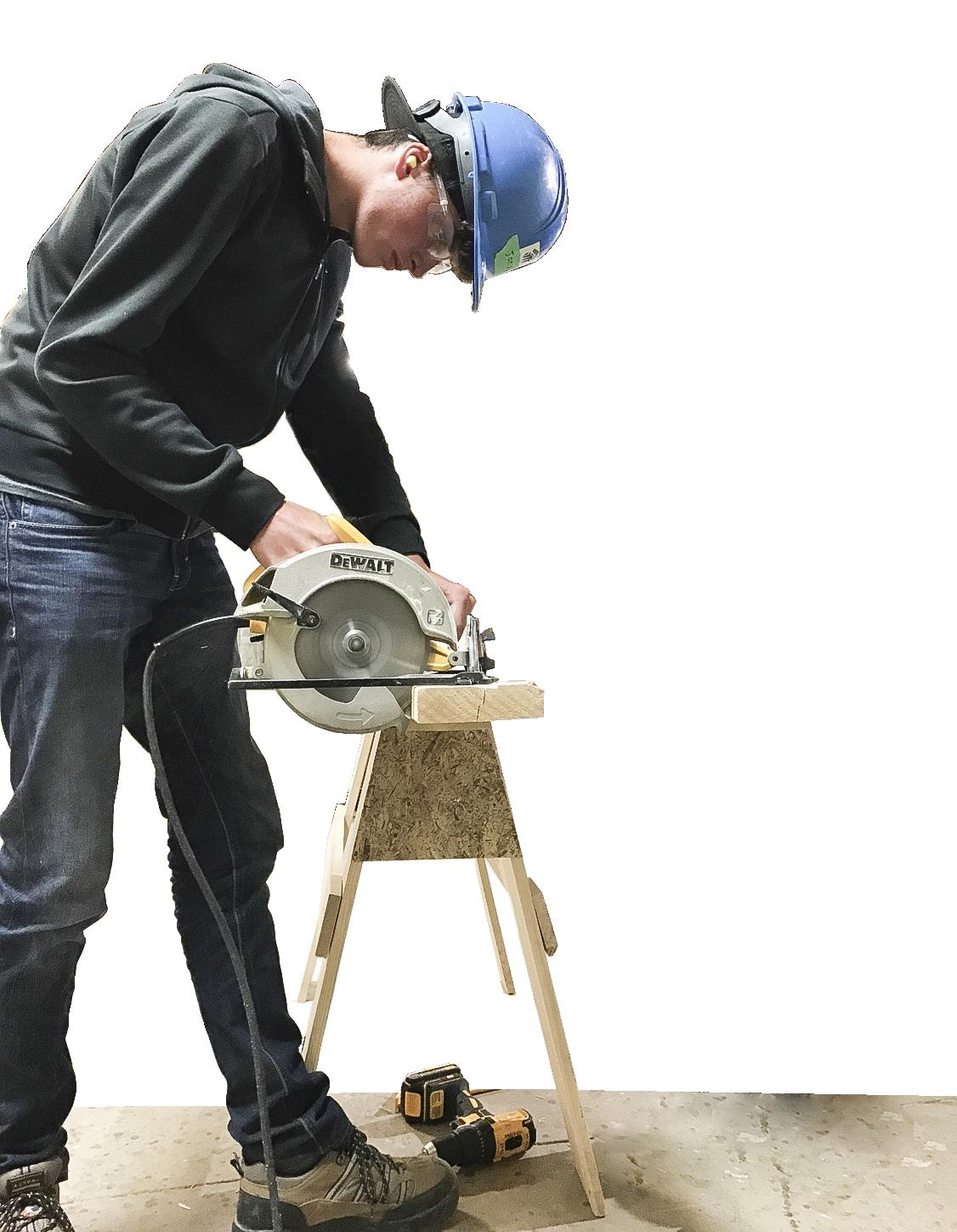
• How to use basic tools such as a hammer, screwdriver, and a saw.
8. Maintaining a Car
Everyone who drives a car should know how to maintain their car. Teach them how to look up car repair videos online so that they can save money by doing minor repairs themselves instead of having to have everything fixed by a professional.
• Add air to a tire.
• Change a tire.
• Jumpstart a car.
• Refill various fluids.
• Be informed about when to bring the car in for service.
• It’s also handy if we can teach our kids how to change the oil, change the brakes, or any other car repairs we know how to do.
9. Job-Seeking Life Skills
Obviously, these are super important.
• Make a resume.
• Fill out job applications (whether online or on paper).
• Prepare for an interview.
• Pick out suitable clothing, tie a Windsor knot, iron a shirt, etc.
• How to shake someone’s hand properly
10. Other Important Life Skills
Someday, our sons and daughters will thank us if we have taught them these skills.
• How to contact people: making important phone calls, sending emails, filling out contact forms, etc.
• How to talk to important people such as bank loan officers.
• How to ask questions of people to handle various situations.
• How to respond in an emergency, such as having to treat a wound.
• Basic sewing skills such as sewing on a button or hemming pants.
BONUS ITEM: Social Responsibilities
It’s also important to be sure our teens understand the importance of other intangibles, such as having empathy and compassion for others, honesty, forgiveness, standing up for your beliefs in the face of opposition, how to treat your spouse, and other important concepts. Without these abilities, our children will either cause themselves or others to struggle in life.
Tips for Teaching Life Skills to Teenagers
If you have the desire to equip your teen by teaching them these life skills, you may encounter some resistance. Teenagers aren’t
always eager to listen to advice. Here are some tips to keep in mind:
• Choose wisely. Start out with tasks your child has some interest in before moving on to ones that may be more of a struggle.
• Show, don’t tell. It’s often helpful for your teen to be present as you tackle a task to help them become familiar with how to do something before asking them to do it on their own.
• Need leads to desire. Remember that many people learn best when they need to do so. Your son may not want to learn how to change a tire on a car until he’s on the side of the road with a flat. He may not be interested in learning about budgets and saving money until he has a job where he’s earning money of his own. Look for opportunities that will show your children their need for this information, and they may be much more receptive to hearing what you have to say.
There is no way you will ever be able to teach your child everything he needs to know. If we teach our kids how to learn,
they will also be able to pick up various skills from different people along the way. Whenever they encounter a new situation, we want them to be willing to try to figure out the best action to take rather than being afraid to do something wrong and getting stuck.
Our kids really DO want to learn life skills if we give them opportunities at the right time and in the right way. Let’s do what we can to raise responsible children who grow into capable men and women. With a bit of effort, we can achieve this goal more easily than we might think.
For links and more info, read the original article here: www.homeschool-your-boys.com/essentiallife-skills/
Michelle Caskey - I’m here because I want to encourage and inspire you as you both parent and/or homeschool your boys. Being a mom to boys can be hard! Homeschooling boys can be even harder. As a mom of two teenage boys who I’ve been homeschooling since the beginning, I’m here to tell you that having sons is a blessing. And it is possible to connect with them and to enjoy spending your days with them. My desire is that Homeschool Your Boys will be a place where parents are inspired to teach their sons in a way which will most engage their minds and their hearts. Find out more at Homeschool Your Boys! homeschool-your-boys.com
Above photo courtesy of the Michelle Caskey
Strategies for Homeschool with Multiple Preschoolers
By Sonya Shafer
What do you do when your oldest is just starting homeschool and you have preschoolers along for the ride? Joining me today is a very special guest: My daughter, Ruth Smith.
Sonya: First, let’s talk about who you are and your family.
Ruth: I’ve got four children, but when I started formally homeschooling, my oldest was 6, and then I had a 4-year-old and a 1-year-old. I quickly learned that you can have a really good plan on paper, but the reality of it, with little ones especially, is that your day just doesn’t go the way you imagine it.
Sonya: It’s like they didn’t read the paper.
Ruth: Exactly. In your head, it’s easy to think, “This is great, everyone will be on board with this, nobody will have a bad attitude or an emergency or a conflict.” But it is challenging, even without school. So when it was time to add in school, I was so intimidated because it was already a challenge just to get through the day and add even one extra thing. And now I was looking at adding four or five extra things every single day. So we started slow. I started tentatively adding in one thing at a time. My oldest was learning how to engage with it. I started trying to be strategic, tucking school in here and there as I was able to. But it looked kind of weird. What I wanted was this sense of, “Okay, it’s time for school.” And then we’d sit down and rotate through short lessons, and then the main part of school for the day is done. But I could not figure out how to achieve that picture with the little ones in the mix. At that time, the 4-year-old and 6-year-old were best pals. They did everything together. So taking the 6-year-old out of that was shocking
for both of them. And the 4-year-old and 1-year-old hadn’t figured out how to play together yet. They didn’t have those skills. I couldn’t just say, “Well, you two play together while I do this.” The 1-year-old was used to having my attention, and the 4-year-old and the 6-year-old were used to being with each other. And so it was just a big upsetting of what was normal.
Sonya: So did you try fitting things in during nap time?
Ruth: I did sometimes use nap time, because we would have an afternoon, everyonetakes-a-rest-time. So I did try utilizing a little bit of that, but I couldn’t use the whole time, because I really needed that downtime too, especially with pregnancy and chronic illness.
Sonya: Exactly.
My 6-year-old also really benefited from having some time alone, because otherwise we’re together all the time. So I couldn’t take that whole time. It was just a little bit here, a little bit there. I didn’t know from one day to the next how exactly it was going to work. It was like trying to dress a cat that’s running away.
Sonya: It’s not pretty.
Ruth: Right. I felt like that was the goal to achieve: the school time where we just do school. But I couldn’t find a way to achieve that that wasn’t disregarding the needs of my preschoolers. They needed attention and care and all of that. I don’t know any 1-year-olds who can be okay without you for 45 minutes. You’re lucky if you get 20 minutes, and you can’t predict when that might happen. So I wrestled with this. We made it work, but all the time I felt like I was subpar. I wasn’t able to achieve it. And it’s easy to start looking at your young ones as the barrier to your goal. And then something occurred to me that completely changed it for me. I looked at my “students” and realized that I had been thinking about how to have a Charlotte Mason-style homeschool with preschoolers in the mix. But what I actually have here is a Charlotte Mason preschool with a first grader in the mix.
Sonya: That’s such a shift. I mean, it just turns it on its head. And then it becomes clear. Wow.
Ruth: It gave me permission to embrace the preschool-ness of our days. And now suddenly I could say, “Yes, this is our preschool. We’re going to take a couple hours to just play in the morning. We’re going to do all these things that the preschoolers need and want.” It’s what I was already trying to do with them. And my first grader was in that as well and benefited from all those things. I was leveling her up here and there as I was able to, working around the preschool schedule. So, it’s small, but it felt like after trying and trying for months to stand on my head, I just decided to stand on my feet instead.
Sonya: It makes sense. Instead of: “I am teaching a first grader, and
I want the preschoolers to fit in where they can,” now it is: “I have a preschool with three students, and I am tucking in extra things for my first grader as it fits.”
Ruth: Right. And she’s more adaptable because she’s older and can go with the flow a little easier. It worked so much better to think about it that way.
Sonya: So let’s get a little more specific about those preschool activities, because when we say we have three students in preschool, and we’re adding the first grader into the mix, we’re not talking about free-playall-day-long preschool.
Ruth: Right. There is a lot of free play.
Sonya: Yes, and that’s important. The free play is very important. But I know that you had other things that you included because we created Our Preschool Life for you guys, for your kids, our grandchildren. Our Preschool Life is just little things that you can tuck into a month. We would give a picture to look at and just talk about. We give short classical music pieces to play.
Ruth: Those are very popular at our house.
Sonya: Are they? That’s so good to hear. There are stories to read. They have a Bible story, they have a poem, they have a rhyme, they have two nature friends to look for each month, and little stickers to put in their nature notebook when they see those friends. What else is there?
Ruth: Crafts. There are ideas for math concepts, ideas for playing outside.
Sonya: Yes. And there’s the option that a person using Our Preschool Life can add in reading kits and the handwriting stuff when the students are ready; as they get older. That’s one of those things that you could tuck in here and there for your older students if you want to. But Our Preschool Life itself gives you all of those little touches that you could do it daily, but you could also use those activities as they fit into your schedule. So that’s what we mean by focusing on the preschool and bringing in the first grader on the side. It’s not just free play all day long. It becomes a way of life, really, which is what Charlotte Mason is. Those are wonderful benefits to focusing on the preschoolers. And your first grader is still reaping those benefits, looking at those good pictures, hearing those stories. Can you give any practical tips on working through that?
Ruth: Every family is going to find different ways to make it work. I recommend thinking about what is the hardest subject for you to accomplish with your first grader when there are preschoolers around. What’s the most challenging? Try to match it up with whatever part of your day the preschoolers are typically less of a distraction. So that could be using a little bit of the nap time. It doesn’t have to be that morning school time; you can use any part of your day. You can also switch around location. It doesn’t have to be at the table or in a school room, it could be in the living room. It could even be the bathtub. Or it could be a water table outside, or the car, if you have a regular drive as part of your week. Maybe you could work an audio component into that. The key is to look at what you’re already doing, what’s already
The Early Years
normal, and try to match things up that way. Because it’s got to be sustainable. You have to do this every single day, so you can’t go all out trying to spend a lot of energy setting up a bunch of stuff for the preschoolers to do so you can get 10 minutes with the first grader. One common piece of advice, of course, is to have some toys that only come out at school time, or when you’re trying to accomplish something.
Sonya: Did that work well for you?
Ruth: I still use that at times, but a trick with that is it can’t be too special or interesting, because then your first grader is going to feel extremely left out. She has to do this work while her siblings get to play with something really cool, so it can’t be too interesting. It has to be something that the first grader also has access to at some time. One big thing we used was extra math manipulatives. So, we have the kit; the beads and the buttons and the coins and the craft sticks, and often, when I was doing math with the first grader, I would let the preschoolers have one of the other batches of manipulatives. They loved that. So keep things simple and use what you’ve already got out, like math manipulatives or even just paper and colored pencils. The younger ones may want to feel like they’re doing some school, too. So if you’re able to give them a handwriting sheet that they could practice on or do a little bit of math with them, that often helps them to feel included.
Sonya: To phrase it this way, in the one-room schoolhouse, the little ones are going to be picking up on those things, too.
Ruth: Exactly. They may be ready for it sooner than your first one was. I encourage everyone to think about what they’ve already got and what they can use and just be strategic, be creative, keep trying. Things change so quickly. You’ll find what works and then a few months later, it’s not working well. So you often have to step back and think: “Okay, what else can I try?”
Sonya: Because those little ones grow at such a quick pace. And reevaluating, that’s a key, regularly, throughout the year.
Ruth: Right. Keep trying. It really is a special time for your first grader. You’re opening his or her eyes to so much more.
Sonya: Those are great ideas, and I appreciate your sharing from your experience for everybody to be encouraged that it doesn’t have to look perfect. It can look different for each person, but yet what you shared today might be just the thing that others need to keep them encouraged and keep them going.
For links and more info, read the original article here: simplycharlottemason.com/blog/strategies-for-homeschool-with-multiplepreschoolers/
Sonya Shafer is a popular homeschool speaker and writer, specializing in the Charlotte Mason Method. She has been on an adventure for more than 20 years studying, researching, practicing, and teaching Charlotte’s gentle and effective methods of education. Her passion for homeschooling her own four daughters grew into helping others and then into Simply Charlotte Mason, which publishes her many books and provides a place of practical encouragement to homeschoolers. The above article was originally published at simplycharlottemason.com and was reprinted with permission.
Oliver J, 7
Penpal Club
Chevelle W, 6
Hi! My favourite animals are dinosaurs. I really like remote control cars, and my favourite color is blue. I have 4 sisters and 2 cats. I hope we can be penpals!
Eviana P, 9
Hi! I live in Grande Prairie and I like dogs and my family. I have 2 brothers and 1 Mom and 1 Dad. I like to read, draw, swim, play the violin, play with Barbies, dance, sing, and play outside. I am excited to be a penpal. I hope I have a penpal soon.
Amelia W, 6
Hello! My favourite book is Whatever After: Bad Hair Day. I am excited to write to whoever writes to me!
Emiliano M, 5
Hi! I like to play with lego and I am starting to swim! I like summer better than winter. I am a big brother. I have 2 cats, Romie and Catsby.
Tanner R, 14
Hi! I love drawing, cooking/baking, and dancing! I live in Calgary and I'm ready to make new friends!
Sterling P, 12
HI! I am a 12 year old boy. I like cars, trucks, playing Fortnite, and playing outside. I like to ride my bike and go camping with my family. I have one younger sister and one older brother. I think having a penpal would be fun.
Marissa C, 14
Hi! I like anything to do with the ocean, travelling, basketball, badminton, and crafts. I have 2 younger siblings and a dog. I live in Northern Alberta. I would like to be penpals with someone my age.
Gracelynn W, 6
Hi! I like to draw. I have 2 cats. I am excited to be in the Penpal Club!
Emily T, 10
Hi! I have 2 dogs and I have 3 older siblings and 1 younger sibling. I play gymnastics and soccer. I hope to be your penpal.
Hi! I like to play in the snow, do things with my family, and go on adventures. My favourite colour is blue.
Deja P, 13
Hi! I love reading fantasy books and writing. I play competitive soccer and love skiing. I love going to church and youth group. Hope to hear from you soon!
Robyn D, 7
Hi! I love dragons and bunnies. I have a dog named Roo. I also have 2 gerbils. Their names are Bilbo and Scabbers. My brother has a snake, her name is Winter. I love animals!
Alysia R, 8
Hi! I love God most of all! I like making new friends, reading, playing the piano, and being creative. I have a little sister who I love playing with and a dog named Chestnut. I wonder if you like the same things I do?
Addelynn H, 7
Hi! I like to play Minecraft and World of Warcraft with my Dad. I have 3 dogs and I am an only child. I like to run, swim, and I practice Jujitsu. I like science and lego, too!
Ena H, 8
Hello! I have 1 younger sister, 2 cats, and 3 dogs. I love to play Minecraft and Candy Crush. I love to play lego, Barbies, do crafts, and sing. I am in Musical Theatre and Girl Guides. My favourite books are "Bad Kitty" books.
Evie O, 12
Hello! I live in Three Hills. I have 2 older brothers. I like playing Minecraft and cuddling with my friend's dogs. I love Nancy Drew and Mandie books. I also love to run and ride my electric scooter around town.
Bethany D, 13
Hi! I like playing with my cat and our baby goats. I like herbs, going for walks, archery, and reading. I'm the second youngest of 8 children. I live on a farm.
Hi, I am looking forward to having a pen pal. I am very curious and love learning new things. I really enjoy programming, designing robots, tinkering, woodworking, quantum physics, and inventing things. I pretty much enjoy doing everything. I have 2 younger sisters and one younger brother. My favourite colour is blue, and I believe in the Messiah. In the summer I love going for hikes, exploring, and bike rides. My family just bought a SideXSide.
Samuel V, 8
Hi! I like hockey and drawing. I have 3 sisters, one older and two younger. I have 2 dogs, a cat, and 16 chickens.
Edessa L, 9
Hi! My favourite colours are pink and yellow. I have 1 sister and 2 brothers. I like painting, drawing, bowling, checkers, and playing outside with my family. I like playing video games with my parents. I'm excited to be penpals with you!
Eli S, 15
Hi! I am an all season biker that likes watching movies with friends and playing with my cat. I am learning guitar, enjoy playing lego, Minecraft, and many other games.
Charlotte O, 12
Hi! I like drawing, reading, lego, and playing Minecraft. I have 4 cats, 1 dog, and a bunny named Ghost. I have 2 younger brothers and I like to play outside.
Marcia D, 10
Hi! I love chickens a lot. We have 2 dogs, 7 goats, 8 cats, and over 100 chickens. I hope to hear from you soon!
Jasmin S, 13
Hi! I like doing arts and crafts, playing with my friends, and playing with my sister and my dog. I like being at home with my family and love animals. I also like building with lego Please write soon.
Mason R, 10
Hi! I like dinosaurs, Minecraft, watching YouTube, drawing, and swimming. I enjoy playing with and petting my dogs and cat, going places like camping, and soccer! I live in Calgary!
Ava D, 5
Hi! I like going swimming. I enjoy spending time with my family. I have two brothers and three cats. My favourite TV show is Rubble & Crew. I enjoy painting and playing outside.
Aveline V, 5
Hi! I love dancing and making my siblings laugh. I love playing outside with my 2 dogs.
Miriam M, 9
Hi! I have 2 brothers and 1 sister. I play the violin and I play ringette. My hobbies are reading, art, and writing. I am also obsessed with Japan and The Babysitter's Club books. I would like a penpal a TON!
Claire L, 13
Hi! I love to dance and play volleyball, basketball, and soccer. I also read a lot. I am a big sister and a little sister. I live with my dad, mom, and sister. My brother lives away from us in another city. We live on an acreage near Sexsmith. We are going to grow chickens this year. If you know how to do it, I would like some pointers! Hope to hear from you soon!
To join
You are invited to write to any Penpal Club member listed here!
To join the Club, please send a short letter of introduction (like those posted here) to the WISDOM office, along with a note giving parental permission.
You may also ask your parent to email office@wisdomhomeschooling.com.
If you'd like to be a penpal of someone listed here, please send your first letter to:
[Penpal name]
℅ WISDOM Penpal Club Box 78
Derwent, AB T0B 1C0
Everett A, 12
Hello, I am the oldest of 3 boys. I have 3 dogs, and wish I could have a snake. I enjoy watching and playing sports, including basketball, hockey, and football. I also love geography and enjoy reading.
Julia T, 12
Hi! I play soccer and pond hockey. I have 2 dogs. I am going to play softball in the summer. I have a younger sister and brother and 2 older brothers. I like listening to music. I hope you write to me!
Kayden M, 10
Hi! I like riding my quad and being with my dog. I love LEGO and playing Minecraft. We have 6 horses. I enjoy going to Jasper with my family, and I love food.
May/June Birthdays
May 8, 2018 — Fillip H
Loves math, numbers, singing, playing piano, & being outdoors.
May 13, 2010 — Cassandra R Loves cats, crocheting, & baking.
May 19, 2011 — Desmond L
Likes lego, skiing, soccer, food, and Greek mythology. Favourite colours are navy and cyan.
May 19, 2022 — Cornell D
Loves getting into trouble with older brother, playing with duplo, & his trucks.
May 24, 2019 — Waylon Z
Enjoys playing with cards, painting, & riding his bike.
May 27, 2019 — Ethan D
Loves playing with lego/duplo, animals, & his nerf gun.
June 3, 2011 — Tanner R
Loves drawing, arts & crafts, and making good friends.
Likes swimming, taking walks, & playing games with my Dad.
June 27, 2018 — Viola M
Join Our Birthday Club!
Write to us with your child's name, age, 2-3 things they're interested in, and their birthdate. We will print them just like we do in the Penpal Club, but instead of an ongoing penpal commitment, this gives other kids a chance to send yours a birthday card!
(Please send this to us at least 3 months before your child's birthday, so we can get them printed in time.)
—A— SourdoughKombucha
Plan
By Paul van den Bosch
The word “plan” is one of those words that I think I know but might not be able to define succinctly. I looked up that word in several places…
The Collins dictionary: A plan is a method of achieving something that you have worked out in detail beforehand: When you plan, you decide in detail what you are going to do, and you intend to do it.
Dictionary.com: A plan is a well-considered scheme or method of acting, doing, or proceeding, developed in advance.
The Oxford dictionary: A plan is a set of things to do in order to achieve something, especially one that has been considered in detail in advance.
The Cambridge dictionary: To plan is to think about and decide what you are going to do or how you are going to do it, to intend to do something so that an event or result should happen.
The Merriam-Webster dictionary: A plan is a method developed for achieving an end, a procedure of doing something, a detailed formulation of an intended program of action.
Although all of those definitions are slightly different, there are some concepts that pop up more than once: “Beforehand” and “In Advance.” “Intend” and “Decide.” “Developed” and “Considered.” “Detail.”
That last word, “detail,’” is something to keep in mind, especially when we are putting together our Education Program Plans for this coming fall. How much detail do we include?
There is a balance to be struck here: we don’t want to “get bogged down in the details” by micromanaging every detail of what we hope will happen this coming school year.
On the other hand, we don’t want to “see the forest but miss the trees” by not including enough detail either, focusing too much on the big picture without providing enough tangible details for the achievement of that grander plan.
Doing our EPPs “beforehand and in advance” also raises the question: how far in advance should we plan? When I am visiting families for our spring facilitator visit, I know that some families like to have the EPPs for the coming fall ready at the spring visit.
Feature
Some do not. Some families are worried that, by planning too far in advance, the plan will not suit the student’s level of knowledge and skills by autumn. It is good to plan in advance, of course, and we don’t want to “plan on the fly,” so please keep in mind that the Education Program Plans we create are living documents and they can be adjusted and altered and supplemented (especially when we find new resources or a different curriculum during the school year).
Another note is that, as much as we want to plan well ahead (with a greater or lesser amount of detail) the kind of plan we need to create is what I would call a “sourdough kombucha plan.”
That will take a little explanation…
I have sometimes teased my wife for making “the mouldy things” in our kitchen. What I mean is that she enjoys making foods for our family that are fermented and/or include live bacteria. You know the kind of things I mean: Homemade yogurt, sourdough, kombucha, kefir, kimchi (although it is one of our daughters who is the expert kimchi maker). I should point out here that I thoroughly enjoy all of these things (although I know almost nothing about how to make any of them) and I’m very grateful for the wonderful food that my wife prepares. We are a healthier and happier family because of the care and love that go into the food she makes.
How does sourdough and kombucha relate to any plan that we might make and, in particular, to our Education Program Plans?
I see four analogies here…
One - branching off from a common base or starting point.
Two - allowing for mistakes and failures.
Three - starting a process of “bubbling up.”
Four- learning patience.
Starting Points
There are many different products that can be made from sourdough, not just sourdough bread, but they all start from the same place. In the same way, there are many different flavours that can be made from one basic kombucha, as you’ll see at your local grocery store or by experimenting with homemade flavours. Regardless of what you decide to make with your sourdough or what flavour of kombucha suits your fancy, there was one common starting point for those sourdough products and that kombucha. With sourdough, it’s the “sourdough starter.” For kombucha, it’s the “kombucha mother.”
From that one starter or mother, the imagination of the baker or the kombucha maker can lead to all sorts of fanciful creations. Have you eaten sourdough muffins or cinnamon rolls or sourdough pancakes? They are all excellent. You can find or make rhubarb flavoured kombucha, if you like tart tastes, or watermelon or lemon ginger or a hundred other varieties of this fizzy drink.
In the same way, we can look at the Education Program Plans that we create for our children and realize that they all have something in common. Call it a common base, or an education ‘starter’.
Put another way, we can agree on some common skills and knowledge that every student should learn to the extent of their ability, things like reading and writing and arithmetic. But from those ‘basics’, the imagination of the parent and the character of the students can then lead to a different epp for each of our children.
For instance, every plan may have “reading” on it as a subject, but not every plan will have the same books to be read. For the 25/26 school year, WISDOM has well over 6000 students and that means there are at least 6000 different ways of home schooling. We may agree on some common ‘mother subjects’ like reading, writing and arithmetic (and there’s even some debate about that) but, regardless of where we start, our educational journey will take us into unexpected places, just like we can find or create unexpected kombucha flavors.
Mistakes
One of the things that every baker knows is that sometimes the bread won’t turn out as expected.
The same process that made a nice fluffy loaf one day will make a dense heavy loaf the next day for often mysterious reasons. Why didn’t the yogurt thicken properly? Why does the kefir taste a little funny today? What made the kimchi turn that colour? All of these questions are familiar to those who work with fermented products because the fermentation process involves live organisms and those live organisms sometimes seem to have a mind of their own.
That’s OK. We don’t expect perfectly uniform yogurt or kefir every day nor can we expect perfectly achieved education every day. Perfection is boring. Perfection is inhuman. If we set ourselves on the road of perfectionism, we doom ourselves to running on an everlasting hamster wheel that will never reach a conclusion. Home schooling isn’t perfect because students make mistakes and parents do as well. We learn from our mistakes.
The mistake could be in a misunderstanding of mathematical processes. The error could be in using baking soda instead of baking
powder (and I made that mistake a long time ago when making non-sourdough biscuits which turned out more like hockey pucks). The mistake could be in expecting the same language arts program to work for each of our kids. In our Education Program Plans, we can allow for changes (a new approach or a new resource or a new curriculum, where necessary) and also allow for our kids to make mistakes along the way as they learn.
Bubbling
If you have ever looked at a large glass jar of kombucha in process, you probably noticed a shape in the jar that looks like a space alien. That alien is the “mother” (or “scoby”, which stands for “symbiotic culture of bacteria and yeast”, or so I’m told, and a jar holding just a scoby is called a “scoby hotel”). That mother is the collection of living organisms in the kombucha, and it will give the kombucha pungency as well as make it a healthy thing to drink. Once started, the kombucha maker doesn’t have to do much. The process has started. The kombucha just…grows.
In the same way, once all of the ingredients have been added to the milk and it has been brought to the correct temperature, the yogurt will incubate and thicken on its own. Sourdough bubbles and percolates upon itself. These are all natural processes and part of how these things get made.
We can do the same with our home schooling. We can plan well, but then things can happen as the plan takes shape in action. That’s why our plans are “living documents”: life happens.
I recall one family that intended to study ancient Egypt for just one day. It became a month-long project and involved several other families as they all studied not only the history of Egypt but the food and costumes and beliefs and hieroglyphics. That wasn’t part of the original plan. But the parents allowed for things to “bubble up”. We can’t predict what things our children will be interested in as they learn. But if we leave time and room for things to bubble, wonderful things will happen. That’s not “planning on the fly” but allowing for adjustments along the way.
Patience
One of the natural results of writing a detailed epp is that once we have written it, we tend to expect regular progress as we move toward the completion of that plan. But progress can be, well, irregular. Our children can take one step forward and two steps back and then three steps to the side and we, the parents who planned everything out, can become frustrated. Learning is sometimes linear and often not. I remember a friend talking to me about his boss who, once a sales plan was put in place, would expect immediate results. My friend was always noting that “he wants it done yesterday.” Parents can be like that too. Unreasonable expectations can cause resentment in both students and parents. We can expect too much too quickly from our kids.
This is where a sourdough kombucha plan can balance things. Sometimes in the making of kombucha or sourdough or yogurt, it can appear that there is nothing happening. We can’t see the tiny organisms, but they are doing their job, unseen and unappreciated. Things are progressing as they should. Sometimes our kids will need a little more time to finish all the questions in their math workbook. There will be times when the behaviour of our kids will seem to stall. There will be days when the simple thing they learned yesterday will seem to be completely forgotten.
But unseen things are happening. Sometimes we, the wise parents we are, need to give our children a little extra time. We also need to give ourselves, as wise parents, a little bit of grace and time to keep up with our children’s progress and adjust our plans as we go. Sometimes we have to just let things sit and percolate, knowing that learning is happening, learning that we can’t track from day-to-day.
We need to make plans, of course, and I know a lot of parents who try to create the perfect plan for each of their kids. I should tell you that I’ve been a facilitator more than 20 years and I don’t think I’ve seen a perfect plan yet. That’s one perspective. On the other hand, if we allow for some imperfections, if we create sourdough kombucha plans, then I would argue that EVERY plan is perfect.
So take courage, have patience and keep planning. And enjoy some kombucha along the way.
Paul van den Bosch is a WISDOM facilitator who enjoys kimchi and yogurt and sourdough and other mouldy things like that.
Photo courtesy of Paul van den Bosch
G
By Tiffany Arnold
Plan a Rhythm
o
Iamnot someone who plans ahead. I’m someone who tends to plan last minute and on the fly. Unfortunately, that doesn’t mean I’m always good at handling unexpected changes or disruptions when they come from outside my own plans, something I’m working on. But I digress… more on that later.
I like to plan last minute, and on a good day, I’m someone who sees possibilities and solutions more often than problems. Because of this, I’ll sometimes send out last minute invites for a spontaneous idea
that could turn into something really fun. It means I’m open to last minute invitations. It also means that, at times, I may want to cancel my plans because I’ve changed my mind about how I want to spend the day.
I used to think that, because I struggled to plan ahead, had a hard time sticking to plans, and often wanted to change them at the last minute, there was something wrong with me, that I was somehow failing. Let me count the ways I’ve felt like I’m “failing” as a mom in today’s society…
So much of our world pushes us toward planning: make appointments, be prepared, have a five-year plan, have a life plan, sign up for kid’s activities months in advance, create your EPP in April ;). The list goes on.
That pressure really grew when I became both an early childhood educator and a new mom. I remember learning how much kids thrive on routine and structure, on plans that don’t change too much. To top that off, my first child is someone who really likes having a plan and struggles when plans change. Looking back, that was a huge source of
stress for me, trying to create and stick to consistent plans, especially when I was already feeling the pull of society and the pressure to do things “right.”
Don’t get me wrong; I do see the value in planning ahead for some things. I get excited when we have future travel plans. I enjoy thinking about what our summer might look like and setting aside time for important events throughout the year. As a facilitator, I like knowing I have a plan to connect with all of my families over the course of a season. And as a home school mom, there are things I enjoy about planning an outlook or framework for our year. I’ve even started hosting a regular Sunday brunch for our families for the foreseeable future (talk about commitment!).
All of these plans provide a sense of direction and grounding. But what makes them work for me is the flexibility within them. I know we’ll miss some Sundays. I know plans will shift. That flexibility is key. In fact, I still find it stressful to book a non-refundable flight because it locks me into a plan I can’t change. Hitting that “book” button always feels like a big commitment! But it keeps it exciting!
Over time, I’ve started to embrace a life with less rigid planning, and it has helped me immensely. There’s something freeing about leaning into who we are instead of
trying to fit into a mould that was never meant for us. I am so grateful for home schooling, as it has been a huge gift in this area. It’s given us more flexibility and removed some of the pressure to always be overprepared. Prepared and organized are areas I’m growing in!
One of the most helpful shifts for me came from a wise suggestion to create a rhythm for our home school days instead of a more restrictive schedule. That idea alone has transformed my mindset. A rhythm allows for flow. It suits my loose planning style. It creates consistency without rigidity. It makes room for different seasons, times when things look different, pause, or shift, and then gently come back again. It also helps prepare our children for real life, where things don’t always follow a predictable routine. Learning to adapt is a skill that often gets overlooked.
Over the past couple of years, I’ve learned that it’s okay to make plans, but it’s just as important to hold them loosely. Things don’t always go the way I expect, and often, they turn out better because of it. I’ve also found that life feels less stressful and chaotic when I don’t plan too far ahead, although I’ll admit a little more organization could probably help with my last-minute tendencies.
But more than anything, what’s been
coming up for me lately is that it’s truly about God’s plan. When I hold too tightly to my own plans, I start trying to control outcomes that were never mine to control. You’ve probably heard the saying about God laughing at our plans. That’s exactly how it’s felt at times, like a gentle reminder that I’m not meant to control it all. I’m learning to release more, to trust more, and to listen for where He’s leading. Because the truth is, I can’t do that when I’m distracted with trying to plan, manage, and keep up appearances. Maybe that’s why I’ve never been much of a planner to begin with.
I know we’re not all called to live the same way. For some people, planning brings peace, and that’s a good thing. But for those of you who are more like me, who have felt “less than” in a world that values planning so highly, this is for you. Embrace the spontaneous parts of who you are. The flexibility. The last minute changes. Invite God into that space. Ask God what He wants it to look like in your life and how He can use that part of you to make something beautiful and to bless your family.
Tiffany is a WISDOM facilitator and home schooling Mom of 2 who is very passionate about parent led education and strong families. She, along with her husband, is also very passionate about following God’s plan in their life.
Home School Experiences
Serving Together in Belize:
The Canadian Commission Homeschool Team’s Journey of Work, Friendship, & Faith
By Victoria Veenstra
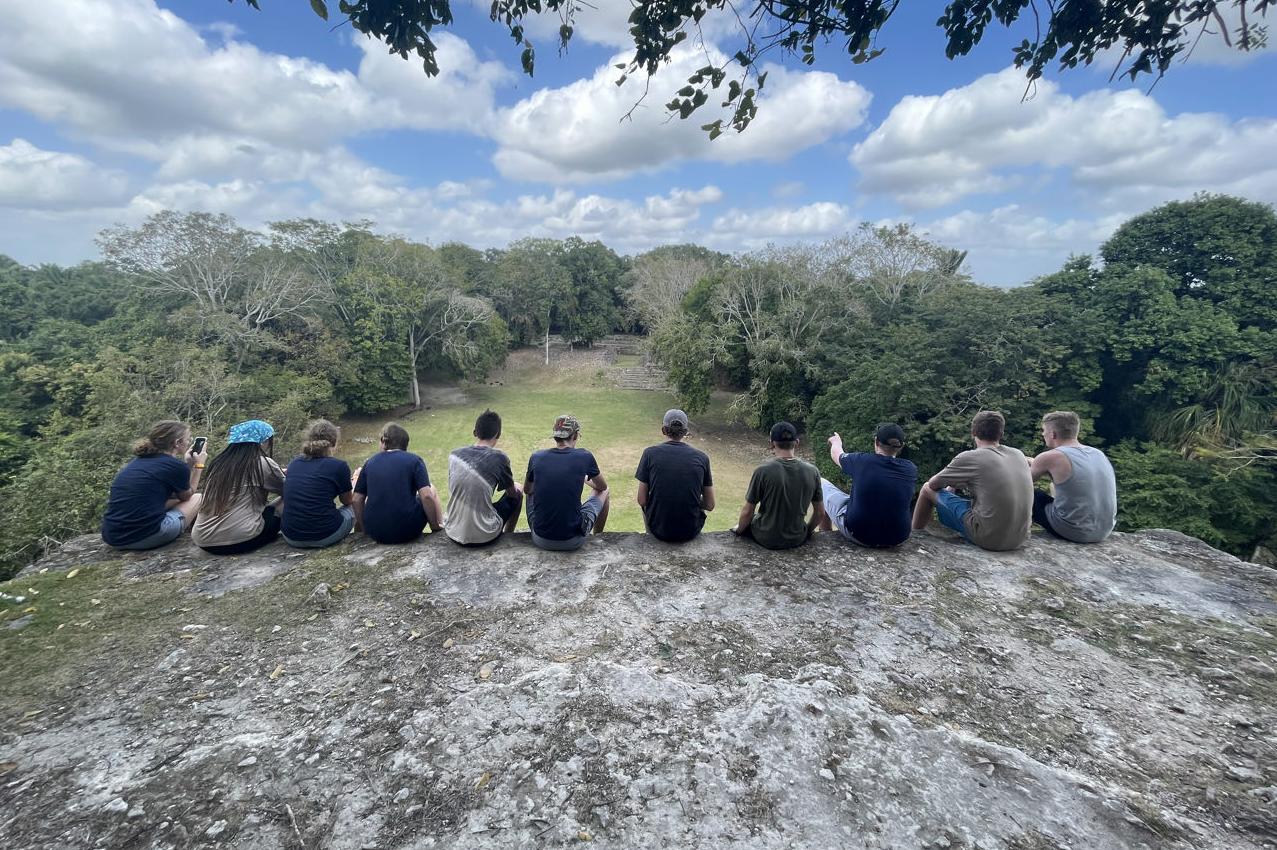
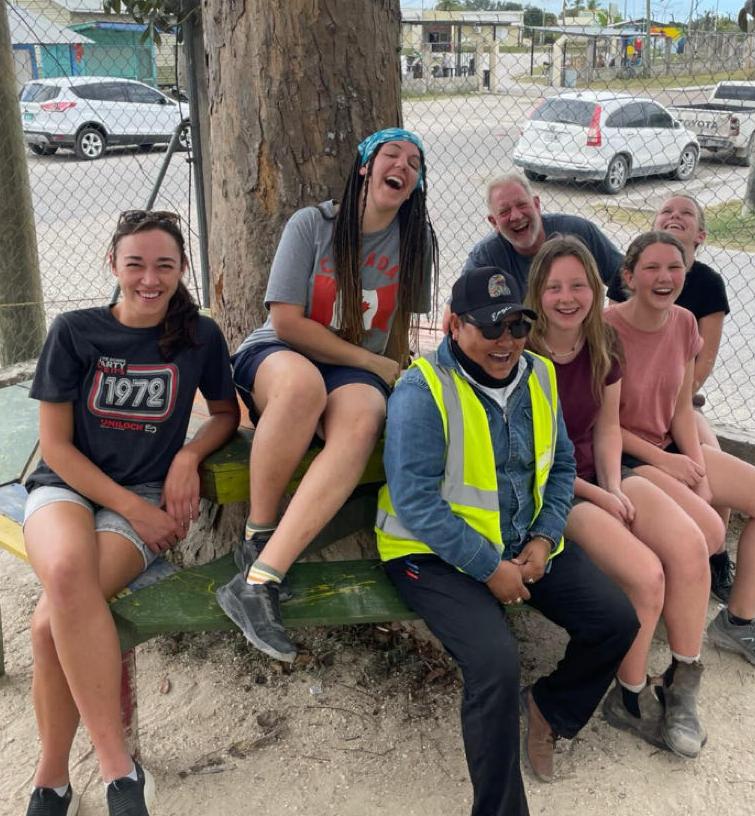
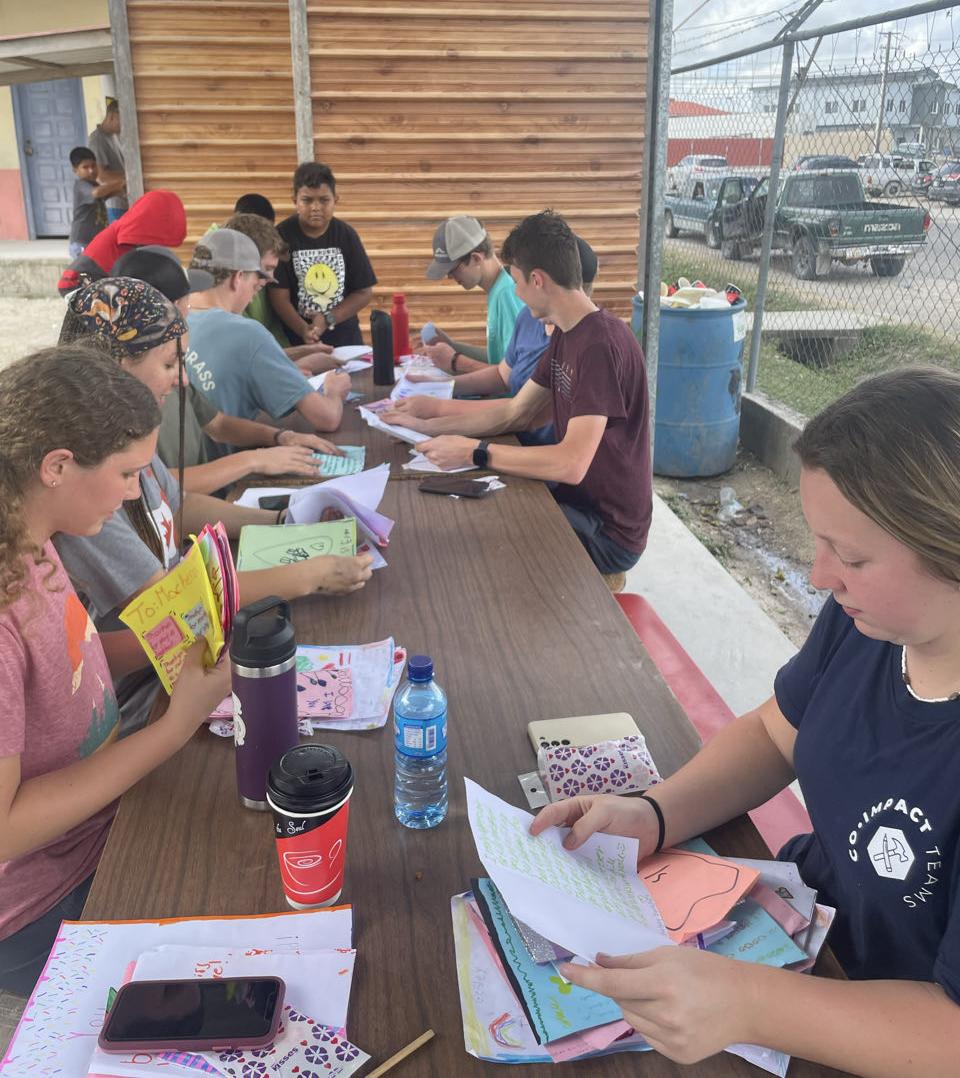
Whenthe Canadian Commission homeschool team arrived in Belize, they stepped into a week filled with service, learning, and cultural connection. Their service trip was part of EduDeo Ministries’ Co-Impact program, which sends volunteers to support partner schools around the world through hands-on work and relationship building. EduDeo works to advance Christ-centred education by partnering with local organizations to support teachers, improve infrastructure, and ensuring students have access to quality education.
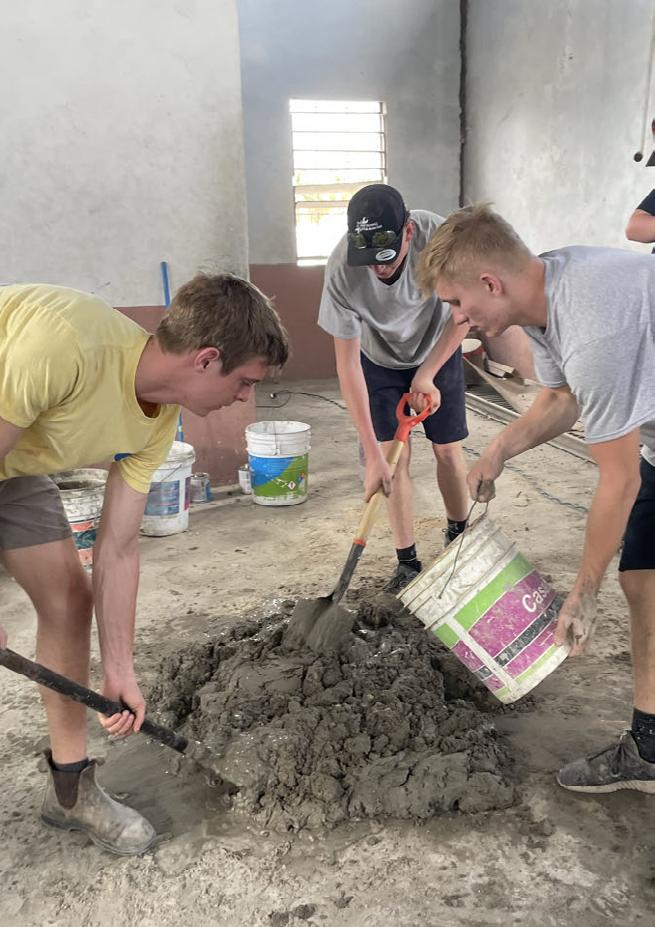
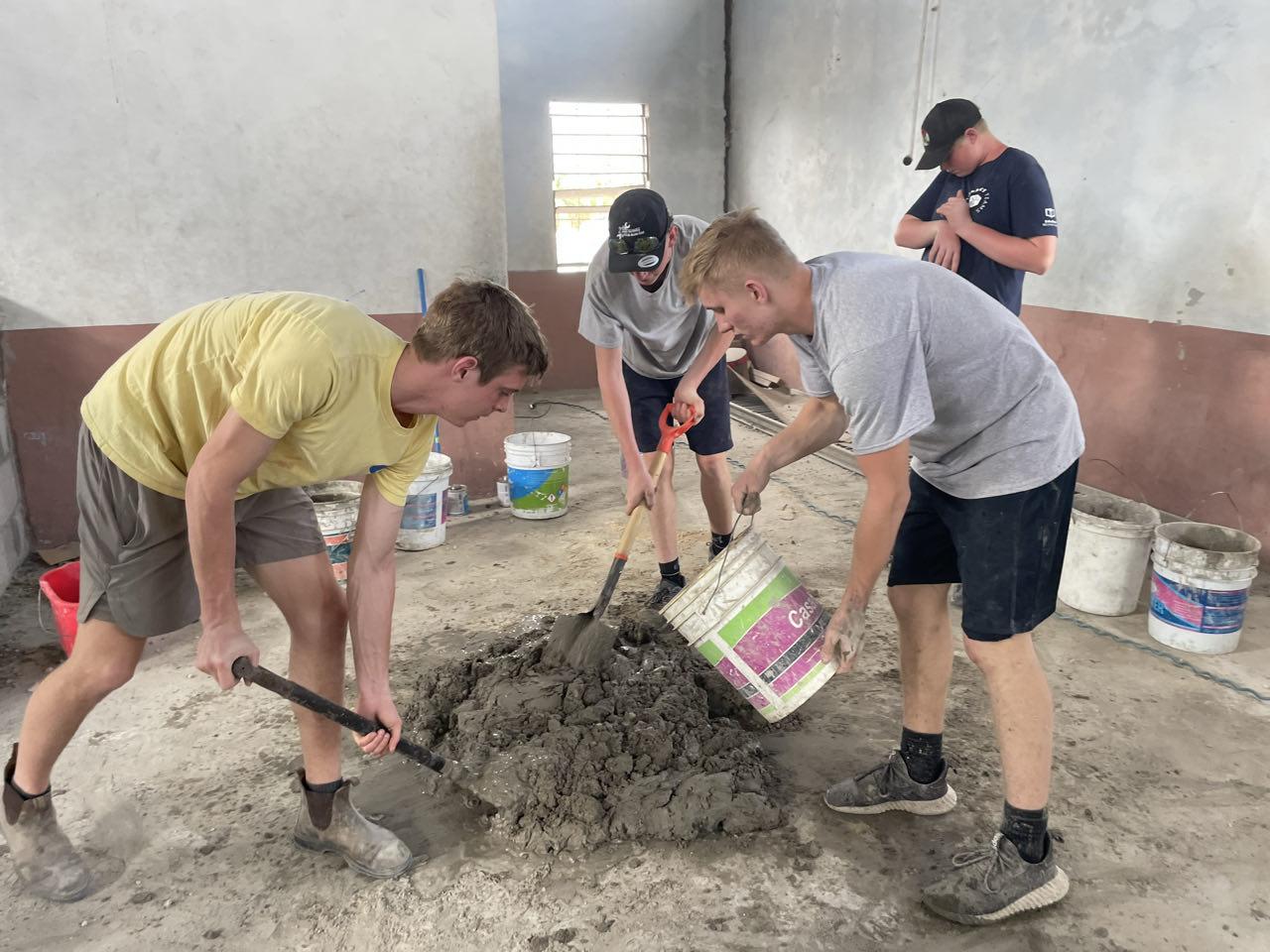
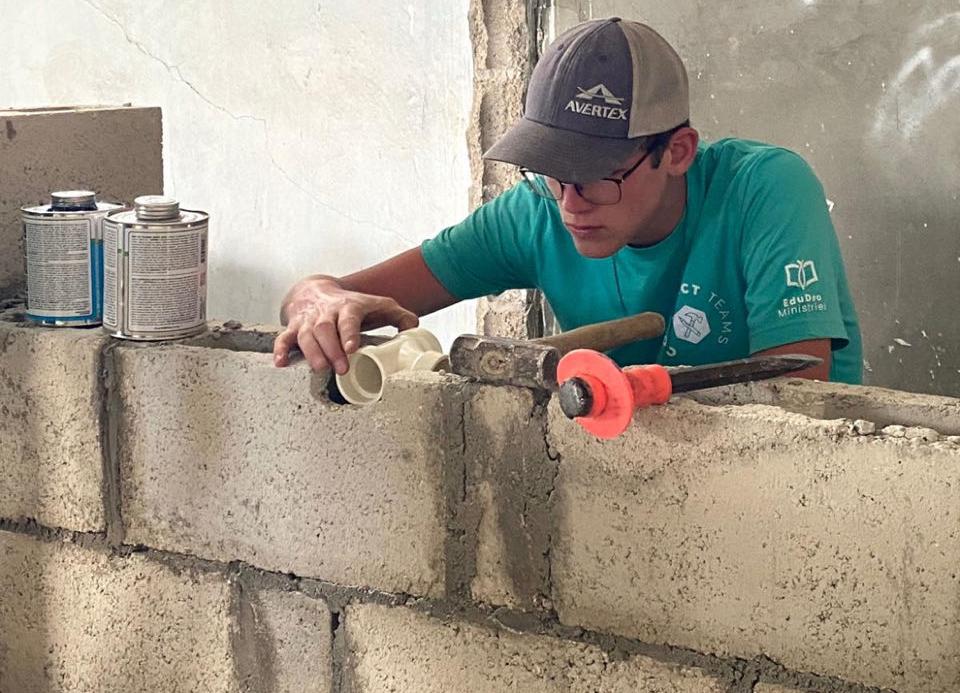
For this team of Canadian homeschoolers, their work unfolded at New Life Presbyterian School in Orange Walk. Under the leadership of foreman Leonardo, the team helped renovate several school bathrooms—a project that demanded muscle, teamwork, and resilience in the tropical heat. One of the most memorable tasks involved carrying 360 cement blocks up three flights of stairs in 33°C weather. Team leader Michelle Helder chuckled as she recalled how quickly the teens worked: “The foreman thought it
would take all day, but they had every block upstairs by noon. Their arms were going to look like Popeye’s by morning!”
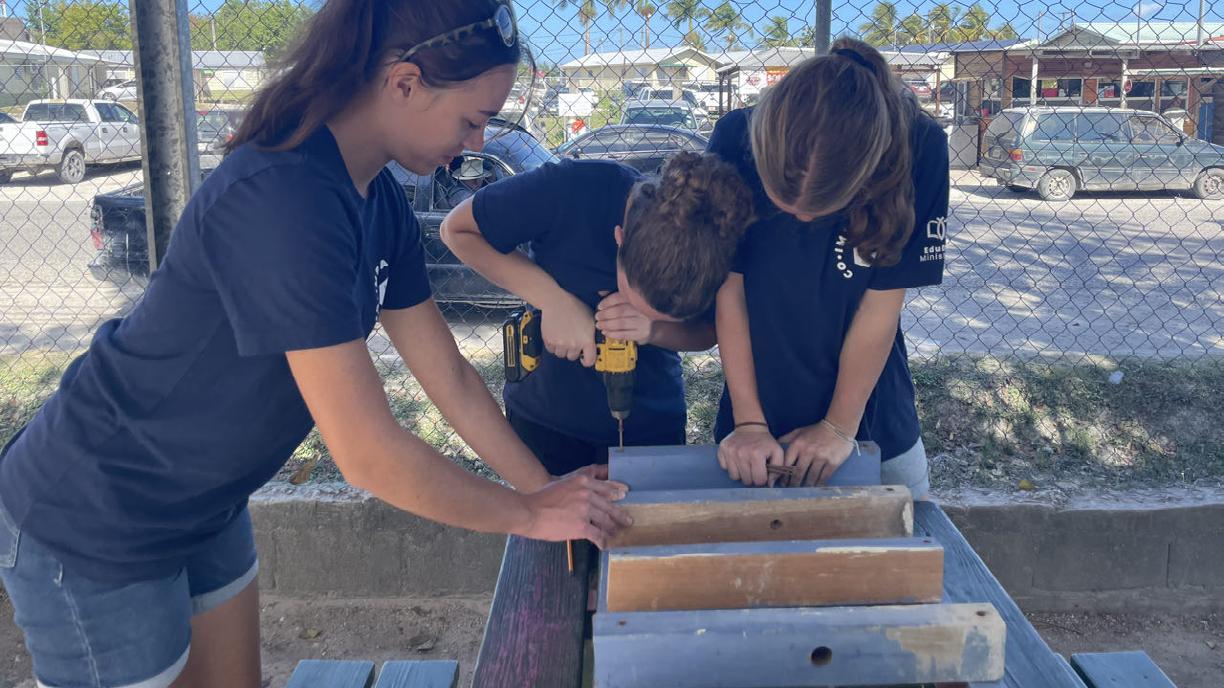
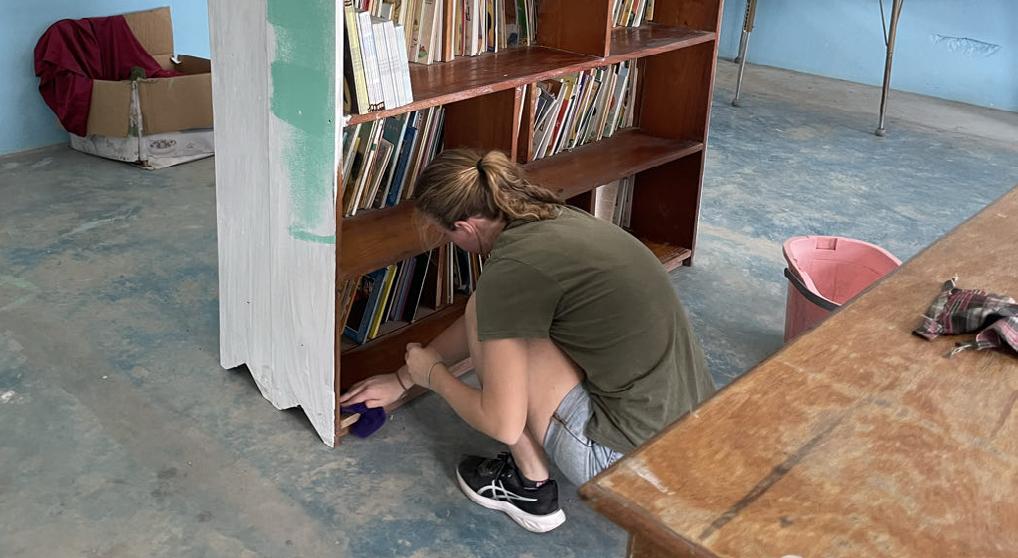
Students rotated through a variety of tasks and experiences. While some tackled cement, plumbing, and painting, others served in classrooms, reading with younger students, giving short presentations about Canada, supporting teachers, and joining in physical education. The girls also spent long hours rejuvenating the school library, sorting through dusty and damaged books to create a clean, welcoming learning space.
“The creativity needed in a developing country is inspiring,” shared Jenna, who spent much of her week adapting to unpredictable resources and even holding up phones for flashlight lighting so others could paint a storage room.
Between tasks, team members were often found playing football, tag, or “Red Light, Green Light” with eager local children. “What stood out to me was how happy the kids were even though they had so little,”
that.”
Several days also included unique cultural experiences: exploring Mayan ruins, touring a Belizean high school, and learning the nuances of “Belize time.” From cheap CocaCola in glass bottles to creative transportation solutions, every day brought new stories and new lessons in flexibility.
By the end of the week, the homeschoolers had completed new cement stairs, improved plumbing, painted hallways, organized the library, repaired furniture, and rebuilt a dilapidated picnic table. More importantly, they had built relationships, with Belizean students and with each other.
Michelle summarized the experience beautifully: “It was such a joy watching these teens learn new skills, work and laugh together, and grow. God was clearly at work in them.” Through the partnership of EduDeo Ministries, these homeschoolers became part of a global effort to strengthen Christ-centred education around the world—one block, one book, and one friendship at a time.
reflected Shane. “We can learn from
Home School Experiences
Excerpts from blog posts by
Michelle Helder
Read the original blog posts here: www.polarsteps.com/MichelleHelder/24235857canadian-commission-to-belize/219456174ladyville?s=82385f20-70d7-4766-ab37-127c75c8ba6d
Day 3
What a day! I think the guys will be asleep before their heads even hit their pillows tonight. That’s what happens when you spend the morning carrying 360 cement blocks up to the third floor! Did I mention they did this in 33°C?! They worked very hard, impressing the foreman who thought it would take them the day to do this. All those bricks were on the third floor before noon. Their forearms will look like Popeye’s by tomorrow! The girls split up, with some working with the younger students, helping them with their letters and numbers, while others were busy painting metal window grates. Once that was done, much work was needed in the library, so sorting and shelving books was started. In the afternoon, a bunch of us hopped on a bus to Muffles College (high school), where Muffles representatives showed their campus to prospective students who hope to go here in September. Mr. Valk, Gideon, and Kaden stayed back to continue working on the cement walls and steps that will eventually lead into much-needed bathrooms. Fixing the gutters was also needed, and so a bunch of guys worked on that and were able to fix the problems. It wasn’t all work:there was some time to play outside with the students as well, playing Catch Catch (Tag) and Red Light, Green Light. We look forward to tomorrow where we will get to explore some Mayan Ruins and some towns.
Day 6
School doesn’t start until 8:30, so we have about a half hour for the boys to play football and the girls to play a game where they are told to “Go!” and then they have to freeze when told “Stop!”. Then the “inspector” comes along to stare you down to see if you move at all. If you do, back to the line you go. Once the bell rang, it was time to get to work. Gideon, Shane, and Zach carried on with constructing what will be more bathrooms, making amazing progress by continuing to build the cement block steps and demolishing a wall. The problem-solving
abilities of these teens amaze me: using the grinder was very loud, so ear plugs were needed. No problem for Gideon - garbage bag pieces stuffed into the ears did exactly what was needed! His eardrums were saved! Ezra, Kaden, Clayton, and Jamian cleared out a whole lot of rubble from beside the school using pails and wheelbarrows; things went a lot quicker when the wheelbarrow was fixed by Mr. Valk. Kaden thought there wasn’t enough work and so he decided to sledge-hammer through an underground pipe. Oops! But in the end, that pipe had to be replaced anyway - phew! Mr. Valk and Clayton fixed a lot of chairs and benches for the church. While Jenna worked with some students, Rebekah, Keziah, Reagan, and Makenna continued their work in the library, sorting through all the books that were in heaps and boxes, and many covered in animal dung and dust, washing everything down, making that library look sparkly and new! Mrs. Bergsma, myself, and some others emptied a few storage rooms full of so much stuff the doors could hardly open! We sorted through the stuff, put back what they wanted to keep and threw out the rest. We were warned of an opossum that had been living in one of the rooms, but we didn’t know which one. We found out! Once the students left, the girls could paint the bathroom, and all the garbage that came out of those storage
rooms could be brought away. The day was a success! We praise God for His blessings on this day, including much cooler weather.
Day 7
So today, the first thing on the agenda was to put scaffolding together in order to get the plumbing for the bathrooms up to the 3rd floor. It was fun (and a bit nerve-wracking) to watch them put it all together, but in no time, it was all done. Much time was dedicated to putting together a picnic table that was originally around a mahogany tree, however it was completely dilapidated and useless, with a lot of rotted wood. Under Mr. Valk’s tutelage, the girls had a great time using the different tools and putting this table back together. Down here, where resources, supplies, and money are limited, very little is thrown away. Time is taken to take apart, get the nails and screws out, get rid of rotted wood pieces, and then measure and reuse what you have to put it back together. By the end of the day, the girls all had the confidence to build their own homes! While some worked getting the plumbing pipes up to the third floor, others worked with the cement, mixing it by hand, and then using it to smooth out the steps leading up to the new bathrooms. Other tasks done today were carrying more pails of gravel up to the third
Home School Experiences
floor and the painting of a hallway. Another day done where skills were taught and practiced, and where teamwork was necessary. Tomorrow will be our last full day of work!
Day 8
Today is our last full work day! We all piled into the van and headed back to the school to do devotions together with the teachers at the school. We were reminded that when we are united in Christ, we display forgiveness, humility, patience, and are all equal. After a breakfast of eggs, waffles, and fruit, it was time to get to work! The cement stairs were finished, a bike rack was put together, the plumbing pipes were completed and tested, the third floor windows were covered with metal grates, a storage room shelving unit was sprayed to kill the termites (Go Makenna!!), then painted. The scaffolding could now come down, and the team could go with the older students for a Phys Ed class. With that, our work day came to a close. We were sure to
pat the kids on the back for a job well done! The evening ended in laughter as Kangaroo Court was held, with Mrs. Bergsma and Jenna being the Jury, and yours truly as Judge - the only one who could keep mostly a straight and stern face throughout the proceedings. Oh, what a hoot!! Tomorrow is our last day - the morning will be at the school, the afternoon will be at the airport.
Final Day Reflections from Students
1. What are you looking forward to most back home?
2. What did you learn/What stood out to you this past week?
Rebekah
1. I am looking forward to seeing my family and to play the piano again.
2. I learned how to use power tools!
Shane
1. I am looking forward to seeing my girlfriend.
2. What stood out to me was how happy the kids were even though they had so little; we can learn from that.
Zach
1. I am looking forward to seeing my family, my bed, and regular food that I am used to.
2. My take away is a greater respect for how we do Sundays; also, learning can look so different across the board, yet learning is happening.
Makenna
1. I am looking forward to seeing my family.
2. What stood out to me was how different the culture was; God is so creative by creating different people and places.
Jenna
1. I am looking forward to my bed!
2. My takeaway is seeing the creativity needed in a developing country to get things done.
Keziah
1. I am most looking forward to my home, the other half of my family, my bed, my routine, and a glass of milk!
2. I enjoyed playing and working with the kids.
Kaden
1. I look forward to seeing my family.
2. I gained more plumbing skills! I also liked the lack of rules, but I can see how that would bring a level of chaos. It was good to experience a different culture.
Ezra
1. I am looking forward to my bed, and food without rice!
2. I learned how to build cement stairs. I also liked building friendships with the kids.
Gideon
1. I am looking forward to my own bed.
2. My takeaway is I noticed how friendly
Home School Experiences
everyone here is in Belize, and very hospitable.
Jamian
1. I am looking forward to seeing my friends and family
2. I loved playing with the kids, especially football. I faced my fear of heights! And I learned how to work with cement.
Klayton
1. I am looking forward to seeing my girlfriend, my family, having a meal without chicken, and going back to work.
2. I noticed the way they appreciate their school and seeing everyone working together, giving it their all. I am going home more grateful for what we have as we can take it for granted.
Reagan
1. I am looking forward to seeing my family.
2. My takeaway is how often we take things for granted.
Francine (leader)
1. I am looking forward to seeing my family. And cream!! Cream for my coffee!!
2. It was a good reminder of how blessed we are and how we are to help those in need, not just with money, but also with our time and energy.
Michelle (leader)
1. I am looking forward to seeing my husband and son and getting back to my tasks at home.
2. I really enjoyed being with this team of teens, watching them learn new skills, working and laughing together, getting to know them better, and just all-around seeing God at work in them.
Eric (leader) (to be read with a New Zealand accent)
1. Obviously I am looking forward to seeing my wife; I also can’t wait to have a bowl of cereal and milk!
2. My takeaway is to see how happy these people are here with so little; we have lots and yet don’t always seem content. It was humbling.
And that’s it! We are thankful to God for this opportunity! Thank you also for following along and your prayers. May He continue to bless all missions, whether that be in the home, in your backyard, or further abroad. May He receive all the glory.
Photos courtesy of EduDeo Ministries
The Simple Productivity Hack I Learned from Caroline Ingalls
By Jamie Erickson
Asa self-professed word nerd, all of my conversations somehow start and end with, “I read in a book once…” Wellwritten stories have shaped nearly every second of my thirtynine years, giving me examples for both the personal and the practical of life.
For instance, I discovered how to be a good friend as I sat with Pooh in the Hundred Acre Wood. I began looking for possibilities while tub-diving with Mary Poppins. And I figured out just how hard was too hard to squeeze a tube of toothpaste during the quiet rebellion of my pal Ramona Quimby. I learned all the most important things from my childhood books.
Now, as an adult, while rereading all these old favorites to my own kids, I’m rediscovering
their simple but timeless truths.
An adult lens definitely has a way of revealing different angles of each story that I never noticed before. Recently, while revisiting the Little House on the Prairie series, I stumbled upon a productivity hack that has revolutionized my days.
Perhaps you remember the simple schedule that Ma Ingalls implemented each week?
Wash on Mondays
Iron on Tuesdays
Mend on Wednesdays
Churn on Thursdays
Clean on Fridays
Bake on Saturdays
Rest on Sundays
Caroline Ingalls didn’t use an elaborate spreadsheet or even a paper planner to get her life in order. She didn’t have an app or an assistant, or really any of the conveniences of our modern mothering. She didn’t need to. She just repeated this no-frills routine each week and in doing so, created an uncomplicated rhythm to her days.
As a homeschooling, work-athome mom, I have a lot of balls in the air on any given week— lesson plans to make, homekeeping chores to accomplish, volunteer projects to plan, church responsibilities to oversee, and work deadlines to complete.
Each day can easily find me trying to do all of them with excellence and in the process, doing most of them with aggressive mediocrity.
I’m only one person, after all. I don’t have enough hands, enough time, enough energy for all of those things. So many of my tasks seem never-ending. And because of that, it’s very easy to feel defeated even before I’ve begun any of them. An ongoing job that’s never officially done to completion can make me feel like a hamster on a wheel, getting nowhere fast.
But instead of contemplating a forfeit because I can’t check a chore off a list or because the moment I finish one task another one suddenly pops us, I’ve decided to redefine “done.”
That’s what Caroline Ingalls did. She never once got to permanently cross-out “churn butter” or indefinitely checkoff “mend” from her To Do list,
because those jobs were ongoing. They weighed on her time weekin and week-out. On paper, she was never “done” with anything. Yet she understood the power of small wins, of daily victories. Instead of trying to do it all halfheartedly, she set aside time each day to do one thing well. And in doing so, she gained forward motion on everything.
Obviously, my modern-day hustle looks different to hers. But my system is exactly the same. It goes without saying that homeschooling takes up a great chunk of the day and is a non-negotiable line-item on the schedule. (You’re a homeschool parent. You understand.) But after school, I usually have around two hours of time to work on other things. And here’s where I steal a play from Ma’s playbook. I assign each of my non-homeschooling jobs to a
particular day of the week:
Write on Mondays
Run errands on Tuesdays
Podcast on Wednesdays
Write on Thursdays
Bake on Fridays
Clean on Saturdays
Menu plan & Worship on Sundays
Throughout the week, I keep a running list of small tasks that need to get done under each category. For instance, on Thursday, if I find a stack of books piled up at the foot of my bed that need to be re-shelved in the home library, I can try to tackle the mess right away or I can add it to my Saturday cleaning list. Then on Saturday when it’s time
to clean, I consult my list to get immediate direction. I don’t have to waste any time stuck in mental lethargy trying to remember what needs to be cleaned or organized. I just consult my Saturday list and get going. If I meet the time goal—if I put my head down and do the work—I get to claim the small victory of calling my cleaning complete even if something on my short list never gets accomplished.
Your weekly responsibilities might look quite a bit different from mine. Maybe you work outside the home. Maybe you have lots of family commitments or volunteer responsibilities. No matter. If you find yourself stuck in overwhelm, discouraged by all the unchecked boxes and loose ends of life, allow Ma Ingall’s chore list to gently walk you down Mt. Never Rest. Checking a list doesn’t have to be the end
game. Weekly forward motion is the old, but new “done.”
For links and more info, read the original article here: simplehomeschool.net/productivity
Jamie Erickson - Jamie left her big city life to follow love all the way to a real-life Mayberry. After earning her Bachelor's degree in elementary education, working for the nation's leading homeschooling curriculum company, and teaching in a traditional classroom, she had babies...lots of them...and decided to point her gaze towards home. When she's not curating memories, hoarding vintage books, or playing ringmaster to her own live-in circus of seven, she can be found writing, speaking, and trying to stay warm in the upper midwest. Be sure to check out Jamie's latest book, Homeschool Bravely: How to Squash Doubt, Trust God, and Teach Your Child With Confidence. Find out more at The Unlikely Homeschool theunlikelyhomeschool.com
Photo courtesy of Jamie Erickson
TIPS FROM THE IT DEPARTMENT: A ComputerBuying Guide
By Levi Breederland
It’s nearly time for everyone to start ramping up their back-to-school promotions. Here are some tips if you are planning to buy a computer for the upcoming school year.
You get what you pay for
The number one thing to remember when buying technology is that you generally get what you pay for. That doesn’t necessarily mean a cheap
computer is bad—one of my favourite and most-used computers was $5 USD brand new—but different brands and product lines prioritise different things.
Sales & promotions
The industry changes quickly. If a product is on sale, there is a good chance the retailer is clearing inventory because newer products are replacing it. Because of that, and because computers are often designed to last only two to four years, it is unwise to purchase something on sale without remembering the strong caveat that there is usually a reason the store is trying to clear it from its shelves. In my experience, money saved at purchase often ends up being spent later when the computer must be replaced sooner. In many cases it makes more sense, both financially and logistically, to buy the model that is not on sale.
This is not to say that you shouldn’t buy something that’s sold for less than the manufacturer’s suggested retail price (msrp), but that you should inspect the potential reasoning for the discount and take that into account when making the final decision.
Education discounts and back-to-school sales
Apple considers home schooling parents to be teachers for the purpose of education discounts that apply to primary and secondary education staff. They place limits on purchases, but many products are discounted by roughly 10%. Other manufacturers run similar promotions, so if you have a specific product in mind it is worth checking whether the manufacturer offers a discount for educators.
In the months leading up to the school year, these discounts often include promotions such as “buy a laptop, get free headphones”. Although these promotions are aimed at students heading to post-secondary education, they often include educators, just like the year-round education discounts.
A keen observer might point out that the earlier warning about sale prices applies
here as well, and that is not entirely wrong. The difference is intent. A sale on an older product may exist simply to clear shelf space, whereas education discounts exist because manufacturers know that if they get a student using their brand early, that student will probably end up being a long-term user.
Laptop versus desktop
Beyond practical considerations, such as whether the computer needs to be portable or remain in one place for supervised use, remember that $1,000 worth of laptop buys something with different priorities than $1,000 worth of desktop. Comparing the specs between the two categories is not entirely relevant.
What about a tablet?
Tablets are excellent devices. They handle certain tasks in ways that make more sense than a traditional computer. However, like the comparison between laptops and desktops, a tablet is a fundamentally different device designed with different priorities. We should also remember that tablet and laptop use teaches different skills. Users will develop different kinds of hand–eye coordination and different expectations about computer interfaces depending on which device they use.
Now, what’s your budget?
Under $500
At this price point, the best value is usually a Chromebook. Because Chrome OS is a lightweight operating system that requires fewer resources than Windows, it can deliver good performance for the kinds of tasks students typically perform without requiring expensive hardware.
Acer, Dell, and Samsung all make solid Chromebooks, though there are a myriad of brands. If possible, it is useful to see the computer in a brick-and-mortar store to evaluate build quality and durability. If
you are looking for the cheapest possible computer, Costco’s lowest-priced model is often surprisingly good value—I’ve bought two on separate occasions and might be buying a third this year.
Windows computers do exist at this price, but part of what you’d pay is eaten by the costs of running Windows. Unless you specifically need Windows to run certain software, a Chromebook will often provide better bang for your buck.
$500–$1,000
At this level, many more options become available. hp, Acer, Dell, and msi are some of the brands that frequently offer solid models for Windows computers at this price range.
Apple’s two cheapest computers, the Mac mini and the recently released MacBook Neo, both start at under $700 with education pricing.
Chromebooks also exist in this price range, often with more storage. Many are hybrid devices with touchscreens that fold around to function as tablets. This form factor can be useful for users who would benefit from the dual use.
$1,000+
At this point, the more powerful Apple computers become affordable, along with higher-end Windows devices from companies such as Dell and Microsoft (such as the Surface line), which are often positioned as Apple-like alternatives. There is generally little downside to a computer at this price so long as the buyer understands they are paying a premium price for a premium product.
Levi was a home schooled kid, is currently a home schooling parent, and serves as IT SysAdmin at WISDOM. He lives in a small town north of Edmonton and offsets his screen time with losing to his family at chess.
Literature & Littles: A Suggestion for your Program Plan
By Nicole Noster
Iam most certainly a planner. A lesson planner, a Google calendar planner, a wannabe user of the beautifully appointed, gold coil bound, write down all the things in an actual book planner (which always sits empty after 1.33 months of good intentions). I plan my days and evenings, school terms and years; each month seems to fill up with some sort of random predictability. Not all things that get on the calendar are regular, but I can usually count on there being very little availability closer to a given date. I don’t know
how the summer fills up by April!
I really wish I could be spontaneous; it seems enchanting and open to wonder. (Are spontaneous people more relaxed?) However, I’ve come to accept that organization calms me; tell me I’m not the only one…
For all of us, I imagine that survival necessitates some sort of planning, even if we differ in personality and mode of operations.
It’s crazy to think we’re at that time of year again when we start to look toward next year’s home schooling plans. Perhaps you’re done with your program plan already? Or are you like me? Even though a planner, I can still also be a procrastinator and put them off until sometime in August.
A portion of my home school planning has always included WISDOM Online Program courses. Call me biased. ;) But truly, I love them. It’s no accident that my position as manager is in my wheelhouse. I love books, I adore good literature, and I will always nerd out about good stories with someone else. Does anyone else imagine themselves as a thrift store book saviour? It’s my favourite section; I often go home with a few “orphans”. I hate clutter, but somehow books are in a category all their own and there can never be too many books, as long as they’re good ones. Many of my longtime favourites are children’s literature, and the junior WISDOM courses are always fun because it gives me an excuse to read them again. It also gives me to chance to connect with parents and their children in those “nerding-out” discussions.
In seriousness though, I encourage you to consider putting your child in a WISDOM junior course. Why, you ask? You probably read to your kids already; they most likely love books already. What can a course offer in addition?
I believe it’s an investment in intentionality and partnership, which is kind of a big deal to a 10 year old. It can be challenging to carve out time with our children individually; a course makes this time a priority. Not only are we sharing a reading with them, but we have decided to demonstrate they’re on top of our list for at least 1 hour a week in a meaningful and connecting way. Junior courses are built to support the partnership between a parent and their child because a good discussion means a lot of side conversations, question clarifications, and idea development. Who better for your child to learn this actively from than you? I’m frequently astounded by what my kids are capable of in these courses. You think you know them, and then you sit down and share a story or book discussion with them where other kids are involved and a different voice than yours is leading, and they say something completely fresh and new. Watching their brain work in a more objective situation never fails to surprise me, and I love sharing this experience with them.
I know that they are receiving more than I can give them on my own, not only from the guidance of another adult, but from sharing their thoughts with peers and learning to listen to theirs in turn. However, I want to be there when they lean into these ideas, so this is a perfect setup. The courses range in reading difficulty as well, which is a real consideration when planning time to get readings done, to not stress out our children, and to find content that is appropriate. 8-10 year olds dive into short stories, many taken from Lang’s Fairy Books, Aesop, Tolstoy, or handed down through tradition. 10-12 year olds get into the meatier youth
books such as The Chronicles of Narnia, pioneer stories like Little House on the Prairie and Caddie Woodlawn, Rosemary Sutcliff’s Iliad and Odyssey adaptations, and other classics like Anne of Green Gables, Black Beauty, and Old Yeller, to name but a few. (Have you ever read The Phantom Tollbooth? If not, PLEASE do. Somehow, my fabulous mother who shaped my love of reading missed this one when I was young. Reading it as an adult is possibly even better.)
My point: try planning a WISDOM junior course into your upcoming year for your 8-12 year old. Siblings can take them together too! Practically, these courses fulfill many Language Arts outcomes (SLOs “a, b, l, m, n, q, s, t” specifically), so they expertly check those boxes. Philosophically, if you want to continue to foster a love of reading and encourage a sense of wonder in your child, I do not think you’ll be disappointed with this enrichment as an option. You might find yourself multi-tasking during these classes because the juggle is real (I occasionally find them a prime laundry folding time when not finding text), but they are worth that time investment in your child. You also might find yourself unexpectedly falling in love or back in love with the stories you share. As C.S. Lewis wrote in his essay On Three Ways of Writing for Children, “I am almost inclined to set it up as a canon that a children’s story which is enjoyed only by children is a bad children’s story. The good ones last.”
Check out our full list of junior courses and their readings lists on our website! Or connect with me to find a good fit for you and your child: nicole@wisdomhomeschooling.com
Nicole loves reading and talking about stories with her 4 children while juggling this job, home schooling, and pretending to be a farm wife. She encourages you to read the whole C.S. Lewis essay at www.catholicculture.org/culture/library/view. cfm?recnum=9117 and to join her “save good books from thrift stores” club. Her current favourite reads are “The Chosen” (Chaim Potok) and “This is Happiness” (Niall Williams).
Do you have a studemt
Graduating in 2026?
Celebrate with WISDOM Class of 2026 wear order before May 20
Graduation Tassel
WISDOM logo charm and charm on
Graduation Hoodie
Celebrate the journey and mark the milestone!
The WISDOM Class of 2026 Grad Hoodie is a symbol of perseverance, independence, and the courage to chart your own course.
Designed especially for our graduates, this cozy, high-quality hoodie features bold Class of 2026 graphics and WISDOM branding that honours your achievement in style. Perfect for grad photos, celebrations, cool Alberta evenings, and the next chapter ahead, it’s a keepsake you’ll reach for long after commencement.
Wear it proudly as you step confidently into what’s next - you’ve earned it!
Order by May 15.
WISDOM DIplOMa, CertIfICate Of COMpletIOn, & tranSCrIpt
Go to wisdomhomeschooling.com/high-school for more information.
You may choose to give a percentage or a letter grade to each course, and you may list grades 10-12 or only 12
In order to provide as much time as possible to complete these, please submit your request as soon as possible.
High School
Graduation Signs
Celebrate your graduation!
Download these signs FOR FREE from our website and print to place on your lawn or in a window. Available in 8 5x11 and 11x17
July WISDOM Family Magazine
Graduate Feature
Grads, may we feature you in the magazine?
Names of our 2026 graduates will be listed in the July WISDOM Family magazine. We will also include photos and short bios from as many of you as possible. Send these to magazine@wisdomhomeschooling.com by May 20. Submissions may be edited for clarity or length. If we do not hear from you, you will not be listed.
WISDOM Science Laboratory Seminars 2026-2027
WISDOM Science Laboratory Seminars offer hands-on, experiment-driven learning to deepen students’ understanding of key scientific principles. With updated content for 2026-2027, these engaging seminars provide essential lab experience in Chemistry, Physics, and Biology, supporting course credit challenges and advanced studies. Spaces are limited—register early!
BIOLOGY LABORATORY 2026-2027: EDMONTON
This program will introduce students to the scientific method and develop their knowledge and skills in the realm of Biology. They will study and conduct experiments regarding: Scientific Method (Rate of Fermentation of Sugar); Evolution (from a Christian perspective); Photosynthesis; General Anatomical Systems (Fetal Pig Dissection); and Respiratory System (Pulmonary Function Testing). Students will write a lab report for each experiment and will receive personalized feedback to aid and improve further studies.
In Biology 20, students will be expected to do a small online pre-lab assessment to ensure adequate preparation. The dates for both the online component and the lab are below:
General Physical Science Lab Seminar LABORATORY 2026-2027: CALGARY
General Physical Science Lab Seminars
(5 sessions-Sept. to Jan) This program will develop the student’s understanding and skills with the scientific method in the realm of Introductory Chemistry and Physics as they study and conduct experiments regarding Matter and Motion. This lab seminar will serve as the prerequisite for the Senior Chemistry and Physics Lab Seminar.
Spring socials wisdom 2026 2026
Join us for exciting family gatherings across the province! These fun and engaging events are open to all current WISDOM Home Schooling families—and we encourage you to bring friends curious about the homeschooling journey. It’s a perfect opportunity to connect with other homeschooling families, chat with members of the WISDOM team, and explore how we can support your homeschooling experience.
From full-family socials to parents-only information sessions, there’s something for everyone! RSVP today by completing the free registration at wisdomhomeschooling.com > Events > Spring Socials or reach out to the event host directly. We can’t wait to see you there!
Medicine Hat Spring Social
When: Wednesday, May 13, 4-8pm
Where: Kin Coulee Kinette Park
Please join us for our annual WISDOM Spring BBQ!
WISDOM will provide burgers, hot dogs and water. There will be games and door prizes available and the kids always come up with more fun ways to play.
Please bring: a potluck side, salad or dessert. As well as a lawn chair (there are picnic tables but not enough for everyone!) Also feel free to bring any yard/lawn or board games to play with the group!
We look forward to seeing you there!
RSVP on the WISDOM website.
For questions, please contact:
Tiffany Arnold 403-866-7822 tiffany@wisdomhomeschooling.com
Brian Taje 780-312-4525 brian@wisdomhomeschooling.com
Fort McMurray Spring Social
When: Tuesday, May 12th, 2026, 11 am - 2 pm
Where: Doug Barnes Cabin, Tamarack Way, Fort McMurray
Current homeschooling families and anyone interested in home schooling are welcome! Spend time with other homeschoolers and members of the WISDOM team, ask questions and find out more about how WISDOM can serve you best.
This is a potluck event. We will be going for a nature walk on the trails (weather permitting).
Please bring: a potluck dish and dessert to share (with ingredients labeled), lawn chairs, outdoor footwear appropriate for a walk in nature; board games (if wet weather).
RSVP by May 12 on the WISDOM website.
For questions, please contact:
Dan or Kim Schultz 780-404-3356 kim@wisdomhomeschooling.com
Gordon Loewen 587-298-7565
Events
Lethbridge & Area Spring Social
When: Tuesday, May 12, 2026, 4-8pm (**Please note: this event will be on a Tuesday evening)
Where: John Martin Recreation Centre - located in Pavan Park
This event is open to all current WISDOM home schooling families as well as those families who are contemplating home schooling with WISDOM in the future. This is a great opportunity to visit with other home schoolers and members of the WISDOM team, and find out more about how WISDOM can serve you best.
WISDOM will provide hamburgers, hot dogs, buns, condiments and beverages. We will enjoy a meal together as well as have an information time, door prizes, games and socializing. This event will run rain or shine.
Please bring: Please bring potluck sides, salads and/or desserts to share with the group. (Please note: if you have a highly restrictive diet, feel free to bring your own food if you wish.) There are many activities to enjoy at the facility, but you are welcome to bring other lawn games, board games, or lawn chairs if you would like.
RSVP by May 26 on the WISDOM website.
For questions and late registrations, please contact:
Liz Gurnett by text at 780-349-1577 liz@wisdomhomeschooling.com
Brian Taje brian@wisdomhomeschooling.com
Simon Friesen simon.f@wisdomhomeschooling.com
Drayton Valley Area WISDOM Family Spring Social
When: Tuesday, May 26, arrive between 4-5 pm; supper at 5 pm; activities to follow until 8 pm
Where: Willey West Campground, 49131 Willey West Road, Brazeau County
Join us for a burger supper supplied by WISDOM Home Schooling. Please bring a side dish to share, as well as plates, cutlery and drinks for your family. Current homeschooling families and anyone interested in home schooling are welcome! Come spend time with other homeschoolers and members of the WISDOM team.
Please wear comfortable clothing and footwear. We'll have a picnic shelter but it might be handy to bring a chair or blanket to sit on. Come prepared for Alberta weather in spring (layers, bug spray, extra water bottles, etc.).
RSVP by May 19 on the WISDOM website.
For questions, please contact:
Simon Friesen 587-222-1790 simon.f@wisdomhomeschooling.com
Nola Hutchinson 780-781-2527 nola@wisdomhomeschooling.com
Westlock
Spring Social: Fun Swim Night
When: Friday, May 22 from 6-8:30 pm
Where: Westlock Aquatic Center - 10605-104 Ave Westlock, AB
We will swim for the first hour and 15 minutes and then meet afterwards for a snack and some good conversation. This event is open to Wisdom Homeschooling families and those interested in homeschooling in the future.
Where: Bower-Kin Community Center 85 Boyce St, Red Deer, AB T4R 1L3
We’d love for you to join us! This potluck is a warm, welcoming event for WISDOM homeschooling families and for those exploring homeschooling as an option. It'll be a wonderful opportunity to meet fellow WISDOM families, connect with the WISDOM team, ask questions, and learn how WISDOM can support you on your journey. WISDOM will take care of the main course and refreshments.
Please bring: Salads and desserts, your favourite board games, and some favourite outdoor games as well.
Where: Fish Creek Provincial Park Glennfield - Blackbird (East) Site. 14428 Bannister Rd SE, Calgary, AB T2X 1Z4
Please join us for an evening of fun to get to know other home schoolers in Calgary and area. We will share a meal together, play games and do a couple of fun activities. You are welcome to invite new friends considering home schooling. There will be several facilitators joining in to answer questions and give out information.
We will serve hotdogs and dessert, please bring your own drink and a potluck side dish to share.
Please bring: potluck side, card/board games, lawnchairs, outdoor games, whatever your family needs for an evening of fun!
This information session is for new WISDOM families or those considering home schooling their families. Bring your question and conversation to meet with WISDOM facilitators to discuss home education options for your family. Session includes: general information on home education, building a vision for your family, building an education program plan, curriculum and resources, funding, and special services WISDOM offers. Childcare is provided.
RSVP on the WISDOM website by Monday, February 23rd.
Join us for our Spring Social! We welcome both WISDOM families and those considering home schooling with WISDOM this Fall. We will provide ice cream treats (please email dietary restrictions and we will do our best to accommodate). We will have access to bouncy houses, the sports field and equipment where we can play volleyball, soccer, basketball and carnival games. Please wear appropriate clothing for these activities.
Please bring: Chairs or blankets for seating, water bottles, sun protection/weather gear
Current homeschooling families and anyone interested in home schooling are welcome! Spend time with other homeschoolers and members of the WISDOM team, ask questions and find out more about how WISDOM can serve you best.
For questions, please contact:
Dan or Kim Schultz 780-404-3356 kim@wisdomhomeschooling.com
Grande Prairie & Area Cookies & Lemonade Spring Social
When: Thursday May 21 from 3-5pm
Where: Sexsmith Heritage Park
There will be a WISDOM info talk at 3:30pm. There is mini golf, fish pond (bring your own rod), playground, wide area games. Bring some cookies to share, a lawn chair, and a friend!
For questions, please contact:
Anella Jantz anella@wisdomhomeschooling.com
On-line One-on-One with Marty Barter,
Complimentary assessment session (20 minutes) for new students chess.com account preferred Rates.
$100.00 / 5 One hour sessions
$65.00 / 3 One hour sessions
$25.00 / 1 One hour session
smartymartyb@gmail.com
on June 30th. magazine@wisdomhomeschooling.com
May
June
July
August
Finding Help
· Call us at 780-741-2113 or 1-877-425-8546 · · Email us at office@wisdomhomeschooling.com ·
Funding
The funding year closes at the end of May. Deadlines are as follows:
May 29 - Mailed Receipt Submissions
Your expense claim submission must be postmarked no later than May 29
If you are mailing it that day, go into the post office and ask them to stamp it in your presence; don't put it in the mailbox.
May 30 - Purchase orders
Access purchase orders for direct billing from select vendors until May 30
May 31 - Uploaded Receipt Submission
You may submit receipts at any time through May 31 via our encrypted online submitter. A successful submission results in a confirmation page; if you do not see the confirmation page, your submission did not go through! Please try again.
We will process the final reimbursement on July 15
Generally, deposits make their way into your bank account within 3 business days of the deposit day.
Go to wisdomhomeschooling.com/funding or read your funding handbook for complete information.
Questions? Email finance@wisdomhomeschooling.com or call 877-425-8546 x 2 during business hours.
A note on emails
We always respond to emails. If you do not receive a reply from us within two weeks, we did not receive it. Please send it to us again.
When you Call Us
Call us at 780-741-2113 or toll free at 1-877-425-8546
We take calls between 9 and 4, Monday through Friday, with an hour off at noon.
If you reach our voicemail, you may enter the extension of anyone in the office at any time during the greeting. To speak to a home school consultant, dial 1. To speak to a member of the funding team, dial 2. To leave a general message, stay on the line or dial 3
We endeavour to return calls as quickly as possible. If you do not hear back from us within two business days, it may be because the message didn't come through clearly, so please call again.
Connect with WISDOM families
We offer many ways to connect with the larger WISDOM community, from events and workshops, to our Social Networking phone and email list, to Facebook Groups just for WISDOM parents. This year, we are working to add local WISDOM communities around Alberta! For more information on events, email events@wisdomhomeschooling.com. For local community connection, email terry@wisdomhomeschooling.com.
Subscribe to The WISDOM Family Magazine
(The Magazine is free to WISDOM families.)
□ Option A - paper subscription ($30 in Canada, $44 in USA)
□ Option B - digital subscription, delivered to your email inbox ($18)