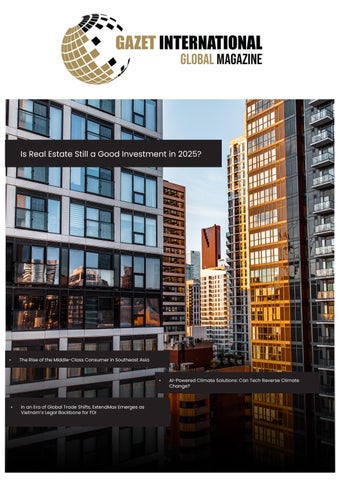
Is Real Estate Still a Good Investment in 2025?
•
The Rise of the Middle-Class Consumer in Southeast Asia
•
•
In an Era of Global Trade Shifts, ExtendMax Emerges as Vietnam’s Legal Backbone for FDI
AI-Powered Climate Solutions: Can Tech Reverse Climate Change?
Q1 2025 GAZET INTERNATIONAL BUSINESS MAGAZINE
Table of
Contents Editor’s Note New year, new quarter, and a new pace of change across every sector from business and banking to technology and lifestyle. For our first issue of 2025, we’ve curated a lineup of articles that reflects where we are today with a hint of where we’re headed. Our business articles dives into two powerful and parallel trends: the rise of the Southeast Asian middle-class consumer and the evolving potential of the metaverse across industries. All thanks to Shree for her contribution in providing us with a closer look at how institutions are aligning with renewable energy goals, and the age-old debate of wealth tax versus income. We also answered the perennial question: Is real estate still a reliable investment in today’s world? On the tech front, we look into the clash of AIs, where intelligent systems are both the threat and the solution in cybersecurity. But AI’s potential isn’t limited to defense; it is also a promising solution to climate change; and our article explores whether tech can actually be helpful in reversing environmental damage. If you are seeking inspiration beyond boardrooms and algorithms, our lifestyle section offers a breath of fresh air. Read about most remote and breathtaking destinations from Nepal to Mongolia. As for legal strategy, we have Vietnam’s ExtendMax, a rising force that offers crucial support to foreign direct investors exploring the shifting terrain of global trade. We hope this issue informs, inspires, and equips you for 2025. Here’s to a bold and thoughtful 2025. Warm regards,
Suraksha Subba Editor-in-Chief
2
TABLE OF CONTENTS
WWW.GAZETINTERNATIONAL.COM
Business: 1.
The Rise of the Middle-Class Consumer in Southeast Asia
2.
The Metaverse: Its potential in marketing, customer service, and collaboration.
Banking: 1.
Finance and Investing:
How Banks Support Renewable Energy (Shree)
1. 2.
Technology:
Wealth Tax vs. Income Tax: Which Model Works Best for Economic Growth? (Shree) Is Real Estate Still a Good Investment in 2025?
1. 2.
Lifestyle:
Legal Strategy:
1.
1.
The Most Remote Places to Visit in Asia (2025)
AI vs. AI: The Battle Between AI-Powered Cyberattacks and AI-Driven Security AI-Powered Climate Solutions: Can Tech Reverse Climate Change.
In an Era of Global Trade Shifts, ExtendMax Emerges as Vietnam’s Legal Backbone for FDI
TABLE OF CONTENTS
3
Q1 2025 GAZET INTERNATIONAL BUSINESS MAGAZINE
Is the Rise of the Middle-Class Consumer Making Southeast Asia a New Economic Powerhouse? If you’ve walked through the busy streets of Jakarta or SIngapore, you’re going to feel the energy. You’ll find shopping malls packed with families, cafés crowded with young professionals, and motorbikes zipping through neon-lit streets. Something big is happening in Southeast Asia, and I’m not talking about the traffic. The rise of the new middle class is spending like never before. From trendy sneakers to smartphones, fitness memberships to vacations abroad, you name it, they have it. And this spending capacity is driving a whole new economic shift. This isn’t just about numbers and statistics, it’s about people, their dreams, and the way they’re shaping the future of the region.
More Money, More Choices Across Southeast Asia, millions of fam4
BUSINESS
ilies are moving up the economic ladder. More people are moving to cities to earn higher salaries and gain access to better education. This equates to more spending power and a shift in lifestyle. Rather than just focusing on necessities, consumers now have the ability and the desire to indulge in experiences, technology, and quality products.
The Digital Revolution: Shopping at Their Fingertips Can you imagine the shopping experience a decade back? It meant enduring the heat and traffic just to visit a local market. Now? You can just scroll through the apps in your phone and get anything you want delivered right at your doorstep. E-commerce platforms like Shopee, Lazada, and Tokopedia have changed
everything. I mean, what’s not there for Southeast Asia’s middle class families to embrace? From home-cooked meals to high-end fashion, online shopping is a whole different experience. People no longer have to walk for hours looking for a perfect pair of shoes. These platforms have made things more convenient, providing them a variety of products along with the excitement of discovering new brands. By pairing these e-commerce platforms with fast internet and digital wallets like GrabPay, GCash, and MoMo, shopping has never been easier. The result? A thriving digital economy, where businesses big and small are competing for the attention of these new consumers.
From Local Brands to Luxury Dreams
WWW.GAZETINTERNATIONAL.COM
The growing middle class isn’t just about spending more, it’s about spending smarter. While people still love international brands like Apple, Nike, and Samsung, recently we have been seeing a growing pride in supporting local businesses. Take Jollibee in the Philippines, VinFast in Vietnam, or Kopi Kenangan in Indonesia, these homegrown brands are thriving because they understand the tastes and preferences of their own people. At the same time, a new generation of middle-class consumers is discovering luxury. A decade ago, designer bags and premium skincare were reserved for the ultra-rich. Now, thanks to higher disposable incomes and accessible financing, middle-class shoppers are splurging on a little bit of luxury, whether it’s a Coach handbag, a weekend staycation at a fivestar hotel, or a fine dining experience.
Experiences Over Possessions For the young generation of Southeast Asians, it’s not just about owning things,
it’s about creating memories. The middle class is contributing to the boom in travel, fitness, and wellness more than ever. Instead of spending on expensive clothes, many friend circles now pool their money for weekend getaways to Bali or Kyoto. They no longer want stuff, they want experiences. Fitness is another well-appreciated growing trend. Gyms, yoga studios, and cycling clubs are popping up everywhere, as more people prioritize health and wellness. From organic food to sustainable fashion, middle-class consumers are becoming more conscious about the effects of their spending on the planet. Of course, not everything is smooth sailing. The cost of living is rising in major cities, and many young professionals feel the pressure to keep up with the fastpaced lifestyle. Inflation, job stability, and wealth inequality are real concerns that could slow down this middle-class boom. Governments and businesses must in-
vest in infrastructure, education, and fair wages to ensure this growth is sustainable. But despite these challenges, the outlook remains incredibly bright.
A Future Powered by Consumers Southeast Asia’s middle-class boom isn’t just an economic trend, it’s a human story. It’s about families breaking out of poverty, young professionals chasing their dreams, and a region coming into its own on the global stage. The consumers driving this change are real people with real aspirations. They want better lives, more choices, and the ability to enjoy what the world has to offer. And as they rise, they’re not just changing their own lives, they’re shaping the future of Southeast Asia and beyond. So, the next time you see a packed café in Kuala Lumpur, a buzzing online sale in Manila, or a family shopping in a sleek new mall in Jakarta, remember, you’re witnessing a revolution, one purchase at a time.
BUSINESS
5
Q1 2025 GAZET INTERNATIONAL BUSINESS MAGAZINE
6
BUSINESS
WWW.GAZETINTERNATIONAL.COM
The Metaverse: Its Potential in Marketing, Customer Service, and Collaboration Can you Imagine walking into a clothing store without leaving your house, chatting with a customer service representative in a digital lounge, or attending a meeting in a virtual office that feels just as real as the one in your corporate building? This isn’t science fiction, it’s the metaverse. The metaverse is changing the way businesses interact with customers and employees. No longer just a playground for gamers, it has become a powerful tool for brands looking to market their products, improve customer service, and enhance remote work collaboration. So, what does this mean for the future of business? Let’s look into how companies are already using the metaverse to engage customers and transform the workplace.
Marketing in the Metaverse, Engaging Customers Like Never Before For years, marketing has been about grabbing attention. Through billboards, social media ads, and influencer collaborations. But in the metaverse, brands are no longer just selling products; they’re creating entire experiences. Take Gucci, for example. They launched a virtual Gucci Town in Roblox, where users could explore and buy digital versions of their luxury items. Nike did something similar, building Nikeland, an interactive world where people can try on digital sneakers and play games. Beyond selling digital goods, companies are finding new ways to engage audiences: •
Immersive brand experiences: Instead of a traditional ad, Wendy’s entered the gaming world of Fortnite and encouraged players to join a digital food fight—a clever way to promote their “fresh, never frozen” burgers.
•
NFTs as brand assets: Coca-Cola launched NFT collectibles, turning digital items into exclusive, sought-after assets. Some of these items even sold for millions, showing that digital ownership is becoming a serious business.
•
Gamified marketing: Brands are making shopping fun. Instead of clicking “add to cart,” customers can interact with products in a 3D space, explore virtual malls, and try before they buy—all without leaving their couch.
BUSINESS
7
Q1 2025 GAZET INTERNATIONAL BUSINESS MAGAZINE
Customer Service in the Some companies are already experi- building online hubs where customers can interact, share experiences, and even Metaverse: A More Human Touch menting with this: We’ve all been there; stuck in a frustrating customer service chat, waiting on hold, or trying to get help through a clunky chatbot. The metaverse offers a completely different experience.
Banks creating virtual branches: Imagine visiting a bank without ever leaving your home. Some financial institutions are exploring virtual customer service centers where users can meet with digital advisors for financial guidance.
Picture this: Instead of calling a support line, you put on a VR headset and enter a virtual store. A digital assistant (either an AI avatar or a real person) greets you, walks you through troubleshooting steps, or even shows you how to fix a product in real time.
Retailers offering live product demos: Instead of watching a YouTube tutorial, customers can enter a 3D space where a support agent demonstrates how to assemble or use a product in a hands-on way. Community-driven support: Brands are
8
BUSINESS
help each other—making support more engaging and social. This kind of customer service doesn’t just solve problems; it makes interactions feel more personal and connected, something traditional customer service often lacks.
Collaboration in the Metaverse: The Future of Remote Work If you’ve ever sat through a long Zoom call, you know how draining remote work can be. Video chats lack the personal touch of in-person meetings, and work-
WWW.GAZETINTERNATIONAL.COM
ing from home can sometimes feel isolating. The metaverse is changing that. Companies are creating virtual offices where employees can meet, brainstorm, and even bump into each other for spontaneous conversations, just like they would in a physical workspace. Some key ways businesses are using the metaverse for work: Virtual meeting spaces: Instead of staring at a screen, employees can put on a VR headset and join a fully immersive meeting room, making discussions feel more natural and engaging.
Hands-on training: Companies like Walmart and Accenture are using metaverse training programs to prepare employees for real-world scenarios; whether it’s handling customer interactions or learning new job skills in a simulated environment. Simulations and digital twins: Some industries, like manufacturing and retail, are creating digital twins: virtual replicas of real-world environments that allow teams to test ideas, optimize processes, and make data-driven decisions before implementing changes in the real world.
brace it are gaining a competitive edge, finding new ways to engage customers, enhance service, and improve remote work. Of course, challenges like accessibility, security, and the need for better technology remain, but the potential is undeniable. Businesses that experiment with the metaverse today will be the ones shaping the digital economy of tomorrow. So the question isn’t if the metaverse will transform business, it’s how fast you’re willing to adapt.
The metaverse isn’t a distant dream; it’s happening now. Companies that emBUSINESS
9
Q1 2025 GAZET INTERNATIONAL BUSINESS MAGAZINE
10
BANKING
WWW.GAZETINTERNATIONAL.COM
HOW BANKS SUPPORT RENEWABLE ENERGY
BANKING
11
Q1 2025 GAZET INTERNATIONAL BUSINESS MAGAZINE
Renewable energy is no longer just an option; it has become a global necessity. As climate change continues to impact economies and daily life, governments, businesses, and communities are shifting toward cleaner, more sustainable power sources like solar, wind, hydro, and geothermal energy. Banks play an important role in this transition by providing funding, managing risks, and developing innovative financial solutions that bring renewable projects to life. Before financing a project, banks conduct detailed market studies to assess its feasibility. They evaluate technological efficiency, government incentives, potential 12
BANKING
risks, and financial returns. This careful analysis ensures that investments contribute to both economic growth and environmental sustainability. Additionally, banks collaborate with policymakers and industry experts to align financial strategies with global sustainability goals, ensuring that funding supports long-term progress. Securing funds for renewable energy projects can be challenging, as they often require substantial capital. To address this, banks offer specialized financing options. Green loans, tailored for projects such as solar farms and wind power plants, provide favorable interest rates and extended repayment terms,
making clean energy development more easy. Similarly, sustainability-linked loans tie interest rates to a company’s environmental performance, rewarding businesses for maintaining eco-friendly practices. These financing structures not only support businesses in meeting their sustainability goals but also encourage the broader adoption of clean energy solutions. Another widely used financial tool is green bonds, which enable investors to fund clean energy initiatives and accelerate the transition away from fossil fuels. Public-private partnerships also play a crucial role by distributing financial
WWW.GAZETINTERNATIONAL.COM
risks among multiple stakeholders. Additionally, banks implement risk management strategies such as credit enhancements, hedging mechanisms, and power purchase agreements to protect against uncertainties like fluctuating energy prices and regulatory changes. By deploying these tools, banks help ensure the long-term viability of renewable energy investments, mitigating financial and operational risks. Beyond lending, some banks invest directly in renewable energy companies, promoting innovation in clean technology and developing the transition to sustainable power.
These direct investments help drive research and development in emerging technologies, such as advanced battery storage and next-generation solar panels. By incorporating environmental factors into their lending decisions, financial institutions encourage corporate sustainability and drive the expansion of the renewable energy sector.
cial products to support the clean energy transition.
Companies that demonstrate strong environmental, social, and governance (ESG) performance are often prioritized for financing, reinforcing the importance of sustainable business practices.
Their role extends beyond financing projects—they are actively shaping a resilient and sustainable global economy. By strategically investing in renewable energy, banks are helping build a future where sustainable power is the standard, benefiting both businesses and communities while safeguarding the planet for future generations.
In conclusion, as technology advances and government policies strengthen, banks will continue refining their finan-
Digital banking solutions and artificial intelligence-driven analytics are being integrated to boost investment strategies, streamline risk assessments, and enhance financial forecasting for renewable projects.
BANKING
13
Q1 2025 GAZET INTERNATIONAL BUSINESS MAGAZINE
14
FINANCE AND INVESTING
WWW.GAZETINTERNATIONAL.COM
Wealth Tax vs. Income Tax: Which Model Works Best for Economic Growth?
FINANCE AND INVESTING
15
Q1 2025 GAZET INTERNATIONAL BUSINESS MAGAZINE
T
axes serve as the backbone of a nation’s economy by providing the necessary funds for public spending. They help build infrastructure, support education and healthcare, and fund social programs that improve the quality of life for citizens. While taxes may sometimes seem like a burden, they play a vital role in maintaining a stable society and promoting growth. With these important roles in mind, it’s clear why governments and economists carefully consider how to design tax systems that are fair and effective. An income tax is a charge on the money earned by individuals and businesses. It 16
FINANCE AND INVESTING
is usually collected as a percentage of income, with higher earners paying more. This system is designed to support a fairer distribution of wealth, while also providing governments with a constant flow of revenue. In contrast, a wealth tax targets the net assets of individuals, including savings, property, and investments. Rather than focusing on annual earnings, it assesses the accumulated wealth, which is typically higher for a small segment of the population. The ease of collection plays a significant role in the effectiveness of any tax system. Income taxes benefit from established systems and reporting procedures.
Most countries already have mechanisms in place to monitor earnings and withhold taxes, making income taxes easy and straightforward to implement. Since most people receive a steady paycheck and businesses report their earnings regularly, collecting income tax is relatively easy and straightforward. This regular stream of revenue helps governments plan and execute budgets with more certainty. Wealth taxes, however, often require complex evaluation methods. Assets like private equity, or unique real estate can be difficult to assess accurately. This complexity can lead to disputes and even tax evasion if the methods used for valuation are not stable. Unlike income tax, which looks at what is earned
WWW.GAZETINTERNATIONAL.COM
in a specific time frame, wealth tax takes a quick overview of what a person owns at a particular moment. Moreover, enforcing a wealth tax on a global scale presents unique challenges. With globalization, many wealthy individuals have assets spread across multiple countries. This dispersion can create loopholes that allow them to minimize tax liability by shifting assets to more favorable jurisdictions. Therefore, while a wealth tax might look attractive on paper, its practical application can be tricky without strong international cooperation and clear guidelines. Economic growth is closely tied to how wealth and income are distributed among the population. A fair distribution can promote a healthy economy by ensuring that more people have access to education, healthcare, and
opportunities for advancement. Income taxes, when set at moderate levels, can provide the necessary funds to support these services without overly burdening individuals. However, when rates are too high, there are chances that they may suppress the drive to work harder and innovate.
size-fits-all solution. Many economists suggest that the answer lies in a balanced mix of both income and wealth taxes. A well-structured income tax can ensure a stable revenue stream, while a carefully designed wealth tax can address the growing gap between the rich and the poor.
Wealth taxes, in contrast, focus on the concentration of wealth among a few. Studies show that by reducing extreme concentrations, wealth taxes can help create a more balanced economy.
By combining the two, governments can aim for a system that supports public services, fosters economic growth, and minimizes inequality.
This approach can potentially lead to a society where a larger number of people have the chance to participate in the economy. Yet, if not designed carefully, wealth taxes can discourage savings and investments. Since these are vital for long-term growth, striking a balance is essential.
In conclusion, both wealth and income taxes offer benefits and challenges. The key to their success lies in careful design and thoughtful implementation. For countries aiming to boost economic growth while promoting fairness, the choice may not be about picking one model over the other, but rather about finding the right balance that suits their unique economic and social needs.
Ultimately, neither tax system is a one-
FINANCE AND INVESTING
17
Q1 2025 GAZET INTERNATIONAL BUSINESS MAGAZINE
18
FINANCE AND INVESTING
WWW.GAZETINTERNATIONAL.COM
Is Real Estate Still a Good Investment in 2025? Is Real Estate Still Worth It Amidst Changing Market Trends? Real estate has long been seen as a reliable way to build wealth. Whether through homeownership or rental properties, investing in real estate has helped millions of people grow their financial security over time. But as we move through 2025, the market is no longer what it once was. Rising interest rates, shifting housing trends, and economic uncertainty have left many people asking: Is real estate still a smart investment? We can’t answer this with a simple yes or no. Real estate still offers strong opportunities, but success now depends on understanding how the market has changed and adjusting your approach accordingly.
Where the Real Estate Market Stands in 2025 Over the past few years, we’ve seen dramatic shifts in the real estate world. During the pandemic, low mortgage rates and high demand pushed home prices through the roof. Then, in response to inflation, interest rates climbed, making borrowing more expensive and slowing down the market. So where do we stand in 2025? •
Mortgage rates are high, but steady. After years of increases, rates have leveled off. They aren’t as low as they were a few years ago, but they also aren’t climbing out of control.
•
Home prices are cooling in some areas. While some cities remain expensive, prices have stabilized or even dropped in others, creating better opportunities for buyers.
•
Rental demand is strong. With fewer people able to afford homeownership, the rental market continues to thrive.
•
Location matters more than ever. Some regions are still seeing home price increases, while others have slowed down significantly.
FINANCE AND INVESTING
19
Q1 2025 GAZET INTERNATIONAL BUSINESS MAGAZINE
Buying a Home in 2025: Still a Good Investment? If you’re thinking about buying a home, the big question is whether it will still be a good financial move in the long run. Historically, real estate has been a great way to build wealth. Even when the market fluctuates, home values tend to rise over time. Here are a few reasons why buying a home is still a smart investment: Homes appreciate over time. Even with ups and downs, real estate generally increases in value over the long haul. Owning builds equity. Instead of spending money on rent, homeowners build wealth by paying off their mortgage. It’s a hedge against inflation. As living costs rise, real estate tends to hold its value better than cash sitting in a bank. That said, affordability is a real concern in 2025. Mortgage rates are higher than they were a few years ago, meaning monthly payments are steeper. For buyers, it’s important to crunch the numbers carefully and make sure a home purchase fits within their budget.
Investing in Rental Property: Is It Still Profitable?
20
FINANCE AND INVESTING
For investors, the rental market still holds plenty of opportunity. More people are renting than ever, creating a steady demand for rental properties. However, being a landlord isn’t as easy as it used to be. Higher interest rates and rising property costs mean investors need to be strategic about where and how they buy.
What Makes Rental Property a Good Investment? Strong demand for rentals. Homeownership is out of reach for many, keeping rental demand high. Reliable cash flow. A well-managed rental property can provide a steady stream of income each month. Tax advantages. Investors can take advantage of deductions on mortgage interest, property depreciation, and maintenance costs.
Challenges to Watch Out For Higher borrowing costs. Loans for investment properties tend to have even higher interest rates than primary residences. More involved property management. Being a landlord requires time and effort—or the cost of hiring a property manager.
WWW.GAZETINTERNATIONAL.COM
Market risks. Some areas are seeing rental growth, while others are experiencing oversupply, making location research crucial. However, you need to remember that not all cities are equal when it comes to rental property investment. Investors should look for areas with strong job markets, growing populations, and reasonable home prices.
What If You Don’t Want to Buy Property? Not everyone wants to deal with buying and managing physical property, but there are still ways to invest in real estate without actually owning a home or rental. Real Estate Investment Trusts (REITs): These are companies that own and manage real estate properties. Investors can buy shares, similar to stocks, and earn passive income. Short-term rentals (Airbnb): Vacation rentals can be a profitable option in the right market, though some cities have strict regulations. Real estate crowdfunding: Platforms like Fundrise and CrowdStreet allow investors to pool their money into real estate projects without a huge upfront investment.
Final Thoughts: Is Real Estate a Smart Investment in 2025? Real estate is still a great way to build wealth, but it’s no longer as simple as buying a home and watching its value climb. The market has shifted, and investors need to adapt to new conditions to succeed. For homebuyers, the key is making sure the numbers work and that you’re buying a property you can afford long-term. For rental investors, it’s all about choosing the right locations and managing properties wisely. And for those who don’t want to own property directly, options like REITs and real estate crowdfunding offer an alternative path. So, is real estate still a good investment? Yes; but only for those who are willing to do their homework, think longterm, and adjust to today’s market realities.
FINANCE AND INVESTING
21
Q1 2025 GAZET INTERNATIONAL BUSINESS MAGAZINE
AI vs. AI: The Wa Powered Cybera Driven S
22
TECHNOLOGY
WWW.GAZETINTERNATIONAL.COM
ar Between AIattacks and AISecurity
TECHNOLOGY
23
Q1 2025 GAZET INTERNATIONAL BUSINESS MAGAZINE
And it’s disturbingly effective. Let’s break it down: Phishing, supercharged: AI can sift through social media posts, old emails, and company data to craft eerily convincing messages tailored to their targets. It’s no longer a Nigerian prince asking for help, it’s your CEO, using her real writing style, asking for a wire transfer. Deepfakes with a dark side: Voice cloning and fake video tech aren’t just party tricks anymore. Cybercriminals are using them to impersonate executives, trick employees, and bypass even biometric security systems. Shape-shifting malware: Today’s malicious software can sense when it’s being watched. Some variants lie dormant until they’re sure no security tools are observing them, then strike in seconds and vanish without a trace. Self-learning bots: Using reinforcement learning (think how robots learn to walk), attackers are deploying autonomous bots that can scout networks, identify weak spots, and exploit them, sometimes faster than any human could react. This isn’t guesswork. These tools are already in use. And the gap between what’s technically possible and what’s being weaponized is shrinking by the day.
The Defense Fights Back
Not long ago, cybersecurity felt like a cat-and-mouse game: a hacker pokes a hole in the system, and someone in IT scrambles to patch it up. Rinse, repeat. But that’s changing fast. These days, it’s not just humans behind the screen. Artificial intelligence has joined the fight on both sides. We’re witnessing the rise of a new kind of cyber battle. On one end, AI-powered attacks are probing our systems with unsettling precision. On the other, AI-driven defenses are evolving in real-time to keep up. It’s AI versus AI; a silent, relentless arms race that’s reshaping how we think about security in the digital age.
When Hackers Get Smart, Literally The romanticized image of the lone hacker in a dark room, clacking away at a keyboard, is quickly becoming obsolete. Today’s most dangerous attackers don’t just write code, they train it. Machine learning, the same tech that powers your Netflix recommendations, is now being used to engineer cyberattacks.
24
TECHNOLOGY
Of course, it’s not all doom and gloom. If attackers have AI, defenders do too, and they’re putting it to work in some pretty incredible ways. Modern cybersecurity systems aren’t just firewalls and antivirus software anymore. They’re smart, adaptive, and, in some cases, just as cunning as the threats they face. Here’s how the good guys are keeping up: Behavior over signatures: Instead of relying solely on known virus “signatures,” security systems now learn what “normal” looks like on your network. When something weird pops up, even if it’s brand new, the AI takes notice. Predicting the next move: Advanced AI models can sift through mountains of threat data from around the world, spotting patterns and predicting where an attack might hit next. It’s like weather forecasting for cyber threats. Instant reaction time: When a breach happens, AI-driven response tools can isolate affected systems, block bad traffic, and even roll back changes, often before the damage spreads. Never off duty: Unlike humans, these systems don’t sleep.
WWW.GAZETINTERNATIONAL.COM
They’re watching 24/7, adapting and learning from every single incident. In some ways, the defenders have an edge: they have access to huge amounts of data, better funding, and broader collaboration. But attackers are often more agile, more ruthless, and unconstrained by ethics or red tape.
The New Cyber Arms Race So who’s winning? That depends on the day. In this AI-fueled tug-of-war, neither side has a permanent upper hand. Every new defensive tool eventually inspires a new workaround. Every sophisticated attack forces defenders to innovate faster. It’s a dynamic, exhausting cycle. And the stakes are getting higher. We’re not just talking about data leaks or annoying ransomware anymore. We’re talking about the potential for AI to take down financial systems, manipulate public opinion with AI-generated disinformation, or even target critical infrastructure like power grids. The arms race isn’t theoretical, it’s happening right now.
Man + Machine: The Only Real Advantage Here’s the part a lot of people miss: AI alone isn’t the answer. Not for the attackers, and not for the defenders. The most successful cybersecurity strategies pair machine efficiency with human creativity. AI can flag anomalies and automate responses, but it still takes a skilled analyst to ask the right questions, interpret the context, and think like an attacker. In fact, some of the best cybersecurity professionals today are being trained to think more like hackers, not to attack systems, but to better anticipate how AI-powered threats might behave. In other words, the future of cybersecurity isn’t AI vs. humans. It’s AI with humans on both sides of the war. We’ve entered a new chapter in digital defense: one where algorithms battle it out in the background while the rest of us go about our daily lives, blissfully unaware of the constant war being waged in the wires. The question isn’t whether AI will define the future of cybersecurity. It already has. The real question is: can we stay one step ahead of the AI trying to outsmart us? Only time, and a whole lot of smart people and smarter machines will tell. TECHNOLOGY
25
Q1 2025 GAZET INTERNATIONAL BUSINESS MAGAZINE
26
TECHNOLOGY
WWW.GAZETINTERNATIONAL.COM
AI-Powered Climate Solutions: Can Tech Reverse Climate Change? A decade ago, if someone told you artificial intelligence would play a role in fighting climate change, how would you have pictured it? You might’ve imagined robots planting trees or machines scrubbing the air. It sounded futuristic, maybe even a little far-fetched. But here we are in 2025, and AI isn’t science fiction anymore. It’s here, it’s powerful, and it’s slowly being woven into one of the most urgent challenges of our time: fixing the damage we’ve done to the planet. So, can AI actually reverse climate change? To be honest, it’s complicated.
TECHNOLOGY
27
Q1 2025 GAZET INTERNATIONAL BUSINESS MAGAZINE
The Problem Is Massive But The Tools Are Getting making an impact in ways most people don’t even realize. Smarter. 1. Keeping the Lights Green
Here’s a fact: climate change isn’t a neat, solvable equation. It’s an ever-growing knot of interconnected issues: rising temperatures, deforestation, extreme weather, melting ice, shifting ecosystems, global supply chains, political tension, and that’s just scratching the surface. But AI has a knack for making sense of the messy. Instead of tackling one piece at a time, AI can scan massive amounts of information from different sources like satellite data, weather forecasts, ocean temperatures, factory emissions, and even how much electricity people are using at a given moment, and start to find patterns. Real patterns. Ones humans would probably miss. It’s like handing a giant jigsaw puzzle to something that can see the full picture before we even find the corner pieces.
Five Ways AI Is Already Getting Involved This isn’t a story about what AI might do someday. It’s already
28
TECHNOLOGY
Across the globe, power grids are becoming smarter. AI systems are now predicting when energy use will spike, balancing it with clean sources like wind and solar, and even deciding the best time to store energy or send it back into the grid. It’s not flashy, but it’s making renewable energy more reliable, which is huge. 2. Growing Food Without Draining the Earth Farms are getting a high-tech upgrade. By analyzing things like soil conditions, weather, and crop health, AI helps farmers use less water, fewer chemicals, and reduce waste. The result? More food, less environmental cost. 3. Catching Climate Clues Faster Climate models used to take ages to run, and they weren’t always very precise. Now, AI speeds up that process and makes the predictions sharper. That means we can prepare earlier for floods, droughts, and storms or even prevent the worst of them.
WWW.GAZETINTERNATIONAL.COM
4. Tracking the Carbon We Can’t See Carbon emissions are tricky. We can’t see them, and they come from everywhere. AI can now help monitor emissions from factories, planes, and even cities, giving governments and companies a clearer picture of their real carbon footprint and how to shrink it. 5. Watching Over the Forests AI is also being used to keep an eye on the world’s forests. By analyzing satellite images, it can detect illegal logging, wildfires, and deforestation almost in real-time. That kind of speed is key when you’re trying to protect the lungs of the Earth. But It’s Not a Silver Bullet As incredible as all this sounds, it’s important to ground the conversation. AI isn’t going to swoop in and save the world on its own. It doesn’t make decisions. It doesn’t lobby for policy change. It doesn’t plant trees, or switch power plants from coal to solar. People still have to do those things.
And then there’s the tricky part: AI itself uses energy. Training big AI models takes a lot of computing power, and that power has to come from somewhere. If we’re not careful, we could end up solving one problem while adding to another. There’s also the matter of accessibility. Many of the most advanced AI tools are being built in wealthy countries, by people who aren’t always connected to the communities most affected by climate change. The tech has to reach the right hands and be made usable and useful there for it to make a real difference globally. What AI Can Do Here’s the honest truth: AI isn’t going to reverse climate change with the press of a button. But it can help us move faster. It can make our solutions smarter. It can shine a light on problems we didn’t even know existed. And most importantly, it can give us more time. Time to adapt. Time to transition. Time to fix what we still have the power to fix. It’s not a replacement for hard work or difficult decisions. It’s a tool. And if we use it right; wisely, fairly, and urgently, it might just be one of the best tools we’ve got.
TECHNOLOGY
29
Q1 2025 GAZET INTERNATIONAL BUSINESS MAGAZINE
Don’t you think that travel these days feels a bit too curated? It’s like you land in Bali, and suddenly everyone’s pointing their phones at the same view, sipping the same iced latte, and chasing the same sunset. Sure it’s beautiful, but something’s missing. If you’re an adventurer who’s craving the kind of journey that doesn’t come with hashtags or itineraries, these places are waiting for you. The kind where there is no network, your shoes are covered in dust, but your soul certainly feels lighter. So here it is: a shortlist of places in Asia that still feel undiscovered. Here the time slows, silence speaks, and the world feels wonderfully far away.
30
LIFESTYLE
WWW.GAZETINTERNATIONAL.COM
LIFESTYLE
31
Q1 2025 GAZET INTERNATIONAL BUSINESS MAGAZINE
1. Zanskar Valley, India Imagine driving for hours through jagged Himalayan landscapes, only to end up in a valley so vast and still, it feels like you’ve stepped into a painting. That’s Zanskar. The roads here are rough and it’s only accessible during the warmer months before winter snow seals it off completely. The people here, monks, farmers, and shepherds, live with simplicity that’s humbling yet elegant. They’ll offer you tea before they ask your name. The silence in the monasteries is almost sacred. Don’t go to Zanskar to “see the sights.” Go there to feel small, in the best possible way.
32
LIFESTYLE
WWW.GAZETINTERNATIONAL.COM
2. Tsum Valley, Nepal Even many seasoned trekkers haven’t heard of this one. Hidden in the shadow of the Ganesh Himal, Tsum Valley feels like Nepal before the world found it. Getting there isn’t easy (of course), you’ll have to walk for days through forests and stone villages, gradually finding yourself rising into the clouds. But when you finally reach, you’ll be greeted by a world that still moves to the rhythm of prayer flags fluttering in the mountain wind. The locals speak an ancient dialect and follow centuries-old Tibetan Buddhist traditions. It’s quiet and serene here. Not the “nobody’s talking” kind of quiet, but the deep, bone-level kind that teaches you what peace should actually feel like.
LIFESTYLE
33
Q1 2025 GAZET INTERNATIONAL BUSINESS MAGAZINE
3. Wakhan Corridor, Afghanistan Yes, Afghanistan. I know what you’re thinking. But the Wakhan Corridor is a place apart, both geographically and culturally. Wedged between Tajikistan and Pakistan, this high-altitude part of land is home to the Wakhi and Kyrgyz people, who live in yurts and move with the seasons. You may find people here who’ve never seen a phone. You show them your phone and they will show you how to make bread over a yak-dung fire while their kids play with stones like toys. No politics, no tension, just people living at the edge of the world with a kind of grace that’s hard to believe unless you see it.
34
LIFESTYLE
WWW.GAZETINTERNATIONAL.COM
4. Tavan Bogd, Mongolia There’s remote, and then there’s Mongolia remote. Out in the Tavan Bogd region, near the far western border, the mountains are vast and lonely, and the air smells like snow and horse sweat. You’ll sleep in gers (yurts), eat goat meat cooked over fire, and ride horses that know the land better than you ever will. What sticks with you most isn’t the scenery, although that’s plenty dramatic; it’s the people. The Kazakh eagle hunters. The calm pride of the nomads. And the feeling that, for once, you are an outsider walking gently through a world that doesn’t need you, but welcomes you anyway.
LIFESTYLE
35
Q1 2025 GAZET INTERNATIONAL BUSINESS MAGAZINE
5. Kachin Hills, Myanmar Warning: This one’s not for everyone. Northern Myanmar is wild, unpredictable, and sometimes closed off due to conflict. But in the pockets that are open, you’ll find dense jungles, cold misty mornings, and communities that barely see outsiders. There are no tour groups here. No signs in English. Just mountains, rivers, and a deep sense of being somewhere that hasn’t been flattened by urbanization. In places like this, a smile is enough to convey a thousand words.
36
LIFESTYLE
WWW.GAZETINTERNATIONAL.COM
6. Batanes, Philippines The Batanes Islands must be the Philippines’ best-kept secret. Imagine rolling green hills, stone houses built to withstand typhoons, and cliffs that drop straight into wild, crashing waves. Locals ride bikes instead of cars. Nobody locks their doors. It’s so peaceful that you’ll find it surreal. Try spending an entire afternoon here doing nothing but watching clouds drift and cows graze, wrapped in a blanket of silence. That kind of stillness? You can’t book it online. You just have to show up and let it swallow you.
LIFESTYLE
37
Q1 2025 GAZET INTERNATIONAL BUSINESS MAGAZINE
7. Far Eastern Siberia (Chukotka), Russia Although it is a part of Asia, this region feels like the edge of the Earth. Think tundra, reindeer herders, and icy coastlines where whales breach offshore. You need permits to enter along with a translator. And don’t forget to add patience in your list. If you make it, Chukotka is like a living time capsule where Indigenous cultures still thrive. Here the cold isn’t just temperature, it’s texture. It might bite your cheeks but it’ll make you feel very, very alive.
38
LIFESTYLE
WWW.GAZETINTERNATIONAL.COM
So, Why Go Remote in 2025? Because maybe, just maybe, we’re all a bit tired of the noise. The endless scroll, the curated feeds, the never ending sound of keyboards clicking, and not to mention, the performative “wanderlust.” When you are remote travelling, you’re not disconnecting from the world, you’re reconnecting with it. You are reconnecting with yourself, with silence, and with landscapes so vast that’ll make your problems feel like grains of sand. Tip: Pack light but go with an open heart. And don’t be afraid to get a little lost because maybe we need to get lost sometimes in order to find ourselves. LIFESTYLE
39
Q1 2025 GAZET INTERNATIONAL BUSINESS MAGAZINE
In an Era of Global Trade Shifts, ExtendMax Emerges as Vietnam’s Legal Backbone for FDI
Hanoi, April 2025 – As tensions escalate in global trade due to the United States’ 104% retaliatory tariffs on Chinese imports, multinational corporations are once again turning to Vietnam as a strategic manufacturing and workforce availability remain key considerations, what truly determines success for foreign direct investment (FDI) in emerging markets is something less visible but far more critical: legal readiness. In this shifting global landscape, ExtendMax Vietnam has emerged not merely as a legal service provider, but as a strategic compliance enabler – helping some of the world’s largest technology companies navigate Vietnam’s complex regulatory environment with precision and speed. When Compliance Becomes the Competitive Advantage Founded in 2015, ExtendMax has built its reputation by doing what few dared to specialize in – offering compliance consulting and import-export regulatory support for ICT products in a country where legal frameworks around civil cryptography, telecommunications, and cybersecurity are highly specialized.
ExtendMax’s client list reads like a roll call of global tech leaders: Amazon, Cisco, Lenovo, LEGO, Heineken, Hewlett Packard Enterprise, and more. For these companies, success in Vietnam hinged on one thing – being able to import critical IT infrastructure and equipment without delay, without legal error, and without compromising project timelines. The firm’s core services include: ∙ Product conformity certification under Vietnam’s QCVN technical regulations
40
CORPORATE
∙ Licensing for civil cryptography devices, one of the most legally sensitive domains in the region ∙ Importer of Record (IOR) and Exporter of Record (EOR) services, enabling companies to operate legally in Vietnam without a local entity ∙ End-to-end advisory on import procedures for IT equipment used in data centers, smart manufacturing, and infrastructure deployments Recognition on the Global Stage: Stevie Awards & Gazet International Awards In 2025, ExtendMax was awarded both a Gold and Silver Stevie Award at the Asia-Pacific Stevie Awards – the Gold for Innovative Achievement in Thought Leadership and the Silver for Most Innovative Entrepreneur of the Year, honoring its Founder & CEO, Mr. Tran Thanh Phuong. The firm was also shortlisted as Vietnam’s only nominee for the prestigious People’s Choice Stevie Awards for Favorite Companies, joining the ranks of global corporations such as IBM, HP, and Cisco. These accolades build on ExtendMax’s earlier recognition by Gazet International Magazine, which honored the company with the Gazet International Awards for two consecutive years: “Best IOR & EOR Services of the Year – Vietnam 2024” and “Best Importer of Record Service Provider in Vietnam 2025”. These distinguished honors underscore ExtendMax’s exceptional contributions to legal innovation in cross-border trade and regulatory compliance, further cementing its reputation as one of Asia’s leading professional service firms enabling global market access.
WWW.GAZETINTERNATIONAL.COM
Building the Legal Infrastructure Behind Vietnam’s Rise While governments negotiate trade agreements and corporations plan billion-dollar investments, companies like ExtendMax quietly perform the work that ensures those strategies translate into real-world operations. “Legal frameworks are the real infrastructure behind every successful supply chain,” says CEO Tran Thanh Phuong. “ExtendMax was founded on the belief that compliance is not just a requirement – it’s a strategic advantage. Our goal is to help global enterprises go faster, not just go safer.” Under his leadership, ExtendMax has: ∙ Executed high-value IOR/EOR projects worth tens of millions of USD ∙ Digitized its internal workflows via cloud-based compliance management systems ∙ Mentored and developed a new generation of Vietnamese legal consultants ∙ Reduced licensing times for clients by up to 40% compared to standard processes A Strategic Partner for the Future of FDI in Vietnam As global supply chains continue to recalibrate in response to geopolitical uncertainty, ExtendMax stands ready as a trusted partner to help businesses enter and expand in Vietnam – legally, efficiently, and with full confidence. For companies navigating trade tensions, shifting compliance rules, or simply seeking faster go-to-market timelines, ExtendMax offers a rare blend of legal depth and operational execution. “We don’t just handle paperwork,” says Phuong. “We unlock markets.”
CORPORATE
41
Q1 2025 GAZET INTERNATIONAL BUSINESS MAGAZINE
Mr. Tran Thanh Phuong – ExtendMax Founder & CEO About ExtendMax Vietnam
Email: consultant@extendmax.vn
Founded in 2015, ExtendMax is Vietnam’s leading provider of consulting services in product conformity certification, civil cryptography licensing, and IOR/EOR services. With a proven track record supporting global clients across Asia, North America, and Europe, ExtendMax is a compliance partner for the world’s most forward-thinking companies.
Tel: +84 24 6666 3088 | Hotline: +84 915 836 555
Contact info: Full name: EXTENDMAX VIETNAM COMPANY LIMITED Website: https://extendmax.vn
42
CORPORATE
Registration address: P903, 9th floor, Tower A, Sky City Tower Complex, 88 Lang Ha street, Lang Ha ward, Dong Da district, Hanoi city, Vietnam Head Office: ExtendMax Villa, C01-L18 An Vuong, Duong Noi urban area, Duong Noi ward, Ha Dong district, Hanoi City, Vietnam
WWW.GAZETINTERNATIONAL.COM
Reliability Excellence Forum 2025 - https://www.smart-reliability. com/
CORPORATE
43
Q1 2025 GAZET INTERNATIONAL BUSINESS MAGAZINE
AI-Waqf Summit 2025 - https://ai-waqf.com/
44
GAZET INTERNATIONAL GLOBAL MAGAZINE 2025 – Q1
WWW.GAZETINTERNATIONAL.COM
HAF Amsterdam - https://kinfos.events/haf/
GAZET INTERNATIONAL GLOBAL MAGAZINE 2025 – Q1
45
Q1 2025 GAZET INTERNATIONAL BUSINESS MAGAZINE
2025 RegTech Africa Conference and Awards - https:// www.regtechafricaconference.com/
46
GAZET INTERNATIONAL GLOBAL MAGAZINE 2025 – Q1
WWW.GAZETINTERNATIONAL.COM
2025 RegTech Africa Conference and Awards - https:// www.regtechafricaconference.com/
GAZET INTERNATIONAL GLOBAL MAGAZINE 2025 – Q1
47
Q1 2025 GAZET INTERNATIONAL BUSINESS MAGAZINE
48
GAZET INTERNATIONAL GLOBAL MAGAZINE 2025 – Q1