Boston's multifamily construction pipeline recedes to a five-year low Apartment construction continues to thin despite recent uptick in starts
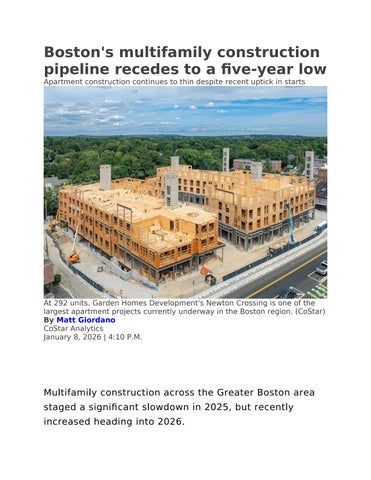
At 292 units, Garden Homes Development's Newton Crossing is one of the largest apartment projects currently underway in the Boston region. (CoStar) By Matt Giordano CoStar Analytics January 8, 2026 | 4:10 P.M.
Multifamily construction across the Greater Boston area staged a significant slowdown in 2025, but recently increased heading into 2026.
Minimal groundbreakings, in tandem with prolonged permitting and economic headwinds, have limited the number of units underway through most of the year. However, construction starts on new apartment projects did increase in the fourth quarter, up 54% quarter-overquarter, to reach the highest level of new units underway for all of 2025.
That appears to be an aberration with even fewer units expected to enter the market in 2026. The construction pullback for much of the year was welcomed by apartment owners and operators as it is expected to help ease vacancy rates slightly by mid-year, which could help support the return of rent growth. As of the end of the fourth quarter of 2025, just over 13,800 units were under construction across the Boston region, a 20.3% decrease year-over-year and well below the five-year quarterly average of 15,400 underconstruction units for the market. Normalizing the number of units under construction as a share of existing inventory provides a measure of how current development activity may influence the overall market. As of the end of the fourth quarter, this metric stood at 4.6%, the lowest level recorded in 12 years.
Apartment construction across Boston peaked in early 2020, when the number of units underway as a percentage of inventory reached 7.5%. The steep decline in activity has thinned Boston's pipeline, and the limited groundbreakings has allowed the market's stock of apartments to refill.
Various factors may account for Boston's downturn in apartment construction. Developers continue to face challenges from elevated construction costs and limited financing availability, largely influenced by inflation, tariffs on building materials and ongoing construction labor shortages. The slowdown in construction reflects supply-side challenges rather than weak demand, as the region continues to face a significant need for additional housing. Three apartment submarkets lead the way in construction activity, each with more than 1,000 units underway. Somerville/Chelsea currently has more than 2,700 units underway, representing 37.3% of its existing inventory. The urban submarket remains appealing to renters due to its close proximity to Boston, consistent rent growth and net absorption, or the net change in occupancy, of 305 units over the past year.
Similarly, East Boston/Chelsea, another close-in urban submarket, has shown a strong performance, with 14.5% of its inventory under construction and one of the highest annual absorption in the Boston region of 456 units. In the suburbs, Chelmsford/Tyngsborough/Townsend remains an actively built area with 23.1% of inventory underway. The suburban submarket has emerged as an affordable housing option in the market, with 23.1% of inventory underway. Average apartment rents in this area are priced at a 10.7% discount compared to the rest of the market. Apartment vacancy rates across Boston are expected to stabilize around mid-2026, likely ranging between 7% and 7.5%. As vacancy peaks, rent growth may turn negative over the next few quarters before expected to begin recovering toward the end of 2026.