Volume 62, Issue 2
Everything Greenhill
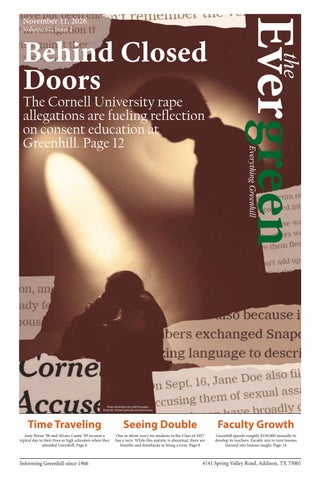
The Cornell University rape allegations are fueling reflection on consent education at Greenhill. Page 12
the
Evergreen
November 11, 2026
Photo illustration by Lylah Pouratian; Photo by Vishaal Gaitonde and Gabe Torres
Time Traveling
Seeing Double
Faculty Growth
Amy Bresie ’96 and Alvaro Cantu ’99 recount a typical day in their lives as high schoolers when they attended Greenhill. Page 6
One in about every six students in the Class of 2027 has a twin. While this statistic is abnormal, there are benefits and drawbacks to being a twin. Page 8
Greenhill spends roughly $250,000 annually to develop its teachers. Faculty aim to turn lessons learned into lessons taught. Page 14
Informing Greenhill since 1966
4141 Spring Valley Road, Addison, TX 75001
02
News
Students Explore Scientific Research Aanya Bhoria, Ela Battikhi
M
ost members of the Class of 2027 spent their summer relaxing by a pool or hanging out with friends. For four seniors, though, the time off was characterized by long commutes, extensive hours in the lab and scientific discovery as part of the UT Southwestern’s prestigious STARS program. The selective eight-week paid STARS research program – formally the Science Teacher Access to Resources at Southwestern program – allows students to conduct realworld research in labs. With Greenhill’s long-term STARS partnership, students can be exposed to an authentic research experience they might not receive in a traditional classroom, according to Upper School science teacher Treavor Kendall. “Research in the wild and in real life, if you will, is a little bit more open-ended, a little more messy,” Kendall said. “And so, it really gives students exposure to that, so they can understand if it’s something [they would] like to continue to do.” Senior Charlotte Faems first heard of STARS her freshman year through a presentation done by a former program participant during an Upper School assembly. “I remember everyone in my advisory was like, ‘This is so annoying and boring,’ and I didn’t want to say anything, but I was actually interested, even though I didn’t know what was going on,” Faems said. The application process for this past summer’s STARS researchers began in the fall of their junior year. Applicants submitted a resume and a one-page written work, along with a recommended two-minute video essay.
the fields of study they listed when applying. Faems advises potential applicants to reflect on their interests before committing to STARS. “I think you definitely should do it, but you have to be dedicated, and you have to be interested,” Faems said. “It’s not a passive program.”
Ronni Phillips Senior Ronni Phillips was selected for the program and began most of her days at 6 a.m., driving 50 minutes from her house to the UT Southwestern Medical Center in downtown Dallas. Each morning, she set a goal: conduct two five-hour long experiments before leaving the center at 6 p.m. Phillips worked in a chemistry lab and focused on developing a test to identify whether new drugs could cause dangerous interactions with other medications. To do so, she studied seven liver enzymes called cytochrome P450. She conducted tests using a laboratory procedure called an assay and programmed a mass spectrometer, an instrument that can measure specific chemicals in a sample. “It was a lot of work,” Phillips said. “I had a Close Friends Instagram story, and I knew that my hours were not normal because there were people being like, ‘Ronni, you’re doing so much work.’” Her most significant research finding came unintentionally. When testing her method on a drug that had advanced in testing, her results suggested that the drug could interfere with the enzymes, potentially affecting how the body processes other medications. After repeating the experiment twice, Phillips brought her findings to her principal investigator. Her work eventually ended up impacting an ongoing investigation and resulted in parts of her work being censored. “That became a big part of my project,” Phillips said. “Eventually, I was not allowed to include the name of the drug because of that.”
Niseem Bhattacharya
Senior Ibrahim Abdelfattah found the video essay beneficial to his application. “I think that was somewhere where I shined because I made a video kind of just explaining a day in my life and walking through what a typical day looks like,” Abdelfattah said. After students complete their STARS applications, the Greenhill science faculty determines which applicants will progress to UT Southwestern’s interview process. Of the 20 to 40 Greenhill students who typically apply to the program, around five to eight are recommended by faculty to continue in the process. From the interviews, STARS accepts around two to three Greenhill students on average into the program each year. “It’s a little scary when you first get into [the interview], and they aren’t just asking you ‘what’s your name’ or ‘what school do you go to,’ kind of questions,” Abdelfattah said. “They’re asking very thoughtful, open questions. What they’re looking for is ‘can you think on your feet?’” Students generally know whether they’ve been selected for the STARS program by early April. They are then matched with a UT Southwestern lab and mentor based on
Senior Niseem Bhattacharya had a unique application process. Bhattacharya participated in the Dallas Regional Science Fair in February 2026, where his project caught the attention of a judge, who happened to be a former STARS team member. The judge put him directly on a list for the final interview process at STARS and Bhattacharya received his acceptance shortly afterward.
“Research in the wild and in real life, if you will, is a little bit more open-ended, a little more messy.”
Unlike many peers from Greenhill, Bhattacharya worked primarily on a computer in a computational biology lab. Here, he used an AI tool called AlphaFold to design protein binders that would attach to spinal projection neurons with the goal of pain relief. Bhattacharya started off with more experience in coding than biology. Because of this, he appreciated the way he collaborated with his primary investigator. “I was meeting with him basically every day,” Bhattacharya said. “He was super involved, and he was really nice because he knows that I’m not very strong in the biology side of things, so he was very lenient. But he
Photo courtesy of Charlotte Faems
STARS: From left, seniors Ronni Phillips, Niseem Bhattacharya, Ibrahim Abdelfattah and Charlotte Faems present their summer research findings at UT Southwestern. expected me to do good with the coding aspect of it.” Bhattacharya found that the most difficult part of his research was ensuring that the protein binders would actually function biologically. For several weeks, his designs failed computational tests, forcing him to repeatedly adjust his parameters and start again. “The most rewarding part of the process was that with like two weeks left, I finally got accepted binders,” Bhattacharya said.
Charlotte Faems Faems conducted research in a cardiology lab, studying atrial fibrillation by examining how genes regulate atrial homeostasis. She worked alongside another STARS researcher in the same lab. “We kind of worked on a very similar project,” Faems said. Later, Faems and the other studentresearcher organized experiments “to create virus to inject the mice,” she said. Throughout the program, Faems worked directly with mice to study their heart activity. Each morning, she and her lab partner checked on the mice, monitored newborn pups and weighed them before bringing selected mice into the laboratory for electrocardiograms. “We did a lot of EKGs, so we would anesthetize the mice and then hook them up to leads,” Faems said. These EKGs allowed the researchers to record electrical activity in the mice’s heart. Faems then worked with plasmid DNA, cutting and inserting DNA sequences, and using a polymerase chain reaction as a part of the lab’s experiment. Beyond the lab, this experience reinforced Faems’ interest in pursuing veterinary medicine. “Within the past few years, I realized that I want to be a vet, and I think this kind of reinforced it,” Faems said.
Ibrahim Abdelfattah Abdelfattah worked in a pharmacology lab specializing in toxoplasma. His research involved studying proteins and attempting to produce them by inserting a gene into a DNA vector through a process called Gibson assembly. Abdelfattah’s work consisted of preparing DNA samples and sending them for sequencing to check whether the DNA
was formed correctly. He also met with his lab mentor to review his progress and determine whether to move forward or repeat an experiment. The specialized nature of his research required him to work independently and consult published papers to better understand his experiments, according to Abdelfattah.
The most rewarding part of the process was that with like two weeks left, I finally got accepted binders.”
“If something goes wrong, you actually have to read,” Abdelfattah said. “Because I was researching something that I think I’m one of three people in the world to know about, I can’t just look it up on ChatGPT or Safari.” The program also strengthened his interest in pursuing biology and continuing protein research in college. “It solidified the fact that I want to major in biology, but more than that, it solidified the fact that I want to do undergraduate research,” Abdelfattah said.
Beyond the Lab While each of the four seniors pursued different research topics, the STARS program offered an opportunity to gain experience beyond a traditional classroom setting and develop understanding of scientific research. Kendall says the program allows students to develop greater independence, strengthen their ability to ask questions and determine whether they want to continue pursuing research. Students tend to become increasingly enthusiastic as they immerse themselves in research, according to Kendall. “They were kind of excited before, and then when I saw them in the program and saw them at the seminars, it seemed like that enthusiasm was heightened,” Kendall said. Beyond developing scientific skills, this experience challenged students to navigate unfamiliar concepts and become comfortable with the uncertainty that comes with research. “I think the main goal of the program is not to expose you to research,” Faems said. “It’s to expose you to things that you don’t understand, and to kind of be okay with that.” Graphic by Lydia Kerridge
November 11, 2026
Evergreen Ever the
News
03
YouthStemline Shapes the Future Anvitha Sagi
J
unior Ronak Ramnani joined YouthStemline in 2024 when one of the co-founders asked him to build its website. A student-led organization, YouthStemline publishes articles by teenage writers and hosts workshops for children to share accurate information about STEM-related topics. Misinformation hurts future generations and their knowledge of science in the world, the group’s mission statement declares. Ramnani says he never imagined how the invitation from Hockaday School junior Aravli Paliwal to build YouthStemline’s website would turn into so much more. “When I remember last summer when I started this, I didn’t expect it to take over my life,” Ramnani said.
Publication Just before Ramnani joined the organization, Paliwal created the concept for YouthStemline in May 2024. Drawing on her experience with a student-led political science-based publication, Paliwal saw a need for students interested in STEM to have an outlet. The organization publishes articles about STEM topics for teenage readers. Ramnani says passionate writers drive the publication’s mission to make STEM interesting for readers. Unlike many digital publications, YouthStemline does not set deadlines for its staff writers called “Stem Scribes.” Paliwal says the organization allows writers to explore new topics, thereby inspiring self-motivation and increasing the quality of articles. “We want to provide a space for these teenagers to be able to express their love for writing and STEM without a pressured environment,” Ramnani said. “I think a lot of times Ronak Ramnani where kids are expected to write, especially when it comes to STEM, it’s in a very high-pressure environment in school or in competitions.” The YouthStemline publication process involves an informal pitch before publication. The writer drafts the piece and submits it to a section editor and one of the four executive team members for final review. The website published 26 articles in 2025 that reached readers across 41 countries, according to a YouthStemline Instagram post. In the quest to reach a larger audience, the publication encountered stereotypes about its quality of work because of the age of the writers, Paliwal said. “I think that it’s such a harmful belief to think that because it was written by somebody that’s 15, they don’t know
what they’re talking about,” Paliwal said. “It’s often people that are 15 that are interested in the most niche topics and have the most to say about them.”
Workshop YouthStemline’s workshop, TomorrowMakers, introduces children ages 4 to 12 to STEM in an interactive environment. The goal is to spark interest without the assignment-based learning that students receive in school. These workshops are hosted across the Dallas-Fort Worth area, including the Preston Royal Branch Library and the Dallas Police Association. Each workshop includes an introduction to the topic, an interactive activity and exposure to a YouthStemline article with help from the workshop leaders. “By having group discussions, by having the older kids just say out loud what they think a topic is to teach the younger kids, it’s like a self-fulfilling prophecy,” Paliwal said. Because artificial intelligence is expanding quickly, TomorrowMakers focuses on teaching students how AI functions. “AI is moving extremely fast,” Ramnani said. “We want to introduce AI topics to kids correctly, especially in a world where it’s going to be consumed by it.”
Future Plans Ramnani’s primary role focuses on outreach alongside running the website and social media accounts. He created a user-friendly website where individuals can read articles, sign up for TomorrowMakers workshops and receive reminder emails. Ramnani also created a mobile app to make the publication more accessible. The app features notifications to announce new articles, an article history that allows readers to resume where they left off, a read-aloud feature and annotation tools. “It was more of a cool project for him to take on because he’s interested in this stuff rather than it offers so much benefit, it’s doing X, Y and Z,” Paliwal said. “I think it’s good to have fun with this stuff and if you’re driving everything towards an impact, you lose sight of what’s actually cool.” Looking to the future, the organization aims to expand its TomorrowMakers workshops, even after the co-founders go to college, according to Ramnani. Another goal is to spread the group’s influence overseas, so more students have access to interactive STEM environments, Ramnani said. Group leaders are “very ready for more,” said Greenhill junior Desi Garza, who oversees YouthStemline’s social media accounts. “They’re very adaptable, and just whatever helps build their community so that they can help DFW, they’re open to that.”
Debate Tournaments Upper School novice, intermediate and varsity debaters competed in the Coppell Classic Debate Tournament on Oct. 16-17. Advanced debaters competed at the St. Mark’s School of Texas for the Heart of Texas Invitational, a national circuit tournament. At Coppell, novice debaters in the Policy and Lincoln-Douglas formats secured top-three rankings and varsity debaters placed first in both styles. Varsity debaters reached the semifinals at the St. Mark’s event.
Donut Day Students, dads and special friends socialized over donuts and coffee for the annual Donut Day on Oct. 23 from 7:15 a.m. to 8:30 a.m. in the dining hall. Attendees also received a complimentary mug designed by third grader Ellie Charanya, the Greenhill Gala winner. Cannisters to support Austin Street Shelter were also collected.
Hispanic Heritage Month Breakfast The Latinx Student Union on Oct. 8 organized a breakfast in the West Dining Hall, where students and families celebrated Hispanic Heritage Month. Breakfast tacos and pastries were served alongside activities such as coloring.
US Musical Performance Upper School theater students will perform the musical “Les Misérables” on Nov. 19-20. The popular French opera based on Victor Hugo’s 19th-century novel tells the story of ex-convict Jean Valijean, played by junior Arhaan Iyer.
Ninth Grade Service Trip The freshman class partnered with the Children’s Hunger Fund organization on Oct. 9 to combat food insecurity. Students spent half the day at the organization’s facility folding and filling food packages with various snacks. In all, 3,504 food pack boxes were folded and 1,572 were filled, creating 37,728 meals for children in need.
Fall SPC Championships As Greenhill transitions into the winter sports season, the Fall Southwest Preparatory Conference Championships were held Nov. 5-7. Cross country, volleyball and field hockey concluded their seasons against conference schools.
Friday on the Hill Greenhill hosted an Oct. 9 edition of Friday on the Hill, a family-friendly campus event primarily for Lower School students. There were games, rides, bounce houses, and other carnival-themed activities. The festivity culminated with a football game, with Greenhill falling to the Home School Athletics Association team 52-38. Photo courtesy of Ronak Ramnani
STEM IN ACTION: YouthStemline leaders engage young learners in hands-on activities, introducing scientific concepts through interactive workshops that encourage problem-solving for the next generation of innovators.
By Alia Gaitonde, Esther Hall
04 News
Ever Evergreen Greenhill Event Tackles Gender Roles
Evan Huang
R
epresentatives of independent schools in the Dallas-Fort Worth metroplex on Oct. 28 met at a Dallas Area Belonging Organization event on the Greenhill campus. The focus of the meeting of DABO, as the group is commonly known, was to discuss gender roles and education. The event included a presentation by Greenhill’s Student Inclusion Council and small group discussions on the topic. “Students explored how societal pressures influence their lives and what it means to show up as their authentic selves,” Greenhill Director of Equity and Inclusion Tai Oney said in an email interview. Senior Carys Diamond, a member of
the
the Upper School Student Inclusion Council, helped select the topic for this year’s event. She says gender roles was the topic chosen because it is a universal experience everyone could relate to. “Gender norms are something that literally anybody from any background can point to a time and say that they’ve experienced some sort of gender norm that they didn’t personally align with, and how that affected them,” Diamond said. Oney agreed about the universal nature of the topic. “I think this is particularly relevant for high school students, who are constantly navigating expectations from the world around them,” Oney said in an email. At the event, students’ discussion of how gender roles play out in school
Photo by Lillian Smith
CAPTIVATING CONVERSATIONS: Greenhill students lead activities in small groups to discuss gender roles and stereotypes with peers from other nearby schools.
HSA Launches
Nithya Rao
A
t the end of the 2025-2026 school year, a group of students banded together to launch the Hindu Student Association as a response to the Upper School’s large Hindu population. Now, the affinity group is in full swing, after a first meeting on Sept 25. The affinity group is currently led by sophomore Aashi Punnam, junior Samaira Panjiar, senior Rahul Singhal and senior Aanya Bhoria. Together, they organized and promoted the group, pulling together the first Hindu-based group in recent memory. Linda Woolley Group leaders asked Upper School English teacher Linda Woolley to sponsor the group. Wooley does not identify as Hindu but sponsored it to help bring the association to Greenhill students. “I helped because the kids wanted it, because there is the Jewish Affinity Group, Christian Student Coalition and Muslim Student Association, so [Hindu students] were just feeling like they would like to have a space where they could go and not just talk about being South Asian but talk about the identity of being Hindu,” Woolley said. Many of the students in the Hindu Student Association are also members of the South Asian Students Association or SASA,
which brings together students and faculty who identify as South Asian. But the demand for an affinity group centered around Hindu religious beliefs was overlooked until recently. The new HSA group is centered specifically on Hindu identity, traditions and spiritual discussions, allowing for a different space to connect. “My hope is that it can help fill a more specific niche that sometimes students had gone to SASA for, but not everyone in SASA is Hindu, and having a place where you can really speak about the religious perspective is really important,” Upper School Interim Equity and Inclusion Coordinator Jenn Jarnagin said. Beyond providing a place for Hindu students, members say the group will be able to educate the wider Greenhill student body. “I think it has a lot of potential to spread more knowledge about the culture of it,” senior Ayush Shetty said. “I went to the first meeting and there was a good turnout, so I think there is a lot of potential.” With the group now officially active, the Hindu Student Association joins the school’s existing network of affinity groups, giving members a place to discuss their religious beliefs, identity and traditions. The group aims to foster a sense of community where students can exchange perspectives on what being Hindu means to them. “It’s a place to explore religion, and connect over experiences, values and perspectives of being Hindu,” Panjiar said.
encompassed social interactions between genders, how different genders feel included in educational environments and how the environment varies by school. “I hope we discuss ways that each school can find some sort of takeaway that they can make actionable and implement at their own school,” Diamond said before the event happened. Diamond also has a personal connection to gender roles as a girl at Greenhill. She says these norms are then amplified with involvement in STEM activities. “As a girl in school, you definitely face certain biases sometimes in the classroom, especially around STEM subjects when sometimes, if you’re saying something, it’s easy to get talked over, so I think it’s important to talk about,” Diamond said. The Greenhill DABO event started off with a catered dinner and was followed by Student Inclusion Council members introducing themselves and that night’s discussion topic. Afterward, the attendees split into different rooms of 10 to 12 people for activities. Some of the activities included icebreakers as well as a video about gender roles and stereotypes, which further discussions were centered around. “We try to keep it fun,” Diamond said. “We do some activities, like an activity where you walk to different sides of the room, depending on how well you agree with a certain statement that we say.” In terms of planning, some inclusion council members helped facilitate activities and others helped promote the event through flyers. Planning the event required effective communication between the inclusion council members to lay out what the event would look like, Diamond said. “It takes a lot of meetings leading up to it to figure out what the topic is going to be, to figure out exactly what we’re doing,”
Diamond said. Aside from logistics, planning the event also involved catering to the students attending. “Beyond coordinating with participating schools and preparing to welcome everyone to campus, much of the planning involves thinking about the student experience,” Oney said in an email. Nonetheless, it was necessary to hear the experiences and thoughts of those in Carys Diamond other schools that may have different approaches to inclusion, according to Diamond. “In order to get a holistic view of what inclusion issues there are in the Dallas circuit, I think it’s important to hear what other schools have to say,” Diamond said. Junior Samy Santosh, who is also a member of the Student Inclusion Council, agreed. “Greenhill just gives you one kind of viewpoint, and we can encompass so many more if we get different schools,” Santosh said. Santosh says she has been positively impacted by DABO meetings by learning about different perspectives from people outside her usual social circle. Spaces like DABO allow students to express their opinions free from judgment, especially in the current polarized political climate, according to Diamond. “I think people still have a need to talk about things that they’re passionate about, and I think they should have that space,” Diamond said. “I think having a place like DABO is really important so that you can go and express your opinions without thinking that you’re going to be targeted.”
Middle School
05
Porter Named Assistant Head
Divya Chamarthy, Arianna Parikh
F
ormer Associate Director of Equity and Inclusion Derek Porter has assumed a new position for the 202627 school year: Assistant Head of Middle School. The change follows a rearrangement of administrative roles in the Middle School. Previously, Upper School Registrar Darcy Rosa organized student schedules in both the Middle and Upper School divisions. For the current school year, former Assistant Head of Middle School Michael Jenks has taken over the new position of Middle School Registrar. The application process to fill the position of Assistant Head of Middle School was opened to all Greenhill Middle School faculty members. “I think one of the things that made me strong was my experience already doing administrative work through the
Office of Equity and Inclusion, which I feel is very prized here at the school,” Porter said. Porter says his lifelong hope of becoming an educational leader combined with the aspect of improving professional development made him excited to apply. Now 38 years old, Porter has spent over 15 years working in an educational environment and joined Greenhill in 2024. He received his Master of Arts from Yale University and then earned his doctorate in education from the College of William and Mary in Williamsburg, Va. Porter was hired for the new role on the strength of his background in academic and administrative work alongside his student-centered way of thinking, according to Head of Middle School Susan Palmer. “He appreciates kids and their ability to grow,” Palmer said. Former students say he was an encouraging teacher.
He taught the material in a way that was easy to understand by taking the time to explain each topic instead of teaching all of the information at once, the students said. “He is very open to questions, very open to further communication in depth, and he is very open to us giving our perspectives,” sophomore Ambry Jensen said. Now serving as a full-time administrator, Porter says he is still Derek Porter making time to interact with students, despite no longer teaching in a classroom. His aim is to ensure his actions align with the needs of middle schoolers. “I’m very intentional about protecting my schedule when it comes to trying to have a conversation with students,” Porter said. So far in his new role, Porter has helped streamline the carpool system, worked to improve the transition between Lower and Middle School and created his own protocol for when students break community expectations or develop behavioral issues. The new discipline system is aimed at reframing and correcting mistakes in a safe and supportive way, according to Porter. Porter is also in charge of leading the department chairs and its teachers within the Middle School. Porter leads the group’s meetings, gives feedback and collaborates with them to brainstorm division improvements. “We’re all on the same team, I can listen to you, you can listen to me,” Porter said. In the future, Porter says he will focus on supporting affinity groups, improving the student schedule and utilizing campus facilities more intentionally. Porter says he is working closely with Palmer to ensure unity and receive feedback on the systems he hopes to put in place. “I think one of the best things I could be known for is if someone tells me something, I follow it through to completion,” Porter said. “Close the case; close the loop; bring people back to a space of rest because I think the best learning happens when you’re psychologically safe.” Graphic by Victoria Gonchar
Lunch Seating Sparks Discourse Annabelle Murray, Julia Rogers
F
or many students, lunch is a long-awaited break from classes and a chance to spend time with friends. At Greenhill, students in grades 5-7 don’t have a choice in the matter most days: They are assigned to new lunch tables each week. The system is designed to encourage students to meet different classmates, but some students say they would prefer more freedom to choose their seats. The assigned seating system began after renovations to Greenhill’s dining hall in 2015, which replaced long tables with round ones. Students Susan Palmer initially sat with their advisories, but Greenhill later enforced rotating assignments to encourage interaction among different classmates, according to Head of Middle School Susan Palmer. “The main part of Middle School that’s so important to all of us is inclusion, and I keep having this vision of people coming out with their food and having nowhere to sit,” Palmer said. The policy is intended to prevent students from feeling excluded and help them get to know more people in their grades. This is especially important for new students, including the 28 students who joined fifth grade this year, Palmer said. While most Middle School students have assigned tables, eighth graders are allowed to choose their seats as part of their transition to Upper School. Palmer says the school evaluates the system’s success by looking at whether students develop stronger connections with their classmates. “The only way you know if it’s working is if the class develops some cohesion and some bonding, and people know each other,” Palmer said. Some students feel that assigned seating limits their opportunities to spend time with friends during lunch. Seventh grader Chayse Nakamura says choosing where to sit at lunch helps students develop important social skills, but he opposes the requirement. “I don’t like assigned seating because I feel like you
have to develop the skill of being able to find a place to sit,” Nakamura said. Sixth grader Sia Ballianda echoes that sentiment, saying friend groups are already set by Middle School. “I personally think [assigned seating] makes it harder, because when you’re in sixth grade, you already have friends and a little clique or group, so you don’t make that many new friends,” Ballianda said. Nakamura suggests an alternative to the current seating system. “Maybe every Friday or two days in a week, you get free seating instead of everyday being assigned seating, so you talk to new people, but you also get to sit with your friends,” Nakamura said.
Palmer says that many grade-level teams offer free seating on Fridays. Still, teachers encourage students to be mindful of others and avoid excluding classmates. Ballianda says she hopes to see more consistent free seating Fridays, since lunch is one of the few times she gets to see her friends. Teachers often take away free seating when a table gets too loud, which she says can be frustrating. As the school continues to adjust its lunch policies, the goal becomes to balance assigned seating’s inclusivity and the freedom of choice, according to Palmer. “We’re going to continue to tweak it, absolutely,” Palmer said. “Free seating is really fun. Also, getting to know your classmates is really fun too.”
Photo by Julia Bella Frankfurt
SEATING DILEMMA: Middle School students in grades 5-7 experience assigned seating arrangements in an attempt to foster inclusion. However, these students have had various mixed reactions to the practice.
Features
06
Blast From the Past Lillian Smith
Upper School English teacher Alvaro Cantu ’99 and Upper School History Department Chair Amy Bresie ’96 take us on a trip down memory lane as they share what a typical Day in the Life looked like during their student days at Greenhill.
Alvaro Cantu
Amy Bresie
6:30 A.M.
6:00 A.M.
I would set my first alarm for 6:30 a.m. and probably hit snooze once or twice. Then, I would get up, shower, eat breakfast, then sit on the couch and watch [ESPN] SportsCenter. Then, my friend Nick Vera would pick me up and take me to school.
I would wake up at 6 a.m. every morning and get ready for the day. My dad [Dan Kasten] taught at Greenhill, and he would insist on driving me to school every morning. Because of that, though, I was always literally the first person at school.
8:00 A.M. 7:30 A.M. My crew of nine and I would sit at those front tables in the Elliott Center right outside of the Lecture Hall and catch up before splitting up and going to class. Sometimes [Assistant Head of Upper School Rebecca] Shuman would be at the door checking if all the boys were clean-shaven. There were a couple of times when she handed me shaving cream and a razor to go shave in the bathroom.
We used to have to check in each morning in the Elliott Center, and if you didn’t it was an automatic detention. Since I was always at school before the teachers, I forgot to check in some mornings and I got a lot of detentions because of that.
8:00 A.M. Back then, we would have 50-minute classes, and we met with all of our classes every day. When I was a senior, I took [Advanced Placement] Literature. I had [Christine Eastus], and she made us read so very, very much. For our summer reading, we read “Moby Dick,” “Crime and Punishment” and “Anna Karenina.”
8:30 A.M. First period, I took Senior Math with Jack Oros. I knew that after Algebra II, math wouldn’t have gone well for me, but there was a group of 10, maybe 12, of us who took Senior Math.
9:30 A.M.
8:55 A.M.
My senior year, I got to take an English elective [about] Chaucer, who was an English poet. [George Wells McMurray II] taught that class, and he was also the college counselor. Our class was only 99 students, so all of us had the same college counselor, who was Mr. McMurray.
I would go to astronomy class, which was my way out of taking any AP sciences. I loved that class, though. [Skip] Kilmer was the physics teacher, but his passion was astronomy. He once took us out to his ranch, and we all lay on his trampoline and looked at the stars. He inspired my great love for astronomy.
10:30 A.M. I was in Spanish IV my senior year with [Wayne] Hines. As a native speaker, the class was really fun, and there were a lot of interesting characters in that class too.
12:30 P.M. After advisory, I probably went to an elective. I was in Singers for three out of four years, and I sang tenor. It was fun because there were all sorts of people in that class.
1:30 P.M. Once we got our senior privileges, my friends’ and my favorite spot was Great Outdoors, which used to be right there on Beltline. It was a sub shop. McDonald’s was also popular.
2:30 P.M. The last science class I remember taking in high school was physics with [Pat] Inman. I struggled in that class as soon as math got brought in, but my teacher was really good.
3:30 P.M. After school, I would have baseball practice, and if I wasn’t in season I would go to the gym to get ready for baseball season. [During] baseball season, I would go to practice with my best friend Tony Adler, and we were coached by [Mark] Parachini. Bus rides to games were always super fun, and St. Mark’s [School of Texas] was always our biggest rival.
7:00 P.M.
10:30 A.M.
I went to Pre-Calculus with [Steve] Warner. I once told him that trigonometry was magic because those numbers never made sense to me.
12:10 P.M. I had Government with [Sally] Roman. She is the reason that I vote in every single election, not just presidential, but every single election.
1:40 P.M. After lunch, it was Evergreen time. We would spend time figuring out what our stories were going to be for the next issue and tracking down interviews. One of my most bizarre Evergreen experiences was when I wrote my only sports story. It was about the golf team, and I won a big award for it.
2:35 P.M. Then, I went to AP Spanish with [Mary] Tapia. It was a really tight-knit group because back then there was only one section of Honors Spanish.
3:30 P.M. My sports credit in high school was Ultimate Frisbee so, after school I went to practice with [Perry] Degener. I was really awful at it because I couldn’t catch or throw, which as it turns out, are necessary to play Ultimate Frisbee.
4:30 P.M.
We would always have a sit-down family dinner at my house. So, I would eat with my mom, dad and all my brothers and sisters.
Sometimes, we would have Evergreen layout after school. Since I was editor-in-chief, I was always doing something for the paper. If I didn’t have Evergreen layout, I would make props for tech theater.
8:00 P.M.
7:00 P.M.
After dinner, I would finish up any work that I didn’t get to during the day. Sometimes, I would play video games like Street Fighter II, or I would watch SportsCenter.
I would go home and eat dinner with my family. After I ate dinner, I would do homework. Sometimes, I would watch a TV show or call a friend. Back in the day, I would pop a CD into my CD player, listen to some music, make a mix and burn a CD for someone that I liked.
10:00 P.M. 10:00 P.M. Then it was time for bed, and it was back to waking up again at 6:30 a.m. the next day!
I always go to bed early, even back then, so I was in bed by around 10 p.m.! Graphics by Lylah Pouratian.
07 Ever Evergreen Campus Spaces Foster Collaboration
November 11, 2026
Cate Simpson, Sophie Fitzgerald, Emma Greenstone
W
hen a student walks through a newer or recently renovated building on Greenhill’s campus, they are almost guaranteed to see one of their teachers through a glass wall or across an open space. There are no doors to knock on, no private office barriers and almost no formal appointments with a preplanned location. A student can simply approach their teacher, and that can lead to a question being answered, collaboration and a conversation. This kind of teacher interaction with students and colleagues is being increasingly integrated into the architecture of Greenhill buildings, according to school administrators. “We’ve been intentional and thoughtful to build physical transparency into the design and the buildings that we’ve been in charge of building,” Head of School Lee Hark said.
Designed for Connection The trend toward physical transparency
The
across Greenhill’s campus wasn’t accidental, but a deliberate design strategy. In recent renovations and construction, administrators focused heavily on using natural light to enhance student focus, memory and academic performance, while also incorporating open sightlines to increase interaction, according to Associate Head of School/Chief Financial Officer/ Chief Operating Officer Kendra Grace. At the same time, open sightlines have become the norm in an intentional choice to increase interactions, she said. “There are lots of studies about how [natural light] is better for students and for education and their brain development,” Grace said. The versatile layouts weren’t just designed for students, however. The removal of cubicles in the renovated Fulton Upper School Building (Upper School South), the addition of a “bullpen” in the Rosa O. Valdes STEM + Innovation Center and the use of glass offices in the Athletic Performance Center have made transparency a defining trait of the faculty work environment. Hark says the open design decreases isolation, encourages teamwork and creates practical spaces for faculty.
Photo by Cate Simpson
WORKING TOGETHER: Shared classrooms, open views and a “bullpen” allow students and faculty to collaborate in the Rosa O. Valdes STEM + Innovation Center.
Features
“We are trying to catalyze collaboration among our faculty, and so that’s why the bullpen was designed the way it is,” Hark said. Hark also says the layout sends a clear message of coordination during the hiring process for possible future employees. “If we want to keep getting better, we’ve got to have people working together,” Hark said. “So, we’re going to build buildings that help make that happen, and then we’re going to incentivize it.” Faculty members across campus said they recognize this effort and the reasons behind it. Upper School science teacher Winfred Parnell ’99 says the forward thinking and future-based strategy has been central to recent projects. “If you want [a design] to be successful, you need to have room to grow,” Parnell said. “And I think they have that foresight, and that’s why the campus is what it is.”
Shared Spaces While making the campus feel more connected, the open architecture that now defines the internal design of Greenhill buildings creates a unique daily experience for the teachers navigating it. In these open spaces, teachers often rotate through shared classrooms during the day. This can present challenges to faculty who see value in personalizing their teaching spaces. Upper School Latin teacher Jenn Jarnagin says splitting a classroom works best when teachers have similar styles because it creates a more consistent and beneficial atmosphere for students. “I think your relationships with your colleagues is really important when you’re sharing spaces,” Jarnagin said. “I do think Greenhill is good about giving us opportunities to feel connected with each other and makes that easier. That can help smooth over any of the stress of not having your own space.” Even so, shared rooms can sometimes present challenges when subjects overlap. Upper School Spanish teacher Stephanie Eniafe says that visual aids in classrooms can sometimes feel mismatched, depending on what’s being taught. “It becomes a bigger issue when
[Latin students] have to go into a Spanish classroom and then they’re surrounded by anchor charts and notes in Spanish rather than in Latin,” Eniafe said. Because faculty are not given their own classroom, Greenhill provides them with a desk or cubicle. In the older Korenvaes Upper School Building (Upper School North), English and history teachers are still currently given a cubicle surrounded by partial-height walls. However, renovations in the Fulton Upper School Building included the removal of those same secluded cubicles in favor of desks and cabinets. In the VSI Building, both Middle and Upper School teachers share “The Bullpen,” a collection of desks in a large room with glass doors. The open workspaces can make it difficult to manage distractions. “What I’m most distracted by is noise, so I usually put on big headphones so that people can see that I’m wearing them and then not come and talk to me while I am working,” Jarnagin said. “In general, students are very mindful that our pods are where we’re working.” Through spaces varying in layout, students can gain experience in determining when interactions are appropriate and respectful. “Students certainly do not, generally speaking, feel shy about coming in,” Upper School English teacher Blake Harkey said. “Even if I am at my desk with my computer open, with my headphones on, they’re still going to feel free to say, ‘Hey, Mr. Harkey, do you have a second?’” While the open layout can cause disruption in faculty’s work, teachers say it sets students up for success after Greenhill. “It gives students the confidence to approach people, the situational awareness of when to approach people, how to behave in a space and what’s the professional and polite way to engage with people,” Jarnagin said. “Those are great life skills no matter where you go and what you do.” In the view of some, if not all, faculty, the open layout is doing what it was designed to do: foster community and connection. “I think it’s a very good thing for a school to convey a literal physical openness that invites us all to share that space and to be in communication and conversation with each other,” Harkey said.
Comic by Lylah Pouratian
Evergreen Ever the
November 11, 2026
Features
09
Senior Editors Take on Fright Fest Evergreen Senior Staff
T
o celebrate spooky season, the Evergreen senior editors took a trip to Six Flags Over Texas to participate in the annual Fright Fest. Starting at 6 p.m. every night from Sept. 11-Nov. 1, Six Flags transforms its park grounds into a large-scale haunted house. Walking from attraction to attraction, visitors may see Six Flags staff members dressed up as clowns, holding chainsaws or roaming around in cloaks. In addition to the regularly programed roller coasters, Fright Fest features several haunted mazes for an additional cost. On top of the fright-filled scenes, Six Flags recently introduced a new recordbreaking attraction this past June. The Tormenta Rampaging Run is the tallest, fastest and longest dive coaster in the world. The new ride features a 309-foot, 95-degree, beyond-vertical drop. What follows is a recap of each of our experiences.
Victoria After spending 4 1/2 hours at Fright Fest and only doing three attractions, I think the scariest part of the night was the ridiculously long lines. As someone who had never been to a haunted house, I was particularly nervous to finally experience one. Unfortunately, I spent more time waiting to get scared than actually feeling scared. To put it bluntly, the haunted house did not feel “haunted.” The Tormenta, on the other hand, was easily the highlight of my night. When Vivian told me she had a favorite roller coaster at Six Flags, I thought she was crazy. I thought all roller coasters were the same, but after riding the Tormenta I can confidently say I was wrong. The massive drop and overall intensity made it infinitely better than the rest. I never thought I would be someone who had a favorite roller coaster, but here I am. I’ll say it with my chest: Tormenta is my favorite roller coaster!
Jordan When we arrived at Fright Fest, I was
too distracted by the glowing blue lights radiating off the Hall of Justice to notice the “scary” actors chasing behind me. I immediately knew I had to seek justice for the time Six Flags refused to refund my ticket after bad weather shut down the rides when I was six years old. Instead, I spent my night waiting in lines, walking through lackluster haunted houses, riding mini mine carts with Lylah and running around the park to make it to the Tormenta ride before closing. The Tormenta was super exhilarating and partly worth the 75-minute wait, even though the actual ride time was shorter than the time it takes to tie my shoe. Although my experience was questionable, I had a fun time in the Halloween-themed atmosphere. (And I never made it to the radiating Hall of Justice.)
Lillian After a traumatic experience at Fright Fest last year, I promised myself that I would never return. Yet peer pressure being peer pressure, here we are. I find staff members dressed as clowns sliding toward me on knee pads particularly disturbing. That, combined with the slaughterhouse-themed haunted house, unsettled me last year. However, I love roller coasters, and the opportunity to try the new Six Flags Tormenta ride made me reconsider my stance. Thankfully, this year’s experience was far less anxiety-inducing than last year’s. Although the haunted house was unpleasant and the lines were ridiculously long, everything was redeemed when I finally rode the record-breaking Tormenta. Admittedly, it wasn’t as scary as the Titan, but I would argue it was even better, considering it didn’t make me black out. Overall, I had a lovely experience at Fright Fest this year, and I hope to reunite with Tormenta soon.
Lylah I am terrified of roller coasters. The night before Fright Fest, I sat in bed thinking about niche excuses for not coming. When Lillian told me we could only skip one Senior Staff Excursion this year, with a halfmarathon being one of them, I knew I had to suck up every ounce of fear in my body
Photo courtesy of Lillian Smith
FACING FEARS: Screaming senior editors occupy the second row as they brace for the record breaking drop and speeds on the Tormenta Rampaging Run. and go. We were welcomed into the parking lot with Tormenta towering above us. I think I stopped breathing for a second seeing riders plummet headfirst down slim metal tracks. As soon as we entered, I was the first to be scared by an actor who came up behind me with cymbals clapped together. I am very thankful to Jordan, who took me on the small rides while the others went on big roller coasters. I eventually made it to the mine cart, which was a big accomplishment for a scaredy-cat like me. The haunted house was not scary, and it was not worth adding another $40 to my ticket. I ended my night beneath Tormenta while the others waited in line for 75 minutes to actually take the ride. While waiting, I got nitrogen-infused lemonade and watched a Día de los Muertos show, which gave me some reflective alone time.
Vivian As a former season-ticket holder and roller coaster junkie, I consider myself a Six Flags expert. I know the entire layout of the park by heart and can tell you all the best rides. But this experience was far from any other. Between the mile-long walk from our parking spot on top of the $40 parking charge to the ridiculous system of accessing your haunted attractions pass, this excursion did not live up to my expectations. After waiting over an hour to ride a mediocre ride, I narrowly avoided a crash out in the line of the EverSmile Industries haunted house when our tickets didn’t follow the overly complicated system. But don’t fret; we had a 75-minute wait for the Tormenta just ahead of us. While the flashy new ride was fun, it did not compare to my dearly beloved Titan.
Aanya
Photo courtesy of Lillian Smith
FRIGHTS AND FLIGHTS: Stepping away from work on the Evergreen, the editors encounter a chainsaw-wielding “scare actor” at the Six Flags Over Texas’ Fright Fest.
After being turned away at the gate last year, I arrived at Fright Fest bursting with excitement and my license in hand. Since I love roller coasters and Halloween is one of my favorite holidays, I thought I was in for the best night of my life. I was wrong. I realized that I had overestimated my courage when we were greeted by a man chasing people with a chainsaw. My excitement dwindled further when we saw
the long wait times for each ride. My biggest disappointment was that we only got to go on two rides, although I absolutely loved Tormenta and thought it was worth the wait. My least favorite part of the excursion, however, was the haunted house. As someone who closes their eyes and covers their ears when anticipating a “jump scare” in a scary movie, my haunted house experience went exactly as expected. My throat was still scratchy the next morning from how much I screamed. Even though I didn’t have the best time at Fright Fest, I still loved getting to spend time with everyone, and I can’t wait for our next adventure!
Kaitlyn While I typically love to spend time with my senior staff peers, this particular outing was a little too daunting for me. Not only do I have a strong aversion to roller coasters, afraid of the tracks breaking or my harness loosening, but I am also not big on haunted houses and the potential jump scares that come along with them. You could say I chickened out, but let’s be honest: I don’t think I would’ve aided the experience much. Thus, I decided it would be best to sit this one out rather than stressing everyone out with my worst-case scenarios and worried remarks. Maybe next time, guys!
Final Thoughts While our Fright Fest and Six Flags excursion had its highs, it also had some very low lows. We spent over 4 1/2 hours on the grounds yet only experienced two rides and walked through one haunted house. On top of that, we spent around $180 each, a ridiculous price for a mediocre night. Oh, and the treacherous Tormenta closed for technical difficulties moments after our ride. You could have lost your beloved Evergreen senior editors! But this excursion brought our staff closer and created countless memories. We braved the Tormenta and even faced some underlying fears entering the haunted house. I don’t think any of us would steer you away from going to Fright Fest, but maybe just don’t go the weekend before Halloween.
10
Evergreen Ever the
Arts
Chou Explores Taiwan Terror Cindy Chou, Khushi Punnam
J
unior Cindy Chou’s parents grew up on opposite sides of Southeast Asia’s strife-torn Taiwan Strait: her father on the island of Taiwan and her mother in mainland China. Gradually, she discovered that her understanding of the two halves of her heritage was out of balance. “As a kid, it was always Chinese history and mythology that I learned through bedtime stories and lessons,” Chou said. As a freshman researching a history class project, Chou stumbled onto the tragic events that wracked Taiwan in the aftermath of the 1949 communist victory in the Chinese civil war. Two years later, Chou is working on a historical novel that she hopes will bring to life the period of Taiwanese history known as the White Terror. In the summers of 2025 and 2026, Chou traveled to Taiwan and walked through the prison cells where White Terror victims were detained. She also interviewed 15 former political prisoners, historians, movie directors and journalists touched by the White Terror. “These experiences have paved the way in which I’ll craft my book,” Chou said. “It is deeply admirable for survivors of history to stand together and revisit the terrors of the past to spread remembrance toward the future of tomorrow.”
Cold War Conflict In the 1950s, Taiwan emerged as a geopolitical flashpoint on the doorstep of Mao Zedong’s communist People’s Republic of China. Taiwan had become the island of refuge for the losing side in the Chinese civil war, the Kuomintang, led by the authoritarian Chiang Kai-shek. The Cold War soon turned hot along the Taiwan-China frontier during the 1950s. From the coastal province of Xiamen, China lobbed artillery rounds into the Taiwanese islands of Kinmen (Quemoy) and Matsu. Faced by military and political threats from communist China, Chiang ruthlessly crushed internal dissent on Taiwan.
Dream Catcher
Photo courtesy of Cindy Chou
FACING CRUELTY: Cindy Chou, second from right, interviews former political prisoner Fred Chin, far left, about being tortured during Taiwan’s White Terror. ¥ ¡ ¡ £ ¡ ¢ ¢ In January 1988, following the death £ of Chiang Ching-kuo, the new Taiwanese ¡ president Lee Teng-hui, began dismantling the KMT dictatorship. After three years, Lee’s government formally ended the emergency powers that had enabled the White Terror. Five years later, Taiwan held its first direct presidential After two decades of KMT terror, Taiwan election and democracy began to flower. found itself facing international isolation. U.S. President Richard Nixon visited China in 1972 to begin normalizing relations with Mao. The diplomatic thaw culminated on Jan. 1, 1979, with the U.S. recognition of Mao’s communist government as the sole legitimate government of China. The U.S. formally cut diplomatic ties with Taiwan while maintaining an unofficial relationship. At the same time, Taiwan was confronting other dramatic changes. Chiang died in 1975, and his son, Chiang Ching-kuo, began easing Taiwan’s decades of autocratic rule and political repression. § ¤ ¤ ¥ ¤ ¦ Photo courtesy of Cindy Chou PERSERVERING PEOPLE: The Retired National Taiwan University Professor Zhang Zezhou shares his “Memory Book” containing notes from people he has met. Graphic by Lylah Pouratian
Trip Timeline
Winds of Change
International Tensions
Novel Plans
Facing Calamity
Evergreen Ever the
November 11, 2026
Arts
11
20 Years of “Taking the Long Way”
Vivian White
T
o celebrate two decades of their award-winning album “Taking the Long Way,” The Chicks released an anniversary version of the Billboard chart topper. Dropped on Oct. 2, the album features three demos of wellknown hits, as well as two rare tracks making their streaming debut, “Live Wire” and “Thin Line.” Sisters and founding members of the band Martie Erwin ’88 and Emily Erwin ’91 – now Martie Maguire and Emily Strayer – are notable Greenhill alumni and started their musical roots in the Dallas area. But with the success of the band’s most recent release, many are reflecting on their previous endeavors. The original five-time Grammy Award-winning project began as a response to controversy. Years prior, during a 2003 show in London, lead vocalist Natalie Maines violated a taboo for musical artists by disparaging the U.S. invasion of Iraq and then-President George W. Bush. Addressing the crowd, Maines said, “Just so you know, we’re on the good side with y’all. We do not want this war, this violence. And we’re ashamed the president of the United States is from Texas.” Following the controversy, the band’s largely conservative fan base boycotted their music and destroyed CDs. They were then blacklisted from multiple major country radio networks and condemned by fellow country artists. “I can’t believe in retrospect that they got in trouble for that,” Upper School History Department Chair Amy Bresie ’96 said. “It seemed to be a pretty straightforward First
Amendment issue, and the fact that they were canceled for really what I consider doing nothing was very frustrating at the time.” In response, The Chicks decided to take an even stronger stance. The original album’s lead single “Not Ready to Make Nice” featured memorable lyrics, such as “I’m not ready to make nice / I’m not ready to back down” and “Forgive? Sounds good / Forget? I’m not sure I could.” This response, while controversial, re-established The Chicks’ place in the music industry, and redefined how celebrities use their platform. “Not only is it a fantastic song, but it’s also a fantastic statement,” Bresie said. “Why should they make nice? Why should they forgive and forget when they were treated so abominably and did nothing wrong?” The decade-lasting impact of “Taking the Long Way” has continued to influence how artists are expected to act in the political realm. Nowadays, it has b e c om e normalized for artists to take political stances and people almost always expect them to endorse candidates and address issues. Current progressive country artists are products of The Chicks’ outspoken stances, continuing to contradict the traditional country narrative, according to Bresie. The re-release is especially relevant this October, after Texas Democratic senatorial candidate James Talarico was seen attending a Kacey Musgraves concert in Dallas and posting a picture with her afterward. This prompted former
U.S. Secretary of Homeland Security Kristi Noem to post on X criticizing Musgraves and supporting the Republican senatorial candidate, Ken Paxton. Musgraves fired back at Noem by referencing a highly publicized story about her killing her pet dog. “I don’t think you have a dog in this fight, but if you did, you would have shot it,” Musgraves wrote in a social media post. Many fans have noted the similarity between this heated exchange and The Chicks controversy, with some conservative critics even warning Musgraves of the band’s past fate. Decades after the 2003 London show that plunged The Chicks into political controversy, Bresie says the courage of the group’s members has paved the way for the strong women who are now shaping the music industry. “I don’t think you have Taylor Swift and [Musgraves] without The Chicks,” Bresie said. Jenna Stenberg To this day, The Chicks continue to express their political opinions without hesitation. During a stop in San Antonio on their “Taking the Long Way 20th Anniversary Tour,” The Chicks brought Talarico onstage. In a clever play on the 2003 Natalie Maines comment about George W. Bush, Talarico said, “I’m proud The Chicks are from Texas.” For senior Jenna Stenberg, The Chicks serve as a reminder that many figures still face scrutiny around their political beliefs, specifically women. “Women with opinions are much more likely to be crucified than men with opinions,” Stenberg said. “So, the environment surrounding politics in the music industry has changed, but some things are still the same.” Nonetheless, this album has shown enduring relevance, catalyzing the way art and politics mix. “The power and vulnerability encapsulated in the album’s songs have given it staying power,” Stenberg said. “Through this album, The Chicks controlled the narrative and empowered other young fans listening to do the same.”
Arts Faculty Expand Skills in Italy Julia Bella Frankfurt
U
pper School Arts Department Chair Leann Ellis and 2D Art teacher Kendall Davis traveled to Italy Oct. 12-23 to develop their artistic skills in separate workshops. While Davis focused on drawing and printmaking, Ellis learned jewelry-making techniques. Both say they returned with new ideas they hope to share with Greenhill students. “Any good artist and teacher knows that the learning never stops,” Ellis said. “There’s no end point for art. It’s a continuum.” Davis discovered her workshop, “Linee e Impronte: The Italian Intensive VII,” through Flatbed Press in Austin, where she had previously attended classes. Held at the La Romita School of Art, the workshop was led by artists Katherine Brimberry and Suzi Davidoff. The program focused on observation, drawing and printmaking, including drypoint engraving and monoprinting.
Photo courtesy of Kendall Davis
CREATING ART: Upper School 2D Art teacher Kendall Davis used printmaking tools during her time in Italy.
“The women teaching the class are just two heroes of mine as artists,” Davis said. Stepping away from teaching allowed Davis to focus on her artwork and learn alongside other artists. “It creates a format where all you have to do is think about your own artwork,” Davis said. While Davis attended drawing and printmaking workshops, Ellis participated in a workshop called “Flush Setting and Florentine Finish,” led by instructors Monica Cardone and Margherita de Martino Norante. Ellis learned traditional jewelry-making methods, including hand fabrication, engraving and stone setting. During the workshop, Ellis created a ring from casting grain, small pieces of metal she melted and shaped by hand. She also learned the Florentine finish, a technique that creates decorative patterns through hand-engraved lines. “I’m actually going to buy some of the engraving tools needed to do it, and teach my students how to do it,” Ellis said. Davis says her workshop introduced her to new drawing and painting approaches. She says she plans to incorporate layering and mark-making techniques into her classes and has already introduced one workshop exercise to her Middle School students. Senior Natalia Serrano says Davis has always encouraged students to experiment with unfamiliar techniques, including oil painting, which Serrano tried before Davis traveled to Italy. “She really helped me not be nervous about just starting to paint,” Serrano said. Serrano says she believes Davis’s experience outside the classroom will also benefit her students. “It’s beneficial to her, but it’s also really beneficial to us because she brings that outside perspective,” Serrano said. Senior Eliza Hark says Ellis encourages students to experiment with their designs while paying attention to small details. Hark says she hopes Ellis will introduce new techniques, including opportunities to create rings. “If she is eager to learn more, it makes me eager to learn more as well,” Hark said. “She obviously really enjoys it, and
Photo courtesy of Kendall Davis
HISTORIC LOCATION: Two Greenhill teachers traveled to Italy to develop their artistic skills in workshops. it creates a really nice atmosphere in class.” Beyond learning new techniques, Davis says she enjoyed receiving feedback from other artists and learning about Italian culture through conversations with the school’s director. Ellis says the experience exceeded her expectations because she gained new skills, connected with other artists and rediscovered the excitement of creating artwork for herself. She says she hopes to explore opportunities for Greenhill students to attend similar workshops in the future. After spending time away from her usual teaching responsibilities, Ellis says she rediscovered the excitement of creating art simply because she enjoys it. “It helps remind you why you love that art form in the first place,” Ellis said.
12
Centerpiece
Everg Ever the
The Silence of
Kaitlyn Yoo, Elena Kramer, Aashi Punnam
S
chool campuses are designed to protect and educate, acting as a secure institution with a mission of nurturing academic and social development. For a Cornell University student who alleged she was sexually assaulted at a campus fraternity house and is now seeking justice under the legal-system pseudonym of Jane Doe, that nurturing mission has dissolved into a nightmare. The Cornell case has seized the attention of many Greenhill students and faculty, unleashing questions concerning sexual consent and the institutional responsibilities for enforcing boundaries and ensuring student safety. Through educational seminars and access to counselors and administrative policies, Greenhill attempts to find a balance in managing these sexual health and safety topics. “It’d be great if we could just do math, science, social studies and be done with it, but the reality is, [sexual violence] is going to impact us everywhere,” Director of Counseling Kathy Roemer said. “So, we have a responsibility to teach about these skills from a preventative perspective.”
National Attention The impetus for the renewed national discussion stems from Jane Doe’s civil lawsuit filed against her alleged rapists on Sept. 16, reopening the investigation into the sexual assaults she says occurred on Oct. 19-20, 2024, in the Chi Phi fraternity house on the Cornell campus. Later, on Nov. 8, 2024, Cornell temporarily suspended the students identified by Jane Doe as the perpetrators of the assault and the Chi Phi fraternity. After further investigation, the university expelled two of the accused students. The investigation of Jane Doe’s allegations by Cornell’s Title IX office came under scrutiny after it was revealed that the school offered Scott Kretzschmar – one of the men that the university’s hearing panel found “responsible for attempted sexual exploitation” – an opportunity to write a “reflection essay” in place of his punishment. When a spotlight was finally turned on Cornell’s initial response earlier this fall, outrage erupted – first on the Cornell campus and then beyond, eventually igniting debate and discussions at Greenhill and other high schools. Much of the criticism of Cornell’s response has been driven by the belief that the alleged perpetrators were not given adequate consequences for their actions. Greenhill sophomore Harper Spellicy articulated a widely held belief that permeated the reaction to the Cornell case: “A girl should never have to wait that long in order to get justice for something as vulnerable as sexual assault.” Much of the initial discussion focused on the institutional failures at Cornell and the local criminal justice system in that part of New York. State prosecutors had initially declined to file criminal charges because of their conclusion that Jane Doe’s original statement did not establish a crime under New York’s consent laws due to her voluntary drug use, according to Matthew Van Houten, the state district attorney for Tompkins County, which encompasses
Cornell University. However, subsequent disclosures by the Cornell Daily Sun and the New York Times have prompted authorities to reconsider criminal charges. But at educational environments across the country, the discussion has widened beyond the merits of Jane Doe’s case into a discussion about sexual consent. “Honestly, I just feel like it’s been very disheartening, especially considering the heavy news coverage and sensationalized story,” said Cornell sophomore Evie Kwei ’25. “Unfortunately, cases like Jane Doe’s are common, and they happen on every single college campus, whether it be a community college, a liberal arts school, a Big 10 school or an Ivy League.” Over the past several weeks, mass social media posts have expressed solidarity with Jane Doe alongside criticism of Cornell’s handling of the case. “The first time I ever saw this case being discussed was when I was scrolling on TikTok, where the heightened outrage surrounding the case led me to go down a spiral of discussion posts,” junior Samaira Panjiar said. At Greenhill, school leaders are trying to foster conversation about these important topics. “I always empower my students just to bring your voice into the space,” Dean of Students Brandon Miller said. “You never know who’s feeling the same way or who might add on to whatever context you have.”
Greenhill Initiatives Even the act of discussing sex, sexual assault or prevention of assaults is controversial in some school districts across the United States. Currently, only 19 states have established laws that require medically accurate sex education for K-12 public schools covering at least one specific topic, such as pregnancy or sexually transmitted infections, according to the American Journal of Public Health. Texas is not among those 19 states that mandate sex education. But at Greenhill, consent education is integrated into the curriculum. In the Lower School, counselors
introduce concepts such as privacy, communication and personal space, often using books to help students understand how their actions affect others. Head of Preschool and Lower School Michael Simpson says students also learn to communicate assertively. This often comes in understanding when to share information with a parent or another authority figure. “We’re trying to lay the foundation with a lot of the principles and values we’re trying to instill in them so that creates a sort of foundational understanding that future teachers can then build on,” Simpson said. The Middle School curriculum becomes more direct in teaching consent. Head of Middle School Susan Palmer says Greenhill brings in Dr. Sonia ShuklaAhluwalia, a local pediatrician, to discuss puberty, body awareness and consent in age-appropriate ways. “We have always been searching for the right voice to help navigate these times,” Palmer said. “We want the right voice, the right tone and the right amount of information, not giving kids too much or too little.” Students are also encouraged to use advisors and counselors as trusted adults in the Middle School, a trend that continues into the Upper School. For Upper School students, consent education becomes more regular and directly related to sexual violence. Freshmen engage in programming through the mandatory semester-long course: Foundations of Fitness and Wellness. Implemented as a requirement at the start of the 202526 school year, the class involves both counselors and sports-performance coaches teaching physical fitness, mental and academic wellness habits and sexual health. This program facilitates a baseline relationship between
13
green
Sexual Assault students and counselors, helping students feel more comfortable using them as resources, according to Roemer. “We wanted a space where we could teach the sexual health programming, but it also allows [Upper School counselor Amanda] Frederick and I to get to know students before we start talking to them about bigger topics,” Roemer said. This initial learning is then supplemented with student-led programming and outside speakers, such as educator Mike Domitrz who presents to freshmen and juniors on consent. Sophomores also participate in programming through TeenAge Communication Theatre, a student-led group that uses skits and discussions to address issues affecting teenagers. The sex education progression is intended to prepare students for situations they may encounter beyond campus, according to Dean of Student Activities Kira Rivera said. “We’re are intentional about who we bring to speak to our student body,” Rivera said. “We don’t do the same programming across grades, each one gets a little bit deeper.” In the fall of 2024, Rivera launched the Consent Task Force, later renamed Talk, Listen, Consent (TLC) by its members. That spring, the leadership group began creating informational posters and attending consent education conferences. “We hope to communicate that we’re here and that we need Greenhill to be a safe space for people to talk when they’re uncomfortable and not be weird about it,” senior Sidrah Tarpeh said. Rivera says feedback from the group about student reception of programming has prompted changes to the presentations. While recent additions have aided Greenhill’s prevention efforts, maintaining progress requires continued attention and a willingness to address uncomfortable topics, says Head of Upper School Trevor
Worcester. “It’s easy to fall into sort of the trap of, ‘Oh, that’s not going to happen here,’” Worcester said. “But then you end up becoming more reactive to it as opposed to thinking through the proactive nature of trying to put programming in place.”
Response Policy While many administrators and students value the preventive programming established on campus, Greenhill also has responsibility over disciplinary responses to sexual assault claims, should students report incidents. When sexual harassment cases surface, they are dealt with on a case-by-case basis and result in “appropriate, responsive action,” according to the 2026-27 Greenhill Handbook. “I look for various perspectives in terms of counseling, what the Dean of Students is recommending and if it’s serious enough to go to [Head of School Lee] Hark as well,” Worcester said. “So, there’s a lot of layers to it.” Furthermore, under the Texas Mandatory Reporting Law, all faculty are mandatory reporters who must inform state authorities when abuse is suspected. As Cornell faces harsh backlash for its response to Jane Doe’s accusations, students are still debating the boundaries around consent within their schools. While Greenhill and other preparatory institutions rarely face on-campus incidents of sexual assault, one in eight undergraduate students face one of these events after enrolling in college, according to the American Psychology Association. This number does not equally affect all college students. Known as the “red zone,” 50% of campus sexual assaults occur within the first day on campus through Thanksgiving break, primarily affecting first-year students, according to the National Institutes of Health. Considering this greater vulnerability for new college students, preparation for this stark reality falls upon high schools, according to a current Cornell student and Greenhill alumna who asked to remain anonymous. “An institution bears a great deal of responsibility when
it comes to protecting its students, and safety mechanisms and accountability surrounding cases are imperative,” the Greenhill graduate said. Kwei says Greenhill has worked hard to prevent sexual violence through educating students. “I’ve been taught to doubt, and I think that’s a very powerful skill, since it can give you the courage to speak out against powerful people, even when they exude confidence in their righteousness,” Kwei said. Although Greenhill provides consent education, students still face broader cultural attitudes that normalize sexual violence, including mindsets of what critics describe as toxic masculinity and misogyny. The ramifications of these ideologies can be seen through the unequal numbers of sexual assault cases. According to the federal Centers for Disease Control, more than 1 in 5 women have experienced completed or attempted rape, a significant increase from the 1 in 31 men affected. “I think for me personally, as a woman, it’s scary,” Rivera said. English teacher Andrew Mercurio says these mindsets often perpetuate sexual violence. With the online praise of what is commonly referred to as “frat bro” culture, Mercurio says it becomes challenging to redirect this behavior, something that schools alone cannot circumvent. According to numerous interviews conducted by the Evergreen, this sometimes facetious mindset about sexual assault and consent continues to push students into extreme danger. “It scares me, and I don’t know what this means for what accountability looks like for boys,” Tarpeh said. “I don’t know why they do things like this or why anyone does anything like this.” In 16 interviews conducted by Evergreen reporters for this article, fear of sexual violence – whether for themselves or other – was consistently mentioned by the interviewees. These realities weigh on Miller, who only recently assumed his role as the Upper School administrator most directly responsible for student behavior and accountability. “My two daughters have to someday go into the real world, so it’s like ‘How do I prepare them for stuff like this, even at such a young age?’” Miller said. Worcester agrees. “It just churns my stomach, and as a father of a daughter, it’s also just troubling,” Worcester said. Nationally, students across grades and genders cannot deny the strong concerns about sexual assault, yet the issue remains largely ignored. But with many students fearing future encounters at football games, parties or in their dorm, there remains a push to open discussions to combat the stigmatism and the roots of abusive and demeaning behavior by some boys and men. “I think as future leaders, your voices are important,” Miller said. “You need to speak and say, ‘Hey, you know this is going on in the world, how can we bring this into Greenhill so that it’s something that we’re not oblivious to, but we’re actually talking about it?’ If you all are passionate about it, bring that up, and let’s start to talk.” Graphic by Lylah Pouratian
14
Special Report
Greenhill Refines Faculty Development Jordan Arbuckle, Natalie Ledyard
S
ince 2018, Upper School English teacher Joel Garza has attended the annual National Council of Teachers of English conference and been among the thousands of educators who listen to speakers, network and participate in workshops. Now, Garza serves on the council’s Secondary Section Steering Committee. This allows him to not only take what he has learned and apply it to his classrooms, but also to encourage other teachers across the nation to grow their reading lists, improve teaching methods and sharpen the ways they assess students. Garza’s travel expenses for the conference are fully paid for through Greenhill’s $250,000 budget for professional learning – a broader effort by the school to encourage faculty and administrators to sharpen their skills and broaden their horizons. Faculty development programs are highly established among independent K-12 schools. Greenhill used to divide funding amounts based upon division, however, roughly five years ago, the process became school-wide to increase equity and opportunity. It’s money well spent, according to Garza. “Every year, [some teachers outside of Greenhill] have to set aside a little bit of money from each paycheck so that they can pay their own way to this conference,” Garza said. “I don’t have to worry about that.” Participation in these development experiences currently depends on the initiative of individual teachers. But school administrators are looking for ways to encourage these opportunities and institutionalize faculty growth. The goal is for faculty and administrators to continue to learn and grow and then bring that new knowledge and growth into classroom practices. “I want us to be a school that continues to seek growth and development and to encourage lifelong learning,” Head of School Lee Hark said. “If we ask that of our students, which we do, we should ask that of the school as well.”
Current Programs Voluntary faculty development opportunities primarily include educational conferences, workshops and summer enrichment programs that are connected to teachers’ individual goals, Head of Middle School Susan Palmer said. “There are all kinds of ways to grow as a teacher,” Palmer said. Faculty development doesn’t always have to cost money. Resources such as online webinars, articles and courses – along with visiting and observing another school – are often free. Greenhill and other private high schools will often welcome and Michael Simpson showcase their programs to outside educators upon request. “A lot of times you will get as much by visiting another school as you will if you go to a big, expensive conference,” Director of Academics Jason Yaffe said. “That’s to me the best form of professional development.” Teachers are informed about possible
opportunities in a monthly email sent by Yaffe. The opportunities are organized under Greenhill’s five pillars of teaching and learning, a set of standards that state five core categories of exemplary teachers. Simply put, Greenhill “will fund and encourage faculty to master their craft,” Garza said. To receive funding, teachers complete an online request form and seek approval with their division head. If accepted, Yaffe will meet with the teacher to discuss cost and how the experience will enhance the Greenhill community. Head of Preschool and Lower School Michael Simpson says he seeks to encourage collaboration by connecting teachers with one another based on their professional goals. Yaffe says that faculty learning from each other’s experiences is a productive way to improve. “We ask teachers to share what they did or learned with their colleagues in some way,” Yaffe said. “That could be with their department or their entire division.” Greenhill has established an official way to use collaboration to directly improve sp e cif ic aspects of the
community. Summer Enrichment Grants allow teachers to collaborate on educational projects during the summer while receiving compensation. Teachers submit proposals each spring. Projects normally span roughly two weeks and aim to research, explore and improve a specific aspect of school life. Last summer, Preschool and Lower School faculty members worked on projects to identify ways to improve student reading comprehension and executive functioning, as well as progress reports and service learning. The groups presented their findings to colleagues when they returned in August. “I think professional development is more successful when people go together as professionals and talk about things together,” Simpson said. Alongside optional ways to improve, Greenhill evaluates teachers through classroom observations and feedback. In the Upper School, returning faculty receive three observations annually, with new teachers receiving more consistent visits. Administrators will make an unannounced visit to a specific class to record observations, strengths, questions and concerns in a document shared with
Yaffe and the teacher, division head and department chair. Afterward, teachers can respond to feedback and provide context about their lessons within the same shared document. The observations are stored within the professional development platform used by Greenhill: Folio Collaborative. “I look back on what the previous documents say, and I look to see if they have adjusted,” Head of Upper School Trevor Worcester said.
Inconsistent Growth While every faculty member receives observation and feedback, consistent and expansive professional growth can often depend on whether teachers pursue optional improvement opportunities, according to Yaffe. As part of the 10-year reaccreditation process with the Independent Schools Association of the Southwest, or ISAS,
Greenhill conducted a self-study of several aspects of school life. To do this, nine subcommittees composed of faculty members researched a topic and made recommendations for improvement. The subcommittee focusing on consistent commitment to professional growth recommended that professional development should be required yearly and official standards should be created to ensure individual development is shared and implemented. “The hope is that we will have every faculty member engaging in professional development every year,” Yaffe said. “Right now, we don’t have everyone doing that.” Another subcommittee examined teaching practices and found that methods, training and feedback varied across campus. It recommended consistent pedagogical training and more opportunities for teachers to receive, respond and implement feedback. The ISAS visiting committee’s review reinforced the subcommittee’s findings by recommending more frequent peer observations, feedback workshops and clear expectations for professional development. “The ISAS report confirmed that we have some work to do in these important
areas,” Hark said. The recommendations reflect broader research on the importance of professional development. A 2025 analysis of 128 studies published in the Educational Research Review found that teacher professional development improved the student average of course mastery. “Every time I go to an opportunity, whether it’s a conference or a workshop, I’m meeting with other colleagues that are in my field,” Director of Learning Assistance Grace Kiang said. “It’s always informative and it’s always exciting to learn something new.”
Strengthening Programs Implementing sustained faculty growth and more consistent feedback can be a daunting challenge for administrators. With dozens of faculty members to oversee, administrators often struggle to find the time and energy to observe teachers on a consistent and thorough basis. Simpson says the lack of ability to observe classes on a consistent basis makes it harder to determine strengths and weaknesses of teachers. “If I do one or two observations in a year for a total of 45 minutes, does that sum up the teacher’s work?” Simpson said. One change underway in the Upper School involves the addition of a requested observation session, which requires teachers to tell an administrator to observe a specific aspect of their teaching. Worcester says the approach helps turn observations into more focused conversations about instructional growth. “It gives agency to faculty,” Worcester said. In the Middle School, Palmer says administrators are also discussing ways to establish a stronger and more consistent faculty evaluation system that provides increased targeted feedback. Another way teachers receive feedback in the Middle and Upper School is student perception surveys. However, with each student submitting their own response, it can be a difficult task for teachers to sort through and identify trends. Due to this, Worcester says he wants to research how Artificial Intelligence could be used to give teachers clearer areas of improvement. Some teachers say they are already using AI to identify weaknesses of students in the classroom. “I actually used AI to essentially identify the weakest topic my students had in the free response [section of the Advanced Placement physics test],” Upper School Science Department Chair Michael Haskins said. “I came up with a lab formative assignment that’s structured similar to the way the AP lab question is.” Palmer and Yaffe say they are considering requiring all teachers to go through some form of individualized professional development and want to create a tracking system to ensure continuous and meaningful improvement. Next year, Yaffe will obtain the new role of Dean of Faculty, which he says will allow him to focus more on providing, institutionalizing and expanding professional development. “Even the most diligent of us can get complacent,” Garza said. “I think to go to even a local conference or to log onto a webinar is a great action that you can take and is a sort of professional and intellectual workout.” Graphic by Lylah Pouratian
Evergreen Ever the
November 11, 2026
Arts
15
A Culinary Calling
Lylah Pouratian
S
enior Zacchaeus Crumedy first discovered his passion for baking in Lower School. As a child, his grandmother would guide him with her personal recipes, and together, they would bake red velvet cake. Crumedy soon realized that preparing food was not just a process he enjoyed, but his way of taking care of others. “[My grandmother] passed the torch down to me,” Crumedy said. “I make the red velvet cake now for the family every time.” Baking later developed into a form of helping others and himself. It also evolved into stress relief, especially amid rising academic pressures.
Little Heron Bakery In pursuing this passion, Crumedy worked over the summer as an assistant pastry chef for Little Heron Bakery in downtown Dallas. He first connected with the establishment through his father. He arrived at the building at 6 a.m. each day and went up to the pastry kitchen located on the fifth Zacchaeus Crumedy floor. He was greeted every day with a to-do list. “Sometimes I had to roll out and measure butter for like a whole day,” Crumedy said. As assistant pastry chef, he oversaw cookie baking and helped make cinnamon rolls, croissants, strombolis and pizza. “[It] is controlled chaos,” Crumedy said. “Everyone is moving around fast [while]
also working together as a team.” The busy atmosphere was no obstacle for Crumedy. He says he saw it more as a challenge. “[It was] overwhelming when a lot of orders came in at the same time; this wasn’t necessarily bad,” Crumedy said. While Crumedy recognized the chaos in a kitchen environment, he also gained skills from his head pastry chef and mentor, further developing his passion for culinary arts. Crumedy says he hopes these skills will aid him in a long-term pursuit of baking, hopefully as a career. “The biggest thing was I learned how to laminate dough, which is like the layering of dough and butter for things like croissants,” Crumedy said. Although Crumedy found the job demanding, he still was able to bake on his own terms. “During downtime throughout the day, I would get to experiment,” Crumedy said. “I made these cookie sandwiches that my head chef really liked. I got to take it to the manager and see them put it out in the cafe.” Although he mainly operated behind the scenes, Crumedy says his position as an assistant sometimes required him to transport pastries down to the café. “I would get to interact with some of the people,” Crumedy said. “It was always nice getting to see them enjoying [what] we made.” Connecting with people, Crumedy says, also solidified his desire to continue this career, reminiscent of his childhood baking projects for his family. He cared for both strangers and those he loves through his summer baking. “I was working too, in a lab, doing some really stressful things all day,” said senior Charlotte Faems. “When I’d come home, he
always was there to drop me off little treats,” Faems says she knew that he was there for her and his friends like senior Miles Wilson and Vivek Thankavel through these small acts of kindness disguised as baked goods. “Between free periods he will go home [and bake] and he baked cookies for Vivek’s birthday one time,” said Wilson. “I think he finds a lot of like joy in doing that. He told me it’s a way for him to decompress.”
Future Plans Wilson says baking has been an outlet for Crumedy as his motivation for academics has decreased in Upper School. “I remember [him] texting me over the summer saying ‘I love this so much. This is what I’m going to do for the rest of my life; this is what I want my career to be,’ and I think that was really just amazing to hear,”
Wilson said. Crumedy says he desires to study culinary arts in college. The Culinary Institute of America is his top choice because of its specialized curriculum. “[The Culinary Institute of America is] solely focused on culinary and baking skills and techniques, and it’s really just the things you need for cooking, not outside class requirements that normal colleges have,” Crumedy said. “I feel like this suits me a lot better because I’m not the best at participating in classes that I don’t enjoy.” His end goal is to open his own restaurant. “The hospitality part of it [is that] when I think about cooking and making food, I think about it in a way of taking care of people,” Crumedy said. “Getting to see people be happy and nurtured by the things that I’m giving them. [Hospitality is] a passion of mine.” Graphic by Lylah Pouratian
Films Achieve All American
Talia Sidikaro
T
welve films created by current and former Upper School Advanced Video Production students were showcased at the All American High School Film Festival in New York City. Three of the films were nominated for major awards. Senior Rohan Swaminathan, juniors Ronak Ramnani and Desi Garza, along with alumni Collin Cannon ’26, Davis Knocke ’26 and Syrus Gupta ’26, presented films at the Oct. 16-17 festival. The event brings together high school filmmakers to screen their work, compete for awards and connect with other young filmmakers from around the country. “We usually get maybe one nomination every two or three years,” Upper School video production teacher Corbin Doyle said. “In the 14 years we have been doing this, we have never had anything like this. It’s bonkers.” The selections portrayed a range of genres from horror to comedy, with each film being a fully student-led production, according to Doyle. While students can submit individual films, Doyle finds group projects to be particularly special. Doyle says he believes encouraging collaboration among people from different friend groups allows more creativity through different perspectives. “I force people to be together that wouldn’t normally be friends,” Doyle said. “Such beautiful things happen from that.” Among this year’s selected films, two
group projects were nominated for major awards. “The Everlasting Escapades of Maraca Man” made by Garza and with alumni Derian Herrmann ’26 and Charlie Waldman ’26 was nominated for best sound design; “Tambourine Terror,” made by Gupta, senior Elise Nelson and juniors Addi Young and Sykes Lamensdorf was nominated for best horror/sci-fi/fantasy.
Additionally, Knocke’s film “ORCHID” received a nomination for the Maverick Award, a competitive honor celebrating a student filmmaker who displays bold creativity and unconventional storytelling. Garza says the film he created stemmed from a prompt created by Doyle which required a random instrument, dancing, camera movement and original music. “We looked at the prompt and thought, ‘What’s a way to get all of these in one?’”
Garza said. “So naturally, we thought, ‘Let’s do a dance battle.’” During the film, a montage follows the protagonist Maraca Man as he travels across different time periods and locations to collect artifacts to make the ultimate maraca. Garza says their main challenge in achieving the effect they wanted was that the sequence required multiple locations, props and filming at different times of day. “We had a bunch of 20 to 30-minute sets where we got everything assembled for just a five-second shot,” Garza said. Ultimately, Garza, Herrmann and Waldman finished the film in early June and were told in July that their creation was nominated for a major award that would be announced at the October festival. Another group film selected for the festival, “Lane 6,” was created by Knocke, Ramnani, senior Ronni Phillips and junior Gabri Blankson. Their story is centered around a son who yearns for the approval of his father and explores themes of loss, acceptance, optimism and fear. Blankson says the group’s production choices helped communicate these themes. “Small, detailed things in the editing process, flickering the lights, and especially the location brought the film to life,” Blankson said. Although she could not attend the festival, Blankson says she was excited to have an audience outside of Greenhill watch the film her team worked on, especially since it’s the largest high school film festival in the country.
“Someone in our group submitted our film and didn’t tell us,” Blankson said. “So, getting into All American was quite a shock, but very exciting.”
Small, detailed things in the editing process, flickering the lights, and especially the location brought the film to life.”
Beyond the opportunity for students to share their films with a wider audience, Doyle says the festival provides an opportunity to create connections across the country. “The kids have the ability to meet other filmmakers that are the best at their towns and cities and schools, and that’s the reason to go,” Doyle said. Doyle emphasizes the importance of students recognizing that they are at their most creative during their younger years and encourages them to take advantage of that creativity. “The lesson is to trust yourself,” Doyle said. “You can’t let doubt take over but it’s always going to try and creep in.” He also encourages students to focus on what they accomplish rather than the setbacks they encounter throughout the filmmaking process. “They’re not thinking about failures; they’re thinking about the wins, and they’re highlighting the wins,” Doyle said. “That’s what is so special about AVP. That’s what our secret sauce is.”
Graphic by Lylah Pouratian
Evergreen Ever
16 Arts
the
Creating Cultural Connections Jordan Arbuckle, Willa Oza
E
arlier this year, fourth grader Eden Arroyo worked with peers to create a grade-wide presentation about impactful Hispanic figures to commemorate Hispanic Heritage Month. “It’s a good way to show culture because some people might have not known that [other students] were Hispanic,” Arroyo said. “It’s just a good way to learn.” Arroyo’s presentation is just one example of a broader effort in the Lower School and Preschool to expose young students to an array of perspectives and experiences. Overseen by Head of Preschool and Lower School Michael Simpson, the religious and cultural presentation initiative allows Greenhill students and families to share their heritage through a presentation and a relevant cultural activity. These presentations became more official and frequent around 2010, according to Simpson. Last school year, 54 presentations representing 19 distinct holidays or celebrations were held under the initiative. To participate, interested families sign up through an Excel spreadsheet that is shared in grade-level newsletters. Parents then select a time and date to present. The showcase lasts roughly 45 minutes and begins with a presentation – often in the form of a book for younger grades and a slideshow for older grades – that educates students about the celebration. The teaching is followed by a hands-on activity representative of the presentation. Past examples include making patterns out of stickers to represent rangoli, an art pattern associated with Diwali, and a science experiment using flowers, a symbol of the
Nithya Rao
Persian new year Nowruz. “I use it as a learning moment of the whole entire world and what’s around us,” Arroyo said. “I also find similarities [between] a bunch of cultures.” As students become older, their role in leading the presentations increases. In Preschool, the presentations and activities are generally shorter to account for the attention span of young children and are led almost completely by adults within an individual homeroom. However, in Lower School the presentations are usually grade-wide with students taking more control. By third and fourth grade, students are encouraged to prepare their own slideshows, present their topic and guide classmates through the related activity. “We are trying to get the older kids to take a step up and do more of the speaking and presenting,” Simpson said. “Parents kind of stand more in the background helping and supporting them.”
Making Connections A primary goal of learning about peers’ experiences is for students to realize there are shared core values – such as morals and kindness – among cultures, according to Simpson. “By recognizing similarities between traditions, students build empathy towards each other and gain an interest in learning about the significance of each and everyone’s religion,” Simpson said. Seeing others share their culture also builds students’ confidence to stay true to themselves, Prekindergarten teacher Shehnaz Makhani said.
Photo courtesy of Shehnaz Makhani
PRESENTING TRADITIONS: Preschool students gather for one of their cultural presentations aimed at exposing them to different experiences and perspectives. “The diversity makes them able to understand that something that looks different isn’t a bad thing, but a good thing,” Makhani said. While the presentations take place in the classroom, their impact can often extend beyond Greenhill’s campus. Melanie Peacock, a Greenhill parent, says that after her daughter learned about Hanukkah, she taught her family how to play the Jewish holiday’s dreidel game at home. “I love it that she was excited to share,” Peacock said. “It sparks more questions and conversations, and it’s an opportunity for everybody in the family to learn something new together.”
Simpson says he wants to strengthen the connections students make with other cultures and religions through more intentional classroom discussions and reflections after the presentations. The long-term hope is for students to take what they learned and apply it to their relationships and overall understanding of the world. “These presentations aren’t just meant to only be 45 minutes of a student’s day,” Makhani said. “[Students] carry them on year after year, and they grow up being able to look past differences from drawing on the commonalities that these presentations teach.”
Round Robin Victory
F
or the first time since 2017, the championship trophy of Greenhill’s prestigious Lincoln-Douglas Round Robin debate tournament on Sept. 19-20 stayed on campus. In the final round of the event, senior Vivek Thankavel secured the title. “Obviously it felt good because I worked hard, but I think what was cooler was just seeing the team succeed because we haven’t won the Round Robin since 2017,” Thankavel said. The annual Round Robin is an exclusive tournament with the best Lincoln-Douglas debaters in the country, according to Upper School debate teacher
Rodrigo Paramo. Lincoln Douglas is a oneon-one debate format where competitors argue opposing sides of motions. “To me, winning the Round Robin feels like winning a national championship,” Paramo said. Thankavel’s journey to the top of Lincoln-Douglas debate wasn’t simple. The journey began his freshman year when he competed in the novice category of his first debate. Thankavel found enjoyment in the individual aspect of the Lincoln-Douglas format and developed his skills in practice sessions and competitions. Director of Debate Aaron Timmons expressed pride in Thankavel’s achievement. But the outcome was uncertain as the competition reached its
dramatic conclusion. “He gave a great final speech that all the judges said was the thing that ultimately did it for them,” Timmons said. After hearing the news, Thankavel celebrated his win with one of his close friends, senior Ali Naseem, who also participated in the tournament. “Whenever Vivek wins, I feel like I win, and I feel like it’s reciprocal because we care so much about each other’s success,” Naseem said. Timmons says Thankavel’s successful performance highlighted his talent and dedication. “I think it was validating that I did the hard work, and it paid off,” Thankavel said. To prepare for the tournament,
Thankavel worked closely with his coaches to research and refine his cases. Specifically, he was supported by Paramo, who also specializes in Lincoln-Douglas debate. “He spent a lot of time at camps, reading, and prepping over the summer, and the Round Robin was an opportunity to use all that he has researched,” Paramo said. “In some ways it was the culmination of a months-long process that started back in May, and it clearly paid off.” In the aftermath of his win, Thankavel has continued to compete for Greenhill and maintain his role as the team’s LincolnDouglas captain. “I want to continue to get better and just keep growing as a debater,” Thankavel said.
Students Celebrate Kindness Week
Daniella Antypas, Isabel Evans
M
iddle and Upper School students celebrated the annual North Texas Kindness Week at the AT&T Performing Arts Center on Nov. 7 by performing music, offering interactive activities and raising awareness about the importance of kindness. North Texas Kindness Week, organized by the Thanks-Giving Foundation, spanned Nov. 7-14. The initiative was created in 19941995 by Dallas residents Dee Silverstein and Jackie Waldman, the grandmother of a current Greenhill student. They were inspired by the example of Oskar Schindler, the German industrialist who saved more than 1,000 Jews under Nazi rule and whose courage and kindness were memorialized in the 1993 Oscar-winning Steven Spielberg film, “Schindler’s List.”
Silverstein and Waldman organized the first Kindness Week in 1995. “[Greenhill was] a sort of driving energy source behind the first Kindness Week,” Associate Head of School for Mission, Community and Culture Tom Perryman ’81 said. Thanks-Giving Foundation’s CEO Kyle Ogden revived the celebration in 2025, renaming it Dallas Kindness Week, formerly Dallas Acts Kind. Now, the event is a citywide celebration dedicated to carrying out acts of service, connection, gratitude and compassion. The Kindness Festival on Nov. 7 was one of the week’s main events. The outdoor celebration brought together local schools, businesses and organizations to watch student performers and participate in various activities. Perryman met with Greenhill’s arts faculty at the start of the school year,
offering all arts programs the opportunity to participate in the festival. Choir, orchestra and band performed at the festival. “Kindness and joy are a central thread to everything that we do in the arts from our littlest students to our oldest,” Director of Bands Brian Donnell said. Greenhill arts students showcased their talents in an hour-long performance. Third through fifth grade strings students opened the show at 10 a.m. Next, the Upper School choir sang three songs, including “Let There Be Peace on Earth,” and the Middle and Upper School band students played “Birdland,” by Joe Zawinul, and the heavy metal band Metallica’s “Enter Sandman.” “It’s a way that we can share the joy of performance that might be uplifting to other people,” Middle and Upper School strings and orchestra teacher Nick Paraskevas said. Performances were not Greenhill’s only
contributions. Upper School student volunteers also ran a booth at the event where they offered a bracelet-making activity, with each bead color representing a different act of kindness. “The hope is that when they are making these bracelets they are thinking about the kind acts they do for themselves and others,” said Director of Service Learning and Community Engagement Jessica Chu. The celebration of Kindness Week isn’t limited to just seven days. For students, November brings stress due to school assignments reaching full swing, so maintaining kindness and a communitybased perspective becomes important, senior Lucy Kim said. “It’s a good reminder to be kind to everyone, because you don’t know what people are going through,” Kim said.
Sports
17
Hornets Nest Returns to Student Leadership Marleigh Massoud, Amara Mirchandani
A
fter more than two years of control by the Greenhill Athletics Department, the Hornets Nest Instagram account has been returned to student hands for coverage of Upper School sports teams. The Athletics Department took control of the account during the 2023-24 school year because the student-originated coverage focused heavily on football while largely ignoring other sports. “It was good at first, but then posts became inconsistent, and only some sports were getting attention,” said Head of Athletics and Physical Education Jarrett Shine. Senior Penelope Stone, who plays on the field hockey and soccer teams, was a driving force behind the return of the account to student hands. Stone began developing the initiative during a three-week summer internship with the Greenhill Athletics Jarrett Shine Department, where she shadowed Shine. Stone proposed restructuring the account to provide more frequent and realtime coverage of ongoing athletic events. “I thought it was good to make it student-run,” Stone said. “Hopefully, it will get more people to show up to games and have better school spirit.” The initiative revives a student-run model that previously existed. Until 2023, Shine selected seniors to manage the account. Responsibility shifted to athletics staff during the following sports seasons. Stone’s new system now introduces a more structured process through student control. The selection is based on an application instead of being hand-picked by Shine. Stone and Athletics Department staff worked together to create an application and then sent it to Upper School students in
late August. The application asked interested students to list their extracurricular commitments, availability, why they hope to work on the initiative and more. After reviewing responses, Stone and her team selected one or two students per sport to cover the fall season. Responsibility for Hornets Nest posts will rotate to new members for the winter and spring athletic seasons. “If we can have one student cover one sport, then each sport can get coverage and not get left behind,” Stone said. With students now responsible for gathering and posting content, the new system also establishes guidelines for how the account is used. To protect the security of the account, only Stone and fellow fall sports seniors Charlotte Faems, Tali Berrelez and Ahan Jain have access to the Instagram login information. All student contributors also signed a contract to ensure the integrity of the posts’ content. “There is obviously the concern of people using the account in the wrong ways,” Shine said. “But I think because it is so structured it will be hard for people to do that.” Since the beginning of the school year, the account has been credited with inspiring more student support for teams and more social media exposure for more sports, according to junior Anthony Harris. “There’s a lot more people at the games,” Harris said. “At Homecoming, so many people went to volleyball for the guys and girls.” Larger crowds can also boost the team’s performance, student-athletes said. “Not having support there, I don’t think they would be able to fight that much and kind of come back to get a win,” said Faems, who is covering girls volleyball on the Hornets Nest page. As these changes to the account are very new, Stone says she still has many plans in store for future growth. “I hope to expand to not just Instagram stories like we have now, but also more
Photo by Vivian White
CREATING CONTENT: Senior Charlotte Faems supports a Greenhill girls volleyball game by posting live updates through the Hornets Nest Instagram account. content on the grid with game-day posts and interviewing different athletes,” Stone said. The student social media team has also discussed creating more specialized positions to make the content as consistent and professional as possible. “I know that there are some students that are interested in graphic design and photography, and I think opening that up to
those students might be helpful to expand,” Faems said. The overriding goal is to increase interest in and support for Greenhill sports, according to Stone. “The more engagement and attention we can get, the better,” Stone said. “I want people from Lower School all the way to Upper School to want to show up to games.”
Photo illustration by Lylah Pouratian
18 Sports
Evergreen Ever the
Field Hockey Culture and Success Aanya Bhoria, Laura Zaballa
T
hroughout the fall season, the field hockey team has worked hard on the field, winning several games on technical skills and strategies. Regardless of the score, the team’s culture and passion for the sport has created a winning environment, according to players and coaches. “We're all super close and we try to do a decent amount of things outside of practice like team lunch, which brings us closer together and helps with team chemistry on the field as well,” senior Nikita Bhasin said. As of Nov. 5, the team held an 8-7-1 record, with players emphasizing the importance of collaboration and recognizing each other's individual strengths. “We have some really skilled players and great athletes who are just willing to put forth their best effort and practice in games,” junior Lucia Tellini said. “We’re really good at playing together as a team. High energy goes a long way, making us play smoother and faster.”
Building Success Field hockey head coach Brittany Hawkins says the seniors on the team have largely contributed to each win this season. These five players have strong dedication, work ethic and compassion, serving as role models to teammates, she said. “Our senior class is fantastic,” Hawkins said. “They embrace what we ask them to do as coaches, but also they really care about their teammates.” Besides the senior class, Hawkins says the entire team’s culture of collaboration, fun, respect and an embrace of interests outside of field hockey is what makes the team successful. “We really encourage the girls to have other interests besides field hockey, which I think is really important to develop the whole person, because we love our sport,” Hawkins said. “We also want them to leave our program and know that they have our full support to go pursue their other interests.” Many players are heavily involved in extracurricular activities such Brittany Hawkins as debate, journalism, theater and robotics, which creates well-rounded individuals and a diverse and supportive environment, according to Hawkins. Beyond team culture, practices on the field have helped players understand different field formations, learn new skills and practice specific drills, depending on what the team needs to work on from previous games. Especially with the newly opened turf field, players can get a better feel for gametime performance. “Our priority as staff is to ensure that each person on our team understands our style of play,” Hawkins said. “Now that we have the confidence that we really know how we want
Photo courtesy of Greenhill Communications
SENIOR CELEBRATION: The Class of 2027 field hockey players walk the field with their families to celebrate Senior Night on Oct. 29. The Greenhill team defeated the Episcopal School of Dallas by a score of 5-1. to play, we can move forward in becoming more creative and encourage each player to find their style and combine it with our tactical style. It’s all credit to the players because it’s a lot to understand, and they are all eager to learn and evolve.” In addition to practices, fitness sessions focus on core strength, agility and explosive power. “We care about making sure that we're developing a full athlete, not just one part or the other,” Hawkins said. After playing on the new turf during the Homecoming game, players say the field provides tactical advantages. Additionally, the field’s closer location to Greenhill’s Shirley Family Track and the Athletic Performance Center has led to more fan support. “Grass, it's really slow, it stops, it's bouncy, so especially for newer players, it's hard to receive the ball,” said senior Soraya Sachdeva, a field hockey team captain. “Now, on our new field, the game is a lot faster. I feel like it's more accessible for everyone to play.” As the Greenhill field hockey program continues to grow, seniors Bhasin, Sachdeva and Noora Qureshi have verbally committed to the admissions process at colleges with the aim of furthering their academic and field hockey careers. Qureshi says she plans to go to the University of Pennsylvania; Bhasin says she plans to go to Bowdoin College and Sachdeva says she plans to attend Johns Hopkins University. “It was definitely really busy sophomore and junior year because a lot of recruiting events were in other states because field hockey isn’t very popular in the south,” Bhasin
Photo by Vivian White
CRAFTING CULTURE: The girls field hockey team has built a strong community of collaboration, cohesion and teamwork, contributing to some successes on the field and friendships in the locker room and outside of school.
said. “But it’s a really rewarding process, and I’ve had a lot of support from my parents and coaches.”
Lasting Legacies These seniors say their decision to continue the sport largely was a result of lessons learned at Greenhill. Sachdeva adds that she wanted to be part of a college field hockey team because of her experiences at Greenhill and in her club, Lonestar Field Hockey. “We had so much fun on the [Greenhill] team, and I think that's why we keep coming back,” Sachdeva said. The Greenhill field hockey program wants their student- athletes to feel prepared for the next chapter of their lives, according to Hawkins. “As an entire coaching staff, from the Middle School to the [Upper] School, we really want each player to thrive when they go to the next level,” Hawkins said. “We want them to be able to be comfortable, be proud of the program that they're playing for and have a good experience.” As the seniors approach graduation, the team’s captains, Qureshi and Sachdeva, are working with the other upperclassmen to ensure the freshmen in the field hockey program feel included and supported. “It was a really welcoming place, and being new to high school, I felt like it kind of eased you into the transition,” sophomore Alice Stenberg said. Hawkins says the team's culture of respect and genuine compassion for their teammates has helped freshmen feel welcomed and included. “Every person in the program is very respectful, and I think they treat everyone with dignity, respect and care,” Hawkins said. “That's why the freshmen feel comfortable being in the program.” One way the team makes connections with each other is various special traditions. These traditions include the team sleepover, the scavenger hunt, the pre-Southwest Preparatory Conference championship team dinner, a Halloweenthemed practice and a competition called the Olympics, in which each grade dresses up as a specific country. “Figuring out what you're going to wear and having everyone coordinate together brings your grade a lot closer too,” Sachdeva said. Outside of the season, the team continues to stay in touch with each other by participating in the same club teams, exchanging gifts or simply saying “hello” when they see each other at school, according to Sachdeva. As the end of the fall season approaches, Hawkins emphasizes her hopes for the future of players as well as the field hockey program. “My hope is that everyone that leaves us knows that they're capable of doing anything they set their minds to because they've accomplished really hard things,” Hawkins said. “My hope for the program is that we continue to be true to who we are. My hope for the sport is that it continues to grow and that more people just try it and love it and not be afraid to do something different."
Evergreen Ever the
November 11, 2026
Sports
19
Cheer’s New Practice Space Jordan Arbuckle
T
his school year, the Greenhill Athletics Department moved the cheer team out of the Adventure Room and relocated the campus yoga class into that space. Upper School cheerleaders now practice in the space that previously housed the High Performance Center, before the opening of the new Athletic Performance Center. For cheerleaders, the Adventure Room wasn’t an optimal space because of its low ceiling. But the former High Performance Center has proved even less conducive to the cheer team’s practices because of the awkward L-shaped layout and low-hanging light fixtures. Cheerleaders struggle to practice their routines, particularly when stunts and tumbles are required. Recently, Head of Athletics and Physical Education Jarrett Shine and senior Dani Reiman, a cheer captain, sat down to discuss these issues in an attempt to find common ground and a resolution. The following transcript was lightly edited for length and clarity.
such a tricky issue to find an area that allows us to do everything, but for us [the move] was kind of like “Oh, now we’re in the old HPC.” The original reason why we decided to move y’all is because the space was bigger. We knew that y’all wanted more space. We know it’s not deep enough, but we thought you’d be able to do your routines in front of the mirrors and then be able to tumble in the long area. We had to move yoga over from the Upper School when they were kicked out over there, so we had to find space here. Would yoga be able to take [the old High Performance Center space] and cheer go in the Adventure Room?
We were going to move yoga into the old HPC because we wanted to keep you guys in your normal space. But then there were concerns about that [from yoga stakeholders]. I think it is because they wanted mats, and there aren’t really any real ones inside the old HPC. We went back and forth and finally decided to go give them the [Adventure Room]. Is the square space when you first walk into the old HPC too small? It is [too small] to actually practice. We have 35 people on our team, and we can practice spacing, but the lack of depth in the space is not enough for us to do the dances without hitting each other. The Adventure Room is square, and that is typically the way we do routines. We’ll go outside every
practice when we need to do the routine because in the old HPC we can only mark things. When the weather is nice, going outside works; I think it gives you more room and you can feel the actual field. But tumbling on it kind of hurts your hands and scrapes them up. You can’t really learn something outside anyways, because it’s a safety hazard if someone falls. I get that; I don’t think the spaces are working out completely for cheer or yoga. The plan for next year is to remove the lights [in the old HPC] and put in [recessed ceiling lights] so there will be enough room for you to tumble and stunt. I just didn’t have enough money to do it this year. My thought is also to install some turf. If that’s the case, then maybe yoga can go in there. We thought about a lot of different options, trust me. We can also look into how you could better share the gym with volleyball during the fall season. This year we had to make it work but we are looking into what exactly we can do for next year. That all sounds good. Finding a way to utilize the gym would ease a lot of the stress of having to go outside, especially in August, because it’s very hot. You have so many teams to balance and meet the needs of, so I definitely understand where you are coming from and I’m glad that there seems to be some possible solutions in the future.
To begin with, we never really had an issue with the Adventure Room space itself; it was just the ceiling height because we couldn’t do any stunts. I know the old [High Performance Center] is a bigger space, but it’s an awkward layout. We also are not able to position stunts or routines. I know it’s
Graphic by Lylah Pouratian
Girls Soccer Rebuild Victoria Gonchar
A
fter finishing third in the Southwest Preparatory Conference last season, the girls soccer team starts the new season facing significant roster changes. Seven seniors graduated and two key juniors left Greenhill to graduate from high school early and play Division I soccer starting in the spring of 2027. The departures leave the 2026 girls team with five starting spots to fill and new roles to establish. “We will definitely miss their skills and their presence on the field,” junior Eden Collins said of the graduates. “They were leaders, Laura Flanagan they helped people and they were very encouraging. They really impacted and benefited our season.” This season’s captains – seniors Noora Qureshi and Sadie Werner along with Collins – see these difficult losses as an opportunity for new players to step in. This year there are 16 freshmen trying out for the team. “I think it’s important to have a lot of younger girls who are ready and willing to learn,” Werner said. “We would want them ready to step in.” Freshman Rose Weisberg says she decided to try out for the team because she has been playing soccer since she was three years old. Playing on the Greenhill high school team felt like a natural next step. “I feel like it’s usually mostly upperclassmen on varsity, making it a big role to fill as a freshman,” Weisberg said. Girls soccer Coach Laura Flanagan also sees the incoming freshmen as an opportunity to bring new skills to the team. “The new kids are going to bring a new
skillset,” Flanagan said. “They are going to bring past experience from our Middle School coaches; they will bring excitement and humbleness.”
I think it’s important to have a lot of younger girls who are ready and willing to learn. “
The roster changes will also require adjustments from the current lineup. Flanagan is currently working on evaluating different starting player combinations based on athletes’ game IQ, conditioning and speed of play. This means potentially moving players to new positions, according to Flanagan. “I’m learning a lot about these new freshmen and where they play on the field,
and it might lead to some movement on the field with some upperclassmen,” Flanagan said. “It’s fun to get creative with new personnel.” Along with evaluating the lineup, Flanagan is also working on integrating the new players into the team’s existing dynamic. To help Flanagan, Noora Qureshi the three captains have organized morning practices to build endurance, develop skills and strengthen team chemistry. These practices also help close the gap between recreational and club players, according to Collins. “We are trying to get started earlier so when the season starts it is not a slow build
and we can start immediately,” Collins said. Outside of practice, the captains are working to establish a supportive team culture. They have organized team breakfasts and lunches, a sleepover, scavenger hunt and fun practices, including scrimmages with the boys soccer team. “I want to make sure everyone feels included, and the team has open collaboration between grades and positions,” Qureshi said. “I hope it’s easy for everyone to talk to each other.” These connections can help players feel less self-conscious about making mistakes and learning from one another, according to Collins.
I want to make sure everyone feels included and the team has open collaboration between grades and positions.”
“We really want to get everyone more comfortable because I feel like if you mess up in a small environment with people you know are supportive, future games will be less intimidating,” Collins said. A closer team can also be more competitive, according to Qureshi. “If the team can play well together then we will be able to hold our ground against even stronger teams,” Qureshi said. Even though the team lost experienced players, Flanagan sees the roster changes as an opportunity to develop new leaders and establish a foundation for future seasons. “It’s always hard to lose players and lose talent,” Flanagan said. “But it also becomes a new journey for the team, and we learn a lot about ourselves through the process.” Graphic by Lylah Pouratian
20 Sports
Evergreen Ever the
Rowing on the National Stage Brooklyn Dean, Khushi Punnam
E
ight hundred seventy boats lined the waters off Sarasota, Fla., as competitors took to the water. Out of roughly 4,000 athletes in the 2026 U.S. Rowing Youth National Championship, junior Kian Sayyid and sophomore Margaret Starrs were among the top rowers. Starrs placed first in the B final for the U17 double category, equating to a ninth place nationally. Sayyid placed fifth in the C final for Men’s U17 8+ category, equating to 21st place nationally. “Going to Nationals was very rewarding because it felt like all my hard work was truly worth it,” Starrs said.
Beginnings Rowing is not among the sports offered at Greenhill, so Starrs and Sayyid had to find different avenues to get involved. Starrs began rowing in the beginning of her freshman year after discovering a club through her family friend. “I really enjoy rowing, and I don’t really dread going to practice like I did in a lot of my other sports,” Starrs said. “I think I just really fell in love with it and my Margaret Starrs team.” She joined the Founders Rowing Club in September 2025, then worked throughout the season to qualify for Nationals in June 2026. “I think Margaret started this sport with the mentality to be highly driven and highly successful,” said Starrs’ coach Matt Naifeh. Sayyid did a summer camp in seventh grade after his mom encouraged him and ended up enjoying the sport. He joined White Rock Rowing club in the summer of 2023. In 2025, Sayyid went to the Rowing Youth National Championship as a coxswain. A coxswain instructs the rowers and steers the shell of the boat.
When he returned to the championships this year, Sayyid rowed in the bow seat, in the front of the boat. The sport requires significant teamwork, which can also make it a challenge to coordinate, Sayyid said. There are also struggles to rowing beyond coordination during competition. “One of the hardest parts of playing a sport not offered at Greenhill is not being able to connect with other people on it,” Starrs said. In addition, Starrs strains to balance schoolwork with rowing demands because she does not receive the same accommodations as Greenhill sports. Sayyid expresses the same challenge but says that his work ethic in rowing often translates to the classroom, helping him be more efficient. He also says that rowing pushes students to maximize their time. Both athletes must maintain rigorous training schedules to qualify for competitions like the national tournament. They each practice six days a week and sometimes more when there is a large race approaching. In the month before Nationals, Sayyid’s training increased to twice-daily sessions. Starrs shares a similar training schedule, with practices that last 2 1/2 hours every day after school. “We set the athletes up all year long for an environment where every day is race day,” Naifeh said. “And then by the time you arrive at race day, race day is just another day.”
schedule of racing doesn’t allow the same athletes to be in both boats.” The 2026 U.S. Rowing Youth National Championship began with time trials. The top 16 boats from the trials advanced to the semifinals. Then, the top eight boats in semifinals advanced to Final A, and the bottom eight boats advanced to Final B. This year’s competition was more chaotic because heavy rain pushed back many races. Starrs ended up racing her time trial at 8:30 p.m. on one day and then Kian Sayyid waking up the next to race in the semifinals at 8 a.m. and the finals at 10 a.m. While the small amount of time between races was physically taxing and the sheer number of boats with teams from all over the country was overwhelming, Starrs says that didn’t sum up her whole experience. “Nationals was a really great opportunity
to compete on a national level, so I really felt accomplished by just being there,” Starrs said. Both Sayyid and Starrs described their experience as nerve-wracking, but they were able to ground themselves once their respective races began. “Once I started heading down, my brain started to black out, so I wasn't focused on anything other than rowing,” Sayyid said. Their performances were impressive, but Naifeh said that Nationals doesn’t carry much weight for determining who is in future races. “The athletes really must continue developing during their free time over the summer, so your performance in one spring season isn’t necessarily going to guarantee that you have opportunities into the subsequent year,” said Naifeh. Both athletes hope to row at the collegiate level and qualify for Nationals again next year. “Although rowing is difficult, I really like that it’s hard because I feel so accomplished after overcoming a big challenge,” Starrs said.
Championship To qualify for the Nationals, rowers must place among the top three in their regional race. Rowers qualify by boat instead of individually, unless the rower is competing in a solo race, known as a single. The regional race where Starrs and Sayyid qualified included teams from nine states. “Our regional championship schedule allows us to race the same athletes in two different events without a time constraint,” said Naifeh. “When we qualify those boats, though, at the national championship, the
Photo courtesy of Margaret Starrs
RACING ROWERS: Sophomore Margaret Starrs, right, and her partner placed first at the U.S. Rowing Youth National Championship in the U17 division B final.
NCAA Fifth-Year Rule Penelope Stone
V
illanova men's basketball head coach Kevin Willard recently announced in a Big East press conference that he will not be recruiting any high school players this year. The announcement highlighted a growing trend, as many NCAA basketball coaches have been prioritizing returning players over new recruits. Driving the trend is the new NCAA Division I and Division II Age-Based Eligibility Rule. Announced on June 24, the Age-Based Eligibility Rule replaces the traditional four seasons of competition within five years to a continuous five-year eligibility period. The decision was made to increase transparency and fairness within collegiate athletics while also giving athletes an additional season to compete in their sport, according to the NCAA. Athletes and coaches have long complained that the eligibility rules are
too complicated. But this change will likely limit NCAA opportunities for current high school seniors. Simply put, there will be fewer roster spots for high school athletes hoping to continue playing their sport in college. Coaches have an incentive to prioritize current players who are eligible for their
The NCAA’s Name, Image and Likeness policy, which gives athletes legal control over how their image is used, creates a second problem. An older, more experienced player will likely garner more NIL dollars through brand deals due to their prominence in their respective sports. While this benefits established athletes
fifth year over a freshman with no college experience. This will likely make the high school recruiting process even more competitive as athletes compete for a limited number of spots.
and wealthy powerhouse conferences like the Southeastern and Big Ten and their bigname brands and donors, this disadvantages smaller schools that don’t have as many big boosters and corporate connections who can help generate more NIL dollars for a
student-athlete. As someone who has loved sports from a young age, I know the dream of many young athletes is to play a college sport. I've watched many of my teammates and friends move on to play at the highest collegiate level, but this new rule decreases the spots available for each class. It's sad to think that many athletes who dream of playing college sports won't have this opportunity. One of the things I love about high school sports is the team culture and camaraderie. I'm worried about the future classes that are facing an even more cutthroat environment, which could potentially pit teammates against each other. This would undercut the best part of playing sports. We are only beginning to see the effects of the NIL distortions among NCAA schools and athletes, and the new NCAA eligibility rule threatens to further limit opportunities for the traditional studentathlete.
Views
21
Tackling the AI Dilemma Oliver Morales
T
here is a foundational truth of Artificial Intelligence in education: AI cannot be controlled outside of school. Tracking AI use at home is a logistical nightmare, and fully blocking AI on school-issued devices would contribute to inequality, since students who can afford alternate Oliver Morales devices would still have access to the technology. Additionally, blocking AI would strip the amazing benefits from students who cannot regularly afford a tutor. Telling the difference between AI and human writing has also become increasingly difficult, and the “AI style” will become even less of a giveaway as models advance and students improve their prompting abilities. So, if the use of AI at home cannot be controlled, and there is no way to tell whether homework assignments are completed by the student, I believe that students should be allowed to use AI on all at-home assignments, and all homework should be ungraded practice. Instead of graded homework, students would be assessed through lowstakes, in-class homework checks.
Graded assignments would only be administered in-class, where the use of AI can be regulated and students are assessed on their true abilities. I want to be clear that this is not an AI policy. Policy designed purely with AI in mind will soon be outdated when the next revolutionary technology emerges. This policy addresses an era where it is easier than ever to outsource your learning to tutors, calculators, translators and any other resource that shortcuts the learning process. The “in-class assessments only” approach is not new. In fact, it has already proven successful in classrooms nationwide. I discovered this through a simple question. Why does it feel like AI affects humanities classes more than math classes? It’s not because AI is bad at Math. In fact, AI is exceptionally good with numbers. In May, Open AI’s internal model disproved the 80-year-old Erdős unit-distance conjecture. The answer is that math classes already developed a solution to the same problem half a century ago. The problem was calculators. Before calculators, teachers could assign math problems as homework and grade students the next day on how many they got correct. Sure, parents, siblings and tutors could help, but in the same way that they helped with English essays prior to 2022. Notice how today, in your math classes, homework is almost always ungraded, and you can only work on graded problem sets in class. Students still do the homework, because if they don’t, they will naturally suffer the consequences on the in-class assessment when they don’t have access to
their tutor or calculator. Here is an example of how this policy might apply to an English class: Instead of reading a passage and writing a text entry for homework, the reading would be the homework, and the text entry would be an in-class graded deliverable. The policy outlined in this article is designed for regulating AI use. However, controlling and incorporating AI are two distinct goals that should be approached separately.
Tracking AI use at home is a logistical nightmare, and fully blocking AI on school-issued devices would contribute to inequality, since students who can afford alternate devices would still have access to the technology. “
Once we regain control over AI, integration can begin. This would involve incorporating AI literacy into standard curricula. New foundational courses may even be developed for the purpose of helping students achieve AI fluency. Maybe one day, there will be AI and no-AI sections on English essays, just like the calculator and no-calculator portions on math tests. My hope is that we eventually shift our focus from antagonizing and restricting AI to embracing it as a tool for extending the capabilities of education.
The Evergreen Crossword Down: 1. Organization junior Ronak Ramnani joined in 2024. 2. Sport that senior Charlotte Faems covers for the Hornets Nest. 3. Type of lunch seating for Middle School students. 5. Number of sets of senior twins on Greenhill’s campus. 9. Name of the film made by Davis Knocke ’26.
Across: 4. A dessert that senior Zacchaeus Crumedy bakes for his friends. 6. The self-ruled island that junior Cindy Chou traveled to over the summer. 7. Religion that new affinity group HSA represents. 8. Acronym for the organization that recently met to discuss gender roles. 10. First name of senior who won the Lincoln-Douglas Round Robin debate tournament at Greenhill.
Crossword by Aanya Bhoria
Evergreen Ever
22 Views
the
Dough & Dine on Henderson Victoria Gonchar, Lillian Smith
D
riving down Henderson Avenue, it’s easy to get overwhelmed by the variety of restaurants displaying signs along the road. Wearing our new hats as Evergreen food critics and motivated by our very own Sage Dining Service’s Crossroads line, we set out on a quest to find restaurants in Dallas that provide the same efficiency and quality as our campus cafeteria. After searching long and hard, we found the two best grab-and-go spots on the strip: Parlor Doughnuts and Prince Street Pizza.
Parlor Doughnuts Parlor Doughnuts is one of the most unique donut shops in Dallas. They are known for their flaky, croissant-style donuts, which Parlor has christened the Famous Layered Doughnuts. There are no excuses to not stop by because Parlor caters to many dietary restrictions. They offer vegan, glutenfriendly and keto-friendly donuts, giving everyone a chance to treat themselves. In our opinion, Parlor’s “must try” French Toast donut didn’t live up to the hype. The donut was glazed with a thin layer of frosting that loosely resembled a maple flavor. The donut itself was not bad by any means, however, the French toast flavor was seriously lacking. There is no reason why this flavor should be Parlor’s most popular when there are many better options. Overall, we give this donut a 6 out of 10. Their fall seasonal offering, the Reese’s Peanut Butter Cup donut, was among the best donuts we tried. We have been dreaming about it ever since. The peanut butter and
chocolate icing were rich and decadent. What really set this donut apart though was the scoop of peanut butter and sprinkled bits of Reese’s Peanut Butter Cups on top. It was sweet, peanut buttery goodness, and for that reason we give it a 9.7 out of 10. Parlor’s Turtle Cheesecake donut adds a whole new twist to the already unique cronut (a cross between a croissant and a donut). Instead of a typical glaze, this donut was topped with fluffy cream cheese frosting that perfectly complemented the crispy layers. The combination of the airy frosting and crunchy exterior created an impeccable balance of textures. The chocolate and caramel drizzle on top also added to the flavor, making every bite just as delicious as the last. We give it a 9.7 out of 10.
Prince Street Pizza Originally founded in New York City, Prince Street Pizza has become famous for its thick, square, individual slices. With a variety of unique options to choose from, we tried some of their most popular pizzas. Prince Street’s Spicy Vodka Pizza puts a delicious twist on the typical cheese pizza by replacing the tomato sauce with a creamy vodka sauce. The sauce adds a sweet and spicy flavor that perfectly complements the mozzarella. Unlike a traditional pizza, the vodka sauce makes each bite richer without being too overwhelming. However, the vodka sauce isn’t spicy in the slightest. If you are looking to branch out from your usual cheese pizza, the Vodka Slice is definitely worth trying. We give it a 9.5 out of 10. Spicy Spring is the pizzeria’s take on a classic pepperoni slice, and we must say that the pizzaioli at Prince Street have a knack for enhancing classic flavors and making them
out of this world! They pack thick pepperoni on top of their pepperoni slice, which complements the buttery, focaccia-like crust wonderfully. The size of the pepperoni allows them to curl up into delectable cups of crispy goodness. Additionally, the tang of the tomato sauce and comfort of the mozzarella cheese pair with the pepperoni very nicely. Overall, we give this a 7 out of 10. We knew that Prince Street had game when it came to pizza, but they know a thing or two about mozzarella sticks as well. Wow, just wow! The mozzarella sticks were thick and delivered an extraordinary cheese pull. The breading had a nice smokey flavor and the mozzarella was nice, warm and creamy. The spicy marinara was tasty and tart, but, similar to the vodka slice, it just didn’t deliver the “spicy” element in its title. Overall, we give the mozzarella sticks with spicy marinara an 8 out of 10. Our campus Crossroads line is impressive for a campus cafeteria, but our Henderson Avenue adventure reminded us there is a big world of culinary delights out there!
M
EDITORS-IN-CHIEF Jordan Arbuckle Vivian White Kaitlyn Yoo
EDITOR-IN-CHIEF - ONLINE Penelope Stone
EXECUTIVE EDITORS Aanya Bhoria Lylah Pouratian Lillian Smith
DEPUTY EXECUTIVE EDITOR Victoria Gonchar
MANAGING EDITORS Cindy Chou Khushi Punnam Cate Simpson
NEWS EDITORS Julia Bella Frankfurt Noa Pouratian
FEATURES EDITORS Natalie Ledyard Marleigh Massoud
ARTS EDITORS Ela Battikhi Aashi Punnam
SPORTS EDITORS Elena Kramer Anvitha Sagi Willa Oza Nithya Rao
STAFF WRITERS
Photo illustration by Lylah Pouratian
Protect the Press attempt to circumvent the electorate’s role in government can be seen as a violation of our Constitution and a turn toward an authoritarian regime. Historically, the reporting pool accredited to cover the president of the United States has given us some of the most notable stories over the past 70 years, including the assassination of President John F. Kennedy and the Sept. 11 terrorist attacks. Stopping or limiting this coverage would effectively limit oversight of the public officials who work for the American people, allowing officials to act without responsibility. The five outlets that Trump is suing are potential forerunners of further antimedia actions by the White House. If these organizations aren’t recognized as free, authentic news sources, who would be? We see the investigation as another attempt by the administration to undermine the Constitution, an awful taste of authoritarianism that Trump is not afraid to show. Trump calls the media the “enemy of the people,” incendiary language rooted in repressive actions during the French Revolution and the Roman Empire. In both cases, those labeled as political “enemies” were exiled or killed. Predictably, when the networks ceased their pool coverage of the president, Trump complained of being ignored by the news, especially after he met with Chinese President Xi Jinping without coverage. This
Evergreen Sta� Ever
VIEWS EDITORS
isleading. Biased. Exposed. Those three words, found on the White House website in a section titled “Media Offenders,” don’t just threaten the many press organizations the Trump administration has attacked as fake news. Rather, they set a standard where the First Amendment is no longer valued. As far as the Trump administration is concerned, freedom of the press is dead. On Sept. 18, President Donald Trump announced on Truth Social that three major news outlets were banned from the White House grounds, preventing them from contributing to the press pool. The outlets – CNN, Politico and MS NOW – fought back with a lawsuit and had their access initially reinstated on Sept. 24. But Trump has appealed the lower court ruling and the legal battle continues to grind on. Trump expanded his legal campaign against news organizations on Oct. 10 when his Justice Department announced an investigation into five outlets that paused their small group “pool” coverage of Trump because of his attempt to ban CNN, Politico and MS Now from the White House. The administration is claiming that the five organizations – ABC, CBS, CNN, NBC and Fox News – violated antitrust laws by collectively pausing coverage of the Trump White House. Trump’s attempts to ban prominent news organizations from the White House put all free media in the nation at risk. We live in a country built on “the people.” Any
the
juxtaposition underscores the institutional need for media. If the president can choose when he wants coverage, what happens to the people’s checks on the government? Who will be there to uncover another Watergate? This act is just one in a series of attempts by Trump to muzzle the press. Last year, we witnessed the Pentagon’s decision to strip prominent journalists of their credentials unless they agreed to unprecedented restrictions on their movements and access to Defense Department officials and military officers. Trump also moved to rescind about $1.1 billion previously approved for the Corporation for Public Broadcasting, which ended government funding for NPR and PBS, according to the New York Times. We are journalists and we stand behind a free media. But it isn’t just reporters who get hurt in these battles. Around the nation, our freedom is stripped away as the administration challenges constitutional rights and long-standing laws. If freedom of the press is limited or hollowed out, what rights remain? Is this a free country? The nation needs the press pool coverage of the President of the United States. We need coverage of our government officials, who we put in office and are supposed to have power over. The Trump administration cannot continue this crackdown on free media. We demand that our journalistic rights be kept sacred. This is how our founding fathers designed our country, and this is how it must remain.
Daniella Antypas Divya Chamarthy Brooklyn Dean Isabel Evans Sophie Fitzgerald Alia Gaitonde Emma Greenstone Esther Hall Evan Huang Annabelle Murray Arianna Parikh Julia Rogers Talia Sidikaro Laura Zaballa
ADVISOR
Gregg Jones
Response? Opinion? Original Idea? Email the Editors-in-Chief: arbucklej28@greenhill.org whitev27@greenhill.org yook27@greenhill.org
EDITORIAL POLICY
The Evergreen is an independent, studentled newspaper serving the Greenhill School community. It is printed six times during the school year. Print circulation is 900 copies. Past issues are archived at issuu.com/ghevergreen. Our staff upholds a code of ethics that values honesty, integrity, accuracy and responsibility. Our mission is to help our community interpret campus, local, state and national events through content written and edited by students. The Evergreen welcomes letters and emails from readers. We reserve the right to edit submissions for accuracy, grammar and length. The staff editorial represents the opinion of The Evergreen staff, not necessarily that of Greenhill School.
ADVERTISEMENTS
The Evergreen welcomes advertisements, but we reserve the right to refuse an ad. Business inquiries should be directed to Victoria Gonchar: goncharv27@greenhill.org
CORRECTIONS & CLARIFICATIONS To request a correction or clarification, please email arbucklej28@greenhill.org, whitev27@ greenhill.org or yook27@greenhill.org
Evergreen Ever the
November 11, 2026
Views
23
Rants & Raves A RAVE to the ongoing frozen yogurt craze in Dallas. With the opening of Australia’s viral self-serve frozen yogurt and açai chain Yo-Chi, and the arrival of Go Greek Yogurt in November, our sweet tooth has never been happier!
A RAVENT to fantasy football. Sure, winning means cash prizes and bragging rights, but losing could mean anything from a 24-hour Waffle House sentence to standing in the middle of Target dressed as a fairy.
A RANT to disappearing student support for the football team. Nothing says school spirit like watching the team play in front of three parents and a tumbleweed. That may be overstating the reality, but Greenhill students need to show up!
A RAVENT to final college decisions being displayed in advisories. While sharing your accomplishments can be a great way to celebrate, publicly displaying decisions may create pressure for students who are not committed or are uneasy with their decision.
A RAVE to a Saturday Halloween this year! The stars aligned, giving us a Halloween without homework, early bedtimes or the crack-of-dawn alarm. With Friday for last-minute costume shopping and Sunday for recovering from the sugar rush, we hit the jackpot! A RANT to the cold and flu season. One minute everything is fine and the next your throat is sore, your nose is stuffy and your head is pounding. Please stay home if you have “allergies,” because it’s never just allergies.
Uncertain Future for School Vouchers Cindy Chou, Marleigh Massoud
G
ov. Greg Abbott’s signature education policy – the Texas Education Freedom Account program that offers parents vouchers to send their child to a private school – is in jeopardy after the victory of Democratic gubernatorial challenger Gina Hinojosa in the Nov. 3 midterm elections. The campaign featured Hinojosa’s pledge to end Abbott’s school voucher program, one that has shifted state money from public schools to private schools. The idea first came to life in May 2025, when Abbott signed Senate Bill 2, creating the $1 billion voucher initiative for the 2026-27 school year. Abbott had also announced that Texas would enter a new federal tax credit scholarship program in January 2027. The focus on private school vouchers reflects President Donald Trump’s push to promote this policy across the country. Eighteen states controlled by Republican legislatures before the midterms now have private school choice programs, according to Education Week. Many Texas private schools, including Greenhill, opted out of the voucher program for the 2026-27 school year, citing concerns about limited information and logistical challenges. With Hinojosa now set to take office in January, the state’s approach to school vouchers is subject to change. She pledged to end the voucher program and channel that money back into public schools. Her promises extended to making Texas teachers among the highest paid in the nation and decreasing class sizes.
Vouchers Won’t Fix What’s Broken Abbott’s rhetoric of supporting school choice sounded very simple: By giving families money, they would have more choice over their children’s education. But the success of the policy can’t be measured by the
appeal of the promise; a better measure is the outcome it can practically deliver. In the 2026-27 school year, the standard award was a voucher of $10,474 for tuition – far below the $49,000$63,000 tuition charged by some private schools. Families who can cover the remaining cost might be able to access a school, but families who can’t afford the difference have no choice at all. Even worse, around 70% of families approved for vouchers already attended private schools or were homeschooled, according to the Texas Comptroller’s Office. Rather than providing new access for students in public schools, it just subsidized families who had already chosen the private-school option. The redirection of $1 billion in taxpayer funds from public education to private schools came even as public schools continue to educate the majority of Texas students. Abbott’s move has only exacerbated challenges faced by Texas public schools. Districts now have fewer resources to retain teachers, maintain smaller class sizes and uphold arts programs. With the loss of students, Texas public schools are expected to lose around $227 million in the year ahead, according to the Houston Chronicle. Under Abbott’s plan, public school struggles would only accelerate, increasing the demand for vouchers and creating a cycle that Texas might not be able to break. This would hurt students who couldn’t afford vouchers and leave Texas without a plan to strengthen the public schools that over 5.4 million students rely on. But all that is now up in the air with Hinojosa set to take office in January.
Repairing the System We believe that it is the state’s responsibility to educate all children, not just the ones who can afford a private school with an Abbott voucher.
Hinojosa aims to do just this by redirecting the $1 billion currently allocated for vouchers into supporting public schools. Repairing public schools in Texas starts with the teachers. Texas ranks 33rd in average teacher pay, according to the National Education Association. Additionally, 12% of Texas teachers leave the profession each year, compared to 7-8% nationally. Hinojosa pledged to increase teacher salaries above the national average. A raise aimed at keeping teachers is an investment in public school students, not just those who use a voucher. While both candidates pledged to channel more money into Texas classrooms, Hinojosa proposed a larger and more direct investment in public schools than Abbott. Supporters of vouchers claim that students cannot wait, and those stuck in a struggling school need a quick solution, but this ignores families who cannot access vouchers or are rejected by private schools.
Future of Texas For years, Democrats dreamed of a “blue wave” in Texas. On Nov. 3, it happened. Hinojosa is in line to become the state’s first Latina governor and the first Democratic governor since Ann Richards left office on Jan. 17, 1995. In our view, Hinojosa’s election is a light at the end of the tunnel for Texas public schools. Texas is the eighth largest economy in the world if ranked among sovereign nations, and yet the state, under Abbott, has deprioritized public schools – the foundation of the state’s future. We see it this way: Everyone in Texas pays taxes, so everyone should benefit from them. The $1 billion drained from public schools for vouchers should be returned to the classrooms that serve all public school students and should not only benefit a few select families. Use our money for those it’s meant for: the people of Texas.
24
Evergreen Ever the
Photo illustrations by Lylah Pouratian