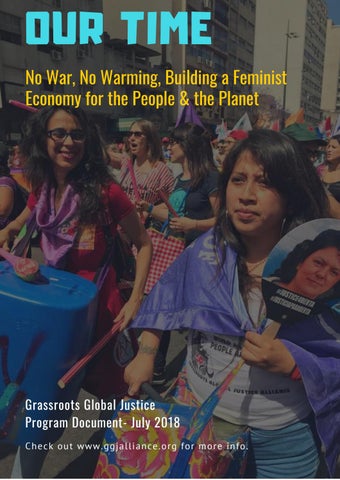
OUR TIME No War, No Warming, Building a Feminist Economy for the People & the Planet
Grassroots Global Justice Program Document- July 2018 Check out www.ggjalliance.org for more info.
Grassroots Global Justice Program Document- July 2018 Check out www.ggjalliance.org for more info.
CONTENTS
TABLE OF
4
OUR TIME: A CALL TO ACTION
8
CONTEXT & ANALYSIS
12 14 16
EXCITEMENT & QUESTIONSÂ GOALS & APPROACH PROGRAM AREAS Mov ement Building Gr assr oots Feminism Global Wellbeing Anti-Militar ism
“IT WAS A TIME WHEN THE UNTHINKABLE BECAME THE THINKABLE AND THE IMPOSSIBLE REALLY HAPPENED.” - Arundhati Roy
Dear GGJ Members & Allies, We are in unordinary and uncertain times. The resurgence of right-wing populism—globally— is a manifestation of the combined crises of neoliberal capitalism, the crisis of the environment and the questioning of state legitimacy. In the last year and half we have faced a steady stream of attacks on everything from healthcare,immigration, sacred sites, education and housing. In that same time we’ve seen unprecedented motion from our organizations and movements but also amongst everyday, and often previously unorganized, people of this country. We cannot allow the opposition to right-wing populism to lose steam. Instead, now is the time to explicitly and strategically link the fight against the right to the fight against neoliberal globalization. It is our time to globalize grassroots resistance. Our movements need to be real about what’s happening. We cannot continue working as if we don’t actually believe we can win. Right now, many of us are focused on policy, litigation and the necessary defense work, but we know in our hearts that is not enough. Or we’re doubling down on our organizing efforts but still doing it in silos. We need to push one another to constantly evolve our analysis and strategy. We’ve got to step back and reassess; question and sharpen; respond and envision collectively as a more unified left of the grassroots organizing sector. We need to be ready-- intellectually, emotionally, politically, infrastructurally-- to advance our most ambitious agendas. Grassroots Global Justice Alliance (GGJ) is a multi-racial, multi-sectoral alliance of more than 60 member organizations of the grassroots organizing sector building a popular movement for peace, democracy and a sustainable world. Our work is intergenerational, mix gendered and visibilizes the leadership of women, gender non-confirming people, LGBTQ and historically marginalized people in the US: Black, Latina/o, Asian Pacific Islanders, Arab, and white working class people.
4
We continue to support one another in our local struggles, work collectively to build a national vehicle for movement cohesion, and collaborate with international allies who share our vision and commitment to building a transformative social justice movement beyond borders. In this moment, GGJ is orienting around 3 strategic axes: alignment, visionary opposition and audacity. Alignment- We can and will win by building common and unified ground. This does not mean seeking our lowest common denominator or liquidating our differences, but instead it means acknowledging our differences and building the vision and strategy that speaks to the intersections of our struggles, experiences, identities and desires. We need intentional movement alignment and convergence that draws together the grassroots organizer sector and people of color led movement organizations across issues, communities and borders. GGJ has long been in the practice of movement convergence at multiple scales, and stands firm in that commitment. Visionary Opposition- GGJ believes in building paths not only toward radical reform but toward liberation. While we develop our resistance and continue to defend our people and planet, we must also find a way to get on the offensive. We have to continue to build a vision for the world that we want. A world that builds bridges instead of borders and is free of war and militarism. A world where black lives and therefore all lives matter. A world where the rights of nature are respected and upheld. A world governed by the people and organized by a feminist economy.
5
Audacity- We are in a fight for our lives and the planet, and we have to let that guide our urgency, but also our ambition. In this moment, nothing we care about and value is safe, so we have to be willing to take new risks and be audacious in how we organize to counter the current hegemony. We have to get creative, step out of our comfort zones, and be bold. There are millions of people who are hungry for a radical vision. We must put out the vision that another world is possible and be truly willing to struggle for what we believe. In the spirit of these axes, GGJ organizers have engaged in deep consultation across our membership, both to listen and to build strategy. What is reflected in this document is background on our program areas, highlights from member feedback and initial thinking on our ways forward. Through the upcoming membership assembly we hope to continue to sharpen and clarify our priorities and strategic plans of action. As we come into this seventh assembly, we are affirming--- This is our time! Our Time to strengthen our alliance, and relations to one another, to lay the groundwork for our dreams, and to dare to hope. We are honored to stand beside you and excited to continue building with you toward the transformation we know is possible. In solidarity, Cindy Wiesner National Coordinator of Grassroots Global Justice Alliance
6
CONTEXT & ANALYSIS Grassroots Global Justice strives to build visionary opposition, but also understands the need to remain vigilant and responsive to the rapid developments in our volatile political context. We cannot build and sustain the movements that we need without speaking to our lived realities. Instead, our collective strategy should be informed by the shifting political landscape and flexible enough to respond without being reactionary. At a global scale, right wing populists and repressive authoritarians are seeing growing levels of support; Le Pen in France, Modi in India, Duterte in the Philippines, Temer in Brazil, Orlando Hernandez in Honduras, and Trump in the US. Right wing political leaders, and the parties that carry them, are aligning to 1) repress already marginalized groups 2) promote exclusionary nationalist agendas with the backing of increased militarization, and 3) impose austerity measures and facilitate corporate capture of the commons. At the national level, we know that our communities have long been up against social, economic and environmental crisis. Still we recognize that the rise and rule of Donald Trump represents a new and particular political moment. Trump was ushered in as president in large part
because of the alignment of white nationalists, neo-conservatives, the religious right and the corporate elite around an explicitly white supremacist and patriarchal agenda. In many ways, his victory can be seen as a backlash against the gains of people of color, including the Black Lives Matter movement and the election of a Black president. Trump and his closest advisors continued a tradition of scapegoating immigrants and people of color for a lack of economic growth, and exploited a feeling of neglect among white americans to further an explicitly racist definition of America. Policies like the muslim ban and immigrant detention have normalized a white supremacist politic. Neoconservatives have been able to push through an agenda of increased spending on militarization and the religious right continues to make progress in dismantling civil and gender rights. While Trump made empty promises to reign in Wall Street, he has deeply corporatized his cabinet and made clear that his administration is nothing if not beholden to corporate interests. This convergence of forces across potentially conflicting interests is a real threat to democracy and should underline the urgency of our own social movement alignment.
8
“Inside the belly of the beast we have a specific role to play because we are inside the country that is making the big moves across the globe – really the leader in pushing the neoliberalist agenda and destroying the planet. Through the global grip of of capitalism and neoliberalism we are all connected. Specifically immigrant communities have been forced to migrate to the US because of US interventionism and exploitation of the natural resources all over the world that displaces entire communities. It’s really important that we are connecting at a global scale – both in our struggles and in our strategy. If we don’t do that, we miss the ability to build power together in order to counter our enemies, which are huge and are very well organized across the globe.” -Kitzia Esteva, Causa Justa::Just Cause 9
The Trump administration has been consistent and unyielding in its attacks, pursuing an agenda of austerity, white supremacy, institutional misogyny, militarism and climate change denial Trump has unsurprisingly cut taxes and slashed spending on everything but the military. The administration has attempted to institutionalize the racism that Trump campaigned on by promoting the Muslim ban, creating the classification of “Black identity extremism”, supporting ICE Raids, family separation and child detention while punishing dissenting and sanctuary cities. The administration has attacked reproductive health including by rolling back Title X availability, attempting to tear down Planned Parenthood and reinstating the global gag rule which prevents international NGOs receiving US family planning funding from providing any abortion services, counsel, or advocacy. Trump is also poised to appoint a supreme court judge who will vote to overturn the landmark decision of Roe vs. Wade. Trump has inflated US defense spending, threatened nuclear war, further militarized our borders and deployed more troops to Afghanistan. Trump has empowered climate change deniers in his cabinet, overturned the decisions blocking the KXL and DAPL
pipelines, attacked union organizing, withdrawn from the Paris Agreement, promoted false solutions like clean fossil fuels and more. We must also recognize and uplift the deep movement alignment and organizing that has continued to emerge despite and throughout this onslaught. Resistance has raged on across numerous frontlines---from the millions in the streets at the Women’s Marches and People’s Climate March to the Anti-Racist uprisings in Charlottesville, VA; from blockades at immigrant detention facilities to important wins in increasingly radical electoral organizing. As we reflect on and analyze the current reality we are faced with, it is our duty to remain hopeful and to stoke and guide those flames. We draw hope from our incredible membership. This year we prioritized a deep consulta process through which GGJ organizers met in person with 33 member organizations across the country. We learned more deeply about their work and gained important feedback on the best role for GGJ to play in our current context. Excitement and questions that came up are below. We are excited to continue the consultation through the membership assembly and to chart a way forward. 10
10
EXCITEMENT Grassroots Internationalism - Much of our membership is looking to deepen their understanding of and solidarity with international social movements. They are looking to GGJ to help support relationship building and exchange. A number of members felt that this is GGJ’s key and unique contribution to the movement and urged us to sharpen and clarify our role in this direction. Grassroots Feminism - Members are very supportive of the growth of feminist organizing schools and are excited for regional and thematic schools. People are looking both for more opportunities to apply a feminist lens to their existing organizing work and to throw down on a collective campaign. Political Education/ Leadership Development - Members appreciated the role we have played here but are still looking for more. In particular there is a desire for more political education across sector and more specific education around grassroots internationalism. Just Transition & Intersections - Many of our members have been forced to take up climate justice work based on the impact of climate change and extractive industries in their context. They are hoping for GGJ to help further their understanding of the landscape as well as the Just Transition framework in particular and its applicability to their existing work on the ground.
12
QUESTIONS Movement Building - What are the overlaps and distinctions between the many different long-standing and emergent national formations and alliances, and what is the particular role of GGJ? How can we increase the opportunities to bring members and allies together to build relationships and a collective vision? At an international scale, should we continue involvement with the World Social Forum, and outside of that, how do create additional radical global spaces? How can we strengthen our connection to and solidarity with existing black organizing and movement building in the south? Given the electoral organizing work of our members, how can GGJ hold space for conversation around radical electoral strategies? Global Well Being - In the post-Paris context, what is the most effective intervention we can make as grassroots, frontline movements to advance real solutions to stop emissions at the source and address the impacts of environmental racism and climate crises in our communities? What is our continuing role, if any, in the People’s Climate March? Grassroots Feminism - In this #MeToo moment, how do we best and most effectively enter the national dialogue around gender based violence, and push the conversation to challenge systems of oppression, as well as offer visionary solutions that include restorative and transformative justice? How can a national campaign best amplify local grassroots feminist organizing and move us forward on a national scale? How do we best reach radical feminists outside of our membership and bring them into the work? Anti-Militarism - What contribution can we make as GGJ to support the growing racial justice movement in Black, Latin@, Asian, Pacific Islander, Arab, and Muslim communities that are challenging US militarism and state violence inside the US as well as US wars of 13 intervention globally?
GOALS
Based on the critical feedback from our members, we see this moment as the time to: Build on the strength of our grassroots organizations to both defend our communities in the face of the current right wing assault and to advance local and municipal power building and people’s solutions. Keep playing a lead role in the coherence of national grassroots movements, across sector, and engage in collective strategy and shared action. Strengthen grassroots internationalism and the commitment to building strategy and solidarity across borders. Provide opportunities for those who are becoming newly politicized to engage in a conversation/mobilization that we as the grassroots are leading. Continue to expand and build capacity, critical consciousness and organizing skills of our members.
14
GRASSROOTS INTERNATIONALISM GGJ holds a strong commitment to grassroots internationalism. We recognize the global dimensions of the root causes of social injustice. Our approach is to develop the capacity for US-based grassroots organizations to engage strategically with movements abroad by bringing leaders together to form working relationships, a reciprocal solidarity model, and framework for joint struggle toward collective strategy and alignment. This helps US movements learn about how popular movements abroad are defining a new vision and implementing it, and infuses their local and regional work with an international analysis. In turn, GGJ brings representatives from working class, Indigenous and communities of color on the frontlines of the climate, gender and economic crises from the US into international movement spaces to share lessons from our work with global movements.
APPROACH
TRANSLOCALISM GGJ believes change happens in our work-places, neighborhoods, and community institutions. We have the most power and leverage locally. We also believe that it is an important strategy to aggregate our local power to make change at regional and national levels. National alliances are key in facilitating this. GGJ takes lead from our membership and aligns strategy on key issues across locally rooted organizations. 15
GGJ PROGRAM AREAS
16
1. MOVEMENT BUILDING
2. GLOBAL WELLBEING
3. GRASSROOTS FEMINISM
4. ANTI-MILITARISM
17
MOVEMENT BUILDING GGJ is committed to engaging in grassroots movement building to strengthen collective alignment and power. While we remain rooted in the critical organizing happening at the local level, given the scope of the challenges we face, we also see a clear need for coherence and unity among left forces at the national and international scales. GGJ has collaborated in numerous domestic movement building processes, but has focused mostly in both It Takes Roots (ITR) and The Majority. It Takes Roots (ITR) is an alignment across Indigenous Environmental Network, Climate Justice Alliance, Right to the City Alliance, and Grassroots Global Justice Alliance. ITR centers the leadership and power of urban and rural communities on the frontlines of racial, gender, housing, environmental, energy and climate justice in the United States to advance regenerative economies and healthy communities. ITR is a multiracial, multicultural, multigenerational alliance of networks and alliances representing over 200 organizations and affiliates in over 50 states, provinces, territories and Native lands in the U.S. and Canada, and is led by women, gender nonconforming people, people of color, and Indigenous Peoples. Through ITR, we are bringing together our collective power as grassroots base
building organizations towards shared practice, training and action. Together we are building a collective platform of demands and furthering the exploration and articulation of alternatives. So far this year, we have co-hosted with Ruckus Society a Direct Action and Community Resiliency camp, aimed at cultivating action and survival skills in the context of intensifying climate disasters. We also sent a 60 person delegation to the Protecting Mother Earth Conference in support of Indigenous leadership and the fight for climate justice and sovereignty. Lastly, through numerous planning meetings, It Takes Roots is gearing up for the Solidarity to Solutions (Sol2Sol) Summit from September 8-13, 2018. In response to Trump’s reckless decision to pull the US out of the Paris Agreement, California Governor Jerry Brown is convening a Global Climate Action Summit (GCAS) in San Francisco this September—bringing together international government and business leaders pledging to continue toward the strikingly inadequate goals of the accord. However, many of the models being touted at the GCAS are market-driven mechanisms that are not proven to reduce emissions, and will further commodify the earth, profit from pollution, and exploit and manipulate natural systems in an effort to 18
“Movement building aims to form authentic, lasting solidarity across race, class, gender, sector and place through shared practice, study, reflection and visionary leadership. Intentional movement building work that ties all our fights and energies together is what will win victories for our people and move the struggle towards the liberation that burns in our hearts.� - Pam Tau Lee, Chinese Progressive Association 19
maintain the fossil fuel economy. Parallel to the GCAS, we will hold a closed membership assembly across our alliances to discuss strategy as well as a public summit to highlight frontline community solutions to the interlinked crises of climate, economy and democracy. GGJ is playing a leadership role in convening the It Takes Roots formation, including in managing the coordinating staff and acting as fiscal sponsor in this early stage. The Majority was convened by the Movement for Black Lives in 2017 as a response to the urgency of the political climate and the need for alignment of vision and strategy amongst POC-led left organizations and movements. The coalition consists of both national organizations with local chapters and local organizations that seek a larger national political community. The Majority centers the leadership of Black people, POC, women, poor people, and working-class people, as well as LGBTQ folks, and other frontline communities and holds the priorities of political education, collective action, and the building of principled solidarity. The Majority aims to build our capacity to escalate, build local and regional power, align across sectors and movements, and develop join practice toward transformational change. So far this
year, we have begun initial conversations around landscape and shared action, grown participation and presence across the POCled left, engaged in shared political education around racial capitalism, and expanded and solidified the leadership team. On the road to a mega-convening in 2020, member alliances and organizations will consult their bases through people's movement assemblies to gain alignment on a political rubric including: divestment and reinvestment; freedom towns; antimilitarization; anti-white supremacy; anticapitalism; reparations and restoration; and gender justice. GGJ is playing an active role in the leadership team of the Majority as well.
20
10
GLOBAL WELLBEING As we continue to experience the hottest weather in human history, the impacts of climate change are still felt first and worst by vulnerable communities inside the US and throughout the Global South. We saw these impacts acutely in the fall of 2017, with the devastating impacts of Superstorm Harvey, Hurricanes Maria and Irma, and the largest wildfires ever recorded in history of the state of California. GGJ’s Global Wellbeing (GWB) program has focused on two core priorities: 1) Strengthen the climate justice movement nationally and internationally and 2) Actualize the Just Transition (JT) model on the ground. Climate Justice Movement: We work very closely with and are deeply aligned with our sister alliances of Climate Justice Alliance (CJA) and the Indigenous Environmental Network (IEN) on both of these levels of movement building. Internationally, GGJ plays a critical lead role in holding many close relationships with social movement allies involved in climate justice work -- a truly global front of struggle. The Paris Agreement, signed by the United Nations in 2015, is a deeply flawed document, with literally no mention of fossil fuels anywhere in the text.
The US Environmental Protection Agency itself acknowledges that “human activities are responsible for almost all of the increase in greenhouse gases (GHG) in the atmosphere over the last 150 years,” with the largest source from US “burning [of] fossil fuels for electricity, heat, and transportation.” The agreement is in essence a trade document that relies on carbon trading and offset schemes that both obscure actual GHG emissions and threaten the rights of Indigenous Peoples and the human rights of forest dependent communities worldwide. As implementation of the Paris Agreement begins, we are seeing a new harmonization of a global carbon market where countries and states are attempting to meet carbon reduction goals not through actual reductions in GHG emissions, but through the buying and selling of carbon credits that allow the dirtiest industries to continue on the same path of polluting and harming communities at the source of extraction while claiming to be contributing to the solution. Pollution and carbon pricing undercut the environmental justice struggles of frontline communities fighting to reduce pollution at the source of the refineries, plants and pipelines. Carbon pricing fails to reduce pollution enough, and opens up new markets built around the financialization and privatization of air, water, and all aspects of nature as a whole. 22
“The struggle for the well-being and future of our local communities is also linked to a global scale of grassroots organizing and alignment in all places, particularly in frontline battlegrounds where the stakes are the highest. We are taking action to address the root causes of climate change and economic and environmental injustice by challenging the current dominant economic system that fails to sustain and regenerate life because it is built on flawed foundations including: The endless industrial extraction and pollution of natural systems and functions; the privatization, commodification and legalized enslavement of nature -- Mother Earth and Father Sky -- that puts a price on air, water and nature that only increases inequality, creates violations of human rights and rights of Indigenous Peoples; and expedites the destruction of ecosystems. Global wellbeing means reclaiming our power, our future and uniting in common struggle. " - Tom BK Goldtooth, Indigenous Environmental Network
23
The Paris Agreement is a dangerous distraction and is far from what we need to solve the climate crisis. In our assessment, one of the most critical tasks for the period ahead is the need to strengthen the level of international strategic alignment alignment and coordination across our global social movement allies. Before the signing of the agreement, the United Nations Framework Convention on Climate Change (UNFCCCC) had provided a space of contested struggle where many social movements were engaged together in collective efforts to strengthen the effectiveness of the global Paris Agreement. Frustration and disillusionment with the corporate capture of the UNFCCC as a whole has led many social movements to disengage and prioritize the Conference of the Parties (COP) meetings and other spaces that had previously created opportunities for convergence and coordination. In this context, GGJ members have been meeting with our allies from La Via Campesina, the Trade Union Federation of the Americas (TUCA), the World March of Women, Friends of the Earth International, the Movement of People Affected by Dams (MAB), the Transnational Institute (TNI) and others to strengthen international coordination for our
movements outside of the logic of the UNFCCC processes. With IEN’s leadership, as a member of GGJ, we have also been cultivating relationships with Indigenous movements from the global south. In the period from 2018 - 2020, the proposal with the strongest support is a shared writing project to articulate our shared vision of Just Transition rising from our social movements across the Americas region. Beginning with the It Takes Roots Solidarity to Solutions (Sol2Sol) week of mobilization in September 2018, GGJ will help to convene a series of discussions with our social movement allies from the Americas to discuss and align our visions of Just Transition. From these discussions and collective writing, we are planning to publish a shared document in advance of COP25 which will be held in the Americas. With a shared articulation of Just Transition arising from this powerful alignment of the social movement Left, we aim to create a counter pole that can help inform shared strategy discussions and planning with our allies in the climate justice movement. Just Transition: The second focus of our Global Wellbeing program is strengthening Just Transition campaigns and programs on the ground. Just Transition is a framework for healing 24
communities and workers from the legacies of racism, exploitation of the environment and people. Just Transition strategies work to actively shift away from an extractive economy toward a regenerative economy through holding corporations, financial sectors, and governments accountable, implementing real solutions to climate change that chart a path towards more democratic, ecologically rooted economies. While the idea of Just Transition has deep resonance in our sector, there is still a lot of confusion about what the concept means. In the process of clarifying, the leadership of the grassroots sector is critical. Since the Paris Agreement, implementation of climate action plans are happening at local, regional, state, tribal and municipal levels. As grassroots movements, these local levels of power are areas where we have had greater levels of influence in advancing our demands and solutions. This is a period where our movements must continue to make bold demands, and advance Just Transition solutions that fundamentally shift our energy and economic systems in the communities where we are based.
Transition Assemblies, to explore the concept and its application in various regions and sectors. One of the key needs that was expressed coming out of each of the JT Assemblies over the last 2 years, was support for groups wanting to really advance Just Transition in their own context. Organizations have gravitated to the principles, but hit obstacles moving the ideas into action. These members are now ready for the next step and are looking for support as they move toward developing Just Transition campaign plans and strategy that is specific to the conditions they are facing. This next period is an important time to both ground the grassroots sector in a clear vision and understanding of Just Transition, and to make Just Transition real on the ground by supporting campaigns in achieving real concrete victories. In the period from 2018 - 2020, the GGJ is proposing a collaboration with CJA, IEN, the Just Transition Alliance (JTA), Movement Generation, and the Reinvest Network to experiment with Just Transition Strategy Labs that are designed to offer strategic technical support, problem solving, and resource sharing to support emergent Just Transition projects across our grassroots sector.
Over the past three years, many of our member organizations have hosted Just 25
GRASSROOTS FEMINISMS With the rise of the right wing, an outspoken misogynist in the white house, and a direct attack on reproductive health policy, resistance in the name of women’s rights has been gaining momentum in the US. From the #MeToo and #TimesUp movements to the Women’s March, women, LGBTQ people and allies are fighting back. GGJ is continuing to develop this program area. At the last member assembly in 2014, GGJ members made the unified decision to launch the US chapter of the World March of Women (WMW), a feminist global action movement with national coordination bodies in over 65 countries and territories. Since the development of the US chapter we have been engaging with our membership to deepen the understanding that our organizing struggles, from housing to climate to anti-militarism, are deeply connected to the fight against patriarchy. From this we hope to advance Grassroots Feminism and the application of a gender justice lens to our organizing and movement building strategies. Since 2016, GGJ has facilitated three Feminist Organizing Schools (FOS). The schools provide an opportunity for members and allies to engage deeply around the intersectionality of our oppressions; the legacy of our diverse genders and
sexualities; the history of our feminist movement in the US; the role of capitalism in global injustice; the possibility of feminist economics; and the importance and power of organizing with a grassroots feminist lens. Through our most recent school in Miami, Florida we experimented with a regional model. We collaborated with member organization Miami Worker’s Center (MWC) and allies at the Statewide Alignment Group (SWAG) to allow for deeper consideration of political context and existing local and statewide organizing work, particularly around a Femme Agenda, electoral organizing and rights restoration. In the future we will be working to develop an FOS rooted in indigenous communities and will also be working with allies to develop an international Feminist Organizing School. As we continue to work with our members to build a strong foundation of political education, we also want to make a significant programmatic pivot this year and have begun to explore the possibility of shared campaign work, both in the short and long term. In the short term, GGJ has committed to lend national support to the Free Siwatu Campaign, being led by organizers in the Detroit area. Siwatu Salama-Ra is the 26
“While Just Transition does mean coal to solar energy and food desserts to food sovereignty, it also requires an examination and evolution of our values and how we practice them in today’s world. Discussions about Indigenous Feminism, for example, are sorely needed in our communities and can gift us with diversity in leadership, a reclaiming of our traditional matriarchal society, and a newfound respect for Mother Earth.” - Jihan Gearon, Executive Director, Black Mesa Water Coalition
27
Co-Director of the East Michigan Environmental Action Council, she is a community organizer, an environmental justice leader, a mother and a part of the It Take Roots movement family. Siwatu is a young Black Muslim mother, and last summer in the process of defending herself and her child, she was unjustly incarcerated. She was pregnant when arrested and recently gave birth in prison. She had only 48 hours with her newborn baby in prison before the baby was taken away to be with the father. Her religious practices have also not been allowed. The same system that routinely fails to indict white men for murdering Black people has sentenced Siwatu to 2 years in prison, even though she committed no crime. She was sentenced for felony possession of a firearm, despite only displaying--not using--a licensed unloaded weapon as a means of defense. Michigan has a stand your ground law, but Siwatu was indicted anyway. The jury that ruled in Siwatu’s case, as in the case of many other women of color in particular, decided that she did not feel fear, and therefore “stand your ground” did not apply. Our racist, patriarchal society and criminal justice system does not permit Black women or men the emotion of fear, instead depicting them as aggressors.
This is a grassroots feminist campaign, not only because it defends the rights of a woman, and a mother to defend her child, but also because it challenges the racist and patriarchal criminal justice system as a whole. GGJ will work to amplify the local Detroit efforts through both social and traditional media. With enough support from our members and allies and enough national attention on the case, the Free Siwatu campaign may become an issue that Michigan’s gubernatorial candidates will have to weigh in on in the lead up to November elections. In the long term, we are envisioning a 2 pronged campaign : 1) Deepening and radicalizing the current conversation about sexual violence and gender justice and 2) Pushing for a Just Transition to a Feminist Economy. The goal of the first prong is to begin to shift the national consciousness. We recognize the importance and momentum of resistance around women’s rights and feminism. However, we also know that the dialogue is lacking in many respects. We want to take advantage of the current moment, engage in the conversation and push it further. If we don’t, we miss an opportunity to counter a singular narrative of feminism and offer our alternative--Grassroots Feminism. 28
Grassroots Feminism is distinct and necessary because it is led by women of color, LGBTQ, poor, and working class people; all of whom understand that their oppression is rooted in patriarchy and its connections to capitalism, colonization, white supremacy, transphobia and homophobia. It furthers the understanding that the liberation of women is bound to the liberation of all oppressed peoples. The national discourse around feminism has to push beyond punishment of gender based violence to consider root causes. It must move beyond representation in elections, to actually consider feminist political values and push for the accountability of electeds to our communities and our movement. The goal of the second prong is to advance demands a feminist economy, through a divest/reinvest organizing strategy. GGJ recognizes that not only does capitalism hurt women of color first and worst, but that the systems of patriarchy, white supremacy and capitalism are inextricably linked. We can’t resist one without resisting the other. We want a feminist economy that is explicitly anti-capitalist and does not exploit, extract or commodify our planet or the bodies and labor of our people. Among our members and allies, the need for a just transition to an alternative economy has wide support, with many organizations committed to local Just Transition campaigns.
The JT framework has roots in labor and climate justice and aims to shift away from a fossil fuel extraction economy, toward a regenerative one. We believe that in defining the vision of the regenerative economy we want to build, gender justice has to be a critical component. We need divestment not just from fossil fuel extraction, but also from the military industrial complex. Reinvestment not just in clean renewable energy, but also in public health, education, housing, food justice, the commons and transformative justice. Organizing around a just transition to a feminist economy has the potential to draw together members and allies across sectors in a powerful way. This orientation can help us amplify local work that is already aligned and to collaborate at a national level to develop a creative, much needed, and synthesizing campaign. During our member consultation meetings and within the WMW committee, members are excited to think it through and carry it forward.
29
ANTIMILITARISM "Militarism is a root cause of a number of our global and domestic issues. It prioritizes and glorifies the expansion and aggressive use of formal, organized state violence to further state interests. It threatens and harms the self-determination of people and nations abroad, while its simultaneously utilized as a tool of overwhelming control here at home." - Ramon Mejia, About Face: Veterans Against War
With a central commitment to grassroots internationalism, GGJ has long understood the relationship between the war at home and the wars abroad. The US has a long sordid history of leading and participating in international wars predicated on both white supremacy and the safeguarding of capitalism. Continuing a tradition of heavily militarized foreign policy, the current administration has increased troops in Afghanistan, continued to weaponize the Saudi led coalition in Yemen, led airstrikes in Syria, threatened nuclear war with North Korea, inflated defense spending and encouraged NATO countries to do the same. All of this continues to occur at the expense of countless civilian lives and creation of humanitarian disasters. At the same time, state violence continues against our communities here at home -- police killing and mass incarceration disproportionately of black and latino people, racial profiling of arabs and muslims, ICE raids of immigrant communities.
International resistance continues to confront the war machine and stake claims for peace, sovereignty and accountability--from Korea to Palestine. In order to stand with them sincerely, we must resist from within the belly of the beast. In recent years in the US, the Movement for Black Lives, the Not1More/ Undocumented & Unafraid movements, and the Standing Rock NoDAPL struggle have brought new life and strategic energy into the struggle for Indigenous, Black, and Latin@ liberation and self determination, with growing solidarity and activism in Asian and Pacific Islander movements as well. In the face of blatant state sanctioned Islamophobia, Arab and Muslim grassroots organizations are also asserting national movement leadership within the anti-war and feminist movements. This leadership and renewed momentum offers possibilities and allies for GGJ. There are increasing opportunities, and under the current administration an ever-growing need, to advance a stronger 30
anti-war and anti-militarism movement that connects the wars abroad with the wars at home.
Through member organization About Face: Veterans Against War, GGJ has been invited into dialogue with people of color, grassroots anti-militarism/ war resisters in Coming into the 2018 Member Assembly, the US. Through the No War, No Warming GGJ is looking to launch a new Antiframework we hope to continue to contribute Militarism working group. GGJ did have an an analysis of the relationship between earlier anti-war group that was put on hold militarism and the extractive economy, and due to capacity. We shifted instead to rapid- to deepen that consciousness and response in relation to war and militarism, messaging within our membership. We also but are excited to bring this focus back. The hope that setting out this new program area main objective will be to support and will more directly draw in member connect our members who are involved in organizations whose core work is focused anti-militarism campaigns -- challenging on immigrant rights, the school to prison police violence, border detention, the pipeline, or other racial and economic justice criminalization of protest, and US military struggles have not had as much designated aggression globally. space with GGJ for coordination and amplification of their existing work.
31