F
Perfect burger buns from China to Chile
Q
by Tip Keng Pong, Technical Director Stern Ingredients Asia-Pacific, Roman Gradert, head of the baking laboratory, Stern Ingredients Mexico, Christof Schricke, R & D, Baking Applications, Mühlenchemie, Vladimir Wengorz, R & D, Baking Applications Eastern Europe / Russia, Mühlenchemie.
uality fluctuations are a “no-go” with burger buns. The international fast food chains expect their suppliers to maintain strict product standards. Four experts from the enzyme specialist Mühlenchemie explain from their own experience how similar burger buns can be produced around the globe – regardless of individual production conditions and the raw materials used. In the summer of 2018, burger buns hit the headlines of the US press after the Texan fast food chain In-N-Out Burger decided to close it restaurants temporarily. The reason given was the poor quality of its burger buns. How can the milling and baking industry prevent such a fiasco?
66 | August 2019 - Milling and Grain
What are the issues with burger bun production?
Tip Keng Pong, Technical Director for Stern Ingredients AsiaPacific says: The production of burger buns is no easy matter. There must be no noticeable deviations from the characteristics and appearance specified by the fast food restaurant chains. Volume, texture, colour, taste – each bun must be exactly the same as the others. But since overall conditions vary enormously and every bakery works with different raw materials and equipment, problems sometimes occur nevertheless.
Where do the difficulties lie, then, in the production of burger buns?
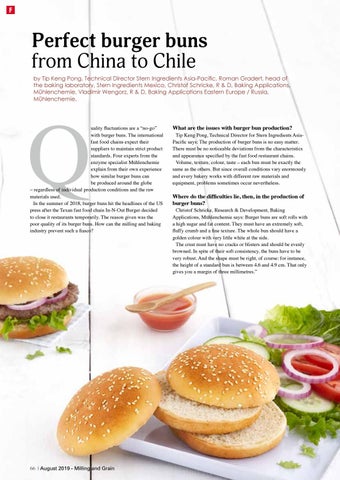
Christof Schricke, Research & Development, Baking Applications, Mühlenchemie says: Burger buns are soft rolls with a high sugar and fat content. They must have an extremely soft, fluffy crumb and a fine texture. The whole bun should have a golden colour with very little white at the side. The crust must have no cracks or blisters and should be evenly browned. In spite of their soft consistency, the buns have to be very robust. And the shape must be right, of course: for instance, the height of a standard bun is between 4.6 and 4.9 cm. That only gives you a margin of three millimetres.”