F
The roles of optical sorters from field to table for Edameme beans
E by Satake, Japan
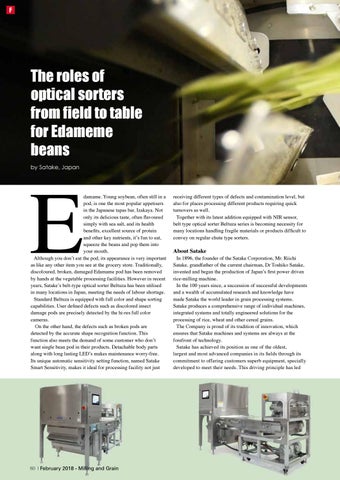
damame. Young soybean, often still in a pod, is one the most popular appetisers in the Japanese tapas bar, Izakaya. Not only its delicious taste, often flavoured simply with sea salt, and its health benefits, excellent source of protein and other key nutrients, it’s fun to eat, squeeze the beans and pop them into your mouth. Although you don’t eat the pod, its appearance is very important as like any other item you see at the grocery store. Traditionally, discoloured, broken, damaged Edamame pod has been removed by hands at the vegetable processing facilities. However in recent years, Satake’s belt-type optical sorter Beltuza has been utilised in many locations in Japan, meeting the needs of labour shortage. Standard Beltuza is equipped with full color and shape sorting capabilities. User defined defects such as discolored insect damage pods are precisely detected by the hi-res full color cameras. On the other hand, the defects such as broken pods are detected by the accurate shape recognition function. This function also meets the demand of some customer who don’t want single bean pod in their products. Detachable body parts along with long lasting LED’s makes maintenance worry-free. Its unique automatic sensitivity setting function, named Satake Smart Sensitivity, makes it ideal for processing facility not just
80 | February 2018 - Milling and Grain
receiving different types of defects and contamination level, but also for places processing different products requiring quick turnovers as well. Together with its latest addition equipped with NIR sensor, belt type optical sorter Beltuza series is becoming necessity for many locations handling fragile materials or products difficult to convey on regular chute type sorters.
About Satake
In 1896, the founder of the Satake Corporation, Mr. Riichi Satake, grandfather of the current chairman, Dr Toshiko Satake, invented and began the production of Japan’s first power driven rice-milling machine. In the 100 years since, a succession of successful developments and a wealth of accumulated research and knowledge have made Satake the world leader in grain processing systems. Satake produces a comprehensive range of individual machines, integrated systems and totally engineered solutions for the processing of rice, wheat and other cereal grains. The Company is proud of its tradition of innovation, which ensures that Satake machines and systems are always at the forefront of technology. Satake has achieved its position as one of the oldest, largest and most advanced companies in its fields through its commitment to offering customers superb equipment, specially developed to meet their needs. This driving principle has led