F
The rise of Russian wheat production:
H
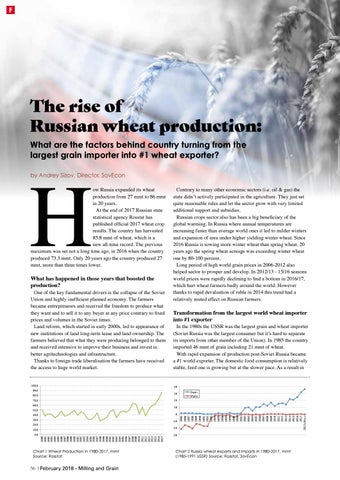
What are the factors behind country turning from the largest grain importer into #1 wheat exporter? by Andrey Sizov, Director, SovEcon ow Russia expanded its wheat production from 27 mmt to 86 mmt in 20 years. At the end of 2017 Russian state statistical agency Rosstat has published official 2017 wheat crop results. The country has harvested 85.8 mmt of wheat, which is a new all-time record. The previous maximum was set not a long time ago, in 2016 when the country produced 73.3 mmt. Only 20 years ago the country produced 27 mmt, more than three times lower.
What has happened in those years that boosted the production?
One of the key fundamental drivers is the collapse of the Soviet Union and highly inefficient planned economy. The farmers became entrepreneurs and received the freedom to produce what they want and to sell it to any buyer at any price contrary to fixed prices and volumes in the Soviet times. Land reform, which started in early 2000s, led to appearance of new institutions of land long-term lease and land ownership. The farmers believed that what they were producing belonged to them and received intensive to improve their business and invest in better agritechnologies and infrastructure. Thanks to foreign trade liberalisation the farmers have received the access to huge world market.
Chart 1 Wheat Production in 1980-2017, mmt Source: Rosstat
56 | February 2018 - Milling and Grain
Contrary to many other economic sectors (i.e. oil & gas) the state didn’t actively participated in the agriculture. They just set quite reasonable rules and let the sector grow with very limited additional support and subsidies. Russian crops sector also has been a big beneficiary of the global warming. In Russia where annual temperatures are increasing faster than average world ones it led to milder winters and expansion of area under higher yielding winter wheat. Since 2016 Russia is sowing more winter wheat than spring wheat. 20 years ago the spring wheat acreage was exceeding winter wheat one by 80-100 percent. Long period of high world grain prices in 2006-2012 also helped sector to prosper and develop. In 2012/13 - 15/16 seasons world prices were rapidly declining to find a bottom in 2016/17, which hurt wheat farmers badly around the world. However thanks to rapid devaluation of ruble in 2014 this trend had a relatively muted effect on Russian farmers.
Transformation from the largest world wheat importer into #1 exporter
In the 1980s the USSR was the largest grain and wheat importer (Soviet Russia was the largest consumer but it’s hard to separate its imports from other member of the Union). In 1985 the country imported 46 mmt of grain including 21 mmt of wheat. With rapid expansion of production post-Soviet Russia became a #1 world exporter. The domestic food consumption is relatively stable, feed one is growing but at the slower pace. As a result in
Chart 2 Russia wheat exports and imports in 1980-2017, mmt (1985-1991 USSR) Source: Rosstat, SovEcon