STORAGE
F
Handling, storage, blending for animal feed
T
Consideration of a blending plant set up and operation by Mr Gustaaf Zeeman, Managing Director of EMT, The Netherlands his article will describe what is necessary to set up a blending plant and how this plant can handle the fertiliser and animal feed based on storage of the products on the floor in boxes. EMT is producing blending and bagging equipment and has major experience in this industrial sector.
Capacity
The rest start for a consideration of a blending plant is to determinate the needed capacity per year and also the second capacity. A general capacity of a blending plant mostly always has a seasonal production pressure. So the capacity is based on this. This can be from 10 till 200 ton per hour. This is a high capacity in a short period of time. Many times a capacity of 50 till 100 ton per hour is an average. The second consideration is how the raw materials for the blending plant are supplied to the warehouse. Is this in 25-50 kg bags (Africa, Asia) or in big bags of 1000 kg (Africa, Asia, South America, Europe)?
Bulk/bags
Or are these raw materials arriving in bulk like Europe, North America, and South America. The number three thinking is how many raw materials are necessary for this blending operation; in general, this is four to six basic raw materials. These are 90-95 percent of the big blending components and the micro components, which are usually supplied in bags. Also liquid product can be added to all the blended raw materials, this can be slow release inhibitors or anti caking liquids. To have a good blend operation these raw material components are also necessary to be available for the blending plant.
Storage
This means enough space or storage boxes to store these products. The size of these boxes is more difficult to determine. This is depending on the input of the raw materials. This is done 100 | January 2018 - Milling and Grain
by sea ships (big quantities per raw material input or done by regular transport like train or trailers), which every day continues input and every day continues blended product output. So when the shipment quantity is an option then this can be a need for storage space between 2000 till 10,000 ton per raw material component for daily input this storage can be much lesser, like 500-1000 ton per component. Nevertheless the blending plant capacity will stay the same, this is not depending on the storage capacity of the raw materials.
Screen
Before the raw materials (when they are in bulk arriving it is possible to screen these products. This screening operation can be done for the big materials and are for the fine (dust) particles to screen this out before storage. This has the benefit that this screen out particles can be stored as one raw material and be re-used or sold. Note: when the screening is done after blending then this screen out particle are also a blending and then more difficult to re-use or re-sell. Many times the dividing of the bulk materials inside the warehouse is done by an overhead conveyor system to divide to the different boxes. For all these machines it is possible to have mild or stainless steel construction. To have an operational blending plant, then all raw materials need to be available. The bulk materials are picked up by a loader with bucket to bring the raw materials to the blender line. When the raw materials are stored in bags or big bags, then a forklift is used to transport these products.
Blending
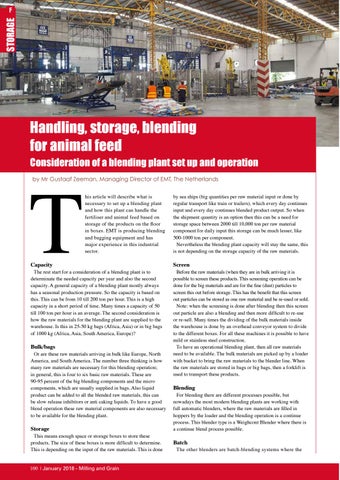
For blending there are different processes possible, but nowadays the most modern blending plants are working with full automatic blenders, where the raw materials are filled in hoppers by the loader and the blending operation is a continue process. This blender type is a Weighcont Blender where there is a continue blend process possible.
Batch
The other blenders are batch-blending systems where the