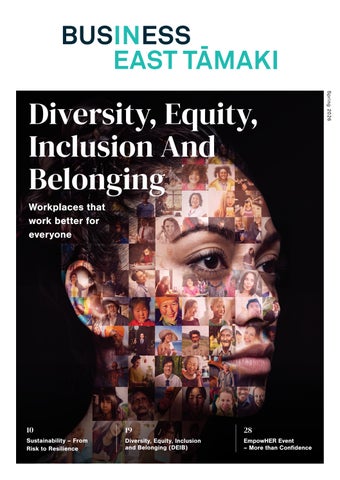
Workplaces that work better for everyone
10
19
28
Sustainability – From Risk to Resilience
Diversity, Equity, Inclusion and Belonging (DEIB)
EmpowHER Event – More than Confidence
Spring 2026
Diversity, Equity, Inclusion And Belonging
LOCAL BOARD
(Left to right): Krish Naidu, Mike Turinsky, Katrina Bungard, Damian Light, Kai Zeng, Bruce Kendall, John Spiller, Adele White, Peter Young, Luke Collings.
The diversity of East Auckland
F
ew places in New Zealand reflect the changing face of our country quite like East Auckland. Walk through our town centres, schools, community events or workplaces, and you'll encounter a remarkable mix of cultures, languages and traditions that help make our community a vibrant place to live, work and do business. Home to around 173,000 people across Howick, Pakūranga, Botany and Flat Bush, East Auckland is one of Auckland's most diverse areas. More than half of our residents were born overseas, bringing global perspectives, entrepreneurial spirit and rich cultural traditions that strengthen our local economy and community life.
The unique character of our neighbourhoods Our diversity is reflected in the many cultures that call East Auckland home. More than half of the residents speak more than one language, with Chinese languages, including Mandarin and Cantonese, spoken by almost a quarter of the population. This cultural richness contributes to the unique character of our neighbourhoods and helps make East Auckland an attractive destination for businesses, families and visitors alike.
2
Creativity and heritage Diversity is also expressed through creativity. Arts, culture and community events provide opportunities for people to share their stories, celebrate their heritage and connect with one another. The Howick Local Board continues to support local artists, cultural groups and community organisations that help build understanding and belonging across our increasingly diverse population.
Strengthening our ties with mana whenua At the same time, we remain committed to strengthening our relationship with Ngāi Tai Ki Tāmaki, acknowledging them as the pre-eminent mana whenua of our rohe. Incorporating Māori culture, language, art and history into public spaces helps ensure the stories of Tāmaki Makaurau are visible and valued by current and future generations. Building an inclusive community requires partnership. During the 2025/26 financial year, the Howick Local Board approved funding for 106 community-led projects, supporting everything from sports and recreation to arts, culture and environmental initiatives.
Business East Tāmaki
Our young people shaping the future Looking ahead, our young people will play a vital role in shaping East Auckland's future. More than 30% of local residents are under 25, and through initiatives such as the Howick Youth Council, Future Connect and the Young Enterprise Scheme, we are helping rangatahi develop the skills, confidence and connections needed to become the next generation of community and business leaders.
Stay in touch You can stay in touch with what is happening around the Howick Local Board area by following us on Facebook (https://www.facebook.com/HowickLB) or signing up for our monthly newsletter (https://bit.ly/3obLgn2). More information on the Board (including our contact information) can be found at www.aucklandcouncil.govt.nz/howick
Contents 2
Howick Local Board Update
4
BNZ for Small Business
5
Welcome from the Chair and Upcoming Events
6
Eastern Busway Update
8
Business ET News
10
Sustainability – From Risk to Resilience
06
10
Sustainability – From Risk to Resilience
Eastern Busway Update
1 | Strictly Private & Confidential. All Rights Reserved. Not for Distribution. Copyright @ 2025 &BLOOM.
12
Business Profile: Yamaha Motors
13
Business Profile: Wavelength Water
14
Past Events
18
Wynyard Wood – Estate Planning for Business Owners
19
Diversity, Equity, Inclusion and Belonging (DEIB)
22
EMA – Health and Safety Leadership
23
Introducing New Sponsors
24
Breakfast Event – Hon Simeon Brown
26
RSM – Tax Incentives
27
Update Highbrook Watersports Centre
28
EmpowHER Event – More than Confidence
30
Crime Prevention
31
Take a Minute – Book Recommendations
19 24
Diversity, Equity, Inclusion and Belonging (DEIB)
Breakfast Event – Hon Simeon Brown
28
EmpowHER Event – More than Confidence
Thanks to all our sponsors GOLD S PONSOR
S ILV E R S P O N S O R S
Business East Tāmaki
B RO N Z E SP O N SO R S
3
ADVERTORIAL
Your small business is a big deal to us By Lawrence Heckler, Small Business Partner, BNZ
S
mall businesses are often described as the backbone of New Zealand's economy. I reckon they're more like the engine, steering wheel, and, occasionally, the mechanic underneath trying to work out what's making that strange noise. Small business owners turn napkin ideas into thriving businesses, garages into workshops, and local opportunities into jobs for friends, family, and the wider community.
We also know business owners can't always spend half a day travelling to a meeting. They're serving customers, managing staff, signing deliveries, or fixing the printer. Our Small Business Partners can meet customers at their workplace, in a BNZ branch or Partners Centre, or anywhere else that suits. Banking should fit around a business owner's day – not the other way around.
Across Aotearoa, small businesses contribute more than a third of GDP and provide around three in every ten jobs. But the numbers tell only part of the story. They sponsor local sports teams, buy from local suppliers, train apprentices, and keep communities humming. That spirit is clear to see in East Tāmaki, one of New Zealand's busiest business hubs. Its manufacturers, tradies, distributors, service businesses, and family-owned companies often began at kitchen tables or in sheds – and many now serve customers nationwide, showcasing the talent and drive of South Auckland.
For East Tāmaki businesses, that means working with someone who understands the area's pace and opportunities, backed by BNZ's wider expertise, tools, and resources. New Zealand's future won't be built by one big moment, but by thousands of small ones: a new apprentice, an extra van, a larger order, a first export customer, or a business owner finally taking a holiday – and checking emails only twelve times a day instead of twenty.
Of course, running a small business isn’t always glamorous. On any given day, the owner might be CEO, HR manager, accounts team, marketer, IT support, and chief coffee maker – all before 10am. That’s where a strong banking relationship can make a real difference. At BNZ, more than 50 Small Business Partners are based throughout New Zealand. These experienced bankers take the time to understand what customers want to achieve, then help identify practical next steps without the finance jargon. That might mean lending for equipment, premises, or growth, smoothing cash flow through busy and quieter periods, or supporting personal goals, such as buying a home or investment property.
4
Each decision may seem small, but together they create momentum for our communities and economy. We want small business owners to feel seen, supported, and backed to take their next step. Because your small business is a big deal to us. And when small businesses succeed, New Zealand is stronger, more prosperous, and probably a little better caffeinated too.
Business East Tāmaki
Welcome from the Chair
Tēnā koutou katoa, Committee Elected Members Lucy Hall Chairperson
Henry Jansen Secretary
Lisa Murphy Treasurer
Nick Biland Committee Member
Emma Monaghan Committee Member
Alan Lun Committee Member
Cozy Tsui Committee Member
Local Board Representatives Howick Local Board - Damian Light Ōtara-Papatoetoe Local Board - Sandeep Saini
This edition of the magazine reflects something we continue to see across East Tāmaki: businesses are adapting, investing, and looking for practical ways to build stronger workplaces and stronger businesses. One of the initiatives I’m particularly pleased to see getting underway is our new East Tāmaki Diversity, Equity, and Inclusion (DEI) network. We have around seven businesses involved so far, with some well advanced in this area and others just starting the conversation, and we think that is a real strength. The network is deliberately informal and allows local businesses to share what is working, ask questions and learn from each other. Keeping it local means that businesses are looking at practical issues such as attracting and retaining talent, connecting with our South Auckland communities and understanding some of the barriers people can face in our local area. There is a lot we can learn from businesses already doing this work, and we are looking forward to seeing how the network develops. If this is an area your business is interested in, contact the BET team and get involved.
Business East Tāmaki Team Ruth White General Manager
Shanu Gounder Marketing, Communications and Events Manager
Andrea Crawford Membership Liaison
Editor Rachel Sturges rachelsturges@gmail.com
Advertising enquiries Shanu Gounder p 027 527 9773 e comms@businesset.org.nz PO Box 58260 Botany Auckland 2163
businessET.org.nz
I’d also like to acknowledge and thank our 2026–27 sponsors for their continued support: Goodman as a Gold sponsor; with Forsyth Barr, Alpine Print, BNZ and Beyond Radiology as Silver sponsors; and Wynyard Wood and Freerange Works as Bronze sponsors. And finally, there is plenty of excitement around the upcoming opening of the new Watersports Centre. With the opening currently expected around September, this will be a fantastic addition to East Tāmaki and another positive sign of the investment and development happening in our area. Warm regards,
There has been plenty happening across the Business East Tāmaki community as well. Our Post-Budget Update with Simeon Brown and Zoe Wallis allowed members to hear directly about the Budget, the current economic, and what it means for business. In June, Beyond Radiology hosted a showcase of its new East Tāmaki facility, which was a great opportunity for members to see behind the scenes and connect with one of our innovative sponsors.
Lucy Hall Chairperson, Business East Tāmaki
Upcoming events 22 October
Business Showcase at The Banker sponsored by Goodman Highbrook
28 October
Business East Tāmaki, AGM BNZ Partners Centre, Highbrook
11 November
Meet Your Neighbours sponsored and hosted by Forsyth Barr
12 November
EMA Post Budget Briefing BNZ Partners Centre, Highbrook
Graphic design Chris Phillips | Design Distillery chris@designdistillery.co.nz
Our EmpowHER event in August, which brought together local women working in senior leadership roles in traditionally maledominated industries, was a great success. The panel shared their experiences of progressing their careers, leading teams, backing themselves and challenging some of the stereotypes that still exist. It was a great, inspiring conversation and a chance to hear directly from women making their mark in these industries.
For more information and/or reserve your spot visit our website at businessET.org.nz/whats-on Business East Tāmaki
5
EASTERN BUSWAY
Kia ora and welcome to the Eastern Busway project update. The latest project images can be viewed at flickr.com/photos/easternbusway and easternbusway.nz/resources/videos.
Construction starts on final stretch of the busway Work has officially started on the last section of the Eastern Busway linking Tī Rākau Drive to Botany Town Centre through Whakamaumahara Guys Reserve. Alongside the construction of this piece of busway, a new shared path will also run through the area, extending walking and cycling connections for the community. Once complete, the fully separated busway will enable people to travel from Botany to downtown Auckland in just 40 minutes by bus and train, with easy connections to Sylvia Park, Newmarket, Manukau, Henderson and beyond. The Howick Local Board area is Auckland’s most populous and projected to grow further. Combined with the City Rail Link opening this year, the Eastern Busway will make public transport a genuine option for many more people. The Eastern Busway provides East Aucklanders with frequent, reliable public transport, supporting growth and helping ease congestion on local roads. Most construction between Pakūranga and Botany will be finished by the end of 2026, with the full Eastern Busway opening in 2027.
The story behind the changing road layout Progress is visible across the project area, from Pakūranga to Botany. New footpaths, street lighting, final road layouts and rising station structures across all four bus stations are all signs that the Eastern Busway will be ready to open in 2027. In our final full year of construction, most of our work has now moved into the road corridor itself. Temporary road layouts are becoming permanent as we complete stormwater and utilities installation and final road surfacing. As each section finishes, we shift traffic onto it, freeing up space to keep building while traffic keeps moving.
6
For the majority of construction, Tī Rākau Drive, one of Auckland's busiest roads, has stayed open. The team has utilised periods such as school and public holidays when there are lower traffic volumes to close the road and work 24/7, minimising the impact to drivers during peak times. As construction continues, please plan ahead during times where there are reduced lanes in place and allow extra time for your journey. We thank you for your patience and support.
Business East Tāmaki
Dumped tyres get a second life Across the project area, old tyres illegally dumped in local waterways and mangroves have been given a new lease of life. Rather than sending them to landfill, we collected and handed them to specialist contractors for recycling. In total, the clean-up has removed over 7 tonnes of tyres from sensitive ecosystems,
EASTERN BUSWAY from other traffic, along with four new bus stations and 15km of safe, separated walking and cycling routes. The benefits don't stop at making journeys quicker, easier and safer though. As we build, we're also leaving behind lasting assets for the community to enjoy, including a basketball halfcourt, new green spaces, and upgraded playgrounds. We are currently upgrading Burswood playground, with completion expected in late 2026. Amid the temporary disruption of construction, we're investing in spaces the community will benefit from for years to come. turning waste into products like rubber footpaths. While building better connections and sustainable travel options for pedestrians, cyclists, motorists, bus and train customers, we're looking beyond construction milestones to care for the environment we operate in.
Designed for downpours Did you know the Eastern Busway has been designed to give water room to move? From stormwater pipes to rain gardens and kerb drains, a range of drainage solutions are being used across the project. Kerb drains
We listened to feedback and amended the design – the third lane on Pakūranga Road at Rā Hihi – flyover signalised intersection is now open. have regularly spaced small holes that let water fall in along their entire length. They are especially useful in tight spots where other underground pipes and cables are already in place, as they take up less space than standard drainage. Together, this network of drainage works to keep water flowing safely away from the road, helping to prevent flooding. Most people will not notice these features but they're an important part of building a safer road for our community.
Construction updates Information about work in progress and detours is available at www.easternbusway.nz/construction
Thank you for your ongoing support while we build the Eastern Busway and shape a more connected, accessible future for East Auckland. If you have any questions about this information or would like to talk to the team, please contact us by calling 0800 287 929 or emailing info@easternbusway.nz. Nga mihi nui The Eastern Busway Alliance
Construction zone to community asset The Eastern Busway is shaping up to be much more than a transport project. Once current work is complete, there will be 7km of busway between Panmure and Botany, fully separated
Business East Tāmaki
7
BUSINESS EAST TĀMAKI NEWS
Annual General Meeting 2026
A reminder that our Annual General Meeting will be held on Wednesday 28 October. Following the resignations of Tim Bull and Arjun Sandhu, we will also be seeking nominations for the Business East Tāmaki Executive Committee. We’d like to take this opportunity to thank Tim and Arjun for their contribution and service to Business East Tāmaki. Their involvement and commitment to our business community have been greatly appreciated. To find out more about the AGM, go to businesset.org.nz/events/agm If you are interested in finding out more about joining the Executive Committee, or the nomination process, please get in touch with Ruth at gm@businessET.org.nz.
OPERATION CLEAN UP WEEK Plastics NZ is excited to confirm the details for the 2026 East Tamaki clean up! We all have a role to play in protecting our environment, so lock in the date and get your gum boots ready for: Community clean up Sausage Sizzle ‘Weirdest Find’ Prize
Operation Clean Up set to take place at Highbrook
11.11.26 10 am - 12 pm Highbrook Park
REGISTER HERE!
Contact: Katy@plastics.org.nz for more information
Safer Plates – once again a great event Business East Tāmaki was proud to support the Safer Plates event at Botany Town Centre in June. Held in partnership with New Zealand Police and Howick & Pakuranga Community Patrol, the event attracted a record 129 vehicles and provided an excellent opportunity to promote vehicle crime prevention and community safety. This success was made possible by the dedication of volunteers, police staff, and partner organisations who worked together throughout the day. “It was awesome to see such a great vibe. Bring on 150 next month! Even though the weather gave us a run for our money, we were able to get the job done.” Howick & Pakuranga Community Patrol.
8
Business East Tāmaki
Operation Clean Up Week is a great initiative organised by Plastics New Zealand. This nationwide event invites volunteers and workplaces to clear litter from local neighbourhoods, parks, and waterways. Our team rolled up their sleeves last year and got involved – a great team-building exercise and good for the environment!
BUSINESS EAST TĀMAKI NEWS
Free Heart Health Support for Your Workplace The Heart Foundation is offering local workplaces a FREE heart health initiative to help staff better understand their risk factors for heart disease and make healthier lifestyle choices. Workplaces can choose from one or both of the following free options: •
Staff presentation covering heart disease risks, heart attack warning signs, ways to reduce risk and tips for a heart-healthy lifestyle.
•
One-to-one heart health checks, including a confidential 5–10 minute conversation, blood pressure check and pulse check, along with practical advice to help employees reduce their personal risk.
Heart disease remains the single biggest cause of death in New Zealand, making awareness and prevention incredibly important. This is a great opportunity to support your team's wellbeing and encourage healthier habits both at work and at home. When? Sessions can be arranged directly with the Heart Foundation to suit your workplace. You can find the programme details and registration form at heartfoundation.org.nz/your-heart/heart-health-education-forworkplaces-and-community-groups. Or contact: Natasha Nair - NatashaN@heartfoundation.org.nz for more information. Register your business today and give your team practical tools to support better heart health at work.
SUSTAINABILITY
From Risk to Resilience Why future-proof businesses are thinking beyond compliance
W
hy do some businesses come through a difficult year in better shape than they went in, while others spend every month reacting to the latest cost rise or disruption?
1 | Strictly Private & Confidential. All Rights Reserved. Not for Distribution. Copyright @ 2025 &BLOOM.
It is rarely luck. Facing the same rising costs and unsettled supply chains as everyone else in their industry, some companies keep growing their margins and winning good work while others fall behind. The difference is how well each has prepared for conditions it cannot control, and that preparation increasingly runs through how a business approaches sustainability.
The ground has shifted under all of us The trading conditions facing East Tamaki businesses would have looked unfamiliar a decade ago, and events on the other side of the world now reach the balance sheet far faster than they once did. Energy and freight show it clearly. Around a quarter of the world's seaborne oil passes through the Strait of Hormuz, so when tensions escalated there in early 2026 and the lane became too dangerous to transit, Brent crude pushed above ninety US dollars a barrel and insurance and freight costs rose with it. Any local manufacturer running machinery or operator filling fuel tanks felt it within weeks. It was a familiar pattern: a year or two earlier, attacks on shipping in the Red Sea had forced hundreds of vessels the long way around Africa, pushing some Asia-to-Europe freight rates up several times over. The pressures closer to home are just as real. Customers now ask where materials come from and whether a supplier can be relied on, and large buyers write these questions into
10
procurement, so a weak answer can screen a business out of a tender before anyone reads its pricing. Insurers are pricing in climate risk, as recent Auckland weather has shown, banks want evidence you understand your exposures, and regulation keeps expanding here and across the Australian and European markets many local firms supply. No single business controls these forces. What it can control is how ready it is when they arrive, and readiness is what separates the firms that absorb a shock from those knocked sideways by it.
Compliance is the floor, not the ceiling For most businesses, the sustainability journey begins defensively: a customer questionnaire, a bank request, a new rule, or a tender they cannot afford to lose. The natural response is to do the minimum and move on. That is a reasonable start, but as the whole job it leaves most of the value untouched. The businesses seeing a genuine return ask a different question: not what they are obliged to do, but how the same effort could make them stronger. Cutting waste lowers disposal costs and often reveals over-ordering. Improving energy efficiency reduces a bill paid every month. Understanding where a supply chain is exposed lets you shore up weak links before they fail mid-order. Even measuring a carbon footprint usually surfaces inefficiencies hiding in plain sight. None of this is charity; it is good management that reduces environmental impact at the same time.
Business East Tāmaki
SUSTAINABILITY
Five actions you can take this month
Where &BLOOM fits
None of this needs a big budget or a dedicated team. A business can start with five practical steps. 1.
2.
Name your biggest risks for the next five years. List with your leadership team what could genuinely disrupt the business, from cost and supply to climate, people and customers. Writing it down is valuable in itself. Ask your customers what matters to them. A few honest conversations reveal which issues influence their buying decisions, and where you might win or lose work.
3.
Look for savings in energy, waste and transport. Cost and impact overlap most closely here, and a review usually uncovers money spent needlessly.
4.
Give sustainability an owner. Work that belongs to everyone tends to belong to no one.
5.
Complete an ESG readiness assessment. An honest baseline shows where you stand and what to prioritise.
This is the work we do every day. &BLOOM Sustainability & ESG helps organisations across New Zealand and Australia move beyond compliance and build sustainability into how the business actually runs, so it becomes a source of lower costs, better tenders and steadier supply rather than another obligation. Our aim is never to hand you a report that sits in a drawer; it is to help build a stronger business with a clear plan for whatever comes next.
A simple first step Wherever you sit on this journey, the most useful thing you can do is find out where you genuinely stand. &BLOOM's free ESG Readiness Quick Scan is built for exactly that. In under five minutes it shows where your business sits today, your likely priority topics, the main gaps to close, and a practical roadmap to get started. The pressures on business are not going to ease, and the past few years have shown how quickly a distant problem lands at a local door. Resilience is no longer about reacting to the last problem; it is about being ready for the next opportunity. The businesses that treat sustainability as strategy rather than a box to tick are the ones that will still be thriving when the next wave of change arrives.
Managing Director Sydney Straver Sydney is dedicated to moving the needle on sustainability. With a proven track record of assisting European firms in advancing their sustainability agendas, she aims to bring this expertise and best practices to the Pacific. Unique to her approach is a strategic value creation lens, helping investors and businesses seize opportunities where sustainability meets value creation.
Learn more or take the complementary Readiness Scan at www.bloomsustainability.co
Business East Tāmaki
11
BUSINESS PROFILE
Yamaha Motors - a passion business I
t may not surprise most watersport-loving Kiwis that New Zealand holds the highest market share for Yamaha outboard engines anywhere in the world — 40% of every outboard sold here wears the Yamaha name, more than in any other country the brand operates in. But Yamaha is bigger than outboards and watercraft: its logo can be found on a wide range of recreational and industrial products, including road and off-road motorbikes and farm vehicles.
Eighty dealers, one head office Yamaha Motors New Zealand has been headquartered in East Tāmaki since the early 2000s, running sales, marketing and logistics for the country — every outboard engine and motorbike sold nationwide passes through its warehouse first. The business operates through roughly 40 marine dealers and 40 land mobility dealers, each shaped by their patch: heavy on farming in the Waikato, commuter bikes in Auckland, marine dealers clustered around the coast. “We have great coverage across the country starting from our primary location in East Tamaki,” says marketing manager Pete Dick. Pete has spent nine years at Yamaha, drawn in by his own passion for boating, fishing and diving. “I thought, if I can combine my work and my passion, then that ticks the box,” he says. It’s a pattern he sees across the rest of the business: “It is a passion company. Most of the people who work here have a passion for some aspect of the Yamaha product range.”
Reliability does the rest: "Dealing with somebody that's been in business for a while and does things properly — that's the message." Brand direction flows from head office, but dealers keep their own personality: "The one thing they do all value is that Yamaha mark above their shop, because it gives customers a sense of trust."
For work and play Yamaha’s range splits into essentials and recreation. On the farming side, Pete says a recession makes little difference: “Farm products are a tool of trade – they need their vehicles to go out every single day.” Other products like watercraft do differ and slow in tighter economic times. Strong demand for dairy has kept farming growing even as recreational spending has “slowed”, carrying the business through recent years.
Part of the neighbourhood As a global corporate, Yamaha has settled comfortably into East Tāmaki’s business community. “We are just locals in the end of the day,” Pete says. That spirit showed up on Yamaha Day — the company’s July 1st birthday — when staff swapped the office for Rotoroa Island wildlife sanctuary to volunteer for the day. It’s a fitting bookend for a business built, in Pete’s words, on people who love what they sell. “We’re a fun company. We provide products that allow people to have great times, as well as essential work — locally and beyond.”
Deep satisfaction and quality Ask Pete what drives Yamaha's marketing, and he doesn't talk about advertising spend — he talks about ‘kando’, a Japanese word for the deep satisfaction of encountering real quality. "It's that sense of satisfaction and emotion that you get when you're using the product," he says.
12
Business East Tāmaki
BUSINESS PROFILE
Wavelength Water – Your Water Treatment Professionals
W
ater is never just water, says Darryl Ingham, co-owner of Wavelength Water. “What comes out of a hospital tap needs to meet a different standard to water used in dentistry, powder coating, or a bottling plant bound for overseas markets,” he says. At Wavelength Water, that’s the job: engineering water to meet whatever standard its use demands. Founded in East Tāmaki in 2005 by engineer Andrew Donovan, the business was taken over by Ben Moore and Darryl Ingham in 2020, drawing on decades of industry relationships. Melissa Pachai stepped in as General Manager in 2023, and today a 20-strong team runs the operation.
One job, start to finish Wavelength provides end-to-end water treatment solutions, including design, scoping, installation, commissioning, servicing, and maintenance for clients across a wide range of industries. In a market full of larger competitors with broader market reach and brand recognition, Wavelength positions itself as a highperforming niche competitor with a strong technical foundation. While their competitors might design a system and subcontract the installation, Wavelength does the whole job. “Most of them wouldn’t do everything,” Melissa says. “We have staff in-house and can do everything.”
Why water is treated Darryl explains that it’s useful to think of it like a blood test. Every water source carries minerals and compounds — calcium, iron silica — each with acceptable upper and lower limits depending on what it’s for. Wavelength tests the source, works out what needs to come out or go in, and designs a treatment plant to do the job. “Instead of your liver or your kidneys doing the work, we’ve got filters that do the job.” The standard changes with each customer. A powder coating company sets its own water requirements; a bottled water exporter selling locally can usually treat water on site, but needs to go several steps further for markets like China or the Middle East.
Three sectors, six markets Clients fall into three groups: government (mostly councils and public health), tender-driven and compliance-led; commercial, chasing efficiency and return on investment; and residential customers who just want something that works. Underneath those sit six markets, from agriculture and horticulture through to aquatics, community water and waste, healthcare, food and beverage, and industrial processing. Healthcare is among the most exacting — hospitals need water clean enough for something as basic as scrubbing in before surgery, with little room for error.
No blame, no bosses Twenty staff and a flat structure contribute to Wavelength's success. There's no hierarchy to speak of — everyone works together rather than answering up a chain — and mistakes are treated as the whole team's problem to fix, not one person's to hide. Being small helps too: without corporate red tape, decisions get made faster. The bigger pressures come from outside. Melissa points to the economy — changing governments and changing rules — and admits there's real uncertainty about what happens after November’s election. Many clients are councils going through restructuring, which is slowing spending on upgrades, while rising fuel costs and import tariffs add further strain.
Built on trust Wavelength’s track record across healthcare, food and beverage, and industrial clients has built a loyal customer base, and staff retention runs deep — technical knowledge stays in-house. That consistency recently earned a nomination for a regional business award, and a growing presence in East Tāmaki’s business community. For Melissa, it comes back to something simple: reliable people doing what they say they’ll do.
Business East Tāmaki
13
PAST EVENTS
Post Budget Breakfast, 05 June, sponsored by Forsyth Barr
Highbrook After 5 Business Showcase, 11 June, sponsored and hosted by Beyond Radiology/Highbrook Medical
SUPPORTING LOCAL PEOPLE SINCE 1894
HAVE YOU BEEN PUTTING OFF DOING YOUR WILL? One of the most important things you’ll ever sign, a professionally prepared Will ensures the people you love and the assets you’ve worked hard for are protected if the unexpected happens. Most importantly, a Will ensures your wishes are carried out and the people you care about are looked after. It’s a simple step that can make a lasting difference. We’re ready for what’s next. Are you?
14
Wynyard Wood BET Magazine 210x74 20260730.indd 1
Business East Tāmaki
30/07/2026 12:20
PAST EVENTS
Safer Plates Event, 16 June, held at Botany Town Centre
Meet Your Neighbours, 23 July, held at Olea Café, Highbrook
EmpowHer Lunch Event, 26 August, sponsored by Alpine Print, held at BNZ Partners Centre, Highbrook
Your team of HR experts
CONTACT US NOW FOR A FREE CONSULTATION
Let us take care of the people, so you can focus on growing your business! sarah@freerangehr.nz freerangehr.nz
Business East Tāmaki
15
BE OUR NEXT
SUCCESS STORY Highbrook is home to over 140 businesses and 6,000 people, and is the smart choice for global and local businesses like yours. Strategically located right next to SH1 in Auckland, it is a prime hub for logistics, distribution, and connectivity. Highbrook’s high-quality facilities include premium, high-stud warehouses with sustainable features such as sub-metering to measure and monitor energy use. Explore warehouse, office and showroom spaces for lease, there’s a range of options to suit your needs. HIGHBROOK.CO.NZ
Modern warehouses & offices for lease
15 Business Parade North
25 Pukekiwiriki Place
+ 4,006 sqm warehouse + 658 sqm office (over 2 levels) + 502 sqm canopy + 1,056 sqm yard + 56 car parks + Available April 2027 (or earlier by negotiation)
+ 11,119 sqm warehouse + 699 sqm office + 1,599 sqm canopy + 1,572 sqm yard + 83 car parks + Available Now
NZ Steel House, 86 Highbrook Drive
RSM House, 62 Highbrook Drive
+ 760 sqm office (over 2 levels) + 30 car parks + Signage opportunities available + Available Now
+ 305 sqm level 1 office + Car parks available + Available December 2026
Highbrook has space to suit a range of businesses: Warehouse space from 742 to 11,119 sqm Office space from 110 to 760 sqm CONTACT Thomas Papesch Asset Manager 021 0334 267 Thomas.Papesch@goodman.com
Robyn Barfoot Portfolio Manager 021 428 446 Robyn.Barfoot@goodman.com
LEGAL ADVICE
Estate Planning for Business Owners in New Zealand Protecting your business, your family and your legacy
F
or many business owners, personal wealth and business value are closely connected. A business may provide income, employ family, secure borrowings, hold key assets, or represent years of goodwill. Without a clear estate plan, death or incapacity can create uncertainty for family, shareholders, staff, customers and suppliers.
Why business owners need a tailored estate plan
Consider business succession and continuity
A standard personal estate plan may not adequately deal with company shares, directorships, shareholder agreements, key-person dependency, debt, guarantees, succession planning, and the needs of staff and family.
A succession plan should record whether the business is to pass to family, be sold, placed under interim management, or wound down.
Start with the will — but do not stop there A current, well-drafted will remains the foundation. It appoints executors, directs how personal assets are distributed, and can include instructions about business interests. It should be reviewed alongside company records, shareholder agreements, trust documents, insurance and relationship property arrangements.
Plan for loss of capacity, not just death Estate planning should also address incapacity. Enduring powers of attorney allow trusted people to make decisions if capacity is lost, but company constitutions, directorship rules, banking mandates, trust deeds and shareholder agreements should also be checked.
Review company documents and shareholder agreements Company shares may not pass simply to family. Constitutions and shareholder agreements may contain transfer restrictions, pre-emptive rights, valuation mechanisms or buy-sell arrangements. These documents should align with the will to avoid conflict, delay and disputes.
18
Continuity planning should identify key roles, contracts, passwords, systems, banking, insurance, suppliers, staff obligations and guarantees so the business can keep operating while legal steps are completed.
Use trusts carefully and keep them up to date Family trusts may assist with succession, asset protection and flexibility, particularly where shares, premises or other assets are to be managed for a family group over time. Trustees must understand their duties, keep records, act under the trust deed, and ensure the trust still reflects current objectives and New Zealand trust law expectations.
Address relationship property and family claims Business interests can raise relationship property issues, especially if the business has grown during a relationship. A contracting out agreement may be appropriate for second relationships, blended families or separate property concerns.
Do not overlook tax, debt and insurance New Zealand has no general inheritance tax, but tax and financial issues can still arise,
Business East Tāmaki
including income tax, GST, bright-line issues, company tax, shareholder current accounts, debt forgiveness, transfers and sale proceeds. Accounting advice should be obtained before restructuring or transferring assets. Insurance may provide liquidity so debts can be repaid, family provided for, or surviving shareholders funded to buy a deceased owner’s interest.
A practical checklist for business owners •
Review your will, executors, enduring powers of attorney and attorney choices.
•
Check company, shareholder and trust documents against the estate plan.
•
Record what happens to shares, directorships and control on death or incapacity.
•
Keep a list of advisers, accounts, policies, contracts, passwords and key systems.
•
Consider buy-sell agreements, insurance, relationship property, family claims and tax advice.
•
Review the plan after major life, business or ownership changes.
Final thoughts For business owners, estate planning is essential risk management. A clear plan protects business value, supports family, reduces uncertainty, and helps ensure the owner’s intentions are carried out. The best plans align wills, corporate documents, trusts, insurance, tax advice and continuity planning.
DIVERSITY, EQUITY, INCLUSION AND BELONGING
Div ers ity
Equity
Inclusion
Belonging
A local network for the DEIB conversation A
new network is giving East Tāmaki businesses a place to discuss Diversity, Equity, Inclusion and Belonging (DEIB) — no polished strategy or dedicated team required. About seven businesses are involved so far, from corporates like OfficeMax and Fisher & Paykel Healthcare to smaller firms just curious to learn more. Business East Tāmaki General Manager Ruth White says it's a space for everyone, wherever they're starting from. "It's definitely still evolving. It's not formal — it's an opportunity to share resources and ideas."
On the starting blocks – DEIB explained DEIB stands for Diversity, Equity, Inclusion and Belonging — four related but distinct ideas about how people experience the workplace. •
Diversity: Who's in the room: different backgrounds, cultures, abilities and perspectives.
•
Equity: Making sure everyone has fair access to opportunities, recognising that people don’t all start from the same place.
•
Inclusion: Whether people's voices are heard and valued once they're there.
•
Belonging: the feeling that you don't just have a seat at the table — you're part of the team.
For businesses, DEIB isn't just a nice-to-have — it's good practice. Teams with a wider mix of perspectives tend to solve problems better and spot risks others miss.
Three informal meetings have been held so far, giving businesses a chance to swap resources, learn what has and hasn't worked for others, and build a few useful connections.
Employees who feel included and valued are more engaged, more likely to speak up, and more likely to stay, which cuts down on costly turnover. Customers increasingly notice and reward businesses that reflect the communities they serve. And in a tight labour market, a reputation for fairness and belonging helps attract talent that might otherwise look elsewhere.
Interested? Contact Ruth White at gm@businesset.co.nz to learn more and find out when the next session is happening.
Put simply, DEIB isn't about ticking boxes. It's about building workplaces where people can do their best work — which is good for people, and good for the bottom line too.
Business East Tāmaki
19
DIVERSITY, EQUITY, INCLUSION AND BELONGING
Building the Pipeline: Foundation funds Māori, Pacific and Asian media talent An East Auckland-based charitable foundation is addressing the lack of diversity in Aotearoa's communications and media industry. The Pouwels Charitable Foundation funds a scholarship programme aimed at building a stronger pipeline of Māori, Pacific and Asian media professionals who can engage more effectively with their own communities' stories. Founder Martin Pouwels says the initiative was born out of frustration with the industry's slow progress: traditional media and comms agencies remain disproportionately staffed by "European Kiwis," despite serving — and needing to reach — a growing Māori, Pacific and Asian population. Advertising bodies had spent six years talking to schools and universities about the diversity gap, with little to show for it. "So, we've decided to put our money where our mouth is," he says. CALD (Culturally and Linguistically Diverse) communities represent more than 56% of Auckland's population and just under 40% of the total NZ population (2023 Census). Their points of view and stories, Martin says, are vital to providing a balanced view of our diverse society, and to developing messaging and marketing that resonates more effectively with Aotearoa's current populace and future workforce.
The Foundation is primarily funded by East Tāmaki-based Martin Pouwels Niche Media and the Bureau of Ethnic Communications — both headed by Martin. Established in 2022, the Foundation now owns Niche Media outright, placing a for-profit company under community ownership. The first intake will enlist three candidates, one each from the Māori, Pacific and Asian communities, in a three-year, $1.25 million programme that pays full wages alongside industry training. Candidates will learn media booking, research and production, working both behind the scenes and in front of the camera — with some expected to eventually help lead Niche Media itself. "It will actually be quite a privileged position for them," Martin says of the candidates' dual role. “Representing their communities to clients, and representing Niche Media back to their communities.” To find out more, go to: nichemedia.co.nz/about-us/
Fisher and Paykel Healthcare: A decade of building on DEI “We can be better as businesses when we share what works. It doesn’t make sense for every organisation to reinvent the wheel when it comes to attracting Māori talent or creating more opportunities for women. After all, we all want workplaces that work better for everyone.” Rachel Miller, Fisher & Paykel Healthcare’s Diversity and Inclusion Manager
•
•
ReThink – A network focussed on neurodiversity
Fisher & Paykel Healthcare, based in East Tāmaki, has spent the last decade building a well-established DEI foundation. But as Rachel explains, the company's diversity, equity and inclusion work didn't start with a strategy document — it started with data. It began when the CEO and HR decided to conduct a gender diagnostic, which highlighted areas for improvement, and this work has continued to focus on women in engineering.
•
Spectra – A network focussed on rainbow inclusion
•
WISE – A network for women in science and engineering
A decade on, that first analysis has grown into five employeeled networks, a full-time DEI role, and an interest in the company's own backyard: East Tāmaki.
Five networks, one growing purpose Fisher & Paykel Healthcare’s five employee-led DEI networks at its New Zealand campus are designed around shared identities and experiences. Their broader purpose is to help create a workplace where people feel safe, valued, included and able to reach their full potential. •
20
Manaaki – Supporting Māori language and culture
Menopause Matters – Helping people to understand menopause
Rachel Miller
Rachel says there’s still more work to do, and not every group facing barriers at work has a network or community. But she believes the next step isn’t necessarily creating more networks. Instead, it’s about embedding inclusion into the way the organisation works, so everyone can benefit.
Looking outward, not just inward For Rachel, the Business East Tāmaki DEI network is a chance to discuss two connected issues that she’s focused on right now: attracting more Māori talent, and engaging with our local communities. Despite the company’s South Auckland location and large local Māori population, Māori remain under-represented, prompting a closer look at barriers into employment and across the employee lifecycle. For her, it’s a chance to learn what’s really happening locally and explore how nearby businesses might collaborate rather than duplicate effort.
Business East Tāmaki
DIVERSITY, EQUITY, INCLUSION AND BELONGING
Officemax: Bringing DEIB closer to home When Izzy Vandersloot joined East Tāmaki-based OfficeMax in 2024 as People & Capability Coordinator, the business had already undertaken significant work in the Diversity, Equity, Inclusion, and Belonging (DEIB) space over the previous couple of years.
•
Running Neurodiversity Celebration Week
•
Hosting a day-long ‘Building Trust Through Cultural Understanding’ workshop
Formally launched in 2024, the programme included an employee-led Diversity, Equity, Inclusion, and Belonging (DEIB) strategy: ‘Hei wāhi mō te katoa - A Place for All’. Modelled on a wharenui — the meeting house at the heart of a marae — the DEIB initiative rests on four pillars:
•
Supporting distribution centre staff through Project Ikuna, which provides training to upskill Māori and Pasifika workers.
•
He whakakore i te manarite-kore: Tackle inequalities
•
He kōkiri i te kauawhi: Drive inclusion
•
He tuku i te whakangungu: Provide training
•
He hāpai i te tūoho: Raise awareness
Guided by OfficeMax’s strategy and ongoing commitment to the kaupapa, the business has continued to bring DEIB to life through practical initiatives, including: •
Partnering with the Hidden Disabilities Sunflower scheme
Izzy Vandersloot
The East Tāmaki DEIB Network began as an OfficeMax DEIB initiative. Izzy reached out to Business East Tāmaki, and they collaborated to launch the network in 2026. To date, OfficeMax has hosted the first two meetings, with the third being hosted by Fisher & Paykel Healthcare. For Izzy, the appeal of the network she helped establish is simple: a group of peers working in a similar space, physically nearby. It's a chance for whakawhanaungatanga — building and maintaining relationships and kinship connections with others — whether that leads to shared events or just someone to call when a question comes up. What she's after now, she says, is further momentum, and a community of peers to help build it.
Highbrook Medical: Naming what's already there Leanne Hanna joined the East Tāmaki Diversity, Equity, Inclusion and Belonging (DEIB) Network out of interest and curiosity. As Highbrook Medical's Clinic Service Manager, it was a chance to see how other businesses are building DEIB into their operations — although she quickly realised that even though Highbrook Medical has no dedicated DEIB group or policy, the health group is living many of these values in everyday interactions with both colleagues and patients. Talking with staff, including the clinic's occupational health nurse, who works closely with patients from a wide range of cultures, backgrounds and needs, and observing frontline interactions, she found examples, which included: •
Customer service staff putting these values into practice in how they communicate with hard-of-hearing patients, providing additional patience and physical assistance to older patients, and respecting the correct pronunciation of names and patients’ preferred names.
•
Interpreters booked automatically when a patient's file flags the need
•
Flexible payment arrangements for patients facing financial hardship
•
Identifying when the waiting room may be overwhelming and offering patients a quieter space
•
Clinic celebrations recognising a range of cultural and awareness days.
Leanne Hanna
For Leanne, the challenge isn't building DEIB from scratch, it's recognising what's already working, making it visible and building on it. Learning from Fisher & Paykel Healthcare and OfficeMax's more established programmes has shown her what a structured approach could look like, from staff networks to spaces designed with belonging in mind. Her next step is a staff audit, starting with a pilot in the customer service team, to capture what's working, surface gaps and measure change over time. Longer term, she wants to strengthen cultural training within the team and build wider staff awareness by sharing and reinforcing the good practice already happening as part of everyday patient care. “It's in our lived daily experience,” she says. “It's just realising it.”
Business East Tāmaki
21
HEALTH AND SAFETY
Health and safety leadership under the spotlight By Paul Jarvie
EMA Manager Employment Relations & Safety
not being effectively identified or escalated, particularly during less supervised periods.
The High Court's recent decision in Gibson v Maritime NZ provides one of the clearest indications yet of what due diligence requires from business leaders. Boards, chief executives and business owners must be able to demonstrate that their health and safety systems are working in practice, particularly when managing critical risks. The case arose from the death of a Ports of Auckland worker in 2020 during container-handling operations. Both the organisation and its then chief executive, Tony Gibson, were prosecuted. In 2026, the High Court upheld Gibson's conviction for failing to exercise due diligence as an officer under the Health and Safety at Work Act. The decision reinforces the personal due diligence obligations of directors, chief executives and other officers, when it comes to workplace safety. Importantly, this was not a case involving a disengaged leader. The Court acknowledged that systems, resources and investment in safety existed. However, it found that the steps taken did not go far enough. The Court's focus was not on effort alone, but on whether sufficient steps had been taken to discharge the due diligence obligations expected of an officer in those circumstances.
The judgment places particular emphasis on critical risk management and the need for officers to verify that controls designed to prevent serious harm are functioning as intended. As a result, leaders should be asking: •
How do we know this control is working?
•
What evidence demonstrates that unsafe behaviour is being detected?
•
How would we know if the system was beginning to fail?
•
Are we receiving assurance based on evidence or assumption?
What effective assurance looks like Perhaps the most important lesson from the Gibson decision is cultural. For many businesses, stable metrics and positive reports have been treated as evidence that systems are working. The Court has made clear that the absence of bad news is not necessarily evidence of good performance. Effective leadership requires:
What the decision means for business leaders
•
Curiosity rather than comfort
•
Active verification rather than passive oversight
The judgment reinforces several important principles:
•
Testing systems under real-world conditions
•
Health and safety is judged on effectiveness, not intention.
•
A willingness to challenge assumptions
•
Policies, dashboards and reporting frameworks are important, but on their own they are not enough.
•
Confidence based on evidence
•
Leaders must verify that critical controls are operating effectively in practice.
•
Officer duties are personal and cannot be delegated away.
•
Governance cannot be separated from operational reality when managing significant risks.
•
High-consequence risks require active oversight and assurance.
One of the most significant findings was the gap between what management believed was happening and what was actually occurring on the ground. Unsafe practices were
22
The decision does not create new obligations. Due diligence has always been required under the Health and Safety at Work Act. What the judgment does provide is a clearer picture of what effective due diligence looks like in practice. For employers, the question is no longer simply whether health and safety systems exist. It is whether leaders can confidently demonstrate that those systems are identifying risks, controlling them effectively and protecting workers when it matters most. When incidents occur, courts will look beyond intentions and policies to the evidence of what leaders knew, what they verified and what actions they took.
Business East Tāmaki
BUSINESS EAST TĀMAKI SPONSORS
A big thank you to our Business East Tāmaki sponsors! None of what we do at Business East Tāmaki – from events and networking to supporting, connecting and advocating for our local business community – would be possible without the ongoing support of our amazing sponsors. A huge thank you to Goodman, our Gold Sponsor; Bank of New Zealand, Alpine Print, Beyond Radiology and Forsyth Barr Limited, our Silver Sponsors; and Freerange Works and Wynyard Wood, our Bronze Sponsors, for continuing to back Business East Tāmaki and everything we do. We're also thrilled to welcome Beyond Radiology as our newest Association Sponsor! We're incredibly grateful to have such a fantastic group of businesses behind us. Your support helps us do more for the East Tāmaki business community – thank you for being part of it. GOLD S PONSOR
S ILV E R S P O N S O R S
B RO N Z E SP O N SO R S
100% NZ owned and clinician led
New Highbrook Practice INTRODUCTORY OFFER
NO ACC SURCHARGE FOR ULTRASOUND OR X-RAY For our patient convenience we offer :
Walk-in X-ray service, no appointment necessary FREE onsite patient parking
31 Highbrook Drive, East Tamaki, Auckland 2013
Phone 09 975 3590 Email highbrook@beyondradiology.co.nz
beyondradiology.co.nz
MRI ULTRASOUND INTERVENTION X-RAY
BUDGET 2026
Budget 2026: Staying the course on fiscal prudence S
enior Government Minister and Pakuranga MP Simeon Brown outlined the Government's Budget 2026 to business owners and leaders at a Business East Tāmaki breakfast event at Pakuranga United Rugby Club.
This abridged article has been reproduced with the kind permission of Phil Taylor and the Eastern Times - times.co.nz)
Before Brown took the floor, the Budget received a vote of confidence from a leading market voice. Zoe Wallis, investment strategist for Forsyth Barr, spoke positively of the Government's fiscal conservatism, describing the path to prudence as sound and noting that net debt was slowly trending lower.
An economic plan for uncertain times Brown told the audience that Budget 2026 was designed to respond to global uncertainty, with "sensible choices that will make New Zealand more secure and help New Zealanders get ahead". He said Treasury's independent forecasts point to growth, higher wages and rising employment in the years ahead, alongside targeted investment in health, schools, community safety and infrastructure.
Debt as a buffer against shocks Drawing a comparison business owners would recognise, Brown noted that, "As a business audience, you'll appreciate the value of a resilient balance sheet. It's the same for a government." He noted that since the late 1980s, fiscal responses to shocks such as earthquakes, severe weather and pandemics have averaged around 10 per cent of GDP per decade, so governments need the capacity to respond when the next one arrives.
24
Business East Tāmaki
BUDGET 2026 Brown briefly reflected on the fiscal position his Government inherited, pointing to sharp spending growth, a larger public service and an inflation peak of 7.3 per cent under the previous administration, which he said had left a heavier debt burden and a $9 billion annual interest bill.
An ageing population adds to the load Layered on top of global unpredictability, Brown said New Zealand's ageing population is pushing up health and superannuation costs as a share of government spending. Health spending is set to reach around $34 billion next year — about $17,000 per household — while the cost of NZ Superannuation is climbing from under $20 billion in 2023 to more than $30 billion by 2030. "There are no magic solutions and no overnight fixes for all these challenges," Brown said, adding that the government's role was to set the conditions for businesses to grow, create jobs and lift wages.
Spending restraint delivering results Brown said the Government had kept new spending below its operating allowances in each of its three Budgets, unlike the previous Government. This year's Budget found $1.7 billion in operating savings and $1.3 billion in
capital savings, reprioritised toward frontline services. He said "the Government is now on track to return to surplus a year earlier than forecast in December", despite disruption from the Middle East conflict and other external pressures. December's projected $900 million deficit for 2028/29 has turned into a $2.6 billion surplus, while the 2029/30 surplus forecast has grown from $2.3 billion to $6.1 billion. As a result, New Zealand Debt Management has trimmed its bond issuance forecast by $6 billion over four years — the first such downward revision since 2021. Treasury also expects employment to grow by 220,000 over the next four years, with wages rising by an average of 3.1 per cent.
Energy security for East Tāmaki businesses Brown highlighted reliable, affordable energy as vital for a region like East Tāmaki, where manufacturing remains a key economic driver. The Budget includes a gas transition loan scheme offering up to $1.2 billion in lower interest rate loans to help larger gas users move away from the country's shrinking reserves, alongside around $200 million toward Genesis Energy's capital raise to build more flexible electricity capacity for years when hydro lakes run low. Brown said this would "directly contribute to enhancing New Zealand's energy security".
Health remains the biggest single investment "The single biggest item in the Budget is support for frontline health services," Brown said, with an additional $5.5 billion allocated to relieve pressure and expand services, including emergency department capacity, specialist assessments, elective surgery and cancer treatment. Targeted funding will also lower the bowel screening age, extend postnatal stays, and boost ambulance and Pharmac funding. A further $682 million in capital investment covers a new south Auckland hospital site at Drury, redevelopment of Auckland's Mason Clinic, a new ward tower at Whangārei Hospital, and further hospital work in Tauranga, Hawke's Bay and Palmerston North.
Building for the future Brown closed by noting that every billion dollars of infrastructure spending supports around 4,500 jobs, and that investment in health, education, transport and defence would support job creation across the region. He said the Government's programme over the past two-and-a-half years was making a difference. "We need to stick with the plan," Brown said, adding that reforms such as to the Resource Management Act would help build a more resilient and productive economy.
A world of research, knowledge and advice is at your front door. Whether you’re starting out, or you’re an experienced investor, our advisers can help you build a portfolio to match your personal ambitions.
It may be to maintain a certain level of income, or to grow funds to help future generations reach their financial goals. Whatever your requirements, the Auckland East team can provide expert help.
Contact your local Auckland East Investment Advisers for a no-obligation review of your existing investment arrangements.
AKE7878 -01- August 2026
Tailored, expert investment advice with a personal, local touch
Ground Floor, Wynyard Wood House 60 Highbrook Drive, Auckland East (09) 368 0170
|
forsythbarr.co.nz
Business East Tāmaki
25
RESEARCH AND DEVELOPMENT TAX
Highbrook and East Tāmaki businesses: R&D tax credits in everyday operations
A
fter 17 years of specialising in Research & Development (R&D) Tax Incentives internationally, I have noticed a common theme: many business owners still assume R&D Incentives are only for tech start-ups or science laboratories.
“
From an R&D perspective, the proposed changes announced in Budget 2026 are also worth watching closely. The headline proposal is interim (likely quarterly) RDTI payments. If implemented, this would mean payments during the year based on expected R&D expenditure, rather than waiting until after year-end to receive the tax credit.
In reality, some of the most innovative companies I work with are manufacturers, engineers, transport operators, logistics providers and warehouse teams.
Cashflow and the timing of R&D support
”
They are solving complex technical problems every day, although they may not always recognise that work as R&D for tax incentive purposes. The New Zealand Research and Development Tax Incentive (RDTI) provides a 15% tax credit on eligible R&D expenditure and is designed to encourage companies to invest in innovation.
That would allow companies to bring forward the value of the incentive and reinvest sooner into people, process improvements, prototypes, testing, automation and new technologies.
A practical question for business owners
Where R&D occurs in operational businesses Most operational teams do not describe their work in technical R&D language. What I usually hear instead is: “we’re testing a new process”; “we’re trying to automate this”; or “we’re working out why this material behaves differently at scale”. In practice, I see teams developing new manufacturing products, designing bespoke automation, testing materials, building proprietary software, improving efficiency and attempting technical outcomes where there is no known or readily available solution. Many of these projects involve real technological uncertainty and systematic experimentation — two key indicators of eligible R&D. One of the biggest misconceptions is that a project must succeed to qualify. That is not the case. R&D is about attempting to resolve uncertainty where the answer is not already known, and sometimes the most valuable lessons come from failure.
This could apply to your business The Government has made it clear that business investment and productivity growth remain key priorities. Budget 2025 introduced the Investment Boost incentive, allowing companies to immediately deduct 20% of the cost of eligible productive assets, making investing in machinery, automation and equipment another reason to modernise.
26
In practice, timing matters. I regularly see projects put on hold because resources are stretched or management is trying to balance operations with investment. The interim payment model would help reduce the delay between undertaking eligible R&D work and receiving the incentive.
The practical question is not whether the company sees itself as a “technology business”. It is whether the team is carrying out qualifying work to solve technical problems where the outcome is uncertain. Where that work is properly identified early and evidenced it can open the door to RDTI refunds that may otherwise be missed or delayed. The key is recognising that eligible R&D may already be happening in day-to-day operations.
With 27 years of tax experience, including 10 years as an Inland Revenue Inspector and 17 years specialising in R&D incentives, Emma helps New Zealand companies identify eligible R&D activities, maximise available incentives, and build auditdefensible claims that stand up to scrutiny. “A significant amount of valuable R&D in New Zealand happens inside practical, operational businesses — across production lines, workshops, warehouses and supply chains. My role is helping companies recognise that work, evidence it properly, and turn it into real value.” – Emma Richards.
Business East Tāmaki
Emma Richards
Partner – R&D Tax Services | RSM New Zealand
WATER SPORTS CENTRE
Making waves: Highbrook's new watersports centre set to open
E
ast Auckland's premier water sports facility is entering its final stage — and local businesses are invited to help launch it. After more than a decade of planning, fundraising and hard graft, East Auckland is about to gain one of Auckland’s most exciting community sports facilities. The Highbrook Regional Watersports Centre (HRWC) is entering its final stages, and the finish line is in sight. For HRWC Trust Chair Murdoch Dryden, Trustee Barry Brown and Treasurer Terry Tidbury, the Centre represents the culmination of a 20-year mission: to give South and East Auckland easier access to water sports. Built on the Waiouru Peninsula at Lady Fisher Place in Highbrook, the facility will cater to rowing, waka ama, canoeing, kayaking, windsurfing, beach sprint rowing and dragon boating. The idea took shape in 2007, when a study for the Auckland Mayoral Forum flagged a serious shortage of flat-water facilities across South and East Auckland. The 400-hectare Tāmaki River offered huge potential, but access was largely limited to its northern shore — leaving much of the surrounding community locked out.
Nowhere is that gap felt more keenly than in local schools. Students from Manurewa High and Papatoetoe High currently travel long distances just to reach the water, a burden on both timetables and budgets. Once open, the Centre will cut travel times for these schools by two-thirds, unlocking the potential for up to 1,500 student engagements every week. The finished clubhouse will be the best of its kind in New Zealand, with a 75-person Club Lounge, dedicated ergometer rooms, high-spec boat storage, and a striking mezzanine level with lift access and sweeping river views — ideal for functions and events. There’s been strong backing from NZ Lotteries and Foundation North, with major sponsor Auckland Council underwriting the fundraising, allowing the Trust to release Stage 3b — the final stage of its contract with Aspec Construction.
“
Attention now turns to the Centre's next chapter: bringing sports clubs and schools onto the water. Some groups are ready to go immediately; others will need a helping hand — and that's where Highbrook's business community comes in.
Our vision is that through combined, relatively small contributions from local businesses we can support local schools onto the water.
”
Join the Corporate Club – Platinum, Gold, Silver or Bronze The Trust invites local businesses to become founding Corporate Members, directly supporting high-need schools: Membership brings:
Get involved: To discuss membership levels or naming rights opportunities, contact Graeme Marshall (Secretary) at graeme.marshall@highbrookwatersports.co.nz or 027 704 7606.
Public and Trust Funders
•
TAB NZ
•
•
Auckland Council
•
•
Howick Local Board
Auckland Region Outrigger Canoeing Association
•
Foundation North
Private and Corporate Contributors
•
Lotteries New Zealand (NZ Lottery Grants Board)
•
Staff wellbeing and team-building through structured ‘learn-to-paddle’ and rowing sessions with top-tier coaches
•
Akarana Community Trust
Goodman: Initial major sponsorship and catalyst funding as owner and manager of Highbrook Business Park.
•
BlueSky Community Trust
•
Cottonsoft Limited
•
Four Winds Foundation
•
NXP Limited
Entry to a projected annual corporate paddling and rowing regatta, in what would be the Highbrook business community's biggest networking showdown
•
Grassroots Trust
•
Metro Performance Glass (Metroglass)
•
Highbrook Development Ltd
•
Spicers NZ Limited
•
Milestone Foundation
•
•
NZ Community Trust
Fraser Thomas Ltd: Provided ongoing project sponsorship and professional engineering/surveying services.
•
The Phillip Verry Charitable Foundation
•
Hynds (Hynds Ltd)
•
Ngāi Tai ki Tāmaki Waiora
•
Pub Charity
•
•
•
Brand visibility, with prominent signage on and inside the clubroom facility Access to the mezzanine Club Lounge, an alternative to the boardroom for off-site meetings
Even modest, combined contributions from several businesses can put an entire school onto the water — a return on investment measured in community impact as much as brand exposure.
Business East Tāmaki
27
EMPOWHER
More than Confidence Navigating and Succeeding in Male-Dominated Industries
I
n August, the Business East Tāmaki EmpowHER event drew a fantastic turnout at BNZ's Partners' Centre, for a panel discussion on building successful careers in industries traditionally dominated by men — construction, manufacturing and engineering.
Some question and answer highlights What first drew you to your industry?
Meet the Panel Stacey Millar, General Manager, Waters & Farr / PKS Civil, Hynds Group Trained as a civil engineer, she worked in site-based construction and design before joining Hynds nearly a decade ago, moving into strategy and general management. She is active in the Women’s Infrastructure Network, marking its tenth anniversary this year.
Alicia Evans, Product Development Manager, Fisher & Paykel Healthcare A school science-camp visit introduced her to the company’s robotics work. She studied mechatronics at the University of Canterbury, was initially turned down for a role at F&P, and took a “backup” position instead. Fifteen years on, she has worked across the full product-development cycle, from infant respiratory products to devices for patients with chronic lung disease.
Gillian Westbrooke, HR Manager, Laser Plumbing East Tāmaki She began in UK retail management, moved into facilities management at the BBC in London, then to New Zealand for public-health-sector logistics. This was followed by a career break to raise her family before joining the family-owned Laser Plumbing business. She brings two decades of leadership experience to a trades’ environment where, as she puts it, she may not lay a drain but has plenty to offer on culture and people.
28
Career direction had less to do with a master plan than early exposure and a willingness to try something new. Stacey always knew she wanted to be a civil engineer; Alicia’s interest in STEM was sparked by a school science trip; Gillian’s dream of recipe development wasn’t available, so she took a retail traineeship instead, later putting those leadership skills to use in a trades business. Stacey and Alicia both said university was the first jolt of realising how few women there were in their chosen fields.
How have you built credibility in a male-dominated workplace? Stacey spoke of repeatedly having to prove her technical and leadership background, even after becoming general manager. Alicia described an early instinct to dress the part for handson work, before realising directness served her better. Gillian, who has no trade skills, built credibility by identifying what the business lacked, people and performance management, and making herself indispensable. The consensus: credibility is rarely given by default; it has to be earned, often repeatedly.
What male behaviours have helped you succeed, and which did you choose not to adopt? Proactive networking, moving on quickly from mistakes, and holding an opinion under challenge all featured. Overt dominance and aggression were flagged as useful on a construction site but poorly suited to a boardroom, and not true to any of the panellists’ styles. Instead, they pointed to collaborative listening and common ground as strengths women bring to these teams.
Business East Tāmaki
EMPOWHER
Our Speakers’ Top Tips •
Sharing your wins helps you stand out at work
•
When you feel passionate about your work, your energy inspires others
•
Don’t wait for the perfect moment to advance your career
•
What you water in your life will always grow, choose wisely
•
Be direct about what you want
•
Setbacks are steps to success; demonstrate resilience when it’s tough
•
Look outside your business, not just within, for networks and mentors
•
Stay curious and expose yourself o new experiences and viewpoints, to develop your judgement
•
Talk openly about your why; clarity of purpose steers career priorities
What role has mentorship played in your career? Stacey has built a network of mentors and mentees outside her own company, through groups such as the Women’s Infrastructure Network. Alicia stressed the value of a mentor outside your direct manager, and encouraged attendees to reach out cold. Gillian credited early, structured leadership training with shaping her management style, but noted that today’s attendees have far more accessible tools, such as podcasts and AI, and urged people to be proactive about their development.
Thanks and Acknowledgements Warm thanks to our generous event sponsor, Alpine Print, and supported by BNZ, ProDotti and The Gateau House.
Contact us for a free print audit East Tāmaki 09 238 3960 ■ hello@alpineprint.nzBusiness ■ www.alpineprint.nz
300+REVIEWS 29
CRIME PREVENTION
Update from Senior Sergeant Simon Cornish Area Communities Manager for Counties Manukau East A Positive Security Update for the East Tāmaki Business Community Through continued partnership and collaboration among local businesses, security providers, Business East Tāmaki, and NZ Police, a positive result has been achieved in addressing a series of scrap metal burglaries that predominantly affected the East Tāmaki area. Police executed two search warrants, resulting in two alleged offenders being charged with five offences each. Stolen property linked to one of the burglaries was recovered and has been returned to its rightful owner. This outcome highlights the real value of a connected and proactive business community. Continued vigilance and reporting of suspicious activity have all played an important role.
Commercial Vehicle Thefts Tradies are increasingly being targeted for power tools and equipment stored in work vehicles. If staff travel with valuable equipment, vehicle security should be a priority.
Trailer Thefts Trailers are attractive targets for offenders. Where possible, keep trailers secured, locked, and out of public view.
Retail Crime Offending Is Being Tackled Retailers should report incidents through Auror, a retail crime intelligence platform that helps businesses and Police prevent, identify, and respond to retail theft and organised offending. Auror enables retailers to:
Thank you to everyone who continues to stay alert, share information, and work together to help keep East Tāmaki a safe, secure, and thriving place to do business. Together, we are making a difference.
•
Quickly record incidents.
•
Identify repeat offenders across multiple locations.
•
Share intelligence with other businesses.
CCTV Cameras: A Powerful Tool in Preventing and Solving Crime
•
Support Police investigations through real-time reporting.
Quality CCTV systems remain one of the most valuable crime prevention and investigation tools available to businesses. They act as a deterrent and provide critical evidence that helps identify offenders and recover stolen property.
How you can help: •
•
•
Register your cameras with Community Cam at communitycam.co.nz. If an incident occurs in your area, Police can quickly identify available footage and contact camera owners directly. Stay engaged with Business East Tāmaki crime alerts. Every day, Police share relevant local crime information with Business East Tāmaki, including vehicle descriptions, CCTV stills, and incident timeframes, which are then distributed to member businesses. Check your cameras when alerts are received. Your footage may contain valuable information that helps Police progress an investigation.
The more connected our network of businesses becomes, the stronger our collective ability to deter and solve crime.
The greater the participation from local retailers, the stronger and more effective the intelligence network becomes. If your business is not already using Auror, we strongly encourage you to consider joining the platform.
Please Keep Reporting Every piece of information matters, even when an incident appears minor: •
Suspicious behaviour around your premises.
•
Unfamiliar vehicles or persons acting unusually.
•
Incidents of theft, damage, or trespass.
•
Anything that does not look right.
Report dirt bikes being ridden on public roads. They are often unregistered, riders frequently operate without helmets, and they can pose significant safety risks. If safe to do so, capture any available CCTV footage or vehicle descriptions. Do not confront riders or put yourself at risk.
Quick reminder: How to report
Current Burglary Trends While recent investigation results are encouraging, businesses should remain vigilant:
111 — Immediate danger or crime in progress
Scrap Metal Theft
police.govt.nz — Report online anytime
Copper wiring, air conditioning units, spouting, and other exposed metal infrastructure continue to be targeted due to their resale value. Businesses are encouraged to secure vulnerable assets wherever practical.
Crime Stoppers: 0800 555 111 — Report anonymously
30
105 — Non-urgent reporting by phone
Business East Tāmaki
TAKE A MINUTE
A
fter a long, cold winter, spring is here at last, and we're looking forward to longer and warmer days. Poppies Howick has gathered six new releases to see in the season — from literary and historical fiction to political and personal memoir, warm motoring non-fiction and a fantastical children's adventure. These titles promise to transport, move and absorb.
A Place to Stand
Whistler
by Ann Patchett
by Claire Ward
When Daphne spots an older man following her through New York's Met museum, she's stunned to realise it's Eddie — her former stepfather, unseen since a fateful event years ago. Their brief marriage-era bond left a profound mark on them both. A moving, luminous story about how family, memory and love endure.
Claire Ward is a country doctor in Hokianga's remote, sparsely populated far north. This thoughtful memoir spans 30 years of practice, exploring what it means to be Pākehā in a deeply Māori world. Written with care and respect, it tells patients' stories with dignity, opening a window into rural medicine's complex world.
Land
Mr Wilman's Motoring Adventure
by Maggie O'Farrell Inspired by the mapping of Ireland in the nineteenth century, Land is an intimate yet epic portrait of a family navigating upheaval and loss. A tale of separation and reunion, buried treasure, ancient woodland and persistent ghosts, it's a spellbinding story of survival — for our times and for all time.
Ringside
by Andy Wilman
Andy Wilman, co-creator of Top Gear and The Grand Tour, lifts the bonnet on 20 years of magic and mayhem. How did a modest car show become a global phenomenon, go wrong, then rise again as The Grand Tour? Jeremy Clarkson's oldest friend finally tells the inside story.
Marlon Foundling and The Circus of Lost Children
by Mike Munro Mike Munro spent 22 years inside Wellington's political world — a decade in the press gallery, then as chief press secretary to one Labour prime minister and chief of staff to another. Ringside recounts a tumultuous era of change, from Muldoon's downfall to the reforms of the Lange and Clark governments.
Business East Tāmaki
by James Russell
When an earthquake destroys the orphanage where fourteen-year-old Marlon has spent his life, his survival draws the attention of The Circus of Lost Children — a troupe of society's forgotten children. But a mysterious hex forces every member to leave by eighteen, and Marlon must confront the vengeful ringmaster behind it.
31
Your small business is a big deal to us Turn your plans into action and book an appointment at BNZ Botany with Small Business Partner Lawrence Heckler.
16760 08/26
P: 021 306 764 E: Lawrence_Heckler@bnz.co.nz