
A life skills scheme to prepare students for adulthood.
A life skills scheme to prepare students for adulthood. Handbook for parents and teachers.
The first part of this Bridges handbook will guide you through the scheme so as to understand the purpose and importance of life skills and how through Bridges, we will ensure life skills become the foundation of our students’ learning. This handbook is designed to work in conjunction with the student portfolio.
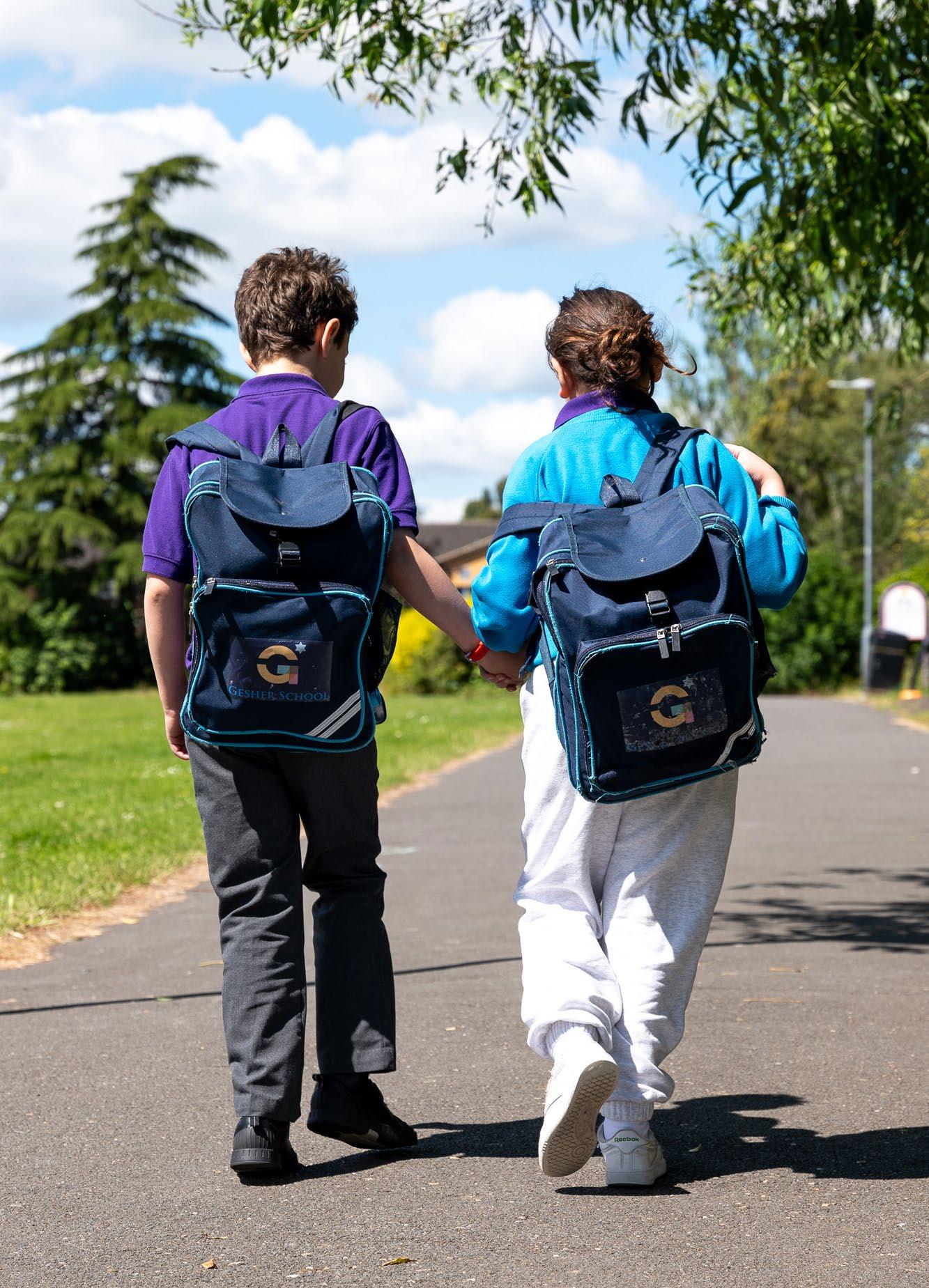
Gesher is both privileged and humbled that the Bridges life skills scheme has been made possible by working in collaboration with the Daniels family from the Pinner Jewish community in order to honour the extraordinary life of Sonya Daniels, their wife, mother and grandmother.
Sonya Daniels was passionately involved in education throughout her life with a love for teaching and a desire to help others. This saw her involved in numerous ventures and projects including working with children as one-to-one support in school, co-founding the Pinner synagogue’s Pre-Cheder (Sunday school), being a governor of the synagogue nursery, taking on the role as one of the lead educators hosting local schools when learning about Judaism, visiting the synagogue and volunteering with the Board of Deputies in their national schools education programme, and not least her active involvement in her own grandchildren’s lives.
Sonya not only loved teaching but she loved learning; she was not afraid to try new things. If it was something she was interested in or she identified a need, she put her creativity to the test learning Ivrit, taking courses in interior design, becoming a skilled patchwork quilter and qualifying as a trained hypnotherapist.
It is evident how important it was for Sonya to be an active part of her community and give to those around her who benefited from her love, passion and expertise. Part of our hope for our students is that they grow to be independent learners who are engaged and active in their communities. This life skills scheme is a living legacy of the core values that Sonya Daniels embodied.
She is and will continue to be an inspiration for our students and for many future generations of students, who we hope, like Sonya, will have the resources and tools to explore new skills, exciting opportunities and meaningful experiences as part of the journey they have chosen for themselves.
Gesher is a community of ambition built on relationships and compassion. We want each and every student to embark on an educational journey that will encourage them to learn, explore, discover and question the world around them as well as themselves as individuals so that as they navigate through life they are safe, happy and valued. Navigating this journey and everyday life can be challenging and we want to ensure that our students have the skills in order to do this successfully.
“ The World Health Organisation (WHO) have recognised the importance of these skills stating that life skills enable individuals to deal effectively with the demands and challenges of everyday life”.
In other words, life skills prepare an individual to live independently and productively within a society. They go on to say that these skills...
“...help people make informed decisions, solve problems, think critically and creatively, communicate effectively, build healthy relationships, empathise with others, and cope with and manage their lives in a healthy and productive manner.”
Acquiring life skills often occurs through modelling and spontaneous teaching as young people go about their daily routines, watching and learning from the adults around them, as well as their peers. Whilst life skills can be picked up through experience, young people need to be guided on this journey. The WHO have identified 10 core skills related to life skills:
•Self-awareness
•Critical thinking
•Decision making
•Coping with stress
•Coping with emotion
•Empathy
•Creativity
•Problem Solving
•Effective communications
•Interpersonal relationships
The purpose of Bridges has been to embed these soft skills in a scheme that creates opportunities for realworld experiences, enabling every student at all stages of development, to achieve independence and the effective tools to navigate the world.
Bridges: Foundation
At Gesher, our mission for our students links directly to preparing them for adulthood and for full engagement in the community.
“It is clear that learning life skills is important for all young people, but in particular, the government has ensured that schools have a clear duty when it comes to preparing young people with special educational needs and/or disabilities for adulthood.”
Children and Families Act 2014 and SEN and Disability Code of Practice 2015
When a student completes their Gesher journey, we want them to be ready to be an active part of the communities they wish to join, and be confident and passionate advocates; able to express their strengths, desires and needs in order to be successful in the workplace and the wider world.
Bridges is rooted in the four areas identified in preparing for adulthood and we have taken each area and broken it down to create eight accessible themes so that the journey to adulthood can start as soon as a student joins Gesher in the Early Years.
•Employment •Independent Living •Health •Community and Inclusion
Each badge focuses on particular content but also aims to develop the 10 core skills identified by the WHO as outlined earlier. This includes critical thinking, problem-solving, decision-making, communication and collaboration, as well as highlighting a commitment to personal and social responsibility.
Skilled for future workplace
Creative and effective communicators, problem solvers, and collaborators
Confident in their sense of self
Clear about their own direction, knowing their strengths and needs and able to advocate for others
Independent Learners
Skilled at managing their learning, thinking and emotions
Qualified for the next stage
With deep knowledge in academic and vocational disciplines.
Buliders of meaningful relationships
With healthy realtionships, friendships and trusted support networks
Ethical and responsible citizens
Understanding, shaped by Jewish faith & culture.
Making positive contributions to our community, society and the planet
and
Bridges: Foundation
Bridges reflects the individual and personal journey that each of our students will go on. For each badge, they will take four steps of challenge, broadly reflecting a student’s growing independence in that particular skill.
For every badge, there is a checklist of success criteria (found in part 2 of this handbook) that help students, school and home, identify the skill steps that are needed to achieve the badge. The success criteria have been developed through extensive research and drawing from the expertise of our Occupational therapists, Speech and Language therapists, Creative therapists and Educational Psychologist.
By step four, students are challenged to not only achieve independence but also complete the steps needed to take full responsibility for that skill as part of their daily life.




It is important to note that the different steps are not age-related but rather based on a child’s own stage of development at any given time and based on their individual skills and needs. They have been written to provide ample opportunities to guide the students from their primary phase into their secondary phase. The pathway to adulthood is not a linear one and students will navigate their own winding path. This scheme has been designed to ensure students are provided with new opportunities and experiences, and adults are able to guide and facilitate along the way.
As the students complete the checklist, whether at school as part of dedicated learning sessions, or at home, they will build a body of evidence to show their achievements which they will record in their own student portfolio. This may include them writing up their experiences, photos of them participating in various activities and/or factsheets and posters they create to show knowledge and understanding. These evidence pages are important for the students to reflect on what they have learnt and demonstrate what they have achieved, and over time lead to the completion of a step.
On completion, the student will be awarded badges which they will add to their journey map in their student portfolio, allowing them to visibly record their ongoing achievements as they follow each step along their life skills journey.
The students will have the chance to share their portfolio with their peers, teachers and family to celebrate their achievements.
The Bridges: Foundation scheme works alongside the curriculum, covering key elements of PSHE (personal, social and health education) and RSE (relationships and sex education), as well as supporting English and Maths.
The scheme is delivered in a way that is both experiential and practical, and compliments with Gesher’s Project Based Learning (PBL) approach. The teaching of life skills will be incorporated as part of the class projects as well as through weekly discrete life skills sessions. At Gesher, life skills are also focused on as part of our integrated therapies. Opportunities to further facilitate and practise life skills in the environment will be embedded throughout the day.
During whole class life skills sessions, each class will focus on different identified badges, which have been mapped out to ensure that every badge is covered at least once during the primary phase of their Gesher journey. The learning will ensure that students engage in authentic real world experiences, delivered through meaningful community experiences as well as use of our unique Life Skills hub, which mirrors a home environment. Further to this, there will also be exciting outreach opportunities to link with various organisations and charities.
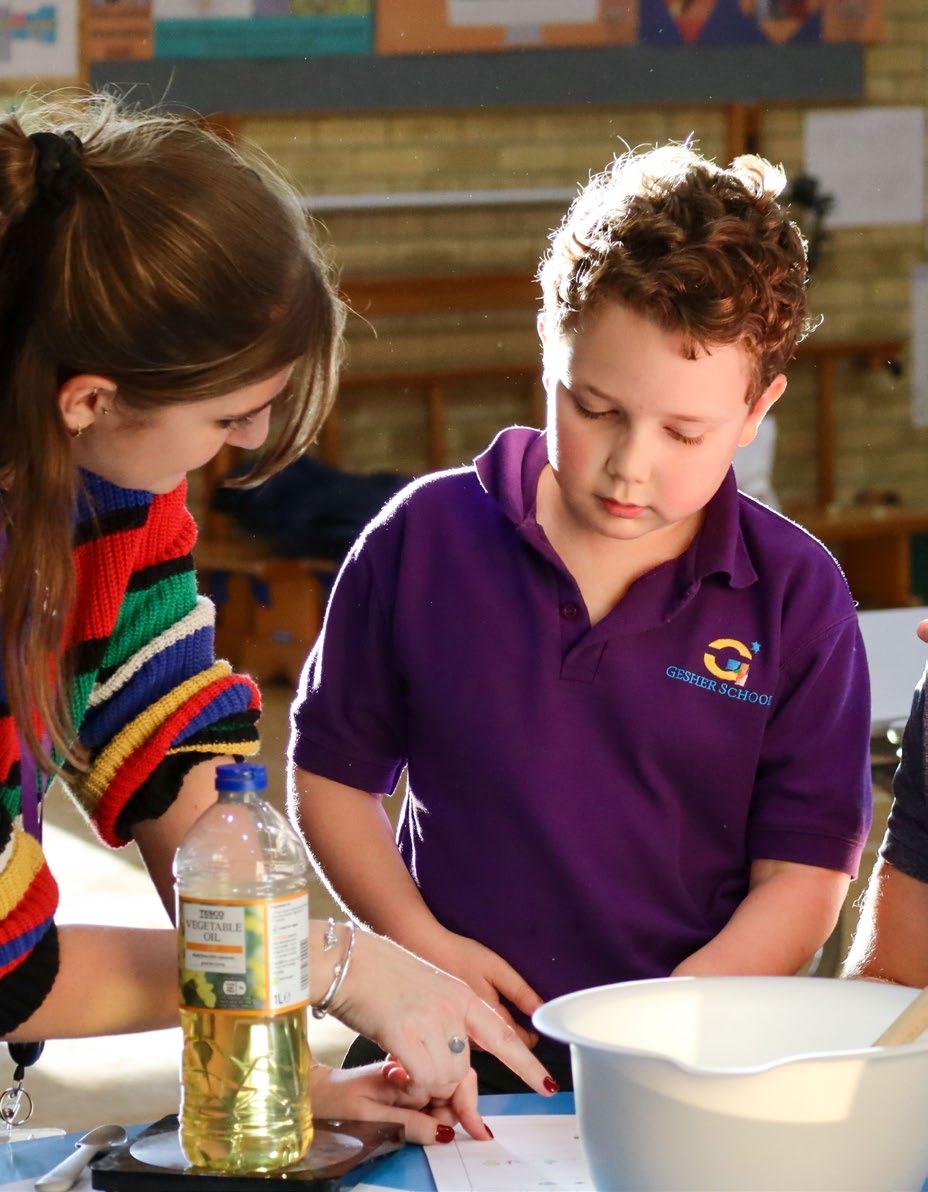
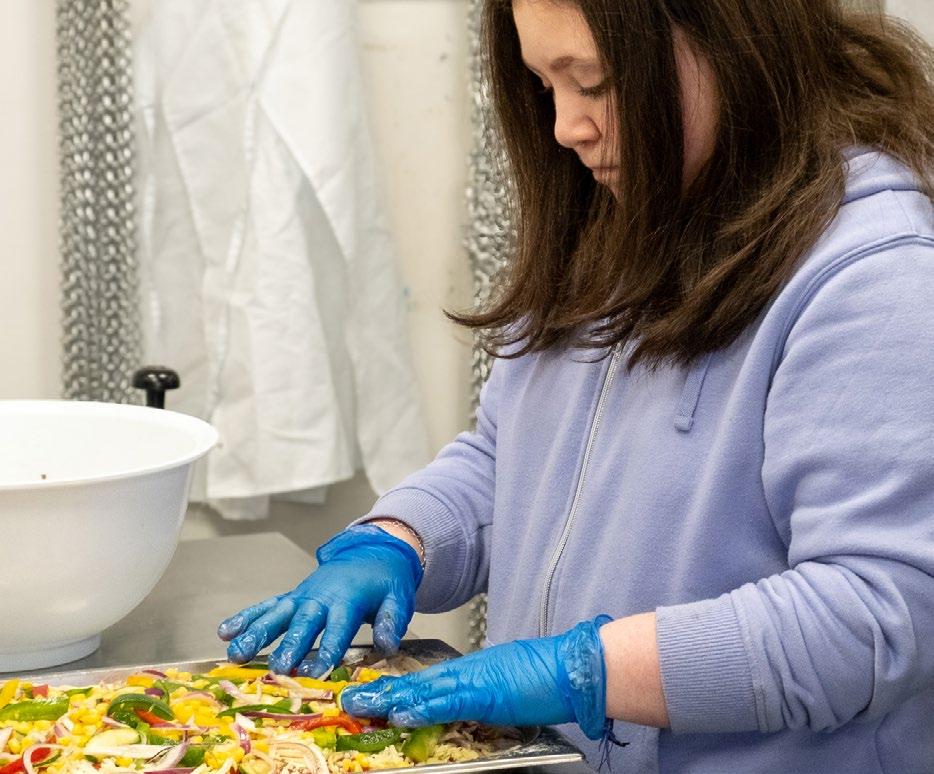
Our hub provides a space for practical learning but also for students to learn about the important theory linked to various life skills and be part of designing and planning. For instance, the theme ‘My Food’, not only ensures students get practical experiences in the kitchen involving using various equipment and tools, but also ensures they are learning about nutrition and then using critical thinking and problem solving to create healthy and sustainable meal planning.
“We
want our children to be intrinsically motivated to develop these skills and so it has been set up in a way that encourages the students to identify what badges they wish to achieve based on their strengths, interests and areas they wish to develop.”
Obtaining these badges at home and at school should be both meaningful and fun for all involved and open up new experiences for our students as they navigate their own individual journeys to adulthood.

“Hey there, life skills legends!”
Meet Gee, Gesher school’s very own lifeskills mascot. As our students progress through the different themes and badges, Gee is their guide to achieving all sorts of skills. Gee will be there all the way to help our students to work on different badges at home and at school.
Themes and individual badges.
The next part of this guide takes you through each colour coded theme and the success criteria for each badge so that staff, parents and students can understand what needs to be learnt and keep a record of each step as it is achieved.
Alongside this, students will complete their portfolio.
We look forward to taking steps on this journey together . . .
We want to ensure that students are given the opportunity to learn how to be safe in a variety of settings; at home, at school, when out and about visiting different places and when using technology, something that is particularly pertinent living in the digital age of the 21st century.
The world is there to be explored and enjoyed and we want students to be able to do this safely and wisely. Developing skills such as critical thinking, decision making and problem solving are a crucial part in keeping safe when interacting with the world around us and with other people, and what we hope our students will develop as they complete these badges.
I am aware of important signs for pedestrians (e.g. pedestrians only, no pedestrians, no access, footpath closed).
I can be a trusted person to help other people, including those younger than me, when walking in the street.
I can independently walk in the street safely when out on my own or with others I can be alert at all times to what is going on around me so I stay safe I can use my devices safely when out and about (e.g. I know not to use my phone when walking in the street).
I can hold the hand of my trusted adult to move safely in the street I can look ahead when I am walking and notice people and objects around me I can move out of other people’s way when I walk on the street and also be safe fron cars, bikes and scooters
I can hold the hand of my trusted adult to move safely in the street
I know that a green person/light means go and a red person/light means stop I can listen to my trusted adult if they tell me to stop
I can walk calmly and sensibly with my trusted adult.
Complete Step 3
Complete Step 2
I am aware of road signs for cars and pedestrians (e.g. traffic signals ahead, school crossing, icy road).
4 Crossing the road safely.
I know and can share with others the full Green Cross Code (6 steps) I can be a trusted person to help other people including those younger than me cross the road
I know several safe places to cross a road: traffic lights, pedestrian crossing, island crossing . ( NOT between parked cars or on corners). I can identify and find safe places to cross ( Flashing yellow beaacons for Zebra crossings, black and white road markings for crossings, traffic light signals at pelican crossing or yellow traffic island beacon).
I can independently cross the road safely when out on my own or with others
Complete Step 1
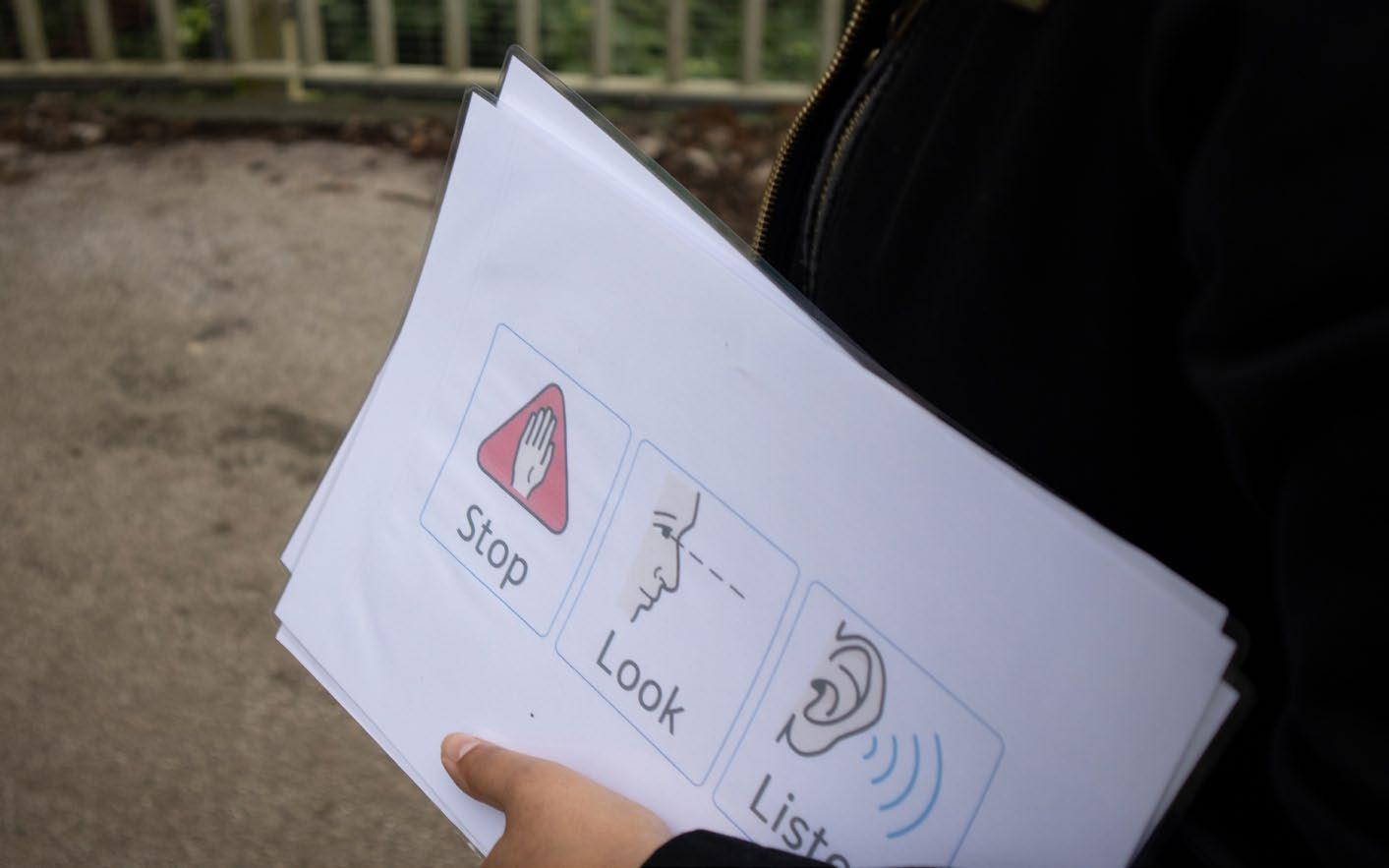
I can follow the rules of STOP, LOOK and LISTEN (part of the Green cross code). I can move out of other people’s way when I walk on the street and also be safe from cars, bikes and scooters I can spot traffic lights as a safe place to cross the road.
I can stop on the pavement near the kerb to be safe. I can make sure I am not near the road when walking in the street. I can make sure I am not near the road when walking in the street.
Complete Step 3
Complete Step 2 PLUS...
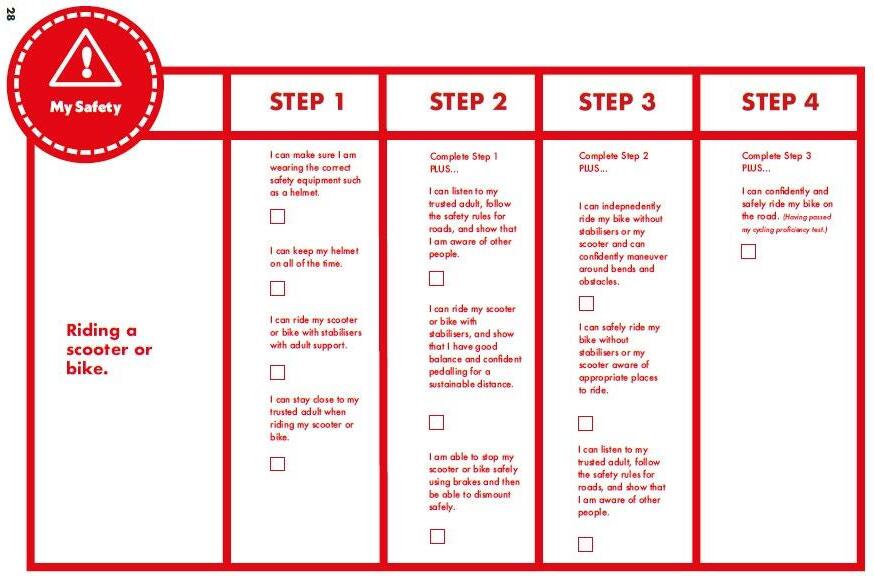
I can confidently and safely ride my bike on the road. (Having passed my cycling proficiency test.)
I can indepnedently ride my bike without stabilisers or my scooter and can confidently maneuver around bends and obstacles. I can safely ride my bike without stabilisers or my scooter aware of appropriate places to ride. I can listen to my trusted adult, follow the safety rules for roads, and show that I am aware of other people
Complete Step 1 PLUS...
I can listen to my trusted adult, follow the safety rules for roads, and show that I am aware of other people I can ride my scooter or bike with stabilisers, and show that I have good balance and confident pedalling for a sustainable distance I am able to stop my scooter or bike safely using brakes and then be able to dismount safely
I can make sure I am wearing the correct safety equipment such as a helmet
I can keep my helmet on all of the time I can ride my scooter or bike with stabilisers with adult support I can stay close to my trusted adult when riding my scooter or bike
Riding a
Complete Step 3
Complete Step 2
I know how to support someone who is injured or unwell whilst waiting for the emergency services. I know how to keep myself safe in a situation where adult assistance is needed.
Complete Step 1
I can independently call 999 and respond with the key information ( which emergency service is required, the location and appropriate detail about the person and incident). I can carefully follow any instructions that are given to me.
I can identify if someone is seriously hurt or needing help I can alert adults to help.
I can identify what the people in the emergency services look like I know and can identify what special vehicles they each drive I know what the main role of each emergency service is. I know that in an emergency we call 999 if someone is hurt or needs help.
Complete Step 3
I am confident in how to talk to people and share information safely and can model and teach those younger than me about being aware.
Complete Step 2
I can identify the appropriate people to share certain information with (in reference to Circles of Closeness).
I am aware of people I don’t know when I am out and know who I can and can’t talk to.
I can identify safe people in my community that I can approach if I need help (e.g. someone wearing a uniform or with an ID badge in a shop)
Complete Step 1
I can identify and name the people in family
I can identify who my trusted adults are (e.g. in my family, friends, at school and within my community).
I can respond safely if I am approached by someone when I am on my own and I do not feel comfortable, whether I know them or do not know them.
I know that I should not approach people that I do not know I know that if someone I do not know approaches me I must be alert or go to my trusted adult straight away I can greet people in my community that I do not know when I am with a trusted adult.
I can identify and name my teachers and the adults in my school I know these people are trusted adults that help me and who I can talk to
I can be a trusted person to someone younger than me to practice good hygiene and be safe in the kitchen.
I can show that I can safely and hygienically prepare food for another person.
I can follow good hygiene practice when handling food and utensils. (e.g. washing hands, no cross contamination).
I can safely clean equipment/utensils with sharp points or edges. I know where kitchen items belong and can help to keep them in the right place.
I can make sure that all appliances including ovens are switched off before leaving the kitchen.
I can walk sensibly in the kitchen to prevent hurting myself or others.
I can identify a number of hazards in the kitchen and can say why they are unsafe.
I can use suitable equipment that is safe for me to use when cutting or slicing food with adult support. (e.g. Child friendly knives).
I can make sure I ask an adult to help if I want to use any hot or electrical appliances.
I can wash my hands before touching any food in the kitchen. I can keep my hands away from my mouth if I am touching food. I can keep my hands away from dangerous appliances or utensils.
I can use protective equipment when touching hot food or appliances.
I know the signs and symbols on electrical items that are designed to keep us safe.
Complete Step 2 PLUS...
I know to keep water away from all electrical items. I can identify a number of dangers of electricity if not used properly.
4 . Being safe with electricity.
Complete Step 3 PLUS... I can use plugs and sockets safely making sure switches are off before putting in and taking out a plug. I know not to touch frayed or broken wires.
I know to turn off all appliances when leaving the room.
Complete Step 1 PLUS...
I know not to touch sockets with my fingers or any object. I know not to play around with switches, flicking them on and off. I can identify electrical appliances in school and at home.
I can identify where the on/off buttons are on electrical appliances.
Complete Step 3
I know how to report material or a situation I may come across that makes me feel upset or uncomfortable, and be able to tell a parent or trusted adult about the situation. I know never to authorise payment for something without checking with an adult first.
Complete Step 2 PLUS...
I can identify and use safety features on the internet (Such as when Chrome shows that a website is secure with a padlock symbol). I can be safe when playing online games and when playing with friends, I know not to speak to people I do not know in real life. If I use messaging on a device I know to use kind words and never to share things that may cause harm or upset others.
Complete Step 1 PLUS...
I can recognise what games or sites are okay for me to play by using the age ratings I am aware of unsafe material on the internet and I use websites and games that are safe using parental controls I know that I need to keep my passwords safe and not share I know never to share personal information online or gaming platforms
I can have fun playing on a device, making sure I only play games that my parents say are safe When I use sites like Youtube, I know a parent needs to supervise videos or games I might watch.
I can tell a parent about the games I can play when asked I can talk about what I do and see when playing on a device with a parent or trusted adult
I can tell a trusted adult if someone is hurt
I can independently and safely dress a wound using items from a first aid box
I can do the checks to assess if someone is breathing and know the appropriate next steps (e.g. check pulse, response, CPR etc).
I know the procedure for putting someone in the recovery position
I can notice and help an adult move possible dangers inside and outside I know basic first aid for burns, nose bleeds, applying dressings etc I know basic first aid for someone who is choking or vomiting.
I can identify places where I can find a first aid box I can notice possible dangers inside and outside and let an adult know I can help someone if they fall and take them to a safe place
I can check on someone if they are hurt to see if they need help
I know how to apply a plaster to a small cut or graze
Complete Step 1
I can be responsble for keeping myself hydrated, by drinking water when out and about
I can use a map and a compass to help navigate a route
I can safely make a successful fire with adult support I can pitch a tent with adult support
I can be eco-safe when exploring by keeping open spaces clean and tidy, using bins to throw rubbish away
I can be safe around roads and places where there may be cars or bikes
I can understand what different colours and symbols on a map mean and help to navigate a simple route with an adult.
I know not to pick up things from the ground that are dirty
I can wear the right clothing and equipment for different weathers I can be safe near water and not go too close
I can be safe near water and not go too close I know how to be safe in high places and not go to near the edge I know how to be safe in high places and not go to near the edge
I know not to put things from the ground in my mouth
I can stay with my trusted adult when exploring open spaces
I know not to touch wild animals or disturb ther habitats
I can enjoy flowers and trees by looking at them but not picking or breaking them
I can stay with my trusted adult when out and about
I can independently walk or use public transport with my parent’s permission and using a planned route to a destination. I can use a phone to let a parent know I have arrived and left a place so they know where I am I can be alert at all times to what is going on around me and keep my valuable items safe in my bag
I can keep all my belongings with me at all times when travelling
I can identify a safe place to go if I am lost recognising the signs for safe places such as an information point
I can go to a safe meeting place that has been agreed with my trusted adult if I get seperated from them I can identify people in the wider community who could help me when I am lost. (e.g. Emergency services).
I can be respectful to members of the public by moving out of the way and saying please and thank you.
I can hold a trusted adults hand when getting on and off public transport
I can stand in the right place when waiting for a bus or train (e.g. behind the yellow line).
I can identify a safe person to ask for help if I am lost (e.g. A parent with children, someone wearing a uniform etc).
I know the names of the people I am travelling with and can say what they look like. (e.g. hair colour, clothes etc).
A healthy body leads to a healthy mind.
Some of the badges within this theme focus on self-care skills involving fundamental everyday tasks that ensure we are ready to participate in our day to day activities. They not only support in developing fine and gross motor skills but also help in learning to plan, sequence and organise ourselves to successfully achieve a task.
Other badges found here promote the importance of being active in keeping our bodies healthy. Research has shown that regular exercise along with a balanced diet helps maintain a healthy, positive sense of physical and mental wellbeing.
Bod y
Complete Step 3
Complete Step 2
I can clean up after brushing my teeth making sure I clear up any mess and rinse the sink.
Complete Step 1
I can independently and effectively clean my teeth for 2 minutes twice a day ( with visuals if needed, to prompt me to brush all parts of my teeth).
I can keep my teeth healthy by flossing regularly.
I can explain why it is important to brush your teeth and demonstrate how to do it.
I can neatly put all items back in the correct place.
I know how to keep my teeth healthy through what I eat.
I can be eco-friendly in my use of water (not leaving water running).
I know my teeth are important for eating.
I can brush my teeth for a full 2 minutes using timers and/or other motivating aids.
I can brush my teeth using a circular motion to brush my gums, with adult prompting to guide which direction to brush.
I can put the toothpaste onto my toothbrush and put the lid back on the toothpaste.
I can put my toothbrush back in its place.
I can open my mouth wide so that a trusted adult can clean my teeth.
I can independently hold a toothbrush with a firm grip.
I can use a toothbrush in my mouth for a short time with adult support (Hand over hand).
Brushing my teeth.
I can let the adult finish brushing my teeth so I brush for 2 minutes.
STEP 1 STEP 2 STEP 3 STEP 4
Complete Step 3
Complete Step 2
I can explain and show someone else the steps of how to wash their hands using soap.
I can explain why it is important to wash our hands.
I can independently wash my hands before food, after the toilet and whenever they are dirty (using visual cues as reminders if needed). I can thoroughly wash my hands (for at least 20 seconds) being careful to wash each part including nails and in between fingers.
Complete Step 1 PLUS...
I can wash my hands using soap with adult prompting before I eat food and after going to the toilet.
I can turn on the cold tap on my own. I can wash my hands using soap with adult modelling and support before I eat food and after going to the toilet.
I can see when my hands are dirty and know I must wash them.
Bod y Washing my hands.
4
Complete Step 3 PLUS...
Complete Step 2 PLUS...
I can independently go to the toilet without needing prompting from a schedule or adults. I can independently wipe and clean myself after going to the toilet.
Complete Step 1 PLUS...
I can follow my schedule to go to the toilet throughout the day. I can wipe after going to the toilet with an effective use of paper.
I know when I need to go and can tell someone that I need to use the toilet. I can sit on stand by the toilet on my own using any equipment to help me and with some adult prompting. I can try and wipe myself with a trusted adult to check.
I can keep the toilet clean when I use it and clean up after me if needed. STEP 1 STEP 2 STEP 3 STEP 4
Bod y Going to the toilet.
Complete Step 3 PLUS...
I can be responsible for keeping my hair clean and tidy: know when it needs washing, needs tying up, needs to be cut. I can independently go to get my hair cut at the hairdressers.
Complete Step 2 PLUS...
I can independently brush my hair and take responsibility to brush my hair everyday. I can independently wash my hair with shampoo and conditioner as needed in the bath or shower. I can independently use a hair dryer. I can go to the hairdressers to have a hair cut with an adult supporting me.
Complete Step 1 PLUS...
I can try to brush my hair on my own as well as someone brushing my hair for me. I can rub shampoo in my hair with adult support using the bottle and with adult prompting then wash it off. I can keep my hair off my face and let someone tie it up if needed. I can help an adult dry my hair (towel dry and/or with a hair dryer).
I can let someone brush my hair everyday. I can let a parent wash my hair using any equipment to help (e.g. toys/aids to keep water off face).
2
Complete Step 3
Complete Step 2
I can be responsible for making sure having a bath or shower is part of my routine.
STEP 1
Complete Step 1 PLUS...
I can get everything ready that is needed to wash my body: soap, sponge etc.
I can independently wash the different parts my body.
I can independently dry myself with a towel.
I can name some of the parts of my body that need washing. (arms, legs, tummy, face).
I can use a sponge to wash my body with adult prompting (naming the parts of my body).
I can help a parent get me dry with a towel.
I can have a bath or shower when my parent tells me to. I can hold a sponge to help wash my body, with adult hand over hand support. I can let an adult get me dry with a towel.
I can run myself a bath or turn the shower on independently making sure it is set at an appropriate temperature. I can independently wash all the different parts of my body thoroughly including those that are difficult to reach like my back. STEP 1
Complete Step 3
I can devise my own fitness routine containing exercise for all areas of the body.
Complete Step 2
Complete Step 1 PLUS...
I can demonstrate an improvement in my fitness over time (e.g. participate in movement activities for a longer time).
I can explain the different reasons why exercising is important and motivate others to join me.
I can demonstrate to others an exercise routine which involves using whole body movement.
I can follow a fitness routine without using visual prompts. I can take responsibility for exercising regularly and demonstrate the positive impact it has on my well being.
I can warm up and cool down by stretching before doing exercise or a movement activity. I can make sure I am active regularly at school in the playground and also at home inside or outside. I can follow a fitness routine following visual and verbal prompts.
I can move my body in a range of different movement activities: walking, running, scooting, climbing, swinging, etc. (so I can feel my heart beating faster in PE or outside activities.)
I can participate in shake breaks when needed.
I can identify a movement activity that I enjoy and participate in the activity of my choice with adult support.
Having a bath or a shower
Complete Step 3
I can commit to participating in a sport and establish a routine of practice.
I can think of new training exercises that will benefit my chosen sport and demonstrate them.
Complete Step 2
I can participate in an individual, team and/or competitive sport, with at least one involving regular and ongoing participation. I can research key skills for my chosen sport and practice for a certain amount of time once a week. I can support and encourage my peers when practicing new skills.
I can demonstrate my new skills learnt from participating in my chosen sport.
Complete Step 1
I can participate in my chosen sport with adult support over a short period of time.
I know what equipment I need for my chosen sport. (football, racket, swimming float, etc).
I can identify suitable clothing and equipment for my chosen sport with adult support.
I can give my chosen sport a try at least once.
I can understand the object of the game and can comply to the rules.
I can participate in more than one chosen sport over a period of time.
I can understand that I may not always win and can show respect to an opponent.
I can independently select suitable clothing and equipment for my chosen sport.
Complete Step 1
I can plan a journey and confidently ride my bike/scooter to a destination making sure I keep to safe pathways.
I can independently ride my bike/scooter, without stabilisers and navigate bends and obstacles.
I can put on my safety equipment independently.
I can use my scooter/ bike (balance or with stabilisers) to glide a short distance using both feet to push off on a bike and one foot on a scooter. I can travel on my bike with stabilisers using the pedals.
I can balance on a scooter/bike (balance or with stabilisers) whilst being pulled along. I can put on my helmet (and any other safety equipment) with some adult support.
I can stop my bike/ scooter using the brakes. I can travel on my bike with stabilisers using the pedals.
I can wear my helmet at all times to keep me safe when I travel on a bike/scooter. I can safely dismount my bike/scooter.
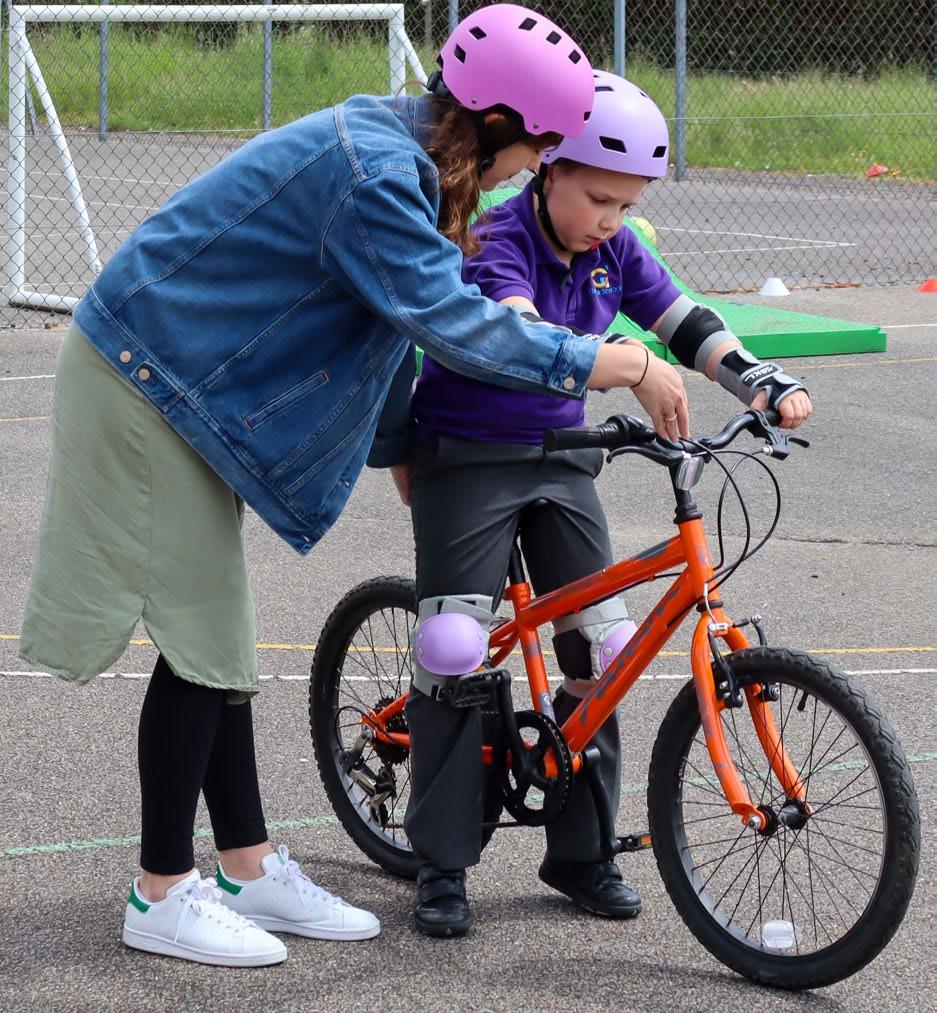
Learning to ride a scooter or bike.
Complete Step 2
I can confidently swim at least 50 metres using a range of strokes such as crawl, backstroke or breaststroke.
Complete Step 1
I can swim at least 25 metres using crawl, breaststroke or backstroke.
I can swim underwater at least 15 metres.
I can dive underwater to retrieve items from the bottom of deep water.
I can dive underwater to retrieve items from the bottom of deep water.
I can keep afloat in deep water. I can swim with my head under water for short periods of time. I can tread water in deep water. I can jump safely into water and I am aware of others in the water.
I can dive underwater to retrieve items from the bottom of water you can stand up in.
Complete Step 2
I can use a basic crawl to swim at least 10 metres without using a flotation aid.
I can swim on my back with a flotation aid for at least 10 metres. I can put my head under water for at least 3 seconds. I can get in and out of the water safely.
I can splash in the water with floatation aids. (with support from my trusted adult). I can kick my legs and move my arms to help me move in the water (with the support of a floatation aid). I can get my hair wet in the water.
I can blow bubbles in the water.
I can float on my back for a few seconds.
I can hold my nose and dip my face in the water. I can walk safely by the water.
Complete Step 1
I can support someone else’s communication using their preferred method (e.g. using their device, makaton, BSL or different language).
I can support restorative practice between peers. I can communicate via my words or device to share a range of feelings with adults and peers. I can take part in restorative practice with peers with some adult facilitation.
I can effectively communicate via my words or device to explain to an adult or one of my peers my preferences and ideas.
I can communicate with my preferred method of communication to tell an adult what I need or want. I can use signs, pictures or words to let someone know how I’m feeling and with adult support say why I am feeling this way. I know to use a different volume of voice when indoors rather than outdoors.
I can use body language and signs to show what I want (e.g. pointing, making sign for object).
I can identify key word/object using pictures or device. I can use my to voice in different ways dependent on a situation.
Complete Step 3
Complete Step 2
I can identify when I am too hot or too cold and respond to help me cool down or warm up (remove jumper, have a drink of water, wash my face with cold water, open a window OR put on extra clothes, run around).
Complete Step 1
I can look at the weather forecast and plan my clothing appropriately.
I can identify when I am too hot or too cold and respond to suggestions an adult makes to help cool down or warm up.
I can help my trusted adult select my clothes according to the weather. I can respond to an adult’s suggestions to help me warm up or cool down.
I can name different items of clothes and match clothes to different weathers.
I can tell someone if I am feeling too cold or too hot using words and/or actions.
Continuing in the same vein as healthy bodies, this theme concentrates on the role food has in keeping our bodies and minds healthy. We want our students to be able to understand the importance of food for our health and be able to make positive choices in leading a healthy lifestyle.
Food can also bring a lot of joy and exploring different foods gives us a chance to experience the world using all our senses. Many of these badges will develop the skills needed to prepare and make our own food as well, providing opportunities to share that experience with other people when coming together to eat and enjoy their own creations.
Complete Step 3 PLUS...
I can regularly prepare my own breakfast independently.
Complete Step 2 PLUS...
I can independentlyand safely make my own breakfast, choosing from a warm or cold option (e.g. cereal, salad, toast, scrambled egg).
I can independently make breakfast for at least one other person and tidy and clean all equipment and surfaces. I can make one part of breakfast from scratch (e.g. pancakes, hash browns, muesli).
I can prepare food and clean up in an environmentally friendly way (e.g. not wasting food, recycling appropriately).
I can find and organise all the food needed from various places in the kitchen ( e.g. the cereal from the cupboard and milk from the fridge). I can tidy up the kitchen after preparing breakfast by washing plates, cutlery, wiping surfaces clean and sweeping and putting food away.
Complete Step 1 PLUS...
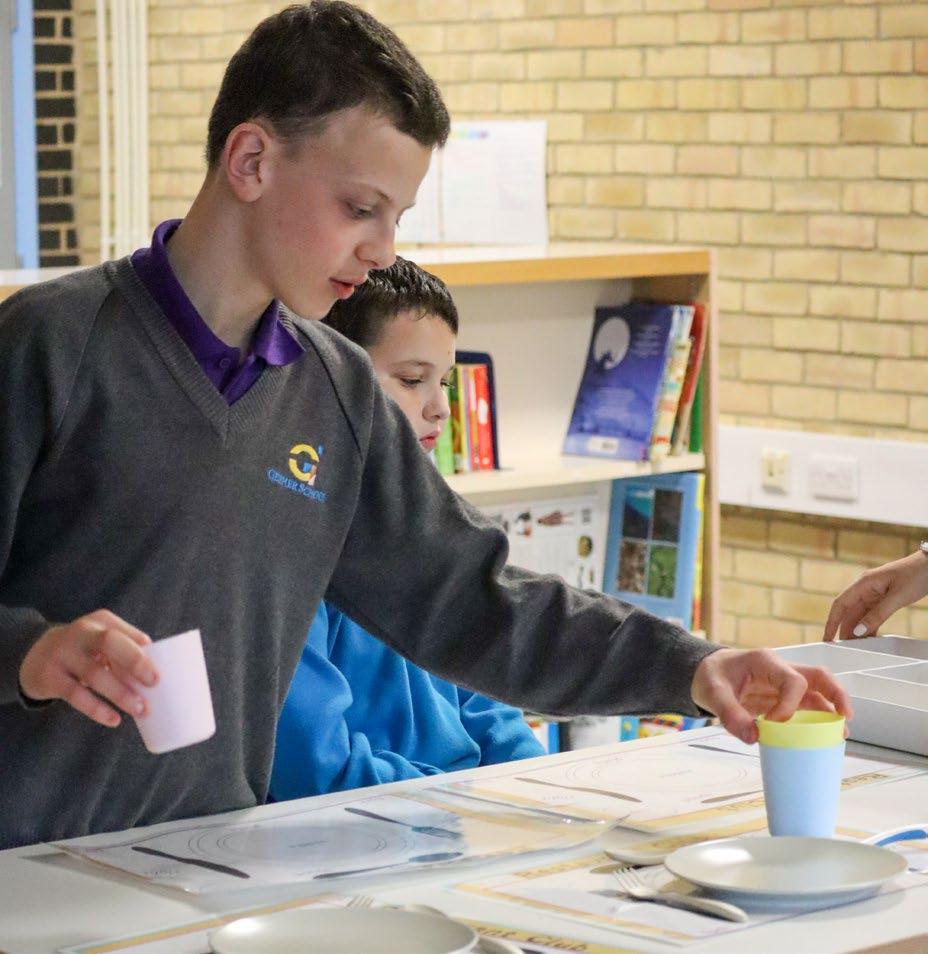
I can independently get my bowl/plate and cutlery ready and laid on the table.
I can choose what to eat for breakfast when given choices to select from.
I can make my breakfast with some adult support (including pouring, spreading, cutting, whisking etc).
I can clear my crockery and cutlery after eating breakfast.
I can help prepare my breakfast by getting my bowl/plate and cutlery ready with adult support. I can help make my breakfast with at least one part of the process with adult support (e.g. pouring the milk in the bowl or putting the bread in the toaster).
Complete Step 3 PLUS...
I can independently adapt a recipe by replacing one or more ingredients (e.g. swapping fruits, types of chocolate etc).
I can bake something for a special occasion (e.g. a birthday).
I can use specialist kitchen appliances for baking with some adult supervision ( e.g.electric mixer, waffle maker, food processor etc).
Complete Step 2 PLUS...
I can independently follow a recipe to bake some goodies.
I can use the oven safely, using gloves/mitts with minimal adult supervision.
Complete Step 1 PLUS...
I can help an adult prepare the oven for baking. (e.g. setting the right temperature, setting the timer).
I can choose what I would like to bake from a selection of options with adult support.
I can tidy up the kitchen after baking by wiping surfaces clean and sweeping.
I can follow a recipe and bake something I would like to eat with minimal adult support.
I can use a manual or electric whisk to beat eggs with adult support.
I can safely and confidently use a wide variety of utensils ( e.g. spatula, rolling pin, whisking, knives).
I can safely use various utensils with adult supervision ( e.g. spatula, rolling pin, whisking, safety knives).
I can be prepared to handle baking ingredients (e.g. hands clean, fingernails short, apron on).
I can get other utensils ready (e.g. tins, trays, cases, moulds, cooling trays).
I can help with at least one part of the process of baking, with adult support (e.g. using skills measuring ingredients, rolling out dough, stirring and mixing).
Complete Step 3 PLUS...
I can regularly prepare my own and other people’s snacks independently.
I can offer suitable options for a snack and make up a balanced snack plate with a variety of foods. I can prepare food and clean up in an environmentally friendly way (e.g. not wasting food, recycling appropriately).
Complete Step 2
I can independently choose what I want for snack and get all the necessary crockery and cutlery ready. I can get all the necessary food ready from their various places in the kitchen. I can independently and confidently prepare my snack using a variety of practiced skills. I can take responsibility for tidying up the kitchen after preparing a snack (e.g. packaging in the bin, utensils in the sink or dishwasher).
Complete Step 1 PLUS...
I can choose what I want for snack from a selection of options.
I can independently get my bowl/plate and cutlery ready and laid on the table. I can help an adult making a snack such as a sandwich (e.g. opening, spreading, cutting and stirring with minimal adult support).
I can independently get my bowl/plate and cutlery ready and laid on the table.
I can choose what to eat for snack when given two choices to select from. I can get my bowl, plate and cutlery ready with some adult prompting. I can help an adult making a snack such as a sandwich using key skills (e.g. opening, spreading, cutting and stirring with adult support). I can throw my rubbish in the bin after finishing eating my snack.
I can use specialist kitchen appliances with some adult supervision (e.g. toaster, waffle maker, sandwich grill etc). STEP 1 STEP 2
Complete Step 3
Complete Step 2
I can independently prepare drinks for a number of people.
I can independently use a kettle to prepare hot drinks, asking for help if needed.
I can make a smoothie preparing different fruits and vegetables and using tools such as a blender.
Preparing my snack.
Complete Step 1
I can independently choose and regularly prepare my own drink. I can independently open bottles or pierce a straw and pour my drink carefully.
I can choose what to drink when given two choices to select from.
I can choose my drink from different options and get my cup ready and anything else from their place in the kitchen (e.g. bottle, straw from cupboard or fridge). I can open bottles or pierce a straw with some adult support.
I can clear up any spillages. I can independently navigate carrying my drink along with other items to where needed.
I can pour my drink with minimal adult support.
I can carry my drink carefully to where needed.
I can get a cup from its cupboard with adult prompting.
I can fill up my cup with water from a tap or pour from a jug with adult support.
Complete Step 3 PLUS...
I can find a recipe that incorporates two different fruits and vegetables and independently prepare a meal using them. I can expand my known fruit and vegetables that I eat by trying at least one new fruit and vegetable as part of exploring foods or as part of a meal.
Complete Step 2 PLUS...
I can eat at least two-three different fruits and two-three different vegetables so that I eat my ‘5 a day’.
I can explain about the health benefits of different fruit and vegetables.
Complete Step 1 PLUS...
I can identify and name a wider variety of different fruits and vegetables.
I can identify and name up to 5 different fruits and vegetables from pictures.
I can identify a meal that contains some fruits and vegetables that I have explored. I can choose at least one fruit and one vegetable to eat that will be on my safe food list.
I can choose at least one fruit and one vegetable to explore through touch and smell.
I can choose at least one fruit and one vegetable to taste.
F ood Eating fruit and vegetables.
STEP 2 STEP 3 STEP 4
Complete Step 3 PLUS...
I can find a recipe that incorporates two different new foods and independently prepare a meal using them.
STEP 1
Complete Step 2 PLUS...
I can choose different foods to try and expand my safe food list. I can eat a variety of foods in my diet. I can explain about the health benefits of different foods.
Complete Step 1 PLUS...
I can identify and name a wider variety of foods I like. I am willing to taste a few foods (choosing one food at a time). I can choose at least one food to eat that will be on my safe food list.
I can identify at least three foods that I like. I am willing to explore a few foods through touch and smell (choosing one food at a time).
I can identify three foods that I don’t like.
Trying new foods.
2
Complete Step 3 PLUS...
I can go to the shops and independently navigate around the shop to find the items needed using signs to help or asking for help. I can select the item needed considering size, quantity, quality and price the item.
I can work out the change that I need and check it when it is given to me.
I am confident to pay for shopping using various means: cash, contactless, chip & pin.
Complete Step 2 PLUS...
I can independently create a shopping list of items needed for home or a specific purpose (e.g. make a recipe).
Complete Step 1 PLUS...
I can create a short shopping list with some adult support.
I can help a trusted adult at the shops with at least one part of the shopping (e.g. selecting the item from the shelf, putting it in the trolley, pushing the trolley, putting items into the bag).
I can go to a familiar shop with a trusted adult and find items from the shopping list.
I can use a visual/written shopping list to select and match the right food and quantity (e.g. 3 apples, 2 bananas, 1 carton of milk).
I can select the food needed considering size, quantity and quality of item. I can independently select the right coins to pay with when given the total cost. I can check the change given to me (e.g. using the information given to me or using the cash register display).
I can count out the correct coins recognising coins up to £2 (with adult support to identify notes).
I can ask a shop assistant where a certain item might be in the supermarket.
I can use a visual or simple shopping list to identify what food to buy (at least 3 items).
I can identify where my local supermarket is.
I can identify coins up to £1 (Helping an adult count out the coins).
I can use kitchen applioances safely (e.g. microwave, oven, blender).
I can prepare my own dinner independently on more than one occasion. I can independently prepare dinner for at least one other person and tidy and clean all equipment and surfaces.
Complete Step 2 PLUS...
I can independently select the necessary equipment and food needed following a recipe/instructions.
Complete Step 1 PLUS...
I can independently choose what I want for dinner and get the necessary crockery and cutlery ready.
Complete Step 3 PLUS... Making a hot meal.
I can independently and safely make my dinner following a recipe showing confidence in my skill with adult supervision as needed
I can accurately measure ingredients using different measures such as scales, measuring jugs or cups.
I can independently prepare dinner for at least one other person and tidy and clean all equipment and surfaces.
I can tidy the kitchen after preparation (e.g. putting food back and equipment in the sink or dishwasher).
I can find and organise ingredients from the various places in the kitchen (e.g. vegetables from the fridge, seasoning from the cupboard).
I can choose what to eat for dinner when provided with choices. I can help prepare my dinner by getting my bowl/plate and cutlery ready with adult support.
I can follow visual instructions/recipe with some adult support.
I can join in with an adult to prepare at least one part of a meal (e.g. stirring, chopping, mixing with support).
I can take part in different stages of making a meal alongside an adult (e.g. measuring, cutting, chopping etc).
I can identify what is next following visual instructions recipe with adult support.
Complete Step 3
Complete Step 2
I know how to use the food groups to plan a healthy meal and independently prepare that meal.
I can identify the health benefits of groups of foods (e.g. Protein for muscle function, calcium for bones/teeth, carbohydrate for energy, omega 3). I can identify which foods are high in protein, carbohydrate or cholesterol and how that can impact on my health.
Complete Step 1
I know how to use the food groups to build healthy meals with some adult support.
I can explain about the health benefits of different foods. I can make healthy choices when choosing food to eat.
Complete Step 3
Complete Step 2
I can join in a sustained family conversation at the table where everyone gets a turn to share or speak. I can choose and book a restaurant for a special occasion considering people’s preferences.
I can identify and group different fruits and vegetables.
I can independently identify and sort different foods into the five main food groups.
I know and can identify certain foods I need to eat more of in my diet and other foods, such as those containing sugar that I need to eat less of. I can learn about different foods by helping with the shopping and/or cooking.
I can identify ‘sugary’ foods which are considered ‘treats’.
I can identify main protein foods such as chicken and eggs and dairy foods such as milk and cheese.
Complete Step 1
I can ask for the menu and order my food with the waiting staff confidently and respectfully. I can tell the waiting staff if I have any dietary requirements eg. nut allergy, gluten free. I can join with my family for the duration of a meal when in a restaurant (taking breaks as needed). I can join in a family conversation by responding to specific questions.
I can select the food and drink I want using the menu to guide me.
I can ask for help choosing something that I would enjoy.
I can take part in a suitable activity with an adult when in a restaurant (e.g. stickers, colouring, card game).
I can communicate in which way I choose if I need to take a movement break or get some fresh air.
I can sit with my family to eat a meal together at home. I can wait till I have finished my meal before leaving the table. I can sit with my family in a restaurant or café for a short period of time whilst having a drink and/or eating a snack and cheese. I can use the activities/tools given to me to support me if I am feeling restless or I need entertaining.
Complete Step 3
I can help others to cut up their food and support them in learning how to independently use cutlery.
Complete Step 2
I can independently eat with both a fork and a knife using my knife confidently to cut up my food.
I know how to leave my cutlery once I have finished eating.
I can select the most appropriate cutlery for the food I am eating.
Complete Step 1
I know where in the kitchen I can find the cutlery I need.
I know which items of cutlery are required for a place setting and can lay them out on the table with minimal adult support.
I can eat with a spoon, scooping food on to my spoon with the help of my other hand or an adult (e.g. using spoons that have a supportive shape and grip to help me as needed). I can spread using a knife with adult support.
My Self
Elements of this theme allow students to complete further self-care skills but the essence of this theme goes beyond just the practical tasks we can do for ourselves and provides students with the opportunity to explore further who they are; their wants, needs and desires. We want to encourage our students to learn about all the different aspects of their identity and have the confidence and pride to be themselves and share that with others.
It is crucial that our students are able to advocate for themselves effectively when exploring and discovering their place in the world and building positive healthy relationships with those they meet on the way, both socially and professionally.
Complete Step 3
Complete Step 2
I can take responsibility for getting myself dressed as part of my daily routine.
I can independently choose and organise appropriate clothes for the day considering what I am doing for the day considering special activities or events that need specific or additional clothing.
STEP 1
Complete Step 1
I can independently choose and organise appropriate clothes for the day considering personal preferences and the weather. I can get dressed independently. I can use a variety of fastenings independently (e.g. zip, poppers, velcro, buttons).
I can help an adult choose the appropriate clothes by looking outside to help me decide. I can get dressed with minimal adult support and prompts. I can use more than one type of fastening with some adult prompting.
I can select at least one preferred item of clothing when given a choice. I can put on at least one item of my clothing where I take the lead and with only minimal adult prompting if needed. I can put on other items of clothing with support from an adult. I can use at least one type of fastening with some adult support or prompts (e.g. zip, poppers, velcro, buttons).
Complete Step 3
Complete Step 2
I can help others tie their laces.
I can explain and show others the steps to tie your laces. I can make sure I am wearing appropriate footwear for different occasions or activities.
I can independently put my shoes on all of the time. I can tie my laces independently from start to finish.
Complete Step 1
I can put my shoes on with some adult support and prompting. I can independently fasten my shoes with Velcro pulling the straps tightly to fit. I can tie my laces by completing the first two stages independently ( e.g. tie the knot and make loops).
I can place my shoes in the correct position of left and right. I can help an adult put my shoes on by pushing my feet into each shoe. I can fasten my shoes with Velcro with minimal adult support.
Putting on my clothes.
Putting on my shoes.
Complete Step 3
Complete Step 2
I can independently choose and organise appropriate outdoor clothing for the day considering activities that need specific items of cloting or protection. I can help others with their outdoor clothes and fastenings.
Complete Step 1
I can independently choose and organise my outdoor clothes using the weather to help determine what is needed.
I can put my coat on independently using my preferred method.
I can independently fasten my coat using any fastenings.
I can name items of outdoor clothing.
I can help an adult choose the appropriate outdoor clothes by looking outside to help me decide.
I can put additional items on with minimal adult support such as my hat or scarf. I can independently choose and organise my outdoor clothes using the weather to help determine what is needed.
I make sure I go to bed at a reasonable time considering what is planned for the next day. I can prepare and organise my room so it is optimal for me to sleep (e.g. consider lighting, bedding, specific items needed).
I can set an alarm for the following day.
I can independently follow my bedtime routine at the agreed time using checklists or organisers as needed.
I can organise all equipment needed such as toothbrush and toothpaste, pyjamas, etc.
I can independently choose and engage in appropriate calmer activities leading up to bedtime.
I can identify appropriate clothing for different seasons.
I can put on my coat completing two parts with some adult support: putting arms through and then pulling up zip with both hands.
Preparing to go outside.
I respond to my trusted adult to start my bedtime routine. I can follow my bedtime routine with minimal adult support. I can take part in calmer activities leading up to bedtime when given choices.
I can identify the different parts of my bedtime routine and identify what part of the bedtime routine is happening now and next (e.g. bath, pyjamas, brush teeth, story, talktime, lights out, sleeptime).
I can follow a step by step visual schedule of my bedtime routine with adult support.
I can help choose my bedtime clothes and help my trusted adult to put them on with adult support.
I listen when it is time for lights out and know that sleep time means quiet time.
Preparing for bedime.
Complete Step 3
Alongside an adult, I can identify a number of key skills required for a particular role, link them with the learning and opportunities at school.
Complete Step 2
Complete Step 1
I have one or two specific ideas of what I would like to do in the future.
I can identify the key areas I need to focus on to develop to help me achieve this role.
I have carried out research into the area or role I wish to pursue.
I can create a simple plan of the steps needed to achieve a role with adult guidance.
I have participated in opportunities to experience different positions of responsibility.
I have participated in extended work experience to practice and develop workplaced skills.
I can identify different jobs that adults do.
I can think about and name what I would like to do/be when I am older.
I know at least one piece of information that explains what the role involves (e.g. ‘I want to be a vet. They look after animals and make sure they are well’).
I can identify and choose different jobs or activities that I enjoy doing. I can identify and choose the jobs and activities that I would like to try.
Exploring my future.
Complete Step 3
Complete Step 2
I am aware and respectful of others when they are having time to relax or be by themselves.
Complete Step 1
I can independently identify and choose a number of activities or strategies that help me to calm and bring me back to the green zone. I can identify when I need some space or time to myself and independently engage in any of my identified activities/spaces. I am aware and respectful of others when they are having time to relax or be by themselves.
I can identify and engage with spaces or activities that make me feel relaxed with adult support.
I can choose one calming activity when given a choice using visuals if necessary (e.g. mindful colouring, listening to relaxing music, sensory lights).
I can use exercises to help me relax with adult support, such as lazy 8 or mindful breathing lying down or sitting.
I can engage in a mindfulness activity or session with adult support.
Complete Step 3
I can independently play, or be engaged in an activity of my choosing for an extended time (beyond 30 minutes).
If I need help I can first try and problem solve on my own before asking an adult.
Complete Step 2
I can independently choose and organise a toy or game independently and enjoy it on my own for at least 30 minutes. I can independently tidy up after my play before moving onto another activity or getting any further equipment out.
Complete Step 1
I can suggest a toy or game to play with when I need to play on my own with some adult prompting if needed. I can set up a simple game on my own and play with it for up to 20 minutes. If I need help I can ask an adult and then continue on my own.
I can choose a toy or game to play on my own when given a choice of no more than three (using visuals if needed).
I can set up the game with some adult support. I can play with the toy or game for at least 10 minutes on my own.
I can help an adult tidy up after my play.
I can tidy up after my play with adult prompting.
Playing on my own.
Complete Step 3
Using restorative practice, I can effectively explain my point of view and begin to problem solve with my peers to explore possible solutions.
Complete Step 2
When faced with a challenging situation, I can explain to and adult or my peers what I need and/or want (e.g. I have and an argument with my friend over a game). As part of restorative practice with an adult, I can explain to others what I need or want to help problem solve (e.g. when frustrated with a game letting my peers know that I want them to listen or that I want to stop playing and be on my own).
Complete Step 1
I can spontaneously let an adult know what I need (visuals may still be needed to confirm what is needed or provide more information). I can use extended language to communicate needs, whether spoken or using a device (e.g.‘I want/need to go to the toilet, please’).
I can let an adult know what I need by making a choice using visuals and/or using gestures. I can use the modelled language provided by an adult to express a short phrase whether spoken or with a device (e.g. ‘I want the blue teddy’).
Sharing my needs.
Complete Step 1
I can identify a variety of emotions: pride, concern, apprehension, giving examples of my experiences. I can manage my emotions with an increasing awareness of my body’s cues and able to identify an appropriate strategy to support regulation, with adult support as needed. As part of restorative practice, I can explain to others how I felt and how I am feeling now and the reasons for it.
I can independently say how I am feeling (e.g. using ZoR).
I can let an adult or peer know how I am feeling and explain why I am aware when I am feeling different emotions and can identify my body’s responses (e.g. heart beating faster, face feeling hot).
I can choose strategies that will help me to regulate with adult support, and visual cues as needed.
I can identify a range of emotions with visuals to support where needed. I can select and express how I am feeling, when given choices or adult prompting (e.g. use of ZoR). I can choose a regulating strategy from choices given.
I can identify up to five different emotions using visuals (e.g. sad, happy, tired, excited and angry). I can select how I am feeling when given visual choices (e.g. use of Zones of Regulation)
Complete Step 2
I can identify how someone is feeling and offer them appropriate support: for example, if someone is sad checking they are okay or if they are angry giving them space. As part of restorative practice, I can actively listen to someone else sharing their emotions and work with them to identify a suitable resolution for all involved.
Complete Step 1
I can identify how someone is feeling and give an appropriate response such as giving a sibling a hug if they are hurt or giving a high five to a friend who has achieved a certificate.
I can recognise if someone is feeling sad or happy and give a simple appropriate reaction and or label their feeling.
I can identify up to five different emotions using visuals (e.g. sad, happy, tired, excited and angry). I can match at least one reason for why someone may be feeling different emotions (e.g. feeling sad with falling down or feeling happy with eating cake).
Knowing other people’s emotions.
Complete Step 3
I can share with adults and peers my interests and give a detailed account that helps others understand more about my interest and encourage them to take part in it or learn more about it. I can listen and respond appropriately to other people’s comments and reactions to my interests. I can ask others about their interests and identify what commonalities and differences I have with my peers.
Complete Step 2
I can share with an adult or peer what my interests are and give more detail including giving simple examples or facts. I can listen and respond to questions an adult or peer may ask me about my interests.
Complete Step 1
I can identify and request a number of interests using visuals as needed to support. I can share with an adult what my interests are giving a little more information using visuals as needed (e.g. ‘I like playing with cars because they go fast’ or ‘I like dinosaurs because they are large and scary’).
I can identify and request something I like to do from visual choices and use modelled language and adult prompting with words or a device ( e.g. ‘I like cars’ or “I like playing with Lego”). I can participate in something I enjoy doing with adult support.
Sharing my interests.
On entering adulthood, being able to have your own place that you can call home is such a key part in living independently. These badges enable students to take responsibility for looking after their home and actively contribute to family life.
Another aspect of this theme links with our responsibility to the environment. In taking pride in our home and how we look after it, we want to encourage our students to consider the choices they can make in keeping a green home and the important part that plays in caring for the planet.
Complete Step 3
Complete Step 2
I can completely clear the table after a family event such as a party or celebration.
I can show someone younger than me how to safely clear away the table and put things away in appropriate places.
I can independently clear all the plates and cutlery from the table and put the dirty dishes, etc in the sink or stacked in the dishwasher.
I can carefully put any rubbish/waste in the bin and put away any bottles, etc into the fridge and cupboards where they belong.
I can independently wipe the table so it is completely clean.
Complete Step 1
I can clear my own plate, cup and cutlery from the table and place it safely in an appropriate place in the kitchen.
I can wipe my area with some adult help. I can clear my own glass/cup and take it to an appropriate place in the kitchen.
I can help an adult by clearing at least one item from the table and either giving it to an adult or placing it safely in the appropriate place in the kitchen (e.g. in or by the sink).
I can help an adult by making sure that my plate and cutlery are stacked carefully so they can be removed from the table.
Complete Step 1
I can clean the floor with a mop and/or other cleaning tools as part of regularly helping to keep the house clean.
I can demonstrate to someone younger than me how to sweep the floor with a dustpan and brush and safely wash the floor using a mop and cleaning products. I can clean the floor before and after a family event (e.g, a party or celebration).
I can independently sweep all crumbs or dirt making sure that I sweep in more difficult places such as under the table and in the corners. I can independently use a mop or other cleaning tools/cloth to clean the floor (with some adult help if necessary in preparing the cleaning mixture). I can make sure all cleaning tools are put away in their place.
I can make sure all cleaning tools are put away in their place. I can use a mop or other cleaning tools or cloth to clean the floor when there are spills or dirty patches to clear with minimal adult help. I can empty the dustpan into the bin carefully and safely put away after use.
I can use a broom or dustpan and brush to sweep a small part of the floor with adult help. I can use cleaning tools/cloth to clean up a spill or dirty patch with adult support.
Complete Step 2
I can take responsibility for keeping my room tidy as part of my weekly routine (e.g. dirty clothes in laundry, clean clothes hung up/folded away and bed is made).
Complete Step 1
I can sort through my clothes and determine which are dirty and put them into the laundry basket.
I can independently dust shelves using a duster and cleaning product. I can vacuum my room after dusting.
I can clear any clothes left out and with some adult help make sure they are put away in the right place (e.g. in the drawer, hanging up in wardrobe or laundry basket).
I can independently tidy up my toys putting everything in its right place. I can pick up clothes and put them in the laundry basket with minimal adult prompting.
I can tidy up the toys I have played with when playing time is finished with adult support.
I can put items such as storybooks and soft toys back into the cupboards or on on shelves in the correct place with some adult support.
I can pick up clothes and put them into a laundry basket with some adult support.
I can make sure my floor is clear so that it can be vacuumed.
Complete Step 3
I can independently put clean bedding on and regularly make my bed (with adult help if two people are needed).
Complete Step 2
Complete Step 1
I can clear any clothes left out and with some adult help make sure they are put away in the right place. (e.g. in the drawer, hanging up in wardrobe or laundry basket). I can put clean bedding on with some adult help.
I can make my bed with some adult support.
I can help an adult make my bed (e.g. putting pillows in the correct place or helping to straighten duvet).
I can independently take off my bedclothes and pillowcases when they are dirty and put them in the laundry.
I can help an adult to take off the bedclothes and put them into the laundry basket to be cleaned.
Complete Step 3
Complete Step 2
I can help with the next part of the laundry process including: helping an adult with folding the clean washing and putting laundry equipment away. I can put my clean washing away where it belongs. If using a washing machine can choose the appropriate programme on the washing machine for the type of clothes I am washing.
Complete Step 1
I can regularly put my dirty washing in the laundry basket.
I can independently carry out at least two parts of the laundry process including: loading the washing machine, adding detergent, hanging up the washing to dry and/or loading the tumble dryer. With adult support I can operate the washing machine with the adult helping me to choose the right programme for my clothes.
I can carry out at least one part of the laundry process with minimal adult support, including: loading the washing machine, adding detergent, hanging up the washing to dry and/or loading the tumble dryer. I can sort my clothes into separate washing piles such as colours, darks and whites with adult prompting.
I can help an adult with at least one part of the laundry: putting their own dirty washing in the basket, helping to carry laundry to place it gets washed, helping to load the washing machine.
Complete Step 3
Complete Step 2
I can independently load and unload the dishwasher.
I can independently choose the right programme for the dishwasher.
I can independently wash and dry up the dishes, as well as putting them away in their place. I can independently either load or unload the dishwasher.
I can help maintain the dishwasher, making sure it has salt and the rinse aid is topped up.
Complete Step 1
I can wash up plates with some adult support and can identify if they are clean or not.
I can identify objects that are clean and dirty. I can wash up my plate using warm soapy water and a cloth/brush with adult support.
I can add an appropriate amount of soap to warm water in the sink when helping to wash up.
I can independently wash up the plates after a family event such as a party or celebration.
Complete Step 3
Complete Step 2
I can plan and set the table for a larger occasion using specific items and decorations to make it special.
Complete Step 1
I can independently lay the table for my family or friends with crockery and cutlery placed correctly.
I can lay the table with extra items needed such as salt and pepper, serviettes and special items. (e.g, those used for Shabbat)
I can help an adult lay the table for a small number of people placing a plate and cup by each person’s place with adult prompting. I can lay the table with cutlery with adult modelling and prompting.
I can lay the table for myself with a plate, cup and choice of cutlery with adult support and modelling.
Complete Step 3
I can independently choose plants that I want to grow, considering the time of year and the environment they are going to grow in. I can help buy the seeds and any other equipment needed to grow my plants.
Complete Step 2
I can name all the things that plants need to grow e.g. water, light, warmth and nutrients.
I can think about where is the best place to grow plants and then independently plant seeds using the necessary equipment.
I can prepare the equipment needed for planting and when looking after my plants.
I can independently check on my plants and recognise when they need watering.
I can independently use any equipment needed for gardening.
Complete Step 1
I can name at least two things plants need to grow: water and sunlight.
I can help an adult to water the plants in the garden with my own watering can with some adult support.
I can plant seeds with adult support. I can use gardening equipment with some adult support. I can check on my plants with an adult and can identify when they need watering.
I can put on special clothes needed such as a coat for outside and gloves with adult support.
I can check on plants to see if they are growing.
Complete Step 1
I can help take responsibility to ensure my pet is happy, safe, clean and fed: take time to play with them, help to exercise them (take on walks, etc), give them water and food when needed, clean their cage/bed, etc.
I can confidently hold/touch my pet safely.
I can make sure I spend quality time with my pet each day.
I can help an adult keep my pet’s cage/bed clean and tidy.
I can help give my pet their food and water when needed. I can help make sure that certain objects are kept away from my pet that could be unsafe for them, (e.g.certain foods, my toys, etc).
I can show kind hands to my pet, stroking my pet gently. I can put on special clothes needed such as a coat for outside and gloves with adult support. I can play with my pet using only their toys that are safe for them.
I can explain to others the benefits and impact of keeping a green home on the environment.
I can research a number of different ways to keep a green home and implement at least one new idea based on recycle, reuse and reduce (growing your own vegetables, shopping locally, saving water, reducing plastic use, saving electricity, using environmentally friendly cleaning products and/or energy saving bulbs, repurposing items).
I can identify, sort and follow the type of recycling that is needed for different household products, checking for the special recycle sign where needed. I have learnt about keeping a green home from reading a book, researching on the internet and/or watching a television programme. I can follow at least one other way to keep a green home as well as recycling involving reusing items or reducing items used.
I know that recycling is important in helping to protect our environment and I can make sure that I recycle household items correctly. I can make sure that when I leave a room, I turn the lights off and other electrical equipment or devices. I can help to save water by making sure I do not keep taps running when they are not needed.
I know that certain items I use don’t have to be thrown away and wasted but recycled so they can be used again or made into something new, for example, the paper I am finished with can go into a special recycling bin.
I make sure that I use my belongings carefully and try to only use what is needed: for example when using paper for arts and crafts or using toilet paper.
I can turn the lights off when I leave my bedroom or the bathroom when an adult reminds me.
Complete Step 3
I can make a plan for a special occasion identifying what, who, when and where for the various items needed.
I can independently prepare/cook a special food/dish for the occasion (with some adult support/prompting only at times where needed/ asked).
Complete Step 2
I can independently lay the table ready for the special occasion with all the items needed (e.g. for the Shabbat table there is the kiddush cup, grape juice/wine, challah board, challah, challah cover, salt, siddur, kippot).
I can help an adult prepare/cook a special food/dish for the occasion with adult modelling and prompting.
I can independently make something special to add to the occasion: a card, decorations, etc.
Complete Step 1
I can identify and select all of the special items/foods with a particular occasion (e.g. birthday, Shabbat, religious holiday).
I can identify and match some of the special items/foods with a particular occasion (e.g. birthday, Shabbat, religious holiday).
I can use visuals and/or verbal prompting to prepare the table with the items needed.
I can make something special to add to the occasion: a card, decorations, with adult support.
I can use visuals to help prepare the table with the items needed with adult support including physical prompting where needed.
My Home Preparing for special occasions.
My Imaginatio n My Imagination
Imagination has no limits.
This is the space where students have the freedom to open their minds to discover, create, innovate and inspire.
There are many different creative outlets and this is where students will get the chance to delve into as many as they wish, with the potential to master skills that play to their strengths as well as master skills they have never tried before.
The creative process is just as important as the final creative product. Along the way students will develop skills such as taking risks, problem solving and resillience, alongside taking pride in their own achievements.
These skills are also linked to community cohesion, as exploring different outlets can also lead to engaging with community activities and events.
4
Complete Step 3
Complete Step 2
I can read regularly and also try reading from other genres that are new to me. I can write/share a short review to say what I was reading was about and if I would recommend it and why.
1
Complete Step 1
I know that there are different types (genres) and I can choose something to read based on the types (genres) I enjoy. I can enjoy reading quietly on my own for 20-30 minutes.
I can recommend reading materials to family and peers based on my own preferences. I can read to someone else: a sibling, friend or younger student.
I can read using strategies to help me with unknown words and with some adult support when needed.
I can share what I have read by retelling events or information to adults or my peers.
Complete Step 3
I can independently build a more complex model on my own using instructions. I can devise my own model and create instructions for someone else to build it.
I can enjoy quietly reading for 10-15 minutes.
I can choose something to read on my own and sit and look at it on my own or with an adult.
I can read with some adult support including paired reading (together at the same time), or shared reading (taking it in turns).
I can identify if what I am reading is fiction based on story-telling or nonfiction based on facts. I can say if I enjoyed what I have read and give at least one reason why.
I can enjoy reading for at least 5 minutes. I can enjoy listening to a story being read to me for up to 10 minutes. I can label people and objects in the book.
Reading for fun.
I can join in story-telling by repeating well known words or phrases from a familiar book.
STEP 2
Complete Step 2
I can independently build a model following instructions/visuals (asking for adult help as needed with more complex parts). I can build a model collaboratively with peers.
Complete Step 1
I can build a simple model following a sequence of visuals alongside adult instructions/prompting.
STEP 1
I can build a simple model following a sequence of at least 3 visuals with adult support, using any construction materials mega blocks, duplo, lego, magnatiles, kinex, etc.
Building a model using instructions.
4
Complete Step 3
I can create a short script for me and my friends to perform for others with costumes and props.
I can design some scenery for use in a performance.
Complete Step 2
I can act as various characters in a roleplay game with my friends or in a performance in a short play. I can make some props that I can use in a performance.
STEP 1 STEP 2
Complete Step 1 PLUS...
I can dress up as different characters and role-play a short play sequence as the character with some adult facilitation (possibly referencing known stories).
I can dress-up in costumes of my choice and name the character I’ll play. I can engage in a short role-play sequence with adult facilitation and copying simple actions/noises/words after modelling.
Acting and role-play.
STEP 4
STEP 3
Complete Step 3
I can independently design a model for a particular purpose and then make it independently using a range of different materials. I can explain and evaluate the model to someone else.
STEP 2
Complete Step 2 PLUS...
I can independently make a more complex model using a range of different materials. I can explain how I made it to someone else.
STEP 1
Complete Step 1 PLUS...
I can make a simple model choosing different materials with some adult support.
I can select different materials from a small choice to make a simple model with adult support.
I can name what I have made and engage with it in play.
Complete Step 3
I can independently design a model/item for a particular purpose and then build it independently using a variety of appropriate materials. I can explain and evaluate the model to someone else.
Complete Step 2
I can independently think of a model/item to make using my own ideas and consider appropriate materials to use.
I can identify a purpose for my model/item and once made can use the model for its intended purpose. I can explain how I made it to someone else.
I can make my model/item asking for adult support with the more complex parts.
Complete Step 1
I can think of my own idea to make a simple model/item using visuals/pictures to help and identify its purpose (e.g. for play, to wear, to keep things in, etc).
I can choose a simple model/item to make from at least two given ideas and I can add at least one of my own ideas.
I can select different materials from choices given.
I can select effective materials to make my model/item with some adult support.
I can make my model/item with some adult support. I can name what I made and engage with it in play/its desired purpose.
I can make my model with adult support.
I can safely try using new materials/equipment with adult support as needed, such as 3D printer, sander, cutting materials, sewing machine. STEP 1 STEP 2
Complete Step 3
Complete Step 2
I can plan what I am going to draw/create and choose the most effective materials.
I can manipulate my chosen materials to create different effects: for example shading with pencils.
I can display a few pieces of my creations so that others can enjoy it (eg. As part of a school gallery or exhibition).
Complete Step 1
I can have a clear idea of what I want to create and independently create a picture using my preferred choice of material as well as trying out different materials too, different colours, different types of paint, etc.
I can make a display to share my creation with the rest of the school.
I can create a picture choosing a preferred material: pencils, crayons, felts, paints, collage materials and with some adult support.
I can name my picture. I can create a picture of my choice choosing from various materials.
I can explain my picture and what I have drawn/created.
I can display my creation in the classroom so that others can enjoy it.
Making a model or item using my own ideas.
Creating a picture or drawing.
Complete Step 3
I can confidently use technology or a specific programme to manipulate something I have created (e.g. edit a movie, create a collage or album of photos taken, complete a presentation using additional features).
Complete Step 2
I can independently use technology or a specific programme to create either a piece of art, poster, letter, slideshow, presentation, coding, comic strip, movie, etc.
Complete Step 1
I can use technology to create with some adult support: for example using a camera to take different photos, using a computer to write a letter, using an app on the ipad to draw or make some art.
I can carry out key functions to create something using technology with adult support: type on the computer, take a photo using a camera, play a game on the ipad, etc.
I can try using a computer programme or technology that I have not used before to create and/or manipulate something I have created (e.g. google slides, publisher, MS paint, imovie, digital camera, 3D printer). STEP 1 STEP 2 STEP 3 STEP 4
Complete Step 3
Complete Step 2
I can make up my own story and retell it with expression and different voices for dialogue.
I can write or record my story to share to a particular audience (e.g. younger children).
I can independently retell or adapt a known story with some picture prompts, including detail about the key events to include who, what, where, when, how and why.
I can record my story whether by writing, typing, using a computer programme such as Clicker, making an audio recording or video.
Complete Step 1
I can retell a familiar story using a picture sequence with some adult prompting to include who, what, where, when.
I can sequence/retell a familiar story using pictures. I can name the main character/s in the story and share at least one thing that is happening in the story using visuals and with adult support.
I can record my story using a writing frame or a computer programme such as Clicker to support my writing.
Creating using technology.
Writing or telling a story.
Complete Step 3
Complete Step 2
I can independently plan a special gift for someone else thinking about their likes and interests.
Complete Step 1
I can plan a special gift for someone thinking about their likes and interests (with some adult support). I can make the gift and present it in a special way (e.g. wrapping, packaging, decoration).
I can plan and make a simple gift for someone with adult support.
I can help an adult choose or make a special gift for someone else.
I can decorate a card for the person with adult support.
I can make a card for the person including decoration and some writing (with adult help where needed).
I can add some special decorations to the gift wrapping with some adult support. I can help an adult wrap a gift, including cutting and sticking.
Making a gift.
STEP 1 STEP 2 STEP 3 STEP 4
Complete Step 3
I can perform my dance to an audience.
I can plan my performance with costumes, props, etc.
Complete Step 2
I can make up or learn a more complex dance routine dancing on my own or with friends. I can perform my dance that I know to others.
Complete Step 1 PLUS...
I can make up or learn a simple dance routine with some adult support dancing on my own or with friends.
I can learn a simple and repetitive dance sequence to a well known song.
Complete Step 3
Complete Step 2
I can independently write my own song (whether original or adapting from a known song) and perform it on my own or with friends in front of a larger audience.
Complete Step 1
I can learn a song and perform it on my own or with friends in front of a small audience I can learn a song and perform it on my own or with friends in front of a small audience. I can write my own song with some adult support (whether original or adapting from a known song) and perform it.
I can sing along to a well known song along with adults and friends and perform it to others.
I can sing along to a well known song along with adults and friends and perform it to others I know.
Writing or performing a song or poem.
The connections and close relationships we build with our family, friends and the communities we grow up in give us all a sense of belonging and value. They are, and continue to be, our critical support networks as we navigate our daily lives just as we are to them. These badges focus on encouraging our students to participate and contribute to different parts of family life.
We want to ensure our students are able to negotiate these relationships safely and successfully. Furthermore, these positive connections will be important models for what good relationships look like and encourage our students to form positive bonds and develop healthy and happy relationships in the future.
Being part of different communities, where there are common interests or shared goals, plays a significant part in our sense of responsibility towards others. Here, we give students the chance to think about the communities they are part of and how they wish to give to that community.
Complete Step 3
Complete Step 2
I can invite guests to have a cup of tea.
I can independently make tea for others, making sure that I ask them how they like their tea (sugar, milk etc).
I can organise the items needed to make a cup of tea: cup/mug, spoon, milk, sugar, water, kettle, etc.
I can tidy/wash up afterwards with items returned to the correct places
I can independently make a cup of tea following instructions/visual sequence with some adult supervision when pouring the hot water.
I can independently wash up and tidy away the ingredients and cups and saucers in the correct place.
Complete Step 1
I can identify the items needed to make a cup of tea with some adult support: cup/mug, spoon, milk, sugar, water, kettle, etc.
I can help an adult when making a cup of tea with at least one part of the process: putting the tea bag in, pouring the milk, stirring the cup.
I can be safe in the kitchen and can handle equipment carefully including serving the tea to someone else.
I can use a visual sequence showing the steps to making a cup of tea to tell an adult what comes next.
I can follow a visual sequence showing the steps to making a cup of tea with some adult prompting and adult support when pouring the hot water. I can help to wash up afterwards
I can take the dog off it’s lead in a safe area and keep control using voice commands.
I can take the dog off it’s lead in a safe area and keep control using voice commands.
I can identify and help to organise the items needed to take my dog for a walk: lead, treats, waste bags.
I can independently take the dog for a walk on it’s lead (with or without someone else) holding the lead safely.
I can take the dog off it’s lead in a safe area where we can play with a ball or other throwing item being aware of other dogs and people.
I can safely hold the lead for an extended time.
I can safely hold the lead for an extended time.
I can independently put the lead back on the dog and take control of the lead.
Making a cup of tea for someone.
I know that I must be careful around hot water and move calmly in the kitchen.
I can carefully carry a cup of tea to serve to someone else with adult support.
I can identify and help an adult select at least two items needed to take my dog for a walk.
I can go with my trusted adult to walk my dog at least once a week.
I can join in playing an appropriate game with my dog (e.g. fetch, catch, running or tug ropes).
I can listen and follow my adult’s instructions carefully when we are out to keep the dog and me safe (not touching the lead unless told, etc).
I can walk sensibly alongside my dog.
I can safely hold the lead when in a safe place for a short time.
Step 1
I know when it is someone’s birthday coming up (people that are important to me).
I can help an adult make a birthday cake.
I can plan something special for someone’s birthday: card, gift, decoration, cake etc.
I can plan something special for my birthday with invited guests, making and sending out invites.
I can help an adult decorate to make a space special for someone’s birthday. I can independently take part in various party games taking turns and sharing with my friends.
I can independently wish someone happy birthday.
I can decorate, draw or write a birthday card for a family member or friend with adult support.
I can decorate, draw or write a birthday card with minimal adult support. I can take part in a simple and short party game with adult support (e.g. musical statues, musical bumps, pass the parcel etc).
I can join in singing happy birthday to a friend or family member. I can say happy birthday to someone with adult prompt/visual. I can tell someone my birthday is coming up soon.
I can say what I would like to do for my birthday (eg. trip out, eat out, party etc).
Step 2
I can plan a charitable activity by researching a challenge and applying to take part (e.g. Charity walk, hill climb, dance etc). I can arrange sponsorship for my challenge either by using online portals (e.g. Just Giving or Paper sponsorship form).
birthdays.
Step 1
I can plan and complete an activity to raise money for a national charitable event. (e.g. Red Nose Day, Children in Need). I can help at a charitable event, such as a coffee morning, by making something to sell (eg. cake, biscuits or craft items picture frames, jewellery).
I can research a charity for which I would like to raise money and say why I would like to support it. I can give some of my pocket money that I have saved for items (food, clothes, toys) as part of giving to tzedakah/charity.
I know that giving to tzedakah/charity is about helping other people and/or looking after things in the world. I can take part in a special tsedakah charity day or initiative at school.
Complete Step 3
Complete Step 2
I can say please and thank you spontaneously in a range of contexts and with both familiar and unfamiliar adults.
Complete Step 1
I can independently make a respectful request and show appreciation when receiving something with only occasional adult prompts.
I can make a respectful request using visuals or makaton, if needed, with some adult prompting.
I can be respectful and communicate ‘please’ when making a request using visuals or makaton as prompts and following adult modelling.
I can say, sign or indicate appreciation when receiving something using visuals or Makaton if needed, with some adult prompting.
I can be respectful and communicate ‘thank you’ when receiving something using visuals or makaton as prompts and following adult modelling. I can show appreciation for a present.
I can make respectful requests and/or show appreciation through writing an email/letter. STEP 1
Complete Step 3
Complete Step 2
I can offer to clean a familiar adults car as part of an enterprise scheme. I can wash a car using advanced equipment such as a power hose.
I can apply aftercare items to a car such as wax or polish.
Communicating respectfully.
Complete Step 1
I can independently wash a car taking part in each stage: wetting car, cleaning with soap and drying car. I can clean a car so that all obvious dirty marks have been washed off.
I can wash a car using a sponge independently and with some adult prompting.
I can help an adult wash a car with at least one part of the process.
I can identity some dirty parts of the car. (e.g. wheel arches, hubcaps, wheels etc).
I can hold a sponge and use appropriate movements (round and round) to wash a car with adult support.
I can check if a car is clean after washing and identify places that need an extra clean.
Washing the car.
I can independently organise the items needed to wash a car: bucket, water, soap, sponge, cloth.
I can identify and help an adult select at least two items needed to wash a car.
Complete Step 3
I can play a collaborative game playing as part of a team.
Complete Step 2
I can play a game with more than one peer following the agreed rules involving multiple turns and playing for more than 10 minutes.
I can independently invite someone to play a game with me showing some awareness if someone is on their own. I can show leadership skills when playing a team game and encourage my teammates.
I can devise a new game to play involving more than one peer and create a set of concrete rules.
I can invite someone to play a game with me and let someone join a game if they ask to play with me (with some adult facilitation as needed).
Complete Step 1
I can play a simple turn taking game with at least one other peer following the rules and supported by an adult.
I can play with a toy/game with an adult taking 4-6 turns following adult modelling and prompting (e.g. pop up pirate, pairs, etc).
I can show appreciation to my opponent in a game by thanking them for playing. I can accept the outcome of a game and understand that I may not always win.
I can play creatively with a toy (small world/ role-play) with a peer. I am happy for different people to start the game.
Playing with others.
I know that toys/ games are for sharing and I am willing to share a favourite toy/game giving equal time .
I can think of an activity I would like to do where I can share my toy with a peer.
I can play with my chosen toy/game and when asked by a friend will share it with them either by playing together or giving them a turn with it.
I can invite someone else to play with a toy/game I am playing when I can see they want to join in or if they are on their own (with some adult facilitation as needed).
I can play with a toy of my choosing and tidy up when asked.
I can play with a toy/ game for a certain amount of time and know when it is time to finish or move on to play with something else.
After my time, I can follow adult instructions to give the toy/game to someone else to play with adult support.
If someone is playing with a toy/game I want I can tell them with adult support using simple words, gestures, or symbols that I want to play with it.
4 My F amily & Community
Complete Step 3
Complete Step 2
I can sit and enjoy a meal with my family at home sharing in the conversation taking turns to share and to listen.
Complete Step 1
I can sit with my family during the whole of a mealtime.
I can share with my family something I have done that day or week and respond to one of my family’s comments or questions about what I shared.
I can listen to another family member sharing something they did and ask a question about it.
I can ask a parent if I can leave the table before excusing myself.
I can sit at the table for the main part of the family meal.
I can decorate, draw or write a birthday card for a family member or friend with adult support.
I can take part in a table activity if I am not eating so I stay at the table with my family.
I can return to my chair or the table following my parent’s request with support I can return to my chair or the table following my parent’s request with support.
I can offer to help at different parts of the meal: laying the table, clearing plates, washing up etc. I can start a conversation at the dinner table by asking a question which is relevant to my family’s interests. STEP 1 STEP 2
I can write a card or letter for someone that includes an appropriate level of detail and uses language that is appropriate for who I am writing to (someone familiar versus someone unfamiliar).
Joining my family at mealtime.
I can say thank you for my meal.
I can write or type a card/short letter to someone I don’t know for a formal purpose with some adult support or writing models.
I can choose a card make a design that I think would be appropriate to the person I am sending the card to.
I can write a card or short letter to someone I know for an informal purpose.
I can write a card or letter to someone as part of role-play using mark making with adult support.
I can tell an adult what I have written.
I can tell an adult what I wish to write in a card or letter to someone.
I can sign my name in a card or letter.
I can choose or make a design for the person I am sending the card to with some adult support.
I can tell an adult what I wish to write in a card or letter to someone.
Writing a card or letter to someone.
I can write a card or short letter to someone I know using some recognisable letters, words with adult support and/or writing models.
I can play a collaborative family game playing as part of a team.
I can take part in a family game and take multiple turns and playing for more than 10 minutes.
I can play a family game through to its conclusion.
I can take part in a family game with a mixture of adults and other children.
I can play an active part in the game, taking turns to ask questions and contribute to answers and in game conversations.
I can take part in a family game and accept that sometimes I may win and sometimes I may not come first.
I can play a simple turn taking game for 4-6 turns with one of my family with adult modelling and prompting. (e.g. pop up pirate, pairs, etc)
I can take part in a family game for up to 10 minutes and take turns with some adult support (use of visuals where needed).
Playing a family game.
I am happy for different people to start the game.
My W orld
Beyond our immediate circles of family, friends and our communities, we want to give our students the opportunity to expand their horizons. On the one hand to understand how vast and richly diverse the world is in which we live and on the other, to understand how through communication and technology the world is at our fingertips.
We invite our students to learn about and celebrate different people, cultures and religions as well as explore unknown places and how by using technology, we can bring the world a lot closer to us.
On a different note, this is the opportunity for students to gain confidence in using money and developing an appreciation of the value of money.
Complete Step 3
Complete Step 2
I can use a tracking number to check on the computer if my letter/package has been delivered successfully.
I can be responsible for keeping all tracking information or return forms safely, identifying a safe place to keep them.
Complete Step 1
I can find out and identify where my nearest post office and letterbox is.
I can independently post the letter/package selecting the appropriate type of stamp.
I know that letters/packages need stamps and the different prices mean that the letter/package will arrive at different times. I can seal a letter and independently post it in the letterbox.
I can take a short walk to the letterbox with a trusted adult. With adult support I can write out an address on an envelope, including postcode.
I can go to the post office to organise sending my letter/package including identifying the type of delivery needed: special or recorded.
I can check with adult support that the person I am sending the letter to has received it.
I can hold indpendently hold a letter/package and with adult support post it in the letterbox.
Posting a letter.
Complete Step 3
I can create a folder for my work and organise my work into folders.
I can save my work to different drives. (e.g. external hard drive, flash drive, network drive).
I can create a copy of a file and save it as a backup on a usb stick or external hard drive, by finding the correct drive during the process of saving a document.
Complete Step 2
I can independently work through all the steps to save my work identifying the correct place to save it.
I can independently save my work to a given destination using ‘File’ and ‘Save as’ and give my work a suitable name.
I can independently I can use the save icon to repeatedly save my work.
I can independently print a page using the print settings and selecting the correct paper.
Complete Step 1
I can open an application on the computer (e.g. word, excel, powerpoint). And then create a new document with minimal adult support.
I can switch on the computer by finding and pressing the on button.
I can use the application to create a piece of work that I can then save with minimal adult support.
I can move the mouse on a computer side to side and up and down to the right place and click on the mouse to make a mark in a programme such as paint or word.
I can give my work a suitable name with adult support.
I can identify the save icon (picture button) on the computer and press it to save my work with adult support.
Using a computer confidently.
I can check that my file is saved on the computer by using the search function.
I can print a page using the print icon with adult support. With adult support I can open a file on the computer using the open icon.
Complete Step 3
I can efficiently send messages to correspond with a variety of people, using my own email address and managing my own inbox. I can compose a message that includes an appropriate level of detail and uses language that is appropriate for who I am writing to (formal versus informal). I can send one or more attachments along with my message. I can send one or more attachments along with my message.
Complete Step 2
I can independently compose and type a message, confidently using a keyboard and using various tools to support me (dictionary, thesaurus, spell check, etc).
I can independently send my email typing in correct email addresses. I can respond to any messages received using the correct functions. I can re-read my message to check it will makes sense and is appropriate to the person who I am sending it to.
Complete Step 1
I can compose or type a short message using a preferred device (computer, ipad, phone) with some adult support. In doing this, I can identify many keys and if needed use programmes such as Clicker, Immersive Reader or predictive texting.
I can use the keyboard with adult support to help identify keys for the purpose of sending a short message to someone I know. I can find the correct keys to type my name to sign off my letter.
I can re-read my message and use a spell check to identify and correct some of my errors.
I can send my message with some adult support when selecting or typing in the person’s contact.
Communicating digitally.
I can send my message whether on a computer, ipad or phone, with adult support, clicking on the correct ‘send’ function.
I can name the seven continents of the world.
I can independently research a country using a variety of different media. I can create a short presentation about the country I have researched. I can show my presentation to a small audience and present what I have learnt.
I can name and identify more than one continent other than the one I live in.
I can identify a capital city of another country. I can identify a language that is spoken in another country. I can choose a country of interest and independently find out a number of facts about it through reading a book, researching on the internet or watching a programme/film.
I can identify England and a number of other countries on a map or globe with visual prompts and, or adult support. I can choose a country of interest and with adult support find out at least 5 facts about it through reading a book, researching on the internet or watching a programme/film.
I can take part in activities (e.g. cooking or art) with adult support that help me learn about other countries their food and their culture. I know the names of a number of countries.
I know which continent England is in. With adult support I can find which country I am in using an atlas, map or on google earth.
I can independently identify a number of countries in an atlas or on a globe.
Complete Step 3
Complete Step 2
I can independently research another religion of interest using a variety of different media.
I can create a short presentation about the religion I have researched. I can show my presentation to a small audience and present what I have learnt.
Complete Step 1
I can name and identify a number of different religions.
I am able to talk about my own religion to share information of what it is about and explain why it is important to me. I am able to talk about my own religion to share information of what it is about and explain why it is important to me.
I am able to talk about my own religion to share information of what it is about and explain why it is important to me.
I can name at least three different religions.
I can take part in activities (e.g. cooking or art) with adult support that help me learn about a religion.
With some adult prompting I am able to talk about my own religion and share 1 piece of information of what it is about. I can choose another religion of interest and with adult support find out at least 5 facts about it through reading a book, researching on the internet or watching a programme/film.
I can name a few of the main festivals linked to a religion. I can spot that different religions use different symbols to identify themselves.
Learning about a religion.
STEP 1 STEP 2 STEP 3 STEP 4
Complete Step 3 PLUS...
I can independently identify and use the correct size screwdriver to unscrew and then screw a battery case. If the product does not work, I can problem solve and consider different solutions: different batteries, different position, etc.
I can safely remove the batteries and dispose of them appropriately.
Complete Step 2 PLUS...
I can independently use a screwdriver to unscrew and screw a battery case.
I can independently identify the correct size battery needed.
I can place the batteries correctly using the + andsymbols. I can independently can check that the batteries are placed correctly by testing the product.
Complete Step 1 PLUS...
I can understand that there are different types, sizes of battery and that they have different names (e.g. AA, AAA, CR230 etc).
I can use a screwdriver to unscrew or screw a battery case with some adult support.
I can help an adult identify and check the correct size battery needed.
On an item, I can find where the batteries need to be inserted with adult support. I can help to push the batteries into place with adult support in positioning them in the correct way. With adult support I can test the product by turning it on. I can remove the batteries with adult support.
I can position and fix into place the batteries with some adult support or prompting.
Complete Step 2
I can take on a leadership role, within a team, encouraging others, helping others to complete a challenge. I can complete the outdoor activity independently (calling on support when necessary). On completing the activity I can talk to others about my achievement and explain what I have gained from it.
Complete Step 1
I can independently identify an outdoor activity I wish to try and complete.
I can work with peers or adults to help me towards completing the outdoor activity with regular practise.
I can fully participate in an outdoor activity, which either I have never tried it before or I find challenging.
I can choose an outdoor activity to do having been given three to four choices by an adult. I can choose appropriate clothing for taking part in my chosen activity. I can complete the challenge set with some adult support.
I can choose an outdoor activity to do having been given two choices by an adult. Using visuals if necessary. With adult support I can prepare for the outdoor activity by putting on appropriate clothing. I can take part in an outdoor activity for a short time and with adult support.
Completing an outdoor acivity.
I can go to a shop and independently navigate around the shop to find the items needed using signs to help or asking for help as needed. I am confident to pay for shopping using various means: cash, contactless, chip & pin.
I can work out the change that I need and check it when it is given to me.
I can go on-line and using a trusted website complete a purchase for specific items with adult support.
2
I can independently create a shopping list identifying items needed for home or for a specific purpose. I can go to a familiar shop with a trusted adult and help an adult find the items needed with prompts: ‘shampoo with toiletries on right hand side’, ‘plasters next to medicines.’ I can select the item needed. Considering size, quantity and quality of item. I can independently select the right coins to pay with when given the total cost.
I can create a short shopping list with some adult support.
I can use a visual/written shopping list to select and match the right item and quantity: 2 bottles of shampoo, 3 boxes of plasters.
I can help a trusted adult at the shops with at least one part of the shopping: e.g. selecting the item from the shelf, putting it in the trolley, pushing the trolley, putting items into the bag. I can name a shop where I could buy an item I need.
I can ask a shop assistant where an item might be in the supermarket.
I can ask a shop assistant where an item might be in the supermarket.
I can use a visual or simple shopping list to identify items to buy (no more than 3 items). I can identify and select coins up to at least £1 and help an adult count out the correct coins.
Shopping for items.
Complete Step 3
Complete Step 2 PLUS...
I can set myself my own target to complete a challenge of something I am not yet fully independent with: cooking, sewing, gardening, tying shoelaces, changing a lightbulb, fixing an item, etc.
On completing the activity I can talk to others about my achievement and explain what I have gained from it.
I can independently identify a new challenge/activity I wish to try and complete (e.g. cooking, sewing, gardening, tying shoelaces, changing a lightbulb, fixing an item, etc). I can work with peers or adults to help me towards completing the challenge with regular practise.
I can complete the challenge independently ( calling on support when necessary).
I can work out the change that I need using a preferred method: (e.g. Counting on or use of calculator). I can check the change I am given is correct. I can open a bank account and keep a record of how much money I have to help me organise what I want to spend and what I need to save each week. I can take the responsibility for earning extra money by considering how I can help or do things for other people and/ or in the home.
I can independently identify all coins and notes. I can count out the right money needed to pay for an item costing more than £5. I know if I need change and I can check the amount is correct. (With some adult support in working out the amount of change I am receiving) I can keep a record of money received, using my own money box with a system to help me spend and save ( e.g. using an app, with adult support as needed).
Complete Step 1 PLUS...
I can prepare items I need to complete my challenge. (eg. appropriate equipment).
I can work with peers or adults to help me towards completing the challenge with regular practise.
I can take part in a new activity that I have not tried before for a short time and with adult support. With adult support, I can choose and work towards a new challenge/activity when given a choice using visuals if necessary (e.g. cooking, sewing, gardening, tying shoelaces).
I can identify all coins up to £2 (able to check the value on the coin itself). I can identify £5, £10 and £20 notes. I can count out the right money needed to pay for an item costing up to £5 with some adult support. I can look after money given to me safely using my own money box. I can choose an item that I would like to save up money for.
I can identify coins up to 50p with adult support. I can identify the right coins needed to pay for an item costing up to £1.00 with some adult support.
Complete Step 2
I can learn about different places of interest around England and the world. I can plan a presentation to share information about my place of interest to my peers/family.
I can carry out further research into areas of learning related to my place of interest.
I can choose a place of interest to visit and learn a little bit about before I visit. I can explore the place and participate independently in the activities. I can take my own photos during my visit. After my visit, I can share a number of facts and photos about where I visited with others.
Complete Step 1
I can go with my family to a place of interest and explore the place and participate in one or two activities with adult support. I can talk about my visit with others afterwards through sharing photos or souvenirs.
I can identify different places of interest near where I live and around England. I can go with my family to a place of interest and explore the place and participate in one or two activities with adult support
Visiting a place of interest.
Bridges: Foundation is the first stage of our life skills scheme, guiding students from the start of primary through to secondary.
Following on from this will be our Bridges: For Life, which will take students right through to 16 years of age and beyond. This stage will enable students to achieve greater independence in a variety of skills, with a sharper focus on establishing goals for the next phase of their lives: physical and emotional wellbeing, career and work opportunities, building healthy relationships, financial responsibilities, home maintenance,, community engagement and navigating the constantly evolving technology of the 21st century.

Gesher is an Ofsted Outstanding all-through school that has expanded into secondary provision. We cater for children aged 4-16 years with a range of mild to moderate needs including autism, ADHD, dyslexia and Down’s syndrome.
Endorsed by NCFE since December 2024.

www.gesherschool.com
© 2023 Copyright protected.